AB 679: Family childcare homes: meals: reimbursement rates.
- Session Year: 2023-2024
- House: Assembly
- Latest Version Date: 2023-05-02
Current Status:
Failed
(2024-02-01: From committee: Filed with the Chief Clerk pursuant to Joint Rule 56.)
Introduced
In Committee
First Chamber
In Committee
Second Chamber
Enacted
What does this bill do?
This bill requires family childcare homes to be reimbursed at 100 percent for eligible meals they serve, affecting family childcare providers who participate in school meal programs. It also says “family childcare homes” has the same meaning as “family daycare homes” as used before December 31, 2023.
The summary is provided by generative AI which can make mistakes. For original language, please view the details in the table below.
Existing law, the Early Education Act, requires the Superintendent of Public Instruction, to, among other things, provide an inclusive and cost-effective preschool program, and declares the policy of the state that no child shall be hungry while in attendance in a preschool facility and that preschool programs have an obligation to provide for the nutritional needs of children in attendance. Existing law requires a school district or county superintendent of schools maintaining a kindergarten or any of grades 1 to 12, inclusive, to provide a needy pupil with one nutritionally adequate free or reduced-price meal during each schoolday, and two school meals free of charge during each schoolday to any pupil who requests a meal without consideration of the pupils eligibility for a federally funded free or reduced-price meal, and sets the reimbursement rate for meals served by family daycare homes at 75 percent of the meals served.
This bill would increase the reimbursement rate for meals served in family childcare homes to instead be 100 percent of the eligible meals served. The bill would define family childcare homes to mean the same as family daycare homes, as provided.
Existing law, the Early Education Act, requires the Superintendent of Public Instruction, to, among other things, provide an inclusive and cost-effective preschool program, and declares the policy of the state that no child shall be hungry while in attendance in a preschool facility and that preschool programs have an obligation to provide for the nutritional needs of children in attendance. Existing law requires a school district or county superintendent of schools maintaining a kindergarten or any of grades 1 to 12, inclusive, to provide a needy pupil with one nutritionally adequate free or reduced-price meal during each schoolday, and two school meals free of charge during each schoolday to any pupil who requests a meal without consideration of the pupils eligibility for a federally funded free or reduced-price meal, and sets the reimbursement rate for meals served by family daycare homes at 75 percent of the meals served.
This bill would increase the reimbursement rate for meals served in family daycare childcare homes to instead be 100 percent of the eligible meals served. The bill would define family childcare homes to mean the same as family daycare homes, as provided.
Existing law, the Early Education Act, requires the Superintendent of Public Instruction, to, among other things, provide an inclusive and cost-effective preschool program, and declares the policy of the state that no child shall be hungry while in attendance in a preschool facility and that preschool programs have an obligation to provide for the nutritional needs of children in attendance. Existing law requires a school district or county superintendent of schools maintaining a kindergarten or any of grades 1 to 12, inclusive, to provide a needy pupil with one nutritionally adequate free or reduced-price meal during each schoolday, and two school meals free of charge during each schoolday to any pupil who requests a meal without consideration of the pupils eligibility for a federally funded free or reduced-price meal, and sets the reimbursement rate for meals served by family daycare homes at 75 percent of the meals served.
This bill would increase the reimbursement rate for meals served in family daycare homes to instead be 100 percent of the eligible meals served.
(a)The governing board of a school district may, for purposes of Section 49500, establish rules by which to determine which pupils are needy, except for family childcare homes that shall be reimbursed for 100 percent of the eligible meals served. For purposes of this article, a pupil within the category of children eligible for aid or services under Chapter 2 (commencing with Section 11200) of Part 3 of Division 9 of the Welfare and Institutions Code shall be deemed needy.
(b)The amendments to this section enacted by the Legislature in the 1981 portion of the 198182 Regular Session of the Legislature shall apply retroactively to July 1, 1981, to the extent that they may legally do so.
(c)For purposes of this section, family childcare homes shall have the same meaning as family daycare homes as that term was used in this section on and before December 31, 2023.
SEC. 2.Section 49501.5 of the Education Code is amended to read:49501.5.(a)Notwithstanding any other provision of this chapter, commencing with the 202223 school year all of the following shall apply:
(1)(A)A school district or county superintendent of schools maintaining kindergarten or any of grades 1 to 12, inclusive, shall provide two school meals free of charge during each schoolday to any pupil who requests a meal without consideration of the pupils eligibility for a federally funded free or reduced-price meal, with a maximum of one free meal for each meal service period, except for family childcare homes that shall be reimbursed for 100 percent of the eligible meals served. The meals provided under this paragraph shall be nutritiously adequate meals that qualify for federal reimbursement.
(B)For purposes of this paragraph, family childcare homes shall have the same meaning as family daycare homes as that term was used in this section on and before December 31, 2023.
(2)A charter school shall provide two school meals free of charge during each schoolday to any pupil who requests a meal without consideration of the pupils eligibility for a federally funded free or reduced-price meal, with a maximum of one free meal for each meal service period. The meals provided under this paragraph shall be nutritiously adequate meals that qualify for federal reimbursement.
(3)(A)A local educational agency that has a reimbursable school breakfast program shall not charge any pupil enrolled in transitional kindergarten, kindergarten, or any of grades 1 to 12, inclusive, any amount for any breakfast served to that pupil through the program, and shall provide a breakfast free of charge to any pupil who requests one without consideration of the pupils eligibility for a federally funded free or reduced-price meal. The meals provided free of charge pursuant to this paragraph shall be nutritiously adequate, and shall count toward the total of two school meals required to be provided each schoolday under paragraphs (1) and (2).
(B)As used in this paragraph, school breakfast program means the nonprofit breakfast program established by Section 4 of the federal Child Nutrition Act of 1966 (42 U.S.C. Sec. 1771 et seq.).
(4)The department shall reimburse local educational agencies that participate in the federal School Breakfast Program and National School Lunch Program for all nonreimbursed expenses accrued in providing United States Department of Agriculture reimbursable meals to pupils as described in subdivision (b).
(b)The amount of per-meal reimbursements provided under this section shall not exceed the difference between the sum of the amounts calculated from meals claimed based on the free combined breakfast and lunch reimbursement rates established by the United States Department of Agriculture and state meal contribution established in Section 49559, and the combined federal and state amounts reimbursed for reduced-price and paid meals claimed.
(c)For the 202122 school year, the twenty-four cents eighty-seven mills ($0.2487) reimbursement per meal served, as specified in Provision 6 of Item 6100-203-0001 of the Budget Act of 2021, shall apply to all United States Department of Agriculture reimbursable meals served to pupils under the federal Seamless Summer Option, if eligible in accordance with federal regulations.
(d)The reimbursement required pursuant to this section shall be provided upon appropriation by the Legislature. This section shall not be operative until the Legislature has appropriated funds for purposes of this section.
(e)(1)The department may adopt, and as necessary revise, guidelines in accordance with this section at a publicly noticed meeting if the department complies with all of the following:
(A)Provides an opportunity for public comment at the meeting.
(B)Provides written public notice of a meeting at least 30 days before the meeting at which the guideline to be adopted will be considered or approved.
(C)For a substantive revision of the guidelines, the department provides written notice of a meeting at least 15 days before the meeting at which the revision will be considered or approved.
(2)The adoption or revision of guidelines pursuant to this subdivision is exempt from Chapter 3.5 (commencing with Section 11340) of Part 1 of Division 3 of Title 2 of the Government Code until July 1, 2023.
SEC. 3.Section 49550 of the Education Code is amended to read:49550.(a)(1)Notwithstanding any other law, a school district or county superintendent of schools maintaining kindergarten or any of grades 1 to 12, inclusive, shall provide each needy pupil with one nutritionally adequate free or reduced-price meal during each schoolday, except for family childcare homes that shall be reimbursed for 100 percent of the eligible meals served.
(2)For purposes of this subdivision, family childcare homes shall have the same meaning as family daycare homes as that term was used in this section on and before December 31, 2023.
(b)To comply with subdivision (a), a school district or county office of education may use funds made available through any federal or state program the purpose of which includes the provision of meals to a pupil, including the federal School Breakfast Program, the federal National School Lunch Program, the federal Summer Food Service Program, the federal Seamless Summer Option, or the state meal program, or may do so at the expense of the school district or county office of education.
(c)For purposes of this article, schoolday means any day that pupils in kindergarten or grades 1 to 12, inclusive, are attending school for purposes of classroom instruction, including, but not limited to, pupil attendance at minimum days, state-funded preschool, transitional kindergarten, summer school including incoming kindergarten pupils, extended school year days, and Saturday school sessions.
SEC. 4.Section 49552 of the Education Code is amended to read:49552.(a)For purposes of this article, needy children shall be defined as those children who meet needy pupil means a pupil who meets federal eligibility criteria for free and reduced-price meals referenced in Section 49531, except for family childcare homes that shall be reimbursed for 100 percent of the eligible meals.
(b)The amendments to this section enacted by the Legislature in the 1982 portion of the 198182 Regular Session of the Legislature shall apply retroactively to July 1, 1981, to the extent that they may legally do so.
(c)For purposes of this section, family childcare homes shall have the same meaning as family daycare homes as that term was used in this section on and before December 31, 2023.
(a)The governing board of a school district may, for purposes of Section 49500, establish rules by which to determine which pupils are needy, except for family daycare childcare homes that shall be reimbursed for 100 percent of the eligible meals served. For purposes of this article, a pupil within the category of children eligible for aid or services under Chapter 2 (commencing with Section 11200) of Part 3 of Division 9 of the Welfare and Institutions Code shall be deemed needy.
(b)The amendments to this section enacted by the Legislature in the 1981 portion of the 198182 Regular Session of the Legislature shall apply retroactively to July 1, 1981, to the extent that they may legally do so.
(c)For purposes of this section, family childcare homes shall have the same meaning as family daycare homes as that term was used in this section on and before December 31, 2023.
SEC. 2.Section 49501.5 of the Education Code is amended to read:49501.5.(a)Notwithstanding any other provision of this chapter, commencing with the 202223 school year all of the following shall apply:
(1)(A)A school district or county superintendent of schools maintaining kindergarten or any of grades 1 to 12, inclusive, shall provide two school meals free of charge during each schoolday to any pupil who requests a meal without consideration of the pupils eligibility for a federally funded free or reduced-price meal, with a maximum of one free meal for each meal service period, except for family daycare childcare homes that shall be reimbursed for 100 percent of the eligible meals served. The meals provided under this paragraph shall be nutritiously adequate meals that qualify for federal reimbursement.
(B)For purposes of this paragraph, family childcare homes shall have the same meaning as family daycare homes as that term was used in this section on and before December 31, 2023.
(2)A charter school shall provide two school meals free of charge during each schoolday to any pupil who requests a meal without consideration of the pupils eligibility for a federally funded free or reduced-price meal, with a maximum of one free meal for each meal service period. The meals provided under this paragraph shall be nutritiously adequate meals that qualify for federal reimbursement.
(3)(A)A local educational agency that has a reimbursable school breakfast program shall not charge any pupil enrolled in transitional kindergarten, kindergarten, or any of grades 1 to 12, inclusive, any amount for any breakfast served to that pupil through the program, and shall provide a breakfast free of charge to any pupil who requests one without consideration of the pupils eligibility for a federally funded free or reduced-price meal. The meals provided free of charge pursuant to this paragraph shall be nutritiously adequate, and shall count toward the total of two school meals required to be provided each schoolday under paragraphs (1) and (2).
(B)As used in this paragraph, school breakfast program means the nonprofit breakfast program established by Section 4 of the federal Child Nutrition Act of 1966 (42 U.S.C. Sec. 1771 et seq.).
(4)The department shall reimburse local educational agencies that participate in the federal School Breakfast Program and National School Lunch Program for all nonreimbursed expenses accrued in providing United States Department of Agriculture reimbursable meals to pupils as described in subdivision (b).
(b)The amount of per-meal reimbursements provided under this section shall not exceed the difference between the sum of the amounts calculated from meals claimed based on the free combined breakfast and lunch reimbursement rates established by the United States Department of Agriculture and state meal contribution established in Section 49559, and the combined federal and state amounts reimbursed for reduced-price and paid meals claimed.
(c)For the 202122 school year, the twenty-four cents eighty-seven mills ($0.2487) reimbursement per meal served, as specified in Provision 6 of Item 6100-203-0001 of the Budget Act of 2021, shall apply to all United States Department of Agriculture reimbursable meals served to pupils under the federal Seamless Summer Option, if eligible in accordance with federal regulations.
(d)The reimbursement required pursuant to this section shall be provided upon appropriation by the Legislature. This section shall not be operative until the Legislature has appropriated funds for purposes of this section.
(e)(1)The department may adopt, and as necessary revise, guidelines in accordance with this section at a publicly noticed meeting if the department complies with all of the following:
(A)Provides an opportunity for public comment at the meeting.
(B)Provides written public notice of a meeting at least 30 days before the meeting at which the guideline to be adopted will be considered or approved.
(C)For a substantive revision of the guidelines, the department provides written notice of a meeting at least 15 days before the meeting at which the revision will be considered or approved.
(2)The adoption or revision of guidelines pursuant to this subdivision is exempt from Chapter 3.5 (commencing with Section 11340) of Part 1 of Division 3 of Title 2 of the Government Code until July 1, 2023.
SEC. 3.Section 49550 of the Education Code is amended to read:49550.(a)(1)Notwithstanding any other law, a school district or county superintendent of schools maintaining kindergarten or any of grades 1 to 12, inclusive, shall provide each needy pupil with one nutritionally adequate free or reduced-price meal during each schoolday, except for family daycare childcare homes that shall be reimbursed for 100 percent of the eligible meals served.
(2)For purposes of this subdivision, family childcare homes shall have the same meaning as family daycare homes as that term was used in this section on and before December 31, 2023.
(b)To comply with subdivision (a), a school district or county office of education may use funds made available through any federal or state program the purpose of which includes the provision of meals to a pupil, including the federal School Breakfast Program, the federal National School Lunch Program, the federal Summer Food Service Program, the federal Seamless Summer Option, or the state meal program, or may do so at the expense of the school district or county office of education.
(c)For purposes of this article, schoolday means any day that pupils in kindergarten or grades 1 to 12, inclusive, are attending school for purposes of classroom instruction, including, but not limited to, pupil attendance at minimum days, state-funded preschool, transitional kindergarten, summer school including incoming kindergarten pupils, extended school year days, and Saturday school sessions.
SEC. 4.Section 49552 of the Education Code is amended to read:49552.(a)For purposes of this article, needy children shall be defined as those children who meet federal eligibility criteria for free and reduced-price meals referenced in Section 49531, except for family daycare childcare homes that shall be reimbursed for 100 percent of the eligible meals.
(b)The amendments to this section enacted by the Legislature in the 1982 portion of the 198182 Regular Session of the Legislature shall apply retroactively to July 1, 1981, to the extent that they may legally do so.
(c)For purposes of this section, family childcare homes shall have the same meaning as family daycare homes as that term was used in this section on and before December 31, 2023.
(a)The governing board of any a school district may, for purposes of Section 49500, establish rules by which to determine which pupils are needy needy, except for family day care daycare homes which that shall be reimbursed for 75 100 percent of the eligible meals served. For purposes of this article, any a pupil within the category of children eligible for aid or services under Chapter 2 (commencing with Section 11200) of Part 3 of Division 9 of the Welfare and Institutions Code shall be deemed needy.
The(b)The amendments to this section enacted by the Legislature in the 1981 portion of the 198182 Regular Session of the Legislature shall apply retroactively to July 1, 1981, to the extent that they may legally do so.
SEC. 2.Section 49501.5 of the Education Code is amended to read:49501.5.(a)Notwithstanding any other provision of this chapter, commencing with the 202223 school year all of the following shall apply:
(1)A school district or county superintendent of schools maintaining kindergarten or any of grades 1 to 12, inclusive, shall provide two school meals free of charge during each schoolday to any pupil who requests a meal without consideration of the pupils eligibility for a federally funded free or reduced-price meal, with a maximum of one free meal for each meal service period, except for family daycare homes that shall be reimbursed for 75 100 percent of the eligible meals served. The meals provided under this paragraph shall be nutritiously adequate meals that qualify for federal reimbursement.
(2)A charter school shall provide two school meals free of charge during each schoolday to any pupil who requests a meal without consideration of the pupils eligibility for a federally funded free or reduced-price meal, with a maximum of one free meal for each meal service period. The meals provided under this paragraph shall be nutritiously adequate meals that qualify for federal reimbursement.
(3)(A)A local educational agency that has a reimbursable school breakfast program shall not charge any pupil enrolled in transitional kindergarten, kindergarten, or any of grades 1 to 12, inclusive, any amount for any breakfast served to that pupil through the program, and shall provide a breakfast free of charge to any pupil who requests one without consideration of the pupils eligibility for a federally funded free or reduced-price meal. The meals provided free of charge pursuant to this paragraph shall be nutritiously adequate, and shall count toward the total of two school meals required to be provided each schoolday under paragraphs (1) and (2).
(B)As used in this paragraph, school breakfast program means the nonprofit breakfast program established by Section 4 of the federal Child Nutrition Act of 1966 (42 U.S.C. Sec. 1771 et seq.).
(4)The department shall reimburse local educational agencies that participate in the federal School Breakfast Program and National School Lunch Program for all nonreimbursed expenses accrued in providing United States Department of Agriculture reimbursable meals to pupils as described in subdivision (b).
(b)The amount of per-meal reimbursements provided under this section shall not exceed the difference between the sum of the amounts calculated from meals claimed based on the free combined breakfast and lunch reimbursement rates established by the United States Department of Agriculture and state meal contribution established in Section 49559, and the combined federal and state amounts reimbursed for reduced-price and paid meals claimed.
(c)For the 202122 school year, the twenty-four cents eighty-seven mills ($0.2487) reimbursement per meal served, as specified in Provision 6 of Item 6100-203-0001 of the Budget Act of 2021, shall apply to all United States Department of Agriculture reimbursable meals served to pupils under the federal Seamless Summer Option, if eligible in accordance with federal regulations.
(d)The reimbursement required pursuant to this section shall be provided upon appropriation by the Legislature. This section shall not be operative until the Legislature has appropriated funds for purposes of this section.
(e)(1)The department may adopt, and as necessary revise, guidelines in accordance with this section at a publicly noticed meeting if the department complies with all of the following:
(A)Provides an opportunity for public comment at the meeting.
(B)Provides written public notice of a meeting at least 30 days before the meeting at which the guideline to be adopted will be considered or approved.
(C)For a substantive revision of the guidelines, the department provides written notice of a meeting at least 15 days before the meeting at which the revision will be considered or approved.
(2)The adoption or revision of guidelines pursuant to this subdivision is exempt from Chapter 3.5 (commencing with Section 11340) of Part 1 of Division 3 of Title 2 of the Government Code until July 1, 2023.
SEC. 3.Section 49550 of the Education Code is amended to read:49550.(a)Notwithstanding any other law, a school district or county superintendent of schools maintaining kindergarten or any of grades 1 to 12, inclusive, shall provide each needy pupil with one nutritionally adequate free or reduced-price meal during each schoolday, except for family daycare homes that shall be reimbursed for 75 100 percent of the eligible meals served.
(b)To comply with subdivision (a), a school district or county office of education may use funds made available through any federal or state program the purpose of which includes the provision of meals to a pupil, including the federal School Breakfast Program, the federal National School Lunch Program, the federal Summer Food Service Program, the federal Seamless Summer Option, or the state meal program, or may do so at the expense of the school district or county office of education.
(c)For purposes of this article, schoolday means any day that pupils in kindergarten or grades 1 to 12, inclusive, are attending school for purposes of classroom instruction, including, but not limited to, pupil attendance at minimum days, state-funded preschool, transitional kindergarten, summer school including incoming kindergarten pupils, extended school year days, and Saturday school sessions.
SEC. 4.Section 49552 of the Education Code is amended to read:49552.(a)For the purposes of this article, needy children shall be defined as those children who meet federal eligibility criteria for free and reduced price reduced-price meals as defined referenced in Section 49531, except for family day care daycare homes which that shall be reimbursed for 75 100 percent of the eligible meals.
The(b)The amendments to this section enacted by the Legislature in the 1982 portion of the 198182 Regular Session of the Legislature shall apply retroactively to July 1, 1981, to the extent that they may legally do so.
|
Date
|
Status
|
|---|---|
| Feb 1, 2024 | From committee: Filed with the Chief Clerk pursuant to Joint Rule 56. |
| Jan 31, 2024 | Died pursuant to Art. IV, Sec. 10(c) of the Constitution. |
| May 18, 2023 | In committee: Held under submission. |
| May 18, 2023 | Joint Rule 62(a), file notice suspended. (Page 1580.) |
| May 17, 2023 | In committee: Set, first hearing. Referred to APPR. suspense file. |
| May 3, 2023 | Re-referred to Com. on APPR. |
| May 2, 2023 | Read second time and amended. |
| May 1, 2023 | From committee: Amend, and do pass as amended and re-refer to Com. on APPR. with recommendation: To Consent Calendar. (Ayes 7. Noes 0.) (April 26). |
| Mar 29, 2023 | From committee: Do pass and re-refer to Com. on ED. (Ayes 7. Noes 0.) (March 28). Re-referred to Com. on ED. |
| Mar 22, 2023 | Re-referred to Com. on HUM. S. |
| Mar 21, 2023 | From committee chair, with author's amendments: Amend, and re-refer to Com. on HUM. S. Read second time and amended. |
| Feb 23, 2023 | Referred to Coms. on HUM. S. and ED. |
| Feb 14, 2023 | From printer. May be heard in committee March 16. |
| Feb 13, 2023 | Read first time. To print. |
|
Date
|
Description
|
Location
|
Votes
|
|
|---|---|---|---|---|
| Apr 26, 2023 | Do pass as amended, and be re-referred to the Committee on [Appropriations] with recommendation: To Consent Calendar | Assembly Standing Committee on Education |
Passed |
|
| Mar 28, 2023 | Do pass and be re-referred to the Committee on [Education] | Assembly Standing Committee on Human Services |
Passed |
This list shows positions taken on this bill by organizations on the date displayed, which is linked to the original source.
Positions by individuals are not included.
|
Organization
|
Position
|
Date
|
|---|---|---|
| AFSCME | ** Support | |
| Bread Head California | ** Support | |
| Buen Vecino | ** Support | |
| CACFP Roundtable | ** Support | |
| California Alternative Payment Program Association | ** Support | |
| California Association Of Food Banks | ** Support | |
| California Family Child Care Network | ** Support | |
| California Family Childcare Network | * Support | Mar 28, 2023 |
| California Food and Farming Network | ** Support | |
| California Immigrant Policy Center | ** Support | |
| California Small Business Roundtable | * Support | Mar 28, 2023 |
| Child Care Law Center | ** Support | |
| Childcare Providers United | ** Support | |
| Children's Council of San Francisco | ** Support | |
| Coalition of California Welfare Rights Organizations | ** Support | |
| Community Action Partnership of Orange County | ** Support | |
| Early Edge California | ** Support | |
| First 5 Alameda County | ** Support | |
| Glide | ** Support | |
| Hunger Action Los Angeles INC | ** Support | |
| John Burton Advocates for Youth | ** Support | |
| LAANE | ** Support | |
| Los Angeles Regional Food Bank | ** Support | |
| Muhammad Daycare | * Support | Mar 28, 2023 |
| Nourish California | ** Support | |
| Orange County United Way | ** Support | |
| San Francisco-Marin Food Bank | ** Support | |
| Second Harvest Food Bank Santa Cruz County | ** Support | |
| Second Harvest of Silicon Valley | ** Support | |
| Solano Family & Children's Services | ** Support | |
| The Education Trust West | ** Support |
Date of Hearing: May 17, 2023
ASSEMBLY COMMITTEE ON APPROPRIATIONS
Chris Holden, Chair
ABPCA Bill Id:AB 679
Author:(Wicks) – As Amended Ver:May 2, 2023
Policy Committee: | Human Services | Vote: | 7 - 0 |
Education | 7 - 0 | ||
|
|
Urgency: No State Mandated Local Program: No Reimbursable: No
SUMMARY:
This bill increases the reimbursement rate for meals served in a family daycare home from 75% of eligible meals served to 100% of eligible meals served. The bill clarifies “family childcare homes” has the same meaning as “family daycare homes” for the purposes of this bill.
FISCAL EFFECT:
Estimated ongoing General Fund costs of approximately $2.5 million to increase the reimbursement rate for meals served in family daycare homes from 75% to 100% of the meals served.
COMMENTS:
- Purpose. According to the author:
Childcare is the largest setting to support access to nutritious foods during the critical early years of development. However, existing law in California only reimbursed for 75% of the meals served to the children in their care, and family childcare providers are forced to make up the difference. The meal reimbursement rate gap is the result of a racist legacy of childcare laws—still in place today—that undervalue and underpay labor historically performed by Black, Latina, and immigrant women. [This bill] offers a method to eliminate burdensome costs that disproportionately impact low income families of color throughout the state.
- Background. The United States Department of Agriculture (USDA) measures food insecurity and reports one in eight children, or nine million children, are currently struggling with hunger. This could mean skipped meals or incomplete or insufficient meals. The pandemic highlighted how many children and families need food assistance. Programs like CalFresh were able to respond and provide food assistance for families. Schools also responded by offering free meals to all school age children, and are continuing to offer free breakfast and lunch to students at school. Meals offered in childcare settings also help ensure children are receiving food.
Existing law establishes the Child and Adult Care Food Program (CACFP) as a state and federally funded Child Nutrition Program that provides reimbursements for nutritious meals and snacks to eligible children and adults who are enrolled for care at participating childcare centers, daycare homes, and adult daycare centers. CACFP must provide reimbursements for meals served to children and youth participating in afterschool care programs, children residing in emergency shelters, and adults over age 60, or living with a disability and enrolled in daycare facilities. Existing law also establishes the childcare component of CACFP to provide reimbursement to licensed and license-exempt childcare centers and daycare homes for healthy meals and snacks.
Reimbursement rates for meals served vary by setting. The National School Lunch program sets annual reimbursement rates for transitional kindergarten to grade 12. CACFP provides full reimbursement to non-residential settings that apply. Until last year, childcare centers and family childcare homes did not receive supplementary funding for meals unless they were sponsored by a public school food authority.
Family daycare providers are temporarily approved, until June 30, 2023, for an increase in CACFP reimbursement due to the Keep Kids Fed Act as an effort to help pandemic-related challenges. However, state law only provides family daycare homes reimbursement for 75% of the eligible meals they serve despite providing care to low-income children who would be eligible to generate 100% reimbursement if they were enrolled in a center-based program. This bill increases the reimbursement rate for meals served in a family daycare home to 100% of the meals served.
Family Daycare Home. A family daycare home is a facility that regularly provides care, protection, and supervision for 14 or fewer children in the provider’s own home. Family daycare homes include license-exempt providers, which are family, friends, or neighbors who provide care and typically must go through a background check process and can accept vouchers.
Analysis Prepared by: Jennifer Swenson / APPR. / (916) 319-2081
Date of Hearing: April 26, 2023
ASSEMBLY COMMITTEE ON EDUCATION
Al Muratsuchi, Chair
ABPCA Bill Id:AB 679 (
Author:Wicks) – As Amended Ver:March 21, 2023
[Note: This bill is double referred to the Assembly Human Services Committee and was heard by that Committee as it relates to issues under its jurisdiction.]
SUBJECT: Family childcare homes: meals: reimbursement rates
SUMMARY: Requires a school district or county superintendent of schools maintaining kindergarten or any of grades 1 to 12, inclusive, to provide two school meals free of charge during each schoolday to any pupil who requests a meal without consideration of the pupil’s eligibility for a federally funded free or reduced-price meal, with a maximum of one free meal for each meal service period, except for family childcare homes that are required to be reimbursed for 100% of the eligible meals served. Specifically, this bill:
- Requires a school district or county superintendent of schools maintaining kindergarten or any of grades 1 to 12, inclusive, to provide two school meals free of charge during each schoolday to any pupil who requests a meal without consideration of the pupil’s eligibility for a federally funded free or reduced-price meal, with a maximum of one free meal for each meal service period, except for family childcare homes that are required to be reimbursed for 100% of the eligible meals served. Requires the meals provided be nutritiously adequate meals that qualify for federal reimbursement.
- Defines “family childcare homes” to have the same meaning as “family daycare homes” as that term was used on and before December 31, 2023.
- Makes conforming changes.
EXISTING LAW:
- Requires, commencing with the 2022–23 school year all of the following:
- A school district or county superintendent of schools maintaining kindergarten or any of grades 1 to 12, inclusive, to provide two school meals free of charge during each schoolday to any pupil who requests a meal, without consideration of the pupil’s eligibility for a federally funded free or reduced-price meal, with a maximum of one free meal for each meal service period, except for family daycare homes which are required to be reimbursed for 75% of the meals served. Requires the meals provided to be nutritiously adequate meals that qualify for federal reimbursement;
- A charter school to provide two school meals free of charge during each schoolday to any pupil who requests a meal, without consideration of the pupil’s eligibility for a federally funded free or reduced-price meal, with a maximum of one free meal for each meal service period. Requires the meals provided to be nutritiously adequate meals that qualify for federal reimbursement; and
- An LEA that has a reimbursable school breakfast program to not charge any pupil enrolled in transitional kindergarten, kindergarten, or any of grades 1 to 12, inclusive, any amount for any breakfast served to that pupil through the program, and to provide a breakfast free of charge to any pupil who requests one, without consideration of the pupil’s eligibility for a federally funded free or reduced-price meal. Requires the meals provided free of charge to be nutritiously adequate, and count toward the total of two school meals required to be provided each schoolday. (Education Code (EC) 49501.5)
- Requires each school district, or county superintendent of schools maintaining any kindergarten or any of grades 1 to 12, inclusive, to provide for each needy pupil one nutritionally adequate free or reduced-price meal during each schoolday. (EC 49550)
- Requires a charter school to provide each needy pupil with one nutritionally adequate free or reduced-price meal during each schoolday. Requires a charter school that offers nonclassroom-based instruction to meet the requirements for any eligible pupil on any schoolday that the pupil is scheduled for educational activities lasting two or more hours at a schoolsite, resource center, meeting space, or other satellite facility operated by the charter school. (EC 47613.5)
- Requires childcare programs operating under California Code of Regulations Title 22 to offer meals or snacks to children, as follows: full-day programs must provide lunch as well as a mid-morning and mid-afternoon snack; part-day programs must provide a mid-morning or mid-afternoon snack. Further requires that snacks include at least one serving from each of two or more food groups. (22 California Code of Regulations (CCR)101227)
- Defines “child daycare facility” to mean a facility that provides nonmedical care to children under 18 years of age, as specified, including daycare centers, employer-sponsored childcare centers, and family daycare homes. (Health and Safety Code Section (HSC) 1596.750)
- Defines “family daycare home” to mean a facility that regularly provides care, protection, and supervision for 14 or fewer children, in the provider’s own home, for periods of less than 24 hours per day, while the parents or guardians are away, and is either a large family daycare home or a small family daycare home, as defined. (HSC 1596.78)
- Establishes the “Childcare and Development Services Act” to provide childcare and development services as part of a coordinated, comprehensive, and cost-effective system serving children from birth to 13 years of age and their parents including a full range of supervision, health, and support services through full- and part-time programs. (Welfare and Institutions Code (WIC) 10207)
- Defines “needy children” to mean children eligible for California Work Opportunity and Responsibility to Kids (CalWORKs). (EC 49501)
- Establishes CalWORKs eligibility to families with related children under the age of 18 years of age, in need because they have been deprived of parental support or care due to:
- The death, physical or mental incapacity, or incarceration of a parent;
- The unemployment of a parent or parents; or,
- Continued absence of a parent from the home due to divorce, separation, or desertion. (WIC 11250)
- Provides that it is the policy of this state that no child be hungry while attending a preschool program, and that preschools have an obligation to provide for the nutritional needs of children in attendance. (EC 8204)
- Establishes the Child and Adult Care Food Program (CACFP) as a state and federally funded Child Nutrition Program that provides reimbursements for nutritious meals and snacks to eligible children and adults who are enrolled for care at participating childcare centers, daycare homes, and adult daycare centers. Requires that CACFP provides reimbursements for meals served to children and youth participating in afterschool care programs, children residing in emergency shelters, and adults over 60, or living with a disability and enrolled in daycare facilities. (42 United States Code (USC) 1766)
- Establishes the childcare component of CACFP to provide reimbursement to licensed and license-exempt childcare centers and daycare homes for healthy meals and snacks. (42 USC 1766)
FISCAL EFFECT: Unknown
COMMENTS:
Need for the bill. According to the author, “Childcare is the largest setting to support access to nutritious foods during the critical early years of development. However, existing law in California only reimburses 75% of the meals served to the children in their care, and family childcare providers are forced to make up the difference. The reimbursement rate gap results from a racist legacy of childcare laws—still in place today—that undervalue and underpay labor historically performed by Black, Latina, and immigrant women. AB 679 offers a method to eliminate burdensome costs that disproportionately impact low-income families of color throughout the state. AB 679 invests in our children's nutrition and our state's childcare workforce and builds upon California's commitment to creating a sustainable childcare system that works for all children, parents, and providers.”
This bill seeks to create parity in food reimbursement among the state and federally subsidized childcare programs in the state. Licensed family childcare home providers are currently reimbursed only for 75% of the eligible meals served, and this bill would change that threshold to 100% for family childcare home providers. Many childcare facilities are struggling to stay open, pay staff, and enroll children due to rising rates of inflation and continued impacts of the COVID-19 pandemic.
School meal reimbursement rates. School meal reimbursement, by both the federal government and the state, varies each year. In order to receive reimbursement, schools must follow a certain meal pattern determined by the USDA. Depending on the age range of the students served, a full meal consists of a specified amount of fruits, vegetables, grains, meat/meat alternative, and milk. Most schools throughout the state participate in “offer versus serve,” which allows a student to pick three of the aforementioned five components in order for the school to receive full reimbursement for that student’s meal.
The federal school lunch reimbursement rates are $4.41 for free lunch and $4.01 for reduced priced lunch. Schools that serve more than 60% low income students receive $0.02 more for both free and reduced priced lunches, as shown in the chart below.
(Source: CDE, 2022-23 school year)
Beginning with the 2022-23 school year, the state requires school districts and charter schools to provide two free meals per day to all students, regardless of free meal eligibility. The state reimburses school districts and charter schools for the cost of the meal, up to the federal free meal reimbursement rates for all students who are not eligible for federal free meals.
Meal funding for children. Reimbursement rates for meals vary based on setting. Non-residential childcare providers are permitted to apply for reimbursement through the Child and Adult Care Food Program (CACFP), as described below. Until last year, childcare centers and family childcare homes did not receive supplementary funding for meals provided by the state unless they were sponsored by a public school food authority.
Family childcare home providers are temporarily approved for an increase in the CACFP reimbursement due to the federal Keep Kids Fed Act as an effort to help pandemic-related challenges. This authorization will expire on June 30, 2023. However, state law only provides that family childcare home providers receive reimbursement for 75% of the eligible meals they serve despite providing care to low-income children who would be eligible to generate 100% reimbursement if they were enrolled in a center-based childcare program.
The Child and Adult Care Food Program (CACFP). The CACFP is a federal program administered through the U.S. Department of Agriculture (USDA) that provides reimbursements for nutritious meals and snacks to eligible children and adults who are enrolled for care at participating childcare centers, day care homes, and adult day care centers. CACFP also provides reimbursements for meals served to children and youth participating in afterschool care programs, children residing in emergency shelters, and adults over the age of 60 or living with a disability and enrolled in day care facilities. The 2022-23 CACFP reimbursement rates are effective from July 1, 2022, through June 30, 2023, and the rates include temporary increased reimbursement authorized by the federal Keep Kids Fed Act, which expires on June 30, 2023.
Breakfast | Lunch/Supper | Snacks |
$1.66 | $3.04 | $0.97 |
Research related to food insecurity. According to the American Public Health Association, “Participation in food assistance programs declined in 2018 because of fear that using government assistance could lead to immigration repercussions, yet household food insecurity has been on the rise— 9.9% in 2007 to 17.8% in 2018 among immigrant families in the U.S.”
According to the USDA, the NSLP and other USDA child nutrition programs provide nutritious foods that help reduce the harmful impact of food insecurity and improve outcomes for children. In 2014 and 2015, 84% of low-income food-insecure households with school-age children accessed free or reduced-price lunches through the NSLP, either in combination with USDA’s Supplemental Nutrition Assistance Program (SNAP) benefits (46%), which provide food and nutrition assistance to low-income Americans, or alone (38%). An estimated 6% of low-income food-insecure households with school-age children received SNAP benefits, but not free or reduced-price school lunches, and 10% did not participate in either program.”
Food insecurity during the COVID-19 pandemic. According to a 2020 article the American Journal of Public Health, Food Insecurity During COVID-19: An Acute Crisis With Long-Term Health Implications, as of March and April 2020, national estimates of food insecurity more than tripled to 38%. Among adults with incomes less than 250% of the 2020 federal poverty level (based on thresholds from the US Census), 44% of all households were food insecure including 48% of Black households, 52% of Hispanic households, and 54% of households with children.
According to a 2021 Centers for Disease Control research brief in Preventing Chronic Disease: Public Health Research, Practice, and Policy, Very Low Food Security Among Low-Income Households With Children in California Before and Shortly After the Economic Downturn From COVID-19, low-income households with children in California were surveyed before and during the pandemic for levels of very low food security (VLFS). From April 27 to July 21, 2020, 14% of mothers reported VLFS versus 19.3% from November 21, 2019, to March 14, 2020, suggesting that existing systems to quickly obtain food assistance benefits in California and new federal benefits available in response to COVID-19 may have reduced VLFS.
Arguments in support. The California Alternative Payment Program Association (CAPPA) writes, “All children deserve to be well nourished and thrive. It is the current policy of this state that no child be hungry while attending a preschool program, and that preschools have an obligation to provide for the nutritional needs of children in attendance. Even with this policy, California fails to fairly invest in nourishing our kids in care and supporting child care providers. Each year, child care providers absorb hundreds of millions of dollars in costs for meals served to children, despite the fact that they are already operating on razor thin margins. AB 679 will move the state closer to ensuring a truly equitable childcare nutrition program that works for kids, parents and providers alike. Good nutrition is the foundation of a healthy start for children, and family childcare home providers deserve to be compensated equally for the invaluable service they provide.”
Related legislation. SB 364 (Skinner) of the 2021-22 Session would have required the Department of Social Services (DSS) to issue Electronic Benefit Transfer (EBT) benefits to certain low-income students for each summer break, contingent on an appropriation, and would have made various changes to free and-reduced price meal processes at LEAs. This bill was held in the Assembly Appropriations Committee.
SB 1481 (Becker) of 2021-22 Session would have established, subject to an appropriation, a free, universal meal program through CACFP by increasing state reimbursement to the existing federal meal program for children in the California State Preschool Program (CSPP), general childcare, and specified licensed-exempt care. This bill would have expanded eligibility for free meals in these programs, and would have created a grant program to encourage expansion and participation in the CACFP in underserved communities. This bill was held in the Assembly Appropriations Committee.
AB 842 (Limon) of 2019-20 Session would have required each part-day CSPP to provide at least one nutritious meal per program day, and each full-day CSPP to provide at least two nutritious meals or two snacks and one nutritious meal per program day. This bill would have required each LEA, including a charter school, that maintains a childcare and development program to provide at least one nutritionally adequate free or reduced-price meal to each needy child, and would have removed the requirement that family daycare homes, funded through school district programs, be reimbursed for 75% of the meals served. This bill was voted by the Governor, with the following message:
Providing nutritious meals in childcare and preschool settings is an important feature of ensuring our youngest children get a healthy start in life, and is currently required of providers who participate in the state's subsidized childcare system. However, this bill places stricter requirements on our preschools and day care providers without fully considering the additional costs it would place on them. While federal and state reimbursement programs may offset a portion of these costs, it is unclear whether many providers can readily access those programs. Moreover, this bill creates ongoing costs in the low millions of dollars and should be considered in the annual budget process.
California is in the process of taking a much-needed holistic look at our early learning and care system. It is premature to saddle additional requirements on these providers until the state understands the true cost of care, including the cost of the nutrition requirements placed on providers.
REGISTERED SUPPORT / OPPOSITION:
Support
AFSCME
Bread Head California
Buen Vecino
California Alternative Payment Program Association
California Association of Food Banks
California Family Child Care Network
California Food and Farming Network
California Immigrant Policy Center
CCFP Roundtable
Child Care Law Center
Child Care Providers United (CCPU)
Children's Council of San Francisco
Coalition of California Welfare Rights Organizations
Community Action Partnership of Orange County
Early Edge California
First 5 Alameda County
Glide
Hunger Action Los Angeles INC
John Burton Advocates for Youth
Laane (Los Angeles Alliance for A New Economy)
Los Angeles Regional Food Bank
Nourish California
Orange County United Way
San Francisco-Marin Food Bank
Second Harvest Food Bank Santa Cruz County
Second Harvest of Silicon Valley
Solano Family & Children's Services
The Education Trust – West
4 individuals
Opposition
None on file
Analysis Prepared by: Marguerite Ries / ED. / (916) 319-2087
Date of Hearing: March 28, 2023
ASSEMBLY COMMITTEE ON HUMAN SERVICES
Corey A. Jackson, Chair
ABPCA Bill Id:AB 679 (
Author:Wicks) – As Amended Ver:March 21, 2023
SUBJECT: Family childcare homes: meals: reimbursement rates
SUMMARY: Allows licensed family childcare homes to receive 100% reimbursement instead of 75% for eligible meals provided to children in their care and clarifies “family childcare homes” has the same meaning as “family daycare homes” for the purposes of this bill.
EXISTING LAW:
- Permits a governing school district board to provide free or reduced price breakfast for pupils within the district and exempts family daycare homes from rules established within the governing school board district, and instead sets a reimbursement rate at 75% of the cost of meals for “needy” children. (Education Code Section [EDC] 49501)
- Requires childcare programs operating under California Code of Regulations Title 22 to offer meals/snacks to children as follows: full-day programs must provide lunch as well as a mid-morning and mid-afternoon snack; part-day programs must provide a mid-morning or mid-afternoon snack. Further requires that snacks include at least one serving from each of two or more food groups. (22 California Code of Regulations Section 101227)
- Defines “child daycare facility” to mean a facility that provides nonmedical care to children under 18 years of age, as specified, including daycare centers, employer-sponsored childcare centers, and family daycare homes. (Health and Safety Code Section [HSC] 1596.750)
- Defines “family daycare home” to mean a facility that regularly provides care, protection, and supervision for 14 or fewer children, in the provider’s own home, for periods of less than 24 hours per day, while the parents or guardians are away, and is either a large family daycare home or a small family daycare home, as defined. (HSC 1596.78)
- Establishes the “Childcare and Development Services Act” to provide childcare and development services as part of a coordinate, comprehensive, and cost-effective system serving children from birth to 13 years of age and their parents including a full range of supervision, health, and support services through full- and part-time programs. (Welfare and Institutions Code Section [WIC] 10207 et seq.)
- Defines “needy children” to mean children eligible for California Work Opportunity and Responsibility to Kids (CalWORKs). (EDC 49501)
- Establishes CalWORKs eligibility to families with related children under the age of 18 years of age, in need because they have been deprived of parental support or care due to:
- The death, physical or mental incapacity, or incarceration of a parent;
- The unemployment of a parent or parents; or,
- Continued absence of a parent from the home due to divorce, separation, or desertion. (WIC 11250)
- Provides that it is the policy of this state that no child be hungry while attending a preschool program, and that preschools have an obligation to provide for the nutritional needs of children in attendance. (EDC 8204)
- Establishes the “Child and Adult Care Food Program” (CACFP) as a state and federally funded Child Nutrition Program that provides reimbursements for nutritious meals and snacks to eligible children and adults who are enrolled for care at participating childcare centers, daycare homes, and adult daycare centers. Further requires that CACFP also provides reimbursements for meals served to children and youth participating in afterschool care programs, children residing in emergency shelters, and adults over 60, or living with a disability and enrolled in daycare facilities. (42 United States Code [USC] 1766)
- Establishes the childcare component of CACFP to provide reimbursement to licensed and license-exempt childcare centers and daycare homes for healthy meals and snacks. (42 USC 1766)
FISCAL EFFECT: Unknown, this bill has not been analyzed by a fiscal committee.
COMMENTS:
Background: Child hunger. Food insecurity and child hunger in the United States remains an issue for many people. The United States Department of Agriculture (USDA) measures food insecurity and reports 1 in 8 or 9 million children are currently struggling with hunger. This could mean skipped meals and/or incomplete or insufficient meals. The pandemic highlighted how many children and families needed food assistance. Programs like CalFresh were able to respond and provide food assistance for families. Schools also responded by offering free meals to all school age children in the district, and are continuing to offer free breakfast and lunch to students at school. The Public Policy Institute of California (PPIC) reported that 16% of households with children who reported food scarcity in late summer 2020 also reported relying on CalFresh and 13% relied on school meals, but only 6% reported participation in both. Meaning, there are a number of children struggling to have access to food that is necessary for growth, learning, and overall thriving. Meals offered in childcare settings are one strategy to ensure children are receiving food.
Meal funding for children. Reimbursement rates vary from each setting. In school settings, the National School Lunch program sets forth annual reimbursement rates for TK-12. Non-residential childcare are permitted to apply for CACFP reimbursement as described below and receive full reimbursement. Additionally, up until last year, childcare centers and childcare homes did not receive supplementary funding for meals provided by the state unless they were sponsored by a public school food authority.
Family daycare providers are temporarily approved, set to expire on June 30, 2023, for an increase in CACFP reimbursement due to the Keep Kids Fed Act as an effort to help pandemic- related challenges. However, state law only provides that family daycare facilities receive reimbursement for 75% of the eligible meals they serve despite providing care to low-income children who would be eligible to generate 100% reimbursement if they were enrolled in a center-based program.
Different childcare settings. California has a variety of subsidized childcare setting choices based on a variety of factors. Center-based direct-contract childcare and development programs are administered by the California Department of Social Services (CDSS) and the California Department of Education (CDE). CDE administers the California State Preschool Program (CSPP), while CDSS administers the General Childcare Program (CCTR), the Severely Handicapped Program (CHAN) and the Family Childcare Education Home Networks Program (CFCC). Each program follows different requirements and has different reimbursement rates.
This bill directly impacts family daycare providers, including license-exempt providers. Family daycare providers are typically in a home-based setting. License-exempt providers are family, friend, or neighbor care that typically have to go through a background check process and can accept vouchers.
Child and Adult Care Food Program. CACFP is a state and federally funded program that provides cash reimbursement for meals that meet nutritional meal requirements as prescribed under the “CACFP meal patterns” to childcare centers, afterschool centers, emergency shelters and adult daycare centers. SB 98 (Committee on Budget and Fiscal Review), Chapter 24, Statutes of 2020, authorized the transfer of state administration of the CACFP, as well as other childcare programs, from CDE to CDSS on July 1, 2021.
The CACFP branch at CDSS states their mission is to “provide equitable access to nutritious meals for infants, children, and adults in the community by supporting our CACFP Operators through policy guidance, nutrition education, and training.”
Childcare centers may independently participate and receive training, support, and reimbursements directly from CDSS or under a sponsoring organization receiving the training, support, and reimbursements from the sponsoring organization. Daycare home providers must use a sponsoring organization.
The current CACFP reimbursement rate, including an additional $0.10 per meal to help alleviate pandemic related challenges, is $2.21 for free breakfast, $1.91 for reduced-price breakfast, $4.03 for free lunch/supper, and $3.63 for reduced-price lunch/supper. In childcare centers, the state will also reimburse an addition $0.1975 for each meal. This additional funding does not extend to daycare homes.
Family daycare providers currently receive lower reimbursement rates of $1.66 for breakfast and $3.04 for lunch/supper. The 2021-22 Budget extended the 75% reimbursement for all daycare home sponsors including those that are not public school food authorities. In past years, there was no additional state reimbursement for these providers, unless they were sponsored through a public school nutrition authority.
Author’s Statement: According to the Author, “Childcare is the largest setting to support access to nutritious foods during the critical early years of development. However, existing law in California only reimbursed for 75% of the meals served to the children in their care, and family childcare providers are forced to make up the difference. The meal reimbursement rate gap is the result of a racist legacy of childcare laws—still in place today—that undervalue and underpay labor historically performed by Black, Latina, and immigrant women. [This bill] offers a method to eliminate burdensome costs that disproportionately impact low income families of color throughout the state. [This bill] invests in our children's nutrition and our state’s childcare workforce and builds upon California’s commitment to creating a sustainable childcare system that works for all children, parents, and providers.”
Need for this bill: This bill creates parity in food reimbursement for the different subsidized childcare programs in the state. Childcare facilities are struggling to stay open, to pay staff, and enroll children. Inflation continues to rise and family daycare providers will be forced to eat the cost, making less money available for wages. Family daycare providers are essential to the childcare infrastructure.
Equity Implications: The Center for the Study of Childcare Employment reports, 71% of family childcare providers are people of color; 53% are 50 or older; and 98% are women. The statewide median income for family childcare providers is $16,200 to $30,000 for small family childcare providers and $40,000 to $56,400 for large family childcare providers.
By failing to provide parity in reimbursement rates, family childcare providers suffer. Based on the demographics of those family childcare providers, it is clear that women of color who are low income stand to suffer the most.
Double referral: This bill will be referred to the Assembly Education Committee should it pass out of this committee.
RELATED AND PRIOR LEGISLATION:
SB 1481 (Becker) of 2022, would have established, subject to an appropriation, a free, universal meal program through CACFP by increasing state reimbursement to the existing federal meal program for children in CSPP, general childcare, and specified licensed-exempt care; would have expanded eligibility for free meals in these programs; and would have created a grant program to encourage expansion and participation in the CACFP in underserved communities. SB 1481 was held on the Assembly Appropriations Committee suspense file.
AB 842 (Limon) of 2019, would have required each part-day CSPP to provide at least one nutritious meal per program day, and each full-day CSPP to provide at least two nutritious meals or two snacks and one nutritious meal per program day. Further, AB 842 would have required each local educational agency, including a charter school, that maintains a childcare and development program to provide at least one nutritionally adequate free or reduced-price meal to each needy child, and would have removed the requirement that family daycare homes, funded through school district programs, be reimbursed for 75% of the meals served. AB 842 was vetoed by Governor Newsom.
REGISTERED SUPPORT / OPPOSITION:
Support
CACFP Roundtable (Co-Sponsor)
Nourish California (Co-Sponsor)
California Alternative Payment Program Association
California Association of Food Banks
California Family Child Care Network
California Food and Farming Network
California Immigrant Policy Center
Child Care Law Center
Child Care Providers United (CCPU)
Children's Council of San Francisco
Coalition of California Welfare Rights Organizations
Community Action Partnership of Orange County
Glide
Hunger Action Los Angeles INC
John Burton Advocates for Youth
LAANE (Los Angeles Alliance for A New Economy)
Los Angeles Regional Food Bank
Orange County United Way
San Francisco-Marin Food Bank
Second Harvest Food Bank Santa Cruz County
Opposition
None on file
Analysis Prepared by: Alexandria Smith / HUM. S. / (916) 319-2089
Discussed in Hearing
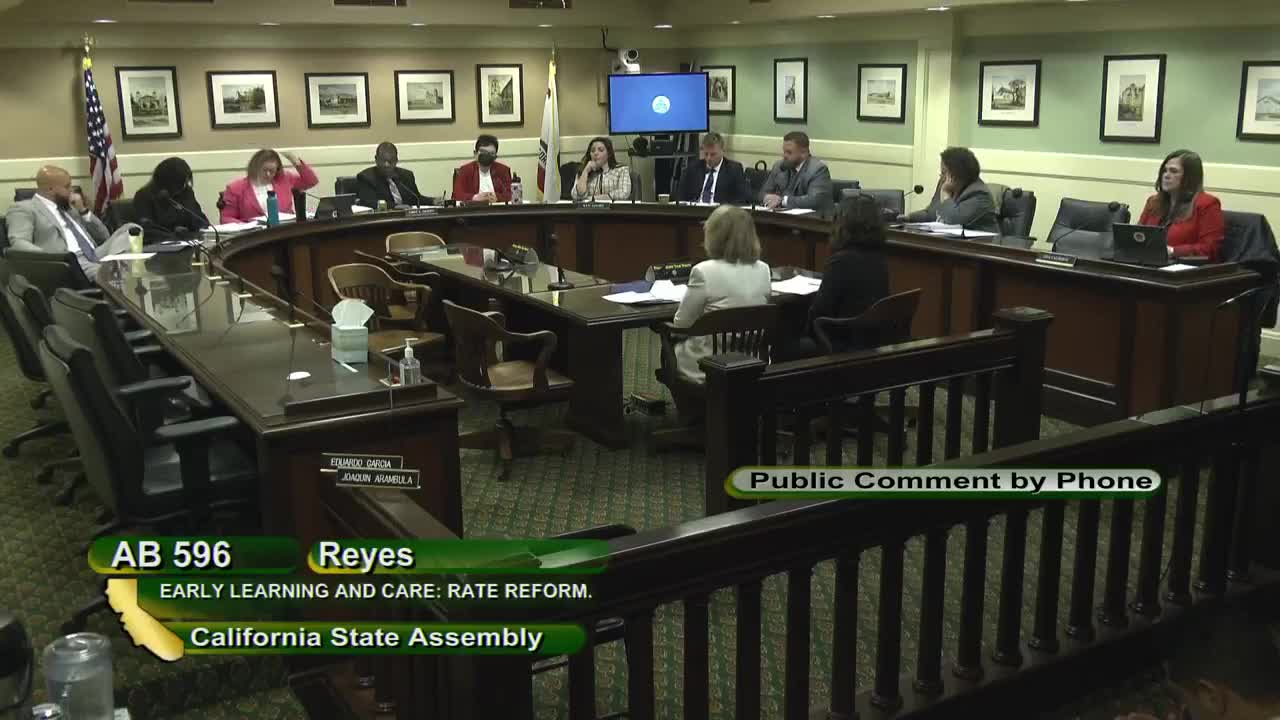 10MIN
Assembly Standing Committee on Human Services
Bill Author

Bill Co-Author(s):