AB 723: Pupil placement: special education: foster children: nonpublic, nonsectarian schools or agencies: school of origin.
- Session Year: 2023-2024
- House: Assembly
- Latest Version Date: 2023-10-13
Current Status:
Passed
(2023-10-13: Chaptered by Secretary of State - Chapter 812, Statutes of 2023.)
Introduced
In Committee
First Chamber
In Committee
Second Chamber
Enacted
Existing law requires a local educational agency serving a foster child to allow the foster child to remain at the childs school of origin upon the initial detention or placement, any subsequent change in placement, the termination of the courts jurisdiction, or pending resolution of a dispute regarding school of origin placement, as provided. Existing law defines school of origin as the school that the foster child attended when permanently housed or the school in which the foster child was last enrolled, except as specified.
Existing law sets forth a method for providing special education and related services to pupils who are individuals with exceptional needs, as defined. Existing law permits, under certain circumstances, contracts to be entered into for the provision of those services by nonpublic, nonsectarian schools or agencies, as defined. Existing law authorizes a master contract for special education and related services provided by a nonpublic, nonsectarian school or agency only if the school or agency has been certified as meeting specified standards. Existing law sets forth the certification process and procedures for the nonpublic, nonsectarian schools or agencies that seek certification from the Superintendent of Public Instruction.
This bill would, for a foster child who is an individual with exceptional needs, define school of origin as also including a placement in a certified nonpublic, nonsectarian school, as provided. The bill would require, commencing with the 202425 school year, a nonpublic, nonsectarian school or agency seeking certification or already certified to agree in writing, for any foster child it serves, to be designated as the school of origin of the foster child and to allow the foster child to continue their education in the school, as specified.
This bill would incorporate additional changes to Section 48853.5 of the Education Code proposed by AB 373 to be operative only if this bill and AB 373 are enacted and this bill is enacted last.
Existing law requires a local educational agency serving a foster child to allow the foster child to remain at the childs school of origin upon the initial detention or placement, any subsequent change in placement, or the termination of the courts jurisdiction, or pending resolution of a dispute regarding school of origin placement, as provided. Existing law defines school of origin as the school that the foster child attended when permanently housed or the school in which the foster child was last enrolled, except as specified.
Existing law sets forth a method for providing special education and related services to pupils who are individuals with exceptional needs, as defined. Existing law permits, under certain circumstances, contracts to be entered into for the provision of those services by nonpublic, nonsectarian schools or agencies, as defined. Existing law authorizes a master contract for special education and related services provided by a nonpublic, nonsectarian school or agency only if the school or agency has been certified as meeting specified standards. Existing law sets forth the certification process and procedures for the nonpublic, nonsectarian schools or agencies that seek certification from the Superintendent of Public Instruction.
This bill would, for a foster child who is an individual with exceptional needs, define school of origin as also including a placement in a certified nonpublic, nonsectarian school. school, as provided. The bill would require, commencing with the 202425 school year, a nonpublic, nonsectarian school or agency seeking certification or already certified to agree in writing, for any foster child it serves, to be designated as the school of origin of the foster child and to allow the foster child to continue their education in the school, as specified.
This bill would incorporate additional changes to Section 48853.5 of the Education Code proposed by AB 373 to be operative only if this bill and AB 373 are enacted and this bill is enacted last.
Existing law requires a local educational agency serving a foster child to allow the foster child to remain at the childs school of origin upon the initial detention or placement, any subsequent change in placement, or the termination of the courts jurisdiction, or pending resolution of a dispute regarding school of origin placement, as provided. Existing law defines school of origin as the school that the foster child attended when permanently housed or the school in which the foster child was last enrolled, except as specified.
Existing law sets forth a method for providing special education and related services to pupils who are individuals with exceptional needs, as defined. Existing law permits, under certain circumstances, contracts to be entered into for the provision of those services by nonpublic, nonsectarian schools or agencies, as defined. Existing law authorizes a master contract for special education and related services provided by a nonpublic, nonsectarian school or agency only if the school or agency has been certified as meeting specified standards. Existing law sets forth the certification process and procedures for the nonpublic, nonsectarian schools or agencies that seek certification from the Superintendent of Public Instruction.
This bill would, for a foster child who is an individual with exceptional needs, define school of origin as also including a certified nonpublic, nonsectarian school. The bill would require, commencing with the 202425 school year, a nonpublic, nonsectarian school or agency seeking certification or already certified to agree in writing, for any foster child it serves, to be designated as the school of origin of the foster child and to allow the foster child to continue their education in the school, as specified.
(a)This section applies to a foster child. Foster child means any of the following:
(1)A child who has been removed from their home pursuant to Section 309 of the Welfare and Institutions Code.
(2)A child who is the subject of a petition filed under Section 300 or 602 of the Welfare and Institutions Code, whether or not the child has been removed from their home.
(3)A dependent child of the court of an Indian tribe, consortium of tribes, or tribal organization who is the subject of a petition filed in the tribal court pursuant to the tribal courts jurisdiction in accordance with the tribes law.
(4)A child who is the subject of a voluntary placement agreement, as defined in subdivision (p) of Section 11400 of the Welfare and Institutions Code.
(b)The department, in consultation with the California Foster Youth Education Task Force, shall develop a standardized notice of the educational rights of foster children, as specified in Sections 48850 to this section, inclusive, and Sections 48911, 48915.5, 49069.5, 49076, 51225.1, and 51225.2. The notice shall include complaint process information, as applicable. The department shall make the notice available to educational liaisons for foster children for dissemination by posting the notice on its internet website. Any version of this notice prepared for use by foster children shall also include, to the greatest extent practicable, the rights established pursuant to Section 16001.9 of the Welfare and Institutions Code. In developing the notice that includes the rights in Section 16001.9 of the Welfare and Institutions Code, the department shall consult with the Office of the State Foster Care Ombudsperson.
(c)Each local educational agency shall designate a staff person as the educational liaison for foster children. In a school district that operates a foster children services program pursuant to Chapter 11.3 (commencing with Section 42920) of Part 24 of Division 3, the educational liaison shall be affiliated with the local foster children services program. The educational liaison shall do both of the following:
(1)Ensure and facilitate the proper educational placement, enrollment in school, and checkout from school of foster children.
(2)Assist foster children when transferring from one school to another school or from one school district to another school district in ensuring proper transfer of credits, records, and grades.
(d)A foster childs educational rights holder, attorney, and county social worker and an Indian childs, as defined in Section 224.1 of the Welfare and Institutions Code, tribal social worker and, if applicable, county social worker shall have the same rights a parent or guardian of a child has to receive a suspension notice, expulsion notice, manifestation determination notice, involuntary transfer notice, and other documents and related information.
(e)This section does not grant authority to the educational liaison that supersedes the authority granted under state and federal law to a parent or legal guardian retaining educational rights, a responsible adult appointed by the court to represent the child pursuant to Section 361 or 726 of the Welfare and Institutions Code, a surrogate parent, or a foster parent exercising the authority granted under Section 56055. The role of the educational liaison is advisory with respect to placement decisions and determination of the school of origin.
(f)(1)At the initial detention or placement, or any subsequent change in placement of a foster child, the local educational agency serving the foster child shall allow the foster child to continue the foster childs education in the school of origin for the duration of the jurisdiction of the court.
(2)If the jurisdiction of the court is terminated before the end of an academic year, the local educational agency shall allow a former foster child who is in kindergarten or any of grades 1 to 8, inclusive, to continue the former foster childs education in the school of origin through the duration of the academic school year.
(3)(A)If the jurisdiction of the court is terminated while a foster child is in high school, the local educational agency shall allow the former foster child to continue the former foster childs education in the school of origin through graduation.
(B)For purposes of this paragraph, a school district is not required to provide transportation to a former foster child who has an individualized education program that does not require transportation as a related service and who changes residence but remains in the former foster childs school of origin pursuant to this paragraph, unless the individualized education program team determines that transportation is a necessary related service.
(4)To ensure that the foster child has the benefit of matriculating with the foster childs peers in accordance with the established feeder patterns of school districts, if the foster child is transitioning between school grade levels, the local educational agency shall allow the foster child to continue in the school district of origin in the same attendance area, or, if the foster child is transitioning to a middle school or high school, and the school designated for matriculation is in another school district, to the school designated for matriculation in that school district.
(5)(A)Paragraphs (2), (3), and (4) do not require a school district to provide transportation services to allow a foster child to attend a school or school district, unless there is an agreement with a local child welfare agency that the school district assumes part or all of the transportation costs in accordance with Section 6312(c)(5) of Title 20 of the United States Code, or unless otherwise required under federal law. This paragraph does not prohibit a school district from, at its discretion, providing transportation services to allow a foster child to attend a school or school district.
(B)In accordance with Section 6312(c)(5) of Title 20 of the United States Code, local educational agencies shall collaborate with local child welfare agencies to develop and implement clear written procedures to address the transportation needs of foster youth to maintain them in their school of origin, when it is in the best interest of the foster youth.
(6)The educational liaison, in consultation with, and with the agreement of, the foster child and the person holding the right to make educational decisions for the foster child, may recommend, in accordance with the foster childs best interests, that the foster childs right to attend the school of origin be waived and the foster child be enrolled in a public school that pupils living in the attendance area in which the foster child resides are eligible to attend.
(7)Before making a recommendation to move a foster child from the foster childs school of origin, the educational liaison shall provide the foster child and the person holding the right to make educational decisions for the foster child with a written explanation stating the basis for the recommendation and how the recommendation serves the foster childs best interests.
(8)(A)If the educational liaison, in consultation with the foster child and the person holding the right to make educational decisions for the foster child, agrees that the best interests of the foster child would best be served by the foster childs transfer to a school other than the school of origin, the foster child shall immediately be enrolled in the new school.
(B)The new school shall immediately enroll the foster child even if the foster child has outstanding fees, fines, textbooks, or other items or moneys due to the school last attended or is unable to produce clothing or records normally required for enrollment, such as previous academic records, medical records, including, but not limited to, records or other proof of immunization history pursuant to Chapter 1 (commencing with Section 120325) of Part 2 of Division 105 of the Health and Safety Code, proof of residency, other documentation, or school uniforms.
(C)Within two business days of the foster childs request for enrollment, the educational liaison for the new school shall contact the school last attended by the foster child to obtain all academic and other records. The last school attended by the foster child shall provide all required records to the new school regardless of any outstanding fees, fines, textbooks, or other items or moneys owed to the school last attended. The educational liaison for the school last attended shall provide all records to the new school within two business days of receiving the request.
(9)If a dispute arises regarding the request of a foster child to remain in the school of origin, the foster child has the right to remain in the school of origin pending resolution of the dispute. The dispute shall be resolved in accordance with the existing dispute resolution process available to a pupil served by the local educational agency.
(10)The local educational agency and the county placing agency are encouraged to collaborate to ensure maximum use of available federal moneys, explore public-private partnerships, and access any other funding sources to promote the well-being of foster children through educational stability.
(11)It is the intent of the Legislature that this subdivision shall not supersede or exceed other laws governing special education services for eligible foster children.
(g)(1)For purposes of this section, school of origin means the school that the foster child attended when permanently housed or the school in which the foster child was last enrolled. If the school the foster child attended when permanently housed is different from the school in which the foster child was last enrolled, or if there is some other school that the foster child attended with which the foster child is connected and that the foster child attended within the immediately preceding 15 months, the educational liaison, in consultation with, and with the agreement of, the foster child and the person holding the right to make educational decisions for the foster child, shall determine, in the best interests of the foster child, the school that shall be deemed the school of origin.
(2)For a foster child who is an individual with exceptional needs as defined in Section 56026, school as used in the definition of school of origin in paragraph (1) includes a placement in a nonpublic, nonsectarian school as defined in Section 56034, subject to the requirements of Section 56325.
(h)This section does not supersede other law governing the educational placements in juvenile court schools, as described in Section 48645.1, by the juvenile court under Section 602 of the Welfare and Institutions Code.
(i)(1)A complaint of noncompliance with the requirements of this section may be filed with the local educational agency under the Uniform Complaint Procedures set forth in Chapter 5.1 (commencing with Section 4600) of Division 1 of Title 5 of the California Code of Regulations.
(2)A complainant not satisfied with the decision of a local educational agency may appeal the decision to the department pursuant to Chapter 5.1 (commencing with Section 4600) of Division 1 of Title 5 of the California Code of Regulations and shall receive a written decision regarding the appeal within 60 days of the departments receipt of the appeal.
(3)If a local educational agency finds merit in a complaint, or if the Superintendent finds merit in an appeal, the local educational agency shall provide a remedy to the affected pupil.
(4)Information regarding the requirements of this section shall be included in the annual notification distributed to, among others, pupils, parents or guardians of pupils, employees, and other interested parties pursuant to Section 4622 of Title 5 of the California Code of Regulations.
SEC. 1.5.Section 48853.5 of the Education Code is amended to read:48853.5.(a)This section applies to a foster child. Foster child means any of the following:
(1)A child who has been removed from their home pursuant to Section 309 of the Welfare and Institutions Code.
(2)A child who is the subject of a petition filed under Section 300 or 602 of the Welfare and Institutions Code, whether or not the child has been removed from their home.
(3)A dependent child of the court of an Indian tribe, consortium of tribes, or tribal organization who is the subject of a petition filed in the tribal court pursuant to the tribal courts jurisdiction in accordance with the tribes law.
(4)A child who is the subject of a voluntary placement agreement, as defined in subdivision (p) of Section 11400 of the Welfare and Institutions Code.
(b)The department, in consultation with the California Foster Youth Education Task Force, shall develop a standardized notice of the educational rights of foster children, as specified in Sections 48850 to this section, inclusive, and Sections 48911, 48915.5, 49069.5, 49076, 51225.1, and 51225.2. The notice shall include complaint process information, as applicable. The department shall make the notice available to educational liaisons for foster children for dissemination by posting the notice on its internet website. Any version of this notice prepared for use by foster children shall also include, to the greatest extent practicable, the rights established pursuant to Section 16001.9 of the Welfare and Institutions Code. In developing the notice that includes the rights in Section 16001.9 of the Welfare and Institutions Code, the department shall consult with the Office of the State Foster Care Ombudsperson.
(c)Each local educational agency shall designate a staff person as the educational liaison for foster children. In a school district that operates a foster children services program pursuant to Chapter 11.3 (commencing with Section 42920) of Part 24 of Division 3, the educational liaison shall be affiliated with the local foster children services program. The educational liaison shall do both of the following:
(1)Ensure and facilitate the proper educational placement, enrollment in school, and checkout from school of foster children.
(2)Assist foster children when transferring from one school to another school or from one school district to another school district in ensuring proper transfer of credits, records, and grades.
(d)A foster childs educational rights holder, attorney, and county social worker and an Indian childs, as defined in Section 224.1 of the Welfare and Institutions Code, tribal social worker and, if applicable, county social worker shall have the same rights a parent or guardian of a child has to receive a suspension notice, expulsion notice, manifestation determination notice, involuntary transfer notice, and other documents and related information.
(e)This section does not grant authority to the educational liaison that supersedes the authority granted under state and federal law to a parent or legal guardian retaining educational rights, a responsible adult appointed by the court to represent the child pursuant to Section 361 or 726 of the Welfare and Institutions Code, a surrogate parent, or a foster parent exercising the authority granted under Section 56055. The role of the educational liaison is advisory with respect to placement decisions and determination of the school of origin.
(f)(1)At the initial detention or placement, or any subsequent change in placement of a foster child, the local educational agency serving the foster child shall allow the foster child to continue the foster childs education in the school of origin for the duration of the jurisdiction of the court.
(2)If the jurisdiction of the court is terminated before the end of an academic year, the local educational agency shall allow a former foster child who is in kindergarten or any of grades 1 to 8, inclusive, to continue the former foster childs education in the school of origin through the duration of the academic school year.
(3)(A)If the jurisdiction of the court is terminated while a foster child is in high school, the local educational agency shall allow the former foster child to continue the former foster childs education in the school of origin through graduation.
(B)For purposes of this paragraph, a school district is not required to provide transportation to a former foster child who has an individualized education program that does not require transportation as a related service and who changes residence but remains in the former foster childs school of origin pursuant to this paragraph, unless the individualized education program team determines that transportation is a necessary related service.
(4)To ensure that the foster child has the benefit of matriculating with the foster childs peers in accordance with the established feeder patterns of school districts, if the foster child is transitioning between school grade levels, the local educational agency shall allow the foster child to continue in the school district of origin in the same attendance area, or, if the foster child is transitioning to a middle school or high school, and the school designated for matriculation is in another school district, to the school designated for matriculation in that school district.
(5)(A)Paragraphs (2), (3), and (4) do not require a school district to provide transportation services to allow a foster child to attend a school or school district, unless there is an agreement with a local child welfare agency that the school district assumes part or all of the transportation costs in accordance with Section 6312(c)(5) of Title 20 of the United States Code, or unless otherwise required under federal law. This paragraph does not prohibit a school district from, at its discretion, providing transportation services to allow a foster child to attend a school or school district.
(B)In accordance with Section 6312(c)(5) of Title 20 of the United States Code, local educational agencies shall collaborate with local child welfare agencies to develop and implement clear written procedures to address the transportation needs of foster youth to maintain them in their school of origin, when it is in the best interest of the foster youth.
(6)The educational liaison, in consultation with, and with the agreement of, the foster child and the person holding the right to make educational decisions for the foster child, may recommend, in accordance with the foster childs best interests, that the foster childs right to attend the school of origin be waived and the foster child be enrolled in a public school that pupils living in the attendance area in which the foster child resides are eligible to attend.
(7)Before making a recommendation to move a foster child from the foster childs school of origin, the educational liaison shall provide the foster child and the person holding the right to make educational decisions for the foster child with a written explanation stating the basis for the recommendation and how the recommendation serves the foster childs best interests.
(8)(A)If the educational liaison, in consultation with the foster child and the person holding the right to make educational decisions for the foster child, agrees that the best interests of the foster child would best be served by the foster childs transfer to a school other than the school of origin, the foster child shall immediately be enrolled in the new school.
(B)The new school shall immediately enroll the foster child even if the foster child has outstanding fees, fines, textbooks, or other items or moneys due to the school last attended or is unable to produce clothing or records normally required for enrollment, such as previous academic records, medical records, including, but not limited to, records or other proof of immunization history pursuant to Chapter 1 (commencing with Section 120325) of Part 2 of Division 105 of the Health and Safety Code, proof of residency, other documentation, or school uniforms.
(C)Within two business days of the foster childs request for enrollment, the educational liaison for the new school shall contact the school last attended by the foster child to obtain all academic and other records. The last school attended by the foster child shall provide all required records to the new school regardless of any outstanding fees, fines, textbooks, or other items or moneys owed to the school last attended. The educational liaison for the school last attended shall provide all records to the new school within two business days of receiving the request.
(9)If a dispute arises regarding the request of a foster child to remain in the school of origin, the foster child has the right to remain in the school of origin pending resolution of the dispute. The dispute shall be resolved in accordance with the existing dispute resolution process available to a pupil served by the local educational agency.
(10)The local educational agency and the county placing agency are encouraged to collaborate to ensure maximum use of available federal moneys, explore public-private partnerships, and access any other funding sources to promote the well-being of foster children through educational stability.
(11)(A)If a local educational agency operates an intersession program, the local educational agency shall grant priority access to a foster child.
(B)Notwithstanding any other law, if the foster child will be moving during an intersession period, the pupils educational rights holder, or Indian custodian in the case of an Indian child, shall determine which school the pupil attends for the intersession period, if applicable.
(12)It is the intent of the Legislature that this subdivision shall not supersede or exceed other laws governing special education services for eligible foster children.
(g)For purposes of this section, the following definitions shall apply:
(1)Indian custodian as it is defined in Section 1903 of Title 25 of the United States Code.
(2)(A)Intersession program means an expanded learning program offered by a local educational agency on nonschooldays, including, but not limited to, summer school.
(B)An intersession program does not include an extended school year program for individuals with exceptional needs established pursuant to Section 3043 of Title 5 of the California Code of Regulations and Section 300.106 of Title 34 of the Code of Federal Regulations.
(3)(A)School of origin means the school that the foster child attended when permanently housed or the school in which the foster child was last enrolled. If the school the foster child attended when permanently housed is different from the school in which the foster child was last enrolled, or if there is some other school that the foster child attended with which the foster child is connected and that the foster child attended within the immediately preceding 15 months, the educational liaison, in consultation with, and with the agreement of, the foster child and the person holding the right to make educational decisions for the foster child, shall determine, in the best interests of the foster child, the school that shall be deemed the school of origin.
(B)For a foster child who is an individual with exceptional needs as defined in Section 56026, school as used in the definition of school of origin in subparagraph (A) includes a placement in a nonpublic, nonsectarian school as defined in Section 56034, subject to the requirements of Section 56325.
(h)This section does not supersede other law governing the educational placements in juvenile court schools, as described in Section 48645.1, by the juvenile court under Section 602 of the Welfare and Institutions Code.
(i)(1)A complaint of noncompliance with the requirements of this section may be filed with the local educational agency under the Uniform Complaint Procedures set forth in Chapter 5.1 (commencing with Section 4600) of Division 1 of Title 5 of the California Code of Regulations.
(2)A complainant not satisfied with the decision of a local educational agency may appeal the decision to the department pursuant to Chapter 5.1 (commencing with Section 4600) of Division 1 of Title 5 of the California Code of Regulations and shall receive a written decision regarding the appeal within 60 days of the departments receipt of the appeal.
(3)If a local educational agency finds merit in a complaint, or if the Superintendent finds merit in an appeal, the local educational agency shall provide a remedy to the affected pupil.
(4)Information regarding the requirements of this section shall be included in the annual notification distributed to, among others, pupils, parents or guardians of pupils, employees, and other interested parties pursuant to Section 4622 of Title 5 of the California Code of Regulations.
SEC. 2.Section 56366.1 of the Education Code is amended to read:56366.1.(a)A nonpublic, nonsectarian school or agency that seeks certification shall file an application with the Superintendent on forms provided by the department, and shall include all of the following information on the application:
(1)A description of the special education and designated instruction and services provided to individuals with exceptional needs if the application is for nonpublic, nonsectarian school certification.
(2)A description of the designated instruction and services provided to individuals with exceptional needs if the application is for nonpublic, nonsectarian agency certification.
(3)A list of appropriately qualified staff, a description of the credential, license, or registration that qualifies each staff member rendering special education or designated instruction and services to do so, and copies of their credentials, licenses, or certificates of registration with the appropriate state or national organization that has established standards for the service rendered.
(4)(A)(i)Commencing with the 202021 school year, documentation that the nonpublic, nonsectarian school or agency will train staff who will have contact or interaction with pupils during the schoolday in the use of evidence-based practices and interventions specific to the unique behavioral needs of the nonpublic, nonsectarian school or agencys pupil population. The training shall be provided within 30 days of employment to new staff who have any contact or interaction with pupils during the schoolday, and annually to all staff who have any contact or interaction with pupils during the schoolday.
(ii)For a nonpublic, nonsectarian school or agency that was in existence as of the January 1 immediately preceding a school year, documentation that the nonpublic, nonsectarian school or agencys staff members who will have contact or interaction with pupils during the schoolday have received training that complies with the requirements of subparagraphs (B) and (C).
(B)The training described in this paragraph shall be selected and conducted by the nonpublic, nonsectarian school or agency and shall satisfy all of the following conditions:
(i)Be conducted by persons licensed or certified in fields related to the evidence-based practices and interventions being taught.
(ii)Be taught in a manner consistent with the development and implementation of individualized education programs.
(iii)Be consistent with the requirements of Article 5.2 (commencing with Section 49005) of Chapter 6 of Part 27, relating to pupil discipline.
(C)The content of the training described in this paragraph shall include, but is not limited to, all of the following:
(i)Positive behavioral intervention and supports, including collection, analysis, and use of data to inform, plan, and implement behavioral supports.
(ii)How to understand and address challenging behaviors, including evidence-based strategies for preventing those behaviors.
(iii)Evidence-based interventions for reducing and replacing challenging behaviors, including deescalation techniques.
(D)(i)The contracting local educational agency shall verify the nonpublic, nonsectarian school or agencys compliance with the requirements of this paragraph, and the nonpublic, nonsectarian school or agency shall report the contracting local educational agencys verification to the Superintendent annually with the annual certification documents described in subdivision (h).
(ii)For a nonpublic, nonsectarian school or agency seeking initial certification, the contracting local educational agency shall verify that the plan and timeline for training provided pursuant to this paragraph are included in the master contract.
(iii)For a nonpublic, nonsectarian school or agency not in existence as of the January 1 immediately preceding a school year, the contracting local educational agency shall, 30 days following the commencement of the school year, verify that the nonpublic, nonsectarian school or agency provided the training required by this paragraph, and shall submit the verification to the Superintendent at that time.
(iv)The nonpublic, nonsectarian school or agency shall maintain written records of the training provided pursuant to this paragraph, and shall provide written verification of the training upon request.
(5)Commencing with the 202122 school year, documentation that the administrator of the nonpublic, nonsectarian school holds or is in the process of obtaining one of the following:
(A)An administrative credential granted by an accredited postsecondary educational institution and two years of experience with pupils with disabilities.
(B)A pupil personnel services credential that authorizes school counseling or psychology.
(C)A license as a clinical social worker issued by the Board of Behavioral Sciences.
(D)A license in psychology regulated by the Board of Psychology.
(E)A masters degree issued by an accredited postsecondary institution in education, special education, psychology, counseling, behavioral analysis, social work, behavioral science, or rehabilitation.
(F)A credential authorizing special education instruction and at least two years of experience teaching in special education before becoming an administrator.
(G)A license as a marriage and family therapist certified by the Board of Behavioral Sciences.
(H)A license as an educational psychologist issued by the Board of Behavioral Sciences.
(I)A license as a professional clinical counselor issued by the Board of Behavioral Sciences.
(6)An annual operating budget.
(7)Affidavits and assurances necessary to comply with all applicable federal, state, and local laws and regulations that include criminal record summaries required of all nonpublic, nonsectarian school or agency personnel having contact with minor children under Section 44237.
(8)Commencing with the 202425 school year, a nonpublic nonsectarian school shall include assurances that for any pupil served by the school who is a foster child as defined in subdivision (a) of Section 48853.5, the school agrees to do both of the following:
(A)Serve as the school of origin of the foster child, as applicable pursuant to subdivision (g) of Section 48853.5.
(B)Allow the foster child to continue their education in the school, as applicable pursuant to subdivisions (f) and (g) of Section 48853.5.
(b)(1)The applicant shall provide the special education local plan area in which the applicant is located with the written notification of its intent to seek certification or renewal of its certification. The local educational agency representatives shall acknowledge that they have been notified of the intent to certify or renew certification. The acknowledgment shall include a statement that representatives of the local educational agency for the area in which the applicant is located have had the opportunity to review the application at least 60 calendar days before submission of an initial application to the Superintendent, or at least 30 calendar days before submission of a renewal application to the Superintendent. The acknowledgment shall provide assurances that local educational agency representatives have had the opportunity to provide input on all required components of the application.
(2)If the local educational agency has not acknowledged an applicants intent to be certified 60 calendar days from the date of submission for initial applications or 30 calendar days from the date of the return receipt for renewal applications, the applicant may file the application with the Superintendent.
(3)The department shall provide electronic notification of the availability of renewal application materials to certified nonpublic, nonsectarian schools and agencies at least 120 days before the date their current certification expires.
(c)If the applicant operates a facility or program on more than one site, each site shall be certified.
(d)If the applicant is part of a larger program or facility on the same site, the Superintendent shall consider the effect of the total program on the applicant. A copy of the policies and standards for the nonpublic, nonsectarian school or agency and the larger program shall be available to the Superintendent.
(e)(1)Before certification, the Superintendent shall conduct an onsite review of the facility and program for which the applicant seeks certification. The Superintendent may be assisted by representatives of the special education local plan area in which the applicant is located and a nonpublic, nonsectarian school or agency representative who does not have a conflict of interest with the applicant. The Superintendent shall conduct an additional onsite review of the facility and program within three years of the effective date of the certification, unless the Superintendent conditionally certifies the nonpublic, nonsectarian school or agency, or unless the Superintendent receives a formal complaint against the nonpublic, nonsectarian school or agency. In the latter two cases, the Superintendent shall conduct an onsite review at least annually.
(2)In carrying out this subdivision, the Superintendent may verify that the nonpublic, nonsectarian school or agency has received a successful criminal background check clearance and has enrolled in subsequent arrest notice service, pursuant to Section 44237, for each owner, operator, and employee of the nonpublic, nonsectarian school or agency.
(3)Commencing with the 202021 school year, a local educational agency that enters into a master contract with a nonpublic, nonsectarian school shall conduct, at minimum, both of the following:
(A)An onsite visit to the nonpublic, nonsectarian school before placement of a pupil if the local educational agency does not have any pupils enrolled at the school at the time of placement.
(B)At least one onsite monitoring visit during each school year to the nonpublic, nonsectarian school at which the local educational agency has a pupil attending and with which it maintains a master contract. The monitoring visit shall include, but is not limited to, a review of services provided to the pupil through the individual service agreement between the local educational agency and the nonpublic, nonsectarian school, a review of progress the pupil is making toward the goals set forth in the pupils individualized education program, a review of progress the pupil is making toward the goals set forth in the pupils behavioral intervention plan, if applicable, an observation of the pupil during instruction, and a walkthrough of the facility. The local educational agency shall report the findings resulting from the monitoring visit to the department within 60 calendar days of the onsite visit. On or before June 30, 2020, the department shall, with input from special education local plan area administrators, create and publish criteria for reporting this information to the department.
(f)The Superintendent shall make a determination on an application within 120 days of receipt of the application and shall certify, conditionally certify, or deny certification to the applicant. If the Superintendent fails to take one of these actions within 120 days, the applicant is automatically granted conditional certification for a period terminating on August 31 of the current school year. If certification is denied, the Superintendent shall provide reasons for the denial. The Superintendent shall not certify the nonpublic, nonsectarian school or agency for a period longer than one year.
(g)Certification becomes effective on the date the nonpublic, nonsectarian school or agency meets all the application requirements and is approved by the Superintendent. Certification may be retroactive if the nonpublic, nonsectarian school or agency met all the requirements of this section on the date the retroactive certification is effective. Certification expires on December 31 of the terminating year.
(h)The Superintendent annually shall review the certification of each nonpublic, nonsectarian school or agency. For this purpose, a certified nonpublic, nonsectarian school or agency annually shall update its application between August 1 and October 31, unless the state board grants a waiver pursuant to Section 56101. The Superintendent may conduct an onsite review as part of the annual review.
(i)(1)The Superintendent shall conduct an investigation of a nonpublic, nonsectarian school or agency onsite at any time without prior notice if there is substantial reason to believe that there is an immediate danger to the health, safety, or welfare of a child. The Superintendent shall document the concern and submit it to the nonpublic, nonsectarian school or agency at the time of the onsite investigation. The Superintendent shall require a written response to any noncompliance or deficiency found.
(2)A nonpublic, nonsectarian school or agency shall notify the department and the local educational agency with which it has a master contract of any pupil-involved incident at the school or agency in which law enforcement was contacted. This notification shall be provided in writing, no later than one business day after the incident occurred.
(3)With respect to a nonpublic, nonsectarian school or agency, the Superintendent shall conduct an investigation, which may include an unannounced onsite visit, if the Superintendent receives evidence of a significant deficiency in the quality of educational services provided, a violation of Section 56366.9, or noncompliance with the policies expressed by subdivision (b) of Section 1501 of the Health and Safety Code by the nonpublic, nonsectarian school or agency. The Superintendent shall document the complaint and the results of the investigation and shall provide copies of the documentation to the complainant, the nonpublic, nonsectarian school or agency, and the contracting local educational agency.
(4)Violations or noncompliance documented pursuant to paragraph (1) or (3) shall be reflected in the status of the certification of the nonpublic, nonsectarian school or agency, at the discretion of the Superintendent, pending an approved plan of correction by the nonpublic, nonsectarian school or agency. The department shall retain for a period of 10 years all violations pertaining to certification of the nonpublic, nonsectarian school or agency.
(5)In carrying out this subdivision, the Superintendent may verify that the nonpublic, nonsectarian school or agency received a successful criminal background check clearance and has enrolled in subsequent arrest notice service, pursuant to Section 44237, for each owner, operator, and employee of the nonpublic, nonsectarian school or agency.
(j)The Superintendent shall monitor the facilities, the educational environment, and the quality of the educational program, including the teaching staff, the credentials authorizing service, the standards-based core curriculum being employed, and the standards-focused instructional materials used, of an existing certified nonpublic, nonsectarian school or agency on a three-year cycle, as follows:
(1)The nonpublic, nonsectarian school or agency shall complete a self-review in year one.
(2)The Superintendent shall conduct an onsite review of the nonpublic, nonsectarian school or agency in year two.
(3)The Superintendent shall conduct a followup visit to the nonpublic, nonsectarian school or agency in year three.
(k)(1)Notwithstanding any other law, the Superintendent shall not certify a nonpublic, nonsectarian school or agency that proposes to initiate or expand services to pupils currently educated in the immediate prior fiscal year in a juvenile court program, community school pursuant to Section 56150, or other nonspecial education program, including independent study or adult school, or both, unless the nonpublic, nonsectarian school or agency notifies the county superintendent of schools and the special education local plan area in which the proposed new or expanded nonpublic, nonsectarian school or agency is located of its intent to seek certification.
(2)The notification shall occur no later than the December 1 before the new fiscal year in which the proposed or expanding school or agency intends to initiate services. The notice shall include the following:
(A)The specific date upon which the proposed nonpublic, nonsectarian school or agency is to be established.
(B)The location of the proposed program or facility.
(C)The number of pupils proposed for services, the number of pupils currently served in the juvenile court, community school, or other nonspecial education program, the current school services including special education and related services provided for these pupils, and the specific program of special education and related services to be provided under the proposed program.
(D)The reason for the proposed change in services.
(E)The number of staff who will provide special education and designated instruction and services and hold a current valid California credential or license in the service rendered.
(3)In addition to the requirements in subdivisions (a) to (f), inclusive, the Superintendent shall require and consider the following in determining whether to certify a nonpublic, nonsectarian school or agency as described in this subdivision:
(A)A complete statement of the information required as part of the notice under paragraph (1).
(B)Documentation of the steps taken in preparation for the conversion to a nonpublic, nonsectarian school or agency, including information related to changes in the population to be served and the services to be provided pursuant to each pupils individualized education program.
(4)Notwithstanding any other law, the certification becomes effective no earlier than July 1 if the nonpublic, nonsectarian school or agency provided the notification required pursuant to paragraph (1).
(l)(1)Notwithstanding any other law, the Superintendent shall not certify or renew the certification of a nonpublic, nonsectarian school that also operates a licensed childrens institution, unless all of the following conditions are met:
(A)The entity operating the nonpublic, nonsectarian school maintains separate financial records for each entity that it operates, with each nonpublic, nonsectarian school identified separately from any licensed childrens institution that it operates.
(B)The entity submits an annual budget that identifies the projected costs and revenues for each entity and demonstrates that the rates to be charged are reasonable to support the operation of the entity.
(C)The entity submits an entitywide annual audit that identifies its costs and revenues, by entity, in accordance with generally accepted accounting and auditing principles. The audit shall clearly document the amount of moneys received and expended on the educational program provided by the nonpublic, nonsectarian school.
(D)The relationship between various entities operated by the same entity are documented, defining the responsibilities of the entities. The documentation shall clearly identify the services to be provided as part of each program, for example, the residential or medical program, the mental health program, or the educational program. The entity shall not seek funding from a public agency for a service, either separately or as part of a package of services, if the service is funded by another public agency, either separately or as part of a package of services.
(2)For purposes of this section, licensed childrens institution has the same meaning as it is defined by Section 56155.5.
(m)(1)The nonpublic, nonsectarian school or agency shall be charged a reasonable fee for certification. The Superintendent may adjust the fee annually commensurate with the statewide average percentage inflation adjustment computed for local control funding formula allocations pursuant to Section 42238.02, as implemented by Section 42238.03, of unified school districts with greater than 1,500 units of average daily attendance if the percentage increase is reflected in the school district local control funding formula allocation pursuant to Section 42238.02, as implemented by Section 42238.03, for inflation purposes. For purposes of this section, the base fee shall be the following:
(1)15 pupils | $300 | |
(2)610 pupils | 500 | |
(3)1124 pupils | 1,000 | |
(4)2575 pupils | 1,500 | |
(5)76 pupils and over | 2,000 | |
(2)The nonpublic, nonsectarian school or agency shall pay this fee when it applies for certification and when it updates its application for annual renewal by the Superintendent. The Superintendent shall use these fees to conduct onsite reviews, which may include field experts. A fee shall not be refunded if the application is withdrawn or is denied by the Superintendent.
(n)(1)Notwithstanding any other law, only those nonpublic, nonsectarian schools or agencies that provide special education and designated instruction and services using administrators and staff who hold a certificate, permit, or other document equivalent to that which staff in a public school are required to hold in the service rendered are eligible to receive certification. Only those nonpublic, nonsectarian schools or agencies located outside of California that employ staff who hold a current valid credential or license to render special education and related services as required by that state shall be eligible to be certified. Commencing with the 202122 school year, this paragraph shall not apply to administrators.
(2)Commencing with the 202122 school year, notwithstanding any other law, only those nonpublic, nonsectarian schools or agencies that provide special education and related services using administrators who hold or are in the process of obtaining a credential, degree, or license in accordance with paragraph (5) of subdivision (a) are eligible to be certified.
(3)The state board shall develop regulations to implement this subdivision.
(o)In addition to meeting the standards adopted by the state board, a nonpublic, nonsectarian school or agency shall provide written assurances that it meets all applicable standards relating to fire, health, sanitation, and building safety.
(p)(1)Notwithstanding subdivision (n) of Section 44237, and for purposes of enabling the Superintendent to carry out the duties pursuant to this section, a nonpublic, nonsectarian school or agency shall, upon demand, make available to the Superintendent evidence of a successful criminal background check clearance and enrollment in subsequent arrest notice service, conducted pursuant to Section 44237, for each owner, operator, and employee of the nonpublic, nonsectarian school or agency.
(2)The nonpublic, nonsectarian school or agency shall retain the evidence and store it in a locked file separate from other files.
SEC. 3.Section 56366.10 of the Education Code is amended to read:56366.10.In addition to the certification requirements set forth in Sections 56366 and 56366.1, a nonpublic, nonsectarian school that provides special education and related services to an individual with exceptional needs shall certify in writing to the Superintendent that it meets all of the following requirements:
(a)It will not accept a pupil with exceptional needs if it cannot provide or ensure the provision of the services outlined in the pupils individualized education program.
(b)Pupils have access to the following educational materials, services, and programs that are consistent with each pupils individualized education program:
(1)(A)For kindergarten and grades 1 to 8, inclusive, state-adopted, standards-based, core curriculum and instructional materials, including technology-based materials as defined in Section 60010.
(B)For grades 9 to 12, inclusive, standards-based, core curriculum and instructional materials, including technology-based materials as defined in Section 60010, used by any local educational agency that contracts with the nonpublic, nonsectarian school.
(2)College preparatory courses.
(3)Extracurricular activities, such as art, sports, music, and academic clubs.
(4)Career preparation and vocational training, consistent with transition plans pursuant to state and federal law.
(5)Supplemental assistance, including individual academic tutoring, psychological counseling, and career and college counseling.
(c)The teachers and staff provide academic instruction and support services to pupils with the goal of integrating pupils into the least restrictive environment pursuant to federal law.
(d)The school has and abides by a written policy for pupil discipline that is consistent with state and federal law and regulations.
(e)For a school serving pupils with significant behavioral needs or who are on behavioral intervention plans, the school has an individual onsite during school hours who is qualified, and responsible for the design, planning, and implementation of behavioral interventions, as authorized under Section 3051.23 of Title 5 of the California Code of Regulations.
(f)Commencing with the 202021 school year, the nonpublic, nonsectarian school provides annual training to all staff who have any contact or interaction with pupils during the schoolday. The training is also provided within 30 days of employment to new staff who have any contact or interaction with pupils during the schoolday. The nonpublic, nonsectarian school maintains written records of the training, and will provide written verification of the training upon request. The training shall comply with the requirements of subparagraphs (B) and (C) of paragraph (4) of subdivision (a) of Section 56366.1.
(g)Commencing with the 202425 school year, for any pupil served by the school who is a foster child as defined in subdivision (a) of Section 48853.5, the school agrees to do both of the following:
(1)Serve as the school of origin of the foster child, as applicable pursuant to subdivision (g) of Section 48853.5.
(2)Allow the foster child to continue their education in the school, as applicable pursuant to subdivisions (f) and (g) of Section 48853.5.
SEC. 4.Section 1.5 of this bill incorporates amendments to Section 48853.5 of the Education Code proposed by both this bill and Assembly Bill 373. That section of this bill shall only become operative if (1) both bills are enacted and become effective on or before January 1, 2024, (2) each bill amends Section 48853.5 of the Education Code, and (3) this bill is enacted after Assembly Bill 373, in which case Section 1 of this bill shall not become operative.
(a)This section applies to a foster child. Foster child means any of the following:
(1)A child who has been removed from their home pursuant to Section 309 of the Welfare and Institutions Code.
(2)A child who is the subject of a petition filed under Section 300 or 602 of the Welfare and Institutions Code, whether or not the child has been removed from their home.
(3)A dependent child of the court of an Indian tribe, consortium of tribes, or tribal organization who is the subject of a petition filed in the tribal court pursuant to the tribal courts jurisdiction in accordance with the tribes law.
(4)A child who is the subject of a voluntary placement agreement, as defined in subdivision (p) of Section 11400 of the Welfare and Institutions Code.
(b)The department, in consultation with the California Foster Youth Education Task Force, shall develop a standardized notice of the educational rights of foster children, as specified in Sections 48850 to this section, inclusive, and Sections 48911, 48915.5, 49069.5, 49076, 51225.1, and 51225.2. The notice shall include complaint process information, as applicable. The department shall make the notice available to educational liaisons for foster children for dissemination by posting the notice on its internet website. Any version of this notice prepared for use by foster children shall also include, to the greatest extent practicable, the rights established pursuant to Section 16001.9 of the Welfare and Institutions Code. In developing the notice that includes the rights in Section 16001.9 of the Welfare and Institutions Code, the department shall consult with the Office of the State Foster Care Ombudsperson.
(c)Each local educational agency shall designate a staff person as the educational liaison for foster children. In a school district that operates a foster children services program pursuant to Chapter 11.3 (commencing with Section 42920) of Part 24 of Division 3, the educational liaison shall be affiliated with the local foster children services program. The educational liaison shall do both of the following:
(1)Ensure and facilitate the proper educational placement, enrollment in school, and checkout from school of foster children.
(2)Assist foster children when transferring from one school to another school or from one school district to another school district in ensuring proper transfer of credits, records, and grades.
(d)A foster childs educational rights holder, attorney, and county social worker and an Indian childs, as defined in Section 224.1 of the Welfare and Institutions Code, tribal social worker and, if applicable, county social worker shall have the same rights a parent or guardian of a child has to receive a suspension notice, expulsion notice, manifestation determination notice, involuntary transfer notice, and other documents and related information.
(e)This section does not grant authority to the educational liaison that supersedes the authority granted under state and federal law to a parent or legal guardian retaining educational rights, a responsible adult appointed by the court to represent the child pursuant to Section 361 or 726 of the Welfare and Institutions Code, a surrogate parent, or a foster parent exercising the authority granted under Section 56055. The role of the educational liaison is advisory with respect to placement decisions and determination of the school of origin.
(f)(1)At the initial detention or placement, or any subsequent change in placement of a foster child, the local educational agency serving the foster child shall allow the foster child to continue the foster childs education in the school of origin for the duration of the jurisdiction of the court.
(2)If the jurisdiction of the court is terminated before the end of an academic year, the local educational agency shall allow a former foster child who is in kindergarten or any of grades 1 to 8, inclusive, to continue the former foster childs education in the school of origin through the duration of the academic school year.
(3)(A)If the jurisdiction of the court is terminated while a foster child is in high school, the local educational agency shall allow the former foster child to continue the former foster childs education in the school of origin through graduation.
(B)For purposes of this paragraph, a school district is not required to provide transportation to a former foster child who has an individualized education program that does not require transportation as a related service and who changes residence but remains in the former foster childs school of origin pursuant to this paragraph, unless the individualized education program team determines that transportation is a necessary related service.
(4)To ensure that the foster child has the benefit of matriculating with the foster childs peers in accordance with the established feeder patterns of school districts, if the foster child is transitioning between school grade levels, the local educational agency shall allow the foster child to continue in the school district of origin in the same attendance area, or, if the foster child is transitioning to a middle school or high school, and the school designated for matriculation is in another school district, to the school designated for matriculation in that school district.
(5)(A)Paragraphs (2), (3), and (4) do not require a school district to provide transportation services to allow a foster child to attend a school or school district, unless there is an agreement with a local child welfare agency that the school district assumes part or all of the transportation costs in accordance with Section 6312(c)(5) of Title 20 of the United States Code, or unless otherwise required under federal law. This paragraph does not prohibit a school district from, at its discretion, providing transportation services to allow a foster child to attend a school or school district.
(B)In accordance with Section 6312(c)(5) of Title 20 of the United States Code, local educational agencies shall collaborate with local child welfare agencies to develop and implement clear written procedures to address the transportation needs of foster youth to maintain them in their school of origin, when it is in the best interest of the foster youth.
(6)The educational liaison, in consultation with, and with the agreement of, the foster child and the person holding the right to make educational decisions for the foster child, may recommend, in accordance with the foster childs best interests, that the foster childs right to attend the school of origin be waived and the foster child be enrolled in a public school that pupils living in the attendance area in which the foster child resides are eligible to attend.
(7)Before making a recommendation to move a foster child from the foster childs school of origin, the educational liaison shall provide the foster child and the person holding the right to make educational decisions for the foster child with a written explanation stating the basis for the recommendation and how the recommendation serves the foster childs best interests.
(8)(A)If the educational liaison, in consultation with the foster child and the person holding the right to make educational decisions for the foster child, agrees that the best interests of the foster child would best be served by the foster childs transfer to a school other than the school of origin, the foster child shall immediately be enrolled in the new school.
(B)The new school shall immediately enroll the foster child even if the foster child has outstanding fees, fines, textbooks, or other items or moneys due to the school last attended or is unable to produce clothing or records normally required for enrollment, such as previous academic records, medical records, including, but not limited to, records or other proof of immunization history pursuant to Chapter 1 (commencing with Section 120325) of Part 2 of Division 105 of the Health and Safety Code, proof of residency, other documentation, or school uniforms.
(C)Within two business days of the foster childs request for enrollment, the educational liaison for the new school shall contact the school last attended by the foster child to obtain all academic and other records. The last school attended by the foster child shall provide all required records to the new school regardless of any outstanding fees, fines, textbooks, or other items or moneys owed to the school last attended. The educational liaison for the school last attended shall provide all records to the new school within two business days of receiving the request.
(9)If a dispute arises regarding the request of a foster child to remain in the school of origin, the foster child has the right to remain in the school of origin pending resolution of the dispute. The dispute shall be resolved in accordance with the existing dispute resolution process available to a pupil served by the local educational agency.
(10)The local educational agency and the county placing agency are encouraged to collaborate to ensure maximum use of available federal moneys, explore public-private partnerships, and access any other funding sources to promote the well-being of foster children through educational stability.
(11)It is the intent of the Legislature that this subdivision shall not supersede or exceed other laws governing special education services for eligible foster children.
(g)(1)For purposes of this section, school of origin means the school that the foster child attended when permanently housed or the school in which the foster child was last enrolled. If the school the foster child attended when permanently housed is different from the school in which the foster child was last enrolled, or if there is some other school that the foster child attended with which the foster child is connected and that the foster child attended within the immediately preceding 15 months, the educational liaison, in consultation with, and with the agreement of, the foster child and the person holding the right to make educational decisions for the foster child, shall determine, in the best interests of the foster child, the school that shall be deemed the school of origin.
(2)Notwithstanding any other law, for For a foster child who is an individual with exceptional needs as defined in Section 56026, school as used in the definition of school of origin in paragraph (1) includes a placement in a nonpublic, nonsectarian school as defined in Section 56034. 56034, subject to the requirements of Section 56325.
(h)This section does not supersede other law governing the educational placements in juvenile court schools, as described in Section 48645.1, by the juvenile court under Section 602 of the Welfare and Institutions Code.
(i)(1)A complaint of noncompliance with the requirements of this section may be filed with the local educational agency under the Uniform Complaint Procedures set forth in Chapter 5.1 (commencing with Section 4600) of Division 1 of Title 5 of the California Code of Regulations.
(2)A complainant not satisfied with the decision of a local educational agency may appeal the decision to the department pursuant to Chapter 5.1 (commencing with Section 4600) of Division 1 of Title 5 of the California Code of Regulations and shall receive a written decision regarding the appeal within 60 days of the departments receipt of the appeal.
(3)If a local educational agency finds merit in a complaint, or if the Superintendent finds merit in an appeal, the local educational agency shall provide a remedy to the affected pupil.
(4)Information regarding the requirements of this section shall be included in the annual notification distributed to, among others, pupils, parents or guardians of pupils, employees, and other interested parties pursuant to Section 4622 of Title 5 of the California Code of Regulations.
SEC. 1.5.Section 48853.5 of the Education Code is amended to read:48853.5.(a)This section applies to a foster child. Foster child means any of the following:
(1)A child who has been removed from their home pursuant to Section 309 of the Welfare and Institutions Code.
(2)A child who is the subject of a petition filed under Section 300 or 602 of the Welfare and Institutions Code, whether or not the child has been removed from their home.
(3)A dependent child of the court of an Indian tribe, consortium of tribes, or tribal organization who is the subject of a petition filed in the tribal court pursuant to the tribal courts jurisdiction in accordance with the tribes law.
(4)A child who is the subject of a voluntary placement agreement, as defined in subdivision (p) of Section 11400 of the Welfare and Institutions Code.
(b)The department, in consultation with the California Foster Youth Education Task Force, shall develop a standardized notice of the educational rights of foster children, as specified in Sections 48850 to this section, inclusive, and Sections 48911, 48915.5, 49069.5, 49076, 51225.1, and 51225.2. The notice shall include complaint process information, as applicable. The department shall make the notice available to educational liaisons for foster children for dissemination by posting the notice on its internet website. Any version of this notice prepared for use by foster children shall also include, to the greatest extent practicable, the rights established pursuant to Section 16001.9 of the Welfare and Institutions Code. In developing the notice that includes the rights in Section 16001.9 of the Welfare and Institutions Code, the department shall consult with the Office of the State Foster Care Ombudsperson.
(c)Each local educational agency shall designate a staff person as the educational liaison for foster children. In a school district that operates a foster children services program pursuant to Chapter 11.3 (commencing with Section 42920) of Part 24 of Division 3, the educational liaison shall be affiliated with the local foster children services program. The educational liaison shall do both of the following:
(1)Ensure and facilitate the proper educational placement, enrollment in school, and checkout from school of foster children.
(2)Assist foster children when transferring from one school to another school or from one school district to another school district in ensuring proper transfer of credits, records, and grades.
(d)A foster childs educational rights holder, attorney, and county social worker and an Indian childs, as defined in Section 224.1 of the Welfare and Institutions Code, tribal social worker and, if applicable, county social worker shall have the same rights a parent or guardian of a child has to receive a suspension notice, expulsion notice, manifestation determination notice, involuntary transfer notice, and other documents and related information.
(e)This section does not grant authority to the educational liaison that supersedes the authority granted under state and federal law to a parent or legal guardian retaining educational rights, a responsible adult appointed by the court to represent the child pursuant to Section 361 or 726 of the Welfare and Institutions Code, a surrogate parent, or a foster parent exercising the authority granted under Section 56055. The role of the educational liaison is advisory with respect to placement decisions and determination of the school of origin.
(f)(1)At the initial detention or placement, or any subsequent change in placement of a foster child, the local educational agency serving the foster child shall allow the foster child to continue the foster childs education in the school of origin for the duration of the jurisdiction of the court.
(2)If the jurisdiction of the court is terminated before the end of an academic year, the local educational agency shall allow a former foster child who is in kindergarten or any of grades 1 to 8, inclusive, to continue the former foster childs education in the school of origin through the duration of the academic school year.
(3)(A)If the jurisdiction of the court is terminated while a foster child is in high school, the local educational agency shall allow the former foster child to continue the former foster childs education in the school of origin through graduation.
(B)For purposes of this paragraph, a school district is not required to provide transportation to a former foster child who has an individualized education program that does not require transportation as a related service and who changes residence but remains in the former foster childs school of origin pursuant to this paragraph, unless the individualized education program team determines that transportation is a necessary related service.
(4)To ensure that the foster child has the benefit of matriculating with the foster childs peers in accordance with the established feeder patterns of school districts, if the foster child is transitioning between school grade levels, the local educational agency shall allow the foster child to continue in the school district of origin in the same attendance area, or, if the foster child is transitioning to a middle school or high school, and the school designated for matriculation is in another school district, to the school designated for matriculation in that school district.
(5)(A)Paragraphs (2), (3), and (4) do not require a school district to provide transportation services to allow a foster child to attend a school or school district, unless there is an agreement with a local child welfare agency that the school district assumes part or all of the transportation costs in accordance with Section 6312(c)(5) of Title 20 of the United States Code, or unless otherwise required under federal law. This paragraph does not prohibit a school district from, at its discretion, providing transportation services to allow a foster child to attend a school or school district.
(B)In accordance with Section 6312(c)(5) of Title 20 of the United States Code, local educational agencies shall collaborate with local child welfare agencies to develop and implement clear written procedures to address the transportation needs of foster youth to maintain them in their school of origin, when it is in the best interest of the foster youth.
(6)The educational liaison, in consultation with, and with the agreement of, the foster child and the person holding the right to make educational decisions for the foster child, may recommend, in accordance with the foster childs best interests, that the foster childs right to attend the school of origin be waived and the foster child be enrolled in a public school that pupils living in the attendance area in which the foster child resides are eligible to attend.
(7)Before making a recommendation to move a foster child from the foster childs school of origin, the educational liaison shall provide the foster child and the person holding the right to make educational decisions for the foster child with a written explanation stating the basis for the recommendation and how the recommendation serves the foster childs best interests.
(8)(A)If the educational liaison, in consultation with the foster child and the person holding the right to make educational decisions for the foster child, agrees that the best interests of the foster child would best be served by the foster childs transfer to a school other than the school of origin, the foster child shall immediately be enrolled in the new school.
(B)The new school shall immediately enroll the foster child even if the foster child has outstanding fees, fines, textbooks, or other items or moneys due to the school last attended or is unable to produce clothing or records normally required for enrollment, such as previous academic records, medical records, including, but not limited to, records or other proof of immunization history pursuant to Chapter 1 (commencing with Section 120325) of Part 2 of Division 105 of the Health and Safety Code, proof of residency, other documentation, or school uniforms.
(C)Within two business days of the foster childs request for enrollment, the educational liaison for the new school shall contact the school last attended by the foster child to obtain all academic and other records. The last school attended by the foster child shall provide all required records to the new school regardless of any outstanding fees, fines, textbooks, or other items or moneys owed to the school last attended. The educational liaison for the school last attended shall provide all records to the new school within two business days of receiving the request.
(9)If a dispute arises regarding the request of a foster child to remain in the school of origin, the foster child has the right to remain in the school of origin pending resolution of the dispute. The dispute shall be resolved in accordance with the existing dispute resolution process available to a pupil served by the local educational agency.
(10)The local educational agency and the county placing agency are encouraged to collaborate to ensure maximum use of available federal moneys, explore public-private partnerships, and access any other funding sources to promote the well-being of foster children through educational stability.
(11)(A)If a local educational agency operates an intersession program, the local educational agency shall grant priority access to a foster child.
(B)Notwithstanding any other law, if the foster child will be moving during an intersession period, the pupils educational rights holder, or Indian custodian in the case of an Indian child, shall determine which school the pupil attends for the intersession period, if applicable.
(11)(12)It is the intent of the Legislature that this subdivision shall not supersede or exceed other laws governing special education services for eligible foster children.
(g)For purposes of this section, school the following definitions shall apply:
(1)Indian custodian as it is defined in Section 1903 of Title 25 of the United States Code.
(2)(A)Intersession program means an expanded learning program offered by a local educational agency on nonschooldays, including, but not limited to, summer school.
(B)An intersession program does not include an extended school year program for individuals with exceptional needs established pursuant to Section 3043 of Title 5 of the California Code of Regulations and Section 300.106 of Title 34 of the Code of Federal Regulations.
(3)(A)School of origin means the school that the foster child attended when permanently housed or the school in which the foster child was last enrolled. If the school the foster child attended when permanently housed is different from the school in which the foster child was last enrolled, or if there is some other school that the foster child attended with which the foster child is connected and that the foster child attended within the immediately preceding 15 months, the educational liaison, in consultation with, and with the agreement of, the foster child and the person holding the right to make educational decisions for the foster child, shall determine, in the best interests of the foster child, the school that shall be deemed the school of origin.
(B)For a foster child who is an individual with exceptional needs as defined in Section 56026, school as used in the definition of school of origin in subparagraph (A) includes a placement in a nonpublic, nonsectarian school as defined in Section 56034, subject to the requirements of Section 56325.
(h)This section does not supersede other law governing the educational placements in juvenile court schools, as described in Section 48645.1, by the juvenile court under Section 602 of the Welfare and Institutions Code.
(i)(1)A complaint of noncompliance with the requirements of this section may be filed with the local educational agency under the Uniform Complaint Procedures set forth in Chapter 5.1 (commencing with Section 4600) of Division 1 of Title 5 of the California Code of Regulations.
(2)A complainant not satisfied with the decision of a local educational agency may appeal the decision to the department pursuant to Chapter 5.1 (commencing with Section 4600) of Division 1 of Title 5 of the California Code of Regulations and shall receive a written decision regarding the appeal within 60 days of the departments receipt of the appeal.
(3)If a local educational agency finds merit in a complaint, or if the Superintendent finds merit in an appeal, the local educational agency shall provide a remedy to the affected pupil.
(4)Information regarding the requirements of this section shall be included in the annual notification distributed to, among others, pupils, parents or guardians of pupils, employees, and other interested parties pursuant to Section 4622 of Title 5 of the California Code of Regulations.
SEC. 2.Section 56366.1 of the Education Code is amended to read:56366.1.(a)A nonpublic, nonsectarian school or agency that seeks certification shall file an application with the Superintendent on forms provided by the department, and shall include all of the following information on the application:
(1)A description of the special education and designated instruction and services provided to individuals with exceptional needs if the application is for nonpublic, nonsectarian school certification.
(2)A description of the designated instruction and services provided to individuals with exceptional needs if the application is for nonpublic, nonsectarian agency certification.
(3)A list of appropriately qualified staff, a description of the credential, license, or registration that qualifies each staff member rendering special education or designated instruction and services to do so, and copies of their credentials, licenses, or certificates of registration with the appropriate state or national organization that has established standards for the service rendered.
(4)(A)(i)Commencing with the 202021 school year, documentation that the nonpublic, nonsectarian school or agency will train staff who will have contact or interaction with pupils during the schoolday in the use of evidence-based practices and interventions specific to the unique behavioral needs of the nonpublic, nonsectarian school or agencys pupil population. The training shall be provided within 30 days of employment to new staff who have any contact or interaction with pupils during the schoolday, and annually to all staff who have any contact or interaction with pupils during the schoolday.
(ii)For a nonpublic, nonsectarian school or agency that was in existence as of the January 1 immediately preceding a school year, documentation that the nonpublic, nonsectarian school or agencys staff members who will have contact or interaction with pupils during the schoolday have received training that complies with the requirements of subparagraphs (B) and (C).
(B)The training described in this paragraph shall be selected and conducted by the nonpublic, nonsectarian school or agency and shall satisfy all of the following conditions:
(i)Be conducted by persons licensed or certified in fields related to the evidence-based practices and interventions being taught.
(ii)Be taught in a manner consistent with the development and implementation of individualized education programs.
(iii)Be consistent with the requirements of Article 5.2 (commencing with Section 49005) of Chapter 6 of Part 27, relating to pupil discipline.
(C)The content of the training described in this paragraph shall include, but is not limited to, all of the following:
(i)Positive behavioral intervention and supports, including collection, analysis, and use of data to inform, plan, and implement behavioral supports.
(ii)How to understand and address challenging behaviors, including evidence-based strategies for preventing those behaviors.
(iii)Evidence-based interventions for reducing and replacing challenging behaviors, including deescalation techniques.
(D)(i)The contracting local educational agency shall verify the nonpublic, nonsectarian school or agencys compliance with the requirements of this paragraph, and the nonpublic, nonsectarian school or agency shall report the contracting local educational agencys verification to the Superintendent annually with the annual certification documents described in subdivision (h).
(ii)For a nonpublic, nonsectarian school or agency seeking initial certification, the contracting local educational agency shall verify that the plan and timeline for training provided pursuant to this paragraph are included in the master contract.
(iii)For a nonpublic, nonsectarian school or agency not in existence as of the January 1 immediately preceding a school year, the contracting local educational agency shall, 30 days following the commencement of the school year, verify that the nonpublic, nonsectarian school or agency provided the training required by this paragraph, and shall submit the verification to the Superintendent at that time.
(iv)The nonpublic, nonsectarian school or agency shall maintain written records of the training provided pursuant to this paragraph, and shall provide written verification of the training upon request.
(5)Commencing with the 202122 school year, documentation that the administrator of the nonpublic, nonsectarian school holds or is in the process of obtaining one of the following:
(A)An administrative credential granted by an accredited postsecondary educational institution and two years of experience with pupils with disabilities.
(B)A pupil personnel services credential that authorizes school counseling or psychology.
(C)A license as a clinical social worker issued by the Board of Behavioral Sciences.
(D)A license in psychology regulated by the Board of Psychology.
(E)A masters degree issued by an accredited postsecondary institution in education, special education, psychology, counseling, behavioral analysis, social work, behavioral science, or rehabilitation.
(F)A credential authorizing special education instruction and at least two years of experience teaching in special education before becoming an administrator.
(G)A license as a marriage and family therapist certified by the Board of Behavioral Sciences.
(H)A license as an educational psychologist issued by the Board of Behavioral Sciences.
(I)A license as a professional clinical counselor issued by the Board of Behavioral Sciences.
(6)An annual operating budget.
(7)Affidavits and assurances necessary to comply with all applicable federal, state, and local laws and regulations that include criminal record summaries required of all nonpublic, nonsectarian school or agency personnel having contact with minor children under Section 44237.
(8)Commencing with the 202425 school year, notwithstanding any other law, a nonpublic nonsectarian school shall include assurances that for any pupil served by the school who is a foster child as defined in subdivision (a) of Section 48853.5, the school agrees to do both of the following:
(A)Serve as the school of origin of the foster child, as applicable pursuant to subdivision (g) of Section 48853.5.
(B)Allow the foster child to continue their education in the school, as applicable pursuant to subdivision (f) subdivisions (f) and (g) of Section 48853.5.
(b)(1)The applicant shall provide the special education local plan area in which the applicant is located with the written notification of its intent to seek certification or renewal of its certification. The local educational agency representatives shall acknowledge that they have been notified of the intent to certify or renew certification. The acknowledgment shall include a statement that representatives of the local educational agency for the area in which the applicant is located have had the opportunity to review the application at least 60 calendar days before submission of an initial application to the Superintendent, or at least 30 calendar days before submission of a renewal application to the Superintendent. The acknowledgment shall provide assurances that local educational agency representatives have had the opportunity to provide input on all required components of the application.
(2)If the local educational agency has not acknowledged an applicants intent to be certified 60 calendar days from the date of submission for initial applications or 30 calendar days from the date of the return receipt for renewal applications, the applicant may file the application with the Superintendent.
(3)The department shall provide electronic notification of the availability of renewal application materials to certified nonpublic, nonsectarian schools and agencies at least 120 days before the date their current certification expires.
(c)If the applicant operates a facility or program on more than one site, each site shall be certified.
(d)If the applicant is part of a larger program or facility on the same site, the Superintendent shall consider the effect of the total program on the applicant. A copy of the policies and standards for the nonpublic, nonsectarian school or agency and the larger program shall be available to the Superintendent.
(e)(1)Before certification, the Superintendent shall conduct an onsite review of the facility and program for which the applicant seeks certification. The Superintendent may be assisted by representatives of the special education local plan area in which the applicant is located and a nonpublic, nonsectarian school or agency representative who does not have a conflict of interest with the applicant. The Superintendent shall conduct an additional onsite review of the facility and program within three years of the effective date of the certification, unless the Superintendent conditionally certifies the nonpublic, nonsectarian school or agency, or unless the Superintendent receives a formal complaint against the nonpublic, nonsectarian school or agency. In the latter two cases, the Superintendent shall conduct an onsite review at least annually.
(2)In carrying out this subdivision, the Superintendent may verify that the nonpublic, nonsectarian school or agency has received a successful criminal background check clearance and has enrolled in subsequent arrest notice service, pursuant to Section 44237, for each owner, operator, and employee of the nonpublic, nonsectarian school or agency.
(3)Commencing with the 202021 school year, a local educational agency that enters into a master contract with a nonpublic, nonsectarian school shall conduct, at minimum, both of the following:
(A)An onsite visit to the nonpublic, nonsectarian school before placement of a pupil if the local educational agency does not have any pupils enrolled at the school at the time of placement.
(B)At least one onsite monitoring visit during each school year to the nonpublic, nonsectarian school at which the local educational agency has a pupil attending and with which it maintains a master contract. The monitoring visit shall include, but is not limited to, a review of services provided to the pupil through the individual service agreement between the local educational agency and the nonpublic, nonsectarian school, a review of progress the pupil is making toward the goals set forth in the pupils individualized education program, a review of progress the pupil is making toward the goals set forth in the pupils behavioral intervention plan, if applicable, an observation of the pupil during instruction, and a walkthrough of the facility. The local educational agency shall report the findings resulting from the monitoring visit to the department within 60 calendar days of the onsite visit. On or before June 30, 2020, the department shall, with input from special education local plan area administrators, create and publish criteria for reporting this information to the department.
(f)The Superintendent shall make a determination on an application within 120 days of receipt of the application and shall certify, conditionally certify, or deny certification to the applicant. If the Superintendent fails to take one of these actions within 120 days, the applicant is automatically granted conditional certification for a period terminating on August 31 of the current school year. If certification is denied, the Superintendent shall provide reasons for the denial. The Superintendent shall not certify the nonpublic, nonsectarian school or agency for a period longer than one year.
(g)Certification becomes effective on the date the nonpublic, nonsectarian school or agency meets all the application requirements and is approved by the Superintendent. Certification may be retroactive if the nonpublic, nonsectarian school or agency met all the requirements of this section on the date the retroactive certification is effective. Certification expires on December 31 of the terminating year.
(h)The Superintendent annually shall review the certification of each nonpublic, nonsectarian school or agency. For this purpose, a certified nonpublic, nonsectarian school or agency annually shall update its application between August 1 and October 31, unless the state board grants a waiver pursuant to Section 56101. The Superintendent may conduct an onsite review as part of the annual review.
(i)(1)The Superintendent shall conduct an investigation of a nonpublic, nonsectarian school or agency onsite at any time without prior notice if there is substantial reason to believe that there is an immediate danger to the health, safety, or welfare of a child. The Superintendent shall document the concern and submit it to the nonpublic, nonsectarian school or agency at the time of the onsite investigation. The Superintendent shall require a written response to any noncompliance or deficiency found.
(2)A nonpublic, nonsectarian school or agency shall notify the department and the local educational agency with which it has a master contract of any pupil-involved incident at the school or agency in which law enforcement was contacted. This notification shall be provided in writing, no later than one business day after the incident occurred.
(3)With respect to a nonpublic, nonsectarian school or agency, the Superintendent shall conduct an investigation, which may include an unannounced onsite visit, if the Superintendent receives evidence of a significant deficiency in the quality of educational services provided, a violation of Section 56366.9, or noncompliance with the policies expressed by subdivision (b) of Section 1501 of the Health and Safety Code by the nonpublic, nonsectarian school or agency. The Superintendent shall document the complaint and the results of the investigation and shall provide copies of the documentation to the complainant, the nonpublic, nonsectarian school or agency, and the contracting local educational agency.
(4)Violations or noncompliance documented pursuant to paragraph (1) or (3) shall be reflected in the status of the certification of the nonpublic, nonsectarian school or agency, at the discretion of the Superintendent, pending an approved plan of correction by the nonpublic, nonsectarian school or agency. The department shall retain for a period of 10 years all violations pertaining to certification of the nonpublic, nonsectarian school or agency.
(5)In carrying out this subdivision, the Superintendent may verify that the nonpublic, nonsectarian school or agency received a successful criminal background check clearance and has enrolled in subsequent arrest notice service, pursuant to Section 44237, for each owner, operator, and employee of the nonpublic, nonsectarian school or agency.
(j)The Superintendent shall monitor the facilities, the educational environment, and the quality of the educational program, including the teaching staff, the credentials authorizing service, the standards-based core curriculum being employed, and the standards-focused instructional materials used, of an existing certified nonpublic, nonsectarian school or agency on a three-year cycle, as follows:
(1)The nonpublic, nonsectarian school or agency shall complete a self-review in year one.
(2)The Superintendent shall conduct an onsite review of the nonpublic, nonsectarian school or agency in year two.
(3)The Superintendent shall conduct a followup visit to the nonpublic, nonsectarian school or agency in year three.
(k)(1)Notwithstanding any other law, the Superintendent shall not certify a nonpublic, nonsectarian school or agency that proposes to initiate or expand services to pupils currently educated in the immediate prior fiscal year in a juvenile court program, community school pursuant to Section 56150, or other nonspecial education program, including independent study or adult school, or both, unless the nonpublic, nonsectarian school or agency notifies the county superintendent of schools and the special education local plan area in which the proposed new or expanded nonpublic, nonsectarian school or agency is located of its intent to seek certification.
(2)The notification shall occur no later than the December 1 before the new fiscal year in which the proposed or expanding school or agency intends to initiate services. The notice shall include the following:
(A)The specific date upon which the proposed nonpublic, nonsectarian school or agency is to be established.
(B)The location of the proposed program or facility.
(C)The number of pupils proposed for services, the number of pupils currently served in the juvenile court, community school, or other nonspecial education program, the current school services including special education and related services provided for these pupils, and the specific program of special education and related services to be provided under the proposed program.
(D)The reason for the proposed change in services.
(E)The number of staff who will provide special education and designated instruction and services and hold a current valid California credential or license in the service rendered.
(3)In addition to the requirements in subdivisions (a) to (f), inclusive, the Superintendent shall require and consider the following in determining whether to certify a nonpublic, nonsectarian school or agency as described in this subdivision:
(A)A complete statement of the information required as part of the notice under paragraph (1).
(B)Documentation of the steps taken in preparation for the conversion to a nonpublic, nonsectarian school or agency, including information related to changes in the population to be served and the services to be provided pursuant to each pupils individualized education program.
(4)Notwithstanding any other law, the certification becomes effective no earlier than July 1 if the nonpublic, nonsectarian school or agency provided the notification required pursuant to paragraph (1).
(l)(1)Notwithstanding any other law, the Superintendent shall not certify or renew the certification of a nonpublic, nonsectarian school that also operates a licensed childrens institution, unless all of the following conditions are met:
(A)The entity operating the nonpublic, nonsectarian school maintains separate financial records for each entity that it operates, with each nonpublic, nonsectarian school identified separately from any licensed childrens institution that it operates.
(B)The entity submits an annual budget that identifies the projected costs and revenues for each entity and demonstrates that the rates to be charged are reasonable to support the operation of the entity.
(C)The entity submits an entitywide annual audit that identifies its costs and revenues, by entity, in accordance with generally accepted accounting and auditing principles. The audit shall clearly document the amount of moneys received and expended on the educational program provided by the nonpublic, nonsectarian school.
(D)The relationship between various entities operated by the same entity are documented, defining the responsibilities of the entities. The documentation shall clearly identify the services to be provided as part of each program, for example, the residential or medical program, the mental health program, or the educational program. The entity shall not seek funding from a public agency for a service, either separately or as part of a package of services, if the service is funded by another public agency, either separately or as part of a package of services.
(2)For purposes of this section, licensed childrens institution has the same meaning as it is defined by Section 56155.5.
(m)(1)The nonpublic, nonsectarian school or agency shall be charged a reasonable fee for certification. The Superintendent may adjust the fee annually commensurate with the statewide average percentage inflation adjustment computed for local control funding formula allocations pursuant to Section 42238.02, as implemented by Section 42238.03, of unified school districts with greater than 1,500 units of average daily attendance if the percentage increase is reflected in the school district local control funding formula allocation pursuant to Section 42238.02, as implemented by Section 42238.03, for inflation purposes. For purposes of this section, the base fee shall be the following:
(1)15 pupils | $300 | |
(2)610 pupils | 500 | |
(3)1124 pupils | 1,000 | |
(4)2575 pupils | 1,500 | |
(5)76 pupils and over | 2,000 | |
(2)The nonpublic, nonsectarian school or agency shall pay this fee when it applies for certification and when it updates its application for annual renewal by the Superintendent. The Superintendent shall use these fees to conduct onsite reviews, which may include field experts. A fee shall not be refunded if the application is withdrawn or is denied by the Superintendent.
(n)(1)Notwithstanding any other law, only those nonpublic, nonsectarian schools or agencies that provide special education and designated instruction and services using administrators and staff who hold a certificate, permit, or other document equivalent to that which staff in a public school are required to hold in the service rendered are eligible to receive certification. Only those nonpublic, nonsectarian schools or agencies located outside of California that employ staff who hold a current valid credential or license to render special education and related services as required by that state shall be eligible to be certified. Commencing with the 202122 school year, this paragraph shall not apply to administrators.
(2)Commencing with the 202122 school year, notwithstanding any other law, only those nonpublic, nonsectarian schools or agencies that provide special education and related services using administrators who hold or are in the process of obtaining a credential, degree, or license in accordance with paragraph (5) of subdivision (a) are eligible to be certified.
(3)The state board shall develop regulations to implement this subdivision.
(o)In addition to meeting the standards adopted by the state board, a nonpublic, nonsectarian school or agency shall provide written assurances that it meets all applicable standards relating to fire, health, sanitation, and building safety.
(p)(1)Notwithstanding subdivision (n) of Section 44237, and for purposes of enabling the Superintendent to carry out the duties pursuant to this section, a nonpublic, nonsectarian school or agency shall, upon demand, make available to the Superintendent evidence of a successful criminal background check clearance and enrollment in subsequent arrest notice service, conducted pursuant to Section 44237, for each owner, operator, and employee of the nonpublic, nonsectarian school or agency.
(2)The nonpublic, nonsectarian school or agency shall retain the evidence and store it in a locked file separate from other files.
SEC. 3.Section 56366.10 of the Education Code is amended to read:56366.10.In addition to the certification requirements set forth in Sections 56366 and 56366.1, a nonpublic, nonsectarian school that provides special education and related services to an individual with exceptional needs shall certify in writing to the Superintendent that it meets all of the following requirements:
(a)It will not accept a pupil with exceptional needs if it cannot provide or ensure the provision of the services outlined in the pupils individualized education program.
(b)Pupils have access to the following educational materials, services, and programs that are consistent with each pupils individualized education program:
(1)(A)For kindergarten and grades 1 to 8, inclusive, state-adopted, standards-based, core curriculum and instructional materials, including technology-based materials as defined in Section 60010.
(B)For grades 9 to 12, inclusive, standards-based, core curriculum and instructional materials, including technology-based materials as defined in Section 60010, used by any local educational agency that contracts with the nonpublic, nonsectarian school.
(2)College preparatory courses.
(3)Extracurricular activities, such as art, sports, music, and academic clubs.
(4)Career preparation and vocational training, consistent with transition plans pursuant to state and federal law.
(5)Supplemental assistance, including individual academic tutoring, psychological counseling, and career and college counseling.
(c)The teachers and staff provide academic instruction and support services to pupils with the goal of integrating pupils into the least restrictive environment pursuant to federal law.
(d)The school has and abides by a written policy for pupil discipline that is consistent with state and federal law and regulations.
(e)For a school serving pupils with significant behavioral needs or who are on behavioral intervention plans, the school has an individual onsite during school hours who is qualified, and responsible for the design, planning, and implementation of behavioral interventions, as authorized under Section 3051.23 of Title 5 of the California Code of Regulations.
(f)Commencing with the 202021 school year, the nonpublic, nonsectarian school provides annual training to all staff who have any contact or interaction with pupils during the schoolday. The training is also provided within 30 days of employment to new staff who have any contact or interaction with pupils during the schoolday. The nonpublic, nonsectarian school maintains written records of the training, and will provide written verification of the training upon request. The training shall comply with the requirements of subparagraphs (B) and (C) of paragraph (4) of subdivision (a) of Section 56366.1.
(g)Commencing with the 202425 school year, notwithstanding any other law, for any pupil served by the school who is a foster child as defined in subdivision (a) of Section 48853.5, the school agrees to do both of the following:
(1)Serve as the school of origin of the foster child, as applicable pursuant to subdivision (g) of Section 48853.5.
(2)Allow the foster child to continue their education in the school, as applicable pursuant to subdivision (f) subdivisions (f) and (g) of Section 48853.5.
SEC. 4.Section 1.5 of this bill incorporates amendments to Section 48853.5 of the Education Code proposed by both this bill and Assembly Bill 373. That section of this bill shall only become operative if (1) both bills are enacted and become effective on or before January 1, 2024, (2) each bill amends Section 48853.5 of the Education Code, and (3) this bill is enacted after Assembly Bill 373, in which case Section 1 of this bill shall not become operative.
(a)This section applies to a foster child. Foster child has the same meaning as foster youth, as that term is defined in subdivision (b) of Section 42238.01. means any of the following:
(1)A child who has been removed from their home pursuant to Section 309 of the Welfare and Institutions Code.
(2)A child who is the subject of a petition filed under Section 300 or 602 of the Welfare and Institutions Code, whether or not the child has been removed from their home.
(3)A dependent child of the court of an Indian tribe, consortium of tribes, or tribal organization who is the subject of a petition filed in the tribal court pursuant to the tribal courts jurisdiction in accordance with the tribes law.
(4)A child who is the subject of a voluntary placement agreement, as defined in subdivision (p) of Section 11400 of the Welfare and Institutions Code.
(b)The department, in consultation with the California Foster Youth Education Task Force, shall develop a standardized notice of the educational rights of foster children, as specified in Sections 48850 to this section, inclusive, and Sections 48911, 48915.5, 49069.5, 49076, 51225.1, and 51225.2. The notice shall include complaint process information, as applicable. The department shall make the notice available to educational liaisons for foster children for dissemination by posting the notice on its internet website. Any version of this notice prepared for use by foster children shall also include, to the greatest extent practicable, the rights established pursuant to Section 16001.9 of the Welfare and Institutions Code. In developing the notice that includes the rights in Section 16001.9 of the Welfare and Institutions Code, the department shall consult with the Office of the State Foster Care Ombudsperson.
(c)Each local educational agency shall designate a staff person as the educational liaison for foster children. In a school district that operates a foster children services program pursuant to Chapter 11.3 (commencing with Section 42920) of Part 24 of Division 3, the educational liaison shall be affiliated with the local foster children services program. The educational liaison shall do both of the following:
(1)Ensure and facilitate the proper educational placement, enrollment in school, and checkout from school of foster children.
(2)Assist foster children when transferring from one school to another school or from one school district to another school district in ensuring proper transfer of credits, records, and grades.
(d)A foster childs educational rights holder, attorney, and county social worker and an Indian childs, as defined in Section 224.1 of the Welfare and Institutions Code, tribal social worker and, if applicable, county social worker shall have the same rights a parent or guardian of a child has to receive a suspension notice, expulsion notice, manifestation determination notice, involuntary transfer notice, and other documents and related information.
(e)This section does not grant authority to the educational liaison that supersedes the authority granted under state and federal law to a parent or legal guardian retaining educational rights, a responsible adult appointed by the court to represent the child pursuant to Section 361 or 726 of the Welfare and Institutions Code, a surrogate parent, or a foster parent exercising the authority granted under Section 56055. The role of the educational liaison is advisory with respect to placement decisions and determination of the school of origin.
(f)(1)At the initial detention or placement, or any subsequent change in placement of a foster child, the local educational agency serving the foster child shall allow the foster child to continue the foster childs education in the school of origin for the duration of the jurisdiction of the court.
(2)If the jurisdiction of the court is terminated before the end of an academic year, the local educational agency shall allow a former foster child who is in kindergarten or any of grades 1 to 8, inclusive, to continue the former foster childs education in the school of origin through the duration of the academic school year.
(3)(A)If the jurisdiction of the court is terminated while a foster child is in high school, the local educational agency shall allow the former foster child to continue the former foster childs education in the school of origin through graduation.
(B)For purposes of this paragraph, a school district is not required to provide transportation to a former foster child who has an individualized education program that does not require transportation as a related service and who changes residence but remains in the former foster childs school of origin pursuant to this paragraph, unless the individualized education program team determines that transportation is a necessary related service.
(4)To ensure that the foster child has the benefit of matriculating with the foster childs peers in accordance with the established feeder patterns of school districts, if the foster child is transitioning between school grade levels, the local educational agency shall allow the foster child to continue in the school district of origin in the same attendance area, or, if the foster child is transitioning to a middle school or high school, and the school designated for matriculation is in another school district, to the school designated for matriculation in that school district.
(5)(A)Paragraphs (2), (3), and (4) do not require a school district to provide transportation services to allow a foster child to attend a school or school district, unless there is an agreement with a local child welfare agency that the school district assumes part or all of the transportation costs in accordance with Section 6312(c)(5) of Title 20 of the United States Code, or unless otherwise required under federal law. This paragraph does not prohibit a school district from, at its discretion, providing transportation services to allow a foster child to attend a school or school district.
(B)In accordance with Section 6312(c)(5) of Title 20 of the United States Code, local educational agencies shall collaborate with local child welfare agencies to develop and implement clear written procedures to address the transportation needs of foster youth to maintain them in their school of origin, when it is in the best interest of the foster youth.
(6)The educational liaison, in consultation with, and with the agreement of, the foster child and the person holding the right to make educational decisions for the foster child, may recommend, in accordance with the foster childs best interests, that the foster childs right to attend the school of origin be waived and the foster child be enrolled in a public school that pupils living in the attendance area in which the foster child resides are eligible to attend.
(7)Before making a recommendation to move a foster child from the foster childs school of origin, the educational liaison shall provide the foster child and the person holding the right to make educational decisions for the foster child with a written explanation stating the basis for the recommendation and how the recommendation serves the foster childs best interests.
(8)(A)If the educational liaison, in consultation with the foster child and the person holding the right to make educational decisions for the foster child, agrees that the best interests of the foster child would best be served by the foster childs transfer to a school other than the school of origin, the foster child shall immediately be enrolled in the new school.
(B)The new school shall immediately enroll the foster child even if the foster child has outstanding fees, fines, textbooks, or other items or moneys due to the school last attended or is unable to produce clothing or records normally required for enrollment, such as previous academic records, medical records, including, but not limited to, records or other proof of immunization history pursuant to Chapter 1 (commencing with Section 120325) of Part 2 of Division 105 of the Health and Safety Code, proof of residency, other documentation, or school uniforms.
(C)Within two business days of the foster childs request for enrollment, the educational liaison for the new school shall contact the school last attended by the foster child to obtain all academic and other records. The last school attended by the foster child shall provide all required records to the new school regardless of any outstanding fees, fines, textbooks, or other items or moneys owed to the school last attended. The educational liaison for the school last attended shall provide all records to the new school within two business days of receiving the request.
(9)If a dispute arises regarding the request of a foster child to remain in the school of origin, the foster child has the right to remain in the school of origin pending resolution of the dispute. The dispute shall be resolved in accordance with the existing dispute resolution process available to a pupil served by the local educational agency.
(10)The local educational agency and the county placing agency are encouraged to collaborate to ensure maximum use of available federal moneys, explore public-private partnerships, and access any other funding sources to promote the well-being of foster children through educational stability.
(11)It is the intent of the Legislature that this subdivision shall not supersede or exceed other laws governing special education services for eligible foster children.
(g)(1)For purposes of this section, school of origin means the school that the foster child attended when permanently housed or the school in which the foster child was last enrolled. If the school the foster child attended when permanently housed is different from the school in which the foster child was last enrolled, or if there is some other school that the foster child attended with which the foster child is connected and that the foster child attended within the immediately preceding 15 months, the educational liaison, in consultation with, and with the agreement of, the foster child and the person holding the right to make educational decisions for the foster child, shall determine, in the best interests of the foster child, the school that shall be deemed the school of origin.
(2)Notwithstanding any other law, for a foster child who is an individual with exceptional needs as defined in Section 56026, school as used in the definition of school of origin in paragraph (1) includes a nonpublic, nonsectarian school as defined in Section 56034.
(h)This section does not supersede other law governing the educational placements in juvenile court schools, as described in Section 48645.1, by the juvenile court under Section 602 of the Welfare and Institutions Code.
(i)(1)A complaint of noncompliance with the requirements of this section may be filed with the local educational agency under the Uniform Complaint Procedures set forth in Chapter 5.1 (commencing with Section 4600) of Division 1 of Title 5 of the California Code of Regulations.
(2)A complainant not satisfied with the decision of a local educational agency may appeal the decision to the department pursuant to Chapter 5.1 (commencing with Section 4600) of Division 1 of Title 5 of the California Code of Regulations and shall receive a written decision regarding the appeal within 60 days of the departments receipt of the appeal.
(3)If a local educational agency finds merit in a complaint, or if the Superintendent finds merit in an appeal, the local educational agency shall provide a remedy to the affected pupil.
(4)Information regarding the requirements of this section shall be included in the annual notification distributed to, among others, pupils, parents or guardians of pupils, employees, and other interested parties pursuant to Section 4622 of Title 5 of the California Code of Regulations.
SEC. 2.Section 56366.1 of the Education Code is amended to read:56366.1.(a)A nonpublic, nonsectarian school or agency that seeks certification shall file an application with the Superintendent on forms provided by the department, and shall include all of the following information on the application:
(1)A description of the special education and designated instruction and services provided to individuals with exceptional needs if the application is for nonpublic, nonsectarian school certification.
(2)A description of the designated instruction and services provided to individuals with exceptional needs if the application is for nonpublic, nonsectarian agency certification.
(3)A list of appropriately qualified staff, a description of the credential, license, or registration that qualifies each staff member rendering special education or designated instruction and services to do so, and copies of their credentials, licenses, or certificates of registration with the appropriate state or national organization that has established standards for the service rendered.
(4)(A)(i)Commencing with the 202021 school year, documentation that the nonpublic, nonsectarian school or agency will train staff who will have contact or interaction with pupils during the schoolday in the use of evidence-based practices and interventions specific to the unique behavioral needs of the nonpublic, nonsectarian school or agencys pupil population. The training shall be provided within 30 days of employment to new staff who have any contact or interaction with pupils during the schoolday, and annually to all staff who have any contact or interaction with pupils during the schoolday.
(ii)For a nonpublic, nonsectarian school or agency that was in existence as of the January 1 immediately preceding a school year, documentation that the nonpublic, nonsectarian school or agencys staff members who will have contact or interaction with pupils during the schoolday have received training that complies with the requirements of subparagraphs (B) and (C).
(B)The training described in this paragraph shall be selected and conducted by the nonpublic, nonsectarian school or agency and shall satisfy all of the following conditions:
(i)Be conducted by persons licensed or certified in fields related to the evidence-based practices and interventions being taught.
(ii)Be taught in a manner consistent with the development and implementation of individualized education programs.
(iii)Be consistent with the requirements of Article 5.2 (commencing with Section 49005) of Chapter 6 of Part 27, relating to pupil discipline.
(C)The content of the training described in this paragraph shall include, but is not limited to, all of the following:
(i)Positive behavioral intervention and supports, including collection, analysis, and use of data to inform, plan, and implement behavioral supports.
(ii)How to understand and address challenging behaviors, including evidence-based strategies for preventing those behaviors.
(iii)Evidence-based interventions for reducing and replacing challenging behaviors, including deescalation techniques.
(D)(i)The contracting local educational agency shall verify the nonpublic, nonsectarian school or agencys compliance with the requirements of this paragraph, and the nonpublic, nonsectarian school or agency shall report the contracting local educational agencys verification to the Superintendent annually with the annual certification documents described in subdivision (h).
(ii)For a nonpublic, nonsectarian school or agency seeking initial certification, the contracting local educational agency shall verify that the plan and timeline for training provided pursuant to this paragraph are included in the master contract.
(iii)For a nonpublic, nonsectarian school or agency not in existence as of the January 1 immediately preceding a school year, the contracting local educational agency shall, 30 days following the commencement of the school year, verify that the nonpublic, nonsectarian school or agency provided the training required by this paragraph, and shall submit the verification to the Superintendent at that time.
(iv)The nonpublic, nonsectarian school or agency shall maintain written records of the training provided pursuant to this paragraph, and shall provide written verification of the training upon request.
(5)Commencing with the 202122 school year, documentation that the administrator of the nonpublic, nonsectarian school holds or is in the process of obtaining one of the following:
(A)An administrative credential granted by an accredited postsecondary educational institution and two years of experience with pupils with disabilities.
(B)A pupil personnel services credential that authorizes school counseling or psychology.
(C)A license as a clinical social worker issued by the Board of Behavioral Sciences.
(D)A license in psychology regulated by the Board of Psychology.
(E)A masters degree issued by an accredited postsecondary institution in education, special education, psychology, counseling, behavioral analysis, social work, behavioral science, or rehabilitation.
(F)A credential authorizing special education instruction and at least two years of experience teaching in special education before becoming an administrator.
(G)A license as a marriage and family therapist certified by the Board of Behavioral Sciences.
(H)A license as an educational psychologist issued by the Board of Behavioral Sciences.
(I)A license as a professional clinical counselor issued by the Board of Behavioral Sciences.
(6)An annual operating budget.
(7)Affidavits and assurances necessary to comply with all applicable federal, state, and local laws and regulations that include criminal record summaries required of all nonpublic, nonsectarian school or agency personnel having contact with minor children under Section 44237.
(8)Commencing with the 202425 school year, notwithstanding any other law, a nonpublic nonsectarian school shall include assurances that for any pupil served by the school who is a foster child as defined in subdivision (a) of Section 48853.5, the school agrees to do both of the following:
(A)Serve as the school of origin of the foster child, as applicable pursuant to subdivision (g) of Section 48853.5.
(B)Allow the foster child to continue their education in the school, as applicable pursuant to subdivision (f) of Section 48853.5.
(b)(1)The applicant shall provide the special education local plan area in which the applicant is located with the written notification of its intent to seek certification or renewal of its certification. The local educational agency representatives shall acknowledge that they have been notified of the intent to certify or renew certification. The acknowledgment shall include a statement that representatives of the local educational agency for the area in which the applicant is located have had the opportunity to review the application at least 60 calendar days before submission of an initial application to the Superintendent, or at least 30 calendar days before submission of a renewal application to the Superintendent. The acknowledgment shall provide assurances that local educational agency representatives have had the opportunity to provide input on all required components of the application.
(2)If the local educational agency has not acknowledged an applicants intent to be certified 60 calendar days from the date of submission for initial applications or 30 calendar days from the date of the return receipt for renewal applications, the applicant may file the application with the Superintendent.
(3)The department shall provide electronic notification of the availability of renewal application materials to certified nonpublic, nonsectarian schools and agencies at least 120 days before the date their current certification expires.
(c)If the applicant operates a facility or program on more than one site, each site shall be certified.
(d)If the applicant is part of a larger program or facility on the same site, the Superintendent shall consider the effect of the total program on the applicant. A copy of the policies and standards for the nonpublic, nonsectarian school or agency and the larger program shall be available to the Superintendent.
(e)(1)Before certification, the Superintendent shall conduct an onsite review of the facility and program for which the applicant seeks certification. The Superintendent may be assisted by representatives of the special education local plan area in which the applicant is located and a nonpublic, nonsectarian school or agency representative who does not have a conflict of interest with the applicant. The Superintendent shall conduct an additional onsite review of the facility and program within three years of the effective date of the certification, unless the Superintendent conditionally certifies the nonpublic, nonsectarian school or agency, or unless the Superintendent receives a formal complaint against the nonpublic, nonsectarian school or agency. In the latter two cases, the Superintendent shall conduct an onsite review at least annually.
(2)In carrying out this subdivision, the Superintendent may verify that the nonpublic, nonsectarian school or agency has received a successful criminal background check clearance and has enrolled in subsequent arrest notice service, pursuant to Section 44237, for each owner, operator, and employee of the nonpublic, nonsectarian school or agency.
(3)Commencing with the 202021 school year, a local educational agency that enters into a master contract with a nonpublic, nonsectarian school shall conduct, at minimum, both of the following:
(A)An onsite visit to the nonpublic, nonsectarian school before placement of a pupil if the local educational agency does not have any pupils enrolled at the school at the time of placement.
(B)At least one onsite monitoring visit during each school year to the nonpublic, nonsectarian school at which the local educational agency has a pupil attending and with which it maintains a master contract. The monitoring visit shall include, but is not limited to, a review of services provided to the pupil through the individual service agreement between the local educational agency and the nonpublic, nonsectarian school, a review of progress the pupil is making toward the goals set forth in the pupils individualized education program, a review of progress the pupil is making toward the goals set forth in the pupils behavioral intervention plan, if applicable, an observation of the pupil during instruction, and a walkthrough of the facility. The local educational agency shall report the findings resulting from the monitoring visit to the department within 60 calendar days of the onsite visit. On or before June 30, 2020, the department shall, with input from special education local plan area administrators, create and publish criteria for reporting this information to the department.
(f)The Superintendent shall make a determination on an application within 120 days of receipt of the application and shall certify, conditionally certify, or deny certification to the applicant. If the Superintendent fails to take one of these actions within 120 days, the applicant is automatically granted conditional certification for a period terminating on August 31 of the current school year. If certification is denied, the Superintendent shall provide reasons for the denial. The Superintendent shall not certify the nonpublic, nonsectarian school or agency for a period longer than one year.
(g)Certification becomes effective on the date the nonpublic, nonsectarian school or agency meets all the application requirements and is approved by the Superintendent. Certification may be retroactive if the nonpublic, nonsectarian school or agency met all the requirements of this section on the date the retroactive certification is effective. Certification expires on December 31 of the terminating year.
(h)The Superintendent annually shall review the certification of each nonpublic, nonsectarian school or agency. For this purpose, a certified nonpublic, nonsectarian school or agency annually shall update its application between August 1 and October 31, unless the state board grants a waiver pursuant to Section 56101. The Superintendent may conduct an onsite review as part of the annual review.
(i)(1)The Superintendent shall conduct an investigation of a nonpublic, nonsectarian school or agency onsite at any time without prior notice if there is substantial reason to believe that there is an immediate danger to the health, safety, or welfare of a child. The Superintendent shall document the concern and submit it to the nonpublic, nonsectarian school or agency at the time of the onsite investigation. The Superintendent shall require a written response to any noncompliance or deficiency found.
(2)A nonpublic, nonsectarian school or agency shall notify the department and the local educational agency with which it has a master contract of any pupil-involved incident at the school or agency in which law enforcement was contacted. This notification shall be provided in writing, no later than one business day after the incident occurred.
(3)With respect to a nonpublic, nonsectarian school or agency, the Superintendent shall conduct an investigation, which may include an unannounced onsite visit, if the Superintendent receives evidence of a significant deficiency in the quality of educational services provided, a violation of Section 56366.9, or noncompliance with the policies expressed by subdivision (b) of Section 1501 of the Health and Safety Code by the nonpublic, nonsectarian school or agency. The Superintendent shall document the complaint and the results of the investigation and shall provide copies of the documentation to the complainant, the nonpublic, nonsectarian school or agency, and the contracting local educational agency.
(4)Violations or noncompliance documented pursuant to paragraph (1) or (3) shall be reflected in the status of the certification of the nonpublic, nonsectarian school or agency, at the discretion of the Superintendent, pending an approved plan of correction by the nonpublic, nonsectarian school or agency. The department shall retain for a period of 10 years all violations pertaining to certification of the nonpublic, nonsectarian school or agency.
(5)In carrying out this subdivision, the Superintendent may verify that the nonpublic, nonsectarian school or agency received a successful criminal background check clearance and has enrolled in subsequent arrest notice service, pursuant to Section 44237, for each owner, operator, and employee of the nonpublic, nonsectarian school or agency.
(j)The Superintendent shall monitor the facilities, the educational environment, and the quality of the educational program, including the teaching staff, the credentials authorizing service, the standards-based core curriculum being employed, and the standards-focused instructional materials used, of an existing certified nonpublic, nonsectarian school or agency on a three-year cycle, as follows:
(1)The nonpublic, nonsectarian school or agency shall complete a self-review in year one.
(2)The Superintendent shall conduct an onsite review of the nonpublic, nonsectarian school or agency in year two.
(3)The Superintendent shall conduct a followup visit to the nonpublic, nonsectarian school or agency in year three.
(k)(1)Notwithstanding any other law, the Superintendent shall not certify a nonpublic, nonsectarian school or agency that proposes to initiate or expand services to pupils currently educated in the immediate prior fiscal year in a juvenile court program, community school pursuant to Section 56150, or other nonspecial education program, including independent study or adult school, or both, unless the nonpublic, nonsectarian school or agency notifies the county superintendent of schools and the special education local plan area in which the proposed new or expanded nonpublic, nonsectarian school or agency is located of its intent to seek certification.
(2)The notification shall occur no later than the December 1 before the new fiscal year in which the proposed or expanding school or agency intends to initiate services. The notice shall include the following:
(A)The specific date upon which the proposed nonpublic, nonsectarian school or agency is to be established.
(B)The location of the proposed program or facility.
(C)The number of pupils proposed for services, the number of pupils currently served in the juvenile court, community school, or other nonspecial education program, the current school services including special education and related services provided for these pupils, and the specific program of special education and related services to be provided under the proposed program.
(D)The reason for the proposed change in services.
(E)The number of staff who will provide special education and designated instruction and services and hold a current valid California credential or license in the service rendered.
(3)In addition to the requirements in subdivisions (a) to (f), inclusive, the Superintendent shall require and consider the following in determining whether to certify a nonpublic, nonsectarian school or agency as described in this subdivision:
(A)A complete statement of the information required as part of the notice under paragraph (1).
(B)Documentation of the steps taken in preparation for the conversion to a nonpublic, nonsectarian school or agency, including information related to changes in the population to be served and the services to be provided pursuant to each pupils individualized education program.
(4)Notwithstanding any other law, the certification becomes effective no earlier than July 1 if the nonpublic, nonsectarian school or agency provided the notification required pursuant to paragraph (1).
(l)(1)Notwithstanding any other law, the Superintendent shall not certify or renew the certification of a nonpublic, nonsectarian school that also operates a licensed childrens institution, unless all of the following conditions are met:
(A)The entity operating the nonpublic, nonsectarian school maintains separate financial records for each entity that it operates, with each nonpublic, nonsectarian school identified separately from any licensed childrens institution that it operates.
(B)The entity submits an annual budget that identifies the projected costs and revenues for each entity and demonstrates that the rates to be charged are reasonable to support the operation of the entity.
(C)The entity submits an entitywide annual audit that identifies its costs and revenues, by entity, in accordance with generally accepted accounting and auditing principles. The audit shall clearly document the amount of moneys received and expended on the educational program provided by the nonpublic, nonsectarian school.
(D)The relationship between various entities operated by the same entity are documented, defining the responsibilities of the entities. The documentation shall clearly identify the services to be provided as part of each program, for example, the residential or medical program, the mental health program, or the educational program. The entity shall not seek funding from a public agency for a service, either separately or as part of a package of services, if the service is funded by another public agency, either separately or as part of a package of services.
(2)For purposes of this section, licensed childrens institution has the same meaning as it is defined by Section 56155.5.
(m)(1)The nonpublic, nonsectarian school or agency shall be charged a reasonable fee for certification. The Superintendent may adjust the fee annually commensurate with the statewide average percentage inflation adjustment computed for local control funding formula allocations pursuant to Section 42238.02, as implemented by Section 42238.03, of unified school districts with greater than 1,500 units of average daily attendance if the percentage increase is reflected in the school district local control funding formula allocation pursuant to Section 42238.02, as implemented by Section 42238.03, for inflation purposes. For purposes of this section, the base fee shall be the following:
(1)15 pupils | $300 | |
(2)610 pupils | 500 | |
(3)1124 pupils | 1,000 | |
(4)2575 pupils | 1,500 | |
(5)76 pupils and over | 2,000 | |
(2)The nonpublic, nonsectarian school or agency shall pay this fee when it applies for certification and when it updates its application for annual renewal by the Superintendent. The Superintendent shall use these fees to conduct onsite reviews, which may include field experts. A fee shall not be refunded if the application is withdrawn or is denied by the Superintendent.
(n)(1)Notwithstanding any other law, only those nonpublic, nonsectarian schools or agencies that provide special education and designated instruction and services using administrators and staff who hold a certificate, permit, or other document equivalent to that which staff in a public school are required to hold in the service rendered are eligible to receive certification. Only those nonpublic, nonsectarian schools or agencies located outside of California that employ staff who hold a current valid credential or license to render special education and related services as required by that state shall be eligible to be certified. Commencing with the 202122 school year, this paragraph shall not apply to administrators.
(2)Commencing with the 202122 school year, notwithstanding any other law, only those nonpublic, nonsectarian schools or agencies that provide special education and related services using administrators who hold or are in the process of obtaining a credential, degree, or license in accordance with paragraph (5) of subdivision (a) are eligible to be certified.
(3)The state board shall develop regulations to implement this subdivision.
(o)In addition to meeting the standards adopted by the state board, a nonpublic, nonsectarian school or agency shall provide written assurances that it meets all applicable standards relating to fire, health, sanitation, and building safety.
(p)(1)Notwithstanding subdivision (n) of Section 44237, and for purposes of enabling the Superintendent to carry out the duties pursuant to this section, a nonpublic, nonsectarian school or agency shall, upon demand, make available to the Superintendent evidence of a successful criminal background check clearance and enrollment in subsequent arrest notice service, conducted pursuant to Section 44237, for each owner, operator, and employee of the nonpublic, nonsectarian school or agency.
(2)The nonpublic, nonsectarian school or agency shall retain the evidence and store it in a locked file separate from other files.
SEC. 3.Section 56366.10 of the Education Code is amended to read:56366.10.In addition to the certification requirements set forth in Sections 56366 and 56366.1, a nonpublic, nonsectarian school that provides special education and related services to an individual with exceptional needs shall certify in writing to the Superintendent that it meets all of the following requirements:
(a)It will not accept a pupil with exceptional needs if it cannot provide or ensure the provision of the services outlined in the pupils individualized education program.
(b)Pupils have access to the following educational materials, services, and programs that are consistent with each pupils individualized education program:
(1)(A)For kindergarten and grades 1 to 8, inclusive, state-adopted, standards-based, core curriculum and instructional materials, including technology-based materials as defined in Section 60010.
(B)For grades 9 to 12, inclusive, standards-based, core curriculum and instructional materials, including technology-based materials as defined in Section 60010, used by any local educational agency that contracts with the nonpublic, nonsectarian school.
(2)College preparatory courses.
(3)Extracurricular activities, such as art, sports, music, and academic clubs.
(4)Career preparation and vocational training, consistent with transition plans pursuant to state and federal law.
(5)Supplemental assistance, including individual academic tutoring, psychological counseling, and career and college counseling.
(c)The teachers and staff provide academic instruction and support services to pupils with the goal of integrating pupils into the least restrictive environment pursuant to federal law.
(d)The school has and abides by a written policy for pupil discipline that is consistent with state and federal law and regulations.
(e)For a school serving pupils with significant behavioral needs or who are on behavioral intervention plans, the school has an individual onsite during school hours who is qualified, and responsible for the design, planning, and implementation of behavioral interventions, as authorized under Section 3051.23 of Title 5 of the California Code of Regulations.
(f)Commencing with the 202021 school year, the nonpublic, nonsectarian school provides annual training to all staff who have any contact or interaction with pupils during the schoolday. The training is also provided within 30 days of employment to new staff who have any contact or interaction with pupils during the schoolday. The nonpublic, nonsectarian school maintains written records of the training, and will provide written verification of the training upon request. The training shall comply with the requirements of subparagraphs (B) and (C) of paragraph (4) of subdivision (a) of Section 56366.1.
(g)Commencing with the 202425 school year, notwithstanding any other law, for any pupil served by the school who is a foster child as defined in subdivision (a) of Section 48853.5, the school agrees to do both of the following:
(1)Serve as the school of origin of the foster child, as applicable pursuant to subdivision (g) of Section 48853.5.
(2)Allow the foster child to continue their education in the school, as applicable pursuant to subdivision (f) of Section 48853.5.
REVISIONS: HeadingLine 2.(a)This section applies to a foster child. Foster child means any of the following: has the same meaning as foster youth, as that term is defined in subdivision (b) of Section 42238.01.
(1)A child who has been removed from their home pursuant to Section 309 of the Welfare and Institutions Code.(2)A child who is the subject of a petition filed under Section 300 or 602 of the Welfare and Institutions Code, whether or not the child has been removed from their home.(3)A dependent child of the court of an Indian tribe, consortium of tribes, or tribal organization who is the subject of a petition filed in the tribal court pursuant to the tribal courts jurisdiction in accordance with the tribes law.(4)A child who is the subject of a voluntary placement agreement, as defined in subdivision (p) of Section 11400 of the Welfare and Institutions Code.(b)The department, in consultation with the California Foster Youth Education Task Force, shall develop a standardized notice of the educational rights of foster children, as specified in Sections 48850 to this section, inclusive, and Sections 48911, 48915.5, 49069.5, 49076, 51225.1, and 51225.2. The notice shall include complaint process information, as applicable. The department shall make the notice available to educational liaisons for foster children for dissemination by posting the notice on its internet website. Any version of this notice prepared for use by foster children shall also include, to the greatest extent practicable, the rights established pursuant to Section 16001.9 of the Welfare and Institutions Code. In developing the notice that includes the rights in Section 16001.9 of the Welfare and Institutions Code, the department shall consult with the Office of the State Foster Care Ombudsperson.
(c)Each local educational agency shall designate a staff person as the educational liaison for foster children. In a school district that operates a foster children services program pursuant to Chapter 11.3 (commencing with Section 42920) of Part 24 of Division 3, the educational liaison shall be affiliated with the local foster children services program. The educational liaison shall do both of the following:
(1)Ensure and facilitate the proper educational placement, enrollment in school, and checkout from school of foster children.
(2)Assist foster children when transferring from one school to another school or from one school district to another school district in ensuring proper transfer of credits, records, and grades.
(d)A foster childs educational rights holder, attorney, and county social worker and an Indian childs, as defined in Section 224.1 of the Welfare and Institutions Code, tribal social worker and, if applicable, county social worker shall have the same rights a parent or guardian of a child has to receive a suspension notice, expulsion notice, manifestation determination notice, involuntary transfer notice, and other documents and related information.
(e)This section does not grant authority to the educational liaison that supersedes the authority granted under state and federal law to a parent or legal guardian retaining educational rights, a responsible adult appointed by the court to represent the child pursuant to Section 361 or 726 of the Welfare and Institutions Code, a surrogate parent, or a foster parent exercising the authority granted under Section 56055. The role of the educational liaison is advisory with respect to placement decisions and determination of the school of origin.
(f)(1)At the initial detention or placement, or any subsequent change in placement of a foster child, the local educational agency serving the foster child shall allow the foster child to continue the foster childs education in the school of origin for the duration of the jurisdiction of the court.
(2)If the jurisdiction of the court is terminated before the end of an academic year, the local educational agency shall allow a former foster child who is in kindergarten or any of grades 1 to 8, inclusive, to continue the former foster childs education in the school of origin through the duration of the academic school year.
(3)(A)If the jurisdiction of the court is terminated while a foster child is in high school, the local educational agency shall allow the former foster child to continue the former foster childs education in the school of origin through graduation.
(B)For purposes of this paragraph, a school district is not required to provide transportation to a former foster child who has an individualized education program that does not require transportation as a related service and who changes residence but remains in the former foster childs school of origin pursuant to this paragraph, unless the individualized education program team determines that transportation is a necessary related service.
(4)To ensure that the foster child has the benefit of matriculating with the foster childs peers in accordance with the established feeder patterns of school districts, if the foster child is transitioning between school grade levels, the local educational agency shall allow the foster child to continue in the school district of origin in the same attendance area, or, if the foster child is transitioning to a middle school or high school, and the school designated for matriculation is in another school district, to the school designated for matriculation in that school district.
(5)(A)Paragraphs (2), (3), and (4) do not require a school district to provide transportation services to allow a foster child to attend a school or school district, unless there is an agreement with a local child welfare agency that the school district assumes part or all of the transportation costs in accordance with Section 6312(c)(5) of Title 20 of the United States Code, or unless otherwise required under federal law. This paragraph does not prohibit a school district from, at its discretion, providing transportation services to allow a foster child to attend a school or school district.
(B)In accordance with Section 6312(c)(5) of Title 20 of the United States Code, local educational agencies shall collaborate with local child welfare agencies to develop and implement clear written procedures to address the transportation needs of foster youth to maintain them in their school of origin, when it is in the best interest of the foster youth.
(6)The educational liaison, in consultation with, and with the agreement of, the foster child and the person holding the right to make educational decisions for the foster child, may recommend, in accordance with the foster childs best interests, that the foster childs right to attend the school of origin be waived and the foster child be enrolled in a public school that pupils living in the attendance area in which the foster child resides are eligible to attend.
(7)Before making a recommendation to move a foster child from the foster childs school of origin, the educational liaison shall provide the foster child and the person holding the right to make educational decisions for the foster child with a written explanation stating the basis for the recommendation and how the recommendation serves the foster childs best interests.
(8)(A)If the educational liaison, in consultation with the foster child and the person holding the right to make educational decisions for the foster child, agrees that the best interests of the foster child would best be served by the foster childs transfer to a school other than the school of origin, the foster child shall immediately be enrolled in the new school.
(B)The new school shall immediately enroll the foster child even if the foster child has outstanding fees, fines, textbooks, or other items or moneys due to the school last attended or is unable to produce clothing or records normally required for enrollment, such as previous academic records, medical records, including, but not limited to, records or other proof of immunization history pursuant to Chapter 1 (commencing with Section 120325) of Part 2 of Division 105 of the Health and Safety Code, proof of residency, other documentation, or school uniforms.
(C)Within two business days of the foster childs request for enrollment, the educational liaison for the new school shall contact the school last attended by the foster child to obtain all academic and other records. The last school attended by the foster child shall provide all required records to the new school regardless of any outstanding fees, fines, textbooks, or other items or moneys owed to the school last attended. The educational liaison for the school last attended shall provide all records to the new school within two business days of receiving the request.
(9)If a dispute arises regarding the request of a foster child to remain in the school of origin, the foster child has the right to remain in the school of origin pending resolution of the dispute. The dispute shall be resolved in accordance with the existing dispute resolution process available to a pupil served by the local educational agency.
(10)The local educational agency and the county placing agency are encouraged to collaborate to ensure maximum use of available federal moneys, explore public-private partnerships, and access any other funding sources to promote the well-being of foster children through educational stability.
(11)It is the intent of the Legislature that this subdivision shall not supersede or exceed other laws governing special education services for eligible foster children.
(g)(1)For purposes of this section, school of origin means the school that the foster child attended when permanently housed or the school in which the foster child was last enrolled. If the school the foster child attended when permanently housed is different from the school in which the foster child was last enrolled, or if there is some other school that the foster child attended with which the foster child is connected and that the foster child attended within the immediately preceding 15 months, the educational liaison, in consultation with, and with the agreement of, the foster child and the person holding the right to make educational decisions for the foster child, shall determine, in the best interests of the foster child, the school that shall be deemed the school of origin.
(2)Notwithstanding any other law, for a foster child who is an individual with exceptional needs as defined in Section 56026, school as used in the definition of school of origin in paragraph (1) includes a nonpublic, nonsectarian school as defined in Section 56034.
(h)This section does not supersede other law governing the educational placements in juvenile court schools, as described in Section 48645.1, by the juvenile court under Section 602 of the Welfare and Institutions Code.
(i)(1)A complaint of noncompliance with the requirements of this section may be filed with the local educational agency under the Uniform Complaint Procedures set forth in Chapter 5.1 (commencing with Section 4600) of Division 1 of Title 5 of the California Code of Regulations.
(2)A complainant not satisfied with the decision of a local educational agency may appeal the decision to the department pursuant to Chapter 5.1 (commencing with Section 4600) of Division 1 of Title 5 of the California Code of Regulations and shall receive a written decision regarding the appeal within 60 days of the departments receipt of the appeal.
(3)If a local educational agency finds merit in a complaint, or if the Superintendent finds merit in an appeal, the local educational agency shall provide a remedy to the affected pupil.
(4)Information regarding the requirements of this section shall be included in the annual notification distributed to, among others, pupils, parents or guardians of pupils, employees, and other interested parties pursuant to Section 4622 of Title 5 of the California Code of Regulations.
SEC. 2.Section 56366.1 of the Education Code is amended to read:56366.1.(a)A nonpublic, nonsectarian school or agency that seeks certification shall file an application with the Superintendent on forms provided by the department, and shall include all of the following information on the application:
(1)A description of the special education and designated instruction and services provided to individuals with exceptional needs if the application is for nonpublic, nonsectarian school certification.
(2)A description of the designated instruction and services provided to individuals with exceptional needs if the application is for nonpublic, nonsectarian agency certification.
(3)A list of appropriately qualified staff, a description of the credential, license, or registration that qualifies each staff member rendering special education or designated instruction and services to do so, and copies of their credentials, licenses, or certificates of registration with the appropriate state or national organization that has established standards for the service rendered.
(4)(A)(i)Commencing with the 202021 school year, documentation that the nonpublic, nonsectarian school or agency will train staff who will have contact or interaction with pupils during the schoolday in the use of evidence-based practices and interventions specific to the unique behavioral needs of the nonpublic, nonsectarian school or agencys pupil population. The training shall be provided within 30 days of employment to new staff who have any contact or interaction with pupils during the schoolday, and annually to all staff who have any contact or interaction with pupils during the schoolday.
(ii)For a nonpublic, nonsectarian school or agency that was in existence as of the January 1 immediately preceding a school year, documentation that the nonpublic, nonsectarian school or agencys staff members who will have contact or interaction with pupils during the schoolday have received training that complies with the requirements of subparagraphs (B) and (C).
(B)The training described in this paragraph shall be selected and conducted by the nonpublic, nonsectarian school or agency and shall satisfy all of the following conditions:
(i)Be conducted by persons licensed or certified in fields related to the evidence-based practices and interventions being taught.
(ii)Be taught in a manner consistent with the development and implementation of individualized education programs.
(iii)Be consistent with the requirements of Article 5.2 (commencing with Section 49005) of Chapter 6 of Part 27, relating to pupil discipline.
(C)The content of the training described in this paragraph shall include, but is not limited to, all of the following:
(i)Positive behavioral intervention and supports, including collection, analysis, and use of data to inform, plan, and implement behavioral supports.
(ii)How to understand and address challenging behaviors, including evidence-based strategies for preventing those behaviors.
(iii)Evidence-based interventions for reducing and replacing challenging behaviors, including deescalation techniques.
(D)(i)The contracting local educational agency shall verify the nonpublic, nonsectarian school or agencys compliance with the requirements of this paragraph, and the nonpublic, nonsectarian school or agency shall report the contracting local educational agencys verification to the Superintendent annually with the annual certification documents described in subdivision (h).
(ii)For a nonpublic, nonsectarian school or agency seeking initial certification, the contracting local educational agency shall verify that the plan and timeline for training provided pursuant to this paragraph are included in the master contract.
(iii)For a nonpublic, nonsectarian school or agency not in existence as of the January 1 immediately preceding a school year, the contracting local educational agency shall, 30 days following the commencement of the school year, verify that the nonpublic, nonsectarian school or agency provided the training required by this paragraph, and shall submit the verification to the Superintendent at that time.
(iv)The nonpublic, nonsectarian school or agency shall maintain written records of the training provided pursuant to this paragraph, and shall provide written verification of the training upon request.
(5)Commencing with the 202122 school year, documentation that the administrator of the nonpublic, nonsectarian school holds or is in the process of obtaining one of the following:
(A)An administrative credential granted by an accredited postsecondary educational institution and two years of experience with pupils with disabilities.
(B)A pupil personnel services credential that authorizes school counseling or psychology.
(C)A license as a clinical social worker issued by the Board of Behavioral Sciences.
(D)A license in psychology regulated by the Board of Psychology.
(E)A masters degree issued by an accredited postsecondary institution in education, special education, psychology, counseling, behavioral analysis, social work, behavioral science, or rehabilitation.
(F)A credential authorizing special education instruction and at least two years of experience teaching in special education before becoming an administrator.
(G)A license as a marriage and family therapist certified by the Board of Behavioral Sciences.
(H)A license as an educational psychologist issued by the Board of Behavioral Sciences.
(I)A license as a professional clinical counselor issued by the Board of Behavioral Sciences.
(6)An annual operating budget.
(7)Affidavits and assurances necessary to comply with all applicable federal, state, and local laws and regulations that include criminal record summaries required of all nonpublic, nonsectarian school or agency personnel having contact with minor children under Section 44237.
(8)Commencing with the 202425 school year, notwithstanding any other law, a nonpublic nonsectarian school shall include assurances that for any pupil served by the school who is a foster child as defined in subdivision (a) of Section 48853.5, the school agrees to do both of the following:
(A)Serve as the school of origin of the foster child, as applicable pursuant to subdivision (g) of Section 48853.5.
(B)Allow the foster child to continue their education in the school, as applicable pursuant to subdivision (f) of Section 48853.5.
(b)(1)The applicant shall provide the special education local plan area in which the applicant is located with the written notification of its intent to seek certification or renewal of its certification. The local educational agency representatives shall acknowledge that they have been notified of the intent to certify or renew certification. The acknowledgment shall include a statement that representatives of the local educational agency for the area in which the applicant is located have had the opportunity to review the application at least 60 calendar days before submission of an initial application to the Superintendent, or at least 30 calendar days before submission of a renewal application to the Superintendent. The acknowledgment shall provide assurances that local educational agency representatives have had the opportunity to provide input on all required components of the application.
(2)If the local educational agency has not acknowledged an applicants intent to be certified 60 calendar days from the date of submission for initial applications or 30 calendar days from the date of the return receipt for renewal applications, the applicant may file the application with the Superintendent.
(3)The department shall provide electronic notification of the availability of renewal application materials to certified nonpublic, nonsectarian schools and agencies at least 120 days before the date their current certification expires.
(c)If the applicant operates a facility or program on more than one site, each site shall be certified.
(d)If the applicant is part of a larger program or facility on the same site, the Superintendent shall consider the effect of the total program on the applicant. A copy of the policies and standards for the nonpublic, nonsectarian school or agency and the larger program shall be available to the Superintendent.
(e)(1)Before certification, the Superintendent shall conduct an onsite review of the facility and program for which the applicant seeks certification. The Superintendent may be assisted by representatives of the special education local plan area in which the applicant is located and a nonpublic, nonsectarian school or agency representative who does not have a conflict of interest with the applicant. The Superintendent shall conduct an additional onsite review of the facility and program within three years of the effective date of the certification, unless the Superintendent conditionally certifies the nonpublic, nonsectarian school or agency, or unless the Superintendent receives a formal complaint against the nonpublic, nonsectarian school or agency. In the latter two cases, the Superintendent shall conduct an onsite review at least annually.
(2)In carrying out this subdivision, the Superintendent may verify that the nonpublic, nonsectarian school or agency has received a successful criminal background check clearance and has enrolled in subsequent arrest notice service, pursuant to Section 44237, for each owner, operator, and employee of the nonpublic, nonsectarian school or agency.
(3)Commencing with the 202021 school year, a local educational agency that enters into a master contract with a nonpublic, nonsectarian school shall conduct, at minimum, both of the following:
(A)An onsite visit to the nonpublic, nonsectarian school before placement of a pupil if the local educational agency does not have any pupils enrolled at the school at the time of placement.
(B)At least one onsite monitoring visit during each school year to the nonpublic, nonsectarian school at which the local educational agency has a pupil attending and with which it maintains a master contract. The monitoring visit shall include, but is not limited to, a review of services provided to the pupil through the individual service agreement between the local educational agency and the nonpublic, nonsectarian school, a review of progress the pupil is making toward the goals set forth in the pupils individualized education program, a review of progress the pupil is making toward the goals set forth in the pupils behavioral intervention plan, if applicable, an observation of the pupil during instruction, and a walkthrough of the facility. The local educational agency shall report the findings resulting from the monitoring visit to the department within 60 calendar days of the onsite visit. On or before June 30, 2020, the department shall, with input from special education local plan area administrators, create and publish criteria for reporting this information to the department.
(f)The Superintendent shall make a determination on an application within 120 days of receipt of the application and shall certify, conditionally certify, or deny certification to the applicant. If the Superintendent fails to take one of these actions within 120 days, the applicant is automatically granted conditional certification for a period terminating on August 31 of the current school year. If certification is denied, the Superintendent shall provide reasons for the denial. The Superintendent shall not certify the nonpublic, nonsectarian school or agency for a period longer than one year.
(g)Certification becomes effective on the date the nonpublic, nonsectarian school or agency meets all the application requirements and is approved by the Superintendent. Certification may be retroactive if the nonpublic, nonsectarian school or agency met all the requirements of this section on the date the retroactive certification is effective. Certification expires on December 31 of the terminating year.
(h)The Superintendent annually shall review the certification of each nonpublic, nonsectarian school or agency. For this purpose, a certified nonpublic, nonsectarian school or agency annually shall update its application between August 1 and October 31, unless the state board grants a waiver pursuant to Section 56101. The Superintendent may conduct an onsite review as part of the annual review.
(i)(1)The Superintendent shall conduct an investigation of a nonpublic, nonsectarian school or agency onsite at any time without prior notice if there is substantial reason to believe that there is an immediate danger to the health, safety, or welfare of a child. The Superintendent shall document the concern and submit it to the nonpublic, nonsectarian school or agency at the time of the onsite investigation. The Superintendent shall require a written response to any noncompliance or deficiency found.
(2)A nonpublic, nonsectarian school or agency shall notify the department and the local educational agency with which it has a master contract of any pupil-involved incident at the school or agency in which law enforcement was contacted. This notification shall be provided in writing, no later than one business day after the incident occurred.
(3)With respect to a nonpublic, nonsectarian school or agency, the Superintendent shall conduct an investigation, which may include an unannounced onsite visit, if the Superintendent receives evidence of a significant deficiency in the quality of educational services provided, a violation of Section 56366.9, or noncompliance with the policies expressed by subdivision (b) of Section 1501 of the Health and Safety Code by the nonpublic, nonsectarian school or agency. The Superintendent shall document the complaint and the results of the investigation and shall provide copies of the documentation to the complainant, the nonpublic, nonsectarian school or agency, and the contracting local educational agency.
(4)Violations or noncompliance documented pursuant to paragraph (1) or (3) shall be reflected in the status of the certification of the nonpublic, nonsectarian school or agency, at the discretion of the Superintendent, pending an approved plan of correction by the nonpublic, nonsectarian school or agency. The department shall retain for a period of 10 years all violations pertaining to certification of the nonpublic, nonsectarian school or agency.
(5)In carrying out this subdivision, the Superintendent may verify that the nonpublic, nonsectarian school or agency received a successful criminal background check clearance and has enrolled in subsequent arrest notice service, pursuant to Section 44237, for each owner, operator, and employee of the nonpublic, nonsectarian school or agency.
(j)The Superintendent shall monitor the facilities, the educational environment, and the quality of the educational program, including the teaching staff, the credentials authorizing service, the standards-based core curriculum being employed, and the standards-focused instructional materials used, of an existing certified nonpublic, nonsectarian school or agency on a three-year cycle, as follows:
(1)The nonpublic, nonsectarian school or agency shall complete a self-review in year one.
(2)The Superintendent shall conduct an onsite review of the nonpublic, nonsectarian school or agency in year two.
(3)The Superintendent shall conduct a followup visit to the nonpublic, nonsectarian school or agency in year three.
(k)(1)Notwithstanding any other law, the Superintendent shall not certify a nonpublic, nonsectarian school or agency that proposes to initiate or expand services to pupils currently educated in the immediate prior fiscal year in a juvenile court program, community school pursuant to Section 56150, or other nonspecial education program, including independent study or adult school, or both, unless the nonpublic, nonsectarian school or agency notifies the county superintendent of schools and the special education local plan area in which the proposed new or expanded nonpublic, nonsectarian school or agency is located of its intent to seek certification.
(2)The notification shall occur no later than the December 1 before the new fiscal year in which the proposed or expanding school or agency intends to initiate services. The notice shall include the following:
(A)The specific date upon which the proposed nonpublic, nonsectarian school or agency is to be established.
(B)The location of the proposed program or facility.
(C)The number of pupils proposed for services, the number of pupils currently served in the juvenile court, community school, or other nonspecial education program, the current school services including special education and related services provided for these pupils, and the specific program of special education and related services to be provided under the proposed program.
(D)The reason for the proposed change in services.
(E)The number of staff who will provide special education and designated instruction and services and hold a current valid California credential or license in the service rendered.
(3)In addition to the requirements in subdivisions (a) to (f), inclusive, the Superintendent shall require and consider the following in determining whether to certify a nonpublic, nonsectarian school or agency as described in this subdivision:
(A)A complete statement of the information required as part of the notice under paragraph (1).
(B)Documentation of the steps taken in preparation for the conversion to a nonpublic, nonsectarian school or agency, including information related to changes in the population to be served and the services to be provided pursuant to each pupils individualized education program.
(4)Notwithstanding any other law, the certification becomes effective no earlier than July 1 if the nonpublic, nonsectarian school or agency provided the notification required pursuant to paragraph (1).
(l)(1)Notwithstanding any other law, the Superintendent shall not certify or renew the certification of a nonpublic, nonsectarian school that also operates a licensed childrens institution, unless all of the following conditions are met:
(A)The entity operating the nonpublic, nonsectarian school maintains separate financial records for each entity that it operates, with each nonpublic, nonsectarian school identified separately from any licensed childrens institution that it operates.
(B)The entity submits an annual budget that identifies the projected costs and revenues for each entity and demonstrates that the rates to be charged are reasonable to support the operation of the entity.
(C)The entity submits an entitywide annual audit that identifies its costs and revenues, by entity, in accordance with generally accepted accounting and auditing principles. The audit shall clearly document the amount of moneys received and expended on the educational program provided by the nonpublic, nonsectarian school.
(D)The relationship between various entities operated by the same entity are documented, defining the responsibilities of the entities. The documentation shall clearly identify the services to be provided as part of each program, for example, the residential or medical program, the mental health program, or the educational program. The entity shall not seek funding from a public agency for a service, either separately or as part of a package of services, if the service is funded by another public agency, either separately or as part of a package of services.
(2)For purposes of this section, licensed childrens institution has the same meaning as it is defined by Section 56155.5.
(m)(1)The nonpublic, nonsectarian school or agency shall be charged a reasonable fee for certification. The Superintendent may adjust the fee annually commensurate with the statewide average percentage inflation adjustment computed for local control funding formula allocations pursuant to Section 42238.02, as implemented by Section 42238.03, of unified school districts with greater than 1,500 units of average daily attendance if the percentage increase is reflected in the school district local control funding formula allocation pursuant to Section 42238.02, as implemented by Section 42238.03, for inflation purposes. For purposes of this section, the base fee shall be the following:
(1)15 pupils | $300 | |
(2)610 pupils | 500 | |
(3)1124 pupils | 1,000 | |
(4)2575 pupils | 1,500 | |
(5)76 pupils and over | 2,000 | |
(2)The nonpublic, nonsectarian school or agency shall pay this fee when it applies for certification and when it updates its application for annual renewal by the Superintendent. The Superintendent shall use these fees to conduct onsite reviews, which may include field experts. A fee shall not be refunded if the application is withdrawn or is denied by the Superintendent.
(n)(1)Notwithstanding any other law, only those nonpublic, nonsectarian schools or agencies that provide special education and designated instruction and services using administrators and staff who hold a certificate, permit, or other document equivalent to that which staff in a public school are required to hold in the service rendered are eligible to receive certification. Only those nonpublic, nonsectarian schools or agencies located outside of California that employ staff who hold a current valid credential or license to render special education and related services as required by that state shall be eligible to be certified. Commencing with the 202122 school year, this paragraph shall not apply to administrators.
(2)Commencing with the 202122 school year, notwithstanding any other law, only those nonpublic, nonsectarian schools or agencies that provide special education and related services using administrators who hold or are in the process of obtaining a credential, degree, or license in accordance with paragraph (5) of subdivision (a) are eligible to be certified.
(3)The state board shall develop regulations to implement this subdivision.
(o)In addition to meeting the standards adopted by the state board, a nonpublic, nonsectarian school or agency shall provide written assurances that it meets all applicable standards relating to fire, health, sanitation, and building safety.
(p)(1)Notwithstanding subdivision (n) of Section 44237, and for purposes of enabling the Superintendent to carry out the duties pursuant to this section, a nonpublic, nonsectarian school or agency shall, upon demand, make available to the Superintendent evidence of a successful criminal background check clearance and enrollment in subsequent arrest notice service, conducted pursuant to Section 44237, for each owner, operator, and employee of the nonpublic, nonsectarian school or agency.
(2)The nonpublic, nonsectarian school or agency shall retain the evidence and store it in a locked file separate from other files.
SEC. 3.Section 56366.10 of the Education Code is amended to read:56366.10.In addition to the certification requirements set forth in Sections 56366 and 56366.1, a nonpublic, nonsectarian school that provides special education and related services to an individual with exceptional needs shall certify in writing to the Superintendent that it meets all of the following requirements:
(a)It will not accept a pupil with exceptional needs if it cannot provide or ensure the provision of the services outlined in the pupils individualized education program.
(b)Pupils have access to the following educational materials, services, and programs that are consistent with each pupils individualized education program:
(1)(A)For kindergarten and grades 1 to 8, inclusive, state-adopted, standards-based, core curriculum and instructional materials, including technology-based materials as defined in Section 60010.
(B)For grades 9 to 12, inclusive, standards-based, core curriculum and instructional materials, including technology-based materials as defined in Section 60010, used by any local educational agency that contracts with the nonpublic, nonsectarian school.
(2)College preparatory courses.
(3)Extracurricular activities, such as art, sports, music, and academic clubs.
(4)Career preparation and vocational training, consistent with transition plans pursuant to state and federal law.
(5)Supplemental assistance, including individual academic tutoring, psychological counseling, and career and college counseling.
(c)The teachers and staff provide academic instruction and support services to pupils with the goal of integrating pupils into the least restrictive environment pursuant to federal law.
(d)The school has and abides by a written policy for pupil discipline that is consistent with state and federal law and regulations.
(e)For a school serving pupils with significant behavioral needs or who are on behavioral intervention plans, the school has an individual onsite during school hours who is qualified, and responsible for the design, planning, and implementation of behavioral interventions, as authorized under Section 3051.23 of Title 5 of the California Code of Regulations.
(f)Commencing with the 202021 school year, the nonpublic, nonsectarian school provides annual training to all staff who have any contact or interaction with pupils during the schoolday. The training is also provided within 30 days of employment to new staff who have any contact or interaction with pupils during the schoolday. The nonpublic, nonsectarian school maintains written records of the training, and will provide written verification of the training upon request. The training shall comply with the requirements of subparagraphs (B) and (C) of paragraph (4) of subdivision (a) of Section 56366.1.
(g)Commencing with the 202425 school year, notwithstanding any other law, for any pupil served by the school who is a foster child as defined in subdivision (a) of Section 48853.5, the school agrees to do both of the following:
(1)Serve as the school of origin of the foster child, as applicable pursuant to subdivision (g) of Section 48853.5.
(2)Allow the foster child to continue their education in the school, as applicable pursuant to subdivision (f) of Section 48853.5.
|
Date
|
Status
|
|---|---|
| Oct 13, 2023 | Chaptered by Secretary of State - Chapter 812, Statutes of 2023. |
| Oct 13, 2023 | Approved by the Governor. |
| Sep 19, 2023 | Enrolled and presented to the Governor at 4 p.m. |
| Sep 12, 2023 | Senate amendments concurred in. To Engrossing and Enrolling. (Ayes 80. Noes 0. Page 3286.). |
| Sep 12, 2023 | Assembly Rule 77 suspended. (Page 3228.) |
| Sep 11, 2023 | In Assembly. Concurrence in Senate amendments pending. May be considered on or after September 13 pursuant to Assembly Rule 77. |
| Sep 11, 2023 | Read third time. Passed. Ordered to the Assembly. (Ayes 39. Noes 0. Page 2591.). |
| Sep 7, 2023 | Read second time. Ordered to third reading. |
| Sep 6, 2023 | Read third time and amended. Ordered to second reading. |
| Sep 5, 2023 | Read second time. Ordered to third reading. |
| Sep 1, 2023 | From committee: Do pass. (Ayes 7. Noes 0.) (September 1). |
| Aug 14, 2023 | In committee: Referred to APPR suspense file. |
| Jul 5, 2023 | From committee: Do pass and re-refer to Com. on APPR. (Ayes 5. Noes 0.) (July 3). Re-referred to Com. on APPR. |
| Jun 7, 2023 | From committee: Do pass and re-refer to Com. on HUMAN S. with recommendation: To Consent Calendar. (Ayes 7. Noes 0.) (June 7). Re-referred to Com. on HUMAN S. |
| May 10, 2023 | Referred to Coms. on ED. and HUMAN S. |
| Apr 27, 2023 | In Senate. Read first time. To Com. on RLS. for assignment. |
| Apr 27, 2023 | Read third time. Passed. Ordered to the Senate. (Ayes 79. Noes 0. Page 1364.) |
| Apr 20, 2023 | Read second time. Ordered to Consent Calendar. |
| Apr 19, 2023 | From committee: Do pass. To Consent Calendar. (Ayes 14. Noes 0.) (April 19). |
| Mar 23, 2023 | From committee: Do pass and re-refer to Com. on APPR. with recommendation: To Consent Calendar. (Ayes 7. Noes 0.) (March 22). Re-referred to Com. on APPR. |
| Mar 23, 2023 | Coauthors revised. |
| Mar 7, 2023 | Re-referred to Com. on ED. |
| Mar 6, 2023 | From committee chair, with author's amendments: Amend, and re-refer to Com. on ED. Read second time and amended. |
| Feb 23, 2023 | Referred to Com. on ED. |
| Feb 14, 2023 | From printer. May be heard in committee March 16. |
| Feb 13, 2023 | Read first time. To print. |
|
Date
|
Description
|
Location
|
Votes
|
|
|---|---|---|---|---|
| Sep 12, 2023 | AB 723 Quirk-Silva Concurrence in Senate Amendments | Assembly Floor |
Passed |
|
| Sep 11, 2023 | Assembly 3rd Reading AB723 Quirk-Silva et al. By Ochoa Bogh | Senate Floor |
Passed |
|
| Sep 1, 2023 | Do pass | Senate Standing Committee on Appropriations |
Passed |
|
| Aug 14, 2023 | Placed on suspense file | Senate Standing Committee on Appropriations |
Passed |
|
| Jul 3, 2023 | Do pass, but first be re-referred to the Committee on [Appropriations] | Senate Standing Committee on Human Services |
Passed |
|
| Jun 7, 2023 | Do pass, but first be re-referred to the Committee on [Human Services] with the recommendation: To Consent Calendar | Senate Standing Committee on Education |
Passed |
|
| Apr 27, 2023 | AB 723 Quirk-Silva Consent Calendar Second Day Regular Session | Assembly Floor |
Passed |
|
| Apr 19, 2023 | Do pass. To Consent Calendar. | Assembly Standing Committee on Appropriations |
Passed |
|
| Mar 22, 2023 | Do pass and be re-referred to the Committee on [Appropriations] with recommendation: To Consent Calendar | Assembly Standing Committee on Education |
Passed |
This list shows positions taken on this bill by organizations on the date displayed, which is linked to the original source.
Positions by individuals are not included.
|
Organization
|
Position
|
Date
|
|---|---|---|
| Association Of Regional Center Agencies | ** Support | |
| California Court Appointed Special Advocate Association | ** Support | |
| Educate. Advocate. | ** Support | |
| Seneca Family of Agencies | ** Support |
CONCURRENCE IN SENATE AMENDMENTS
CSA1 Bill Id:AB 723
Author:(Quirk-Silva)
As Amended Ver:September 6, 2023
Majority vote
SUMMARY
Defines "school of origin" for purposes of foster youth educational rights to remain enrolled in a school when a residential placement changes, to include placements in non-public, nonsectarian schools (NPSs), and requires an NPS, commencing in the 2024-25 school year, to provide assurances in its application for state certification that it agrees to serve as the school of origin of a foster youth and allow these students to continue their education in the school.
Senate Amendments
- State that NPS placements, instead of NPSs, may be the school of origin for a student in foster care, and clarify that this requirement is subject to existing requirements for students with disabilities when changing schools within and between school districts.
- Include double-jointing amendments to avoid chaptering out issues with AB 373 of this Session.
COMMENTS
Clarity needed to ensure that foster youth attending NPSs are entitled to remain in their school of origin. This bill proposes to clarify whether NPS placements are "schools of origin" for foster youth. Under current law, students in foster care have the right to remain in their school of origin when their residential placement changes. But because state law is not clear, there is sometimes confusion over whether NPSs qualify as the 'school of origin' when a student in foster care changes their residential placement. According to Disability Rights California, some school districts have policies that explicitly carve out NPSs from the definition of 'school of origin.' This can lead to educational delays and disruptions. Disability Rights California notes that when a student with a disability is prohibited from remaining in their NPS of origin, they often miss school for long periods of time while their IEP teams find a new placement and execute the required contracts.
According to the Author
"Foster youth are entitled to remain at their school of origin. Existing law is not clear that "school of origin" includes non-public schools. AB 723 ensures foster students with disabilities will have better educational outcomes by allowing them to remain at their school of origin."
Arguments in Support
The California CASA Association writes, "Children and youth in foster care have the right to stay in their school of origin after moving to a new placement to promote school stability and improve educational outcomes. A disproportionate number of foster youth attend NPSs, which serve students with disabilities whose IEP teams have determined that there is no appropriate public education program available to meet their unique needs. AB 723 would clarify state law so that there is no confusion over whether NPSs qualify as the "school of origin" when a foster youth moves."
Arguments in Opposition
None on file
FISCAL COMMENTS
According to the Senate Appropriations Committee, pursuant to Senate Rule 28.8, negligible state costs.
VOTES:
ASM EDUCATION: 7-0-0
YES: Muratsuchi, Megan Dahle, Juan Carrillo, Hoover, Lee, McCarty, Quirk-Silva
ASM APPROPRIATIONS: 14-0-2
YES: Holden, Megan Dahle, Calderon, Wendy Carrillo, Dixon, Mike Fong, Hart, Lowenthal, Mathis, Papan, Robert Rivas, Sanchez, Weber, Wilson
ABS, ABST OR NV: Bryan, Pellerin
ASSEMBLY FLOOR: 79-0-1
YES: Addis, Aguiar-Curry, Alanis, Alvarez, Arambula, Bains, Bauer-Kahan, Bennett, Berman, Boerner, Bonta, Bryan, Calderon, Juan Carrillo, Wendy Carrillo, Cervantes, Chen, Connolly, Megan Dahle, Davies, Dixon, Essayli, Flora, Mike Fong, Vince Fong, Friedman, Gabriel, Gallagher, Garcia, Gipson, Grayson, Haney, Hart, Holden, Hoover, Irwin, Jackson, Jones- Sawyer, Kalra, Lackey, Lee, Low, Lowenthal, Maienschein, Mathis, McCarty, McKinnor, Muratsuchi, Stephanie Nguyen, Ortega, Pacheco, Papan, Joe Patterson, Pellerin, Petrie-Norris, Quirk-Silva, Ramos, Reyes, Luz Rivas, Robert Rivas, Rodriguez, Blanca Rubio, Sanchez, Santiago, Schiavo, Soria, Ta, Ting, Valencia, Villapudua, Waldron, Wallis, Ward, Weber, Wicks, Wilson, Wood, Zbur, Rendon
ABS, ABST OR NV: Jim Patterson
SENATE FLOOR: 39-0-1
YES: Allen, Alvarado-Gil, Archuleta, Ashby, Atkins, Becker, Blakespear, Bradford, Cortese, Dahle, Dodd, Durazo, Eggman, Glazer, Gonzalez, Grove, Hurtado, Jones, Laird, Limón, McGuire, Menjivar, Min, Newman, Nguyen, Niello, Ochoa Bogh, Padilla, Portantino, Roth, Rubio, Seyarto, Skinner, Smallwood-Cuevas, Stern, Umberg, Wahab, Wiener, Wilk
ABS, ABST OR NV: Caballero
UPDATED
VERSION: September 6, 2023
CONSULTANT: Tanya Lieberman / ED. / (916) 319-2087 FN: 0002345
SENATE RULES COMMITTEE Office of Senate Floor Analyses (916) 651-1520 Fax: (916) 327-4478 | AB 723 |
THIRD READING
Bill No: AB 723
Author: Quirk-Silva (D), et al.
Amended: 9/6/23 in Senate
Vote: 21
SENATE EDUCATION COMMITTEE: 7-0, 6/7/23
AYES: Newman, Ochoa Bogh, Cortese, Glazer, McGuire, Smallwood-Cuevas, Wilk
SENATE HUMAN SERVICES COMMITTEE: 5-0, 7/3/23
AYES: Alvarado-Gil, Ochoa Bogh, Hurtado, Menjivar, Wahab
SENATE APPROPRIATIONS COMMITTEE: 7-0, 9/1/23
AYES: Portantino, Jones, Ashby, Bradford, Seyarto, Wahab, Wiener
ASSEMBLY FLOOR: 79-0, 4/27/23 (Consent) - See last page for vote
SUBJECT: Pupil placement: special education: foster children: nonpublic, nonsectarian schools or agencies: school of origin
SOURCE: Author
DIGEST:
This bill defines “school of origin,” for a student in foster care who is also an individual with exceptional needs, to include a nonpublic school (NPS) for purposes of specified rights.
Senate Floor Amendments of 9/6/23 (1) clarify the definition of “school of origin” includes placement in a nonpublic, nonsectarian school, subject to existing special education requirements, and (2) include double-jointing language to avoid chaptering issues.
ANALYSIS:
Existing law:
- Defines “school of origin” to mean the school that a foster child attended when permanently housed, or the school in which the foster child was last enrolled.
- Requires, if the school the foster child attended when permanently housed is different from the school in which the foster child was last enrolled, or if there is some other school that the foster child attended with which the foster child is connected and that the foster child attended within the immediately preceding 15 months, the educational liaison, in consultation with, and with the agreement of, the foster child and the person holding the right to make educational decisions for the foster child, to determine, in the best interests of the foster child, the school that is deemed the school of origin.
- Requires that, at the initial detention or placement of a foster child, or any subsequent change in placement of a foster child, the local educational agency (LEA) serving the foster child allow them to continue their education in the school of origin for the duration of the jurisdiction of the court.
- Requires that, if the jurisdiction of the court is terminated before the end of an academic year, the LEA allow a former foster child who is in kindergarten through grade 8 to continue their education in the school of origin through the duration of the academic school year.
- Requires that, if the jurisdiction of the court is terminated while a foster child is in high school, the LEA allow the former foster child to continue his or her education in the school of origin through graduation.
- States the intent of the Legislature that these rights not supersede or exceed other laws governing special education services for eligible foster children.
- Expresses the intent of the Legislature that the role of an NPS and a nonpublic agency (NPA) be maintained and continued as an alternative special education service available to an LEA and parents.
- Requires that a master contract for NPS and NPA services specify the general administrative and financial agreements, including teacher-to-pupil ratios, between the NPS or NPA and the LEA to provide the special education and designated instruction and services, as well as transportation specified in each pupil’s individualized education program (IEP). (Education Code (EC) 56366)
- Requires the Superintendent of Public Instruction (SPI), before certifying an NPS, to conduct an onsite review of the facility and program for which the applicant seeks certification.
- Requires the SPI to annually review the certification of each NPS and NPA. Authorizes the SPI to conduct an onsite review as part of the annual review.
This bill:
- Defines “school of origin,” for a student in foster care who is also an individual with exceptional needs, to include placement in a NPS, subject to existing special education law, for purposes of the following rights:
- The right to remain in the school of origin at the initial detention or placement, or any subsequent change in placement, for the duration of the jurisdiction of the court;
- For students in grades kindergarten through 8th grade, inclusive, the right to remain in the school of origin through the end of the duration of the academic year if the jurisdiction of the court is terminated before the end of an academic year; and
- The right to remain in the school of origin through graduation if the jurisdiction of the court is terminated while a foster child is in high school.
- Requires that an NPS seeking state certification file an application with the SPI which includes, commencing with the 2024-25 school year, assurances that for any pupil served by the school who is a foster child the school agrees to do both of the following:
- Serve as the school of origin of the foster child, pursuant to existing law; and
- Allow the foster child to continue their education in the school, pursuant to existing law.
- Requires an NPS to certify the above assurances in writing to the SPI, commencing in the 2024-25 school year.
Comments
- Need for the bill. According to the author, “Foster youth are entitled to remain at their school of origin. Existing law is not clear that “school of origin” includes non-public schools. AB 723 ensures foster students with disabilities will have better educational outcomes by allowing them to remain at their school of origin.”
- School of origin is particularly important for foster youth. This bill proposes to clarify whether NPS placements are “schools of origin” for foster youth. Under current law, students in foster care have the right to remain in their school of origin when their residential placement changes. But because state law is not clear, there is sometimes confusion over whether NPSs qualify as the ‘school of origin’ when a student in foster care changes their residential placement. According to Disability Rights California, some school districts have policies that explicitly carve out NPSs from the definition of ‘school of origin.’ This can lead to educational delays and disruptions. Disability Rights California notes that when a student with a disability is prohibited from remaining in their NPS of origin, they often miss school for long periods of time while their IEP teams find a new placement and execute the required contracts.
- Non-public schools in California. California's non-public, non-sectarian schools are specialized private schools that provide services to public school students with disabilities. They are defined in statute as private, non-sectarian schools that enroll individuals with exceptional needs pursuant to an IEP. The tuition of a student in a NPS is paid by the public LEA that places the student in the school.
Current law requires the following oversight of NPSs by the California Department of Education (CDE), by requiring the SPI to:
- Annually review the certification of each NPS and authorizes the SPI to conduct an onsite review as part of the annual review.
- Conduct an onsite investigation of an NPS at any time without prior notice if there is substantial reason to believe that there is an immediate danger to the health, safety, or welfare of a child.
- Conduct an investigation, which may include an unannounced onsite visit, if the SPI receives evidence of a significant deficiency in the quality of educational services provided, making enrollment in an NPS a condition of placement in a licensed children’s institution, among other requirements.
- Reflect violations or noncompliance in the certification status of the NPS, at the discretion of the SPI, pending an approved plan of correction by the NPS. Requires the CDE to retain records of all violations for a period of 10 years.
- Monitor the facilities, the educational environment, and the quality of the educational program, including the teaching staff, the credentials authorizing service, the standards-based core curriculum being employed, and the standards-focused instructional materials used, of an existing certified NPS on a three-year cycle.
- Ensure that only those NPSs that provide special education and designated instruction and services using staff who hold a certificate, permit, or other document equivalent to that which staff in a public school are required to hold in the service rendered are eligible to receive certification.
- Authorizes the SPI to revoke or suspend the certification of an NPS for specified reasons, including failure to notify the CDE in writing of any of the following within 45 days of specified occurrences, including failure to notify the SPI in writing within 10 days of the death of a student or any other individual of unnatural causes within the school or agency, and including the circumstances surrounding the death and appropriate preventative measures being taken or recommended.
FISCAL EFFECT: Appropriation: No Fiscal Com.: Yes Local: No
According to the Senate Appropriations Committee, this bill is not expected to result in a net increase in Proposition 98 General Fund costs to the state. Any costs to serve these foster youth would no longer shift between schools because the students would now stay at the same NPS. However, the schools could incur additional, unknown one-time costs to modify their policies and procedures to reflect the changes proposed by this bill and provide notifications to the students and guardians.
SUPPORT: (Verified 9/7/23)
Association of Regional Center Agencies
California Court Appointed Special Advocate Association
Seneca Family of Agencies
OPPOSITION: (Verified 9/7/23)
None received
ASSEMBLY FLOOR: 79-0, 4/27/23
AYES: Addis, Aguiar-Curry, Alanis, Alvarez, Arambula, Bains, Bauer-Kahan, Bennett, Berman, Boerner, Bonta, Bryan, Calderon, Juan Carrillo, Wendy Carrillo, Cervantes, Chen, Connolly, Megan Dahle, Davies, Dixon, Essayli, Flora, Mike Fong, Vince Fong, Friedman, Gabriel, Gallagher, Garcia, Gipson, Grayson, Haney, Hart, Holden, Hoover, Irwin, Jackson, Jones-Sawyer, Kalra, Lackey, Lee, Low, Lowenthal, Maienschein, Mathis, McCarty, McKinnor, Muratsuchi, Stephanie Nguyen, Ortega, Pacheco, Papan, Joe Patterson, Pellerin, Petrie-Norris, Quirk-Silva, Ramos, Reyes, Luz Rivas, Robert Rivas, Rodriguez, Blanca Rubio, Sanchez, Santiago, Schiavo, Soria, Ta, Ting, Valencia, Villapudua, Waldron, Wallis, Ward, Weber, Wicks, Wilson, Wood, Zbur, Rendon
NO VOTE RECORDED: Jim Patterson
Prepared by: Ian Johnson / ED. / (916) 651-4105
9/8/23 14:41:57
**** END ****
SENATE COMMITTEE ON APPROPRIATIONS
Senator Anthony Portantino, Chair
2023 - 2024 Regular Session
AB 723 (Quirk-Silva) - Pupil placement: special education: foster children: nonpublic, nonsectarian schools or agencies: school of origin
Version: March 6, 2023 | Policy Vote: ED. 7 - 0, HUMAN S. 5 - 0 |
Urgency: No | Mandate: No |
Hearing Date: August 14, 2023 | Consultant: Lenin Del Castillo |
Bill Summary:
This bill defines “school of origin,” for a student in foster care who is also an individual with exceptional needs, to include a nonpublic school (NPS) for purposes of specified rights.
Fiscal Impact:
This bill is not expected to result in a net increase in Proposition 98 General Fund costs to the state. Any costs to serve these foster youth would no longer shift between schools because the students would now stay at the same NPS. However, the schools could incur additional, unknown one-time costs to modify their policies and procedures to reflect the changes proposed by this bill and provide notifications to the students and guardians.
Background:
Existing law defines “school of origin” to mean the school that a foster child attended when permanently housed, or the school in which the foster child was last enrolled. If the school the foster child attended when permanently housed is different from the school in which the foster child was last enrolled, or if there is some other school that the foster child attended with which the foster child is connected and that the foster child attended within the immediately preceding 15 months, requires the educational liaison, in consultation with, and with the agreement of, the foster child and the person holding the right to make educational decisions for the foster child, to determine, in the best interests of the foster child, the school that is deemed the school of origin.
Existing law requires that, at the initial detention or placement of a foster child, or any subsequent change in placement of a foster child, the local educational agency (LEA) serving the foster child allow them to continue their education in the school of origin for the duration of the jurisdiction of the court. It requires that, if the jurisdiction of the court is terminated before the end of an academic year, the LEA allow a former foster child who is in kindergarten through grade 8 to continue their education in the school of origin through the duration of the academic school year. Existing law also requires that, if the jurisdiction of the court is terminated while a foster child is in high school, the LEA allow the former foster child to continue his or her education in the school of origin through graduation.
California's non-public, non-sectarian schools are specialized private schools certified by CDE that provide services to public school students with disabilities. They are defined in statute as private, non-sectarian schools that enroll individuals with exceptional needs pursuant to an IEP. The tuition of a student in an NPS is paid by the public LEA that places the student in the school. At least annually, the LEA must consider whether the needs of the student continue to be best met at the NPS and whether changes to the IEP are necessary, including whether the student may be transitioned to a public school setting.
Proposed Law:
This bill defines “school of origin,” for a student in foster care who is also an individual with exceptional needs, to include an NPS, for purposes of the following rights:
- The right to remain in the school of origin at the initial detention or placement, or any subsequent change in placement, for the duration of the jurisdiction of the court;
- For students in grades kindergarten through 8th grade, inclusive, the right to remain in the school of origin through the end of the duration of the academic year if the jurisdiction of the court is terminated before the end of an academic year; and
- The right to remain in the school of origin through graduation if the jurisdiction of the court is terminated while a foster child is in high school.
This bill requires that an NPS seeking state certification file an application with the SPI which includes, commencing with the 2024-25 school year, assurances that for any pupil served by the school who is a foster child the school agrees to do both of the following:
- Serve as the school of origin of the foster child, pursuant to existing law; and
- Allow the foster child to continue their education in the school, pursuant to existing law.
This bill requires an NPS to certify the above assurances in writing to the SPI, commencing in the 2024-25 school year.
Related Legislation:
AB 2475 (Quirk-Silva, 2022) was nearly identical to this bill. The bill was held in the Assembly Appropriations Committee.
Staff Comments:
Under current law, a foster youth with disabilities who is denied the ability to stay at their NPS when their residential placement changes would need to be served by another NPS or in another setting in which their special needs can be met. Therefore, the costs to serve them may shift from one school to another, but the cost to the state to serve the students remains neutral. Under this bill, these costs would no longer shift between schools because the foster youth would stay at the same NPS.
-- END --
SENATE COMMITTEE ON HUMAN SERVICES
Senator Alvarado-Gil, Chair
2023 - 2024 Regular
Bill No: | AB 723 | ||
Author: | Quirk-Silva | ||
Version: | March 6, 2023 | Hearing Date: | July 3, 2023 |
Urgency: | No | Fiscal: | Yes |
Consultant: | Diana Dominguez | ||
Subject: Pupil placement: special education: foster children: nonpublic, nonsectarian schools or agencies: school of origin
SUMMARY
This bill expands the definition of “school of origin” to include a nonpublic, nonsectarian school (NPS) for a foster child who is an individual with exceptional needs, as defined. This bill requires an NPS, commencing with the 2024-25 school year, to include assurances and certify in writing to the Superintendent of Public Instruction (Superintendent) that the school agrees to serve as the school of origin of a foster child and allow the foster child to continue their education in the school.
ABSTRACT
Existing law:
- States the intent of the Legislature to ensure that all pupils in foster care and those who are homeless, as defined, have a meaningful opportunity to meet the challenging state pupil academic achievement standards to which all pupils are held. Further states that educators, county placing agencies, care providers, advocates, and the juvenile courts shall work together to maintain stable school placements and to ensure that each pupil is placed in the least restrictive educational programs, and has access to the academic resources, services, and extracurricular and enrichment activities that are available to all pupils. Further states that educational and school placement decisions shall be based on the best interests of the child and shall consider educational stability and the opportunity to be educated in the least restrictive educational setting necessary to achieve academic progress. (EDC 48850(a))
- Authorizes a peace officer, without a warrant, to take into temporary custody a minor under specified circumstances. (WIC 305)
- Defines “foster child” to mean any of the following:
- A child who has been removed from their home and been taken into temporary custody;
- A child who is the subject of a petition, as defined, whether or not the child has been removed from their home;
- A dependent child of the court of an Indian tribe, consortium of tribes, or tribal organization who is the subject of a petition filed in the tribal court pursuant to the tribal court’s jurisdiction in accordance with the tribe’s law; or
- A child who is the subject of a voluntary placement agreement, as defined. (EDC 48853.5(a))
- A child who has been removed from their home and been taken into temporary custody;
- Requires LEAs to allow a foster child to continue their education in the school of origin at the initial detention, placement, or any subsequent change in placement of the child. (EDC 48853.5(f)(1))
- Requires an LEA to allow the foster child to continue in the school district of origin in the same attendance area if the foster child is transitioning between school grade levels. (EDC 48853.5(f)(4)
- Under federal law, the Fostering Connections to Success and increasing Adoptions Act of 2008 requires child welfare agencies to document in each child’s case plan that school stability has been carefully considered. (42 USC 675(4)(A))
- Under federal law, the Every Student Succeeds Act (ESSA) requires local education and child welfare agencies to collaborate, and requires LEAs to include in their local plans assurances that they have developed and implemented clear written procedures governing how transportation to ensure school stability will be provided, arranged and funded for the duration of the child'’ time in foster care. Specifies that the educational stability provisions apply to all youth in foster care, regardless of whether the home is fully licensed or whether federal matching payments are being claimed on behalf of the foster child. (Public Law 114-95)
- Defines “school of origin” as the school that the foster child attended when permanently housed or the school in which the foster child was last enrolled. States that if the school the foster child attended when permanently housed is different from the school in which the foster child was last enrolled, the educational liaison, in consultation and agreement with the foster child and the person holding the right to make educational decisions for the foster child, shall determine, in the best interests of the foster child, the school that shall be deemed the school of origin. (EDC 48853.5(g))
- Requires an NPS or agency that seeks certification to file an application with the Superintendent on forms provided by the California Department of Education (CDE), and to include specified information. (EDC 56366.1)
- Requires an NPS that provides special education and related services to an individual with exceptional needs to certify in writing to the Superintendent that it meets specified requirements. (EDC 56366.10)
This bill:
- Expands the definition of “school,” as used in the definition of “school of origin,” to include an NPS, as defined in EDC 56034, for a foster child who is an individual with exceptional needs as defined in WIC 56026.
- Requires an NPS, commencing with the 2024-25 school year, to include assurances that for any pupil served by the school who is a foster child, as defined, the school agrees to do both of the following:
- Serve as the school of origin of the foster child, and
- Allow the foster child to continue their education in the school.
- Serve as the school of origin of the foster child, and
- Requires an NPS that provides special education and related serves to an individual with exceptional needs to certify in writing to the Superintendent that it agrees to both of the following, commencing with the 2024-25 school year, for any pupil served by the school who is a foster child, as defined:
- Serve as the school of origin of the foster child, and
- Allow the foster child to continue their education in the school.
- Serve as the school of origin of the foster child, and
FISCAL IMPACT
According to the Assembly Appropriations Committee, neutral Proposition 98 General Fund fiscal effects. Under current law, a foster youth with disabilities who is denied the ability to stay at their NPS when their residential placement changes would need to be served by another NPS or in another setting in which their special needs can be met. That is, under current law, costs to serve the foster youth with disabilities may shift from one school to another, but the cost to the state to serve the student remains neutral. Under this bill, costs to serve the foster youth would no longer shift between schools because the youth would stay at the same NPS. Costs to the state would remain neutral.
BACKGROUND AND DISCUSSION
Purpose of the bill:
According to the author, “Foster youth are entitled to remain at their school of origin. Existing law is not clear that ‘school of origin’ includes non-public schools. AB 723 ensures foster students with disabilities will have better educational outcomes by allowing them to remain at their school of origin.”
Significance of School of Origin
This bill proposes to clarify whether NPS placements are “schools of origin” for foster youth. Under current law, students in foster care have the right to remain in their school of origin when their residential placement changes. However, current law does not explicitly include nor exclude NPSs, which can cause confusion. According to Disability Rights California (DRC), some school districts have policies that explicitly carve out NPSs from the definition of school of origin, which can lead to educational delays and disruptions for foster youth. DRC notes that when a student with a disability is prohibited from remaining in their NPS of origin, they often miss school for long periods of time while their individualized education plan (IEP) teams find a new placement and execute the required contracts.
Non-Public Schools in California
California’s NPSs are specialized private schools that provide services to public school students with disabilities. They are defined in statute as private, non-sectarian schools that enroll individuals with exceptional needs pursuant to an IEP. The tuition of a student in an NPS is paid by the public LEA that places the student in the school.
Current law requires the following oversight of NPSs by the CDE, by requiring the Superintendent to: annually review the certification of each NPS and conduct an annual onsite review; conduct various onsite investigations, without notice, if there is evidence or substantial reason, as specified; reflect violations, noncompliance, or suspension in an NPS’s certification status; and monitor NPS facilities, educational environment, and quality of education.
Related legislation:
AB 373 (Gipson) would require an LEA, if it operates an intersession program, to grant priority access to foster children and homeless youth, and specifies who shall determine which school the foster child or homeless youth attends if they will be moving during an intersession period. AB 373 is set to be heard in Senate Human Services on July 3, 2023.
AB 2475 (Quirk-Silva, 2022) was substantially similar to this bill. AB 2475 was held in the Assembly Appropriations Committee.
COMMENTS
This bill aims to reduce disruption caused by changes in educational placement for students in foster care with disabilities. Numerous studies indicate that student mobility is associated with poor educational outcomes.
PRIOR VOTES
Senate Education Committee: | 7 - 0 |
Assembly Floor: | 79 - 0 |
Assembly Appropriations Committee: | 14 - 0 |
Assembly Education Committee: | 7 - 0 |
POSITIONS
Support:
Association of Regional Center Agencies
California Court Appointed Special Advocate Association
Seneca Family of Agencies
Oppose:
None received
-- END --
SENATE COMMITTEE ON EDUCATION
Senator Josh Newman, Chair
2023 - 2024 Regular
Bill No: AB 723 Hearing Date: June 7, 2023
Author: | |||
Version: | March 6, 2023 | ||
Urgency: | No | Fiscal: | Yes |
Consultant: | Ian Johnson | ||
Subject: Pupil placement: special education: foster children: nonpublic, nonsectarian schools or agencies: school of origin.
NOTE: This bill has been referred to the Committees on Education and Human Services. A "do pass" motion should include referral to the Committee on Human Services.
SUMMARY
Existing law:
- Defines “school of origin” to mean the school that a foster child attended when permanently housed, or the school in which the foster child was last enrolled.
- If the school the foster child attended when permanently housed is different from the school in which the foster child was last enrolled, or if there is some other school that the foster child attended with which the foster child is connected and that the foster child attended within the immediately preceding 15 months, requires the educational liaison, in consultation with, and with the agreement of, the foster child and the person holding the right to make educational decisions for the foster child, to determine, in the best interests of the foster child, the school that is deemed the school of origin.
- Requires that, at the initial detention or placement of a foster child, or any subsequent change in placement of a foster child, the local educational agency (LEA) serving the foster child allow them to continue their education in the school of origin for the duration of the jurisdiction of the court.
- Requires that, if the jurisdiction of the court is terminated before the end of an academic year, the LEA allow a former foster child who is in kindergarten through grade 8 to continue their education in the school of origin through the duration of the academic school year.
- Requires that, if the jurisdiction of the court is terminated while a foster child is in high school, the LEA allow the former foster child to continue his or her education in the school of origin through graduation.
- States the intent of the Legislature that these rights not supersede or exceed other laws governing special education services for eligible foster children.
- Expresses the intent of the Legislature that the role of an NPS and a nonpublic agency (NPA) be maintained and continued as an alternative special education service available to an LEA and parents.
- Requires that a master contract for NPS and NPA services specify the general administrative and financial agreements, including teacher-to-pupil ratios, between the NPS or NPA and the LEA to provide the special education and designated instruction and services, as well as transportation specified in each pupil’s individualized education program (IEP). (Education Code (EC) 56366)
- Requires the Superintendent of Public Instruction (SPI), before certifying an NPS, to conduct an onsite review of the facility and program for which the applicant seeks certification.
- Requires the SPI to annually review the certification of each NPS and NPA. Authorizes the SPI to conduct an onsite review as part of the annual review.
ANALYSIS
This bill:
- Defines “school of origin,” for a student in foster care who is also an individual with exceptional needs, to include an NPS, for purposes of the following rights:
- The right to remain in the school of origin at the initial detention or placement, or any subsequent change in placement, for the duration of the jurisdiction of the court;
- For students in grades kindergarten through 8th grade, inclusive, the right to remain in the school of origin through the end of the duration of the academic year if the jurisdiction of the court is terminated before the end of an academic year; and
- The right to remain in the school of origin through graduation if the jurisdiction of the court is terminated while a foster child is in high school.
- Requires that an NPS seeking state certification file an application with the SPI which includes, commencing with the 2024-25 school year, assurances that for any pupil served by the school who is a foster child the school agrees to do both of the following:
- Serve as the school of origin of the foster child, pursuant to existing law; and
- Allow the foster child to continue their education in the school, pursuant to existing law.
- Requires an NPS to certify the above assurances in writing to the SPI, commencing in the 2024-25 school year.
STAFF COMMENTS
- Need for the bill. According to the author, “Foster youth are entitled to remain at their school of origin. Existing law is not clear that “school of origin” includes non-public schools. AB 723 ensures foster students with disabilities will have better educational outcomes by allowing them to remain at their school of origin.”
- School of origin is particularly important for foster youth. This bill proposes to clarify whether NPS placements are “schools of origin” for foster youth. Under current law, students in foster care have the right to remain in their school of origin when their residential placement changes. But because state law is not clear, there is sometimes confusion over whether NPSs qualify as the ‘school of origin’ when a student in foster care changes their residential placement. According to Disability Rights California, some school districts have policies that explicitly carve out NPSs from the definition of ‘school of origin.’ This can lead to educational delays and disruptions. Disability Rights California notes that when a student with a disability is prohibited from remaining in their NPS of origin, they often miss school for long periods of time while their IEP teams find a new placement and execute the required contracts.
- Non-public schools in California. California's non-public, non-sectarian schools are specialized private schools that provide services to public school students with disabilities. They are defined in statute as private, non-sectarian schools that enroll individuals with exceptional needs pursuant to an IEP. The tuition of a student in a NPS is paid by the public LEA that places the student in the school.
Current law requires the following oversight of NPSs by the California Department of Education (CDE), by requiring the SPI to:
- Annually review the certification of each NPS and authorizes the SPI to conduct an onsite review as part of the annual review.
- Conduct an onsite investigation of an NPS at any time without prior notice if there is substantial reason to believe that there is an immediate danger to the health, safety, or welfare of a child.
- Conduct an investigation, which may include an unannounced onsite visit, if the SPI receives evidence of a significant deficiency in the quality of educational services provided, making enrollment in an NPS a condition of placement in a licensed children’s institution, among other requirements.
- Reflect violations or noncompliance in the certification status of the NPS, at the discretion of the SPI, pending an approved plan of correction by the NPS. Requires the CDE to retain records of all violations for a period of 10 years.
- Monitor the facilities, the educational environment, and the quality of the educational program, including the teaching staff, the credentials authorizing service, the standards-based core curriculum being employed, and the standards-focused instructional materials used, of an existing certified NPS on a three-year cycle.
- Ensure that only those NPSs that provide special education and designated instruction and services using staff who hold a certificate, permit, or other document equivalent to that which staff in a public school are required to hold in the service rendered are eligible to receive certification.
- Authorizes the SPI to revoke or suspend the certification of an NPS for specified reasons, including failure to notify the CDE in writing of any of the following within 45 days of specified occurrences, including failure to notify the SPI in writing within 10 days of the death of a student or any other individual of unnatural causes within the school or agency, and including the circumstances surrounding the death and appropriate preventative measures being taken or recommended.
- Arguments in support. The California CASA Association writes, “Children and youth in foster care have the right to stay in their school of origin after moving to a new placement to promote school stability and improve educational outcomes. A disproportionate number of foster youth attend NPSs, which serve students with disabilities whose IEP teams have determined that there is no appropriate public education program available to meet their unique needs. AB 723 would clarify state law so that there is no confusion over whether NPSs qualify as the “school of origin” when a foster youth moves.”
SUPPORT
California Court Appointed Special Advocate Association
Seneca Family of Agencies
OPPOSITION
None received
-- END --
Date of Hearing: April 19, 2023
ASSEMBLY COMMITTEE ON APPROPRIATIONS
Chris Holden, Chair
ABPCA Bill Id:AB 723
Author:(Quirk-Silva) – As Amended Ver:March 6, 2023
Policy Committee: | Education | Vote: | 7 - 0 |
|
| ||
|
|
Urgency: No State Mandated Local Program: No Reimbursable: No
SUMMARY:
This bill clarifies that nonpublic schools (NPS) are “schools of origin” for foster youth with disabilities. The bill also requires an NPS, commencing in the 2024-24 school year, to provide assurances on its application for state certification that it will serve as the school of origin of a foster youth with disabilities.
FISCAL EFFECT:
Neutral Proposition 98 General Fund fiscal effects.
Under current law, a foster youth with disabilities who is denied the ability to stay at their NPS when their residential placement changes would need to be served by another NPS or in another setting in which their special needs can be met. That is, under current law, costs to serve the foster youth with disabilities may shift from one school to another, but the cost to the state to serve the student remains neutral. Under this bill, costs to serve the foster youth would no longer shift between schools because the youth would stay at the same NPS. Costs to the state would remain neutral.
COMMENTS:
- Purpose. According to the author:
Foster youth are entitled to remain at their school of origin. Existing law is not clear that “school of origin” includes non-public schools. AB 723 ensures foster students with disabilities will have better educational outcomes by allowing them to remain at their school of origin.
- Nonpublic Schools. NPSs are specialized private schools that provide services to public school students with disabilities. LEAs contract with NPSs to serve students the LEA is responsible for serving. Each NPS is certified by the California Department of Education (CDE).
According to the CDE, in the 2022-23 school year, 202 in-state and 47 out-of-state NPS served 5,858 and 305 students respectively. In the 2019-20 school year, of 54,322 foster youth, 1,161 attended NPSs.
- Rights of Foster Youth. Under current law, youth in foster care have the right to remain in their “school of origin” when their residential placement changes. That is, a foster youth can continue to attend the school they previously attended, even if they move outside the boundaries of that school. However, because state law is not clear, there is sometimes confusion over whether an NPS qualifies as a school of origin when a student in foster care changes their residential placement.
This bill clarifies that a student in foster care has the right to remain at an NPS as their school of origin.
- Prior Legislation. AB 2475 (Quirk-Silva), of the 2021-22 Legislative Session, was nearly identical to this bill. AB 2475 was held in this committee.
Analysis Prepared by: Natasha Collins / APPR. / (916) 319-2081
Date of Hearing: March 22, 2023
ASSEMBLY COMMITTEE ON EDUCATION
Al Muratsuchi, Chair
ABPCA Bill Id:AB 723 (
Author:Quirk-Silva) – As Amended Ver:March 6, 2023
SUBJECT: Pupil placement: special education: foster children: nonpublic, nonsectarian schools or agencies: school of origin
SUMMARY: Defines “school of origin” for purposes of foster youth educational rights to remain enrolled in a school when a residential placement changes, to include non-public, nonsectarian schools (NPSs), and requires an NPS, commencing in the 2024-25 school year, to provide assurances in its application for state certification that it agrees to serve as the school of origin of a foster youth and allow these students to continue their education in the school. Specifically, this bill:
- Defines “school of origin,” for a student in foster care who is also an individual with exceptional needs, to include an NPS, for purposes of the following rights:
- The right to remain in the school of origin at the initial detention or placement, or any subsequent change in placement, for the duration of the jurisdiction of the court;
- For students in grades kindergarten through 8th grade, inclusive, the right to remain in the school of origin through the end of duration of the academic year if the jurisdiction of the court is terminated before the end of an academic year; and
- The right to remain in the school of origin through graduation if the jurisdiction of the court is terminated while a foster child is in high school.
- Requires that an NPS seeking state certification file an application with the Superintendent of Public Instruction (SPI) which includes, commencing with the 2024-25 school year, assurances that for any pupil served by the school who is a foster child the school agrees to do both of the following:
- Serve as the school of origin of the foster child, pursuant to existing law; and
- Allow the foster child to continue their education in the school, pursuant to existing law.
- Requires an NPS to certify the above assurances in writing to the SPI, commencing in the 2024-25 school year.
EXISTING LAW:
- Defines “school of origin” to mean the school that a foster child attended when permanently housed, or the school in which the foster child was last enrolled.
- If the school the foster child attended when permanently housed is different from the school in which the foster child was last enrolled, or if there is some other school that the foster child attended with which the foster child is connected and that the foster child attended within the immediately preceding 15 months, requires the educational liaison, in consultation with, and with the agreement of, the foster child and the person holding the right to make educational decisions for the foster child, to determine, in the best interests of the foster child, the school that is deemed the school of origin.
- Requires that, at the initial detention or placement of a foster child, or any subsequent change in placement of a foster child, the local educational agency (LEA) serving the foster child allow them to continue their education in the school of origin for the duration of the jurisdiction of the court.
- Requires that, if the jurisdiction of the court is terminated before the end of an academic year, the LEA allow a former foster child who is in kindergarten through grade 8 to continue their education in the school of origin through the duration of the academic school year.
- Requires that, if the jurisdiction of the court is terminated while a foster child is in high school, the LEA allow the former foster child to continue his or her education in the school of origin through graduation.
- States the intent of the Legislature that these rights not supersede or exceed other laws governing special education services for eligible foster children.
- Expresses the intent of the Legislature that the role of an NPS and a nonpublic agency (NPA) be maintained and continued as an alternative special education service available to an LEA and parents.
- Requires that a master contract for NPS and NPA services specify the general administrative and financial agreements, including teacher-to-pupil ratios, between the NPS or NPA and the LEA to provide the special education and designated instruction and services, as well as transportation specified in each pupil’s individualized education program (IEP). (EC 56366)
- Requires the SPI, before certifying an NPS, to conduct an onsite review of the facility and program for which the applicant seeks certification.
- Requires the SPI to annually review the certification of each NPS and NPA. Authorizes the SPI to conduct an onsite review as part of the annual review.
FISCAL EFFECT: Unknown
COMMENTS:
Need for the bill. The author states, “Foster youth are entitled to remain at their school of origin. Existing law is not clear that “school of origin” includes non-public schools. AB 723 ensures foster students with disabilities will have better educational outcomes by allowing them to remain at their school of origin.”
Clarity needed to ensure that foster youth attending NPSs are entitled to remain in their school of origin. This bill proposes to clarify whether NPS placements are “schools of origin” for foster youth. Under current law, students in foster care have the right to remain in their school of origin when their residential placement changes. But because state law is not clear, there is sometimes confusion over whether NPSs qualify as the ‘school of origin’ when a student in foster care changes their residential placement. According to Disability Rights California, some school districts have policies that explicitly carve out NPSs from the definition of ‘school of origin.’ This can lead to educational delays and disruptions. Disability Rights California notes that when a student with a disability is prohibited from remaining in their NPS of origin, they often miss school for long periods of time while their IEP teams find a new placement and execute the required contracts.
Number of students in foster care enrolled in NPSs. According to the CDE, in the 2019-20 school year, of the 54,322 students in foster care, 1,161 attended NPSs.
Non-public schools in California. California's non-public, non-sectarian schools are specialized private schools that provide services to public school students with disabilities. They are defined in statute as private, non-sectarian schools that enroll individuals with exceptional needs pursuant to an IEP. The tuition of a student in a non-public school is paid by the public LEA that places the student in the school. Each NPS is certified by the CDE.
According to the CDE, 202 in-state and 47 out-of-state NPS served 5,858 and 305 students respectively during the 2022-23 school year. As shown in the table below, as of 2018, 40% of students served by NPSs are identified as being on the Autism spectrum. The next largest group by disability are the students who are identified as having emotional disturbance, at 31%.
Trends in NPS enrollment. According to the CDE, and as illustrated in the graph above, enrollment in NPS has been declining precipitously. Enrollment declined from 14,258 in 2008 to 6,163 in 2023. Out-of-state enrollment has declined significantly, from 893 in 208 to 305 in 2023.
The decline in NPS residential enrollment has also been particularly steep. As shown in the graph on this page (data provided by CDE) enrollment in residential NPSs has declined by 87% between 2008 and 2018, from 1,256 to 165 students. This decline is likely due to Continuum of Care reforms which have reduced the use of licensed children’s institutions to serve students in foster care, to which many residential NPS were attached.
Data show achievement gap between students in foster care and their peers. Data from the CDE show a significant achievement gap between students in foster care and statewide averages. In addition to the gaps in graduation, absenteeism, suspension, and college/career readiness shown in the chart below, data from the state summative assessment in English language arts and mathematics show:
On the 2019 administration of the California Assessment of Student Performance and Progress (CAASPP) test of English language arts, 24% of students in foster care scored at “met standard” or above, compared to 51% of all students.

On the 2019 administration of the CAASPP test of mathematics, 15% of students in foster care scored at “met standard” or above, compared to 40% of all students.
Effect of mobility on academic outcomes. This bill aims to reduce disruption caused by changes in educational placement for students in foster care with disabilities. Numerous studies indicate that student mobility is associated with poor educational outcomes. One meta-analysis (Mehana, 2004) on the effects of school mobility on reading and math achievement in the elementary grades found the equivalent of a 3–4 month performance disadvantage in achievement. Another study (Reynolds, 2009) found that frequent mobility was associated with significantly lower reading and math achievement by up to a third of a standard deviation, and that students who moved three or more times had rates of school dropout that was nearly one-third of a standard deviation higher than those who were school-stable. One longitudinal study (Temple, 1999) found that half of the one year difference between mobile and non-mobile students could be attributed to mobility, and that it is “frequent, rather than occasional, mobility that significantly increases the risk of underachievement.” And another longitudinal study (Herbers, 2014) found that students who experience more school changes between kindergarten and twelfth grade are less likely to complete high school on time, complete fewer years of school, and attain lower levels of occupational prestige, even when controlling for poverty. Results of this study indicated more negative outcomes associated with moves later in the grade school career, particularly between fourth and eighth grade.
Arguments in support. The California CASA Association writes, “Children and youth in foster care have the right to stay in their school of origin after moving to a new placement to promote school stability and improve educational outcomes. A disproportionate number of foster youth attend NPSs, which serve students with disabilities whose IEP teams have determined that there is no appropriate public education program available to meet their unique needs. AB 723 would clarify state law so that there is no confusion over whether NPSs qualify as the “school of origin” when a foster youth moves.”
Related legislation. AB 2475 (Quirk Silva) of the 2021-22 Session was substantially similar to this bill. AB 2475 was held in the Assembly Appropriations Committee.
SB 532 (Caballero) Chapter 918, Statutes of 2022, expands the rights for foster youth, homeless youth, former juvenile court school students, children of military families, migratory children, and students participating in a newcomer program (highly mobile students) to be exempted from local graduation requirements if certain conditions are met; requires LEAs to provide these students the option to remain in school for a fifth year to complete the statewide coursework requirements if certain conditions are met; specifies the contents of transcripts when transferred to a new LEA; and requires LEAs to annually report to the CDE on the number of students, who in the prior school year, graduated with an exemption from the LEA's local graduation requirements.
AB 1055 (Ramos), Chapter 237, Statutes of 2021, revises the definition of students in foster care for purposes of the Local Control Funding Formula (LCFF) and for purposes of specified educational rights of students in foster care, including the right to remain in the school of origin, to include those students subject to a voluntary placement agreement and by eliminating the requirement that a dependent child of the court of an Indian tribe also meet the definition of a dependent child of a county court.
AB 150 (Cooper) of the 2019-20 Session would have required that, when a student in foster care and other specified students leave an LEA, the student be issued partial credit for coursework satisfactorily completed, requires that the new LEA contact the prior school to request that the students' full or partial credits be delivered on a transcript, and requires that partial credit earned in a prior school be accepted as credit in the subject in which the coursework was taken. This bill was held in the Senate Education Committee.
AB 2949 (Gloria), Chapter 327, Statutes of 2018, requires that a student who is the child of a military family be allowed to remain in his or her school of origin, and to matriculate with his or her peers in accordance with the established feeder patterns of school districts.
AB 1172 (Frazier), Chapter 454, Statutes of 2019, requires that LEAs that send students to NPSs conduct on-site monitoring visits; requires that NPSs notify the CDE of any student-involved incident in which law enforcement is contacted; requires the CDE, if an investigation conducted by the CDE results in a finding that pupil health or safety has been compromised, to immediately suspend or revoke the school’s certification; requires that an NPS serving students with significant behavioral needs to have an individual on site who is qualified to implement behavior interventions, requires that administrators of NPSs hold or be working toward specified credentials or licenses; and requires that NPSs train specified staff in evidence-based practices and interventions specific to students’ unique behavioral needs.
REGISTERED SUPPORT / OPPOSITION:
Support
Educate. Advocate.
Opposition
None on file
Analysis Prepared by: Tanya Lieberman / ED. / (916) 319-2087
Discussed in Hearing
 52SEC
Assembly Floor
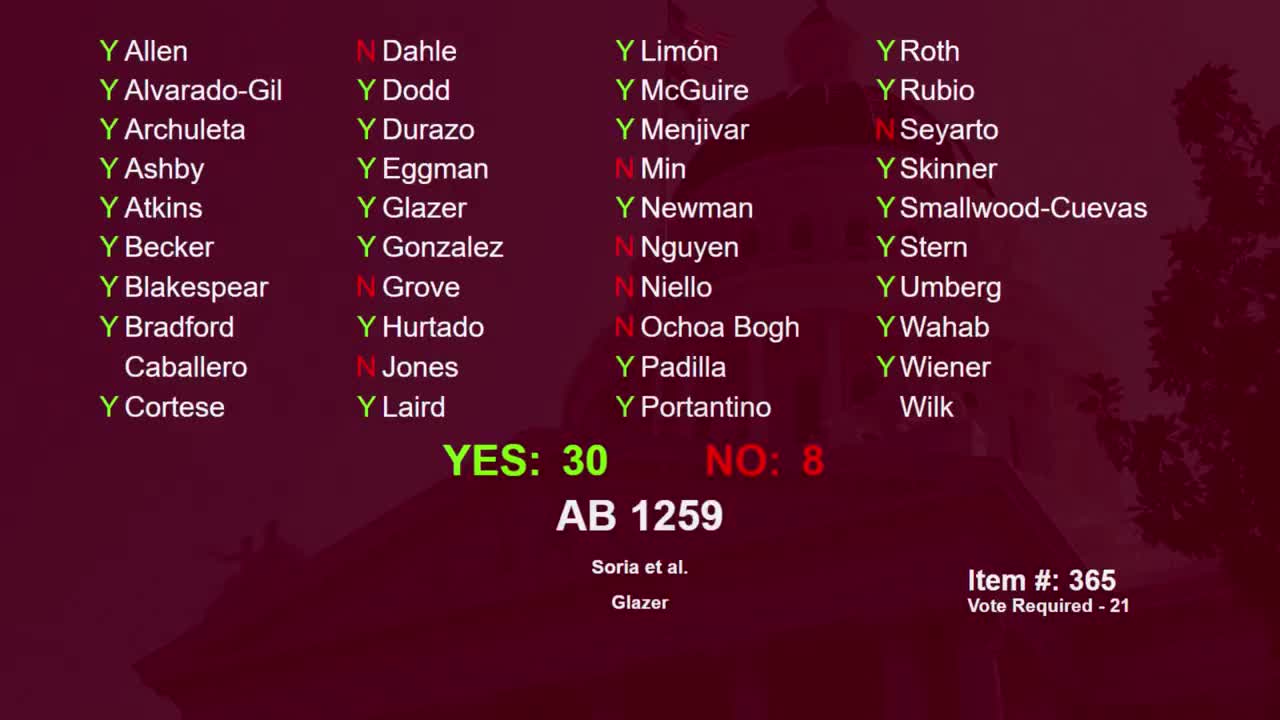 1MIN
Senate Floor
 28SEC
Senate Standing Committee on Appropriations
 5MIN
Senate Standing Committee on Human Services
Bill Author

Bill Co-Author(s):
