AB 755: Water: public entity: water usage demand analysis.
- Session Year: 2023-2024
- House: Assembly
- Latest Version Date: 2023-10-08
Current Status:
Passed
(2023-10-08: Chaptered by Secretary of State - Chapter 542, Statutes of 2023.)
Introduced
In Committee
First Chamber
In Committee
Second Chamber
Enacted
Existing law authorizes a public entity that supplies water at retail or wholesale within its service area to adopt, in accordance with specified procedures, and enforce a water conservation program.
This bill would require a public entity, as defined, to conduct a water usage demand analysis, as defined, prior to completing, or as part of, a cost-of-service analysis conducted to set fees and charges for water service that are consistent with applicable law. The bill would require a public entity to identify, within the water usage demand analysis, the costs of water service for the highest users, as defined, incurred by the public entity, and the average annual volume of water delivered to high water users. The bill would also require the costs of water service for the highest users and the average annual volume of water delivered to high water users to be made publicly available by posting the information in the public entitys cost-of-service analysis. By requiring a higher level of service of public entities, the bill would impose a state-mandated local program.
The bill would include findings that changes proposed by this bill address a matter of statewide concern rather than a municipal affair and, therefore, apply to all cities, including charter cities.
The California Constitution requires the state to reimburse local agencies and school districts for certain costs mandated by the state. Statutory provisions establish procedures for making that reimbursement.
This bill would provide that, if the Commission on State Mandates determines that the bill contains costs mandated by the state, reimbursement for those costs shall be made pursuant to the statutory provisions noted above.
Existing law authorizes a public entity that supplies water at retail or wholesale within its service area to adopt, in accordance with specified procedures, and enforce a water conservation program.
This bill would provide that require a public entity, as defined, should to conduct a water usage demand analysis, as defined, prior to completing, or as part of, a cost-of-service analysis conducted to set fees and charges for water service that are consistent with applicable law. The bill would require a public entity to identify, within the water usage demand analysis, the marginal cost costs of water service for the highest users, as defined, incurred by the public entity as a result of high water users, as defined, entity, and the average annual volume of water delivered to high water users. The bill would also require the marginal cost costs of water service for the highest users and the average annual volume of water delivered to high water users to be made publicly available by posting the information in the public entitys cost-of-service analysis. By requiring a higher level of service of public entities, the bill would impose a state-mandated local program.
The bill would include findings that changes proposed by this bill address a matter of statewide concern rather than a municipal affair and, therefore, apply to all cities, including charter cities.
The California Constitution requires the state to reimburse local agencies and school districts for certain costs mandated by the state. Statutory provisions establish procedures for making that reimbursement.
This bill would provide that, if the Commission on State Mandates determines that the bill contains costs mandated by the state, reimbursement for those costs shall be made pursuant to the statutory provisions noted above.
Existing law authorizes a public entity that supplies water at retail or wholesale within its service area to adopt, in accordance with specified procedures, and enforce a water conservation program.
This bill would require provide that a public entity, as defined, that conducts a cost-of-service analysis, as defined, to identify the total incremental costs incurred by all the major water users, as described, and low volume water users, as described, in the single-family residential class. should conduct a water usage demand analysis, as defined, prior to completing, or as part of, a cost-of-service analysis conducted to set fees and charges for water service that are consistent with applicable law. The bill would require a public entity to identify, within the water usage demand analysis, the marginal cost of water service incurred by the public entity as a result of high water users, as defined, and the average annual volume of water delivered to high water users. The bill would also require both of those costs the marginal cost and the average annual volume of water delivered to high water users to be made publicly available by posting the information in the public entitys cost-of-service analysis. By requiring a higher level of service of public entities, the bill would impose a state-mandated local program.
The bill would include findings that changes proposed by this bill address a matter of statewide concern rather than a municipal affair and, therefore, apply to all cities, including charter cities.
The California Constitution requires the state to reimburse local agencies and school districts for certain costs mandated by the state. Statutory provisions establish procedures for making that reimbursement.
This bill would provide that, if the Commission on State Mandates determines that the bill contains costs mandated by the state, reimbursement for those costs shall be made pursuant to the statutory provisions noted above.
Existing law authorizes a public entity that supplies water at retail or wholesale within its service area to adopt, in accordance with specified procedures, and enforce a water conservation program.
This bill would require a public entity, as defined, that conducts a cost-of-service analysis, as defined, to identify the total incremental costs incurred by all the major water users, as described, and low volume water users, as described, in the single-family residential class and the total incremental costs that would be avoided if major water users met a specified efficiency goal. class. The bill would also require both of those costs to be made publicly available by posting the information in the public entitys cost-of-service analysis. By requiring a higher level of service of public entities, the bill would impose a state-mandated local program.
The bill would include findings that changes proposed by this bill address a matter of statewide concern rather than a municipal affair and, therefore, apply to all cities, including charter cities.
The California Constitution requires the state to reimburse local agencies and school districts for certain costs mandated by the state. Statutory provisions establish procedures for making that reimbursement.
This bill would provide that, if the Commission on State Mandates determines that the bill contains costs mandated by the state, reimbursement for those costs shall be made pursuant to the statutory provisions noted above.
Existing law authorizes a public entity that supplies water at retail or wholesale within its service area to adopt, in accordance with specified procedures, and enforce a water conservation program.
This bill would require a public entity, as defined, that conducts a cost-of-service analysis, as defined, to identify the total incremental costs incurred by all the major water users, as described, in the single-family residential class and the total incremental costs that would be avoided if major water users met a specified efficiency goal. The bill would also require the incremental costs incurred by the major water users both of those costs to be made publicly available by posting the information on in the public entitys internet website. cost-of-service analysis. By requiring a higher level of service of public entities, the bill would impose a state-mandated local program.
The bill would include findings that changes proposed by this bill address a matter of statewide concern rather than a municipal affair and, therefore, apply to all cities, including charter cities.
The California Constitution requires the state to reimburse local agencies and school districts for certain costs mandated by the state. Statutory provisions establish procedures for making that reimbursement.
This bill would provide that, if the Commission on State Mandates determines that the bill contains costs mandated by the state, reimbursement for those costs shall be made pursuant to the statutory provisions noted above.
Existing law authorizes a public entity that supplies water at retail or wholesale within its service area to adopt, in accordance with specified procedures, and enforce a water conservation program.
This bill would require a public entity, as defined, that conducts a cost-of-service analysis, as defined, to identify the incremental costs incurred by the major water users, as described, in the single-family residential class and the incremental costs that would be avoided if major water users met a specified efficiency goal. The bill would also require the incremental costs incurred by the major water users to be made publicly available by posting the information on the public entitys internet website. By requiring a higher level of service of public entities, the bill would impose a state-mandated local program.
The bill would include findings that changes proposed by this bill address a matter of statewide concern rather than a municipal affair and, therefore, apply to all cities, including charter cities.
The California Constitution requires the state to reimburse local agencies and school districts for certain costs mandated by the state. Statutory provisions establish procedures for making that reimbursement.
This bill would provide that, if the Commission on State Mandates determines that the bill contains costs mandated by the state, reimbursement for those costs shall be made pursuant to the statutory provisions noted above.
The California Constitution establishes the Public Utilities Commission, with jurisdiction over all public utilities. The California Constitution grants the commission certain general powers over public utilities, subject to control by the Legislature, and authorizes the Legislature, unlimited by the other provisions of the California Constitution, to confer on the commission additional authority and jurisdiction.The Public Utilities Act contains laws directing the commissions regulation of public utilities.This bill would make nonsubstantive changes to the law naming the act.The California Constitution establishes the Public Utilities Commission, with jurisdiction over all public utilities. The California Constitution grants the commission certain general powers over public utilities, subject to control by the Legislature, and authorizes the Legislature, unlimited by the other provisions of the California Constitution, to confer on the commission additional authority and jurisdiction.
The Public Utilities Act contains laws directing the commissions regulation of public utilities.
This bill would make nonsubstantive changes to the law naming the act.
For purposes of this chapter, the following terms have the following meanings:
(a)Costs of water service for the highest users means the difference in costs, including applicable capital costs and operation and maintenance costs, that the public entity incurs directly, or by contract, as a result of the increased water service required by its high water users. Costs of water service for the highest users may be reported by customer class, rate classification, or cumulatively, and may include any of the following:
(1)Conservation best management practices, conservation education, irrigation controls and other conservation devices, and other demand management measures.
(2)Water system retrofitting, dual plumbing and facilities for production, distribution, and all uses of recycled water and other alternative water supplies.
(3)Projects and programs for the prevention, control, or treatment of the runoff of water from irrigation and other outdoor water uses. Incremental costs do not include the costs of stormwater management systems and programs.
(4)Securing dry year water supplies.
(5)Procuring water supplies, including supply or capacity contracts for water supply rights or entitlements.
(6)Energy costs for water delivery.
(b)High water users means the top 10 percent of water, in terms of volume of water consumed. Alternatively, for a public entity that has allocation-based conservation water pricing pursuant to Section 372, the public entity may define high water users as those customers whose water use is above the water budget assigned to them by that public entity.
(c)Public entity means a city, whether general law or chartered, county, city and county, special district, agency, authority, any other municipal public corporation or district, or any other political subdivision of the state that provides retail water service and that is an urban water supplier, as defined in Section 10617.
(d)Water usage demand analysis means an analysis conducted to determine water usage patterns and demands placed on a water system operated by a public entity.
390.1.(a)A public entity shall conduct a water usage demand analysis prior to completing, or as a part of, a cost-of-service analysis conducted to set fees and charges for water service that are consistent with Section 6 of Article XIII D of the California Constitution and other applicable law. Within the water usage demand analysis, a public entity shall identify both of the following:
(1)The costs of water service for the highest users incurred by the public entity.
(2)The average annual volume of water delivered to high water users.
(b)The costs of water service and the average annual volume identified in paragraphs (1) and (2) of subdivision (a) shall be made publicly available by posting the information in the public entitys cost-of-service analysis.
SEC. 2.The Legislature finds and declares that water conservation is a matter of statewide concern and is not a municipal affair as that term is used in Section 5 of Article XI of the California Constitution. Therefore, Section 1 of this act adding Section 390.1 to the Water Code applies to all cities, including charter cities.
SEC. 3.If the Commission on State Mandates determines that this act contains costs mandated by the state, reimbursement to local agencies and school districts for those costs shall be made pursuant to Part 7 (commencing with Section 17500) of Division 4 of Title 2 of the Government Code.
For purposes of this chapter, the following terms have the following meanings:
(a)High water users means the top 10 percent of water, in terms of volume of water consumed. Alternatively, for a public entity that has allocation-based conservation water pricing pursuant to Section 372, the public entity may define high water users as those customers whose water use is above the water budget assigned to them by that public entity.(b)Marginal costs of water service(a)Costs of water service for the highest users means the difference in costs, including applicable capital costs and operation and maintenance costs, that the public entity incurs directly, or by contract, as a result of the increased water service required by its high water users. Marginal costs Costs of water service for the highest users may be reported by customer class, rate classification, or cumulatively, and may include any of the following:
(1)Conservation best management practices, conservation education, irrigation controls and other conservation devices, and other demand management measures.
(2)Water system retrofitting, dual plumbing and facilities for production, distribution, and all uses of recycled water and other alternative water supplies.
(3)Projects and programs for the prevention, control, or treatment of the runoff of water from irrigation and other outdoor water uses. Incremental costs do not include the costs of stormwater management systems and programs.
(4)Securing dry year water supplies.
(5)Procuring water supplies, including supply or capacity contracts for water supply rights or entitlements.
(6)Energy costs for water delivery.
(b)High water users means the top 10 percent of water, in terms of volume of water consumed. Alternatively, for a public entity that has allocation-based conservation water pricing pursuant to Section 372, the public entity may define high water users as those customers whose water use is above the water budget assigned to them by that public entity.
(c)Public entity means a city, whether general law or chartered, county, city and county, special district, agency, authority, any other municipal public corporation or district, or any other political subdivision of the state that provides retail water service and that is an urban water supplier, as defined in Section 10617.
(d)Water usage demand analysis means an analysis conducted to determine water usage patterns and demands placed on a water system operated by a public entity.
390.1.(a)A public entity should shall conduct a water usage demand analysis prior to completing, or as a part of, a cost-of-service analysis conducted to set fees and charges for water service that are consistent with Section 6 of Article XIII D of the California Constitution and other applicable law. Within the water usage demand analysis, a public entity shall identify both of the following:
(1)The marginal cost costs of water service for the highest users incurred by the public entity as a result of its high water users. entity.
(2)The average annual volume of water delivered to high water users.
(b)The costs of water service and the average annual volume identified in paragraphs (1) and (2) of subdivision (a) shall be made publicly available by posting the information in the public entitys cost-of-service analysis.
SEC. 2.The Legislature finds and declares that water conservation is a matter of statewide concern and is not a municipal affair as that term is used in Section 5 of Article XI of the California Constitution. Therefore, Section 1 of this act adding Section 390.1 to the Water Code applies to all cities, including charter cities.
SEC. 3.If the Commission on State Mandates determines that this act contains costs mandated by the state, reimbursement to local agencies and school districts for those costs shall be made pursuant to Part 7 (commencing with Section 17500) of Division 4 of Title 2 of the Government Code.
For purposes of this chapter, the following terms have the following meanings:
(a)Cost-of-service analysis means the analysis conducted to determine water usage patterns and demands placed on the system by various customer classes.(b)Incremental costs means the costs of water service, including capital costs and operation and maintenance costs, that the public entity incurs directly, or by contract, as a result of the use of water by the systems major water users and may include any of the following:(1)Conservation best management practices, conservation education, irrigation controls and other conservation devices, and other demand management measures.(2)Water system retrofitting, dual plumbing and facilities for production, distribution, and all uses of recycled water and other alternative water supplies.(3)Projects and programs for the prevention, control, or treatment of the runoff of water from irrigation and other outdoor water uses. Incremental costs does not include the costs of stormwater management systems and programs.(4)Securing dry year water supply arrangements.(5)Procuring water supplies, including supply or capacity contracts for water supply rights or entitlements.(6)Energy costs for water delivery.(c)Low volume water user means the bottom 10 percent of water users in a given customer class since the last cost-of-service analysis.(d)Major water user means the top 10 percent of water users in a given customer class since the last cost-of-service analysis.(a)High water users means the top 10 percent of water, in terms of volume of water consumed. Alternatively, for a public entity that has allocation-based conservation water pricing pursuant to Section 372, the public entity may define high water users as those customers whose water use is above the water budget assigned to them by that public entity.
(b)Marginal costs of water service means the difference in costs, including applicable capital costs and operation and maintenance costs, that the public entity incurs directly, or by contract, as a result of the increased water service required by its high water users. Marginal costs of water service may be reported by customer class, rate classification, or cumulatively, and may include any of the following:
(1)Conservation best management practices, conservation education, irrigation controls and other conservation devices, and other demand management measures.
(2)Water system retrofitting, dual plumbing and facilities for production, distribution, and all uses of recycled water and other alternative water supplies.
(3)Projects and programs for the prevention, control, or treatment of the runoff of water from irrigation and other outdoor water uses. Incremental costs do not include the costs of stormwater management systems and programs.
(4)Securing dry year water supplies.
(5)Procuring water supplies, including supply or capacity contracts for water supply rights or entitlements.
(6)Energy costs for water delivery.
(e)(c)Public entity means a city, whether general law or chartered, county, city and county, special district, agency, authority, any other municipal public corporation or district, or any other political subdivision of the state that provides retail water service and that is an urban water supplier, as defined in Section 10617.
(d)Water usage demand analysis means an analysis conducted to determine water usage patterns and demands placed on a water system operated by a public entity.
390.1.(a)Whenever a public entity conducts a cost-of-service analysis, that entity shall identify the total incremental costs incurred by all the major water users and the total incremental costs incurred by all the low volume water users in the single-family residential class.390.1.(a)A public entity should conduct a water usage demand analysis prior to completing, or as a part of, a cost-of-service analysis conducted to set fees and charges for water service that are consistent with Section 6 of Article XIII D of the California Constitution and other applicable law. Within the water usage demand analysis, a public entity shall identify both of the following:
(1)The marginal cost of water service incurred by the public entity as a result of its high water users.
(2)The average annual volume of water delivered to high water users.
(b)The costs identified in paragraphs (1) and (2) of subdivision (a) shall be made publicly available by posting the information in the public entitys cost-of-service analysis.
SEC. 2.The Legislature finds and declares that water conservation is a matter of statewide concern and is not a municipal affair as that term is used in Section 5 of Article XI of the California Constitution. Therefore, Section 1 of this act adding Section 390.1 to the Water Code applies to all cities, including charter cities.
SEC. 3.If the Commission on State Mandates determines that this act contains costs mandated by the state, reimbursement to local agencies and school districts for those costs shall be made pursuant to Part 7 (commencing with Section 17500) of Division 4 of Title 2 of the Government Code.
For purposes of this chapter, the following terms have the following meanings:
(a)Cost-of-service analysis means the analysis conducted to determine water usage patterns and demands placed on the system by various customer classes.
(b)Efficiency goal means the long-term standards for efficient water use, as developed by the board, pursuant to Section 10609.2, as applied to an individual household.(c)(b)Incremental costs means the costs of water service, including capital costs and operation and maintenance costs, that the public entity incurs directly, or by contract, as a result of the use of water by the systems major water users and may include any of the following:
(1)Conservation best management practices, conservation education, irrigation controls and other conservation devices, and other demand management measures.
(2)Water system retrofitting, dual plumbing and facilities for production, distribution, and all uses of recycled water and other alternative water supplies.
(3)Projects and programs for the prevention, control, or treatment of the runoff of water from irrigation and other outdoor water uses. Incremental costs does not include the costs of stormwater management systems and programs.
(4)Securing dry year water supply arrangements.
(5)Procuring water supplies, including supply or capacity contracts for water supply rights or entitlements.
(6)Energy costs for water delivery.
(c)Low volume water user means the bottom 10 percent of water users in a given customer class since the last cost-of-service analysis.
(d)Major water user means the top 10 percent of water users in a given customer class since the last cost-of-service analysis.
(e)Public entity means a city, whether general law or chartered, county, city and county, special district, agency, authority, any other municipal public corporation or district, or any other political subdivision of the state that provides retail water service and that is an urban water supplier, as defined in Section 10617.
390.1.(a)Whenever a public entity conducts a cost-of-service analysis, that entity shall identify both of the following: the total incremental costs incurred by all the major water users and the total incremental costs incurred by all the low volume water users in the single-family residential class.
(1)The total incremental costs incurred by all the major water users in the single-family residential class.(2)The total incremental costs that would be avoided if major water users met a specified efficiency goal.(b)The costs identified in paragraphs (1) and (2) of subdivision (a) shall be made publicly available by posting the information in the public entitys cost-of-service analysis.
SEC. 2.The Legislature finds and declares that water conservation is a matter of statewide concern and is not a municipal affair as that term is used in Section 5 of Article XI of the California Constitution. Therefore, Section 1 of this act adding Section 390.1 to the Water Code applies to all cities, including charter cities.
SEC. 3.If the Commission on State Mandates determines that this act contains costs mandated by the state, reimbursement to local agencies and school districts for those costs shall be made pursuant to Part 7 (commencing with Section 17500) of Division 4 of Title 2 of the Government Code.
For purposes of this chapter, the following terms have the following meanings:
(a)Cost-of-service analysis means the analysis conducted to determine water usage patterns and demands placed on the system by various customer classes.
(b)Efficiency goal means the long-term standards for efficient water use, as developed by the board, pursuant to Section 10609.2. 10609.2, as applied to an individual household.
(c)Incremental costs means the costs of water service, including capital costs and operation and maintenance costs, that the public entity incurs directly, or by contract, as a result of the use of water by the systems major water users and may include any of the following:
(1)Conservation best management practices, conservation education, irrigation controls and other conservation devices, and other demand management measures.
(2)Water system retrofitting, dual plumbing and facilities for production, distribution, and all uses of recycled water and other alternative water supplies.
(3)Projects and programs for the prevention, control, or treatment of the runoff of water from irrigation and other outdoor water uses. Incremental costs does not include the costs of stormwater management systems and programs.
(4)Securing dry year water supply arrangements.
(5)Procuring water supplies, including supply or capacity contracts for water supply rights or entitlements.
(6)Energy costs for water delivery.
(d)Major water user means the top 10 percent of water users in a given customer class since the last cost of service cost-of-service analysis.
(e)Public entity means a city, whether general law or chartered, county, city and county, special district, agency, authority, any other municipal public corporation or district, or any other political subdivision of the state that provides retail water service and that is an urban water supplier, as defined in Section 10617.
390.1.(a)Whenever a public entity conducts a cost-of-service analysis, that entity shall identify both of the following:
(1)The total incremental costs incurred by all the major water users in the single-family residential class.
(2)The total incremental costs that would be avoided if major water users met a specified efficiency goal.
(b)The incremental costs incurred by the major water users, as identified pursuant to subdivision (a), costs identified in paragraphs (1) and (2) of subdivision (a) shall be made publicly available by posting the information on in the public entitys internet website. cost-of-service analysis.
SEC. 2.The Legislature finds and declares that water conservation is a matter of statewide concern and is not a municipal affair as that term is used in Section 5 of Article XI of the California Constitution. Therefore, Section 1 of this act adding Section 390.1 to the Water Code applies to all cities, including charter cities.
SEC. 3.If the Commission on State Mandates determines that this act contains costs mandated by the state, reimbursement to local agencies and school districts for those costs shall be made pursuant to Part 7 (commencing with Section 17500) of Division 4 of Title 2 of the Government Code.
For purposes of this chapter, the following terms have the following meanings:
(a)Cost-of-service analysis means the analysis conducted to determine water usage patterns and demands placed on the system by various customer classes.
(b)Efficiency goal means the long-term standards for efficient water use, as developed by the board, pursuant to Section 10609.2.
(c)Incremental costs means the costs of water service, including capital costs and operation and maintenance costs, that the public entity incurs directly, or by contract, as a result of the use of water by the systems major water users and may include any of the following:
(1)Conservation best management practices, conservation education, irrigation controls and other conservation devices, and other demand management measures.
(2)Water system retrofitting, dual plumbing and facilities for production, distribution, and all uses of recycled water and other alternative water supplies.
(3)Projects and programs for the prevention, control, or treatment of the runoff of water from irrigation and other outdoor water uses. Incremental costs does not include the costs of stormwater management systems and programs.
(4)Securing dry year water supply arrangements.
(5)Procuring water supplies, including supply or capacity contracts for water supply rights or entitlements.
(6)Energy costs for water delivery.
(d)Major water user means the top 10 percent of water users in a given customer class since the last cost of service analysis.
(e)Public entity means a city, whether general law or chartered, county, city and county, special district, agency, authority, any other municipal public corporation or district, or any other political subdivision of the state that provides retail water service and that is an urban water supplier, as defined in Section 10617.
390.1.(a)Whenever a public entity conducts a cost-of-service analysis, that entity shall identify both of the following:
(1)The incremental costs incurred by the major water users in the single-family residential class.
(2)The incremental costs that would be avoided if major water users met a specified efficiency goal.
(b)The incremental costs incurred by the major water users, as identified pursuant to subdivision (a), shall be made publicly available by posting the information on the public entitys internet website.
SEC. 2.The Legislature finds and declares that water conservation is a matter of statewide concern and is not a municipal affair as that term is used in Section 5 of Article XI of the California Constitution. Therefore, Section 1 of this act adding Section 390.1 to the Water Code applies to all cities, including charter cities.
SEC. 3.If the Commission on State Mandates determines that this act contains costs mandated by the state, reimbursement to local agencies and school districts for those costs shall be made pursuant to Part 7 (commencing with Section 17500) of Division 4 of Title 2 of the Government Code.
SECTION 1.Section 201 of the Public Utilities Code is amended to read:201.This part shall be known, and may be cited, as the Public Utilities Act.This part shall be known, and may be cited cited, as the Public Utilities Act.
|
Date
|
Status
|
|---|---|
| Oct 8, 2023 | Chaptered by Secretary of State - Chapter 542, Statutes of 2023. |
| Oct 8, 2023 | Approved by the Governor. |
| Sep 19, 2023 | Enrolled and presented to the Governor at 4 p.m. |
| Sep 12, 2023 | Senate amendments concurred in. To Engrossing and Enrolling. (Ayes 60. Noes 18. Page 3237.). |
| Sep 12, 2023 | Assembly Rule 77 suspended. (Page 3228.) |
| Sep 11, 2023 | In Assembly. Concurrence in Senate amendments pending. May be considered on or after September 13 pursuant to Assembly Rule 77. |
| Sep 11, 2023 | Read third time. Passed. Ordered to the Assembly. (Ayes 28. Noes 10. Page 2549.). |
| Aug 22, 2023 | Read second time. Ordered to third reading. |
| Aug 21, 2023 | From committee: Be ordered to second reading pursuant to Senate Rule 28.8. |
| Aug 14, 2023 | From committee chair, with author's amendments: Amend, and re-refer to committee. Read second time, amended, and re-referred to Com. on APPR. |
| Aug 9, 2023 | In committee: Set, first hearing. Hearing canceled at the request of author. |
| Jul 13, 2023 | Read second time and amended. Re-referred to Com. on APPR. |
| Jul 12, 2023 | From committee: Amend, and do pass as amended and re-refer to Com. on APPR. (Ayes 7. Noes 3.) (July 10). |
| Jul 3, 2023 | From committee chair, with author's amendments: Amend, and re-refer to committee. Read second time, amended, and re-referred to Com. on N.R. & W. |
| Jun 14, 2023 | Referred to Com. on N.R. & W. |
| Jun 1, 2023 | In Senate. Read first time. To Com. on RLS. for assignment. |
| May 31, 2023 | Read third time. Passed. Ordered to the Senate. (Ayes 58. Noes 17. Page 2032.) |
| May 18, 2023 | Read third time and amended. Ordered to third reading. (Page 1585.) |
| May 11, 2023 | Read second time. Ordered to third reading. |
| May 10, 2023 | From committee: Do pass. (Ayes 12. Noes 3.) (May 10). |
| Apr 24, 2023 | From committee: Do pass and re-refer to Com. on APPR. (Ayes 11. Noes 4.) (April 24). Re-referred to Com. on APPR. |
| Mar 20, 2023 | Re-referred to Com. on W., P., & W. |
| Mar 16, 2023 | Referred to Com. on W., P., & W. |
| Mar 16, 2023 | From committee chair, with author's amendments: Amend, and re-refer to Com. on W., P., & W. Read second time and amended. |
| Feb 14, 2023 | From printer. May be heard in committee March 16. |
| Feb 13, 2023 | Read first time. To print. |
|
Date
|
Description
|
Location
|
Votes
|
|
|---|---|---|---|---|
| Sep 12, 2023 | AB 755 Papan Concurrence in Senate Amendments | Assembly Floor |
Passed |
|
| Sep 11, 2023 | Assembly 3rd Reading AB755 Papan By Ashby | Senate Floor |
Passed |
|
| Jul 10, 2023 | Do pass as amended, but first amend, and re-refer to the Committee on [Appropriations] | Senate Standing Committee on Natural Resources and Water |
Passed |
|
| May 31, 2023 | AB 755 Papan Assembly Third Reading | Assembly Floor |
Passed |
|
| May 10, 2023 | Do pass. | Assembly Standing Committee on Appropriations |
Passed |
|
| Apr 24, 2023 | Do pass and be re-referred to the Committee on [Appropriations] | Assembly Standing Committee on Water, Parks, and Wildlife |
Passed |
This list shows positions taken on this bill by organizations on the date displayed, which is linked to the original source.
Positions by individuals are not included.
|
Organization
|
Position
|
Date
|
|---|---|---|
| Association Of California Water Agencies | ** Against | |
| California Coastkeeper Alliance | ** Support | |
| California Municipal Utilities Association | * Against | Jul 10, 2023 |
| California Special Districts Association | ** Against | |
| Coachella Valley Water District | ** Against | |
| Coachella Valley Waterkeeper | ** Support | |
| Community Water Center | ** Support | |
| Contra Costa Water District | ** Against | |
| East Bay Municipal Utilities District | * Against Unless Amend | Jul 10, 2023 |
| Humboldt Baykeeper | ** Support | |
| Inland Empire Waterkeeper | ** Support | |
| Irvine Ranch Water District | * For If Amend | Jul 10, 2023 |
| Las Virgenes Municipal Water District | ** Against | |
| League Of California Cities | ** Against | |
| levenheim water disctrict | * Against | Jul 10, 2023 |
| Los Angeles Alliance for a New Economy Dba. LAANE | ** Support | |
| Los Angeles Water Keeper | * Support | Jul 10, 2023 |
| Los Angeles Waterkeeper | ** Support | |
| Mesa Water District | ** Support | |
| Mono Lake Committee | ** Support | |
| Monterey Waterkeeper | ** Support | |
| Orange County Coastkeeper | ** Support | |
| River in Action | ** Support | |
| Russian Riverkeeper | ** Support | |
| San Diego Coastkeeper | ** Support | |
| Santa Barbara Channelkeeper | ** Support | |
| Save the Sonoma Coast | ** Support | |
| See | ** Support | |
| Social Eco Education | ** Support | |
| Somos Familia Valle | ** Support | |
| South Yuba River Citizens League | ** Support | |
| western center on law and poverty | ** Support | |
| Yuba River Waterkeeper | ** Support |
CONCURRENCE IN SENATE AMENDMENTS
CSA1 Bill Id:AB 755
Author:(Papan)
As Amended Ver:August 14, 2023
Majority vote
SUMMARY
Requires a public entity to conduct a "water usage demand analysis" before completing, or as part of, a cost-of-service analysis used to set fees and charges for water service pursuant to Proposition 218. Requires the water usage demand analysis to identify the costs of water service for the highest users incurred by the public entity and the average annual volume of water delivered to high water users.
Senate Amendments
- Require a public entity to conduct a "water usage demand analysis" prior to completing, or as part of, a cost-of-service analysis used to set fees and charges for water service pursuant to Proposition 218.
- Requires a public entity to identify the following as part of a "water usage demand analysis:"
- The costs of water service for the highest users incurred by the public water entity; and
- The average annual volume of water delivered to high water users.
- Provide that the costs of water service for the highest users and the average volume of water delivered to high water users shall be made publicly available as part of the cost-of-service analysis.
- Define "water usage demand analysis" as an analysis conducted to determine water usage patterns and demands placed on a water system operated by a public entity.
- Define various terms for the purpose of this bill.
- Make technical and conforming changes.
COMMENTS
Analysis of water sector finance by the Public Policy Institute of California (PPIC) finds that local water agencies account for approximately 84% of the funds spent on water in California (PPIC, 2021). Local agencies can face impediments, however, in trying to pay for certain services: "Propositions 218 and 26 impose strict cost-recovery requirements on water rates, making it challenging for public water agencies to implement conservation-oriented rates and user fees" (PPIC, 2021). This bill requires water agencies to analyze specific costs when conducting a rate study to change or increase its water rate structure.
Proposition 218. Enacted in November 1996, Proposition 218 amended the California Constitution by placing restrictions on how local agencies use fees, charges, or special assessments ("property-related services") to cover the cost of providing services, including for water service. In order to assess a fee, water agencies must ensure it meets five standards under Proposition 218: that a fee or charge (1) not exceed the cost of providing the service for which it is charged or (2) be used for any purpose other than that for which it is charged; (3) that a fee not exceed the proportional cost of providing a service to an individual property; (4) that no fee be imposed for a service unless that service is actually used by or available to a property owner; and (5) that no fee or charge may be imposed for general governmental services that are available to the public in the same manner as it is to property owners. To comply with Proposition 218, water agencies have to undertake a detailed cost study to establish the basis upon which the amount of a proposed fee or charge is calculated, notify customers of a proposed fee or charge, and hold a public hearing on the proposed fee or charge. If a majority of the property owners that will be subject to the proposed fee or charge protest the fee or charge, a local agency may not impose the fee or charge.
Proposition 26. Enacted in November 2010, Proposition 26 places additional burdens on local agencies by broadening the definition of "tax" as "any levy, charge, or exaction of any kind" except for charges imposed to confer a specific benefit or service to the payer. It also places the burden of proof on a local agency to demonstrate that a charge is not greater than the cost of providing the service for which it is charged in the event of a challenge.
According to the Author
According to the author, "All too often, the maximum demand for water is driven by the customers that use the most, and the affluent single family residences are notorious for using excessive amounts of water for outdoor irrigation. Considering that the system needs to satisfy the highest possible demand on any given day, the largest water users are a driving force behind the public utility’s need for larger supply, increased infrastructure, and efforts to conserve the system’s water. These investments increase the public water utility’s overall costs and can raise the rates for all customers. In drought, these issues are especially exacerbated, as the temporary additional water supplies and conservation programs can be costly. For people who conserve water and keep demand low, many of the public utilities costly investments are unnecessary."
The author maintains that "as system expenses continue to increase to meet the demands of the major water users, public utilities must charge water rates to recoup their overall system costs. As a result, customers who conserve may be required to subsidize rising costs for those who use the most." For this reason, the author argues this bill is necessary to determine how high water users are driving up costs and to increase transparency. The author asserts "the analysis required by [this bill] will serve as a necessary foundation for a more fair and equitable rate structure."
Arguments in Support
This bill is sponsored by California Coastkeeper Alliance (Coastkeeper) who note that water affordability remains a statewide issue that is exacerbated by climate change. Coastkeeper argues this bill will "ensure Californians pay a fair price for water" by requiring water utilities to determine how the heaviest water users in their service area drive up cost. Water rate increases have outpaced inflation and Coastkeeper points to analysis that indicate larger lot single family residences that are found in more affluent neighborhoods are typically the highest water users. Coastkeeper asserts that water utilities must invest in infrastructure to meet the highest level of demand on a given day and that "the greater the demand customers place on the system, the greater these investments must be, and the greater the investments, the higher customer bills climb."
Arguments in Opposition
The Association of California Water Agencies (ACWA) opposes this bill arguing that it conflicts with the "Making Conservation a Way of Life" legislation [AB 1668 (Friedman) and SB 606 (Hertzberg)] from 2018 and increases legal risk for water systems. Further ACWA asserts that this bill "would require water systems to include hypotheticals into a [cost-of-service analysis], introducing an admission of uncertainty into their rate analyses, which could in turn be used to challenge rates under Prop. 218. This problem would be compounded if the system introduced or modified efficiency goals after the [cost-of-service analysis] was completed or adopted. This will ultimately contribute to greater litigation risk and overall revenue uncertainty which will not help a system achieve increased water conservation goals."
FISCAL COMMENTS
According to the Assembly Appropriations Committee, this bill will have "no state costs."
VOTES:
ASM WATER, PARKS, AND WILDLIFE: 11-4-0
YES: Bauer-Kahan, Bennett, Friedman, Hart, Kalra, Pellerin, Blanca Rubio, Schiavo, Villapudua, Ward, Weber
NO: Mathis, Alanis, Joe Patterson, Davies
ASM APPROPRIATIONS: 12-3-1
YES: Holden, Bryan, Calderon, Wendy Carrillo, Mike Fong, Addis, Lowenthal, Papan, Pellerin, Robert Rivas, Weber, Wilson
NO: Megan Dahle, Dixon, Sanchez
ABS, ABST OR NV: Mathis
ASSEMBLY FLOOR: 58-17-5
YES: Addis, Aguiar-Curry, Alvarez, Arambula, Bains, Bauer-Kahan, Bennett, Berman, Boerner, Bonta, Bryan, Calderon, Juan Carrillo, Wendy Carrillo, Cervantes, Connolly, Mike Fong, Friedman, Gabriel, Garcia, Gipson, Grayson, Haney, Hart, Holden, Irwin, Jackson, Jones- Sawyer, Kalra, Lee, Low, Lowenthal, Maienschein, McCarty, McKinnor, Muratsuchi, Ortega, Pacheco, Papan, Pellerin, Petrie-Norris, Quirk-Silva, Ramos, Reyes, Luz Rivas, Robert Rivas, Blanca Rubio, Santiago, Schiavo, Soria, Ting, Villapudua, Ward, Wicks, Wilson, Wood, Zbur, Rendon
NO: Alanis, Chen, Megan Dahle, Davies, Dixon, Flora, Vince Fong, Gallagher, Hoover, Lackey, Mathis, Jim Patterson, Joe Patterson, Sanchez, Ta, Waldron, Wallis
ABS, ABST OR NV: Essayli, Stephanie Nguyen, Rodriguez, Valencia, Weber
SENATE FLOOR: 28-10-2
YES: Allen, Archuleta, Ashby, Atkins, Becker, Blakespear, Bradford, Cortese, Dodd, Durazo, Eggman, Glazer, Gonzalez, Laird, Limón, McGuire, Menjivar, Min, Newman, Padilla, Portantino, Rubio, Skinner, Smallwood-Cuevas, Stern, Umberg, Wahab, Wiener
NO: Alvarado-Gil, Dahle, Grove, Hurtado, Jones, Nguyen, Niello, Ochoa Bogh, Seyarto, Wilk
ABS, ABST OR NV: Caballero, Roth
UPDATED
VERSION: August 14, 2023
CONSULTANT: Pablo Garza / W., P., & W. / (916) 319-2096 FN: 0002334
SENATE RULES COMMITTEE Office of Senate Floor Analyses (916) 651-1520 Fax: (916) 327-4478 | AB 755 |
THIRD READING
Bill No: AB 755
Author: Papan (D)
Amended: 8/14/23 in Senate
Vote: 21
SENATE NATURAL RES. & WATER COMMITTEE: 7-3, 7/10/23
AYES: Min, Allen, Eggman, Laird, Limón, Padilla, Stern
NOES: Seyarto, Dahle, Grove
NO VOTE RECORDED: Hurtado
SENATE APPROPRIATIONS COMMITTEE: Senate Rule 28.8
ASSEMBLY FLOOR: 58-17, 5/31/23 - See last page for vote
SUBJECT: Water: public entity: water usage demand analysis
SOURCE: Author
DIGEST:
This bill requires a public entity to conduct a water usage demand analysis, as defined, before completing, or as part of, a cost-of-service analysis and requires the water usage demand analysis to include the costs of water service for the highest users incurred by the public entity and the average annual volume of water delivered to high water users.
ANALYSIS:
Existing law:
- Requires an agency to follow specified procedures when imposing any fee or charge and prohibits a fee or charge from being extended, imposed, or increased unless it meets all of the following:
- Revenues derived from the fee or charge do not exceed the funds required to provide the property-related service.
- Revenues derived from the fee or charge are not used for any purpose other than that which the fee or charge was imposed.
- The amount of a fee or charge imposed on any parcel or person as an incident of property ownership does not exceed the proportional cost of the service attributable to the parcel.
- The fee or charge cannot be imposed for a service unless the service is actually used by, or immediately available to, the owner of the property.
- The fee or charge cannot be imposed for general governmental services where the service is available to the public at large in substantially the manner as it is to the property owners.
- Provides that revenues derived from allocation-based conservation water pricing shall not exceed the reasonable cost of water service including base costs and incremental costs. (Water Code (Wat) §373)
- Permits a water supplier to adopt and enforce a water conservation program to reduce water use. (Wat. §375)
This bill:
- Requires a public entity to conduct a water usage demand analysis before completing, or as a part of, a cost-of-service analysis conducted to set fees and charges for water service that are consistent with the California Constitution and other applicable.
- Requires, within the water usage demand analysis, the public entity to identify both of the following:
- The costs of water service for the highest users incurred by the public entity; and
- The average annual volume of water delivered to the high water users.
- Requires the cost of water service and average annual volume of water be made publicly available, as specified.
- Defines the following terms:
- “Cost of water service for the highest users” means the difference in costs that the public entity incurs directly, or by contract, as a result of the increased water service required by its high water users.
- “High water user” means the top 10 percent of water, in terims of volume of water consumed.
Background
Analysis of water sector finance by the Public Policy Institute of California (PPIC) finds that local water agencies account for approximately 84% of the funds spent on water in California (PPIC, 2021). Local agencies can face impediments, however, in trying to pay for certain services: “Propositions 218 and 26 impose strict cost-recovery requirements on water rates, making it challenging for public water agencies to implement conservation-oriented rates and user fees” (PPIC, 2021). This bill requires water agencies to analyze specific costs when conducting a rate study to change or increase its water rate structure.
Proposition 218. Enacted in November 1996, Proposition 218 amended the California Constitution by placing restrictions on how local agencies use fees, charges, or special assessments ("property-related services") to cover the cost of providing services, including for water service. In order to assess a fee, water agencies must ensure it meets five standards under Proposition 218: that a fee or charge (1) not exceed the cost of providing the service for which it is charged or (2) not be used for any purpose other than that for which it is charged; (3) not exceed the proportional cost of providing a service to an individual property; (4) not be imposed for a service unless that service is actually used by or available to a property owner; and (5) not be imposed for general governmental services that are available to the public in the same manner as it is to property owners. To comply with Proposition 218, water agencies have to undertake a detailed cost study to establish the basis upon which the amount of a proposed fee or charge is calculated, notify customers of a proposed fee or charge, and hold a public hearing on the proposed fee or charge. If a majority of the property owners that will be subject to the proposed fee or charge protest the fee or charge, a local agency may not impose the fee or charge.
Proposition 26. Enacted in November 2010, Proposition 26 places additional burdens on local agencies by broadening the definition of "tax" as "any levy, charge, or exaction of any kind" except for charges imposed to confer a specific benefit or service to the payer. It also places the burden of proof on a local agency to demonstrate that a charge is not greater than the cost of providing the service for which it is charged in the event of a challenge.
FISCAL EFFECT: Appropriation: No Fiscal Com.: Yes Local: Yes
SUPPORT: (Verified 9/8/23)
California Coastkeeper Alliance
Coachella Valley Waterkeeper
Community Water Center
Humboldt Baykeeper
Inland Empire Waterkeeper
Los Angeles Alliance for a New Economy Dba. LAANE
Los Angeles Waterkeeper
Mesa Water District
Mono Lake Committee
Monterey Waterkeeper
Orange County Coastkeeper
River in Action
Russian Riverkeeper
San Diego Coastkeeper
Santa Barbara Channelkeeper
Save the Sonoma Coast
Social Eco Education
Somos Familia Valle
South Yuba River Citizens League
Western Center on Law and Poverty
Yuba River Waterkeeper
OPPOSITION: (Verified 9/8/23)
Association of California Water Agencies
California Special Districts Association
Coachella Valley Water District
Contra Costa Water District
Las Virgenes Municipal Water District
League of California Cities
ASSEMBLY FLOOR: 58-17, 5/31/23
AYES: Addis, Aguiar-Curry, Alvarez, Arambula, Bains, Bauer-Kahan, Bennett, Berman, Boerner, Bonta, Bryan, Calderon, Juan Carrillo, Wendy Carrillo, Cervantes, Connolly, Mike Fong, Friedman, Gabriel, Garcia, Gipson, Grayson, Haney, Hart, Holden, Irwin, Jackson, Jones-Sawyer, Kalra, Lee, Low, Lowenthal, Maienschein, McCarty, McKinnor, Muratsuchi, Ortega, Pacheco, Papan, Pellerin, Petrie-Norris, Quirk-Silva, Ramos, Reyes, Luz Rivas, Robert Rivas, Blanca Rubio, Santiago, Schiavo, Soria, Ting, Villapudua, Ward, Wicks, Wilson, Wood, Zbur, Rendon
NOES: Alanis, Chen, Megan Dahle, Davies, Dixon, Flora, Vince Fong, Gallagher, Hoover, Lackey, Mathis, Jim Patterson, Joe Patterson, Sanchez, Ta, Waldron, Wallis
NO VOTE RECORDED: Essayli, Stephanie Nguyen, Rodriguez, Valencia, Weber
Prepared by: Genevieve Wong / N.R. & W. / (916) 651-4116
9/8/23 10:55:15
**** END ****
SENATE COMMITTEE ON NATURAL RESOURCES AND WATER
Senator Dave Min, Chair
2023 - 2024 Regular
Bill No: AB 755 Hearing Date: July 10, 2023
Author: | |||
Version: | Amended | ||
Urgency: | Fiscal: | ||
Consultant: | |||
Subject: Water: public entity: cost-of-service analysis
BACKGROUND AND EXISTING LAW
Analysis of water sector finance by the Public Policy Institute of California (PPIC) finds that local water agencies account for approximately 84% of the funds spent on water in California (PPIC, 2021). Local agencies can face impediments, however, in trying to pay for certain services: “Propositions 218 and 26 impose strict cost-recovery requirements on water rates, making it challenging for public water agencies to implement conservation-oriented rates and user fees” (PPIC, 2021). This bill requires water agencies to analyze specific costs when conducting a rate study to change or increase its water rate structure.
Proposition 218. Enacted in November 1996, Proposition 218 amended the California Constitution by placing restrictions on how local agencies use fees, charges, or special assessments ("property-related services") to cover the cost of providing services, including for water service. In order to assess a fee, water agencies must ensure it meets five standards under Proposition 218: that a fee or charge 1) not exceed the cost of providing the service for which it is charged or 2) not be used for any purpose other than that for which it is charged; 3) not exceed the proportional cost of providing a service to an individual property; 4) not be imposed for a service unless that service is actually used by or available to a property owner; and 5) not be imposed for general governmental services that are available to the public in the same manner as it is to property owners. To comply with Proposition 218, water agencies have to undertake a detailed cost study to establish the basis upon which the amount of a proposed fee or charge is calculated, notify customers of a proposed fee or charge, and hold a public hearing on the proposed fee or charge. If a majority of the property owners that will be subject to the proposed fee or charge protest the fee or charge, a local agency may not impose the fee or charge.
Proposition 26. Enacted in November 2010, Proposition 26 places additional burdens on local agencies by broadening the definition of "tax" as "any levy, charge, or exaction of any kind" except for charges imposed to confer a specific benefit or service to the payer. It also places the burden of proof on a local agency to demonstrate that a charge is not greater than the cost of providing the service for which it is charged in the event of a challenge.
Existing law:
- Provides that revenues derived from allocation-based conservation water pricing shall not exceed the reasonable cost of water service including base costs and incremental costs. (Water Code (Wat) §373)
- Permits a water supplier to adopt and enforce a water conservation program to reduce water use. (Wat. §375)
PROPOSED LAW
This bill:
- Requires a public entity, whenever conducting a cost-of-service analysis, to identify the total incremental costs incurred by all the major water users and the total incremental costs incurred by all the low volume water users in the single-family residential class.
- Defines the following terms:
- “Cost-of-service” analysis as the analysis conducted to determine water usage patterns and demands placed on the system by various customer classes.
- “Incremental costs” as the costs of water service, including capital costs and operation and maintenance costs, that the public entity incurs directly, or by contract, as a result of the use of water by the systems’ major water users and may include:
- Conservation best management practices, conservation education, irrigation controls and other conservation devices, and other demand management measures.
- Water system retrofitting, dual plumbing and facilities for production, distribution, and all uses of recycled water and other alternative water supplies.
- Projects and programs for the prevention, control, or treatment of the runoff of water from irrigation and other outdoor water uses.
- Securing dry year water supply arrangements.
- Procuring water supplies.
- Energy cost for water delivery.
- “Major water user” as the top 10 percent of water users in a given customer class since the last cost-of-service analysis.
- “Low volume water user” as the bottom 10 percent of water users in a given customer class since the last cost-of-service analysis.
- “Cost-of-service” analysis as the analysis conducted to determine water usage patterns and demands placed on the system by various customer classes.
ARGUMENTS IN SUPPORT
According to the author, “All too often, the maximum demand for water is driven by the customers that use the most, and the affluent single family residences are notorious for using excessive amounts of water for outdoor irrigation. Considering that the system needs to satisfy the highest possible demand on any given day, the largest water users are a driving force behind the public utility’s need for larger supply, increased infrastructure, and efforts to conserve the system’s water. These investments increase the public water utility’s overall costs and can raise the rates for all customers. In drought, these issues are especially exacerbated, as the temporary additional water supplies and conservation programs can be costly. For people who conserve water and keep demand low, many of the public utilities costly investments are unnecessary.
However, as system expenses continue to increase to meet the demands of the major water users, public utilities must charge water rates to recoup their overall system costs. As a result, customers who conserve may be required to subsidize rising costs for those who use the most. In addition, for affluent households, higher water rates do not always effectively incentivize conservation. And customers are often unaware of how the major water users in a system can drive system costs for everyone. Requiring public water utilities to identify how major water users have driven system expenses will shine an important light on a root cause of rising costs. The analysis required by AB 755 will serve as a necessary foundation for a more fair and equitable rate structure.”
ARGUMENTS IN OPPOSITION
According to California Municipal Utilities Association, Association of California Water Agencies, League of California Cities, and California Special Districts Association, AB 755’s “approval is overly prescriptive and doesn’t fit the [cost-of-service analysis] process.” According to their letter, AB 755 is far too prescriptive, confusing and makes various assumptions that may not be correct. For example:
- [The bill] assumes that “major water users” cause water systems to incur costs that far exceed what they are paying. Many water systems have high fixed costs so their assumption may not be correct. …
- The bill defines “major water user” as the top 10% of water users in each customer class but then the operative language outlines only the single-family residential class.
- The major water user category is a continual moving target with respect to actual users and is not consistent from reporting period to reporting period, making it impossible to calculate and include in a [cost-of-service analysis]. …
- Being a major water user doesn’t necessarily mean that the customer is wasting water, using the most water especially given commercial and industrial customers, or what the water is used for, so this bill is far from a guarantee that the bill will save additional water.”
According to the Las Virgenes Municipal Water District and Coachella Valley Water District, “Major water users already pay for the incremental costs they impose on a water system under tiered rate structures…. [Public water systems] are allowed to set up tiers that reflect higher per capita water use, but they are legally required to meticulously account for the structure of the tiered rates to ensure that one group of rate payers never subsidizes another group. For this reason, the author incorrectly claims that ‘customers who conserve may be required to subsidize rising costs for those who use the most.’ … AB 755 will not accomplish any of the goals it claims to achieve, but it will have one predictable result: it will expose retail water agencies to litigation. The bill requires retail water agencies to speculate as to the ‘incremental costs’ of water used by major water users. For the reasons given above, there is no direct connection between a small subset of water users and the cost of delivering water by a [public water agency]. That means [public water agencies] will be forced to guess at numbers that will satisfy the demands of the bill, and every guess they make will be second guessed … in a lawsuit.”
COMMENTS
Expectation versus reality. AB 755’s definition of “cost-of-service analysis” may not match the common understanding of the term in application. AB 755 defines “cost-of-service analysis” as the analysis conducted to determine water usage patterns and demands placed on the system by various customer classes.
However, according to water agencies, a cost-of-service analysis, as used within the California water community, refers to a comprehensive review and detailing of the method a water supplier uses to develop its rates and charges for water service. It breaks down the costs into rates based on that methodology, details how the water supplier’s rates and fees are reasonable and proportional to the cost of providing the service, how the costs are fairly spread among customers, and how the rates meet Proposition 218’s other requirements.
Because the cost-of-service analysis is an important document used by water agencies to demonstrate their compliance with Proposition 218, water agencies are concerned about the difference between the bill’s definition and how the water community currently understands the term.
Increased risk of Prop 218 litigation. As discussed above, Proposition 218 requires a nexus between the costs of providing water service and the rates charged. If a water supplier’s rates are challenged, the local agency has the burden of proof to show that the rates meet Proposition 218 requirements.
A water supplier’s cost-of-service analysis is one of the primary documents agencies use to demonstrate its compliance with Proposition 218 when there is a challenge.
However, some water agencies are concerned that adding the incremental costs of major water users and the incremental costs of low volume water users in the single-family residential class to the cost-of-service analysis could cause three issues. First, because the top 10 percent of homeowners is not always constant, using that data in the cost-of-service analysis could result in a hypothetical analysis for the new rates in the new cost-of-service analysis. Second, including the incremental costs of low-volume users implies that there is a subsidy they are paying for higher volume users. Finally, the addition of this information can cause confusion of the rates and the methodology used to set up those rates.
As such, if the court does not understand the cost-of-service analysis, it may find that the agency is subsidizing certain water users and therefore violating Proposition 218.
Close, but no cigar. Author’s staff, committee staff, and stakeholders have been working together to find a solution to the above-identified concerns. A potential solution to use a different term instead of “cost-of-service analysis” is being discussed, but is not finalized and requires additional vetting by stakeholders. The committee may wish to require the author to continue to work with committee staff to find a solution.
SUPPORT
California Coastkeeper Alliance (sponsor)
Coachella Valley Waterkeeper
Community Water Center
Inland Empire Waterkeeper
Laane (Los Angeles Alliance for A New Economy)
Los Angeles Waterkeeper
Mono Lake Committee
Monterey Waterkeeper
Orange County Coastkeeper
River in Action
Russian Riverkeeper
San Diego Coastkeeper
Santa Barbara Channelkeeper
Save the Sonoma Coast
Social Eco Education
Somos Familia Valle
South Yuba River Citizens League
Western Center on Law and Poverty
Yuba River Waterkeeper
OPPOSITION
Association of California Water Agencies (ACWA)
California Municipal Utilities Association
California Special Districts Association
Coachella Valley Water District
Contra Costa Water District
East Bay Municipal Utility District (unless amended)
Las Virgenes Municipal Water District
League of California Cities
-- END --
ASSEMBLY THIRD READING
ATR Bill Id:AB 755
Author:(Papan)
As Amended Ver:May 18, 2023
Majority vote
SUMMARY
Requires urban water agencies, when conducting a cost-of-service analysis, to analyze the total incremental costs of providing water service to residential customers that are "major water users" and estimate potential savings if those users were to use water more efficiently.
Major Provisions
- Requires a public entity (e.g., local agency) to identify the following information when conducting a cost-of-service analysis:
- The total incremental costs incurred by major water users in the single-family residential class (this information shall be made public); and
- The total incremental costs that would be avoided if major water users conserved water by meeting a specified goal.
- Defines the following terms for the purpose of this bill:
- "Cost-of-service analysis" as the analysis conducted to determine water usage patterns and demands placed on the system by various customer classes;
- "Efficiency goal" as the standards for outdoor residential use, outdoor CII (commercial, industrial, and institutional) use, and water loss volume adopted by the State Water Resources Control Board (State Water Board) applied to an individual household;
- "Incremental costs" as the costs of water service that a public entity incurs as a result of the use of water by the systems' major water users, including specified examples; and
- "Major water user" as the top 10% of water users in a given customer class since the last cost-of-service analysis.
- Provides that total incremental costs incurred by major water users and total incremental costs that could be avoided by major water users shall be made publicly available by being included in the cost-of-service analysis.
COMMENTS
Analysis of water sector finance by the Public Policy Institute of California (PPIC) finds that local water agencies account for approximately 84% of the funds spent on water in California (PPIC, 2021). Local agencies can face impediments, however, in trying to pay for certain services: "Propositions 218 and 26 impose strict cost-recovery requirements on water rates, making it challenging for public water agencies to implement conservation-oriented rates and user fees" (PPIC, 2021). This bill requires water agencies to analyze specific costs when conducting a rate study to change or increase its water rate structure.
Proposition 218. Enacted in November 1996, Proposition 218 amended the California Constitution by placing restrictions on how local agencies use fees, charges, or special assessments ("property-related services") to cover the cost of providing services, including for water service. In order to assess a fee, water agencies must ensure it meets five standards under Proposition 218: that a fee or charge 1) not exceed the cost of providing the service for which it is charged or 2) be used for any purpose other than that for which it is charged; 3) that a fee not exceed the proportional cost of providing a service to an individual property; 4) that no fee be imposed for a service unless that service is actually used by or available to a property owner; and 5) that no fee or charge may be imposed for general governmental services that are available to the public in the same manner as it is to property owners. To comply with Proposition 218, water agencies have to undertake a detailed cost study to establish the basis upon which the amount of a proposed fee or charge is calculated, notify customers of a proposed fee or charge, and hold a public hearing on the proposed fee or charge. If a majority of the property owners that will be subject to the proposed fee or charge protest the fee or charge, a local agency may not impose the fee or charge.
Proposition 26. Enacted in November 2010, Proposition 26 places additional burdens on local agencies by broadening the definition of "tax" as "any levy, charge, or exaction of any kind" except for charges imposed to confer a specific benefit or service to the payer. It also places the burden of proof on a local agency to demonstrate that a charge is not greater than the cost of providing the service for which it is charged in the event of a challenge.
According to the Author
According to the author, "All too often, the maximum demand for water is driven by the customers that use the most, and the affluent single family residences are notorious for using excessive amounts of water for outdoor irrigation. Considering that the system needs to satisfy the highest possible demand on any given day, the largest water users are a driving force behind the public utility's need for larger supply, increased infrastructure, and efforts to conserve the system's water. These investments increase the public water utility's overall costs and can raise the rates for all customers. In drought, these issues are especially exacerbated, as the temporary additional water supplies and conservation programs can be costly. For people who conserve water and keep demand low, many of the public utilities costly investments are unnecessary."
The author maintains that "as system expenses continue to increase to meet the demands of the major water users, public utilities must charge water rates to recoup their overall system costs. As a result, customers who conserve may be required to subsidize rising costs for those who use the most. In addition, for affluent households, higher water rates do not always effectively incentivize conservation. And customers are often unaware of how the major water users in a system can drive system costs for everyone." For this reason, the author argues this bill is necessary to determine how high water users are driving up costs and to increase transparency. The author asserts "the analysis required by [this bill] will serve as a necessary foundation for a more fair and equitable rate structure."
Arguments in Support
This bill is sponsored by California Coastkeeper Alliance (Coastkeeper) who note that water affordability remains a statewide issue that is exacerbated by climate change. Coastkeeper argues this bill will "ensure Californians pay a fair price for water" by requiring water utilities to determine how the heaviest water users in their service area drive up cost. Water rate increases have outpaced inflation and Coastkeeper points to analysis that indicate larger lot single family residences that are found in more affluent neighborhoods are typically the highest water users. Coastkeeper asserts that water utilities must invest in infrastructure to meet the highest level of demand on a given day and that "the greater the demand customers place on the system, the greater these investments must be, and the greater the investments, the higher customer bills climb."
Arguments in Opposition
The Association of California Water Agencies (ACWA) opposes this bill contending that it imposes significant challenges on water agencies in determining what water rate to charge different classes of customers. ACWA argues that this bill "would force agencies to incorporate hypotheticals into their cost-of-service analysis. The inherent uncertainty of this analysis could expose agencies to liability." Finally, ACWA maintains that this "bill assumes that customers with large properties are water wasters. Water agencies have the ability to address water wasters, but this is not done based on the size of the property."
FISCAL COMMENTS
According to the Assembly Appropriations Committee, this bill will have "no state costs."
VOTES
ASM WATER, PARKS, AND WILDLIFE: 11-4-0
YES: Bauer-Kahan, Bennett, Friedman, Hart, Kalra, Pellerin, Blanca Rubio, Schiavo, Villapudua, Ward, Weber
NO: Mathis, Alanis, Joe Patterson, Davies
ASM APPROPRIATIONS: 12-3-1
YES: Holden, Bryan, Calderon, Wendy Carrillo, Mike Fong, Addis, Lowenthal, Papan, Pellerin, Robert Rivas, Weber, Wilson
NO: Megan Dahle, Dixon, Sanchez
ABS, ABST OR NV: Mathis
UPDATED
VERSION: May 18, 2023
CONSULTANT: Pablo Garza / W., P., & W. / (916) 319-2096 FN: 0000395
ASSEMBLY THIRD READING
ATR Bill Id:AB 755
Author:(Papan)
As Amended Ver:March 16, 2023
Majority vote
SUMMARY
Requires urban water agencies, when conducting a cost-of-service analysis, to analyze the incremental costs of providing water service to residential customers that are "major water users" and estimate potential savings if those users were to use water more efficiently.
Major Provisions
- Requires a public entity (e.g., local agency) to identify the following information when conducting a cost-of-service analysis:
- The incremental costs incurred by major water users in the single-family residential class (this information shall be made public); and
- The incremental costs that would be avoided if major water users conserved water by meeting a specified goal.
- Defines the following terms for the purpose of this bill:
- "Cost-of-service analysis" as the analysis conducted to determine water usage patterns and demands placed on the system by various customer classes;
- "Efficiency goal" as the standards for outdoor residential use, outdoor CII (commercial, industrial, and institutional) use, and water loss volume adopted by the State Water Resources Control Board (State Water Board);
- "Incremental costs" as the costs of water service that a public entity incurs as a result of the use of water by the systems' major water users, including specified examples; and
- "Major water user" as the top 10% of water users in a given customer class since the last cost-of-service analysis.
COMMENTS
Analysis of water sector finance by the Public Policy Institute of California (PPIC) finds that local water agencies account for approximately 84% of the funds spent on water in California (PPIC, 2021). Local agencies can face impediments, however, in trying to pay for certain services: "Propositions 218 and 26 impose strict cost-recovery requirements on water rates, making it challenging for public water agencies to implement conservation-oriented rates and user fees" (PPIC, 2021). This bill requires water agencies to analyze specific costs when conducting a rate study to change or increase its water rate structure.
Proposition 218. Enacted in November 1996, Proposition 218 amended the California Constitution by placing restrictions on how local agencies use fees, charges, or special assessments ("property-related services") to cover the cost of providing services, including for water service. In order to assess a fee, water agencies must ensure it meets five standards under Proposition 218: that a fee or charge 1) not exceed the cost of providing the service for which it is charged or 2) be used for any purpose other than that for which it is charged; 3) that a fee not exceed the proportional cost of providing a service to an individual property; 4) that no fee be imposed for a service unless that service is actually used by or available to a property owner; and 5) that no fee or charge may be imposed for general governmental services that are available to the public in the same manner as it is to property owners. To comply with Proposition 218, water agencies have to undertake a detailed cost study to establish the basis upon which the amount of a proposed fee or charge is calculated, notify customers of a proposed fee or charge, and hold a public hearing on the proposed fee or charge. If a majority of the property owners that will be subject to the proposed fee or charge protest the fee or charge, a local agency may not impose the fee or charge.
Proposition 26. Enacted in November 2010, Proposition 26 places additional burdens on local agencies by broadening the definition of "tax" as "any levy, charge, or exaction of any kind" except for charges imposed to confer a specific benefit or service to the payer. It also places the burden of proof on a local agency to demonstrate that a charge is not greater than the cost of providing the service for which it is charged in the event of a challenge.
According to the Author
According to the author, "All too often, the maximum demand for water is driven by the customers that use the most, and the affluent single family residences are notorious for using excessive amounts of water for outdoor irrigation. Considering that the system needs to satisfy the highest possible demand on any given day, the largest water users are a driving force behind the public utility's need for larger supply, increased infrastructure, and efforts to conserve the system's water. These investments increase the public water utility's overall costs and can raise the rates for all customers. In drought, these issues are especially exacerbated, as the temporary additional water supplies and conservation programs can be costly. For people who conserve water and keep demand low, many of the public utilities costly investments are unnecessary."
The author maintains that "as system expenses continue to increase to meet the demands of the major water users, public utilities must charge water rates to recoup their overall system costs. As a result, customers who conserve may be required to subsidize rising costs for those who use the most. In addition, for affluent households, higher water rates do not always effectively incentivize conservation. And customers are often unaware of how the major water users in a system can drive system costs for everyone." For this reason, the author argues this bill is necessary to determine how high water users are driving up costs and to increase transparency. The author asserts "the analysis required by [this bill] will serve as a necessary foundation for a more fair and equitable rate structure."
Arguments in Support
This bill is sponsored by California Coastkeeper Alliance (Coastkeeper) who note that water affordability remains a statewide issue that is exacerbated by climate change. Coastkeeper argues this bill will "ensure Californians pay a fair price for water" by requiring water utilities to determine how the heaviest water users in their service area drive up cost. Water rate increases have outpaced inflation and Coastkeeper points to analysis that indicate larger lot single family residences that are found in more affluent neighborhoods are typically the highest water users. Coastkeeper asserts that water utilities must invest in infrastructure to meet the highest level of demand on a given day and that "the greater the demand customers place on the system, the greater these investments must be, and the greater the investments, the higher customer bills climb."
Arguments in Opposition
The Association of California Water Agencies (ACWA) opposes this bill contending that it imposes significant challenges on water agencies in determining what water rate to charge different classes of customers. ACWA argues that this bill "would force agencies to incorporate hypotheticals into their cost-of-service analysis. The inherent uncertainty of this analysis could expose agencies to liability." Finally, ACWA maintains that this "bill assumes that customers with large properties are water wasters. Water agencies have the ability to address water wasters, but this is not done based on the size of the property."
FISCAL COMMENTS
According to the Assembly Appropriations Committee, this bill will have "no state costs."
VOTES
ASM WATER, PARKS, AND WILDLIFE: 11-4-0
YES: Bauer-Kahan, Bennett, Friedman, Hart, Kalra, Pellerin, Blanca Rubio, Schiavo, Villapudua, Ward, Weber
NO: Mathis, Alanis, Joe Patterson, Davies
ASM APPROPRIATIONS: 12-3-1
YES: Holden, Bryan, Calderon, Wendy Carrillo, Mike Fong, Addis, Lowenthal, Papan, Pellerin, Robert Rivas, Weber, Wilson
NO: Megan Dahle, Dixon, Sanchez
ABS, ABST OR NV: Mathis
UPDATED
VERSION: March 16, 2023
CONSULTANT: Pablo Garza / W., P., & W. / (916) 319-2096 FN: 0000375
Date of Hearing: May 10, 2023
ASSEMBLY COMMITTEE ON APPROPRIATIONS
Chris Holden, Chair
ABPCA Bill Id:AB 755
Author:(Papan) – As Amended Ver:March 16, 2023
Policy Committee: | Water, Parks and Wildlife | Vote: | 11 - 4 |
|
| ||
|
|
Urgency: No State Mandated Local Program: Yes Reimbursable: No
SUMMARY:
This bill requires a public entity, when conducting a cost-of-service analysis, to (1) identify and make publicly available on the entity’s website the incremental costs incurred by major water users in the single-family residential class and (2) identify the incremental costs that would be avoided if major water users met a specified efficiency goal.
FISCAL EFFECT:
No state costs.
COMMENTS:
1) Purpose. According to the author:
All too often, the maximum demand for water is driven by the customers that use the most, and the affluent single family residences are notorious for using excessive amounts of water for outdoor irrigation. Considering that the system needs to satisfy the highest possible demand on any given day, the largest water users are a driving force behind the public utility’s need for larger supply, increased infrastructure, and efforts to conserve the system’s water. These investments increase the public water utility’s overall costs and can raise the rates for all customers. In drought, these issues are especially exacerbated, as the temporary additional water supplies and conservation programs can be costly. For people who conserve water and keep demand low, many of the public utilities costly investments are unnecessary.
2) Background. Public water utilities must ensure their water systems can meet the highest level of demand on any given day. To guarantee that water stays flowing, these utilities must invest in supply, infrastructure, and public outreach. According to supporters of this bill, the last drop of water is usually the most expensive and the largest water users in a system are responsible for the last incremental extra cost the public water utility needs to invest to satisfy above-average needs. The cost of water has increased considerably in the state, and the financial burden of soaring water prices most often hits customers with low incomes who generally conserve the most. In response, the author intends this bill to require public utilities to identify the single-family residences that use the most water in their systems, identify the extra incremental cost these residences have placed on the systems, and make this information public. In addition, this bill requires public utilities to show any costs they could have avoided had these major water users been more efficient with their water use.
The Association of California Water Agencies and the California Municipal Utilities Association, who are opposed to this bill, argue, among other things, that this bill conflicts with existing water conservation laws, which require the development of system-wide urban water use objectives as opposed to requirements imposed on individual water users. They contend this bill introduces hypotheticals into agencies’ cost-of-service analysis which will inform their rate making process, creating unnecessary legal uncertainty and risk under Proposition 218. They further argue that the highest water users in a given area vary from month to month, making identification of a discrete group of major water users a challenge.
Analysis Prepared by: Nikita Koraddi / APPR. / (916) 319-2081
Date of Hearing: April 24, 2023
ASSEMBLY COMMITTEE ON WATER, PARKS, AND WILDLIFE
Rebecca Bauer-Kahan, Chair
ABPCA Bill Id:AB 755 (
Author:Papan) – As Amended Ver:March 16, 2023
SUBJECT: Water: public entity: cost-of-service analysis
SUMMARY: Requires urban water agencies, when conducting a cost-of-service analysis, to analyze the incremental costs of providing water service to residential customers that are “major water users” and estimate potential savings if those users were to implement efficiency measures. Specifically, this bill:
- Requires a public entity (e.g., local agency) to identify the following information when conducting a cost-of-service analysis:
- The incremental costs incurred by major water users in the single-family residential class (this information shall be made public); and
- The incremental costs that would be avoided if major water users conserved water by meeting a specified goal.
- Defines the following terms for the purpose of this bill:
- “Cost-of-service analysis” as the analysis conducted to determine water usage patterns and demands placed on the system by various customer classes;
- “Efficiency goal” as the standards for outdoor residential use, outdoor CII (commercial, industrial, and institutional) use, and water loss volume adopted by the State Water Resources Control Board (State Water Board);
- “Incremental costs” as the costs of water service that a public entity incurs as a result of the use of water by the systems’ major water users, including specified examples;
- “Major water user” as the top 10% of water users in a given customer class since the last cost-of-service analysis; and
- “Public entity” as a local agency including a special district, authority, municipal public corporation or district, or any other public agency that provides retail water service and that is an urban water supplier.
- Finds and declares that water conservation is a matter of statewide concern and is not a municipal affair as defined in the California Constitution so that this bill applies to all cities, including charter cities.
- Provides that, if the Commission on State Mandates determines that this bill contains costs mandated by the state, reimbursement to local agencies and school districts for those costs shall be made pursuant to current law governing state mandated local costs.
EXISTING LAW:
- Provides that revenues derived from allocation-based conservation water pricing shall not exceed the reasonable cost of water service including base costs and incremental costs (Water Code § 373).
- Permits a water supplier to adopt and enforce a water conservation program to reduce water use (Water Code § 375).
- Requires the State Water Board, in coordination with DWR, to adopt long-term standards for outdoor residential use, outdoor commercial, industrial, and institutional (CII) water use, and water loss volume by June 30, 2022 (Water Code § 10609.2).
- Requires urban retail water suppliers to calculate their urban water use objectives no later than January 1, 2024 and by January 1 every year thereafter. The urban water use objective shall be the sum of the following: (a) aggregate estimated efficient indoor residential water use; (b) aggregate estimated efficient outdoor residential water use; (c) aggregate estimated efficient outdoor CII water use; (d) aggregate estimated efficient water loses; (e) aggregate estimated water use with variances, as appropriate; and (f) bonus incentives for potable reuse (Water Code §10609.20).
- Defines “urban retail water supplier” as either a public or private water supplier that provides water for municipal purposes to more than 3,000 customers or that supplies more than 3,000 acre-feet annually, including water wholesalers (Water Code § 10617).
FISCAL EFFECT: This bill is keyed fiscal and contains a state-mandated local program.
COMMENTS:
- Purpose of this bill. According to the author, “All too often, the maximum demand for water is driven by the customers that use the most, and the affluent single family residences are notorious for using excessive amounts of water for outdoor irrigation. Considering that the system needs to satisfy the highest possible demand on any given day, the largest water users are a driving force behind the public utility’s need for larger supply, increased infrastructure, and efforts to conserve the system’s water. These investments increase the public water utility’s overall costs and can raise the rates for all customers. In drought, these issues are especially exacerbated, as the temporary additional water supplies and conservation programs can be costly. For people who conserve water and keep demand low, many of the public utilities costly investments are unnecessary.”
The author maintains that “as system expenses continue to increase to meet the demands of the major water users, public utilities must charge water rates to recoup their overall system costs. As a result, customers who conserve may be required to subsidize rising costs for those who use the most. In addition, for affluent households, higher water rates do not always effectively incentivize conservation. And customers are often unaware of how the majorwater users in a system can drive system costs for everyone.” For this reason, the author argues this bill is necessary to determine how high water users are driving up costs and to increase transparency. The author asserts “the analysis required by [this bill] will serve as a necessary foundation for a more fair and equitable rate structure.” - Background. Analysis of water sector finance by the Public Policy Institute of California (PPIC) finds that local water agencies account for approximately 84% of the funds spent on water in California (PPIC, 2021). Local agencies can face impediments, however, in trying to pay for certain services: “Propositions 218 and 26 impose strict cost-recovery requirements on water rates, making it challenging for public water agencies to implement conservation-oriented rates and user fees” (PPIC, 2021). This bill requires water agencies to analyze specific costs when conducting a rate study to change or increase its water rate structure.
Proposition 218. Enacted in November 1996, Proposition 218 amended the California Constitution by placing restrictions on how local agencies use fees, charges, or special assessments (“property-related services”) to cover the cost of providing services, including for water service. In order to assess a fee, water agencies must ensure it meets five standards under Proposition 218: that a fee or charge (1) not exceed the cost of providing the service for which it is charged or (2) be used for any purpose other than that for which it is charged; (3) that a fee not exceed the proportional cost of providing a service to an individual property; (4) that no fee be imposed for a service unless that service is actually used by or available to a property owner; and (5) that no fee or charge may be imposed for general governmental services that are available to the public in the same manner as it is to property owners. To comply with Proposition 218, water agencies have to undertake a detailed cost study to establish the basis upon which the amount of a proposed fee or charge is calculated, notify customers of a proposed fee or charge, and hold a public hearing on the proposed fee or charge. If a majority of the property owners that will be subject to the proposed fee or charge protest the fee or charge, a local agency may not impose the fee or charge.
Proposition 26. Enacted in November 2010, Proposition 26 places additional burdens on local agencies by attempting to broaden the definition of “tax” as “any levy, charge, or exaction of any kind” except for charges imposed to confer a specific benefit or service to the payer. It also places the burden of proof on a local agency to demonstrate that a charge is not greater than the cost of providing the service for which it is charged in the event of a challenge. - Arguments in support. This bill is sponsored by California Coastkeeper Alliance (Coastkeeper) who note that water affordability remains a statewide issue that is exacerbated by climate change. Coastkeeper argues this bill will “ensure Californians pay a fair price for water” by requiring water utilities to determine how the heaviest water users in their service area drive up cost. Water rate increases have outpaced inflation and Coastkeeper points to analysis that indicate larger lot single family residences that are found in more affluent neighborhoods are typically the highest water users. Coastkeeper asserts that water utilities must invest in infrastructure to meet the highest level of demand on a given day and that “the greater the demand customers place on the system, the greater these investments must be, and the greater the investments, the higher customer bills climb.”
- Arguments in opposition. The Association of California Water Agencies (ACWA) opposes this bill contending that it imposes significant challenges on water agencies in determining what water rate to charge different classes of customers. ACWA argues that this bill “would force agencies to incorporate hypotheticals into their cost-of-service analysis. The inherent uncertainty of this analysis could expose agencies to liability.” Finally, ACWA maintains that this “bill assumes that customers with large properties are water wasters. Water agencies have the ability to address water wasters, but this is not done based on the size of the property.”
REGISTERED SUPPORT / OPPOSITION:
Support
California Coastkeeper Alliance (sponsor)
Coachella Valley Waterkeeper
Community Water Center
Humboldt Baykeeper
Inland Empire Waterkeeper
laane (Los Angeles Alliance for A New Economy)
Mono Lake Committee
Monterey Waterkeeper
Orange County Coastkeeper
River in Action
Russian Riverkeeper
San Diego Coastkeeper
Santa Barbara Channelkeeper
Save the Sonoma Coast
SEE (Social Eco Education)
Somos Familia Valle
South Yuba River Citizens League
Western Center on Law & Poverty
Yuba River Waterkeeper
Opposition
Association of California Water Agencies
California Municipal Utilities Association
Irvine Ranch Water District
Analysis Prepared by: Pablo Garza / W., P., & W. / (916) 319-2096
Discussed in Hearing
 3MIN
Senate Floor
 9MIN
Senate Standing Committee on Natural Resources and Water
 1MIN
Assembly Floor
 1MIN
Assembly Standing Committee on Appropriations
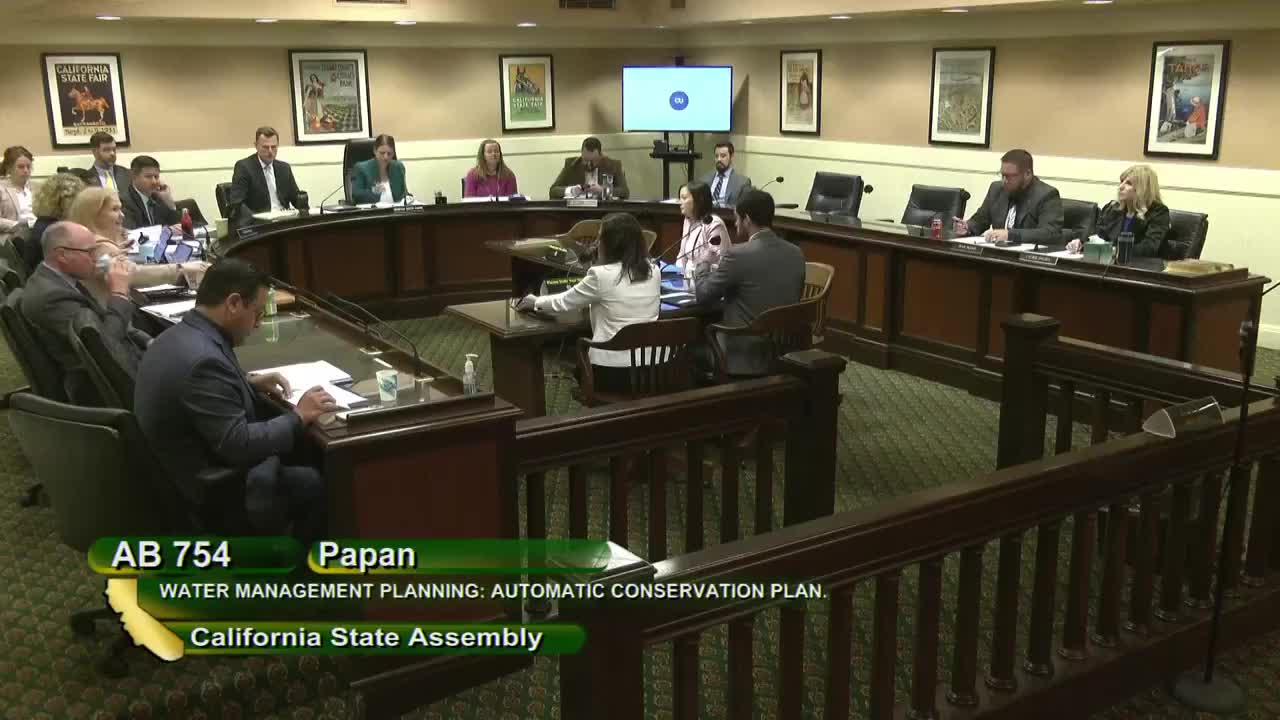 31MIN
Assembly Standing Committee on Water, Parks, and Wildlife
Bill Author

Bill Co-Author(s):