AB 896: Flood control: City of Woodland: Lower Cache Creek.
- Session Year: 2023-2024
- House: Assembly
- Latest Version Date: 2023-04-07
Current Status:
Failed
(2024-02-01: From committee: Filed with the Chief Clerk pursuant to Joint Rule 56.)
Introduced
In Committee
First Chamber
In Committee
Second Chamber
Enacted
What does this bill do?
This bill adopts the federally authorized Lower Cache Creek Flood Risk Management Project and allows the state to pay up to 99% of its costs to protect the City of Woodland and other parts of Yolo County. State funds may be used for planning, design, mitigation, land needs, and construction only if the water department finds the project meets cost‑share and hardship tests, and the City of Woodland agrees to protect the state from any damage claims, with the state disclaiming liability for project damages.
The summary is provided by generative AI which can make mistakes. For original language, please view the details in the table below.
Existing law provides for state cooperation with the federal government in the construction of specified flood control projects. For certain flood control projects authorized on or after January 1, 2002, or for small flood management projects for which specified findings have been made on or after that date, existing law requires the state to pay 50% of specified nonfederal costs. Existing law authorizes the state to pay up to 70% of those nonfederal costs upon the recommendation of the Department of Water Resources or the Central Valley Flood Protection Board if either entity determines that the project will advance one of several specified objectives. Existing law authorizes a plan of improvement for flood control and water conservation on Cache Creek, including Clear Lake, in the Counties of Yolo and Lake.
This bill would specifically adopt and approve the Lower Cache Creek Flood Risk Management Project, as provided. The bill would also authorize the state to provide funds, up to 99% of the costs, as specified, for the project for flood control on the Lower Cache Creek in the County of Yolo, and would authorize the City of Woodland to receive funds for these purposes under specified conditions. The bill would also authorize the state to authorize funding, upon appropriation by the Legislature, to be used for planning, engineering, designing, mitigation, and constructing the project if the Director of Water Resources makes specified findings.
This bill would make legislative findings and declarations as to the necessity of a special statute for the City of Woodland.
Existing law requires the Department of Water Resources to update every 5 years the plan for the orderly and coordinated control, protection, conservation, development, and use of the water resources of the state, which is known as The California Water Plan.This bill would make nonsubstantive changes to those provisions.Existing law requires the Department of Water Resources to update every 5 years the plan for the orderly and coordinated control, protection, conservation, development, and use of the water resources of the state, which is known as The California Water Plan.
This bill would make nonsubstantive changes to those provisions.
The Legislature hereby finds and declares all of the following:
(a)The Lower Cache Creek Project protecting the City of Woodland in the County of Yolo, was authorized by the United States Congress in Section 209 of the Flood Control Act of 1962 (Public Law 87-874), Section 202(a)(11) of the Water Resource Development Act of 2020 (Division AA of Public Law 116-260), and Section 401(2) of the Water Resources Development Act of 2022 (Public Law 117-263).
(b)The City of Woodland partnering with the United States Army Corps of Engineers (USACE), the Central Valley Flood Protection Board (board), and the Department of Water Resources (department) prepared a feasibility study that concluded the City of Woodland is at risk of flooding in a seven-year flood event. The study proposes a project to meet State Urban Level of Flood Protection requirements.
(c)The recommended project was based on a series of engineering and environmental impact studies prepared by the USACE with the cooperation of the department, the board, and the City of Woodland. These studies supported federal authorization of regional improvements to the Sacramento River Flood Control Project, including federal authorizations in the Water Resources Development Act of 2022 (Public Law 117-263).
(d)Residents in the floodplain meet the state definition of being an economically disadvantaged community. The project will provide ecological benefits that contribute to the Central Valley Flood Protection Plans Conservation Strategy. The City of Woodlands entire industrial area, which employs over 10,000 people and is a vital part of the regions food and agricultural economy, is in the floodplain and would benefit from the project.
(e)The voters of the City of Woodland enacted an initiative measure (Measure S) in 2004 that established a city policy to encourage a regional flood control project that would protect both the City of Woodland and other nearby areas of the County of Yolo. To help implement that policy, Measure S prohibited the city from funding or taking any other action to support the Lower Cache Creek Flood Barrier or any substantially similar structure without voter approval. This act does not affect the validity of Measure S, its applicability to any flood control project, including the subject of this act, or the outcome of the litigation challenging the citys approval of the project.
SEC. 2.Section 12663.1 is added to the Water Code, to read:12663.1.The Lower Cache Creek Project along Cache Creek adopted and authorized by the United States Congress in the Water Resources Development Act of 2022 (Public Law 117-263), is hereby adopted and approved substantially in accordance with the recommendations of the Chief of Engineers of the United States Army Corps of Engineers in the Report entitled Lower Cache Creek, Yolo County, Woodland and Vicinity, California Final Chiefs Report and dated June, June 21, 2021, at an estimated cost to the state of the sum of one hundred fourteen million six hundred ninety-two thousand five hundred dollars ($114,692,500) one hundred twenty-eight million two hundred thirty-five thousand four hundred fifty dollars ($128,235,450) that may be appropriated by the Legislature for state participation, upon the recommendation and advice of the department or the board.
SEC. 3.Section 12663.2 is added to the Water Code, to read:12663.2.(a)Notwithstanding Section 12585.7, the state may provide funds, up to 99 percent of the costs, for the project for flood control on the Lower Cache Creek in the County of Yolo, that is substantially in accordance with the recommendations of the Chief of Engineers of the United States Army Corps of Engineers in the Lower Cache Creek, Yolo County, Woodland and Vicinity, California Final Chiefs Report dated June 21, 2021, as follows:
(1)At an estimated cost to the state of the sum of one hundred fourteen million six hundred ninety-two thousand five hundred dollars ($114,692,500) one hundred twenty-eight million two hundred thirty-five thousand four hundred fifty dollars ($128,235,450) that may be appropriated for state cooperation by the Legislature upon the recommendations and advice of the department.
(2)Upon a specific written determination by the department that the project meets the requirements of Section 12582.7.
(b)The state assumes no liability for damages that may result from the project by either of the following:
(1)Authorizing the project in accordance with this section.
(2)The appropriation by the Legislature of funds upon the recommendations and advice of the department.
(c)The City of Woodland may receive funds only if it enters into an agreement with the department pursuant to which the City of Woodland agrees to indemnify and hold and save harmless the state, its officers, agents, and employees for any and all liability for damages that may result from the project.
(d)State funding, upon appropriation by the Legislature, may be used for planning, engineering, designing, mitigation, and constructing the project within authorized project boundaries as set forth in the recommendations of the Chief of Engineers of the United States Army Corps of Engineers, as authorized by the Water Resources Development Act of 2022 (Public Law 117-263) and the additional project features identified in the Woodland Flood Risk Management Project Final Environmental Impact Report (EIR) and any future supplements or addendums to this EIR. The state may advance funds for the planning, engineering, design, and construction of the authorized project and supplemental features identified in the EIR, and the acquisition of required lands, easements, rights-of-way, utility relocations, disposal sites, and borrow areas for, and mitigation of, the authorized project, as specified in the Army Corps of Engineers report entitled Lower Cache Creek, Yolo County, Woodland and Vicinity, California Final Interim Feasibility Report Flood Risk Management. The state shall have the discretion to reduce retention withheld under any cost-share agreement to fund the Lower Cache Creek Flood Risk Management Project to 0 percent and is authorized to advance funding in the absence, in whole or in part, of federal funding, in which case the funding shall not exceed the amount that would be the equivalent nonfederal share if there was federal project funding.
(e)Before any funds appropriated by the Legislature are provided to the flood control project, the director shall find both of the following:
(1)The project qualifies for a 99 percent state cost share based upon the gross calculation of the cumulative benefits the project provides as described in a nonfederal cost-share report submitted to the department for the project.
(2)The project is located in the County of Yolo, contains significant state assets, and economic hardship exists within the benefit area of the project, as demonstrated in a nonfederal cost-share report submitted to the department for the project, and the project would include setback levees.
(f)For purposes of this section, liability for damages includes, but is not limited to, liability for damages relating to the construction or operation of the project or the failure of the project to operate as intended.
SEC. 4.This act does not affect, and shall not be construed to affect, the validity of City of Woodland Measure S (2004), its applicability to any flood control project, including the subject of this act, or the outcome of the litigation in Yolo County Farm Bureau v. City of Woodland (Yolo County Superior Court Case No. CV 2021-0564; 3rd District Court of Appeal Case No. C09702).
SEC. 4.SEC. 5.The Legislature finds and declares that a special statute is necessary and that a general statute cannot be made applicable within the meaning of Section 16 of Article IV of the California Constitution because of the unique need to improve flood control on the Lower Cache Creek located in the County of Yolo as described in Section 1 of this act.
The Legislature hereby finds and declares all of the following:
(a)The Lower Cache Creek Project protecting the City of Woodland in the County of Yolo, was authorized by the United States Congress in Section 209 of the Flood Control Act of 1962 (Public Law 87-874), Section 202(a)(11) of the Water Resource Development Act of 2020 (Division AA of Public Law 116-260), and Section 401(2) of the Water Resources Development Act of 2022 (Public Law 117-263).
(b)The City of Woodland partnering with the United States Army Corps of Engineers (USACE), the Central Valley Flood Protection Board (board), and the Department of Water Resources (department) prepared a feasibility study that concluded the City of Woodland is at risk of flooding in a seven-year flood event. The study proposes a project to meet State Urban Level of Flood Protection requirements.
(c)The recommended project was based on a series of engineering and environmental impact studies prepared by the USACE with the cooperation of the department, the board, and the City of Woodland. These studies supported federal authorization of regional improvements to the Sacramento River Flood Control Project, including federal authorizations in the Water Resources Development Act of 2022 (Public Law 117-263).
(d)Residents in the floodplain meet the state definition of being an economically disadvantaged community. The project will provide ecological benefits that contribute to the Central Valley Flood Protection Plans Conservation Strategy. The City of Woodlands entire industrial area, which employs over 10,000 people and is a vital part of the regions food and agricultural economy, is in the floodplain and would benefit from the project.
SEC. 2.Section 12663.1 is added to the Water Code, to read:12663.1.The Lower Cache Creek Project along Cache Creek adopted and authorized by the United States Congress in the Water Resources Development Act of 2022 (Public Law 117-263), is hereby adopted and approved substantially in accordance with the recommendations of the Chief of Engineers of the United States Army Corps of Engineers in the Report entitled Lower Cache Creek, Yolo County, Woodland and Vicinity, California Final Chiefs Report and dated June, 21, 2021, at an estimated cost to the state of the sum of one hundred fourteen million six hundred ninety-two thousand five hundred dollars ($114,692,500) that may be appropriated by the Legislature for state participation, upon the recommendation and advice of the department or the board.
SEC. 3.Section 12663.2 is added to the Water Code, to read:12663.2.(a)Notwithstanding Section 12585.7, the state may provide funds, up to 99 percent of the costs, for the project for flood control on the Lower Cache Creek in the County of Yolo, that is substantially in accordance with the recommendations of the Chief of Engineers of the United States Army Corps of Engineers in the Lower Cache Creek, Yolo County, Woodland and Vicinity, California Final Chiefs Report dated June 21, 2021, as follows:
(1)At an estimated cost to the state of the sum of one hundred fourteen million six hundred ninety-two thousand five hundred dollars ($114,692,500) that may be appropriated for state cooperation by the Legislature upon the recommendations and advice of the department.
(2)Upon a specific written determination by the department that the project meets the requirements of Section 12582.7.
(b)The state assumes no liability for damages that may result from the project by either of the following:
(1)Authorizing the project in accordance with this section.
(2)The appropriation by the Legislature of funds upon the recommendations and advice of the department.
(c)The City of Woodland may receive funds only if it enters into an agreement with the department pursuant to which the City of Woodland agrees to indemnify and hold and save harmless the state, its officers, agents, and employees for any and all liability for damages that may result from the project.
(d)State funding, upon appropriation by the Legislature, may be used for planning, engineering, designing, mitigation, and constructing the project within authorized project boundaries as set forth in the recommendations of the Chief of Engineers of the United States Army Corps of Engineers, as authorized by the Water Resources Development Act of 2022 (Public Law 117-263) and the additional project features identified in the Woodland Flood Risk Management Project Final Environmental Impact Report (EIR) and any future supplements or addendums to this EIR. The state may advance funds for the planning, engineering, design, and construction of the authorized project and supplemental features identified in the EIR, and the acquisition of required lands, easements, rights-of-way, utility relocations, disposal sites, and borrow areas for, and mitigation of, the authorized project, as specified in the Army Corps of Engineers report entitled Lower Cache Creek, Yolo County, Woodland and Vicinity, California Final Interim Feasibility Report Flood Risk Management. The state shall have the discretion to reduce retention withheld under any cost-share agreement to fund the Lower Cache Creek Flood Risk Management Project to 0 percent and is authorized to advance funding in the absence, in whole or in part, of federal funding, in which case the funding shall not exceed the amount that would be the equivalent nonfederal share if there was federal project funding.
(e)Before any funds appropriated by the Legislature are provided to the flood control project, the director shall find both of the following:
(1)The project qualifies for a 99 percent state cost share based upon the gross calculation of the cumulative benefits the project provides as described in a nonfederal cost-share report submitted to the department for the project.
(2)The project is located in the County of Yolo, contains significant state assets, and economic hardship exists within the benefit area of the project, as demonstrated in a nonfederal cost-share report submitted to the department for the project, and the project would include setback levees.
(f)For purposes of this section, liability for damages includes, but is not limited to, liability for damages relating to the construction or operation of the project or the failure of the project to operate as intended.
SEC. 4.The Legislature finds and declares that a special statute is necessary and that a general statute cannot be made applicable within the meaning of Section 16 of Article IV of the California Constitution because of the unique need to improve flood control on the Lower Cache Creek located in the County of Yolo as described in Section 1 of this act.
SECTION 1.Section 10004 of the Water Code is amended to read:10004.(a)The plan for the orderly and coordinated control, protection, conservation, development, and use of the water resources of the state, which is set forth and described in Bulletin No. 1 of the State Water Resources Board titled, Water Resources of California, Bulletin No. 2 of the State Water Resources Board titled, Water Utilization and Requirements of California, and Bulletin No. 3 of the department titled, The California Water Plan, with the necessary amendments, supplements, and additions to the plan, shall be known as The California Water Plan.(b)(1)The department shall update The California Water Plan on or before December 31, 2003, and every five years thereafter. The department shall report the amendments, supplements, and additions included in the updates of The California Water Plan, together with a summary of the departments conclusions and recommendations, to the Legislature in the session in which the updated plan is issued.(2)The department shall establish an advisory committee, comprised of representatives of agricultural and urban water suppliers, local government, business, production agriculture, and environmental interests, and other interested parties, to assist the department in updating The California Water Plan. The department shall consult with the advisory committee in carrying out this section. The department shall provide written notice of meetings of the advisory committee to any interested person or entity that requests the notice. The meetings shall be open to the public.(3)The department shall release a preliminary draft of The California Water Plan, as updated, upon request, to interested persons and entities throughout the state for their review and comments. The department shall provide these persons and entities an opportunity to present written or oral comments on the preliminary draft. The department shall consider these comments in the preparation of the final publication of The California Water Plan, as updated.(a)The plan for the orderly and coordinated control, protection, conservation, development, and utilization use of the water resources of the state state, which is set forth and described in Bulletin No. 1 of the State Water Resources Board entitled titled, Water Resources of California, Bulletin No. 2 of the State Water Resources Board entitled, titled, Water Utilization and Requirements of California, and Bulletin No. 3 of the department entitled, titled, The California Water Plan, with any the necessary amendments, supplements, and additions to the plan, shall be known as The California Water Plan.
(b)(1)The department shall update The California Water Plan on or before December 31, 2003, and every five years thereafter. The department shall report the amendments, supplements, and additions included in the updates of The California Water Plan, together with a summary of the departments conclusions and recommendations, to the Legislature in the session in which the updated plan is issued.
(2)The department shall establish an advisory committee, comprised of representatives of agricultural and urban water suppliers, local government, business, production agriculture, and environmental interests, and other interested parties, to assist the department in the updating of The California Water Plan. The department shall consult with the advisory committee in carrying out this section. The department shall provide written notice of meetings of the advisory committee to any interested person or entity that request requests the notice. The meetings shall be open to the public.
(3)The department shall release a preliminary draft of The California Water Plan, as updated, upon request, to interested persons and entities throughout the state for their review and comments. The department shall provide these persons and entities an opportunity to present written or oral comments on the preliminary draft. The department shall consider these comments in the preparation of the final publication of The California Water Plan, as updated.
|
Date
|
Status
|
|---|---|
| Feb 1, 2024 | From committee: Filed with the Chief Clerk pursuant to Joint Rule 56. |
| Jan 31, 2024 | Died pursuant to Art. IV, Sec. 10(c) of the Constitution. |
| May 18, 2023 | In committee: Held under submission. |
| May 10, 2023 | In committee: Set, first hearing. Referred to APPR. suspense file. |
| May 3, 2023 | In committee: Hearing postponed by committee. |
| Apr 19, 2023 | From committee: Do pass and re-refer to Com. on APPR. (Ayes 14. Noes 0.) (April 18). Re-referred to Com. on APPR. |
| Apr 10, 2023 | Re-referred to Com. on W., P., & W. |
| Apr 7, 2023 | From committee chair, with author's amendments: Amend, and re-refer to Com. on W., P., & W. Read second time and amended. |
| Mar 13, 2023 | Re-referred to Com. on W., P., & W. |
| Mar 9, 2023 | From committee chair, with author's amendments: Amend, and re-refer to Com. on W., P., & W. Read second time and amended. |
| Mar 9, 2023 | Referred to Com. on W., P., & W. |
| Feb 15, 2023 | From printer. May be heard in committee March 17. |
| Feb 14, 2023 | Read first time. To print. |
|
Date
|
Description
|
Location
|
Votes
|
|
|---|---|---|---|---|
| Apr 18, 2023 | Do pass and be re-referred to the Committee on [Appropriations] | Assembly Standing Committee on Water, Parks, and Wildlife |
Passed |
This list shows positions taken on this bill by organizations on the date displayed, which is linked to the original source.
Positions by individuals are not included.
|
Organization
|
Position
|
Date
|
|---|---|---|
| California Central Valley Flood Control Association | ** Support | |
| City of Woodland | * Support | Apr 18, 2023 |
| Woodland Chamber of Commerce | * Support | Apr 18, 2023 |
Date of Hearing: May 10, 2023
ASSEMBLY COMMITTEE ON APPROPRIATIONS
Chris Holden, Chair
ABPCA Bill Id:AB 896
Author:(Aguiar-Curry) – As Amended Ver:April 7, 2023
Policy Committee: | Water, Parks and Wildlife | Vote: | 14 - 0 |
|
| ||
|
|
Urgency: No State Mandated Local Program: No Reimbursable: No
SUMMARY:
This bill adopts and approves the Lower Cache Creek Flood Risk Management Project (Project) and authorizes the state to fund up to 99% of the nonfederal costs of the Project.
Specifically, this bill:
- Adopts and approves the Project at an estimated cost to the state of $128,235,450 that may be appropriated by the Legislature for state participation, upon the recommendation and advice of the Department of Water Resources (DWR) or the Central Valley Flood Protection Board (CVFPB), and requires DWR to make certain findings and provide a written determination that the Project meets specified requirements.
- Authorizes the state to fund up to 99% of the Project for flood control in the Lower Cache Creek that is substantially in accordance with the recommendations of the U.S. Army Corps of Engineers (USACE) in the June 21, 2021, “Lower Cache Creek, Yolo County, Woodland and Vicinity, California Final Chiefs Report” (2021 USACE report).
- Provides that the state assumes no liability for damages that may result from the Project and that funds will be granted to the City of Woodland only upon agreement to indemnify the state for any and all liability for and damages that may result from the Project.
- Provides that state funding, upon appropriation, may be used for planning, engineering, designing, mitigation, and constructing the Project, as specified, and authorizes the state to advance funds for the Project before federal funds are available so long as any advanced state funds do not exceed the nonfederal share of the Project.
- Grants the state discretion to reduce retention withheld under any cost-share agreement to fund the Project to 0%, as specified.
FISCAL EFFECT:
If DWR approves and the Legislature appropriates up to 99% of the nonfederal cost of the Project, there will be a one-time state cost of up to approximately $128 million (General Fund or bond funds).
COMMENTS:
1) Purpose. According to the author:
The Lower Cache Creek Flood Management Project will provide flood protection for the City of Woodland and the disadvantaged communities that are disproportionately impacted by the risk of flooding. This project has been technically reviewed and approved by the [USACE] and federally approved and authorized by US Congress. This bill will provide needed state approval and authorize the state to provide funding upon appropriation. Further, given the impacted community’s disadvantaged status, this bill will increase the allowable state cost share for the project.
2) Background.
Cache Creek is Flood-Prone. According to the City of Woodland, Cache Creek, located north of the City of Woodland, carries water from Clear Lake into the Cache Creek Settling Basin and eventually into the Yolo Bypass. The Creek has a long history of flooding. The Creek has overtopped its banks and levees more than 20 times since 1900. This is primarily because the existing levees along Cache Creek provide only approximately a 10-year level of flood protection. This means the levees have a 10% chance of breaching in any given year. Most recently, the Cache Creek levees overtopped in February 2019. If not for flood fighting actions, portions of Woodland could have flooded.
The City of Woodland, CVFPB, DWR, and USACE completed the Lower Cache Creek Feasibility Study in 2021 to increase flood protection to Woodland and adjacent critical infrastructure. As a result, USACE has recommended a plan to construct six miles of new levees, levee embankment, seepage berms, drainage channels, cutoff walls, a weir, and closure structures across roads and railways.
Cost Share. Under state law, §12582.7, the state may participate in funding local flood control projects that are authorized by the Legislature and that meet specific criteria, including that the project qualifies for federal financial assistance and is authorized by Congress. Projects may be authorized pursuant to a USACE Chief Engineer’s report, but cannot receive state funding until authorized by Congress. The $366 million Project was authorized by Congress and signed by President Biden in 2022 as part of the Water Resources Development Act of 2022.
Typically, the federal government provides funding for 50% to 75% of a project’s cost, and the local agency, as the entity participating in the project construction under agreement with the federal agency, is responsible for providing the nonfederal share of project costs. If the local agency complies with the Water Code and program guidelines, the state will reimburse the local entity for 50% to 70% of the nonfederal share (not to exceed specified limits.) The reimbursement rate is based on how effectively the project achieves multi-purpose objectives, as determined by DWR or CVFPB. DWR reports that few projects have trouble reaching the 70% cap, and many would exceed the cap if allowed to.
Notwithstanding the 70% cap for state cost share under current law, SB 496 (Laird), Chapter 310, Statutes of 2021, authorized DWR to pay up to 100% of specified nonfederal costs for reconstruction of the Pajaro River Flood Risk Management Project. This bill similarly authorizes the state to pay up to 99% of the nonfederal cost of the Project – approximately $128 million. In its March 13, 2023, draft nonfederal cost share report, the City of Woodland contends the Project is eligible for an increase in state cost share of 10.7% because it significantly increases flood protection for a disadvantaged community, an additional 10% increase because it would increase flood protection for segments of two state transportation facilities (State Route 113 and Interstate Highway 5), and an additional 28% increase due to benefits to open space, habitat, and recreation. According to the report, the Project would be eligible for a 44% increase in state cost share (for a total of 99%) if the 70% cap under existing law were not in place. The City of Woodland states:
Given the information provided in this report, the City requests the State cost share for the Lower Cache Creek Project be 99%. The City recognizes the Water Code caps the maximum state share at 70%. The City believes the Water Code has not kept pace with the Administration’s goals for helping disadvantaged communities and incentivizing multi benefit projects that provide for resilience to climate change, preserve open space and create habitat and recreation opportunities. The City intends on pursuing legislation to support this cost share request.
Analysis Prepared by: Nikita Koraddi / APPR. / (916) 319-2081
Date of Hearing: April 18, 2023
ASSEMBLY COMMITTEE ON WATER, PARKS, AND WILDLIFE
Rebecca Bauer-Kahan, Chair
ABPCA Bill Id:AB 896 (
Author:Aguiar-Curry) – As Amended Ver:April 7, 2023
SUBJECT: Flood control: City of Woodland: Lower Cache Creek
SUMMARY: Adopts and authorizes the Lower Cache Creek Flood Risk Management Project (Proposed Project) and authorizes the Department of Water Resources (DWR) to recommend the state to fund up to 99% of specified nonfederal costs for the Proposed Project. Specifically, this bill:
- Adopts and authorizes the Proposed Project.
- Allows the state to cover up to 99% of the cost of the Proposed Project.
- Provides that the state may advance funds for the planning, engineering, designing, mitigation, and construction of the Proposed Project; the acquisition of required lands, easements, rights-of-way, and other facilities for the Proposed Project.
- Grants the state discretion to reduce retention withheld under any cost-share agreement to fund the Proposed Project to zero percent.
- Authorizes the state to advance funds for the Proposed Project before federal funds are available to the Proposed Project so long as any advanced state funds do not exceed the nonfederal share of the Proposed Project.
- Requires the director of DWR to make the following findings before funds appropriated by the Legislature are provided to the Proposed Project:
- The Proposed Project qualifies for a 99% state cost share based upon the gross calculation of the cumulative benefits the project provides as described in a nonfederal cost-share report submitted to the department for the project; and
- The project is located in the County of Yolo, contains significant state assets, and economic hardship exists within the benefit area of the project, as demonstrated in a nonfederal cost-share report submitted to DWR for the project, and the project would include setback levees.
- Establishes that the state will not assume liability for damages that may result from the Proposed Project and that funds will only be granted to the City of Woodland upon agreement to indemnify the state for damages.
- Makes findings and declarations regarding the history of flood protection efforts along the Cache Creek and the need to improve and construct new levees.
- Declares that a special statute is necessary because of the unique need to improve flood control on the Cache Creek.
EXISTING LAW:
- Provides that the state has a primary interest in the manner in which flood waters shall be controlled for the protection of life and property and the control, storage, and use of the state’s water resources (Water Code § 12578 et seq.).
- Authorizes the state, under the State Water Resources Law of 1945, to participate in funding local flood control projects that are authorized by the Legislature and that meet specific criteria, including that the project qualifies for federal financial assistance and is authorized by Congress. Projects may be authorized pursuant to a U.S. Army Corps of Engineers (USACE) Chief Engineer’s report, but cannot receive state funding until authorized by Congress. Additional criteria include that the project provides protection from flood damages in the most efficient manner practicable, the project considers environmental, recreational, and local economic conditions, the annual benefits exceed the annual costs, project avoids, minimizes, or mitigates impacts to environmental and recreational values, etc. (Water Code § 12582.7).
- Provides that the state shall pay 50% of the nonfederal capital, environmental mitigation, and planning and engineering costs of flood management projects if authorized by the Legislature and if a project meets specified conditions (Water Code § 12585.7).
- Provides the state may pay an additional 20% of the nonfederal share (up to 70% total) of a project if DWR or the Central Valley Flood Protection Board (CVFPB) determine that a project meets one of the following objectives (Water Code § 12585.7):
- Protects, creates, or enhances endangered species or important habitats;
- Protects or enhances open space;
- Develops or enhances recreational opportunities;
- Increases the level of protection for disadvantaged communities; or
- Increases flood protection for state transportation facilities or state water supply facilities.
- Defines “disadvantaged community” as a community with an annual median household income that is less than 80% of the statewide annual median household income (Water Code § 79505.5).
- Authorizes numerous projects for the control, conservation, and utilization of destructive flood waters in the interest of the public welfare (Water Code § 12639).
- Requires that DWR obtain the total cost of the project and the cost and benefit ratio before the project may be recommended to the Legislature (Water Code § 12630).
- Adopts the flood control and water conservation improvement plan on Cache Creek in Yolo and Lake Counties (Water Code § 12663).
FISCAL EFFECT: Unknown. This bill is keyed fiscal.
COMMENTS:
- Purpose of this bill. The purpose of this bill is to allow for the construction of the Proposed Project to provide flood protection to the City of Woodland, allow the state to cover up to 99% of the non-federal cost share of the project, and allow the state to advance funds towards the Proposed Project. According to the author, this bill is needed because the City of Woodland is at the highest risk of any urban area in the Central Valley: “The Lower Cache Creek Flood Management Project will provide flood protection for the City of Woodland and the disadvantaged communities that are disproportionately impacted by the risk of flooding. This project has been technically reviewed and approved by the [USACE] and federally approved and authorized by US Congress. This bill will provide needed state approval and authorize the state to provide funding upon appropriation. Further, given the impacted community’s disadvantaged status, this bill will increase the allowable state cost share for the project.”
- Background. Water in Cache Creek only reaches the Woodland area at certain times of year due to upstream retention and diversions for water supply. The channel then passes north of the City of Woodland through levees constructed by USACE in 1958 as part of the federally authorized Sacramento River Flood Control Project. The leveed portion of Cache Creek discharges into the Cache Creek Settling Basin, which was also constructed by USACE as a separately authorized component of the Sacramento River Flood Control Project. Cache Creek has historically carried a large sediment load. The settling basin was constructed to prevent sediment carried by Cache Creek from adversely affecting the hydraulic capacity of the Yolo Bypass through excessive sediment deposition and thereby increasing the flood risk of the City of Sacramento.
The Proposed Project. A study by the USACE investigated and determined the extent of federal interest in a range of alternative plans that reduce flood risk to Woodland and surrounding areas. Lower Cache Creek has a history of flooding, and the study area has experienced 20 flood events since the mid-1900s. While Woodland has not historically flooded, this is a function of flood fighting efforts and good luck. An approximate population of 3,000 individuals and critical infrastructure, like schools, utilities, and Interstate 5, are at risk of flooding.
According to the 2020 independent review of the feasibility study,[1] “There is a risk to human life and safety in the City of Woodland, town of Yolo, and surrounding areas from flooding of Lower Cache Creek. Floodwaters from Lower Cache Creek create a significant life safety risk by inundating roadways from city streets to Interstate 5, which creates hazards for motorists and isolates citizens from critical facilities such as hospitals. Additionally, flooding from Lower Cache Creek poses a risk of economic damage to property and critical infrastructure within the City of Woodland, town of Yolo, and surrounding areas. The anticipated damageable property (structures and contents) is $1.3 billion (October 2018 price levels) and the average annual damages are expected to range from $20.7 million to $27.5 million over the 50-year period of analysis. Damages are concentrated in an industrial area in northeastern Woodland, southwest of the CCSB. The threat of flooding to the City of Woodland includes potential impacts on both residential and commercial property, disruption of two major transportation routes (Interstate 5 and the Union Pacific Railroad), and impacts on agricultural production.”
The Proposed Project consists of improving existing levees and constructing new levees north of Woodland in order to prevent floodwaters emanating from Lower Cache Creek from reaching the built-up portion of the city. Proposed project features include nearly 6 miles of new levees, levee embankment, seepage berms, drainage channels, cutoff walls, a weir, and closure structures across roads and railways. With the Proposed Project in place, areas in northeast Woodland, where damages are concentrated, would see a reduction in the annual chance of flooding from up to 7.0% to about 0.1%. The cost of the project is $366,387,000 (non-federal share $128,235,450) with a benefit cost ratio of 2.1.[2]
Cost share analysis. Under the DWR regulations in Title 23 CCR 572 and 574, DWR or the CVFPB will review the draft nonfederal cost-share report and submit a final nonfederal Cost-Share report to the Legislature for final state cost-share approval. The City of Woodland reviewed what state cost share might be if the 70% cap on the state’s cost share were not in place. The “Lower Cache Creek, Yolo County, Woodland and Vicinity, California Project – Draft Nonfederal Cost-Sharing Report” (Report) concludes that the Proposed Project is eligible for a state cost-share of 10.7% increase because it significantly increases flood protection for a disadvantaged communities. In addition, the Report finds that the Proposed Project is eligible for a state cost-share increase of 10% because it would increase flood protection for segments of two state transportation facilities (State Route 113 and Interstate Highway 5). Finally, the Report finds that the Proposed Project is eligible for an additional 28% increase due to benefits to open space, habitat, and recreation due to the construction of levee setbacks. According to the report, the Proposed Project would be eligible for a 44% increase in state cost-share (for a total of 99%) if the 70% cap under existing law were not in place.
Under the existing 70% cap, the state’s share for the Proposed Project is approximately $89.8 million (70% of the nonfederal share of approximately $128 million). An increase of the state’s share to 99% of the nonfederal share would increase the state’s contribution by approximately $37 million.
Measure S. In 2003, an approved flood wall project was stopped by a voter initiative. This measure was added by a group of Woodland area residents on the ballot as Measure S, which asked whether the city should be prohibited from funding or taking any action that supported the Lower Cache Creek Flood Barrier (flood wall) or a substantially similar structure. Despite opposition from those who did not want the flood wall option to be taken off the table permanently and who did not want to continue having to pay flood insurance, the measure passed.
In 2012, Woodland, in partnership with USACE and DWR, re-initiated the Lower Cache Creek Feasibility Study (Study). The Study looked at 26 different alternatives. Woodland established a local citizen advisory committee made up of a broad cross-section of community members including those who were opposed to the previous 2003 project. In 2021, the city certified the environmental impact report and approved a revised project (supported by the advisory committee) and that, while similar in geographical location, included many structural and non-structural benefits that were not part of the 2002 flood protection project.
Despite these efforts, a lawsuit was filed against the city claiming the approved project was substantially similar to the 2002 project and therefore in violation of Measure S. Yolo Superior Court Judge Sam McAdam recently issued a ruling in favor of plaintiffs. The city has since filed an appeal and is preparing a ballot measure to overturn Measure S. In response to this, this bill contains language that bill “does not affect, and shall not be construed to affect, the validity of City of Woodland Measure S (2004), its applicability to any flood control project, including the subject of this act, or the outcome of the litigation.”
- Policy considerations. In recent years, SB 496 of 2021 and SB 489 of 2022 passed to provide up to a 100% cost share on a flood protection projects along the Pajaro River. The Senate Natural Resources and Water Committee analysis for AB 489 presciently noted:
“The issues on the Pajaro River may be unique. Nonetheless, between the waiving of the local match requirement provided by SB 496 and the advance payment provisions of this bill, it seems likely that future bills will cite these bills as precedent for similarly waiving matching rates and providing advance payment.”
This bill is continuing precedent set in waiving the state cap on funding for flood projects. However, in light of recent, disastrous events in Pajaro, it is clear that levee maintenance and flood protection is needed and special support is needed to support low-income areas. The Legislature may want to consider how strictly it will abide by established limits to cost-shares or if the limits to cost-share based on any of the outline criteria should be changed instead of evaluated on a case-by-case basis.
- Arguments in support. The California Central Valley Flood Control Association writes in support of this bill as the Proposed Project will “provide additional flood protection to the state’s existing portfolio and yield ecological benefits that contribute to the Central Valley Flood Protection Plan’s Conservation Strategy. The project will also provide multiple benefits to the city of Woodland’s entire industrial area, which is a vital part of the region’s food and agricultural economy, and economically disadvantaged communities residing in the floodplain.”
- Related legislation. SB 496 (Laird), Chapter 310, Statutes of 2021, authorizes DWR to pay up to 100% of specified nonfederal costs for the Flood Risk Management Project on the Pajaro River.
SB 489 (Laird), Chapter 667, Statutes of 2022, authorizes the state to advance funds available, upon appropriation by the Legislature, for a flood control project on the Pajaro River even in the absence of matching federal funds.
REGISTERED SUPPORT / OPPOSITION:
Support
California Central Valley Flood Control Association
Opposition
None on file
Analysis Prepared by: Stephanie Mitchell / W., P., & W. / (916) 319-2096
Discussed in Hearing
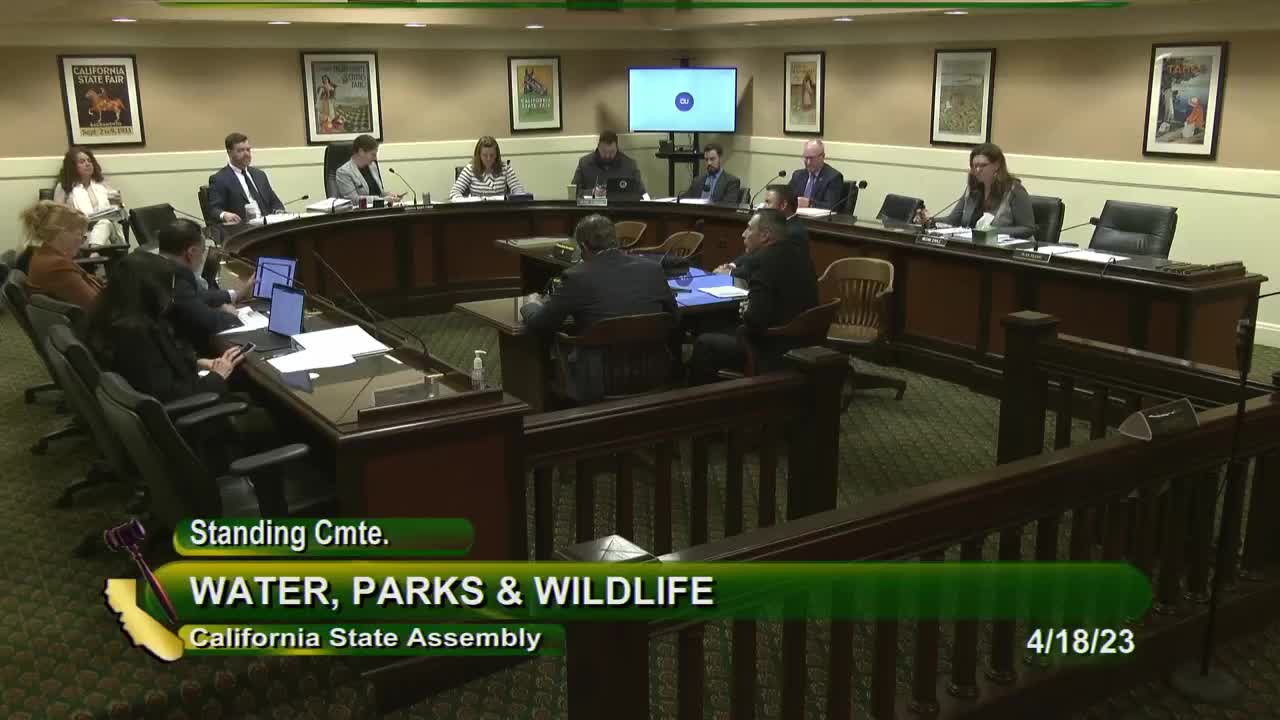 7MIN
Assembly Standing Committee on Water, Parks, and Wildlife
Bill Author

Bill Co-Author(s):