SB 1040: Civil actions: service of process.
- Session Year: 2023-2024
- House: Senate
- Latest Version Date: 2024-04-08
Current Status:
Failed
(2024-05-16: May 16 hearing: Held in committee and under submission.)
Introduced
In Committee
First Chamber
In Committee
Second Chamber
Enacted
What does this bill do?
This bill changes how civil summonses (notices of a lawsuit) are served to people in state prisons and county jails: servers must first try to hand papers to the person under a new rule, and if that fails the papers may be left with the warden, sheriff, or jailer. It requires institutions to treat accepted papers as confidential mail handed to the inmate in their presence with a signature, and to notify the server within 24 hours if the person was transferred or released so the attempted service is not effective.
The summary is provided by generative AI which can make mistakes. For original language, please view the details in the table below.
Existing law provides that in a civil action, if a copy of the summons and complaint cannot with reasonable diligence be personally delivered to the person to be served, as specified, a summons may be served by leaving a copy of the summons and complaint at the persons dwelling house, usual place of abode, usual place of business, or usual mailing address, in the presence of a competent member of the household or a person apparently in charge of their office, place of business, at least 18 years of age, and by thereafter mailing a copy of the summons and complaint to the person to be served at the place where a copy of the summons and complaint were left.
This bill would provide that if a process for personal service where the only address reasonably known for the person to be served with the summons is a state prison or county jail, service of process may be effected on the first delivery attempt jail. Where that process cannot be effectuated, the bill provides that substitute service may be made by leaving a copy of the summons and complaint with the warden, sheriff, or jailer of that state prison or county jail. jail, as specified. If the person to be served has been transferred or released, the bill would require a warden, sheriff, or jailer who receives a copy of a summons on the persons behalf to notify the server of that fact within 24 hours of the attempted service, and the attempted service would not be effective.
Existing law provides that in a civil action, if a copy of the summons and complaint cannot with reasonable diligence be personally delivered to the person to be served, as specified, a summons may be served by leaving a copy of the summons and complaint at the persons dwelling house, usual place of abode, usual place of business, or usual mailing address, in the presence of a competent member of the household or a person apparently in charge of their office, place of business, at least 18 years of age, and by thereafter mailing a copy of the summons and complaint to the person to be served at the place where a copy of the summons and complaint were left.
This bill would provide that if the only address reasonably known for the person to be served with the summons is a state prison or county jail, service of process may be effected on the first delivery attempt by leaving a copy of the summons and complaint with the warden, sheriff, or jailer of that state prison or county jail. If the person to be served has been transferred or released, the bill would require a warden, sheriff, or jailer who receives a copy of a summons on the persons behalf to notify the server of that fact within 24 hours of the attempted service, and the attempted service would not be effective.
(a)In lieu of personal delivery of a copy of the summons and complaint to the person to be served as specified in Section 416.10, 416.20, 416.30, 416.40, or 416.50, a summons may be served by leaving a copy of the summons and complaint during usual office hours in the person to be serveds office or, if no physical address is known, at their usual mailing address, other than a United States Postal Service post office box, with the person who is apparently in charge thereof, and by thereafter mailing a copy of the summons and complaint by first-class mail, postage prepaid to the person to be served at the place where a copy of the summons and complaint were left. When service is effected by leaving a copy of the summons and complaint at a mailing address, it shall be left with a person at least 18 years of age, who shall be informed of the contents thereof. Service of a summons in this manner is deemed complete on the 10th day after the mailing.
(b)If a copy of the summons and complaint cannot with reasonable diligence be personally delivered to the person to be served, as specified in Section 416.60, 416.70, 416.80, or 416.90, a summons may be served by leaving a copy of the summons and complaint at the persons dwelling house, usual place of abode, usual place of business, or usual mailing address other than a United States Postal Service post office box, in the presence of a competent member of the household or a person apparently in charge of their office, place of business, or usual mailing address other than a United States Postal Service post office box, at least 18 years of age, who shall be informed of the contents thereof, and by thereafter mailing a copy of the summons and of the complaint by first-class mail, postage prepaid to the person to be served at the place where a copy of the summons and complaint were left. Service of a summons in this manner is deemed complete on the 10th day after the mailing.
(c)Notwithstanding subdivision (b), if the only address reasonably known for the person to be served is a private mailbox obtained through a commercial mail receiving agency, service of process may be effected on the first delivery attempt by leaving a copy of the summons and complaint with the commercial mail receiving agency in the manner described in subdivision (d) of Section 17538.5 of the Business and Professions Code.
(d)(1)Notwithstanding subdivision (b), if the only address reasonably known for the person to be served is a state prison or county jail, service of process may be effected on the first delivery attempt personal service of process shall be first be attempted in conformity with Section 4013.5 of the Penal Code. If personal service cannot be made, then substitute service may be made by leaving a copy of the summons and complaint with the warden, sheriff, or jailer in the manner described in Section Sections 4013 and 4013.5 of the Penal Code.
(2)If the person to be served has been transferred or released, a warden, sheriff, or jailer who receives a copy of the summons and complaint on that persons behalf shall notify the server of that fact within 24 hours of the attempted service, and service shall not be considered effective.
SEC. 2.Section 4013 of the Penal Code is amended to read:4013.(a)A warden, sheriff, sheriff or jailer upon whom a paper in a judicial proceeding, directed to an incarcerated person in the custody of the warden, sheriff, or jailer, is served, shall forthwith deliver the paper to the incarcerated person, with a note thereon of the time of its service. The warden, sheriff, sheriff or jailer is liable to the incarcerated person for all damages occasioned thereby for neglecting to do so.
(b)Service directed to a person who is incarcerated within any institution in this state may be served by any person who may lawfully serve process.
SEC. 3.Section 4013.5 is added to the Penal Code, to read:4013.5.(a)A warden upon whom a paper in a judicial proceeding, directed to an incarcerated person in the custody of the warden, is served shall not preclude the proper service of the paper.
(b)When service is requested by a person at any institution in this state and that service is directed to a person who is incarcerated within the institution, service shall be completed as follows:
(1)Institution staff may accept the papers and shall complete the service on the incarcerated person pursuant to subdivision (c).
(2)A sworn peace officer may be escorted into the security area to complete the service of papers.
(3)Personal service may be permitted if:
(A)Personal service is requested, and the request was made to the institution.
(B)The incarcerated person can reasonably be brought to the visiting area.
(C)Permitting the personal service does not compromise the institutions security.
(c)If institution staff accepts the papers pursuant to subdivision (b), the staff shall deem the paper as incoming confidential mail and place the paper in an envelope provided by the person requesting service. Designated institution staff shall open the envelope in the presence of the addressed incarcerated person at a designated time and place. Staff shall remove the contents of the envelope upside down to prevent inadvertent reading of the contents and shake them to ensure the absence of prohibited material. The incarcerated person shall sign for all confidential mail at the time of delivery.
(d)The warden is liable to the incarcerated person for all damages occasioned thereby for neglecting to do so.
(e)Service directed to a person who is incarcerated within any institution in this state may be served by any person who may lawfully serve process.
(a)In lieu of personal delivery of a copy of the summons and complaint to the person to be served as specified in Section 416.10, 416.20, 416.30, 416.40, or 416.50, a summons may be served by leaving a copy of the summons and complaint during usual office hours in his or her the person to be serveds office or, if no physical address is known, at his or her their usual mailing address, other than a United States Postal Service post office box, with the person who is apparently in charge thereof, and by thereafter mailing a copy of the summons and complaint by first-class mail, postage prepaid to the person to be served at the place where a copy of the summons and complaint were left. When service is effected by leaving a copy of the summons and complaint at a mailing address, it shall be left with a person at least 18 years of age, who shall be informed of the contents thereof. Service of a summons in this manner is deemed complete on the 10th day after the mailing.
(b)If a copy of the summons and complaint cannot with reasonable diligence be personally delivered to the person to be served, as specified in Section 416.60, 416.70, 416.80, or 416.90, a summons may be served by leaving a copy of the summons and complaint at the persons dwelling house, usual place of abode, usual place of business, or usual mailing address other than a United States Postal Service post office box, in the presence of a competent member of the household or a person apparently in charge of his or her their office, place of business, or usual mailing address other than a United States Postal Service post office box, at least 18 years of age, who shall be informed of the contents thereof, and by thereafter mailing a copy of the summons and of the complaint by first-class mail, postage prepaid to the person to be served at the place where a copy of the summons and complaint were left. Service of a summons in this manner is deemed complete on the 10th day after the mailing.
(c)Notwithstanding subdivision (b), if the only address reasonably known for the person to be served is a private mailbox obtained through a commercial mail receiving agency, service of process may be effected on the first delivery attempt by leaving a copy of the summons and complaint with the commercial mail receiving agency in the manner described in subdivision (d) of Section 17538.5 of the Business and Professions Code.
(d)(1)Notwithstanding subdivision (b), if the only address reasonably known for the person to be served is a state prison or county jail, service of process may be effected on the first delivery attempt by leaving a copy of the summons and complaint with the warden, sheriff, or jailer in the manner described in Section 4013 of the Penal Code.
(2)If the person to be served has been transferred or released, a warden, sheriff, or jailer who receives a copy of the summons and complaint on that persons behalf shall notify the server of that fact within 24 hours of the attempted service, and service shall not be considered effective.
|
Date
|
Status
|
|---|---|
| May 16, 2024 | May 16 hearing: Held in committee and under submission. |
| May 10, 2024 | Set for hearing May 16. |
| May 6, 2024 | May 6 hearing: Placed on APPR suspense file. |
| Apr 26, 2024 | Set for hearing May 6. |
| Apr 23, 2024 | From committee: Do pass and re-refer to Com. on APPR with recommendation: To consent calendar. (Ayes 5. Noes 0. Page 3730.) (April 23). Re-referred to Com. on APPR. |
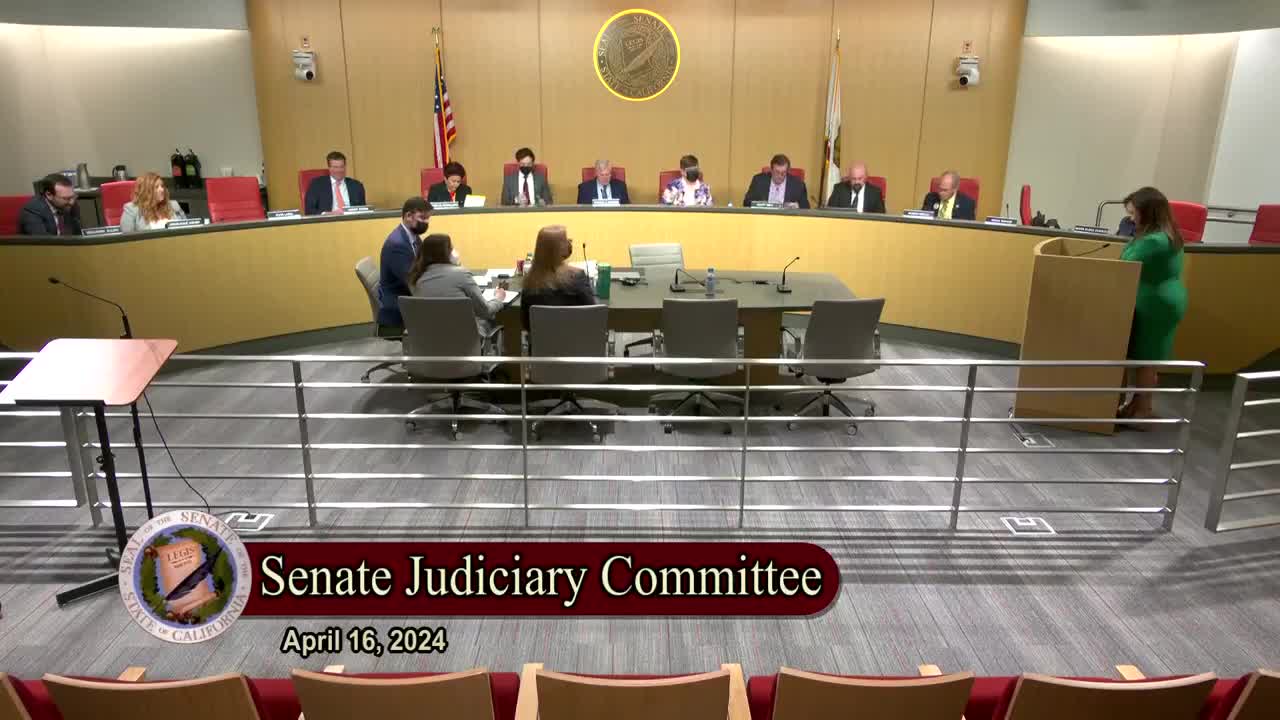
| Apr 17, 2024 | From committee: Do pass and re-refer to Com. on PUB S. (Ayes 11. Noes 0. Page 3635.) (April 16). Re-referred to Com. on PUB S. |
| Apr 9, 2024 | Set for hearing April 23 in PUB S. pending receipt. |
| Apr 8, 2024 | From committee with author's amendments. Read second time and amended. Re-referred to Com. on JUD. |
| Apr 3, 2024 | Set for hearing April 16. |
| Feb 14, 2024 | Referred to Coms. on JUD. and PUB S. |
| Feb 8, 2024 | From printer. May be acted upon on or after March 9. |
| Feb 7, 2024 | Introduced. Read first time. To Com. on RLS. for assignment. To print. |
|
Date
|
Description
|
Location
|
Votes
|
|
|---|---|---|---|---|
| May 6, 2024 | Placed on suspense file | Senate Standing Committee on Appropriations |
Passed |
|
| Apr 23, 2024 | Do pass, but first be re-referred to the Committee on [Appropriations] with the recommendation: To Consent Calendar | Senate Standing Committee on Public Safety |
Passed |
|
| Apr 16, 2024 | Do pass, but first be re-referred to the Committee on [Public Safety] | Senate Standing Committee on Judiciary |
Passed |
This list shows positions taken on this bill by organizations on the date displayed, which is linked to the original source.
Positions by individuals are not included.
|
Organization
|
Position
|
Date
|
|---|---|---|
| Aclu California Action | * Indeterminate | Apr 16, 2024 |
| California Association Of Legal Support Professionals | ** Support | |
| San Bernardino County Sheriff | ** Support |
SENATE COMMITTEE ON
Senator Anna Caballero, Chair
2023 - 2024 Regular Session
SB 1040 (Ochoa Bogh) - Civil actions: service of process
Version: | Policy Vote: |
Urgency: | Mandate: |
Hearing Date: | Consultant: |
Bill Summary:
SB 1040 allows substituted service of process to individuals incarcerated in state prisons and county jails.
Fiscal Impact:
- CDCR indicates potentially significant costs (General Fund) in the hundreds of thousands of dollars. The department notes that this bill generally aligns with CDCR’s existing policy to conduct service of process on the incarcerated population. However, SB 1040 deviates from existing policy by requiring CDCR staff to treat documents being served as confidential mail, when that was not previously the process nor is it considered confidential mail under existing CDCR regulations. This could drive potential overtime workload for staff, likely resulting in hundreds of thousands of dollars in fiscal impact, at the institutions to appropriately process and deliver paperwork.
- Unknown, potentially significant cost pressures to counties (local funds) in staffing costs to local correctional facilities to adequately process and serve judicial papers.
- Unknown, potentially significant workload cost pressures to the courts (Trial Court Trust Fund, General Fund) to adjudicate alleged violations of this bill. While the superior courts are not funded on a workload basis, an increase in workload could result in delayed court services and would put pressure on the General Fund to increase the amount appropriated to backfill for trial court operations. The Governor’s 2024-25 state budget proposes $83.1 million ongoing General Fund to continue to backfill the Trial Court Trust Fund for expected revenue declines.
Background:
Under existing law, a warden of a state prison or a sheriff of a county jail must deliver judicial papers served to an incarcerated person with a note indicating the time of service. The warden or sheriff is liable to the incarcerated person for all damages resulting from the failure to deliver the papers. California case law has interpreted this to authorize wardens or sheriffs to accept service on an incarcerated person’s behalf. (Sakaguchi v. Sakaguchi (2009) 173 Cal.App.4th 852; Crane v. Dolihite (2021) 70 Cal.App.5th 772.) In terms of substitute service, this has been interpreted to mean that a warden or sheriff are authorized to accept a judicial document on an incarcerated person’s behalf if reasonably diligent attempts to personally serve the incarcerated individual fail. (Ibid.)
CDCR’s Department Operations Manual (DOM) specifies procedures for service on an inmate in a state prison. As provided in the DOM, service may be completed by accepting the papers from the process server and completing service on the inmate; escorting a sworn peace officer into a security area to complete service; or by permitting a non-sworn process server to complete personal service under certain circumstances. For non-sworn process servers to be allowed to personally serve an inmate, they must desire to make personal service and have made prior arrangements, inmates must be able to be reasonably brought to the visiting area, and allowing personal service must not compromise the institution’s security.
Proposed Law:
This bill would allow for substituted service on an incarcerated person as follows:
- Personal service of process must first be attempted. Personal service may be permitted if the incarcerated person can be reasonably brought to the visiting area and if it does not compromise institutional security.
- If personal service cannot be made, then substitute service may be made by leaving a copy of the papers with the warden or sheriff. The papers must be deemed confidential and the incarcerated person is required to sign for the papers at the time of delivery. The warden or sheriff is liable to the incarcerated person for all damages for neglecting to follow these procedures.
- If the person to be served has been transferred or released, the warden or sheriff must notify the server of that fact within 24 hours of the attempted service, and service shall not be considered effective.
Related Legislation:
561 (Chen, 2023) would have provided that service of process for a summons or civil subpoena may be deemed completed for an incarcerated individual on the first delivery attempt by delivering a copy to a warden or jailer, as specified. AB 561 died without a hearing in Assembly Public Safety Committee.
AB 3131 (Diep, 2019) would have, among other things, made service upon a warden or jailer constitute personal service for an individual incarcerated in the warden or jailer’s facility. AB 3131 died without a hearing in Assembly Public Safety Committee.
-- END --
SENATE COMMITTEE ON PUBLIC SAFETY
Senator Aisha Wahab, Chair
2023 - 2024 Regular
Bill No: SB 1040 Hearing Date: April 23, 2024
Author: | Ochoa Bogh | ||
Version: | April 8, 2024 | ||
Urgency: | No | Fiscal: | Yes |
Consultant: | SJ | ||
Subject: Civil actions: service of process
HISTORY
Source: California Association of Legal Support Professionals
Prior Legislation: AB 561 (Chen), not heard in Assembly Public Safety in 2023
AB 1974 (Chen), Ch. 255, Stats. 2022
AB 1093 (Chen), Ch. 129, Stats. 2017
AB 496 (Aghazarian), Ch. 300, Stats. 2005
Support: Child Support Directors Association of California; San Bernardino County Sheriff’s Department
Opposition: None known
PURPOSE
The purpose of this bill is to allow for substitute service when a person’s only reasonably known address is a state prison or county jail and personal service cannot be effectuated, by allowing a person to leave a copy of the summons and complaint with the warden, sheriff, or jailer of that state prison or county jail, as specified.
Existing federal law provides that no state shall deprive any person of life, liberty, or property without due process of law. (U.S. Const., 14th Amend.)
Existing law provides that a person may not be deprived of life, liberty, or property without due process of law or be denied equal protection of the laws. (Cal. Const., art. I, § 7.)
Existing law provides that an incarcerated person may, during the period of confinement, be deprived of such rights, and only such rights, as is reasonably related to legitimate penological interests. (Pen. Code, § 2600.)
Existing law provides that a court in which an action is pending has jurisdiction over a party from the time a summons is served on the party. (Code Civ. Proc., § 410.50.)
Existing law defines “process” as a writ or summons issued in the course of judicial proceedings. (Code Civ. Proc., § 17, subd. (b)(7).)
Existing law provides that if no provision of law covers the manner in which a service of summons may be made, the court in which the action is pending may prescribe the manner of service in a way reasonably calculated to give actual notice. (Code Civ. Proc., § 413.30.)
Existing law provides that personal service may be deemed completed by personally delivering a copy of the summons and complaint to the person to be served. (Code Civ. Proc., § 415.10.)
Existing law provides that, in lieu of personal service, substitute service may be completed as follows:
- For corporations, dissolved corporations, joint stock companies, unincorporated associations, or public entities by leaving the document during usual office hours at their office, or, if their office address is not known, their mailing address, aside from a post office box, with the person apparently in charge thereof, and by afterward mailing a copy of the summons and complaint to the person to be served at the place where a copy of the summons and complaint was left. Provides that service is deemed complete 10 days after the mailing;
- For minors, individuals under conservatorship or other guardianship, or persons otherwise not specified, if the document cannot with reasonable diligence be personally served, by leaving the document at the individual’s home, usual place of abode, business, or mailing address aside from a post office box, in the presence of a competent adult in the household, person apparently in charge of the business or mailing address, and by afterwards mailing a copy of the document to the person to be served at the place where the document was left. Provides that service is deemed complete 10 days after the mailing; or,
- For persons whose only reasonably known address is a private mailbox managed by a commercial mail receiving agency, service of process may be effected on the first delivery attempt by leaving a copy of the summons and complaint with the commercial mail receiving agency.
(Code Civ. Proc., § 415.20.)
Existing law provides that service by mail may be completed by sending a copy of the summons and the complaint through first-class mail to the individual with an acknowledgement of receipt of the summons. Provides that service is deemed complete on the date when a written acknowledgment of receipt of the document is executed, if such acknowledgement is thereafter returned to the sender. (Code Civ. Proc., § 415.30.)
Existing law outlines various other methods in which service may be completed, such as service by publication. (Code Civ. Proc., §§ 415.40 et seq.)
Existing law provides that a registered process server or licensed private investigator must be granted access to a gated community or a covered multifamily dwelling for a reasonable period to perform lawful service of process. (Code Civ. Proc., § 415.21.)
Existing law provides that a warden, sheriff, or jailer upon whom a paper in a judicial proceeding, directed to an incarcerated person in the custody of the warden, sheriff, or jailer, is served, must deliver the paper to the incarcerated person, with a note thereon of the time of its service. Provides that a failure to do so will result in liability to the incarcerated person for all damages occasioned. (Pen. Code, § 4013, subd. (a).)
Existing law provides that any person who may lawfully serve process may serve process to an incarcerated person. (Pen. Code, § 4013, subd. (b).)
This bill provides that, if the only address reasonably known for a person to be served is a state prison or county jail, personal service of process must first be attempted, as specified, and that substitute service may be made by leaving a copy of the summons and complaint with the warden, sheriff, or jailer, as prescribed, if personal service cannot be made.
This bill requires a warden, sheriff, or jailer who receives a copy of a summons and complaint on behalf of a person who has been transferred or released, to notify the server that the person has been transferred or released within 24 hours of the attempted service. Provides that under these circumstances, service is not to be considered effective.
This bill provides that, if a warden of a state prison receives a paper in a judicial proceeding directed to an incarcerated person in the custody of the warden, the warden must not preclude proper service of the paper.
This bill requires service directed to a person who is incarcerated within the institution to be completed as follows:
- By having the paper delivered to the inmate as incoming confidential mail, in which it is placed in an envelope provided by the person requesting service, opened by designated institution staff in the presence of the inmate to be served at a designated time and place, and removed from the envelope upside down and shaken to prevent inadvertent reading of the contents and to ensure the absence of prohibited materials, and have the incarcerated person sign for the mail at the time of delivery;
- By allowing a peace officer be escorted into the security area to complete service; and,
- By allowing personal service under the following circumstances:
- Personal service is requested to the institution;
- The incarcerated person can reasonably be brought to the visiting area; and
- Permitting personal service does not compromise the institution’s security.
This bill provides that the warden of a state prison is liable to an incarcerated person for all damages occasioned from the warden failing to allow proper service.
This bill provides that service directed to an incarcerated person within any institution in the state may be served by any person who may lawfully serve process.
COMMENTS
- Need For This Bill
According to the author:
SB 1040 would facilitate service of process to incarcerated individuals on the first try at a state prison or county jail if the prison or jail is the recipient party’s only reasonably known address, and codifies CDCR’s Department Operations Manual provisions that facilitate delivery of documents to an incarcerated individual through a prison’s confidential mail process.
This bill will help prevent some courts’ interpretation that process servers must attempt to personally serve an incarcerated person with court documents multiple times before leaving them with the facility’s litigation coordinator. SB 1040 will ensure that the due process rights of incarcerated individuals are protected, while holding jail and prison administrators responsible for delivery of court documents to the incarcerated population.
- Service of Process and Due Process
The word “jurisdiction” is often used in a number of ways, however, it generally means the right to adjudicate an action or proceeding. (Harrington v. Superior Court of County of Placer (1924) 194 Cal.185, 188.) One crucial part of obtaining proper jurisdiction over a proceeding, and those involved in the proceeding, is ensuring that the parties have been given proper notice of the proceeding. (Mullane v. Cent. Hanover Bank & Trust Co. (hereafter Mullane) (1950) 339 U.S. 306, 314.) The method of ensuring parties are given notice is often referred to as “service of process.” The term “process” signifies a writ or summons issued in the course of a proceeding and “service of process” is the means by which a court asserts its jurisdiction over a party and gives the parties notice. (Rockefeller Technology Investments VII v. Changzhou Sino Type Technology Co., (2020) 9 Cal.5th 125 139.) In proceedings where a party is considered to be given proper notice or service of process, the party is at risk of losing by default if they do not appear at the proceeding. (See e.g., Code Civ. Proc., § 473.)
Not only must a party be given notice, the party must be given proper notice. The Fourteenth Amendment’s Due Process clause requires notice that is reasonably calculated, under all the circumstances, to apprise interested parties of the pendency of an action and afford them an opportunity to present their objections. (Mullane, supra, 339 U.S. at 314.) As the results of a proceeding can result in the deprivation of life, liberty, or property, the U.S. Supreme Court has stated notice and a fair opportunity to be heard are, “among the most important procedural mechanisms for purposes of avoiding erroneous deprivations.” (Wilkinson v. Austin (2005) 545 U.S. 209, 226.)
Assessing the adequacy of a particular form of notice requires a balancing of the interest in having a judicial proceeding be settled, against the individual interest protected by the Fourteenth Amendment. (Jones v. Flowers (hereafter Jones) (2006) 574 U.S. 220, 229.) As mentioned above, the adequacy of notice depends on whether, under all the circumstances, it was reasonably calculated to apprise parties of the proceeding. This means that service of process should take into account the totality of the circumstances to avoid going through the motions of effecting notice without meaning it. “When notice is a person’s due, process which is a mere gesture is not due process.” (Mullane, supra, 339 U.S. at 315.) When setting up a statutory scheme for service of process, “[t]he government must consider unique information about an intended recipient regardless of whether a statutory scheme is reasonably calculated to provide notice in the ordinary case.” (Jones, supra, 547 U.S. at 230.)
- Service of Process in California
There are four usual methods for completing service within California. (Crane v. Dolihite (2021) 70 Cal.App.5th 772, 786.) The methods for completing service are personal delivery to an individual (i.e. personal service), delivery to someone else where the individual’s usual residence or place of business is (i.e. substitute service), delivery by mail with acknowledgement of receipt (i.e. service by mail), and service by publication.
This bills deals with substitute service, which can be used in lieu of personal service based on certain situations. (Code Civ. Proc., § 415.20.) Substitute service allows for a copy of the summons and complaint to be left with someone other than the person who is a party to an action. For example, in the case of a corporation, a document could be left at the corporation’s office or mailing address with a person who is apparently in charge of the place and afterwards mailing a copy of the document to that location. (Code Civ. Proc., § 415.20, subd. (a).) For a natural person, substitute service allows for a document to be left at their dwelling, usual place of abode, or place of business, with an adult member of the household or person seemingly in charge of the office and afterwards mailing a copy of the document to that location. (Code Civ. Proc., § 415.20, subd. (b).) In both situations, service of process is considered complete 10 days after mailing a copy of the document.
Substitute service may be used on corporations and other business entities without ever needing to attempt to personally serve those entities. (Code Civ. Proc., § 415.20, subd. (a).) However, substitute service can only be used for “natural persons” if the person cannot, with reasonable diligence, be personally served. (Code Civ. Proc., § 415.20, subd. (b).) For natural persons, existing law allows for substitute service without attempting personal service if the person has a private mailbox through a commercial mail agency and cannot otherwise be located. (Code Civ. Proc., § 415.20, subd. (c).) However, that person must have first signed an agreement allowing the mailing agency to accept service of process for them. (Bus. & Prof. Code, § 17538.5, subd. (d).) The courts have generally found that “ordinarily, two or three attempts at personal service at a proper place should fully satisfy the requirement of reasonable diligence and allow substituted service to be made.” (Espindola v. Nunez (1988) 199 Cal. App. 3d 1389, 1392.)
- Applicability of Current Law to Persons Incarcerated in State Prisons
Penal Code section 4013 requires a warden, sheriff, or jailer upon whom a paper in a judicial proceeding, directed to an incarcerated person in the warden, sheriff, or jailer’s custody, is served, to deliver it to the incarcerated person, with a note thereon of the time of its service. A warden, sheriff, or jailer is liable to the incarcerated person for all damages for failing to do so.
Section 14010.7.4 of the California Department of Corrections and Rehabilitation (CDCR) Department Operations Manual lays out the legal process for serving incarcerated individuals:
No charge shall be made for the serving of legal papers on inmates by departmental staff. This shall preclude process servers from direct access to security areas of the institutions. This shall not preclude the proper service of papers by a sworn peace officer escorted into a security area.
Service may be completed as follows:
- Staff may accept the papers from the process server and then complete the service on the inmate.
- A sworn peace officer may be escorted into the security area to complete the service of papers.
- A non-sworn process server may be permitted to complete personal service if:
- The server desires to make personal service and has made prior arrangements.
- The inmate can reasonably be brought to the visiting area.
- Permitting the personal service does not compromise the institution security.
- If a request for service is received by mail, institution staff shall serve the papers and complete the verification of service.
- Effect of This Bill
This bill allows for substitute service under certain circumstances when a defendant is incarcerated in a state prison or county jail. Specifically, this bill provides that if the only address reasonably known for the person to be served is a state prison or county jail, service may be effected by leaving a copy of the summons and complaint with the warden, sheriff, or jailer if personal service is first attempted and is not successful. Penal Code section 4013 currently requires a sheriff or jailer of a county jail upon whom a paper in a judicial proceeding, directed to an incarcerated person in the sheriff or jailer’s custody, is served, to deliver it to the incarcerated person, with a note thereon of the time of its service. Under current law, a sheriff or jailer is liable for all damages to the incarcerated person intended to be served arising from the sheriff or jailer’s failure to deliver the documents.
If the incarcerated individual to be served is in the custody of a state prison, this bill prohibits the institution from precluding proper service of the summons, and codifies the methods for service outlined in the department’s DOM for effectuating that service. Specifically, the bill provides that personal service of an incarcerated individual may be allowed, if the person serving the papers desires to make personal service and makes prior arrangements, the incarcerated individual can be reasonably brought to the visiting area, and personal service does not compromise the institution’s security. The bill also allows for service to be completed by the institution accepting the papers from the process server and completing service on the incarcerated individual or by the institution escorting a sworn peace officer into a security area to complete service. This bill makes the warden liable to the incarcerated individual for all damages resulting from the institution’s failure to allow proper service as specified.
If the institution accepts the summons for delivery on the incarcerated person by the institution, this bill requires the institution to treat the summons as incoming confidential mail and subject to the procedures applied to all incoming confidential mail. More specifically, this bill requires that institution staff place the paper in an envelope provided by the person requesting service, open the envelope in the presence of the incarcerated person at a designated time and place, and remove the contents of the envelope upside down to prevent inadvertent reading of the contents and shake them to ensure there are no prohibited material. The bill requires that the incarcerated person sign for all confidential mail at the time of delivery. Lastly, it allows that, in the context of a state prison, service directed to a person incarcerated in any institution in the state may be served by any person who may lawfully serve process.
This bill additionally includes provides that if an incarcerated individual to be served has been transferred to another facility or has been released, the warden, sheriff, or jailer who receives the documents must notify the process server within 24 hours of that fact. In that case, this bill provides that service cannot be considered effective.
- Argument in Support
The California Association of Legal Support Professionals, the bill’s co-sponsor, writes:
California law and constitutional guarantees of due process require that in order for a party to be brought within the jurisdiction of the court, the party receive formal notice that the legal process has begun. California requires a sheriff, who is served with a paper in a judicial proceeding and is directed to an inmate in their custody, to deliver the paper to the inmate in their custody, to deliver the paper to the inmate and to note when the paper was served. Until the enactment of AB 1974…, there was no corresponding statute applying this requirement to state prisons. SB 1040 seeks to address the remaining issue which was not resolved by AB 1974 about whether diligence is required under service left with a sheriff and warden.
Existing law is unclear whether serving the court documents to a sheriff or warden constitutes personal service. If this service is not considered personal service, courts generally require the exercise of due diligence to effect service. Frequently to show due diligence, the process server will have to make multiple attempts to personally deliver the documents to the incarcerated person even when the jail or prison staff indicate that they will not produce the individual for service. SB 1040 clarifies that if the only reasonably known address for an incarcerated person is the prison or jail then service may be effected on the first delivery attempt by leaving the summons and complaint with the warden or sheriff. This is similar to existing law for service of an individual who’s only reasonably known address is a private mailbox at a commercial mail receiving agency.
…[SB 1040] codif[ies] the legal process at penal facilities and clarifies that leaving legal documents with prison staff constitutes “confidential mail” and the incarcerated person signs for the delivery.
-- END --
Senator Thomas Umberg, Chair
2023-2024 Regular Session
Bill No: SB 1040 (Author:Ochoa Bogh)
Version: April 8, 2024
Hearing Date: April 16, 2024
Fiscal: Yes
Urgency: No
Consultant: ID
SUBJECT
Civil actions: service of process
DIGEST
This bill permits substitute service of process upon an inmate in a state prison or county jail through specified processes, if an attempt at personal service as described was not successful.
EXECUTIVE SUMMARY
Under the Due Process clause of the United States Constitution, individuals whose rights may be effected by a judicial proceeding are entitled to be heard and notified of the proceeding. Typically, notice of the proceeding must be delivered to the person to be served in person in order to satisfy the Constitutional requirements of procedural due process. However, in certain circumstances, it may be difficult to personally serve the individual. When personal service is impossible and the party completing service has exercised reasonable diligence to personally serve the other party, substitute service through other means may be permissible. This bill allows for substitute service of an individual who is incarcerated in a state prison or jail, when at least one attempt of personal service is not successful. It specifies that, if substitute service is attempted by leaving a copy of the papers to be served with a warden, sheriff, or jailer, and the person to be served has been transferred or released, the warden, sheriff, or jailer must notify the person completing service within 24 hours of that fact, and service shall be considered ineffective. This bill also specifies a process for personal service and substitute in state prisons and jails to be completed, and makes the warden, sheriff, or jailer liable for failing to serve a paper provided to them. SB 1040 is sponsored by the California Association of Legal Support Professionals, and the San Bernardino County Sheriff. The Committee has received no timely opposition.
PROPOSED CHANGES TO THE LAW
Existing law:
- Holds that parties whose rights are to be effected have a procedural due process right to be heard, and in order that they be heard, they must have notice of the legal proceeding against them. (Fuentes v. Shevin (1972), 407 U.S. 67, 80.)
- Requires that notice to a party whose interests are to be effected in a legal proceeding be “reasonably calculated, under all the circumstances, to apprise interested parties of the pendency of the action and afford them an opportunity to present their objections.” (Mullane v. Central Hanover Bank & Trust, Co. (1950), 339 U.S. 306, 314.)
- Provides that a summons may be served by personal delivery of a copy of the summons and the complaint on the person to be served, and that personal service is deemed complete at the time of such delivery. Requires that the date of the personal service must be affixed to the face of the copy at the time of delivery. (Code of Civ. Proc. § 415.10.)
- Provides that, in lieu of personal delivery of a copy of the summons and complaint to a corporate or public entity, as defined, the summons may be served by leaving a copy during usual office hours at their office, or if no physical address is known, at their usual mailing address, other than a United States Postal Service post office box, with the person apparently in charge of the office, and subsequently mailing a copy of the summons and complaint by first-class mail with prepaid postage to the place where the summons and complaint were left. If the summons is left at the mailing address, it must be left with a person who is at least 18 years old, and they must be informed of the contents of the summons. Substitute service through these methods is deemed complete on the tenth day after the copy is mailed. (Code of Civ. Proc. § 415.20(a).)
- Provides that, if a copy of a summons and complaint cannot with reasonable diligence be personally delivered to an individual to be served, a summons may be served by leaving a copy of the summons and complaint at the person’s dwelling, usual place of abode, usual place of business, or usual mailing address other than a United States Postal Service post office box, in the presence of a competent member of the household or person apparently in charge of the office, place of business, or usual mailing address, who is at least 18 years old. The competent member of the household or person apparently in charge must be informed of the contents, and a copy of the summons and complaint must thereafter be mailed by first-class mail, with prepaid postage, to the person to be served at the address where the summons were left. Service in this manner is deemed complete on the tenth day after mailing. (Code of Civ. Proc. § 415.20(b).)
- Provides that, if the only address reasonably known for the person to be served is a private mailbox obtained through a commercial mail receiving agency, service of process may be effected on the first delivery by leaving a copy of the summons and complaint with the commercial mail receiving agency, as prescribed. (Code of Civ. Proc. § 415.20(c).)
- Provides that, if a summons is to be served by mail, a copy of the summons and complaint must be mailed by first-class mail or airmail, with prepaid postage, with two copies of a specified notice, and with a prepaid return envelope for acknowledgement of receipt of summons. Specifies that service by this manner is deemed complete on the date of the written acknowledgement of receipt, if the acknowledgement is returned to the person sending service. (Code of Civ. Proc. § 415.30.)
- Requires that a warden of a state prison, sheriff, or jailer who receives papers in a judicial proceeding directed to an inmate in the custody of the warden, sheriff, or jailer, forthwith deliver the paper to the incarcerated person with a note on the papers indicating the time of service. Provides that the warden, sheriff, or jailer is liable to the incarcerated person for all damages occasioned by the warden, sheriff, or jailer’s failure to deliver the papers as proscribed. Provides that service to an incarcerated person may be completed by any person who may lawfully complete service. (Penal Code § 4013.)
- Regulates and requires the registration of specified persons who qualify as process servers. (Bus. & Prof. Code § 22350 et seq.)
This bill:
- Provides that, if the only address reasonably known for a person to be served is a state prison or county jail, personal service of process must first be attempted as specified, and that substitute service may be made by leaving a copy of the summons and complaint with the warden, sheriff, or jailer as prescribed, if personal service cannot be made.
- Provides that, if the warden, sheriff, or jailer who receives a copy of the summons and complaint to be served on a person who has been transferred or released from the warden, sheriff, or jailer’s custody, the warden, sheriff, or jailer must notify the server of the summons and complaint within 24 hours of that fact, and that service shall not be considered effective.
- Provides that, if a sheriff or a jailer receives paper in a judicial proceeding directed to an incarcerated person in their custody, the sheriff or jailer must forthwith deliver the paper to the incarcerated person with a notice on the paper indicating the time of service. Provides that the sheriff or jailer is liable to the incarcerated person for all damages occasioned by failing to deliver the paper as specified.
- Provides that, if a warden of a state prison receives a paper in a judicial proceeding directed to an incarcerated person in their custody, the warden must not preclude proper service of the paper, and specifies service must be completed in one of the following manners:
- By having the paper delivered to the inmate as incoming confidential mail, in which it is placed in an envelope provided by the person requesting service, opened by designated institution staff in the presence of the inmate to be served at a designated time and place, and removed from the envelope upside down and shaken to prevent inadvertent reading of the contents and to ensure the absence of prohibited materials, and have the incarcerated person sign for the mail at the time of delivery;
- By allowing a peace officer be escorted into the security area to complete service; and
- By allowing personal service under the following circumstances:
- Personal service is requested to the institution;
- The incarcerated person can reasonably be brought to the visiting area; and
- Permitting personal service does not compromise the institution’s security.
- Specifies that the warden of a state prison is liable to an incarcerated person for all damages occasioned from the warden failing to allow proper service.
- Specifies that service directed to an incarcerated person within any institution in the state may be served by any person who may lawfully serve process.
COMMENTS
- Author’s statement
According to the author:
SB 1040 facilitates service of process to incarcerated individuals at a state prison or county jail if the prison or jail is the recipient party’s only reasonably known address. The bill addresses some courts’ interpretation that process servers must attempt to personally serve an incarcerated person with court documents multiple times before leaving them with the facility’s litigation coordinator, regardless of whether the jail or prison staff indicate they will not present the documents to the named person. SB 1040 protects the due process rights of incarcerated individuals, while holding jail and prison administrators responsible for delivery of court documents to the named person.
- The constitutional right to adequate service of process
The Fourteenth Amendment of the United States Constitution ensures all persons in the United States protection against deprivation of life, liberty, or property without “due process of law.”[1] It is one of the fundamental tenants of the nation’s Constitution and the rights of persons in the United States that it protects. The right to due process includes two separate types of due process: substantive due process and procedural due process. While substantive due process concerns fundamental rights, procedural due process relates to the adjudicative procedures a person is due in order to be able to ensure that they are heard and protected against a mistaken or unjustified deprivation of life, liberty, or property. Thus, procedural due process relates to an individual’s right to a process that is fair and ensures they are afforded the ability to defend themselves or make their case.
An important component of procedural due process is the right of an individual being sued or brought into court to be heard. However, in order for an individual to be able to be heard, they must be notified of the court proceeding and the claims against them. As the United States Supreme Court has stated: “for more than a century the central meaning of procedural due process has been clear: parties whose rights are to be affected are entitled to be heard; and in order that they may enjoy that right they must first be notified.”[2] Notice to a defendant of a lawsuit against them must be “reasonably calculated, under all the circumstances, to apprise interested parties of the pendency of the action and afford them an opportunity to present their objections.”[3] In California, this notice must be accomplished by personal service – the handing of the complaint and summons relating to the case to the person whose rights are affected in person. (Cal. Code of Civ. Proc. § 415.10.)
- Substituted service is sometimes available when personal service is not possible
However, sometimes it may be difficult to personally serve someone. For example, a party may try to serve a defendant at their residence, only to find that they are not at home, or if the residence is in a gated community, that they cannot enter the community to visit the defendant’s residence. Prior to 1969, California and its courts required strict compliance with personal service; however, in 1969, the state enacted laws that allowed for substituted service through other means in limited circumstances. In order to be able to serve a defendant through substituted service, the person completing service must first exercise “reasonable diligence” to personally serve the defendant. (Cal. Code of Civ. Proc. § 415.20.) Thus, even with substituted service, a person attempting service must still attempt to serve the defendant personally first. The courts have generally found that “ordinarily, two or three attempts at personal service at a proper place should fully satisfy the requirement of reasonable diligence and allow substituted service to be made.”[4]
Substituted service is allowed to be accomplished in a variety of ways. For example, when service is to be made on an individual and is attempted at the individual’s home, and they are not available for personal service, the documents to be served can be left with a competent member of the household who is at least 18 years old. (Cal. Code of Civ. Proc. § 415.20(b).) A copy of the documents must then also be mailed by first-class mail to the individual’s home where the documents were left. Substitute service can be accomplished in a similar way by leaving the documents at the individual’s usual place of business with a person apparently in charge of the office. When service is to be completed on an individual at their residence in a gated community or a multifamily dwelling, the law requires that the community or dwelling’s security guard grant access to the community or dwelling for the purposes of completing personal service. (Code of Civ. Proc. § 415.21.)
On the other hand, substituted service in lieu of personal service in the first instance is only allowed in limited circumstances and to certain defendants. Substituted service is allowed in place of personal service when the entity to be served is a corporate or public entity. (Code of Civ. Proc. § 415.20(a).) It is also allowed to be accomplished by mail in the first instance, if the only address reasonably known for the person to be served is a private mailbox obtained through a commercial mail receiving agency. (Code of Civ. Proc. § 415.20(c).)
- Service of individuals currently incarcerated in California
Affecting personal service when a defendant is currently incarcerated in a local jail or state prison may present challenges due to the individual’s incarceration. Carceral institutions usually maintain significant security measures for entry and for visiting with inmates. The author asserts that often, in order to meet the requirements of reasonable diligence, process servers must make multiple attempts to personally deliver the documents to an incarcerated individual even when the jail or prison staff have indicated that they are unable to present the individual to receive the documents.
California law and guidance from the California Department of Corrections and Rehabilitation (CDCR) address service to inmates in the custody of a jail or state prison. Section 4013 of the Penal Code requires a warden, sheriff, or jailer to “forthwith” deliver papers directed to an incarcerated individual relating to a judicial proceeding. (Pen. Code § 4013.) The warden, sheriff, or jailer must include a note on the papers indicating the time the papers were served, and is liable to the incarcerated individual for any damages that result from the warden, sheriff, or jailer’s failure to deliver the papers to the incarcerated individual.
Moreover, CDCR’s Operations Manual specifies procedures for service on an inmate in a prison. These regulations specify that service may be completed by: accepting the papers from the process server and completing service on the inmate; escorting a sworn peace officer into a security area to complete service; or by permitting a non-sworn process server to complete personal service under certain circumstances.[5] For non-sworn process servers to be allowed to personally serve an inmate, they must desire to make personal service and have made prior arrangements, inmates must be able to be reasonably brought to the visiting area, and allowing personal service must not compromise the institution’s security. The Operations Manual also specifies that, if a request for service is received by mail, the institution must serve the papers and complete the verification of service. Thus, the CDCR’s guidance allows for personal service, under certain circumstances, as well as other forms of service if requested.
- This bill allows substituted service in the first instance
SB 1040 proposes to allow for substituted service under certain circumstances when a defendant is incarcerated in a California prison or jail. It does so by specifying in the California Code of Civil Procedure that, if the only address reasonably known for the person to be served is a state prison or county jail, service may be effected by leaving a copy of the summons and complaint with the warden, sheriff, or jailer in a process prescribed in Sections 4013 and 4013.5 of the Penal Code, if personal service is first attempted and is not successful. Under its amendments to Section 4013, a sheriff or jailer of a county jail must deliver the documents “forthwith” to the inmate to be served with a note indicating the time of service. A sheriff or jailer would be liable for all damages to the inmate intended to be served arising from the sheriff or jailer’s failure to deliver the documents forthwith.
If the inmate to be served is in the custody of a state prison, SB 4013 requires that the institution not preclude proper service of the summons, and codifies the methods for service outlined in the CDCR Operations Manual for effectuating that service. Thus, it specifies that personal service of an inmate may be allowed, if the person serving the papers desires to make personal service and makes prior arrangements, the inmate can be reasonably brought to the visiting area, and personal service does not compromise the institution’s security. SB 1040 also allows for service to be completed by the institution accepting the papers from the process server and completing service on the inmate as proscribed or by the institution escorting a sworn peace officer into a security area to complete service. SB 1040 makes the warden liable to the incarcerated individual for all damages resulting from the institution’s failure to allow proper service as specified. If the institution accepts the summons for delivery on the incarcerated person by the institution, SB 1040 requires the institution to treat the summons as incoming confidential mail and treat it with the procedures applied to incoming confidential mail. These procedures under the bill require that institution staff place the paper in an envelope provided by the person requesting service, open the envelope in the presence of the incarcerated person at a designated time and place, and remove the contents of the envelope upside down to prevent inadvertent reading of the contents and shake them to ensure there are no prohibited material. The bill requires that the incarcerated person sign for all confidential mail at the time of delivery. Lastly, it allows that, in the context of a state prison, service directed to a person incarcerated in any institution in the state may be served by any person who may lawfully serve process.
SB 1040 also includes a provision to address the scenario in which the inmate is no longer at the jail or prison that is their last reasonably known address. If an inmate to be served has been transferred to another facility or has been released, the warden, sheriff, or jailer who receives the documents must notify the process server within 24 hours of that fact. In that case, SB 1040 states that service cannot be considered effective.
- An inmate’s remedy under this bill is to sue for damages
Because SB 1040 includes provisions that specify that, if the warden, sheriff, or jailer fails to deliver the summons, or delivers them to the inmate too late in the specified process, and the inmate loses the right to defend themselves or their interests in the judicial proceeding for which service was required, the inmate could seek an award of damages in court. If, for example, an inmate was sued for collections of a debt or breach of contract, and a default judgement was entered against them in the case, they could sue the warden, sheriff, or jailer to recover the damages they suffered from not being able to defend their interests in the collections or breach of contract suit. This provision could thus allow defendant inmates some recourse if they never receive notice as required, and may encourage wardens, sheriffs, and jailers to comply with SB 1040’s requirements in order to avoid liability.
However, this provision does not provide for or allow the underlying judicial proceeding to be reversed if the inmate never received notice. Therefore, the inmate could lose their property, or a significant interest or right in the underlying proceeding, for which damages or any post-judgement remedy would be unable to fully remedy. For example, if the inmate did not receive the notice and a default judgement was entered against them in a judicial foreclosure suit, they could later sue the prison or jail for the damages they suffered in losing their home and not being able to present their case in the judicial foreclosure proceeding, but they would not be able to reverse the sale of their home in the foreclosure sale. In another example, an inmate who was not served the papers from the prison or jail and therefore had a default judgement entered against them in a family court case over custody of their child, would not be able to reverse the custody determination based on Penal Code section 4013 or this bill.
The only way for an inmate defendant to undo a default judgement would be through filing a motion to set aside the default judgement. Code of Civil Procedure Section 473.5 allows for a defendant who did not receive actual notice of the judicial proceeding in which a default judgement was entered against them to file a motion to set aside the default judgment with the court. (Code of Civ. Procedure § 473.5.) In order to be able to file such a motion, the motion must be served and filed within a reasonable time, but in no case more than either two years after the entry of the default judgement, or 180 days after the defendant received notice of the default judgement. A defendant must also file with such a motion their answer, motion, or other pleading in response to the original complaint. If the court finds that a defendant made a motion within the required timeframe, and that the defendant’s lack of actual notice was not caused by their avoidance of service or inexcusable neglect, the court may set aside the default judgement and allow the defendant to defend themselves in a re-hearing of the underlying case.
Practically speaking, filing motions to set aside a default judgement are not easy or simple motions. The defendant inmate would need to have become aware of the default judgement within the timeframe required for such a motion to be filed, and must have access to an attorney or legal assistance to file such a motion. If, for example, the defendant inmate is serving a multi-year sentence, the two year timeframe for filing a motion to set aside a default judgement after entry of the default may well run before the inmate is even released from jail. Moreover, in certain types of judicial proceedings, the harm caused the defendant inmate from a default judgement may be irreversible: they may lose title to their home, or lose custody rights and the ability to see their child. Their property could be seized and sold to satisfy a judgement of monetary awards to the plaintiff. In these situations, even if a court were to set aside the judgement and permit the defendant to present their defense, the defendant’s rights and property may already have been irreversibly affected or disposed of.
Such realities are part of why notice is such an important component of an individual’s Constitutional procedural due process rights and right to be heard, and why personal service is highly favored in the law. Allowing more substitute service may present a greater risk that inmates are not afforded actual notice of civil proceedings against them. SB 1040 requires personal service be attempted at least once, and includes a variety of procedures to help ensure that wardens, sheriffs, and jailers comply with its requirements to actually serve legal documents provided by a process server. However, two remaining ambiguities in this bill include the process for when an inmate refuses to sign for the service documents, as required, and how soon after the prison warden receives the service documents from the process server must the prison deliver the documents to the inmate. The author has agreed to continue working with stakeholders on these issues.
SUPPORT
California Association of Legal Support Professionals (sponsor)
San Bernardino County Sheriff
OPPOSITION
None received
RELATED LEGISLATION
Pending Legislation: None known.
Prior Legislation:
AB 561 (Chen, 2023) would have allowed service of process and subpoenas on incarcerated individuals in the first instance if the prison or jail is the individual’s only reasonably known address by leaving a copy of the summons and complaint with the warden, sheriff, or jailer, and would have required the warden, sheriff, or jailer to notify the process server within 24 hours of attempted service if the individual to receive service has been transferred or released from the facility. AB 561 died in the Assembly Appropriations Committee.
AB 1974 (Chen, Ch. 255, Stats. 2022) applied to wardens at state prisons existing law requiring a sheriff or jailer of a county jail who received paperwork in a judicial proceeding to deliver the document to the incarcerated individual.
AB 3131 (Diep, 2020) would have required persons designated to effect service upon inmates of a state prison to forthwith deliver the paper to the inmate, and would have made this individual liable for all damages occasioned by neglecting to deliver the paper. AB 3131 died in the Assembly Public Safety Committee.
AB 622 (Chen, Ch. 12, Stats. 2019) expanded the types of structures into which a qualified individual must be granted limited access for the purpose of service of process or service of a subpoena to include covered multifamily dwellings.
AB 1093 (Chen, Ch. 129, Stats. 2017) clarified the manner in which service of process on the first delivery attempt may be effected on a person whose only address reasonably known is a private mailbox obtained through a commercial mail receiving agency.
**************
U.S. Const. Art. XIV, Sec. 1. ↑
Fuentes v. Shevin (1972), 407 U.S. 67, 80; Wilkinson v. Austin (2005), 545 U.S. 209, 226. ↑
Mullane v. Central Hanover Bank & Trust, Co. (1950), 339 U.S. 306, 314. ↑
Espindola v. Nunez (1988) 199 Cal. App. 3d 1389, 1392. ↑
Cal. Dept. of Corrections & Rehabilitation, Department Operations Manual (DOM) Ch. 1, Art. 18, § 14010.7.4 (2024), available at https://www.cdcr.ca.gov/regulations/cdcr-regulations/dom-toc/. ↑
Bill Author

Bill Co-Author(s):