SB 1041: Physician assistants: licensure: Armenian medical graduate physician assistants.
- Session Year: 2023-2024
- House: Senate
- Latest Version Date: 2024-04-08
Current Status:
Failed
(2024-05-16: May 16 hearing: Held in committee and under submission.)
Introduced
In Committee
First Chamber
In Committee
Second Chamber
Enacted
Existing law, the Physician Assistant Practice Act, establishes the Physician Assistant Board to license and regulate physician assistants. Existing law requires the board to issue a license to practice as a physician assistant to an applicant who satisfies specified requirements, including successfully completing an approved program and passing a prescribed examination. Existing law also authorizes the board to issue a probationary license to an applicant in accordance with specified terms and conditions. Existing law makes a violation of certain provisions of the act a misdemeanor.
This bill would establish the Armenian Doctor Pilot Program, to be operative from January 1, 2025, to January 1, 2027, inclusive. Under the pilot program, up to 15 doctors who graduated from Yerevan State Medical University and have attained their medical degree and medical license in Armenia but have not practiced medicine in California within the 10 years preceding the operative date of the pilot program would be eligible to participate in the program. The bill would require participants in the program to be enrolled in a medical refresher course developed by Yerevan State Medical University and an accredited academic institution in California with an approved physician assistant program, which would be subject to approval by the board. The bill would require classes to be provided by Yerevan State Medical University and the approved California educational institution via a distance learning program. The bill would require the refresher course to include clinical training undertaken in a federally qualified health center that serves the Armenian community in southern California. The bill would require the board to issue a license to practice as a physician assistant in a federally qualified health center for 2 years to a participant who satisfies the requirements set forth in the bill. The bill, beginning April 1, 2025, would require federally qualified health centers to begin assessing the work of the participants of the pilot program. The bill would require the assessments to be submitted to the board, and would require the board to review the findings and discuss the future of the pilot program. The bill would repeal the pilot program on January 1, 2027. Medical Graduate Physician Assistant Training Program, to be conducted at an appropriate educational institution or institutions. The bill would require the board to establish a Training Program Advisory Task Force, which the bill would require to develop and recommend curriculum for a training program. The bill would make an Armenian medical graduate who is either a citizen or permanent resident of the United States and who has satisfactorily completed the training program eligible for licensure as a physician assistant if the person has also successfully completed a certain written examination. The bill would require that funding necessary for the implementation of the program to be secured from nonprofit philanthropic entities, as specified.
Because the bill would expand the scope of a crime, the bill would impose a state-mandated local program.
This bill would make legislative findings and declarations as to the necessity of a special statute for Armenian medical graduates who are either citizens or permanent residents of the United States.
The California Constitution requires the state to reimburse local agencies and school districts for certain costs mandated by the state. Statutory provisions establish procedures for making that reimbursement.
This bill would provide that no reimbursement is required by this act for a specified reason.
Existing law, the Physician Assistant Practice Act, establishes the Physician Assistant Board to license and regulate physician assistants. Existing law requires the board to issue a license to practice as a physician assistant to an applicant who satisfies specified requirements, including successfully completing an approved program and passing a prescribed examination. Existing law also authorizes the board to issue a probationary license to an applicant in accordance with specified terms and conditions. Existing law makes a violation of certain provisions of the act a misdemeanor.
This bill would establish the Armenian Doctor Pilot Program, to be operative from January 1, 2025, to January 1, 2027, inclusive. Under the pilot program, up to 15 doctors who graduated from Yerevan State Medical University and have attained their medical degree and medical license in Armenia but have not practiced medicine in California within the 10 years preceding the operative date of the pilot program would be eligible to participate in the program. The bill would require participants in the program to be enrolled in a medical refresher course developed by Yerevan State Medical University and an accredited academic institution in California with an approved physician assistant program, which would be subject to approval by the board. The bill would require classes to be provided by Yerevan State Medical University and the approved California educational institution via a distance learning program. The bill would require the refresher course to include clinical training undertaken in a federally qualified health center that serves the Armenian community in southern California. The bill would require the board to issue a license to practice as a physician assistant in a federally qualified health center for 2 years to a participant who satisfies the requirements set forth in the bill. The bill, beginning April 1, 2025, would require federally qualified health centers to begin assessing the work of the participants of the pilot program. The bill would require the assessments to be submitted to the board, and would require the board to review the findings and discuss the future of the pilot program. The bill would repeal the pilot program on January 1, 2027.
Because the bill would expand the scope of a crime, the bill would impose a state-mandated local program.
The California Constitution requires the state to reimburse local agencies and school districts for certain costs mandated by the state. Statutory provisions establish procedures for making that reimbursement.
This bill would provide that no reimbursement is required by this act for a specified reason.
The Legislature finds and declares all of the following:
(a)Research in health care workforce shortage has found the primary care physicians workforce is unevenly distributed across the state.
(b)Some primary care physicians do not accept Medi-Cal patients.
(c)Primary care physicians are less racially, ethnically, and linguistically diverse than Californias population.
(d)As we see in the Armenian community, many physicians will likely retire within the next decade.
(e)Forecasts suggest that insufficient primary care physicians will enter the workforce to replace those who retire.
(f)There is also a significant treatment gap with multiple barriers at the individual level, especially dealing with engagement in behavioral health care; at the community level, with a lack of access to culturally and linguistically appropriate services; and at the systemic level, with a lack of social and economic resources and poor living conditions.
SEC. 2.Article 9 (commencing with Section 3550) is added to Chapter 7.7 of Division 2 of the Business and Professions Code, to read:9.Armenian Doctor Pilot Program3550.(a)The Armenian Doctor Pilot Program is hereby created, to be operative from January 1, 2025, to January 1, 2027.(b)For purposes of this article, federally qualified health center has the same meaning as in Section 1396d(l)(2) of Title 42 of the United States Code. 3551.(a)Doctors who graduated from Yerevan State Medical University and have attained their medical degree and medical license in Armenia but have not practiced medicine in California within the 10 years preceding the operative date of the pilot program shall be eligible for the pilot program. The pilot program shall allow no more than 15 participants. Each candidate shall provide to the board the following documents from primary sources:(1)Transcripts from Yerevan State Medical University showing the candidates enrollment and satisfactory medical program completion.(2)The candidates medical license, regardless of when it was obtained.(3)The date on which the candidate was last employed as a medical practitioner in Armenia.(b)Each participant in the pilot program shall be required to enroll in a medical refresher course that shall review the critical medical subjective matter most pertinent to functioning as a physician assistant and was included in the medical curriculum during this course of study for a medical degree. This refresher course shall also include clinical training in California for three months. This clinical training shall be undertaken at a federally qualified health center that serves the Armenian community in southern California.(c)The refresher course shall be developed in conjunction by Yerevan State Medical University and an accredited academic institution in California with an approved physician assistant program. Classes shall be provided by Yerevan State Medical University and the approved California educational institution via a distance learning program. Participants shall pass the refresher course and satisfactorily meet the standards established for the clinical training program. Yerevan State Medical University and the approved academic institution in California shall provide a certificate of satisfactory completion of the refresher course and transmit this documentation to the board.(d)The refresher course described in subdivisions (b) and (c) shall be subject to approval by the board to ensure that it contains the requisite subject matter and complies with the appropriate laws of this state and medical standards, where applicable.(e)Notwithstanding any other provision of this chapter, upon satisfactory completion of the requirements in subdivisions (a), (b), and (c), a participant in the pilot program shall receive a physician assistant license for two years that authorizes the holder to practice as a physician assistant in a federally qualified health center.3552.(a)Beginning April 1, 2025, the federally qualified health center shall begin assessing the following aspects of the work of the participants employed as physician assistants:(1)Quality of care provided by doctors under this pilot program.(2)Adaptability of these licensed practitioners to California medical standards.(3)Impact on the working and administrative environment in federally qualified health centers and impact on interpersonal relations with medically licensed counterparts in the federally qualified health center.(4)Response and approval by patients.(5)Impact on cultural and linguistic services.(6)Increases in medical encounters provided by participating practitioners to limited-English-speaking patient populations and increases in the number of limited-English-speaking patients seeking health care services from federally qualified health centers.(b)The assessment of each physician assistant of the issues identified in paragraphs (1) to (6), inclusive, of subdivision (a) shall be submitted to the board. The board shall review the findings conveyed in less than two meetings of the board to discuss the future of the pilot program.3553.This article shall remain in effect only until January 1, 2027, and as of that date is repealed.SEC. 2.Article 7.6 (commencing with Section 3538) is added to Chapter 7.7 of Division 2 of the Business and Professions Code, to read:7.6. Armenian Medical Graduate Physician Assistant Training Program3538.(a)The board shall establish an Armenian Medical Graduate Physician Assistant Training Program, to be conducted at an appropriate educational institution or institutions.
(b)The goal of the program shall be to establish a pathway for licensure as a physician assistant and place as many Armenian medical graduate physician assistants who are either citizens or permanent residents of the United States in medically underserved areas as possible in order to provide greater access to care for Armenian patients.
3538.1.(a)The board shall establish a Training Program Advisory Task Force.
(b)The task force shall be comprised of representatives from all of the following groups:
(1)Physician assistant program directors from accredited academic institutions in California with an approved physician assistant program.
(2)Armenian medical graduates.
(3)The California Academy of Physician Assistants.
(4)Federally qualified health center directors.
(c)The task force shall develop a recommended curriculum for a training program that shall be from 12 to 15 months in duration and shall, at a minimum, meet curriculum and clinical training standards consistent with existing law and the boards regulations.
3538.2.An Armenian medical graduate who is either a citizen or permanent resident of the United States and who has satisfactorily completed the training program established by this article shall be eligible for licensure as a physician assistant if the person has also successfully completed the written examination required under Section 3517.
3538.3.(a)Any funding necessary for the implementation of the program established by this article shall be secured from nonprofit philanthropic entities.
(b)The program established by this article shall not be implemented unless appropriate funding is secured from nonprofit philanthropic entities.
(c)Notwithstanding Section 11005 of the Government Code, the board may accept moneys from nonprofit philanthropic entities to fund the program established by this article.
(d)The board shall, upon appropriation in the annual Budget Act, expend funds received from nonprofit philanthropic entities for the program established by this article.
SEC. 3.The Legislature finds and declares that a special statute is necessary and that a general statute cannot be made applicable within the meaning of Section 16 of Article IV of the California Constitution because of the unique need to provide doctors familiar with the language and culture of Armenian people.
SEC. 3.SEC. 4.No reimbursement is required by this act pursuant to Section 6 of Article XIIIB of the California Constitution because the only costs that may be incurred by a local agency or school district will be incurred because this act creates a new crime or infraction, eliminates a crime or infraction, or changes the penalty for a crime or infraction, within the meaning of Section 17556 of the Government Code, or changes the definition of a crime within the meaning of Section 6 of Article XIIIB of the California Constitution.
The Legislature finds and declares all of the following:
(a)Research in health care workforce shortage has found the primary care physicians workforce is unevenly distributed across the state.
(b)Some primary care physicians do not accept Medi-Cal patients.
(c)Primary care physicians are less racially, ethnically, and linguistically diverse than Californias population.
(d)As we see in the Armenian community, many physicians will likely retire within the next decade.
(e)Forecasts suggest that insufficient primary care physicians will enter the workforce to replace those who retire.
(f)There is also a significant treatment gap with multiple barriers at the individual level, especially dealing with engagement in behavioral health care; at the community level, with a lack of access to culturally and linguistically appropriate services; and at the systemic level, with a lack of social and economic resources and poor living conditions.
SEC. 2.Article 9 (commencing with Section 3550) is added to Chapter 7.7 of Division 2 of the Business and Professions Code, to read:9.Armenian Doctor Pilot Program3550.(a)The Armenian Doctor Pilot Program is hereby created, to be operative from January 1, 2025, to January 1, 2027.
(b)For purposes of this article, federally qualified health center has the same meaning as in Section 1396d(l)(2) of Title 42 of the United States Code.
3551.(a)Doctors who graduated from Yerevan State Medical University and have attained their medical degree and medical license in Armenia but have not practiced medicine in California within the 10 years preceding the operative date of the pilot program shall be eligible for the pilot program. The pilot program shall allow no more than 15 participants. Each candidate shall provide to the board the following documents from primary sources:
(1)Transcripts from Yerevan State Medical University showing the candidates enrollment and satisfactory medical program completion.
(2)The candidates medical license, regardless of when it was obtained.
(3)The date on which the candidate was last employed as a medical practitioner in Armenia.
(b)Each participant in the pilot program shall be required to enroll in a medical refresher course that shall review the critical medical subjective matter most pertinent to functioning as a physician assistant and was included in the medical curriculum during this course of study for a medical degree. This refresher course shall also include clinical training in California for three months. This clinical training shall be undertaken at a federally qualified health center that serves the Armenian community in southern California.
(c)The refresher course shall be developed in conjunction by Yerevan State Medical University and an accredited academic institution in California with an approved physician assistant program. Classes shall be provided by Yerevan State Medical University and the approved California educational institution via a distance learning program. Participants shall pass the refresher course and satisfactorily meet the standards established for the clinical training program. Yerevan State Medical University and the approved academic institution in California shall provide a certificate of satisfactory completion of the refresher course and transmit this documentation to the board.
(d)The refresher course described in subdivisions (b) and (c) shall be subject to approval by the board to ensure that it contains the requisite subject matter and complies with the appropriate laws of this state and medical standards, where applicable.
(e)Notwithstanding any other provision of this chapter, upon satisfactory completion of the requirements in subdivisions (a), (b), and (c), a participant in the pilot program shall receive a physician assistant license for two years that authorizes the holder to practice as a physician assistant in a federally qualified health center.
3552.(a)Beginning April 1, 2025, the federally qualified health center shall begin assessing the following aspects of the work of the participants employed as physician assistants:
(1)Quality of care provided by doctors under this pilot program.
(2)Adaptability of these licensed practitioners to California medical standards.
(3)Impact on the working and administrative environment in federally qualified health centers and impact on interpersonal relations with medically licensed counterparts in the federally qualified health center.
(4)Response and approval by patients.
(5)Impact on cultural and linguistic services.
(6)Increases in medical encounters provided by participating practitioners to limited-English-speaking patient populations and increases in the number of limited-English-speaking patients seeking health care services from federally qualified health centers.
(b)The assessment of each physician assistant of the issues identified in paragraphs (1) to (6), inclusive, of subdivision (a) shall be submitted to the board. The board shall review the findings conveyed in less than two meetings of the board to discuss the future of the pilot program.
3553.This article shall remain in effect only until January 1, 2027, and as of that date is repealed.
SEC. 3.No reimbursement is required by this act pursuant to Section 6 of Article XIIIB of the California Constitution because the only costs that may be incurred by a local agency or school district will be incurred because this act creates a new crime or infraction, eliminates a crime or infraction, or changes the penalty for a crime or infraction, within the meaning of Section 17556 of the Government Code, or changes the definition of a crime within the meaning of Section 6 of Article XIIIB of the California Constitution.
|
Date
|
Status
|
|---|---|
| May 16, 2024 | May 16 hearing: Held in committee and under submission. |
| May 10, 2024 | Set for hearing May 16. |
| Apr 29, 2024 | April 29 hearing: Placed on APPR suspense file. |
| Apr 22, 2024 | Set for hearing April 29. |
| Apr 16, 2024 | Re-referred to Com. on APPR. |
| Apr 16, 2024 | Withdrawn from committee. |
| Apr 16, 2024 | From committee: Do pass and re-refer to Com. on HEALTH. (Ayes 12. Noes 0. Page 3605.) (April 15). Re-referred to Com. on HEALTH. |
| Apr 8, 2024 | From committee with author's amendments. Read second time and amended. Re-referred to Com. on B., P. & E. D. |
| Apr 5, 2024 | Set for hearing April 15. |
| Feb 14, 2024 | Referred to Coms. on B., P. & E. D. and HEALTH. |
| Feb 8, 2024 | From printer. May be acted upon on or after March 9. |
| Feb 7, 2024 | Introduced. Read first time. To Com. on RLS. for assignment. To print. |
|
Date
|
Description
|
Location
|
Votes
|
|
|---|---|---|---|---|
| Apr 29, 2024 | Placed on suspense file | Senate Standing Committee on Appropriations |
Passed |
|
| Apr 15, 2024 | Do pass, but first be re-referred to the Committee on [Health] | Senate Standing Committee on Business, Professions and Economic Development |
Passed |
This list shows positions taken on this bill by organizations on the date displayed, which is linked to the original source.
Positions by individuals are not included.
|
Organization
|
Position
|
Date
|
|---|---|---|
| California Academy of PAs | ** Against | |
| California Association Of Physician Assistants | * Against | Apr 15, 2024 |
| Noah's Children Charity | * Support | Apr 15, 2024 |
SENATE COMMITTEE ON
Senator Anna Caballero, Chair
2023 - 2024 Regular Session
SB 1041 (Portantino) - Physician assistants: licensure: Armenian medical graduate physician assistants
Version: | Policy Vote: |
Urgency: | Mandate: |
Hearing Date: | Consultant: |
Bill Summary:
SB 1041 requires the Physician’s Assistant Board to establish an Armenian Medical Graduate Physician Assistant Training Program to establish a pathway for licensure as a physician assistant (PA) for Armenian medical graduates.
Fiscal Impact:
- One-time total cost ranging from approximately $110,000 to $310,000 for the board to establish the task force and develop the curriculum for the program. The board’s estimate includes contracting costs to consult subject matter experts to assist with curriculum development and travel and quarterly workshop costs.
- Unknown ongoing administrative and enforcement costs for the board to maintain the program. Total ongoing costs will depend on, among other things, the number of interested parties who may apply for licensure as a PA pursuant to the pathway proposed by this bill.
- Unknown fiscal impact to the Physician Assistant Fund. The bill specifies that funding for the program be secured from nonprofit philanthropic entities, and that the program may not be implemented unless appropriate funding is secured. While the appropriate funding to establish and implement the program may be achieved by reaching a specific funding goal, it is unknown if there will be appropriate funding available on an ongoing basis to support the board’s administrative and enforcement activities to maintain the program. To the extent that this funding is not available or insufficient to cover associated workload to maintain the program, the board may need to use its current resources for its ongoing administrative and enforcement costs.
Generally, the board is supported by regulatory and license fees and does not receive support from the General Fund. New legislative mandates, even those modest in scope, may in totality create new cost pressures and impact the board’s operating costs, future budget requests, or license fees.
- One-time IT costs of $15,000 for the Department of Consumer Affairs’ Office of Information Services, which may be absorbed within existing maintenance resources.
Background:
PAs provide health care services with the direction and responsible supervision of a doctor of medicine or osteopathy. Although the profession has been around longer, regulation of PAs began in California in 1975 with the passage of the Physician Assistant Practice Act. According to information provided by the PAB, PAs make clinical decisions and provide a broad range of diagnostic, therapeutic, preventative and health maintenance services. Examples of services offered by a PA include ordering x-rays and laboratory tests, performing diagnoses, administering immunizations, providing referrals within the healthcare system, performing minor surgery, and acting as first or second assistants during surgery.
While the PA Practice Act already has an existing framework for international medical graduates to become licensed PAs through an additional training program, it does not appear that the program was ever implemented.
Proposed Law:
- Requires the board to establish an Armenian Medical Graduate Physician Assistant Training Program to establish a pathway for licensure as a PA and place as many Armenian medical graduate PAs who are either citizens or permanent residents of the United States in medically underserved areas as possible in order to provide greater access to care for Armenian patients.
- Requires the board to establish a Training Program Advisory Task Force, and requires the task force to:
- Be comprised of representatives from PA program directors from accredited academic institutions in California with an approved PA program, Armenian medical graduates, the California Academy of PAs, and federally qualified health center directors.
- Develop a recommended curriculum for a 12-15 month training program that, at a minimum, meets curriculum and clinical training standards consistent with existing law and board regulations.
- Provides that an Armenian medical graduate who is either a citizen or permanent resident of the U.S. who has satisfactorily completed the training program established by this article be eligible for licensure as a PA if the person has also successfully completed the written examination as required by the board.
- Provides that any funding necessary for implementation of the program be secured from nonprofit philanthropic entities, and that the program shall not be implemented unless appropriate funding is secured.
- States legislative findings and declarations.
-- END --
SENATE COMMITTEE ON
BUSINESS, PROFESSIONS AND ECONOMIC DEVELOPMENT
Senator Angelique Ashby, Chair
2023 - 2024 Regular
Bill No: Hearing Date: April 15, 2024
Author: | |||
Version: | April 8, 2024 | ||
Urgency: | No | Fiscal: | Yes |
Consultant: | Sarah Mason | ||
Subject:
SUMMARY:
Requires the Physician Assistant Board (PAB) to establish an Armenian Medical Graduate Physician Assistant (PA) Training Program (Armenian PA Program) with the goal of creating a pathway for Armenian medical graduates to become licensed PAs in California.
NOTE: This measure is double-referred to the Senate Committee on Health, second.
Existing law:
- Establishes various practice acts in the Business and Professions Code (BPC) governed by various boards within the Department of Consumer Affairs (DCA) which provide for the licensing and regulation of health care professionals including: physicians and surgeons (under the Medical Practice Act); osteopathic physicians and surgeons (under the Osteopathic Medical Practice Act); and physician assistants (PA) (under the Physician Assistant Practice Act). (Business and Professions Code (BPC) §§ 2000 et seq.; 2099.5 et seq.; 3500 et seq.)
- Requires the PAB to issue a license to a PA who: provides evidence of successful completion of an approved PA educational program; passes the written examination for licensure as a PA administered by the National Commission on Certification of PAs and provides the score to PAB; is not otherwise subject to denial; and pays required licensing fees. (BPC §§ 3517, 3519 and 16 CCR §1399.507).
- Requires PAB to recognize the approval of PA training programs approved by a national accrediting organization and specifies that PA training programs accredited by a national accrediting agency, which is approved by PAB, are deemed an approved training program. (BPC § 3513)
- Authorizes a PA to perform medical services under the supervision of a licensed physician and surgeon pursuant to a practice agreement if they are competent to perform the services and if their education, training, and experience have prepared them to render the services. Specifies that only a person licensed to practice as a PA shall practice as a PA or hold themselves out as a PA or use any other term implying they are a PA. (BPC §§ 3502 and 3503)
- Establishes an International Medical Graduate PA Training Program (International PA Program) with the goal of placing as many international medical graduate PAs in medically underserved areas as possible in order to provide greater access to care by training foreign medical graduates to become licensed as PAs at no cost to the participants in return for a commitment from the participants to serve full time in underserved areas for a four-year period. Requires the Department of Health Care Access and Information (HCAI) to establish an advisory task force that develops a recommended curriculum for a 12 to 15 month-long program that meets curriculum standards consistent with PAB regulations and is subject to PAB approval. Specifies that a person completes the program is eligible for licensure as a PA if they also successfully complete the PAB licensure examination and successfully complete the Test of English as a Foreign Language (TOEFL). (BPC §3537.10 - 3537.50)
- Requires applicants for physician and surgeon licensure by Medical Board of California (MBC), who graduated from a MBC approved international medical school, to complete two years of Accreditation Council for Graduate Medical Education (U.S.) or Royal College of Physicians and Surgeons of Canada (Canada) accredited postgraduate training and three years beginning January 1, 2020. (BPC §§ 2096, 2082).
- Requires the MBC to develop a process to give priority review status to the application of an applicant for a physician and surgeon’s certificate who can demonstrate that they intend to practice in a medically underserved area or serve a medically underserved population. (BPC § 2092)
- Establishes the Mexico Pilot Program to allow up to 30 licensed physicians specializing in family practice, internal medicine, pediatrics, and obstetrics and gynecology who are certified or recertified and in good standing in their medical specialty in Mexico, and up to 30 licensed dentists from Mexico to practice medicine or dentistry in California for three years according to certain requirements. (BPC § 853).
- Specifies that physician program participants, prior to leaving Mexico, must complete a six-month orientation program which addresses medical protocol, community clinic history and operations, medical administration, hospital operations and protocol, medical ethics, the California medical delivery system, health maintenance organizations and managed care practices, and pharmacology differences. Requires National Autonomous University of Mexico (UNAM) and a medical school in good standing, or a facility conducting an approved medical residency training program in California, to confer to develop a mutually agreed upon distant learning program for the six-month orientation. Requires MBC to approve the orientation to ensure that it contains the requisite subject matter and meets appropriate California law and medical standards where applicable. (BPC §§ 853(c)(2)(B)(i) and 853 (c)(2)(C)).
- Specifies that any funding necessary for the implementation of the Mexico Pilot Program by MBC and DBC, including the evaluation and oversight functions, shall be secured from nonprofit philanthropic entities. Specifies that implementation of the Mexico Pilot Program by MBC and DBC may not proceed unless appropriate funding is secured from nonprofit philanthropic entities. Authorizes MBC to accept funds from nonprofit philanthropic entities and, upon appropriation in the annual Budget Act, expend funds received from nonprofit philanthropic entities for the Mexico Pilot Program. Authorizes DBC to accept funds from nonprofit philanthropic entities. (BPC §§ 853 (c)(8) and 853 (d)(8))
This bill:
- Requires PAB to establish an Armenian PA Program to be conducted at an appropriate educational institution, with the goal of establishing a pathway for licensure as a PA and placing as many Armenian medical graduate PAs who are either U.S. citizens or permanent residents in medically underserved areas in order to provide greater access to care for Armenian patients.
- Requires PAB to establish a Training Program Task Force to develop a recommended curriculum for a 12-15 month training program that, at a minimum, meets curriculum and clinical training standards consistent with existing law and PAB regulations comprised of individuals representing:
- PA program directors from accredited academic institutions in California with an approved PA program
- Armenian medical graduates
- The California Academy of PAs
- Federally qualified health center directors
- Provides that an Armenian medical graduate who is either a U.S. citizen or permanent resident who has satisfactorily completed the training program is eligible for licensure as a PA if they also successfully complete the PAB required written examination.
- Specifies that funding necessary for the implementation of the Armenian PA Program must be secured from nonprofit philanthropic entities and that the Armenian PA Program shall not be implemented unless appropriate funding is secured from nonprofit philanthropic entities. Authorizes PAB to accept moneys to fund the Armenian PA Program and expend funds received to implement the program.
- Makes various findings and declarations including: that the primary care physician (PCP) workforce is unevenly distributed across the state; some primary care physicians do not accept Medi-Cal patients; PCPs are less racially, ethnically, and linguistically diverse than California’s population; in the Armenian community, many physicians will likely retire within the next decade; forecasts suggest that insufficient PCPs will enter the workforce to replace those who retire; and there is a significant treatment gap with multiple barriers at the individual level, especially dealing with engagement in behavioral health care; at the community level, with a lack of access to culturally and linguistically appropriate services; and at the systemic level, with a lack of social and economic resources and poor living conditions.
FISCAL EFFECT:
Unknown. This bill is keyed fiscal by Legislative Counsel.
COMMENTS:
- Purpose. The Author is the Sponsor of this bill. According to the Author, “The existing law doesn’t allow physicians who have earned their degrees from a foreign institution, such as Yerevan State Medical University, to leverage their medical education and experience as physician assistants after immigrating to California. According to the American Medical Association, by 2030, California is projected to have a shortage of 32,669 physicians. Among the immigrants who currently reside in California, there are highly skilled doctors and medical professionals who have practiced medicine in Armenia for many years but are unable to do the same in California. The Armenian Doctor Pilot Program would help to address the shortage of physicians as well as increase the number of professionals who are familiar with the cultural and linguistic elements of the Armenian-American community.”
- Background.
Physician Assistants and PAB. PAs provide health care services with the direction and responsible supervision of a doctor of medicine or osteopathy. Although the profession has been around longer, regulation of PAs began in California in 1975 with the passage of the Physician Assistant Practice Act. According to information provided by the PAB, PAs make clinical decisions and provide a broad range of diagnostic, therapeutic, preventative and health maintenance services. Examples of services offered by a PA include ordering x-rays and laboratory tests, performing diagnoses, administering immunizations, providing referrals within the healthcare system, performing minor surgery, and acting as first or second assistants during surgery.
The PAB does not approve PA programs. Instead, the PAB recognizes accrediting agencies which evaluate and accredit PA programs. BPC § 3513 requires the PAB to recognize a national accrediting organization’s school approval, but provides the PAB with authority to approve an educational program should a national accrediting body not exist. As specified in 16 CCR § 1399.530, the PAB currently recognizes schools approved by the Accreditation Review Commission on Education for the Physician Assistant (ARC-PA). Currently in California, there are 16 programs approved by the ARC-PA.
The PA Practice Act already has an existing framework for international medical graduates to become licensed PAs through an additional training program. It does not appear that the program was ever implemented.
Physician Licensure Pathways. MBC accepts applicants who have graduated from all medical schools approved by the Liaison Committee on Medical Education (LCME, the nationally-recognized accrediting authority for allopathic medical education programs leading to the issuance of Medical Doctor (M.D.) degrees in the U.S. and Canada) and all postgraduate training approved by the Accreditation Council for Graduate Medical Education. Physician applicants for licensure by MBC must pass nationally recognized examinations, the United States Medical Licensing Examination Step 1, Step 2 Clinical Knowledge, and Step 3. MBC requires documents to be sent directly from medical schools, postgraduate training programs, other state medical boards and other sources to MBC as means of verifying proof of attendance, completion, licensure in another state and other evidence that is necessary to consider for licensure.
The Osteopathic Medical Board of California relies on approval of osteopathic colleges by the Commission on Osteopathic College Accreditation (COCA). Schools of Osteopathic Medicine are reviewed by the COCA on a scheduled basis and must satisfactorily meet all markers on the stringent accreditation timetable to obtain provisional and/or permanent accreditation. D.O. applicants for licensure must graduate from an accredited college of osteopathic medicine, complete postgraduate training, which includes a minimum of four months of medicine and successfully complete all levels of a national exam. The exam, generated and administered by the National Board of Osteopathic Medical Examiners (NBOME), is known as the NBOME Comprehensive Osteopathic Medical Licensing Examination (COMLEX-USA) and serves as the recognized national evaluative instrument for osteopathic students and graduates. The COMLEX-USA is only offered in English.
Mexico Pilot Program. The Licensed Physicians and Dentists Program (Mexico Pilot Program), established by AB 1045 (Firebaugh, Chapter 1157, Statutes of 2002), was designed to bring physicians and dentists from Mexico with rural experience, who speak the language, understand the culture, and know how to apply this knowledge in serving the large Latino communities in rural areas who have limited or no access to primary health care services. Proponents of the measure were concerned about addressing primary care physician and dentist shortages while maintaining a high quality of care.
The bill authorized up to 30 licensed physicians specializing in family practice, internal medicine, pediatrics, and obstetrics and gynecology and up to 30 licensed dentists from Mexico to practice medicine or dentistry in California for up to three years, and required the individuals to meet certain requirements related to training and education.
AB 1045 tasked MBC with oversight review of both the implementation of the program and an evaluation of the program once it is implemented. The bill specified that any funding necessary for the implementation of the program, including the evaluation and oversight functions, was to be secured from nonprofit philanthropic entities and further stated that implementation of the program could not move forward unless appropriate funding was secured from nonprofit philanthropic entities. The bill also required evaluation of the Mexico Pilot Program and participants.
Program participants are required to undergo a six-month orientation program approved by MBC that addresses medical protocol, community clinic history and operations, medical administration, hospital operations and protocol, medical ethics, the California medical delivery system, health maintenance organizations and managed care practices and pharmacology differences.
MBC received the necessary philanthropic funding in 2018 to initiate the program and began taking the necessary steps for implementation. As of April 2019, MBC began accepting applications for the Mexico Pilot Program. MBC received the required funding commitments necessary for program implementation in December 2020. Mexico Pilot Program physicians are currently authorized to practice in certain MBC-approved community health clinics.
- Arguments in Opposition. The California Academy of PAs (CAPA) writes that the organization would “wholeheartedly support a measure tasking the PAB with identifying possible options to expand culturally competent, high quality medical care that prioritized those populations identified as the most underserved. But, respectfully, the Legislature without analysis, investigation, study, or the consideration, should not select one of California's diverse communities for prioritization, and should instead commend the overall question of which underserved populations need priority to the expert PAB and Medical Board.”
SUPPORT AND OPPOSITION:
Support:
None received
Opposition:
California Academy of Pas
-- END --
Discussed in Hearing
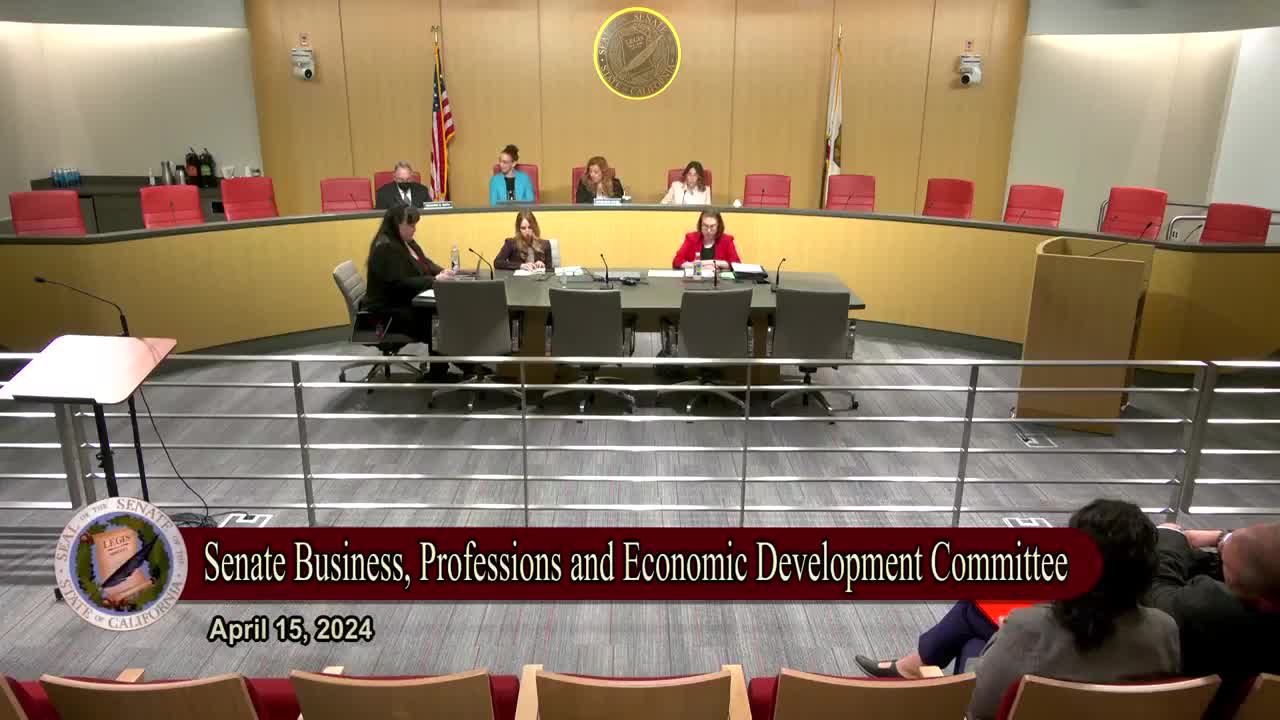 15MIN
Senate Standing Committee on Business, Professions and Economic Development
Bill Author

Bill Co-Author(s):