SB 1054: Natural gas: customer credit.
- Session Year: 2023-2024
- House: Senate
- Latest Version Date: 2024-05-20
Current Status:
Failed
(2024-08-15: August 15 hearing: Held in committee and under submission.)
Introduced
In Committee
First Chamber
In Committee
Second Chamber
Enacted
What does this bill do?
The bill requires the California Public Utilities Commission to have natural gas companies credit the money they receive from the direct allocation of greenhouse‑gas allowances to their residential customers and to distribute that credit to those customers each year.
The summary is provided by generative AI which can make mistakes. For original language, please view the details in the table below.
Existing law vests the Public Utilities Commission (PUC) with regulatory authority over public utilities, including gas corporations. The California Global Warming Solutions Act of 2006 designates the State Air Resources Board as the state agency charged with monitoring and regulating sources of emissions of greenhouse gases. The act authorizes the state board to include the use of market-based compliance mechanisms in regulating those emissions. The implementing regulations adopted by the state board provide for the direct allocation of greenhouse gas allowances to electrical corporations and gas corporations pursuant to a market-based compliance mechanism.
This bill would require the PUC commission to direct the balance of the revenues received by a gas corporation as a result of that allocation to be credited directly to the residential customers of the gas corporation, except that, until January 1, 2029, the bill would authorize the PUC to require gas corporations to annually use up to 15% of the revenues received as a result of that allocation to fund the Climate Pollution Reduction in Homes Initiative, as specified.
Under existing law, a violation of the Public Utilities Act or any order, decision, rule, direction, demand, or requirement of the PUC commission is a crime.
Because certain of the above-described provisions would be part of the act and a violation of a PUC commission action implementing this bills requirements would be a crime, the bill would impose a state-mandated local program.
The California Constitution requires the state to reimburse local agencies and school districts for certain costs mandated by the state. Statutory provisions establish procedures for making that reimbursement.
This bill would provide that no reimbursement is required by this act for a specified reason.
Existing law requires the State Energy Resources Conservation and Development Commission (Energy Commission) to prescribe, by regulation, among other things, lighting, insulation, climate control system, and other building design and construction standards, energy and water conservation design standards, and appliance efficiency standards to reduce the wasteful, uneconomic, inefficient, or unnecessary consumption of energy and to manage energy loads to help maintain electrical grid reliability, as specified.
This bill would require the Energy Commission, in consultation with the Department of Community Services and Development, to develop and supervise the Climate Pollution Reduction in Homes Initiative to require gas corporations to jointly award grants for local service providers, as defined, nonprofit organizations, and regional collections of local governments to provide financial assistance to low-income households for the purchase of zero-carbon-emitting appliances. The bill would require the Energy Commission, as part of developing and administering the initiative, to develop guidelines, as specified, and authorize local service providers, nonprofit organizations, and regional collections of local governments to use those grant moneys for outreach and technical assistance, rebates, loans, installation, educational information, and other support services to assist low-income households. The bill would repeal the above-described provisions on January 1, 2029. The bill would also require the Energy Commission, on March 1 of every year from 2026 to 2030, inclusive, to submit a report to the relevant policy committees of the Legislature on the implementation of the initiative, as specified.
Existing law vests the Public Utilities Commission (PUC) with regulatory authority over public utilities, including gas corporations. The California Global Warming Solutions Act of 2006 designates the State Air Resources Board as the state agency charged with monitoring and regulating sources of emissions of greenhouse gases. The act authorizes the state board to include the use of market-based compliance mechanisms in regulating those emissions. The implementing regulations adopted by the state board provide for the direct allocation of greenhouse gas allowances to electrical corporations and gas corporations pursuant to a market-based compliance mechanism.
This bill would require the PUC to direct the balance of the revenues received by a gas corporation as a result of that allocation to be credited directly to the residential customers of the gas corporation, except that, until January 1, 2029, the bill would authorize the PUC to require gas corporations to annually use up to 15% of the revenues received as a result of that allocation of allowances to fund the Climate Pollution Reduction in Homes Initiative, and would require the PUC to direct the balance of those revenues, including any accrued interest, received by a gas corporation to be credited directly to the residential customers of the gas corporation. The bill would require the PUC to annually direct gas corporations to distribute the credit, as specified. Initiative, as specified.
Under existing law, a violation of the Public Utilities Act or any order, decision, rule, direction, demand, or requirement of the PUC is a crime.
Because certain of the above-described provisions would be part of the act and a violation of a PUC action implementing this bills requirements would be a crime, the bill would impose a state-mandated local program.
The California Constitution requires the state to reimburse local agencies and school districts for certain costs mandated by the state. Statutory provisions establish procedures for making that reimbursement.
This bill would provide that no reimbursement is required by this act for a specified reason.
Existing law requires the State Energy Resources Conservation and Development Commission (Energy Commission) to prescribe, by regulation, among other things, lighting, insulation, climate control system, and other building design and construction standards, energy and water conservation design standards, and appliance efficiency standards to reduce the wasteful, uneconomic, inefficient, or unnecessary consumption of energy and to manage energy loads to help maintain electrical grid reliability, as specified.
Upon appropriation by the Legislature, thisThis bill would establish the Climate Pollution Reduction in Homes Initiative, which would require the commission, Energy Commission, in consultation with the Department of Community Services and Development, to develop and supervise the Climate Pollution Reduction in Homes Initiative to require gas corporations to jointly award grants for local service providers, as defined, nonprofit organizations, and regional collections of local governments to provide financial assistance to low-income households for the purchase of zero-carbon-emitting appliances. The initiative bill would require the commission Energy Commission, as part of developing and administering the initiative, to develop guidelines for implementation, guidelines, as specified, and authorize local service providers, nonprofit organizations, and regional collections of local governments to use those grant moneys for outreach and technical assistance, rebates, loans, installation, educational information, and other support services to assist low-income households.
Existing law vests the Public Utilities Commission (PUC) with regulatory authority over public utilities, including gas corporations. The California Global Warming Solutions Act of 2006 designates the State Air Resources Board as the state agency charged with monitoring and regulating sources of emissions of greenhouse gases. The act authorizes the state board to include the use of market-based compliance mechanisms in regulating those emissions. The implementing regulations adopted by the state board provide for the direct allocation of greenhouse gas allowances to electrical corporations and gas corporations pursuant to a market-based compliance mechanism.
This bill would authorize the PUC to require gas corporations to annually use up to 15% of the revenues received as a result of that allocation of allowances to fund the Climate Pollution Reduction in Homes Initiative, and would require the PUC to direct the balance of those revenues, including any accrued interest, received by a gas corporation to be credited directly to the residential customers of the gas corporation. The bill would require the PUC to annually direct gas corporations to distribute the credit, as specified.
Under existing law, a violation of the Public Utilities Act or any order, decision, rule, direction, demand, or requirement of the PUC is a crime.
Because certain of the above-described provisions would be part of the act and a violation of a PUC action implementing this bills requirements would be a crime, the bill would impose a state-mandated local program.
The California Constitution requires the state to reimburse local agencies and school districts for certain costs mandated by the state. Statutory provisions establish procedures for making that reimbursement.
This bill would provide that no reimbursement is required by this act for a specified reason.
Existing law requires the State Energy Resources Conservation and Development Commission to prescribe, by regulation, among other things, lighting, insulation, climate control system, and other building design and construction standards, energy and water conservation design standards, and appliance efficiency standards to reduce the wasteful, uneconomic, inefficient, or unnecessary consumption of energy and to manage energy loads to help maintain electrical grid reliability, as specified.
Upon appropriation by the Legislature, this bill would establish the Climate Pollution Reduction in Homes Initiative, which would require the commission, in consultation with the Department of Community Services and Development, to award grants for local service providers, as defined, nonprofit organizations, and regional collections of local governments to provide financial assistance to low-income households for the purchase of zero-carbon-emitting appliances. The initiative would require the commission to develop guidelines for implementation, as specified, and authorize local service providers, nonprofit organizations, and regional collections of local governments to use those grant moneys for outreach and technical assistance, rebates, loans, installation, educational information, and other support services to assist low-income households.
(a)Except as provided in subdivision (c), the The commission shall require revenues, including any accrued interest, received by a gas corporation as a result of the direct allocation of greenhouse gas allowances to gas utilities pursuant to subdivision (a) and paragraphs (2) and (3) of subdivision (d) of Section 95893 of Title 17 of the California Code of Regulations to be credited directly to the residential customers of the gas corporation.
(b)Each year, the commission shall direct each gas corporation to distribute the credit described in subdivision (a) to residential customers of the gas corporation.
(c)(1)The commission may require gas corporations to annually use up to 15 percent of the revenues, including any accrued interest, received as a result of the direct allocation of greenhouse gas emissions allowances provided to gas corporations as part of a market-based compliance mechanism adopted pursuant to subdivision (c) of Section 38562 of the Health and Safety Code to fund the Climate Pollution Reduction in Homes Initiative established pursuant to Chapter 8.65 (commencing with Section 25760) of Division 15 of the Public Resources Code.(2)This subdivision shall become inoperative on January 1, 2029.SEC. 4.SEC. 2.No reimbursement is required by this act pursuant to Section 6 of Article XIIIB of the California Constitution because the only costs that may be incurred by a local agency or school district will be incurred because this act creates a new crime or infraction, eliminates a crime or infraction, or changes the penalty for a crime or infraction, within the meaning of Section 17556 of the Government Code, or changes the definition of a crime within the meaning of Section 6 of Article XIIIB of the California Constitution.
The Legislature finds and declares all of the following:
(a)The state is a global leader in greenhouse gas emissions reduction targets, including establishing state policies to return to 1990 greenhouse gas emissions levels by 2020, to reduce greenhouse gas emissions levels to 40 percent below 1990 levels by 2030, and to achieve carbon neutrality by 2045.
(b)Energy use in buildings is responsible for 25 percent of all emissions of greenhouse gases in the state and contributes to indoor and outdoor air pollution.
(c)Low-income communities across the state have disproportionately shouldered high energy costs and the burdens of poor air quality.
(d)Reducing home energy use through energy efficiency measures and retrofitting appliances simultaneously reduces residential energy expenses and harmful emissions, thereby improving economic security and indoor air quality, particularly in low-income communities.
SEC. 2.Chapter 8.65 (commencing with Section 25760) is added to Division 15 of the Public Resources Code, to read:8.65.Climate Pollution Reduction in Homes Initiative25760.(a)For purposes of this chapter, the following definitions apply:
(1)Department means the Department of Community Services and Development.
(2)Initiative means the Climate Pollution Reduction in Homes Initiative.
(3)Local service provider has the same meaning as defined in Section 16367.5 of the Government Code.
(4)Low-income household means a person or family with a household income at or below 60 percent of the area median income, including such a person or family in a multiunit dwelling.
(b)(1)The commission, in consultation with the department, shall develop and supervise the Climate Pollution Reduction in Homes Initiative to require gas corporations to jointly award grants for local service providers, nonprofit organizations, and regional collections of local governments to provide financial assistance to low-income households for the purchase of zero-carbon-emitting appliances.
(2)For purposes of supervising the initiative, the commission shall act as third-party administrator.
(3)Moneys allocated pursuant to Section 748.7 of the Public Utilities Code shall be available to the commission, as the third-party administrator, for allocation consistent with this section.
(c)As part of developing and administering the initiative, the commission shall develop guidelines that do all of the following:
(1)Provide for the expenditure of grant funds to ensure expeditious delivery of financial assistance to low-income households.
(2)Specify criteria for which appliances, which may include water heaters, stoves and cooking appliances, home heating and cooling systems, refrigerators and freezers, and washers and dryers, are eligible for financial assistance.
(3)Ensure the initiative provides safe and reliable appliances that stabilize the utility bills of low-income households.
(4)Provide funding for single-family and multifamily residential buildings.
(5)Provide preference to projects that are receiving or combining funding from other sources, including, but not limited to, the Energy Efficiency Low-Income Weatherization Program established pursuant to Section 12087.5 of the Government Code.
(6)Provide tenant protections for rental properties, where appropriate.
(7)Maximize community-based outreach and education for the initiative through collaboration with local service providers, nonprofit organizations, or regional collections of local governments that have demonstrated ties to the local community at the neighborhood, city, or county level and have experience delivering energy incentives.
(8)Ensure that moneys from each gas corporation for the initiative are used for grants located in the service territory of the gas corporation from which the moneys are received.
(d)(1)A local service provider, nonprofit organization, or regional collection of local governments may use grant moneys for outreach and technical assistance, rebates, loans, installation, educational information, and other support services to assist low-income households.
(2)A local service provider, nonprofit organization, or regional collection of local governments may authorize up to 20 percent of the financial assistance provided to a low-income household to be used on electrical upgrades to the low-income households property to support the installation of a zero-carbon-emitting appliance.
(e)This section shall remain in effect only until January 1, 2029, and as of that date is repealed.
25761.(a)On March 1, 2026, and each March 1 thereafter, the commission shall submit a report to the relevant policy committees of the Legislature on the implementation of this chapter that details all of the following:
(1)The amount of funding received.
(2)The grants awarded.
(3)The number and location of projects funded.
(4)The number of completed projects.
(5)Any challenges and lessons learned.
(b)A report to be submitted pursuant to subdivision (a) shall be submitted in compliance with Section 9795 of the Government Code.
25762.This chapter shall remain in effect only until January 1, 2031, and as of that date is repealed.
SEC. 3.Section 748.7 is added to the Public Utilities Code, to read:748.7.(a)Except as provided in subdivision (c), the commission shall require revenues, including any accrued interest, received by a gas corporation as a result of the direct allocation of greenhouse gas allowances to gas utilities pursuant to subdivision (a) and paragraphs (2) and (3) of subdivision (d) of Section 95893 of Title 17 of the California Code of Regulations to be credited directly to the residential customers of the gas corporation.
(b)Each year, the commission shall direct each gas corporation to distribute the credit described in subdivision (a) during the February utility billing cycle, so as to coincide with the highest usage gas utility bill during the year. to residential customers of the gas corporation.
(c)The commission may consider a gas corporations billing systems ability to distribute the credit described in subdivision (a) in February and may authorize the gas corporation to provide the credit as close to the February utility billing cycle as feasible.(d)(c)(1)The commission may require gas corporations to annually use up to 15 percent of the revenues, including any accrued interest, received as a result of the direct allocation of greenhouse gas emissions allowances provided to gas corporations as part of a market-based compliance mechanism adopted pursuant to subdivision (c) of Section 38562 of the Health and Safety Code to fund the Climate Pollution Reduction in Homes Initiative established pursuant to Chapter 8.65 (commencing with Section 25760) of Division 15 of the Public Resources Code.
(2)This subdivision shall become inoperative on January 1, 2029.
SEC. 4.No reimbursement is required by this act pursuant to Section 6 of Article XIIIB of the California Constitution because the only costs that may be incurred by a local agency or school district will be incurred because this act creates a new crime or infraction, eliminates a crime or infraction, or changes the penalty for a crime or infraction, within the meaning of Section 17556 of the Government Code, or changes the definition of a crime within the meaning of Section 6 of Article XIIIB of the California Constitution.
The Legislature finds and declares all of the following:
(a)The state is a global leader in greenhouse gas emissions reduction targets, including establishing state policies to return to 1990 greenhouse gas emissions levels by 2020, to reduce greenhouse gas emissions levels to 40 percent below 1990 levels by 2030, and to achieve carbon neutrality by 2045.
(b)Energy use in buildings is responsible for 25 percent of all emissions of greenhouse gases in the state and contributes to indoor and outdoor air pollution.
(c)Low-income communities across the state have disproportionately shouldered high energy costs and the burdens of poor air quality.
(d)Reducing home energy use through energy efficiency measures and retrofitting appliances simultaneously reduces residential energy expenses and harmful emissions, thereby improving economic security and indoor air quality, particularly in low-income communities.
SEC. 2.Chapter 8.65 (commencing with Section 25760) is added to Division 15 of the Public Resources Code, to read:8.65.Climate Pollution Reduction in Homes Initiative25760.(a)For purposes of this chapter, the following definitions apply:
(1)Department means the Department of Community Services and Development.
(2)Initiative means the Climate Pollution Reduction in Homes Initiative.
(3)Local service provider has the same meaning as defined in Section 16367.5 of the Government Code.
(4)Low-income household means a person or family with a household income at or below 60 percent of the area median income, including such a person or family in a multiunit dwelling.
(b)(1)The commission, in consultation with the department, shall develop and supervise the Climate Pollution Reduction in Homes Initiative is hereby established. The initiative shall be administered by the commission, in consultation with the department, to require gas corporations to jointly award grants for local service providers, nonprofit organizations, and regional collections of local governments to provide financial assistance to low-income households for the purchase of zero-carbon-emitting appliances.
(2)For purposes of supervising the initiative, the commission shall act as third-party administrator.
(3)Moneys allocated pursuant to Section 748.7 of the Public Utilities Code shall be available to the commission, as the third-party administrator, for allocation consistent with this section.
(c)For purposes of implementing As part of developing and administering the initiative, the commission shall develop guidelines that do all of the following:
(1)Provide for the expenditure of grant funds to ensure expeditious delivery of financial assistance to low-income households.
(2)Specify criteria for which appliances, which may include water heaters, stoves and cooking appliances, home heating and cooling systems, refrigerators and freezers, and washers and dryers, are eligible for financial assistance.
(3)Ensure the initiative provides safe and reliable appliances that stabilize the utility bills of low-income households.
(4)Provide funding for single-family and multifamily residential buildings.
(5)Provide preference to projects that are receiving or combining funding from other sources, including, but not limited to, the Energy Efficiency Low-Income Weatherization Program established pursuant to Section 12087.5 of the Government Code.
(6)Provide tenant protections for rental properties, where appropriate.
(7)Maximize community-based outreach and education for the initiative through collaboration with local service providers, nonprofit organizations, or regional collections of local governments that have demonstrated ties to the local community at the neighborhood, city, or county level and have experience delivering energy incentives.
(8)Ensure that moneys from each gas corporation for the initiative are used for grants located in the service territory of the gas corporation from which the moneys are received.
(d)(1)A local service provider, nonprofit organization, or regional collection of local governments may use grant moneys for outreach and technical assistance, rebates, loans, installation, educational information, and other support services to assist low-income households.
(2)A local service provider, nonprofit organization, or regional collection of local governments may authorize up to 20 percent of the financial assistance provided to a low-income household to be used on electrical upgrades to the low-income households property to support the installation of a zero-carbon-emitting appliance.
(e)This section shall be implemented upon an appropriation for its purposes by the Legislature.SEC. 3.Section 748.7 is added to the Public Utilities Code, to read:748.7.(a)Except as provided in subdivision (c), the commission shall require revenues, including any accrued interest, received by a gas corporation as a result of the direct allocation of greenhouse gas allowances to gas utilities pursuant to subdivision (a) and paragraphs (2) and (3) of subdivision (d) of Section 95893 of Title 17 of the California Code of Regulations to be credited directly to the residential customers of the gas corporation.
(b)Each year, the commission shall direct each gas corporation to distribute the credit described in subdivision (a) during the February utility billing cycle, so as to coincide with the highest usage gas utility bill during the year.
(c)The commission may consider a gas corporations billing systems ability to distribute the credit described in subdivision (a) in February and may authorize the gas corporation to provide the credit as close to the February utility billing cycle as feasible.
(d)The commission may require gas corporations to annually use up to 15 percent of the revenues, including any accrued interest, received as a result of the direct allocation of greenhouse gas emissions allowances provided to gas corporations as part of a market-based compliance mechanism adopted pursuant to subdivision (c) of Section 38562 of the Health and Safety Code to fund the Climate Pollution Reduction in Homes Initiative established pursuant to Chapter 8.65 (commencing with Section 25760) of Division 15 of the Public Resources Code.
SEC. 4.No reimbursement is required by this act pursuant to Section 6 of Article XIIIB of the California Constitution because the only costs that may be incurred by a local agency or school district will be incurred because this act creates a new crime or infraction, eliminates a crime or infraction, or changes the penalty for a crime or infraction, within the meaning of Section 17556 of the Government Code, or changes the definition of a crime within the meaning of Section 6 of Article XIIIB of the California Constitution.
The Legislature finds and declares all of the following:
(a)The state is a global leader in greenhouse gas emissions reduction targets, including establishing state policies to return to 1990 greenhouse gas emissions levels by 2020, to reduce greenhouse gas emissions levels to 40 percent below 1990 levels by 2030, and to achieve carbon neutrality by 2045.
(b)Energy use in buildings is responsible for 25 percent of all emissions of greenhouse gases in the state and contributes to indoor and outdoor air pollution.
(c)Low-income communities across the state have disproportionately shouldered high energy costs and the burdens of poor air quality.
(d)Reducing home energy use through energy efficiency measures and retrofitting appliances simultaneously reduces residential energy expenses and harmful emissions, thereby improving economic security and indoor air quality, particularly in low-income communities.
SEC. 2.Chapter 8.65 (commencing with Section 25760) is added to Division 15 of the Public Resources Code, to read:8.65.Climate Pollution Reduction in Homes Initiative25760.(a)For purposes of this chapter, the following definitions apply:
(1)Department means the Department of Community Services and Development.
(2)Initiative means the Climate Pollution Reduction in Homes Initiative.
(3)Local service provider has the same meaning as defined in Section 16367.5 of the Government Code.
(4)Low-income household means a person or family with a household income at or below 60 percent of the area median income, including such a person or family in a multiunit dwelling.
(b)The Climate Pollution Reduction in Homes Initiative is hereby established. The initiative shall be administered by the commission, in consultation with the department, to award grants for local service providers, nonprofit organizations, and regional collections of local governments to provide financial assistance to low-income households for the purchase of zero-carbon-emitting appliances.
(c)For purposes of implementing the initiative, the commission shall develop guidelines that do all of the following:
(1)Provide for the expenditure of grant funds to ensure expeditious delivery of financial assistance to low-income households.
(2)Specify criteria for which appliances, which may include water heaters, stoves and cooking appliances, home heating and cooling systems, refrigerators and freezers, and washers and dryers, are eligible for financial assistance.
(3)Ensure the initiative provides safe and reliable appliances that stabilize the utility bills of low-income households.
(4)Provide funding for single-family and multifamily residential buildings.
(5)Provide preference to projects that are receiving or combining funding from other sources, including, but not limited to, the Energy Efficiency Low-Income Weatherization Program established pursuant to Section 12087.5 of the Government Code.
(6)Provide tenant protections for rental properties, where appropriate.
(7)Maximize community-based outreach and education for the initiative through collaboration with local service providers, nonprofit organizations, or regional collections of local governments that have demonstrated ties to the local community at the neighborhood, city, or county level and have experience delivering energy incentives.
(d)(1)A local service provider, nonprofit organization, or regional collection of local governments may use grant moneys for outreach and technical assistance, rebates, loans, installation, educational information, and other support services to assist low-income households.
(2)A local service provider, nonprofit organization, or regional collection of local governments may authorize up to 20 percent of the financial assistance provided to a low-income household to be used on electrical upgrades to the low-income households property to support the installation of a zero-carbon-emitting appliance.
(e)This section shall be implemented upon an appropriation for its purposes by the Legislature.
|
Date
|
Status
|
|---|---|
| Aug 15, 2024 | August 15 hearing: Held in committee and under submission. |
| Aug 7, 2024 | August 7 set for first hearing. Placed on suspense file. |
| Jul 2, 2024 | From committee: Do pass and re-refer to Com. on APPR. with recommendation: To consent calendar. (Ayes 15. Noes 0.) (July 1). Re-referred to Com. on APPR. |
| Jun 17, 2024 | June 19 set for first hearing canceled at the request of author. |
| Jun 3, 2024 | Referred to Com. on U. & E. |
| May 24, 2024 | In Assembly. Read first time. Held at Desk. |
| May 23, 2024 | Read third time. Passed. (Ayes 34. Noes 0. Page 4190.) Ordered to the Assembly. |
| May 21, 2024 | Read second time. Ordered to third reading. |
| May 20, 2024 | From committee: Do pass as amended. (Ayes 5. Noes 1. Page 3969.) (May 16). |
| May 20, 2024 | Read second time and amended. Ordered to second reading. |
| May 14, 2024 | Set for hearing May 16. |
| May 13, 2024 | May 13 hearing: Placed on APPR suspense file. |
| May 3, 2024 | Set for hearing May 13. |
| Apr 30, 2024 | Read second time and amended. Re-referred to Com. on APPR. |
| Apr 29, 2024 | From committee: Do pass as amended and re-refer to Com. on APPR. (Ayes 16. Noes 1. Page 3700.) (April 22). |
| Apr 4, 2024 | Set for hearing April 22. |
| Mar 20, 2024 | From committee with author's amendments. Read second time and amended. Re-referred to Com. on E., U. & C. |
| Feb 21, 2024 | Referred to Com. on E., U. & C. |
| Feb 9, 2024 | From printer. May be acted upon on or after March 10. |
| Feb 8, 2024 | Introduced. Read first time. To Com. on RLS. for assignment. To print. |
|
Date
|
Description
|
Location
|
Votes
|
|
|---|---|---|---|---|
| Jul 1, 2024 | Do pass and be re-referred to the Committee on [Appropriations] with recommendation: To Consent Calendar | Assembly Standing Committee on Utilities and Energy |
Passed |
|
| May 23, 2024 | Senate 3rd Reading SB1054 Rubio | Senate Floor |
Passed |
|
| May 16, 2024 | Do pass as amended | Senate Standing Committee on Appropriations |
Passed |
|
| May 13, 2024 | Placed on suspense file | Senate Standing Committee on Appropriations |
Passed |
|
| Apr 22, 2024 | Do pass as amended, but first amend, and re-refer to the Committee on [Appropriations] | Senate Standing Committee on Energy, Utilities and Communications |
Passed |
This list shows positions taken on this bill by organizations on the date displayed, which is linked to the original source.
Positions by individuals are not included.
|
Organization
|
Position
|
Date
|
|---|---|---|
| Advanced Energy United | ** Support | |
| Breathe California | ** Support | |
| Building Decarbonization Coalition | ** Support | |
| California Apartment Association | ** Support | |
| California Environmental Voters | ** Support | |
| Central Coast Energy Services | ** Support | |
| Climate Reality Project, Los Angeles Chapter | ** Support | |
| Climate Reality Project: San Fernando Valley Chapter | ** Support | |
| Community Action to Fight Asthma | ** Support | |
| Community Resource Project, INC. | ** Support | |
| Earthjustice | ** Support | |
| Natural Resources Defense Council | ** Support | |
| NRDC | ** Support | |
| San Francisco Peninsula Energy Services | ** Support | |
| Sierra Club California | ** Support | |
| South Bay Cities Council of Governments | ** Support | |
| US Green Building Council | ** Support | |
| USGBC - CA | ** Support | |
| USGBC-la Duplicate | ** Support |
Date of Hearing: August 7, 2024
ASSEMBLY COMMITTEE ON APPROPRIATIONS
Buffy Wicks, Chair
SBPCA Bill Id:SB 1054
Author:(Rubio) – As Amended Ver:May 20, 2024
Policy Committee: | Utilities and Energy | Vote: | 15 - 0 |
|
| ||
|
|
Urgency: No State Mandated Local Program: Yes Reimbursable: No
SUMMARY:
This bill dedicates all revenue from the sale of any greenhouse gas (GHG) allowances allocated to a natural gas investor-owned utility (IOU) directly to the IOU’s residential customers.
Specifically, this bill requires the California Public Utilities Commission (CPUC) annually to direct each natural gas IOU to distribute the California Climate Credit to residential customers of the gas IOU.
FISCAL EFFECT:
The CPUC should experience only minor and absorbable costs to direct the gas IOUs to distribute the climate credit to residential gas customers.
However, the bill has a significant fiscal effect nonetheless as it precludes the CPUC from ordering other uses of the gas IOU climate credit funds.
COMMENTS:
Existing state law requires every emitter of greenhouse gas to purchase an allowance for each ton of GHG emitted, sometimes known as a “carbon allowance.” The price per allowance is set by a “cap-and-trade” market, subject to regulation by the Air Resources Board (ARB).
The state’s IOUs, as emitters of GHGs, must purchase large amounts of carbon allowances to cover the GHG emissions released from the combustion of the natural gas. However, to diminish the cost to IOU ratepayers of purchasing the allowances, ARB allocates free allowances to each IOU, based on a historic sales, which the IOU sells on the allowance market.
State law treats the proceeds of an allowance sold by an electrical IOU differently than it treats proceeds of an allowance sold on behalf of a natural gas IOUs. For electric IOU allowances, state law requires resulting revenue be credited directly to residential, small business and emission-intensive trade-exposed customers, except for 15% of revenue, which the CPUC must allocate for clean energy and energy efficiency projects. In contrast, statute is silent regarding allocation of revenues from the sale of GHG allowance sold by a natural gas IOU, other than specifying that, from 2019 through 2023, the CPUC was to annually allocate $50 million for two building-related GHG emissions-reduction incentive programs.
In the absence of statutory direction, the CPUC has directed all proceeds of sales of carbon allowances by natural gas IOUs be returned to the natural gas IOUs’ residential ratepayers. For the most part, these proceeds have been returned to IOU ratepayers through the California Climate Credit, an annual credit on the bill of each ratepayer. According to the CPUC, since 2018, $3.5 billion has been returned to natural gas IOU residential ratepayers through the climate credit, and annual credit amounts per household have ranged from $18.00 and $85.46. In addition, the IOUs have distributed $317 million in natural gas allowance proceeds to other natural gas programs, such as incentives for low- and zero-emission technology to reduce GHGs from the building sector and incentives for purchase of electric appliances by low-income IOU customers.
Utility bills have increased considerably in recent years. Gas bills, in particular, have fluctuated dramatically and, in the view of many, unpredictably. For example, IOU residential customer gas bills in January of 2023 were about double what they were in January 2022. The author intends this bill to ease the burden of gas utility bills. As the author puts it:
SB 1054 will provide relief to households for one of the fastest-rising, most burdening costs they are currently experiencing, which is utility bills. These costs affect low-income households the most, as they pay more of their monthly income on utility bills in comparison to higher-income households. As the cost of living continues to rise in California, it is important that we find and implement effective approaches that would help alleviate financial burdens for our constituents, especially the most vulnerable.
This bill has been significantly narrowed since its introduction. Prior versions would have dedicated portions of the proceeds of sales of natural gas IOU carbon allowances to financial assistance to low-income households to transition to zero-emission appliances. Those provisions were amended out of the bill, and it now, as described above, simply dedicates all revenue from the sale of any carbon allowances by a natural gas IOU to IOU residential customers. Several organizations—the Natural Resources Defense Council and the Sierra Club California, among several others—have removed their support and express “significant concerns with the language in print.” These erstwhile supporters call for amendments to “direct at least 15% of gas cap-and-trade allowance proceeds to the Equitable Building Decarbonization program” authorized by existing law.
Analysis Prepared by: Jay Dickenson / APPR. / (916) 319-2081
Date of Hearing: July 1, 2024
ASSEMBLY COMMITTEE ON UTILITIES AND ENERGY
Cottie Petrie-Norris, Chair
SBPCA Bill Id:SB 1054
Author:(Rubio) – As Amended Ver:May 20, 2024
SENATE VOTE: 34-0
SUBJECT: Natural gas: customer credit
SUMMARY: Requires the California Public Utilities Commission (CPUC) to require natural gas corporations to annually distribute greenhouse gas (GHG) allowance revenues, known as the Climate Credit, only to residential customers.
EXISTING LAW:
- Requires the California Air Resources Board (CARB) to ensure that statewide GHG emissions are reduced to 40% below the 1990 level by 2030. (Health & Safety Code § 38566)
- Establishes the California Global Warming Solutions Act of 2006 and designates CARB as the state agency charged with monitoring and regulating sources of emissions of GHGs. Authorizes CARB to include the use of market-based compliance mechanisms in regulating those emissions, this is known as the Cap-and-Trade program. (Health and Safety Code § 38500 et seq.)
- Requires CPUC, in consultation with the California Energy Commission (CEC), to develop and supervise a program, known as the Building Initiative for Low-Emissions Development (BUILD) program, where gas corporations provide incentives for near-zero and zero-emissions building technologies to significantly reduce the emissions of GHGs from buildings, as specified. (Public Utilities Code §§ 921-921.1)
- Requires the CPUC to develop and supervise the administration of the Technology and Equipment for Clean Heating (TECH) Initiative, a statewide market development initiative, to require gas corporations to advance the state’s market for low-emission space and water heating equipment for new and existing residential buildings. (Public Utilities Code § 922)
- Requires the CPUC, until June 30, 2023, to annually allocate $50,000,000 of the revenues received by gas corporations as a result of the direct allocation of GHGs emissions allowances provided to gas corporations to fund BUILD Program and TECH Initiative. (Public Utilities Code § 748.6)
- Requires the CPUC to allocate up to 15% of revenues received by an electrical corporation as a result of the direct allocation of GHG allowances to electrical distribution utilities to be used for clean energy and energy efficiency projects and otherwise requires revenues to be credited directly to residential, small business, and emission-intensive trade-exposed customers. (Public Utilities Code § 748.5)
- Provides, pursuant to implementing regulations adopted by CARB, for the direct allocation of GHG allowances to electrical corporations and gas corporations pursuant to a market-based compliance mechanism. (California Code of Regulations Title 17 § 95893(a) and (d)(2) and (3))
- Establishes the Multifamily Affordable Housing Solar Roofs Program (also known as the Solar on Multifamily Affordable Housing Program, SOMAH) to provide financial incentives for qualified solar installations at multifamily affordable housing properties funded from approximately 10% of electric IOUs’ GHG allowances. (Public Utilities Code § 2870)
FISCAL EFFECT: According to the Senate Committee on Appropriations, this bill may result in unknown, ongoing costs to the CPUC and CEC.
BACKGROUND:
The California Climate Credit – California ratepayers receive regular bill credits as part of the proceeds arising from their utility’s participation in the state’s Cap-and-Trade program. The origin of these customer climate credits is AB 32 (Nunez, Chapter 488, Statutes of 2006), which established limits on GHG emissions in California and designated CARB as the agency responsible for designing a market-based mechanism to reduce emissions. Recently, SB 32 (Pavley, Chapter 249, Statutes of 2016) and AB 398 (E. Garcia, Chapter 135, Statutes of 2017) were passed to extend the state’s Cap-and-Trade program through 2030 with a revised statewide emissions target of 40% below 1990 emissions levels by 2030.
In December 2011, CARB created the statewide Cap-and-Trade program establishing limits, or caps, on the number of pollution permits, or allowances, available in a given year. The CARB Cap-and-Trade program applies to facilities that emit more than 25,000 metric tons of carbon dioxide equivalents per year, as well as any facility with lower emissions that opt-in to the program. These facilities include large electric power plants, large industrial plants, and fuel distributors (e.g., natural gas and petroleum).
Electric and natural gas corporations, also known as investor-owned utilities (IOUs), are required to consign to auction a certain portion of the GHG allowances they receive. Covered entities purchase the utility allowances to cover their own GHG emissions. The proceeds generated from such sales must be primarily used for the benefit of retail ratepayers. For electric IOU customers, these funds are returned via a credit on their utility bills, known as the Climate Credit. State law requires 85% to be used for the Climate Credit and permits the CPUC to allocate the remaining 15% for clean energy and energy efficiency projects.[1]
From 2013 to 2020, the electric IOUs returned $6.3 billion directly to customers.[2] Proceeds are returned to customers via three mechanisms – the industrial assistance credit, the small business climate credit, and the residential California Climate Credit. The residential California Climate Credit is provided on residential customers’ bills twice annually in the spring and fall. In 2020, in response to the COVID-19 pandemic, the Governor’s shelter-in-place orders, and resulting changes in residential electric consumption, the CPUC altered the timing of the 2020 residential climate credit. Most credits were distributed earlier in the year and some IOUs split their credits to provide assistance over multiple months, without altering the total amount of credit received.[3]
Unlike the electric IOUs’ which are directed by statute to return no less than 85% of GHG allowance proceeds to customers, the use of gas IOUs’ allowance proceeds are generally not controlled by statute. Instead, natural gas IOUs’ allowance proceeds are allocated by CPUC decisions (D.15-10-032 and D.18-03-017), within the parameters of CARB’s Cap-and-Trade regulation, which specifies they should benefit retail ratepayers.
It is the expectation that as CARB continues to lower the “cap” in the Cap-and-Trade program to help California reach its emissions-reduction goals, the total amount of available allowances – and thus proceeds from IOU sales of their allowances – will decline. Thus the California Climate Credit and associated programs funded through the GHG allowance proceeds are expected to likewise decrease in funding size over time.
Existing CPUC Programs Funded by GHG Allowance Proceeds – For electricity, per statute, up to 15% of the electric IOU auction proceeds may be used for clean energy or energy efficiency projects. The largest of these programs is SOMAH, authorized by AB 693 (Eggman, Chapter 582, Statutes of 2015). The SOMAH program uses $100 million or 10% of the IOUs’ auction proceeds, whichever is less, to provide financial incentives for the installation of solar energy photovoltaic (PV) systems on multifamily affordable housing properties throughout California. In addition to SOMAH, the CPUC developed three programs to increase the adoption of renewable generation in disadvantaged communities.[4] The CPUC funded these programs with allowance proceeds, if funds were available under the 15% limit; otherwise, if such funds were exhausted, the programs would access ratepayer funding.
For natural gas, the CPUC has ordered that natural gas GHG allowance proceeds be included in the annual Climate Credit and be returned solely to residential customers.[5] In general, the natural gas Climate Credit is issued on gas utility bills in April and has ranged from $18 to $56 credit on customers’ natural gas utility bills, depending on the year and utility. The use of gas allocations are not controlled by statute. In 2018, the Legislature adopted SB 1477 (Stern, Chapter 378, Statutes of 2018) which requires an allocation of $50 million annually from July 1, 2019 through June 30, 2023 from natural gas IOUs’ GHG allowance revenues to fund the BUILD program and TECH initiative which provide incentive funding for low- and zero-emission technology to reduce GHGs from the building sector.
COMMENTS:
- Author’s Statement. According to the author, “SB 1054 will provide relief to households for one of the fastest-rising, most burdening costs they are currently experiencing, which is utility bills. These costs affect low-income households the most, as they pay more of their monthly income on utility bills in comparison to higher-income households. As the cost of living continues to rise in California, it is important that we find and implement effective approaches that would help alleviate financial burdens for our constituents, especially the most vulnerable.”
- To Program or Not to Program. Currently, there is no requirement in statute regarding how much, if any, of the GHG allowance revenues are distributed to natural gas IOU customers, as there is for electric IOU customers. This bill would codify a requirement to issue the Climate Credit solely as bill credits to residential natural gas IOU customers, thereby clearly directing how these proceeds can be utilized.
Any proposal to fund programs from these proceeds would thus require the adoption of subsequent statute. Stakeholders who earlier supported this measure when it was establishing a statewide initiative to finance, through Cap-and-Trade proceeds, the purchase of cleaner appliances for low-income households, now hold a Support if Amended position. They cite the current requirement under the bill that auction proceeds return directly as bill credits as “against the goal” of providing specific relief and benefits to low-income Californians.
This bill currently chooses bill credits, shared across all residential accounts, as the preferred method of providing customer relief. During the winter of 2022-23, the commodity price of natural gas rose significantly and resulted in nearly all customers experiencing natural gas utility bill shocks. At the time, the CPUC directed the natural gas IOUs to provide the Climate Credit earlier in the year in order to mitigate the increased utility bills. In choosing to direct the GHG allowance revenues to residential customers via bill credits under this measure, the Legislature is helping all residential customers offset the costs of their utility bill.
- Previous Legislation.
SB 429 (Bradford, 2023) would have codified requiring natural gas IOUs to provide customers with an annual credit (known as the California Climate Credit) from the GHG allowance revenue and to time the distribution of the credit to coincide with the highest usage month, on or as close to the February utility billing cycle, as feasible. Status: the bill was amended to a new subject by the author.
AB 1087 (Chiu, 2021) would have established the Environmental Justice Community Resilience Hubs Program, a competitive grant program funded by a portion of the proceeds of annual sales of electric utilities greenhouse gas (GHG) emissions allowances. Status: Died – Assembly Committee on Appropriations.
SB 1477 (Stern) required the CPUC, from July 1, 2019 through June 30, 2023, to allocate $50 million annually from gas corporations' GHG emissions allowance revenues for the BUILD Program and the TECH Initiative established by the bill to require gas corporations to provide incentives for near-zero and zero-emissions building technologies to significantly reduce the emissions of GHGs from those buildings. Status: Chapter 378, Statutes of 2018.
AB 693 (Eggman) created the Multifamily Affordable Housing Solar Roofs Program, to provide financial incentives for qualified solar installations at multifamily affordable housing properties funded from electric IOU’s GHG allowance revenues. Status: Chapter 582, Statutes of 2015.
SB 1018 (Committee on Budget) required the CPUC to direct electric IOUs to credit residential, small business, and emissions intensive trade exposed industries the revenues from the GHG allowances. Authorized the CPUC to allocate up to 15 percent of the revenues to clean energy and energy efficiency projects. Status: Chapter 39, Statutes of 2012.
REGISTERED SUPPORT / OPPOSITION:
Support
Breathe California
California Apartment Association
Central Coast Energy Services
Climate Reality Project San Fernando Valley Chapter
Climate Reality Project, Los Angeles Chapter
Community Action to Fight Asthma
Community Resource Project, INC.
Natural Resources Defense Council
San Francisco Peninsula Energy Services
South Bay Cities Council of Governments
US Green Building Council
USGBC - CA
USGBC-la Duplicate
Support If Amended
Advanced Energy United
Building Decarbonization Coalition
California Environmental Voters
Earthjustice
NRDC
Sierra Club California
Opposition
None on file.
Analysis Prepared by: Laura Shybut / U. & E. / (916) 319-2083
PU Code § 748.5 ↑
As reported to this committee by the CPUC in March 2021. ↑
See CPUC webpage on the California Climate Credit; https://www.cpuc.ca.gov/climatecredit/ as appeared on March 26, 2021. ↑
Established in D. 18-06-027 in R. 14-07-002. More information on the programs may be found at the CPUC’s website “Solar in Disadvantaged Communities;” https://www.cpuc.ca.gov/SolarInDACs/ as appeared on March 26, 2021. ↑
D. 15-10-032 and D.18-03-017 ↑
SENATE RULES COMMITTEE Office of Senate Floor Analyses (916) 651-1520 Fax: (916) 327-4478 | SB 1054 |
THIRD READING
Bill No: SB 1054
Author: Rubio (D)
Amended: 5/20/24
Vote: 21
SENATE ENERGY, U. & C. COMMITTEE: 16-1, 4/22/24
AYES: Bradford, Dahle, Ashby, Becker, Caballero, Dodd, Durazo, Eggman, Gonzalez, Limón, Min, Newman, Rubio, Skinner, Wahab, Wilk
NOES: Seyarto
NO VOTE RECORDED: Grove
SENATE APPROPRIATIONS COMMITTEE: 5-1, 5/16/24
AYES: Caballero, Ashby, Becker, Bradford, Wahab
NOES: Seyarto
NO VOTE RECORDED: Jones
SUBJECT: Natural gas: customer credit
SOURCE: Author
DIGEST:
This bill requires the California Public Utilities Commission (CPUC) to require natural gas corporations to annually distribute greenhouse gas (GHG) allowance revenues to residential customers, known as the Climate Credit.
ANALYSIS:
Existing law:
- Establishes and vests the CPUC with regulatory authority over public utilities, including gas corporations. (Article XII of the California Constitution)
- Establishes the California Global Warming Solutions Act of 2006 and designates the California Air Resources Board (CARB) as the state agency charged with monitoring and regulating sources of emissions of GHGs. Authorizes CARB to include the use of market-based compliance mechanisms in regulating those emissions. (Health and Safety Code §38500 et seq.)
- Requires the CPUC to develop and supervise the administration of the Technology and Equipment for Clean Heating (TECH) Initiative, a statewide market development initiative, to require gas corporations to advance the state’s market for low-emission space and water heating equipment for new and existing residential buildings through upstream market development, consumer education, contractor and vendor training, and the provision of upstream and midstream incentives to install low-emission space and water heating equipment in existing and new buildings, with technologies identified pursuant to subdivision (b). (Public Utilities Code §922)
- Requires the CPUC, until June 30, 2023, to annually allocate $50,000,000 of the revenues received by gas corporations as a result of the direct allocation of GHGs emissions allowances provided to gas corporations to fund the Building Initiative for Low-Emissions Development (BUILD) Program and the TECH Initiative. (Public Utilities Code §748.6)
- Requires the CPUC to allocate up to 15 percent of revenues received by an electrical corporation as a result of the direct allocation of GHG allowances to electrical distribution utilities to be used for clean energy and energy efficiency projects and otherwise requires revenues to be credited directly to residential, small business, and emission-intensive trade-exposed customers. (Public Utilities Code §748.5)
- Provides, pursuant to implementing regulations adopted by CARB, for the direct allocation of GHG allowances to electrical corporations and gas corporations pursuant to a market-based compliance mechanism. (California Code of Regulations Title 17 §95893(a) and (d)(2) and (3))
This bill:
- Requires the CPUC to require gas corporations to annually credit to residential customers of the gas corporation the balance of the revenues received, including any accrued interest, as a result of the direct allocation of GHG allowances from the market-based compliance mechanisms used by CARB to regulate the sources of GHG emissions.
- Requires the CPUC to annually direct gas corporations to distribute the credit to residential customers of the gas corporation (known as the Climate Credit).
Background
- California Climate Credit. Electric and natural gas investor-owned utilities (IOUs) are required to consign to auction a certain portion of the GHG allowances they receive as part of their compliance with the regulations adopted pursuant to the CARB cap-and-trade program. Utility GHG allowance proceeds are to be used exclusively for the benefit of retail ratepayers per the requirements of the regulation. For electric IOUs, these funds are returned to ratepayers via a credit on their utility bills, known as the California Climate Credit. State law requires 85 percent to be used for the Climate Credit for electric IOUs and permits the CPUC to allocate the remaining 15 percent for clean energy and energy efficiency projects. The CPUC ordered that natural gas GHG allowance proceeds be included in the annual Climate Credit and be returned to residential retail customers. In general, the natural gas Climate Credit is issued on gas utility bills in April and has ranged from $18 to $56 credit on customers’ natural gas utility bills, depending on the year and utility.
- Current uses of natural gas allowance revenues. Unlike the electric IOUs’ which are directed by statute to return no less than 85 percent of GHG allowance proceeds to customers, the use of gas IOUs’ allowance proceeds are generally not controlled by statute. Instead, natural gas IOUs’ allowance proceeds are allocated by CPUC decisions (D.15-10-032 and D.18-03-017), within the parameters of CARB’s cap-and-trade regulation, which specifies they should benefit retail ratepayers.
- Previous legislative actions to direct use of some gas IOU GHG allowance revenues. In 2017, the Legislature adopted SB 1477 which requires an allocation of $50 million annually from July 1, 2019 through June 30, 2023 from natural gas IOUs’ GHG allowance revenues to fund the BUILD program and TECH initiative which provide incentive funding for low- and zero-emission technology to reduce GHGs from the building sector.
- CPUC decisions to direct use of some of the gas IOUs’ GHG allowance revenues. In CPUC decision (D. 20-05-012) related to the Self-Generation Incentive Program (SGIP), the CPUC allocated one-time funding of $40 million from the 2023 natural gas IOUs’ GHG allowance revenues to augment funds for a load-shifting heat pump and water heating incentive program. In a separate decision from December 2020 (D. 20-12-03), the CPUC reserved $5 million of quarterly auction proceeds from 2022 through 2023 (for a total of $40 million) to fund monetary incentives for biomethane projects to interconnect to the natural gas IOU pipeline system.
Comments
Bill proposes to codify natural gas utility rebates to customers. Currently, there is no requirement in statute regarding how much, if any, of the GHG allowance revenues are distributed to natural gas IOU customers, as there is for electric IOU customers. During winter 2022-23, the price of natural gas commodity rose significantly and resulted customers experiencing natural gas utility bill shocks. At the time, the CPUC directed the natural gas IOUs to provide the Climate Credit earlier in the year in order to mitigate the increased utility bills. By placing in statute a requirement to issue the Climate Credit to natural gas IOU customers, the Legislature will have the authority to direct how these proceeds can be utilized, as any proposal to fund programs from these proceeds would require the adoption of subsequent legislative statute(s). More importantly, the Legislature can be assured that the GHG allowance revenues would be directed to customers via the Climate Credit, thereby helping customers offset the costs of their utility bill.
Related/Prior Legislation
SB 429 (Bradford, 2023) would have codified requiring natural gas IOUs to provide customers with an annual credit (known as the California Climate Credit) from the GHG allowance revenue and to time the distribution of the credit to coincide with the highest usage month, on or as close to the February utility billing cycle, as feasible. The bill was amended in the Assembly by the author with unrelated provisions.
SB 1477 (Stern, Chapter 378, Statutes of 2018) required the CPUC, from July 1, 2019 through June 30, 2023, to allocate $50 million annually from gas corporations' GHG emissions allowance revenues for the BUILD Program and the TECH Initiative established by the bill to require gas corporations to provide incentives for near-zero and zero-emissions building technologies to significantly reduce the emissions of GHGs from those buildings.
AB 693 (Eggman, Chapter 582, Statutes of 2015) created the Multifamily Affordable Housing Solar Roofs Program, to provide financial incentives for qualified solar installations at multifamily affordable housing properties funded from electric IOU’s GHG allowance revenues.
SB 1018 (Committee on Budget, Chapter 39, Statutes of 2012) required the CPUC to direct electric IOUs to credit residential, small business, and emissions intensive trade exposed industries the revenues from the GHG allowances. Authorized the CPUC to allocate up to 15 percent of the revenues to clean energy and energy efficiency projects.
FISCAL EFFECT: Appropriation: No Fiscal Com.: Yes Local: Yes
According to the Senate Committee on Appropriations, “unknown ongoing costs for the California Public Utilities Commission (CPUC) and California Energy Commission (CEC) to administer the climate credit for residential natural gas customers as provided and implement the provisions of this bill.”
SUPPORT: (Verified 5/15/24)
Advanced Energy United
Building Decarbonization Coalition
Breathe California
California Apartment Association
California Environmental Voters
Central Coast Energy Services
Community Action to Fight Asthma
Community Resource Project
Earthjustice
Natural Resources Defense Council
San Francisco Peninsula Energy Services
Sierra Club California
South Bay Cities Council of Governments
The Climate Reality Project, California
The Climate Reality Project, San Fernando Valley Chapter
The Climate Reality Project, Los Angeles Chapter
U.S. Green Building Council
U.S. Green Building Council-California
OPPOSITION: (Verified 5/15/24)
None received
ARGUMENTS IN SUPPORT: Many of the entities in support of this bill express support for the program that was proposed and has since been removed by recent amendments in the Senate Committee on Appropriations.
Prepared by: Nidia Bautista / E., U. & C. / (916) 651-4107
5/22/24 13:28:10
**** END ****
SENATE RULES COMMITTEE Office of Senate Floor Analyses (916) 651-1520 Fax: (916) 327-4478 | SB 1054 |
THIRD READING
Bill No: SB 1054
Author: Rubio (D)
Amended: 5/20/24
Vote: 21
SENATE ENERGY, U. & C. COMMITTEE: 16-1, 4/22/24
AYES: Bradford, Dahle, Ashby, Becker, Caballero, Dodd, Durazo, Eggman, Gonzalez, Limón, Min, Newman, Rubio, Skinner, Wahab, Wilk
NOES: Seyarto
NO VOTE RECORDED: Grove
SENATE APPROPRIATIONS COMMITTEE: 5-1, 5/16/24
AYES: Caballero, Ashby, Becker, Bradford, Wahab
NOES: Seyarto
NO VOTE RECORDED: Jones
SUBJECT: Natural gas: customer credit
SOURCE: Author
DIGEST:
This bill requires the California Public Utilities Commission (CPUC) to require natural gas corporations to annually distribute greenhouse gas (GHG) allowance revenues to residential customers, known as the Climate Credit.
ANALYSIS:
Existing law:
- Establishes and vests the CPUC with regulatory authority over public utilities, including gas corporations. (Article XII of the California Constitution)
- Establishes the California Global Warming Solutions Act of 2006 and designates the California Air Resources Board (CARB) as the state agency charged with monitoring and regulating sources of emissions of GHGs. Authorizes CARB to include the use of market-based compliance mechanisms in regulating those emissions. (Health and Safety Code §38500 et seq.)
- Requires the CPUC to develop and supervise the administration of the Technology and Equipment for Clean Heating (TECH) Initiative, a statewide market development initiative, to require gas corporations to advance the state’s market for low-emission space and water heating equipment for new and existing residential buildings through upstream market development, consumer education, contractor and vendor training, and the provision of upstream and midstream incentives to install low-emission space and water heating equipment in existing and new buildings, with technologies identified pursuant to subdivision (b). (Public Utilities Code §922)
- Requires the CPUC, until June 30, 2023, to annually allocate $50,000,000 of the revenues received by gas corporations as a result of the direct allocation of GHGs emissions allowances provided to gas corporations to fund the Building Initiative for Low-Emissions Development (BUILD) Program and the TECH Initiative. (Public Utilities Code §748.6)
- Requires the CPUC to allocate up to 15 percent of revenues received by an electrical corporation as a result of the direct allocation of GHG allowances to electrical distribution utilities to be used for clean energy and energy efficiency projects and otherwise requires revenues to be credited directly to residential, small business, and emission-intensive trade-exposed customers. (Public Utilities Code §748.5)
- Provides, pursuant to implementing regulations adopted by CARB, for the direct allocation of GHG allowances to electrical corporations and gas corporations pursuant to a market-based compliance mechanism. (California Code of Regulations Title 17 §95893(a) and (d)(2) and (3))
This bill:
- Requires the CPUC to require gas corporations to annually credit to residential customers of the gas corporation the balance of the revenues received, including any accrued interest, as a result of the direct allocation of GHG allowances from the market-based compliance mechanisms used by CARB to regulate the sources of GHG emissions.
- Requires the CPUC to annually direct gas corporations to distribute the credit to residential customers of the gas corporation (known as the Climate Credit).
Background
- California Climate Credit. Electric and natural gas investor-owned utilities (IOUs) are required to consign to auction a certain portion of the GHG allowances they receive as part of their compliance with the regulations adopted pursuant to the CARB cap-and-trade program. Utility GHG allowance proceeds are to be used exclusively for the benefit of retail ratepayers per the requirements of the regulation. For electric IOUs, these funds are returned to ratepayers via a credit on their utility bills, known as the California Climate Credit. State law requires 85 percent to be used for the Climate Credit for electric IOUs and permits the CPUC to allocate the remaining 15 percent for clean energy and energy efficiency projects. The CPUC ordered that natural gas GHG allowance proceeds be included in the annual Climate Credit and be returned to residential retail customers. In general, the natural gas Climate Credit is issued on gas utility bills in April and has ranged from $18 to $56 credit on customers’ natural gas utility bills, depending on the year and utility.
- Current uses of natural gas allowance revenues. Unlike the electric IOUs’ which are directed by statute to return no less than 85 percent of GHG allowance proceeds to customers, the use of gas IOUs’ allowance proceeds are generally not controlled by statute. Instead, natural gas IOUs’ allowance proceeds are allocated by CPUC decisions (D.15-10-032 and D.18-03-017), within the parameters of CARB’s cap-and-trade regulation, which specifies they should benefit retail ratepayers.
- Previous legislative actions to direct use of some gas IOU GHG allowance revenues. In 2017, the Legislature adopted SB 1477 which requires an allocation of $50 million annually from July 1, 2019 through June 30, 2023 from natural gas IOUs’ GHG allowance revenues to fund the BUILD program and TECH initiative which provide incentive funding for low- and zero-emission technology to reduce GHGs from the building sector.
- CPUC decisions to direct use of some of the gas IOUs’ GHG allowance revenues. In CPUC decision (D. 20-05-012) related to the Self-Generation Incentive Program (SGIP), the CPUC allocated one-time funding of $40 million from the 2023 natural gas IOUs’ GHG allowance revenues to augment funds for a load-shifting heat pump and water heating incentive program. In a separate decision from December 2020 (D. 20-12-03), the CPUC reserved $5 million of quarterly auction proceeds from 2022 through 2023 (for a total of $40 million) to fund monetary incentives for biomethane projects to interconnect to the natural gas IOU pipeline system.
Comments
Bill proposes to codify natural gas utility rebates to customers. Currently, there is no requirement in statute regarding how much, if any, of the GHG allowance revenues are distributed to natural gas IOU customers, as there is for electric IOU customers. During winter 2022-23, the price of natural gas commodity rose significantly and resulted customers experiencing natural gas utility bill shocks. At the time, the CPUC directed the natural gas IOUs to provide the Climate Credit earlier in the year in order to mitigate the increased utility bills. By placing in statute a requirement to issue the Climate Credit to natural gas IOU customers, the Legislature will have the authority to direct how these proceeds can be utilized, as any proposal to fund programs from these proceeds would require the adoption of subsequent legislative statute(s). More importantly, the Legislature can be assured that the GHG allowance revenues would be directed to customers via the Climate Credit, thereby helping customers offset the costs of their utility bill.
Prior/Related Legislation
SB 429 (Bradford, 2023) would have codified requiring natural gas IOUs to provide customers with an annual credit (known as the California Climate Credit) from the GHG allowance revenue and to time the distribution of the credit to coincide with the highest usage month, on or as close to the February utility billing cycle, as feasible. The bill was amended in the Assembly by the author with unrelated provisions.
SB 1477 (Stern, Chapter 378, Statutes of 2018) required the CPUC, from July 1, 2019 through June 30, 2023, to allocate $50 million annually from gas corporations' GHG emissions allowance revenues for the BUILD Program and the TECH Initiative established by the bill to require gas corporations to provide incentives for near-zero and zero-emissions building technologies to significantly reduce the emissions of GHGs from those buildings.
AB 693 (Eggman, Chapter 582, Statutes of 2015) created the Multifamily Affordable Housing Solar Roofs Program, to provide financial incentives for qualified solar installations at multifamily affordable housing properties funded from electric IOU’s GHG allowance revenues.
SB 1018 (Committee on Budget, Chapter 39, Statutes of 2012) required the CPUC to direct electric IOUs to credit residential, small business, and emissions intensive trade exposed industries the revenues from the GHG allowances. Authorized the CPUC to allocate up to 15 percent of the revenues to clean energy and energy efficiency projects.
FISCAL EFFECT: Appropriation: No Fiscal Com.: Yes Local: Yes
According to the Senate Committee on Appropriations, “unknown ongoing costs for the California Public Utilities Commission (CPUC) and California Energy Commission (CEC) to administer the climate credit for residential natural gas customers as provided and implement the provisions of this bill.”
SUPPORT: (Verified 5/15/24)
Advanced Energy United
Breathe California
California Apartment Association
California Environmental Voters
Central Coast Energy Services
Community Action to Fight Asthma
Community Resource Project
Earthjustice
Natural Resources Defense Council
San Francisco Peninsula Energy Services
Sierra Club California
South Bay Cities Council of Governments
The Climate Reality Project, California
The Climate Reality Project, San Fernando Valley Chapter
The Climate Reality Project, Los Angeles Chapter
U.S. Green Building Council
U.S. Green Building Council-California
OPPOSITION: (Verified 5/15/24)
None received
ARGUMENTS IN SUPPORT: Many of the entities in support of this bill express support for the program that was proposed and has since been removed by recent amendments in the Senate Committee on Appropriations.
Prepared by: Nidia Bautista / E., U. & C. / (916) 651-4107
5/20/24 18:52:32
**** END ****
SENATE COMMITTEE ON APPROPRIATIONS
Senator Anna Caballero, Chair
2023 - 2024 Regular Session
SB 1054 (Rubio) - Climate Pollution Reduction in Homes Initiative: natural gas: customer credit
Version: April 30, 2024 | Policy Vote: E., U. & C. 16 - 1 |
Urgency: No | Mandate: Yes |
Hearing Date: May 16, 2024 | Consultant: Ashley Ames |
Bill Summary:
This bill would establish the Climate Pollution Reduction in Homes Initiative to provide financial assistance to low-income households for the purchase of zero-carbon-emitting appliances. It would authorize up to 15 percent of the natural gas corporations’ greenhouse gas (GHG) allowances be used to fund the program and require that the remainder be returned to residential customers of the utilities.
*********** ANALYSIS ADDENDUM – SUSPENSE FILE ***********
The following information is revised to reflect amendments
adopted by the committee on May 16, 2024
Fiscal Impact:
- Unknown ongoing costs for the California Public Utilities Commission (CPUC) and California Energy Commission (CEC) to administer the climate credit for residential natural gas customers as provided and implement the provisions of this bill.
Committee Amendments:
Committee amendments would delete the Climate Pollution Reduction in Homes Initiative proposed by the bill and preserve the climate credit for residential customers of natural gas utilities.
-- END --
SENATE COMMITTEE ON APPROPRIATIONS
Senator Anna Caballero, Chair
2023 - 2024 Regular Session
SB 1054 (Rubio) - Climate Pollution Reduction in Homes Initiative: natural gas: customer credit
Version: April 30, 2024 | Policy Vote: E., U. & C. 16 - 1 |
Urgency: No | Mandate: Yes |
Hearing Date: May 13, 2024 | Consultant: Ashley Ames |
Bill Summary:
This bill would establish the Climate Pollution Reduction in Homes Initiative to provide financial assistance to low-income households for the purchase of zero-carbon-emitting appliances. It would authorize up to 15 percent of the natural gas corporations’ greenhouse gas (GHG) allowances be used to fund the program and require that the remainder be returnefd to residential customers of the utilities.
Fiscal Impact:
- The California Energy Commission (CEC) estimates ongoing costs of about $763,000 annually (Climate Credit or Energy Resources Program Account [ERPA]) to implement the Climate Pollution Reduction in Homes Initiative and report to the Legislature.
- The California Public Utilities Commission (CPUC) estimates ongoing costs of about $203,000 annually (ratepayer funds) to modify existing templates used to track Investor Owned Utility (IOU) Allocated Allowance Auction Proceeds, calculate the residential gas California Climate Credit, and track CEC spending to ensure proceeds were spent within the period proscribed in ARB Cap-and-Trade Regulations, among other things.
- Unknown, potentially significant fiscal impacts to the state as a natural gas ratepayer (various funds). The State of California is a natural gas customer, purchasing roughly four percent of the state’s natural gas. As such, the state incurs costs or savings when rates change. (See staff comments.)
Background:
State has many energy assistance programs. There are several energy assistance programs to help low-income residents and households. These include:
- Energy Savings Assistance (ESA) Program. The ESA Program is one of the state’s oldest energy assistance programs, with origins in a 1983 decision by the CPUC, and one of the key assistance programs administered by the state’s four largest investor-owned energy utilities. The ESA Program offers no-cost energy efficiency measures and non-energy benefits for income-qualified households. Services provided include attic insulation, energy-efficient refrigerators, energy-efficient furnaces, weather-stripping, caulking, low-flow showerheads, water heater blankets, and door and building envelope repairs that reduce air infiltration. In providing these energy efficiency and weatherization measures, the ESA Program is able to help low-income families reduce energy consumption and optimize a more efficient use of energy, while improving quality of life and comfort. Both participating and non-participating ratepayers fund the ESA Program via a surcharge on electric and gas utility bills.
- Low-Income Home Energy Assistance Program (LIHEAP). LIHEAP is a federally funded program administered through the California CSD and its network of local government and nonprofit providers. LIHEAP provides one-time emergency utility bill assistance for eligible customers of any electric or gas utility in the state. The LIHEAP also provides some weatherization assistance, although more limited than the ESA Program.
- Weatherization Assistance Program (WAP). The United States Department of Energy’s WAP is administered by CSD and its network of providers in California. WAP helps reduce energy usage and costs by providing services intended to improve energy efficiency in the homes of eligible low-income households.
- Other Energy Assistance Programs. In addition to the programs noted above, there are additional assistance programs to help low-income customers. Most notably, in previous years, the state has also provided funding for energy assistance programs, through the greenhouse gas reduction fund (GGRF), for a Low-Income Weatherization Program (LIWP) also administered by CSD and which largely provide solar installations on eligible homes. The CPUC also administers a number of programs that provide financial assistance, in many cases for solar other distributed energy resources including energy storage batteries, with some funding targeted at low-income or disadvantaged communities. These programs include: the Self Generation Incentive Program (SGIP) and Solar on Multifamily Affordable Housing.
- Equitable Building Decarbonization Program. The Equitable Building Decarbonization Program was established in budget trailer bill, AB 209 (Committee on Budget, Chapter 251, Statutes of 2022) with the goals to reduce GHGs related to the building sector. The program has two components: a direct install program and a statewide incentive program for low-carbon building technologies. The direct install program provides minimal or no-cost retrofits to low- and moderate-income households, with preference given for buildings located in under-resourced communities, or owned or managed by a California Native American tribe or a member of a California Native American tribe. The statute defines low- and moderate-income residents as those persons and families whose income does not exceed 120 percent of area median income, adjusted for family size, in accordance with the U.S. Department of Housing and Urban Development. The retrofits include installation of energy efficient appliances, energy efficiency measures, demand flexibility measures, wiring and panel upgrades, building infrastructure upgrades, efficient air conditioning systems, ceiling fans, and other measures to protect against extreme heat, where appropriate, and remediation and safety measures to facility the installation of new technologies. The Governor’s January budget proposes reducing overall funding for this CEC program by $283 million, retaining $639 million, or 69 percent, of the original allocation. The reduction would result in fewer direct install incentives
- SB 1477 (Stern, Chapter 378, Statutes of 2018) BUILD and TECH programs. SB 1477 made available $50 million annually for four years, for a total of $200 million, derived from the revenue generated from the GHG emission allowances directly allocated to gas corporations and consigned to auction as part of the CARB’s Cap-and-Trade program. The CPUC decision appropriates 40 percent of the $200 million budget for the BUILD Program and 60 percent for the TECH Initiative. The BUILD Program is administered by the CEC with CPUC oversight. Per the CPUC direction, the CEC should aim to design the BUILD Program with the goal to deploy near-zero emission building technologies in the largest number of new residential housing units possible. To achieve that aim, at least 30 percent of the total $200 million in total funding authorized by SB 1477 (i.e., $60 million) is appropriated for new low-income residential housing under BUILD Program.
California Climate Credit. Electric and natural gas investor-owned utilities (IOUs) are required to consign to auction a certain portion of the GHG allowances they receive as part of their compliance with the regulations adopted pursuant to the CARB cap-and-trade program. Utility allowance proceeds are to be used exclusively for the benefit of retail ratepayers per the requirements of the regulation. These proceeds are referred to as GHG allowance proceeds. For electric IOUs, these funds are returned to ratepayers via a credit on their utility bills, known as the California Climate Credit. State law requires 85 percent to be used for the Climate Credit for electric IOUs and permits the CPUC to allocate the remaining 15 percent for clean energy and energy efficiency projects. The CPUC ordered that natural gas GHG allowance proceeds be included in the annual Climate Credit and be returned to residential retail customers. In general, the natural gas Climate Credit is issued on gas utility bills in April and has ranged from $18 to $56 credit on customers’ natural gas utility bills, depending on the year and utility.
Current uses of natural gas allowance revenues. Unlike the electric IOUs’ which are directed by statute to return no less than 85 percent of GHG allowance proceeds to customers, the use of gas IOUs’ allowance proceeds were generally not controlled by statute. Instead, natural gas IOUs’ allowance proceeds are allocated by CPUC decisions (D.15-10-032 and D.18-03-017), within the parameters of CARB’s cap-and-trade regulation, which specifies they should benefit retail ratepayers. In 2017, the Legislature adopted SB 1477 which requires an allocation of $50 million annually from July 1, 2019 through June 30, 2023 from natural gas IOUs’ GHG allowance revenues to fund the BUILD program and TECH initiative which provide incentive funding for low- and zero-emission technology to reduce GHGs from the building sector. Additionally, in decision (D. 20-05-012) related to the SGIP, the CPUC allocated one-time funding of $40 million from the 2023 natural gas IOUs’ GHG allowance revenues to augment funds for a load-shifting heat pump and water heating incentive program. In a separate decision from December 2020 (D. 20-12-03), the CPUC reserved $5 million of quarterly auction proceeds from 2022 through 2023 (for a total of $40 million) to fund monetary incentives for biomethane projects to interconnect to the natural gas IOU pipeline system.
Proposed Law:
This bill would establish the Climate Pollution Reduction in Homes Initiative to provide financial assistance to low-income households for the purchase of zero-carbon-emitting appliances. It would authorize up to 15 percent of the natural gas corporations’ GHG allowances be used to fund the program and require that the remainder be returned to residential customers of the utilities. Specifically, this bill would:
- Require the CEC, in consultation with the Department of Community Services and Development (CSD), to develop and supervise the Climate Pollution Reduction in Homes Initiative, a new program, to require gas corporations to jointly award grants for local service providers, nonprofit organizations, and regional collections of local governments to provide financial assistance to low-income households for the purchase of zero-carbon-emitting appliances.
- Require the CEC, as part of developing and administering the initiative, to develop guidelines, and authorize local service providers, nonprofit organizations, and regional collections of local governments to use those grant moneys for outreach and technical assistance, rebates, loans, installation, educational information, and other support services to assist low-income households.
- Authorize the CPUC to require gas corporations to annually use up to 15 percent of the revenues received as a result of that allocation of allowances to fund the Climate Pollution Reduction in Homes Initiative, and requires the CPUC to direct the balance of those revenues, including any accrued interest, received by a gas corporation to be credited directly to the residential customers of the gas corporation.
- Require the CEC, on March 2, 2026 and each March 1 thereafter, to submit a report to the relevant policy committees of the Legislature on the implementation of this chapter that details all of the following:
- The amount of funding received.
- The grants awarded.
- The number and location of projects funded.
- The number of completed projects.
- Any challenges and lessons learned.
- Sunset the Climate Pollution Reduction in Homes Initiative and the reporting requirement on January 1, 2029 and January 1, 2031, respectively.
Related Legislation:
SB 429 (Bradford, 2023) would have codified requiring natural gas IOUs to provide customers with an annual credit (known as the California Climate Credit) from the greenhouse gas allowance revenue and to time the distribution of the credit to coincide with the highest usage month, on or as close to the February utility billing cycle, as feasible. The bill was amended in the Assembly by the author with unrelated provisions.
SB 306 (Caballero, Chapter 387, Statutes of 2023) required annually reporting to the Legislature by the CEC regarding the direct install program as part of the Equitable Building Decarbonization Program.
AB 209 (Committee on Budget, Chapter 251, Statutes of 2022), among its many provisions, established the Equitable Building Decarbonization Program, including a direct install program to fund the installation of measures to reduce GHGs from buildings.
AB 179 (Ting, Chapter 249, Statutes of 2022), Budget Act of 2022, appropriated $1.12 billion for the Equitable Building Decarbonization Program.
SB 560 (Rubio, 2021) would have established the Climate Pollution Reduction in Homes Initiative and require the CSD to administer the initiative to provide grants for projects, including, but not limited to, those that provide financial assistance to low-income households for the purchase of zero-carbon-emitting appliances. The bill was held in the Assembly Committee on Appropriations.
SB 756 (Hueso, 2021) would define “low-income customers” for the purposes of eligibility for the ESA Program to mean low-income persons or families with household income at or below 250 percent of federal poverty level, instead of the current 200 percent of federal poverty.
SB 1035 (Rubio, 2020) would have established the Climate Pollution Reduction in Low-Income Homes Initiative. The bill would have required the CEC to administer the initiative to provide grants to eligible entities to provide financial assistance to low-income households for the purchase of low-carbon-emitting appliances. The bill died in the Senate Committee on Energy, Utilities and Communications.
SB 1477 (Stern, Chapter 378, Statutes of 2018) required the CPUC, from July 1, 2019 through June 30, 2023, to allocate $50 million annually from gas corporations' GHG emissions allowance revenues for the BUILD Program and the TECH Initiative established by the bill to require gas corporations to provide incentives for near-zero and zero-emissions building technologies to significantly reduce the emissions of GHGs from those buildings.
AB 693 (Eggman, Chapter 582, Statutes of 2015) created the Multifamily Affordable Housing Solar Roofs Program, to provide financial incentives for qualified solar installations at multifamily affordable housing properties funded from electric IOU’s GHG allowance revenues.
SB 1018 (Committee on Budget, Chapter 39, Statutes of 2012) required the CPUC to direct electric IOUs to credit residential, small business, and emissions intensive trade exposed industries the revenues from the GHG allowances. Authorized the CPUC to allocate up to 15 percent of the revenues to clean energy and energy efficiency projects.
Staff Comments:
This bill would move monies (Climate Credit) from gas residential ratepayers and allocate it to programs administered by the California Energy Commission (CEC). These funds would go to CEC programs that might or might not include the same customers that are bearing these costs. ARB restrictions on use of funds limits may limit program design options. The CPUC estimates that, for 2024, funding taken from ratepayers could be approximately $141 million.
Allocated allowance auction proceeds are the funds derived from the consignment to auction by the investor-owned utilities (IOU) of “free” allowances granted to each gas utility by CARB as part of the Cap-and-Trade Program. The intent of the allocation is to offset the financial impact experienced by customers as part of the Cap-and-Trade Program, as residential customers pay more for electric and gas but cannot pass along Cap-and-Trade costs to customers like industrial or small businesses customers.
-- END --
SENATE COMMITTEE ON ENERGY, UTILITIES AND COMMUNICATIONS
Senator Steven Bradford, Chair
2023 - 2024 Regular
Bill No: Hearing Date: 4/22/2024
Author: | |||
Version: | Amended | ||
Urgency: | Fiscal: | ||
Consultant: | |||
SUBJECT:
DIGEST: This bill establishes the Climate Pollution Reduction in Homes Initiative to provide financial assistance to low-income households for the purchase of zero-carbon-emitting appliances. This bill authorizes up to 15 percent of the natural gas corporations’ greenhouse gas (GHG) allowances are used to fund the program and requires the remaining 85 percent is returned to customers of the utilities.
ANALYSIS:
Existing law:
- Requires the State Energy Resources Conservation and Development Commission (California Energy Commission (CEC)) to prescribe, by regulation, among other things, lighting, insulation, climate control system, and other building design and construction standards, energy and water conservation design standards, and appliance efficiency standards to reduce the wasteful, uneconomic, inefficient, or unnecessary consumption of energy and to manage energy loads to help maintain electrical grid reliability. (Public Resources Code §25402)
- Establishes and vests the California Public Utilities Commission (CPUC) with regulatory authority over public utilities, including gas corporations. (Article XII of the California Constitution)
- Establishes the California Global Warming Solutions Act of 2006 and designates the California Air Resources Board (CARB) as the state agency charged with monitoring and regulating sources of emissions of GHGs. Authorizes CARB to include the use of market-based compliance mechanisms in regulating those emissions. (Health and Safety Code §38500 et seq.)
- Requires the CEC to establish the Equitable Building Decarbonization Program, which includes establishing a statewide incentive program for low-carbon building technologies and the direct install program to fund certain projects, including installation of energy efficient electric appliances, energy efficiency measures, demand flexibility measures, wiring and panel upgrades, building infrastructure upgrades, efficient air conditioning systems, ceiling fans, and other measures to protect against extreme heat, where appropriate, and remediation and safety measures to facilitate the installation of new technologies. (Public Resources Code §25665 et seq.)
- Establishes the Building Initiative for Low-Emissions Development (BUILD) Program to require gas corporations to provide incentives to eligible applicants for the deployment of near-zero-emission building technologies to significantly reduce the emissions of GHGs from those buildings below the minimum projected emissions reductions that would otherwise be expected to result from the implementation of the prescriptive standards described in Section 150.1 of Subchapter 8 of Part 6 of Title 24 of the California Code of Regulations. (Public Utilities Code §921.1)
- Requires the CPUC to develop and supervise the administration of the Technology and Equipment for Clean Heating (TECH) Initiative, a statewide market development initiative, to require gas corporations to advance the state’s market for low-emission space and water heating equipment for new and existing residential buildings through upstream market development, consumer education, contractor and vendor training, and the provision of upstream and midstream incentives to install low-emission space and water heating equipment in existing and new buildings, with technologies identified pursuant to subdivision (b). (Public Utilities Code §922)
- Requires the CPUC, until June 30, 2023, to annually allocate $50,000,000 of the revenues received by gas corporations as a result of the direct allocation of GHGs emissions allowances provided to gas corporations to fund the BUILD Program and the TECH Initiative. (Public Utilities Code §748.6)
- Requires the CPUC to allocate up to 15 percent of revenues received by an electrical corporation as a result of the direct allocation of GHG allowances to electrical distribution utilities to be used for clean energy and energy efficiency projects and otherwise requires revenues to be credited directly to residential, small business, and emission-intensive trade-exposed customers. (Public Utilities Code §748.5)
- Provides, pursuant to implementing regulations adopted by CARB, for the direct allocation of GHG allowances to electrical corporations and gas corporations pursuant to a market-based compliance mechanism. (California Code of Regulations Title 17 §95893(a) and (d)(2) and (3))
This bill:
- Requires the CEC, in consultation with the Department of Community Services and Development (CSD), to develop and supervise the Climate Pollution Reduction in Homes Initiative, a new program, to require gas corporations to jointly award grants for local service providers, nonprofit organizations, and regional collections of local governments to provide financial assistance to low-income households for the purchase of zero-carbon-emitting appliances.
- Requires the CEC, as part of developing and administering the initiative, to develop guidelines, and authorize local service providers, nonprofit organizations, and regional collections of local governments to use those grant moneys for outreach and technical assistance, rebates, loans, installation, educational information, and other support services to assist low-income households.
- Authorizes the CPUC to require gas corporations to annually use up to 15 percent of the revenues received as a result of that allocation of allowances to fund the Climate Pollution Reduction in Homes Initiative, and requires the CPUC to direct the balance of those revenues, including any accrued interest, received by a gas corporation to be credited directly to the residential customers of the gas corporation.
- Requires the CPUC to annually direct gas corporations to distribute the credit during the February utility billing cycle, so as to coincide with the highest usage gas utility bill during the year.
Background
GHG emissions from the building sector. According to the CARB, residential and commercial buildings are responsible for roughly 25 percent of California’s GHG emissions when accounting for electricity demand, fossil fuels consumed onsite, and refrigerants. Of the 25 percent, roughly 10 percent of emissions are attributable to fossil fuel combustion, including natural gas, with residential buildings accounting for slightly more of those emissions than commercial buildings. However, CARB has noted that these emissions numbers can vary from year-to-year.
Reducing GHG emissions from the building sector. There are several strategies that can be employed to reduce GHG emissions from the building sector, these include: improved energy efficiency of buildings and appliances, reducing carbon emissions from fossil fuel sources, ensuring cleaner sources of energy to operate buildings and associated appliances, addressing methane leaks, and others. CARB has noted that refrigerants used for space-cooling and refrigeration systems also contribute directly to building-related GHG emissions and these are a growing source of GHGs from buildings which must also be reduced. The Climate Change Scoping Plan identifies actions to reduce GHG emissions from the building sector, including progressively improving building codes and standards, pursuing voluntary efforts to exceed code requirements, and completing existing building retrofits.
State has many energy assistance programs. There are several energy assistance programs to help low-income residents and households. These include:
- Energy Savings Assistance (ESA) Program. The ESA Program is one of the state’s oldest energy assistance programs, with origins in a 1983 decision by the CPUC, and one of the key assistance programs administered by the state’s four largest investor-owned energy utilities. The ESA Program offers no-cost energy efficiency measures and non-energy benefits for income-qualified households. Services provided include attic insulation, energy-efficient refrigerators, energy-efficient furnaces, weather-stripping, caulking, low-flow showerheads, water heater blankets, and door and building envelope repairs that reduce air infiltration. In providing these energy efficiency and weatherization measures, the ESA Program is able to help low-income families reduce energy consumption and optimize a more efficient use of energy, while improving quality of life and comfort. Both participating and non-participating ratepayers fund the ESA Program via a surcharge on electric and gas utility bills.
- Low-Income Home Energy Assistance Program (LIHEAP). LIHEAP is a federally funded program administered through the California CSD and its network of local government and nonprofit providers. LIHEAP provides one-time emergency utility bill assistance for eligible customers of any electric or gas utility in the state. The LIHEAP also provides some weatherization assistance, although more limited than the ESA Program.
- Weatherization Assistance Program (WAP). The United States Department of Energy’s WAP is administered by CSD and its network of providers in California. WAP helps reduce energy usage and costs by providing services intended to improve energy efficiency in the homes of eligible low-income households.
- Other Energy Assistance Programs. In addition to the programs noted above, there are additional assistance programs to help low-income customers. Most notably, in previous years, the state has also provided funding for energy assistance programs, through the greenhouse gas reduction fund (GGRF), for a Low-Income Weatherization Program (LIWP) also administered by CSD and which largely provide solar installations on eligible homes. The CPUC also administers a number of programs that provide financial assistance, in many cases for solar other distributed energy resources including energy storage batteries, with some funding targeted at low-income or disadvantaged communities. These programs include: the Self Generation Incentive Program (SGIP) and Solar on Multifamily Affordable Housing.
- Equitable Building Decarbonization Program. The Equitable Building Decarbonization Program was established in budget trailer bill, AB 209 (Committee on Budget, Chapter 251, Statutes of 2022) with the goals to reduce GHGs related to the building sector. The program has two components: a direct install program and a statewide incentive program for low-carbon building technologies. The direct install program provides minimal or no-cost retrofits to low- and moderate-income households, with preference given for buildings located in under-resourced communities, or owned or managed by a California Native American tribe or a member of a California Native American tribe. The statute defines low- and moderate-income residents as those persons and families whose income does not exceed 120 percent of area median income, adjusted for family size, in accordance with the U.S. Department of Housing and Urban Development. The retrofits include installation of energy efficient appliances, energy efficiency measures, demand flexibility measures, wiring and panel upgrades, building infrastructure upgrades, efficient air conditioning systems, ceiling fans, and other measures to protect against extreme heat, where appropriate, and remediation and safety measures to facility the installation of new technologies. The Governor’s January budget proposes reducing overall funding for this CEC program by $283 million, retaining $639 million, or 69 percent, of the original allocation. The reduction would result in fewer direct install incentives
- SB 1477 (Stern, Chapter 378, Statutes of 2018) BUILD and TECH programs. SB 1477 made available $50 million annually for four years, for a total of $200 million, derived from the revenue generated from the GHG emission allowances directly allocated to gas corporations and consigned to auction as part of the CARB’s Cap-and-Trade program. The CPUC decision appropriates 40 percent of the $200 million budget for the BUILD Program and 60 percent for the TECH Initiative. The BUILD Program is administered by the CEC with CPUC oversight. Per the CPUC direction, the CEC should aim to design the BUILD Program with the goal to deploy near-zero emission building technologies in the largest number of new residential housing units possible. To achieve that aim, at least 30 percent of the total $200 million in total funding authorized by SB 1477 (i.e., $60 million) is appropriated for new low-income residential housing under BUILD Program.
California Climate Credit. Electric and natural gas investor-owned utilities (IOUs) are required to consign to auction a certain portion of the GHG allowances they receive as part of their compliance with the regulations adopted pursuant to the CARB cap-and-trade program. Utility allowance proceeds are to be used exclusively for the benefit of retail ratepayers per the requirements of the regulation. These proceeds are referred to as GHG allowance proceeds. For electric IOUs, these funds are returned to ratepayers via a credit on their utility bills, known as the California Climate Credit. State law requires 85 percent to be used for the Climate Credit for electric IOUs and permits the CPUC to allocate the remaining 15 percent for clean energy and energy efficiency projects. The CPUC ordered that natural gas GHG allowance proceeds be included in the annual Climate Credit and be returned to residential retail customers. In general, the natural gas Climate Credit is issued on gas utility bills in April and has ranged from $18 to $56 credit on customers’ natural gas utility bills, depending on the year and utility.
Current uses of natural gas allowance revenues. Unlike the electric IOUs’ which are directed by statute to return no less than 85 percent of GHG allowance proceeds to customers, the use of gas IOUs’ allowance proceeds were generally not controlled by statute. Instead, natural gas IOUs’ allowance proceeds are allocated by CPUC decisions (D.15-10-032 and D.18-03-017), within the parameters of CARB’s cap-and-trade regulation, which specifies they should benefit retail ratepayers. In 2017, the Legislature adopted SB 1477 which requires an allocation of $50 million annually from July 1, 2019 through June 30, 2023 from natural gas IOUs’ GHG allowance revenues to fund the BUILD program and TECH initiative which provide incentive funding for low- and zero-emission technology to reduce GHGs from the building sector. Additionally, in decision (D. 20-05-012) related to the SGIP, the CPUC allocated one-time funding of $40 million from the 2023 natural gas IOUs’ GHG allowance revenues to augment funds for a load-shifting heat pump and water heating incentive program. In a separate decision from December 2020 (D. 20-12-03), the CPUC reserved $5 million of quarterly auction proceeds from 2022 through 2023 (for a total of $40 million) to fund monetary incentives for biomethane projects to interconnect to the natural gas IOU pipeline system.
Comments
Need for this bill. The author and supporters note the need to help low-income residents replace appliances to energy efficient zero-emission appliances. They contend that low-income residents face significant barriers to accessing clean energy resources, including energy efficient appliances. They believe an additional program is needed to help these residents. Additionally, the author has proposed to use a portion of the natural gas GHG allowance revenue to fund the program and return the remaining – 85 percent – to natural gas utility customers.
Legislature codifies natural gas utility rebates to customers. Currently, there is no requirement in statute regarding how much, if any, of the revenues are distributed to natural gas IOU customers, as there is for electric IOU customers. By placing in statute a requirement to issue the Climate Credit to natural gas IOU customers, the Legislature will have the authority to direct how these proceeds can be utilized, as any proposal to fund programs from these proceeds would require the adoption of subsequent legislative statute(s). More importantly, the Legislature can be assured that 85 percent of the revenues would be directed to customers, helping them offset the costs of their utility bill.
Need for amendments. The author and committee may wish to add a sunset to the program of four years and require annual reporting by the CEC to the Legislature as to the progress of implementing the program. Additionally, the author and committee may wish to strike the language in this bill directing the timing of the distribution of the Climate Credit, thereby allowing the CPUC to adjust the timing, as necessary.
Prior/Related Legislation
SB 429 (Bradford, 2023) would have codified requiring natural gas IOUs to provide customers with an annual credit (known as the California Climate Credit) from the greenhouse gas allowance revenue and to time the distribution of the credit to coincide with the highest usage month, on or as close to the February utility billing cycle, as feasible. The bill was amended in the Assembly by the author with unrelated provisions.
SB 306 (Caballero, Chapter 387, Statutes of 2023) required annually reporting to the Legislature by the CEC regarding the direct install program as part of the Equitable Building Decarbonization Program.
AB 209 (Committee on Budget, Chapter 251, Statutes of 2022), among its many provisions, established the Equitable Building Decarbonization Program, including a direct install program to fund the installation of measures to reduce GHGs from buildings.
AB 179 (Ting, Chapter 249, Statutes of 2022), Budget Act of 2022, appropriated $1.12 billion for the Equitable Building Decarbonization Program.
SB 560 (Rubio, 2021) would have established the Climate Pollution Reduction in Homes Initiative and requires the CSD to administer the initiative to provide grants for projects, including, but not limited to, those that provide financial assistance to low-income households for the purchase of zero-carbon-emitting appliances. The bill was held in the Assembly Committee on Appropriations.
SB 756 (Hueso, 2021) would define “low-income customers” for the purposes of eligibility for the ESA Program to mean low-income persons or families with household income at or below 250 percent of federal poverty level, instead of the current 200 percent of federal poverty.
SB 1035 (Rubio, 2020) would have established the Climate Pollution Reduction in Low-Income Homes Initiative. The bill would have required the CEC to administer the initiative to provide grants to eligible entities to provide financial assistance to low-income households for the purchase of low-carbon-emitting appliances. The bill died in the Senate Committee on Energy, Utilities and Communications.
SB 1477 (Stern, Chapter 378, Statutes of 2018) required the CPUC, from July 1, 2019 through June 30, 2023, to allocate $50 million annually from gas corporations' GHG emissions allowance revenues for the BUILD Program and the TECH Initiative established by the bill to require gas corporations to provide incentives for near-zero and zero-emissions building technologies to significantly reduce the emissions of GHGs from those buildings.
AB 693 (Eggman, Chapter 582, Statutes of 2015) created the Multifamily Affordable Housing Solar Roofs Program, to provide financial incentives for qualified solar installations at multifamily affordable housing properties funded from electric IOU’s GHG allowance revenues.
SB 1018 (Committee on Budget, Chapter 39, Statutes of 2012) required the CPUC to direct electric IOUs to credit residential, small business, and emissions intensive trade exposed industries the revenues from the GHG allowances. Authorized the CPUC to allocate up to 15 percent of the revenues to clean energy and energy efficiency projects.
FISCAL EFFECT: Appropriation: Fiscal Com.: Local:
SUPPORT:
California Apartment Association
Central Coast Energy Services
San Francisco Peninsula Energy Services
The Climate Reality Project, California
The Climate Reality Project, San Fernando Valley Chapter
The Climate Reality Project, Los Angeles Chapter
Community Resource Project
U.S. Green Building Council
U.S. Green Building Council-CA
OPPOSITION:
None received
ARGUMENTS IN SUPPORT: In support of this bill, Central Coast Energy Services states:
California’s climate crisis, clean air standards, and 2045 carbon neutrality goal require the state to plan for a zero-emission economy. To achieve this goal, California must stop using fossil fuels to heat buildings and drastically reduce emissions from the building sector. Low-income Californians face significant barriers to accessing clean energy resources, often making them the last to benefit from clean technologies, like energy efficient electric appliances. Environmental justice and disadvantaged communities across the state have disproportionately shouldered the burdens of poor air quality and high energy costs, however, California has the opportunity to prioritize these communities in the transition to a zero-emission building future. Utilizing cap-and-trade dollars to fund a zero-emission appliance incentive program at the California Energy Commission will not only cut building sector emissions off at the source, but will also improve indoor air quality, health, comfort, and energy affordability for working-class families.
-- END --
Discussed in Hearing
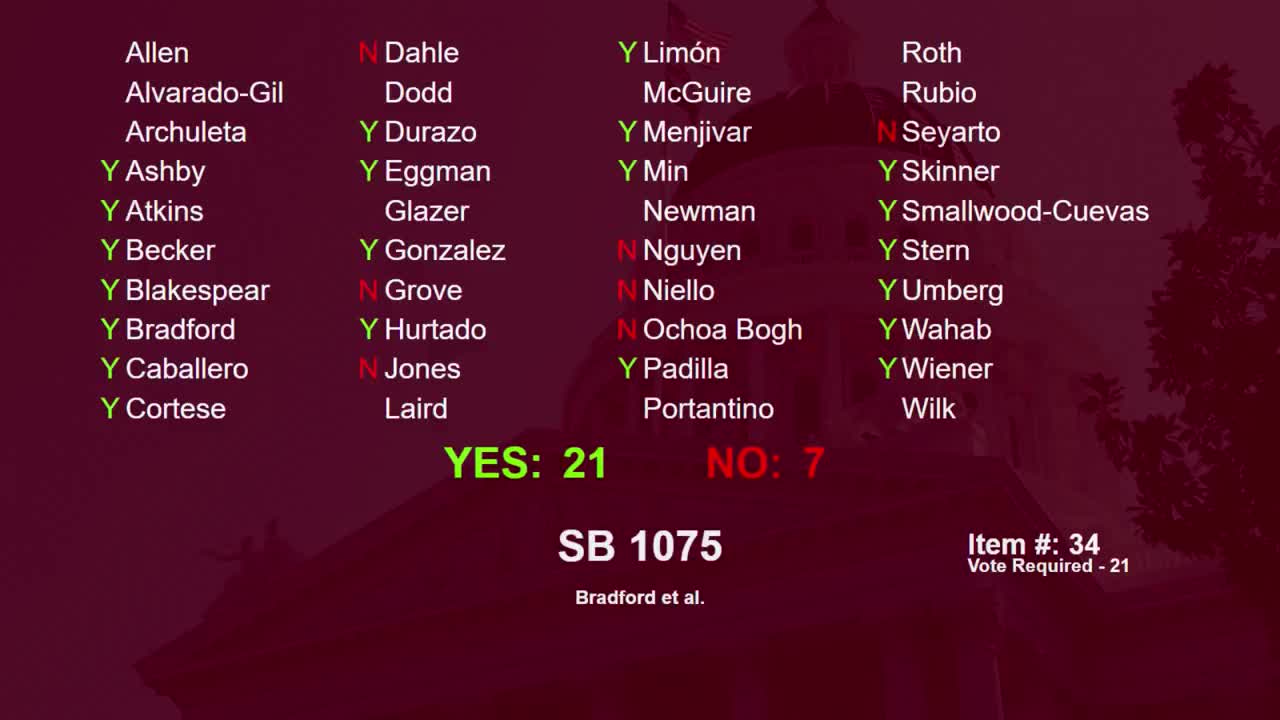 4MIN
Senate Floor
 25MIN
Senate Standing Committee on Energy, Utilities and Communications
 38SEC
Senate Standing Committee on Energy, Utilities and Communications
Bill Author

Bill Co-Author(s):