SB 1064: Cannabis: operator and separate premises license types: excessive concentration of licenses.
- Session Year: 2023-2024
- House: Senate
- Latest Version Date: 2024-09-28
Current Status:
Passed
(2024-09-28: Chaptered by Secretary of State. Chapter 875, Statutes of 2024.)
Introduced
In Committee
First Chamber
In Committee
Second Chamber
Enacted
Existing law, the Control, Regulate and Tax Adult Use of Marijuana Act (AUMA), an initiative measure, authorizes a person who obtains a state license under AUMA to engage in commercial adult-use cannabis activity pursuant to that license and applicable local ordinances. Existing law, the Medicinal and Adult-Use Cannabis Regulation and Safety Act (MAUCRSA), among other things, consolidates the licensure and regulation of commercial medicinal and adult-use cannabis activities, and establishes the Department of Cannabis Control to administer and enforce its provisions.
MAUCRSA requires an applicant or licensee to apply for a separate license for each location where it engages in commercial cannabis activity. MAUCRSA sets forth a codified list of license types for different commercial cannabis activities, including, among others, retail sale, distribution, 2 types of manufacturing, laboratory testing, and various kinds and sizes of cultivation activities.
This bill would revise the MAUCRSA licensing scheme for commercial cannabis activities by adding a combined activities license classification. The bill would define combined activities license as a state license that authorizes 2 or more commercial cannabis activities at the same premises, with the exception of laboratory testing, as specified. The bill would make various related conforming changes.
MAUCRSA requires the department, in determining whether to grant, deny, or renew a specified license, to consider if an excessive concentration, as described, exists in the area where the licensee will operate.
This bill would remove this requirement.
MAUCRSA imposes various requirements on an applicant for a state license, including, among other things, requiring each owner to electronically submit to the Department of Justice fingerprint images and related information required by the Department of Justice, as described. If an owner has previously submitted fingerprint images and related information, as described above, MAUCRSA does not require the owner to submit additional fingerprint images and related information in connection with a subsequent application for a state license.
This bill would additionally specify that an owner is not required to resubmit owner-related information previously provided to the department.
This bill would make related legislative findings and declarations.
AUMA authorizes the Legislature to amend its provisions with a 2/3 vote of both houses to further its purposes and intent, except as specified.
This bill would declare that its provisions further the purposes and intent of AUMA, as described.
Existing law, the Control, Regulate and Tax Adult Use of Marijuana Act (AUMA), an initiative measure, authorizes a person who obtains a state license under AUMA to engage in commercial adult-use cannabis activity pursuant to that license and applicable local ordinances. Existing law, the Medicinal and Adult-Use Cannabis Regulation and Safety Act (MAUCRSA), among other things, consolidates the licensure and regulation of commercial medicinal and adult-use cannabis activities, and establishes the Department of Cannabis Control to administer and enforce its provisions.
MAUCRSA requires an applicant or licensee to apply for a separate license for each location where it engages in commercial cannabis activity. MAUCRSA sets forth a codified list of license types for different commercial cannabis activities, including, among others, retail sale, distribution, 2 types of manufacturing, laboratory testing, and various kinds and sizes of cultivation activities.
This bill would revise the MAUCRSA licensing scheme for commercial cannabis activities other than cultivation and laboratory testing. Specifically, the bill would consolidate the licensing of those activities under one license type called an operator license, and would require an operator licensee to acquire an additional premises license specific to the activity to be conducted on the premises. by adding a combined activities license classification. The bill would define combined activities license as a state license that authorizes 2 or more commercial cannabis activities at the same premises, with the exception of laboratory testing, as specified. The bill would make various related conforming changes including by revising and recasting the codified list of license types. In this regard, the bill would list the cultivation and laboratory testing types under the unified license classification, would list the other commercial cannabis activity types under the premises license classification, and would establish the operator license classification as a single license type. The bill, until January 1, 2029, would deem the holder of an unexpired annual license on January 1, 2028, to hold, as applicable, either a unified license or both an operator license and the required premises license with the same expiration date as the annual license, as specified. changes.
MAUCRSA requires the department, in determining whether to grant, deny, or renew a specified license, to consider if an excessive concentration, as described, exists in the area where the licensee will operate.
This bill would remove this requirement.
MAUCRSA imposes various requirements on an applicant for a state license, including, among other things, requiring each owner to electronically submit to the Department of Justice fingerprint images and related information required by the Department of Justice, as described. If an owner has previously submitted fingerprint images and related information, as described above, MAUCRSA does not require the owner to submit additional fingerprint images and related information in connection with a subsequent application for a state license.
This bill would additionally specify that an owner is not required to resubmit owner-related information previously provided to the department.
This bill would make its provisions effective on January 1, 2028, and would make related legislative findings and declarations.
AUMA authorizes the Legislature to amend its provisions with a 2/3 vote of both houses to further its purposes and intent, except as specified.
This bill would declare that its provisions further the purposes and intent of AUMA, as described.
Existing law, the Control, Regulate and Tax Adult Use of Marijuana Act (AUMA), an initiative measure, authorizes a person who obtains a state license under AUMA to engage in commercial adult-use cannabis activity pursuant to that license and applicable local ordinances. Existing law, the Medicinal and Adult-Use Cannabis Regulation and Safety Act (MAUCRSA), among other things, consolidates the licensure and regulation of commercial medicinal and adult-use cannabis activities, and establishes the Department of Cannabis Control to administer and enforce its provisions.
MAUCRSA requires an applicant or licensee to apply for a separate license for each location where it engages in commercial cannabis activity. MAUCRSA sets forth a codified list of license types for different commercial cannabis activities, including, among others, retail sale, distribution, 2 types of manufacturing, laboratory testing, and various kinds and sizes of cultivation activities.
This bill would revise the MAUCRSA licensing scheme for commercial cannabis activities other than cultivation and laboratory testing. Specifically, the bill would consolidate the licensing of those activities under one license type called an operator license, and would require an operator licensee to acquire an additional premises license specific to the activity to be conducted on the premises. The bill would make various conforming changes including by revising and recasting the codified list of license types. In this regard, the bill would list the cultivation and laboratory testing types under the unified license classification, would list the other commercial cannabis activity types under the premises license classification, and would establish the operator license classification as a single license type. The bill, until January 1, 2027, 2029, would deem the holder of an unexpired annual license on January 1, 2026, 2028, to hold, as applicable, either a unified license or both an operator license and the required premises license with the same expiration date as the annual license, as specified.
MAUCRSA requires the department, in determining whether to grant, deny, or renew a specified license, to consider if an excessive concentration, as described, exists in the area where the licensee will operate.
This bill would remove this requirement.
This bill would make its provisions effective on January 1, 2026, 2028, and would make related legislative findings and declarations.
AUMA authorizes the Legislature to amend its provisions with a 2/3 vote of both houses to further its purposes and intent, except as specified.
This bill would declare that its provisions further the purposes and intent of AUMA, as described.
Existing law, the Control, Regulate and Tax Adult Use of Marijuana Act (AUMA), an initiative measure, authorizes a person who obtains a state license under AUMA to engage in commercial adult-use cannabis activity pursuant to that license and applicable local ordinances. Existing law, the Medicinal and Adult-Use Cannabis Regulation and Safety Act (MAUCRSA), among other things, consolidates the licensure and regulation of commercial medicinal and adult-use cannabis activities, and establishes the Department of Cannabis Control to administer and enforce its provisions.
MAUCRSA requires an applicant or licensee to apply for a separate license for each location where it engages in commercial cannabis activity. MAUCRSA sets forth a codified list of license types for different commercial cannabis activities, including, among others, retail sale, distribution, 2 types of manufacturing, laboratory testing, and various kinds and sizes of cultivation activities.
This bill would revise the MAUCRSA licensing scheme for commercial cannabis activities other than cultivation and laboratory testing. Specifically, the bill would consolidate the licensing of those activities under one license type called an operator license, and would require an operator licensee to acquire an additional premises license specific to the activity to be conducted on the premises. The bill would make various conforming changes including by revising and recasting the codified list of license types. In this regard, the bill would list the cultivation and laboratory testing types under the unified license classification, would list the other commercial cannabis activity types under the premises license classification, and would establish the operator license classification as a single license type. The bill, until January 1, 2027, would deem the holder of an unexpired annual license on January 1, 2026, to hold, as applicable, either a unified license or both an operator license and the required premises license with the same expiration date as the annual license, as specified.
MAUCRSA requires the department, in determining whether to grant, deny, or renew a specified license, to consider if an excessive concentration, as described, exists in the area where the licensee will operate.
This bill would remove this requirement.
This bill would make its provisions effective on January 1, 2026, and would make related legislative findings and declarations.
AUMA authorizes the Legislature to amend its provisions with a 2/3 vote of both houses to further its purposes and intent, except as specified.
This bill would declare that its provisions further the purposes and intent of AUMA, as described.
Existing law, the Control, Regulate and Tax Adult Use of Marijuana Act (AUMA), approved by the voters at the November 8, 2016, statewide general election, regulates the cultivation, distribution, transport, storage, manufacturing, testing, processing, sale, and use of cannabis for nonmedical purposes by people 21 years of age and older. The existing Medicinal and Adult-Use Cannabis Regulation and Safety Act (MAUCRSA), among other things, consolidates the licensure and regulation of commercial medicinal and adult-use cannabis activities.This bill would state the intent of the Legislature to enact subsequent legislation to strengthen the states legal cannabis market.Existing law, the Control, Regulate and Tax Adult Use of Marijuana Act (AUMA), approved by the voters at the November 8, 2016, statewide general election, regulates the cultivation, distribution, transport, storage, manufacturing, testing, processing, sale, and use of cannabis for nonmedical purposes by people 21 years of age and older. The existing Medicinal and Adult-Use Cannabis Regulation and Safety Act (MAUCRSA), among other things, consolidates the licensure and regulation of commercial medicinal and adult-use cannabis activities.
This bill would state the intent of the Legislature to enact subsequent legislation to strengthen the states legal cannabis market.
The Legislature finds and declares as follows:
(a)In November 1996, voters approved Proposition 215, which decriminalized the use of medicinal cannabis in California.
(b)In 2015, California enacted three billsAssembly Bill 243 (Chapter 688 of the Statutes of 2015); Assembly Bill 266 (Chapter 689 of the Statutes of 2015); and Senate Bill 643 (Chapter 719 of the Statutes of 2015)that collectively established a comprehensive state regulatory framework for the licensing and enforcement of cultivation, manufacturing, retail sale, transportation, storage, delivery, and testing of medicinal cannabis in California. This regulatory scheme is known as the Medical Cannabis Regulation and Safety Act (MCRSA).
(c)In November 2016, voters approved Proposition 64, the Adult Use of Marijuana Act (AUMA). AUMA makes it legal to sell and distribute cannabis for adult use through a regulated business.
(d)In 2017, the Legislature enacted Senate Bill 94 (Chapter 27 of the Statutes of 2017) to merge the regulatory provisions of MCRSA and AUMA and provide for a single regulatory structure for both medicinal and adult-use cannabis. This consolidated regulatory structure is known as the Medicinal and Adult-Use Cannabis Regulation and Safety Act (MAUCRSA).
(e)The intent of MCRSA, AUMA, and MAUCRSA was to ensure a comprehensive regulatory system that takes production and sales of cannabis away from an illegal market and curtails the illegal diversion of cannabis from California into other states or countries, while avoiding duplicative costs and inevitable confusion among licensees, regulatory agencies, and the public and ensuring a regulatory structure that prevents access to minors, protects public safety, public health, and the environment, as well as maintaining local control.
(f)The purpose of this act is to revise the procedures for issuance of state licenses for certain commercial cannabis activities to promote efficiency, avoid overlap with local land use processes while protecting local control, and reduce barriers to entry into the legal, regulated market, in furtherance of the purposes and intent of MCRSA, AUMA, and MAUCRSA.
SEC. 2.Section 26001 of the Business and Professions Code is amended to read:26001.For purposes of this division, the following definitions apply:
(a)A-license means a state license issued under this division for cannabis or cannabis products that are intended for adults who are 21 years of age and older and who do not possess a physicians recommendation, or are intended for use on, or consumption by, animals.
(b)A-licensee means any person holding a license under this division for cannabis or cannabis products that are intended for adults who are 21 years of age and older and who do not possess a physicians recommendation, or are intended for use on, or consumption by, animals.
(c)Animal does not include a food animal as defined in Section 4825.1 or livestock as defined in Section 14205 of the Food and Agricultural Code.
(d)Applicant means an owner applying for a state license pursuant to this division.
(e)Batch means a specific quantity of homogeneous cannabis or cannabis product that is one of the following types:
(1)Harvest batch. Harvest batch means a specifically identified quantity of dried flower or trim, leaves, and other cannabis plant matter that is harvested at the same time, and, if applicable, cultivated using the same pesticides and other agricultural chemicals.
(2)Manufactured cannabis batch. Manufactured cannabis batch means either of the following:
(A)An amount of cannabis concentrate or extract that is produced in one production cycle using the same extraction methods and standard operating procedures.
(B)An amount of a type of manufactured cannabis produced in one production cycle using the same formulation and standard operating procedures.
(f)Cannabis means all parts of the plant Cannabis sativa Linnaeus, Cannabis indica, or Cannabis ruderalis, whether growing or not; the seeds thereof; the resin, whether crude or purified, extracted from any part of the plant; and every compound, manufacture, salt, derivative, mixture, or preparation of the plant, its seeds, or resin. Cannabis also means the separated resin, whether crude or purified, obtained from cannabis. Cannabis does not include the mature stalks of the plant, fiber produced from the stalks, oil or cake made from the seeds of the plant, any other compound, manufacture, salt, derivative, mixture, or preparation of the mature stalks (except the resin extracted therefrom), fiber, oil, or cake, or the sterilized seed of the plant which is incapable of germination. For the purpose of this division, cannabis does not mean industrial hemp as defined by Section 11018.5 of the Health and Safety Code.
(g)Cannabis accessories has the same meaning as in Section 11018.2 of the Health and Safety Code.
(h)Cannabis beverage means a form of edible cannabis product that is intended to be consumed in its final state as a beverage.
(i)Cannabis concentrate means cannabis that has undergone a process to concentrate one or more active cannabinoids, thereby increasing the products potency. Resin from glandular trichomes from a cannabis plant is a concentrate for purposes of this division. A cannabis concentrate is not considered food, as defined by Section 109935 of the Health and Safety Code, a processed pet food, as defined by Section 113025 of the Health and Safety Code, or a drug, as defined by Section 109925 of the Health and Safety Code.
(j)Cannabis event organizer means a person authorized to plan and organize temporary cannabis events as authorized in Section 26200.
(k)Cannabis products has the same meaning as in Section 11018.1 of the Health and Safety Code, and includes cannabis products intended for use on, or consumption by, an animal. Cannabis products are not considered food, as defined by Section 109935 of the Health and Safety Code, a drug, as defined by Section 109925 of the Health and Safety Code, or a cosmetic, as defined by Section 109900 of the Health and Safety Code.
(l)Child resistant means designed or constructed to be significantly difficult for children under five years of age to open, and not difficult for normal adults to use properly.
(m)Combined activities license means a state license that authorizes two or more commercial cannabis activities at the same premises, with the exception of laboratory testing. A combined activities license shall conform with all requirements imposed by this division to the extent the licensee engages in those activities.
(n)Commercial cannabis activity includes the cultivation, possession, manufacture, distribution, processing, storing, laboratory testing, packaging, labeling, transportation, delivery, or sale of cannabis and cannabis products as provided for in this division, or acting as a cannabis event organizer for temporary cannabis events.
(o)Cultivation means any activity involving the planting, growing, harvesting, drying, curing, grading, or trimming of cannabis.
(p)Cultivation site means a location where cannabis is planted, grown, harvested, dried, cured, graded, or trimmed, or a location where any combination of those activities occurs.
(q)Customer means a natural person 21 years of age or older or a natural person 18 years of age or older who possesses a physicians recommendation, or a primary caregiver.
(r)Daycare center has the same meaning as in Section 1596.76 of the Health and Safety Code.
(s)Delivery means the commercial transfer of cannabis or cannabis products to a customer. Delivery also includes the use by a retailer of any technology platform.
(t)Department means the Department of Cannabis Control within the Business, Consumer Services, and Housing Agency.
(u)Director means the Director of the Department of Cannabis Control.
(v)Distribution means the procurement, sale, and transport of cannabis and cannabis products between licensees.
(w)Distributor means a licensee that is authorized to engage in the distribution of cannabis and cannabis products.
(x)Dried flower means all dead cannabis that has been harvested, dried, cured, or otherwise processed, excluding leaves and stems.
(y)Edible cannabis product means a cannabis product that is intended to be used, in whole or in part, for human or animal consumption, including, but not limited to, chewing gum, but excluding products set forth in Division 15 (commencing with Section 32501) of the Food and Agricultural Code. An edible cannabis product is not considered food, as defined by Section 109935 of the Health and Safety Code, a processed pet food, as defined by Section 113025 of the Health and Safety Code, or a drug, as defined by Section 109925 of the Health and Safety Code.
(z)Fund means the Cannabis Control Fund established pursuant to Section 26210.
(aa)Kind means applicable type or designation regarding a particular cannabis variant, origin, or product type, including, but not limited to, strain name, trademark, or production area designation.
(ab)Labeling means any label or other written, printed, or graphic matter upon a cannabis product, upon its container or wrapper, or that accompanies any cannabis product.
(ac)Labor peace agreement means an agreement between a licensee and any bona fide labor organization that, at a minimum, protects the states proprietary interests by prohibiting labor organizations and members from engaging in picketing, work stoppages, boycotts, and any other economic interference with the applicants business. This agreement means that the applicant has agreed not to disrupt efforts by the bona fide labor organization to communicate with, and attempt to organize and represent, the applicants employees. The agreement shall provide a bona fide labor organization access at reasonable times to areas in which the applicants employees work, for the purpose of meeting with employees to discuss their right to representation, employment rights under state law, and terms and conditions of employment. This type of agreement shall not mandate a particular method of election or certification of the bona fide labor organization.
(ad)License means a state license issued under this division, and includes both an A-license and an M-license, as well as a testing laboratory license.
(ae)Licensee means any person holding a license under this division, regardless of whether the license held is an A-license or an M-license, and includes the holder of a testing laboratory license.
(af)Licensing authority means the department and any state agency currently or formerly responsible for the issuance, renewal, or reinstatement of the license, or the state agency authorized to take disciplinary action against the licensee.
(ag)Live plants means living cannabis flowers and plants, including seeds, immature plants, and vegetative stage plants.
(ah)Local jurisdiction means a city, county, or city and county.
(ai)Lot means a batch or a specifically identified portion of a batch.
(aj)M-license means a state license issued under this division for commercial cannabis activity involving medicinal cannabis.
(ak)M-licensee means any person holding a license under this division for commercial cannabis activity involving medicinal cannabis.
(al)Manufacture means to compound, blend, extract, infuse, package, label, or otherwise make or prepare a cannabis product.
(am)(1)Medicinal cannabis or medicinal cannabis product means cannabis or a cannabis product, respectively, intended to be sold or donated for use pursuant to the Compassionate Use Act of 1996 (Proposition 215), found in Section 11362.5 of the Health and Safety Code, by a medicinal cannabis patient in California who possesses a physicians recommendation, or in compliance with any compassionate use, equity, or other similar program administered by a local jurisdiction.
(2)The amendments made to this subdivision by the act adding this paragraph shall become operative upon completion of the necessary changes to the track and trace program in order to implement the act adding this paragraph, as determined by the Department of Food and Agriculture, or on March 1, 2020, whichever occurs first.
(an)Microbusiness means a licensee that is authorized to engage in cultivation of cannabis on an area less than 10,000 square feet and to act as a licensed distributor, Level 1 manufacturer, and retailer under this division, provided such licensee can demonstrate compliance with all requirements imposed by this division on licensed cultivators, distributors, Level 1 manufacturers, and retailers to the extent the licensee engages in such activities.
(ao)Nursery means a licensee that produces only clones, immature plants, seeds, and other agricultural products used specifically for the propagation and cultivation of cannabis.
(ap)Operation means any act for which licensure is required under the provisions of this division, or any commercial transfer of cannabis or cannabis products.
(aq)Owner means any of the following:
(1)A person with an aggregate ownership interest of 20 percent or more in the person applying for a license or a licensee, unless the interest is solely a security, lien, or encumbrance.
(2)The chief executive officer of a nonprofit or other entity.
(3)A member of the board of directors of a nonprofit.
(4)An individual who will be participating in the direction, control, or management of the person applying for a license.
(ar)Package means any container or receptacle used for holding cannabis or cannabis products.
(as)Person includes any individual, firm, partnership, joint venture, association, corporation, limited liability company, estate, trust, business trust, receiver, syndicate, or any other group or combination acting as a unit, and the plural as well as the singular.
(at)Physicians recommendation means a recommendation by a physician and surgeon that a patient use cannabis provided in accordance with the Compassionate Use Act of 1996 (Proposition 215), found at Section 11362.5 of the Health and Safety Code.
(au)Premises means the designated structure or structures and land specified in the application that is owned, leased, or otherwise held under the control of the applicant or licensee where the commercial cannabis activity will be or is conducted.
(av)Primary caregiver has the same meaning as in Section 11362.7 of the Health and Safety Code.
(aw)Processor means a person authorized to engage in only trimming, drying, curing, grading, packaging, and labeling of cannabis and nonmanufactured cannabis products.
(ax)Purchaser means the customer who is engaged in a transaction with a licensee for purposes of obtaining cannabis or cannabis products.
(ay)Retailer means a person authorized to engage in the retail sale and delivery of cannabis or cannabis products to customers.
(az)Sell, sale, and to sell include any transaction whereby, for any consideration, title to cannabis or cannabis products is transferred from one person to another, and includes the delivery of cannabis or cannabis products pursuant to an order placed for the purchase of the same and soliciting or receiving an order for the same, but does not include the return of cannabis or cannabis products by a licensee to the licensee from whom the cannabis or cannabis product was purchased.
(ba)Testing laboratory means a laboratory, facility, or entity in the state that offers or performs tests of cannabis or cannabis products and that is both of the following:
(1)Accredited by an accrediting body that is independent from all other persons involved in commercial cannabis activity in the state.
(2)Licensed by the department.
(bb)Unique identifier means an alphanumeric code or designation issued pursuant to the track and trace program established by the department and used for reference to a specific plant on a licensed premises and any cannabis or cannabis product derived or manufactured from that plant.
(bc)Youth center has the same meaning as in Section 11353.1 of the Health and Safety Code.
SEC. 3.Section 26050 of the Business and Professions Code is amended to read:26050.(a)The license classification pursuant to this division shall, at a minimum, be as follows:
(1)Type 1Cultivation; Specialty outdoor; Small.
(2)Type 1ACultivation; Specialty indoor; Small.
(3)Type 1BCultivation; Specialty mixed-light; Small.
(4)Type 1CCultivation; Specialty cottage; Small.
(5)Type 2Cultivation; Outdoor; Small.
(6)Type 2ACultivation; Indoor; Small.
(7)Type 2BCultivation; Mixed-light; Small.
(8)Type 3Cultivation; Outdoor; Medium.
(9)Type 3ACultivation; Indoor; Medium.
(10)Type 3BCultivation; Mixed-light; Medium.
(11)Type 4Cultivation; Nursery.
(12)Type 5Cultivation; Outdoor; Large.
(13)Type 5ACultivation; Indoor; Large.
(14)Type 5BCultivation; Mixed-light; Large.
(15)Type 6Manufacturer 1.
(16)Type 7Manufacturer 2.
(17)Type 8Testing laboratory.
(18)Type 10Retailer.
(19)Type 11Distributor.
(20)Type 12Microbusiness.
(21)Type 13Cannabis event organizer.
(22)Type 14Processor.
(23)Type 15Combined activities.
(b)With the exception of testing laboratory licenses, which may be used to test cannabis and cannabis products regardless of whether they are intended for use by individuals who possess a physicians recommendation, all licenses issued under this division shall bear a clear designation indicating whether the license is for commercial adult-use cannabis activity as distinct from commercial medicinal cannabis activity by prominently affixing an A or M, respectively. Examples of such a designation include, but are not limited to, A-Type 1 or M-Type 1. Except as specifically specified in this division, the requirements for A-licenses and M-licenses shall be the same. For testing laboratories, the department shall create a license that indicates a testing laboratory may test both adult-use and medicinal cannabis.
(c)A license issued pursuant to this division shall be valid for 12 months from the date of issuance. The license may be renewed annually.
(d)The department shall establish procedures for the issuance and renewal of licenses.
SEC. 4.Section 26051 of the Business and Professions Code is amended to read:26051.(a)The Cartwright Act, the Unfair Practices Act, the Unfair Competition Law, and the other provisions of Part 2 (commencing with Section 16600) of Division 7 apply to all licensees regulated under this division.
(b)It shall be unlawful for any person to monopolize, attempt to monopolize, or combine or conspire with any person or persons to monopolize, any part of the trade or commerce related to cannabis. The Attorney General shall have the sole authority to enforce the provisions of this subdivision.
SEC. 5.Section 26051.5 of the Business and Professions Code is amended to read:26051.5.(a)An applicant for a state license issued pursuant to this division to conduct commercial cannabis activity, as defined in Section 26001, shall do all of the following:
(1)Except as provided in subparagraph (G), require that each owner electronically submit to the Department of Justice fingerprint images and related information required by the Department of Justice for the purpose of obtaining information as to the existence and content of a record of state or federal convictions and state and federal arrests, and also information as to the existence and content of a record of state or federal convictions and arrests for which the Department of Justice establishes that the person is free on bail or on their own recognizance pending trial or appeal.
(A)Notwithstanding any other law, the department may obtain criminal history information from the Department of Justice and the Federal Bureau of Investigation for an applicant for any state license under this division, including any license established by a licensing authority, as defined in Section 26001, by regulation pursuant to subdivision (b) of Section 26012.
(B)When received, the Department of Justice shall transmit fingerprint images and related information received pursuant to this section to the Federal Bureau of Investigation for the purpose of obtaining a federal criminal history records check. The Department of Justice shall review the information returned from the Federal Bureau of Investigation and compile and disseminate a response to the licensing authority.
(C)The Department of Justice shall provide a response to the licensing authority pursuant to paragraph (1) of subdivision (p) of Section 11105 of the Penal Code.
(D)The licensing authority shall request from the Department of Justice subsequent notification service, as provided pursuant to Section 11105.2 of the Penal Code, for applicants.
(E)The Department of Justice shall charge the applicant a fee sufficient to cover the reasonable cost of processing the requests described in this paragraph.
(F)Notwithstanding any other law, a licensing authority may request and receive from a local or state agency certified records of all arrests and convictions, certified records regarding probation, and any and all other related documentation needed to complete an applicant or licensee investigation. A local or state agency may provide those records to a licensing authority upon request.
(G)If an owner has previously submitted fingerprint images and related information required by the Department of Justice pursuant to this paragraph in connection with a valid state license issued by a licensing authority, all of the following apply:
(i)The owner shall not be required to submit additional fingerprint images and related information pursuant to this paragraph in connection with a subsequent application for a state license.
(ii)The department shall not consider the owners criminal history information obtained from the fingerprint images and related information that were previously submitted pursuant to this paragraph when considering whether to issue a subsequent state license.
(iii)An owner shall not be required to resubmit owner-related information previously provided to the department.
(2)Provide evidence of the legal right to occupy and use the proposed location and provide a statement from the landowner of real property or that landowners agent where the commercial cannabis activity will occur, as proof to demonstrate the landowner has acknowledged and consented to permit commercial cannabis activities to be conducted on the property by the tenant applicant.
(3)Provide evidence that the proposed location is in compliance with subdivision (b) of Section 26054.
(4)Provide a statement, signed by the applicant under penalty of perjury, that the information provided is complete, true, and accurate.
(5)(A)(i)For an applicant with 20 or more employees, or an applicant with 10 or more employees that submits an application on or after July 1, 2024, provide a notarized statement that the applicant will enter into, or demonstrate that it has already entered into, and will abide by the terms of a labor peace agreement. On and after July 1, 2024, the department shall not renew a license for a licensee with 10 or more employees unless the licensee provides a statement that the licensee has already entered into and will abide by the terms of a labor peace agreement.
(ii)For an applicant with 10 or more employees but less than 20 employees that has not yet entered into a labor peace agreement, provide a notarized statement as a part of its application indicating that the applicant will enter into and abide by the terms of a labor peace agreement within 60 days of employing its 20th employee, or on or before July 1, 2024, whichever is earlier.
(iii)For an applicant with less than 10 employees that has not yet entered into a labor peace agreement, provide a notarized statement as a part of its application indicating that the applicant will enter into and abide by the terms of a labor peace agreement within 60 days of employing its 10th employee, or on or before July 1, 2024, whichever is later.
(iv)Nothing in this paragraph shall be construed to limit the authority of the department to revoke or suspend a license for a violation of this paragraph.
(B)Compliance with the terms of an applicable labor peace agreement is a condition of licensure. A licensee seeking renewal of any license shall attest to the department that it remains in compliance with the terms of any applicable labor peace agreement.
(C)Any labor organization, or any current or former employee of the relevant licensee, may report to the department that a licensee has failed to provide a truthful attestation of compliance with subparagraph (B).
(i)The reporting party shall provide documentation, in a form and manner required by the department, to substantiate their allegation before the department considers it. The department shall collaborate with such agencies as it deems relevant to evaluate the report.
(ii)If the department substantiates the validity of a report made pursuant to this subparagraph, the department may suspend, revoke, place on probation with terms and conditions, or otherwise discipline the license and fine the licensee.
(D)(i)Any labor organization, or any current or former employee of the relevant licensee, may file a complaint with the Agricultural Labor Relations Board that an organization with which a licensee has entered into a labor peace agreement is not a bona fide labor organization.
(ii)The Agricultural Labor Relations Board shall consider all relevant evidence provided or obtained in rendering a decision on whether the entity is a bona fide labor organization and issue a report with its findings no later than 90 days from receiving the complaint.
(iii)If the Agricultural Labor Relations Board determines that the entity is not a bona fide labor organization, the labor peace agreement shall be null and void. The department shall promptly notify all licensees that have signed labor peace agreements with the entity that the entity was found not to be a bona fide labor organization and offer those licensees a reasonable time period, not to exceed 180 days, to enter into a labor peace agreement with a bona fide labor organization. Failure to enter into a labor peace agreement with a bona fide labor organization after that reasonable time period shall be a violation of this section.
(E)For the purposes of this paragraph, all of the following shall apply:
(i)Employee does not include a supervisor.
(ii)Labor organization means any organization of any kind, or any agency or employee representation committee or plan, in which employees participate and which exists, in whole or in part, for the purpose of dealing with employers concerning grievances, labor disputes, wages, rates of pay, hours of employment, or conditions of work for employees.
(iii)Supervisor means an individual having authority, in the interest of the applicant, to hire, transfer, suspend, lay off, recall, promote, discharge, assign, reward, or discipline other employees, or responsibility to direct them or to adjust their grievances, or effectively to recommend such action, if, in connection with the foregoing, the exercise of that authority is not of a merely routine or clerical nature, but requires the use of independent judgment.
(6)Provide the applicants valid sellers permit number issued pursuant to Part 1 (commencing with Section 6001) of Division 2 of the Revenue and Taxation Code or indicate that the applicant is currently applying for a sellers permit.
(7)Provide any other information required by the department.
(8)For an applicant seeking a cultivation license, provide a statement declaring the applicant is an agricultural employer, as defined in the Alatorre-Zenovich-Dunlap-Berman Agricultural Labor Relations Act of 1975 (Part 3.5 (commencing with Section 1140) of Division 2 of the Labor Code), to the extent not prohibited by law.
(9)Pay all applicable fees required for licensure by the department.
(10)Provide proof of a bond to cover the costs of destruction of cannabis or cannabis products if necessitated by a violation of licensing requirements.
(11)(A)Provide a statement, upon initial application and application for renewal, that the applicant employs, or will employ within one year of receiving or renewing a license, one supervisor and one employee who have successfully completed a Division of Occupational Safety and Health (OSHA) 30-hour general industry outreach course offered by a training provider that is authorized by an OSHA Training Institute Education Center to provide the course. This paragraph shall not be construed to alter or amend existing requirements for employers to provide occupational safety and health training to employees.
(B)An applicant with only one employee shall not be subject to subparagraph (A).
(C)For purposes of this paragraph employee has the same meaning as provided in subparagraph (B) of paragraph (5) and supervisor has the same meaning as provided in subparagraph (C) of paragraph (5).
(b)An applicant shall also include in the application a detailed description of the applicants operating procedures for all of the following, as required by the department:
(1)Cultivation.
(2)Extraction and infusion methods.
(3)The transportation process.
(4)Inventory procedures.
(5)Quality control procedures.
(6)Security protocols.
(7)For applicants seeking licensure to cultivate, the source or sources of water the applicant will use for cultivation, as provided in subdivisions (a) to (c), inclusive, of Section 26060.1. For purposes of this paragraph, cultivation as used in Section 26060.1 shall have the same meaning as defined in Section 26001. The department shall consult with the State Water Resources Control Board and the Department of Fish and Wildlife in the implementation of this paragraph.
(c)The applicant shall also provide a complete detailed diagram of the proposed premises wherein the license privileges will be exercised, with sufficient particularity to enable ready determination of the bounds of the premises, showing all boundaries, dimensions, entrances and exits, interior partitions, walls, rooms, and common or shared entryways, and include a brief statement or description of the principal activity to be conducted therein, and, for licenses permitting cultivation, measurements of the planned canopy, including aggregate square footage and individual square footage of separate cultivation areas, if any, roads, water crossings, points of diversion, water storage, and all other facilities and infrastructure related to the cultivation.
(d)Provide a complete list of every person with a financial interest in the person applying for the license as required by the department. For purposes of this subdivision, persons with a financial interest does not include persons whose only interest in a licensee is an interest in a diversified mutual fund, blind trust, or similar instrument.
SEC. 6.Section 26061 of the Business and Professions Code is amended to read:26061.(a)The state cultivator license types to be issued by the department under this division shall include all of the following:
(1)Type 1, or specialty outdoor, for outdoor cultivation using no artificial lighting of less than or equal to 5,000 square feet of total canopy size on one premises, or up to 50 mature plants on noncontiguous plots.
(2)Type 1A, or specialty indoor, for indoor cultivation using exclusively artificial lighting of between 501 and 5,000 square feet of total canopy size on one premises.
(3)Type 1B, or specialty mixed-light, for cultivation using a combination of natural and supplemental artificial lighting at a maximum threshold to be determined by the department of between 2,501 and 5,000 square feet of total canopy size on one premises.
(4)Type 1C, or specialty cottage, for cultivation using a combination of natural and supplemental artificial lighting at a maximum threshold to be determined by the department, of 2,500 square feet or less of total canopy size for mixed-light cultivation, 2,500 square feet or less of total canopy size for outdoor cultivation with the option to meet an alternative maximum threshold to be determined by the department of up to 25 mature plants for outdoor cultivation, or 500 square feet or less of total canopy size for indoor cultivation, on one premises.
(5)Type 2, or small outdoor, for outdoor cultivation using no artificial lighting between 5,001 and 10,000 square feet, inclusive, of total canopy size on one premises.
(6)Type 2A, or small indoor, for indoor cultivation using exclusively artificial lighting between 5,001 and 10,000 square feet, inclusive, of total canopy size on one premises.
(7)Type 2B, or small mixed-light, for cultivation using a combination of natural and supplemental artificial lighting at a maximum threshold to be determined by the department, between 5,001 and 10,000 square feet, inclusive, of total canopy size on one premises.
(8)Type 3, or outdoor, for outdoor cultivation using no artificial lighting from 10,001 square feet to one acre, inclusive, of total canopy size on one premises. The department shall limit the number of licenses allowed of this type.
(9)Type 3A, or indoor, for indoor cultivation using exclusively artificial lighting between 10,001 and 22,000 square feet, inclusive, of total canopy size on one premises. The department shall limit the number of licenses allowed of this type.
(10)Type 3B, or mixed-light, for cultivation using a combination of natural and supplemental artificial lighting at a maximum threshold to be determined by the department between 10,001 and 22,000 square feet, inclusive, of total canopy size on one premises. The department shall limit the number of licenses allowed of this type.
(11)Type 4, or nursery, for cultivation of cannabis solely as a nursery.
(b)Except as otherwise provided by law:
(1)Type 5, or outdoor, means for outdoor cultivation using no artificial lighting greater than one acre, inclusive, of total canopy size on one premises.
(2)Type 5A, or indoor, means for indoor cultivation using exclusively artificial lighting greater than 22,000 square feet, inclusive, of total canopy size on one premises.
(3)Type 5B, or mixed-light, means for cultivation using a combination of natural and supplemental artificial lighting at a maximum threshold to be determined by the department greater than 22,000 square feet, inclusive, of total canopy size on one premises.
(c)No Type 5, Type 5A, or Type 5B cultivation licenses may be issued before January 1, 2023.
(d)Commencing on January 1, 2023, a Type 5, Type 5A, or Type 5B licensee may apply for and hold a Type 6 or Type 7 license and apply for and hold a Type 10 license. A Type 5, Type 5A, or Type 5B licensee shall not be eligible to apply for or hold any of the following license types:
(1)Type 8.
(2)Type 11.
(3)Type 12, authorized to engage in Type 11 distribution.
(4)Type 15, authorized to engage in Type 11 distribution.
(e)A licensee that holds a cultivation license eligible for conversion to a Type 5, Type 5A, or Type 5B shall not be eligible to apply for or hold a Type 15 license for those cultivation activities eligible for conversion, or that includes a Type 11 distribution.
SEC. 7.The heading of Chapter 7 (commencing with Section 26070) of Division 10 of the Business and Professions Code is amended to read:7.Retailers, Distributors, Microbusinesses, and Combined ActivitiesSEC. 8.Section 26070 of the Business and Professions Code is amended to read:26070.Retailers, Distributors, Microbusinesses, and Combined Activities.
(a)State licenses to be issued by the department related to the sale and distribution of cannabis and cannabis products are as follows:
(1)A retailer shall have a licensed premises which is a physical location from which commercial cannabis activities are conducted. A retailers premises may be closed to the public. A retailer may conduct sales exclusively by delivery.
(2)A distributor licensee shall be bonded and insured at a minimum level established by the department.
(3)(A)Microbusiness or combined activities licenses that authorize cultivation of cannabis shall include the license conditions described in subdivision (b) of Section 26060.1.
(B) The department shall establish a process by which an applicant for a microbusiness or combined activities license can demonstrate compliance with all the requirements under this division for the activities that will be conducted under the license.
(b)The department shall establish minimum security and transportation safety requirements for the commercial distribution and delivery of cannabis and cannabis products. Except as provided in subdivision (d) of Section 26110, the transportation of cannabis and cannabis products shall only be conducted by licensed persons authorized to engage in distribution under this division or employees of those persons. Transportation safety standards established by the department shall include, but not be limited to, minimum standards governing the types of vehicles in which cannabis and cannabis products may be distributed and delivered and minimum qualifications for persons eligible to operate such vehicles.
(c)The driver of a vehicle transporting or transferring cannabis or cannabis products shall be directly employed by a licensee authorized to transport or transfer cannabis or cannabis products.
(d)Notwithstanding any other law, all vehicles transporting cannabis and cannabis products for hire shall be required to have a valid motor carrier permit pursuant to Chapter 2 (commencing with Section 34620) of Division 14.85 of the Vehicle Code. The Department of the California Highway Patrol shall have authority over the safe operation of these vehicles, including, but not limited to, requiring licensees engaged in the transportation of cannabis or cannabis products to participate in the Basic Inspection of Terminals (BIT) program pursuant to Section 34501.12 of the Vehicle Code.
(e)Prior to transporting cannabis or cannabis products, a licensed distributor shall do both of the following:
(1)Complete an electronic shipping manifest as prescribed by the department. The shipping manifest shall include the unique identifier, pursuant to Section 26067, issued by the department for the cannabis product.
(2)Securely transmit the manifest to the department and the licensee that will receive the cannabis product.
(f)During transportation, the licensed distributor shall maintain a physical copy of the shipping manifest and make it available upon request to agents of the department and law enforcement officers.
(g)The licensee receiving the shipment shall maintain each electronic shipping manifest and shall make it available upon request to the department and any law enforcement officers.
(h)Upon receipt of the transported shipment, the licensee receiving the shipment shall submit to the department a record verifying receipt of the shipment and the details of the shipment.
(i)Transporting, or arranging for or facilitating the transport of, cannabis or cannabis products in violation of this chapter is grounds for disciplinary action against the license.
(j)Licensed retailers, microbusinesses, and combined activities, and licensed nonprofits under Section 26070.5, shall implement security measures reasonably designed to prevent unauthorized entrance into areas containing cannabis or cannabis products and theft of cannabis or cannabis products from the premises. These security measures shall include, but not be limited to, all of the following:
(1)Prohibiting individuals from remaining on the licensees premises if they are not engaging in activity expressly related to the operations of the retailer.
(2)Establishing limited access areas accessible only to authorized personnel.
(3)Other than limited amounts of cannabis used for display purposes, samples, or immediate sale, storing all finished cannabis and cannabis products in a secured and locked room, safe, or vault, and in a manner reasonably designed to prevent diversion, theft, and loss.
(k)A retailer shall notify the department and the appropriate law enforcement authorities within 24 hours after discovering any of the following:
(1)Significant discrepancies identified during inventory. The level of significance shall be determined by the department.
(2)Diversion, theft, loss, or any criminal activity pertaining to the operation of the retailer.
(3)Diversion, theft, loss, or any criminal activity by any agent or employee of the retailer pertaining to the operation of the retailer.
(4)The loss or unauthorized alteration of records related to cannabis or cannabis products, registered qualifying patients, primary caregivers, or retailer employees or agents.
(5)Any other breach of security.
SEC. 9.The Legislature finds and declares that this act furthers the purposes and intent of the Control, Regulate and Tax Adult Use of Marijuana Act by accomplishing all of the following:
(a)Reducing barriers to entry into the legal, regulated market by making state licensing processes more efficient and avoiding unnecessary overlap with local land use permitting, while protecting local control.
(b)Improving and strengthening Californias comprehensive system to legalize, control, and regulate commercial cannabis activities.
(c)Allowing local governments to enact additional local requirements for adult-use cannabis businesses, and to adopt and enforce other local police power, land use, and business regulations with respect to commercial cannabis activities, but not requiring that they enact cannabis-specific regulations for adult-use cannabis businesses to be issued local permits and state licenses and be legal under state law.
(d)Promoting the strict control of commercial cannabis activities and the prevention of the illegal production or distribution of cannabis and the illegal diversion of cannabis from California to other states or countries or to the illegal market.
The Legislature finds and declares as follows:
(a)In November 1996, voters approved Proposition 215, which decriminalized the use of medicinal cannabis in California.
(b)In 2015, California enacted three billsAssembly Bill 243 (Chapter 688 of the Statutes of 2015); Assembly Bill 266 (Chapter 689 of the Statutes of 2015); and Senate Bill 643 (Chapter 719 of the Statutes of 2015)that collectively established a comprehensive state regulatory framework for the licensing and enforcement of cultivation, manufacturing, retail sale, transportation, storage, delivery, and testing of medicinal cannabis in California. This regulatory scheme is known as the Medical Cannabis Regulation and Safety Act (MCRSA).
(c)In November 2016, voters approved Proposition 64, the Adult Use of Marijuana Act (AUMA). AUMA makes it legal to sell and distribute cannabis for adult use through a regulated business.
(d)In 2017, the Legislature enacted Senate Bill 94 (Chapter 27 of the Statutes of 2017) to merge the regulatory provisions of MCRSA and AUMA and provide for a single regulatory structure for both medicinal and adult-use cannabis. This consolidated regulatory structure is known as the Medicinal and Adult-Use Cannabis Regulation and Safety Act (MAUCRSA).
(e)The intent of MCRSA, AUMA, and MAUCRSA was to ensure a comprehensive regulatory system that takes production and sales of cannabis away from an illegal market and curtails the illegal diversion of cannabis from California into other states or countries, while avoiding duplicative costs and inevitable confusion among licensees, regulatory agencies, and the public and ensuring a regulatory structure that prevents access to minors, protects public safety, public health, and the environment, as well as maintaining local control.
(f)The purpose of this act is to revise the procedures for issuance of state licenses for certain commercial cannabis activities to promote efficiency, avoid overlap with local land use processes while protecting local control, and reduce barriers to entry into the legal, regulated market, in furtherance of the purposes and intent of MCRSA, AUMA, and MAUCRSA.
SEC. 2.Section 26001 of the Business and Professions Code is amended to read:26001.For purposes of this division, the following definitions apply:
(a)A-license means a state license issued under this division for cannabis or cannabis products that are intended for adults who are 21 years of age and older and who do not possess a physicians recommendation, or are intended for use on, or consumption by, animals.
(b)A-licensee means any person holding a license under this division for cannabis or cannabis products that are intended for adults who are 21 years of age and older and who do not possess a physicians recommendation, or are intended for use on, or consumption by, animals.
(c)Animal does not include a food animal as defined in Section 4825.1 or livestock as defined in Section 14205 of the Food and Agricultural Code.
(d)Applicant means an owner applying for a state license pursuant to this division.
(e)Batch means a specific quantity of homogeneous cannabis or cannabis product that is one of the following types:
(1)Harvest batch. Harvest batch means a specifically identified quantity of dried flower or trim, leaves, and other cannabis plant matter that is harvested at the same time, and, if applicable, cultivated using the same pesticides and other agricultural chemicals.
(2)Manufactured cannabis batch. Manufactured cannabis batch means either of the following:
(A)An amount of cannabis concentrate or extract that is produced in one production cycle using the same extraction methods and standard operating procedures.
(B)An amount of a type of manufactured cannabis produced in one production cycle using the same formulation and standard operating procedures.
(f)Cannabis means all parts of the plant Cannabis sativa Linnaeus, Cannabis indica, or Cannabis ruderalis, whether growing or not; the seeds thereof; the resin, whether crude or purified, extracted from any part of the plant; and every compound, manufacture, salt, derivative, mixture, or preparation of the plant, its seeds, or resin. Cannabis also means the separated resin, whether crude or purified, obtained from cannabis. Cannabis does not include the mature stalks of the plant, fiber produced from the stalks, oil or cake made from the seeds of the plant, any other compound, manufacture, salt, derivative, mixture, or preparation of the mature stalks (except the resin extracted therefrom), fiber, oil, or cake, or the sterilized seed of the plant which is incapable of germination. For the purpose of this division, cannabis does not mean industrial hemp as defined by Section 11018.5 of the Health and Safety Code.
(g)Cannabis accessories has the same meaning as in Section 11018.2 of the Health and Safety Code.
(h)Cannabis beverage means a form of edible cannabis product that is intended to be consumed in its final state as a beverage.
(i)Cannabis concentrate means cannabis that has undergone a process to concentrate one or more active cannabinoids, thereby increasing the products potency. Resin from glandular trichomes from a cannabis plant is a concentrate for purposes of this division. A cannabis concentrate is not considered food, as defined by Section 109935 of the Health and Safety Code, a processed pet food, as defined by Section 113025 of the Health and Safety Code, or a drug, as defined by Section 109925 of the Health and Safety Code.
(j)Cannabis event organizer means a person authorized to plan and organize temporary cannabis events as authorized in Section 26200.
(k)Cannabis products has the same meaning as in Section 11018.1 of the Health and Safety Code, and includes cannabis products intended for use on, or consumption by, an animal. Cannabis products are not considered food, as defined by Section 109935 of the Health and Safety Code, a drug, as defined by Section 109925 of the Health and Safety Code, or a cosmetic, as defined by Section 109900 of the Health and Safety Code.
(l)Child resistant means designed or constructed to be significantly difficult for children under five years of age to open, and not difficult for normal adults to use properly.
(m)Combined activities license means a state license that authorizes two or more commercial cannabis activities at the same premises, with the exception of laboratory testing. A combined activities license shall conform with all requirements imposed by this division to the extent the licensee engages in those activities.
(n)Commercial cannabis activity includes the cultivation, possession, manufacture, distribution, processing, storing, laboratory testing, packaging, labeling, transportation, delivery, or sale of cannabis and cannabis products as provided for in this division, or acting as a cannabis event organizer for temporary cannabis events.
(o)Cultivation means any activity involving the planting, growing, harvesting, drying, curing, grading, or trimming of cannabis.
(p)Cultivation site means a location where cannabis is planted, grown, harvested, dried, cured, graded, or trimmed, or a location where any combination of those activities occurs.
(q)Customer means a natural person 21 years of age or older or a natural person 18 years of age or older who possesses a physicians recommendation, or a primary caregiver.
(r)Daycare center has the same meaning as in Section 1596.76 of the Health and Safety Code.
(s)Delivery means the commercial transfer of cannabis or cannabis products to a customer. Delivery also includes the use by a retailer of any technology platform.
(t)Department means the Department of Cannabis Control within the Business, Consumer Services, and Housing Agency.
(u)Director means the Director of the Department of Cannabis Control.
(v)Distribution means the procurement, sale, and transport of cannabis and cannabis products between licensees.
(w)Distributor means a licensee that is authorized to engage in the distribution of cannabis and cannabis products.
(x)Dried flower means all dead cannabis that has been harvested, dried, cured, or otherwise processed, excluding leaves and stems.
(y)Edible cannabis product means a cannabis product that is intended to be used, in whole or in part, for human or animal consumption, including, but not limited to, chewing gum, but excluding products set forth in Division 15 (commencing with Section 32501) of the Food and Agricultural Code. An edible cannabis product is not considered food, as defined by Section 109935 of the Health and Safety Code, a processed pet food, as defined by Section 113025 of the Health and Safety Code, or a drug, as defined by Section 109925 of the Health and Safety Code.
(z)Fund means the Cannabis Control Fund established pursuant to Section 26210.
(aa)Kind means applicable type or designation regarding a particular cannabis variant, origin, or product type, including, but not limited to, strain name, trademark, or production area designation.
(ab)Labeling means any label or other written, printed, or graphic matter upon a cannabis product, upon its container or wrapper, or that accompanies any cannabis product.
(ac)Labor peace agreement means an agreement between a licensee and any bona fide labor organization that, at a minimum, protects the states proprietary interests by prohibiting labor organizations and members from engaging in picketing, work stoppages, boycotts, and any other economic interference with the applicants business. This agreement means that the applicant has agreed not to disrupt efforts by the bona fide labor organization to communicate with, and attempt to organize and represent, the applicants employees. The agreement shall provide a bona fide labor organization access at reasonable times to areas in which the applicants employees work, for the purpose of meeting with employees to discuss their right to representation, employment rights under state law, and terms and conditions of employment. This type of agreement shall not mandate a particular method of election or certification of the bona fide labor organization.
(ad)License means a state license issued under this division, and includes both an A-license and an M-license, as well as a testing laboratory license.
(ae)Licensee means any person holding a license under this division, regardless of whether the license held is an A-license or an M-license, and includes the holder of a testing laboratory license.
(af)Licensing authority means the department and any state agency currently or formerly responsible for the issuance, renewal, or reinstatement of the license, or the state agency authorized to take disciplinary action against the licensee.
(ag)Live plants means living cannabis flowers and plants, including seeds, immature plants, and vegetative stage plants.
(ah)Local jurisdiction means a city, county, or city and county.
(ai)Lot means a batch or a specifically identified portion of a batch.
(aj)M-license means a state license issued under this division for commercial cannabis activity involving medicinal cannabis.
(ak)M-licensee means any person holding a license under this division for commercial cannabis activity involving medicinal cannabis.
(al)Manufacture means to compound, blend, extract, infuse, package, label, or otherwise make or prepare a cannabis product.
(am)(1)Medicinal cannabis or medicinal cannabis product means cannabis or a cannabis product, respectively, intended to be sold or donated for use pursuant to the Compassionate Use Act of 1996 (Proposition 215), found in Section 11362.5 of the Health and Safety Code, by a medicinal cannabis patient in California who possesses a physicians recommendation, or in compliance with any compassionate use, equity, or other similar program administered by a local jurisdiction.
(2)The amendments made to this subdivision by the act adding this paragraph shall become operative upon completion of the necessary changes to the track and trace program in order to implement the act adding this paragraph, as determined by the Department of Food and Agriculture, or on March 1, 2020, whichever occurs first.
(an)Microbusiness means a licensee that is authorized to engage in cultivation of cannabis on an area less than 10,000 square feet and to act as a licensed distributor, Level 1 manufacturer, and retailer under this division, provided such licensee can demonstrate compliance with all requirements imposed by this division on licensed cultivators, distributors, Level 1 manufacturers, and retailers to the extent the licensee engages in such activities.
(ao)Nursery means a licensee that produces only clones, immature plants, seeds, and other agricultural products used specifically for the propagation and cultivation of cannabis.
(ap)Operation means any act for which licensure is required under the provisions of this division, or any commercial transfer of cannabis or cannabis products.
(aq)Owner means any of the following:
(1)A person with an aggregate ownership interest of 20 percent or more in the person applying for a license or a licensee, unless the interest is solely a security, lien, or encumbrance.
(2)The chief executive officer of a nonprofit or other entity.
(3)A member of the board of directors of a nonprofit.
(4)An individual who will be participating in the direction, control, or management of the person applying for a license.
(ar)Package means any container or receptacle used for holding cannabis or cannabis products.
(as)Person includes any individual, firm, partnership, joint venture, association, corporation, limited liability company, estate, trust, business trust, receiver, syndicate, or any other group or combination acting as a unit, and the plural as well as the singular.
(at)Physicians recommendation means a recommendation by a physician and surgeon that a patient use cannabis provided in accordance with the Compassionate Use Act of 1996 (Proposition 215), found at Section 11362.5 of the Health and Safety Code.
(au)Premises means the designated structure or structures and land specified in the application that is owned, leased, or otherwise held under the control of the applicant or licensee where the commercial cannabis activity will be or is conducted.
(av)Primary caregiver has the same meaning as in Section 11362.7 of the Health and Safety Code.
(aw)Processor means a person authorized to engage in only trimming, drying, curing, grading, packaging, and labeling of cannabis and nonmanufactured cannabis products.
(ax)Purchaser means the customer who is engaged in a transaction with a licensee for purposes of obtaining cannabis or cannabis products.
(ay)Retailer means a person authorized to engage in the retail sale and delivery of cannabis or cannabis products to customers.
(az)Sell, sale, and to sell include any transaction whereby, for any consideration, title to cannabis or cannabis products is transferred from one person to another, and includes the delivery of cannabis or cannabis products pursuant to an order placed for the purchase of the same and soliciting or receiving an order for the same, but does not include the return of cannabis or cannabis products by a licensee to the licensee from whom the cannabis or cannabis product was purchased.
(ba)Testing laboratory means a laboratory, facility, or entity in the state that offers or performs tests of cannabis or cannabis products and that is both of the following:
(1)Accredited by an accrediting body that is independent from all other persons involved in commercial cannabis activity in the state.
(2)Licensed by the department.
(bb)Unique identifier means an alphanumeric code or designation issued pursuant to the track and trace program established by the department and used for reference to a specific plant on a licensed premises and any cannabis or cannabis product derived or manufactured from that plant.
(bc)Youth center has the same meaning as in Section 11353.1 of the Health and Safety Code.
SEC. 3.Section 26050 of the Business and Professions Code is amended to read:26050.(a)The license classification pursuant to this division shall, at a minimum, be as follows:
(1)Type 1Cultivation; Specialty outdoor; Small.
(2)Type 1ACultivation; Specialty indoor; Small.
(3)Type 1BCultivation; Specialty mixed-light; Small.
(4)Type 1CCultivation; Specialty cottage; Small.
(5)Type 2Cultivation; Outdoor; Small.
(6)Type 2ACultivation; Indoor; Small.
(7)Type 2BCultivation; Mixed-light; Small.
(8)Type 3Cultivation; Outdoor; Medium.
(9)Type 3ACultivation; Indoor; Medium.
(10)Type 3BCultivation; Mixed-light; Medium.
(11)Type 4Cultivation; Nursery.
(12)Type 5Cultivation; Outdoor; Large.
(13)Type 5ACultivation; Indoor; Large.
(14)Type 5BCultivation; Mixed-light; Large.
(15)Type 6Manufacturer 1.
(16)Type 7Manufacturer 2.
(17)Type 8Testing laboratory.
(18)Type 10Retailer.
(19)Type 11Distributor.
(20)Type 12Microbusiness.
(21)Type 13Cannabis event organizer.
(22)Type 14Processor.
(23)Type 15Combined activities.
(b)With the exception of testing laboratory licenses, which may be used to test cannabis and cannabis products regardless of whether they are intended for use by individuals who possess a physicians recommendation, all licenses issued under this division shall bear a clear designation indicating whether the license is for commercial adult-use cannabis activity as distinct from commercial medicinal cannabis activity by prominently affixing an A or M, respectively. Examples of such a designation include, but are not limited to, A-Type 1 or M-Type 1. Except as specifically specified in this division, the requirements for A-licenses and M-licenses shall be the same. For testing laboratories, the department shall create a license that indicates a testing laboratory may test both adult-use and medicinal cannabis.
(c)A license issued pursuant to this division shall be valid for 12 months from the date of issuance. The license may be renewed annually.
(d)The department shall establish procedures for the issuance and renewal of licenses.
SEC. 4.Section 26051 of the Business and Professions Code is amended to read:26051.(a)The Cartwright Act, the Unfair Practices Act, the Unfair Competition Law, and the other provisions of Part 2 (commencing with Section 16600) of Division 7 apply to all licensees regulated under this division.
(b)It shall be unlawful for any person to monopolize, attempt to monopolize, or combine or conspire with any person or persons to monopolize, any part of the trade or commerce related to cannabis. The Attorney General shall have the sole authority to enforce the provisions of this subdivision.
SEC. 5.Section 26051.5 of the Business and Professions Code is amended to read:26051.5.(a)An applicant for a state license issued pursuant to this division to conduct commercial cannabis activity, as defined in Section 26001, shall do all of the following:
(1)Except as provided in subparagraph (G), require that each owner electronically submit to the Department of Justice fingerprint images and related information required by the Department of Justice for the purpose of obtaining information as to the existence and content of a record of state or federal convictions and state and federal arrests, and also information as to the existence and content of a record of state or federal convictions and arrests for which the Department of Justice establishes that the person is free on bail or on their own recognizance pending trial or appeal.
(A)Notwithstanding any other law, the department may obtain criminal history information from the Department of Justice and the Federal Bureau of Investigation for an applicant for any state license under this division, including any license established by a licensing authority, as defined in Section 26001, by regulation pursuant to subdivision (b) of Section 26012.
(B)When received, the Department of Justice shall transmit fingerprint images and related information received pursuant to this section to the Federal Bureau of Investigation for the purpose of obtaining a federal criminal history records check. The Department of Justice shall review the information returned from the Federal Bureau of Investigation and compile and disseminate a response to the licensing authority.
(C)The Department of Justice shall provide a response to the licensing authority pursuant to paragraph (1) of subdivision (p) of Section 11105 of the Penal Code.
(D)The licensing authority shall request from the Department of Justice subsequent notification service, as provided pursuant to Section 11105.2 of the Penal Code, for applicants.
(E)The Department of Justice shall charge the applicant a fee sufficient to cover the reasonable cost of processing the requests described in this paragraph.
(F)Notwithstanding any other law, a licensing authority may request and receive from a local or state agency certified records of all arrests and convictions, certified records regarding probation, and any and all other related documentation needed to complete an applicant or licensee investigation. A local or state agency may provide those records to a licensing authority upon request.
(G)If an owner has previously submitted fingerprint images and related information required by the Department of Justice pursuant to this paragraph in connection with a valid state license issued by a licensing authority, all of the following apply:
(i)The owner shall not be required to submit additional fingerprint images and related information pursuant to this paragraph in connection with a subsequent application for a state license.
(ii)The department shall not consider the owners criminal history information obtained from the fingerprint images and related information that were previously submitted pursuant to this paragraph when considering whether to issue a subsequent state license.
(iii)An owner shall not be required to resubmit owner-related information previously provided to the department.
(2)Provide evidence of the legal right to occupy and use the proposed location and provide a statement from the landowner of real property or that landowners agent where the commercial cannabis activity will occur, as proof to demonstrate the landowner has acknowledged and consented to permit commercial cannabis activities to be conducted on the property by the tenant applicant.
(3)Provide evidence that the proposed location is in compliance with subdivision (b) of Section 26054.
(4)Provide a statement, signed by the applicant under penalty of perjury, that the information provided is complete, true, and accurate.
(5)(A)(i)For an applicant with 20 or more employees, or an applicant with 10 or more employees that submits an application on or after July 1, 2024, provide a notarized statement that the applicant will enter into, or demonstrate that it has already entered into, and will abide by the terms of a labor peace agreement. On and after July 1, 2024, the department shall not renew a license for a licensee with 10 or more employees unless the licensee provides a statement that the licensee has already entered into and will abide by the terms of a labor peace agreement.
(ii)For an applicant with 10 or more employees but less than 20 employees that has not yet entered into a labor peace agreement, provide a notarized statement as a part of its application indicating that the applicant will enter into and abide by the terms of a labor peace agreement within 60 days of employing its 20th employee, or on or before July 1, 2024, whichever is earlier.
(iii)For an applicant with less than 10 employees that has not yet entered into a labor peace agreement, provide a notarized statement as a part of its application indicating that the applicant will enter into and abide by the terms of a labor peace agreement within 60 days of employing its 10th employee, or on or before July 1, 2024, whichever is later.
(iv)Nothing in this paragraph shall be construed to limit the authority of the department to revoke or suspend a license for a violation of this paragraph.
(B)Compliance with the terms of an applicable labor peace agreement is a condition of licensure. A licensee seeking renewal of any license shall attest to the department that it remains in compliance with the terms of any applicable labor peace agreement.
(C)Any labor organization, or any current or former employee of the relevant licensee, may report to the department that a licensee has failed to provide a truthful attestation of compliance with subparagraph (B).
(i)The reporting party shall provide documentation, in a form and manner required by the department, to substantiate their allegation before the department considers it. The department shall collaborate with such agencies as it deems relevant to evaluate the report.
(ii)If the department substantiates the validity of a report made pursuant to this subparagraph, the department may suspend, revoke, place on probation with terms and conditions, or otherwise discipline the license and fine the licensee.
(D)(i)Any labor organization, or any current or former employee of the relevant licensee, may file a complaint with the Agricultural Labor Relations Board that an organization with which a licensee has entered into a labor peace agreement is not a bona fide labor organization.
(ii)The Agricultural Labor Relations Board shall consider all relevant evidence provided or obtained in rendering a decision on whether the entity is a bona fide labor organization and issue a report with its findings no later than 90 days from receiving the complaint.
(iii)If the Agricultural Labor Relations Board determines that the entity is not a bona fide labor organization, the labor peace agreement shall be null and void. The department shall promptly notify all licensees that have signed labor peace agreements with the entity that the entity was found not to be a bona fide labor organization and offer those licensees a reasonable time period, not to exceed 180 days, to enter into a labor peace agreement with a bona fide labor organization. Failure to enter into a labor peace agreement with a bona fide labor organization after that reasonable time period shall be a violation of this section.
(E)For the purposes of this paragraph, all of the following shall apply:
(i)Employee does not include a supervisor.
(ii)Labor organization means any organization of any kind, or any agency or employee representation committee or plan, in which employees participate and which exists, in whole or in part, for the purpose of dealing with employers concerning grievances, labor disputes, wages, rates of pay, hours of employment, or conditions of work for employees.
(iii)Supervisor means an individual having authority, in the interest of the applicant, to hire, transfer, suspend, lay off, recall, promote, discharge, assign, reward, or discipline other employees, or responsibility to direct them or to adjust their grievances, or effectively to recommend such action, if, in connection with the foregoing, the exercise of that authority is not of a merely routine or clerical nature, but requires the use of independent judgment.
(6)Provide the applicants valid sellers permit number issued pursuant to Part 1 (commencing with Section 6001) of Division 2 of the Revenue and Taxation Code or indicate that the applicant is currently applying for a sellers permit.
(7)Provide any other information required by the department.
(8)For an applicant seeking a cultivation license, provide a statement declaring the applicant is an agricultural employer, as defined in the Alatorre-Zenovich-Dunlap-Berman Agricultural Labor Relations Act of 1975 (Part 3.5 (commencing with Section 1140) of Division 2 of the Labor Code), to the extent not prohibited by law.
(9)Pay all applicable fees required for licensure by the department.
(10)Provide proof of a bond to cover the costs of destruction of cannabis or cannabis products if necessitated by a violation of licensing requirements.
(11)(A)Provide a statement, upon initial application and application for renewal, that the applicant employs, or will employ within one year of receiving or renewing a license, one supervisor and one employee who have successfully completed a Division of Occupational Safety and Health (OSHA) 30-hour general industry outreach course offered by a training provider that is authorized by an OSHA Training Institute Education Center to provide the course. This paragraph shall not be construed to alter or amend existing requirements for employers to provide occupational safety and health training to employees.
(B)An applicant with only one employee shall not be subject to subparagraph (A).
(C)For purposes of this paragraph employee has the same meaning as provided in subparagraph (B) of paragraph (5) and supervisor has the same meaning as provided in subparagraph (C) of paragraph (5).
(b)An applicant shall also include in the application a detailed description of the applicants operating procedures for all of the following, as required by the department:
(1)Cultivation.
(2)Extraction and infusion methods.
(3)The transportation process.
(4)Inventory procedures.
(5)Quality control procedures.
(6)Security protocols.
(7)For applicants seeking licensure to cultivate, the source or sources of water the applicant will use for cultivation, as provided in subdivisions (a) to (c), inclusive, of Section 26060.1. For purposes of this paragraph, cultivation as used in Section 26060.1 shall have the same meaning as defined in Section 26001. The department shall consult with the State Water Resources Control Board and the Department of Fish and Wildlife in the implementation of this paragraph.
(c)The applicant shall also provide a complete detailed diagram of the proposed premises wherein the license privileges will be exercised, with sufficient particularity to enable ready determination of the bounds of the premises, showing all boundaries, dimensions, entrances and exits, interior partitions, walls, rooms, and common or shared entryways, and include a brief statement or description of the principal activity to be conducted therein, and, for licenses permitting cultivation, measurements of the planned canopy, including aggregate square footage and individual square footage of separate cultivation areas, if any, roads, water crossings, points of diversion, water storage, and all other facilities and infrastructure related to the cultivation.
(d)Provide a complete list of every person with a financial interest in the person applying for the license as required by the department. For purposes of this subdivision, persons with a financial interest does not include persons whose only interest in a licensee is an interest in a diversified mutual fund, blind trust, or similar instrument.
SEC. 6.Section 26061 of the Business and Professions Code is amended to read:26061.(a)The state cultivator license types to be issued by the department under this division shall include all of the following:
(1)Type 1, or specialty outdoor, for outdoor cultivation using no artificial lighting of less than or equal to 5,000 square feet of total canopy size on one premises, or up to 50 mature plants on noncontiguous plots.
(2)Type 1A, or specialty indoor, for indoor cultivation using exclusively artificial lighting of between 501 and 5,000 square feet of total canopy size on one premises.
(3)Type 1B, or specialty mixed-light, for cultivation using a combination of natural and supplemental artificial lighting at a maximum threshold to be determined by the department of between 2,501 and 5,000 square feet of total canopy size on one premises.
(4)Type 1C, or specialty cottage, for cultivation using a combination of natural and supplemental artificial lighting at a maximum threshold to be determined by the department, of 2,500 square feet or less of total canopy size for mixed-light cultivation, 2,500 square feet or less of total canopy size for outdoor cultivation with the option to meet an alternative maximum threshold to be determined by the department of up to 25 mature plants for outdoor cultivation, or 500 square feet or less of total canopy size for indoor cultivation, on one premises.
(5)Type 2, or small outdoor, for outdoor cultivation using no artificial lighting between 5,001 and 10,000 square feet, inclusive, of total canopy size on one premises.
(6)Type 2A, or small indoor, for indoor cultivation using exclusively artificial lighting between 5,001 and 10,000 square feet, inclusive, of total canopy size on one premises.
(7)Type 2B, or small mixed-light, for cultivation using a combination of natural and supplemental artificial lighting at a maximum threshold to be determined by the department, between 5,001 and 10,000 square feet, inclusive, of total canopy size on one premises.
(8)Type 3, or outdoor, for outdoor cultivation using no artificial lighting from 10,001 square feet to one acre, inclusive, of total canopy size on one premises. The department shall limit the number of licenses allowed of this type.
(9)Type 3A, or indoor, for indoor cultivation using exclusively artificial lighting between 10,001 and 22,000 square feet, inclusive, of total canopy size on one premises. The department shall limit the number of licenses allowed of this type.
(10)Type 3B, or mixed-light, for cultivation using a combination of natural and supplemental artificial lighting at a maximum threshold to be determined by the department between 10,001 and 22,000 square feet, inclusive, of total canopy size on one premises. The department shall limit the number of licenses allowed of this type.
(11)Type 4, or nursery, for cultivation of cannabis solely as a nursery.
(b)Except as otherwise provided by law:
(1)Type 5, or outdoor, means for outdoor cultivation using no artificial lighting greater than one acre, inclusive, of total canopy size on one premises.
(2)Type 5A, or indoor, means for indoor cultivation using exclusively artificial lighting greater than 22,000 square feet, inclusive, of total canopy size on one premises.
(3)Type 5B, or mixed-light, means for cultivation using a combination of natural and supplemental artificial lighting at a maximum threshold to be determined by the department greater than 22,000 square feet, inclusive, of total canopy size on one premises.
(c)No Type 5, Type 5A, or Type 5B cultivation licenses may be issued before January 1, 2023.
(d)Commencing on January 1, 2023, a Type 5, Type 5A, or Type 5B licensee may apply for and hold a Type 6 or Type 7 license and apply for and hold a Type 10 license. A Type 5, Type 5A, or Type 5B licensee shall not be eligible to apply for or hold any of the following license types:
(1)Type 8.
(2)Type 11.
(3)Type 12, authorized to engage in Type 11 distribution.
(4)Type 15, authorized to engage in Type 11 distribution.
(e)A licensee that holds a cultivation license eligible for conversion to a Type 5, Type 5A, or Type 5B shall not be eligible to apply for or hold a Type 15 license for those cultivation activities eligible for conversion, or that includes a Type 11 distribution.
SEC. 7.The heading of Chapter 7 (commencing with Section 26070) of Division 10 of the Business and Professions Code is amended to read:7.Retailers, Distributors, Microbusinesses, and Combined ActivitiesSEC. 8.Section 26070 of the Business and Professions Code is amended to read:26070.Retailers, Distributors, Microbusinesses, and Combined Activities.
(a)State licenses to be issued by the department related to the sale and distribution of cannabis and cannabis products are as follows:
(1)A retailer shall have a licensed premises which is a physical location from which commercial cannabis activities are conducted. A retailers premises may be closed to the public. A retailer may conduct sales exclusively by delivery.
(2)A distributor licensee shall be bonded and insured at a minimum level established by the department.
(3)(A)Microbusiness or combined activities licenses that authorize cultivation of cannabis shall include the license conditions described in subdivision (b) of Section 26060.1.
(B) The department shall establish a process by which an applicant for a microbusiness or combined activities license can demonstrate compliance with all the requirements under this division for the activities that will be conducted under the license.
(b)The department shall establish minimum security and transportation safety requirements for the commercial distribution and delivery of cannabis and cannabis products. Except as provided in subdivision (d) of Section 26110, the transportation of cannabis and cannabis products shall only be conducted by licensed persons authorized to engage in distribution under this division or employees of those persons. Transportation safety standards established by the department shall include, but not be limited to, minimum standards governing the types of vehicles in which cannabis and cannabis products may be distributed and delivered and minimum qualifications for persons eligible to operate such vehicles.
(c)The driver of a vehicle transporting or transferring cannabis or cannabis products shall be directly employed by a licensee authorized to transport or transfer cannabis or cannabis products.
(d)Notwithstanding any other law, all vehicles transporting cannabis and cannabis products for hire shall be required to have a valid motor carrier permit pursuant to Chapter 2 (commencing with Section 34620) of Division 14.85 of the Vehicle Code. The Department of the California Highway Patrol shall have authority over the safe operation of these vehicles, including, but not limited to, requiring licensees engaged in the transportation of cannabis or cannabis products to participate in the Basic Inspection of Terminals (BIT) program pursuant to Section 34501.12 of the Vehicle Code.
(e)Prior to transporting cannabis or cannabis products, a licensed distributor shall do both of the following:
(1)Complete an electronic shipping manifest as prescribed by the department. The shipping manifest shall include the unique identifier, pursuant to Section 26067, issued by the department for the cannabis product.
(2)Securely transmit the manifest to the department and the licensee that will receive the cannabis product.
(f)During transportation, the licensed distributor shall maintain a physical copy of the shipping manifest and make it available upon request to agents of the department and law enforcement officers.
(g)The licensee receiving the shipment shall maintain each electronic shipping manifest and shall make it available upon request to the department and any law enforcement officers.
(h)Upon receipt of the transported shipment, the licensee receiving the shipment shall submit to the department a record verifying receipt of the shipment and the details of the shipment.
(i)Transporting, or arranging for or facilitating the transport of, cannabis or cannabis products in violation of this chapter is grounds for disciplinary action against the license.
(j)Licensed retailers, microbusinesses, and combined activities, and licensed nonprofits under Section 26070.5, shall implement security measures reasonably designed to prevent unauthorized entrance into areas containing cannabis or cannabis products and theft of cannabis or cannabis products from the premises. These security measures shall include, but not be limited to, all of the following:
(1)Prohibiting individuals from remaining on the licensees premises if they are not engaging in activity expressly related to the operations of the retailer.
(2)Establishing limited access areas accessible only to authorized personnel.
(3)Other than limited amounts of cannabis used for display purposes, samples, or immediate sale, storing all finished cannabis and cannabis products in a secured and locked room, safe, or vault, and in a manner reasonably designed to prevent diversion, theft, and loss.
(k)A retailer shall notify the department and the appropriate law enforcement authorities within 24 hours after discovering any of the following:
(1)Significant discrepancies identified during inventory. The level of significance shall be determined by the department.
(2)Diversion, theft, loss, or any criminal activity pertaining to the operation of the retailer.
(3)Diversion, theft, loss, or any criminal activity by any agent or employee of the retailer pertaining to the operation of the retailer.
(4)The loss or unauthorized alteration of records related to cannabis or cannabis products, registered qualifying patients, primary caregivers, or retailer employees or agents.
(5)Any other breach of security.
(l)This section shall remain in effect only until January 1, 2028, and as of that date is repealed.SEC. 9.The Legislature finds and declares that this act furthers the purposes and intent of the Control, Regulate and Tax Adult Use of Marijuana Act by accomplishing all of the following:
(a)Reducing barriers to entry into the legal, regulated market by making state licensing processes more efficient and avoiding unnecessary overlap with local land use permitting, while protecting local control.
(b)Improving and strengthening Californias comprehensive system to legalize, control, and regulate commercial cannabis activities.
(c)Allowing local governments to enact additional local requirements for adult-use cannabis businesses, and to adopt and enforce other local police power, land use, and business regulations with respect to commercial cannabis activities, but not requiring that they enact cannabis-specific regulations for adult-use cannabis businesses to be issued local permits and state licenses and be legal under state law.
(d)Promoting the strict control of commercial cannabis activities and the prevention of the illegal production or distribution of cannabis and the illegal diversion of cannabis from California to other states or countries or to the illegal market.
The Legislature finds and declares as follows:
(a)In November 1996, voters approved Proposition 215, which decriminalized the use of medicinal cannabis in California.
(b)In 2015, California enacted three billsAssembly Bill 243 (Chapter 688 of the Statutes of 2015); Assembly Bill 266 (Chapter 689 of the Statutes of 2015); and Senate Bill 643 (Chapter 719 of the Statutes of 2015)that collectively established a comprehensive state regulatory framework for the licensing and enforcement of cultivation, manufacturing, retail sale, transportation, storage, delivery, and testing of medicinal cannabis in California. This regulatory scheme is known as the Medical Cannabis Regulation and Safety Act (MCRSA).
(c)In November 2016, voters approved Proposition 64, the Adult Use of Marijuana Act (AUMA). AUMA makes it legal to sell and distribute cannabis for adult use through a regulated business.
(d)In 2017, the Legislature enacted Senate Bill 94 (Chapter 27 of the Statutes of 2017) to merge the regulatory provisions of MCRSA and AUMA and provide for a single regulatory structure for both medicinal and adult-use cannabis. This consolidated regulatory structure is known as the Medicinal and Adult-Use Cannabis Regulation and Safety Act (MAUCRSA).
(e)The intent of MCRSA, AUMA, and MAUCRSA was to ensure a comprehensive regulatory system that takes production and sales of cannabis away from an illegal market and curtails the illegal diversion of cannabis from California into other states or countries, while avoiding duplicative costs and inevitable confusion among licensees, regulatory agencies, and the public and ensuring a regulatory structure that prevents access to minors, protects public safety, public health, and the environment, as well as maintaining local control.
(f)The purpose of this act is to revise the procedures for issuance of state licenses for certain commercial cannabis activities to promote efficiency, avoid overlap with local land use processes while protecting local control, and reduce barriers to entry into the legal, regulated market, in furtherance of the purposes and intent of MCRSA, AUMA, and MAUCRSA.
SEC. 2.Section 26001 of the Business and Professions Code is amended to read:26001.(a)For purposes of this division, the following definitions apply:
(1)(a)A-license means a state license issued under this division for cannabis or cannabis products that are intended for adults who are 21 years of age and older and who do not possess a physicians recommendation, or are intended for use on, or consumption by, animals.
(2)(b)A-licensee means any person holding a license under this division for cannabis or cannabis products that are intended for adults who are 21 years of age and older and who do not possess a physicians recommendation, or are intended for use on, or consumption by, animals.
(3)(c)Animal does not include a food animal as defined in Section 4825.1 or livestock as defined in Section 14205 of the Food and Agricultural Code.
(4)(d)Applicant means an owner applying for a state license pursuant to this division.
(5)(e)Batch means a specific quantity of homogeneous cannabis or cannabis product that is one of the following types:
(A)(1)Harvest batch. Harvest batch means a specifically identified quantity of dried flower or trim, leaves, and other cannabis plant matter that is harvested at the same time, and, if applicable, cultivated using the same pesticides and other agricultural chemicals.
(B)(2)Manufactured cannabis batch. Manufactured cannabis batch means either of the following:
(i)(A)An amount of cannabis concentrate or extract that is produced in one production cycle using the same extraction methods and standard operating procedures.
(ii)(B)An amount of a type of manufactured cannabis produced in one production cycle using the same formulation and standard operating procedures.
(6)(f)Cannabis means all parts of the plant Cannabis sativa Linnaeus, Cannabis indica, or Cannabis ruderalis, whether growing or not; the seeds thereof; the resin, whether crude or purified, extracted from any part of the plant; and every compound, manufacture, salt, derivative, mixture, or preparation of the plant, its seeds, or resin. Cannabis also means the separated resin, whether crude or purified, obtained from cannabis. Cannabis does not include the mature stalks of the plant, fiber produced from the stalks, oil or cake made from the seeds of the plant, any other compound, manufacture, salt, derivative, mixture, or preparation of the mature stalks (except the resin extracted therefrom), fiber, oil, or cake, or the sterilized seed of the plant which is incapable of germination. For the purpose of this division, cannabis does not mean industrial hemp as defined by Section 11018.5 of the Health and Safety Code.
(7)(g)Cannabis accessories has the same meaning as in Section 11018.2 of the Health and Safety Code.
(8)(h)Cannabis beverage means a form of edible cannabis product that is intended to be consumed in its final state as a beverage.
(9)(i)Cannabis concentrate means cannabis that has undergone a process to concentrate one or more active cannabinoids, thereby increasing the products potency. Resin from glandular trichomes from a cannabis plant is a concentrate for purposes of this division. A cannabis concentrate is not considered food, as defined by Section 109935 of the Health and Safety Code, a processed pet food, as defined by Section 113025 of the Health and Safety Code, or a drug, as defined by Section 109925 of the Health and Safety Code.
(10)(j)Cannabis event organizer means a person authorized to plan and organize temporary cannabis events as authorized in Section 26200.
(11)(k)Cannabis products has the same meaning as in Section 11018.1 of the Health and Safety Code, and includes cannabis products intended for use on, or consumption by, an animal. Cannabis products are not considered food, as defined by Section 109935 of the Health and Safety Code, a drug, as defined by Section 109925 of the Health and Safety Code, or a cosmetic, as defined by Section 109900 of the Health and Safety Code.
(12)(l)Child resistant means designed or constructed to be significantly difficult for children under five years of age to open, and not difficult for normal adults to use properly.
(m)Combined activities license means a state license that authorizes two or more commercial cannabis activities at the same premises, with the exception of laboratory testing. A combined activities license shall conform with all requirements imposed by this division to the extent the licensee engages in those activities.
(13)(n)Commercial cannabis activity includes the cultivation, possession, manufacture, distribution, processing, storing, laboratory testing, packaging, labeling, transportation, delivery, or sale of cannabis and cannabis products as provided for in this division, or acting as a cannabis event organizer for temporary cannabis events.
(14)(o)Cultivation means any activity involving the planting, growing, harvesting, drying, curing, grading, or trimming of cannabis.
(15)(p)Cultivation site means a location where cannabis is planted, grown, harvested, dried, cured, graded, or trimmed, or a location where any combination of those activities occurs.
(16)(q)Customer means a natural person 21 years of age or older or a natural person 18 years of age or older who possesses a physicians recommendation, or a primary caregiver.
(17)(r)Daycare center has the same meaning as in Section 1596.76 of the Health and Safety Code.
(18)(s)Delivery means the commercial transfer of cannabis or cannabis products to a customer. Delivery also includes the use by a retailer of any technology platform.
(19)(t)Department means the Department of Cannabis Control within the Business, Consumer Services, and Housing Agency.
(20)(u)Director means the Director of the Department of Cannabis Control.
(21)(v)Distribution means the procurement, sale, and transport of cannabis and cannabis products between licensees.
(22)(w)Distributor means a licensee that is authorized to engage in the distribution of cannabis and cannabis products.
(23)(x)Dried flower means all dead cannabis that has been harvested, dried, cured, or otherwise processed, excluding leaves and stems.
(24)(y)Edible cannabis product means a cannabis product that is intended to be used, in whole or in part, for human or animal consumption, including, but not limited to, chewing gum, but excluding products set forth in Division 15 (commencing with Section 32501) of the Food and Agricultural Code. An edible cannabis product is not considered food, as defined by Section 109935 of the Health and Safety Code, a processed pet food, as defined by Section 113025 of the Health and Safety Code, or a drug, as defined by Section 109925 of the Health and Safety Code.
(25)(z)Fund means the Cannabis Control Fund established pursuant to Section 26210.
(26)(aa)Kind means applicable type or designation regarding a particular cannabis variant, origin, or product type, including, but not limited to, strain name, trademark, or production area designation.
(27)(ab)Labeling means any label or other written, printed, or graphic matter upon a cannabis product, upon its container or wrapper, or that accompanies any cannabis product.
(28)(ac)Labor peace agreement means an agreement between a licensee and any bona fide labor organization that, at a minimum, protects the states proprietary interests by prohibiting labor organizations and members from engaging in picketing, work stoppages, boycotts, and any other economic interference with the applicants business. This agreement means that the applicant has agreed not to disrupt efforts by the bona fide labor organization to communicate with, and attempt to organize and represent, the applicants employees. The agreement shall provide a bona fide labor organization access at reasonable times to areas in which the applicants employees work, for the purpose of meeting with employees to discuss their right to representation, employment rights under state law, and terms and conditions of employment. This type of agreement shall not mandate a particular method of election or certification of the bona fide labor organization.
(29)(ad)License means a state license issued under this division, and includes both an A-license and an M-license, as well as a testing laboratory license.
(30)(ae)Licensee means any person holding a license under this division, regardless of whether the license held is an A-license or an M-license, and includes the holder of a testing laboratory license.
(31)(af)Licensing authority means the department and any state agency currently or formerly responsible for the issuance, renewal, or reinstatement of the license, or the state agency authorized to take disciplinary action against the licensee.
(32)(ag)Live plants means living cannabis flowers and plants, including seeds, immature plants, and vegetative stage plants.
(33)(ah)Local jurisdiction means a city, county, or city and county.
(34)(ai)Lot means a batch or a specifically identified portion of a batch.
(35)(aj)M-license means a state license issued under this division for commercial cannabis activity involving medicinal cannabis.
(36)(ak)M-licensee means any person holding a license under this division for commercial cannabis activity involving medicinal cannabis.
(37)(al)Manufacture means to compound, blend, extract, infuse, package, label, or otherwise make or prepare a cannabis product.
(38)(A)(am)(1)Medicinal cannabis or medicinal cannabis product means cannabis or a cannabis product, respectively, intended to be sold or donated for use pursuant to the Compassionate Use Act of 1996 (Proposition 215), found in Section 11362.5 of the Health and Safety Code, by a medicinal cannabis patient in California who possesses a physicians recommendation, or in compliance with any compassionate use, equity, or other similar program administered by a local jurisdiction.
(B)(2)The amendments made to this subdivision by the act adding this paragraph shall become operative upon completion of the necessary changes to the track and trace program in order to implement the act adding this paragraph, as determined by the Department of Food and Agriculture, or on March 1, 2020, whichever occurs first.
(39)(an)Microbusiness means a licensee that is authorized to engage in cultivation of cannabis on an area less than 10,000 square feet and to act as a licensed distributor, Level 1 manufacturer, and retailer under this division, provided such licensee can demonstrate compliance with all requirements imposed by this division on licensed cultivators, distributors, Level 1 manufacturers, and retailers to the extent the licensee engages in such activities.
(40)(ao)Nursery means a licensee that produces only clones, immature plants, seeds, and other agricultural products used specifically for the propagation and cultivation of cannabis.
(41)(ap)Operation means any act for which licensure is required under the provisions of this division, or any commercial transfer of cannabis or cannabis products.
(42)(aq)Owner means any of the following:
(A)(1)A person with an aggregate ownership interest of 20 percent or more in the person applying for a license or a licensee, unless the interest is solely a security, lien, or encumbrance.
(B)(2)The chief executive officer of a nonprofit or other entity.
(C)(3)A member of the board of directors of a nonprofit.
(D)(4)An individual who will be participating in the direction, control, or management of the person applying for a license.
(43)(ar)Package means any container or receptacle used for holding cannabis or cannabis products.
(44)(as)Person includes any individual, firm, partnership, joint venture, association, corporation, limited liability company, estate, trust, business trust, receiver, syndicate, or any other group or combination acting as a unit, and the plural as well as the singular.
(45)(at)Physicians recommendation means a recommendation by a physician and surgeon that a patient use cannabis provided in accordance with the Compassionate Use Act of 1996 (Proposition 215), found at Section 11362.5 of the Health and Safety Code.
(46)(au)Premises means the designated structure or structures and land specified in the application that is owned, leased, or otherwise held under the control of the applicant or licensee where the commercial cannabis activity will be or is conducted. The premises shall be a contiguous area and shall only be occupied by one licensee.
(47)(av)Primary caregiver has the same meaning as in Section 11362.7 of the Health and Safety Code.
(48)(aw)Processor means a person authorized to engage in only trimming, drying, curing, grading, packaging, and labeling of cannabis and nonmanufactured cannabis products.
(49)(ax)Purchaser means the customer who is engaged in a transaction with a licensee for purposes of obtaining cannabis or cannabis products.
(50)(ay)Retailer means a person authorized to engage in the retail sale and delivery of cannabis or cannabis products to customers.
(51)(az)Sell, sale, and to sell include any transaction whereby, for any consideration, title to cannabis or cannabis products is transferred from one person to another, and includes the delivery of cannabis or cannabis products pursuant to an order placed for the purchase of the same and soliciting or receiving an order for the same, but does not include the return of cannabis or cannabis products by a licensee to the licensee from whom the cannabis or cannabis product was purchased.
(52)(ba)Testing laboratory means a laboratory, facility, or entity in the state that offers or performs tests of cannabis or cannabis products and that is both of the following:
(A)(1)Accredited by an accrediting body that is independent from all other persons involved in commercial cannabis activity in the state.
(B)(2)Licensed by the department.
(53)(bb)Unique identifier means an alphanumeric code or designation issued pursuant to the track and trace program established by the department and used for reference to a specific plant on a licensed premises and any cannabis or cannabis product derived or manufactured from that plant.
(54)(bc)Youth center has the same meaning as in Section 11353.1 of the Health and Safety Code.
(b)This section shall remain in effect only until January 1, 2028, and as of that date is repealed.SEC. 3.Section 26001 is added to the Business and Professions Code, to read:26001.(a)For purposes of this division, the following definitions apply:(1)A-license means a state license issued under this division for cannabis or cannabis products that are intended for adults who are 21 years of age and older and who do not possess a physicians recommendation, or are intended for use on, or consumption by, animals.(2)A-licensee means any person holding a license under this division for cannabis or cannabis products that are intended for adults who are 21 years of age and older and who do not possess a physicians recommendation, or are intended for use on, or consumption by, animals.(3)Animal does not include a food animal as defined in Section 4825.1 or livestock as defined in Section 14205 of the Food and Agricultural Code.(4)Applicant means an owner applying for an operator license or unified license pursuant to this division, or the holder of an operator license applying for a premises license pursuant to this division.(5)Batch means a specific quantity of homogeneous cannabis or cannabis product that is one of the following types:(A)Harvest batch. Harvest batch means a specifically identified quantity of dried flower or trim, leaves, and other cannabis plant matter that is harvested at the same time, and, if applicable, cultivated using the same pesticides and other agricultural chemicals.(B)Manufactured cannabis batch. Manufactured cannabis batch means either of the following:(i)An amount of cannabis concentrate or extract that is produced in one production cycle using the same extraction methods and standard operating procedures.(ii)An amount of a type of manufactured cannabis produced in one production cycle using the same formulation and standard operating procedures.(6)Cannabis means all parts of the plant Cannabis sativa Linnaeus, Cannabis indica, or Cannabis ruderalis, whether growing or not; the seeds thereof; the resin, whether crude or purified, extracted from any part of the plant; and every compound, manufacture, salt, derivative, mixture, or preparation of the plant, its seeds, or resin. Cannabis also means the separated resin, whether crude or purified, obtained from cannabis. Cannabis does not include the mature stalks of the plant, fiber produced from the stalks, oil or cake made from the seeds of the plant, any other compound, manufacture, salt, derivative, mixture, or preparation of the mature stalks (except the resin extracted therefrom), fiber, oil, or cake, or the sterilized seed of the plant which is incapable of germination. For the purpose of this division, cannabis does not mean industrial hemp as defined by Section 11018.5 of the Health and Safety Code.(7)Cannabis accessories has the same meaning as in Section 11018.2 of the Health and Safety Code.(8)Cannabis beverage means a form of edible cannabis product that is intended to be consumed in its final state as a beverage.(9)Cannabis concentrate means cannabis that has undergone a process to concentrate one or more active cannabinoids, thereby increasing the products potency. Resin from glandular trichomes from a cannabis plant is a concentrate for purposes of this division. A cannabis concentrate is not considered food, as defined by Section 109935 of the Health and Safety Code, a processed pet food, as defined by Section 113025 of the Health and Safety Code, or a drug, as defined by Section 109925 of the Health and Safety Code.(10)Cannabis event organizer means the holder of an operator license who plans and organizes temporary cannabis events in accordance with Section 26200.(11)Cannabis products has the same meaning as in Section 11018.1 of the Health and Safety Code, and includes cannabis products intended for use on, or consumption by, an animal. Cannabis products are not considered food, as defined by Section 109935 of the Health and Safety Code, a drug, as defined by Section 109925 of the Health and Safety Code, or a cosmetic, as defined by Section 109900 of the Health and Safety Code.(12)Child resistant means designed or constructed to be significantly difficult for children under five years of age to open, and not difficult for normal adults to use properly. (13)Commercial cannabis activity includes the cultivation, possession, manufacture, distribution, processing, storing, laboratory testing, packaging, labeling, transportation, delivery, or sale of cannabis and cannabis products as provided for in this division, or acting as a cannabis event organizer for temporary cannabis events.(14)Cultivation means any activity involving the planting, growing, harvesting, drying, curing, grading, or trimming of cannabis.(15)Cultivation site means a location where cannabis is planted, grown, harvested, dried, cured, graded, or trimmed, or a location where any combination of those activities occurs.(16)Customer means a natural person 21 years of age or older or a natural person 18 years of age or older who possesses a physicians recommendation, or a primary caregiver.(17)Daycare center has the same meaning as in Section 1596.76 of the Health and Safety Code.(18)Delivery means the commercial transfer of cannabis or cannabis products to a customer. Delivery also includes the use by a retailer of any technology platform.(19)Department means the Department of Cannabis Control within the Business, Consumer Services, and Housing Agency.(20)Director means the Director of the Department of Cannabis Control.(21)Distribution means the procurement, sale, and transport of cannabis and cannabis products between licensees.(22)Distributor means the holder of a premises license authorizing the licensee to engage in the distribution of cannabis and cannabis products.(23)Dried flower means all dead cannabis that has been harvested, dried, cured, or otherwise processed, excluding leaves and stems.(24)Edible cannabis product means a cannabis product that is intended to be used, in whole or in part, for human or animal consumption, including, but not limited to, chewing gum, but excluding products set forth in Division 15 (commencing with Section 32501) of the Food and Agricultural Code. An edible cannabis product is not considered food, as defined by Section 109935 of the Health and Safety Code, a processed pet food, as defined by Section 113025 of the Health and Safety Code, or a drug, as defined by Section 109925 of the Health and Safety Code.(25)Fund means the Cannabis Control Fund established pursuant to Section 26210.(26)Kind means applicable type or designation regarding a particular cannabis variant, origin, or product type, including, but not limited to, strain name, trademark, or production area designation.(27)Labeling means any label or other written, printed, or graphic matter upon a cannabis product, upon its container or wrapper, or that accompanies any cannabis product.(28)Labor peace agreement means an agreement between a licensee and any bona fide labor organization that, at a minimum, protects the states proprietary interests by prohibiting labor organizations and members from engaging in picketing, work stoppages, boycotts, and any other economic interference with the applicants business. This agreement means that the applicant has agreed not to disrupt efforts by the bona fide labor organization to communicate with, and attempt to organize and represent, the applicants employees. The agreement shall provide a bona fide labor organization access at reasonable times to areas in which the applicants employees work, for the purpose of meeting with employees to discuss their right to representation, employment rights under state law, and terms and conditions of employment. This type of agreement shall not mandate a particular method of election or certification of the bona fide labor organization.(29)License or state license means a state operator license, state premises license, or state unified license issued under this division, and includes both an A-license and an M-license, as well as a testing laboratory license.(30)Licensee means any person holding a license under this division, regardless of whether the license held is an A-license or an M-license, and includes the holder of a testing laboratory license.(31)Licensing authority means the department and any state agency currently or formerly responsible for the issuance, renewal, or reinstatement of the license, or the state agency authorized to take disciplinary action against the licensee.(32)Live plants means living cannabis flowers and plants, including seeds, immature plants, and vegetative stage plants.(33)Local jurisdiction means a city, county, or city and county.(34)Local permit means a valid, unexpired license, permit, or other authorization to engage in commercial cannabis activities issued by an affirmative act of a local jurisdiction or its duly authorized official in accordance with Section 26200.(35)Lot means a batch or a specifically identified portion of a batch.(36)M-license means a state license issued under this division for commercial cannabis activity involving medicinal cannabis.(37)M-licensee means any person holding a license under this division for commercial cannabis activity involving medicinal cannabis.(38)Manufacture means to compound, blend, extract, infuse, package, label, or otherwise make or prepare a cannabis product.(39)(A)Medicinal cannabis or medicinal cannabis product means cannabis or a cannabis product, respectively, intended to be sold or donated for use pursuant to the Compassionate Use Act of 1996 (Proposition 215), found in Section 11362.5 of the Health and Safety Code, by a medicinal cannabis patient in California who possesses a physicians recommendation, or in compliance with any compassionate use, equity, or other similar program administered by a local jurisdiction.(B)The amendments made to this subdivision by the act adding this paragraph shall become operative upon completion of the necessary changes to the track and trace program in order to implement the act adding this paragraph, as determined by the Department of Food and Agriculture, or on March 1, 2020, whichever occurs first.(40)(A)Microbusiness means a licensee that engages in at least three of the following commercial cannabis activities:(i)Cultivation of cannabis on an area less than 10,000 square feet.(ii)Level 1 manufacturing.(iii)Licensed distribution.(iv)Retail.(B)A microbusiness licensee must demonstrate compliance with all requirements imposed by this division on licensed cultivators, distributors, Level 1 manufacturers, and retailers to the extent the licensee engages in such activities.(41)Nursery means a licensee that produces only clones, immature plants, seeds, and other agricultural products used specifically for the propagation and cultivation of cannabis.(42)Operation means any act for which licensure is required under the provisions of this division, or any commercial transfer of cannabis or cannabis products.(43)Operator license means a state license issued under this division establishing the applicants eligibility to engage in commercial cannabis activities, other than the commercial cannabis activities described in paragraph (56). An operator license shall be effective statewide and shall not be specific to any premises. The holder of an operator license shall not engage in commercial cannabis activities without both a local permit and a premises license authorizing commercial cannabis activities at a specific premises.(44)Owner means any of the following:(A)A person with an aggregate ownership interest of 20 percent or more in the person applying for a license or a licensee, unless the interest is solely a security, lien, or encumbrance.(B)The chief executive officer of a nonprofit or other entity.(C)A member of the board of directors of a nonprofit.(D)An individual who will be participating in the direction, control, or management of the person applying for a license.(45)Package means any container or receptacle used for holding cannabis or cannabis products.(46)Person includes any individual, firm, partnership, joint venture, association, corporation, limited liability company, estate, trust, business trust, receiver, syndicate, or any other group or combination acting as a unit, and the plural as well as the singular.(47)Physicians recommendation means a recommendation by a physician and surgeon that a patient use cannabis provided in accordance with the Compassionate Use Act of 1996 (Proposition 215), found at Section 11362.5 of the Health and Safety Code.(48)(A)Premises means either of the following, as applicable:(i)With respect to commercial cannabis activity described in paragraph (56), premises means the designated structure or structures and land specified in the application for a unified license that is owned, leased, or otherwise held under the control of the applicant or licensee where the commercial cannabis activity will be or is conducted.(ii)With respect to any other commercial cannabis activity, premises means the designated structure or structures and land permitted by the local jurisdiction and specified in the application for a premises license that is owned, leased, or otherwise held under the control of the licensee where the commercial cannabis activity will be or is conducted.(B)The department shall adopt regulations governing the area and occupancy of premises where commercial cannabis activities are conducted.(49)Premises license means a ministerial approval issued by the department to the holder of an operator license for the conduct of commercial cannabis activity, other than commercial cannabis activity described in paragraph (56), at a specific premises for which the local jurisdiction has issued a local permit.(50)Primary caregiver has the same meaning as in Section 11362.7 of the Health and Safety Code.(51)Processor means a person authorized to engage in only trimming, drying, curing, grading, packaging, and labeling of cannabis and nonmanufactured cannabis products.(52)Purchaser means the customer who is engaged in a transaction with a licensee for purposes of obtaining cannabis or cannabis products.(53)Retailer means the holder of a premises license authorizing the licensee to engage in the retail sale and delivery of cannabis or cannabis products to customers.(54)Sell, sale, and to sell include any transaction whereby, for any consideration, title to cannabis or cannabis products is transferred from one person to another, and includes the delivery of cannabis or cannabis products pursuant to an order placed for the purchase of the same and soliciting or receiving an order for the same, but does not include the return of cannabis or cannabis products by a licensee to the licensee from whom the cannabis or cannabis product was purchased.(55)Testing laboratory means a laboratory, facility, or entity in the state that offers or performs tests of cannabis or cannabis products and that is both of the following:(A)Accredited by an accrediting body that is independent from all other persons involved in commercial cannabis activity in the state.(B)Licensed by the department.(56)Unified license means a state license issued under this division authorizing commercial cannabis activity that includes the cultivation or laboratory testing of cannabis or cannabis products.(57)Unique identifier means an alphanumeric code or designation issued pursuant to the track and trace program established by the department and used for reference to a specific plant on a licensed premises and any cannabis or cannabis product derived or manufactured from that plant.(58)Youth center has the same meaning as in Section 11353.1 of the Health and Safety Code.(b)This section shall become operative January 1, 2028.SEC. 4.Section 26037.5 of the Business and Professions Code is amended to read:26037.5.(a)A person or entity shall not engage in commercial cannabis activity without a state license issued by the department pursuant to this division.(b)The requirement to obtain a state license for the cultivation of cannabis pursuant to this division does not apply to the cultivation of cannabis in accordance with Section 11362.1 of the Health and Safety Code or the Compassionate Use Act or to persons or entities licensed under subdivision (b) of Section 26070.5.(c)This section shall remain in effect only until January 1, 2028, and as of that date is repealed.SEC. 5.Section 26037.5 is added to the Business and Professions Code, to read:26037.5.(a)(1)A person or entity shall not engage in commercial cannabis activity described in paragraph (56) of subdivision (a) of Section 26001 without a state unified license issued by the department pursuant to this division.(2)A person or entity shall not engage in any other commercial cannabis activity without a state operator license and one or more premises licenses issued by the department pursuant to this division and a local permit issued in accordance with Section 26200 for each licensed premises.(b)Except as set forth in the Medicinal Cannabis Patients Right of Access Act (Chapter 26 (commencing with Section 26320)), a person or entity shall not engage in commercial cannabis activity in violation of any local law, ordinance, rule, or regulation.(c)The requirement to obtain a state license for the cultivation of cannabis pursuant to this division does not apply to the cultivation of cannabis in accordance with Section 11362.1 of the Health and Safety Code or the Compassionate Use Act or to persons or entities licensed under subdivision (b) of Section 26070.5.(d)This section shall become operative January 1, 2028.SEC. 6.SEC. 3.Section 26050 of the Business and Professions Code is amended to read:26050.(a)The license classification pursuant to this division shall, at a minimum, be as follows:
(1)Type 1Cultivation; Specialty outdoor; Small.
(2)Type 1ACultivation; Specialty indoor; Small.
(3)Type 1BCultivation; Specialty mixed-light; Small.
(4)Type 1CCultivation; Specialty cottage; Small.
(5)Type 2Cultivation; Outdoor; Small.
(6)Type 2ACultivation; Indoor; Small.
(7)Type 2BCultivation; Mixed-light; Small.
(8)Type 3Cultivation; Outdoor; Medium.
(9)Type 3ACultivation; Indoor; Medium.
(10)Type 3BCultivation; Mixed-light; Medium.
(11)Type 4Cultivation; Nursery.
(12)Type 5Cultivation; Outdoor; Large.
(13)Type 5ACultivation; Indoor; Large.
(14)Type 5BCultivation; Mixed-light; Large.
(15)Type 6Manufacturer 1.
(16)Type 7Manufacturer 2.
(17)Type 8Testing laboratory.
(18)Type 10Retailer.
(19)Type 11Distributor.
(20)Type 12Microbusiness.
(21)Type 13Cannabis event organizer.
(22)Type 14Processor.
(23)Type 15Combined activities.
(b)With the exception of testing laboratory licenses, which may be used to test cannabis and cannabis products regardless of whether they are intended for use by individuals who possess a physicians recommendation, all licenses issued under this division shall bear a clear designation indicating whether the license is for commercial adult-use cannabis activity as distinct from commercial medicinal cannabis activity by prominently affixing an A or M, respectively. Examples of such a designation include, but are not limited to, A-Type 1 or M-Type 1. Except as specifically specified in this division, the requirements for A-licenses and M-licenses shall be the same. For testing laboratories, the department shall create a license that indicates a testing laboratory may test both adult-use and medicinal cannabis.
(c)A license issued pursuant to this division shall be valid for 12 months from the date of issuance. The license may be renewed annually.
(d)The department shall establish procedures for the issuance and renewal of licenses.
(e)This section shall remain in effect only until January 1, 2028, and as of that date is repealed.SEC. 7.Section 26050 is added to the Business and Professions Code, to read:26050.(a)The license classification pursuant to this division shall, at a minimum, be as follows:(1)Unified license classifications shall include, at a minimum, all of the following:(A)Type 1Cultivation; Specialty outdoor; Small.(B)Type 1ACultivation; Specialty indoor; Small.(C)Type 1BCultivation; Specialty mixed-light; Small.(D)Type 1CCultivation; Specialty cottage; Small.(E)Type 2Cultivation; Outdoor; Small.(F)Type 2ACultivation; Indoor; Small.(G)Type 2BCultivation; Mixed-light; Small.(H)Type 3Cultivation; Outdoor; Medium.(I)Type 3ACultivation; Indoor; Medium.(J)Type 3BCultivation; Mixed-light; Medium.(K)Type 4Cultivation; Nursery.(L)Type 5Cultivation; Outdoor; Large.(M)Type 5ACultivation; Indoor; Large.(N)Type 5BCultivation; Mixed-light; Large.(O)Type 8Testing laboratory.(P)Type 12-1Microbusiness license authorizing any commercial cannabis activities described in paragraph (56) of subdivision (a) of Section 26001.(2)Operator license classification shall be a single license type.(3)Premises license classifications shall include, at a minimum, all of the following:(A)Type 6Manufacturer 1.(B)Type 7Manufacturer 2.(C)Type 10Retailer.(D)Type 11Distributor.(E)Type 12-2Microbusiness license not authorizing any commercial cannabis activities described in paragraph (56) of subdivision (a) of Section 26001.(F)Type 14Processor.(b)With the exception of testing laboratory licenses, which may be used to test cannabis and cannabis products regardless of whether they are intended for use by individuals who possess a physicians recommendation, all licenses issued under this division shall bear a clear designation indicating whether the license is for commercial adult-use cannabis activity as distinct from commercial medicinal cannabis activity by prominently affixing an A or M, respectively. Examples of such a designation include, but are not limited to, A-Type 1 or M-Type 1. Except as specifically specified in this division, the requirements for A-licenses and M-licenses shall be the same. For testing laboratories, the department shall create a license that indicates a testing laboratory may test both adult-use and medicinal cannabis.(c)A license issued pursuant to this division shall be valid for 12 months from the date of issuance. The license may be renewed annually.(d)(1)The department shall establish procedures for the issuance and renewal of licenses.(2)Procedures for the issuance and renewal of premises licenses shall be consistent with Section 26057.5.(e)The holder of a unified license shall be entitled to exercise all of the rights and privileges of an operator license under this division.(f)The department may issue a premises license that authorizes one or more of the classifications set forth in paragraph (3) of subdivision (a).(g)This section shall become operative January 1, 2028.SEC. 8.Section 26050.1 is added to the Business and Professions Code, to read:26050.1.(a)The holder of an unexpired annual license authorizing any commercial cannabis activity described in paragraph (56) of subdivision (a) of Section 26001 on January 1, 2028, shall thereafter be deemed to hold a unified license authorizing that activity at the licensed premises with the same expiration date as the annual license.(b)(1)The holder of an unexpired annual license authorizing any other commercial cannabis activity on January 1, 2028, shall thereafter be deemed to hold an operator license and a premises license authorizing that activity at the licensed premises with the same expiration date as the annual license.(2)If a licensee described in paragraph (1) has not previously provided to the department any item required under Section 26057.5, that item shall be provided as part of the next renewal of the licensees premises license. (c)This section shall become operative January 1, 2028, shall remain in effect only until January 1, 2029, and as of that date is repealed. SEC. 9.SEC. 4.Section 26051 of the Business and Professions Code is amended to read:26051.(a)The Cartwright Act, the Unfair Practices Act, the Unfair Competition Law, and the other provisions of Part 2 (commencing with Section 16600) of Division 7 apply to all licensees regulated under this division.
(b)It shall be unlawful for any person to monopolize, attempt to monopolize, or combine or conspire with any person or persons to monopolize, any part of the trade or commerce related to cannabis. The Attorney General shall have the sole authority to enforce the provisions of this subdivision.
(c)In determining whether to grant, deny, or renew a retail license, microbusiness license, or a license issued under Section 26070.5, the department shall consider if an excessive concentration exists in the area where the licensee will operate. For purposes of this section, excessive concentration applies when either of the following conditions exists:(1)The ratio of licensees to population in the census tract or census division in which the applicant premises is located exceeds the ratio of licensees to population in the county in which the applicant premises is located, unless denial of the application would unduly limit the development of the legal market so as to perpetuate the illegal market for cannabis or cannabis products.(2)The ratio of retail licenses, microbusiness licenses, or licenses under Section 26070.5 to the population in the census tract, census division, or jurisdiction exceeds that allowable by local ordinance adopted under Section 26200.(d)This section shall remain in effect only until January 1, 2028, and as of that date is repealed. SEC. 10.Section 26051 is added to the Business and Professions Code, to read:26051.(a)The Cartwright Act, the Unfair Practices Act, the Unfair Competition Law, and the other provisions of Part 2 (commencing with Section 16600) of Division 7 apply to all licensees regulated under this division.(b)It shall be unlawful for any person to monopolize, attempt to monopolize, or combine or conspire with any person or persons to monopolize, any part of the trade or commerce related to cannabis. The Attorney General shall have the sole authority to enforce the provisions of this subdivision.(c)This section shall become operative January 1, 2028.SEC. 11.SEC. 5.Section 26051.5 of the Business and Professions Code is amended to read:26051.5.(a)An applicant for a state license issued pursuant to this division to conduct commercial cannabis activity, as defined in Section 26001, shall do all of the following:
(1)Except as provided in subparagraph (G), require that each owner electronically submit to the Department of Justice fingerprint images and related information required by the Department of Justice for the purpose of obtaining information as to the existence and content of a record of state or federal convictions and state and federal arrests, and also information as to the existence and content of a record of state or federal convictions and arrests for which the Department of Justice establishes that the person is free on bail or on their own recognizance pending trial or appeal.
(A)Notwithstanding any other law, the department may obtain criminal history information from the Department of Justice and the Federal Bureau of Investigation for an applicant for any state license under this division, including any license established by a licensing authority, as defined in Section 26001, by regulation pursuant to subdivision (b) of Section 26012.
(B)When received, the Department of Justice shall transmit fingerprint images and related information received pursuant to this section to the Federal Bureau of Investigation for the purpose of obtaining a federal criminal history records check. The Department of Justice shall review the information returned from the Federal Bureau of Investigation and compile and disseminate a response to the licensing authority.
(C)The Department of Justice shall provide a response to the licensing authority pursuant to paragraph (1) of subdivision (p) of Section 11105 of the Penal Code.
(D)The licensing authority shall request from the Department of Justice subsequent notification service, as provided pursuant to Section 11105.2 of the Penal Code, for applicants.
(E)The Department of Justice shall charge the applicant a fee sufficient to cover the reasonable cost of processing the requests described in this paragraph.
(F)Notwithstanding any other law, a licensing authority may request and receive from a local or state agency certified records of all arrests and convictions, certified records regarding probation, and any and all other related documentation needed to complete an applicant or licensee investigation. A local or state agency may provide those records to a licensing authority upon request.
(G)If an owner has previously submitted fingerprint images and related information required by the Department of Justice pursuant to this paragraph in connection with a valid state license issued by a licensing authority, both all of the following apply:
(i)The owner shall not be required to submit additional fingerprint images and related information pursuant to this paragraph in connection with a subsequent application for a state license.
(ii)The department shall not consider the owners criminal history information obtained from the fingerprint images and related information that were previously submitted pursuant to this paragraph when considering whether to issue a subsequent state license.
(iii)An owner shall not be required to resubmit owner-related information previously provided to the department.
(2)Provide evidence of the legal right to occupy and use the proposed location and provide a statement from the landowner of real property or that landowners agent where the commercial cannabis activity will occur, as proof to demonstrate the landowner has acknowledged and consented to permit commercial cannabis activities to be conducted on the property by the tenant applicant.
(3)Provide evidence that the proposed location is in compliance with subdivision (b) of Section 26054.
(4)Provide a statement, signed by the applicant under penalty of perjury, that the information provided is complete, true, and accurate.
(5)(A)(i)For an applicant with 20 or more employees, or an applicant with 10 or more employees that submits an application on or after July 1, 2024, provide a notarized statement that the applicant will enter into, or demonstrate that it has already entered into, and will abide by the terms of a labor peace agreement. On and after July 1, 2024, the department shall not renew a license for a licensee with 10 or more employees unless the licensee provides a statement that the licensee has already entered into and will abide by the terms of a labor peace agreement.
(ii)For an applicant with 10 or more employees but less than 20 employees that has not yet entered into a labor peace agreement, provide a notarized statement as a part of its application indicating that the applicant will enter into and abide by the terms of a labor peace agreement within 60 days of employing its 20th employee, or on or before July 1, 2024, whichever is earlier.
(iii)For an applicant with less than 10 employees that has not yet entered into a labor peace agreement, provide a notarized statement as a part of its application indicating that the applicant will enter into and abide by the terms of a labor peace agreement within 60 days of employing its 10th employee, or on or before July 1, 2024, whichever is later.
(iv)Nothing in this paragraph shall be construed to limit the authority of the department to revoke or suspend a license for a violation of this paragraph.
(B)Compliance with the terms of an applicable labor peace agreement is a condition of licensure. A licensee seeking renewal of any license shall attest to the department that it remains in compliance with the terms of any applicable labor peace agreement.
(C)Any labor organization, or any current or former employee of the relevant licensee, may report to the department that a licensee has failed to provide a truthful attestation of compliance with subparagraph (B).
(i)The reporting party shall provide documentation, in a form and manner required by the department, to substantiate their allegation before the department considers it. The department shall collaborate with such agencies as it deems relevant to evaluate the report.
(ii)If the department substantiates the validity of a report made pursuant to this subparagraph, the department may suspend, revoke, place on probation with terms and conditions, or otherwise discipline the license and fine the licensee.
(D)(i)Any labor organization, or any current or former employee of the relevant licensee, may file a complaint with the Agricultural Labor Relations Board that an organization with which a licensee has entered into a labor peace agreement is not a bona fide labor organization.
(ii)The Agricultural Labor Relations Board shall consider all relevant evidence provided or obtained in rendering a decision on whether the entity is a bona fide labor organization and issue a report with its findings no later than 90 days from receiving the complaint.
(iii)If the Agricultural Labor Relations Board determines that the entity is not a bona fide labor organization, the labor peace agreement shall be null and void. The department shall promptly notify all licensees that have signed labor peace agreements with the entity that the entity was found not to be a bona fide labor organization and offer those licensees a reasonable time period, not to exceed 180 days, to enter into a labor peace agreement with a bona fide labor organization. Failure to enter into a labor peace agreement with a bona fide labor organization after that reasonable time period shall be a violation of this section.
(E)For the purposes of this paragraph, all of the following shall apply:
(i)Employee does not include a supervisor.
(ii)Labor organization means any organization of any kind, or any agency or employee representation committee or plan, in which employees participate and which exists, in whole or in part, for the purpose of dealing with employers concerning grievances, labor disputes, wages, rates of pay, hours of employment, or conditions of work for employees.
(iii)Supervisor means an individual having authority, in the interest of the applicant, to hire, transfer, suspend, lay off, recall, promote, discharge, assign, reward, or discipline other employees, or responsibility to direct them or to adjust their grievances, or effectively to recommend such action, if, in connection with the foregoing, the exercise of that authority is not of a merely routine or clerical nature, but requires the use of independent judgment.
(6)Provide the applicants valid sellers permit number issued pursuant to Part 1 (commencing with Section 6001) of Division 2 of the Revenue and Taxation Code or indicate that the applicant is currently applying for a sellers permit.
(7)Provide any other information required by the department.
(8)For an applicant seeking a cultivation license, provide a statement declaring the applicant is an agricultural employer, as defined in the Alatorre-Zenovich-Dunlap-Berman Agricultural Labor Relations Act of 1975 (Part 3.5 (commencing with Section 1140) of Division 2 of the Labor Code), to the extent not prohibited by law.
(9)Pay all applicable fees required for licensure by the department.
(10)Provide proof of a bond to cover the costs of destruction of cannabis or cannabis products if necessitated by a violation of licensing requirements.
(11)(A)Provide a statement, upon initial application and application for renewal, that the applicant employs, or will employ within one year of receiving or renewing a license, one supervisor and one employee who have successfully completed a Division of Occupational Safety and Health (OSHA) 30-hour general industry outreach course offered by a training provider that is authorized by an OSHA Training Institute Education Center to provide the course. This paragraph shall not be construed to alter or amend existing requirements for employers to provide occupational safety and health training to employees.
(B)An applicant with only one employee shall not be subject to subparagraph (A).
(C)For purposes of this paragraph employee has the same meaning as provided in subparagraph (B) of paragraph (5) and supervisor has the same meaning as provided in subparagraph (C) of paragraph (5).
(b)An applicant shall also include in the application a detailed description of the applicants operating procedures for all of the following, as required by the department:
(1)Cultivation.
(2)Extraction and infusion methods.
(3)The transportation process.
(4)Inventory procedures.
(5)Quality control procedures.
(6)Security protocols.
(7)For applicants seeking licensure to cultivate, the source or sources of water the applicant will use for cultivation, as provided in subdivisions (a) to (c), inclusive, of Section 26060.1. For purposes of this paragraph, cultivation as used in Section 26060.1 shall have the same meaning as defined in Section 26001. The department shall consult with the State Water Resources Control Board and the Department of Fish and Wildlife in the implementation of this paragraph.
(c)The applicant shall also provide a complete detailed diagram of the proposed premises wherein the license privileges will be exercised, with sufficient particularity to enable ready determination of the bounds of the premises, showing all boundaries, dimensions, entrances and exits, interior partitions, walls, rooms, and common or shared entryways, and include a brief statement or description of the principal activity to be conducted therein, and, for licenses permitting cultivation, measurements of the planned canopy, including aggregate square footage and individual square footage of separate cultivation areas, if any, roads, water crossings, points of diversion, water storage, and all other facilities and infrastructure related to the cultivation.
(d)Provide a complete list of every person with a financial interest in the person applying for the license as required by the department. For purposes of this subdivision, persons with a financial interest does not include persons whose only interest in a licensee is an interest in a diversified mutual fund, blind trust, or similar instrument.
(e)This section shall remain in effect only until January 1, 2028, and as of that date is repealed.SEC. 12.Section 26051.5 is added to the Business and Professions Code, to read:26051.5.(a)An applicant for an operator license or a unified license issued pursuant to this division to conduct commercial cannabis activity, as defined in Section 26001, shall do all of the following:(1)Except as provided in subparagraph (G), require that each owner electronically submit to the Department of Justice fingerprint images and related information required by the Department of Justice for the purpose of obtaining information as to the existence and content of a record of state or federal convictions and state and federal arrests, and also information as to the existence and content of a record of state or federal convictions and arrests for which the Department of Justice establishes that the person is free on bail or on their own recognizance pending trial or appeal.(A)Notwithstanding any other law, the department may obtain criminal history information from the Department of Justice and the Federal Bureau of Investigation for an applicant for any state license under this division, including any license established by a licensing authority, as defined in Section 26001, by regulation pursuant to subdivision (b) of Section 26012.(B)When received, the Department of Justice shall transmit fingerprint images and related information received pursuant to this section to the Federal Bureau of Investigation for the purpose of obtaining a federal criminal history records check. The Department of Justice shall review the information returned from the Federal Bureau of Investigation and compile and disseminate a response to the licensing authority.(C)The Department of Justice shall provide a response to the licensing authority pursuant to paragraph (1) of subdivision (p) of Section 11105 of the Penal Code.(D)The licensing authority shall request from the Department of Justice subsequent notification service, as provided pursuant to Section 11105.2 of the Penal Code, for applicants.(E)The Department of Justice shall charge the applicant a fee sufficient to cover the reasonable cost of processing the requests described in this paragraph.(F)Notwithstanding any other law, a licensing authority may request and receive from a local or state agency certified records of all arrests and convictions, certified records regarding probation, and any and all other related documentation needed to complete an applicant or licensee investigation. A local or state agency may provide those records to a licensing authority upon request.(G)If an owner has previously submitted fingerprint images and related information required by the Department of Justice pursuant to this paragraph in connection with a valid state license issued by a licensing authority, both of the following apply:(i)The owner shall not be required to submit additional fingerprint images and related information pursuant to this paragraph in connection with a subsequent application for a state license.(ii)The department shall not consider the owners criminal history information obtained from the fingerprint images and related information that were previously submitted pursuant to this paragraph when considering whether to issue a subsequent state license.(2)Provide a statement, signed by the applicant under penalty of perjury, that the information provided is complete, true, and accurate.(3)(A)(i)For an applicant with 20 or more employees, or an applicant with 10 or more employees that submits an application on or after July 1, 2024, provide a notarized statement that the applicant will enter into, or demonstrate that it has already entered into, and will abide by the terms of a labor peace agreement. On and after July 1, 2024, the department shall not renew a license for a licensee with 10 or more employees unless the licensee provides a statement that the licensee has already entered into and will abide by the terms of a labor peace agreement.(ii)For an applicant with 10 or more employees but less than 20 employees that has not yet entered into a labor peace agreement, provide a notarized statement as a part of its application indicating that the applicant will enter into and abide by the terms of a labor peace agreement within 60 days of employing its 20th employee, or on or before July 1, 2024, whichever is earlier.(iii)For an applicant with less than 10 employees that has not yet entered into a labor peace agreement, provide a notarized statement as a part of its application indicating that the applicant will enter into and abide by the terms of a labor peace agreement within 60 days of employing its 10th employee, or on or before July 1, 2024, whichever is later.(iv)Nothing in this paragraph shall be construed to limit the authority of the department to revoke or suspend a license for a violation of this paragraph.(B)Compliance with the terms of an applicable labor peace agreement is a condition of licensure. A licensee seeking renewal of any license shall attest to the department that it remains in compliance with the terms of any applicable labor peace agreement.(C)Any labor organization, or any current or former employee of the relevant licensee, may report to the department that a licensee has failed to provide a truthful attestation of compliance with subparagraph (B).(i)The reporting party shall provide documentation, in a form and manner required by the department, to substantiate their allegation before the department considers it. The department shall collaborate with such agencies as it deems relevant to evaluate the report.(ii)If the department substantiates the validity of a report made pursuant to this subparagraph, the department may suspend, revoke, place on probation with terms and conditions, or otherwise discipline the license and fine the licensee.(D)(i)Any labor organization, or any current or former employee of the relevant licensee, may file a complaint with the Agricultural Labor Relations Board that an organization with which a licensee has entered into a labor peace agreement is not a bona fide labor organization.(ii)The Agricultural Labor Relations Board shall consider all relevant evidence provided or obtained in rendering a decision on whether the entity is a bona fide labor organization and issue a report with its findings no later than 90 days from receiving the complaint.(iii)If the Agricultural Labor Relations Board determines that the entity is not a bona fide labor organization, the labor peace agreement shall be null and void. The department shall promptly notify all licensees that have signed labor peace agreements with the entity that the entity was found not to be a bona fide labor organization and offer those licensees a reasonable time period, not to exceed 180 days, to enter into a labor peace agreement with a bona fide labor organization. Failure to enter into a labor peace agreement with a bona fide labor organization after that reasonable time period shall be a violation of this section.(E)For the purposes of this paragraph, all of the following shall apply:(i)Employee does not include a supervisor.(ii)Labor organization means any organization of any kind, or any agency or employee representation committee or plan, in which employees participate and which exists, in whole or in part, for the purpose of dealing with employers concerning grievances, labor disputes, wages, rates of pay, hours of employment, or conditions of work for employees.(iii)Supervisor means an individual having authority, in the interest of the applicant, to hire, transfer, suspend, lay off, recall, promote, discharge, assign, reward, or discipline other employees, or responsibility to direct them or to adjust their grievances, or effectively to recommend such action, if, in connection with the foregoing, the exercise of that authority is not of a merely routine or clerical nature, but requires the use of independent judgment.(4)Provide proof of a bond to cover the costs of destruction of cannabis or cannabis products if necessitated by a violation of licensing requirements.(5)(A)Provide a statement, upon initial application and application for renewal, that the applicant employs, or will employ within one year of receiving or renewing a license, one supervisor and one employee who have successfully completed a Division of Occupational Safety and Health (OSHA) 30-hour general industry outreach course offered by a training provider that is authorized by an OSHA Training Institute Education Center to provide the course. This paragraph shall not be construed to alter or amend existing requirements for employers to provide occupational safety and health training to employees.(B)An applicant with only one employee shall not be subject to subparagraph (A).(C)For purposes of this paragraph, employee has the same meaning as provided in subparagraph (B) of paragraph (3) and supervisor has the same meaning as provided in subparagraph (C) of paragraph (3).(6)Provide a complete list of every person with a financial interest in the person applying for the license as required by the department. For purposes of this subdivision, persons with a financial interest does not include persons whose only interest in a licensee is an interest in a diversified mutual fund, blind trust, or similar instrument.(7)Provide any other information required by the department.(8)Pay all applicable fees required for licensure by the department.(b)An applicant for a unified license shall additionally do all of the following:(1)Provide evidence of the legal right to occupy and use the proposed location and provide a statement from the landowner of real property or that landowners agent where the commercial cannabis activity will occur, as proof to demonstrate the landowner has acknowledged and consented to permit commercial cannabis activities to be conducted on the property by the tenant applicant.(2)Provide evidence that the proposed location is in compliance with subdivision (b) of Section 26054.(3)Provide the applicants valid sellers permit number issued pursuant to Part 1 (commencing with Section 6001) of Division 2 of the Revenue and Taxation Code or indicate that the applicant is currently applying for a sellers permit.(4)For an applicant seeking a unified license authorizing commercial cannabis activity that includes cultivation, provide a statement declaring the applicant is an agricultural employer, as defined in the Alatorre-Zenovich-Dunlap-Berman Agricultural Labor Relations Act of 1975 (Part 3.5 (commencing with Section 1140) of Division 2 of the Labor Code), to the extent not prohibited by law.(5)Include in the application a detailed description of the applicants operating procedures for the following, as required by the department:(A)Cultivation.(B)Extraction and infusion methods.(C)The transportation process.(D)Inventory procedures.(E)Quality control procedures.(F)Security protocols.(6)For applicants seeking licensure to cultivate, the source or sources of water the applicant will use for cultivation, as provided in subdivisions (a) to (c), inclusive, of Section 26060.1. For purposes of this paragraph, cultivation as used in Section 26060.1 shall have the same meaning as defined in Section 26001. The department shall consult with the State Water Resources Control Board and the Department of Fish and Wildlife in the implementation of this paragraph.(7)Provide a complete detailed diagram of the proposed premises wherein the license privileges will be exercised, with sufficient particularity to enable ready determination of the bounds of the premises, showing all boundaries, dimensions, entrances and exits, interior partitions, walls, rooms, and common or shared entryways, and include a brief statement or description of the principal activity to be conducted therein, and, for licenses permitting cultivation, measurements of the planned canopy, including aggregate square footage and individual square footage of separate cultivation areas, if any, roads, water crossings, points of diversion, water storage, and all other facilities and infrastructure related to the cultivation.(c)The department shall prescribe by regulation the criteria for issuance and renewal of operator licenses and unified licenses.(d)This section shall become operative January 1, 2028.SEC. 13.Section 26053 of the Business and Professions Code is amended to read:26053.(a)All commercial cannabis activity shall be conducted between licensees, except as otherwise provided in this division.(b)(1)A person that holds a state testing laboratory license under this division is prohibited from licensure for any other activity, except testing, as authorized under this division. A person that holds a state testing laboratory license shall not employ an individual who is also employed by any other licensee that does not hold a state testing laboratory license.(2)A person with a financial interest in a state testing laboratory license under this division is prohibited from holding a financial interest in any other type of cannabis license.(c)Except as provided in subdivision (b), a person may apply for and be issued more than one license under this division.(d)Each applicant or licensee shall apply for, and if approved, shall obtain, a separate license for each location where it engages in commercial cannabis activity.(e)This section shall remain in effect only until January 1, 2028, and as of that date is repealed.SEC. 14.Section 26053 is added to the Business and Professions Code, to read:26053.(a)All commercial cannabis activity shall be conducted between licensees, except as otherwise provided in this division.(b)(1)A person that holds a state testing laboratory license under this division is prohibited from licensure for any other activity, except testing, as authorized under this division. A person that holds a state testing laboratory license shall not employ an individual who is also employed by any other licensee that does not hold a state testing laboratory license.(2)A person with a financial interest in a state testing laboratory license under this division is prohibited from holding a financial interest in any other type of cannabis license.(c)Except as provided in subdivision (b), a person may apply for and be issued more than one license under this division.(d)(1)Each applicant for, or holder of, a unified license shall apply for, and if approved, shall obtain, a separate unified license for each location where it engages in commercial cannabis activity described in paragraph (56) of subdivision (a) of Section 26001.(2)Each holder of an operator license shall apply for, and if approved, shall obtain, a separate premises license for each location where it engages in commercial cannabis activity.(e)This section shall become operative January 1, 2028.SEC. 15.Section 26055 of the Business and Professions Code is amended to read:26055.(a)The department may issue state licenses only to qualified applicants.(b)Revocation of a state license issued under this division shall terminate the ability of the licensee to operate pursuant to that license within California until a new license is obtained.(c)A licensee shall not change or alter the premises in a manner which materially or substantially alters the premises, the usage of the premises, or the mode or character of business operation conducted from the premises, from the plan contained in the diagram on file with the application, unless and until written approval by the department has been obtained. For purposes of this section, material or substantial physical changes of the premises, or in the usage of the premises, shall include, but not be limited to, a substantial increase or decrease in the total area of the licensed premises previously diagrammed, or any other physical modification resulting in substantial change in the mode or character of business operation.(d)The department shall not approve an application for a state license under this division if approval of the state license will violate the provisions of any local ordinance or regulation adopted in accordance with Section 26200.(e)An applicant may voluntarily provide proof of a license, permit, or other authorization from the local jurisdiction verifying that the applicant is in compliance with the local jurisdiction. An applicant that voluntarily submits a valid, unexpired license, permit, or other authorization from the local jurisdiction shall be presumed to be in compliance with all local ordinances unless the department is notified otherwise by the local jurisdiction. The department shall notify the contact person for the local jurisdiction of any applicant that voluntarily submits a valid, unexpired license, permit, or other authorization from the local jurisdiction.(f)(1)A local jurisdiction shall provide to the department a copy of any ordinance or regulation related to commercial cannabis activity and the name and contact information for the person who will serve as the contact for the department regarding commercial cannabis activity within the jurisdiction. If a local jurisdiction does not provide a contact person, the department shall assume that the clerk of the legislative body of the local jurisdiction is the contact person.(2)Whenever there is a change in a local ordinance or regulation adopted pursuant to Section 26200 or a change in the contact person for the jurisdiction, the local jurisdiction shall provide that information to the department.(g)(1)The department shall deny an application for a license under this division for a commercial cannabis activity that the local jurisdiction has notified the department is prohibited in accordance with subdivision (f). The department shall notify the contact person for the local jurisdiction of each application denied due to the local jurisdictions indication that the commercial cannabis activity for which a license is sought is prohibited by a local ordinance or regulation.(2)Prior to issuing a state license under this division for any commercial cannabis activity, if an applicant has not provided adequate proof of compliance with local laws pursuant to subdivision (e):(A)The department shall notify the contact person for the local jurisdiction of the receipt of an application for commercial cannabis activity within their jurisdiction.(B)A local jurisdiction may notify the department that the applicant is not in compliance with a local ordinance or regulation. In this instance, the department shall deny the application.(C)A local jurisdiction may notify the department that the applicant is in compliance with all applicable local ordinances and regulations. In this instance, the department may proceed with the licensing process.(D)If the local jurisdiction does not provide notification of compliance or noncompliance with applicable local ordinances or regulations, or otherwise does not provide notification indicating that the completion of the local permitting process is still pending, within 60 business days of receiving the inquiry from the department submitted pursuant to subparagraph (A), the department shall make a rebuttable presumption that the applicant is in compliance with all local ordinances and regulations adopted in accordance with Section 26200, except as provided in subparagraphs (E) and (F).(E)At any time after expiration of the 60-business-day period set forth in subparagraph (D), the local jurisdiction may provide written notification to the department that the applicant or licensee is not in compliance with a local ordinance or regulation adopted in accordance with Section 26200. Upon receiving this notification, the department shall not presume that the applicant or licensee has complied with all local ordinances and regulations adopted in accordance with Section 26200, and may commence disciplinary action in accordance with Chapter 3 (commencing with Section 26030). If the department does not take action against the licensee before the time of the renewal of the license, the license shall not be renewed until and unless the local jurisdiction notifies the department that the licensee is once again in compliance with local ordinances.(F)A presumption by the department pursuant to this paragraph that an applicant has complied with all local ordinances and regulations adopted in accordance with Section 26200 shall not prevent, impair, or preempt the local government from enforcing all applicable local ordinances or regulations against the applicant, nor shall the presumption confer any right, vested or otherwise, upon the applicant to commence or continue operating in any local jurisdiction except in accordance with all local ordinances or regulations.(3)For purposes of this section, notification includes written notification or access by the department to a local jurisdictions registry, database, or other platform designated by a local jurisdiction, containing information specified by the department, on applicants to determine local compliance.(h)Without limiting any other statutory exemption or categorical exemption, Division 13 (commencing with Section 21000) of the Public Resources Code does not apply to the adoption of an ordinance, rule, or regulation by a local jurisdiction that requires discretionary review and approval of permits, licenses, or other authorizations to engage in commercial cannabis activity. To qualify for this exemption, the discretionary review in any such law, ordinance, rule, or regulation shall include any applicable environmental review pursuant to Division 13 (commencing with Section 21000) of the Public Resources Code. This subdivision shall become inoperative on July 1, 2021.(i)A local or state public agency may charge and collect a fee from a person proposing a project pursuant to subdivision (a) of Section 21089 of the Public Resources Code.(j)This section shall remain in effect only until January 1, 2028, and as of that date is repealed.SEC. 16.Section 26055 is added to the Business and Professions Code, to read:26055.(a)(1)The department may issue operator licenses and unified licenses only to qualified applicants.(2)The department may issue a premises license only to the holder of a current and valid operator license and only for a single premises permitted by the local jurisdiction pursuant to a local permit.(b)Revocation of a state license issued under this division shall terminate the ability of the licensee to operate pursuant to that license within California until a new license is obtained.(c)(1)A licensee shall not change or alter the premises in a manner which materially or substantially alters the premises, the usage of the premises, or the mode or character of business operation conducted from the premises, from the plan contained in the diagram on file with the application for a unified license or premises license, as applicable, unless and until written approval by the department has been obtained. For purposes of this section, material or substantial physical changes of the premises, or in the usage of the premises, shall include, but not be limited to, a substantial increase or decrease in the total area of the licensed premises previously diagrammed, or any other physical modification resulting in substantial change in the mode or character of business operation.(2)The department shall implement a ministerial process using only fixed objective standards for the review and approval of modifications under this subdivision requested by the holder of a premises license.(d)The department shall not approve an application for a unified license or premises license if approval of the unified license or premises license will violate the provisions of any local ordinance or regulation adopted in accordance with Section 26200.(e)(1)An applicant for a unified license may voluntarily provide proof of a license, permit, or other authorization from the local jurisdiction verifying that the applicant is in compliance with the local jurisdiction. An applicant for a unified license that voluntarily submits a valid, unexpired license, permit, or other authorization from the local jurisdiction shall be presumed to be in compliance with all local ordinances unless the department is notified otherwise by the local jurisdiction. The department shall notify the contact person for the local jurisdiction of any applicant for a unified license that voluntarily submits a valid, unexpired license, permit, or other authorization from the local jurisdiction.(2)An applicant for a premises license shall provide proof that the local jurisdiction has issued a local permit authorizing the applicant to engage in the subject commercial cannabis activities at the proposed location in accordance with Section 26200.(f)(1)A local jurisdiction shall provide to the department a copy of any ordinance or regulation related to commercial cannabis activity and the name and contact information for the person who will serve as the contact for the department regarding commercial cannabis activity within the jurisdiction. If a local jurisdiction does not provide a contact person, the department shall assume that the clerk of the legislative body of the local jurisdiction is the contact person.(2)Whenever there is a change in a local ordinance or regulation adopted pursuant to Section 26200 or a change in the contact person for the jurisdiction, the local jurisdiction shall provide that information to the department.(g)(1)(A)The department shall deny an application for a unified license under this division for a commercial cannabis activity that the local jurisdiction has notified the department is prohibited in accordance with subdivision (f). The department shall notify the contact person for the local jurisdiction of each application denied due to the local jurisdictions indication that the commercial cannabis activity for which a license is sought is prohibited by a local ordinance or regulation.(B)The department shall deny an application for issuance or renewal of a premises license if the applicant has not provided proof that the local jurisdiction has issued a local permit authorizing the applicant to engage in the subject commercial cannabis activities at the proposed location.(2)Prior to issuing a unified license, if an applicant has not provided adequate proof of compliance with local laws pursuant to subdivision (e):(A)The department shall notify the contact person for the local jurisdiction of the receipt of an application for commercial cannabis activity described in paragraph (56) of subdivision (a) of Section 26001 within their jurisdiction.(B)A local jurisdiction may notify the department that the applicant is not in compliance with a local ordinance or regulation. In this instance, the department shall deny the application.(C)A local jurisdiction may notify the department that the applicant is in compliance with all applicable local ordinances and regulations. In this instance, the department may proceed with the licensing process.(D)If the local jurisdiction does not provide notification of compliance or noncompliance with applicable local ordinances or regulations, or otherwise does not provide notification indicating that the completion of the local permitting process is still pending, within 60 business days of receiving the inquiry from the department submitted pursuant to subparagraph (A), the department shall make a rebuttable presumption that the applicant for a unified license is in compliance with all local ordinances and regulations adopted in accordance with Section 26200, except as provided in subparagraphs (E) and (F).(E)At any time after expiration of the 60-business-day period set forth in subparagraph (D), the local jurisdiction may provide written notification to the department that the applicant or licensee is not in compliance with a local ordinance or regulation adopted in accordance with Section 26200. Upon receiving this notification, the department shall not presume that the applicant or licensee has complied with all local ordinances and regulations adopted in accordance with Section 26200, and may commence disciplinary action in accordance with Chapter 3 (commencing with Section 26030). If the department does not take action against the licensee before the time of the renewal of the license, the license shall not be renewed until and unless the local jurisdiction notifies the department that the licensee is once again in compliance with local ordinances.(F)A presumption by the department pursuant to this paragraph that an applicant for a unified license has complied with all local ordinances and regulations adopted in accordance with Section 26200 shall not prevent, impair, or preempt the local government from enforcing all applicable local ordinances or regulations against the applicant, nor shall the presumption confer any right, vested or otherwise, upon the applicant to commence or continue operating in any local jurisdiction except in accordance with all local ordinances or regulations.(3)For purposes of this section, notification includes written notification or access by the department to a local jurisdictions registry, database, or other platform designated by a local jurisdiction, containing information specified by the department, on applicants to determine local compliance.(h)A local or state public agency may charge and collect a fee from a person proposing a project pursuant to subdivision (a) of Section 21089 of the Public Resources Code.(i)This section shall become operative January 1, 2028.SEC. 17.Section 26057 of the Business and Professions Code is amended to read:26057.(a)The department shall deny an application if either the applicant, or the premises for which a state license is applied, do not qualify for licensure under this division.(b)The department may deny the application for licensure or renewal of a state license if any of the following conditions applies:(1)Failure or inability to comply with the provisions of this division, any rule or regulation adopted pursuant to this division, or any requirement imposed to protect natural resources, including, but not limited to, protections for instream flow, water quality, and fish and wildlife.(2)Conduct that constitutes grounds for denial of licensure under Chapter 2 (commencing with Section 480) of Division 1.5, except as otherwise specified in this section and Section 26059.(3)Failure to provide information required by the department.(4)The applicant, owner, or licensee has been convicted of an offense that is substantially related to the qualifications, functions, or duties of the business or profession for which the application is made, except that if the department determines that the applicant, owner, or licensee is otherwise suitable to be issued a license, and granting the license would not compromise public safety, the department shall conduct a thorough review of the nature of the crime, conviction, circumstances, and evidence of rehabilitation of the applicant or owner, and shall evaluate the suitability of the applicant, owner, or licensee to be issued a license based on the evidence found through the review. In determining which offenses are substantially related to the qualifications, functions, or duties of the business or profession for which the application is made, the department shall include, but not be limited to, the following:(A)A violent felony conviction, as specified in subdivision (c) of Section 667.5 of the Penal Code.(B)A serious felony conviction, as specified in subdivision (c) of Section 1192.7 of the Penal Code.(C)A felony conviction involving fraud, deceit, or embezzlement.(D)A felony conviction for hiring, employing, or using a minor in transporting, carrying, selling, giving away, preparing for sale, or peddling, any controlled substance to a minor; or selling, offering to sell, furnishing, offering to furnish, administering, or giving any controlled substance to a minor.(E)A felony conviction for drug trafficking with enhancements pursuant to Section 11370.4 or 11379.8 of the Health and Safety Code.(5)Except as provided in subparagraphs (D) and (E) of paragraph (4) and notwithstanding Chapter 2 (commencing with Section 480) of Division 1.5, a prior conviction, where the sentence, including any term of probation, incarceration, or supervised release, is completed, for possession, possession for sale, sale, manufacture, transportation, or cultivation of a controlled substance is not considered substantially related, and shall not be the sole ground for denial of a license. Conviction for any controlled substance felony subsequent to licensure shall be grounds for revocation of a license or denial of the renewal of a license.(6)The applicant, or any of its officers, directors, or owners, has been subject to fines, penalties, or otherwise been sanctioned for cultivation or production of a controlled substance on public or private lands pursuant to Section 12025 or 12025.1 of the Fish and Game Code.(7)The applicant, or any of its officers, directors, or owners, has been sanctioned by the department, the Bureau of Cannabis Control, the Department of Food and Agriculture, or the State Department of Public Health or a city, county, or city and county for unauthorized commercial cannabis activities, has had a license suspended or revoked under this division in the three years immediately preceding the date the application is filed with the department.(8)Failure to obtain and maintain a valid sellers permit required pursuant to Part 1 (commencing with Section 6001) of Division 2 of the Revenue and Taxation Code.(9)Any other condition specified in law.(c)The withdrawal of an application for a license after it has been filed with the department shall not deprive the department of its authority to institute or continue a proceeding against the applicant for the denial of the license upon any ground provided by law or to enter an order denying the license upon any ground.(d)This section shall remain in effect only until January 1, 2028, and as of that date is repealed.SEC. 18.Section 26057 is added to the Business and Professions Code, to read:26057.(a)The department shall deny an application for an operator license or a unified license if either the applicant, or the premises for which a unified license is applied, do not qualify for licensure under this division.(b)The department may deny the application for licensure or renewal of a state license if any of the following conditions applies:(1)Failure or inability to comply with the provisions of this division, any rule or regulation adopted pursuant to this division, or any requirement imposed to protect natural resources, including, but not limited to, protections for instream flow, water quality, and fish and wildlife.(2)Conduct that constitutes grounds for denial of licensure under Chapter 2 (commencing with Section 480) of Division 1.5, except as otherwise specified in this section and Section 26059.(3)Failure to provide information required by the department.(4)The applicant, owner, or licensee has been convicted of an offense that is substantially related to the qualifications, functions, or duties of the business or profession for which the application is made, except that if the department determines that the applicant, owner, or licensee is otherwise suitable to be issued a license, and granting the license would not compromise public safety, the department shall conduct a thorough review of the nature of the crime, conviction, circumstances, and evidence of rehabilitation of the applicant or owner, and shall evaluate the suitability of the applicant, owner, or licensee to be issued a license based on the evidence found through the review. In determining which offenses are substantially related to the qualifications, functions, or duties of the business or profession for which the application is made, the department shall include, but not be limited to, the following:(A)A violent felony conviction, as specified in subdivision (c) of Section 667.5 of the Penal Code.(B)A serious felony conviction, as specified in subdivision (c) of Section 1192.7 of the Penal Code.(C)A felony conviction involving fraud, deceit, or embezzlement.(D)A felony conviction for hiring, employing, or using a minor in transporting, carrying, selling, giving away, preparing for sale, or peddling, any controlled substance to a minor; or selling, offering to sell, furnishing, offering to furnish, administering, or giving any controlled substance to a minor.(E)A felony conviction for drug trafficking with enhancements pursuant to Section 11370.4 or 11379.8 of the Health and Safety Code.(5)Except as provided in subparagraphs (D) and (E) of paragraph (4) and notwithstanding Chapter 2 (commencing with Section 480) of Division 1.5, a prior conviction, where the sentence, including any term of probation, incarceration, or supervised release, is completed, for possession, possession for sale, sale, manufacture, transportation, or cultivation of a controlled substance is not considered substantially related, and shall not be the sole ground for denial of a license. Conviction for any controlled substance felony subsequent to licensure shall be grounds for revocation of a license or denial of the renewal of a license.(6)The applicant, or any of its officers, directors, or owners, has been subject to fines, penalties, or otherwise been sanctioned for cultivation or production of a controlled substance on public or private lands pursuant to Section 12025 or 12025.1 of the Fish and Game Code.(7)The applicant, or any of its officers, directors, or owners, has been sanctioned by the department, the Bureau of Cannabis Control, the Department of Food and Agriculture, or the State Department of Public Health or a city, county, or city and county for unauthorized commercial cannabis activities, has had a license suspended or revoked under this division in the three years immediately preceding the date the application is filed with the department.(8)Failure to obtain and maintain a valid sellers permit required pursuant to Part 1 (commencing with Section 6001) of Division 2 of the Revenue and Taxation Code.(9)Any other condition specified in law.(c)The withdrawal of an application for a license after it has been filed with the department shall not deprive the department of its authority to institute or continue a proceeding against the applicant for the denial of the license upon any ground provided by law or to enter an order denying the license upon any ground.(d)This section shall become operative January 1, 2028.SEC. 19.Section 26057.5 is added to the Business and Professions Code, to read:26057.5.(a)An applicant for a premises license issued pursuant to this division shall do all of the following:(1)Provide proof that the applicant holds a current and valid operator license issued pursuant to Section 26051.(2)Provide proof that the local jurisdiction has issued a local permit authorizing the applicant to engage in the subject commercial cannabis activities at the proposed location in accordance with Section 26200.(3)Provide evidence of the legal right to occupy and use the proposed location and provide a statement from the landowner of real property or that landowners agent where the commercial cannabis activity will occur, as proof to demonstrate the landowner has acknowledged and consented to permit commercial cannabis activities to be conducted on the property by the tenant applicant.(4)Provide evidence that the proposed location is in compliance with subdivision (b) of Section 26054.(5)Provide the applicants valid sellers permit number issued pursuant to Part 1 (commencing with Section 6001) of Division 2 of the Revenue and Taxation Code or indicate that the applicant is currently applying for a sellers permit.(6)Include in the application a detailed description of the applicants operating procedures for all of the following, as required by the department:(A)Extraction and infusion methods.(B)The transportation process.(C)Inventory procedures.(D)Quality control procedures.(E)Security protocols.(7)Provide a complete detailed diagram of the proposed premises wherein the license privileges will be exercised, with sufficient particularity to enable ready determination of the bounds of the premises, showing all boundaries, dimensions, entrances and exits, interior partitions, walls, rooms, and common or shared entryways, and include a brief statement or description of the principal activity to be conducted therein, and, for licenses permitting cultivation, measurements of the planned canopy, including aggregate square footage and individual square footage of separate cultivation areas, if any, roads, water crossings, points of diversion, water storage, and all other facilities and infrastructure related to the cultivation.(8)Provide any other information required by the department.(9)Pay all applicable fees required for licensure by the department.(b)The department shall implement a ministerial process using only fixed objective standards for the review and approval of applications for a premises license.(c)This section shall become operative January 1, 2028.SEC. 20.Section 26058 of the Business and Professions Code is amended to read:26058.(a)Upon the denial of any application for a license, the department shall notify the applicant in writing. Within 30 days of service of the notice, the applicant may file a written petition for a license with the department. Upon receipt of a timely filed petition, the department shall set the petition for hearing. The hearing shall be conducted in accordance with Chapter 5 (commencing with Section 11500) of Part 1 of Division 3 of Title 2 of the Government Code, and the director shall have all the powers granted therein. Any appeal from a final decision of the department shall be conducted in accordance with Chapter 4 (commencing with Section 26040).(b)This section shall remain in effect only until January 1, 2028, and as of that date is repealed.SEC. 21.Section 26058 is added to the Business and Professions Code, to read:26058.(a)Upon the denial of any application for an operator license or a unified license, the department shall notify the applicant in writing. Within 30 days of service of the notice, the applicant may file a written petition for a license with the department. Upon receipt of a timely filed petition, the department shall set the petition for hearing. The hearing shall be conducted in accordance with Chapter 5 (commencing with Section 11500) of Part 1 of Division 3 of Title 2 of the Government Code, and the director shall have all the powers granted therein. Any appeal from a final decision of the department shall be conducted in accordance with Chapter 4 (commencing with Section 26040).(b)This section shall become operative January 1, 2028.SEC. 6.Section 26061 of the Business and Professions Code is amended to read:26061.(a)The state cultivator license types to be issued by the department under this division shall include all of the following:
(1)Type 1, or specialty outdoor, for outdoor cultivation using no artificial lighting of less than or equal to 5,000 square feet of total canopy size on one premises, or up to 50 mature plants on noncontiguous plots.
(2)Type 1A, or specialty indoor, for indoor cultivation using exclusively artificial lighting of between 501 and 5,000 square feet of total canopy size on one premises.
(3)Type 1B, or specialty mixed-light, for cultivation using a combination of natural and supplemental artificial lighting at a maximum threshold to be determined by the department of between 2,501 and 5,000 square feet of total canopy size on one premises.
(4)Type 1C, or specialty cottage, for cultivation using a combination of natural and supplemental artificial lighting at a maximum threshold to be determined by the department, of 2,500 square feet or less of total canopy size for mixed-light cultivation, 2,500 square feet or less of total canopy size for outdoor cultivation with the option to meet an alternative maximum threshold to be determined by the department of up to 25 mature plants for outdoor cultivation, or 500 square feet or less of total canopy size for indoor cultivation, on one premises.
(5)Type 2, or small outdoor, for outdoor cultivation using no artificial lighting between 5,001 and 10,000 square feet, inclusive, of total canopy size on one premises.
(6)Type 2A, or small indoor, for indoor cultivation using exclusively artificial lighting between 5,001 and 10,000 square feet, inclusive, of total canopy size on one premises.
(7)Type 2B, or small mixed-light, for cultivation using a combination of natural and supplemental artificial lighting at a maximum threshold to be determined by the department, between 5,001 and 10,000 square feet, inclusive, of total canopy size on one premises.
(8)Type 3, or outdoor, for outdoor cultivation using no artificial lighting from 10,001 square feet to one acre, inclusive, of total canopy size on one premises. The department shall limit the number of licenses allowed of this type.
(9)Type 3A, or indoor, for indoor cultivation using exclusively artificial lighting between 10,001 and 22,000 square feet, inclusive, of total canopy size on one premises. The department shall limit the number of licenses allowed of this type.
(10)Type 3B, or mixed-light, for cultivation using a combination of natural and supplemental artificial lighting at a maximum threshold to be determined by the department between 10,001 and 22,000 square feet, inclusive, of total canopy size on one premises. The department shall limit the number of licenses allowed of this type.
(11)Type 4, or nursery, for cultivation of cannabis solely as a nursery.
(b)Except as otherwise provided by law:
(1)Type 5, or outdoor, means for outdoor cultivation using no artificial lighting greater than one acre, inclusive, of total canopy size on one premises.
(2)Type 5A, or indoor, means for indoor cultivation using exclusively artificial lighting greater than 22,000 square feet, inclusive, of total canopy size on one premises.
(3)Type 5B, or mixed-light, means for cultivation using a combination of natural and supplemental artificial lighting at a maximum threshold to be determined by the department greater than 22,000 square feet, inclusive, of total canopy size on one premises.
(c)No Type 5, Type 5A, or Type 5B cultivation licenses may be issued before January 1, 2023.
(d)Commencing on January 1, 2023, a Type 5, Type 5A, or Type 5B licensee may apply for and hold a Type 6 or Type 7 license and apply for and hold a Type 10 license. A Type 5, Type 5A, or Type 5B licensee shall not be eligible to apply for or hold a Type 8, Type 11, or Type 12 license. any of the following license types:
(1)Type 8.
(2)Type 11.
(3)Type 12, authorized to engage in Type 11 distribution.
(4)Type 15, authorized to engage in Type 11 distribution.
(e)A licensee that holds a cultivation license eligible for conversion to a Type 5, Type 5A, or Type 5B shall not be eligible to apply for or hold a Type 15 license for those cultivation activities eligible for conversion, or that includes a Type 11 distribution.
SEC. 7.The heading of Chapter 7 (commencing with Section 26070) of Division 10 of the Business and Professions Code is amended to read:7.Retailers, Distributors, and Microbusinesses Microbusinesses, and Combined ActivitiesSEC. 22.SEC. 8.Section 26070 of the Business and Professions Code is amended to read:26070.Retailers, Distributors, and Microbusinesses. Microbusinesses, and Combined Activities.
(a)State licenses to be issued by the department related to the sale and distribution of cannabis and cannabis products are as follows:
(1)A retailer shall have a licensed premises which is a physical location from which commercial cannabis activities are conducted. A retailers premises may be closed to the public. A retailer may conduct sales exclusively by delivery.
(2)A distributor licensee shall be bonded and insured at a minimum level established by the department.
(3)(A)Microbusiness or combined activities licenses that authorize cultivation of cannabis shall include the license conditions described in subdivision (b) of Section 26060.1.
(B) The department shall establish a process by which an applicant for a microbusiness or combined activities license can demonstrate compliance with all the requirements under this division for the activities that will be conducted under the license.
(b)The department shall establish minimum security and transportation safety requirements for the commercial distribution and delivery of cannabis and cannabis products. Except as provided in subdivision (d) of Section 26110, the transportation of cannabis and cannabis products shall only be conducted by licensed persons holding a distributor license authorized to engage in distribution under this division or employees of those persons. Transportation safety standards established by the department shall include, but not be limited to, minimum standards governing the types of vehicles in which cannabis and cannabis products may be distributed and delivered and minimum qualifications for persons eligible to operate such vehicles.
(c)The driver of a vehicle transporting or transferring cannabis or cannabis products shall be directly employed by a licensee authorized to transport or transfer cannabis or cannabis products.
(d)Notwithstanding any other law, all vehicles transporting cannabis and cannabis products for hire shall be required to have a valid motor carrier permit pursuant to Chapter 2 (commencing with Section 34620) of Division 14.85 of the Vehicle Code. The Department of the California Highway Patrol shall have authority over the safe operation of these vehicles, including, but not limited to, requiring licensees engaged in the transportation of cannabis or cannabis products to participate in the Basic Inspection of Terminals (BIT) program pursuant to Section 34501.12 of the Vehicle Code.
(e)Prior to transporting cannabis or cannabis products, a licensed distributor shall do both of the following:
(1)Complete an electronic shipping manifest as prescribed by the department. The shipping manifest shall include the unique identifier, pursuant to Section 26067, issued by the department for the cannabis product.
(2)Securely transmit the manifest to the department and the licensee that will receive the cannabis product.
(f)During transportation, the licensed distributor shall maintain a physical copy of the shipping manifest and make it available upon request to agents of the department and law enforcement officers.
(g)The licensee receiving the shipment shall maintain each electronic shipping manifest and shall make it available upon request to the department and any law enforcement officers.
(h)Upon receipt of the transported shipment, the licensee receiving the shipment shall submit to the department a record verifying receipt of the shipment and the details of the shipment.
(i)Transporting, or arranging for or facilitating the transport of, cannabis or cannabis products in violation of this chapter is grounds for disciplinary action against the license.
(j)Licensed retailers and microbusinesses, retailers, microbusinesses, and combined activities, and licensed nonprofits under Section 26070.5, shall implement security measures reasonably designed to prevent unauthorized entrance into areas containing cannabis or cannabis products and theft of cannabis or cannabis products from the premises. These security measures shall include, but not be limited to, all of the following:
(1)Prohibiting individuals from remaining on the licensees premises if they are not engaging in activity expressly related to the operations of the retailer.
(2)Establishing limited access areas accessible only to authorized personnel.
(3)Other than limited amounts of cannabis used for display purposes, samples, or immediate sale, storing all finished cannabis and cannabis products in a secured and locked room, safe, or vault, and in a manner reasonably designed to prevent diversion, theft, and loss.
(k)A retailer shall notify the department and the appropriate law enforcement authorities within 24 hours after discovering any of the following:
(1)Significant discrepancies identified during inventory. The level of significance shall be determined by the department.
(2)Diversion, theft, loss, or any criminal activity pertaining to the operation of the retailer.
(3)Diversion, theft, loss, or any criminal activity by any agent or employee of the retailer pertaining to the operation of the retailer.
(4)The loss or unauthorized alteration of records related to cannabis or cannabis products, registered qualifying patients, primary caregivers, or retailer employees or agents.
(5)Any other breach of security.
(l)This section shall remain in effect only until January 1, 2028, and as of that date is repealed.
SEC. 23.Section 26070 is added to the Business and Professions Code, to read:26070.Retailers, Distributors, and Microbusinesses.(a)State licenses to be issued by the department related to the sale and distribution of cannabis and cannabis products are as follows:(1)A retailer shall obtain a premises license for a premises which is a physical location from which commercial cannabis activities are conducted. A retailers premises may be closed to the public. A retailer may conduct sales exclusively by delivery.(2)A distributor shall be bonded and insured at a minimum level established by the department.(3)(A)Microbusiness licenses that authorize cultivation of cannabis shall be unified licenses and shall include the license conditions described in subdivision (b) of Section 26060.1.(B) The department shall establish a process by which an applicant for a microbusiness license can demonstrate compliance with all the requirements under this division for the activities that will be conducted under the license.(b)The department shall establish minimum security and transportation safety requirements for the commercial distribution and delivery of cannabis and cannabis products. Except as provided in subdivision (d) of Section 26110, the transportation of cannabis and cannabis products shall only be conducted by the holder of a distributor license or a microbusiness license authorizing distribution or employees of those persons. Transportation safety standards established by the department shall include, but not be limited to, minimum standards governing the types of vehicles in which cannabis and cannabis products may be distributed and delivered and minimum qualifications for persons eligible to operate such vehicles.(c)The driver of a vehicle transporting or transferring cannabis or cannabis products shall be directly employed by a licensee authorized to transport or transfer cannabis or cannabis products.(d)Notwithstanding any other law, all vehicles transporting cannabis and cannabis products for hire shall be required to have a valid motor carrier permit pursuant to Chapter 2 (commencing with Section 34620) of Division 14.85 of the Vehicle Code. The Department of the California Highway Patrol shall have authority over the safe operation of these vehicles, including, but not limited to, requiring licensees engaged in the transportation of cannabis or cannabis products to participate in the Basic Inspection of Terminals (BIT) program pursuant to Section 34501.12 of the Vehicle Code.(e)Prior to transporting cannabis or cannabis products, a licensed distributor shall do both of the following:(1)Complete an electronic shipping manifest as prescribed by the department. The shipping manifest shall include the unique identifier, pursuant to Section 26067, issued by the department for the cannabis product.(2)Securely transmit the manifest to the department and the licensee that will receive the cannabis product.(f)During transportation, the licensed distributor shall maintain a physical copy of the shipping manifest and make it available upon request to agents of the department and law enforcement officers.(g)The licensee receiving the shipment shall maintain each electronic shipping manifest and shall make it available upon request to the department and any law enforcement officers.(h)Upon receipt of the transported shipment, the licensee receiving the shipment shall submit to the department a record verifying receipt of the shipment and the details of the shipment.(i)Transporting, or arranging for or facilitating the transport of, cannabis or cannabis products in violation of this chapter is grounds for disciplinary action against the license.(j)Licensed retailers and microbusinesses, and licensed nonprofits under Section 26070.5, shall implement security measures reasonably designed to prevent unauthorized entrance into areas containing cannabis or cannabis products and theft of cannabis or cannabis products from the premises. These security measures shall include, but not be limited to, all of the following:(1)Prohibiting individuals from remaining on the licensees premises if they are not engaging in activity expressly related to the operations of the retailer.(2)Establishing limited access areas accessible only to authorized personnel.(3)Other than limited amounts of cannabis used for display purposes, samples, or immediate sale, storing all finished cannabis and cannabis products in a secured and locked room, safe, or vault, and in a manner reasonably designed to prevent diversion, theft, and loss.(k)A retailer shall notify the department and the appropriate law enforcement authorities within 24 hours after discovering any of the following:(1)Significant discrepancies identified during inventory. The level of significance shall be determined by the department.(2)Diversion, theft, loss, or any criminal activity pertaining to the operation of the retailer.(3)Diversion, theft, loss, or any criminal activity by any agent or employee of the retailer pertaining to the operation of the retailer.(4)The loss or unauthorized alteration of records related to cannabis or cannabis products, registered qualifying patients, primary caregivers, or retailer employees or agents.(5)Any other breach of security.(l)This section shall become operative January 1, 2028.SEC. 24.Section 26130 of the Business and Professions Code is amended to read:26130.(a)The department shall promulgate regulations governing the licensing of cannabis manufacturers and standards for the manufacturing, packaging, and labeling of all manufactured cannabis products. Licenses to be issued are as follows:(1)Manufacturing Level 1, for sites that manufacture cannabis products using nonvolatile solvents, or no solvents.(2)Manufacturing Level 2, for sites that manufacture cannabis products using volatile solvents.(b)For purposes of this section, volatile solvents shall have the same meaning as in paragraph (3) of subdivision (b) of Section 11362.3 of the Health and Safety Code, unless otherwise provided by law or regulation.(c)Edible cannabis products shall be:(1)Not designed to be appealing to children or easily confused with commercially sold candy or foods that do not contain cannabis.(2)Produced and sold with a standardized concentration of cannabinoids not to exceed 10 milligrams tetrahydrocannabinol (THC) per serving.(3)Delineated or scored into standardized serving sizes if the cannabis product contains more than one serving and is an edible cannabis product in solid form.(4)Homogenized to ensure uniform disbursement of cannabinoids throughout the product.(5)Manufactured and sold under sanitation standards established by the department that are similar to the standards for preparation, storage, handling, and sale of food products.(6)Provided to customers with sufficient information to enable the informed consumption of the product, including the potential effects of the cannabis product and directions as to how to consume the cannabis product, as necessary.(7)Marked with a universal symbol, as determined by the department through regulation.(d)Cannabis, including concentrated cannabis, included in a cannabis product manufactured in compliance with law is not considered an adulterant under state law.(e)(1)If the cannabis product is intended for therapeutic effect or health supplementation use on, or for consumption by, an animal, the cannabis product shall also conform with any additional relevant standards, including, but not limited to, an alternative standardized concentration, established by the department through regulations.(2)The department shall promulgate regulations for animal product standards no later than July 1, 2025. Cannabis products shall not be marketed or sold for use on, or consumption by, animals before these regulations for animal standards take effect.(f)This section shall remain in effect only until January 1, 2028, and as of that date is repealed. SEC. 25.Section 26130 is added to the Business and Professions Code, to read:26130.(a)The department shall promulgate regulations governing the licensing of cannabis manufacturing and standards for the manufacturing, packaging, and labeling of all manufactured cannabis products. Regulations governing the issuance of premises licenses for premises in which manufacturing activities occur shall be consistent with Section 26057.5. Premises licenses to be issued are as follows:(1)Manufacturing Level 1, for sites that manufacture cannabis products using nonvolatile solvents, or no solvents.(2)Manufacturing Level 2, for sites that manufacture cannabis products using volatile solvents.(b)For purposes of this section, volatile solvents shall have the same meaning as in paragraph (3) of subdivision (b) of Section 11362.3 of the Health and Safety Code, unless otherwise provided by law or regulation.(c)Edible cannabis products shall be:(1)Not designed to be appealing to children or easily confused with commercially sold candy or foods that do not contain cannabis.(2)Produced and sold with a standardized concentration of cannabinoids not to exceed 10 milligrams tetrahydrocannabinol (THC) per serving.(3)Delineated or scored into standardized serving sizes if the cannabis product contains more than one serving and is an edible cannabis product in solid form.(4)Homogenized to ensure uniform disbursement of cannabinoids throughout the product.(5)Manufactured and sold under sanitation standards established by the department that are similar to the standards for preparation, storage, handling, and sale of food products.(6)Provided to customers with sufficient information to enable the informed consumption of the product, including the potential effects of the cannabis product and directions as to how to consume the cannabis product, as necessary.(7)Marked with a universal symbol, as determined by the department through regulation.(d)Cannabis, including concentrated cannabis, included in a cannabis product manufactured in compliance with law is not considered an adulterant under state law.(e)(1)If the cannabis product is intended for therapeutic effect or health supplementation use on, or for consumption by, an animal, the cannabis product shall also conform with any additional relevant standards, including, but not limited to, an alternative standardized concentration, established by the department through regulations.(2)The department shall promulgate regulations for animal product standards. Cannabis products shall not be marketed or sold for use on, or consumption by, animals before these regulations for animal standards take effect.(f)This section shall become operative January 1, 2028.SEC. 26.Section 26151 of the Business and Professions Code is amended to read:26151.(a)(1)All advertisements and marketing shall accurately and legibly identify the licensee responsible for its content, by adding, at a minimum, the licensees license number.(2)A technology platform shall not display an advertisement by a licensee on an internet website unless the advertisement displays the license number of the licensee.(3)An outdoor advertising company subject to the Outdoor Advertising Act (Chapter 2 (commencing with Section 5200) of Division 3) shall not display an advertisement by a licensee unless the advertisement displays the license number of the licensee.(b)Any advertising or marketing placed in broadcast, cable, radio, print, and digital communications shall only be displayed where at least 71.6 percent of the audience is reasonably expected to be 21 years of age or older, as determined by reliable, up-to-date audience composition data.(c)Any advertising or marketing involving direct, individualized communication or dialogue controlled by the licensee shall utilize a method of age affirmation to verify that the recipient is 21 years of age or older before engaging in that communication or dialogue controlled by the licensee. For purposes of this section, that method of age affirmation may include user confirmation, birth date disclosure, or other similar registration method.(d)All advertising shall be truthful and appropriately substantiated.(e)This section shall remain in effect only until January 1, 2028, and as of that date is repealed.SEC. 27.Section 26151 is added to the Business and Professions Code, to read:26151.(a)(1)All advertisements and marketing shall accurately and legibly identify the licensee responsible for its content, by adding, at a minimum, the licensees operator license number or unified license number.(2)A technology platform shall not display an advertisement by a licensee on an internet website unless the advertisement displays the license number of the licensee.(3)An outdoor advertising company subject to the Outdoor Advertising Act (Chapter 2 (commencing with Section 5200) of Division 3) shall not display an advertisement by a licensee unless the advertisement displays the license number of the licensee.(b)Any advertising or marketing placed in broadcast, cable, radio, print, and digital communications shall only be displayed where at least 71.6 percent of the audience is reasonably expected to be 21 years of age or older, as determined by reliable, up-to-date audience composition data.(c)Any advertising or marketing involving direct, individualized communication or dialogue controlled by the licensee shall utilize a method of age affirmation to verify that the recipient is 21 years of age or older before engaging in that communication or dialogue controlled by the licensee. For purposes of this section, that method of age affirmation may include user confirmation, birth date disclosure, or other similar registration method.(d)All advertising shall be truthful and appropriately substantiated.(e)This section shall become operative January 1, 2028.SEC. 28.Section 26160 of the Business and Professions Code is amended to read:26160.(a)A licensee shall keep accurate records of commercial cannabis activity.(b)All records related to commercial cannabis activity as defined by the department shall be maintained for a minimum of seven years.(c)The department may examine the records of a licensee and inspect the premises of a licensee as the department, or a state or local agency, deems necessary to perform its duties under this division. All inspections and examinations of records shall be conducted during standard business hours of the licensed facility or at any other reasonable time. Licensees shall provide and deliver records to the department upon request.(d)Licensees shall keep records identified by the department on the premises of the location licensed. The department may make any examination of the records of any licensee. Licensees shall also provide and deliver copies of documents to the department upon request.(e)A licensee, or its agent or employee, that refuses, impedes, obstructs, or interferes with an inspection of the premises or records of the licensee pursuant to this section, has engaged in a violation of this division.(f)If a licensee, or an agent or employee of a licensee, fails to maintain or provide the records required pursuant to this section, the licensee shall be subject to a citation and fine of up to thirty thousand dollars ($30,000) per individual violation.(g)This section shall remain in effect only until January 1, 2028, and as of that date is repealed.SEC. 29.Section 26160 is added to the Business and Professions Code, to read:26160.(a)A licensee shall keep accurate records of commercial cannabis activity.(b)All records related to commercial cannabis activity as defined by the department shall be maintained for a minimum of seven years.(c)The department may examine the records of a licensee and inspect any premises of a licensee or an operator license holders principal place of business as the department, or a state or local agency, deems necessary to perform its duties under this division. All inspections and examinations of records shall be conducted during standard business hours of the licensed premises or at any other reasonable time. Licensees shall provide and deliver records to the department upon request.(d)The holder of any unified license or premises license shall keep records identified by the department on the premises of the location licensed. The holder of an operator license who does not also hold a current and valid premises license shall keep records identified by the department at the physical address of the licensees principal place of business set forth in the application for licensure under this division. The department may make any examination of the records of any licensee. Licensees shall also provide and deliver copies of documents to the department upon request.(e)A licensee, or its agent or employee, that refuses, impedes, obstructs, or interferes with an inspection of the premises or records of the licensee pursuant to this section, has engaged in a violation of this division.(f)If a licensee, or an agent or employee of a licensee, fails to maintain or provide the records required pursuant to this section, the licensee shall be subject to a citation and fine of up to thirty thousand dollars ($30,000) per individual violation.(g)This section shall become operative January 1, 2028.SEC. 30.Section 26200 of the Business and Professions Code is amended to read:26200.(a)(1)Except as set forth in the Medicinal Cannabis Patients Right of Access Act (Chapter 26 (commencing with Section 26320)), this division shall not be interpreted to supersede or limit the authority of a local jurisdiction to adopt and enforce local ordinances to regulate businesses licensed under this division, including, but not limited to, local zoning and land use requirements, business license requirements, and requirements related to reducing exposure to secondhand smoke, or to completely prohibit the establishment or operation of one or more types of businesses licensed under this division within the local jurisdiction.(2)Except as set forth in the Medicinal Cannabis Patients Right of Access Act (Chapter 26 (commencing with Section 26320)), this division shall not be interpreted to supersede or limit existing local authority for law enforcement activity, enforcement of local zoning requirements or local ordinances, or enforcement of local license, permit, or other authorization requirements.(b)This division shall not be interpreted to require the department to undertake local law enforcement responsibilities, enforce local zoning requirements, or enforce local licensing, permitting, or other authorization requirements.(c)A local jurisdiction shall notify the department upon revocation of any local license, permit, or authorization for a licensee to engage in commercial cannabis activity within the local jurisdiction. Within 60 days of being so informed, the department shall begin the process to determine whether a license issued to the licensee should be suspended or revoked pursuant to Chapter 3 (commencing with Section 26030).(d)For facilities issued a state license that are located within the incorporated area of a city, the city shall have full power and authority to enforce this division and the regulations promulgated by the department, if delegated by the state. Notwithstanding Sections 101375, 101400, and 101405 of the Health and Safety Code or any contract entered into pursuant thereto, or any other law, the city shall assume complete responsibility for any regulatory function pursuant to this division within the city limits that would otherwise be performed by the county or any county officer or employee, including a county health officer, without liability, cost, or expense to the county.(e)(1)This division does not prohibit the issuance of a state temporary event license to a licensee authorizing onsite cannabis sales to, and consumption by, persons 21 years of age or older at a county fair event, district agricultural association event, or at another venue expressly approved by a local jurisdiction for the purpose of holding temporary events of this nature, provided that the activities, at a minimum, comply with all the following:(A)The requirements of paragraphs (1) to (3), inclusive, of subdivision (g).(B)All participants who are engaged in the onsite retail sale of cannabis or cannabis products at the event are licensed under this division to engage in that activity.(C)The activities are otherwise consistent with regulations promulgated and adopted by the department governing state temporary event licenses, except as otherwise provided in paragraphs (6), (7), and (8).(D)A state temporary event license shall only be issued in local jurisdictions that authorize such events.(E)A licensee who submits an application for a state temporary event license shall, 60 days before the event, provide to the department a list of all licensees that will be providing onsite sales of cannabis or cannabis products at the event. If any changes occur in that list, the licensee shall provide the department with a final updated list to reflect those changes. A person shall not engage in the onsite retail sale of cannabis or cannabis products, or in any way participate in the event, who is not included in the list, including any updates, provided to the department.(2)The department may impose a civil penalty on any person who violates this subdivision, or any regulations adopted by the department governing state temporary event licenses, in an amount up to three times the amount of the license fee for each violation, consistent with Sections 26018 and 26038.(3)The department may require the event and all participants to cease operations without delay if in the opinion of the department or local law enforcement it is necessary to protect the immediate public health and safety of the people of the state. The department may also require the event organizer to immediately expel from the event any participant selling cannabis or cannabis products without a license from the department that authorizes the participant to sell cannabis or cannabis products. If the unlicensed participant does not leave the event, the department may require the event and all participants to cease operations immediately.(4)The order by the department for the event to cease operations pursuant to paragraph (3) does not entitle the event organizer or any participant in the event to a hearing or an appeal of the decision. Chapter 3 (commencing with Section 490) of Division 1.5 and Chapter 4 (commencing with Section 26040) of this division shall not apply to the order by the department for the event to cease operations pursuant to paragraph (3).(5)The smoking of cannabis or cannabis products at temporary events authorized pursuant to this subdivision is prohibited in locations where smoking is prohibited. For purposes of this section, smoking has the same meaning as defined in subdivision (c) of Section 22950.5.(6)(A) All licensees who are issued a state temporary event license allowed pursuant to this subdivision may, upon completion or cessation of the temporary event, reconcile unsold inventory of cannabis or cannabis products and return it to the licensees retail premises.(B)All unsold inventory of cannabis or cannabis products from the temporary event shall be noted in track and trace prior to transport.(C)All unsold inventory of cannabis or cannabis products from the temporary event shall be in its original packaging in which it was placed pursuant to Chapter 12 (commencing with Section 26120).(7)The inventory of cannabis or cannabis products authorized to be sold by a state temporary event license pursuant to this subdivision shall only be transported to and from the temporary event by a licensed distributor or licensed microbusiness.(8)The department shall not deny an application for a state temporary event license pursuant to this subdivision solely on the basis that there is a license issued pursuant to the Alcoholic Beverage Control Act (Division 9 (commencing with Section 23000)) for the proposed premises of the event. Furthermore, the Department of Alcoholic Beverage Control shall not take any disciplinary action against a person licensed pursuant to the Alcoholic Beverage Control Act on the basis of a state temporary event license issued by the department to a licensee pursuant to this subdivision that utilizes the same premises as the person licensed pursuant to the Alcoholic Beverage Control Act.(A)All on- and off-sale privileges of alcoholic beverages at the venue shall be suspended for the day of the event and shall not resume until 6 a.m. on the day after the event has ended.(B)Alcohol consumption on the venue premises shall be strictly prohibited for the day of the event and shall not resume until 6 a.m. on the day after the event has ended.(f)This division, or any regulations promulgated thereunder, shall not be deemed to limit the authority or remedies of a city, county, or city and county under any provision of law, including, but not limited to, Section 7 of Article XI of the California Constitution.(g)Notwithstanding paragraph (1) of subdivision (a) of Section 11362.3 of the Health and Safety Code, a local jurisdiction may allow for the smoking, vaporizing, and ingesting of cannabis or cannabis products on the premises of a retailer or microbusiness licensed under this division if all of the following are met:(1)Access to the area where cannabis consumption is allowed is restricted to persons 21 years of age or older.(2)Cannabis consumption is not visible from any public place or nonage-restricted area.(3)Sale or consumption of alcohol or tobacco is not allowed on the premises.(h)This division shall not be interpreted to supersede Section 6404.5 of the Labor Code.(i)This section does not alter or affect the prohibition on the sale of alcoholic beverages by a licensee, as provided in Section 26054, on or at a venue premises licensed under this division.(j)This section shall remain in effect only until January 1, 2028, and as of that date is repealed.SEC. 31.Section 26200 is added to the Business and Professions Code, to read:26200.(a)(1)Except as set forth in the Medicinal Cannabis Patients Right of Access Act (Chapter 26 (commencing with Section 26320)), this division shall not be interpreted to supersede or limit the authority of a local jurisdiction to adopt and enforce local ordinances to regulate businesses licensed under this division, including, but not limited to, local zoning and land use requirements, business license requirements, and requirements related to reducing exposure to secondhand smoke, or to completely prohibit the establishment or operation of one or more types of businesses licensed under this division within the local jurisdiction.(2)Except as set forth in the Medicinal Cannabis Patients Right of Access Act (Chapter 26 (commencing with Section 26320)), this division shall not be interpreted to supersede or limit existing local authority for law enforcement activity, enforcement of local zoning requirements or local ordinances, or enforcement of local license, permit, or other authorization requirements.(b)This division shall not be interpreted to require the department to undertake local law enforcement responsibilities, enforce local zoning requirements, or enforce local licensing, permitting, or other authorization requirements.(c)A local jurisdiction shall notify the department upon revocation of any local license, permit, or authorization for a licensee to engage in commercial cannabis activity within the local jurisdiction. Within 60 days of being so informed, the department shall begin the process to determine whether a license issued to the licensee should be suspended or revoked pursuant to Chapter 3 (commencing with Section 26030).(d)For facilities issued a state license that are located within the incorporated area of a city, the city shall have full power and authority to enforce this division and the regulations promulgated by the department, if delegated by the state. Notwithstanding Sections 101375, 101400, and 101405 of the Health and Safety Code or any contract entered into pursuant thereto, or any other law, the city shall assume complete responsibility for any regulatory function pursuant to this division within the city limits that would otherwise be performed by the county or any county officer or employee, including a county health officer, without liability, cost, or expense to the county.(e)(1)This division does not prohibit the issuance of a state temporary event license to the holder of an operator license authorizing onsite cannabis sales to, and consumption by, persons 21 years of age or older at a county fair event, district agricultural association event, or at another venue expressly approved by a local jurisdiction for the purpose of holding temporary events of this nature, provided that the activities, at a minimum, comply with all of the following:(A)The requirements of paragraphs (1) to (3), inclusive, of subdivision (g).(B)All participants who are engaged in the onsite retail sale of cannabis or cannabis products at the event hold an operator license under this division.(C)The activities are otherwise consistent with regulations promulgated and adopted by the department governing state temporary event licenses, except as otherwise provided in paragraphs (6), (7), and (8).(D)A state temporary event license shall only be issued in local jurisdictions that authorize such events.(E)A licensee who submits an application for a state temporary event license shall, 60 days before the event, provide to the department a list of all licensees that will be providing onsite sales of cannabis or cannabis products at the event. If any changes occur in that list, the licensee shall provide the department with a final updated list to reflect those changes. A person shall not engage in the onsite retail sale of cannabis or cannabis products, or in any way participate in the event, who is not included in the list, including any updates, provided to the department.(2)The department may impose a civil penalty on any person who violates this subdivision, or any regulations adopted by the department governing state temporary event licenses, in an amount up to three times the amount of the license fee for each violation, consistent with Sections 26018 and 26038.(3)The department may require the event and all participants to cease operations without delay if in the opinion of the department or local law enforcement it is necessary to protect the immediate public health and safety of the people of the state. The department may also require the event organizer to immediately expel from the event any participant selling cannabis or cannabis products without a license from the department that authorizes the participant to sell cannabis or cannabis products. If the unlicensed participant does not leave the event, the department may require the event and all participants to cease operations immediately.(4)The order by the department for the event to cease operations pursuant to paragraph (3) does not entitle the event organizer or any participant in the event to a hearing or an appeal of the decision. Chapter 3 (commencing with Section 490) of Division 1.5 and Chapter 4 (commencing with Section 26040) of this division shall not apply to the order by the department for the event to cease operations pursuant to paragraph (3).(5)The smoking of cannabis or cannabis products at temporary events authorized pursuant to this subdivision is prohibited in locations where smoking is prohibited. For purposes of this section, smoking has the same meaning as defined in subdivision (c) of Section 22950.5.(6)(A)All licensees who are issued a state temporary event license allowed pursuant to this subdivision may, upon completion or cessation of the temporary event, reconcile unsold inventory of cannabis or cannabis products and return it to the licensees retail premises.(B)All unsold inventory of cannabis or cannabis products from the temporary event shall be noted in track and trace prior to transport.(C)All unsold inventory of cannabis or cannabis products from the temporary event shall be in its original packaging in which it was placed pursuant to Chapter 12 (commencing with Section 26120).(7)The inventory of cannabis or cannabis products authorized to be sold by a state temporary event license pursuant to this subdivision shall only be transported to and from the temporary event by the holder of a distributor license or a microbusiness license authorizing distribution.(8)The department shall not deny an application for a state temporary event license pursuant to this subdivision solely on the basis that there is a license issued pursuant to the Alcoholic Beverage Control Act (Division 9 (commencing with Section 23000)) for the proposed premises of the event. Furthermore, the Department of Alcoholic Beverage Control shall not take any disciplinary action against a person licensed pursuant to the Alcoholic Beverage Control Act on the basis of a state temporary event license issued by the department to a licensee pursuant to this subdivision that utilizes the same premises as the person licensed pursuant to the Alcoholic Beverage Control Act.(A)All on- and off-sale privileges of alcoholic beverages at the venue shall be suspended for the day of the event and shall not resume until 6 a.m. on the day after the event has ended.(B)Alcohol consumption on the venue premises shall be strictly prohibited for the day of the event and shall not resume until 6 a.m. on the day after the event has ended.(f)This division, or any regulations promulgated thereunder, shall not be deemed to limit the authority or remedies of a city, county, or city and county under any provision of law, including, but not limited to, Section 7 of Article XI of the California Constitution.(g)Notwithstanding paragraph (1) of subdivision (a) of Section 11362.3 of the Health and Safety Code, a local jurisdiction may allow for the smoking, vaporizing, and ingesting of cannabis or cannabis products on the premises of a retailer or microbusiness licensed under this division if all of the following are met:(1)Access to the area where cannabis consumption is allowed is restricted to persons 21 years of age or older.(2)Cannabis consumption is not visible from any public place or nonage-restricted area.(3)Sale or consumption of alcohol or tobacco is not allowed on the premises.(h)This division shall not be interpreted to supersede Section 6404.5 of the Labor Code.(i)This section does not alter or affect the prohibition on the sale of alcoholic beverages by a licensee, as provided in Section 26054, on or at a venue premises licensed under this division.(j)This section shall become operative January 1, 2028.SEC. 32.Section 26223 of the Business and Professions Code is amended to read:26223.(a)Three or more natural persons, who are engaged in the cultivation of any cannabis product, may form an association pursuant to this chapter for the purpose of engaging in any activity in connection with any of the following:(1)The cultivation, marketing, or selling of the cannabis products of its members.(2)The growing, harvesting, curing, drying, trimming, packing, grading, storing, or handling of any product of its members.(3)The manufacturing, selling, or supplying to its members of machinery, equipment, or supplies.(4)The financing of the activities that are specified by this section.(b)Members of a cannabis cooperative shall be disclosed to the department before the application is processed.(c)Members of a cannabis cooperative formed pursuant to this chapter shall be limited to cultivators who only hold a single Type 1 or Type 2 license.(d)Collectively, members of a cannabis cooperative shall not grow more than four acres of total canopy size of cultivation throughout the state during the period that the respective licensees are valid.(e)No member of a cooperative formed pursuant to this section shall be licensed to operate a cannabis business in another state or country.(f)This section shall remain in effect only until January 1, 2028, and as of that date is repealed.SEC. 33.Section 26223 is added to the Business and Professions Code, to read:26223.(a)Three or more natural persons, who are engaged in the cultivation of any cannabis product, may form an association pursuant to this chapter for the purpose of engaging in any activity in connection with any of the following:(1)The cultivation, marketing, or selling of the cannabis products of its members.(2)The growing, harvesting, curing, drying, trimming, packing, grading, storing, or handling of any product of its members.(3)The manufacturing, selling, or supplying to its members of machinery, equipment, or supplies.(4)The financing of the activities that are specified by this section.(b)Members of a cannabis cooperative shall be disclosed to the department before the application is processed.(c)Members of a cannabis cooperative formed pursuant to this chapter shall be limited to cultivators who only hold a single Type 1 or Type 2 unified license.(d)Collectively, members of a cannabis cooperative shall not grow more than four acres of total canopy size of cultivation throughout the state during the period that the respective licensees are valid.(e)No member of a cooperative formed pursuant to this section shall be licensed to operate a cannabis business in another state or country.(f)This section shall become operative January 1, 2028.SEC. 34.Section 26240 of the Business and Professions Code is amended to read:26240.For purposes of this chapter, the following definitions apply:(a)Eligible local jurisdiction means a local jurisdiction that demonstrates an intent to develop a local program or that has adopted or operates a local equity program.(b)Equity assessment means an assessment conducted by the local jurisdiction that was used to inform the creation of a local equity program, and that assessment may include the following:(1)Reference to local historical rates of arrests or convictions for cannabis law violations.(2)Identification of the impacts that cannabis-related policies have had historically on communities and populations within that local jurisdiction.(3)Other information that demonstrates how individuals and communities within the local jurisdiction have been disproportionately or negatively impacted by the War on Drugs.(c)Local equity applicant means an applicant who has submitted, or will submit, an application to a local jurisdiction to engage in commercial cannabis activity within the jurisdictional boundaries of that jurisdiction and who meets the requirements of that jurisdictions local equity program.(d)Local equity licensee means a person who has obtained a license from a local jurisdiction to engage in commercial cannabis activity within the jurisdictional boundaries of that jurisdiction and who meets the requirements of that jurisdictions local equity program.(e)Local equity program means a program adopted or operated by a local jurisdiction that focuses on inclusion and support of individuals and communities in Californias cannabis industry who are linked to populations or neighborhoods that were negatively or disproportionately impacted by cannabis criminalization as evidenced by the local jurisdictions equity assessment. Local equity programs may include, but are not limited to, the following types of services:(1)Small business support services offering technical assistance or professional and mentorship services to those persons from economically disadvantaged communities that experience high rates of poverty or communities most harmed by cannabis prohibition, determined by historically high rates of arrests or convictions for cannabis law violations.(2)Tiered fees or fee waivers for cannabis-related permits and licenses.(3)Assistance in paying state regulatory and licensing fees.(4)Assistance securing business locations prior to or during the application process.(5)Assistance securing capital investments or direct access to capital.(6)Assistance with regulatory compliance.(7)Assistance in recruitment, training, and retention of a qualified and diverse workforce, including transitional workers.(8)Other services deemed by the Governors Office of Business and Economic Development to be consistent with the intent of this chapter.(f)Transitional worker means a person who, at the time of starting employment at the business premises, resides in a ZIP Code or census tract area with higher than average unemployment, crime, or child death rates, and faces at least one of the following barriers to employment: (1) is homeless; (2) is a custodial single parent; (3) is receiving public assistance; (4) lacks a GED or high school diploma; (5) has a criminal record or other involvement with the criminal justice system; (6) suffers from chronic unemployment; (7) is emancipated from the foster care system; (8) is a veteran; or (9) is over 65 years of age and is financially compromised.(g)This section shall remain in effect only until January 1, 2028, and as of that date is repealed.SEC. 35.Section 26240 is added to the Business and Professions Code, to read:26240.For purposes of this chapter, the following definitions apply:(a)Eligible local jurisdiction means a local jurisdiction that demonstrates an intent to develop a local program or that has adopted or operates a local equity program.(b)Equity assessment means an assessment conducted by the local jurisdiction that was used to inform the creation of a local equity program, and that assessment may include the following:(1)Reference to local historical rates of arrests or convictions for cannabis law violations.(2)Identification of the impacts that cannabis-related policies have had historically on communities and populations within that local jurisdiction.(3)Other information that demonstrates how individuals and communities within the local jurisdiction have been disproportionately or negatively impacted by the War on Drugs.(c)Local equity applicant means an applicant who has submitted, or will submit, an application to a local jurisdiction to engage in commercial cannabis activity within the jurisdictional boundaries of that jurisdiction and who meets the requirements of that jurisdictions local equity program.(d)Local equity licensee means a person who has obtained a local permit from a local jurisdiction to engage in commercial cannabis activity within the jurisdictional boundaries of that jurisdiction and who meets the requirements of that jurisdictions local equity program.(e)Local equity program means a program adopted or operated by a local jurisdiction that focuses on inclusion and support of individuals and communities in Californias cannabis industry who are linked to populations or neighborhoods that were negatively or disproportionately impacted by cannabis criminalization as evidenced by the local jurisdictions equity assessment. Local equity programs may include, but are not limited to, the following types of services:(1)Small business support services offering technical assistance or professional and mentorship services to those persons from economically disadvantaged communities that experience high rates of poverty or communities most harmed by cannabis prohibition, determined by historically high rates of arrests or convictions for cannabis law violations.(2)Tiered fees or fee waivers for cannabis-related permits and licenses.(3)Assistance in paying state regulatory and licensing fees.(4)Assistance securing business locations prior to or during the application process.(5)Assistance securing capital investments or direct access to capital.(6)Assistance with regulatory compliance.(7)Assistance in recruitment, training, and retention of a qualified and diverse workforce, including transitional workers.(8)Other services deemed by the Governors Office of Business and Economic Development to be consistent with the intent of this chapter.(f)Transitional worker means a person who, at the time of starting employment at the business premises, resides in a ZIP Code or census tract area with higher than average unemployment, crime, or child death rates, and faces at least one of the following barriers to employment: (1) is homeless; (2) is a custodial single parent; (3) is receiving public assistance; (4) lacks a GED or high school diploma; (5) has a criminal record or other involvement with the criminal justice system; (6) suffers from chronic unemployment; (7) is emancipated from the foster care system; (8) is a veteran; or (9) is over 65 years of age and is financially compromised.(g)This section shall become operative January 1, 2028.SEC. 36.SEC. 9.The Legislature finds and declares that this act furthers the purposes and intent of the Control, Regulate and Tax Adult Use of Marijuana Act by accomplishing all of the following:
(a)Reducing barriers to entry into the legal, regulated market by making state licensing processes more efficient and avoiding unnecessary overlap with local land use permitting, while protecting local control.
(b)Improving and strengthening Californias comprehensive system to legalize, control, and regulate commercial cannabis activities.
(c)Allowing local governments to enact additional local requirements for adult-use cannabis businesses, and to adopt and enforce other local police power, land use, and business regulations with respect to commercial cannabis activities, but not requiring that they enact cannabis-specific regulations for adult-use cannabis businesses to be issued local permits and state licenses and be legal under state law.
(d)Promoting the strict control of commercial cannabis activities and the prevention of the illegal production or distribution of cannabis and the illegal diversion of cannabis from California to other states or countries or to the illegal market.
The Legislature finds and declares as follows:
(a)In November 1996, voters approved Proposition 215, which decriminalized the use of medicinal cannabis in California.
(b)In 2015, California enacted three billsAssembly Bill 243 (Chapter 688 of the Statutes of 2015); Assembly Bill 266 (Chapter 689 of the Statutes of 2015); and Senate Bill 643 (Chapter 719 of the Statutes of 2015)that collectively established a comprehensive state regulatory framework for the licensing and enforcement of cultivation, manufacturing, retail sale, transportation, storage, delivery, and testing of medicinal cannabis in California. This regulatory scheme is known as the Medical Cannabis Regulation and Safety Act (MCRSA).
(c)In November 2016, voters approved Proposition 64, the Adult Use of Marijuana Act (AUMA). AUMA makes it legal to sell and distribute cannabis for adult use through a regulated business.
(d)In 2017, the Legislature enacted Senate Bill 94 (Chapter 27 of the Statutes of 2017) to merge the regulatory provisions of MCRSA and AUMA and provide for a single regulatory structure for both medicinal and adult-use cannabis. This consolidated regulatory structure is known as the Medicinal and Adult-Use Cannabis Regulation and Safety Act (MAUCRSA).
(e)The intent of MCRSA, AUMA, and MAUCRSA was to ensure a comprehensive regulatory system that takes production and sales of cannabis away from an illegal market and curtails the illegal diversion of cannabis from California into other states or countries, while avoiding duplicative costs and inevitable confusion among licensees, regulatory agencies, and the public and ensuring a regulatory structure that prevents access to minors, protects public safety, public health, and the environment, as well as maintaining local control.
(f)The purpose of this act is to revise the procedures for issuance of state licenses for certain commercial cannabis activities to promote efficiency, avoid overlap with local land use processes while protecting local control, and reduce barriers to entry into the legal, regulated market, in furtherance of the purposes and intent of MCRSA, AUMA, and MAUCRSA.
SEC. 2.Section 26001 of the Business and Professions Code is amended to read:26001.(a)For purposes of this division, the following definitions apply:
(1)A-license means a state license issued under this division for cannabis or cannabis products that are intended for adults who are 21 years of age and older and who do not possess a physicians recommendation, or are intended for use on, or consumption by, animals.
(2)A-licensee means any person holding a license under this division for cannabis or cannabis products that are intended for adults who are 21 years of age and older and who do not possess a physicians recommendation, or are intended for use on, or consumption by, animals.
(3)Animal does not include a food animal as defined in Section 4825.1 or livestock as defined in Section 14205 of the Food and Agricultural Code.
(4)Applicant means an owner applying for a state license pursuant to this division.
(5)Batch means a specific quantity of homogeneous cannabis or cannabis product that is one of the following types:
(A)Harvest batch. Harvest batch means a specifically identified quantity of dried flower or trim, leaves, and other cannabis plant matter that is harvested at the same time, and, if applicable, cultivated using the same pesticides and other agricultural chemicals.
(B)Manufactured cannabis batch. Manufactured cannabis batch means either of the following:
(i)An amount of cannabis concentrate or extract that is produced in one production cycle using the same extraction methods and standard operating procedures.
(ii)An amount of a type of manufactured cannabis produced in one production cycle using the same formulation and standard operating procedures.
(6)Cannabis means all parts of the plant Cannabis sativa Linnaeus, Cannabis indica, or Cannabis ruderalis, whether growing or not; the seeds thereof; the resin, whether crude or purified, extracted from any part of the plant; and every compound, manufacture, salt, derivative, mixture, or preparation of the plant, its seeds, or resin. Cannabis also means the separated resin, whether crude or purified, obtained from cannabis. Cannabis does not include the mature stalks of the plant, fiber produced from the stalks, oil or cake made from the seeds of the plant, any other compound, manufacture, salt, derivative, mixture, or preparation of the mature stalks (except the resin extracted therefrom), fiber, oil, or cake, or the sterilized seed of the plant which is incapable of germination. For the purpose of this division, cannabis does not mean industrial hemp as defined by Section 11018.5 of the Health and Safety Code.
(7)Cannabis accessories has the same meaning as in Section 11018.2 of the Health and Safety Code.
(8)Cannabis beverage means a form of edible cannabis product that is intended to be consumed in its final state as a beverage.
(9)Cannabis concentrate means cannabis that has undergone a process to concentrate one or more active cannabinoids, thereby increasing the products potency. Resin from glandular trichomes from a cannabis plant is a concentrate for purposes of this division. A cannabis concentrate is not considered food, as defined by Section 109935 of the Health and Safety Code, a processed pet food, as defined by Section 113025 of the Health and Safety Code, or a drug, as defined by Section 109925 of the Health and Safety Code.
(10)Cannabis event organizer means a person authorized to plan and organize temporary cannabis events as authorized in Section 26200.
(11)Cannabis products has the same meaning as in Section 11018.1 of the Health and Safety Code, and includes cannabis products intended for use on, or consumption by, an animal. Cannabis products are not considered food, as defined by Section 109935 of the Health and Safety Code, a drug, as defined by Section 109925 of the Health and Safety Code, or a cosmetic, as defined by Section 109900 of the Health and Safety Code.
(12)Child resistant means designed or constructed to be significantly difficult for children under five years of age to open, and not difficult for normal adults to use properly.
(13)Commercial cannabis activity includes the cultivation, possession, manufacture, distribution, processing, storing, laboratory testing, packaging, labeling, transportation, delivery, or sale of cannabis and cannabis products as provided for in this division, or acting as a cannabis event organizer for temporary cannabis events.
(14)Cultivation means any activity involving the planting, growing, harvesting, drying, curing, grading, or trimming of cannabis.
(15)Cultivation site means a location where cannabis is planted, grown, harvested, dried, cured, graded, or trimmed, or a location where any combination of those activities occurs.
(16)Customer means a natural person 21 years of age or older or a natural person 18 years of age or older who possesses a physicians recommendation, or a primary caregiver.
(17)Daycare center has the same meaning as in Section 1596.76 of the Health and Safety Code.
(18)Delivery means the commercial transfer of cannabis or cannabis products to a customer. Delivery also includes the use by a retailer of any technology platform.
(19)Department means the Department of Cannabis Control within the Business, Consumer Services, and Housing Agency.
(20)Director means the Director of the Department of Cannabis Control.
(21)Distribution means the procurement, sale, and transport of cannabis and cannabis products between licensees.
(22)Distributor means a licensee that is authorized to engage in the distribution of cannabis and cannabis products.
(23)Dried flower means all dead cannabis that has been harvested, dried, cured, or otherwise processed, excluding leaves and stems.
(24)Edible cannabis product means a cannabis product that is intended to be used, in whole or in part, for human or animal consumption, including, but not limited to, chewing gum, but excluding products set forth in Division 15 (commencing with Section 32501) of the Food and Agricultural Code. An edible cannabis product is not considered food, as defined by Section 109935 of the Health and Safety Code, a processed pet food, as defined by Section 113025 of the Health and Safety Code, or a drug, as defined by Section 109925 of the Health and Safety Code.
(25)Fund means the Cannabis Control Fund established pursuant to Section 26210.
(26)Kind means applicable type or designation regarding a particular cannabis variant, origin, or product type, including, but not limited to, strain name, trademark, or production area designation.
(27)Labeling means any label or other written, printed, or graphic matter upon a cannabis product, upon its container or wrapper, or that accompanies any cannabis product.
(28)Labor peace agreement means an agreement between a licensee and any bona fide labor organization that, at a minimum, protects the states proprietary interests by prohibiting labor organizations and members from engaging in picketing, work stoppages, boycotts, and any other economic interference with the applicants business. This agreement means that the applicant has agreed not to disrupt efforts by the bona fide labor organization to communicate with, and attempt to organize and represent, the applicants employees. The agreement shall provide a bona fide labor organization access at reasonable times to areas in which the applicants employees work, for the purpose of meeting with employees to discuss their right to representation, employment rights under state law, and terms and conditions of employment. This type of agreement shall not mandate a particular method of election or certification of the bona fide labor organization.
(29)License means a state license issued under this division, and includes both an A-license and an M-license, as well as a testing laboratory license.
(30)Licensee means any person holding a license under this division, regardless of whether the license held is an A-license or an M-license, and includes the holder of a testing laboratory license.
(31)Licensing authority means the department and any state agency currently or formerly responsible for the issuance, renewal, or reinstatement of the license, or the state agency authorized to take disciplinary action against the licensee.
(32)Live plants means living cannabis flowers and plants, including seeds, immature plants, and vegetative stage plants.
(33)Local jurisdiction means a city, county, or city and county.
(34)Lot means a batch or a specifically identified portion of a batch.
(35)M-license means a state license issued under this division for commercial cannabis activity involving medicinal cannabis.
(36)M-licensee means any person holding a license under this division for commercial cannabis activity involving medicinal cannabis.
(37)Manufacture means to compound, blend, extract, infuse, package, label, or otherwise make or prepare a cannabis product.
(38)(A)Medicinal cannabis or medicinal cannabis product means cannabis or a cannabis product, respectively, intended to be sold or donated for use pursuant to the Compassionate Use Act of 1996 (Proposition 215), found in Section 11362.5 of the Health and Safety Code, by a medicinal cannabis patient in California who possesses a physicians recommendation, or in compliance with any compassionate use, equity, or other similar program administered by a local jurisdiction.
(B)The amendments made to this subdivision by the act adding this paragraph shall become operative upon completion of the necessary changes to the track and trace program in order to implement the act adding this paragraph, as determined by the Department of Food and Agriculture, or on March 1, 2020, whichever occurs first.
(39)Microbusiness means a licensee that is authorized to engage in cultivation of cannabis on an area less than 10,000 square feet and to act as a licensed distributor, Level 1 manufacturer, and retailer under this division, provided such licensee can demonstrate compliance with all requirements imposed by this division on licensed cultivators, distributors, Level 1 manufacturers, and retailers to the extent the licensee engages in such activities.
(40)Nursery means a licensee that produces only clones, immature plants, seeds, and other agricultural products used specifically for the propagation and cultivation of cannabis.
(41)Operation means any act for which licensure is required under the provisions of this division, or any commercial transfer of cannabis or cannabis products.
(42)Owner means any of the following:
(A)A person with an aggregate ownership interest of 20 percent or more in the person applying for a license or a licensee, unless the interest is solely a security, lien, or encumbrance.
(B)The chief executive officer of a nonprofit or other entity.
(C)A member of the board of directors of a nonprofit.
(D)An individual who will be participating in the direction, control, or management of the person applying for a license.
(43)Package means any container or receptacle used for holding cannabis or cannabis products.
(44)Person includes any individual, firm, partnership, joint venture, association, corporation, limited liability company, estate, trust, business trust, receiver, syndicate, or any other group or combination acting as a unit, and the plural as well as the singular.
(45)Physicians recommendation means a recommendation by a physician and surgeon that a patient use cannabis provided in accordance with the Compassionate Use Act of 1996 (Proposition 215), found at Section 11362.5 of the Health and Safety Code.
(46)Premises means the designated structure or structures and land specified in the application that is owned, leased, or otherwise held under the control of the applicant or licensee where the commercial cannabis activity will be or is conducted. The premises shall be a contiguous area and shall only be occupied by one licensee.
(47)Primary caregiver has the same meaning as in Section 11362.7 of the Health and Safety Code.
(48)Processor means a person authorized to engage in only trimming, drying, curing, grading, packaging, and labeling of cannabis and nonmanufactured cannabis products.
(49)Purchaser means the customer who is engaged in a transaction with a licensee for purposes of obtaining cannabis or cannabis products.
(50)Retailer means a person authorized to engage in the retail sale and delivery of cannabis or cannabis products to customers.
(51)Sell, sale, and to sell include any transaction whereby, for any consideration, title to cannabis or cannabis products is transferred from one person to another, and includes the delivery of cannabis or cannabis products pursuant to an order placed for the purchase of the same and soliciting or receiving an order for the same, but does not include the return of cannabis or cannabis products by a licensee to the licensee from whom the cannabis or cannabis product was purchased.
(52)Testing laboratory means a laboratory, facility, or entity in the state that offers or performs tests of cannabis or cannabis products and that is both of the following:
(A)Accredited by an accrediting body that is independent from all other persons involved in commercial cannabis activity in the state.
(B)Licensed by the department.
(53)Unique identifier means an alphanumeric code or designation issued pursuant to the track and trace program established by the department and used for reference to a specific plant on a licensed premises and any cannabis or cannabis product derived or manufactured from that plant.
(54)Youth center has the same meaning as in Section 11353.1 of the Health and Safety Code.
(b)This section shall remain in effect only until January 1, 2026, 2028, and as of that date is repealed.
SEC. 3.Section 26001 is added to the Business and Professions Code, to read:26001.(a)For purposes of this division, the following definitions apply:
(1)A-license means a state license issued under this division for cannabis or cannabis products that are intended for adults who are 21 years of age and older and who do not possess a physicians recommendation, or are intended for use on, or consumption by, animals.
(2)A-licensee means any person holding a license under this division for cannabis or cannabis products that are intended for adults who are 21 years of age and older and who do not possess a physicians recommendation, or are intended for use on, or consumption by, animals.
(3)Animal does not include a food animal as defined in Section 4825.1 or livestock as defined in Section 14205 of the Food and Agricultural Code.
(4)Applicant means an owner applying for an operator license or unified license pursuant to this division, or the holder of an operator license applying for a premises license pursuant to this division.
(5)Batch means a specific quantity of homogeneous cannabis or cannabis product that is one of the following types:
(A)Harvest batch. Harvest batch means a specifically identified quantity of dried flower or trim, leaves, and other cannabis plant matter that is harvested at the same time, and, if applicable, cultivated using the same pesticides and other agricultural chemicals.
(B)Manufactured cannabis batch. Manufactured cannabis batch means either of the following:
(i)An amount of cannabis concentrate or extract that is produced in one production cycle using the same extraction methods and standard operating procedures.
(ii)An amount of a type of manufactured cannabis produced in one production cycle using the same formulation and standard operating procedures.
(6)Cannabis means all parts of the plant Cannabis sativa Linnaeus, Cannabis indica, or Cannabis ruderalis, whether growing or not; the seeds thereof; the resin, whether crude or purified, extracted from any part of the plant; and every compound, manufacture, salt, derivative, mixture, or preparation of the plant, its seeds, or resin. Cannabis also means the separated resin, whether crude or purified, obtained from cannabis. Cannabis does not include the mature stalks of the plant, fiber produced from the stalks, oil or cake made from the seeds of the plant, any other compound, manufacture, salt, derivative, mixture, or preparation of the mature stalks (except the resin extracted therefrom), fiber, oil, or cake, or the sterilized seed of the plant which is incapable of germination. For the purpose of this division, cannabis does not mean industrial hemp as defined by Section 11018.5 of the Health and Safety Code.
(7)Cannabis accessories has the same meaning as in Section 11018.2 of the Health and Safety Code.
(8)Cannabis beverage means a form of edible cannabis product that is intended to be consumed in its final state as a beverage.
(9)Cannabis concentrate means cannabis that has undergone a process to concentrate one or more active cannabinoids, thereby increasing the products potency. Resin from glandular trichomes from a cannabis plant is a concentrate for purposes of this division. A cannabis concentrate is not considered food, as defined by Section 109935 of the Health and Safety Code, a processed pet food, as defined by Section 113025 of the Health and Safety Code, or a drug, as defined by Section 109925 of the Health and Safety Code.
(10)Cannabis event organizer means the holder of an operator license who plans and organizes temporary cannabis events in accordance with Section 26200.
(11)Cannabis products has the same meaning as in Section 11018.1 of the Health and Safety Code, and includes cannabis products intended for use on, or consumption by, an animal. Cannabis products are not considered food, as defined by Section 109935 of the Health and Safety Code, a drug, as defined by Section 109925 of the Health and Safety Code, or a cosmetic, as defined by Section 109900 of the Health and Safety Code.
(12)Child resistant means designed or constructed to be significantly difficult for children under five years of age to open, and not difficult for normal adults to use properly.
(13)Commercial cannabis activity includes the cultivation, possession, manufacture, distribution, processing, storing, laboratory testing, packaging, labeling, transportation, delivery, or sale of cannabis and cannabis products as provided for in this division, or acting as a cannabis event organizer for temporary cannabis events.
(14)Cultivation means any activity involving the planting, growing, harvesting, drying, curing, grading, or trimming of cannabis.
(15)Cultivation site means a location where cannabis is planted, grown, harvested, dried, cured, graded, or trimmed, or a location where any combination of those activities occurs.
(16)Customer means a natural person 21 years of age or older or a natural person 18 years of age or older who possesses a physicians recommendation, or a primary caregiver.
(17)Daycare center has the same meaning as in Section 1596.76 of the Health and Safety Code.
(18)Delivery means the commercial transfer of cannabis or cannabis products to a customer. Delivery also includes the use by a retailer of any technology platform.
(19)Department means the Department of Cannabis Control within the Business, Consumer Services, and Housing Agency.
(20)Director means the Director of the Department of Cannabis Control.
(21)Distribution means the procurement, sale, and transport of cannabis and cannabis products between licensees.
(22)Distributor means the holder of a premises license authorizing the licensee to engage in the distribution of cannabis and cannabis products.
(23)Dried flower means all dead cannabis that has been harvested, dried, cured, or otherwise processed, excluding leaves and stems.
(24)Edible cannabis product means a cannabis product that is intended to be used, in whole or in part, for human or animal consumption, including, but not limited to, chewing gum, but excluding products set forth in Division 15 (commencing with Section 32501) of the Food and Agricultural Code. An edible cannabis product is not considered food, as defined by Section 109935 of the Health and Safety Code, a processed pet food, as defined by Section 113025 of the Health and Safety Code, or a drug, as defined by Section 109925 of the Health and Safety Code.
(25)Fund means the Cannabis Control Fund established pursuant to Section 26210.
(26)Kind means applicable type or designation regarding a particular cannabis variant, origin, or product type, including, but not limited to, strain name, trademark, or production area designation.
(27)Labeling means any label or other written, printed, or graphic matter upon a cannabis product, upon its container or wrapper, or that accompanies any cannabis product.
(28)Labor peace agreement means an agreement between a licensee and any bona fide labor organization that, at a minimum, protects the states proprietary interests by prohibiting labor organizations and members from engaging in picketing, work stoppages, boycotts, and any other economic interference with the applicants business. This agreement means that the applicant has agreed not to disrupt efforts by the bona fide labor organization to communicate with, and attempt to organize and represent, the applicants employees. The agreement shall provide a bona fide labor organization access at reasonable times to areas in which the applicants employees work, for the purpose of meeting with employees to discuss their right to representation, employment rights under state law, and terms and conditions of employment. This type of agreement shall not mandate a particular method of election or certification of the bona fide labor organization.
(29)License or state license means a state operator license, state premises license, or state unified license issued under this division, and includes both an A-license and an M-license, as well as a testing laboratory license.
(30)Licensee means any person holding a license under this division, regardless of whether the license held is an A-license or an M-license, and includes the holder of a testing laboratory license.
(31)Licensing authority means the department and any state agency currently or formerly responsible for the issuance, renewal, or reinstatement of the license, or the state agency authorized to take disciplinary action against the licensee.
(32)Live plants means living cannabis flowers and plants, including seeds, immature plants, and vegetative stage plants.
(33)Local jurisdiction means a city, county, or city and county.
(34)Local permit means a valid, unexpired license, permit, or other authorization to engage in commercial cannabis activities issued by an affirmative act of a local jurisdiction or its duly authorized official in accordance with Section 26200.
(35)Lot means a batch or a specifically identified portion of a batch.
(36)M-license means a state license issued under this division for commercial cannabis activity involving medicinal cannabis.
(37)M-licensee means any person holding a license under this division for commercial cannabis activity involving medicinal cannabis.
(38)Manufacture means to compound, blend, extract, infuse, package, label, or otherwise make or prepare a cannabis product.
(39)(A)Medicinal cannabis or medicinal cannabis product means cannabis or a cannabis product, respectively, intended to be sold or donated for use pursuant to the Compassionate Use Act of 1996 (Proposition 215), found in Section 11362.5 of the Health and Safety Code, by a medicinal cannabis patient in California who possesses a physicians recommendation, or in compliance with any compassionate use, equity, or other similar program administered by a local jurisdiction.
(B)The amendments made to this subdivision by the act adding this paragraph shall become operative upon completion of the necessary changes to the track and trace program in order to implement the act adding this paragraph, as determined by the Department of Food and Agriculture, or on March 1, 2020, whichever occurs first.
(40)(A)Microbusiness means a licensee that engages in at least three of the following commercial cannabis activities:
(i)Cultivation of cannabis on an area less than 10,000 square feet.
(ii)Level 1 manufacturing.
(iii)Licensed distribution.
(iv)Retail.
(B)A microbusiness licensee must demonstrate compliance with all requirements imposed by this division on licensed cultivators, distributors, Level 1 manufacturers, and retailers to the extent the licensee engages in such activities.
(41)Nursery means a licensee that produces only clones, immature plants, seeds, and other agricultural products used specifically for the propagation and cultivation of cannabis.
(42)Operation means any act for which licensure is required under the provisions of this division, or any commercial transfer of cannabis or cannabis products.
(43)Operator license means a state license issued under this division establishing the applicants eligibility to engage in commercial cannabis activities, other than the commercial cannabis activities described in paragraph (56). An operator license shall be effective statewide and shall not be specific to any premises. The holder of an operator license shall not engage in commercial cannabis activities without both a local permit and a premises license authorizing commercial cannabis activities at a specific premises.
(44)Owner means any of the following:
(A)A person with an aggregate ownership interest of 20 percent or more in the person applying for a license or a licensee, unless the interest is solely a security, lien, or encumbrance.
(B)The chief executive officer of a nonprofit or other entity.
(C)A member of the board of directors of a nonprofit.
(D)An individual who will be participating in the direction, control, or management of the person applying for a license.
(45)Package means any container or receptacle used for holding cannabis or cannabis products.
(46)Person includes any individual, firm, partnership, joint venture, association, corporation, limited liability company, estate, trust, business trust, receiver, syndicate, or any other group or combination acting as a unit, and the plural as well as the singular.
(47)Physicians recommendation means a recommendation by a physician and surgeon that a patient use cannabis provided in accordance with the Compassionate Use Act of 1996 (Proposition 215), found at Section 11362.5 of the Health and Safety Code.
(48)(A)Premises means either of the following, as applicable:
(i)With respect to commercial cannabis activity described in paragraph (56), premises means the designated structure or structures and land specified in the application for a unified license that is owned, leased, or otherwise held under the control of the applicant or licensee where the commercial cannabis activity will be or is conducted.
(ii)With respect to any other commercial cannabis activity, premises means the designated structure or structures and land permitted by the local jurisdiction and specified in the application for a premises license that is owned, leased, or otherwise held under the control of the licensee where the commercial cannabis activity will be or is conducted.
(B)The department shall adopt regulations governing the area and occupancy of premises where commercial cannabis activities are conducted.
(49)Premises license means a ministerial approval issued by the department to the holder of an operator license for the conduct of commercial cannabis activity, other than commercial cannabis activity described in paragraph (56), at a specific premises for which the local jurisdiction has issued a local permit.
(50)Primary caregiver has the same meaning as in Section 11362.7 of the Health and Safety Code.
(51)Processor means a person authorized to engage in only trimming, drying, curing, grading, packaging, and labeling of cannabis and nonmanufactured cannabis products.
(52)Purchaser means the customer who is engaged in a transaction with a licensee for purposes of obtaining cannabis or cannabis products.
(53)Retailer means the holder of a premises license authorizing the licensee to engage in the retail sale and delivery of cannabis or cannabis products to customers.
(54)Sell, sale, and to sell include any transaction whereby, for any consideration, title to cannabis or cannabis products is transferred from one person to another, and includes the delivery of cannabis or cannabis products pursuant to an order placed for the purchase of the same and soliciting or receiving an order for the same, but does not include the return of cannabis or cannabis products by a licensee to the licensee from whom the cannabis or cannabis product was purchased.
(55)Testing laboratory means a laboratory, facility, or entity in the state that offers or performs tests of cannabis or cannabis products and that is both of the following:
(A)Accredited by an accrediting body that is independent from all other persons involved in commercial cannabis activity in the state.
(B)Licensed by the department.
(56)Unified license means a state license issued under this division authorizing commercial cannabis activity that includes the cultivation or laboratory testing of cannabis or cannabis products.
(57)Unique identifier means an alphanumeric code or designation issued pursuant to the track and trace program established by the department and used for reference to a specific plant on a licensed premises and any cannabis or cannabis product derived or manufactured from that plant.
(58)Youth center has the same meaning as in Section 11353.1 of the Health and Safety Code.
(b)This section shall become operative January 1, 2026. 2028.
SEC. 4.Section 26037.5 of the Business and Professions Code is amended to read:26037.5.(a)A person or entity shall not engage in commercial cannabis activity without a state license issued by the department pursuant to this division.
(b)The requirement to obtain a state license for the cultivation of cannabis pursuant to this division does not apply to the cultivation of cannabis in accordance with Section 11362.1 of the Health and Safety Code or the Compassionate Use Act or to persons or entities licensed under subdivision (b) of Section 26070.5.
(c)This section shall remain in effect only until January 1, 2026, 2028, and as of that date is repealed.
SEC. 5.Section 26037.5 is added to the Business and Professions Code, to read:26037.5.(a)(1)A person or entity shall not engage in commercial cannabis activity described in paragraph (56) of subdivision (a) of Section 26001 without a state unified license issued by the department pursuant to this division.
(2)A person or entity shall not engage in any other commercial cannabis activity without a state operator license and one or more premises licenses issued by the department pursuant to this division and a local permit issued in accordance with Section 26200 for each licensed premises.
(b)Except as set forth in the Medicinal Cannabis Patients Right of Access Act (Chapter 26 (commencing with Section 26320)), a person or entity shall not engage in commercial cannabis activity in violation of any local law, ordinance, rule, or regulation.
(c)The requirement to obtain a state license for the cultivation of cannabis pursuant to this division does not apply to the cultivation of cannabis in accordance with Section 11362.1 of the Health and Safety Code or the Compassionate Use Act or to persons or entities licensed under subdivision (b) of Section 26070.5.
(d)This section shall become operative January 1, 2026. 2028.
SEC. 6.Section 26050 of the Business and Professions Code is amended to read:26050.(a)The license classification pursuant to this division shall, at a minimum, be as follows:
(1)Type 1Cultivation; Specialty outdoor; Small.
(2)Type 1ACultivation; Specialty indoor; Small.
(3)Type 1BCultivation; Specialty mixed-light; Small.
(4)Type 1CCultivation; Specialty cottage; Small.
(5)Type 2Cultivation; Outdoor; Small.
(6)Type 2ACultivation; Indoor; Small.
(7)Type 2BCultivation; Mixed-light; Small.
(8)Type 3Cultivation; Outdoor; Medium.
(9)Type 3ACultivation; Indoor; Medium.
(10)Type 3BCultivation; Mixed-light; Medium.
(11)Type 4Cultivation; Nursery.
(12)Type 5Cultivation; Outdoor; Large.
(13)Type 5ACultivation; Indoor; Large.
(14)Type 5BCultivation; Mixed-light; Large.
(15)Type 6Manufacturer 1.
(16)Type 7Manufacturer 2.
(17)Type 8Testing laboratory.
(18)Type 10Retailer.
(19)Type 11Distributor.
(20)Type 12Microbusiness.
(21)Type 13Cannabis event organizer.
(22)Type 14Processor.
(b)With the exception of testing laboratory licenses, which may be used to test cannabis and cannabis products regardless of whether they are intended for use by individuals who possess a physicians recommendation, all licenses issued under this division shall bear a clear designation indicating whether the license is for commercial adult-use cannabis activity as distinct from commercial medicinal cannabis activity by prominently affixing an A or M, respectively. Examples of such a designation include, but are not limited to, A-Type 1 or M-Type 1. Except as specifically specified in this division, the requirements for A-licenses and M-licenses shall be the same. For testing laboratories, the department shall create a license that indicates a testing laboratory may test both adult-use and medicinal cannabis.
(c)A license issued pursuant to this division shall be valid for 12 months from the date of issuance. The license may be renewed annually.
(d)The department shall establish procedures for the issuance and renewal of licenses.
(e)This section shall remain in effect only until January 1, 2026, 2028, and as of that date is repealed.
SEC. 7.Section 26050 is added to the Business and Professions Code, to read:26050.(a)The license classification pursuant to this division shall, at a minimum, be as follows:
(1)Unified license classifications shall include, at a minimum, all of the following:
(A)Type 1Cultivation; Specialty outdoor; Small.
(B)Type 1ACultivation; Specialty indoor; Small.
(C)Type 1BCultivation; Specialty mixed-light; Small.
(D)Type 1CCultivation; Specialty cottage; Small.
(E)Type 2Cultivation; Outdoor; Small.
(F)Type 2ACultivation; Indoor; Small.
(G)Type 2BCultivation; Mixed-light; Small.
(H)Type 3Cultivation; Outdoor; Medium.
(I)Type 3ACultivation; Indoor; Medium.
(J)Type 3BCultivation; Mixed-light; Medium.
(K)Type 4Cultivation; Nursery.
(L)Type 5Cultivation; Outdoor; Large.
(M)Type 5ACultivation; Indoor; Large.
(N)Type 5BCultivation; Mixed-light; Large.
(O)Type 8Testing laboratory.
(P)Type 12-1Microbusiness license authorizing any commercial cannabis activities described in paragraph (56) of subdivision (a) of Section 26001.
(Q)Type 14Processor.(2)Operator license classification shall be a single license type.
(3)Premises license classifications shall include, at a minimum, all of the following:
(A)Type 6Manufacturer 1.
(B)Type 7Manufacturer 2.
(C)Type 10Retailer.
(D)Type 11Distributor.
(E)Type 12-2Microbusiness license not authorizing any commercial cannabis activities described in paragraph (56) of subdivision (a) of Section 26001.
(F)Type 14Processor.
(b)With the exception of testing laboratory licenses, which may be used to test cannabis and cannabis products regardless of whether they are intended for use by individuals who possess a physicians recommendation, all licenses issued under this division shall bear a clear designation indicating whether the license is for commercial adult-use cannabis activity as distinct from commercial medicinal cannabis activity by prominently affixing an A or M, respectively. Examples of such a designation include, but are not limited to, A-Type 1 or M-Type 1. Except as specifically specified in this division, the requirements for A-licenses and M-licenses shall be the same. For testing laboratories, the department shall create a license that indicates a testing laboratory may test both adult-use and medicinal cannabis.
(c)A license issued pursuant to this division shall be valid for 12 months from the date of issuance. The license may be renewed annually.
(d)(1)The department shall establish procedures for the issuance and renewal of licenses.
(2)Procedures for the issuance and renewal of premises licenses shall be consistent with Section 26057.5.
(e)The holder of a unified license shall be entitled to exercise all of the rights and privileges of an operator license under this division.
(f)The department may issue a premises license that authorizes one or more of the classifications set forth in paragraph (3) of subdivision (a).
(f)(g)This section shall become operative January 1, 2026. 2028.
SEC. 8.Section 26050.1 is added to the Business and Professions Code, to read:26050.1.(a)The holder of an unexpired annual license authorizing any commercial cannabis activity described in paragraph (56) of subdivision (a) of Section 26001 on January 1, 2026, 2028, shall thereafter be deemed to hold a unified license authorizing that activity at the licensed premises with the same expiration date as the annual license.
(b)(1)The holder of an unexpired annual license authorizing any other commercial cannabis activity on January 1, 2026, 2028, shall thereafter be deemed to hold an operator license and a premises license authorizing that activity at the licensed premises with the same expiration date as the annual license.
(2)If a licensee described in paragraph (1) has not previously provided to the department any item required under Section 26057.5, that item shall be provided as part of the next renewal of the licensees premises license.
(c)This section shall become operative January 1, 2026, 2028, shall remain in effect only until January 1, 2027, 2029, and as of that date is repealed.
SEC. 9.Section 26051 of the Business and Professions Code is amended to read:26051.(a)The Cartwright Act, the Unfair Practices Act, the Unfair Competition Law, and the other provisions of Part 2 (commencing with Section 16600) of Division 7 apply to all licensees regulated under this division.
(b)It shall be unlawful for any person to monopolize, attempt to monopolize, or combine or conspire with any person or persons to monopolize, any part of the trade or commerce related to cannabis. The Attorney General shall have the sole authority to enforce the provisions of this subdivision.
(c)In determining whether to grant, deny, or renew a retail license, microbusiness license, or a license issued under Section 26070.5, the department shall consider if an excessive concentration exists in the area where the licensee will operate. For purposes of this section, excessive concentration applies when either of the following conditions exist: exists:
(1)The ratio of licensees to population in the census tract or census division in which the applicant premises is located exceeds the ratio of licensees to population in the county in which the applicant premises is located, unless denial of the application would unduly limit the development of the legal market so as to perpetuate the illegal market for cannabis or cannabis products.
(2)The ratio of retail licenses, microbusiness licenses, or licenses under Section 26070.5 to the population in the census tract, census division, or jurisdiction exceeds that allowable by local ordinance adopted under Section 26200.
(d)This section shall remain in effect only until January 1, 2026, 2028, and as of that date is repealed.
SEC. 10.Section 26051 is added to the Business and Professions Code, to read:26051.(a)The Cartwright Act, the Unfair Practices Act, the Unfair Competition Law, and the other provisions of Part 2 (commencing with Section 16600) of Division 7 apply to all licensees regulated under this division.
(b)It shall be unlawful for any person to monopolize, attempt to monopolize, or combine or conspire with any person or persons to monopolize, any part of the trade or commerce related to cannabis. The Attorney General shall have the sole authority to enforce the provisions of this subdivision.
(c)This section shall become operative January 1, 2026. 2028.
SEC. 11.Section 26051.5 of the Business and Professions Code is amended to read:26051.5.(a)An applicant for a state license issued pursuant to this division to conduct commercial cannabis activity, as defined in Section 26001, shall do all of the following:
(1)Except as provided in subparagraph (G), require that each owner electronically submit to the Department of Justice fingerprint images and related information required by the Department of Justice for the purpose of obtaining information as to the existence and content of a record of state or federal convictions and state and federal arrests, and also information as to the existence and content of a record of state or federal convictions and arrests for which the Department of Justice establishes that the person is free on bail or on their own recognizance pending trial or appeal.
(A)Notwithstanding any other law, the department may obtain criminal history information from the Department of Justice and the Federal Bureau of Investigation for an applicant for any state license under this division, including any license established by a licensing authority, as defined in Section 26001, by regulation pursuant to subdivision (b) of Section 26012.
(B)When received, the Department of Justice shall transmit fingerprint images and related information received pursuant to this section to the Federal Bureau of Investigation for the purpose of obtaining a federal criminal history records check. The Department of Justice shall review the information returned from the Federal Bureau of Investigation and compile and disseminate a response to the licensing authority.
(C)The Department of Justice shall provide a response to the licensing authority pursuant to paragraph (1) of subdivision (p) of Section 11105 of the Penal Code.
(D)The licensing authority shall request from the Department of Justice subsequent notification service, as provided pursuant to Section 11105.2 of the Penal Code, for applicants.
(E)The Department of Justice shall charge the applicant a fee sufficient to cover the reasonable cost of processing the requests described in this paragraph.
(F)Notwithstanding any other law, a licensing authority may request and receive from a local or state agency certified records of all arrests and convictions, certified records regarding probation, and any and all other related documentation needed to complete an applicant or licensee investigation. A local or state agency may provide those records to a licensing authority upon request.
(G)If an owner has previously submitted fingerprint images and related information required by the Department of Justice pursuant to this paragraph in connection with a valid state license issued by a licensing authority, both of the following apply:
(i)The owner shall not be required to submit additional fingerprint images and related information pursuant to this paragraph in connection with a subsequent application for a state license.
(ii)The department shall not consider the owners criminal history information obtained from the fingerprint images and related information that were previously submitted pursuant to this paragraph when considering whether to issue a subsequent state license.
(2)Provide evidence of the legal right to occupy and use the proposed location and provide a statement from the landowner of real property or that landowners agent where the commercial cannabis activity will occur, as proof to demonstrate the landowner has acknowledged and consented to permit commercial cannabis activities to be conducted on the property by the tenant applicant.
(3)Provide evidence that the proposed location is in compliance with subdivision (b) of Section 26054.
(4)Provide a statement, signed by the applicant under penalty of perjury, that the information provided is complete, true, and accurate.
(5)(A)(i)For an applicant with 20 or more employees, or an applicant with 10 or more employees that submits an application on or after July 1, 2024, provide a notarized statement that the applicant will enter into, or demonstrate that it has already entered into, and will abide by the terms of a labor peace agreement. On and after July 1, 2024, the department shall not renew a license for a licensee with 10 or more employees unless the licensee provides a statement that the licensee has already entered into and will abide by the terms of a labor peace agreement.
(ii)For an applicant with 10 or more employees but less than 20 employees that has not yet entered into a labor peace agreement, provide a notarized statement as a part of its application indicating that the applicant will enter into and abide by the terms of a labor peace agreement within 60 days of employing its 20th employee, or on or before July 1, 2024, whichever is earlier.
(iii)For an applicant with less than 10 employees that has not yet entered into a labor peace agreement, provide a notarized statement as a part of its application indicating that the applicant will enter into and abide by the terms of a labor peace agreement within 60 days of employing its 10th employee, or on or before July 1, 2024, whichever is later.
(iv)Nothing in this paragraph shall be construed to limit the authority of the department to revoke or suspend a license for a violation of this paragraph.
(B)Compliance with the terms of an applicable labor peace agreement is a condition of licensure. A licensee seeking renewal of any license shall attest to the department that it remains in compliance with the terms of any applicable labor peace agreement.
(C)Any labor organization, or any current or former employee of the relevant licensee, may report to the department that a licensee has failed to provide a truthful attestation of compliance with subparagraph (B).
(i)The reporting party shall provide documentation, in a form and manner required by the department, to substantiate their allegation before the department considers it. The department shall collaborate with such agencies as it deems relevant to evaluate the report.
(ii)If the department substantiates the validity of a report made pursuant to this subparagraph, the department may suspend, revoke, place on probation with terms and conditions, or otherwise discipline the license and fine the licensee.
(D)(i)Any labor organization, or any current or former employee of the relevant licensee, may file a complaint with the Agricultural Labor Relations Board that an organization with which a licensee has entered into a labor peace agreement is not a bona fide labor organization.
(ii)The Agricultural Labor Relations Board shall consider all relevant evidence provided or obtained in rendering a decision on whether the entity is a bona fide labor organization and issue a report with its findings no later than 90 days from receiving the complaint.
(iii)If the Agricultural Labor Relations Board determines that the entity is not a bona fide labor organization, the labor peace agreement shall be null and void. The department shall promptly notify all licensees that have signed labor peace agreements with the entity that the entity was found not to be a bona fide labor organization and offer those licensees a reasonable time period, not to exceed 180 days, to enter into a labor peace agreement with a bona fide labor organization. Failure to enter into a labor peace agreement with a bona fide labor organization after that reasonable time period shall be a violation of this section.
(E)For the purposes of this paragraph, all of the following shall apply:
(i)Employee does not include a supervisor.
(ii)Labor organization means any organization of any kind, or any agency or employee representation committee or plan, in which employees participate and which exists, in whole or in part, for the purpose of dealing with employers concerning grievances, labor disputes, wages, rates of pay, hours of employment, or conditions of work for employees.
(iii)Supervisor means an individual having authority, in the interest of the applicant, to hire, transfer, suspend, lay off, recall, promote, discharge, assign, reward, or discipline other employees, or responsibility to direct them or to adjust their grievances, or effectively to recommend such action, if, in connection with the foregoing, the exercise of that authority is not of a merely routine or clerical nature, but requires the use of independent judgment.
(6)Provide the applicants valid sellers permit number issued pursuant to Part 1 (commencing with Section 6001) of Division 2 of the Revenue and Taxation Code or indicate that the applicant is currently applying for a sellers permit.
(7)Provide any other information required by the department.
(8)For an applicant seeking a cultivation license, provide a statement declaring the applicant is an agricultural employer, as defined in the Alatorre-Zenovich-Dunlap-Berman Agricultural Labor Relations Act of 1975 (Part 3.5 (commencing with Section 1140) of Division 2 of the Labor Code), to the extent not prohibited by law.
(9)Pay all applicable fees required for licensure by the department.
(10)Provide proof of a bond to cover the costs of destruction of cannabis or cannabis products if necessitated by a violation of licensing requirements.
(11)(A)Provide a statement, upon initial application and application for renewal, that the applicant employs, or will employ within one year of receiving or renewing a license, one supervisor and one employee who have successfully completed a Division of Occupational Safety and Health (OSHA) 30-hour general industry outreach course offered by a training provider that is authorized by an OSHA Training Institute Education Center to provide the course. This paragraph shall not be construed to alter or amend existing requirements for employers to provide occupational safety and health training to employees.
(B)An applicant with only one employee shall not be subject to subparagraph (A).
(C)For purposes of this paragraph employee has the same meaning as provided in subparagraph (B) of paragraph (5) and supervisor has the same meaning as provided in subparagraph (C) of paragraph (5).
(b)An applicant shall also include in the application a detailed description of the applicants operating procedures for all of the following, as required by the department:
(1)Cultivation.
(2)Extraction and infusion methods.
(3)The transportation process.
(4)Inventory procedures.
(5)Quality control procedures.
(6)Security protocols.
(7)For applicants seeking licensure to cultivate, the source or sources of water the applicant will use for cultivation, as provided in subdivisions (a) to (c), inclusive, of Section 26060.1. For purposes of this paragraph, cultivation as used in Section 26060.1 shall have the same meaning as defined in Section 26001. The department shall consult with the State Water Resources Control Board and the Department of Fish and Wildlife in the implementation of this paragraph.
(c)The applicant shall also provide a complete detailed diagram of the proposed premises wherein the license privileges will be exercised, with sufficient particularity to enable ready determination of the bounds of the premises, showing all boundaries, dimensions, entrances and exits, interior partitions, walls, rooms, and common or shared entryways, and include a brief statement or description of the principal activity to be conducted therein, and, for licenses permitting cultivation, measurements of the planned canopy, including aggregate square footage and individual square footage of separate cultivation areas, if any, roads, water crossings, points of diversion, water storage, and all other facilities and infrastructure related to the cultivation.
(d)Provide a complete list of every person with a financial interest in the person applying for the license as required by the department. For purposes of this subdivision, persons with a financial interest does not include persons whose only interest in a licensee is an interest in a diversified mutual fund, blind trust, or similar instrument.
(e)This section shall remain in effect only until January 1, 2026, 2028, and as of that date is repealed.
SEC. 12.Section 26051.5 is added to the Business and Professions Code, to read:26051.5.(a)An applicant for an operator license or a unified license issued pursuant to this division to conduct commercial cannabis activity, as defined in Section 26001, shall do all of the following:
(1)Except as provided in subparagraph (G), require that each owner electronically submit to the Department of Justice fingerprint images and related information required by the Department of Justice for the purpose of obtaining information as to the existence and content of a record of state or federal convictions and state and federal arrests, and also information as to the existence and content of a record of state or federal convictions and arrests for which the Department of Justice establishes that the person is free on bail or on their own recognizance pending trial or appeal.
(A)Notwithstanding any other law, the department may obtain criminal history information from the Department of Justice and the Federal Bureau of Investigation for an applicant for any state license under this division, including any license established by a licensing authority, as defined in Section 26001, by regulation pursuant to subdivision (b) of Section 26012.
(B)When received, the Department of Justice shall transmit fingerprint images and related information received pursuant to this section to the Federal Bureau of Investigation for the purpose of obtaining a federal criminal history records check. The Department of Justice shall review the information returned from the Federal Bureau of Investigation and compile and disseminate a response to the licensing authority.
(C)The Department of Justice shall provide a response to the licensing authority pursuant to paragraph (1) of subdivision (p) of Section 11105 of the Penal Code.
(D)The licensing authority shall request from the Department of Justice subsequent notification service, as provided pursuant to Section 11105.2 of the Penal Code, for applicants.
(E)The Department of Justice shall charge the applicant a fee sufficient to cover the reasonable cost of processing the requests described in this paragraph.
(F)Notwithstanding any other law, a licensing authority may request and receive from a local or state agency certified records of all arrests and convictions, certified records regarding probation, and any and all other related documentation needed to complete an applicant or licensee investigation. A local or state agency may provide those records to a licensing authority upon request.
(G)If an owner has previously submitted fingerprint images and related information required by the Department of Justice pursuant to this paragraph in connection with a valid state license issued by a licensing authority, both of the following apply:
(i)The owner shall not be required to submit additional fingerprint images and related information pursuant to this paragraph in connection with a subsequent application for a state license.
(ii)The department shall not consider the owners criminal history information obtained from the fingerprint images and related information that were previously submitted pursuant to this paragraph when considering whether to issue a subsequent state license.
(2)Provide a statement, signed by the applicant under penalty of perjury, that the information provided is complete, true, and accurate.
(3)(A)(i)For an applicant with 20 or more employees, or an applicant with 10 or more employees that submits an application on or after July 1, 2024, provide a notarized statement that the applicant will enter into, or demonstrate that it has already entered into, and will abide by the terms of a labor peace agreement. On and after July 1, 2024, the department shall not renew a license for a licensee with 10 or more employees unless the licensee provides a statement that the licensee has already entered into and will abide by the terms of a labor peace agreement.
(ii)For an applicant with 10 or more employees but less than 20 employees that has not yet entered into a labor peace agreement, provide a notarized statement as a part of its application indicating that the applicant will enter into and abide by the terms of a labor peace agreement within 60 days of employing its 20th employee, or on or before July 1, 2024, whichever is earlier.
(iii)For an applicant with less than 10 employees that has not yet entered into a labor peace agreement, provide a notarized statement as a part of its application indicating that the applicant will enter into and abide by the terms of a labor peace agreement within 60 days of employing its 10th employee, or on or before July 1, 2024, whichever is later.
(iv)Nothing in this paragraph shall be construed to limit the authority of the department to revoke or suspend a license for a violation of this paragraph.
(B)Compliance with the terms of an applicable labor peace agreement is a condition of licensure. A licensee seeking renewal of any license shall attest to the department that it remains in compliance with the terms of any applicable labor peace agreement.
(C)Any labor organization, or any current or former employee of the relevant licensee, may report to the department that a licensee has failed to provide a truthful attestation of compliance with subparagraph (B).
(i)The reporting party shall provide documentation, in a form and manner required by the department, to substantiate their allegation before the department considers it. The department shall collaborate with such agencies as it deems relevant to evaluate the report.
(ii)If the department substantiates the validity of a report made pursuant to this subparagraph, the department may suspend, revoke, place on probation with terms and conditions, or otherwise discipline the license and fine the licensee.
(D)(i)Any labor organization, or any current or former employee of the relevant licensee, may file a complaint with the Agricultural Labor Relations Board that an organization with which a licensee has entered into a labor peace agreement is not a bona fide labor organization.
(ii)The Agricultural Labor Relations Board shall consider all relevant evidence provided or obtained in rendering a decision on whether the entity is a bona fide labor organization and issue a report with its findings no later than 90 days from receiving the complaint.
(iii)If the Agricultural Labor Relations Board determines that the entity is not a bona fide labor organization, the labor peace agreement shall be null and void. The department shall promptly notify all licensees that have signed labor peace agreements with the entity that the entity was found not to be a bona fide labor organization and offer those licensees a reasonable time period, not to exceed 180 days, to enter into a labor peace agreement with a bona fide labor organization. Failure to enter into a labor peace agreement with a bona fide labor organization after that reasonable time period shall be a violation of this section.
(E)For the purposes of this paragraph, all of the following shall apply:
(i)Employee does not include a supervisor.
(ii)Labor organization means any organization of any kind, or any agency or employee representation committee or plan, in which employees participate and which exists, in whole or in part, for the purpose of dealing with employers concerning grievances, labor disputes, wages, rates of pay, hours of employment, or conditions of work for employees.
(iii)Supervisor means an individual having authority, in the interest of the applicant, to hire, transfer, suspend, lay off, recall, promote, discharge, assign, reward, or discipline other employees, or responsibility to direct them or to adjust their grievances, or effectively to recommend such action, if, in connection with the foregoing, the exercise of that authority is not of a merely routine or clerical nature, but requires the use of independent judgment.
(4)Provide proof of a bond to cover the costs of destruction of cannabis or cannabis products if necessitated by a violation of licensing requirements.
(5)(A)Provide a statement, upon initial application and application for renewal, that the applicant employs, or will employ within one year of receiving or renewing a license, one supervisor and one employee who have successfully completed a Division of Occupational Safety and Health (OSHA) 30-hour general industry outreach course offered by a training provider that is authorized by an OSHA Training Institute Education Center to provide the course. This paragraph shall not be construed to alter or amend existing requirements for employers to provide occupational safety and health training to employees.
(B)An applicant with only one employee shall not be subject to subparagraph (A).
(C)For purposes of this paragraph, employee has the same meaning as provided in subparagraph (B) of paragraph (3) and supervisor has the same meaning as provided in subparagraph (C) of paragraph (3).
(6)Provide a complete list of every person with a financial interest in the person applying for the license as required by the department. For purposes of this subdivision, persons with a financial interest does not include persons whose only interest in a licensee is an interest in a diversified mutual fund, blind trust, or similar instrument.
(7)Provide any other information required by the department.
(8)Pay all applicable fees required for licensure by the department.
(b)An applicant for a unified license shall additionally do all of the following:
(1)Provide evidence of the legal right to occupy and use the proposed location and provide a statement from the landowner of real property or that landowners agent where the commercial cannabis activity will occur, as proof to demonstrate the landowner has acknowledged and consented to permit commercial cannabis activities to be conducted on the property by the tenant applicant.
(2)Provide evidence that the proposed location is in compliance with subdivision (b) of Section 26054.
(3)Provide the applicants valid sellers permit number issued pursuant to Part 1 (commencing with Section 6001) of Division 2 of the Revenue and Taxation Code or indicate that the applicant is currently applying for a sellers permit.
(4)For an applicant seeking a unified license authorizing commercial cannabis activity that includes cultivation, provide a statement declaring the applicant is an agricultural employer, as defined in the Alatorre-Zenovich-Dunlap-Berman Agricultural Labor Relations Act of 1975 (Part 3.5 (commencing with Section 1140) of Division 2 of the Labor Code), to the extent not prohibited by law.
(5)Include in the application a detailed description of the applicants operating procedures for the following, as required by the department:
(A)Cultivation.
(B)Extraction and infusion methods.
(C)The transportation process.
(D)Inventory procedures.
(E)Quality control procedures.
(F)Security protocols.
(6)For applicants seeking licensure to cultivate, the source or sources of water the applicant will use for cultivation, as provided in subdivisions (a) to (c), inclusive, of Section 26060.1. For purposes of this paragraph, cultivation as used in Section 26060.1 shall have the same meaning as defined in Section 26001. The department shall consult with the State Water Resources Control Board and the Department of Fish and Wildlife in the implementation of this paragraph.
(7)Provide a complete detailed diagram of the proposed premises wherein the license privileges will be exercised, with sufficient particularity to enable ready determination of the bounds of the premises, showing all boundaries, dimensions, entrances and exits, interior partitions, walls, rooms, and common or shared entryways, and include a brief statement or description of the principal activity to be conducted therein, and, for licenses permitting cultivation, measurements of the planned canopy, including aggregate square footage and individual square footage of separate cultivation areas, if any, roads, water crossings, points of diversion, water storage, and all other facilities and infrastructure related to the cultivation.
(c)The department shall prescribe by regulation the criteria for issuance and renewal of operator licenses and unified licenses.
(d)This section shall become operative January 1, 2026. 2028.
SEC. 13.Section 26053 of the Business and Professions Code is amended to read:26053.(a)All commercial cannabis activity shall be conducted between licensees, except as otherwise provided in this division.
(b)(1)A person that holds a state testing laboratory license under this division is prohibited from licensure for any other activity, except testing, as authorized under this division. A person that holds a state testing laboratory license shall not employ an individual who is also employed by any other licensee that does not hold a state testing laboratory license.
(2)A person with a financial interest in a state testing laboratory license under this division is prohibited from holding a financial interest in any other type of cannabis license.
(c)Except as provided in subdivision (b), a person may apply for and be issued more than one license under this division.
(d)Each applicant or licensee shall apply for, and if approved, shall obtain, a separate license for each location where it engages in commercial cannabis activity.
(e)This section shall remain in effect only until January 1, 2026, 2028, and as of that date is repealed.
SEC. 14.Section 26053 is added to the Business and Professions Code, to read:26053.(a)All commercial cannabis activity shall be conducted between licensees, except as otherwise provided in this division.
(b)(1)A person that holds a state testing laboratory license under this division is prohibited from licensure for any other activity, except testing, as authorized under this division. A person that holds a state testing laboratory license shall not employ an individual who is also employed by any other licensee that does not hold a state testing laboratory license.
(2)A person with a financial interest in a state testing laboratory license under this division is prohibited from holding a financial interest in any other type of cannabis license.
(c)Except as provided in subdivision (b), a person may apply for and be issued more than one license under this division.
(d)(1)Each applicant for, or holder of, a unified license shall apply for, and if approved, shall obtain, a separate unified license for each location where it engages in commercial cannabis activity described in paragraph (56) of subdivision (a) of Section 26001.
(2)Each holder of an operator license shall apply for, and if approved, shall obtain, a separate premises license for each location where it engages in commercial cannabis activity.
(e)This section shall become operative January 1, 2026. 2028.
SEC. 15.Section 26055 of the Business and Professions Code is amended to read:26055.(a)The department may issue state licenses only to qualified applicants.
(b)Revocation of a state license issued under this division shall terminate the ability of the licensee to operate pursuant to that license within California until a new license is obtained.
(c)A licensee shall not change or alter the premises in a manner which materially or substantially alters the premises, the usage of the premises, or the mode or character of business operation conducted from the premises, from the plan contained in the diagram on file with the application, unless and until written approval by the department has been obtained. For purposes of this section, material or substantial physical changes of the premises, or in the usage of the premises, shall include, but not be limited to, a substantial increase or decrease in the total area of the licensed premises previously diagrammed, or any other physical modification resulting in substantial change in the mode or character of business operation.
(d)The department shall not approve an application for a state license under this division if approval of the state license will violate the provisions of any local ordinance or regulation adopted in accordance with Section 26200.
(e)An applicant may voluntarily provide proof of a license, permit, or other authorization from the local jurisdiction verifying that the applicant is in compliance with the local jurisdiction. An applicant that voluntarily submits a valid, unexpired license, permit, or other authorization from the local jurisdiction shall be presumed to be in compliance with all local ordinances unless the department is notified otherwise by the local jurisdiction. The department shall notify the contact person for the local jurisdiction of any applicant that voluntarily submits a valid, unexpired license, permit, or other authorization from the local jurisdiction.
(f)(1)A local jurisdiction shall provide to the department a copy of any ordinance or regulation related to commercial cannabis activity and the name and contact information for the person who will serve as the contact for the department regarding commercial cannabis activity within the jurisdiction. If a local jurisdiction does not provide a contact person, the department shall assume that the clerk of the legislative body of the local jurisdiction is the contact person.
(2)Whenever there is a change in a local ordinance or regulation adopted pursuant to Section 26200 or a change in the contact person for the jurisdiction, the local jurisdiction shall provide that information to the department.
(g)(1)The department shall deny an application for a license under this division for a commercial cannabis activity that the local jurisdiction has notified the department is prohibited in accordance with subdivision (f). The department shall notify the contact person for the local jurisdiction of each application denied due to the local jurisdictions indication that the commercial cannabis activity for which a license is sought is prohibited by a local ordinance or regulation.
(2)Prior to issuing a state license under this division for any commercial cannabis activity, if an applicant has not provided adequate proof of compliance with local laws pursuant to subdivision (e):
(A)The department shall notify the contact person for the local jurisdiction of the receipt of an application for commercial cannabis activity within their jurisdiction.
(B)A local jurisdiction may notify the department that the applicant is not in compliance with a local ordinance or regulation. In this instance, the department shall deny the application.
(C)A local jurisdiction may notify the department that the applicant is in compliance with all applicable local ordinances and regulations. In this instance, the department may proceed with the licensing process.
(D)If the local jurisdiction does not provide notification of compliance or noncompliance with applicable local ordinances or regulations, or otherwise does not provide notification indicating that the completion of the local permitting process is still pending, within 60 business days of receiving the inquiry from the department submitted pursuant to subparagraph (A), the department shall make a rebuttable presumption that the applicant is in compliance with all local ordinances and regulations adopted in accordance with Section 26200, except as provided in subparagraphs (E) and (F).
(E)At any time after expiration of the 60-business-day period set forth in subparagraph (D), the local jurisdiction may provide written notification to the department that the applicant or licensee is not in compliance with a local ordinance or regulation adopted in accordance with Section 26200. Upon receiving this notification, the department shall not presume that the applicant or licensee has complied with all local ordinances and regulations adopted in accordance with Section 26200, and may commence disciplinary action in accordance with Chapter 3 (commencing with Section 26030). If the department does not take action against the licensee before the time of the renewal of the license, the license shall not be renewed until and unless the local jurisdiction notifies the department that the licensee is once again in compliance with local ordinances.
(F)A presumption by the department pursuant to this paragraph that an applicant has complied with all local ordinances and regulations adopted in accordance with Section 26200 shall not prevent, impair, or preempt the local government from enforcing all applicable local ordinances or regulations against the applicant, nor shall the presumption confer any right, vested or otherwise, upon the applicant to commence or continue operating in any local jurisdiction except in accordance with all local ordinances or regulations.
(3)For purposes of this section, notification includes written notification or access by the department to a local jurisdictions registry, database, or other platform designated by a local jurisdiction, containing information specified by the department, on applicants to determine local compliance.
(h)Without limiting any other statutory exemption or categorical exemption, Division 13 (commencing with Section 21000) of the Public Resources Code does not apply to the adoption of an ordinance, rule, or regulation by a local jurisdiction that requires discretionary review and approval of permits, licenses, or other authorizations to engage in commercial cannabis activity. To qualify for this exemption, the discretionary review in any such law, ordinance, rule, or regulation shall include any applicable environmental review pursuant to Division 13 (commencing with Section 21000) of the Public Resources Code. This subdivision shall become inoperative on July 1, 2021.
(i)A local or state public agency may charge and collect a fee from a person proposing a project pursuant to subdivision (a) of Section 21089 of the Public Resources Code.
(j)This section shall remain in effect only until January 1, 2026, 2028, and as of that date is repealed.
SEC. 16.Section 26055 is added to the Business and Professions Code, to read:26055.(a)(1)The department may issue operator licenses and unified licenses only to qualified applicants.
(2)The department may issue a premises license only to the holder of a current and valid operator license and only for a single premises permitted by the local jurisdiction pursuant to a local permit.
(b)Revocation of a state license issued under this division shall terminate the ability of the licensee to operate pursuant to that license within California until a new license is obtained.
(c)(1)A licensee shall not change or alter the premises in a manner which materially or substantially alters the premises, the usage of the premises, or the mode or character of business operation conducted from the premises, from the plan contained in the diagram on file with the application for a unified license or premises license, as applicable, unless and until written approval by the department has been obtained. For purposes of this section, material or substantial physical changes of the premises, or in the usage of the premises, shall include, but not be limited to, a substantial increase or decrease in the total area of the licensed premises previously diagrammed, or any other physical modification resulting in substantial change in the mode or character of business operation.
(2)The department shall implement a ministerial process using only fixed objective standards for the review and approval of modifications under this subdivision requested by the holder of a premises license.
(d)The department shall not approve an application for a unified license or premises license if approval of the unified license or premises license will violate the provisions of any local ordinance or regulation adopted in accordance with Section 26200.
(e)(1)An applicant for a unified license may voluntarily provide proof of a license, permit, or other authorization from the local jurisdiction verifying that the applicant is in compliance with the local jurisdiction. An applicant for a unified license that voluntarily submits a valid, unexpired license, permit, or other authorization from the local jurisdiction shall be presumed to be in compliance with all local ordinances unless the department is notified otherwise by the local jurisdiction. The department shall notify the contact person for the local jurisdiction of any applicant for a unified license that voluntarily submits a valid, unexpired license, permit, or other authorization from the local jurisdiction.
(2)An applicant for a premises license shall provide proof that the local jurisdiction has issued a local permit authorizing the applicant to engage in the subject commercial cannabis activities at the proposed location in accordance with Section 26200.
(f)(1)A local jurisdiction shall provide to the department a copy of any ordinance or regulation related to commercial cannabis activity and the name and contact information for the person who will serve as the contact for the department regarding commercial cannabis activity within the jurisdiction. If a local jurisdiction does not provide a contact person, the department shall assume that the clerk of the legislative body of the local jurisdiction is the contact person.
(2)Whenever there is a change in a local ordinance or regulation adopted pursuant to Section 26200 or a change in the contact person for the jurisdiction, the local jurisdiction shall provide that information to the department.
(g)(1)(A)The department shall deny an application for a unified license under this division for a commercial cannabis activity that the local jurisdiction has notified the department is prohibited in accordance with subdivision (f). The department shall notify the contact person for the local jurisdiction of each application denied due to the local jurisdictions indication that the commercial cannabis activity for which a license is sought is prohibited by a local ordinance or regulation.
(B)The department shall deny an application for issuance or renewal of a premises license if the applicant has not provided proof that the local jurisdiction has issued a local permit authorizing the applicant to engage in the subject commercial cannabis activities at the proposed location.
(2)Prior to issuing a unified license, if an applicant has not provided adequate proof of compliance with local laws pursuant to subdivision (e):
(A)The department shall notify the contact person for the local jurisdiction of the receipt of an application for commercial cannabis activity described in paragraph (56) of subdivision (a) of Section 26001 within their jurisdiction.
(B)A local jurisdiction may notify the department that the applicant is not in compliance with a local ordinance or regulation. In this instance, the department shall deny the application.
(C)A local jurisdiction may notify the department that the applicant is in compliance with all applicable local ordinances and regulations. In this instance, the department may proceed with the licensing process.
(D)If the local jurisdiction does not provide notification of compliance or noncompliance with applicable local ordinances or regulations, or otherwise does not provide notification indicating that the completion of the local permitting process is still pending, within 60 business days of receiving the inquiry from the department submitted pursuant to subparagraph (A), the department shall make a rebuttable presumption that the applicant for a unified license is in compliance with all local ordinances and regulations adopted in accordance with Section 26200, except as provided in subparagraphs (E) and (F).
(E)At any time after expiration of the 60-business-day period set forth in subparagraph (D), the local jurisdiction may provide written notification to the department that the applicant or licensee is not in compliance with a local ordinance or regulation adopted in accordance with Section 26200. Upon receiving this notification, the department shall not presume that the applicant or licensee has complied with all local ordinances and regulations adopted in accordance with Section 26200, and may commence disciplinary action in accordance with Chapter 3 (commencing with Section 26030). If the department does not take action against the licensee before the time of the renewal of the license, the license shall not be renewed until and unless the local jurisdiction notifies the department that the licensee is once again in compliance with local ordinances.
(F)A presumption by the department pursuant to this paragraph that an applicant for a unified license has complied with all local ordinances and regulations adopted in accordance with Section 26200 shall not prevent, impair, or preempt the local government from enforcing all applicable local ordinances or regulations against the applicant, nor shall the presumption confer any right, vested or otherwise, upon the applicant to commence or continue operating in any local jurisdiction except in accordance with all local ordinances or regulations.
(3)For purposes of this section, notification includes written notification or access by the department to a local jurisdictions registry, database, or other platform designated by a local jurisdiction, containing information specified by the department, on applicants to determine local compliance.
(h)A local or state public agency may charge and collect a fee from a person proposing a project pursuant to subdivision (a) of Section 21089 of the Public Resources Code.
(i)This section shall become operative January 1, 2026. 2028.
SEC. 17.Section 26057 of the Business and Professions Code is amended to read:26057.(a)The department shall deny an application if either the applicant, or the premises for which a state license is applied, do not qualify for licensure under this division.
(b)The department may deny the application for licensure or renewal of a state license if any of the following conditions applies:
(1)Failure or inability to comply with the provisions of this division, any rule or regulation adopted pursuant to this division, or any requirement imposed to protect natural resources, including, but not limited to, protections for instream flow, water quality, and fish and wildlife.
(2)Conduct that constitutes grounds for denial of licensure under Chapter 2 (commencing with Section 480) of Division 1.5, except as otherwise specified in this section and Section 26059.
(3)Failure to provide information required by the department.
(4)The applicant, owner, or licensee has been convicted of an offense that is substantially related to the qualifications, functions, or duties of the business or profession for which the application is made, except that if the department determines that the applicant, owner, or licensee is otherwise suitable to be issued a license, and granting the license would not compromise public safety, the department shall conduct a thorough review of the nature of the crime, conviction, circumstances, and evidence of rehabilitation of the applicant or owner, and shall evaluate the suitability of the applicant, owner, or licensee to be issued a license based on the evidence found through the review. In determining which offenses are substantially related to the qualifications, functions, or duties of the business or profession for which the application is made, the department shall include, but not be limited to, the following:
(A)A violent felony conviction, as specified in subdivision (c) of Section 667.5 of the Penal Code.
(B)A serious felony conviction, as specified in subdivision (c) of Section 1192.7 of the Penal Code.
(C)A felony conviction involving fraud, deceit, or embezzlement.
(D)A felony conviction for hiring, employing, or using a minor in transporting, carrying, selling, giving away, preparing for sale, or peddling, any controlled substance to a minor; or selling, offering to sell, furnishing, offering to furnish, administering, or giving any controlled substance to a minor.
(E)A felony conviction for drug trafficking with enhancements pursuant to Section 11370.4 or 11379.8 of the Health and Safety Code.
(5)Except as provided in subparagraphs (D) and (E) of paragraph (4) and notwithstanding Chapter 2 (commencing with Section 480) of Division 1.5, a prior conviction, where the sentence, including any term of probation, incarceration, or supervised release, is completed, for possession, possession for sale, sale, manufacture, transportation, or cultivation of a controlled substance is not considered substantially related, and shall not be the sole ground for denial of a license. Conviction for any controlled substance felony subsequent to licensure shall be grounds for revocation of a license or denial of the renewal of a license.
(6)The applicant, or any of its officers, directors, or owners, has been subject to fines, penalties, or otherwise been sanctioned for cultivation or production of a controlled substance on public or private lands pursuant to Section 12025 or 12025.1 of the Fish and Game Code.
(7)The applicant, or any of its officers, directors, or owners, has been sanctioned by the department, the Bureau of Cannabis Control, the Department of Food and Agriculture, or the State Department of Public Health or a city, county, or city and county for unauthorized commercial cannabis activities, has had a license suspended or revoked under this division in the three years immediately preceding the date the application is filed with the department.
(8)Failure to obtain and maintain a valid sellers permit required pursuant to Part 1 (commencing with Section 6001) of Division 2 of the Revenue and Taxation Code.
(9)Any other condition specified in law.
(c)The withdrawal of an application for a license after it has been filed with the department shall not deprive the department of its authority to institute or continue a proceeding against the applicant for the denial of the license upon any ground provided by law or to enter an order denying the license upon any ground.
(d)This section shall remain in effect only until January 1, 2026, 2028, and as of that date is repealed.
SEC. 18.Section 26057 is added to the Business and Professions Code, to read:26057.(a)The department shall deny an application for an operator license or a unified license if either the applicant, or the premises for which a unified license is applied, do not qualify for licensure under this division.
(b)The department may deny the application for licensure or renewal of a state license if any of the following conditions applies:
(1)Failure or inability to comply with the provisions of this division, any rule or regulation adopted pursuant to this division, or any requirement imposed to protect natural resources, including, but not limited to, protections for instream flow, water quality, and fish and wildlife.
(2)Conduct that constitutes grounds for denial of licensure under Chapter 2 (commencing with Section 480) of Division 1.5, except as otherwise specified in this section and Section 26059.
(3)Failure to provide information required by the department.
(4)The applicant, owner, or licensee has been convicted of an offense that is substantially related to the qualifications, functions, or duties of the business or profession for which the application is made, except that if the department determines that the applicant, owner, or licensee is otherwise suitable to be issued a license, and granting the license would not compromise public safety, the department shall conduct a thorough review of the nature of the crime, conviction, circumstances, and evidence of rehabilitation of the applicant or owner, and shall evaluate the suitability of the applicant, owner, or licensee to be issued a license based on the evidence found through the review. In determining which offenses are substantially related to the qualifications, functions, or duties of the business or profession for which the application is made, the department shall include, but not be limited to, the following:
(A)A violent felony conviction, as specified in subdivision (c) of Section 667.5 of the Penal Code.
(B)A serious felony conviction, as specified in subdivision (c) of Section 1192.7 of the Penal Code.
(C)A felony conviction involving fraud, deceit, or embezzlement.
(D)A felony conviction for hiring, employing, or using a minor in transporting, carrying, selling, giving away, preparing for sale, or peddling, any controlled substance to a minor; or selling, offering to sell, furnishing, offering to furnish, administering, or giving any controlled substance to a minor.
(E)A felony conviction for drug trafficking with enhancements pursuant to Section 11370.4 or 11379.8 of the Health and Safety Code.
(5)Except as provided in subparagraphs (D) and (E) of paragraph (4) and notwithstanding Chapter 2 (commencing with Section 480) of Division 1.5, a prior conviction, where the sentence, including any term of probation, incarceration, or supervised release, is completed, for possession, possession for sale, sale, manufacture, transportation, or cultivation of a controlled substance is not considered substantially related, and shall not be the sole ground for denial of a license. Conviction for any controlled substance felony subsequent to licensure shall be grounds for revocation of a license or denial of the renewal of a license.
(6)The applicant, or any of its officers, directors, or owners, has been subject to fines, penalties, or otherwise been sanctioned for cultivation or production of a controlled substance on public or private lands pursuant to Section 12025 or 12025.1 of the Fish and Game Code.
(7)The applicant, or any of its officers, directors, or owners, has been sanctioned by the department, the Bureau of Cannabis Control, the Department of Food and Agriculture, or the State Department of Public Health or a city, county, or city and county for unauthorized commercial cannabis activities, has had a license suspended or revoked under this division in the three years immediately preceding the date the application is filed with the department.
(8)Failure to obtain and maintain a valid sellers permit required pursuant to Part 1 (commencing with Section 6001) of Division 2 of the Revenue and Taxation Code.
(9)Any other condition specified in law.
(c)The withdrawal of an application for a license after it has been filed with the department shall not deprive the department of its authority to institute or continue a proceeding against the applicant for the denial of the license upon any ground provided by law or to enter an order denying the license upon any ground.
(d)This section shall become operative January 1, 2026. 2028.
SEC. 19.Section 26057.5 is added to the Business and Professions Code, to read:26057.5.(a)An applicant for a premises license issued pursuant to this division shall do all of the following:
(1)Provide proof that the applicant holds a current and valid operator license issued pursuant to Section 26051.
(2)Provide proof that the local jurisdiction has issued a local permit authorizing the applicant to engage in the subject commercial cannabis activities at the proposed location in accordance with Section 26200.
(3)Provide evidence of the legal right to occupy and use the proposed location and provide a statement from the landowner of real property or that landowners agent where the commercial cannabis activity will occur, as proof to demonstrate the landowner has acknowledged and consented to permit commercial cannabis activities to be conducted on the property by the tenant applicant.
(4)Provide evidence that the proposed location is in compliance with subdivision (b) of Section 26054.
(5)Provide the applicants valid sellers permit number issued pursuant to Part 1 (commencing with Section 6001) of Division 2 of the Revenue and Taxation Code or indicate that the applicant is currently applying for a sellers permit.
(6)Include in the application a detailed description of the applicants operating procedures for all of the following, as required by the department:
(A)Extraction and infusion methods.
(B)The transportation process.
(C)Inventory procedures.
(D)Quality control procedures.
(E)Security protocols.
(7)Provide a complete detailed diagram of the proposed premises wherein the license privileges will be exercised, with sufficient particularity to enable ready determination of the bounds of the premises, showing all boundaries, dimensions, entrances and exits, interior partitions, walls, rooms, and common or shared entryways, and include a brief statement or description of the principal activity to be conducted therein, and, for licenses permitting cultivation, measurements of the planned canopy, including aggregate square footage and individual square footage of separate cultivation areas, if any, roads, water crossings, points of diversion, water storage, and all other facilities and infrastructure related to the cultivation.
(8)Provide any other information required by the department.
(9)Pay all applicable fees required for licensure by the department.
(b)The department shall implement a ministerial process using only fixed objective standards for the review and approval of applications for a premises license.
(c)This section shall become operative January 1, 2026. 2028.
SEC. 20.Section 26058 of the Business and Professions Code is amended to read:26058.(a)Upon the denial of any application for a license, the department shall notify the applicant in writing. Within 30 days of service of the notice, the applicant may file a written petition for a license with the department. Upon receipt of a timely filed petition, the department shall set the petition for hearing. The hearing shall be conducted in accordance with Chapter 5 (commencing with Section 11500) of Part 1 of Division 3 of Title 2 of the Government Code, and the director shall have all the powers granted therein. Any appeal from a final decision of the department shall be conducted in accordance with Chapter 4 (commencing with Section 26040).
(b)This section shall remain in effect only until January 1, 2026, 2028, and as of that date is repealed.
SEC. 21.Section 26058 is added to the Business and Professions Code, to read:26058.(a)Upon the denial of any application for an operator license or a unified license, the department shall notify the applicant in writing. Within 30 days of service of the notice, the applicant may file a written petition for a license with the department. Upon receipt of a timely filed petition, the department shall set the petition for hearing. The hearing shall be conducted in accordance with Chapter 5 (commencing with Section 11500) of Part 1 of Division 3 of Title 2 of the Government Code, and the director shall have all the powers granted therein. Any appeal from a final decision of the department shall be conducted in accordance with Chapter 4 (commencing with Section 26040).
(b)This section shall become operative January 1, 2026. 2028.
SEC. 22.Section 26070 of the Business and Professions Code is amended to read:26070.Retailers, Distributors, and Microbusinesses.
(a)State licenses to be issued by the department related to the sale and distribution of cannabis and cannabis products are as follows:
(1)A retailer shall have a licensed premises which is a physical location from which commercial cannabis activities are conducted. A retailers premises may be closed to the public. A retailer may conduct sales exclusively by delivery.
(2)A distributor licensee shall be bonded and insured at a minimum level established by the department.
(3)(A)Microbusiness licenses that authorize cultivation of cannabis shall include the license conditions described in subdivision (b) of Section 26060.1.
(B) The department shall establish a process by which an applicant for a microbusiness license can demonstrate compliance with all the requirements under this division for the activities that will be conducted under the license.
(b)The department shall establish minimum security and transportation safety requirements for the commercial distribution and delivery of cannabis and cannabis products. Except as provided in subdivision (d) of Section 26110, the transportation of cannabis and cannabis products shall only be conducted by persons holding a distributor license under this division or employees of those persons. Transportation safety standards established by the department shall include, but not be limited to, minimum standards governing the types of vehicles in which cannabis and cannabis products may be distributed and delivered and minimum qualifications for persons eligible to operate such vehicles.
(c)The driver of a vehicle transporting or transferring cannabis or cannabis products shall be directly employed by a licensee authorized to transport or transfer cannabis or cannabis products.
(d)Notwithstanding any other law, all vehicles transporting cannabis and cannabis products for hire shall be required to have a valid motor carrier permit pursuant to Chapter 2 (commencing with Section 34620) of Division 14.85 of the Vehicle Code. The Department of the California Highway Patrol shall have authority over the safe operation of these vehicles, including, but not limited to, requiring licensees engaged in the transportation of cannabis or cannabis products to participate in the Basic Inspection of Terminals (BIT) program pursuant to Section 34501.12 of the Vehicle Code.
(e)Prior to transporting cannabis or cannabis products, a licensed distributor shall do both of the following:
(1)Complete an electronic shipping manifest as prescribed by the department. The shipping manifest shall include the unique identifier, pursuant to Section 26067, issued by the department for the cannabis product.
(2)Securely transmit the manifest to the department and the licensee that will receive the cannabis product.
(f)During transportation, the licensed distributor shall maintain a physical copy of the shipping manifest and make it available upon request to agents of the department and law enforcement officers.
(g)The licensee receiving the shipment shall maintain each electronic shipping manifest and shall make it available upon request to the department and any law enforcement officers.
(h)Upon receipt of the transported shipment, the licensee receiving the shipment shall submit to the department a record verifying receipt of the shipment and the details of the shipment.
(i)Transporting, or arranging for or facilitating the transport of, cannabis or cannabis products in violation of this chapter is grounds for disciplinary action against the license.
(j)Licensed retailers and microbusinesses, and licensed nonprofits under Section 26070.5, shall implement security measures reasonably designed to prevent unauthorized entrance into areas containing cannabis or cannabis products and theft of cannabis or cannabis products from the premises. These security measures shall include, but not be limited to, all of the following:
(1)Prohibiting individuals from remaining on the licensees premises if they are not engaging in activity expressly related to the operations of the retailer.
(2)Establishing limited access areas accessible only to authorized personnel.
(3)Other than limited amounts of cannabis used for display purposes, samples, or immediate sale, storing all finished cannabis and cannabis products in a secured and locked room, safe, or vault, and in a manner reasonably designed to prevent diversion, theft, and loss.
(k)A retailer shall notify the department and the appropriate law enforcement authorities within 24 hours after discovering any of the following:
(1)Significant discrepancies identified during inventory. The level of significance shall be determined by the department.
(2)Diversion, theft, loss, or any criminal activity pertaining to the operation of the retailer.
(3)Diversion, theft, loss, or any criminal activity by any agent or employee of the retailer pertaining to the operation of the retailer.
(4)The loss or unauthorized alteration of records related to cannabis or cannabis products, registered qualifying patients, primary caregivers, or retailer employees or agents.
(5)Any other breach of security.
(l)This section shall remain in effect only until January 1, 2026, 2028, and as of that date is repealed.
SEC. 23.Section 26070 is added to the Business and Professions Code, to read:26070.Retailers, Distributors, and Microbusinesses.
(a)State licenses to be issued by the department related to the sale and distribution of cannabis and cannabis products are as follows:
(1)A retailer shall obtain a premises license for a premises which is a physical location from which commercial cannabis activities are conducted. A retailers premises may be closed to the public. A retailer may conduct sales exclusively by delivery.
(2)A distributor shall be bonded and insured at a minimum level established by the department.
(3)(A)Microbusiness licenses that authorize cultivation of cannabis shall be unified licenses and shall include the license conditions described in subdivision (b) of Section 26060.1.
(B) The department shall establish a process by which an applicant for a microbusiness license can demonstrate compliance with all the requirements under this division for the activities that will be conducted under the license.
(b)The department shall establish minimum security and transportation safety requirements for the commercial distribution and delivery of cannabis and cannabis products. Except as provided in subdivision (d) of Section 26110, the transportation of cannabis and cannabis products shall only be conducted by persons holding a Type 11Distributor license under this division the holder of a distributor license or a microbusiness license authorizing distribution or employees of those persons. Transportation safety standards established by the department shall include, but not be limited to, minimum standards governing the types of vehicles in which cannabis and cannabis products may be distributed and delivered and minimum qualifications for persons eligible to operate such vehicles.
(c)The driver of a vehicle transporting or transferring cannabis or cannabis products shall be directly employed by a licensee authorized to transport or transfer cannabis or cannabis products.
(d)Notwithstanding any other law, all vehicles transporting cannabis and cannabis products for hire shall be required to have a valid motor carrier permit pursuant to Chapter 2 (commencing with Section 34620) of Division 14.85 of the Vehicle Code. The Department of the California Highway Patrol shall have authority over the safe operation of these vehicles, including, but not limited to, requiring licensees engaged in the transportation of cannabis or cannabis products to participate in the Basic Inspection of Terminals (BIT) program pursuant to Section 34501.12 of the Vehicle Code.
(e)Prior to transporting cannabis or cannabis products, a licensed distributor shall do both of the following:
(1)Complete an electronic shipping manifest as prescribed by the department. The shipping manifest shall include the unique identifier, pursuant to Section 26067, issued by the department for the cannabis product.
(2)Securely transmit the manifest to the department and the licensee that will receive the cannabis product.
(f)During transportation, the licensed distributor shall maintain a physical copy of the shipping manifest and make it available upon request to agents of the department and law enforcement officers.
(g)The licensee receiving the shipment shall maintain each electronic shipping manifest and shall make it available upon request to the department and any law enforcement officers.
(h)Upon receipt of the transported shipment, the licensee receiving the shipment shall submit to the department a record verifying receipt of the shipment and the details of the shipment.
(i)Transporting, or arranging for or facilitating the transport of, cannabis or cannabis products in violation of this chapter is grounds for disciplinary action against the license.
(j)Licensed retailers and microbusinesses, and licensed nonprofits under Section 26070.5, shall implement security measures reasonably designed to prevent unauthorized entrance into areas containing cannabis or cannabis products and theft of cannabis or cannabis products from the premises. These security measures shall include, but not be limited to, all of the following:
(1)Prohibiting individuals from remaining on the licensees premises if they are not engaging in activity expressly related to the operations of the retailer.
(2)Establishing limited access areas accessible only to authorized personnel.
(3)Other than limited amounts of cannabis used for display purposes, samples, or immediate sale, storing all finished cannabis and cannabis products in a secured and locked room, safe, or vault, and in a manner reasonably designed to prevent diversion, theft, and loss.
(k)A retailer shall notify the department and the appropriate law enforcement authorities within 24 hours after discovering any of the following:
(1)Significant discrepancies identified during inventory. The level of significance shall be determined by the department.
(2)Diversion, theft, loss, or any criminal activity pertaining to the operation of the retailer.
(3)Diversion, theft, loss, or any criminal activity by any agent or employee of the retailer pertaining to the operation of the retailer.
(4)The loss or unauthorized alteration of records related to cannabis or cannabis products, registered qualifying patients, primary caregivers, or retailer employees or agents.
(5)Any other breach of security.
(l)This section shall become operative January 1, 2026. 2028.
SEC. 24.Section 26130 of the Business and Professions Code is amended to read:26130.(a)The department shall promulgate regulations governing the licensing of cannabis manufacturers and standards for the manufacturing, packaging, and labeling of all manufactured cannabis products. Licenses to be issued are as follows:
(1)Manufacturing Level 1, for sites that manufacture cannabis products using nonvolatile solvents, or no solvents.
(2)Manufacturing Level 2, for sites that manufacture cannabis products using volatile solvents.
(b)For purposes of this section, volatile solvents shall have the same meaning as in paragraph (3) of subdivision (b) of Section 11362.3 of the Health and Safety Code, unless otherwise provided by law or regulation.
(c)Edible cannabis products shall be:
(1)Not designed to be appealing to children or easily confused with commercially sold candy or foods that do not contain cannabis.
(2)Produced and sold with a standardized concentration of cannabinoids not to exceed 10 milligrams tetrahydrocannabinol (THC) per serving.
(3)Delineated or scored into standardized serving sizes if the cannabis product contains more than one serving and is an edible cannabis product in solid form.
(4)Homogenized to ensure uniform disbursement of cannabinoids throughout the product.
(5)Manufactured and sold under sanitation standards established by the department that are similar to the standards for preparation, storage, handling, and sale of food products.
(6)Provided to customers with sufficient information to enable the informed consumption of the product, including the potential effects of the cannabis product and directions as to how to consume the cannabis product, as necessary.
(7)Marked with a universal symbol, as determined by the department through regulation.
(d)Cannabis, including concentrated cannabis, included in a cannabis product manufactured in compliance with law is not considered an adulterant under state law.
(e)(1)If the cannabis product is intended for therapeutic effect or health supplementation use on, or for consumption by, an animal, the cannabis product shall also conform with any additional relevant standards, including, but not limited to, an alternative standardized concentration, established by the department through regulations.
(2)The department shall promulgate regulations for animal product standards no later than July 1, 2025. Cannabis products shall not be marketed or sold for use on, or consumption by, animals before these regulations for animal standards take effect.
(f)This section shall remain in effect only until January 1, 2026, 2028, and as of that date is repealed.
SEC. 25.Section 26130 is added to the Business and Professions Code, to read:26130.(a)The department shall promulgate regulations governing the licensing of cannabis manufacturing and standards for the manufacturing, packaging, and labeling of all manufactured cannabis products. Regulations governing the issuance of premises licenses for premises in which manufacturing activities occur shall be consistent with Section 26057.5. Premises licenses to be issued are as follows:
(1)Manufacturing Level 1, for sites that manufacture cannabis products using nonvolatile solvents, or no solvents.
(2)Manufacturing Level 2, for sites that manufacture cannabis products using volatile solvents.
(b)For purposes of this section, volatile solvents shall have the same meaning as in paragraph (3) of subdivision (b) of Section 11362.3 of the Health and Safety Code, unless otherwise provided by law or regulation.
(c)Edible cannabis products shall be:
(1)Not designed to be appealing to children or easily confused with commercially sold candy or foods that do not contain cannabis.
(2)Produced and sold with a standardized concentration of cannabinoids not to exceed 10 milligrams tetrahydrocannabinol (THC) per serving.
(3)Delineated or scored into standardized serving sizes if the cannabis product contains more than one serving and is an edible cannabis product in solid form.
(4)Homogenized to ensure uniform disbursement of cannabinoids throughout the product.
(5)Manufactured and sold under sanitation standards established by the department that are similar to the standards for preparation, storage, handling, and sale of food products.
(6)Provided to customers with sufficient information to enable the informed consumption of the product, including the potential effects of the cannabis product and directions as to how to consume the cannabis product, as necessary.
(7)Marked with a universal symbol, as determined by the department through regulation.
(d)Cannabis, including concentrated cannabis, included in a cannabis product manufactured in compliance with law is not considered an adulterant under state law.
(e)(1)If the cannabis product is intended for therapeutic effect or health supplementation use on, or for consumption by, an animal, the cannabis product shall also conform with any additional relevant standards, including, but not limited to, an alternative standardized concentration, established by the department through regulations.
(2)The department shall promulgate regulations for animal product standards. Cannabis products shall not be marketed or sold for use on, or consumption by, animals before these regulations for animal standards take effect.
(f)This section shall become operative January 1, 2026. 2028.
SEC. 26.Section 26151 of the Business and Professions Code is amended to read:26151.(a)(1)All advertisements and marketing shall accurately and legibly identify the licensee responsible for its content, by adding, at a minimum, the licensees license number.
(2)A technology platform shall not display an advertisement by a licensee on an internet website unless the advertisement displays the license number of the licensee.
(3)An outdoor advertising company subject to the Outdoor Advertising Act (Chapter 2 (commencing with Section 5200) of Division 3) shall not display an advertisement by a licensee unless the advertisement displays the license number of the licensee.
(b)Any advertising or marketing placed in broadcast, cable, radio, print, and digital communications shall only be displayed where at least 71.6 percent of the audience is reasonably expected to be 21 years of age or older, as determined by reliable, up-to-date audience composition data.
(c)Any advertising or marketing involving direct, individualized communication or dialogue controlled by the licensee shall utilize a method of age affirmation to verify that the recipient is 21 years of age or older before engaging in that communication or dialogue controlled by the licensee. For purposes of this section, that method of age affirmation may include user confirmation, birth date disclosure, or other similar registration method.
(d)All advertising shall be truthful and appropriately substantiated.
(e)This section shall remain in effect only until January 1, 2026, 2028, and as of that date is repealed.
SEC. 27.Section 26151 is added to the Business and Professions Code, to read:26151.(a)(1)All advertisements and marketing shall accurately and legibly identify the licensee responsible for its content, by adding, at a minimum, the licensees operator license number or unified license number.
(2)A technology platform shall not display an advertisement by a licensee on an internet website unless the advertisement displays the license number of the licensee.
(3)An outdoor advertising company subject to the Outdoor Advertising Act (Chapter 2 (commencing with Section 5200) of Division 3) shall not display an advertisement by a licensee unless the advertisement displays the license number of the licensee.
(b)Any advertising or marketing placed in broadcast, cable, radio, print, and digital communications shall only be displayed where at least 71.6 percent of the audience is reasonably expected to be 21 years of age or older, as determined by reliable, up-to-date audience composition data.
(c)Any advertising or marketing involving direct, individualized communication or dialogue controlled by the licensee shall utilize a method of age affirmation to verify that the recipient is 21 years of age or older before engaging in that communication or dialogue controlled by the licensee. For purposes of this section, that method of age affirmation may include user confirmation, birth date disclosure, or other similar registration method.
(d)All advertising shall be truthful and appropriately substantiated.
(e)This section shall become operative January 1, 2026. 2028.
SEC. 28.Section 26160 of the Business and Professions Code is amended to read:26160.(a)A licensee shall keep accurate records of commercial cannabis activity.
(b)All records related to commercial cannabis activity as defined by the department shall be maintained for a minimum of seven years.
(c)The department may examine the records of a licensee and inspect the premises of a licensee as the department, or a state or local agency, deems necessary to perform its duties under this division. All inspections and examinations of records shall be conducted during standard business hours of the licensed facility or at any other reasonable time. Licensees shall provide and deliver records to the department upon request.
(d)Licensees shall keep records identified by the department on the premises of the location licensed. The department may make any examination of the records of any licensee. Licensees shall also provide and deliver copies of documents to the department upon request.
(e)A licensee, or its agent or employee, that refuses, impedes, obstructs, or interferes with an inspection of the premises or records of the licensee pursuant to this section, has engaged in a violation of this division.
(f)If a licensee, or an agent or employee of a licensee, fails to maintain or provide the records required pursuant to this section, the licensee shall be subject to a citation and fine of up to thirty thousand dollars ($30,000) per individual violation.
(g)This section shall remain in effect only until January 1, 2026, 2028, and as of that date is repealed.
SEC. 29.Section 26160 is added to the Business and Professions Code, to read:26160.(a)A licensee shall keep accurate records of commercial cannabis activity.
(b)All records related to commercial cannabis activity as defined by the department shall be maintained for a minimum of seven years.
(c)The department may examine the records of a licensee and inspect any premises of a licensee or an operator license holders principal place of business as the department, or a state or local agency, deems necessary to perform its duties under this division. All inspections and examinations of records shall be conducted during standard business hours of the licensed premises or at any other reasonable time. Licensees shall provide and deliver records to the department upon request.
(d)The holder of any unified license or premises license shall keep records identified by the department on the premises of the location licensed. The holder of an operator license who does not also hold a current and valid premises license shall keep records identified by the department at the physical address of the licensees principal place of business set forth in the application for licensure under this division. The department may make any examination of the records of any licensee. Licensees shall also provide and deliver copies of documents to the department upon request.
(e)A licensee, or its agent or employee, that refuses, impedes, obstructs, or interferes with an inspection of the premises or records of the licensee pursuant to this section, has engaged in a violation of this division.
(f)If a licensee, or an agent or employee of a licensee, fails to maintain or provide the records required pursuant to this section, the licensee shall be subject to a citation and fine of up to thirty thousand dollars ($30,000) per individual violation.
(g)This section shall become operative January 1, 2026. 2028.
SEC. 30.Section 26200 of the Business and Professions Code is amended to read:26200.(a)(1)Except as set forth in the Medicinal Cannabis Patients Right of Access Act (Chapter 26 (commencing with Section 26320)), this division shall not be interpreted to supersede or limit the authority of a local jurisdiction to adopt and enforce local ordinances to regulate businesses licensed under this division, including, but not limited to, local zoning and land use requirements, business license requirements, and requirements related to reducing exposure to secondhand smoke, or to completely prohibit the establishment or operation of one or more types of businesses licensed under this division within the local jurisdiction.
(2)Except as set forth in the Medicinal Cannabis Patients Right of Access Act (Chapter 26 (commencing with Section 26320)), this division shall not be interpreted to supersede or limit existing local authority for law enforcement activity, enforcement of local zoning requirements or local ordinances, or enforcement of local license, permit, or other authorization requirements.
(b)This division shall not be interpreted to require the department to undertake local law enforcement responsibilities, enforce local zoning requirements, or enforce local licensing, permitting, or other authorization requirements.
(c)A local jurisdiction shall notify the department upon revocation of any local license, permit, or authorization for a licensee to engage in commercial cannabis activity within the local jurisdiction. Within 60 days of being so informed, the department shall begin the process to determine whether a license issued to the licensee should be suspended or revoked pursuant to Chapter 3 (commencing with Section 26030).
(d)For facilities issued a state license that are located within the incorporated area of a city, the city shall have full power and authority to enforce this division and the regulations promulgated by the department, if delegated by the state. Notwithstanding Sections 101375, 101400, and 101405 of the Health and Safety Code or any contract entered into pursuant thereto, or any other law, the city shall assume complete responsibility for any regulatory function pursuant to this division within the city limits that would otherwise be performed by the county or any county officer or employee, including a county health officer, without liability, cost, or expense to the county.
(e)(1)This division does not prohibit the issuance of a state temporary event license to a licensee authorizing onsite cannabis sales to, and consumption by, persons 21 years of age or older at a county fair event, district agricultural association event, or at another venue expressly approved by a local jurisdiction for the purpose of holding temporary events of this nature, provided that the activities, at a minimum, comply with all the following:
(A)The requirements of paragraphs (1) to (3), inclusive, of subdivision (g).
(B)All participants who are engaged in the onsite retail sale of cannabis or cannabis products at the event are licensed under this division to engage in that activity.
(C)The activities are otherwise consistent with regulations promulgated and adopted by the department governing state temporary event licenses, except as otherwise provided in paragraphs (6), (7), and (8).
(D)A state temporary event license shall only be issued in local jurisdictions that authorize such events.
(E)A licensee who submits an application for a state temporary event license shall, 60 days before the event, provide to the department a list of all licensees that will be providing onsite sales of cannabis or cannabis products at the event. If any changes occur in that list, the licensee shall provide the department with a final updated list to reflect those changes. A person shall not engage in the onsite retail sale of cannabis or cannabis products, or in any way participate in the event, who is not included in the list, including any updates, provided to the department.
(2)The department may impose a civil penalty on any person who violates this subdivision, or any regulations adopted by the department governing state temporary event licenses, in an amount up to three times the amount of the license fee for each violation, consistent with Sections 26018 and 26038.
(3)The department may require the event and all participants to cease operations without delay if in the opinion of the department or local law enforcement it is necessary to protect the immediate public health and safety of the people of the state. The department may also require the event organizer to immediately expel from the event any participant selling cannabis or cannabis products without a license from the department that authorizes the participant to sell cannabis or cannabis products. If the unlicensed participant does not leave the event, the department may require the event and all participants to cease operations immediately.
(4)The order by the department for the event to cease operations pursuant to paragraph (3) does not entitle the event organizer or any participant in the event to a hearing or an appeal of the decision. Chapter 3 (commencing with Section 490) of Division 1.5 and Chapter 4 (commencing with Section 26040) of this division shall not apply to the order by the department for the event to cease operations pursuant to paragraph (3).
(5)The smoking of cannabis or cannabis products at temporary events authorized pursuant to this subdivision is prohibited in locations where smoking is prohibited. For purposes of this section, smoking has the same meaning as defined in subdivision (c) of Section 22950.5.
(6)(A) All licensees who are issued a state temporary event license allowed pursuant to this subdivision may, upon completion or cessation of the temporary event, reconcile unsold inventory of cannabis or cannabis products and return it to the licensees retail premises.
(B)All unsold inventory of cannabis or cannabis products from the temporary event shall be noted in track and trace prior to transport.
(C)All unsold inventory of cannabis or cannabis products from the temporary event shall be in its original packaging in which it was placed pursuant to Chapter 12 (commencing with Section 26120).
(7)The inventory of cannabis or cannabis products authorized to be sold by a state temporary event license pursuant to this subdivision shall only be transported to and from the temporary event by a licensed distributor or licensed microbusiness.
(8)The department shall not deny an application for a state temporary event license pursuant to this subdivision solely on the basis that there is a license issued pursuant to the Alcoholic Beverage Control Act (Division 9 (commencing with Section 23000)) for the proposed premises of the event. Furthermore, the Department of Alcoholic Beverage Control shall not take any disciplinary action against a person licensed pursuant to the Alcoholic Beverage Control Act on the basis of a state temporary event license issued by the department to a licensee pursuant to this subdivision that utilizes the same premises as the person licensed pursuant to the Alcoholic Beverage Control Act.
(A)All on- and off-sale privileges of alcoholic beverages at the venue shall be suspended for the day of the event and shall not resume until 6 a.m. on the day after the event has ended.
(B)Alcohol consumption on the venue premises shall be strictly prohibited for the day of the event and shall not resume until 6 a.m. on the day after the event has ended.
(f)This division, or any regulations promulgated thereunder, shall not be deemed to limit the authority or remedies of a city, county, or city and county under any provision of law, including, but not limited to, Section 7 of Article XI of the California Constitution.
(g)Notwithstanding paragraph (1) of subdivision (a) of Section 11362.3 of the Health and Safety Code, a local jurisdiction may allow for the smoking, vaporizing, and ingesting of cannabis or cannabis products on the premises of a retailer or microbusiness licensed under this division if all of the following are met:
(1)Access to the area where cannabis consumption is allowed is restricted to persons 21 years of age or older.
(2)Cannabis consumption is not visible from any public place or nonage-restricted area.
(3)Sale or consumption of alcohol or tobacco is not allowed on the premises.
(h)This division shall not be interpreted to supersede Section 6404.5 of the Labor Code.
(i)This section does not alter or affect the prohibition on the sale of alcoholic beverages by a licensee, as provided in Section 26054, on or at a venue premises licensed under this division.
(j)This section shall remain in effect only until January 1, 2026, 2028, and as of that date is repealed.
SEC. 31.Section 26200 is added to the Business and Professions Code, to read:26200.(a)(1)Except as set forth in the Medicinal Cannabis Patients Right of Access Act (Chapter 26 (commencing with Section 26320)), this division shall not be interpreted to supersede or limit the authority of a local jurisdiction to adopt and enforce local ordinances to regulate businesses licensed under this division, including, but not limited to, local zoning and land use requirements, business license requirements, and requirements related to reducing exposure to secondhand smoke, or to completely prohibit the establishment or operation of one or more types of businesses licensed under this division within the local jurisdiction.
(2)Except as set forth in the Medicinal Cannabis Patients Right of Access Act (Chapter 26 (commencing with Section 26320)), this division shall not be interpreted to supersede or limit existing local authority for law enforcement activity, enforcement of local zoning requirements or local ordinances, or enforcement of local license, permit, or other authorization requirements.
(b)This division shall not be interpreted to require the department to undertake local law enforcement responsibilities, enforce local zoning requirements, or enforce local licensing, permitting, or other authorization requirements.
(c)A local jurisdiction shall notify the department upon revocation of any local license, permit, or authorization for a licensee to engage in commercial cannabis activity within the local jurisdiction. Within 60 days of being so informed, the department shall begin the process to determine whether a license issued to the licensee should be suspended or revoked pursuant to Chapter 3 (commencing with Section 26030).
(d)For facilities issued a state license that are located within the incorporated area of a city, the city shall have full power and authority to enforce this division and the regulations promulgated by the department, if delegated by the state. Notwithstanding Sections 101375, 101400, and 101405 of the Health and Safety Code or any contract entered into pursuant thereto, or any other law, the city shall assume complete responsibility for any regulatory function pursuant to this division within the city limits that would otherwise be performed by the county or any county officer or employee, including a county health officer, without liability, cost, or expense to the county.
(e)(1)This division does not prohibit the issuance of a state temporary event license to the holder of an operator license authorizing onsite cannabis sales to, and consumption by, persons 21 years of age or older at a county fair event, district agricultural association event, or at another venue expressly approved by a local jurisdiction for the purpose of holding temporary events of this nature, provided that the activities, at a minimum, comply with all of the following:
(A)The requirements of paragraphs (1) to (3), inclusive, of subdivision (g).
(B)All participants who are engaged in the onsite retail sale of cannabis or cannabis products at the event hold an operator license under this division.
(C)The activities are otherwise consistent with regulations promulgated and adopted by the department governing state temporary event licenses, except as otherwise provided in paragraphs (6), (7), and (8).
(D)A state temporary event license shall only be issued in local jurisdictions that authorize such events.
(E)A licensee who submits an application for a state temporary event license shall, 60 days before the event, provide to the department a list of all licensees that will be providing onsite sales of cannabis or cannabis products at the event. If any changes occur in that list, the licensee shall provide the department with a final updated list to reflect those changes. A person shall not engage in the onsite retail sale of cannabis or cannabis products, or in any way participate in the event, who is not included in the list, including any updates, provided to the department.
(2)The department may impose a civil penalty on any person who violates this subdivision, or any regulations adopted by the department governing state temporary event licenses, in an amount up to three times the amount of the license fee for each violation, consistent with Sections 26018 and 26038.
(3)The department may require the event and all participants to cease operations without delay if in the opinion of the department or local law enforcement it is necessary to protect the immediate public health and safety of the people of the state. The department may also require the event organizer to immediately expel from the event any participant selling cannabis or cannabis products without a license from the department that authorizes the participant to sell cannabis or cannabis products. If the unlicensed participant does not leave the event, the department may require the event and all participants to cease operations immediately.
(4)The order by the department for the event to cease operations pursuant to paragraph (3) does not entitle the event organizer or any participant in the event to a hearing or an appeal of the decision. Chapter 3 (commencing with Section 490) of Division 1.5 and Chapter 4 (commencing with Section 26040) of this division shall not apply to the order by the department for the event to cease operations pursuant to paragraph (3).
(5)The smoking of cannabis or cannabis products at temporary events authorized pursuant to this subdivision is prohibited in locations where smoking is prohibited. For purposes of this section, smoking has the same meaning as defined in subdivision (c) of Section 22950.5.
(6)(A)All licensees who are issued a state temporary event license allowed pursuant to this subdivision may, upon completion or cessation of the temporary event, reconcile unsold inventory of cannabis or cannabis products and return it to the licensees retail premises.
(B)All unsold inventory of cannabis or cannabis products from the temporary event shall be noted in track and trace prior to transport.
(C)All unsold inventory of cannabis or cannabis products from the temporary event shall be in its original packaging in which it was placed pursuant to Chapter 12 (commencing with Section 26120).
(7)The inventory of cannabis or cannabis products authorized to be sold by a state temporary event license pursuant to this subdivision shall only be transported to and from the temporary event by the holder of a distributor license or a microbusiness license authorizing distribution.
(8)The department shall not deny an application for a state temporary event license pursuant to this subdivision solely on the basis that there is a license issued pursuant to the Alcoholic Beverage Control Act (Division 9 (commencing with Section 23000)) for the proposed premises of the event. Furthermore, the Department of Alcoholic Beverage Control shall not take any disciplinary action against a person licensed pursuant to the Alcoholic Beverage Control Act on the basis of a state temporary event license issued by the department to a licensee pursuant to this subdivision that utilizes the same premises as the person licensed pursuant to the Alcoholic Beverage Control Act.
(A)All on- and off-sale privileges of alcoholic beverages at the venue shall be suspended for the day of the event and shall not resume until 6 a.m. on the day after the event has ended.
(B)Alcohol consumption on the venue premises shall be strictly prohibited for the day of the event and shall not resume until 6 a.m. on the day after the event has ended.
(f)This division, or any regulations promulgated thereunder, shall not be deemed to limit the authority or remedies of a city, county, or city and county under any provision of law, including, but not limited to, Section 7 of Article XI of the California Constitution.
(g)Notwithstanding paragraph (1) of subdivision (a) of Section 11362.3 of the Health and Safety Code, a local jurisdiction may allow for the smoking, vaporizing, and ingesting of cannabis or cannabis products on the premises of a retailer or microbusiness licensed under this division if all of the following are met:
(1)Access to the area where cannabis consumption is allowed is restricted to persons 21 years of age or older.
(2)Cannabis consumption is not visible from any public place or nonage-restricted area.
(3)Sale or consumption of alcohol or tobacco is not allowed on the premises.
(h)This division shall not be interpreted to supersede Section 6404.5 of the Labor Code.
(i)This section does not alter or affect the prohibition on the sale of alcoholic beverages by a licensee, as provided in Section 26054, on or at a venue premises licensed under this division.
(j)This section shall become operative January 1, 2026. 2028.
SEC. 32.Section 26223 of the Business and Professions Code is amended to read:26223.(a)Three or more natural persons, who are engaged in the cultivation of any cannabis product, may form an association pursuant to this chapter for the purpose of engaging in any activity in connection with any of the following:
(1)The cultivation, marketing, or selling of the cannabis products of its members.
(2)The growing, harvesting, curing, drying, trimming, packing, grading, storing, or handling of any product of its members.
(3)The manufacturing, selling, or supplying to its members of machinery, equipment, or supplies.
(4)The financing of the activities that are specified by this section.
(b)Members of a cannabis cooperative shall be disclosed to the department before the application is processed.
(c)Members of a cannabis cooperative formed pursuant to this chapter shall be limited to cultivators who only hold a single Type 1 or Type 2 license.
(d)Collectively, members of a cannabis cooperative shall not grow more than four acres of total canopy size of cultivation throughout the state during the period that the respective licensees are valid.
(e)No member of a cooperative formed pursuant to this section shall be licensed to operate a cannabis business in another state or country.
(f)This section shall remain in effect only until January 1, 2026, 2028, and as of that date is repealed.
SEC. 33.Section 26223 is added to the Business and Professions Code, to read:26223.(a)Three or more natural persons, who are engaged in the cultivation of any cannabis product, may form an association pursuant to this chapter for the purpose of engaging in any activity in connection with any of the following:
(1)The cultivation, marketing, or selling of the cannabis products of its members.
(2)The growing, harvesting, curing, drying, trimming, packing, grading, storing, or handling of any product of its members.
(3)The manufacturing, selling, or supplying to its members of machinery, equipment, or supplies.
(4)The financing of the activities that are specified by this section.
(b)Members of a cannabis cooperative shall be disclosed to the department before the application is processed.
(c)Members of a cannabis cooperative formed pursuant to this chapter shall be limited to cultivators who only hold a single Type 1 or Type 2 unified license.
(d)Collectively, members of a cannabis cooperative shall not grow more than four acres of total canopy size of cultivation throughout the state during the period that the respective licensees are valid.
(e)No member of a cooperative formed pursuant to this section shall be licensed to operate a cannabis business in another state or country.
(f)This section shall become operative January 1, 2026. 2028.
SEC. 34.Section 26240 of the Business and Professions Code is amended to read:26240.For purposes of this chapter, the following definitions apply:
(a)Eligible local jurisdiction means a local jurisdiction that demonstrates an intent to develop a local program or that has adopted or operates a local equity program.
(b)Equity assessment means an assessment conducted by the local jurisdiction that was used to inform the creation of a local equity program, and that assessment may include the following:
(1)Reference to local historical rates of arrests or convictions for cannabis law violations.
(2)Identification of the impacts that cannabis-related policies have had historically on communities and populations within that local jurisdiction.
(3)Other information that demonstrates how individuals and communities within the local jurisdiction have been disproportionately or negatively impacted by the War on Drugs.
(c)Local equity applicant means an applicant who has submitted, or will submit, an application to a local jurisdiction to engage in commercial cannabis activity within the jurisdictional boundaries of that jurisdiction and who meets the requirements of that jurisdictions local equity program.
(d)Local equity licensee means a person who has obtained a license from a local jurisdiction to engage in commercial cannabis activity within the jurisdictional boundaries of that jurisdiction and who meets the requirements of that jurisdictions local equity program.
(e)Local equity program means a program adopted or operated by a local jurisdiction that focuses on inclusion and support of individuals and communities in Californias cannabis industry who are linked to populations or neighborhoods that were negatively or disproportionately impacted by cannabis criminalization as evidenced by the local jurisdictions equity assessment. Local equity programs may include, but are not limited to, the following types of services:
(1)Small business support services offering technical assistance or professional and mentorship services to those persons from economically disadvantaged communities that experience high rates of poverty or communities most harmed by cannabis prohibition, determined by historically high rates of arrests or convictions for cannabis law violations.
(2)Tiered fees or fee waivers for cannabis-related permits and licenses.
(3)Assistance in paying state regulatory and licensing fees.
(4)Assistance securing business locations prior to or during the application process.
(5)Assistance securing capital investments or direct access to capital.
(6)Assistance with regulatory compliance.
(7)Assistance in recruitment, training, and retention of a qualified and diverse workforce, including transitional workers.
(8)Other services deemed by the Governors Office of Business and Economic Development to be consistent with the intent of this chapter.
(f)Transitional worker means a person who, at the time of starting employment at the business premises, resides in a ZIP Code or census tract area with higher than average unemployment, crime, or child death rates, and faces at least one of the following barriers to employment: (1) is homeless; (2) is a custodial single parent; (3) is receiving public assistance; (4) lacks a GED or high school diploma; (5) has a criminal record or other involvement with the criminal justice system; (6) suffers from chronic unemployment; (7) is emancipated from the foster care system; (8) is a veteran; or (9) is over 65 years of age and is financially compromised.
(g)This section shall remain in effect only until January 1, 2026, 2028, and as of that date is repealed.
SEC. 35.Section 26240 is added to the Business and Professions Code, to read:26240.For purposes of this chapter, the following definitions apply:
(a)Eligible local jurisdiction means a local jurisdiction that demonstrates an intent to develop a local program or that has adopted or operates a local equity program.
(b)Equity assessment means an assessment conducted by the local jurisdiction that was used to inform the creation of a local equity program, and that assessment may include the following:
(1)Reference to local historical rates of arrests or convictions for cannabis law violations.
(2)Identification of the impacts that cannabis-related policies have had historically on communities and populations within that local jurisdiction.
(3)Other information that demonstrates how individuals and communities within the local jurisdiction have been disproportionately or negatively impacted by the War on Drugs.
(c)Local equity applicant means an applicant who has submitted, or will submit, an application to a local jurisdiction to engage in commercial cannabis activity within the jurisdictional boundaries of that jurisdiction and who meets the requirements of that jurisdictions local equity program.
(d)Local equity licensee means a person who has obtained a local permit from a local jurisdiction to engage in commercial cannabis activity within the jurisdictional boundaries of that jurisdiction and who meets the requirements of that jurisdictions local equity program.
(e)Local equity program means a program adopted or operated by a local jurisdiction that focuses on inclusion and support of individuals and communities in Californias cannabis industry who are linked to populations or neighborhoods that were negatively or disproportionately impacted by cannabis criminalization as evidenced by the local jurisdictions equity assessment. Local equity programs may include, but are not limited to, the following types of services:
(1)Small business support services offering technical assistance or professional and mentorship services to those persons from economically disadvantaged communities that experience high rates of poverty or communities most harmed by cannabis prohibition, determined by historically high rates of arrests or convictions for cannabis law violations.
(2)Tiered fees or fee waivers for cannabis-related permits and licenses.
(3)Assistance in paying state regulatory and licensing fees.
(4)Assistance securing business locations prior to or during the application process.
(5)Assistance securing capital investments or direct access to capital.
(6)Assistance with regulatory compliance.
(7)Assistance in recruitment, training, and retention of a qualified and diverse workforce, including transitional workers.
(8)Other services deemed by the Governors Office of Business and Economic Development to be consistent with the intent of this chapter.
(f)Transitional worker means a person who, at the time of starting employment at the business premises, resides in a ZIP Code or census tract area with higher than average unemployment, crime, or child death rates, and faces at least one of the following barriers to employment: (1) is homeless; (2) is a custodial single parent; (3) is receiving public assistance; (4) lacks a GED or high school diploma; (5) has a criminal record or other involvement with the criminal justice system; (6) suffers from chronic unemployment; (7) is emancipated from the foster care system; (8) is a veteran; or (9) is over 65 years of age and is financially compromised.
(g)This section shall become operative January 1, 2026. 2028.
SEC. 36.The Legislature finds and declares that this act furthers the purposes and intent of the Control, Regulate and Tax Adult Use of Marijuana Act by accomplishing all of the following:
(a)Reducing barriers to entry into the legal, regulated market by making state licensing processes more efficient and avoiding unnecessary overlap with local land use permitting, while protecting local control.
(b)Improving and strengthening Californias comprehensive system to legalize, control, and regulate commercial cannabis activities.
(c)Allowing local governments to enact additional local requirements for adult-use cannabis businesses, and to adopt and enforce other local police power, land use, and business regulations with respect to commercial cannabis activities, but not requiring that they enact cannabis-specific regulations for adult-use cannabis businesses to be issued local permits and state licenses and be legal under state law.
(d)Promoting the strict control of commercial cannabis activities and the prevention of the illegal production or distribution of cannabis and the illegal diversion of cannabis from California to other states or countries or to the illegal market.
The Legislature finds and declares as follows:
(a)In November 1996, voters approved Proposition 215, which decriminalized the use of medicinal cannabis in California.
(b)In 2015, California enacted three billsAssembly Bill 243 (Chapter 688 of the Statutes of 2015); Assembly Bill 266 (Chapter 689 of the Statutes of 2015); and Senate Bill 643 (Chapter 719 of the Statutes of 2015)that collectively established a comprehensive state regulatory framework for the licensing and enforcement of cultivation, manufacturing, retail sale, transportation, storage, delivery, and testing of medicinal cannabis in California. This regulatory scheme is known as the Medical Cannabis Regulation and Safety Act (MCRSA).
(c)In November 2016, voters approved Proposition 64, the Adult Use of Marijuana Act (AUMA). AUMA makes it legal to sell and distribute cannabis for adult use through a regulated business.
(d)In 2017, the Legislature enacted Senate Bill 94 (Chapter 27 of the Statutes of 2017) to merge the regulatory provisions of MCRSA and AUMA and provide for a single regulatory structure for both medicinal and adult-use cannabis. This consolidated regulatory structure is known as the Medicinal and Adult-Use Cannabis Regulation and Safety Act (MAUCRSA).
(e)The intent of MCRSA, AUMA, and MAUCRSA was to ensure a comprehensive regulatory system that takes production and sales of cannabis away from an illegal market and curtails the illegal diversion of cannabis from California into other states or countries, while avoiding duplicative costs and inevitable confusion among licensees, regulatory agencies, and the public and ensuring a regulatory structure that prevents access to minors, protects public safety, public health, and the environment, as well as maintaining local control.
(f)The purpose of this act is to revise the procedures for issuance of state licenses for certain commercial cannabis activities to promote efficiency, avoid overlap with local land use processes while protecting local control, and reduce barriers to entry into the legal, regulated market, in furtherance of the purposes and intent of MCRSA, AUMA, and MAUCRSA.
SEC. 2.Section 26001 of the Business and Professions Code is amended to read:26001.(a)For purposes of this division, the following definitions apply:
(1)A-license means a state license issued under this division for cannabis or cannabis products that are intended for adults who are 21 years of age and older and who do not possess a physicians recommendation, or are intended for use on, or consumption by, animals.
(2)A-licensee means any person holding a license under this division for cannabis or cannabis products that are intended for adults who are 21 years of age and older and who do not possess a physicians recommendation, or are intended for use on, or consumption by, animals.
(3)Animal does not include a food animal as defined in Section 4825.1 or livestock as defined in Section 14205 of the Food and Agricultural Code.
(4)Applicant means an owner applying for a state license pursuant to this division.
(5)Batch means a specific quantity of homogeneous cannabis or cannabis product that is one of the following types:
(A)Harvest batch. Harvest batch means a specifically identified quantity of dried flower or trim, leaves, and other cannabis plant matter that is harvested at the same time, and, if applicable, cultivated using the same pesticides and other agricultural chemicals.
(B)Manufactured cannabis batch. Manufactured cannabis batch means either of the following:
(i)An amount of cannabis concentrate or extract that is produced in one production cycle using the same extraction methods and standard operating procedures.
(ii)An amount of a type of manufactured cannabis produced in one production cycle using the same formulation and standard operating procedures.
(6)Cannabis means all parts of the plant Cannabis sativa Linnaeus, Cannabis indica, or Cannabis ruderalis, whether growing or not; the seeds thereof; the resin, whether crude or purified, extracted from any part of the plant; and every compound, manufacture, salt, derivative, mixture, or preparation of the plant, its seeds, or resin. Cannabis also means the separated resin, whether crude or purified, obtained from cannabis. Cannabis does not include the mature stalks of the plant, fiber produced from the stalks, oil or cake made from the seeds of the plant, any other compound, manufacture, salt, derivative, mixture, or preparation of the mature stalks (except the resin extracted therefrom), fiber, oil, or cake, or the sterilized seed of the plant which is incapable of germination. For the purpose of this division, cannabis does not mean industrial hemp as defined by Section 11018.5 of the Health and Safety Code.
(7)Cannabis accessories has the same meaning as in Section 11018.2 of the Health and Safety Code.
(8)Cannabis beverage means a form of edible cannabis product that is intended to be consumed in its final state as a beverage.
(9)Cannabis concentrate means cannabis that has undergone a process to concentrate one or more active cannabinoids, thereby increasing the products potency. Resin from glandular trichomes from a cannabis plant is a concentrate for purposes of this division. A cannabis concentrate is not considered food, as defined by Section 109935 of the Health and Safety Code, a processed pet food, as defined by Section 113025 of the Health and Safety Code, or a drug, as defined by Section 109925 of the Health and Safety Code.
(10)Cannabis event organizer means a person authorized to plan and organize temporary cannabis events as authorized in Section 26200.
(11)Cannabis products has the same meaning as in Section 11018.1 of the Health and Safety Code, and includes cannabis products intended for use on, or consumption by, an animal. Cannabis products are not considered food, as defined by Section 109935 of the Health and Safety Code, a drug, as defined by Section 109925 of the Health and Safety Code, or a cosmetic, as defined by Section 109900 of the Health and Safety Code.
(12)Child resistant means designed or constructed to be significantly difficult for children under five years of age to open, and not difficult for normal adults to use properly.
(13)Commercial cannabis activity includes the cultivation, possession, manufacture, distribution, processing, storing, laboratory testing, packaging, labeling, transportation, delivery, or sale of cannabis and cannabis products as provided for in this division, or acting as a cannabis event organizer for temporary cannabis events.
(14)Cultivation means any activity involving the planting, growing, harvesting, drying, curing, grading, or trimming of cannabis.
(15)Cultivation site means a location where cannabis is planted, grown, harvested, dried, cured, graded, or trimmed, or a location where any combination of those activities occurs.
(16)Customer means a natural person 21 years of age or older or a natural person 18 years of age or older who possesses a physicians recommendation, or a primary caregiver.
(17)Daycare center has the same meaning as in Section 1596.76 of the Health and Safety Code.
(18)Delivery means the commercial transfer of cannabis or cannabis products to a customer. Delivery also includes the use by a retailer of any technology platform.
(19)Department means the Department of Cannabis Control within the Business, Consumer Services, and Housing Agency.
(20)Director means the Director of the Department of Cannabis Control.
(21)Distribution means the procurement, sale, and transport of cannabis and cannabis products between licensees.
(22)Distributor means a licensee that is authorized to engage in the distribution of cannabis and cannabis products.
(23)Dried flower means all dead cannabis that has been harvested, dried, cured, or otherwise processed, excluding leaves and stems.
(24)Edible cannabis product means a cannabis product that is intended to be used, in whole or in part, for human or animal consumption, including, but not limited to, chewing gum, but excluding products set forth in Division 15 (commencing with Section 32501) of the Food and Agricultural Code. An edible cannabis product is not considered food, as defined by Section 109935 of the Health and Safety Code, a processed pet food, as defined by Section 113025 of the Health and Safety Code, or a drug, as defined by Section 109925 of the Health and Safety Code.
(25)Fund means the Cannabis Control Fund established pursuant to Section 26210.
(26)Kind means applicable type or designation regarding a particular cannabis variant, origin, or product type, including, but not limited to, strain name, trademark, or production area designation.
(27)Labeling means any label or other written, printed, or graphic matter upon a cannabis product, upon its container or wrapper, or that accompanies any cannabis product.
(28)Labor peace agreement means an agreement between a licensee and any bona fide labor organization that, at a minimum, protects the states proprietary interests by prohibiting labor organizations and members from engaging in picketing, work stoppages, boycotts, and any other economic interference with the applicants business. This agreement means that the applicant has agreed not to disrupt efforts by the bona fide labor organization to communicate with, and attempt to organize and represent, the applicants employees. The agreement shall provide a bona fide labor organization access at reasonable times to areas in which the applicants employees work, for the purpose of meeting with employees to discuss their right to representation, employment rights under state law, and terms and conditions of employment. This type of agreement shall not mandate a particular method of election or certification of the bona fide labor organization.
(29)License means a state license issued under this division, and includes both an A-license and an M-license, as well as a testing laboratory license.
(30)Licensee means any person holding a license under this division, regardless of whether the license held is an A-license or an M-license, and includes the holder of a testing laboratory license.
(31)Licensing authority means the department and any state agency currently or formerly responsible for the issuance, renewal, or reinstatement of the license, or the state agency authorized to take disciplinary action against the licensee.
(32)Live plants means living cannabis flowers and plants, including seeds, immature plants, and vegetative stage plants.
(33)Local jurisdiction means a city, county, or city and county.
(34)Lot means a batch or a specifically identified portion of a batch.
(35)M-license means a state license issued under this division for commercial cannabis activity involving medicinal cannabis.
(36)M-licensee means any person holding a license under this division for commercial cannabis activity involving medicinal cannabis.
(37)Manufacture means to compound, blend, extract, infuse, package, label, or otherwise make or prepare a cannabis product.
(38)(A)Medicinal cannabis or medicinal cannabis product means cannabis or a cannabis product, respectively, intended to be sold or donated for use pursuant to the Compassionate Use Act of 1996 (Proposition 215), found in Section 11362.5 of the Health and Safety Code, by a medicinal cannabis patient in California who possesses a physicians recommendation, or in compliance with any compassionate use, equity, or other similar program administered by a local jurisdiction.
(B)The amendments made to this subdivision by the act adding this paragraph shall become operative upon completion of the necessary changes to the track and trace program in order to implement the act adding this paragraph, as determined by the Department of Food and Agriculture, or on March 1, 2020, whichever occurs first.
(39)Microbusiness means a licensee that is authorized to engage in cultivation of cannabis on an area less than 10,000 square feet and to act as a licensed distributor, Level 1 manufacturer, and retailer under this division, provided such licensee can demonstrate compliance with all requirements imposed by this division on licensed cultivators, distributors, Level 1 manufacturers, and retailers to the extent the licensee engages in such activities.
(40)Nursery means a licensee that produces only clones, immature plants, seeds, and other agricultural products used specifically for the propagation and cultivation of cannabis.
(41)Operation means any act for which licensure is required under the provisions of this division, or any commercial transfer of cannabis or cannabis products.
(42)Owner means any of the following:
(A)A person with an aggregate ownership interest of 20 percent or more in the person applying for a license or a licensee, unless the interest is solely a security, lien, or encumbrance.
(B)The chief executive officer of a nonprofit or other entity.
(C)A member of the board of directors of a nonprofit.
(D)An individual who will be participating in the direction, control, or management of the person applying for a license.
(43)Package means any container or receptacle used for holding cannabis or cannabis products.
(44)Person includes any individual, firm, partnership, joint venture, association, corporation, limited liability company, estate, trust, business trust, receiver, syndicate, or any other group or combination acting as a unit, and the plural as well as the singular.
(45)Physicians recommendation means a recommendation by a physician and surgeon that a patient use cannabis provided in accordance with the Compassionate Use Act of 1996 (Proposition 215), found at Section 11362.5 of the Health and Safety Code.
(46)Premises means the designated structure or structures and land specified in the application that is owned, leased, or otherwise held under the control of the applicant or licensee where the commercial cannabis activity will be or is conducted. The premises shall be a contiguous area and shall only be occupied by one licensee.
(47)Primary caregiver has the same meaning as in Section 11362.7 of the Health and Safety Code.
(48)Processor means a person authorized to engage in only trimming, drying, curing, grading, packaging, and labeling of cannabis and nonmanufactured cannabis products.
(49)Purchaser means the customer who is engaged in a transaction with a licensee for purposes of obtaining cannabis or cannabis products.
(50)Retailer means a person authorized to engage in the retail sale and delivery of cannabis or cannabis products to customers.
(51)Sell, sale, and to sell include any transaction whereby, for any consideration, title to cannabis or cannabis products is transferred from one person to another, and includes the delivery of cannabis or cannabis products pursuant to an order placed for the purchase of the same and soliciting or receiving an order for the same, but does not include the return of cannabis or cannabis products by a licensee to the licensee from whom the cannabis or cannabis product was purchased.
(52)Testing laboratory means a laboratory, facility, or entity in the state that offers or performs tests of cannabis or cannabis products and that is both of the following:
(A)Accredited by an accrediting body that is independent from all other persons involved in commercial cannabis activity in the state.
(B)Licensed by the department.
(53)Unique identifier means an alphanumeric code or designation issued pursuant to the track and trace program established by the department and used for reference to a specific plant on a licensed premises and any cannabis or cannabis product derived or manufactured from that plant.
(54)Youth center has the same meaning as in Section 11353.1 of the Health and Safety Code.
(b)This section shall remain in effect only until January 1, 2026, and as of that date is repealed.
SEC. 3.Section 26001 is added to the Business and Professions Code, to read:26001.(a)For purposes of this division, the following definitions apply:
(1)A-license means a state license issued under this division for cannabis or cannabis products that are intended for adults who are 21 years of age and older and who do not possess a physicians recommendation, or are intended for use on, or consumption by, animals.
(2)A-licensee means any person holding a license under this division for cannabis or cannabis products that are intended for adults who are 21 years of age and older and who do not possess a physicians recommendation, or are intended for use on, or consumption by, animals.
(3)Animal does not include a food animal as defined in Section 4825.1 or livestock as defined in Section 14205 of the Food and Agricultural Code.
(4)Applicant means an owner applying for an operator license or unified license pursuant to this division, or the holder of an operator license applying for a premises license pursuant to this division.
(5)Batch means a specific quantity of homogeneous cannabis or cannabis product that is one of the following types:
(A)Harvest batch. Harvest batch means a specifically identified quantity of dried flower or trim, leaves, and other cannabis plant matter that is harvested at the same time, and, if applicable, cultivated using the same pesticides and other agricultural chemicals.
(B)Manufactured cannabis batch. Manufactured cannabis batch means either of the following:
(i)An amount of cannabis concentrate or extract that is produced in one production cycle using the same extraction methods and standard operating procedures.
(ii)An amount of a type of manufactured cannabis produced in one production cycle using the same formulation and standard operating procedures.
(6)Cannabis means all parts of the plant Cannabis sativa Linnaeus, Cannabis indica, or Cannabis ruderalis, whether growing or not; the seeds thereof; the resin, whether crude or purified, extracted from any part of the plant; and every compound, manufacture, salt, derivative, mixture, or preparation of the plant, its seeds, or resin. Cannabis also means the separated resin, whether crude or purified, obtained from cannabis. Cannabis does not include the mature stalks of the plant, fiber produced from the stalks, oil or cake made from the seeds of the plant, any other compound, manufacture, salt, derivative, mixture, or preparation of the mature stalks (except the resin extracted therefrom), fiber, oil, or cake, or the sterilized seed of the plant which is incapable of germination. For the purpose of this division, cannabis does not mean industrial hemp as defined by Section 11018.5 of the Health and Safety Code.
(7)Cannabis accessories has the same meaning as in Section 11018.2 of the Health and Safety Code.
(8)Cannabis beverage means a form of edible cannabis product that is intended to be consumed in its final state as a beverage.
(9)Cannabis concentrate means cannabis that has undergone a process to concentrate one or more active cannabinoids, thereby increasing the products potency. Resin from glandular trichomes from a cannabis plant is a concentrate for purposes of this division. A cannabis concentrate is not considered food, as defined by Section 109935 of the Health and Safety Code, a processed pet food, as defined by Section 113025 of the Health and Safety Code, or a drug, as defined by Section 109925 of the Health and Safety Code.
(10)Cannabis event organizer means a person authorized to plan and organize the holder of an operator license who plans and organizes temporary cannabis events as authorized in accordance with Section 26200.
(11)Cannabis products has the same meaning as in Section 11018.1 of the Health and Safety Code, and includes cannabis products intended for use on, or consumption by, an animal. Cannabis products are not considered food, as defined by Section 109935 of the Health and Safety Code, a drug, as defined by Section 109925 of the Health and Safety Code, or a cosmetic, as defined by Section 109900 of the Health and Safety Code.
(12)Child resistant means designed or constructed to be significantly difficult for children under five years of age to open, and not difficult for normal adults to use properly.
(13)Commercial cannabis activity includes the cultivation, possession, manufacture, distribution, processing, storing, laboratory testing, packaging, labeling, transportation, delivery, or sale of cannabis and cannabis products as provided for in this division, or acting as a cannabis event organizer for temporary cannabis events.
(14)Cultivation means any activity involving the planting, growing, harvesting, drying, curing, grading, or trimming of cannabis.
(15)Cultivation site means a location where cannabis is planted, grown, harvested, dried, cured, graded, or trimmed, or a location where any combination of those activities occurs.
(16)Customer means a natural person 21 years of age or older or a natural person 18 years of age or older who possesses a physicians recommendation, or a primary caregiver.
(17)Daycare center has the same meaning as in Section 1596.76 of the Health and Safety Code.
(18)Delivery means the commercial transfer of cannabis or cannabis products to a customer. Delivery also includes the use by a retailer of any technology platform.
(19)Department means the Department of Cannabis Control within the Business, Consumer Services, and Housing Agency.
(20)Director means the Director of the Department of Cannabis Control.
(21)Distribution means the procurement, sale, and transport of cannabis and cannabis products between licensees.
(22)Distributor means a the holder of a premises license authorizing the licensee that is authorized to engage in the distribution of cannabis and cannabis products.
(23)Dried flower means all dead cannabis that has been harvested, dried, cured, or otherwise processed, excluding leaves and stems.
(24)Edible cannabis product means a cannabis product that is intended to be used, in whole or in part, for human or animal consumption, including, but not limited to, chewing gum, but excluding products set forth in Division 15 (commencing with Section 32501) of the Food and Agricultural Code. An edible cannabis product is not considered food, as defined by Section 109935 of the Health and Safety Code, a processed pet food, as defined by Section 113025 of the Health and Safety Code, or a drug, as defined by Section 109925 of the Health and Safety Code.
(25)Fund means the Cannabis Control Fund established pursuant to Section 26210.
(26)Kind means applicable type or designation regarding a particular cannabis variant, origin, or product type, including, but not limited to, strain name, trademark, or production area designation.
(27)Labeling means any label or other written, printed, or graphic matter upon a cannabis product, upon its container or wrapper, or that accompanies any cannabis product.
(28)Labor peace agreement means an agreement between a licensee and any bona fide labor organization that, at a minimum, protects the states proprietary interests by prohibiting labor organizations and members from engaging in picketing, work stoppages, boycotts, and any other economic interference with the applicants business. This agreement means that the applicant has agreed not to disrupt efforts by the bona fide labor organization to communicate with, and attempt to organize and represent, the applicants employees. The agreement shall provide a bona fide labor organization access at reasonable times to areas in which the applicants employees work, for the purpose of meeting with employees to discuss their right to representation, employment rights under state law, and terms and conditions of employment. This type of agreement shall not mandate a particular method of election or certification of the bona fide labor organization.
(29)License or state license means a state operator license, state premises license, or state unified license issued under this division, and includes both an A-license and an M-license, as well as a testing laboratory license.
(30)Licensee means any person holding a license under this division, regardless of whether the license held is an A-license or an M-license, and includes the holder of a testing laboratory license.
(31)Licensing authority means the department and any state agency currently or formerly responsible for the issuance, renewal, or reinstatement of the license, or the state agency authorized to take disciplinary action against the licensee.
(32)Live plants means living cannabis flowers and plants, including seeds, immature plants, and vegetative stage plants.
(33)Local jurisdiction means a city, county, or city and county.
(34)Local permit means a valid, unexpired license, permit, or other authorization to engage in commercial cannabis activities issued by an affirmative act of a local jurisdiction or its duly authorized official in accordance with Section 26200.
(35)Lot means a batch or a specifically identified portion of a batch.
(36)M-license means a state license issued under this division for commercial cannabis activity involving medicinal cannabis.
(37)M-licensee means any person holding a license under this division for commercial cannabis activity involving medicinal cannabis.
(38)Manufacture means to compound, blend, extract, infuse, package, label, or otherwise make or prepare a cannabis product.
(39)(A)Medicinal cannabis or medicinal cannabis product means cannabis or a cannabis product, respectively, intended to be sold or donated for use pursuant to the Compassionate Use Act of 1996 (Proposition 215), found in Section 11362.5 of the Health and Safety Code, by a medicinal cannabis patient in California who possesses a physicians recommendation, or in compliance with any compassionate use, equity, or other similar program administered by a local jurisdiction.
(B)The amendments made to this subdivision by the act adding this paragraph shall become operative upon completion of the necessary changes to the track and trace program in order to implement the act adding this paragraph, as determined by the Department of Food and Agriculture, or on March 1, 2020, whichever occurs first.
(40)(A)Microbusiness means a licensee that engages in at least three of the following commercial cannabis activities:
(i)Cultivation of cannabis on an area less than 10,000 square feet.
(ii)Level 1 manufacturing.
(iii)Licensed distribution.
(iv)Retail.
(B)A microbusiness licensee must demonstrate compliance with all requirements imposed by this division on licensed cultivators, distributors, Level 1 manufacturers, and retailers to the extent the licensee engages in such activities.
(41)Nursery means a licensee that produces only clones, immature plants, seeds, and other agricultural products used specifically for the propagation and cultivation of cannabis.
(42)Operation means any act for which licensure is required under the provisions of this division, or any commercial transfer of cannabis or cannabis products.
(43)Operator license means a state license issued under this division establishing the applicants eligibility to engage in commercial cannabis activities, other than the commercial cannabis activities described in paragraph (56). An operator license shall be effective statewide and shall not be specific to any premises. The holder of an operator license shall not engage in commercial cannabis activities without both a local permit and a premises license authorizing commercial cannabis activities at a specific premises.
(44)Owner means any of the following:
(A)A person with an aggregate ownership interest of 20 percent or more in the person applying for a license or a licensee, unless the interest is solely a security, lien, or encumbrance.
(B)The chief executive officer of a nonprofit or other entity.
(C)A member of the board of directors of a nonprofit.
(D)An individual who will be participating in the direction, control, or management of the person applying for a license.
(45)Package means any container or receptacle used for holding cannabis or cannabis products.
(46)Person includes any individual, firm, partnership, joint venture, association, corporation, limited liability company, estate, trust, business trust, receiver, syndicate, or any other group or combination acting as a unit, and the plural as well as the singular.
(47)Physicians recommendation means a recommendation by a physician and surgeon that a patient use cannabis provided in accordance with the Compassionate Use Act of 1996 (Proposition 215), found at Section 11362.5 of the Health and Safety Code.
(48)(A)Premises means either of the following, as applicable:
(i)With respect to commercial cannabis activity described in paragraph (56), premises means the designated structure or structures and land specified in the application for a unified license that is owned, leased, or otherwise held under the control of the applicant or licensee where the commercial cannabis activity will be or is conducted.
(ii)With respect to any other commercial cannabis activity, premises means the designated structure or structures and land permitted by the local jurisdiction and specified in the application for a premises license that is owned, leased, or otherwise held under the control of the licensee where the commercial cannabis activity will be or is conducted.
(B)The department shall adopt regulations governing the area and occupancy of premises where commercial cannabis activities are conducted.
(49)Premises license means a ministerial approval issued by the department to the holder of an operator license for the conduct of commercial cannabis activity, other than commercial cannabis activity described in paragraph (56), at a specific premises for which the local jurisdiction has issued a local permit.
(50)Primary caregiver has the same meaning as in Section 11362.7 of the Health and Safety Code.
(51)Processor means a person authorized to engage in only trimming, drying, curing, grading, packaging, and labeling of cannabis and nonmanufactured cannabis products.
(52)Purchaser means the customer who is engaged in a transaction with a licensee for purposes of obtaining cannabis or cannabis products.
(53)Retailer means a person authorized the holder of a premises license authorizing the licensee to engage in the retail sale and delivery of cannabis or cannabis products to customers.
(54)Sell, sale, and to sell include any transaction whereby, for any consideration, title to cannabis or cannabis products is transferred from one person to another, and includes the delivery of cannabis or cannabis products pursuant to an order placed for the purchase of the same and soliciting or receiving an order for the same, but does not include the return of cannabis or cannabis products by a licensee to the licensee from whom the cannabis or cannabis product was purchased.
(55)Testing laboratory means a laboratory, facility, or entity in the state that offers or performs tests of cannabis or cannabis products and that is both of the following:
(A)Accredited by an accrediting body that is independent from all other persons involved in commercial cannabis activity in the state.
(B)Licensed by the department.
(56)Unified license means a state license issued under this division authorizing commercial cannabis activity that includes the cultivation or laboratory testing of cannabis or cannabis products. A unified license confers upon the licensee the privileges and duties of both an operator license and a premises license for the licensed premises.
(57)Unique identifier means an alphanumeric code or designation issued pursuant to the track and trace program established by the department and used for reference to a specific plant on a licensed premises and any cannabis or cannabis product derived or manufactured from that plant.
(58)Youth center has the same meaning as in Section 11353.1 of the Health and Safety Code.
(b)This section shall become operative January 1, 2026.
SEC. 4.Section 26037.5 of the Business and Professions Code is amended to read:26037.5.(a)A person or entity shall not engage in commercial cannabis activity without a state license issued by the department pursuant to this division.
(b)The requirement to obtain a state license for the cultivation of cannabis pursuant to this division does not apply to the cultivation of cannabis in accordance with Section 11362.1 of the Health and Safety Code or the Compassionate Use Act or to persons or entities licensed under subdivision (b) of Section 26070.5.
(c)This section shall remain in effect only until January 1, 2026, and as of that date is repealed.
SEC. 5.Section 26037.5 is added to the Business and Professions Code, to read:26037.5.(a)(1)A person or entity shall not engage in commercial cannabis activity described in paragraph (56) of subdivision (a) of Section 26001 without a state unified license issued by the department pursuant to this division.
(2)A person or entity shall not engage in any other commercial cannabis activity without a state operator license and one or more premises license licenses issued by the department pursuant to this division and a local permit issued in accordance with Section 26200. 26200 for each licensed premises.
(b)Except as set forth in the Medicinal Cannabis Patients Right of Access Act (Chapter 26 (commencing with Section 26320)), a person or entity shall not engage in commercial cannabis activity in violation of any local law, ordinance, rule, or regulation.
(c)The requirement to obtain a state license for the cultivation of cannabis pursuant to this division does not apply to the cultivation of cannabis in accordance with Section 11362.1 of the Health and Safety Code or the Compassionate Use Act or to persons or entities licensed under subdivision (b) of Section 26070.5.
(d)This section shall become operative January 1, 2026.
SEC. 6.Section 26050 of the Business and Professions Code is amended to read:26050.(a)The license classification pursuant to this division shall, at a minimum, be as follows:
(1)Type 1Cultivation; Specialty outdoor; Small.
(2)Type 1ACultivation; Specialty indoor; Small.
(3)Type 1BCultivation; Specialty mixed-light; Small.
(4)Type 1CCultivation; Specialty cottage; Small.
(5)Type 2Cultivation; Outdoor; Small.
(6)Type 2ACultivation; Indoor; Small.
(7)Type 2BCultivation; Mixed-light; Small.
(8)Type 3Cultivation; Outdoor; Medium.
(9)Type 3ACultivation; Indoor; Medium.
(10)Type 3BCultivation; Mixed-light; Medium.
(11)Type 4Cultivation; Nursery.
(12)Type 5Cultivation; Outdoor; Large.
(13)Type 5ACultivation; Indoor; Large.
(14)Type 5BCultivation; Mixed-light; Large.
(15)Type 6Manufacturer 1.
(16)Type 7Manufacturer 2.
(17)Type 8Testing laboratory.
(18)Type 10Retailer.
(19)Type 11Distributor.
(20)Type 12Microbusiness.
(21)Type 13Cannabis event organizer.
(22)Type 14Processor.
(b)With the exception of testing laboratory licenses, which may be used to test cannabis and cannabis products regardless of whether they are intended for use by individuals who possesses possess a physicians recommendation, all licenses issued under this division shall bear a clear designation indicating whether the license is for commercial adult-use cannabis activity as distinct from commercial medicinal cannabis activity by prominently affixing an A or M, respectively. Examples of such a designation include, but are not limited to, A-Type 1 or M-Type 1. Except as specifically specified in this division, the requirements for A-licenses and M-licenses shall be the same. For testing laboratories, the department shall create a license that indicates a testing laboratory may test both adult-use and medicinal cannabis.
(c)A license issued pursuant to this division shall be valid for 12 months from the date of issuance. The license may be renewed annually.
(d)The department shall establish procedures for the issuance and renewal of licenses.
(e)This section shall remain in effect only until January 1, 2026, and as of that date is repealed.
SEC. 7.Section 26050 is added to the Business and Professions Code, to read:26050.(a)The license classification pursuant to this division shall, at a minimum, be as follows:
(1)Unified license classifications shall include, at a minimum, all of the following:
(A)Type 1Cultivation; Specialty outdoor; Small.
(B)Type 1ACultivation; Specialty indoor; Small.
(C)Type 1BCultivation; Specialty mixed-light; Small.
(D)Type 1CCultivation; Specialty cottage; Small.
(E)Type 2Cultivation; Outdoor; Small.
(F)Type 2ACultivation; Indoor; Small.
(G)Type 2BCultivation; Mixed-light; Small.
(H)Type 3Cultivation; Outdoor; Medium.
(I)Type 3ACultivation; Indoor; Medium.
(J)Type 3BCultivation; Mixed-light; Medium.
(K)Type 4Cultivation; Nursery.
(L)Type 5Cultivation; Outdoor; Large.
(M)Type 5ACultivation; Indoor; Large.
(N)Type 5BCultivation; Mixed-light; Large.
(O)Type 8Testing laboratory.
(P)Type 12-1Microbusiness license authorizing any commercial cannabis activities described in paragraph (56) of subdivision (a) of Section 26001.
(Q)Type 14Processor.
(2)Operator license classification shall be a single license type.
(3)Premises license classifications shall include, at a minimum, all of the following:
(A)Type 6Manufacturer 1.
(B)Type 7Manufacturer 2.
(C)Type 10Retailer.
(D)Type 11Distributor.
(E)Type 12-2Microbusiness license not authorizing any commercial cannabis activities described in paragraph (56) of subdivision (a) of Section 26001.
(F)Type 13Cannabis event organizer.(b)With the exception of testing laboratory licenses, which may be used to test cannabis and cannabis products regardless of whether they are intended for use by individuals who possess a physicians recommendation, all licenses issued under this division shall bear a clear designation indicating whether the license is for commercial adult-use cannabis activity as distinct from commercial medicinal cannabis activity by prominently affixing an A or M, respectively. Examples of such a designation include, but are not limited to, A-Type 1 or M-Type 1. Except as specifically specified in this division, the requirements for A-licenses and M-licenses shall be the same. For testing laboratories, the department shall create a license that indicates a testing laboratory may test both adult-use and medicinal cannabis.
(c)A license issued pursuant to this division shall be valid for 12 months from the date of issuance. The license may be renewed annually.
(d)(1)The department shall establish procedures for the issuance and renewal of licenses.
(2)Procedures for the issuance and renewal of premises licenses shall be consistent with Section 26057.5.
(e)The holder of a unified license shall be entitled to exercise all of the rights and privileges of an operator license under this division.
(e)(f)This section shall become operative January 1, 2026.
SEC. 8.Section 26050.1 is added to the Business and Professions Code, to read:26050.1.(a)The holder of an unexpired annual license authorizing any commercial cannabis activity described in paragraph (56) of subdivision (a) of Section 26001 on January 1, 2026, shall thereafter be deemed to hold a unified license authorizing that activity at the licensed premises with the same expiration date as the annual license.
(b)(1)The holder of an unexpired annual license authorizing any other commercial cannabis activity on January 1, 2026, shall thereafter be deemed to hold an operator license and a premises license authorizing that activity at the licensed premises with the same expiration date as the annual license.
(2)If a licensee described in paragraph (1) has not previously provided to the department any item required under Section 26057.5, that item shall be provided as part of the next renewal of the licensees premises license.
(c)This section shall become operative January 1, 2026, shall remain in effect only until January 1, 2027, and as of that date is repealed.
SEC. 9.Section 26051 of the Business and Professions Code is amended to read:26051.(a)The Cartwright Act, the Unfair Practices Act, the Unfair Competition Law, and the other provisions of Part 2 (commencing with Section 16600) of Division 7 apply to all licensees regulated under this division.
(b)It shall be unlawful for any person to monopolize, attempt to monopolize, or combine or conspire with any person or persons to monopolize, any part of the trade or commerce related to cannabis. The Attorney General shall have the sole authority to enforce the provisions of this subdivision.
(c)In determining whether to grant, deny, or renew a retail license, microbusiness license, or a license issued under Section 26070.5, the department shall consider if an excessive concentration exists in the area where the licensee will operate. For purposes of this section section, excessive concentration applies when either of the following conditions exist:
(1)The ratio of licensees to population in the census tract or census division in which the applicant premises is located exceeds the ratio of licensees to population in the county in which the applicant premises is located, unless denial of the application would unduly limit the development of the legal market so as to perpetuate the illegal market for cannabis or cannabis products.
(2)The ratio of retail licenses, microbusiness licenses, or licenses under Section 26070.5 to the population in the census tract, census division, or jurisdiction exceeds that allowable by local ordinance adopted under Section 26200.
(d)This section shall remain in effect only until January 1, 2026, and as of that date is repealed.
SEC. 10.Section 26051 is added to the Business and Professions Code, to read:26051.(a)The Cartwright Act, the Unfair Practices Act, the Unfair Competition Law, and the other provisions of Part 2 (commencing with Section 16600) of Division 7 apply to all licensees regulated under this division.
(b)It shall be unlawful for any person to monopolize, attempt to monopolize, or combine or conspire with any person or persons to monopolize, any part of the trade or commerce related to cannabis. The Attorney General shall have the sole authority to enforce the provisions of this subdivision.
(c)This section shall become operative January 1, 2026.
SEC. 11.Section 26051.5 of the Business and Professions Code is amended to read:26051.5.(a)An applicant for a state license issued pursuant to this division to conduct commercial cannabis activity, as defined in Section 26001, shall do all of the following:
(1)Except as provided in subparagraph (G), require that each owner electronically submit to the Department of Justice fingerprint images and related information required by the Department of Justice for the purpose of obtaining information as to the existence and content of a record of state or federal convictions and state and federal arrests, and also information as to the existence and content of a record of state or federal convictions and arrests for which the Department of Justice establishes that the person is free on bail or on their own recognizance pending trial or appeal.
(A)Notwithstanding any other law, the department may obtain criminal history information from the Department of Justice and the Federal Bureau of Investigation for an applicant for any state license under this division, including any license established by a licensing authority, as defined in Section 26001, by regulation pursuant to subdivision (b) of Section 26012.
(B)When received, the Department of Justice shall transmit fingerprint images and related information received pursuant to this section to the Federal Bureau of Investigation for the purpose of obtaining a federal criminal history records check. The Department of Justice shall review the information returned from the Federal Bureau of Investigation and compile and disseminate a response to the licensing authority.
(C)The Department of Justice shall provide a response to the licensing authority pursuant to paragraph (1) of subdivision (p) of Section 11105 of the Penal Code.
(D)The licensing authority shall request from the Department of Justice subsequent notification service, as provided pursuant to Section 11105.2 of the Penal Code, for applicants.
(E)The Department of Justice shall charge the applicant a fee sufficient to cover the reasonable cost of processing the requests described in this paragraph.
(F)Notwithstanding any other law, a licensing authority may request and receive from a local or state agency certified records of all arrests and convictions, certified records regarding probation, and any and all other related documentation needed to complete an applicant or licensee investigation. A local or state agency may provide those records to a licensing authority upon request.
(G)If an owner has previously submitted fingerprint images and related information required by the Department of Justice pursuant to this paragraph in connection with a valid state license issued by a licensing authority, both of the following apply:
(i)The owner shall not be required to submit additional fingerprint images and related information pursuant to this paragraph in connection with a subsequent application for a state license.
(ii)The department shall not consider the owners criminal history information obtained from the fingerprint images and related information that were previously submitted pursuant to this paragraph when considering whether to issue a subsequent state license.
(2)Provide evidence of the legal right to occupy and use the proposed location and provide a statement from the landowner of real property or that landowners agent where the commercial cannabis activity will occur, as proof to demonstrate the landowner has acknowledged and consented to permit commercial cannabis activities to be conducted on the property by the tenant applicant.
(3)Provide evidence that the proposed location is in compliance with subdivision (b) of Section 26054.
(4)Provide a statement, signed by the applicant under penalty of perjury, that the information provided is complete, true, and accurate.
(5)(A)(i)For an applicant with 20 or more employees, or an applicant with 10 or more employees that submits an application on or after July 1, 2024, provide a notarized statement that the applicant will enter into, or demonstrate that it has already entered into, and will abide by the terms of a labor peace agreement. On and after July 1, 2024, the department shall not renew a license for a licensee with 10 or more employees unless the licensee provides a statement that the licensee has already entered into and will abide by the terms of a labor peace agreement.
(ii)For an applicant with 10 or more employees but less than 20 employees that has not yet entered into a labor peace agreement, provide a notarized statement as a part of its application indicating that the applicant will enter into and abide by the terms of a labor peace agreement within 60 days of employing its 20th employee, or on or before July 1, 2024, whichever is earlier.
(iii)For an applicant with less than 10 employees that has not yet entered into a labor peace agreement, provide a notarized statement as a part of its application indicating that the applicant will enter into and abide by the terms of a labor peace agreement within 60 days of employing its 10th employee employee, or on or before July 1, 2024, whichever is later.
(iv)Nothing in this paragraph shall be construed to limit the authority of the department to revoke or suspend a license for a violation of this paragraph.
(B)Compliance with the terms of an applicable labor peace agreement is a condition of licensure. A licensee seeking renewal of any license shall attest to the department that it remains in compliance with the terms of any applicable labor peace agreement.
(C)Any labor organization, or any current or former employee of the relevant licensee, may report to the department that a licensee has failed to provide a truthful attestation of compliance with subparagraph (B).
(i)The reporting party shall provide documentation, in a form and manner required by the department, to substantiate their allegation before the department considers it. The department shall collaborate with such agencies as it deems relevant to evaluate the report.
(ii)If the department substantiates the validity of a report made pursuant to this subparagraph, the department may suspend, revoke, place on probation with terms and conditions, or otherwise discipline the license and fine the licensee.
(D)(i)Any labor organization, or any current or former employee of the relevant licensee, may file a complaint with the Agricultural Labor Relations Board that an organization with which a licensee has entered into a labor peace agreement is not a bona fide labor organization.
(ii)The Agricultural Labor Relations Board shall consider all relevant evidence provided or obtained in rendering a decision on whether the entity is a bona fide labor organization and issue a report with its findings no later than ninety (90) 90 days from receiving the complaint.
(iii)If the Agricultural Labor Relations Board determines that the entity is not a bona fide labor organization, the labor peace agreement shall be null and void. The department shall promptly notify all licensees that have signed labor peace agreements with the entity that the entity was found not to be a bona fide labor organization and offer those licensees a reasonable time period, not to exceed 180 days, to enter into a labor peace agreement with a bona fide labor organization. Failure to enter into a labor peace agreement with a bona fide labor organization after that reasonable time period shall be a violation of this section.
(E)For the purposes of this paragraph, all of the following shall apply:
(i)Employee does not include a supervisor.
(ii)Labor organization means any organization of any kind, or any agency or employee representation committee or plan, in which employees participate and which exists, in whole or in part, for the purpose of dealing with employers concerning grievances, labor disputes, wages, rates of pay, hours of employment, or conditions of work for employees.
(iii)Supervisor means an individual having authority, in the interest of the applicant, to hire, transfer, suspend, lay off, recall, promote, discharge, assign, reward, or discipline other employees, or responsibility to direct them or to adjust their grievances, or effectively to recommend such action, if, in connection with the foregoing, the exercise of that authority is not of a merely routine or clerical nature, but requires the use of independent judgment.
(6)Provide the applicants valid sellers permit number issued pursuant to Part 1 (commencing with Section 6001) of Division 2 of the Revenue and Taxation Code or indicate that the applicant is currently applying for a sellers permit.
(7)Provide any other information required by the department.
(8)For an applicant seeking a cultivation license, provide a statement declaring the applicant is an agricultural employer, as defined in the Alatorre-Zenovich-Dunlap-Berman Agricultural Labor Relations Act of 1975 (Part 3.5 (commencing with Section 1140) of Division 2 of the Labor Code), to the extent not prohibited by law.
(9)Pay all applicable fees required for licensure by the department.
(10)Provide proof of a bond to cover the costs of destruction of cannabis or cannabis products if necessitated by a violation of licensing requirements.
(11)(A)Provide a statement, upon initial application and application for renewal, that the applicant employs, or will employ within one year of receiving or renewing a license, one supervisor and one employee who have successfully completed a Cal-OSHA Division of Occupational Safety and Health (OSHA) 30-hour general industry outreach course offered by a training provider that is authorized by an OSHA Training Institute Education Center to provide the course. This paragraph shall not be construed to alter or amend existing requirements for employers to provide occupational safety and health training to employees.
(B)An applicant with only one employee shall not be subject to subparagraph (A).
(C)For purposes of this paragraph employee has the same meaning as provided in subparagraph (B) of paragraph (5) and supervisor has the same meaning as provided in subparagraph (C) of paragraph (5).
(b)An applicant shall also include in the application a detailed description of the applicants operating procedures for all of the following, as required by the department:
(1)Cultivation.
(2)Extraction and infusion methods.
(3)The transportation process.
(4)Inventory procedures.
(5)Quality control procedures.
(6)Security protocols.
(7)For applicants seeking licensure to cultivate, the source or sources of water the applicant will use for cultivation, as provided in subdivisions (a) to (c), inclusive, of Section 26060.1. For purposes of this paragraph, cultivation as used in Section 26060.1 shall have the same meaning as defined in Section 26001. The department shall consult with the State Water Resources Control Board and the Department of Fish and Wildlife in the implementation of this paragraph.
(c)The applicant shall also provide a complete detailed diagram of the proposed premises wherein the license privileges will be exercised, with sufficient particularity to enable ready determination of the bounds of the premises, showing all boundaries, dimensions, entrances and exits, interior partitions, walls, rooms, and common or shared entryways, and include a brief statement or description of the principal activity to be conducted therein, and, for licenses permitting cultivation, measurements of the planned canopy, including aggregate square footage and individual square footage of separate cultivation areas, if any, roads, water crossings, points of diversion, water storage, and all other facilities and infrastructure related to the cultivation.
(d)Provide a complete list of every person with a financial interest in the person applying for the license as required by the department. For purposes of this subdivision, persons with a financial interest does not include persons whose only interest in a licensee is an interest in a diversified mutual fund, blind trust, or similar instrument.
(e)This section shall remain in effect only until January 1, 2026, and as of that date is repealed.
SEC. 12.Section 26051.5 is added to the Business and Professions Code, to read:26051.5.(a)An applicant for an operator license or a unified license issued pursuant to this division to conduct commercial cannabis activity, as defined in Section 26001, shall do all of the following:
(1)Except as provided in subparagraph (G), require that each owner electronically submit to the Department of Justice fingerprint images and related information required by the Department of Justice for the purpose of obtaining information as to the existence and content of a record of state or federal convictions and state and federal arrests, and also information as to the existence and content of a record of state or federal convictions and arrests for which the Department of Justice establishes that the person is free on bail or on their own recognizance pending trial or appeal.
(A)Notwithstanding any other law, the department may obtain criminal history information from the Department of Justice and the Federal Bureau of Investigation for an applicant for any state license under this division, including any license established by a licensing authority, as defined in Section 26001, by regulation pursuant to subdivision (b) of Section 26012.
(B)When received, the Department of Justice shall transmit fingerprint images and related information received pursuant to this section to the Federal Bureau of Investigation for the purpose of obtaining a federal criminal history records check. The Department of Justice shall review the information returned from the Federal Bureau of Investigation and compile and disseminate a response to the licensing authority.
(C)The Department of Justice shall provide a response to the licensing authority pursuant to paragraph (1) of subdivision (p) of Section 11105 of the Penal Code.
(D)The licensing authority shall request from the Department of Justice subsequent notification service, as provided pursuant to Section 11105.2 of the Penal Code, for applicants.
(E)The Department of Justice shall charge the applicant a fee sufficient to cover the reasonable cost of processing the requests described in this paragraph.
(F)Notwithstanding any other law, a licensing authority may request and receive from a local or state agency certified records of all arrests and convictions, certified records regarding probation, and any and all other related documentation needed to complete an applicant or licensee investigation. A local or state agency may provide those records to a licensing authority upon request.
(G)If an owner has previously submitted fingerprint images and related information required by the Department of Justice pursuant to this paragraph in connection with a valid state license issued by a licensing authority, both of the following apply:
(i)The owner shall not be required to submit additional fingerprint images and related information pursuant to this paragraph in connection with a subsequent application for a state license.
(ii)The department shall not consider the owners criminal history information obtained from the fingerprint images and related information that were previously submitted pursuant to this paragraph when considering whether to issue a subsequent state license.
(2)Provide a statement, signed by the applicant under penalty of perjury, that the information provided is complete, true, and accurate.
(3)(A)(i)For an applicant with 20 or more employees, or an applicant with 10 or more employees that submits an application on or after July 1, 2024, provide a notarized statement that the applicant will enter into, or demonstrate that it has already entered into, and will abide by the terms of a labor peace agreement. On and after July 1, 2024, the department shall not renew a license for a licensee with 10 or more employees unless the licensee provides a statement that the licensee has already entered into and will abide by the terms of a labor peace agreement.
(ii)For an applicant with 10 or more employees but less than 20 employees that has not yet entered into a labor peace agreement, provide a notarized statement as a part of its application indicating that the applicant will enter into and abide by the terms of a labor peace agreement within 60 days of employing its 20th employee, or on or before July 1, 2024, whichever is earlier.
(iii)For an applicant with less than 10 employees that has not yet entered into a labor peace agreement, provide a notarized statement as a part of its application indicating that the applicant will enter into and abide by the terms of a labor peace agreement within 60 days of employing its 10th employee employee, or on or before July 1, 2024, whichever is later.
(iv)Nothing in this paragraph shall be construed to limit the authority of the department to revoke or suspend a license for a violation of this paragraph.
(B)Compliance with the terms of an applicable labor peace agreement is a condition of licensure. A licensee seeking renewal of any license shall attest to the department that it remains in compliance with the terms of any applicable labor peace agreement.
(C)Any labor organization, or any current or former employee of the relevant licensee, may report to the department that a licensee has failed to provide a truthful attestation of compliance with subparagraph (B).
(i)The reporting party shall provide documentation, in a form and manner required by the department, to substantiate their allegation before the department considers it. The department shall collaborate with such agencies as it deems relevant to evaluate the report.
(ii)If the department substantiates the validity of a report made pursuant to this subparagraph, the department may suspend, revoke, place on probation with terms and conditions, or otherwise discipline the license and fine the licensee.
(D)(i)Any labor organization, or any current or former employee of the relevant licensee, may file a complaint with the Agricultural Labor Relations Board that an organization with which a licensee has entered into a labor peace agreement is not a bona fide labor organization.
(ii)The Agricultural Labor Relations Board shall consider all relevant evidence provided or obtained in rendering a decision on whether the entity is a bona fide labor organization and issue a report with its findings no later than ninety (90) 90 days from receiving the complaint.
(iii)If the Agricultural Labor Relations Board determines that the entity is not a bona fide labor organization, the labor peace agreement shall be null and void. The department shall promptly notify all licensees that have signed labor peace agreements with the entity that the entity was found not to be a bona fide labor organization and offer those licensees a reasonable time period, not to exceed 180 days, to enter into a labor peace agreement with a bona fide labor organization. Failure to enter into a labor peace agreement with a bona fide labor organization after that reasonable time period shall be a violation of this section.
(E)For the purposes of this paragraph, all of the following shall apply:
(i)Employee does not include a supervisor.
(ii)Labor organization means any organization of any kind, or any agency or employee representation committee or plan, in which employees participate and which exists, in whole or in part, for the purpose of dealing with employers concerning grievances, labor disputes, wages, rates of pay, hours of employment, or conditions of work for employees.
(iii)Supervisor means an individual having authority, in the interest of the applicant, to hire, transfer, suspend, lay off, recall, promote, discharge, assign, reward, or discipline other employees, or responsibility to direct them or to adjust their grievances, or effectively to recommend such action, if, in connection with the foregoing, the exercise of that authority is not of a merely routine or clerical nature, but requires the use of independent judgment.
(4)Provide proof of a bond to cover the costs of destruction of cannabis or cannabis products if necessitated by a violation of licensing requirements.
(5)(A)Provide a statement, upon initial application and application for renewal, that the applicant employs, or will employ within one year of receiving or renewing a license, one supervisor and one employee who have successfully completed a Cal-OSHA Division of Occupational Safety and Health (OSHA) 30-hour general industry outreach course offered by a training provider that is authorized by an OSHA Training Institute Education Center to provide the course. This paragraph shall not be construed to alter or amend existing requirements for employers to provide occupational safety and health training to employees.
(B)An applicant with only one employee shall not be subject to subparagraph (A).
(C)For purposes of this paragraph paragraph, employee has the same meaning as provided in subparagraph (B) of paragraph (3) and supervisor has the same meaning as provided in subparagraph (C) of paragraph (3).
(6)Provide a complete list of every person with a financial interest in the person applying for the license as required by the department. For purposes of this subdivision, persons with a financial interest does not include persons whose only interest in a licensee is an interest in a diversified mutual fund, blind trust, or similar instrument.
(7)Provide any other information required by the department.
(8)Pay all applicable fees required for licensure by the department.
(b)An applicant for a unified license shall additionally do all of the following:
(1)Provide evidence of the legal right to occupy and use the proposed location and provide a statement from the landowner of real property or that landowners agent where the commercial cannabis activity will occur, as proof to demonstrate the landowner has acknowledged and consented to permit commercial cannabis activities to be conducted on the property by the tenant applicant.
(2)Provide evidence that the proposed location is in compliance with subdivision (b) of Section 26054.
(3)Provide the applicants valid sellers permit number issued pursuant to Part 1 (commencing with Section 6001) of Division 2 of the Revenue and Taxation Code or indicate that the applicant is currently applying for a sellers permit.
(4)For an applicant seeking a unified license authorizing commercial cannabis activity that includes cultivation, provide a statement declaring the applicant is an agricultural employer, as defined in the Alatorre-Zenovich-Dunlap-Berman Agricultural Labor Relations Act of 1975 (Part 3.5 (commencing with Section 1140) of Division 2 of the Labor Code), to the extent not prohibited by law.
(5)Include in the application a detailed description of the applicants operating procedures for the following, as required by the department:
(A)Cultivation.
(B)Extraction and infusion methods.
(C)The transportation process.
(D)Inventory procedures.
(E)Quality control procedures.
(F)Security protocols.
(6)For applicants seeking licensure to cultivate, the source or sources of water the applicant will use for cultivation, as provided in subdivisions (a) to (c), inclusive, of Section 26060.1. For purposes of this paragraph, cultivation as used in Section 26060.1 shall have the same meaning as defined in Section 26001. The department shall consult with the State Water Resources Control Board and the Department of Fish and Wildlife in the implementation of this paragraph.
(7)Provide a complete detailed diagram of the proposed premises wherein the license privileges will be exercised, with sufficient particularity to enable ready determination of the bounds of the premises, showing all boundaries, dimensions, entrances and exits, interior partitions, walls, rooms, and common or shared entryways, and include a brief statement or description of the principal activity to be conducted therein, and, for licenses permitting cultivation, measurements of the planned canopy, including aggregate square footage and individual square footage of separate cultivation areas, if any, roads, water crossings, points of diversion, water storage, and all other facilities and infrastructure related to the cultivation.
(c)The department shall prescribe by regulation the criteria for issuance and renewal of operator licenses and unified licenses.
(d)This section shall become operative January 1, 2026.
SEC. 13.Section 26053 of the Business and Professions Code is amended to read:26053.(a)All commercial cannabis activity shall be conducted between licensees, except as otherwise provided in this division.
(b)(1)A person that holds a state testing laboratory license under this division is prohibited from licensure for any other activity, except testing, as authorized under this division. A person that holds a state testing laboratory license shall not employ an individual who is also employed by any other licensee that does not hold a state testing laboratory license.
(2)A person with a financial interest in a state testing laboratory license under this division is prohibited from holding a financial interest in any other type of cannabis license.
(c)Except as provided in subdivision (b), a person may apply for and be issued more than one license under this division.
(d)Each applicant or licensee shall apply for, and if approved, shall obtain, a separate license for each location where it engages in commercial cannabis activity.
(e)This section shall remain in effect only until January 1, 2026, and as of that date is repealed.
SEC. 14.Section 26053 is added to the Business and Professions Code, to read:26053.(a)All commercial cannabis activity shall be conducted between licensees, except as otherwise provided in this division.
(b)(1)A person that holds a state testing laboratory license under this division is prohibited from licensure for any other activity, except testing, as authorized under this division. A person that holds a state testing laboratory license shall not employ an individual who is also employed by any other licensee that does not hold a state testing laboratory license.
(2)A person with a financial interest in a state testing laboratory license under this division is prohibited from holding a financial interest in any other type of cannabis license.
(c)Except as provided in subdivision (b), a person may apply for and be issued more than one license under this division.
(d)(1)Each applicant for, or holder of, a unified license shall apply for, and if approved, shall obtain, a separate unified license for each location where it engages in commercial cannabis activity described in paragraph (56) of subdivision (a) of Section 26001.
(2)Each holder of an operator license shall apply for, and if approved, shall obtain, a separate premises license for each location where it engages in commercial cannabis activity.
(e)This section shall become operative January 1, 2026.
SEC. 15.Section 26055 of the Business and Professions Code is amended to read:26055.(a)The department may issue state licenses only to qualified applicants.
(b)Revocation of a state license issued under this division shall terminate the ability of the licensee to operate pursuant to that license within California until a new license is obtained.
(c)A licensee shall not change or alter the premises in a manner which materially or substantially alters the premises, the usage of the premises, or the mode or character of business operation conducted from the premises, from the plan contained in the diagram on file with the application, unless and until written approval by the department has been obtained. For purposes of this section, material or substantial physical changes of the premises, or in the usage of the premises, shall include, but not be limited to, a substantial increase or decrease in the total area of the licensed premises previously diagrammed, or any other physical modification resulting in substantial change in the mode or character of business operation.
(d)The department shall not approve an application for a state license under this division if approval of the state license will violate the provisions of any local ordinance or regulation adopted in accordance with Section 26200.
(e)An applicant may voluntarily provide proof of a license, permit, or other authorization from the local jurisdiction verifying that the applicant is in compliance with the local jurisdiction. An applicant that voluntarily submits a valid, unexpired license, permit, or other authorization from the local jurisdiction shall be presumed to be in compliance with all local ordinances unless the department is notified otherwise by the local jurisdiction. The department shall notify the contact person for the local jurisdiction of any applicant that voluntarily submits a valid, unexpired license, permit, or other authorization from the local jurisdiction.
(f)(1)A local jurisdiction shall provide to the department a copy of any ordinance or regulation related to commercial cannabis activity and the name and contact information for the person who will serve as the contact for the department regarding commercial cannabis activity within the jurisdiction. If a local jurisdiction does not provide a contact person, the department shall assume that the clerk of the legislative body of the local jurisdiction is the contact person.
(2)Whenever there is a change in a local ordinance or regulation adopted pursuant to Section 26200 or a change in the contact person for the jurisdiction, the local jurisdiction shall provide that information to the department.
(g)(1)The department shall deny an application for a license under this division for a commercial cannabis activity that the local jurisdiction has notified the department is prohibited in accordance with subdivision (f). The department shall notify the contact person for the local jurisdiction of each application denied due to the local jurisdictions indication that the commercial cannabis activity for which a license is sought is prohibited by a local ordinance or regulation.
(2)Prior to issuing a state license under this division for any commercial cannabis activity, if an applicant has not provided adequate proof of compliance with local laws pursuant to subdivision (e):
(A)The department shall notify the contact person for the local jurisdiction of the receipt of an application for commercial cannabis activity within their jurisdiction.
(B)A local jurisdiction may notify the department that the applicant is not in compliance with a local ordinance or regulation. In this instance, the department shall deny the application.
(C)A local jurisdiction may notify the department that the applicant is in compliance with all applicable local ordinances and regulations. In this instance, the department may proceed with the licensing process.
(D)If the local jurisdiction does not provide notification of compliance or noncompliance with applicable local ordinances or regulations, or otherwise does not provide notification indicating that the completion of the local permitting process is still pending, within 60 business days of receiving the inquiry from the department submitted pursuant to subparagraph (A), the department shall make a rebuttable presumption that the applicant is in compliance with all local ordinances and regulations adopted in accordance with Section 26200, except as provided in subparagraphs (E) and (F).
(E)At any time after expiration of the 60-business-day period set forth in subparagraph (D), the local jurisdiction may provide written notification to the department that the applicant or licensee is not in compliance with a local ordinance or regulation adopted in accordance with Section 26200. Upon receiving this notification, the department shall not presume that the applicant or licensee has complied with all local ordinances and regulations adopted in accordance with Section 26200, and may commence disciplinary action in accordance with Chapter 3 (commencing with Section 26030). If the department does not take action against the licensee before the time of the renewal of the license, the license shall not be renewed until and unless the local jurisdiction notifies the department that the licensee is once again in compliance with local ordinances.
(F)A presumption by the department pursuant to this paragraph that an applicant has complied with all local ordinances and regulations adopted in accordance with Section 26200 shall not prevent, impair, or preempt the local government from enforcing all applicable local ordinances or regulations against the applicant, nor shall the presumption confer any right, vested or otherwise, upon the applicant to commence or continue operating in any local jurisdiction except in accordance with all local ordinances or regulations.
(3)For purposes of this section, notification includes written notification or access by the department to a local jurisdictions registry, database, or other platform designated by a local jurisdiction, containing information specified by the department, on applicants to determine local compliance.
(h)Without limiting any other statutory exemption or categorical exemption, Division 13 (commencing with Section 21000) of the Public Resources Code does not apply to the adoption of an ordinance, rule, or regulation by a local jurisdiction that requires discretionary review and approval of permits, licenses, or other authorizations to engage in commercial cannabis activity. To qualify for this exemption, the discretionary review in any such law, ordinance, rule, or regulation shall include any applicable environmental review pursuant to Division 13 (commencing with Section 21000) of the Public Resources Code. This subdivision shall become inoperative on July 1, 2021.
(i)A local or state public agency may charge and collect a fee from a person proposing a project pursuant to subdivision (a) of Section 21089 of the Public Resources Code.
(j)This section shall remain in effect only until January 1, 2026, and as of that date is repealed.
SEC. 16.Section 26055 is added to the Business and Professions Code, to read:26055.(a)(1)The department may issue operator licenses and unified licenses only to qualified applicants.
(2)The department may issue a premises license only to the holder of a current and valid operator license and only for a specific single premises permitted by the local jurisdiction pursuant to a local permit.
(b)Revocation of a state license issued under this division shall terminate the ability of the licensee to operate pursuant to that license within California until a new license is obtained.
(c)(1)A licensee shall not change or alter the premises in a manner which materially or substantially alters the premises, the usage of the premises, or the mode or character of business operation conducted from the premises, from the plan contained in the diagram on file with the application for a unified license or premises license, as applicable, unless and until written approval by the department has been obtained. For purposes of this section, material or substantial physical changes of the premises, or in the usage of the premises, shall include, but not be limited to, a substantial increase or decrease in the total area of the licensed premises previously diagrammed, or any other physical modification resulting in substantial change in the mode or character of business operation.
(2)The department shall implement a ministerial process using only fixed objective standards for the review and approval of modifications under this subdivision requested by the holder of a premises license.
(d)The department shall not approve an application for a unified license or premises license if approval of the unified license or premises license will violate the provisions of any local ordinance or regulation adopted in accordance with Section 26200.
(e)(1)An applicant for a unified license may voluntarily provide proof of a license, permit, or other authorization from the local jurisdiction verifying that the applicant is in compliance with the local jurisdiction. An applicant for a unified license that voluntarily submits a valid, unexpired license, permit, or other authorization from the local jurisdiction shall be presumed to be in compliance with all local ordinances unless the department is notified otherwise by the local jurisdiction. The department shall notify the contact person for the local jurisdiction of any applicant for a unified license that voluntarily submits a valid, unexpired license, permit, or other authorization from the local jurisdiction.
(2)An applicant for a premises license shall provide proof that the local jurisdiction has issued a local permit authorizing the applicant to engage in the subject commercial cannabis activities at the proposed location in accordance with Section 26200.
(f)(1)A local jurisdiction shall provide to the department a copy of any ordinance or regulation related to commercial cannabis activity and the name and contact information for the person who will serve as the contact for the department regarding commercial cannabis activity within the jurisdiction. If a local jurisdiction does not provide a contact person, the department shall assume that the clerk of the legislative body of the local jurisdiction is the contact person.
(2)Whenever there is a change in a local ordinance or regulation adopted pursuant to Section 26200 or a change in the contact person for the jurisdiction, the local jurisdiction shall provide that information to the department.
(g)(1)(A)The department shall deny an application for a unified license under this division for a commercial cannabis activity that the local jurisdiction has notified the department is prohibited in accordance with subdivision (f). The department shall notify the contact person for the local jurisdiction of each application denied due to the local jurisdictions indication that the commercial cannabis activity for which a license is sought is prohibited by a local ordinance or regulation.
(B)The department shall deny an application for issuance or renewal of a premises license if the applicant has not provided proof that the local jurisdiction has issued a local permit authorizing the applicant to engage in the subject commercial cannabis activities at the proposed location.
(2)Prior to issuing a unified license, if an applicant has not provided adequate proof of compliance with local laws pursuant to subdivision (e):
(A)The department shall notify the contact person for the local jurisdiction of the receipt of an application for commercial cannabis activity described in paragraph (56) of subdivision (a) of Section 26001 within their jurisdiction.
(B)A local jurisdiction may notify the department that the applicant is not in compliance with a local ordinance or regulation. In this instance, the department shall deny the application.
(C)A local jurisdiction may notify the department that the applicant is in compliance with all applicable local ordinances and regulations. In this instance, the department may proceed with the licensing process.
(D)If the local jurisdiction does not provide notification of compliance or noncompliance with applicable local ordinances or regulations, or otherwise does not provide notification indicating that the completion of the local permitting process is still pending, within 60 business days of receiving the inquiry from the department submitted pursuant to subparagraph (A), the department shall make a rebuttable presumption that the applicant for a unified license is in compliance with all local ordinances and regulations adopted in accordance with Section 26200, except as provided in subparagraphs (E) and (F).
(E)At any time after expiration of the 60-business-day period set forth in subparagraph (D), the local jurisdiction may provide written notification to the department that the applicant or licensee is not in compliance with a local ordinance or regulation adopted in accordance with Section 26200. Upon receiving this notification, the department shall not presume that the applicant or licensee has complied with all local ordinances and regulations adopted in accordance with Section 26200, and may commence disciplinary action in accordance with Chapter 3 (commencing with Section 26030). If the department does not take action against the licensee before the time of the renewal of the license, the license shall not be renewed until and unless the local jurisdiction notifies the department that the licensee is once again in compliance with local ordinances.
(F)A presumption by the department pursuant to this paragraph that an applicant for a unified license has complied with all local ordinances and regulations adopted in accordance with Section 26200 shall not prevent, impair, or preempt the local government from enforcing all applicable local ordinances or regulations against the applicant, nor shall the presumption confer any right, vested or otherwise, upon the applicant to commence or continue operating in any local jurisdiction except in accordance with all local ordinances or regulations.
(3)For purposes of this section, notification includes written notification or access by the department to a local jurisdictions registry, database, or other platform designated by a local jurisdiction, containing information specified by the department, on applicants to determine local compliance.
(h)A local or state public agency may charge and collect a fee from a person proposing a project pursuant to subdivision (a) of Section 21089 of the Public Resources Code.
(i)This section shall become operative January 1, 2026.
SEC. 17.Section 26057 of the Business and Professions Code is amended to read:26057.(a)The department shall deny an application if either the applicant, or the premises for which a state license is applied, do not qualify for licensure under this division.
(b)The department may deny the application for licensure or renewal of a state license if any of the following conditions apply: applies:
(1)Failure or inability to comply with the provisions of this division, any rule or regulation adopted pursuant to this division, or any requirement imposed to protect natural resources, including, but not limited to, protections for instream flow, water quality, and fish and wildlife.
(2)Conduct that constitutes grounds for denial of licensure under Chapter 2 (commencing with Section 480) of Division 1.5, except as otherwise specified in this section and Section 26059.
(3)Failure to provide information required by the department.
(4)The applicant, owner, or licensee has been convicted of an offense that is substantially related to the qualifications, functions, or duties of the business or profession for which the application is made, except that if the department determines that the applicant, owner, or licensee is otherwise suitable to be issued a license, and granting the license would not compromise public safety, the department shall conduct a thorough review of the nature of the crime, conviction, circumstances, and evidence of rehabilitation of the applicant or owner, and shall evaluate the suitability of the applicant, owner, or licensee to be issued a license based on the evidence found through the review. In determining which offenses are substantially related to the qualifications, functions, or duties of the business or profession for which the application is made, the department shall include, but not be limited to, the following:
(A)A violent felony conviction, as specified in subdivision (c) of Section 667.5 of the Penal Code.
(B)A serious felony conviction, as specified in subdivision (c) of Section 1192.7 of the Penal Code.
(C)A felony conviction involving fraud, deceit, or embezzlement.
(D)A felony conviction for hiring, employing, or using a minor in transporting, carrying, selling, giving away, preparing for sale, or peddling, any controlled substance to a minor; or selling, offering to sell, furnishing, offering to furnish, administering, or giving any controlled substance to a minor.
(E)A felony conviction for drug trafficking with enhancements pursuant to Section 11370.4 or 11379.8 of the Health and Safety Code.
(5)Except as provided in subparagraphs (D) and (E) of paragraph (4) and notwithstanding Chapter 2 (commencing with Section 480) of Division 1.5, a prior conviction, where the sentence, including any term of probation, incarceration, or supervised release, is completed, for possession, possession for sale, sale, manufacture, transportation, or cultivation of a controlled substance is not considered substantially related, and shall not be the sole ground for denial of a license. Conviction for any controlled substance felony subsequent to licensure shall be grounds for revocation of a license or denial of the renewal of a license.
(6)The applicant, or any of its officers, directors, or owners, has been subject to fines, penalties, or otherwise been sanctioned for cultivation or production of a controlled substance on public or private lands pursuant to Section 12025 or 12025.1 of the Fish and Game Code.
(7)The applicant, or any of its officers, directors, or owners, has been sanctioned by the department, the Bureau of Cannabis Control, the Department of Food and Agriculture, or the State Department of Public Health or a city, county, or city and county for unauthorized commercial cannabis activities, has had a license suspended or revoked under this division in the three years immediately preceding the date the application is filed with the department.
(8)Failure to obtain and maintain a valid sellers permit required pursuant to Part 1 (commencing with Section 6001) of Division 2 of the Revenue and Taxation Code.
(9)Any other condition specified in law.
(c)The withdrawal of an application for a license after it has been filed with the department shall not deprive the department of its authority to institute or continue a proceeding against the applicant for the denial of the license upon any ground provided by law or to enter an order denying the license upon any ground.
(d)This section shall remain in effect only until January 1, 2026, and as of that date is repealed.
SEC. 18.Section 26057 is added to the Business and Professions Code, to read:26057.(a)The department shall deny an application for an operator license or a unified license if either the applicant, or the premises for which a unified license is applied, do not qualify for licensure under this division.
(b)The department may deny the application for licensure or renewal of a state license if any of the following conditions apply: applies:
(1)Failure or inability to comply with the provisions of this division, any rule or regulation adopted pursuant to this division, or any requirement imposed to protect natural resources, including, but not limited to, protections for instream flow, water quality, and fish and wildlife.
(2)Conduct that constitutes grounds for denial of licensure under Chapter 2 (commencing with Section 480) of Division 1.5, except as otherwise specified in this section and Section 26059.
(3)Failure to provide information required by the department.
(4)The applicant, owner, or licensee has been convicted of an offense that is substantially related to the qualifications, functions, or duties of the business or profession for which the application is made, except that if the department determines that the applicant, owner, or licensee is otherwise suitable to be issued a license, and granting the license would not compromise public safety, the department shall conduct a thorough review of the nature of the crime, conviction, circumstances, and evidence of rehabilitation of the applicant or owner, and shall evaluate the suitability of the applicant, owner, or licensee to be issued a license based on the evidence found through the review. In determining which offenses are substantially related to the qualifications, functions, or duties of the business or profession for which the application is made, the department shall include, but not be limited to, the following:
(A)A violent felony conviction, as specified in subdivision (c) of Section 667.5 of the Penal Code.
(B)A serious felony conviction, as specified in subdivision (c) of Section 1192.7 of the Penal Code.
(C)A felony conviction involving fraud, deceit, or embezzlement.
(D)A felony conviction for hiring, employing, or using a minor in transporting, carrying, selling, giving away, preparing for sale, or peddling, any controlled substance to a minor; or selling, offering to sell, furnishing, offering to furnish, administering, or giving any controlled substance to a minor.
(E)A felony conviction for drug trafficking with enhancements pursuant to Section 11370.4 or 11379.8 of the Health and Safety Code.
(5)Except as provided in subparagraphs (D) and (E) of paragraph (4) and notwithstanding Chapter 2 (commencing with Section 480) of Division 1.5, a prior conviction, where the sentence, including any term of probation, incarceration, or supervised release, is completed, for possession, possession for sale, sale, manufacture, transportation, or cultivation of a controlled substance is not considered substantially related, and shall not be the sole ground for denial of a license. Conviction for any controlled substance felony subsequent to licensure shall be grounds for revocation of a license or denial of the renewal of a license.
(6)The applicant, or any of its officers, directors, or owners, has been subject to fines, penalties, or otherwise been sanctioned for cultivation or production of a controlled substance on public or private lands pursuant to Section 12025 or 12025.1 of the Fish and Game Code.
(7)The applicant, or any of its officers, directors, or owners, has been sanctioned by the department, the Bureau of Cannabis Control, the Department of Food and Agriculture, or the State Department of Public Health or a city, county, or city and county for unauthorized commercial cannabis activities, has had a license suspended or revoked under this division in the three years immediately preceding the date the application is filed with the department.
(8)Failure to obtain and maintain a valid sellers permit required pursuant to Part 1 (commencing with Section 6001) of Division 2 of the Revenue and Taxation Code.
(9)Any other condition specified in law.
(c)The withdrawal of an application for a license after it has been filed with the department shall not deprive the department of its authority to institute or continue a proceeding against the applicant for the denial of the license upon any ground provided by law or to enter an order denying the license upon any ground.
(d)This section shall become operative January 1, 2026.
SEC. 19.Section 26057.5 is added to the Business and Professions Code, to read:26057.5.(a)An applicant for a premises license issued pursuant to this division shall do all of the following:
(1)Provide proof that the applicant holds a current and valid operator license issued pursuant to Section 26051.
(2)Provide proof that the local jurisdiction has issued a local permit authorizing the applicant to engage in the subject commercial cannabis activities at the proposed location in accordance with Section 26200.
(3)Provide evidence of the legal right to occupy and use the proposed location and provide a statement from the landowner of real property or that landowners agent where the commercial cannabis activity will occur, as proof to demonstrate the landowner has acknowledged and consented to permit commercial cannabis activities to be conducted on the property by the tenant applicant.
(4)Provide evidence that the proposed location is in compliance with subdivision (b) of Section 26054.
(5)Provide the applicants valid sellers permit number issued pursuant to Part 1 (commencing with Section 6001) of Division 2 of the Revenue and Taxation Code or indicate that the applicant is currently applying for a sellers permit.
(6)Include in the application a detailed description of the applicants operating procedures for all of the following, as required by the department:
(A)Extraction and infusion methods.
(B)The transportation process.
(C)Inventory procedures.
(D)Quality control procedures.
(E)Security protocols.
(7)Provide a complete detailed diagram of the proposed premises wherein the license privileges will be exercised, with sufficient particularity to enable ready determination of the bounds of the premises, showing all boundaries, dimensions, entrances and exits, interior partitions, walls, rooms, and common or shared entryways, and include a brief statement or description of the principal activity to be conducted therein, and, for licenses permitting cultivation, measurements of the planned canopy, including aggregate square footage and individual square footage of separate cultivation areas, if any, roads, water crossings, points of diversion, water storage, and all other facilities and infrastructure related to the cultivation.
(8)Provide any other information required by the department.
(9)Pay all applicable fees required for licensure by the department.
(b)The department shall implement a ministerial process using only fixed objective standards for the review and approval of applications for a premises license.
(c)This section shall become operative January 1, 2026.
SEC. 20.Section 26058 of the Business and Professions Code is amended to read:26058.(a)Upon the denial of any application for a license, the department shall notify the applicant in writing. Within 30 days of service of the notice, the applicant may file a written petition for a license with the department. Upon receipt of a timely filed petition, the department shall set the petition for hearing. The hearing shall be conducted in accordance with Chapter 5 (commencing with Section 11500) of Part 1 of Division 3 of Title 2 of the Government Code, and the director shall have all the powers granted therein. Any appeal from a final decision of the department shall be conducted in accordance with Chapter 4 (commencing with Section 26040).
(b)This section shall remain in effect only until January 1, 2026, and as of that date is repealed.
SEC. 21.Section 26058 is added to the Business and Professions Code, to read:26058.(a)Upon the denial of any application for an operator license or a unified license, the department shall notify the applicant in writing. Within 30 days of service of the notice, the applicant may file a written petition for a license with the department. Upon receipt of a timely filed petition, the department shall set the petition for hearing. The hearing shall be conducted in accordance with Chapter 5 (commencing with Section 11500) of Part 1 of Division 3 of Title 2 of the Government Code, and the director shall have all the powers granted therein. Any appeal from a final decision of the department shall be conducted in accordance with Chapter 4 (commencing with Section 26040).
(b)This section shall become operative January 1, 2026.
SEC. 22.Section 26070 of the Business and Professions Code is amended to read:26070.Retailers, Distributors, and Microbusinesses.
(a)State licenses to be issued by the department related to the sale and distribution of cannabis and cannabis products are as follows:
(1)A retailer shall have a licensed premises which is a physical location from which commercial cannabis activities are conducted. A retailers premises may be closed to the public. A retailer may conduct sales exclusively by delivery.
(2)A distributor licensee shall be bonded and insured at a minimum level established by the department.
(3)(A)Microbusiness licenses that authorize cultivation of cannabis shall include the license conditions described in subdivision (b) of Section 26060.1.
(B) The department shall establish a process by which an applicant for a microbusiness license can demonstrate compliance with all the requirements under this division for the activities that will be conducted under the license.
(b)The department shall establish minimum security and transportation safety requirements for the commercial distribution and delivery of cannabis and cannabis products. Except as provided in subdivision (d) of Section 26110, the transportation of cannabis and cannabis products shall only be conducted by persons holding a distributor license under this division or employees of those persons. Transportation safety standards established by the department shall include, but not be limited to, minimum standards governing the types of vehicles in which cannabis and cannabis products may be distributed and delivered and minimum qualifications for persons eligible to operate such vehicles.
(c)The driver of a vehicle transporting or transferring cannabis or cannabis products shall be directly employed by a licensee authorized to transport or transfer cannabis or cannabis products.
(d)Notwithstanding any other law, all vehicles transporting cannabis and cannabis products for hire shall be required to have a valid motor carrier permit pursuant to Chapter 2 (commencing with Section 34620) of Division 14.85 of the Vehicle Code. The Department of the California Highway Patrol shall have authority over the safe operation of these vehicles, including, but not limited to, requiring licensees engaged in the transportation of cannabis or cannabis products to participate in the Basic Inspection of Terminals (BIT) program pursuant to Section 34501.12 of the Vehicle Code.
(e)Prior to transporting cannabis or cannabis products, a licensed distributor shall do both of the following:
(1)Complete an electronic shipping manifest as prescribed by the department. The shipping manifest shall include the unique identifier, pursuant to Section 26067, issued by the department for the cannabis product.
(2)Securely transmit the manifest to the department and the licensee that will receive the cannabis product.
(f)During transportation, the licensed distributor shall maintain a physical copy of the shipping manifest and make it available upon request to agents of the department and law enforcement officers.
(g)The licensee receiving the shipment shall maintain each electronic shipping manifest and shall make it available upon request to the department and any law enforcement officers.
(h)Upon receipt of the transported shipment, the licensee receiving the shipment shall submit to the department a record verifying receipt of the shipment and the details of the shipment.
(i)Transporting, or arranging for or facilitating the transport of, cannabis or cannabis products in violation of this chapter is grounds for disciplinary action against the license.
(j)Licensed retailers and microbusinesses, and licensed nonprofits under Section 26070.5, shall implement security measures reasonably designed to prevent unauthorized entrance into areas containing cannabis or cannabis products and theft of cannabis or cannabis products from the premises. These security measures shall include, but not be limited to, all of the following:
(1)Prohibiting individuals from remaining on the licensees premises if they are not engaging in activity expressly related to the operations of the retailer.
(2)Establishing limited access areas accessible only to authorized personnel.
(3)Other than limited amounts of cannabis used for display purposes, samples, or immediate sale, storing all finished cannabis and cannabis products in a secured and locked room, safe, or vault, and in a manner reasonably designed to prevent diversion, theft, and loss.
(k)A retailer shall notify the department and the appropriate law enforcement authorities within 24 hours after discovering any of the following:
(1)Significant discrepancies identified during inventory. The level of significance shall be determined by the department.
(2)Diversion, theft, loss, or any criminal activity pertaining to the operation of the retailer.
(3)Diversion, theft, loss, or any criminal activity by any agent or employee of the retailer pertaining to the operation of the retailer.
(4)The loss or unauthorized alteration of records related to cannabis or cannabis products, registered qualifying patients, primary caregivers, or retailer employees or agents.
(5)Any other breach of security.
(l)This section shall remain in effect only until January 1, 2026, and as of that date is repealed.
SEC. 23.Section 26070 is added to the Business and Professions Code, to read:26070.Retailers, Distributors, and Microbusinesses.
(a)State licenses to be issued by the department related to the sale and distribution of cannabis and cannabis products are as follows:
(1)A retailer shall obtain a premises license for a premises which is a physical location from which commercial cannabis activities are conducted. A retailers premises may be closed to the public. A retailer may conduct sales exclusively by delivery.
(2)A distributor licensee shall be bonded and insured at a minimum level established by the department.
(3)(A)Microbusiness licenses that authorize cultivation of cannabis shall be unified licenses and shall include the license conditions described in subdivision (b) of Section 26060.1.
(B) The department shall establish a process by which an applicant for a microbusiness license can demonstrate compliance with all the requirements under this division for the activities that will be conducted under the license.
(b)The department shall establish minimum security and transportation safety requirements for the commercial distribution and delivery of cannabis and cannabis products. Except as provided in subdivision (d) of Section 26110, the transportation of cannabis and cannabis products shall only be conducted by persons holding a distributor Type 11Distributor license under this division or employees of those persons. Transportation safety standards established by the department shall include, but not be limited to, minimum standards governing the types of vehicles in which cannabis and cannabis products may be distributed and delivered and minimum qualifications for persons eligible to operate such vehicles.
(c)The driver of a vehicle transporting or transferring cannabis or cannabis products shall be directly employed by a licensee authorized to transport or transfer cannabis or cannabis products.
(d)Notwithstanding any other law, all vehicles transporting cannabis and cannabis products for hire shall be required to have a valid motor carrier permit pursuant to Chapter 2 (commencing with Section 34620) of Division 14.85 of the Vehicle Code. The Department of the California Highway Patrol shall have authority over the safe operation of these vehicles, including, but not limited to, requiring licensees engaged in the transportation of cannabis or cannabis products to participate in the Basic Inspection of Terminals (BIT) program pursuant to Section 34501.12 of the Vehicle Code.
(e)Prior to transporting cannabis or cannabis products, a licensed distributor shall do both of the following:
(1)Complete an electronic shipping manifest as prescribed by the department. The shipping manifest shall include the unique identifier, pursuant to Section 26067, issued by the department for the cannabis product.
(2)Securely transmit the manifest to the department and the licensee that will receive the cannabis product.
(f)During transportation, the licensed distributor shall maintain a physical copy of the shipping manifest and make it available upon request to agents of the department and law enforcement officers.
(g)The licensee receiving the shipment shall maintain each electronic shipping manifest and shall make it available upon request to the department and any law enforcement officers.
(h)Upon receipt of the transported shipment, the licensee receiving the shipment shall submit to the department a record verifying receipt of the shipment and the details of the shipment.
(i)Transporting, or arranging for or facilitating the transport of, cannabis or cannabis products in violation of this chapter is grounds for disciplinary action against the license.
(j)Licensed retailers and microbusinesses, and licensed nonprofits under Section 26070.5, shall implement security measures reasonably designed to prevent unauthorized entrance into areas containing cannabis or cannabis products and theft of cannabis or cannabis products from the premises. These security measures shall include, but not be limited to, all of the following:
(1)Prohibiting individuals from remaining on the licensees premises if they are not engaging in activity expressly related to the operations of the retailer.
(2)Establishing limited access areas accessible only to authorized personnel.
(3)Other than limited amounts of cannabis used for display purposes, samples, or immediate sale, storing all finished cannabis and cannabis products in a secured and locked room, safe, or vault, and in a manner reasonably designed to prevent diversion, theft, and loss.
(k)A retailer shall notify the department and the appropriate law enforcement authorities within 24 hours after discovering any of the following:
(1)Significant discrepancies identified during inventory. The level of significance shall be determined by the department.
(2)Diversion, theft, loss, or any criminal activity pertaining to the operation of the retailer.
(3)Diversion, theft, loss, or any criminal activity by any agent or employee of the retailer pertaining to the operation of the retailer.
(4)The loss or unauthorized alteration of records related to cannabis or cannabis products, registered qualifying patients, primary caregivers, or retailer employees or agents.
(5)Any other breach of security.
(l)This section shall become operative January 1, 2026.
SEC. 24.Section 26130 of the Business and Professions Code is amended to read:26130.(a)The department shall promulgate regulations governing the licensing of cannabis manufacturers and standards for the manufacturing, packaging, and labeling of all manufactured cannabis products. Licenses to be issued are as follows:
(1)Manufacturing Level 1, for sites that manufacture cannabis products using nonvolatile solvents, or no solvents.
(2)Manufacturing Level 2, for sites that manufacture cannabis products using volatile solvents.
(b)For purposes of this section, volatile solvents shall have the same meaning as in paragraph (3) of subdivision (b) of Section 11362.3 of the Health and Safety Code, unless otherwise provided by law or regulation.
(c)Edible cannabis products shall be:
(1)Not designed to be appealing to children or easily confused with commercially sold candy or foods that do not contain cannabis.
(2)Produced and sold with a standardized concentration of cannabinoids not to exceed 10 milligrams tetrahydrocannabinol (THC) per serving.
(3)Delineated or scored into standardized serving sizes if the cannabis product contains more than one serving and is an edible cannabis product in solid form.
(4)Homogenized to ensure uniform disbursement of cannabinoids throughout the product.
(5)Manufactured and sold under sanitation standards established by the department that are similar to the standards for preparation, storage, handling, and sale of food products.
(6)Provided to customers with sufficient information to enable the informed consumption of the product, including the potential effects of the cannabis product and directions as to how to consume the cannabis product, as necessary.
(7)Marked with a universal symbol, as determined by the department through regulation.
(d)Cannabis, including concentrated cannabis, included in a cannabis product manufactured in compliance with law is not considered an adulterant under state law.
(e)(1)If the cannabis product is intended for therapeutic effect or health supplementation use on, or for consumption by, an animal, the cannabis product shall also conform with any additional relevant standards, including, but not limited to, an alternative standardized concentration, established by the department through regulations.
(2)The department shall promulgate regulations for animal product standards no later than July 1, 2025. Cannabis products shall not be marketed or sold for use on, or consumption by, animals before these regulations for animal standards take effect.
(f)This section shall remain in effect only until January 1, 2026, and as of that date is repealed.
SEC. 25.Section 26130 is added to the Business and Professions Code, to read:26130.(a)The department shall promulgate regulations governing the licensing of cannabis manufacturers manufacturing and standards for the manufacturing, packaging, and labeling of all manufactured cannabis products. Regulations governing the issuance of premises licenses for manufacturing premises in which manufacturing activities occur shall be consistent with Section 26057.5. Premises licenses to be issued are as follows:
(1)Manufacturing Level 1, for sites that manufacture cannabis products using nonvolatile solvents, or no solvents.
(2)Manufacturing Level 2, for sites that manufacture cannabis products using volatile solvents.
(b)For purposes of this section, volatile solvents shall have the same meaning as in paragraph (3) of subdivision (b) of Section 11362.3 of the Health and Safety Code, unless otherwise provided by law or regulation.
(c)Edible cannabis products shall be:
(1)Not designed to be appealing to children or easily confused with commercially sold candy or foods that do not contain cannabis.
(2)Produced and sold with a standardized concentration of cannabinoids not to exceed 10 milligrams tetrahydrocannabinol (THC) per serving.
(3)Delineated or scored into standardized serving sizes if the cannabis product contains more than one serving and is an edible cannabis product in solid form.
(4)Homogenized to ensure uniform disbursement of cannabinoids throughout the product.
(5)Manufactured and sold under sanitation standards established by the department that are similar to the standards for preparation, storage, handling, and sale of food products.
(6)Provided to customers with sufficient information to enable the informed consumption of the product, including the potential effects of the cannabis product and directions as to how to consume the cannabis product, as necessary.
(7)Marked with a universal symbol, as determined by the department through regulation.
(d)Cannabis, including concentrated cannabis, included in a cannabis product manufactured in compliance with law is not considered an adulterant under state law.
(e)(1)If the cannabis product is intended for therapeutic effect or health supplementation use on, or for consumption by, an animal, the cannabis product shall also conform with any additional relevant standards, including, but not limited to, an alternative standardized concentration, established by the department through regulations.
(2)The department shall promulgate regulations for animal product standards. Cannabis products shall not be marketed or sold for use on, or consumption by, animals before these regulations for animal standards take effect.
(f)This section shall become operative January 1, 2026.
SEC. 26.Section 26151 of the Business and Professions Code is amended to read:26151.(a)(1)All advertisements and marketing shall accurately and legibly identify the licensee responsible for its content, by adding, at a minimum, the licensees license number.
(2)A technology platform shall not display an advertisement by a licensee on an Internet Web page internet website unless the advertisement displays the license number of the licensee.
(3)An outdoor advertising company subject to the Outdoor Advertising Act (Chapter 2 (commencing with Section 5200) of Division 3) shall not display an advertisement by a licensee unless the advertisement displays the license number of the licensee.
(b)Any advertising or marketing placed in broadcast, cable, radio, print, and digital communications shall only be displayed where at least 71.6 percent of the audience is reasonably expected to be 21 years of age or older, as determined by reliable, up-to-date audience composition data.
(c)Any advertising or marketing involving direct, individualized communication or dialogue controlled by the licensee shall utilize a method of age affirmation to verify that the recipient is 21 years of age or older before engaging in that communication or dialogue controlled by the licensee. For purposes of this section, that method of age affirmation may include user confirmation, birth date disclosure, or other similar registration method.
(d)All advertising shall be truthful and appropriately substantiated.
(e)This section shall remain in effect only until January 1, 2026, and as of that date is repealed.
SEC. 27.Section 26151 is added to the Business and Professions Code, to read:26151.(a)(1)All advertisements and marketing shall accurately and legibly identify the licensee responsible for its content, by adding, at a minimum, the licensees operator license number or unified license number.
(2)A technology platform shall not display an advertisement by a licensee on an internet web page website unless the advertisement displays the license number of the licensee.
(3)An outdoor advertising company subject to the Outdoor Advertising Act (Chapter 2 (commencing with Section 5200) of Division 3) shall not display an advertisement by a licensee unless the advertisement displays the license number of the licensee.
(b)Any advertising or marketing placed in broadcast, cable, radio, print, and digital communications shall only be displayed where at least 71.6 percent of the audience is reasonably expected to be 21 years of age or older, as determined by reliable, up-to-date audience composition data.
(c)Any advertising or marketing involving direct, individualized communication or dialogue controlled by the licensee shall utilize a method of age affirmation to verify that the recipient is 21 years of age or older before engaging in that communication or dialogue controlled by the licensee. For purposes of this section, that method of age affirmation may include user confirmation, birth date disclosure, or other similar registration method.
(d)All advertising shall be truthful and appropriately substantiated.
(e)This section shall become operative January 1, 2026.
SEC. 28.Section 26160 of the Business and Professions Code is amended to read:26160.(a)A licensee shall keep accurate records of commercial cannabis activity.
(b)All records related to commercial cannabis activity as defined by the department shall be maintained for a minimum of seven years.
(c)The department may examine the records of a licensee and inspect the premises of a licensee as the department, or a state or local agency, deems necessary to perform its duties under this division. All inspections and examinations of records shall be conducted during standard business hours of the licensed facility or at any other reasonable time. Licensees shall provide and deliver records to the department upon request.
(d)Licensees shall keep records identified by the department on the premises of the location licensed. The department may make any examination of the records of any licensee. Licensees shall also provide and deliver copies of documents to the department upon request.
(e)A licensee, or its agent or employee, that refuses, impedes, obstructs, or interferes with an inspection of the premises or records of the licensee pursuant to this section, has engaged in a violation of this division.
(f)If a licensee, or an agent or employee of a licensee, fails to maintain or provide the records required pursuant to this section, the licensee shall be subject to a citation and fine of up to thirty thousand dollars ($30,000) per individual violation.
(g)This section shall remain in effect only until January 1, 2026, and as of that date is repealed.
SEC. 29.Section 26160 is added to the Business and Professions Code, to read:26160.(a)A licensee shall keep accurate records of commercial cannabis activity.
(b)All records related to commercial cannabis activity as defined by the department shall be maintained for a minimum of seven years.
(c)The department may examine the records of a licensee and inspect any premises of a licensee or an operator license holders principal place of business as the department, or a state or local agency, deems necessary to perform its duties under this division. All inspections and examinations of records shall be conducted during standard business hours of the licensed facility premises or at any other reasonable time. Licensees shall provide and deliver records to the department upon request.
(d)The holder of any unified license or premises license shall keep records identified by the department on the premises of the location licensed. The holder of an operator license who does not also hold a current and valid premises license shall keep records identified by the department at the physical address of the licensees principal place of business set forth in the application for licensure under this division. The department may make any examination of the records of any licensee. Licensees shall also provide and deliver copies of documents to the department upon request.
(e)A licensee, or its agent or employee, that refuses, impedes, obstructs, or interferes with an inspection of the premises or records of the licensee pursuant to this section, has engaged in a violation of this division.
(f)If a licensee, or an agent or employee of a licensee, fails to maintain or provide the records required pursuant to this section, the licensee shall be subject to a citation and fine of up to thirty thousand dollars ($30,000) per individual violation.
(g)This section shall become operative January 1, 2026.
SEC. 30.Section 26200 of the Business and Professions Code is amended to read:26200.(a)(1)Except as set forth in the Medicinal Cannabis Patients Right of Access Act (Chapter 26 (commencing with Section 26320)), this division shall not be interpreted to supersede or limit the authority of a local jurisdiction to adopt and enforce local ordinances to regulate businesses licensed under this division, including, but not limited to, local zoning and land use requirements, business license requirements, and requirements related to reducing exposure to secondhand smoke, or to completely prohibit the establishment or operation of one or more types of businesses licensed under this division within the local jurisdiction.
(2)Except as set forth in the Medicinal Cannabis Patients Right of Access Act (Chapter 26 (commencing with Section 26320)), this division shall not be interpreted to supersede or limit existing local authority for law enforcement activity, enforcement of local zoning requirements or local ordinances, or enforcement of local license, permit, or other authorization requirements.
(b)This division shall not be interpreted to require the department to undertake local law enforcement responsibilities, enforce local zoning requirements, or enforce local licensing, permitting, or other authorization requirements.
(c)A local jurisdiction shall notify the department upon revocation of any local license, permit, or authorization for a licensee to engage in commercial cannabis activity within the local jurisdiction. Within 60 days of being so informed, the department shall begin the process to determine whether a license issued to the licensee should be suspended or revoked pursuant to Chapter 3 (commencing with Section 26030).
(d)For facilities issued a state license that are located within the incorporated area of a city, the city shall have full power and authority to enforce this division and the regulations promulgated by the department, if delegated by the state. Notwithstanding Sections 101375, 101400, and 101405 of the Health and Safety Code or any contract entered into pursuant thereto, or any other law, the city shall assume complete responsibility for any regulatory function pursuant to this division within the city limits that would otherwise be performed by the county or any county officer or employee, including a county health officer, without liability, cost, or expense to the county.
(e)(1)This division does not prohibit the issuance of a state temporary event license to a licensee authorizing onsite cannabis sales to, and consumption by, persons 21 years of age or older at a county fair event, district agricultural association event, or at another venue expressly approved by a local jurisdiction for the purpose of holding temporary events of this nature, provided that the activities, at a minimum, comply with all the following:
(A)The requirements of paragraphs (1) to (3), inclusive, of subdivision (g).
(B)All participants who are engaged in the onsite retail sale of cannabis or cannabis products at the event are licensed under this division to engage in that activity.
(C)The activities are otherwise consistent with regulations promulgated and adopted by the department governing state temporary event licenses, except as otherwise provided in paragraphs (6), (7), and (8).
(D)A state temporary event license shall only be issued in local jurisdictions that authorize such events.
(E)A licensee who submits an application for a state temporary event license shall, 60 days before the event, provide to the department a list of all licensees that will be providing onsite sales of cannabis or cannabis products at the event. If any changes occur in that list, the licensee shall provide the department with a final updated list to reflect those changes. A person shall not engage in the onsite retail sale of cannabis or cannabis products, or in any way participate in the event, who is not included in the list, including any updates, provided to the department.
(2)The department may impose a civil penalty on any person who violates this subdivision, or any regulations adopted by the department governing state temporary event licenses, in an amount up to three times the amount of the license fee for each violation, consistent with Sections 26018 and 26038.
(3)The department may require the event and all participants to cease operations without delay if in the opinion of the department or local law enforcement it is necessary to protect the immediate public health and safety of the people of the state. The department may also require the event organizer to immediately expel from the event any participant selling cannabis or cannabis products without a license from the department that authorizes the participant to sell cannabis or cannabis products. If the unlicensed participant does not leave the event, the department may require the event and all participants to cease operations immediately.
(4)The order by the department for the event to cease operations pursuant to paragraph (3) does not entitle the event organizer or any participant in the event to a hearing or an appeal of the decision. Chapter 3 (commencing with Section 490) of Division 1.5 and Chapter 4 (commencing with Section 26040) of this division shall not apply to the order by the department for the event to cease operations pursuant to paragraph (3).
(5)The smoking of cannabis or cannabis products at temporary events authorized pursuant to this subdivision is prohibited in locations where smoking is prohibited. For purposes of this section, smoking has the same meaning as defined in subdivision (c) of Section 22950.5.
(6)(A) All licensees who are issued a state temporary event license allowed pursuant to this subdivision may, upon completion or cessation of the temporary event, reconcile unsold inventory of cannabis or cannabis products and return it to the licensees retail premises.
(B)All unsold inventory of cannabis or cannabis products from the temporary event shall be noted in track and trace prior to transport.
(C)All unsold inventory of cannabis or cannabis products from the temporary event shall be in its original packaging in which it was placed pursuant to Chapter 12 (commencing with Section 26120).
(7)The inventory of cannabis or cannabis products authorized to be sold by a state temporary event license pursuant to this subdivision shall only be transported to and from the temporary event by a licensed distributor or licensed microbusiness.
(8)The department shall not deny an application for a state temporary event license pursuant to this subdivision solely on the basis that there is a license issued pursuant to the Alcoholic Beverage Control Act (Division 9 (commencing with Section 23000)) for the proposed premises of the event. Furthermore, the Department of Alcoholic Beverage Control shall not take any disciplinary action against a person licensed pursuant to the Alcoholic Beverage Control Act on the basis of a state temporary event license issued by the department to a licensee pursuant to this subdivision that utilizes the same premises as the person licensed pursuant to the Alcoholic Beverage Control Act.
(A)All on- and off-sale privileges of alcoholic beverages at the venue shall be suspended for the day of the event and shall not resume until 6 a.m. on the day after the event has ended.
(B)Alcohol consumption on the venue premises shall be strictly prohibited for the day of the event and shall not resume until 6 a.m. on the day after the event has ended.
(f)This division, or any regulations promulgated thereunder, shall not be deemed to limit the authority or remedies of a city, county, or city and county under any provision of law, including, but not limited to, Section 7 of Article XI of the California Constitution.
(g)Notwithstanding paragraph (1) of subdivision (a) of Section 11362.3 of the Health and Safety Code, a local jurisdiction may allow for the smoking, vaporizing, and ingesting of cannabis or cannabis products on the premises of a retailer or microbusiness licensed under this division if all of the following are met:
(1)Access to the area where cannabis consumption is allowed is restricted to persons 21 years of age or older.
(2)Cannabis consumption is not visible from any public place or nonage-restricted area.
(3)Sale or consumption of alcohol or tobacco is not allowed on the premises.
(h)This division shall not be interpreted to supersede Section 6404.5 of the Labor Code.
(i)This section does not alter or affect the prohibition on the sale of alcoholic beverages by a licensee, as provided in Section 26054, on or at a venue premises licensed under this division.
(j)This section shall remain in effect only until January 1, 2026, and as of that date is repealed.
SEC. 31.Section 26200 is added to the Business and Professions Code, to read:26200.(a)(1)Except as set forth in the Medicinal Cannabis Patients Right of Access Act (Chapter 26 (commencing with Section 26320)), this division shall not be interpreted to supersede or limit the authority of a local jurisdiction to adopt and enforce local ordinances to regulate businesses licensed under this division, including, but not limited to, local zoning and land use requirements, business license requirements, and requirements related to reducing exposure to secondhand smoke, or to completely prohibit the establishment or operation of one or more types of businesses licensed under this division within the local jurisdiction.
(2)Except as set forth in the Medicinal Cannabis Patients Right of Access Act (Chapter 26 (commencing with Section 26320)), this division shall not be interpreted to supersede or limit existing local authority for law enforcement activity, enforcement of local zoning requirements or local ordinances, or enforcement of local license, permit, or other authorization requirements.
(b)This division shall not be interpreted to require the department to undertake local law enforcement responsibilities, enforce local zoning requirements, or enforce local licensing, permitting, or other authorization requirements.
(c)A local jurisdiction shall notify the department upon revocation of any local license, permit, or authorization for a licensee to engage in commercial cannabis activity within the local jurisdiction. Within 60 days of being so informed, the department shall begin the process to determine whether a license issued to the licensee should be suspended or revoked pursuant to Chapter 3 (commencing with Section 26030).
(d)For facilities issued a state license that are located within the incorporated area of a city, the city shall have full power and authority to enforce this division and the regulations promulgated by the department, if delegated by the state. Notwithstanding Sections 101375, 101400, and 101405 of the Health and Safety Code or any contract entered into pursuant thereto, or any other law, the city shall assume complete responsibility for any regulatory function pursuant to this division within the city limits that would otherwise be performed by the county or any county officer or employee, including a county health officer, without liability, cost, or expense to the county.
(e)(1)This division does not prohibit the issuance of a state temporary event license to the holder of an operator license authorizing onsite cannabis sales to, and consumption by, persons 21 years of age or older at a county fair event, district agricultural association event, or at another venue expressly approved by a local jurisdiction for the purpose of holding temporary events of this nature, provided that the activities, at a minimum, comply with all the following:
(A)The requirements of paragraphs (1) to (3), inclusive, of subdivision (g).
(B)All participants who are engaged in the onsite retail sale of cannabis or cannabis products at the event hold an operator license under this division.
(C)The activities are otherwise consistent with regulations promulgated and adopted by the department governing state temporary event licenses, except as otherwise provided in paragraphs (6), (7), and (8).
(D)A state temporary event license shall only be issued in local jurisdictions that authorize such events.
(E)A licensee who submits an application for a state temporary event license shall, 60 days before the event, provide to the department a list of all licensees that will be providing onsite sales of cannabis or cannabis products at the event. If any changes occur in that list, the licensee shall provide the department with a final updated list to reflect those changes. A person shall not engage in the onsite retail sale of cannabis or cannabis products, or in any way participate in the event, who is not included in the list, including any updates, provided to the department.
(2)The department may impose a civil penalty on any person who violates this subdivision, or any regulations adopted by the department governing state temporary event licenses, in an amount up to three times the amount of the license fee for each violation, consistent with Sections 26018 and 26038.
(3)The department may require the event and all participants to cease operations without delay if in the opinion of the department or local law enforcement it is necessary to protect the immediate public health and safety of the people of the state. The department may also require the event organizer to immediately expel from the event any participant selling cannabis or cannabis products without a license from the department that authorizes the participant to sell cannabis or cannabis products. If the unlicensed participant does not leave the event, the department may require the event and all participants to cease operations immediately.
(4)The order by the department for the event to cease operations pursuant to paragraph (3) does not entitle the event organizer or any participant in the event to a hearing or an appeal of the decision. Chapter 3 (commencing with Section 490) of Division 1.5 and Chapter 4 (commencing with Section 26040) of this division shall not apply to the order by the department for the event to cease operations pursuant to paragraph (3).
(5)The smoking of cannabis or cannabis products at temporary events authorized pursuant to this subdivision is prohibited in locations where smoking is prohibited. For purposes of this section, smoking has the same meaning as defined in subdivision (c) of Section 22950.5.
(6)(A)All licensees who are issued a state temporary event license allowed pursuant to this subdivision may, upon completion or cessation of the temporary event, reconcile unsold inventory of cannabis or cannabis products and return it to the licensees retail premises.
(B)All unsold inventory of cannabis or cannabis products from the temporary event shall be noted in track and trace prior to transport.
(C)All unsold inventory of cannabis or cannabis products from the temporary event shall be in its original packaging in which it was placed pursuant to Chapter 12 (commencing with Section 26120).
(7)The inventory of cannabis or cannabis products authorized to be sold by a state temporary event license pursuant to this subdivision shall only be transported to and from the temporary event by the holder of a distributor license or a microbusiness license authorizing distribution.
(8)The department shall not deny an application for a state temporary event license pursuant to this subdivision solely on the basis that there is a license issued pursuant to the Alcoholic Beverage Control Act (Division 9 (commencing with Section 23000)) for the proposed premises of the event. Furthermore, the Department of Alcoholic Beverage Control shall not take any disciplinary action against a person licensed pursuant to the Alcoholic Beverage Control Act on the basis of a state temporary event license issued by the department to a licensee pursuant to this subdivision that utilizes the same premises as the person licensed pursuant to the Alcoholic Beverage Control Act.
(A)All on- and off-sale privileges of alcoholic beverages at the venue shall be suspended for the day of the event and shall not resume until 6 a.m. on the day after the event has ended.
(B)Alcohol consumption on the venue premises shall be strictly prohibited for the day of the event and shall not resume until 6 a.m. on the day after the event has ended.
(f)This division, or any regulations promulgated thereunder, shall not be deemed to limit the authority or remedies of a city, county, or city and county under any provision of law, including, but not limited to, Section 7 of Article XI of the California Constitution.
(g)Notwithstanding paragraph (1) of subdivision (a) of Section 11362.3 of the Health and Safety Code, a local jurisdiction may allow for the smoking, vaporizing, and ingesting of cannabis or cannabis products on the premises of a retailer or microbusiness licensed under this division if all of the following are met:
(1)Access to the area where cannabis consumption is allowed is restricted to persons 21 years of age or older.
(2)Cannabis consumption is not visible from any public place or nonage-restricted area.
(3)Sale or consumption of alcohol or tobacco is not allowed on the premises.
(h)This division shall not be interpreted to supersede Section 6404.5 of the Labor Code.
(i)This section does not alter or affect the prohibition on the sale of alcoholic beverages by a licensee, as provided in Section 26054, on or at a venue premises licensed under this division.
(j)This section shall become operative January 1, 2026.
SEC. 30.SEC. 32.Section 26223 of the Business and Professions Code is amended to read:26223.(a)Three or more natural persons, who are engaged in the cultivation of any cannabis product, may form an association pursuant to this chapter for the purpose of engaging in any activity in connection with any of the following:
(1)The cultivation, marketing, or selling of the cannabis products of its members.
(2)The growing, harvesting, curing, drying, trimming, packing, grading, storing, or handling of any product of its members.
(3)The manufacturing, selling, or supplying to its members of machinery, equipment, or supplies.
(4)The financing of the activities that are specified by this section.
(b)Members of a cannabis cooperative shall be disclosed to the department before the application is processed.
(c)Members of a cannabis cooperative formed pursuant to this chapter shall be limited to cultivators who only hold a single Type 1 or Type 2 license.
(d)Collectively, members of a cannabis cooperative shall not grow more than four acres of total canopy size of cultivation throughout the state during the period that the respective licensees are valid.
(e)No member of a cooperative formed pursuant to this section shall be licensed to operate a cannabis business in another state or country.
(f)This section shall remain in effect only until January 1, 2026, and as of that date is repealed.
SEC. 31.SEC. 33.Section 26223 is added to the Business and Professions Code, to read:26223.(a)Three or more natural persons, who are engaged in the cultivation of any cannabis product, may form an association pursuant to this chapter for the purpose of engaging in any activity in connection with any of the following:
(1)The cultivation, marketing, or selling of the cannabis products of its members.
(2)The growing, harvesting, curing, drying, trimming, packing, grading, storing, or handling of any product of its members.
(3)The manufacturing, selling, or supplying to its members of machinery, equipment, or supplies.
(4)The financing of the activities that are specified by this section.
(b)Members of a cannabis cooperative shall be disclosed to the department before the application is processed.
(c)Members of a cannabis cooperative formed pursuant to this chapter shall be limited to cultivators who only hold a single Type 1 or Type 2 unified license.
(d)Collectively, members of a cannabis cooperative shall not grow more than four acres of total canopy size of cultivation throughout the state during the period that the respective licensees are valid.
(e)No member of a cooperative formed pursuant to this section shall be licensed to operate a cannabis business in another state or country.
(f)This section shall become operative January 1, 2026.
SEC. 32.SEC. 34.Section 26240 of the Business and Professions Code is amended to read:26240.For purposes of this chapter, the following definitions apply:
(a)Eligible local jurisdiction means a local jurisdiction that demonstrates an intent to develop a local program or that has adopted or operates a local equity program.
(b)Equity assessment means an assessment conducted by the local jurisdiction that was used to inform the creation of a local equity program, and that assessment may include the following:
(1)Reference to local historical rates of arrests or convictions for cannabis law violations.
(2)Identification of the impacts that cannabis-related policies have had historically on communities and populations within that local jurisdiction.
(3)Other information that demonstrates how individuals and communities within the local jurisdiction have been disproportionately or negatively impacted by the War on Drugs.
(c)Local equity applicant means an applicant who has submitted, or will submit, an application to a local jurisdiction to engage in commercial cannabis activity within the jurisdictional boundaries of that jurisdiction and who meets the requirements of that jurisdictions local equity program.
(d)Local equity licensee means a person who has obtained a license from a local jurisdiction to engage in commercial cannabis activity within the jurisdictional boundaries of that jurisdiction and who meets the requirements of that jurisdictions local equity program.
(e)Local equity program means a program adopted or operated by a local jurisdiction that focuses on inclusion and support of individuals and communities in Californias cannabis industry who are linked to populations or neighborhoods that were negatively or disproportionately impacted by cannabis criminalization as evidenced by the local jurisdictions equity assessment. Local equity programs may include, but are not limited to, the following types of services:
(1)Small business support services offering technical assistance or professional and mentorship services to those persons from economically disadvantaged communities that experience high rates of poverty or communities most harmed by cannabis prohibition, determined by historically high rates of arrests or convictions for cannabis law violations.
(2)Tiered fees or fee waivers for cannabis-related permits and licenses.
(3)Assistance in paying state regulatory and licensing fees.
(4)Assistance securing business locations prior to or during the application process.
(5)Assistance securing capital investments or direct access to capital.
(6)Assistance with regulatory compliance.
(7)Assistance in recruitment, training, and retention of a qualified and diverse workforce, including transitional workers.
(8)Other services deemed by the Governors Office of Business and Economic Development to be consistent with the intent of this chapter.
(f)Transitional worker means a person who, at the time of starting employment at the business premises, resides in a ZIP Code or census track tract area with higher than average unemployment, crime, or child death rates, and faces at least one of the following barriers to employment: (1) is homeless; (2) is a custodial single parent; (3) is receiving public assistance; (4) lacks a GED or high school diploma; (5) has a criminal record or other involvement with the criminal justice system; (6) suffers from chronic unemployment; (7) is emancipated from the foster care system; (8) is a veteran; or (9) is over 65 years of age and is financially compromised.
(g)This section shall remain in effect only until January 1, 2026, and as of that date is repealed.
SEC. 33.SEC. 35.Section 26240 is added to the Business and Professions Code, to read:26240.For purposes of this chapter, the following definitions apply:
(a)Eligible local jurisdiction means a local jurisdiction that demonstrates an intent to develop a local program or that has adopted or operates a local equity program.
(b)Equity assessment means an assessment conducted by the local jurisdiction that was used to inform the creation of a local equity program, and that assessment may include the following:
(1)Reference to local historical rates of arrests or convictions for cannabis law violations.
(2)Identification of the impacts that cannabis-related policies have had historically on communities and populations within that local jurisdiction.
(3)Other information that demonstrates how individuals and communities within the local jurisdiction have been disproportionately or negatively impacted by the War on Drugs.
(c)Local equity applicant means an applicant who has submitted, or will submit, an application to a local jurisdiction to engage in commercial cannabis activity within the jurisdictional boundaries of that jurisdiction and who meets the requirements of that jurisdictions local equity program.
(d)Local equity licensee means a person who has obtained a local permit from a local jurisdiction to engage in commercial cannabis activity within the jurisdictional boundaries of that jurisdiction and who meets the requirements of that jurisdictions local equity program.
(e)Local equity program means a program adopted or operated by a local jurisdiction that focuses on inclusion and support of individuals and communities in Californias cannabis industry who are linked to populations or neighborhoods that were negatively or disproportionately impacted by cannabis criminalization as evidenced by the local jurisdictions equity assessment. Local equity programs may include, but are not limited to, the following types of services:
(1)Small business support services offering technical assistance or professional and mentorship services to those persons from economically disadvantaged communities that experience high rates of poverty or communities most harmed by cannabis prohibition, determined by historically high rates of arrests or convictions for cannabis law violations.
(2)Tiered fees or fee waivers for cannabis-related permits and licenses.
(3)Assistance in paying state regulatory and licensing fees.
(4)Assistance securing business locations prior to or during the application process.
(5)Assistance securing capital investments or direct access to capital.
(6)Assistance with regulatory compliance.
(7)Assistance in recruitment, training, and retention of a qualified and diverse workforce, including transitional workers.
(8)Other services deemed by the Governors Office of Business and Economic Development to be consistent with the intent of this chapter.
(f)Transitional worker means a person who, at the time of starting employment at the business premises, resides in a ZIP Code or census track tract area with higher than average unemployment, crime, or child death rates, and faces at least one of the following barriers to employment: (1) is homeless; (2) is a custodial single parent; (3) is receiving public assistance; (4) lacks a GED or high school diploma; (5) has a criminal record or other involvement with the criminal justice system; (6) suffers from chronic unemployment; (7) is emancipated from the foster care system; (8) is a veteran; or (9) is over 65 years of age and is financially compromised.
(g)This section shall become operative January 1, 2026.
SEC. 34.SEC. 36.The Legislature finds and declares that this act furthers the purposes and intent of the Control, Regulate and Tax Adult Use of Marijuana Act by accomplishing all of the following:
(a)Reducing barriers to entry into the legal, regulated market by making state licensing processes more efficient and avoiding unnecessary overlap with local land use permitting, while protecting local control.
(b)Improving and strengthening Californias comprehensive system to legalize, control, and regulate commercial cannabis activities.
(c)Allowing local governments to enact additional local requirements for adult-use cannabis businesses, and to adopt and enforce other local police power, land use, and business regulations with respect to commercial cannabis activities, but not requiring that they enact cannabis-specific regulations for adult-use cannabis businesses to be issued local permits and state licenses and be legal under state law.
(d)Promoting the strict control of commercial cannabis activities and the prevention of the illegal production or distribution of cannabis and the illegal diversion of cannabis from California to other states or countries or to the illegal market.
The Legislature finds and declares as follows:
(a)In November 1996, voters approved Proposition 215, which decriminalized the use of medicinal cannabis in California.
(b)In 2015, California enacted three billsAssembly Bill 243 (Chapter 688 of the Statutes of 2015); Assembly Bill 266 (Chapter 689 of the Statutes of 2015); and Senate Bill 643 (Chapter 719 of the Statutes of 2015)that collectively established a comprehensive state regulatory framework for the licensing and enforcement of cultivation, manufacturing, retail sale, transportation, storage, delivery, and testing of medicinal cannabis in California. This regulatory scheme is known as the Medical Cannabis Regulation and Safety Act (MCRSA).
(c)In November 2016, voters approved Proposition 64, the Adult Use of Marijuana Act (AUMA). AUMA makes it legal to sell and distribute cannabis for adult use through a regulated business.
(d)In 2017, the Legislature enacted Senate Bill 94 (Chapter 27 of the Statutes of 2017) to merge the regulatory provisions of MCRSA and AUMA and provide for a single regulatory structure for both medicinal and adult-use cannabis. This consolidated regulatory structure is known as the Medicinal and Adult-Use Cannabis Regulation and Safety Act (MAUCRSA).
(e)The intent of MCRSA, AUMA, and MAUCRSA was to ensure a comprehensive regulatory system that takes production and sales of cannabis away from an illegal market and curtails the illegal diversion of cannabis from California into other states or countries, while avoiding duplicative costs and inevitable confusion among licensees, regulatory agencies, and the public and ensuring a regulatory structure that prevents access to minors, protects public safety, public health, and the environment, as well as maintaining local control.
(f)The purpose of this act is to revise the procedures for issuance of state licenses for certain commercial cannabis activities to promote efficiency, avoid overlap with local land use processes while protecting local control, and reduce barriers to entry into the legal, regulated market, in furtherance of the purposes and intent of MCRSA, AUMA, and MAUCRSA.
SEC. 2.Section 26001 of the Business and Professions Code is amended to read:26001.(a)For purposes of this division, the following definitions apply:
(a)(1)A-license means a state license issued under this division for cannabis or cannabis products that are intended for adults who are 21 years of age and older and who do not possess a physicians recommendation, or are intended for use on, or consumption by, animals.
(b)(2)A-licensee means any person holding a license under this division for cannabis or cannabis products that are intended for adults who are 21 years of age and older and who do not possess a physicians recommendation, or are intended for use on, or consumption by, animals.
(c)(3)Animal does not include a food animal as defined in Section 4825.1 or livestock as defined in Section 14205 of the Food and Agricultural Code.
(d)(4)Applicant means an owner applying for a state license pursuant to this division.
(e)(5)Batch means a specific quantity of homogeneous cannabis or cannabis product that is one of the following types:
(1)(A)Harvest batch. Harvest batch means a specifically identified quantity of dried flower or trim, leaves, and other cannabis plant matter that is harvested at the same time, and, if applicable, cultivated using the same pesticides and other agricultural chemicals.
(2)(B)Manufactured cannabis batch. Manufactured cannabis batch means either of the following:
(A)(i)An amount of cannabis concentrate or extract that is produced in one production cycle using the same extraction methods and standard operating procedures.
(B)(ii)An amount of a type of manufactured cannabis produced in one production cycle using the same formulation and standard operating procedures.
(f)(6)Cannabis means all parts of the plant Cannabis sativa Linnaeus, Cannabis indica, or Cannabis ruderalis, whether growing or not; the seeds thereof; the resin, whether crude or purified, extracted from any part of the plant; and every compound, manufacture, salt, derivative, mixture, or preparation of the plant, its seeds, or resin. Cannabis also means the separated resin, whether crude or purified, obtained from cannabis. Cannabis does not include the mature stalks of the plant, fiber produced from the stalks, oil or cake made from the seeds of the plant, any other compound, manufacture, salt, derivative, mixture, or preparation of the mature stalks (except the resin extracted therefrom), fiber, oil, or cake, or the sterilized seed of the plant which is incapable of germination. For the purpose of this division, cannabis does not mean industrial hemp as defined by Section 11018.5 of the Health and Safety Code.
(g)(7)Cannabis accessories has the same meaning as in Section 11018.2 of the Health and Safety Code.
(h)(8)Cannabis beverage means a form of edible cannabis product that is intended to be consumed in its final state as a beverage.
(i)(9)Cannabis concentrate means cannabis that has undergone a process to concentrate one or more active cannabinoids, thereby increasing the products potency. Resin from glandular trichomes from a cannabis plant is a concentrate for purposes of this division. A cannabis concentrate is not considered food, as defined by Section 109935 of the Health and Safety Code, a processed pet food, as defined by Section 113025 of the Health and Safety Code, or a drug, as defined by Section 109925 of the Health and Safety Code.
(j)(10)Cannabis event organizer means a person authorized to plan and organize temporary cannabis events as authorized in Section 26200.
(k)(11)Cannabis products has the same meaning as in Section 11018.1 of the Health and Safety Code, and includes cannabis products intended for use on, or consumption by, an animal. Cannabis products are not considered food, as defined by Section 109935 of the Health and Safety Code, a drug, as defined by Section 109925 of the Health and Safety Code, or a cosmetic, as defined by Section 109900 of the Health and Safety Code.
(l)(12)Child resistant means designed or constructed to be significantly difficult for children under five years of age to open, and not difficult for normal adults to use properly.
(m)(13)Commercial cannabis activity includes the cultivation, possession, manufacture, distribution, processing, storing, laboratory testing, packaging, labeling, transportation, delivery, or sale of cannabis and cannabis products as provided for in this division, or acting as a cannabis event organizer for temporary cannabis events.
(n)(14)Cultivation means any activity involving the planting, growing, harvesting, drying, curing, grading, or trimming of cannabis.
(o)(15)Cultivation site means a location where cannabis is planted, grown, harvested, dried, cured, graded, or trimmed, or a location where any combination of those activities occurs.
(p)(16)Customer means a natural person 21 years of age or older or a natural person 18 years of age or older who possesses a physicians recommendation, or a primary caregiver.
(q)(17)Daycare center has the same meaning as in Section 1596.76 of the Health and Safety Code.
(r)(18)Delivery means the commercial transfer of cannabis or cannabis products to a customer. Delivery also includes the use by a retailer of any technology platform.
(s)(19)Department means the Department of Cannabis Control within the Business, Consumer Services, and Housing Agency.
(t)(20)Director means the Director of the Department of Cannabis Control.
(u)(21)Distribution means the procurement, sale, and transport of cannabis and cannabis products between licensees.
(v)(22)Distributor means a licensee that is authorized to engage in the distribution of cannabis and cannabis products.
(w)(23)Dried flower means all dead cannabis that has been harvested, dried, cured, or otherwise processed, excluding leaves and stems.
(x)(24)Edible cannabis product means a cannabis product that is intended to be used, in whole or in part, for human or animal consumption, including, but not limited to, chewing gum, but excluding products set forth in Division 15 (commencing with Section 32501) of the Food and Agricultural Code. An edible cannabis product is not considered food, as defined by Section 109935 of the Health and Safety Code, a processed pet food, as defined by Section 113025 of the Health and Safety Code, or a drug, as defined by Section 109925 of the Health and Safety Code.
(y)(25)Fund means the Cannabis Control Fund established pursuant to Section 26210.
(z)(26)Kind means applicable type or designation regarding a particular cannabis variant, origin, or product type, including, but not limited to, strain name, trademark, or production area designation.
(aa)(27)Labeling means any label or other written, printed, or graphic matter upon a cannabis product, upon its container or wrapper, or that accompanies any cannabis product.
(ab)(28)Labor peace agreement means an agreement between a licensee and any bona fide labor organization that, at a minimum, protects the states proprietary interests by prohibiting labor organizations and members from engaging in picketing, work stoppages, boycotts, and any other economic interference with the applicants business. This agreement means that the applicant has agreed not to disrupt efforts by the bona fide labor organization to communicate with, and attempt to organize and represent, the applicants employees. The agreement shall provide a bona fide labor organization access at reasonable times to areas in which the applicants employees work, for the purpose of meeting with employees to discuss their right to representation, employment rights under state law, and terms and conditions of employment. This type of agreement shall not mandate a particular method of election or certification of the bona fide labor organization.
(ac)(29)License means a state license issued under this division, and includes both an A-license and an M-license, as well as a testing laboratory license.
(ad)(30)Licensee means any person holding a license under this division, regardless of whether the license held is an A-license or an M-license, and includes the holder of a testing laboratory license.
(ae)(31)Licensing authority means the department and any state agency currently or formerly responsible for the issuance, renewal, or reinstatement of the license, or the state agency authorized to take disciplinary action against the licensee.
(af)(32)Live plants means living cannabis flowers and plants, including seeds, immature plants, and vegetative stage plants.
(ag)(33)Local jurisdiction means a city, county, or city and county.
(ah)(34)Lot means a batch or a specifically identified portion of a batch.
(ai)(35)M-license means a state license issued under this division for commercial cannabis activity involving medicinal cannabis.
(aj)(36)M-licensee means any person holding a license under this division for commercial cannabis activity involving medicinal cannabis.
(ak)(37)Manufacture means to compound, blend, extract, infuse, package, label, or otherwise make or prepare a cannabis product.
(al)(1) Medicinal(38)(A)Medicinal cannabis or medicinal cannabis product means cannabis or a cannabis product, respectively, intended to be sold or donated for use pursuant to the Compassionate Use Act of 1996 (Proposition 215), found in Section 11362.5 of the Health and Safety Code, by a medicinal cannabis patient in California who possesses a physicians recommendation, or in compliance with any compassionate use, equity, or other similar program administered by a local jurisdiction.
(2)(B)The amendments made to this subdivision by the act adding this paragraph shall become operative upon completion of the necessary changes to the track and trace program in order to implement the act adding this paragraph, as determined by the Department of Food and Agriculture, or on March 1, 2020, whichever occurs first.
(am)(39)Microbusiness means a licensee that is authorized to engage in cultivation of cannabis on an area less than 10,000 square feet and to act as a licensed distributor, Level 1 manufacturer, and retailer under this division, provided such licensee can demonstrate compliance with all requirements imposed by this division on licensed cultivators, distributors, Level 1 manufacturers, and retailers to the extent the licensee engages in such activities.
(an)(40)Nursery means a licensee that produces only clones, immature plants, seeds, and other agricultural products used specifically for the propagation and cultivation of cannabis.
(ao)(41)Operation means any act for which licensure is required under the provisions of this division, or any commercial transfer of cannabis or cannabis products.
(ap)(42)Owner means any of the following:
(1)(A)A person with an aggregate ownership interest of 20 percent or more in the person applying for a license or a licensee, unless the interest is solely a security, lien, or encumbrance.
(2)(B)The chief executive officer of a nonprofit or other entity.
(3)(C)A member of the board of directors of a nonprofit.
(4)(D)An individual who will be participating in the direction, control, or management of the person applying for a license.
(aq)(43)Package means any container or receptacle used for holding cannabis or cannabis products.
(ar)(44)Person includes any individual, firm, partnership, joint venture, association, corporation, limited liability company, estate, trust, business trust, receiver, syndicate, or any other group or combination acting as a unit, and the plural as well as the singular.
(as)(45)Physicians recommendation means a recommendation by a physician and surgeon that a patient use cannabis provided in accordance with the Compassionate Use Act of 1996 (Proposition 215), found at Section 11362.5 of the Health and Safety Code.
(at)(46)Premises means the designated structure or structures and land specified in the application that is owned, leased, or otherwise held under the control of the applicant or licensee where the commercial cannabis activity will be or is conducted. The premises shall be a contiguous area and shall only be occupied by one licensee.
(au)(47)Primary caregiver has the same meaning as in Section 11362.7 of the Health and Safety Code.
(av)(48)Processor means a person authorized to engage in only trimming, drying, curing, grading, packaging, and labeling of cannabis and nonmanufactured cannabis products.
(aw)(49)Purchaser means the customer who is engaged in a transaction with a licensee for purposes of obtaining cannabis or cannabis products.
(ax)(50)Retailer means a person authorized to engage in the retail sale and delivery of cannabis or cannabis products to customers.
(ay)(51)Sell, sale, and to sell include any transaction whereby, for any consideration, title to cannabis or cannabis products is transferred from one person to another, and includes the delivery of cannabis or cannabis products pursuant to an order placed for the purchase of the same and soliciting or receiving an order for the same, but does not include the return of cannabis or cannabis products by a licensee to the licensee from whom the cannabis or cannabis product was purchased.
(az)(52)Testing laboratory means a laboratory, facility, or entity in the state that offers or performs tests of cannabis or cannabis products and that is both of the following:
(1)(A)Accredited by an accrediting body that is independent from all other persons involved in commercial cannabis activity in the state.
(2)(B)Licensed by the department.
(ba)(53)Unique identifier means an alphanumeric code or designation issued pursuant to the track and trace program established by the department and used for reference to a specific plant on a licensed premises and any cannabis or cannabis product derived or manufactured from that plant.
(bb)(54)Youth center has the same meaning as in Section 11353.1 of the Health and Safety Code.
(b)This section shall remain in effect only until January 1, 2026, and as of that date is repealed.
SEC. 3.Section 26001 is added to the Business and Professions Code, to read:26001.(a)For purposes of this division, the following definitions apply:
(1)A-license means a state license issued under this division for cannabis or cannabis products that are intended for adults who are 21 years of age and older and who do not possess a physicians recommendation, or are intended for use on, or consumption by, animals.
(2)A-licensee means any person holding a license under this division for cannabis or cannabis products that are intended for adults who are 21 years of age and older and who do not possess a physicians recommendation, or are intended for use on, or consumption by, animals.
(3)Animal does not include a food animal as defined in Section 4825.1 or livestock as defined in Section 14205 of the Food and Agricultural Code.
(4)Applicant means an owner applying for an operator license or unified license pursuant to this division, or the holder of an operator license applying for a premises license pursuant to this division.
(5)Batch means a specific quantity of homogeneous cannabis or cannabis product that is one of the following types:
(A)Harvest batch. Harvest batch means a specifically identified quantity of dried flower or trim, leaves, and other cannabis plant matter that is harvested at the same time, and, if applicable, cultivated using the same pesticides and other agricultural chemicals.
(B)Manufactured cannabis batch. Manufactured cannabis batch means either of the following:
(i)An amount of cannabis concentrate or extract that is produced in one production cycle using the same extraction methods and standard operating procedures.
(ii)An amount of a type of manufactured cannabis produced in one production cycle using the same formulation and standard operating procedures.
(6)Cannabis means all parts of the plant Cannabis sativa Linnaeus, Cannabis indica, or Cannabis ruderalis, whether growing or not; the seeds thereof; the resin, whether crude or purified, extracted from any part of the plant; and every compound, manufacture, salt, derivative, mixture, or preparation of the plant, its seeds, or resin. Cannabis also means the separated resin, whether crude or purified, obtained from cannabis. Cannabis does not include the mature stalks of the plant, fiber produced from the stalks, oil or cake made from the seeds of the plant, any other compound, manufacture, salt, derivative, mixture, or preparation of the mature stalks (except the resin extracted therefrom), fiber, oil, or cake, or the sterilized seed of the plant which is incapable of germination. For the purpose of this division, cannabis does not mean industrial hemp as defined by Section 11018.5 of the Health and Safety Code.
(7)Cannabis accessories has the same meaning as in Section 11018.2 of the Health and Safety Code.
(8)Cannabis beverage means a form of edible cannabis product that is intended to be consumed in its final state as a beverage.
(9)Cannabis concentrate means cannabis that has undergone a process to concentrate one or more active cannabinoids, thereby increasing the products potency. Resin from glandular trichomes from a cannabis plant is a concentrate for purposes of this division. A cannabis concentrate is not considered food, as defined by Section 109935 of the Health and Safety Code, a processed pet food, as defined by Section 113025 of the Health and Safety Code, or a drug, as defined by Section 109925 of the Health and Safety Code.
(10)Cannabis event organizer means a person authorized to plan and organize temporary cannabis events as authorized in Section 26200.
(11)Cannabis products has the same meaning as in Section 11018.1 of the Health and Safety Code, and includes cannabis products intended for use on, or consumption by, an animal. Cannabis products are not considered food, as defined by Section 109935 of the Health and Safety Code, a drug, as defined by Section 109925 of the Health and Safety Code, or a cosmetic, as defined by Section 109900 of the Health and Safety Code.
(12)Child resistant means designed or constructed to be significantly difficult for children under five years of age to open, and not difficult for normal adults to use properly.
(13)Commercial cannabis activity includes the cultivation, possession, manufacture, distribution, processing, storing, laboratory testing, packaging, labeling, transportation, delivery, or sale of cannabis and cannabis products as provided for in this division, or acting as a cannabis event organizer for temporary cannabis events.
(14)Cultivation means any activity involving the planting, growing, harvesting, drying, curing, grading, or trimming of cannabis.
(15)Cultivation site means a location where cannabis is planted, grown, harvested, dried, cured, graded, or trimmed, or a location where any combination of those activities occurs.
(16)Customer means a natural person 21 years of age or older or a natural person 18 years of age or older who possesses a physicians recommendation, or a primary caregiver.
(17)Daycare center has the same meaning as in Section 1596.76 of the Health and Safety Code.
(18)Delivery means the commercial transfer of cannabis or cannabis products to a customer. Delivery also includes the use by a retailer of any technology platform.
(19)Department means the Department of Cannabis Control within the Business, Consumer Services, and Housing Agency.
(20)Director means the Director of the Department of Cannabis Control.
(21)Distribution means the procurement, sale, and transport of cannabis and cannabis products between licensees.
(22)Distributor means a licensee that is authorized to engage in the distribution of cannabis and cannabis products.
(23)Dried flower means all dead cannabis that has been harvested, dried, cured, or otherwise processed, excluding leaves and stems.
(24)Edible cannabis product means a cannabis product that is intended to be used, in whole or in part, for human or animal consumption, including, but not limited to, chewing gum, but excluding products set forth in Division 15 (commencing with Section 32501) of the Food and Agricultural Code. An edible cannabis product is not considered food, as defined by Section 109935 of the Health and Safety Code, a processed pet food, as defined by Section 113025 of the Health and Safety Code, or a drug, as defined by Section 109925 of the Health and Safety Code.
(25)Fund means the Cannabis Control Fund established pursuant to Section 26210.
(26)Kind means applicable type or designation regarding a particular cannabis variant, origin, or product type, including, but not limited to, strain name, trademark, or production area designation.
(27)Labeling means any label or other written, printed, or graphic matter upon a cannabis product, upon its container or wrapper, or that accompanies any cannabis product.
(28)Labor peace agreement means an agreement between a licensee and any bona fide labor organization that, at a minimum, protects the states proprietary interests by prohibiting labor organizations and members from engaging in picketing, work stoppages, boycotts, and any other economic interference with the applicants business. This agreement means that the applicant has agreed not to disrupt efforts by the bona fide labor organization to communicate with, and attempt to organize and represent, the applicants employees. The agreement shall provide a bona fide labor organization access at reasonable times to areas in which the applicants employees work, for the purpose of meeting with employees to discuss their right to representation, employment rights under state law, and terms and conditions of employment. This type of agreement shall not mandate a particular method of election or certification of the bona fide labor organization.
(29)License means a state operator license, premises license, or unified license issued under this division, and includes both an A-license and an M-license, as well as a testing laboratory license.
(30)Licensee means any person holding a license under this division, regardless of whether the license held is an A-license or an M-license, and includes the holder of a testing laboratory license.
(31)Licensing authority means the department and any state agency currently or formerly responsible for the issuance, renewal, or reinstatement of the license, or the state agency authorized to take disciplinary action against the licensee.
(32)Live plants means living cannabis flowers and plants, including seeds, immature plants, and vegetative stage plants.
(33)Local jurisdiction means a city, county, or city and county.
(34)Local permit means a valid, unexpired license, permit, or other authorization to engage in commercial cannabis activities issued by an affirmative act of a local jurisdiction or its duly authorized official in accordance with Section 26200.
(35)Lot means a batch or a specifically identified portion of a batch.
(36)M-license means a state license issued under this division for commercial cannabis activity involving medicinal cannabis.
(37)M-licensee means any person holding a license under this division for commercial cannabis activity involving medicinal cannabis.
(38)Manufacture means to compound, blend, extract, infuse, package, label, or otherwise make or prepare a cannabis product.
(39)(A)Medicinal cannabis or medicinal cannabis product means cannabis or a cannabis product, respectively, intended to be sold or donated for use pursuant to the Compassionate Use Act of 1996 (Proposition 215), found in Section 11362.5 of the Health and Safety Code, by a medicinal cannabis patient in California who possesses a physicians recommendation, or in compliance with any compassionate use, equity, or other similar program administered by a local jurisdiction.
(B)The amendments made to this subdivision by the act adding this paragraph shall become operative upon completion of the necessary changes to the track and trace program in order to implement the act adding this paragraph, as determined by the Department of Food and Agriculture, or on March 1, 2020, whichever occurs first.
(40)(A)Microbusiness means a licensee that engages in at least three of the following commercial cannabis activities:
(i)Cultivation of cannabis on an area less than 10,000 square feet.
(ii)Level 1 manufacturing.
(iii)Licensed distribution.
(iv)Retail.
(B)A microbusiness licensee must demonstrate compliance with all requirements imposed by this division on licensed cultivators, distributors, Level 1 manufacturers, and retailers to the extent the licensee engages in such activities.
(41)Nursery means a licensee that produces only clones, immature plants, seeds, and other agricultural products used specifically for the propagation and cultivation of cannabis.
(42)Operation means any act for which licensure is required under the provisions of this division, or any commercial transfer of cannabis or cannabis products.
(43)Operator license means a state license issued under this division establishing the applicants eligibility to engage in commercial cannabis activities, other than the commercial cannabis activities described in paragraph (56). An operator license shall be effective statewide and shall not be specific to any premises. The holder of an operator license shall not engage in commercial cannabis activities without both a local permit and a premises license authorizing commercial cannabis activities at a specific premises.
(44)Owner means any of the following:
(A)A person with an aggregate ownership interest of 20 percent or more in the person applying for a license or a licensee, unless the interest is solely a security, lien, or encumbrance.
(B)The chief executive officer of a nonprofit or other entity.
(C)A member of the board of directors of a nonprofit.
(D)An individual who will be participating in the direction, control, or management of the person applying for a license.
(45)Package means any container or receptacle used for holding cannabis or cannabis products.
(46)Person includes any individual, firm, partnership, joint venture, association, corporation, limited liability company, estate, trust, business trust, receiver, syndicate, or any other group or combination acting as a unit, and the plural as well as the singular.
(47)Physicians recommendation means a recommendation by a physician and surgeon that a patient use cannabis provided in accordance with the Compassionate Use Act of 1996 (Proposition 215), found at Section 11362.5 of the Health and Safety Code.
(48)(A)Premises means either of the following, as applicable:
(i)With respect to commercial cannabis activity described in paragraph (56), premises means the designated structure or structures and land specified in the application for a unified license that is owned, leased, or otherwise held under the control of the applicant or licensee where the commercial cannabis activity will be or is conducted.
(ii)With respect to any other commercial cannabis activity, premises means the designated structure or structures and land permitted by the local jurisdiction and specified in the application for a premises license that is owned, leased, or otherwise held under the control of the licensee where the commercial cannabis activity will be or is conducted.
(B)The department shall adopt regulations governing the area and occupancy of premises where commercial cannabis activities are conducted.
(49)Premises license means a ministerial approval issued by the department to the holder of an operator license for the conduct of commercial cannabis activity, other than commercial cannabis activity described in paragraph (56), at a specific premises for which the local jurisdiction has issued a local permit.
(50)Primary caregiver has the same meaning as in Section 11362.7 of the Health and Safety Code.
(51)Processor means a person authorized to engage in only trimming, drying, curing, grading, packaging, and labeling of cannabis and nonmanufactured cannabis products.
(52)Purchaser means the customer who is engaged in a transaction with a licensee for purposes of obtaining cannabis or cannabis products.
(53)Retailer means a person authorized to engage in the retail sale and delivery of cannabis or cannabis products to customers.
(54)Sell, sale, and to sell include any transaction whereby, for any consideration, title to cannabis or cannabis products is transferred from one person to another, and includes the delivery of cannabis or cannabis products pursuant to an order placed for the purchase of the same and soliciting or receiving an order for the same, but does not include the return of cannabis or cannabis products by a licensee to the licensee from whom the cannabis or cannabis product was purchased.
(55)Testing laboratory means a laboratory, facility, or entity in the state that offers or performs tests of cannabis or cannabis products and that is both of the following:
(A)Accredited by an accrediting body that is independent from all other persons involved in commercial cannabis activity in the state.
(B)Licensed by the department.
(56)Unified license means a state license issued under this division authorizing commercial cannabis activity that includes the cultivation or laboratory testing of cannabis or cannabis products. A unified license confers upon the licensee the privileges and duties of both an operator license and a premises license for the licensed premises.
(57)Unique identifier means an alphanumeric code or designation issued pursuant to the track and trace program established by the department and used for reference to a specific plant on a licensed premises and any cannabis or cannabis product derived or manufactured from that plant.
(58)Youth center has the same meaning as in Section 11353.1 of the Health and Safety Code.
(b)This section shall become operative January 1, 2026.
SEC. 4.Section 26037.5 of the Business and Professions Code is amended to read:26037.5.(a)A person or entity shall not engage in commercial cannabis activity without a state license issued by the department pursuant to this division.
(b)The requirement to obtain a state license for the cultivation of cannabis pursuant to this division does not apply to the cultivation of cannabis in accordance with Section 11362.1 of the Health and Safety Code or the Compassionate Use Act or to persons or entities licensed under subdivision (b) of Section 26070.5.
(c)This section shall remain in effect only until January 1, 2026, and as of that date is repealed.
SEC. 5.Section 26037.5 is added to the Business and Professions Code, to read:26037.5.(a)(1)A person or entity shall not engage in commercial cannabis activity described in paragraph (56) of subdivision (a) of Section 26001 without a state unified license issued by the department pursuant to this division.
(2)A person or entity shall not engage in any other commercial cannabis activity without a state operator license and premises license issued by the department pursuant to this division and a local permit issued in accordance with Section 26200.
(b)Except as set forth in the Medicinal Cannabis Patients Right of Access Act (Chapter 26 (commencing with Section 26320)), a person or entity shall not engage in commercial cannabis activity in violation of any local law, ordinance, rule, or regulation.
(c)The requirement to obtain a state license for the cultivation of cannabis pursuant to this division does not apply to the cultivation of cannabis in accordance with Section 11362.1 of the Health and Safety Code or the Compassionate Use Act or to persons or entities licensed under subdivision (b) of Section 26070.5.
(d)This section shall become operative January 1, 2026.
SEC. 6.Section 26050 of the Business and Professions Code is amended to read:26050.(a)The license classification pursuant to this division shall, at a minimum, be as follows:
(1)Type 1Cultivation; Specialty outdoor; Small.
(2)Type 1ACultivation; Specialty indoor; Small.
(3)Type 1BCultivation; Specialty mixed-light; Small.
(4)Type 1CCultivation; Specialty cottage; Small.
(5)Type 2Cultivation; Outdoor; Small.
(6)Type 2ACultivation; Indoor; Small.
(7)Type 2BCultivation; Mixed-light; Small.
(8)Type 3Cultivation; Outdoor; Medium.
(9)Type 3ACultivation; Indoor; Medium.
(10)Type 3BCultivation; Mixed-light; Medium.
(11)Type 4Cultivation; Nursery.
(12)Type 5Cultivation; Outdoor; Large.
(13)Type 5ACultivation; Indoor; Large.
(14)Type 5BCultivation; Mixed-light; Large.
(15)Type 6Manufacturer 1.
(16)Type 7Manufacturer 2.
(17)Type 8Testing laboratory.
(18)Type 10Retailer.
(19)Type 11Distributor.
(20)Type 12Microbusiness.
(21)Type 13Cannabis event organizer.
(22)Type 14Processor.
(b)With the exception of testing laboratory licenses, which may be used to test cannabis and cannabis products regardless of whether they are intended for use by individuals who possesses a physicians recommendation, all licenses issued under this division shall bear a clear designation indicating whether the license is for commercial adult-use cannabis activity as distinct from commercial medicinal cannabis activity by prominently affixing an A or M, respectively. Examples of such a designation include, but are not limited to, A-Type 1 or M-Type 1. Except as specifically specified in this division, the requirements for A-licenses and M-licenses shall be the same. For testing laboratories, the department shall create a license that indicates a testing laboratory may test both adult-use and medicinal cannabis.
(c)A license issued pursuant to this division shall be valid for 12 months from the date of issuance. The license may be renewed annually.
(d)The department shall establish procedures for the issuance and renewal of licenses.
(e)This section shall remain in effect only until January 1, 2026, and as of that date is repealed.
SEC. 7.Section 26050 is added to the Business and Professions Code, to read:26050.(a)The license classification pursuant to this division shall, at a minimum, be as follows:
(1)Unified license classifications shall include, at a minimum, all of the following:
(A)Type 1Cultivation; Specialty outdoor; Small.
(B)Type 1ACultivation; Specialty indoor; Small.
(C)Type 1BCultivation; Specialty mixed-light; Small.
(D)Type 1CCultivation; Specialty cottage; Small.
(E)Type 2Cultivation; Outdoor; Small.
(F)Type 2ACultivation; Indoor; Small.
(G)Type 2BCultivation; Mixed-light; Small.
(H)Type 3Cultivation; Outdoor; Medium.
(I)Type 3ACultivation; Indoor; Medium.
(J)Type 3BCultivation; Mixed-light; Medium.
(K)Type 4Cultivation; Nursery.
(L)Type 5Cultivation; Outdoor; Large.
(M)Type 5ACultivation; Indoor; Large.
(N)Type 5BCultivation; Mixed-light; Large.
(O)Type 8Testing laboratory.
(P)Type 12-1Microbusiness license authorizing any commercial cannabis activities described in paragraph (56) of subdivision (a) of Section 26001.
(Q)Type 14Processor.
(2)Operator license classification shall be a single license type.
(3)Premises license classifications shall include, at a minimum, all of the following:
(A)Type 6Manufacturer 1.
(B)Type 7Manufacturer 2.
(C)Type 10Retailer.
(D)Type 11Distributor.
(E)Type 12-2Microbusiness license not authorizing any commercial cannabis activities described in paragraph (56) of subdivision (a) of Section 26001.
(F)Type 13Cannabis event organizer.
(b)With the exception of testing laboratory licenses, which may be used to test cannabis and cannabis products regardless of whether they are intended for use by individuals who possess a physicians recommendation, all licenses issued under this division shall bear a clear designation indicating whether the license is for commercial adult-use cannabis activity as distinct from commercial medicinal cannabis activity by prominently affixing an A or M, respectively. Examples of such a designation include, but are not limited to, A-Type 1 or M-Type 1. Except as specifically specified in this division, the requirements for A-licenses and M-licenses shall be the same. For testing laboratories, the department shall create a license that indicates a testing laboratory may test both adult-use and medicinal cannabis.
(c)A license issued pursuant to this division shall be valid for 12 months from the date of issuance. The license may be renewed annually.
(d)(1)The department shall establish procedures for the issuance and renewal of licenses.
(2)Procedures for the issuance and renewal of premises licenses shall be consistent with Section 26057.5.
(e)This section shall become operative January 1, 2026.
SEC. 8.Section 26050.1 is added to the Business and Professions Code, to read:26050.1.(a)The holder of an unexpired annual license authorizing any commercial cannabis activity described in paragraph (56) of subdivision (a) of Section 26001 on January 1, 2026, shall thereafter be deemed to hold a unified license authorizing that activity at the licensed premises with the same expiration date as the annual license.
(b)(1)The holder of an unexpired annual license authorizing any other commercial cannabis activity on January 1, 2026, shall thereafter be deemed to hold an operator license and a premises license authorizing that activity at the licensed premises with the same expiration date as the annual license.
(2)If a licensee described in paragraph (1) has not previously provided to the department any item required under Section 26057.5, that item shall be provided as part of the next renewal of the licensees premises license.
(c)This section shall become operative January 1, 2026, shall remain in effect only until January 1, 2027, and as of that date is repealed.
SEC. 9.Section 26051 of the Business and Professions Code is amended to read:26051.(a)The Cartwright Act, the Unfair Practices Act, the Unfair Competition Law, and the other provisions of Part 2 (commencing with Section 16600) of Division 7 apply to all licensees regulated under this division.
(b)It shall be unlawful for any person to monopolize, attempt to monopolize, or combine or conspire with any person or persons to monopolize, any part of the trade or commerce related to cannabis. The Attorney General shall have the sole authority to enforce the provisions of this subdivision.
(c)In determining whether to grant, deny, or renew a retail license, microbusiness license, or a license issued under Section 26070.5, the department shall consider if an excessive concentration exists in the area where the licensee will operate. For purposes of this section excessive concentration applies when either of the following conditions exist:
(1)The ratio of licensees to population in the census tract or census division in which the applicant premises is located exceeds the ratio of licensees to population in the county in which the applicant premises is located, unless denial of the application would unduly limit the development of the legal market so as to perpetuate the illegal market for cannabis or cannabis products.
(2)The ratio of retail licenses, microbusiness licenses, or licenses under Section 26070.5 to the population in the census tract, census division, or jurisdiction exceeds that allowable by local ordinance adopted under Section 26200.
(d)This section shall remain in effect only until January 1, 2026, and as of that date is repealed.
SEC. 10.Section 26051 is added to the Business and Professions Code, to read:26051.(a)The Cartwright Act, the Unfair Practices Act, the Unfair Competition Law, and the other provisions of Part 2 (commencing with Section 16600) of Division 7 apply to all licensees regulated under this division.
(b)It shall be unlawful for any person to monopolize, attempt to monopolize, or combine or conspire with any person or persons to monopolize, any part of the trade or commerce related to cannabis. The Attorney General shall have the sole authority to enforce the provisions of this subdivision.
(c)This section shall become operative January 1, 2026.
SEC. 11.Section 26051.5 of the Business and Professions Code is amended to read:26051.5.(a)An applicant for a state license issued pursuant to this division to conduct commercial cannabis activity, as defined in Section 26001, shall do all of the following:
(1)Except as provided in subparagraph (G), require that each owner electronically submit to the Department of Justice fingerprint images and related information required by the Department of Justice for the purpose of obtaining information as to the existence and content of a record of state or federal convictions and state and federal arrests, and also information as to the existence and content of a record of state or federal convictions and arrests for which the Department of Justice establishes that the person is free on bail or on their own recognizance pending trial or appeal.
(A)Notwithstanding any other law, the department may obtain criminal history information from the Department of Justice and the Federal Bureau of Investigation for an applicant for any state license under this division, including any license established by a licensing authority, as defined in Section 26001, by regulation pursuant to subdivision (b) of Section 26012.
(B)When received, the Department of Justice shall transmit fingerprint images and related information received pursuant to this section to the Federal Bureau of Investigation for the purpose of obtaining a federal criminal history records check. The Department of Justice shall review the information returned from the Federal Bureau of Investigation and compile and disseminate a response to the licensing authority.
(C)The Department of Justice shall provide a response to the licensing authority pursuant to paragraph (1) of subdivision (p) of Section 11105 of the Penal Code.
(D)The licensing authority shall request from the Department of Justice subsequent notification service, as provided pursuant to Section 11105.2 of the Penal Code, for applicants.
(E)The Department of Justice shall charge the applicant a fee sufficient to cover the reasonable cost of processing the requests described in this paragraph.
(F)Notwithstanding any other law, a licensing authority may request and receive from a local or state agency certified records of all arrests and convictions, certified records regarding probation, and any and all other related documentation needed to complete an applicant or licensee investigation. A local or state agency may provide those records to a licensing authority upon request.
(G)If an owner has previously submitted fingerprint images and related information required by the Department of Justice pursuant to this paragraph in connection with a valid state license issued by a licensing authority, both of the following apply:
(i)The owner shall not be required to submit additional fingerprint images and related information pursuant to this paragraph in connection with a subsequent application for a state license.
(ii)The department shall not consider the owners criminal history information obtained from the fingerprint images and related information that were previously submitted pursuant to this paragraph when considering whether to issue a subsequent state license.
(2)Provide evidence of the legal right to occupy and use the proposed location and provide a statement from the landowner of real property or that landowners agent where the commercial cannabis activity will occur, as proof to demonstrate the landowner has acknowledged and consented to permit commercial cannabis activities to be conducted on the property by the tenant applicant.
(3)Provide evidence that the proposed location is in compliance with subdivision (b) of Section 26054.
(4)Provide a statement, signed by the applicant under penalty of perjury, that the information provided is complete, true, and accurate.
(5)(A)(i)For an applicant with 20 or more employees, or an applicant with 10 or more employees that submits an application on or after July 1, 2024, provide a notarized statement that the applicant will enter into, or demonstrate that it has already entered into, and will abide by the terms of a labor peace agreement. On and after July 1, 2024, the department shall not renew a license for a licensee with 10 or more employees unless the licensee provides a statement that the licensee has already entered into and will abide by the terms of a labor peace agreement.
(ii)For an applicant with 10 or more employees but less than 20 employees that has not yet entered into a labor peace agreement, provide a notarized statement as a part of its application indicating that the applicant will enter into and abide by the terms of a labor peace agreement within 60 days of employing its 20th employee, or on or before July 1, 2024, whichever is earlier.
(iii)For an applicant with less than 10 employees that has not yet entered into a labor peace agreement, provide a notarized statement as a part of its application indicating that the applicant will enter into and abide by the terms of a labor peace agreement within 60 days of employing its 10th employee or on or before July 1, 2024, whichever is later.
(iv)Nothing in this paragraph shall be construed to limit the authority of the department to revoke or suspend a license for a violation of this paragraph.
(B)Compliance with the terms of an applicable labor peace agreement is a condition of licensure. A licensee seeking renewal of any license shall attest to the department that it remains in compliance with the terms of any applicable labor peace agreement.
(C)Any labor organization, or any current or former employee of the relevant licensee, may report to the department that a licensee has failed to provide a truthful attestation of compliance with subparagraph (B).
(i)The reporting party shall provide documentation, in a form and manner required by the department, to substantiate their allegation before the department considers it. The department shall collaborate with such agencies as it deems relevant to evaluate the report.
(ii)If the department substantiates the validity of a report made pursuant to this subparagraph, the department may suspend, revoke, place on probation with terms and conditions, or otherwise discipline the license and fine the licensee.
(D)(i)Any labor organization, or any current or former employee of the relevant licensee, may file a complaint with the Agricultural Labor Relations Board that an organization with which a licensee has entered into a labor peace agreement is not a bona fide labor organization.
(ii)The Agricultural Labor Relations Board shall consider all relevant evidence provided or obtained in rendering a decision on whether the entity is a bona fide labor organization and issue a report with its findings no later than ninety (90) days from receiving the complaint.
(iii)If the Agricultural Labor Relations Board determines that the entity is not a bona fide labor organization, the labor peace agreement shall be null and void. The department shall promptly notify all licensees that have signed labor peace agreements with the entity that the entity was found not to be a bona fide labor organization and offer those licensees a reasonable time period, not to exceed 180 days, to enter into a labor peace agreement with a bona fide labor organization. Failure to enter into a labor peace agreement with a bona fide labor organization after that reasonable time period shall be a violation of this section.
(E)For the purposes of this paragraph, all of the following shall apply:
(i)Employee does not include a supervisor.
(ii)Labor organization means any organization of any kind, or any agency or employee representation committee or plan, in which employees participate and which exists, in whole or in part, for the purpose of dealing with employers concerning grievances, labor disputes, wages, rates of pay, hours of employment, or conditions of work for employees.
(iii)Supervisor means an individual having authority, in the interest of the applicant, to hire, transfer, suspend, lay off, recall, promote, discharge, assign, reward, or discipline other employees, or responsibility to direct them or to adjust their grievances, or effectively to recommend such action, if, in connection with the foregoing, the exercise of that authority is not of a merely routine or clerical nature, but requires the use of independent judgment.
(6)Provide the applicants valid sellers permit number issued pursuant to Part 1 (commencing with Section 6001) of Division 2 of the Revenue and Taxation Code or indicate that the applicant is currently applying for a sellers permit.
(7)Provide any other information required by the department.
(8)For an applicant seeking a cultivation license, provide a statement declaring the applicant is an agricultural employer, as defined in the Alatorre-Zenovich-Dunlap-Berman Agricultural Labor Relations Act of 1975 (Part 3.5 (commencing with Section 1140) of Division 2 of the Labor Code), to the extent not prohibited by law.
(9)Pay all applicable fees required for licensure by the department.
(10)Provide proof of a bond to cover the costs of destruction of cannabis or cannabis products if necessitated by a violation of licensing requirements.
(11)(A)Provide a statement, upon initial application and application for renewal, that the applicant employs, or will employ within one year of receiving or renewing a license, one supervisor and one employee who have successfully completed a Cal-OSHA 30-hour general industry outreach course offered by a training provider that is authorized by an OSHA Training Institute Education Center to provide the course. This paragraph shall not be construed to alter or amend existing requirements for employers to provide occupational safety and health training to employees.
(B)An applicant with only one employee shall not be subject to subparagraph (A).
(C)For purposes of this paragraph employee has the same meaning as provided in subparagraph (B) of paragraph (5) and supervisor has the same meaning as provided in subparagraph (C) of paragraph (5).
(b)An applicant shall also include in the application a detailed description of the applicants operating procedures for all of the following, as required by the department:
(1)Cultivation.
(2)Extraction and infusion methods.
(3)The transportation process.
(4)Inventory procedures.
(5)Quality control procedures.
(6)Security protocols.
(7)For applicants seeking licensure to cultivate, the source or sources of water the applicant will use for cultivation, as provided in subdivisions (a) to (c), inclusive, of Section 26060.1. For purposes of this paragraph, cultivation as used in Section 26060.1 shall have the same meaning as defined in Section 26001. The department shall consult with the State Water Resources Control Board and the Department of Fish and Wildlife in the implementation of this paragraph.
(c)The applicant shall also provide a complete detailed diagram of the proposed premises wherein the license privileges will be exercised, with sufficient particularity to enable ready determination of the bounds of the premises, showing all boundaries, dimensions, entrances and exits, interior partitions, walls, rooms, and common or shared entryways, and include a brief statement or description of the principal activity to be conducted therein, and, for licenses permitting cultivation, measurements of the planned canopy, including aggregate square footage and individual square footage of separate cultivation areas, if any, roads, water crossings, points of diversion, water storage, and all other facilities and infrastructure related to the cultivation.
(d)Provide a complete list of every person with a financial interest in the person applying for the license as required by the department. For purposes of this subdivision, persons with a financial interest does not include persons whose only interest in a licensee is an interest in a diversified mutual fund, blind trust, or similar instrument.
(e)This section shall remain in effect only until January 1, 2026, and as of that date is repealed.
SEC. 12.Section 26051.5 is added to the Business and Professions Code, to read:26051.5.(a)An applicant for an operator license or a unified license issued pursuant to this division to conduct commercial cannabis activity, as defined in Section 26001, shall do all of the following:
(1)Except as provided in subparagraph (G), require that each owner electronically submit to the Department of Justice fingerprint images and related information required by the Department of Justice for the purpose of obtaining information as to the existence and content of a record of state or federal convictions and state and federal arrests, and also information as to the existence and content of a record of state or federal convictions and arrests for which the Department of Justice establishes that the person is free on bail or on their own recognizance pending trial or appeal.
(A)Notwithstanding any other law, the department may obtain criminal history information from the Department of Justice and the Federal Bureau of Investigation for an applicant for any state license under this division, including any license established by a licensing authority, as defined in Section 26001, by regulation pursuant to subdivision (b) of Section 26012.
(B)When received, the Department of Justice shall transmit fingerprint images and related information received pursuant to this section to the Federal Bureau of Investigation for the purpose of obtaining a federal criminal history records check. The Department of Justice shall review the information returned from the Federal Bureau of Investigation and compile and disseminate a response to the licensing authority.
(C)The Department of Justice shall provide a response to the licensing authority pursuant to paragraph (1) of subdivision (p) of Section 11105 of the Penal Code.
(D)The licensing authority shall request from the Department of Justice subsequent notification service, as provided pursuant to Section 11105.2 of the Penal Code, for applicants.
(E)The Department of Justice shall charge the applicant a fee sufficient to cover the reasonable cost of processing the requests described in this paragraph.
(F)Notwithstanding any other law, a licensing authority may request and receive from a local or state agency certified records of all arrests and convictions, certified records regarding probation, and any and all other related documentation needed to complete an applicant or licensee investigation. A local or state agency may provide those records to a licensing authority upon request.
(G)If an owner has previously submitted fingerprint images and related information required by the Department of Justice pursuant to this paragraph in connection with a valid state license issued by a licensing authority, both of the following apply:
(i)The owner shall not be required to submit additional fingerprint images and related information pursuant to this paragraph in connection with a subsequent application for a state license.
(ii)The department shall not consider the owners criminal history information obtained from the fingerprint images and related information that were previously submitted pursuant to this paragraph when considering whether to issue a subsequent state license.
(2)Provide a statement, signed by the applicant under penalty of perjury, that the information provided is complete, true, and accurate.
(3)(A)(i)For an applicant with 20 or more employees, or an applicant with 10 or more employees that submits an application on or after July 1, 2024, provide a notarized statement that the applicant will enter into, or demonstrate that it has already entered into, and will abide by the terms of a labor peace agreement. On and after July 1, 2024, the department shall not renew a license for a licensee with 10 or more employees unless the licensee provides a statement that the licensee has already entered into and will abide by the terms of a labor peace agreement.
(ii)For an applicant with 10 or more employees but less than 20 employees that has not yet entered into a labor peace agreement, provide a notarized statement as a part of its application indicating that the applicant will enter into and abide by the terms of a labor peace agreement within 60 days of employing its 20th employee, or on or before July 1, 2024, whichever is earlier.
(iii)For an applicant with less than 10 employees that has not yet entered into a labor peace agreement, provide a notarized statement as a part of its application indicating that the applicant will enter into and abide by the terms of a labor peace agreement within 60 days of employing its 10th employee or on or before July 1, 2024, whichever is later.
(iv)Nothing in this paragraph shall be construed to limit the authority of the department to revoke or suspend a license for a violation of this paragraph.
(B)Compliance with the terms of an applicable labor peace agreement is a condition of licensure. A licensee seeking renewal of any license shall attest to the department that it remains in compliance with the terms of any applicable labor peace agreement.
(C)Any labor organization, or any current or former employee of the relevant licensee, may report to the department that a licensee has failed to provide a truthful attestation of compliance with subparagraph (B).
(i)The reporting party shall provide documentation, in a form and manner required by the department, to substantiate their allegation before the department considers it. The department shall collaborate with such agencies as it deems relevant to evaluate the report.
(ii)If the department substantiates the validity of a report made pursuant to this subparagraph, the department may suspend, revoke, place on probation with terms and conditions, or otherwise discipline the license and fine the licensee.
(D)(i)Any labor organization, or any current or former employee of the relevant licensee, may file a complaint with the Agricultural Labor Relations Board that an organization with which a licensee has entered into a labor peace agreement is not a bona fide labor organization.
(ii)The Agricultural Labor Relations Board shall consider all relevant evidence provided or obtained in rendering a decision on whether the entity is a bona fide labor organization and issue a report with its findings no later than ninety (90) days from receiving the complaint.
(iii)If the Agricultural Labor Relations Board determines that the entity is not a bona fide labor organization, the labor peace agreement shall be null and void. The department shall promptly notify all licensees that have signed labor peace agreements with the entity that the entity was found not to be a bona fide labor organization and offer those licensees a reasonable time period, not to exceed 180 days, to enter into a labor peace agreement with a bona fide labor organization. Failure to enter into a labor peace agreement with a bona fide labor organization after that reasonable time period shall be a violation of this section.
(E)For the purposes of this paragraph, all of the following shall apply:
(i)Employee does not include a supervisor.
(ii)Labor organization means any organization of any kind, or any agency or employee representation committee or plan, in which employees participate and which exists, in whole or in part, for the purpose of dealing with employers concerning grievances, labor disputes, wages, rates of pay, hours of employment, or conditions of work for employees.
(iii)Supervisor means an individual having authority, in the interest of the applicant, to hire, transfer, suspend, lay off, recall, promote, discharge, assign, reward, or discipline other employees, or responsibility to direct them or to adjust their grievances, or effectively to recommend such action, if, in connection with the foregoing, the exercise of that authority is not of a merely routine or clerical nature, but requires the use of independent judgment.
(4)Provide proof of a bond to cover the costs of destruction of cannabis or cannabis products if necessitated by a violation of licensing requirements.
(5)(A)Provide a statement, upon initial application and application for renewal, that the applicant employs, or will employ within one year of receiving or renewing a license, one supervisor and one employee who have successfully completed a Cal-OSHA 30-hour general industry outreach course offered by a training provider that is authorized by an OSHA Training Institute Education Center to provide the course. This paragraph shall not be construed to alter or amend existing requirements for employers to provide occupational safety and health training to employees.
(B)An applicant with only one employee shall not be subject to subparagraph (A).
(C)For purposes of this paragraph employee has the same meaning as provided in subparagraph (B) of paragraph (3) and supervisor has the same meaning as provided in subparagraph (C) of paragraph (3).
(6)Provide a complete list of every person with a financial interest in the person applying for the license as required by the department. For purposes of this subdivision, persons with a financial interest does not include persons whose only interest in a licensee is an interest in a diversified mutual fund, blind trust, or similar instrument.
(7)Provide any other information required by the department.
(8)Pay all applicable fees required for licensure by the department.
(b)An applicant for a unified license shall additionally do all of the following:
(1)Provide evidence of the legal right to occupy and use the proposed location and provide a statement from the landowner of real property or that landowners agent where the commercial cannabis activity will occur, as proof to demonstrate the landowner has acknowledged and consented to permit commercial cannabis activities to be conducted on the property by the tenant applicant.
(2)Provide evidence that the proposed location is in compliance with subdivision (b) of Section 26054.
(3)Provide the applicants valid sellers permit number issued pursuant to Part 1 (commencing with Section 6001) of Division 2 of the Revenue and Taxation Code or indicate that the applicant is currently applying for a sellers permit.
(4)For an applicant seeking a unified license authorizing commercial cannabis activity that includes cultivation, provide a statement declaring the applicant is an agricultural employer, as defined in the Alatorre-Zenovich-Dunlap-Berman Agricultural Labor Relations Act of 1975 (Part 3.5 (commencing with Section 1140) of Division 2 of the Labor Code), to the extent not prohibited by law.
(5)Include in the application a detailed description of the applicants operating procedures for the following, as required by the department:
(A)Cultivation.
(B)Extraction and infusion methods.
(C)The transportation process.
(D)Inventory procedures.
(E)Quality control procedures.
(F)Security protocols.
(6)For applicants seeking licensure to cultivate, the source or sources of water the applicant will use for cultivation, as provided in subdivisions (a) to (c), inclusive, of Section 26060.1. For purposes of this paragraph, cultivation as used in Section 26060.1 shall have the same meaning as defined in Section 26001. The department shall consult with the State Water Resources Control Board and the Department of Fish and Wildlife in the implementation of this paragraph.
(7)Provide a complete detailed diagram of the proposed premises wherein the license privileges will be exercised, with sufficient particularity to enable ready determination of the bounds of the premises, showing all boundaries, dimensions, entrances and exits, interior partitions, walls, rooms, and common or shared entryways, and include a brief statement or description of the principal activity to be conducted therein, and, for licenses permitting cultivation, measurements of the planned canopy, including aggregate square footage and individual square footage of separate cultivation areas, if any, roads, water crossings, points of diversion, water storage, and all other facilities and infrastructure related to the cultivation.
(c)The department shall prescribe by regulation the criteria for issuance and renewal of operator licenses and unified licenses.
(d)This section shall become operative January 1, 2026.
SEC. 13.Section 26053 of the Business and Professions Code is amended to read:26053.(a)All commercial cannabis activity shall be conducted between licensees, except as otherwise provided in this division.
(b)(1)A person that holds a state testing laboratory license under this division is prohibited from licensure for any other activity, except testing, as authorized under this division. A person that holds a state testing laboratory license shall not employ an individual who is also employed by any other licensee that does not hold a state testing laboratory license.
(2)A person with a financial interest in a state testing laboratory license under this division is prohibited from holding a financial interest in any other type of cannabis license.
(c)Except as provided in subdivision (b), a person may apply for and be issued more than one license under this division.
(d)Each applicant or licensee shall apply for, and if approved, shall obtain, a separate license for each location where it engages in commercial cannabis activity.
(e)This section shall remain in effect only until January 1, 2026, and as of that date is repealed.
SEC. 14.Section 26053 is added to the Business and Professions Code, to read:26053.(a)All commercial cannabis activity shall be conducted between licensees, except as otherwise provided in this division.
(b)(1)A person that holds a state testing laboratory license under this division is prohibited from licensure for any other activity, except testing, as authorized under this division. A person that holds a state testing laboratory license shall not employ an individual who is also employed by any other licensee that does not hold a state testing laboratory license.
(2)A person with a financial interest in a state testing laboratory license under this division is prohibited from holding a financial interest in any other type of cannabis license.
(c)Except as provided in subdivision (b), a person may apply for and be issued more than one license under this division.
(d)(1)Each applicant for, or holder of, a unified license shall apply for, and if approved, shall obtain, a separate unified license for each location where it engages in commercial cannabis activity described in paragraph (56) of subdivision (a) of Section 26001.
(2)Each holder of an operator license shall apply for, and if approved, shall obtain, a separate premises license for each location where it engages in commercial cannabis activity.
(e)This section shall become operative January 1, 2026.
SEC. 15.Section 26055 of the Business and Professions Code is amended to read:26055.(a)The department may issue state licenses only to qualified applicants.
(b)Revocation of a state license issued under this division shall terminate the ability of the licensee to operate pursuant to that license within California until a new license is obtained.
(c)A licensee shall not change or alter the premises in a manner which materially or substantially alters the premises, the usage of the premises, or the mode or character of business operation conducted from the premises, from the plan contained in the diagram on file with the application, unless and until written approval by the department has been obtained. For purposes of this section, material or substantial physical changes of the premises, or in the usage of the premises, shall include, but not be limited to, a substantial increase or decrease in the total area of the licensed premises previously diagrammed, or any other physical modification resulting in substantial change in the mode or character of business operation.
(d)The department shall not approve an application for a state license under this division if approval of the state license will violate the provisions of any local ordinance or regulation adopted in accordance with Section 26200.
(e)An applicant may voluntarily provide proof of a license, permit, or other authorization from the local jurisdiction verifying that the applicant is in compliance with the local jurisdiction. An applicant that voluntarily submits a valid, unexpired license, permit, or other authorization from the local jurisdiction shall be presumed to be in compliance with all local ordinances unless the department is notified otherwise by the local jurisdiction. The department shall notify the contact person for the local jurisdiction of any applicant that voluntarily submits a valid, unexpired license, permit, or other authorization from the local jurisdiction.
(f)(1)A local jurisdiction shall provide to the department a copy of any ordinance or regulation related to commercial cannabis activity and the name and contact information for the person who will serve as the contact for the department regarding commercial cannabis activity within the jurisdiction. If a local jurisdiction does not provide a contact person, the department shall assume that the clerk of the legislative body of the local jurisdiction is the contact person.
(2)Whenever there is a change in a local ordinance or regulation adopted pursuant to Section 26200 or a change in the contact person for the jurisdiction, the local jurisdiction shall provide that information to the department.
(g)(1)The department shall deny an application for a license under this division for a commercial cannabis activity that the local jurisdiction has notified the department is prohibited in accordance with subdivision (f). The department shall notify the contact person for the local jurisdiction of each application denied due to the local jurisdictions indication that the commercial cannabis activity for which a license is sought is prohibited by a local ordinance or regulation.
(2)Prior to issuing a state license under this division for any commercial cannabis activity, if an applicant has not provided adequate proof of compliance with local laws pursuant to subdivision (e):
(A)The department shall notify the contact person for the local jurisdiction of the receipt of an application for commercial cannabis activity within their jurisdiction.
(B)A local jurisdiction may notify the department that the applicant is not in compliance with a local ordinance or regulation. In this instance, the department shall deny the application.
(C)A local jurisdiction may notify the department that the applicant is in compliance with all applicable local ordinances and regulations. In this instance, the department may proceed with the licensing process.
(D)If the local jurisdiction does not provide notification of compliance or noncompliance with applicable local ordinances or regulations, or otherwise does not provide notification indicating that the completion of the local permitting process is still pending, within 60 business days of receiving the inquiry from the department submitted pursuant to subparagraph (A), the department shall make a rebuttable presumption that the applicant is in compliance with all local ordinances and regulations adopted in accordance with Section 26200, except as provided in subparagraphs (E) and (F).
(E)At any time after expiration of the 60-business-day period set forth in subparagraph (D), the local jurisdiction may provide written notification to the department that the applicant or licensee is not in compliance with a local ordinance or regulation adopted in accordance with Section 26200. Upon receiving this notification, the department shall not presume that the applicant or licensee has complied with all local ordinances and regulations adopted in accordance with Section 26200, and may commence disciplinary action in accordance with Chapter 3 (commencing with Section 26030). If the department does not take action against the licensee before the time of the renewal of the license, the license shall not be renewed until and unless the local jurisdiction notifies the department that the licensee is once again in compliance with local ordinances.
(F)A presumption by the department pursuant to this paragraph that an applicant has complied with all local ordinances and regulations adopted in accordance with Section 26200 shall not prevent, impair, or preempt the local government from enforcing all applicable local ordinances or regulations against the applicant, nor shall the presumption confer any right, vested or otherwise, upon the applicant to commence or continue operating in any local jurisdiction except in accordance with all local ordinances or regulations.
(3)For purposes of this section, notification includes written notification or access by the department to a local jurisdictions registry, database, or other platform designated by a local jurisdiction, containing information specified by the department, on applicants to determine local compliance.
(h)Without limiting any other statutory exemption or categorical exemption, Division 13 (commencing with Section 21000) of the Public Resources Code does not apply to the adoption of an ordinance, rule, or regulation by a local jurisdiction that requires discretionary review and approval of permits, licenses, or other authorizations to engage in commercial cannabis activity. To qualify for this exemption, the discretionary review in any such law, ordinance, rule, or regulation shall include any applicable environmental review pursuant to Division 13 (commencing with Section 21000) of the Public Resources Code. This subdivision shall become inoperative on July 1, 2021.
(i)A local or state public agency may charge and collect a fee from a person proposing a project pursuant to subdivision (a) of Section 21089 of the Public Resources Code.
(j)This section shall remain in effect only until January 1, 2026, and as of that date is repealed.
SEC. 16.Section 26055 is added to the Business and Professions Code, to read:26055.(a)(1)The department may issue operator licenses and unified licenses only to qualified applicants.
(2)The department may issue a premises license only to the holder of a current and valid operator license and only for a specific premises permitted by the local jurisdiction pursuant to a local permit.
(b)Revocation of a state license issued under this division shall terminate the ability of the licensee to operate pursuant to that license within California until a new license is obtained.
(c)(1)A licensee shall not change or alter the premises in a manner which materially or substantially alters the premises, the usage of the premises, or the mode or character of business operation conducted from the premises, from the plan contained in the diagram on file with the application for a unified license or premises license, as applicable, unless and until written approval by the department has been obtained. For purposes of this section, material or substantial physical changes of the premises, or in the usage of the premises, shall include, but not be limited to, a substantial increase or decrease in the total area of the licensed premises previously diagrammed, or any other physical modification resulting in substantial change in the mode or character of business operation.
(2)The department shall implement a ministerial process using only fixed objective standards for the review and approval of modifications under this subdivision requested by the holder of a premises license.
(d)The department shall not approve an application for a unified license or premises license if approval of the unified license or premises license will violate the provisions of any local ordinance or regulation adopted in accordance with Section 26200.
(e)(1)An applicant for a unified license may voluntarily provide proof of a license, permit, or other authorization from the local jurisdiction verifying that the applicant is in compliance with the local jurisdiction. An applicant for a unified license that voluntarily submits a valid, unexpired license, permit, or other authorization from the local jurisdiction shall be presumed to be in compliance with all local ordinances unless the department is notified otherwise by the local jurisdiction. The department shall notify the contact person for the local jurisdiction of any applicant for a unified license that voluntarily submits a valid, unexpired license, permit, or other authorization from the local jurisdiction.
(2)An applicant for a premises license shall provide proof that the local jurisdiction has issued a local permit authorizing the applicant to engage in the subject commercial cannabis activities at the proposed location in accordance with Section 26200.
(f)(1)A local jurisdiction shall provide to the department a copy of any ordinance or regulation related to commercial cannabis activity and the name and contact information for the person who will serve as the contact for the department regarding commercial cannabis activity within the jurisdiction. If a local jurisdiction does not provide a contact person, the department shall assume that the clerk of the legislative body of the local jurisdiction is the contact person.
(2)Whenever there is a change in a local ordinance or regulation adopted pursuant to Section 26200 or a change in the contact person for the jurisdiction, the local jurisdiction shall provide that information to the department.
(g)(1)(A)The department shall deny an application for a unified license under this division for a commercial cannabis activity that the local jurisdiction has notified the department is prohibited in accordance with subdivision (f). The department shall notify the contact person for the local jurisdiction of each application denied due to the local jurisdictions indication that the commercial cannabis activity for which a license is sought is prohibited by a local ordinance or regulation.
(B)The department shall deny an application for issuance or renewal of a premises license if the applicant has not provided proof that the local jurisdiction has issued a local permit authorizing the applicant to engage in the subject commercial cannabis activities at the proposed location.
(2)Prior to issuing a unified license, if an applicant has not provided adequate proof of compliance with local laws pursuant to subdivision (e):
(A)The department shall notify the contact person for the local jurisdiction of the receipt of an application for commercial cannabis activity described in paragraph (56) of subdivision (a) of Section 26001 within their jurisdiction.
(B)A local jurisdiction may notify the department that the applicant is not in compliance with a local ordinance or regulation. In this instance, the department shall deny the application.
(C)A local jurisdiction may notify the department that the applicant is in compliance with all applicable local ordinances and regulations. In this instance, the department may proceed with the licensing process.
(D)If the local jurisdiction does not provide notification of compliance or noncompliance with applicable local ordinances or regulations, or otherwise does not provide notification indicating that the completion of the local permitting process is still pending, within 60 business days of receiving the inquiry from the department submitted pursuant to subparagraph (A), the department shall make a rebuttable presumption that the applicant for a unified license is in compliance with all local ordinances and regulations adopted in accordance with Section 26200, except as provided in subparagraphs (E) and (F).
(E)At any time after expiration of the 60-business-day period set forth in subparagraph (D), the local jurisdiction may provide written notification to the department that the applicant or licensee is not in compliance with a local ordinance or regulation adopted in accordance with Section 26200. Upon receiving this notification, the department shall not presume that the applicant or licensee has complied with all local ordinances and regulations adopted in accordance with Section 26200, and may commence disciplinary action in accordance with Chapter 3 (commencing with Section 26030). If the department does not take action against the licensee before the time of the renewal of the license, the license shall not be renewed until and unless the local jurisdiction notifies the department that the licensee is once again in compliance with local ordinances.
(F)A presumption by the department pursuant to this paragraph that an applicant for a unified license has complied with all local ordinances and regulations adopted in accordance with Section 26200 shall not prevent, impair, or preempt the local government from enforcing all applicable local ordinances or regulations against the applicant, nor shall the presumption confer any right, vested or otherwise, upon the applicant to commence or continue operating in any local jurisdiction except in accordance with all local ordinances or regulations.
(3)For purposes of this section, notification includes written notification or access by the department to a local jurisdictions registry, database, or other platform designated by a local jurisdiction, containing information specified by the department, on applicants to determine local compliance.
(h)A local or state public agency may charge and collect a fee from a person proposing a project pursuant to subdivision (a) of Section 21089 of the Public Resources Code.
(i)This section shall become operative January 1, 2026.
SEC. 17.Section 26057 of the Business and Professions Code is amended to read:26057.(a)The department shall deny an application if either the applicant, or the premises for which a state license is applied, do not qualify for licensure under this division.
(b)The department may deny the application for licensure or renewal of a state license if any of the following conditions apply:
(1)Failure or inability to comply with the provisions of this division, any rule or regulation adopted pursuant to this division, or any requirement imposed to protect natural resources, including, but not limited to, protections for instream flow, water quality, and fish and wildlife.
(2)Conduct that constitutes grounds for denial of licensure under Chapter 2 (commencing with Section 480) of Division 1.5, except as otherwise specified in this section and Section 26059.
(3)Failure to provide information required by the department.
(4)The applicant, owner, or licensee has been convicted of an offense that is substantially related to the qualifications, functions, or duties of the business or profession for which the application is made, except that if the department determines that the applicant, owner, or licensee is otherwise suitable to be issued a license, and granting the license would not compromise public safety, the department shall conduct a thorough review of the nature of the crime, conviction, circumstances, and evidence of rehabilitation of the applicant or owner, and shall evaluate the suitability of the applicant, owner, or licensee to be issued a license based on the evidence found through the review. In determining which offenses are substantially related to the qualifications, functions, or duties of the business or profession for which the application is made, the department shall include, but not be limited to, the following:
(A)A violent felony conviction, as specified in subdivision (c) of Section 667.5 of the Penal Code.
(B)A serious felony conviction, as specified in subdivision (c) of Section 1192.7 of the Penal Code.
(C)A felony conviction involving fraud, deceit, or embezzlement.
(D)A felony conviction for hiring, employing, or using a minor in transporting, carrying, selling, giving away, preparing for sale, or peddling, any controlled substance to a minor; or selling, offering to sell, furnishing, offering to furnish, administering, or giving any controlled substance to a minor.
(E)A felony conviction for drug trafficking with enhancements pursuant to Section 11370.4 or 11379.8 of the Health and Safety Code.
(5)Except as provided in subparagraphs (D) and (E) of paragraph (4) and notwithstanding Chapter 2 (commencing with Section 480) of Division 1.5, a prior conviction, where the sentence, including any term of probation, incarceration, or supervised release, is completed, for possession, possession for sale, sale, manufacture, transportation, or cultivation of a controlled substance is not considered substantially related, and shall not be the sole ground for denial of a license. Conviction for any controlled substance felony subsequent to licensure shall be grounds for revocation of a license or denial of the renewal of a license.
(6)The applicant, or any of its officers, directors, or owners, has been subject to fines, penalties, or otherwise been sanctioned for cultivation or production of a controlled substance on public or private lands pursuant to Section 12025 or 12025.1 of the Fish and Game Code.
(7)The applicant, or any of its officers, directors, or owners, has been sanctioned by the department, the Bureau of Cannabis Control, the Department of Food and Agriculture, or the State Department of Public Health or a city, county, or city and county for unauthorized commercial cannabis activities, has had a license suspended or revoked under this division in the three years immediately preceding the date the application is filed with the department.
(8)Failure to obtain and maintain a valid sellers permit required pursuant to Part 1 (commencing with Section 6001) of Division 2 of the Revenue and Taxation Code.
(9)Any other condition specified in law.
(c)The withdrawal of an application for a license after it has been filed with the department shall not deprive the department of its authority to institute or continue a proceeding against the applicant for the denial of the license upon any ground provided by law or to enter an order denying the license upon any ground.
(d)This section shall remain in effect only until January 1, 2026, and as of that date is repealed.
SEC. 18.Section 26057 is added to the Business and Professions Code, to read:26057.(a)The department shall deny an application for an operator license or a unified license if either the applicant, or the premises for which a unified license is applied, do not qualify for licensure under this division.
(b)The department may deny the application for licensure or renewal of a state license if any of the following conditions apply:
(1)Failure or inability to comply with the provisions of this division, any rule or regulation adopted pursuant to this division, or any requirement imposed to protect natural resources, including, but not limited to, protections for instream flow, water quality, and fish and wildlife.
(2)Conduct that constitutes grounds for denial of licensure under Chapter 2 (commencing with Section 480) of Division 1.5, except as otherwise specified in this section and Section 26059.
(3)Failure to provide information required by the department.
(4)The applicant, owner, or licensee has been convicted of an offense that is substantially related to the qualifications, functions, or duties of the business or profession for which the application is made, except that if the department determines that the applicant, owner, or licensee is otherwise suitable to be issued a license, and granting the license would not compromise public safety, the department shall conduct a thorough review of the nature of the crime, conviction, circumstances, and evidence of rehabilitation of the applicant or owner, and shall evaluate the suitability of the applicant, owner, or licensee to be issued a license based on the evidence found through the review. In determining which offenses are substantially related to the qualifications, functions, or duties of the business or profession for which the application is made, the department shall include, but not be limited to, the following:
(A)A violent felony conviction, as specified in subdivision (c) of Section 667.5 of the Penal Code.
(B)A serious felony conviction, as specified in subdivision (c) of Section 1192.7 of the Penal Code.
(C)A felony conviction involving fraud, deceit, or embezzlement.
(D)A felony conviction for hiring, employing, or using a minor in transporting, carrying, selling, giving away, preparing for sale, or peddling, any controlled substance to a minor; or selling, offering to sell, furnishing, offering to furnish, administering, or giving any controlled substance to a minor.
(E)A felony conviction for drug trafficking with enhancements pursuant to Section 11370.4 or 11379.8 of the Health and Safety Code.
(5)Except as provided in subparagraphs (D) and (E) of paragraph (4) and notwithstanding Chapter 2 (commencing with Section 480) of Division 1.5, a prior conviction, where the sentence, including any term of probation, incarceration, or supervised release, is completed, for possession, possession for sale, sale, manufacture, transportation, or cultivation of a controlled substance is not considered substantially related, and shall not be the sole ground for denial of a license. Conviction for any controlled substance felony subsequent to licensure shall be grounds for revocation of a license or denial of the renewal of a license.
(6)The applicant, or any of its officers, directors, or owners, has been subject to fines, penalties, or otherwise been sanctioned for cultivation or production of a controlled substance on public or private lands pursuant to Section 12025 or 12025.1 of the Fish and Game Code.
(7)The applicant, or any of its officers, directors, or owners, has been sanctioned by the department, the Bureau of Cannabis Control, the Department of Food and Agriculture, or the State Department of Public Health or a city, county, or city and county for unauthorized commercial cannabis activities, has had a license suspended or revoked under this division in the three years immediately preceding the date the application is filed with the department.
(8)Failure to obtain and maintain a valid sellers permit required pursuant to Part 1 (commencing with Section 6001) of Division 2 of the Revenue and Taxation Code.
(9)Any other condition specified in law.
(c)The withdrawal of an application for a license after it has been filed with the department shall not deprive the department of its authority to institute or continue a proceeding against the applicant for the denial of the license upon any ground provided by law or to enter an order denying the license upon any ground.
(d)This section shall become operative January 1, 2026.
SEC. 19.Section 26057.5 is added to the Business and Professions Code, to read:26057.5.(a)An applicant for a premises license issued pursuant to this division shall do all of the following:
(1)Provide proof that the applicant holds a current and valid operator license issued pursuant to Section 26051.
(2)Provide proof that the local jurisdiction has issued a local permit authorizing the applicant to engage in the subject commercial cannabis activities at the proposed location in accordance with Section 26200.
(3)Provide evidence of the legal right to occupy and use the proposed location and provide a statement from the landowner of real property or that landowners agent where the commercial cannabis activity will occur, as proof to demonstrate the landowner has acknowledged and consented to permit commercial cannabis activities to be conducted on the property by the tenant applicant.
(4)Provide evidence that the proposed location is in compliance with subdivision (b) of Section 26054.
(5)Provide the applicants valid sellers permit number issued pursuant to Part 1 (commencing with Section 6001) of Division 2 of the Revenue and Taxation Code or indicate that the applicant is currently applying for a sellers permit.
(6)Include in the application a detailed description of the applicants operating procedures for all of the following, as required by the department:
(A)Extraction and infusion methods.
(B)The transportation process.
(C)Inventory procedures.
(D)Quality control procedures.
(E)Security protocols.
(7)Provide a complete detailed diagram of the proposed premises wherein the license privileges will be exercised, with sufficient particularity to enable ready determination of the bounds of the premises, showing all boundaries, dimensions, entrances and exits, interior partitions, walls, rooms, and common or shared entryways, and include a brief statement or description of the principal activity to be conducted therein, and, for licenses permitting cultivation, measurements of the planned canopy, including aggregate square footage and individual square footage of separate cultivation areas, if any, roads, water crossings, points of diversion, water storage, and all other facilities and infrastructure related to the cultivation.
(8)Provide any other information required by the department.
(9)Pay all applicable fees required for licensure by the department.
(b)The department shall implement a ministerial process using only fixed objective standards for the review and approval of applications for a premises license.
(c)This section shall become operative January 1, 2026.
SEC. 20.Section 26058 of the Business and Professions Code is amended to read:26058.(a)Upon the denial of any application for a license, the department shall notify the applicant in writing. Within 30 days of service of the notice, the applicant may file a written petition for a license with the department. Upon receipt of a timely filed petition, the department shall set the petition for hearing. The hearing shall be conducted in accordance with Chapter 5 (commencing with Section 11500) of Part 1 of Division 3 of Title 2 of the Government Code, and the director shall have all the powers granted therein. Any appeal from a final decision of the department shall be conducted in accordance with Chapter 4 (commencing with Section 26040).
(b)This section shall remain in effect only until January 1, 2026, and as of that date is repealed.
SEC. 21.Section 26058 is added to the Business and Professions Code, to read:26058.(a)Upon the denial of any application for an operator license or a unified license, the department shall notify the applicant in writing. Within 30 days of service of the notice, the applicant may file a written petition for a license with the department. Upon receipt of a timely filed petition, the department shall set the petition for hearing. The hearing shall be conducted in accordance with Chapter 5 (commencing with Section 11500) of Part 1 of Division 3 of Title 2 of the Government Code, and the director shall have all the powers granted therein. Any appeal from a final decision of the department shall be conducted in accordance with Chapter 4 (commencing with Section 26040).
(b)This section shall become operative January 1, 2026.
SEC. 22.Section 26070 of the Business and Professions Code is amended to read:26070.Retailers, Distributors, and Microbusinesses.
(a)State licenses to be issued by the department related to the sale and distribution of cannabis and cannabis products are as follows:
(1)A retailer shall have a licensed premises which is a physical location from which commercial cannabis activities are conducted. A retailers premises may be closed to the public. A retailer may conduct sales exclusively by delivery.
(2)A distributor licensee shall be bonded and insured at a minimum level established by the department.
(3)(A)Microbusiness licenses that authorize cultivation of cannabis shall include the license conditions described in subdivision (b) of Section 26060.1.
(B) The department shall establish a process by which an applicant for a microbusiness license can demonstrate compliance with all the requirements under this division for the activities that will be conducted under the license.
(b)The department shall establish minimum security and transportation safety requirements for the commercial distribution and delivery of cannabis and cannabis products. Except as provided in subdivision (d) of Section 26110, the transportation of cannabis and cannabis products shall only be conducted by persons holding a distributor license under this division or employees of those persons. Transportation safety standards established by the department shall include, but not be limited to, minimum standards governing the types of vehicles in which cannabis and cannabis products may be distributed and delivered and minimum qualifications for persons eligible to operate such vehicles.
(c)The driver of a vehicle transporting or transferring cannabis or cannabis products shall be directly employed by a licensee authorized to transport or transfer cannabis or cannabis products.
(d)Notwithstanding any other law, all vehicles transporting cannabis and cannabis products for hire shall be required to have a valid motor carrier permit pursuant to Chapter 2 (commencing with Section 34620) of Division 14.85 of the Vehicle Code. The Department of the California Highway Patrol shall have authority over the safe operation of these vehicles, including, but not limited to, requiring licensees engaged in the transportation of cannabis or cannabis products to participate in the Basic Inspection of Terminals (BIT) program pursuant to Section 34501.12 of the Vehicle Code.
(e)Prior to transporting cannabis or cannabis products, a licensed distributor shall do both of the following:
(1)Complete an electronic shipping manifest as prescribed by the department. The shipping manifest shall include the unique identifier, pursuant to Section 26067, issued by the department for the cannabis product.
(2)Securely transmit the manifest to the department and the licensee that will receive the cannabis product.
(f)During transportation, the licensed distributor shall maintain a physical copy of the shipping manifest and make it available upon request to agents of the department and law enforcement officers.
(g)The licensee receiving the shipment shall maintain each electronic shipping manifest and shall make it available upon request to the department and any law enforcement officers.
(h)Upon receipt of the transported shipment, the licensee receiving the shipment shall submit to the department a record verifying receipt of the shipment and the details of the shipment.
(i)Transporting, or arranging for or facilitating the transport of, cannabis or cannabis products in violation of this chapter is grounds for disciplinary action against the license.
(j)Licensed retailers and microbusinesses, and licensed nonprofits under Section 26070.5, shall implement security measures reasonably designed to prevent unauthorized entrance into areas containing cannabis or cannabis products and theft of cannabis or cannabis products from the premises. These security measures shall include, but not be limited to, all of the following:
(1)Prohibiting individuals from remaining on the licensees premises if they are not engaging in activity expressly related to the operations of the retailer.
(2)Establishing limited access areas accessible only to authorized personnel.
(3)Other than limited amounts of cannabis used for display purposes, samples, or immediate sale, storing all finished cannabis and cannabis products in a secured and locked room, safe, or vault, and in a manner reasonably designed to prevent diversion, theft, and loss.
(k)A retailer shall notify the department and the appropriate law enforcement authorities within 24 hours after discovering any of the following:
(1)Significant discrepancies identified during inventory. The level of significance shall be determined by the department.
(2)Diversion, theft, loss, or any criminal activity pertaining to the operation of the retailer.
(3)Diversion, theft, loss, or any criminal activity by any agent or employee of the retailer pertaining to the operation of the retailer.
(4)The loss or unauthorized alteration of records related to cannabis or cannabis products, registered qualifying patients, primary caregivers, or retailer employees or agents.
(5)Any other breach of security.
(l)This section shall remain in effect only until January 1, 2026, and as of that date is repealed.
SEC. 23.Section 26070 is added to the Business and Professions Code, to read:26070.Retailers, Distributors, and Microbusinesses.
(a)State licenses to be issued by the department related to the sale and distribution of cannabis and cannabis products are as follows:
(1)A retailer shall obtain a premises license for a premises which is a physical location from which commercial cannabis activities are conducted. A retailers premises may be closed to the public. A retailer may conduct sales exclusively by delivery.
(2)A distributor licensee shall be bonded and insured at a minimum level established by the department.
(3)(A)Microbusiness licenses that authorize cultivation of cannabis shall be unified licenses and shall include the license conditions described in subdivision (b) of Section 26060.1.
(B) The department shall establish a process by which an applicant for a microbusiness license can demonstrate compliance with all the requirements under this division for the activities that will be conducted under the license.
(b)The department shall establish minimum security and transportation safety requirements for the commercial distribution and delivery of cannabis and cannabis products. Except as provided in subdivision (d) of Section 26110, the transportation of cannabis and cannabis products shall only be conducted by persons holding a distributor license under this division or employees of those persons. Transportation safety standards established by the department shall include, but not be limited to, minimum standards governing the types of vehicles in which cannabis and cannabis products may be distributed and delivered and minimum qualifications for persons eligible to operate such vehicles.
(c)The driver of a vehicle transporting or transferring cannabis or cannabis products shall be directly employed by a licensee authorized to transport or transfer cannabis or cannabis products.
(d)Notwithstanding any other law, all vehicles transporting cannabis and cannabis products for hire shall be required to have a valid motor carrier permit pursuant to Chapter 2 (commencing with Section 34620) of Division 14.85 of the Vehicle Code. The Department of the California Highway Patrol shall have authority over the safe operation of these vehicles, including, but not limited to, requiring licensees engaged in the transportation of cannabis or cannabis products to participate in the Basic Inspection of Terminals (BIT) program pursuant to Section 34501.12 of the Vehicle Code.
(e)Prior to transporting cannabis or cannabis products, a licensed distributor shall do both of the following:
(1)Complete an electronic shipping manifest as prescribed by the department. The shipping manifest shall include the unique identifier, pursuant to Section 26067, issued by the department for the cannabis product.
(2)Securely transmit the manifest to the department and the licensee that will receive the cannabis product.
(f)During transportation, the licensed distributor shall maintain a physical copy of the shipping manifest and make it available upon request to agents of the department and law enforcement officers.
(g)The licensee receiving the shipment shall maintain each electronic shipping manifest and shall make it available upon request to the department and any law enforcement officers.
(h)Upon receipt of the transported shipment, the licensee receiving the shipment shall submit to the department a record verifying receipt of the shipment and the details of the shipment.
(i)Transporting, or arranging for or facilitating the transport of, cannabis or cannabis products in violation of this chapter is grounds for disciplinary action against the license.
(j)Licensed retailers and microbusinesses, and licensed nonprofits under Section 26070.5, shall implement security measures reasonably designed to prevent unauthorized entrance into areas containing cannabis or cannabis products and theft of cannabis or cannabis products from the premises. These security measures shall include, but not be limited to, all of the following:
(1)Prohibiting individuals from remaining on the licensees premises if they are not engaging in activity expressly related to the operations of the retailer.
(2)Establishing limited access areas accessible only to authorized personnel.
(3)Other than limited amounts of cannabis used for display purposes, samples, or immediate sale, storing all finished cannabis and cannabis products in a secured and locked room, safe, or vault, and in a manner reasonably designed to prevent diversion, theft, and loss.
(k)A retailer shall notify the department and the appropriate law enforcement authorities within 24 hours after discovering any of the following:
(1)Significant discrepancies identified during inventory. The level of significance shall be determined by the department.
(2)Diversion, theft, loss, or any criminal activity pertaining to the operation of the retailer.
(3)Diversion, theft, loss, or any criminal activity by any agent or employee of the retailer pertaining to the operation of the retailer.
(4)The loss or unauthorized alteration of records related to cannabis or cannabis products, registered qualifying patients, primary caregivers, or retailer employees or agents.
(5)Any other breach of security.
(l)This section shall become operative January 1, 2026.
SEC. 24.Section 26130 of the Business and Professions Code is amended to read:26130.(a)The department shall promulgate regulations governing the licensing of cannabis manufacturers and standards for the manufacturing, packaging, and labeling of all manufactured cannabis products. Licenses to be issued are as follows:
(1)Manufacturing Level 1, for sites that manufacture cannabis products using nonvolatile solvents, or no solvents.
(2)Manufacturing Level 2, for sites that manufacture cannabis products using volatile solvents.
(b)For purposes of this section, volatile solvents shall have the same meaning as in paragraph (3) of subdivision (b) of Section 11362.3 of the Health and Safety Code, unless otherwise provided by law or regulation.
(c)Edible cannabis products shall be:
(1)Not designed to be appealing to children or easily confused with commercially sold candy or foods that do not contain cannabis.
(2)Produced and sold with a standardized concentration of cannabinoids not to exceed 10 milligrams tetrahydrocannabinol (THC) per serving.
(3)Delineated or scored into standardized serving sizes if the cannabis product contains more than one serving and is an edible cannabis product in solid form.
(4)Homogenized to ensure uniform disbursement of cannabinoids throughout the product.
(5)Manufactured and sold under sanitation standards established by the department that are similar to the standards for preparation, storage, handling, and sale of food products.
(6)Provided to customers with sufficient information to enable the informed consumption of the product, including the potential effects of the cannabis product and directions as to how to consume the cannabis product, as necessary.
(7)Marked with a universal symbol, as determined by the department through regulation.
(d)Cannabis, including concentrated cannabis, included in a cannabis product manufactured in compliance with law is not considered an adulterant under state law.
(e)(1)If the cannabis product is intended for therapeutic effect or health supplementation use on, or for consumption by, an animal, the cannabis product shall also conform with any additional relevant standards, including, but not limited to, an alternative standardized concentration, established by the department through regulations.
(2)The department shall promulgate regulations for animal product standards no later than July 1, 2025. Cannabis products shall not be marketed or sold for use on, or consumption by, animals before these regulations for animal standards take effect.
(f)This section shall remain in effect only until January 1, 2026, and as of that date is repealed.
SEC. 25.Section 26130 is added to the Business and Professions Code, to read:26130.(a)The department shall promulgate regulations governing the licensing of cannabis manufacturers and standards for the manufacturing, packaging, and labeling of all manufactured cannabis products. Regulations governing the issuance of premises licenses for manufacturing premises shall be consistent with Section 26057.5. Premises licenses to be issued are as follows:
(1)Manufacturing Level 1, for sites that manufacture cannabis products using nonvolatile solvents, or no solvents.
(2)Manufacturing Level 2, for sites that manufacture cannabis products using volatile solvents.
(b)For purposes of this section, volatile solvents shall have the same meaning as in paragraph (3) of subdivision (b) of Section 11362.3 of the Health and Safety Code, unless otherwise provided by law or regulation.
(c)Edible cannabis products shall be:
(1)Not designed to be appealing to children or easily confused with commercially sold candy or foods that do not contain cannabis.
(2)Produced and sold with a standardized concentration of cannabinoids not to exceed 10 milligrams tetrahydrocannabinol (THC) per serving.
(3)Delineated or scored into standardized serving sizes if the cannabis product contains more than one serving and is an edible cannabis product in solid form.
(4)Homogenized to ensure uniform disbursement of cannabinoids throughout the product.
(5)Manufactured and sold under sanitation standards established by the department that are similar to the standards for preparation, storage, handling, and sale of food products.
(6)Provided to customers with sufficient information to enable the informed consumption of the product, including the potential effects of the cannabis product and directions as to how to consume the cannabis product, as necessary.
(7)Marked with a universal symbol, as determined by the department through regulation.
(d)Cannabis, including concentrated cannabis, included in a cannabis product manufactured in compliance with law is not considered an adulterant under state law.
(e)(1)If the cannabis product is intended for therapeutic effect or health supplementation use on, or for consumption by, an animal, the cannabis product shall also conform with any additional relevant standards, including, but not limited to, an alternative standardized concentration, established by the department through regulations.
(2)The department shall promulgate regulations for animal product standards. Cannabis products shall not be marketed or sold for use on, or consumption by, animals before these regulations for animal standards take effect.
(f)This section shall become operative January 1, 2026.
SEC. 26.Section 26151 of the Business and Professions Code is amended to read:26151.(a)(1)All advertisements and marketing shall accurately and legibly identify the licensee responsible for its content, by adding, at a minimum, the licensees license number.
(2)A technology platform shall not display an advertisement by a licensee on an Internet Web page unless the advertisement displays the license number of the licensee.
(3)An outdoor advertising company subject to the Outdoor Advertising Act (Chapter 2 (commencing with Section 5200) of Division 3) shall not display an advertisement by a licensee unless the advertisement displays the license number of the licensee.
(b)Any advertising or marketing placed in broadcast, cable, radio, print, and digital communications shall only be displayed where at least 71.6 percent of the audience is reasonably expected to be 21 years of age or older, as determined by reliable, up-to-date audience composition data.
(c)Any advertising or marketing involving direct, individualized communication or dialogue controlled by the licensee shall utilize a method of age affirmation to verify that the recipient is 21 years of age or older before engaging in that communication or dialogue controlled by the licensee. For purposes of this section, that method of age affirmation may include user confirmation, birth date disclosure, or other similar registration method.
(d)All advertising shall be truthful and appropriately substantiated.
(e)This section shall remain in effect only until January 1, 2026, and as of that date is repealed.
SEC. 27.Section 26151 is added to the Business and Professions Code, to read:26151.(a)(1)All advertisements and marketing shall accurately and legibly identify the licensee responsible for its content, by adding, at a minimum, the licensees operator license number or unified license number.
(2)A technology platform shall not display an advertisement by a licensee on an internet web page unless the advertisement displays the license number of the licensee.
(3)An outdoor advertising company subject to the Outdoor Advertising Act (Chapter 2 (commencing with Section 5200) of Division 3) shall not display an advertisement by a licensee unless the advertisement displays the license number of the licensee.
(b)Any advertising or marketing placed in broadcast, cable, radio, print, and digital communications shall only be displayed where at least 71.6 percent of the audience is reasonably expected to be 21 years of age or older, as determined by reliable, up-to-date audience composition data.
(c)Any advertising or marketing involving direct, individualized communication or dialogue controlled by the licensee shall utilize a method of age affirmation to verify that the recipient is 21 years of age or older before engaging in that communication or dialogue controlled by the licensee. For purposes of this section, that method of age affirmation may include user confirmation, birth date disclosure, or other similar registration method.
(d)All advertising shall be truthful and appropriately substantiated.
(e)This section shall become operative January 1, 2026.
SEC. 28.Section 26160 of the Business and Professions Code is amended to read:26160.(a)A licensee shall keep accurate records of commercial cannabis activity.
(b)All records related to commercial cannabis activity as defined by the department shall be maintained for a minimum of seven years.
(c)The department may examine the records of a licensee and inspect the premises of a licensee as the department, or a state or local agency, deems necessary to perform its duties under this division. All inspections and examinations of records shall be conducted during standard business hours of the licensed facility or at any other reasonable time. Licensees shall provide and deliver records to the department upon request.
(d)Licensees shall keep records identified by the department on the premises of the location licensed. The department may make any examination of the records of any licensee. Licensees shall also provide and deliver copies of documents to the department upon request.
(e)A licensee, or its agent or employee, that refuses, impedes, obstructs, or interferes with an inspection of the premises or records of the licensee pursuant to this section, has engaged in a violation of this division.
(f)If a licensee, or an agent or employee of a licensee, fails to maintain or provide the records required pursuant to this section, the licensee shall be subject to a citation and fine of up to thirty thousand dollars ($30,000) per individual violation.
(g)This section shall remain in effect only until January 1, 2026, and as of that date is repealed.
SEC. 29.Section 26160 is added to the Business and Professions Code, to read:26160.(a)A licensee shall keep accurate records of commercial cannabis activity.
(b)All records related to commercial cannabis activity as defined by the department shall be maintained for a minimum of seven years.
(c)The department may examine the records of a licensee and inspect any premises of a licensee or an operator license holders principal place of business as the department, or a state or local agency, deems necessary to perform its duties under this division. All inspections and examinations of records shall be conducted during standard business hours of the licensed facility or at any other reasonable time. Licensees shall provide and deliver records to the department upon request.
(d)The holder of any unified license or premises license shall keep records identified by the department on the premises of the location licensed. The holder of an operator license who does not also hold a current and valid premises license shall keep records identified by the department at the physical address of the licensees principal place of business set forth in the application for licensure under this division. The department may make any examination of the records of any licensee. Licensees shall also provide and deliver copies of documents to the department upon request.
(e)A licensee, or its agent or employee, that refuses, impedes, obstructs, or interferes with an inspection of the premises or records of the licensee pursuant to this section, has engaged in a violation of this division.
(f)If a licensee, or an agent or employee of a licensee, fails to maintain or provide the records required pursuant to this section, the licensee shall be subject to a citation and fine of up to thirty thousand dollars ($30,000) per individual violation.
(g)This section shall become operative January 1, 2026.
SEC. 30.Section 26223 of the Business and Professions Code is amended to read:26223.(a)Three or more natural persons, who are engaged in the cultivation of any cannabis product, may form an association pursuant to this chapter for the purpose of engaging in any activity in connection with any of the following:
(1)The cultivation, marketing, or selling of the cannabis products of its members.
(2)The growing, harvesting, curing, drying, trimming, packing, grading, storing, or handling of any product of its members.
(3)The manufacturing, selling, or supplying to its members of machinery, equipment, or supplies.
(4)The financing of the activities that are specified by this section.
(b)Members of a cannabis cooperative shall be disclosed to the department before the application is processed.
(c)Members of a cannabis cooperative formed pursuant to this chapter shall be limited to cultivators who only hold a single Type 1 or Type 2 license.
(d)Collectively, members of a cannabis cooperative shall not grow more than four acres of total canopy size of cultivation throughout the state during the period that the respective licensees are valid.
(e)No member of a cooperative formed pursuant to this section shall be licensed to operate a cannabis business in another state or country.
(f)This section shall remain in effect only until January 1, 2026, and as of that date is repealed.
SEC. 31.Section 26223 is added to the Business and Professions Code, to read:26223.(a)Three or more natural persons, who are engaged in the cultivation of any cannabis product, may form an association pursuant to this chapter for the purpose of engaging in any activity in connection with any of the following:
(1)The cultivation, marketing, or selling of the cannabis products of its members.
(2)The growing, harvesting, curing, drying, trimming, packing, grading, storing, or handling of any product of its members.
(3)The manufacturing, selling, or supplying to its members of machinery, equipment, or supplies.
(4)The financing of the activities that are specified by this section.
(b)Members of a cannabis cooperative shall be disclosed to the department before the application is processed.
(c)Members of a cannabis cooperative formed pursuant to this chapter shall be limited to cultivators who only hold a single Type 1 or Type 2 unified license.
(d)Collectively, members of a cannabis cooperative shall not grow more than four acres of total canopy size of cultivation throughout the state during the period that the respective licensees are valid.
(e)No member of a cooperative formed pursuant to this section shall be licensed to operate a cannabis business in another state or country.
(f)This section shall become operative January 1, 2026.
SEC. 32.Section 26240 of the Business and Professions Code is amended to read:26240.For purposes of this chapter, the following definitions apply:
(a)Eligible local jurisdiction means a local jurisdiction that demonstrates an intent to develop a local program or that has adopted or operates a local equity program.
(b)Equity assessment means an assessment conducted by the local jurisdiction that was used to inform the creation of a local equity program, and that assessment may include the following:
(1)Reference to local historical rates of arrests or convictions for cannabis law violations.
(2)Identification of the impacts that cannabis-related policies have had historically on communities and populations within that local jurisdiction.
(3)Other information that demonstrates how individuals and communities within the local jurisdiction have been disproportionately or negatively impacted by the War on Drugs.
(c)Local equity applicant means an applicant who has submitted, or will submit, an application to a local jurisdiction to engage in commercial cannabis activity within the jurisdictional boundaries of that jurisdiction and who meets the requirements of that jurisdictions local equity program.
(d)Local equity licensee means a person who has obtained a license from a local jurisdiction to engage in commercial cannabis activity within the jurisdictional boundaries of that jurisdiction and who meets the requirements of that jurisdictions local equity program.
(e)Local equity program means a program adopted or operated by a local jurisdiction that focuses on inclusion and support of individuals and communities in Californias cannabis industry who are linked to populations or neighborhoods that were negatively or disproportionately impacted by cannabis criminalization as evidenced by the local jurisdictions equity assessment. Local equity programs may include, but are not limited to, the following types of services:
(1)Small business support services offering technical assistance or professional and mentorship services to those persons from economically disadvantaged communities that experience high rates of poverty or communities most harmed by cannabis prohibition, determined by historically high rates of arrests or convictions for cannabis law violations.
(2)Tiered fees or fee waivers for cannabis-related permits and licenses.
(3)Assistance in paying state regulatory and licensing fees.
(4)Assistance securing business locations prior to or during the application process.
(5)Assistance securing capital investments or direct access to capital.
(6)Assistance with regulatory compliance.
(7)Assistance in recruitment, training, and retention of a qualified and diverse workforce, including transitional workers.
(8)Other services deemed by the Governors Office of Business and Economic Development to be consistent with the intent of this chapter.
(f)Transitional worker means a person who, at the time of starting employment at the business premises, resides in a ZIP Code or census track area with higher than average unemployment, crime, or child death rates, and faces at least one of the following barriers to employment: (1) is homeless; (2) is a custodial single parent; (3) is receiving public assistance; (4) lacks a GED or high school diploma; (5) has a criminal record or other involvement with the criminal justice system; (6) suffers from chronic unemployment; (7) is emancipated from the foster care system; (8) is a veteran; or (9) is over 65 years of age and is financially compromised.
(g)This section shall remain in effect only until January 1, 2026, and as of that date is repealed.
SEC. 33.Section 26240 is added to the Business and Professions Code, to read:26240.For purposes of this chapter, the following definitions apply:
(a)Eligible local jurisdiction means a local jurisdiction that demonstrates an intent to develop a local program or that has adopted or operates a local equity program.
(b)Equity assessment means an assessment conducted by the local jurisdiction that was used to inform the creation of a local equity program, and that assessment may include the following:
(1)Reference to local historical rates of arrests or convictions for cannabis law violations.
(2)Identification of the impacts that cannabis-related policies have had historically on communities and populations within that local jurisdiction.
(3)Other information that demonstrates how individuals and communities within the local jurisdiction have been disproportionately or negatively impacted by the War on Drugs.
(c)Local equity applicant means an applicant who has submitted, or will submit, an application to a local jurisdiction to engage in commercial cannabis activity within the jurisdictional boundaries of that jurisdiction and who meets the requirements of that jurisdictions local equity program.
(d)Local equity licensee means a person who has obtained a local permit from a local jurisdiction to engage in commercial cannabis activity within the jurisdictional boundaries of that jurisdiction and who meets the requirements of that jurisdictions local equity program.
(e)Local equity program means a program adopted or operated by a local jurisdiction that focuses on inclusion and support of individuals and communities in Californias cannabis industry who are linked to populations or neighborhoods that were negatively or disproportionately impacted by cannabis criminalization as evidenced by the local jurisdictions equity assessment. Local equity programs may include, but are not limited to, the following types of services:
(1)Small business support services offering technical assistance or professional and mentorship services to those persons from economically disadvantaged communities that experience high rates of poverty or communities most harmed by cannabis prohibition, determined by historically high rates of arrests or convictions for cannabis law violations.
(2)Tiered fees or fee waivers for cannabis-related permits and licenses.
(3)Assistance in paying state regulatory and licensing fees.
(4)Assistance securing business locations prior to or during the application process.
(5)Assistance securing capital investments or direct access to capital.
(6)Assistance with regulatory compliance.
(7)Assistance in recruitment, training, and retention of a qualified and diverse workforce, including transitional workers.
(8)Other services deemed by the Governors Office of Business and Economic Development to be consistent with the intent of this chapter.
(f)Transitional worker means a person who, at the time of starting employment at the business premises, resides in a ZIP Code or census track area with higher than average unemployment, crime, or child death rates, and faces at least one of the following barriers to employment: (1) is homeless; (2) is a custodial single parent; (3) is receiving public assistance; (4) lacks a GED or high school diploma; (5) has a criminal record or other involvement with the criminal justice system; (6) suffers from chronic unemployment; (7) is emancipated from the foster care system; (8) is a veteran; or (9) is over 65 years of age and is financially compromised.
(g)This section shall become operative January 1, 2026.
SEC. 34.The Legislature finds and declares that this act furthers the purposes and intent of the Control, Regulate and Tax Adult Use of Marijuana Act by accomplishing all of the following:
(a)Reducing barriers to entry into the legal, regulated market by making state licensing processes more efficient and avoiding unnecessary overlap with local land use permitting, while protecting local control.
(b)Improving and strengthening Californias comprehensive system to legalize, control, and regulate commercial cannabis activities.
(c)Allowing local governments to enact additional local requirements for adult-use cannabis businesses, and to adopt and enforce other local police power, land use, and business regulations with respect to commercial cannabis activities, but not requiring that they enact cannabis-specific regulations for adult-use cannabis businesses to be issued local permits and state licenses and be legal under state law.
(d)Promoting the strict control of commercial cannabis activities and the prevention of the illegal production or distribution of cannabis and the illegal diversion of cannabis from California to other states or countries or to the illegal market.
SECTION 1.It is the intent of the Legislature to enact subsequent legislation to strengthen the states legal cannabis market.It is the intent of the Legislature to enact subsequent legislation to strengthen the states legal cannabis market.
|
Date
|
Status
|
|---|---|
| Sep 28, 2024 | Chaptered by Secretary of State. Chapter 875, Statutes of 2024. |
| Sep 28, 2024 | Approved by the Governor. |
| Sep 3, 2024 | Enrolled and presented to the Governor at 3 p.m. |
| Aug 28, 2024 | Assembly amendments concurred in. (Ayes 37. Noes 1. Page 5604.) Ordered to engrossing and enrolling. |
| Aug 26, 2024 | In Senate. Concurrence in Assembly amendments pending. |
| Aug 26, 2024 | Read third time. Passed. (Ayes 73. Noes 0. Page 6553.) Ordered to the Senate. |
| Aug 22, 2024 | Read third time and amended. |
| Aug 22, 2024 | Ordered to third reading. |
| Aug 20, 2024 | Read second time. Ordered to third reading. |
| Aug 19, 2024 | Read second time and amended. Ordered to second reading. |
| Aug 15, 2024 | From committee: Do pass as amended. (Ayes 11. Noes 0.) (August 15). |
| Aug 7, 2024 | August 7 set for first hearing. Placed on suspense file. |
| Jun 25, 2024 | From committee: Do pass and re-refer to Com. on APPR. (Ayes 18. Noes 0.) (June 25). Re-referred to Com. on APPR. |
| Jun 3, 2024 | Referred to Com. on B. & P. |
| May 23, 2024 | In Assembly. Read first time. Held at Desk. |
| May 22, 2024 | Read third time. Passed. (Ayes 35. Noes 0. Page 4143.) Ordered to the Assembly. |
| May 20, 2024 | Read second time. Ordered to third reading. |
| May 16, 2024 | Read second time and amended. Ordered to second reading. |
| May 16, 2024 | From committee: Do pass as amended. (Ayes 7. Noes 0. Page 3970.) (May 16). |
| May 10, 2024 | Set for hearing May 16. |
| May 6, 2024 | May 6 hearing: Placed on APPR suspense file. |
| Apr 26, 2024 | Set for hearing May 6. |
| Apr 22, 2024 | From committee: Do pass and re-refer to Com. on APPR. (Ayes 11. Noes 0. Page 3698.) (April 22). Re-referred to Com. on APPR. |
| Apr 16, 2024 | From committee with author's amendments. Read second time and amended. Re-referred to Com. on B., P. & E. D. |
| Apr 12, 2024 | Set for hearing April 22. |
| Apr 3, 2024 | Re-referred to Com. on B., P. & E. D. |
| Mar 20, 2024 | From committee with author's amendments. Read second time and amended. Re-referred to Com. on RLS. |
| Feb 21, 2024 | Referred to Com. on RLS. |
| Feb 9, 2024 | From printer. May be acted upon on or after March 10. |
| Feb 8, 2024 | Introduced. Read first time. To Com. on RLS. for assignment. To print. |
|
Date
|
Description
|
Location
|
Votes
|
|
|---|---|---|---|---|
| Aug 28, 2024 | Unfinished Business SB1064 Laird Concurrence | Senate Floor |
Passed |
|
| Aug 26, 2024 | SB 1064 Laird Senate Third Reading By Berman | Assembly Floor |
Passed |
|
| Aug 15, 2024 | Do pass as amended. | Assembly Standing Committee on Appropriations |
Passed |
|
| Jun 25, 2024 | Do pass and be re-referred to the Committee on [Appropriations] | Assembly Standing Committee on Business and Professions |
Passed |
|
| May 22, 2024 | Senate 3rd Reading SB1064 Laird | Senate Floor |
Passed |
|
| May 16, 2024 | Do pass as amended | Senate Standing Committee on Appropriations |
Passed |
|
| May 6, 2024 | Placed on suspense file | Senate Standing Committee on Appropriations |
Passed |
|
| Apr 22, 2024 | Do pass, but first be re-referred to the Committee on [Appropriations] | Senate Standing Committee on Business, Professions and Economic Development |
Passed |
This list shows positions taken on this bill by organizations on the date displayed, which is linked to the original source.
Positions by individuals are not included.
|
Organization
|
Position
|
Date
|
|---|---|---|
| California Cannabis Industry Association | ** Support | |
| California Cannabis Manufacturers Association | * Support | Apr 22, 2024 |
| California State Association Of Counties | ** Support | |
| Cannabis Policy Lab | * Support | Apr 22, 2024 |
| Good Farmers Great Neigbors | * Support | Apr 22, 2024 |
| Good Farmers, Great Neighbors | * Support | Jun 25, 2024 |
| League Of California Cities | ** Support | |
| Rural County Representatives of California | ** Support | |
| United Cannabis Business Association | * Support | Jun 25, 2024 |
SENATE RULES COMMITTEE Office of Senate Floor Analyses (916) 651-1520 Fax: (916) 327-4478 | SB 1064 |
UNFINISHED BUSINESS
Bill No: SB 1064
Author: Laird (D)
Amended: 8/22/24
Vote: 27
SENATE BUS., PROF. & ECON. DEV. COMMITTEE: 11-0, 4/22/24
AYES: Ashby, Alvarado-Gil, Archuleta, Becker, Dodd, Eggman, Glazer, Niello, Roth, Smallwood-Cuevas, Wilk
NO VOTE RECORDED: Nguyen, Menjivar
SENATE APPROPRIATIONS COMMITTEE: 7-0, 5/16/24
AYES: Caballero, Jones, Ashby, Becker, Bradford, Seyarto, Wahab
SENATE FLOOR: 35-0, 5/22/24
AYES: Alvarado-Gil, Ashby, Atkins, Becker, Blakespear, Bradford, Caballero, Cortese, Dahle, Dodd, Durazo, Eggman, Glazer, Gonzalez, Grove, Jones, Laird, Limón, McGuire, Menjivar, Min, Newman, Niello, Ochoa Bogh, Padilla, Portantino, Roth, Seyarto, Skinner, Smallwood-Cuevas, Stern, Umberg, Wahab, Wiener, Wilk
NO VOTE RECORDED: Allen, Archuleta, Hurtado, Nguyen, Rubio
ASSEMBLY FLOOR: 73-0, 8/26/24 - See last page for vote
SUBJECT: Cannabis: operator and separate premises license types: excessive concentration of licenses
SOURCE: Rural County Representatives of California
California Cannabis Industry Association
DIGEST:
This bill creates a new combined activities license (CAL), under the Department of Cannabis Control (DCC), which will authorize two or more commercial cannabis activities to take place at the same premises, except laboratory testing, as specified.
Assembly Amendments
delete provisions of the bill that would have restructured the licensing system under the DCC to create the single “operator” and “unified” licenses and replace with the creation of a new license type, the CAL.
ANALYSIS:
Existing law:
- Enacts the Medicinal and Adult-Use Cannabis Regulation and Safety Act (MAUCRSA) to provide for a comprehensive regulatory framework for the cultivation, distribution, transport, storage, manufacturing, processing, and sale of medicinal and adult-use cannabis. (Business and Professions Code (BPC) §§ 26000 et seq.)
- Establishes the DCC to regulate cannabis with the sole authority to create, issue, deny, renew, discipline, suspend, or revoke licenses for microbusinesses, transportation, storage unrelated to manufacturing activities, distribution, testing, and sale of cannabis and cannabis products within the state. Requires the DCC to administer the portions of MAUCRSA related to and associated with the cultivation of cannabis and with the manufacturing of cannabis products. Delegates to the DCC authority to create, issue, deny, and suspend or revoke cultivation or manufacturing licenses for violations of MAUCRSA. (BPC §§ 26010, 26012)
- Provides for 22 total types of cannabis licenses including subtypes for cultivation, manufacturing, testing, retail, distribution, and microbusiness; requires each licensee except for testing laboratories to clearly designate whether their license is for adult-use or medicinal cannabis. (BPC § 26050)
- Requires the DCC to consider when determining whether to grant, deny, or renew a retail license, microbusiness license, or a licensed issued, as specified, if an excessive concentration exists in the area where the licensee will operate, and defines “excessive concentration. (BPC § 26051(c))
This bill:
- Establishes the CAL and defines “CAL” to mean a state license that authorizes two or more commercial cannabis activities at the same premises, with the exception of laboratory testing, and a CAL must conform with all requirements imposed under MAUCRSA, to the extent the licensee engages in those activities.
- Deletes the requirement that a premises be a contiguous area and only be occupied by one licensee.
- Deletes the existing requirement for the DCC to consider if an excessive concentration exists in an area where a licensee will operate when the DCC is determining whether to grant, deny, or renew a retail license, as specified.
- Amends provisions of law relating to the collection of fingerprint images and criminal history information to provide that the owner of a cannabis business is not required to resubmit owner-related information previously provided to the DCC.
- Prohibits the holder of a cultivation license eligible for conversion to a Type 5, Type 5A, or Type 5B from applying for, or holding, a Type 15 license for those cultivation activities eligible for conversion, or from a Type 11 distribution.
- Includes references to the CAL in specified provisions of law applicable to microbusiness licenses.
- Makes findings and declarations, as specified, and states that the purpose of this act is to revise the procedures for issuance of state licenses for certain commercial cannabis activities to promote efficiency, avoid overlap with local land use processes while protecting local control, and reduce barriers to entry into the legal, regulated market, in furtherance of the purposes and intent of MCRSA, AUMA, and MAUCRSA.
- Makes other technical and conforming changes.
Background
Cannabis Policy Lab Report. In 2024, the Cannabis Policy Lab released the California Cannabis Report: Licensing and Marketing Access. How to Improve the State’s Cannabis Laws and Regulating Framework. That report analyzed the current structure of the legal cannabis system, and provided various recommendations on ways to improve the regulation of cannabis in California. The report noted generally that those states including California, that had approved cannabis in the early to mid-2000’s, likely created a regulatory construct that “focused on avoiding federal intervention and enforcement, which meant creating restrictively and tightly controlled regulatory oversight.” As further explained in the report, because the federal landscape has shifted where 24 states allow for some form of non-medicinal cannabis and 38 states allow medicinal cannabis, the regulatory landscape has likely shifted from a reactive approach to tightly control all aspects of the industry to a more efficient and streamlined way of regulation which may allow for more success in the legal and licensed market. The report is critical of California’s current model, noting that fundamental challenges in the regulatory framework are impeding the functionality of the many aspects of the State’s cannabis program. The first of the recommendations published in the report urged lawmakers to "simplify the state license structure."
Licensure and the Licensing Process. Under current law, a separate license is required for every corner of the cannabis market, including growing cannabis, transporting cannabis, making cannabis products, testing cannabis products, selling cannabis, and holding an event where cannabis is sold. Under current law, “commercial cannabis activity” as defined, includes all aspects of the cannabis market. A separate license is required even if multiple cannabis licensing activities are taking place at one location. Current licensing processes require an applicant to obtain multiple licenses for different commercial cannabis activities conducted at a single location. Under the provisions MAUCRSA, there are 22 separate license types specified in the BPC. Prior to the recent amendments, this bill sought to address potential deficiencies in the current licensing classification scheme by completely restructuring the licensure system to create a single “operator” license and a separate “unified” license, which would have authorized commercial cannabis activities without the need to obtain a separate “premises” license from the DCC.
However, recent amendments have moved away from creating an entirely new licensing structure. Instead, this bill proposes to create a new "combined activities license" to allow multiple commercial cannabis activities to take place at the same premises, with the exception of laboratory testing. Under this new license type, the DCC would be authorized to issue a single license to unique businesses conducting several activities at one location, similarly to how earlier iterations of the bill intended for the premises licensing process to function. While under existing law, each of these businesses is required to apply for multiple licenses from the DCC, each of which must be separately obtained and maintained, this bill would allow for the DCC to instead issue a single license. This bill will add an additional license classification, the CAL to help streamline the licensure process for those licensees who seek to provide combined services at one location. In another effort to streamline the DCC’s licensure review process, this bill deletes a provision in current law which requires the DCC to consider when determining whether to grant, deny, or renew a retail license or microbusiness license to consider if an excessive concentration exists in the area where the licensee will operate.
FISCAL EFFECT: Appropriation: No Fiscal Com.: Yes Local: No
According to the Assembly Committee on Appropriations, DCC estimates one-time costs of approximately $12 million over several years to modify the existing cannabis licensing framework to implement the bill (Cannabis Control Fund). DCC states it will need resources for information technology system development and licensing data conversion, project management consultant costs, software to support development and testing environments and track and trace software system modifications.
SUPPORT: (Verified 8/26/24)
Rural County Representatives of California (source)
California Cannabis Industry Association (source)
California State Association of Counties
League of California Cities
OPPOSITION: (Verified 8/26/24)
None received
ARGUMENTS IN SUPPORT: Supporters note that overall, this bill seeks to reduce unnecessary complexity and duplication within the cannabis regulatory environment and reduce challenges and barriers to basic compliance for businesses.
ASSEMBLY FLOOR: 73-0, 8/26/24
AYES: Addis, Aguiar-Curry, Alanis, Alvarez, Arambula, Bains, Bauer-Kahan, Bennett, Berman, Boerner, Bonta, Bryan, Calderon, Juan Carrillo, Wendy Carrillo, Chen, Connolly, Megan Dahle, Davies, Dixon, Essayli, Flora, Mike Fong, Friedman, Gabriel, Gallagher, Garcia, Gipson, Grayson, Haney, Hart, Holden, Hoover, Irwin, Jackson, Jones-Sawyer, Kalra, Lackey, Lee, Low, Maienschein, Mathis, McCarty, McKinnor, Stephanie Nguyen, Pacheco, Papan, Jim Patterson, Pellerin, Petrie-Norris, Quirk-Silva, Ramos, Rendon, Reyes, Luz Rivas, Rodriguez, Blanca Rubio, Sanchez, Santiago, Schiavo, Soria, Ting, Valencia, Villapudua, Waldron, Wallis, Ward, Weber, Wicks, Wilson, Wood, Zbur, Robert Rivas
NO VOTE RECORDED: Cervantes, Lowenthal, Muratsuchi, Ortega, Joe Patterson, Ta
Prepared by: Elissa Silva / B., P. & E.D. / 916-651-4104
8/27/24 11:32:29
**** END ****
SENATE THIRD READING
STR Bill Id:SB 1064
Author:(Laird)
As Amended Ver:August 22, 2024
2/3 vote
SUMMARY
Restructures the license classifications and application process for certain applicants seeking to engage in commercial cannabis activity under the Department of Cannabis Control (DCC) to provide for a combined activities license, which would authorize two or more commercial cannabis activities to take place at the same premises, with the exception of laboratory testing.
Major Provisions
Defines "combined activities license" as a state license that authorizes two or more commercial cannabis activities at the same premises, with the exception of laboratory testing.
- Requires combined activities licenses to conform with all the requirements imposed by the Medicinal and Adult Use Cannabis Regulation and Safety Act (MAUCRSA) to the extent the licensee engages in those activities.
- Adds references to combined activities licenses in various provisions of law currently applicable to microbusiness licenses.
- Repeals the requirement that a premises be a contiguous area that is only occupied by one licensee and requires the DCC to adopt regulations governing the area and occupancy of premises where commercial cannabis activities are conducted.
- Prohibits the holder of a cultivation license eligible for conversion to a Type 5, Type 5A, or Type 5B from applying for or holding a Type 15 license for those cultivation activities eligible for conversion, or from a Type 11 distribution.
- Repeals the requirement for the DCC to consider if an excessive concentration exists in an area where a licensee will operate when the DCC is determining whether to grant, deny, or renew a retail license.
- Amends provisions of law relating to the collection of fingerprint images and criminal history information to provide that the owner of a cannabis business shall not be required to resubmit owner-related information previously provided to the DCC.
- Makes findings and declarations in support of the bill.
COMMENTS
Licensing Framework Reform. In February 2024, Cannabis Policy Lab (CPL), an organization established to assist governments and the public understand and engage in the state's cannabis laws, published California Cannabis Report: Licensing and Market Access. In its executive summary, the report states: "Today, the complexities within California's cannabis laws are impeding government effectiveness, small business survival, and enforcement of public health and safety standards. The state must make a concerted effort to unravel those complexities and incorporate best practices from across the country if it wishes to remain a national leader."
The first of the recommendations published in CPL's report urged lawmakers to "simplify the state license structure." Specifically, the report recommended that cannabis business review be separated from location licensing, wherein state cannabis licensing would be restructured "so the cannabis business operator is reviewed and approved first, separately from the permit to perform cannabis activities at a specific location." The report argued that "separating operator review from location review would reduce the amount of time that an applicant must hold a physical location before becoming licensed, thus reducing upfront capital requirements. This would also allow local governments to cede some of the more specialized aspects of entity-level review to the state, if desired – including untangling multi-layered legal structures or criminal background review of owners."
Earlier language contained in this bill would have fully implemented this recommendation, by dividing the process of applying to engage in commercial cannabis activity would be divided into two separate license types. First, an individual or entity would apply for, and receive, an operator license, at which time it would be determined if the applicant themselves meets the requirements to operate a cannabis business under MAUCRSA. Once an operator license has been obtained, the individual or entity would apply for one or more premises licenses, at which time it would be determined if the location where the operator intends to engage in cannabis activity is authorized by local government and conforms with the requirements for a premises under MAUCRSA.
One advantage of the CPL's proposed licensing framework was that an individual or entity would not have to obtain and maintain a separate and additional license each time they seek to engage to engage in a new type of commercial cannabis activity on the same premises. For example, under the current system, if a licensee who already operates a licensed cannabis business to open a second location or engage in additional activities, would currently have to go through the entire application and review process as an operator even though nothing has changed about their qualifications to operate a business. The CPL's proposal would allow for that review to only occur once when the business owner obtains an operator license; any new business locations would only require the review associated with obtaining a premises license.
As recently amended, this bill would no longer bifurcate the licensing scheme under MAUCRSA into "operator" and "premises" licenses. Instead, the bill would now create a new "combined activities license" to allow for multiple commercial cannabis activities to take place at the same premises, with the exception of laboratory testing. Under this new license category, the DCC would be authorized to issue a single license to unique businesses conducting several activities at one location, similarly to how earlier iterations of the bill intended for the premises licensing process to function. While under existing law, each of these businesses is required to apply for multiple licenses from the DCC, each of which must be separately obtained and maintained, this bill would allow for the DCC to instead issue a single license.
The licensing framework reforms contained in this bill, along with other minor revisions and updates to MAUCRSA consistent with CPL's recommendations, are intended to ease the license application process for cannabis businesses, regulators, and local governments. The DCC estimates that the new combined license could potentially reduce 2,128 eligible licenses down to 730 combined activities licenses. This transition would effectively serve as an additional form of streamlining and efficiency, furthering California's goals when it consolidated the state's cannabis licensing authorities into a unified department.
According to the Author
"Senate Bill 1064 aims to modernize the state's cannabis licensing process by clarifying the roles of state and local governments in the licensing and oversight of cannabis businesses, eliminating duplication of efforts and reducing regulatory burdens while maintaining robust oversight to ensure compliance with regulations. This bill represents a crucial step forward in achieving key objectives to help support the state's legal and regulated cannabis industry by encouraging economic growth and stability, and expanding access to legal cannabis retail."
Arguments in Support
The Rural County Representatives of California and the California Cannabis Industry Associations, who are co-sponsoring this bill, write in support alongside the League of California Cities and the California State Association of Counties:
SB 1064 addresses several key challenges faced by cannabis businesses operating in California. One of the most pressing issues is the complexity and inefficiency of the current licensing system, which requires businesses to obtain multiple licenses for different activities conducted at a single location. This not only creates unnecessary administrative burdens for businesses but also increases processing times and costs for both applicants and regulatory agencies." The bill's sponsors and supporters further argue that "this bill seeks to reduce unnecessary complexity and duplication within the cannabis regulatory environment which is impeding government's ability to license businesses in a reasonable timeframe and complicating efforts to enforce the law. By doing so, it seeks to reduce challenges and barriers to basic compliance for businesses.
Arguments in Opposition
No opposition on file.
FISCAL COMMENTS
According to the Assembly Committee on Appropriations, the DCC estimates one-time costs of approximately $500,000 over several years to modify the existing cannabis licensing framework to implement the bill.
VOTES
SENATE FLOOR: 35-0-5
YES: Alvarado-Gil, Ashby, Atkins, Becker, Blakespear, Bradford, Caballero, Cortese, Dahle, Dodd, Durazo, Eggman, Glazer, Gonzalez, Grove, Jones, Laird, Limón, McGuire, Menjivar, Min, Newman, Niello, Ochoa Bogh, Padilla, Portantino, Roth, Seyarto, Skinner, Smallwood‑Cuevas, Stern, Umberg, Wahab, Wiener, Wilk
ABS, ABST OR NV: Allen, Archuleta, Hurtado, Nguyen, Rubio
ASM BUSINESS AND PROFESSIONS: 18-0-0
YES: Berman, Flora, Alanis, Bains, Juan Carrillo, Chen, Dixon, Grayson, Irwin, Jackson, Low, Lowenthal, McKinnor, Stephanie Nguyen, Pellerin, Sanchez, Soria, Zbur
ASM APPROPRIATIONS: 11-0-4
YES: Wicks, Arambula, Bryan, Calderon, Wendy Carrillo, Mike Fong, Grayson, Haney, Hart, Pellerin, Villapudua
ABS, ABST OR NV: Sanchez, Dixon, Jim Patterson, Ta
UPDATED
VERSION: August 22, 2024
CONSULTANT: Robert Sumner / B. & P. / (916) 319-3301 FN: 0004379
SENATE THIRD READING
STR Bill Id:SB 1064
Author:(Laird)
As Amended Ver:August 19, 2024
2/3 vote
SUMMARY
Restructures the license classifications and application process for certain applicants seeking to engage in commercial cannabis activity under the Department of Cannabis Control (DCC) to provide for a combined activities license, which would authorize two or more commercial cannabis activities to take place at the same premises, with the exception of laboratory testing.
Major Provisions
- Defines "combined activities license" as a state license that authorizes two or more commercial cannabis activities at the same premises, with the exception of laboratory testing.
- Requires combined activities licenses to conform with all the requirements imposed by the Medicinal and Adult Use Cannabis Regulation and Safety Act (MAUCRSA) to the extent the licensee engages in those activities.
- Adds references to combined activities licenses in various provisions of law currently applicable to microbusiness licenses.
- Repeals the requirement that a premises be a contiguous area that is only occupied by one licensee and requires the DCC to adopt regulations governing the area and occupancy of premises where commercial cannabis activities are conducted.
- Prohibits the holder of a cultivation license eligible for conversion to a Type 5, Type 5A, or Type 5B from applying for or holding a Type 15 license for those cultivation activities eligible for conversion, or from a Type 11 distribution.
- Repeals the requirement for the DCC to consider if an excessive concentration exists in an area where a licensee will operate when the DCC is determining whether to grant, deny, or renew a retail license.
- Amends provisions of law relating to the collection of fingerprint images and criminal history information to provide that the owner of a cannabis business shall not be required to resubmit owner-related information previously provided to the DCC.
- Makes findings and declarations in support of the bill.
COMMENTS
Licensing Framework Reform. In February 2024, Cannabis Policy Lab (CPL), an organization established to assist governments and the public understand and engage in the state's cannabis laws, published California Cannabis Report: Licensing and Market Access. In its executive summary, the report states: "Today, the complexities within California's cannabis laws are impeding government effectiveness, small business survival, and enforcement of public health and safety standards. The state must make a concerted effort to unravel those complexities and incorporate best practices from across the country if it wishes to remain a national leader."
The first of the recommendations published in CPL's report urged lawmakers to "simplify the state license structure." Specifically, the report recommended that cannabis business review be separated from location licensing, wherein state cannabis licensing would be restructured "so the cannabis business operator is reviewed and approved first, separately from the permit to perform cannabis activities at a specific location." The report argued that "separating operator review from location review would reduce the amount of time that an applicant must hold a physical location before becoming licensed, thus reducing upfront capital requirements. This would also allow local governments to cede some of the more specialized aspects of entity-level review to the state, if desired – including untangling multi-layered legal structures or criminal background review of owners."
Earlier language contained in this bill would have fully implemented this recommendation, by dividing the process of applying to engage in commercial cannabis activity would be divided into two separate license types. First, an individual or entity would apply for, and receive, an operator license, at which time it would be determined if the applicant themselves meets the requirements to operate a cannabis business under MAUCRSA. Once an operator license has been obtained, the individual or entity would apply for one or more premises licenses, at which time it would be determined if the location where the operator intends to engage in cannabis activity is authorized by local government and conforms with the requirements for a premises under MAUCRSA.
One advantage of the CPL's proposed licensing framework was that an individual or entity would not have to obtain and maintain a separate and additional license each time they seek to engage to engage in a new type of commercial cannabis activity on the same premises. For example, under the current system, if a licensee who already operates a licensed cannabis business to open a second location or engage in additional activities, would currently have to go through the entire application and review process as an operator even though nothing has changed about their qualifications to operate a business. The CPL's proposal would allow for that review to only occur once when the business owner obtains an operator license; any new business locations would only require the review associated with obtaining a premises license.
As recently amended, this bill would no longer bifurcate the licensing scheme under MAUCRSA into "operator" and "premises" licenses. Instead, the bill would now create a new "combined activities license" to allow for multiple commercial cannabis activities to take place at the same premises, with the exception of laboratory testing. Under this new license category, the DCC would be authorized to issue a single license to unique businesses conducting several activities at one location, similarly to how earlier iterations of the bill intended for the premises licensing process to function. While under existing law, each of these businesses is required to apply for multiple licenses from the DCC, each of which must be separately obtained and maintained, this bill would allow for the DCC to instead issue a single license.
The licensing framework reforms contained in this bill, along with other minor revisions and updates to MAUCRSA consistent with CPL's recommendations, are intended to ease the license application process for cannabis businesses, regulators, and local governments. The DCC estimates that the new combined license could potentially reduce 2,128 eligible licenses down to 730 combined activities licenses. This transition would effectively serve as an additional form of streamlining and efficiency, furthering California's goals when it consolidated the state's cannabis licensing authorities into a unified department.
According to the Author
"Senate Bill 1064 aims to modernize the state's cannabis licensing process by clarifying the roles of state and local governments in the licensing and oversight of cannabis businesses, eliminating duplication of efforts and reducing regulatory burdens while maintaining robust oversight to ensure compliance with regulations. This bill represents a crucial step forward in achieving key objectives to help support the state's legal and regulated cannabis industry by encouraging economic growth and stability, and expanding access to legal cannabis retail."
Arguments in Support
The Rural County Representatives of California and the California Cannabis Industry Associations, who are co-sponsoring this bill, write in support alongside the League of California Cities and the California State Association of Counties: "SB 1064 addresses several key challenges faced by cannabis businesses operating in California. One of the most pressing issues is the complexity and inefficiency of the current licensing system, which requires businesses to obtain multiple licenses for different activities conducted at a single location. This not only creates unnecessary administrative burdens for businesses but also increases processing times and costs for both applicants and regulatory agencies." The bill's sponsors and supporters further argue that "this bill seeks to reduce unnecessary complexity and duplication within the cannabis regulatory environment which is impeding government's ability to license businesses in a reasonable timeframe and complicating efforts to enforce the law. By doing so, it seeks to reduce challenges and barriers to basic compliance for businesses."
Arguments in Opposition
None on file.
FISCAL COMMENTS
According to the Assembly Committee on Appropriations, the DCC estimates one-time costs of approximately $500,000 over several years to modify the existing cannabis licensing framework to implement the bill.
VOTES
SENATE FLOOR: 35-0-5
YES: Alvarado-Gil, Ashby, Atkins, Becker, Blakespear, Bradford, Caballero, Cortese, Dahle, Dodd, Durazo, Eggman, Glazer, Gonzalez, Grove, Jones, Laird, Limón, McGuire, Menjivar, Min, Newman, Niello, Ochoa Bogh, Padilla, Portantino, Roth, Seyarto, Skinner, Smallwood-Cuevas, Stern, Umberg, Wahab, Wiener, Wilk
ABS, ABST OR NV: Allen, Archuleta, Hurtado, Nguyen, Rubio
ASM BUSINESS AND PROFESSIONS: 18-0-0
YES: Berman, Flora, Alanis, Bains, Juan Carrillo, Chen, Dixon, Grayson, Irwin, Jackson, Low, Lowenthal, McKinnor, Stephanie Nguyen, Pellerin, Sanchez, Soria, Zbur
ASM APPROPRIATIONS: 11-0-4
YES: Wicks, Arambula, Bryan, Calderon, Wendy Carrillo, Mike Fong, Grayson, Haney, Hart, Pellerin, Villapudua
ABS, ABST OR NV: Sanchez, Dixon, Jim Patterson, Ta
UPDATED
VERSION: August 19, 2024
CONSULTANT: Robert Sumner / B. & P. / (916) 319-3301 FN: 0004048
Date of Hearing: August 7, 2024
ASSEMBLY COMMITTEE ON APPROPRIATIONS
Buffy Wicks, Chair
SBPCA Bill Id:SB 1064
Author:(Laird) – As Amended Ver:May 16, 2024
Policy Committee: | Business and Professions | Vote: | 18 - 0 |
|
| ||
|
|
Urgency: No State Mandated Local Program: No Reimbursable: No
SUMMARY:
This bill revises the licensing scheme for most commercial cannabis activities. The bill establishes, beginning January 1, 2028, distinct operator license and premises license classifications for retail, distribution, processing and manufacturing license types. The bill also establishes a unified license classification for cultivation or testing laboratory license types.
Specifically, this bill:
- Establishes under the Medicinal and Adult-Use Cannabis Regulation and Safety Act (MAUCRSA) an “operator license,” defined as a license establishing an applicant’s eligibility to engage in commercial cannabis activities other than the cultivation or laboratory testing of cannabis or cannabis products. Specifies that an operator license is a single license type and is effective statewide and is not specific to any premises.
- Defines “local permit” as a valid, unexpired license, permit, or other authorization to engage in commercial cannabis activities issued by an affirmative act of a local jurisdiction or its authorized official.
- Establishes a “premises license,” defined as a ministerial approval issued by the DCC to the holder of an operator license for the conduct of commercial cannabis activity, other than the cultivation or laboratory testing of cannabis or cannabis products, at a specific premises for which the local jurisdiction has issued a local permit.
- Prohibits the holder of an operator license from engaging in commercial cannabis activities without both a local permit and a premises license authorizing commercial cannabis activities at a specific premises. Requires the holder of an operator license to obtain a separate premises license for each location where the holder engages in commercial cannabis activity.
- Provides that premises license classifications include manufacturing, retail, distribution, microbusiness, and processing, and authorizes DCC to issue a premises license that authorizes one or more classifications of these activities.
- Authorizes DCC to issue a premises license only to the holder of a current and valid operator license and only for a specific premises permitted by the local jurisdiction.
- Establishes a “unified license,” defined as a state license authorizing commercial cannabis activity that includes the cultivation or laboratory testing of cannabis or cannabis products.
- Requires a person or entity to possess a unified license issued by the DCC to engage in the cultivation or laboratory testing of cannabis or cannabis products, or both an operator license and one or more premises licenses to engage in other forms of commercial cannabis activity.
- Repeals the requirement for the DCC to consider if an excessive concentration exists in an area where a licensee will operate when the DCC is determining whether to grant, deny, or renew a retail license.
- Requires the DCC to prescribe by regulation the criteria for issuance and renewal of operator licenses and unified licenses.
- Allows the DCC to issue operator and unified licenses only to qualified applicants and prohibits the DCC from approving an application for a unified license or premises license if approval of such license violates any local ordinance or regulation.
- Retroactively deems the holder of an unexpired annual license authorizing cannabis cultivation or laboratory testing on January 1, 2028, as holding a unified license.
- Retroactively deems the holder of an unexpired annual license authorizing any commercial cannabis activity other than cultivation on January 1, 2028, to hold an operator license and a premises license.
- Makes numerous additional and conforming changes.
- Delays implementation of most provisions of the bill until January 1, 2028.
FISCAL EFFECT:
DCC estimates one-time costs of approximately $12 million over several years to modify the existing cannabis licensing framework to implement the bill (Cannabis Control Fund). DCC states it will need resources for information technology system development and licensing data conversion, project management consultant costs, software to support development and testing environments and track and trace software system modifications.
COMMENTS:
- Purpose. This bill is sponsored by the Rural County Representatives of California (RCRC) and the California Cannabis Industry Association (CCIA). According to the author:
Senate Bill 1064 aims to modernize the state’s cannabis licensing process by clarifying the roles of state and local governments in the licensing and oversight of cannabis businesses, eliminating duplication of efforts and reducing regulatory burdens while maintaining robust oversight to ensure compliance with regulations. This bill represents a crucial step forward in achieving key objectives to help support the state’s legal and regulated cannabis industry by encouraging economic growth and stability, and expanding access to legal cannabis retail.
- Background. In February 2024, the Cannabis Policy Lab (CPL), an organization established to assist governments and the public understand and engage in the state’s cannabis laws, published a report on California’s legal cannabis market. The report states the complexities in California’s cannabis laws impede government effectiveness, small business survival, and enforcement of public health and safety standards, and asserts the state must unravel those complexities and incorporate best practices from across the country. To simplify the state license structure, the report recommends the state separate cannabis business review from location licensing, “so the cannabis business operator is reviewed and approved first, separately from the permit to perform cannabis activities at a specific location.” The report argues “separating operator review from location review would reduce the amount of time that an applicant must hold a physical location before becoming licensed, thus reducing upfront capital requirements.” Local governments could then cede some of the more specialized aspects of entity-level review to the state.
This bill implements the CPL recommendation by dividing the process of applying to engage in commercial cannabis activity into two separate licensing tracks. First, an individual or entity would apply for and obtain an operator license if the applicant meets the requirements to operate a cannabis business under MAUCRSA. Once the individual or entity has obtained an operator license, the individual or entity would apply for one or more premises licenses, at which time the state would determine whether the location where the operator intends to engage in cannabis activity is authorized by local government and conforms with the requirements for a premises. The licensed operator would not have to be reviewed as an operator each time they seek to engage in commercial cannabis activity in a new location or engage in a new type of commercial cannabis activity. Under the current system, if a licensee who already operates a licensed cannabis business wishes to open a second location or engage in additional activities, they must again go through the entire application and review process as an operator, even though nothing has changed about their qualifications to operate a business.
Analysis Prepared by: Allegra Kim / APPR. / (916) 319-2081
Date of Hearing: June 25, 2024
ASSEMBLY COMMITTEE ON BUSINESS AND PROFESSIONS
Marc Berman, Chair
SBPCA Bill Id:SB 1064
Author:(Laird) – As Amended Ver:May 16, 2024
SENATE VOTE: 35-0
SUBJECT: Cannabis: operator and separate premises license types: excessive concentration of licenses
SUMMARY: Restructures the license classifications and application process for applicants seeking to engage in commercial cannabis activity under the Department of Cannabis Control (DCC) to provide for distinct operator license and premises license classifications for retail, distribution, processing and manufacturing license types, while providing for unified license classifications for cultivation or testing laboratory license types, beginning January 1, 2028.
EXISTING LAW:
- Enacts the Medicinal and Adult-Use Cannabis Regulation and Safety Act (MAUCRSA) to provide for a comprehensive regulatory framework for the cultivation, distribution, transport, storage, manufacturing, processing, and sale of medicinal and adult-use cannabis. (Business and Professions Code (BPC) §§ 26000 et seq.)
- Establishes the DCC within the Business, Consumer Services, and Housing Agency (previously established as the Bureau of Cannabis Control, the Bureau of Marijuana Control, the Bureau of Medical Cannabis Regulation, and the Bureau of Medical Marijuana Regulation), for purposes of administering and enforcing MAUCRSA. (BPC § 26010)
- Prohibits a person or entity from engaging in commercial cannabis activity without a state license issued by the DCC pursuant to MAUCRSA. (BPC § 26037.5)
- Provides the DCC with authority for issuing twenty-two types of cannabis licenses, including license subtypes for cultivation, manufacturing, testing, retail, distribution, processing, event organization, and microbusiness. (BPC § 26050)
- Until June 30, 2022, gives the DCC discretion to issue provisional licenses to applicants who are not yet in compliance with the California Environmental Quality Act (CEQA) but who provide evidence that compliance is underway, with specific criteria for demonstrating progress. (BPC § 26050.2)
- Until January 1, 2031, gives the DCC discretion to issue provisional licenses to local equity applicants who are not yet in compliance with the CEQA but who provide evidence that compliance is underway, with specific criteria for demonstrating progress. (BPC § 26050.5)
- Provides that it is unlawful for any person to monopolize, attempt to monopolize, or combine or conspire with any person or persons to monopolize, any part of the trade or commerce related to cannabis, and requires the DCC to consider if an excessive concentration exists in the area where a license applicant will operate when determining whether to approve a license to engage in cannabis retail activity. (BPC § 26051)
- Establishes various requirements regarding the information that must be submitted to the DCC as part of an application for a state license, including the following:
- Fingerprint images and related information for purposes of obtaining criminal history information from the Department of Justice and the Federal Bureau of Investigation.
- Evidence of the applicant’s legal right to occupy and use the proposed location and proof that the landowner has acknowledged and consented to permit commercial cannabis activities to be conducted on the property by the tenant applicant.
- Evidence that the proposed location is not within a prohibited proximity to a school, daycare center, or youth center.
- A statement, signed by the applicant under penalty of perjury, that the information provided is complete, true, and accurate.
- For applicants with 20 or more employees, or applicants with 10 or more employees that submits an application on or after July 1, 2024, a notarized statement that the applicant will enter into or has already entered into a labor peace agreement.
- The applicant’s valid seller’s permit number or an indication that the applicant is currently applying for a seller’s permit.
- For applicants for a cultivation license, a statement declaring the applicant is an “agricultural employer,” as defined.
- Any other information required by the DCC.
- Payment of all applicable fees required for licensure by the DCC.
- Proof of a bond to cover the costs of destruction of cannabis or cannabis products if necessitated by a violation of licensing requirements.
- A statement, upon initial application and application for renewal, that the applicant employs or will employ one supervisor and one employee who have successfully completed a Cal-OSHA 30-hour general industry outreach course.
(BPC § 26051.5)
- Allows for a person to apply for and be issued more than one license from the DCC, except that a person who holds a testing laboratory license is prohibited from receiving a license for any other activity and a person with a financial interest in a testing laboratory license is prohibited from holding a financial interest in any other license type. (BPC § 26053)
- Prohibits a licensed premises from being located within a 600-foot radius of a school providing instruction in kindergarten or any grades 1 through 12, daycare center, or youth center that is in existence at the time the license is issued. (BPC § 26054)
- Authorizes the DCC to issue state licenses only to qualified applicants. (BPC § 26055(a))
- Prohibits a licensee from changing or altering the premises in a manner which materially or substantially alters the premises, its usage, or the mode or character of business operation conducted from the premises, from the plan contained in the diagram on file with the application, unless written approval by the DCC has been obtained. (BPC § 26055(c))
- Prohibits the DCC from approving an application for a state cannabis license if approval of the license will violate the provisions of any local ordinance or regulation. (BPC § 26055(d))
- Requires the DCC to deny an application if either the applicant, or the premises for which a state license is applied, do not qualify for licensure under MAUCRSA or if specified conditions apply. (BPC § 26057)
- Requires the DCC to notify an applicant in writing within 30 days of denying their application for a license. (BPC § 26058)
- Provides that an applicant shall not be denied a state license if the denial is based solely on a prior conviction that was subsequently dismissed or for which the applicant has obtained a certificate of rehabilitation. (BPC § 26059)
- Requires the DCC to consider issues relating to water use and environmental impacts when issuing cannabis cultivation licenses. (BPC § 26060)
- Establishes requirements for retail, distribution, and microbusiness licenses, including a requirement that each retailer have a licensed premises which is a physical location from which commercial cannabis activities are conducted, which may be closed to the public. (BPC § 26070)
- Requires the DCC to promulgate regulations governing the licensing of cannabis manufacturers and standards for the manufacturing, packaging, and labeling of all manufactured cannabis products. (BPC § 26130)
- Requires that all advertisements identify the license number of the licensee responsible for its content and to comply with restrictions on advertising to youth audiences. (BPC § 26151)
- Requires licensees to keep accurate records of commercial cannabis activity and authorizes the DCC to examine those records and inspect the premises of a licensee. (BPC § 26160)
- Requires the DCC to prepare and submit to the Legislature an annual report on its activities, including the number of state licenses issued, renewed, denied, suspended, and revoked, by state license category. (BPC § 26190)
- Specifies that MAUCRSA does not supersede or limit the authority of a local jurisdiction to adopt and enforce local ordinances regulating commercial cannabis licensees. (BPC § 26200)
- Authorizes three or more natural persons who are engaged in the cultivation of any cannabis product to form an association in connection with specified activities. (BPC § 26223)
- Establishes the California Cannabis Equity Act, enacted to ensure that persons most harmed by cannabis criminalization and poverty be offered assistance to enter the cannabis industry. (BPC §§ 26240 et seq.)
THIS BILL:
- Establishes an “operator license,” defined as a state license establishing an applicant’s eligibility to engage in commercial cannabis activities under MAUCRSA, other than the cultivation or laboratory testing of cannabis or cannabis products.
- Provides that an operator license is a single license type and shall be effective statewide and shall not be specific to any premises.
- Defines “local permit” as a valid, unexpired license, permit, or other authorization to engage in commercial cannabis activities issued by an affirmative act of a local jurisdiction or its duly authorized official.
- Establishes a “premises license,” defined as a ministerial approval issued by the DCC to the holder of an operator license for the conduct of commercial cannabis activity, other than the cultivation or laboratory testing of cannabis or cannabis products, at a specific premises for which the local jurisdiction has issued a local permit.
- Prohibits the holder of an operator license from engaging in commercial cannabis activities without both a local permit and a premises license authorizing commercial cannabis activities at a specific premises.
- Requires the holder of an operator license to apply for, and if approved, obtain, a separate premises license for each location where they engage in commercial cannabis activity.
- Requires the DCC to implement a ministerial process using only fixed objective standards for the review and approval of modifications requested by the holder of a premises license.
- Provides that premises license classifications include manufacturing, retail, distribution, microbusiness, and processing, and authorizes the DCC to issue a premises license that authorizes one or more classifications of these activities permitted.
- Authorizes the DCC to issue a premises license only to the holder of a current and valid operator license and only for a specific premise permitted by the local jurisdiction.
- Repeals the requirement that a premises be a contiguous area that is only occupied by one licensee and requires the DCC to adopt regulations governing the area and occupancy of premises where commercial cannabis activities are conducted.
- Establishes a “unified license,” defined as a state license authorizing commercial cannabis activity that includes the cultivation or laboratory testing of cannabis or cannabis products.
- Requires a person and entity to possess a unified license issued by the DCC to engage in the cultivation or laboratory testing of cannabis or cannabis products, or both an operator license and one or more premises licenses issued by the DCC to engage in other forms of commercial cannabis activity.
- Provides that the holder of a unified license shall be entitled to exercise all of the rights and privileges of an operator license.
- Updates the definition of a microbusiness and divides the microbusiness license into two types, one of which may include cannabis cultivation under a unified license and one of which does not.
- Eliminates the specific license type for cannabis event organizers.
- Repeals the requirement for the DCC to consider if an excessive concentration exists in an area where a licensee will operate when the DCC is determining whether to grant, deny, or renew a retail license.
- Removes the requirement that an applicant for an operator license provide evidence of compliance with laws relating to the premises where they intend to engage in commercial cannabis activities, instead requiring this evidence to be provided as part of an application for a premises license.
- Requires the DCC to prescribe by regulation the criteria for issuance and renewal of operator licenses and unified licenses.
- Allows the DCC to only issue operator and unified licenses to qualified applicants and prohibits the DCC from approving an application for a unified license or premises license if approval of such license violates any local ordinance or regulation.
- Narrows the requirement to provide proof that the local jurisdiction has issued a local permit to only premises license applications for activity within the scope of an operator license.
- Updates current requirements for cannabis advertising and marketing to include a license number to reference either an operator license number or a unified license number.
- Requires the holder of a unified license or premises license to keep records identified by the DCC, and the holder of an operator license who does not also hold a current and valid premises license to keep the records identified by the DCC at the physical address of licensee’s principal place of business.
- Retroactively deems the holder of an unexpired annual license authorizing commercial cannabis activity that is cultivation or laboratory testing on January 1, 2028 to hold a unified license.
- Retroactively deems the holder of an unexpired annual license authorizing any other commercial cannabis activity than cultivation on January 1, 2028, to hold an operator license and a premises license.
- Makes numerous additional changes to various other provisions of MAUCRSA to update references to licensure to reflect the new operator, premises, and unified license types.
- Delays implementation of most provisions of the bill until January 1, 2028.
- Makes findings and declarations in support of the bill.
FISCAL EFFECT: According to the Senate Committee on Appropriations, unknown significant costs ranging in the millions of dollars to the DCC to modify its existing cannabis licensing framework.
COMMENTS:
Purpose. This bill is co-sponsored by the Rural County Representatives of California and the California Cannabis Industry Association. According to the author:
“Senate Bill 1064 aims to modernize the state’s cannabis licensing process by clarifying the roles of state and local governments in the licensing and oversight of cannabis businesses, eliminating duplication of efforts and reducing regulatory burdens while maintaining robust oversight to ensure compliance with regulations. This bill represents a crucial step forward in achieving key objectives to help support the state’s legal and regulated cannabis industry by encouraging economic growth and stability, and expanding access to legal cannabis retail.”
Background.
Brief History of Cannabis Regulation in California. Consumption of cannabis was first made lawful in California in 1996 when voters approved Proposition 215, or the Compassionate Use Act. Proposition 215 protected qualified patients and caregivers from prosecution relating to the possession and cultivation of cannabis for medicinal purposes, if recommended by a physician. This regulatory scheme was further refined by Senate Bill 420 (Vasconcellos) in 2003, which established the state’s Medical Marijuana Program. After several years of lawful cannabis cultivation and consumption under state law, a lack of a uniform regulatory framework led to persistent problems across the state. Cannabis’s continued illegality under the federal Controlled Substances Act, which classifies cannabis as a Schedule I drug ineligible for prescription, generated periodic enforcement activities by the United States Department of Justice. Threat of action by the federal government created persistent apprehension within California’s cannabis community.
After several prior attempts to improve the state’s regulation of cannabis, the Legislature passed the Medical Marijuana Regulation and Safety Act—subsequently retitled the Medical Cannabis Regulation and Safety Act (MCRSA)—in 2015. MCRSA established, for the first time, a comprehensive statewide licensing and regulatory framework for the cultivation, manufacture, transportation, testing, distribution, and sale of medicinal cannabis. While entrusting state agencies to promulgate extensive regulations governing the implementation of the state’s cannabis laws, MCRSA fully preserved local control. Under MCRSA, local governments may establish their own ordinances to regulate medicinal cannabis activity. Local jurisdictions could also choose to ban cannabis establishments altogether.
Not long after the Legislature enacted MCRSA, California voters passed Proposition 64, the Adult Use of Marijuana Act (AUMA). The passage of the AUMA legalized cannabis for non-medicinal adult use in a private home or licensed business; allowed adults 21 and over to possess and give away up to approximately one ounce of cannabis and up to eight grams of concentrate; and permitted the personal cultivation of up to six plants. The proponents of the AUMA sought to make use of much of the regulatory framework and authorities set out by MCRSA while making a few notable changes to the structure still being implemented.
In the spring of 2017, Senate Bill 94 (Committee on Budget and Fiscal Review) was passed to reconcile the distinct systems for the regulation, licensing, and enforcement of legal cannabis that had been established under the respective authorities of MCRSA and the AUMA. The single consolidated system established by the bill—known as the Medicinal and Adult-Use Cannabis Regulation and Safety Act (MAUCRSA)—created a unified series of cannabis laws. On January 16, 2019, the state’s three cannabis licensing authorities—the Bureau of Cannabis Control, the California Department of Food and Agriculture, and the California Department of Public Health—officially announced that the Office of Administrative Law had approved final cannabis regulations promulgated by the three agencies respectively.
In early 2021, the Department of Finance released trailer bill language to create a new Department with centralized authority for cannabis licensing and enforcement activities. This new department was created through a consolidation of the three prior licensing authorities’ cannabis programs. As of July 1, 2021, the Department has been the single entity responsible for administering and enforcing the majority of MAUCRSA. New regulations went into effect on January 1, 2023 to effectuate the organizational consolidation and make other changes to cannabis regulation.
Challenges in Implementing Cannabis Licensure. Language included in MAUCRSA authorized the state’s cannabis licensing authorities to issue four month “temporary licenses” to applicants, which could be extended in 90-day increments. These temporary licenses allowed businesses to engage in commercial cannabis activity under state approval while local governments commenced with establishing their own local authorization processes and reviewing applications for local approval. Temporary licenses were issued without any fees and temporary licensees did not have access to the state’s track and trace system.
While the intent of MAUCRSA was to transition businesses to full annual licensure no later than December 31, 2018—at which time temporary license authority was scheduled to expire—many local jurisdictions struggled to launch their approval programs. For example, by August of 2018, Humboldt County regulators had received 2,376 permit applications and only approved 240. Some jurisdictions issued temporary or provisional local permits, but had not completed the full process for local permitting.
One of the driving issues behind the delay with local authorization was the requirement that a “complete” application include evidence of compliance with CEQA. Signed into law by Governor Ronald Reagan in 1970, CEQA requires public agencies to consider the environmental impact of approving discretionary projects. While the scope of this process can vary based on the nature of the project, CEQA review can frequently be protracted and complex.
To transition away from temporary licensure while local authorization issues remained unresolved, the Legislature passed SB 1459 (Cannella) in 2018, which instead established a new “provisional license” scheme. Unlike temporary licenses, provisional license holders must pay a fee, comply with track and trace requirements, and meet additional responsibilities under MAUCRSA. However, provisional licensure does not require proof of compliance with the requirements of CEQA.
The authority to issue and renew provisional licenses was originally scheduled to sunset on January 1, 2020; this was subsequently extended to January 1, 2022. The 2021-22 Budget Act further extended this expiration date, prohibiting the DCC from renewing a provisional license after January 1, 2025 and sunsetting the provisional licensing program on January 1, 2026. Specific expiration dates and deadlines were applied to provisional licensees and applicants based on the size and nature of the business, and new requirements for certain applicants to submit documentation regarding lake or streambed alteration agreement were enacted.
According to information provided by the DCC in 2022, approximately 70 percent of licenses in California remain provisional. Discussions have continued around how to streamline the CEQA process and eliminate redundant reviews. However, CEQA is not the only barrier to licensees transitioning to full annual licensure; many policy organizations and advocates have long argued that the process of obtaining a license to operate is excessively bureaucratic and labyrinthine and that securing both state and local approval frequently involves duplicative and superfluous scrutiny.
Licensing Framework Reform. In February 2024, Cannabis Policy Lab (CPL), an organization established to assist governments and the public understand and engage in the state’s cannabis laws, published California Cannabis Report: Licensing and Market Access.[1] In its executive summary, the report states: “Today, the complexities within California’s cannabis laws are impeding government effectiveness, small business survival, and enforcement of public health and safety standards. The state must make a concerted effort to unravel those complexities and incorporate best practices from across the country if it wishes to remain a national leader.”
The first of the recommendations published in CPL’s report urged lawmakers to “simplify the state license structure.” Specifically, the report recommended that cannabis business review be separated from location licensing, wherein state cannabis licensing would be restructured “so the cannabis business operator is reviewed and approved first, separately from the permit to perform cannabis activities at a specific location.” The report argued that “separating operator review from location review would reduce the amount of time that an applicant must hold a physical location before becoming licensed, thus reducing upfront capital requirements. This would also allow local governments to cede some of the more specialized aspects of entity-level review to the state, if desired – including untangling multi-layered legal structures or criminal background review of owners.”
This bill would implement this recommendation, along with others outlined in CPL’s report. Beginning January 1, 2028, the process of applying to engage in commercial cannabis activity would be divided into two separate license types. First, an individual or entity would apply for, and receive, an operator license, at which time it would be determined if the applicant themselves meets the requirements to operate a cannabis business under MAUCRSA. Once an operator license has been obtained, the individual or entity would apply for one or more premises licenses, at which time it would be determined if the location where the operator intends to engage in cannabis activity is authorized by local government and conforms with the requirements for a premises under MAUCRSA.
One advantage of the new licensing framework proposed by this bill is that an individual or entity would not have to be reviewed as an operator each time they seek to engage in commercial cannabis activity in a new location, or to engage in a new type of commercial cannabis activity. For example, under the current system, if a licensee who already operates a licensed cannabis business to open a second location or engage in additional activities, would currently have to go through the entire application and review process as an operator even though nothing has changed about their qualifications to operate a business. This bill would allow for that review to only occur once when the business owner obtains an operator license; any new business locations would only require the review associated with obtaining a new premises license.
This bill would additionally clarify the level of review that would be required at the state and local level, respectively. Under the new licensing framework, the DCC would still be engaged in “discretionary review” when considering an application for an operator license, determining whether to grant the license based on the parameters provided under MAUCRSA. However, when considering an application for a premises license, the DCC would be required to utilize a ministerial process using only fixed objective standards to confirm that the premises complies with the scope of local authorization and premises-specific requirements in MAUCRSA. This distinction further simplifies the review process at the state level simpler when a new premises is submitted for approval.
The new licensing framework providing for operator and premises licenses would apply to retail, distribution, processing and manufacturing license types. For individuals or entities seeking licensure to engage in cannabis cultivation or laboratory testing, they would continue to seek approval under a unified license scheme, where both the operator and the premises are approved simultaneously at the state and local level. This distinction recognizes the greater need for consideration of a prospective cannabis cultivator’s community and environmental impacts when obtaining approval, as well as the necessary independence of testing laboratories that has long been established under MAUCRSA.
The licensing framework reforms contained in this bill, along with other minor revisions and updates to MAUCRSA consistent with CPL’s recommendations, are intended to ease the license application process for both cannabis businesses, regulators, and local governments. When the provisions of this bill go into effect, the author believes that licensing timelines will shorten and applicants will be presented with a simpler application process. This transition would effectively serve as an additional form of streamlining and efficiency, furthering California’s goals when it consolidated the state’s cannabis licensing authorities into a unified department.
Current Related Legislation.
AB 2223 (Aguiar-Curry) would allow for cannabis licensees to manufacture, distribute, or sell products that contain industrial hemp and places additional restrictions on industrial hemp products containing THC or comparable cannabinoids. This bill is pending in the Senate Committee on Business, Professions, and Economic Development.
SB 1109 (Bradford) would require the DCC to collect voluntarily provided demographic data about individuals applying for an initial license or license renewal. This bill is pending in the Assembly Committee on Judiciary.
Prior Related Legislation.
AB 2540 (Chen) of 2024 would have authorized the DCC to transfer, assign, or reassign licenses for commercial cannabis activity. This bill died in the Assembly Committee on Appropriations.
AB 351 (Chen) of 2023 would have authorized the DCC to transfer, assign, or reassign licenses for commercial cannabis activity. This bill died in the Assembly Committee on Appropriations.
SB 51 (Bradford, Chapter 593, Statutes of 2023) authorized the DCC to continue to issue and renew provisional licenses to local equity applicants until January 1, 2031.
SB 833 (McGuire, Chapter 886, Statutes of 2023) required the DCC, no later than March 1, 2024, to begin allowing cultivators to select a smaller license type or place their license in inactive status.
AB 141 (Committee on Budget, Chapter 141, Statutes of 2021) extended the timeline for provisional licenses, prohibiting renewal after January 1, 2025.
AB 97 (Committee on Budget, Chapter 40, Statutes of 2019) extended the repeal date for the provisional license authority until January 1, 2022.
SB 595 (Bradford, Chapter 852, Statutes of 2019) required the DCC to develop and implement a program that provides a license fee deferral or waiver for needs-based applicants and licensees.
SB 1459 (Cannella, Chapter 857, Statutes of 2018) authorized the state’s cannabis licensing authorities to grant provisional licenses until January 1, 2020.
SB 94 (Committee on Budget and Fiscal Review, Chapter 27, Statutes of 2017) enacted MAUCRSA and authorized the state’s cannabis licensing authorities to grant temporary licenses.
ARGUMENTS IN SUPPORT:
The Rural County Representatives of California and the California Cannabis Industry Associations, who are co-sponsoring this bill, write in support alongside the League of California Cities and the California State Association of Counties: “SB 1064 addresses several key challenges faced by cannabis businesses operating in California. One of the most pressing issues is the complexity and inefficiency of the current licensing system, which requires businesses to obtain multiple licenses for different activities conducted at a single location. This not only creates unnecessary administrative burdens for businesses but also increases processing times and costs for both applicants and regulatory agencies.” The bill’s sponsors and supporters further argue that “this bill seeks to reduce unnecessary complexity and duplication within the cannabis regulatory environment which is impeding government’s ability to license businesses in a reasonable timeframe and complicating efforts to enforce the law. By doing so, it seeks to reduce challenges and barriers to basic compliance for businesses.”
ARGUMENTS IN OPPOSITION:
None on file.
REGISTERED SUPPORT:
California Cannabis Industry Association (Co-Sponsor)
Rural County Representatives of California (Co-Sponsor)
California State Association of Counties
Good Farmers Great Neighbors
League of California Cities
REGISTERED OPPOSITION:
None on file.
Analysis Prepared by: Robert Sumner / B. & P. / (916) 319-3301
https://www.cannabispolicylab.com/research-and-analysis/2024-02/california-cannabis-report-licensing-and-market-access ↑
SENATE RULES COMMITTEE Office of Senate Floor Analyses (916) 651-1520 Fax: (916) 327-4478 | SB 1064 |
THIRD READING
Bill No: SB 1064
Author: Laird (D)
Amended: 4/16/24
Vote: 27
SENATE BUS., PROF. & ECON. DEV. COMMITTEE: 11-0, 4/22/24
AYES: Ashby, Alvarado-Gil, Archuleta, Becker, Dodd, Eggman, Glazer, Niello, Roth, Smallwood-Cuevas, Wilk
NO VOTE RECORDED: Nguyen, Menjivar
SENATE APPROPRIATIONS COMMITTEE: 7-0, 5/16/24
AYES: Caballero, Jones, Ashby, Becker, Bradford, Seyarto, Wahab
SUBJECT: Cannabis: operator and separate premises license types: excessive concentration of licenses
SOURCE: Rural County Representatives of California
California Cannabis Industry Association
DIGEST:
This bill revises the current licensing framework for retail, distribution, processing and manufacturing of cannabis or cannabis products for commercial cannabis activity by creating a uniform operator license, a revised premises license, as specified, and transforming a cultivation or laboratory license into a unified license by January 1, 2028.
ANALYSIS:
Existing law:
- Enacts the Medicinal and Adult-Use Cannabis Regulation and Safety Act (MAUCRSA) to provide for a comprehensive regulatory framework for the cultivation, distribution, transport, storage, manufacturing, processing, and sale of medicinal and adult-use cannabis. (Business and Professions Code (BPC) §§ 26000 et seq.)
- Establishes the Department of Cannabis Control (DCC) to regulate cannabis with the sole authority to create, issue, deny, renew, discipline, suspend, or revoke licenses for microbusinesses, transportation, storage unrelated to manufacturing activities, distribution, testing, and sale of cannabis and cannabis products within the state. Requires the DCC to administer the portions of MAUCRSA related to and associated with the cultivation of cannabis and with the manufacturing of cannabis products. Delegates to the DCC authority to create, issue, deny, and suspend or revoke cultivation or manufacturing licenses for violations of MAUCRSA. (BPC §§ 26010, 26012)
- Provides for 22 total types of cannabis licenses including subtypes for cultivation, manufacturing, testing, retail, distribution, and microbusiness; requires each licensee except for testing laboratories to clearly designate whether their license is for adult-use or medicinal cannabis. (BPC § 26050)
- Requires the DCC to consider when determining whether to grant, deny, or renew a retail license, microbusiness license, or a licensed issued, as specified, if an excessive concentration exists in the area where the licensee will operate, and defines “excessive concentration. (BPC § 26051(c))
This bill:
- Revises and/or adds the following definitions:
- “Applicant” to mean an owner applying for an operator or unified license or the holder of an operator license applying for a premises license.
- “License” to mean a state operator license, premises license, or unified license issued including an A-license or an M-license.
- “Local permit” to mean a valid, unexpired license, permit, or other authorization to engage in commercial cannabis activities issued by an affirmative act of a local jurisdiction or its duly authorized official, as specified.
- “Operator license” to mean a state license establishing the applicant’s eligibility to engage in commercial cannabis activities, other than the commercial activity that is conducted under a unified license, as specified.
- “Premises” with respect to commercial cannabis activity under a unified license, to mean the designated structure or structures and land specified in the application for a unified license that is owned, leased, or otherwise held under the control of the applicant or licensee where the commercial cannabis activity will be conducted and deletes the requirement that .
- “Premises” with respect to any other commercial cannabis activity to mean the designated structure or structures and land permitted by the local jurisdiction and specified in the application for a premises license (as defined) that is owned, leased, or otherwise held under the control of the licensee where the commercial cannabis activity will be or is conducted.
- “Unified license” to mean a state license issued under the cannabis act, authorizing commercial cannabis activity that includes the cultivation or laboratory testing for cannabis or cannabis products.
- “Microbusiness” to mean a license that engages in at least three of the following commercial cannabis activities, cultivation of cannabis on an area less than 10,000 square feet, level 1 manufacturing, licensed distribution; or, retail.
- Requires a microbusiness licensee to demonstrate compliance with all requirements imposed on licensed cultivators, distributors, Level 1 manufacturers, and retailers to the extent the licensee engages in such activities.
- Requires the DCC to adopt regulations governing the area and occupancy of premises where commercial cannabis activities are conducted.
- Deletes from the current definition of “premises” the requirement for a premise to be a contiguous area and only be occupied by one licensee.
- Prohibits a person or entity from engaging in cultivation or laboratory testing, as specified without a state unified license.
- Prohibits a person or entity from engaging in any other commercial cannabis activity without a state operator license and a premises license issued by the DCC pursuant to MAUCRSA and a local permit, as specified.
- Divides the microbusiness license into 1) a type 12-1 which authorizes a licensee to conduct any commercial cannabis activities as described in the definition of a microbusiness license in (1)(h) above to include cultivation and 2) a type 12-2 which authorizes any commercial cannabis activity described in (1)(h) above that does not include cultivation, as specified.
- Adds the “operator”, “premises”, and “unified” license classification to the list of licenses under MAUCRSA.
- Deletes the existing requirement for the DCC to consider if an excessive concentration exists in an area where a licensee will operate when the DCC is determining whether to grant, deny, or renew a retail license, as specified, beginning January 1, 2028.
- Deletes the existing requirement that all cannabis applicants provide evidence of the legal right to occupy and use a proposed location, as specified, and that the proposed location complies with the prohibition being near schools, day care centers, or youth centers and instead, only requires these for applicants for a unified license applicant.
- Specifies that only an applicant for a unified license pay application fees, as specified, and specifies the additional requirements that an applicant for a unified license must comply with in order to obtain a unified license, as specified.
- Requires the DCC to prescribe by regulation the criteria for issuance and renewal of operator licenses and unified licenses.
- Requires each applicant or holder of a unified license to apply for, and if approved, obtain a separate unified license for each location where it engages in commercial cannabis activity for cultivation or laboratory testing, as specified.
- Requires each holder or an operator license to apply for, and obtain, a separate premises license for each location where it engages in commercial cannabis activity.
- Authorizes the holder of a unified license to be entitled to exercise all of the rights and privileges of an operator license.
- States that the DCC may issue operator and unified licenses only to qualified applicants and prohibits the DCC from approving an application for a unified license or premises license if approval of such license violates any local ordinance or regulation, as specified.
- Authorizes the DCC to issue a premises license only to the holder of a current and valid operator license and only for a specific premise permitted by the local jurisdiction.
- Requires the DCC to implement a ministerial process, using only fixed objective standards for the review and approval of modifications, as specified, requested by the holder of a premises license.
- Specifies that only a ‘unified license applicant may provide proof or local authorization, instead of all license applicants.
- Requires only a premises applicant to provide proof that the local jurisdiction has issued a local permit, as specified.
- Revises the requirements for DCC to deny an application for a unified license and a premises license if the applicant does not meet the specified requirements for local authorization.
- Revises the requirements for applicants for a unified license related to local authorization, as specified.
- Requires the DCC to deny an application for an operator license or a unified license if either the applicant or the premises for which a unified license is applied do not qualify for licensure.
- Establishes the licensure requirement for a premises license, as specified.
- Requires the DCC to implement a ministerial process using only fixed objective standards for the review and approval of applications for a premises license.
- Establishes the denial process for an operator license or a unified license, as specified.
- Requires a retailer to obtain a premises license for a premise, which is a physical location from which commercial cannabis activities are conducted, as specified.
- Specifies that a microbusiness that authorizes cultivation of cannabis is to be a unified license, as specified.
- Revises the requirements for advertising and marketing to include the operator license number or the unified license number, as specified.
- Requires the holder of a unified license or premises license to keep records identified by the DCC, and the holder of an operator license who does not also hold a current and valid premises license to keep the records identified by the DCC at the physical address of licensee’s principal place of business. Licensees are required to make any examination of the records and provide and deliver copies of documents per the DCC’s request.
- Requires the revising licensing provisions to take effect January 1, 2028, and sunsets the current licensing system.
- Deems the holder of an unexpired annual license authorizing commercial cannabis activity that is cultivation or laboratory testing on January 1, 2028 to hold a unified license, as specified.
- Deems the holder of an unexpired annual license authorizing any other commercial cannabis activity than cultivation on January 1, 2028, to hold an operator license and a premises license, as specified.
- States that if an annual license holder has not submitted the newly required item for a premises license, the item should be provided to the DCC as part of the next renewal process, as specified.
- Makes findings and declarations, as specified, and states that the purpose of this act is to revise the procedures for issuance of state licenses for certain commercial cannabis activities to promote efficiency, avoid overlap with local land use processes while protecting local control, and reduce barriers to entry into the legal, regulated market, in furtherance of the purposes and intent of MCRSA, AUMA, and MAUCRSA.
- Makes numerous other technical and conforming changes.
Background
Cannabis Policy Lab Report. In 2024, the Cannabis Policy Lab released the California Cannabis Report: Licensing and Marketing Access. How to Improve the State’s Cannabis Laws and Regulating Framework. That report analyzed the current structure of the legal cannabis system, and provided various recommendations on ways to improve the regulation of cannabis in California. The report noted generally that those states including California, that had approved cannabis in the early to mid-2000’s, likely created a regulatory construct that “focused on avoiding federal intervention and enforcement, which meant creating restrictively and tightly controlled regulatory oversight.” As further explained in the report, because the federal landscape has shifted where 24 states allow for some form of non-medicinal cannabis and 38 states allow medicinal cannabis, the regulatory landscape has likely shifted from a reactive approach to tightly control all aspects of the industry to a more efficient and streamlined way of regulation which may allow for more success in the legal and licensed market. The report is critical of California’s current model, noting that fundamental challenges in the regulatory framework are impeding the functionality of the many aspects of the State’s cannabis program.
Licensure and the Licensing Process. Under current law, a separate license is required for every corner of the cannabis market, including growing cannabis, transporting cannabis, making cannabis products, testing cannabis products, selling cannabis, and holding an event where cannabis is sold. Under current law, “commercial cannabis activity” is defined to include all aspects of the cannabis market. A separate license is required even if multiple cannabis licensing activities are taking place at one location. Current licensing processes require an applicant to obtain multiple licenses for different commercial cannabis activities conducted at a single location. Under the provisions MAUCRSA, there are 22 separate license types specified in the BPC.
In an effort to streamline the licensing process, this bill revises the current licensing structure by creating a state “operator” license for purposes of conducting designated commercial cannabis activities at a location that has applied for and received a new “premises” license from the DCC. The “operator” license is to be applicable statewide and not be site specific or tied to any location. The aim is to allow a potential licensee to obtain a state license to operate, without the need to first find a location to conduct business and pay the location costs prior to receiving an authorization from both the state and local jurisdiction. A separate “premises” license will be required to conduct commercial cannabis activity at a location, which may only be issued if the applicant has first obtained the “operator” license. The commercial cannabis activity that would need additionally need a “premises” license would include the following type of activity:
Separately, this bill creates a “unified” license, which will authorize commercial cannabis activities without the need to obtain a separate “premises” license from the DCC. However; in order for a “unified” license holder to engage in the designated commercial cannabis activities at more than one location, they will be required to obtain a separate “unified” license for each location where engaging in commercial cannabis activity. As this bill aims to streamline the licensure process, it will reduce the current number of license types to two. The holder of an “operator” license will not be able to conduct cultivation or laboratory testing activities, as noted above, without also holding a separate “unified” license issued by the DCC.
This bill will require an “operator licensee” to obtain a separate “premises” license for each location the operator seeks to engage in commercial cannabis activity. The review process by the DCC for the proposed “premises” permit is required to be ministerial and the DCC will be limited to utilize only fixed objective standards for the review and approval or modifications. The provisions proposed in this bill make it clear that the DCC is not to approve any application for a “premises” license in violation of any local ordinance. As currently drafted, this bill maintains specified requirements that the DCC must comply with for issuing a denial of an application for an “operator” license and a “unified” license, with are consistent with existing law (BPC § 26058). However, it is unclear if the denial of a “premises” license will be consistent with those provisions. The “premises” license is intended to only be issued to an applicant that already has a state “operator” license and has received the appropriate local permit or authorization. Because the local authorities have already approved the location, the DCC’s role in premises approval is to be limited.
In another effort to streamline the DCC’s licensure review process, this bill deletes a provision in current law which requires the DCC to consider when determining whether to grant, deny, or renew a retail license or microbusiness license to consider if an excessive concentration exists in the area where the licensee will operate. Existing law further specifies what is considered as “excessive concentration” for purposes of DCC’s review. This bill will remove the requirement for DCC to consider excessive concentration for issuance of an “operator” license. It is unclear how the DCC undertakes this concentration review currently, including what criteria is used and why the DCC is a better determinant of excessive concentration than a local licensing authority.
FISCAL EFFECT: Appropriation: No Fiscal Com.: Yes Local: No
According to the Senate Appropriations Committee:
The bill will result in unknown significant costs ranging in the millions of dollars for DCC to modify its existing cannabis licensing framework.
SUPPORT: (Verified 5/16/24)
California Cannabis Industry Association (co-source)
Rural County Representatives of California (co-source)
California State Association of Counties
League of California Cities
OPPOSITION: (Verified 5/16/24)
None received
ARGUMENTS IN SUPPORT: Supporters note generally that the bill represents a crucial step forward in achieving two primary objectives: to encourage economic growth and stability in the legal cannabis industry, and to incentivize local governments to permit commercial cannabis activity by establishing clear responsibilities and a streamlined process, thereby expanding much-needed access to legal retail.
Prepared by: Elissa Silva / B., P. & E.D. / 916-651-4104
5/17/24 10:09:21
**** END ****
SENATE COMMITTEE ON
Senator Anna Caballero, Chair
2023 - 2024 Regular Session
SB 1064 (Laird) - Cannabis: operator and separate premises license types: excessive concentration of licenses
Version: | Policy Vote: |
Urgency: | Mandate: |
Hearing Date: | Consultant: |
Bill Summary:
SB 1064 revises the current licensing framework for retail, distribution, processing and manufacturing of cannabis or cannabis products for commercial cannabis activity by creating a uniform operator license, a revised premises license, as specified, and transforming a cultivation or laboratory license into a unified license by January 1, 2026.
*********** ANALYSIS ADDENDUM – SUSPENSE FILE ***********
The following information is revised to reflect amendments
adopted by the committee on May 16, 2024
Fiscal Impact:
Unknown significant costs ranging in the millions of dollars to the Department of Cannabis Control (DCC) to modify its existing cannabis licensing framework (Cannabis Control Fund). Costs would include additional resources for IT system development and licensing data conversion, project management consultant costs, and track and trace software system modifications.
Author Amendments:
- Delay implementation until January 1, 2028.
- Make other technical and conforming changes.
-- END --
SENATE COMMITTEE ON
Senator Anna Caballero, Chair
2023 - 2024 Regular Session
SB 1064 (Laird) - Cannabis: operator and separate premises license types: excessive concentration of licenses
Version: | Policy Vote: |
Urgency: | Mandate: |
Hearing Date: | Consultant: |
Bill Summary:
SB 1064 revises the current licensing framework for retail, distribution, processing and manufacturing of cannabis or cannabis products for commercial cannabis activity by creating a uniform operator license, a revised premises license, as specified, and transforming a cultivation or laboratory license into a unified license by January 1, 2026.
Fiscal Impact:
- The Department of Cannabis Control (DCC) reports one-time and ongoing costs in the millions of dollars to modify its existing cannabis licensing framework (Cannabis Control Fund). Costs include additional resources for IT system development and licensing data conversion, project management consultant costs, and track and trace software system modifications.
Background:
Under current law, a separate license is required for every corner of the cannabis market, including growing cannabis, transporting cannabis, making cannabis products, testing cannabis products, selling cannabis, and holding an event where cannabis is sold. Under current law, “commercial cannabis activity” is defined to include all aspects of the cannabis market. A separate license is required even if multiple cannabis licensing activities are taking place at one location. Current licensing processes require an applicant to obtain multiple licenses for different commercial cannabis activities conducted at a single location. Each license type is distinct and must be approved before operating. Under the provisions MAUCRSA, there are 22 separate license types specified in the BPC, which include 14 different cultivation licenses, two manufacturer licenses, and the rest as follows:
(1) Type 1—Cultivation; Specialty outdoor; Small.
(2) Type 1A—Cultivation; Specialty indoor; Small.
(3) Type 1B—Cultivation; Specialty mixed-light; Small.
(4) Type 1C—Cultivation; Specialty cottage; Small.
(5) Type 2—Cultivation; Outdoor; Small.
(6) Type 2A—Cultivation; Indoor; Small.
(7) Type 2B—Cultivation; Mixed-light; Small.
(8) Type 3—Cultivation; Outdoor; Medium.
(9) Type 3A—Cultivation; Indoor; Medium.
(10) Type 3B—Cultivation; Mixed-light; Medium.
(11) Type 4—Cultivation; Nursery.
(12) Type 5—Cultivation; Outdoor; Large.
(13) Type 5A—Cultivation; Indoor; Large.
(14) Type 5B—Cultivation; Mixed-light; Large.
(15) Type 6—Manufacturer 1.
(16) Type 7—Manufacturer 2.
(17) Type 8—Testing laboratory.
(18) Type 10—Retailer.
(19) Type 11—Distributor.
(20) Type 12—Microbusiness
(21) Type 13—Cannabis Event Organizer
(22) Type 14—Processor
The current licensing process begins both at the local level and then progresses to the state level, essentially creating a dual licensing scheme. According to information from the DCC, 44% of cities and counties allow at least one type of cannabis business, but each locality has a different set of rules and a different process that businesses must undergo in order to comply with regulatory requirements. Local compliance for cannabis businesses include, but are not limited to, a physical location, labor peace agreement, financial interest information, application fees, and depending on the license type, may include environmental review and considerations.
Currently, DCC uses separate licensing systems, which stem from those legacy programs, corresponding with the different types of licensing. The DCC reports that is in the process of restructuring its current multiple licensing programs into one comprehensive unified licensing system, but that timeframe is undetermined. The provisions of this bill are required to take effect on January 1, 2026, likely far ahead of the DCC’s licensing system unification.
Proposed Law:
- Requires a microbusiness licensee to demonstrate compliance with all requirements imposed on licensed cultivators, distributors, Level 1 manufacturers, and retailers to the extent the licensee engages in such activities.
- Requires the DCC to adopt regulations governing the area and occupancy of premises where commercial cannabis activities are conducted.
- Deletes from the current definition of “premises,” the requirement for a premises to be a contiguous area and only be occupied by one licensee.
- Prohibits a person or entity from engaging in cultivation or laboratory testing, as specified without a state unified license.
- Prohibits a person or entity from engaging in any other commercial cannabis activity without a state operator license and a premises license issued by the DCC pursuant to MAUCRSA and a local permit, as specified.
- Divides the microbusiness license, as specified.
- Adds the “operator”, “premises”, and “unified” license classification to the list of licenses under MAUCRSA.
- Deletes the existing requirement for the DCC to consider if an excessive concentration exists in an area where a licensee will operate when the DCC is determining whether to grant, deny, or renew a retail license, as specified, beginning January 1, 2026.
- Deletes the existing requirement that all cannabis applicants provide evidence of the legal right to occupy and use a proposed location, as specified, and that the proposed location is in compliance with the prohibition being near schools, day care centers, or youth centers and instead, only requires these for applicants for a unified license applicant.
- Specifies that only an applicant for a unified license pay application fees, as specified.
- Specifies the additional requirements that an applicant for a unified license must comply with in order to obtain a unified license, as specified.
- Requires the DCC to prescribe by regulation the criteria for issuance and renewal of operator licenses and unified licenses.
- Requires each applicant or holder of a unified license to apply for, and if approved, obtain a separate unified license for each location where it engages in commercial cannabis activity for cultivation or laboratory testing, as specified.
- Requires each holder or an operator license to apply for, and obtain, a separate premises license for each location where it engages in commercial cannabis activity.
- Authorizes the holder of a unified license to be entitled to exercise all of the rights and privileges of an operator license.
- States that the DCC may issue operator and unified licenses only to qualified applicants and prohibits the DCC from approving an application for a unified license or premises license if approval of such license violates any local ordinance or regulation, as specified.
- Authorizes the DCC to issue a premises license only to the holder of a current and valid operator license and only for a specific premise permitted by the local jurisdiction.
- Requires the DCC to implement a ministerial process, using only fixed objective standards for the review and approval of modifications, as specified, requested by the holder of a premises license.
- Specifies that only a ‘unified license applicant may provide proof or local authorization, instead of all license applicants.
- Requires only a premises applicant to provide proof that the local jurisdiction has issued a local permit, as specified.
- Revises the requirements for DCC to deny an application for a unified license and a premises license if the applicant does not meet the specified requirements for local authorization.
- Revises the requirements for applicants for a unified license related to local authorization, as specified.
- Requires the DCC to deny an application for an operator license or a unified license if either the applicant or the premises for which a unified license is applied do not qualify for licensure.
- Establishes the licensure requirement for a premises license, as specified.
- Requires the DCC to implement a ministerial process using only fixed objective standards for the review and approval of applications for a premises license.
- Establishes the denial process for an operator license or a unified license, as specified.
- Requires a retailer to obtain a premises license for a premise, which is a physical location from which commercial cannabis activities are conducted, as specified.
- Specifies that a microbusiness that authorizes cultivation of cannabis is to be a unified license, as specified.
- Revises the requirements for advertising and marketing to include the operator license number or the unified license number, as specified.
- Requires the holder of a unified license or premises license to keep records identified by the DCC, and the holder of an operator license who does not also hold a current and valid premises license to keep the records identified by the DCC at the physical address of licensee’s principal place of business. Licensees are required to make any examination of the records and provide and deliver copies of documents per the DCC’s request.
- Requires the revising licensing provisions to take effect January 1, 2026, and sunsets the current licensing system.
- Deems the holder of an unexpired annual license authorizing commercial cannabis activity that is cultivation or laboratory testing on January 1, 2026 to hold a unified license, as specified.
- Deems the holder of an unexpired annual license authorizing any other commercial cannabis activity than cultivation on January 1, 2026, to hold an operator license and a premises license, as specified.
- States that if an annual license holder has not submitted the newly required item for a premises license, the item should be provided to the DCC as part of the next renewal process, as specified.
- States that specified provisions are operative from January 1, 2026 through January 1, 2027.
- Revises and adds definitions.
- States legislative findings and declarations.
-- END --
SENATE COMMITTEE ON
BUSINESS, PROFESSIONS AND ECONOMIC DEVELOPMENT
Senator Angelique Ashby, Chair
2023 - 2024 Regular
Bill No: Hearing Date: April 22, 2024
Author: | |||
Version: | April 16, 2024 | ||
Urgency: | No | Fiscal: | Yes |
Consultant: | Elissa Silva | ||
Subject:
SUMMARY:
Revises the current licensing framework for retail, distribution, processing and manufacturing of cannabis or cannabis products for commercial cannabis activity by creating a uniform operator license, a revised premises license, as specified, and transforming a cultivation or laboratory license into a unified license by January 1, 2026.
Existing law:
- Enacts the Medicinal and Adult-Use Cannabis Regulation and Safety Act (MAUCRSA) to provide for a comprehensive regulatory framework for the cultivation, distribution, transport, storage, manufacturing, processing, and sale of medicinal and adult-use cannabis. (Business and Professions Code (BPC) §§ 26000 et seq.)
- Establishes the Department of Cannabis Control (DCC) to regulate cannabis with the sole authority to create, issue, deny, renew, discipline, suspend, or revoke licenses for microbusinesses, transportation, storage unrelated to manufacturing activities, distribution, testing, and sale of cannabis and cannabis products within the state. Requires the DCC to administer the portions of MAUCRSA related to and associated with the cultivation of cannabis and with the manufacturing of cannabis products. Delegates to the DCC authority to create, issue, deny, and suspend or revoke cultivation or manufacturing licenses for violations of MAUCRSA. (BPC §§ 26010, 26012)
- Provides for 22 total types of cannabis licenses including subtypes for cultivation, manufacturing, testing, retail, distribution, and microbusiness; requires each licensee except for testing laboratories to clearly designate whether their license is for adult-use or medicinal cannabis. (BPC § 26050)
- Establishes grounds for disciplinary action against cannabis licensees, including failures to comply with state licensing requirements as well as local laws and ordinances. (BPC § 26030)
- Subjects cannabis businesses operating without a license to civil penalties of up to three times the amount of the license fee for each violation in addition to any criminal penalties. (BPC § 26038)
- Defines “license” to mean a state license which includes both an A-license and M-license as well as a laboratory license for purposes of MAUCRSA. (BPC § 26001 (ac)
- Prohibits a person or entity from engaging in commercial cannabis activity without a state licensed issued by the DCC, as specified. (BPC § 26037.5)
- Requires the DCC to consider when determining whether to grant, deny, or renew a retail license, microbusiness license, or a licensed issued, as specified, if an excessive concentration exists in the area where the licensee will operate, and defines “excessive concentration” to apply when the following conditions exist:
- The ratio of licensees to population in the census tract or census division in which the applicant premises is located exceeds the ratio of licensees to population in the county in which the applicant premises is located unless denial of the application would unduly limit the development of the legal market so as to perpetuate the illegal market for cannabis or cannabis products; and,
- The ratio of retail licenses, microbusinesses licenses, or nonprofit license classifications, to the population in the census tract, census division, or jurisdiction exceeds that allowable by local ordinance. (BPC § 26051(c))
- The ratio of licensees to population in the census tract or census division in which the applicant premises is located exceeds the ratio of licensees to population in the county in which the applicant premises is located unless denial of the application would unduly limit the development of the legal market so as to perpetuate the illegal market for cannabis or cannabis products; and,
- Requires an applicant for a state cannabis license to conduct commercial cannabis activity, as defined, to, among other requirements, do the following:
- Provide evidence of the legal right to occupy and used the proposed location and provide a statement from the landowner of real property or that landowner’s agent where the commercial cannabis will occur, as proof to demonstrate the landowner has acknowledged and consented to permit commercial cannabis activities to be conducted on the property by the tenant applicant; and
- Provide evidence that the location is in compliance with not selling alcoholic beverages or tobacco products not within 600 feet of a school, daycare center, and youth center, as specified. (BPC §§ 26051.5(a)(2), 26054)
- Provide evidence of the legal right to occupy and used the proposed location and provide a statement from the landowner of real property or that landowner’s agent where the commercial cannabis will occur, as proof to demonstrate the landowner has acknowledged and consented to permit commercial cannabis activities to be conducted on the property by the tenant applicant; and
- States that all commercial cannabis activity is to be conducted between licensees, unless specified. (BPC § 26053(a))
- Defines “commercial cannabis activity” to include the cultivation, possession, manufacture, distribution, processing, storing, laboratory testing, packaging, labeling, transportation, delivery, or sale of cannabis and cannabis products as provided for in this division, or acting as a cannabis event organizer for temporary cannabis events. (BPC § 26001(m))
This bill:
- Revises and/or adds the following definitions:
- “Applicant” to mean an owner applying for an operator or unified license or the holder of an operator license applying for a premises license.
- “License” to mean a state operator license, premises license, or unified license issued including an A-license or an M-license.
- “Local permit” to mean a valid, unexpired license, permit, or other authorization to engage in commercial cannabis activities issued by an affirmative act of a local jurisdiction or its duly authorized official, as specified.
- “Operator license” to mean a state license establishing the applicant’s eligibility to engage in commercial cannabis activities, other than the commercial activity that is conducted under a unified license, as specified.
- “Premises” with respect to commercial cannabis activity under a unified license, to mean the designated structure or structures and land specified in the application for a unified license that is owned, leased, or otherwise held under the control of the applicant or licensee where the commercial cannabis activity will be conducted and deletes the requirement that .
- “Premises” with respect to any other commercial cannabis activity to mean the designated structure or structures and land permitted by the local jurisdiction and specified in the application for a premises license (as defined) that is owned, leased, or otherwise held under the control of the licensee where the commercial cannabis activity will be or is conducted.
- “Unified license” to mean a state license issued under the cannabis act, authorizing commercial cannabis activity that includes the cultivation or laboratory testing for cannabis or cannabis products.
- “Microbusiness” to mean a license that engages in at least three of the following commercial cannabis activities:
- Cultivation of cannabis on an area less than 10,000 square feet;
- Level 1 manufacturing;
- Licensed distribution; or,
- Retail.
- Requires a microbusiness licensee to demonstrate compliance with all requirements imposed on licensed cultivators, distributors, Level 1 manufacturers, and retailers to the extent the licensee engages in such activities.
- Requires the DCC to adopt regulations governing the area and occupancy of premises where commercial cannabis activities are conducted.
- Deletes from the current definition of “premises” the requirement for a premises to be a contiguous area and only be occupied by one licensee.
- Prohibits a person or entity from engaging in cultivation or laboratory testing, as specified without a state unified license.
- Prohibits a person or entity from engaging in any other commercial cannabis activity without a state operator license and a premises license issued by the DCC pursuant to MAUCRSA and a local permit, as specified.
- Divides the microbusiness license into 1) a type 12-1 which authorizes a licensee to conduct any commercial cannabis activities as described in the definition of a microbusiness license in (1)(h) above to include cultivation and 2) a type 12-2 which authorizes any commercial cannabis activity described in (1)(h) above that does not include cultivation, as specified.
- Adds the “operator”, “premises”, and “unified” license classification to the list of licenses under MAUCRSA.
- Deletes the existing requirement for the DCC to consider if an excessive concentration exists in an area where a licensee will operate when the DCC is determining whether to grant, deny, or renew a retail license, as specified, beginning January 1, 2026.
- Deletes the existing requirement that all cannabis applicants provide evidence of the legal right to occupy and use a proposed location, as specified, and that the proposed location is in compliance with the prohibition being near schools, day care centers, or youth centers and instead, only requires these for applicants for a unified license applicant.
- Specifies that only an applicant for a unified license pay application fees, as specified.
- Specifies the additional requirements that an applicant for a unified license must comply with in order to obtain a unified license, as specified.
- Requires the DCC to prescribe by regulation the criteria for issuance and renewal of operator licenses and unified licenses.
- Requires each applicant or holder of a unified license to apply for, and if approved, obtain a separate unified license for each location where it engages in commercial cannabis activity for cultivation or laboratory testing, as specified.
- Requires each holder or an operator license to apply for, and obtain, a separate premises license for each location where it engages in commercial cannabis activity.
- Authorizes the holder of a unified license to be entitled to exercise all of the rights and privileges of an operator license.
- States that the DCC may issue operator and unified licenses only to qualified applicants and prohibits the DCC from approving an application for a unified license or premises license if approval of such license violates any local ordinance or regulation, as specified.
- Authorizes the DCC to issue a premises license only to the holder of a current and valid operator license and only for a specific premise permitted by the local jurisdiction.
- Requires the DCC to implement a ministerial process, using only fixed objective standards for the review and approval of modifications, as specified, requested by the holder of a premises license.
- Specifies that only a ‘unified license applicant may provide proof or local authorization, instead of all license applicants.
- Requires only a premises applicant to provide proof that the local jurisdiction has issued a local permit, as specified.
- Revises the requirements for DCC to deny an application for a unified license and a premises license if the applicant does not meet the specified requirements for local authorization.
- Revises the requirements for applicants for a unified license related to local authorization, as specified.
- Requires the DCC to deny an application for an operator license or a unified license if either the applicant or the premises for which a unified license is applied do not qualify for licensure.
- Establishes the licensure requirement for a premises license to include the following:
- Provide proof that the applicant hold a current and valid operator license, as specified;
- Provide proof that the local jurisdiction has issued a local permit authorizing the applicant to engage in the subject commercial cannabis activities at the proposed location;
- Provide evidence of the legal right to occupy and use the proposed location and provide a statement from the landowner of real property or that Landowner’s agent where the commercial cannabis activity will occur, as proof to demonstrate the landowner has acknowledged and consented to permit commercial cannabis activity to be conducted on the property by the tenant application;
- Provide evidence of compliance with prohibitions on locations near schools, day care centers or youth centers, as specified;
- Provide valid applicant or seller’s permit;
- Include operating procedures, as specified;
- Provide a diagram of the proposed premises;
- Provide any other information required by the DCC and pay the application fee.
- Requires the DCC to implement a ministerial process using only fixed objective standards for the review and approval of applications for a premises license.
- Establishes the denial process for an operator license or a unified license, as specified.
- Requires a retailer to obtain a premises license for a premise, which is a physical location from which commercial cannabis activities are conducted, as specified.
- Specifies that a microbusiness that authorizes cultivation of cannabis is to be a unified license, as specified.
- Revises the requirements for advertising and marketing to include the operator license number or the unified license number, as specified.
- Requires the holder of a unified license or premises license to keep records identified by the DCC, and the holder of an operator license who does not also hold a current and valid premises license to keep the records identified by the DCC at the physical address of licensee’s principal place of business. Licensees are required to make any examination of the records and provide and deliver copies of documents per the DCC’s request.
- Requires the revising licensing provisions to take effect January 1, 2026, and sunsets the current licensing system.
- Deems the holder of an unexpired annual license authorizing commercial cannabis activity that is cultivation or laboratory testing on January 1, 2026 to hold a unified license, as specified.
- Deems the holder of an unexpired annual license authorizing any other commercial cannabis activity than cultivation on January 1, 2026, to hold an operator license and a premises license, as specified.
- States that if an annual license holder has not submitted the newly required item for a premises license, the item should be provided to the DCC as part of the next renewal process, as specified.
- States that 33-35) above are operative from January 1, 2026 through January 1, 2027.
- Makes findings and declarations, as specified, and states that the purpose of this act is to revise the procedures for issuance of state licenses for certain commercial cannabis activities to promote efficiency, avoid overlap with local land use processes while protecting local control, and reduce barriers to entry into the legal, regulated market, in furtherance of the purposes and intent of MCRSA, AUMA, and MAUCRSA.
- Makes numerous other technical and conforming changes.
FISCAL EFFECT:
Unknown. This bill is keyed fiscal by Legislative Counsel.
COMMENTS:
- Purpose. The Rural County Representatives of California and the California Cannabis Industry Association are the sponsors of this bill. According to the author, “Overall, this bill seeks to reduce unnecessary complexity and duplication within the cannabis regulatory environment which is impeding government’s ability to license businesses in a reasonable timeframe and complicating efforts to enforce the law. By doing so, it seeks to reduce challenges and barriers to basic compliance for businesses.”
- Background.
Cannabis Regulatory Background. In 1996, California first legalized medicinal cannabis via Proposition 215, also known as the Compassionate Use Act. Proposition 215 protected qualified patients and primary caregivers from prosecution related to the possession and cultivation of cannabis for medicinal purposes. In 2003, the Legislature authorized the formation of medical marijuana cooperatives—nonprofit organizations that cultivate and distribute marijuana for medical uses to their members through dispensaries.
In 2015, Governor Brown signed three bills into law that created a comprehensive state licensing and regulatory framework governing the commercial cultivation, manufacture, retail sale, transport, distribution, delivery, and testing of medical cannabis in California. AB 243 (Wood, Chapter 688, Statutes of 2015), AB 266 (Bonta, Chapter 689, Statutes of 2015), and SB 643 (McGuire, Chapter 719, Statutes of 2015) collectively established the Medical Marijuana Regulation and Safety Act (later renamed to the Medical Cannabis Regulation and Safety Act (MCRSA)), to be administered by a number of state agencies: a Bureau of Cannabis Control within the Department of Consumer Affairs; the California Department of Public Health (CDPH); and the California Department of Food and Agriculture (CDFA).
Shortly following the passage of MCRSA, California voters passed Proposition 64 (Prop 64), the “Control, Regulate and Tax Adult Use of Marijuana Act” in November 2016, which decriminalized and legalized adult-use cannabis. Less than a year later in June 2017, the California State Legislature passed a budget trailer bill, SB 94 (Committee on Budget and Fiscal Review, Chapter 27, Statutes of 2017), that integrated MCRSA with Prop 64 to create MAUCRSA, which is the current regulatory structure for both medicinal and adult-use cannabis today.
Beginning in 2018, Prop 64 permitted adults 21 years of age or older to legally grow, possess, and use cannabis for nonmedical purposes, with certain restrictions. MCRSA, the 2015 medical cannabis regulation and safety act required that three separate regulatory agencies be jointly responsible for the licensure and regulation of cannabis. Each of the three agencies had separate responsibilities for review and structure of regulating cannabis. The old framework required a Bureau of Cannabis Control to issue licenses and regulate dispensaries, distributors, and transporters, and to provide oversight for the state’s regulatory framework; CDPH was tasked with the licensure and regulation of testing laboratories and manufacturers; and the CDFA was tasked with the licensure and regulation of cultivators. In 2020, Governor Newsom proposed consolidation of the three licensing and regulatory programs within separate state agencies to form a single department with a goal of streamlining and simplifying access to licensing and regulatory oversight of cannabis. Onset of the COVID-19 pandemic delayed these efforts for one year; however, in 2021, the DCC was formally operational with licensing, regulatory and enforcement authority of cannabis regulation.
The aim of creating a single entity for cannabis regulatory oversight was to centralize and align critical licensing, compliance and enforcement responsibilities to help build a sustainable and successful legal cannabis market by creating a single point of contact for cannabis applicants, licensees and local governments. The goal was to ultimately simplify and centralize state regulatory efforts; improve coordination, including enforcement; reduce barriers to participation in the legal market; and incentivize greater local participation. However, the current regulatory structure continues to pose challenges to the legal market. Concerns have been shared that duplicate licensing processes, expensive upfront business and licensing costs, and local review continue to plague cannabis regulation.
As noted by the sponsor, the California Cannabis Industry Association, “One of the most pressing issues is the complexity and inefficiency of the current licensing system, which requires businesses to obtain multiple licenses for different activities conducted at a single location. This not only creates unnecessary administrative burdens for businesses but also increases processing times and costs for both applicants and regulatory agencies.”
Cannabis Policy Lab Report. In 2024, the Cannabis Policy Lab released the California Cannabis Report: Licensing and Marketing Access. How to Improve the State’s Cannabis Laws and Regulating Framework. That report analyzed the current structure of the legal cannabis system, and provided various recommendations on ways to improve the regulation of cannabis in California. The report noted generally that those states including California, that had approved cannabis in the early to mid-2000’s, likely created a regulatory construct that “focused on avoiding federal intervention and enforcement, which meant creating restrictively and tightly controlled regulatory oversight.” As further explained in the report, because the federal landscape has shifted where 24 states allow for some form of non-medicinal cannabis and 38 states allow medicinal cannabis, the regulatory landscape has likely shifted from a reactive approach to tightly control all aspects of the industry to a more efficient and streamlined way of regulation which may allow for more success in the legal and licensed market. The report is critical of California’s current model, noting that fundamental challenges in the regulatory framework are impeding the functionality of the many aspects of the State’s cannabis program.
The report contains a number of recommendations as potential ways to improve the overall cannabis market and regulatory structure in California. The first two recommendations in the report are to simplify the licensing structure as follows: 1) separate the cannabis business review from location licensing, and 2) issue state license by location rather than activity. Both of these recommendations are contemplated under the provisions of this bill.
Licensure and the Licensing Process. Under current law, a separate license is required for every corner of the cannabis market, including growing cannabis, transporting cannabis, making cannabis products, testing cannabis products, selling cannabis, and holding an event where cannabis is sold. Under current law, “commercial cannabis activity” is defined to include all aspects of the cannabis market. A separate license is required even if multiple cannabis licensing activities are taking place at one location. Current licensing processes require an applicant to obtain multiple licenses for different commercial cannabis activities conducted at a single location. Each license type is distinct and must be approved before operating. Under the provisions MAUCRSA, there are 22 separate license types specified in the BPC, which include 14 different cultivation licenses, two manufacturer licenses, and the rest as follows:
(1) Type 1—Cultivation; Specialty outdoor; Small.
(2) Type 1A—Cultivation; Specialty indoor; Small.
(3) Type 1B—Cultivation; Specialty mixed-light; Small.
(4) Type 1C—Cultivation; Specialty cottage; Small.
(5) Type 2—Cultivation; Outdoor; Small.
(6) Type 2A—Cultivation; Indoor; Small.
(7) Type 2B—Cultivation; Mixed-light; Small.
(8) Type 3—Cultivation; Outdoor; Medium.
(9) Type 3A—Cultivation; Indoor; Medium.
(10) Type 3B—Cultivation; Mixed-light; Medium.
(11) Type 4—Cultivation; Nursery.
(12) Type 5—Cultivation; Outdoor; Large.
(13) Type 5A—Cultivation; Indoor; Large.
(14) Type 5B—Cultivation; Mixed-light; Large.
(15) Type 6—Manufacturer 1.
(16) Type 7—Manufacturer 2.
(17) Type 8—Testing laboratory.
(18) Type 10—Retailer.
(19) Type 11—Distributor.
(20) Type 12—Microbusiness
(21) Type 13—Cannabis Event Organizer
(22) Type 14—Processor
The current licensing process begins both at the local level and then progresses to the state level, essentially creating a dual licensing scheme. According to information from the DCC, 44% of cities and counties allow at least one type of cannabis business, but each locality has a different set of rules and a different process that businesses must undergo in order to comply with regulatory requirements. Local compliance for cannabis businesses include, but are not limited to, a physical location, labor peace agreement, financial interest information, application fees, and depending on the license type, may include environmental review and considerations. Currently, DCC uses separate licensing systems, which stem from those legacy programs, corresponding with the different types of licensing. The DCC reports that is in the process of restructuring its current multiple licensing programs into one comprehensive unified licensing system, but that timeframe is undetermined. The provisions of this bill are required to take effect on January 1, 2026, likely far ahead of the DCC’s licensing system unification.
The DCC’s 2023 annual report provided the following licensing processing times.
Cultivation Licenses: 221 days
Manufacturing Licenses: 180 days
Distribution Licenses: 287 days
Testing Laboratory Licenses: 851 days
Retailer Licenses: 183 days
Microbusiness Licenses: 244 days
Event Organizer Licenses: 153 days
Temporary Cannabis Event Licenses: 59 days
Under the current licensing system, for an applicant who wishes to cultivate cannabis and operate as a retailer, the applicant must obtain two separate state licenses from the DCC, a cultivation license (depending on size and location) and the current, Type-10 retailer license. The applicant must meet whatever local requirements are necessary for each license requested. The applicant must submit two separate applications to the DCC for review and processing for each license type. Leading to duplicative applicant information. This duplicative licensing process, likely increases the workload of the DCC, as each application is reviewed separately. The DCC currently does not have affirmative authority to issue a single license to conduct two separate cannabis activities at one location under one application. Specifically pertaining to a cultivation license, many cultivation licenses hold more than one license type, thereby creating a lengthy duplicative review process for the same applicant to hold multiple licenses that allows for the same activity, under different cultivation methods. The current licensing structure is per applicant to cover both the cannabis activity and the location where that activity is taking place.
This bill seeks to revise, in an effort to streamline, the current licensing structure by creating a state “operator” license for purposes of conducting the following commercial cannabis activities at a location that has applied for and received a new “premises” license from the DCC. The “operator” license is intended to be applicable statewide and not be site specific or tied to any location. The aim is to allow a potential licensee to obtain a state license to operate, without the need to first find a location to conduct business and pay the location costs prior to receiving an authorization from both the state and local jurisdiction. A separate “premises” license will be required to conduct commercial cannabis activity at a location, which may only be issued if the applicant has first obtained the “operator” license. The commercial cannabis activity that would need additionally need a “premises” license would include the following type of activity:
Type 6—Manufacturer 1.
Type 7—Manufacturer 2.
Type 10—Retailer.
Type 11—Distributor.
Type 12-2—Microbusiness license (not including cultivation).
Separately, this bill creates a “unified” license, which will authorize commercial cannabis activities without the need to obtain a separate “premises” license from the DCC. However; in order for a “unified” license holder to engage in the following commercial cannabis activities at more than one location, they will be required to obtain a separate “unified” license for each location where engaging in commercial cannabis activity. According to the author, the current licensing structure for cannabis cultivation licenses and laboratory testing will remain the same, under the general “unified” license:
Type 1—Cultivation; Specialty outdoor; Small.
Type 1A—Cultivation; Specialty indoor; Small.
Type 1B—Cultivation; Specialty mixed-light; Small.
Type 1C—Cultivation; Specialty cottage; Small.
Type 2—Cultivation; Outdoor; Small.
Type 2A—Cultivation; Indoor; Small.
Type 2B—Cultivation; Mixed-light; Small.
Type 3—Cultivation; Outdoor; Medium.
Type 3A—Cultivation; Indoor; Medium.
Type 3B—Cultivation; Mixed-light; Medium.
Type 4—Cultivation; Nursery.
Type 5—Cultivation; Outdoor; Large.
Type 5A—Cultivation; Indoor; Large.
Type 5B—Cultivation; Mixed-light; Large.
Type 8—Testing laboratory.
Type 12-1—Microbusiness license (which includes cultivation)
As this bill aims to streamline the licensure process, it will reduce the current number of license types to two. The holder of an “operator” license will not be able to conduct cultivation or laboratory testing activities, as noted above, without also holding a separate “unified” license issued by the DCC. According to information from the DCC’s 2023 Annual Report, various cultivator licensees hold the majority of current licenses. This bill requires the DCC to prescribe by regulation the criteria for issuance and renewal of both the “operator” and “unified” license.
As noted above, the average processing times for issuance of a laboratory license is currently over 800 days, which is a significant amount of time in a licensing process. As noted by the DCC in its 2023, Annual Report “Testing laboratory applications are a notable outlier given the complexity of the license review process due to the requirement for a testing laboratory to submit complete standard operating procedures (SOPs) and method validations that meet regulatory testing standards. Average licensing processing times are impacted because many applicants do not produce all required documentation in a timely manner, if at all, which creates significant delays in the application process.” Given the complexity associated with the review of testing laboratory applications, it is unclear if the provisions of this bill will help to address the significant timeframes for processing the testing laboratory applications.
With respect to premises, under current law, a premises is defined as the “designated structure or structures and land specified in the application for a state cannabis license that is owned, leased or otherwise held under control of the applicant or licensee where the commercial cannabis activity will be conducted.” Current law permits a premise to be occupied by only one licensee. There is not currently a separate application for a premises license at the state level, meaning depending on the state license applied for (presuming all local requirements and state requirements for a premises are met), the licensee may commence the cannabis business for which they are licensed for at any location. Essentially, any one of the current licensing classifications authorizes a state license holder to conduct cannabis at any premises.
This bill will alter that current structure by requiring an “operator licensee” to obtain a separate “premises” license for each location the operator seeks to engage in commercial cannabis activity. The review process by the DCC for the proposed “premises” permit is required to be ministerial and the DCC will be limited to utilize only fixed objective standards for the review and approval or modifications. The provisions proposed in this bill make it clear that the DCC is not to approve any application for a “premises” license in violation of any local ordinance. As currently drafted, this bill maintains specified requirements that the DCC must comply with for issuing a denial of an application for an “operator” license and a “unified” license, with are consistent with existing law (BPC § 26058). However, it is unclear if the denial of a “premises” license will be consistent with those provisions. The “premises” license is intended to only be issued to an applicant that already has a state “operator” license and has received the appropriate local permit or authorization. Because the local authorities have already approved the location, the DCC’s role in premises approval is to be limited.
In another effort to streamline the DCC’s licensure review process, this bill deletes a provision in current law which requires the DCC to consider when determining whether to grant, deny, or renew a retail license or microbusiness license to consider if an excessive concentration exists in the area where the licensee will operate. Existing law further specifies what is considered as “excessive concentration” for purposes of DCC’s review. This bill will remove the requirement for DCC to consider excessive concentration for issuance of an “operator” license. It is unclear how the DCC undertakes this concentration review currently, including what criteria is used and why the DCC is a better determinant of excessive concentration than a local licensing authority.
- Arguments in Support. The California Cannabis Industry Association writes in support and notes, “Overall, SB 1064 represents a commonsense approach to cannabis licensing reform that will benefit both businesses and regulatory agencies alike. By simplifying the licensing process, clarifying regulatory responsibilities, and reducing unnecessary administrative burdens, SB 1064 will help to promote economic growth and stability in the legal cannabis industry while also expanding access to legal cannabis retail in underserved communities.”
The Rural County Representatives of California writes in support and notes, “SB 1064 addresses several key challenges faced by cannabis businesses operating in California. One of the most pressing issues is the complexity and inefficiency of the current licensing system, which requires businesses to obtain multiple licenses for different activities conducted at a single location. This not only creates unnecessary administrative burdens for businesses but also increases processing times and costs for both applicants and regulatory agencies. By replacing the current system with a streamlined process that issues a single premises license for each location, SB 1064 will significantly reduce complexity and streamline the licensing process for cannabis businesses. This will not only make it easier for businesses to comply with regulatory requirements but also improve the efficiency of oversight and enforcement efforts by regulatory agencies.”
- Policy Considerations.
Changing Proposition 64. It is evident that the current structure of regulation of cannabis in California is not working as hoped or likely intended when Prop 64 passed by the voters in 2016. Should the Legislature continue with a piecemeal approach to update laws in hopes of creating a better framework? Would a comprehensive review of Prop 64 in its entirety be a more effective method to address many of the current challenges, rather than entirely adjusting the licensing process administered by the DCC, which was only established formally in 2021? The author should continue to work with all stakeholders to ensure that any changes to the current regulatory structure do not have unintended legislative challenges later.
Continued Technical Changes. This bill makes numerous changes to the current provisions of the BPC under MAUCRSA. In creating a new structure, there are likely code sections that will need updated cross references, or unintentional drafting errors that will need revisions. For example, a “processor” will need to obtain an “operator” license, and subsequently a “premises” license; however, as currently drafted, the provisions of this bill do not include the “processor” license under those required to additionally obtain a “premises” license. There is not a current due process for denial of a “premises” license applicant. The author should continue to work with stakeholders to address any necessary technical changes.
Stakeholder Input. The supporters of this measure have been front line in the regulation of cannabis since the passage of Prop 64. However, there are likely many other cannabis stakeholders that have engaged in the oversight and regulation of cannabis. It is beneficial to ensure that all cannabis stakeholders are participate in the dialogue to redesign the regulatory framework and licensing system to ensure that this approach is the best licensing structure moving forward. The author should continue to work with stakeholders in revising provisions of Prop 64.
Implementation Delay. This bill would require the new licensing structure to take effect on January 1, 2026. That short timeframe is not likely a sufficient amount of time for the DCC to completely restructure its licensing program, especially as the DCC is in the process of creating a uniform licensing system. The changes proposed by this bill will likely precede the transition to a new licensing platform, which could ultimately increase costs. In addition, this bill will eliminate the current licensing classifications and shift to the “operator” license and “unified” license while creating a new “premises” license. The changes proposed by this bill will likely require significant staff time and resources to restructure current licensing systems, change forms, and update licensing review requirements. The author should consider extending the implementation date, upon consultation with the DCC, to ensure a smooth and successful licensing transition.
SUPPORT AND OPPOSITION:
Support:
California Cannabis Industry Association
Rural County Representatives of California
Opposition:
None received
-- END --
Discussed in Hearing
 1MIN
Senate Floor
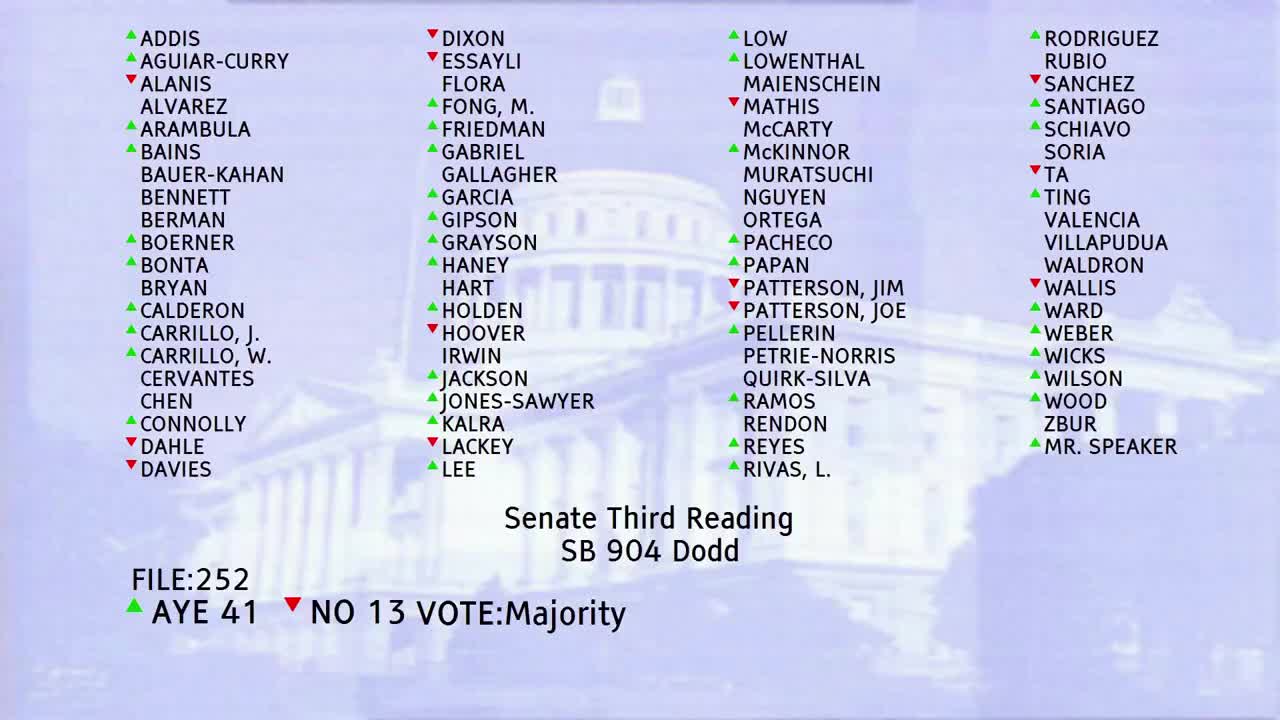 55SEC
Assembly Floor
 9MIN
Assembly Standing Committee on Business and Professions
 4MIN
Senate Floor
 24MIN
Senate Standing Committee on Business, Professions and Economic Development
 58SEC
Senate Standing Committee on Business, Professions and Economic Development
 31SEC
Senate Standing Committee on Business, Professions and Economic Development
21SEC
Senate Standing Committee on Business, Professions and Economic Development
Bill Author

Bill Co-Author(s):