SB 1073: State acquisition of goods and services: low-carbon cement or concrete products.
- Session Year: 2023-2024
- House: Senate
- Latest Version Date: 2024-04-29
Current Status:
Failed
(2024-08-15: August 15 hearing: Held in committee and under submission.)
Introduced
In Committee
First Chamber
In Committee
Second Chamber
Enacted
Existing law authorizes state agencies to enter into contracts for the acquisition of goods or services upon approval by the Department of General Services. Existing law requires the State Air Resources Board (board) to develop a comprehensive strategy for the states cement sector to achieve net-zero emissions of greenhouse gases associated with cement used within the state, as specified. Existing law also requires the board to develop a framework for measuring the average carbon intensity of the materials used in the construction of new buildings and a comprehensive strategy for the states building sector to achieve a 40% net reduction in greenhouse gas emissions of building materials, as specified. Existing law, the California Climate Crisis Act, sets forth the policy of the state, including, among other things, to achieve net zero greenhouse gas emissions, as soon as possible, but no later than 2045, and to achieve and maintain net negative greenhouse gas emissions thereafter.
This bill would authorize a state agency to enter into forward contracts to purchase low-carbon cement or concrete products up to 10 years in advance to facilitate the commercialization of concrete, cement, and supplementary cementitious materials and in furtherance of either of the policy and comprehensive strategy policy, comprehensive strategy, or framework relating to net-zero greenhouse gas emissions, as described above. The bill would make a related statement of legislative findings and declarations.
Existing law authorizes state agencies to enter into contracts for the acquisition of goods or services upon approval by the Department of General Services. Existing law requires the State Air Resources Board to develop a comprehensive strategy for the states cement sector to achieve net-zero emissions of greenhouse gases associated with cement used within the state, as specified. Existing law, the California Climate Crisis Act, sets forth the policy of the state, including, among other things, to achieve net zero greenhouse gas emissions, as soon as possible, but no later than 2045, and to achieve and maintain net negative greenhouse gas emissions thereafter.
This bill would authorize a state agency to enter into forward contracts to purchase low-carbon cement or concrete products up to 10 years in advance to facilitate the commercialization of concrete, cement, and supplementary cementitious materials and in furtherance of either of the policy and comprehensive strategy relating to net-zero greenhouse gas emissions, as described above. The bill would make a related statement of legislative findings and declarations.
The Legislature finds and declares all of the following:
(a)Achieving Californias greenhouse gas emission reduction goals, including carbon-neutrality and net-zero greenhouse gas emissions in the cement sector by 2045, requires new lower carbon cement and concrete solutions.
(b)By demonstrating market demand, forward contracts can accelerate the development and deployment of new lower carbon cement and concrete solutions.
(c)The authority of state agencies to enter into forward contracts requires further clarification.
SEC. 2.Section 10295.5.1 is added to the Public Contract Code, to read:10295.5.1.A state agency may enter into forward contracts to purchase low-carbon cement or concrete products up to 10 years in advance to facilitate the commercialization of concrete, cement, and supplementary cementitious materials and in furtherance of either any of the following:
(a)The comprehensive strategy for the states cement sector as described in Section 38561.2 of the Health and Safety Code.
(b)The policy of the California Climate Crisis Act, as described in Section 38562.2 of the Health and Safety Code.
(c)The framework and comprehensive strategy for reducing the average carbon intensity of building materials, as described in Section 38561.3 of the Health and Safety Code.
The Legislature finds and declares all of the following:
(a)Achieving Californias greenhouse gas emission reduction goals, including carbon-neutrality and net-zero greenhouse gas emissions in the cement sector by 2045, requires new lower carbon cement and concrete solutions.
(b)By demonstrating market demand, forward contracts can accelerate the development and deployment of new lower carbon cement and concrete solutions.
(c)The authority of state agencies to enter into forward contracts requires further clarification.
SEC. 2.Section 10295.5.1 is added to the Public Contract Code, to read:10295.5.1.A state agency may enter into forward contracts to purchase low-carbon cement or concrete products up to 10 years in advance to facilitate the commercialization of concrete, cement, and supplementary cementitious materials and in furtherance of either of the following:
(a)The comprehensive strategy for the states cement sector as described in Section 38561.2 of the Health and Safety Code.
(b)The policy of the California Climate Crisis Act, as described in Section 38562.2 of the Health and Safety Code.
|
Date
|
Status
|
|---|---|
| Aug 15, 2024 | August 15 hearing: Held in committee and under submission. |
| Jul 2, 2024 | July 2 set for first hearing. Placed on suspense file. |
| Jun 26, 2024 | June 26 hearing postponed by committee. |
| Jun 18, 2024 | From committee: Do pass and re-refer to Com. on APPR. (Ayes 9. Noes 0.) (June 17). Re-referred to Com. on APPR. |
| Jun 3, 2024 | Referred to Com. on NAT. RES. |
| May 24, 2024 | In Assembly. Read first time. Held at Desk. |
| May 23, 2024 | Read third time. Passed. (Ayes 37. Noes 0. Page 4179.) Ordered to the Assembly. |
| May 20, 2024 | Ordered to special consent calendar. |
| May 16, 2024 | Read second time. Ordered to third reading. |
| May 16, 2024 | From committee: Do pass. (Ayes 7. Noes 0. Page 3970.) (May 16). |
| May 14, 2024 | Set for hearing May 16. |
| May 13, 2024 | May 13 hearing: Placed on APPR suspense file. |
| May 3, 2024 | Set for hearing May 13. |
| Apr 29, 2024 | Read second time and amended. Re-referred to Com. on APPR. |
| Apr 25, 2024 | From committee: Do pass as amended and re-refer to Com. on APPR. (Ayes 7. Noes 0. Page 3753.) (April 24). |
| Apr 11, 2024 | Set for hearing April 24. |
| Apr 9, 2024 | From committee: Do pass and re-refer to Com. on E.Q. (Ayes 13. Noes 0. Page 3528.) (April 9). Re-referred to Com. on E.Q. |
| Mar 14, 2024 | Set for hearing April 9. |
| Feb 21, 2024 | Referred to Coms. on G.O. and E.Q. |
| Feb 13, 2024 | From printer. May be acted upon on or after March 14. |
| Feb 12, 2024 | Introduced. Read first time. To Com. on RLS. for assignment. To print. |
|
Date
|
Description
|
Location
|
Votes
|
|
|---|---|---|---|---|
| Jun 17, 2024 | Do pass and be re-referred to the Committee on [Appropriations] | Assembly Standing Committee on Natural Resources |
Passed |
|
| May 23, 2024 | Special Consent SB1073 Skinner | Senate Floor |
Passed |
|
| May 16, 2024 | Do pass | Senate Standing Committee on Appropriations |
Passed |
|
| May 13, 2024 | Placed on suspense file | Senate Standing Committee on Appropriations |
Passed |
|
| Apr 24, 2024 | Do pass as amended, but first amend, and re-refer to the Committee on [Appropriations] | Senate Standing Committee on Environmental Quality |
Passed |
|
| Apr 9, 2024 | Do pass, but first be re-referred to the Committee on [Environmental Quality] | Senate Standing Committee on Governmental Organization |
Passed |
This list shows positions taken on this bill by organizations on the date displayed, which is linked to the original source.
Positions by individuals are not included.
|
Organization
|
Position
|
Date
|
|---|---|---|
| 350 Sacramento | ** Support | |
| Argent Materials | * Support | Apr 9, 2024 |
| Brimstone | * Support | Jun 17, 2024 |
| Brimstone | * Support | Apr 24, 2024 |
| Brimstone Energy | ** Support | |
| Brimstone Energy Inc | * Support | Apr 9, 2024 |
| CA Chapters of the National Electrical Contractors Association | * Against Unless Amend | Jun 18, 2024 |
| California Legislative Conference Of Plumbing, Heating & Piping Industry | ** Against | |
| Carbonbuilt | ** Support | |
| Climate Action California | ** Support | |
| Climate Health Now | * Support | Jun 17, 2024 |
| Construction Employers Association | ** Against | |
| Decarbonized Cement & Concrete Working Group | ** Support | |
| Decarbonized Cement and Concrete Alliance | * Support | Apr 24, 2024 |
| Decarbonized Cement and Concrete Alliance | * Support | Apr 9, 2024 |
| E2 | ** Support | |
| Environmental Defense Fund | ** Support | |
| Fortera | * Support | Apr 24, 2024 |
| Leilac | ** Support | |
| Leilac U.S., Inc. | ** Support | |
| National Electrical Contractors Association | ** Against | |
| Natural Resources Defense Council | ** Support | |
| Natural Resources Defense Council (NRDC) | * Support | Jun 17, 2024 |
| New Buildings Institute | ** Support | |
| Rocky Mountain Institute | ** Support | |
| Santa Cruz Climate Action Network | ** Support | |
| Sierra Club | * Support | Jun 18, 2024 |
| Southern California Contractors Association | * Against | Apr 9, 2024 |
| United Contractors | ** Against | |
| Wall and Ceiling Alliance | ** Against | |
| Weidman Group | * Support | Apr 9, 2024 |
| West LA Democratic Club | ** Support | |
| western line constructors | ** Against |
Date of Hearing: July 2, 2024
ASSEMBLY COMMITTEE ON APPROPRIATIONS
Buffy Wicks, Chair
SBPCA Bill Id:SB 1073
Author:(Skinner) – As Amended Ver:April 29, 2024
Policy Committee: | Natural Resources | Vote: | 9 - 0 |
|
| ||
|
|
Urgency: No State Mandated Local Program: No Reimbursable: No
SUMMARY:
This bill authorizes state agencies to enter into forward contracts to purchase low-carbon cement or concrete products up to 10 years in advance.
Specifically, this bill:
- Authorizes state agencies to enter into forward contracts to purchase low-carbon cement or concrete products up to 10 years in advance to facilitate commercialization of concrete, cement, and supplementary cementitious materials in furtherance of current law requiring a comprehensive strategy for the state’s cement sector to achieve net-zero greenhouse gas (GHG) emissions by 2045 and current law on reducing carbon in building materials.
- States legislative findings on the need to demonstrate market demand for low-carbon products needed to meet GHG reduction goals.
FISCAL EFFECT:
The Department of General Services (DGS), with broad authority related to contracts across state agencies, reports significant cost pressure, even if no immediate and direct fiscal impact given that this bill is permissive. If forward contracts are used, DGS estimates General Fund costs:
- The DGS Procurement Division (PD) Acquisition Branch will need two full-time Associate Governmental Program Analysts (AGPA) at $170,000 each ongoing.
- The PD’s Engineering Branch will need one full-time Associate Procurement Engineer with low-carbon concrete expertise to oversee contracts at $260,000 ongoing.
- The Office of Policy Procedure and Legislation will need one Retired Annuitant for 24 months at the AGPA level at $110,000 to process regulations, develop statewide policies and procedures in the State Contract Manual.
DGS also identifies financial risk to the state if a forward contract requires advance payment and the cement producer goes out of business or otherwise cannot perform the contract.
Discussion of this bill in the Committee on Natural Resources included how use of forward contracts where a state agency procures cement may shift liability for product quality to the state, in contrast to under a typical state contract where the winning bidder procures supply for the project and is responsible for product quality.
According to the Legislative Analyst’s Office, the General Fund faces a structural deficit in the tens of billions of dollars over the next several fiscal years.
COMMENTS:
- Purpose. According to the author:
The cement and concrete industry is one of the most difficult industries to decarbonize. Cement and concrete production currently accounts for about 8 percent of global carbon emissions. SB 1073 will help lower carbon emissions from cement and concrete by giving state agencies the option to purchase low-carbon cement and concrete through advance procurement agreements. Advance procurement agreements provide a market signal that can promote the production of new and innovative carbon and cement technologies, additionally advance procurement agreements provide stability and clarity for agencies and suppliers in California. By ensuring that California prioritizes low-carbon cement purchases, we can build on the great progress California has made to achieve our 2045 zero-emission goals.
- Background. State agencies generally acquire goods and services through a competitive bid process designed to ensure procurement at the lowest price while also promoting fair competition, integrity and efficiency in public contracting. Under a forward contract, a government entity agrees to purchase a significant and specified quantity of a product from a supplier at a predetermined price in the future, sometimes years in advance. This mechanism encourages development of new products when the cost of research and development is too high to be worthwhile for the private sector. It has been used successfully in the development of certain vaccines. This approach has the benefit of guaranteeing a reliable, predictable buyer for firms developing a new product. But it also has potential for the buyer to overpay if the contracted price ends up being more than the market price at the time of purchase.
Achieving the state’s GHG emission reduction goals will require GHG reductions in heavy industry including cement production. Cement, a key component of concrete, is considered one of the most challenging industrial sectors to decarbonize. Significant emissions result from the heating process and chemical reactions in making cement, and also from quarrying, transporting, and preparing raw materials for production. Cement plants also are the largest consumer of coal in the state.
This bill is intended to address a key barrier to reducing GHG emissions in the building sector by allowing for clear, contractual commitments for low-carbon concrete and cement before those materials are commercially available. According to the author, this commitment is needed to enable the investments necessary to bring them to market. The bill specifies that forward contracts for low-carbon cement can further state climate goals.
- Prior Legislation. SB 596 (Becker), Statutes of 2021, Chapter 246, requires ARB, by July 1, 2023, to develop a comprehensive strategy to achieve net-zero GHG emissions associated with cement used within the state no later than December 31, 2045.
Analysis Prepared by: Jacqueline Kinney / APPR. / (916) 319-2081
Date of Hearing: June 17, 2024
ASSEMBLY COMMITTEE ON NATURAL RESOURCES
Isaac G. Bryan, Chair
SBPCA Bill Id:SB 1073
Author:(Skinner) – As Amended Ver:April 29, 2024
SENATE VOTE: 37-0
SUBJECT: State acquisition of goods and services: low-carbon cement or concrete products
SUMMARY: Authorizes state agencies to enter into forward contracts to purchase low-carbon cement or concrete products up to 10 years in advance.
EXISTING LAW:
- Requires the Air Resources Board (ARB) to develop a comprehensive strategy for the state’s cement sector to achieve net-zero emissions of greenhouse gases (GHGs) associated with cement used within the state, as specified. (Health and Safety Code (HSC) 38561.2)
- Establishes the California Climate Crisis Act, which establishes the policy of the state to, among other things, achieve zero GHG emissions as soon as possible, but no later than 2045, and to achieve and maintain net negative GHG emissions thereafter. (HSC 38562.2)
- Requires ARB, by July 1, 2025, to develop a framework (that may include a market-based crediting system) for measuring and reducing the carbon intensity of building materials used in the construction of new buildings, including for residential uses. Requires ARB to develop a comprehensive strategy for the state’s building sector to achieve a 40% net reduction in GHGs of building materials no later than December 31, 2035. (HSC 38561.3)
- Buy Clean California Act requires the Department of General Services (DGS) to establish and publish Global Warming Potential (GWP) limits for four categories of materials used in eligible projects: carbon steel rebar (used to reinforce concrete), flat glass, mineral wool insulation, and structural steel. Requires awarding authorities for eligible projects to include in specifications for bids that the facility-specific GWP for those materials does not exceed the limits established by DGS. (Public Contract Code 3500 et seq.)
- Directs DGS to minimize the state government’s carbon footprint and to develop and implement sustainable purchasing policies to prioritize the procurement of environmentally preferable goods and services. (Executive Order N-19-19)
THIS BILL:
- Authorizes state agencies to enter into forward contracts to purchase low-carbon cement or concrete products up to 10 years in advance to facilitate the commercialization of concrete, cement, and supplementary cementitious materials in furtherance of any of the following:
- The comprehensive strategy for the state’s cement sector;
- The policy of the California Climate Crisis Act; and,
- The framework and comprehensive strategy for reducing the average carbon intensity of building materials.
- States related legislative findings and declarations.
FISCAL EFFECT: According to the Senate Appropriations Committee, unknown potentially significant ongoing costs pressures, to the extent state agencies electing to enter into forward contracts to purchase low-carbon cement or concrete products increases state contracting costs or other procurement workload (General Fund and various special funds).
DGS notes that should it or other state agencies enter into a contract of this type, it would require additional limited-tem staff resources to develop policies, procedures, and statewide guidance to use this procurement method. Ongoing costs may include additional full-time staff resources to ensure contractors fulfill obligations and provide consultation or guidance to other state agencies utilizing forward contracts to purchases of low carbon concrete. These total one-time and ongoing costs are indeterminate at this time, but may range into the hundreds of thousands of dollars.
The actual fiscal impact of this bill to DGS and other state agencies would depend on, among other things, the extent that state agencies will utilize this procurement method as well as the type, scale, and duration of any associated projects.
COMMENTS:
- Forward contracts. A forward contract is a customized contract to buy or sell a commodity at a specified price on a future date. In the procurement world, a forward contract is as a contractual agreement between a government entity and a supplier, whereby the government commits to purchasing a significant and specified quantity of a product at predetermined terms and prices years in advance.
This funding mechanism is useful to encourage the development of new products when the cost of research and development is too high to be worthwhile for the private sector. It has been used successfully in the development of certain vaccines. This approach has the benefit of guaranteeing a reliable, predictable buyer for firms developing a new product; however, it creates the potential for overpaying for the product. For example, the contracted price may end up being more than the market price at the time of purchase.
- Cement and concrete. California is the second largest cement producing state after Texas, accounting for approximately 10-15% of the cement production and industry employment in the United States (US). In 2019, there were eight cement plants in California and more than 300 concrete manufacturing plants. Most of the cement used in California is produced in-state and cement and clinker production is expected to increase significantly in California as the population and economy grow.
Concrete is a mixture of cement (a binder usually made from lime or calcium silicate), aggregates (sand, rock, etc.), water, and air. In a typical concrete mix, cement represents 10-15% of the concrete by volume.
Cement is made by grinding clinker, an intermediary nodular material produced from heating limestone and clay in a rotary kiln to about 2700°F. Most of the energy used, and emissions generated, by cement manufacturing are in clinker production. Approximately 40% of the GHG emissions from cement production are from energy use (for heating and driving the processing) and 60% from the chemical reaction that occurs when limestone is heated at high temperatures to make cement, known as “process emissions.” Additional emissions comes from quarrying, transporting, and preparing the other raw materials.
Cement is responsible for 80-90% of the life cycle GHG emissions for concrete, 1.8% of the California’s overall GHG emissions, and 7% of GHG emissions worldwide. It is considered one of the most challenging industrial sectors to decarbonize.
Cement plants are also the largest consumer of coal in the state. In 2015, 51% of fuel combustion and energy for California's cement industry came from coal, while 12% came from electricity. Due to the high heat required, full electrification of these plants is difficult. GHG emissions dropped 20% between 2000 and 2015, mainly due to a drop in production; however, they have slowly been rising since. Achieving the state’s GHG emission reduction goals will require GHG reductions in heavy industry, like cement producers.
- Decarbonizing cement. The US Department of Energy 2023 report, Pathways to Commercial Liftoff: Low-Carbon Cement, identifies four tracks to commercial liftoff for low-carbon cement:
- Currently deployable measures, including clinker substitution, energy efficiency, and alternative fuels;
- Carbon capture and storage retrofits and integration into new plants;
- Alternative production methods, including alternative feedstocks and alternatives to traditional rotary kiln production; and,
- Alternative binder chemistries (i.e., alternatives to clinker).
The report states that government procurement drives approximately 50% of US demand, “giving the public sector an outsized role in accelerating decarbonization.” However, features of the cement market make it difficult to create a clear demand signal. The report includes recommendations to make the demand signal for low-carbon cement bankable for investors and to enable financing at a larger scale, including:
- A direct, legally enforceable contract between cement producers and a creditworthy end customer, such as a government entity;
- Guaranteed offtake for most of all of a plant’s production for the investment period, with a price guarantee; and,
- Active management of intermediators in the supply chain to ensure low-carbon cement is used in the construction process.
- State efforts. The state has established a clear preference for low-carbon products, including cement and concrete. The Buy Clean California Act requires DGS to establish and publish Global Warming Potential (GWP) limits for four categories of materials used in public works projects: carbon steel rebar (used to reinforce concrete), flat glass, mineral wool insulation, and structural steel.
AB 2446 (Holden), Chapter 352, Statutes of 2022, requires ARB to develop a framework to measure and reduce the embodied carbon of building materials, primarily at the materials production stage. The bill established a 40% GHG emission reduction target by 2035. AB 43 (Holden), Chapter 316, Statutes of 2023, built upon the foundation of AB 2446 by providing ARB the authority to establish an embodied carbon trading system to achieve the target. - This bill. This bill is intended to address a key barrier to achieving GHG emissions reductions in the building sector by allowing for clear, contractual commitments for low-carbon concrete and cement before those materials are commercially available. According to the author, this commitment is needed to enable the investments necessary to bring them to market.
- Author’s statement:
The cement and concrete industry is one of the most difficult industries to decarbonize. Cement and concrete production currently accounts for about 8 percent of global carbon emissions. SB 1073 will help lower carbon emissions from cement and concrete by giving state agencies the option to purchase low-carbon cement and concrete through advance procurement agreements. Advance procurement agreements provide a market signal that can promote the production of new and innovative carbon and cement technologies, additionally advance procurement agreements provide stability and clarity for agencies and suppliers in California. By ensuring that California prioritizes low-carbon cement purchases, we can build on the great progress California has made to achieve our 2045 zero-emission goals.
- Previous legislation.
SB 682 (Skinner, 2023) would have made it the policy of the state to purchase or specify at least 10% of cement and concrete meet or exceed a specified benchmark for low-carbon cement by 2030 and to exclude the purchase of all fossil-based supplementary cementious materials from that 10% by 2035. This bill was held in the Senate Appropriations Committee.
AB 1250 (Friedman, 2023) would have required the Secretary of Transportation, in consultation with the Department of Transportation (Caltrans), to submit a report to the Legislature regarding the global warming potential of asphalt, cement, and concrete used in transportation projects and the availability of lower-carbon alternatives. This bill would have also required Caltrans to require bidders of specified projects to submit valid environmental product declarations for asphalt and concrete used in a project. This bill was held in the Senate Appropriations Committee.
REGISTERED SUPPORT / OPPOSITION:
Support
Blue Planet Systems
Brimstone Energy
Carbonbuilt
CleanEarth4Kids.org
Opposition, unless amended
California Legislative Conference of Plumbing, Heating, and Piping Industry
Construction Employers Association
National Electrical Contractors Association
United Contractors
Western Line Construction Chapter, Inc.
Analysis Prepared by: Elizabeth MacMillan / NAT. RES. /
SENATE RULES COMMITTEE Office of Senate Floor Analyses (916) 651-1520 Fax: (916) 327-4478 | SB 1073 |
THIRD READING
Bill No: SB 1073
Author: Skinner (D)
Amended: 4/29/24
Vote: 21
SENATE GOVERNMENTAL ORG. COMMITTEE: 13-0, 4/9/24
AYES: Dodd, Wilk, Alvarado-Gil, Archuleta, Bradford, Glazer, Jones, Nguyen, Padilla, Portantino, Rubio, Seyarto, Smallwood-Cuevas
NO VOTE RECORDED: Ashby, Ochoa Bogh, Roth
SENATE ENVIRONMENTAL QUALITY COMMITTEE: 7-0, 4/24/24
AYES: Allen, Dahle, Gonzalez, Hurtado, Menjivar, Nguyen, Skinner
SENATE APPROPRIATIONS COMMITTEE: 7-0, 5/16/24
AYES: Caballero, Jones, Ashby, Becker, Bradford, Seyarto, Wahab
SUBJECT: State acquisition of goods and services: low-carbon cement or concrete products
SOURCE: Author
DIGEST: This bill authorizes state agencies to enter into forward contracts to purchase low-carbon cement or concrete products up to 10 years in advance, as specified.
ANALYSIS:
Existing law:
- Authorizes state agencies to enter into contracts for the acquisition of goods or services upon approval by the Department of General Services (DGS).
- Requires the State Air Resources Board (ARB) to develop a comprehensive strategy for the state’s cement sector to achieve net-zero emissions of greenhouse gases associated with cement used within the state, as specified.
- Requires the ARB to develop a framework for measuring the average carbon intensity of the materials used in the construction of new buildings and a comprehensive strategy for the state’s building sector to achieve 40% net reduction in GHG emissions of building materials, as specified.
- Establishes the California Climate Crisis Act, which sets forth the policy of the state, including, among other things, to achieve zero greenhouse gas (GHG) emissions, as soon as possible, but no later than 2045, and to achieve and maintain net negative GHG emissions thereafter.
- Directs, under Executive Order N-19-19, DGS to minimize the state government’s carbon footprint and to develop and implement sustainable purchasing policies to prioritize the purchase of environmentally preferable goods and services.
This bill:
- Authorizes state agencies to enter into forward contracts to purchase low-carbon cement or concrete products up to 10 years in advance to facilitate the commercialization of concrete, cement, and supplementary cementitious materials and in furtherance of either of the following:
- The comprehensive strategy for the state’s cement sector.
- The policy of the California Climate Crisis Act.
- The framework and comprehensive strategy for reducing the average carbon intensity of building materials, as described.
- Includes legislative findings.
Background
- Author Statement. According to the author’s office, “the cement and concrete industry is one of the most difficult industries to decarbonize. Cement and concrete production currently accounts for about eight percent of global carbon emissions. SB 1073 will help lower carbon emissions from cement and concrete by giving state agencies the option to purchase low-carbon cement and concrete through advance procurement agreements.”
The author’s office further states that, “advance procurement agreements provide a market signal that can promote the production of new and innovative carbon and cement technologies, additionally advance procurement agreements provide stability and clarity for agencies and suppliers in California. By ensuring that California prioritizes low-carbon cement purchases, we can build on the great progress California has made to achieve our 2045 zero-emission goals.”
- Forward Contracts. In simple terms, a forward contract is a customized contract between two parties to buy or sell a commodity at a specified price on a future date. In the procurement world, a forward contract is as a contractual agreement between a government entity and a supplier, whereby the government commits to purchasing a significant and specified quantity of a product at predetermined terms and prices years in advance. Supporters of this type of contract argue that by providing this commitment, the government mitigates supplier risk, incentivizes private investment for research and development and unlocking capital necessary for large-scale production.
However, forward contracts do come with some risks. Critics of these types of contracts argue that in some cases the price that was initially agreed to may be higher than the market price at the time of the delivery. If this occurs, the state could be spending more for a product than if the state would have used more traditional procurement processes. Supporters respond to this criticism by stating that while this could occur, if the public pays less for a new, innovative product than what the government initially paid, isn’t that proof the success of investment in that type of technology. In other words, the government’s initial investment in that technology could be the main reason the product was developed in the first place and may be why the supplier can scale up production and sell to the public at a lower cost.
- Purchasing and Contracting by State Agencies. Generally speaking, state agencies acquire goods and services through a competitive bid process which is designed to ensure that the state is able to acquire all the necessary goods and/or services at the lowest possible price. The current procurements process aims at ensuring fair competition, integrity, and efficiency in public contracting. This bill authorizes state agencies to enter into forward contracts to purchase low-carbon cement or concrete products up to 10 years in advance. It should be noted however, that there does not appear to be anything in law that prohibits any state agency from already entering into such contracts.
The author’s office argues that, “while state law is clear on establishing a preference for developing innovative materials and supporting environmental outcomes, including advancing the state’s climate change priorities, and includes allowances for innovative or sustainable purchasing policies, state agencies have not yet applied advance market commitments as a tool to secure a pipeline of these critically needed materials or otherwise support the state’s climate objectives. SB 1073 would clarify their authority to do so and align the Public Contract Code with existing state priorities and preferences for supporting development and use of low carbon building materials, including low carbon cement and concrete.”
- Agencies and Low-Carbon Cement. In January 2022, the California Department of Transportation (Caltrans) announced it was approving the use of low-carbon cement, relying on Portland limestone cement, which the agency says can cut its concrete-related carbon dioxide emissions by up to 10% a year while meeting the same high performance standards as regular concrete at a slightly lower cost. Caltrans is one of the largest consumers of cement and concrete in the state.
The Department of Water Resources announced in November 2022 that it too was using more carbon-friendly concrete. It made repairs at the Oroville Dam using low-carbon concrete, resulting in 125 pounds per cubic yard of less cement and reduced about 2,037 tons of carbon dioxide. The agency says it was the equivalent of eliminating the emissions of 400 gasoline-powered vehicles over one year.
- Concrete and Cement. Concrete is a mixture of cement (a binder usually made from lime or calcium silicate), aggregates (sand, rock, etc.), water, and air. In a typical mix, the cement represents 10-15% of the material by volume but 80-90% of the life cycle CO2 emissions for the concrete. Cement is made by grinding clinker, an intermediary nodular material produced from heating limestone and clay in a rotary kiln to about 2700°F. Most of the energy used in cement manufacturing is in clinker production. The remainder of emissions comes from quarrying, transporting, and preparing the other raw materials.
California is the second largest cement producing state after Texas, accounting for 10-15% of the cement production and industry employment in the US as of 2009. As of 2019, there were eight cement plants in California and more than 300 concrete manufacturing plants. Most of the cement used in California is produced in state. Cement and clinker production is expected to increase significantly in California as the population and economy grow.
- Concrete GHG Emissions. Cement accounts for 1.8% of the California’s GHG emissions and seven percent of CO2 emissions worldwide. It is often referred to as one of the most “hard to abate” industrial sectors. Cement plants are also the largest consumer of coal in the state. In 2015, 51% of fuel combustion and energy for California's cement industry came from coal while 12% came from electricity. Due to the high heat required, full electrification is difficult. GHG emissions decreased 20% between 2000 and 2015, mainly due to a decrease in production, however they have slowly been rising again since. According to an Energy Innovation Report, California won’t meet 2030 GHG emission reduction goals unless heavy industry like cement producers reduce their emissions. The report notes that this would require plant retrofits, major changes to infrastructure, and would likely lean heavily on technologies that haven’t yet been deployed at scale in California, like carbon capture and storage.
- SB 596 (Becker, Chapter 246, Statutes of 2021). In September 2021, Governor Newsom signed SB 596 (Becker, Chapter 246, Statutes of 2021), which requires the ARB, by July 1, 2023, to develop a comprehensive strategy for the cement sector in California to achieve a GHG emissions intensity 40% below baseline levels by 2035 and net-zero GHG emissions by 2045. The bill also requires ARB to establish interim targets for reductions in the GHG intensity of cement used within the state relative to the average GHG intensity of cement used within the state during the 2019 calendar year, with the goal of reducing the GHG intensity of cement used within the state to 40% below the 2019 average levels by December 31, 2035. Since the signing of the bill, the CARB has held three different workshops/meetings, however CARB has yet to release their comprehensive strategy which was supposed to be finalized on July 1, 2023.
Related/Prior Legislation
SB 682 (Skinner, 2023) would have made it the policy of the state to purchase or specify that at least 10% of cement and concrete meet or exceed a specified benchmark for low-carbon cement by 2030 and to exclude the purchase of all fossil-based supplementary cementitious materials from that 10% by 2035. (Held in the Senate Appropriations Suspense File)
AB 1250 (Friedman, 2023) would have required the Secretary of Transportation, in consultation with CalTrans, to submit a report to the Legislature, by December 31, 2024 that discusses the global warming potential of asphalt mixtures, cement, and concrete used in state transportation projects and the availability of lower carbon emission alternatives to those materials, as specified. (Held in the Senate Appropriations Suspense File)
SB 596 (Becker, Chapter 246, Statutes of 2021) requires the ARB, by July 1, 2023, to develop a comprehensive strategy for the state’s cement sector to achieve net-zero GHG emissions no later than December 31, 2045.
AB 966 (Bonta, 2019) would have required the state’s cement plants to submit a facility-specific Environmental Product Declaration to ARB to disclose the environmental impacts of the plant. (Held in the Assembly Appropriations Committee Suspense File)
AB 1452 (Skinner, 2009) would have required ARB to develop and adopt limitations on GHG emissions that result from the production of all cement sold in the state. (Held in the Assembly Appropriations Committee Suspense File)
FISCAL EFFECT: Appropriation: No Fiscal Com.: Yes Local: No
According to the Senate Appropriations Committee, unknown potentially significant ongoing costs pressures, to the extent state agencies electing to enter into forward contracts to purchase low-carbon cement or concrete products increases state contracting costs or other procurement workload (General Fund and various special funds).
For context, DGS notes that should it or other state agencies enter into a contract of this type, the department would require additional limited-tem staff resources to develop policies, procedures, and statewide guidance to use this procurement method. Ongoing costs may include additional full-time staff resources to ensure contractors fulfill obligations and provide consultation or guidance to other state agencies utilizing forward contracts to purchases of low carbon concrete. These total one-time and ongoing costs are indeterminate at this time, but may range into the hundreds of thousands of dollars.
The actual fiscal impact of this bill to DGS and other state agencies would depend on, among other things, the extent that state agencies will utilize this procurement method as well as the type, scale, and duration of any associated projects.
SUPPORT: (Verified 5/15/24)
350 Sacramento
Brimstone Energy
Carbonbuilt
Climate Action California
Decarbonized Cement & Concrete Working Group
Environmental Defense Fund
E2
Leilac
Natural Resources Defense Council
New Buildings Institute
Rocky Mountain Institute
Santa Cruz Climate Action Network
Sierra Club California
West LA Democratic Club
OPPOSITION: (Verified 5/15/24)
California Chapters of the National Electrical Contractors Association
California Legislative Conference of the Plumbing, Heating & Piping Industry
Construction Employers’ Association
National Electrical Contractors Association
United Contractors
Wall and Ceiling Alliance
Western Line Constructors
ARGUMENTS IN SUPPORT: According to supporters of the bill, “to achieve California’s ambitious climate and air quality goals there is a consensus that it will take an ‘all above’ strategy. Part of the mix will need to be reducing the embodied carbon in cement. There is no a nascent market for ‘low-carbon cement’ materials. Your bill will allow the state to support future growth of that important market by entering into long-term prospective purchase contracts for those products. Public agencies, including CalTrans, are the largest cement and concrete purchasers in the state; their ability to purchase materials with a smaller carbon footprint will help develop a much needed industry in California.”
ARGUMENTS IN OPPOSITION: Opponents of the bill argue that, “as with last year’s SB 682, the Advance Procurement Agreement provisions in the bill do not comport with how construction contracts are actually awarded and many fundamental questions remain unanswered. While we appreciate the desire to utilize cleaner building materials, we suggest the state first utilize 2021’s SB 596 (Becker) which requires the state board, by July 1, 2023, to develop a comprehensive strategy for the state’s cement sector to achieve net-zero emissions of greenhouse gases. Layering different standards on top of pre-existing processes will create confusion and uncertainty for all parties.”
Prepared by: Felipe Lopez / G.O. / (916) 651-1530
5/17/24 10:09:21
SENATE COMMITTEE ON
Senator Anna Caballero, Chair
2023 - 2024 Regular Session
SB 1073 (Skinner) - State acquisition of goods and services: low-carbon cement or concrete products
Version: | Policy Vote: |
Urgency: | Mandate: |
Hearing Date: | Consultant: |
Bill Summary:
SB 1073 authorizes a state agency to enter into forward contracts to purchase low-carbon cement or concrete products up to 10 years in advance to facilitate the commercialization of concrete, cement, and supplementary cementitious materials in furtherance of specified state emission reduction goals.
Fiscal Impact:
Unknown potentially significant ongoing cost pressures, to the extent that state agencies electing to enter into forward contracts to purchase low-carbon cement or concrete products increases state contracting costs or other procurement workload (General Fund and various special funds).
For context, the Department of General Services (DGS) notes that should it or other state agencies enter into a contract of this type, the department would require additional limited-term staff resources to develop policies, procedures, and statewide guidance to use this procurement method. Ongoing costs may include additional full-time staff resources to ensure contractors fulfill obligations and provide consultation or guidance to other state agencies utilizing forward contracts to purchase of low carbon concrete. These total one-time and ongoing costs are indeterminate at this time, but may range into the hundreds of thousands of dollars.
The actual fiscal impact of this bill to DGS and other state agencies would depend on, among other things, the extent that state agencies will utilize this procurement method as well as the type, scale, and duration of any associated projects.
Background:
Generally, a forward contract is a customized contract between two parties to buy or sell a commodity at a specified price on a future date. In the procurement world, a forward contract is as a contractual agreement between a government entity and a supplier, whereby the government commits to purchasing a significant and specified quantity of a product at predetermined terms and prices years in advance.
This approach has the benefit of guaranteeing a reliable, predictable buyer for firms developing a new product. However, in cases where the price that was initially agreed to may be higher than the market price at the time of delivery, the state could be spending more for a product than if the state would have used more traditional procurement processes.
State agencies acquire goods and services through a competitive bid process which is designed to ensure that the state is able to acquire all the necessary goods and/or services at the lowest possible price. The current procurements process aims at ensuring fair competition, integrity, and efficiency in public contracting.
Proposed Law:
- Authorizes a state agency to enter into forward contracts to purchase low-carbon cement or concrete products up to 10 years in advance to facilitate the commercialization of concrete, cement, and supplementary cementitious materials in furtherance of the following:
- The comprehensive strategy for the cement sector to achieve net-zero emissions of greenhouse gases associated with cement used within the state as soon as possible, but no later than December 31, 2045, as specified in Health and Safety Code (HSC) section 38561.2.
- The policy of the California Climate Crisis Act, as specified in HSC section 38562.2
- The framework and comprehensive strategy for reducing the average carbon intensity of building materials, as specified in HSC section 38561.3.
- States legislative findings and declarations.
Related Legislation:
SB 682 (Skinner, 2023) would have made it the policy of the state to purchase or specify at least 10 percent of cement and concrete meet or exceed a specified benchmark for low-carbon cement by 2030 and to exclude the purchase of all fossil-based supplementary cementitious materials from that 10 percent by 2035. SB 682 would have directed the California Transportation Department and DGS to develop a model for advanced procurement agreements for the purchase or specification of low-carbon cement and low-carbon concrete products up to 10 years in advance. SB 682 was held on the Suspense File in this committee.
-- END --
SENATE COMMITTEE ON ENVIRONMENTAL QUALITY
Senator Allen, Chair
2023 - 2024 Regular
Bill No. | SB 1073 | Hearing Date: | 4/24/2024 |
Author: | Skinner | ||
Version: | 2/12/2024 | ||
Urgency: | No | Fiscal: | Yes |
Consultant: | Eric Walters | ||
SUBJECT: State acquisition of goods and services: low-carbon cement or concrete products
DIGEST: This bill authorizes state agencies to enter into forward contracts to purchase low-carbon cement or concrete products up to 10 years in advance in furtherance of specified state goals.
ANALYSIS:
Existing law:
- Requires the California Air Resources Board (CARB) to develop a comprehensive strategy for the state’s cement sector to achieve net-zero emissions of greenhouse gases associated with cement used within the state, as specified. (Health and Safety Code § 38561.2)
- Establishes the California Climate Crisis Act, which sets forth the policy of the state, including, among other things, to achieve zero greenhouse gas (GHG) emissions, as soon as possible, but no later than 2045, and to achieve and maintain net negative GHG emissions thereafter. (HSC § 38562.2)
- Directs, under Executive Order N-19-19, Department of General Services (DGS) to minimize the state government’s carbon footprint and to develop and implement sustainable purchasing policies to prioritize the purchase of environmentally preferable goods and services.
- Requires CARB, by July 1, 2025, to develop a framework (which may include a market-based crediting system) for measuring and then reducing the carbon intensity of the building materials used in the construction of new buildings, including those for residential uses. Also requires CARB to develop a comprehensive strategy for the State’s building sector to achieve a 40 percent net reduction in GHGs of building materials no later than December 31, 2035. (HSC § 38561.3)
This bill:
- Makes findings and declarations regarding
- Authorizes state agencies to enter into forward contracts to purchase low-carbon cement or concrete products up to 10 years in advance to facilitate the commercialization of concrete, cement, and supplementary cementitious materials and in furtherance of either of the following:
- The comprehensive strategy for the state’s cement sector.
- The policy of the California Climate Crisis Act.
Background
- Forward Contracts. In simple terms, a forward contract is a customized contract between two parties to buy or sell a commodity at a specified price on a future date. In the procurement world, a forward contract is as a contractual agreement between a government entity and a supplier, whereby the government commits to purchasing a significant and specified quantity of a product at predetermined terms and prices years in advance.
This approach has the benefit of guaranteeing a reliable, predictable buyer for firms developing a new product. However, it also has the drawback of potentially overpaying for something—if, say, the agreed-upon price ends up being greater than the market price at the time of purchase. This funding mechanism is used when the cost of research and development is too high to be worthwhile for the private sector without a guarantee of a certain quantity of purchases, and it has been used to great effect in the development of certain vaccines. - Concrete and cement. Concrete is a mixture of cement (a binder usually made from lime or calcium silicate), aggregates (sand, rock, etc.), water, and air. In a typical mix, the cement represents 10-15% of the material by volume but 80-
90% of the life cycle CO2 emissions for the concrete.
Cement is made by grinding clinker, an intermediary nodular material produced from heating limestone and clay in a rotary kiln to about 2700 °F. Most of the energy used in cement manufacturing is in clinker production. The remainder of emissions comes from quarrying, transporting, and preparing the other raw materials.
California is the second largest cement producing state after Texas, accounting for 10-15% of the cement production and industry employment in the US as of
2009. As of 2019, there were eight cement plants in California and more than
300 concrete manufacturing plants. Most of the cement used in California is produced in state and cement and clinker production is expected to increase significantly in California as the population and economy grow.
- Concrete GHG emissions. Cement accounts for 1.8% of the California’s GHG emissions and 7% of CO2 emissions worldwide. It is often referred to as one of the most hard to abate industrial sectors.
Cement plants are also the largest consumer of coal in the state. In 2015, 51% of fuel combustion and energy for California's cement industry came from coal, while 12% came from electricity.
Due to the high heat required, full electrification of these plants is difficult. GHG emissions dropped 20% between 2000 and 2015, mainly due to a drop in production, however, they have slowly been rising again since.
According to an Energy Innovation Report, California will not meet its 2030 GHG emission reduction goals unless heavy industry like cement producers reduce their emissions. The report notes this would require plant retrofits, major changes to infrastructure, and would likely require the use of technologies that have not yet been deployed at scale in California, like carbon capture and storage (CCS).
- Decarbonizing cement. The GHG emissions stemming from the making of cement are approximately 40% from energy use (for heating and driving the processing) and 60% from the chemical reaction that occurs when limestone is heated at high temperatures to make cement, known as “process emissions.”
In 2019, Global Efficiency Intelligence, an environmental consulting firm, published a report called Deep Decarbonization Roadmap for the Cement and
Concrete Industries in California. It identified the following four strategies, in order of greatest reduction potential to least:
- Carbon capture, utilization, and storage (CCUS) – capturing and compressing CO2 emitted during cement production to be permanently stored;
- Clinker substitution – replacing conventional Portland cement clinker with supplementary cementitious materials (SCMs) that produce less CO2;
- Fuel switching – replacing coal and petroleum coke used for heating with natural gas or a low carbon fuel; and
- Energy efficiency, including waste heat recovery.
Implementing these four strategies could potentially reduce GHG emissions from concrete and cement by up to 68% compared to 2015 levels by 2040. A more conservative estimate with moderate improvements and low adoption of CCUS is around a 13% reduction by 2040.
Comments
- Purpose of Bill. According to the author, “The cement and concrete industry is one of the most difficult industries to decarbonize. Cement and concrete production currently accounts for about 8 percent of global carbon emissions. SB 1073 will help lower carbon emissions from cement and concrete by giving state agencies the option to purchase low-carbon cement and concrete through advance procurement agreements. Advance procurement agreements provide a market signal that can promote the production of new and innovative carbon and cement technologies, additionally advance procurement agreements provide stability and clarity for agencies and suppliers in California. By ensuring that California prioritizes low-carbon cement purchases, we can build on the great progress California has made to achieve our 2045 zero-emission goals.”
- What exactly is low-carbon cement? There is not a universal, standardized definition of “low-carbon cement” used today. However, one specific benchmark for “near zero-emissions cement” was developed by the First Movers Coalition (FMC).
The FMC is a public-private partnership to commercialize clean technologies through advanced purchase commitments. It was formed by President Biden in partnership with the World Economic Forum in 2021. Two years ago, FMC set commitments for purchasers and specifiers of cement and concrete. For construction and engineering projects, the member companies and government agencies committed to purchasing at least 10% (by volume) of their cement/concrete per year as near-zero cement/concrete inclusive of any supplementary cementitious materials (SCM) by 2030 and excluding fossil-based SCMs by 2035.
The FMC developed a benchmark carbon intensity for so-called “near zero-emissions” cement of 184 kg CO2 equivalent per ton of cement. Although carbon intensities for cement vary considerably (as they do for all product classes), a 2020 study in the scholarly journal Buildings & Cities found a range between 732 to 941 kg CO2 equivalent per ton of cement. SB 682 (Skinner, 2023) would have adopted the FCM benchmark to define “low-carbon cement” for advanced procurement agreements between state agencies and manufacturers.
The present bill does not define low-carbon cement, nor does it need to. The bill simply clarifies state agencies’ authority to enter into forward contracts for low-carbon cement in furtherance of specified state policies. Until those policies establish low-carbon cement standards, it would likely be inappropriate to set a specific standard for what can be agreed to in forward contracts. - In furtherance of state policies. This bill clarifies state agencies are able to enter into forward contracts for low-carbon cement in furtherance of two specified California laws: SB 596 (Becker, Chapter 246, Statutes of 2021) and AB 1279 (Muratsuchi, Chapter 337, Statutes of 2022). These bills would require CARB to develop a comprehensive strategy to reach a 40% GHG reduction in the cement sector by 2035 (and carbon neutrality by 2045), and economy-wide carbon neutrality by 2045, respectively.
Although the comprehensive strategy called for by July 1, 2023 in SB 596 has not yet been released, it was a first-of-its-kind bill that is expected to chart the path towards decarbonizing the cement and concrete industry. Once it is released, it will presumably help send market signals for what is needed from cement manufacturers in California.
SB 596 is not, however, the only policy signal that has been sent for decarbonizing cement and concrete. AB 2446 by Assemblymember Holden in 2022 tasked CARB with developing a framework for measuring and reducing the carbon intensity of building materials (including concrete) with the goal of a 40% reduction in carbon intensity by 2035. While that framework is not due until July 1 of next year, it is another notable policy that will presumably set a standard (and increase demand) for low-carbon cement. The committee may wish to include AB 2446 among the policies that may be furthered through forward contracts for low-carbon cement. - Committee amendments. Committee staff recommends adopting the amendments in bold in comment 3 above.
DOUBLE REFERRAL:
This measure was heard in Senate Governmental Organization Committee on April 9, 2024, and passed out of committee with a vote of 13-0.
Related/Prior Legislation
SB 682 (Skinner, 2023) would have made it the policy of the state to purchase or specify that at least 10% of cement and concrete meet or exceed a specified benchmark for low-carbon cement by 2030 and to exclude the purchase of all fossil-based supplementary cementitious materials from that 10% by 2035. (Held in the Senate Appropriations Suspense File)
AB 1250 (Friedman, 2023) would have required the Secretary of Transportation, in consultation with CalTrans, to submit a report to the Legislature, by December 31, 2024 that discusses the global warming potential of asphalt mixtures, cement, and concrete used in state transportation projects and the availability of lower carbon emission alternatives to those materials, as specified. (Held in the Senate Appropriations Suspense File)
SB 596 (Becker, Chapter 246, Statutes of 2021) requires the ARB, by July 1, 2023, to develop a comprehensive strategy for the state’s cement sector to achieve net-zero GHG emissions no later than December 31, 2045.
AB 966 (Bonta, 2019) would have required the state’s cement plants to submit a facility-specific Environmental Product Declaration to ARB to disclose the environmental impacts of the plant. (Held in the Assembly Appropriations Committee Suspense File)
AB 1452 (Skinner, 2009) would have required ARB to develop and adopt limitations on GHG emissions that result from the production of all cement sold in the state. (Held in the Assembly Appropriations Committee Suspense File)
SOURCE:
Decarbonized Cement & Concrete Working Group
NRDC
SUPPORT:
350 Sacramento
Brimstone Energy
Carbonbuilt
Climate Action California
Decarbonized Cement & Concrete Working Group
E2
Environmental Defense Fund
Leilac U.S., Inc.
Natural Resources Defense Council
New Buildings Institute
Rocky Mountain Institute (RMI)
Santa Cruz Climate Action Network
Sierra Club California
OPPOSITION:
California Legislative Conference of Plumbing, Heating & Piping Industry
Construction Employers' Association
United Contractors (UCON)
Wall and Ceiling Alliance
ARGUMENTS IN SUPPORT:
According to a coalition including one of the sponsors and other environmental organizations, “Low and ultra-low cement and concrete solutions have already been developed and tested. However, there are financing barriers to scaling up to commercial production levels, which can be addressed by demonstrating demand for these products. The U.S. Department of Energy’s Commercial Liftoff report suggests that one solution is for large concrete users like state agencies to “develop alternative procurement models that provide direct offtake for projects.” SB 1073 clarifies the authority California has to enable forward contracts, but does not require or mandate their use by state entities. Agencies would have the discretion to decide whether, when, and how to enter into and structure these arrangements, to best advance their climate goals alongside other critical agency objectives.”
ARGUMENTS IN OPPOSITION:
According to a coalition of the opposed groups, “The above-referenced construction groups, which represent the majority of all union signatory prime contractors and subcontractors in California, are writing to express our collective opposition to SB 1073. Specifically, as with last year’s SB 682, the Advance Procurement Agreement provisions in the bill do not comport with how construction contracts are actually awarded and many fundamental questions remain unanswered.”
-- END --
SENATE COMMITTEE ON GOVERNMENTAL ORGANIZATION
Senator Bill Dodd
Chair
2023 - 2024 Regular
Bill No: 1073 Hearing Date: 4/9/2024
Author: | |||
Version: | 2/12/2024 Introduced | ||
Urgency: | No | Fiscal: | Yes |
Consultant: | Felipe Lopez | ||
SUBJECT: State acquisition of goods and services: low-carbon cement or concrete products
DIGEST: This bill authorizes state agencies to enter into forward contracts to purchase low-carbon cement or concrete products up to 10 years in advance, as specified.
ANALYSIS:
Existing law:
- Authorizes state agencies to enter into contracts for the acquisition of goods or services upon approval by the Department of General Services (DGS).
- Requires the State Air Resources Board (ARB) to develop a comprehensive strategy for the state’s cement sector to achieve net-zero emissions of greenhouse gases associated with cement used within the state, as specified.
- Establishes the California Climate Crisis Act, which sets forth the policy of the state, including, among other things, to achieve zero greenhouse gas (GHG) emissions, as soon as possible, but no later than 2045, and to achieve and maintain net negative GHG emissions thereafter.
- Directs, under Executive Order N-19-19, DGS to minimize the state government’s carbon footprint and to develop and implement sustainable purchasing policies to prioritize the purchase of environmentally preferable goods and services.
This bill:
- Authorizes state agencies to enter into forward contracts to purchase low-carbon cement or concrete products up to 10 years in advance to facilitate the commercialization of concrete, cement, and supplementary cementitious materials and in furtherance of either of the following:
- The comprehensive strategy for the state’s cement sector.
- The policy of the California Climate Crisis Act.
- Includes legislative findings.
Background
Author Statement. According to the author’s office, “the cement and concrete industry is one of the most difficult industries to decarbonize. Cement and concrete production currently accounts for about eight percent of global carbon emissions. SB 1073 will help lower carbon emissions from cement and concrete by giving state agencies the option to purchase low-carbon cement and concrete through advance procurement agreements.”
The author’s office further states that, “advance procurement agreements provide a market signal that can promote the production of new and innovative carbon and cement technologies, additionally advance procurement agreements provide stability and clarity for agencies and suppliers in California. By ensuring that California prioritizes low-carbon cement purchases, we can build on the great progress California has made to achieve our 2045 zero-emission goals.”
Forward Contracts. In simple terms, a forward contract is a customized contract between two parties to buy or sell a commodity at a specified price on a future date. In the procurement world, a forward contract is as a contractual agreement between a government entity and a supplier, whereby the government commits to purchasing a significant and specified quantity of a product at predetermined terms and prices years in advance. Supporters of this type of contract argue that by providing this commitment, the government mitigates supplier risk, incentivizes private investment for research and development and unlocking capital necessary for large-scale production.
However, forward contracts do come with some risks. Critics of these types of contracts argue that in some cases the price that was initially agreed to may be higher than the market price at the time of the delivery. If this occurs, the state could be spending more for a product than if the state would have used more traditional procurement processes. Supporters respond to this criticism by stating that while this could occur, if the public pays less for a new, innovative product than what the government initially paid, isn’t that proof the success of investment in that type of technology. In other words, the government’s initial investment in that technology could be the main reason the product was developed in the first place and may be why the supplier can scale up production and sell to the public at a lower cost.
Purchasing and Contracting by State Agencies. Generally speaking, state agencies acquire goods and services through a competitive bid process which is designed to ensure that the state is able to acquire all the necessary goods and/or services at the lowest possible price. The current procurements process aims at ensuring fair competition, integrity, and efficiency in public contracting. This bill authorizes state agencies to enter into forward contracts to purchase low-carbon cement or concrete products up to 10 years in advance. It should be noted however, that there does not appear to be anything in law that prohibits any state agency from already entering into such contracts.
The author’s office argues that, “while state law is clear on establishing a preference for developing innovative materials and supporting environmental outcomes, including advancing the state’s climate change priorities, and includes allowances for innovative or sustainable purchasing policies, state agencies have not yet applied advance market commitments as a tool to secure a pipeline of these critically needed materials or otherwise support the state’s climate objectives. SB 1073 would clarify their authority to do so and align the Public Contract Code with existing state priorities and preferences for supporting development and use of low carbon building materials, including low carbon cement and concrete.”
Agencies and Low-Carbon Cement. In January 2022, the California Department of Transportation (Caltrans) announced it was approving the use of low-carbon cement, relying on Portland limestone cement, which the agency says can cut its concrete-related carbon dioxide emissions by up to 10% a year while meeting the same high performance standards as regular concrete at a slightly lower cost. Caltrans is one of the largest consumers of cement and concrete in the state.
The Department of Water Resources announced in November 2022 that it too was using more carbon-friendly concrete. It made repairs at the Oroville Dam using low-carbon concrete, resulting in 125 pounds per cubic yard of less cement and reduced about 2,037 tons of carbon dioxide. The agency says it was the equivalent of eliminating the emissions of 400 gasoline-powered vehicles over one year.
Concrete and Cement. Concrete is a mixture of cement (a binder usually made from lime or calcium silicate), aggregates (sand, rock, etc.), water, and air. In a typical mix, the cement represents 10-15% of the material by volume but 80-90% of the life cycle CO2 emissions for the concrete. Cement is made by grinding clinker, an intermediary nodular material produced from heating limestone and clay in a rotary kiln to about 2700°F. Most of the energy used in cement manufacturing is in clinker production. The remainder of emissions comes from quarrying, transporting, and preparing the other raw materials.
California is the second largest cement producing state after Texas, accounting for 10-15% of the cement production and industry employment in the US as of 2009. As of 2019, there were eight cement plants in California and more than 300 concrete manufacturing plants. Most of the cement used in California is produced in state. Cement and clinker production is expected to increase significantly in California as the population and economy grow.
Concrete GHG Emissions. Cement accounts for 1.8% of the California’s GHG emissions and seven percent of CO2 emissions worldwide. It is often referred to as one of the most “hard to abate” industrial sectors. Cement plants are also the largest consumer of coal in the state. In 2015, 51% of fuel combustion and energy for California's cement industry came from coal while 12% came from electricity. Due to the high heat required, full electrification is difficult. GHG emissions decreased 20% between 2000 and 2015, mainly due to a decrease in production, however they have slowly been rising again since. According to an Energy Innovation Report, California won’t meet 2030 GHG emission reduction goals unless heavy industry like cement producers reduce their emissions. The report notes that this would require plant retrofits, major changes to infrastructure, and would likely lean heavily on technologies that haven’t yet been deployed at scale in California, like carbon capture and storage.
SB 596 (Becker, Chapter 246, Statutes of 2021). In September 2021, Governor Newsom signed SB 596 (Becker, Chapter 246, Statutes of 2021), which requires the ARB, by July 1, 2023, to develop a comprehensive strategy for the cement sector in California to achieve a GHG emissions intensity 40% below baseline levels by 2035 and net-zero GHG emissions by 2045. The bill also requires ARB to establish interim targets for reductions in the GHG intensity of cement used within the state relative to the average GHG intensity of cement used within the state during the 2019 calendar year, with the goal of reducing the GHG intensity of cement used within the state to 40% below the 2019 average levels by December 31, 2035. Since the signing of the bill, the CARB has held three different workshops/meetings, however CARB has yet to release their comprehensive strategy which was supposed to be finalized on July 1, 2023.
Prior/Related Legislation
SB 682 (Skinner, 2023) would have made it the policy of the state to purchase or specify that at least 10% of cement and concrete meet or exceed a specified benchmark for low-carbon cement by 2030 and to exclude the purchase of all fossil-based supplementary cementitious materials from that 10% by 2035. (Held in the Senate Appropriations Suspense File)
AB 1250 (Friedman, 2023) would have required the Secretary of Transportation, in consultation with CalTrans, to submit a report to the Legislature, by December 31, 2024 that discusses the global warming potential of asphalt mixtures, cement, and concrete used in state transportation projects and the availability of lower carbon emission alternatives to those materials, as specified. (Held in the Senate Appropriations Suspense File)
SB 596 (Becker, Chapter 246, Statutes of 2021) requires the ARB, by July 1, 2023, to develop a comprehensive strategy for the state’s cement sector to achieve net-zero GHG emissions no later than December 31, 2045.
AB 966 (Bonta, 2019) would have required the state’s cement plants to submit a facility-specific Environmental Product Declaration to ARB to disclose the environmental impacts of the plant. (Held in the Assembly Appropriations Committee Suspense File)
AB 1452 (Skinner, 2009) would have required ARB to develop and adopt limitations on GHG emissions that result from the production of all cement sold in the state. (Held in the Assembly Appropriations Committee Suspense File)
FISCAL EFFECT: Appropriation: Fiscal Com.: Local:
SUPPORT:
350 Sacramento
Brimstone Energy
Carbonbuilt
Climate Action California
Decarbonized Cement & Concrete Working Group
Environmental Defense Fund
Natural Resources Defense Council
Santa Cruz Climate Action Network
Sierra Club California
OPPOSITION:
California Chapters of the National Electrical Contractors Association
California Legislative Conference of the Plumbing, Heating & Piping Industry
Construction Employers’ Association
National Electrical Contractors Association
United Contractors
Wall and Ceiling Alliance
Western Line Constructors
ARGUMENTS IN SUPPORT: According to supporters of the bill, “to achieve California’s ambitious climate and air quality goals there is a consensus that it will take an ‘all above’ strategy. Part of the mix will need to be reducing the embodied carbon in cement. There is no a nascent market for ‘low-carbon cement’ materials. Your bill will allow the state to support future growth of that important market by entering into long-term prospective purchase contracts for those products. Public agencies, including CalTrans, are the largest cement and concrete purchasers in the state; their ability to purchase materials with a smaller carbon footprint will help develop a much needed industry in California.”
ARGUMENTS IN OPPOSITION: Opponents of the bill argue that, “as with last year’s SB 682, the Advance Procurement Agreement provisions in the bill do not comport with how construction contracts are actually awarded and many fundamental questions remain unanswered. While we appreciate the desire to utilize cleaner building materials, we suggest the state first utilize 2021’s SB 596 (Becker) which requires the state board, by July 1, 2023, to develop a comprehensive strategy for the state’s cement sector to achieve net-zero emissions of greenhouse gases. Layering different standards on top of pre-existing processes will create confusion and uncertainty for all parties.”
DUAL REFERRAL: Senate Governmental Organization Committee & Senate Environmental Quality Committee
Discussed in Hearing
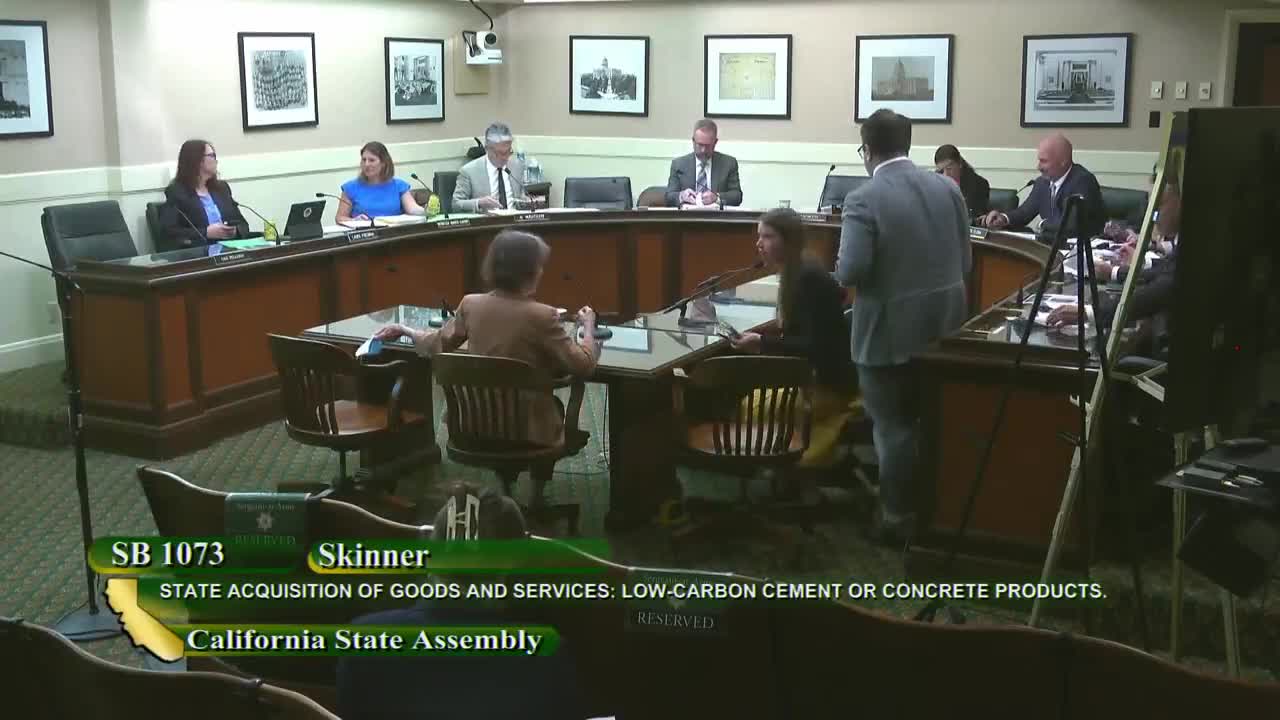 14MIN
Assembly Standing Committee on Natural Resources
 15MIN
Senate Standing Committee on Environmental Quality
17SEC
Senate Standing Committee on Environmental Quality
 22MIN
Senate Standing Committee on Governmental Organization
Bill Author

Bill Co-Author(s):