SB 1075: Credit unions: overdraft and nonsufficient funds fees.
- Session Year: 2023-2024
- House: Senate
- Latest Version Date: 2024-09-24
Current Status:
Passed
(2024-09-24: Chaptered by Secretary of State. Chapter 521, Statutes of 2024.)
Introduced
In Committee
First Chamber
In Committee
Second Chamber
Enacted
What does this bill do?
The bill requires California credit unions to notify a member each time the credit union charges an overdraft or nonsufficient funds (NSF) fee. It also caps those fees at $14 or at a lower amount if the federal Consumer Financial Protection Bureau sets a smaller limit.
The summary is provided by generative AI which can make mistakes. For original language, please view the details in the table below.
The California Credit Union Law generally provides for the organization and regulation of credit unions by the Commissioner of Financial Protection and Innovation. Existing law requires a credit union subject to the examination authority of the commissioner to report annually to the commissioner on the amount of revenue earned from overdraft fees and nonsufficient funds fees, as defined and specified.
This bill would require a credit union to provide a member a notice each time the credit union assesses an overdraft fee or nonsufficient funds fee, as specified. Beginning January 1, 2026, the bill would prohibit a credit union from charging an overdraft fee or a nonsufficient funds fee exceeding $14 or the amount set by the federal Consumer Financial Protection Bureau for the fee, whichever is lower.
The California Credit Union Law generally provides for the organization and regulation of credit unions by the Commissioner of Financial Protection and Innovation. Existing law requires a credit union subject to the examination authority of the commissioner to report annually to the commissioner on the amount of revenue earned from overdraft fees and nonsufficient funds fees, as defined and specified.
This bill would require a credit union to provide a customer at least 3 business days before requiring payment of an overdraft fee to give the customer an opportunity to repay the amount that triggered the fee. The member a notice each time the credit union assesses an overdraft fee or nonsufficient funds fee, as specified. Beginning January 1, 2026, the bill would prohibit a credit union from charging an overdraft fee or a nonsufficient funds fee exceeding $14 or the amount set by the federal Consumer Financial Protection Bureau for the fee, whichever is lower. The bill would require a credit union to disclose these requirements to all customers by January 31, 2025, and then annually thereafter. The bill would apply these provisions to credit unions with assets exceeding $1,000,000,000 on January 1, 2025, and to all credit unions on January 1, 2026, except as specified.
The California Credit Union Law generally provides for the organization and regulation of credit unions by the Commissioner of Financial Protection and Innovation. Existing law requires a credit union subject to the examination authority of the commissioner to report annually to the commissioner on the amount of revenue earned from overdraft fees and nonsufficient funds fees, as defined and specified.
This bill would require a credit union to provide a customer at least 3 business days before requiring payment of an overdraft fee to give the customer an opportunity to repay the amount that triggered the fee. The bill would prohibit a credit union from charging an overdraft fee or a nonsufficient funds fee exceeding $14 or the amount set by the federal Consumer Financial Protection Bureau for the fee, whichever is lower. The bill would require a credit union to disclose these requirements to all customers by January 31, 2025, and then annually thereafter. The bill would apply these provisions to credit unions with assets exceeding $1,000,000,000 on January 1, 2025, and to all credit unions on January 1, 2026, except as specified.
The California Credit Union Law generally provides for the organization and regulation of credit unions by the Commissioner of Financial Protection and Innovation. Existing law requires a credit union subject to the examination authority of the commissioner to report annually to the commissioner on the amount of revenue earned from overdraft fees and nonsufficient funds fees, as defined and specified.
This bill would require a credit union to provide a customer at least 5 3 business days before requiring payment of an overdraft fee to give the customer an opportunity to repay the amount that triggered the fee. The bill would prohibit a credit union from charging more than 3 overdraft fees and nonsufficient funds fees per month. an overdraft fee or a nonsufficient funds fee exceeding $14 or the amount set by the federal Consumer Financial Protection Bureau for the fee, whichever is lower. The bill would require a credit union to disclose these requirements to all customers by January 31, 2025, and then annually thereafter.
The California Credit Union Law generally provides for the organization and regulation of credit unions by the Commissioner of Financial Protection and Innovation. Existing law requires a credit union subject to the examination authority of the commissioner to report annually to the commissioner on the amount of revenue earned from overdraft fees and nonsufficient funds fees, as defined and specified.
This bill would require a credit union to provide a customer at least 5 business days before requiring payment of an overdraft fee or nonsufficient funds fee to give the customer an opportunity to repay the amount that triggered the fee. The bill would prohibit a credit union from charging more than 3 of those fees overdraft fees and nonsufficient funds fees per month. The bill would require a credit union to disclose these requirements to all customers by January 31, 2025, and then annually thereafter.
The California Credit Union Law generally provides for the organization and regulation of credit unions by the Commissioner of Financial Protection and Innovation. Existing law requires a credit union subject to the examination authority of the commissioner to report annually to the commissioner on the amount of revenue earned from overdraft fees and nonsufficient funds fees, as defined and specified.
This bill would require a state-chartered credit union to provide a customer at least 5 business days before requiring payment of an overdraft fee or nonsufficient funds fee to give the customer an opportunity to repay the amount that triggered the fee. The bill would prohibit a state-chartered credit union from charging more than 3 of those fees per month. The bill would require a state-chartered credit union to disclose these requirements to all customers by January 31, 2025, and then annually thereafter.
(a)For purposes of this section, the following definitions apply:
(1)Fee means a nonsufficient funds fee or an overdraft fee.
(2)Nonsufficient funds fee means a fee resulting from the initiation of a transaction that exceeds the members available account balance if the members credit union declines to make the payment.
(3)Overdraft fee means a fee resulting from the processing of a transaction that exceeds a members available account balance.
(b)(1)A credit union shall provide a notice to a member each time the credit union assesses a fee that meets all of the following requirements:
(A)The notice shall be provided to the member using a communication method designated by the member for receiving this type of notice.
(B)The notice shall be provided on the same business day the transaction that resulted in the fee occurred, unless it is not feasible to provide the notice that day, in which case the notice shall be provided on the next business day.
(C)The notice shall contain all of the following:
(i)The date of the transaction.
(ii)The type of transaction.
(iii)Whether the transaction was declined or processed.
(iv)If applicable, the amount of the overdraft that results from the transaction.
(v)If applicable, the amount necessary to return the account to a positive balance.
(vi)If applicable, the consequences of not returning the account to a positive balance within a certain timeframe.
(vii)If applicable, the amount of time the member has to return the account to a positive balance to avoid the consequences described in clause (vi).
(2)If the account has more than one accountholder, provision of the notice described in paragraph (1) to any accountholder shall be sufficient.
(c)Beginning January 1, 2026, a credit union shall not charge a fee exceeding fourteen dollars ($14) or the amount set by the federal Consumer Financial Protection Bureau for the fee, whichever is lower.
(a)For purposes of this section, the following definitions apply:
(1)Fee means a nonsufficient funds fee or an overdraft fee.
(2)Nonsufficient funds fee means a fee resulting from the initiation of a transaction that exceeds the customers members available account balance if the customers members credit union declines to make the payment.
(3)Overdraft fee means a fee resulting from the processing of a transaction that exceeds a customers members available account balance.
(b)A credit union with assets exceeding one billion dollars ($1,000,000,000) shall provide a customer at least three business days before requiring payment of an overdraft fee to give the customer an opportunity to repay the amount that triggered the overdraft fee.(b)(1)A credit union shall provide a notice to a member each time the credit union assesses a fee that meets all of the following requirements:
(A)The notice shall be provided to the member using a communication method designated by the member for receiving this type of notice.
(B)The notice shall be provided on the same business day the transaction that resulted in the fee occurred, unless it is not feasible to provide the notice that day, in which case the notice shall be provided on the next business day.
(C)The notice shall contain all of the following:
(i)The date of the transaction.
(ii)The type of transaction.
(iii)Whether the transaction was declined or processed.
(iv)If applicable, the amount of the overdraft that results from the transaction.
(v)If applicable, the amount necessary to return the account to a positive balance.
(vi)If applicable, the consequences of not returning the account to a positive balance within a certain timeframe.
(vii)If applicable, the amount of time the member has to return the account to a positive balance to avoid the consequences described in clause (vi).
(2)If the account has more than one accountholder, provision of the notice described in paragraph (1) to any accountholder shall be sufficient.
(c)A Beginning January 1, 2026, a credit union with assets exceeding one billion dollars ($1,000,000,000) shall not charge a fee exceeding fourteen dollars ($14) or the amount set by the federal Consumer Financial Protection Bureau for the fee, whichever is lower.
(d)A credit union with assets exceeding one billion dollars ($1,000,000,000) shall disclose the requirements of subdivisions (b) and (c) to all customers by January 31, 2025.(e)This section shall remain in effect only until January 1, 2026, and as of that date is repealed.SEC. 2.Section 14053 is added to the Financial Code, to read:14053.(a)For purposes of this section, the following definitions apply:(1)Fee means a nonsufficient funds fee or an overdraft fee.(2)Nonsufficient funds fee means a fee resulting from the initiation of a transaction that exceeds the customers account balance if the customers credit union declines to make the payment.(3)Overdraft fee means a fee resulting from the processing of a transaction that exceeds a customers account balance.(b)A credit union shall provide a customer at least three business days before requiring payment of an overdraft fee to give the customer an opportunity to repay the amount that triggered the overdraft fee.(c)A credit union shall not charge a fee exceeding fourteen dollars ($14) or the amount set by the federal Consumer Financial Protection Bureau for the fee, whichever is lower.(d)A credit union shall disclose the requirements of subdivisions (b) and (c) to all customers by January 31, 2026, and then annually thereafter.(e)This section shall become operative January 1, 2026.(a)For purposes of this section, the following definitions apply:
(1)Fee means a nonsufficient funds fee or an overdraft fee.
(2)Nonsufficient funds fee means a fee resulting from the initiation of a transaction that exceeds the customers account balance if the customers credit union declines to make the payment.
(3)Overdraft fee means a fee resulting from the processing of a transaction that exceeds a customers account balance.
(b)A credit union with assets exceeding one billion dollars ($1,000,000,000) shall provide a customer at least three business days before requiring payment of an overdraft fee to give the customer an opportunity to repay the amount that triggered the overdraft fee.
(c)A credit union with assets exceeding one billion dollars ($1,000,000,000) shall not charge a fee exceeding fourteen dollars ($14) or the amount set by the federal Consumer Financial Protection Bureau for the fee, whichever is lower.
(d)A credit union with assets exceeding one billion dollars ($1,000,000,000) shall disclose the requirements of subdivisions (b) and (c) to all customers by January 31, 2025, and then annually thereafter. 2025.
(e)This section shall remain in effect only until January 1, 2026, and as of that date is repealed.
SEC. 2.Section 14053 is added to the Financial Code, to read:14053.(a)For purposes of this section, the following definitions apply:
(1)Fee means a nonsufficient funds fee or an overdraft fee.
(2)Nonsufficient funds fee means a fee resulting from the initiation of a transaction that exceeds the customers account balance if the customers credit union declines to make the payment.
(3)Overdraft fee means a fee resulting from the processing of a transaction that exceeds a customers account balance.
(b)A credit union shall provide a customer at least three business days before requiring payment of an overdraft fee to give the customer an opportunity to repay the amount that triggered the overdraft fee.
(c)A credit union shall not charge a fee exceeding fourteen dollars ($14) or the amount set by the federal Consumer Financial Protection Bureau for the fee, whichever is lower.
(d)A credit union shall disclose the requirements of subdivisions (b) and (c) to all customers by January 31, 2026, and then annually thereafter.
(e)This section shall become operative January 1, 2026.
(a)For purposes of this section, the following definitions apply:
(1)Fee means a nonsufficient funds fee or an overdraft fee.
(2)Nonsufficient funds fee means a fee resulting from the initiation of a transaction that exceeds the customers account balance if the customers credit union declines to make the payment.
(3)Overdraft fee means a fee resulting from the processing of a transaction that exceeds a customers account balance.
(b)A credit union shall provide a customer at least five three business days before requiring payment of an overdraft fee to give the customer an opportunity to repay the amount that triggered the overdraft fee.
(c)A credit union shall not charge more than three fees per month. a fee exceeding fourteen dollars ($14) or the amount set by the federal Consumer Financial Protection Bureau for the fee, whichever is lower.
(d)A credit union shall disclose the requirements of subdivisions (b) and (c) to all customers by January 31, 2025, and then annually thereafter.
(a)For purposes of this section, the following definitions apply:
(1)Fee means a nonsufficient funds fee or an overdraft fee.
(2)Nonsufficient funds fee means a fee resulting from the initiation of a transaction that exceeds the customers account balance if the customers credit union declines to make the payment.
(3)Overdraft fee means a fee resulting from the processing of a transaction that exceeds a customers account balance.
(b)A credit union shall provide a customer at least five business days before requiring payment of a an overdraft fee to give the customer an opportunity to repay the amount that triggered the overdraft fee.
(c)A credit union shall not charge more than three fees per month.
(d)A credit union shall disclose the requirements of subdivisions (b) and (c) to all customers by January 31, 2025, and then annually thereafter.
(a)For purposes of this section, the following definitions apply:
(1)Fee means a nonsufficient funds fee or an overdraft fee.
(2)Nonsufficient funds fee means a fee resulting from the initiation of a transaction that exceeds the customers account balance if the customers credit union declines to make the payment.
(3)Overdraft fee means a fee resulting from the processing of a transaction that exceeds a customers account balance.
(b)A state-chartered credit union shall provide a customer at least five business days before requiring payment of a fee to give the customer an opportunity to repay the amount that triggered the fee.
(c)A state-chartered credit union shall not charge more than three fees per month.
(d)A state-chartered credit union shall disclose the requirements of subdivisions (b) and (c) to all customers by January 31, 2025, and then annually thereafter.
|
Date
|
Status
|
|---|---|
| Sep 24, 2024 | Chaptered by Secretary of State. Chapter 521, Statutes of 2024. |
| Sep 24, 2024 | Approved by the Governor. |
| Sep 4, 2024 | Enrolled and presented to the Governor at 4 p.m. |
| Aug 28, 2024 | Assembly amendments concurred in. (Ayes 36. Noes 2. Page 5588.) Ordered to engrossing and enrolling. |
| Aug 28, 2024 | In Senate. Concurrence in Assembly amendments pending. |
| Aug 27, 2024 | Read third time. Passed. (Ayes 76. Noes 0. Page 6654.) Ordered to the Senate. |
| Aug 8, 2024 | Read second time. Ordered to third reading. |
| Aug 7, 2024 | From committee: Do pass. (Ayes 14. Noes 0.) (August 7). |
| Jul 2, 2024 | From committee: Do pass and re-refer to Com. on APPR. (Ayes 9. Noes 0.) (July 1). Re-referred to Com. on APPR. |
| Jun 24, 2024 | From committee with author's amendments. Read second time and amended. Re-referred to Com. on B. & F. |
| Jun 3, 2024 | Referred to Com. on B. & F. |
| May 24, 2024 | In Assembly. Read first time. Held at Desk. |
| May 23, 2024 | Read third time. Passed. (Ayes 24. Noes 7. Page 4189.) Ordered to the Assembly. |
| May 21, 2024 | Read second time. Ordered to third reading. |
| May 20, 2024 | Read third time and amended. |
| May 20, 2024 | Ordered to second reading. |
| May 13, 2024 | Read second time. Ordered to third reading. |
| May 9, 2024 | Read third time and amended. |
| May 9, 2024 | Ordered to second reading. |
| Apr 16, 2024 | Read second time. Ordered to third reading. |
| Apr 15, 2024 | From committee: Be ordered to second reading pursuant to Senate Rule 28.8. |
| Apr 9, 2024 | From committee with author's amendments. Read second time and amended. Re-referred to Com. on APPR. |
| Apr 9, 2024 | Set for hearing April 15. |
| Apr 8, 2024 | Read second time and amended. Re-referred to Com. on APPR. |
| Apr 4, 2024 | From committee: Do pass as amended and re-refer to Com. on APPR. (Ayes 4. Noes 2. Page 3465.) (April 3). |
| Mar 20, 2024 | Set for hearing April 3. |
| Feb 21, 2024 | Referred to Com. on B. & F.I. |
| Feb 13, 2024 | From printer. May be acted upon on or after March 14. |
| Feb 12, 2024 | Introduced. Read first time. To Com. on RLS. for assignment. To print. |
|
Date
|
Description
|
Location
|
Votes
|
|
|---|---|---|---|---|
| Aug 28, 2024 | Unfinished Business SB1075 Bradford et al. Concurrence | Senate Floor |
Passed |
|
| Aug 27, 2024 | SB 1075 Bradford Senate Third Reading By Ting | Assembly Floor |
Passed |
|
| Aug 7, 2024 | Do pass. | Assembly Standing Committee on Appropriations |
Passed |
|
| Jul 1, 2024 | Do pass and be re-referred to the Committee on [Appropriations] | Assembly Standing Committee on Banking and Finance |
Passed |
|
| May 23, 2024 | Senate 3rd Reading SB1075 Bradford et al. | Senate Floor |
Passed |
|
| Apr 3, 2024 | Do pass as amended, but first amend, and re-refer to the Committee on [Appropriations] | Senate Standing Committee on Banking and Financial Institutions |
Passed |
This list shows positions taken on this bill by organizations on the date displayed, which is linked to the original source.
Positions by individuals are not included.
|
Organization
|
Position
|
Date
|
|---|---|---|
| California Capital Financial Development Corporation | ** Support | |
| California Coalition For Rural Housing | ** Support | |
| California Community Economic Development Association | ** Support | |
| California Credit Union League | * Neutral | Jul 1, 2024 |
| California Low-Income Consumer Coalition | * Support | Jul 1, 2024 |
| California School Employees Association | ** Support | |
| Center for Community Advocacy | ** Support | |
| Consumer Federation Of California | ** Support | |
| Consumers For Auto Reliability And Safety | ** Support | |
| Courage California | ** Support | |
| East Los Angeles Community Corporation | ** Support | |
| Esperanza Community Housing Corporation | ** Support | |
| Fair Housing Advocates of Northern California | ** Support | |
| Faith And Community Empowerment | ** Support | |
| Families in Good Health | ** Support | |
| Haven Neighborhood Services | ** Support | |
| Inclusive Action for the City | ** Support | |
| Koreatown Youth and Community Center INC. | ** Support | |
| MicroEnterprise Collaborative of Inland Southern California | ** Support | |
| Mission Street Neighbors | ** Against | |
| National Council Of Jewish Women Los Angeles | ** Support | |
| Renaissance Entrepreneurship Center | ** Support | |
| Rise Economy | * Support | Jul 1, 2024 |
| Thai Community Development Center | ** Support | |
| The Academy of Financial Education | ** Support | |
| The Central Valley Urban Institute | ** Support | |
| The Sidewalk Project | ** Support |
SENATE RULES COMMITTEE Office of Senate Floor Analyses (916) 651-1520 Fax: (916) 327-4478 | SB 1075 |
UNFINISHED BUSINESS
Bill No: SB 1075
Author: Bradford (D) and Limón (D)
Amended: 6/24/24
Vote: 21
SENATE BANKING & F.I. COMMITTEE: 4-2, 4/3/24
AYES: Limón, Bradford, Caballero, Menjivar
NOES: Niello, Nguyen
NO VOTE RECORDED: Portantino
SENATE APPROPRIATIONS COMMITTEE: Senate Rule 28.8
SENATE FLOOR: 24-7, 5/23/24
AYES: Ashby, Atkins, Becker, Blakespear, Bradford, Caballero, Cortese, Durazo, Eggman, Gonzalez, Hurtado, Limón, McGuire, Menjivar, Min, Padilla, Rubio, Skinner, Smallwood-Cuevas, Stern, Umberg, Wahab, Wiener, Wilk
NOES: Dahle, Grove, Jones, Nguyen, Niello, Ochoa Bogh, Seyarto
NO VOTE RECORDED: Allen, Alvarado-Gil, Archuleta, Dodd, Glazer, Laird, Newman, Portantino, Roth
ASSEMBLY FLOOR: 76-0, 8/27/24 - See last page for vote
SUBJECT: Credit unions: overdraft and nonsufficient funds fees
SOURCE: Author
DIGEST:
This bill limits the amount of nonsufficient funds and overdraft fees that a credit union may charge and requires a credit union to provide a notice to a member each time the credit union assesses such a fee.
Assembly Amendments
delete the requirement that a credit union, as specified, provide a three-day grace period before charging an overdraft fee, delay the limit on fee amount to January 1, 2026, and specify a required notice that a credit union must provide to a member each time the credit union assess an overdraft or nonsufficient funds fee.
ANALYSIS:
Existing federal law:
- Provides the Truth in Lending Act and its implementing regulations, known as Regulation Z, which, among other things, requires lenders to disclose all charges and fees associated with a loan. Provides, through Regulation Z, an exception for charges imposed by a financial institution for paying items that overdraw an account, unless the payment of such items and the imposition of the charge were previously agreed upon in writing. (12 CFR 1026.4)
- Provides the Electronic Fund Transfer Act and its implementing regulations, known as Regulation E, which are intended to protect consumers who use electronic fund transfers, such as transactions using a debit card, ACH, or prepaid account. Provides, through Regulation E, the following related to overdraft:
- Defines “overdraft service” as a service under which a financial institution assesses a fee or charge on a consumer's account held by the institution for paying a transaction (including a check or other item) when the consumer has insufficient or unavailable funds in the account. Provides that “overdraft service” does not include specified products or services, including but not limited to, an overdraft transaction subject to Regulation Z or a service that transfers funds from another account, like a savings account, held by a consumer.
- Prohibits a financial institution holding a consumer’s account from assessing a fee or charge on a consumer’s account for paying an ATM or one-time debit card transaction pursuant to the institution’s overdraft service, unless the institution obtains the consumer’s affirmative consent, or opt-in, to the institution’s overdraft program, as specified. (12 CFR 1005.17)
- Provides the Truth-in-Savings Act and its implementing regulations, known as Regulation DD, which, among other things:
- Requires the disclosure of the amount of any fee that may be imposed in connection with the account (or an explanation of how the fee will be determined) and the conditions under which the fee may be imposed. (12 CFR 1030.4)
- Specifies how overdraft fees must be disclosed on periodic statements and provides requirements and prohibitions related to the advertising of overdraft services. (12 CFR 1030.11)
Existing state law:
Provides the California Credit Union Law, administered by the Department of Financial Protection and Innovation (DFPI), which prescribes the rules applicable to any person, other than a federal credit union, which engages in business as a credit union in this state. (Financial Code Section 14000 et. seq.)
- Requires banks and credit unions subject to the examination authority of DFPI to report annually the revenue earned from overdraft fees, as specified, and requires the commissioner to publish that information in a publicly available report. (Financial Code Section 521)
This bill:
- Defines the following terms:
- “Nonsufficient funds fee” means a fee resulting from the initiation of a transaction that exceed the member’s available account balance if the member’s credit union declines to make the payment.
- “Overdraft fee” means a fee resulting from the processing of a transaction that exceeds a member’s available account balance.
- “Fee” means a nonsufficient funds fee or an overdraft fee.
- Beginning January 1, 2026, prohibits a credit union from charging a fee exceeding $14 or the amount set by the federal Consumer Financial Protection Bureau for the fee, whichever is lower.
- Requires a credit union to provide a notice, as specified, to a member each time the credit union assesses a fee.
Background
A consumer may incur an overdraft fee when they initiate a debit transaction, such as using a check or debit card to make a payment, that exceeds their account balance. Whether an overdraft fee is charged depends on several factors, including the terms of the consumer’s agreement with their depository institution and, in some cases, whether the depository institution uses its discretion to authorize the transaction and charge a fee. If the account does not offer overdraft clearing or if the depository institution decides to decline the payment, the depository institution may charge the consumer a non-sufficient fund (NSF) fee.
As described in the ‘Existing federal law’ section, depository institutions must comply with certain federal laws depending on the type of overdraft clearing being offered. Some overdraft services, such as overdraft lines of credit or transfers from another account held by the consumer, are of lesser concern for consumer protection purposes, as these services must comply with disclosure requirements of Regulation Z and typically have low or no fees. Overdraft services that are subject to the opt-in requirement of Regulation E, however, are of higher concern. If the consumer opts-in, these overdraft services allow the depository institution to charge a fee on debit card and ATM transactions that the depository institution authorizes even if authorizing the transaction will cause the account to settle with a negative balance. Research from the Consumer Financial Protection Bureau (CFPB) finds that these accounts lead to the highest frequency of overdraft charges.[1]
Comments
- Author’s statement. According to the author:
The purpose of SB 1075 is to address the results of the report from SB 1415 showing that state-chartered credit unions in California are generating a substantial amount of income from overdraft and non-sufficient fund fees. It will establish basic consumer protections and protect the most financially vulnerable members of credit unions.
Overdraft and non-sufficient fund fees tend to disproportionately affect those who can least afford them. The Consumer Financial Protection Bureau estimates that 80% of overdraft fees come from just 9% of account holders industry wide. A substantial amount of credit unions generate over 40% of their net income from overdraft and non-sufficient fund fees alone. Six of these credit unions derive 100% or more of their net income from these fees.
- Who Uses Overdraft Services and How Do They Use Them. The incidence of overdraft fees is concentrated in a relatively small portion of accountholders. CFPB research finds that 9% of accountholders account for 79% of all overdraft and NSF fees.[2] These frequent overdrafters had more than 10 overdraft and NSF fees charged to their accounts in a one-year period, which translates to a median of $380 in fees in year. Moreover, accounts that had more than 20 overdraft and NSF fees in a year accounted for 63% of all such fees. On the other hand, 75% of accountholders incurred zero overdraft fees during the period of the study. These data show that the burden of overdraft fees are not borne similarly across all accountholders, but instead, are acute challenges for a small portion of consumers.
The occurrence of overdraft fees has deep disparities across race, income, and age demographics. The Financial Health Network finds the following in 2022:
- Black and Latino households reported having overdrafted more often than White households (amongst households with checking accounts, 26% of Black and 23% of Latino households reported having incurred an overdraft fee, versus 14% of White households).
- Younger respondents were three times more likely to have overdrafted than older respondents (amongst those with accounts, 24% of respondents aged 18-25 had overdrafted, compared with 8% of those 65 and older).
- Households with incomes under $30,000 were twice as likely to report at least one overdraft as those with incomes of $100,000 or more (22% vs. 11%, among households with accounts).[3]
The Financial Health Network analysis goes on to estimate that financially vulnerable people paid over $6 billion in overdraft fees in 2022, more than 60% of all overdraft fees collected, while comprising only 15% of the U.S. population. These data provide strong evidence that overdraft fees are charged largely to households that have the least ability to afford them, a disproportionate number of whom are Black and Latino.
- The Downsides of Overdraft Services. Overdraft services pose numerous risks and challenges to consumers. Some of these risks are directly related to the structure of overdraft programs, while others are interrelated with challenges a consumer faces beyond their use of overdraft services.
- High fees. Overdraft is an expensive form of short-term credit. Overdraft and NSF fees are often from $20 to $35 per transaction, though some depository institutions have reduced fees below this range in the past few years. Many depository institutions charge an overdraft fee for each transaction that results in a negative balance up to a daily limit, with many allowing three or more overdraft or NSF fees per day. This results in accumulated fees of $60 or more in a single day. The magnitude of these fees is high relative to the amount of credit being extended (often less than $50), the time period that the credit is outstanding (75% of overdrafts are repaid within five days), and the depository institution’s actual and direct costs for providing the credit (estimated at $6 per overdraft).
- Surprise overdraft. A certain category of overdraft transactions, so-called “surprise” overdraft fees, has received scrutiny recently from federal and state law enforcement agencies. Surprise overdraft describes a class of transactions that are assessed an overdraft fee that a consumer would not reasonably expect. These transactions are typically initiated when a consumer has sufficient available balance in their account to cover the transaction, but by the time the transaction fully settles, the consumer balance is insufficient due to other intervening transactions.
Many consumers charged an overdraft fee are surprised by the fee. CFPB research finds that, among consumers in households charged an overdraft fee in the last year, 43% were surprised by the most recent overdraft, 35% thought it was possible, and just 22% expected it.[4] Both the CFPB and California Attorney General Rob Bonta have called attention to this practice, which has likely persuaded many institutions to stop this practice.
- High frequency. Consumer protection advocates and government regulators would likely be less concerned with overdraft practices but for the incidence and characteristics of high frequency overdrafters. As previously mentioned, a significant majority of overdraft fees are paid by 9% of accountholders, and many of these accountholders face considerable financial challenges. CFPB research shows that this segment of consumers, at the median, incurs 19 overdraft fees per year, which translates to $665 annually based on the median overdraft fee of $35.[5]
- The “un-banking” of consumers. For some consumers, overdraft clearing and associated fees push them out of the banking system. Depository institutions may close a customer’s account if the account balance is negative and the customer seems unwilling or unable to bring the account back to a positive balance. The CFPB finds that the great majority of involuntary account closures are due to negative balances that accountholders do not repay, and many of these closures are associated with the use of overdraft.[6] Involuntary account closures are neither common, nor exceedingly rare. The CFPB observed a 6% rate of involuntary closures in 2011 among banks in its study, though this metric likely varies significantly across depository institutions and may also vary over time.[7]
- The Value of Overdraft Services. In spite of concerns discussed in the previous comment, overdraft services provide value to depository institutions and to consumers. The value to depository institutions is quite obvious. As previously discussed, the actual and direct costs of providing overdraft services are estimated to be $6 per overdraft transaction. Compared to the median overdraft fee of $35, overdraft services can be highly profitable sources of revenue.
When faced with the choice of paying an overdraft fee or having their transaction declined, a majority of consumers prefer to pay the fee. Across the range of overdraft frequency, 60% of consumers state a preference for incurring an overdraft fee rather than having their transaction declined, which increases to 81% for frequent overdrafters. Across the range of transaction sizes, 60% of consumers prefer transactions of less than $25 to be declined rather than to incur a fee, but nearly two-thirds of consumers prefer to incur an overdraft fee rather than having a transaction of more than $25 declined.[8]
- Market Trends and Regulatory Response. Depository institutions’ policies and practices related to overdraft have changed considerably over the past several decades. In the mid-20th century, depository institutions provided overdraft as a courtesy, approving on an ad hoc basis the clearing and settlement of paper checks that exceeded the available balance in customer accounts.[9] Beginning around the turn of the century, overdraft services transformed into a high-capacity, automated set of processes that allowed depository institutions to make overdraft decisions on a large volume of transactions.
The expansion of overdraft services shifted the economics of transaction accounts and depository institutions’ related policies and practices. Depository institutions shifted away from upfront monthly checking account fees, relying instead on overdraft fee revenue that would grow to comprise somewhere between two-thirds and three-fourths of consumer deposit account service charges industry-wide. The CFPB estimates that consumers have paid an estimated $280 billion in overdraft fees over the past two decades.[10]
In the past three years, many depository institutions have changed their policies and practices related to overdraft fees, likely spurred by regulatory pressure and competition from fintech companies. Some institutions reduced the size of overdraft fees to $10 - $15, with a few eliminating overdraft fees altogether.[11] These changes have translated to saving for consumers. In total, depository institutions generated an estimated $9.1 billion of overdraft revenue in 2022, a decrease of $3.5 billion, or 27%, compared to pre-pandemic levels.
In January 2024, the CFPB proposed a rule related to overdraft programs at depository institutions with at least $10 billion in assets.[12] The proposed rule would limit fees on most overdraft transactions to the depository institution’s costs and losses for providing the overdraft program. The rule would also establish a benchmark fee, which may have the effect of establishing a de facto fee cap on overdraft transactions. The CFPB proposed and is seeking comment on four potential benchmark fee amounts: $3, $6, $7, or $14. The CFPB expects the proposed rule will be effective on October 1, 2025.
- Overdraft At California Credit Unions. In 2022, California enacted SB 1415 (Limón, Chapter 847, Statutes of 2022) which required state-chartered banks and credit unions to report to the DFPI annually the revenue they generate from overdraft and NSF fees and for DFPI to make a public report of this information. In aggregate, California credit unions collected more than $250 million in overdraft and NSF fees in 2022, which surpasses the $224 million in fees that payday lenders collected in California that same year. Thirty credit unions earned half or more of their net profit from overdraft fees, with seven whose overdraft revenue exceeded their total net income. State-chartered banks, on the other hand, collected $73 million in overdraft fees, with only one bank generating overdraft revenue of more than 20% of its net income. The difference in outcomes between state credit unions and state banks is likely due, in part, to credit unions having a higher relative concentration of revenue from consumer accounts, while state banks have a higher relative concentration of revenue from commercial accounts.
FISCAL EFFECT: Appropriation: No Fiscal Com.: Yes Local: No
According to the Assembly Appropriations Committee, minor and absorbable costs to the Department of Financial Protection and Innovation (DFPI) to update manuals, examinations, and procedures, and ensure compliance.
SUPPORT: (Verified 8/21/24)
California School Employees Association
OPPOSITION: (Verified 8/21/24)
None received
ARGUMENTS IN SUPPORT: According to the California School Employees Association:
"Low-income workers across California are struggling to make ends meet, and surprise overdraft fees can be a major financial setback. SB 1075 offers critical protections by providing our members who bank at credit unions with a five-day grace period to fix overdrafts before a fees are charged. This breathing room can mean the difference between putting food on the table or getting hit with a penalty that throws their budgets off track."
ASSEMBLY FLOOR: 76-0, 8/27/24
AYES: Addis, Aguiar-Curry, Alanis, Alvarez, Arambula, Bains, Bauer-Kahan, Bennett, Berman, Boerner, Bonta, Bryan, Calderon, Juan Carrillo, Wendy Carrillo, Chen, Connolly, Megan Dahle, Davies, Dixon, Essayli, Flora, Mike Fong, Friedman, Gabriel, Gallagher, Garcia, Gipson, Grayson, Haney, Hart, Holden, Hoover, Irwin, Jackson, Jones-Sawyer, Kalra, Lackey, Lee, Low, Lowenthal, Maienschein, Mathis, McCarty, McKinnor, Muratsuchi, Stephanie Nguyen, Pacheco, Papan, Jim Patterson, Joe Patterson, Pellerin, Petrie-Norris, Quirk-Silva, Ramos, Rendon, Reyes, Luz Rivas, Rodriguez, Blanca Rubio, Sanchez, Santiago, Schiavo, Soria, Ta, Ting, Valencia, Villapudua, Wallis, Ward, Weber, Wicks, Wilson, Wood, Zbur, Robert Rivas
NO VOTE RECORDED: Cervantes, Ortega, Waldron
Prepared by: Michael Burdick / B. & F.I. /
8/27/24 18:38:54
**** END ****
David Low et al., CFPB, Data Point: Frequent Overdrafters, at 5 (Aug. 2017), https://files.consumerfinance.gov/f/documents/201708_cfpb_data-point_frequent-overdrafters.pdf (CFPB 2017 Data Point). ↑
Id. ↑
Financial Health Network (FHN), Overdraft Trends Amid Historic Policy Shifts (June 1, 2023), https://finhealthnetwork.org/research/overdraft-trends-amid-historic-policy-shifts/ (FHN Brief 2023). ↑
CFPB, Overdraft and Nonsufficient Fund Fees: Insights from the Making Ends Meet Survey and Consumer Credit Panel (Dec. 2024), https://files.consumerfinance.gov/f/documents/cfpb_overdraft-nsf-report_2023-12.pdf. ↑
Id. ↑
CFPB, CFPB Study of Overdraft Programs: A white paper of initial data findings, (June 2013), https://files.consumerfinance.gov/f/201306_cfpb_whitepaper_overdraft-practices.pdf (CFPB 2013 White Paper). ↑
Id. ↑
Id. ↑
See Footnote 19 of CFPB Notice of Proposed Rulemaking here: https://public-inspection.federalregister.gov/2024-01095.pdf ↑
https://files.consumerfinance.gov/f/documents/cfpb_overdraft-credit-very-large-financial-institutions_fact-sheet_2024-01.pdf ↑
See this table reflecting overdraft and NSF practices at the 20 largest banks: https://files.consumerfinance.gov/f/documents/cfpb_overdraft-table_2023-05.pdf. ↑
https://www.consumerfinance.gov/about-us/newsroom/cfpb-proposes-rule-to-close-bank-overdraft-loophole-that-costs-americans-billions-each-year-in-junk-fees/ ↑
SENATE THIRD READING
STR Bill Id:SB 1075
Author:(Bradford and Limón)
As Amended Ver:June 24, 2024
Majority vote
SUMMARY
Limits the amount of overdraft and nonsufficient fund (NSF) fees a credit union may charge to $14 or the amount set by the Consumer Financial Protection Bureau (CFPB), as specified.
Major Provisions
- Prohibits, beginning on January 1, 2026, a state-chartered credit union from charging a fee exceeding $14 or the amount set by the federal CFPB for the fee, whichever is lower.
- Requires a state-chartered credit union to provide a credit union a notice each time the credit union assesses a fee. The notice must include specified information, such as the date of the transaction, the type of transaction, the amount of overdraft, and whether the transaction was declined or processed.
COMMENTS
- Background: Overdraft and NSF fees.
An overdraft fee is charged when a consumer attempts a debit transaction that exceeds their account balance and the financial institution lets the transaction proceed. In essence, overdraft acts as a short-term extension of credit for the customer, with the financial institution covering the transaction rather than halting it altogether. Many banks and credit unions have some type of overdraft program for their customers, though these programs may be structured differently. For example, some banks and credit unions may establish overdraft limits (the amount by which the institution would allow payments to overdraw a consumer's account) at different or varying amounts or have different fee amounts based on the number of overdraft clearances that occur in a specified time period. The typical overdraft fee today is around $35.
An NSF fee is charged by a financial institution when they decline to make a payment from a consumer's account after determining the account lacks sufficient funds. In this case, the bank or credit union does not cover this transaction or extend credit (like in overdraft), and the transaction is rejected. The use of NSF fees is far less common than overdraft: According to the CFPB, a majority of large banks with at least $1 billion in total assets have stopped charging NSF fees. And, to the extent this fee is charged, it is typically for a declined personal check or Automated Cleaning House transaction and rarely for a declined Automated Teller Machine or debit transaction.
- State report on overdraft and NSF fees
In 2022, the Legislature passed SB 1415 (Limón), Chapter 847, Statutes of 2022 to require the Department of Financial Protection and Innovation (DFPI) to collect data from state-chartered banks and credit unions about their fee practices. SB 1415 was in response to press reports highlighting how smaller banks and credit unions relied on fee revenue more than their larger counterparts. The first report, released in March 2024, contained a number of key takeaways:
- Overdraft and NSF fee revenue is modest for many institutions. One immediate takeaway is that more than half of California's banks and credit unions collect minimal revenue from these fees, as measured as a percentage of the institution's net income. Of the 214 institutions that reported information, 114 reported combined NSF and overdraft fee revenue making up less than 5% of their net income
- Overdraft and NSF fee revenue is quite significant at a smaller number of institutions. At the same time, DFPI's report highlights how some institutions still heavily rely on fee revenue. 75 institutions reported combined overdraft and NSF revenue making up more than 10% of net income, 56 of whom reported fee revenue exceeding 20% of net income.
- CFPB's "Junk Fee" initiative and proposed rules
As part of the Biden Administration's "junk fee" initiative, the CFPB announced a proposed rule to rein in overdraft fees charged by the largest financial institutions. This rule, applying to depository institutions like credit unions with total assets of $10 billion or more, would limit overdraft fee levels to be either a "breakeven" amount, measured as the direct costs to the institution for providing the service, or a "benchmark" amount of either $3, $6, $7, or $14.
CFPB also allows a financial institution to charge higher amounts than the proposed fee caps, but only if it complies with federal laws covering loans. As the CFPB notes, consumers who incur overdraft fees may have access to cheaper credit sources, and under the rule, CFPB would require disclosures under the Truth in Lending Act for these more costly "overdraft loans."
The CFPB expects the proposed rule to be effective on October 1, 2025. This bill proposes to cap credit union overdraft and NSF fees to $14 or whatever the amount set by CFPB for larger financial institutions.
According to the Author
"The purpose of SB 1075 is to address the results of the report from SB 1415 (2022) showing that state-chartered credit unions in California are generating a substantial amount of income from overdraft and non-sufficient fund fees.
Overdraft and non-sufficient fund fees tend to disproportionately affect those who can least afford them. The Consumer Financial Protection Bureau estimates that 80% of overdraft fees come from just 9% of account holders industry wide. A substantial amount of credit unions generate over 40% of their net income from overdraft and non-sufficient fund fees alone. Six of these credit unions derive 100% or more of their net income from these fees."
Arguments in Support
According to the California School Employees Association:
"Low-income workers across California are struggling to make ends meet, and surprise overdraft fees can be a major financial setback. SB 1075 offers critical protections by providing our members who bank at credit unions with a five-day grace period to fix overdrafts before a fees are charged. This breathing room can mean the difference between putting food on the table or getting hit with a penalty that throws their budgets off track."
Arguments in Opposition
None on file.
FISCAL COMMENTS
According to the Assembly Appropriations Committee, minor and absorbable costs to DFPI to update manuals, examinations, and procedures, and ensure compliance.
VOTES
SENATE FLOOR: 24-7-9
YES: Ashby, Atkins, Becker, Blakespear, Bradford, Caballero, Cortese, Durazo, Eggman, Gonzalez, Hurtado, Limón, McGuire, Menjivar, Min, Padilla, Rubio, Skinner, Smallwood- Cuevas, Stern, Umberg, Wahab, Wiener, Wilk
NO: Dahle, Grove, Jones, Nguyen, Niello, Ochoa Bogh, Seyarto
ABS, ABST OR NV: Allen, Alvarado-Gil, Archuleta, Dodd, Glazer, Laird, Newman, Portantino, Roth
ASM BANKING AND FINANCE: 9-0-0
YES: Grayson, Chen, Kalra, Dixon, Mike Fong, Maienschein, Petrie-Norris, Blanca Rubio, Soria
ASM APPROPRIATIONS: 14-0-1
YES: Wicks, Sanchez, Arambula, Bryan, Calderon, Wendy Carrillo, Dixon, Mike Fong, Grayson, Haney, Hart, Jim Patterson, Pellerin, Ta
ABS, ABST OR NV: Villapudua
UPDATED
VERSION: June 24, 2024
CONSULTANT: Luke Reidenbach / B. & F. / (916) 319-3081 FN: 0003789
Date of Hearing: August 7, 2024
ASSEMBLY COMMITTEE ON APPROPRIATIONS
Buffy Wicks, Chair
SBPCA Bill Id:SB 1075
Author:(Bradford) – As Amended Ver:June 24, 2024
Policy Committee: | Banking and Finance | Vote: | 9 - 0 |
|
| ||
|
|
Urgency: No State Mandated Local Program: No Reimbursable: No
SUMMARY:
This bill limits the assessment of an overdraft or nonsufficient funds (NSF) fee by a credit union.
Specifically, this bill:
- Requires a credit union to provide a member a notice each time the credit union assesses an overdraft fee or NSF fee. The notice must include certain information and be provided using a member-designated communication method by the next business day after the transaction resulting in the fee occurred.
- Prohibits, beginning January 1, 2026, a credit union from charging an overdraft fee or NSF fee exceeding $14, or the allowable amount set by the federal Consumer Financial Protection Bureau (CFPB), whichever is lower.
FISCAL EFFECT:
Minor and absorbable costs to the Department of Financial Protection and Innovation (DFPI) to update manuals, examinations, and procedures, and ensure compliance.
COMMENTS:
- Purpose. According to the author:
The purpose of SB 1075 is to address the results of the report from SB 1415 showing that state-chartered credit unions in California are generating a substantial amount of income from overdraft and non-sufficient fund fees. It will establish basic consumer protections and protect the most financially vulnerable members of credit unions.
This bill is supported by consumer groups and economic justice organizations.
- Overdraft and NSF Fees. An overdraft fee is charged when a consumer attempts a debit transaction that exceeds the consumer’s account balance and the financial institution lets the transaction proceed, resulting in a short-term extension of credit for the consumer. An NSF fee is charged by a financial institution when it declines to make a payment from a consumer’s account after determining the account lacks sufficient funds.
SB 1415 (Limon), Chapter 847, Statutes of 2022, required DFPI to collect fee practices data from state-chartered banks and credit unions. The ensuing report found that overdraft and NSF fee revenue is modest for many institutions, but a small number of institutions rely heavily on such revenue, with 75 institutions reporting over 10% of net income from such fees (over 20% of net income for 56 respondents). At the federal level, the CFPB has proposed “junk fee” rules for large depository institutions that: (a) limit overdraft fee levels to either a “breakeven” amount or a “benchmark” amount of either $2, $6, $7, or $14, and (b) prohibit the use of NSF fees for transactions that are “instantaneously” declined. This bill limits, beginning January 1, 2026, after the CFPB rule takes effect, the amount of an overdraft or NSF fee a credit union may charge to $14, or the amount set by the CFPB, whichever is lower. Thus, this bill ensures the CFPB’s fee cap applies to smaller credit unions outside the scope of the CFPB rule. This bill also requires a credit union to send a member a notice each time an overdraft or NSF fee is assessed, which is consistent with industry best practices.
- Related Legislation. AB 2017 (Grayson) prohibits a bank or credit union from charging a consumer an NSF fee when the consumer’s attempt to initiate a transaction is declined instantaneously, or near instantaneously, due to NSF. AB 2017 is pending in the Senate Appropriations Committee.
Analysis Prepared by: Irene Ho / APPR. / (916) 319-2081
Date of Hearing: July 1, 2024
ASSEMBLY COMMITTEE ON BANKING AND FINANCE
Timothy Grayson, Chair
SBPCA Bill Id:SB 1075
Author:(Bradford) – As Amended Ver:June 24, 2024
SENATE VOTE: 24-7
SUBJECT: Credit unions: overdraft and nonsufficient funds fees
SUMMARY: Limits the amount of overdraft and nonsufficient fund (NSF) fees a credit union may charge to $14 or the amount set by the Consumer Financial Protection Bureau (CFPB), as specified.
Specifically, this bill:
- Defines the following terms:
- “Nonsufficient funds fee” means a fee resulting from the initiation of a transaction that exceed the customer’s account balance if the customer’s credit union declines to make the payment.
- “Overdraft fee” means a fee resulting from the processing of a transaction that exceeds a customer’s account balance.
- “Fee” means a nonsufficient funds fee or an overdraft fee.
- Prohibits, beginning on January 1, 2026, a state-chartered credit union from charging a fee exceeding $14 or the amount set by the federal CFPB for the fee, whichever is lower.
- Requires a state-chartered credit union to provide a credit union a notice each time the credit union assesses a fee. The notice must include specified information, such as the date of the transaction, the type of transaction, the amount of overdraft and whether the transaction was declined or processed.
EXISTING LAW:
- Includes the following, among others, in the definition of “licensee” under the Financial Institutions Law (Financial Code Section 185):
- A bank authorized by the commissioner to conduct business, as specified.
- A credit union authorized by the commissioner to conduct business, as specified.
- Requires a bank or a credit union subject to the examination authority of the commissioner shall report annually, on or before March 1, to the commissioner on the amount of revenue earned from overdraft fees and nonsufficient funds fees collected in the most recently completed calendar year and the percentage of that revenue as a proportion of the net income of the bank or credit union. (Financial Code Section 521)
FISCAL EFFECT: Unknown. This bill is keyed Fiscal by Legislative Counsel.
COMMENTS:
- Purpose.
According to the author:
In January, the Consumer Financial Protection Bureau (CFPB) proposed a new rule that would prohibit nonsufficient fund (NSF) fees on transactions that are declined instantaneously or near-instantaneously in order to "proactively set regulations to protect consumers from abusive practices." It has been shown that these fees are most likely to be assessed on financially vulnerable consumers, increasing financial strain while also negatively affecting a consumer's overall perceptions of the banking system being fair and transparent. AB 2017 will codify CFPB's proposed rule in order to protect consumers and prevent fee creep in California.
- Background: Credit Unions
A credit union is a not-for-profit cooperative that accepts deposits, makes loans, and offers a variety of financial services and products to its members. Under state law, a credit union is formed for the purposes of “creating a source of credit for [members] at rates of interest set by the board of directors, and providing an opportunity for them to use and control their own money on a democratic basis in order to improve their economic and social condition.”
In many important ways, a credit union functions similarly to a bank and is subject to comparable rules and requirements designed to ensure the safety and soundness of the institution. But, as a cooperative corporation, a credit union is organized and managed much differently than a traditional bank. For example, a credit union is subject to a “field of membership” requirement, meaning that its membership must be limited to groups with a “common bond.” This common bond requirement is the reason a credit union may consist of members of a church or labor union, employees of one company, or residents of a defined geographic area.
A credit union also has unique governance because of its nonprofit cooperative structure. A credit union’s unpaid board of directors is elected by the credit union’s members, who each have a vote regardless of how much money they have held at the credit union. State law also establishes duties and roles for committees and leadership, including the credit committee and the audit committee.
- Background: Overdraft and NSF fees.
While overdraft fees and NSF fees are often discussed together, they are separate fees consumers pay in two different situations.
An overdraft fee is charged when a consumer attempts a debit transaction that exceeds their account balance and the financial institution lets the transaction proceed. In essence, overdraft acts as a short-term extension of credit for the customer, with the financial institution covering the transaction rather than halting it altogether. Many banks and credit unions have some type of overdraft program for their customers, though these programs may be structured differently. For example, some banks and credit unions may establish overdraft limits (the amount by which the institution would allow payments to overdraw a consumer’s account) at different or varying amounts or have different fee amounts based on the number of overdraft clearances that occur in a specified time period. The typical overdraft fee today is around $35.
An NSF fee is charged by a financial institution when they decline to make a payment from a consumer’s account after determining the account lacks sufficient funds. In this case, the bank or credit union does not cover this transaction or extend credit (like in overdraft), and the transaction is rejected. The use of NSF fees is far less common than overdraft: According to the CFPB, a majority of large banks with at least $1 billion in total assets have stopped charging NSF fees. And, to the extent this fee is charged, it is typically for a declined personal check or Automated Cleaning House transaction and rarely for a declined Automated Teller Machine or debit transaction.
The reliance on overdraft and NSF fees by financial institutions has been heavily critiqued by policymakers and consumer advocates. While overdraft serves a specific purpose that can be beneficial to a consumer, advocates warn that these fees operate “as a back-end profit center that disguises the cost of bank accounts.”[1] According to the CFPB, overdraft fees typically affect lower-income households, with 80% of all overdraft fee revenue of large banks coming from just 9% of consumer accounts.[2]
- DFPI report on overdraft and NSF fees
In 2022, the Legislature passed SB 1415 (Limón), Chapter 847, to require the Department of Financial Protection and Innovation (DFPI) to collect data from state-chartered banks and credit unions about their fee practices. SB 1415 was in response to press reports highlighting how smaller banks and credit unions relied on fee revenue more than their larger counterparts. The first report, released in March 2024, contained a number of key takeaways:
- Overdraft and NSF fee revenue is modest for many institutions. One immediate takeaway is that more than half of California’s banks and credit unions collect minimal revenue from these fees, as measured as a percentage of the institution’s net income. Of the 214 institutions that reported information, 114 reported combined NSF and overdraft fee revenue making up less than 5% of their net income
- Overdraft and NSF fee revenue is quite significant at a smaller number of institutions. At the same time, DFPI’s report highlights how some institutions still heavily rely on fee revenue. 75 institutions reported combined overdraft and NSF revenue making up more than 10% of net income, 56 of whom reported fee revenue exceeding 20% of net income.
- New scrutiny of credit union fee practices
DFPI’s data collection has led to new scrutiny of credit union fee collection practices. An October 2023 Politico opinion article, for example, argues that this new data shows how “many California credit unions are taking millions from their most vulnerable customers and spending it on perks and bonuses for executives that resemble those of big banks more than nonprofits.”[3]
Much of the recent criticism of credit unions has focused on one specific credit union and its treatment of military personnel. An investigative report by KPBS relying on DFPI’s data revealed how San Diego-based Frontwave Credit Union, which has an exclusive arrangement with the U.S. Marine Corps and serves around 20,000 Marine recruits, collected $8 million in overdraft fees, triple the average among state-chartered credit unions.[4] This fee revenue ended up becoming vital to Frontwave’s business model, with one employee telling KPBS that “we needed that money to survive.” In response to the reporting about Frontwave’s overdraft practices, a group of federal lawmakers from both political parties issued a letter demanding an explanation for its “exploitative overdraft fees targeting Marine recruits.”
Regulators have also voiced concerns about credit union practices. Todd Harper, the Chairman of the Board of the National Credit Union Administration (NCUA), argued in a March 2024 editorial for Credit Union Times that credit unions need to move away from charging overdraft and NSF fees altogether. Harper likens the practice to when Blockbuster Video became overly reliant on late fees, which new competitors like Netflix did not charge. Harper argues that the lesson to learn from Blockbuster is that “profiting from consumers’ problems can come back and bite you. That’s because, at some point, your competition will solve your customer’s problems.”[5]
In response to these criticisms, credit unions have pushed back, arguing credit unions face different business pressures than other financial institutions and that overdraft protection is a valuable service to their members. The national group America’s Credit Union (ACU) and the California Credit Union League have argued that overdraft protection is a customer service that costs money to provide and that credit union members want. They also argue that banks tend to have access to other revenue sources, which skews the data showing the importance of this fee revenue to a financial institution’s bottom line.
Even if the criticism of credit union fee practices fails to account for these nuances, the industry acknowledges certain fee practices will likely need to change. In February 2024, the ACU issued a note to its federally-chartered members that credit unions may rethink overdraft and NSF fee practices in light of how reporting of this information “could affect reputation risk.”[6]
- CFPB’s “Junk Fee” initiative and proposed rules
In 2022, the CFPB launched an initiative to eliminate exploitative junk fees charged by banks and other financial services companies. In supporting materials accompanying that announcement, the CFPB points to research showing how back-end fees can obscure the true cost of a product and undermine a competitive market.[7]
As part of the Biden Administration’s “junk fee” initiative, the CFPB announced a proposed rule to rein in overdraft fees charged by the largest financial institutions. This rule, applying to depository institutions like credit unions with total assets of $10 billion or more, would limit overdraft fee levels to be either a “breakeven” amount, measured as the direct costs to the institution for providing the service, or a “benchmark” amount of either $3, $6, $7, or $14.[8]
CFPB also allows a financial institution to charge higher amounts than the proposed fee caps, but only if it complies with federal laws covering loans. As the CFPB notes, consumers who incur overdraft fees may have access to cheaper credit sources, and under the rule, CFPB would require disclosures under the Truth in Lending Act for these more costly “overdraft loans.”
The CFPB expects the proposed rule would be effective on October 1, 2025.
- What does SB 1075 do?
SB 1075 limits the amount of an NSF or overdraft fee to $14 or the amount set by the CFPB as part of the proposed regulations described in Comment #6. This cap applies only to credit unions and would take effect on January 1, 2026, after the CFPB rules are finalized. In effect, this bill ensures that CFPB’s established fee cap, which would apply only to large institutions, applies to smaller credit unions outside of the scope of CFBP’s rule. Moreover, as amended on June 25, 2024, SB 1075 also requires a credit union to send a member a notice each time the credit union assesses a fee. This notice is consistent with industry best practices.
Recent amendments also eliminated a provision that would have allowed for a three-day “grace period” for a customer to repay the amount that triggered the overdraft before being charged a fee. This provision was inspired by an existing practice where a small number of credit unions voluntarily refund or waive an overdraft fee if the customer repays the overdrawn transaction within 24 hours. However, SB 1075’s proposal proved controversial and was a source of significant consternation and opposition from CCUL.
- CCUL position update
Following recent author amends, the CCUL dropped its opposition to SB 1075, noting: “CCUL believes the bill in print strikes the right balance of consumer protection while ensuring credit union members still have the ability to access a service that they desire.”
REGISTERED SUPPORT / OPPOSITION:
Support
California School Employees Association
Opposition
None on file.
Analysis Prepared by: Luke Reidenbach / B. & F. / (916) 319-3081
https://www.nclc.org/topic/overdraft-fees-and-services/ ↑
https://www.consumerfinance.gov/about-us/newsroom/cfpb-research-shows-banks-deep-dependence-on-overdraft-fees/ ↑
https://www.politico.com/news/magazine/2023/10/05/credit-unions-overdraft-fees-00119904 ↑
https://www.kpbs.org/news/2024/03/11/oceanside-frontwave-credit-union-millions-fees-young-marines-money ↑
https://www.cutimes.com/2024/03/04/credit-unions-should-rethink-their-overreliance-on-overdraft-nsf-fees/?slreturn=20240613171901 ↑
https://www.americascreditunions.org/compliance/ncua-call-report-update-focus-on-overdraft-nsf-fees-penalties-resume/?utm_source=substack&utm_medium=email ↑
https://www.consumerfinance.gov/about-us/newsroom/consumer-financial-protection-bureau-launches-initiative-to-save-americans-billions-in-junk-fees/ ↑
https://files.consumerfinance.gov/f/documents/cfpb_overdraft-credit-very-large-financial-institutions_fact-sheet_2024-01.pdf ↑
SENATE RULES COMMITTEE Office of Senate Floor Analyses (916) 651-1520 Fax: (916) 327-4478 | SB 1075 |
THIRD READING
Bill No: SB 1075
Author: Bradford (D) and Limón (D)
Amended: 5/20/24
Vote: 21
SENATE BANKING & F.I. COMMITTEE: 4-2, 4/3/24
AYES: Limón, Bradford, Caballero, Menjivar
NOES: Niello, Nguyen
NO VOTE RECORDED: Portantino
SENATE APPROPRIATIONS COMMITTEE: Senate Rule 28.8
SUBJECT: Credit unions: overdraft and nonsufficient funds fees
SOURCE: Author
DIGEST:
This bill requires state-chartered credit unions to provide a three-day grace period before charging an overdraft and limits the amount of overdraft and nonsufficient funds fees to $14 or the amount set by a federal regulator, whichever is less.
Senate Floor Amendments of 5/20/24 delay the operative date of the bill’s provisions to January 1, 2026, for credit unions with $1 billion in assets or less.
ANALYSIS:
Existing federal law:
- Provides the Truth in Lending Act and its implementing regulations, known as Regulation Z, which, among other things, requires lenders to disclose all charges and fees associated with a loan. Provides, through Regulation Z, an exception for charges imposed by a financial institution for paying items that overdraw an account, unless the payment of such items and the imposition of the charge were previously agreed upon in writing. (12 CFR 1026.4)
- Provides the Electronic Fund Transfer Act and its implementing regulations, known as Regulation E, which are intended to protect consumers who use electronic fund transfers, such as transactions using a debit card, ACH, or prepaid account. Provides, through Regulation E, the following related to overdraft:
- Defines “overdraft service” as a service under which a financial institution assesses a fee or charge on a consumer's account held by the institution for paying a transaction (including a check or other item) when the consumer has insufficient or unavailable funds in the account. Provides that “overdraft service” does not include specified products or services, including but not limited to, an overdraft transaction subject to Regulation Z or a service that transfers funds from another account, like a savings account, held by a consumer.
- Prohibits a financial institution holding a consumer’s account from assessing a fee or charge on a consumer’s account for paying an ATM or one-time debit card transaction pursuant to the institution’s overdraft service, unless the institution obtains the consumer’s affirmative consent, or opt-in, to the institution’s overdraft program, as specified. (12 CFR 1005.17)
- Provides the Truth-in-Savings Act and its implementing regulations, known as Regulation DD, which, among other things:
- Requires the disclosure of the amount of any fee that may be imposed in connection with the account (or an explanation of how the fee will be determined) and the conditions under which the fee may be imposed. (12 CFR 1030.4)
- Specifies how overdraft fees must be disclosed on periodic statements and provides requirements and prohibitions related to the advertising of overdraft services. (12 CFR 1030.11)
Existing state law:
Provides the California Credit Union Law, administered by the Department of Financial Protection and Innovation (DFPI), which prescribes the rules applicable to any person, other than a federal credit union, which engages in business as a credit union in this state. (Financial Code Section 14000 et. seq.)
- Requires banks and credit unions subject to the examination authority of DFPI to report annually the revenue earned from overdraft fees, as specified, and requires the commissioner to publish that information in a publicly available report. (Financial Code Section 521)
This bill:
- Defines the following terms:
- “Nonsufficient funds fee” means a fee resulting from the initiation of a transaction that exceed the customer’s account balance if the customer’s credit union declines to make the payment.
- “Overdraft fee” means a fee resulting from the processing of a transaction that exceeds a customer’s account balance.
- “Fee” means a nonsufficient funds fee or an overdraft fee.
- Requires a state-chartered credit union to provide a customer at least three business days before requiring payment of an overdraft fee to give the customer an opportunity to repay the amount that triggered the overdraft fee.
- Prohibits a state-chartered credit union from charging a fee exceeding $14 or the amount set by the federal Consumer Financial Protection Bureau for the fee, whichever is lower.
- Requires a state-chartered credit union to disclose the information described in 2) and 3), above, to all customers by January 31, 2025, and then annually thereafter.
- Provides that the bill’s provisions apply to a credit union with $1 billion in assets or less as of January 1, 2026, while maintaining an operative date of January 1, 2025, for credit unions with assets of more than $1 billion.
Background
A consumer may incur an overdraft fee when they initiate a debit transaction, such as using a check or debit card to make a payment, that exceeds their account balance. Whether an overdraft fee is charged depends on several factors, including the terms of the consumer’s agreement with their depository institution and, in some cases, whether the depository institution uses its discretion to authorize the transaction and charge a fee. If the account does not offer overdraft clearing or if the depository institution decides to decline the payment, the depository institution may charge the consumer a non-sufficient fund (NSF) fee.
As described in the ‘Existing federal law’ section, depository institutions must comply with certain federal laws depending on the type of overdraft clearing being offered. Some overdraft services, such as overdraft lines of credit or transfers from another account held by the consumer, are of lesser concern for consumer protection purposes, as these services must comply with disclosure requirements of Regulation Z and typically have low or no fees. Overdraft services that are subject to the opt-in requirement of Regulation E, however, are of higher concern. If the consumer opts-in, these overdraft services allow the depository institution to charge a fee on debit card and ATM transactions that the depository institution authorizes even if authorizing the transaction will cause the account to settle with a negative balance. Research from the Consumer Financial Protection Bureau (CFPB) finds that these accounts lead to the highest frequency of overdraft charges.[1]
Comments
- Author’s statement. According to the author:
The purpose of SB 1075 is to address the results of the report from SB 1415 showing that state-chartered credit unions in California are generating a substantial amount of income from overdraft and non-sufficient fund fees. It will establish basic consumer protections and protect the most financially vulnerable members of credit unions.
Overdraft and non-sufficient fund fees tend to disproportionately affect those who can least afford them. The Consumer Financial Protection Bureau estimates that 80% of overdraft fees come from just 9% of account holders industry wide. A substantial amount of credit unions generate over 40% of their net income from overdraft and non-sufficient fund fees alone. Six of these credit unions derive 100% or more of their net income from these fees.
- Who Uses Overdraft Services and How Do They Use Them. The incidence of overdraft fees is concentrated in a relatively small portion of accountholders. CFPB research finds that 9% of accountholders account for 79% of all overdraft and NSF fees.[2] These frequent overdrafters had more than 10 overdraft and NSF fees charged to their accounts in a one-year period, which translates to a median of $380 in fees in year. Moreover, accounts that had more than 20 overdraft and NSF fees in a year accounted for 63% of all such fees. On the other hand, 75% of accountholders incurred zero overdraft fees during the period of the study. These data show that the burden of overdraft fees are not borne similarly across all accountholders, but instead, are acute challenges for a small portion of consumers.
The occurrence of overdraft fees has deep disparities across race, income, and age demographics. The Financial Health Network finds the following in 2022:
- Black and Latino households reported having overdrafted more often than White households (amongst households with checking accounts, 26% of Black and 23% of Latino households reported having incurred an overdraft fee, versus 14% of White households).
- Younger respondents were three times more likely to have overdrafted than older respondents (amongst those with accounts, 24% of respondents aged 18-25 had overdrafted, compared with 8% of those 65 and older).
- Households with incomes under $30,000 were twice as likely to report at least one overdraft as those with incomes of $100,000 or more (22% vs. 11%, among households with accounts).[3]
The Financial Health Network analysis goes on to estimate that financially vulnerable people paid over $6 billion in overdraft fees in 2022, more than 60% of all overdraft fees collected, while comprising only 15% of the U.S. population. These data provide strong evidence that overdraft fees are charged largely to households that have the least ability to afford them, a disproportionate number of whom are Black and Latino.
- The Downsides of Overdraft Services. Overdraft services pose numerous risks and challenges to consumers. Some of these risks are directly related to the structure of overdraft programs, while others are interrelated with challenges a consumer faces beyond their use of overdraft services.
- High fees. Overdraft is an expensive form of short-term credit. Overdraft and NSF fees are often from $20 to $35 per transaction, though some depository institutions have reduced fees below this range in the past few years. Many depository institutions charge an overdraft fee for each transaction that results in a negative balance up to a daily limit, with many allowing three or more overdraft or NSF fees per day. This results in accumulated fees of $60 or more in a single day. The magnitude of these fees is high relative to the amount of credit being extended (often less than $50), the time period that the credit is outstanding (75% of overdrafts are repaid within five days), and the depository institution’s actual and direct costs for providing the credit (estimated at $6 per overdraft).
- Surprise overdraft. A certain category of overdraft transactions, so-called “surprise” overdraft fees, has received scrutiny recently from federal and state law enforcement agencies. Surprise overdraft describes a class of transactions that are assessed an overdraft fee that a consumer would not reasonably expect. These transactions are typically initiated when a consumer has sufficient available balance in their account to cover the transaction, but by the time the transaction fully settles, the consumer balance is insufficient due to other intervening transactions.
Many consumers charged an overdraft fee are surprised by the fee. CFPB research finds that, among consumers in households charged an overdraft fee in the last year, 43% were surprised by the most recent overdraft, 35% thought it was possible, and just 22% expected it.[4] Both the CFPB and California Attorney General Rob Bonta have called attention to this practice, which has likely persuaded many institutions to stop this practice.
- High frequency. Consumer protection advocates and government regulators would likely be less concerned with overdraft practices but for the incidence and characteristics of high frequency overdrafters. As previously mentioned, a significant majority of overdraft fees are paid by 9% of accountholders, and many of these accountholders face considerable financial challenges. CFPB research shows that this segment of consumers, at the median, incurs 19 overdraft fees per year, which translates to $665 annually based on the median overdraft fee of $35.[5]
- The “un-banking” of consumers. For some consumers, overdraft clearing and associated fees push them out of the banking system. Depository institutions may close a customer’s account if the account balance is negative and the customer seems unwilling or unable to bring the account back to a positive balance. The CFPB finds that the great majority of involuntary account closures are due to negative balances that accountholders do not repay, and many of these closures are associated with the use of overdraft.[6] Involuntary account closures are neither common, nor exceedingly rare. The CFPB observed a 6% rate of involuntary closures in 2011 among banks in its study, though this metric likely varies significantly across depository institutions and may also vary over time.[7]
- The Value of Overdraft Services. In spite of concerns discussed in the previous comment, overdraft services provide value to depository institutions and to consumers. The value to depository institutions is quite obvious. As previously discussed, the actual and direct costs of providing overdraft services are estimated to be $6 per overdraft transaction. Compared to the median overdraft fee of $35, overdraft services can be highly profitable sources of revenue.
When faced with the choice of paying an overdraft fee or having their transaction declined, a majority of consumers prefer to pay the fee. Across the range of overdraft frequency, 60% of consumers state a preference for incurring an overdraft fee rather than having their transaction declined, which increases to 81% for frequent overdrafters. Across the range of transaction sizes, 60% of consumers prefer transactions of less than $25 to be declined rather than to incur a fee, but nearly two-thirds of consumers prefer to incur an overdraft fee rather than having a transaction of more than $25 declined.[8]
- Market Trends and Regulatory Response. Depository institutions’ policies and practices related to overdraft have changed considerably over the past several decades. In the mid-20th century, depository institutions provided overdraft as a courtesy, approving on an ad hoc basis the clearing and settlement of paper checks that exceeded the available balance in customer accounts.[9] Beginning around the turn of the century, overdraft services transformed into a high-capacity, automated set of processes that allowed depository institutions to make overdraft decisions on a large volume of transactions.
The expansion of overdraft services shifted the economics of transaction accounts and depository institutions’ related policies and practices. Depository institutions shifted away from upfront monthly checking account fees, relying instead on overdraft fee revenue that would grow to comprise somewhere between two-thirds and three-fourths of consumer deposit account service charges industry-wide. The CFPB estimates that consumers have paid an estimated $280 billion in overdraft fees over the past two decades.[10]
In the past three years, many depository institutions have changed their policies and practices related to overdraft fees, likely spurred by regulatory pressure and competition from fintech companies. Some institutions reduced the size of overdraft fees to $10 - $15, with a few eliminating overdraft fees altogether.[11] These changes have translated to saving for consumers. In total, depository institutions generated an estimated $9.1 billion of overdraft revenue in 2022, a decrease of $3.5 billion, or 27%, compared to pre-pandemic levels.
In January 2024, the CFPB proposed a rule related to overdraft programs at depository institutions with at least $10 billion in assets.[12] The proposed rule would limit fees on most overdraft transactions to the depository institution’s costs and losses for providing the overdraft program. The rule would also establish a benchmark fee, which may have the effect of establishing a de facto fee cap on overdraft transactions. The CFPB proposed and is seeking comment on four potential benchmark fee amounts: $3, $6, $7, or $14. The CFPB expects the proposed rule will be effective on October 1, 2025.
- Overdraft At California Credit Unions. In 2022, California enacted SB 1415 (Limón, Chapter 847, Statutes of 2022) which required state-chartered banks and credit unions to report to the DFPI annually the revenue they generate from overdraft and NSF fees and for DFPI to make a public report of this information. In aggregate, California credit unions collected more than $250 million in overdraft and NSF fees in 2022, which surpasses the $224 million in fees that payday lenders collected in California that same year. Thirty credit unions earned half or more of their net profit from overdraft fees, with seven whose overdraft revenue exceeded their total net income. State-chartered banks, on the other hand, collected $73 million in overdraft fees, with only one bank generating overdraft revenue of more than 20% of its net income. The difference in outcomes between state credit unions and state banks is likely due, in part, to credit unions having a higher relative concentration of revenue from consumer accounts, while state banks have a higher relative concentration of revenue from commercial accounts.
- Policy Considerations of This Bill.
- What this bill does. This bill proposes two substantive policies related to overdraft practices at credit unions: a mandatory three-day grace period and a cap of three overdraft fees that can be collected each month. The two policies aim to address different problems with overdraft fees.
First, the mandatory grace period would allow consumers to avoid an overdraft fee if they bring their account balance back to positive within three days of going negative. As discussed in Comment 3) (a), above, many consumers bring their accounts back to positive within a few days, showing that overdraft credit is very short-term in nature. Additionally, the proposed grace period would likely eliminate most instances of “surprise overdrafts,” as consumers would have time to transfer money from another account or make a cash deposit to remedy the account deficit.
The proposed fee limit of $14 per overdraft or NSF fee is designed to limit the financial burden of high frequency overdrafts. As overdraft charges accrue, it becomes more difficult for the consumer to stay afloat as their successive paycheck or deposit is offset by mounting fees.
- Potential industry response. If this bill is enacted into law, credit unions will likely change the structure of their overdraft programs beyond the necessary changes to comply with this bill. Some credit unions may not be comfortable extending overdraft credit for three days before assessing a fee and may discontinue their overdraft programs altogether. Others may find ways to mitigate, rather than eliminate, risk by restricting access to overdraft clearing to accounts that meet certain standards, by tightening overdraft approvals to reduce the amount that an account can go negative, and by declining to approve certain debit card and ATM transactions that they are willing to approve today.
This bill may also have indirect effects on credit unions’ business decisions. Given the likelihood of a significant revenue decline due to the requirements of this bill, credit unions may discontinue or scale back the offering of free checking accounts to generate revenue from monthly maintenance fees. There is also the possibility that a state-chartered credit union could seek to convert its charter to become a federal credit union. Charter conversions are costly and can be burdensome, but some credit unions may feel that the cost of conversion is preferred to the revenue losses from a more constrained overdraft program.
FISCAL EFFECT: Appropriation: No Fiscal Com.: Yes Local: No
SUPPORT: (Verified 5/20/24)
California Capital Financial Development Corporation
California Coalition for Rural Housing
California Community Economic Development Association
California Low-income Consumer Coalition
California School Employees Association
Center for Community Advocacy
Consumer Federation of California
Consumers for Auto Reliability and Safety
Courage California
East Los Angeles Community Corporation
Esperanza Community Housing Corporation
Fair Housing Advocates of Northern California
Faith and Community Empowerment
Families in Good Health
Haven Neighborhood Services
Inclusive Action for The City
Koreatown Youth and Community Center INC.
Microenterprise Collaborative of Inland Southern California
National Council of Jewish Women Los Angeles
Renaissance Entrepreneurship Center
Rise Economy
Thai Community Development Center
The Academy of Financial Education
The Central Valley Urban Institute
The Sidewalk Project
OPPOSITION: (Verified 5/20/24)
California Credit Union League
Mission Street Neighbors
ARGUMENTS IN SUPPORT: Rise Economy writes in support:
Consumer Financial Protection Bureau data shows that fees like overdraft (OD) and non-sufficient fund (NSF) charges are undue burdens that disproportionately fall on those who have less cash on hand in the first place. Expensive and excessive charges can make difficult economic conditions worse, and can lead to account closures or a negative credit report which makes opening a new account even more difficult locking people out of economic opportunities and into financial precarity.
The Financial Health Network’s policy brief on overdraft trends finds Black and Latine households on average report having overdrafted more often than white households, and households with incomes under $30,000 were twice as likely to report at least one overdraft than those with household incomes of $100,000 or more. In fact, the study finds that almost half (45%) of overdrafters reported that their most recent overdraft occurred on a transaction of $50 or less.” We believe that the credit union's junk fee policy is, thus, a penalty for the working poor and financially vulnerable households living paycheck to paycheck and this bill is a necessary protection from predatory practices of California credit unions…
When compared to banks, credit unions reported higher percentages of income earned from NSF and OD fee revenue. The largest percentage of revenue by these fees for credit unions was a startling 15%. Collecting so much OD/NSF fee revenue and depending so heavily on this revenue for income is incongruous with the claims of being community-minded and serving the needs of members adequately — as the credit union industry often claims.
The findings of DFPI’s report point to a clear need for greater regulatory oversight and accountability against things like unfair and excessive consumer fees that hinder the economic stability of LMI and BIPOC borrowers and communities.
ARGUMENTS IN OPPOSITION: The California Credit Union League write in opposition:
The California Credit Union League (CCUL) opposes SB 1075 as it creates a completely uneven playing field for state-chartered credit unions that wish to offer their members the services they desire.
Recent amendments remove the cap on the number of transactions, which was three per month, but replaces the transaction cap with a price cap of $14 until the Consumer Financial Protection Bureau (CFPB) finalizes their proposed rule on courtesy overdraft for very large financial institutions. CCUL believes the price cap in SB 1075 should mirror the timing of the CFPB proposed rule to ensure parity for state-chartered credit unions compared to Wall-Street banks.
Moreover, recent amendments also shorten the period in which credit unions must wait to charge a fee from 5 days to 3 days. While we appreciate the effort to limit the waiting period, our member credit unions express serious concerns about the feasibility of implementing any waiting period. The current core processing systems, responsible for backend banking transactions, are not configured to accommodate such delays, posing significant challenges to implementation. Additionally, these systems represent a substantial cost for credit unions. As a result, feedback from members suggests that the waiting period will cause state-chartered credit unions to rethink offering courtesy overdraft pay to their members.
Prepared by: Michael Burdick / B. & F.I. /
5/21/24 18:07:46
**** END ****
David Low et al., CFPB, Data Point: Frequent Overdrafters, at 5 (Aug. 2017), https://files.consumerfinance.gov/f/documents/201708_cfpb_data-point_frequent-overdrafters.pdf (CFPB 2017 Data Point). ↑
Id. ↑
Financial Health Network (FHN), Overdraft Trends Amid Historic Policy Shifts (June 1, 2023), https://finhealthnetwork.org/research/overdraft-trends-amid-historic-policy-shifts/ (FHN Brief 2023). ↑
CFPB, Overdraft and Nonsufficient Fund Fees: Insights from the Making Ends Meet Survey and Consumer Credit Panel (Dec. 2024), https://files.consumerfinance.gov/f/documents/cfpb_overdraft-nsf-report_2023-12.pdf. ↑
Id. ↑
CFPB, CFPB Study of Overdraft Programs: A white paper of initial data findings, (June 2013), https://files.consumerfinance.gov/f/201306_cfpb_whitepaper_overdraft-practices.pdf (CFPB 2013 White Paper). ↑
Id. ↑
Id. ↑
See Footnote 19 of CFPB Notice of Proposed Rulemaking here: https://public-inspection.federalregister.gov/2024-01095.pdf ↑
https://files.consumerfinance.gov/f/documents/cfpb_overdraft-credit-very-large-financial-institutions_fact-sheet_2024-01.pdf ↑
See this table reflecting overdraft and NSF practices at the 20 largest banks: https://files.consumerfinance.gov/f/documents/cfpb_overdraft-table_2023-05.pdf. ↑
https://www.consumerfinance.gov/about-us/newsroom/cfpb-proposes-rule-to-close-bank-overdraft-loophole-that-costs-americans-billions-each-year-in-junk-fees/ ↑
SENATE RULES COMMITTEE Office of Senate Floor Analyses (916) 651-1520 Fax: (916) 327-4478 | SB 1075 |
THIRD READING
Bill No: SB 1075
Author: Bradford (D) and Limón (D)
Amended: 5/9/24
Vote: 21
SENATE BANKING & F.I. COMMITTEE: 4-2, 4/3/24
AYES: Limón, Bradford, Caballero, Menjivar
NOES: Niello, Nguyen
NO VOTE RECORDED: Portantino
SENATE APPROPRIATIONS COMMITTEE: Senate Rule 28.8
SUBJECT: Credit unions: overdraft and nonsufficient funds fees
SOURCE: Author
DIGEST:
This bill requires state-chartered credit unions to provide a three-day grace period before charging an overdraft and limits the amount of overdraft and nonsufficient funds fees to $14 or the amount set by a federal regulator, whichever is less.
Senate Floor Amendments of 5/9/24 reduce the minimum time before an overdraft fee can be charged to three days, from five, to give the customer an opportunity to repay the amount that trigger the overdraft fee, and replace the monthly limit on overdraft and nonsufficient fees with a cap on the amount of such fees of $14 per transaction or the amount established by the federal Consumer Financial Protection Bureau, whichever is less.
ANALYSIS:
Existing federal law:
- Provides the Truth in Lending Act and its implementing regulations, known as Regulation Z, which, among other things, requires lenders to disclose all charges and fees associated with a loan. Provides, through Regulation Z, an exception for charges imposed by a financial institution for paying items that overdraw an account, unless the payment of such items and the imposition of the charge were previously agreed upon in writing. (12 CFR 1026.4)
- Provides the Electronic Fund Transfer Act and its implementing regulations, known as Regulation E, which are intended to protect consumers who use electronic fund transfers, such as transactions using a debit card, ACH, or prepaid account. Provides, through Regulation E, the following related to overdraft:
- Defines “overdraft service” as a service under which a financial institution assesses a fee or charge on a consumer's account held by the institution for paying a transaction (including a check or other item) when the consumer has insufficient or unavailable funds in the account. Provides that “overdraft service” does not include specified products or services, including but not limited to, an overdraft transaction subject to Regulation Z or a service that transfers funds from another account, like a savings account, held by a consumer.
- Prohibits a financial institution holding a consumer’s account from assessing a fee or charge on a consumer’s account for paying an ATM or one-time debit card transaction pursuant to the institution’s overdraft service, unless the institution obtains the consumer’s affirmative consent, or opt-in, to the institution’s overdraft program, as specified. (12 CFR 1005.17)
- Provides the Truth-in-Savings Act and its implementing regulations, known as Regulation DD, which, among other things:
- Requires the disclosure of the amount of any fee that may be imposed in connection with the account (or an explanation of how the fee will be determined) and the conditions under which the fee may be imposed. (12 CFR 1030.4)
- Specifies how overdraft fees must be disclosed on periodic statements and provides requirements and prohibitions related to the advertising of overdraft services. (12 CFR 1030.11)
Existing state law:
Provides the California Credit Union Law, administered by the Department of Financial Protection and Innovation (DFPI), which prescribes the rules applicable to any person, other than a federal credit union, which engages in business as a credit union in this state. (Financial Code Section 14000 et. seq.)
- Requires banks and credit unions subject to the examination authority of DFPI to report annually the revenue earned from overdraft fees, as specified, and requires the commissioner to publish that information in a publicly available report. (Financial Code Section 521)
This bill:
- Defines the following terms:
- “Nonsufficient funds fee” means a fee resulting from the initiation of a transaction that exceed the customer’s account balance if the customer’s credit union declines to make the payment.
- “Overdraft fee” means a fee resulting from the processing of a transaction that exceeds a customer’s account balance.
- “Fee” means a nonsufficient funds fee or an overdraft fee.
- Requires a state-chartered credit union to provide a customer at least three business days before requiring payment of an overdraft fee to give the customer an opportunity to repay the amount that triggered the overdraft fee.
- Prohibits a state-chartered credit union from charging a fee exceeding $14 or the amount set by the federal Consumer Financial Protection Bureau for the fee, whichever is lower.
- Requires a state-chartered credit union to disclose the information described in 2) and 3), above, to all customers by January 31, 2025, and then annually thereafter.
Background
A consumer may incur an overdraft fee when they initiate a debit transaction, such as using a check or debit card to make a payment, that exceeds their account balance. Whether an overdraft fee is charged depends on several factors, including the terms of the consumer’s agreement with their depository institution and, in some cases, whether the depository institution uses its discretion to authorize the transaction and charge a fee. If the account does not offer overdraft clearing or if the depository institution decides to decline the payment, the depository institution may charge the consumer a non-sufficient fund (NSF) fee.
As described in the ‘Existing federal law’ section, depository institutions must comply with certain federal laws depending on the type of overdraft clearing being offered. Some overdraft services, such as overdraft lines of credit or transfers from another account held by the consumer, are of lesser concern for consumer protection purposes, as these services must comply with disclosure requirements of Regulation Z and typically have low or no fees. Overdraft services that are subject to the opt-in requirement of Regulation E, however, are of higher concern. If the consumer opts-in, these overdraft services allow the depository institution to charge a fee on debit card and ATM transactions that the depository institution authorizes even if authorizing the transaction will cause the account to settle with a negative balance. Research from the Consumer Financial Protection Bureau (CFPB) finds that these accounts lead to the highest frequency of overdraft charges.[1]
Comments
- Author’s statement. According to the author:
The purpose of SB 1075 is to address the results of the report from SB 1415 showing that state-chartered credit unions in California are generating a substantial amount of income from overdraft and non-sufficient fund fees. It will establish basic consumer protections and protect the most financially vulnerable members of credit unions.
Overdraft and non-sufficient fund fees tend to disproportionately affect those who can least afford them. The Consumer Financial Protection Bureau estimates that 80% of overdraft fees come from just 9% of account holders industry wide. A substantial amount of credit unions generate over 40% of their net income from overdraft and non-sufficient fund fees alone. Six of these credit unions derive 100% or more of their net income from these fees.
- Who Uses Overdraft Services and How Do They Use Them. The incidence of overdraft fees is concentrated in a relatively small portion of accountholders. CFPB research finds that 9% of accountholders account for 79% of all overdraft and NSF fees.[2] These frequent overdrafters had more than 10 overdraft and NSF fees charged to their accounts in a one-year period, which translates to a median of $380 in fees in year. Moreover, accounts that had more than 20 overdraft and NSF fees in a year accounted for 63% of all such fees. On the other hand, 75% of accountholders incurred zero overdraft fees during the period of the study. These data show that the burden of overdraft fees are not borne similarly across all accountholders, but instead, are acute challenges for a small portion of consumers.
The occurrence of overdraft fees has deep disparities across race, income, and age demographics. The Financial Health Network finds the following in 2022:
- Black and Latino households reported having overdrafted more often than White households (amongst households with checking accounts, 26% of Black and 23% of Latino households reported having incurred an overdraft fee, versus 14% of White households).
- Younger respondents were three times more likely to have overdrafted than older respondents (amongst those with accounts, 24% of respondents aged 18-25 had overdrafted, compared with 8% of those 65 and older).
- Households with incomes under $30,000 were twice as likely to report at least one overdraft as those with incomes of $100,000 or more (22% vs. 11%, among households with accounts).[3]
The Financial Health Network analysis goes on to estimate that financially vulnerable people paid over $6 billion in overdraft fees in 2022, more than 60% of all overdraft fees collected, while comprising only 15% of the U.S. population. These data provide strong evidence that overdraft fees are charged largely to households that have the least ability to afford them, a disproportionate number of whom are Black and Latino.
- The Downsides of Overdraft Services. Overdraft services pose numerous risks and challenges to consumers. Some of these risks are directly related to the structure of overdraft programs, while others are interrelated with challenges a consumer faces beyond their use of overdraft services.
- High fees. Overdraft is an expensive form of short-term credit. Overdraft and NSF fees are often from $20 to $35 per transaction, though some depository institutions have reduced fees below this range in the past few years. Many depository institutions charge an overdraft fee for each transaction that results in a negative balance up to a daily limit, with many allowing three or more overdraft or NSF fees per day. This results in accumulated fees of $60 or more in a single day. The magnitude of these fees is high relative to the amount of credit being extended (often less than $50), the time period that the credit is outstanding (75% of overdrafts are repaid within five days), and the depository institution’s actual and direct costs for providing the credit (estimated at $6 per overdraft).
- Surprise overdraft. A certain category of overdraft transactions, so-called “surprise” overdraft fees, has received scrutiny recently from federal and state law enforcement agencies. Surprise overdraft describes a class of transactions that are assessed an overdraft fee that a consumer would not reasonably expect. These transactions are typically initiated when a consumer has sufficient available balance in their account to cover the transaction, but by the time the transaction fully settles, the consumer balance is insufficient due to other intervening transactions.
Many consumers charged an overdraft fee are surprised by the fee. CFPB research finds that, among consumers in households charged an overdraft fee in the last year, 43% were surprised by the most recent overdraft, 35% thought it was possible, and just 22% expected it.[4] Both the CFPB and California Attorney General Rob Bonta have called attention to this practice, which has likely persuaded many institutions to stop this practice.
- High frequency. Consumer protection advocates and government regulators would likely be less concerned with overdraft practices but for the incidence and characteristics of high frequency overdrafters. As previously mentioned, a significant majority of overdraft fees are paid by 9% of accountholders, and many of these accountholders face considerable financial challenges. CFPB research shows that this segment of consumers, at the median, incurs 19 overdraft fees per year, which translates to $665 annually based on the median overdraft fee of $35.[5]
- The “un-banking” of consumers. For some consumers, overdraft clearing and associated fees push them out of the banking system. Depository institutions may close a customer’s account if the account balance is negative and the customer seems unwilling or unable to bring the account back to a positive balance. The CFPB finds that the great majority of involuntary account closures are due to negative balances that accountholders do not repay, and many of these closures are associated with the use of overdraft.[6] Involuntary account closures are neither common, nor exceedingly rare. The CFPB observed a 6% rate of involuntary closures in 2011 among banks in its study, though this metric likely varies significantly across depository institutions and may also vary over time.[7]
- The Value of Overdraft Services. In spite of concerns discussed in the previous comment, overdraft services provide value to depository institutions and to consumers. The value to depository institutions is quite obvious. As previously discussed, the actual and direct costs of providing overdraft services are estimated to be $6 per overdraft transaction. Compared to the median overdraft fee of $35, overdraft services can be highly profitable sources of revenue.
When faced with the choice of paying an overdraft fee or having their transaction declined, a majority of consumers prefer to pay the fee. Across the range of overdraft frequency, 60% of consumers state a preference for incurring an overdraft fee rather than having their transaction declined, which increases to 81% for frequent overdrafters. Across the range of transaction sizes, 60% of consumers prefer transactions of less than $25 to be declined rather than to incur a fee, but nearly two-thirds of consumers prefer to incur an overdraft fee rather than having a transaction of more than $25 declined.[8]
- Market Trends and Regulatory Response. Depository institutions’ policies and practices related to overdraft have changed considerably over the past several decades. In the mid-20th century, depository institutions provided overdraft as a courtesy, approving on an ad hoc basis the clearing and settlement of paper checks that exceeded the available balance in customer accounts.[9] Beginning around the turn of the century, overdraft services transformed into a high-capacity, automated set of processes that allowed depository institutions to make overdraft decisions on a large volume of transactions.
The expansion of overdraft services shifted the economics of transaction accounts and depository institutions’ related policies and practices. Depository institutions shifted away from upfront monthly checking account fees, relying instead on overdraft fee revenue that would grow to comprise somewhere between two-thirds and three-fourths of consumer deposit account service charges industry-wide. The CFPB estimates that consumers have paid an estimated $280 billion in overdraft fees over the past two decades.[10]
In the past three years, many depository institutions have changed their policies and practices related to overdraft fees, likely spurred by regulatory pressure and competition from fintech companies. Some institutions reduced the size of overdraft fees to $10 - $15, with a few eliminating overdraft fees altogether.[11] These changes have translated to saving for consumers. In total, depository institutions generated an estimated $9.1 billion of overdraft revenue in 2022, a decrease of $3.5 billion, or 27%, compared to pre-pandemic levels.
In January 2024, the CFPB proposed a rule related to overdraft programs at depository institutions with at least $10 billion in assets.[12] The proposed rule would limit fees on most overdraft transactions to the depository institution’s costs and losses for providing the overdraft program. The rule would also establish a benchmark fee, which may have the effect of establishing a de facto fee cap on overdraft transactions. The CFPB proposed and is seeking comment on four potential benchmark fee amounts: $3, $6, $7, or $14. The CFPB expects the proposed rule will be effective on October 1, 2025.
- Overdraft At California Credit Unions. In 2022 California enacted SB 1415 (Limón, Chapter 847, Statutes of 2022) which required state-chartered banks and credit unions to report to the DFPI annually the revenue they generate from overdraft and NSF fees and for DFPI to make a public report of this information. In aggregate, California credit unions collected more than $250 million in overdraft and NSF fees in 2022, which surpasses the $224 million in fees that payday lenders collected in California that same year. Thirty credit unions earned half or more of their net profit from overdraft fees, with seven whose overdraft revenue exceeded their total net income. State-chartered banks, on the other hand, collected $73 million in overdraft fees, with only one bank generating overdraft revenue of more than 20% of its net income. The difference in outcomes between state credit unions and state banks is likely due, in part, to credit unions having a higher relative concentration of revenue from consumer accounts, while state banks have a higher relative concentration of revenue from commercial accounts.
- Policy Considerations of This Bill.
- What this bill does. This bill proposes two substantive policies related to overdraft practices at credit unions: a mandatory three-day grace period and a cap of three overdraft fees that can be collected each month. The two policies aim to address different problems with overdraft fees.
First, the mandatory grace period would allow consumers to avoid an overdraft fee if they bring their account balance back to positive within three days of going negative. As discussed in Comment 3) (a), above, many consumers bring their accounts back to positive within a few days, showing that overdraft credit is very short-term in nature. Additionally, the proposed grace period would likely eliminate most instances of “surprise overdrafts,” as consumers would have time to transfer money from another account or make a cash deposit to remedy the account deficit.
The proposed fee limit of $14 per overdraft or NSF fee is designed to limit the financial burden of high frequency overdrafts. As overdraft charges accrue, it becomes more difficult for the consumer to stay afloat as their successive paycheck or deposit is offset by mounting fees.
- Potential industry response. If this bill is enacted into law, credit unions will likely change the structure of their overdraft programs beyond the necessary changes to comply with this bill. Some credit unions may not be comfortable extending overdraft credit for three days before assessing a fee and may discontinue their overdraft programs altogether. Others may find ways to mitigate, rather than eliminate, risk by restricting access to overdraft clearing to accounts that meet certain standards, by tightening overdraft approvals to reduce the amount that an account can go negative, and by declining to approve certain debit card and ATM transactions that they are willing to approve today.
This bill may also have indirect effects on credit unions’ business decisions. Given the likelihood of a significant revenue decline due to the requirements of this bill, credit unions may discontinue or scale back the offering of free checking accounts to generate revenue from monthly maintenance fees. There is also the possibility that a state-chartered credit union could seek to convert its charter to become a federal credit union. Charter conversions are costly and can be burdensome, but some credit unions may feel that the cost of conversion is preferred to the revenue losses from a more constrained overdraft program.
FISCAL EFFECT: Appropriation: No Fiscal Com.: Yes Local: No
SUPPORT: (Verified 5/14/24)
California School Employees Association
Consumer Federation of California
Rise Economy
OPPOSITION: (Verified 5/14/24)
California Credit Union League
Mission Street Neighbors
ARGUMENTS IN SUPPORT: Rise Economy writes in support:
Consumer Financial Protection Bureau data shows that fees like overdraft (OD) and non-sufficient fund (NSF) charges are undue burdens that disproportionately fall on those who have less cash on hand in the first place. Expensive and excessive charges can make difficult economic conditions worse, and can lead to account closures or a negative credit report which makes opening a new account even more difficult locking people out of economic opportunities and into financial precarity.
The Financial Health Network’s policy brief on overdraft trends finds Black and Latine households on average report having overdrafted more often than white households, and households with incomes under $30,000 were twice as likely to report at least one overdraft than those with household incomes of $100,000 or more. In fact, the study finds that almost half (45%) of overdrafters reported that their most recent overdraft occurred on a transaction of $50 or less.” We believe that the credit union's junk fee policy is, thus, a penalty for the working poor and financially vulnerable households living paycheck to paycheck and this bill is a necessary protection from predatory practices of California credit unions…
When compared to banks, credit unions reported higher percentages of income earned from NSF and OD fee revenue. The largest percentage of revenue by these fees for credit unions was a startling 15%. Collecting so much OD/NSF fee revenue and depending so heavily on this revenue for income is incongruous with the claims of being community-minded and serving the needs of members adequately — as the credit union industry often claims.
The findings of DFPI’s report point to a clear need for greater regulatory oversight and accountability against things like unfair and excessive consumer fees that hinder the economic stability of LMI and BIPOC borrowers and communities.
ARGUMENTS IN OPPOSITION: The California Credit Union League write in opposition:
The California Credit Union League (CCUL) opposes SB 1075 as it creates a completely uneven playing field for state-chartered credit unions that wish to offer their members the services they desire.
Recent amendments remove the cap on the number of transactions, which was three per month, but replaces the transaction cap with a price cap of $14 until the Consumer Financial Protection Bureau (CFPB) finalizes their proposed rule on courtesy overdraft for very large financial institutions. CCUL believes the price cap in SB 1075 should mirror the timing of the CFPB proposed rule to ensure parity for state-chartered credit unions compared to Wall-Street banks.
Moreover, recent amendments also shorten the period in which credit unions must wait to charge a fee from 5 days to 3 days. While we appreciate the effort to limit the waiting period, our member credit unions express serious concerns about the feasibility of implementing any waiting period. The current core processing systems, responsible for backend banking transactions, are not configured to accommodate such delays, posing significant challenges to implementation. Additionally, these systems represent a substantial cost for credit unions. As a result, feedback from members suggests that the waiting period will cause state-chartered credit unions to rethink offering courtesy overdraft pay to their members.
Prepared by: Michael Burdick / B. & F.I. /
5/14/24 15:06:50
**** END ****
David Low et al., CFPB, Data Point: Frequent Overdrafters, at 5 (Aug. 2017), https://files.consumerfinance.gov/f/documents/201708_cfpb_data-point_frequent-overdrafters.pdf (CFPB 2017 Data Point). ↑
Id. ↑
Financial Health Network (FHN), Overdraft Trends Amid Historic Policy Shifts (June 1, 2023), https://finhealthnetwork.org/research/overdraft-trends-amid-historic-policy-shifts/ (FHN Brief 2023). ↑
CFPB, Overdraft and Nonsufficient Fund Fees: Insights from the Making Ends Meet Survey and Consumer Credit Panel (Dec. 2024), https://files.consumerfinance.gov/f/documents/cfpb_overdraft-nsf-report_2023-12.pdf. ↑
Id. ↑
CFPB, CFPB Study of Overdraft Programs: A white paper of initial data findings, (June 2013), https://files.consumerfinance.gov/f/201306_cfpb_whitepaper_overdraft-practices.pdf (CFPB 2013 White Paper). ↑
Id. ↑
Id. ↑
See Footnote 19 of CFPB Notice of Proposed Rulemaking here: https://public-inspection.federalregister.gov/2024-01095.pdf ↑
https://files.consumerfinance.gov/f/documents/cfpb_overdraft-credit-very-large-financial-institutions_fact-sheet_2024-01.pdf ↑
See this table reflecting overdraft and NSF practices at the 20 largest banks: https://files.consumerfinance.gov/f/documents/cfpb_overdraft-table_2023-05.pdf. ↑
https://www.consumerfinance.gov/about-us/newsroom/cfpb-proposes-rule-to-close-bank-overdraft-loophole-that-costs-americans-billions-each-year-in-junk-fees/ ↑
SENATE RULES COMMITTEE Office of Senate Floor Analyses (916) 651-1520 Fax: (916) 327-4478 | SB 1075 |
THIRD READING
Bill No: SB 1075
Author: Bradford (D) and Limón (D)
Amended: 4/9/24
Vote: 21
SENATE BANKING & F.I. COMMITTEE: 4-2, 4/3/24
AYES: Limón, Bradford, Caballero, Menjivar
NOES: Niello, Nguyen
NO VOTE RECORDED: Portantino
SENATE APPROPRIATIONS COMMITTEE: Senate Rule 28.8
SUBJECT: Credit unions: overdraft and nonsufficient funds fees
SOURCE: Author
DIGEST:
This bill requires state-chartered credit unions to provide a five-day grace period before charging an overdraft and limits the number of overdraft and nonsufficient funds fees that can be charged to a maximum of three per month.
ANALYSIS:
Existing federal law:
- Provides the Truth in Lending Act and its implementing regulations, known as Regulation Z, which, among other things, requires lenders to disclose all charges and fees associated with a loan. Provides, through Regulation Z, an exception for charges imposed by a financial institution for paying items that overdraw an account, unless the payment of such items and the imposition of the charge were previously agreed upon in writing. (12 CFR 1026.4)
- Provides the Electronic Fund Transfer Act and its implementing regulations, known as Regulation E, which are intended to protect consumers who use electronic fund transfers, such as transactions using a debit card, ACH, or prepaid account. Provides, through Regulation E, the following related to overdraft:
- Defines “overdraft service” as a service under which a financial institution assesses a fee or charge on a consumer's account held by the institution for paying a transaction (including a check or other item) when the consumer has insufficient or unavailable funds in the account. Provides that “overdraft service” does not include specified products or services, including but not limited to, an overdraft transaction subject to Regulation Z or a service that transfers funds from another account, like a savings account, held by a consumer.
- Prohibits a financial institution holding a consumer’s account from assessing a fee or charge on a consumer’s account for paying an ATM or one-time debit card transaction pursuant to the institution’s overdraft service, unless the institution obtains the consumer’s affirmative consent, or opt-in, to the institution’s overdraft program, as specified. (12 CFR 1005.17)
- Provides the Truth-in-Savings Act and its implementing regulations, known as Regulation DD, which, among other things:
- Requires the disclosure of the amount of any fee that may be imposed in connection with the account (or an explanation of how the fee will be determined) and the conditions under which the fee may be imposed. (12 CFR 1030.4)
- Specifies how overdraft fees must be disclosed on periodic statements and provides requirements and prohibitions related to the advertising of overdraft services. (12 CFR 1030.11)
Existing state law:
Provides the California Credit Union Law, administered by the Department of Financial Protection and Innovation (DFPI), which prescribes the rules applicable to any person, other than a federal credit union, which engages in business as a credit union in this state. (Financial Code Section 14000 et. seq.)
- Requires banks and credit unions subject to the examination authority of DFPI to report annually the revenue earned from overdraft fees, as specified, and requires the commissioner to publish that information in a publicly available report. (Financial Code Section 521)
This bill:
- Defines the following terms:
- “Nonsufficient funds fee” means a fee resulting from the initiation of a transaction that exceed the customer’s account balance if the customer’s credit union declines to make the payment.
- “Overdraft fee” means a fee resulting from the processing of a transaction that exceeds a customer’s account balance.
- “Fee” means a nonsufficient funds fee or an overdraft fee.
- Requires a state-chartered credit union to provide a customer at least five business days before requiring payment of an overdraft fee to give the customer an opportunity to repay the amount that triggered the overdraft fee.
- Prohibits a state-chartered credit union from charging more than three fees per month.
- Requires a state-chartered credit union to disclose the information described in 2) and 3), above, to all customers by January 31, 2025, and then annually thereafter.
Background
A consumer may incur an overdraft fee when they initiate a debit transaction, such as using a check or debit card to make a payment, that exceeds their account balance. Whether an overdraft fee is charged depends on several factors, including the terms of the consumer’s agreement with their depository institution and, in some cases, whether the depository institution uses its discretion to authorize the transaction and charge a fee. If the account does not offer overdraft clearing or if the depository institution decides to decline the payment, the depository institution may charge the consumer a non-sufficient fund (NSF) fee.
As described in the ‘Existing federal law’ section, depository institutions must comply with certain federal laws depending on the type of overdraft clearing being offered. Some overdraft services, such as overdraft lines of credit or transfers from another account held by the consumer, are of lesser concern for consumer protection purposes, as these services must comply with disclosure requirements of Regulation Z and typically have low or no fees. Overdraft services that are subject to the opt-in requirement of Regulation E, however, are of higher concern. If the consumer opts-in, these overdraft services allow the depository institution to charge a fee on debit card and ATM transactions that the depository institution authorizes even if authorizing the transaction will cause the account to settle with a negative balance. Research from the Consumer Financial Protection Bureau (CFPB) finds that these accounts lead to the highest frequency of overdraft charges.[1]
Comments
- Author’s statement. According to the author:
The purpose of SB 1075 is to address the results of the report from SB 1415 showing that state-chartered credit unions in California are generating a substantial amount of income from overdraft and non-sufficient fund fees. It will establish basic consumer protections and protect the most financially vulnerable members of credit unions.
Overdraft and non-sufficient fund fees tend to disproportionately affect those who can least afford them. The Consumer Financial Protection Bureau estimates that 80% of overdraft fees come from just 9% of account holders industry wide. A substantial amount of credit unions generate over 40% of their net income from overdraft and non-sufficient fund fees alone. Six of these credit unions derive 100% or more of their net income from these fees.
- Who Uses Overdraft Services and How Do They Use Them. The incidence of overdraft fees is concentrated in a relatively small portion of accountholders. CFPB research finds that 9% of accountholders account for 79% of all overdraft and NSF fees.[2] These frequent overdrafters had more than 10 overdraft and NSF fees charged to their accounts in a one-year period, which translates to a median of $380 in fees in year. Moreover, accounts that had more than 20 overdraft and NSF fees in a year accounted for 63% of all such fees. On the other hand, 75% of accountholders incurred zero overdraft fees during the period of the study. These data show that the burden of overdraft fees are not borne similarly across all accountholders, but instead, are acute challenges for a small portion of consumers.
The occurrence of overdraft fees has deep disparities across race, income, and age demographics. The Financial Health Network finds the following in 2022:
- Black and Latino households reported having overdrafted more often than White households (amongst households with checking accounts, 26% of Black and 23% of Latino households reported having incurred an overdraft fee, versus 14% of White households).
- Younger respondents were three times more likely to have overdrafted than older respondents (amongst those with accounts, 24% of respondents aged 18-25 had overdrafted, compared with 8% of those 65 and older).
- Households with incomes under $30,000 were twice as likely to report at least one overdraft as those with incomes of $100,000 or more (22% vs. 11%, among households with accounts).[3]
The Financial Health Network analysis goes on to estimate that financially vulnerable people paid over $6 billion in overdraft fees in 2022, more than 60% of all overdraft fees collected, while comprising only 15% of the U.S. population. These data provide strong evidence that overdraft fees are charged largely to households that have the least ability to afford them, a disproportionate number of whom are Black and Latino.
- The Downsides of Overdraft Services. Overdraft services pose numerous risks and challenges to consumers. Some of these risks are directly related to the structure of overdraft programs, while others are interrelated with challenges a consumer faces beyond their use of overdraft services.
- High fees. Overdraft is an expensive form of short-term credit. Overdraft and NSF fees are often from $20 to $35 per transaction, though some depository institutions have reduced fees below this range in the past few years. Many depository institutions charge an overdraft fee for each transaction that results in a negative balance up to a daily limit, with many allowing three or more overdraft or NSF fees per day. This results in accumulated fees of $60 or more in a single day. The magnitude of these fees is high relative to the amount of credit being extended (often less than $50), the time period that the credit is outstanding (75% of overdrafts are repaid within five days), and the depository institution’s actual and direct costs for providing the credit (estimated at $6 per overdraft).
- Surprise overdraft. A certain category of overdraft transactions, so-called “surprise” overdraft fees, has received scrutiny recently from federal and state law enforcement agencies. Surprise overdraft describes a class of transactions that are assessed an overdraft fee that a consumer would not reasonably expect. These transactions are typically initiated when a consumer has sufficient available balance in their account to cover the transaction, but by the time the transaction fully settles, the consumer balance is insufficient due to other intervening transactions.
Many consumers charged an overdraft fee are surprised by the fee. CFPB research finds that, among consumers in households charged an overdraft fee in the last year, 43% were surprised by the most recent overdraft, 35% thought it was possible, and just 22% expected it.[4] Both the CFPB and California Attorney General Rob Bonta have called attention to this practice, which has likely persuaded many institutions to stop this practice.
- High frequency. Consumer protection advocates and government regulators would likely be less concerned with overdraft practices but for the incidence and characteristics of high frequency overdrafters. As previously mentioned, a significant majority of overdraft fees are paid by 9% of accountholders, and many of these accountholders face considerable financial challenges. CFPB research shows that this segment of consumers, at the median, incurs 19 overdraft fees per year, which translates to $665 annually based on the median overdraft fee of $35.[5]
- The “un-banking” of consumers. For some consumers, overdraft clearing and associated fees push them out of the banking system. Depository institutions may close a customer’s account if the account balance is negative and the customer seems unwilling or unable to bring the account back to a positive balance. The CFPB finds that the great majority of involuntary account closures are due to negative balances that accountholders do not repay, and many of these closures are associated with the use of overdraft.[6] Involuntary account closures are neither common, nor exceedingly rare. The CFPB observed a 6% rate of involuntary closures in 2011 among banks in its study, though this metric likely varies significantly across depository institutions and may also vary over time.[7]
- The Value of Overdraft Services. In spite of concerns discussed in the previous comment, overdraft services provide value to depository institutions and to consumers. The value to depository institutions is quite obvious. As previously discussed, the actual and direct costs of providing overdraft services are estimated to be $6 per overdraft transaction. Compared to the median overdraft fee of $35, overdraft services can be highly profitable sources of revenue.
When faced with the choice of paying an overdraft fee or having their transaction declined, a majority of consumers prefer to pay the fee. Across the range of overdraft frequency, 60% of consumers state a preference for incurring an overdraft fee rather than having their transaction declined, which increases to 81% for frequent overdrafters. Across the range of transaction sizes, 60% of consumers prefer transactions of less than $25 to be declined rather than to incur a fee, but nearly two-thirds of consumers prefer to incur an overdraft fee rather than having a transaction of more than $25 declined.[8]
- Market Trends and Regulatory Response. Depository institutions’ policies and practices related to overdraft have changed considerably over the past several decades. In the mid-20th century, depository institutions provided overdraft as a courtesy, approving on an ad hoc basis the clearing and settlement of paper checks that exceeded the available balance in customer accounts.[9] Beginning around the turn of the century, overdraft services transformed into a high-capacity, automated set of processes that allowed depository institutions to make overdraft decisions on a large volume of transactions.
The expansion of overdraft services shifted the economics of transaction accounts and depository institutions’ related policies and practices. Depository institutions shifted away from upfront monthly checking account fees, relying instead on overdraft fee revenue that would grow to comprise somewhere between two-thirds and three-fourths of consumer deposit account service charges industry-wide. The CFPB estimates that consumers have paid an estimated $280 billion in overdraft fees over the past two decades.[10]
In the past three years, many depository institutions have changed their policies and practices related to overdraft fees, likely spurred by regulatory pressure and competition from fintech companies. Some institutions reduced the size of overdraft fees to $10 - $15, with a few eliminating overdraft fees altogether.[11] These changes have translated to saving for consumers. In total, depository institutions generated an estimated $9.1 billion of overdraft revenue in 2022, a decrease of $3.5 billion, or 27%, compared to pre-pandemic levels.
In January 2024, the CFPB proposed a rule related to overdraft programs at depository institutions with at least $10 billion in assets.[12] The proposed rule would limit fees on most overdraft transactions to the depository institution’s costs and losses for providing the overdraft program. The rule would also establish a benchmark fee, which may have the effect of establishing a de facto fee cap on overdraft transactions. The CFPB proposed and is seeking comment on four potential benchmark fee amounts: $3, $6, $7, or $14. The CFPB expects the proposed rule will be effective on October 1, 2025.
- Overdraft At California Credit Unions. In 2022 California enacted SB 1415 (Limón, Chapter 847, Statutes of 2022) which required state-chartered banks and credit unions to report to the DFPI annually the revenue they generate from overdraft and NSF fees and for DFPI to make a public report of this information. In aggregate, California credit unions collected more than $250 million in overdraft and NSF fees in 2022, which surpasses the $224 million in fees that payday lenders collected in California that same year. Thirty credit unions earned half or more of their net profit from overdraft fees, with seven whose overdraft revenue exceeded their total net income. State-chartered banks, on the other hand, collected $73 million in overdraft fees, with only one bank generating overdraft revenue of more than 20% of its net income. The difference in outcomes between state credit unions and state banks is likely due, in part, to credit unions having a higher relative concentration of revenue from consumer accounts, while state banks have a higher relative concentration of revenue from commercial accounts.
- Policy Considerations of This Bill.
- What this bill does. This bill proposes two substantive policies related to overdraft practices at credit unions: a mandatory five-day grace period and a cap of three overdraft fees that can be collected each month. The two policies aim to address different problems with overdraft fees.
First, the mandatory grace period would allow consumers to avoid an overdraft fee if they bring their account balance back to positive within five days of going negative. As discussed in Comment 3) (a), above, many consumers bring their accounts back to positive within five days, showing that overdraft credit is very short-term in nature. Additionally, the proposed grace period would likely eliminate most instances of “surprise overdrafts,” as consumers would have time to transfer money from another account or make a cash deposit to remedy the account deficit.
The proposed monthly limit of three overdraft charges is designed to limit the burden of high frequency overdrafts. At the median overdraft fee of $35, three charges in a month sum to $105 – a significant burden for someone who is likely to be financially vulnerable in the first place. As overdraft charges accrue, it becomes more difficult for the consumer to stay afloat as their successive paycheck or deposit is offset by mounting fees.
- Potential industry response. If this bill is enacted into law, credit unions will likely change the structure of their overdraft programs beyond the necessary changes to comply with this bill. Some credit unions may not be comfortable extending overdraft credit for five days before assessing a fee and may discontinue their overdraft programs altogether. Others may find ways to mitigate, rather than eliminate, risk by restricting access to overdraft clearing to accounts that meet certain standards, by tightening overdraft approvals to reduce the amount that an account can go negative, and by declining to approve certain debit card and ATM transactions that they are willing to approve today.
This bill may also have indirect effects on credit unions’ business decisions. Given the likelihood of a significant revenue decline due to the requirements of this bill, credit unions may discontinue or scale back the offering of free checking accounts to generate revenue from monthly maintenance fees. There is also the possibility that a state-chartered credit union could seek to convert its charter to become a federal credit union. Charter conversions are costly and can be burdensome, but some credit unions may feel that the cost of conversion is preferred to the revenue losses from a more constrained overdraft program.
FISCAL EFFECT: Appropriation: No Fiscal Com.: Yes Local: No
SUPPORT: (Verified 4/15/24)
California School Employees Association
Consumer Federation of California
Rise Economy
OPPOSITION: (Verified 4/15/24)
California Credit Union League
Mission Street Neighbors
ARGUMENTS IN SUPPORT: Rise Economy writes in support:
Consumer Financial Protection Bureau data shows that fees like overdraft (OD) and non-sufficient fund (NSF) charges are undue burdens that disproportionately fall on those who have less cash on hand in the first place. Expensive and excessive charges can make difficult economic conditions worse, and can lead to account closures or a negative credit report which makes opening a new account even more difficult locking people out of economic opportunities and into financial precarity.
The Financial Health Network’s policy brief on overdraft trends finds Black and Latine households on average report having overdrafted more often than white households, and households with incomes under $30,000 were twice as likely to report at least one overdraft than those with household incomes of $100,000 or more. In fact, the study finds that almost half (45%) of overdrafters reported that their most recent overdraft occurred on a transaction of $50 or less.” We believe that the credit union's junk fee policy is, thus, a penalty for the working poor and financially vulnerable households living paycheck to paycheck and this bill is a necessary protection from predatory practices of California credit unions…
When compared to banks, credit unions reported higher percentages of income earned from NSF and OD fee revenue. The largest percentage of revenue by these fees for credit unions was a startling 15%. Collecting so much OD/NSF fee revenue and depending so heavily on this revenue for income is incongruous with the claims of being community-minded and serving the needs of members adequately — as the credit union industry often claims.
The findings of DFPI’s report point to a clear need for greater regulatory oversight and accountability against things like unfair and excessive consumer fees that hinder the economic stability of LMI and BIPOC borrowers and communities.
ARGUMENTS IN OPPOSITION: The California Credit Union League write in opposition:
SB 1075 imposes stringent requirements on how state-chartered credit unions serve their members that utilize overdraft services by limiting the number of overdraft and nonsufficient fund (NSF) transactions to three per month and mandating a five-day waiting period before a fee can be assessed. The former will significantly affect how credit union members manage their finances…
Overdraft services were introduced… to assist credit union members in accessing funds they lacked in their accounts. Members opt-in to utilize these services as a financial tool, often relying on them in crucial situations. The story of why overdraft courtesy pay matters is best understood through the experience of those who use it most. When asked, consumers who frequently utilize overdraft services—some exceeding eight times a year—shared stories of leveraging it after medical emergencies, to meet essential expenses during tough times, and to bridge financial gaps when payments are delayed…
Consumers should have the opportunity to choose which financial services to utilize that best suit their needs. SB 1075 limits a consumer’s access to a financial tool that continues to be desired among credit union members…
[R]estricting access to overdraft protection could force credit unions into a difficult position. If this bill advances, credit unions might face a difficult choice: accepting increased risk associated with unchecked consumer overdraft behaviors or, more likely, being compelled to discontinue or scale back on consumer-friendly products such as free checking accounts. This restriction could result in reduced access to financial services and higher costs for basic necessities, disproportionately impacting financially vulnerable consumers. Such actions would contradict the objectives of
promoting access and inclusion in financial services that many policymakers and regulators strive to achieve.
Prepared by: Michael Burdick / B. & F.I. /
4/16/24 13:58:29
**** END ****
David Low et al., CFPB, Data Point: Frequent Overdrafters, at 5 (Aug. 2017), https://files.consumerfinance.gov/f/documents/201708_cfpb_data-point_frequent-overdrafters.pdf (CFPB 2017 Data Point). ↑
Id. ↑
Financial Health Network (FHN), Overdraft Trends Amid Historic Policy Shifts (June 1, 2023), https://finhealthnetwork.org/research/overdraft-trends-amid-historic-policy-shifts/ (FHN Brief 2023). ↑
CFPB, Overdraft and Nonsufficient Fund Fees: Insights from the Making Ends Meet Survey and Consumer Credit Panel (Dec. 2024), https://files.consumerfinance.gov/f/documents/cfpb_overdraft-nsf-report_2023-12.pdf. ↑
Id. ↑
CFPB, CFPB Study of Overdraft Programs: A white paper of initial data findings, (June 2013), https://files.consumerfinance.gov/f/201306_cfpb_whitepaper_overdraft-practices.pdf (CFPB 2013 White Paper). ↑
Id. ↑
Id. ↑
See Footnote 19 of CFPB Notice of Proposed Rulemaking here: https://public-inspection.federalregister.gov/2024-01095.pdf ↑
https://files.consumerfinance.gov/f/documents/cfpb_overdraft-credit-very-large-financial-institutions_fact-sheet_2024-01.pdf ↑
See this table reflecting overdraft and NSF practices at the 20 largest banks: https://files.consumerfinance.gov/f/documents/cfpb_overdraft-table_2023-05.pdf. ↑
https://www.consumerfinance.gov/about-us/newsroom/cfpb-proposes-rule-to-close-bank-overdraft-loophole-that-costs-americans-billions-each-year-in-junk-fees/ ↑
SENATE COMMITTEE ON
BANKING AND FINANCIAL INSTITUTIONS
Senator Monique Limón, Chair
2023 - 2024 Regular
Bill No: SB 1075 Hearing Date: April 3, 2024
Author: | Bradford | ||
Version: | February 12, 2024 Introduced | ||
Urgency: | No | Fiscal: | Yes |
Consultant: | Michael Burdick | ||
Subject: Credit unions: overdraft and nonsufficient funds fees
SUMMARY
This bill requires state-chartered credit unions to provide a five-day grace period before charging an overdraft or nonsufficient funds fee and limits the number of such fees that can be charged to a maximum of three per month.
EXISTING FEDERAL LAW
- Provides the Truth in Lending Act and its implementing regulations, known as Regulation Z, which, among other things, requires lenders to disclose all charges and fees associated with a loan. Reg Z provides an exception for charges imposed by a financial institution for paying items that overdraw an account, unless the payment of such items and the imposition of the charge were previously agreed upon in writing. (12 CFR 1026.4)
- Provides the Electronic Fund Transfer Act and its implementing regulations, known as Regulation E, which are intended to protect consumers who use electronic fund transfers, such as transactions using a debit card, ACH, or prepaid account. Regulation E provides the following related to overdraft:
- Defines “overdraft service” as a service under which a financial institution assesses a fee or charge on a consumer's account held by the institution for paying a transaction (including a check or other item) when the consumer has insufficient or unavailable funds in the account. Provides that “overdraft service” does not include specified products or services, including but not limited to, an overdraft transaction subject to Regulation Z or a service that transfers funds from another account, like a savings account, held by a consumer.
- Prohibits a financial institution holding a consumer’s account from assessing a fee or charge on a consumer’s account for paying an ATM or one-time debit card transaction pursuant to the institution’s overdraft service, unless the institution obtains the consumer’s affirmative consent, or opt-in, to the institution’s overdraft program, as specified. (12 CFR 1005.17)
- Provides the Truth-in-Savings Act and its implementing regulations, known as Regulation DD, which, among other things:
- Requires the disclosure of the amount of any fee that may be imposed in connection with the account (or an explanation of how the fee will be determined) and the conditions under which the fee may be imposed. (12 CFR 1030.4)
- Specifies how overdraft fees must be disclosed on periodic statements and provides requirements and prohibitions related to the advertising of overdraft services. (12 CFR 1030.11)
EXISTING STATE LAW
Provides the California Credit Union Law, administered by the Department of Financial Protection and Innovation (DFPI), which prescribes the rules applicable to any person, other than a federal credit union, which engages in business as a credit union in this state. (Financial Code Section 14000 et. seq.)
- Requires banks and credit unions subject to the examination authority of DFPI to report annually the revenue earned from overdraft fees, as specified, and requires the commissioner to publish that information in a publicly available report. (Financial Code Section 521)
THIS BILL
- Defines the following terms:
- “Nonsufficient funds fee” means a fee resulting from the initiation of a transaction that exceed the customer’s account balance if the customer’s credit union declines to make the payment.
- “Overdraft fee” means a fee resulting from the processing of a transaction that exceeds a customer’s account balance.
- “Fee” means a nonsufficient funds fee or an overdraft fee.
- Requires a state-chartered credit union to provide a customer at least five business days before requiring payment of a fee to give the customer an opportunity to repay the amount that triggered the fee.
- Prohibits a state-chartered credit union from charging more than three fees per month.
- Requires a state-chartered credit union to disclose the information described in #2 and #3, above, to all customers by January 31, 2025, and then annually thereafter.
COMMENTS
- PURPOSE
According to the author:
The purpose of SB 1075 is to address the results of the report from SB 1415 showing that state-chartered credit unions in California are generating a substantial amount of income from overdraft and non-sufficient fund fees. It will establish basic consumer protections and protect the most financially vulnerable members of credit unions.
Overdraft and non-sufficient fund fees tend to disproportionately affect those who can least afford them. The Consumer Financial Protection Bureau estimates that 80% of overdraft fees come from just 9% of account holders industry wide. A substantial amount of credit unions generate over 40% of their net income from overdraft and non-sufficient fund fees alone. Six of these credit unions derive 100% or more of their net income from these fees.
- BACKGROUND
A consumer may incur an overdraft fee when they initiate a debit transaction, such as using a check or debit card to make a payment, that exceeds their account balance. Whether an overdraft fee is charged depends on several factors, including the terms of the consumer’s agreement with their depository institution and, in some cases, whether the depository institution uses its discretion to authorize the transaction and charge a fee. If the account does not offer overdraft clearing or if the depository institution decides to decline the payment, the depository institution may charge the consumer a non-sufficient fund (NSF) fee.
As described in the Existing Federal Law section, depository institutions must comply with certain federal laws depending on the type of overdraft clearing being offered. Some overdraft services, such as overdraft lines of credit or transfers from another account held by the consumer, are of lesser concern for consumer protection purposes, as these services must comply with disclosure requirements of Regulation Z and typically have low or no fees. Overdraft services that are subject to the opt-in requirement of Regulation E, however, are of higher concern. If the consumer opts-in, these overdraft services allow the depository institution to charge a fee on debit card and ATM transactions that the depository institution authorizes even if authorizing the transaction will cause the account to settle with a negative balance. Research from the Consumer Financial Protection Bureau (CFPB) finds that these accounts lead to the highest frequency of overdraft charges.[1]
- WHO USES OVERDRAFT SERVICES AND HOW DO THEY USE THEM
The incidence of overdraft fees is concentrated in a relatively small portion of accountholders. CFPB research finds that 9% of accountholders account for 79% of all overdraft and NSF fees.[2] These frequent overdrafters had more than 10 overdraft and NSF fees charged to their accounts in a one-year period, which translates to a median of $380 in fees in year. Moreover, accounts that had more than 20 overdraft and NSF fees in a year accounted for 63% of all such fees. On the other hand, 75% of accountholders incurred zero overdraft fees during the period of the study. These data show that the burden of overdraft fees are not borne similarly across all accountholders, but instead, are acute challenges for a small portion of consumers.
The occurrence of overdraft fees has deep disparities across race, income, and age demographics. The Financial Health Network finds the following in 2022:
- Black and Latino households reported having overdrafted more often than White households (amongst households with checking accounts, 26% of Black and 23% of Latino households reported having incurred an overdraft fee, versus 14% of White households).
- Younger respondents were three times more likely to have overdrafted than older respondents (amongst those with accounts, 24% of respondents aged 18-25 had overdrafted, compared with 8% of those 65 and older).
- Households with incomes under $30,000 were twice as likely to report at least one overdraft as those with incomes of $100,000 or more (22% vs. 11%, among households with accounts).[3]
The Financial Health Network analysis goes on to estimate that financially vulnerable people paid over $6 billion in overdraft fees in 2022, more than 60% of all overdraft fees collected, while comprising only 15% of the U.S. population. These data provide strong evidence that overdraft fees are charged largely to households that have the least ability to afford them, a disproportionate number of whom are Black and Latino.
- THE DOWNSIDES OF OVERDRAFT SERVICES
Overdraft services pose numerous risks and challenges to consumers. Some of these risks are directly related to the structure of overdraft programs, while others are interrelated with challenges a consumer faces beyond their use of overdraft services.
- High fees
Overdraft is an expensive form of short-term credit. Overdraft and NSF fees are often from $20 to $35 per transaction, though some depository institutions have reduced fees below this range in the past few years. Many depository institutions charge an overdraft fee for each transaction that results in a negative balance up to a daily limit, with many allowing three or more overdraft or NSF fees per day. This results in accumulated fees of $60 or more in a single day. The magnitude of these fees is high relative to the amount of credit being extended, the time period that the credit is outstanding, and the depository institution’s actual and direct costs for providing the credit.
Research suggests that about half of overdraft transactions are caused by payments of $50 or less. The CFPB analyzed transaction-level data from accounts at several large banks and found that the median value of transactions charged an overdraft fee was $50.[4] For such transactions initiated with a debit card, the median value was $24. Recent survey data from the Financial Health Network arrives at similar findings, with 45% of respondents reporting that their most recent overdraft fee was triggered by a transaction of $50 or less.[5]
Consumers often address negative balances promptly. The CFPB finds that more than half of overdrafted accounts become positive within three days and 76% within one week.[6] In 29% of cases, the accountholder brings the balance back to positive on the next calendar day after the account goes negative. In a majority of cases, overdraft credit is extended for a very short period of time.
Not only are overdraft fees high relative to the amount and term of credit extended, but also the magnitude of overdraft fees is disproportionate to the cost of providing overdraft credit. According to the CFPB review of costs reported by depository institutions, the single largest cost associated with overdraft programs is charged-off account balances – accounts that were closed with negative balances because the consumer was unable or unwilling to bring the account balance back to positive.[7] Allocating these costs across all transactions that were charged an overdraft fee, the CFPB found that the average overdraft charge-off was about $5 per transaction. After adding $1 per transaction to reflect cost of funds and overhead, the CFPB estimates the marginal cost of providing overdraft credit at $6. The CFPB notes that there is variation among institutions, but this average cost of $6 relative to the median overdraft fee of $35 strongly suggests that overdraft programs are highly profitable revenue sources for some depository institutions.
- Surprise overdraft
A certain category of overdraft transactions, so-called “surprise” overdraft fees, has received scrutiny recently from federal and state law enforcement agencies. Surprise overdraft describes a class of transactions that are assessed an overdraft fee that a consumer would not reasonably expect. These transactions are typically initiated when a consumer has sufficient available balance in their account to cover the transaction, but by the time the transaction fully settles, the consumer balance is insufficient due to other intervening transactions. These transactions are commonly referred to as “authorize positive, settle negative” (APSN) and are difficult for an informed consumer to anticipate or avoid, partially due to the complexity of transaction processing and overdraft practices at depository institutions.
For example, a consumer may see an available balance on their mobile app of $100 and that consumer proceeds to pay a $70 transaction with their debit card. Unbeknownst to the consumer, a previously authorized but unsettled transaction of $50 was not reflected in their available balance. Before the $70 transaction is settled, the $50 transaction settles, leaving the consumer with only a $50 balance that goes down to -$20 when the $70 transaction settles, triggering an overdraft charge.
Many consumers charged an overdraft fee are surprised by the fee. CFPB research finds that, among consumers in households charged an overdraft fee in the last year, 43% were surprised by the most recent overdraft, 35% thought it was possible, and just 22% expected it.[8]
The CFPB issued a circular in 2022 alerting depository institutions that “unanticipated overdraft fee assessment practices,” like APSN may violate the federal Consumer Financial Protection Act as an unfair practice.[9] In addition to putting depository institutions on notice, the CFPB also required certain depository institutions to return fees related to surprise overdraft transactions through supervisory and enforcement actions.[10]
At the state level, California Attorney General Rob Bonta sent a letter to California banks and credit unions in February 2024, alerting them that surprise overdraft fees are likely an unfair business practice that violates the state’s Unfair Competition Law and the Consumer Financial Protection Act.[11] Committee staff is unaware of any enforcement or supervisory actions by state enforcement agencies against California depository institutions related to surprise overdraft, but the letter from AG Bonta will likely serve as an additional deterrent from charging these fees.
- High frequency
Consumer protection advocates and government regulators would likely be less concerned with overdraft practices but for the incidence and characteristics of high frequency overdrafters. As previously mentioned, a significant majority of overdraft fees are paid by 9% of accountholders, and many of these accountholders face considerable financial challenges. Compared to non- or infrequent overdrafters, frequent overdrafters tend to have lower incomes and lower end-of-day balances. They also have fewer alternatives to make ends meet – they have lower credit scores, are less likely to have a credit card, and, if they do, they have less available credit on it.[12]
The high fees and high frequency of overdrafting combined with a financially vulnerable segment of the population is a recipe for poor outcomes, especially for those consumers who opt-in to programs that charge fees on overdraft transactions initiated by debit card and ATM transactions. CFPB research shows that this segment of consumers, at the median, incurs 19 overdraft fees per year, which translates to $665 annually based on the median overdraft fee of $35.[13] This segment of consumers has a typical end-of-day balance of $312, less than half the amount of their annual costs for overdrafts.
- The “un-banking” of consumers
For some consumers, overdraft clearing and associated fees push them out of the banking system. Depository institutions may close a customer’s account if the account balance is negative and the customer seems unwilling or unable to bring the account back to a positive balance. The CFPB finds that the great majority of involuntary account closures are due to negative balances that accountholders do not repay, and many of these closures are associated with the use of overdraft.[14] Involuntary account closures are neither common, nor exceedingly rare. The CFPB observed a 6% rate of involuntary closures in 2011 among banks in its study, though this metric likely varies significantly across depository institutions and may also vary over time.[15]
Account closures do not only affect the consumer immediately, as they are compelled to find an alternative to manage their finances, but closures often have a longer-term effect. Many depository institutions report account closures to specialty credit bureaus, like Early Warning Services, that create screening reports on consumers that can be used to deny access to opening accounts. If a consumer has a history of account closures, they may have difficulty finding a depository institution that will provide them an account.
In addition to involuntary closures, overdraft fees may negatively affect a person’s perception of the value of a bank account. Many people who do not currently have a bank account (often referred to as “unbanked”) have previously owned an account. According to the Federal Deposit Insurance Corporation (FDIC), nearly half of unbanked households reported having previously owned a bank account in a 2021 survey.[16] This means that there are approximately 3 million households nationwide where people once had a bank account, but no longer do. Of these unbanked households that were previously banked, two-thirds reported being uninterested in ever owning a bank account again.
The size of fees and frequency that depository institutions assess fees can affect a person’s perception of the fairness and transparency of the banking system. The CFPB conducted in-depth interviews with a sample of consumers who experienced overdraft fees.[17] The following quotes from interviewees reflect their attitudes about overdraft and the risk of having a bank account:
- “$35 is a lot of money for a person that doesn’t have any.”
- “If you are overdrafting, the risk is that you are going to end up with your whole entire deposit being eaten up by overdraft fees.”
- “I got tired of my checks being gone before I can spend them.”
- THE VALUE OF OVERDRAFT SERVICES
In spite of concerns discussed in the previous comment, overdraft services provide value to depository institutions and to consumers. The value to depository institutions is quite obvious. As previously discussed, the actual and direct costs of providing overdraft services are estimated to be $6 per overdraft transaction. Compared to the median overdraft fee of $35, overdraft services can be highly profitable sources of revenue.
Consumers who never or infrequently overdraft may benefit indirectly from overdraft services. Depository institutions may provide transaction account services for free or reduced cost to consumers broadly, in part because revenue earned from frequent overdrafters essentially subsidizes overhead and administrative costs applicable to all accountholders. This may be especially true for accountholders with relatively low balances, low account activity, and few other products (e.g., credit card accounts, mortgage loans) with the depository institution.
Consumers who infrequently overdraft are likely to be surprised when they are charged an overdraft fee; frequent overdrafters, however, often have a different relationship with overdraft services. The Financial Health Network finds that 35% of frequent overdrafters said their last overdraft was intentional and an additional 38% said they took a gamble – they knew their account balance was low, but thought there was a chance that they had enough to cover the expense.[18] This suggests that frequent overdrafters are more likely to know their account balance and whether a given transaction will settle with a negative balance. Whether due to lacking access to better options or not knowing about alternatives, these consumers are more likely to knowingly incur overdraft fees than consumers who overdraft infrequently.
When faced with the choice of paying an overdraft fee or having their transaction declined, a majority of consumers prefer to pay the fee. Across the range of overdraft frequency, 60% of consumers state a preference for incurring an overdraft fee rather than having their transaction declined, which increases to 81% for frequent overdrafters. Across the range of transaction sizes, 60% of consumers prefer transactions of less than $25 to be declined rather than to incur a fee, but nearly two-thirds of consumers prefer to incur an overdraft fee rather than having a transaction of more than $25 declined.[19] Based on this feedback, consumers appear to prefer having access to overdraft programs, rather than having their depository institution decline any transaction that would settle with a negative account balance.
- MARKET TRENDS AND REGULATORY RESPONSE
Depository institutions’ policies and practices related to overdraft have changed considerably over the past several decades. In the mid-20th century, depository institutions provided overdraft as a courtesy, approving on an ad hoc basis the clearing and settlement of paper checks that exceeded the available balance in customer accounts. This courtesy allowed customers to avoid NSF fees and other costs associated with bounced checks. Federal regulators recognized the value that courtesy overdraft provided accountholders and crafted an exception to Regulation Z for a service that banks “may occasionally, as an accommodation to its customer, honor a check which inadvertently overdraws that account.”[20] Beginning around the turn of the century, overdraft services transformed into a high-capacity, automated set of processes that allowed depository institutions to make overdraft decisions on a large volume of transactions. Furthermore, the acceleration of debit cards as a payment method, displacing checks and cash, created many more opportunities for overdraft transactions.
The expansion of overdraft services shifted the economics of transaction accounts and depository institutions’ related policies and practices. Depository institutions shifted away from upfront monthly checking account fees, relying instead on overdraft fee revenue that would grow to comprise somewhere between two-thirds and three-fourths of consumer deposit account service charges industry-wide. The CFPB estimates that consumers have paid an estimated $280 billion in overdraft fees over the past two decades.[21]
In the past three years, many depository institutions have changed their policies and practices related to overdraft fees, likely spurred by regulatory pressure and competition from fintech companies. Some institutions reduced the size of overdraft fees to $10 - $15, with a few eliminating overdraft fees altogether.[22] Other institutions have made less drastic changes, such as providing a cushion of up to $50 before an overdraft fee is charged or extending a grace period until the next day before charging a fee. These changes have translated to saving for consumers. In total, depository institutions generated an estimated $9.1 billion of overdraft revenue in 2022, a decrease of $3.5 billion, or 27%, compared to pre-pandemic levels.
In January 2024, the CFPB proposed a rule related to overdraft programs at depository institutions with at least $10 billion in assets.[23] These ~175 institutions are responsible for more than two-thirds of marketwide overdraft revenue. The regulator estimates that the proposed rule could save consumers $3.5 billion or more in fees per year, on top of the $3.5 billion consumers are already saving compared to 2019. The proposed rule would limit fees on most overdraft transactions to the depository institution’s costs and losses for providing the overdraft program. The rule would also establish a benchmark fee, which may have the effect of establishing a de facto fee cap on overdraft transactions. The CFPB proposed and is seeking comment on four potential benchmark fee amounts: $3, $6, $7, or $14. The rule allows depository institutions to offer overdraft credit on a profitable, instead of breakeven, basis if such credit is offered and extended pursuant to Regulation Z and the Truth-in-Lending Act. The CFPB expects the proposed rule will be effective on October 1, 2025.
- OVERDRAFT AT CALIFORNIA CREDIT UNIONS
Regulators and consumer advocates have long taken aim at overdraft practices at large banks, but recently, their scrutiny has expanded to include credit unions. Despite their nonprofit and member-owned structures, recent reporting has revealed questionable practices related to overdraft programs at some California credit unions. Additionally, a newly-mandated report surfaced details about the magnitude and importance of overdraft revenue for a broad set of state credit unions.
In 2022 California enacted SB 1415 (Limón, Chapter 847, Statutes of 2022) which requires state-chartered banks and credit unions to report to the DFPI annually the revenue they generate from overdraft and NSF fees and for DFPI to make a public report of this information. The first report required by SB 1415 was released in March 2023. In aggregate, California credit unions collected more than $250 million in overdraft and NSF fees in 2022, which surpasses the $224 million in fees that payday lenders collected in California that same year. Thirty credit unions earned half or more of their net profit from overdraft fees, with seven whose overdraft revenue exceeded their total net income. State-chartered banks, on the other hand, collected $73 million in overdraft fees, with only one bank generating overdraft revenue of more than 20% of its net income. The difference in outcomes between state credit unions and state banks is likely due, in part, to credit unions having a higher relative concentration of revenue from consumer accounts, while state banks have a higher relative concentration of revenue from commercial accounts.
Recent media reports have also revealed information about specific credit unions’ practices. KPBS in San Diego published three articles since November 2023 detailing their investigation into local credit unions’ overdraft programs and business practices:
- The first article summarizes data from the SB 1415 report, identifies specific credit unions with high levels of overdraft revenue, and calls attention to the disparities between certain credit unions’ investments in local communities, which are a small fraction of the revenue they generated from overdraft fees.[24]
- The second article focuses on executive compensation at certain credit unions, such as one CEO who has seen her compensation increased seven-fold over the past decade to nearly $12 million per year while her credit union raked in $18 million in overdraft fees.[25]
- The third article focuses on Frontwave Credit Union and its exclusive arrangement with the U.S. Marine Corps to sign-up young recruits who go through boot camp at the Marine Corps Recruit Depot in San Diego.[26] The article quotes former employees of Frontwave who heard from Marines who were confused about why they were receiving hundreds of dollars in fees for small purchases at vending machines. One employee said, “Marines would fall behind on their bills, and then depend on [overdraft] to help cover the next month’s bills. They were already in the hole and their direct deposit wouldn’t cover it.” Another said, “I feel so sad that we didn’t really give them a hand up. We let a lot of them dig themselves into a hole that takes years to get out of.”
For decades, credit unions have enjoyed certain advantages compared to banks, most notably exemptions from income tax and Community Reinvestment Act requirements. Congress predicated these advantages on credit unions being non-profit, member-owned organizations with “the specified mission of meeting the credit and savings needs of consumers, especially persons of modest means.”[27] More recently, however, the activities of some credit unions have become more difficult to distinguish from the activities of for-profit banks, a trend that has coincided with the increased prevalence of overdraft fees. Examples of this potential mission creep include multi-million dollar executive compensation, purchases of naming rights on sports stadiums and concert venues, and 54 announced mergers over the past five years with a credit union acquiring a commercial bank.[28] Aggressive overdraft practices are another example where striving for profits can be at odds with consumer-friendly values. This bill proposes safeguards around overdraft practices at state credit unions that are intended to decrease the burden of overdraft fees for low- and middle-income consumers and to keep credit unions’ focus on serving “persons of modest means.”
- POLICY CONSIDERATIONS OF THIS BILL
What this bill does
This bill proposes two substantive policies related to overdraft practices at credit unions: a mandatory 5-day grace period and a cap of three overdraft fees that can be collected each month. The two policies aim to address different problems with overdraft fees.
First, the mandatory grace period would allow consumers to avoid an overdraft fee if they bring their account balance back to positive within five days of going negative. As discussed in Comment 4) a), above, many consumers bring their accounts back to positive within five days, showing that overdraft credit is very short-term in nature. Additionally, the proposed grace period would likely eliminate most instances of “surprise overdrafts,” as consumers would have time to transfer money from another account or make a cash deposit to remedy the account deficit.
The proposed monthly limit of three overdraft charges is designed to limit the burden of high frequency overdrafts. At the median overdraft fee of $35, three charges in a month sum to $105 – a significant burden for someone who is likely to be financially vulnerable in the first place. As overdraft charges accrue, it becomes more difficult for the consumer to stay afloat as their successive paycheck or deposit is offset by mounting fees.
Potential industry response
If this bill is enacted into law, credit unions will likely change the structure of their overdraft programs beyond the necessary changes to comply with this bill. Some credit unions may not be comfortable extending overdraft credit for five days before assessing a fee and may discontinue their overdraft programs altogether. Others may find ways to mitigate, rather than eliminate, risk by restricting access to overdraft clearing to accounts that meet certain standards, by tightening overdraft approvals to reduce the amount that an account can go negative, and by declining to approve certain debit card and ATM transactions that they are willing to approve today.
This bill may also have indirect effects on credit unions’ business decisions. Given the likelihood of a significant revenue decline due to the requirements of this bill, credit unions may discontinue or scale back the offering of free checking accounts to generate revenue from monthly maintenance fees. There is also the possibility that a state-chartered credit union could seek to convert its charter to become a federal credit union. Charter conversions are costly and can be burdensome, but some credit unions may feel that the cost of conversion is preferred to the revenue losses from a more constrained overdraft program.
Relation to federal law
In its opposition letter, the California Credit Union League argues that the mandatory grace period proposed by this bill is arguably preempted by federal law. Committee staff disagrees. Regulation E provides express preemption of inconsistent state laws in 12 CFR 1005.12. The part of that rule relevant to overdraft programs specifies that a state law is inconsistent with the federal law, and therefore, preempted, if the state law either “requires or permits a practice or act prohibited by the Federal law” or “requires initial disclosures, periodic statements, or receipts that are different in content from those required by the Federal law except to the extent that the disclosures relate to consumer rights by the state law and not by the Federal law [emphasis added].” This bill does not require a credit union to act in a manner that is prohibited by any federal law, nor does the bill permit the credit union to undertake a prohibited act. While the bill does require credit unions to provide an annual disclosure related to the grace period and monthly fee limit, that annual disclosure is not an initial disclosure, periodic statement, or receipt required by Regulation E, and even if it were, the information being disclosed is related to consumer rights provided by the state law. The risk of any provision of this bill being preempted by existing federal law is low.
- CONSIDERATIONS FOR THE AUTHOR
If this bill is approved by the committee, the author may consider the following questions and determine whether any amendments may be appropriate:
- Should the grace period apply to nonsufficient funds (NSF) fees, and if so, how?
A depository institution may charge NSF fees when it returns an item (e.g., check, ACH, or debit card transaction) unpaid due to the account balance being insufficient to cover the size of the transaction. The grace period proposed by this bill requires a credit union to provide a customer at least five business days before requiring payment of an overdraft or NSF fee to give the customer an opportunity to repay the amount that triggered the fee. This concept makes sense in the overdraft context as the depository institution authorized the payment despite insufficient funds in the account to cover the transaction amount, which means the account settled at a negative balance that a customer could repay during the five-day grace period.
An NSF fee, however, may be charged when a customer’s account balance is positive – because the transaction was declined, the balance may not be negative. For example, a depository institution may decline to pay a $200 check because the account balance was only $100. If the depository institution charged a $30 NSF fee, the account balance would be $70. So, how would the grace period work in this situation? The author may decide to apply the grace period provision only to overdraft fees, while maintaining the monthly cap that applies to both overdraft and NSF fees.
- Should this bill make any considerations for the pending CFPB rule?
As summarized in Comment 6), above, the CFPB has proposed a rule that would restrict overdraft practices for depository institutions with at least $10 billion in assets. This bill applies to all state-chartered credit unions, many of which are far below this threshold. There are two state-chartered credit unions, however, that appear to exceed the threshold based on data reported by DFPI: The Golden 1 Credit Union and San Diego County Credit Union.[29] If both the CFPB rule and this bill are enacted as proposed, these two credit unions would be subject to both laws. Additionally, there are two other state credit unions that are close to the $10 billion threshold, and others that could grow to that size in the future. The author may consider whether an entity that is subject to the CFPB rule should also be subject to this bill, assuming the rule is finalized and survives any legal challenges.
- ARGUMENTS IN SUPPORT
Rise Economy writes in support:
Consumer Financial Protection Bureau data shows that fees like overdraft (OD) and non-sufficient fund (NSF) charges are undue burdens that disproportionately fall on those who have less cash on hand in the first place. Expensive and excessive charges can make difficult economic conditions worse, and can lead to account closures or a negative credit report which makes opening a new account even more difficult locking people out of economic opportunities and into financial precarity.
The Financial Health Network’s policy brief on overdraft trends finds Black and Latine households on average report having overdrafted more often than white households, and households with incomes under $30,000 were twice as likely to report at least one overdraft than those with household incomes of $100,000 or more. In fact, the study finds that almost half (45%) of overdrafters reported that their most recent overdraft occurred on a transaction of $50 or less.” We believe that the credit union's junk fee policy is, thus, a penalty for the working poor and financially vulnerable households living paycheck to paycheck and this bill is a necessary protection from predatory practices of California credit unions…
When compared to banks, credit unions reported higher percentages of income earned from NSF and OD fee revenue. The largest percentage of revenue by these fees for credit unions was a startling 15%. Collecting so much OD/NSF fee revenue and depending so heavily on this revenue for income is incongruous with the claims of being community-minded and serving the needs of members adequately — as the credit union industry often claims.
The findings of DFPI’s report point to a clear need for greater regulatory oversight and accountability against things like unfair and excessive consumer fees that hinder the economic stability of LMI and BIPOC borrowers and communities.
- ARGUMENTS IN OPPOSITION
The California Credit Union League write in opposition:
SB 1075 imposes stringent requirements on how state-chartered credit unions serve their members that utilize overdraft services by limiting the number of overdraft and nonsufficient fund (NSF) transactions to three per month and mandating a five-day waiting period before a fee can be assessed. The former will significantly affect how credit union members manage their finances…
Overdraft services were introduced… to assist credit union members in accessing funds they lacked in their accounts. Members opt-in to utilize these services as a financial tool, often relying on them in crucial situations. The story of why overdraft courtesy pay matters is best understood through the experience of those who use it most. When asked, consumers who frequently utilize overdraft services—some exceeding eight times a year—shared stories of leveraging it after medical emergencies, to meet essential expenses during tough times, and to bridge financial gaps when payments are delayed…
Consumers should have the opportunity to choose which financial services to utilize that best suit their needs. SB 1075 limits a consumer’s access to a financial tool that continues to be desired among credit union members…
[R]estricting access to overdraft protection could force credit unions into a difficult position. If this bill advances, credit unions might face a difficult choice: accepting increased risk associated with unchecked consumer overdraft behaviors or, more likely, being compelled to discontinue or scale back on consumer-friendly products such as free checking accounts. This restriction could result in reduced access to financial services and higher costs for basic necessities, disproportionately impacting financially vulnerable consumers. Such actions would contradict the objectives of promoting access and inclusion in financial services that many policymakers and regulators strive to achieve.
- AMENDMENTS
Committee staff recommends the following technical amendment.
Strike out the term “state-chartered” from the bill. This term is not used elsewhere in Division 5 of the Financial Code, and this division already limits its scope by exempting federal credit unions in Section 14001.1.
- PRIOR AND RELATED LEGISLATION
SB 1415 (Limón, Chapter 847, Statutes of 2022) requires state-chartered banks and credit unions to report to the DFPI annually the revenue they generate from overdraft and NSF fees and for DFPI to make a public report of this information.
AB 365 (Ammiano, 2009) proposed the Consumer Overdraft Protection Fair Practices Act, which would have required specified disclosures related to overdraft services, limited the number of overdraft fees charged in a day, and capped the amount of overdraft fees at $25 or the amount of the overdraft of the customer’s account if $10 or less. The bill died in the Assembly Banking and Finance Committee.
LIST OF REGISTERED SUPPORT/OPPOSITION
Support
California School Employees Association
Consumer Federation of California
Rise Economy
Opposition
California Credit Union League
-- END --
David Low et al., CFPB, Data Point: Frequent Overdrafters, at 5 (Aug. 2017), https://files.consumerfinance.gov/f/documents/201708_cfpb_data-point_frequent-overdrafters.pdf (CFPB 2017 Data Point). ↑
Id. ↑
Financial Health Network (FHN), Overdraft Trends Amid Historic Policy Shifts (June 1, 2023), https://finhealthnetwork.org/research/overdraft-trends-amid-historic-policy-shifts/ (FHN Brief 2023). ↑
Trevor Bakker et al., CFPB, Data Point: Checking account overdraft, at 5, 22 (July 2014), https://files.consumerfinance.gov/f/201407_cfpb_report_data-point_overdrafts.pdf (CFPB 2014 Data Point). ↑
FHN Brief 2023. ↑
CFPB 2014 Data Brief. ↑
CFPB, Discretionary Overdraft and NSF Practices at Very Large Financial Institutions (Jan. 2024), https://files.consumerfinance.gov/f/documents/cfpb_overdraft-nsf-practices-very-large-financial-institutions_2024-01.pdf (CFPB 2024 Overdraft NSF Report). ↑
CFPB, Overdraft and Nonsufficient Fund Fees: Insights from the Making Ends Meet Survey and Consumer Credit Panel (Dec. 2024), https://files.consumerfinance.gov/f/documents/cfpb_overdraft-nsf-report_2023-12.pdf. ↑
CFPB Circular 2022-06: Unanticipated Overdraft Fee Assessment Practices, 87 FR 66935 (Nov. 7, 2022), https://files.consumerfinance.gov/f/documents/cfpb_unanticipated-overdraft-fee-assessment-practices_circular_2022-10.pdf. ↑
See, e.g., enforcement action against Wells Fargo, https://www.consumerfinance.gov/about-us/newsroom/cfpb-orders-wells-fargo-to-pay-37-billion-for-widespread-mismanagement-of-auto-loans-mortgages-and-deposit-accounts/, and notes on supervisory actions from Fall 2023, https://files.consumerfinance.gov/f/documents/cfpb_supervisory_highlights_junk_fees-update-special-ed_2023-09.pdf. ↑
https://oag.ca.gov/system/files/attachments/press-docs/Blanket%20CA%20Banks%20and%20Credit%20Unions%20re%20Overdraft%20Fees%20%281%29.pdf ↑
CFPB 2017 Data Point. ↑
Id. ↑
CFPB, CFPB Study of Overdraft Programs: A white paper of initial data findings, (June 2013), https://files.consumerfinance.gov/f/201306_cfpb_whitepaper_overdraft-practices.pdf (CFPB 2013 White Paper). ↑
Id. ↑
FDIC, 2021 FDIC National Survey of Unbanked and Underbanked Households, https://www.fdic.gov/analysis/household-survey/2021report.pdf. ↑
CFPB, Consumer Voices on Overdraft Programs, (Nov. 2017), https://files.consumerfinance.gov/f/documents/cfpb_consumer-voices-on-overdraft-programs_report_112017.pdf. ↑
FHN Brief 2023. ↑
Id. ↑
See Footnote 19 of CFPB Notice of Proposed Rulemaking here: https://public-inspection.federalregister.gov/2024-01095.pdf ↑
https://files.consumerfinance.gov/f/documents/cfpb_overdraft-credit-very-large-financial-institutions_fact-sheet_2024-01.pdf ↑
See this table reflecting overdraft and NSF practices at the 20 largest banks: https://files.consumerfinance.gov/f/documents/cfpb_overdraft-table_2023-05.pdf. ↑
https://www.consumerfinance.gov/about-us/newsroom/cfpb-proposes-rule-to-close-bank-overdraft-loophole-that-costs-americans-billions-each-year-in-junk-fees/ ↑
https://www.kpbs.org/news/quality-of-life/2023/11/29/san-diego-credit-unions-charging-millions-overdraft-fees ↑
https://www.kpbs.org/news/economy/2023/12/01/san-diego-county-credit-union-executives-see-big-pay-raises-while-customers-pay-millions-in-overdraft-fees ↑
https://www.kpbs.org/news/2024/03/11/oceanside-frontwave-credit-union-millions-fees-young-marines-money ↑
Public Law 105-219 ↑
https://www.spglobal.com/marketintelligence/en/news-insights/latest-news-headlines/credit-unions-to-face-stiffer-competition-for-bank-deals-in-2024-79807423 ↑
https://dfpi.ca.gov/wp-content/uploads/sites/337/2024/03/fin4q23.pdf ↑
Discussed in Hearing
 2MIN
Senate Floor
 57SEC
Assembly Floor
 1MIN
Assembly Standing Committee on Appropriations
 7MIN
Assembly Standing Committee on Banking and Finance
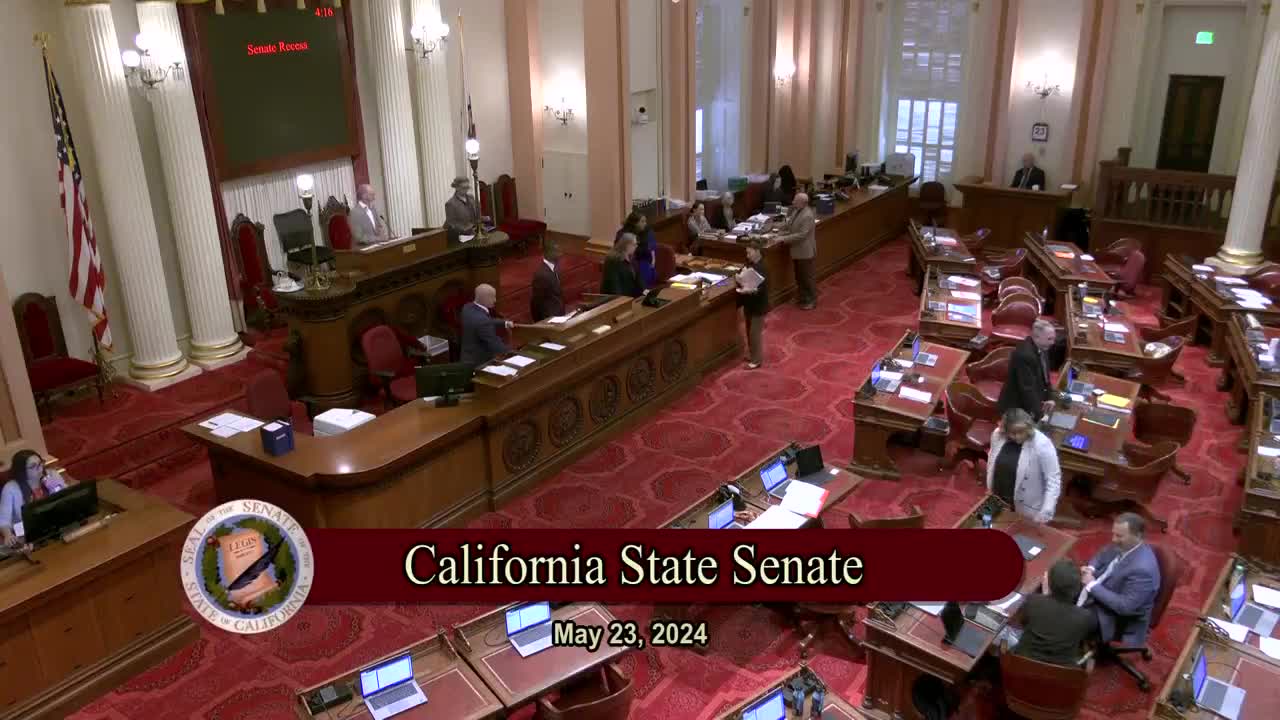 7MIN
Senate Floor
 35MIN
Senate Standing Committee on Banking and Financial Institutions

Bill Co-Author(s):