SB 1080: Pupil nutrition: school meals: halal and kosher food options.
- Session Year: 2023-2024
- House: Senate
- Latest Version Date: 2024-03-14
Current Status:
Failed
(2024-05-16: May 16 hearing: Held in committee and under submission.)
Introduced
In Committee
First Chamber
In Committee
Second Chamber
Enacted
What does this bill do?
Beginning in the 2025–26 school year, school districts, county offices of education, and charter schools must offer a halal or kosher breakfast or lunch option at any schoolsite where at least 5% of students prefer that option; schools may survey students to determine preference and may offer these options even if the 5% threshold is not met. The bill covers both nutritionally adequate breakfast and lunch. It defines halal as food prepared according to Islamic law and kosher as food prepared according to Jewish dietary laws.
The summary is provided by generative AI which can make mistakes. For original language, please view the details in the table below.
Existing law requires each school district, county superintendent of schools, and charter school to make available a nutritionally adequate breakfast, as defined, and a nutritionally adequate lunch, as defined, free of charge during each schoolday, as defined, to any pupil who requests a meal, without consideration of the pupils eligibility for a federally funded free or reduced-price meal, as provided.
This bill would state the intent of the Legislature to enact subsequent legislation relating to school lunch.This bill, commencing with the 202526 school year, if 5% or more of pupils at a schoolsite of a school district, county superintendent of schools, or charter school prefer a halal or kosher food option for a nutritionally adequate breakfast and a nutritionally adequate lunch, would require the schoolsite to offer a halal or kosher food option, respectively. The bill would authorize a schoolsite to collect information from pupils to determine if this condition is met. The bill would authorize a schoolsite to offer halal and kosher food options even if this condition is not met. By imposing new duties on a schoolsite of a school district, county superintendent of schools, or charter school, the bill would constitute a state-mandated local program.
The California Constitution requires the state to reimburse local agencies and school districts for certain costs mandated by the state. Statutory provisions establish procedures for making that reimbursement.
This bill would provide that, if the Commission on State Mandates determines that the bill contains costs mandated by the state, reimbursement for those costs shall be made pursuant to the statutory provisions noted above.
Existing law requires each school district, county superintendent of schools, and charter school to make available a nutritionally adequate breakfast, as defined, and a nutritionally adequate lunch, as defined, free of charge during each schoolday, as defined, to any pupil who requests a meal, without consideration of the pupils eligibility for a federally funded free or reduced-price meal, as provided.
This bill would state the intent of the Legislature to enact subsequent legislation relating to school lunch.
This act shall be known, and may be cited, as the Halal and Kosher School Meals Act.
SEC. 2.Section 49501.5 of the Education Code is amended to read:49501.5.(a)Notwithstanding any other provision of this chapter, commencing with the 202223 school year year, all of the following shall apply:
(1)(A)(i)A school district, county superintendent of schools, or charter school maintaining kindergarten or any of grades 1 to 12, inclusive, shall make available a nutritionally adequate breakfast and a nutritionally adequate lunch free of charge and with adequate time to eat, as determined by that school district, county superintendent of schools, or charter school in consideration of the recommendations provided by the department pursuant to subdivision (e), during each schoolday to any pupil who requests a meal without consideration of the pupils eligibility for a federally funded free or reduced-price meal, except as described in clauses (i) and (ii) of subparagraph (B), with a maximum of one free breakfast meal and one free lunch meal, except for family daycare homes that shall be reimbursed for 75 percent of the meals served. The meals made available under this paragraph shall be nutritionally adequate meals that qualify for federal reimbursement. Participating school districts, county superintendents of schools, and charter schools shall comply with federal regulations for the National School Lunch Program and School Breakfast Program, which includes established mealtimes.
(ii)Commencing with the 202526 school year, if 5 percent or more of pupils at a schoolsite of a school district, county superintendent of schools, or charter school maintaining kindergarten or any of grades 1 to 12, inclusive, prefer a halal or kosher food option for a nutritionally adequate breakfast and a nutritionally adequate lunch, the schoolsite shall offer a halal or kosher food option, respectively. A schoolsite may collect information from pupils to determine whether this condition is met. A schoolsite may offer halal and kosher food options even if this condition is not met.
(B)(i)The department shall submit a waiver request to the United States Department of Agriculture to allow for one meal provided during a schoolday lasting four hours or less to be served in a noncongregate manner.
(ii)If the department receives approval for the federal noncongregate waiver required by clause (i), school districts, county superintendents of schools, and charter schools may make available either a nutritionally adequate breakfast or a nutritionally adequate lunch in a noncongregate manner for meal service combinations resulting in either (I) a congregate nutritionally adequate breakfast and a noncongregate nutritionally adequate lunch or (II) a noncongregate nutritionally adequate breakfast and a congregate nutritionally adequate lunch. These meals shall be reimbursed under the provisions of paragraph (2) if both state and federal requirements are met.
(2)The department shall provide state meal reimbursement to school districts, county offices of education, and charter schools that participate in, and meet the requirements of, the federal School Breakfast Program and National School Lunch Program, and any applicable state laws and regulations. State meal reimbursement shall be provided for reduced-price and paid meals served to pupils, as described in subdivision (b).
(b)The amount of per-meal reimbursements provided under this section shall not exceed the difference between the sum of the amounts calculated from meals claimed based on the free combined breakfast and lunch reimbursement rates established by the United States Department of Agriculture and state meal contribution established in Section 49559, and the combined federal and state amounts reimbursed for reduced-price and paid meals claimed.
(c)The reimbursement required pursuant to this section shall be provided upon appropriation by the Legislature. This section shall not be operative until only be implemented during periods for which the Legislature has appropriated funds for purposes of this section.
(d)(1)The department may adopt, and as necessary revise, guidelines in accordance with this section at a publicly noticed meeting if the department complies with all of the following:
(A)Provides an opportunity for public comment at the meeting.
(B)Provides written public notice of a meeting at least 30 days before the meeting at which the guideline to be adopted will be considered or approved.
(C)For a substantive revision of the guidelines, the department provides written notice of a meeting at least 15 days before the meeting at which the revision will be considered or approved.
(2)The adoption or revision of guidelines pursuant to this subdivision is exempt from Chapter 3.5 (commencing with Section 11340) of Part 1 of Division 3 of Title 2 of the Government Code until July 1, 2023.
(e)The department shall review available evidence-based research, studies, and survey findings with school food authorities and school food workers, or their representatives, to make a recommendation for the amount of time that is adequate for a pupil to eat a school meal, including, but not limited to, the steps necessary to ensure that a pupil has adequate time to eat school meals that are served pursuant to this section and examining the role that breakfast in the classroom and other innovative breakfast models can play in supporting adequate time to eat. These recommendations shall be made public on the departments internet website on or before June 30, 2025.
(f)Notwithstanding subdivision (a), a school district, county office of education, or charter school that offers independent study, pursuant to Article 5.5 (commencing with Section 51744) of Chapter 5 of Part 28, shall meet the requirements of this section for any pupil on any schoolday that the pupil is scheduled for educational activities, as defined in Section 49010, lasting two or more hours, at a schoolsite, resource center, meeting space, or other satellite facility. Pupils who are present during established meal times shall have a nutritionally adequate breakfast and nutritionally adequate lunch made available.
(g)The chartering authority shall, upon request by a charter school and to the extent feasible within existing resources, provide technical assistance to the charter school in implementing this section.
(h)A charter school may enter into a partnership with an existing school food authority for the purposes of implementing this section.
(i)The chartering authority shall, upon request by a new charter school, contract with a charter school to make available a nutritionally adequate school breakfast and a nutritionally adequate school lunch until the charter school is an approved school food authority or until July 1 of the school year after the charter school becomes operational, whichever occurs first. The contract shall not exceed the actual costs to provide meals to the charter school, including, but not limited to, additional staffing costs and delivery of meals to the schoolsite, that are not covered by federal or state meal reimbursement.
(j)To comply with subdivision (a), a school district, county office of education, or charter school may use funds made available through any federal or state program the purpose of which includes the provision of meals to a pupil, including the federal School Breakfast Program, the federal National School Lunch Program, the federal Summer Food Service Program, the federal Seamless Summer Option, or the state meal program, or may do so at the expense of the school district, county office of education, or charter school.
(k)For purposes of this section, the following definitions apply:
(1)Halal means food that is prepared in accordance with Islamic law.
(2)Kosher has the same meaning as defined in Section 383b of the Penal Code.
(1)(3)Nutritionally adequate breakfast is one that qualifies for reimbursement under the most current meal pattern for the federal School Breakfast Program, as defined in Section 220.8 of Title 7 of the Code of Federal Regulations.
(2)(4)Nutritionally adequate lunch is one that qualifies for reimbursement under the most current meal pattern for the federal National School Lunch Program, as defined in Section 210.10 of Title 7 of the Code of Federal Regulations.
(3)(5)Schoolday means any day that pupils in kindergarten or any of grades 1 to 12, inclusive, are present at a schoolsite or school facility for purposes of instruction or educational activities, as defined in Section 49010, including, but not limited to, pupil attendance at minimum days, state-funded preschool, transitional kindergarten, summer school including incoming kindergarten pupils, extended school year days, school-sponsored field trips, independent study when a pupil is onsite during the schoolday, and Saturday school sessions.
SEC. 3.If the Commission on State Mandates determines that this act contains costs mandated by the state, reimbursement to local agencies and school districts for those costs shall be made pursuant to Part 7 (commencing with Section 17500) of Division 4 of Title 2 of the Government Code.
SECTION 1.It is the intent of the Legislature to enact subsequent legislation relating to school lunch.It is the intent of the Legislature to enact subsequent legislation relating to school lunch.
|
Date
|
Status
|
|---|---|
| May 16, 2024 | May 16 hearing: Held in committee and under submission. |
| May 10, 2024 | Set for hearing May 16. |
| Apr 29, 2024 | April 29 hearing: Placed on APPR suspense file. |
| Apr 22, 2024 | Set for hearing April 29. |
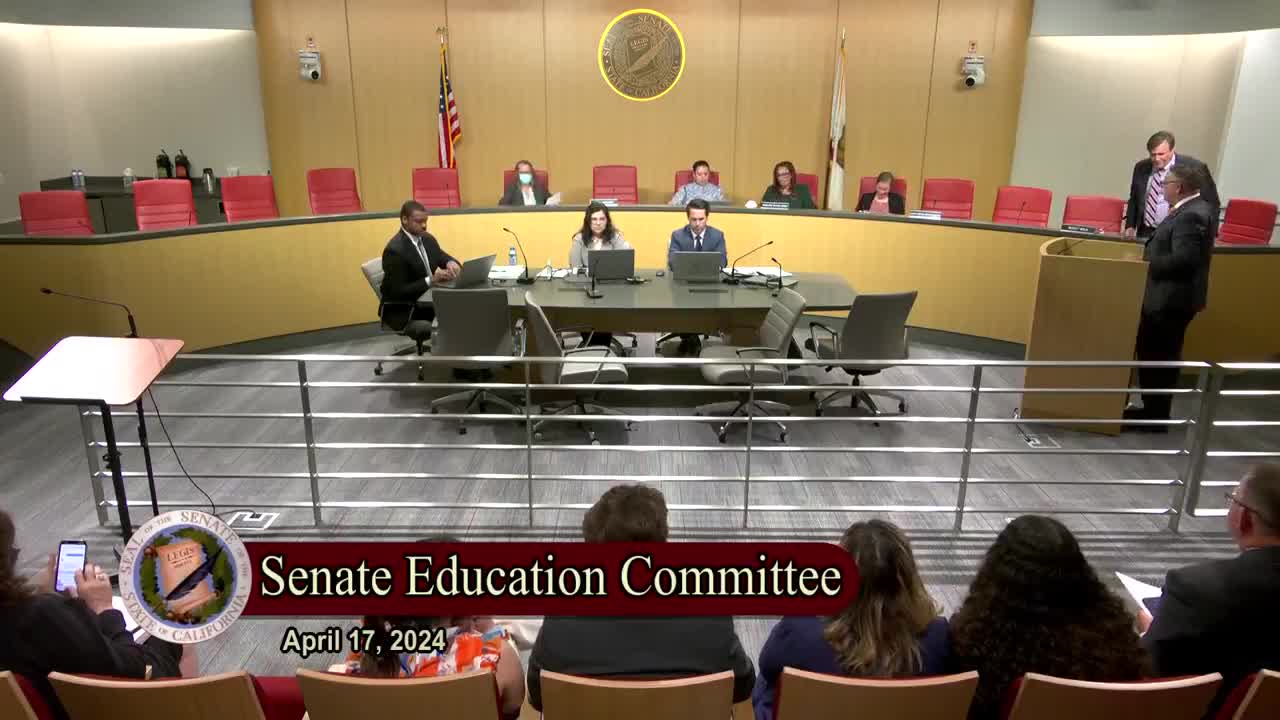
| Apr 17, 2024 | From committee: Do pass and re-refer to Com. on APPR. (Ayes 7. Noes 0. Page 3659.) (April 17). Re-referred to Com. on APPR. |
| Apr 4, 2024 | Set for hearing April 17. |
| Apr 3, 2024 | Re-referred to Com. on ED. |
| Mar 14, 2024 | From committee with author's amendments. Read second time and amended. Re-referred to Com. on RLS. |
| Feb 21, 2024 | Referred to Com. on RLS. |
| Feb 13, 2024 | From printer. May be acted upon on or after March 14. |
| Feb 12, 2024 | Introduced. Read first time. To Com. on RLS. for assignment. To print. |
|
Date
|
Description
|
Location
|
Votes
|
|
|---|---|---|---|---|
| Apr 29, 2024 | Placed on suspense file | Senate Standing Committee on Appropriations |
Passed |
|
| Apr 17, 2024 | Do pass, but first be re-referred to the Committee on [Appropriations] | Senate Standing Committee on Education |
Passed |
This list shows positions taken on this bill by organizations on the date displayed, which is linked to the original source.
Positions by individuals are not included.
|
Organization
|
Position
|
Date
|
|---|---|---|
| Afghan Student Association | * Support | Apr 17, 2024 |
| California Association Of Food Banks | * Support | Apr 17, 2024 |
| Council on American-Islamic Relations, California | ** Support | |
| Lashon Academy | ** Support | |
| Los Angeles County Office Of Education | * Support | Apr 17, 2024 |
| Sacramento Board of Rabbis | * Support | Apr 17, 2024 |
SENATE COMMITTEE ON
Senator Anna Caballero, Chair
2023 - 2024 Regular Session
SB 1080 (Newman) - Pupil nutrition: school meals: halal and kosher food options
Version: | Policy Vote: |
Urgency: | Mandate: |
Hearing Date: | Consultant: |
Bill Summary:
This bill requires schools to provide a nutritionally adequate breakfast and lunch kosher or halal school meal if 5 percent or more of students request a halal or kosher school meal option.
Fiscal Impact:
The California Department of Education (CDE) estimates Proposition 98 General Fund costs of approximately $29.1 million each year for additional state meal reimbursements provided for Halal and kosher meals as part of the state’s school nutrition programs.
Background:
Existing law requires a school district or county superintendent of schools maintaining kindergarten or any of grades 1 to 12, inclusive, to provide two school meals free of charge during each schoolday to any pupil who requests a meal, without consideration of the pupil’s eligibility for a federally funded free or reduced-price meal, with a maximum of one free meal for each meal service period, except when it requires family daycare homes to be reimbursed for 75% of the meals served. The law requires the meals to be nutritiously adequate meals that qualify for federal reimbursement;
Existing law requires charter schools to provide two school meals free of charge during each schoolday to any pupil who requests a meal, without consideration of the pupil’s eligibility for a federally funded free or reduced-price meal, with a maximum of one free meal for each meal service period. The law requires the meals to be nutritiously adequate meals that qualify for federal reimbursement.
Existing law provides that a local educational agency (LEA) that has a reimbursable school breakfast program to not charge any pupil enrolled in transitional kindergarten, kindergarten, or any of grades 1 to 12, inclusive, any amount for any breakfast served to that pupil through the program, and to provide a breakfast free of charge to any pupil who requests one, without consideration of the pupil’s eligibility for a federally funded free or reduced-price meal. It requires the meals provided free of charge to be nutritiously adequate, and to count toward the total of two school meals required to be provided each schoolday.
The California Department of Education (CDE) Nutrition Services Division administers many of the USDA meal programs at the state level, including the National School Lunch Program (NSLP) which is a federally assisted meal program operating in public and nonprofit private schools and residential childcare institutions. It provides nutritionally balanced, low-cost, or free lunches to children each school day. The programs also include the School Breakfast Program (SBP) which provides reimbursement to states to operate nonprofit breakfast programs in schools and residential childcare institutions, and the Child and Adult Care Food Program (CACFP) which is a federal program that provides reimbursements for nutritious meals and snacks to eligible children and adults who are enrolled for care at participating childcare centers, daycare homes, and adult daycare centers. The CACFP also provides reimbursements for meals served to children and youth participating in afterschool programs, children residing in emergency shelters, and adults over the age of 60, or living with a disability and enrolled in daycare facilities.
Proposed Law:
This bill requires a schoolsite of an LEA, county superintendent of schools, or charter school to provide a nutritionally adequate breakfast and lunch kosher or halal school meal if 5 percent or more of pupils request a halal or kosher school meal option. However, the bill does not prohibit schoolsites from providing a halal or kosher school meal option if the 5 percent threshold is not met.
Related Legislation:
AB 558 (Nazarian, Chapter 905, Statutes of 2022) requires the CDE to develop guidance for LEAs that maintain kindergarten or any of grades 1 to 6, inclusive, on how to serve eligible nonschoolaged children breakfast or a morning snack at an LEA schoolsite.
AB 130 (Committee on Budget, Chapter 44, Statutes of 2021) establishes a California Universal Meals Program with changes to the state meal mandate and new requirements for high poverty schools to apply for a federal provision.
Staff Comments:
School meal reimbursement varies each year at both the federal and state levels. In order to receive reimbursement, schools must follow a certain meal pattern determined by the USDA. Depending on the age range of the students served, a full meal consists of a specified amount of fruits, vegetables, grains, meat/meat alternative, and milk. Most schools participate in “offer versus serve” which allows a student to pick three of the aforementioned five components in order for the school to receive full reimbursement for that student’s meal.
By requiring schools to provide kosher or halal school meal options, the CDE estimates Proposition 98 General Fund costs of approximately $29.1 million each year, with $8.1 million for the School Breakfast Program and $21.0 million for the School Lunch Program. This estimate assumes a 15 percent increase above the current per meal reimbursement amount to account for the higher cost to provide these meal options.
-- END --
SENATE COMMITTEE ON EDUCATION
Senator Josh Newman, Chair
2023 - 2024 Regular
Bill No: SB 1080 Hearing Date: April 17, 2024
Author: | |||
Version: | March 14, 2024 | ||
Urgency: | No | Fiscal: | Yes |
Consultant: | Kordell Hampton | ||
Subject: Pupil nutrition: school meals: halal and kosher food options.
SUMMARY
This bill requires a schoolsite of an local educational agency (LEA), county superintendent of schools, or charter school to provide a nutritionally adequate breakfast and lunch kosher or halal school meal if 5% or more of pupils request a halal or kosher school meal option, but does not prohibit schoolsites of an LEA, county superintendent of schools, or charter school from providing a halal or kosher school meal option if the 5% threshold is not met.
BACKGROUND
Existing Law:
Education Code (EC)
- Requires every public school to post the school district’s nutrition and physical activity policies, in public view within all school cafeterias or other central eating areas. (EC § 49432)
- Requires, commencing with the 2022–23 school year all of the following:
- A school district or county superintendent of schools maintaining kindergarten or any of grades 1 to 12, inclusive, to provide two school meals free of charge during each schoolday to any pupil who requests a meal, without consideration of the pupil’s eligibility for a federally funded free or reduced-price meal, with a maximum of one free meal for each meal service period, except when it requires family daycare homes to be reimbursed for 75% of the meals served. Requires the meals provided to be nutritiously adequate meals that qualify for federal reimbursement;
- A charter school to provide two school meals free of charge during each schoolday to any pupil who requests a meal, without consideration of the pupil’s eligibility for a federally funded free or reduced-price meal, with a maximum of one free meal for each meal service period. Requires the meals to be nutritiously adequate meals that qualify for federal reimbursement; and
- An LEA that has a reimbursable school breakfast program to not charge any pupil enrolled in transitional kindergarten, kindergarten, or any of grades 1 to 12, inclusive, any amount for any breakfast served to that pupil through the program, and to provide a breakfast free of charge to any pupil who requests one, without consideration of the pupil’s eligibility for a federally funded free or reduced-price meal. Requires the meals provided free of charge to be nutritiously adequate, and to count toward the total of two school meals required to be provided each schoolday. (EC § 49501.5)
Penal Code (PEN)
- A person selling or falsely exposing meat or meat preparations as halal, whether raw or prepared for human consumption, is guilty of a misdemeanor. This includes falsely claiming that the food product or its contents are halal or that both halal and nonhalal meat are sold in the same place of business. The person must also display a sign stating "halal meat" or "nonhalal meat" on their display window signs. Selling or exposing food preparations falsely as halal or prepared by Islamic religious requirements in a restaurant or other place is punishable by a fine of $100 or more or imprisonment in a county jail of 30 days or more. (PEN § 383c)
- A person selling or falsely exposing meat or meat preparations as kosher, whether raw or prepared for human consumption, is guilty of a misdemeanor. They must display a sign stating "kosher and nonkosher meats sold here" on their window signs in all display advertising. They must also display a sign saying "kosher meat" or "nonkosher meat" on each type of meat or food preparation. Selling or exposing kosher and nonkosher food or preparations in a restaurant or other place where food products are sold for consumption on the premises is also a misdemeanor. Penalties include a fine of $100 or $600, imprisonment in the county jail of 30 days or 90 days, or both. (PEN § 383b)
ANALYSIS
This bill requires a schoolsite of an LEA, county superintendent of schools, or charter school to provide a nutritionally adequate breakfast and lunch kosher or halal school meal if 5% or more of pupils request a halal or kosher school meal option, but does not prohibit schoolsites of an LEA, county superintendent of schools, or charter school from providing a halal or kosher school meal option if the 5% threshold is not met.
STAFF COMMENTS
- Need for the bill. According to the author, “By requiring California schools to offer halal and kosher meal options consistent with Muslim and Jewish cultural practices, SB 1080 will reduce stigma, promote cultural understanding and appreciation among students, build a more tolerant environment, and break down stereotypes and prejudices. SB 1080, which would be the first state-wide culturally appropriate school nutrition program of its kind in the nation, will also help promote engagement and participation between schools and families from religious minority backgrounds by encouraging them to communicate regarding their dietary needs on a proactive, inclusive basis.”
“In light of the recent, alarming increase of Islamophobia and anti-Semitism, California has an opportunity to once again exert national leadership, this time by further advancing the integration of members of these communities within our public school system. Offering halal and kosher meals to schools that meet the bill’s threshold will allow all students, regardless of religious persuasion or dietary restrictions, to participate in school meals; to more fully engage in school life; and to feel valued and included in their community.”
- Meals Service Options: USDA Meal Programs or Competitive Food. The California Department of Education (CDE) Nutrition Services Division administers many of the USDA meal programs at the state level:
- The National School Lunch Program (NSLP). The NSLP is a federally assisted meal program operating in public and nonprofit private schools and residential childcare institutions. It provides nutritionally balanced, low-cost, or free lunches to children each school day.
- The School Breakfast Program (SBP). The SBP provides reimbursement to states to operate nonprofit breakfast programs in schools and residential childcare institutions. The Food and Nutrition Service of the USDA administers the SBP at the federal level.
- The Child and Adult Care Food Program (CACFP). The CACFP is a federal program that provides reimbursements for nutritious meals and snacks to eligible children and adults who are enrolled for care at participating childcare centers, daycare homes, and adult daycare centers. The CACFP also provides reimbursements for meals served to children and youth participating in afterschool programs, children residing in emergency shelters, and adults over the age of 60, or living with a disability and enrolled in daycare facilities.
- The Summer Food Service Program (SFSP). The SFSP is a federally-funded, state-administered program. The SFSP reimburses program operators who serve free healthy meals and snacks to children and teens in low-income areas.
- The Seamless Summer Option (SSO). Schools participating in the NSLP or SBP are eligible to apply for the SSO. This option allows public schools to combine features of the School Nutrition Programs and the SFSP along with reduced paperwork requirements, making it easier for schools to feed children during the traditional summer vacation periods and, for year-round schools, long school vacation periods.
Separate from school meal provisions, competitive food and beverage requirements in California began in 1976 with rules that govern food and beverage sales by student organizations. Since 2001, due to awareness of the obesity epidemic, there have been numerous state laws passed which currently shape the competitive food environment in California schools for all foods and beverages sold to students outside the meal program. In July 2014, schools implemented the USDA competitive food regulations, called Smart Snacks in School (SSIS). In 2016, California passed Senate Bill 1169 (McGuire, chapter 280, Statutes of 2016) which streamlines state competitive food rules with the federal SSIS. Today’s rules encompass a comprehensive approach to food and beverage sales by all groups or individuals, during the school day, throughout the school campus.
USDA Explored Halal and Kosher School Meal Options in 2023.
On May 30, 2023, the USDA Agricultural Marketing Service (AMS) conducted research to expand its Kosher and Halal food options in USDA nutrition assistance programs. Companies that manufacture Kosher or Halal-certified food products and wish to sell them to the USDA for use in nutrition assistance programs, such as The Emergency Food Assistance Program (TEFAP) and the NSLP, were invited to respond to the USDA's request for information (RFI). The purpose of the RFI is to enable AMS to gain a thorough understanding of the companies' capabilities and limitations when it comes to supplying these food products. School nutrition operators looking for resources on serving kosher and halal meals to students can contact the advocacy organizations listed on TEFAP’s website.
While USDA has explored options to better support schools in providing Halal and Kosher meals to students, currently, Halal and Kosher meals are not included in USDA’s meal services options for schools which means there are not clear guidance or standards.
- School Meal Reimbursement Rates. School meal reimbursement, by both the federal government and the state, varies each year. In order to receive reimbursement, schools must follow a certain meal pattern determined by the USDA. Depending on the age range of the students served, a full meal consists of a specified amount of fruits, vegetables, grains, meat/meat alternative, and milk. Most schools throughout the state participate in “offer versus serve,” which allows a student to pick three of the aforementioned five components in order for the school to receive full reimbursement for that student’s meal.
The federal school breakfast rates are $2.28 for free breakfast and $1.98 for reduced breakfast.
Source: CDE, 2023-24 |
The federal school lunch reimbursement rates are $4.33 for free lunch and $3.93 for reduced priced lunch. Schools that serve more than 60% low income students receive $0.02 more for both free and reduced priced lunches, as shown in the chart below.
Source: CDE, 2023-24 |
- Kosher and Halal Diets and Certified Foods. Certain criteria determine if any specific animal could be permitted as food for someone who keeps kosher. Among land animals, they must both chew their cud and have a cleft hoof to be kosher, for example, cows or venison. Pork, camel, and rabbit are non-kosher animals. Among water-living animals, only true fish having both fins and scales are permitted. Hence, salmon, tuna, flounder, cod, for example, are kosher, while all shellfish, dolphin, whale, eels, and any fish that do not have both fins and scales are not kosher. In a broad general rule, non-birds-of prey are kosher; chicken, duck, and goose are all kosher animals.
According to the USDA’s website; individuals following a kosher diet must only eat meat with kosher certification for beef, poultry, fish, and other animal meats. Unless experts in kosher food requirements are authorized, kosher certification is also mandatory on any processed and packaged product. Kosher products will never contain both meat and dairy ingredients. Pork and shellfish products are not permissible in a kosher diet. Some USDA Foods are certified kosher by an established certifying authority, meaning the product has been processed in a facility that maintains the integrity of the kosher certification. These items are identified on the list of foods available by TEFAP with a "(K)" next to the item name.
Halal diets follow certain dietary restrictions prohibiting the consumption of pork products, alcohol, products containing alcohol, and products made with non-halal animal-derived ingredients. For instance, some cheese products may contain an ingredient called rennet, derived from animals and unsuitable for halal-observant communities. It is not sufficient that the ingredients are halal, but one should eliminate the possibility of cross contamination when processing or serving food. Food cannot be fried in the same oil as non-halal ingredients, and serving spoons should be separate. It is preferable to serve halal food away from non-halal items to minimize spillage leading to cross contamination.
Some USDA Foods are certified halal, which means that they are acceptable and have been processed in a facility that maintains the integrity of the halal certification. These items can be identified on the TEFAP foods available list with an "(H)" next to its name.
The committee may wish to consider if LEAs are equipped with the proper facilities to serve halal and kosher meals that are aligned with the standards and practices to provide such meals. Further, the ability of a school district to procure such food from vendors on a consistent basis given the volume of which some district would be ordering should be considered.
- Related Legislation.
AB 558 (Nazarian, Chapter 905, Statutes of 2022) requires, by July 1, 2023, the CDE, in consultation with the State Department of Social Services, to develop guidance for LEAs that maintain kindergarten or any of grades 1 to 6, inclusive, on how to serve eligible nonschoolaged children breakfast or a morning snack at an LEA schoolsite.
AB 130 (Committee on Budget, Chapter 44, Statutes of 2021) establishes a California Universal Meals Program with changes to the state meal mandate and new requirements for high poverty schools to apply for a federal provision.
SB 1138 (Skinner, Chapter 512, Statutes of 2018) requires state prisons and hospitals to serve plant-based meals.
ACR 279 (Kalra, Chapter 213, Statutes of 2018) encourages Californians to include more healthy plant-based foods in their diet.
ACR 16 (Nation, Chapter 62, Statutes of 2003) urged CDE and the Department of Public Health to develop school lunch menu plans that include a daily vegan lunch option that is nutritionally balanced.
SUPPORT
California Association of Food Banks
Council on American-Islamic Relations, California
Lashon Academy
OPPOSITION
None received
-- END --
Bill Author

Bill Co-Author(s):