SB 1094: Pupil instruction: course of study: social sciences: civic engagement.
- Session Year: 2023-2024
- House: Senate
- Latest Version Date: 2024-06-17
Current Status:
Failed
(2024-08-15: August 15 hearing: Held in committee and under submission.)
Introduced
In Committee
First Chamber
In Committee
Second Chamber
Enacted
Existing law requires the adopted course of study for grades 1 to 6, inclusive, and the adopted course of study for grades 7 to 12, inclusive, to include certain areas of study, including, among others, social sciences. Existing law requires instruction in social sciences to provide a foundation for understanding, among other things, the history, resources, development, and government of California and the United States of America.
This bill, with respect to both of the above-referenced adopted courses of study, would explicitly require instruction in social sciences to also include civic engagement experiences with governmental institutions and instruction in principles of democracy and the State and Federal Constitutions. The bill would also require pupils, at least once while in either grade 1, 2, 3, 4, 5, or 6, and at least once while in either grade 7 or 8, to complete one civic engagement or experience with a governmental institution at the local, state, or national level, as provided. To the extent that this bill would create new duties for local educational agencies or local officials, it would constitute a state-mandated local program.
The California Constitution requires the state to reimburse local agencies and school districts for certain costs mandated by the state. Statutory provisions establish procedures for making that reimbursement.
This bill would provide that, if the Commission on State Mandates determines that the bill contains costs mandated by the state, reimbursement for those costs shall be made pursuant to the statutory provisions noted above.
Existing law requires the adopted course of study for grades 1 to 6, inclusive, and the adopted course of study for grades 7 to 12, inclusive, to include certain areas of study, including, among others, social sciences. Existing law requires instruction in social sciences to provide a foundation for understanding, among other things, the history, resources, development, and government of California and the United States of America.
This bill, with respect to both of the above-referenced adopted courses of study, would explicitly require instruction in social sciences to also include principles of democracy and the State and Federal Constitutions. The bill would also require pupils, at least once while in either grade 1, 2, 3, 4, 5, or 6, and at least once while in either grade 7 or 8, to complete one civic engagement or experience with a governmental institution at the local, state, or national level, as provided. To the extent that this bill would create new duties for local educational agencies or local officials, it would constitute a state-mandated local program.
The California Constitution requires the state to reimburse local agencies and school districts for certain costs mandated by the state. Statutory provisions establish procedures for making that reimbursement.
This bill would provide that, if the Commission on State Mandates determines that the bill contains costs mandated by the state, reimbursement for those costs shall be made pursuant to the statutory provisions noted above.
(a)The Legislature finds and declares that all students, regardless of their background, must have a comprehensive understanding of democratic institutions in order to become active participants in their communities and their government.
(b)It is the intent of the Legislature to create pathways for pupils in elementary and secondary schools to become civically engaged in democratic governmental institutions at the local, state, and national levels, and to provide civic learning resources and support for teachers to implement programming that will create these pathways.
(c)It is the intent of the Legislature that social science instruction in elementary and secondary schools should focus on the pupils understanding of the foundations of the democratic system in the United States of America, the roles of the three branches of government, and the State and Federal Constitutions, and include engagement with government agencies and policymakers at the local, state, and federal levels.
SEC. 2.Section 51210 of the Education Code is amended to read:51210.(a)The adopted course of study for grades 1 to 6, inclusive, shall include instruction, beginning in grade 1 and continuing through grade 6, in the following areas of study:
(1)English, including knowledge of, and appreciation for, literature and the language, as well as the skills of speaking, reading, listening, spelling, handwriting, including instruction in cursive or joined italics in the appropriate grade levels, and composition.
(2)Mathematics, including concepts, operational skills, and problem solving.
(3)(A)Social sciences, drawing upon the disciplines of anthropology, economics, geography, history, political science, psychology, and sociology, including civic engagement experiences with governmental institutions, that are designed to fit the maturity of the pupils. Instruction shall provide a foundation for understanding the history, resources, development, and government of California and the United States of America, including principles of democracy and the State and Federal Constitutions; the development of the American economic system, including the role of the entrepreneur and labor; the relations of persons to their human and natural environment; eastern and western cultures and civilizations; contemporary issues; and the wise use of natural resources.
(B)In addition to the instruction received pursuant to subparagraph (A), a pupil shall complete a civic engagement or experience with a governmental institution at the local, state, or national level at least once while in either grade 1, 2, 3, 4, 5, or 6, as determined by the governing board.(4)Science, including the biological and physical aspects, with emphasis on the processes of experimental inquiry, on the place of humans in ecological systems, on the causes and effects of climate change, and on the methods to mitigate and adapt to climate change. Appropriate coursework including material on the causes and effects of climate change and methods to mitigate and adapt to climate change shall be offered to pupils as soon as possible, commencing no later than the 202425 school year.
(5)Visual and performing arts, including instruction in the subjects of dance, music, theater, and visual arts, aimed at the development of aesthetic appreciation and the skills of creative expression.
(6)Health, including instruction in the principles and practices of individual, family, and community health.
(7)Physical education, with emphasis upon the physical activities for the pupils that may be conducive to health and vigor of body and mind, for a total period of time of not less than 200 minutes each 10 schooldays, excluding recesses and the lunch period.
(8)Other studies that the governing board may prescribe.
(b)(1)A complaint that a school district or county superintendent of schools has not complied with the instructional minute requirements of paragraph (7) of subdivision (a) may be filed with a school district or county superintendent of schools pursuant to the Uniform Complaint Procedures set forth in Chapter 5.1 (commencing with Section 4600) of Division 1 of Title 5 of the California Code of Regulations.
(2)A complainant not satisfied with the decision of a school district or county superintendent of schools may appeal the decision to the department pursuant to Chapter 5.1 (commencing with Section 4600) of Division 1 of Title 5 of the California Code of Regulations and shall receive a written appeal decision within 60 days of the departments receipt of the appeal.
(3)If a school district or county superintendent of schools finds merit in a complaint, or the Superintendent finds merit in an appeal, the school district or county superintendent of schools shall provide a remedy to all affected pupils, parents, and guardians.
(c)The Legislature finds and declares that neither the original provisions of this section, nor any subsequent amendments to it, were intended to create a private right of action. However, nothing in this subdivision shall restrict or expand the existing right of any party to seek relief from noncompliance with this section pursuant to a writ of mandate.
SEC. 3.Section 51220 of the Education Code is amended to read:51220.The adopted course of study for grades 7 to 12, inclusive, shall offer courses in the following areas of study:
(a)English, including knowledge of and appreciation for literature, language, and composition, and the skills of reading, listening, and speaking.
(b)(1)(A)Social sciences, drawing upon the disciplines of anthropology, economics, geography, history, political science, psychology, and sociology, including civic engagement experiences with governmental institutions that are supportive of pupils earning the State Seal of Civic Engagement, as authorized by Section 51471, that are designed to fit the maturity of the pupils. Instruction shall provide a foundation for understanding the history, resources, development, and government of California and the United States of America, including principles of democracy and the State and Federal Constitutions; instruction in our American legal system, the operation of the juvenile and adult criminal justice systems, and the rights and duties of citizens under the criminal and civil law and the State and Federal Constitutions; the development of the American economic system, including the role of the entrepreneur and labor; the relations of persons to their human and natural environment; eastern and western cultures and civilizations; human rights issues, with particular attention to the study of the inhumanity of genocide, slavery, and the Holocaust; and contemporary issues.
(B)In addition to the instruction received pursuant to subparagraph (A), a pupil shall complete a civic engagement or experience with a governmental institution at the local, state, or national level at least once while in either grade 7 or 8, as determined by the governing board.(2)For purposes of this subdivision, genocide may include the Armenian Genocide. The Armenian Genocide means the torture, starvation, and murder of 1,500,000 Armenians, which included death marches into the Syrian desert, by the rulers of the Ottoman Turkish Empire and the exile of more than 500,000 innocent people during the period from 1915 to 1923, inclusive.
(c)World language or languages, beginning not later than grade 7, designed to develop a facility for understanding, speaking, reading, and writing the particular language.
(d)Physical education, with emphasis given to physical activities that are conducive to health and to vigor of body and mind, as required by Section 51222.
(e)Science, including the physical and biological aspects, with emphasis on basic concepts, theories, and processes of scientific investigation, on the place of humans in ecological systems, on the causes and effects of climate change, on the methods to mitigate and adapt to climate change, and with appropriate applications of the interrelation and interdependence of the sciences. Appropriate coursework including material on the causes and effects of climate change and methods to mitigate and adapt to climate change shall be offered to pupils as soon as possible, commencing no later than the 202425 school year.
(f)Mathematics, including instruction designed to develop mathematical understandings, operational skills, and insight into problem solving procedures.
(g)Visual and performing arts, including dance, music, theater, and visual arts, with emphasis upon development of aesthetic appreciation and the skills of creative expression.
(h)Applied arts, including instruction in the areas of consumer education, family and consumer sciences education, industrial arts, general business education, or general agriculture.
(i)Career technical education designed and conducted for the purpose of preparing youth for gainful employment in the occupations and in the numbers that are appropriate to the personnel needs of the state and the community served and relevant to the career desires and needs of the pupils.
(j)Automobile driver education, designed to develop a knowledge of the Vehicle Code and other laws of this state relating to the operation of motor vehicles, a proper acceptance of personal responsibility in traffic, a true appreciation of the causes, seriousness, and consequences of traffic accidents, and the knowledge and attitudes necessary for the safe operation of motor vehicles. A course in automobile driver education shall include education in the safe operation of motorcycles.
(k)Other studies that the governing board may prescribe.
SEC. 4.If the Commission on State Mandates determines that this act contains costs mandated by the state, reimbursement to local agencies and school districts for those costs shall be made pursuant to Part 7 (commencing with Section 17500) of Division 4 of Title 2 of the Government Code.
(a)The Legislature finds and declares that all students, regardless of their background, must have a comprehensive understanding of democratic institutions in order to become active participants in their communities and their government.
(b)It is the intent of the Legislature to create pathways for pupils in elementary and secondary schools to become civically engaged in democratic governmental institutions at the local, state, and national levels, and to provide civic learning resources and support for teachers to implement programming that will create these pathways.
SEC. 2.Section 51210 of the Education Code is amended to read:51210.(a)The adopted course of study for grades 1 to 6, inclusive, shall include instruction, beginning in grade 1 and continuing through grade 6, in the following areas of study:
(1)English, including knowledge of, and appreciation for, literature and the language, as well as the skills of speaking, reading, listening, spelling, handwriting, including instruction in cursive or joined italics in the appropriate grade levels, and composition.
(2)Mathematics, including concepts, operational skills, and problem solving.
(3)(A)Social sciences, drawing upon the disciplines of anthropology, economics, geography, history, political science, psychology, and sociology, designed to fit the maturity of the pupils. Instruction shall provide a foundation for understanding the history, resources, development, and government of California and the United States of America; America, including principles of democracy and the State and Federal Constitutions; the development of the American economic system, including the role of the entrepreneur and labor; the relations of persons to their human and natural environment; eastern and western cultures and civilizations; contemporary issues; and the wise use of natural resources.
(B)In addition to the instruction received pursuant to subparagraph (A), a pupil shall complete a civic engagement or experience with a governmental institution at the local, state, or national level at least once while in either grade 1, 2, 3, 4, 5, or 6, as determined by the governing board.
(4)Science, including the biological and physical aspects, with emphasis on the processes of experimental inquiry, on the place of humans in ecological systems, on the causes and effects of climate change, and on the methods to mitigate and adapt to climate change. Appropriate coursework including material on the causes and effects of climate change and methods to mitigate and adapt to climate change shall be offered to pupils as soon as possible, commencing no later than the 202425 school year.
(5)Visual and performing arts, including instruction in the subjects of dance, music, theater, and visual arts, aimed at the development of aesthetic appreciation and the skills of creative expression.
(6)Health, including instruction in the principles and practices of individual, family, and community health.
(7)Physical education, with emphasis upon the physical activities for the pupils that may be conducive to health and vigor of body and mind, for a total period of time of not less than 200 minutes each 10 schooldays, excluding recesses and the lunch period.
(8)Other studies that the governing board may prescribe.
(b)(1)A complaint that a school district or county superintendent of schools has not complied with the instructional minute requirements of paragraph (7) of subdivision (a) may be filed with a school district or county superintendent of schools pursuant to the Uniform Complaint Procedures set forth in Chapter 5.1 (commencing with Section 4600) of Division 1 of Title 5 of the California Code of Regulations.
(2)A complainant not satisfied with the decision of a school district or county superintendent of schools may appeal the decision to the department pursuant to Chapter 5.1 (commencing with Section 4600) of Division 1 of Title 5 of the California Code of Regulations and shall receive a written appeal decision within 60 days of the departments receipt of the appeal.
(3)If a school district or county superintendent of schools finds merit in a complaint, or the Superintendent finds merit in an appeal, the school district or county superintendent of schools shall provide a remedy to all affected pupils, parents, and guardians.
(c)The Legislature finds and declares that neither the original provisions of this section, nor any subsequent amendments to it, were intended to create a private right of action. However, nothing in this subdivision shall restrict or expand the existing right of any party to seek relief from noncompliance with this section pursuant to a writ of mandate.
SEC. 3.Section 51220 of the Education Code is amended to read:51220.The adopted course of study for grades 7 to 12, inclusive, shall offer courses in the following areas of study:
(a)English, including knowledge of and appreciation for literature, language, and composition, and the skills of reading, listening, and speaking.
(b)(1)(A)Social sciences, drawing upon the disciplines of anthropology, economics, geography, history, political science, psychology, and sociology, designed to fit the maturity of the pupils. Instruction shall provide a foundation for understanding the history, resources, development, and government of California and the United States of America; America, including principles of democracy and the State and Federal Constitutions; instruction in our American legal system, the operation of the juvenile and adult criminal justice systems, and the rights and duties of citizens under the criminal and civil law and the State and Federal Constitutions; the development of the American economic system, including the role of the entrepreneur and labor; the relations of persons to their human and natural environment; eastern and western cultures and civilizations; human rights issues, with particular attention to the study of the inhumanity of genocide, slavery, and the Holocaust; and contemporary issues.
(B)In addition to the instruction received pursuant to subparagraph (A), a pupil shall complete a civic engagement or experience with a governmental institution at the local, state, or national level at least once while in either grade 7 or 8, as determined by the governing board.
(2)For purposes of this subdivision, genocide may include the Armenian Genocide. The Armenian Genocide means the torture, starvation, and murder of 1,500,000 Armenians, which included death marches into the Syrian desert, by the rulers of the Ottoman Turkish Empire and the exile of more than 500,000 innocent people during the period from 1915 to 1923, inclusive.
(c)World language or languages, beginning not later than grade 7, designed to develop a facility for understanding, speaking, reading, and writing the particular language.
(d)Physical education, with emphasis given to physical activities that are conducive to health and to vigor of body and mind, as required by Section 51222.
(e)Science, including the physical and biological aspects, with emphasis on basic concepts, theories, and processes of scientific investigation, on the place of humans in ecological systems, on the causes and effects of climate change, on the methods to mitigate and adapt to climate change, and with appropriate applications of the interrelation and interdependence of the sciences. Appropriate coursework including material on the causes and effects of climate change and methods to mitigate and adapt to climate change shall be offered to pupils as soon as possible, commencing no later than the 202425 school year.
(f)Mathematics, including instruction designed to develop mathematical understandings, operational skills, and insight into problem solving procedures.
(g)Visual and performing arts, including dance, music, theater, and visual arts, with emphasis upon development of aesthetic appreciation and the skills of creative expression.
(h)Applied arts, including instruction in the areas of consumer education, family and consumer sciences education, industrial arts, general business education, or general agriculture.
(i)Career technical education designed and conducted for the purpose of preparing youth for gainful employment in the occupations and in the numbers that are appropriate to the personnel needs of the state and the community served and relevant to the career desires and needs of the pupils.
(j)Automobile driver education, designed to develop a knowledge of the Vehicle Code and other laws of this state relating to the operation of motor vehicles, a proper acceptance of personal responsibility in traffic, a true appreciation of the causes, seriousness, and consequences of traffic accidents, and the knowledge and attitudes necessary for the safe operation of motor vehicles. A course in automobile driver education shall include education in the safe operation of motorcycles.
(k)Other studies that the governing board may prescribe.
SEC. 4.If the Commission on State Mandates determines that this act contains costs mandated by the state, reimbursement to local agencies and school districts for those costs shall be made pursuant to Part 7 (commencing with Section 17500) of Division 4 of Title 2 of the Government Code.
|
Date
|
Status
|
|---|---|
| Aug 15, 2024 | August 15 hearing: Held in committee and under submission. |
| Jul 2, 2024 | July 2 set for first hearing. Placed on suspense file. |
| Jun 17, 2024 | Read second time and amended. Re-referred to Com. on APPR. |
| Jun 13, 2024 | From committee: Do pass as amended and re-refer to Com. on APPR. with recommendation: To consent calendar. (Ayes 7. Noes 0.) (June 12). |
| May 28, 2024 | Referred to Com. on ED. |
| May 22, 2024 | In Assembly. Read first time. Held at Desk. |
| May 21, 2024 | Read third time. Passed. (Ayes 34. Noes 4. Page 4085.) Ordered to the Assembly. |
| May 16, 2024 | From committee: Do pass. (Ayes 5. Noes 2. Page 3971.) (May 16). |
| May 16, 2024 | Read second time. Ordered to third reading. |
| May 10, 2024 | Set for hearing May 16. |
| Apr 22, 2024 | April 22 hearing: Placed on APPR suspense file. |
| Apr 12, 2024 | Set for hearing April 22. |
| Apr 10, 2024 | From committee: Do pass and re-refer to Com. on APPR. (Ayes 7. Noes 0. Page 3558.) (April 10). Re-referred to Com. on APPR. |
| Mar 28, 2024 | Set for hearing April 10. |
| Feb 21, 2024 | Referred to Com. on ED. |
| Feb 13, 2024 | From printer. May be acted upon on or after March 14. |
| Feb 12, 2024 | Introduced. Read first time. To Com. on RLS. for assignment. To print. |
|
Date
|
Description
|
Location
|
Votes
|
|
|---|---|---|---|---|
| Jun 12, 2024 | Do pass as amended, and be re-referred to the Committee on [Appropriations] with recommendation: To Consent Calendar | Assembly Standing Committee on Education |
Passed |
|
| May 21, 2024 | Senate 3rd Reading SB1094 Limón et al. | Senate Floor |
Passed |
|
| May 16, 2024 | Do pass | Senate Standing Committee on Appropriations |
Passed |
|
| Apr 22, 2024 | Placed on suspense file | Senate Standing Committee on Appropriations |
Passed |
|
| Apr 10, 2024 | Do pass, but first be re-referred to the Committee on [Appropriations] | Senate Standing Committee on Education |
Passed |
This list shows positions taken on this bill by organizations on the date displayed, which is linked to the original source.
Positions by individuals are not included.
|
Organization
|
Position
|
Date
|
|---|---|---|
| alameda county board of education | ** Support | |
| California Council For The Social Studies | ** Support | |
| City of Monterey Park | ** Support | |
| Generation Citizen | ** Support | |
| Generation Up | ** Support | |
| homeschool parent | * Support | Apr 10, 2024 |
| Icivics, INC | ** Support | |
| Los Angeles County Office Of Education | ** Support | |
| Roseville Joint Union High School District | * Support | Apr 10, 2024 |
| Sacramento County Board of Education | ** Support | |
| Sacramento County Office of Education | ** Support | |
| Sanger Unified School District | * Support | Apr 10, 2024 |
| Simi Valley Unified School District | ** Support | |
| Thinking Nation | ** Support | |
| Ventura County Office of Education | ** Support | |
| West Campus High School | * Support | Apr 10, 2024 |
| West Campus High School | * Support | Apr 10, 2024 |
| West Campus High School | * Support | Apr 10, 2024 |
Date of Hearing: July 2, 2024
ASSEMBLY COMMITTEE ON APPROPRIATIONS
Buffy Wicks, Chair
SBPCA Bill Id:SB 1094
Author:(Limón) – As Amended Ver:June 17, 2024
Policy Committee: | Education | Vote: | 7 - 0 |
|
| ||
|
|
Urgency: No State Mandated Local Program: Yes Reimbursable: Yes
SUMMARY:
This bill further defines the social sciences course of study for grades one through 12 to include civic engagement experiences with governmental institutions and instruction in principles of democracy and the State and Federal Constitutions.
Specifically, this bill, for grades one through six, requires a local educational agency (LEA) to provide instruction that includes (a) civic engagement experiences with governmental institutions and (b) principles of democracy and the State and Federal Constitutions.
For grades seven through twelve, this bill requires an LEA to offer (a) courses that include civic engagement experiences with governmental institutions that are supportive of pupils earning the State Seal of Civic Engagement and (b) courses that include principles of democracy and the State and Federal Constitutions.
FISCAL EFFECT:
- Likely minor ongoing Proposition 98 General Fund costs to LEAs to include content related to principles of democracy and the State and Federal Constitutions in social science instruction and courses. These requirements are unlikely to generate additional costs to LEAs since instruction in the principles of democracy are already included under the existing curriculum, according to the California Department of Education.
- Ongoing Proposition 98 General Fund costs, of an unknown amount, potentially in the hundreds of thousands of dollars annually, for LEAs to provide instruction and offer courses that include civic engagement experiences with governmental institutions. The bill does not define civic engagement or a civic engagement experience. Thus, LEAs could likely comply with the requirement in various ways that would vary in cost. For example, a more expensive option would be to require students to participate in an off-campus civic engagement experience while a less costly option would be to require students to write a letter of support for a bill to the Legislature. In any case, this requirement would result in administrative costs to LEAs to provide professional development in the new requirement and to otherwise implement and monitor participation. The state has about 10,000 schools serving grades one through 12. Assuming each school spent two hours of administrative staff time monitoring participation in civic engagement experiences to ensure compliance, at $30 per hour, costs would be $600,000.
If the Commission on State Mandates determines the bill’s requirements to be a reimbursable state mandate, the state would need to reimburse these costs to LEAs or provide funding through the K-12 Mandate Block Grant.
According to the Legislative Analyst’s Office, the General Fund faces a structural deficit in the tens of billions of dollars over the next several fiscal years.
COMMENTS:
- Purpose. According to the author:
SB 1094 furthers existing law by creating pathways for students in elementary and secondary schools to become civically engaged at the local, state, and national levels of government. Civic education provides students with critical thinking and collaboration skills and empowers students with knowledge to become active participants in their communities and government. It is imperative to introduce them early to civic education and systems of government to create clear pathways towards a lifetime of civic engagement.
- Background.
Course of Study. Current law defines for students in public school an “adopted course of study.” For grades one through six, schools are to deliver students a course of study that provides instruction in English, math, social sciences, science, and visual and performing arts, among others. For grades seven through 12, schools are to provide students a course of study that offers courses to students in the areas of English, math, social sciences, world languages, science, and visual and performing arts, among others.
Civic Engagement. Civic engagement is generally defined as activities related to be being a citizen or member of a community. According to the American Psychological Association, civic engagement is "individual and collective actions designed to identify and address issues of public concern. Civic engagement can take many forms, from individual voluntarism to organizational involvement to electoral participation.”
Current law provides high school students the opportunity to earn a State Seal of Civic Engagement high school diploma seal. The seal demonstrates a student’s outstanding commitment to their civic duty. To earn the seal, the student must complete various requirements, including demonstrating a competent understanding of the United States and California constitutions, participating in one or more informed civic engagement projects, and other requirements.
- Related Legislation. AB 1821 (Ramos) adds to the course of study for public school students information related to the Spanish colonization of California and Gold Rush period and the treatment of Native Americans, among other requirements. The bill is currently pending on the floor.
AB 1871 (Alanis) adds to the course of study for social sciences for students in grades seven to 12 instruction on personal financial literacy. The bill currently is in the Senate.
SB 1341 (Allen) adds “media arts” to the course of study for visual and performing arts in grades one through 12. The bill is pending in this committee.
Analysis Prepared by: Natasha Collins / APPR. / (916) 319-2081
Date of Hearing: June 12, 2024
ASSEMBLY COMMITTEE ON EDUCATION
Al Muratsuchi, Chair
SBPCA Bill Id:SB 1094
Author:(Limón) – As Introduced Ver:February 12, 2024
SENATE VOTE:
SUBJECT: Pupil instruction: course of study: social sciences: civic engagement
SUMMARY: Adds principles of democracy and the State and Federal Constitutions to the courses of study for grades 1 through 6 and 7 through 12, and requires students to complete a civic engagement or experience with a local, state, or national governmental institution at least once between grades 1 to 6 and again in either grade 7 or 8. Specifically, this bill:
- Adds principles of democracy and the State and Federal Constitutions to the courses of study for grades 1 through 6 and 7 through 12.
- Requires students to complete a civic engagement or experience with a governmental institution at the local, state, or national level at least once in grades 1 to 6 and again in either grade 7 or 8, as determined by the governing board of the local educational agency (LEA).
EXISTING LAW:
- Establishes the adopted course of study for grades 1 to 6, inclusive, to include instruction in social sciences, drawing upon anthropology, economics, geography, history, political science, psychology, and sociology, designed to fit the pupils’ maturity. (Education Code (EC) 51210)
- Establishes the adopted course of study for grades 7 to 12, inclusive, to include social sciences, drawing upon the disciplines of anthropology, economics, geography, history, political science, psychology, and sociology, designed to fit the maturity of the pupils. (EC 51220)
- Requires the Superintendent of Public Instruction (SPI), on or before January 1, 2020, to recommend to the State Board of Education (SBE) criteria for awarding a State Seal of Civic Engagement to students who have demonstrated excellence in civics education and participation and have demonstrated an understanding of the United States Constitution, the California Constitution, and the democratic system of government. (EC 51471)
- Requires the SPI, in developing criteria for the State Seal of Civic Engagement, to incorporate the Six Proven Practices for Effective Civic Learning, and to consult with a diverse group of credentialed, current, classroom teachers who teach the subject of history-social science, including government, in secondary schools. Requires the SPI to also consider including criteria based on each of the following:
- Successful completion of history, government, and civics courses, including courses that incorporate character education;
- Voluntary participation in community service or extracurricular activities; and
- Any other related requirements it deems appropriate. (EC 51471)
- Requires the SPI to ensure, to the greatest extent feasible, that the criteria:
- Provide all students with an opportunity to earn the State Seal of Civic Engagement;
- Recognize student excellence or outstanding achievement;
- Are not based primarily on student achievement that is already recognized through grades or other standard measures of student achievement; and
- To the extent possible, result in a seal that confers some benefit to students beyond secondary school. (EC 51471)
- Prohibits a student from being charged to receive a State Seal of Civic Engagement. (EC 51474)
FISCAL EFFECT: According to the Senate Appropriations Committee, this bill could result in a reimbursable state mandate for local educational agencies (LEAs) to offer civic engagement opportunities for students. Actual costs will vary by LEA but statewide Proposition 98 General Fund costs could be in the hundreds of thousands of dollars each year. Ultimately, the bill’s cost will depend on how LEAs elect to comply with the bill’s provisions which are broad and allow for much discretion. For example, an LEA may require students to complete an essay in the classroom to satisfy the civic engagement requirement while another district may choose to offer a field trip to an off-campus location which would be more costly.
COMMENTS:
Need for the bill. According to the author, “SB 1094 furthers existing law by creating pathways for students in elementary and secondary schools to become civically engaged at the local, state, and national levels of government. Civic education provides students with critical thinking and collaboration skills and empowers students with knowledge to become active participants in their communities and government. It is imperative to introduce them early to civic education and systems of government to create clear pathways towards a lifetime of civic engagement.”
Civic education in History-Social Science Curriculum Framework. California’s History-Social Science Framework, adopted by the SBE in July 2016, addresses civic engagement throughout the document.
According to the California Department of Education (CDE), the Framework includes more than thirty detailed classroom examples from a wide range of grade levels that show teachers how they can tailor instruction to address not only the history–social science standards, but also the English Language Arts (ELA)/English Language Development (ELD) standards. The classroom examples include a number with a civic focus, such as:
- Kindergarten: Being a Good Citizen
- Grade Three: Classroom Constitution
- Grade Five: The Preamble
- Grade Eight: The Civic Purpose of Public Education
- Grade Twelve: Judicial Review
In addition to the classroom examples, the CDE reports that there are many places in the Framework’s course descriptions where there are suggestions for activities that engage students in civic learning. Some examples include:
- Studying key American symbols and heroes through grade-appropriate literature, songs, and images in kindergarten through 3rd grade;
- Simulations of government activities (e.g., a Congressional hearing debating the bill of rights in 5th grade, planning and participating in a mock election in 8th grade, or conducting mock trials of landmark Supreme Court cases in 11th grade);
- Suggestions for engaging in service-learning projects such as voter education and registration activities;
- Suggestions for inquiry-based projects that include student interviews of legislators and other public officials, civil rights activists, or members of the military; and
- Suggestions for ways that students can get involved in campaigns to address local issues at the school or community level (e.g., recycling, campus safety).
The 12th grade curriculum “Principles of American Democracy” section includes a focus on the questions, “What does it mean to be a citizen?” and “How can citizens improve democracy?” The course description states: “Students learn that democracies depend upon an actively engaged citizenry – individuals who fully participate in the responsibilities of citizenship (such as voting, serving in the military, or regular public service) – for their long-term survival.”
This 12th grade course description also suggests the use of structured group discussion techniques, simulations, classroom debates, and civics-based serving learning activities, designed to provide students with concrete answers to the question. Other suggested activities include participating in classroom mock trials, visiting courtrooms, serving as poll workers, participating in voter registration, simulating or visit city council meetings, conducting projects to identify, analyzing and addressing a community problem, competing in civic-writing activities, and participating in service-learning.
The Framework also includes two appendices devoted to civic engagement and service-learning:
- Appendix D: Educating for Democracy: Civic Education in the History–Social Science Curriculum, which includes the Six Proven Practices for Effective Civic Learning; and
- Appendix H: Practicing Civic Engagement: Service Learning in the History-Social Science Framework, which provides definitions, examples, and reasons for encouraging service-learning in the curriculum.
State Seal of Civic Engagement. In addition to its inclusion in the curriculum, California has prioritized civic education through enactment of the State Seal of Civic Engagement, one of two diploma seals students may earn to recognize special achievement.
AB 24 (Eggman), Chapter 604, Statutes of 2017, required the SBE to establish five criteria for the awarding of the State Seal of Civic Engagement. The SBE established these five criteria in 2020.
The five criteria are meant to provide LEAs with a Framework for making determinations of student qualifications required to earn the State Seal of Civic Engagement, based on their own local contexts. The criteria were written to ensure that no student is excluded from an opportunity to earn the State Seal of Civic Engagement based on academic ability, alternative school settings, or unique or unconventional expressions of civic engagement. The student must:
- Be engaged in academic work in a productive way;
- Demonstrate a competent understanding of the United States and California constitutions; the functions and governance of local governments; tribal government structures and organizations; the role of the citizen in a constitutional democracy; and democratic principles, concepts, and processes;
- Participate in one or more informed civic engagement project(s) that address real-world problems and require students to identify and inquire into civic needs or problems, consider varied responses, take action, and reflect on efforts;
- Demonstrate civic knowledge, skills, and dispositions through self-reflection; and
- Exhibit character traits that reflect civic-mindedness and a commitment to positively impact the classroom, school, community and/or society.
State Seal of Civic Engagement issuance increasing steadily. Participation in this program has been small but growing. According to the CDE, in the 2020-21 school year, 103 schools participated in 28 LEAs, and 5,359 Seals were issued. In the 2021-22 school year, 181 schools participated in 65 LEAs, and 10,104 Seals were issued. And in the 2022-23 school year, 260 schools in 86 LEAs participated, and 12,559 Seals were issued.
Six Proven Practices for Effective Civic Learning. Existing law required the SBE, in establishing criteria for the State Seal of Civic Engagement to incorporate the Six Proven Practices for Effective Civic Learning, developed by the Education Commission of the States. These Six Practices are:
- Provide instruction in government, history, law, and democracy;
- Incorporate discussion of current local, national, and international issues and events in the classroom, particularly those that young people view as important to their lives;
- Design and implement programs that provide students with opportunities to apply what they learn through performing community service that is linked to the formal curriculum and classroom instruction;
- Offer extracurricular activities that provide opportunities for young people to get involved in their schools or communities;
- Encourage student participation in school governance; and
- Encourage students’ participation in simulations of democratic processes and procedures.
California Task Force on K-12 Civic Learning of 2014 (Task Force). In 2014, the Chief Justice of California and the SPI formed the Task Force with the goal of crafting a set of recommendations to improve civic learning in our schools to address the need to revitalize civic learning in our state. To this end, the Task Force made the following system-wide recommendations to improve civic learning in California schools:
- Revise the California History-Social Science Content Standards and accompanying curriculum frameworks to incorporate an emphasis on civic learning, starting in kindergarten, so all students acquire the civic knowledge, skills and values they need to succeed in college, career, and civic life.
- Integrate civic learning into state assessment and accountability systems for students, schools, and districts. Civic knowledge, skills, values, and whether students are receiving learning opportunities that promote these outcomes must be assessed and linked to revised California History-Social Science Content Standards and relevant Common Core State Standards. This will enable periodic reporting to the Legislature and the public on the state of students’ civic learning.
- Improve professional learning experiences for teachers and administrators to help them implement civic learning in schools. Connect professional learning in civics to Common Core State Standards professional learning experiences.
- Develop an articulated sequence of instruction in civic learning across all of K-12, pegged to revised standards. At each grade level, civic learning should draw on research and include work that is action-oriented and project-based and that develops digital literacy.
- Establish a communication mechanism so community stakeholders can easily connect with teachers and students on civic education and engagement. Students need to get out of the school building to practice civic engagement, and civic leaders need to come into schools to engage students.
- Provide incentives for local school districts to fund civic learning in Local Control Accountability Plans under the new Local Control Funding Formula (LCFF).
Arguments in support. The Los Angeles County Office of Education writes, “On September 10, 2020, the SBE adopted criteria and guidance to award a State Seal of Civic Engagement to California students in public schools, grades 11 and 12, who demonstrate excellence in civics education and participation, including an understanding of the United States Constitution, the California Constitution, and the democratic system of government. According to the law, it is the intent of the Legislature to establish a State Seal of Civic Engagement to encourage and create pathways for pupils in elementary and secondary schools to become civically engaged in democratic governmental institutions at the local, state, and national levels.
However, there currently is no requirement for elementary and middle schools to establish a pathway for students to become civically engaged in democratic governmental institutions in order to prepare them to meet the criteria to earn the State Seal of Civic Engagement in grades 11 or 12.
SB 1094 will promote civic engagement by encouraging and establishing pathways for elementary and secondary school pupils to actively participate in democratic governmental institutions at various levels. Additionally, this bill would underscore the need for earlier preparation in elementary and middle schools, creating a foundation for students to meet the criteria for the SSCE in later grades.”
Recommended Committee amendments. To conform to this Committee’s curriculum measures policy, staff recommends that this bill be amended to:
- Strike the requirements that students participate in a civic engagement or experience with a governmental institution at the local, state, or national level at least once in grades 1 to 6 and again in either grade 7 or 8, and instead add “including civic engagement experiences with governmental institutions” to the course of study for grades 1 to 6, and add “including civic engagement experiences with governmental institutions, that are supportive of pupils earning the State Seal of Civic Engagement, as authorized by section 51471” to the course of study for grades 7 to 12.
- Add intent language which states that instruction in elementary and secondary schools should focus on students’ understanding the foundations of the democratic system in America, the role of the three branches of government, State and Federal Constitutions; and engage with government agencies and policymakers at local, state, and federal levels.
Related legislation. AB 1520 (Bonta) of the 2023-24 Session would have required the SPI, by July 1, 2024, to select a partnership consisting of a county office of education (COE) and a community organization to serve as the State Seal of Civic Engagement Resource Lead. Specifically, the State Seal of Civic Engagement Resource Lead is to engage in a wide range of duties, including the coordination of support, provision of technical assistance, and delivery of professional learning to improve equitable access for students, especially those in marginalized communities, to the State Seal of Civic Engagement.
AB 24 (Eggman), Chapter 604, Statutes of 2017, establishes the State Seal of Civic Engagement, to be affixed to the diploma of qualifying high school graduates, based on a demonstration of excellence in civics education and participation.
REGISTERED SUPPORT / OPPOSITION:
Support
Alameda County Board of Education
California Council for the Social Studies
California County Superintendents
California School Boards Association
Californians for Civic Learning
City of Monterey Park
City of Santa Paula
Civic Education Center
Generation Citizen
Generation Up
iCivics
Los Angeles County Office of Education
Sacramento County Office of Education
Simi Valley Unified School District
Teach Democracy
Thinking Nation
Ventura County Office of Education
Youth Power Project
1 individual
Opposition
None on file
Analysis Prepared by: Tanya Lieberman / ED. / (916) 319-2087
1094 SENATE RULES COMMITTEE Office of Senate Floor Analyses (916) 651-1520 Fax: (916) 327-4478 | SB 1094 |
THIRD READING
Bill No: SB 1094
Author: Limón (D), et al.
Introduced: 2/12/24
Vote: 21
SENATE EDUCATION COMMITTEE: 7-0, 4/10/24
AYES: Newman, Ochoa Bogh, Cortese, Glazer, Gonzalez, Smallwood-Cuevas, Wilk
SENATE APPROPRIATIONS COMMITTEE: 5-2, 5/16/24
AYES: Caballero, Ashby, Becker, Bradford, Wahab
NOES: Jones, Seyarto
SUBJECT: Pupil instruction: course of study: social sciences: civic engagement
SOURCE: Los Angeles County Office of Education
Sacramento County Office of Education
DIGEST:
This bill further defines social sciences, to include principles of democracy and the State and Federal Constitutions and requires students to complete a civic engagement or experience with a local, state, or national governmental institution at least once between grades 1 to 6 and again between grades 7 and 8.
ANALYSIS:
Existing Law:
- Requires the adopted course of study for grades 1 to 6, inclusive, shall include instruction, beginning in grade 1 and continuing through grade 6, in the following areas of study:
- English, including knowledge of and appreciation for literature and the language, as well as speaking, reading, listening, spelling, handwriting, and composition skills.
- Mathematics, including concepts, operational skills, and problem-solving.
- Social sciences, drawing upon anthropology, economics, geography, history, political science, psychology, and sociology, are designed to fit the pupils’ maturity.
- Science, including the biological and physical aspects, with emphasis on the processes of experimental inquiry and the place of humans in ecological systems.
- Visual and performing arts, including instruction in the subjects of dance, music, theatre, and visual arts, aimed at the development of aesthetic appreciation and the skills of creative expression.
- Health, including instruction in the principles and practices of individual, family, and community health.
- Physical education, emphasizing the physical activities for the pupils that may be conducive to health and vigor of body and mind.
- Other studies that the governing board may prescribe. (EC § 51210)
- Requires the adopted course of study for grades 7 to 12, inclusive, shall offer courses in the following areas of study:
- English, including knowledge of and appreciation for literature, language, and composition, and the skills of reading, listening, and speaking.
- Social sciences, drawing upon the disciplines of anthropology, economics, geography, history, political science, psychology, and sociology, designed to fit the maturity of the pupils.
- World language or languages, beginning not later than grade 7, designed to develop a facility for understanding, speaking, reading, and writing the particular language.
- Physical education, with emphasis given to physical activities that are conducive to health and vigor of body and mind.
- Science, including the physical and biological aspects, with emphasis on basic concepts, theories, and processes of scientific investigation and on the place of humans in ecological systems, and with appropriate applications of the interrelation and interdependence of the sciences.
- Mathematics, including instruction designed to develop mathematical understandings, operational skills, and insight into problem-solving procedures.
- Visual and performing arts, including dance, music, theater, and visual arts, with emphasis upon development of aesthetic appreciation and the skills of creative expression.
- Applied arts, including instruction in the areas of consumer education, family and consumer sciences education, industrial arts, general business education, or general agriculture.
- Career technical education designed and conducted for the purpose of preparing youth for gainful employment.
- Automobile driver education, designed to develop a knowledge of the Vehicle Code and other laws of this state relating to the operation of motor vehicles.
- Other studies as may be prescribed by the governing board. (EC § 51220)
This bill:
- Defines social sciences, to include principles of democracy and the State and Federal Constitutions and requires students to complete a civic engagement or experience with a local, state, or national governmental institution at least once between grades 1 to 6 and again between grades 7 and 8.
Comments
- Need for the bill. According to the author:
“SB 1094 furthers existing law by creating pathways for students in elementary and secondary schools to become civically engaged at the local, state, and national levels of government. Civic education provides students with critical thinking and collaboration skills and empowers students with knowledge to become active participants in their communities and government. It is imperative to introduce them early to civic education and systems of government to create clear pathways towards a lifetime of civic engagement.”
- California Task Force on K-12 Civic Learning of 2014 (Task Force). In 2014, the Chief Justice of California and the State Superintendent of Public Instruction formed the Task Force with the intention to craft a set of recommendations to improve civic learning in our schools to address the need to revitalize civic learning in our state. To this end, the Task Force makes the following system-wide recommendations to improve civic learning in every district, in every school, for every child:
- Revise the California History-Social Science Content Standards and accompanying curriculum frameworks to incorporate an emphasis on civic learning, starting in kindergarten, so all students acquire the civic knowledge, skills and values they need to succeed in college, career and civic life.
- Integrate civic learning into state assessment and accountability systems for students, schools, and districts. Civic knowledge, skills, values, and whether students are receiving learning opportunities that promote these outcomes must be assessed and linked to revised California History-Social Science Content Standards and relevant Common Core State Standards. This will enable periodic reporting to the legislature and the public on the state of students’ civic learning.
- Improve professional learning experiences for teachers and administrators to help them implement civic learning in schools. Connect professional learning in civics to Common Core State Standards professional learning experiences.
- Develop an articulated sequence of instruction in civic learning across all of K-12, pegged to revised standards. At each grade level, civic learning should draw on the research-based and include work that is action-oriented and project-based and that develops digital literacy.
- Establish a communication mechanism so community stakeholders can easily connect with teachers and students on civic education and engagement. Students need to get out of the school building to practice civic engagement, and civic leaders need to come into schools to engage students.
- Provide incentives for local school districts to fund civic learning in Local Control Accountability Plans under the new Local Control Funding Formula (LCFF).
- Civic Education Included in History-Social Science Curriculum Framework. California’s history-social science Framework, adopted by the State Board of Education in July, 2016, addresses civic engagement throughout the document. According to the CDE, the Framework includes more than thirty detailed classroom examples from a wide range of grade levels that show teachers how they can tailor instruction to address not only the history–social science standards, but also the English Language Arts (ELA)/English Language Development (ELD) standards. The classroom examples include a number with a civic focus, such as:
- Kindergarten: Being a Good Citizen.
- Grade Three: Classroom Constitution.
- Grade Five: The Preamble.
- Grade Eight: The Civic Purpose of Public Education.
- Grade Twelve: Judicial Review.
For example, the 12th-grade curriculum in the 12th grade “Principles of American Democracy” section includes a focus on the questions, “What does it mean to be a citizen?” and “How can citizens improve democracy?” The course description states: “Students learn that democracies depend upon an actively engaged citizenry – individuals who fully participate in the responsibilities of citizenship (such as voting, serving in the military, or regular public service) – for their long-term survival.” For example, the 12th-grade curriculum in the 12th grade “Principles of American Democracy” section includes a focus on the questions, “What does it mean to be a citizen?” and “How can citizens improve democracy?” The course description states: “Students learn that democracies depend upon an actively engaged citizenry – individuals who fully participate in the responsibilities of citizenship (such as voting, serving in the military, or regular public service) – for their long-term survival.”
- State Seal Of Civic Engagement (SSCE). On September 10, 2020, the SBE adopted criteria and guidance to award a SSCE to California students who demonstrate excellence in civics education and participation, and an understanding of the United States Constitution, the California Constitution, and the democratic system of government. By adopting these criteria, California joined a small but growing number of states that formally recognize and promote student civic engagement with seals to affix to student transcripts, diplomas, or certificates of completion. According to CDE’s 2022-23 school year data, of the 260 schools that participate, 12,559 seals have been awarded to students.
- The Local Control Funding Formula). The LCFF recognizes the necessity of investing in the reduction and ultimate removal of inequitable outcomes in California public schools. Revitalizing civic learning opportunities, in an equitable manner, can contribute to meeting these goals.
- Related/Prior Legislation.
SB 1341 (Allen,2024) defines visual and performing arts in the adopted course of study for grades 1 to 6 and grades 7 to 12, including media art.
AB 1871 (Alanis, 2024) would require the social sciences and career technical education areas of study to also include instruction on personal financial literacy.
AB 1821 (Ramos, 2024) would, commencing the 2025–26 school year, with respect to both of the above-referenced adopted courses of study for social sciences, would require any instruction on the Spanish missions in California or the Gold Rush Era to also include instruction regarding the treatment of Native Americans during those periods.
AB 446 (Quirk-Silva, Chapter 804, Statutes 2023) defines handwriting, in the course of study for grades 1 to 6, to include cursive and joined italics.
FISCAL EFFECT: Appropriation: No Fiscal Com.: Yes Local: Yes
According to the Senate Appropriations Committee:
This bill could result in a reimbursable state mandate for local educational agencies (LEAs) to offer civic engagement opportunities for students. Actual costs will vary by LEA but statewide Proposition 98 General Fund costs could be in the hundreds of thousands of dollars each year. Ultimately, the bill’s cost will depend on how LEAs elect to comply with the bill’s provisions which are broad and allow for much discretion. For example, an LEA may require students to complete an essay in the classroom to satisfy the civic engagement requirement while another district may choose to offer a field trip to an off-campus location which would be more costly.
SUPPORT: (Verified 5/16/24)
Los Angeles County Office of Education (co-source)
Sacramento County Office of Education (co-source)
Alameda County Board of Education
California Council for the Social Studies
City of Monterey Park
Generation Citizen
Generation Up
Icivics, INC
Sacramento County Board of Education
Simi Valley Unified School District
Thinking Nation
Ventura County Office of Education
4 Individuals
OPPOSITION: (Verified 5/16/24)
None received
ARGUMENTS IN SUPPORT: According to the Los Angeles County Office of Education:
“ In October 2017, then-Governor Jerry Brown signed Assembly Bill 24 into law. The law required the State Superintendent of Public Instruction to recommend to the State Board of Education (SBE) criteria for awarding a State Seal of Civic Engagement (SSCE) to pupils who have demonstrated excellence in civic education and participation and an understanding of the United States Constitution, the California Constitution, and the democratic system of government. On September 10, 2020, the SBE adopted criteria and guidance to award a State Seal of Civic Engagement to California students in public schools, grades 11 and 12, who demonstrate excellence in civics education and participation, including an understanding of the United States Constitution, the California Constitution, and the democratic system of government. According to the law, it is the intent of the Legislature to establish a State Seal of Civic Engagement to encourage and create pathways for pupils in elementary and secondary schools to become civically engaged in democratic governmental institutions at the local, state, and national levels. However, there currently is no requirement for elementary and middle schools to establish a pathway for students to become civically engaged in democratic governmental institutions in order to prepare them to meet the criteria to earn the State Seal of Civic Engagement in grades 11 or 12. SB 1094 will promote civic engagement by encouraging and establishing pathways for elementary and secondary school pupils to actively participate in democratic governmental institutions at various levels. Additionally, this bill would underscore the need for earlier preparation in elementary and middle schools, creating a foundation for students to meet the criteria for the SSCE in later grades. For these reasons, we respectfully request your support and AYE vote for SB 1094.”
Prepared by: Kordell Hampton / ED. / (916) 651-4105
5/17/24 17:44:22
**** END ****
SENATE COMMITTEE ON
Senator Anna Caballero, Chair
2023 - 2024 Regular Session
SB 1094 (Limón) - Pupil instruction: course of study: social sciences: civic engagement
Version: | Policy Vote: |
Urgency: | Mandate: |
Hearing Date: | Consultant: |
Bill Summary:
This bill further defines social sciences, to include principles of democracy and the State and Federal Constitutions, and also requires students to complete a civic engagement or experience at least once between grades 1 to 6 and again between grades 7 and 8.
Fiscal Impact:
This bill could result in a reimbursable state mandate for local educational agencies (LEAs) to offer civic engagement opportunities for students. Actual costs will vary by LEA but statewide Proposition 98 General Fund costs could be in the hundreds of thousands of dollars each year. Ultimately, the bill’s cost will depend on how LEAs elect to comply with the bill’s provisions which are broad and allow for much discretion. For example, an LEA may require students to complete an essay in the classroom to satisfy the civic engagement requirement while another district may choose to offer a field trip to an off-campus location which would be more costly.
Background:
Existing law requires the adopted course of study for grades 1 to 6, inclusive, and grades 7 to 12, inclusive, to include among other things, social sciences. The instruction shall include anthropology, economics, geography, history, political science, psychology, and sociology and designed to fit the maturity of the pupils. California’s History-Social Science Framework was adopted by the State Board of Education in July, 2016 and addresses civic engagement throughout the document. According to the CDE, the Framework includes more than thirty detailed classroom examples from a wide range of grade levels that show teachers how they can tailor instruction to address not only the history–social science standards, but also the English Language Arts/English Language Development standards.
Proposed Law:
This bill further defines social sciences, to include principles of democracy and the State and Federal Constitutions and requires students to complete a civic engagement or experience with a local, state, or national governmental institution at least once between grades 1 to 6 and again between grades 7 and 8.
Staff Comments:
The CDE indicates that the bill would not result in additional state administrative costs to the department. Additionally, further defining social sciences is not likely to generate additional costs to LEAs since instruction in the principles of democracy are already carried out under the existing curriculum.
However, the CDE indicates that meeting the requirements for students to engage in at least two civic engagement opportunities could cause LEAs to incur expenses related to implementing and monitoring participation. As currently drafted, it is unclear whether the bill would require schools to provide or arrange opportunities for civic engagement or whether students would be required to seek out such opportunities on their own. Further, the bill does not define what constitutes a civic engagement or experience with a local, state, or national governmental institution, leaving much discretion to the LEA. Some LEAs may require students to travel to off-campus locations such as a city hall, courthouse, polling place, or the State Capitol, while others may require the writing of advocacy letters or interviewing elected officials on campus. Regardless, LEAs may incur additional costs in developing the infrastructure to identify or create civic engagement opportunities, training educators to facilitate civic engagement projects, and ensuring that students have fulfilled these requirements. These activities are likely to be deemed a reimbursable state mandate.
-- END --
SENATE COMMITTEE ON EDUCATION
Senator Josh Newman, Chair
2023 - 2024 Regular
Bill No: Hearing Date: April 10, 2024
Author: | Limón | ||
Version: |
| ||
Urgency: | Fiscal: | ||
Consultant: | |||
Subject:
SUMMARY
This bill further defines social sciences, to include principles of democracy and the State and Federal Constitutions and requires students to complete a civic engagement or experience with a local, state, or national governmental institution at least once between grades 1 to 6 and again between grades 7 and 8.
BACKGROUND
Existing Law:
Education Code (EC)
- Requires the adopted course of study for grades 1 to 6, inclusive, shall include instruction, beginning in grade 1 and continuing through grade 6, in the following areas of study:
- English, including knowledge of and appreciation for literature and the language, as well as speaking, reading, listening, spelling, handwriting, and composition skills.
- Mathematics, including concepts, operational skills, and problem-solving.
- Social sciences, drawing upon anthropology, economics, geography, history, political science, psychology, and sociology, are designed to fit the pupils’ maturity.
- Science, including the biological and physical aspects, with emphasis on the processes of experimental inquiry and the place of humans in ecological systems.
- Visual and performing arts, including instruction in the subjects of dance, music, theatre, and visual arts, aimed at the development of aesthetic appreciation and the skills of creative expression.
- Health, including instruction in the principles and practices of individual, family, and community health.
- Physical education, emphasizing the physical activities for the pupils that may be conducive to health and vigor of body and mind.
- Other studies that the governing board may prescribe. (EC § 51210)
- Requires the adopted course of study for grades 7 to 12, inclusive, shall offer courses in the following areas of study:
- English, including knowledge of and appreciation for literature, language, and composition, and the skills of reading, listening, and speaking.
- Social sciences, drawing upon the disciplines of anthropology, economics, geography, history, political science, psychology, and sociology, designed to fit the maturity of the pupils.
- World language or languages, beginning not later than grade 7, designed to develop a facility for understanding, speaking, reading, and writing the particular language.
- Physical education, with emphasis given to physical activities that are conducive to health and vigor of body and mind.
- Science, including the physical and biological aspects, with emphasis on basic concepts, theories, and processes of scientific investigation and on the place of humans in ecological systems, and with appropriate applications of the interrelation and interdependence of the sciences.
- Mathematics, including instruction designed to develop mathematical understandings, operational skills, and insight into problem-solving procedures.
- Visual and performing arts, including dance, music, theater, and visual arts, with emphasis upon development of aesthetic appreciation and the skills of creative expression.
- Applied arts, including instruction in the areas of consumer education, family and consumer sciences education, industrial arts, general business education, or general agriculture.
- Career technical education designed and conducted for the purpose of preparing youth for gainful employment.
- Automobile driver education, designed to develop a knowledge of the Vehicle Code and other laws of this state relating to the operation of motor vehicles.
- Other studies as may be prescribed by the governing board. (EC § 51220)
ANALYSIS
This bill further defines social sciences, to include principles of democracy and the State and Federal Constitutions and requires students to complete a civic engagement or experience with a local, state, or national governmental institution at least once between grades 1 to 6 and again between grades 7 and 8.
STAFF COMMENTS
- Need for the bill. According to the author “SB 1094 furthers existing law by creating pathways for students in elementary and secondary schools to become civically engaged at the local, state, and national levels of government. Civic education provides students with critical thinking and collaboration skills and empowers students with knowledge to become active participants in their communities and government. It is imperative to introduce them early to civic education and systems of government to create clear pathways towards a lifetime of civic engagement.”
- California Task Force on K-12 Civic Learning of 2014 (Task Force). In 2014, the Chief Justice of California and the State Superintendent of Public Instruction formed the Task Force with the intention to craft a set of recommendations to improve civic learning in our schools to address the need to revitalize civic learning in our state. To this end, the Task Force makes the following system-wide recommendations to improve civic learning in every district, in every school, for every child:
- Revise the California History-Social Science Content Standards and accompanying curriculum frameworks to incorporate an emphasis on civic learning, starting in kindergarten, so all students acquire the civic knowledge, skills and values they need to succeed in college, career and civic life.
- Integrate civic learning into state assessment and accountability systems for students, schools, and districts. Civic knowledge, skills, values, and whether students are receiving learning opportunities that promote these outcomes must be assessed and linked to revised California History-Social Science Content Standards and relevant Common Core State Standards. This will enable periodic reporting to the legislature and the public on the state of students’ civic learning.
- Improve professional learning experiences for teachers and administrators to help them implement civic learning in schools. Connect professional learning in civics to Common Core State Standards professional learning experiences.
- Develop an articulated sequence of instruction in civic learning across all of K-12, pegged to revised standards. At each grade level, civic learning should draw on the research-based and include work that is action-oriented and project-based and that develops digital literacy.
- Establish a communication mechanism so community stakeholders can easily connect with teachers and students on civic education and engagement. Students need to get out of the school building to practice civic engagement, and civic leaders need to come into schools to engage students.
- Provide incentives for local school districts to fund civic learning in Local Control Accountability Plans under the new Local Control Funding Formula (LCFF).
- Civic Education Included in History-Social Science Curriculum Framework. California’s history-social science Framework, adopted by the State Board of Education in July, 2016, addresses civic engagement throughout the document. According to the CDE, the Framework includes more than thirty detailed classroom examples from a wide range of grade levels that show teachers how they can tailor instruction to address not only the history–social science standards, but also the English Language Arts (ELA)/English Language Development (ELD) standards. The classroom examples include a number with a civic focus, such as:
- Kindergarten: Being a Good Citizen.
- Grade Three: Classroom Constitution.
- Grade Five: The Preamble.
- Grade Eight: The Civic Purpose of Public Education.
- Grade Twelve: Judicial Review.
For example, the 12th-grade curriculum in the 12th grade “Principles of American Democracy” section includes a focus on the questions, “What does it mean to be a citizen?” and “How can citizens improve democracy?” The course description states: “Students learn that democracies depend upon an actively engaged citizenry – individuals who fully participate in the responsibilities of citizenship (such as voting, serving in the military, or regular public service) – for their long-term survival.” For example, the 12th-grade curriculum in the 12th grade “Principles of American Democracy” section includes a focus on the questions, “What does it mean to be a citizen?” and “How can citizens improve democracy?” The course description states: “Students learn that democracies depend upon an actively engaged citizenry – individuals who fully participate in the responsibilities of citizenship (such as voting, serving in the military, or regular public service) – for their long-term survival.”
- State Seal Of Civic Engagement (SSCE). On September 10, 2020, the SBE adopted criteria and guidance to award a SSCE to California students who demonstrate excellence in civics education and participation, and an understanding of the United States Constitution, the California Constitution, and the democratic system of government. By adopting these criteria, California joined a small but growing number of states that formally recognize and promote student civic engagement with seals to affix to student transcripts, diplomas, or certificates of completion. According to CDE’s 2022-23 school year data, of the 260 schools that participate, 12,559 seals have been awarded to students.
- The Local Control Funding Formula (LCFF). The LCFF recognizes the necessity of investing in the reduction and ultimate removal of inequitable outcomes in California public schools. Revitalizing civic learning opportunities, in an equitable manner, can contribute to meeting these goals.
- Related Legislation.
SB 1341 (Allen,2024) defines visual and performing arts in the adopted course of study for grades 1 to 6 and grades 7 to 12, including media art.
AB 1871 (Alanis, 2024) would require the social sciences and career technical education areas of study to also include instruction on personal financial literacy.
AB 1821 (Ramos, 2024) would, commencing the 2025–26 school year, with respect to both of the above-referenced adopted courses of study for social sciences, would require any instruction on the Spanish missions in California or the Gold Rush Era to also include instruction regarding the treatment of Native Americans during those periods.
AB 446 (Ouirk-Silva, Chapter 804, Statutes 2023) defines handwriting, in the course of study for grades 1 to 6, to include cursive and joined italics.
SUPPORT
Los Angeles County Office of Education (co-sponsor)
Sacramento County Office of Education (co-sponsor)
California Council for the Social Studies
City of Monterey Park
Generation Citizen
Generation Up
3 Individuals
OPPOSITION
None received
-- END --
Discussed in Hearing
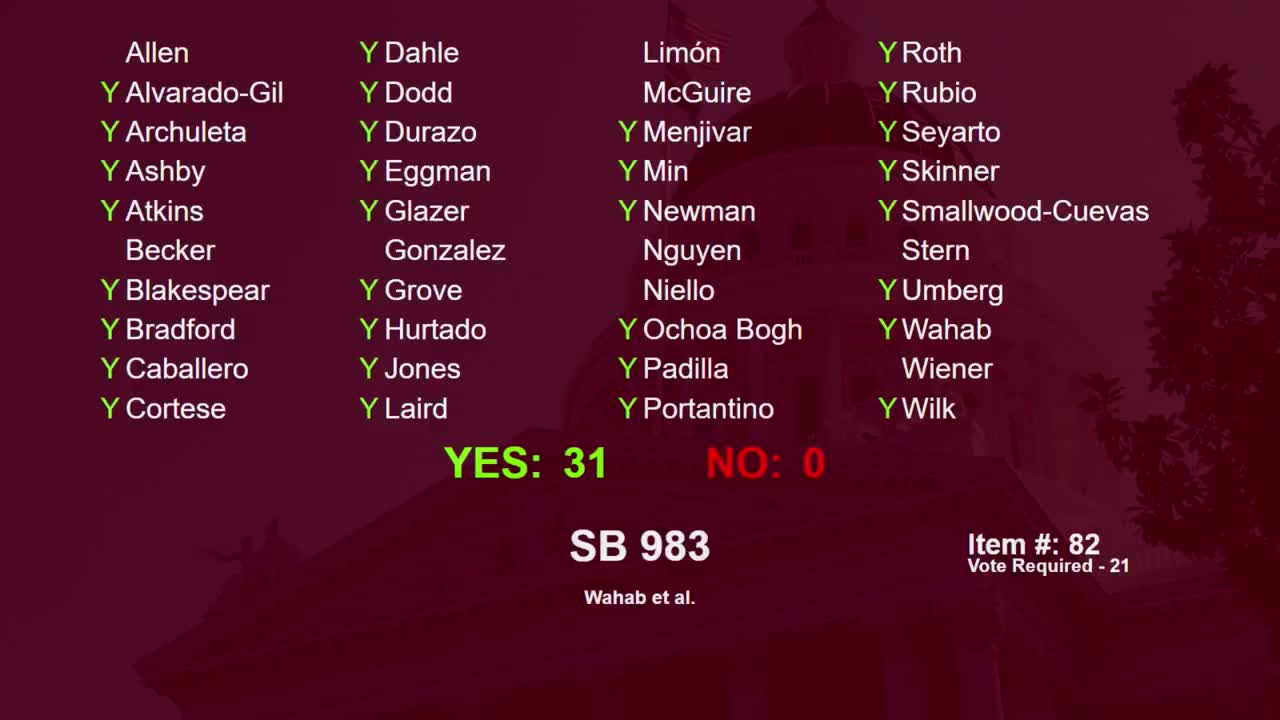 1MIN
Senate Floor
 1MIN
Senate Standing Committee on Appropriations
 18MIN
Senate Standing Committee on Education
Bill Author