SB 1118: Solar on Multifamily Affordable Housing Program.
- Session Year: 2023-2024
- House: Senate
- Latest Version Date: 2024-08-28
Current Status:
Failed
(2024-09-22: In Senate. Consideration of Governor's veto pending.)
Introduced
In Committee
First Chamber
In Committee
Second Chamber
Enacted
Existing law vests the Public Utilities Commission with regulatory authority over public utilities, including electrical corporations. Existing law establishes the Multifamily Affordable Housing Solar Roofs Program, also known as the Solar on Multifamily Affordable Housing Program. Existing law requires the commission, as part of the program, to authorize the award of monetary incentives for qualifying solar energy systems, as defined, that are installed on qualified multifamily affordable residential properties of at least 5 rental housing units that are operated to provide deed-restricted low-income residential housing, as defined, and that meet one or more specified requirements, including, among other things, that the property is owned by a tribe, through December 31, 2032.
This bill would provide that property that is owned by a tribe is not required to be deed restricted to be eligible for the program, but is required to meet the income requirements of the program, as specified. The bill would require a property that is owned by a tribe that is not deed restricted to have received public financing to fund affordable housing in order to be eligible for the program, as provided.
Under existing law, a violation of any order, decision, rule, direction, demand, or requirement of the commission is a crime.
Because a violation of a commission action implementing this bills requirements would be a crime, the bill would impose a state-mandated local program.
The California Constitution requires the state to reimburse local agencies and school districts for certain costs mandated by the state. Statutory provisions establish procedures for making that reimbursement.
This bill would provide that no reimbursement is required by this act for a specified reason.
Existing law vests the Public Utilities Commission with regulatory authority over public utilities, including electrical corporations. Existing law establishes the Multifamily Affordable Housing Solar Roofs Program, also known as the Solar on Multifamily Affordable Housing Program. Existing law requires the commission, as part of the program, to award monetary incentives for qualifying solar energy systems, as defined, that are installed on multifamily residential properties of at least 5 rental housing units that are operated to provide deed-restricted low-income residential housing, as defined, and that meet one or more specified requirements, including, among other things, that the property is owned by a tribe, through December 31, 2032.
This bill would provide that property that is owned by a tribe is not required to be deed restricted to be eligible for the program. program, but is required to meet the income requirements of the program, as specified. The bill would also require a property that is owned by a tribe that is not deed restricted to have received public financing to fund affordable housing, as provided.
Under existing law, a violation of any order, decision, rule, direction, demand, or requirement of the commission is a crime.
Because a violation of a commission action implementing this bills requirements would be a crime, the bill would impose a state-mandated local program.
The California Constitution requires the state to reimburse local agencies and school districts for certain costs mandated by the state. Statutory provisions establish procedures for making that reimbursement.
This bill would provide that no reimbursement is required by this act for a specified reason.
Existing law vests the Public Utilities Commission with regulatory authority over public utilities, including electrical corporations. Existing law establishes the Multifamily Affordable Housing Solar Roofs Program, also known as the Solar on Multifamily Affordable Housing Program. Existing law requires the commission, as part of the program, to award monetary incentives for qualifying solar energy systems, as defined, that are installed on multifamily residential properties of at least 5 rental housing units that are operated to provide deed-restricted low-income residential housing, as defined, and that meet one or more specified requirements, including, among other things, that the property is owned by a tribe, through December 31, 2032.
This bill would provide that property that is owned by a tribe is not required to be deed restricted to be eligible for the program.
Under existing law, a violation of any order, decision, rule, direction, demand, or requirement of the commission is a crime.
Because a violation of a commission action implementing this bills requirements would be a crime, the bill would impose a state-mandated local program.
The California Constitution requires the state to reimburse local agencies and school districts for certain costs mandated by the state. Statutory provisions establish procedures for making that reimbursement.
This bill would provide that no reimbursement is required by this act for a specified reason.
Existing law establishes the Multifamily Affordable Housing Solar Roofs Program, also known as the Solar on Multifamily Affordable Housing Program. Existing law requires the commission, as part of the program, to award monetary incentives for qualifying solar energy systems, as defined, that are installed on multifamily residential property of at least 5 rental housing units that is, or will be, operated to provide deed-restricted low-income residential housing, as defined, and that meet one or more specified requirements, including that at least 66% of the households have incomes at or below 80% of the area median income, through December 31, 2032.This bill would state the intent of the Legislature to enact future legislation relating to the Solar on Multifamily Affordable Housing Program.Existing law establishes the Multifamily Affordable Housing Solar Roofs Program, also known as the Solar on Multifamily Affordable Housing Program. Existing law requires the commission, as part of the program, to award monetary incentives for qualifying solar energy systems, as defined, that are installed on multifamily residential property of at least 5 rental housing units that is, or will be, operated to provide deed-restricted low-income residential housing, as defined, and that meet one or more specified requirements, including that at least 66% of the households have incomes at or below 80% of the area median income, through December 31, 2032.
This bill would state the intent of the Legislature to enact future legislation relating to the Solar on Multifamily Affordable Housing Program.
(a)As used in this section, the following definitions apply:
(1)CARE program means the California Alternate Rates for Energy program established pursuant to Section 739.1.
(2)Program means the Multifamily Affordable Housing Solar Roofs Program established pursuant to this chapter, which is also known as the Solar on Multifamily Affordable Housing Program.
(3)(A)Qualified multifamily affordable housing property means a multifamily residential property of at least five rental housing units that is, or will be, operated to provide deed-restricted low-income residential housing, as defined in clause (i) of subparagraph (A) of paragraph (3) of subdivision (a) of Section 2852, except as specified in subparagraph (B), and that meets one or more of the following requirements:
(i)The property is located in a disadvantaged community, as identified by the California Environmental Protection Agency pursuant to Section 39711 of the Health and Safety Code.
(ii)At least 66 percent of the households have incomes at or below 80 percent of the area median income, as defined in subdivision (f) of Section 50052.5 of the Health and Safety Code.
(iii)The property is owned by a tribe.
(iv)The property is rental housing property that is owned by either of the following:
(I)A public housing authority created pursuant to the Housing Authorities Law (Chapter 1 (commencing with Section 34200) of Part 2 of Division 24 of the Health and Safety Code).
(II)A public housing agency, as defined in Section 1437a of Title 42 of the United States Code.
(B)Notwithstanding subparagraph (A), a property owned by a tribe is not required to be deed restricted to be eligible for the program, but is required to meet the income requirements of the program pursuant to clause (ii) of subparagraph (A). To be eligible for the program, a property owned by a tribe that is not deed restricted shall have received public financing to fund affordable housing through any of the following:
(i)The United States Department of Housing and Urban Development Indian Housing Block Grant program.
(ii)The United States Bureau of Indian Affairs.
(iii)The Native American Housing Assistance and Self-Determination Act of 1996 (Public Law 104-330), as amended.
(4)Solar energy system means a solar energy photovoltaic device that meets or exceeds the eligibility criteria established pursuant to Section 25782 of the Public Resources Code.
(5)Tribe means a California Native American tribe, as defined in Section 21073 of the Public Resources Code.
(b)(1)Adoption and implementation of the program may count toward the satisfaction of the commissions obligation to ensure that specific alternatives designed for growth among residential customers in disadvantaged communities are offered as part of the standard contract or tariff developed pursuant to subdivision (b) of Section 2827.1.
(2)This section does not preclude electrical corporations from offering and administering a distributed energy resource program, including solar energy systems, in disadvantaged communities offered under current or proposed programs using funds provided under subdivision (c) of Section 748.5 or programs proposed to comply with paragraph (1) as approved by the commission.
(c)The commission shall annually authorize the allocation of one hundred million dollars ($100,000,000) or 66.67 percent of available funds, whichever is less, from the revenues described in subdivision (c) of Section 748.5 for the program, beginning with the fiscal year commencing July 1, 2016, and ending with the fiscal year ending June 30, 2020. The commission shall continue authorizing the allocation of these funds through June 30, 2026, if the commission determines that revenues are available after 2020 and that there is adequate interest and participation in the program.
(d)The commission shall consider the most appropriate program administration structure, including administration by a qualified third-party administrator, selected by the commission through a competitive bidding process, or administration by an electrical corporation, in an existing or future proceeding.
(e)Not more than 10 percent of the funds allocated to the program shall be used for administration.
(f)(1)By June 30, 2017, the commission shall authorize the award of monetary incentives for qualifying solar energy systems that are installed on qualified multifamily affordable housing properties through December 31, 2032. The target of the program is to install a combined generating capacity of at least 300 megawatts on qualified properties.
(2)The commission shall require that the electricity generated by qualifying renewable energy systems installed pursuant to the program be primarily used to offset electricity usage by low-income tenants. These requirements may include required covenants and restrictions in deeds.
(3)The commission shall require that qualifying solar energy systems owned by third-party owners are subject to contractual restrictions to ensure that no additional costs for the system be passed on to low-income tenants at the properties receiving incentives pursuant to the program. The commission shall require third-party owners of solar energy systems to provide ongoing operations and maintenance of the system, monitor energy production, and, where necessary, take appropriate action to ensure that the kilowatthour production levels projected for the system are achieved throughout the period of the third-party agreement. Those actions may include, but are not limited to, providing a performance guarantee of annual production levels or taking corrective actions to resolve underproduction problems.
(4)The commission shall ensure that incentive levels for photovoltaic installations receiving incentives through the program are aligned with the installation costs for solar energy systems for affordable housing and take account of federal investment tax credits and contributions from other sources to the extent feasible.
(5)The commission shall require that no individual installation receive incentives at a rate greater than 100 percent of the total system installation costs.
(6)The commission shall establish local hiring requirements for the program to provide economic development benefits to disadvantaged communities.
(7)The commission shall establish energy efficiency requirements that are equal to the energy efficiency requirements established for the program described in Section 2852, including participation in a federal, state, or utility-funded energy efficiency program or documentation of a recent energy efficiency retrofit.
(8)For purposes of the new construction of qualified multifamily affordable housing property, moneys authorized through the program shall not be used to meet the requirements of Part 6 (commencing with Section 100) of Title 24 of the California Code of Regulations.
(g)(1)The commission shall ensure that electrical corporation tariff structures affecting the low-income tenants participating in the program continue to provide a direct economic benefit from the qualifying solar energy system.
(2)If units are separately metered, low-income tenants who participate in the program shall receive credits on utility bills from the program. The commission shall ensure that utility bill reductions are achieved through tariffs that allow for the allocation of credits, such as virtual net metering tariffs designed for program participants, or other tariffs that may be adopted by the commission pursuant to Section 2827.1.
(h)This chapter does not supplant CARE program rates as the primary mechanism for achieving the goals of the CARE program.
(i)The commission shall determine the eligibility of qualified multifamily affordable housing property tenants that are customers of community choice aggregators.
(j)The commission may consider authorizing an advance payment loan to an eligible project if there is reasonable evidence to suggest that an advance payment loan would lead to the delivery of a project that would not occur absent the advance payment loan, if appropriate funding guarantee and loss recovery mechanisms are implemented to limit the risk of liability to the program from making the advance payment loan. The commission, in considering an advance payment loan, may prioritize allocating funding to a project where an advance payment loan will have the greatest impact on project delivery.
(k)(1)Every three years, the commission shall evaluate the programs expenditures, commitments, uncommitted balances, future demands, performance, and outcomes and shall make any necessary adjustments to the program to ensure the goals of the program are being met. If, upon review, the commission finds there is insufficient participation in the program, the commission may credit uncommitted funds back to ratepayers pursuant to Section 748.5.
(2)The commission shall include in the annual workplan required pursuant to Section 910, an annual update of the program that shall include, but not be limited to, the number of projects approved, number of projects completed, number of pending projects awaiting approval, and geographic distribution of the projects.
SEC. 2.No reimbursement is required by this act pursuant to Section 6 of Article XIIIB of the California Constitution because the only costs that may be incurred by a local agency or school district will be incurred because this act creates a new crime or infraction, eliminates a crime or infraction, or changes the penalty for a crime or infraction, within the meaning of Section 17556 of the Government Code, or changes the definition of a crime within the meaning of Section 6 of Article XIIIB of the California Constitution.
(a)As used in this section, the following definitions apply:
(1)CARE program means the California Alternate Rates for Energy program established pursuant to Section 739.1.
(2)Program means the Multifamily Affordable Housing Solar Roofs Program established pursuant to this chapter, which is also known as the Solar on Multifamily Affordable Housing Program.
(3)(A)Qualified multifamily affordable housing property means a multifamily residential property of at least five rental housing units that is, or will be, operated to provide deed-restricted low-income residential housing, as defined in clause (i) of subparagraph (A) of paragraph (3) of subdivision (a) of Section 2852, except as specified in subparagraph (B), and that meets one or more of the following requirements:
(i)The property is located in a disadvantaged community, as identified by the California Environmental Protection Agency pursuant to Section 39711 of the Health and Safety Code.
(ii)At least 66 percent of the households have incomes at or below 80 percent of the area median income, as defined in subdivision (f) of Section 50052.5 of the Health and Safety Code.
(iii)The property is owned by a tribe.
(iv)The property is rental housing property that is owned by either of the following:
(I)A public housing authority created pursuant to the Housing Authorities Law (Chapter 1 (commencing with Section 34200) of Part 2 of Division 24 of the Health and Safety Code).
(II)A public housing agency, as defined in Section 1437a of Title 42 of the United States Code.
(B)Notwithstanding subparagraph (A), a property owned by a tribe is not required to be deed restricted to be eligible for the program. program, but is required to meet the income requirements of the program pursuant to clause (ii) of subparagraph (A). To be eligible for the program, a property owned by a tribe that is not deed restricted shall have received public financing to fund affordable housing through any of the following:
(i)The United States Department of Housing and Urban Development Indian Housing Block Grant program.
(ii)The United States Bureau of Indian Affairs.
(iii)The Native American Housing Assistance and Self-Determination Act of 1996 (Public Law 104-330), as amended.
(4)Solar energy system means a solar energy photovoltaic device that meets or exceeds the eligibility criteria established pursuant to Section 25782 of the Public Resources Code.
(5)Tribe means a California Native American tribe, as defined in Section 21073 of the Public Resources Code.
(b)(1)Adoption and implementation of the program may count toward the satisfaction of the commissions obligation to ensure that specific alternatives designed for growth among residential customers in disadvantaged communities are offered as part of the standard contract or tariff developed pursuant to subdivision (b) of Section 2827.1.
(2)This section does not preclude electrical corporations from offering and administering a distributed energy resource program, including solar energy systems, in disadvantaged communities offered under current or proposed programs using funds provided under subdivision (c) of Section 748.5 or programs proposed to comply with paragraph (1) as approved by the commission.
(c)The commission shall annually authorize the allocation of one hundred million dollars ($100,000,000) or 66.67 percent of available funds, whichever is less, from the revenues described in subdivision (c) of Section 748.5 for the program, beginning with the fiscal year commencing July 1, 2016, and ending with the fiscal year ending June 30, 2020. The commission shall continue authorizing the allocation of these funds through June 30, 2026, if the commission determines that revenues are available after 2020 and that there is adequate interest and participation in the program.
(d)The commission shall consider the most appropriate program administration structure, including administration by a qualified third-party administrator, selected by the commission through a competitive bidding process, or administration by an electrical corporation, in an existing or future proceeding.
(e)Not more than 10 percent of the funds allocated to the program shall be used for administration.
(f)(1)By June 30, 2017, the commission shall authorize the award of monetary incentives for qualifying solar energy systems that are installed on qualified multifamily affordable housing properties through December 31, 2032. The target of the program is to install a combined generating capacity of at least 300 megawatts on qualified properties.
(2)The commission shall require that the electricity generated by qualifying renewable energy systems installed pursuant to the program be primarily used to offset electricity usage by low-income tenants. These requirements may include required covenants and restrictions in deeds.
(3)The commission shall require that qualifying solar energy systems owned by third-party owners are subject to contractual restrictions to ensure that no additional costs for the system be passed on to low-income tenants at the properties receiving incentives pursuant to the program. The commission shall require third-party owners of solar energy systems to provide ongoing operations and maintenance of the system, monitor energy production, and, where necessary, take appropriate action to ensure that the kilowatthour production levels projected for the system are achieved throughout the period of the third-party agreement. Those actions may include, but are not limited to, providing a performance guarantee of annual production levels or taking corrective actions to resolve underproduction problems.
(4)The commission shall ensure that incentive levels for photovoltaic installations receiving incentives through the program are aligned with the installation costs for solar energy systems for affordable housing and take account of federal investment tax credits and contributions from other sources to the extent feasible.
(5)The commission shall require that no individual installation receive incentives at a rate greater than 100 percent of the total system installation costs.
(6)The commission shall establish local hiring requirements for the program to provide economic development benefits to disadvantaged communities.
(7)The commission shall establish energy efficiency requirements that are equal to the energy efficiency requirements established for the program described in Section 2852, including participation in a federal, state, or utility-funded energy efficiency program or documentation of a recent energy efficiency retrofit.
(8)For purposes of the new construction of qualified multifamily affordable housing property, moneys authorized through the program shall not be used to meet the requirements of Part 6 (commencing with Section 100) of Title 24 of the California Code of Regulations.
(g)(1)The commission shall ensure that electrical corporation tariff structures affecting the low-income tenants participating in the program continue to provide a direct economic benefit from the qualifying solar energy system.
(2)If units are separately metered, low-income tenants who participate in the program shall receive credits on utility bills from the program. The commission shall ensure that utility bill reductions are achieved through tariffs that allow for the allocation of credits, such as virtual net metering tariffs designed for program participants, or other tariffs that may be adopted by the commission pursuant to Section 2827.1.
(h)This chapter does not supplant CARE program rates as the primary mechanism for achieving the goals of the CARE program.
(i)The commission shall determine the eligibility of qualified multifamily affordable housing property tenants that are customers of community choice aggregators.
(j)The commission may consider authorizing an advance payment loan to an eligible project if there is reasonable evidence to suggest that an advance payment loan would lead to the delivery of a project that would not occur absent the advance payment loan, if appropriate funding guarantee and loss recovery mechanisms are implemented to limit the risk of liability to the program from making the advance payment loan. The commission, in considering an advance payment loan, may prioritize allocating funding to a project where an advance payment loan will have the greatest impact on project delivery.
(k)(1)Every three years, the commission shall evaluate the programs expenditures, commitments, uncommitted balances, future demands, performance, and outcomes and shall make any necessary adjustments to the program to ensure the goals of the program are being met. If, upon review, the commission finds there is insufficient participation in the program, the commission may credit uncommitted funds back to ratepayers pursuant to Section 748.5.
(2)The commission shall include in the annual workplan required pursuant to Section 910, an annual update of the program that shall include, but not be limited to, the number of projects approved, number of projects completed, number of pending projects awaiting approval, and geographic distribution of the projects.
SEC. 2.No reimbursement is required by this act pursuant to Section 6 of Article XIIIB of the California Constitution because the only costs that may be incurred by a local agency or school district will be incurred because this act creates a new crime or infraction, eliminates a crime or infraction, or changes the penalty for a crime or infraction, within the meaning of Section 17556 of the Government Code, or changes the definition of a crime within the meaning of Section 6 of Article XIIIB of the California Constitution.
(a)As used in this section, the following definitions apply:
(1)CARE program means the California Alternate Rates for Energy program established pursuant to Section 739.1.
(2)Program means the Multifamily Affordable Housing Solar Roofs Program established pursuant to this chapter, which is also known as the Solar on Multifamily Affordable Housing Program.
(3)(A)Qualified multifamily affordable housing property means a multifamily residential property of at least five rental housing units that is, or will be, operated to provide deed-restricted low-income residential housing, as defined in clause (i) of subparagraph (A) of paragraph (3) of subdivision (a) of Section 2852, except as specified in subparagraph (B), and that meets one or more of the following requirements:
(A)(i)The property is located in a disadvantaged community, as identified by the California Environmental Protection Agency pursuant to Section 39711 of the Health and Safety Code.
(B)(ii)At least 66 percent of the households have incomes at or below 80 percent of the area median income, as defined in subdivision (f) of Section 50052.5 of the Health and Safety Code.
(C)(iii)The property is owned by a tribe.
(D)(iv)The property is rental housing property that is owned by one either of the following:
(i)(I)A public housing authority created pursuant to the Housing Authorities Law (Chapter 1 (commencing with Section 34200) of Part 2 of Division 24 of the Health and Safety Code).
(ii)(II)A public housing agency, as defined in Section 1437a of Title 42 of the United States Code.
(B)Notwithstanding subparagraph (A), a property owned by a tribe is not required to be deed restricted to be eligible for the program.
(4)Solar energy system means a solar energy photovoltaic device that meets or exceeds the eligibility criteria established pursuant to Section 25782 of the Public Resources Code.
(5)Tribe means a California Native American tribe, as defined in Section 21073 of the Public Resources Code.
(b)(1)Adoption and implementation of the program may count toward the satisfaction of the commissions obligation to ensure that specific alternatives designed for growth among residential customers in disadvantaged communities are offered as part of the standard contract or tariff authorized developed pursuant to paragraph (1) of subdivision (b) of Section 2827.1.
(2)This section does not preclude electrical corporations from offering and administering a distributed energy resource program, including solar energy systems, in disadvantaged communities offered under current or proposed programs using funds provided under subdivision (c) of Section 748.5 or programs proposed to comply with paragraph (1) as approved by the commission.
(c)The commission shall annually authorize the allocation of one hundred million dollars ($100,000,000) or 66.67 percent of available funds, whichever is less, from the revenues described in subdivision (c) of Section 748.5 for the program, beginning with the fiscal year commencing July 1, 2016, and ending with the fiscal year ending June 30, 2020. The commission shall continue authorizing the allocation of these funds through June 30, 2026, if the commission determines that revenues are available after 2020 and that there is adequate interest and participation in the program.
(d)The commission shall consider the most appropriate program administration structure, including administration by a qualified third-party administrator, selected by the commission through a competitive bidding process, or administration by an electrical corporation, in an existing or future proceeding.
(e)Not more than 10 percent of the funds allocated to the program shall be used for administration.
(f)(1)By June 30, 2017, the commission shall authorize the award of monetary incentives for qualifying solar energy systems that are installed on qualified multifamily affordable housing properties through December 31, 2032. The target of the program is to install a combined generating capacity of at least 300 megawatts on qualified properties.
(2)The commission shall require that the electricity generated by qualifying renewable energy systems installed pursuant to the program be primarily used to offset electricity usage by low-income tenants. These requirements may include required covenants and restrictions in deeds.
(3)The commission shall require that qualifying solar energy systems owned by third-party owners are subject to contractual restrictions to ensure that no additional costs for the system be passed on to low-income tenants at the properties receiving incentives pursuant to the program. The commission shall require third-party owners of solar energy systems to provide ongoing operations and maintenance of the system, monitor energy production, and, where necessary, take appropriate action to ensure that the kWh kilowatthour production levels projected for the system are achieved throughout the period of the third-party agreement. Those actions may include, but are not limited to, providing a performance guarantee of annual production levels or taking corrective actions to resolve underproduction problems.
(4)The commission shall ensure that incentive levels for photovoltaic installations receiving incentives through the program are aligned with the installation costs for solar energy systems for affordable housing and take account of federal investment tax credits and contributions from other sources to the extent feasible.
(5)The commission shall require that no individual installation receive incentives at a rate greater than 100 percent of the total system installation costs.
(6)The commission shall establish local hiring requirements for the program to provide economic development benefits to disadvantaged communities.
(7)The commission shall establish energy efficiency requirements that are equal to the energy efficiency requirements established for the program described in Section 2852, including participation in a federal, state, or utility-funded energy efficiency program or documentation of a recent energy efficiency retrofit.
(8)For purposes of the new construction of qualified multifamily affordable housing property, moneys authorized through the program shall not be used to meet the requirements of Part 6 (commencing with Section 100) of Title 24 of the California Code of Regulations.
(g)(1)The commission shall ensure that electrical corporation tariff structures affecting the low-income tenants participating in the program continue to provide a direct economic benefit from the qualifying solar energy system.
(2)If units are separately metered, low-income tenants who participate in the program shall receive credits on utility bills from the program. The commission shall ensure that utility bill reductions are achieved through tariffs that allow for the allocation of credits, such as virtual net metering tariffs designed for program participants, or other tariffs that may be adopted by the commission pursuant to Section 2827.1.
(h)This chapter is not intended to does not supplant CARE program rates as the primary mechanism for achieving the goals of the CARE program.
(i)The commission shall determine the eligibility of qualified multifamily affordable housing property tenants that are customers of community choice aggregators.
(j)The commission may consider authorizing an advance payment loan to an eligible project if there is reasonable evidence to suggest that an advance payment loan would lead to the delivery of a project that would not occur absent the advance payment loan, so long as if appropriate funding guarantee and loss recovery mechanisms are implemented to limit the risk of liability to the program from making the advance payment loan. The commission, in considering an advance payment loan, may prioritize allocating funding to a project where an advance payment loan will have the greatest impact on project delivery.
(k)(1)Every three years, the commission shall evaluate the programs expenditures, commitments, uncommitted balances, future demands, performance, and outcomes and shall make any necessary adjustments to the program to ensure the goals of the program are being met. If, upon review, the commission finds there is insufficient participation in the program, the commission may credit uncommitted funds back to ratepayers pursuant to Section 748.5.
(2)The commission shall include in the annual workplan required pursuant to Section 910, an annual update of the program that shall include, but not be limited to, the number of projects approved, number of projects completed, number of pending projects awaiting approval, and geographic distribution of the projects.
SEC. 2.No reimbursement is required by this act pursuant to Section 6 of Article XIIIB of the California Constitution because the only costs that may be incurred by a local agency or school district will be incurred because this act creates a new crime or infraction, eliminates a crime or infraction, or changes the penalty for a crime or infraction, within the meaning of Section 17556 of the Government Code, or changes the definition of a crime within the meaning of Section 6 of Article XIIIB of the California Constitution.
SECTION 1.It is the intent of the Legislature to enact future legislation relating to the Solar on Multifamily Affordable Housing Program.It is the intent of the Legislature to enact future legislation relating to the Solar on Multifamily Affordable Housing Program.
|
Date
|
Status
|
|---|---|
| Sep 22, 2024 | In Senate. Consideration of Governor's veto pending. |
| Sep 22, 2024 | Vetoed by the Governor. |
| Sep 3, 2024 | Enrolled and presented to the Governor at 3 p.m. |
| Aug 26, 2024 | In Senate. Ordered to engrossing and enrolling. |
| Aug 26, 2024 | Read third time. Passed. (Ayes 74. Noes 0. Page 6527.) Ordered to the Senate. |
| Aug 19, 2024 | Read second time. Ordered to third reading. |
| Aug 15, 2024 | From committee: Do pass. (Ayes 14. Noes 0.) (August 15). |
| Aug 7, 2024 | August 7 set for first hearing. Placed on suspense file. |
| Jun 20, 2024 | From committee: Do pass and re-refer to Com. on APPR. (Ayes 15. Noes 0.) (June 19). Re-referred to Com. on APPR. |
| Jun 5, 2024 | June 5 hearing postponed by committee. |
| May 28, 2024 | Referred to Com. on U. & E. |
| May 22, 2024 | In Assembly. Read first time. Held at Desk. |
| May 21, 2024 | Read third time. Passed. (Ayes 33. Noes 3. Page 4065.) Ordered to the Assembly. |
| May 16, 2024 | Read second time. Ordered to third reading. |
| May 16, 2024 | From committee: Do pass. (Ayes 5. Noes 1. Page 3972.) (May 16). |
| May 10, 2024 | Set for hearing May 16. |
| May 6, 2024 | May 6 hearing: Placed on APPR suspense file. |
| Apr 26, 2024 | Set for hearing May 6. |
| Apr 22, 2024 | Read second time and amended. Re-referred to Com. on APPR. |
| Apr 18, 2024 | From committee: Do pass as amended and re-refer to Com. on APPR. (Ayes 15. Noes 2. Page 3632.) (April 16). |
| Apr 4, 2024 | Set for hearing April 16. |
| Apr 3, 2024 | Re-referred to Com. on E., U. & C. |
| Mar 18, 2024 | From committee with author's amendments. Read second time and amended. Re-referred to Com. on RLS. |
| Feb 21, 2024 | Referred to Com. on RLS. |
| Feb 14, 2024 | From printer. May be acted upon on or after March 15. |
| Feb 13, 2024 | Introduced. Read first time. To Com. on RLS. for assignment. To print. |
|
Date
|
Description
|
Location
|
Votes
|
|
|---|---|---|---|---|
| Aug 26, 2024 | SB 1118 Eggman Senate Third Reading By Soria | Assembly Floor |
Passed |
|
| Aug 15, 2024 | Do pass. | Assembly Standing Committee on Appropriations |
Passed |
|
| Jun 19, 2024 | Do pass and be re-referred to the Committee on [Appropriations] | Assembly Standing Committee on Utilities and Energy |
Passed |
|
| May 21, 2024 | Senate 3rd Reading SB1118 Eggman | Senate Floor |
Passed |
|
| May 16, 2024 | Do pass | Senate Standing Committee on Appropriations |
Passed |
|
| May 6, 2024 | Placed on suspense file | Senate Standing Committee on Appropriations |
Passed |
|
| Apr 16, 2024 | Do pass as amended, but first amend, and re-refer to the Committee on [Appropriations] | Senate Standing Committee on Energy, Utilities and Communications |
Passed |
This list shows positions taken on this bill by organizations on the date displayed, which is linked to the original source.
Positions by individuals are not included.
|
Organization
|
Position
|
Date
|
|---|---|---|
| association for energy affordability | ** Support | |
| California Environmental Justice Alliance | * Support | Jun 19, 2024 |
| California Housing Partnership | ** Support | |
| California Solar & Storage Association | ** Support | |
| Center for Sustainable Energy | ** Support | |
| Climate Action California | * Support | Apr 16, 2024 |
| Grid Alternatives | ** Support | |
| MidPen Housing | ** Support | |
| Natural Resources Defense Counsel | * Support | Apr 16, 2024 |
| San Diego Green Building Council | ** Support | |
| Union Of Concerned Scientists | ** Support |
SENATE RULES COMMITTEE Office of Senate Floor Analyses (916) 651-1520 Fax: (916) 327-4478 | SB 1118 |
VETO
Bill No: SB 1118
Author: Eggman (D)
Enrolled: 8/28/24
Vote: 27
SENATE ENERGY, U. & C. COMMITTEE: 15-2, 4/16/24
AYES: Bradford, Ashby, Becker, Caballero, Dodd, Durazo, Eggman, Gonzalez, Grove, Limón, Min, Newman, Rubio, Skinner, Stern
NOES: Dahle, Wilk
NO VOTE RECORDED: Seyarto
SENATE APPROPRIATIONS COMMITTEE: 5-1, 5/16/24
AYES: Caballero, Ashby, Becker, Bradford, Wahab
NOES: Jones
NO VOTE RECORDED: Seyarto
SENATE FLOOR: 33-3, 5/21/24
AYES: Alvarado-Gil, Archuleta, Ashby, Atkins, Becker, Blakespear, Bradford, Caballero, Cortese, Dodd, Durazo, Eggman, Glazer, Gonzalez, Grove, Hurtado, Laird, Limón, McGuire, Menjivar, Min, Newman, Padilla, Portantino, Roth, Rubio, Skinner, Smallwood-Cuevas, Stern, Umberg, Wahab, Wiener, Wilk
NOES: Dahle, Jones, Niello
NO VOTE RECORDED: Allen, Nguyen, Ochoa Bogh, Seyarto
ASSEMBLY FLOOR: 74-0, 8/26/24 - See last page for vote
SUBJECT: Solar on Multifamily Affordable Housing Program
SOURCE: Author
DIGEST:
This bill exempts property that is owned by a Native American tribe from the requirement in the existing Solar on Multifamily Affordable Housing (SOMAH) Program that the property must be “deed restricted” affordable housing, under specified conditions.
ANALYSIS:
Existing law:
- Establishes and vests the California Public Utilities Commission (CPUC) with regulatory authority over public utilities, including electrical corporations. (Article XII of the California Constitution)
- Establishes the Multifamily Affordable Housing Solar Roofs Program, also known as the SOMAH Program. Requires the CPUC, as part of the program, to award monetary incentives for qualifying solar energy systems, that are installed on multifamily residential properties of at least five rental housing units that are operated to provide deed-restricted low-income residential housing, and that meet one or more specified requirements, including, among other things, that the property is owned by a tribe, through December 31, 2032. (Public Utilities Code §2870)
- Defines “Tribe” to mean a California Native American tribe, as defined in Section 21073 of the Public Resources Code. (Public Utilities Code §2870 (a)(5))
- Defines a “California Native American Tribe” to mean a Native American tribe located in California that is on the contact list maintained by the Native American Heritage Commission. (Public Resources Code §21073)
- Defines “low-income residential housing” to be a multifamily residential complex financed with specified monies that provide that the rents of the occupants who are lower income households do not exceed those prescribed by deed restrictions or regulatory agreements pursuant to the terms of the financing or financial assistance. (Public Utilities Code §2852 (a)(3)(A)(i))
- Requires the CPUC to allocate up to 15% of revenues received by an electrical corporation as a result of the direct allocation of greenhouse gas (GHG) allowances to electrical distribution utilities to be used for clean energy and energy efficiency projects and otherwise requires revenues to be credited directly to residential, small business, and emission-intensive trade-exposed customers. (Public Utilities Code §748.5)
This bill:
- Provides that property that is owned by a tribe is not required to be deed restricted to be eligible for the SOMAH program, but is required to meet the income requirements of the program.
- Requires a property that is owned by a tribe that is not deed restricted to have received public financing to fund affordable housing from any of the following:
- The United States Department of Housing and Urban Development Indian Housing Block Grant program.
- The United States Bureau of Indian Affairs.
- The Native American Housing Assistance and Self-Determination Act of 1996 (Public Law 104-330), as amended.
- Makes additional clarifying changes.
Background
- SOMAH. Established by AB 693 (Eggman, Chapter 582, Statutes of 2015), the SOMAH program provides incentives for solar energy photovoltaic (PV) systems for qualified multifamily affordable housing. SOMAH is funded from the portion of the electric investor-owned utilities (IOUs) GHG emissions auction proceeds that is authorized to be programed by the CPUC for clean energy or energy efficiency programs. Per the statute, the program requires funding of up to $100 million annually, and up to one billion dollars over 10 years, to install 300 megawatts (MW) of capacity. The qualified multifamily affordable housing is defined as a residential building of at least five rental housing units that is operated to provide deed-restricted low-income residential housing, and is located in a disadvantaged community and/or at least 66 percent of the households have incomes at or below 80 percent of the area median income. Incentive levels for program applicants range up to $3.50 per AC Watt for renewable capacity serving tenants and $1.19 per AC Watt for renewable capacity serving common areas. The incentive levels are dependent on tax credit usage for the project and expected performance of the eligible renewable generator(s). The program also has a mandate that incented renewable energy generation systems lower tenant energy bills through the SOMAH virtual net energy metering tariff.
- SOMAH implementation. The SOMAH program had a delayed start, as the program didn’t begin accepting applications until July 1, 2019. On the first day it opened, the program received more than 200 applications, and waitlists were started in the large electric IOUs’ territories. The SOMAH Program Administrative team is comprised entirely of non-profit organizations: the Center for Sustainable Energy, GRID Alternatives, the Association for Energy Affordability, and the California Housing Partnership Corporation. According to the program’s website, there have been 82 completed projects with 15 MW of installed capacity with service to over 7,333 tenant units across the state. There are roughly 400 active applications, representing 50 MW of reserved capacity and $104 million in funding, with participation in all five SOMAH-eligible electric IOU territories, namely: Pacific Gas & Electric, San Diego Gas & Electric, Southern California Edison, PacifiCorp and Liberty Utilities. There is roughly $400 million of remaining available funding for the program. More recently, the program seems to have stalled as the number of applications declined significantly. In response, the CPUC adopted a decision (D.23-03-007) in March 2023 to adjust the incentive levels of the program in order to encourage more participation and address concerns about increased projects costs, including those affected by recent inflation. SB 355 (Eggman, Chapter 393, Statutes of 2023) further expanded eligibility for the program to encourage more participation, including adjusting the income program requirements from at least 80 percent of the households having incomes at or below 60 percent of the median income, to at least 66 percent of the households having incomes at or below 80 percent of the median income.
Comments
- Need for this bill. As noted above, SB 355 expanded the eligibility of the program, including by explicitly including property that is owned by Native American tribes. Some tribal projects have been successful in participating in the program. As showcased on the SOMAH program website, the first project on tribal reservation was inaugurated last year. The project is a 49-kW solar installation at Coyote Mountain Apartments owned by the Bishop Paiute Tribe within Southern California Edison electric utility service territory. However, the author and supporters of this bill contend additional changes are needed to ensure SOMAH projects are developed by tribes. They believe the deed restriction requirement is preventing tribes from better accessing the program. The supporters note that a small handful of projects from entities on tribal lands financed with a Housing and Urban Development (HUD) Indian Housing Block Grant have not been successfully enrolled in the program because the financing structure didn’t meet the deed restriction requirements, specifically in relation to the remaining 10+ years of affordability. They suggest that removing the deed restriction requirement would remove a barrier to ensure these projects, and other tribal projects similarly financed, are able to participate.
- Limits the exemption to tribal projects funded by federal programs for tribal affordable housing. The proposal in this bill would exempt tribal projects from the deed restriction requirement but require the projects continue to meet the income requirements of the SOMAH program, which requires that at least 66 percent of the households have incomes at or below 80 percent of the area median income. Additionally, the bill requires that tribal projects exempted from the deed-restriction requirement must be limited to projects that receive public financing from the HUD Indian Housing Block Grant, U.S. Bureau of Indian Affairs, or Native American Housing Assistance and Self-Determination Act. In this regard, the bill attempts to ensure the program continues to be targeted to benefit low-income tenants as originally intended.
Related/Prior Legislation
AB 3121 (Petrie-Norris) would have credited, among its provisions, to residential retail electric IOU customers up to one-half of the SOMAH program funds that are unencumbered as of January 1, 2025. The bill was held in the Senate Energy, Utilities, and Communications Committee by the author.
SB 355 (Eggman, Chapter 393, Statutes of 2023) made various changes to the SOMAH Program, including explicitly expanding the eligibility for the program to tribes.
AB 693 (Eggman, Chapter 582, Statutes of 2015) created the Multifamily Affordable Housing Solar Roofs Program, to provide financial incentives for qualified solar installations at multifamily affordable housing properties funded from IOU’s GHG allowances.
AB 217 (Bradford, Chapter 609, Statutes of 2013) extended the low-income programs of the California Solar Initiative (CSI) Program from 2016 until 2021, authorizes the collection of an additional $108 million for these programs, and adds additional standards to the program, as specified.
SB 1 (Murray, Chapter 132, Statutes of 2006) established the electric portion of the CSI with a 10-year budget of $2.2 billion collected from ratepayers.
FISCAL EFFECT: Appropriation: No Fiscal Com.: Yes Local: Yes
According to the Assembly Committee on Appropriations, cost pressure of an unknown, but potentially significant amount as a result of expanding eligibility for the SOMAH program (likely, though not necessarily, Greenhouse Gas Reduction Fund). Minor and absorbable costs the CPUC to implement this bill.
SUPPORT: (Verified 9/24/24)
Association for Energy Affordability
California Housing Partnership
California Solar & Storage Association
Center for Sustainable Energy
GRID Alternatives
MidPen Housing
San Diego Green Building Council
Union of Concerned Scientists
OPPOSITION: (Verified 9/24/24)
None received
ARGUMENTS IN SUPPORT: The coalition of organizations in support of the bill are part of the SOMAH program administration team and express:
SB 1118 continues SB 355’s improvements by removing SOMAH’s deed restriction requirements for tribal properties that serve affordable housing populations. To make reliable and affordable housing more accessible to tribal members, tribes may access and utilize funding sources for their properties that do not require the same income verification and documentation typically associated with non-tribal affordable housing properties. As a result, the deed restriction requirement prevents many tribes from accessing SOMAH funds and tenant benefits including lower electric bills.
GOVERNOR'S VETO MESSAGE:
To the Members of the California State Senate:
I am returning Senate Bill 1118 without my signature.
This bill would, under specified conditions, exempt property owned by a tribe from the "deed restriction" requirement in the existing Solar on Multifamily Affordable Housing (SOMAH) program.
California has world-leading clean energy policies and dozens of programs advancing the deployment of clean energy technologies. While I support efforts to improve existing programs to deliver their intended outcomes, the SOMAH program continues to be severely underutilized. The lack of interest in this program comes despite numerous modifications in recent years, including an increase in the solar photovoltaic project incentive levels and the expansion of program eligibility.
In addition, this program has diverted hundreds of millions of dollars of funding from electric customers that would otherwise be returned to customers as part of the California Climate Credit - a bill credit that provides cost relief for electric and gas customers throughout most of California.
For these reasons, I cannot sign this bill.
Sincerely,
Gavin Newsom
ASSEMBLY FLOOR: 74-0, 8/26/24
AYES: Addis, Aguiar-Curry, Alanis, Alvarez, Arambula, Bains, Bauer-Kahan, Bennett, Berman, Boerner, Bonta, Bryan, Calderon, Juan Carrillo, Wendy Carrillo, Chen, Connolly, Davies, Dixon, Flora, Mike Fong, Friedman, Gabriel, Gallagher, Garcia, Gipson, Grayson, Haney, Hart, Holden, Hoover, Irwin, Jackson, Jones-Sawyer, Kalra, Lee, Low, Lowenthal, Maienschein, Mathis, McCarty, McKinnor, Muratsuchi, Stephanie Nguyen, Pacheco, Papan, Jim Patterson, Joe Patterson, Pellerin, Petrie-Norris, Quirk-Silva, Ramos, Rendon, Reyes, Luz Rivas, Rodriguez, Blanca Rubio, Sanchez, Santiago, Schiavo, Soria, Ta, Ting, Valencia, Villapudua, Waldron, Wallis, Ward, Weber, Wicks, Wilson, Wood, Zbur, Robert Rivas
NO VOTE RECORDED: Cervantes, Megan Dahle, Essayli, Lackey, Ortega
Prepared by: Nidia Bautista / E., U. & C. / (916) 651-4107
10/11/24 10:33:18
SENATE THIRD READING
STR Bill Id:SB 1118
Author:(Eggman)
As Amended Ver:April 22, 2024
Majority vote
SUMMARY
Exempts property that is owned by a tribe from the requirement that it be "deed-restricted" affordable housing to meet eligibility under the Solar on Multifamily Affordable Housing (SOMAH) Program, and instead requires tribal property to have received public financing to fund affordable housing through specified programs.
COMMENTS
Established by AB 693 (Eggman, Chapter 582, Statutes of 2015), the SOMAH program continues efforts to expand solar capacity in the state to disadvantaged communities, as identified by the California Environmental Protection Agency, by providing incentives for solar PV systems to qualified multifamily affordable housing. The CPUC directs up to $100 million annually, and up to $1 billion over 10 years, from the portion of the IOUs' GHG emissions auction proceeds that is authorized to be programmed for clean energy or energy efficiency programs. The SOMAH program seeks to incentivize the installation of at least 300 megawatts (MW) of solar power by the end of 2032. So far, the program has awarded 453 projects totaling 72 MW of reserved capacity. More than $500 million in incentive funding for SOMAH currently remains available across all IOUs.
Passed in 2023, SB 355 (Eggman, Chapter 393, Statutes of 2023) expanded explicit eligibility for SOMAH to tribes. Since then, enhanced efforts are underway to emphasize tribal communities as a priority group in SOMAH. For example, application deposits are often waived to decrease the financial barrier to participation. To increase applications on tribal lands, the SOMAH program administrator reports efforts on increased engagement with tribal entities, including conducting research on the structure of tribal entities and points of contact and creating an application resource document for special considerations for tribal properties. The first tribal solar project under SOMAH was completed in late 2023: a 49-kilowatt system by the Bishop Paiute Tribe to serve 24 apartment homes.
Although the SOMAH program administrator reports increased efforts to reach out to tribal communities, supporters of this bill contend that a lingering barrier to increased participation by tribes is the program's deed restriction requirement. Deed restriction is a conventional mechanism for preserving affordability of housing units. Deed-restricted affordable housing properties have a use-restriction that limits the rent or purchase price and requires occupancy by low-income housing for a set period of time, typically 55 years. The funding mechanisms and rent protections for low-income housing on tribal properties are more varied. As a result, supporters note that a small handful of projects from entities on tribal lands financed with a Housing and Urban Development Indian Housing Block Grant – a federal formula grant that funds affordable housing activities on tribal lands – have not been successfully enrolled in the program. This bill seeks to remedy this barrier to participation by tribal communities by narrowly exempting tribal projects from the deed restriction requirement and providing guardrails to corroborate that a tribal project would benefit a low-income multifamily residential property.
According to the Author
"In 2015, we made a promise to Californians that we were going to bring the financial benefits of rooftop solar to those in economically and environmentally disadvantaged areas by passing AB 693. This was a crucial piece of equity-focused climate policy that established the Solar on Multifamily Affordable Housing (SOMAH) Program. Last year, we expanded SOMAH to benefit more low-income Californians and properties owned by California Native American Tribes. However, the existing eligibility criteria requiring all projects to be deed-restricted makes it practically impossible to approve projects for properties owned by California Native American Tribes where deed-restrictions don't typically exist. SB 1118 amends the eligibility criteria for properties owned by California Native American Tribes under SOMAH to make clear that these properties are not subject to the deed-restriction eligibility requirements of the program, but still meet the SOMAH income requirements and are publicly financed."
Arguments in Support
The Union of Concerned Scientists writes in support, "The [SOMAH] program was expanded last year through the passage of SB 355 to include properties owned by California Native American Tribes; however, many of these properties are still not eligible because most property on Tribal Lands are not subject to deed restrictions. [This bill] seeks to correct this unintended exclusion by clarifying that properties owned by California Native American Tribes are not subject to the deed-restriction eligibility requirements under the SOMAH program."
Arguments in Opposition
None on file.
FISCAL COMMENTS
According to the Assembly Committee on Appropriations, this bill puts cost pressures of an unknown, but potentially significant amount as a result of expanding eligibility for the SOMAH program (special fund or General Fund). The bill also places minor and absorbable costs on the CPUC.
VOTES
SENATE FLOOR: 33-3-4
YES: Alvarado-Gil, Archuleta, Ashby, Atkins, Becker, Blakespear, Bradford, Caballero, Cortese, Dodd, Durazo, Eggman, Glazer, Gonzalez, Grove, Hurtado, Laird, Limón, McGuire, Menjivar, Min, Newman, Padilla, Portantino, Roth, Rubio, Skinner, Smallwood-Cuevas, Stern, Umberg, Wahab, Wiener, Wilk
NO: Dahle, Jones, Niello
ABS, ABST OR NV: Allen, Nguyen, Ochoa Bogh, Seyarto
ASM UTILITIES AND ENERGY: 15-0-1
YES: Petrie-Norris, Jim Patterson, Bauer-Kahan, Boerner, Calderon, Chen, Friedman, Hart, Holden, Reyes, Santiago, Ting, Wallis, Wood, Zbur
ABS, ABST OR NV: Joe Patterson
ASM APPROPRIATIONS: 14-0-1
YES: Wicks, Sanchez, Arambula, Bryan, Calderon, Wendy Carrillo, Dixon, Mike Fong, Grayson, Haney, Hart, Pellerin, Ta, Villapudua
ABS, ABST OR NV: Jim Patterson
UPDATED
VERSION: April 22, 2024
CONSULTANT: Kathleen Chen / U. & E. / (916) 319-2083 FN: 0004025
Date of Hearing: August 7, 2024
ASSEMBLY COMMITTEE ON APPROPRIATIONS
Buffy Wicks, Chair
SBPCA Bill Id:SB 1118
Author:(Eggman) – As Amended Ver:April 22, 2024
Policy Committee: | Utilities and Energy | Vote: | 15 - 0 |
|
| ||
|
|
Urgency: No State Mandated Local Program: Yes Reimbursable: No
SUMMARY:
This bill exempts property owned by a tribe from the requirement in current law that it be “deed-restricted” affordable housing to meet eligibility under the Solar on Multifamily Affordable Housing (SOMAH) Program, and instead requires tribal property, to be eligible under SOMAH, to have received public financing to fund affordable housing through specified programs.
FISCAL EFFECT:
Cost pressure of an unknown, but potentially significant amount as a result of expanding eligibility for the SOMAH program (likely, though not necessarily, Greenhouse Gas Reduction Fund).
Minor and absorbable costs the CPUC to implement this bill.
COMMENTS:
- Purpose. The author describes this bill as remedying a provision of existing law that inadvertently excludes much property owned by tribes from participation in programs to subsidize the costs of rooftop solar on rooftops in economically and environmentally disadvantaged areas. According to the author:
Last year, we expanded SOMAH to benefit more low-income Californians and properties owned by California Native American Tribes. However, the existing eligibility criteria requiring all projects to be deedrestricted makes it practically impossible to approve projects for properties owned by California Native American Tribes where deed-restrictions don’t typically exist. SB 1118 amends the eligibility criteria for properties owned by California Native American Tribes under SOMAH to make clear that these properties are not subject to the deed-restriction eligibility requirements of the program, but still meet the SOMAH income requirements and are publicly financed.
- Background. AB 693 (Eggman), Chapter 582, Statutes of 2015, created the Multifamily Affordable Housing Solar Roofs Program. The CPUC, in developing rules for the program, named it SOMAH.
SOMAH provides monthly electric utility bill credits to participating multifamily affordable housing located in the territory of one of the state’s investor-owned utilities (IOUs). Through SOMAH, owners and tenants of an eligible building are compensated through monthly utility bill credits for the electricity generated by a single solar system located on the property. Bill credits accrue to both tenants and common areas, and program rules require that at least 51% of credits go to tenants. Current credit rates are $3.50 per watt for tenant areas and $1.19 per watt for common areas.
To be eligible to participate in SOMAH, a building must:
- Be deed-restricted, low-income residential housing.
- Have at least five rental units.
- Meter every unit separately.
- Be an existing building
- Be an IOU or community choice aggregator customer in the following utility territories: Pacific Gas & Electric, Southern California Edison, San Diego Gas & Electric, Liberty Utilities or PacifiCorp.
- Satisfy one of the following: 80% of the property residents have incomes at or below 60% of the area median income or the property is in a defined disadvantaged community.
SOMAH is funded at $100 million annually, and up to $1 billion over 10 years, from the IOUs’ shares of greenhouse gas emission permit auction proceeds. The program goal is to install 300 megawatts of capacity by 2030. SOMAH is overseen by the CPUC and administered by a team of nonprofit organizations selected by the CPUC.
For a variety of reasons, four years passed between passage of legislation to require creation of the program and implementation of the program. On July 1, 2019, the CPUC, having determined revenues were available and there was adequate interest, and participation, in the program, and consistent with statutory direction, continued authorizing the allocation of IOU moneys to SOMAH through June 30, 2026. Last year, the Legislature passed SB 355 (Eggman), Chapter 393, Statutes of 2023, which extends the date through which the CPUC may make awards, from December 31, 2030, to December 31, 2032. According to the CPUC, ample funding remains available to the program.
According to the second triennial evaluation of SOMAH, prepared by Verdant Associates, LLC and released on July 14, 2023, about 40% of the 719 applications to the program submitted since its inception have been cancelled or withdrawn. The report also notes a significant slowdown in applications in 2023 compared to the number of applications submitted in the previous three years.
As described above, to be eligible to participate in SOMAH, a property must be deed-restricted, low-income residential housing. However, the author and bill supporters assert that few properties on tribal land are subject to deed restriction and, therefore, are unable to participate in the program, contrary to the intent behind last year’s SB 355.
Analysis Prepared by: Jay Dickenson / APPR. / (916) 319-2081
Date of Hearing: June 19, 2024
ASSEMBLY COMMITTEE ON UTILITIES AND ENERGY
Cottie Petrie-Norris, Chair
SBPCA Bill Id:SB 1118
Author:(Eggman) – As Amended Ver:April 22, 2024
SENATE VOTE: 33-3
SUBJECT: Solar on Multifamily Affordable Housing Program
SUMMARY: Exempts property that is owned by a tribe from the requirement that it be “deed-restricted” affordable housing to meet eligibility under the Solar on Multifamily Affordable Housing (SOMAH) Program, and instead requires tribal property to have received public financing to fund affordable housing through specified programs.
EXISTING LAW:
- Grants the California Public Utilities Commission (CPUC) with regulatory authority over public utilities, including electrical corporations. (Public Utilities Code § 701)
- Establishes the Multifamily Affordable Housing Solar Roofs Program – also renamed SOMAH – and authorizes the CPUC to award, through December 31, 2032, monetary incentives for qualifying solar energy systems that are installed on multifamily residential properties of at least five rental housing units that are operated to provide deed-restricted low-income residential housing, and that meet one or more of the following requirements:
- The property is located in a disadvantaged community (DAC), as identified by the California Environmental Protection Agency.
- At least 66% of the households have incomes at or below 80% of the area median income.
- The property is owned by a tribe.
- The property is rental housing property that is owned by either a public housing authority or a public housing agency. (Public Utilities Code § 2870)
- Defines a “California Native American tribe” to mean a Native American tribe located in California that is on the contact list maintained by the Native American Heritage Commission. (Public Resources Code § 21073)
- Defines “low-income residential housing” to be a multifamily residential complex financed with specified monies that provide that the rents of the occupants who are lower income households do not exceed those prescribed by deed restrictions or regulatory agreements pursuant to the terms of the financing or financial assistance. (Public Utilities Code § 2852)
- Requires the CPUC to allocate up to 15% of revenues received by an electrical corporation as a result of the direct allocation of greenhouse gas (GHG) allowances to electrical distribution utilities to be used for clean energy and energy efficiency projects, such as SOMAH, and otherwise requires revenues to be credited directly to residential, small business, and emission-intensive trade-exposed customers. (Public Utilities Code § 748.5)
- Requires every electric utility, defined to include electric investor-owned utilities (IOUs), local publicly-owned electric utilities (POUs), and electrical cooperatives, to develop a standard contract or tariff for net energy metering (NEM), for generation by a renewable electrical generation facility, and to make this contract or tariff available to eligible customer-generators until the time that the total rated generating capacity used by eligible customer generators exceeds five percent of the electric utility’s aggregate customer peak demand. (Public Utilities Code § 2827)
- Requires the CPUC, for large electrical IOUs, to have developed a second standard contract or tariff to provide NEM to additional eligible customer-generators in the IOU’s service territory and imposes no limitation on the number of new eligible customer-generators. Requires the CPUC, in developing the second standard contract or tariff, to include specific alternatives designed for growth among residential customers in DACs. (Public Utilities Code § 2827.1)
FISCAL EFFECT: According to the Senate Committee on Appropriations, this bill could add unknown but potentially significant ongoing cost pressure to the state as an electrical customer due to expanded SOMAH eligibility and reduced cap-and-trade allocations as a result of that expansion, while the CPUC anticipates minor and absorbable costs.
BACKGROUND:
Embracing solar in California – Under directive of AB 32 (Núñez, Chapter 488, Statutes of 2006), also known as the California Global Warming Solutions Act of 2006, the California Air Resources Board developed a Scoping Plan describing the approach California will take to reduce GHGs and created a market mechanism for the auctioning of GHG proceeds to incentivize utilities and industries throughout the state to reduce their greenhouse gas emissions, improve the efficiency of their operations, and move toward cleaner forms of energy. This mechanism, known as the California GHG Cap-and-Trade Program, has been instrumental in California’s clean energy transition.
In a wide effort to bolster clean energy ambitions, the Legislature also passed SB 1 (Murray, Chapter 132, Statutes of 2006), which authorized the CPUC to launch the California Solar Initiative (CSI), an unprecedented $3.3 billion ratepayer-funded rebate program with the goal of installing 3 gigawatts (GW) of new grid-connected solar over the next decade. CSI had historical programs that provided incentives for low-income customers in single and multi-family housing to install solar photovoltaic (PV) systems.
Low solar adoption in disadvantaged communities – California’s solar initiatives have made solar a cornerstone of the state’s clean energy goals to date. California currently ranks first amongst states in generating solar energy, with nearly 47 GW of solar installed.[1] However, despite some targeted efforts to encourage the adoption of solar in DACs, solar adoption rates in California’s most disadvantaged communities remain far lower than in the state’s moderate- and high-income communities.[2] Low-income households face numerous barriers to accessing solar power, including high upfront costs, lack of access to financial instruments, lack of information, and split incentives between owners and renters.[3]
Solar on Multifamily Affordable Housing program – Established by AB 693 (Eggman, Chapter 582, Statutes of 2015), the SOMAH program continues efforts to expand solar capacity in the state to DACs by providing incentives for solar PV systems to qualified multifamily affordable housing. The CPUC directs up to $100 million annually, and up to $1 billion over 10 years, from the portion of the IOUs’ GHG emissions auction proceeds that is authorized to be programmed for clean energy or energy efficiency programs. The SOMAH program seeks to incentivize the installation of at least 300 megawatts (MW) of solar power by the end of 2032. So far, the program has awarded 453 projects totaling 72 MW of reserved capacity.[4] More than $500 million in incentive funding for SOMAH currently remains available across all IOUs,[5] as detailed in Table 1.
Table 1: SOMAH Incentive Funding by Investor-Owned Utility (IOU)5 | |||
IOU | Total Budget ($) | Application Totals ($) | Remaining Budget ($) |
Pacific Gas & Electric | 254,361,004 | 74,336,732 | 180,024,272 |
Southern California Edison | 310,593,729 | 58,780,344 | 251,813,385 |
San Diego Gas & Electric | 80,607,112 | 22,125,572 | 58,481,540 |
PacifiCorp | 8,347,570 | 0 | 8,347,570 |
Liberty | 2,153,055 | 280,540 | 1,872,515 |
Total | 656,062,470 | 155,523,188 | 500,539,282 |
Tribal participation in SOMAH – Passed in 2023, SB 355 (Eggman, Chapter 393, Statutes of 2023) expanded explicit eligibility for SOMAH to tribes. Since then, enhanced efforts are underway to emphasize tribal communities as a priority group in SOMAH.[6] For example, application deposits are often waived to decrease the financial barrier to participation. To increase applications on tribal lands, the SOMAH program administrator reports efforts on increased engagement with tribal entities, including conducting research on the structure of tribal entities and points of contact and creating an application resource document for special considerations for tribal properties. The first tribal solar project under SOMAH was completed in late 2023: a 49-kilowatt system by the Bishop Paiute Tribe to serve 24 apartment homes.
COMMENTS:
- Author’s statement. According to the author, “In 2015, we made a promise to Californians that we were going to bring the financial benefits of rooftop solar to those in economically and environmentally disadvantaged areas by passing AB 693. This was a crucial piece of equity-focused climate policy that established the Solar on Multifamily Affordable Housing (SOMAH) Program. Last year, we expanded SOMAH to benefit more low-income Californians and properties owned by California Native American Tribes. However, the existing eligibility criteria requiring all projects to be deed-restricted makes it practically impossible to approve projects for properties owned by California Native American Tribes where deed-restrictions don’t typically exist. SB 1118 amends the eligibility criteria for properties owned by California Native American Tribes under SOMAH to make clear that these properties are not subject to the deed-restriction eligibility requirements of the program, but still meet the SOMAH income requirements and are publicly financed.”
- A unique situation that needs addressing. Although the SOMAH program administrator reports increased efforts to reach out to tribal communities, supporters of this bill contend that a lingering barrier to increased participation by tribes is the program’s deed restriction requirement. Deed restriction is a conventional mechanism for preserving affordability of housing units. Deed-restricted affordable housing properties have a use-restriction that limits the rent or purchase price and requires occupancy by low-income housing for a set period of time, typically 55 years. The funding mechanisms and rent protections for low-income housing on tribal properties are more varied. As a result, supporters note that a small handful of projects from entities on tribal lands financed with a Housing and Urban Development Indian Housing Block Grant – a federal formula grant that funds affordable housing activities on tribal lands – have not been successfully enrolled in the program. This bill seeks to remedy this barrier to participation by tribal communities by narrowly exempting tribal projects from the deed restriction requirement and providing guardrails to corroborate that a tribal project would benefit a low-income multifamily residential property.
- Prior legislation.
SB 355 (Eggman) made various changes to the SOMAH program, including extending the CPUC’s authorization to award incentives for the program through December 31, 2032 and explicitly expanding the eligibility for the program to tribes and other specified groups. Status: Chapter 393, Statutes of 2023.
AB 693 (Eggman) created the SOMAH program, funded from IOUs’ GHG allowances, to provide financial incentives for qualified solar installations at multifamily affordable housing properties. Status: Chapter 582, Statutes of 2015.
AB 217 (Bradford) extended the low-income programs of the CSI program from 2016 until 2021, authorized the collection of an additional $108 million for these programs, and added additional standards to the program, as specified. Status: Chapter 609, Statutes of 2013.
SB 1 (Murray) established the electric portion of the CSI with a 10-year budget of $2.2 billion collected from ratepayers. Status: Chapter 132, Statutes of 2006.
REGISTERED SUPPORT / OPPOSITION:
Support
Union of Concerned Scientists
Opposition
None on file.
Analysis Prepared by: Kathleen Chen / U. & E. / (916) 319-2083
Solar Energy Industries Association; “California Solar”; https://www.seia.org/state-solar-policy/california-solar. ↑
Canary Media; “How will low-income Californians access home solar and batteries?”; December 2022. ↑
Physicians, Scientists, and Engineers for Healthy Energy; “Distributed solar and environmental justice: Exploring the demographic and socioeconomic trends of residential PV adoption in California”; Energy Policy; November 2019. ↑
SOMAH; “About SOMAH: Program Impacts”; https://calsomah.org/program-impacts. ↑
SOMAH; Figure 4; Semiannual Progress Report: July 1, 2023 – December 31, 2023; January 2024. ↑
SOMAH; Page 93; Semiannual Progress Report: July 1, 2023 – December 31, 2023; January 2024. ↑
SENATE RULES COMMITTEE Office of Senate Floor Analyses (916) 651-1520 Fax: (916) 327-4478 | SB 1118 |
THIRD READING
Bill No: SB 1118
Author: Eggman (D)
Amended: 4/22/24
Vote: 21
SENATE ENERGY, U. & C. COMMITTEE: 15-2, 4/16/24
AYES: Bradford, Ashby, Becker, Caballero, Dodd, Durazo, Eggman, Gonzalez, Grove, Limón, Min, Newman, Rubio, Skinner, Stern
NOES: Dahle, Wilk
NO VOTE RECORDED: Seyarto
SENATE APPROPRIATIONS COMMITTEE: 5-1, 5/16/24
AYES: Caballero, Ashby, Becker, Bradford, Wahab
NOES: Jones
NO VOTE RECORDED: Seyarto
SUBJECT: Solar on Multifamily Affordable Housing Program
SOURCE: Author
DIGEST:
This bill exempts property that is owned by a tribe from the requirement in the existing Solar on Multifamily Affordable Housing (SOMAH) Program that the property must be “deed restricted” affordable housing, under specified conditions.
ANALYSIS:
Existing law:
- Establishes and vests the California Public Utilities Commission (CPUC) with regulatory authority over public utilities, including electrical corporations. (Article XII of the California Constitution)
- Establishes the Multifamily Affordable Housing Solar Roofs Program, also known as the SOMAH Program. Requires the CPUC, as part of the program, to award monetary incentives for qualifying solar energy systems, that are installed on multifamily residential properties of at least five rental housing units that are operated to provide deed-restricted low-income residential housing, and that meet one or more specified requirements, including, among other things, that the property is owned by a tribe, through December 31, 2032. (Public Utilities Code §2870)
- Defines “Tribe” to mean a California Native American tribe, as defined in Section 21073 of the Public Resources Code. (Public Utilities Code §2870 (a)(5))
- Defines a “California Native American Tribe” to mean a Native American tribe located in California that is on the contact list maintained by the Native American Heritage Commission. (Public Resources Code §21073)
- Defines “low-income residential housing” to be a multifamily residential complex financed with specified monies that provide that the rents of the occupants who are lower income households do not exceed those prescribed by deed restrictions or regulatory agreements pursuant to the terms of the financing or financial assistance. (Public Utilities Code §2852 (a)(3)(A)(i))
- Requires the CPUC to allocate up to 15 percent of revenues received by an electrical corporation as a result of the direct allocation of greenhouse gas (GHG) allowances to electrical distribution utilities to be used for clean energy and energy efficiency projects and otherwise requires revenues to be credited directly to residential, small business, and emission-intensive trade-exposed customers. (Public Utilities Code §748.5)
This bill:
- Provides that property that is owned by a tribe is not required to be deed restricted to be eligible for the program, but is required to meet the income requirements of the program.
- Requires a property that is owned by a tribe that is not deed restricted to have received public financing to fund affordable housing from any of the following:
- The United States Department of Housing and Urban Development Indian Housing Block Grant program.
- The United States Bureau of Indian Affairs.
- The Native American Housing Assistance and Self-Determination Act of 1996 (Public Law 104-330), as amended.
- Makes additional clarifying changes.
Background
- SOMAH. Established by AB 693 (Eggman, Chapter 582, Statutes of 2015), the SOMAH program provides incentives for solar energy photovoltaic (PV) systems for qualified multifamily affordable housing. SOMAH is funded from the portion of the electric investor-owned utilities (IOUs) GHG emissions auction proceeds that is authorized to be programed by the CPUC for clean energy or energy efficiency programs. Per the statute, the program requires funding of up to $100 million annually, and up to one billion dollars over 10 years, to install 300 megawatts (MW) of capacity. The qualified multifamily affordable housing is defined as a residential building of at least five rental housing units that is operated to provide deed-restricted low-income residential housing, and is located in a disadvantaged community and/or at least 80 percent of the households have incomes at or below 60 percent of the area median income.
- SOMAH implementation. The SOMAH program had a delayed start, as the program didn’t begin accepting applications until July 1, 2019. On the first day it opened, the program received more than 200 applications, and waitlists were started in the large electric IOUs’ territories. The SOMAH Program Administrative team is comprised entirely of non-profit organizations: the Center for Sustainable Energy, GRID Alternatives, the Association for Energy Affordability, and the California Housing Partnership Corporation. According to the program’s website, there have been 82 completed projects with 15 MW of installed capacity with service to over 7,333 tenant units across the state. There are roughly 400 active applications, representing 50 MW of reserved capacity and $104 million in funding, with participation in all five SOMAH-eligible electric IOU territories. There is roughly $400 million of remaining available funding for the program. More recently, the program seems to have stalled as the number of applications declined significantly. In response, the CPUC adopted a decision (D.23-03-007) to adjust the incentive levels of the program in order to encourage more participation and address concerns about increased projects costs, including those affected by recent inflation. SB 355 (Eggman, Chapter 393, Statutes of 2023) further expanded eligibility for the program to encourage more participation.
Comments
- Need for this bill. As noted above, SB 355 expanded the eligibility of the program, including by explicitly including property that is owned by Native American tribes. Some tribal projects have been successful in participating in the program, as showcased on the SOMAH program website, the first project on tribal reservation was inaugurated last year. The project is a 49-kW solar installation at Coyote Mountain Apartments owned by the Bishop Paiute Tribe within Southern California Edison electric service territory. However, the author and supporters of this bill contend additional changes are needed to ensure SOMAH projects are developed by tribes. They contend that the deed restriction requirement of the program is preventing tribes from better accessing the program. The supporters note that a small handful of projects from entities on tribal lands financed with a Housing and Urban Development (HUD) Indian Housing Block Grant have not been successfully enrolled in the program because the financing structure didn’t meet the deed restriction requirements, specifically in relation to the remaining 10+ years of affordability. They suggest that removing the deed restriction requirement would remove a barrier to ensure these projects, and other tribal projects similarly financed, are able to participate.
- Limits the exemption to tribal projects funded by federal programs for tribal affordable housing. The proposal in this bill would exempt tribal projects from the deed restriction but must continue to meet the income requirements of the SOMAH program, which requires that at least 66 percent of the households have incomes at or below 80 percent of the area median income. Additionally, the bill requires that tribal projects exempted from the deed-restriction requirement must be limited to projects that receive public financing from the HUD Indian Housing Block Grant, U.S. Bureau of Indian Affairs, or Native American Housing Assistance and Self-Determination Act. In this regard, the bill attempts to ensure the program continues to be targeted to benefit low-income tenants as originally intended.
Prior/Related Legislation
SB 355 (Eggman, Chapter 393, Statutes of 2023) made various changes to the SOMAH Program, including explicitly expanding the eligibility for the program to tribes.
AB 693 (Eggman, Chapter 582, Statutes of 2015) created the Multifamily Affordable Housing Solar Roofs Program, to provide financial incentives for qualified solar installations at multifamily affordable housing properties funded from IOU’s GHG allowances.
AB 217 (Bradford, Chapter 609, Statutes of 2013) extended the low-income programs of the CSI Program from 2016 until 2021, authorizes the collection of an additional $108 million for these programs, and adds additional standards to the program, as specified.
SB 1 (Murray, Chapter 132, Statutes of 2006) established the electric portion of the CSI with a 10-year budget of $2.2 billion collected from ratepayers
FISCAL EFFECT: Appropriation: No Fiscal Com.: Yes Local: Yes
According to the Senate Appropriations Committee:
- Unknown but potentially significant ongoing cost pressure (Cap-and-trade allocation sales and ratepayer funds) due to expanded SOMAH program eligibility. (See staff comments for details.)
- The California Public Utilities Commission (CPUC) anticipates costs would be minor and absorbable.
SUPPORT: (Verified 5/15/24)
Association for Energy Affordability
California Housing Partnership
California Solar & Storage Association
Center for Sustainable Energy
GRID Alternatives
MidPen Housing
San Diego Green Building Council
Union of Concerned Scientists
OPPOSITION: (Verified 5/15/24)
None received
ARGUMENTS IN SUPPORT: The coalition of organizations in support of the bill are part of the SOMAH program administration team and express:
SB 1118 continues SB 355’s improvements by removing SOMAH’s deed restriction requirements for tribal properties that serve affordable housing populations. To make reliable and affordable housing more accessible to tribal members, tribes may access and utilize funding sources for their properties that do not require the same income verification and documentation typically associated with non-tribal affordable housing properties. As a result, the deed restriction requirement prevents many tribes from accessing SOMAH funds and tenant benefits including lower electric bills.
Prepared by: Nidia Bautista / E., U. & C. / (916) 651-4107
5/17/24 11:56:25
**** END ****
SENATE COMMITTEE ON
Senator Anna Caballero, Chair
2023 - 2024 Regular Session
SB 1118 (Eggman) - Solar on Multifamily Affordable Housing Program
Version: | Policy Vote: |
Urgency: | Mandate: |
Hearing Date: | Consultant: |
Bill Summary:
This bill would exempt property that is owned by a tribe from the requirement in the existing Solar on Multifamily Affordable Housing (SOMAH) Program to be “deed restricted” affordable housing and instead would require it to have received public financing to fund affordable housing, as provided.
Fiscal Impact:
- Unknown but potentially significant ongoing cost pressure (Cap-and-trade allocation sales and ratepayer funds) due to expanded SOMAH program eligibility. (See staff comments for details.)
- The California Public Utilities Commission (CPUC) anticipates costs would be minor and absorbable.
Background:
Established by AB 693 (Eggman, Chapter 582, Statutes of 2015), the SOMAH program provides incentives for solar energy photovoltaic (PV) systems for qualified multifamily affordable housing. SOMAH is funded from the portion of the electric IOUs GHG emissions auction proceeds that is authorized to be programed by the CPUC for clean energy or energy efficiency programs. Per the statute, the program requires funding of up to $100 million annually, and up to one billion dollars over 10 years, to install 300 megawatts (MW) of capacity. The qualified multifamily affordable housing is defined as a residential building of at least five rental housing units that is operated to provide deed-restricted low-income residential housing, and is located in a disadvantaged community and/or at least 80 percent of the households have incomes at or below 60 percent of the area median income.
The SOMAH program had a delayed start, as the program didn’t begin accepting applications until July 1, 2019. On the first day it opened, the program received more than 200 applications, and waitlists were started in the large electric IOUs’ territories. The SOMAH Program Administrative team is comprised entirely of non-profit organizations: the Center for Sustainable Energy, GRID Alternatives, the Association for Energy Affordability, and the California Housing Partnership Corporation. According to the program’s website, there have been 82 completed projects with 15 MW of installed capacity with service to over 7,333 tenant units across the state. There are roughly 400 active applications, representing 50 MW of reserved capacity and $104 million in funding, with participation in all five SOMAH-eligible electric IOU territories.
There is roughly $400 million of remaining available funding for the program. More recently, the program seems to have stalled as the number of applications declined significantly last year. Last year, the CPUC adopted a decision (D.23-03-007) to adjust the incentive levels of the program in order to encourage more participation and address concerns about increased projects costs, including those affected by recent inflation.
Proposed Law:
This bill would exempt property that is owned by a tribe from the requirement in the existing SOMAH Program to be “deed restricted” affordable housing and instead would require it to have received public financing to fund affordable housing, as provided. Specifically, this bill would:
- Specify that a property owned by a tribe is not required to be deed restricted to be eligible for the program.
- Instead require a property owned by a tribe that is not deed restricted to:
- Meet the income requirements of the program, and
- Have received public financing to fund affordable housing through any of the following:
- The United States Department of Housing and Urban Development Indian Housing Block Grant program.
- The United States Bureau of Indian Affairs.
- The Native American Housing Assistance and Self-Determination Act of 1996 (Public Law 104-330), as amended.
- Make additional clarifying changes.
Related Legislation:
SB 355 (Eggman, Chapter 393, Statutes of 2023) made various changes to the SOMAH Program, including explicitly expanding the eligibility for the program to tribes.
AB 693 (Eggman, Chapter 582, Statutes of 2015) created the Multifamily Affordable Housing Solar Roofs Program, to provide financial incentives for qualified solar installations at multifamily affordable housing properties funded from IOU’s GHG allowances.
AB 217 (Bradford, Chapter 609, Statutes of 2013) extended the low-income programs of the CSI Program from 2016 until 2021, authorizes the collection of an additional $108 million for these programs, and adds additional standards to the program, as specified.
SB 1 (Murray, Chapter 132, Statutes of 2006) established the electric portion of the CSI with a 10-year budget of $2.2 billion collected from ratepayers
Staff Comments:
According to the author’s office, there have been two SOMAH applications from tribes that have been denied so far, but they do expect the number of applicants to increase with this bill in place. The author’s offices notes they believe that such an increase would “not be so substantial as to oversubscribe the program.” By expanding program eligibility, this bill could result in cost pressure for SOMAH. While the amount is currently unknown, it could be potentially significant. For example, the first tribal SOMAH-Funded solar installation was recently completed by the Bishop Paiute Tribe with a $114,457 SOMAH incentive, an amount that would meet the Suspense threshold. If SOMAH provides a similar amount of funding for even one project that otherwise would not be eligible absent this bill, it would be enough for this bill to qualify as a Suspense candidate. The actual amount of cost pressure will ultimately depend on the number of additional applications submitted to the program for properties made eligible by this bill.
SOMAH is funded from Cap-and-Trade Program auction proceeds deposited in the Greenhouse Gas Reduction Fund (GGRF), as part of the California Climate Investments Initiative used to further the state’s objectives of decarbonization and curbing climate change. Staff note this bill could result in reduced credits to electricity consumers as a result of the sale of Cap-and-Trade allocations, including the state. The State of California is an electrical customer, purchasing roughly one percent of the state’s electricity. As such, the state incurs costs when electricity rates increase. Since this bill would result in reduced credits to electricity consumers as a result of the sale of Cap-and-Trade allocations, it could potentially impact the state as an electrical ratepayer. However, such an impact as a result of this bill would likely be negligible.
-- END --
SENATE COMMITTEE ON ENERGY, UTILITIES AND COMMUNICATIONS
Senator Steven Bradford, Chair
2023 - 2024 Regular
Bill No: SB 1118 Hearing Date: 4/16/2024
Author: | Eggman | ||
Version: | 3/18/2024 Amended | ||
Urgency: | No | Fiscal: | Yes |
Consultant: | Nidia Bautista | ||
SUBJECT: Solar on Multifamily Affordable Housing Program
DIGEST: This bill exempts property that is owned by a tribe from the requirement in the existing Solar on Multifamily Affordable Housing (SOMAH) Program to be “deed restricted” affordable housing.
ANALYSIS:
Existing law:
- Establishes and vests the California Public Utilities Commission (CPUC) with regulatory authority over public utilities, including electrical corporations. (Article XII of the California Constitution)
- Establishes the Multifamily Affordable Housing Solar Roofs Program, also known as the Solar on Multifamily Affordable Housing (SOMAH) Program. Requires the CPUC, as part of the program, to award monetary incentives for qualifying solar energy systems, that are installed on multifamily residential properties of at least five rental housing units that are operated to provide deed-restricted low-income residential housing, and that meet one or more specified requirements, including, among other things, that the property is owned by a tribe, through December 31, 2032. (Public Utilities Code §2870)
- Defines “Tribe” to mean a California Native American tribe, as defined in Section 21073 of the Public Resources Code. (Public Utilities Code §2870 (a)(5))
- Defines a “California Native American Tribe” to mean a Native American tribe located in California that is on the contact list maintained by the Native American Heritage Commission. (Public Resources Code §21073)
- Defines “low-income residential housing” to be a multifamily residential complex financed with specified monies that provide that the rents of the occupants who are lower income households do not exceed those prescribed by deed restrictions or regulatory agreements pursuant to the terms of the financing or financial assistance. (Public Utilities Code §2852 (a)(3)(A)(i))
- Requires the CPUC to allocate up to 15 percent of revenues received by an electrical corporation as a result of the direct allocation of greenhouse gas (GHG) allowances to electrical distribution utilities to be used for clean energy and energy efficiency projects and otherwise requires revenues to be credited directly to residential, small business, and emission-intensive trade-exposed customers. (Public Utilities Code §748.5)
- Requires every electric utility, defined to include electrical corporations (also referred to as investor-owned utilities (IOUs)), local publicly owned electric utilities (POUs), and electrical cooperatives, to develop a standard contract or tariff for net energy metering (NEM), for generation by a renewable electrical generation facility, and to make this contract or tariff available to eligible customer-generators until the time that the total rated generating capacity used by eligible customer generators exceeds five percent of the electric utility’s aggregate customer peak demand. (Public Utilities Code §2827)
- Requires the CPUC, for large electric IOUs to have developed a second standard contract or tariff to provide NEM to additional eligible customer-generators in the IOU’s service territory and imposes no limitation on the number of new eligible customer-generators. Requires the CPUC, in developing the second standard contract or tariff, to include specific alternatives designed for growth among residential customers in disadvantaged communities. (Public Utilities Code §2827.1)
This bill:
- Provides that property that is owned by a tribe is not required to be deed restricted to be eligible for the program.
- Makes additional clarifying changes.
Background
SOMAH. Established by AB 693 (Eggman, Chapter 582, Statutes of 2015), the SOMAH program provides incentives for solar energy photovoltaic (PV) systems for qualified multifamily affordable housing. SOMAH is funded from the portion of the electric IOUs GHG emissions auction proceeds that is authorized to be programed by the CPUC for clean energy or energy efficiency programs. Per the statute, the program requires funding of up to $100 million annually, and up to one billion dollars over 10 years, to install 300 megawatts (MW) of capacity. The qualified multifamily affordable housing is defined as a residential building of at least five rental housing units that is operated to provide deed-restricted low-income residential housing, and is located in a disadvantaged community and/or at least 80 percent of the households have incomes at or below 60 percent of the area median income.
The SOMAH program had a delayed start, as the program didn’t begin accepting applications until July 1, 2019. On the first day it opened, the program received more than 200 applications, and waitlists were started in the large electric IOUs’ territories. The SOMAH Program Administrative team is comprised entirely of non-profit organizations: the Center for Sustainable Energy, GRID Alternatives, the Association for Energy Affordability, and the California Housing Partnership Corporation. According to the program’s website, there have been 82 completed projects with 15 MW of installed capacity with service to over 7,333 tenant units across the state. There are roughly 400 active applications, representing 50 MW of reserved capacity and $104 million in funding, with participation in all five SOMAH-eligible electric IOU territories.
There is roughly $400 million of remaining available funding for the program. More recently, the program seems to have stalled as the number of applications declined significantly last year. Last year, the CPUC adopted a decision (D.23-03-007) to adjust the incentive levels of the program in order to encourage more participation and address concerns about increased projects costs, including those affected by recent inflation.
Comments
Need for this bill. SB 355 (Eggman, Chapter 393, Statutes of 2023) expanded the eligibility of the program to property that is owned by Native American tribes. Some tribal projects have been successful in participating in the program, as showcased on the SOMAH program website, the first project on tribal reservation was inaugurated last year. The project is a 49-kW solar installation at Coyote Mountain Apartments owned by the Bishop Paiute Tribe within Southern California Edison electric service territory. However, the author and supporters of this bill contend additional changes are needed to ensure SOMAH projects are developed by tribes. Specifically, supporters contend that the deed restriction requirement of the program is preventing tribes from better accessing the program. The supporters note that a small handful of projects from entities on tribal lands financed with a Housing and Urban Development (HUD) Indian Housing Block Grant have not been successfully enrolled in the program because the financing structure didn’t meet the deed restriction requirements, specifically in relation to the remaining 10+ years of affordability. They suggest that removing the deed restriction requirement would remove a barrier to ensure these projects, and other tribal projects similarly financed, are able to participate.
Need for amendments. The proposal in this bill would exempt tribal projects from the deed restriction. However, such an exemption could result in situations where market rate housing would become eligible for the program. As such, additional amendments could help ensure that the program continues to be targeted to benefit low-income tenants as intended. Specifically, the author and committee may wish to amend this bill to require that tribal projects that are exempted from the deed restriction must continue to meet the income requirements of the SOMAH program and must be limited to the public financing of the HUD Indian Housing Block Grant, U.S. Bureau of Indian Affairs, or Native American Housing Assistance and Self-Determination Act.
Prior/Related Legislation
SB 355 (Eggman, Chapter 393, Statutes of 2023) made various changes to the SOMAH Program, including explicitly expanding the eligibility for the program to tribes.
AB 693 (Eggman, Chapter 582, Statutes of 2015) created the Multifamily Affordable Housing Solar Roofs Program, to provide financial incentives for qualified solar installations at multifamily affordable housing properties funded from IOU’s GHG allowances.
AB 217 (Bradford, Chapter 609, Statutes of 2013) extended the low-income programs of the CSI Program from 2016 until 2021, authorizes the collection of an additional $108 million for these programs, and adds additional standards to the program, as specified.
SB 1 (Murray, Chapter 132, Statutes of 2006) established the electric portion of the CSI with a 10-year budget of $2.2 billion collected from ratepayers
FISCAL EFFECT: Appropriation: No Fiscal Com.: Yes Local: Yes
SUPPORT:
Association for Energy Affordability
California Housing Partnership
Center for Sustainable Energy
GRID Alternatives
San Diego Green Building Council
OPPOSITION:
None received
ARGUMENTS IN SUPPORT: The coalition of organizations in support of the bill are part of the SOMAH program administration team and express:
SB 1118 continues SB 355’s improvements by removing SOMAH’s deed restriction requirements for tribal properties that serve affordable housing populations. To make reliable and affordable housing more accessible to tribal members, tribes may access and utilize funding sources for their properties that do not require the same income verification and documentation typically associated with non-tribal affordable housing properties. As a result, the deed restriction requirement prevents many tribes from accessing SOMAH funds and tenant benefits including lower electric bills.
-- END --
Discussed in Hearing
 1MIN
Assembly Floor
 2MIN
Assembly Standing Committee on Utilities and Energy
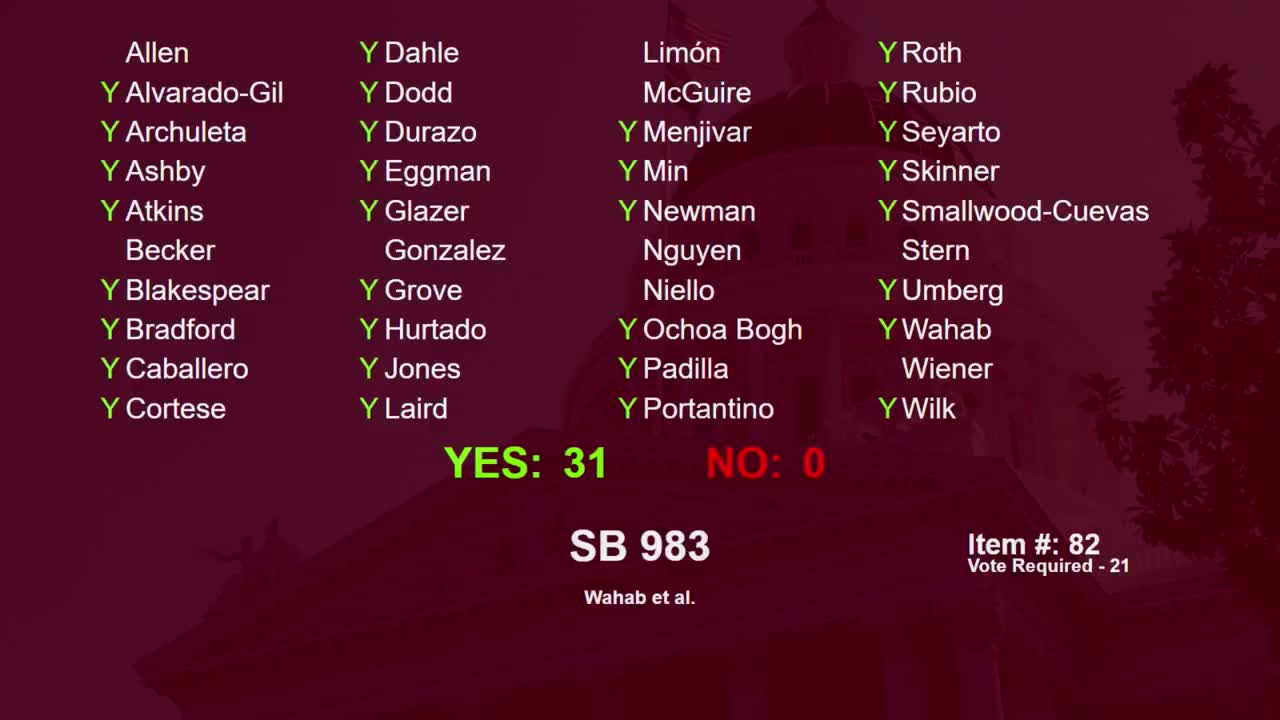 2MIN
Senate Floor
 3MIN
Senate Standing Committee on Energy, Utilities and Communications
Bill Author

Bill Co-Author(s):