SB 1158: Carl Moyer Memorial Air Quality Standards Attainment Program.
- Session Year: 2023-2024
- House: Senate
- Latest Version Date: 2024-09-22
Current Status:
Passed
(2024-09-22: Chaptered by Secretary of State. Chapter 459, Statutes of 2024.)
Introduced
In Committee
First Chamber
In Committee
Second Chamber
Enacted
Existing law establishes the Carl Moyer Memorial Air Quality Standards Attainment Program (Carl Moyer Program), which is administered by the State Air Resources Board, to provide grants to offset the incremental cost of eligible projects that reduce emissions of air pollutants from sources in the state and for funding a fueling infrastructure demonstration program and technology development efforts. Existing law requires that funds be allocated under the program to local air districts for liquidation in accordance with grant criteria and guidelines adopted by the state board. Existing law provides that any funds reserved for a local air district by the state board are available for disbursement to the district for a period of not more than 2 years from the time of reservation. Existing law requires funds not liquidated by a district by June 30 of the 4th calendar year following the date of the reservation to be returned to the state board within 90 days for future allocation under the program. Beginning January 1, 2034, existing law reduces the deadline for that period of liquidation to June 30 of the 2nd calendar year following the date of reservation.
This bill would extend the deadline for the period of liquidation to June 30 of the 6th calendar year following the date of disbursement and would make other conforming changes.
Under the Carl Moyer Program, existing law limits the amount of moneys that a local air district may use from its allocation for indirect costs of implementation of the program. Under existing law, that limit is 6.25% of the allocated moneys for a district with a population of 1,000,000 or more and 12.5% of the allocated moneys for a district with a population of less than 1,000,000.This bill would instead set that limit at 12.5% for all local air districts regardless of population.Existing law establishes the Carl Moyer Memorial Air Quality Standards Attainment Program (Carl Moyer Program), which is administered by the State Air Resources Board, to provide grants to offset the incremental cost of eligible projects that reduce emissions of air pollutants from sources in the state and for funding a fueling infrastructure demonstration program and technology development efforts. Existing law requires that funds be allocated under the program to local air districts for liquidation in accordance with grant criteria and guidelines adopted by the state board. Existing law provides that any funds reserved for a local air district by the state board are available for disbursement to the district for a period of not more than 2 years from the time of reservation. Existing law requires funds not liquidated by a district by June 30 of the 4th calendar year following the date of the reservation to be returned to the state board within 90 days for future allocation under the program. Beginning January 1, 2034, existing law reduces the deadline for that period of liquidation to June 30 of the 2nd calendar year following the date of reservation.
This bill would extend the deadline for the period of liquidation to June 30 of the 6th calendar year following the date of disbursement and would make other conforming changes.
Under the Carl Moyer Program, existing law limits the amount of moneys that a local air district may use from its allocation for indirect costs of implementation of the program. Under existing law, that limit is 6.25% of the allocated moneys for a district with a population of 1,000,000 or more and 12.5% of the allocated moneys for a district with a population of less than 1,000,000.
This bill would instead set that limit at 12.5% for all local air districts regardless of population.
(a)The state board shall establish grant criteria and guidelines consistent with this chapter for covered vehicle projects as soon as practicable, but not later than January 1, 2000. The adoption of guidelines is exempt from the rulemaking provisions of the Administrative Procedure Act, Chapter 3.5 (commencing with Section 11340) of Part 1 of Division 3 of Title 2 of the Government Code. The state board shall solicit input and comment from the districts during the development of the criteria and guidelines and shall make every effort to develop criteria and guidelines that are compatible with existing district programs that are also consistent with this chapter. Guidelines shall include protocols to calculate project cost-effectiveness. The grant criteria and guidelines shall include safeguards to ensure that the project generates surplus emissions reductions. Guidelines shall enable and encourage districts to cofund projects that provide emissions reductions in more than one district. The state board shall make draft criteria and guidelines available to the public 45 days before final adoption, and shall hold at least one public meeting to consider public comments before final adoption.
(b)The state board, in consultation with the participating districts, may propose revisions to the criteria and guidelines established pursuant to subdivision (a) as necessary to improve the ability of the program to achieve its goals. A proposed revision shall be made available to the public 45 days before final adoption of the revision and the state board shall hold at least one public meeting to consider public comments before final adoption of the revision.
(c)The state board shall reserve funds for, and disburse funds to, districts from the fund for administration pursuant to this section and Section 44299.1.
(d)The state board shall develop guidelines for a district to follow in applying for the reservation of funds, in accordance with this chapter. It is the intent of the Legislature that district administration of any reserved funds be in accordance with the project selection criteria specified in Sections 44281, 44282, and 44283 and all other provisions of this chapter. The guidelines shall be established and published by the state board as soon as practicable, but not later than January 1, 2000.
(e)Funds shall be reserved by the state board for administration by a district that adopts an eligible program pursuant to this chapter and offers matching funds at a ratio of one dollar ($1) of matching funds committed by the district or the Mobile Source Air Pollution Reduction Review Committee for every two dollars ($2) committed from the fund. Funds available to the Mobile Source Air Pollution Reduction Review Committee may be counted as matching funds for projects in the South Coast Air Basin only if the committee approves the use of these funds for matching purposes. Matching funds may be any funds under the districts budget authority that are committed to be expended in accordance with the program. Funds committed by a port authority or a local government, in cooperation with a district, to be expended in accordance with the program may also be counted as district matching funds. Matching funds provided by a port authority or a local government may not exceed 30 percent of the total required matching funds in any district that applies for more than three hundred thousand dollars ($300,000) of the state board funds. Only a district, or a port authority or a local government teamed with a district, may provide matching funds.
(f)The state board may adjust the ratio of matching funds described in subdivision (e), if it determines that an adjustment is necessary in order to maximize the use of, or the air quality benefits provided by, the program, based on a consideration of the financial resources of the district.
(g)Notwithstanding subdivision (e), a district need not provide matching funds for state board funds allocated to the district for program outreach activities pursuant to paragraph (2) of subdivision (a) of Section 44299.1.
(h)A district may include within its matching funds a reasonable estimate of direct or in-kind costs for assistance in providing program outreach and application evaluation. In-kind and direct matching funds shall not exceed 15 percent of the total matching funds offered by a district. A district may also include within its matching funds any money spent on or after February 25, 1999, that would have qualified as matching funds but were not previously claimed as matching funds.
(i)A district desiring a reservation of funds shall apply to the state board following the application guidelines established pursuant to this section. The state board shall approve or disapprove a district application not later than 60 days after receipt. Upon approval of any district application, the state board shall simultaneously approve a reservation of funding for that district to administer. Reserved funds shall be disbursed to the district so that funding of a district-approved project is not impeded.
(j)Notwithstanding any other provision of this chapter, districts and the Mobile Source Air Pollution Reduction Review Committee shall not use funds collected pursuant to Section 41081 or Chapter 7 (commencing with Section 44220), or pursuant to Section 9250.11 of the Vehicle Code, as matching funds to fund a project with stationary or portable engines, locomotives, or marine vessels.
(k)Any funds reserved for a district pursuant to this section are available to the district for a period of not more than two years from the time of reservation. Funds not expended by June 30 of the sixth calendar year following the date of disbursement shall revert back to the state board as of that June 30, and shall be deposited in the fund for use by the program. The funds may then be redirected based on applications to the fund. Regardless of any reversion of funds back to the state board, the district may continue to request other reservations of funds for local administration. Each reservation of funds shall be accounted for separately, and unused funds from each application shall revert back to the state board as specified in this subdivision.
(l)The state board shall specify a date each year when district applications are due. If the eligible applications received in any year oversubscribe the available funds, the state board shall reserve funds on an allocation basis, pursuant to subdivision (b) of Section 44299.1. The state board may accept a district application after the due date for a period of months specified by the state board. Funds may be reserved in response to those applications, in accordance with this chapter, out of funds remaining after the original reservation of funds for the year.
(m)Guidelines for a district application shall require information from an applicant district to the extent necessary to meet the requirements of this chapter, but shall otherwise minimize the information required of a district.
(n)A district application shall be reviewed by the state board immediately upon receipt. If the state board determines that an application is incomplete, the applicant shall be notified within 10 working days with an explanation of what is missing from the application. A completed application fulfilling the criteria shall be approved as soon as practicable, but not later than 60 working days after receipt.
(o)The state board, in consultation with the districts, shall establish project approval criteria and guidelines for infrastructure projects consistent with Section 44284 as soon as practicable, but not later than February 15, 2000. The commission shall make draft criteria and guidelines available to the public 45 days before final adoption, and shall hold at least one public meeting to consider public comments before final adoption.
(p)The state board, in consultation with the participating districts, may propose revisions to the criteria and guidelines established pursuant to subdivision (o) as necessary to improve the ability of the program to achieve its goals. A revision may be proposed at any time, or may be proposed in response to a finding made in the annual report on the program published by the state board pursuant to Section 44295. A proposed revision shall be made available to the public 45 days before final adoption of the revision and the commission shall hold at least one public meeting to consider public comments before final adoption of the revision.
(q)This section shall become operative on January 1, 2034.
SEC. 2.Section 44287 of the Health and Safety Code, as amended by Section 122 of Chapter 131 of the Statutes of 2023, is amended to read:44287.(a)The state board shall establish or update grant criteria and guidelines consistent with this chapter for covered vehicle and infrastructure projects as soon as practicable, but not later than July 1, 2017. The adoption of guidelines is exempt from the rulemaking provisions of the Administrative Procedure Act (Chapter 3.5 (commencing with Section 11340) of Part 1 of Division 3 of Title 2 of the Government Code). The state board shall solicit input and comment from the districts during the development of the criteria and guidelines and shall make every effort to develop criteria and guidelines that are compatible with existing district programs that are also consistent with this chapter. Guidelines shall include protocols to calculate project cost-effectiveness. The grant criteria and guidelines shall include safeguards to ensure that the project generates surplus emissions reductions. Guidelines shall enable and encourage districts to cofund projects that provide emissions reductions in more than one district. The state board shall make draft criteria and guidelines available to the public 45 days before final adoption, and shall hold at least one public meeting to consider public comments before final adoption. The state board may develop separate guidelines and criteria for the different types of eligible projects described in subdivision (a) of Section 44281.
(b)The state board, in consultation with the participating districts, may propose revisions to the criteria and guidelines established pursuant to subdivision (a) as necessary to improve the ability of the program to achieve its goals. A proposed revision shall be made available to the public 45 days before final adoption of the revision and the state board shall hold at least one public meeting to consider public comments before final adoption of the revision.
(c)The state board shall reserve funds for, and disburse funds to, districts from the fund for administration pursuant to this section and Section 44299.1.
(d)The state board shall develop guidelines for a district to follow in applying for the reservation of funds, in accordance with this chapter. It is the intent of the Legislature that district administration of any reserved funds be in accordance with the project selection criteria specified in Sections 44281, 44282, and 44283 and all other provisions of this chapter. The guidelines shall be established and published by the state board as soon as practicable, but not later than January 1, 2006.
(e)Funds shall be reserved by the state board for administration by a district that adopts an eligible program pursuant to this chapter and offers matching funds at a ratio of one dollar ($1) of matching funds committed by the district or the Mobile Source Air Pollution Reduction Review Committee for every two dollars ($2) committed from the fund. Funds available to the Mobile Source Air Pollution Reduction Review Committee may be counted as matching funds for projects in the South Coast Air Basin only if the committee approves the use of these funds for matching purposes. Matching funds may be any funds under the districts budget authority that are committed to be expended in accordance with the program. Funds committed by a port authority or a local government, in cooperation with a district, to be expended in accordance with the program may also be counted as district matching funds. Matching funds provided by a port authority or a local government shall not exceed 30 percent of the total required matching funds in any district that applies for more than three hundred thousand dollars ($300,000) of the state board funds. Only a district, or a port authority or a local government teamed with a district, may provide matching funds.
(f)The state board may adjust the ratio of matching funds described in subdivision (e), if it determines that an adjustment is necessary in order to maximize the use of, or the air quality benefits provided by, the program, based on a consideration of the financial resources of the district.
(g)Notwithstanding subdivision (e), a district need not provide matching funds for state board funds allocated to the district for program outreach activities pursuant to paragraph (2) of subdivision (a) of Section 44299.1.
(h)A district may include within its matching funds a reasonable estimate of direct or in-kind costs for assistance in providing program outreach and application evaluation. In-kind and direct matching funds shall not exceed 15 percent of the total matching funds offered by a district. A district may also include within its matching funds any money spent on or after February 25, 1999, that would have qualified as matching funds but were not previously claimed as matching funds.
(i)A district desiring a reservation of funds shall apply to the state board following the application guidelines established pursuant to this section. The state board shall approve or disapprove a district application not later than 60 days after receipt. Upon approval of any district application, the state board shall simultaneously approve a reservation of funding for that district to administer. Reserved funds shall be disbursed to the district so that funding of a district-approved project is not impeded.
(j)Any funds reserved for a district by the state board pursuant to this section are available for disbursement to the district for a period of not more than two years from the time of reservation. Funds not liquidated by a district by June 30 of the sixth calendar year following the date of disbursement shall be returned to the state board within 90 days for future allocation pursuant to this chapter. Each reservation of funds shall be accounted for separately, and unused funds from each application shall revert back to the state board for use pursuant to this chapter as specified in this subdivision.
(k)The state board shall specify a date each year when district applications are due. If the eligible applications received in any year oversubscribe the available funds, the state board shall reserve funds on an allocation basis, pursuant to Section 44299.2. The state board may accept a district application after the due date for a period of months specified by the state board. Funds may be reserved in response to those applications, in accordance with this chapter, out of funds remaining after the original reservation of funds for the year.
(l)Guidelines for a district application shall require information from an applicant district to the extent necessary to meet the requirements of this chapter, but shall otherwise minimize the information required of a district.
(m)A district application shall be reviewed by the state board immediately upon receipt. If the state board determines that an application is incomplete, the applicant shall be notified within 10 working days with an explanation of what is missing from the application. A completed application fulfilling the criteria shall be approved as soon as practicable, but not later than 60 working days after receipt.
(n)The commission, in consultation with the districts, shall establish project approval criteria and guidelines for infrastructure projects consistent with Section 44284 as soon as practicable, but not later than February 15, 2000. The commission shall make draft criteria and guidelines available to the public 45 days before final adoption, and shall hold at least one public meeting to consider public comments before final adoption.
(o)The commission, in consultation with the participating districts, may propose revisions to the criteria and guidelines established pursuant to subdivision (n) as necessary to improve the ability of the program to achieve its goals. A revision may be proposed at any time, or may be proposed in response to a finding made in the annual report on the program published by the state board pursuant to Section 44295. A proposed revision shall be made available to the public 45 days before final adoption of the revision and the commission shall hold at least one public meeting to consider public comments before final adoption of the revision.
(p)Unclaimed funds will be allocated by the state board in accordance with Section 44299.2.
(q)This section shall remain in effect only until January 1, 2034, and as of that date is repealed, unless a later enacted statute, that is enacted before January 1, 2034, deletes or extends that date.
SEC. 3.Section 44299.2 of the Health and Safety Code is amended to read:44299.2.Funds shall be allocated to districts, and shall be subject to administrative terms and conditions as follows:
(a)Available funds shall be distributed to districts taking into consideration the population of the area, the severity of the air quality problems experienced by the population, and the historical allocation of the program funds, except that the south coast district shall be allocated a percentage of the total funds available to districts that is proportional to the percentage of the total state population residing within the jurisdictional boundaries of that district. For the purposes of this subdivision, population shall be determined by the state board based on the most recent data provided by the Department of Finance. The allocation to the south coast district shall be subtracted from the total funds available to districts. Each district, except the south coast district, shall be awarded a minimum allocation of two hundred thousand dollars ($200,000), and the remainder, which shall be known as the allocation amount, shall be allocated to all districts as follows:
(1)The state board shall distribute 35 percent of the allocation amount to the districts in proportion to the percentage of the total residual state population that resides within each districts boundaries. For purposes of this paragraph, total residual state population means the total state population, less the total population that resides within the south coast district.
(2)The state board shall distribute 35 percent of the allocation amount to the districts in proportion to the severity of the air quality problems to which each districts population is exposed. The severity of the exposure shall be calculated as follows:
(A)Each district shall be awarded severity points based on the districts attainment designation and classification, as most recently promulgated by the federal Environmental Protection Agency for the National Ambient Air Quality Standard for ozone averaged over eight hours, as follows:
(i)A district that is designated attainment for the federal eight-hour ozone standard shall be awarded one point.
(ii)A district that is designated nonattainment for the federal eight-hour ozone standard shall be awarded severity points based on classification. Two points shall be awarded for transitional, basic, or marginal classifications, three points for moderate classification, four points for serious classification, five points for severe classification, six points for severe-17 classification, and seven points for extreme classification.
(B)Each district shall be awarded severity points based on the annual diesel particulate emissions in the air basin, as determined by the state board. One point shall be awarded to the district, in increments, for each 1,000 tons of diesel particulate emissions. In making this determination, 0 to 999 tons shall be awarded no points, 1,000 to 1,999 tons shall be awarded one point, 2,000 to 2,999 tons shall be awarded two points, and so forth. If a district encompasses more than one air basin, the air basin with the greatest diesel particulate emissions shall be used to determine the points awarded to the district. The San Diego County Air Pollution Control District and the Imperial County Air Pollution Control District shall be awarded one additional point each to account for annual diesel particulate emissions transported from Mexico.
(C)The points awarded under subparagraphs (A) and (B), shall be added together for each district, and the total shall be multiplied by the population residing within the district boundaries, to yield the local air quality exposure index.
(D)The local air quality exposure index for each district shall be summed together to yield a total state exposure index. Funds shall be allocated under this paragraph to each district in proportion to its local air quality exposure index divided by the total state exposure index.
(3)The state board shall distribute 30 percent of the allocation amount to the districts in proportion to the allocation of funds from the program moneys in the fund, as follows:
(A)Because each district is awarded a minimum allocation pursuant to subdivision (a), there shall be no additional minimum allocation from the program historical allocation funds. The total amount allocated in this way shall be subtracted from total funding previously awarded to the district under the program, and the remainder, which shall be known as directed funds, shall be allocated pursuant to subparagraph (B).
(B)Each district with a population that is greater than or equal to 1 percent of the states population shall receive an additional allocation based on the population of the district and the districts relative share of emission reduction commitments in the state implementation plan to attain the National Ambient Air Quality Standard for ozone averaged over one hour. This additional allocation shall be calculated as a percentage share of the directed funds for each district, derived using a ratio of each districts share amount to the base amount, which shall be calculated as follows:
(i)The base amount shall be the total program funds allocated by the state board to the districts in the 200203 fiscal year, less the total of the funds allocated through the minimum allocation to each district in the 200203 fiscal year.
(ii)The share amount shall be the allocation that each district received in the 200203 fiscal year, not including the minimum allocation. There shall be one share amount for each district.
(iii)The percentage share shall be calculated for each district by dividing the districts share amount by the base amount, and multiplying the result by the total directed funds available under this subparagraph.
(b)Funds shall be distributed as expeditiously as reasonably practicable, and a report of the distribution shall be made available to the public.
(c)All funds allocated pursuant to this section shall be liquidated as provided for in the guidelines adopted pursuant to Section 44287.
(a)The state board shall establish grant criteria and guidelines consistent with this chapter for covered vehicle projects as soon as practicable, but not later than January 1, 2000. The adoption of guidelines is exempt from the rulemaking provisions of the Administrative Procedure Act, Chapter 3.5 (commencing with Section 11340) of Part 1 of Division 3 of Title 2 of the Government Code. The state board shall solicit input and comment from the districts during the development of the criteria and guidelines and shall make every effort to develop criteria and guidelines that are compatible with existing district programs that are also consistent with this chapter. Guidelines shall include protocols to calculate project cost-effectiveness. The grant criteria and guidelines shall include safeguards to ensure that the project generates surplus emissions reductions. Guidelines shall enable and encourage districts to cofund projects that provide emissions reductions in more than one district. The state board shall make draft criteria and guidelines available to the public 45 days before final adoption, and shall hold at least one public meeting to consider public comments before final adoption.
(b)The state board, in consultation with the participating districts, may propose revisions to the criteria and guidelines established pursuant to subdivision (a) as necessary to improve the ability of the program to achieve its goals. A proposed revision shall be made available to the public 45 days before final adoption of the revision and the state board shall hold at least one public meeting to consider public comments before final adoption of the revision.
(c)The state board shall reserve funds for, and disburse funds to, districts from the fund for administration pursuant to this section and Section 44299.1.
(d)The state board shall develop guidelines for a district to follow in applying for the reservation of funds, in accordance with this chapter. It is the intent of the Legislature that district administration of any reserved funds be in accordance with the project selection criteria specified in Sections 44281, 44282, and 44283 and all other provisions of this chapter. The guidelines shall be established and published by the state board as soon as practicable, but not later than January 1, 2000.
(e)Funds shall be reserved by the state board for administration by a district that adopts an eligible program pursuant to this chapter and offers matching funds at a ratio of one dollar ($1) of matching funds committed by the district or the Mobile Source Air Pollution Reduction Review Committee for every two dollars ($2) committed from the fund. Funds available to the Mobile Source Air Pollution Reduction Review Committee may be counted as matching funds for projects in the South Coast Air Basin only if the committee approves the use of these funds for matching purposes. Matching funds may be any funds under the districts budget authority that are committed to be expended in accordance with the program. Funds committed by a port authority or a local government, in cooperation with a district, to be expended in accordance with the program may also be counted as district matching funds. Matching funds provided by a port authority or a local government may not exceed 30 percent of the total required matching funds in any district that applies for more than three hundred thousand dollars ($300,000) of the state board funds. Only a district, or a port authority or a local government teamed with a district, may provide matching funds.
(f)The state board may adjust the ratio of matching funds described in subdivision (e), if it determines that an adjustment is necessary in order to maximize the use of, or the air quality benefits provided by, the program, based on a consideration of the financial resources of the district.
(g)Notwithstanding subdivision (e), a district need not provide matching funds for state board funds allocated to the district for program outreach activities pursuant to paragraph (2) of subdivision (a) of Section 44299.1.
(h)A district may include within its matching funds a reasonable estimate of direct or in-kind costs for assistance in providing program outreach and application evaluation. In-kind and direct matching funds shall not exceed 15 percent of the total matching funds offered by a district. A district may also include within its matching funds any money spent on or after February 25, 1999, that would have qualified as matching funds but were not previously claimed as matching funds.
(i)A district desiring a reservation of funds shall apply to the state board following the application guidelines established pursuant to this section. The state board shall approve or disapprove a district application not later than 60 days after receipt. Upon approval of any district application, the state board shall simultaneously approve a reservation of funding for that district to administer. Reserved funds shall be disbursed to the district so that funding of a district-approved project is not impeded.
(j)Notwithstanding any other provision of this chapter, districts and the Mobile Source Air Pollution Reduction Review Committee shall not use funds collected pursuant to Section 41081 or Chapter 7 (commencing with Section 44220), or pursuant to Section 9250.11 of the Vehicle Code, as matching funds to fund a project with stationary or portable engines, locomotives, or marine vessels.
(k)Any funds reserved for a district pursuant to this section are available to the district for a period of not more than two years from the time of reservation. Funds not expended by June 30 of the sixth calendar year following the date of disbursement shall revert back to the state board as of that June 30, and shall be deposited in the fund for use by the program. The funds may then be redirected based on applications to the fund. Regardless of any reversion of funds back to the state board, the district may continue to request other reservations of funds for local administration. Each reservation of funds shall be accounted for separately, and unused funds from each application shall revert back to the state board as specified in this subdivision.
(l)The state board shall specify a date each year when district applications are due. If the eligible applications received in any year oversubscribe the available funds, the state board shall reserve funds on an allocation basis, pursuant to subdivision (b) of Section 44299.1. The state board may accept a district application after the due date for a period of months specified by the state board. Funds may be reserved in response to those applications, in accordance with this chapter, out of funds remaining after the original reservation of funds for the year.
(m)Guidelines for a district application shall require information from an applicant district to the extent necessary to meet the requirements of this chapter, but shall otherwise minimize the information required of a district.
(n)A district application shall be reviewed by the state board immediately upon receipt. If the state board determines that an application is incomplete, the applicant shall be notified within 10 working days with an explanation of what is missing from the application. A completed application fulfilling the criteria shall be approved as soon as practicable, but not later than 60 working days after receipt.
(o)The state board, in consultation with the districts, shall establish project approval criteria and guidelines for infrastructure projects consistent with Section 44284 as soon as practicable, but not later than February 15, 2000. The commission shall make draft criteria and guidelines available to the public 45 days before final adoption, and shall hold at least one public meeting to consider public comments before final adoption.
(p)The state board, in consultation with the participating districts, may propose revisions to the criteria and guidelines established pursuant to subdivision (o) as necessary to improve the ability of the program to achieve its goals. A revision may be proposed at any time, or may be proposed in response to a finding made in the annual report on the program published by the state board pursuant to Section 44295. A proposed revision shall be made available to the public 45 days before final adoption of the revision and the commission shall hold at least one public meeting to consider public comments before final adoption of the revision.
(q)This section shall become operative on January 1, 2034.
SEC. 2.Section 44287 of the Health and Safety Code, as amended by Section 122 of Chapter 131 of the Statutes of 2023, is amended to read:44287.(a)The state board shall establish or update grant criteria and guidelines consistent with this chapter for covered vehicle and infrastructure projects as soon as practicable, but not later than July 1, 2017. The adoption of guidelines is exempt from the rulemaking provisions of the Administrative Procedure Act (Chapter 3.5 (commencing with Section 11340) of Part 1 of Division 3 of Title 2 of the Government Code). The state board shall solicit input and comment from the districts during the development of the criteria and guidelines and shall make every effort to develop criteria and guidelines that are compatible with existing district programs that are also consistent with this chapter. Guidelines shall include protocols to calculate project cost-effectiveness. The grant criteria and guidelines shall include safeguards to ensure that the project generates surplus emissions reductions. Guidelines shall enable and encourage districts to cofund projects that provide emissions reductions in more than one district. The state board shall make draft criteria and guidelines available to the public 45 days before final adoption, and shall hold at least one public meeting to consider public comments before final adoption. The state board may develop separate guidelines and criteria for the different types of eligible projects described in subdivision (a) of Section 44281.
(b)The state board, in consultation with the participating districts, may propose revisions to the criteria and guidelines established pursuant to subdivision (a) as necessary to improve the ability of the program to achieve its goals. A proposed revision shall be made available to the public 45 days before final adoption of the revision and the state board shall hold at least one public meeting to consider public comments before final adoption of the revision.
(c)The state board shall reserve funds for, and disburse funds to, districts from the fund for administration pursuant to this section and Section 44299.1.
(d)The state board shall develop guidelines for a district to follow in applying for the reservation of funds, in accordance with this chapter. It is the intent of the Legislature that district administration of any reserved funds be in accordance with the project selection criteria specified in Sections 44281, 44282, and 44283 and all other provisions of this chapter. The guidelines shall be established and published by the state board as soon as practicable, but not later than January 1, 2006.
(e)Funds shall be reserved by the state board for administration by a district that adopts an eligible program pursuant to this chapter and offers matching funds at a ratio of one dollar ($1) of matching funds committed by the district or the Mobile Source Air Pollution Reduction Review Committee for every two dollars ($2) committed from the fund. Funds available to the Mobile Source Air Pollution Reduction Review Committee may be counted as matching funds for projects in the South Coast Air Basin only if the committee approves the use of these funds for matching purposes. Matching funds may be any funds under the districts budget authority that are committed to be expended in accordance with the program. Funds committed by a port authority or a local government, in cooperation with a district, to be expended in accordance with the program may also be counted as district matching funds. Matching funds provided by a port authority or a local government shall not exceed 30 percent of the total required matching funds in any district that applies for more than three hundred thousand dollars ($300,000) of the state board funds. Only a district, or a port authority or a local government teamed with a district, may provide matching funds.
(f)The state board may adjust the ratio of matching funds described in subdivision (e), if it determines that an adjustment is necessary in order to maximize the use of, or the air quality benefits provided by, the program, based on a consideration of the financial resources of the district.
(g)Notwithstanding subdivision (e), a district need not provide matching funds for state board funds allocated to the district for program outreach activities pursuant to paragraph (2) of subdivision (a) of Section 44299.1.
(h)A district may include within its matching funds a reasonable estimate of direct or in-kind costs for assistance in providing program outreach and application evaluation. In-kind and direct matching funds shall not exceed 15 percent of the total matching funds offered by a district. A district may also include within its matching funds any money spent on or after February 25, 1999, that would have qualified as matching funds but were not previously claimed as matching funds.
(i)A district desiring a reservation of funds shall apply to the state board following the application guidelines established pursuant to this section. The state board shall approve or disapprove a district application not later than 60 days after receipt. Upon approval of any district application, the state board shall simultaneously approve a reservation of funding for that district to administer. Reserved funds shall be disbursed to the district so that funding of a district-approved project is not impeded.
(j)Any funds reserved for a district by the state board pursuant to this section are available for disbursement to the district for a period of not more than two years from the time of reservation. Funds not liquidated by a district by June 30 of the sixth calendar year following the date of disbursement shall be returned to the state board within 90 days for future allocation pursuant to this chapter. Each reservation of funds shall be accounted for separately, and unused funds from each application shall revert back to the state board for use pursuant to this chapter as specified in this subdivision.
(k)The state board shall specify a date each year when district applications are due. If the eligible applications received in any year oversubscribe the available funds, the state board shall reserve funds on an allocation basis, pursuant to Section 44299.2. The state board may accept a district application after the due date for a period of months specified by the state board. Funds may be reserved in response to those applications, in accordance with this chapter, out of funds remaining after the original reservation of funds for the year.
(l)Guidelines for a district application shall require information from an applicant district to the extent necessary to meet the requirements of this chapter, but shall otherwise minimize the information required of a district.
(m)A district application shall be reviewed by the state board immediately upon receipt. If the state board determines that an application is incomplete, the applicant shall be notified within 10 working days with an explanation of what is missing from the application. A completed application fulfilling the criteria shall be approved as soon as practicable, but not later than 60 working days after receipt.
(n)The commission, in consultation with the districts, shall establish project approval criteria and guidelines for infrastructure projects consistent with Section 44284 as soon as practicable, but not later than February 15, 2000. The commission shall make draft criteria and guidelines available to the public 45 days before final adoption, and shall hold at least one public meeting to consider public comments before final adoption.
(o)The commission, in consultation with the participating districts, may propose revisions to the criteria and guidelines established pursuant to subdivision (n) as necessary to improve the ability of the program to achieve its goals. A revision may be proposed at any time, or may be proposed in response to a finding made in the annual report on the program published by the state board pursuant to Section 44295. A proposed revision shall be made available to the public 45 days before final adoption of the revision and the commission shall hold at least one public meeting to consider public comments before final adoption of the revision.
(p)Unclaimed funds will be allocated by the state board in accordance with Section 44299.2.
(q)This section shall remain in effect only until January 1, 2034, and as of that date is repealed, unless a later enacted statute, that is enacted before January 1, 2034, deletes or extends that date.
SEC. 3.Section 44299.1 of the Health and Safety Code is amended to read:44299.1.(a)To ensure that emission reductions are obtained as needed from pollution sources, any moneys deposited in the fund for use by the program or appropriated to the program shall be segregated and administered as follows:(1)Not more than 2.5 percent of the moneys in the fund for use by the program shall be allocated to program support and outreach costs incurred by the state board and the commission directly associated with implementing the program pursuant to this chapter. These funds shall be allocated to the state board and the commission in proportion to total program funds administered by the state board and the commission.(2)Not more than 2.5 percent of the moneys in the fund for use by the program shall be allocated to direct program outreach activities. The state board may use these funds for program outreach contracts or may allocate outreach funds to participating districts in proportion to each districts allocation from the program moneys in the fund. The state board shall report on the use of outreach funds in their reports to the Legislature pursuant to Section 44295.(3)The balance shall be deposited in the fund to be expended to offset added costs of new very low or zero-emission vehicle technologies, and emission reducing repowers, retrofits, and add-on equipment for covered vehicles and engines, and other projects specified in Section 44281.(b)Moneys in the fund shall be allocated to a district that submits an eligible application to the state board pursuant to Section 44287. The state board shall determine the maximum amount of annual funding from the fund for use by the program that each district may receive. This determination shall be based on the population in each district as well as the relative importance of obtaining covered emission reductions in each district, specifically through the program.(c)Not more than 12.5 percent of the moneys allocated pursuant to this chapter to a district may be used by the district for indirect costs of implementation of the program, including outreach costs that are subject to the limitation in paragraph (2) of subdivision (a).SEC. 4.SEC. 3.Section 44299.2 of the Health and Safety Code is amended to read:44299.2.Funds shall be allocated to districts, and shall be subject to administrative terms and conditions as follows:
(a)Available funds shall be distributed to districts taking into consideration the population of the area, the severity of the air quality problems experienced by the population, and the historical allocation of the program funds, except that the south coast district shall be allocated a percentage of the total funds available to districts that is proportional to the percentage of the total state population residing within the jurisdictional boundaries of that district. For the purposes of this subdivision, population shall be determined by the state board based on the most recent data provided by the Department of Finance. The allocation to the south coast district shall be subtracted from the total funds available to districts. Each district, except the south coast district, shall be awarded a minimum allocation of two hundred thousand dollars ($200,000), and the remainder, which shall be known as the allocation amount, shall be allocated to all districts as follows:
(1)The state board shall distribute 35 percent of the allocation amount to the districts in proportion to the percentage of the total residual state population that resides within each districts boundaries. For purposes of this paragraph, total residual state population means the total state population, less the total population that resides within the south coast district.
(2)The state board shall distribute 35 percent of the allocation amount to the districts in proportion to the severity of the air quality problems to which each districts population is exposed. The severity of the exposure shall be calculated as follows:
(A)Each district shall be awarded severity points based on the districts attainment designation and classification, as most recently promulgated by the federal Environmental Protection Agency for the National Ambient Air Quality Standard for ozone averaged over eight hours, as follows:
(i)A district that is designated attainment for the federal eight-hour ozone standard shall be awarded one point.
(ii)A district that is designated nonattainment for the federal eight-hour ozone standard shall be awarded severity points based on classification. Two points shall be awarded for transitional, basic, or marginal classifications, three points for moderate classification, four points for serious classification, five points for severe classification, six points for severe-17 classification, and seven points for extreme classification.
(B)Each district shall be awarded severity points based on the annual diesel particulate emissions in the air basin, as determined by the state board. One point shall be awarded to the district, in increments, for each 1,000 tons of diesel particulate emissions. In making this determination, 0 to 999 tons shall be awarded no points, 1,000 to 1,999 tons shall be awarded one point, 2,000 to 2,999 tons shall be awarded two points, and so forth. If a district encompasses more than one air basin, the air basin with the greatest diesel particulate emissions shall be used to determine the points awarded to the district. The San Diego County Air Pollution Control District and the Imperial County Air Pollution Control District shall be awarded one additional point each to account for annual diesel particulate emissions transported from Mexico.
(C)The points awarded under subparagraphs (A) and (B), shall be added together for each district, and the total shall be multiplied by the population residing within the district boundaries, to yield the local air quality exposure index.
(D)The local air quality exposure index for each district shall be summed together to yield a total state exposure index. Funds shall be allocated under this paragraph to each district in proportion to its local air quality exposure index divided by the total state exposure index.
(3)The state board shall distribute 30 percent of the allocation amount to the districts in proportion to the allocation of funds from the program moneys in the fund, as follows:
(A)Because each district is awarded a minimum allocation pursuant to subdivision (a), there shall be no additional minimum allocation from the program historical allocation funds. The total amount allocated in this way shall be subtracted from total funding previously awarded to the district under the program, and the remainder, which shall be known as directed funds, shall be allocated pursuant to subparagraph (B).
(B)Each district with a population that is greater than or equal to 1 percent of the states population shall receive an additional allocation based on the population of the district and the districts relative share of emission reduction commitments in the state implementation plan to attain the National Ambient Air Quality Standard for ozone averaged over one hour. This additional allocation shall be calculated as a percentage share of the directed funds for each district, derived using a ratio of each districts share amount to the base amount, which shall be calculated as follows:
(i)The base amount shall be the total program funds allocated by the state board to the districts in the 200203 fiscal year, less the total of the funds allocated through the minimum allocation to each district in the 200203 fiscal year.
(ii)The share amount shall be the allocation that each district received in the 200203 fiscal year, not including the minimum allocation. There shall be one share amount for each district.
(iii)The percentage share shall be calculated for each district by dividing the districts share amount by the base amount, and multiplying the result by the total directed funds available under this subparagraph.
(b)Funds shall be distributed as expeditiously as reasonably practicable, and a report of the distribution shall be made available to the public.
(c)All funds allocated pursuant to this section shall be liquidated as provided for in the guidelines adopted pursuant to Section 44287.
(a)The state board shall establish grant criteria and guidelines consistent with this chapter for covered vehicle projects as soon as practicable, but not later than January 1, 2000. The adoption of guidelines is exempt from the rulemaking provisions of the Administrative Procedure Act, Chapter 3.5 (commencing with Section 11340) of Part 1 of Division 3 of Title 2 of the Government Code. The state board shall solicit input and comment from the districts during the development of the criteria and guidelines and shall make every effort to develop criteria and guidelines that are compatible with existing district programs that are also consistent with this chapter. Guidelines shall include protocols to calculate project cost-effectiveness. The grant criteria and guidelines shall include safeguards to ensure that the project generates surplus emissions reductions. Guidelines shall enable and encourage districts to cofund projects that provide emissions reductions in more than one district. The state board shall make draft criteria and guidelines available to the public 45 days before final adoption, and shall hold at least one public meeting to consider public comments before final adoption.
(b)The state board, in consultation with the participating districts, may propose revisions to the criteria and guidelines established pursuant to subdivision (a) as necessary to improve the ability of the program to achieve its goals. A proposed revision shall be made available to the public 45 days before final adoption of the revision and the state board shall hold at least one public meeting to consider public comments before final adoption of the revision.
(c)The state board shall reserve funds for, and disburse funds to, districts from the fund for administration pursuant to this section and Section 44299.1.
(d)The state board shall develop guidelines for a district to follow in applying for the reservation of funds, in accordance with this chapter. It is the intent of the Legislature that district administration of any reserved funds be in accordance with the project selection criteria specified in Sections 44281, 44282, and 44283 and all other provisions of this chapter. The guidelines shall be established and published by the state board as soon as practicable, but not later than January 1, 2000.
(e)Funds shall be reserved by the state board for administration by a district that adopts an eligible program pursuant to this chapter and offers matching funds at a ratio of one dollar ($1) of matching funds committed by the district or the Mobile Source Air Pollution Reduction Review Committee for every two dollars ($2) committed from the fund. Funds available to the Mobile Source Air Pollution Reduction Review Committee may be counted as matching funds for projects in the South Coast Air Basin only if the committee approves the use of these funds for matching purposes. Matching funds may be any funds under the districts budget authority that are committed to be expended in accordance with the program. Funds committed by a port authority or a local government, in cooperation with a district, to be expended in accordance with the program may also be counted as district matching funds. Matching funds provided by a port authority or a local government may not exceed 30 percent of the total required matching funds in any district that applies for more than three hundred thousand dollars ($300,000) of the state board funds. Only a district, or a port authority or a local government teamed with a district, may provide matching funds.
(f)The state board may adjust the ratio of matching funds described in subdivision (e), if it determines that an adjustment is necessary in order to maximize the use of, or the air quality benefits provided by, the program, based on a consideration of the financial resources of the district.
(g)Notwithstanding subdivision (e), a district need not provide matching funds for state board funds allocated to the district for program outreach activities pursuant to paragraph (2) of subdivision (a) of Section 44299.1.
(h)A district may include within its matching funds a reasonable estimate of direct or in-kind costs for assistance in providing program outreach and application evaluation. In-kind and direct matching funds shall not exceed 15 percent of the total matching funds offered by a district. A district may also include within its matching funds any money spent on or after February 25, 1999, that would have qualified as matching funds but were not previously claimed as matching funds.
(i)A district desiring a reservation of funds shall apply to the state board following the application guidelines established pursuant to this section. The state board shall approve or disapprove a district application not later than 60 days after receipt. Upon approval of any district application, the state board shall simultaneously approve a reservation of funding for that district to administer. Reserved funds shall be disbursed to the district so that funding of a district-approved project is not impeded.
(j)Notwithstanding any other provision of this chapter, districts and the Mobile Source Air Pollution Reduction Review Committee shall not use funds collected pursuant to Section 41081 or Chapter 7 (commencing with Section 44220), or pursuant to Section 9250.11 of the Vehicle Code, as matching funds to fund a project with stationary or portable engines, locomotives, or marine vessels.
(k)Any funds reserved for a district pursuant to this section are available to the district for a period of not more than two years from the time of reservation. Funds not expended by June 30 of the second sixth calendar year following the date of the reservation disbursement shall revert back to the state board as of that June 30, and shall be deposited in the fund for use by the program. The funds may then be redirected based on applications to the fund. Regardless of any reversion of funds back to the state board, the district may continue to request other reservations of funds for local administration. Each reservation of funds shall be accounted for separately, and unused funds from each application shall revert back to the state board as specified in this subdivision.
(l)The state board shall specify a date each year when district applications are due. If the eligible applications received in any year oversubscribe the available funds, the state board shall reserve funds on an allocation basis, pursuant to subdivision (b) of Section 44299.1. The state board may accept a district application after the due date for a period of months specified by the state board. Funds may be reserved in response to those applications, in accordance with this chapter, out of funds remaining after the original reservation of funds for the year.
(m)Guidelines for a district application shall require information from an applicant district to the extent necessary to meet the requirements of this chapter, but shall otherwise minimize the information required of a district.
(n)A district application shall be reviewed by the state board immediately upon receipt. If the state board determines that an application is incomplete, the applicant shall be notified within 10 working days with an explanation of what is missing from the application. A completed application fulfilling the criteria shall be approved as soon as practicable, but not later than 60 working days after receipt.
(o)The state board, in consultation with the districts, shall establish project approval criteria and guidelines for infrastructure projects consistent with Section 44284 as soon as practicable, but not later than February 15, 2000. The commission shall make draft criteria and guidelines available to the public 45 days before final adoption, and shall hold at least one public meeting to consider public comments before final adoption.
(p)The state board, in consultation with the participating districts, may propose revisions to the criteria and guidelines established pursuant to subdivision (o) as necessary to improve the ability of the program to achieve its goals. A revision may be proposed at any time, or may be proposed in response to a finding made in the annual report on the program published by the state board pursuant to Section 44295. A proposed revision shall be made available to the public 45 days before final adoption of the revision and the commission shall hold at least one public meeting to consider public comments before final adoption of the revision.
(q)This section shall become operative on January 1, 2034.
SEC. 2.Section 44287 of the Health and Safety Code, as amended by Section 122 of Chapter 131 of the Statutes of 2023, is amended to read:44287.(a)The state board shall establish or update grant criteria and guidelines consistent with this chapter for covered vehicle and infrastructure projects as soon as practicable, but not later than July 1, 2017. The adoption of guidelines is exempt from the rulemaking provisions of the Administrative Procedure Act (Chapter 3.5 (commencing with Section 11340) of Part 1 of Division 3 of Title 2 of the Government Code). The state board shall solicit input and comment from the districts during the development of the criteria and guidelines and shall make every effort to develop criteria and guidelines that are compatible with existing district programs that are also consistent with this chapter. Guidelines shall include protocols to calculate project cost-effectiveness. The grant criteria and guidelines shall include safeguards to ensure that the project generates surplus emissions reductions. Guidelines shall enable and encourage districts to cofund projects that provide emissions reductions in more than one district. The state board shall make draft criteria and guidelines available to the public 45 days before final adoption, and shall hold at least one public meeting to consider public comments before final adoption. The state board may develop separate guidelines and criteria for the different types of eligible projects described in subdivision (a) of Section 44281.
(b)The state board, in consultation with the participating districts, may propose revisions to the criteria and guidelines established pursuant to subdivision (a) as necessary to improve the ability of the program to achieve its goals. A proposed revision shall be made available to the public 45 days before final adoption of the revision and the state board shall hold at least one public meeting to consider public comments before final adoption of the revision.
(c)The state board shall reserve funds for, and disburse funds to, districts from the fund for administration pursuant to this section and Section 44299.1.
(d)The state board shall develop guidelines for a district to follow in applying for the reservation of funds, in accordance with this chapter. It is the intent of the Legislature that district administration of any reserved funds be in accordance with the project selection criteria specified in Sections 44281, 44282, and 44283 and all other provisions of this chapter. The guidelines shall be established and published by the state board as soon as practicable, but not later than January 1, 2006.
(e)Funds shall be reserved by the state board for administration by a district that adopts an eligible program pursuant to this chapter and offers matching funds at a ratio of one dollar ($1) of matching funds committed by the district or the Mobile Source Air Pollution Reduction Review Committee for every two dollars ($2) committed from the fund. Funds available to the Mobile Source Air Pollution Reduction Review Committee may be counted as matching funds for projects in the South Coast Air Basin only if the committee approves the use of these funds for matching purposes. Matching funds may be any funds under the districts budget authority that are committed to be expended in accordance with the program. Funds committed by a port authority or a local government, in cooperation with a district, to be expended in accordance with the program may also be counted as district matching funds. Matching funds provided by a port authority or a local government shall not exceed 30 percent of the total required matching funds in any district that applies for more than three hundred thousand dollars ($300,000) of the state board funds. Only a district, or a port authority or a local government teamed with a district, may provide matching funds.
(f)The state board may adjust the ratio of matching funds described in subdivision (e), if it determines that an adjustment is necessary in order to maximize the use of, or the air quality benefits provided by, the program, based on a consideration of the financial resources of the district.
(g)Notwithstanding subdivision (e), a district need not provide matching funds for state board funds allocated to the district for program outreach activities pursuant to paragraph (2) of subdivision (a) of Section 44299.1.
(h)A district may include within its matching funds a reasonable estimate of direct or in-kind costs for assistance in providing program outreach and application evaluation. In-kind and direct matching funds shall not exceed 15 percent of the total matching funds offered by a district. A district may also include within its matching funds any money spent on or after February 25, 1999, that would have qualified as matching funds but were not previously claimed as matching funds.
(i)A district desiring a reservation of funds shall apply to the state board following the application guidelines established pursuant to this section. The state board shall approve or disapprove a district application not later than 60 days after receipt. Upon approval of any district application, the state board shall simultaneously approve a reservation of funding for that district to administer. Reserved funds shall be disbursed to the district so that funding of a district-approved project is not impeded.
(j)Any funds reserved for a district by the state board pursuant to this section are available for disbursement to the district for a period of not more than two years from the time of reservation. Funds not liquidated by a district by June 30 of the fourth sixth calendar year following the date of the reservation disbursement shall be returned to the state board within 90 days for future allocation pursuant to this chapter. Each reservation of funds shall be accounted for separately, and unused funds from each application shall revert back to the state board for use pursuant to this chapter as specified in this subdivision.
(k)The state board shall specify a date each year when district applications are due. If the eligible applications received in any year oversubscribe the available funds, the state board shall reserve funds on an allocation basis, pursuant to Section 44299.2. The state board may accept a district application after the due date for a period of months specified by the state board. Funds may be reserved in response to those applications, in accordance with this chapter, out of funds remaining after the original reservation of funds for the year.
(l)Guidelines for a district application shall require information from an applicant district to the extent necessary to meet the requirements of this chapter, but shall otherwise minimize the information required of a district.
(m)A district application shall be reviewed by the state board immediately upon receipt. If the state board determines that an application is incomplete, the applicant shall be notified within 10 working days with an explanation of what is missing from the application. A completed application fulfilling the criteria shall be approved as soon as practicable, but not later than 60 working days after receipt.
(n)The commission, in consultation with the districts, shall establish project approval criteria and guidelines for infrastructure projects consistent with Section 44284 as soon as practicable, but not later than February 15, 2000. The commission shall make draft criteria and guidelines available to the public 45 days before final adoption, and shall hold at least one public meeting to consider public comments before final adoption.
(o)The commission, in consultation with the participating districts, may propose revisions to the criteria and guidelines established pursuant to subdivision (n) as necessary to improve the ability of the program to achieve its goals. A revision may be proposed at any time, or may be proposed in response to a finding made in the annual report on the program published by the state board pursuant to Section 44295. A proposed revision shall be made available to the public 45 days before final adoption of the revision and the commission shall hold at least one public meeting to consider public comments before final adoption of the revision.
(p)Unclaimed funds will be allocated by the state board in accordance with Section 44299.2.
(q)This section shall remain in effect only until January 1, 2034, and as of that date is repealed, unless a later enacted statute, that is enacted before January 1, 2034, deletes or extends that date.
SEC. 3.Section 44299.1 of the Health and Safety Code is amended to read:44299.1.(a)To ensure that emission reductions are obtained as needed from pollution sources, any moneys deposited in the fund for use by the program or appropriated to the program shall be segregated and administered as follows:
(1)Not more than 2.5 percent of the moneys in the fund for use by the program shall be allocated to program support and outreach costs incurred by the state board and the commission directly associated with implementing the program pursuant to this chapter. These funds shall be allocated to the state board and the commission in proportion to total program funds administered by the state board and the commission.
(2)Not more than 2.5 percent of the moneys in the fund for use by the program shall be allocated to direct program outreach activities. The state board may use these funds for program outreach contracts or may allocate outreach funds to participating districts in proportion to each districts allocation from the program moneys in the fund. The state board shall report on the use of outreach funds in their reports to the Legislature pursuant to Section 44295.
(3)The balance shall be deposited in the fund to be expended to offset added costs of new very low or zero-emission vehicle technologies, and emission reducing repowers, retrofits, and add-on equipment for covered vehicles and engines, and other projects specified in Section 44281.
(b)Moneys in the fund shall be allocated to a district that submits an eligible application to the state board pursuant to Section 44287. The state board shall determine the maximum amount of annual funding from the fund for use by the program that each district may receive. This determination shall be based on the population in each district as well as the relative importance of obtaining covered emission reductions in each district, specifically through the program.
(c)Not more than 6.25 percent of the moneys allocated pursuant to this chapter to a district with a population of one million or more may be used by the district for indirect costs of implementation of the program, including outreach costs that are subject to the limitation in paragraph (2) of subdivision (a).(d)(c)Not more than 12.5 percent of the moneys allocated pursuant to this chapter to a district with a population of less than one million may be used by the district for indirect costs of implementation of the program, including outreach costs that are subject to the limitation in paragraph (2) of subdivision (a).
SEC. 4.Section 44299.2 of the Health and Safety Code is amended to read:44299.2.Funds shall be allocated to districts, and shall be subject to administrative terms and conditions as follows:
(a)Available funds shall be distributed to districts taking into consideration the population of the area, the severity of the air quality problems experienced by the population, and the historical allocation of the program funds, except that the south coast district shall be allocated a percentage of the total funds available to districts that is proportional to the percentage of the total state population residing within the jurisdictional boundaries of that district. For the purposes of this subdivision, population shall be determined by the state board based on the most recent data provided by the Department of Finance. The allocation to the south coast district shall be subtracted from the total funds available to districts. Each district, except the south coast district, shall be awarded a minimum allocation of two hundred thousand dollars ($200,000), and the remainder, which shall be known as the allocation amount, shall be allocated to all districts as follows:
(1)The state board shall distribute 35 percent of the allocation amount to the districts in proportion to the percentage of the total residual state population that resides within each districts boundaries. For purposes of this paragraph, total residual state population means the total state population, less the total population that resides within the south coast district.
(2)The state board shall distribute 35 percent of the allocation amount to the districts in proportion to the severity of the air quality problems to which each districts population is exposed. The severity of the exposure shall be calculated as follows:
(A)Each district shall be awarded severity points based on the districts attainment designation and classification, as most recently promulgated by the federal Environmental Protection Agency for the National Ambient Air Quality Standard for ozone averaged over eight hours, as follows:
(i)A district that is designated attainment for the federal eight-hour ozone standard shall be awarded one point.
(ii)A district that is designated nonattainment for the federal eight-hour ozone standard shall be awarded severity points based on classification. Two points shall be awarded for transitional, basic, or marginal classifications, three points for moderate classification, four points for serious classification, five points for severe classification, six points for severe-17 classification, and seven points for extreme classification.
(B)Each district shall be awarded severity points based on the annual diesel particulate emissions in the air basin, as determined by the state board. One point shall be awarded to the district, in increments, for each 1,000 tons of diesel particulate emissions. In making this determination, 0 to 999 tons shall be awarded no points, 1,000 to 1,999 tons shall be awarded one point, 2,000 to 2,999 tons shall be awarded two points, and so forth. If a district encompasses more than one air basin, the air basin with the greatest diesel particulate emissions shall be used to determine the points awarded to the district. The San Diego County Air Pollution Control District and the Imperial County Air Pollution Control District shall be awarded one additional point each to account for annual diesel particulate emissions transported from Mexico.
(C)The points awarded under subparagraphs (A) and (B), shall be added together for each district, and the total shall be multiplied by the population residing within the district boundaries, to yield the local air quality exposure index.
(D)The local air quality exposure index for each district shall be summed together to yield a total state exposure index. Funds shall be allocated under this paragraph to each district in proportion to its local air quality exposure index divided by the total state exposure index.
(3)The state board shall distribute 30 percent of the allocation amount to the districts in proportion to the allocation of funds from the program moneys in the fund, as follows:
(A)Because each district is awarded a minimum allocation pursuant to subdivision (a), there shall be no additional minimum allocation from the program historical allocation funds. The total amount allocated in this way shall be subtracted from total funding previously awarded to the district under the program, and the remainder, which shall be known as directed funds, shall be allocated pursuant to subparagraph (B).
(B)Each district with a population that is greater than or equal to 1 percent of the states population shall receive an additional allocation based on the population of the district and the districts relative share of emission reduction commitments in the state implementation plan to attain the National Ambient Air Quality Standard for ozone averaged over one hour. This additional allocation shall be calculated as a percentage share of the directed funds for each district, derived using a ratio of each districts share amount to the base amount, which shall be calculated as follows:
(i)The base amount shall be the total program funds allocated by the state board to the districts in the 200203 fiscal year, less the total of the funds allocated through the minimum allocation to each district in the 200203 fiscal year.
(ii)The share amount shall be the allocation that each district received in the 200203 fiscal year, not including the minimum allocation. There shall be one share amount for each district.
(iii)The percentage share shall be calculated for each district by dividing the districts share amount by the base amount, and multiplying the result by the total directed funds available under this subparagraph.
(b)Funds shall be distributed as expeditiously as reasonably practicable, and a report of the distribution shall be made available to the public.
(c)All funds allocated pursuant to this section shall be liquidated as provided for in the guidelines adopted pursuant to Section 44287 by June 30 of the fourth year following the year of allocation. Funds not liquidated within the four years shall be returned to the state board within 90 days for future allocation pursuant to this chapter. 44287.
|
Date
|
Status
|
|---|---|
| Sep 22, 2024 | Chaptered by Secretary of State. Chapter 459, Statutes of 2024. |
| Sep 22, 2024 | Approved by the Governor. |
| Aug 22, 2024 | Enrolled and presented to the Governor at 2 p.m. |
| Aug 15, 2024 | In Senate. Ordered to engrossing and enrolling. |
| Aug 15, 2024 | Read third time. Passed. (Ayes 75. Noes 0. Page 6320.) Ordered to the Senate. |
| Aug 8, 2024 | Read second time. Ordered to consent calendar. |
| Aug 7, 2024 | From committee: Do pass. Ordered to consent calendar. (Ayes 14. Noes 0.) (August 7). |
| Jun 25, 2024 | From committee: Do pass and re-refer to Com. on APPR. with recommendation: To consent calendar. (Ayes 10. Noes 0.) (June 24). Re-referred to Com. on APPR. |
| Jun 18, 2024 | From committee: Do pass and re-refer to Com. on NAT. RES. with recommendation: To consent calendar. (Ayes 15. Noes 0.) (June 17). Re-referred to Com. on NAT. RES. |
| Jun 3, 2024 | Referred to Coms. on TRANS. and NAT. RES. |
| May 9, 2024 | In Assembly. Read first time. Held at Desk. |
| May 9, 2024 | Read third time. Passed. (Ayes 37. Noes 0. Page 3873.) Ordered to the Assembly. |
| May 7, 2024 | Read second time. Ordered to consent calendar. |
| May 6, 2024 | From committee: Be ordered to second reading pursuant to Senate Rule 28.8 and ordered to consent calendar. |
| Apr 26, 2024 | Set for hearing May 6. |
| Apr 24, 2024 | From committee: Do pass and re-refer to Com. on APPR with recommendation: To consent calendar. (Ayes 15. Noes 0. Page 3732.) (April 23). Re-referred to Com. on APPR. |
| Apr 16, 2024 | From committee with author's amendments. Read second time and amended. Re-referred to Com. on TRANS. |
| Apr 11, 2024 | Set for hearing April 23. |
| Mar 20, 2024 | From committee: Do pass and re-refer to Com. on TRANS. (Ayes 5. Noes 0. Page 3379.) (March 20). Re-referred to Com. on TRANS. |
| Mar 5, 2024 | Set for hearing March 20. |
| Feb 21, 2024 | Referred to Coms. on E.Q. and TRANS. |
| Feb 15, 2024 | From printer. May be acted upon on or after March 16. |
| Feb 14, 2024 | Introduced. Read first time. To Com. on RLS. for assignment. To print. |
|
Date
|
Description
|
Location
|
Votes
|
|
|---|---|---|---|---|
| Aug 15, 2024 | SB 1158 Archuleta Consent Calendar Second Day Regular Session | Assembly Floor |
Passed |
|
| Aug 7, 2024 | Do pass. To Consent Calendar. | Assembly Standing Committee on Appropriations |
Passed |
|
| Jun 24, 2024 | Do pass and be re-referred to the Committee on [Appropriations] with recommendation: To Consent Calendar | Assembly Standing Committee on Natural Resources |
Passed |
|
| Jun 17, 2024 | Do pass and be re-referred to the Committee on [Natural Resources] with recommendation: To Consent Calendar | Assembly Standing Committee on Transportation |
Passed |
|
| May 9, 2024 | Consent Calendar 2nd SB1158 Archuleta | Senate Floor |
Passed |
|
| Apr 23, 2024 | Do pass, but first be re-referred to the Committee on [Appropriations] with the recommendation: To Consent Calendar | Senate Standing Committee on Transportation |
Passed |
|
| Mar 20, 2024 | Do pass, but first be re-referred to the Committee on [Transportation] | Senate Standing Committee on Environmental Quality |
Passed |
This list shows positions taken on this bill by organizations on the date displayed, which is linked to the original source.
Positions by individuals are not included.
|
Organization
|
Position
|
Date
|
|---|---|---|
| Bay Area Air Quality Management District | ** Support | |
| California Air Pollution Control Officers Association | ** Support | |
| San Diego County Air Pollution Control District | ** Support | |
| South Coast Air Quality Management District | ** Support | |
| The Gualco Group, Inc. | ** Support |
Date of Hearing: August 7, 2024
ASSEMBLY COMMITTEE ON APPROPRIATIONS
Buffy Wicks, Chair
SBPCA Bill Id:SB 1158
Author:(Archuleta) – As Amended Ver:April 16, 2024
Policy Committee: | Transportation | Vote: | 15 - 0 |
Natural Resources | 10 - 0 | ||
|
|
Urgency: No State Mandated Local Program: No Reimbursable: No
SUMMARY:
This bill extends the amount of time an air district has to liquidate Carl Moyer Program (Moyer Program) funds reserved for it before the funds revert back to the Air Resources Board (ARB), from four years following disbursement of funds to six years following disbursement of funds.
FISCAL EFFECT:
Negligible costs to ARB as a result of this bill.
COMMENTS:
The Moyer Program provides monetary grants to private companies and public agencies to clean up their heavy-duty engines beyond the standard required by law through retrofitting, repowering or replacing their engines with newer and cleaner ones. These grants are issued locally by air districts. The Moyer Program’s primary objective is to obtain cost-effective and surplus emission reductions credited toward California’s obligations in the State Implementation Plan—California’s road map for attaining health-based national ambient air quality standards. Covered pollutants include oxides of nitrogen (NOx), reactive organic gases (ROG) and particulate matter (PM). The Moyer Program is implemented as a partnership between ARB and California’s 35 air districts. ARB works collaboratively with the air districts and other stakeholders to set guidelines and ensure the program reduces pollution and provides cleaner air for Californians.
The Moyer Program was established more than 24 years ago. Since that time, nearly $1.2 billion has been awarded for projects to replace various types of engines that are estimated to reduce emissions by 198,417 tons of NOx and ROGs and 7,343 tons of PM.
The South Coast Air Quality Management District, writing in support of this bill, provides the following conditions as reasons to extend the program’s liquidation period:
- Supply chain challenges on equipment components often slow the process.
- The war in Ukraine has impacted the availability of raw materials. Parts and labor shortages greatly impact the delivery timeline of new clean equipment.
- Deployment of zero emission (ZE) equipment requires construction of supporting ZE infrastructure: funded projects now include more and more infrastructure rather than just vehicles and equipment; both new technology deployment and infrastructure take time, including yearlong delays in permitting and acquiring components such as switch gears used to control, protect and isolate electrical equipment; and circuit capacity limitations at many sites cause additional problems.
- Many projects require CARB’s lengthy case-by-case approvals before they start.
There is no opposition to this bill.
Analysis Prepared by: Jay Dickenson / APPR. / (916) 319-2081
Date of Hearing: June 24, 2024
ASSEMBLY COMMITTEE ON NATURAL RESOURCES
Isaac G. Bryan, Chair
SBPCA Bill Id:SB 1158
Author:(Archuleta) – As Amended Ver:April 16, 2024
SENATE VOTE: 37-0
SUBJECT: Carl Moyer Memorial Air Quality Standards Attainment Program
SUMMARY: Extends the deadline for a local air district to liquidate funds reserved under the Carl Moyer Memorial Air Quality Standards Attainment Program (Moyer Program) from four years after the date of reservation of the funds to six years after the date of disbursement of the funds to the air district, after which any unused funds revert to the Air Resources Board (ARB) for future allocation.
EXISTING LAW:
- Establishes the Moyer Program, administered by ARB and air districts, to fund the incremental cost of cleaner-than-required vehicles, engines, and equipment. The primary objective of the program is to achieve air quality emission reductions that would not otherwise occur through regulations or other legal mandates. The Moyer Program is funded by vehicle registration surcharges and tire fees. (Health and Safety Code (HSC) 44275 et seq.)
- Requires ARB to reserve Moyer Program funds for an air district and disburse the funds to the air district within two years of reservation. Further requires that an air district return to CARB any Carl Moyer Program funds not used within four years after reservation for future allocation under the Program. Beginning January 1, 2034, air districts must return any program funds unused within two years after reservation. (HSC 44287)
FISCAL EFFECT: According to the Senate Appropriations Committee, pursuant to Senate Rule 28.8, negligible state costs.
COMMENTS:
- Background. The Moyer Program provides monetary grants to private companies and public agencies to clean up their heavy-duty engines beyond that required by law through retrofitting, repowering or replacing their engines with newer and cleaner ones. These grants are issued locally by air districts. Moyer’s primary objective is to obtain cost-effective and surplus emission reductions to be credited toward California’s obligations in the State Implementation Plan (SIP) – California’s road map for attaining health-based national ambient air quality standards. Covered pollutants include oxides of nitrogen (NOx), reactive organic gases (ROG), and particulate matter (PM). Moyer is implemented as a partnership between ARB and California’s 35 air districts. ARB works collaboratively with the air districts and other stakeholders to set guidelines and ensure the program reduces pollution and provides cleaner air for Californians.
A variety of fees, largely from vehicle registration surcharges adopted by local air districts in “nonattainment” areas not meeting federal air quality standards, fees on new tires, and smog abatement fees go into the Air Pollution Control Fund (APCF) and fund the program. AB 2836 (E. Garcia), Chapter 355, Statutes of 2022 recently re-authorized the program through 2033. As of June 2021, the program has allocated $1.6 billion towards 69,900 projects, reducing over 200,000 tons of reactive organic gases and over 7,000 tons of particulate matter.
This bill extends the time that air districts have to disburse Moyer Program funds from four to six years. Under current law, after four years, funds are simply returned to the APCF, and ARB must still subsequently use those funds for the Moyer Program.
- Author’s statement:
The Carl Moyer Program is a proven cost-effective clean air program administered by local air districts that provides incentives to private businesses and public agencies to voluntarily clean up older, dirtier vehicle and mobile off-road engines with cleaner-than-required engines, equipment and emission reduction technologies. It is the gold standard of incentive programs in California. However, current global economic trends have amplified the need for the Moyer program to be modernized. The economic impacts of the War in Ukraine, inflation, and supply chain issues have negatively impacted Air Districts’ ability to operate this valuable program. By expanding liquidation time, we will ensure that California’s air districts are able to continue successfully implementing this vital program.
- Double referral. This bill passed the Transportation Committee by a vote of 15-0 on June 17.
REGISTERED SUPPORT / OPPOSITION:
Support
California Council for Environmental & Economic Balance
South Coast Air Quality Management District
Opposition
None on file
Analysis Prepared by: Lawrence Lingbloom / NAT. RES. /
Date of Hearing: June 17, 2024
ASSEMBLY COMMITTEE ON TRANSPORTATION
Lori D. Wilson, Chair
SBPCA Bill Id:SB 1158
Author:(Archuleta) – As Amended Ver:April 16, 2024
SENATE VOTE: 37-0
SUBJECT: Carl Moyer Memorial Air Quality Standards Attainment Program
SUMMARY: Extends the deadline for a local air district to liquidate funds reserved under the Carl Moyer Memorial Air Quality Standards Attainment Program (Carl Moyer Program) from four years after the date of reservation of the funds to six years after the date of disbursement of the funds to the air district, after which any unused funds revert to the California Air Resources Board (CARB) for future allocation.
EXISTING LAW:
- Establishes CARB as the air pollution control agency in California and requires CARB, among other things, to control emissions from a wide array of mobile sources and coordinate with local air districts to control emission from stationary sources in order to implement the Federal Clean Air Act. (Health and Safety Code (HSC) 39602; HSC 39602.5)
- Establishes the Carl Moyer Program, administered by the CARB and local air districts (Air Quality Management Districts (AQMDs) and Air Pollution Control Districts (APCDs), funds the incremental cost of cleaner-than-required vehicles, engines, and equipment. The objective of the program is to achieve air quality emission reductions that would not otherwise occur through regulations or other legal mandates. (HSC 44275, et seq.)
- Establishes the Air Quality Improvement Program, administered by CARB, and the Air Pollution Control Fund (APCF), with the primary purpose of funding air quality improvement projects relating to fuel and vehicle technologies that reduce criteria air pollutants and improve air quality, including but not limited to providing Carl Moyer Program grants. (HSC 43015, 44274, and 44275)
- Expands the Carl Moyer Program to cover additional pollutants and engines, imposes a $1 fee on tire sales to fund the Carl Moyer Program, and establishes air quality improvement programs through local air districts. (HSC 41081, 44225, 44229, 44275, 44280, 44281, 44282, 44283, 44287, and 44299.1; Public Resources Code 42885 and 42889; and Vehicle Code 9250.2)
- Authorizes the Carl Moyer Program to fund projects that reduce emissions from covered sources and the collection of supporting fees and surcharges until January 1, 2034. (Ibid.)
- Requires CARB to reserve Carl Moyer Program funds for an air district and disburse the funds to the air district within two years of reservation. Further requires that an air district return to CARB any Carl Moyer Program funds not used within four years after reservation for future allocation under the Program. Beginning January 1, 2034, air districts must return any program funds unused within two years after reservation. (HSC 44287)
FISCAL EFFECT: According to the Senate Appropriations Committee, pursuant to Senate Rule 28.8, negligible state costs.
COMMENTS: The Legislature has set a number of goals to address climate change, including reducing statewide greenhouse gas (GHG) emissions to 40% below the 1990 level by 2030. The transportation sector generates nearly 40% of state GHG emissions. Furthermore, as reported in CARB’s 2022 Scoping Plan, transportation generates significant toxic air pollution, accounting for over 80% of statewide NOx emissions and 30% of fine particulate matter emissions. The state continues to push towards the use of cleaner vehicles, including zero-emission vehicles (ZEVs).
CARB administers a variety of incentive programs intended to reduce mobile source emissions, including the Carl Moyer Program. The Legislature created the Program in 1998 through a one-time budget allocation (and codified it a year later) to promote adoption of vehicle technology, engines and other equipment that are cleaner-than-required by state rules or regulations. A variety of fees, largely from vehicle registration surcharges adopted by local air districts in “nonattainment” areas not meeting federal air quality standards, fees on new tires, and smog abatement fees go into the Air Pollution Control Fund (APCF) and fund the program. AB 2836 (E. Garcia), Chapter 355, Statutes of 2022 recently re-authorized the Program through 2033.
The Carl Moyer Program has been highly successful, achieving significant reductions in air pollution. Many of the projects funded by the program to date have focused on cleaning up the combustion-based powertrains of existing vehicles. As of June 2021, the Program has allocated $1.6 billion towards 69,900 projects, reducing over 200,000 tons of reactive organic gases and over 7,000 tons of particulate matter.
Since the inception of the Program, air quality standards and the technologies to achieve them have advanced substantially. However, with state regulations requiring adoption of increasingly low emission, and in some instances zero-emission, technologies, the threshold for “cleaner-than-required” has also increased. The Carl Moyer Program has adapted to fund zero-emission technology in on-road and off-road vehicles and marine vessels, as well as supporting fueling or charging infrastructure. No longer are Carl Moyer eligible projects simply characterized by upgrades to newer engines of the same fuel type or retrofits of existing vehicles with filters. Eligibility and approval for Carl Moyer Program funds can and often does require a transition to an entirely different technology than before.
Depending on the size, scope and geographic location of funded projects, the timing and costs associated with planning, permitting and building infrastructure to support newer zero-emission technologies can be a huge barrier to ZEV adoption. For example, according to the CEC’s 2023 Annual Assessment of Hydrogen Refueling Network in California, the median total development time for hydrogen fueling stations completed during the pandemic ranged from two to four years before the COVID-19 pandemic. For electric vehicle charging stations, the CTC estimates current charging station development ranging from between six years to more than eight years on average per station. Moreover, while some air districts with large urban centers may already have electric charging stations to support ZEVs, they, as well as many smaller, rural air districts that lack stations outright, may still need to work with their local utility companies to upgrade grid transmission capacity to accommodate even more ZEVs, which can take an additional 10 years.
According to the author, “The Carl Moyer Program is a proven cost-effective clean air program administered by local air districts that provides incentives to private businesses and public agencies to voluntarily clean up older, dirtier vehicle and mobile off-road engines with cleaner-than-required engines, equipment and emission reduction technologies. It is the gold standard of incentive programs in California. However, current global economic trends have amplified the need for the Moyer program to be modernized. The economic impacts of the War in Ukraine, inflation, and supply chain issues have negatively impacted air districts’ ability to operate this valuable program. By expanding liquidation time, we will ensure that California’s air districts are able to continue successfully implementing this vital program.”
As noted by the bill’s sponsor, South Coast Air Quality Management District (SCAQMD), “Deployment of zero emission (ZE) equipment requires construction of supporting ZE infrastructure: Funded projects now include more and more infrastructure rather than just vehicles and equipment…Both new technology deployment and infrastructure take time”. The bill’s sponsor further writes that: “SB 1158 will help move this highly effective program into the next phase of technology development and deployment by making adjustments that allow it to promote zero emissions type projects more effectively… Expanded funding liquidation time is needed due in part to the following: Supply chain challenges on equipment components often slow the process;…Parts and labor shortages greatly impact the delivery timeline of new clean equipment; …yearlong delays in permitting and acquiring components such as switch gears used to control, protect and isolate electrical equipment; and Circuit capacity limitations at many sites cause additional problems; and Many projects require CARB’s lengthy case-by-case approvals before they start.”
Committee comments: This bill extends the deadline for funds allocated to local air districts under the Carl Moyer Program from four years after reservation to six years after disbursement, after which deadline the funds revert to CARB for future allocation under the Program. Under existing law, and unchanged by the bill, CARB must disburse reserved funds to an air district within two years of the initial reservation date.
As noted in the analysis by Senate Committee on Transportation, local air districts’ failure to expend funds “by the four-year deadline does not necessarily reduce the total resources available to the Program moving forward” and “the extension to six years may avoid some delays and inconveniences related to return of funds and reallocation” on CARB’s end. On the other hand, adjusting the deadline to six years after the date of disbursement for air districts to utilize Carl Moyer Program funds could be immensely impactful for air districts and their grant awardees. The provision of an additional two years (assuming minimal delay between reservation and disbursement) could offer a small but significant assurance of extra time and financial support for grant awardees to see their cleaner-than-required projects to completion.
Double referral: This bill is double referred to the Assembly Natural Resources Committee, and will be heard by that Committee as it relates to issues under its jurisdiction.
Related legislation: AB 2836 (E. Garcia), Chapter 355, Statutes of 2022, extends the various fees that support the Carl Moyer Program until January 1, 2034.
SB 513 (Beall), Chapter 610, Statutes of 2015, updates the Carl Moyer Program including recognizing GHG reductions so that funded projects can achieve both criteria pollutant and GHG emissions reductions, adjusting the cost-effectiveness formula, streamlining program administrative requirements.
AB 8 (Perea), Chapter 401, Statutes of 2013, extends Carl Moyer, as amended by AB 923, until January 1, 2024, including the 75-cent per tire fee on tire sales to fund Carl Moyer.
AB 2522 (Arambula), Chapter 677, Statutes of 2008, authorizes the San Joaquin Valley Unified Air Pollution Control District to increase the motor vehicle registration fee surcharge to up to, but not exceeding, $30 for incentive-based programs to achieve surplus emissions reductions, as specified.
AB 923 (Firebaugh), Chapter 707, Statutes of 2004, expanded Carl Moyer Program to cover additional pollutants and engines and imposed a 75-cent per tire fee on tire sales to fund Carl Moyer Program. Its provisions sunset January 1, 2015.
AB 1571 (Villaraigosa), Chapter 923, Statutes of 1999, establishes Carl Moyer through which CARB provides grants to offset the incremental costs of purchasing or retrofitting engines in order to reduce specified air emissions. Carl Moyer originally received General Fund appropriations.
REGISTERED SUPPORT / OPPOSITION:
Support
South Coast Air Quality Management District (sponsor)
Bay Area Air Quality Management District
California Air Pollution Control Officers Association
California Council for Environmental & Economic Balance
San Diego County Air Pollution Control District
The Gualco Group
Opposition
None on File
Analysis Prepared by: Stephanie Choing / TRANS. / (916) 319-2093
SENATE RULES COMMITTEE Office of Senate Floor Analyses (916) 651-1520 Fax: (916) 327-4478 | SB 1158 |
CONSENT
Bill No: SB 1158
Author: Archuleta (D)
Amended: 4/16/24
Vote: 21
SENATE ENVIRONMENTAL QUALITY COMMITTEE: 5-0, 3/20/24
AYES: Allen, Gonzalez, Hurtado, Menjivar, Skinner
NO VOTE RECORDED: Dahle, Nguyen
SENATE TRANSPORTATION COMMITTEE: 15-0, 4/23/24
AYES: Cortese, Niello, Allen, Archuleta, Blakespear, Dahle, Dodd, Gonzalez, Laird, Limón, Newman, Nguyen, Portantino, Seyarto, Umberg
SENATE APPROPRIATIONS COMMITTEE: Senate Rule 28.8
SUBJECT: Carl Moyer Memorial Air Quality Standards Attainment Program
SOURCE: South Coast Air Quality Management District
DIGEST:
This bill extends the time air districts have to disburse Carl Moyer Program funds from four to six years.
ANALYSIS:
Existing law:
- Establishes under AB 1571 (Villaraigosa, Chapter 923, Statutes of 1999), the Moyer Program, administered by the California Air Resources Board (CARB) and local air districts (Air Quality Management Districts (AQMDs) and Air Pollution Control Districts (APCDs), funds the incremental cost of cleaner-than-required vehicles, engines, and equipment. The objective of the program is to achieve air quality emission reductions that would not otherwise occur through regulations or other legal mandates. (Health and Safety Code (HSC) 44275 et seq.)
- Expands, through AB 923 (Firebaugh, Chapter 707, Statutes of 2004), the Moyer Program to cover additional pollutants and engines, impose a $1 fee on tire sales to fund the Moyer Program and CalRecycle, and establish air quality improvement programs through local air districts. (HSC 41081, 44225, 44229, 44275, 44280, 44281, 44282, 44283, 44287, and 44299.1; Public Resources Code (PRC) 42885 and 42889; and Vehicle Code (VEH) 9250.2)
- Establishes the Air Pollution Control Fund (APCF) in the State Treasury, which is available upon appropriation by the Legislature to CARB to carry out its duties and functions, including but not limited to providing Moyer Program grants. (HSC § 43015)
This bill extends the deadline by which funds must be disbursed after being reserved (lest they be returned to CARB for future allocation to Moyer Program projects) from four to six years, and makes conforming changes.
Background
- Vehicle GHG emissions and air pollution. The state has undertaken a variety of steps to try to limit the magnitude of climate change and reduce greenhouse gas (GHG) emissions. Transportation is the largest single source of GHG emissions—responsible for about 40 percent of total GHG emissions overall, with 25 percent of the total coming from passenger vehicles. This makes vehicles a key area of focus for achieving GHG reductions. Additionally, vehicles— particularly heavy-duty trucks—are major sources of air pollution. Numerous counties in the state are out of attainment with federal air quality standards, and several counties in the Central Valley and Southern California are classified as extreme non-attainment communities. Air pollution from mobile sources is responsible for about 80 percent of nitrogen oxide emissions and 90 percent of diesel particulate matter emissions, both of which are harmful to human health. Communities with larger percentages of low-income households and people of color are disproportionately exposed to air pollution.
- Carl Moyer Program. The Moyer Program provides grants to private companies and public agencies to clean up their heavy-duty engines beyond what is required by law through retrofitting, repowering or replacing their engines with newer and cleaner ones. These grants are issued locally by air districts. Moyer’s primary objective is to obtain cost-effective and surplus emission reductions to be credited toward California’s obligations in the State Implementation Plan (SIP) – California’s road map for attaining health-based national ambient air quality standards. Covered pollutants include oxides of nitrogen (NOx), reactive organic gases (ROG), and particulate matter (PM). Moyer is implemented as a partnership between ARB and California’s 35 air districts working collaboratively with stakeholders to set guidelines and ensure the program reduces pollution and provides cleaner air for Californians.
The Moyer Program is funded through a variety of fees that go into the Air Pollution Control Fund (APCF). Specifically, vehicle registration surcharges adopted by local air districts in non-attainment areas, a $0.75 fee on new tires, and a $2 surcharge for local air districts on vehicle registrations are the primary sources of funding for the program. The committee may recall the reauthorization of the AB 8 (Perea, Chapter 401, Statutes of 2013) fees last year, which was a topic of considerable discussion, largely as it pertained to the Clean Transportation Program that receives $110 million annually from the AB 8 fees. A portion ($50 million) of those same AB 8 fees fund the Moyer Program.
Comments
- Purpose of Bill. According to the author, “The Moyer Program is a proven cost-effective clean air program administered by local air districts that provides incentives to private businesses and public agencies to voluntarily clean up older, dirtier vehicle and mobile off-road engines with cleaner-than-required engines, equipment and emission reduction technologies. It is the gold standard of incentive programs in California. Current global economic trends have amplified the need for the Moyer program to be updated. The economic impacts of the War in Ukraine, inflation, and supply chain delays have negatively impacted Air Districts’ ability to operate this valuable program. SB 1158 will simply expand liquidation time for Carl Moyer Program (Moyer) funding from 4 to 6 years and would Increase Moyer administrative fees for large air districts to offset the increasingly difficult conditions surrounding funding of projects.”
- How much does the Russo-Ukrainian War affect ZEV production? In 2014, Russia annexed Crimea from Ukraine, beginning a period of significant military conflict and heightened tensions. This progressed in February of 2022 to a full-scale Russian invasion of Ukraine, which was internationally condemned. Many countries imposed sanctions against Russia and increased existing sanctions. The conflict continues today and has resulted in a refugee crisis and tens of thousands of deaths.
The author of this bill posits that this war has also had the unfortunate side effect of impacting zero- emission vehicle (ZEV) supply chains. The support provided for this claim was two articles from the few months following the initial invasion in 2022. Those articles describe a considerable price spike in nickel that occurred immediately after Russia invaded Ukraine, attributed to the fact that Russia produces roughly 11% of the world’s nickel and the fact that electric vehicle (EV) batteries contain a significant amount of nickel. In the time since that spike, however, nickel prices on worldwide commodity markets have returned to roughly pre-invasion prices.
The 2022 nickel price spike aside, it seems impossible at this time to describe objectively the impact the Russo-Ukrainian War has had on ZEV supply chains. While there have undoubtedly been impacts, the magnitude and persistence of those effects are difficult to determine. Nevertheless, ZEV manufacturers the world over have, in the roughly two years since Russia invaded Ukraine, committed publicly to expanding their ZEV offerings. Time will tell if manufacturers are able to deliver on those promises.
- What makes Moyer Program’s situation unique? Since 1998, the Moyer Program has cost-effectively reduced smog-forming and toxic emissions. As of June 2021, the Program allocated $1.6 billion towards 69,900 projects, reducing 191,000 tons of nitrogen oxides, 10,900 tons of reactive organic gases, and 7,440 tons of particulate matter. Many of the projects funded by the Moyer Program to date have not put ZEVs on the road, but rather cleaned up the combustion-based powertrains of existing vehicles. As the state moves towards its aggressive, statewide ZEV goals, it would be expected that Moyer Program, like other programs, will shift more towards ZEV technology.
It is not clear at this time, based on information provided to committee staff, that air districts vis-á-vis Moyer Program have a markedly more difficult path ahead of them than other ZEV programs. A question arises as to why the extra time provided to air districts in SB 1158 should not also apply to other administrators of other programs. Although the Legislature would do well to assess progress and adjust programs accordingly as circumstances require, we must also uphold our commitment to the major, rapid changes that will be required to decarbonize all sectors of our economy. - What happens when funds are not liquidated? This bill extends the time that air districts have to disburse Moyer Program funds from four to six years. What exactly does that timeline mean? According to HSC 44287—the code section this bill amends—at the end of the four years, funds are simply returned to the APCF, and CARB must still subsequently use those funds for the Moyer Program. While that would be expected to add additional delays, bureaucratic resources, and inconveniences, ultimately failing to disburse funds by the four-year deadline does not reduce the total resources available to Moyer Program.
- Not your father’s Moyer Program. The Moyer Program has evolved alongside California’s climate policy landscape for the last 25 years. Where past projects ultimately kept combustion vehicles on the road and running cleaner, today’s projects are more complicated. As the state—and Moyer Program—move aggressively towards ZEVs throughout the entire transportation sector, Moyer Program applicants must consider constructing and powering new fueling/charging infrastructure alongside changing out their vehicles.
As Moyer Program applicants’ projects expand in complexity, so too do the administering air districts’ responsibilities. Despite Moyer Program being heavily oversubscribed, air districts must still fully review and evaluate all applications in order to allocate funding. Moreover, air district staff must monitor many awardees’ projects annually for as long as fifteen years.
FISCAL EFFECT: Appropriation: No Fiscal Com.: Yes Local: No
SUPPORT: (Verified 5/7/24)
South Coast Air Quality Management District (source)
Bay Area Air Quality Management District
California Air Pollution Control Officers Association
San Diego County Air Pollution Control District
OPPOSITION: (Verified 5/7/24)
Prepared by: Eric Walters / E.Q. / (916) 651-4108
5/8/24 10:48:56
**** END ****
SENATE COMMITTEE ON TRANSPORTATION
Senator Dave Cortese, Chair
2023 - 2024 Regular
Bill No: Hearing Date: 4/23/2024
Author: | Archuleta | ||
Version: | 4/16/2024 Amended | ||
Urgency: | No | Fiscal: | Yes |
Consultant: | Benjamin O'Brien-Hokanson | ||
SUBJECT:
DIGEST: This bill would extend the time air districts have to use Carl Moyer Program funds from four to six years.
ANALYSIS:
Existing law:
- Establishes the Moyer Program, administered by the California Air Resources Board (CARB) and local air districts (Air Quality Management Districts (AQMDs) and Air Pollution Control Districts (APCDs), to fund the incremental cost of cleaner-than-required vehicles, engines, and equipment. The objective of the program is to achieve air quality emission reductions that would not otherwise occur through regulations or other legal mandates.
- Establishes that any Moyer Program funds not used within 4 years of disbursement will be returned to CARB for future allocation.
- Establishes the Moyer Program to cover additional pollutants and engines, imposes a $1 fee on tire sales to fund the Moyer Program and CalRecycle, and develops air quality improvement programs through local air districts.
- Establishes the Air Pollution Control Fund (APCF) in the State Treasury, which is available upon appropriation by the Legislature to CARB to carry out its duties and functions, including but not limited to providing Moyer Program grants.
This bill:
- Postpones the date at which funds must be disbursed after being reserved from four to six years, and makes conforming changes.
COMMENTS:
- Purpose of the bill. According to the author, “The Moyer Program is a proven cost-effective clean air program administered by local air districts that provides incentives to private businesses and public agencies to voluntarily clean up older, dirtier vehicle and mobile off-road engines with cleaner-than-required engines, equipment and emission reduction technologies. It is the gold standard of incentive programs in California. Current global economic trends have amplified the need for the Moyer program to be updated. The economic impacts of the War in Ukraine, inflation, and supply chain delays have negatively impacted Air Districts’ ability to operate this valuable program. SB 1158 will simply expand liquidation time for Carl Moyer Program (Moyer) funding from 4 to 6 years and would Increase Moyer administrative fees for large air districts to offset the increasingly difficult conditions surrounding funding of projects.”
- Green House Gas (GHG) Emissions and Air Pollutants from Transportation. According to a 2021 report by CARB, transportation is the largest source of GHG emissions in the state, nearly double that of the closest other sector, industrial (ie. cement, refineries, and general fuel use). Passenger and heavy-duty vehicles alone account for over 90% of the state’s transportation GHG emissions. Transitioning current passenger and heavy-duty vehicles to greener alternatives should be a key area of focus to reach the states ambitious goals to reduce air pollution and GHG emissions.
- Carl Moyer Program. The Program provides grants to private companies and public agencies to clean up their heavy-duty engines beyond what is required by law through retrofitting, repowering, or replacing their engines with newer and cleaner versions. The Program is implemented as a partnership between CARB and California’s 35 air districts working collaboratively with stakeholders to set guidelines and ensure the Program reduces pollution and leads to cleaner air. Program grants are issued locally by air districts who select which projects to fund and are then responsible for reporting that information to CARB via the Clean Air Reporting Log.
The main goal of the Program is to obtain cost-effective and surplus emission reductions to be credited toward California’s obligations in the State Implementation Plan (SIP) – California’s road map for attaining health-based national ambient air quality standards. As noted, The Program is funded through a variety of fees that go into the Air Pollution Control Fund (APCF). These fees come largely from vehicle registration surcharges adopted by local air districts in areas not meeting federal air quality standards, a $0.75 fee on new tires, and a $2 surcharge for local air districts on vehicle registrations. Additionally, a portion of AB 8 (Perea, 2013) fees fund the Program. AB 8 fees include smog abatement and a specified service fee for identification plates.
- What happens if the funds are not spent? This bill extends the time that air districts have to disburse Program funds from four to six years. Under current law, at the end of the four years, unspent funds are simply returned to the APCF, and CARB must still subsequently use those funds for the Program. While that would be expected to add additional delays, bureaucratic resources, and inconveniences, failing to disburse funds by the four-year deadline does not necessarily reduce the total resources available to the Program moving forward. However, the extension to six-years may avoid some delays and inconveniences related to return of funds and reallocation as noted above.
- A Program shifting gears. Since 1998, the Program has successfully and cost-effectively reduced GHG emissions and air pollutants. As of June 2021, the Program has allocated $1.6 billion towards 69,900 projects, reducing over 200,000 tons of reactive organic gases and over 7,000 tons of particulate matter. Many of the projects funded by the program to date have focused on cleaning up the combustion-based powertrains of existing vehicles. However, as California moves toward its aggressive statewide Zero-Emission Vehicle (ZEV) and air quality goals, it would be expected that the Program will shift more to the purchasing and implementation of ZEV technology rather than cleaning up of combustion engines. Where past projects generally involved retrofits or other one-time activities that ultimately kept combustion vehicles on the road and running cleaner, today’s projects are more complicated. Program applicants are now undertaking projects like constructing and powering new fueling/charging infrastructure or purchasing of ZEVs. All while maintaining existing reporting requirements that have become more onerous because of these new types of projects.
In addition to these concerns, the author writes that supply chain delays associated with the War in Ukraine and other events have limited the ability for Program recipients to spend their funding in a timely manner. While there have undoubtedly been impacts to the Program because of the War in Ukraine and supply chain delays, the magnitude and persistence of those effects are difficult to determine. What is known however is that despite the Moyer Program being heavily oversubscribed, air districts must still fully review and evaluate all applications in order to allocate funding. Moreover, air district staff have a responsibility to monitor many awardees’ projects annually for as long as fifteen years. In light of this growing complexity, the increase in time to dispense funds proposed by SB 1158 may be justified to better support the Program. This viewpoint is shared in a letter of support written by Bay Area AQMD, “SB 1158 will help to move this highly effective program into the next phase of technology development and deployment by making adjustments that allow it to promote zero emissions type projects more effectively.”
- Above and beyond. In analyzing this proposal, a question arises as to why the accommodation provided to air districts in SB 1158 (more time) should not also apply to other administrators of other programs. Especially considering many other programs also deal with ZEV technology and may face similar challenges. It is not clear at this time, based on information provided to committee staff, that air districts vis-á-vis Moyer Program have a markedly more difficult path ahead of them than other ZEV programs. In the future, the Legislature may wish to consider similar modifications to other ZEV programs.
Related Legislation:
AB 1571 (Villaraigosa, Chapter 923, Statutes of 1999) - Establishes the Moyer Program through which CARB provides grants to offset the incremental costs of purchasing or retrofitting engines in order to reduce specified air emissions. Moyer Program originally received General Fund appropriations.
SB 513 (Beall, Chapter 610, Statutes of 2015) - Updates the Moyer Program including recognizing GHG reductions so that funded projects can achieve both criteria pollutant and GHG emissions reductions, adjusting the cost-effectiveness formula, streamlining program administrative requirements.
AB 2836 (E. Garcia, Chapter 355, Statutes of 2022) - Extends the various fees that support the Moyer Program and the Waste Tire Management Program until January 1, 2034.
FISCAL EFFECT: Appropriation: No Fiscal Com.: Yes Local: No
POSITIONS: (Communicated to the committee before noon on Wednesday,
April 17th.)
SUPPORT:
South Coast Air Quality Management District (Sponsor)
Bay Area Air Quality Management District
California Air Pollution Control Officers Association
San Diego County Air Pollution Control District
The Gualco Group, Inc.
OPPOSITION:
None Received
-- END --
SENATE COMMITTEE ON ENVIRONMENTAL QUALITY
Senator Allen, Chair
2023 - 2024 Regular
Bill No: SB 1158
Author: | Archuleta | ||
Version: | 2/14/2024 | Hearing Date: | 3/20/2024 |
Urgency: | No | Fiscal: | Yes |
Consultant: | Eric Walters | ||
SUBJECT: Carl Moyer Memorial Air Quality Standards Attainment Program
DIGEST: This bill extends the time air districts have to disburse Carl Moyer Program funds from four to six years, and increases the proportion of funds permissible for indirect administrative costs from 6.25% to 12.5% for large air districts.
ANALYSIS:
Existing law:
- Established, under AB 1571 (Villaraigosa, Chapter 923, Statutes of 1999), the Moyer Program, administered by the California Air Resources Board (CARB) and local air districts (Air Quality Management Districts (AQMDs) and Air Pollution Control Districts (APCDs), funds the incremental cost of cleaner-than-required vehicles, engines, and equipment. The objective of the program is to achieve air quality emission reductions that would not otherwise occur through regulations or other legal mandates. (Health and Safety Code (HSC) 44275 et seq.)
- Expanded, through AB 923 (Firebaugh, Chapter 707, Statutes of 2004), the Moyer Program to cover additional pollutants and engines, impose a $1 fee on tire sales to fund the Moyer Program and CalRecycle, and establish air quality improvement programs through local air districts. (HSC 41081, 44225, 44229, 44275, 44280, 44281, 44282, 44283, 44287, and 44299.1; Public Resources Code (PRC) 42885 and 42889; and Vehicle Code (VEH) 9250.2)
- Establishes the Air Pollution Control Fund (APCF) in the State Treasury, which is available upon appropriation by the Legislature to CARB to carry out its duties and functions, including but not limited to providing Moyer Program grants. (HSC § 43015)
This bill:
- Postpones the date at which funds must be disbursed after being reserved (lest they be returned to CARB for future allocation to Moyer Program projects) from 4 to 6 years, and makes conforming changes.
- Harmonizes the amount of allocated moneys that can be spent on indirect costs of implementation by large (population >1,000,000) air districts from 6.25% to the 12.5% level permitted for small air districts.
Background
- Vehicle GHG emissions and air pollution. The state has undertaken a variety of steps to try to limit the magnitude of climate change and reduce GHG emissions. Transportation is the largest single source of GHG emissions—responsible for about 40 percent of total GHG emissions overall, with 25 percent of the total coming from passenger vehicles. This makes vehicles a key area of focus for achieving GHG reductions. Additionally, vehicles— particularly heavy-duty trucks—are major sources of air pollution. Numerous counties in the state are out of attainment with federal air quality standards, and several counties in the Central Valley and Southern California are classified as extreme non-attainment communities. Air pollution from mobile sources is responsible for about 80 percent of nitrogen oxide emissions and 90 percent of diesel particulate matter emissions, both of which are harmful to human health. Communities with larger percentages of low-income households and people of color are disproportionately exposed to air pollution.
- Carl Moyer Program. The Moyer Program provides grants to private companies and public agencies to clean up their heavy-duty engines beyond what is required by law through retrofitting, repowering or replacing their engines with newer and cleaner ones. These grants are issued locally by air districts. Moyer’s primary objective is to obtain cost-effective and surplus emission reductions to be credited toward California’s obligations in the State Implementation Plan (SIP) – California’s road map for attaining health-based national ambient air quality standards. Covered pollutants include oxides of nitrogen (NOx), reactive organic gases (ROG), and particulate matter (PM). Moyer is implemented as a partnership between ARB and California’s 35 air districts working collaboratively with stakeholders to set guidelines and ensure the program reduces pollution and provides cleaner air for Californians.
The Moyer Program is funded through a variety of fees that go into the Air Pollution Control Fund (APCF). Specifically, vehicle registration surcharges adopted by local air districts in non-attainment areas, a $0.75 fee on new tires, and a $2 surcharge for local air districts on vehicle registrations are the primary sources of funding for the program. The committee may recall the reauthorization of the AB 8 (Perea, Chapter 401, Statutes of 2013) fees last year, which was a topic of considerable discussion, largely as it pertained to the Clean Transportation Program that receives $110 million annually from the AB 8 fees. A portion ($50 million) of those same AB 8 fees fund the Moyer Program.
Comments
- Purpose of Bill. According to the author, “The Moyer Program is a proven cost-effective clean air program administered by local air districts that provides incentives to private businesses and public agencies to voluntarily clean up older, dirtier vehicle and mobile off-road engines with cleaner-than-required engines, equipment and emission reduction technologies. It is the gold standard of incentive programs in California. Current global economic trends have amplified the need for the Moyer program to be updated. The economic impacts of the War in Ukraine, inflation, and supply chain delays have negatively impacted Air Districts’ ability to operate this valuable program. SB 1158 will simply expand liquidation time for Carl Moyer Program (Moyer) funding from 4 to 6 years and would Increase Moyer administrative fees for large air districts to offset the increasingly difficult conditions surrounding funding of projects.”
- How much does the Russo-Ukrainian War affect ZEV production? In 2014, Russia annexed Crimea from Ukraine, beginning a period of significant military conflict and heightened tensions. This progressed in February of 2022 to a full-scale Russian invasion of Ukraine, which was internationally condemned. Many countries imposed sanctions against Russia and increased existing sanctions. The conflict continues today and has resulted in a refugee crisis and tens of thousands of deaths.
The author of SB 1158 posits that this war (alongside inflation and supply chain delays) has also had the unfortunate side effect of impacting zero- emission vehicle (ZEV) supply chains. The support provided for this claim was two articles from the few months following the initial invasion in 2022. Those articles describe a considerable price spike in nickel that occurred immediately after Russia invaded Ukraine, attributed to the fact that Russia produces roughly 11% of the world’s nickel and the fact that electric vehicle (EV) batteries contain a significant amount of nickel. In the time since that spike, however, nickel prices on worldwide commodity markets have returned to roughly pre-invasion prices. The economic indicator website Trading Economics describes the current global nickel situation thusly: “The fundamental picture for the commodity remained bearish, with the supply projected to surpass demand by 239,000 metric tons in 2024.”
The 2022 nickel price spike aside, it seems impossible at this time to describe objectively the impact the Russo-Ukrainian War has had on ZEV supply chains. While there have undoubtedly been impacts, the magnitude and persistence of those effects are difficult to determine. Nevertheless, ZEV manufacturers the world over have, in the roughly two years since Russia invaded Ukraine, committed publicly to expanding their ZEV offerings. Time will tell if manufacturers are able to deliver on those promises. - What makes Moyer Program’s situation unique? Since 1998, the Moyer Program has cost-effectively reduced smog-forming and toxic emissions. As of June 2021, the Program allocated $1.6 billion towards 69,900 projects, reducing 191,000 tons of nitrogen oxides, 10,900 tons of reactive organic gases, and 7,440 tons of particulate matter. Many of the projects funded by the Moyer Program to date have not put ZEVs on the road, but rather cleaned up the combustion-based powertrains of existing vehicles. As the state moves towards its aggressive, statewide ZEV goals, it would be expected that Moyer Program, like other programs, will shift more towards ZEV technology.
It is not clear at this time, based on information provided to committee staff, that air districts vis-á-vis Moyer Program have a markedly more difficult path ahead of them than other ZEV programs. A question arises as to why the accommodations provided to air districts in SB 1158 (more time, more administrative costs) should not also apply to other administrators of other programs. Although the Legislature would do well to assess progress and adjust programs accordingly as circumstances require, we must also uphold our commitment to the major, rapid changes that will be required to decarbonize all sectors of our economy. - What happens when funds are not liquidated? This bill extends the time that air districts have to disburse Moyer Program funds from four to six years. What exactly does that timeline mean? According to HSC § 44287—the code section SB 1158 amends—at the end of the four years, funds are simply returned to the APCF, and CARB must still subsequently use those funds for the Moyer Program. While that would be expected to add additional delays, bureaucratic resources, and inconveniences, it ultimately seems that failing to disburse funds by the four-year deadline does not necessarily reduce the total resources available to Moyer Program.
- Indirect costs scale with grant value. This bill also amends the Moyer Program codes that dictate how moneys deposited in the fund for Moyer Program are administered. Currently, “small” air districts (covering populations less than 1 million) can spend up to 12.5% of moneys on indirect costs of implementation, and “large” air districts (covering populations above 1 million) can only spend up to 6.25%. Most of California’s 35 air districts are small; South Coast AQMD (the sponsors of this legislation), Bay Area AQMD, San Joaquin Valley APCD, Sacramento Metro AQMD, and San Diego County Air APCD appear to be the only five air districts affected by this limit.
It should be noted that those caps are established as a percentage of moneys allocated to a district for a program. As such, as the value of grants increases, so too does a district’s ability to pay for administrative expenses. According to information provided by the author to committee, South Coast AQMD awarded approximately $196 million in Moyer Program awards in the 2023-2024 fiscal year. If so, then 6.25% of that would mean the district had $12.25 million to spend on indirect administrative costs, and is seeking to increase that to $24.5 million. - Not your father’s Moyer Program. The Moyer Program has evolved alongside California’s climate policy landscape for the last 25 years. Where past projects generally involved retrofits or other one-time activities that ultimately kept combustion vehicles on the road and running cleaner, today’s projects are more complicated. As the state—and Moyer Program—move aggressively towards ZEVs throughout the entire transportation sector, Moyer Program applicants must consider constructing and powering new fueling/charging infrastructure alongside changing out their vehicles.
As Moyer Program applicants’ projects expand in complexity, so too do the administering air districts’ responsibilities. Despite Moyer Program being heavily oversubscribed, air districts must still fully review and evaluate all applications in order to allocate funding. Moreover, air district staff have a responsibility to monitor many awardees’ projects annually for as long as fifteen years. Even today, air districts report that costs for implementation already exceed the 6.25% of Moyer Program grants, and so operating the program requires dipping into other air district funds. In light of this growing complexity, the substantial increase in administrative costs proposed by SB 1158 may indeed be justified.
DOUBLE REFERRAL:
If this measure is approved by the Senate Environmental Quality Committee, the do pass motion must include the action to re-refer the bill to the Senate Transportation Committee.
Related/Prior Legislation
AB 2836 (E. Garcia, Chapter 355, Statutes of 2022) extends the various fees that support the Moyer Program and the Waste Tire Management Program until January 1, 2034.
SB 513 (Beall, Chapter 610, Statutes of 2015) updates Carl Moyer Program including recognizing GHG reductions so that funded projects can achieve both criteria pollutant and GHG emissions reductions, adjusting the cost-effectiveness formula, streamlining program administrative requirements.
AB 1571 (Villaraigosa, Chapter 923, Statutes of 1999) establishes Carl Moyer through which CARB provides grants to offset the incremental costs of purchasing or retrofitting engines in order to reduce specified air emissions. Carl Moyer originally received General Fund appropriations.
SOURCE:
South Coast Air Quality Management District
SUPPORT:
Bay Area Air Quality Management District
South Coast Air Quality Management District
OPPOSITION:
None received
-- END --
Discussed in Hearing
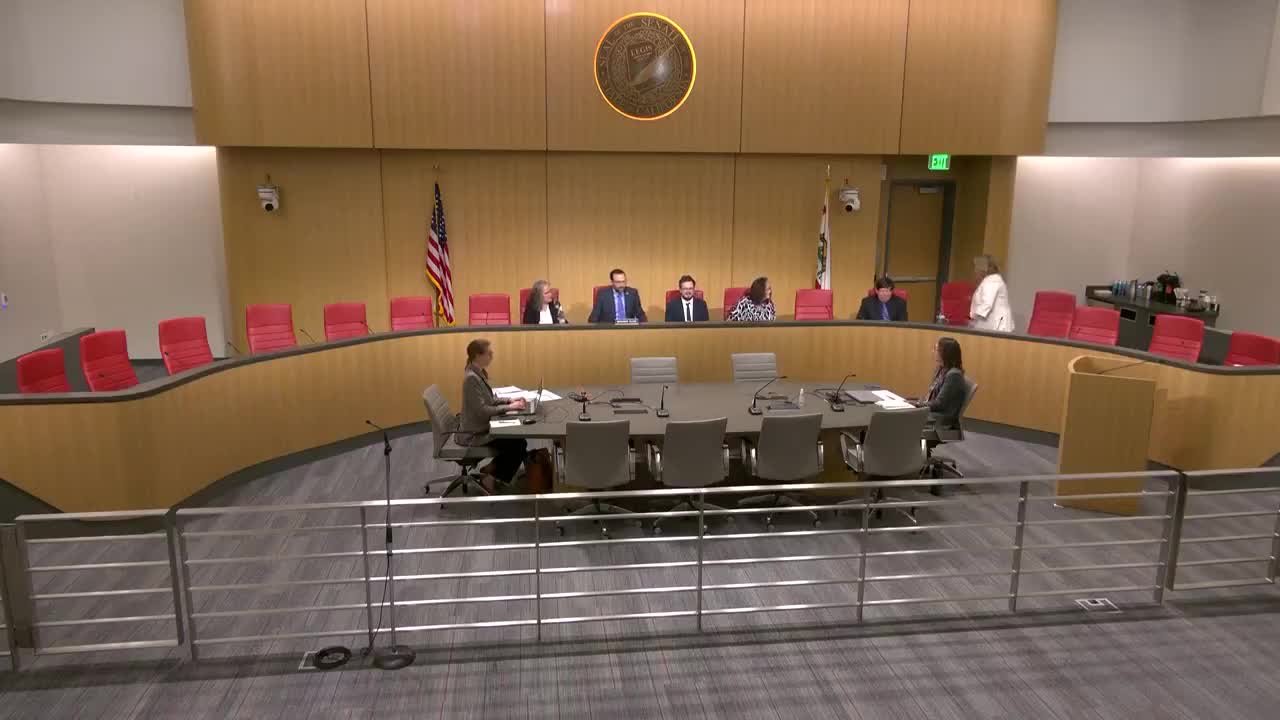 10MIN
Senate Standing Committee on Environmental Quality
Bill Author
Bill Co-Author(s):