SB 1167: Solid waste: single-use drinking vessels.
- Session Year: 2023-2024
- House: Senate
- Latest Version Date: 2024-04-04
Current Status:
Failed
(2024-04-17: April 17 set for first hearing. Failed passage in committee. (Ayes 2. Noes 2. Page 3660.))
Introduced
In Committee
First Chamber
In Committee
Second Chamber
Enacted
Existing law prohibits a full-service restaurant, as specified, from providing single-use plastic straws, as defined, to consumers unless requested by the consumer. Existing law requires a city, county, or city and county, to authorize an enforcement agency to enforce these provisions. Existing law specifies that the first and 2nd violations of these provisions would result in a notice of violation and any subsequent violation would be an infraction punishable by a fine of $25 for each day the full-service restaurant is in violation, but not to exceed an annual total of $300.
This bill would require a chain restaurant, before serving a beverage, to ask a customer if the customer intends to consume the beverage on the premises or off the premises. The bill would prohibit a chain restaurant from serving or offering for sale a beverage in a single-use vessel to if a customer that is dining or consuming indicates intent to consume the beverage on the premises, as specified. specified, and would subject a violator to the enforcement provisions described above. By expanding the scope of a crime, the bill would impose a state-mandated local program.
The California Constitution requires the state to reimburse local agencies and school districts for certain costs mandated by the state. Statutory provisions establish procedures for making that reimbursement.
This bill would provide that no reimbursement is required by this act for a specified reason.
Existing law prohibits a full-service restaurant, as specified, from providing single-use plastic straws, as defined, to consumers unless requested by the consumer. Existing law requires a city, county, or city and county, to authorize an enforcement agency to enforce these provisions. Existing law specifies that the first and 2nd violations of these provisions would result in a notice of violation and any subsequent violation would be an infraction punishable by a fine of $25 for each day the full-service restaurant is in violation, but not to exceed an annual total of $300.
This bill would prohibit a chain restaurant from serving or offering for sale a beverage in a single-use vessel to a customer that is dining or consuming the beverage on the premises, as specified. By expanding the scope of a crime, the bill would impose a state-mandated local program.
The California Constitution requires the state to reimburse local agencies and school districts for certain costs mandated by the state. Statutory provisions establish procedures for making that reimbursement.
This bill would provide that no reimbursement is required by this act for a specified reason.
For purposes of this chapter, the following definitions apply:
(a)Chain restaurant means a food facility subject to the requirements of subdivision (a) of Section 114094 of the Health and Safety Code.
(b)Consumer has the same meaning as in Section 113757 of the Health and Safety Code.
(c)Food facility has the same meaning as in Section 113789 of the Health and Safety Code.
(d)Premises, for purposes of Section 42271.5 only, means a chain restaurants dining area, table, or nonseated picnic area provided by the chain restaurant on its own, in conjunction with one or more other chain restaurants, or pursuant to an agreement with a third party.
(d)(e)Ready-to-eat food has the same meaning as in Section 113881 of the Health and Safety Code.
(e)(f)Single-use means designed to be used once and then discarded, and not designed for repeated use and sanitizing.
(f)(g)Single-use foodware accessory means all of the following single-use items provided alongside ready-to-eat food:
(1)Utensils, which is defined as forks, knives, spoons, and sporks.
(2)Chopsticks.
(3)Condiment cups and packets.
(4)Straws.
(5)Stirrers.
(6)Splash sticks.
(7)Cocktail sticks.
(g)(h)(1)Single-use drinking vessel means a cup, mug, or container that is used to hold a hot or cold beverage that is not sufficiently durable or washable to allow multiple uses or that is disposed of after a single use.
(2)Single-use drinking vessel does not include any of the following:
(A)A reusable drinking vessel.
(B)Beverage containers as defined in Section 14505.
(C)Ceramic, porcelain, glass, or metal service packaging that is cleaned and reused by the food service facility.
(D)A product, including its packaging, defined as a drug, device, or medical food pursuant to the Federal Food, Drug, and Cosmetic Act (21 U.S.C. Sec. 321(g), 321(h), and 360ee(b)(3)) and recommended or prescribed by a medical professional or otherwise determined by a food service facility to be reasonably necessary for accommodating a medical-related or health-related need.(E)(D)A product, including, but not limited to, a container, used at any of the following types of facilities that is recommended or prescribed by a medical professional or otherwise determined by a food service facility to be reasonably necessary to assist a resident of the facility or another person receiving care at the facility in the performance of functions related to the service and consumption of a beverage or to protect the health or safety of a resident of the facility or another person:
(i)A health facility, as defined in Section 1250 of the Health and Safety Code.
(ii)A residential care facility for the elderly, as defined in Section 1569.2 of the Health and Safety Code.
(iii)A community care facility, as defined in Section 1502 of the Health and Safety Code.
(iv)Any other facility that provides medical treatment or other health-related services to patients under the care of a medical professional.
(E)A product, including its packaging, defined as a drug, device, or medical food pursuant to the Federal Food, Drug, and Cosmetic Act (21 U.S.C. Sec. 321(g), 321(h), and 360ee(b)(3)) and recommended or prescribed by a medical professional or otherwise determined by a food service facility to be reasonably necessary for accommodating a medical-related or health-related need.
(h)(i)Reusable drinking vessel means a durable cup, mug, or glass containing hot or cold liquids that is cleaned and reused by the food service facility.
(i)(j)Standard condiment means relishes, spices, sauces, confections, or seasonings that require no additional preparation and that are usually used on a food item after preparation, including ketchup, mustard, mayonnaise, soy sauce, hot sauce, salsa, salt, pepper, sugar, and sugar substitutes.
(j)(k)Third-party food delivery platform has the same meaning as in Section 113930.5 of the Health and Safety Code.
SEC. 2.Section 42271.5 is added to the Public Resources Code, to read:42271.5.(a)A chain restaurant shall not serve or offer for sale a beverage in a single-use drinking vessel to a customer who is dining or consuming the beverage on the premises.42271.5.(a)Before serving a beverage, a chain restaurant shall ask a customer if the customer intends to consume the beverage on the premises or off the premises. If the customer indicates intent to consume the beverage on the premises, then the chain restaurant shall not serve the beverage in a single-use drinking vessel. If the consumer indicates, either initially or subsequently, intent to consume the beverage off the premises, then the chain restaurant may serve the beverage in a single-use drinking vessel.
(b)Nothing in this section shall be interpreted to prohibit the use of a reusable drinking vessel or the use of a container provided by a customer in accordance with the California Retail Food Code (Part 7 (commencing with Section 113700) of Division 104 of the Health and Safety Code).
(c)Upon request of an enforcement agency, as described in Section 42272, a chain restaurant shall provide proof of the availability of reusable drinking vessels on the premises for compliance with this section.
SEC. 3.No reimbursement is required by this act pursuant to Section 6 of Article XIIIB of the California Constitution because the only costs that may be incurred by a local agency or school district will be incurred because this act creates a new crime or infraction, eliminates a crime or infraction, or changes the penalty for a crime or infraction, within the meaning of Section 17556 of the Government Code, or changes the definition of a crime within the meaning of Section 6 of Article XIIIB of the California Constitution.
For purposes of this chapter, the following definitions apply:
(a)Chain restaurant means a food facility subject to the requirements of subdivision (a) of Section 114094 of the Health and Safety Code.
(a)(b)Consumer has the same meaning as in Section 113757 of the Health and Safety Code.
(b)(c)Food facility has the same meaning as in Section 113789 of the Health and Safety Code.
(c)(d)Ready-to-eat food has the same meaning as in Section 113881 of the Health and Safety Code.
(d)(e)Single-use means designed to be used once and then discarded, and not designed for repeated use and sanitizing.
(e)(f)Single-use foodware accessory means all of the following single-use items provided alongside ready-to-eat food:
(1)Utensils, which is defined as forks, knives, spoons, and sporks.
(2)Chopsticks.
(3)Condiment cups and packets.
(4)Straws.
(5)Stirrers.
(6)Splash sticks.
(7)Cocktail sticks.
(g)(1)Single-use drinking vessel means a cup, mug, or container that is used to hold a hot or cold beverage that is not sufficiently durable or washable to allow multiple uses or that is disposed of after a single use.
(2)Single-use drinking vessel does not include any of the following:
(A)A reusable drinking vessel.
(B)Beverage containers as defined in Section 14505.
(C)Ceramic, porcelain, glass, or metal service packaging that is cleaned and reused by the food service facility.
(D)A product, including its packaging, defined as a drug, device, or medical food pursuant to the Federal Food, Drug, and Cosmetic Act (21 U.S.C. Sec. 321(g), 321(h), and 360ee(b)(3)) and recommended or prescribed by a medical professional or otherwise determined by a food service facility to be reasonably necessary for accommodating a medical-related or health-related need.
(E)A product, including, but not limited to, a container, used at any of the following types of facilities that is recommended or prescribed by a medical professional or otherwise determined by a food service facility to be reasonably necessary to assist a resident of the facility or another person receiving care at the facility in the performance of functions related to the service and consumption of a beverage or to protect the health or safety of a resident of the facility or another person:
(i)A health facility, as defined in Section 1250 of the Health and Safety Code.
(ii)A residential care facility for the elderly, as defined in Section 1569.2 of the Health and Safety Code.
(iii)A community care facility, as defined in Section 1502 of the Health and Safety Code.
(iv)Any other facility that provides medical treatment or other health-related services to patients under the care of a medical professional.
(h)Reusable drinking vessel means a durable cup, mug, or glass containing hot or cold liquids that is cleaned and reused by the food service facility.
(f)(i)Standard condiment means relishes, spices, sauces, confections, or seasonings that require no additional preparation and that are usually used on a food item after preparation, including ketchup, mustard, mayonnaise, soy sauce, hot sauce, salsa, salt, pepper, sugar, and sugar substitutes.
(g)(j)Third-party food delivery platform has the same meaning as in Section 113930.5 of the Health and Safety Code.
SEC. 2.Section 42271.5 is added to the Public Resources Code, to read:42271.5.(a)A chain restaurant shall not serve or offer for sale a beverage in a single-use drinking vessel to a customer who is dining or consuming the beverage on the premises.
(b)Nothing in this section shall be interpreted to prohibit the use of a reusable drinking vessel or the use of a container provided by a customer in accordance with the California Retail Food Code (Part 7 (commencing with Section 113700) of Division 104 of the Health and Safety Code).
SEC. 3.No reimbursement is required by this act pursuant to Section 6 of Article XIIIB of the California Constitution because the only costs that may be incurred by a local agency or school district will be incurred because this act creates a new crime or infraction, eliminates a crime or infraction, or changes the penalty for a crime or infraction, within the meaning of Section 17556 of the Government Code, or changes the definition of a crime within the meaning of Section 6 of Article XIIIB of the California Constitution.
|
Date
|
Status
|
|---|---|
| Apr 17, 2024 | April 17 set for first hearing. Failed passage in committee. (Ayes 2. Noes 2. Page 3660.) |
| Apr 4, 2024 | From committee with author's amendments. Read second time and amended. Re-referred to Com. on E.Q. |
| Mar 12, 2024 | Set for hearing April 17. |
| Feb 21, 2024 | Referred to Com. on E.Q. |
| Feb 15, 2024 | From printer. May be acted upon on or after March 16. |
| Feb 14, 2024 | Introduced. Read first time. To Com. on RLS. for assignment. To print. |
|
Date
|
Description
|
Location
|
Votes
|
|
|---|---|---|---|---|
| Apr 17, 2024 | Do pass, but first be re-referred to the Committee on [Appropriations] | Senate Standing Committee on Environmental Quality |
Failed |
This list shows positions taken on this bill by organizations on the date displayed, which is linked to the original source.
Positions by individuals are not included.
|
Organization
|
Position
|
Date
|
|---|---|---|
| 350 Sacramento | * Support | Apr 17, 2024 |
| 5 Gyres Institute | * Support | Apr 17, 2024 |
| 7th Generation Advisors | ** Support | |
| A Voice for Choice Advocacy | * Support | Apr 17, 2024 |
| Active San Gabriel Valley | ** Support | |
| American Chemistry Council | * Against | Apr 17, 2024 |
| American Forest and Paper Association | * Against | Apr 17, 2024 |
| American Institute for Packaging and the Environment | * Against | Apr 17, 2024 |
| American Sustainable Business Council | ** Support | |
| Atrium 916 | ** Support | |
| Aveson Schools | ** Support | |
| Ban SUP | ** Support | |
| Berry Global, INC. | ** Against | |
| Blue Ocean Warriors | ** Support | |
| Breast Cancer Prevention Partners | ** Support | |
| California Alliance of Family Owned Business | * Against | Apr 17, 2024 |
| California Chamber Of Commerce | * Against | Apr 17, 2024 |
| California Coalition of Climate Reality Project | * Support | Apr 17, 2024 |
| California Compost Coalition | * Support | Apr 17, 2024 |
| California Manufacturers And Technology Association | * Against | Apr 17, 2024 |
| California Product Stewardship Council | * Support | Apr 17, 2024 |
| California Restaurant Association | ** Against | |
| California Retailers Association | ** Against | |
| California Travel Association | * Against | Apr 17, 2024 |
| Californians Against Waste | * Support | Apr 17, 2024 |
| CALPIRG, California Public Interest Research Group | ** Support | |
| Center For Biological Diversity Inc | * Support | Apr 17, 2024 |
| Center For Environmental Health | ** Support | |
| City & County of San Francisco | * Support | Apr 17, 2024 |
| Clean Water Action | ** Support | |
| cleanearth4kids.org | ** Support | |
| Climate Action California | ** Support | Apr 17, 2024 |
| Community Environmental Council | ** Support | |
| Courage California | ** Support | |
| Dart Container Corporation | * Against | Apr 17, 2024 |
| Environmental Action Committee of West Marin | ** Support | |
| Environmental Working Group | ** Support | |
| Every Neighborhood Partnership | ** Support | |
| Food Service Packaging Institute | * Against | Apr 17, 2024 |
| Friends Committee On Legislation Of California | ** Support | |
| Friends of the River | ** Support | |
| Gaia | ** Support | |
| Generation Awakening | ** Support | |
| Glendale Environmental Coalition | ** Support | Apr 17, 2024 |
| Graphic Packaging International | ** Against | |
| Green America | ** Support | |
| Green Behind the Scenes | ** Support | |
| Heal The Bay | * Support | Apr 17, 2024 |
| Indivisible California StateStrong | * Support | Apr 17, 2024 |
| International Franchise Association (Ifa) | * Against | Apr 17, 2024 |
| Kp Public Affairs | * Against | Apr 17, 2024 |
| Los Angeles Climate Reality Project | * Support | Apr 17, 2024 |
| Los Angeles Waterkeeper | ** Support | |
| Lutheran Office Of Public Policy - California | ** Support | |
| McHugh Koepke Padron | ** Against | Apr 17, 2024 |
| Monterey Bay Aquarium | ** Support | |
| National Federation Of Independent Business | ** Against | |
| National Stewardship Action Council | ** Support | |
| Northern California Recycling Association | ** Support | |
| Numerous individuals | ** Against | |
| Oakland City Council | * Support | Apr 17, 2024 |
| Occidental Arts and Ecology Center | ** Support | |
| Oceana | ** Support | |
| Pacific Environment | ** Support | |
| Pactiv Evergreen Inc | ** Against | |
| Paddle Out Plastic | ** Support | |
| Plastic Pollution Coalition | ** Support | |
| Plastic Pollution Coalition/ the Last Plastic Straw | ** Support | |
| Plastics Industry Association | ** Against | |
| Regeneración - Pajaro Valley Climate Action | ** Support | |
| San Fernando Valley Climate Reality Project | * Support | Apr 17, 2024 |
| San Francisco Baykeeper | ** Support | |
| SanDiego350 | ** Support | |
| Santa Barbara County Board of Supervisors | * Support | Apr 17, 2024 |
| Santa Clara Climate Action Network | * Support | Apr 17, 2024 |
| Save Our Shores | ** Support | |
| Save The Albatross Coalition | ** Support | |
| Save The Bay | ** Support | |
| SD-SEQUEL | ** Support | |
| Sea Hugger | ** Support | |
| Sierra Club California | ** Support | |
| Solana Center for Environmental Innovation | ** Support | |
| Surfrider Foundation | * Support | Apr 17, 2024 |
| The Last Plastic Straw | ** Support | |
| The Story of Stuff Project | ** Support | |
| Third Act | * Support | Apr 17, 2024 |
| True Zero Waste Program | * Support | Apr 17, 2024 |
| Turtle Island Restoration Network | ** Support | |
| US Green Building Council | * Support | Apr 17, 2024 |
| Valley Improvement Projects | ** Support | |
| Voices for Progress | ** Support | |
| Wholly H2O | ** Support | |
| Wildcoast | ** Support | |
| Wishtoyo Foundation | ** Support | |
| Zero Waste Ithaca | ** Support | |
| Zero Waste San Diego | ** Support | |
| Zero Waste USA | ** Support |
SENATE COMMITTEE ON ENVIRONMENTAL QUALITY
Senator Allen, Chair
2023 - 2024 Regular
Bill No: SB 1167
Author: | Blakespear | ||
Version: | 4/4/2024 | Hearing Date: | 4/17/2024 |
Urgency: | No | Fiscal: | Yes |
Consultant: | Holly Rudel | ||
SUBJECT: Solid waste: single-use drinking vessels
DIGEST: Prohibits chain restaurants, as defined, from serving or offering for sale a beverage in a single-use drinking vessel to a customer who indicates that their intention is to consume the beverage on the premises.
ANALYSIS:
Existing law:
- Establishes the Integrated Waste Management Act of 1989 (IWMA), administered by the Department of Resources Recycling and Recovery (CalRecycle). The IWMA establishes a state recycling goal that 75% of solid waste should be diverted from landfill disposal through source reduction, recycling, and composting by 2020. (Public Resources Code (PRC) §40000 et seq.)
- Establishes a statewide “bag ban” on stores that prohibits from providing a plastic single-use carryout bag to a customer at the point of sale unless it is a reusable, compostable bag sold at not less than $0.10. (PRC §42283-42284)
- Prohibits restaurants from providing single-use plastic foodware, including utensils, chopsticks, standard condiment cups and packets, straws, stirrers, splash sticks, cocktail sticks to consumers unless requested by the consumer. (PRC § 42270 et seq.)
- Prohibits a state food service facility from dispensing prepared food using a type of food service packaging unless the packaging is on a specified list maintained by the Department of Resources Recycling and Recovery (CalRecycle) and has been determined to be reusable, recyclable, or compostable. (PRC §42370 et seq.)
- Establishes the Plastic Pollution Prevention and Packaging Producer Responsibility Act, which establishes a goal that single-use packaging and plastic food serviceware be 100% compostable or recyclable by Jan 1, 2032, and imposes minimum recycled content and source reduction requirements for these covered materials to be achieved through an extended producer responsibility (EPR) program. (PRC §42070 et. seq.)
- Permits food facilities to fill and return clean consumer-owned containers provided by the customer if the container is filled by either an employee of the food facility or the owner of the container. (Health & Safety Code (HSC) § 114121)
This bill:
- Requires chain restaurants to ask a customer whether they intend to consume their drink on or off the business premises.
- Prohibits chain restaurants from serving or offering for sale a beverage in a single-use drinking vessel to a customer who indicates their intention is to dine or consume the beverage on the premises.
Background
- California’s Waste Goals. According to CalRecycle, Californians throw away 290 Olympic pools worth of plastic per day. Under the IWMA, CalRecycle is tasked with reducing the amount of waste that gets landfilled in California. The IWMA establishes a goal that 75% of solid waste generated in the state be diverted from landfills through source reduction, recycling, and composting by 2020. However, according to CalRecycle’s 2021 State of Disposal and Recycling, the State’s 2021 recycling rate was just 40%, down from a peak of 50% in 2014. The single largest contributor to the recycling rate is exports, where recyclable material is sold outside the State. However, the amount of recyclables that California can export, and correspondingly the State’s recycling rate, may decline given new global policies like China’s National SWORD and the Basel Convention, which restrict the amount of foreign waste that countries will accept.
- Meet the plastics. Plastics pose a threat to the environment from origin to end-of-life. Plastics are petroleum-based and have a large carbon footprint. Plastic production is responsible for three and a half percent of all greenhouse gas (GHG) emissions—more than the entire aviation sector. In 2023, global plastics production was estimated at 400.3 million metric tons. The United Nations Environment Program reports that only 9% of all plastic ever made has been recycled. A further 12% has been incinerated, and the remaining 79% has accumulated in landfills or natural environments.
Once plastics enter the environment, they remain there for hundreds to thousands of years. Plastics do not break down into their constituent parts, but instead break down into very small particles of plastic, or microplastics (plastics under five millimeters). Because they are so small, microplastics can travel in the air, and water, and can be easily absorbed by living things and accumulate up the food chain. Microplastics have been found in the most pristine natural environments on earth, including in the deep ocean, Antarctic sea ice, and human placentas. Laboratory studies have found that microplastics increase the risk of cancer and disrupt hormone pathways in lab rats.
According to a report by the Organization for Economic Co-operation and Development (OECD), in a “business as usual” modelled scenario where no further action to combat the plastics problem continued, the expected plastics use and waste generation would increase by 70% in 2040 from 2020 levels, contributing to a 60% increase in GHG emissions. Further, they report that 86% of these plastics would be landfilled, incinerated, or mismanaged (compared to just 14% recycled). According to CalRecycle, plastic accounts for 5.4 million tons of California’s waste stream, or about 14%.
- Significance of single-use cups in the waste stream. According to a report by the United Nations Environment Program, over 500 billion disposable cups are used each year around the world, of which between 250 and 300 billion are plastic-lined paper cups (such as hot beverage cups). Stacked end to end, this is enough cups to go to the moon and back over 80 times. Many producers of single-use items argue that the environmental health impacts are minimized by utilizing recyclable or compostable material. However, many cups, including single-use hot drink cups, are lined with plastic to prevent leaks, making them difficult to recycle (some estimates put the recycling rate at around 1%). According to a report by NextGen, there are 30 paper mills in North America that accept paper cups, but none of them are in California. A high percentage of cups end up in landfills each year. Furthermore, misconceptions concerning the recyclability can lead to people improperly disposal cups in recycling bins, an added burden on disposal facilities due to waste contamination (a problem sometimes known as “wish-cycling”).
- Source reduction in SB 54. To reduce plastic consumption and ultimately plastic waste, the Legislature passed the Plastic Pollution Prevention and Packaging Producer Responsibility Act (SB 54, Allen, Chapter 75, Statutes of 2022) which is one of the most sweeping measures the state has enacted to address plastic waste (including single-use cups).
SB 54 uses an EPR approach to reach ambitious targets to reduce plastic waste. The bill will reduce single-use plastic serviceware and packaging through source reduction and recycling over the next decade. Under SB 54, producers of packaging and single-use plastics will pay $500 million per year from January 1, 2027, through January 1, 2037 through a Producer Responsibility Organization (PRO) to fund the program. The PRO in turn can collect $150 million from plastic manufacturers.
SB 54 holistically addresses our reliance on single-use plastics, including by setting the following goals:
a) Requiring all covered material sold in the state be recyclable or compostable by January 1, 2032;
b) Achieving a 25% source reduction for all covered material by January 1, 2032; and
c) Achieving a 65% recycled rate for all single-use plastic packaging and food ware by January 1, 2032.
- Ongoing efforts by business and government. In 2019, the City of Berkeley enacted the world’s first reusable foodware policy, requiring businesses offering on-site dining to use reusable foodware to serve customers eating on the premises. According to information provided by the author, over 20 local jurisdictions in California have enacted reuse for onsite dining policies, including Oakland, Culver City, Sausalito, Truckee, and Palm Springs.
In additional to local jurisdictions, businesses have also committed to reducing their waste impact. In January 2024, Starbucks announced that customers can use their own clean personal cup when ordering in a café, in the drive-thru, or when ordering ahead on the Starbucks app. The company also piloted a program to allow customers to use and return a reusable cup from a previous visit. McDonalds collaborated with circular packaging service Loop in 2021 to test a reusable cup model for beverages in the United Kingdom. In 2022, the company also began accepting customer provided, clean reusable travel mugs for coffee in Canadian stores.
- What is a chain restaurant? The provisions in SB 1167 apply only to “chain restaurants,” or food facilities subject to Section 343 of Title 21 of the U.S. Code, defined as “a restaurant or similar retail food establishment that is part of a chain with 20 or more locations doing business under the same name (regardless of the type of ownership of locations) and offering for sale substantially the same menu items.” This categorization is in reference to a 2008 bill (SB 1420, Padilla) that required large food facilities to disclose nutrient content information. In the Assembly floor analysis of that bill, the provision would apply to “between 17,000 and 20,000 California restaurants.” This number is likely an overestimate of the facilities subject to SB 1167 because it includes all chain restaurants, including ones that don’t offer to-go cups for dine-in already.
Comments
- Purpose of Bill. According to the author, “California has a massive plastic and paper waste problem, and if we are serious about protecting our environment and living sustainably, we must reduce it across the board. Several cities have passed or introduced disposable foodware ordinances in response to growing calls for reducing single-use plastic. They are leading the charge to address this massive problem we have with our culture of waste.
“Reducing our waste stream will keep single-use plastics out of landfills and waterways, cut costs for businesses and shift consumer behavior towards reuse. Case studies show that transitioning to reusable foodware and beverage-ware can save a small business between $3,000 and $22,000 annually, with the added benefit of preventing 1,300 to 2,200 pounds of single-use trash per restaurant from entering the waste stream.
“SB 1167 is a simple, sensible step to reduce waste coming from restaurants by requiring chain restaurants provide non-toxic reusable cups for customers who dine-in. Our intention is to not completely eliminate disposable cups from being provided to customers who are on the go. We simply want to ensure people dining-in are provided a non-toxic reusable cup. This will prevent us from needlessly adding waste to landfills and shift consumer habits.”
- How does this bill intersect with SB 54? SB 54 was the result of several years of negotiations between environmental and industry stakeholders and certainly represents significant progress in California’s ambitious goals to reduce its reliance on single-use plastic materials. It marked a shift in California's legislative approach to plastic-reduction policy; rather than targeting just one waste item per bill, SB 54 encompassed a broad swath of items, including all packaging and single-use serviceware (including single-use cups). By grouping a number of products based on their use, SB 54 avoids the “whack-a-mole” pitfall that bans can face when new products, with equivalent impacts on the waste stream, emerge to take the space of banned items. In his veto message of SB 728 (Limon, 2023), which would have banned the manufacture and sale of plastic gift cards, Governor Newsom wrote, “California has successfully implemented many programs to reduce our reliance on single-use plastic while incentivizing businesses to transition towards more sustainable products and materials. I encourage the Legislature to consider alternatives to a statutory, single-product ban to help meet the state's plastic waste reduction goals.”
CalRecycle is currently in the process of implementing SB 54, including conducting a needs assessment to evaluate the current system for managing materials covered by the law and identifying actions and investments needed to meet the mandates of SB 54. CalRecycle is also currently working with an appointed advisory board to identify barriers and solutions to creating a circular economy and advise the producer responsibility organizations, producers, and the department in implementing this new law. The department released draft regulations for SB 54 implementation in March 2024, and extended the comment period to May 2024 to allow for sufficient public discussion, after which the finalized regulations are expected to be adopted.
As significant work is ongoing to implement SB 54, it may be premature to legislate on a single item in its universe. Its ambitious goals for source reduction of the plastics sector overall (25% reduction in plastic packaging and foodware) are set for 2032. While SB 54 specifies that California will meet its targets, it doesn’t specify how, leaving it to the producers to determine the best source reduction and recycling strategies. A question arises as to whether the Legislature should prioritize dine-in single-use cups at chain restaurants over other ongoing efforts to reduce single-use plastic items.
- How much of an impact would this make on plastic waste? According to a 2021 report from CalRecycle, plastic food service ware is responsible for over 500,000 tons of waste each year in California landfills. SB 1167 takes an incremental step at reducing this quantity by prohibiting chain restaurants from serving or offering for sale a beverage in a single-use drinking vessel to a customer who is dining on the premises. However, according to a report by NextGen, a consortium of industry partners and environmental nonprofits, 40% of consumers surveyed pick up their coffee at a drive thru and/or consume it on the-go. SB 1167 would likely only apply to a smaller portion of the total single-cup users, as it only targets dine-in customers at chain restaurants.
- The case for reusables. In a 2021 report by Upstream synthesizing findings from dozens of life cycle assessments, reusable cups generally have a lower environmental impact across every metric with the main impacts come during the dishwashing and drying phase. The type of reusable material and the number of reuses for a product can greatly impact how it is benchmarked against single-use material. For example, reusable ceramic cups need to be used between 10-70 times to be more sustainable than paper, while reusable polypropylene cups need to be reused just 10 times to breakeven with single-use polypropylene. It is therefore important that “reusable” cups are, in fact, reusable enough times to break even with the impacts of their single-use counterparts. As currently written, SB 1167 defines a “reusable drinking vessel” as a “durable cup, mug, or glass containing hot or cold liquids that is cleaned and reused by the food service facility” but does not provide guardrails for how many uses the vessel must be “durable” enough to withstand. If SB 1167 passes out of this committee, the author should more clearly define what reusable means.
- Are current penalties enough of a deterrence? Existing law includes an enforcement provision that would apply to SB 1167. It specifies that the first and second violations result in a warning, and subsequent violations is punishable by fine of $25 per day, with a maximum of $300 annually. Given the market value of the chain restaurants specified in this bill, this penalty is likely insufficient to deter infractions, and is likely not even enough to cover the cost of the enforcement agency to enforce the law. If SB 1167 passes out of this committee, the author may wish to consider strengthening the violation penalties.
- Date going into effect? As currently written, SB 1167 does not specify an effective date, meaning that its prohibition will be enacted January 1, 2025. This may not be enough time for restaurants to use their existing stock of single-use cups (potentially leading to landfilling of unused cups) or install necessary infrastructure for reusable cups.
- Who does this apply to? Besides applying only to chain restaurants, SB 1167 specifies that health facilities, residential care facilities, community care facilities, and any other facility that provides medical treatment or other health-related services are exempt from this prohibition. However, the section of code that SB 1167 is seeking to amend (PRC § 42270 et seq.) already excludes these facilities as well as correctional institutions and public and private school cafeterias. Additionally, the bill requires businesses to ask a customer’s intention regarding whether they intend to consume their drink on the premises, however, this seemingly would be unnecessary for a drive-thru where it is likely that the customer is taking their drink to-go.
- Regrettable substitution? As currently written, SB 1167 does not apply to beverage containers (e.g., individual bottles, cans, jars, cartons). Food facilities, as a result, may choose to increase their sales of these individual containers. While these containers may be recyclable and more likely to be collected than single-use cups, it might not spark the consumer shift towards reusables intended by the bill. These kind of regrettable substitutions can happen with single item bans, such as when plastic bags were simply replaced with thicker plastic bags in wake of the California-wide bag ban.
- A more sustainable future. It is clear that the most effective way to tackle the plastic pollution crisis is to use less of it. However, what is at the root of our plastics problem is the ease and convenience of the throw-away culture many consumers have become reliant on. Transitioning to a reusable system that is sustainable (both for the environment and over time) is complex and necessitates both business and customer buy-in. Small steps are good, but we need to think bigger picture about what incentives will promote a culture of “reduce, reuse, and recycle” on a larger scale. Pilot programs to test and refine reuse models could be a good forum to identify best practices for encouraging a wide-scale shift towards a more sustainable future.
Related/Prior Legislation
SB 728 (Limon, 2023) would have banned the manufacture and sale of plastic gift cards beginning January 1, 2026. The bill was vetoed by Governor Newsom.
AB 1276 (Carrillo and Gonzalez, Chapter 505, Statutes of 2021) prohibits food facilities from providing any single-use foodware accessory or standard condiment to a consumer unless requested by the consumer.
SB 54 (Allen, Chapter 75, Statutes of 2022), among other things, establishes an Extended Producer Responsibility program to manage packaging and single-use plastic food ware products, and ensures that packaging and plastic food ware sold in California is recyclable or compostable.
AB 793 (Ting, Chapter 115, Statutes of 2020) requires plastic beverage containers subject to the California Beverage Container Recycling and Litter Reduction Act to contain minimum amounts of postconsumer recycling plastic annually, beginning with 15% by 2022, increasing to 35% by 2029, and 50% by 2030
AB 1884 (Calderon, Chapter 576, Statutes of 2018) prohibited full service restaurants from providing a single-use plastic straw to a customer unless requested
SOURCE: 5 Gyres Institute, Californians Against Waste, Heal the Bay, Surfrider Foundation (co-sponsors)
SUPPORT:
350 Bay Area Action
350 Sacramento
5 Gyres Institute
7th Generation Advisors
A Voice for Choice Advocacy
Active San Gabriel Valley
American Sustainable Business Council
Atrium 916
Aveson Schools
Ban Sup (single Use Plastic)
Blue Ocean Warriors
Breast Cancer Prevention Partners
California Product Stewardship Council
Californians Against Waste
Calpirg, California Public Interest Research Group
Center for Biological Diversity
Center for Environmental Health
City and County of San Francisco
Clean Water Action
Cleanearth4kids.org
Climate Action California
Climate Reality Project, California Coalition
Climate Reality Project, San Fernando Valley
Community Environmental Council
County of Santa Barbara
Courage California
Environmental Action Committee of West Marin (EAC)
Environmental Working Group
Every Neighborhood Partnership
Friends Committee on Legislation of California
Friends of The River
Gaia
Generation Awakening
Glendale Environmental Coalition
Green America
Green Behind the Scenes
Heal the Bay
Indivisible Alta Pasadena
Indivisible Ca: Statestrong
Los Angeles Waterkeeper
Lutheran Office of Public Policy - California
Monterey Bay Aquarium
National Stewardship Action Council
Northern California Recycling Association
Occidental Arts and Ecology Center
Oceana
Pacific Environment
Paddle Out Plastic
Plastic Pollution Coalition
Plastic Pollution Coalition/ the Last Plastic Straw
Regeneración - Pajaro Valley Climate Action
San Francisco Baykeeper
Sandiego350
Save Our Shores
Save the Albatross Coalition
Save the Bay
Sd-sequel
Sea Hugger
Sierra Club California
Solana Center for Environmental Innovation
Surfrider Foundation
Surfrider San Francisco
The Last Plastic Straw
The Story of Stuff Project
Turtle Island Restoration Network
Valley Improvement Projects
Voices for Progress
Wholly H2o
Wildcoast
Wishtoyo Foundation
Zero Waste Ithaca
Zero Waste San Diego
Zero Waste USA
One Individual
OPPOSITION:
American Chemistry Council
American Forest & Paper Association
American Institute for Packaging and Environment (AMERIPEN)
Berry Global, INC.
California Alliance of Family Owned Businesses
California Chamber of Commerce
California Manufacturers & Technology Association
California Restaurant Association
California Retailers Association
California Travel Association
Foodservice Packaging Institute
Graphic Packaging International
International Franchise Association
National Federation of Independent Business
Pactiv Evergreen INC.
Plastics Industry Association
Numerous Individuals
ARGUMENTS IN SUPPORT:
According to a coalition of environmental organizations, “SB 1167 represents a pragmatic step towards waste reduction and consumer behavior change. Across California, over 20 jurisdictions have already passed reuse for dine-in requirements, and it is time for the State to follow suit. By requiring chain restaurants to provide non-toxic reusable cups, this legislation promotes sustainability and waste reduction, cost savings for food establishments, and a better dining experience for customers.”
ARGUMENTS IN OPPOSITION:
According to a coalition of 13 business and industry members, “[SB 1167 has] potential to significantly harm essential businesses within the state, increase adverse environmental impacts, duplicate ongoing work to implement recycling improvements through SB 54, and ultimately create impacts for California consumers.”
-- END --
Discussed in Hearing
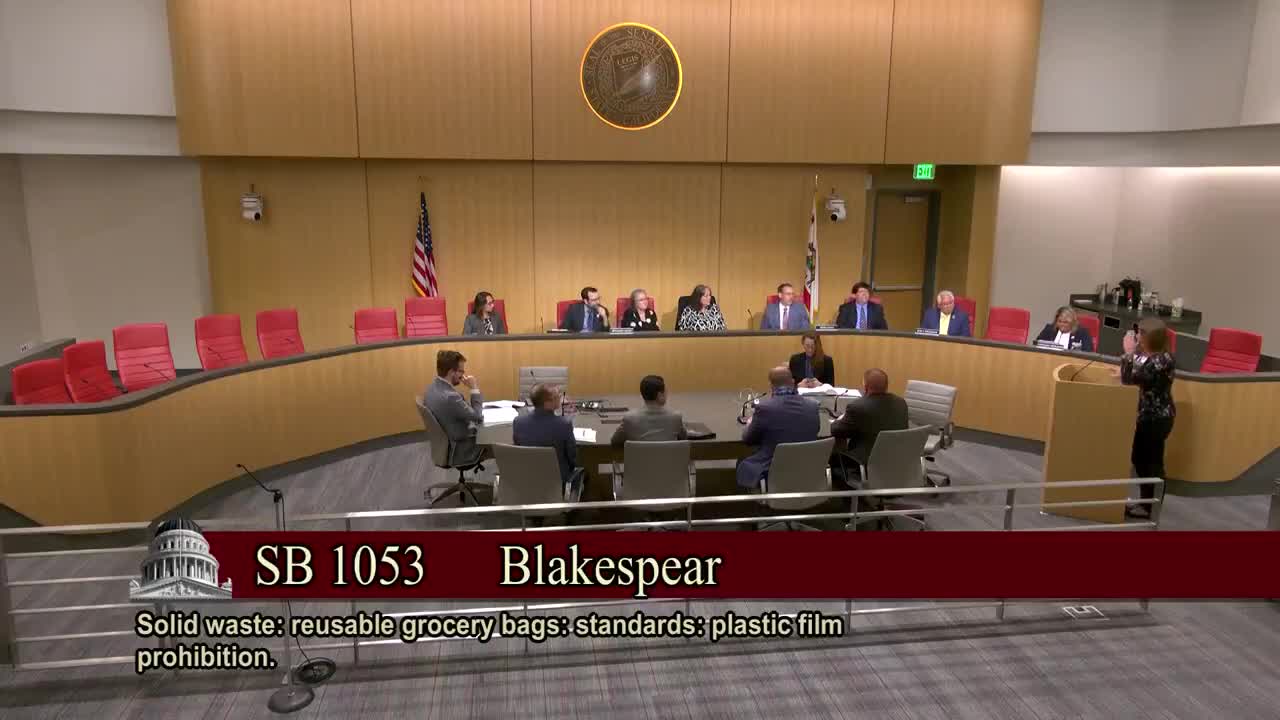 34MIN
Senate Standing Committee on Environmental Quality
Bill Author

Bill Co-Author(s):