SB 1202: Department of Corrections and Rehabilitation: reports: assaults.
- Session Year: 2023-2024
- House: Senate
- Latest Version Date: 2024-06-10
Current Status:
Failed
(2024-08-15: August 15 hearing: Held in committee and under submission.)
Introduced
In Committee
First Chamber
In Committee
Second Chamber
Enacted
Existing law establishes the Department of Corrections and Rehabilitation and sets forth its powers and duties regarding the administration of correctional facilities and the care and custody of inmates and wards. Existing law requires the department to establish a statewide policy on operational procedures for the handling of threats made by inmates or wards, and threats made by family members of inmates or wards, against department staff that includes methods to ensure that department staff members are advised of those threats, as specified, and requires those threats to be thoroughly investigated.
This bill would require the department to make a report regarding assaults, as defined, against employees, quarterly to all bargaining units at the department, and annually to the Legislature and the chairs of the Senate Committee on Budget and Fiscal Review and the Assembly Committee on Budget. The bill would require the reports to appropriately protect the confidentiality of patients, inmates, and employees and to include certain information, including the date of the assault and the name of the facility where the incident occurred.
The California Constitution establishes the State Personnel Board and requires the board to, among other things, enforce the civil service statutes, prescribe probationary periods and classifications, adopt rules authorized by statute, and review disciplinary actions. Existing law establishes the Department of Human Resources (CalHR) and provides that, subject to the requirements of the California Constitution, it succeeds to and is vested with the duties, purposes, responsibilities, and jurisdiction exercised by the board as its designee with respect to the boards administrative and ministerial functions.This bill would require CalHR to make a quarterly report regarding assaults, as defined, against employees on or before January 30, 2026, and annually thereafter, to the Legislature and the chairs of the Senate Committee on Budget and Fiscal Review and the Assembly Committee on Budget with respect to assaults that occurred during the preceding calendar year. The bill would require that report to include certain information with respect to any assault that occurred during the previous reporting period, including the date of the assault and the job classification of any affected represented employee.Existing constitutional provisions require that a statute that limits the right of access to the meetings of public bodies or the writings of public officials and agencies be adopted with findings demonstrating the interest protected by the limitation and the need for protecting that interest.This bill would make legislative findings to that effect.The California Constitution establishes the State Personnel Board and requires the board to, among other things, enforce the civil service statutes, prescribe probationary periods and classifications, adopt rules authorized by statute, and review disciplinary actions. Existing law establishes the Department of Human Resources (CalHR) and provides that, subject to the requirements of the California Constitution, it succeeds to and is vested with the duties, purposes, responsibilities, and jurisdiction exercised by the board as its designee with respect to the boards administrative and ministerial functions.
This bill would require the Labor and Workforce Development Agency CalHR to make a quarterly report regarding assaults, as defined, against employees to the Labor Commissioner and any bargaining unit within the agency within 30 calendar days of the last day of the quarter with respect to assaults that occurred during that quarter and, on or before January 30, 2026, and annually thereafter, to the Legislature and the chairs of the Senate Committee on Budget and Fiscal Review and the Assembly Committee on Budget with respect to assaults that occurred during the preceding calendar year. The bill would require that report to include certain information with respect to any assault that occurred during the previous reporting period, including the date of the assault and the job classification of any affected represented employee.
Existing constitutional provisions require that a statute that limits the right of access to the meetings of public bodies or the writings of public officials and agencies be adopted with findings demonstrating the interest protected by the limitation and the need for protecting that interest.
This bill would make legislative findings to that effect.
Existing law generally grants to the Division of Occupational Safety and Health, within the Department of Industrial Relations, jurisdiction over every employment and place of employment necessary to adequately enforce and administer all laws, standards, and orders. Existing law creates the Occupational Safety and Health Standards Board within the Labor and Workforce Development Agency and, among other things, requires it to adopt standards developed by the division relating to workplace violence prevention plans at hospitals.
This bill would require the Labor and Workforce Development Agency to make a quarterly report regarding assaults, as defined, against employees to the Labor Commissioner and any bargaining unit within the agency within 30 calendar days of the last day of the quarter with respect to assaults that occurred during that quarter and, on or before January 30, 2026, and annually thereafter, the Legislature and the chairs of the Senate Committee on Budget and Fiscal Review and the Assembly Committee on Budget with respect to assaults that occurred during the preceding calendar year. The bill would require that report to include certain information with respect to any assault that occurred during the previous reporting period, including the date of the assault and the job classification of any affected represented employee.
Existing constitutional provisions require that a statute that limits the right of access to the meetings of public bodies or the writings of public officials and agencies be adopted with findings demonstrating the interest protected by the limitation and the need for protecting that interest.
This bill would make legislative findings to that effect.
Existing law generally requires the minimum wage for all industries to not be less than specified amounts to be increased until it is $15 per hour commencing January 1, 2022, for employers employing 26 or more employees, and commencing January 1, 2023, for employers employing 25 or fewer employees. Existing law makes a violation of minimum wage requirements a misdemeanor, and imposes on the Labor Commissioner certain duties related to the enforcement of the minimum wage.This bill would exempt a teaching artist employed by a nonprofit performing arts organization, as those terms are defined, from a minimum wage or maximum hour order of the commission if the teaching artist receives a weekly salary of at least 85% of the minimum wage for a 40-hour week, regardless of the number of hours per week the teaching artist might work at the nonprofit performing arts organization. The bill would require that if the teaching artist works less than 40 hours per week, the teaching artist shall be paid at least 85% of the minimum hourly wage for each hour worked.Existing law generally requires the minimum wage for all industries to not be less than specified amounts to be increased until it is $15 per hour commencing January 1, 2022, for employers employing 26 or more employees, and commencing January 1, 2023, for employers employing 25 or fewer employees. Existing law makes a violation of minimum wage requirements a misdemeanor, and imposes on the Labor Commissioner certain duties related to the enforcement of the minimum wage.
This bill would exempt a teaching artist employed by a nonprofit performing arts organization, as those terms are defined, from a minimum wage or maximum hour order of the commission if the teaching artist receives a weekly salary of at least 85% of the minimum wage for a 40-hour week, regardless of the number of hours per week the teaching artist might work at the nonprofit performing arts organization. The bill would require that if the teaching artist works less than 40 hours per week, the teaching artist shall be paid at least 85% of the minimum hourly wage for each hour worked.
(a)For purposes of this section, the following terms have the following meanings:
(1)Assault means a physically aggressive act to staff, including hitting, pushing, kicking, or other acts directed against a staff person that could cause potential or actual injury.
(2)Facilities means any correctional facility within the jurisdiction of the Department of Corrections and Rehabilitation, not including adult or juvenile fire camps.
(b)The department shall report quarterly, within 30 days of the end of each quarter, to all bargaining units at the department, the total number of assaults against employees.
(c)(1)The department shall report, beginning on January 1, 2025, and each year thereafter within 30 days after December 31, to the Legislature and the chairs of the Senate Committee on Budget and Fiscal Review and the Assembly Committee on Budget, the total number of assaults against employees that occurred during the preceding calendar year.
(2)A report to be submitted pursuant to paragraph (1) shall be submitted in compliance with Section 9795 of the Government Code.
(d)The reports made by the department pursuant to subdivisions (b) and (c) shall appropriately protect the confidentiality of patients, inmates, and employees and include all of the following information:
(1)The date the assault occurred.
(2)The state bargaining unit designation of the employee who was assaulted.
(3)The job classification of any represented employee affected by the incident.
(4)The name of the facility where the incident occurred.
SECTION 1.Section 19816.15 is added to the Government Code, immediately following Section 19816.14, to read:19816.15.(a)For purposes of this section, the following terms have the following meanings:(1)Assault means a physically aggressive act to staff, including hitting, pushing, kicking, or other acts directed against a staff person that could cause potential or actual injury.(2)Employee has the same meaning as in subdivision (d) of Section 19815.(b)(1)The Department of Human Resources shall make a quarterly report, pursuant to subdivision (c), regarding assaults against employees on or before January 30, 2026, and annually thereafter, to the Legislature and the chairs of the Senate Committee on Budget and Fiscal Review and the Assembly Committee on Budget with respect to assaults that occurred during the preceding calendar year.(2)A report submitted to the Legislature pursuant to this subdivision shall be submitted pursuant to Section 9795.(c)(1)A report made pursuant to this section shall include all of the following information with respect to any assault that occurred during the previous reporting period:(A)The date of the assault.(B)The job classification of any affected represented employee.(C)The employees state bargaining unit designation.(D)The name of the location at which the incident occurred.(2)Information reported pursuant to this subdivision shall be reported in a manner that appropriately protects the confidentiality of employees.SEC. 2.The Legislature finds and declares that Section 1 of this act, which adds Section 19816.15 to the Government Code, imposes a limitation on the publics right of access to the meetings of public bodies or the writings of public officials and agencies within the meaning of Section 3 of Article I of the California Constitution. Pursuant to that constitutional provision, the Legislature makes the following findings to demonstrate the interest protected by this limitation and the need for protecting that interest:In order to appropriately protect the privacy of persons involved in violent incidents, it is necessary to limit access to the personal information of employees involved in these incidents.(a)For purposes of this section, assault the following terms have the following meanings:
(1)Assault means a physically aggressive act to staff, including hitting, pushing, kicking, or other acts directed against a staff person that could cause potential or actual injury.
(2)Employee has the same meaning as in subdivision (d) of Section 19815.
(b)(1)The Labor and Workforce Development Agency Department of Human Resources shall make a quarterly report, pursuant to subdivision (c), regarding assaults against employees to both of the following:
(A)The Labor Commissioner and any bargaining unit within the agency within 30 calendar days of the last day of the quarter with respect to assaults that occurred during that quarter.(B)On employees on or before January 30, 2026, and annually thereafter, to the Legislature and the chairs of the Senate Committee on Budget and Fiscal Review and the Assembly Committee on Budget with respect to assaults that occurred during the preceding calendar year.
(2)A report submitted to the Legislature pursuant to this subdivision shall be submitted pursuant to Section 9795 of the Government Code. 9795.
(c)(1)A report made pursuant to this section shall include all of the following information with respect to any assault that occurred during the previous reporting period:
(A)The date of the assault.
(B)The job classification of any affected represented employee.
(C)The employees state bargaining unit designation.
(D)The name of the location at which the incident occurred.
(2)Information reported pursuant to this subdivision shall be reported in a manner that appropriately protects the confidentiality of employees.
SEC. 2.The Legislature finds and declares that Section 1 of this act, which adds Section 6401.10 19816.15 to the Labor Government Code, imposes a limitation on the publics right of access to the meetings of public bodies or the writings of public officials and agencies within the meaning of Section 3 of Article I of the California Constitution. Pursuant to that constitutional provision, the Legislature makes the following findings to demonstrate the interest protected by this limitation and the need for protecting that interest:
In order to appropriately protect the privacy of persons involved in violent incidents, it is necessary to limit access to the personal information of employees involved in these incidents.
(a)For purposes of this section, assault means a physically aggressive act to staff, including hitting, pushing, kicking, or other acts directed against a staff person that could cause potential or actual injury.
(b)(1)The Labor and Workforce Development Agency shall make a quarterly report, pursuant to subdivision (c), regarding assaults against employees to both of the following:
(A)The Labor Commissioner and any bargaining unit within the agency within 30 calendar days of the last day of the quarter with respect to assaults that occurred during that quarter.
(B)On or before January 30, 2026, and annually thereafter, the Legislature and the chairs of the Senate Committee on Budget and Fiscal Review and the Assembly Committee on Budget with respect to assaults that occurred during the preceding calendar year.
(2)A report submitted to the Legislature pursuant to this subdivision shall be submitted pursuant to Section 9795 of the Government Code.
(c)(1)A report made pursuant to this section shall include all of the following information with respect to any assault that occurred during the previous reporting period:
(A)The date of the assault.
(B)The job classification of any affected represented employee.
(C)The employees state bargaining unit designation.
(D)The name of the location at which the incident occurred.
(2)Information reported pursuant to this subdivision shall be reported in a manner that appropriately protects the confidentiality of employees.
SEC. 2.The Legislature finds and declares that Section 1 of this act, which adds Section 6401.10 to the Labor Code, imposes a limitation on the publics right of access to the meetings of public bodies or the writings of public officials and agencies within the meaning of Section 3 of Article I of the California Constitution. Pursuant to that constitutional provision, the Legislature makes the following findings to demonstrate the interest protected by this limitation and the need for protecting that interest:
In order to appropriately protect the privacy of persons involved in violent incidents, it is necessary to limit access to the personal information of employees involved in these incidents.
SECTION 1.Section 1182.3 is added to the Labor Code, to read:1182.3.(a)A teaching artist employed by a nonprofit performing arts organization shall not be subject to a minimum wage or maximum hour order of the commission if the teaching artist receives a weekly salary of at least 85 percent of the minimum wage for a 40-hour week, regardless of the number of hours per week the teaching artist might work at the nonprofit performing arts organization. If the teaching artist works less than 40 hours per week, the teaching artist shall be paid at least 85 percent of the minimum hourly wage for each hour worked.(b)As used in this section, the following terms have the following meanings:(1)Nonprofit performing arts organization has the same meaning as set forth in Section 8757 of the Government Code.(2)Teaching artist means an individual who provides arts instruction for a nonprofit performing arts organization, engages in a performance tour of seven or more contiguous days, works no more than 500 hours in any calendar year, and does not serve in a managerial or supervisorial capacity.(a)A teaching artist employed by a nonprofit performing arts organization shall not be subject to a minimum wage or maximum hour order of the commission if the teaching artist receives a weekly salary of at least 85 percent of the minimum wage for a 40-hour week, regardless of the number of hours per week the teaching artist might work at the nonprofit performing arts organization. If the teaching artist works less than 40 hours per week, the teaching artist shall be paid at least 85 percent of the minimum hourly wage for each hour worked.
(b)As used in this section, the following terms have the following meanings:
(1)Nonprofit performing arts organization has the same meaning as set forth in Section 8757 of the Government Code.
(2)Teaching artist means an individual who provides arts instruction for a nonprofit performing arts organization, engages in a performance tour of seven or more contiguous days, works no more than 500 hours in any calendar year, and does not serve in a managerial or supervisorial capacity.
|
Date
|
Status
|
|---|---|
| Aug 15, 2024 | August 15 hearing: Held in committee and under submission. |
| Aug 7, 2024 | August 7 set for first hearing. Placed on suspense file. |
| Jul 3, 2024 | From committee: Do pass and re-refer to Com. on APPR. with recommendation: To consent calendar. (Ayes 8. Noes 0.) (July 2). Re-referred to Com. on APPR. |
| Jun 19, 2024 | From committee: Do pass and re-refer to Com. on PUB. S. with recommendation: To consent calendar. (Ayes 7. Noes 0.) (June 19). Re-referred to Com. on PUB. S. |
| Jun 10, 2024 | From committee with author's amendments. Read second time and amended. Re-referred to Com. on P.E. & R. |
| Jun 3, 2024 | Referred to Com. on P.E. & R. |
| May 22, 2024 | In Assembly. Read first time. Held at Desk. |
| May 21, 2024 | Read third time. Passed. (Ayes 39. Noes 0. Page 4089.) Ordered to the Assembly. |
| May 16, 2024 | Read second time. Ordered to third reading. |
| May 16, 2024 | From committee: Do pass. (Ayes 7. Noes 0. Page 3975.) (May 16). |
| May 14, 2024 | Set for hearing May 16. |
| May 13, 2024 | May 13 hearing: Placed on APPR suspense file. |
| May 3, 2024 | Set for hearing May 13. |
| Apr 25, 2024 | Read second time and amended. Re-referred to Com. on APPR. |
| Apr 24, 2024 | From committee: Do pass as amended and re-refer to Com. on APPR with recommendation: To consent calendar. (Ayes 11. Noes 0. Page 3726.) (April 23). |
| Apr 18, 2024 | Re-referred to Com. on JUD. |
| Apr 17, 2024 | From committee: Do pass and re-refer to Com. on RLS. (Ayes 4. Noes 0. Page 3662.) (April 17). Re-referred to Com. on RLS. |
| Apr 12, 2024 | Set for hearing April 23 in JUD. pending receipt. |
| Apr 11, 2024 | Set for hearing April 17. |
| Apr 9, 2024 | From committee with author's amendments. Read second time and amended. Re-referred to Com. on L., P.E. & R. |
| Feb 29, 2024 | Referred to Com. on L., P.E. & R. |
| Feb 16, 2024 | From printer. May be acted upon on or after March 17. |
| Feb 15, 2024 | Introduced. Read first time. To Com. on RLS. for assignment. To print. |
|
Date
|
Description
|
Location
|
Votes
|
|
|---|---|---|---|---|
| Jul 2, 2024 | Do pass and be re-referred to the Committee on [Appropriations] with recommendation: To Consent Calendar | Assembly Standing Committee on Public Safety |
Passed |
|
| Jun 19, 2024 | Do pass and be re-referred to the Committee on [Public Safety] with recommendation: To Consent Calendar | Assembly Standing Committee on Public Employment and Retirement |
Passed |
|
| May 21, 2024 | Senate 3rd Reading SB1202 Newman | Senate Floor |
Passed |
|
| May 16, 2024 | Do pass | Senate Standing Committee on Appropriations |
Passed |
|
| May 13, 2024 | Placed on suspense file | Senate Standing Committee on Appropriations |
Passed |
|
| Apr 23, 2024 | Do pass as amended, but first amend, and re-refer to the Committee on [Appropriations] with the recommendation: To Consent Calendar | Senate Standing Committee on Judiciary |
Passed |
|
| Apr 17, 2024 | Do pass, but first be re-referred to the Committee on [Rules] | Senate Standing Committee on Labor, Public Employment and Retirement |
Passed |
This list shows positions taken on this bill by organizations on the date displayed, which is linked to the original source.
Positions by individuals are not included.
|
Organization
|
Position
|
Date
|
|---|---|---|
| AFSCME Local 2620 | ** Support |
Date of Hearing: August 7, 2024
ASSEMBLY COMMITTEE ON APPROPRIATIONS
Buffy Wicks, Chair
SBPCA Bill Id:SB 1202
Author:(Newman) – As Amended Ver:June 10, 2024
Policy Committee: | Public Employment and Retirement | Vote: | 7 - 0 |
Public Safety | 8 - 0 | ||
|
|
Urgency: No State Mandated Local Program: No Reimbursable: No
SUMMARY:
This bill requires California Department of Corrections and Rehabilitation (CDCR) to report specified information about assaults against employees at CDCR facilities to all bargaining units at CDCR and to the Legislature.
Specifically, this bill requires CDCR to report the following information:
- The total number of assaults against employees.
- The date each assault occurred.
- The state bargaining unit designation of any employee who was assaulted.
- The job classification of any represented employee affected by the incident.
- The name of the facility where each incident occurred.
CDCR must report the above information on a quarterly basis to all bargaining units at CDCR, and on an annual basis to the Legislature. The bill also requires CDCR to “appropriately protect the confidentiality of patients, inmates, and employees.”
FISCAL EFFECT:
Ongoing costs (General Fund) to CDCR, possibly in the low hundreds of thousands of dollars annually, to compile the reports required by this bill. CDCR currently publishes aggregated information about assaults on its staff regularly on its website through its COMPSTAT program. However, this bill requires CDCR to include more granular data than is currently reported, and requires CDCR to determine an appropriate level of confidentiality protections for the data reported. As a result, CDCR anticipates an increase in workload resulting from the bill.
According to the Legislative Analyst’s Office, the General Fund faces a structural deficit in the tens of billions of dollars over the next several fiscal years.
COMMENTS:
- Purpose. This bill is sponsored by AFSCME Local 2620, which represents employees, including social workers, psychologists, and recreation therapists, who work in CDCR providing direct services to incarcerated people. According to the author:
According to the Department of Justice, public employees experience workplace violence incidents at a rate three times higher than private employees. In 2023, according to data from the California Department of Corrections and Rehabilitations, there were 563 recorded assaults and more than 4,300 instances of battery against a correctional officer or non-prisoner… The impetus for this bill was a horrific assault on a CDCR employee at a CDRC facility and where representatives of the affected employee were subsequently prevented from accessing relevant and timely information about these incidents to help inform their advocacy moving forward.
- Prior Legislation. SB 363 (Pan), of the 2019 Legislative Session, would have required CDCR and several other state departments to report, on a monthly basis, the total number of assaults against employees to the bargaining unit of each affected employee. Governor Newsom vetoed SB 363, writing:
SB 363’s goal of ensuring safety for employees is an important one. However, mandating these reporting requirements in state law is unnecessary, as the departments can undertake this reporting administratively. I encourage the Legislature to work on a more appropriate solution to these issues.
Analysis Prepared by: Annika Carlson / APPR. / (916) 319-2081
Date of Hearing: July 2, 2024
Chief Counsel: Gregory Pagan
ASSEMBLY COMMITTEE ON PUBLIC SAFETY
Kevin McCarty, Chair
SBPCA Bill Id:SB 1202
Author:(Newman) – As Amended Ver:June 10, 2024
SUMMARY: Requires the California Department of Corrections and Rehabilitation (CDCR) to prepare and issue reports, as specified, relating to assaults against employees at any CDCR facility. Specifically, this bill:
- Requires CDCR to report quarterly, within 30 days of the end of each quarter, to all bargaining units at the department, the total number of assaults against employees.
- Requires CDCR to report, beginning on January 1, 2025, and each year thereafter within 30 days after December 31, to the Legislature and the Chairs of the Senate Committee on Budget and Fiscal Review and the Assembly Committee on Budget, the total number of assaults against employees that occurred during the preceding calendar year.
- Provides that the reports made by the department shall appropriately protect the confidentiality of patients, inmates, and employees and include all of the following information:
- The date the assault occurred;
- The state bargaining unit of the who was assaulted;
- The classification of any represented employee affected by the incident; and,
- The name of the facility where the incident occurred.
- The date the assault occurred;
- Defines the following terms:
- “Assault” means a physically aggressive act to staff, including hitting, pushing, kicking, or other acts directed against a staff person that could cause potential injury.
- “Facilities” means any correctional facility within the jurisdiction of CDCR.
- “Assault” means a physically aggressive act to staff, including hitting, pushing, kicking, or other acts directed against a staff person that could cause potential injury.
EXISTING LAW:
- Defines "assault" as an unlawful attempt, coupled with a present ability, to commit a violent injury on the person of another. (Pen. Code, § 240.)
- Provides that assault is punishable by a fine not exceeding $1,000, by imprisonment in the county jail not exceeding six months, or by both the fine and imprisonment. (Pen. Code, § 241, subd. (a).)
- Proscribes that when an assault is committed against the person of a custodial officer, firefighter, emergency medical technician (EMT), physician or nurse providing emergency care, lifeguard, process server, traffic officer, code enforcement, or animal control officer engaged in the performance of his or her duties, and the person committing the offense knows or reasonably should know that the victim is a custodial officer, firefighter, EMT, physician or nurse providing emergency care, lifeguard, process server, traffic officer, code enforcement officer, or animal control officer, the assault is punishable by a find not exceeding $2,000, by imprisonment in the county jail not exceeding six months, or by both fine and imprisonment. (Pen. Code § 241, subd. (c).)
- Provides that any person that commits an assault on the person of another with force likely to produce great bodily injury shall be punished by imprisonment in the state prison for two, three, or four years, or in a county jail for a term not to exceed one year, or by a fine not exceeding ten thousand dollars, or by both the fine and imprisonment. (Pen. Code, § 245, subd. (a)(4).)
FISCAL EFFECT: Unknown
COMMENTS:
- Author's Statement: According to the author, "According to the Department of Justice, public employees experience workplace violence incidents at a rate three times higher than private employees. In 2023, according to data from the California Department of Corrections and Rehabilitations, there were 563 recorded assaults and more than 4,300 instances of battery against a correctional officer or non-prisoner. SB 1202 endeavors to better address these incidents and their underlying causes by requiring CDCR to report on a quarterly basis to relevant bargaining units all such incidents, along with the bargaining unit and job classification of the correctional employee who was the target of such an attack. The impetus for this bill was a horrific assault on a CDCR employee at a CDRC facility and where representatives of the affected employee were subsequently prevented from accessing relevant and timely information about these incidents to help inform their advocacy moving forward. To the extent that we expect these dedicated state employees to carry out their duties in a charged and challenging environment, the state and the Legislature should reasonably be expected to ensure proper and thorough reporting of these incidents to the bargaining units tasked with representing their interests and wellbeing.”
- Prior Legislation:
- SB 553 (Cortese), Chapter 289, Statutes of 2023 requires employers to establish, implement and maintain an effective workplace violence prevention plan that includes, among other elements, requirements to maintain incident logs, provide specified trainings, and conduct periodic reviews of the plan.
- SB 363 (Pan) of the 2019 Legislative Session required the Department of State Hospitals, the Department of Developmental Services, and the Department of Corrections and Rehabilitation to report monthly the total number of assaults against employees to the bargaining unit of the affected employees. This bill was vetoed by the Governor.
REGISTERED SUPPORT / OPPOSITION:
Support
None
Opposition
None
Analysis Prepared by: Gregory Pagan / PUB. S. / (916) 319-3744
Date of Hearing: June 19, 2024
ASSEMBLY COMMITTEE ON PUBLIC EMPLOYMENT AND RETIREMENT
Tina S. McKinnor, Chair
SBPCA Bill Id:SB 1202
Author:(Newman) – As Amended Ver:June 10, 2024
SENATE VOTE: 39-0
SUBJECT: Department of Corrections and Rehabilitation: reports: assaults
SUMMARY: Requires the California Department of Corrections and Rehabilitation (CDCR) to submit a report to the Legislature regarding assaults against employees, as prescribed. Specifically, this bill:
- Requires the CDCR to report quarterly, within 30 days of the end of each quarter, the total number of assaults against employees to all bargaining units (BUs).
- Requires the CDCR to report, beginning January 1, 2025, and each year thereafter within 30 days after December 31, to the Legislature and the chairs of the Senate Committee on Budget and Fiscal Review and the Assembly Committee on Budget, the total number of assauts against employees that occurred during the preceding calendar year.
- Requires the reports in 1) and 2), above, to appropriately protect the confidentiality of patients, inmates, and employees, and include the following information:
- The date the assault occurred;
- The state bargaining unit designation of the employee who was assaulted;
- The job classification of any represented employee affected by the incident; and,
- The name of the facility where the incident occurred.
- Defines the following terms:
- “Assault” to mean a physically aggressive act to staff, including hitting, pushing, kicking, or other acts directed against a staff person that could cause potential or actual injury.
- “Facilities to mean any correctional facility within the jurisdiction of the CDCR, not including adult or juvenile fire camps.
EXISTING LAW:
Pursuant to Section 5004.7 of the Penal Code, the CDCR is required to establish a statewide policy on operational procedures for handling threats made by inmates or wards, and threats made by family members of inmates or wards against department staff; the CDCR to provide training on the policy developed as part of its existing training programs; and, that the statewide policy be accessible to members of the public upon request. In addition, the policy must include methods to ensure that CDCR staff are advised of threats made against them by inmates, wards, or their family members, and such threats to be thoroughly investigated. However, if an individual institution has a more detailed policy, the policy must be accessible to all of the institution’s staff members.
FISCAL EFFECT: The Senate Appropriations Committee states that, “[a]dministrative costs to CalHR would likely reach the low millions of dollars on an ongoing basis (General Fund). This bill would require CalHR to establish a tracking system and train staff regarding intake, processing, and reporting of assault data. State budget data indicate that there are nearly 200 state entities (agencies, departments, boards, and commissions) that could be reporting information to CalHR.
COMMENTS:
- Background
Information provided by the author states that, “[according] to the CDCRs COMPSTAT data, 530 assaults were carried out in CDCR facilities against correctional officers and non-inmates in 2023.[1] The data that CDCR reports is vague and does not contain information that would assist public sector unions in identifying problems and advocating for potential solutions to improve workplace safety and conditions for their workers. While Senate Bill 553 (Cortese) [enacted by the Legislature] last year [that requires] workplace violence plans for all work places, the CDCR was exempted, [these] state employees work in dangerous situations and the least that the state can do to ensure their safety is to give their unions better data about these incidents.
“Specific data about assaults on employees is not provided by CDCR. These facilities have a heightened level of threat for employees and their unions do not have access to relevant data needed to adequately advocate for workplace protections. The California Department of Hospitals does provide the data requested in this bill which has helped to inform advocacy efforts. [AFSCME], one of the unions representing employees inside of CDCR facilities, [has] repeatedly requested and bargained for this type of data but has been denied. While the CDCR does collect data in their COMPSTAT….,” “… this data is heavily aggregated and does not contain the info necessary for unions to successfully bargain for their members.
“This bill requires that CDCR quarterly report to all bargaining units the total number of assaults against employees, the date the assault occurred, the bargaining unit of the employee, the job classification of the employee and the name of the facility where the incident occurred.”
- Suggestions to the Author for Consideration Should the Bill Advance Beyond this Committee
- “Well, what had actually happened was…,”
Reasonable apprehension of fear of imminent (or immediate) harmful or offensive contact vs. harmful or offensive contact (or unlawful application of force). Revise the definition of “assault.”
The proposed definition of “assault” in this bill may be construed as inconsistent with its definition under common law, modern jurisprudence, or California’s statutory definition of this term, as the proposed definition includes acts that also may constitute a “battery” depending on specific facts and circumstances, at least under California law.
Some jurisdictions merge assault and battery into a single act. California has separate statutory definitions for each term. As to this bill, because the definition of “assault” also combines acts applicable to the commission of a “battery,” the proposed definition may be construed as ambiguous resulting in confusion, and subjective interpretation and application for purposes of reporting. As such, the reportable data may not accurately reflect the actual act committed, or may not be included in the report whatsoever because of ambiguity, confusion, and subjective interpretation.
The author may wish to simply define “assault” by referencing Section 240 of the Penal Code. Further, if desired, the author may wish to add “battery” among the proposed definitions by referencing its statutory definition in Section 242 of the Penal Code to also capture data regarding this act.
- Who did (or said) what to whom?
Resolve potential, if not likely, ambiguity relating to who commits such acts upon an employee.
As discussed under “Existing Law,” the CDCR is required to have a statewide policy and procedures regarding threats against its employees.
While this bill requires the CDCR to report data regarding assaults, as specified, it is unclear as to how the data applies as to whom commits the act. For example, would the required reportable data capture acts committed by one employee upon another? Managerial or supervisory personnel committing such acts upon a subordinate employee? A private person (non-employee/person of the public) who commits the act upon an employee? A patient or incarcerated person under the care, charge, or supervision of an employee who committed the act upon an employee? All of the above?
It appears that this bill attempts to operate in conjunction with existing law (discussed above) as to who commits acts against an employee; however, its provisions may be ambiguous and result in confusion, since the proposed statute to be added by this bill also may, in and of itself, be construed to stand alone; thus, apart from existing law.
One possible solution may be that this bill reference the existing law in a manner to add clarity that the reportable acts are those that are committed by inmates, wards, or their family members against a CDCR employee.
- Overkill in reporting?
Address the reporting requirements in a manner that simplifies the requirements, may reduce overall costs, and provides increased clarity and accessibility of the data.
This bill simultaneously requires quarterly and annual reporting, albeit, depending on when the reporting occurs and to whom the report is to be submitted.
To reduce effort, costs, potential for unnecessary duplication, and provide for increased clarity, the author may wish to address the frequency of the reports, and to whom the data is reportable by simplifying the reporting requirement. One approach may be to modify the frequency of the reports, and simply require that the reports be made publicly available by placement on the CDCR’s internet website. Thus, the report will simultaneously be available and accessible to all CDCR employees, the public, and the Legislature.
- Statement by the Author
Regarding this bill, the author states that, “[according] to the Department of Justice, public employees experience workplace violence incidents at a rate three times higher than private employees.” Further, “[to] the extent that we expect these dedicated state employees to carry out their duties in a charged and challenging environment, the state and the Legislature should reasonably be expected to ensure proper and thorough reporting of these incidents to the bargaining units tasked with representing their interests and wellbeing.”
- Comments by Supporters
Among other things, supporters state that, “[the] consequences of assault on state employees extends beyond physical harm, often leading to psychological trauma, decreased job satisfaction and diminished productivity leading to a ripple effect on organizational morale and efficacy. Without current and timely reporting, workers and their unions are limited in our ability to advocate for better workplace safety policies. “This bill] will provide greater accountability and transparency about violent incidents, and is a step in the right direction toward a safer and higher performing workplace within the California Department of Corrections and Rehabilitation.”
- Comments by Opponents
None on file.
- Prior or Related Legislation
Chapter 289, Statutes of 2023 (Senate Bill 553, Cortese) requires employers to establish, implement and maintain an effective workplace violence prevention plan that includes, among other elements, requirements to maintain incident logs, provide specified trainings, and conduct periodic reviews of the plan.
Senate Bill 363 (Pan, 2019) proposed to require the Department of State Hospitals, the Department of Developmental Services, and the Department of Corrections and Rehabilitation to report monthly the total number of assaults against employees to the bargaining unit of the affected employees. This bill was vetoed by the Governor stating that:
“SB 363's goal of ensuring safety for employees is an important one. However, mandating these reporting requirements in state law is unnecessary, as the departments can undertake this reporting administratively. I encourage the Legislature to work on a more appropriate solution to these issues.”
REGISTERED SUPPORT / OPPOSITION:
Support
American Federation of State, County and Municipal Employees, Local 2620 (Sponsor)
American Federation of State, County and Municipal Employees, Council 57, AFL-CIO
Service Employees International Union, Local 1000
Opposition
None on file.
Analysis Prepared by: Michael Bolden / P. E. & R. / (916) 319-3957
Date of Hearing: June 19, 2024
ASSEMBLY COMMITTEE ON PUBLIC EMPLOYMENT AND RETIREMENT
Tina S. McKinnor, Chair
SBPCA Bill Id:SB 1202
Author:(Newman) – As Amended Ver:June 10, 2024
SENATE VOTE: 39-0
SUBJECT: Department of Corrections and Rehabilitation: reports: assaults
SUMMARY: Requires the California Department of Corrections and Rehabilitation (CDCR) to submit a report to the Legislature regarding assaults against employees, as prescribed. Specifically, this bill:
- Requires the CDCR to report quarterly, within 30 days of the end of each quarter, the total number of assaults against employees to all bargaining units (BUs).
- Requires the CDCR to report, beginning January 1, 2025, and each year thereafter within 30 days after December 31, to the Legislature and the chairs of the Senate Committee on Budget and Fiscal Review and the Assembly Committee on Budget, the total number of assauts against employees that occurred during the preceding calendar year.
- Requires the reports in 1) and 2), above, to appropriately protect the confidentiality of patients, inmates, and employees, and include the following information:
- The date the assault occurred;
- The state bargaining unit designation of the employee who was assaulted;
- The job classification of any represented employee affected by the incident; and,
- The name of the facility where the incident occurred.
- Defines the following terms:
- “Assault” to mean a physically aggressive act to staff, including hitting, pushing, kicking, or other acts directed against a staff person that could cause potential or actual injury.
- “Facilities to mean any correctional facility within the jurisdiction of the CDCR, not including adult or juvenile fire camps.
EXISTING LAW:
Pursuant to Section 5004.7 of the Penal Code, the CDCR is required to establish a statewide policy on operational procedures for handling threats made by inmates or wards, and threats made by family members of inmates or wards against department staff; the CDCR to provide training on the policy developed as part of its existing training programs; and, that the statewide policy be accessible to members of the public upon request. In addition, the policy must include methods to ensure that CDCR staff are advised of threats made against them by inmates, wards, or their family members, and such threats to be thoroughly investigated. However, if an individual institution has a more detailed policy, the policy must be accessible to all of the institution’s staff members.
FISCAL EFFECT: The Senate Appropriations Committee states that, “[a]dministrative costs to CalHR would likely reach the low millions of dollars on an ongoing basis (General Fund). This bill would require CalHR to establish a tracking system and train staff regarding intake, processing, and reporting of assault data. State budget data indicate that there are nearly 200 state entities (agencies, departments, boards, and commissions) that could be reporting information to CalHR.
COMMENTS:
- Background
Information provided by the author states that, “[according] to the CDCRs COMPSTAT data, 530 assaults were carried out in CDCR facilities against correctional officers and non-inmates in 2023.[1] The data that CDCR reports is vague and does not contain information that would assist public sector unions in identifying problems and advocating for potential solutions to improve workplace safety and conditions for their workers. While Senate Bill 553 (Cortese) [enacted by the Legislature] last year [that requires] workplace violence plans for all work places, the CDCR was exempted, [these] state employees work in dangerous situations and the least that the state can do to ensure their safety is to give their unions better data about these incidents.
“Specific data about assaults on employees is not provided by CDCR. These facilities have a heightened level of threat for employees and their unions do not have access to relevant data needed to adequately advocate for workplace protections. The California Department of Hospitals does provide the data requested in this bill which has helped to inform advocacy efforts. [AFSCME], one of the unions representing employees inside of CDCR facilities, [has] repeatedly requested and bargained for this type of data but has been denied. While the CDCR does collect data in their COMPSTAT….,” “… this data is heavily aggregated and does not contain the info necessary for unions to successfully bargain for their members.
“This bill requires that CDCR quarterly report to all bargaining units the total number of assaults against employees, the date the assault occurred, the bargaining unit of the employee, the job classification of the employee and the name of the facility where the incident occurred.”
- Suggestions to the Author for Consideration Should the Bill Advance Beyond this Committee
- “Well, what had actually happened was…,”
Reasonable apprehension of fear of imminent (or immediate) harmful or offensive contact vs. harmful or offensive contact (or unlawful application of force). Revise the definition of “assault.”
The proposed definition of “assault” in this bill may be construed as inconsistent with its definition under common law, modern jurisprudence, or California’s statutory definition of this term, as the proposed definition includes acts that also may constitute a “battery” depending on specific facts and circumstances, at least under California law.
Some jurisdictions merge assault and battery into a single act. California has separate statutory definitions for each term. As to this bill, because the definition of “assault” also combines acts applicable to the commission of a “battery.” The proposed definition may be construed as ambiguous resulting in confusion, and subjective interpretation and application for purposes of reporting. As such, the reportable data may not accurately reflect the actual act committed, or may not be included in the report whatsoever because of ambiguity, confusion, and subjective interpretation.
The author may wish to simply define “assault” by referencing Section 240 of the Penal Code. Further, if desired, the author may wish to add “battery” among the proposed definitions by referencing its statutory definition in Section 242 of the Penal Code to also capture data regarding this act.
- Who did (or said) what to whom?
Resolve potential, if not likely, ambiguity relating to who commits such acts upon an employee.
As discussed under “Existing Law,” the CDCR is required to have a statewide policy and procedures regarding threats against its employees.
While this bill requires the CalHR to report data regarding assaults, as specified, it is unclear as to how the data applies as to whom commits the act. For example, would the required reportable data capture acts committed by one employee upon another? Managerial or supervisory personnel committing such acts upon a subordinate employee? A private person (non-employee/person of the public) who commits the act upon an employee? A patient or incarcerated person under the care, charge, or supervision of an employee who committed the act upon an employee? All of the above?
It appears that this bill attempts to operate in conjunction with existing law (discussed above) as to who commits acts against an employee; however, its provisions may be ambiguous and result in confusion, since the proposed statute to be added by this bill also may, in and of itself, be construed to stand alone; thus, apart from existing law.
One possible solution may be that this bill reference the existing law in a manner to add clarity that the reportable acts are those that are committed by inmates, wards, or their family members against a CDCR employee.
- Overkill in reporting?
Address the reporting requirements in a manner that simplifies the requirements, may reduce overall costs, and provides increased clarity and accessibility of the data.
This bill simultaneously requires quarterly and annual reporting, albeit, depending on when the reporting occurs and to whom the report is to be submitted.
To reduce effort, costs, potential for unnecessary duplication, and provide for increased clarity, the author may wish to address the frequency of the reports, and to whom the data is reportable by simplifying the reporting requirement. One approach may be to modify the frequency of the reports, and simply require that the reports be made publicly available by placement on the CDCR’s internet website. Thus, the report will simultaneously be available and accessible to all CDCR employees, the public, and the Legislature.
- Statement by the Author
Regarding this bill, the author states that, “[according] to the Department of Justice, public employees experience workplace violence incidents at a rate three times higher than private employees.” Further, “[to] the extent that we expect these dedicated state employees to carry out their duties in a charged and challenging environment, the state and the Legislature should reasonably be expected to ensure proper and thorough reporting of these incidents to the bargaining units tasked with representing their interests and wellbeing.”
- Comments by Supporters
Among other things, supporters state that, “[the] consequences of assault on state employees extends beyond physical harm, often leading to psychological trauma, decreased job satisfaction and diminished productivity leading to a ripple effect on organizational morale and efficacy. Without current and timely reporting, workers and their unions are limited in our ability to advocate for better workplace safety policies. “This bill] will provide greater accountability and transparency about violent incidents, and is a step in the right direction toward a safer and higher performing workplace within the California Department of Corrections and Rehabilitation.”
- Comments by Opponents
None on file.
- Prior or Related Legislation
Chapter 289, Statutes of 2023 (Senate Bill 553, Cortese) requires employers to establish, implement and maintain an effective workplace violence prevention plan that includes, among other elements, requirements to maintain incident logs, provide specified trainings, and conduct periodic reviews of the plan.
Senate Bill 363 (Pan, 2019) proposed to require the Department of State Hospitals, the Department of Developmental Services, and the Department of Corrections and Rehabilitation to report monthly the total number of assaults against employees to the bargaining unit of the affected employees. This bill was vetoed by the Governor stating that:
“SB 363's goal of ensuring safety for employees is an important one. However, mandating these reporting requirements in state law is unnecessary, as the departments can undertake this reporting administratively. I encourage the Legislature to work on a more appropriate solution to these issues.”
REGISTERED SUPPORT / OPPOSITION:
Support
American Federation of State, County and Municipal Employees, Local 2620 (Sponsor)
American Federation of State, County and Municipal Employees, Council 57, AFL-CIO
Service Employees International Union, Local 1000
Opposition
None on file.
Analysis Prepared by: Michael Bolden / P. E. & R. / (916) 319-3957
SENATE RULES COMMITTEE Office of Senate Floor Analyses (916) 651-1520 Fax: (916) 327-4478 | SB 1202 |
THIRD READING
Bill No: SB 1202
Author: Newman (D)
Amended: 4/25/24
Vote: 21
SENATE LABOR, PUB. EMP. & RET. COMMITTEE: 4-0, 4/17/24
AYES: Smallwood-Cuevas, Wilk, Cortese, Laird
NO VOTE RECORDED: Durazo
SENATE JUDICIARY COMMITTEE: 11-0, 4/23/24
AYES: Umberg, Wilk, Allen, Ashby, Caballero, Durazo, Gonzalez, Laird, Min, Niello, Wahab
SENATE APPROPRIATIONS COMMITTEE: 7-0, 5/16/24
AYES: Caballero, Jones, Ashby, Becker, Bradford, Seyarto, Wahab
SUBJECT: California Department of Human Resources: reports: assaults
SOURCE: Author
DIGEST:
This bill requires the California Department of Human Resources (CalHR) to make a quarterly report regarding assaults against state employees to the Legislature.
ANALYSIS:
Existing law:
- Assures, under the California Occupational Safety and Health Act, safe and healthful working conditions for all California workers by authorizing the enforcement of effective standards, assisting and encouraging employers to maintain safe and healthful working conditions, and by providing for research, information, education, training, and enforcement in the field of occupational safety and health. (Labor Code §6300 et seq.)
- Creates the California Department of Human Resources (CalHR) and vests it with the powers, duties, and authorities necessary to operate the state civil service system pursuant to Article VII of the California Constitution, the Government Code, the merit principle, and applicable rules duly adopted by the State Personnel Board. (Government Code § 18502)
- Defines, for purposes of Section 19815 of the Government Code, “employee” as employees subject to the Ralph C. Dills Act, supervisory, managerial, and confidential employees, as specified, employees of the Legislative Counsel Bureau, employees of the Bureau of State Audits, employees of the office of the Inspector General, employees of the Public Employment Relations Board, conciliators employed by the California State Mediation and Conciliation Service, employees of the Department of Human Resources, professional employees of the Department of Finance, intermittent athletic inspectors who are employees of the State Athletic Commission, professional employees in the Personnel/Payroll Services Division of the Controller’s office, and all employees of the executive branch of government who are not elected to office.
- Requires every employer, as part of the Injury and Illness Prevention Plan (IIPP) to additionally establish, implement, and maintain, an effective workplace violence prevention plan (WVPP) that is written, available, and easily accessible at all times, as specified. (Labor Code §6401.9)
- Requires employers to record information in a violent incident log for every workplace violence incident. Specifies that information recorded in the log include, among other things, a detailed description of the incident, a classification of who committed the violence, the working conditions at the time, the type of incident, and the consequences, including actions taken to protect employees, as specified. (Labor Code §6401.9(d))
- Provides that all records of violent incident logs and violent incident investigations be maintained for a minimum of five years and be made available to Cal/OSHA, employees, and their representatives, as specified. (Labor Code §6401.9(f))
- Requires every employer to file a complete report with Cal/OSHA of every occupational injury or occupational illness to each employee which results in lost time beyond the date of the injury or illness, or which requires medical treatment beyond first aid. A report must be filed within five days after the employer obtains knowledge of the injury or illness. In addition to this report, in every case involving a serious injury or illness, or death, the employer is required to make an immediate report to Cal/OSHA by telephone or email. (Labor Code §6409.1)
This bill:
- Requires CalHR to make a quarterly report regarding assaults against employees to the Legislature and the chairs of the Senate Committee on Budget and Fiscal Review and the Assembly Committee on Budget with respect to assaults that occurred during the preceding calendar year on or before January 30, 2026.
- Defines “assault” as a physically aggressive act to staff, including hitting, pushing, kicking, or other acts directed against a staff person that could cause potential or actual injury.
- Defines “employee” as having the same meaning set forth in section 19815 of the Government Code, defined above under existing law.
- Requires the report to include all of the following information:
- The date of the assault;
- The job classification of any affected represented employee;
- The employee’s state bargaining unit designation; and
- The name of the location at which the incident occurred.
- Requires information reported pursuant to these provisions to be reported in a manner that appropriately protects the confidentiality of employees.
Background
There is an existing mechanism to track incidents of workplace violence for public and private sector employees. SB 553 (Cortese, Chapter 289, Statutes of 2023) requires employers to establish, implement, and maintain an effective workplace violence prevention plan that includes, among other elements, a requirement to maintain workplace violence incident logs and make them available to employees and their representatives. With the exception of including a represented employee’s job classification and their state bargaining unit, the information in this bill’s report is already included in workplace violence incident logs.
Employees, and their representatives, are entitled to examine and copy workplace violence logs within 15 days of their request without cost.
This bill requires CalHR, on or before January 30, 2026, to make quarterly reports on assaults against state employees to the Legislature, as specified. Under existing law, the Legislature does not have explicit access to the workplace violence incident logs maintained pursuant to SB 553 (Cortese, Chapter 289, Statutes of 2023).
Related/Prior Legislation
SB 553 (Cortese, Chapter 289, Statutes of 2023) required employers to establish, implement and maintain an effective workplace violence prevention plan that includes, among other elements, requirements to maintain incident logs, provide specified trainings, and conduct periodic reviews of the plan.
SB 363 (Pan, 2019) would have required the Department of State Hospitals, the Department of Developmental Services, and the Department of Corrections and Rehabilitation to report monthly the total number of assaults against employees to the bargaining unit of the affected employees.
FISCAL EFFECT: Appropriation: No Fiscal Com.: Yes Local: No
According to the Senate Appropriations Committee, “Administrative costs to CalHR would likely reach the low millions of dollars on an ongoing basis (General Fund). This bill would require CalHR to establish a tracking system and train staff regarding intake, processing, and reporting of assault data. State budget data indicate that there are nearly 200 state entities (agencies, departments, boards, and commissions) that could be reporting information to CalHR.”
SUPPORT: (Verified 5/16/24)
AFSCME Local 2620
OPPOSITION: (Verified 5/16/24)
None received
ARGUMENTS IN SUPPORT:
According to AFSCME Local 2620, “The consequences of assault on public employees extends beyond physical harm, often leading to psychological trauma, decreased job satisfaction and diminished productivity leading to a ripple effect on organizational morale and public trust. Public sector unions are situated in a location to effectively advocate for policies that protect the workers they represent. However, without current and timely reporting, unions are unable to effectively support members and advocate for these policies. SB 1202 requires this transparency and represents a step in the right direction for safer workplaces for California’s public servants.”
Prepared by: Emma Bruce / L., P.E. & R. / (916) 651-1556
5/17/24 15:29:00
**** END ****
SENATE COMMITTEE ON
Senator Anna Caballero, Chair
2023 - 2024 Regular Session
SB 1202 (Newman) - California Department of Human Resources: reports: assaults
Version: | Policy Vote: |
Urgency: | Mandate: |
Hearing Date: | Consultant: |
Bill Summary:
SB 1202 would require the California Department of Human Resources (CalHR) to make a quarterly report to the Legislature regarding assaults against state employees.
Fiscal Impact:
Administrative costs to CalHR would likely reach the low millions of dollars on an ongoing basis (General Fund). This bill would require CalHR to establish a tracking system and train staff regarding intake, processing, and reporting of assault data. State budget data indicate that there are nearly 200 state entities (agencies, departments, boards, and commissions) that could be reporting information to CalHR.
Background:
SB 1299 (Padilla, Chapter 842, Statutes of 2014), required the Occupational Safety and Health Standards Board (OSHA Board) to adopt, by July 1, 2016, standards requiring specified hospitals to adopt a workplace violence prevention plan as part of the hospital’s injury and illness prevention plan to protect workers and other facility personnel from aggressive and violent behavior. In 2017, the OSHA Board adopted a healthcare industry specific workplace violence prevention standard, requiring covered employers to establish, implement, and maintain an effective workplace violence prevention plan, maintain a violent incident log, and provide effective training to employees. Certain employers must also report violent incidents to Cal/OSHA.
In order to extend workplace violence protections to workers in non-healthcare industries, Cal/OSHA subsequently released a proposed draft of a general industry workplace violence standard. Five years later, in May 2022, Cal/OSHA circulated another discussion draft. SB 553 (Cortese, 2023) superseded the regulatory process, and requires employers to establish, implement and maintain an effective workplace violence prevention plan, as specified.
Proposed Law:
This bill would, among other things, do the following:
- Require CalHR, on or before January 30, 2026 and annually thereafter, to make a quarterly report to the Legislature regarding assaults against state employees (as defined) that occurred during the preceding calendar year.
- Require the report to include specified information, in a manner that appropriately protects the confidentiality of employees.
Related Legislation:
- SB 553 (Cortese, Chapter 289, Statutes of 2023) required employers to establish, implement and maintain an effective workplace violence prevention plan that includes, among other elements, requirements to maintain incident logs, provide specified trainings, and conduct periodic reviews of the plan.
- SB 363 (Pan, 2019) would have required the Department of State Hospitals, the Department of Developmental Services, and the Department of Corrections and Rehabilitation to report monthly the total number of assaults against employees to the bargaining unit of the affected employees. The bill was vetoed by the Governor.
-- END --
Senator Thomas Umberg, Chair
2023-2024 Regular Session
Bill No: SB 1202 (Author:Newman)
Version: April 9, 2024
Hearing Date: April 23, 2024
Fiscal: Yes
Urgency: No
Consultant: AM
SUBJECT
Labor and Workforce Development Agency: reports: assaults
DIGEST
This bill, as agreed to be amended in the Senate Labor, Public Employment and Retirement Committee, requires the California Department of Human Resources (CalHR) to make a quarterly report regarding assaults against state employees to the Legislature.
EXECUTIVE SUMMARY
This bill was previously heard in the Senate Labor, Public Employment and Retirement Committee where the author committed to make certain amendments that, due to timing, will be taken in this Committee. This analysis will be based on the bill with those amendments. A mock-up of those amendments can be found at the end of this analysis. This bill requires CalHR to make quarterly reports regarding assaults against state employees to the Legislature. In order to protect the privacy of individual employees, the bill requires information to be reported in a manner that appropriately protects the confidentiality of employees. The bill is author sponsored and supported by AFSCME Local 2620. No timely opposition was received by the Committee. The bill passed the Senate Labor, Public Employment and Retirement Committee on a vote of 4 to 0.
PROPOSED CHANGES TO THE LAW
Existing law:
- Requires every employer to establish, implement, and maintain, an effective workplace violence prevention plan (WVPP) that is written, available and easily accessible at all times, as specified. (Lab. Code § 6401.9.)
- Requires employers to record information in a violent incident log for every workplace violence incident, and specifies that information recorded in the log include, among other things, a detailed description of the incident, a classification of who committed the violence, the working conditions at the time, the type of incident, and the consequences, including actions taken to protect employees, as specified. (Id. at subd. (d))
- Provides that all records of violent incident logs and violent incident investigations be maintained for a minimum of five years and be made available to Cal/OSHA, employees, and their representatives, as specified. (Id. at subd. (f).)
- Requires every employer to file a complete report with Cal/OSHA of every occupational injury or occupational illness to each employee that results in lost time beyond the date of the injury or illness, or which requires medical treatment beyond first aid.
- A report must be filed within five days after the employer obtains knowledge of the injury or illness.
- In addition to this report, in every case involving a serious injury or illness, or death, the employer is required to make an immediate report to Cal/OSHA by telephone or email. (Labor Code §6409.1.)
This bill, as agreed to be amended in the Senate Labor, Public Employment and Retirement Committee:
- Requires CalHR to make a quarterly report regarding assaults against employees to the Legislature and the chairs of the Senate Committee on Budget and Fiscal Review and the Assembly Committee on Budget with respect to assaults that occurred during the preceding calendar year on or before January 30, 2026.
- Defines “assault” as a physically aggressive act to staff, including hitting, pushing, kicking, or other acts directed against a staff person that could cause potential or actual injury.
- Defines “employee” as employees subject to the Ralph C. Dills Act (Chapter 10.3 (commencing with Section 3512), Division 4, Title 1) of the Government Code, supervisory employees as defined in subdivision (g) of Section 3513 of the Government Code, managerial employees as defined in subdivision (e) of Section 3513 of the Government Code, confidential employees as defined in subdivision (f) of Section 3513 of the Government Code, employees of the Legislative Counsel Bureau, employees of the Bureau of State Audits, employees of the office of the Inspector General, employees of the Public Employment Relations Board, conciliators employed by the California State Mediation and Conciliation Service, employees of the Department of Human Resources, professional employees of the Department of Finance engaged in technical or analytical state budget preparation other than audit staff, intermittent athletic inspectors who are employees of the State Athletic Commission, professional employees in the Personnel/Payroll Services Division of the Controller’s office, and all employees of the executive branch of government who are not elected to office.
- Requires the report to include all of the following information:
- the date of the assault;
- the job classification of any affected represented employee;
- the employee’s state bargaining unit designation; and
- the name of the location at which the incident occurred.
- Requires information reported to be reported in a manner that appropriately protects the confidentiality of employees.
- Provides, pursuant to the California Constitution, that the people have the right of access to information concerning the conduct of the people’s business, and, therefore, the meetings of public bodies and the writings of public officials and agencies are required to be open to public scrutiny. (Cal. const. art. I, § 3(b)(1).)
- Requires a statute to be broadly construed if it furthers the people’s right of access, and narrowly construed if it limits the right of access. (Cal. const. art. I, § 3(b)(1).)
- Requires a statute that limits the public’s right of access to be adopted with findings demonstrating the interest protected by the limitation and the need for protecting that interest. (Cal. const. art. I, § 3(b)(1).)
- Governs the disclosure of information collected and maintained by public agencies pursuant to the CPRA. (Gov. Code §§ 7920.000 et seq.)
- States that the Legislature, mindful of the individual right to privacy, finds and declares that access to information concerning the conduct of the people’s business is a fundamental and necessary right of every person in this state. (Gov. Code § 7921.000.)
- Defines “public records” as any writing containing information relating to the conduct of the public’s business prepared, owned, used, or retained by any state or local agency regardless of physical form or characteristics. (Gov. Code § 7920.530.)
- Provides that all public records are accessible to the public upon request, unless the record requested is exempt from public disclosure. (Gov. Code § 7922.530.)
COMMENTS
- Stated need for the bill
The author writes:
According to the Department of Justice, public employees experience workplace violence incidents at a rate that is three times higher than that of private employees. SB 1202 intends to ensure greater oversight of these incidents by requiring CalHR to report such incidents annually to the Legislature. The impetus for this bill was a horrific incident which occurred at a California Department of Corrections and Rehabilitation facility, where an employee was assaulted and their union representatives were unable to access any statistical data about these incidents to help inform their advocacy. SB 553 (Cortese, Ch. 289, Stats. 2023), which passed last year will help remedy this issue by mandating workplace violence prevention plans and the keeping of records of these incidents so that union representatives may utilize this data. This bill seeks to further advance the intent of SB 553 by requiring an annual report of workplace assaults on public sector employees to the Legislature. As we expect these public employees to carry out the work of the state, it should be the responsibility of the state and the Legislature to ensure proper and thorough reporting of these incidents if and when they occur.
- Limiting disclosure of information contained in public records
This bill requires, on or before January 30, 2026, that CalHR make quarterly reports regarding assaults against state employees to the Legislature and the chairs of the Senate Committee on Budget and Fiscal Review and the Assembly Committee on Budget for assaults that occurred during the preceding calendar year. Assault, for purposes of this bill, means a physically aggressive act to staff, including hitting, pushing, kicking, or other acts directed against a staff person that could cause potential or actual injury. The reports are required to contain: the date of the assault, job classification of any affected represented employee, the employee’s state bargaining unit designation, and the name of the location at which the incident occurred. In order to protect the privacy of individual employees, the bill requires information to be reported in a manner that appropriately protects the confidentiality of employees.
California generally recognizes that public access to information concerning the conduct of the people’s business is a fundamental and necessary right.[1] At the same time, the state recognizes that this right must be balanced against the right to privacy.[2] The general right of access to public records may, therefore, be limited where records include personal information. In recognition of this, the bill states that in order to protect the privacy of persons involved in violent incidents, it is necessary to limit access to the personal information of employees involved in these incidents. In light of the personal nature of a person’s date of birth and the fact that other personally identifying information is already protected from disclosure, the bill’s findings appear consistent with the state’s right to privacy and limits on disclosure of public records.
SUPPORT
AFSCME Local 2620
OPPOSITION
None received
RELATED LEGISLATION
Pending Legislation: None known.
Prior Legislation:
SB 553 (Cortese, Ch. 289, Stats. 2023) required employers to establish, implement and maintain an effective workplace violence prevention plan that includes, among other elements, requirements to maintain incident logs, provide specified trainings, and conduct periodic reviews of the plan.
SB 363 (Pan, 2019) would have required the Department of State Hospitals, the Department of Developmental Services, and the Department of Corrections and Rehabilitation to report monthly the total number of assaults against employees to the bargaining unit of the affected employees. This bill was vetoed by Governor Newsom, stating the bill’s “goal of ensuring safety for employees is an important one. However, mandating these reporting requirements in state law is unnecessary, as the departments can undertake this reporting administratively.”
PRIOR VOTES
Senate Labor, Public Employment and Retirement Committee (4 Ayes, 0 Noes)
**************
mock-up of amendments agreed to in the Senate Labor, Public Employment and Retirement Committee that will be taken in this committee:[3]
SECTION 1. Section 6401.10 is added to the Labor Code, immediately following Section 6401.9, to read:
6401.10.
SECTION 1. Section 19816.15 is added to the Government Code, immediately following Section 19816.14, to read:
19816.15 (a) For purposes of this section, “assault” the following terms have the following meanings:
(1) “Assault” means a physically aggressive act to staff, including hitting, pushing, kicking, or other acts directed against a staff person that could cause potential or actual injury.
(2) “Employee” has the same meaning as subdivision (d) of Section 19815.
(b) (1) The Labor and Workforce Development Agency Department of Human Resources shall make a quarterly report, pursuant to subdivision (c), regarding assaults against employees to both of the following:
(A) The Labor Commissioner and any bargaining unit within the agency within 30 calendar days of the last day of the quarter with respect to assaults that occurred during that quarter.
(B) On employees on or before January 30, 2026, and annually thereafter, to the Legislature and the chairs of the Senate Committee on Budget and Fiscal Review and the Assembly Committee on Budget with respect to assaults that occurred during the preceding calendar year.
(2) A report submitted to the Legislature pursuant to this subdivision shall be submitted pursuant to Section 9795 of the Government Code. 9795.
(c) (1) A report made pursuant to this section shall include all of the following information with respect to any assault that occurred during the previous reporting period:
(A) The date of the assault.
(B) The job classification of any affected represented employee.
(C) The employee’s state bargaining unit designation.
(D) The name of the location at which the incident occurred.
(2) Information reported pursuant to this subdivision shall be reported in a manner that appropriately protects the confidentiality of employees.
SENATE COMMITTEE ON LABOR, PUBLIC EMPLOYMENT AND RETIREMENT
Senator Lola Smallwood-Cuevas, Chair
2023 - 2024 Regular
Bill No: SB 1202 Hearing Date: April 17, 2024
Author: | Newman | ||
Version: | April 9, 2024 | ||
Urgency: | No | Fiscal: | Yes |
Consultant: | Emma Bruce | ||
SUBJECT: Labor and Workforce Development Agency: reports: assaults
KEY ISSUE
This bill directs the Labor and Workforce Development Agency (LWDA) to compile a quarterly report regarding assaults against employees and distribute it to specified entities, including the Labor Commissioner (LC) and the Legislature.
ANALYSIS
Existing law:
- Under the California Occupational Safety and Health Act assures safe and healthful working conditions for all California workers by authorizing the enforcement of effective standards, assisting and encouraging employers to maintain safe and healthful working conditions, and by providing for research, information, education, training, and enforcement in the field of occupational safety and health. (Labor Code §6300 et seq.)
- Establishes the Department of Industrial Relations (DIR) in the LWDA, and vests it with various powers and duties to foster, promote, and develop the welfare of the wage earners of California, to improve their working conditions, and to advance their opportunities for profitable employment. (Labor Code §50.5)
- Establishes within DIR, the Division of Labor Standards Enforcement (DLSE) under the direction of the LC, and empowers the LC with ensuring a just day’s pay in every workplace and promotes economic justice through robust enforcement of labor laws. (Labor Code §79-107)
- Establishes within DIR, the Division of Occupational Safety and Health (known as Cal/OSHA) to, among other things, propose, administer, and enforce occupational safety and health standards. (Labor Code §6300 et seq.)
- Defines, for purposes of Division 5 of the Labor Code (§6300-9254), “employer” as having the same meaning put forth in Division 4, §3300 of the Labor Code. This section provides that an “employer” means:
- The State and every State agency.
- Each county, city, district, and all public and quasi-public corporations and public agencies therein.
- Every person including any public service corporation, which has any natural person in service.
- The legal representative of any deceased employer.
(Labor Code §§3300, 6304)
- Defines, for purposes of Division 5 of the Labor Code, an “employee” as every person who is required or directed by any employer to engage in any employment or to go to work or be at any time in any place of employment. (Labor Code §6304.1)
- Requires every employer, as part of the Injury and Illness Prevention Plan (IIPP) to additionally establish, implement, and maintain, an effective workplace violence prevention plan (WVPP) that is written, available, and easily accessible at all times, as specified. (Labor Code §6401.9)
- Requires employers to record information in a violent incident log for every workplace violence incident. Specifies that information recorded in the log include, among other things, a detailed description of the incident, a classification of who committed the violence, the working conditions at the time, the type of incident, and the consequences, including actions taken to protect employees, as specified. (Labor Code §6401.9(d))
- Provides that all records of violent incident logs and violent incident investigations be maintained for a minimum of five years and be made available to Cal/OSHA, employees, and their representatives, as specified. (Labor Code §6401.9(f))
- Requires every employer to file a complete report with Cal/OSHA of every occupational injury or occupational illness to each employee which results in lost time beyond the date of the injury or illness, or which requires medical treatment beyond first aid. A report must be filed within five days after the employer obtains knowledge of the injury or illness. In addition to this report, in every case involving a serious injury or illness, or death, the employer is required to make an immediate report to Cal/OSHA by telephone or email. (Labor Code §6409.1)
This bill:
- Defines “assault” as a physically aggressive act to staff, including hitting, pushing, kicking, or other acts directed against a staff person that could cause potential or actual injury.
- Directs the LWDA to make a quarterly report regarding assaults against employees to both of the following:
- The LC and any bargaining unit within the agency within 30 calendar days of the last day of the quarter with respect to assaults that occurred during that quarter.
- On or before January 30, 2026, and annually thereafter, the Legislature and the chairs of the Senate Committee on Budget and Fiscal Review and the Assembly Committee on Budget with respect to assaults that occurred during the preceding calendar year.
- Provides that a report made pursuant to these provisions shall include all of the following with respect to any assault that occurred during the previous reporting period:
- The date of the assault.
- The job classification of any affected represented employee.
- The employee’s state bargaining unit designation.
- The name of the location at which the incident occurred.
- Specifies that information reported pursuant to these provisions shall be reported in a manner that appropriately protects the confidentiality of employees.
COMMENTS
1. Committee Comments:
Which employees are included in the report?
SB 1202 proposes to add a section to Division 5 of the Labor Code. This particular division uses the definition of “employer” and “employee” specified above under existing law. Specifically, the division defines “employee” as every person who is required or directed by any employer to engage in employment. The bill in print applies to both public and private sector employees. The background document provided by the author’s office refers to “employees” generally, but then specifies that the “intent of this bill is to provide unions, the Labor Commissioner, and the legislature with more accurate data about assaults in public workplaces.” The document also cites a study, conducted by the U.S. Department of Justice[1], on rates of workplace violence experienced by government employees.
After the LWDA compiles the report on assaults against employees, the agency is directed to submit it to, among others, the LC and any bargaining unit within the agency. It is unclear if the intent of the author is to compile a report of workplace assaults against all employees in the state, all employees under the jurisdiction of the LWDA, or just all state employees. If the intent is to capture reports of assaults against all employees in the state, it is unclear why state bargaining units within the LWDA would need or should have access to this information for every employee in California.
Duplicative Information?
There is an existing mechanism to track incidents of workplace violence for public and private sector employees. SB 553 (Cortese, Chapter 289, Statutes of 2023) requires employers to establish, implement, and maintain an effective workplace violence prevention plan that includes, among other elements, a requirement to maintain workplace violence incident logs and make them available to employees and their representatives. With the exception of including a represented employee’s job classification and their state bargaining unit, the information in SB 1202’s report is already included in workplace violence incident logs.
Employees, and their representatives, are entitled to examine and copy workplace violence logs within 15 days of their request without cost.
LWDA vs. LC?
The LWDA oversees seven major departments, boards, and panels that serve California workers and employers. DIR is one of these departments. Within DIR is the Labor Commissioner’s (LC) office, also known as DLSE.
This bill directs the LWDA to make a quarterly report to the LC. Seeing as the LWDA oversees the LC, the author may want to consider requiring a different entity to compile the report and furnish it to the LWDA. Cal/OSHA, also within DIR, already receives reports of occupational injuries and illnesses and has access to workplace violence incident logs. The LC promotes economic justice through robust enforcement of labor laws. Either of these two divisions is more equipped to compile a report on employee assaults. The LWDA is the over-arching authority and should be the one receiving the report, regardless of the division tasked with making it.
Purpose of the Bill?
The committee is uncertain if the bill in print captures the author’s intentions. The author may wish to amend the bill to clarify what employee assaults are to be reported and to whom. Should the author decide to apply these provisions only to public employees, the committee recommends working on amendments in Senate Judiciary. The bill’s late amended date of April 9th and the quick turnaround necessitated by the double referral prohibits amendments from being processed in this committee.
2. Need for this Bill?
According to the author, “There is currently no requirement for unions to be notified of on the job assaults to their members. This represents a gap for representation and bargaining agreements.”
They also state that, “The intent of this bill is to provide unions, the Labor Commissioner, and the legislature with more accurate data about assaults in public workplaces. According to DIR, In the U.S., an average of 1.3 million nonfatal violent crimes in the workplace occurred annually from 2015 to 2019.[2]”
Finally, they argue, “Public sector unions work every day to ensure that their members receive due compensation and are able to work in safe and positive work environments. They should have access to this type of data to better represent their members and bargain for protections that keep those employees safe. As we rely on public workers to implement our policies and provide services to the public, the unions that represent them should at the minimum have access to general and current data about the frequency, location and circumstances surrounding assault in the workplace.”
3. Proponent Arguments:
None received.
4. Opponent Arguments:
None received.
5. Dual Referral:
Amendments taken after the bill was referred to the Committee on Labor, Public Employment and Retirement have triggered a re-referral to Senate Judiciary. Should the bill be passed today, it will be sent to Senate Rules Committee for a re-referral to Senate Judiciary Committee.
6. Prior Legislation:
SB 553 (Cortese, Chapter 289, Statutes of 2023) required employers to establish, implement and maintain an effective workplace violence prevention plan that includes, among other elements, requirements to maintain incident logs, provide specified trainings, and conduct periodic reviews of the plan.
SB 363 (Pan, 2019, Vetoed) would have required the Department of State Hospitals, the Department of Developmental Services, and the Department of Corrections and Rehabilitation to report monthly the total number of assaults against employees to the bargaining unit of the affected employees.
SUPPORT
None received
OPPOSITION
None received
-- END --
Erika Harrell, PH.D,“Workplace Violence Against Government Employees,” U.S. Department of Justice, Bureau of Justice Statistics, April 2013 ↑
“Workplace Violence Prevention in General Industry” https://www.dir.ca.gov/dosh/doshreg/Workplace-Violence-in-General-Industry/ ↑
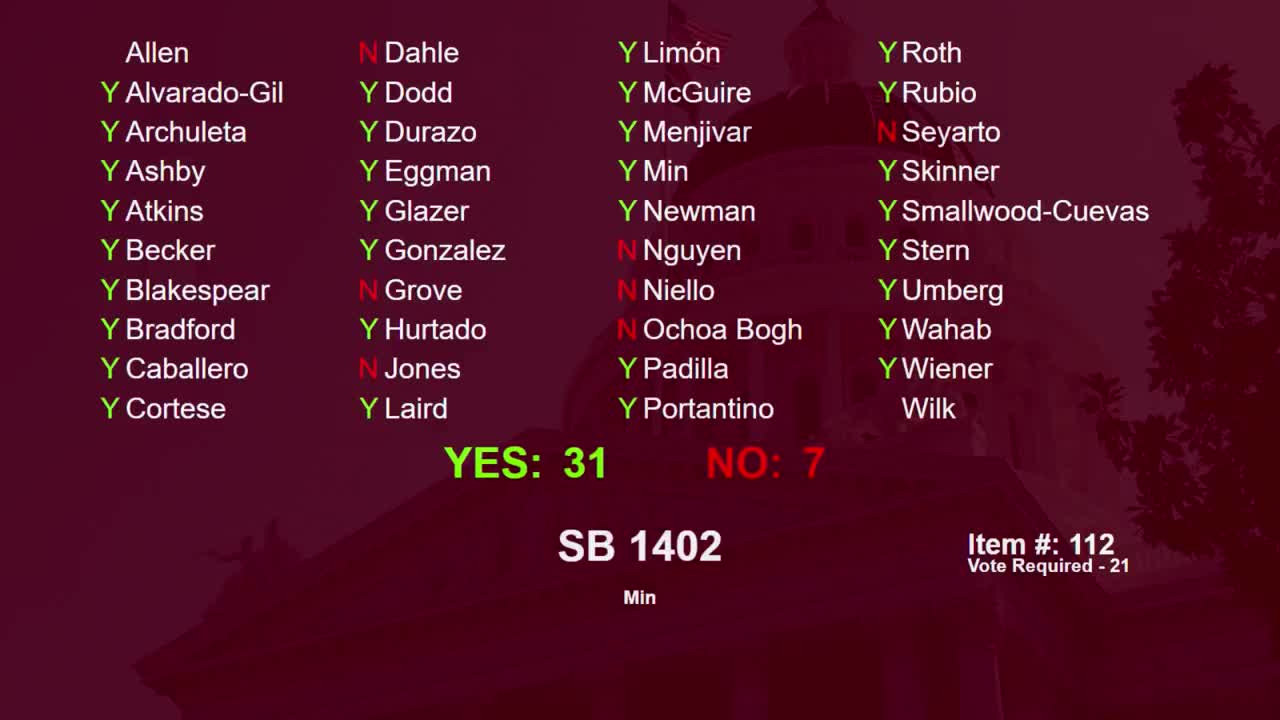
Bill Author

Bill Co-Author(s):