SB 1206: GO-Biz: next generation batteries.
- Session Year: 2023-2024
- House: Senate
- Latest Version Date: 2024-04-30
Current Status:
Failed
(2024-05-16: May 16 hearing: Held in committee and under submission.)
Introduced
In Committee
First Chamber
In Committee
Second Chamber
Enacted
What does this bill do?
The bill lets the Governor’s Office of Business and Economic Development seek federal “next generation” battery hub funding to support battery projects in California. Grants must help improve grid reliability and meet state clean‑energy and emissions goals, and they must prioritize projects that lower battery costs, expand access, cut greenhouse gases, and boost local jobs, equity, air quality, and health. Before applying, project partners must adopt a community benefits plan requiring prevailing wages, labor‑peace policies, local and disadvantaged‑worker hiring and training priorities, and accountability measures.
The summary is provided by generative AI which can make mistakes. For original language, please view the details in the table below.
Existing law establishes the Governors Office of Business and Economic Development (GO-Biz), which serves the Governor as the lead entity for economic strategy and the marketing of California on issues relating to business development, private sector investment, and economic growth. Existing law authorizes GO-Biz, until July 1, 2025, to undertake measures that are necessary or useful to prepare and submit an application to receive funding from the regional clean hydrogen hubs program established by the Secretary of the United States Department of Energy or to otherwise participate in the regional clean hydrogen hubs program. Existing law requires grants made from any funding received from the regional clean hydrogen hubs program to be used as specified. The California Renewables Portfolio Standard Program requires the Public Utilities Commission to establish a renewables portfolio standard, as defined, requiring all retail sellers, as defined, to procure a minimum quantity of electricity products from eligible renewable energy resources, as defined, so that the total kilowatthours of those products sold to their retail end-use customers achieves 25% of retail sales by December 31, 2016, 33% by December 31, 2020, 44% by December 31, 2024, 52% by December 31, 2027, and 60% by December 31, 2030. The California Global Warming Solutions Act of 2006 designates the State Air Resources Board as the state agency responsible for monitoring and regulating sources emitting greenhouse gases. The act requires the state board to prepare and approve a scoping plan for achieving the maximum technologically feasible and cost-effective reductions in greenhouse gas emissions and to update the scoping plan at least once every 5 years.
This bill would, until January 1, 2030, authorize GO-Biz to undertake measures that are necessary or useful to prepare and submit an application to receive funding from next generation battery hub programs, as defined. The bill would require that grants made from any funding received from next generation battery hub programs under its provisions support projects in California, including, but not limited to, in the San Francisco Bay area and the Sacramento Valley, California that advance progress toward resource adequacy goals and the targets of the scoping plan and the California Renewables Portfolio Standard Program. The bill would also require that grants made from any funding received from next generation battery hub programs under its provisions prioritize projects that meet any of the specified conditions, including that the project help reduce costs and increase access to batteries. Prior to the submission of any applications to receive funding from next generation battery hub programs, the bill would require a partnership entered into pursuant to the above-described provisions to adopt a community benefits plan that includes specified elements. The bill would require GO-Biz to submit a report to the relevant budget and policy committees of the Legislature on or before March 1, 2030, January 1, 2026, and annually thereafter, regarding the status of any partnership entered into pursuant to the above-described provisions.
This bill would make legislative findings and declarations as to the necessity of a special statute for the San Francisco Bay area and the Sacramento Valley.Existing law establishes the Governors Office of Business and Economic Development (GO-Biz), which serves the Governor as the lead entity for economic strategy and the marketing of California on issues relating to business development, private sector investment, and economic growth. Existing law authorizes GO-Biz, until July 1, 2025, to undertake measures that are necessary or useful to prepare and submit an application to receive funding from the regional clean hydrogen hubs program established by the Secretary of the United States Department of Energy or to otherwise participate in the regional clean hydrogen hubs program. Existing law requires grants made from any funding received from the regional clean hydrogen hubs program to be used as specified. The California Renewables Portfolio Standard Program requires the Public Utilities Commission to establish a renewables portfolio standard, as defined, requiring all retail sellers, as defined, to procure a minimum quantity of electricity products from eligible renewable energy resources, as defined, so that the total kilowatthours of those products sold to their retail end-use customers achieves 25% of retail sales by December 31, 2016, 33% by December 31, 2020, 44% by December 31, 2024, 52% by December 31, 2027, and 60% by December 31, 2030.The 2030. The California Global Warming Solutions Act of 2006 designates the State Air Resources Board as the state agency responsible for monitoring and regulating sources emitting greenhouse gases. The act requires the state board to prepare and approve a scoping plan for achieving the maximum technologically feasible and cost-effective reductions in greenhouse gas emissions and to update the scoping plan at least once every 5 years.
This bill would, until January 1, 2030, authorize GO-Biz to undertake measures that are necessary or useful to prepare and submit an application to receive funding from next generation battery hub programs, as defined. The bill would require that grants made from any funding received from next generation battery hub programs under its provisions support projects in California California, including, but not limited to, in the San Francisco Bay area and the Sacramento Valley, that advance progress toward resource adequacy goals and the targets of the scoping plan and the California Renewables Portfolio Standard Program. The bill would also require that grants made from any funding received from next generation battery hub programs under its provisions prioritize projects that meet any of the specified conditions, including that the project help reduce costs and increase access to batteries. Prior to the submission of any applications to receive funding from next generation battery hub programs, the bill would require a partnership entered into pursuant to the above-described provisions to adopt a community benefits plan that includes specified elements. The bill would require GO-Biz to submit a report to the relevant budget and policy committees of the Legislature on or before March 1, 2030, and annually thereafter, regarding the status of any partnership entered into pursuant to the above-described provisions.
This bill would make legislative findings and declarations as to the necessity of a special statute for the San Francisco Bay area and the Sacramento Valley.
Existing law establishes the Governors Office of Business and Economic Development (GO-Biz), which serves the Governor as the lead entity for economic strategy and the marketing of California on issues relating to business development, private sector investment, and economic growth. Existing law authorizes GO-Biz, until July 1, 2025, to undertake measures that are necessary or useful to prepare and submit an application to receive funding from the regional clean hydrogen hubs program established by the Secretary of the United States Department of Energy or to otherwise participate in the regional clean hydrogen hubs program. Existing law requires grants made from any funding received from the regional clean hydrogen hubs program to be used as specified. The California Renewables Portfolio Standard Program requires the Public Utilities Commission to establish a renewables portfolio standard, as defined, requiring all retail sellers, as defined, to procure a minimum quantity of electricity products from eligible renewable energy resources, as defined, so that the total kilowatthours of those products sold to their retail end-use customers achieves 25% of retail sales by December 31, 2016, 33% by December 31, 2020, 44% by December 31, 2024, 52% by December 31, 2027, and 60% by December 31, 2030.The California Global Warming Solutions Act of 2006 designates the State Air Resources Board as the state agency responsible for monitoring and regulating sources emitting greenhouse gases. The act requires the state board to prepare and approve a scoping plan for achieving the maximum technologically feasible and cost-effective reductions in greenhouse gas emissions and to update the scoping plan at least once every 5 years.
This bill would, until January 1, 2030, authorize GO-Biz to undertake measures that are necessary or useful to prepare and submit an application to receive funding from next generation battery hub programs, as defined. The bill would require that grants made from any funding received from next generation battery hub programs under its provisions support projects in California that advance progress toward resource adequacy goals and the targets of the scoping plan and the California Renewables Portfolio Standard Program. The bill would also require that grants made from any funding received from next generation battery hub programs under its provisions prioritize projects that meet any of the specified conditions, including that the project help reduce costs and increase access to batteries. Prior to the submission of any applications to receive funding from next generation battery hub programs, the bill would require a partnership entered into pursuant to the above-described provisions to adopt a community benefits plan that includes specified elements. The bill would require GO-Biz to submit a report to the relevant budget and policy committees of the Legislature on or before March 1, 2030, and annually thereafter, regarding the status of any partnership entered into pursuant to the above-described provisions.
For purposes of this article, the following definitions apply:
(a)Office means the Governors Office of Business and Economic Development.
(b)Regional next generation battery hub programs means loans or other financing offered by the Loan Programs Office within the United States Department of Energy, the federal advanced manufacturing production credit (26 U.S.C. Sec. 45X), the federal qualifying advanced energy project credit (26 U.S.C. Sec. 48C(c)(1)), Energy or other funding relevant to and consistent with the purposes and intent of the scoping plan prepared pursuant to Section 38561 of the Health and Safety Code and the Clean Energy, Jobs, and Affordability Act of 2022.
12100.165.(a)The office may undertake measures that are necessary or useful to prepare and submit an application to receive funding from next generation battery hub programs.
(b)Grants made from any funding received from the regional next generation battery hub programs under this article shall support projects in California, including, but not limited to, in the San Francisco Bay area and the Sacramento Valley, California that advance progress toward resource adequacy goals and the targets of the scoping plan prepared pursuant to Section 38561 of the Health and Safety Code and the California Renewables Portfolio Standard Program (Article 16 (commencing with Section 399.11) of Chapter 2.3 of Part 1 of Division 1 of the Public Utilities Code).
(c)Grants made from any funding received from the regional next generation battery hub programs under this article shall prioritize projects that do any of the following:
(1)Help reduce costs and increase access to next generation batteries.
(2)Advance state greenhouse gas emissions reduction goals.
(3)Maximize socioeconomic, workforce, equity, air quality, and health benefits.
(d)Prior to the submission of any application to receive funding from next generation battery hub programs, a partnership entered into pursuant to this section shall adopt a community benefits plan that includes, at minimum, all of the following elements:
(1)The use of project labor agreements for all construction and maintenance work that ensure payment of prevailing wages and benefits and use of a skilled and trained workforce.
(2)Requirements for operations and manufacturing work that include labor peace policies and the payment of family-supporting wages and benefits.
(3)Hiring and training priority for local workers, veterans, tribal members, workers from underrepresented groups, and disadvantaged workers.
(4)Accountability requirements to ensure that goals for job quality, training, and outreach are achieved.
(e)(1)The office shall submit a report to the relevant budget and policy committees of the Legislature on or before March 1, 2030, January 1, 2026, and annually thereafter, regarding the status of any partnership entered into pursuant to this section.
(2)The requirement for submitting a report imposed under paragraph (1) is inoperative on March 1, 2034, pursuant to Section 10231.5.
(3)A report to be submitted pursuant to paragraph (1) shall be submitted in compliance with Section 9795.
(f)In undertaking the duty described in subdivision (a), the office shall consult and coordinate with relevant stakeholders, including, but not limited to, federal agencies, local governments, and utilities.
12100.166.This article shall remain in effect only until January 1, 2030, and as of that date is repealed.
SEC. 2.The Legislature finds and declares that a special statute is necessary and that a general statute cannot be made applicable within the meaning of Section 16 of Article IV of the California Constitution because of the unique circumstances existing in the San Francisco Bay area and the Sacramento Valley.For purposes of this article, the following definitions apply:
(a)Office means the Governors Office of Business and Economic Development.
(b)Regional next generation battery hub programs means loans or other financing offered by the Loan Programs Office within the United States Department of Energy, the federal advanced manufacturing production credit (26 U.S.C. Sec. 45X), the federal qualifying advanced energy project credit (26 U.S.C. Sec. 48C(c)(1)), or other funding relevant to and consistent with the purposes and intent of the scoping plan prepared pursuant to Section 38561 of the Health and Safety Code and the Clean Energy, Jobs, and Affordability Act of 2022.
12100.165.(a)The office may undertake measures that are necessary or useful to prepare and submit an application to receive funding from next generation battery hub programs.
(b)Grants made from any funding received from the regional next generation battery hub programs under this article shall support projects in California California, including, but not limited to, in the San Francisco Bay area and the Sacramento Valley, that advance progress toward resource adequacy goals and the targets of the scoping plan prepared pursuant to Section 38561 of the Health and Safety Code and the California Renewables Portfolio Standard Program (Article 16 (commencing with Section 399.11) of Chapter 2.3 of Part 1 of Division 1 of the Public Utilities Code).
(c)Grants made from any funding received from the regional next generation battery hub programs under this article shall prioritize projects that do any of the following:
(1)Help reduce costs and increase access to next generation batteries.
(2)Advance state greenhouse gas emissions reduction goals.
(3)Maximize socioeconomic, workforce, equity, air quality, and health benefits.
(d)Prior to the submission of any application to receive funding from next generation battery hub programs, a partnership entered into pursuant to this section shall adopt a community benefits plan that includes, at minimum, all of the following elements:
(1)The use of project labor agreements for all construction and maintenance work that ensure payment of prevailing wages and benefits and use of a skilled and trained workforce.
(2)Requirements for operations and manufacturing work that include labor peace policies and the payment of family-supporting wages and benefits.
(3)Hiring and training priority for local workers, veterans, tribal members, workers from underrepresented groups, and disadvantaged workers.
(4)Accountability requirements to ensure that goals for job quality, training, and outreach are achieved.
(e)(1)The office shall submit a report to the relevant budget and policy committees of the Legislature on or before March 1, 2030, and annually thereafter, regarding the status of any partnership entered into pursuant to this section.
(2)The requirement for submitting a report imposed under paragraph (1) is inoperative on March 1, 2034, pursuant to Section 10231.5.
(3)A report to be submitted pursuant to paragraph (1) shall be submitted in compliance with Section 9795.
(f)In undertaking the duty described in subdivision (a), the office shall consult and coordinate with relevant stakeholders, including, but not limited to, federal agencies, local governments, and utilities.
12100.166.This article shall remain in effect only until January 1, 2030, and as of that date is repealed.
SEC. 2.The Legislature finds and declares that a special statute is necessary and that a general statute cannot be made applicable within the meaning of Section 16 of Article IV of the California Constitution because of the unique circumstances existing in the San Francisco Bay area and the Sacramento Valley.
For purposes of this article, the following definitions apply:
(a)Office means the Governors Office of Business and Economic Development.
(b)Regional next generation battery hub programs means loans or other financing offered by the Loan Programs Office within the United States Department of Energy, the federal advanced manufacturing production credit (26 U.S.C. Sec. 45X), the federal qualifying advanced energy project credit (26 U.S.C. Sec. 48C(c)(1)), or other funding relevant to and consistent with the purposes and intent of the scoping plan prepared pursuant to Section 38561 of the Health and Safety Code and the Clean Energy, Jobs, and Affordability Act of 2022.
12100.165.(a)The office may undertake measures that are necessary or useful to prepare and submit an application to receive funding from next generation battery hub programs.
(b)Grants made from any funding received from the regional next generation battery hub programs under this article shall support projects in California that advance progress toward resource adequacy goals and the targets of the scoping plan prepared pursuant to Section 38561 of the Health and Safety Code and the California Renewables Portfolio Standard Program (Article 16 (commencing with Section 399.11) of Chapter 2.3 of Part 1 of Division 1 of the Public Utilities Code).
(c)Grants made from any funding received from the regional next generation battery hub programs under this article shall prioritize projects that do any of the following:
(1)Help reduce costs and increase access to next generation batteries.
(2)Advance state greenhouse gas emissions reduction goals.
(3)Maximize socioeconomic, workforce, equity, air quality, and health benefits.
(d)Prior to the submission of any application to receive funding from next generation battery hub programs, a partnership entered into pursuant to this section shall adopt a community benefits plan that includes, at minimum, all of the following elements:
(1)The use of project labor agreements for all construction and maintenance work that ensure payment of prevailing wages and benefits and use of a skilled and trained workforce.
(2)Requirements for operations and manufacturing work that include labor peace policies and the payment of family-supporting wages and benefits.
(3)Hiring and training priority for local workers, veterans, tribal members, workers from underrepresented groups, and disadvantaged workers.
(4)Accountability requirements to ensure that goals for job quality, training, and outreach are achieved.
(e)(1)The office shall submit a report to the relevant budget and policy committees of the Legislature on or before March 1, 2030, and annually thereafter, regarding the status of any partnership entered into pursuant to this section.
(2)The requirement for submitting a report imposed under paragraph (1) is inoperative on March 1, 2034, pursuant to Section 10231.5.
(3)A report to be submitted pursuant to paragraph (1) shall be submitted in compliance with Section 9795.
(f)In undertaking the duty described in subdivision (a), the office shall consult and coordinate with relevant stakeholders, including, but not limited to, federal agencies, local governments, and utilities.
12100.166.This article shall remain in effect only until January 1, 2030, and as of that date is repealed.
|
Date
|
Status
|
|---|---|
| May 16, 2024 | May 16 hearing: Held in committee and under submission. |
| May 14, 2024 | Set for hearing May 16. |
| May 13, 2024 | May 13 hearing: Placed on APPR suspense file. |
| May 3, 2024 | Set for hearing May 13. |
| Apr 30, 2024 | Read second time and amended. Re-referred to Com. on APPR. |
| Apr 29, 2024 | From committee: Do pass as amended and re-refer to Com. on APPR. (Ayes 15. Noes 3. Page 3701.) (April 22). |
| Apr 17, 2024 | Set for hearing April 22. |
| Apr 16, 2024 | From committee: Do pass and re-refer to Com. on E., U. & C. (Ayes 9. Noes 1. Page 3605.) (April 15). Re-referred to Com. on E., U. & C. |
| Apr 9, 2024 | Set for hearing April 15. |
| Apr 8, 2024 | April 8 set for first hearing canceled at the request of author. |
| Apr 4, 2024 | Set for hearing April 8. |
| Apr 3, 2024 | From committee with author's amendments. Read second time and amended. Re-referred to Com. on B., P. & E. D. |
| Feb 29, 2024 | Referred to Coms. on B., P. & E. D. and E., U. & C. |
| Feb 16, 2024 | From printer. May be acted upon on or after March 17. |
| Feb 15, 2024 | Introduced. Read first time. To Com. on RLS. for assignment. To print. |
|
Date
|
Description
|
Location
|
Votes
|
|
|---|---|---|---|---|
| May 13, 2024 | Placed on suspense file | Senate Standing Committee on Appropriations |
Passed |
|
| Apr 22, 2024 | Do pass as amended, but first amend, and re-refer to the Committee on [Appropriations] | Senate Standing Committee on Energy, Utilities and Communications |
Passed |
|
| Apr 15, 2024 | Do pass, but first be re-referred to the Committee on [Energy, Utilities and Communications] | Senate Standing Committee on Business, Professions and Economic Development |
Passed |
This list shows positions taken on this bill by organizations on the date displayed, which is linked to the original source.
Positions by individuals are not included.
|
Organization
|
Position
|
Date
|
|---|---|---|
| Blue Current, INC. | ** Support | |
| CA State Building & Construction Trades | * Support | Apr 22, 2024 |
| Cal Star | * Support | Apr 15, 2024 |
| California Labor Federation | * Support | Apr 22, 2024 |
| California Mobility Center | ** Support | |
| California Mobility Center | * Support | Apr 22, 2024 |
| Calstar | * Support | Apr 22, 2024 |
| Calstart | ** Support | |
| Clean Transportation Technologies and Solutions | ** Support | |
| Climate Action California | * Support | Apr 22, 2024 |
| Rising Sun Center for Opportunity | ** Support | |
| Self Help Counties Coalition | * Support | Apr 22, 2024 |
| State Building & Construction Trades Council Of California | ** Support | |
| Western Electrical Contractor's Association | * Against | Apr 22, 2024 |
| Western Electrical Contractors Association | ** Against |
SENATE COMMITTEE ON
Senator Anna Caballero, Chair
2023 - 2024 Regular Session
SB 1206 (Becker) - GO-Biz: next generation batteries
Version: | Policy Vote: |
Urgency: | Mandate: |
Hearing Date: | Consultant: |
Bill Summary:
SB 1206 would (1) authorize the Governor’s Office of Business and Economic Development (GO-Biz) to establish a battery manufacturing hub to research and develop specified battery technologies, and (2) specify that the hub would use existing federal funds, including federal production tax credits to provide in-state financing for battery development projects that comply with certain labor requirements, including the use of project labor agreements.
Fiscal Impact:
Administrative costs to GO-Biz have yet to be identified, but could potentially reach the hundreds of thousands of dollars (General Fund or special fund).
Background:
The State has had various economic development departments through the decades. Prior to 2003, the majority of the State’s economic development programs were housed within the Technology, Trade, and Commerce Agency. The 2003 04 Budget Act abolished both the Agency and state funding for many of its programs designed to encourage economic development.
GO Biz was established statutorily in 2011 to be the lead entity for economic strategy and the marketing of California on issues relating to business development, private sector investment, and economic growth. GO-Biz staff provide a wide range of advisory and coordinating roles across the administration related to economic development. Several units of GO Biz serve as points of contact for businesses considering relocating to or expanding in California. For example, CalOSBA provides resources for small businesses and financial assistance for small business advisory centers. Other units assist international investors, help businesses obtain information about business permits, administer the California Competes Tax Credit Program, and administer the Cannabis Local Equity Grant Program. Additionally, the California Film Commission, Travel and Tourism Commission, and the Infrastructure and Economic Development Bank have been assigned for oversight purposes to GO Biz.
Batteries are seen as an important climate solution because they can power vehicles that have historically relied on climate-impacting fossil fuels, and they also store clean electricity created by solar panels or wind turbines. According to information from the California Energy Commission (CEC), energy storage projects capture power produced by wind and solar resources and discharge the energy back to the electric grid during times of peak demand. In California, electricity demand is highest in the late afternoon and early evening hours when the sun sets, causing solar resources to drop off before winds pick up later in the evening. The battery storage fleet provides a critical energy bridge during this time of day.
Recently, funding opportunities from the U.S. Department of Energy (DOE) have become available for battery manufacturing, energy storage projects, research, and development.
Proposed Law:
This bill would, until January 1, 2030, do the following:
- Define a “regional next generation battery hub program” as loans or other financing offered by the federal Department of Energy (DOE) Loan Programs Office, the federal advanced manufacturing production credit, the federal advanced energy project credit, or other funding relevant for next generation battery manufacturing that will help achieve California’s emissions reduction goals.
- Authorize GO-Biz to consult with stakeholders and take steps to prepare and submit an application to receive funding from next generation battery hub programs.
- Specify that grants made the regional next generation battery hub programs must support projects in California that advance progress toward resource adequacy goals and emissions reduction targets, as specified.
- Require grants made by the hub to prioritize projects that do any of the following: (1) help reduce costs and increase access to next generation batteries, (2) advance state GHG emissions reduction goals, and (3) maximize socioeconomic, workforce, equity, air quality, and health benefits.
- Establish specified labor standards for grants issued by the hub.
- Require GO-Biz to submit a report to the Legislature by January 1, 2026, and annually thereafter as specified, regarding the status of any partnership developed pursuant to this bill.
Related Legislation:
- SB 322 (Becker, 2023) would establish labor preferences that the CEC and any third-party administrator must use when awarding funds for the Zero-Emission Vehicle (ZEV) Battery Manufacturing Block Grants Program. The bill is currently pending in the Assembly Appropriations Committee.
- AB 157 (Committee on Budget, Chapter 570, Statutes of 2022) authorized GO-Biz to take steps to prepare and submit an application to receive funding from the regional clean hydrogen hubs program or to otherwise participate in the regional clean hydrogen hubs program. The bill also established a definition of clean hydrogen.
- SB 589 (Hueso, Chapter 732, Statutes of 2021) expanded the types of projects eligible for funding from the CEC’s Clean Transportation Program (CTP) to include projects that develop in-state supply chains and the workforce for raw materials and components needed for ZEV manufacturing. The bill also expanded the groups the CEC must consult as part of CTP workforce development efforts.
- AB 1697 (Bonilla, Chapter 446, Statutes of 2016) added prioritization criteria for the CTP to prioritize projects that transition workers to the alternative and renewable fuel and vehicle technology sector. The bill also added criteria for workforce development programs eligible for CTP funding.
-- END --
SENATE COMMITTEE ON ENERGY, UTILITIES AND COMMUNICATIONS
Senator Steven Bradford, Chair
2023 - 2024 Regular
Bill No: Hearing Date: 4/22/2024
Author: | |||
Version: | Amended | ||
Urgency: | Fiscal: | ||
Consultant: | |||
SUBJECT:
DIGEST: This bill authorizes the Governor’s Office of Business and Economic Development (GO-Biz) to establish a battery manufacturing hub to research and develop specified battery technologies. This bill specifies that the hub will use existing federal funds, including federal production tax credits to provide in-state financing for battery development projects that comply with certain labor requirements, including the use of project labor agreements.
ANALYSIS:
Existing law:
- Authorizes GO-Biz to take steps necessary to apply for federal regional clean hydrogen hubs funding. Existing law defines “clean hydrogen” for the purposes of the clean hydrogen hub funding as hydrogen produced from RPS-eligible energy resources and otherwise consistent with federal law for the clean hydrogen hub program. (Government Code §12100.161–12100.162)
- Requires the California Air Resources Board (CARB) to prepare a scoping plan for achieving the maximum technologically feasible and cost-effective reductions in greenhouse gas (GHG) emissions by specified dates. Existing law requires CARB to update the scoping plan every five years. (Health and Safety Code §38561)
- Establishes the Renewable Portfolio Standard (RPS) program and establishes a goal of procuring at least 60 percent of total retail sales of electricity from renewable energy resources by December 31, 2030, with specified benchmarks up to that date. Existing law requires the California Public Utilities Commission (CPUC) to oversee electrical corporations’ compliance with renewable energy procurement mandates and requires the California Energy Commission (CEC) to oversee publicly owned electric utility renewable energy procurement compliance. (Public Utilities Code §399.11 et. seq.)
- Establishes the resource adequacy (RA) framework by requiring the CPUC to work with the California Independent System Operator (CAISO) to establish RA requirements for all load serving entities. Requires the CPUC to establish these RA requirements in a manner that ensures the reliability of electrical service in the state while advancing the state’s clean energy and climate goals. (Public Utilities Code §380 et. seq.)
This bill:
- Defines a “regional next generation battery hub program” as loans or other financing offered by the federal Department of Energy (DOE) Loan Programs Office, the federal advanced manufacturing production credit, the federal advanced energy project credit, or other funding relevant for next generation battery manufacturing that will help achieve California’s emissions reduction goals.
- Authorizes GO-Biz to consult with stakeholders and take steps to prepare and submit an application to receive funding from next generation battery hub programs.
- Specifies that grants made the regional next generation battery hub programs must support projects in California, including, but not limited to projects in the San Francisco Bay Area and the Sacramento Valley. This bill specifies that grants issued by the hub must advance progress toward RA goals and emissions reduction targets identified by CARB in the scoping plan.
- Requires grants made by the hub to prioritize projects that do any of the following:
- Help reduce costs and increase access to next generation batteries.
- Advance state GHG emissions reduction goals.
- Maximize socioeconomic, workforce, equity, air quality, and health benefits.
- Establishes labor standards for grants issued by the hub by requiring any partnerships that apply for funding under this bill to first adopt a community benefits plan that includes all of the following:
- The use of project labor agreements (PLAs) for all construction and maintenance work that ensure payment of prevailing wages and benefits and use of a skilled and trained workforce.
- Requirements for operations and manufacturing work that include labor peace policies and the payment of family-supporting wages and benefits.
- Hiring and training priority for local workers, veterans, tribal members, workers from underrepresented groups, and disadvantaged workers.
- Accountability requirements to ensure that goals for job quality, training, and outreach are achieved.
- Requires GO-Biz to submit a report to the relevant legislative budget and policy committees by March 1, 2030, and annually thereafter until March 1, 2043, regarding the status of any partnership developed pursuant to this bill.
- Sunsets the bill on January 1, 2030.
Background
Bill aims to incentivize development of next generation battery technologies. Further developing energy storage resources is necessary to meeting California’s emissions reduction goals from multiple sectors, including the electricity and transportation sectors. Developing batteries for the transportation sector that will improve the range of vehicles and lower costs for batteries can support greater electric vehicle adoption. Multiple studies have indicated that in order to meet deeper decarbonization goals in the electricity sector, the state needs to develop new energy resources that can deliver consistent zero-carbon energy at peak demand periods. According to reports by the CEC, California had 6,600 megawatts of battery storage operating at four to six hour durations. The CEC also estimates that more than 48 gigawatts of battery storage and 4 gigawatts of long duration storage will be needed to meet the state’s goal of using electricity that is 100 percent zero-carbon by 2045. Several research bodies have already established entities focused on developing new battery technology. For example Lawrence Berkeley National Laboratory (LBNL) has multiple groups developing battery technology, and the lab has established a long-term goal of creating an energy storage hub to develop cost-competitive energy storage to improve renewable electricity generation and improve grid resilience.
Bill is modeled on California’s hydrogen hub project, but its funding sources differ. This bill would authorize GO-Biz to form a public-private partnership to draw down specified federal funds to develop battery technology in-state. This bill establishes labor standards for this public-private partnership and requires investments to meet California’s climate and energy reliability goals. While this bill is modeled on legislation authorizing the creation of a hydrogen hub program in California, the funding sources specified in this bill differ from those supporting California’s hydrogen hub partnership.
In 2021, President Biden signed the Infrastructure Investment and Jobs Act (IIJA), which included $8 billion to the federal DOE to establish regional clean hydrogen hubs across the nation. In 2022, the Legislature passed AB 157 (Committee on Budget, Chapter 570, Statutes of 2022), which authorized GO-Biz to take steps to prepare and submit an application to receive funding from the regional clean hydrogen hubs program. This legislation led to the establishment of a public-private partnership, known as the Alliance for Renewable Clean Hydrogen Energy Systems (ARCHES), which has received an award of $1.2 in IIJA federal monies to develop fossil-free hydrogen production in California.
This bill aims to establish a regional battery hub program based on the ARCHES model. However, the federal government has not provided funding specifically for the creation of the battery hub proposed under this bill. Instead, this bill cites several new and existing federal incentives and funding as resources to fund grants and loans through an in-state hub. Below are the funding sources cited in this bill as resources for supplying grants and loans from the battery hub.
- Department of Energy Loan Program Office (LPO), which provides loans for large-scale energy infrastructure projects.
- The Federal Advanced Manufacturing Production credit (also known as the 45X credit) provides tax credits over time for investments supporting domestic manufacturing of certain clean energy technologies, including certain battery components.
- The Federal Qualifying Advanced Energy Project credit (also known as the 48C credit) provides an up-front credit for certain investments in manufacturing and industrial decarbonization.
While a number of different types of projects may qualify for loans provided by the LPO, the 45X and 48C tax credits were established in the Inflation Reduction Act (IRA) to provide incentives directly for taxpayer investments in certain domestic clean energy and emissions reduction technologies. It is unclear how this bill intends to use federal tax credits to develop in-state grants.
This bill also defines regional next generation battery hub programs in a manner that could be interpreted as adding a layer of state-level requirements to federal tax credits for clean energy development.
From Oakland to Sactown, the Bay Area, and Back Down? While this bill does not limit a battery hub’s investment across the state, this bill specifically indicates that the regional hub should support projects in the San Francisco Bay Area and the Sacramento Valley. While these regions may include institutions and investors that are already engaging in next generation battery development, potential investors and project developers may exist elsewhere in the state. To the extent that there are entities in the Bay Area and Sacramento that are already well-positioned to participate in a battery hub, it may not be necessary to specifically identify these areas as potential project locations since they would be likely to participate without a reference in statute. Additionally, this reference may indicate that certain projects in these areas should be privileged over others.
Need for amendments. As currently written, this bill specifically establishes federal production tax credits as financing mechanisms for in-state loans without clarifying how this will be achieved. To the extent that this bill creates legal ambiguity about taxpayers’ eligibility for these federal tax credits, this bill could disincentivize the use of these credits within California. This does not appear to be the Author’s intent. Additionally, specific references to funding projects in the San Francisco Bay Area and Sacramento Valley are unnecessary for a bill that could fund projects across the state. This bill also establishes a legislative reporting requirement that requires GO-Biz to produce a report after the date on which this bill is repealed. It is unclear how the Legislature would use a report received after this repeal date. For these reasons, the author and committee may wish to amend this bill to do the following:
- Delete references to the federal tax credits and funding for projects in specific geographic locations.
- Modify the existing reporting requirement in this bill to require GO-Biz to submit a report to the Legislature regarding the formation of a public-private partnership pursuant to this bill by January 1, 2026.
Dual Referral. This bill passed out of the Senate Committee on Business, Professions and Economic Development on April 15, 2024 with a vote of 9-1.
Prior/Related Legislation
SB 322 (Becker, 2023) would establish labor preferences that the CEC and any third-party administrator must use when awarding funds for the Zero-Emission Vehicle (ZEV) Battery Manufacturing Block Grants Program. The bill is currently in the Assembly Appropriations Committee.
AB 157 (Committee on Budget, Chapter 570, Statutes of 2022) authorized GO-Biz to take steps to prepare and submit an application to receive funding from the regional clean hydrogen hubs program or to otherwise participate in the regional clean hydrogen hubs program. The bill also established a definition of clean hydrogen.
SB 589 (Hueso, Chapter 732, Statutes of 2021) expanded the types of projects eligible for funding from the CEC’s Clean Transportation Program (CTP) to include projects that develop in-state supply chains and the workforce for raw materials and components needed for ZEV manufacturing. The bill also expanded the groups the CEC must consult as part of CTP workforce development efforts.
AB 1697 (Bonilla, Chapter 446, Statutes of 2016) added prioritization criteria for the CTP to prioritize projects that transition workers to the alternative and renewable fuel and vehicle technology sector. The bill also added criteria for workforce development programs eligible for CTP funding.
FISCAL EFFECT: Appropriation: Fiscal Com.: Local:
SUPPORT:
State Building & Construction Trades Council of California, Sponsor
California Mobility Center
CALSTART
Rising Sun Center for Opportunity
OPPOSITION:
Western Electrical Contractors Association
ARGUMENTS IN SUPPORT: According to the author:
Solid-state batteries are a novel battery technology with a greater energy density, making them smaller and lighter than lithium-ion batteries. While solid-state batteries could provide a breakthrough increase in the energy capacity for electric vehicles and (EVs) clean reliability energy, companies are still overcoming barriers to scaling, such as limitations from the cost of production.
California has demonstrated the potential of a public-private partnership by receiving federal and private funding for a state-wide hydrogen hub, hosted by the Governor’s Office of Business and Economic Development. Despite the success of this model, Go-Biz doesn’t have the authority to establish a new partnership for other clean energy resources that are critical for decreasing up-stream costs of the renewables used to meet the state’s clean energy targets.
Given that criteria for US Department of Energy’s Loan Programs Office loans prioritize projects matching co-lenders and public sector funding, as well as community benefit agreements and labor standards, it is imperative California builds the state support, ensuring we do not leave federal lower-interest loans for clean energy manufacturing on the table.
This bill prioritizes California’s role in establishing next generation batteries by authorizing Go-Biz to develop a public-private partnership of labor, private-sector manufacturers and investors, and community partners to develop the plan for a regional Bay Area and Northern San Joaquin Valley battery manufacturing hub developing and researching next-generation solid-state battery technology.
This bill provides the potential to support California’s EV and clean energy transition supporting High Road jobs and community benefits.
ARGUMENTS IN OPPOSITION: In opposition, the Western Electrical Contractors Association (WECA) states:
Unfortunately, the bill mandates “the use of project labor agreements for all construction and maintenance work that ensure payment of prevailing wages and benefits and the use of a skilled and trained workforce.” As I am sure you are aware, all public works construction requires the payment of prevailing wages and there is no need for a PLA to “ensure payment of prevailing wages and benefits.”
-- END --
SENATE COMMITTEE ON
BUSINESS, PROFESSIONS AND ECONOMIC DEVELOPMENT
Senator Angelique Ashby, Chair
2023 - 2024 Regular
Bill No: SB 1206 Hearing Date: April 15, 2024
Author: | Becker | ||
Version: |
| ||
Urgency: | Fiscal: | ||
Consultant: | |||
Subject: GO-Biz: next generation batteries
SUMMARY:
Authorizes GO-Biz to undertake measures that are necessary or useful to prepare and submit an application to receive funding from next generation battery hub programs.
NOTE:
Double-referral to the Senate Committee on Energy, Utilities, and Commerce, Second.
Existing law establishes GO-Biz within the Governor’s Office for the purpose of serving as the lead state agency for economic strategy and marketing of California on issues relating to business development, private sector investment, and economic growth, and authorizes GO-Biz to establish an interactive internet website. (Government Code (GOV) §§ 12096-12098.5)
This bill:
- Until January 1, 2030, authorizes GO-Biz to undertake measures that are necessary or useful to prepare and submit an application to receive funding from next generation battery hub programs (NGBHPs). Funding from NGBHPs are loans or other financing offered by the Loan Programs Office within the United States Department of Energy (USDE), the federal advanced manufacturing production credit, the federal qualifying advanced energy project credit, or other funding relevant to and consistent with the purposes and intent of the scoping plan prepared by the California Air Resources Board (ARB) for achieving the maximum technologically feasible and cost-effective reductions in greenhouse gas emissions.
- Specifies that grants made from any funding received from NGBHPs shall support projects in California, including, but not limited to, in the San Francisco Bay area and the Sacramento Valley, that advance progress toward resource adequacy goals and the targets of the ARB scoping plan and that grants shall prioritize projects that:
- Help reduce costs and increase access to next generation batteries.
- Advance state greenhouse gas emissions reduction goals.
- Maximize socioeconomic, workforce, equity, air quality, and health benefits.
- Requires any partnership applying for grants to adopt a community benefits plan that includes, at minimum, all of the following:
- The use of project labor agreements for all construction and maintenance work that ensure payment of prevailing wages and benefits and use of a skilled and trained workforce.
- Requirements for operations and manufacturing work that include labor peace policies and the payment of family-supporting wages and benefits.
- Hiring and training priority for local workers, veterans, tribal members, workers from underrepresented groups, and disadvantaged workers.
- Accountability requirements to ensure that goals for job quality, training, and outreach are achieved.
- Requires GO-Biz to submit a report to the relevant budget and policy committees of the Legislature on or before March 1, 2030, and annually thereafter, regarding the status of any partnership.
FISCAL EFFECT:
Unknown. This bill is keyed fiscal by Legislative Counsel.
COMMENTS:
- Purpose. This bill is sponsored by the State Building and Construction Trades Council of California. According to the Author, “California’s High Road Jobs plan encourages the use of demand-side policies that ‘identify and focus incentives on win-win strategies that meet both climate and workforce goals,’ and ‘expand the use of community workforce agreements.’” The Author states that the Alliance for Renewable Clean Hydrogen Energy Systems (ARCHES) authorized GO-Biz the authority to establish a public-private partnership to create a clean hydrogen hub in California, demonstrating the roadmap for high road climate-jobs by requiring participating private-sector partners to commit to a skilled and trained union force and a project labor agreement. According to the Author, “Despite the success of this model, GO-Biz doesn’t have the authority to establish a new partnership for other clean energy resources that are critical for decreasing up-stream costs of the renewables used to meet the state’s clean energy targets. Given that criteria for Loan Program Office loans prioritize projects matching co-lenders and public sector funding, as well as community benefit agreements and labor standards, a lack of state government support leaves federal lower-interest loans for clean energy manufacturing on the table.”
- Background.
Batteries and Funding Programs. According to the U.S. Energy Information Administration, an energy storage system (ESS) for electricity generation uses electricity (or some other energy source, such as solar-thermal energy) to charge an energy storage system or device, which is discharged to supply (generate) electricity when needed at desired levels and quality. ESSs provide a variety of services to support electric power grids. In some cases, ESSs may be paired or co-located with other generation resources to improve the economic efficiency of one or both systems.
Batteries are seen as an important climate solution because they can power vehicles that have historically relied on climate-impacting fossil fuels, and they also store clean electricity created by solar panels or wind turbines. According to information from the California Energy Commission (CEC), energy storage projects capture power produced by wind and solar resources and discharge the energy back to the electric grid during times of peak demand. In California, electricity demand is highest in the late afternoon and early evening hours when the sun sets, causing solar resources to drop off before winds pick up later in the evening. The battery storage fleet provides a critical energy bridge during this time of day.
In October 2023, CEC highlighted data related to an important aspect of the state’s transition to 100 percent clean energy by 2024: “California is surging forward with the buildout of battery energy storage systems with more than 6,600 megawatts (MW) online, enough electricity to power 6.6 million homes for up to four hours. The total resource is up from 770 MW four years ago and double the amount installed just two years ago.” CEC notes this information shows that the state is a leader in battery storage capacity as well as new clean energy development required to meet goals for the transition from fossil fuels to a modernized grid powered by clean, renewable sources.”
A March 2024 CEC-sponsored report, Improved Batteries for California’s Zero - Emissions Vehicle Future found that, “Lithium-ion (Li-ion) batteries do not have sufficient energy density and safety to reach the performance needed for mass-market electrification of the aviation, drone, high performance automotive, and long-haul trucking sectors. In fact, lithium-ion technology will soon reach theoretical limitations in energy density because the conductivities of most of the electrode materials are not sufficient to attain high-rate performance. Moreover, there is difficulty obtaining strong rate capability while maintaining long cycle-life and safety…And many other emerging approaches to improve battery performance suffer from major challenges with scalability and manufacturing incompatibility, which makes development and scale-up too costly and technically risky. California, therefore, must look to new solutions if it is to reach its goal of transitioning 100 percent of medium- and heavy-duty vehicles in the state to EVs by 2045. California must incubate battery technology outside of the conventional lithium-ion realm to successfully accomplish its objectives.”
Recently, funding opportunities from the U.S. Department of Energy (DOE) have become available for battery manufacturing, energy storage projects, research, and development.
GO-Biz. In February 2010, the Little Hoover Commission undertook a review of the state's economic and workforce development programs. In its final report, Making up for Lost Ground: Creating a Governor's Office of Economic Development, it analyzed the status and effectiveness of current programs since the 2003 demise of the Technology, Trade and Commerce Agency (TTCA) and recommended the creation of a new governmental entity to fill the void left by the dismantled agency.
The report called for a single entity that would promote greater economic development, foster job creation, serve as a policy advisor and deliver specific services (i.e., permitting, tax, regulatory, and other information) directly to the California business community. In April 2010, Governor Schwarzenegger issued Executive Order S-05-10 as a means to operationalize the report recommendations including the creation of the Governor's Office of Economic Development (GOED).
In October 2011, the Governor signed AB 29 (John A. Pérez, Chapter 475, Statutes of 2011), which effectively codified GOED and changed its name to GO-Biz. Since its inception, the office has served thousands of businesses, 95 percent of which are small businesses. The most frequent types of assistance include help with permit streamlining, starting a business, relocation and expansion of businesses, and regulatory challenges.
In March 2012, Governor Brown initiated a reorganization process to realign the state's administrative structure. Key changes include dismantling of the Business, Transportation and Housing Agency and the shifting of a number of key programs to GO-Biz including the Small Business Loan Guarantee Program, the California Travel and Tourism Commission, the California Film Commission, the Film California First Program, and the Infrastructure and Economic Development Bank (IBank). Currently, GO-Biz administers the following programs and units:
- Made In California program for the purpose of encouraging consumer product awareness and to foster the purchases of products manufactured in California.
- The California Inclusive Innovation Hub Program (iHub2) to incubate and/or accelerate technology and science-based firms, with a focus on underserved regions and communities.
- The California Competes Tax Credit Program under which “businesses who want to come to California or stay and grow in California” can receive an income tax credit.
- The California Business Investment Services Unit, which provides no-fee, tailored site selection services to employers and others who may be considering California for relocation or expansion.
- The California Business Portal, which provides information to California businesses about common questions, permitting, financial options, and more.
- The California Community Reinvestment Grants Program, which was included in Proposition 64, authorized GO-Biz to award grants to local health departments and certain nonprofit organizations to support communities disproportionately affected by the War on Drugs.
- Office of the Small Business Advocate which provides information and assistance to small businesses.
- The Zero Emission Vehicles (ZEV) Infrastructure Unit which works to accelerate the deployment of ZEV infrastructure.
- The International Affairs and Business Development Unit, which serves as California’s primary point of contact for expanding international trade and investment relations. This unit focuses on foreign direct investment (services for foreign investors, foreign investment technical assistance, and the EB-5 Investor Visa Program), international trade promotion (STEP program, trade missions, export assistance, and the California-China Trade Office), and international agreements.
AB 157 (Committee on Budget, Chapter 570, Statutes of 2022) is the basis for the language in this bill and similarly authorized GO-Biz to, until July 1, 2025, “undertake measures that are necessary or useful to prepare and submit an application to receive funding and participate in a regional clean hydrogen hubs program established by the Federal Secretary of Energy.” California submitted an application through the Alliance for Renewable Clean Hydrogen Energy Systems (ARCHES), a statewide public-private partnership designed to accelerate renewable hydrogen’s (H2) contribution to decarbonizing the state’s economy. The state was one of seven awardees in October 2023 of the DOE’s Regional Clean Hydrogen Hubs and was awarded $1.2 billion.
- Arguments in Support. Clean Transportation Technologies and Solutions (CALSTART) states that “next-generation battery technologies, such as solid-state batteries, are novel battery solutions with a greater energy density, making them smaller and lighter than current lithium-ion batteries. While next-generation technologies could provide a breakthrough increase in the energy capacity for electric vehicles and (EVs) clean reliability energy, companies are still overcoming barriers to scaling, particularly in key mid-to-late stages of the development/commercialization process.”
Supporters note once commercially available, these improved technologies will face future manufacturing and commercialization barriers prior to their adoption and that this bill provides the potential for California to support a clean energy transition.
- Arguments in Opposition. The Western Electrical Contractors Association is concerned that this bill mandates “the use of project labor agreements for all construction and maintenance work that ensure payment of prevailing wages and benefits and the use of a skilled and trained workforce.” They note that all public works construction requires the payment of prevailing wages and there is no need for a PLA to “ensure payment of prevailing wages and benefits.” WECA believes this mandate is discriminatory and increases the cost of construction. A study published recently by the Rand Corporation found that a bond measure passed by LA area voters in 2016 failed to deliver its intended results, primarily because of a project labor agreement. WECA is resolute in its belief that project labor agreements are both wasteful and discriminatory.”
- Policy Questions and Comments.
Does the language in this bill achieve the Author’s goal? According to the Author, “SB 1206 authorizes [GO-Biz] to develop a public-private partnership of labor, private-sector manufacturers and investors, and community partners to develop the plan for a regional Bay Area and Northern San Joaquin Valley battery manufacturing hub developing and researching next-generation solid-state battery technology. [GO-Biz] and the partnership would be required to consult relevant stakeholders and prioritize projects which decrease costs and access to solid-state batteries, advance the state’s clean energy and EV deployment goals, and maximize workforce and equity benefits. This partnership would replicate the ARCHES model for High Road jobs and community benefits…This public-private partnership provides the potential to support California’s EV and clean energy transition supporting High Road jobs and community benefits.”
However, this bill does not establish anything, does not mandate that GO-Biz establish a partnership, and does not specify that GO-Biz must establish a grants process to administer monies. Instead, the bill is entirely permissive and solely authorizes GO-Biz to “undertake measures that are necessary or useful to prepare and submit an application to receive funding from next generation battery hub programs.” It would be helpful to understand if there are federal funding opportunities in the area of next generation battery research, development, and manufacturing that California is not currently eligible to apply for or receive due to an absence of collaboration or regional coordination and how this non-specific bill will solve that problem. If the Author intends to task GO-Biz with administering a public-private partnership in order to qualify for federal monies, and task GO-Biz or a GO-Biz- established partnership to distribute federal monies through a grant program, moving forward, the Author may wish to provide specificity and direction, particularly in conformity with any federal requirements for states, regions, or programs to be eligible for federal funding.
SUPPORT AND OPPOSITION:
Support:
Blue Current, INC.
California Mobility Center
Clean Transportation Technologies and Solutions
Rising Sun Center for Opportunity
State Building and Construction Trades Council
Opposition:
Western Electrical Contractors Association
-- END --
SENATE COMMITTEE ON
BUSINESS, PROFESSIONS AND ECONOMIC DEVELOPMENT
Senator Angelique Ashby, Chair
2023 - 2024 Regular
Bill No: Hearing Date: April 8, 2024
Author: | |||
Version: | April 3, 2024 | ||
Urgency: | No | Fiscal: | Yes |
Consultant: | Sarah Mason | ||
Subject:
SUMMARY:
Authorizes GO-Biz to undertake measures that are necessary or useful to prepare and submit an application to receive funding from next generation battery hub programs.
NOTE:
Double-referral to the Senate Committee on Energy, Utilities, and Commerce, Second.
Existing law establishes GO-Biz within the Governor’s Office for the purpose of serving as the lead state agency for economic strategy and marketing of California on issues relating to business development, private sector investment, and economic growth, and authorizes GO-Biz to establish an interactive internet website. (Government Code (GOV) §§ 12096-12098.5)
This bill:
- Until January 1, 2030, authorizes GO-Biz to undertake measures that are necessary or useful to prepare and submit an application to receive funding from next generation battery hub programs (NGBHPs). Funding from NGBHPs are loans or other financing offered by the Loan Programs Office within the United States Department of Energy (USDE), the federal advanced manufacturing production credit, the federal qualifying advanced energy project credit, or other funding relevant to and consistent with the purposes and intent of the scoping plan prepared by the California Air Resources Board (ARB) for achieving the maximum technologically feasible and cost-effective reductions in greenhouse gas emissions.
- Specifies that grants made from any funding received from NGBHPs shall support projects in California, including, but not limited to, in the San Francisco Bay area and the Sacramento Valley, that advance progress toward resource adequacy goals and the targets of the ARB scoping plan and that grants shall prioritize projects that:
- Help reduce costs and increase access to next generation batteries.
- Advance state greenhouse gas emissions reduction goals.
- Maximize socioeconomic, workforce, equity, air quality, and health benefits.
- Requires any partnership applying for grants to adopt a community benefits plan that includes, at minimum, all of the following:
- The use of project labor agreements for all construction and maintenance work that ensure payment of prevailing wages and benefits and use of a skilled and trained workforce.
- Requirements for operations and manufacturing work that include labor peace policies and the payment of family-supporting wages and benefits.
- Hiring and training priority for local workers, veterans, tribal members, workers from underrepresented groups, and disadvantaged workers.
- Accountability requirements to ensure that goals for job quality, training, and outreach are achieved.
- Requires GO-Biz to submit a report to the relevant budget and policy committees of the Legislature on or before March 1, 2030, and annually thereafter, regarding the status of any partnership.
FISCAL EFFECT:
Unknown. This bill is keyed fiscal by Legislative Counsel.
COMMENTS:
- Purpose. This bill is sponsored by the State Building and Construction Trades Council of California. According to the Author, “California’s High Road Jobs plan encourages the use of demand-side policies that ‘identify and focus incentives on win-win strategies that meet both climate and workforce goals,’ and ‘expand the use of community workforce agreements.’” The Author states that the Alliance for Renewable Clean Hydrogen Energy Systems (ARCHES) authorized GO-Biz the authority to establish a public-private partnership to create a clean hydrogen hub in California, demonstrating the roadmap for high road climate-jobs by requiring participating private-sector partners to commit to a skilled and trained union force and a project labor agreement. According to the Author, “Despite the success of this model, GO-Biz doesn’t have the authority to establish a new partnership for other clean energy resources that are critical for decreasing up-stream costs of the renewables used to meet the state’s clean energy targets. Given that criteria for Loan Program Office loans prioritize projects matching co-lenders and public sector funding, as well as community benefit agreements and labor standards, a lack of state government support leaves federal lower-interest loans for clean energy manufacturing on the table.”
- Background.
Batteries and Funding Programs. According to the U.S. Energy Information Administration, an energy storage system (ESS) for electricity generation uses electricity (or some other energy source, such as solar-thermal energy) to charge an energy storage system or device, which is discharged to supply (generate) electricity when needed at desired levels and quality. ESSs provide a variety of services to support electric power grids. In some cases, ESSs may be paired or co-located with other generation resources to improve the economic efficiency of one or both systems.
Batteries are seen as an important climate solution because they can power vehicles that have historically relied on climate-impacting fossil fuels, and they also store clean electricity created by solar panels or wind turbines. According to information from the California Energy Commission (CEC), energy storage projects capture power produced by wind and solar resources and discharge the energy back to the electric grid during times of peak demand. In California, electricity demand is highest in the late afternoon and early evening hours when the sun sets, causing solar resources to drop off before winds pick up later in the evening. The battery storage fleet provides a critical energy bridge during this time of day.
In October 2023, CEC highlighted data related to an important aspect of the state’s transition to 100 percent clean energy by 2024: “California is surging forward with the buildout of battery energy storage systems with more than 6,600 megawatts (MW) online, enough electricity to power 6.6 million homes for up to four hours. The total resource is up from 770 MW four years ago and double the amount installed just two years ago.” CEC notes this information shows that the state is a leader in battery storage capacity as well as new clean energy development required to meet goals for the transition from fossil fuels to a modernized grid powered by clean, renewable sources.”
A March 2024 CEC-sponsored report, Improved Batteries for California’s Zero - Emissions Vehicle Future found that, “Lithium-ion (Li-ion) batteries do not have sufficient energy density and safety to reach the performance needed for mass-market electrification of the aviation, drone, high performance automotive, and long-haul trucking sectors. In fact, lithium-ion technology will soon reach theoretical limitations in energy density because the conductivities of most of the electrode materials are not sufficient to attain high-rate performance. Moreover, there is difficulty obtaining strong rate capability while maintaining long cycle-life and safety…And many other emerging approaches to improve battery performance suffer from major challenges with scalability and manufacturing incompatibility, which makes development and scale-up too costly and technically risky. California, therefore, must look to new solutions if it is to reach its goal of transitioning 100 percent of medium- and heavy-duty vehicles in the state to EVs by 2045. California must incubate battery technology outside of the conventional lithium-ion realm to successfully accomplish its objectives.”
Recently, funding opportunities from the U.S. Department of Energy (DOE) have become available for battery manufacturing, energy storage projects, research, and development.
GO-Biz. In February 2010, the Little Hoover Commission undertook a review of the state's economic and workforce development programs. In its final report, Making up for Lost Ground: Creating a Governor's Office of Economic Development, it analyzed the status and effectiveness of current programs since the 2003 demise of the Technology, Trade and Commerce Agency (TTCA) and recommended the creation of a new governmental entity to fill the void left by the dismantled agency.
The report called for a single entity that would promote greater economic development, foster job creation, serve as a policy advisor and deliver specific services (i.e., permitting, tax, regulatory, and other information) directly to the California business community. In April 2010, Governor Schwarzenegger issued Executive Order S-05-10 as a means to operationalize the report recommendations including the creation of the Governor's Office of Economic Development (GOED).
In October 2011, the Governor signed AB 29 (John A. Pérez, Chapter 475, Statutes of 2011), which effectively codified GOED and changed its name to GO-Biz. Since its inception, the office has served thousands of businesses, 95 percent of which are small businesses. The most frequent types of assistance include help with permit streamlining, starting a business, relocation and expansion of businesses, and regulatory challenges.
In March 2012, Governor Brown initiated a reorganization process to realign the state's administrative structure. Key changes include dismantling of the Business, Transportation and Housing Agency and the shifting of a number of key programs to GO-Biz including the Small Business Loan Guarantee Program, the California Travel and Tourism Commission, the California Film Commission, the Film California First Program, and the Infrastructure and Economic Development Bank (IBank). Currently, GO-Biz administers the following programs and units:
- Made In California program for the purpose of encouraging consumer product awareness and to foster the purchases of products manufactured in California.
- The California Inclusive Innovation Hub Program (iHub2) to incubate and/or accelerate technology and science-based firms, with a focus on underserved regions and communities.
- The California Competes Tax Credit Program under which “businesses who want to come to California or stay and grow in California” can receive an income tax credit.
- The California Business Investment Services Unit, which provides no-fee, tailored site selection services to employers and others who may be considering California for relocation or expansion.
- The California Business Portal, which provides information to California businesses about common questions, permitting, financial options, and more.
- The California Community Reinvestment Grants Program, which was included in Proposition 64, authorized GO-Biz to award grants to local health departments and certain nonprofit organizations to support communities disproportionately affected by the War on Drugs.
- Office of the Small Business Advocate which provides information and assistance to small businesses.
- The Zero Emission Vehicles (ZEV) Infrastructure Unit which works to accelerate the deployment of ZEV infrastructure.
- The International Affairs and Business Development Unit, which serves as California’s primary point of contact for expanding international trade and investment relations. This unit focuses on foreign direct investment (services for foreign investors, foreign investment technical assistance, and the EB-5 Investor Visa Program), international trade promotion (STEP program, trade missions, export assistance, and the California-China Trade Office), and international agreements.
AB 157 (Committee on Budget, Chapter 570, Statutes of 2022) is the basis for the language in this bill and similarly authorized GO-Biz to, until July 1, 2025, “undertake measures that are necessary or useful to prepare and submit an application to receive funding and participate in a regional clean hydrogen hubs program established by the Federal Secretary of Energy.” California submitted an application through the Alliance for Renewable Clean Hydrogen Energy Systems (ARCHES), a statewide public-private partnership designed to accelerate renewable hydrogen’s (H2) contribution to decarbonizing the state’s economy. The state was one of seven awardees in October 2023 of the DOE’s Regional Clean Hydrogen Hubs and was awarded $1.2 billion.
- Arguments in Support. Clean Transportation Technologies and Solutions (CALSTART) states that “next-generation battery technologies, such as solid-state batteries, are novel battery solutions with a greater energy density, making them smaller and lighter than current lithium-ion batteries. While next-generation technologies could provide a breakthrough increase in the energy capacity for electric vehicles and (EVs) clean reliability energy, companies are still overcoming barriers to scaling, particularly in key mid-to-late stages of the development/commercialization process.”
- Arguments in Opposition. The Western Electrical Contractors Association is concerned that this bill mandates “the use of project labor agreements for all construction and maintenance work that ensure payment of prevailing wages and benefits and the use of a skilled and trained workforce.” They note that all public works construction requires the payment of prevailing wages and there is no need for a PLA to “ensure payment of prevailing wages and benefits.” WECA believes this mandate is discriminatory and increases the cost of construction. A study published recently by the Rand Corporation found that a bond measure passed by LA area voters in 2016 failed to deliver its intended results, primarily because of a project labor agreement. WECA is resolute in its belief that project labor agreements are both wasteful and discriminatory.”
- Policy Questions and Comments.
Does the language in this bill achieve the Author’s goal? According to the Author, “SB 1206 authorizes [GO-Biz] to develop a public-private partnership of labor, private-sector manufacturers and investors, and community partners to develop the plan for a regional Bay Area and Northern San Joaquin Valley battery manufacturing hub developing and researching next-generation solid-state battery technology. [GO-Biz] and the partnership would be required to consult relevant stakeholders and prioritize projects which decrease costs and access to solid-state batteries, advance the state’s clean energy and EV deployment goals, and maximize workforce and equity benefits. This partnership would replicate the ARCHES model for High Road jobs and community benefits…This public-private partnership provides the potential to support California’s EV and clean energy transition supporting High Road jobs and community benefits.”
However, this bill does not establish anything, does not mandate that GO-Biz establish a partnership, and does not specify that GO-Biz must establish a grants process to administer monies. Instead, the bill is entirely permissive and solely authorizes GO-Biz to “undertake measures that are necessary or useful to prepare and submit an application to receive funding from next generation battery hub programs.” It would be helpful to understand if there are federal funding opportunities in the area of next generation battery research, development, and manufacturing that California is not currently eligible to apply for or receive due to an absence of collaboration or regional coordination and how this non-specific bill will solve that problem. If the Author intends to task GO-Biz with administering a public-private partnership in order to qualify for federal monies, and task GO-Biz or a GO-Biz- established partnership to distribute federal monies through a grant program, moving forward, the Author may wish to provide specificity and direction, particularly in conformity with any federal requirements for states, regions, or programs to be eligible for federal funding.
SUPPORT AND OPPOSITION:
Support:
Clean Transportation Technologies and Solutions
State Building and Construction Trades Council
Opposition:
Western Electrical Contractors Association
-- END --
Discussed in Hearing
 12MIN
Senate Standing Committee on Energy, Utilities and Communications
 38SEC
Senate Standing Committee on Energy, Utilities and Communications
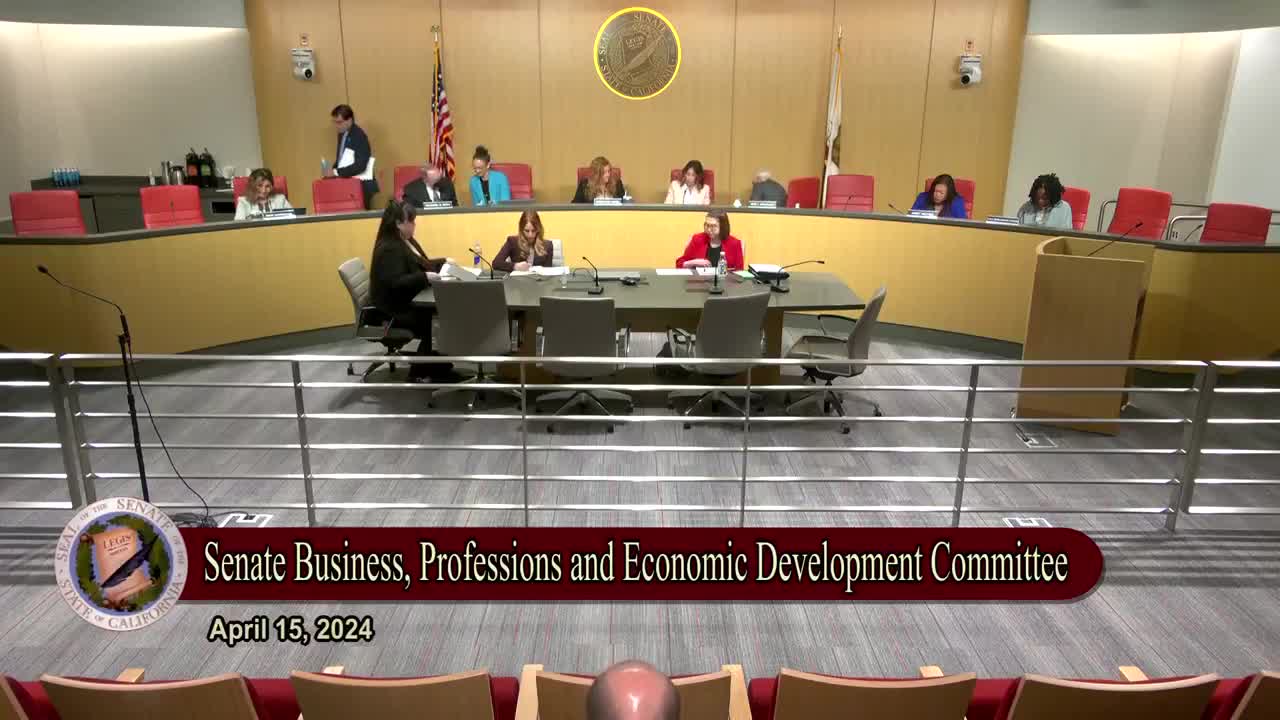 17MIN
Senate Standing Committee on Business, Professions and Economic Development
Bill Author

Bill Co-Author(s):