SB 1221: Gas corporations: ceasing service: priority neighborhood decarbonization zones.
- Session Year: 2023-2024
- House: Senate
- Latest Version Date: 2024-09-25
Current Status:
Passed
(2024-09-25: Chaptered by Secretary of State. Chapter 602, Statutes of 2024.)
Introduced
In Committee
First Chamber
In Committee
Second Chamber
Enacted
Existing law vests the Public Utilities Commission with regulatory authority over public utilities, including gas corporations. Existing law requires every public utility to furnish and maintain adequate, efficient, just and reasonable service, instrumentalities, equipment, and facilities as are necessary to promote the safety, health, comfort, and convenience of its patrons, employees, and the public.
This bill would require each gas corporation, on or before July 1, 2025, and annually thereafter, to submit to the commission a map containing certain information, including the location of all potential gas distribution line replacement projects identified in its distribution integrity management plan and other foreseeable gas distribution pipeline replacements. The bill would require the commission, on or before January 1, 2026, to designate priority neighborhood decarbonization zones considering, among other things, the concentration of gas distribution line replacement projects identified in the maps. The bill would require the commission, on or before July 1, 2026, to establish a voluntary program to facilitate the cost-effective decarbonization of priority neighborhood decarbonization zones, as defined, not to exceed 30 pilot projects across the state and affecting no more than 1% of each gas corporations customers within its service territory, except as provided. The bill would prohibit the commission from establishing pilot projects on or after January 1, 2030. The bill would require the commission to establish various processes, criteria, methodology, and requirements in administering the pilot projects, including by establishing the criteria and methodology for determining the cost-effectiveness of zero-emission alternatives, as defined, and establishing the appropriate rate of return and recovery period that a gas corporation is eligible to receive for their costs to implement zero-emission alternatives. The bill would authorize a gas corporation to cease providing, and would require the commission to relieve the gas corporation of its obligation to provide, service in an area within the gas corporations service territory where a pilot project has been implemented if the commission determines that adequate substitute energy service is reasonably available to support the energy end uses of affected gas corporation customers, as provided. The bill would also require the commission to submit various reports to the relevant committees of the Legislature regarding the pilot projects, as provided. The bill would, except as provided, repeal the above-described provisions on January 1, 2031.
Under existing law, a violation of the Public Utilities Act or an order, decision, rule, direction, demand, or requirement of the commission is a crime.
Because the above requirements would be codified in the act and a violation of those requirements or a commission action implementing those requirements would be a crime, this bill would impose a state-mandated local program.
The California Constitution requires the state to reimburse local agencies and school districts for certain costs mandated by the state. Statutory provisions establish procedures for making that reimbursement.
This bill would provide that no reimbursement is required by this act for a specified reason.
Existing law vests the Public Utilities Commission with regulatory authority over public utilities, including gas corporations. Existing law requires every public utility to furnish and maintain adequate, efficient, just and reasonable service, instrumentalities, equipment, and facilities as are necessary to promote the safety, health, comfort, and convenience of its patrons, employees, and the public.
This bill would authorize a gas corporation to cease providing service in an area within its service territory if the commission determines that adequate substitute energy service is reasonably available to support the energy end uses of affected gas corporation customers, as provided.This bill would require each gas corporation, on or before July 1, 2025, and annually thereafter, to submit to the commission a map containing certain information, including the location of all potential gas distribution line replacement projects identified in its distribution integrity management plan and other foreseeable gas distribution pipeline replacements. The bill would require the commission, on or before January 1, 2026, to designate priority neighborhood decarbonization zones considering, among other things, the concentration of gas distribution line replacement projects identified in the maps. The bill would require the commission, on or before July 1, 2026, to establish a voluntary program to facilitate the cost-effective decarbonization of priority neighborhood decarbonization zones, as defined, not to exceed 30 pilot projects across the state and affecting no more than 1% of each gas corporations customers within its service territory, except as provided. The bill would prohibit the commission from establishing pilot projects on or after January 1, 2030. The bill would require the commission to establish various processes, criteria, methodology, and requirements in administering the pilot projects, including by establishing the criteria and methodology for determining the cost-effectiveness of zero-emission alternatives, as defined, and establishing the appropriate rate of return and recovery period that a gas corporation is eligible to receive for their costs to implement zero-emission alternatives. The bill would, if the commission approves a pilot project proposed by a gas corporation, authorize the commission to relieve the gas corporation of its obligation to provide service within the pilot project boundary, as specified. The bill would authorize a gas corporation to cease providing, and would require the commission to relieve the gas corporation of its obligation to provide, service in an area within the gas corporations service territory where a pilot project has been implemented if the commission determines that adequate substitute energy service is reasonably available to support the energy end uses of affected gas corporation customers, as provided. The bill would also require the commission to submit various reports to the relevant committees of the Legislature regarding the pilot projects, as provided. The bill would, except as provided, repeal the above-described provisions on January 1, 2031.
Under existing law, a violation of the Public Utilities Act or an order, decision, rule, direction, demand, or requirement of the commission is a crime.
Because the above requirements would be codified in the act and a violation of those requirements or a commission action implementing those requirements would be a crime, this bill would impose a state-mandated local program.
The California Constitution requires the state to reimburse local agencies and school districts for certain costs mandated by the state. Statutory provisions establish procedures for making that reimbursement.
This bill would provide that no reimbursement is required by this act for a specified reason.
Existing law vests the Public Utilities Commission with regulatory authority over public utilities, including gas corporations. Existing law requires every public utility to furnish and maintain adequate, efficient, just and reasonable service, instrumentalities, equipment, and facilities as are necessary to promote the safety, health, comfort, and convenience of its patrons, employees, and the public.
This bill would authorize a gas corporation to cease providing service in an area within its service territory if the commission determines that adequate substitute energy service is reasonably available to support the energy end uses of affected gas corporation customers, as provided.
This bill would require each gas corporation, on or before July 1, 2025, and annually thereafter, to submit to the commission a map containing certain information, including the location of all potential gas distribution line replacement projects identified in its distribution integrity management plan and other foreseeable gas distribution pipeline replacements. The bill would require the commission, on or before January 1, 2026, to designate priority neighborhood decarbonization zones considering, among other things, the concentration of gas distribution line replacement projects identified in the maps. The bill would require the commission, on or before January July 1, 2026, to establish a voluntary program to facilitate the cost-effective decarbonization of priority neighborhood decarbonization zones, as defined, not to exceed 30 pilot projects across the state and affecting no more than 1% of each gas corporations customers within its service territory, except as provided. The bill would prohibit the commission from establishing pilot projects on or after January 1, 2030. The bill would require the commission to establish various processes, criteria, methodology, and requirements in administering the pilot projects, including by establishing the criteria and methodology for determining the cost-effectiveness of zero-emission alternatives, as defined, and establishing the appropriate rate of return and recovery period that a gas corporation is eligible to receive for their costs to implement zero-emission alternatives. The bill would, if the commission approves a pilot project proposed by a gas corporation, authorize the commission to relieve the gas corporation of its obligation to provide service within the pilot project boundary, as specified. The bill would also require the commission to submit various reports to the relevant committees of the Legislature regarding the pilot projects, as provided. The bill would authorize a gas corporation to cease providing service in an area within its service territory where a pilot project has been implemented if the commission determines that adequate substitute energy service is reasonably available to support the energy end uses of affected gas corporation customers, as provided. The bill would, except as provided, repeal the above-described provisions on January 1, 2031.
Under existing law, a violation of the Public Utilities Act or an order, decision, rule, direction, demand, or requirement of the commission is a crime.
Because the above requirements would be codified in the act and a violation of those requirements or a commission action implementing those requirements would be a crime, this bill would impose a state-mandated local program.
The California Constitution requires the state to reimburse local agencies and school districts for certain costs mandated by the state. Statutory provisions establish procedures for making that reimbursement.
This bill would provide that no reimbursement is required by this act for a specified reason.
Existing law vests the Public Utilities Commission with regulatory authority over public utilities, including gas corporations. Existing law requires every public utility to furnish and maintain adequate, efficient, just and reasonable service, instrumentalities, equipment, and facilities as are necessary to promote the safety, health, comfort, and convenience of its patrons, employees, and the public.
This bill would require each gas corporation, on or before July 1, 2025, and annually thereafter, to submit to the commission a map containing certain information, including the location of all potential gas distribution line replacement projects identified in its distribution integrity management plan and other foreseeable gas distribution pipeline replacements. The bill would require the commission, on or before January 1, 2026, to designate priority neighborhood decarbonization zones considering, among other things, the concentration of gas distribution line replacement projects identified in the maps. The bill would, until January 1, 2030, would require the commission, on or before January 1, 2026, to establish a voluntary program to facilitate the cost-effective decarbonization of priority neighborhood decarbonization zones, as defined, not to exceed 30 pilot projects across the state and affecting no more than 1% of each gas corporations customers within its service territory, except as provided. The bill would prohibit the commission from establishing pilot projects on or after January 1, 2030. The bill would require the commission to establish various processes, criteria, methodology, and requirements in administering the pilot projects, including by establishing the criteria and methodology for determining the cost-effectiveness of zero-emission alternatives, as defined, and establishing the appropriate rate of return and recovery period that a gas corporation is eligible to receive for their costs to implement zero-emission alternatives, and establishing a preference for pilot projects located in priority neighborhood decarbonization zones. alternatives. The bill would also require the commission to submit various reports to the relevant committees of the Legislature regarding the pilot projects, as provided. The bill would repeal the above-described provisions on January 1, 2031. The bill would also, until January 1, 2030, authorize a gas corporation to cease providing service in an area within its service territory where a pilot project has been implemented if the commission determines that adequate substitute energy service is reasonably available to support the energy end use uses of affected gas corporation customers, as provided. The bill would, except as provided, repeal the above-described provisions on January 1, 2031.
Under existing law, a violation of the Public Utilities Act or an order, decision, rule, direction, demand, or requirement of the commission is a crime.
Because the above requirements would be codified in the act and a violation of those requirements or a commission action implementing those requirements would be a crime, this bill would impose a state-mandated local program.
The California Constitution requires the state to reimburse local agencies and school districts for certain costs mandated by the state. Statutory provisions establish procedures for making that reimbursement.
This bill would provide that no reimbursement is required by this act for a specified reason.
Existing law vests the Public Utilities Commission with regulatory authority over public utilities, including gas corporations. Existing law requires every public utility to furnish and maintain adequate, efficient, just and reasonable service, instrumentalities, equipment, and facilities as are necessary to promote the safety, health, comfort, and convenience of its patrons, employees, and the public.
This bill would require each gas corporation, on or before July 1, 2025, and annually thereafter, to file submit to the commission a map containing certain information, including the location of all potential gas distribution line replacement projects identified in its distribution integrity management plan and other foreseeable gas distribution pipeline replacements. The bill would require the commission, on or before January 1, 2026, to designate priority neighborhood decarbonization zones considering, among other things, the concentration of gas distribution line replacement projects identified in the maps. The bill would would, until January 1, 2030, require the commission, on or before January 1, 2026, in a new or existing proceeding, to establish a voluntary program to facilitate the cost-effective decarbonization of priority neighborhood decarbonization zones, as defined, not to exceed 30 pilot projects across the state and affecting no more than 1% of each of gas corporations customers within their its service territory. territory, except as provided. The bill would require the commission to do various things, establish various processes, criteria, methodology, and requirements in administering the pilot projects, including establish by establishing the criteria and methodology for determining the cost-effectiveness of zero-emission alternatives, as defined, for purposes of the pilot projects, determine establishing the appropriate rate of return and recovery period that a gas corporation is eligible to receive for their costs to implement zero-emission alternatives for purposes of the pilot projects, and designate priority neighborhood decarbonization zones taking into consideration certain factors. The bill would authorize a gas corporation to cease providing service in an area within its service territory where a pilot project has been implemented if the commission determines that adequate substitute energy service is reasonably available to support the energy end use of affected gas corporation customers, as provided. The bill would repeal the above-described provisions on January 1, 2030. alternatives, and establishing a preference for pilot projects located in priority neighborhood decarbonization zones. The bill would also require the commission to submit various reports to the relevant committees of the Legislature regarding the pilot projects, as provided, and provided. The bill would repeal these reporting requirements the above-described provisions on January 1, 2031. The bill would also, until January 1, 2030, authorize a gas corporation to cease providing service in an area within its service territory where a pilot project has been implemented if the commission determines that adequate substitute energy service is reasonably available to support the energy end use of affected gas corporation customers, as provided.
Under existing law, a violation of the Public Utilities Act or an order, decision, rule, direction, demand, or requirement of the commission is a crime.
Because the above requirements are would be codified in the act and a violation of those requirements or a commissions commission action implementing those requirements would be a crime, this bill would impose a state-mandated local program.
The California Constitution requires the state to reimburse local agencies and school districts for certain costs mandated by the state. Statutory provisions establish procedures for making that reimbursement.
This bill would provide that no reimbursement is required by this act for a specified reason.
Existing law vests the Public Utilities Commission with regulatory authority over public utilities, including gas corporations. Existing law requires every public utility to furnish and maintain adequate, efficient, just and reasonable service, instrumentalities, equipment, and facilities as are necessary to promote the safety, health, comfort, and convenience of its patrons, employees, and the public.
This bill would require each gas corporation, by on or before July 1, 2025, to and annually thereafter, to file a map containing certain information, including the location of all potential gas distribution line replacement projects identified in its distribution integrity management plan and other foreseeable gas distribution pipeline replacements. The bill would require the commission, on or before January 1, 2026, in a new or existing proceeding, to establish a voluntary program to facilitate the cost-effective decarbonization of priority neighborhood decarbonization zones, as defined, not to exceed 30 pilot projects across the state and affecting no more than 1% of each of gas corporations customers within their service territory. The bill would require the commission, by January 1, 2026, commission to do various things, including the establishment of establish the criteria and methodology for determining the cost-effectiveness of zero-emission alternatives, as defined, the determination of for purposes of the pilot projects, determine the appropriate rate of return and recovery period that a gas corporation is eligible to receive for their costs to implement zero-emission alternatives, the designation of alternatives for purposes of the pilot projects, and designate priority neighborhood decarbonization zones taking into consideration certain factors, and the adoption of a long-term gas distribution system planning process to evaluate and implement zero-emission alternatives for gas distribution line replacement projects and other capital investments in the gas distribution system. The bill would require the commission to evaluate the costs and benefits of thermal energy networks and identify potential implementation barriers. The bill would prohibit a gas corporation from involuntarily laying off employees as a result of the implementation of zero-emission alternatives. factors. The bill would authorize a gas corporation to cease providing service in an area within its service territory where a pilot project has been implemented if the commission determines that adequate substitute energy service is reasonably available to support the energy end use of affected gas corporation customers, as provided. The bill would repeal the above-described provisions on January 1, 2030. The bill would also require the commission to submit various reports to the relevant committees of the Legislature regarding the pilot projects, as provided, and would repeal these reporting requirements on January 1, 2031.
This bill would authorize a gas corporation to cease providing service if adequate substitute energy service is reasonably available to support the energy end use of the affected gas corporation customers.This bill would require the commission, by January 1, 2026, to direct each electrical corporation to offer incremental discounts or other rate adjustments, if needed, to enable the adoption of building electrification technologies by participants in the California Alternate Rates for Energy (CARE) program or the Family Electric Rate Assistance (FERA) program, as provided.Under existing law, a violation of the Public Utilities Act or an order, decision, rule, direction, demand, or requirement of the commission is a crime.
Because the above requirements are codified in the act and a violation of those requirements or a commissions action implementing those requirements would be a crime, this bill would impose a state-mandated local program.
The California Constitution requires the state to reimburse local agencies and school districts for certain costs mandated by the state. Statutory provisions establish procedures for making that reimbursement.
This bill would provide that no reimbursement is required by this act for a specified reason.
Existing law vests the Public Utilities Commission with regulatory authority over public utilities, including gas corporations. Existing law requires every public utility to furnish and maintain adequate, efficient, just and reasonable service, instrumentalities, equipment, and facilities as are necessary to promote the safety, health, comfort, and convenience of its patrons, employees, and the public.
This bill would require each gas corporation, by July 1, 2025, to annually file a map containing certain information, including the location of all potential gas distribution line replacement projects identified in its distribution integrity management plan and other foreseeable gas distribution pipeline replacements. The bill would require the commission, by January 1, 2026, to do various things, including the establishment of criteria and methodology for determining the cost-effectiveness of zero-emission alternatives, as defined, the determination of the appropriate rate of return and recovery period that a gas corporation is eligible to receive their costs to implement zero-emission alternatives, the designation of priority neighborhood decarbonization zones taking into consideration certain factors, and the adoption of a long-term gas distribution system planning process to evaluate and implement zero-emission alternatives for gas distribution line replacement projects and other capital investments in the gas distribution system. The bill would require the commission to evaluate the costs and benefits of thermal energy networks and identify potential implementation barriers. The bill would prohibit a gas corporation from involuntarily laying off employees as a result of the implementation of zero-emission alternatives.
This bill would authorize a gas corporation to cease providing service if adequate substitute energy service is reasonably available to support the energy end use of the affected gas corporation customers.
This bill would require the commission, by January 1, 2026, to direct each electrical corporation to offer incremental discounts or other rate adjustments, if needed, to enable the adoption of building electrification technologies by participants in the California Alternate Rates for Energy (CARE) program or the Family Electric Rate Assistance (FERA) program, as provided.
Under existing law, a violation of the Public Utilities Act or an order, decision, rule, direction, demand, or requirement of the commission is a crime.
Because the above requirements are codified in the act and a violation of those requirements or a commissions action implementing those requirements would be a crime, this bill would impose a state-mandated local program.
The California Constitution requires the state to reimburse local agencies and school districts for certain costs mandated by the state. Statutory provisions establish procedures for making that reimbursement.
This bill would provide that no reimbursement is required by this act for a specified reason.
Existing law requires the State Energy Resources Conservation and Development Commission to establish the Equitable Building Decarbonization Program, which includes establishing a statewide incentive program for low-carbon building technologies and the direct install program to fund certain projects, including installation of energy efficient electric appliances, energy efficiency measures, demand flexibility measures, wiring and panel upgrades, building infrastructure upgrades, efficient air-conditioning systems, ceiling fans, and other measures to protect against extreme heat, where appropriate, and remediation and safety measures to facilitate the installation of new technologies. Existing law authorizes the commission to administer the direct install program through regional direct install third-party implementers, as specified. Existing law requires that the direct install program give preference to projects in buildings that meet specified criteria. The Budget Act of 2022 appropriated $112,000,000 from the General Fund for purposes of the Equitable Building Decarbonization Program.Existing law requires the commission, on or before September 1, 2024, and annually thereafter until the moneys described above have been expended, to submit a report to the relevant policy committees of the Legislature that includes information about the progress of the direct install program, including the selected administrators and implementers and implementation progress, as specified.This bill would make nonsubstantive changes to the above-described provision involving this report.Existing law requires the State Energy Resources Conservation and Development Commission to establish the Equitable Building Decarbonization Program, which includes establishing a statewide incentive program for low-carbon building technologies and the direct install program to fund certain projects, including installation of energy efficient electric appliances, energy efficiency measures, demand flexibility measures, wiring and panel upgrades, building infrastructure upgrades, efficient air-conditioning systems, ceiling fans, and other measures to protect against extreme heat, where appropriate, and remediation and safety measures to facilitate the installation of new technologies. Existing law authorizes the commission to administer the direct install program through regional direct install third-party implementers, as specified. Existing law requires that the direct install program give preference to projects in buildings that meet specified criteria. The Budget Act of 2022 appropriated $112,000,000 from the General Fund for purposes of the Equitable Building Decarbonization Program.
Existing law requires the commission, on or before September 1, 2024, and annually thereafter until the moneys described above have been expended, to submit a report to the relevant policy committees of the Legislature that includes information about the progress of the direct install program, including the selected administrators and implementers and implementation progress, as specified.
This bill would make nonsubstantive changes to the above-described provision involving this report.
(a)The Legislature finds and declares all of the following:
(1)California is leading the nation in moving toward clean, renewable forms of energy to fight climate change and improve the health and well-being of residents.
(2)Natural gas demand is already declining as California transitions away from natural gas to achieve the states energy efficiency, climate, and air quality objectives.
(3)Without active planning and management, reduced demand for natural gas will result in higher gas rates, with a disproportionate burden on vulnerable customers.
(4)A longer term planning process is necessary to evaluate zero-emission alternatives, including neighborhood electrification and thermal energy networks, that could avoid new capital investment in the gas system that may become stranded assets and to reduce upward pressure on gas rates.
(5)Installation of electric heat pump space conditioning systems, which provide both efficient heating and cooling, is particularly valuable in frontline communities to improve occupant comfort and increase resilience to heat waves because members of those communities are more likely to lack access to air conditioning.
(6)Cost-effective, zero-emission alternatives to pipeline replacement projects both reduce gas system costs and further Californias efforts to reduce greenhouse gas emissions and improve air quality.
(7)Deployment of zero-emission alternatives should prioritize high road jobs for workers.
(8)Deployment of zero-emission alternatives should prioritize benefits to disadvantaged and low-income communities and include tenant protections.
(b)It is the intent of the Legislature that the Public Utilities Commission authorize gas corporations to deploy a limited and targeted number of pilot projects to decommission portions of the natural gas corporation distribution system.
(c)It is further the intent of the Legislature that pilot projects authorized by the Public Utilities Commission will provide lessons, including by identifying, documenting, and reporting on key challenges and successes, hurdles to customer participation, cost and affordability implications, customer satisfaction, and other outcomes concerning natural gas corporation distribution system decommissioning and electrification.
SEC. 2.Section 451.9 is added to the Public Utilities Code, to read:451.9.(a)Notwithstanding Section 451, a gas corporation may cease providing service in an area within its service territory where a pilot project has been implemented pursuant to Section 663 if the commission determines that adequate substitute energy service is reasonably available to support the energy end uses of affected gas corporation customers.
(b)(1)In determining what constitutes adequate substitute energy service and when the substitute energy service is reasonably available, the commission shall adopt guidelines necessary to ensure that the rates for substitute energy service are just and reasonable as provided by a load-serving entity as the provider of last resort pursuant to Section 387.
(2)The commission may authorize a gas corporation to recover the undepreciated costs of any gas plant or asset, including the cost to retire the gas plant or asset that will no longer be used and useful. The commission shall determine the just and reasonable recovery of undepreciated costs, including the period over which the undepreciated costs are recovered so as to minimize impacts to remaining gas distribution system customers.
(c)This section does not modify the authority of the commission to determine adequate, efficient, just, and reasonable service. (d)(1)Except as provided in paragraph (2) or (3), this section shall remain in effect only until January 1, 2031, and as of that date is repealed.(2)Paragraph (1) does not affect the termination of a gas corporations obligation to provide service that is authorized under this section on or before January 1, 2031.
(3)Paragraph (1) does not affect the authority of the commission under this section to relieve a gas corporation of its obligation to provide service within the approved boundary of a pilot project approved pursuant to Section 663 that is pending as of January 1, 2031.
SEC. 3.Article 11 (commencing with Section 660) is added to Chapter 3 of Part 1 of Division 1 of the Public Utilities Code, to read:11.Neighborhood Decarbonization Zone Pilot Projects660.For purposes of this article, the following definitions apply:
(a)Disadvantaged community means a community identified pursuant to Section 39711 of the Health and Safety Code.
(b)Distribution integrity management plan means a plan developed pursuant to Part 192 (commencing with Section 192.1) of Subchapter D of Chapter I of Subtitle B of Title 49 of the Code of Federal Regulations.
(c)Gas distribution line means either a gas distribution main line or gas distribution service line.
(d)Gas distribution main line has the same meaning as main set forth in Section 192.3 of Title 49 of the Code of Federal Regulations.
(e)Gas distribution service line has the same meaning as service line set forth in Section 192.3 of Title 49 of the Code of Federal Regulations.
(f)Low-income means having a household income no greater than 80 percent of area median income or qualifying for participation in the California Alternate Rates for Energy (CARE) program or Family Electric Rate Assistance (FERA) program.
(g)Priority neighborhood decarbonization zone means a zone identified pursuant to Section 662.
(h)Thermal energy network means a network of piped noncombustible fluids used for transferring heat into and out of buildings for purposes of providing zero-emission heating and cooling services.
(i)Tribe means a California Native American tribe, as defined in Section 21073 of the Public Resources Code.
(j)Zero-emission alternatives means methods of providing gas customers with suitable substitute energy service that does not require new investment in gas distribution lines, including, but not limited to, electrification of gas end uses and energy efficiency, thermal energy networks, and demand flexibility measures to alter energy needs.
661.(a)On or before July 1, 2025, and each year thereafter, each gas corporation shall submit to the commission a map that includes all of the following:
(1)The location of all potential gas distribution line replacement projects identified in its distribution integrity management plan and any foreseeable gas distribution pipeline replacements.
(2)The city, county, and census tract boundaries within the gas corporations service territory.
(3)Locations of disadvantaged communities, tribes, and priority neighborhood decarbonization zones, as designated by the commission pursuant to Section 662, that are within the gas corporations service territory.
(4)Any additional information required by the commission.
(b)This section does not modify a gas corporations safety requirements under state or federal law.
(c)On or after January 1, 2030, the commission may determine whether gas corporations will continue to be subject to the requirements of this section.
662.(a)On or before January 1, 2026, in a new or existing proceeding and following recommendations from each gas corporation and the opportunity for public comment, the commission shall designate priority neighborhood decarbonization zones. In designating the zones, the commission shall consider factors that include, but are not limited to, all of the following:
(1)Presence of disadvantaged or low-income communities in high-temperature climate zones or low-temperature climate zones that disproportionately lack cooling or heating.
(2)Presence of environmental and social justice communities as defined in the commissions Environmental and Social Justice Action Plan.
(3)Availability of supportive local government or community partners.
(4)Concentration of gas distribution line replacement projects identified in the map submitted pursuant to Section 661.
(b)The commission shall coordinate with relevant agencies to identify nonratepayer funding, such as state and federal funds, that may be used to execute pilot projects in priority neighborhood decarbonization zones that would be cost effective with supplemental nonratepayer funding.
(c)If pilot projects for zero-emission alternatives pursuant to Section 663 are implemented in a priority neighborhood decarbonization zone, the commission may direct gas corporations and electrical corporations, if appropriate, to leverage other available programs, including, but not limited to, energy efficiency, low-income weatherization, and distributed generation programs.
(d)The commission may, after providing an opportunity for public comment, update the priority neighborhood decarbonization zones as necessary.
663.(a)On or before July 1, 2026, in a new or existing proceeding, the commission, in consultation with the states gas corporations, shall establish a voluntary program to facilitate the cost-effective decarbonization of priority neighborhood decarbonization zones, not to exceed 30 pilot projects across the state and affecting no more than 1 percent of each gas corporations customers within their service territory. A pilot project where a gas corporation obtains the consent of 100 percent of property owners with natural gas service within the pilot project boundary shall not count toward the 30 pilot project limit.
(b)In administering the pilot projects established pursuant to subdivision (a), the commission shall establish all of the following:
(1)A process for gas corporations to determine and submit pilot projects for approval.
(2)Criteria and methodology for determining the cost-effectiveness of a zero-emission alternative as compared to replacement, repair, or continued operation of the affected asset of the gas system. Nonenergy benefits may be considered in prioritizing pilot projects, but shall not be used to calculate cost-effectiveness. The total cost incurred by the gas corporation for the zero-emission alternative shall be less than the total cost that would have otherwise occurred. Gas corporations shall use nonratepayer funding when available.
(3)Requirements and programs to ensure that a substitute for gas service for low-income customers is affordable, adequate, efficient, and just and reasonable.
(4)A requirement that no less than 67 percent of the property owners with natural gas service within the pilot project boundary consent to the pilot project. The commission shall establish the manner in which consent shall be received and notifications about the pilot project shall be provided to property owners and affected customers. Notifications shall include information about the anticipated costs and benefits of the zero-emission alternative offering. Notifications shall be made available in the zones prevailing languages.
(5)A requirement for addressing master-metered properties to ensure tenants receive adequate notification and engagement.
(6)A preference for pilot projects that provide prevailing wages and use high road job programs.
(7)A requirement that gas corporations and electrical corporations, local publicly owned electric utilities, load-serving entities, local governments, and, if feasible, core transport agents affected by the pilot project coordinate and collaborate.
(8)A requirement that gas corporations recover costs related to the pilot projects that are deemed just and reasonable and a requirement that prohibits a gas corporation from recovering behind-the-meter costs associated with the pilot projects as capital costs that are afforded a rate of return.
(9)The appropriate rate of return and recovery period that a gas corporation is eligible to receive for its costs to implement a zero-emission alternative. A gas corporation shall not receive ratepayer funding for the costs of a zero-emission alternative that are covered by incentives under federal, state, or local laws.
(c)Notwithstanding any other law, if the commission approves a pilot project proposed by a gas corporation pursuant to subdivision (a), the commission shall, pursuant to Section 451.9, relieve the gas corporation of its obligation to provide service within the pilot project boundary upon completion of all affected customers conversion to zero-emission alternatives. A property owners withholding of consent to a pilot project shall not give rise to a right to continued natural gas service if the commission approves a pilot project that includes that property within its boundary.
(d)The commission shall not establish pilot projects under this section on or after January 1, 2030.
664.(a)(1)Beginning on January 1, 2029, the commission, in a new or existing proceeding, shall review the efficacy of the pilot projects established pursuant to Section 663 in providing benefits to gas corporation customers and in assisting the state in meeting the states climate change goals.
(2)On or before March 1, 2030, the commission shall submit to the relevant policy committees of the Legislature a report on the review performed pursuant to paragraph (1).
(b)On or before March 1, 2026, and on or before March 1 of each year thereafter, the commission shall submit a progress report to the relevant policy committees of the Legislature summarizing the findings of the pilot projects, including the locations of the pilot projects, the number of customers affected, the costs of the pilot projects, the funding used to pay for the pilot projects, any assistance provided to customers, and any outcomes, challenges, and recommendations.
(c)Reports submitted pursuant to this section shall be submitted in compliance with Section 9795 of the Government Code.
665.In a new or existing proceeding, the commission shall evaluate the costs and benefits of thermal energy networks and identify potential implementation barriers.
666.(a)Except as provided in subdivision (b) or (c), this article shall remain in effect only until January 1, 2031, and as of that date is repealed.
(b)Notwithstanding subdivision (a), a pilot project that has been established pursuant to Section 663 and is pending as of January 1, 2031, may continue until the completion of the pilot project.
(c)Subdivision (a) does not affect the commissions authorization to relieve a gas corporation of its obligation to provide service within a pilot project boundary under subdivision (c) of Section 663.
SEC. 4.No reimbursement is required by this act pursuant to Section 6 of Article XIIIB of the California Constitution because the only costs that may be incurred by a local agency or school district will be incurred because this act creates a new crime or infraction, eliminates a crime or infraction, or changes the penalty for a crime or infraction, within the meaning of Section 17556 of the Government Code, or changes the definition of a crime within the meaning of Section 6 of Article XIIIB of the California Constitution.
(a)The Legislature finds and declares all of the following:
(1)California is leading the nation in moving toward clean, renewable forms of energy to fight climate change and improve the health and well-being of residents.
(2)Natural gas demand is already declining as California transitions away from natural gas to achieve the states energy efficiency, climate, and air quality objectives.
(3)Without active planning and management, reduced demand for natural gas will result in higher gas rates, with a disproportionate burden on vulnerable customers.
(4)A longer term planning process is necessary to evaluate zero-emission alternatives, including neighborhood electrification and thermal energy networks, that could avoid new capital investment in the gas system that may become stranded assets and to reduce upward pressure on gas rates.
(5)Installation of electric heat pump space conditioning systems, which provide both efficient heating and cooling, is particularly valuable in frontline communities to improve occupant comfort and increase resilience to heat waves because members of those communities are more likely to lack access to air conditioning.
(6)Cost-effective, zero-emission alternatives to pipeline replacement projects both reduce gas system costs and further Californias efforts to reduce greenhouse gas emissions and improve air quality.
(7)Deployment of zero-emission alternatives should prioritize high road jobs for workers.
(8)Deployment of zero-emission alternatives should prioritize benefits to disadvantaged and low-income communities and include tenant protections.
(b)It is the intent of the Legislature that the Public Utilities Commission authorize gas corporations to deploy a limited and targeted number of pilot projects to decommission portions of the natural gas corporation distribution system.
(c)It is further the intent of the Legislature that pilot projects authorized by the Public Utilities Commission will provide lessons, including by identifying, documenting, and reporting on key challenges and successes, hurdles to customer participation, cost and affordability implications, customer satisfaction, and other outcomes concerning natural gas corporation distribution system decommissioning and electrification.
SEC. 2.Section 451.9 is added to the Public Utilities Code, to read:451.9.(a)Notwithstanding any other law, Section 451, a gas corporation may cease providing service in an area within its service territory where a pilot project has been implemented pursuant to Section 663 if the commission determines that adequate substitute energy service is reasonably available to support the energy end uses of affected gas corporation customers.
(b)(1)In determining what constitutes adequate substitute energy service and when the substitute energy service is reasonably available, the commission shall adopt guidelines necessary to ensure that the rates for substitute energy service are just and reasonable. reasonable as provided by a load-serving entity as the provider of last resort pursuant to Section 387.
(2)The commission may authorize a gas corporation to recover the undepreciated costs of any gas plant or asset, including the cost to retire the gas plant or asset that will no longer be used and useful. The commission shall determine the just and reasonable recovery of undepreciated costs, including the period over which the undepreciated costs are recovered so as to minimize impacts to remaining gas distribution system customers.
(c)This section does not modify the authority of the commission to determine adequate, efficient, just, and reasonable service. (c)(d)(1)Except as provided in paragraph (2) or (3), this section shall remain in effect only until January 1, 2031, and as of that date is repealed.(2)Paragraph (1) does not affect the termination of a gas corporations obligation to provide service that is authorized under this section on or before January 1, 2031.
(3)Paragraph (1) does not affect the authority of the commission under this section to relieve a gas corporation of its obligation to provide service within the approved boundary of a pilot project approved pursuant to Section 663 that is pending as of January 1, 2031.
SEC. 3.Article 11 (commencing with Section 660) is added to Chapter 3 of Part 1 of Division 1 of the Public Utilities Code, to read:11.Neighborhood Decarbonization Zone Pilot Projects660.For purposes of this article, the following definitions apply:
(a)Disadvantaged community means a community identified pursuant to Section 39711 of the Health and Safety Code.
(b)Distribution integrity management plan means a plan developed pursuant to Part 192 (commencing with Section 192.1) of Subchapter D of Chapter I of Subtitle B of Title 49 of the Code of Federal Regulations.
(c)Gas distribution line means either a gas distribution main line or gas distribution service line.
(d)Gas distribution main line has the same meaning as main set forth in Section 192.3 of Title 49 of the Code of Federal Regulations.
(e)Gas distribution service line has the same meaning as service line set forth in Section 192.3 of Title 49 of the Code of Federal Regulations.
(f)Low-income means having a household income no greater than 80 percent of area median income or qualifying for participation in the California Alternate Rates for Energy (CARE) program or Family Electric Rate Assistance (FERA) program.
(g)Priority neighborhood decarbonization zone means a zone identified pursuant to Section 662.
(h)Thermal energy network means a network of piped noncombustible fluids used for transferring heat into and out of buildings for purposes of providing zero-emission heating and cooling services.
(i)Tribe means a California Native American tribe, as defined in Section 21073 of the Public Resources Code.
(j)Zero-emission alternatives means methods of providing gas customers with suitable substitute energy service that does not require new investment in gas distribution lines, including, but not limited to, electrification of gas end uses and energy efficiency, thermal energy networks, and demand flexibility measures to alter energy needs.
661.(a)On or before July 1, 2025, and each year thereafter, each gas corporation shall submit to the commission a map that includes all of the following:
(a)(1)The location of all potential gas distribution line replacement projects identified in its distribution integrity management plan and any foreseeable gas distribution pipeline replacements.
(b)(2)The city, county, and census tract boundaries within the gas corporations service territory.
(c)(3)Locations of disadvantaged communities, tribes, and priority neighborhood decarbonization zones, as designated by the commission pursuant to Section 662, that are within the gas corporations service territory.
(d)(4)Any additional information required by the commission.
(b)This section does not modify a gas corporations safety requirements under state or federal law.
(e)(c)On or after January 1, 2030, the commission may determine whether gas corporations will continue to be subject to the requirements of this section.
662.(a)On or before January 1, 2026, in a new or existing proceeding and following recommendations from each gas corporation and the opportunity for public comment, the commission shall designate priority neighborhood decarbonization zones. In designating the zones, the commission shall consider factors that include, but are not limited to, all of the following:
(1)Presence of disadvantaged and or low-income communities in high-temperature climate zones or low-temperature climate zones that disproportionately lack cooling or heating.
(2)Presence of environmental and social justice communities as defined in the commissions Environmental and Social Justice Action Plan.
(3)Availability of supportive local government or community partners.
(4)Concentration of gas distribution line replacement projects identified in the map submitted pursuant to Section 661.
(b)The commission shall coordinate with relevant agencies to identify nonratepayer funding, such as state and federal funds, that may be used to execute pilot projects in priority neighborhood decarbonization zones that would be cost effective with supplemental nonratepayer funding.
(c)If pilot projects for zero-emission alternatives pursuant to Section 663 are implemented in a priority neighborhood decarbonization zone, the commission may direct gas corporations and electrical corporations, if appropriate, to leverage other available programs, including, but not limited to, energy efficiency, low-income weatherization, and distributed generation programs.
(d)The commission may, after providing an opportunity for public comment, update the priority neighborhood decarbonization zones as necessary.
663.(a)On or before July 1, 2026, in a new or existing proceeding, the commission, in consultation with the states gas corporations, shall establish a voluntary program to facilitate the cost-effective decarbonization of priority neighborhood decarbonization zones, not to exceed 30 pilot projects across the state and affecting no more than 1 percent of each gas corporations customers within their service territory. A pilot project where a gas corporation obtains the consent of 100 percent of property owners with natural gas service within the pilot project boundary shall not count toward the 30 pilot project limit.
(b)In administering the pilot projects established pursuant to subdivision (a), the commission shall establish all of the following:
(1)A process for gas corporations to determine and submit pilot projects for approval.
(2)Criteria and methodology for determining the cost-effectiveness of a zero-emission alternative as compared to replacement, repair, or continued operation of the affected asset of the gas system. Nonenergy benefits may be considered in prioritizing pilot projects, but shall not be used to calculate cost-effectiveness. The total cost incurred by the gas corporation for the zero-emission alternative shall be less than the total cost that would have otherwise occurred. Gas corporations shall use nonratepayer funding when available.
(3)Requirements and programs to ensure that a substitute for gas service for low-income customers is affordable, adequate, efficient, and just and reasonable.
(4)A requirement that no less than 67 percent of the property owners with natural gas service within the pilot project boundary consent to the pilot project. The commission shall establish the manner in which consent shall be received and notifications about the pilot project shall be provided to property owners and affected customers. Notifications shall include information about the anticipated costs and benefits of the zero-emission alternative offering. Notifications shall be made available in the zones prevailing languages.
(5)A requirement for addressing master-metered properties to ensure tenants receive adequate notification and engagement.
(6)A preference for pilot projects that provide prevailing wages and use high road job programs.
(7)A requirement that gas corporations and electrical corporations, local publicly owned electric utilities, load-serving entities, local governments, and, if feasible, core transport agents affected by the pilot project coordinate and collaborate.
(8)A requirement that gas corporations recover costs related to the pilot projects that are deemed just and reasonable and a requirement that prohibits a gas corporation from recovering behind-the-meter costs associated with the pilot projects as capital costs that are afforded a rate of return.
(9)The appropriate rate of return and recovery period that a gas corporation is eligible to receive for its costs to implement a zero-emission alternative. A gas corporation shall not receive ratepayer funding for the costs of a zero-emission alternative that are covered by incentives under federal, state, or local laws.
(c)Notwithstanding any other law, if the commission approves a pilot project proposed by a gas corporation pursuant to subdivision (a), the commission may, shall, pursuant to Section 451.9, relieve the gas corporation of its obligation to provide service within the pilot project boundary upon completion of all affected customers conversion to zero-emission alternatives. A property owners withholding of consent to a pilot project shall not give rise to a right to continued natural gas service if the commission approves a pilot project that includes that property within its boundary.
(d)The commission shall not establish pilot projects under this section on or after January 1, 2030.
664.(a)(1)Beginning on January 1, 2029, the commission, in a new or existing proceeding, shall review the efficacy of the pilot projects established pursuant to Section 663 in providing benefits to gas corporation customers and in assisting the state in meeting the states climate change goals.
(2)On or before March 1, 2030, the commission shall submit to the relevant policy committees of the Legislature a report on the review performed pursuant to paragraph (1).
(b)On or before March 1, 2026, and on or before March 1 of each year thereafter, the commission shall submit a progress report to the relevant policy committees of the Legislature summarizing the findings of the pilot projects, including the locations of the pilot projects, the number of customers affected, the costs of the pilot projects, the funding used to pay for the pilot projects, any assistance provided to customers, and any outcomes, challenges, and recommendations.
(c)Reports submitted pursuant to this section shall be submitted in compliance with Section 9795 of the Government Code.
665.In a new or existing proceeding, the commission shall evaluate the costs and benefits of thermal energy networks and identify potential implementation barriers.
666.(a)Except as provided in subdivision (b) or (c), this article shall remain in effect only until January 1, 2031, and as of that date is repealed.
(b)Notwithstanding subdivision (a), a pilot project that has been established pursuant to Section 663 and is pending as of January 1, 2031, may continue until the completion of the pilot project.
(c)Subdivision (a) does not affect the commissions authorization to relieve a gas corporation of its obligation to provide service within a pilot project boundary under subdivision (c) of Section 663.
SEC. 4.No reimbursement is required by this act pursuant to Section 6 of Article XIIIB of the California Constitution because the only costs that may be incurred by a local agency or school district will be incurred because this act creates a new crime or infraction, eliminates a crime or infraction, or changes the penalty for a crime or infraction, within the meaning of Section 17556 of the Government Code, or changes the definition of a crime within the meaning of Section 6 of Article XIIIB of the California Constitution.
(a)The Legislature finds and declares all of the following:
(1)California is leading the nation in moving toward clean, renewable forms of energy to fight climate change and improve the health and well-being of residents.
(2)Natural gas demand is already declining as California transitions away from natural gas to achieve the states energy efficiency, climate, and air quality objectives.
(3)Without active planning and management, reduced demand for natural gas will result in higher gas rates, with a disproportionate burden on vulnerable customers.
(4)A longer term planning process is necessary to evaluate zero-emission alternatives, including neighborhood electrification and thermal energy networks, that could avoid new capital investment in the gas system that may become stranded assets and to reduce upward pressure on gas rates.
(5)Installation of electric heat pump space conditioning systems, which provide both efficient heating and cooling, is particularly valuable in frontline communities to improve occupant comfort and increase resilience to heat waves because members of those communities are more likely to lack access to air conditioning.
(6)Cost-effective, zero-emission alternatives to pipeline replacement projects both reduce gas system costs and further Californias efforts to reduce greenhouse gas emissions and improve air quality.
(7)Deployment of zero-emission alternatives should prioritize high road jobs for workers.
(8)Deployment of zero-emission alternatives should prioritize benefits to disadvantaged and low-income communities and include tenant protections.
(b)It is the intent of the Legislature that the Public Utilities Commission authorize gas corporations to deploy a limited and targeted number of pilot projects to decommission portions of the natural gas corporation distribution system.
(c)It is further the intent of the Legislature that pilot projects authorized by the Public Utilities Commission will provide lessons, including by identifying, documenting, and reporting on key challenges and successes, hurdles to customer participation, cost and affordability implications, customer satisfaction, and other outcomes concerning natural gas corporation distribution system decommissioning and electrification.
SEC. 2.Section 451.9 is added to the Public Utilities Code, to read:451.9.(a)Notwithstanding any other law, a gas corporation may cease providing service in an area within its service territory where a pilot project has been implemented pursuant to Section 663 if the commission determines that adequate substitute energy service is reasonably available to support the energy end uses of affected gas corporation customers.
(b)(1)In determining what constitutes adequate substitute energy service and when the substitute energy service is reasonably available, the commission shall adopt guidelines necessary to ensure that the rates for substitute energy service for low-income customers and renters are just and reasonable.
(2)The commission shall may authorize a gas corporations corporation to recover the undepreciated costs of any gas plant or asset, including the cost to retire the gas plant or asset that will no longer be used and useful. The commission shall determine the just and reasonable recovery of undepreciated costs, including the period over which the undepreciated costs are recovered so as to minimize impacts to remaining gas distribution system customers.
(c)(1)Except as provided in paragraph (2) or (3), this section shall remain in effect only until January 1, 2031, and as of that date is repealed.
(2)Paragraph (1) does not affect the termination of a gas corporations obligation to provide service that is authorized under this section on or before January 1, 2031.
(3)Paragraph (1) does not affect the authority of the commission under this section to relieve a gas corporation of its obligation to provide service within the approved boundary of a pilot project approved pursuant to Section 663 that is pending as of January 1, 2031.
SEC. 3.Article 11 (commencing with Section 660) is added to Chapter 3 of Part 1 of Division 1 of the Public Utilities Code, to read:11.Neighborhood Decarbonization Zone Pilot Projects660.For purposes of this article, the following definitions apply:
(a)Disadvantaged community means a community identified pursuant to Section 39711 of the Health and Safety Code.
(b)Distribution integrity management plan means a plan developed pursuant to Part 192 (commencing with Section 192.1) of Subchapter D of Chapter I of Subtitle B of Title 49 of the Code of Federal Regulations.
(c)Gas distribution line means either a gas distribution main line or gas distribution service line.
(d)Gas distribution main line has the same meaning as main set forth in Section 192.3 of Title 49 of the Code of Federal Regulations.
(e)Gas distribution service line has the same meaning as service line set forth in Section 192.3 of Title 49 of the Code of Federal Regulations.
(f)Low-income means having a household income no greater than 80 percent of area median income or qualifying for participation in the California Alternate Rates for Energy (CARE) program or Family Electric Rate Assistance (FERA) program.
(g)Priority neighborhood decarbonization zone means a zone identified pursuant to Section 662.
(h)Thermal energy network means a network of piped noncombustible fluids used for transferring heat into and out of buildings for purposes of providing zero-emission heating and cooling services.
(i)Tribe means a California Native American tribe, as defined in Section 21073 of the Public Resources Code.
(i)(j)Zero-emission alternatives means methods of providing gas customers with suitable substitute energy service that does not require new investment in gas distribution lines, including, but not limited to, electrification of gas end uses and energy efficiency, thermal energy networks, and demand flexibility measures to alter energy needs.
661.On or before July 1, 2025, and each year thereafter, each gas corporation shall submit to the commission a map that includes all of the following:
(a)The location of all potential gas distribution line replacement projects identified in its distribution integrity management plan and any foreseeable gas distribution pipeline replacements.
(b)The city, county, and census tract boundaries within the gas corporations service territory.
(c)Locations of disadvantaged communities and communities, tribes, and priority neighborhood decarbonization zones, as designated by the commission pursuant to Section 662, that are within the gas corporations service territory.
(d)Any additional information required by the commission.
(e)On or after January 1, 2030, the commission may determine whether gas corporations will continue to be subject to the requirements of this section.
662.(a)On or before January 1, 2026, in a new or existing proceeding and following recommendations from each gas corporation and the opportunity for public comment, the commission shall designate priority neighborhood decarbonization zones. In designating the zones, the commission shall consider factors that include, but are not limited to, all of the following:
(1)Presence of disadvantaged and low-income communities in high-temperature climate zones or low-temperature climate zones that disproportionately lack cooling. cooling or heating.
(2)Presence of environmental and social justice communities as defined in the commissions Environmental and Social Justice Action Plan.
(3)Availability of supportive local government or community partners.
(4)Concentration of gas distribution line replacement projects identified in the map submitted pursuant to Section 661.
(b)The commission shall coordinate with relevant agencies to identify nonratepayer funding, such as state and federal funds, that may be used to execute pilot projects in priority neighborhood decarbonization zones that would be cost effective with supplemental nonratepayer funding.
(c)If pilot projects for zero-emission alternatives pursuant to Section 663 are implemented in a priority neighborhood decarbonization zone, the commission may direct gas corporations and electrical corporations, if appropriate, to leverage other available programs, including, but not limited to, energy efficiency, low-income weatherization, and distributed generation programs.
(d)The commission may, after providing an opportunity for public comment, update the priority neighborhood decarbonization zones as necessary.
663.(a)On or before July 1, 2026, in a new or existing proceeding, the commission, in consultation with each of the states three largest gas corporations, shall establish a voluntary program to facilitate the cost-effective decarbonization of priority neighborhood decarbonization zones, not to exceed 30 pilot projects across the state and affecting no more than 1 percent of each gas corporations customers within their service territory. A pilot project where a gas corporation obtains the consent of 100 percent of property owners with natural gas service within the pilot project boundary shall not count toward the 30 pilot project limit.
(b)In administering the pilot projects established pursuant to subdivision (a), the commission shall establish all of the following:
(1)A process for gas corporations to determine and submit pilot projects for approval.
(2)Criteria and methodology for determining the cost-effectiveness of a zero-emission alternative as compared to replacement, repair, or continued operation of the affected asset of the gas system. Nonenergy benefits may be considered in prioritizing pilot projects, but shall not be used to calculate cost-effectiveness. The total cost incurred by the gas corporation for the zero-emission alternative shall be less than the total cost that would have otherwise occurred. Gas corporations shall use nonratepayer funding when available.
(3)Requirements and programs to ensure that a substitute for gas service for low-income customers is affordable, adequate, efficient, and just and reasonable.
(4)A requirement that no less than 67 percent of the property owners with natural gas service within the pilot project boundary consent to the pilot project. The commission shall establish the manner in which consent shall be received and notifications about the pilot project shall be provided to property owners and affected customers. Notifications shall include information about the anticipated costs and benefits of the zero-emission alternative offering. Notifications shall be made available in the zones prevailing languages.
(5)A requirement for addressing master-metered properties to ensure tenants receive adequate notification and engagement.
(6)A preference for pilot projects that provide prevailing wages and use high road job programs.
(7)A requirement that gas corporations and electrical corporations, local publicly owned electric utilities, load-serving entities, local governments, and, if feasible, core transport agents affected by the pilot project coordinate and collaborate.
(8)A requirement that gas corporations recover costs related to the pilot projects that are deemed just and reasonable and a requirement that prohibits a gas corporation from recovering behind-the-meter costs associated with the pilot projects as capital costs that are afforded a rate of return.
(9)The appropriate rate of return and recovery period that a gas corporation is eligible to receive for its costs to implement a zero-emission alternative. A gas corporation shall not receive ratepayer funding for the costs of a zero-emission alternative that are covered by incentives under federal, state, or local laws.
(c)Notwithstanding any other law, if the commission approves a pilot project proposed by a gas corporation pursuant to subdivision (a), the commission shall, may, pursuant to Section 451.9, relieve the gas corporation of its obligation to provide service within the pilot project boundary upon completion of all affected customers conversion to zero-emission alternatives. A property owners withholding of consent to a pilot project shall not give rise to a right to continued natural gas service if the commission approves a pilot project that includes that property within its boundary.
(d)The commission shall not establish pilot projects under this section on or after January 1, 2030.
664.(a)(1)Beginning on January 1, 2029, the commission, in a new or existing proceeding, shall review the efficacy of the pilot projects established pursuant to Section 663 in providing benefits to gas corporation customers and in assisting the state in meeting the states climate change goals.
(2)On or before March 1, 2030, the commission shall submit to the relevant policy committees of the Legislature a report on the review performed pursuant to paragraph (1).
(b)On or before March 1, 2026, and on or before March 1 of each year thereafter, the commission shall submit a progress report to the relevant policy committees of the Legislature summarizing the findings of the pilot projects, including the locations of the pilot projects, the number of customers affected, the costs of the pilot projects, the funding used to pay for the pilot projects, any assistance provided to customers, and any outcomes, challenges, and recommendations.
(c)Reports submitted pursuant to this section shall be submitted in compliance with Section 9795 of the Government Code.
665.In a new or existing proceeding, the commission shall evaluate the costs and benefits of thermal energy networks and identify potential implementation barriers.
666.(a)Except as provided in subdivision (b) or (c), this article shall remain in effect only until January 1, 2031, and as of that date is repealed.
(a)(b)Notwithstanding subdivision (a), a pilot project that has been established pursuant to Section 663 and is pending as of January 1, 2031, may continue until the completion of the pilot project.
(b)(c)Subdivision (a) does not affect the requirement on the commission commissions authorization to relieve a gas corporation of its obligation to provide service within a pilot project boundary under subdivision (c) of Section 663.
SEC. 4.No reimbursement is required by this act pursuant to Section 6 of Article XIIIB of the California Constitution because the only costs that may be incurred by a local agency or school district will be incurred because this act creates a new crime or infraction, eliminates a crime or infraction, or changes the penalty for a crime or infraction, within the meaning of Section 17556 of the Government Code, or changes the definition of a crime within the meaning of Section 6 of Article XIIIB of the California Constitution.
(a)The Legislature finds and declares all of the following:
(1)California is leading the nation in moving toward clean, renewable forms of energy to fight climate change and improve the health and well-being of residents.
(2)Natural gas demand is already declining as California transitions away from natural gas to achieve the states energy efficiency, climate, and air quality objectives.
(3)Without active planning and management, reduced demand for natural gas will result in higher gas rates, with a disproportionate burden on vulnerable customers.
(4)A longer term planning process is necessary to evaluate zero-emission alternatives, including neighborhood electrification and thermal energy networks, that could avoid new capital investment in the gas system that may become stranded assets and to reduce upward pressure on gas rates.
(5)Installation of electric heat pump space conditioning systems, which provide both efficient heating and cooling, is particularly valuable in frontline communities to improve occupant comfort and increase resilience to heat waves because members of those communities are more likely to lack access to air conditioning.
(6)Cost-effective, zero-emission alternatives to pipeline replacement projects both reduce gas system costs and further Californias efforts to reduce greenhouse gas emissions and improve air quality.
(7)Deployment of zero-emission alternatives should prioritize high road jobs for workers.
(8)Deployment of zero-emission alternatives should prioritize benefits to disadvantaged and low-income communities and include tenant protections.
(b)It is the intent of the Legislature that the Public Utilities Commission authorize gas corporations to deploy a limited and targeted number of pilot projects to decommission portions of the natural gas corporation distribution system.
(c)It is further the intent of the Legislature that pilot projects authorized by the Public Utilities Commission will provide lessons, including by identifying, documenting, and reporting on key challenges and successes, hurdles to customer participation, cost and affordability implications, customer satisfaction, and other outcomes concerning natural gas corporation distribution system decommissioning and electrification.
SEC. 2.Section 451.9 is added to the Public Utilities Code, to read:451.9.(a)Notwithstanding any other law, a gas corporation may cease providing service in an area within its service territory where a pilot project has been implemented pursuant to Section 663 if the commission determines that adequate substitute energy service is reasonably available to support the energy end use uses of affected gas corporation customers.
(b)(1)In determining what constitutes adequate substitute energy service and when the substitute energy service is reasonably available, the commission shall adopt guidelines necessary to ensure that the rates for substitution of substitute energy service for low-income customers and renters are just and reasonable.
(2)The commission shall authorize gas corporations to recover the undepreciated costs of any gas plant or asset, including the cost to retire the gas plant or asset that will no longer be used and useful. The commission shall determine the just and reasonable recovery of undepreciated costs, including the period over which the undepreciated costs are recovered so as to minimize impacts to remaining gas distribution system customers.
(c)This (1)Except as provided in paragraph (2) or (3), this section shall remain in effect only until January 1, 2030, 2031, and as of that date is repealed.
(2)Paragraph (1) does not affect the termination of a gas corporations obligation to provide service that is authorized under this section on or before January 1, 2031.(3)Paragraph (1) does not affect the authority of the commission under this section to relieve a gas corporation of its obligation to provide service within the approved boundary of a pilot project approved pursuant to Section 663 that is pending as of January 1, 2031.SEC. 3.Article 11 (commencing with Section 660) is added to Chapter 3 of Part 1 of Division 1 of the Public Utilities Code, to read:11.Neighborhood Decarbonization Zone Pilot Projects660.For purposes of this article, the following definitions apply:
(a)Disadvantaged community means a community identified pursuant to Section 39711 of the Health and Safety Code.
(b)Distribution integrity management plan means a plan developed pursuant to Part 192 (commencing with Section 192.1) of Title 49 of the Code of Federal Regulations.
(c)Gas distribution line means either a gas distribution main lines line or gas distribution service lines. line.
(d)Gas distribution main line has the same meaning as main set forth in Section 192.3 of Title 49 of the Code of Federal Regulations.
(e)Gas distribution service line has the same meaning as service line set forth in Section 192.3 of Title 49 of the Code of Federal Regulations.
(f)Low-income means having a household income no greater than 80 percent of area median income or qualifying for participation in the California Alternate Rates for Energy (CARE) program or Family Electric Rate Assistance (FERA) program.
(g)Priority neighborhood decarbonization zone means a zone identified pursuant to Section 662.
(h)Thermal energy network means a network of piped noncombustible fluids used for transferring heat into and out of buildings for purposes of providing zero-emission heating and cooling services.
(i)Zero-emission alternatives means methods of providing gas customers with suitable replacement substitute energy service that does not require new investment in gas distribution lines, including, but not limited to, electrification of gas end uses and energy efficiency, thermal energy networks, and demand flexibility measures to alter energy needs.
661.On or before July 1, 2025, and each year thereafter, each gas corporation shall submit to the commission a map that includes all of the following:
(a)The location of all potential gas distribution line replacement projects identified in its distribution integrity management plan and any foreseeable gas distribution pipeline replacements.
(b)The city, county, and census tract boundaries within the gas corporations service territory.
(c)Locations of disadvantaged communities and priority neighborhood decarbonization zones, as designated by the commission pursuant to Section 662, that are within the gas corporations service territory.
(d)Any additional information required by the commission.
(e)On or after January 1, 2030, the commission may determine whether gas corporations will continue to be subject to the requirements of this section.
662.(a)On or before January 1, 2026, in a new or existing proceeding and following recommendations from each gas corporation and the opportunity for public comment, the commission shall designate priority neighborhood decarbonization zones. In designating the zones, the commission shall consider factors that include, but are not limited to, all of the following:
(1)Presence of disadvantaged and low-income communities in high-temperature climate zones that disproportionately lack cooling.
(2)Presence of environmental and social justice communities as defined in the commissions Environmental and Social Justice Action Plan.
(3)Availability of supportive local government or community partners.
(4)Concentration of gas distribution line replacement projects identified in the map submitted pursuant to Section 661.
(b)The commission shall coordinate with relevant agencies to identify nonratepayer funding, such as state and federal funds, that may be used to execute pilot projects in priority neighborhood decarbonization zones that would be cost effective with supplemental nonratepayer funding.
(c)If pilot projects for zero-emission alternatives pursuant to Section 663 are implemented in a priority neighborhood decarbonization zone, the commission may direct gas corporations and electrical corporations, if appropriate, to leverage other available programs, including, but not limited to, energy efficiency, low-income weatherization, and distributed generation programs.
(d)The commission may, after providing an opportunity for public comment, update the priority neighborhood decarbonization zones as necessary.
663.(a)On or before July 1, 2026, in a new or existing proceeding, the commission, in consultation with each of the states three largest gas corporations, shall establish a voluntary program to facilitate the cost-effective decarbonization of priority neighborhood decarbonization zones, not to exceed 30 pilot projects across the state and affecting no more than 1 percent of each gas corporations customers within their service territory. Projects A pilot project where a gas corporation obtains the consent of 100 percent of the affected gas distribution customers to the pilot project property owners with natural gas service within the pilot project boundary shall not count toward the 30 pilot project limit.
(b)In administering the pilot projects established pursuant to subdivision (a), the commission shall establish all of the following:
(1)A process for gas corporations to determine and submit pilot projects for approval.
(2)Criteria and methodology for determining the cost-effectiveness of a zero-emission alternative as compared to replacement, repair, or continued operation of the affected asset of the gas system. Nonenergy benefits may be considered in prioritizing pilot projects, but shall not be used to calculate cost-effectiveness. The total cost incurred by the gas corporation for the zero-emission alternative shall be less than the total cost that would have otherwise occurred. Gas corporations shall use nonratepayer funding when available.
(3)Requirements and programs to ensure that a substitute for gas service for low-income customers is affordable, adequate, efficient, and just and reasonable.
(4)A requirement that no less than 67 percent of the affected gas distribution customers property owners with natural gas service within the pilot project boundary consent to the pilot project. The commission shall establish the manner in which consent shall be received and notifications about the pilot project shall be provided to property owners and affected customers. Notifications shall include information about the anticipated costs and benefits of the zero-emission alternative offering. Notifications shall be made available in the zones prevailing languages.
(5)A requirement for addressing master-metered properties to ensure tenants receive adequate notification and engagement.
(6)A preference for pilot projects that provide prevailing wages and use high road job programs.
(7)A preference for pilot projects located in priority neighborhood decarbonization zones.(8)(7)A requirement that gas corporations and electrical corporations, local publicly owned electric utilities, load-serving entities, local governments, and, if feasible, core transport agents affected by the pilot project coordinate and collaborate.
(9)(8)A requirement that gas corporations recover costs related to the pilot projects that are deemed just and reasonable and a requirement that prohibits a gas corporation from recovering behind-the-meter costs associated with the pilot projects as capital costs that are afforded a rate of return.
(10)(9)The appropriate rate of return and recovery period that a gas corporation is eligible to receive for their its costs to implement a zero-emission alternative. A gas corporation shall not receive ratepayer funding for the costs of a zero-emission alternative that are covered by incentives under federal, state, or local laws.
(c)This section shall remain in effect only until January 1, 2030, and as of that date is repealed.(c)Notwithstanding any other law, if the commission approves a pilot project proposed by a gas corporation pursuant to subdivision (a), the commission shall, pursuant to Section 451.9, relieve the gas corporation of its obligation to provide service within the pilot project boundary upon completion of all affected customers conversion to zero-emission alternatives. A property owners withholding of consent to a pilot project shall not give rise to a right to continued natural gas service if the commission approves a pilot project that includes that property within its boundary.
(d)The commission shall not establish pilot projects under this section on or after January 1, 2030.
664.(a)(1)Beginning on January 1, 2029, the commission, in a new or existing proceeding, shall review the efficacy of the pilot projects established pursuant to Section 663 in providing benefits to gas corporation customers and in assisting the state in meeting the states climate change goals.
(2)On or before March 1, 2030, the commission shall submit to the relevant policy committees of the Legislature a report on the review performed pursuant to paragraph (1).
(b)On or before March 1, 2026, and on or before March 1 of each year thereafter, the commission shall submit a progress report to the relevant policy committees of the Legislature summarizing the findings of the pilot projects, including the locations of the pilot projects, the number of customers affected, the costs of the pilot projects, the funding used to pay for the pilot projects, any assistance provided to customers, and any outcomes, challenges, and recommendations.
(c)Reports submitted pursuant to this section shall be submitted in compliance with Section 9795 of the Government Code.
665.In a new or existing proceeding, the commission shall evaluate the costs and benefits of thermal energy networks and identify potential implementation barriers.
666.This Except as provided in subdivision (b) or (c), this article shall remain in effect only until January 1, 2031, and as of that date is repealed.
(a)Notwithstanding subdivision (a), a pilot project that has been established pursuant to Section 663 and is pending as of January 1, 2031, may continue until the completion of the pilot project.
(b)Subdivision (a) does not affect the requirement on the commission to relieve a gas corporation of its obligation to provide service within a pilot project boundary under subdivision (c) of Section 663.
SEC. 4.No reimbursement is required by this act pursuant to Section 6 of Article XIIIB of the California Constitution because the only costs that may be incurred by a local agency or school district will be incurred because this act creates a new crime or infraction, eliminates a crime or infraction, or changes the penalty for a crime or infraction, within the meaning of Section 17556 of the Government Code, or changes the definition of a crime within the meaning of Section 6 of Article XIIIB of the California Constitution.
(a)The Legislature finds and declares all of the following:
(1)California is leading the nation in moving toward clean, renewable forms of energy to fight climate change and improve the health and well-being of residents.
(2)Natural gas demand is already declining as California transitions away from natural gas to achieve the states climate energy efficiency, climate, and air quality objectives.
(3)Without active planning and management, reduced demand for natural gas will result in higher gas rates, with a disproportionate burden on customers unable to afford to transition away from dependence on gas appliances. vulnerable customers.
(4)A longer term planning process is necessary to evaluate zero-emission alternatives, including neighborhood electrification and thermal energy networks, that could avoid new capital investment in the gas system that may become stranded assets and to reduce upward pressure on gas rates.
(5)Installation of electric heat pump space conditioning systems, which provide both efficient heating and cooling, is particularly valuable in frontline communities to improve occupant comfort and increase resilience to heat waves because members of those communities are more likely to lack access to air conditioning.
(6)Cost-effective, zero-emission alternatives to pipeline replacement projects both reduce gas system costs and further Californias efforts to reduce greenhouse gas pollution emissions and improve air quality.
(7)Deployment of zero-emission alternatives should prioritize high road jobs for workers.
(8)Deployment of zero-emission alternatives should prioritize benefits to disadvantaged and low-income communities and include tenant protections.
(b)It is the intent of the Legislature that the Public Utilities Commission authorize gas corporations to deploy a limited and targeted number of pilot projects to decommission portions of the natural gas corporation distribution system.
(c)It is further the intent of the Legislature that pilot projects authorized by the Public Utilities Commission will provide lessons, including by identifying, documenting, and reporting on key challenges and successes, hurdles to customer participation, cost and affordability implications, customer satisfaction, and other outcomes concerning natural gas distribution system decommissioning and electrification.
SEC. 2.Section 451.9 is added to the Public Utilities Code, to read:451.9.(a)Notwithstanding any other law, a gas corporation may cease providing service in an area within its service territory where a pilot project has been implemented pursuant to Section 663 if the commission determines that adequate substitute energy service is reasonably available to support the energy end use of affected gas corporation customers.(b)(1)In determining what constitutes adequate substitute energy service and when the substitute energy service is reasonably available, the commission shall adopt guidelines necessary to ensure that the rates for substitution of energy service for low-income customers and renters are just and reasonable.(2)The commission shall authorize gas corporations to recover the unprecedented undepreciated costs of any gas plant or asset, including the cost to retire the gas plant or asset that will no longer be used and useful. The commission shall determine the just and reasonable recovery of those undepreciated costs, including the period over which the undepreciated costs are recovered so as to minimize impacts to remaining gas distribution system customers.(c)This section shall remain in effect only until January 1, 2030, and as of that date is repealed.SEC. 3.Article 11 (commencing with Section 660) is added to Chapter 3 of Part 1 of Division 1 of the Public Utilities Code, to read:11.Neighborhood Decarbonization Zone Pilot Projects660.For purposes of this article, the following definitions apply:
(a)Disadvantaged community means a community identified pursuant to Section 39711 of the Health and Safety Code.
(b)Distribution integrity management plan means a plan developed pursuant to Part 192 (commencing with Section 192.1) of Title 49 of the Code of Federal Regulations.
(c)Gas distribution line means either gas distribution main lines or gas distribution service lines.
(d)Gas distribution main line has the same meaning as main set forth in Section 192.3 of Title 49 of the Code of Federal Regulations.
(e)Gas distribution service line has the same meaning as service line set forth in Section 192.3 of Title 49 of the Code of Federal Regulations.
(f)Low-income means having a household income no greater than 80 percent of area median income or qualifying for participation in the California Alternate Rates for Energy (CARE) program or Family Electric Rate Assistance (FERA) program.
(g)Priority neighborhood decarbonization zone means a zone identified pursuant to Section 662.
(h)Thermal energy network means a network of piped noncombustible fluids used for transferring heat into and out of buildings for purposes of providing zero-emission heating and cooling services.
(i)Zero-emission alternatives means methods of providing gas customers with suitable replacement energy service that does not require new investment in gas distribution lines, including, but not limited to, electrification of gas end uses and energy efficiency, thermal energy networks, and demand flexibility measures to alter energy needs.
(j)This section shall remain in effect only until January 1, 2030, and as of that date is repealed.661.On or before July 1, 2025, and each year thereafter, each gas corporation shall submit to the commission a map that includes all of the following:
(a)The location of all potential gas distribution line replacement projects identified in its distribution integrity management plan and any foreseeable gas distribution pipeline replacements.
(b)The city, county, and census tract boundaries within the gas corporations service territory.
(c)Locations of disadvantaged communities and priority neighborhood decarbonization zones, if as designated by the commission pursuant to Section 662, that are within the gas corporations service territory.
(d)Any additional information required by the commission.
(e)This section does not authorize the commission to expand projects for zero-emission alternatives beyond those pilot projects authorized pursuant to Section 663.(f)This section shall remain in effect only until January 1, 2030, and as of that date is repealed.(e)On or after January 1, 2030, the commission may determine whether gas corporations will continue to be subject to the requirements of this section.
662.(a)On or before January 1, 2026, in a new or existing proceeding and following recommendations from each gas corporation and the opportunity for public comment, the commission shall designate priority neighborhood decarbonization zones. In designating the zones, the commission shall consider factors that include, but are not limited to, all of the following:
(1)Presence of disadvantaged and low-income communities in high-temperature climate zones that disproportionately lack cooling.
(2)Presence of environmental and social justice communities as defined in the commissions Environmental and Social Justice Action Plan.
(3)Availability of supportive local government or community partners.
(4)Concentration of gas distribution line replacement projects identified in the map submitted pursuant to Section 661.
(b)The commission shall coordinate with relevant agencies to identify third-party nonratepayer funding, such as state and federal funds, that may be used to execute pilot projects in priority neighborhood decarbonization zones that would be cost effective with supplemental nonratepayer funding.
(c)If pilot projects for zero-emission alternatives pursuant to Section 663 are implemented in a priority neighborhood decarbonization zone, the commission may direct gas corporations and electrical corporations, if appropriate, to leverage other available programs, including, but not limited to, energy efficiency, low-income weatherization, and distributed generation programs.
(d)The commission may, after providing an opportunity for public comment, update the priority neighborhood decarbonization zones as necessary.
(e)This section does not authorize the commission to expand projects for zero-emission alternatives beyond those pilot projects authorized pursuant to Section 663.(f)This section shall remain in effect only until January 1, 2030, and as of that date is repealed.663.(a)On or before July 1, 2026, in a new or existing proceeding, the commission, in consultation with each of the states three largest gas corporations, shall establish a voluntary program to facilitate the cost-effective decarbonization of priority neighborhood decarbonization zones, not to exceed 30 pilot projects across the state and affecting no more than 1 percent of each gas corporations customers within their service territory. Projects where a gas corporation obtains the consent of 100 percent of the affected gas distribution customers to the pilot project shall not count toward the 30 pilot project limit.
(b)In administering the pilot projects established pursuant to subdivision (a), the commission shall establish all of the following:
(1)A process for gas corporations to determine and submit eligible priority neighborhood decarbonization zones. pilot projects for approval.
(2)Criteria and methodology for determining the cost-effectiveness of a zero-emission alternative as compared to replacement, repair, or continued operation of the affected asset of the gas system. Nonenergy benefits may be considered in prioritizing pilot projects, but shall not be used to calculate cost effectiveness. cost-effectiveness. The total cost incurred by the gas corporation for the zero-emission alternative shall be less than the total cost that would have otherwise occurred. Gas corporations shall use nonratepayer funding when available.
(3)Requirements and programs to ensure that a substitute for gas service for low-income customers is affordable, adequate, efficient, and just and reasonable, including, but not limited to, renter protections. However, the costs of renter protections shall not be borne by nonparticipating utility customers. reasonable.
(4)A requirement that no less than 67 percent of the affected gas distribution customers within the priority neighborhood decarbonization zones consent to the pilot project. The commission shall establish the manner in which consent shall be received and notifications about the pilot project shall be provided to affected customers. Notifications shall include information about the climate and health benefits of zero-emission buildings and the potential impact of declining gas demand on gas rates. anticipated costs and benefits of the zero-emission alternative offering. Notifications shall be made available in the zones prevailing languages.
(5)A requirement for addressing master-metered properties to ensure tenants receive adequate notification and engagement.
(6)A preference for pilot projects that provide prevailing wages and use high road job programs.
(7)A preference for pilot projects located in priority neighborhood decarbonization zones.
(7)(8)A requirement that gas corporations coordinate with and electrical corporations, local publicly owned electric utilities, load-serving entities, local governments, and, if feasible, core transport agents affected by the pilot project. project coordinate and collaborate.
(8)(9)A requirement that gas corporations recover costs related to the pilot projects that are deemed just and reasonable and a requirement that prohibits a gas corporation from recovering behind-the-meter costs associated with the pilot projects as capital costs that are afforded a rate of return.
(9)(10)The appropriate rate of return and recovery period that a gas corporation is eligible to receive for their costs to implement a zero-emission alternative. A gas corporation shall not receive ratepayer funding for the costs of a zero-emission alternative that are covered by incentives under federal, state, or local laws.
(c)This section shall remain in effect only until January 1, 2030, and as of that date is repealed.
664.(a)(1)Beginning on January 1, 2029, the commission, in a new or existing proceeding, shall review the efficacy of the pilot projects established pursuant to Section 663 in providing benefits to gas utility corporation customers and in assisting the state in meeting the states climate change goals.
(2)On or before March 1, 2030, the commission shall submit to the relevant policy committees of the Legislature a report on the review performed pursuant to paragraph (1).
(b)On or before March 1, 2026, and on or before March 1 of each year thereafter, the commission shall submit a progress report to the relevant policy committees of the Legislature summarizing the findings of the pilot projects, including the locations of the pilot projects, the number of customers affected, the costs of the pilot projects, the funding used to pay for the pilot projects, any assistance provided to customers, and any outcomes, challenges, and recommendations.
(c)Reports submitted pursuant to this section shall be submitted in compliance with Section 9795 of the Government Code.
665.In a new or existing proceeding, the commission shall evaluate the costs and benefits of thermal energy networks and identify potential implementation barriers.
665.666.This article shall remain in effect only until January 1, 2031, and as of that date is repealed.
SEC. 4.No reimbursement is required by this act pursuant to Section 6 of Article XIIIB of the California Constitution because the only costs that may be incurred by a local agency or school district will be incurred because this act creates a new crime or infraction, eliminates a crime or infraction, or changes the penalty for a crime or infraction, within the meaning of Section 17556 of the Government Code, or changes the definition of a crime within the meaning of Section 6 of Article XIIIB of the California Constitution.
(a)The Legislature finds and declares all of the following:
(1)California is leading the nation in moving toward clean, renewable forms of energy to fight climate change and improve the health and well-being of residents.
(2)Gas Natural gas demand is already declining as California transitions away from fossil natural gas to achieve the states climate and air quality objectives.
(3)Without active planning and management, reduced demand for fossil natural gas will result in higher gas rates, with a disproportionate burden on customers unable to afford to transition away from dependence on gas appliances.
(4)A longer term planning process is necessary to evaluate zero-emission alternatives, including neighborhood electrification and thermal energy networks, that could avoid new capital investment in the gas system that may become stranded assets and to reduce upward pressure on gas rates.
(5)Installation of electric heat pump space conditioning systems, which provide both efficient heating and cooling, is particularly valuable in frontline communities to improve occupant comfort and increase resilience to heat waves because members of those communities are more likely to lack access to air conditioning.
(6)Cost-effective, zero-emission alternatives both reduce gas system costs and further Californias efforts to reduce greenhouse gas pollution and improve air quality.(7)(6)Cost-effective, zero-emission alternatives to pipeline replacement projects both reduce gas system costs and further Californias efforts to reduce greenhouse gas pollution and improve air quality.
(8)(7)Deployment of zero-emission alternatives should prioritize high road jobs for workers.
(9)(8)Deployment of zero-emission alternatives should prioritize benefits to disadvantaged and low-income communities and include tenant and bill protections.
(b)It is the intent of the Legislature to provide direction for purposes of the Public Utilities Commissions ongoing long-term gas planning rulemaking (R.20-01-007) to ensure affordability and to provide protections for communities and workers. that the Public Utilities Commission authorize gas corporations to deploy a limited and targeted number of pilot projects to decommission portions of the natural gas corporation distribution system.
(c)It is further the intent of the Legislature that pilot projects authorized by the Public Utilities Commission will provide lessons, including by identifying, documenting, and reporting on key challenges and successes, hurdles to customer participation, cost and affordability implications, customer satisfaction, and other outcomes concerning natural gas distribution system decommissioning and electrification.
SEC. 3.Section 451 of the Public Utilities Code is amended to read:451.(a)(1) All charges demanded or received by a public utility, or by two or more public utilities, for a product or commodity furnished or to be furnished or a service rendered or to be rendered shall be just and reasonable. Every unjust or unreasonable charge demanded or received for that product or commodity or service is unlawful.(2)Every public utility shall furnish and maintain adequate, efficient, just, and reasonable service, instrumentalities, equipment, and facilities, including telephone facilities, as defined in Section 54.1 of the Civil Code, as are necessary to promote the safety, health, comfort, and convenience of its patrons, employees, and the public.(3)All rules made by a public utility affecting or pertaining to its charges or service to the public shall be just and reasonable.(b)(1)This section does not apply to the provision of gas service at premises that have ceased gas service pursuant to Section 451.6.(2)Notwithstanding any other law, the gas corporation that previously served those premises described in paragraph (1) shall have no further obligation to provide gas service to those premises. The gas corporation shall continue to have an obligation to serve all other customers in its service territory.SEC. 4.Section 451.6 is added to the Public Utilities Code, to read:451.6.Notwithstanding any other law, a gas corporation may cease providing service if adequate substitute energy service is reasonably available to support the energy end uses of the affected gas corporation customers.SEC. 2.Section 451.9 is added to the Public Utilities Code, to read:451.9.(a)Notwithstanding any other law, a gas corporation may cease providing service in an area within its service territory where a pilot project has been implemented pursuant to Section 663 if the commission determines that adequate substitute energy service is reasonably available to support the energy end use of affected gas corporation customers.
(b)(1)In determining what constitutes adequate substitute energy service and when the substitute energy service is reasonably available, the commission shall adopt guidelines necessary to ensure that the rates for substitution of energy service for low-income customers and renters are just and reasonable.
(2)The commission shall authorize gas corporations to recover the unprecedented costs of any gas plant or asset, including the cost to retire the gas plant or asset that will no longer be used and useful. The commission shall determine the just and reasonable recovery of those costs, including the period over which the undepreciated costs are recovered so as to minimize impacts to remaining gas distribution system customers.
(c)This section shall remain in effect only until January 1, 2030, and as of that date is repealed.
SEC. 5.SEC. 3.Article 11 (commencing with Section 660) is added to Chapter 3 of Part 1 of Division 1 of the Public Utilities Code, to read:11.Gas Distribution Infrastructure Plan Neighborhood Decarbonization Zone Pilot Projects660.For purposes of this article, the following definitions apply:
(a)Disadvantaged community means a community identified pursuant to Section 39711 of the Health and Safety Code.
(b)Distribution integrity management plan means a plan developed pursuant to Part 192 (commencing with Section 192.1) of Title 49 of the Code of Federal Regulations.
(c)Gas distribution line means either gas distribution main lines or gas distribution service lines.
(d)Gas distribution main line has the same meaning as main set forth in Section 192.3 of Title 49 of the Code of Federal Regulations.
(e)Gas distribution service line has the same meaning as service line set forth in Section 192.3 of Title 49 of the Code of Federal Regulations.
(f)Low-income means having a household income no greater than 80 percent of area median income or qualifying for participation in the California Alternate Rates for Energy (CARE) program or Family Electric Rate Assistance (FERA) program.
(g)Priority neighborhood decarbonization zone means a zone identified pursuant to Section 663. 662.
(h)Thermal energy network means a network of piped noncombustible fluids used for transferring heat into and out of buildings for purposes of providing zero-emission heating and cooling services.
(i)Zero-emission alternatives means methods of providing gas customers with suitable replacement energy service that does not require new investment in gas distribution lines, including, but not limited to, electrification of gas end uses and energy efficiency, thermal energy networks, and demand flexibility measures to alter energy needs.
(j)This section shall remain in effect only until January 1, 2030, and as of that date is repealed.
661.On or before July 1, 2025, and each year thereafter, each gas corporation shall submit to the commission a map that includes all of the following:
(a)The location of all potential gas distribution line replacement projects identified in its distribution integrity management plan and any foreseeable gas distribution pipeline replacements.
(b)The city, county, and census tract boundaries within the gas corporations service territory.
(c)Locations of disadvantaged communities and priority neighborhood decarbonization zones, if designated by the commission pursuant to Section 663, 662, that are within the gas corporations service territory.
(d)Any additional information required by the commission.
(e)This section does not authorize the commission to expand projects for zero-emission alternatives beyond those pilot projects authorized pursuant to Section 663.
(f)This section shall remain in effect only until January 1, 2030, and as of that date is repealed.
662.On or before January 1, 2026, in a new or existing proceeding, the commission shall establish all of the following:(a)Criteria and methodology for determining the cost-effectiveness of a zero-emission alternative. The commission shall consider nonenergy benefits in determining the cost-effectiveness of zero-emission alternatives.(b)Requirements and programs to ensure that a substitute for gas service for low-income customers is affordable, adequate, efficient, and just and reasonable, including, but not limited to, bill and renter protections.(c)Notice requirements for customers if a zero-emission alternative would be implemented. Notice shall include information about the climate and health benefits of zero-emission buildings and the potential impact of declining gas demand on gas rates, and the notice shall be made available in the areas prevailing languages.(d)The appropriate rate of return and recovery period that a gas corporation is eligible to receive for their costs to implement a zero-emission alternative. A gas corporation shall not receive ratepayer funding for the costs of a zero-emission alternative that are covered by incentives under federal, state, or local laws.663.(a)On or before January 1, 2026, in a new or existing proceeding and following the opportunity for public comment, the commission shall designate priority neighborhood decarbonization zones. In designating the zones, the commission shall consider factors that include, but are not limited to, all of the following:(1)Presence of disadvantaged and low-income communities in high-temperature climate zones that disproportionately lack cooling.(2)Presence of environmental and social justice communities as defined in the commissions Environmental and Social Justice Action Plan.(3)Availability of supportive local government or community partners.(4)Concentration of gas distribution line replacement projects identified in the map submitted pursuant to Section 661.(b)The commission shall coordinate with relevant agencies to identify third-party funding, such as state and federal funds, that may be used to execute projects in priority neighborhood decarbonization zones that would be cost effective with supplemental nonratepayer funding.(c)If zero-emission alternatives are implemented in a priority neighborhood decarbonization zone, the commission shall direct gas corporations and electrical corporations, if appropriate, to leverage other available programs, including, but not limited to, energy efficiency, low-income weatherization, and distributed generation programs.(d)The commission may, after providing an opportunity for public comment, update the priority neighborhood decarbonization zones as necessary.664.(a)On or before July 1, 2026, the commission shall adopt a long-term gas distribution system planning process to evaluate and implement zero-emission alternatives for gas distribution line replacement projects and any other capital investments in the gas distribution system the commission deems necessary.(b)The commission may establish a separate process to routinize review, communication, and execution of zero-emission alternatives for gas distribution service line replacements.(c)This section does not prevent a gas corporation from seeking commission approval of pilot projects to implement zero-emission alternatives before establishment of a long-term gas distribution system planning process, if the cost to gas ratepayers of the zero-emission alternative is less than, or equal to, the cost of the gas distribution pipeline replacement project and adequate substitution of service has been provided. A gas corporation may replace no more than 3 percent of its gas distribution pipelines with zero-emission alternatives before the commission adopts a long-term gas distribution system planning process.665.In a new or existing proceeding, the commission shall evaluate the costs and benefits of thermal energy networks and identify potential implementation barriers.666.(a)The commission shall require that all construction work undertaken to implement a zero-emission alternative, other than decommissioning a gas corporations plant and property by employees of the gas corporation or front-of-meter work performed by an electrical corporation or local publicly owned electric utility, as appropriate, shall be constructed using a skilled and trained workforce as provided in Chapter 2.9 (commencing with Section 2600) of Part 1 of Division 2 of the Public Contract Code, and all of the following conditions shall apply:(1)(A)Except as provided in paragraph (3), every contractor and subcontractor performing work paid for in whole or in part by the program implementing the zero-emission alternative shall use a skilled and trained workforce to construct any portion of the program.(B)Contractors and subcontractors that violate subparagraph (A) are subject to the penalties provided in Section 2603 of the Public Contract Code. Penalties for a contractors or subcontractors failure to comply with the requirement to use a skilled and trained workforce may be assessed by the Labor Commissioner within 18 months of completion of any portion of the program using the same procedures for issuance of civil wage and penalty assessments pursuant to Section 2603 of the Public Contract Code. Penalties shall be paid to the State Public Works Enforcement Fund.(2)(A)Except as provided in paragraph (3), every contractor and subcontractor shall pay to all construction workers employed in the construction of any portion of the program implementing the zero-emission alternative at least the general prevailing rate of per diem wages, as determined by the Director of Industrial Relations pursuant to Sections 1773 and 1773.9 of the Labor Code, except that apprentices registered in programs approved by the Chief of the Division of Apprenticeship Standards may be paid at least the applicable apprentice prevailing rate.(B)The obligation of contractors and subcontractors to pay prevailing wages may be enforced by the Labor Commissioner through the issuance of a civil wage and penalty assessment pursuant to Section 1741 of the Labor Code, which may be reviewed pursuant to Section 1742 of the Labor Code, within 18 months after the completion of any portion of the program, or by an underpaid worker through an administrative complaint or civil action, or by a joint labor-management committee through a civil action under Section 1771.2 of the Labor Code. If a civil wage and penalty assessment is issued, the contractor, subcontractor, and surety on a bond or bonds issued to secure the payment of wages covered by the assessment shall be liable for liquidated damages pursuant to Section 1742.1 of the Labor Code.(3)Paragraphs (1) and (2) do not apply if all contractors and subcontractors performing work on the project are subject to a project labor agreement as defined in Section 2500 of the Public Contract Code. The project labor agreement shall also include, but not be limited to, all of the following:(A)Provisions requiring compliance with the skilled and trained workforce requirement and for enforcement of that obligation through an arbitration procedure.(B)Provisions requiring payment of prevailing wages to all construction workers employed in the construction of any portion of the program and for enforcement of that obligation through an arbitration procedure.(C)Targeted hiring provisions, including a targeted hiring plan, on a craft-by-craft basis to address job access for local, disadvantaged, or underrepresented workers, as defined by a local agency.(D)Apprenticeship use provisions that commit all parties to increasing the share of work performed by state-registered apprentices above the state-mandated minimum ratio required in Section 1777.5 of the Labor Code.(E)Apprenticeship use provisions that commit all parties to hiring and retaining a certain percentage of state-registered apprentices that have completed the Multi-Craft Core preapprenticeship training curriculum referenced in subdivision (t) of Section 14005 of the Unemployment Insurance Code.(b)This section does not apply to behind-the meter work for zero-emission alternatives to individual gas distribution line replacement projects serving no more than three customers.(c)A gas corporation shall not involuntarily lay off any employee as a result of the implementation of zero-emission alternatives.667.This article does not prohibit a gas corporation from seeking commission approval of cost-effective zero-emission alternatives before the filing of a gas distribution infrastructure plan.662.(a)On or before January 1, 2026, in a new or existing proceeding and following the opportunity for public comment, the commission shall designate priority neighborhood decarbonization zones. In designating the zones, the commission shall consider factors that include, but are not limited to, all of the following:
(1)Presence of disadvantaged and low-income communities in high-temperature climate zones that disproportionately lack cooling.
(2)Presence of environmental and social justice communities as defined in the commissions Environmental and Social Justice Action Plan.
(3)Availability of supportive local government or community partners.
(4)Concentration of gas distribution line replacement projects identified in the map submitted pursuant to Section 661.
(b)The commission shall coordinate with relevant agencies to identify third-party funding, such as state and federal funds, that may be used to execute pilot projects in priority neighborhood decarbonization zones that would be cost effective with supplemental nonratepayer funding.
(c)If pilot projects for zero-emission alternatives pursuant to Section 663 are implemented in a priority neighborhood decarbonization zone, the commission may direct gas corporations and electrical corporations, if appropriate, to leverage other available programs, including, but not limited to, energy efficiency, low-income weatherization, and distributed generation programs.
(d)The commission may, after providing an opportunity for public comment, update the priority neighborhood decarbonization zones as necessary.
(e)This section does not authorize the commission to expand projects for zero-emission alternatives beyond those pilot projects authorized pursuant to Section 663.
(f)This section shall remain in effect only until January 1, 2030, and as of that date is repealed.
663.(a)On or before July 1, 2026, in a new or existing proceeding, the commission, in consultation with each of the states three largest gas corporations, shall establish a voluntary program to facilitate the cost-effective decarbonization of priority neighborhood decarbonization zones, not to exceed 30 pilot projects across the state and affecting no more than 1 percent of each gas corporations customers within their service territory.
(b)In administering the pilot projects established pursuant to subdivision (a), the commission shall establish all of the following:
(1)A process for gas corporations to determine and submit eligible priority neighborhood decarbonization zones.
(2)Criteria and methodology for determining the cost-effectiveness of a zero-emission alternative as compared to replacement, repair, or continued operation of the affected asset of the gas system. Nonenergy benefits may be considered in prioritizing pilot projects, but shall not be used to calculate cost effectiveness.
(3)Requirements and programs to ensure that a substitute for gas service for low-income customers is affordable, adequate, efficient, and just and reasonable, including, but not limited to, renter protections. However, the costs of renter protections shall not be borne by nonparticipating utility customers.
(4)A requirement that no less than 67 percent of the affected gas distribution customers within the priority neighborhood decarbonization zones consent to the pilot project. The commission shall establish the manner in which consent shall be received and notifications about the pilot project shall be provided to affected customers. Notifications shall include information about the climate and health benefits of zero-emission buildings and the potential impact of declining gas demand on gas rates. Notifications shall be made available in the zones prevailing languages.
(5)A requirement for addressing master-metered properties to ensure tenants receive adequate notification and engagement.
(6)A preference for pilot projects that provide prevailing wages and use high road job programs.
(7)A requirement that gas corporations coordinate with electrical corporations, publicly owned electric utilities, load-serving entities, local governments, and, if feasible, core transport agents affected by the pilot project.
(8)A requirement that gas corporations recover costs related to the pilot projects that are deemed just and reasonable and a requirement that prohibits a gas corporation from recovering behind-the-meter costs associated with the pilot projects as capital costs that are afforded a rate of return.
(9)The appropriate rate of return and recovery period that a gas corporation is eligible to receive for their costs to implement a zero-emission alternative. A gas corporation shall not receive ratepayer funding for the costs of a zero-emission alternative that are covered by incentives under federal, state, or local laws.
(c)This section shall remain in effect only until January 1, 2030, and as of that date is repealed.
664.(a)(1)Beginning on January 1, 2029, the commission, in a new proceeding, shall review the efficacy of the pilot projects established pursuant to Section 663 in providing benefits to gas utility customers and in assisting the state in meeting the states climate change goals.
(2)On or before March 1, 2030, the commission shall submit to the relevant policy committees of the Legislature a report on the review performed pursuant to paragraph (1).
(b)On or before March 1, 2026, and on or before March 1 of each year thereafter, the commission shall submit a progress report to the relevant policy committees of the Legislature summarizing the findings of the pilot projects, including the locations of the pilot projects, the number of customers affected, the costs of the pilot projects, the funding used to pay for the pilot projects, any assistance provided to customers, and any outcomes, challenges, and recommendations.
(c)Reports submitted pursuant to this section shall be submitted in compliance with Section 9795 of the Government Code.
665.This article shall remain in effect only until January 1, 2031, and as of that date is repealed.
SEC. 6.Section 739.16 is added to the Public Utilities Code, to read:739.16.(a)On or before January 1, 2026, the commission shall direct each electrical corporation to offer an incremental discount or other rate adjustment, if needed, to enable the adoption of building electrification technologies by participants in the California Alternate Rates for Energy (CARE) program or Family Electric Rate Assistance (FERA) program, who shall be eligible to take service under an optional electrification tariff designed to promote the adoption of building and transportation electrification. The incremental discount or other rate adjustments shall promote accelerated payback periods for electric space heating and water heating investments by reducing the operational costs of those technologies.(b)An incremental discount shall satisfy both of the following requirements:(1)The incremental discount shall be in addition to any discount authorized pursuant to Sections 739.1 and 739.12 and shall be excluded from any determination of the average effective CARE program discount in paragraph (1) of subdivision (c) of Section 739.1.(2)The cost of the incremental discount shall be recovered from customers in the same manner as specified under paragraph (7) of subdivision (a) of Section 327.SEC. 7.SEC. 4.No reimbursement is required by this act pursuant to Section 6 of Article XIIIB of the California Constitution because the only costs that may be incurred by a local agency or school district will be incurred because this act creates a new crime or infraction, eliminates a crime or infraction, or changes the penalty for a crime or infraction, within the meaning of Section 17556 of the Government Code, or changes the definition of a crime within the meaning of Section 6 of Article XIIIB of the California Constitution.
This act shall be known, and may be cited, as the Affordable Energy Transition and Workforce Protection Act.
SEC. 2.(a)The Legislature finds and declares all of the following:
(1)California is leading the nation in moving toward clean, renewable forms of energy to fight climate change and improve the health and well-being of residents.
(2)Gas demand is already declining as California transitions away from fossil gas to achieve the states climate and air quality objectives.
(3)Without active planning and management, reduced demand for fossil gas will result in higher gas rates, with a disproportionate burden on customers unable to afford to transition away from dependence on gas appliances.
(4)A longer term planning process is necessary to evaluate zero-emission alternatives, including neighborhood electrification and thermal energy networks, that could avoid new capital investment in the gas system that may become stranded assets and to reduce upward pressure on gas rates.
(5)Installation of electric heat pump space conditioning systems, which provide both efficient heating and cooling, is particularly valuable in frontline communities to improve occupant comfort and increase resilience to heat waves because members of those communities are more likely to lack access to air conditioning.
(6)Cost-effective, zero-emission alternatives both reduce gas system costs and further Californias efforts to reduce greenhouse gas pollution and improve air quality.
(7)Cost-effective, zero-emission alternatives to pipeline replacement projects both reduce gas system costs and further Californias efforts to reduce greenhouse gas pollution and improve air quality.
(8)Deployment of zero-emission alternatives should prioritize high road jobs for workers.
(9)Deployment of zero-emission alternatives should prioritize benefits to disadvantaged and low-income communities and include tenant and bill protections.
(b)It is the intent of the Legislature to provide direction for purposes of the Public Utilities Commissions ongoing long-term gas planning rulemaking (R.20-01-007) to ensure affordability and to provide protections for communities and workers.
SEC. 3.Section 451 of the Public Utilities Code is amended to read:451.(a)(1) All charges demanded or received by any a public utility, or by any two or more public utilities, for any a product or commodity furnished or to be furnished or any a service rendered or to be rendered shall be just and reasonable. Every unjust or unreasonable charge demanded or received for such that product or commodity or service is unlawful.
Every(2)Every public utility shall furnish and maintain such adequate, efficient, just, and reasonable service, instrumentalities, equipment, and facilities, including telephone facilities, as defined in Section 54.1 of the Civil Code, as are necessary to promote the safety, health, comfort, and convenience of its patrons, employees, and the public.
All(3)All rules made by a public utility affecting or pertaining to its charges or service to the public shall be just and reasonable.
(b)(1)This section does not apply to the provision of gas service at premises that have ceased gas service pursuant to Section 451.6.
(2)Notwithstanding any other law, the gas corporation that previously served those premises described in paragraph (1) shall have no further obligation to provide gas service to those premises. The gas corporation shall continue to have an obligation to serve all other customers in its service territory.
SEC. 4.Section 451.6 is added to the Public Utilities Code, to read:451.6.Notwithstanding any other law, a gas corporation may cease providing service if adequate substitute energy service is reasonably available to support the energy end uses of the affected gas corporation customers.
SEC. 5.Article 11 (commencing with Section 660) is added to Chapter 3 of Part 1 of Division 1 of the Public Utilities Code, to read:11.Gas Distribution Infrastructure Plan660.For purposes of this article, the following definitions apply:
(a)Disadvantaged community means a community identified pursuant to Section 39711 of the Health and Safety Code.
(b)Distribution integrity management plan means a plan developed pursuant to Part 192 (commencing with Section 192.1) of Title 49 of the Code of Federal Regulations.
(c)Gas distribution line means either gas distribution main lines or gas distribution service lines.
(d)Gas distribution main line has the same meaning as main set forth in Section 192.3 of Title 49 of the Code of Federal Regulations.
(e)Gas distribution service line has the same meaning as service line set forth in Section 192.3 of Title 49 of the Code of Federal Regulations.
(f)Low-income means having a household income no greater than 80 percent of area median income or qualifying for participation in the California Alternate Rates for Energy (CARE) program or Family Electric Rate Assistance (FERA) program.
(g)Priority neighborhood decarbonization zone means a zone identified pursuant to Section 663.
(h)Thermal energy network means a network of piped noncombustible fluids used for transferring heat into and out of buildings for purposes of providing zero-emission heating and cooling services.
(i)Zero-emission alternatives means methods of providing gas customers with suitable replacement energy service that does not require new investment in gas distribution lines, including, but not limited to, electrification of gas end uses and energy efficiency, thermal energy networks, and demand flexibility measures to alter energy needs.
661.On or before July 1, 2025, and each year thereafter, each gas corporation shall submit to the commission a map that includes all of the following:
(a)The location of all potential gas distribution line replacement projects identified in its distribution integrity management plan and any foreseeable gas distribution pipeline replacements.
(b)The city, county, and census tract boundaries within the gas corporations service territory.
(c)Locations of disadvantaged communities and priority neighborhood decarbonization zones, if designated by the commission pursuant to Section 663, that are within the gas corporations service territory.
(d)Any additional information required by the commission.
662.On or before January 1, 2026, in a new or existing proceeding, the commission shall establish all of the following:
(a)Criteria and methodology for determining the cost-effectiveness of a zero-emission alternative. The commission shall consider nonenergy benefits in determining the cost-effectiveness of zero-emission alternatives.
(b)Requirements and programs to ensure that a substitute for gas service for low-income customers is affordable, adequate, efficient, and just and reasonable, including, but not limited to, bill and renter protections.
(c)Notice requirements for customers if a zero-emission alternative would be implemented. Notice shall include information about the climate and health benefits of zero-emission buildings and the potential impact of declining gas demand on gas rates, and the notice shall be made available in the areas prevailing languages.
(d)The appropriate rate of return and recovery period that a gas corporation is eligible to receive for their costs to implement a zero-emission alternative. A gas corporation shall not receive ratepayer funding for the costs of a zero-emission alternative that are covered by incentives under federal, state, or local laws.
663.(a)On or before January 1, 2026, in a new or existing proceeding and following the opportunity for public comment, the commission shall designate priority neighborhood decarbonization zones. In designating the zones, the commission shall consider factors that include, but are not limited to, all of the following:
(1)Presence of disadvantaged and low-income communities in high-temperature climate zones that disproportionately lack cooling.
(2)Presence of environmental and social justice communities as defined in the commissions Environmental and Social Justice Action Plan.
(3)Availability of supportive local government or community partners.
(4)Concentration of gas distribution line replacement projects identified in the map submitted pursuant to Section 661.
(b)The commission shall coordinate with relevant agencies to identify third-party funding, such as state and federal funds, that may be used to execute projects in priority neighborhood decarbonization zones that would be cost effective with supplemental nonratepayer funding.
(c)If zero-emission alternatives are implemented in a priority neighborhood decarbonization zone, the commission shall direct gas corporations and electrical corporations, if appropriate, to leverage other available programs, including, but not limited to, energy efficiency, low-income weatherization, and distributed generation programs.
(d)The commission may, after providing an opportunity for public comment, update the priority neighborhood decarbonization zones as necessary.
664.(a)On or before July 1, 2026, the commission shall adopt a long-term gas distribution system planning process to evaluate and implement zero-emission alternatives for gas distribution line replacement projects and any other capital investments in the gas distribution system the commission deems necessary.
(b)The commission may establish a separate process to routinize review, communication, and execution of zero-emission alternatives for gas distribution service line replacements.
(c)This section does not prevent a gas corporation from seeking commission approval of pilot projects to implement zero-emission alternatives before establishment of a long-term gas distribution system planning process, if the cost to gas ratepayers of the zero-emission alternative is less than, or equal to, the cost of the gas distribution pipeline replacement project and adequate substitution of service has been provided. A gas corporation may replace no more than 3 percent of its gas distribution pipelines with zero-emission alternatives before the commission adopts a long-term gas distribution system planning process.
665.In a new or existing proceeding, the commission shall evaluate the costs and benefits of thermal energy networks and identify potential implementation barriers.
666.(a)The commission shall require that all construction work undertaken to implement a zero-emission alternative, other than decommissioning a gas corporations plant and property by employees of the gas corporation or front-of-meter work performed by an electrical corporation or local publicly owned electric utility, as appropriate, shall be constructed using a skilled and trained workforce as provided in Chapter 2.9 (commencing with Section 2600) of Part 1 of Division 2 of the Public Contract Code, and all of the following conditions shall apply:
(1)(A)Except as provided in paragraph (3), every contractor and subcontractor performing work paid for in whole or in part by the program implementing the zero-emission alternative shall use a skilled and trained workforce to construct any portion of the program.
(B)Contractors and subcontractors that violate subparagraph (A) are subject to the penalties provided in Section 2603 of the Public Contract Code. Penalties for a contractors or subcontractors failure to comply with the requirement to use a skilled and trained workforce may be assessed by the Labor Commissioner within 18 months of completion of any portion of the program using the same procedures for issuance of civil wage and penalty assessments pursuant to Section 2603 of the Public Contract Code. Penalties shall be paid to the State Public Works Enforcement Fund.
(2)(A)Except as provided in paragraph (3), every contractor and subcontractor shall pay to all construction workers employed in the construction of any portion of the program implementing the zero-emission alternative at least the general prevailing rate of per diem wages, as determined by the Director of Industrial Relations pursuant to Sections 1773 and 1773.9 of the Labor Code, except that apprentices registered in programs approved by the Chief of the Division of Apprenticeship Standards may be paid at least the applicable apprentice prevailing rate.
(B)The obligation of contractors and subcontractors to pay prevailing wages may be enforced by the Labor Commissioner through the issuance of a civil wage and penalty assessment pursuant to Section 1741 of the Labor Code, which may be reviewed pursuant to Section 1742 of the Labor Code, within 18 months after the completion of any portion of the program, or by an underpaid worker through an administrative complaint or civil action, or by a joint labor-management committee through a civil action under Section 1771.2 of the Labor Code. If a civil wage and penalty assessment is issued, the contractor, subcontractor, and surety on a bond or bonds issued to secure the payment of wages covered by the assessment shall be liable for liquidated damages pursuant to Section 1742.1 of the Labor Code.
(3)Paragraphs (1) and (2) do not apply if all contractors and subcontractors performing work on the project are subject to a project labor agreement as defined in Section 2500 of the Public Contract Code. The project labor agreement shall also include, but not be limited to, all of the following:
(A)Provisions requiring compliance with the skilled and trained workforce requirement and for enforcement of that obligation through an arbitration procedure.
(B)Provisions requiring payment of prevailing wages to all construction workers employed in the construction of any portion of the program and for enforcement of that obligation through an arbitration procedure.
(C)Targeted hiring provisions, including a targeted hiring plan, on a craft-by-craft basis to address job access for local, disadvantaged, or underrepresented workers, as defined by a local agency.
(D)Apprenticeship use provisions that commit all parties to increasing the share of work performed by state-registered apprentices above the state-mandated minimum ratio required in Section 1777.5 of the Labor Code.
(E)Apprenticeship use provisions that commit all parties to hiring and retaining a certain percentage of state-registered apprentices that have completed the Multi-Craft Core preapprenticeship training curriculum referenced in subdivision (t) of Section 14005 of the Unemployment Insurance Code.
(b)This section does not apply to behind-the meter work for zero-emission alternatives to individual gas distribution line replacement projects serving no more than three customers.
(c)A gas corporation shall not involuntarily lay off any employee as a result of the implementation of zero-emission alternatives.
667.This article does not prohibit a gas corporation from seeking commission approval of cost-effective zero-emission alternatives before the filing of a gas distribution infrastructure plan.
SEC. 6.Section 739.16 is added to the Public Utilities Code, to read:739.16.(a)On or before January 1, 2026, the commission shall direct each electrical corporation to offer an incremental discount or other rate adjustment, if needed, to enable the adoption of building electrification technologies by participants in the California Alternate Rates for Energy (CARE) program or Family Electric Rate Assistance (FERA) program, who shall be eligible to take service under an optional electrification tariff designed to promote the adoption of building and transportation electrification. The incremental discount or other rate adjustments shall promote accelerated payback periods for electric space heating and water heating investments by reducing the operational costs of those technologies.
(b)An incremental discount shall satisfy both of the following requirements:
(1)The incremental discount shall be in addition to any discount authorized pursuant to Sections 739.1 and 739.12 and shall be excluded from any determination of the average effective CARE program discount in paragraph (1) of subdivision (c) of Section 739.1.
(2)The cost of the incremental discount shall be recovered from customers in the same manner as specified under paragraph (7) of subdivision (a) of Section 327.
SEC. 7.No reimbursement is required by this act pursuant to Section 6 of Article XIIIB of the California Constitution because the only costs that may be incurred by a local agency or school district will be incurred because this act creates a new crime or infraction, eliminates a crime or infraction, or changes the penalty for a crime or infraction, within the meaning of Section 17556 of the Government Code, or changes the definition of a crime within the meaning of Section 6 of Article XIIIB of the California Constitution.
SECTION 1.Section 25665.7 of the Public Resources Code is amended to read:25665.7.(a)Notwithstanding Section 10231.5 of the Government Code, on or before September 1, 2024, and annually thereafter until all moneys appropriated in Items 3360-002-0001 and 3360-102-0001 of Section 2.00 of the Budget Act of 2022, as amended by Chapter 249 of the Statutes of 2022, for the Equitable Building Decarbonization Program are expended, the commission shall submit a report to the relevant policy committees of the Legislature that includes information about the progress of the direct install program, including the selected administrators and implementers and implementation progress, including, but not limited to, the number of residents and buildings provided low- and zero-cost projects, the number of each project type implemented, the estimated reduction of greenhouse gas emissions, and the locational distribution of the expenditures by county and region.(b)(1)Upon the complete expenditure of all moneys described in subdivision (a), the commission shall notify the Secretary of State contemporaneously with the submission of the report required by subdivision (a) that includes information regarding the last expended moneys.(2)This section shall become inoperative on the date the commission notifies the Secretary of State pursuant to paragraph (1) and is repealed on January 1 of the following year.(a)Notwithstanding Section 10231.5 of the Government Code, on or before September 1, 2024, and annually thereafter until all moneys appropriated in Items 3360-002-0001 and 3360-102-0001 of Section 2.00 of the Budget Act of 2022, as amended by Chapter 249 of the Statutes of 2022, for the Equitable Building Decarbonization Program have been are expended, the commission shall submit a report to the relevant policy committees of the Legislature that includes information about the progress of the direct install program, including the selected administrators and implementers and implementation progress, including, but not limited to, the number of residents and buildings provided low- and zero-cost projects, the number of each project type implemented, the estimated reductions of the emissions of greenhouse gases, reduction of greenhouse gas emissions, and the locational distribution of the expenditures by county and region.
(b)(1)Upon the complete expenditure of all moneys described in subdivision (a), the commission shall notify the Secretary of State contemporaneously with the submission of the report required by subdivision (a) that includes information regarding the last expended moneys.
(2)This section shall become inoperative on the date the commission notifies the Secretary of State pursuant to paragraph (1) and is repealed on January 1 of the following year.
|
Date
|
Status
|
|---|---|
| Sep 25, 2024 | Chaptered by Secretary of State. Chapter 602, Statutes of 2024. |
| Sep 25, 2024 | Approved by the Governor. |
| Sep 12, 2024 | Enrolled and presented to the Governor at 3 p.m. |
| Aug 31, 2024 | Assembly amendments concurred in. (Ayes 30. Noes 8. Page 5800.) Ordered to engrossing and enrolling. |
| Aug 31, 2024 | In Senate. Concurrence in Assembly amendments pending. |
| Aug 31, 2024 | Read third time. Passed. (Ayes 54. Noes 15. Page 7111.) Ordered to the Senate. |
| Aug 29, 2024 | Withdrawn from committee. |
| Aug 29, 2024 | Ordered to third reading. |
| Aug 29, 2024 | Assembly Rule 96 suspended. |
| Aug 28, 2024 | Re-referred to Com. on RLS. pursuant to Assembly Rule 97. |
| Aug 28, 2024 | From committee with author's amendments. Read second time and amended. Re-referred to Com. on RLS. |
| Aug 20, 2024 | Read second time. Ordered to third reading. |
| Aug 19, 2024 | Read second time and amended. Ordered to second reading. |
| Aug 15, 2024 | From committee: Do pass as amended. (Ayes 11. Noes 3.) (August 15). |
| Aug 7, 2024 | August 7 set for first hearing. Placed on suspense file. |
| Jul 3, 2024 | Read second time and amended. Re-referred to Com. on APPR. |
| Jul 2, 2024 | From committee: Do pass as amended and re-refer to Com. on APPR. (Ayes 12. Noes 1.) (July 1). |
| Jun 20, 2024 | From committee with author's amendments. Read second time and amended. Re-referred to Com. on U. & E. |
| Jun 17, 2024 | June 19 set for first hearing canceled at the request of author. |
| May 28, 2024 | Referred to Com. on U. & E. |
| May 22, 2024 | In Assembly. Read first time. Held at Desk. |
| May 21, 2024 | Read third time. Passed. (Ayes 28. Noes 9. Page 4086.) Ordered to the Assembly. |
| May 16, 2024 | Read second time. Ordered to third reading. |
| May 16, 2024 | From committee: Do pass. (Ayes 5. Noes 2. Page 3976.) (May 16). |
| May 14, 2024 | Set for hearing May 16. |
| May 13, 2024 | May 13 hearing: Placed on APPR suspense file. |
| May 3, 2024 | Set for hearing May 13. |
| Apr 29, 2024 | Re-referred to Com. on APPR. |
| Apr 29, 2024 | Withdrawn from committee. |
| Apr 25, 2024 | From committee with author's amendments. Read second time and amended. Re-referred to Com. on L., P.E. & R. |
| Apr 23, 2024 | From committee: Do pass and re-refer to Com. on L., P.E. & R. (Ayes 14. Noes 4. Page 3701.) (April 22). Re-referred to Com. on L., P.E. & R. |
| Apr 17, 2024 | Set for hearing April 22. |
| Apr 15, 2024 | April 16 set for first hearing canceled at the request of author. |
| Apr 4, 2024 | Set for hearing April 16. |
| Apr 3, 2024 | Re-referred to Coms. on E., U. & C. and L., P.E. & R. |
| Mar 18, 2024 | From committee with author's amendments. Read second time and amended. Re-referred to Com. on RLS. |
| Feb 29, 2024 | Referred to Com. on RLS. |
| Feb 16, 2024 | From printer. May be acted upon on or after March 17. |
| Feb 15, 2024 | Introduced. Read first time. To Com. on RLS. for assignment. To print. |
|
Date
|
Description
|
Location
|
Votes
|
|
|---|---|---|---|---|
| Aug 31, 2024 | SB 1221 Min Senate Third Reading By Friedman | Assembly Floor |
Passed |
|
| Aug 31, 2024 | Unfinished Business SB1221 Min Concurrence | Senate Floor |
Passed |
|
| Aug 15, 2024 | Do pass as amended. | Assembly Standing Committee on Appropriations |
Passed |
|
| Jul 1, 2024 | Do pass as amended and be re-referred to the Committee on [Appropriations] | Assembly Standing Committee on Utilities and Energy |
Passed |
|
| May 21, 2024 | Senate 3rd Reading SB1221 Min | Senate Floor |
Passed |
|
| May 16, 2024 | Do pass | Senate Standing Committee on Appropriations |
Passed |
|
| May 13, 2024 | Placed on suspense file | Senate Standing Committee on Appropriations |
Passed |
|
| Apr 22, 2024 | Do pass, but first be re-referred to the Committee on [Labor, Public Employment and Retirement ] | Senate Standing Committee on Energy, Utilities and Communications |
Passed |
This list shows positions taken on this bill by organizations on the date displayed, which is linked to the original source.
Positions by individuals are not included.
|
Organization
|
Position
|
Date
|
|---|---|---|
| 350 Bay Area | ** Support | |
| 350 Humboldt: Grass Roots Climate Action | ** Support | |
| Acterra: Action for A Healthy Planet | ** Support | |
| Active San Gabriel Valley | ** Support | |
| Advanced Energy United | ** Support | |
| An individual | ** Support | |
| Asian Pacific Environmental Network | ** Support | |
| Axiom Advisors | * Support | Jul 1, 2024 |
| Building Decarbonization Coalition | ** Support | |
| California Community Choice Association | * Indeterminate | Jul 1, 2024 |
| California Department of Finance | ** Against | |
| California Environmental Voters | ** Support | |
| California Pool & Spa Association | ** Against | |
| California State Association Of Electrical Workers | ** Against | |
| California State Pipe Trades Council | ** Against | |
| Carbon Free Palo Alto | ** Support | |
| Carbon Free Silicon Valley | ** Support | |
| Carbon Zero Buildings | ** Support | |
| Carbon Zero Buildings INC | ** Support | |
| Ceres | ** Support | |
| City Of Oakland | ** Support | |
| Clean Power Alliance | ** Support | |
| Clean Power Alliance of Southern California | ** Against | |
| cleanearth4kids.org | ** Support | |
| Climate Action California | ** Support | |
| Coalition of California Utility Employees | ** Against | |
| Community Water Center | ** Support | |
| Design Avenues | ** Support | |
| Earthjustice | ** Support | |
| Efficiency Frist California | ** Support | |
| Energy and Environmental Economics | * Support | Jul 1, 2024 |
| Environmental Defense Fund | ** Support | |
| FutureFit Partners | ** Support | |
| Green Building Architects | ** Support | |
| Marin Clean Energy | ** Support | |
| Menlo Spark | ** Support | |
| Natural Resources Defense Council | ** Support | |
| NRDC | ** Support | |
| Pacific Gas And Electric Company | ** Support | |
| Project Green Home | ** Support | |
| Quitcarbon | ** Support | |
| RCRC | * Against | Jul 1, 2024 |
| Redwood Energy | ** Support | |
| Rewiring America | ** Support | |
| Rural County Representatives of California | ** Against | |
| SAFE Cities at Stand.earth | ** Support | |
| San Mateo Heat Pump Advocates | ** Support | |
| Santa Cruz Climate Action Network | ** Support | Jul 1, 2024 |
| Sierra Club of California | ** Support | |
| Silicon Valley Clean Energy | ** Support | |
| Sonoma Clean Power | ** Support | |
| Southern California Edison | ** Support | |
| Southern California Gas Company | ** Support | |
| StopWaste | ** Support | |
| Sustainable Silicon Valley | ** Support | |
| The Pool and Hot Tub Alliance | ** Against | |
| UndauntedK12 | ** Support | |
| US Green Building Council California | ** Support | |
| USGBC-LA | ** Support | |
| Vote Solar | ** Support |
SENATE RULES COMMITTEE Office of Senate Floor Analyses (916) 651-1520 Fax: (916) 327-4478 | SB 1221 |
UNFINISHED BUSINESS
Bill No: SB 1221
Author: Min (D)
Amended: 8/28/24
Vote: 21
SENATE ENERGY, U. & C. COMMITTEE: 14-4, 4/22/24
AYES: Bradford, Ashby, Becker, Caballero, Dodd, Durazo, Eggman, Gonzalez, Limón, Min, Newman, Rubio, Skinner, Wahab
NOES: Dahle, Grove, Seyarto, Wilk
SENATE APPROPRIATIONS COMMITTEE: 5-2, 5/16/24
AYES: Caballero, Ashby, Becker, Bradford, Wahab
NOES: Jones, Seyarto
SENATE FLOOR: 28-9, 5/21/24
AYES: Archuleta, Ashby, Atkins, Becker, Blakespear, Bradford, Caballero, Cortese, Dodd, Durazo, Glazer, Hurtado, Laird, Limón, McGuire, Menjivar, Min, Newman, Padilla, Portantino, Roth, Rubio, Skinner, Smallwood-Cuevas, Stern, Umberg, Wahab, Wiener
NOES: Alvarado-Gil, Dahle, Grove, Jones, Nguyen, Niello, Ochoa Bogh, Seyarto, Wilk
NO VOTE RECORDED: Allen, Eggman, Gonzalez
ASSEMBLY FLOOR: 41-13, 8/31/24 – Roll call not available
SUBJECT: Gas corporations: ceasing service: priority neighborhood decarbonization zones
SOURCE: Building Decarbonization Coalition
Earthjustice
Natural Resources Defense Council
DIGEST:
This bill authorizes 30 pilot projects where cost-effective decarbonization of priority neighborhoods meeting specified criteria can be implemented, if the California Public Utilities Commission (CPUC) determines adequate substitute energy is available, among other requirements. The bill also requires specified mapping of the natural gas utility distribution system and requires the identification of priority decarbonization neighborhood zones, authorizes gas corporations to cease providing service within the 30 pilot projects, among other provisions.
Assembly Amendments
clarify the sunset date does not affect the termination of a gas corporation’s obligation to serve in an area in its service territory where a pilot project has been implemented; add a definition for “tribe”; clarify the sunset dates; clarify that existing pilot projects with 100 percent consent do not count towards the 30 pilot projects; and require an evaluation of thermal energy networks.
ANALYSIS:
Existing law:
- Establishes and vests the CPUC with regulatory authority over public utilities, including gas and electrical corporations. (Article XII of the California Constitution)
- Requires every public utility to furnish and maintain such adequate, efficient, just, and reasonable service, instrumentalities, equipment, and facilities, …as are necessary to promote the safety, health, comfort, and convenience of its patrons, employees, and the public. (Public Utilities Code §451)
- Authorizes the CPUC to supervise and regulate every public utility in the State and do all things, whether specifically designated in this part or in addition to, which are necessary and convenient in the exercise of such power and jurisdiction. (Public Utilities Code §701)
- Authorizes the CPUC after hearing to ascertain and fix just and reasonable standards, classifications, regulations, practices, measurements, or service to be furnished, imposed, observed and followed by all electrical, gas, and water corporations. (Public Utilities Code §770)
- Requires the CPUC to require each gas corporation to provide bundled basic gas service to all core customers in its service territory unless the customer chooses or contracts to have natural gas purchased and supplied by another entity. (Public Utilities Code §328.2)
- Prohibits gas and electrical corporations from terminating residential service for nonpayment of a delinquent account unless the corporation first gives notice of the delinquency and impending termination, as provided in the statute. (Public Utilities Code §§779, 779.1, 779.2, 780)
- Requires the CPUC to require each gas corporation to provide bundled basic gas service to all core customers in its service territory, unless the customer chooses or contracts to have natural gas purchased and supplied by another entity. (Public Utilities Code §963)
This bill:
- Makes several findings and declarations concerning the need for longer term planning to evaluate zero-emission alternatives and to state the intent of the legislature that pilot projects authorized by the bill will provide learnings and identification of challenges and successes.
- Requires each gas corporation, on or before July 1, 2025, and annually thereafter, to submit to the CPUC a map containing certain information, including the location of all potential gas distribution line replacement projects identified in its distribution integrity management plan and other foreseeable gas distribution pipeline replacements.
- Requires the CPUC, on or before January 1, 2026, to designate priority neighborhood decarbonization zones considering, among other things, the concentration of gas distribution line replacement projects identified in the maps.
- Requires the CPUC, on or before July 1, 2026, in a new or existing proceeding, in consultation with gas corporations, to establish a voluntary program to facilitate the cost-effective decarbonization of priority neighborhood decarbonization zones, as defined, not to exceed 30 pilot projects across the state and affecting no more than one percent of each of gas corporation’s customers within their service territory.
- Requires the CPUC to establish various processes, criteria, methodology, and requirements in administering the pilot projects, including determining the cost-effectiveness of zero-emission alternatives, as defined, and establishing the appropriate rate of return and recovery period that a gas corporation is eligible to receive for their costs to implement zero-emission alternatives.
- Authorizes a gas corporation to cease providing service, and would require the CPUC to relieve the gas corporation of its obligation to provide service, in an area within its service territory where a pilot project has been implemented, if the CPUC determines that adequate substitute energy service is reasonably available to support the energy end uses of affected gas corporation customers, as provided. Prohibits the CPUC from establishing pilot projects on or after January 1, 2030.
- Requires the CPUC, by January 1, 2029, to review the efficacy of the pilot projects in providing benefits to gas corporation customers and in assisting the state in meeting the state’s climate change goals. Requires the CPUC to submit a progress report to the Legislature by March 1, 2026, and each year thereafter, that includes specified information regarding the pilot projects.
- Repeals the provisions of the bill on January 1, 2031.
- Requires the CPUC to submit various reports to the relevant committees of the Legislature regarding the pilot projects, as provided, and would repeal these reporting requirements on January 1, 2031.
Background
- Natural gas utility service. Natural gas is transported to California customers via a system of interstate and common carrier transmission and distribution pipelines, and underground storage fields. Approximately 77 percent of California’s homes receive natural gas utility service (just over 11 million households of a total of 14.5 million); additionally, about 450,000 commercial customers and another nearly 36,000 industrial customers receive gas service, based on the data (2021) from the U.S. Energy Information Administration (EIA). Southern California Gas (SoCal Gas) and Pacific Gas & Electric (PG&E) provide gas utility service to about 5.9 million and 4.5 million customer service connections, respectively, while San Diego Gas & Electric (SDG&E) provides service to over 800,000 customer service connections and a few additional smaller gas investor-owned utilities (IOUs) provide service, including Southwest Gas and West Coast Gas. Additionally, there are a few publicly owned (POU) gas utilities, including the City of Coalinga, Long Beach Gas & Oil, City of Palo Alto, City of Susanville, and City of Vernon; these utilities are not rate-regulated by the CPUC.
The state's natural gas utilities operate over 100,000 miles of transmission and distribution pipelines, including what is referred to as the “back-bone,” and thousands more miles of service lines. According to a 2021 CPUC Staff Proposal, most gas used by the residential sector is for space and water heating, with smaller percentages used for cooking, fireplaces, clothes drying, and a few other functions. Dual fuel homes – those using both gas and electricity – are the dominant type of home in California. California is the state with the highest percentage of households using natural gas for cooking (70 percent), according to a 2020 analysis from the EIA.
- Reducing emissions from the building sector. Residential and commercial buildings are responsible for roughly 25 percent of California’s greenhouse gas (GHG) emissions when accounting for electricity demand, fossil fuels consumed onsite, and refrigerants, according to California Air Resources Board (CARB). Of the 25 percent, roughly 10 percent of emissions are attributable to fossil fuel combustion, including natural gas, with residential buildings accounting for slightly more of those emissions than commercial buildings. However, CARB has noted that these emissions numbers can vary from year-to-year. There are several strategies that can be employed to reduce GHG emissions from the building sector, these include: improved energy efficiency of buildings and appliances, reducing carbon emissions from fossil fuel sources, ensuring cleaner sources of energy to operate buildings and associated appliances, addressing methane leaks, and others. CARB has noted that refrigerants used for space-cooling and refrigeration systems also contribute directly to building-related GHG emissions and these are a growing source of GHGs from buildings which must also be reduced.
California’s agencies are taking steps toward achieving carbon neutrality by 2045 and meeting the state’s ambitious 2030 GHG emissions reduction target, including with actions specific to reducing emissions from the building sector. (See policy committee analysis for list of agency actions.)
- Local rules to limit or ban gas use. In 2019, the City of Berkeley adopted the nation’s first ban of natural gas hookups in most new residences and commercial buildings. Since then, about 50 other California cities and counties have adopted reach codes (those that surpass state building standards) or ordinances that either limit or ban the installation of gas connections to new buildings. Additionally, the Bay Area Air Quality Management District adopted rules prohibiting installation of natural gas furnaces and water heaters in residential and commercial settings beginning in 2027.
- Federal court overturns City of Berkeley ban. In April 2023, a federal court overturned the City of Berkeley’s ban on natural gas hookups. The 9th U.S. Circuit Court of Appeals found the ban to be in direct violation of the Energy Policy and Conservation Act of 1975 (EPCA) (California Restaurant Association v. City of Berkeley (United States Court of Appeals, 9th Cir. 2023). In early January, a federal appeals court declined to rehear the earlier court decision striking down the City’s ordinance. In late March, the City of Berkeley announced it is repealing the ordinance, which may take several months, so it is immediately ceasing enforcement of the ordinance in order to comply with the court ruling.
- CPUC actively considering the issues of zonal decarbonization with concurrent decommissioning of the natural gas utility system. The CPUC has an active proceeding related to long-term natural gas system planning (R. 20-01-007) where many of the issues related to decommissioning natural gas utility service concurrently with transitioning customers to alternative energy sources, and related issues are being discussed. The CPUC has solicited comments from parties on a staff proposal to establish criteria and prioritize geographic tranches of the gas utility system to identify the most cost-effective areas to decommission, including those where the environmental burdens may be highest, while ensuring protections for remaining utility customers. Separately, PG&E has submitted an application (A. 22-08-003) to pilot a zonal electrification project at California State University Monterey Bay. The “first-of-its-kind” pilot would convert 391 of 484 services, including some student housing, to all-electric service instead of pursuing certain pipeline replacement projects planned for the 2022-2025 period. PG&E estimates that the cost to gas customers to complete this alternative zonal electrification work will be less than the cost to replace the gas system, and requests authority to recover actual regulatory asset-related revenue requirements associated with up to $17 million in program costs.
- Obligation to serve. The concept of a regulatory compact recognizes a set of mutual rights, obligations, and benefits between utilities and their customers. Utilities are granted exclusive service franchise (service territories), and in exchange accept the responsibility to serve everyone in the territory (obligation to serve everyone willing to pay) and submit to rate-regulation by an economic regulator (a public utilities commission) where the utility has the opportunity to earn a rate of return. A utility’s obligation to serve is noted in various statues and Constitutional provisions, most notably, in Public Utilities Code §451 which requires utilities “to furnish and maintain… adequate, efficient, just, and reasonable service.” A number of statutes also provide requirements for how a utility must discontinue service, including provisions related to nonpayment by a customer.
Comments
- Push towards decarbonization, including electrification. As California embarks on achieving its clean energy and GHG goals, there’s a growing push to electrify applications that are powered with natural gas, including those in buildings. The various state and local policies to limit natural gas use, noted above in the analysis, along with incentive programs to encourage adoption of non-gas appliances, may result in a reduction in the number of remaining customers on a the gas utility system. However, the utility system will continue to require maintenance of the infrastructure (pipelines, storage fields) and, overall, fixed costs. Therefore, the shift towards electrification, if not managed well, could result in higher costs for remaining customers (not to mention an increase in the need for fossil-fueled generation to support the added load on the electric system during times when demand outstrips the capacity from zero-carbon and renewable energy resources).
Additionally, the upfront costs of replacing gas appliances with electric appliances, as well as, upgrading electric panels (or re-wiring a building), are likely to be cost-prohibitive for many Californians, especially those on fixed-incomes, renters, and those generally lower-income or with limited discretionary income. According to a study by the California Center for Sustainable Communities at UCLA, as communities are required to electrify, they will be required to incur the costs necessary to retrofit their homes to accommodate increased electricity use and to purchase new appliances. The cost to do so could range from $15,830 to $21,140 per household.
- Bill authorizes limited pilot projects within gas utility service territory. Given the limited, if non-existent, understanding of real-world impacts to Californians of wide-spread decommissioning of the natural gas utility system, this bill attempts to deploy targeted pilot projects to provide learnings and greater understanding of the challenges of this transition. The pilot projects would be voluntary to natural gas utilities, requires consent from a super-majority of affected customers, and require the projects to be more cost-effective for ratepayers as compared to needed proposed upgrades on the natural gas system. The bill would also ensure that where a pilot project is implemented, the natural gas corporation can cease providing service with no continued obligation to serve, thereby protecting ratepayers from having to build out the system in the future. Nonetheless, as noted above, the challenges to decarbonize buildings are many. The Legislature will need to monitor these efforts closely. Importantly, this bill includes requirements for annual reporting to the Legislature and an evaluation of the pilot projects with specified information.
Related/Prior Legislation
SB 527 (Min, 2023) would have required the CPUC, in consultation with gas corporations, to develop and supervise the administration of the Neighborhood Decarbonization Program to cease providing gas utility service in an area within its service territory if the CPUC determines that adequate substitute energy service is reasonably available to support the energy end use of affected gas customers. The bill was held in the Senate Committee on Appropriations.
FISCAL EFFECT: Appropriation: No Fiscal Com.: Yes Local: Yes
According to the Assembly Committee on Appropriations:
This bill creates significant new work for the CPUC. The CPUC anticipates needing seven new positions, at an annual ongoing cost of $1.6 million, as well as $60,000 each year for four years for public outreach and information and $49,500 one-time for travel, training and equipment (Public Utilities Commission Utilities Reimbursement Account). CPUC attributes these costs to the following activities:
- Two regulatory analysts, at an annual cost of $210,000 each, to lead a proceeding on mapping, decarbonization zones and related issues and a proceeding on the pilot projects, and to co-lead a proceeding on the efficacy of pilot projects.
- One administrative law judge, at an annual cost of $249,000, to adopt new decarbonization-related pilot projects, provide information to the Legislature regarding neighborhood decarbonization efforts, and review and evaluate requests from gas corporations related to ceasing service in California.
- One regulatory analyst, at an annual cost of $179,000, to review maps submitted by utilities, contribute to annual reports and co-lead the proceeding on the efficacy of pilot projects.
- One regulatory analyst, at an annual cost of $193,000, to focus on equity and outreach to under-resourced potential pilot sites and, possibly, to Native American Tribes, and to facilitate community involvement and engagement.
- One supervisor, at an annual cost of $279,000, to plan and organize all work relating to building decarbonization activities overseen by the CPUC.
- One attorney, at an annual cost of $250,000, to support the Public Advocates Office—an independent office
SUPPORT: (Verified 8/29/24)
Building Decarbonization Coalition (co-source)
Earthjustice (co-source)
Natural Resources Defense Council (co-source)
350 Bay Area
350 Humboldt: Grassroots Climate Action
Acterra: Action for a Healthy Planet
Active San Gabriel Valley
Advanced Energy United
Asian Pacific Environmental Network
California Environmental Voters
Carbon Free Palo Alto
Carbon Free Silicon Valley
Carbon Zero Buildings
Ceres
City of Oakland
CleanEarth4Kids.org
Climate Action California
Clean Power Alliance
Community Water Center
Design A Venues
Efficiency Frist California
Environmental Defense Fund
FutureFit Partners
Green Building Architects
Marin Clean Energy
Menlo Spark
Project Green Home
QuitCarbon
Pacific Gas and Electric Company
Redwood Energy
Rewiring America
SAFE Cities at Stand.earth
San Mateo Heat Pump Advocates
Sierra Club of California
Silicon Valley Clean Energy
Sonoma Clean Power
Southern California Edison
Southern California Gas Company
StopWaste
Sustainable Silicon Valley
UndauntedK12
US Green Building Council California
Vote Solar
One Individual
OPPOSITION: (Verified 8/29/24)
California Department of Finance
California Pool & Spa Association
Rural County Representatives of California
The Pool and Hot Tub Alliance
ARGUMENTS IN SUPPORT: The sponsors of this bill, the Natural Resources Defense Council, Building Decarbonization Coalition, and Earthjustice state:
SB 1221 will allow regulators and utilities to consider zero-emission alternatives to pipeline replacements when they are the most affordable option. With average pipeline replacement costs over $3 million per mile, zonal electrification areas can be more cost-effective than many planned gas distribution pipeline investments. The pilot projects would impact a very small percentage of gas customers but would provide significant affordability benefits to the gas customer-base as a whole and would create high-roads jobs working on neighborhood-scale decarbonization.
ARGUMENTS IN OPPOSITION: The California Pool & Spa Association (CPSA) and its national Affiliate, the Pool and Hot Tub Alliance (PHTA), state:
We are in opposition of SB 1221 because the technology to replace gas heaters with electric alternatives is not yet sufficiently advanced. Currently, a typical gas heater for pools is 400,000 BTUs, while available electric heat pumps are only 150,000 BTUs, requiring three to four electric units to match the heating speed of a single gas heater. This inefficiency could significantly impact the functionality and cost-effectiveness of heating pools, spas, and other amenities. This would also mean the end of existing fire pits, fireplaces, fire features, and BBQs, all important elements of the backyard lifestyle we depend upon as an industry. …We advocate for maintaining the option of gas heating until more efficient and reliable electric alternatives are available.
Rural County Representatives of California oppose this bill expressing two main concerns: (1) they suggest the Neighborhood Decarbonization Program and its pilot projects should only apply in areas where the local government has concurred with decommissioning the natural gas system; and (2) that the program must ensure it will result in lower overall costs for all customers, including costs of equipment and appliance replacement and electric panel upgrades.
Prepared by: Nidia Bautista / E., U. & C. / (916) 651-4107
8/31/24 23:10:32
**** END ****
SENATE THIRD READING
STR Bill Id:SB 1221
Author:(Min)
As Amended Ver:August 28, 2024
Majority vote
SUMMARY
Authorizes limited and voluntary pilot projects to retire select portions of the natural gas utility system, so long as adequate substitute energy service is provided to customers within the pilot.
Major Provisions
- Directs the California Public Utilities Commission (CPUC), by January 1, 2026, and following both recommendations from each gas corporation (also known as an investor-owned gas utility, or IOU) and the opportunity for public comment, to designate "priority neighborhood decarbonization zones."
- Directs the CPUC, in designating such zones, to consider various factors, generally relating to income and economic and environmental disadvantage; climate and availability of cooling or heating; the availability of supportive local government and community partners and a concentration of gas distribution line replacement projects identified in maps this bill requires the gas IOUs submit to the CPUC by July 1, 2025, and each year thereafter until the year 2030, or beyond if the CPUC requires it.
- By July 1, 2026, requires the CPUC, in consultation with each of the state's gas IOUs, to establish a voluntary program to facilitate the cost-effective decarbonization of priority neighborhood decarbonization zones, not to exceed 30 pilot projects across the state and affecting no more than 1% of each IOU's customers, and prohibits the CPUC from establishing a new pilot project on or after January 1, 2030.
- Authorizes gas IOUs to cease providing service (the obligation to serve) in an area where a pilot has been established if the CPUC determines that adequate substitute energy service is reasonably available to support the energy end uses of customers. Requires the CPUC to adopt guidelines necessary to ensure that rates for substitute service, as provided by the provider of last resort, are just and reasonable. Sunsets the IOUs' ability to cease providing service on January 1, 2031. Clarifies that the CPUC's authority to determine adequate, efficient, just, and reasonable service is not modified by these provisions.
- Specifies numerous elements of the pilot program the CPUC is to establish, such as, but not only: (a) criteria and methodology for determining the cost-effectiveness of a zero-emission alternative as compared to replacement, repair, or continued operation of the affected asset of the gas system; (b) features to ensure that a substitute for gas service for low-income customers is affordable, adequate, efficient and just and reasonable; and (c) a requirement that no less than 67% of the property owners with natural gas service within the pilot project boundary consent to the pilot project.
- Requires the CPUC, by March 1, 2026, and annually thereafter, to submit progress reports to the Legislature.
- Requires the CPUC, beginning January 1, 2029, to review the efficacy of the pilot projects in providing benefits to IOU customers and assisting the state in achieving its climate goals, and to submit a related report to the Legislature by March 1, 2030.
- Requires the CPUC to evaluate the costs and benefits of "thermal energy networks"—that is, networks of piped noncombustible fluids used for transferring heat into and out of buildings for purposes of providing zero-emission heating and cooling services—and identify potential implementation barriers.
- Requires the gas IOUs, by July 1, 2025, and annually thereafter, to submit to the CPUC a map of all potential gas distribution line replacement projects, as specified, along with locational information of those line replacement projects. Specifies that the mapping requirement does not modify a gas IOU's federal or state safety requirements.
COMMENTS
IOUs are obligated to serve their customers. Specifically, state law requires every IOU to provide just and reasonable service to its customers in exchange for rate regulation by the CPUC and the opportunity to earn a guaranteed return on its investments. Yet, in service of the state's clean energy goals, there is interest in relieving the gas IOUs of their obligation to serve. That is, state law establishes the goal of California achieving "carbon neutrality" by 2045, and many see general electrification of the building sector as key to achieving this goal. In fact, the CPUC is actively discussing long-term planning of the natural gas system and the implications and challenges of decommissioning segments of gas IOU service territories. For its part, Pacific Gas and Electric has proposed electrifying service to certain buildings at California State University, Monterey Bay instead of undertaking replacing and upgrading natural gas infrastructure.
A wrinkle in these plans is that as some existing gas IOU customers stop taking service from the gas IOU, the customers who remain are forced to pick up a greater portion of the IOU's costs of service. Expensive, long-term investments in IOU gas systems compound the problem, as even greater costs are levied against a "shrinking base" of customers.
This bill allows piloting of segmented cessation of IOU gas service, subject to numerous conditions and requirements, with reporting requirements following the end of the pilot projects, should any occur.
According to the Author
According to the author, "Currently, long-term investments in new gas infrastructure occur in the short-term period of CPUC rate cases. This process does not allow for meaningful consideration of alternatives to new long-term capital investments in the gas system. Instead, dollar amounts are approved for spending categories, such as pipeline replacements that may cost over $3 million per mile. These decisions commit California's ratepayers to decades of expensive investments to delivery systems that may be obsolete before they are paid off. At a time of sky-high utility bills, zero-emission alternative projects would save ratepayers money as these projects are often less expensive than pipeline replacement projects. SB 1221 requires the CPUC to evaluate zero-emission alternatives to gas pipeline replacement projects, and encourages utility companies to pursue cost-effective, zero-emission alternative pilot projects. It will better inform the CPUC's Long-Term Gas Planning Rulemaking, while saving ratepayers money and reducing emissions from buildings."
Arguments in Support
The bill is supported by a number of environmental advocacy organizations, some local governments and others, as well as the Building Decarbonization Coalition, Earthjustice and the Natural Resources Defense Council. The coalition notes that average gas pipeline replacement costs often run into the millions of dollars, such that select electrification, as proposed under this measure, is often the more cost-effective solution. They go on to note this bill would enable gas utilities to pursue such cost-effective projects.
Arguments in Opposition
The California Pool & Spa Association, the Pool and Hot Tub Alliance, and the Rural County Representatives of California (RCRC) oppose the bill. RCRC notes its fear that the pilot programs will "shift costs from gas utilities onto the backs of customers, including those who are least able to bear cost increases," specifically noting their position that ratepayers should cover the cost of new appliances as part of the pilots. The pool and spa trade associations raise concern with the lack of reliable alternatives to gas heating, noting the bill would result in "potential negative impacts on existing infrastructure and amenities." Amendments taken on August 19th related to the obligation to serve have also lead Southern California Gas Company (SoCalGas) to oppose the bill. They note the bill now gives "the CPUC the authority to eliminate [gas service] anywhere in the State." SoCalGas requested a return to the prior version of the bill, before August 19th; the latest set of amendments return the portion related to the obligation to serve back to just the pilot areas, seemingly addressing SoCalGas's principal concern.
FISCAL COMMENTS
According to the Assembly Committee on Appropriations, this bill will result in significant, ongoing costs to the CPUC, upwards of $1.6 million.
VOTES
SENATE FLOOR: 28-9-3
YES: Archuleta, Ashby, Atkins, Becker, Blakespear, Bradford, Caballero, Cortese, Dodd, Durazo, Glazer, Hurtado, Laird, Limón, McGuire, Menjivar, Min, Newman, Padilla, Portantino, Roth, Rubio, Skinner, Smallwood-Cuevas, Stern, Umberg, Wahab, Wiener
NO: Alvarado-Gil, Dahle, Grove, Jones, Nguyen, Niello, Ochoa Bogh, Seyarto, Wilk
ABS, ABST OR NV: Allen, Eggman, Gonzalez
ASM UTILITIES AND ENERGY: 12-1-3
YES: Petrie-Norris, Bauer-Kahan, Calderon, Friedman, Hart, Holden, Reyes, Santiago, Schiavo, Ting, Wood, Zbur
NO: Joe Patterson
ABS, ABST OR NV: Jim Patterson, Chen, Wallis
ASM APPROPRIATIONS: 11-3-1
YES: Wicks, Arambula, Bryan, Calderon, Wendy Carrillo, Mike Fong, Grayson, Haney, Hart, Pellerin, Villapudua
NO: Sanchez, Dixon, Ta
ABS, ABST OR NV: Jim Patterson
UPDATED
VERSION: August 28, 2024
CONSULTANT: Laura Shybut / U. & E. / (916) 319-2083 FN: 0004935
SENATE THIRD READING
STR Bill Id:SB 1221
Author:(Min)
As Amended Ver:August 19, 2024
Majority vote
SUMMARY
Authorizes limited and voluntary pilot projects to retire select portions of the natural gas utility system, so long as adequate substitute energy service is provided to customers within the pilot.
Major Provisions
- Directs the California Public Utilities Commission (CPUC), by January 1, 2026, and following both recommendations from each gas corporation (also known as an investor-owned gas utility, or IOU) and the opportunity for public comment, to designate "priority neighborhood decarbonization zones."
- Directs the CPUC, in designating such zones, to consider various factors, generally relating to income and economic and environmental disadvantage; climate and availability of cooling or heating; the availability of supportive local government and community partners and a concentration of gas distribution line replacement projects identified in maps this bill requires the gas IOUs submit to the CPUC by July 1, 2025, and each year thereafter until the year 2030, or beyond if the CPUC requires it.
- By July 1, 2026, requires the CPUC, in consultation with each of the state's gas IOUs, to establish a voluntary program to facilitate the cost-effective decarbonization of priority neighborhood decarbonization zones, not to exceed 30 pilot projects across the state and affecting no more than 1% of each IOU's customers, and prohibits the CPUC from establishing a new pilot project on or after January 1, 2030.
- Specifies numerous elements of the pilot program the CPUC is to establish, such as, but not only: (a) criteria and methodology for determining the cost-effectiveness of a zero-emission alternative as compared to replacement, repair, or continued operation of the affected asset of the gas system; (b) features to ensure that a substitute for gas service for low-income customers is affordable, adequate, efficient and just and reasonable; and (c) a requirement that no less than 67% of the property owners with natural gas service within the pilot project boundary consent to the pilot project.
- Requires the CPUC, by March 1, 2026, and annually thereafter, to submit progress reports to the Legislature.
- Requires the CPUC, beginning January 1, 2029, to review the efficacy of the pilot projects in providing benefits to IOU customers and assisting the state in achieving its climate goals, and to submit a related report to the Legislature by March 1, 2030.
- Requires the CPUC to evaluate the costs and benefits of "thermal energy networks"—that is, networks of piped noncombustible fluids used for transferring heat into and out of buildings for purposes of providing zero-emission heating and cooling services—and identify potential implementation barriers.
COMMENTS
IOUs are obligated to serve their customers. Specifically, state law requires every IOU to provide just and reasonable service to its customers in exchange for rate regulation by the CPUC and the opportunity to earn a guaranteed return on its investments. Yet, in service of the state’s clean energy goals, there is interest in relieving the gas IOUs of their obligation to serve. That is, state law establishes the goal of California achieving "carbon neutrality" by 2045, and many see general electrification of the building sector as key to achieving this goal. In fact, the CPUC is actively discussing long-term planning of the natural gas system and the implications and challenges of decommissioning segments of gas IOU service territories. For its part, Pacific Gas and Electric has proposed electrifying service to certain buildings at California State University, Monterey Bay instead of undertaking replacing and upgrading natural gas infrastructure.
A wrinkle in these plans is that as some existing gas IOU customers stop taking service from the gas IOU, the customers who remain are forced to pick up a greater portion of the IOU’s costs of service. Expensive, long-term investments in IOU gas systems compound the problem, as even greater costs are levied against a “shrinking base” of customers.
This bill allows piloting of segmented cessation of IOU gas service, subject to numerous conditions and requirements, with reporting requirements following the end of the pilot projects, should any occur.
According to the Author
According to the author, "Currently, long-term investments in new gas infrastructure occur in the short-term period of CPUC rate cases. This process does not allow for meaningful consideration of alternatives to new long-term capital investments in the gas system. Instead, dollar amounts are approved for spending categories, such as pipeline replacements that may cost over $3 million per mile. These decisions commit California's ratepayers to decades of expensive investments to delivery systems that may be obsolete before they are paid off. At a time of sky-high utility bills, zero-emission alternative projects would save ratepayers money as these projects are often less expensive than pipeline replacement projects. SB 1221 requires the CPUC to evaluate zero-emission alternatives to gas pipeline replacement projects, and encourages utility companies to pursue cost-effective, zero-emission alternative pilot projects. It will better inform the CPUC's Long-Term Gas Planning Rulemaking, while saving ratepayers money and reducing emissions from buildings."
Arguments in Support
The bill is supported by a number of environmental advocacy organizations, some local governments and others, as well as the Building Decarbonization Coalition, Earthjustice and the Natural Resources Defense Council. The coalition notes that average gas pipeline replacement costs often run into the millions of dollars, such that select electrification, as proposed under this measure, is often the more cost-effective solution. They go on to note this bill would enable gas utilities to pursue such cost-effective projects.
Arguments in Opposition
The California Pool & Spa Association, the Pool and Hot Tub Alliance, and the Rural County Representatives of California (RCRC) oppose the bill. RCRC notes its fear that the pilot programs will "shift costs from gas utilities onto the backs of customers, including those who are least able to bear cost increases," specifically noting their position that ratepayers should cover the cost of new appliances as part of the pilots. The pool and spa trade associations raise concern with the lack of reliable alternatives to gas heating, noting the bill would result in "potential negative impacts on existing infrastructure and amenities."
FISCAL COMMENTS
According to the Assembly Committee on Appropriations, this bill will result in significant, ongoing costs to the CPUC, upwards of $1.6 million.
VOTES
SENATE FLOOR: 28-9-3
YES: Archuleta, Ashby, Atkins, Becker, Blakespear, Bradford, Caballero, Cortese, Dodd, Durazo, Glazer, Hurtado, Laird, Limón, McGuire, Menjivar, Min, Newman, Padilla, Portantino, Roth, Rubio, Skinner, Smallwood-Cuevas, Stern, Umberg, Wahab, Wiener
NO: Alvarado-Gil, Dahle, Grove, Jones, Nguyen, Niello, Ochoa Bogh, Seyarto, Wilk
ABS, ABST OR NV: Allen, Eggman, Gonzalez
ASM UTILITIES AND ENERGY: 12-1-3
YES: Petrie-Norris, Bauer-Kahan, Calderon, Friedman, Hart, Holden, Reyes, Santiago, Schiavo, Ting, Wood, Zbur
NO: Joe Patterson
ABS, ABST OR NV: Jim Patterson, Chen, Wallis
ASM APPROPRIATIONS: 11-3-1
YES: Wicks, Arambula, Bryan, Calderon, Wendy Carrillo, Mike Fong, Grayson, Haney, Hart, Pellerin, Villapudua
NO: Sanchez, Dixon, Ta
ABS, ABST OR NV: Jim Patterson
UPDATED
VERSION: August 19, 2024
CONSULTANT: Laura Shybut / U. & E. / (916) 319-2083 FN: 0004085
Date of Hearing: August 7, 2024
ASSEMBLY COMMITTEE ON APPROPRIATIONS
Buffy Wicks, Chair
SBPCA Bill Id:SB 1221
Author:(Min) – As Amended Ver:July 3, 2024
Policy Committee: | Utilities and Energy | Vote: | 12 - 1 |
|
| ||
|
|
Urgency: No State Mandated Local Program: Yes Reimbursable: No
SUMMARY:
This bill directs the California Public Utilities Commission (CPUC) to establish a voluntary program to facilitate cost-effective decarbonization of specified zones, as identified by the CPUC, in which the relevant gas corporation may stop providing gas service, but only if adequate substitute energy service is reasonably available.
Specifically, this bill:
- Directs the CPUC, by January 1, 2026, and following both recommendations from each gas corporation (also known as an investor-owned gas utility, or IOU) and the opportunity for public comment, to designate “priority neighborhood decarbonization zones.”
- Directs the CPUC, in designating such zones, to consider various factors, generally relating to income and economic and environmental disadvantage; climate and availability of cooling; the availability of supportive local government and community partners and a concentration of gas distribution line replacement projects identified in maps this bill requires the IOUs submit to the CPUC by July 1, 2025, and each year thereafter until the year 2030, or beyond if the CPUC requires it.
- By July 1, 2026, requires the CPUC, in consultation with each of the state’s three largest IOUs, establish a voluntary program to facilitate the cost-effective decarbonization of priority neighborhood decarbonization zones, not to exceed 30 pilot projects across the state and affecting no more than 1% of each IOU’s customers, and prohibits the CPUC from establishing a new pilot project on or after January 1, 2030.
- Specifies numerous elements of the pilot program the CPUC is to establish, such as, but not only: (a) criteria and methodology for determining the cost-effectiveness of a zero-emission alternative as compared to replacement, repair, or continued operation of the affected asset of the gas system; (b) features to ensure that a substitute for gas service for low-income customers is affordable, adequate, efficient and just and reasonable; and (c) a requirement that no less than 67% of the property owners with natural gas service within the pilot project boundary consent to the pilot project.
- Requires the CPUC, by March 1, 2026, and annually thereafter, to submit progress reports to the Legislature.
- Requires the CPUC, beginning January 1, 2029, to review the efficacy of the pilot projects in providing benefits to IOU customers and assisting the state in achieving its climate goals, and to submit a related report to the Legislature by March 1, 2030.
- Requires the CPUC to evaluate the costs and benefits of “thermal energy networks”—that is, networks of piped noncombustible fluids used for transferring heat into and out of buildings for purposes of providing zero-emission heating and cooling services—and identify potential implementation barriers.
FISCAL EFFECT:
This bill creates significant new work for the CPUC. The CPUC anticipates needing seven new positions, at an annual ongoing cost of $1.6 million, as well as $60,000 each year for four years for public outreach and information and $49,500 one-time for travel, training and equipment (Public Utilities Commission Utilities Reimbursement Account). CPUC attributes these costs to the following activities:
- Two regulatory analysts, at an annual cost of $210,000 each, to lead a proceeding on mapping, decarbonization zones and related issues and a proceeding on the pilot projects, and to co-lead a proceeding on the efficacy of pilot projects.
- One administrative law judge, at an annual cost of $249,000, to adopt new decarbonization-related pilot projects, provide information to the Legislature regarding neighborhood decarbonization efforts, and review and evaluate requests from gas corporations related to ceasing service in California.
- One regulatory analyst, at an annual cost of $179,000, to review maps submitted by utilities, contribute to annual reports and co-lead the proceeding on the efficacy of pilot projects.
- One regulatory analyst, at an annual cost of $193,000, to focus on equity and outreach to under-resourced potential pilot sites and, possibly, to Native American Tribes, and to facilitate community involvement and engagement.
- One supervisor, at an annual cost of $279,000, to plan and organize all work relating to building decarbonization activities overseen by the CPUC.
- One attorney, at an annual cost of $250,000, to support the Public Advocates Office—an independent office within the CPUC—in proceedings and handle all aspects of litigation.
COMMENTS:
- Purpose. The author intends this bill encourage the IOUs to consider, and possibly undertake, limited efforts to end gas service to certain homes, thereby “saving ratepayers money and reducing emissions from buildings.”
- Background. IOUs are obligated to serve their customers. Specifically, state law requires every IOU to provide just and reasonable service to its customers in exchange for rate regulation by the CPUC and the opportunity to earn a guaranteed return on its investments. Yet, in service of the state’s clean energy goals, there is interest in relieving the gas IOUs of their obligation to serve. That is, state law establishes the goal of California achieving “carbon neutrality” by 2045, and many see general electrification of the building sector as key to achieving this goal. In fact, the CPUC is actively discussing long-term planning of the natural gas system and the implications and challenges of decommissioning segments of gas IOU service territories. And Pacific Gas and Electric has proposed electrifying service to certain building at California State University, Monterey Bay instead of undertaking replacing and upgrading natural gas infrastructure.
A wrinkle in these plans is that as some existing gas IOU customers stop taking service from the gas IOU, the of customers who remain are forced to pick up a greater portion of the IOU’s costs of service. Expensive, long-term investments in IOU gas systems compound the problem, as even greater costs are levied against a “shrinking base” of customers.
This bill allows piloting of segmented cessation of IOU gas service, subject to numerous conditions and requirements, with reporting requirements following the end of the pilot projects, should any occur.
- Support and Opposition. The bill is supported by a number of environmental advocacy organizations, some local governments and others, as well as the Building Decarbonization Coalition, Earthjustice and the Natural Resources Defense Council, who together write:
One of the growing drivers of bill increases is the hundreds of millions of dollars our utilities spend annually to replace aging gas infrastructure. PG&E customers were billed close to $400 million last year alone to replace miles of gas pipelines. By 2045, California’s gas utilities are estimated to spend between $32 to 56 billion on replacing gas distribution pipelines. With the current value of existing gas capital assets at $35 billion, the projected pipeline replacement projects would more than double the total cost of gas infrastructure while replacing only 10% of existing gas mains through 2045. These significant investments will be paid off over the next 50-80 years by a decreasing customer base as more Californians seek the health and economic benefits of building decarbonization. A well-managed transition is necessary for prioritizing California ratepayers and environmental justice communities.
In contrast, the Rural Counties Representatives of California (RCRC) opposes the bill, noting its fear that the pilot programs will “shift costs from gas utilities onto the backs of customers, including those who are least able to bear cost increases.” RCRC goes on to object:
- Ratepayer costs to purchase new appliances and perform electrical upgrades must be factored into the overarching cost-effectiveness determination and covered as part of the pilot program to discontinue gas service.
- Implementation of each pilot program should be contingent upon the utility securing and funding ratepayer costs of replacing natural gas appliances and performing required electrical upgrades.
- SB 1221 should be amended to require the CPUC to ensure that the substitute service and rates for all customers are affordable, adequate, efficient, and just and reasonable.
Analysis Prepared by: Jay Dickenson / APPR. / (916) 319-2081
Date of Hearing: July 1, 2024
ASSEMBLY COMMITTEE ON UTILITIES AND ENERGY
Cottie Petrie-Norris, Chair
SBPCA Bill Id:SB 1221
Author:(Min) – As Amended Ver:June 20, 2024
SENATE VOTE: 28-9
SUBJECT: Gas corporations: priority neighborhood decarbonization zones: pilot projects
SUMMARY: Authorizes limited and voluntary pilot projects to retire select portions of the natural gas utility system, so long as adequate substitute energy service is provided to customers within the pilot. Specifically, this bill:
- Requires each gas corporation, on or before July 1, 2025, and annually thereafter, to file a map containing certain information, including the location of all potential gas distribution integrity management plan and other foreseeable gas distribution pipeline replacements. Directs the California Public Utilities Commission (CPUC) to determine whether gas corporations must continue this filing after January 1, 2030.
- Requires the CPUC, on or before January 1, 2026, in a new or existing proceeding, to designate priority neighborhood decarbonization zones, doing so by considering factors such as the presence of disadvantaged or low-income communities in high-temperature climate zones, presence of environmental and social justice communities, supportive local governments, and the concentration of gas distribution line replacement projects.
- Requires the CPUC, on or before July 1, 2026, in a new or existing proceeding, to establish a voluntary program to facilitate the cost-effective decarbonization of priority neighborhood decarbonization zones, not to exceed 30 pilot projects across the state and affecting no more than one percent of each of gas corporation’s customers within their service territory. Specifies that projects where a gas corporation obtains 100% customer consent does not count toward the 30 pilot limit.
- Requires the CPUC to establish the criteria and methodology for determining the cost-effectiveness of zero-emission alternatives, as defined, for purposes of the pilot projects; to determine the appropriate rate of return and recovery period that a gas corporation is eligible to receive for their costs to implement zero-emission alternatives for purposes of the pilot projects; and to establish how consent shall be given and project notifications delivered to affected customers.
- Authorizes a gas corporation to cease providing service in an area within its service territory where a pilot project has been implemented if the CPUC determines that adequate substitute energy service is reasonably available to support the energy end use of affected gas corporation customers.
- Repeals the above-described provisions on January 1, 2031.
- Require the CPUC to submit various reports to the relevant committees of the Legislature regarding the pilot projects, as provided.
EXISTING LAW:
- Requires every public utility to furnish and maintain such adequate, efficient, just, and reasonable service, instrumentalities, equipment, and facilities, …as are necessary to promote the safety, health, comfort, and convenience of its patrons, employees, and the public. This is commonly referred to as the utility’s “obligation to serve.” (Public Utilities Code § 451)
- Authorizes the CPUC to supervise and regulate every public utility in the State and do all things, whether specifically designated in this part or in addition thereto, which are necessary and convenient in the exercise of such power and jurisdiction. (Public Utilities Code § 701)
- Authorizes the CPUC after hearing to ascertain and fix just and reasonable standards, classifications, regulations, practices, measurements, or services to be furnished, imposed, observed and followed by all electrical, gas, and water corporations. (Public Utilities Code § 770)
- Requires the CPUC to require each gas corporation to provide bundled basic gas service to all core customers in its service territory unless the customer chooses or contracts to have natural gas purchased and supplied by another entity. (Public Utilities Code § 328.2)
- Prohibits gas and electrical corporations from terminating residential service for nonpayment of a delinquent account unless the corporation first gives notice of the delinquency and impending termination, as provided in the statute. Prohibits disconnection of service due to nonpayment to a customer or if a member of a customer’s household is under hospice care at home or depends on life-support equipment, and on specified days. (Public Utilities Code §§ 779, 779.1, 779.2, 780)
- Requires the CPUC to require each gas corporation to provide bundled basic gas service to all core customers in its service territory, unless the customer chooses or contracts to have natural gas purchased and supplied by another entity. (Public Utilities Code § 963)
FISCAL EFFECT: According to the Senate Committee on Appropriations, this bill may result in ongoing costs of about $1.5 million and one-time costs of about $843,000 to the CPUC to develop the pilots.
BACKGROUND:
Natural gas in California – Approximately 77% of California’s homes receive natural gas utility service. This equates to roughly 11+ million households of a total of 14.5 million. Another 450,000 commercial customers and nearly 36,000 industrial customers receive gas service, based on the data (2021) from the Energy Information Administration. Southern California Gas (SoCal Gas) and Pacific Gas & Electric (PG&E) provide gas utility service to about 5.9 million and 4.5 million customer service connections, respectively, while San Diego Gas & Electric (SDG&E) provides service to over 800,000 customer service connections. A few additional smaller gas investor-owned utilities (IOUs) provide service, including Southwest Gas and West Coast Gas. Additionally, there are a few publicly owned gas utilities (POUs), including the City of Coalinga, Long Beach Gas & Oil, City of Palo Alto, City of Susanville, and City of Vernon. These gas POUs are not regulated by the CPUC.
The state's natural gas utilities operate over 100,000 miles of transmission and distribution pipelines, including what is referred to as the “back-bone” system, and thousands more miles of service lines. According to a 2021 CPUC Staff Proposal, most gas used by the residential sector is for space and water heating, with smaller percentages used for cooking, fireplaces, clothes drying, and a few other functions. Dual fuel homes – those using both gas and electricity – are the dominant type of home in California. California is the state with the highest percentage of households using natural gas for cooking (70%).[1]
Cleaning Up Buildings – California’s agencies are taking steps toward achieving carbon neutrality by 2045 and meeting the state’s ambitious 2030 GHG emissions reduction target, including with actions specific to reducing emissions from the building sector. Residential and commercial buildings are responsible for roughly 25% of California’s greenhouse gas (GHG) emissions when accounting for electricity demand, fossil fuels consumed onsite, and refrigerants, according to California Air Resources Board (CARB). Of the 25%, roughly 10% of emissions are attributable to fossil fuel combustion, including natural gas, with residential buildings accounting for slightly more of those emissions than commercial buildings. However, CARB has noted that these emissions numbers can vary from year-to-year. There are several strategies that can be employed to reduce GHG emissions from the building sector, these include: improved energy efficiency of buildings and appliances, reducing carbon emissions from fossil fuel sources, ensuring cleaner sources of energy to operate buildings and associated appliances, addressing methane leaks, and others.
Local Efforts on Natural Gas Moratoriums – In 2019, the City of Berkeley adopted the nation’s first ban of natural gas hookups in most new residences and commercial buildings. Since then, about 50 other California cities and counties have adopted reach codes (those that surpass state building standards) or ordinances that either limit or ban the installation of gas connections to new buildings. Additionally, the Bay Area Air Quality Management District adopted rules prohibiting installation of natural gas furnaces and water heaters in residential and commercial settings beginning in 2027.
However, in April 2023, a federal court overturned the City of Berkeley’s ban on natural gas hookups. The California Restaurant Association filed suit against the City of Berkeley months after the city adopted the ban. The Restaurant Association explains in its complaint that restaurants rely on natural gas for preparing certain foods, with many chefs trained only on natural gas stoves. The 9th U.S. Circuit Court of Appeals found the ban to be in direct violation of the Energy Policy and Conservation Act of 1975 (EPCA)[2]. In early January, a federal appeals court declined to rehear the earlier court decision striking down the City’s ordinance. In late March, the City of Berkeley announced it is repealing the ordinance, which may take several months, so it is immediately ceasing enforcement of the ordinance in order to comply with the court ruling.
Obligation to serve – Under the “regulatory compact” a utility is granted an exclusive service territory (franchise), in exchange for accepting the responsibility to serve everyone in that territory and submit to rate-regulation by an economic regulator (a public utilities commission) where the utility has the opportunity to earn a rate of return. This acceptance of serving everyone in the territory is known as the utility’s obligation to serve. The obligation to serve is articulated in various Constitutional provisions, CPUC decisions, and statutes; most notably, in Public Utilities Code § 451 which requires utilities “to furnish and maintain… adequate, efficient, just, and reasonable service.” A number of statutes also provide requirements for how a utility must discontinue service, including provisions related to nonpayment by a customer. The obligation to serve applies to both gas and electric service within a given boundary, even when a single utility – such as PG&E – offers both. In other words, the obligation to serve – at least as currently applied – compels offerings of both electric and gas service to customers, even if a customer’s full energy needs could be met by only one resource.
COMMENTS:
- Author’s Statement. According to the author, “Currently, long-term investments in new gas infrastructure occur in the short-term period of CPUC rate cases. This process does not allow for meaningful consideration of alternatives to new long-term capital investments in the gas system. Instead, dollar amounts are approved for spending categories, such as pipeline replacements that may cost over $3 million per mile. These decisions commit California’s ratepayers to decades of expensive investments to delivery systems that may be obsolete before they are paid off. At a time of sky-high utility bills, zero-emission alternative projects would save ratepayers money as these projects are often less expensive than pipeline replacement projects. SB 1221 requires the CPUC to evaluate zero-emission alternatives to gas pipeline replacement projects, and encourages utility companies to pursue cost-effective, zero-emission alternative pilot projects. It will better inform the CPUC’s Long-Term Gas Planning Rulemaking, while saving ratepayers money and reducing emissions from buildings.”
- Balancing Customer Impacts. Electrification has been promoted as one of the primary strategies for California to achieve its clean energy and GHG reduction goals, especially in applications powered by natural gas, such as in buildings. Aside from local efforts at natural gas moratoriums, as mentioned earlier, the approach to date to switch from natural gas to electricity in the building sector has lacked uniformity, instead relying on individual choice or individual financial incentives to encourage adoption. The consequence of such an approach is the potential for existing infrastructure to become stranded if the consumption of natural gas declines rapidly. This may leave an ever-shrinking portion of ratepayers having to bear the cost of maintaining a system built for a much larger customer pool, likely disproportionately impacting ratepayers least able to transition off of gas.[3] Some have hypothesized that this shrinking could trigger a feedback effect, where rising gas rates caused by electrification and falling demand can spur additional electrification, further exacerbating the cost burden and potentially threatening the financial viability of the gas system.[4]
Moreover, the upfront costs of replacing gas appliances with electric appliances – as well as upgrading electric panels or re-wiring a building – are likely to be cost-prohibitive for many Californians, especially those on fixed-incomes, renters, and those generally lower-income or with limited discretionary income. As a result, a piecemeal approach to electrification may doubly hurt these Californians who cannot electrify due to the added cost of appliance replacement, but then become subject to higher gas bills as a result of others leaving gas service.
As a result of this customer double-edged sword, many electrification proponents have begun advocating for zonal decarbonization, or branch pruning, as a possible avenue that could achieve greater levels of emissions reductions while protecting communities from spiraling utility costs.[5] However, there are currently multiple unknowns concerning execution of such a complex, long-term policy, requiring careful planning between local and state authorities, utilities, and community groups. Moreover, while utility bill costs may be better managed with such an approach, individuals may experience sudden, expensive costs to convert home appliances, or otherwise risk compromising their ability to cook or to heat their homes.
Given the limited, if non-existent, understanding of real-world impacts to Californians of wide-spread decommissioning of the natural gas utility system, this bill establishes pilot projects to provide learnings and greater understanding of challenges of such approaches. The CPUC would designate priority neighborhood decarbonization zones where the pilots may occur; and establish a voluntary program by January 1, 2026 to facilitate the cost-effective decarbonization of customers in these selected pilots. The bill limits the number of pilots to no more than 30, and requires that no more than 1% of each gas corporation’s customers can be affected. (In other words, one cannot draw a circle around the entire Bay Area and designate that as one pilot area.) In addition, at least 2/3rds of customers within a proposed pilot must consent to the project. This pilot approach seeks to provide real-world understanding of decommissioning portions of the natural gas utility system, while managing customer impacts.
- Alignment with Ongoing Planning Efforts. The CPUC has an active proceeding related to long-term natural gas system planning where the core theme and many of the issues present in this bill are being discussed.[6] The CPUC has solicited comments from parties on a staff proposal to establish criteria and prioritize geographic areas of the gas system to identify the most cost-effective areas to decommission, including those where the environmental burdens may be highest. Separately, PG&E has submitted an application to pilot a zonal electrification project at California State University Monterey Bay.[7] The pilot would convert 391 of 484 services, including some student housing, to all-electric service instead of pursuing certain pipeline replacement projects previously planned for 2022-2025. PG&E characterizes the pilot as “first-of-its-kind,” and estimates that the cost to gas customers to complete this alternative zonal electrification work will be less than the cost to replace the gas system, and requests authority to recover up to $22 million in program costs – including behind-the-meter costs – as regulatory assets.[8]
It is currently unclear how many other locations might offer similar savings, willing participation, and benefits as PG&E’s Monterey Bay project. This bill, and the pilots established therein, align with these efforts at the CPUC, and provide a limited sample size by which the CPUC can review the efficacy of zonal decarbonization, in order to evaluate customer impacts more fully. The bill also specifies that the pilots shall be “across the state,” suggesting the potential for project selection to be diverse in geography and population. However, this bill does not make such diversity considerations a requirement of the designation of priority neighborhood decarbonization zones nor of preferencing pilot project. The author may wish to consider providing explicit direction in this bill that the 30 pilots are truly spread across the state and engage a variety of customer types (residential, renters, multi-meter, etc.), to provide as many use cases where zonal decarbonization may be studied.
- Determining Adequate Service. This bill amends a utility obligation to serve in the areas where the pilot projects have been implemented. This revoking of the obligation to serve is dependent upon the CPUC determining that “adequate substitute energy service is reasonably available” to support the customers within the pilot zone. The bill goes on to note that the CPUC should adopt guidelines to aide in determining what is adequate substitute energy service, including ensuring that rates for the substitute service for low-income customers and renters are just and reasonable. This protection is important to center pilot selection on the impacts to individual affected customers, and not just whether the zonal decarbonization may be cost-effective for ratepayers collectively.
However, this directive has raised concerns from parties. One, the Rural County Representatives of California writes in their Oppose letter that the guidelines shall ensure rates for substitute energy service should be just and reasonable for all customers, not just low-income and renters as called for under the bill. Two, the Clean Power Alliance community choice aggregator (CCA) raises in their Oppose Unless Amended letter jurisdictional concerns about requiring the CPUC to ensure “just and reasonable” rates for the substitute service. They note this language may grant the CPUC some degree of ratemaking authority over the CCAs, a fundamental concern for these energy providers, should a pilot be established within their service territory. The author may wish to consider amendments that address these concerns, while still maintaining the core direction to the CPUC that customers in these pilots will receive adequate service, including at reasonable costs, should they lose access to natural gas service.
- Sunsetting Challenges. This bill provides a limited exception to a gas utility’s obligation to serve, where they would be authorized by the CPUC to terminate service within the pilot project area if adequate substitute service is otherwise available. This lifting of the obligation to serve ensures these pilots are truly zonal decarbonization, such that an individual customer within the zone cannot request – and thereby receive – gas service, and thus binding the utility to the continued maintenance of the gas infrastructure serving that area.
Yet this bill also repeals the statutory authorization of the pilots and the lifting of the obligation to serve on January 1, 2030. This repeal is important to ensure the Legislature is given an opportunity to review the efficacy of the pilot projects and whether they are meeting stated statutory goals, and to make any needed modifications or corrections to the program’s structure. However, the consequence of such a repeal is that on January 2, 2030, customers within the pilot project areas could request new gas service and the utility would be obligated to provide it. This could change the economics and customer benefits of the pilots overnight. If the intention behind the statutory repeal is to allow time for a programmatic review, such an outright repeal may inadvertently undermine this effort. As such, the committee recommends amendments to clarify the sunset applies to the CPUC’s authority to establish new pilots, and does not impact pilots that were established prior to the repeal date; as well as clarify that the removal of the utility’s obligation to serve is maintained in the pilot project areas that were authorized prior to the repeal date.
- Which Customer Decides? The gas utilities have raised implementation challenges regarding who will be consenting to the pilot projects. The bill currently requires consent of 67% of affected gas distribution customers. Though implied, this language is not explicit that these customers must be within the pilot project boundary. This requirement also becomes challenging with multi-unit buildings, such as apartments or mobilehome parks. Tenants in these circumstances may be individually metered, and thus a unique utility customer, but do not own the impacted residences nor even the appliances that would need replacement. It may be more appropriate in such circumstances that the customer responsible for the cost of conversion be the one consenting to the pilot. The committee thus recommends amending the provisions related to customer consent to specify that it is the property owner with natural gas service within the pilot project boundary who will be consenting. The author may wish to consider further clarification to ensure tenants receive, at minimum, adequate notification from property owners of the (pending or imminent) removal of appliances or other impacts to their residences should obligations under leases to provide such notice be insufficient.
- Previous Legislation.
SB 527 (Min, 2023) would have required the CPUC, in consultation with gas corporations, to develop and supervise the administration of the Neighborhood Decarbonization Program to cease providing gas utility service in an area within its service territory if the CPUC determines that adequate substitute energy service is reasonably available to support the energy end use of affected gas customers. Status: Held – Senate Committee on Appropriations.
SB 48 (Becker) required the CEC along with other agencies, to develop to a state strategy to achieve State goals for energy and GHG emissions from existing buildings, and authorized the CEC to implement the strategy, upon appropriation, including authorizing establishing Building Performance Standards for existing commercial buildings to require reductions in energy usage and GHG emissions. Status: Chapter 378, Statutes of 2023.
AB 209 (Committee on Budget) among its many provisions, established the Equitable Building Decarbonization Program, including a direct install program to fund the installation of measures to reduce GHGs from buildings. Status: Chapter 251, Statutes of 2022.
AB 179 (Ting) Budget Act of 2022 appropriated $1.12 billion for the Equitable Building Decarbonization Program. Status: Chapter 249, Statutes of 2022
SB 1477 (Stern) required the CEC to develop a statewide market transformation initiative to transform the state’s market for low-emission space and water heating equipment for new and existing residential and nonresidential buildings and to develop an incentive program to fund near-zero emission technology for new residential and commercial buildings. Status: Chapter 378, Statutes of 2018.
AB 3232 (Friedman) required the CEC to assess the potential for the state to achieve the goal of reducing the emissions of GHGs by the state’s residential and commercial building stock by at least 40 percent below the 1990 levels by January 1, 2030. Status: Chapter 373, Statutes of 2018.
REGISTERED SUPPORT / OPPOSITION:
Support
350 Bay Area Action
Acterra: Action for A Healthy Planet
Activesgv
Advanced Energy United
Asian Pacific Environmental Network
Building Decarbonization Coalition
California Environmental Voters
Carbon Free Palo Alto
Carbon Free Silicon Valley
Carbon Zero Buildings INC
Ceres
Ceres, INC.
City of Oakland
Cleanearth4kids.org
Climate Action California
Communitiy Water Center
Earthjustice
Efficiency First California
Environmental Defense Fund
Green Building Architects
Marin Clean Energy (MCE)
Menlo Spark
NRDC
Quitcarbon
Redwood Energy
Rewiring America
Sierra Club California
Sierra Club of California
Silicon Valley Clean Energy
Sonoma Clean Power
Standearth
Stopwaste
Sustainable Silicon Valley
UndauntedK12
USGBC-LA
Vote Solar
Opposition
California Pool & Spa Association
Rural County Representatives of California (RCRC)
Oppose Unless Amended
Clean Power Alliance of Southern California
Southern California Gas Company
Other
California State Association of Electrical Workers
California State Pipe Trades Council
Coalition of California Utility Employees
Southern California Gas Company
Analysis Prepared by: Laura Shybut / U. & E. / (916) 319-2083
U.S. Energy Information Administration; “In 2020, most U.S. households prepared at least one hot meal a day at home.” https://www.eia.gov/todayinenergy/detail.php?id=53439 ↑
California Restaurant Association v. City of Berkeley (United States Court of Appeals, 9th Cir. 2023 ↑
L. Davis and C. Hausman, “Who Will Pay for Legacy Utility Costs?” Energy Institute White Paper 317, June 2021. ↑
Aas, D., Mahone, A., Subin, Z., MacKinnon, M., Lane, B., and Price, S. The Challenge of Retail Gas in California’s Low-Carbon Future: Technology Options, Customer Costs and Public Health Benefits of Reducing Natural Gas Use. California Energy Commission. Publication Number: CEC-500-2019-055-F. April 15, 2020. ↑
Ong, A., Mastrandrea, M., and Wara, M. The Costs of Building Decarbonization Policy Proposals for California Natural Gas Ratepayers: Identifying Cost-effective Paths to a Zero Carbon Building Fleet. Stanford Woods Institute Climate and Energy Policy Program White Paper. June 2021. ↑
R. 20-01-007 ↑
A. 22-08-003 ↑
A. 22-08-003; PG&E CSU Monterey Zonal Electrification Supplemental Amended Testimony; June 27, 2024. ↑
SENATE RULES COMMITTEE Office of Senate Floor Analyses (916) 651-1520 Fax: (916) 327-4478 | SB 1221 |
THIRD READING
Bill No: SB 1221
Author: Min (D)
Amended: 4/25/24
Vote: 21
SENATE ENERGY, U. & C. COMMITTEE: 14-4, 4/22/24
AYES: Bradford, Ashby, Becker, Caballero, Dodd, Durazo, Eggman, Gonzalez, Limón, Min, Newman, Rubio, Skinner, Wahab
NOES: Dahle, Grove, Seyarto, Wilk
SENATE APPROPRIATIONS COMMITTEE: 5-2, 5/16/24
AYES: Caballero, Ashby, Becker, Bradford, Wahab
NOES: Jones, Seyarto
SUBJECT: Gas corporations: priority neighborhood decarbonization zones: pilot projects
SOURCE: Building Decarbonization Coalition
Earthjustice
Natural Resources Defense Council
DIGEST:
This bill would authorize and require provisions related to retiring portions of the natural gas utility system, including authorizing limited and targeted voluntary pilot projects.
ANALYSIS:
Existing law:
- Establishes and vests the California Public Utilities Commission (CPUC) with regulatory authority over public utilities, including gas and electrical corporations. (Article XII of the California Constitution)
- Requires every public utility to furnish and maintain such adequate, efficient, just, and reasonable service, instrumentalities, equipment, and facilities, …as are necessary to promote the safety, health, comfort, and convenience of its patrons, employees, and the public. (Public Utilities Code §451)
- Authorizes the CPUC to supervise and regulate every public utility in the State and do all things, whether specifically designated in this part or in addition thereto, which are necessary and convenient in the exercise of such power and jurisdiction. (Public Utilities Code §701)
- Authorizes the CPUC after hearing to ascertain and fix just and reasonable standards, classifications, regulations, practices, measurements, or service to be furnished, imposed, observed and followed by all electrical, gas, and water corporations. (Public Utilities Code §770)
- Requires the CPUC to require each gas corporation to provide bundled basic gas service to all core customers in its service territory unless the customer chooses or contracts to have natural gas purchased and supplied by another entity. (Public Utilities Code §328.2)
- Prohibits gas and electrical corporations from terminating residential service for nonpayment of a delinquent account unless the corporation first gives notice of the delinquency and impending termination, as provided in the statute. Prohibits disconnection of service due to nonpayment to a customer or if a member of a customer’s household is under hospice care at home or depends on life-support equipment, and on specified days. (Public Utilities Code §§779, 779.1, 779.2, 780)
- Requires the CPUC to require each gas corporation to provide bundled basic gas service to all core customers in its service territory, unless the customer chooses or contracts to have natural gas purchased and supplied by another entity. (Public Utilities Code §963)
This bill:
- Makes several findings and declarations concerning the need for longer term planning to evaluate zero-emission alternatives and to state the intent of the legislature to provide direction for the CPUC’s ongoing natural gas planning rulemaking (R. 20-01-007).
- Requires each gas corporation, on or before July 1, 2025, and annually thereafter, to file a map containing certain information, including the location of all potential gas distribution integrity management plan and other forseeable gas distribution pipeline replacements.
- Requires the CPUC, on or before January 1, 2026, in a new or existing proceeding, to establish a voluntary program to facilitate the cost-effective decarbonization of priority neighborhood decarbonization zones, as defined, not to exceed 30 pilot projects across the state and affecting no more than one percent of each of gas corporation’s customers within their service territory.
- Require the CPUC to do various things, including establish the criteria and methodology for determining the cost-effectiveness of zero-emission alternatives, as defined, for purposes of the pilot projects, determine the appropriate rate of return and recovery period that a gas corporation is eligible to receive for their costs to implement zero-emission alternatives for purposes of the pilot projects, and designate priority neighborhood decarbonization zones taking into consideration certain factors.
- Authorizes a gas corporation to cease providing service in an area within its service territory where a pilot project has been implemented if the commission determines that adequate substitute energy service is reasonably available to support the energy end use of affected gas corporation customers, as provided.
- Repeals the above-described provisions on January 1, 2030.
- Require the CPUC to submit various reports to the relevant committees of the Legislature regarding the pilot projects, as provided, and would repeal these reporting requirements on January 1, 2031.
Background
- Natural gas utility service. Natural gas is transported to California customers via a system of interstate and common carrier transmission and distribution pipelines, and underground storage fields. Approximately 77 percent of California’s homes receive natural gas utility service (just over 11 million households of a total of 14.5 million); additionally, about 450,000 commercial customers and another nearly 36,000 industrial customers receive gas service, based on the data (2021) from the Energy Information Administration. Southern California Gas (SoCal Gas) and Pacific Gas & Electric (PG&E) provide gas utility service to about 5.9 million and 4.5 million customer service connections, respectively, while San Diego Gas & Electric (SDG&E) provides service to over 800,000 customer service connections and a few additional smaller gas investor-owned utilities (IOUs) provide service, including Southwest Gas and West Coast Gas. Additionally, there are a few publicly owned (POU) gas utilities, including the City of Coalinga, Long Beach Gas & Oil, City of Palo Alto, City of Susanville, and City of Vernon; these utilities are not regulated by the CPUC.
The state's natural gas utilities operate over 100,000 miles of transmission and distribution pipelines, including what is referred to as the “back-bone,” and thousands more miles of service lines. According to a 2021 CPUC Staff Proposal, most gas used by the residential sector is for space and water heating, with smaller percentages used for cooking, fireplaces, clothes drying, and a few other functions. Dual fuel homes – those using both gas and electricity – are the dominant type of home in California. California is the state with the highest percentage of households using natural gas for cooking (70 percent), according to a 2020 analysis from the Energy Information Administration.
- Reducing emissions from the building sector. Residential and commercial buildings are responsible for roughly 25 percent of California’s greenhouse gas (GHG) emissions when accounting for electricity demand, fossil fuels consumed onsite, and refrigerants, according to California Air Resources Board (CARB). Of the 25 percent, roughly 10 percent of emissions are attributable to fossil fuel combustion, including natural gas, with residential buildings accounting for slightly more of those emissions than commercial buildings. However, CARB has noted that these emissions numbers can vary from year-to-year. There are several strategies that can be employed to reduce GHG emissions from the building sector, these include: improved energy efficiency of buildings and appliances, reducing carbon emissions from fossil fuel sources, ensuring cleaner sources of energy to operate buildings and associated appliances, addressing methane leaks, and others. CARB has noted that refrigerants used for space-cooling and refrigeration systems also contribute directly to building-related GHG emissions and these are a growing source of GHGs from buildings which must also be reduced.
- California’s agencies are taking steps toward achieving carbon neutrality by 2045 and meeting the state’s ambitious 2030 GHG emissions reduction target, including with actions specific to reducing emissions from the building sector. (See policy committee analysis for list of agency actions.)
- Local rules to limit or ban gas use. In 2019, the City of Berkeley adopted the nation’s first ban of natural gas hookups in most new residences and commercial buildings. Since then, about 50 other California cities and counties have adopted reach codes (those that surpass state building standards) or ordinances that either limit or ban the installation of gas connections to new buildings. Additionally, the Bay Area Air Quality Management District adopted rules prohibiting installation of natural gas furnaces and water heaters in residential and commercial settings beginning in 2027.
- Federal court overturns City of Berkeley ban. In April 2023, a federal court overturned the City of Berkeley’s ban on natural gas hookups. The California Restaurant Association filed suit against the City of Berkeley months after the city adopted the ban. The Restaurant Association explains in its complaint that restaurants rely on natural gas for preparing certain foods, with many chefs trained only on natural gas stoves. The 9th U.S. Circuit Court of Appeals found the ban to be in direct violation of the Energy Policy and Conservation Act of 1975 (EPCA) (California Restaurant Association v. City of Berkeley (United States Court of Appeals, 9th Cir. 2023). In early January, a federal appeals court declined to rehear the earlier court decision striking down the City’s ordinance. In late March, the City of Berkeley announced it is repealing the ordinance, which may take several months, so it is immediately ceasing enforcement of the ordinance in order to comply with the court ruling.
- CPUC actively considering the issues of zonal decarbonization with concurrent decommissioning of the natural gas utility system. The CPUC has an active proceeding related to long-term natural gas system planning (R. 20-01-007) where many of the issues related to decommissioning natural gas utility service concurrently with transitioning customers to alternative energy sources, and related issues are being discussed. The CPUC has solicited comments from parties on a staff proposal to establish criteria and prioritize geographic tranches of the gas utility system to identify the most cost-effective areas to decommission, including those where the environmental burdens may be highest, while ensuring protections for remaining utility customers. Separately, PG&E has submitted an application (A. 22-08-003) to pilot a zonal electrification project at California State University Monterey Bay. The “first-of-its-kind” pilot would convert 391 of 484 services, including some student housing, to all-electric service instead of pursuing certain pipeline replacement projects planned for the 2022-2025 period. PG&E estimates that the cost to gas customers to complete this alternative zonal electrification work will be less than the cost to replace the gas system, and requests authority to recover actual regulatory asset-related revenue requirements associated with up to $17 million in program costs.
- Obligation to serve. The concept of a regulatory compact recognizes a set of mutual rights, obligations, and benefits between utilities and their customers. Utilities are granted exclusive service franchise (service territories), and in exchange accept the responsibility to serve everyone in the territory (obligation to serve everyone willing to pay) and submit to rate-regulation by an economic regulator (a public utilities commission) where the utility has the opportunity to earn a rate of return. A utility’s obligation to serve is noted in various statues and Constitutional provisions, most notably, in Public Utilities Code §451 which requires utilities “to furnish and maintain… adequate, efficient, just, and reasonable service.” A number of statutes also provide requirements for how a utility must discontinue service, including provisions related to nonpayment by a customer.
Comments
- As California embarks on achieving its clean energy and GHG goals, there’s a growing push to electrify applications that are powered with natural gas, including those in buildings. The various state and local policies to limit natural gas use, noted above in the analysis, along with incentive programs to encourage adoption of non-gas appliances, may result in a reduction in the number of remaining customers on a the gas utility system. A utility system that will continue to require maintenance of the infrastructure (pipelines, storage fields) and, overall, fixed costs of the system. This shift towards electrification, if not managed well, could result in higher costs for remaining customers on the gas utility system (not to mention an increase in the need for fossil-fueled generation to support the added load on the electric system during times when demand outstrips the capacity from zero-carbon and renewable energy). Additionally, the upfront costs of replacing gas appliances with electric appliances, as well as, upgrading electric panels (or re-wire a building), are likely to be cost-prohibitive for many Californians, especially those on fixed-incomes, renters, and those generally lower-income or with limited discretionary income. According to a study by the California Center for Sustainable Communities at UCLA, as communities are required to electrify, they will be required to incur the costs necessary to retrofit their homes to accommodate increased electricity use and to purchase new appliances. The cost to do so could range from $15,830 to $21,140 per household.
- Obligation to serve. The concept of a regulatory compact recognizes a set of mutual rights, obligations, and benefits between utilities and their customers. Utilities are granted exclusive service franchise (service territories), and in exchange accept the responsibility to serve everyone in the territory (obligation to serve everyone willing to pay) and submit to rate-regulation by an economic regulator (a public utilities commission) where the utility has the opportunity to earn a rate of return. A utility’s obligation to serve is noted in various statues and Constitutional provisions, most notably, in Public Utilities Code §451 which requires utilities “to furnish and maintain… adequate, efficient, just, and reasonable service.” A number of statutes also provide requirements for how a utility must discontinue service, including provisions related to nonpayment by a customer. This bill would authorize the CPUC to authorize gas IOUs to terminate service where substitute adequate service is available, namely electricity, for the pilot project areas.
- Bill attempts to limit and narrow scope of pilot projects within gas utility service territory. Given the limited, if non-existent understanding of real-world impacts to Californians of wide-spread decommissioning of the natural gas utility system, this bill attempts to limit and target pilot projects to provide learnings and greater understanding of challenges of such approaches. Such an approach will help provide real-world understanding of decommissioning portions of the natural gas utility system.
Related/Prior Legislation
SB 527 (Min, 2023) would have required the CPUC, in consultation with gas corporations, to develop and supervise the administration of the Neighborhood Decarbonization Program to cease providing gas utility service in an area within its service territory if the CPUC determines that adequate substitute energy service is reasonably available to support the energy end use of affected gas customers. The bill was held in the Senate Committee on Appropriations.
FISCAL EFFECT: Appropriation: No Fiscal Com.: Yes Local: Yes
According to the Senate Appropriations Committee:
- The CPUC estimates ongoing costs of about $1.5 million annually and one-time costs of about $843,000 (ratepayer funds) to develop new pilot projects that have not been scoped into any existing Commission proceeding, among other things.
- Unknown potential cost pressure (various funds) to scale up or expand the pilot projects should they prove successful or effective.
SUPPORT: (Verified 5/15/24)
Building Decarbonization Coalition (co-source)
Earthjustice (co-source)
Natural Resources Defense Council (co-source)
Active San Gabriel Valley
Advanced Energy United
Asian Pacific Environmental Network
California Environmental Voters
Carbon Zero Buildings
Ceres
Climate Action California
Community Water Center
Design A Venues
Environmental Defense Fund
FutureFit Partners
Marin Clean Energy
Project Green Home
QuitCarbon
Rewiring America
SAFE Cities at Stand.earth
Sierra Club of California
Silicon Valley Clean Energy
Sonoma Clean Power
Sustainable Silicon Valley
UndauntedK12
US Green Building Council California
Vote Solar
1 Individual
OPPOSITION: (Verified 5/15/24)
California State Association of Electrical Workers
California State Pipe Trades Council
Coalition of California Utility Employees
Rural County Representatives of California
ARGUMENTS IN SUPPORT: The sponsors of this bill, the Natural Resources Defense Council, Building Decarbonization Coalition, and Earthjustice state:
SB 1221 will allow regulators and utilities to consider zero-emission alternatives to pipeline replacements when they are the most affordable option. With average pipeline replacement costs over $3 million per mile, zonal electrification areas can be more cost-effective than many planned gas distribution pipeline investments. The pilot projects would impact a very small percentage of gas customers but would provide significant affordability benefits to the gas customer-base as a whole and would create high-roads jobs working on neighborhood-scale decarbonization.
ARGUMENTS IN OPPOSITION: The Coalition of California Utility Employees, the California State Association of Electrical Workers and the California State Pipe Trades Council the unions stated:
They would be neutral if the bill was amended in-line with last year’s SB 527. While this bill was significantly amended in the policy committee, it is unclear whether the opposition continues to oppose the current elements in the bill.
Rural County Representatives of California oppose this bill expressing two main concerns: (1) they suggest the Neighborhood Decarbonization Program and its pilot projects should only apply in areas where the local government has concurred with decommissioning the natural gas system; and (2) that the program must ensure it will result in lower overall costs for all customers, including costs of equipment and appliance replacement and electric panel upgrades.
Prepared by: Nidia Bautista / E., U. & C. / (916) 651-4107
5/21/24 14:29:13
**** END ****
SENATE RULES COMMITTEE Office of Senate Floor Analyses (916) 651-1520 Fax: (916) 327-4478 | SB 1221 |
THIRD READING
Bill No: SB 1221
Author: Min (D)
Amended: 4/25/24
Vote: 21
SENATE ENERGY, U. & C. COMMITTEE: 14-4, 4/22/24
AYES: Bradford, Ashby, Becker, Caballero, Dodd, Durazo, Eggman, Gonzalez, Limón, Min, Newman, Rubio, Skinner, Wahab
NOES: Dahle, Grove, Seyarto, Wilk
SENATE APPROPRIATIONS COMMITTEE: 5-2, 5/16/24
AYES: Caballero, Ashby, Becker, Bradford, Wahab
NOES: Jones, Seyarto
SUBJECT: Gas corporations: priority neighborhood decarbonization zones: pilot projects
SOURCE: Building Decarbonization Coalition
Earthjustice
Natural Resources Defense Council
DIGEST:
This bill would authorize and require provisions related to retiring portions of the natural gas utility system, including authorizing limited and targeted voluntary pilot projects.
ANALYSIS:
Existing law:
- Establishes and vests the California Public Utilities Commission (CPUC) with regulatory authority over public utilities, including gas and electrical corporations. (Article XII of the California Constitution)
- Requires every public utility to furnish and maintain such adequate, efficient, just, and reasonable service, instrumentalities, equipment, and facilities, …as are necessary to promote the safety, health, comfort, and convenience of its patrons, employees, and the public. (Public Utilities Code §451)
- Authorizes the CPUC to supervise and regulate every public utility in the State and do all things, whether specifically designated in this part or in addition thereto, which are necessary and convenient in the exercise of such power and jurisdiction. (Public Utilities Code §701)
- Authorizes the CPUC after hearing to ascertain and fix just and reasonable standards, classifications, regulations, practices, measurements, or service to be furnished, imposed, observed and followed by all electrical, gas, and water corporations. (Public Utilities Code §770)
- Requires the CPUC to require each gas corporation to provide bundled basic gas service to all core customers in its service territory unless the customer chooses or contracts to have natural gas purchased and supplied by another entity. (Public Utilities Code §328.2)
- Prohibits gas and electrical corporations from terminating residential service for nonpayment of a delinquent account unless the corporation first gives notice of the delinquency and impending termination, as provided in the statute. Prohibits disconnection of service due to nonpayment to a customer or if a member of a customer’s household is under hospice care at home or depends on life-support equipment, and on specified days. (Public Utilities Code §§779, 779.1, 779.2, 780)
- Requires the CPUC to require each gas corporation to provide bundled basic gas service to all core customers in its service territory, unless the customer chooses or contracts to have natural gas purchased and supplied by another entity. (Public Utilities Code §963)
This bill:
- Makes several findings and declarations concerning the need for longer term planning to evaluate zero-emission alternatives and to state the intent of the legislature to provide direction for the CPUC’s ongoing natural gas planning rulemaking (R. 20-01-007).
- Requires each gas corporation, on or before July 1, 2025, and annually thereafter, to file a map containing certain information, including the location of all potential gas distribution integrity management plan and other forseeable gas distribution pipeline replacements.
- Requires the CPUC, on or before January 1, 2026, in a new or existing proceeding, to establish a voluntary program to facilitate the cost-effective decarbonization of priority neighborhood decarbonization zones, as defined, not to exceed 30 pilot projects across the state and affecting no more than one percent of each of gas corporation’s customers within their service territory.
- Require the CPUC to do various things, including establish the criteria and methodology for determining the cost-effectiveness of zero-emission alternatives, as defined, for purposes of the pilot projects, determine the appropriate rate of return and recovery period that a gas corporation is eligible to receive for their costs to implement zero-emission alternatives for purposes of the pilot projects, and designate priority neighborhood decarbonization zones taking into consideration certain factors.
- Authorizes a gas corporation to cease providing service in an area within its service territory where a pilot project has been implemented if the commission determines that adequate substitute energy service is reasonably available to support the energy end use of affected gas corporation customers, as provided.
- Repeals the above-described provisions on January 1, 2030.
- Require the CPUC to submit various reports to the relevant committees of the Legislature regarding the pilot projects, as provided, and would repeal these reporting requirements on January 1, 2031.
Background
- Natural gas utility service. Natural gas is transported to California customers via a system of interstate and common carrier transmission and distribution pipelines, and underground storage fields. Approximately 77 percent of California’s homes receive natural gas utility service (just over 11 million households of a total of 14.5 million); additionally, about 450,000 commercial customers and another nearly 36,000 industrial customers receive gas service, based on the data (2021) from the Energy Information Administration. Southern California Gas (SoCal Gas) and Pacific Gas & Electric (PG&E) provide gas utility service to about 5.9 million and 4.5 million customer service connections, respectively, while San Diego Gas & Electric (SDG&E) provides service to over 800,000 customer service connections and a few additional smaller gas investor-owned utilities (IOUs) provide service, including Southwest Gas and West Coast Gas. Additionally, there are a few publicly owned (POU) gas utilities, including the City of Coalinga, Long Beach Gas & Oil, City of Palo Alto, City of Susanville, and City of Vernon; these utilities are not regulated by the CPUC.
The state's natural gas utilities operate over 100,000 miles of transmission and distribution pipelines, including what is referred to as the “back-bone,” and thousands more miles of service lines. According to a 2021 CPUC Staff Proposal, most gas used by the residential sector is for space and water heating, with smaller percentages used for cooking, fireplaces, clothes drying, and a few other functions. Dual fuel homes – those using both gas and electricity – are the dominant type of home in California. California is the state with the highest percentage of households using natural gas for cooking (70 percent), according to a 2020 analysis from the Energy Information Administration.
- Reducing emissions from the building sector. Residential and commercial buildings are responsible for roughly 25 percent of California’s greenhouse gas (GHG) emissions when accounting for electricity demand, fossil fuels consumed onsite, and refrigerants, according to California Air Resources Board (CARB). Of the 25 percent, roughly 10 percent of emissions are attributable to fossil fuel combustion, including natural gas, with residential buildings accounting for slightly more of those emissions than commercial buildings. However, CARB has noted that these emissions numbers can vary from year-to-year. There are several strategies that can be employed to reduce GHG emissions from the building sector, these include: improved energy efficiency of buildings and appliances, reducing carbon emissions from fossil fuel sources, ensuring cleaner sources of energy to operate buildings and associated appliances, addressing methane leaks, and others. CARB has noted that refrigerants used for space-cooling and refrigeration systems also contribute directly to building-related GHG emissions and these are a growing source of GHGs from buildings which must also be reduced.
- California’s agencies are taking steps toward achieving carbon neutrality by 2045 and meeting the state’s ambitious 2030 GHG emissions reduction target, including with actions specific to reducing emissions from the building sector. (See policy committee analysis for list of agency actions.)
- Local rules to limit or ban gas use. In 2019, the City of Berkeley adopted the nation’s first ban of natural gas hookups in most new residences and commercial buildings. Since then, about 50 other California cities and counties have adopted reach codes (those that surpass state building standards) or ordinances that either limit or ban the installation of gas connections to new buildings. Additionally, the Bay Area Air Quality Management District adopted rules prohibiting installation of natural gas furnaces and water heaters in residential and commercial settings beginning in 2027.
- Federal court overturns City of Berkeley ban. In April 2023, a federal court overturned the City of Berkeley’s ban on natural gas hookups. The California Restaurant Association filed suit against the City of Berkeley months after the city adopted the ban. The Restaurant Association explains in its complaint that restaurants rely on natural gas for preparing certain foods, with many chefs trained only on natural gas stoves. The 9th U.S. Circuit Court of Appeals found the ban to be in direct violation of the Energy Policy and Conservation Act of 1975 (EPCA) (California Restaurant Association v. City of Berkeley (United States Court of Appeals, 9th Cir. 2023). In early January, a federal appeals court declined to rehear the earlier court decision striking down the City’s ordinance. In late March, the City of Berkeley announced it is repealing the ordinance, which may take several months, so it is immediately ceasing enforcement of the ordinance in order to comply with the court ruling.
- CPUC actively considering the issues of zonal decarbonization with concurrent decommissioning of the natural gas utility system. The CPUC has an active proceeding related to long-term natural gas system planning (R. 20-01-007) where many of the issues related to decommissioning natural gas utility service concurrently with transitioning customers to alternative energy sources, and related issues are being discussed. The CPUC has solicited comments from parties on a staff proposal to establish criteria and prioritize geographic tranches of the gas utility system to identify the most cost-effective areas to decommission, including those where the environmental burdens may be highest, while ensuring protections for remaining utility customers. Separately, PG&E has submitted an application (A. 22-08-003) to pilot a zonal electrification project at California State University Monterey Bay. The “first-of-its-kind” pilot would convert 391 of 484 services, including some student housing, to all-electric service instead of pursuing certain pipeline replacement projects planned for the 2022-2025 period. PG&E estimates that the cost to gas customers to complete this alternative zonal electrification work will be less than the cost to replace the gas system, and requests authority to recover actual regulatory asset-related revenue requirements associated with up to $17 million in program costs.
- Obligation to serve. The concept of a regulatory compact recognizes a set of mutual rights, obligations, and benefits between utilities and their customers. Utilities are granted exclusive service franchise (service territories), and in exchange accept the responsibility to serve everyone in the territory (obligation to serve everyone willing to pay) and submit to rate-regulation by an economic regulator (a public utilities commission) where the utility has the opportunity to earn a rate of return. A utility’s obligation to serve is noted in various statues and Constitutional provisions, most notably, in Public Utilities Code §451 which requires utilities “to furnish and maintain… adequate, efficient, just, and reasonable service.” A number of statutes also provide requirements for how a utility must discontinue service, including provisions related to nonpayment by a customer.
Comments
- As California embarks on achieving its clean energy and GHG goals, there’s a growing push to electrify applications that are powered with natural gas, including those in buildings. The various state and local policies to limit natural gas use, noted above in the analysis, along with incentive programs to encourage adoption of non-gas appliances, may result in a reduction in the number of remaining customers on a the gas utility system. A utility system that will continue to require maintenance of the infrastructure (pipelines, storage fields) and, overall, fixed costs of the system. This shift towards electrification, if not managed well, could result in higher costs for remaining customers on the gas utility system (not to mention an increase in the need for fossil-fueled generation to support the added load on the electric system during times when demand outstrips the capacity from zero-carbon and renewable energy). Additionally, the upfront costs of replacing gas appliances with electric appliances, as well as, upgrading electric panels (or re-wire a building), are likely to be cost-prohibitive for many Californians, especially those on fixed-incomes, renters, and those generally lower-income or with limited discretionary income. According to a study by the California Center for Sustainable Communities at UCLA, as communities are required to electrify, they will be required to incur the costs necessary to retrofit their homes to accommodate increased electricity use and to purchase new appliances. The cost to do so could range from $15,830 to $21,140 per household.
- Obligation to serve. The concept of a regulatory compact recognizes a set of mutual rights, obligations, and benefits between utilities and their customers. Utilities are granted exclusive service franchise (service territories), and in exchange accept the responsibility to serve everyone in the territory (obligation to serve everyone willing to pay) and submit to rate-regulation by an economic regulator (a public utilities commission) where the utility has the opportunity to earn a rate of return. A utility’s obligation to serve is noted in various statues and Constitutional provisions, most notably, in Public Utilities Code §451 which requires utilities “to furnish and maintain… adequate, efficient, just, and reasonable service.” A number of statutes also provide requirements for how a utility must discontinue service, including provisions related to nonpayment by a customer. This bill would authorize the CPUC to authorize gas IOUs to terminate service where substitute adequate service is available, namely electricity, for the pilot project areas.
- Bill attempts to limit and narrow scope of pilot projects within gas utility service territory. Given the limited, if non-existent understanding of real-world impacts to Californians of wide-spread decommissioning of the natural gas utility system, this bill attempts to limit and target pilot projects to provide learnings and greater understanding of challenges of such approaches. Such an approach will help provide real-world understanding of decommissioning portions of the natural gas utility system.
Related/Prior Legislation
SB 527 (Min, 2023) would have required the CPUC, in consultation with gas corporations, to develop and supervise the administration of the Neighborhood Decarbonization Program to cease providing gas utility service in an area within its service territory if the CPUC determines that adequate substitute energy service is reasonably available to support the energy end use of affected gas customers. The bill was held in the Senate Committee on Appropriations.
FISCAL EFFECT: Appropriation: No Fiscal Com.: Yes Local: Yes
According to the Senate Appropriations Committee:
- The CPUC estimates ongoing costs of about $1.5 million annually and one-time costs of about $843,000 (ratepayer funds) to develop new pilot projects that have not been scoped into any existing Commission proceeding, among other things.
- Unknown potential cost pressure (various funds) to scale up or expand the pilot projects should they prove successful or effective.
SUPPORT: (Verified 5/15/24)
Building Decarbonization Coalition (co-source)
Earthjustice (co-source)
Natural Resources Defense Council (co-source)
Active San Gabriel Valley
Advanced Energy United
Asian Pacific Environmental Network
California Environmental Voters
Carbon Zero Buildings
Ceres
Climate Action California
Community Water Center
Design A Venues
Environmental Defense Fund
FutureFit Partners
Marin Clean Energy
Project Green Home
QuitCarbon
Rewiring America
SAFE Cities at Stand.earth
Sierra Club of California
Silicon Valley Clean Energy
Sonoma Clean Power
Sustainable Silicon Valley
UndauntedK12
US Green Building Council California
Vote Solar
1 Individual
OPPOSITION: (Verified 5/15/24)
California State Association of Electrical Workers
California State Pipe Trades Council
Coalition of California Utility Employees
Rural County Representatives of California
ARGUMENTS IN SUPPORT: The sponsors of this bill, the Natural Resources Defense Council, Building Decarbonization Coalition, and Earthjustice state:
SB 1221 will allow regulators and utilities to consider zero-emission alternatives to pipeline replacements when they are the most affordable option. With average pipeline replacement costs over $3 million per mile, zonal electrification areas can be more cost-effective than many planned gas distribution pipeline investments. The pilot projects would impact a very small percentage of gas customers but would provide significant affordability benefits to the gas customer-base as a whole and would create high-roads jobs working on neighborhood-scale decarbonization.
ARGUMENTS IN OPPOSITION: The Coalition of California Utility Employees, the California State Association of Electrical Workers and the California State Pipe Trades Council the unions stated:
They would be neutral if the bill was amended in-line with last year’s SB 527. While this bill was significantly amended in the policy committee, it is unclear whether the opposition continues to oppose the current elements in the bill.
Prepared by: Nidia Bautista / E., U. & C. / (916) 651-4107
5/20/24 14:51:07
**** END ****
SENATE RULES COMMITTEE Office of Senate Floor Analyses (916) 651-1520 Fax: (916) 327-4478 | SB 1221 |
THIRD READING
Bill No: SB 1221
Author: Min (D)
Amended: 4/25/24
Vote: 21
SENATE ENERGY, U. & C. COMMITTEE: 14-4, 4/22/24
AYES: Bradford, Ashby, Becker, Caballero, Dodd, Durazo, Eggman, Gonzalez, Limón, Min, Newman, Rubio, Skinner, Wahab
NOES: Dahle, Grove, Seyarto, Wilk
SENATE APPROPRIATIONS COMMITTEE: 5-2, 5/16/24
AYES: Caballero, Ashby, Becker, Bradford, Wahab
NOES: Jones, Seyarto
SUBJECT: Gas corporations: priority neighborhood decarbonization zones: pilot projects
SOURCE: Building Decarbonization Coalition
Earthjustice
Natural Resources Defense Council
DIGEST:
This bill would authorize and require provisions related to retiring portions of the natural gas utility system, including authorizing limited and targeted voluntary pilot projects.
ANALYSIS:
Existing law:
- Establishes and vests the California Public Utilities Commission (CPUC) with regulatory authority over public utilities, including gas and electrical corporations. (Article XII of the California Constitution)
- Requires every public utility to furnish and maintain such adequate, efficient, just, and reasonable service, instrumentalities, equipment, and facilities, …as are necessary to promote the safety, health, comfort, and convenience of its patrons, employees, and the public. (Public Utilities Code §451)
- Authorizes the CPUC to supervise and regulate every public utility in the State and do all things, whether specifically designated in this part or in addition thereto, which are necessary and convenient in the exercise of such power and jurisdiction. (Public Utilities Code §701)
- Authorizes the CPUC after hearing to ascertain and fix just and reasonable standards, classifications, regulations, practices, measurements, or service to be furnished, imposed, observed and followed by all electrical, gas, and water corporations. (Public Utilities Code §770)
- Requires the CPUC to require each gas corporation to provide bundled basic gas service to all core customers in its service territory unless the customer chooses or contracts to have natural gas purchased and supplied by another entity. (Public Utilities Code §328.2)
- Prohibits gas and electrical corporations from terminating residential service for nonpayment of a delinquent account unless the corporation first gives notice of the delinquency and impending termination, as provided in the statute. Prohibits disconnection of service due to nonpayment to a customer or if a member of a customer’s household is under hospice care at home or depends on life-support equipment, and on specified days. (Public Utilities Code §§779, 779.1, 779.2, 780)
- Requires the CPUC to require each gas corporation to provide bundled basic gas service to all core customers in its service territory, unless the customer chooses or contracts to have natural gas purchased and supplied by another entity. (Public Utilities Code §963)
This bill:
- Makes several findings and declarations concerning the need for longer term planning to evaluate zero-emission alternatives and to state the intent of the legislature to provide direction for the CPUC’s ongoing natural gas planning rulemaking (R. 20-01-007).
- Requires each gas corporation, on or before July 1, 2025, and annually thereafter, to file a map containing certain information, including the location of all potential gas distribution integrity management plan and other forseeable gas distribution pipeline replacements.
- Requires the CPUC, on or before January 1, 2026, in a new or existing proceeding, to establish a voluntary program to facilitate the cost-effective decarbonization of priority neighborhood decarbonization zones, as defined, not to exceed 30 pilot projects across the state and affecting no more than one percent of each of gas corporation’s customers within their service territory.
- Require the CPUC to do various things, including establish the criteria and methodology for determining the cost-effectiveness of zero-emission alternatives, as defined, for purposes of the pilot projects, determine the appropriate rate of return and recovery period that a gas corporation is eligible to receive for their costs to implement zero-emission alternatives for purposes of the pilot projects, and designate priority neighborhood decarbonization zones taking into consideration certain factors.
- Authorizes a gas corporation to cease providing service in an area within its service territory where a pilot project has been implemented if the commission determines that adequate substitute energy service is reasonably available to support the energy end use of affected gas corporation customers, as provided.
- Repeals the above-described provisions on January 1, 2030.
- Require the CPUC to submit various reports to the relevant committees of the Legislature regarding the pilot projects, as provided, and would repeal these reporting requirements on January 1, 2031.
Background
- Natural gas utility service. Natural gas is transported to California customers via a system of interstate and common carrier transmission and distribution pipelines, and underground storage fields. Approximately 77 percent of California’s homes receive natural gas utility service (just over 11 million households of a total of 14.5 million); additionally, about 450,000 commercial customers and another nearly 36,000 industrial customers receive gas service, based on the data (2021) from the Energy Information Administration. Southern California Gas (SoCal Gas) and Pacific Gas & Electric (PG&E) provide gas utility service to about 5.9 million and 4.5 million customer service connections, respectively, while San Diego Gas & Electric (SDG&E) provides service to over 800,000 customer service connections and a few additional smaller gas investor-owned utilities (IOUs) provide service, including Southwest Gas and West Coast Gas. Additionally, there are a few publicly owned (POU) gas utilities, including the City of Coalinga, Long Beach Gas & Oil, City of Palo Alto, City of Susanville, and City of Vernon; these utilities are not regulated by the CPUC.
The state's natural gas utilities operate over 100,000 miles of transmission and distribution pipelines, including what is referred to as the “back-bone,” and thousands more miles of service lines. According to a 2021 CPUC Staff Proposal, most gas used by the residential sector is for space and water heating, with smaller percentages used for cooking, fireplaces, clothes drying, and a few other functions. Dual fuel homes – those using both gas and electricity – are the dominant type of home in California. California is the state with the highest percentage of households using natural gas for cooking (70 percent), according to a 2020 analysis from the Energy Information Administration.
- Reducing emissions from the building sector. Residential and commercial buildings are responsible for roughly 25 percent of California’s greenhouse gas (GHG) emissions when accounting for electricity demand, fossil fuels consumed onsite, and refrigerants, according to California Air Resources Board (CARB). Of the 25 percent, roughly 10 percent of emissions are attributable to fossil fuel combustion, including natural gas, with residential buildings accounting for slightly more of those emissions than commercial buildings. However, CARB has noted that these emissions numbers can vary from year-to-year. There are several strategies that can be employed to reduce GHG emissions from the building sector, these include: improved energy efficiency of buildings and appliances, reducing carbon emissions from fossil fuel sources, ensuring cleaner sources of energy to operate buildings and associated appliances, addressing methane leaks, and others. CARB has noted that refrigerants used for space-cooling and refrigeration systems also contribute directly to building-related GHG emissions and these are a growing source of GHGs from buildings which must also be reduced.
- California’s agencies are taking steps toward achieving carbon neutrality by 2045 and meeting the state’s ambitious 2030 GHG emissions reduction target, including with actions specific to reducing emissions from the building sector. (See policy committee analysis for list of agency actions.)
- Local rules to limit or ban gas use. In 2019, the City of Berkeley adopted the nation’s first ban of natural gas hookups in most new residences and commercial buildings. Since then, about 50 other California cities and counties have adopted reach codes (those that surpass state building standards) or ordinances that either limit or ban the installation of gas connections to new buildings. Additionally, the Bay Area Air Quality Management District adopted rules prohibiting installation of natural gas furnaces and water heaters in residential and commercial settings beginning in 2027.
- Federal court overturns City of Berkeley ban. In April 2023, a federal court overturned the City of Berkeley’s ban on natural gas hookups. The California Restaurant Association filed suit against the City of Berkeley months after the city adopted the ban. The Restaurant Association explains in its complaint that restaurants rely on natural gas for preparing certain foods, with many chefs trained only on natural gas stoves. The 9th U.S. Circuit Court of Appeals found the ban to be in direct violation of the Energy Policy and Conservation Act of 1975 (EPCA) (California Restaurant Association v. City of Berkeley (United States Court of Appeals, 9th Cir. 2023). In early January, a federal appeals court declined to rehear the earlier court decision striking down the City’s ordinance. In late March, the City of Berkeley announced it is repealing the ordinance, which may take several months, so it is immediately ceasing enforcement of the ordinance in order to comply with the court ruling.
- CPUC actively considering the issues of zonal decarbonization with concurrent decommissioning of the natural gas utility system. The CPUC has an active proceeding related to long-term natural gas system planning (R. 20-01-007) where many of the issues related to decommissioning natural gas utility service concurrently with transitioning customers to alternative energy sources, and related issues are being discussed. The CPUC has solicited comments from parties on a staff proposal to establish criteria and prioritize geographic tranches of the gas utility system to identify the most cost-effective areas to decommission, including those where the environmental burdens may be highest, while ensuring protections for remaining utility customers. Separately, PG&E has submitted an application (A. 22-08-003) to pilot a zonal electrification project at California State University Monterey Bay. The “first-of-its-kind” pilot would convert 391 of 484 services, including some student housing, to all-electric service instead of pursuing certain pipeline replacement projects planned for the 2022-2025 period. PG&E estimates that the cost to gas customers to complete this alternative zonal electrification work will be less than the cost to replace the gas system, and requests authority to recover actual regulatory asset-related revenue requirements associated with up to $17 million in program costs.
- Obligation to serve. The concept of a regulatory compact recognizes a set of mutual rights, obligations, and benefits between utilities and their customers. Utilities are granted exclusive service franchise (service territories), and in exchange accept the responsibility to serve everyone in the territory (obligation to serve everyone willing to pay) and submit to rate-regulation by an economic regulator (a public utilities commission) where the utility has the opportunity to earn a rate of return. A utility’s obligation to serve is noted in various statues and Constitutional provisions, most notably, in Public Utilities Code §451 which requires utilities “to furnish and maintain… adequate, efficient, just, and reasonable service.” A number of statutes also provide requirements for how a utility must discontinue service, including provisions related to nonpayment by a customer.
Comments
- As California embarks on achieving its clean energy and GHG goals, there’s a growing push to electrify applications that are powered with natural gas, including those in buildings. The various state and local policies to limit natural gas use, noted above in the analysis, along with incentive programs to encourage adoption of non-gas appliances, may result in a reduction in the number of remaining customers on a the gas utility system. A utility system that will continue to require maintenance of the infrastructure (pipelines, storage fields) and, overall, fixed costs of the system. This shift towards electrification, if not managed well, could result in higher costs for remaining customers on the gas utility system (not to mention an increase in the need for fossil-fueled generation to support the added load on the electric system during times when demand outstrips the capacity from zero-carbon and renewable energy). Additionally, the upfront costs of replacing gas appliances with electric appliances, as well as, upgrading electric panels (or re-wire a building), are likely to be cost-prohibitive for many Californians, especially those on fixed-incomes, renters, and those generally lower-income or with limited discretionary income. According to a study by the California Center for Sustainable Communities at UCLA, as communities are required to electrify, they will be required to incur the costs necessary to retrofit their homes to accommodate increased electricity use and to purchase new appliances. The cost to do so could range from $15,830 to $21,140 per household.
- Obligation to serve. The concept of a regulatory compact recognizes a set of mutual rights, obligations, and benefits between utilities and their customers. Utilities are granted exclusive service franchise (service territories), and in exchange accept the responsibility to serve everyone in the territory (obligation to serve everyone willing to pay) and submit to rate-regulation by an economic regulator (a public utilities commission) where the utility has the opportunity to earn a rate of return. A utility’s obligation to serve is noted in various statues and Constitutional provisions, most notably, in Public Utilities Code §451 which requires utilities “to furnish and maintain… adequate, efficient, just, and reasonable service.” A number of statutes also provide requirements for how a utility must discontinue service, including provisions related to nonpayment by a customer. This bill would authorize the CPUC to authorize gas IOUs to terminate service where substitute adequate service is available, namely electricity, for the pilot project areas.
- Bill attempts to limit and narrow scope of pilot projects within gas utility service territory. Given the limited, if non-existent understanding of real-world impacts to Californians of wide-spread decommissioning of the natural gas utility system, this bill attempts to limit and target pilot projects to provide learnings and greater understanding of challenges of such approaches. Such an approach will help provide real-world understanding of decommissioning portions of the natural gas utility system.
Related/Prior Legislation
SB 527 (Min, 2023) would have required the CPUC, in consultation with gas corporations, to develop and supervise the administration of the Neighborhood Decarbonization Program to cease providing gas utility service in an area within its service territory if the CPUC determines that adequate substitute energy service is reasonably available to support the energy end use of affected gas customers. The bill was held in the Senate Committee on Appropriations.
FISCAL EFFECT: Appropriation: No Fiscal Com.: Yes Local: Yes
According to the Senate Appropriations Committee:
- The CPUC estimates ongoing costs of about $1.5 million annually and one-time costs of about $843,000 (ratepayer funds) to develop new pilot projects that have not been scoped into any existing Commission proceeding, among other things.
- Unknown potential cost pressure (various funds) to scale up or expand the pilot projects should they prove successful or effective.
SUPPORT: (Verified 5/15/24)
Building Decarbonization Coalition (co-source)
Earthjustice (co-source)
Natural Resources Defense Council (co-source)
Active San Gabriel Valley
Advanced Energy United
Asian Pacific Environmental Network
California Environmental Voters
Carbon Zero Buildings
Ceres
Climate Action California
Community Water Center
Design A Venues
Environmental Defense Fund
FutureFit Partners
Marin Clean Energy
Project Green Home
QuitCarbon
Rewiring America
Rural County Representatives of California
SAFE Cities at Stand.earth
Sierra Club of California
Silicon Valley Clean Energy
Sonoma Clean Power
Sustainable Silicon Valley
UndauntedK12
US Green Building Council California
Vote Solar
An Individual
OPPOSITION: (Verified 5/15/24)
California State Association of Electrical Workers
California State Pipe Trades Council
Coalition of California Utility Employees
Southern California Gas Company
ARGUMENTS IN SUPPORT: The sponsors of this bill, the Natural Resources Defense Council, Building Decarbonization Coalition, and Earthjustice state:
SB 1221 will allow regulators and utilities to consider zero-emission alternatives to pipeline replacements when they are the most affordable option. With average pipeline replacement costs over $3 million per mile, zonal electrification areas can be more cost-effective than many planned gas distribution pipeline investments. The pilot projects would impact a very small percentage of gas customers but would provide significant affordability benefits to the gas customer-base as a whole and would create high-roads jobs working on neighborhood-scale decarbonization.
ARGUMENTS IN OPPOSITION: The Coalition of California Utility Employees, the California State Association of Electrical Workers and the California State Pipe Trades Council the unions stated:
They would be neutral if the bill was amended in-line with last year’s SB 527. While this bill was significantly amended in the policy committee, it is unclear whether the opposition continues to oppose the current elements in the bill.
Prepared by: Nidia Bautista / E., U. & C. / (916) 651-4107
5/17/24 17:19:25
**** END ****
SENATE COMMITTEE ON
Senator Anna Caballero, Chair
2023 - 2024 Regular Session
SB 1221 (Min) - Gas corporations: priority neighborhood decarbonization zones: pilot projects
Version: | Policy Vote: |
Urgency: | Mandate: |
Hearing Date: | Consultant: |
Bill Summary:
This bill would require the California Public Utilities Commission (CPUC) to establish a voluntary program to facilitate the cost-effective decarbonization of priority neighborhood decarbonization zones, as defined, among other things.
Fiscal Impact:
- The CPUC estimates ongoing costs of about $1.5 million annually and one-time costs of about $843,000 (ratepayer funds) to develop new pilot projects that have not been scoped into any existing Commission proceeding, among other things.
- Unknown potential cost pressure (various funds) to scale up or expand the pilot projects should they prove successful or effective.
Background:
Natural gas utility service. Natural gas is transported to California customers via a system of interstate and common carrier transmission and distribution pipelines, and underground storage fields. Most natural gas consumed in state is delivered from out-of-state sources. Approximately 77 percent of California’s homes receive natural gas utility service (just over 11 million households of a total of 14.5 million); additionally, about 450,000 commercial customers and another nearly 36,000 industrial customers receive gas service, based on the data (2021) from the Energy Information Administration. Southern California Gas (SoCal Gas) and Pacific Gas & Electric (PG&E) provide gas utility service to about 5.9 million and 4.5 million customer service connections, respectively, while San Diego Gas & Electric (SDG&E) provides service to over 800,000 customer service connections and a few additional smaller gas investor-owned utilities (IOUs) provide service, including Southwest Gas and West Coast Gas. Additionally, there are a few publicly owned (POU) gas utilities, including the City of Coalinga, Long Beach Gas & Oil, City of Palo Alto, City of Susanville, and City of Vernon; these utilities are not regulated by the CPUC.
Natural gas consumers. Natural gas utility customers are divided into core customers, which are residential and small commercial, and non-core customers, which are large commercial and industrial customers. The majority of core customers receive fuel, distribution and transmission service from the gas utility, however, some core customers elect to be served by a third-party provider, known as a Core Transport Agent (CTA). The CTA procures the gas fuel, and the gas IOU continues to provide distribution, transmission, and billing services. According to the CPUC’s website, although very small in number relative to core customers, non-core customers consume about 65 percent of the natural gas delivered by the state's natural gas utilities, while core customers consume about 35 percent. A significant amount of gas (about 19 percent in 2018 per the CPUC) is also directly delivered to some California large volume consumers, without being transported over the regulated utility pipeline system. The state's natural gas utilities operate over 100,000 miles of transmission and distribution pipelines, including what is referred to as the “back-bone,” and thousands more miles of service lines.
According to a 2021 CPUC Staff Proposal, most gas used by the residential sector is for space and water heating, with smaller percentages used for cooking, fireplaces, clothes drying, and a few other functions. Dual fuel homes – those using both gas and electricity – are the dominant type of home in California. California is the state with the highest percentage of households using natural gas for cooking (70 percent), according to a 2020 analysis from the Energy Information Administration. Many of California’s homes that lack access to gas service supplement with propane which is often delivered by truck service or purchased in canisters and tanks. Commercial customers are non-manufacturing businesses, including hotels, government, hospitals, and schools, who commonly also receive natural gas service via the same pipelines serving neighboring residents. Industrial customers, which includes electricity generators, also use many of the same transmission pipelines, though as noted above, some may receive direct deliveries from interstate pipelines.
Local rules to limit or ban gas use. In 2019, the City of Berkeley adopted the nation’s first ban of natural gas hookups in most new residences and commercial buildings. Since then, about 50 other California cities and counties have adopted reach codes (those that surpass state building standards) or ordinances that either limit or ban the installation of gas connections to new buildings. Additionally, the Bay Area Air Quality Management District adopted rules prohibiting installation of natural gas furnaces and water heaters in residential and commercial settings beginning in 2027.
Federal court overturns City of Berkeley ban. In April 2023, a federal court overturned the City of Berkeley’s ban on natural gas hookups. The California Restaurant Association filed suit against the City of Berkeley months after the city adopted the ban. The Restaurant Association explains in its complaint that restaurants rely on natural gas for preparing certain foods, with many chefs trained only on natural gas stoves. The Association alleges that one or more of its members would like to open or relocate a restaurant in a new Berkeley building completed after the ordinance became effective on January 1, 2020. But those members could not do so because of the ban on natural gas.
A lower district court upheld the ban in 2021, however, the 9th U.S. Circuit Court of Appeals found the ban to be in direct violation of the Energy Policy and Conservation Act of 1975 (EPCA) (California Restaurant Association v. City of Berkeley (United States Court of Appeals, 9th Cir. 2023). The three-judge panel held that “the Energy Policy and Conservation Act 42 U.S.C. §6297(c), expressly preempts state and local regulations concerning the energy use of many natural gas appliances, including those used in household and restaurant kitchens. Instead of directly banning those appliances in new buildings, Berkeley took a more circuitous route to the same result. It enacted a building code that prohibits natural gas piping into those buildings, rendering the gas appliances useless.” The court ruled that the EPCA preempts the Berkeley ordinance. The City of Berkeley requested a rehearing. However, in early January, a federal appeals court declined to rehear the earlier court decision striking down the City’s ordinance. In late March, the City of Berkeley announced it is repealing the ordinance, which may take several months, so it is immediately ceasing enforcement of the ordinance in order to comply with the court ruling.
CPUC actively considering the issues of zonal decarbonization with concurrent decommissioning of the natural gas utility system. The CPUC has an active proceeding related to long-term natural gas system planning (R. 20-01-007) where many of the issues related to decommissioning natural gas utility service concurrently with transitioning customers to alternative energy sources, and related issues are being discussed. The CPUC has solicited comments from parties on a staff proposal to establish criteria and prioritize geographic tranches of the gas utility system to identify the most cost-effective areas to decommission, including those where the environmental burdens may be highest, while ensuring protections for remaining utility customers. Separately, PG&E has submitted an application (A. 22-08-003) to pilot a zonal electrification project at California State University Monterey Bay. The “first-of-its-kind” pilot would convert 391 of 484 services, including some student housing, to all-electric service instead of pursuing certain pipeline replacement projects planned for the 2022-2025 period. PG&E estimates that the cost to gas customers to complete this alternative zonal electrification work will be less than the cost to replace the gas system, and requests authority to recover actual regulatory asset-related revenue requirements associated with up to $17 million in program costs.
Obligation to serve. The concept of a regulatory compact recognizes a set of mutual rights, obligations, and benefits between utilities and their customers. Utilities are granted exclusive service franchise (service territories), and in exchange accept the responsibility to serve everyone in the territory (obligation to serve everyone willing to pay) and submit to rate-regulation by an economic regulator (a public utilities commission) where the utility has the opportunity to earn a rate of return. A utility’s obligation to serve is noted in various statues and Constitutional provisions, most notably, in Public Utilities Code §451 which requires utilities “to furnish and maintain… adequate, efficient, just, and reasonable service.” A number of statutes also provide requirements for how a utility must discontinue service, including provisions related to nonpayment by a customer.
Proposed Law:
This bill would:
- Require the CPUC, on or before January 1, 2026, in a new or existing proceeding, to establish a voluntary program to facilitate the cost-effective decarbonization of priority neighborhood decarbonization zones, as defined, not to exceed 30 pilot projects across the state and affecting no more than 1% of each of gas corporation’s customers within their service territory.
- Require the CPUC, beginning on January 1, 2029, in a new proceeding, to review the efficacy of the pilot projects in providing benefits to gas utility customers and in assisting the state in meeting the state’s climate change goals.
- Allow a gas corporation to cease providing service in an area within its service territory where a pilot project has been implemented if the CPUC determines that adequate substitute energy service is reasonably available to support the energy end use of affected gas corporation customers.
- Sunset these provisions in 2030 and 2031.
Related Legislation:
SB 527 (Min, 2023) would have required the CPUC, in consultation with gas corporations, to develop and supervise the administration of the Neighborhood Decarbonization Program to cease providing gas utility service in an area within its service territory if the CPUC determines that adequate substitute energy service is reasonably available to support the energy end use of affected gas customers. The bill was held on Suspense in this committee.
SB 48 (Becker, Chapter 378, Statutes of 2023) required the CEC along with other agencies, to develop to a state strategy to achieve State goals for energy and GHG emissions from existing buildings, and authorized the CEC to implement the strategy, upon appropriation, including authorizing establishing Building Performance Standards for existing commercial buildings to require reductions in energy usage and GHG emissions.
SB 306 (Caballero, Chapter 387, Statutes of 2023) made changes to the direct install program approved in the 2022 budget as part of the Equitable Building Decarbonization Program and codifies the Extreme Heat Action Plan.
AB 209 (Committee on Budget, Chapter 251, Statutes of 2022) among its many provisions, established the Equitable Building Decarbonization Program, including a direct install program to fund the installation of measures to reduce GHGs from buildings.
AB 179 (Ting, Chapter 249, Statutes of 2022) Budget Act of 2022 appropriated $1.12 billion for the Equitable Building Decarbonization Program.
SB 1477 (Stern, Chapter 378, Statutes of 2018) required the CEC to develop a statewide market transformation initiative to transform the state’s market for low-emission space and water heating equipment for new and existing residential and nonresidential buildings and to develop an incentive program to fund near-zero emission technology for new residential and commercial buildings.
AB 3232 (Friedman, Chapter 373, Statutes of 2018) required the CEC to assess the potential for the state to achieve the goal of reducing the emissions of GHGs by the state’s residential and commercial building stock by at least 40 percent below the 1990 levels by January 1, 2030.
AB 1279 (Muratsuchi, Chapter 337, Statutes of 2022) established the policy of the state to achieve carbon neutrality as soon as possible, but no later than 2045.
SB 32 (Pavley, Chapter 249, Statutes of 2016) required the CARB to reduce statewide GHG emissions to at least 40 percent below the 1990 emissions level by 2030.
AB 32 (Nuñez/Pavley, Chapter 488, Statutes of 2006) required CARB to adopt policies to reduce statewide GHG emissions to 1990 levels by 2020.
-- END --
SENATE COMMITTEE ON ENERGY, UTILITIES AND COMMUNICATIONS
Senator Steven Bradford, Chair
2023 - 2024 Regular
Bill No: Hearing Date: 4/22/2024
Author: | |||
Version: | Amended | ||
Urgency: | Fiscal: | ||
Consultant: | |||
SUBJECT:
DIGEST: This bill would authorize and require numerous provisions related to retiring portions of the natural gas utility system, including: authorize a gas corporation to cease providing service if adequate substitute energy service is reasonably available to support the energy end use of the affected gas corporation customers; requires the California Public Utilities Commission (CPUC), by January 1, 2026, to establish of criteria and methodology for determining the cost-effectiveness of zero-emission alternatives, and determine the appropriate rate of return and recovery period for a gas corporation; and direct electrical corporations to offer incremental discounts to support electrification, among others.
ANALYSIS:
Existing law:
- Establishes and vests the CPUC with regulatory authority over public utilities, including gas and electrical corporations. (Article XII of the California Constitution)
- Requires every public utility to furnish and maintain such adequate, efficient, just, and reasonable service, instrumentalities, equipment, and facilities, …as are necessary to promote the safety, health, comfort, and convenience of its patrons, employees, and the public. (Public Utilities Code §451)
- Authorizes the CPUC to supervise and regulate every public utility in the State and do all things, whether specifically designated in this part or in addition thereto, which are necessary and convenient in the exercise of such power and jurisdiction. (Public Utilities Code §701)
- Authorizes the CPUC after hearing to ascertain and fix just and reasonable standards, classifications, regulations, practices, measurements, or service to be furnished, imposed, observed and followed by all electrical, gas, and water corporations. (Public Utilities Code §770)
- Requires the CPUC to require each gas corporation to provide bundled basic gas service to all core customers in its service territory unless the customer chooses or contracts to have natural gas purchased and supplied by another entity. (Public Utilities Code §328.2)
- Prohibits gas and electrical corporations from terminating residential service for nonpayment of a delinquent account unless the corporation first gives notice of the delinquency and impending termination, as provided in the statute. Prohibits disconnection of service due to nonpayment to a customer or if a member of a customer’s household is under hospice care at home or depends on life-support equipment, and on specified days. (Public Utilities Code §§779, 779.1, 779.2, 780)
- Requires the CPUC to require each gas corporation to provide bundled basic gas service to all core customers in its service territory, unless the customer chooses or contracts to have natural gas purchased and supplied by another entity. (Public Utilities Code §963)
- Requires the State Energy Resources Conservation and Development Commission (also known as the California Energy Commission (CEC)) to establish the Equitable Building Decarbonization Program, which includes establishing a statewide incentive program for low-carbon building technologies and the direct install program to fund certain projects, including installation of energy efficient electric appliances, energy efficiency measures, demand flexibility measures, wiring and panel upgrades, building infrastructure upgrades, efficient air conditioning systems, ceiling fans, and other measures to protect against extreme heat, where appropriate, and remediation and safety measures to facilitate the installation of new technologies. (Public Resources Code §25665 et seq.)
This bill:
- Makes several findings and declarations concerning the need for longer term planning to evaluate zero-emission alternatives and to state the intent of the legislature to provide direction for the CPUC’s ongoing natural gas planning rulemaking (R. 20-01-007).
- Authorizes a gas corporation to cease providing service if adequate substitute energy service is reasonably available to support the energy end use of the affected gas corporation customers.
- Requires each gas corporation, by July 1, 2025, to annually file a map containing specified information, including: the location of all potential gas distribution line replacement projects identified in its distribution integrity management plan, other foreseeable gas distribution pipeline replacements, locations of disadvantaged communities and priority neighborhood decarbonization zones.
- Requires the CPUC, by January 1, 2026, to do various things, including the establishment of criteria and methodology for determining the cost-effectiveness of zero-emission alternatives, as defined, the determination of the appropriate rate of return and recovery period that a gas corporation is eligible to receive their costs to implement zero-emission alternatives, the designation of priority neighborhood decarbonization zones taking into consideration certain factors, and the adoption of a long-term gas distribution system planning process to evaluate and implement zero-emission alternatives for gas distribution line replacement projects and other capital investments in the gas distribution system.
- Requires the CPUC to evaluate the costs and benefits of thermal energy networks and identify potential implementation barriers.
- Prohibits a gas corporation from involuntarily laying off employees as a result of the implementation of zero-emission alternatives.
- Require the CPUC, by January 1, 2026, to direct each electrical corporation to offer incremental discounts or other rate adjustments, if needed, to enable the adoption of building electrification technologies by participants in the California Alternate Rates for Energy (CARE) program or the Family Electric Rate Assistance (FERA) program, as provided.
Background
Natural gas utility service. Natural gas is transported to California customers via a system of interstate and common carrier transmission and distribution pipelines, and underground storage fields. Most natural gas consumed in state is delivered from out-of-state sources. Approximately 77 percent of California’s homes receive natural gas utility service (just over 11 million households of a total of 14.5 million); additionally, about 450,000 commercial customers and another nearly 36,000 industrial customers receive gas service, based on the data (2021) from the Energy Information Administration. Southern California Gas (SoCal Gas) and Pacific Gas & Electric (PG&E) provide gas utility service to about 5.9 million and 4.5 million customer service connections, respectively, while San Diego Gas & Electric (SDG&E) provides service to over 800,000 customer service connections and a few additional smaller gas investor-owned utilities (IOUs) provide service, including Southwest Gas and West Coast Gas. Additionally, there are a few publicly owned (POU) gas utilities, including the City of Coalinga, Long Beach Gas & Oil, City of Palo Alto, City of Susanville, and City of Vernon; these utilities are not regulated by the CPUC.
Natural gas consumers. Natural gas utility customers are divided into core customers, which are residential and small commercial, and non-core customers, which are large commercial and industrial customers. The majority of core customers receive fuel, distribution and transmission service from the gas utility, however, some core customers elect to be served by a third-party provider, known as a Core Transport Agent (CTA). The CTA procures the gas fuel, and the gas IOU continues to provide distribution, transmission, and billing services. According to the CPUC’s website, although very small in number relative to core customers, non-core customers consume about 65 percent of the natural gas delivered by the state's natural gas utilities, while core customers consume about 35 percent. A significant amount of gas (about 19 percent in 2018 per the CPUC) is also directly delivered to some California large volume consumers, without being transported over the regulated utility pipeline system. The state's natural gas utilities operate over 100,000 miles of transmission and distribution pipelines, including what is referred to as the “back-bone,” and thousands more miles of service lines.
According to a 2021 CPUC Staff Proposal, most gas used by the residential sector is for space and water heating, with smaller percentages used for cooking, fireplaces, clothes drying, and a few other functions. Dual fuel homes – those using both gas and electricity – are the dominant type of home in California. California is the state with the highest percentage of households using natural gas for cooking (70 percent), according to a 2020 analysis from the Energy Information Administration. Many of California’s homes that lack access to gas service supplement with propane which is often delivered by truck service or purchased in canisters and tanks. Commercial customers are non-manufacturing businesses, including hotels, government, hospitals, and schools, who commonly also receive natural gas service via the same pipelines serving neighboring residents. Industrial customers, which includes electricity generators, also use many of the same transmission pipelines, though as noted above, some may receive direct deliveries from interstate pipelines.
Reducing emissions from the building sector. Residential and commercial buildings are responsible for roughly 25 percent of California’s greenhouse gas (GHG) emissions when accounting for electricity demand, fossil fuels consumed onsite, and refrigerants, according to California Air Resources Board (CARB). Of the 25 percent, roughly 10 percent of emissions are attributable to fossil fuel combustion, including natural gas, with residential buildings accounting for slightly more of those emissions than commercial buildings. However, CARB has noted that these emissions numbers can vary from year-to-year. There are several strategies that can be employed to reduce GHG emissions from the building sector, these include: improved energy efficiency of buildings and appliances, reducing carbon emissions from fossil fuel sources, ensuring cleaner sources of energy to operate buildings and associated appliances, addressing methane leaks, and others. CARB has noted that refrigerants used for space-cooling and refrigeration systems also contribute directly to building-related GHG emissions and these are a growing source of GHGs from buildings which must also be reduced.
The 2022 Climate Change Scoping Plan identifies actions to reduce GHG emissions from the building sector, including progressively improving building codes and standards, pursuing voluntary efforts to exceed code requirements, and completing existing building retrofits. The most recent Scoping Plan also noted:
“Achieving carbon neutrality must include transitioning away from fossil gas in residential and commercial buildings, and will rely primarily on advancing energy efficiency while replacing gas appliances with non-combustion alternatives. This transition must include the goal of trimming back the existing gas infrastructure so pockets of gas-fueled residential and commercial buildings do not require ongoing maintenance of the entire limb for gas delivery.”
California’s agencies are taking steps toward achieving carbon neutrality by 2045 and meeting the state’s ambitious 2030 GHG emissions reduction target, including with actions specific to reducing emissions from the building sector. These actions include:
- The CARB adopted a strategy to end sales of natural gas space and water heaters starting in 2030 as part of the 2022 State Implementation Plan for meeting the eight-hour ozone standard, which is submitted in compliance with the federal Clean Air Act. CARB will need to adopt regulations to implement these measures.
- The CEC adopted building energy efficiency standards in 2022 that establish electric-ready standards, encourage electric heat pump technologies, and expand the solar photovoltaic system and energy storage standards.
- The CPUC has eliminated financial subsidies available to builders to offset the costs of extending natural gas lines to serve new buildings, known as allowances which are funded by natural gas utility customers. The CPUC’s intent is to eliminate these allowances, beginning in July 2023, in order to encourage builders to construct new buildings without gas utility service, essentially all-electric. (D.22-09-26 Phase III Decision Eliminating Gas Line Extension Allowances, Ten-Year Refundable Payment Option, and Fifty Percent Discount Payment Option Under Gas Line Extension Rules)
- In December 2022, the CPUC adopted a decision to comprehensively review natural gas utility infrastructure investments “in order to help the state transition away from natural gas-fueled technologies and avoid stranded assets in the gas system. The decision requires gas IOUs to seek CPUC approval of projects via an application for a certificate of public convenience and necessity (CPCN) prior to commencing construction on any gas infrastructure project whose cost exceeds $75 million; or is located near a sensitive receptor (housing, school, health care facility) and the project requires a permit from the local air district in a non-attainment area for federal air quality standards. (D. 22-12-021 Order Instituting Rulemaking to Establish Policies, Processes, and Rules to Ensure Safe and Reliable Gas Systems in California and Perform Long-Term Gas System Planning.)
- Last year, the CPUC adopted a decision to reduce incentives for natural gas energy efficiency measures in residential and commercial new construction to align more closely with the state’s GHG reduction, climate change mitigation, and decarbonization goals. (D. 23-04-035 Decision Addressing Codes and Standards Subprograms and Budgets and Staff Proposal on Reducing Ratepayer-Funded Incentives for Gas Energy Efficiency Measures.)
Local rules to limit or ban gas use. In 2019, the City of Berkeley adopted the nation’s first ban of natural gas hookups in most new residences and commercial buildings. Since then, about 50 other California cities and counties have adopted reach codes (those that surpass state building standards) or ordinances that either limit or ban the installation of gas connections to new buildings. Additionally, the Bay Area Air Quality Management District adopted rules prohibiting installation of natural gas furnaces and water heaters in residential and commercial settings beginning in 2027.
Federal court overturns City of Berkeley ban. In April 2023, a federal court overturned the City of Berkeley’s ban on natural gas hookups. The California Restaurant Association filed suit against the City of Berkeley months after the city adopted the ban. The Restaurant Association explains in its complaint that restaurants rely on natural gas for preparing certain foods, with many chefs trained only on natural gas stoves. The Association alleges that one or more of its members would like to open or relocate a restaurant in a new Berkeley building completed after the ordinance became effective on January 1, 2020. But those members could not do so because of the ban on natural gas.
A lower district court upheld the ban in 2021, however, the 9th U.S. Circuit Court of Appeals found the ban to be in direct violation of the Energy Policy and Conservation Act of 1975 (EPCA) (California Restaurant Association v. City of Berkeley (United States Court of Appeals, 9th Cir. 2023). The three-judge panel held that “the Energy Policy and Conservation Act 42 U.S.C. §6297(c), expressly preempts state and local regulations concerning the energy use of many natural gas appliances, including those used in household and restaurant kitchens. Instead of directly banning those appliances in new buildings, Berkeley took a more circuitous route to the same result. It enacted a building code that prohibits natural gas piping into those buildings, rendering the gas appliances useless.” The court ruled that the EPCA preempts the Berkeley ordinance. The City of Berkeley requested a rehearing. However, in early January, a federal appeals court declined to rehear the earlier court decision striking down the City’s ordinance. In late March, the City of Berkeley announced it is repealing the ordinance, which may take several months, so it is immediately ceasing enforcement of the ordinance in order to comply with the court ruling.
CPUC actively considering the issues of zonal decarbonization with concurrent decommissioning of the natural gas utility system. The CPUC has an active proceeding related to long-term natural gas system planning (R. 20-01-007) where many of the issues related to decommissioning natural gas utility service concurrently with transitioning customers to alternative energy sources, and related issues are being discussed. The CPUC has solicited comments from parties on a staff proposal to establish criteria and prioritize geographic tranches of the gas utility system to identify the most cost-effective areas to decommission, including those where the environmental burdens may be highest, while ensuring protections for remaining utility customers. Separately, PG&E has submitted an application (A. 22-08-003) to pilot a zonal electrification project at California State University Monterey Bay. The “first-of-its-kind” pilot would convert 391 of 484 services, including some student housing, to all-electric service instead of pursuing certain pipeline replacement projects planned for the 2022-2025 period. PG&E estimates that the cost to gas customers to complete this alternative zonal electrification work will be less than the cost to replace the gas system, and requests authority to recover actual regulatory asset-related revenue requirements associated with up to $17 million in program costs.
Obligation to serve. The concept of a regulatory compact recognizes a set of mutual rights, obligations, and benefits between utilities and their customers. Utilities are granted exclusive service franchise (service territories), and in exchange accept the responsibility to serve everyone in the territory (obligation to serve everyone willing to pay) and submit to rate-regulation by an economic regulator (a public utilities commission) where the utility has the opportunity to earn a rate of return. A utility’s obligation to serve is noted in various statues and Constitutional provisions, most notably, in Public Utilities Code §451 which requires utilities “to furnish and maintain… adequate, efficient, just, and reasonable service.” A number of statutes also provide requirements for how a utility must discontinue service, including provisions related to nonpayment by a customer.
Comments
As California embarks on achieving its clean energy and GHG goals, there’s a growing push to electrify applications that are powered with natural gas, including those in buildings. The various state and local policies to limit natural gas use, noted above in the analysis, along with incentive programs to encourage adoption of non-gas appliances, may result in a reduction in the number of remaining customers on a the gas utility system. A utility system that will continue to require maintenance of the infrastructure (pipelines, storage fields) and, overall, fixed costs of the system. This shift towards electrification, if not managed well, could result in higher costs for remaining customers on the gas utility system (not to mention an increase in the need for fossil-fueled generation to support the added load on the electric system during times when demand outstrips the capacity from zero-carbon and renewable energy). Additionally, the upfront costs of replacing gas appliances with electric appliances, as well as, upgrading electric panels (or re-wire a building), are likely to be cost-prohibitive for many Californians, especially those on fixed-incomes, renters, and those generally lower-income or with limited discretionary income. According to a study by the California Center for Sustainable Communities at UCLA, as communities are required to electrify, they will be required to incur the costs necessary to retrofit their homes to accommodate increased electricity use and to purchase new appliances. The cost to do so could range from $15,830 to $21,140 per household.
Households who may be able to afford some of these appliances may not welcome the added expense and disruption, given that most households only replace these appliances during a move, renovation project, or if the appliance needs repair or replacement as part of the natural attrition (this includes ovens, stoves, space and water heaters, fireplaces, clothes dryers, and others). Household needs, lifestyle, and cultural preferences may also affect adoption, particularly for changes to cooking, as noted by the California Restaurant Association’s challenge to the Berkeley ordinance.
Obligation to serve. The concept of a regulatory compact recognizes a set of mutual rights, obligations, and benefits between utilities and their customers. Utilities are granted exclusive service franchise (service territories), and in exchange accept the responsibility to serve everyone in the territory (obligation to serve everyone willing to pay) and submit to rate-regulation by an economic regulator (a public utilities commission) where the utility has the opportunity to earn a rate of return. A utility’s obligation to serve is noted in various statues and Constitutional provisions, most notably, in Public Utilities Code §451 which requires utilities “to furnish and maintain… adequate, efficient, just, and reasonable service.” A number of statutes also provide requirements for how a utility must discontinue service, including provisions related to nonpayment by a customer.
This bill would authorize the CPUC to authorize gas IOUs to terminate service where substitute adequate service is available, namely electricity. In so far as these provisions apply beyond pilot projects, this could result in numerous unintended consequences to customers whose utility service is terminated and those remaining on the gas utility system, as well as, potential implications for electric utility service customers. In this regard, the Legislature may wish to proceed with caution. The author and committee may wish to amend this bill to delete provisions that authorize changes to a gas corporation’s obligation to serve beyond those in relation to the limited and targeted pilot projects.
CPUC actively considering the issues of zonal decarbonization with concurrent decommissioning of the natural gas utility system. The CPUC has an active proceeding related to long-term natural gas system planning (R. 20-01-007) where many of the issues related to decommissioning natural gas utility service concurrently with transitioning customers to alternative energy sources, and related issues are being discussed. The CPUC has solicited comments from parties on a staff proposal to establish criteria and prioritize geographic tranches of the gas utility system to identify the most cost-effective areas to decommission, including those where the environmental burdens may be highest, while ensuring protections for remaining utility customers. Separately, PG&E has submitted an application (A. 22-08-003) to pilot a zonal electrification project at California State University Monterey Bay. The “first-of-its-kind” pilot would convert 391 of 484 services, including some student housing, to all-electric service instead of pursuing certain pipeline replacement projects planned for the 2022-2025 period. PG&E estimates that the cost to gas customers to complete this alternative zonal electrification work will be less than the cost to replace the gas system, and requests authority to recover actual regulatory asset-related revenue requirements associated with up to $17 million in program costs. The application is still be reviewed as there are numerous issues being debated, including the impacts to the overall system and customers, how costs are recovered (including whether the utility should be afforded a rate-of-return for behind-the-meter assets) and who benefits, whether the project is identifying a priority need to decommissioning of the utility’s system, to name a few.
Need to limit and narrow scope of bill to limited and targeted pilot projects. In this regard, the proposal in this bill to establish open-ended authority to decommission the natural gas utility system considered a “first-of-its-kind,” particularly as this bill proposes to change a utility’s obligation to serve to authorize adequate service. Such a change can have a myriad of implications, including for impacted customers, remaining customers (both in terms of costs and impacts to service), the electric utility providing the substitute energy, core transport agents who procure gas for these customers, and the uncertainty for the gas corporation that the obligation to serve could be demanded by existing or future customers in the affected area. This bill acknowledges some of the issues that merit further review at the CPUC. However, the scope of the program is open-ended with no limitation, or explicit direction that the program should be pilot projects, which the CPUC’s recent Staff Proposal acknowledges are needed.
Given the limited, if non-existent, understanding of real-world impacts to Californians of such wide-spread decommissioning of the natural gas utility system, changes to this bill may be merited to narrow the scope and application. Additionally, there may be additional issues that will need to be further reviewed, particularly changes to additional statutes to authorize these pilot projects. Additionally, efforts to address utility bill discounts are premature given the numerous current discussions and policies related to electric rate restructuring (including using a fixed charge) and other pending policy bills related to rate assistance programs. This bill also includes numerous provisions related to the workforce requirements with the intent to assist the transition of natural gas utility workers. However, such efforts may be premature, as noted by the opposition letter from organizations representing these workers. The author and committee may need to address additional issues as merited, beyond those currently addressed in this bill. Given the current information and recommendation to include guard rails to protect customers, the author and committee may wish to amend this bill to limit and narrow the program to the following:
- Explicitly note this is a limited, targeted “pilot program” that will authorize a limited number of projects across the state, limited to affecting no more than one percent of the respective utility’s customers for all projects in the service territory (for PG&E roughly under 49K customers, for SoCalGas roughly under 59K customers, and for SDG&E roughly under 8K customers).
- Include intent language as to the Legislature’s intent to limit the program and expectations for learnings from the pilot projects.
- Authorize the CPUC to provide for the recovery of costs that are just and reasonable.
- Require coordination with electrical corporations, electric publicly owned utilities, load-serving entities, core-transport agents, and local governments.
- Require a threshold of no less than 2/3 of customers in the affected area provide consent to participate in the pilot project.
- Require the CPUC to provide guidelines for affected master-metered properties and the appropriate engagement with tenants.
- Prohibit behind-the-meter costs from receiving capital asset recovery by the utility.
- Recast the changes to the obligation to serve language to encompass only the authorized limited pilot projects.
- Require projects are less than the avoided gas asset replacement, repair, or operational costs.
- Delete Section 3 of this bill that removes the obligation to serve permanently for gas corporations without reference to pilot programs.
- Clarify that the changes to obligation to serve are only in reference to the pilot projects authorized by this bill.
- Recast the language in Section 5 of this bill that requires the gas corporations to develop maps, but recast the remaining language in the section to authorize limited and targeted pilot project, delete language related to long-term gas decommissioning beyond the limited pilot projects and delete language related to labor/workforce provisions, costs/benefits of thermal energy networks, authorization for other pilot projects or other alternatives.
- Require the nonenergy benefits may be considered to prioritize projects but not to calculate cost-effectiveness.
- Clarify the findings and declarations.
- Require a sunset for the program of January 1, 2030.
- Require a report to the Legislature that includes details on the projects funded, challenges, opportunities, findings, learnings.
Dual Referral. Should this bill be approved by this committee, it will be re-referred to the Senate Committee on Labor, Public Employment and Retirement.
Prior/Related Legislation
SB 527 (Min, 2023) would have required the CPUC, in consultation with gas corporations, to develop and supervise the administration of the Neighborhood Decarbonization Program to cease providing gas utility service in an area within its service territory if the CPUC determines that adequate substitute energy service is reasonably available to support the energy end use of affected gas customers. The bill was held in the Senate Committee on Appropriations.
SB 48 (Becker, Chapter 378, Statutes of 2023) required the CEC along with other agencies, to develop to a state strategy to achieve State goals for energy and GHG emissions from existing buildings, and authorized the CEC to implement the strategy, upon appropriation, including authorizing establishing Building Performance Standards for existing commercial buildings to require reductions in energy usage and GHG emissions.
SB 306 (Caballero, Chapter 387, Statutes of 2023) made changes to the direct install program approved in the 2022 budget as part of the Equitable Building Decarbonization Program and codifies the Extreme Heat Action Plan.
AB 209 (Committee on Budget, Chapter 251, Statutes of 2022) among its many provisions, established the Equitable Building Decarbonization Program, including a direct install program to fund the installation of measures to reduce GHGs from buildings.
AB 179 (Ting, Chapter 249, Statutes of 2022) Budget Act of 2022 appropriated $1.12 billion for the Equitable Building Decarbonization Program.
SB 1477 (Stern, Chapter 378, Statutes of 2018) required the CEC to develop a statewide market transformation initiative to transform the state’s market for low-emission space and water heating equipment for new and existing residential and nonresidential buildings and to develop an incentive program to fund near-zero emission technology for new residential and commercial buildings.
AB 3232 (Friedman, Chapter 373, Statutes of 2018) required the CEC to assess the potential for the state to achieve the goal of reducing the emissions of GHGs by the state’s residential and commercial building stock by at least 40 percent below the 1990 levels by January 1, 2030.
AB 1279 (Muratsuchi, Chapter 337, Statutes of 2022) established the policy of the state to achieve carbon neutrality as soon as possible, but no later than 2045.
SB 32 (Pavley, Chapter 249, Statutes of 2016) required the CARB to reduce statewide GHG emissions to at least 40 percent below the 1990 emissions level by 2030.
AB 32 (Nuñez/Pavley, Chapter 488, Statutes of 2006) required CARB to adopt policies to reduce statewide GHG emissions to 1990 levels by 2020.
FISCAL EFFECT: Appropriation: Fiscal Com.: Local:
SUPPORT:
Building Decarbonization Coalition, Co-sponsor
Earthjustice, Co-sponsor
Natural Resources Defense Council, Co-sponsor
Active San Gabriel Valley
Advanced Energy United
Asian Pacific Environmental Network
California Environmental Voters
Carbon Zero Buildings
Climate Action California
Community Water Center
Design AVEnues
Environmental Defense Fund
FutureFit Partners
Marin Clean Energy
Project Green Home
QuitCarbon
Rewiring America
SAFE Cities at Stand.earth
Sierra Club of California
Sonoma Clean Power
Sustainable Silicon Valley
UndauntedK12
US Green Building Council California
Vote Solar
An Individual
OPPOSITION:
California State Association of Electrical Workers
California State Pipe Trades Council
Coalition of California Utility Employees
Southern California Gas Company
ARGUMENTS IN SUPPORT: The sponsors of this bill, the Natural Resources Defense Council, Building Decarbonization Coalition, and Earthjustice state:
SB 1221 will allow regulators and utilities to consider zero-emission alternatives to pipeline replacements when they are the most affordable option. With average pipeline replacement costs over $3 million per mile, ZEAs can be more cost-effective than many planned gas distribution pipeline investments. SB 1221 enables gas utilities to pursue cost-effective ZEA pilot projects, while ensuring that workers and environmental justice communities are prioritized for the resulting environmental health and economic benefits. ZEA pilot projects would impact a very 2 small percentage of gas customers but would provide significant affordability benefits to the gas customer-base as a whole and would create high-roads jobs working on neighborhood-scale decarbonization. Further, the bill provides guidance to the CPUC’s ongoing Long-Term Gas Planning Rulemaking including guardrails such as requirements for bill and rental protections for low-income customers when ZEAs are implemented.
ARGUMENTS IN OPPOSITION: In opposition to this bill, the Coalition of California Utility Employees, the California State Association of Electrical Workers and the California State Pipe Trades Council state:
The aforementioned unions were neutral on the author's very similar bill, SB 527, from last year with the amendments taken in Senate Energy. If SB 1221 were to be amended to comport with SB 527 as it left Senate Energy, we would once again be neutral on the bill. Specifically, we adamantly object to eliminating the obligation to serve by gas companies in California. This is a reckless step that potentially leaves millions of Californians who rely on natural gas for cooking and heating their homes stranded and facing tens of thousands of dollars in home upgrades. The arbitrary cap in SB 1221 is loosely drafted and gives us little comfort. …While we appreciate the author’s gesture of including workforce protections for workers performing electrification work, none of the workforce protections in the bill would assist a single gas worker displaced by his bill.
-- END --
SENATE COMMITTEE ON ENERGY, UTILITIES AND COMMUNICATIONS
Senator Steven Bradford, Chair
2023 - 2024 Regular
Bill No: SB 1221 Hearing Date: 4/16/2024
Author: | Min | ||
Version: | 3/18/2024 Amended | ||
Urgency: | No | Fiscal: | Yes |
Consultant: | Nidia Bautista | ||
SUBJECT: Gas corporations: gas distribution infrastructure: zero-emission alternatives
DIGEST: This bill would authorize and require numerous provisions related to retiring portions of the natural gas utility system, including: authorize a gas corporation to cease providing service if adequate substitute energy service is reasonably available to support the energy end use of the affected gas corporation customers; requires the California Public Utilities Commission (CPUC), by January 1, 2026, to establish of criteria and methodology for determining the cost-effectiveness of zero-emission alternatives, and determine the appropriate rate of return and recovery period for a gas corporation; and direct electrical corporations to offer incremental discounts to support electrification, among others.
ANALYSIS:
Existing law:
- Establishes and vests the CPUC with regulatory authority over public utilities, including gas and electrical corporations. (Article XII of the California Constitution)
- Requires every public utility to furnish and maintain such adequate, efficient, just, and reasonable service, instrumentalities, equipment, and facilities, …as are necessary to promote the safety, health, comfort, and convenience of its patrons, employees, and the public. (Public Utilities Code §451)
- Authorizes the CPUC to supervise and regulate every public utility in the State and do all things, whether specifically designated in this part or in addition thereto, which are necessary and convenient in the exercise of such power and jurisdiction. (Public Utilities Code §701)
- Authorizes the CPUC after hearing to ascertain and fix just and reasonable standards, classifications, regulations, practices, measurements, or service to be furnished, imposed, observed and followed by all electrical, gas, and water corporations. (Public Utilities Code §770)
- Requires the CPUC to require each gas corporation to provide bundled basic gas service to all core customers in its service territory unless the customer chooses or contracts to have natural gas purchased and supplied by another entity. (Public Utilities Code §328.2)
- Prohibits gas and electrical corporations from terminating residential service for nonpayment of a delinquent account unless the corporation first gives notice of the delinquency and impending termination, as provided in the statute. Prohibits disconnection of service due to nonpayment to a customer or if a member of a customer’s household is under hospice care at home or depends on life-support equipment, and on specified days. (Public Utilities Code §§779, 779.1, 779.2, 780)
- Requires the CPUC to require each gas corporation to provide bundled basic gas service to all core customers in its service territory, unless the customer chooses or contracts to have natural gas purchased and supplied by another entity. (Public Utilities Code §963)
- Requires the State Energy Resources Conservation and Development Commission (also known as the California Energy Commission (CEC)) to establish the Equitable Building Decarbonization Program, which includes establishing a statewide incentive program for low-carbon building technologies and the direct install program to fund certain projects, including installation of energy efficient electric appliances, energy efficiency measures, demand flexibility measures, wiring and panel upgrades, building infrastructure upgrades, efficient air conditioning systems, ceiling fans, and other measures to protect against extreme heat, where appropriate, and remediation and safety measures to facilitate the installation of new technologies. (Public Resources Code §25665 et seq.)
This bill:
- Makes several findings and declarations concerning the need for longer term planning to evaluate zero-emission alternatives and to state the intent of the legislature to provide direction for the CPUC’s ongoing natural gas planning rulemaking (R. 20-01-007).
- Authorizes a gas corporation to cease providing service if adequate substitute energy service is reasonably available to support the energy end use of the affected gas corporation customers.
- Requires each gas corporation, by July 1, 2025, to annually file a map containing specified information, including: the location of all potential gas distribution line replacement projects identified in its distribution integrity management plan, other foreseeable gas distribution pipeline replacements, locations of disadvantaged communities and priority neighborhood decarbonization zones.
- Requires the CPUC, by January 1, 2026, to do various things, including the establishment of criteria and methodology for determining the cost-effectiveness of zero-emission alternatives, as defined, the determination of the appropriate rate of return and recovery period that a gas corporation is eligible to receive their costs to implement zero-emission alternatives, the designation of priority neighborhood decarbonization zones taking into consideration certain factors, and the adoption of a long-term gas distribution system planning process to evaluate and implement zero-emission alternatives for gas distribution line replacement projects and other capital investments in the gas distribution system.
- Requires the CPUC to evaluate the costs and benefits of thermal energy networks and identify potential implementation barriers.
- Prohibits a gas corporation from involuntarily laying off employees as a result of the implementation of zero-emission alternatives.
- Require the CPUC, by January 1, 2026, to direct each electrical corporation to offer incremental discounts or other rate adjustments, if needed, to enable the adoption of building electrification technologies by participants in the California Alternate Rates for Energy (CARE) program or the Family Electric Rate Assistance (FERA) program, as provided.
Background
Natural gas utility service. Natural gas is transported to California customers via a system of interstate and common carrier transmission and distribution pipelines, and underground storage fields. Most natural gas consumed in state is delivered from out-of-state sources. Approximately 77 percent of California’s homes receive natural gas utility service (just over 11 million households of a total of 14.5 million); additionally, about 450,000 commercial customers and another nearly 36,000 industrial customers receive gas service, based on the data (2021) from the Energy Information Administration. Southern California Gas (SoCal Gas) and Pacific Gas & Electric (PG&E) provide gas utility service to about 5.9 million and 4.5 million customer service connections, respectively, while San Diego Gas & Electric (SDG&E) provides service to over 800,000 customer service connections and a few additional smaller gas investor-owned utilities (IOUs) provide service, including Southwest Gas and West Coast Gas. Additionally, there are a few publicly owned (POU) gas utilities, including the City of Coalinga, Long Beach Gas & Oil, City of Palo Alto, City of Susanville, and City of Vernon; these utilities are not regulated by the CPUC.
Natural gas consumers. Natural gas utility customers are divided into core customers, which are residential and small commercial, and non-core customers, which are large commercial and industrial customers. The majority of core customers receive fuel, distribution and transmission service from the gas utility, however, some core customers elect to be served by a third-party provider, known as a Core Transport Agent (CTA). The CTA procures the gas fuel, and the gas IOU continues to provide distribution, transmission, and billing services. According to the CPUC’s website, although very small in number relative to core customers, non-core customers consume about 65 percent of the natural gas delivered by the state's natural gas utilities, while core customers consume about 35 percent. A significant amount of gas (about 19 percent in 2018 per the CPUC) is also directly delivered to some California large volume consumers, without being transported over the regulated utility pipeline system. The state's natural gas utilities operate over 100,000 miles of transmission and distribution pipelines, including what is referred to as the “back-bone,” and thousands more miles of service lines.
According to a 2021 CPUC Staff Proposal, most gas used by the residential sector is for space and water heating, with smaller percentages used for cooking, fireplaces, clothes drying, and a few other functions. Dual fuel homes – those using both gas and electricity – are the dominant type of home in California. California is the state with the highest percentage of households using natural gas for cooking (70 percent), according to a 2020 analysis from the Energy Information Administration. Many of California’s homes that lack access to gas service supplement with propane which is often delivered by truck service or purchased in canisters and tanks. Commercial customers are non-manufacturing businesses, including hotels, government, hospitals, and schools, who commonly also receive natural gas service via the same pipelines serving neighboring residents. Industrial customers, which includes electricity generators, also use many of the same transmission pipelines, though as noted above, some may receive direct deliveries from interstate pipelines.
Reducing emissions from the building sector. Residential and commercial buildings are responsible for roughly 25 percent of California’s greenhouse gas (GHG) emissions when accounting for electricity demand, fossil fuels consumed onsite, and refrigerants, according to California Air Resources Board (CARB). Of the 25 percent, roughly 10 percent of emissions are attributable to fossil fuel combustion, including natural gas, with residential buildings accounting for slightly more of those emissions than commercial buildings. However, CARB has noted that these emissions numbers can vary from year-to-year. There are several strategies that can be employed to reduce GHG emissions from the building sector, these include: improved energy efficiency of buildings and appliances, reducing carbon emissions from fossil fuel sources, ensuring cleaner sources of energy to operate buildings and associated appliances, addressing methane leaks, and others. CARB has noted that refrigerants used for space-cooling and refrigeration systems also contribute directly to building-related GHG emissions and these are a growing source of GHGs from buildings which must also be reduced.
The 2022 Climate Change Scoping Plan identifies actions to reduce GHG emissions from the building sector, including progressively improving building codes and standards, pursuing voluntary efforts to exceed code requirements, and completing existing building retrofits. The most recent Scoping Plan also noted:
“Achieving carbon neutrality must include transitioning away from fossil gas in residential and commercial buildings, and will rely primarily on advancing energy efficiency while replacing gas appliances with non-combustion alternatives. This transition must include the goal of trimming back the existing gas infrastructure so pockets of gas-fueled residential and commercial buildings do not require ongoing maintenance of the entire limb for gas delivery.”
California’s agencies are taking steps toward achieving carbon neutrality by 2045 and meeting the state’s ambitious 2030 GHG emissions reduction target, including with actions specific to reducing emissions from the building sector. These actions include:
- The CARB adopted a strategy to end sales of natural gas space and water heaters starting in 2030 as part of the 2022 State Implementation Plan for meeting the eight-hour ozone standard, which is submitted in compliance with the federal Clean Air Act. CARB will need to adopt regulations to implement these measures.
- The CEC adopted building energy efficiency standards in 2022 that establish electric-ready standards, encourage electric heat pump technologies, and expand the solar photovoltaic system and energy storage standards.
- The CPUC has eliminated financial subsidies available to builders to offset the costs of extending natural gas lines to serve new buildings, known as allowances which are funded by natural gas utility customers. The CPUC’s intent is to eliminate these allowances, beginning in July 2023, in order to encourage builders to construct new buildings without gas utility service, essentially all-electric. (D.22-09-26 Phase III Decision Eliminating Gas Line Extension Allowances, Ten-Year Refundable Payment Option, and Fifty Percent Discount Payment Option Under Gas Line Extension Rules)
- In December 2022, the CPUC adopted a decision to comprehensively review natural gas utility infrastructure investments “in order to help the state transition away from natural gas-fueled technologies and avoid stranded assets in the gas system. The decision requires gas IOUs to seek CPUC approval of projects via an application for a certificate of public convenience and necessity (CPCN) prior to commencing construction on any gas infrastructure project whose cost exceeds $75 million; or is located near a sensitive receptor (housing, school, health care facility) and the project requires a permit from the local air district in a non-attainment area for federal air quality standards. (D. 22-12-021 Order Instituting Rulemaking to Establish Policies, Processes, and Rules to Ensure Safe and Reliable Gas Systems in California and Perform Long-Term Gas System Planning.)
- Last year, the CPUC adopted a decision to reduce incentives for natural gas energy efficiency measures in residential and commercial new construction to align more closely with the state’s GHG reduction, climate change mitigation, and decarbonization goals. (D. 23-04-035 Decision Addressing Codes and Standards Subprograms and Budgets and Staff Proposal on Reducing Ratepayer-Funded Incentives for Gas Energy Efficiency Measures.)
Local rules to limit or ban gas use. In 2019, the City of Berkeley adopted the nation’s first ban of natural gas hookups in most new residences and commercial buildings. Since then, about 50 other California cities and counties have adopted reach codes (those that surpass state building standards) or ordinances that either limit or ban the installation of gas connections to new buildings. Additionally, the Bay Area Air Quality Management District adopted rules prohibiting installation of natural gas furnaces and water heaters in residential and commercial settings beginning in 2027.
Federal court overturns City of Berkeley ban. In April 2023, a federal court overturned the City of Berkeley’s ban on natural gas hookups. The California Restaurant Association filed suit against the City of Berkeley months after the city adopted the ban. The Restaurant Association explains in its complaint that restaurants rely on natural gas for preparing certain foods, with many chefs trained only on natural gas stoves. The Association alleges that one or more of its members would like to open or relocate a restaurant in a new Berkeley building completed after the ordinance became effective on January 1, 2020. But those members could not do so because of the ban on natural gas.
A lower district court upheld the ban in 2021, however, the 9th U.S. Circuit Court of Appeals found the ban to be in direct violation of the Energy Policy and Conservation Act of 1975 (EPCA) (California Restaurant Association v. City of Berkeley (United States Court of Appeals, 9th Cir. 2023). The three-judge panel held that “the Energy Policy and Conservation Act 42 U.S.C. §6297(c), expressly preempts state and local regulations concerning the energy use of many natural gas appliances, including those used in household and restaurant kitchens. Instead of directly banning those appliances in new buildings, Berkeley took a more circuitous route to the same result. It enacted a building code that prohibits natural gas piping into those buildings, rendering the gas appliances useless.” The court ruled that the EPCA preempts the Berkeley ordinance. The City of Berkeley requested a rehearing. However, in early January, a federal appeals court declined to rehear the earlier court decision striking down the City’s ordinance. In late March, the City of Berkeley announced it is repealing the ordinance, which may take several months, so it is immediately ceasing enforcement of the ordinance in order to comply with the court ruling.
CPUC actively considering the issues of zonal decarbonization with concurrent decommissioning of the natural gas utility system. The CPUC has an active proceeding related to long-term natural gas system planning (R. 20-01-007) where many of the issues related to decommissioning natural gas utility service concurrently with transitioning customers to alternative energy sources, and related issues are being discussed. The CPUC has solicited comments from parties on a staff proposal to establish criteria and prioritize geographic tranches of the gas utility system to identify the most cost-effective areas to decommission, including those where the environmental burdens may be highest, while ensuring protections for remaining utility customers. Separately, PG&E has submitted an application (A. 22-08-003) to pilot a zonal electrification project at California State University Monterey Bay. The “first-of-its-kind” pilot would convert 391 of 484 services, including some student housing, to all-electric service instead of pursuing certain pipeline replacement projects planned for the 2022-2025 period. PG&E estimates that the cost to gas customers to complete this alternative zonal electrification work will be less than the cost to replace the gas system, and requests authority to recover actual regulatory asset-related revenue requirements associated with up to $17 million in program costs.
Obligation to serve. The concept of a regulatory compact recognizes a set of mutual rights, obligations, and benefits between utilities and their customers. Utilities are granted exclusive service franchise (service territories), and in exchange accept the responsibility to serve everyone in the territory (obligation to serve everyone willing to pay) and submit to rate-regulation by an economic regulator (a public utilities commission) where the utility has the opportunity to earn a rate of return. A utility’s obligation to serve is noted in various statues and Constitutional provisions, most notably, in Public Utilities Code §451 which requires utilities “to furnish and maintain… adequate, efficient, just, and reasonable service.” A number of statutes also provide requirements for how a utility must discontinue service, including provisions related to nonpayment by a customer.
Comments
As California embarks on achieving its clean energy and GHG goals, there’s a growing push to electrify applications that are powered with natural gas, including those in buildings. The various state and local policies to limit natural gas use, noted above in the analysis, along with incentive programs to encourage adoption of non-gas appliances, may result in a reduction in the number of remaining customers on a the gas utility system. A utility system that will continue to require maintenance of the infrastructure (pipelines, storage fields) and, overall, fixed costs of the system. This shift towards electrification, if not managed well, could result in higher costs for remaining customers on the gas utility system (not to mention an increase in the need for fossil-fueled generation to support the added load on the electric system during times when demand outstrips the capacity from zero-carbon and renewable energy). Additionally, the upfront costs of replacing gas appliances with electric appliances, as well as, upgrading electric panels (or re-wire a building), are likely to be cost-prohibitive for many Californians, especially those on fixed-incomes, renters, and those generally lower-income or with limited discretionary income. According to a study by the California Center for Sustainable Communities at UCLA, as communities are required to electrify, they will be required to incur the costs necessary to retrofit their homes to accommodate increased electricity use and to purchase new appliances. The cost to do so could range from $15,830 to $21,140 per household.
Households who may be able to afford some of these appliances may not welcome the added expense and disruption, given that most households only replace these appliances during a move, renovation project, or if the appliance needs repair or replacement as part of the natural attrition (this includes ovens, stoves, space and water heaters, fireplaces, clothes dryers, and others). Household needs, lifestyle, and cultural preferences may also affect adoption, particularly for changes to cooking, as noted by the California Restaurant Association’s challenge to the Berkeley ordinance.
Obligation to serve. The concept of a regulatory compact recognizes a set of mutual rights, obligations, and benefits between utilities and their customers. Utilities are granted exclusive service franchise (service territories), and in exchange accept the responsibility to serve everyone in the territory (obligation to serve everyone willing to pay) and submit to rate-regulation by an economic regulator (a public utilities commission) where the utility has the opportunity to earn a rate of return. A utility’s obligation to serve is noted in various statues and Constitutional provisions, most notably, in Public Utilities Code §451 which requires utilities “to furnish and maintain… adequate, efficient, just, and reasonable service.” A number of statutes also provide requirements for how a utility must discontinue service, including provisions related to nonpayment by a customer.
This bill would authorize the CPUC to authorize gas IOUs to terminate service where substitute adequate service is available, namely electricity. In so far as these provisions apply beyond pilot projects, this could result in numerous unintended consequences to customers whose utility service is terminated and those remaining on the gas utility system, as well as, potential implications for electric utility service customers. In this regard, the Legislature may wish to proceed with caution. The author and committee may wish to amend this bill to delete provisions that authorize changes to a gas corporation’s obligation to serve beyond those in relation to the limited and targeted pilot projects.
CPUC actively considering the issues of zonal decarbonization with concurrent decommissioning of the natural gas utility system. The CPUC has an active proceeding related to long-term natural gas system planning (R. 20-01-007) where many of the issues related to decommissioning natural gas utility service concurrently with transitioning customers to alternative energy sources, and related issues are being discussed. The CPUC has solicited comments from parties on a staff proposal to establish criteria and prioritize geographic tranches of the gas utility system to identify the most cost-effective areas to decommission, including those where the environmental burdens may be highest, while ensuring protections for remaining utility customers. Separately, PG&E has submitted an application (A. 22-08-003) to pilot a zonal electrification project at California State University Monterey Bay. The “first-of-its-kind” pilot would convert 391 of 484 services, including some student housing, to all-electric service instead of pursuing certain pipeline replacement projects planned for the 2022-2025 period. PG&E estimates that the cost to gas customers to complete this alternative zonal electrification work will be less than the cost to replace the gas system, and requests authority to recover actual regulatory asset-related revenue requirements associated with up to $17 million in program costs. The application is still be reviewed as there are numerous issues being debated, including the impacts to the overall system and customers, how costs are recovered (including whether the utility should be afforded a rate-of-return for behind-the-meter assets) and who benefits, whether the project is identifying a priority need to decommissioning of the utility’s system, to name a few.
Need to limit and narrow scope of bill to limited and targeted pilot projects. In this regard, the proposal in this bill to establish open-ended authority to decommission the natural gas utility system considered a “first-of-its-kind,” particularly as this bill proposes to change a utility’s obligation to serve to authorize adequate service. Such a change can have a myriad of implications, including for impacted customers, remaining customers (both in terms of costs and impacts to service), the electric utility providing the substitute energy, core transport agents who procure gas for these customers, and the uncertainty for the gas corporation that the obligation to serve could be demanded by existing or future customers in the affected area. This bill acknowledges some of the issues that merit further review at the CPUC. However, the scope of the program is open-ended with no limitation, or explicit direction that the program should be pilot projects, which the CPUC’s recent Staff Proposal acknowledges are needed.
Given the limited, if non-existent, understanding of real-world impacts to Californians of such wide-spread decommissioning of the natural gas utility system, changes to this bill may be merited to narrow the scope and application. Additionally, there may be additional issues that will need to be further reviewed, particularly changes to additional statutes to authorize these pilot projects. Additionally, efforts to address utility bill discounts are premature given the numerous current discussions and policies related to electric rate restructuring (including using a fixed charge) and other pending policy bills related to rate assistance programs. This bill also includes numerous provisions related to the workforce requirements with the intent to assist the transition of natural gas utility workers. However, such efforts may be premature, as noted by the opposition letter from organizations representing these workers. The author and committee may need to address additional issues as merited, beyond those currently addressed in this bill. Given the current information and recommendation to include guard rails to protect customers, the author and committee may wish to amend this bill to limit and narrow the program to the following:
- Explicitly note this is a limited, targeted “pilot program” that will authorize a limited number of projects across the state, limited to affecting no more than one percent of the respective utility’s customers for all projects in the service territory (for PG&E roughly under 49K customers, for SoCalGas roughly under 59K customers, and for SDG&E roughly under 8K customers).
- Include intent language as to the Legislature’s intent to limit the program and expectations for learnings from the pilot projects.
- Authorize the CPUC to provide for the recovery of costs that are just and reasonable.
- Require coordination with electrical corporations, electric publicly owned utilities, load-serving entities, core-transport agents, and local governments.
- Require a threshold of no less than 2/3 of customers in the affected area provide consent to participate in the pilot project.
- Require the CPUC to provide guidelines for affected master-metered properties and the appropriate engagement with tenants.
- Prohibit behind-the-meter costs from receiving capital asset recovery by the utility.
- Recast the changes to the obligation to serve language to encompass only the authorized limited pilot projects.
- Require projects are less than the avoided gas asset replacement, repair, or operational costs.
- Delete Section 3 of this bill that removes the obligation to serve permanently for gas corporations without reference to pilot programs.
- Clarify that the changes to obligation to serve are only in reference to the pilot projects authorized by this bill.
- Recast the language in Section 5 of this bill that requires the gas corporations to develop maps, but recast the remaining language in the section to authorize limited and targeted pilot project, delete language related to long-term gas decommissioning beyond the limited pilot projects and delete language related to labor/workforce provisions, costs/benefits of thermal energy networks, authorization for other pilot projects or other alternatives.
- Require the nonenergy benefits may be considered to prioritize projects but not to calculate cost-effectiveness.
- Clarify the findings and declarations.
- Require a sunset for the program of January 1, 2030.
- Require a report to the Legislature that includes details on the projects funded, challenges, opportunities, findings, learnings.
Dual Referral. Should this bill be approved by this committee, it will be re-referred to the Senate Committee on Labor, Public Employment and Retirement.
Prior/Related Legislation
SB 527 (Min, 2023) would have required the CPUC, in consultation with gas corporations, to develop and supervise the administration of the Neighborhood Decarbonization Program to cease providing gas utility service in an area within its service territory if the CPUC determines that adequate substitute energy service is reasonably available to support the energy end use of affected gas customers. The bill was held in the Senate Committee on Appropriations.
SB 48 (Becker, Chapter 378, Statutes of 2023) required the CEC along with other agencies, to develop to a state strategy to achieve State goals for energy and GHG emissions from existing buildings, and authorized the CEC to implement the strategy, upon appropriation, including authorizing establishing Building Performance Standards for existing commercial buildings to require reductions in energy usage and GHG emissions.
SB 306 (Caballero, Chapter 387, Statutes of 2023) made changes to the direct install program approved in the 2022 budget as part of the Equitable Building Decarbonization Program and codifies the Extreme Heat Action Plan.
AB 209 (Committee on Budget, Chapter 251, Statutes of 2022) among its many provisions, established the Equitable Building Decarbonization Program, including a direct install program to fund the installation of measures to reduce GHGs from buildings.
AB 179 (Ting, Chapter 249, Statutes of 2022) Budget Act of 2022 appropriated $1.12 billion for the Equitable Building Decarbonization Program.
SB 1477 (Stern, Chapter 378, Statutes of 2018) required the CEC to develop a statewide market transformation initiative to transform the state’s market for low-emission space and water heating equipment for new and existing residential and nonresidential buildings and to develop an incentive program to fund near-zero emission technology for new residential and commercial buildings.
AB 3232 (Friedman, Chapter 373, Statutes of 2018) required the CEC to assess the potential for the state to achieve the goal of reducing the emissions of GHGs by the state’s residential and commercial building stock by at least 40 percent below the 1990 levels by January 1, 2030.
AB 1279 (Muratsuchi, Chapter 337, Statutes of 2022) established the policy of the state to achieve carbon neutrality as soon as possible, but no later than 2045
SB 32 (Pavley, Chapter 249, Statutes of 2016) required the CARB to reduce statewide GHG emissions to at least 40 percent below the 1990 emissions level by 2030.
AB 32 (Nuñez/Pavley, Chapter 488, Statutes of 2006) requires CARB to adopt policies to reduce statewide GHG emissions to 1990 levels by 2020.
FISCAL EFFECT: Appropriation: No Fiscal Com.: Yes Local: Yes
SUPPORT:
Building Decarbonization Coalition, Co-sponsor
Earthjustice, Co-sponsor
Natural Resources Defense Council, Co-sponsor
Active San Gabriel Valley
Advanced Energy United
Asian Pacific Environmental Network
California Environmental Voters
Carbon Zero Buildings
Climate Action California
Community Water Center
Design A Venues
Environmental Defense Fund
FutureFit Partners
Marin Clean Energy
Project Green Home
QuitCarbon
Rewiring America
SAFE Cities at Stand.earth
Sierra Club of California
Sustainable Silicon Valley
UndauntedK12
US Green Building Council California
Vote Solar
OPPOSITION:
California State Association of Electrical Workers
California State Pipe Trades Council
Coalition of California Utility Employees
Southern California Gas Company, unless amended
ARGUMENTS IN SUPPORT: The sponsors of the bill, the Natural Resources Defense Council (NRDC), Building Decarbonization Coalition (BDC), and Earthjustice state:
SB 1221 will allow regulators and utilities to consider zero-emission alternatives to pipeline replacements when they are the most affordable option. With average pipeline replacement costs over $3 million per mile, ZEAs can be more cost-effective than many planned gas distribution pipeline investments. SB 1221 enables gas utilities to pursue cost-effective ZEA pilot projects, while ensuring that workers and environmental justice communities are prioritized for the resulting environmental health and economic benefits. ZEA pilot projects would impact a very 2 small percentage of gas customers but would provide significant affordability benefits to the gas customer-base as a whole and would create high-roads jobs working on neighborhood-scale decarbonization. Further, the bill provides guidance to the CPUC’s ongoing Long-Term Gas Planning Rulemaking including guardrails such as requirements for bill and rental protections for low-income customers when ZEAs are implemented.
ARGUMENTS IN OPPOSITION: In opposition to this bill, the Coalition of California Utility Employees, the California State Association of Electrical Workers and the California State Pipe Trades Council state:
The aforementioned unions were neutral on the author's very similar bill, SB 527, from last year with the amendments taken in Senate Energy. If SB 1221 were to be amended to comport with SB 527 as it left Senate Energy, we would once again be neutral on the bill. Specifically, we adamantly object to eliminating the obligation to serve by gas companies in California. This is a reckless step that potentially leaves millions of Californians who rely on natural gas for cooking and heating their homes stranded and facing tens of thousands of dollars in home upgrades. The arbitrary cap in SB 1221 is loosely drafted and gives us little comfort. …While we appreciate the author’s gesture of including workforce protections for workers performing electrification work, none of the workforce protections in the bill would assist a single gas worker displaced by his bill.
-- END --
Discussed in Hearing
 1MIN
Senate Floor
 1MIN
Assembly Floor
 13MIN
Assembly Standing Committee on Utilities and Energy
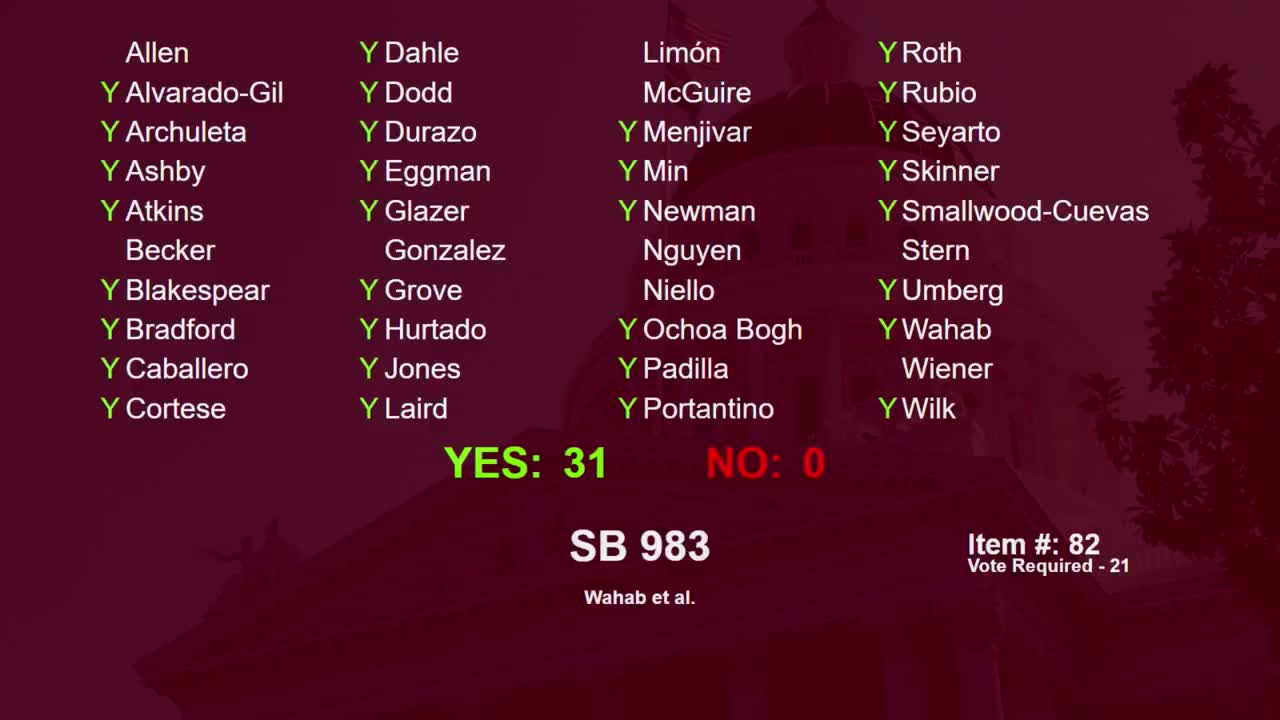 3MIN
Senate Floor
 10MIN
Senate Standing Committee on Energy, Utilities and Communications
 44SEC
Senate Standing Committee on Energy, Utilities and Communications
Bill Author

Bill Co-Author(s):