SB 1292: Electricity: fixed charges: report.
- Session Year: 2023-2024
- House: Senate
- Latest Version Date: 2024-09-03
Current Status:
Failed
(2024-09-22: In Senate. Consideration of Governor's veto pending.)
Introduced
In Committee
First Chamber
In Committee
Second Chamber
Enacted
Existing law authorizes the Public Utilities Commission to adopt new, or expand existing, fixed charges, as defined, for the purpose of collecting a reasonable portion of the fixed costs of providing electrical service to residential customers. Under existing law, the commission may authorize fixed charges for any rate schedule applicable to a residential customer account. Existing law requires the commission, no later than July 1, 2024, to authorize a fixed charge for default residential rates on an income-graduated basis, as specified.
This bill would require the commission, on or before January 1, 2028, but no sooner than 2 years after the adoption of the income-graduated fixed charge for residential rates, to submit a report to the relevant policy committees of both houses of the Legislature on the electrical corporations implementation of the fixed charge, as specified. The bill would prohibit the commission from authorizing a new residential fixed charge other than those authorized before July 1, 2024, until 30 days after the report is submitted.
Existing law vests the Public Utilities Commission with regulatory authority over public utilities, including electrical corporations. Existing law authorizes the commission to adopt new, or expand existing, fixed charges, as defined, for the purpose of collecting a reasonable portion of the fixed costs of providing electrical service to residential customers. Under existing law, the commission may authorize fixed charges for any rate schedule applicable to a residential customer account. Existing law requires the commission, no later than July 1, 2024, to authorize a fixed charge for default residential rates on an income-graduated basis, as specified.
This bill would require the commission, on or before January 1, 2028, but no sooner than 2 years after the adoption of the income-graduated fixed charge for residential rates, to submit a report to the relevant policy committees of both houses of the Legislature on the electrical corporations implementation of the fixed charge, as specified. The bill would prohibit the commission from authorizing a new residential fixed charge other than the income-graduated fixed charge for default residential rates those authorized before July 1, 2024, until 30 days after the report is submitted.
Existing law vests the Public Utilities Commission with regulatory authority over public utilities, including electrical corporations. Existing law authorizes the commission to adopt new, or expand existing, fixed charges, as defined, for the purpose of collecting a reasonable portion of the fixed costs of providing electrical service to residential customers. Under existing law, the commission may authorize fixed charges for any rate schedule applicable to a residential customer account. Existing law requires the commission, no later than July 1, 2024, to authorize a fixed charge for default residential rates on an income-graduated basis, as specified.
This bill would require the commission, on or before July 1, 2027, January 1, 2028, but no sooner than 2 years after the adoption of the income-graduated fixed charge for default residential rates, to submit a report to the relevant policy committees of both houses of the Legislature on the electrical corporations implementation of the fixed charge, as specified. The bill would prohibit the commission from authorizing a fixed charge other than the income-graduated fixed charge for default residential rates until 30 days after the report is submitted.
Existing law vests the Public Utilities Commission with regulatory authority over public utilities, including electrical corporations. Existing law authorizes the commission to adopt new, or expand existing, fixed charges, as defined, for the purpose of collecting a reasonable portion of the fixed costs of providing electrical service to residential customers. Under existing law, the commission may authorize fixed charges for any rate schedule applicable to a residential customer account. Existing law requires the commission, no later than July 1, 2024, to authorize a fixed charge for default residential rates on an income-graduated basis, as specified.
This bill would require the commission, on or before July 1, 2027, but no sooner than 2 years after the adoption of the income-graduated fixed charge for default residential rates, to submit a report to the relevant policy committees of both houses of the Legislature on the electrical corporations implementation of the fixed charge, as specified. The bill would prohibit the commission from authorizing a fixed charge other than the income-graduated fixed charge for default residential rates until 30 days after the report is submitted.
(a)Fixed charge means any fixed customer charge, basic service fee, demand differentiated basic service fee, demand charge, or other charge not based on the volume of electricity consumed.
(b)Increases to electrical rates and charges in rate design proceedings, including any reduction in the California Alternate Rates for Energy (CARE) program discount, shall be reasonable and subject to a reasonable phase-in schedule relative to the rates and charges in effect before January 1, 2014.
(c)Consistent with the requirements of Section 739, the commission may modify the seasonal definitions and applicable percentage of average consumption for one or more climatic zones.
(d)The commission may adopt new, or expand existing, fixed charges for the purpose of collecting a reasonable portion of the fixed costs of providing electrical service to residential customers. The commission shall ensure that any approved charges do all of the following:
(1)Reasonably reflect an appropriate portion of the different costs of serving small and large customers.
(2)Not unreasonably impair incentives for conservation, energy efficiency, and beneficial electrification and greenhouse gas emissions reduction.
(3)Are set at levels that do not overburden low-income customers.
(e)(1)(A)For the purposes of this section and Section 739.1, the commission may authorize fixed charges for any rate schedule applicable to a residential customer account. The fixed charge shall be established on an income-graduated basis with no fewer than three income thresholds so that a low-income ratepayer in each baseline territory would realize a lower average monthly bill without making any changes in usage.
(B)The commission shall, no later than July 1, 2024, authorize a fixed charge for default residential rates.
(C)The commission shall not authorize a new residential fixed charge, except those authorized before July 1, 2024, pursuant to this paragraph, until 30 days after the report described in Section 913.7 is submitted to the relevant policy committees of both houses of the Legislature.
(2)For purposes of this subdivision, income-graduated means that low-income customers pay a smaller fixed charge than high-income customers.
(f)Notwithstanding the requirements of subdivision (d) of Section 739 and Section 739.7, the commission shall not apply the composite tier method to the treatment of any revenues resulting from any fixed charge adopted pursuant to this section.
SEC. 2.Section 913.7 is added to the Public Utilities Code, to read:913.7.(a)For purposes of this section, fixed charge means the fixed charge for residential rates adopted pursuant to subparagraph (B) of paragraph (1) of subdivision (e) of Section 739.9.
(b)The commission, on or before January 1, 2028, but no sooner than two years after the adoption of the fixed charge, shall submit a report to the relevant policy committees of both houses of the Legislature on the electrical corporations implementation of the fixed charge.
(c)The commission shall include in the report an evaluation of the implementation of the fixed charge. The evaluation shall include all of the following information:
(1)Impacts to customers participating in the California Alternate Rates for Energy (CARE) or family electric rate assistance (FERA) programs.
(2)Impacts to all other residential customers.
(3)Administrative and operational challenges with implementing the fixed charge.
(4)Impacts on master-metered residential customer accounts.
(5)A summary of customer complaints associated with the fixed charge, including the number and relevant categories of customer complaints.
(6)A list of potential challenges with future adjustments to the fixed charge, including, but not limited to, adjustments to the income-graduated tiers, administrative issues, and billing systems.
(7)The extent to which the fixed charge impacts the rate of building electrification, the rate of air conditioning adoption, customer conservation efforts, residential electric vehicle charging behavior, and the rate of installation of distributed solar or battery storage systems.
(d)Pursuant to Section 10231.5 of the Government Code, this section is repealed on January 1, 2031.
(a)Fixed charge means any fixed customer charge, basic service fee, demand differentiated basic service fee, demand charge, or other charge not based on the volume of electricity consumed.
(b)Increases to electrical rates and charges in rate design proceedings, including any reduction in the California Alternate Rates for Energy (CARE) program discount, shall be reasonable and subject to a reasonable phase-in schedule relative to the rates and charges in effect before January 1, 2014.
(c)Consistent with the requirements of Section 739, the commission may modify the seasonal definitions and applicable percentage of average consumption for one or more climatic zones.
(d)The commission may adopt new, or expand existing, fixed charges for the purpose of collecting a reasonable portion of the fixed costs of providing electrical service to residential customers. The commission shall ensure that any approved charges do all of the following:
(1)Reasonably reflect an appropriate portion of the different costs of serving small and large customers.
(2)Not unreasonably impair incentives for conservation, energy efficiency, and beneficial electrification and greenhouse gas emissions reduction.
(3)Are set at levels that do not overburden low-income customers.
(e)(1)(A)For the purposes of this section and Section 739.1, the commission may authorize fixed charges for any rate schedule applicable to a residential customer account. The fixed charge shall be established on an income-graduated basis with no fewer than three income thresholds so that a low-income ratepayer in each baseline territory would realize a lower average monthly bill without making any changes in usage.
(B)The commission shall, no later than July 1, 2024, authorize a fixed charge for default residential rates.
(C)The commission shall not authorize a fixed charge pursuant to this paragraph, except the fixed charge described in subparagraph (B), a new residential fixed charge, except those authorized before July 1, 2024, pursuant to this paragraph, until 30 days after the report described in Section 913.7 is submitted to the relevant policy committees of both houses of the Legislature.
(2)For purposes of this subdivision, income-graduated means that low-income customers pay a smaller fixed charge than high-income customers.
(f)Notwithstanding the requirements of subdivision (d) of Section 739 and Section 739.7, the commission shall not apply the composite tier method to the treatment of any revenues resulting from any fixed charge adopted pursuant to this section.
SEC. 2.Section 913.7 is added to the Public Utilities Code, to read:913.7.(a)For purposes of this section, fixed charge means the fixed charge for residential rates adopted pursuant to subparagraph (B) of paragraph (1) of subdivision (e) of Section 739.9.
(b)The commission, on or before January 1, 2028, but no sooner than two years after the adoption of the fixed charge, shall submit a report to the relevant policy committees of both houses of the Legislature on the electrical corporations implementation of the fixed charge.
(c)The commission shall include in the report an evaluation of the implementation of the fixed charge. The evaluation shall include all of the following information:
(1)Impacts to customers participating in the California Alternate Rates for Energy (CARE) or family electric rate assistance (FERA) programs.
(2)Impacts to all other residential customers.
(3)Administrative and operational challenges with implementing the fixed charge.
(4)Impacts on master-metered residential customer accounts.
(5)A summary of customer complaints associated with the fixed charge, including the number and relevant categories of customer complaints.
(6)A list of potential challenges with future adjustments to the fixed charge, including, but not limited to, adjustments to the income-graduated tiers, administrative issues, and billing systems.
(d)Pursuant to Section 10231.5 of the Government Code, this section is repealed on January 1, 2031.
(a)Fixed charge means any fixed customer charge, basic service fee, demand differentiated basic service fee, demand charge, or other charge not based on the volume of electricity consumed.
(b)Increases to electrical rates and charges in rate design proceedings, including any reduction in the California Alternate Rates for Energy (CARE) program discount, shall be reasonable and subject to a reasonable phase-in schedule relative to the rates and charges in effect before January 1, 2014.
(c)Consistent with the requirements of Section 739, the commission may modify the seasonal definitions and applicable percentage of average consumption for one or more climatic zones.
(d)The commission may adopt new, or expand existing, fixed charges for the purpose of collecting a reasonable portion of the fixed costs of providing electrical service to residential customers. The commission shall ensure that any approved charges do all of the following:
(1)Reasonably reflect an appropriate portion of the different costs of serving small and large customers.
(2)Not unreasonably impair incentives for conservation, energy efficiency, and beneficial electrification and greenhouse gas emissions reduction.
(3)Are set at levels that do not overburden low-income customers.
(e)(1)(A)For the purposes of this section and Section 739.1, the commission may authorize fixed charges for any rate schedule applicable to a residential customer account. The fixed charge shall be established on an income-graduated basis with no fewer than three income thresholds so that a low-income ratepayer in each baseline territory would realize a lower average monthly bill without making any changes in usage.
(B)The commission shall, no later than July 1, 2024, authorize a fixed charge for default residential rates.
(C)The commission shall not authorize a fixed charge pursuant to this paragraph, except the fixed charge described in subparagraph (B), until 30 days after the report described in Section 913.7 is submitted to the relevant policy committees of both houses of the Legislature.
(2)For purposes of this subdivision, income-graduated means that low-income customers pay a smaller fixed charge than high-income customers.
(f)Notwithstanding the requirements of subdivision (d) of Section 739 and Section 739.7, the commission shall not apply the composite tier method to the treatment of any revenues resulting from any fixed charge adopted pursuant to this section.
SEC. 2.Section 913.7 is added to the Public Utilities Code, to read:913.7.(a)For purposes of this section, fixed charge means the fixed charge for default residential rates adopted pursuant to subparagraph (B) of paragraph (1) of subdivision (e) of Section 739.9.
(b)The commission, on or before July 1, 2027, January 1, 2028, but no sooner than two years after the adoption of the fixed charge, shall submit a report to the relevant policy committees of both houses of the Legislature on the electrical corporations implementation of the fixed charge.
(c)The commission shall include in the report an evaluation of the implementation of the fixed charge. The evaluation shall include all of the following information:
(1)Impacts to customers participating in the California Alternate Rates for Energy (CARE) or family electric rate assistance (FERA) programs.
(2)Impacts to all other residential customers.
(3)Administrative and operational challenges with implementing the fixed charge.
(4)Impacts on master-metered residential customer accounts.
(5)A summary of customer complaints associated with the fixed charge, including the number and relevant categories of customer complaints.
(6)A list of potential challenges with future adjustments to the fixed charge, including, but not limited to, adjustments to the income-graduated tiers, administrative issues, and billing systems.
(d)Pursuant to Section 10231.5 of the Government Code, this section is repealed on January 1, 2031.
(a)Fixed charge means any fixed customer charge, basic service fee, demand differentiated basic service fee, demand charge, or other charge not based on the volume of electricity consumed.
(b)Increases to electrical rates and charges in rate design proceedings, including any reduction in the California Alternate Rates for Energy (CARE) program discount, shall be reasonable and subject to a reasonable phase-in schedule relative to the rates and charges in effect before January 1, 2014.
(c)Consistent with the requirements of Section 739, the commission may modify the seasonal definitions and applicable percentage of average consumption for one or more climatic zones.
(d)The commission may adopt new, or expand existing, fixed charges for the purpose of collecting a reasonable portion of the fixed costs of providing electrical service to residential customers. The commission shall ensure that any approved charges do all of the following:
(1)Reasonably reflect an appropriate portion of the different costs of serving small and large customers.
(2)Not unreasonably impair incentives for conservation, energy efficiency, and beneficial electrification and greenhouse gas emissions reduction.
(3)Are set at levels that do not overburden low-income customers.
(e)(1)(A)For the purposes of this section and Section 739.1, the commission may authorize fixed charges for any rate schedule applicable to a residential customer account. The fixed charge shall be established on an income-graduated basis with no fewer than three income thresholds so that a low-income ratepayer in each baseline territory would realize a lower average monthly bill without making any changes in usage. The
(B)The commission shall, no later than July 1, 2024, authorize a fixed charge for default residential rates.
(C)The commission shall not authorize a fixed charge pursuant to this paragraph, except the fixed charge described in subparagraph (B), until 30 days after the report described in Section 913.7 is submitted to the relevant policy committees of both houses of the Legislature.
(2)For purposes of this subdivision, income-graduated means that low-income customers pay a smaller fixed charge than high-income customers.
(f)Notwithstanding the requirements of subdivision (d) of Section 739 and Section 739.7, the commission shall not apply the composite tier method to the treatment of any revenues resulting from any fixed charge adopted pursuant to this section.
SEC. 2.Section 913.7 is added to the Public Utilities Code, to read:913.7.(a)For purposes of this section, fixed charge means the fixed charge for default residential rates adopted pursuant to subparagraph (B) of paragraph (1) of subdivision (e) of Section 739.9.
(b)The commission, on or before July 1, 2027, but no sooner than two years after the adoption of the fixed charge, shall submit a report to the relevant policy committees of both houses of the Legislature on the electrical corporations implementation of the fixed charge.
(c)The commission shall include in the report an evaluation of the implementation of the fixed charge. The evaluation shall include all of the following information:
(1)Impacts to customers participating in the California Alternate Rates for Energy (CARE) or family electric rate assistance (FERA) programs.
(2)Impacts to all other residential customers.
(3)Administrative and operational challenges with implementing the fixed charge.
(4)Impacts on master-metered residential customer accounts.
(5)A summary of customer complaints associated with the fixed charge, including the number and relevant categories of customer complaints.
(6)A list of potential challenges with future adjustments to the fixed charge, including, but not limited to, adjustments to the income-graduated tiers, administrative issues, and billing systems.
(d)Pursuant to Section 10231.5 of the Government Code, this section is repealed on January 1, 2031.
|
Date
|
Status
|
|---|---|
| Sep 22, 2024 | In Senate. Consideration of Governor's veto pending. |
| Sep 22, 2024 | Vetoed by the Governor. |
| Sep 9, 2024 | Enrolled and presented to the Governor at 3 p.m. |
| Aug 29, 2024 | Assembly amendments concurred in. (Ayes 40. Noes 0. Page 5652.) Ordered to engrossing and enrolling. |
| Aug 28, 2024 | In Senate. Concurrence in Assembly amendments pending. |
| Aug 28, 2024 | Read third time. Passed. (Ayes 75. Noes 0. Page 6699.) Ordered to the Senate. |
| Aug 19, 2024 | Read second time. Ordered to third reading. |
| Aug 15, 2024 | From committee: Do pass. (Ayes 14. Noes 0.) (August 15). |
| Aug 7, 2024 | August 7 set for first hearing. Placed on suspense file. |
| Jul 3, 2024 | Read second time and amended. Re-referred to Com. on APPR. |
| Jul 2, 2024 | From committee: Do pass as amended and re-refer to Com. on APPR. with recommendation: To consent calendar. (Ayes 15. Noes 0.) (July 1). |
| Jun 23, 2024 | From committee with author's amendments. Read second time and amended. Re-referred to Com. on U. & E. |
| Jun 3, 2024 | Referred to Com. on U. & E. |
| May 23, 2024 | In Assembly. Read first time. Held at Desk. |
| May 22, 2024 | Read third time. Passed. (Ayes 37. Noes 0. Page 4150.) Ordered to the Assembly. |
| May 16, 2024 | Read second time. Ordered to third reading. |
| May 16, 2024 | From committee: Do pass. (Ayes 7. Noes 0. Page 3978.) (May 16). |
| May 14, 2024 | Set for hearing May 16. |
| May 13, 2024 | May 13 hearing: Placed on APPR suspense file. |
| May 3, 2024 | Set for hearing May 13. |
| Apr 30, 2024 | Read second time and amended. Re-referred to Com. on APPR. |
| Apr 29, 2024 | From committee: Do pass as amended and re-refer to Com. on APPR. (Ayes 17. Noes 0. Page 3701.) (April 22). |
| Apr 4, 2024 | Set for hearing April 22. |
| Feb 29, 2024 | Referred to Com. on E., U. & C. |
| Feb 16, 2024 | From printer. May be acted upon on or after March 17. |
| Feb 15, 2024 | Introduced. Read first time. To Com. on RLS. for assignment. To print. |
|
Date
|
Description
|
Location
|
Votes
|
|
|---|---|---|---|---|
| Aug 29, 2024 | Unfinished Business SB1292 Bradford Concurrence | Senate Floor |
Passed |
|
| Aug 28, 2024 | SB 1292 Bradford Senate Third Reading By Petrie-Norris | Assembly Floor |
Passed |
|
| Aug 15, 2024 | Do pass. | Assembly Standing Committee on Appropriations |
Passed |
|
| Jul 1, 2024 | Do pass as amended, and be re-referred to the Committee on [Appropriations] with recommendation: To Consent Calendar | Assembly Standing Committee on Utilities and Energy |
Passed |
|
| May 22, 2024 | Senate 3rd Reading SB1292 Bradford | Senate Floor |
Passed |
|
| May 16, 2024 | Do pass | Senate Standing Committee on Appropriations |
Passed |
|
| May 13, 2024 | Placed on suspense file | Senate Standing Committee on Appropriations |
Passed |
|
| Apr 22, 2024 | Do pass as amended, but first amend, and re-refer to the Committee on [Appropriations] | Senate Standing Committee on Energy, Utilities and Communications |
Passed |
This list shows positions taken on this bill by organizations on the date displayed, which is linked to the original source.
Positions by individuals are not included.
|
Organization
|
Position
|
Date
|
|---|---|---|
| Natural Resources Defense Council | ** Support | |
| San Diego Gas and Electric Company | ** Support | |
| The Utility Reform Network | ** Support |
SENATE RULES COMMITTEE Office of Senate Floor Analyses (916) 651-1520 Fax: (916) 327-4478 | SB 1292 |
VETO
Bill No: SB 1292
Author: Bradford (D)
Enrolled: 9/3/24
Vote: 27
SENATE ENERGY, U. & C. COMMITTEE: 17-0, 4/22/24
AYES: Bradford, Dahle, Ashby, Becker, Caballero, Dodd, Durazo, Eggman, Gonzalez, Limón, Min, Newman, Rubio, Seyarto, Skinner, Wahab, Wilk
NO VOTE RECORDED: Grove
SENATE APPROPRIATIONS COMMITTEE: 7-0, 5/16/24
AYES: Caballero, Jones, Ashby, Becker, Bradford, Seyarto, Wahab
SENATE FLOOR: 37-0, 5/22/24
AYES: Alvarado-Gil, Ashby, Atkins, Becker, Blakespear, Bradford, Caballero, Cortese, Dahle, Dodd, Durazo, Eggman, Glazer, Gonzalez, Grove, Hurtado, Jones, Laird, Limón, McGuire, Menjivar, Min, Newman, Nguyen, Niello, Padilla, Portantino, Roth, Rubio, Seyarto, Skinner, Smallwood-Cuevas, Stern, Umberg, Wahab, Wiener, Wilk
NO VOTE RECORDED: Allen, Archuleta, Ochoa Bogh
SENATE FLOOR: 40-0, 8/29/24
AYES: Allen, Alvarado-Gil, Archuleta, Ashby, Atkins, Becker, Blakespear, Bradford, Caballero, Cortese, Dahle, Dodd, Durazo, Eggman, Glazer, Gonzalez, Grove, Hurtado, Jones, Laird, Limón, McGuire, Menjivar, Min, Newman, Nguyen, Niello, Ochoa Bogh, Padilla, Portantino, Roth, Rubio, Seyarto, Skinner, Smallwood-Cuevas, Stern, Umberg, Wahab, Wiener, Wilk
ASSEMBLY FLOOR: 75-0, 8/28/24 - See last page for vote
SUBJECT: Electricity: fixed charges: report
SOURCE: Author
DIGEST:
This bill requires the California Public Utilities Commission (CPUC), by January 1, 2028, but no sooner than two years after the adoption of the income-graduated fixed charge for default residential rates, to submit a report to the relevant policy committees of both houses of the Legislature. This bill also prohibits the CPUC from authorizing a new income-graduated fixed charge until 30 days after the report has been provided to the Legislature.
ANALYSIS:
Existing law:
- Establishes and vests the CPUC with regulatory authority over public utilities, including electrical corporations. (Article XII of the California Constitution)
- Authorizes the CPUC to adopt new, or expand existing, fixed charges, as defined, for the purpose of collecting a reasonable portion of the fixed costs of providing electrical service to residential customers. (Public Utilities Code §739.9(d))
- Authorizes the CPUC to establish fixed charges for any rate schedule applicable to a residential customer account, and is required, no later than July 1, 2024, to authorize a fixed charge for default residential rates. Requires these fixed charges to be established on an income-graduated basis, with no fewer than three income thresholds, so that low-income ratepayers in each baseline territory would realize a lower average monthly bill without making any changes in usage. (Public Utilities Code §739.9(e))
- Requires the CPUC to continue the California Alternative Rates for Energy (CARE) program to provide assistance to low-income electric and gas customers with annual household incomes that are no greater than 200 percent of the federal poverty guideline levels, and exempts any fixed charge from the discount. (Public Utilities Code §739.1)
This bill:
- Requires the CPUC, on or before January 1, 2028, but no sooner than two years after the adoption of the income-graduated fixed charge for residential rates (two years from May 2024, specifically May 2026), to submit a report to the relevant policy committees of both houses of the Legislature on the electrical corporations’ implementation of the fixed charge.
- Requires the report to include specified information concerning any impacts of the fixed charge to low-income customers, all residential customers, master-metered customers; potential challenges with future adjustments; and impacts to electrification and air conditioning adoption.
- Prohibits the CPUC from authorizing a new residential fixed charge other than the income-graduated fixed charge for default residential rates adopted before July 1, 2024, until 30 days after the report is submitted (no sooner than May 2026).
Background
- About fixed charges. Fixed charges provide utilities the ability to recover certain costs via a consistent charge on utility bills that is unrelated to usage, as opposed to recovering these costs via volumetric usage (the amount of electricity used) on the utility bill. For electric utilities, these costs might include those related to utility billing systems, wildfire mitigation, public purpose programs, and others. Fixed charges are employed by many utilities as part of their rate design, including many water utilities, and some electric utilities (e.g. Sacramento Municipal Utility District (SMUD) has a $20+/month fixed charge) to recover costs that may be unaffected by usage and which are used to support the operation of the utility system. However, the CPUC has largely declined to adopt fixed charges on electric utility bills, as consumer organizations have historically opposed such proposals. The CPUC has approved very limited fixed charges (under $2/month) for default residential rates and largely opted for alternative rate designs that don’t include a fixed charge but instead collect most costs based on usage.
- AB 327 (Perea, Chapter 611, Statutes of 2013). Prior to the adoption of AB 205 (Committee on Budget, Chapter 61, Statutes of 2022), existing law, as adopted by AB 327, provided the CPUC could authorize electric investor-owned utilities (IOUs) to adopt a fixed charge but capped at no more than $10 per month for residential customers and $5 per month for eligible low-income residential customers participating in the low-income assistance program CARE. The fixed charges would apply to residential customers of electric IOUs, such as Pacific Gas & Electric (PG&E), San Diego Gas & Electric (SDG&E), Southern California Edison (SCE), and a few smaller utilities in the state, which are rate-regulated by the CPUC. These changes in legislation do NOT apply to publicly owned utilities (POUs), such as SMUD, Silicon Valley Power, Los Angeles Department of Water and Power (LADWP), whose governing board set their own rates. However, in many instances POUs have adopted their own fixed charges.
- Income-graduated fixed charges. The idea of basing the amount of the fixed charge on customer’s income was proposed by academic researchers, published in two reports by Next10 and the Energy Institute at Haas, several years ago and has received traction with some stakeholders who are concerned that the increasing costs of electric utility bills are hampering efforts to encourage customers to shift from fossil fuel uses to electricity (e.g. gasoline for vehicles, and natural gas for residential space and water heating). Many of these stakeholders contend that utility cost recovery based on volumetric usage is more regressive than a specified fixed charge applied to all customers, with the amount of the charge varying by the customer’s income, where lower income customers pay a lower fixed charge as compared to higher income customers. They contend that a fixed charge will help reduce the volumetric rate of electricity and thereby encourage customers to transition to electrification for transportation and residential uses.
- AB 205 fixed charge electric rate provisions. Among its many provisions, AB 205 requires the CPUC to authorize a fixed-charge for default residential electric utility rates established on an income-graduated basis by July 1, 2024. The income-graduated basis must have no fewer than three income thresholds so that low-income customers realize a lower average monthly bill without making any changes in usage and that low-income customers pay a smaller fixed charge than higher-income customers.
- CPUC proceeding (Rulemaking 22-07-005). Since the adoption of AB 205, the CPUC has been conducting an active proceeding on how best to adopt the income-graduated fixed charge, including vetting proposals from several stakeholders, conducting workshops, and solicitations for comments. Parties to the proceeding proposed various rate designs with a spectrum of fixed charge amounts (ranging from the $5 to over $100) in order to satisfy the requirements of AB 205, as well as, various income tiers. The CPUC had been working towards ultimately adopting an income-graduated fixed charge by July 1, 2024 (as required by the statute).
- CPUC adopts decision (D. 24-05-028). In May, the CPUC adopted the final decision in the proceeding defining the cost categories of fixed costs, the income based tiers, the respective fixed monthly charges for each tier, the implementation timing, as well as, marketing, outreach, and education to customers.
The decision explicitly states the intent to utilize the SMUD fixed charge of $20+ per month as a benchmark for the large electric IOUs. Specifically, large electric IOUs are required to adopt billing structure changes that require:
- Tier 1: Customers enrolled in the CARE program will pay $6 per month.
- Tier 2: Customers enrolled in the Family Electric Rate Assistance (FERA) program or who live in affordable housing restricted with incomes below 80 percent area median income will pay $12 per month.
- Tier 3: All other customers will pay a fixed amount of $24.15 per month.
On timing, the proposed decision requires SCE and SDG&E to apply the fixed charges between October 1, 2025 and December 15, 2025, and requires PG&E to apply fixed charges to residential customers’ bills between January 1, 2026 and March 31, 2026. The decision specified electric utility cost categories which would be defined as fixed costs, specifically: marginal customer access costs, public purpose program non-bypassable charges, new system generation charges, local generation charges, and nuclear decommissioning non-bypassable charges.
Comments
- Need for this bill. The author contends the important role of the Legislature to ensure the CPUC moves in a reasonable manner to design the income-graduated fixed charge required by the Legislature in AB 205. As such, the Legislature must be apprised of learnings and challenges of implementing the income-graduated fixed charge to ensure the authority granted to the CPUC in AB 205 remains consistent with the Legislature’s intent.
- Why income-graduated fixed charges? Proponents of income-graduated fixed charges, including electric IOUs, Natural Resources Defense Council, The Utility Reform Network, Public Advocates’ Office, and the Administration, suggest that not implementing the income-based fixed charges will hamper efforts to address electric utility bill affordability in the rate design. These proponents express concerns that a lack of affordability of electric utility bills will deter customers from electrifying current fossil-fueled applications (including adopting electric vehicles, residential electric space and water heating, residential electric cooking, etc.). They contend that customers’ reluctance to electrify these applications will thwart the state’s efforts to achieve its greenhouse gas reduction goals. The supporters of income-graduated fixed charges acknowledge a fixed charge can diminish the price signal for energy conservation, but contend there is a need to transition to electrification and to structure rates to better protect low-income customers, particularly those in inland areas that require more electricity to cool their homes during hot days. They express concerns about the growing costs of utility bills and the dependence on usage rates to recover the fixed costs of the electric utility system, including infrastructure and wildfire mitigation, which are costs that are unaffected by usage.
- In opposition to income-graduated fixed charges. On the other hand, some stakeholders oppose high fixed charges or fixed charges based on income tiers. For example, the California Solar and Storage Association oppose proposals in the CPUC proceeding for much higher fixed charges (particularly those above $12-16 per month). These stakeholders worry that a high fixed charge amount will reduce the value of installing solar or energy efficiency upgrades for customers, as the payback periods could be longer than with a lower or non-existent fixed charge amount. Some opponents of income-based fixed charges also take issue with the income-based distinctions in utility bills that would be managed by utilities and could require disclosure of customers’ income information, beyond those of voluntary rate assistance programs for income-eligible residents.
- Allocating utility costs. A rate design is not intended to affect the amount a utility can recover, as the process to determine a utility’s just and reasonable costs is unaffected by the design. However, a rate design will affect customers differently, depending on their usage. There has been substantial attention to the various proposals in the CPUC proceeding, including those by utilities which at various times proposed $70 to upwards of $100 per month fixed charges, as well as, concerns about how and whether a utility should manage customer income information and charge customers differently based on their income rather than their use of electricity. The CPUC’s May decision establishes a fixed charge more closely aligned with that of SMUD – at $24 per month – for most customers, with low-income residents having a $6-$12 per month charge, and a phase-in schedule over multiple years for the utilities. The income tiers proposed by the CPUC rely on the income eligibility of existing rate assistance programs – CARE and FERA – which would not require additional monitoring and tracking of every customer’s income. The CPUC’s decision is structured to reduce the usage (volumetric) rate by 5 to 7 cents per kilowatt hour. The decision is also structured with the intent to reduce the average low-income customers’ utility bill in every baseline territory compared to what their bill would have been without the fixed charge. However, the decision also notes an intention to continue to adjust income-graduated fixed charges, including exploring additional income tiers beyond those of the existing rate assistance program and at charges that may be higher than the initial fixed charges.
- More than a report, a limit on implementing an additional version of income-graduated fixed charge before the initial version is evaluated. This bill would require the CPUC to provide a report to the Legislature on the learnings and challenges of the recently adopted income-graduated fixed charges no earlier than two years from the adoption of the CPUC decision (adopted on May 9, 2024). Therefore, the report can be provided as early as May 10, 2026, and not later than January 1, 2028. This bill would also prohibit the CPUC from instituting new income-graduated fixed charges until 30 days after the report is issued, the earliest date would be June 9, 2026 (30 days after May 10, 2026).
The CPUC decision requires CPUC staff to prepare an evaluation report for the income-graduated fixed charges based on one calendar year of metrics and input from the Implementation Working Group. Given the timing of the implementation for each of the electric utilities, the first calendar year report with one-year’s data of actual customer experiences would be no sooner than after October (or up to December) 2026 for data from SCE and SDG&E, plus time needed to develop the evaluation report. For PG&E, one-year’s data from the implementation of the income-graduated fixed charge will not be available until after January 1, 2027 (and possibly later), plus the time needed to develop the evaluation report. The CPUC decision states that the evaluation report would be used to build the record for a decision on the next version of income-graduated fixed charges or alternative rate mechanisms. In this regard, the timing of the required report to the Legislature in this bill would be aligned with the evaluation required in the CPUC decision, but explicitly provided to the Legislature to inform future decisions and satisfy the author’s intent to have the Legislature be apprised of whether the CPUC’s implementation of income-graduated fixed charges is satisfying the intent of AB 205.
Related/Prior Legislation
SB 1326 (Jones, 2024) would have repealed the provisions adopted in AB 205 which authorize an income-graduated fixed charge in electric IOU rates, replaces with the language that existed prior which capped fixed charges. The bill failed passage in the Senate Committee on Energy, Utilities and Communications.
AB 205 (Committee on Budget, Chapter 61, Statutes of 2022) among its provisions, repealed the $10 fixed charge cap for residential electric IOU customers. Authorized the CPUC to use fixed charges for any rate schedule for residential customers, as specified. The bill requires the fixed charge to be established on an income-graduated basis with no fewer than three income thresholds, such that a low-income ratepayer would realize lower average monthly bill without making any chances in usage, as specified.
AB 327 (Perea, Chapter 611, Statutes of 2013) among its provisions, included language authorizing fixed charges for electric IOU rates, but capped the fixed charge to $10 per month for residential non-CARE customers, and $5 per month for CARE customers.
FISCAL EFFECT: Appropriation: No Fiscal Com.: Yes Local: No
According the Assembly Committee on Appropriations:
- The CPUC will need to dedicate resources to complete the report required by this bill. The CPUC anticipates needing one permanent regulatory analyst, at a cost of $210,000 annually, to coordinate on development of parameters of the report and oversee its production by an outside consultant (Public Utilities Commission Utilities Reimbursement Account). The CPUC contends it will still need the regulatory analyst following submission of the report to engage in “the ongoing collection and evaluation of data to support this new program area, which would continue to evolve through record development and data analysis over the next several years.”
- The CPUC also expects to need $250,000 a year for each of three years for an outside consultant to develop systems for tracking and evaluation of IOU customer bill effects, administrative and implementation challenges, customer complaints and other relevant information (PUCURA).
SUPPORT: (Verified 9/24/24)
Natural Resources Defense Council
The Utility Reform Network
OPPOSITION: (Verified 9/24/24)
None received
ARGUMENTS IN SUPPORT: According to the author:
Californians have generally enjoyed lower energy bills when compared to the rest of the country, largely due to milder weather and investments in energy efficiency. However, in more recent years, these trends have been changing as California’s higher energy rates are also resulting in higher energy utility bills.
California’s current utility rate system recovers fixed system costs, including wildfire hardening, grid infrastructure and public benefits programs, from everyone at the same rate based on how much energy they use. The average total household electric bill in California is $157 per month. This is regressive because California’s low-income customers are paying the same bill per kilowatt hour as millionaires.
Because of the extensive impacts that a fixed charge could have on the affordability of Californian’s utility bills, more transparency is needed in this process. SB 1292 would require the CPUC to report to the Legislature on the implementation of an income-based fixed charge and its impacts on customers before any future adjustments are made.
GOVERNOR'S VETO MESSAGE:
To the Members of the California State Senate:
I am returning Senate Bill 1292 without my signature.
This bill requires the California Public Utilities Commission (CPUC) to evaluate the implementation and impact of the recently adopted income-graduated fixed charge (IGFC) for residential electricity rates. The bill requires the CPUC to submit a detailed report to the Legislature by January 1, 2028, with the earliest submission date being May 2026, and prohibits the CPUC from authorizing any new residential fixed charges until 30 days after the report has been provided to the Legislature.
In 2022, the Legislature passed Assembly Bill 205, directing the CPUC to, following certain guidelines, develop an IGFC as part of the default residential rate tariff in private electric utility territories by July 1, 2024. The IGFC was carefully designed to allocate the costs of developing and maintaining electric infrastructure that benefits all customers more equitably, while lowering the volumetric rate for electricity. This is a rate design feature common in many California publicly-owned utility territories throughout the state and for many electric utilities throughout the country. Once fully implemented, the IGFC will improve electric bill affordability and encourage further electrification of the state's building and transportation sectors, which are increasingly powered by clean electricity.
While I support this bill's requirement for the CPUC to evaluate the impact of the IGFC, I am concerned about placing unwarranted limitations on the CPUC's authority to adjust it once fully enacted. In addition, the CPUC already established a process for the evaluation of the IGFC as part of its May 2024 Decision.
For these reasons, I cannot sign this bill.
Sincerely,
Gavin Newsom
ASSEMBLY FLOOR: 75-0, 8/28/24
AYES: Addis, Aguiar-Curry, Alanis, Alvarez, Arambula, Bains, Bauer-Kahan, Bennett, Berman, Boerner, Bonta, Bryan, Calderon, Juan Carrillo, Wendy Carrillo, Chen, Connolly, Megan Dahle, Davies, Dixon, Essayli, Flora, Mike Fong, Friedman, Gabriel, Gallagher, Garcia, Gipson, Grayson, Haney, Hart, Holden, Hoover, Irwin, Jackson, Jones-Sawyer, Kalra, Lackey, Lee, Low, Lowenthal, Maienschein, Mathis, McCarty, McKinnor, Muratsuchi, Stephanie Nguyen, Pacheco, Papan, Jim Patterson, Joe Patterson, Pellerin, Petrie-Norris, Quirk-Silva, Ramos, Rendon, Reyes, Luz Rivas, Rodriguez, Blanca Rubio, Sanchez, Santiago, Schiavo, Soria, Ta, Ting, Valencia, Villapudua, Waldron, Wallis, Weber, Wicks, Wilson, Zbur, Robert Rivas
NO VOTE RECORDED: Cervantes, Ortega, Ward, Wood
Prepared by: Nidia Bautista / E., U. & C. / (916) 651-4107
10/16/24 14:18:23
**** END ****
SENATE RULES COMMITTEE Office of Senate Floor Analyses (916) 651-1520 Fax: (916) 327-4478 | SB 1292 |
UNFINISHED BUSINESS
Bill No: SB 1292
Author: Bradford (D)
Amended: 7/3/24
Vote: 21
SENATE ENERGY, U. & C. COMMITTEE: 17-0, 4/22/24
AYES: Bradford, Dahle, Ashby, Becker, Caballero, Dodd, Durazo, Eggman, Gonzalez, Limón, Min, Newman, Rubio, Seyarto, Skinner, Wahab, Wilk
NO VOTE RECORDED: Grove
SENATE APPROPRIATIONS COMMITTEE: 7-0, 5/16/24
AYES: Caballero, Jones, Ashby, Becker, Bradford, Seyarto, Wahab
SENATE FLOOR: 37-0, 5/22/24
AYES: Alvarado-Gil, Ashby, Atkins, Becker, Blakespear, Bradford, Caballero, Cortese, Dahle, Dodd, Durazo, Eggman, Glazer, Gonzalez, Grove, Hurtado, Jones, Laird, Limón, McGuire, Menjivar, Min, Newman, Nguyen, Niello, Padilla, Portantino, Roth, Rubio, Seyarto, Skinner, Smallwood-Cuevas, Stern, Umberg, Wahab, Wiener, Wilk
NO VOTE RECORDED: Allen, Archuleta, Ochoa Bogh
ASSEMBLY FLOOR: 75-0, 8/28/24 - See last page for vote
SUBJECT: Electricity: fixed charges: report
SOURCE: Author
DIGEST:
This bill requires the California Public Utilities Commission (CPUC), by January 1, 2028, but no sooner than two years after the adoption of the income-graduated fixed charge for default residential rates, to submit a report to the relevant policy committees of both houses of the Legislature. This bill also prohibits the CPUC from authorizing a new income-graduated fixed charge until 30 days after the report has been provided to the Legislature.
Assembly Amendments
make mostly clarifying changes, including adding a requirement that the report include information regarding impacts to building electrification, air conditioning adoption, and among other considerations.
ANALYSIS:
Existing law:
- Establishes and vests the CPUC with regulatory authority over public utilities, including electrical corporations. (Article XII of the California Constitution)
- Authorizes the CPUC to adopt new, or expand existing, fixed charges, as defined, for the purpose of collecting a reasonable portion of the fixed costs of providing electrical service to residential customers. (Public Utilities Code §739.9(d))
- Authorizes the CPUC to establish fixed charges for any rate schedule applicable to a residential customer account, and is required, no later than July 1, 2024, to authorize a fixed charge for default residential rates. Requires these fixed charges to be established on an income-graduated basis, with no fewer than three income thresholds, so that low-income ratepayers in each baseline territory would realize a lower average monthly bill without making any changes in usage. (Public Utilities Code §739.9(e))
- Requires the CPUC to continue the California Alternative Rates for Energy (CARE) program to provide assistance to low-income electric and gas customers with annual household incomes that are no greater than 200 percent of the federal poverty guideline levels, and exempts any fixed charge from the discount. (Public Utilities Code §739.1)
This bill:
- Requires the CPUC, on or before January 1, 2028, but no sooner than two years after the adoption of the income-graduated fixed charge for residential rates, to submit a report to the relevant policy committees of both houses of the Legislature on the electrical corporations’ implementation of the fixed charge.
- Requires the report to include specified information concerning any impacts of the fixed charge to low-income customers, all residential customers, master-metered customers; potential challenges with future adjustments; and impacts to electrification and air conditioning adoption.
- Prohibits the CPUC from authorizing a new residential fixed charge other than the income-graduated fixed charge for default residential rates adopted before July 1, 2024, until 30 days after the report is submitted.
Background
- About fixed charges. Fixed charges provide utilities the ability to recover certain costs via a consistent charge on utility bills that is unrelated to usage, as opposed to recovering these costs via volumetric usage (the amount of electricity used) on the utility bill. These costs might include those related to utility billing systems, wildfire mitigation, public purpose programs, and others. Fixed charges are employed by many utilities as part of their rate design, including many water utilities, and some electric utilities (e.g. Sacramento Municipal Utility District (SMUD) has a $20+/month fixed charge) to recover costs that may be unaffected by usage and which are used to support the operation of the utility system. However, the CPUC has largely declined to adopt fixed charges on electric utility bills, as consumer organizations have largely opposed such proposals. Historically, the CPUC has approved very limited fixed charges (under $2/month) for default residential rates and largely opted for alternative rate designs that don’t include a fixed charge but instead collect most costs based on usage.
- AB 327 (Perea, Chapter 611, Statutes of 2013). Prior to the adoption of AB 205 (Committee on Budget, Chapter 61, Statutes of 2022), existing law, as adopted by AB 327, provided the CPUC could authorize electric investor-owned utilities (IOUs) to adopt a fixed charge but capped at no more than $10 per month for residential customers and $5 per month for eligible low-income customers participating in the low-income assistance program CARE. The fixed charges would apply to residential customers of electric IOUs, such as Pacific Gas & Electric (PG&E), San Diego Gas & Electric (SDG&E), Southern California Edison (SCE), and a few smaller utilities in the state, which are rate-regulated by the CPUC. These changes in legislation do NOT apply to publicly owned utilities (POUs), such as SMUD, Silicon Valley Power, Los Angeles Department of Water and Power (LADWP) whose governing board sets rates. However, in many instances POUs have adopted fixed charges.
- Income-graduated fixed charges. The idea of basing the fixed charge on income was proposed by academic researchers, published in two reports by Next10 and Energy Institute at Haas, several years ago and has received traction with some stakeholders who are concerned that the increasing costs of electric utility bills are hampering efforts to encourage customers to shift from fossil fuel uses to electricity (e.g. gasoline for vehicles, natural gas for home space and water heating). Many of these stakeholders contend that utility cost recovery based on volumetric usage is more regressive than a specified fixed charge applied to all customers, with the amount of the charge varying by income, where lower income customers pay a lower fixed charge as compared to higher income customers. They contend that a fixed charge will help reduce the volumetric rate to encourage customers to transition to electrification.
- AB 205 fixed charge electric rate provisions. Among its many provisions, AB 205 requires the CPUC to authorize a fixed-charge for default residential electric utility rates established on an income-graduated basis. The income-graduated basis must have no fewer than three income thresholds so that low-income customers realize a lower average monthly bill without making any changes in usage and that low-income customers pay a smaller fixed charge than higher-income customers.
- CPUC proceeding (Rulemaking 22-07-005). Since the adoption of AB 205, the CPUC has been conducting an active proceeding on how best to adopt the income-graduated fixed charge, including several stakeholders with multiple proposals, workshops, and solicitations for comments. Parties to the proceeding proposed various rate designs with a spectrum of fixed charge amounts (ranging from the $5 to over $100) in order to satisfy the requirements of AB 205. The CPUC has been working towards ultimately adopting an income-graduated fixed charge by July 1, 2024 (as required by the statute).
- CPUC adopts decision (D. 24-05-028). In May, the CPUC adopted the final decision in the proceeding with the following elements:
Large electric IOUs are required to adopt billing structure changes that require:
- Tier 1: Customers enrolled in the CARE program will pay $6 per month.
- Tier 2: Customers enrolled in the Family Electric Rate Assistance (FERA) program or who live in affordable housing restricted with incomes below 80 percent area median income will pay $12 per month.
- Tier 3: All other customers will pay a fixed amount of $24.15 per month.
The proposed decision requires SCE and SDG&E to apply the fixed charges between October 1, 2025 and December 15, 2025, and requires PG&E to apply fixed charges to residential customers’ bills between January 1, 2026 and March 31, 2026.
Comments
- Need for this bill. The author contends the important role of the Legislature to ensure the CPUC moves in a reasonable direction to design the income-graduated fixed charge required by the Legislature in AB 205. As such, the Legislature must be apprised of learnings and challenges of implementing the income-graduated fixed charge to ensure the authority granted to the CPUC in AB 205 remains consistent with the Legislature’s intent.
- Why income-graduated fixed charges? Proponents of income-graduated fixed charges, including electric IOUs, Natural Resources Defense Council, The Utility Reform Network, Public Advocates’ Office, and the Administration, suggest that not implementing the income-based fixed charges will hamper efforts to address electric utility bill affordability in the rate design. These proponents express concerns that a lack of affordability of electric utility bills will deter customers from electrifying current fossil-fueled applications (including adopting electric vehicles, electric space and water heating, electric cooking, etc.). They contend that customers’ reluctance to electrify these applications will thwart the state’s efforts to achieve its greenhouse gas reduction goals. The supporters of income-graduated fixed charges acknowledge a fixed charge can diminish the price signal for energy conservation, but contend there is a need to transition to electrification and to structure rates to better protect low-income customers, particularly those in inland areas that require more electricity to cool their homes. They express concerns about the growing costs of utility bills and the dependence on usage rates to recover the fixed costs of the system, including infrastructure and wildfire mitigation, that is unaffected by usage.
- In opposition to income-graduated fixed charges. On the other hand, opponents of the income-graduated fixed charges, including the California Solar and Storage Association, oppose proposals in the CPUC proceeding for much higher fixed charges (particularly those above $12-16). These stakeholders worry that a high fixed charge amount will reduce the value of installing solar or energy efficiency upgrades for customers, as the payback periods could be longer than with a lower or non-existent fixed charge amount. Some opponents of income-based fixed charges also take issue with the income-based distinctions in utility bills that would be managed by utilities and could require disclosure of customers’ income information, beyond those of voluntary rate assistance programs.
- Allocating utility costs. A rate design is not intended to affect the amount a utility can recover, as the process to determine a utility’s just and reasonable costs is unaffected by the design. However, a rate design will affect customers differently, depending on their usage. There has been substantial attention to the various proposals in the CPUC proceeding, including those by utilities which at various times proposed $70 to upwards of $100 per month fixed charges, as well as, concerns about how a utility would manage customer income information. However, the CPUC has now adopted a decision that establishes a fixed charge more closely aligned with that of SMUD – at $24 per month – for most customers, with low-income residents having a $6-$12 per month charge, and a phase-in schedule over multiple years for the utilities. The income tiers proposed by the CPUC rely on the income eligibility of existing rate assistance programs – CARE and FERA – which would not require additional monitoring of all customer incomes. The CPUC’s decision is structured to reduce the usage (volumetric) rate by 5 to 7 cents per kilowatt hour. The decision is also structured with the intent to reduce the average low-income customers’ utility bill in every baseline territory compared to what their bill would have been without the fixed charge.
- More than a report, a limit on implementing a new income-graduated fixed charge. This bill would require the CPUC to provide a report to the Legislature on the learnings and challenges of the recently adopted income-graduated fixed charges no earlier than two years from May 9, 2024 (May 10, 2026). This bill would also prohibit the CPUC from instituting new income-graduated fixed charges until 30 days after the report is issued.
Related/Prior Legislation
SB 1326 (Jones, 2024) would have repealed the provisions adopted in AB 205 which authorize an income-graduated fixed charge in electric IOU rates, replaces with the language that existed prior which capped fixed charges. The bill failed passage in the Senate Committee on Energy, Utilities and Communications.
AB 205 (Committee on Budget, Chapter 61, Statutes of 2022) among its provisions, repealed the $10 fixed charge cap for residential electric IOU customers. Authorized the CPUC to use fixed charges for any rate schedule for residential customers, as specified. The bill requires the fixed charge to be established on an income-graduated basis with no fewer than three income thresholds, such that a low-income ratepayer would realize lower average monthly bill without making any chances in usage, as specified.
AB 327 (Perea, Chapter 611, Statutes of 2013) among its provisions, included language authorizing fixed charges for electric IOU rates, but capped the fixed charge to $10 per month for residential non-CARE customers, and $5 per month for CARE customers.
FISCAL EFFECT: Appropriation: No Fiscal Com.: Yes Local: No
According the Assembly Committee on Appropriations:
- The CPUC will need to dedicate resources to complete the report required by this bill. The CPUC anticipates needing one permanent regulatory analyst, at a cost of $210,000 annually, to coordinate on development of parameters of the report and oversee its production by an outside consultant (Public Utilities Commission Utilities Reimbursement Account). The CPUC contends it will still need the regulatory analyst following submission of the report to engage in “the ongoing collection and evaluation of data to support this new program area, which would continue to evolve through record development and data analysis over the next several years.”
- The CPUC also expects to need $250,000 a year for each of three years for an outside consultant to develop systems for tracking and evaluation of IOU customer bill effects, administrative and implementation challenges, customer complaints and other relevant information (PUCURA).
SUPPORT: (Verified 8/21/24)
Natural Resources Defense Council
The Utility Reform Network
OPPOSITION: (Verified 8/21/24)
None received
ARGUMENTS IN SUPPORT: According to the author:
Californians have generally enjoyed lower energy bills when compared to the rest of the country, largely due to milder weather and investments in energy efficiency. However, in more recent years, these trends have been changing as California’s higher energy rates are also resulting in higher energy utility bills.
California’s current utility rate system recovers fixed system costs, including wildfire hardening, grid infrastructure and public benefits programs, from everyone at the same rate based on how much energy they use. The average total household electric bill in California is $157 per month. This is regressive because California’s low-income customers are paying the same bill per kilowatt hour as millionaires.
The California Public Utilities Commission (CPUC) has begun a proceeding to establish an income-based fixed charge for residential rates that will be completed by July of 2024. Designed correctly, adjusting the utility rate structure to include a fixed-rate could lower bills for most Californians.
Because of the extensive impacts that a fixed charge could have on the affordability of Californian’s utility bills, more transparency is needed in this process. SB 1292 would require the CPUC to report to the Legislature on the implementation of an income-based fixed charge and its impacts on customers before any future adjustments are made.
ASSEMBLY FLOOR: 75-0, 8/28/24
AYES: Addis, Aguiar-Curry, Alanis, Alvarez, Arambula, Bains, Bauer-Kahan, Bennett, Berman, Boerner, Bonta, Bryan, Calderon, Juan Carrillo, Wendy Carrillo, Chen, Connolly, Megan Dahle, Davies, Dixon, Essayli, Flora, Mike Fong, Friedman, Gabriel, Gallagher, Garcia, Gipson, Grayson, Haney, Hart, Holden, Hoover, Irwin, Jackson, Jones-Sawyer, Kalra, Lackey, Lee, Low, Lowenthal, Maienschein, Mathis, McCarty, McKinnor, Muratsuchi, Stephanie Nguyen, Pacheco, Papan, Jim Patterson, Joe Patterson, Pellerin, Petrie-Norris, Quirk-Silva, Ramos, Rendon, Reyes, Luz Rivas, Rodriguez, Blanca Rubio, Sanchez, Santiago, Schiavo, Soria, Ta, Ting, Valencia, Villapudua, Waldron, Wallis, Weber, Wicks, Wilson, Zbur, Robert Rivas
NO VOTE RECORDED: Cervantes, Ortega, Ward, Wood
Prepared by: Nidia Bautista / E., U. & C. / (916) 651-4107
8/28/24 22:17:24
**** END ****
SENATE THIRD READING
STR Bill Id:SB 1292
Author:(Bradford)
As Amended Ver:July 3, 2024
Majority vote
SUMMARY
Requires the California Public Utilities Commission (CPUC) to evaluate the implementation and impacts of the residential fixed charge, and to submit a report to the Legislature by January 1, 2028, but no sooner than May 2026, detailing the evaluation. Also prohibits the CPUC from authorizing any new residential fixed charge until 30 days after the report has been provided to the Legislature.
Major Provisions
Requires the report on the IOUs' implementation of the fixed charge to include:
- Impacts to customers participating in the California Alternate Rates for Energy (CARE) or family electric rate assistance (FERA) programs, and to all other residential customers.
- Administrative and operational challenges with implementing the fixed charge.
- Impacts on master-metered residential customer accounts.
- A summary of customer complaints associated with the fixed charge, including the number and relevant categories of customer complaints.
- A list of potential challenges with future adjustments to the fixed charge, including, but not limited to, adjustments to the income-graduated tiers, administrative issues, and billing systems.
- The extent to which the fixed charge impacts the rate of building electrification, the rate of air conditioning adoption, customer conservation efforts, residential electric vehicle charging behavior and the rate of installation of distributed solar or battery storage systems.
COMMENTS
Traditionally, electrical corporations – also known as investor-owned utilities (IOUs) – with rates regulated by the CPUC have recovered nearly all of their costs of doing business through per-unit (i.e. "volumetric") charges on the electricity used by their customers.[1] This includes costs that increase, generally, with the amount of electricity a customer uses (variable costs, such as the cost of fuel) as well as costs that do not vary with the amount of electricity used (fixed costs, such as the cost of electric poles and wires). This pricing arrangement means a customer who uses more electricity pays for more of the IOU's fixed costs than does a customer who uses relatively less electricity, even though the customer's greater use of electricity does not lead to an increase in the IOU's fixed costs. For many years, California policy favored this arrangement. This is because volumetric pricing rewards conservation and punishes consumption, thereby encouraging Californians to use energy efficiently.
State policy now favors widespread electrification. Yet, arguably, the distortion of electricity prices caused by volumetric pricing discourages adoption of electric appliances and vehicles. A solution could be to remove certain fixed costs from the price charged for a unit of electricity and, instead, place those fixed costs in set amounts charged to every IOU customer, regardless of the amount of electricity the customer uses. Fixed charges are employed by many utilities as part of their rate design, including many water utilities, and some municipal electric utilities (e.g., Sacramento Municipal Utility District (SMUD) has a $20+/month fixed charge).
In 2022, the Legislature passed AB 205, Committee on Budget, Chapter 61, Statutes of 2022, which repealed an existing statutory $10 limit on any fixed charge approved by the CPUC. Instead, AB 205 authorized the CPUC to "establish reasonable fixed charges on default residential customer rates to help stabilize rates and equitably allocate and recover costs among residential customers in each electrical corporation's service territory." The statute directed the CPUC, in establishing the fixed charge, to ensure low-income customers have a lower monthly bill, without unreasonably impairing incentives for electrification and greenhouse gas reduction, among other requirements.
On May 9, 2024, the CPUC adopted just such a fixed charge, set at $6 a month for customers who participate in the rate-subsidized CARE program, $12 a month for customers in the rate-assistance program FERA and $24 a month for all other customers. In addition, the CPUC decision reduced volumetric electricity rates by five cents to seven cents per kilowatt hour used.
According to the Author
According to the author, "California's current utility rate system recovers fixed system costs, including wildfire hardening, grid infrastructure and public benefits programs, from everyone at the same rate based on how much energy they use. The average total household electric bill in California is $157 per month. This structure is regressive because California's low-income customers are paying the same bill per kilowatt hour as millionaires. The California Public Utilities Commission (CPUC) has approved an income-based fixed charge for residential rates. Because of the extensive impacts that a fixed charge could have on the affordability of Californian's utility bills, more transparency is needed in this process. SB 1292 would require the CPUC to report to the Legislature on the implementation of an income-based fixed charge and its impacts on customers before any future changes can be made."
Arguments in Support
None on file.
Writing in Support if Amended, The Utility Reform Network (TURN) and the Natural Resources Defense Council (NRDC) report they would support the bill if two "small" amendments were made:
- Allow the CPUC to make minor changes to the initial fixed charges over the next two years such as inflation adjustments or modifying the types of costs to be recovered.
- Require the California Energy Commission to submit a similar report to the Legislature that includes an evaluation of the fixed charges included in publicly owned utility residential rate tariffs.
Arguments in Opposition
None on file.
San Diego Gas and Electric writes with "Concerns" that this bill would "create a new duplicative report" and prohibit the CPUC from revising the fixed charge until the new report was submitted. They note that the CPUC's recent decision on fixed charge already requires the utilities to submit an evaluation within one year.
FISCAL COMMENTS
According to the Assembly Committee on Appropriations, this bill will result in approximately $460,000 – with approximately $210,000 of that recurring annually – to the CPUC to complete the report required by this bill.
VOTES
SENATE FLOOR: 37-0-3
YES: Alvarado-Gil, Ashby, Atkins, Becker, Blakespear, Bradford, Caballero, Cortese, Dahle, Dodd, Durazo, Eggman, Glazer, Gonzalez, Grove, Hurtado, Jones, Laird, Limón, McGuire, Menjivar, Min, Newman, Nguyen, Niello, Padilla, Portantino, Roth, Rubio, Seyarto, Skinner, Smallwood-Cuevas, Stern, Umberg, Wahab, Wiener, Wilk
ABS, ABST OR NV: Allen, Archuleta, Ochoa Bogh
ASM UTILITIES AND ENERGY: 15-0-1
YES: Petrie-Norris, Bauer-Kahan, Calderon, Chen, Friedman, Hart, Holden, Joe Patterson, Reyes, Santiago, Schiavo, Ting, Wallis, Wood, Zbur
ABS, ABST OR NV: Jim Patterson
ASM APPROPRIATIONS: 14-0-1
YES: Wicks, Sanchez, Arambula, Bryan, Calderon, Wendy Carrillo, Dixon, Mike Fong, Grayson, Haney, Hart, Pellerin, Ta, Villapudua
ABS, ABST OR NV: Jim Patterson
UPDATED
VERSION: July 3, 2024
CONSULTANT: Laura Shybut / U. & E. / (916) 319-2083 FN: 0004021
Pg. 14, CPUC, 2023 Senate Bill 695 Report, May 2023. ↑
Date of Hearing: August 7, 2024
ASSEMBLY COMMITTEE ON APPROPRIATIONS
Buffy Wicks, Chair
SBPCA Bill Id:SB 1292
Author:(Bradford) – As Amended Ver:July 3, 2024
Policy Committee: | Utilities and Energy | Vote: | 15 - 0 |
|
| ||
|
|
Urgency: No State Mandated Local Program: No Reimbursable: No
SUMMARY:
This bill directs the California Public Utilities Commission (CPUC), no later than July 1, 2024, to authorize electrical corporations (also known as investor-owned electric utilities, or IOUs) to implement a fixed charge for default residential rates, but only as the CPUC had authorized such a charge before July 1, 2024, until 30 days after the CPUC submits the report required by this bill to the Legislature.
The bill requires the CPUC to submit the report by January 1, 2028, but no sooner than two years after the adoption of the fixed charge, and requires the report on the IOUs’ implementation of the fixed charge, including:
- Impacts to customers participating in the California Alternate Rates for Energy (CARE) or family electric rate assistance (FERA) programs, and to all other residential customers.
- Administrative and operational challenges with implementing the fixed charge.
- Impacts on master-metered residential customer accounts.
- A summary of customer complaints associated with the fixed charge, including the number and relevant categories of customer complaints.
- A list of potential challenges with future adjustments to the fixed charge, including, but not limited to, adjustments to the income-graduated tiers, administrative issues, and billing systems.
- The extent to which the fixed charge impacts the rate of building electrification, the rate of air conditioning adoption, customer conservation efforts, residential electric vehicle charging behavior and the rate of installation of distributed solar or battery storage systems.
FISCAL EFFECT:
The CPUC will need to dedicate resources to complete the report required by this bill. The CPUC anticipates needing one permanent regulatory analyst, at a cost of $210,000 annually, to coordinate on development of parameters of the report and oversee its production by an outside consultant (Public Utilities Commission Utilities Reimbursement Account). The CPUC contends it will still need the regulatory analyst following submission of the report to engage in “the ongoing collection and evaluation of data to support this new program area, which would continue to evolve through record development and data analysis over the next several years.”
The CPUC also expects to need $250,000 a year for each of three years for an outside consultant to develop systems for tracking and evaluation of IOU customer bill effects, administrative and implementation challenges, customer complaints and other relevant information (PUCURA).
COMMENTS:
- Purpose. The author intends this bill to provide information about the effects of fixed charges recently approved by the CPUC. According to the author:
California’s current utility rate system recovers fixed system costs, including wildfire hardening, grid infrastructure and public benefits programs, from everyone at the same rate based on how much energy they use. The average total household electric bill in California is $157 per month. This structure is regressive because California’s low-income customers are paying the same bill per kilowatt hour as millionaires. The California Public Utilities Commission (CPUC) has approved an income-based fixed charge for residential rates. Because of the extensive impacts that a fixed charge could have on the affordability of Californian’s utility bills, more transparency is needed in this process. SB 1292 would require the CPUC to report to the Legislature on the implementation of an income-based fixed charge and its impacts on customers before any future changes can be made.
- Background. Traditionally, electrical corporations (oftentimes referred to as an investor-owned utility or “IOU”) with rates regulated by the CPUC have recovered their costs of doing business through per-unit charges on the electricity used by their customers. This includes costs that increase, generally, with the amount of electricity a customer uses (variable costs, such as the cost of fuel) as well as costs that do not vary with the amount of electricity used (fixed costs, such as the cost of electric poles and wires). This pricing arrangement means a customer who uses more electricity pays for more of the IOUs fixed costs than does a customer who uses relatively less electricity, even though the customer’s greater use of electricity does not lead to an increase in the IOU’s fixed costs. For many years, California policy favored this arrangement. This is because volumetric pricing rewards conservation and punishes consumption, thereby encouraging Californians to use energy efficiently.
State policy now favors widespread electrification, yet, arguably, the distortion of electricity prices caused by volumetric pricing discourages adoption of electric appliances and vehicles. A solution could be to remove certain fixed costs from the price charged for a unit of electricity and, instead, place those fixed costs in fixed amounts charged to each IOU customer, regardless of the amount of electricity the customer uses. And many have advocated for such a solution. (See, for example, https://haas.berkeley.edu/wp-content/uploads/WP314.pdf.)
In 2022, the Legislature passed AB 205, Committee on Budget, Chapter 61, Statutes of 2022, which repealed an existing statutory $10 limit on any fixed charge approved by the CPUC. Instead, AB 205 authorized the CPUC to “establish reasonable fixed charges on default residential customer rates to help stabilize rates and equitably allocate and recover costs among residential customers in each electrical corporation’s service territory.” The statute directed the CPUC, if did adopt a fixed charge, to ensure the charge “more fairly” distribute the burden of supporting the electric system and achieving the state’s clean energy goals.
On May 9, 2024, the CPUC adopted just such a fixed charge, set at $6 a month for customers who participate in the rate-subsidized CARE program, $12 a month for customers in the rate-assistance program FERA and $24 a month for all other customers. In addition, the CPUC decision reduced volumetric electricity rates by five cents to seven cents per kilowatt hour used.
- Request for Amendments. The Utility Reform Network (TURN) and the Natural Resources Defense Council (NRDC) report they would support the bill if two “small” amendments were made:
- Allow the CPUC to make minor changes to the initial fixed charges over the next two years such as inflation adjustments or modifying the types of costs to be recovered.
- Require the California Energy Commission to submit a similar report to the Legislature that includes an evaluation of the fixed charges included in publicly owned utility residential rate tariffs.
- Related Legislation. AB 1999 (Irwin) revokes, on July 1, 2028, the income-graduated fixed charge for electric IOU residential customers, and replaces it with prior statutory language capping the fixed charge at $5 for CARE discounted customers and $10 for everyone else and calls for a report by July 1, 2027, on the implementation of the fixed charge. AB 1999 failed to pass this committee.
SB 1326 (Jones) repeals the provisions adopted in AB 205 (Committee on the Budget), Chapter 61, Statutes of 2022) that authorized the CPUC to institute an income-graduated fixed charge in electric IOU rates. SB 1326 failed to pass the Senate Committee on Energy, Utilities and Communications.
Analysis Prepared by: Jay Dickenson / APPR. / (916) 319-2081
Date of Hearing: July 1, 2024
ASSEMBLY COMMITTEE ON UTILITIES AND ENERGY
Cottie Petrie-Norris, Chair
SBPCA Bill Id:SB 1292
Author:(Bradford) – As Amended Ver:June 23, 2024
SENATE VOTE: 37-0
SUBJECT: Electricity: fixed charges: report
SUMMARY: Requires the California Public Utilities Commission (CPUC) to evaluate the implementation and impacts of the residential fixed charge, and to submit a report to the Legislature by January 1, 2028, but no sooner than May 2026, detailing the evaluation. Also prohibits the CPUC from authorizing any new residential fixed charge until 30 days after the report has been provided to the Legislature.
EXISTING LAW:
- Establishes and vests the CPUC with regulatory authority over public utilities, including electrical corporations. (Article XII of the California Constitution)
- Authorizes the CPUC to adopt new, or expand existing, fixed charges, as defined, for the purpose of collecting a reasonable portion of the fixed costs of providing electrical service to residential customers. (Public Utilities Code § 739.9(d))
- Authorizes the CPUC to establish fixed charges for any rate schedule applicable to a residential customer account, and is required, no later than July 1, 2024, to authorize a fixed charge for default residential rates. Requires these fixed charges to be established on an income-graduated basis, with no fewer than three income thresholds, so that low-income ratepayers in each baseline territory would realize a lower average monthly bill without making any changes in usage. (Public Utilities Code § 739.9(e))
- Requires the CPUC to continue the California Alternative Rates for Energy (CARE) program to provide assistance to low-income electric and gas customers with annual household incomes that are no greater than 200% of the federal poverty guideline levels, and exempts any fixed charge from the discount. (Public Utilities Code § 739.1)
FISCAL EFFECT: According to the Senate Committee on Appropriations, this bill will result in one-time costs of about $750,000, spread over three years, for the CPUC to perform the evaluation.
BACKGROUND:
Fixing charges – Traditionally, electrical corporations – also known as investor-owned utilities (IOUs) – with rates regulated by the CPUC have recovered nearly all of their costs of doing business through per-unit (i.e. “volumetric”) charges on the electricity used by their customers.[1] This includes costs that increase, generally, with the amount of electricity a customer uses (variable costs, such as the cost of fuel) as well as costs that do not vary with the amount of
electricity used (fixed costs, such as the cost of electric poles and wires). This pricing arrangement means a customer who uses more electricity pays for more of the IOU’s fixed costs than does a customer who uses relatively less electricity, even though the customer’s greater use of electricity does not lead to an increase in the IOU’s fixed costs. For many years, California policy favored this arrangement. This is because volumetric pricing rewards conservation and punishes consumption, thereby encouraging Californians to use energy efficiently.
State policy now favors widespread electrification. Yet, arguably, the distortion of electricity prices caused by volumetric pricing discourages adoption of electric appliances and vehicles. A solution could be to remove certain fixed costs from the price charged for a unit of electricity and, instead, place those fixed costs in set amounts charged to every IOU customer, regardless of the amount of electricity the customer uses. Many have advocated for such a solution. [2] Fixed charges are also employed by many utilities as part of their rate design, including many water utilities, and some municipal electric utilities (e.g., Sacramento Municipal Utility District (SMUD) has a $20+/month fixed charge[3]).
In 2013, AB 327 (Perea, Chapter 611, Statutes of 2013) permitted the CPUC to adopt a fixed charge of no more than $10 for most residential customers, and $5 for CARE customers. The CPUC never adopted the $10 fixed charge on standard residential rates; however, they have adopted optional electrification rates for electric vehicles and rooftop solar that require a fixed charge between $12-15/month, with a lower volumetric rate.
AB 205 (Committee on Budget, Chapter 61, Statutes of 2022) [4] removed the $10 statutory cap, and requires the CPUC to instead authorize an “income graduated” fixed charge by July 1, 2024 for default residential rates. AB 205 requires that the fixed charge have “at least three income tiers” and must ensure low-income customers have a lower monthly bill, without unreasonably impairing incentives for electrification and greenhouse gas reduction, among other requirements.[5] The discussion to implement the statute has been active and contentious.[6]
CPUC Decision – On March 27, 2024, the CPUC issued a proposed decision implementing an income-graduated fixed charge. The decision requires large electric IOUs to adopt billing changes that result in a $6/month charge for customers who participate in the rate-subsidized CARE program, $12/month for customers in the rate-assistance program FERA, and $24/month for all other customers, as shown in Table 1.
Table 1. Breakdown of the CPUC income graduated fixed charge decision.
Tier | Qualification | Fixed Charge Amount (monthly) |
CARE customers | Household income <200% federal poverty guidelines (~ $ 60k/year for family of 4) | $6 |
Family Electric Rate Assistance (FERA) customers or customers in deed-restricted housing | Household income 200-250% of federal poverty guidelines (~ $ 75k/year for family of 4) Or customers living in affordable housing restricted with incomes below 80% area median income | $12 |
Everyone else | >250% federal poverty guidelines | $24.15 |
The proposed decision also cuts the volumetric usage rate by 5-7 cents per kilowatt-hour, seemingly reducing overall bills for most customers despite the imposition of the fixed charge.
The proposed decision requires SCE and SDG&E to apply the fixed charges between October 1, 2025 and December 15, 2025, and requires PG&E to apply fixed charges between January 1, 2026 and March 31, 2026. On Thursday, May 9th, 2024, the CPUC adopted the income graduated fixed charge proposal at its voting meeting.
COMMENTS:
- Author’s Statement. According to the author, “California’s current utility rate system recovers fixed system costs, including wildfire hardening, grid infrastructure and public benefits programs, from everyone at the same rate based on how much energy they use. The average total household electric bill in California is $157 per month. This structure is regressive because California’s low-income customers are paying the same bill per kilowatt hour as millionaires. The California Public Utilities Commission (CPUC) has approved an income-based fixed charge for residential rates. Because of the extensive impacts that a fixed charge could have on the affordability of Californian’s utility bills, more transparency is needed in this process. SB 1292 would require the CPUC to report to the Legislature on the implementation of an income-based fixed charge and its impacts on customers before any future changes can be made.”
- Data Welcome. A rate design is not intended to affect the amount a utility can recover, as the process to determine a utility’s just and reasonable costs is unaffected by the design. However, a rate design will affect customers differently, depending on their usage. Statute requires the CPUC, in designing and implementing a fixed charge, to ensure low-income customers have a lower monthly bill, without unreasonably impairing incentives for electrification and greenhouse gas reduction, among other requirements. Yet it is unclear just how the recently adopted fixed charge will yield these outcomes. As a result, as the author notes, the fixed charge could have extensive impacts on utility bills. Therefore more transparency and data are needed – as called for in this measure – on the fixed charge’s implementation and impact.
This bill prohibits the CPUC from adopting any new residential fixed charges until 30 days after submitting a report to the Legislature. However, this bill does not overturn nor reverse the existing fixed charge the CPUC adopted in May. The bill permits that fixed charge to be fully implemented, and then requires the CPUC to monitor its implementation and impact and report back to the Legislature on certain metrics. Such a report must be submitted before January 1, 2028, but no sooner than two years following the adoption of the income-graduated fixed charge, which is May 2026. The report shall include customer impacts for each tier of the fixed charge; administration and operational challenges with implementing the fixed charge; impacts on master-metered residential customers; a summary of customer complaints about the fixed charge; and a list of potential challenges with future adjustments to the fixed charge.
However, one of the primary justifications for adopting the recent fixed charge has been to encourage customer electrification. Proponents of income-graduated fixed charges – including electric IOUs, the Natural Resources Defense Council, The Utility Reform Network, and the Public Advocates’ Office – suggest that not implementing the income-based fixed charges will deter customers from electrifying their homes and vehicles, diminishing the state’s efforts to achieve its emission reduction goals. Opponents of income-graduated fixed charges worry that a high fixed charge amount will reduce the value of installing solar or energy efficiency upgrades for customers, as the payback periods could be longer than with a lower or non-existent fixed charge amount. They also worry that the fixed charge sends the wrong price signal to customers, and could hinder the state’s longstanding practice of incentivizing customer conservation.
While encouraging electrification has been cited as a primary motivation for the recent fixed charge adoption, the evaluation called for under this bill is silent as to how the fixed charge is impacting customer electrification efforts. Given the value in the Legislature knowing whether the fixed charge is meeting its stated intent, it may be worth any evaluation to consider impacts to electrification, conservation, and distributed resource adoption. As such, the committee recommends amendments to add as part of the evaluation the impact of the fixed charge on building electrification, installation of air conditioning, customer energy conservation, electric vehicle charging patterns, and installation of distributed solar and storage.
- Related Legislation.
AB 1999 (Irwin) revokes, on July 1, 2028, the income-graduated fixed charge for electric IOU residential customers, and replaces it with prior statutory language capping the fixed charge at $5 for CARE discounted customers and $10 for everyone else. Also calls for a report by July 1, 2027, on the implementation of the fixed charge. Status: failed passage in the Assembly Committee on Appropriations on a 2-0-13 vote.
SB 1326 (Jones) repeals the provisions adopted in AB 205 which authorize an income-graduated fixed charge in electric IOU rates, replaces with the language that existed prior which capped fixed charges. Status: failed passage in the Senate Committee on Energy, Utilities, and Communications on a 4-0-14 vote; granted reconsideration.
- Prior Legislation.
AB 205 (Committee on Budget) among its provisions, repealed the $10 fixed charge cap for residential electric IOU customers. Authorized the CPUC to use fixed charges for any rate schedule for residential customers, as specified. The bill required the fixed charge to be established on an income-graduated basis with no fewer than three income thresholds, such that a low-income ratepayer would realize a lower average monthly bill without making any changes in usage, as specified. Status: Chapter 61, Statutes of 2022.
AB 327 (Perea) among its provisions, included language authorizing fixed charges for electric IOU rates, but capped the fixed charge to $10 per month for residential non-CARE customers, and $5 per month for CARE customers. Status: Chapter 611, Statutes of 2013.
REGISTERED SUPPORT / OPPOSITION:
Support
None on file.
Support If Amended
Natural Resources Defense Council
The Utility Reform Network (TURN)
Other
San Diego Gas and Electric Company
Opposition
None on file.
Analysis Prepared by: Laura Shybut / U. & E. / (916) 319-2083
Pg. 14, CPUC, 2023 Senate Bill 695 Report, May 2023. ↑
Borenstein, Fowlie, Sallee; “Designing Electricity Rates for an Equitable Energy Transition,” Energy Institute WP 314; February 2021; https://haas.berkeley.edu/wp-content/uploads/WP314.pdf ↑
SMUD rate information, accessed on May 13, 2024; https://www.smud.org/en/Rate-Information/Residential-rates ↑
PUC §739.9 ↑
See agenda for June 1, 2022, Assembly Budget Subcommittee No. 3 on the Governor’s May Revision Energy Proposals, and discussion in that hearing, for more information: https://abgt.assembly.ca.gov/sites/abgt.assembly.ca.gov/files/June%201-%20Sub%203%20Energy%20May%20Revision%20Informational%20Hearing.pdf ↑
R. 22-07-005. ↑
SENATE RULES COMMITTEE Office of Senate Floor Analyses (916) 651-1520 Fax: (916) 327-4478 | SB 1292 |
THIRD READING
Bill No: SB 1292
Author: Bradford (D)
Amended: 4/30/24
Vote: 21
SENATE ENERGY, U. & C. COMMITTEE: 17-0, 4/22/24
AYES: Bradford, Dahle, Ashby, Becker, Caballero, Dodd, Durazo, Eggman, Gonzalez, Limón, Min, Newman, Rubio, Seyarto, Skinner, Wahab, Wilk
NO VOTE RECORDED: Grove
SENATE APPROPRIATIONS COMMITTEE: 7-0, 5/16/24
AYES: Caballero, Jones, Ashby, Becker, Bradford, Seyarto, Wahab
SUBJECT: Electricity: fixed charges: report
SOURCE: Author
DIGEST:
This bill requires the California Public Utilities Commission (CPUC), by January 1, 2028, but no sooner than two years after the adoption of the income-graduated fixed charge for default residential rates, to submit a report to the relevant policy committees of both houses of the Legislature. This bill also prohibits the CPUC from authorizing a second phase income-graduated fixed charge until 30 days after the report has been provided to the Legislature.
ANALYSIS:
Existing law:
- Establishes and vests the CPUC with regulatory authority over public utilities, including electrical corporations. (Article XII of the California Constitution)
- Authorizes the CPUC to adopt new, or expand existing, fixed charges, as defined, for the purpose of collecting a reasonable portion of the fixed costs of providing electrical service to residential customers. (Public Utilities Code §739.9(d))
- Authorizes the CPUC to establish fixed charges for any rate schedule applicable to a residential customer account, and is required, no later than July 1, 2024, to authorize a fixed charge for default residential rates. Requires these fixed charges to be established on an income-graduated basis, with no fewer than three income thresholds, so that low-income ratepayers in each baseline territory would realize a lower average monthly bill without making any changes in usage. (Public Utilities Code §739.9(e))
- Requires the CPUC to continue the California Alternative Rates for Energy (CARE) program to provide assistance to low-income electric and gas customers with annual household incomes that are no greater than 200 percent of the federal poverty guideline levels, and exempts any fixed charge from the discount. (Public Utilities Code §739.1)
This bill:
- Requires the CPUC, on or before January 1, 2028, but no sooner than two years after the adoption of the income-graduated fixed charge for default residential rates, to submit a report to the relevant policy committees of both houses of the Legislature on the electrical corporations’ implementation of the fixed charge, as specified.
- Prohibits the CPUC from authorizing a fixed charge other than the income-graduated fixed charge for default residential rates until 30 days after the report is submitted.
Background
- About fixed charges. Fixed charges provide utilities the ability to recover certain costs via a consistent charge on utility bills that is unrelated to usage, as opposed to recovering these costs via volumetric usage (the amount of electricity used) on the utility bill. These costs might include those related to utility billing systems, wildfire mitigation, public purpose programs, and others. Fixed charges are employed by many utilities as part of their rate design, including many water utilities, and some electric utilities (e.g. Sacramento Municipal Utility District (SMUD) has a $20+/month fixed charge) to recover costs that may be unaffected by usage and which are used to support the operation of the utility system. However, the CPUC has largely declined to adopt fixed charges on electric utility bills, as consumer organizations have largely opposed such proposals. Historically, the CPUC has approved very limited fixed charges (under $2/month) for default residential rates and largely opted for alternative rate designs that don’t include a fixed charge but instead collect most costs based on usage.
- AB 327 (Perea, Chapter 611, Statutes of 2013). Prior to the adoption of AB 205 (Committee on Budget, Chapter 61, Statutes of 2022), existing law, as adopted by AB 327, provided the CPUC could authorize electric investor-owned utilities (IOUs) to adopt a fixed charge but capped at no more than $10 per month for residential customers and $5 per month for eligible low-income customers participating in the low-income assistance program CARE. The fixed charges would apply to residential customers of electric IOUs, such as Pacific Gas & Electric (PG&E), San Diego Gas & Electric (SDG&E), Southern California Edison (SCE), and a few smaller utilities in the state, which are rate-regulated by the CPUC. These changes in legislation do NOT apply to publicly-owned utilities (POUs), such as SMUD, Silicon Valley Power, Los Angeles Department of Water and Power (LADWP) whose governing board sets rates. However, in many instances POUs have adopted fixed charges.
- Income-graduated fixed charges. The idea of basing the fixed charge on income was proposed by academic researchers, published in two reports by Next10 and Energy Institute at Haas, several years ago and has received traction with some stakeholders who are concerned that the increasing costs of electric utility bills are hampering efforts to encourage customers to shift from fossil fuel uses to electricity (e.g. gasoline for vehicles, natural gas for home space and water heating). Many of these stakeholders contend that utility cost recovery based on volumetric usage is more regressive than a specified fixed charge applied to all customers, with the amount of the charge varying by income, where lower income customers pay a lower fixed charge as compared to higher income customers. They contend that a fixed charge will help reduce the volumetric rate to encourage customers to transition to electrification.
- AB 205 fixed charge electric rate provisions. Among its many provisions, AB 205 requires the CPUC to authorize a fixed-charge for default residential electric utility rates established on an income-graduated basis. The income-graduated basis must have no fewer than three income thresholds so that low-income customers realize a lower average monthly bill without making any changes in usage and that low-income customers pay a smaller fixed charge than higher-income customers.
- CPUC proceeding (Rulemaking 22-07-005). Since the adoption of AB 205, the CPUC has been conducting an active proceeding on how best to adopt the income-graduated fixed charge, including several stakeholders with multiple proposals, workshops, and solicitations for comments. Parties to the proceeding proposed various rate designs with a spectrum of fixed charge amounts (ranging from the $5 to over $100) in order to satisfy the requirements of AB 205. The CPUC has been working towards ultimately adopting an income-graduated fixed charge by July 1, 2024 (as required by the statute).
- CPUC issues proposed decision. On March 27, the CPUC issued the proposed decision in the proceeding with the following elements:
Large electric IOUs are required to adopt billing structure changes that require:
- Tier 1: Customers enrolled in the CARE program will pay $6 per month.
- Tier 2: Customers enrolled in the Family Electric Rate Assistance (FERA) program or who live in affordable housing restricted with incomes below 80 percent area median income will pay $12 per month.
- Tier 3: All other customers will pay a fixed amount of $24.15 per month.
The proposed decision requires SCE and SDG&E to apply the fixed charges between October 1, 2025 and December 15, 2025, and requires PG&E to apply fixed charges to residential customers’ bills between January 1, 2026 and March 31, 2026. The CPUC adopted the proposed decision at its May 9, 2024 CPUC business meeting.
Comments
- Need for this bill. The author contends the important role of the Legislature to ensure the CPUC moves in a reasonable direction to design the income-graduated fixed charge required by the Legislature in AB 205. As such, the Legislature must be apprised of learnings and challenges of implementing the income-graduated fixed charge to ensure the authority granted in AB 205 remains consistent with the Legislature’s intent.
- Why income-graduated fixed charges? Proponents of income-graduated fixed charges, including electric IOUs, Natural Resources Defense Council, The Utility Reform Network, Public Advocates’ Office, and the Administration, suggest that not implementing the income-based fixed charges will hamper efforts to address electric utility bill affordability in the rate design. These proponents express concerns that a lack of affordability of electric utility bills will deter customers from electrifying current fossil-fueled applications (including adopting electric vehicles, electric space and water heating, electric cooking, etc.). They contend that customers’ reluctance to electrify these applications will thwart the state’s efforts to achieve its greenhouse gas reduction goals. The supporters of income-graduated fixed charges acknowledge a fixed charge can diminish the price signal for energy conservation, but contend the need to transition to electrification and to structure rates to better protect low-income customers, particularly those in inland areas that require more electricity to cool their homes. They express concerns about the growing costs of utility bills and the dependence on usage rates to recover the fixed costs of the system, including infrastructure and wildfire mitigation, that is unaffected by usage.
- In opposition to income-graduated fixed charges. On the other hand, opponents of the income-graduated fixed charges, including the California Solar and Storage Association, oppose proposals in the CPUC proceeding for much higher fixed charges (particularly those above $12-16), as the ability of customers to control the utility bill costs and provide the incentives to encourage solar adoption. These stakeholders worry that a high fixed charge amount will reduce the value of installing solar or energy efficiency upgrades for customers, as the payback periods could be longer than with a lower or non-existent fixed charge amount. Some opponents of income-based fixed charges also take issue with the income-based distinctions in utility bills that would be managed by utilities and could require customers’ income information, beyond those of voluntary rate assistance programs.
- Allocating utility costs. A rate design is not intended to affect the amount a utility can recover, as the process to determine a utility’s just and reasonable costs is unaffected by the design. However, a rate design will affect customers differently, depending on their usage. There has been substantial attention to the various proposals in the CPUC proceeding, including those by utilities which at various times proposed $70 to upwards of $100 per month fixed charges, as well as, concerns about how a utility would manage customer income information. However, the CPUC has now issued proposed and recently adopted a decision that tends to fall closer to the fixed charge more closely aligned with that of SMUD – at $24 per month – and a phase in schedule over multiple years. The income tiers proposed by the CPUC rely on the income eligibility of existing rate assistance programs – CARE and FERA – which do not require additional monitoring of all customer incomes. The CPUC’s decision is structured to reduce the usage (volumetric) rate by 5 to 7 cents per kilowatt hour. The proposed decision is also structured with the intent to reduce the average low-income customers’ utility bill in every baseline territory compared to what their bill would have been without the fixed charge.
- More than a report, a limit on implementing a second-phase income-graduated fixed charge. This bill would require the CPUC to provide a report to the Legislature on the learnings and challenges of the first-phase of the income-graduated fixed charges no earlier than two years from May 9, 2024 (May 10, 2026). This bill would also prohibit the CPUC from instituting a second phase of income-graduated fixed charges until 30 days after the report is issued.
Related/Prior Legislation
SB 1326 (Jones, 2024) would repeal the provisions adopted in AB 205 which authorize an income-graduated fixed charge in electric IOU rates, replaces with the language that existed prior which capped fixed charges. The bill is pending in the Senate.
AB 205 (Committee on Budget, Chapter 61, Statutes of 2022) among its provisions, repealed the $10 fixed charge cap for residential electric IOU customers. Authorized the CPUC to use fixed charges for any rate schedule for residential customers, as specified. The bill requires the fixed charge to be established on an income-graduated basis with no fewer than three income thresholds, such that a low-income ratepayer would realize lower average monthly bill without making any chances in usage, as specified.
AB 327 (Perea, Chapter 611, Statutes of 2013) among its provisions, included language authorizing fixed charges for electric IOU rates, but capped the fixed charge to $10 per month for residential non-CARE customers, and $5 per month for CARE customers.
FISCAL EFFECT: Appropriation: No Fiscal Com.: Yes Local: No
According to the Senate Appropriations Committee; the CPUC estimates one-time costs of about $750,000 spread over three years (ratepayer funds) for new programmatic work in developing systems for tracking and evaluating IOU customer bill impacts, administrative / implementation challenges, customer complaints, and other relevant information as well as assistance in compiling and analyzing large amounts of data, among other things.
SUPPORT: (Verified 5/15/24)
Natural Resources Defense Council
The Utility Reform Network
OPPOSITION: (Verified 5/15/24)
None received
ARGUMENTS IN SUPPORT: According to the author:
Californians have generally enjoyed lower energy bills when compared to the rest of the country, largely due to milder weather and investments in energy efficiency. However, in more recent years, these trends have been changing as California’s higher energy rates are also resulting in higher energy utility bills.
California’s current utility rate system recovers fixed system costs, including wildfire hardening, grid infrastructure and public benefits programs, from everyone at the same rate based on how much energy they use. The average total household electric bill in California is $157 per month. This is regressive because California’s low-income customers are paying the same bill per kilowatt hour as millionaires.
The California Public Utilities Commission (CPUC) has begun a proceeding to establish an income-based fixed charge for residential rates that will be completed by July of 2024. Designed correctly, adjusting the utility rate structure to include a fixed-rate could lower bills for most Californians.
Because of the extensive impacts that a fixed charge could have on the affordability of Californian’s utility bills, more transparency is needed in this process. SB 1292 would require the CPUC to report to the Legislature on the implementation of an income-based fixed charge and its impacts on customers before any future adjustments are made.
Prepared by: Nidia Bautista / E., U. & C. / (916) 651-4107
5/17/24 13:33:39
**** END ****
SENATE COMMITTEE ON
Senator Anna Caballero, Chair
2023 - 2024 Regular Session
SB 1292 (Bradford) - Electricity: fixed charges: report
Version: | Policy Vote: |
Urgency: | Mandate: |
Hearing Date: | Consultant: |
Bill Summary:
This bill would require the California Public Utilities Commission (CPUC), by July 1, 2028, but no sooner than two years after the adoption of the income-graduated fixed charge for residential rates, to submit a report to the relevant policy committees of both houses of the Legislature. This bill would also prohibit the CPUC from authorizing a second phase income-graduated fixed charge until 30 days after the report has been provided to the Legislature.
Fiscal Impact:
- The CPUC estimates one-time costs of about $750,000 spread over three years (ratepayer funds) for new programmatic work in developing systems for tracking and evaluating IOU customer bill impacts, administrative / implementation challenges, customer complaints, and other relevant information as well as assistance in compiling and analyzing large amounts of data, among other things.
Background:
About fixed charges. Fixed charges provide utilities the ability to recover certain costs via a consistent charge on utility bills that is unrelated to usage, as opposed to recovering these costs via volumetric usage (the amount of electricity used) on the utility bill. These costs might include those related to utility billing systems, wildfire mitigation, public purpose programs, and others. Fixed charges are employed by many utilities as part of their rate design, including many water utilities, and some electric utilities (e.g. Sacramento Municipal Utility District (SMUD) has a $20+/month fixed charge) to recover costs that may be unaffected by usage and which are used to support the operation of the utility system. However, the CPUC has largely declined to adopt fixed charges on electric utility bills, as consumer organizations have largely opposed such proposals. Historically, the CPUC has approved very limited fixed charges (under $2/month) for default residential rates and largely opted for alternative rate designs that don’t include a fixed charge but instead collect most costs based on usage.
AB 327 (Perea, Chapter 611, Statutes of 2013). Prior to the adoption of AB 205 (Committee on Budget, Chapter 61, Statutes of 2022), existing law, as adopted by AB 327, provided the CPUC could authorize electric investor-owned utilities (IOUs) to adopt a fixed charge but capped at no more than $10 per month for residential customers and $5 per month for eligible low-income customers participating in the low-income assistance program CARE. The fixed charges would apply to residential customers of electric IOUs, such as Pacific Gas & Electric (PG&E), San Diego Gas & Electric (SDG&E), Southern California Edison (SCE), and a few smaller utilities in the state, which are rate-regulated by the CPUC. These changes in legislation do NOT apply to publicly-owned utilities (POUs), such as Sacramento Municipal Utility District (SMUD), Silicon Valley Power, Los Angeles Department of Water and Power (LADWP) whose governing board sets rates. However, in many instances POUs have adopted fixed charges.
Income-based fixed charges. The idea of basing the fixed charge on income was proposed by academic researchers, published in two reports by Next10 and Energy Institute at Haas, several years ago and has received traction with some stakeholders who are concerned that the increasing costs of electric utility bills are hampering efforts to encourage customers to shift from fossil fuel uses to electricity (e.g. gasoline for vehicles, natural gas for home space and water heating). Many of these stakeholders contend that utility cost recovery based on volumetric usage is more regressive than a specified fixed charge applied to all customers, with the amount of the charge varying by income, where lower income customers pay a lower fixed charge as compared to higher income customers. They contend that a fixed charge will help reduce the volumetric rate to encourage customers to transition to electrification.
AB 205 fixed charge electric rate provisions. Among its many provisions, AB 205 requires the CPUC to authorize a “fixed-charge” for default residential electric utility rates established on an income-graduated basis. The income-graduated basis must have no fewer than three income thresholds so that low-income customers realize a lower average monthly bill without making any changes in usage and that low-income customers pay a smaller fixed charge than higher-income customers.
CPUC proceeding (Rulemaking 22-07-005). Since the adoption of AB 205, the CPUC has been conducting an active proceeding on how best to adopt the income-graduated fixed charge, including several stakeholders with multiple proposals, workshops, and solicitations for comments. Parties to the proceeding are proposing various rate designs with a spectrum of fixed charge amounts (ranging from the $5 to over $100) in order to satisfy the requirements of AB 205. The CPUC has been working towards ultimately adopting an income-graduated fixed charge by July 1, 2024 (as required by the statute).
CPUC issues proposed decision. On March 27, the CPUC issued the proposed decision in the proceeding with the following elements:
Large electric IOUs are required to adopt billing structure changes that require:
- Tier 1: Customers enrolled in the CARE program will pay $6 per month.
- Tier 2: Customers enrolled in the Family Electric Rate Assistance (FERA) program or who live in affordable housing restricted with incomes below 80 percent area median income will pay $12 per month.
- Tier 3: All other customers will pay a fixed amount of $24.15 per month.
The proposed decision requires SCE and SDG&E to apply the fixed charges between October 1, 2025 and December 15, 2025, and requires PG&E to apply fixed charges to residential customers’ bills between January 1, 2026 and March 31, 2026. The proposed decision is available for comments and the earliest a decision can be made is at the May 9, 2024 CPUC business meeting.
Proposed Law:
This bill would require the CPUC, by July 1, 2028, but no sooner than two years after the adoption of the income-graduated fixed charge for residential rates, to submit a report to the relevant policy committees of both houses of the Legislature. This bill would also prohibit the CPUC from authorizing a second phase income-graduated fixed charge until 30 days after the report has been provided to the Legislature.
Related Legislation:
SB 1326 (Jones, 2024) repeals the provisions adopted in AB 205 which authorize an income-graduated fixed charge in electric IOU rates, replaces with the language that existed prior which capped fixed charges.
AB 205 (Committee on Budget, Chapter 61, Statutes of 2022) among its provisions, repealed the $10 fixed charge cap for residential electric IOU customers. Authorized the CPUC to use fixed charges for any rate schedule for residential customers, as specified. The bill requires the fixed charge to be established on an income-graduated basis with no fewer than three income thresholds, such that a low-income ratepayer would realize lower average monthly bill without making any chances in usage, as specified.
AB 327 (Perea, Chapter 611, Statutes of 2013) among its provisions, included language authorizing fixed charges for electric IOU rates, but capped the fixed charge to $10 per month for residential non-CARE customers, and $5 per month for CARE customers.
-- END --
SENATE COMMITTEE ON ENERGY, UTILITIES AND COMMUNICATIONS
Senator Steven Bradford, Chair
2023 - 2024 Regular
Bill No: Hearing Date: 4/22/2024
Author: | |||
Version: | Introduced | ||
Urgency: | Fiscal: | ||
Consultant: | |||
SUBJECT:
DIGEST: This bill requires the California Public Utilities Commission (CPUC), by July 1, 2027, but no sooner than two years after the adoption of the income-graduated fixed charge for default residential rates, to submit a report to the relevant policy committees of both houses of the Legislature. This bill also prohibits the CPUC from authorizing a second phase income-graduated fixed charge until 30 days after the report has been provided to the Legislature.
ANALYSIS:
Existing law:
- Establishes and vests the CPUC with regulatory authority over public utilities, including electrical corporations. (Article XII of the California Constitution)
- Authorizes the CPUC to adopt new, or expand existing, fixed charges, as defined, for the purpose of collecting a reasonable portion of the fixed costs of providing electrical service to residential customers. (Public Utilities Code §739.9(d))
- Authorizes the CPUC to establishes fixed charges for any rate schedule applicable to a residential customer account, and is required, no later than July 1, 2024, to authorize a fixed charge for default residential rates. Requires these fixed charges to be established on an income-graduated basis, with no fewer than three income thresholds, so that low-income ratepayers in each baseline territory would realize a lower average monthly bill without making any changes in usage. (Public Utilities Code §739.9(e))
- Requires the CPUC to continue the California Alternative Rates for Energy (CARE) program to provide assistance to low-income electric and gas customers with annual household incomes that are no greater than 200 percent of the federal poverty guideline levels, and exempts any fixed charge from the discount. (Public Utilities Code §739.1)
This bill:
- Requires the CPUC, on or before July 1, 2027, but no sooner than two years after the adoption of the income-graduated fixed charge for default residential rates, to submit a report to the relevant policy committees of both houses of the Legislature on the electrical corporations’ implementation of the fixed charge, as specified.
- Prohibits the CPUC from authorizing a fixed charge other than the income-graduated fixed charge for default residential rates until 30 days after the report is submitted.
Background
About fixed charges. Fixed charges provide utilities the ability to recover certain costs via a consistent charge on utility bills that is unrelated to usage, as opposed to recovering these costs via volumetric usage (the amount of electricity used) on the utility bill. These costs might include those related to utility billing systems, wildfire mitigation, public purpose programs, and others. Fixed charges are employed by many utilities as part of their rate design, including many water utilities, and some electric utilities (e.g. Sacramento Municipal Utility District (SMUD) has a $20+/month fixed charge) to recover costs that may be unaffected by usage and which are used to support the operation of the utility system. However, the CPUC has largely declined to adopt fixed charges on electric utility bills, as consumer organizations have largely opposed such proposals. Historically, the CPUC has approved very limited fixed charges (under $2/month) for default residential rates and largely opted for alternative rate designs that don’t include a fixed charge but instead collect most costs based on usage.
AB 327 (Perea, Chapter 611, Statutes of 2013). Prior to the adoption of AB 205 (Committee on Budget, Chapter 61, Statutes of 2022), existing law, as adopted by AB 327, provided the CPUC could authorize electric investor-owned utilities (IOUs) to adopt a fixed charge but capped at no more than $10 per month for residential customers and $5 per month for eligible low-income customers participating in the low-income assistance program CARE. The fixed charges would apply to residential customers of electric IOUs, such as Pacific Gas & Electric (PG&E), San Diego Gas & Electric (SDG&E), Southern California Edison (SCE), and a few smaller utilities in the state, which are rate-regulated by the CPUC. These changes in legislation do NOT apply to publicly-owned utilities (POUs), such as Sacramento Municipal Utility District (SMUD), Silicon Valley Power, Los Angeles Department of Water and Power (LADWP) whose governing board sets rates. However, in many instances POUs have adopted fixed charges.
Income-based fixed charges. The idea of basing the fixed charge on income was proposed by academic researchers, published in two reports by Next10 and Energy Institute at Haas, several years ago and has received traction with some stakeholders who are concerned that the increasing costs of electric utility bills are hampering efforts to encourage customers to shift from fossil fuel uses to electricity (e.g. gasoline for vehicles, natural gas for home space and water heating). Many of these stakeholders contend that utility cost recovery based on volumetric usage is more regressive than a specified fixed charge applied to all customers, with the amount of the charge varying by income, where lower income customers pay a lower fixed charge as compared to higher income customers. They contend that a fixed charge will help reduce the volumetric rate to encourage customers to transition to electrification.
AB 205 fixed charge electric rate provisions. Among its many provisions, AB 205 requires the CPUC to authorize a “fixed-charge” for default residential electric utility rates established on an income-graduated basis. The income-graduated basis must have no fewer than three income thresholds so that low-income customers realize a lower average monthly bill without making any changes in usage and that low-income customers pay a smaller fixed charge than higher-income customers.
CPUC proceeding (Rulemaking 22-07-005). Since the adoption of AB 205, the CPUC has been conducting an active proceeding on how best to adopt the income-graduated fixed charge, including several stakeholders with multiple proposals, workshops, and solicitations for comments. Parties to the proceeding are proposing various rate designs with a spectrum of fixed charge amounts (ranging from the $5 to over $100) in order to satisfy the requirements of AB 205. The CPUC has been working towards ultimately adopting an income-graduated fixed charge by July 1, 2024 (as required by the statute).
CPUC issues proposed decision. On March 27, the CPUC issued the proposed decision in the proceeding with the following elements:
Large electric IOUs are required to adopt billing structure changes that require:
- Tier 1: Customers enrolled in the CARE program will pay $6 per month.
- Tier 2: Customers enrolled in the Family Electric Rate Assistance (FERA) program or who live in affordable housing restricted with incomes below 80 percent area median income will pay $12 per month.
- Tier 3: All other customers will pay a fixed amount of $24.15 per month.
The proposed decision requires SCE and SDG&E to apply the fixed charges between October 1, 2025 and December 15, 2025, and requires PG&E to apply fixed charges to residential customers’ bills between January 1, 2026 and March 31, 2026. The proposed decision is available for comments and the earliest a decision can be made is at the May 9, 2024 CPUC business meeting.
Comments
Need for this bill. The author contends the important role of the Legislature to ensure the CPUC moves in a reasonable direction to design the income-graduated fixed charge required by the Legislature in AB 205 (2022). As such, the Legislature must be apprised of learnings and challenges of implementing the income-graduated fixed charge to ensure the authority granted in AB 205 remains consistent with the Legislature’s intent.
Why income-graduated fixed charges? Proponents of income-graduated fixed charges, including electric IOUs, Natural Resources Defense Council, The Utility Reform Network, Public Advocates’ Office, and the Administration, suggest that not implementing the income-based fixed charges will hamper efforts to address electric utility bill affordability in the rate design. These proponents express concerns that a lack of affordability of electric utility bills will deter customers from electrifying current fossil-fueled applications (including adopting electric vehicles, electric space and water heating, electric cooking, etc.). They contend that customers’ reluctance to electrify these applications will thwart the state’s efforts to achieve its greenhouse gas reduction goals. The supporters of income-graduated fixed charges acknowledge a fixed charge can diminish the price signal for energy conservation, but contend the need to transition to electrification and to structure rates to better protect low-income customers, particularly those in inland areas that require more electricity to cool their homes. They express concerns about the growing costs of utility bills and the dependence on usage rates to recover the fixed costs of the system, including infrastructure and wildfire mitigation, that is unaffected by usage.
In opposition to income-graduated fixed charges. On the other hand, opponents of the income-graduated fixed charges, including the California Solar and Storage Association, oppose proposals in the CPUC proceeding for much higher fixed charges (particularly those above $12-16), as the ability of customers to control the utility bill costs and provide the incentives to encourage solar adoption. These stakeholders worry that a high fixed charge amount will reduce the value of installing solar or energy efficiency upgrades for customers, as the payback periods could be longer than with a lower or non-existent fixed charge amount. Some opponents of income-based fixed charges also take issue with the income-based distinctions in utility bills that would be managed by utilities and could require customers’ income information, beyond those of voluntary rate assistance programs.
Allocating utility costs. A rate design is not intended to affect the amount a utility can recover, as the process to determine a utility’s just and reasonable costs is unaffected by the design. However, a rate design will affect customers differently depending on their usage. There has been substantial attention to the various proposals in the CPUC proceeding, including those by utilities which at various times proposed $70 to upwards of $100 per month fixed charges, as well as, concerns about how a utility would manage customer income information. However, the CPUC has now issued a proposed decision that tends to fall closer to the fixed charge more closely aligned with that of SMUD – at $24 per month – and a phase in schedule over multiple years. The income tiers proposed by the CPUC rely on the income eligibility of existing rate assistance programs – CARE and FERA. The CPUC’s proposed decision is structured to reduce the usage (volumetric) rate by 5 to 7 cents per kilowatt hour. The proposed decision is also structured with the intent to reduce the average low-income customers’ utility bill in every baseline territory compared to what their bill would have been without the fixed charge. This bill, if passed, the CPUC would be required to provide a report to the Legislature on the learnings and challenges of the first-phase of the income graduated fixed charges. This bill would also prevent the CPUC from instituting a second phase of income-graduated fixed charges until 30 days after the report is issued. In this regard, the author may wish to consider the decision that the CPUC adopts by July 1, 2024 to inform whether to continue to include or adjust this provision in this bill.
Need for amendments. In light of the proposed decision’s anticipated implementation schedule for the first-phase of income-graduated fixed charges, the author and committee may wish to amend this bill to adjust the date by when the report is due to better account for the anticipated schedule and remove the reference to “default” residential rates, so as to include all residential rates.
Prior/Related Legislation
SB 1326 (Jones, 2024) repeals the provisions adopted in AB 205 which authorize an income-graduated fixed charge in electric IOU rates, replaces with the language that existed prior which capped fixed charges.
AB 205 (Committee on Budget, Chapter 61, Statutes of 2022) among its provisions, repealed the $10 fixed charge cap for residential electric IOU customers. Authorized the CPUC to use fixed charges for any rate schedule for residential customers, as specified. The bill requires the fixed charge to be established on an income-graduated basis with no fewer than three income thresholds, such that a low-income ratepayer would realize lower average monthly bill without making any chances in usage, as specified.
AB 327 (Perea, Chapter 611, Statutes of 2013) among its provisions, included language authorizing fixed charges for electric IOU rates, but capped the fixed charge to $10 per month for residential non-CARE customers, and $5 per month for CARE customers.
FISCAL EFFECT: Appropriation: Fiscal Com.: Local:
SUPPORT:
None received
OPPOSITION:
None received
ARGUMENTS IN SUPPORT: According to the author:
Californians have generally enjoyed lower energy bills when compared to the rest of the country, largely due to milder weather and investments in energy efficiency. However, in more recent years, these trends have been changing as California’s higher energy rates are also resulting in higher energy utility bills.
California’s current utility rate system recovers fixed system costs, including wildfire hardening, grid infrastructure and public benefits programs, from everyone at the same rate based on how much energy they use. The average total household electric bill in California is $157 per month. This is regressive because California’s low-income customers are paying the same bill per kilowatt hour as millionaires.
The California Public Utilities Commission (CPUC) has begun a proceeding to establish an income-based fixed charge for residential rates that will be completed by July of 2024. Designed correctly, adjusting the utility rate structure to include a fixed-rate could lower bills for most Californians.
Because of the extensive impacts that a fixed charge could have on the affordability of Californian’s utility bills, more transparency is needed in this process. SB 1292 would require the CPUC to report to the Legislature on the implementation of an income-based fixed charge and its impacts on customers before any future adjustments are made.
-- END --
Discussed in Hearing
 2MIN
Senate Floor
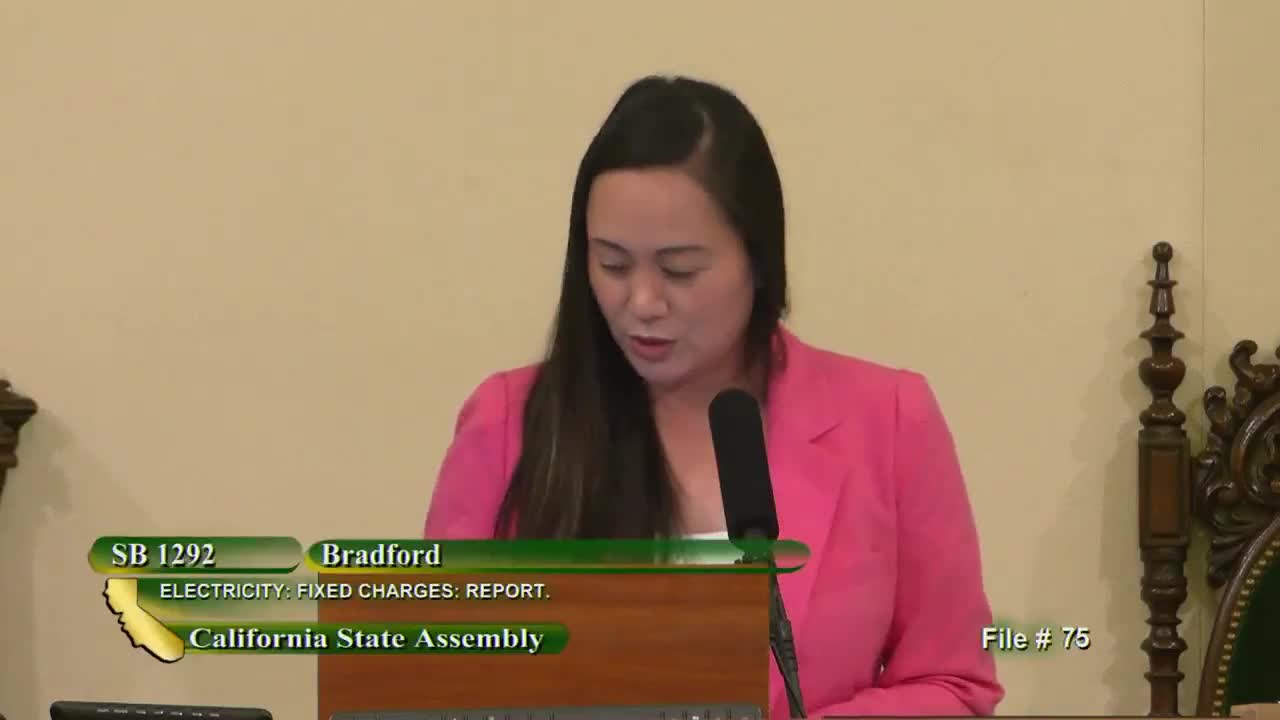 1MIN
Assembly Floor
 2MIN
Senate Floor
 2MIN
Senate Standing Committee on Energy, Utilities and Communications
46SEC
Senate Standing Committee on Energy, Utilities and Communications
Bill Author

Bill Co-Author(s):