SB 1294: Elections: recall of local officers.
- Session Year: 2023-2024
- House: Senate
- Latest Version Date: 2024-03-20
Current Status:
Failed
(2024-04-23: April 22 set for second hearing. Failed passage in committee. (Ayes 1. Noes 1. Page 3700.))
Introduced
In Committee
First Chamber
In Committee
Second Chamber
Enacted
Existing law provides for the recall of local officers. Existing law requires a recall petition to contain, among other things, a copy of the notice of intention that includes the names of at least 10 recall proponents that appear on the notice and that are selected by the proponents. Existing law requires the elections official to verify the signatures on the recall petition and, if the elections official finds the signatures to be sufficient, to submit a certificate as to the sufficiency of the petition to the governing body at its next regular meeting. Within 14 days after the meeting at which the governing body receives the certificate of sufficiency, existing law requires the governing body to issue an order stating that an election will be held to determine whether or not the officer named in the petition should be recalled.
This bill would authorize the proponents of a recall of a local officer to file with the elections official a notice withdrawing their petition at any time before the elections official submits the certificate of sufficiency to the governing body at its next regular meeting. The bill would require the elections official, upon receipt of the notice of withdrawal, to take no further action on the petition. The bill would provide that the withdrawal of a recall petition against a local officer does not bar the later filing of a new petition against that officer. The bill would define proponents, for its purposes, to mean the 10 recall proponents listed on the copy of the notice of intention that appears on the recall petition, as specified.
The California Constitution requires the state to reimburse local agencies and school districts for certain costs mandated by the state. Statutory provisions establish procedures for making that reimbursement.
This bill would provide that, if the Commission on State Mandates determines that the bill contains costs mandated by the state, reimbursement for those costs shall be made pursuant to the statutory provisions noted above.
Existing law provides for the recall of local officers. When the city or county elections official is the officer sought to be recalled, existing law requires the duties imposed upon that official to be performed by some other person designated by the governing board. This bill would make a technical, nonsubstantive change to this provision.Existing law provides for the recall of local officers. When the city or county elections official is the officer sought to be recalled, existing law requires the duties imposed upon that official to be performed by some other person designated by the governing board.
This bill would make a technical, nonsubstantive change to this provision.
(a)The proponents of a recall of a local officer may file with the elections official a notice withdrawing their petition at any time before the elections official submits the certificate of sufficiency to the governing body at its next regular meeting as specified in Section 11227.
(b)(1)Upon receipt of the proponents notice of withdrawal specified in subdivision (a), the elections official shall take no further action on the petition, whether or not the petition has already been found sufficient by the elections official.
(2)A recall petition that has been withdrawn by its proponents shall remain on file.
(c)The withdrawal of a recall petition against a local officer does not bar the later filing of a new petition against that officer.
(d)For purposes of this section, proponents means the 10 recall proponents listed on the copy of the notice of intention that appears on each page of each section of the recall petition as provided in paragraph (2) of subdivision (a) of Section 11041.
SEC. 2.If the Commission on State Mandates determines that this act contains costs mandated by the state, reimbursement to local agencies and school districts for those costs shall be made pursuant to Part 7 (commencing with Section 17500) of Division 4 of Title 2 of the Government Code.
SECTION 1.Section 11201 of the Elections Code is amended to read:11201.When the city or county elections official is the officer sought to be recalled, the duties imposed upon that official shall be performed by some other person designated by the governing board.When the city or county elections official is the officer sought to be recalled, the duties imposed upon him or her that official shall be performed by some other person designated by the governing board.
|
Date
|
Status
|
|---|---|
| Apr 23, 2024 | April 22 set for second hearing. Failed passage in committee. (Ayes 1. Noes 1. Page 3700.) |
| Apr 17, 2024 | Set for hearing April 22. |
| Apr 16, 2024 | April 16 set for first hearing canceled at the request of author. |
| Apr 5, 2024 | Set for hearing April 16. |
| Apr 3, 2024 | Re-referred to Com. on E. & C.A. |
| Mar 20, 2024 | From committee with author's amendments. Read second time and amended. Re-referred to Com. on RLS. |
| Feb 29, 2024 | Referred to Com. on RLS. |
| Feb 16, 2024 | From printer. May be acted upon on or after March 17. |
| Feb 15, 2024 | Introduced. Read first time. To Com. on RLS. for assignment. To print. |
|
Date
|
Description
|
Location
|
Votes
|
|
|---|---|---|---|---|
| Apr 22, 2024 | Do pass, but first be re-referred to the Committee on [Appropriations] | Senate Standing Committee on Elections and Constitutional Amendments |
Failed |
This list shows positions taken on this bill by organizations on the date displayed, which is linked to the original source.
Positions by individuals are not included.
SENATE COMMITTEE ON
ELECTIONS AND CONSTITUTIONAL AMENDMENTS
Senator Catherine Blakespear, Chair
2023 - 2024 Regular
Bill No: 1294 Hearing Date: 4/22/24
Author: | Ochoa Bogh | ||
Version: |
| ||
Urgency: | Fiscal: | ||
Consultant: | |||
Subject:
DIGEST
This bill permits the proponents of a recall of a local officer to file with the elections official a notice withdrawing their petition at any time before the elections official submits the certificate of sufficiency to the governing body, as specified.
ANALYSIS
Existing law:
- States, pursuant to the California Constitution, that the recall is the power of the voters to remove an elective officer, and specifies that the in the case of a recall of a state officer, the sufficiency of the reason for recalling the official is not reviewable by a court.
- Requires, pursuant to the California Constitution, that the Legislature provide for the recall of local officers. Provides that this provision does not affect counties and cities whose charters provide for recall.
- Authorizes recall proceedings to commence for the recall of any elective officer by the service, filing, and publication of a notice of intention to circulate a recall petition.
- Requires the proponents of a recall to be registered voters of the electoral jurisdiction of the officer they seek to recall.
- Requires a county elections official, in the case of a petition for the recall of a local officer, to make a copy of the petition available for public examination in the elections official’s office for 10 days, and requires the public examination to run concurrently with the 10-day review period for the elections official to determine whether the form and wording of the petition are in accordance with existing law.
- Permits a voter of the applicable electoral jurisdiction or the elections official, during the public examination period described above, to seek a writ of mandate or an injunction requiring any or all of the statement of the proponents or the answer of the officer included with the petition to be amended or deleted. Requires the writ of mandate or injunction request to be filed no later than the end of the 10-day public examination period.
- Requires a recall election, in the case of a recall of a local officer, to be held not less than 88, nor more than 125, days after the issuance of an order that the recall election be held. Requires the recall election to be held on the same day as, and consolidated with, any regular or special election held throughout the electoral jurisdiction of the officer sought to be recalled, as specified. Permits a recall election to be conducted within 180 days after the issuance of the order so that the election may be consolidated with a regularly scheduled election.
This bill:
- Permits the proponents of a recall of a local officer to file with the elections official a notice withdrawing their petition at any time before the elections official submits the certificate of sufficiency to the governing body, as specified.
- Provides, upon receipt of the proponents’ notice of withdrawal, the elections official shall take no further action on the petition, whether or not the petition has already been found sufficient by the elections official. Requires a recall petition that has been withdrawn by its proponents to remain on file.
- Provides that the withdrawal of a recall petition against a local officer does not bar the later filing of a new petition against that officer.
- Defines, for purposes of this bill, “proponents” to mean the 10 recall proponents listed on the copy of the notice of intention that appears on each page of each section of the recall petition, as specified.
BACKGROUND
Informational Recall Hearings. In 2021 and 2022, this committee and the Assembly Committee on Elections held a series of joint informational hearings to review California’s recall process following gubernatorial recall election in September of 2021.
At the first hearing, on October 28, 2021, the committees heard from current and former elected officials, elections experts, and academics about their perspectives on the state’s recall process and different reform proposals, including increasing the number of signatures for qualifying a statewide recall and changing the method for selecting the successor to a recalled official.
At the second hearing, on December 6, 2021, the committees heard from two panels of expert witnesses. The first panel of academics examined a limitation, used in several states, which only allows recalls to be initiated against an official for certain enumerated causes. The second panel of experts and local elected officials discussed the use of the recall at the local level, along with potential options for reform.
One of the major takeaways from the committee’s first two hearings was that many of the recall reform proposals would require voter approval in order to take effect. In particular, proposals to make significant structural changes to the recall process at the state level generally require an amendment to the California Constitution. By contrast, changes to the process for recalling local elected officials and certain procedural changes to the state process can be made through statutory changes alone.
At the third and final recall informational hearing, on February 1, 2022, the committees heard from the Secretary of State who shared recommendations for improvements on the state recall process based on her consultation with outside experts and stakeholders. The third hearing generally reinforced the importance of continuing to evaluate California’s recall processes and that California voters generally support reform of the recall process, but are against any changes to the recall procedure or process that diminish or decrease the voter’s power to recall an elected official.
Yucaipa. In May of 2023, recall proponents in Yucaipa, California, submitted a recall petition that was approved by the City Clerk. Concurrently, the City Clerk filed a writ of mandate challenging the information contained in the proponent’s statement. The ruling on the writ of mandate went beyond the amount of time allocated to gather signatures, which meant the proponents were unable to move forward with the petition. While the proponents were allowed to remove their names from the petition, they could not withdraw the petition.
The delay in the ruling on the writ of mandate caused a delay in timing and deadlines with regard to signature gathering and the proponents were unable to move forward nor could they withdraw the petition.
Number of Recalls. Since the addition of recall provisions in the California Constitution in 1911, there have only been 11 recall elections against a state official. Of those, six were successful. The most recent statewide recall election was the effort in 2021 to recall Governor Newsom. In that election, voters chose to not recall the Governor.
The recall is more commonly used at the local level. According to data from the California Election Data Archive (CEDA), a joint project of the Center for California Studies at the California State University, Sacramento, and the Secretary of State’s office, there were 368 local recall elections for county, city, or school district officials in California between 1995 and 2022, or an average of approximately 13 per year. Although CEDA does not maintain comprehensive information about the number of local recall attempts, most local efforts to qualify a recall election fail. It should be noted that for county, city, and school districts, recall efforts that do qualify for the ballot are generally successful. According to the CEDA data, from 2020 through 2022, there were 23 recall elections with 16 elections resulting in the recall of the local official. This equates to approximately 70% of recall elections.
COMMENTS
- According to the author: Senate Bill 1294 would codify the ability of the recall proponents to file a notice of withdrawal informing the local elections official that no further action on the recall petition is needed. The notice of withdrawal can be submitted at any time before the elections official submits the certificate of sufficiency to the governing body at its next regular meeting.
Once the notice of withdrawal is received by the elections official, action on the recall petition would end. However, this would not preclude the recall proponents from filing a new notice of intention at a later date.
The recall is a popular tool of electoral accountability that has been used by California’s voters for more than a century. While it is important to safeguard that right, it is also important to ensure that if a writ of mandate is filed and there is not a ruling from the court in a timely manner that the proponents be allowed to withdraw their petition.
- Withdrawal as a Political Maneuver. Currently, if a recall petition fails to meet certain deadlines or does not comply with statute, then the entire recall effort starts over. SB 1294 provides a way for proponents to withdrawal their recall petition at any time before the petition is certified by the affected governing body. Typically, an undesirable action by an elected official leads to a recall effort. This could lead to a group of voters using a recall petition against an elected official to get a desired outcome on a matter important to the proponents.
RELATED/PRIOR LEGISLATION
SB 1293 (Ochoa Bogh) of 2023 requires the published copy of the notice of intention to omit recall proponents’ signatures and residence addresses, as specified. SB 1293 passed this committee with a vote of 7 – 0 and is pending consideration in the Committee on Judiciary.
AB 2584 (Berman), Chapter 791, Statutes of 2022, among other provisions related to recall, permitted a voter of the applicable electoral jurisdiction or the elections official to seek a writ of mandate or an injunction requiring any or all of the statement of the proponents or the answer of the officer included with the petition to be amended or deleted. AB 2584 also required that the writ of mandate or injunction request be filed no later than the end of the 10-day public examination period and only be issued upon clear and convincing proof that the material in question is false, misleading, or inconsistent, as specified.
POSITIONS
Sponsor: Author
Support: None received
Oppose: None received
-- END --
SENATE COMMITTEE ON
ELECTIONS AND CONSTITUTIONAL AMENDMENTS
Senator Catherine Blakespear, Chair
2023 - 2024 Regular
Bill No: 1294 Hearing Date: 4/16/24
Author: | Ochoa Bogh | ||
Version: |
| ||
Urgency: | Fiscal: | ||
Consultant: | |||
Subject:
DIGEST
This bill permits the proponents of a recall of a local officer to file with the elections official a notice withdrawing their petition at any time before the elections official submits the certificate of sufficiency to the governing body, as specified.
ANALYSIS
Existing law:
- States, pursuant to the California Constitution, that the recall is the power of the voters to remove an elective officer, and specifies that the in the case of a recall of a state officer, the sufficiency of the reason for recalling the official is not reviewable by a court.
- Requires, pursuant to the California Constitution, that the Legislature provide for the recall of local officers. Provides that this provision does not affect counties and cities whose charters provide for recall.
- Authorizes recall proceedings to commence for the recall of any elective officer by the service, filing, and publication of a notice of intention to circulate a recall petition.
- Requires the proponents of a recall to be registered voters of the electoral jurisdiction of the officer they seek to recall.
- Requires a county elections official, in the case of a petition for the recall of a local officer, to make a copy of the petition available for public examination in the elections official’s office for 10 days, and requires the public examination to run concurrently with the 10-day review period for the elections official to determine whether the form and wording of the petition are in accordance with existing law.
- Permits a voter of the applicable electoral jurisdiction or the elections official, during the public examination period described above, to seek a writ of mandate or an injunction requiring any or all of the statement of the proponents or the answer of the officer included with the petition to be amended or deleted. Requires the writ of mandate or injunction request to be filed no later than the end of the 10-day public examination period.
- Requires a recall election, in the case of a recall of a local officer, to be held not less than 88, nor more than 125, days after the issuance of an order that the recall election be held. Requires the recall election to be held on the same day as, and consolidated with, any regular or special election held throughout the electoral jurisdiction of the officer sought to be recalled, as specified. Permits a recall election to be conducted within 180 days after the issuance of the order so that the election may be consolidated with a regularly scheduled election.
This bill:
- Permits the proponents of a recall of a local officer to file with the elections official a notice withdrawing their petition at any time before the elections official submits the certificate of sufficiency to the governing body, as specified.
- Provides, upon receipt of the proponents’ notice of withdrawal, the elections official shall take no further action on the petition, whether or not the petition has already been found sufficient by the elections official. Requires a recall petition that has been withdrawn by its proponents to remain on file.
- Provides that the withdrawal of a recall petition against a local officer does not bar the later filing of a new petition against that officer.
- Defines, for purposes of this bill, “proponents” to mean the 10 recall proponents listed on the copy of the notice of intention that appears on each page of each section of the recall petition, as specified.
BACKGROUND
Informational Recall Hearings. In 2021 and 2022, this committee and the Assembly Elections Committee held a series of joint informational hearings to review California’s recall process following gubernatorial recall election in September of 2021.
At the first hearing, on October 28, 2021, the committees heard from current and former elected officials, elections experts, and academics about their perspectives on the state’s recall process and different reform proposals, including increasing the number of signatures for qualifying a statewide recall and changing the method for selecting the successor to a recalled official.
At the second hearing, on December 6, 2021, the committees heard from two panels of expert witnesses. The first panel of academics examined a limitation, used in several states, which only allows recalls to be initiated against an official for certain enumerated causes. The second panel of experts and local elected officials discussed the use of the recall at the local level, along with potential options for reform.
One of the major takeaways from the committee’s first two hearings was that many of the recall reform proposals would require voter approval in order to take effect. In particular, proposals to make significant structural changes to the recall process at the state level generally require an amendment to the California Constitution. By contrast, changes to the process for recalling local elected officials and certain procedural changes to the state process can be made through statutory changes alone.
At the third and final recall informational hearing, on February 1, 2022, the committees heard from the Secretary of State who shared recommendations for improvements on the state recall process based on her consultation with outside experts and stakeholders. The third hearing generally reinforced the importance of continuing to evaluate California’s recall processes and that California voters generally support reform of the recall process, but are against any changes to the recall procedure or process that diminish or decrease the voter’s power to recall an elected official.
Yucaipa. In May of 2023, recall proponents in Yucaipa, California, submitted a recall petition that was approved by the City Clerk. Concurrently, the City Clerk filed a writ of mandate challenging the information contained in the proponent’s statement. The ruling on the writ of mandate went beyond the amount of time allocated to gather signatures, which meant the proponents were unable to move forward with the petition. While the proponents were allowed to remove their names from the petition, they could not withdraw the petition.
The delay in the ruling on the writ of mandate caused a delay in timing and deadlines with regard to signature gathering and the proponents were unable to move forward nor could they withdraw the petition.
Number of Recalls. Since the addition of recall provisions in the California Constitution in 1911, there have only been 11 recall elections against a state official. Of those, six were successful. The most recent statewide recall election was the effort in 2021 to recall Governor Newsom. In that election, voters chose to not recall the Governor.
The recall is more commonly used at the local level. According to data from the California Election Data Archive (CEDA), a joint project of the Center for California Studies at the California State University, Sacramento, and the Secretary of State’s office, there were 368 local recall elections for county, city, or school district officials in California between 1995 and 2022, or an average of approximately 13 per year. Although CEDA does not maintain comprehensive information about the number of local recall attempts, most local efforts to qualify a recall election fail. It should be noted that for county, city, and school districts, recall efforts that do qualify for the ballot are generally successful. According to the CEDA data, from 2020 through 2022, there were 23 recall elections with 16 elections resulting in the recall of the local official. This equates to approximately 70% of recall elections.
COMMENTS
- According to the author: Senate Bill 1294 would codify the ability of the recall proponents to file a notice of withdrawal informing the local elections official that no further action on the recall petition is needed. The notice of withdrawal can be submitted at any time before the elections official submits the certificate of sufficiency to the governing body at its next regular meeting.
Once the notice of withdrawal is received by the elections official, action on the recall petition would end. However, this would not preclude the recall proponents from filing a new notice of intention at a later date.
The recall is a popular tool of electoral accountability that has been used by California’s voters for more than a century. While it is important to safeguard that right, it is also important to ensure that if a writ of mandate is filed and there is not a ruling from the court in a timely manner that the proponents be allowed to withdraw their petition.
- Withdrawal as a Political Maneuver. Currently, if a recall petition fails to meet certain deadlines or does not comply with statute, then the entire recall effort starts over. SB 1294 provides a way for proponents to withdrawal their recall petition at any time before the petition is certified by the affected governing body. Typically, an undesirable action by an elected official leads to a recall effort. This could lead to a group of voters using a recall petition against an elected official to get a desired outcome on a matter important to the proponents.
RELATED/PRIOR LEGISLATION
SB 1293 (Ochoa Bogh) of 2023 requires the published copy of the notice of intention to omit recall proponents’ signatures and residence addresses, as specified. SB 1293 passed this committee with a vote of 7 – 0 and is pending consideration in the Committee on Judiciary.
AB 2584 (Berman), Chapter 791, Statutes of 2022, among other provisions related to recall, permitted a voter of the applicable electoral jurisdiction or the elections official to seek a writ of mandate or an injunction requiring any or all of the statement of the proponents or the answer of the officer included with the petition to be amended or deleted. AB 2584 also required that the writ of mandate or injunction request be filed no later than the end of the 10-day public examination period and only be issued upon clear and convincing proof that the material in question is false, misleading, or inconsistent, as specified.
POSITIONS
Sponsor: Author
Support: None received
Oppose: None received
-- END --
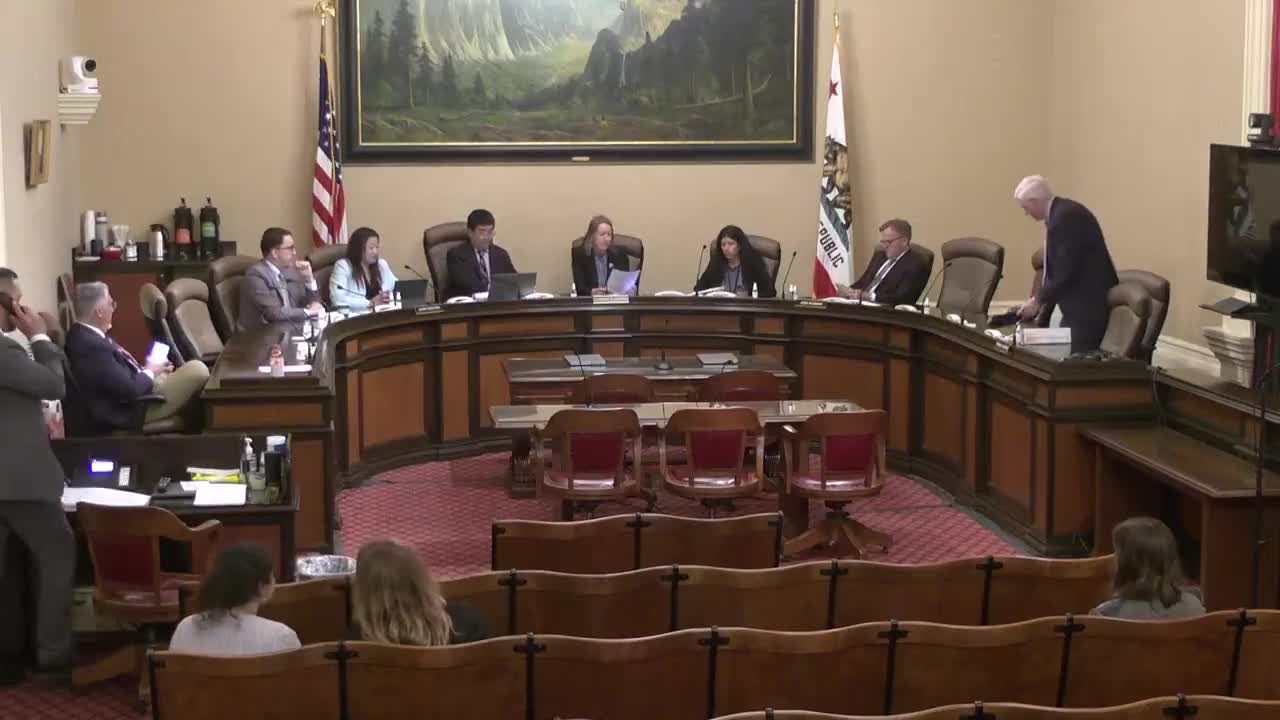
Discussed in Hearing
 16MIN
Senate Standing Committee on Elections and Constitutional Amendments
51SEC
Senate Standing Committee on Elections and Constitutional Amendments
Bill Author

Bill Co-Author(s):