SB 1306: Recycling: precious metals and critical minerals: report.
- Session Year: 2023-2024
- House: Senate
- Latest Version Date: 2024-05-06
Current Status:
Failed
(2024-05-16: May 16 hearing: Held in committee and under submission.)
Introduced
In Committee
First Chamber
In Committee
Second Chamber
Enacted
What does this bill do?
The bill requires the California Department of Resources Recycling and Recovery (CalRecycle) to prepare a report for the Legislature on collecting, recycling, reusing, and stockpiling precious metals and critical minerals (as listed by the U.S. Geological Survey) found in products sold in California. The report must describe current and emerging extraction technologies, benefits to California, existing in‑state processing, potential revenue from stockpiles, barriers to building a domestic recycling supply chain, and policy recommendations, and CalRecycle must seek public and stakeholder input.
The summary is provided by generative AI which can make mistakes. For original language, please view the details in the table below.
Existing law establishes in the California Environmental Protection Agency the Department of Resources Recycling and Recovery, which administers various solid waste management and recycling programs.
This bill would require the office, in consultation with the Department of Resources Recycling and Recovery and the Department of Toxic Substances Control, Department of Resources Recycling and Recovery to draft and submit a report to the Legislature on or before January 1, 2027, relating to the in-state collection, recycling, reuse, and stockpiling for domestic consumption of precious metals, critical minerals, as defined, and other similar valuable materials as reasonably decided by the office, department, contained within products in the state, as specified. The bill would require the office department to provide opportunities for public input and to perform outreach to potentially interested parties, as specified.
Existing law establishes the Governors Office of Business and Economic Development to serve the Governor as the lead entity for economic strategy and the marketing of California on issues relating to business development, private sector investment, and economic growth.
This bill would require the office, in consultation with the Department of Resources Recycling and Recovery and the Department of Toxic Substances Control, to draft and submit a report to the Legislature relating to the in-state collection, recycling, reuse, and stockpiling for domestic consumption of rare earth elements precious metals, critical minerals, as defined, and other similar valuable materials as reasonably decided by the office, contained within products in the state, as specified. The bill would require the office to provide opportunities for public input and to perform outreach to potentially interested parties, as specified.
Existing law establishes the Governors Office of Business and Economic Development to serve the Governor as the lead entity for economic strategy and the marketing of California on issues relating to business development, private sector investment, and economic growth.
This bill would require the office, in consultation with the Department of Resources Recycling and Recovery and the Department of Toxic Substances Control, to draft and submit a report to the Legislature relating to the in-state collection, recycling, reuse, and stockpiling for domestic consumption of rare earth elements contained within products in the state, as specified. The bill would require the office to provide opportunities for public input and to perform outreach to potentially interested parties, as specified.
Existing law authorizes the State Department of State Hospitals, the State Department of Health Care Services, and other departments as necessary to perform various tasks relating to mental health services, including, among others, disseminating educational information relating to the prevention, diagnosis, and treatment of mental illness and, upon request, advising all public officers, organizations, and agencies interested in the mental health of the people of the state.This bill would make technical, nonsubstantive changes to these provisions.Existing law authorizes the State Department of State Hospitals, the State Department of Health Care Services, and other departments as necessary to perform various tasks relating to mental health services, including, among others, disseminating educational information relating to the prevention, diagnosis, and treatment of mental illness and, upon request, advising all public officers, organizations, and agencies interested in the mental health of the people of the state.
This bill would make technical, nonsubstantive changes to these provisions.
The Legislature finds and declares all of the following:
(a)As a result of prior legislation, including Senate Bill 20 of the 200304 Regular Session (Sher), which enacted the Electronic Waste Recycling Act of 2003 (Chapter 526 of the Statutes of 2003), Assembly Bill 2440 of the 202122 Regular Session (Irwin), which enacted the Responsible Battery Recycling Act of 2022 (Chapter 351 of the Statutes of 2022), and Senate Bill 1215 of the 202122 Regular Session (Newman), which expanded the Electronic Waste Recycling Act of 2003 to include battery-embedded products (Chapter 370 of the Statutes of 2022), hundreds of thousands of cell phones, LED lights, fluorescent lights, computers, printers, televisions, batteries, battery-embedded products, and other forms of electronic waste are now being collected from California consumers and diverted from landfills.
(b)Many of these electronic waste items and other waste items contain critical materials, including rare earth elements (REEs). REEs are necessary for many green technologies, including electric vehicles, solar panels, and wind turbines. These green technologies are essential to meeting Californias climate goals and are essential to the world in helping to mitigate climate change.
(c)Currently, REEs are mined. According to the United States Geologic Geological Survey, about 70 percent of REEs come from China.
(d)The mining of REEs is energy intensive, relies on fossil fuels for extraction and shipping, and can be environmentally destructive to the communities where they are mined.
(e)Further, there is not enough inground supply of many REEs to meet demand. Researchers estimate that, Among the leading global REE consumersChina, the European Union and the United StatesChina is projected to be the only nation capable of fulfilling its domestic demand.... (P. Wang, et al., Regional Rare-Earth Element Supply and Demand Balanced with Circular Economy Strategies (Jan. 4, 2024) 17 Nature Geoscience 94102.)
(f)However, current research also reveals that recycling and reusing REEs from old cell phones, hard drives, electric motors, and turbines could meet as much as 40 percent of the demand for REEs in the United States, China, and Europe by 2050, and that the United States, the European Union, and Japan could eventually accumulate REE stockpiles in their old electronics and other products that far exceed what they would find mining the earth.
(g)Although California collects and recycles products containing REEs, collectors here do not extract this valuable material. Instead, components containing REEs are shipped to other countries, including Korea and Japan, for foreign entities to extract and reuse REEs in new products.
(h)Because REEs are combined with other materials in products, extracting REEs has historically been a highly toxic process. However, there are scientific breakthroughs being made to use nontoxic techniques so that REEs can be retained as part of a green, circular economy.
SEC. 2.Article 6.1 (commencing with Section 12098.30) is added to Chapter 1.6 of Part 2 of Division 3 of Title 2 of the Government Code, to read:6.1.Critical Materials in the State12098.30.(a)On or before January 1, 2027, the office, in consultation with the Department of Resources Recycling and Recovery and the Department of Toxic Substances Control, shall draft and submit a report to the Legislature relating to the instate collection, recycling, reuse, and stockpiling for domestic consumption of precious metals, critical minerals, as defined by the 2022 list of critical minerals released by the United States Geological Survey, and other similar valuable materials as reasonably decided by the office, contained within products in the state.(b)The office shall provide opportunities for public input and shall perform outreach to potentially interested parties, including, but not limited to, researchers, academics, scientists, the business community, manufacturers, and environmental organizations.(c)The report shall discuss all of the following:(1)The existing technologies and those under development to extract these precious metals, critical minerals, and other similar valuable materials from products.(2)The benefits to California from recycling these materials in products sold and used in the state to facilitate the transition away from fossil fuels.(3)The existence of current instate processes to extract and separate these materials, whether that extraction is being used on recycled consumer goods or in mining operations.(4)The potential for revenue to the state in extracting and creating a stockpile of these materials for domestic manufacturing of green technology.(5)The current barriers that need to be addressed to incentivize and create within California the ability to recycle and reuse these materials.(6)Policy recommendations to further Californias ability to recycle and reuse these materials in products in California.(d)(1) A report to be submitted pursuant to this section shall be submitted in compliance with Section 9795 of the Government Code.(2)Pursuant to Section 10231.5 of the Government Code, this article is repealed on January 1, 2031.SEC. 2.Division 31.5 (commencing with Section 55000) is added to the Public Resources Code, to read:31.5.Critical Materials in the State: Recycling55000.(a)On or before January 1, 2027, the department shall draft and submit a report to the Legislature relating to the in-state collection, recycling, reuse, and stockpiling for domestic consumption of precious metals, critical minerals, as defined by the 2022 list of critical minerals released by the United States Geological Survey, and other similar valuable materials as reasonably decided by the department, contained within products in the state. The department may perform this duty as part of its current duties, using current funding, to the extent feasible. The department may, but is not required to, consult with the Governors Office of Business and Economic Development or the Department of Toxic Substances Control to the extent that those agencies have relevant or useful information.
(b)The department shall provide opportunities for public input and shall perform outreach to potentially interested parties, including, but not limited to, researchers, academics, scientists, the business community, manufacturers, and environmental organizations.
(c)The report shall discuss all of the following:
(1)The existing technologies and those under development to extract these precious metals, critical minerals, and other similar valuable materials from products.
(2)The benefits to California from recycling these materials in products sold and used in the state to facilitate the transition away from fossil fuels.
(3)The existence of current in-state processes to extract and separate these materials, whether that extraction is being used on recycled consumer goods or in mining operations.
(4)The potential for revenue to the state in extracting and creating a stockpile of these materials for domestic manufacturing of green technology.
(5)The current barriers that need to be addressed to incentivize and create within California the ability to recycle and reuse these materials.
(6)Policy recommendations to further Californias ability to recycle and reuse these materials in products in California.
(d)(1)A report to be submitted pursuant to this section shall be submitted in compliance with Section 9795 of the Government Code.
(2)Pursuant to Section 10231.5 of the Government Code, this division is repealed on January 1, 2031.
The Legislature finds and declares all of the following:
(a)As a result of prior legislation, including Senate Bill 20 of the 200304 Regular Session (Sher), which enacted the Electronic Waste Recycling Act of 2003 (Chapter 526 of the Statutes of 2003), Assembly Bill 2440 of the 202122 Regular Session (Irwin), which enacted the Responsible Battery Recycling Act of 2022 (Chapter 351 of the Statutes of 2022), and Senate Bill 1215 of the 202122 Regular Session (Newman), which expanded the Electronic Waste Recycling Act of 2003 to include battery-embedded products (Chapter 370 of the Statutes of 2022), hundreds of thousands of cell phones, LED lights, fluorescent lights, computers, printers, televisions, batteries, battery-embedded products, and other forms of electronic waste are now being collected from California consumers and diverted from landfills.
(b)Many of these electronic waste items and other waste items contain critical materials, including rare earth elements (REEs). REEs are necessary for many green technologies, including electric vehicles, solar panels, and wind turbines. These green technologies are essential to meeting Californias climate goals and are essential to the world in helping to mitigate climate change.
(c)Currently, REEs are mined. According to the United States Geologic Survey, about 70 percent of REEs come from China.
(d)The mining of REEs is energy intensive, relies of on fossil fuels for extraction and shipping, and can be environmentally destructive to the communities where they are mined.
(e)Further, there is not enough inground supply of many REEs to meet demand. Researchers estimate that, Among the leading global REE consumersChina, the European Union and the United StatesChina is projected to be the only nation capable of fulfilling its domestic demand.... (P. Wang, et al., Regional Rare-Earth Element Supply and Demand Balanced with Circular Economy Strategies (Jan. 4, 2024) 17 Nature Geoscience 94102.)
(f)However, current research also reveals that recycling and reusing REEs from old cell phones, hard drives, electric motors, and turbines could meet as much as 40 percent of the demand for REEs in the United States, China, and Europe by 2050, and that the United States, the European Union, and Japan could eventually accumulate REE stockpiles in their old electronics and other products that far exceed what they would find mining the earth.
(g)Although California collects and recycles products containing REEs, collectors here do not extract this valuable material. Instead, components containing REEs are shipped to other countries, including Korea and Japan, for foreign entities to extract and reuse REEs in new products.
(h)Because REEs are combined with other materials in products, extracting REEs has historically been a highly toxic process. However, there are scientific breakthroughs being made to use nontoxic techniques so that REEs can be retained as part of a green, circular economy.
SEC. 2.Article 6.1 (commencing with Section 12098.30) is added to Chapter 1.6 of Part 2 of Division 3 of Title 2 of the Government Code, to read:6.1.Rare Earth Elements Critical Materials in the State12098.30.(a)On or before January 1, 2027, the office, in consultation with the Department of Resources Recycling and Recovery and the Department of Toxic Substances Control, shall draft and submit a report to the Legislature relating to the instate collection, recycling, reuse, and stockpiling for domestic consumption of rare earth elements precious metals, critical minerals, as defined by the 2022 list of critical minerals released by the United States Geological Survey, and other similar valuable materials as reasonably decided by the office, contained within products in the state.
(b)The office shall provide opportunities for public input and shall perform outreach to potentially interested parties, including, but not limited to, researchers, academics, scientists, the business community, manufacturers, and environmental organizations.
(c)The report shall discuss all of the following:
(1)The existing technologies and those under development to extract rare earth elements and other precious metals these precious metals, critical minerals, and other similar valuable materials from products.
(2)The benefits to California from recycling rare earth elements and other precious metals these materials in products sold and used in the state to facilitate the transition away from fossil fuels.
(3)The existence of current instate processes to extract and separate rare earth elements, these materials, whether that extraction is being used on recycled consumer goods or in mining operations.
(4)The potential for revenue to the state in extracting and creating a stockpile of recycled rare earth elements these materials for domestic manufacturing of green technology.
(5)The current barriers that need to be addressed to incentivize and create within California the ability to recycle and reuse rare earth elements. these materials.
(6)Policy recommendations to further Californias ability to recycle and reuse rare earth elements and other precious metals these materials in products in California.
(d)(1) A report to be submitted pursuant to this section shall be submitted in compliance with Section 9795 of the Government Code.
(2)Pursuant to Section 10231.5 of the Government Code, this article is repealed on January 1, 2031.
The Legislature finds and declares all of the following:
(a)As a result of prior legislation, including Senate Bill 20 of the 200304 Regular Session (Sher), which enacted the Electronic Waste Recycling Act of 2003 (Chapter 526 of the Statutes of 2003), Assembly Bill 2440 of the 202122 Regular Session (Irwin), which enacted the Responsible Battery Recycling Act of 2022 (Chapter 351 of the Statutes of 2022), and Senate Bill 1215 of the 202122 Regular Session (Newman), which expanded the Electronic Waste Recycling Act of 2003 to include battery-embedded products (Chapter 370 of the Statutes of 2022), hundreds of thousands of cell phones, LED lights, fluorescent lights, computers, printers, televisions, batteries, battery-embedded products, and other forms of electronic waste are now being collected from California consumers and diverted from landfills.
(b)Many of these electronic waste items and other waste items contain rare earth elements (REEs). REEs are necessary for many green technologies, including electric vehicles, solar panels, and wind turbines. These green technologies are essential to meeting Californias climate goals and are essential to the world in helping to mitigate climate change.
(c)Currently, REEs are mined. According to the United States Geologic Survey, about 70 percent of REEs come from China.
(d)The mining of REEs is energy intensive, relies of fossil fuels for extraction and shipping, and can be environmentally destructive to the communities where they are mined.
(e)Further, there is not enough inground supply of many REEs to meet demand. Researchers estimate that, Among the leading global REE consumersChina, the European Union and the United StatesChina is projected to be the only nation capable of fulfilling its domestic demand.... (P. Wang, et al., Regional Rare-Earth Element Supply and Demand Balanced with Circular Economy Strategies (Jan. 4, 2024) 17 Nature Geoscience 94102.)
(f)However, current research also reveals that recycling and reusing REEs from old cell phones, hard drives, electric motors, and turbines could meet as much as 40 percent of the demand for REEs in the United States, China, and Europe by 2050, and that the United States, the European Union, and Japan could eventually accumulate REE stockpiles in their old electronics and other products that far exceed what they would find mining the earth.
(g)Although California collects and recycles products containing REEs, collectors here do not extract this valuable material. Instead, components containing REEs are shipped to other countries, including Korea and Japan, for foreign entities to extract and reuse REEs in new products.
(h)Because REEs are combined with other materials in products, extracting REEs has historically been a highly toxic process. However, there are scientific breakthroughs being made to use nontoxic techniques so that REEs can be retained as part of a green, circular economy.
SEC. 2.Article 6.1 (commencing with Section 12098.30) is added to Chapter 1.6 of Part 2 of Division 3 of Title 2 of the Government Code, to read:6.1.Rare Earth Elements in the State12098.30.(a)On or before January 1, 2027, the office, in consultation with the Department of Resources Recycling and Recovery and the Department of Toxic Substances Control, shall draft and submit a report to the Legislature relating to the instate collection, recycling, reuse, and stockpiling for domestic consumption of rare earth elements contained within products in the state.
(b)The office shall provide opportunities for public input and shall perform outreach to potentially interested parties, including, but not limited to, researchers, academics, scientists, the business community, manufacturers, and environmental organizations.
(c)The report shall discuss all of the following:
(1)The existing technologies and those under development to extract rare earth elements and other precious metals from products.
(2)The benefits to California from recycling rare earth elements and other precious metals in products sold and used in the state to facilitate the transition away from fossil fuels.
(3)The existence of current instate processes to extract and separate rare earth elements, whether that extraction is being used on recycled consumer goods or in mining operations.
(4)The potential for revenue to the state in extracting and creating a stockpile of recycled rare earth elements for domestic manufacturing of green technology.
(5)The current barriers that need to be addressed to incentivize and create within California the ability to recycle and reuse rare earth elements.
(6)Policy recommendations to further Californias ability to recycle and reuse rare earth elements and other precious metals in products in California.
(d)(1) A report to be submitted pursuant to this section shall be submitted in compliance with Section 9795 of the Government Code.
(2)Pursuant to Section 10231.5 of the Government Code, this article is repealed on January 1, 2031.
SECTION 1.Section 4012 of the Welfare and Institutions Code is amended to read:4012.The State Department of State Hospitals, the State Department of Health Care Services, and other departments as necessary, may do all of the following:(a)Disseminate educational information relating to the prevention, diagnosis, and treatment of mental illness.(b)Upon request, advise all public officers, organizations, and agencies interested in the mental health of the people of the state.(c)Conduct educational and related work to encourage the development of proper mental health facilities throughout the state.(d)Coordinate state activities that involve other departments whose actions affect individuals with mental illness.(e)Coordinate with, and provide information to, other states and national organizations on issues involving mental health.(f)Disseminate information and federal and private foundation funding opportunities to counties and cities that administer mental health programs.The State Department of State Hospitals, the State Department of Health Care Services, and other departments as necessary, may: may do all of the following:
(a)Disseminate educational information relating to the prevention, diagnosis diagnosis, and treatment of mental illness.
(b)Upon request, advise all public officers, organizations organizations, and agencies interested in the mental health of the people of the state.
(c)Conduct such educational and related work as will tend to encourage the development of proper mental health facilities throughout the state.
(d)Coordinate state activities involving that involve other departments whose actions affect mentally ill persons. individuals with mental illness.
(e)Coordinate with, and provide information to, other states and national organizations, on organizations on issues involving mental health.
(f)Disseminate information and federal and private foundation funding opportunities to counties and cities that administer mental health programs.
|
Date
|
Status
|
|---|---|
| May 16, 2024 | May 16 hearing: Held in committee and under submission. |
| May 14, 2024 | Set for hearing May 16. |
| May 13, 2024 | May 13 hearing: Placed on APPR suspense file. |
| May 6, 2024 | From committee with author's amendments. Read second time and amended. Re-referred to Com. on APPR. |
| May 3, 2024 | Set for hearing May 13. |
| Apr 29, 2024 | Read second time and amended. Re-referred to Com. on APPR. |
| Apr 25, 2024 | From committee: Do pass as amended and re-refer to Com. on APPR with recommendation: To consent calendar. (Ayes 7. Noes 0. Page 3754.) (April 24). |
| Apr 17, 2024 | Set for hearing April 24. |
| Apr 16, 2024 | From committee: Do pass and re-refer to Com. on E.Q. (Ayes 12. Noes 0. Page 3605.) (April 15). Re-referred to Com. on E.Q. |
| Apr 5, 2024 | Set for hearing April 15. |
| Apr 3, 2024 | Re-referred to Coms. on B., P. & E. D. and E.Q. |
| Mar 18, 2024 | From committee with author's amendments. Read second time and amended. Re-referred to Com. on RLS. |
| Feb 29, 2024 | Referred to Com. on RLS. |
| Feb 16, 2024 | From printer. May be acted upon on or after March 17. |
| Feb 15, 2024 | Introduced. Read first time. To Com. on RLS. for assignment. To print. |
|
Date
|
Description
|
Location
|
Votes
|
|
|---|---|---|---|---|
| May 13, 2024 | Placed on suspense file | Senate Standing Committee on Appropriations |
Passed |
|
| Apr 24, 2024 | Do pass as amended, but first amend, and re-refer to the Committee on [Appropriations] with the recommendation: To Consent Calendar | Senate Standing Committee on Environmental Quality |
Passed |
|
| Apr 15, 2024 | Do pass, but first be re-referred to the Committee on [Environmental Quality] | Senate Standing Committee on Business, Professions and Economic Development |
Passed |
This list shows positions taken on this bill by organizations on the date displayed, which is linked to the original source.
Positions by individuals are not included.
|
Organization
|
Position
|
Date
|
|---|---|---|
| National Stewardship Action Council | * Support | Apr 15, 2024 |
SENATE COMMITTEE ON APPROPRIATIONS
Senator Anna Caballero, Chair
2023 - 2024 Regular Session
SB 1306 (Skinner) - Recycling: precious metals and critical minerals: report
Version: May 6, 2024 | Policy Vote: B., P. & E.D. 12 - 0, E.Q. 7 - 0 |
Urgency: No | Mandate: No |
Hearing Date: May 13, 2024 | Consultant: Robert Ingenito |
Bill Summary:
SB 1306 would require the Department of Resources, Recycling and Recovery (CalRecycle) to submit a report to the Legislature on or before January 1, 2027, relating to the in-state collection, recycling, reuse, and stockpiling for domestic consumption of precious metals, critical minerals, as defined, and other similar valuable materials as reasonably decided by the department, contained within products in the state, as specified.
Fiscal Impact:
CalRecycle would incur a one-time cost, likely in the hundreds of thousands of dollars, to prepare the required report (Integrated Waste Management Account).
Background:
Universal wastes are hazardous wastes that are widely produced by households and many different types of businesses. Universal wastes include televisions, computers, other electronic devices, batteries, fluorescent lamps, mercury thermostats, and other mercury containing equipment, among others.
Electronic waste (E-waste) refers to any unwanted electronic device and is classified as universal waste. E-waste frequently contains hazardous materials, predominantly lead and mercury, and is produced by households, businesses, governments, and industries. In 2022, over 60 million tons of e-waste was generated globally. In the US, it is estimated that 46 pounds of e-waste is generated per person per year, for a total of 7 million tons. Each year in California, hundreds of thousands of computers, monitors, copiers, fax machines, printers, televisions, and other electronic items become "obsolete" in the eyes of consumers. Rapid advances in technology and an expanding demand for new features accelerate the generation of e-waste. The result is a growing challenge for businesses, residents, and local governments as they search for ways to reuse, recycle, or properly dispose of this equipment.
Rare earth elements (REEs) are a specific set of 17 elements on the periodic table: the fifteen lanthanides plus scandium and yttrium. REEs are found throughout the earth’s crust, but most often occur in low concentrations; they typically don’t exist in isolation, but in minerals in concentrations too small for economical extraction. However, REEs can be, and often are, mined. The U.S. used to be a major producer of REEs in the 1960s and 1970s, but China has rapidly increased its REE production and now dominates on the global scale.
In 2022, it was reported that e-waste worldwide contained 34 million tons of metals. According to a 2018 CalRecycle report entitled “Future of Electronic Waste Management in California,” from 2003-2018, approximately 2.2 billion pounds of covered video display devices were recycled. Currently, there are 19 in-state facilities for e-waste recyclers and 288 e-waste collectors.
Recycling e-waste could be a promising alternative to mining for recovering valuable materials. According to the DOE, only 17percent of e-waste was collected and recycled globally in 2019 (15 percent in the United States), the remainder was discarded, representing approximately $57 billion in raw material value. According to the United Nations Environmental Program, as much as 7 percent of the world’s gold may be currently contained in e-waste. The United States Environmental Protection Agency (U.S. EPA) reports that for every 1,000,000 discarded cell phones, there are 35,000 pounds of copper, 772 pounds of silver, 33 pounds of palladium, and 75 pounds of gold. E-waste worldwide contains over 8 billion pounds of critical raw materials.
Proposed Law:
This bill would require CalRecycle to draft and submit a report to the Legislature on or before January 1, 2027, relating to the in-state collection, recycling, reuse, and stockpiling for domestic consumption of precious metals, critical minerals, as defined, and other similar valuable materials as reasonably decided by the department, contained within products in the state, as specified. The bill would require CalRecycle to provide opportunities for public input and to perform outreach to potentially interested parties, as specified.
Related Legislation:
- AB 2440 (Irwin, Chapter 351, Statutes of 2022) established the Responsible Battery Recycling Act of 2022 to create a stewardship program for the collection and recycling of covered batteries as defined.
- SB 1215 (Newman, Chapter 370, Statutes of 2022) expands the definition of “covered electronic device” to include a “covered battery-embedded product”, or a new or refurbished product containing a battery that is not intended to be easily removed from the product by the consumer with no more than commonly used household tools, to be covered by the Electronic Waste Recycling Act.
- AB 2832 (Dahle, Chapter 822, Statutes of 2018) requires the Secretary for the California Environmental Protection Agency to convene a research group to review and advise the Legislature on policies pertaining to the recovery and recycling of lithium-ion vehicle batteries sold with motor vehicles in the state.
- SB 20 (Sher, Chapter 526, Statutes of 2003) enacts the Electronic Waste Recycling Act of 2003 to provide for the convenient recycling of covered electronic devices in California.
-- END --
SENATE COMMITTEE ON ENVIRONMENTAL QUALITY
Senator Allen, Chair
2023 - 2024 Regular
Bill No: SB 1306
Author: | Skinner | ||
Version: | 3/18/2024 | Hearing Date: | 4/24/2024 |
Urgency: | No | Fiscal: | Yes |
Consultant: | Holly Rudel | ||
SUBJECT: Recycling: rare earth metals: report
DIGEST: This bill requires the Governor’s Office of Business and Economic Development (GO-Biz) to prepare a report to the Legislature, in consultation with the Department of Resources Recycling and Recovery (CalRecycle) and the Department of Toxic Substances Control (DTSC), on instate collection, recycling, reuse, and stockpiling for domestic consumption of rare earth elements contained within products in the state.
ANALYSIS:
Existing law:
- Pursuant to the Electronic Waste Recycling Act of 2003 (EWRA), among other things, (Public Resources Code (PRC) §25214.9 et seq.):
- Establishes processes for consumers to return, recycle, and ensure the safe and environmentally sound disposal of video display devices, such as televisions and computer monitors that are hazardous wastes when discarded
- Imposes certain obligations on a manufacturer of a covered electronic device (CED), including, but not limited to, requiring a manufacturer to submit a report to the Department of Resource Recovery and Recycling (CalRecycle), as provided, and to make information available to consumers that describes where and how to return, recycle, and dispose of the CED.
- Requires an exporter of covered electronic waste, among other things, to notify DTSC and demonstrate that they attempted to locate an in-state covered electronic waste recycler but that the waste could not be managed; and
- Requires the Secretary for the California Environmental Protection Agency to convene a research group to review and advise the Legislature on policies pertaining to the recovery and recycling of lithium-ion vehicle batteries sold with motor vehicles in the state. (PRC §42450.5 et seq.)
- Requires the Department of Toxic Substances Control (DTSC) to adopt regulations that prohibit an electronic device from being sold or offered for sale in California if the electronic device is prohibited from being sold or offered for sale in the European Union (EU) on and after its date of manufacture, to the extent that Directive 2002/95/EC, adopted by the European Parliament and the Council of European Union on January 27, 2003, as amended by the Commission of European Communities, prohibits that sale due to the presence of certain heavy metals. (Health and Safety Code (HSC) §25214.10 et seq.)
- Requires DTSC to adopt regulations to identify electronic devices that DTSC determines are presumed to be, when discarded, a hazardous waste. Requires a manufacturer of an electronic device that is identified in those regulations to send to any retailer that sells that electronic device a notice that identifies the electronic device and informs the retailer that the electronic device is subject to the covered electronic waste recycling fee. (HSC §25214.10 et seq.)
This bill:
- Requires the Governor’s Office of Business and Economic Development (GO-Biz), in consultation with CalRecycle and DTSC to submit a report to the Legislature relating to the instate collection, recycling, reuse, and stockpiling for domestic consumption of rare earth elements (REEs) contained within products in the state, including:
- Existing technologies and those under development to extract REEs and other precious metals from products; and
- The benefits to California from recycling to facilitate the transition away from fossil fuels; and
- The existence of current instate process to extract and separate REEs whether in recycled products or mining; and
- The potential revenue to the state in extracting and stockpiling REEs for manufacturing of green technology; and
- Current barriers that need to be addressed to incentivize and create recycling infrastructure; and
- Policy recommendations to further California’s ability to recycle and reuse REEs and other precious metals in products.
- Requires GO-Biz to provide opportunities for public input on the report and perform outreach to researchers, academics, scientists, the business community, manufacturers, and environmental organizations.
Background
Universal waste. Universal wastes are hazardous wastes that are widely produced by households and many different types of businesses. Universal wastes include televisions, computers, other electronic devices, batteries, fluorescent lamps, mercury thermostats, and other mercury containing equipment, among others.
California’s Universal Waste Rule allows individuals and businesses to transport, handle, and recycle certain common hazardous wastes, termed universal wastes, in a manner that differs from the requirements for most hazardous wastes. The more relaxed requirements for managing universal wastes were adopted to ensure that they are managed safely and are not disposed of in the trash. The universal waste requirements are also less complex and easier to comply with, thereby increasing compliance. 68,343,301
Electronic waste (E-Waste). E-waste refers to any unwanted electronic device and is classified as universal waste. E-waste frequently contains hazardous materials, predominantly lead and mercury, and is produced by households, businesses, governments, and industries. In 2022, over 60 million tons of e-waste was generated globally. In the US, it is estimated that 46 pounds of e-waste is generated per person per year, for a total of 7 million tons. Each year in California, hundreds of thousands of computers, monitors, copiers, fax machines, printers, televisions, and other electronic items become "obsolete" in the eyes of consumers. Rapid advances in technology and an expanding demand for new features accelerate the generation of e-waste. The result is a growing challenge for businesses, residents, and local governments as they search for ways to reuse, recycle, or properly dispose of this equipment; since 2010 the growth of e-waste generation is outpacing formal collection and recycling by a factor of 5. To meet this challenge, California enacted the Electronic Waste Recycling Act of 2003 (SB 20 Sher, Chapter 526, Statutes of 2003), which established the covered electronic waste recycling program to offset the cost of compliantly handling certain unwanted electronic devices.
- Rare earth elements (REEs). The term rare earth element refers to a specific set of 17 elements on the periodic table: the fifteen lanthanides plus scandium and yttrium. REEs are found throughout the earth’s crust, but most often occur in low concentrations; they typically don’t exist in isolation, but in minerals in concentrations too small for economical extraction. However, REEs can be, and often are, mined. The U.S. used to be a major producer of REEs in the 1960s and 1970s, but China has rapidly increased its REE production and now dominates on the global scale.
- Annual reporting for e-waste collectors, recyclers, and generators. An annual report is required to be submitted to DTSC for any universal waste collector and/or recycler that:
- Generated 11,000 pounds or more of e-waste from on-site activities and operations; or
- Accepted 220 pounds or more of e-waste from off-site sources (e.g., households, businesses) but did not perform any treatment; or
- Treated and/or recycled any amount of electronic waste.
These reports are submitted to DTSC using the Universal Waste Electronic Devices online system or by hard copy. The report, among other things, requires handlers and recyclers to report the types of e-waste received and/or treated, including electronic devices and cathode ray tubes and glass, as well as any methods of treatment.
- Recycling e-waste. In 2022, it was reported that e-waste worldwide contained 34 million tons of metals. According to a 2018 CalRecycle report entitled “Future of Electronic Waste Management in California,” from 2003-2018, approximately 2.2 billion pounds of covered video display devices were recycled. As of the writing of this analysis, there are 19 in-state facilities for e-waste recyclers and 288 e-waste collectors.
Recycling e-waste could be a promising alternative to mining for recovering valuable materials. According to the DOE, only 17.4% of e-waste was collected and recycled globally in 2019 (15% in the United States), the remaining 83% was discarded, representing approximately $57 billion in raw material value. According to the United Nations Environmental Program, as much as 7% of the world’s gold may be currently contained in e-waste. The United States Environmental Protection Agency (U.S. EPA) reports that for every 1,000,000 discarded cell phones, there are 35,000 pounds of copper, 772 pounds of silver, 33 pounds of palladium, and 75 pounds of gold. E-waste worldwide contains over 8 billion pounds of critical raw materials.
Some of the challenge e-waste recovery faces include a fragmented recycling value chain, a complex feedstock, a rapidly evolving end-use market, and historically toxic processes. In March, 2024, Department of Energy (DOE) launched the Electronics Scrap Recycling Advancement Prize (E-SCRAP), which will award up to $4 million to competitors to substantial increase the production and use of critical materials recovered from e-waste. In June 2023, the DOE announced more than $192 million in new funding for recycling batteries from consumer products, including a Battery Recycling Prize to develop and demonstrate technologies that have the potential to profitably capture spent lithium-based batteries for recovery of key materials for re-introduction into the U.S. supply chain.
- Shipping e-waste abroad. A two-year investigation by the Basel Action Network found that a third of tracked electronics went overseas. Much of this waste is handled in poorly regulated facilities, or by individuals who scavenge landfills to extract usable or high value components (such as copper wiring) in a dangerous and difficult work sometimes called “urban mining.” E-waste can be burned, generating toxic dioxins, or dismantled, exposing people to toxic materials such as mercury. Many e-waste collection and recycling facilities in California do not recover commodities on-site, and instead send them to downstream processors and refineries. In response to social and environmental concerns about these labor practices, SB 568 (Newman, Chapter 308, Statutes of 2023) was signed into law requiring any person who exports e-waste or a covered electronic device to a foreign country to, at least 60 days prior, demonstrate the person attempted to locate an in-state e-waste recycler and that the e-waste or CED could not be managed by an in-state e-waste recycler. It also requires that the person demonstrate that the waste or device will be managed within facilities whose operations meet or exceed the standards of the Organization for Economic Cooperation and Development.
- Lithium-ion car battery recycling advisory group. In 2018, AB 2832 (Dahle, Chapter 822, Statutes of 2018) was signed into law, requiring the Secretary for Environmental Protection to convene a Lithium-Ion Car Battery Recycling Advisor group to review and advise the Legislature on policies pertaining to the recovery and recycling of lithium-ion batteries (LIBs) sold with motor vehicles in the state. The advisory group, which met quarterly from fall 2019-spring 2022, was facilitated by researchers from UC Davis and contained members from 19 governmental, non-profit, and industry organizations. The group was tasked to “submit policy recommendations to the Legislature… aimed at ensuring that as close to 100 percent as possible of lithium-ion vehicle batteries in the state are reused or recycled at end-of-life in a safe and cost-effective manner.” The group voted on policy proposals, which were then subject to a public comment period, before the report was released in March, 2022. The recycling subcommittee of the advisory group was formed to identify policy options that address barriers to recycling and opportunities for minimizing environmental and economic cost while maximizing material recovery. The scope covered included material recovery via recycling processes.
The report highlights the high-levels barriers to LIB recycling in the state, including: the regulatory environment; the economic challenges and logistical costs; a limited supply of LIBs; a lack of a LIB battery supply chain to purchase the recovered materials after recycling; and lack of information about the chemical makeup of the battery. It also highlights the opportunities of LIB recycling, including: the environmental and social impact; the economic benefits; and the support of the development of a domestic LIB supply chain. The subgroup recommended policy changes to encourage reuse, repurposing, and recycling of LIBs including: providing financial incentives to recycle LIBs in California; establishing a timeline for hazardous waste processing permits; and expanding eligibility for relevant incentive programs to include reused and repurposed batteries. The report also contained recommendations for future research.
- New vision for e-waste management. Developing sustainable, domestic supply chains for strategic minerals and precious metals, including critical minerals and rare earth metals has become a national security and state priority. The White House recently released a review on resilient supply chains, under President Biden’s Executive Order on Supply Chains, which highlights recycling as a key component of a broader supply chain to secure resilient and sustainable supplies for these minerals in a manner that supports domestic job creation and environmental justice. The recent Inflation Reduction Act also includes tax credits for electric vehicles that meet certain eligibility requirements, including domestic content of minerals produced or recycled in North America.
A 2018 CalRecycle report titled, Future of Electronic Waste Management in California, also highlights California’s interest in this area, stating that “…CalRecycles’s vision is that e-waste management should move beyond focusing solely on hazardous waste and should emphasize resource recovery and the waste management hierarchy by prioritizing source reduction, reuse, and recycling.”
Comments
- Purpose of Bill. According to the author, “SB1306 provides California a path for the future reclaim and reuse of the critical minerals and precious metals such as cobalt, lithium, and more that are commonly used in EV batteries, solar equipment, computers, cell phones, and other electronics and are critical to our clean energy future. SB 1306 directs the Governor's Office of Business and Economic Development (“Go-Biz), in consultation with the Department of Resources Recycling and Recovery and the Department of Toxic Substances, to study how best to reclaim these materials from recycled electronics for reuse in domestic production of batteries and other products. Currently California’s E-Waste programs do not reclaim these minerals, instead shipping collected electronics to countries which may or may not recapture these essential minerals, and certainly not for reuse in our domestic manufacturing facilities. Present estimates suggest that the US could meet as much as 40% of critical minerals demand if these minerals were reclaimed from recycled electronics and reused domestically. If California is able to establish such a program, it would reduce our reliance on environmentally damaging foreign mining operations and our dependence on other countries to supply these essential minerals, SB1306 will give California the critical information necessary to design and implement such a program.”
- Critical minerals, metals, and materials. Many electronics products contain a wide variety of metals, materials, and minerals. The rare earth elements (REEs) (e.g. scandium, lanthanum, dysprosium) identified in SB 1306 are essential for manufacturing touchscreens in electronic products and magnet-based motors that drive large wind turbines, or electric vehicles. However, there are other materials that are not technically REEs that are equally important for green technology. Metalloids such as silicon and germanium are essential for manufacturing certain semiconductors; nickel, cobalt, and lithium are essential for batteries.
Many of these metals are mined in countries outside of the U.S. and can pose environmental risks to communities from extraction and transport of the material. Further, these materials are subject to supply risks that may be (1) geologic—whether the resource exists in nature; (2) technical—whether the resource can be extracted and processed; (3) environmental and social—whether the resource can be extracted and processed in an environmentally and socially acceptable way; (4) political—whether governments influence resource availability through policies and actions; and (5) economic—whether the resource can be extracted and processed at a cost that users are willing to pay. As a result, these metals, metalloids, minerals, and materials, have been characterized by their “criticality” across these various metrics.
In 2020, Congress passed the Energy Act of 2020, which defined the term “critical mineral” based on some of these supply risk criteria. It also required the U.S. Geological Survey (USGS) to develop a list of critical minerals, to be reviewed every three years. The 2022 list of critical minerals is based on a methodology developed over several years with leadership by the USGS and interagency input coordinated by the White House Office of Science and Technology Policy’s National Science and Technology Council (NSTC) Critical Minerals Subcommittee. It further tasked the USGS to produce annual reviews, including production, consumption, and recycling patterns of critical minerals. According to a 2024 USGS report, the U.S. was 100% net import reliant for 12 of the 50 critical minerals on the 2022 list, and more than 50% net import reliant for an additional 29. In 2023, China was the leading producer for 29 of the 50 critical minerals on the 2022 critical minerals list. The U.S. Department of Energy also released a list of eighteen “critical materials for energy” based on whether the material has a high risk of supply chain disruption and serves an essential function in energy technologies.
“Critical” materials more accurately reflect those materials that would have intrinsic benefit from recycling and recovering than just REEs, which is a classification just based on positioning in the periodic table. Furthermore, the USGS list includes all REEs but is more expansive to encompass other minerals, including cobalt and lithium.
Given that this bill seeks to investigate the full landscape of recycling materials for green technologies, the committee may wish to consider amending the bill to add “critical” materials and other similar valuable materials to be more inclusive.
- Is the Governor’s Office of Business and Economic Development the right office for this report? Though GO-Biz might be an appropriate partner to evaluate the in-state economic benefits of extracting and stockpiling recycled REEs and ideate on mechanisms to develop the infrastructure to do so, the office may not have the technical information necessary to evaluate current state processes on e-waste collection and management. As described above, CalRecycle has already released a report on e-waste management (which included policy recommendations) and oversees the covered electronic waste recycling program. DTSC manages e-waste annual reporting and oversees the Cell Phone Recycling Act program. Both agencies were included in the lithium-ion car battery recycling advisory group, which released a report similar to the goals laid out in this bill (though, notably, only focused on lithium ion batteries in electric vehicles, rather than all products). Given the expertise of these agencies, the primary responsibilities laid out in the bill may be better suited with CalRecycle or DTSC.
- Covered products. SB 1306 requires GO-Biz to draft a report relating to “collection, recycling, reuse, and stockpiling for domestic consumption of rare earth elements contained within products in the state.” Given the expansive scope of products this might cover, this would likely be a significant undertaking. It may be worth providing some direction about which products, specifically, will be targeted, perhaps by focusing on covered electronic products, whose lifecycle is already well documented by CalRecycle and DTSC.
- Committee amendments. Staff recommends the committee adopt the bolded amendment contained in comment (2) above.
DOUBLE REFERRAL:
This measure was heard in Senate Business, Professions, and Economic Development Committee on April 15, 2024, and passed out of committee with a vote of 12-0.
Related/Prior Legislation
AB 2440 (Irwin, Chapter 351, Statutes of 2022) established the Responsible Battery Recycling Act of 2022 to create a stewardship program for the collection and recycling of covered batteries as defined.
SB 1215 (Newman, Chapter 370, Statutes of 2022) Expands the definition of “covered electronic device” to include a “covered battery-embedded product”, or a new or refurbished product containing a battery that is not intended to be easily removed from the product by the consumer with no more than commonly used household tools, to be covered by the Electronic Waste Recycling Act.
AB 2832 (Dahle, Chapter 822, Statutes of 2018). Requires the Secretary for the California Environmental Protection Agency to convene a research group to review and advise the Legislature on policies pertaining to the recovery and recycling of lithium-ion vehicle batteries sold with motor vehicles in the state.
SB 20 (Sher, Chapter 526, Statutes of 2003). Enacts the Electronic Waste Recycling Act of 2003 to provide for the convenient recycling of covered electronic devices in California.
SOURCE:
Author
SUPPORT:
None received
OPPOSITION:
None received
-- END --
SENATE COMMITTEE ON
BUSINESS, PROFESSIONS AND ECONOMIC DEVELOPMENT
Senator Angelique Ashby, Chair
2023 - 2024 Regular
Bill No: Hearing Date: April 15, 2024
Author: | |||
Version: | March 18, 2024 | ||
Urgency: | No | Fiscal: | Yes |
Consultant: | Sarah Mason | ||
Subject:
SUMMARY:
This bill requires the Governor’s Office of Business and Economic Development (GO-Biz) to prepare a report to the Legislature, in consultation with the Department of Resources Recycling and Recovery (CalRecycle) and the Department of Toxic Substances Control (DTSC), on instate collection, recycling, reuse, and stockpiling for domestic consumption of rare earth elements (REEs) contained within products in the state.
NOTE: This measure is double-referred to the Senate Committee on Environmental Quality, second.
Existing law establishes GO-Biz within the Governor’s Office for the purpose of serving as the lead state agency for economic strategy and marketing of California on issues relating to business development, private sector investment, and economic growth, and authorizes GO-Biz to establish an interactive internet website. (Government Code (GOV) §§ 12096-12098.5)
This bill:
- Requires GO-Biz, on or before January 1, 2027, in consultation with CalRecycle and DTSC, to draft and submit a report to the Legislature relating to the instate collection, recycling, reuse, and stockpiling for domestic consumption of REEs contained within products in the state. Requires GO-Biz to provide opportunities for public input and to perform outreach to potentially interested parties, including, but not limited to, researchers, academics, scientists, the business community, manufacturers, and environmental organizations.
- Requires the report to discuss:
- The existing technologies and those under development to extract REEs and other precious metals from products.
- The benefits to California from recycling REEs and other precious metals in products sold and used in the state to facilitate the transition away from fossil fuels.
- The existence of current instate processes to extract and separate REEs, whether that extraction is being used on recycled consumer goods or in mining operations.
- The potential for revenue to the state in extracting and creating a stockpile of recycled REEs for domestic manufacturing of green technology.
- The current barriers that need to be addressed to incentivize and create the ability to recycle and reuse REEs within California.
- Policy recommendations to further California’s ability to recycle and reuse REEs and other precious metals in products in California.
- Makes findings and declarations related to recycling of REEs, including:
- As a result of prior legislation, hundreds of thousands of cell phones, LED lights, fluorescent lights, computers, printers, televisions, batteries, battery-embedded products, and other forms of electronic waste are now being collected from California consumers and diverted from landfills.
- Many of these electronic waste items and other waste items contain REEs which are necessary for many green technologies, including electric vehicles, solar panels, and wind turbines. These green technologies are essential to meeting California’s climate goals and are essential to the world in helping to mitigate climate change.
- According to the United States Geologic Survey, about 70 percent of REEs come from China.
- The mining of REEs is energy intensive, relies of fossil fuels for extraction and shipping, and can be environmentally destructive to the communities where they are mined.
- There is not enough inground supply of many REEs to meet demand. However, current research also reveals that recycling and reusing REEs from old cell phones, hard drives, electric motors, and turbines could meet as much as 40 percent of the demand for REEs in the U.S., China, and Europe by 2050, and that the U.S., the European Union, and Japan could eventually accumulate REE stockpiles in their old electronics and other products that far exceed what they would find mining the earth.
- Although California collects and recycles products containing REEs, collectors here do not extract this valuable material. Instead, components containing REEs are shipped to other countries, including Korea and Japan, for foreign entities to extract and reuse REEs in new products.
- Because REEs are combined with other materials in products, extracting REEs has historically been a highly toxic process. However, there are scientific breakthroughs being made to use nontoxic techniques so that REEs can be retained as part of a green, circular economy.
FISCAL EFFECT:
Unknown. This bill is keyed fiscal by Legislative Counsel.
COMMENTS:
- Purpose. The Author is the Sponsor of this bill. According to the Author, “These rare earth elements are a series of heavy metals with an extremely broad set of applications. They feature in everything from electronics, medical and industrial components, to lasers and glass. Though plentiful in terms of their presence in the Earth’s crust, they are hard to obtain in pure form, which is why they are referred to as ‘rare’ elements.” The Author cites a study from researchers in China and the Netherlands that estimates that reusing or recycling rare earth metals from old cellphones, hard drives, electric motors and turbines could meet as much as 40 percent of the demand for the metals in the United States, China and Europe by 2050. The Author notes a New York Times article that states “Rare earths are essential for green technology, like electric vehicles and wind turbines, which have a critical role in moving the world away from burning fossil fuels. They’re also used in industries like aircraft, missile and satellite manufacturing. Reusing and recycling rare earths can cut down on the need for mining, which can pollute soil and water with toxic heavy metals like arsenic. Rare earth mining operations have also become embroiled in local conflicts and human rights violations.”
- Background.
Rare earth elements. According to the U.S. Department of Energy, The Energy Act of 2020 defines a “critical material” as any non-fuel mineral, element, substance, or material that the Secretary of Energy determines: (i) has a high risk of supply chain disruption; and (ii) serves an essential function in one or more energy technologies, including technologies that produce, transmit, store, and conserve energy. Critical minerals include “rare earth elements” (REEs) and “platinum group elements.” According to the U.S. Department of Energy Office of Fossil Energy and Carbon Management, REEs comprise of only 17 elements from the entire periodic table but play a critical role to our national security, energy independence, environmental future, and economic growth. Many advanced technologies have components made from REEs such as magnets, batteries, phosphors, and catalysts. These components are used in various sectors of the U.Ss economy including health care, transportation, power generation, petroleum refining, and consumer electronics. Because of this critical role, interest and research into the recovery of REEs from end-of-life products and secondary sources such as coal and coal byproducts has recently increased.
GO-Biz. In February 2010, the Little Hoover Commission undertook a review of the state's economic and workforce development programs. In its final report, Making up for Lost Ground: Creating a Governor's Office of Economic Development, it analyzed the status and effectiveness of current programs since the 2003 demise of the Technology, Trade and Commerce Agency (TTCA) and recommended the creation of a new governmental entity to fill the void left by the dismantled agency.
The report called for a single entity that would promote greater economic development, foster job creation, serve as a policy advisor and deliver specific services (i.e., permitting, tax, regulatory, and other information) directly to the California business community. In April 2010, Governor Schwarzenegger issued Executive Order S-05-10 as a means to operationalize the report recommendations including the creation of the Governor's Office of Economic Development (GOED).
In October 2011, the Governor signed AB 29 (John A. Pérez, Chapter 475, Statutes of 2011), which effectively codified GOED and changed its name to GO-Biz. Since its inception, the office has served thousands of businesses, 95 percent of which are small businesses. The most frequent types of assistance include help with permit streamlining, starting a business, relocation and expansion of businesses, and regulatory challenges.
In March 2012, Governor Brown initiated a reorganization process to realign the state's administrative structure. Key changes include dismantling of the Business, Transportation and Housing Agency and the shifting of a number of key programs to GO-Biz including the Small Business Loan Guarantee Program, the California Travel and Tourism Commission, the California Film Commission, the Film California First Program, and the Infrastructure and Economic Development Bank (IBank). Currently, GO-Biz administers the following programs and units:
- Made In California program for the purpose of encouraging consumer product awareness and to foster the purchases of products manufactured in California.
- The California Inclusive Innovation Hub Program (iHub2) to incubate and/or accelerate technology and science-based firms, with a focus on underserved regions and communities.
- The California Competes Tax Credit Program under which “businesses who want to come to California or stay and grow in California” can receive an income tax credit.
- The California Business Investment Services Unit, which provides no-fee, tailored site selection services to employers and others who may be considering California for relocation or expansion.
- The California Business Portal, which provides information to California businesses about common questions, permitting, financial options, and more.
- The California Community Reinvestment Grants Program, which was included in Proposition 64, authorized GO-Biz to award grants to local health departments and certain nonprofit organizations to support communities disproportionately affected by the War on Drugs.
- Office of the Small Business Advocate which provides information and assistance to small businesses.
- The Zero Emission Vehicles (ZEV) Infrastructure Unit which works to accelerate the deployment of ZEV infrastructure.
- The International Affairs and Business Development Unit, which serves as California’s primary point of contact for expanding international trade and investment relations. This unit focuses on foreign direct investment (services for foreign investors, foreign investment technical assistance, and the EB-5 Investor Visa Program), international trade promotion (STEP program, trade missions, export assistance, and the California-China Trade Office), and international agreements.
SUPPORT AND OPPOSITION:
Support:
None received
Opposition:
None received
-- END --
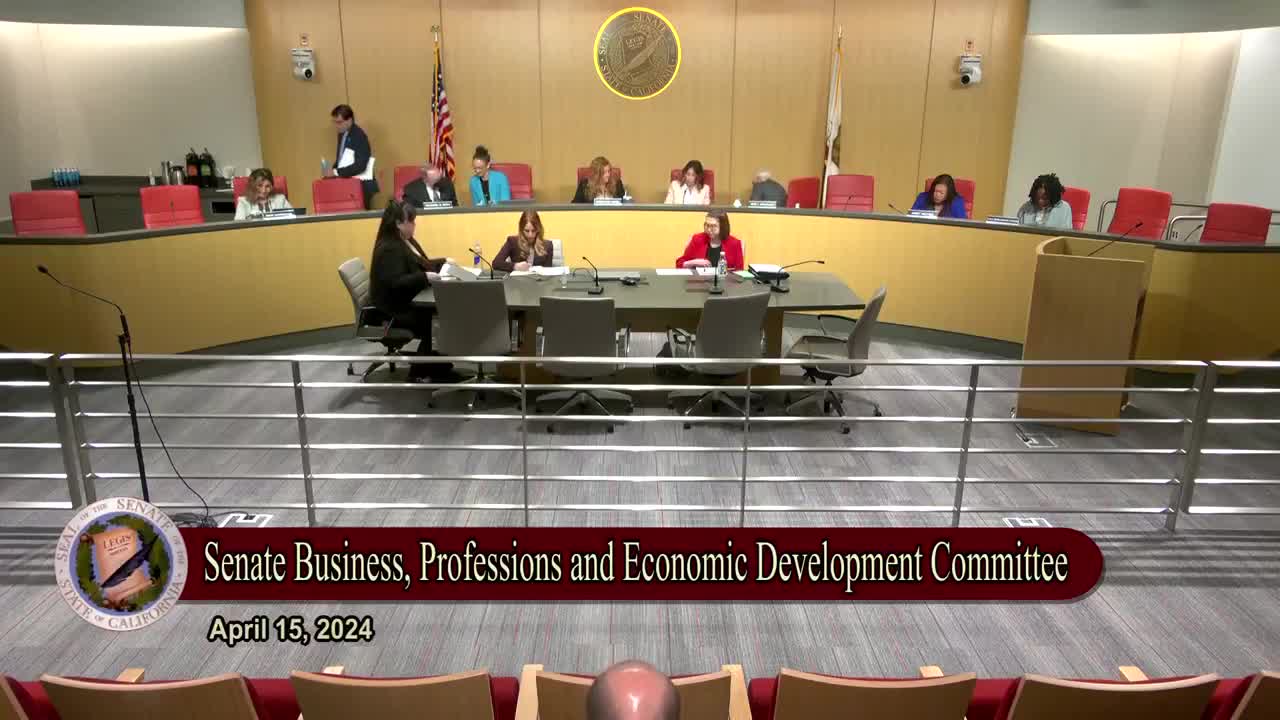
Discussed in Hearing
 6MIN
Senate Standing Committee on Business, Professions and Economic Development
Bill Author

Bill Co-Author(s):