SB 1311: Energy: reliability planning assessment: integrated energy policy report.
- Session Year: 2023-2024
- House: Senate
- Latest Version Date: 2024-02-15
Current Status:
Failed
(2024-05-16: May 16 hearing: Held in committee and under submission.)
Introduced
In Committee
First Chamber
In Committee
Second Chamber
Enacted
What does this bill do?
The bill requires state energy agencies to give the Legislature and the public more detailed, quarterly information about grid projects, approvals, and timelines, affecting the Energy Commission, the Public Utilities Commission, the CAISO, the Department of Water Resources, utilities, and project developers. The reliability assessment and energy almanac must include transmission upgrades and grid capacity, PUC approvals and construction permits, CAISO queue status, expected completion dates and retirements, and any fossil‑fuel use by DWR facilities, and the Energy Commission must publish a public tracking dashboard. The bill also requires demand forecasts and wind and solar profiles to account for increased weather variability and multiday heat events from climate change to guide energy planning, beginning with the 2025 integrated energy policy report.
The summary is provided by generative AI which can make mistakes. For original language, please view the details in the table below.
Existing law requires the State Energy Resources Conservation and Development Commission (Energy Commission) and the Public Utilities Commission (PUC), on or before December 15, 2022, and quarterly thereafter, to submit to the Legislature a joint Reliability Planning Assessment that, among other things, includes prospective information on existing and expected resources, including updates on the interconnection status for renewable projects and any delays in interconnection, and expected retirements for both system and local resources. Existing law requires the Energy Commission to report in the energy almanac on California energy resources that serve load in California.
This bill would require that the assessment also include the status of utility transmission upgrades and electrical grid infrastructure capacity, PUC approvals of applications for certificates of public convenience and necessity and permits to construct utility and independent projects, and applications for permits for projects from the Energy Commission and the queue of projects from the Independent System Operator, include the expected completion dates for both system and local resources, and report on the use of fossil fuel by certain facilities constructed by, purchased by, or under contract with the Department of Water Resources, as specified. The bill would require the Energy Commission to quarterly publish on its internet website and update a tracking energy development dashboard that synthesizes and publishes the information included in the assessment and reported on California energy resources in the energy almanac.
Existing law requires the Energy Commission, on a biennial basis, to adopt an integrated energy policy report containing an overview of major trends and issues facing the state. Existing law requires the report to include an assessment and forecast of system reliability and the need for resource additions, efficiency, and conservation that considers all aspects of energy industries and markets that are essential for the state economy, general welfare, public health and safety, energy diversity, and protection of the environment.
This bill would require the Energy Commission to ensure that the demand forecasts in the integrated energy policy report and wind and solar energy generation profiles account for increased weather variability, interactive weather effects, and increased likelihood of heat events, including multiday events, due to climate change, and to use the demand forecasts and those energy generation profiles to inform its energy planning, as specified.
(a)Notwithstanding Section 10231.5 of the Government Code, on or before December 15, 2022, and quarterly thereafter, the commission and the Public Utilities Commission shall submit a joint Reliability Planning Assessment to the Legislature in accordance with Section 9795 of the Government Code.
(1)The assessment shall identify estimates for the electrical supply and demand balance, for the forward 5- and 10-year periods, under high-, medium-, and low-risk scenarios. The assessment shall identify loads and resources online and loads and resources expected by reliability year ending September 30.
(2)The assessment shall focus on the Independent System Operator system, with an emphasis on the electrical demand, load, supply, or resource resources for load-serving entities subject to the Public Utilities Commissions jurisdiction. The assessment shall break down loads and resources by type of load-serving entity by year by transmission access charge area.
(3)The assessment shall include information about imports, by amount, source if known, and other relevant factors, and transmission capacity for imports by date and transmission access area or balancing authority.
(4)The commission shall provide an estimate for the loads and resources for the entities that are not subject to the Public Utilities Commissions jurisdiction that are part of the Independent System Operator system supply and demand balance.
(5)The assessment shall include prospective information on existing and expected resources, including updates on the interconnection status for renewable projects and any delays in interconnection, the status of utility transmission upgrades and electrical grid infrastructure capacity, including substations and expanded transmission in existing corridors, the status of Public Utilities Commission approvals of applications for certificates of public convenience and necessity and permits to construct utility and independent projects, the status of applications for permits for projects from the commission and the queue of projects from the Independent System Operator, filtered by geographic region and energy resource type, and expected completion dates and retirements for both system and local resources. This shall include updates based on actions taken directly by, or as a result of, the Tracking Energy Development Task Force. The assessment shall include an accompanying Gantt chart to track progress.
(6)The assessment shall maintain confidentiality of market sensitive information.
(7)The assessment shall rely upon on the most recently available integrated energy policy report prepared pursuant to Section 25302 for the demand assessment.
(8)The assessment shall report on any other significant delays or barriers affecting timely deployment of renewable energy and zero-carbon resources, including, but not limited to, supply chain disruptions, land use restrictions, and permitting processes.
(9)The assessment shall make recommendations to the Legislature on actions needed to resolve any delays or barriers reported in the assessment.
(10)The assessment shall report on any regulatory barriers and challenges to increasing deployment of other preferred resources, including energy efficiency and demand response programs.
(11)The assessment shall report on the use of fossil fuel by a facility constructed by, purchased by, or under contract with the Department of Water Resources pursuant to subdivision (a) of, or paragraph (1) of subdivision (b) of, Section 80710 of the Water Code.
(b)The commission shall continue to report on California energy resources that serve load in California in the energy almanac. The commission shall expand the energy almanac report to include storage resources that serve wholesale load. The commission shall report on energy resources that serve load in the Independent Systems System Operator system, which is a subset of its current reporting of all California resources, and may include energy resources located outside the state.
(c)The commission shall quarterly publish on its internet website and update a tracking energy development dashboard that synthesizes and publishes the information included in the assessments submitted, and reports made, pursuant to this section.
SEC. 2.Section 25302.8 is added to the Public Resources Code, to read:25302.8.The commission shall ensure that the demand forecasts in the integrated energy policy report required pursuant to Section 25302 and wind and solar energy generation profiles account for increased weather variability, interactive weather effects, and increased likelihood of heat events, including multiday events, due to climate change. The demand forecasts shall include an estimate of weather-normal peak electrical demand and of peak electrical demand expected to occur given the increased likelihood of heat events due to climate change. The commission shall use the demand forecasts and wind and solar energy generation profiles to inform its energy planning in the state beginning with the integrated energy policy report adopted in 2025.
|
Date
|
Status
|
|---|---|
| May 16, 2024 | May 16 hearing: Held in committee and under submission. |
| May 10, 2024 | Set for hearing May 16. |
| Apr 29, 2024 | April 29 hearing: Placed on APPR suspense file. |
| Apr 22, 2024 | Set for hearing April 29. |
| Apr 16, 2024 | From committee: Do pass and re-refer to Com. on APPR. (Ayes 17. Noes 0. Page 3632.) (April 16). Re-referred to Com. on APPR. |
| Apr 4, 2024 | Set for hearing April 16. |
| Feb 29, 2024 | Referred to Com. on E., U. & C. |
| Feb 16, 2024 | From printer. May be acted upon on or after March 17. |
| Feb 15, 2024 | Introduced. Read first time. To Com. on RLS. for assignment. To print. |
|
Date
|
Description
|
Location
|
Votes
|
|
|---|---|---|---|---|
| Apr 29, 2024 | Placed on suspense file | Senate Standing Committee on Appropriations |
Passed |
|
| Apr 16, 2024 | Do pass, but first be re-referred to the Committee on [Appropriations] | Senate Standing Committee on Energy, Utilities and Communications |
Passed |
This list shows positions taken on this bill by organizations on the date displayed, which is linked to the original source.
Positions by individuals are not included.
|
Organization
|
Position
|
Date
|
|---|---|---|
| 350 Silicon Valley | * Support | Apr 16, 2024 |
| Clean Power Campaign | * Support | Apr 16, 2024 |
| Climate Action California | ** Support | Apr 16, 2024 |
| Environmental Defense Fund | * Support | Apr 16, 2024 |
| Glendale Environmental Coalition | ** Support | Apr 16, 2024 |
| Santa Claus Climate Action Network | ** Support | Apr 16, 2024 |
| The Climate Reality Project | ** Support | Apr 16, 2024 |
SENATE COMMITTEE ON
Senator Anna Caballero, Chair
2023 - 2024 Regular Session
SB 1311 (Stern) - Energy: reliability planning assessment: integrated energy policy report
Version: | Policy Vote: |
Urgency: | Mandate: |
Hearing Date: | Consultant: |
Bill Summary:
This bill would require the California Energy Commission (CEC) to include extreme weather events within the existing energy demand forecasts and, as part of an existing assessment with the California Public Utilities Commission (CPUC), include specified reporting on the status of electric infrastructure projects and the contracting of fossil fuel resources as part of a statewide program for electricity supply reliability.
Fiscal Impact:
- CEC estimates ongoing costs of about $201,000 annually (Energy Resources Program Account [ERPA] or General Fund) for one position to implement the provisions of this bill. Staff note that ERPA, the CEC’s main funding source, has a significant structural deficit and may not be the most appropriate funding source to support the implementation of this bill.
- CPUC estimates ongoing costs of about $423,000 annually (ratepayer funds) to compile disparate information on transmission, interconnection projects, permit/certificate applications, and resource retirements into part of our SB 846 Quarterly Report and into tracking documents that would need to be updated quarterly.
Background:
Extreme weather events. In recent years, California has experienced challenges ensuring adequate electricity supply reliability during extreme heat events when demand peaks and generation has been reduced or constrained. In August 2020, electric generation and transmission capacity was strained to keep up with the increased electricity demand – setting a peak demand record in the Western Interconnection of just over 162,000 megawatts (MW) on August 18, 2020. During this heat wave, many balancing authorities were forced to declare energy emergencies as they were unable to meet their load obligations, including the CAISO and five balancing authorities outside California. Within the CAISO, for the first time in about 20 years, utilities were forced to shed load – via rotating outages – to help balance the electrical grid. The outages ranged from eight minutes to 2.5 hour durations, depending on the utility, while affected customers experienced between eight minutes to 20 minute outages, generally. The following year, in the midst of a heat wave, a wildfire in Oregon compromised an electric transmission line, dramatically reducing a critical source of energy imports for the state. Last year, a 10-day heat wave resulted in the CAISO setting an all-time record for electricity demand of over 52,000 MW on September 6th. The combination of increased demand and variability and constrained electricity supply, resulted in the state for the first-time issuing a wireless emergency alert calling on Californians to conserve energy.
CEC and CPUC joint Reliability Planning Assessment. As part of SB 846 (Dodd, Chapter 239, Statutes of 2022) authorized the extension of the Diablo Canyon Power Plant (DCPP)—which was scheduled to retire by 2025—through 2030. SB 846 also included legislative intent to provide a total of $1 billion from the General Fund from 2023-24 through 2025-26—$100 million in 2023-24, $400 million in 2024-25, and $500 million in 2025-26—to support the Clean Energy Reliability Investment Plan, which CEC recently updated. Adjustments to these amounts and dates are subject to annual state budget decisions. The legislation required the plan to support investments that address near- and mid-term reliability needs and the state’s greenhouse gas (GHG) and clean energy goals. The plan adopted by the CEC incorporates a combination of planning and enabling structures to support clean energy deployment and augmenting for extreme events for the first year $100 million funding. Additionally, the legislation requires the CEC and CPUC to quarterly publish a reliability planning assessment to include estimates of supply and demand for the next 10 years under different risk scenarios, information on existing and new resources and delays, and a description of barriers to timely deployment of resources. The agencies have issued their third quarterly report since the passage of SB 846.
Integrated Energy Policy Report (IEPR). The IEPR provides a cohesive approach to identifying and solving the state’s pressing energy needs and issues. The report, which is crafted in collaboration with a range of stakeholders, develops and implements energy plans and policies. SB 1389 (Bowen, Chapter 568, Statutes of 2002) required the CEC to conduct assessments and forecasts of all 10 aspects of energy industry supply, production, transportation, delivery and distribution, demand, and prices. The CEC is then required to use these assessments and forecasts to “develop energy policies that conserve resources, protect the environment, ensure energy reliability, enhance the state's economy, and protect public health and safety.” The CEC adopts an IEPR every two years and an update every other year.
Transmission Development Forum. The Transmission Development Forum is a joint effort between the CAISO and the CPUC to discuss and track Participating Transmission Owners expansion, network upgrade projects, and schedules. The Transmission Development Forum creates a single forum to track the status of transmission network upgrade projects that affect generators and all other transmission projects approved in the CAISO’s transmission planning process. The effort allows for increased transparency for all stakeholders about transmission projects and enhances accountability of transmission owners by having them explain schedule changes, delays, and address stakeholders’ questions, particularly for projects in the transmission queue.
Tracking Energy Development (TED) Task Force. The TED Taskforce is complimentary joint effort of the CPUC, CEC, CAISO, and Office of Business and Economic Development (GO-Biz) to track new energy projects under development. According to the CPUC, the objective is to build on the success of ad hoc efforts in 2021 to provide energy resource project development support, as appropriate, and identify barriers and mitigation strategies to accelerate energy project development.
Electricity Supply Strategic Reliability Reserve Program at the DWR (funded at $2.3 billion). In June 2022, Budget Trailer Bills, AB 205 (Committee on Budget, Chapter 61, Statutes of 2022), AB 178 (Ting, Chapter 45, Statutes of 2022), and AB 180 (Ting, Chapter 44, Statutes of 2022) collectively established the ESSRRP and set forth new responsibilities and activities by DWR, funded by the newly established ESSRRF, and separate from the State Water Project. DWR established temporary energy resources and created a new deputy director-level division with 25 staff – the Division of Statewide Water and Energy – which oversees the ESSRRP along with the State Power Augmentation Program which was developed in July 2021 in response to executive order direction to quickly deploy 120 MW of new generation. Under the ESSRRP, DWR acts as contingency insurance to help maintain electricity reliability. As part of the program, DWR contracts directly with power facilities and also enters into agreements with the state’s large electric investor-owned utilities (IOUs) to reimburse for the value of imported firm energy resources to support summer reliability.
DWR ESSRRP contracting for fossil fuel resources. As part of the ESSRRP, DWR has contracted with natural gas turbine generator units, including three natural gas powerplants subject to the State Water Resources Control Board’s once-through-cooling regulations. These natural gas powerplants – AES Alamitos, AES Huntington Beach, and Ormond – are in addition to contracts for imported energy and four temporary natural gas turbine generator units totaling 120 MW at existing power generation sites located in the Cities of Roseville (two units owned by Roseville) and Yuba City (two units owned by Calpine). Current agreements allow the units to remain available for operation until the end of 2023. DWR is also in entered into of contracts for other resources, including a gas plant owned by California State University at Channel Islands and Enchanted Rock Electric LLC for three separate plants operating in local publicly owned utilities service territories within the San Joaquin Valley (City of Lodi, Modesto Irrigation District, and Turlock Irrigation District). DWR has also entered into an agreement with Pacific Gas & Electric as the owner and operator of the DCPP to secure necessary funding for fuel purchases and management to maintain the option of extending the use of the facility (contingent on extended licensing) beyond the current retirement dates.
Proposed Law:
This bill would require CEC to include extreme weather events within the existing energy demand forecasts and, as part of an existing assessment with CPUC, include specified reporting on the status of electric infrastructure projects and the contracting of fossil fuel resources as part of a statewide program for electricity supply reliability. Specifically, this bill would:
- Require the joint Reliability Planning Assessment to also include:
- The status of electric utility transmission upgrades and electrical grid infrastructure capacity.
- CPUC approvals of applications for certificates of public convenience and necessity (CPCN) and permits to construct utility and independent projects, and applications for permits for projects from the CEC and the queue of projects from the California Independent System Operator (CAISO), include the expected completion dates for both system and local resource.
- Report on the use of fossil fuel by facilities constructed by, purchased by, or under contract with the DWR, as part of the ESSRRP and ESSRRF.
- Require the CEC to quarterly publish on its internet website and update a tracking energy development dashboard that synthesizes and publishes the information included in the joint Reliability Planning Assessment and reported on state’s energy resources in the energy almanac.
- Require the CEC to ensure that the demand forecasts in the IEPR and wind and solar energy generation profiles account for increased weather variability, interactive weather effects, and increased likelihood of heat events, including multiday events, due to climate change, and to use the demand forecasts and those energy generation profiles to inform its energy planning.
Related Legislation:
SB 664 (Stern, 2023) would have required the CEC to include extreme weather events within the existing energy demand forecasts and, as part of an existing assessment with the CPUC, include specified reporting on the status of electric infrastructure projects and the contracting of fossil fuel resources as part of a statewide program for electricity supply reliability. The bill was vetoed.
SB 124 (Committee on Budget and Fiscal Review, Chapter 53, Statutes of 2023) required the CEC, CAISO, and DWR to submit a report to the Legislature each year on the status of the impact of new resource additions and revisions to the state’s electric demand forecast, and the impact of these updates and needed for keeping the DCPP online.
SB 319 (McGuire, Chapter 390, Statutes of 2023) required the CEC and the CPUC, in coordination with the CAISO, to better and regularly coordinate planning and permitting of energy transmission infrastructure to ensure the state meets its clean energy goals and to evaluate and report on that planning and related infrastructure development. The bill also required these state energy agencies to jointly develop an electrical transmission infrastructure development guidebook.
SB 420 (Becker, 2023) would have exempted construction of certain low-voltage electrical lines and associated equipment from the need to receive a discretionary permit from the CPUC. The bill was vetoed.
AB 1373 (E. Garcia, Chapter 367, Statutes of 2023) made numerous changes to electricity policy, most notably, authorized the DWR to serve as a central procurement entity to procure energy resources in order to help the state meet its renewable and zero-carbon energy resources and reliability goals. The bill also included numerous related and additional provisions.
SB 529 (Hertzberg, Chapter 357, Statutes of 2022) exempted an extension, expansion, upgrade, or other modification of an existing transmission line or substations from the requirement of a CPCN and directs the CPUC to revise its general orders, by January 1, 2024, to instead use its permit to construct process for these approvals.
SB 887 (Becker, Chapter 358, Statutes of 2022) directed, among other provisions, the CPUC, on or before January 15, 2023, to request CAISO to identify the highest priority anticipated transmission facilities that are needed to deliver renewable energy resources or zero-carbon resources.
SB 846 (Dodd, Chapter 239, Statutes of 2022) included a requirement that the CEC and CPUC submit a joint Agency Reliability Report by December 15, 2022 and quarterly thereafter.
SB 1174 (Herzberg, Chapter 229, Statutes of 2022) required certain CPUC reports and assessments, including reporting relating to the California Renewables Portfolio Standard Program, to consider the role of transmission.
AB 205 (Committee on Budget, Chapter 21, Statutes of 2022) allowed certain energy projects, including electric transmission lines between certain non-fossil fuel energy generation facilities to become certified leadership projects under the Jobs and Economic Improvement Through Environmental Leadership Act of 2021 through a certification process through the CEC. With this certification, actions or proceedings related to the certification of an environmental impact report need to be resolve within 270 days to the extent feasible.
Staff Comments: The main funding source supporting CEC is ERPA, which was established to provide funds for ongoing energy programs and energy as established to provide funds for ongoing energy programs and energy projects, including the operations of the CEC. ERPA is supported by a statutory surcharge on electricity consumption. According to the CEC, as building and appliance energy efficiency and the increase of behind-the-meter solar produce customer savings and flatten statewide electricity consumption, ERPA revenues have decreased, and the costs have been borne by fewer and fewer customers. Even as revenues drop, ERPA is repeatedly tapped to support new programs and must cover increases in employee compensation and benefit contributions.
The surcharge generated approximately $69.1 million in 2020-21 and currently costs the average household about $2.13 annually (larger customers pay the same rate but pay more based on volume). Despite CEC efforts to reduce ERPA spending by more than $37 million over four years, a structural deficit remains and ERPA’s fund balance is projected to be in the red in 2024-25.
As part of the 2022-23 budget, the Legislature passed trailer bill language that raised the statutory cap on the ERPA surcharge, tied the statutory cap to the Consumer Price Index, and extended the surcharge to behind-the-meter electricity consumption. Using ERPA to fund implementation of this bill would increase ERPA expenditures thereby exacerbating the structural deficit. A better funding source may need to be identified.
-- END --
SENATE COMMITTEE ON ENERGY, UTILITIES AND COMMUNICATIONS
Senator Steven Bradford, Chair
2023 - 2024 Regular
Bill No: Hearing Date: 4/16/2024
Author: | |||
Version: | Introduced | ||
Urgency: | Fiscal: | ||
Consultant: | |||
SUBJECT:
DIGEST: This bill requires the California Energy Commission (CEC) to include extreme weather events within the existing energy demand forecasts and, as part of an existing assessment with the California Public Utilities Commission (CPUC), include specified reporting on the status of electric infrastructure projects and the contracting of fossil fuel resources as part of a statewide program for electricity supply reliability.
ANALYSIS:
Existing law:
- Requires the CEC and CPUC, on or before December 15, 2022, and quarterly thereafter, to submit to the Legislature a joint Reliability Planning Assessment that, among other things, includes prospective information on existing and expected resources, including updates on the interconnection status for renewable projects and any delays in interconnection, and expected retirements for both system and local resources. Requires the CEC to report in the energy almanac on California energy resources that serve load in California. (Public Resources Code §25233)
- Requires the CEC, on a biennial basis, to adopt an integrated energy policy report (IEPR) containing an overview of major trends and issues facing the state. Requires the report to include an assessment and forecast of system reliability and the need for resource additions, efficiency, and conservation that considers all aspects of energy industries and markets that are essential for the state economy, general welfare, public health and safety, energy diversity, and protection of the environment. Requires the report to include an assessment and forecast of system reliability and the need for resource additions, efficiency, and conservation that considers all aspects of energy industries and markets that are essential for the state economy, general welfare, public health and safety, energy diversity, and protection of the environment. (Public Resources Code §25302)
- Requires an electrical corporation that owns electrical transmission facilities to annually prepare a report identifying the changes to any in-service dates of any electrical transmission and interconnection facility, upgrade, or enhancement that was previously reported and is reasonably necessary to achieve the procurement requirements of the California Renewal Portfolio Standards Program and to submit that report to the CPUC. (Public Utilities Code §399.13)
- Establishes the Electricity Supply Strategic Reliability Reserve Program (ESSRRP), administered by the Department of Water Resources (DWR), to expand the resources capable of managing or reducing net-peak demand during extreme events. Provides funding to secure conventional generation, efficiency upgrades at existing natural gas plants, demand response, distributed generation, and long-duration storage. (Water Code §§80710-80712)
- Creates the Electricity Supply Strategic Reliability Reserve Fund (ESSRRF), a continuously appropriated fund, for purposes of adding resources to the electrical grid to ensure electrical grid reliability and support the clean energy transition. Authorizes the CEC to approve an investment plan provided by the DWR regarding the terms, cost, and scope of the contracts, entered into for those purposes. (Public Resources Code §25793)
This bill:
- Requires the joint Reliability Planning Assessment to also include:
- The status of electric utility transmission upgrades and electrical grid infrastructure capacity.
- CPUC approvals of applications for certificates of public convenience and necessity (CPCN) and permits to construct utility and independent projects, and applications for permits for projects from the CEC and the queue of projects from the California Independent System Operator (CAISO), include the expected completion dates for both system and local resource.
- Report on the use of fossil fuel by facilities constructed by, purchased by, or under contract with the DWR, as part of the ESSRRP and ESSRRF.
- Requires the CEC to quarterly publish on its internet website and update a tracking energy development dashboard that synthesizes and publishes the information included in the joint Reliability Planning Assessment and reported on state’s energy resources in the energy almanac.
- Requires the CEC to ensure that the demand forecasts in the IEPR and wind and solar energy generation profiles account for increased weather variability, interactive weather effects, and increased likelihood of heat events, including multiday events, due to climate change, and to use the demand forecasts and those energy generation profiles to inform its energy planning.
Background
Extreme weather events. In recent years, California has experienced challenges ensuring adequate electricity supply reliability during extreme heat events when demand peaks and generation has been reduced or constrained. In August 2020, electric generation and transmission capacity was strained to keep up with the increased electricity demand – setting a peak demand record in the Western Interconnection of just over 162,000 megawatts (MW) on August 18, 2020. During this heat wave, many balancing authorities were forced to declare energy emergencies as they were unable to meet their load obligations, including the CAISO and five balancing authorities outside California. Within the CAISO, for the first time in about 20 years, utilities were forced to shed load – via rotating outages – to help balance the electrical grid. The outages ranged from eight minutes to 2.5 hour durations, depending on the utility, while affected customers experienced between eight minutes to 20 minute outages, generally. The following year, in the midst of a heat wave, a wildfire in Oregon compromised an electric transmission line, dramatically reducing a critical source of energy imports for the state. Last year, a 10-day heat wave resulted in the CAISO setting an all-time record for electricity demand of over 52,000 MW on September 6th. The combination of increased demand and variability and constrained electricity supply, resulted in the state for the first-time issuing a wireless emergency alert calling on Californians to conserve energy.
CEC and CPUC joint Reliability Planning Assessment. As part of SB 846 (Dodd, Chapter 239, Statutes of 2022) authorized the extension of the Diablo Canyon Power Plant (DCPP)—which was scheduled to retire by 2025—through 2030. SB 846 also included legislative intent to provide a total of $1 billion from the General Fund from 2023-24 through 2025-26—$100 million in 2023-24, $400 million in 2024-25, and $500 million in 2025-26—to support the Clean Energy Reliability Investment Plan, which CEC recently updated. Adjustments to these amounts and dates are subject to annual state budget decisions. The legislation required the plan to support investments that address near- and mid-term reliability needs and the state’s greenhouse gas (GHG) and clean energy goals. The plan adopted by the CEC incorporates a combination of planning and enabling structures to support clean energy deployment and augmenting for extreme events for the first year $100 million funding. Additionally, the legislation requires the CEC and CPUC to quarterly publish a reliability planning assessment to include estimates of supply and demand for the next 10 years under different risk scenarios, information on existing and new resources and delays, and a description of barriers to timely deployment of resources. The agencies have issued their third quarterly report since the passage of SB 846.
Integrated Energy Policy Report (IEPR). The IEPR provides a cohesive approach to identifying and solving the state’s pressing energy needs and issues. The report, which is crafted in collaboration with a range of stakeholders, develops and implements energy plans and policies. SB 1389 (Bowen, Chapter 568, Statutes of 2002) required the CEC to conduct assessments and forecasts of all 10 aspects of energy industry supply, production, transportation, delivery and distribution, demand, and prices. The CEC is then required to use these assessments and forecasts to “develop energy policies that conserve resources, protect the environment, ensure energy reliability, enhance the state's economy, and protect public health and safety.” The CEC adopts an IEPR every two years and an update every other year.
Transmission Development Forum. The Transmission Development Forum is a joint effort between the CAISO and the CPUC to discuss and track Participating Transmission Owners expansion, network upgrade projects, and schedules. The Transmission Development Forum creates a single forum to track the status of transmission network upgrade projects that affect generators and all other transmission projects approved in the CAISO’s transmission planning process. The effort allows for increased transparency for all stakeholders about transmission projects and enhances accountability of transmission owners by having them explain schedule changes, delays, and address stakeholders’ questions, particularly for projects in the transmission queue.
Tracking Energy Development (TED) Task Force. The TED Taskforce is complimentary joint effort of the CPUC, CEC, CAISO, and Office of Business and Economic Development (GO-Biz) to track new energy projects under development. According to the CPUC, the objective is to build on the success of ad hoc efforts in 2021 to provide energy resource project development support, as appropriate, and identify barriers and mitigation strategies to accelerate energy project development.
Electricity Supply Strategic Reliability Reserve Program at the DWR (funded at $2.3 billion). In June 2022, Budget Trailer Bills, AB 205 (Committee on Budget, Chapter 61, Statutes of 2022), AB 178 (Ting, Chapter 45, Statutes of 2022), and AB 180 (Ting, Chapter 44, Statutes of 2022) collectively established the ESSRRP and set forth new responsibilities and activities by DWR, funded by the newly established ESSRRF, and separate from the State Water Project. DWR established temporary energy resources and created a new deputy director-level division with 25 staff – the Division of Statewide Water and Energy – which oversees the ESSRRP along with the State Power Augmentation Program which was developed in July 2021 in response to executive order direction to quickly deploy 120 MW of new generation. Under the ESSRRP, DWR acts as contingency insurance to help maintain electricity reliability. As part of the program, DWR contracts directly with power facilities and also enters into agreements with the state’s large electric investor-owned utilities (IOUs) to reimburse for the value of imported firm energy resources to support summer reliability.
DWR ESSRRP contracting for fossil fuel resources. As part of the ESSRRP, DWR has contracted with natural gas turbine generator units, including three natural gas powerplants subject to the State Water Resources Control Board’s once-through-cooling regulations. These natural gas powerplants – AES Alamitos, AES Huntington Beach, and Ormond – are in addition to contracts for imported energy and four temporary natural gas turbine generator units totaling 120 MW at existing power generation sites located in the Cities of Roseville (two units owned by Roseville) and Yuba City (two units owned by Calpine). Current agreements allow the units to remain available for operation until the end of 2023. DWR is also in entered into of contracts for other resources, including a gas plant owned by California State University at Channel Islands and Enchanted Rock Electric LLC for three separate plants operating in local publicly owned utilities service territories within the San Joaquin Valley (City of Lodi, Modesto Irrigation District, and Turlock Irrigation District). DWR has also entered into an agreement with Pacific Gas & Electric as the owner and operator of the DCPP to secure necessary funding for fuel purchases and management to maintain the option of extending the use of the facility (contingent on extended licensing) beyond the current retirement dates.
Comments
Need for this bill. This bill requires additional reporting of the CEC and CPUC as part of the joint Reliability Planning Report, including identifying fossil fuel generating resources contracted by DWR. This bill also largely codifies the CEC’s current and intended near- and longer-term efforts to better incorporate extreme events in its demand forecast, as part of the IEPR. Since the August 2020 heat wave when CAISO was forced to institute rotating electricity outages, the CEC has instituted a number of changes to its demand forecasts to better account for extreme weather events, specifically incorporating 1-in-2-year weather events, 1-in-5-year weather events, 1-in-10-year weather events, and 1-in-20-year weather events to better account for the impacts of climate change on electricity peak demand. For the 2023 IEPR forecast, the CEC shifted to a methodology that uses climate projections to develop the one-in-X peak demand forecast. The climate change projections account for the increasing frequency and intensity of extreme heat, and an increase in the number of consecutive days with extreme temperatures. As a longer-term project, the CEC is also looking into the electricity output impacts of extreme heat on generation resources, including solar photovoltaic and wind energy. As noted in the 2023 IEPR,
As the impacts of climate change increase in significance, historical weather data are no longer sufficient to predict future weather patterns. Consequently, CEC staff is integrating new climate simulation data into the forecast from the Cal-Adapt Analytics Engine. Weather and climate data are also used to re-characterize normal and extreme peak electricity demand events (events likely to happen once in X years, such as 1-in-10). Future demand models will include additional data and refinements.
Governor’s veto message. This bill is nearly identical to SB 664 (Stern, 2023) which was vetoed by the Governor who stated in the veto message:
While I support the author's attempt to daylight the development and use of specific energy infrastructure, this bill is redundant of existing efforts and duplicates requirements in other bills that I recently signed. To achieve our clean energy and climate goals, we must ensure that the relevant agencies' planning and reporting efforts are coordinated and aligned. Unfortunately, this bill does not achieve that objective.
The author and supporters disagree with the Governor’s veto message and contend there is value to the additional reporting requirements proposed in this bill, particularly in relation to the need to better track the transmission build-out that will be necessary to achieve the state’s clean energy goals.
Prior/Related Legislation
SB 664 (Stern, 2023) would have required the CEC to include extreme weather events within the existing energy demand forecasts and, as part of an existing assessment with the CPUC, include specified reporting on the status of electric infrastructure projects and the contracting of fossil fuel resources as part of a statewide program for electricity supply reliability. The bill was vetoed.
SB 124 (Committee on Budget and Fiscal Review, Chapter 53, Statutes of 2023) required the CEC, CAISO, and DWR to submit a report to the Legislature each year on the status of the impact of new resource additions and revisions to the state’s electric demand forecast, and the impact of these updates and needed for keeping the DCPP online.
SB 319 (McGuire, Chapter 390, Statutes of 2023) required the CEC and the CPUC, in coordination with the CAISO, to better and regularly coordinate planning and permitting of energy transmission infrastructure to ensure the state meets its clean energy goals and to evaluate and report on that planning and related infrastructure development. The bill also required these state energy agencies to jointly develop an electrical transmission infrastructure development guidebook.
SB 420 (Becker, 2023) would have exempted construction of certain low-voltage electrical lines and associated equipment from the need to receive a discretionary permit from the CPUC. The bill was vetoed.
AB 1373 (E. Garcia, Chapter 367, Statutes of 2023) made numerous changes to electricity policy, most notably, authorized the DWR to serve as a central procurement entity to procure energy resources in order to help the state meet its renewable and zero-carbon energy resources and reliability goals. The bill also included numerous related and additional provisions.
SB 529 (Hertzberg, Chapter 357, Statutes of 2022) exempted an extension, expansion, upgrade, or other modification of an existing transmission line or substations from the requirement of a CPCN and directs the CPUC to revise its general orders, by January 1, 2024, to instead use its permit to construct process for these approvals.
SB 887 (Becker, Chapter 358, Statutes of 2022) directed, among other provisions, the CPUC, on or before January 15, 2023, to request CAISO to identify the highest priority anticipated transmission facilities that are needed to deliver renewable energy resources or zero-carbon resources.
SB 846 (Dodd, Chapter 239, Statutes of 2022) included a requirement that the CEC and CPUC submit a joint Agency Reliability Report by December 15, 2022 and quarterly thereafter.
SB 1174 (Herzberg, Chapter 229, Statutes of 2022) required certain CPUC reports and assessments, including reporting relating to the California Renewables Portfolio Standard Program, to consider the role of transmission.
AB 205 (Committee on Budget, Chapter 21, Statutes of 2022) allowed certain energy projects, including electric transmission lines between certain non-fossil fuel energy generation facilities to become certified leadership projects under the Jobs and Economic Improvement Through Environmental Leadership Act of 2021 through a certification process through the CEC. With this certification, actions or proceedings related to the certification of an environmental impact report need to be resolve within 270 days to the extent feasible.
FISCAL EFFECT: Appropriation: Fiscal Com.: Local:
SUPPORT:
Climate Action California
Environmental Defense Fund
The Climate Reality Project: Silicon Valley Chapter
OPPOSITION:
None received
ARGUMENTS IN SUPPORT: In support of this bill, the Environmental Defense Fund states:
SB 1311 recognizes that the state needs to build a tremendous amount of new infrastructure to support our transition to a clean energy economy. Understanding what needs to be built when, and what the progress is on that upgrade is critical. Such transparency helps the decision-making process and more importantly reduces costs to customers by lowering risk. The current process is a “black box,” and this type of reporting will help give more confidence to all stakeholders to understand what potential delays are. This type of tracking will help ensure grid reliability as we electrify more portions of our economy. Ultimately, the reporting envisioned in this bill will help match the coordination to help unlock our clean energy goals more quickly and affordably.
-- END --
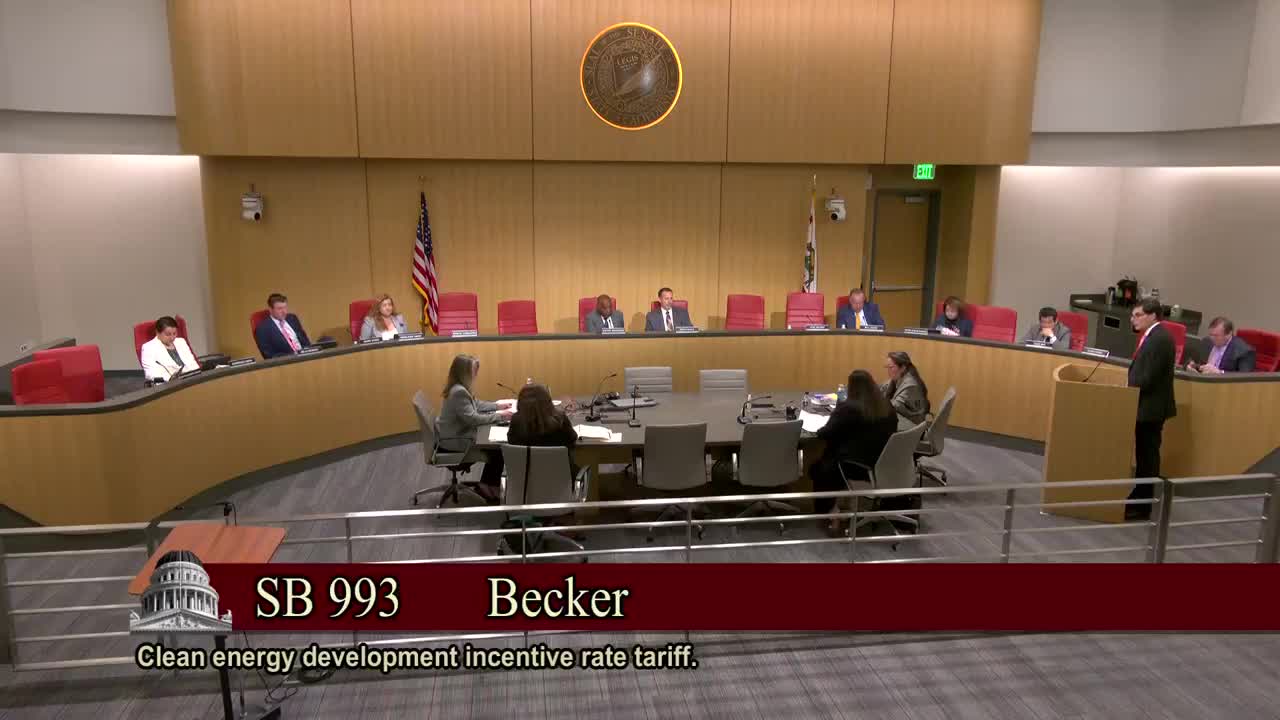
Discussed in Hearing
 3MIN
Senate Standing Committee on Energy, Utilities and Communications
Bill Author

Bill Co-Author(s):