SB 1351: Electricity: state policy.
- Session Year: 2023-2024
- House: Senate
- Latest Version Date: 2024-04-29
Current Status:
Failed
(2024-05-16: May 16 hearing: Held in committee and under submission.)
Introduced
In Committee
First Chamber
In Committee
Second Chamber
Enacted
Existing law vests the Public Utilities Commission (PUC) with regulatory authority over public utilities, including electrical corporations, while local publicly owned electric utilities are under the direction of their governing boards. Existing law establishes a state policy that eligible renewable energy resources and zero-carbon resources supply 90% of all retail sales of electricity to California end-use customers by December 31, 2035, 95% of all retail sales of electricity to California end-use customers by December 31, 2040, 100% of all retail sales of electricity to California end-use customers by December 31, 2045, and 100% of electricity procured to serve all state agencies by December 31, 2035, as provided. Existing law requires the PUC, State Energy Resources Conservation and Development Commission (Energy Commission), and State Air Resources Board to issue a joint report to the Legislature by January 1, 2021, and every 4 years thereafter, that includes specified information relating to the implementation of that state policy.
This bill would require the PUC, Energy Commission, and state board, in consultation with all California balancing authorities and as part of a public process, on or before January 1, 2026, and subsequently as part of the above-described joint report, to issue a report to the Legislature that contains a clean energy infrastructure development plan setting out the infrastructure and processes necessary for the state to accomplish the above-described state policy, as provided.
Under existing law, a violation of the Public Utilities Act or any order, decision, rule, direction, demand, or requirement of the PUC is a crime.Because the above provisions would be part of the act and a violation of a PUC action implementing this bills requirements would be a crime, the bill would impose a state-mandated local program.The California Constitution requires the state to reimburse local agencies and school districts for certain costs mandated by the state. Statutory provisions establish procedures for making that reimbursement.This bill would provide that no reimbursement is required by this act for a specified reason.Existing law vests the Public Utilities Commission (PUC) with regulatory authority over public utilities, including electrical corporations, while local publicly owned electric utilities are under the direction of their governing boards. Existing law establishes a state policy that eligible renewable energy resources and zero-carbon resources supply 90% of all retail sales of electricity to California end-use customers by December 31, 2035, 95% of all retail sales of electricity to California end-use customers by December 31, 2040, 100% of all retail sales of electricity to California end-use customers by December 31, 2045, and 100% of electricity procured to serve all state agencies by December 31, 2035, as provided. Existing law requires the PUC, State Energy Resources Conservation and Development Commission (Energy Commission), and State Air Resources Board to issue a joint report to the Legislature by January 1, 2021, and every 4 years thereafter, that includes specified information relating to the implementation of that state policy.
This bill would require the PUC, Energy Commission, and state board, in consultation with all California balancing authorities and as part of a public process, on or before January 1, 2026, and subsequently as part of the above-described joint report, to issue a report to the Legislature that contains a clean energy infrastructure development plan setting out the infrastructure and processes necessary for the state to accomplish the above-described state policy, as provided.
Under existing law, a violation of the Public Utilities Act or any order, decision, rule, direction, demand, or requirement of the PUC is a crime.
Because the above provisions would be part of the act and a violation of a PUC action implementing this bills requirements would be a crime, the bill would impose a state-mandated local program.
The California Constitution requires the state to reimburse local agencies and school districts for certain costs mandated by the state. Statutory provisions establish procedures for making that reimbursement.
This bill would provide that no reimbursement is required by this act for a specified reason.
Existing law, under the California Emergency Services Act, requires a county to integrate cultural competence, as defined, into its emergency plan upon the next update to its emergency plan, as specified. Existing law requires a county to provide a forum for community engagement in geographically diverse locations in order to engage with culturally diverse communities, as defined, within its jurisdiction.This bill would make a nonsubstantive change to these provisions.Existing law, under the California Emergency Services Act, requires a county to integrate cultural competence, as defined, into its emergency plan upon the next update to its emergency plan, as specified. Existing law requires a county to provide a forum for community engagement in geographically diverse locations in order to engage with culturally diverse communities, as defined, within its jurisdiction.
This bill would make a nonsubstantive change to these provisions.
(a)It is the policy of the state that eligible renewable energy resources and zero-carbon resources supply 90 percent of all retail sales of electricity to California end-use customers by December 31, 2035, 95 percent of all retail sales of electricity to California end-use customers by December 31, 2040, 100 percent of all retail sales of electricity to California end-use customers by December 31, 2045, and 100 percent of electricity procured to serve all state agencies by December 31, 2035. The achievement of this policy for California shall not increase carbon emissions elsewhere in the western grid and shall not allow resource shuffling. The commission and Energy Commission, in consultation with the State Air Resources Board, shall take steps to ensure that a transition to a zero-carbon electrical system for the State of California does not cause or contribute to increased emissions of greenhouse gases elsewhere in the western grid, and is undertaken in a manner consistent with clause 3 of Section 8 of Article I of the United States Constitution. The commission, the Energy Commission, the State Air Resources Board, and all other state agencies shall incorporate this policy into all relevant planning.
(b)The commission, Energy Commission, State Air Resources Board, and all other state agencies shall ensure that actions taken in furtherance of subdivision (a) do all of the following:
(1)Maintain and protect the safety, reliable operation, and balancing of the electrical system.
(2)Prevent unreasonable impacts to electricity, gas, and water customer rates and bills resulting from implementation of this section, taking into full consideration the economic and environmental costs and benefits of renewable energy and zero-carbon resources.
(3)To the extent feasible and authorized under law, lead to the adoption of policies and taking of actions in other sectors to obtain reductions in the emissions of greenhouse gases that ensure equity between other sectors and the electricity sector.
(4)Not affect in any manner the rules and requirements for the oversight of, and enforcement against, retail sellers and local publicly owned utilities pursuant to the California Renewables Portfolio Standard Program (Article 16 (commencing with Section 399.11) of Chapter 2.3) and Sections 454.51, 454.52, 9621, and 9622.
(5)Not consider the energy, capacity, or any attribute from the Diablo Canyon Unit 1 or Unit 2 powerplant after August 26, 2025, in achieving the policy described in subdivision (a).
(c)This section does not affect a retail sellers obligation to comply with the federal Public Utility Regulatory Policies Act of 1978 (16 U.S.C. Sec. 2601 et seq.).
(d)The commission, Energy Commission, and State Air Resources Board shall do all of the following:
(1)Use programs authorized under existing statutes to achieve the policy described in subdivision (a).
(2)In consultation with all California balancing authorities, as defined in subdivision (d) of Section 399.12, as part of a public process, issue a joint report to the Legislature by January 1, 2021, and at least every four years thereafter. The joint report shall include all of the following:
(A)A review of the policy described in subdivision (a) focused on technologies, forecasts, then-existing transmission, and maintaining safety, environmental and public safety protection, affordability, and system and local reliability.
(B)An evaluation identifying the potential benefits and impacts on system and local reliability associated with achieving the policy described in subdivision (a).
(C)An evaluation identifying the nature of any anticipated financial costs and benefits to electrical, gas, and water utilities, including customer rate impacts and benefits.
(D)The barriers to, and benefits of, achieving the policy described in subdivision (a).
(E)Alternative scenarios in which the policy described in subdivision (a) can be achieved and the estimated costs and benefits of each scenario.
(3)On or before December 1, 2023, and annually thereafter, in consultation with California balancing authorities, as defined in subdivision (d) of Section 399.12, and as part of, or an interim addendum to, the quadrennial joint report required by paragraph (2), as applicable, issue a joint reliability progress report that reviews system and local reliability within the context of the policy described in subdivision (a), with a particular focus on summer reliability. The joint reliability progress report shall identify challenges and gaps, if any, to achieving system and local reliability and identify the amount and cause of any delays to achieving compliance with all energy and capacity procurement requirements set by the commission.
(4)(A)In consultation with all California balancing authorities, as part of a public process, on or before January 1, 2026, and subsequently as part of the quadrennial joint report required by paragraph (2), issue a report to the Legislature that contains a clean energy infrastructure development plan setting out the infrastructure and processes necessary for the state to accomplish the policy described in subdivision (a).
(B)The plan shall include all of the following:
(i)A An estimated timeline and milestones by which each portion of the clean energy infrastructure shall plan is expected to be functional.
(ii)The necessary actions each state agency, local government, load-serving entity, transmission owner, independent system operator, and local publicly owned electric utility shall take to comply with the plan, and when those actions shall be taken. plans to take and an estimated timeline in support of the plan.
(iii)Any recommended statutory changes necessary or helpful to achieve the policy described in subdivision (a).
(iv)For each subsequent plan after the plan contained in the report due on or before January 1, 2026, an evaluation of the extent to which the prior plan has been achieved, the reasons for any failure to achieve the plan, adjustments, and the steps needed to improve performance to achieve the policy described in subdivision (a).
(C)The plan shall consider each of the elements provided in subparagraphs (A) to (E), inclusive, of paragraph (2).
(D)For purposes of this paragraph, the following definitions apply:
(i)California balancing authority has the same meaning as defined in subdivision (d) of Section 399.12.
(ii)Infrastructure means generating plants, transmission facilities, distribution facilities, and all necessary associated equipment.
(E)A report to be submitted pursuant to this paragraph shall be submitted in compliance with Section 9795 of the Government Code.
(e)This section does not authorize the commission to establish any requirements on a nonmobile self-cogeneration or cogeneration facility that served onsite load, or that served load pursuant to an over-the-fence arrangement if that arrangement existed on or before December 20, 1995.
(f)This section does not limit any entity, including local governments, from accelerating their achievement of the states electric sector decarbonization targets.
(a)It is the policy of the state that eligible renewable energy resources and zero-carbon resources supply 90 percent of all retail sales of electricity to California end-use customers by December 31, 2035, 95 percent of all retail sales of electricity to California end-use customers by December 31, 2040, 100 percent of all retail sales of electricity to California end-use customers by December 31, 2045, and 100 percent of electricity procured to serve all state agencies by December 31, 2035. The achievement of this policy for California shall not increase carbon emissions elsewhere in the western grid and shall not allow resource shuffling. The commission and Energy Commission, in consultation with the State Air Resources Board, shall take steps to ensure that a transition to a zero-carbon electric electrical system for the State of California does not cause or contribute to greenhouse gas emissions increases increased emissions of greenhouse gases elsewhere in the western grid, and is undertaken in a manner consistent with clause 3 of Section 8 of Article I of the United States Constitution. The commission, the Energy Commission, the State Air Resources Board, and all other state agencies shall incorporate this policy into all relevant planning.
(b)The commission, Energy Commission, State Air Resources Board, and all other state agencies shall ensure that actions taken in furtherance of subdivision (a) do all of the following:
(1)Maintain and protect the safety, reliable operation, and balancing of the electric electrical system.
(2)Prevent unreasonable impacts to electricity, gas, and water customer rates and bills resulting from implementation of this section, taking into full consideration the economic and environmental costs and benefits of renewable energy and zero-carbon resources.
(3)To the extent feasible and authorized under law, lead to the adoption of policies and taking of actions in other sectors to obtain greenhouse gas emission reductions reductions in the emissions of greenhouse gases that ensure equity between other sectors and the electricity sector.
(4)Not affect in any manner the rules and requirements for the oversight of, and enforcement against, retail sellers and local publicly owned utilities pursuant to the California Renewables Portfolio Standard Program (Article 16 (commencing with Section 399.11) of Chapter 2.3) and Sections 454.51, 454.52, 9621, and 9622.
(5)Not consider the energy, capacity, or any attribute from the Diablo Canyon Unit 1 or Unit 2 powerplant after August 26, 2025, in achieving the policy described in subdivision (a).
(c)This section does not affect a retail sellers obligation to comply with the federal Public Utility Regulatory Policies Act of 1978 (16 U.S.C. Sec. 2601 et seq.).
(d)The commission, Energy Commission, and State Air Resources Board shall do all of the following:
(1)Use programs authorized under existing statutes to achieve the policy described in subdivision (a).
(2)In consultation with all California balancing authorities, as defined in subdivision (d) of Section 399.12, as part of a public process, issue a joint report to the Legislature by January 1, 2021, and at least every four years thereafter. The joint report shall include all of the following:
(A)A review of the policy described in subdivision (a) focused on technologies, forecasts, then-existing transmission, and maintaining safety, environmental and public safety protection, affordability, and system and local reliability.
(B)An evaluation identifying the potential benefits and impacts on system and local reliability associated with achieving the policy described in subdivision (a).
(C)An evaluation identifying the nature of any anticipated financial costs and benefits to electrical, gas, and water utilities, including customer rate impacts and benefits.
(D)The barriers to, and benefits of, achieving the policy described in subdivision (a).
(E)Alternative scenarios in which the policy described in subdivision (a) can be achieved and the estimated costs and benefits of each scenario.
(3)On or before December 1, 2023, and annually thereafter, in consultation with California balancing authorities, as defined in subdivision (d) of Section 399.12, and as part of, or an interim addendum to, the quadrennial joint report required by paragraph (2), as applicable, issue a joint reliability progress report that reviews system and local reliability within the context of the policy described in subdivision (a), with a particular focus on summer reliability. The joint reliability progress report shall identify challenges and gaps, if any, to achieving system and local reliability and identify the amount and cause of any delays to achieving compliance with all energy and capacity procurement requirements set by the commission.
(4)(A)In consultation with all California balancing authorities, as part of a public process, on or before January 1, 2026, and subsequently as part of the quadrennial joint report required by paragraph (2), issue a report to the Legislature that contains a clean energy infrastructure development plan setting out the infrastructure and processes necessary for the state to accomplish the policy described in subdivision (a).
(B)The plan shall include all of the following:
(i)A timeline and milestones by which each portion of the clean energy infrastructure shall be functional.
(ii)The necessary actions each state agency, local government, load-serving entity, transmission owner, independent system operator, and local publicly owned electric utility shall take to comply with the plan, and when those actions shall be taken.
(iii)Any recommended statutory changes necessary or helpful to achieve the policy described in subdivision (a).
(iv)For each subsequent plan after the plan contained in the report due on or before January 1, 2026, an evaluation of the extent to which the prior plan has been achieved, the reasons for any failure to achieve the plan, and the steps needed to improve performance to achieve the policy described in subdivision (a).
(C)The plan shall consider both of the following:
(i)Each each of the elements provided in subparagraphs (A) to (E), inclusive, of paragraph (2).
(ii)The steps needed to accelerate achievement of the policy that eligible renewable energy resources and zero-carbon resources supply 100 percent of all retail sales of electricity to California end-use customers by December 31, 2045, to 2040 and 2035.(D)For purposes of this paragraph, the following definitions apply:
(i)California balancing authority has the same meaning as defined in subdivision (d) of Section 399.12.
(ii)Infrastructure means generating plants, transmission facilities, distribution facilities, and all necessary associated equipment.
(E)A report to be submitted pursuant to this paragraph shall be submitted in compliance with Section 9795 of the Government Code.
(e)This section does not authorize the commission to establish any requirements on a nonmobile self-cogeneration or cogeneration facility that served onsite load, or that served load pursuant to an over-the-fence arrangement if that arrangement existed on or before December 20, 1995.
(f)This section does not limit any entity, including local governments, from accelerating their achievement of the states electric sector decarbonization targets.
SEC. 2.No reimbursement is required by this act pursuant to Section 6 of Article XIIIB of the California Constitution because the only costs that may be incurred by a local agency or school district will be incurred because this act creates a new crime or infraction, eliminates a crime or infraction, or changes the penalty for a crime or infraction, within the meaning of Section 17556 of the Government Code, or changes the definition of a crime within the meaning of Section 6 of Article XIIIB of the California Constitution.(a)It is the policy of the state that eligible renewable energy resources and zero-carbon resources supply 90 percent of all retail sales of electricity to California end-use customers by December 31, 2035, 95 percent of all retail sales of electricity to California end-use customers by December 31, 2040, 100 percent of all retail sales of electricity to California end-use customers by December 31, 2045, and 100 percent of electricity procured to serve all state agencies by December 31, 2035. The achievement of this policy for California shall not increase carbon emissions elsewhere in the western grid and shall not allow resource shuffling. The commission and Energy Commission, in consultation with the State Air Resources Board, shall take steps to ensure that a transition to a zero-carbon electric system for the State of California does not cause or contribute to greenhouse gas emissions increases elsewhere in the western grid, and is undertaken in a manner consistent with clause 3 of Section 8 of Article I of the United States Constitution. The commission, the Energy Commission, the State Air Resources Board, and all other state agencies shall incorporate this policy into all relevant planning.
(b)The commission, Energy Commission, State Air Resources Board, and all other state agencies shall ensure that actions taken in furtherance of subdivision (a) do all of the following:
(1)Maintain and protect the safety, reliable operation, and balancing of the electric system.
(2)Prevent unreasonable impacts to electricity, gas, and water customer rates and bills resulting from implementation of this section, taking into full consideration the economic and environmental costs and benefits of renewable energy and zero-carbon resources.
(3)To the extent feasible and authorized under law, lead to the adoption of policies and taking of actions in other sectors to obtain greenhouse gas emission reductions that ensure equity between other sectors and the electricity sector.
(4)Not affect in any manner the rules and requirements for the oversight of, and enforcement against, retail sellers and local publicly owned utilities pursuant to the California Renewables Portfolio Standard Program (Article 16 (commencing with Section 399.11) of Chapter 2.3) and Sections 454.51, 454.52, 9621, and 9622.
(5)Not consider the energy, capacity, or any attribute from the Diablo Canyon Unit 1 or Unit 2 powerplant after August 26, 2025, in achieving the policy described in subdivision (a).
(c)This section does not affect a retail sellers obligation to comply with the federal Public Utility Regulatory Policies Act of 1978 (16 U.S.C. Sec. 2601 et seq.).
(d)The commission, Energy Commission, and State Air Resources Board shall do all of the following:
(1)Use programs authorized under existing statutes to achieve the policy described in subdivision (a).
(2)In consultation with all California balancing authorities, as defined in subdivision (d) of Section 399.12, as part of a public process, issue a joint report to the Legislature by January 1, 2021, and at least every four years thereafter. The joint report shall include all of the following:
(A)A review of the policy described in subdivision (a) focused on technologies, forecasts, then-existing transmission, and maintaining safety, environmental and public safety protection, affordability, and system and local reliability.
(B)An evaluation identifying the potential benefits and impacts on system and local reliability associated with achieving the policy described in subdivision (a).
(C)An evaluation identifying the nature of any anticipated financial costs and benefits to electric, electrical, gas, and water utilities, including customer rate impacts and benefits.
(D)The barriers to, and benefits of, achieving the policy described in subdivision (a).
(E)Alternative scenarios in which the policy described in subdivision (a) can be achieved and the estimated costs and benefits of each scenario.
(3)On or before December 1, 2023, and annually thereafter, in consultation with California balancing authorities, as defined in subdivision (d) of Section 399.12, and as part of, or an interim addendum to, the quadrennial joint report required by paragraph (2), as applicable, issue a joint reliability progress report that reviews system and local reliability within the context of the policy described in subdivision (a), with a particular focus on summer reliability. The joint reliability progress report shall identify challenges and gaps, if any, to achieving system and local reliability and identify the amount and cause of any delays to achieving compliance with all energy and capacity procurement requirements set by the commission.
(4)(A)In consultation with all California balancing authorities, as part of a public process, on or before January 1, 2026, and subsequently as part of the quadrennial joint report required by paragraph (2), issue a report to the Legislature that contains a clean energy infrastructure development plan setting out the infrastructure and processes necessary for the state to accomplish the policy described in subdivision (a).
(B)The plan shall include all of the following:
(i)A timeline and milestones by which each portion of the clean energy infrastructure shall be functional.
(ii)The necessary actions each state agency, local government, load-serving entity, transmission owner, independent system operator, and local publicly owned electric utility shall take to comply with the plan, and when those actions shall be taken.
(iii)Any recommended statutory changes necessary or helpful to achieve the policy described in subdivision (a).
(iv)For each subsequent plan after the plan contained in the report due on or before January 1, 2026, an evaluation of the extent to which the prior plan has been achieved, the reasons for any failure to achieve the plan, and the steps needed to improve performance to achieve the policy described in subdivision (a).
(C)The plan shall consider both of the following:
(i)Each of the elements provided in subparagraphs (A) to (E), inclusive, of paragraph (2).
(ii)The steps needed to accelerate achievement of the policy that eligible renewable energy resources and zero-carbon resources supply 100 percent of all retail sales of electricity to California end-use customers by December 31, 2045, to 2040 and 2035.
(D)For purposes of this paragraph, the following definitions apply:
(i)California balancing authority has the same meaning as defined in subdivision (d) of Section 399.12.
(ii)Infrastructure means generating plants, transmission facilities, distribution facilities, and all necessary associated equipment.
(E)A report to be submitted pursuant to this paragraph shall be submitted in compliance with Section 9795 of the Government Code.
(e)This section does not authorize the commission to establish any requirements on a nonmobile self-cogeneration or cogeneration facility that served onsite load, or that served load pursuant to an over-the-fence arrangement if that arrangement existed on or before December 20, 1995.
(f)This section does not limit any entity, including local governments, from accelerating their achievement of the states electric sector decarbonization targets.
SEC. 2.No reimbursement is required by this act pursuant to Section 6 of Article XIIIB of the California Constitution because the only costs that may be incurred by a local agency or school district will be incurred because this act creates a new crime or infraction, eliminates a crime or infraction, or changes the penalty for a crime or infraction, within the meaning of Section 17556 of the Government Code, or changes the definition of a crime within the meaning of Section 6 of Article XIIIB of the California Constitution.
SECTION 1.Section 8593.3.5 of the Government Code is amended to read:8593.3.5.(a)A county, including a city and county, shall, upon the next update to its emergency plan, integrate cultural competence into its emergency plan by addressing, at a minimum, how culturally diverse communities within its jurisdiction are served by the following:(1)Emergency communications, including the integration of interpreters and translators.(2)Emergency evacuation and sheltering.(3)Emergency mitigation and prevention.(4)Emergency planning, including drawing on community-based values and customs, and incorporating qualified representatives from diverse population groups in the community, during the planning process.(5)Emergency preparedness, including the use of culturally appropriate resources and outreach techniques to educate and prepare community members for emergencies or disasters.(b)Pursuant to subdivision (a), a county, including a city and county, shall provide a forum for community engagement in geographically diverse locations in order to engage with culturally diverse communities within its jurisdiction.(1)A county, including a city and county, may establish a separate community advisory board for the purpose of cohosting, coordinating, and conducting outreach for the community engagement forums. The advisory board may assist the county in prioritizing which culturally diverse communities to outreach to and in implementing strategies related to elements in subdivision (a) for integration into the county emergency plan. Representatives of the following parties shall be considered for the composition of the advisory board:(A)Interagency county government departments including, but not limited to, emergency services, public health, social services, and transportation.(B)Culturally diverse community advocacy groups and community members as identified in paragraph (2) of subdivision (c).(2)A county, including a city and county, through the advisory board may coordinate community outreach forums to solicit input from and share information with culturally diverse community organizations and community members as identified in paragraph (2) of subdivision (c) on related topics of the emergency plan as identified under subdivision (a).(3)The community engagement forums may include translation and interpretation in languages other than English.(c)For purposes of this section:(1)Cultural competence means the ability to understand, value, communicate with, and effectively interact with people across cultures in order to ensure that the needs of all community members are addressed, with priority given to culturally diverse communities. Cultural competence includes, but is not limited to, being respectful and responsive to the cultural and linguistic needs of diverse population groups.(2)Culturally diverse communities includes, but is not limited to, race and ethnicity, including indigenous peoples, communities of color, and immigrant and refugee communities; gender, including women; age, including the elderly and youth; sexual and gender minorities; people with disabilities; occupation and income level including low-income individuals and the unhoused; education level; people with no or limited English language proficiency; as well as geographic location.(a)A county, including a city and county, shall, upon the next update to its emergency plan, integrate cultural competence into its emergency plan by addressing, at a minimum, how culturally diverse communities within its jurisdiction are served by the following:
(1)Emergency communications, including the integration of interpreters and translators.
(2)Emergency evacuation and sheltering.
(3)Emergency mitigation and prevention.
(4)Emergency planning, including drawing on community-based values and customs, and incorporating qualified representatives from diverse population groups in the community, during the planning process.
(5)Emergency preparedness, including the use of culturally appropriate resources and outreach techniques to educate and prepare community members for emergencies or disasters.
(b)In relation Pursuant to subdivision (a), a county, including a city and county, shall provide a forum for community engagement in geographically diverse locations in order to engage with culturally diverse communities within its jurisdiction.
(1)A county, including a city and county, may establish a separate community advisory board for the purpose of cohosting, coordinating, and conducting outreach for the community engagement forums. The advisory board may assist the county in prioritizing which culturally diverse communities to outreach to and in implementing strategies related to elements in subdivision (a) for integration into the county emergency plan. Representatives of the following parties shall be considered for the composition of the advisory board:
(A)Interagency county government departments including, but not limited to, emergency services, public health, social services, and transportation.
(B)Culturally diverse community advocacy groups and community members as identified in paragraph (2) of subdivision (c).
(2)A county, including a city and county, through the advisory board may coordinate community outreach forums to solicit input from and share information with culturally diverse community organizations and community members as identified in paragraph (2) of subdivision (c) on related topics of the emergency plan as identified under subdivision (a).
(3)The community engagement forums may include translation and interpretation in languages other than English.
(c)For purposes of this section:
(1)Cultural competence means the ability to understand, value, communicate with, and effectively interact with people across cultures in order to ensure that the needs of all community members are addressed, with priority given to culturally diverse communities. Cultural competence includes, but is not limited to, being respectful and responsive to the cultural and linguistic needs of diverse population groups.
(2)Culturally diverse communities includes, but is not limited to, race and ethnicity, including indigenous peoples, communities of color, and immigrant and refugee communities; gender, including women; age, including the elderly and youth; sexual and gender minorities; people with disabilities; occupation and income level including low-income individuals and the unhoused; education level; people with no or limited English language proficiency; as well as geographic location.
|
Date
|
Status
|
|---|---|
| May 16, 2024 | May 16 hearing: Held in committee and under submission. |
| May 14, 2024 | Set for hearing May 16. |
| May 13, 2024 | May 13 hearing: Placed on APPR suspense file. |
| May 3, 2024 | Set for hearing May 13. |
| Apr 29, 2024 | Read second time and amended. Re-referred to Com. on APPR. |
| Apr 25, 2024 | From committee: Do pass as amended and re-refer to Com. on APPR. (Ayes 14. Noes 1. Page 3701.) (April 22). |
| Apr 10, 2024 | From committee with author's amendments. Read second time and amended. Re-referred to Com. on E., U. & C. |
| Apr 4, 2024 | Set for hearing April 22. |
| Apr 3, 2024 | Re-referred to Com. on E., U. & C. |
| Mar 18, 2024 | From committee with author's amendments. Read second time and amended. Re-referred to Com. on RLS. |
| Feb 29, 2024 | Referred to Com. on RLS. |
| Feb 20, 2024 | From printer. May be acted upon on or after March 18. |
| Feb 16, 2024 | Introduced. Read first time. To Com. on RLS. for assignment. To print. |
|
Date
|
Description
|
Location
|
Votes
|
|
|---|---|---|---|---|
| May 13, 2024 | Placed on suspense file | Senate Standing Committee on Appropriations |
Passed |
|
| Apr 22, 2024 | Do pass as amended, but first amend, and re-refer to the Committee on [Appropriations] | Senate Standing Committee on Energy, Utilities and Communications |
Passed |
This list shows positions taken on this bill by organizations on the date displayed, which is linked to the original source.
Positions by individuals are not included.
|
Organization
|
Position
|
Date
|
|---|---|---|
| California State Association Of Electrical Workers | ** Support | |
| Clean Power Campaign | * Support | Apr 22, 2024 |
| Climate Action California | * Support | Apr 22, 2024 |
| Coalition of California Utility Employees | ** Support |
SENATE COMMITTEE ON APPROPRIATIONS
Senator Anna Caballero, Chair
2023 - 2024 Regular Session
SB 1351 (Padilla) - Electricity: state policy
Version: April 29, 2024 | Policy Vote: E., U. & C. 14 - 1 |
Urgency: No | Mandate: No |
Hearing Date: May 13, 2024 | Consultant: Ashley Ames |
Bill Summary:
This bill would require the California Public Utilities Commission (CPUC), the California Energy Commission (CEC), and California Air Resources Board (ARB), in consultation with all California balancing authorities, by January 1, 2026, to issue a report to the Legislature that contains a clean energy infrastructure plan setting out the infrastructure and processes necessary for the state to accomplish its clean energy goals.
Fiscal Impact:
- The CPUC estimates ongoing costs of about $701,000 annually (ratepayer funds) to estimate the timeline and milestones by which each portion of the clean energy infrastructure plan is expected to be functional, determine the actions/timeline that relevant entities plan to take in support of the plan, determine what statutory changes are necessary/helpful to accomplish the SB 100 goals, and evaluate the extent to which the prior plan has been achieved.
- The CEC estimates ongoing costs of about $426,000 annually and one-time costs of about $1 million (General Fund or Energy Resources Program Account [ERPA]) to, in conjunction with other specified entities to gather data, conduct analysis, and draft and publish a plan related to clean energy infrastructure needs, among other things. Staff note that ERPA, the CEC’s main funding source, has a significant structural deficit and may not be the most appropriate funding source to support the implementation of this bill.
- The ARB estimates ongoing costs of about $220,000 annually (Cost of Implementation Account) to implement the provisions of this bill.
Background:
SB 100/SB 1020 clean energy goals. With the adoption of SB 100 (De León, Chapter 312, Statutes of 2018) and SB 1020 (Laird, Chapter 361, Statutes of 2022) statute establishes the policy of the state that eligible renewable energy resources and zero-carbon resources supply 90 percent of all retail sales of electricity to California end-use customers by December 31, 2035, 95 percent of all retail sales of electricity to California end-use customers by December 31, 2040, 100 percent of all retail sales of electricity to California end-use customers by December 31, 2045, and 100 percent of electricity procured to serve all state agencies by December 31, 2035.
In March 2021, the CEC, CPUC and the CARB released the joint agency SB 100 report, to determine how best to implement the 100 percent clean energy policy, and found that in order to meet the state’s energy goals, California will need to roughly triple its current electricity power capacity. Most of California's electric transmission system was built four decades ago to deliver electricity from fossil, nuclear, and hydroelectric generation. As such, upgrades are needed to meet our zero-carbon and renewable energy future. Currently, many reforms are underway; either through better coordination amongst the energy entities to streamline planning, or through efforts to expedite permitting, including much focus on environmental review, or through reforms to the interconnection process to ensure new resources can be delivered.
CAISO transmission planning. The California Independent System Operator (CAISO) conducts its transmission planning process to identify potential system limitations, as well as, opportunities for system reinforcements that improve reliability and efficiency. The annual transmission plan fulfills the CAISO’s core responsibility to identify and plan the development of solutions, transmission or otherwise, to meet the future needs of the electricity grid. In 2021, the CAISO created a 20-Year Transmission Outlook for the electric grid with the goal of exploring the longer-term grid requirements and options for meeting the state’s SB 100 clean energy objectives reliably and cost-effectively. The 20-Year Transmission Outlook estimates a significant amount, and expense, to construct and expand transmission facilities, including an estimated $10.74 billion in upgrades to existing facilities and estimates that more than $30 billion in new transmission capacity will be needed by 2040.
CAISO Annual Transmission Planning Process (TPP) which evaluates the electricity system’s needs based on energy resource portfolios developed by the CPUC, and in consultation with the CEC, identifies the necessary new transmission lines and upgrades to existing transmission lines required to assure reliability and to further public policy goals. The 2023-24 TPP Portfolios were transmitted to CAISO planning for approximately 86 gigawatts of new resources by 2035.
Transmission Development Forum. The Transmission Development Forum is a more recent joint effort between the CAISO and the CPUC to discuss and track Participating Transmission Owners’ expansion and network upgrade projects and schedules. The Transmission Development Forum creates a single forum to track the status of transmission network upgrade projects that affect generators and all other transmission projects approved in the CAISO’s transmission planning process. The effort allows for increased transparency for all stakeholders about transmission projects and enhances accountability of transmission owners by having them explain schedule changes, delays, and address stakeholders’ questions.
Tracking Energy Development (TED) Task Force. The TED Taskforce is complimentary joint effort of the CPUC, CEC, CAISO, and Office of Business and Economic Development (GO-Biz) to track new energy projects under development. According to the CPUC, the objective is to build on the success of ad hoc efforts in 2021 to provide energy resource project development support, as appropriate, and identify barriers and mitigation strategies to accelerate energy project development.
Proposed Law:
This bill would require the CPUC, CEC, and ARB, in consultation with all California balancing authorities, by January 1, 2026, and subsequently as part of the SB 100 joint agency report, to issue a report to the Legislature that contains a clean energy infrastructure development plan setting out the infrastructure and processes necessary for the state to accomplish the SB 100 goals. The plan is required to include:
- An estimated timeline and milestones by which each portion of the clean energy infrastructure plan is expected to be functional.
- The actions each state agency, local government, load-serving entity, transmission owner, independent system operator, and local publicly owned electric utility plans to take and an estimated timeline in support of the plan.
- Any recommended statutory changes necessary or helpful to achieve the SB 100 policy.
- Require each subsequent plan after the plan to include an evaluation of the extent to which the prior plan has been achieved, the reasons for any adjustments, and the steps needed to achieve the policy.
Related Legislation:
SB 1165 (Padilla, 2024) would indirectly designate the CEC to be the lead agency for CEQA compliance for transmission permitting and would require the CPUC to adopt the CEC’s CEQA analysis to support its decision.
SB 1311 (Stern, 2024) would require CEC to include extreme weather events within existing energy demand forecasts and adds specified reporting as part of a statewide program for electricity supply reliability.
SB 619 (Padilla, 2023) would have authorized an electrical corporation that applies to the CPUC to authorize construction of a high voltage electrical transmission line, rated at 138 kV or greater, to apply to the CEC for certification of the facility pursuant to the CEQA, instead of the CPUC conducting the CEQA review. The bill provides that the CEC certification authorizes the project to be eligible for the CEQA judicial streamlining afforded to ELDPs and the CEC’s “Opt-in” permitting process. The bill was vetoed.
SB 149 (Caballero, Chapter 60, Statutes of 2023) among its provisions, revised the procedures regarding CEQA administrative records and expedited administrative and judicial review procedures for ELDPs for specified projects, including transmission projects, that required the courts to resolve CEQA litigation within 270 days to the extent feasible and extends the ELDP sunset to January 1, 2034.
SB 319 (McGuire, Chapter 390, Statutes of 2023) required the CEC and the CPUC, in coordination with the CAISO, to better and regularly coordinate planning and permitting of energy transmission infrastructure to ensure the state meets its clean energy goals and to evaluate and report on that planning and related infrastructure development. The bill also required these state energy agencies to jointly develop an electrical transmission infrastructure development guidebook.
SB 529 (Hertzberg, Chapter 357, Statutes of 2022) exempted an extension, expansion, upgrade, or other modification of an existing transmission line or substations from the requirement of a Certificate of Public Convenience and Necessity and directed the CPUC to revise its General Order, by January 1, 2024, to instead use its permit to construct process for these approvals.
SB 1020 (Laird, Chapter 361, Statutes of 2022) established interim targets to reach SB 100 clean energy goals and required state agencies to purchase 100 percent zero carbon electricity by 2035 to serve their load, including obligations on State Water Project.
SB 887 (Becker, Chapter 358, Statutes of 2022) directed, among other provisions, the CPUC, on or before January 15, 2023, to request CAISO to identify the highest priority anticipated transmission facilities that are needed to deliver renewable energy resources or zero-carbon resources.
SB 846 (Dodd, Chapter 239, Statutes of 2022) included a requirement that the CEC and CPUC submit a joint Agency Reliability Report by December 15, 2022 and quarterly thereafter.
SB 1174 (Herzberg, Chapter 229, Statutes of 2022) required certain CPUC reports and assessments, including reporting relating to the California Renewables Portfolio Standard (RPS) Program, to consider the role of transmission.
AB 205 (Committee on Budget, Chapter 21, Statutes of 2022) allowed certain energy projects, including electric transmission lines between certain non-fossil fuel energy generation facilities to become certified leadership projects under the Jobs and Economic Improvement Through Environmental Leadership Act of 2021 through a certification process through the CEC. With this certification, actions or proceedings related to the certification of an environmental impact report need to be resolves within 270 days to the extent feasible.
SB 423 (Stern, Chapter 243, Statutes of 2021) required the CEC to submit to the Legislature an assessment by December 31, 2023, of firm zero-carbon resources that support a clean, reliable, and resilient electrical grid and will help achieve the existing statutory goal of ensuring renewable energy and zero-carbon resources supply 100 percent of all retail sales of electricity to California customers by December 31, 2045.
SB 100 (De León, Chapter 312, Statutes of 2018) established the 100 Percent Clean Energy Act of 2017 which increases the RPS requirement from 50 percent by 2030 to 60 percent, and created the policy of planning to meet all of the state's retail electricity supply with a mix of RPS-eligible and zero-carbon resources by December 31, 2045, for a total of 100 percent clean energy.
Staff Comments:
The main funding source supporting CEC is ERPA, which was established to provide funds for ongoing energy programs and energy as established to provide funds for ongoing energy programs and energy projects, including the operations of the CEC. ERPA is supported by a statutory surcharge on electricity consumption. According to the CEC, as building and appliance energy efficiency and the increase of behind-the-meter solar produce customer savings and flatten statewide electricity consumption, ERPA revenues have decreased, and the costs have been borne by fewer and fewer customers. Even as revenues drop, ERPA is repeatedly tapped to support new programs and must cover increases in employee compensation and benefit contributions.
The surcharge generated approximately $69.1 million in 2020-21 and currently costs the average household about $2.13 annually (larger customers pay the same rate but pay more based on volume). Despite CEC efforts to reduce ERPA spending by more than $37 million over four years, a structural deficit remains and ERPA’s fund balance is projected to be in the red in 2024-25.
As part of the 2022-23 budget, the Legislature passed trailer bill language that raised the statutory cap on the ERPA surcharge, tied the statutory cap to the Consumer Price Index, and extended the surcharge to behind-the-meter electricity consumption. Using ERPA to fund implementation of this bill would increase ERPA expenditures thereby exacerbating the structural deficit.
-- END --
SENATE COMMITTEE ON ENERGY, UTILITIES AND COMMUNICATIONS
Senator Steven Bradford, Chair
2023 - 2024 Regular
Bill No: SB 1351 Hearing Date: 4/22/2024
Author: | Padilla | ||
Version: | 4/10/2024 Amended | ||
Urgency: | No | Fiscal: | Yes |
Consultant: | Nidia Bautista | ||
SUBJECT: Electricity: state policy
DIGEST: This bill requires the California Public Utilities Commission (CPUC), the California Energy Commission (CEC), and California Air Resources Board (CARB), in consultation with all California balancing authorities, by January 1, 2026, to issue a report to the Legislature that contains a clean energy infrastructure development plan setting out the infrastructure and processes necessary for the state to accomplish its clean energy goals.
ANALYSIS:
Existing law:
- Establishes and vests the CPUC with regulatory authority over public utilities, including electrical corporations, while local publicly owned electric utilities are under the direction of their governing boards. (Article XII of the California Constitution)
- Provides that the CPUC may supervise and regulate every public utility in the state and may do all things, whether specifically designated or in addition, which are necessary and convenient in the exercise of such power and jurisdiction. (Public Utilities Code §701)
- Prohibits an electrical corporation from beginning construction of a line, plant, or system, or of any extension thereof, without having first obtained from the CPUC a certificate that the present or future public convenience and necessity requires, or will require, its construction. (Public Utilities Code §1001)
- States the state policy that eligible renewable energy resources and zero-carbon resources supply 90 percent of all retail sales of electricity to California end-use customer by December 31, 2035, 95 percent by December 31, 2040, and 100 percent by December 31, 2045, and 100 percent of electricity procured to serve all state agencies by December 31, 2035. (Public Utilities Code §454.53(a))
- Requires the CPUC, the CEC, and the CARB, on a four-year basis, to issue a joint agency report to the Legislature that includes, among other things, alternative scenarios in which that state policy can be achieved and the estimated costs and benefits of each scenario. (Public Utilities Code §454.53(d)(2))
This bill:
- Requires the CPUC, CEC, and CARB, in consultation with all California balancing authorities and as part of a public process, by January 1, 2026, and subsequently as part of the SB 100 joint agency report, to issue a report to the Legislature that contains a clean energy infrastructure development plan setting out the infrastructure and processes necessary for the state to accomplish the SB 100 goals. The plan is required to include:
- A timeline and milestones by which each portion of the clean energy infrastructure shall be functional.
- The necessary actions each state agency, local government, load-serving entity, transmission owner, independent system operator, and local publicly owned electric utility will take and when they will be taken.
- Any recommended statutory changes necessary or helpful to achieve the SB 100 policy.
- Requires each subsequent plan after the plan to include an evaluation of the extent to which the prior plan has been achieved, the reasons for not achieving the plan, and the steps needed to achieve the policy.
Background
SB 100/SB 1020 clean energy goals. With the adoption of SB 100 (De León, Chapter 312, Statutes of 2018) and SB 1020 (Laird, Chapter 361, Statutes of 2022) statute establishes the policy of the state that eligible renewable energy resources and zero-carbon resources supply 90 percent of all retail sales of electricity to California end-use customers by December 31, 2035, 95 percent of all retail sales of electricity to California end-use customers by December 31, 2040, 100 percent of all retail sales of electricity to California end-use customers by December 31, 2045, and 100 percent of electricity procured to serve all state agencies by December 31, 2035.
In March 2021, the CEC, CPUC and the CARB released the joint agency SB 100 report, to determine how best to implement the 100 percent clean energy policy, and found that in order to meet the state’s energy goals, California will need to roughly triple its current electricity power capacity. Most of California's electric transmission system was built four decades ago to deliver electricity from fossil, nuclear, and hydroelectric generation. As such, upgrades are needed to meet our zero-carbon and renewable energy future. Currently, many reforms are underway; either through better coordination amongst the energy entities to streamline planning, or through efforts to expedite permitting, including much focus on environmental review, or through reforms to the interconnection process to ensure new resources can be delivered.
CAISO transmission planning. The California Independent System Operator (CAISO) conducts its transmission planning process to identify potential system limitations, as well as, opportunities for system reinforcements that improve reliability and efficiency. The annual transmission plan fulfills the CAISO’s core responsibility to identify and plan the development of solutions, transmission or otherwise, to meet the future needs of the electricity grid. In 2021, the CAISO created a 20-Year Transmission Outlook for the electric grid with the goal of exploring the longer-term grid requirements and options for meeting the state’s SB 100 clean energy objectives reliably and cost-effectively. The 20-Year Transmission Outlook estimates a significant amount, and expense, to construct and expand transmission facilities, including an estimated $10.74 billion in upgrades to existing facilities and estimates that more than $30 billion in new transmission capacity will be needed by 2040.
CAISO Annual Transmission Planning Process (TPP) which evaluates the electricity system’s needs based on energy resource portfolios developed by the CPUC, and in consultation with the CEC, identifies the necessary new transmission lines and upgrades to existing transmission lines required to assure reliability and to further public policy goals. The 2023-24 TPP Portfolios were transmitted to CAISO planning for approximately 86 gigawatts of new resources by 2035.
Transmission Development Forum. The Transmission Development Forum is a more recent joint effort between the CAISO and the CPUC to discuss and track Participating Transmission Owners’ expansion and network upgrade projects and schedules. The Transmission Development Forum creates a single forum to track the status of transmission network upgrade projects that affect generators and all other transmission projects approved in the CAISO’s transmission planning process. The effort allows for increased transparency for all stakeholders about transmission projects and enhances accountability of transmission owners by having them explain schedule changes, delays, and address stakeholders’ questions.
Tracking Energy Development (TED) Task Force. The TED Taskforce is complimentary joint effort of the CPUC, CEC, CAISO, and Office of Business and Economic Development (GO-Biz) to track new energy projects under development. According to the CPUC, the objective is to build on the success of ad hoc efforts in 2021 to provide energy resource project development support, as appropriate, and identify barriers and mitigation strategies to accelerate energy project development.
Comments
Need for this bill. The supporters of this bill contend that the state has much work to do in order to build-out the necessary infrastructure to achieve its clean energy goals. They cite the findings of the SB 100 joint agency report which found that California needs to triple its electricity capacity, triple the build rate for solar and wind resources, and increase the build rate for battery storage eightfold. The author and supporters argue that the state must do more to meet its clean energy goals and the state needs a plan to get it done. They contend this bill attempts to provide these plans into one plan, and as part of the update to the SB 100 joint agency report.
Need for amendments. In so far as this bill requires a plan and reporting to the Legislature of the needed infrastructure build-out to achieve the state’s goals. However, the author and committee may wish to amend this bill to make clarifying changes that this plan and the reporting are to maintain tracking of the state’s efforts, but not to infer this plan and reporting are to circumvent the state’s existing processes for transmission, distribution, and energy generation buildout.
Prior/Related Legislation
SB 1165 (Padilla, 2024) authorizes an electrical corporation that applies to the CPUC to authorize construction of a high voltage electrical transmission line, rated at 138 kilovolts (kV)or greater, to apply to the CEC for certification of the facility pursuant to the California Environmental Quality Act (CEQA), instead of the CPUC conducting the CEQA review. The bill provides that the CEC certification authorizes the project to be eligible for the CEQA judicial streamlining afforded to Environmental Leadership Development Projects (ELDPs) and the CEC’s “Opt-in” permitting process. The bill is pending before the Senate Committee on Environmental Quality.
SB 1311 (Stern, 2024) requires the CEC to include extreme weather events within the existing energy demand forecasts and, as part of an existing assessment with the CPUC, include specified reporting on the status of electric infrastructure projects and the contracting of fossil fuel resources as part of a statewide program for electricity supply reliability. The bill is pending in the Committee on Appropriations.
SB 619 (Padilla, 2023) would have authorized an electrical corporation that applies to the CPUC to authorize construction of a high voltage electrical transmission line, rated at 138 kV or greater, to apply to the CEC for certification of the facility pursuant to the CEQA, instead of the CPUC conducting the CEQA review. The bill provides that the CEC certification authorizes the project to be eligible for the CEQA judicial streamlining afforded to ELDPs and the CEC’s “Opt-in” permitting process. The bill was vetoed.
SB 149 (Caballero, Chapter 60, Statutes of 2023) among its provisions, revised the procedures regarding CEQA administrative records and expedited administrative and judicial review procedures for ELDPs for specified projects, including transmission projects, that required the courts to resolve CEQA litigation within 270 days to the extent feasible and extends the ELDP sunset to January 1, 2034.
SB 319 (McGuire, Chapter 390, Statutes of 2023) required the CEC and the CPUC, in coordination with the CAISO, to better and regularly coordinate planning and permitting of energy transmission infrastructure to ensure the state meets its clean energy goals and to evaluate and report on that planning and related infrastructure development. The bill also required these state energy agencies to jointly develop an electrical transmission infrastructure development guidebook.
SB 529 (Hertzberg, Chapter 357, Statutes of 2022) exempted an extension, expansion, upgrade, or other modification of an existing transmission line or substations from the requirement of a Certificate of Public Convenience and Necessity and directed the CPUC to revise its General Order, by January 1, 2024, to instead use its permit to construct process for these approvals.
SB 1020 (Laird, Chapter 361, Statutes of 2022) established interim targets to reach SB 100 clean energy goals and required state agencies to purchase 100 percent zero carbon electricity by 2035 to serve their load, including obligations on State Water Project.
SB 887 (Becker, Chapter 358, Statutes of 2022) directed, among other provisions, the CPUC, on or before January 15, 2023, to request CAISO to identify the highest priority anticipated transmission facilities that are needed to deliver renewable energy resources or zero-carbon resources.
SB 846 (Dodd, Chapter 239, Statutes of 2022) included a requirement that the CEC and CPUC submit a joint Agency Reliability Report by December 15, 2022 and quarterly thereafter.
SB 1174 (Herzberg, Chapter 229, Statutes of 2022) required certain CPUC reports and assessments, including reporting relating to the California Renewables Portfolio Standard (RPS) Program, to consider the role of transmission.
AB 205 (Committee on Budget, Chapter 21, Statutes of 2022) allowed certain energy projects, including electric transmission lines between certain non-fossil fuel energy generation facilities to become certified leadership projects under the Jobs and Economic Improvement Through Environmental Leadership Act of 2021 through a certification process through the CEC. With this certification, actions or proceedings related to the certification of an environmental impact report need to be resolves within 270 days to the extent feasible.
SB 423 (Stern, Chapter 243, Statutes of 2021) required the CEC to submit to the Legislature an assessment by December 31, 2023, of firm zero-carbon resources that support a clean, reliable, and resilient electrical grid and will help achieve the existing statutory goal of ensuring renewable energy and zero-carbon resources supply 100 percent of all retail sales of electricity to California customers by December 31, 2045.
SB 100 (De León, Chapter 312, Statutes of 2018) established the 100 Percent Clean Energy Act of 2017 which increases the RPS requirement from 50 percent by 2030 to 60 percent, and created the policy of planning to meet all of the state's retail electricity supply with a mix of RPS-eligible and zero-carbon resources by December 31, 2045, for a total of 100 percent clean energy
FISCAL EFFECT: Appropriation: No Fiscal Com.: Yes Local: No
SUPPORT:
California State Association of Electrical Workers
Coalition of California Utility Employees
OPPOSITION:
None received
ARGUMENTS IN SUPPORT: According to the author:
California has committed to aggressive but necessary clean energy goals, however, the state has not developed its grid infrastructure at the required rate to reach these targets. Creating an energy infrastructure plan with detailed steps to expand our grid’s capacity and speed up its development is vital to reaching 100% clean energy in compliance with our goals.
-- END --
Discussed in Hearing
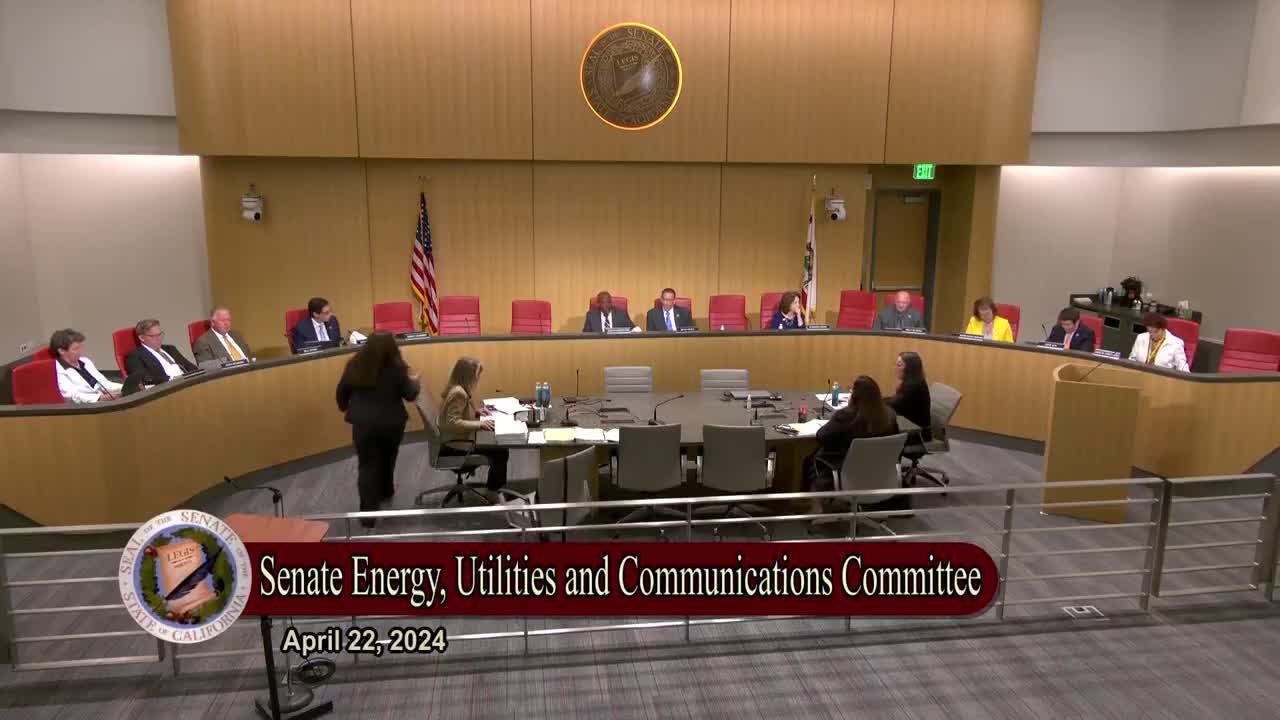 5MIN
Senate Standing Committee on Energy, Utilities and Communications
 38SEC
Senate Standing Committee on Energy, Utilities and Communications
Bill Author

Bill Co-Author(s):