SB 1372: Airports: third-party vendors: security lanes.
- Session Year: 2023-2024
- House: Senate
- Latest Version Date: 2024-06-18
Current Status:
Failed
(2024-07-01: July 1 set for first hearing canceled at the request of author.)
Introduced
In Committee
First Chamber
In Committee
Second Chamber
Enacted
Existing law, the State Aeronautics Act, governs various matters relative to aviation in the state, and authorizes the Department of Transportation to adopt, administer, and enforce rules and regulations for the administration of the act. A violation of the State Aeronautics Act is a crime.
This bill would prohibit a public airport that provides commercial services from entering into an agreement that authorizes a private third-party vendor that provides expedited security screening to use the standard security lane or the Transportation Security Administration PreCheck security lane. The bill would provide that this prohibition does not apply if there was an agreement between the public airport and the private third-party vendor that was entered into before January 1, 2025. The bill would also provide that the prohibition does not apply to an agreement between a public airport and a private third-party vendor if the private third-party vendor has obtained dedicated Transportation Security Administration security lanes solely for use by the private third-party vendor at that public airport.
Because a violation of these provisions would be a crime, this bill would impose a state-mandated local program.
The California Constitution requires the state to reimburse local agencies and school districts for certain costs mandated by the state. Statutory provisions establish procedures for making that reimbursement.
This bill would provide that no reimbursement is required by this act for a specified reason.
Existing law, the State Aeronautics Act, governs various matters relative to aviation in the state, and authorizes the Department of Transportation to adopt, administer, and enforce rules and regulations for the administration of the act. A violation of the State Aeronautics Act is a crime.
This bill would prohibit a public airport that provides commercial services, beginning January 1, 2025, services from entering into a new an agreement that authorizes a private third-party vendor that provides expedited security screening to use the standard security lane or the Transportation Security Administration PreCheck security lane. The bill would provide that this prohibition only applies to an agreement entered into before January 1, 2025, upon the expiration of the agreement. does not apply if there was an agreement between the public airport and the private third-party vendor that was entered into before January 1, 2025. The bill would also provide that the prohibition does not apply to an agreement between a public airport and a private third-party vendor if the private third-party vendor has obtained dedicated Transportation Security Administration security lanes solely for use by the private third-party vendor at that public airport.
Because a violation of these provisions would be a crime, the this bill would impose a state-mandated local program.
The California Constitution requires the state to reimburse local agencies and school districts for certain costs mandated by the state. Statutory provisions establish procedures for making that reimbursement.
This bill would provide that no reimbursement is required by this act for a specified reason.
Existing law, the State Aeronautics Act, governs various matters relative to aviation in the state, and authorizes the Department of Transportation to adopt, administer, and enforce rules and regulations for the administration of the act. A violation of the State Aeronautics Act is a crime.
This bill would prohibit a public airport that provides commercial services services, beginning January 1, 2025, from entering into an a new agreement that authorizes a private third-party vendor that provides expedited security screening to use the standard security lane or the Transportation Security Administration PreCheck security lane. The bill would provide that this prohibition only applies to an agreement entered into before January 1, 2025, upon the expiration of the agreement.
Because a violation of these provisions would be a crime, the bill would impose a state-mandated local program.
The California Constitution requires the state to reimburse local agencies and school districts for certain costs mandated by the state. Statutory provisions establish procedures for making that reimbursement.
This bill would provide that no reimbursement is required by this act for a specified reason.
Existing law, the State Aeronautics Act, governs various matters relative to aviation in the state, and authorizes the Department of Transportation to adopt, administer, and enforce rules and regulations for the administration of the act. A violation of the State Aeronautics Act is a crime.
This bill would prohibit a public airport that provides commercial services from entering into an agreement that authorizes a private third-party vendor that provides expedited security screening to use the Transportation Security Administration PreCheck security lane.
Because a violation of these provisions would be a crime, the bill would impose a state-mandated local program.
The California Constitution requires the state to reimburse local agencies and school districts for certain costs mandated by the state. Statutory provisions establish procedures for making that reimbursement.
This bill would provide that no reimbursement is required by this act for a specified reason.
(a)(1)A public airport that provides commercial services shall not enter into an agreement that authorizes a private third-party vendor that provides expedited security screening to use the standard security lane or the Transportation Security Administration PreCheck security lane.
(2)This subdivision does not apply if there was an agreement between the public airport and the private third-party vendor that was entered into before January 1, 2025.
(b)This section does not apply to an agreement between a public airport and a private third-party vendor if the private third-party vendor has obtained dedicated Transportation Security Administration security lanes solely for use by the private third-party vendor at that public airport.
(c)For purposes of this section, an airline, as certified under Part 121 (commencing with Section 121.1) of Title 14 of the Code of Federal Regulations, is not a private third-party vendor. This section does not apply to any services, including priority lanes or lines, offered by an airline solely for use by the airlines passengers, without a separate charge to a passenger by a private third-party vendor.
SEC. 2.No reimbursement is required by this act pursuant to Section 6 of Article XIIIB of the California Constitution because the only costs that may be incurred by a local agency or school district will be incurred because this act creates a new crime or infraction, eliminates a crime or infraction, or changes the penalty for a crime or infraction, within the meaning of Section 17556 of the Government Code, or changes the definition of a crime within the meaning of Section 6 of Article XIIIB of the California Constitution.
(a)Beginning January 1, 2025, a (1)A public airport that provides commercial services shall not enter into a new an agreement that authorizes a private third-party vendor that provides expedited security screening to use the standard security lane or the Transportation Security Administration PreCheck security lane.
(b)For agreements entered into before January 1, 2025, this section shall only apply upon the expiration of the agreement.(2)This subdivision does not apply if there was an agreement between the public airport and the private third-party vendor that was entered into before January 1, 2025.
(b)This section does not apply to an agreement between a public airport and a private third-party vendor if the private third-party vendor has obtained dedicated Transportation Security Administration security lanes solely for use by the private third-party vendor at that public airport.
SEC. 2.No reimbursement is required by this act pursuant to Section 6 of Article XIIIB of the California Constitution because the only costs that may be incurred by a local agency or school district will be incurred because this act creates a new crime or infraction, eliminates a crime or infraction, or changes the penalty for a crime or infraction, within the meaning of Section 17556 of the Government Code, or changes the definition of a crime within the meaning of Section 6 of Article XIIIB of the California Constitution.
A (a)Beginning January 1, 2025, a public airport that provides commercial services shall not enter into an a new agreement that authorizes a private third-party vendor that provides expedited security screening to use the standard security lane or the Transportation Security Administration PreCheck security lane.
(b)For agreements entered into before January 1, 2025, this section shall only apply upon the expiration of the agreement.
SEC. 2.No reimbursement is required by this act pursuant to Section 6 of Article XIIIB of the California Constitution because the only costs that may be incurred by a local agency or school district will be incurred because this act creates a new crime or infraction, eliminates a crime or infraction, or changes the penalty for a crime or infraction, within the meaning of Section 17556 of the Government Code, or changes the definition of a crime within the meaning of Section 6 of Article XIIIB of the California Constitution.
A public airport that provides commercial services shall not enter into an agreement that authorizes a private third-party vendor that provides expedited security screening to use the Transportation Security Administration PreCheck security lane.
SEC. 2.No reimbursement is required by this act pursuant to Section 6 of Article XIIIB of the California Constitution because the only costs that may be incurred by a local agency or school district will be incurred because this act creates a new crime or infraction, eliminates a crime or infraction, or changes the penalty for a crime or infraction, within the meaning of Section 17556 of the Government Code, or changes the definition of a crime within the meaning of Section 6 of Article XIIIB of the California Constitution.
|
Date
|
Status
|
|---|---|
| Jul 1, 2024 | July 1 set for first hearing canceled at the request of author. |
| Jun 18, 2024 | From committee with author's amendments. Read second time and amended. Re-referred to Com. on TRANS. |
| Jun 3, 2024 | Referred to Com. on TRANS. |
| May 23, 2024 | In Assembly. Read first time. Held at Desk. |
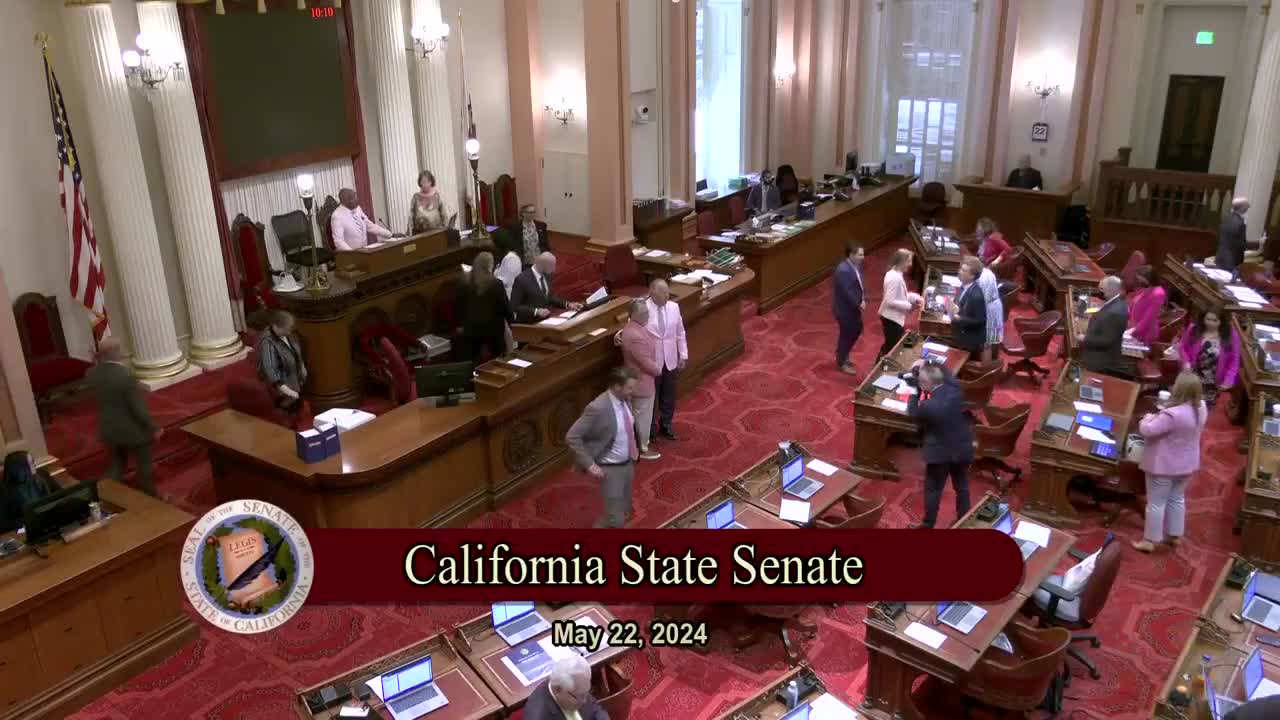
| May 22, 2024 | Read third time. Passed. (Ayes 26. Noes 7. Page 4132.) Ordered to the Assembly. |
| May 14, 2024 | Read second time. Ordered to third reading. |
| May 13, 2024 | From committee: Be ordered to second reading pursuant to Senate Rule 28.8. |
| May 3, 2024 | Set for hearing May 13. |
| Apr 30, 2024 | Read second time and amended. Re-referred to Com. on APPR. |
| Apr 29, 2024 | From committee: Do pass as amended and re-refer to Com. on APPR. (Ayes 8. Noes 4. Page 3733.) (April 23). |
| Apr 2, 2024 | Set for hearing April 23. |
| Apr 1, 2024 | April 9 set for first hearing canceled at the request of author. |
| Mar 18, 2024 | From committee with author's amendments. Read second time and amended. Re-referred to Com. on TRANS. |
| Mar 6, 2024 | Set for hearing April 9. |
| Feb 29, 2024 | Referred to Com. on TRANS. |
| Feb 20, 2024 | From printer. May be acted upon on or after March 18. |
| Feb 16, 2024 | Introduced. Read first time. To Com. on RLS. for assignment. To print. |
|
Date
|
Description
|
Location
|
Votes
|
|
|---|---|---|---|---|
| May 22, 2024 | Senate 3rd Reading SB1372 Newman | Senate Floor |
Passed |
|
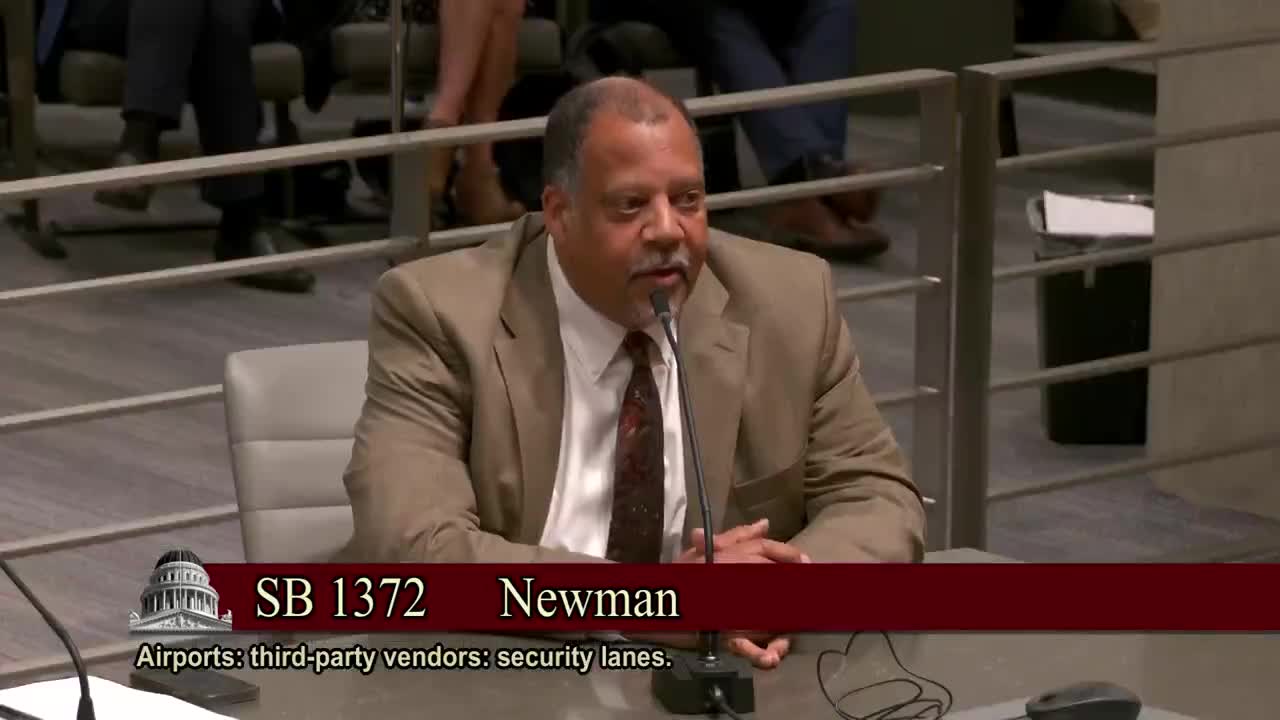
| Apr 23, 2024 | Do pass as amended, but first amend, and re-refer to the Committee on [Appropriations] | Senate Standing Committee on Transportation |
Passed |
This list shows positions taken on this bill by organizations on the date displayed, which is linked to the original source.
Positions by individuals are not included.
|
Organization
|
Position
|
Date
|
|---|---|---|
| Alaska Airlines | ** Against | |
| Alliance For Automotive Innovation | * Support | Apr 23, 2024 |
| American Federation of Government Employees Local 1230 | ** Support | |
| Association of Flight Attendants CWA | ** Support | |
| Association of Flight Attendents | * Support | Apr 23, 2024 |
| Bay Area Council | ** Against | |
| Burbank Glendale Pasadena Airport Authority | * Against | Apr 23, 2024 |
| burbank-glendale-pasadena airport authority | ** Against | |
| California Airports Council | ** Against | |
| California Business Roundtable | ** Against | |
| California Chamber Of Commerce | ** Against | |
| California Hydrogen Business Council | * Support | Apr 23, 2024 |
| California Hydrogen Coalition | * Support | Apr 23, 2024 |
| California State ASsociaiton of Counties | * Support | Apr 23, 2024 |
| California Travel Association | ** Against | |
| Chamber Of Progress | ** Against | |
| City of San Jose | ** Against | |
| Clear | ** Against | |
| Clear | * Indeterminate | Apr 23, 2024 |
| Delta Air Lines, Inc | ** Against | |
| First Student | * Support | Apr 23, 2024 |
| Hawaiian Airlines | ** Against | |
| Jetblue | ** Against | |
| LAX Coastal Chamber of Commerce | ** Against | |
| League Of California Cities | * Support | Apr 23, 2024 |
| Los Angeles Area Chamber Of Commerce | ** Against | |
| Los Angeles County Sanitation Districts | * Support | Apr 23, 2024 |
| National Express | * Support | Apr 23, 2024 |
| North San Diego Business Chamber | ** Against | |
| Oakland Chamber of Commerce | ** Against | |
| San Diego Regional Chamber Of Commerce | ** Against | |
| San Francisco Chamber of Commerce | ** Against | |
| SECURE IDENTITY LLC | ** Against | |
| Southwest Airlines | ** Against | |
| Technet | ** Against | |
| Tom's Truck Center | * Support | Apr 23, 2024 |
| United Airlines, Inc. | ** Against |
Date of Hearing: July 1, 2024
ASSEMBLY COMMITTEE ON TRANSPORTATION
Lori D. Wilson, Chair
SBPCA Bill Id:SB 1372
Author:(Newman) – As Amended Ver:April 30, 2024
SENATE VOTE: 26-7
SUBJECT: Airports: third-party vendors: security lanes
SUMMARY: Prohibits a public airport that provides commercial services from entering into an agreement that authorizes a private third-party vendor providing expedited security screening unless certain exempting criteria are met. Specifically, this bill:
- Prohibits a public airport that provides commercial services from entering into an agreement that authorizes a private third-party vendor that provides expedited security screening to use the standard security lane or the Transportation Security Administration PreCheck security lane.
- Allows an agreement between a public airport and private third-party vendor if either of the following applies:
- The airport operator entered into the contract with the private third party-vendor before January 1, 2025;
- The private third-party vendor has obtained dedicated TSA security lanes solely for use by the private third-party vendor at that public airport.
- Specifies that, under these provisions, an airline is not a private third-party vendor, and further exempts any services, including priority lanes or lines, offered by an airline solely for use by the airline’s passengers, without a separate charge to a passenger by a private third-party vendor.
EXISTING LAW:
- Establishes the Transportation Security Admininstration (TSA) and the role of Administrator of the TSA for overseeing civil aviation security services at each airport in the United States. (Aviation and Transportation Security Act of 2001; 49 United States Code (U.S.C.) §114, § 44901, and §44903)
- Assigns the Administrator various responsibilities, including managing day-to-day security screening operations for passenger air transportation; hiring, training and testing security screening personnel to provide security screening at all U.S. airports; providing operation guidance to the TSA’s field security resources to be implemented by designated Federal Security Directors (FSDs). (49 U.S.C. §44901; 49 U.S.C. §44933-44937)
- Grants the Adminstrator authority to establish requirements to implement trusted passenger programs and use available technologies to expedite the security screening of passengers who participate in such programs, thereby allowing security screening personnel to focus on those passengers who should be subject to more extensive screening. (Aviation and Transportation Security Act of 2001)
- Establishes the TSA PreCheck Program and requirements for the provision of expedited security screening of passengers, including vetting and risk assessment of applicants with biometric means, and further requires the Administrator to ensure that PreCheck screening operations remain open and available during peak and high-volume travel. (TSA Modernization Act of 2018; 49 U.S.C. §44919)
- Requires the Administrator to approve an application by an airport operator to contract with a qualified private screening company for screening of passengers and property at the airport if it is determined that the approval would not compromise security or detrimentally affect the cost-efficiency or effectiveness of screening at the airport. (49 U.S.C. §44920(a) and (b))
- Requires airport operators to adopt and carry out a security program (or plan) that has been approved by the TSA and to notify TSA of changes that would affect security, including layout or physical structure of any area under the control of the airport operator, airport tenant, aircraft operator, or foreign air carrier used to support the screening process, access, presence, or movement control functions (49 Code of Federal Regulations 1542.101 and 1542.107)
- Requires governing bodies of public airports to manage airport facilities and grant airport concessions in furtherance of the development of state commerce and tourism, including by avoiding wasteful duplication of such services; securing to the users of airports safe, courteous, and quality service; allocating limited airport resources to promote such ends. (Public Utilities Code 21690.7)
FISCAL EFFECT: According to the Senate Appropriations Committee, pursuant to Senate Rule 28.8, negligible state costs.
COMMENTS: In the wake of the September 11th terrorist attacks, Congress enacted the Aviation and Transportation Security Act of 2001, creating the TSA to oversee civil aviation security and prevent similar attacks in the future. For the first time in the country’s history, the federal government established a new paradigm of air transportation security protocols for screening passengers and cargo nationwide. With TSA managing security of over 440 federalized airports today, screening has become a tediously familiar experience for travelers.
Congress directed TSA to engage in research and development of new security technologies, recognizing that such technologies would enable expedited screening security procedures. Over time, TSA operations have evolved to reflect advances in identity verification and physical screening. The agency is actively deploying, among other things, biometrics technology, credential authentication technology, automated screening lanes, and computed tomography X-ray scanning in airports across the country. However, the full implementation of these technologies is unlikely to happen anytime soon, due to funding constraints. According to TSA Administrator David Pekoske, speaking on the FY 2025 budget request, low budget allocations in previous fiscal years, operations expenses and diversion of collected passenger fees are a hindrance to roll-out of new technologies for faster screening, for example, preventing full deployment of facial recognition scanners in airports until 2049.
Registered Traveler Program (RTP) and CLEAR. Recognizing its own limitations in timely implementation of new, expedited security technologies, TSA rolled out the RTP in 2006. As detailed in a November 2006 technical document for a “Registered Traveler Program Business Model”, TSA actively engaged the private sector to help develop technical standards as well as operational/business models for “a common infrastructure that allow[ed trusted] passengers to use [expedited screening] at any participating airports” and to create a “fair and seamless platform for airports, airlines and vendors to interface with TSA and each other”.
Today, Secure Identity LLC (doing business as CLEAR Secure, Inc.) is the largest private entity operating under the RTP. CLEAR Secure is a publicly traded company that operates a service known as “Clear Plus” or “CLEAR” which provides a biometric identity verification service for use at major airports, event arenas and sports stadiums. CLEAR is a subscription-based service, currently costing $189 per passenger per year; discounts are available for family members and through partnerships with American Express, Delta Airlines and United Airlines. CLEAR operates at 57 airports in the U.S., with over 22 million members.
CLEAR Secure provides service at most of California’s biggest airports, with the exceptions of John Wayne International Airport, Hollywood/Burbank Airport, and Fresno International Airport. CLEAR Secure reports that they paid California airports $13 million in 2023. Proponents of the bill argue that this creates a conflict of interest for airports, in that longer TSA lines encourage more CLEAR customers which could raise additional revenue for the airports if more space were leased. While this may be true, airports also lose out on revenue from concessions when passengers spend hours waiting for security screening. Were airports to lose the CLEAR revenue, they would make it up by charging other companies that utilize the airport space more, such as rental car companies, other concessionaires, or airlines.
At airports where CLEAR is available, a CLEAR customer has their identity verified (by iris or fingerprint scan or face recognition) and their boarding pass scanned by a CLEAR employee. The CLEAR employee then escorts the CLEAR customer to a TSA agent checking government IDs and verifying boarding passes. As the CLEAR customer’s identity has already been verified, the TSA agent generally only looks at the boarding pass and then allows the customer to advance to physical security screening, thereby “skipping” the line for ID and travel document review.
CLEAR membership can be used with or without TSA PreCheck status. CLEAR customers who also have TSA PreCheck go to the TSA PreCheck security checkpoint; those without PreCheck go to the regular checkpoint. According to CLEAR Secure, about 10% of airport patrons are CLEAR customers.
At the initial implementation of the RTP, TSA recognized that the RTP could provide increased efficiency for security screening but could also negatively impact non-Registered Traveler (non-RT) wait times. In its November 2006 Business Model Document, TSA noted that “[r]equests for additional lanes are subject to airport and TSA approval based on the unique operational set-ups of the individual airports and their checkpoints”. In order to minimize impact on non-RT travelers, the agency has informally mandated the use of “zippering” to manage passenger traffic from the standard TSA or TSA PreCheck security lanes and from the corresponding CLEAR lanes. In practice, however, zippering is dependent upon the TSA agent at the checkpoint and passengers traveling in groups or with family are often processed together, irrespective of CLEAR status.
The perceived unfairness of CLEAR customers paying to save time and skip lines has rankled many non-CLEAR passengers. Conversely, many CLEAR customers find the service valuable for this exact reason. According to a recent letter to the editor published in the L.A. Times, one reader writes that: “As a frequent business traveler, I feel Clear is worth the extra annual fee for the time savings, in addition to my PreCheck.”
TSA PreCheck Program. In 2018, Congress passed the TSA Modernization Act, which required TSA to develop the TSA PreCheck Program, an expedited security screening protocol for trusted travelers. TSA PreCheck is modeled after other trusted traveler programs (Global Entry, SENTRI, NEXUS, FAST) authorized by Customs and Border Protection for transit between foreign countries and the United States, though largely across Canadian-U.S.-Mexican borders.
The TSA PreCheck Program costs approximately $80 per passenger (administrative and processing fees), but gives travelers PreCheck status for five years. Similar to travelers in standard security lanes, travelers with TSA PreCheck status must still have their identification and boarding pass verified by a TSA agent. Unlike standard security lanes, however, TSA PreCheck travelers do not need to remove their shoes and are permitted to leave their laptops/electronics and liquids in their carry-on luggage.
The TSA Modernization Act set specific timeline goals for passenger enrollment in the TSA PreCheck program, and further authorized TSA to work with private contractors to facilitate registrations. CLEAR Secure recently entered into an agreement with TSA to serve as a private contractor promoting and enabling enrollment in the TSA PreCheck Program. CLEAR Secure will likely benefit from enrollment of passengers in TSA PreCheck who decide to subscribe to CLEAR services at the same time.
Reimbursable Security Screening Services Program (RSSP). Starting in 2019, TSA began a new pilot program in eight airports called the “Reimbursable Screening Services Program” (RSSP). The RSSP, which ends in 2025, authorizes private companies or airlines to establish and provide screening services and checkpoints outside an airport terminal’s primary screening area for passengers. Under the program, participants reimburse TSA fully for all personnel and non-personnel costs associated with the additional services at the new checkpoints. TSA states that the RSSP proposals are reviewed to ensure that there is no negative impact on current operations at existing security checkpoints for general travelers.
California currently hosts two RSSP participants, both operating at Los Angeles International Airport (LAX). These include Private Suite (P/S), a luxury airport terminal company advertised as a “back door to your commercial aircraft, [with] private TSA and Customs clearance” and the Delta One Lounge at LAX Terminal 3. The P/S service is subscription-based, with an entrance fee ranging from $1,095 for one-time access to its salon all the way up to $4,850 for annual membership, which reduces the salon rate to $750 per visit. A fully private Delta One TSA screening experience can be accessed through the purchase of a “premium” business class seat on a Delta One-eligible flight, or by Delta 360 members (which is Delta’s invitation-only status).
The RSSP attempts to address three major bottlenecks in airport security screening, which are limited TSA funding for its basic operations, the lack of sufficient space to accommodate more screening, and the dearth of TSA agents to support high passenger through-put. Most airports were designed prior to the 9/11 attacks and had no dedicated space for security screening. Adding additional lines and lanes for CLEAR or other third-party security companies is not always possible. Moreover, insufficient TSA staffing has been an ongoing concern of airlines and passengers over the last few years.
Other “Pay-to-Play” Services. Consumers often pay to jump lines, and CLEAR is not the only instance of consumers paying to get ahead in airports or elsewhere. For example, Southwest customers can pay to pre-board. In fact, many airlines, including American Airlines, Delta Airlines, United Airlines, Southwest, and Jet Blue, offer or have previously offered elite status or tickets for higher-class seats that afford similar line-jumping benefits as CLEAR. For example, Delta offers priority lines for elite or frequent travelers in select airport locations, including in California (LAX, SNA, SAN, SFO, SJC). Jet Blue offers similar expedited security at LAX, PSP, SMF, SAN, and SJC. This bill allows these airline priority lines for expedited screening to continue operating without requiring a dedicated security lane or TSA agent.
According to the author, “CLEAR, the expedited screening service provider, sold its services to California’s public airports as a way to enhance security and improve efficiency. Yet, recently, CLEAR has been the source of numerous security violations, including at least one incident in which CLEAR escorted past TSA an individual using a boarding pass found in the trash. And while CLEAR may save its customers time, it does so at the direct expense of those who cannot or choose not to purchase its nearly $200-a-year subscription. SB 1372 seeks to create shared motivation between CLEAR, airports, and TSA to grant premium travelers their own, dedicated lane, separate from those used by the general public. SB 1372 does not ban CLEAR. It’s simply about finding a better basis for the operations of expedited screening programs like CLEAR, so that those who participate can enjoy the benefits of membership without adversely affecting those who don’t.”
Writing in support, the Association of Flight Attendants-CWA, AFL-CIO state, “SB 1372 would restore equal access and treatment at the airport security checkpoint by requiring companies like CLEAR to operate in a dedicated security lane, separate from general travelers and TSA PreCheck members. This separation would preserve CLEAR’s ability to operate in California but in a way that streamlines the security process for everyone moving through California’s airports, whether CLEAR customers or not.”
In opposition, the California Airports Council writes “Airport security checkpoints are managed and controlled by the [TSA] which includes staffing, configuration and overall passenger screening processes. Airport authorities are allowed under federal law to contract with entities that have obtained approval from the TSA, including CLEAR, which screens airport passengers using biometrics. The process by which CLEAR customers are screened through the checkpoint is controlled by the TSA, not the airport. The overall intent is to make airline passenger security screening at airports faster. …Commercial airports are required to be financially self-sufficient. Thus, airlines pay airport Rates & Charges for use of the airport. Rates & Charges will include landing fees, passenger ticket fees, and services such as parking, fueling and deicing. …When airports have sources of non-airline revenue, it lowers the Rates & Charges paid by airlines, thus keeping airline operating costs lower, which can directly impact consumer airline ticket prices. Rental cars, concessions, advertising and CLEAR, are all sources of non-airline revenue.”
Committee comments: This bill prohibits a public airport from entering into a contract with a private vendor for security services, unless the contract was executed prior to Jan 1, 2025, or the private vendor obtains a dedicated security lane solely for use by the vendor’s customers. The bill also exempts contracts made between airports and airlines for the provision similar expedited screening services without a dedicated security lane.
There are many examples of consumers paying extra money to access additional privileges both inside and outside of airports. CLEAR Plus provides a significant time-saving benefit to frequent fliers at minimal expense. Unlike other examples of consumers paying to get ahead, the author contends that cutting TSA lines should not be permitted because the TSA provides a government service, not a private service. However, this bill is not uniform in its prohibition of privileged access, preserving airlines’ ability to offer their passengers expedited screening services with purchase of elite status or higher-class seats without obtaining a dedicated security lane.
The bill permits private vendors of expedited security screening services to operate if they can obtain a dedicated security lane. However, this is both an inefficient use of TSA staff and, critically, outside of private vendors and airport operators’ control. Requiring a dedicated security lane may result in less agile and adaptive TSA operations to respond to airports’ security needs. The RSSP pilot may not address staff allocation issues, as TSA agents staffing RSSP locations will be stationed away from airports’ primary screening areas and TSA may have less flexibility to move its TSA agents around as needed.
More importantly, TSA agents are federal employees and TSA exercises approval authority over public airports’ allocation of TSA staff and security layout in their airport security plans. Public airports do not have any authority to control the allocation of TSA agents or space to allow for a dedicated security lane solely for the private third-party vendor’s use, as required by this bill. Even if TSA did grant a public airport enough TSA agents to staff a dedicated CLEAR lane, the dedicated TSA agent could not help with screening the non-CLEAR security lanes without violating the provisions of this bill.
Government taxes and security fees cover the cost of TSA security screening operations. While this bill may reduce some of the perceived inequity of line-cutting, this bill does not address the underlying issues of funding, staffing and space that are causing such long lines in the first place. Apart from the limited RSSP pilot program, there is no mechanism that allows CLEAR Secure or airlines to reimburse TSA for costs associated with staffing security lanes, let alone paying for dedicated security lanes. CLEAR Secure, airport operators and airlines may have some ability to persuade Congress to grant TSA more funding or to extend the RSSP program.
Related Legislation: None.
REGISTERED SUPPORT / OPPOSITION:
Support
American Federation of Government Employees Local 1230
Association of Flight Attendants - CWA (AFA)
Opposition
Bay Area Council
Burbank-Glendale-Pasadena Airport Authority
California Airports Council
California Chamber of Commerce
California Travel Association
Chamber of Progress
City of San Jose
LAX Coastal Chamber of Commerce
Los Angeles Area Chamber of Commerce
North San Diego Business Chamber
San Diego Regional Chamber of Commerce
San Francisco Chamber of Commerce
Secure Identity LLC
Technet
Analysis Prepared by: Stephanie Choing / TRANS. / (916) 319-2093
SENATE RULES COMMITTEE Office of Senate Floor Analyses (916) 651-1520 Fax: (916) 327-4478 | SB 1372 |
THIRD READING
Bill No: SB 1372
Author: Newman (D)
Amended: 4/30/24
Vote: 21
SENATE TRANSPORTATION COMMITTEE: 8-4, 4/23/24
AYES: Cortese, Archuleta, Blakespear, Gonzalez, Laird, Limón, Newman, Umberg
NOES: Niello, Dahle, Dodd, Seyarto
NO VOTE RECORDED: Allen, Nguyen, Portantino
SENATE APPROPRIATIONS COMMITTEE: Senate Rule 28.8
SUBJECT: Airports: third-party vendors: security lanes
SOURCE: Author
DIGEST:
This bill prohibits a public airport from entering into an agreement authorizing a private third-party vendor to provide expedited security screening that uses the existing security lanes unless: (1) there was an agreement in place before January 1, 2025; or, (2) the third-party vendor has obtained dedicated Transportation Security Administration (TSA) security lanes.
ANALYSIS:
Existing law:
Recognizes the authority of the federal government to regulate the operation of aircraft and to control the use of the airways. (Public Utilities Code Section 21240)
This bill:
- Prohibits a public airport from entering into an agreement authorizing a private third-party vendor to provide expedited security screening that uses the existing security lanes unless:
- There was an agreement in place at the airport before January 1, 2025, or
- The third-party vendor obtains dedicated TSA security lanes.
Comments
- Author’s Statement. According to the author, “CLEAR, the expedited screening service provider, sold its services to airports and the Transportation Security Administration (TSA) as a tool to enhance security and improve efficiency. Counter to their claims of enhanced security, however, CLEAR has in recent years been the source of numerous security violations, including at least one incident where a person using a boarding pass they had found in the trash was escorted through security by CLEAR personnel. Moreover, counter to CLEAR’s claim of enhanced efficiency, while CLEAR may save time for its high-paying customers, it does so at the direct expense of average airport travelers who, having finally made it to the front of a security line, often find themselves being pushed aside to make way for a CLEAR subscriber. SB 1372 would place a moratorium on CLEAR’s expansion into any other California airport unless it operates in a dedicated security lane, separate from general security and TSA PreCheck passengers, thereby ensuring a consistent and equitable experience for all air travelers. California’s airports should of course be encouraged to find creative ways to raise revenues, but not at the expense of the public’s interest.”
- Clearly Convenient. Clear Secure is a publicly traded company that operates a service known as “Clear Plus” which provides a biometric identity verification service for about $200 annually. At major airports Clear Plus customers have their identify verified and their boarding pass scanned by a Clear Secure employee who then escorts the customer to the TSA agent, thereby skipping the TSA and TSA PreCheck lines. As the customer’s identity has already been verified by Clear, the TSA agent generally[1] only looks at the boarding pass and then allows the customer to advance to the TSA scanner lane with the other passengers. Clear Plus customers who also have TSA PreCheck go to the TSA PreCheck lane; those without PreCheck go to the regular lane. About 10% of airport patrons are Clear Plus customers. Clear provides service at most of California’s biggest airports, with the exceptions of John Wayne International Airport, Hollywood/Burbank Airport, Fresno International Airport, and Santa Barbara Municipal Airport.
- Paying for Convenience. Consumers can often pay to jump lines. Southwest customers can pay to pre-board. Disneyland customers can purchase the Genie+ service to minimize the time standing in lines. The author contends that cutting TSA lines is different because the TSA is a government service, not a private service.
- Follow the Money. Airports oppose the bill because they earn fees from leasing their space to Clear Secure. This creates a tension in that longer TSA lines encourage more Clear Plus customers, which raises additional revenue for the airports. Clear Secure reports that they have paid California airports $13 million in 2023. Were airports to lose the Clear revenue, they would make it up by charging other customers, such as rental car companies, other concessionaires, or airlines.
- Making American Airports Great. The TSA, or Transportation Security Administration, is an entity of the federal government under the Department of Transportation created after the terrorist attacks in New York, Pennsylvania and Virginia on September 11, 2001. It is responsible for security screening operations for passenger air transportation nationwide. As a federal agency, the TSA is part of the federal budget so increasing TSA staffing requires an act of Congress.
While TSA lines are inevitable, they are still frustrating. Insufficient TSA staffing has been an ongoing concern of airlines and passengers. Even if staffing were available, there are also physical limitations on the number of TSA lines and lanes because of limited airport space. Most airports were designed prior to the 9/11 attacks and therefore had no dedicated space for security screening. Adding additional lines and lanes for Clear or other third-party security provides is not always possible.
- Some Opposition Removed. This bill was amended in policy committee (Senate Committee on Transportation) to narrow the prohibition to airports that do not already have a contract with Clear as of January 1, 2025. With that amendment, Clear removed their opposition though other opponents remain.
FISCAL EFFECT: Appropriation: No Fiscal Com.: Yes Local: Yes
SUPPORT: (Verified 5/13/24)
American Federation of Government Employees Local 1230
Association of Flight Attendants - Cwa (AFA)
OPPOSITION: (Verified 5/13/24)
Alaska Airlines
Burbank-glendale-pasadena Airport Authority
California Airports Council
California Business Roundtable
California Chamber of Commerce
California Travel Association
Chamber of Progress
Delta Air Lines, INC
Hawaiian Airlines
Jetblue
LAX Coastal Chamber of Commerce
Los Angeles Area Chamber of Commerce
North San Diego Business Chamber
Oakland Chamber of Commerce
San Deigo Regional Chamber of Commerce
San Francisco Chamber of Commerce
Southwest Airlines
Technet
The Bay Area Council
United Airlines, INC.
Prepared by: Randy Chinn / TRANS. / (916) 651-4121
5/14/24 11:57:05
**** END ****
After several security breaches the TSA has recently required additional identity vetting of a portion of Clear customers. ↑
SENATE COMMITTEE ON TRANSPORTATION
Senator Dave Cortese, Chair
2023 - 2024 Regular
Bill No: Hearing Date: 4/23/2024
Author: | Newman | ||
Version: | 3/18/2024 Amended | ||
Urgency: | No | Fiscal: | Yes |
Consultant: | Randy Chinn | ||
SUBJECT:
DIGEST: This bill prohibits a public airport from entering into a new agreement authorizing a private third-party vendor to provide expedited security screening that uses the existing security lanes.
ANALYSIS:
Existing law:
- Recognizes the authority of the federal government to regulate the operation of aircraft and to control the use of the airways. (Public Utilities Code Section 21240)
This bill:
- Beginning January 1, 2025, prohibits a public airport providing commercial services from entering into a new agreement authorizing a private third-party vendor to provide expedited security screening that uses the existing security lanes. This prohibition applies upon expiration for agreements entered into prior to January 1, 2025.
COMMENTS:
- Author’s Statement. “CLEAR, the expedited screening service provider, sold its services to airports and the Transportation Security Administration (TSA) as a tool to enhance security and improve efficiency. Counter to their claims of enhanced security, however, CLEAR has in recent years been the source of numerous security violations, including at least one incident where a person using a boarding pass they’d found in the trash was escorted through security by CLEAR personnel. Moreover, counter to CLEAR’s claim of enhanced efficiency, while CLEAR may save time for its high-paying customers, it does so at the direct expense of average airport travelers who, having finally made it to the front of a security line, often find themselves being pushed aside to make way for a CLEAR subscriber. SB 1372 would require CLEAR and other companies offering similar services at California airports to operate in a dedicated security lane, separate from general security and TSA PreCheck passengers, thereby ensuring a consistent and equitable experience for all air travelers. California’s airports should of course be encouraged to find creative ways to raise revenues, but not at the expense of the public’s interest.”
- Clearly Convenient. Clear Secure is a publicly traded company that operates a service known as “Clear Plus” which provides a biometric identity verification service for about $200 annually. At major airports Clear Plus customers have their identify verified and their boarding pass scanned by a Clear Secure employee who then escorts the customer to the TSA agent, thereby skipping the TSA and TSA PreCheck lines. As the customer’s identity has already been verified by Clear, the TSA agent generally[1] only looks at the boarding pass and then allows the customer to advance to the TSA scanner lane with the other passengers. Clear Plus customers who also have TSA PreCheck go to the TSA PreCheck lane; those without PreCheck go to the regular lane. About 10% of airport patrons are Clear Plus customers. Clear provides service at most of California’s biggest airports, with the exceptions of John Wayne International Airport, Hollywood/Burbank Airport, and Fresno International Airport.
- Paying for Convenience. Consumers can often pay to jump lines. Southwest customers can pay to pre-board. Disneyland customers can purchase the Genie+ service to minimize the time standing in lines. The author contends that cutting TSA lines is different because the TSA is a government service, not a private service.
- Follow the Money. Airports oppose the bill because they earn fees from leasing their space to Clear Secure. This creates a tension in that longer TSA lines encourage more Clear Plus customers which raises additional revenue for the airports. Clear Secure reports that they have paid California airports $13 million in 2023. Were airports to lose the Clear revenue they would make it up by charging other customers, such as rental car companies, other concessionaires, or airlines.
- Making American Airports Great. The TSA, or Transportation Security Administration, is an entity of the federal government under the Department of Transportation created after the terrorist attacks in New York, Pennsylvania and Virginia on September 11, 2001. It is responsible for security screening operations for passenger air transportation nationwide. As a federal agency, the TSA is part of the federal budget so increasing TSA staffing requires an act of Congress.
While TSA lines are inevitable, they are still frustrating. Insufficient TSA staffing has been an ongoing concern of airlines and passengers. Even if staffing were available, there are also physical limitations on the number of TSA lines and lanes because of limited airport space. Most airports were designed prior to the 9/11 attacks and therefore had no dedicated space for security screening. Adding additional lines and lanes for Clear or other third-party security provides is not always possible.
- Proposed Amendment. The bill prohibits airports from entering into new contracts with companies like Clear Secure if they use the existing TSA security lines and lanes. The author’s goal is for Clear customers to have their own dedicated TSA screeners. Obtaining these dedicated resources is extremely challenging (see above), and is beyond the authority of the state. However, Clear Secure may have some ability to persuade Congress on this. Recognizing the potential inconvenience to Clear customers if the service is phased out at airports, the author may wish to consider amending the bill to instead limit the ability of Clear Secure to extend to new airports in California until dedicated TSA lanes and lines are provided, giving Clear Secure strong motivation to push for more TSA funding.
Related Legislation:
None.
FISCAL EFFECT: Appropriation: No Fiscal Com.: Yes Local: Yes
POSITIONS: (Communicated to the committee before noon on Wednesday,
April 17th.)
SUPPORT:
American Federation of Government Employees Local 1230
Association of Flight Attendants - Cwa (AFA)
OPPOSITION:
Alaska Airlines
Burbank-glendale-pasadena Airport Authority
California Airports Council
California Business Roundtable
California Chamber of Commerce
California Travel Association
Chamber of Progress
Clear
Delta Air Lines, INC
Hawaiian Airlines
Jetblue
LAX Coastal Chamber of Commerce
Los Angeles Area Chamber of Commerce
North San Diego Business Chamber
Oakland Chamber of Commerce
San Deigo Regional Chamber of Commerce
San Francisco Chamber of Commerce
Southwest Airlines
Technet
The Bay Area Council
United Airlines, INC.
-- END --
After several security breaches the TSA has recently required additional identity vetting of a portion of Clear customers. ↑
Discussed in Hearing
 11MIN
Senate Floor
 20MIN
Senate Standing Committee on Transportation
 37MIN
Senate Standing Committee on Transportation
 30SEC
Senate Standing Committee on Transportation
Bill Author

Bill Co-Author(s):