SB 1422: Disclosures: Travel DISCLOSE Act.
- Session Year: 2023-2024
- House: Senate
- Latest Version Date: 2024-04-09
Current Status:
Failed
(2024-05-16: May 16 hearing: Held in committee and under submission.)
Introduced
In Committee
First Chamber
In Committee
Second Chamber
Enacted
Under existing law, a nonprofit organization that regularly organizes and hosts travel for elected officials and spends more than $10,000 in a calendar year, or more than $5,000 in a calendar year for a single person, for travel by an elected state officer or local elected officeholder, must disclose to the Fair Political Practices Commission the names of donors who, in the preceding year, donated more than $1,000 to the nonprofit organization and accompanied an elected state officer or local elected officeholder for any portion of the travel, as specified. Under existing law, this requirement applies only if the sum of the organizations expenses relating to travel, study tours, or conferences, conventions, and meetings, was greater than one-third of the organizations total expenses, as specified.
This bill would instead require any person that regularly organizes and hosts travel for elected officials and spends more than $10,000 in a calendar year, or more than $5,000 in a calendar year for a single person, for travel by an elected state officer or local elected officeholder, to file certain disclosures with the commission. A violation of the Political Reform Act of 1974 is punishable as a misdemeanor. By creating a new crime, this bill would impose a state-mandated local program.
The California Constitution requires the state to reimburse local agencies and school districts for certain costs mandated by the state. Statutory provisions establish procedures for making that reimbursement.
This bill would provide that no reimbursement is required by this act for a specified reason.
The Political Reform Act of 1974, an initiative measure, provides that the Legislature may amend the act to further the acts purposes upon a 2/3 vote of each house of the Legislature and compliance with specified procedural requirements.
This bill would declare that it furthers the purposes of the act.
The Political Reform Act of 1974 requires certain disclosures relating to campaign contributions, including in-kind contributions. The act requires any candidate or committee that makes a late contribution that is an in-kind contribution to notify the recipient in writing of the value of the in-kind contribution within 24 hours of the time the contribution is made.This bill would make technical, nonsubstantive changes to this provision.The Political Reform Act of 1974 requires certain disclosures relating to campaign contributions, including in-kind contributions. The act requires any candidate or committee that makes a late contribution that is an in-kind contribution to notify the recipient in writing of the value of the in-kind contribution within 24 hours of the time the contribution is made.
This bill would make technical, nonsubstantive changes to this provision.
This act shall be known, and may be cited, as the Travel DISCLOSE Act.
SEC. 2.Section 89506 of the Government Code is amended to read:89506.(a)Payments, advances, or reimbursements for travel, including actual transportation and related lodging and subsistence that is reasonably related to a legislative or governmental purpose, or to an issue of state, national, or international public policy, are not prohibited or limited by this chapter if either of the following applies:
(1)The travel is in connection with a speech given by the elected state officer, local elected officeholder, candidate for elective state office or local elective office, an individual specified in Section 87200, member of a state board or commission, or designated employee of a state or local government agency, the lodging and subsistence expenses are limited to the day immediately preceding, the day of, and the day immediately following the speech, and the travel is within the United States.
(2)The travel is provided by a government, a governmental agency, a foreign government, a governmental authority, a bona fide public or private educational institution, as defined in Section 203 of the Revenue and Taxation Code, a nonprofit organization that is exempt from taxation under Section 501(c)(3) of the Internal Revenue Code, or by a person domiciled outside the United States who substantially satisfies the requirements for tax-exempt status under Section 501(c)(3) of the Internal Revenue Code.
(b)Gifts of travel not described in subdivision (a) are subject to the limits in Section 89503.
(c)Subdivision (a) applies only to travel that is reported on the recipients statement of economic interests.
(d)For purposes of this section, a gift of travel does not include any of the following:
(1)Travel that is paid for from campaign funds, as permitted by Article 4 (commencing with Section 89510), or that is a contribution.
(2)Travel that is provided by the governmental agency of a local elected officeholder, an elected state officer, member of a state board or commission, an individual specified in Section 87200, or a designated employee.
(3)Travel that is reasonably necessary in connection with a bona fide business, trade, or profession and that satisfies the criteria for federal income tax deduction for business expenses in Sections 162 and 274 of the Internal Revenue Code, unless the sole or predominant activity of the business, trade, or profession is making speeches.
(4)Travel that is excluded from the definition of a gift by any other provision of this title.
(e)This section does not apply to payments, advances, or reimbursements for travel and related lodging and subsistence permitted or limited by Section 170.9 of the Code of Civil Procedure.
(f)(1)A person, other than a government, a governmental agency, a foreign government, a governmental authority, or a bona fide public or private educational institution of collegiate grade, as defined in Section 203 of the Revenue and Taxation Code, that makes payments, advances, or reimbursements that total more than ten thousand dollars ($10,000) in a calendar year, or that total more than five thousand dollars ($5,000) in a calendar year for a single person, for travel by an elected state officer or local elected officeholder as described in subdivision (a) shall disclose to the Commission, at a time specified by Commission regulations, all of the following information with respect to that calendar year:
(A)(i)The name of each donor, and the cumulative value of each of those donors donations, to the person donor who donated one thousand dollars ($1,000) or more to the organization person in the calendar year. This disclosure requirement only applies to donors year and who knew or had reason to know that the donation would be used for a payment, advance, or reimbursement for travel by an elected state officer or local elected officeholder as described in subdivision (a).
(ii)For each donor described in clause (i), the cumulative total of their donations to the person in the calendar year.
(ii)(iii)A donor knows or has reason to know that their donation will be used in the manner described in clause (i) if any of the following conditions applies:
(I)The donor directed the person to use the donation to make a payment, advance, or reimbursement for travel by an elected state officer or local elected officeholder as described in subdivision (a).
(II)The donor made the donation in response to a message or solicitation for donations for the stated purpose of making a payment, advance, or reimbursement for travel by an elected state officer or local elected officeholder as described in subdivision (a).
(III)The donor, or an agent, employee, or representative of the donor, accompanied an elected state officer or local elected officeholder for any portion of travel as described in subdivision (a).
(B)Each travel event for which the person made payments, advances, or reimbursements for travel of one or more elected state officer or local elected officers as described in subdivision (a). For each travel event, the person shall disclose:
(i)The travel destination or destinations.
(ii)The dates of the travel event.
(iii)The names of the elected state officers or local elected officers for whom the person made payments, advances, or reimbursements for travel relating to the event.
(iv)The names of any donors described in subparagraph (A) for which the donor, or an agent, employee, or representative of the donor, accompanied an elected state officer or local elected officeholder for any portion of travel event.
(2)This subdivision does not preclude a finding that a nonprofit organization person is acting as an intermediary or agent of the donor. If the nonprofit organization person is acting as an intermediary or agent of the donor, all of the following apply:
(A)The donor to the nonprofit organization person is the source of the gift.
(B)The donor shall be identified as a financial interest under Section 87103.
(C)The gift shall be reported as required by Section 87207.
(D)The gift shall be subject to the limitations on gifts specified in Section 89503.
(3)For purposes of this subdivision, a nonprofit organization includes an organization that is exempt from taxation under Section 501(c)(3) or Section 501(c)(4) of the Internal Revenue Code.SEC. 3.No reimbursement is required by this act pursuant to Section 6 of Article XIIIB of the California Constitution because the only costs that may be incurred by a local agency or school district will be incurred because this act creates a new crime or infraction, eliminates a crime or infraction, or changes the penalty for a crime or infraction, within the meaning of Section 17556 of the Government Code, or changes the definition of a crime within the meaning of Section 6 of Article XIIIB of the California Constitution.
SEC. 4.The Legislature finds and declares that this bill furthers the purposes of the Political Reform Act of 1974 within the meaning of subdivision (a) of Section 81012 of the Government Code.
This act shall be known, and may be cited, as the Travel DISCLOSE Act.
SEC. 2.Section 89506 of the Government Code is amended to read:89506.(a)Payments, advances, or reimbursements for travel, including actual transportation and related lodging and subsistence that is reasonably related to a legislative or governmental purpose, or to an issue of state, national, or international public policy, are not prohibited or limited by this chapter if either of the following applies:
(1)The travel is in connection with a speech given by the elected state officer, local elected officeholder, candidate for elective state office or local elective office, an individual specified in Section 87200, member of a state board or commission, or designated employee of a state or local government agency, the lodging and subsistence expenses are limited to the day immediately preceding, the day of, and the day immediately following the speech, and the travel is within the United States.
(2)The travel is provided by a government, a governmental agency, a foreign government, a governmental authority, a bona fide public or private educational institution, as defined in Section 203 of the Revenue and Taxation Code, a nonprofit organization that is exempt from taxation under Section 501(c)(3) of the Internal Revenue Code, or by a person domiciled outside the United States who substantially satisfies the requirements for tax-exempt status under Section 501(c)(3) of the Internal Revenue Code.
(b)Gifts of travel not described in subdivision (a) are subject to the limits in Section 89503.
(c)Subdivision (a) applies only to travel that is reported on the recipients statement of economic interests.
(d)For purposes of this section, a gift of travel does not include any of the following:
(1)Travel that is paid for from campaign funds, as permitted by Article 4 (commencing with Section 89510), or that is a contribution.
(2)Travel that is provided by the governmental agency of a local elected officeholder, an elected state officer, member of a state board or commission, an individual specified in Section 87200, or a designated employee.
(3)Travel that is reasonably necessary in connection with a bona fide business, trade, or profession and that satisfies the criteria for federal income tax deduction for business expenses in Sections 162 and 274 of the Internal Revenue Code, unless the sole or predominant activity of the business, trade, or profession is making speeches.
(4)Travel that is excluded from the definition of a gift by any other provision of this title.
(e)This section does not apply to payments, advances, or reimbursements for travel and related lodging and subsistence permitted or limited by Section 170.9 of the Code of Civil Procedure.
(f)(1)A nonprofit organization that regularly organizes and hosts travel for elected officials and A person, other than a government, a governmental agency, a foreign government, a governmental authority, or a bona fide public or private educational institution of collegiate grade, as defined in Section 203 of the Revenue and Taxation Code, that makes payments, advances, or reimbursements that total more than ten thousand dollars ($10,000) in a calendar year, or that total more than five thousand dollars ($5,000) in a calendar year for a single person, for travel by an elected state officer or local elected officeholder as described in subdivision (a) shall disclose to the Commission the names of donors who did both of the following in the preceding year: Commission, at a time specified by Commission regulations, all of the following information with respect to that calendar year:
(A)(i)The name of each donor, and the cumulative value of each of those donors donations, to the person who donated one thousand dollars ($1,000) or more to the organization in the calendar year. This disclosure requirement only applies to donors who knew or had reason to know that the donation would be used for a payment, advance, or reimbursement for travel by an elected state officer or local elected officeholder as described in subdivision (a).
(ii)A donor knows or has reason to know that their donation will be used in the manner described in clause (i) if any of the following conditions applies:
(I)The donor directed the person to use the donation to make a payment, advance, or reimbursement for travel by an elected state officer or local elected officeholder as described in subdivision (a).
(II)The donor made the donation in response to a message or solicitation for donations for the stated purpose of making a payment, advance, or reimbursement for travel by an elected state officer or local elected officeholder as described in subdivision (a).
(III)The donor, or an agent, employee, or representative of the donor, accompanied an elected state officer or local elected officeholder for any portion of travel as described in subdivision (a).
(B)Each travel event for which the person made payments, advances, or reimbursements for travel of one or more elected state officer or local elected officers as described in subdivision (a). For each travel event, the person shall disclose:
(i)The travel destination or destinations.
(ii)The dates of the travel event.
(iii)The names of the elected state officers or local elected officers for whom the person made payments, advances, or reimbursements for travel relating to the event.
(iv)The names of any donors described in subparagraph (A) for which the donor, or an agent, employee, or representative of the donor, accompanied an elected state officer or local elected officeholder for any portion of travel event.
(A)Donated one thousand dollars ($1,000) or more to the nonprofit organization.(B)Accompanied an elected state officer or local elected officeholder, either personally or through an agent, employee, or representative, for any portion of travel described in subdivision (a).(2)For purposes of this subdivision, a nonprofit organization regularly organizes and hosts travel for elected officials if the sum of the nonprofit organizations expenses that relate to any of the following types of activities with regard to elected officials was greater than one-third of its total expenses reflected on the nonprofit organizations Internal Revenue Service Form 990, or the equivalent, filed most recently within the last 12 months:(A)Travel.(B)Study tours.(C)Conferences, conventions, and meetings.(3)(2)This subdivision does not preclude a finding that a nonprofit organization is acting as an intermediary or agent of the donor. If the nonprofit organization is acting as an intermediary or agent of the donor, all of the following apply:
(A)The donor to the nonprofit organization is the source of the gift.
(B)The donor shall be identified as a financial interest under Section 87103.
(C)The gift shall be reported as required by Section 87207.
(D)The gift shall be subject to the limitations on gifts specified in Section 89503.
(4)(3)For purposes of this subdivision, a nonprofit organization includes an organization that is exempt from taxation under Section 501(c)(3) or Section 501(c)(4) of the Internal Revenue Code.
SEC. 3.No reimbursement is required by this act pursuant to Section 6 of Article XIIIB of the California Constitution because the only costs that may be incurred by a local agency or school district will be incurred because this act creates a new crime or infraction, eliminates a crime or infraction, or changes the penalty for a crime or infraction, within the meaning of Section 17556 of the Government Code, or changes the definition of a crime within the meaning of Section 6 of Article XIIIB of the California Constitution.
SEC. 4.The Legislature finds and declares that this bill furthers the purposes of the Political Reform Act of 1974 within the meaning of subdivision (a) of Section 81012 of the Government Code.
SECTION 1.Section 84203.3 of the Government Code is amended to read:84203.3.(a)Any candidate or committee that makes a late contribution that is an in-kind contribution shall notify the recipient in writing of the value of the in-kind contribution. The notice shall be received by the recipient within 24 hours of the time the contribution is made.(b)This section shall not relieve a candidate or committee that makes a late in-kind contribution or the recipient of a late in-kind contribution from the requirement to file late contribution reports pursuant to Section 84203. However, a report filed by the recipient of a late in-kind contribution shall be deemed timely filed if it is received by the filing officer within 48 hours of the time the contribution is received.(a)Any candidate or committee that makes a late contribution that is an in-kind contribution shall notify the recipient in writing of the value of the in-kind contribution. The notice shall be received by the recipient within 24 hours of the time the contribution is made.
(b)Nothing in this This section shall not relieve a candidate or committee that makes a late in-kind contribution or the recipient of a late in-kind contribution from the requirement to file late contribution reports pursuant to Section 84203. However, a report filed by the recipient of a late in-kind contribution shall be deemed timely filed if it is received by the filing officer within 48 hours of the time the contribution is received.
|
Date
|
Status
|
|---|---|
| May 16, 2024 | May 16 hearing: Held in committee and under submission. |
| May 10, 2024 | Set for hearing May 16. |
| Apr 29, 2024 | April 29 hearing: Placed on APPR suspense file. |
| Apr 22, 2024 | Set for hearing April 29. |
| Apr 16, 2024 | From committee: Do pass and re-refer to Com. on APPR. (Ayes 7. Noes 0. Page 3631.) (April 16). Re-referred to Com. on APPR. |
| Apr 9, 2024 | From committee with author's amendments. Read second time and amended. Re-referred to Com. on E. & C.A. |
| Apr 5, 2024 | Set for hearing April 16. |
| Apr 3, 2024 | Re-referred to Com. on E. & C.A. |
| Mar 20, 2024 | From committee with author's amendments. Read second time and amended. Re-referred to Com. on RLS. |
| Feb 29, 2024 | Referred to Com. on RLS. |
| Feb 20, 2024 | From printer. May be acted upon on or after March 18. |
| Feb 16, 2024 | Introduced. Read first time. To Com. on RLS. for assignment. To print. |
|
Date
|
Description
|
Location
|
Votes
|
|
|---|---|---|---|---|
| Apr 29, 2024 | Placed on suspense file | Senate Standing Committee on Appropriations |
Passed |
|
| Apr 16, 2024 | Do pass, but first be re-referred to the Committee on [Appropriations] | Senate Standing Committee on Elections and Constitutional Amendments |
Passed |
This list shows positions taken on this bill by organizations on the date displayed, which is linked to the original source.
Positions by individuals are not included.
|
Organization
|
Position
|
Date
|
|---|---|---|
| 350 Conejo | ** Support | |
| 350 South Bay LA | ** Support | |
| 350 Southland Legislative Alliance | ** Support | |
| 350 Ventura County Climate Hub | ** Support | |
| Acterra | ** Support | |
| Ballona Institute | ** Support | |
| Ban SUP | ** Support | |
| California Alliance for Community Energy | ** Support | |
| California Clean Money Campaign | * Support | Apr 16, 2024 |
| California Climate Voters | ** Support | |
| California For Disability Rights | ** Support | |
| California News Publishers Association | * Support | Apr 16, 2024 |
| Californians for Energy Choice | ** Support | |
| Center For Biological Diversity | ** Support | |
| Clean Coalition | ** Support | |
| cleanearth4kids.org | ** Support | |
| Coastal Lands Action Network | ** Support | |
| Consumer Federation Of California | ** Support | |
| Consumer Watchdog | ** Support | |
| Courage California | ** Support | |
| Courageous Resistance of The Desert | ** Support | |
| Custom Power Solar | ** Support | |
| Defend Ballona Wetlands | ** Support | |
| Dogfight | * Support | Apr 16, 2024 |
| Endangered Habitats League | ** Support | |
| Extinction Rebellion San Francisco Bay Area | ** Support | |
| Glendale Environmental Coalition | ** Support | |
| Habitable Designs | ** Support | |
| Hammond Climate Solutions | ** Support | |
| Hang Out Do Good | ** Support | |
| Indivisible Ca: Statestrong | ** Support | |
| Indivisible California Green Team | ** Support | |
| League of Woman Voters of California | * Support | Apr 16, 2024 |
| Local Clean Energy Alliance | ** Support | |
| Long Beach Alliance for Clean Energy | ** Support | |
| Long Beach Environmental Alliance | ** Support | |
| Money Out People In | ** Support | |
| Money Out Voters In | ** Support | |
| Progressive Democrats of America, California | ** Support | |
| progressive democrats of the santa monica mountains | ** Support | |
| recolte energy | ** Support | |
| RootsAction.org | ** Support | |
| San Joaquin Valley Democratic Club | ** Support | |
| San Jose Community Energy Advocates | ** Support | |
| San Luis Obispo Mothers for Peace | ** Support | |
| Silicon Valley Youth Climate Action | ** Support | |
| Socal 350 | ** Support | |
| Sonoma County Democratic Party | ** Support | |
| Sustainable Systems Research Foundation | ** Support | |
| The Climate Alliance of Santa Cruz County | ** Support | |
| Unrig LA | ** Support | |
| Valley Women’s Club Environmental Committee | ** Support | |
| Voices for Progress | * Support | Apr 16, 2024 |
| Voters Right to Know | ** Support | |
| Women’s Energy Matters | ** Support |
SENATE COMMITTEE ON
Senator Anna Caballero, Chair
2023 - 2024 Regular Session
SB 1422 (Allen) - Disclosures: Travel DISCLOSE Act
Version: | Policy Vote: |
Urgency: | Mandate: |
Hearing Date: | Consultant: |
Bill Summary:
SB 1422 would require any person that regularly organizes and hosts travel for elected officials and spends more than $10,000 in a calendar year, or more than $5,000 in a calendar year for a single person, to file certain disclosures with the Fair Political Practices Commission (FPPC), as specified.
Fiscal Impact:
FPPC indicates that it would incur first-year costs of $189,000, and $182,000 annually thereafter, to implement the provisions of the bill (General Fund).
Background:
Current law provides that a nonprofit organization that regularly organizes and hosts travel for elected officials and spends more than $10,000 in a calendar year, or more than $5,000 in a calendar year for a single person, for travel by an elected state officer or local elected officeholder, must disclose to FPPC the names of donors who, in the preceding year, donated more than $1,000 to the nonprofit organization and accompanied an elected state officer or local elected officeholder for any portion of the travel, as specified. Under existing law, this requirement applies only if the sum of the organization’s expenses relating to travel, study tours, or conferences, conventions, and meetings, was greater than one-third of the organization’s total expenses, as specified.
In 2015, the Legislature enacted SB 21 (Hill), which required nonprofit organizations that pay for specified types of travel for elected officeholders to disclose the names of donors responsible for funding the travel. The bill also required an official who receives a gift of a travel payment from any source to report the travel destination on their statement of economic interests.
A CalMatters inquiry in May 2023 found that two disclosure forms have been filed during the nine years since SB 21’s enactment. After contacting several organizations, CalMatters noted that many of those groups contended that they do not meet the eligibility requirements for disclosure. The article explained that many organizations meet the monetary thresholds, but that ambiguity existed on how spending for travel, study tours and conferences, conventions and meetings related to elected officials account for at least one-third of its total expenses was calculated.
Proposed Law:
This bill would, among other things, do the following:
- Apply the disclosure requirement to all nonprofit entities that spend at least $10,000, or $5,000 for a single person, in a calendar year for organizing and hosting travel, as specified.
- Provide that the disclosure requirement described above only would apply to donors who knew or had reason to know that the donation would be used for a payment, advance, or reimbursement for travel by an elected state officer or local elected officeholder, as specified. Provide that the disclosure requirement does not apply to a government, a governmental agency, a foreign government, a governmental authority, or a bona fide public or private educational institution of collegiate grade, as specified.
- Require the person who made payments, advances, or reimbursements for travel to one or more elected officers to disclose the following for each travel event: (1) the travel destination or destinations, (2) the dates of the travel event, (3) the names of the elected state officers or local elected officers for whom the person made payments, advances, or reimbursements for travel relating to the event, and (4) the names of any donors for which the donor, or an agent, employee, or representative of the donor, accompanied an elected state officer or local elected officeholder for any portion of travel event.
Related Legislation:
SB 21 (Hill, Chapter 757, Statutes of 2015) required nonprofit organizations that pay for specified types of travel for elected officeholders to disclose the names of donors responsible for funding the travel. The bill also required an official who receives a gift of a travel payment from any source to report the travel destination on their statement of economic interests.
Staff Comments: FPPC notes that the number of new individuals/entities subject to the reporting requirement is unknown. The Commission anticipates costs for education materials, outreach, and resolution of potential complaints.
Any local government costs resulting from the mandate in this measure are not state-reimbursable because the mandate only involves the definition of a crime or the penalty for conviction of a crime.
-- END --
SENATE COMMITTEE ON
ELECTIONS AND CONSTITUTIONAL AMENDMENTS
Senator Catherine Blakespear, Chair
2023 - 2024 Regular
Bill No: 1422 Hearing Date: 4/16/24
Author: | Allen | ||
Version: |
| ||
Urgency: | Fiscal: | ||
Consultant: | |||
Subject:
DIGEST
This bill requires any person that regularly organizes and hosts travel for elected officials and spends more than $10,000 in a calendar year, or more than $5,000 in a calendar year for a single person, to file certain disclosures with the Fair Political Practices Commission (FPPC), as specified.
ANALYSIS
Existing law:
- Creates the Fair Political Practices Commission (FPPC), and makes it responsible for the impartial, effective administration and implementation of the Political Reform Act (PRA).
- Provides that payments, advances, or reimbursements for travel, including actual transportation and related lodging and subsistence that is reasonably related to a legislative or governmental purpose, or to an issue of state, national, or international public policy, are not prohibited or limited if either of the following applies:
- The travel is in connection with a speech, as specified.
- The travel is provided by a government, a governmental agency, a foreign government, a governmental authority, a bona fide public or private educational institution, a nonprofit organization, or by a person domiciled outside the United States who substantially satisfies the requirements for tax-exempt status, as specified.
- Requires a nonprofit organization that regularly organizes and hosts travel for elected officials and that makes payments, advances, or reimbursements that total more than $10,000 in a calendar year, or more than $5,000 in a calendar year for a single person, to disclose to the FPPC the names of donors who did both of the following in the preceding year:
- Donated $1,000 or more to the nonprofit organization.
- Accompanied an elected state officer or local elected officeholder, either personally or through an agent, employee, or representative, for any portion of travel, as specified.
- Provides that a nonprofit organization “regularly organizes and hosts travel for elected officials” if the sum of the nonprofit organization’s expenses that relate to any of the following types of activities with regard to elected officials was greater than one-third of its total expenses reflected on the nonprofit organization’s Internal Revenue Service Form 990, or the equivalent, filed most recently within the last 12 months:
- Travel.
- Study tours.
- Conferences, conventions, and meetings.
- Does not preclude a finding that a nonprofit organization is acting as an intermediary or agent of the donor. Provides that if the nonprofit organization is acting as an intermediary or agent of the donor, all of the following apply:
- The donor to the nonprofit organization is the source of the gift.
- The donor is identified as a financial interest, as specified.
- The gift is required to be reported, as specified.
- The gift is subject to the limitations on gifts, as specified.
- Provides that a nonprofit organization include an organization that is exempt from taxation under Section 501(c)(3) or Section 501(c)(4) of the Internal Revenue Code.
This bill:
- Removes the requirement in 4) above and applies the disclosure requirement to all entities that spend at least $10,000, or $5,000 for a single person, in a calendar year for organizing and hosting travel, as specified.
- Provides that the disclosure requirement described above only apply to donors who knew or had reason to know that the donation would be used for a payment, advance, or reimbursement for travel by an elected state officer or local elected officeholder, as specified. Provides that the disclosure requirement does not apply to a government, a governmental agency, a foreign government, a governmental authority, or a bona fide public or private educational institution of collegiate grade, as specified.
- Requires the person who made payments, advances, or reimbursements for travel to one or more elected officers to disclose the following for each travel event:
- The travel destination or destinations.
- The dates of the travel event.
- The names of the elected state officers or local elected officers for whom the person made payments, advances, or reimbursements for travel relating to the event.
- The names of any donors for which the donor, or an agent, employee, or representative of the donor, accompanied an elected state officer or local elected officeholder for any portion of travel event.
BACKGROUND
Political Reform Act of 1974. In 1974, California voters passed Proposition 9, an initiative commonly known as the PRA. Proposition 9 created the FPPC and codified significant restrictions and prohibitions on candidates, officeholders, and lobbyists. The Legislature is permitted to amend the PRA, but the amendments must further the purposes of the PRA and requires a two-thirds vote of both houses of the Legislature.
Additionally, some travel payments are not subject to the $590 gift limit but are reportable on an official’s statement of economic interests. This includes certain travel in connection with a speech, panel or seminar and certain travel provided by specified nonprofit organizations.
Previous Legislation. In 2015, the Legislature passed and Governor Brown signed SB 21 (Hill), Chapter 757, Statutes of 2015. SB 21 required nonprofit organizations that pay for specified types of travel for elected officeholders to disclose the names of donors responsible for funding the travel. The bill also required an official who receives a gift of a travel payment from any source to report the travel destination on their statement of economic interests.
CalMatters Reporting. In May of 2023, CalMatters reported that following the passage of SB 21 two disclosure forms were filed. After contacting several organizations, CalMatters noted that many of those groups contended that they do not meet the eligibility requirements for disclosure. The article explained that many organizations meet the monetary thresholds, but that ambiguity existed on how spending for travel, study tours and conferences, conventions and meetings related to elected officials account for at least one-third of its total expenses was calculated.
COMMENTS
- According to the author: California disclosure laws require interest groups that sponsor travel for legislators to disclose if any donors to the organization also attended the trip. These disclosures improve transparency and accountability for the public to know what outside groups are paying to sponsor travel for legislators. However, according to May 2023 reporting by CalMatters, a review of disclosure filings with the FPPC revealed that only two disclosures have been filed in the 9 years since this law was enacted in 2015.
Provisions of that law require disclosure only if one-third of the organization’s yearly expenditures were dedicated to sponsoring the travel of legislators. This loophole inadvertently allows the most well-resourced organizations to circumvent travel disclosures if they spend more on other activities. SB 1422 seeks to close this loophole by removing the one-third expenditure provision. The bill also further increases transparency by requiring disclosure of the amount a donor contributed to an interest group for travel purposes and how many trips the donor attended.
- Argument in Support. In a letter supporting SB 1422, former Senator Jerry Hill stated, in part, the following:
I strongly support SB 1422’s new requirements, informed by experience since the initial law’s passage, to ensure the public’s transparency needs are met.
The most impactful change removes the secondary threshold in current law. Currently, nonprofits only report when travel payments for elected officials make up over one-third of their total expenses. While this aimed to capture nonprofits focused primarily on travel funding, experience has shown it leaves the public unaware of donors behind larger nonprofits that may spend heavily on elected official travel. Larger nonprofits should not get out of disclosure of the travel they pay for just because they have larger budgets.
SB 1422’s expansion to encompass all non-governmental entities is equally important. The initial law focused on non-profits (501(c)(3) and (c)(4) organizations), but as CalMatters exposed in 2022, two trade associations exceeding the spending threshold claimed exemption due to this limitation. This needs to change. Public knowledge of travel funded by trade associations, unions, corporations, or individuals is as crucial as that of travel funded by nonprofits.
Finally, I commend SB 1422 for expanding disclosure requirements to include travel locations, dates, participating elected officials, and accompanying donors. Additionally, identifying donors who knowingly funded elected official travel and their contribution amounts is crucial. It makes a difference whether they have $1,000 or $50,000.
As a former State Senator, I recognize the potential education benefits of travel for elected officials. However, public awareness of trip funders and participants is equally important – just like knowing who is making campaign contributions and spending on political ads.
RELATED/PRIOR LEGISLATION
SB 21 (Hill), Chapter 757, Statutes of 2015, required nonprofit organizations that pay for specified types of travel for elected officeholders to disclose the names of donors responsible for funding the travel, as specified. SB 21 also required an officeholder who receives a gift of a travel payment from any source to report the travel destination on their statement of economic interests.
POSITIONS
Sponsor: California Clean Money Campaign
Support: Former State Senator Jerry Hill
350 Conejo
350 South Bay LA
350 Southland Legislative Alliance
350 Ventura County Climate Hub
Acterra
Ballona Institute
Ban Sup
California Alliance for Community Energy
California Climate Voters
California for Disability Rights
California for Energy Choice
Center for Biological Diversity
Clean Coalition
CleanEarth4Kids.org
Coastal Lands Action Network
Consumer Federation of California
Consumer Watchdog
Courage California
Courageous Resistance of the Desert
Custom Power Solar
Defend Ballona Wetlands
Endangered Habitats League
Extinction Rebellion San Francisco Bay Area
Glendale Environment Coalition
Habitable Designs
Hammond Climate Solutions
Hang Out Do Good
Indivisible California Green Team
Indivisible CA: StateStrong
Local Clean Energy Alliance
Long Beach Alliance for Clean Energy
Long Beach Environmental Alliance
Money Out People In
Money Out Voters In
Progressive Democrats of America, California
Progressive Democrats of the Santa Monica Mountains
Recolte Energy
RootsAction.org
San Joaquin Valley Democratic Club
San Jose Community Energy Advocates
San Luis Obispo Mothers for Peace
Silicon Valley Youth Climate Action
SoCal 350
Sonoma County Democratic Party
Sustainable Systems Research Foundation
The Climate Alliance of Santa Cruz County
Unrig LA
Valley Women’s Club Environmental Committee
Voices for Progress
Voters Right to Know
Women’s Energy Matters
Oppose: None received
-- END --
Discussed in Hearing
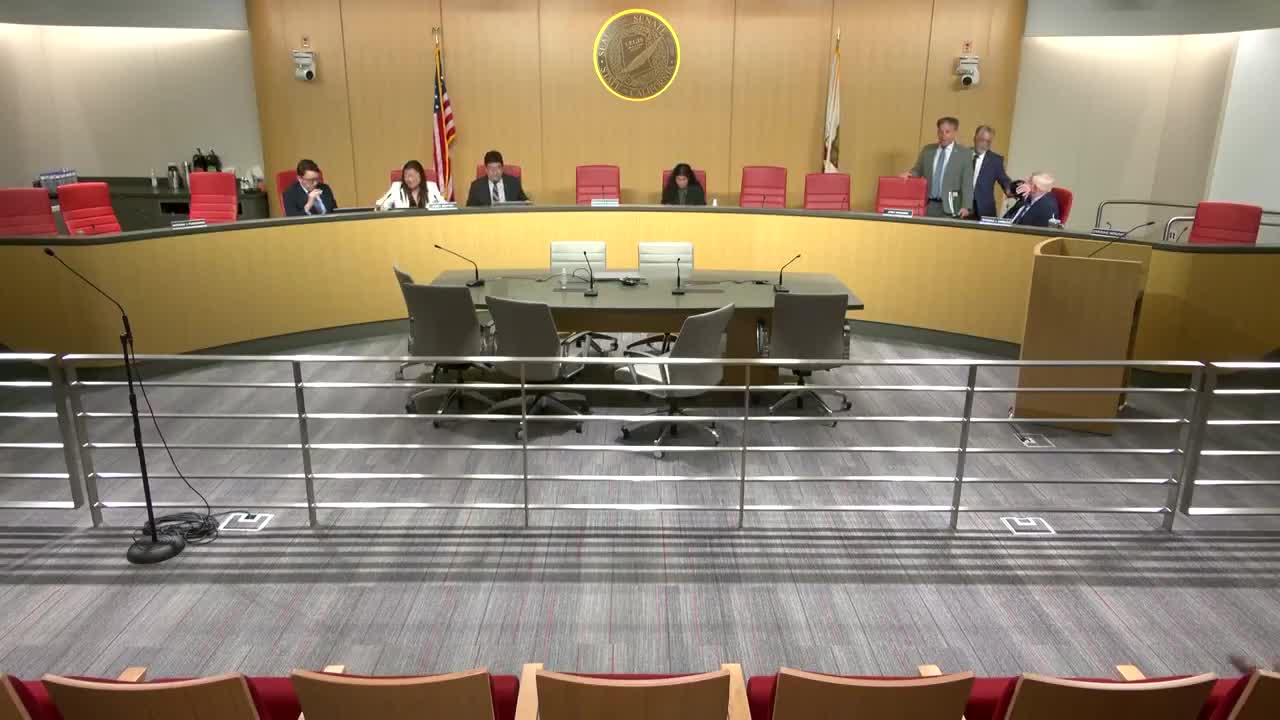 24MIN
Senate Standing Committee on Elections and Constitutional Amendments
Bill Author

Bill Co-Author(s):