SB 1508: Electricity: integrated resource plans: energy storage systems: modeling.
- Session Year: 2023-2024
- House: Senate
- Latest Version Date: 2024-05-16
Current Status:
Failed
(2024-08-15: August 15 hearing: Held in committee and under submission.)
Introduced
In Committee
First Chamber
In Committee
Second Chamber
Enacted
What does this bill do?
The bill requires the California Public Utilities Commission to make sure utility resource planning models include different energy storage duration classes — including long‑duration and multiday storage when reasonably available — and to allow any storage technology that meets a class’s minimum duration to be treated within that class. This change affects load‑serving entities (utilities and community choice aggregators) when they prepare and file their integrated resource plans.
The summary is provided by generative AI which can make mistakes. For original language, please view the details in the table below.
Existing law requires the Public Utilities Commission to adopt a process for each load-serving entities to file an integrated resource plan and a schedule for periodic updates to the plan and to ensure that load-serving entities, among other things, ensure system and local reliability on a near-term, mid-term, and long-term basis and maintain a diverse portfolio of energy resources.
This bill would require the commission to ensure that diverse energy storage duration classes are modeled modeled, as specified, and that authorize energy storage technology that meets an energy storage classs minimum duration requirements is to be modeled within that class to ensure technology neutrality.
Under existing law, a violation of any order, decision, rule, direction, demand, or requirement of the PUC commission is a crime.
Because a violation of a PUC commission action implementing the bills requirements would be a crime, this bill would impose a state-mandated local program.
The California Constitution requires the state to reimburse local agencies and school districts for certain costs mandated by the state. Statutory provisions establish procedures for making that reimbursement.
This bill would provide that no reimbursement is required by this act for a specified reason.
Existing law requires the Public Utilities Commission to adopt a process for each load-serving entities to file an integrated resource plan and a schedule for periodic updates to the plan and to ensure that load-serving entities, among other things, ensure system and local reliability on a near-term, mid-term, and long-term basis and maintain a diverse portfolio of energy resources.
This bill would require the commission to ensure that diverse energy storage duration classes are modeled and that energy storage technology that meets an energy storage classs minimum duration requirements is modeled within that class to ensure technology neutrality.
Under existing law, a violation of any order, decision, rule, direction, demand, or requirement of the PUC is a crime.
Because a violation of a PUC action implementing this the bills requirements would be a crime, the this bill would impose a state-mandated local program.
In addition, to the extent the bill would impose new requirements on local publicly owned electric utilities, the bill would impose a state-mandated local program.The California Constitution requires the state to reimburse local agencies and school districts for certain costs mandated by the state. Statutory provisions establish procedures for making that reimbursement.This bill would provide that no reimbursement is required by this act for specified reasons.The California Constitution requires the state to reimburse local agencies and school districts for certain costs mandated by the state. Statutory provisions establish procedures for making that reimbursement.
This bill would provide that no reimbursement is required by this act for a specified reason.
Existing law vests the Public Utilities Commission (PUC) with regulatory authority over public utilities, including electrical corporations, while local publicly owned electric utilities are under the direction of their governing boards. Existing law requires the PUC to open a proceeding to determine appropriate targets, if any, for each load-serving entity, as defined, to procure viable and cost-effective energy storage systems, as defined, to be achieved by specified dates, and authorizes the PUC to consider a variety of possible policies to encourage the cost-effective deployment of energy storage systems. Existing law similarly requires the governing board of each local publicly owned electric utility to initiate a process to determine appropriate targets, if any, for the utility to procure viable and cost-effective energy storage systems and authorizes the governing board to consider a variety of possible policies, as specified. Existing law requires each electrical corporations renewable energy procurement plan to require the utility to procure new energy storage systems that are appropriate to allow the electrical corporation to comply with the energy storage system procurement targets and policies and to address the acquisition and use of energy storage systems in order to achieve specified purposes. Existing law requires each load-serving entity to submit, by specified dates, reports to the PUC demonstrating that it has complied with the energy storage system procurement targets and policies adopted by the PUC.
This bill would require the PUC, on or before March 1, 2025, to adopt appropriate targets for each load-serving entity to procure viable and cost-effective energy storage systems, including long-duration energy storage systems, as defined, multiday energy storage systems, as defined, and emerging energy storage technologies, to be achieved by specified dates, and would require the PUC to determine the amount of new energy storage systems, as defined, that each load-serving entity would be required to deploy in order to facilitate a reliable, zero-carbon electricity grid, and achieve net-zero greenhouse gas emissions as soon as possible, as provided. The bill would require the governing board of each local publicly owned electric utility, on or before March 1, 2025, to initiate a process to determine appropriate targets, if any, for the utility to procure viable and cost-effective energy storage systems, to be achieved by specified dates, and to report those targets to the State Energy Resources Conservation and Development Commission, as provided. The bill would require that each electrical corporations renewable energy procurement plan achieve additional specified purposes, including reducing the demand for electricity during net peak periods, achieving permanent load shifting, achieving the objectives of a reliable, zero-carbon electricity grid and net-zero greenhouse gas emissions as soon as possible, and achieving an optimized overall portfolio of resources that use renewable energy generation and energy storage systems. The bill would update the specified dates by which each load-serving entity is required to submit reports to the PUC demonstrating that it has complied with the energy storage system procurement targets and policies adopted by the PUC.
Under existing law, a violation of any order, decision, rule, direction, demand, or requirement of the PUC is a crime.
Because a violation of a PUC action implementing this bills requirements would be a crime, the bill would impose a state-mandated local program.
In addition, to the extent the bill would impose new requirements on local publicly owned electric utilities, the bill would impose a state-mandated local program.
The California Constitution requires the state to reimburse local agencies and school districts for certain costs mandated by the state. Statutory provisions establish procedures for making that reimbursement.
This bill would provide that no reimbursement is required by this act for specified reasons.
Existing law establishes the Multifamily Affordable Housing Solar Roofs Program, also known as the Solar on Multifamily Affordable Housing Program. Existing law requires the commission, as part of the program, to award monetary incentives for qualifying solar energy systems, as defined, that are installed on multifamily residential property of at least 5 rental housing units that is, or will be, operated to provide deed-restricted low-income residential housing, as defined, and that meet one or more specified requirements, including that at least 66% of the households have incomes at or below 80% of the area median income, through December 31, 2032.This bill would state the intent of the Legislature to enact future legislation to facilitate the installation of solar energy systems and solar energy storage technologies in multifamily housing.Existing law establishes the Multifamily Affordable Housing Solar Roofs Program, also known as the Solar on Multifamily Affordable Housing Program. Existing law requires the commission, as part of the program, to award monetary incentives for qualifying solar energy systems, as defined, that are installed on multifamily residential property of at least 5 rental housing units that is, or will be, operated to provide deed-restricted low-income residential housing, as defined, and that meet one or more specified requirements, including that at least 66% of the households have incomes at or below 80% of the area median income, through December 31, 2032.
This bill would state the intent of the Legislature to enact future legislation to facilitate the installation of solar energy systems and solar energy storage technologies in multifamily housing.
(a)(1)Beginning in 2017, and to be updated regularly thereafter, the commission shall adopt a process for each load-serving entity to file an integrated resource plan, and a schedule for periodic updates to the plan, and shall ensure that load-serving entities do all of the following:
(A)Meet the greenhouse gas emissions reduction targets established by the State Air Resources Board, in coordination with the commission and the Energy Commission, for the electricity sector and each load-serving entity that reflect the electricity sectors percentage in achieving the economywide greenhouse gas emissions reductions pursuant to Section 38566 of the Health and Safety Code.
(B)Procure at least 60 percent eligible renewable energy resources by December 31, 2030, consistent with the state policy specified in Section 454.53 and Article 16 (commencing with Section 399.11) of Chapter 2.3.
(C)Enable each electrical corporation to fulfill its obligation to serve its customers at just and reasonable rates.
(D)Minimize impacts on ratepayers bills.
(E)Ensure system and local reliability on a near-term, mid-term, and long-term basis, including meeting the near-term and forecast long-term resource adequacy requirements of Section 380, and require sufficient, predictable resource procurement and development to avoid unplanned energy supply shortfalls by taking into account impacts due to climate change, forecasted levels of building and transportation electrification, and other factors that can result in those shortfalls.
(F)Comply with paragraph (1) of subdivision (b) of Section 399.13.
(G)Strengthen the diversity, sustainability, and resilience of the bulk transmission and distribution systems, and local communities.
(H)Enhance distribution systems and demand-side energy management.
(I)Minimize localized air pollutants and other greenhouse gas emissions, with early priority on disadvantaged communities identified pursuant to Section 39711 of the Health and Safety Code.
(J)Maintain a diverse portfolio of energy resources, which may include eligible energy resources procured by the Department of Water Resources.
(2)(A)The commission may authorize all source procurement for load-serving entities that includes various resource types including demand-side resources, supply-side resources, and resources that may be either demand-side resources or supply-side resources, taking into account the differing load-serving entities geographic service areas, to ensure that each load-serving entity meets the goals set forth in paragraph (1).
(B)The commission may approve procurement of resource types that will reduce the overall emissions of greenhouse gases from the electricity sector and meet the other goals specified in paragraph (1), but due to the nature of the technology or fuel source may not compete favorably in price against other resources over the time period of the integrated resource plan.
(3)In furtherance of the requirements of paragraph (1), the commission shall consider the role of existing renewable generation, grid operational efficiencies, energy storage, and distributed energy resources, including energy efficiency, in helping to ensure each load-serving entity meets energy needs and reliability needs in hours to encompass the hour of peak demand of electricity, excluding demand met by variable renewable generation directly connected to a California balancing authority, as defined in Section 399.12, while reducing the need for new electricity generation resources and new transmission resources in achieving the states energy goals at the least cost to ratepayers.
(4)(A)On or before September 1, 2024, and consistent with the process and schedule adopted pursuant to paragraph (1), the commission, in consultation with the Energy Commission and the Independent System Operator, shall determine if there is a need for the procurement of eligible energy resources based on a review of the integrated resource plans submitted by load-serving entities in compliance with the requirements of this section and Section 454.53 and the progress towards meeting the portfolio of resources identified pursuant to subdivision (a) of Section 454.51.
(B)If the commission determines that there is a need for the procurement of eligible energy resources, the commission shall specify the eligible energy resources that should be procured to meet that need.
(C)Within six months of determining that there is a need for the procurement of eligible energy resources, the commission may request the Department of Water Resources to exercise its central procurement function to procure those eligible energy resources specified pursuant to subparagraph (B) that meet the portfolio of resources identified in subdivision (a) of Section 454.51.
(D)(i)Upon receiving a request pursuant to subparagraph (C), the Department of Water Resources, before January 1, 2035, may exercise its central procurement function to conduct one or more competitive solicitations and enter into contracts to procure eligible energy resources in order to achieve the policy of the state specified in Section 454.53.
(ii)Any contract entered into by the Department of Water Resources pursuant to clause (i) and approved by the commission pursuant to Section 80821 of the Water Code before January 1, 2035, shall remain in force for the duration of the contract.
(E)The Department of Water Resources exercising of its central procurement function to procure eligible energy resources pursuant to this paragraph shall be conducted in accordance with Division 29.5 (commencing with Section 80800) of the Water Code.
(5)In furtherance of the requirements of paragraph (1), the commission shall ensure that diverse energy storage duration classes are modeled, including long-duration energy storage and multiday energy storage, if the commission determines multiday energy storage is reasonably available. To ensure technology neutrality, energy storage technology that meets an energy storage classs minimum duration requirements shall may be modeled within that class.
(b)(1)Each load-serving entity shall prepare and file an integrated resource plan consistent with paragraph (2) of subdivision (a) on a time schedule directed by the commission and subject to commission review.
(2)Each electrical corporations plan shall follow Section 454.5.
(3)The plan of a community choice aggregator shall be submitted to its governing board for approval and provided to the commission for certification, consistent with paragraph (5) of subdivision (a) of Section 366.2, and shall achieve all of the following:
(A)Economic, reliability, environmental, security, and other benefits and performance characteristics that are consistent with the goals set forth in paragraph (1) of subdivision (a).
(B)A diversified procurement portfolio consisting of short-term and long-term electricity, electricity-related, and demand reduction products.
(C)The resource adequacy requirements established pursuant to Section 380.
(4)The plan of an electric service provider shall achieve the goals set forth in paragraph (1) of subdivision (a) through a diversified portfolio consisting of short-term and long-term electricity, electricity-related, and demand reduction products.
(c)To the extent that additional procurement is authorized for the electrical corporation in the integrated resource plan or the procurement process authorized pursuant to Section 454.5, the commission shall ensure that the costs are allocated in a fair and equitable manner to all customers consistent with Section 454.51, that there is no cost shifting among customers of load-serving entities, and that community choice aggregators may self-provide renewable integration resources consistent with Section 454.51. The commission may order the procurement of resources with specific attributes by load-serving entities as a result of the integrated resource planning process and shall enforce any resource procurement requirements on a nondiscriminatory basis. Enforcement may include the assessment of penalties for noncompliance.
(d)To eliminate redundancy and increase efficiency, the process adopted pursuant to subdivision (a) shall incorporate, and not duplicate, any other planning processes of the commission.
(e)This section applies to an electrical cooperative, as defined in Section 2776, only if the electrical cooperative has an annual electrical demand exceeding 700 gigawatthours, as determined based on a three-year average commencing with January 1, 2013.
(f)(1)The commission shall not include the energy, capacity, or any attribute from Diablo Canyon Unit 1 beyond November 1, 2024, or Unit 2 beyond August 26, 2025, in the adopted integrated resource plan portfolios, resource stacks, or preferred system plans.
(2)The commission shall disallow a load-serving entity from including in their adopted integrated resource plan any energy, capacity, or any attribute from the Diablo Canyon Unit 1 beyond November 1, 2024, or Unit 2 beyond August 26, 2025.
(g)For a thermal powerplant that uses nuclear fission technology not constructed in the twenty-first 21st century, all resource attributes shall be retired on January 1, 2031, and shall be reported as a separate, separate line item resource for purposes of complying with Section 398.4.
(h)(1)Only a new energy resource that meets all of the following requirements is eligible to be procured by the Department of Water Resources pursuant to this section:
(A)The resource directly supports attainment of the goals specified in Section 454.53 without increasing the states dependence on any fossil fuel-based resources.
(B)The resource is determined by the commission to not be under contract at sufficient levels as shown in load-serving entities most recent individual integrated resource plans submitted to and reviewed by the commission pursuant to this section to achieve the goals specified in Section 454.53.
(C)The resource has a construction and development lead time of at least five years.
(D)The resource does not generate electricity using fossil fuels or fuels derived from fossil fuels.
(E)The resource does not use combustion to generate electricity, unless that combustion use is ancillary and necessary to facilitate geothermal electricity generation.
(2)Resources from a pump hydroelectric facility may be procured by the Department of Water Resources pursuant to this section if the pump hydroelectric facility does not exceed 500 megawatts and has been directly appropriated funding by the state before January 1, 2023.
(i)For purposes of this section, load-serving entity has the same meaning as defined in Section 380.
SEC. 2.No reimbursement is required by this act pursuant to Section 6 of Article XIIIB of the California Constitution because the only costs that may be incurred by a local agency or school district will be incurred because this act creates a new crime or infraction, eliminates a crime or infraction, or changes the penalty for a crime or infraction, within the meaning of Section 17556 of the Government Code, or changes the definition of a crime within the meaning of Section 6 of Article XIIIB of the California Constitution.
(a)(1)Beginning in 2017, and to be updated regularly thereafter, the commission shall adopt a process for each load-serving entity to file an integrated resource plan, and a schedule for periodic updates to the plan, and shall ensure that load-serving entities do all of the following:
(A)Meet the greenhouse gas emissions reduction targets established by the State Air Resources Board, in coordination with the commission and the Energy Commission, for the electricity sector and each load-serving entity that reflect the electricity sectors percentage in achieving the economywide greenhouse gas emissions reductions pursuant to Section 38566 of the Health and Safety Code.
(B)Procure at least 60 percent eligible renewable energy resources by December 31, 2030, consistent with the state policy specified in Section 454.53 and Article 16 (commencing with Section 399.11) of Chapter 2.3.
(C)Enable each electrical corporation to fulfill its obligation to serve its customers at just and reasonable rates.
(D)Minimize impacts on ratepayers bills.
(E)Ensure system and local reliability on a near-term, mid-term, and long-term basis, including meeting the near-term and forecast long-term resource adequacy requirements of Section 380, and require sufficient, predictable resource procurement and development to avoid unplanned energy supply shortfalls by taking into account impacts due to climate change, forecasted levels of building and transportation electrification, and other factors that can result in those shortfalls.
(F)Comply with paragraph (1) of subdivision (b) of Section 399.13.
(G)Strengthen the diversity, sustainability, and resilience of the bulk transmission and distribution systems, and local communities.
(H)Enhance distribution systems and demand-side energy management.
(I)Minimize localized air pollutants and other greenhouse gas emissions, with early priority on disadvantaged communities identified pursuant to Section 39711 of the Health and Safety Code.
(J)Maintain a diverse portfolio of energy resources, which may include eligible energy resources procured by the Department of Water Resources.
(2)(A)The commission may authorize all source procurement for load-serving entities that includes various resource types including demand-side resources, supply-side resources, and resources that may be either demand-side resources or supply-side resources, taking into account the differing load-serving entities geographic service areas, to ensure that each load-serving entity meets the goals set forth in paragraph (1).
(B)The commission may approve procurement of resource types that will reduce the overall emissions of greenhouse gases from the electricity sector and meet the other goals specified in paragraph (1), but due to the nature of the technology or fuel source may not compete favorably in price against other resources over the time period of the integrated resource plan.
(3)In furtherance of the requirements of paragraph (1), the commission shall consider the role of existing renewable generation, grid operational efficiencies, energy storage, and distributed energy resources, including energy efficiency, in helping to ensure each load-serving entity meets energy needs and reliability needs in hours to encompass the hour of peak demand of electricity, excluding demand met by variable renewable generation directly connected to a California balancing authority, as defined in Section 399.12, while reducing the need for new electricity generation resources and new transmission resources in achieving the states energy goals at the least cost to ratepayers.
(4)(A)On or before September 1, 2024, and consistent with the process and schedule adopted pursuant to paragraph (1), the commission, in consultation with the Energy Commission and the Independent System Operator, shall determine if there is a need for the procurement of eligible energy resources based on a review of the integrated resource plans submitted by load-serving entities in compliance with the requirements of this section and Section 454.53 and the progress towards meeting the portfolio of resources identified pursuant to subdivision (a) of Section 454.51.
(B)If the commission determines that there is a need for the procurement of eligible energy resources, the commission shall specify the eligible energy resources that should be procured to meet that need.
(C)Within six months of determining that there is a need for the procurement of eligible energy resources, the commission may request the Department of Water Resources to exercise its central procurement function to procure those eligible energy resources specified pursuant to subparagraph (B) that meet the portfolio of resources identified in subdivision (a) of Section 454.51.
(D)(i)Upon receiving a request pursuant to subparagraph (C), the Department of Water Resources, before January 1, 2035, may exercise its central procurement function to conduct one or more competitive solicitations and enter into contracts to procure eligible energy resources in order to achieve the policy of the state specified in Section 454.53.
(ii)Any contract entered into by the Department of Water Resources pursuant to clause (i) and approved by the commission pursuant to Section 80821 of the Water Code before January 1, 2035, shall remain in force for the duration of the contract.
(E)The Department of Water Resources exercising of its central procurement function to procure eligible energy resources pursuant to this paragraph shall be conducted in accordance with Division 29.5 (commencing with Section 80800) of the Water Code.
(5)In furtherance of the requirements of paragraph (1), the commission shall ensure that diverse energy storage duration classes are modeled, including long-duration energy storage and multiday energy storage, if the commission determines multiday energy storage is reasonably available. To ensure technology neutrality, energy storage technology that meets an energy storage classs minimum duration requirements shall be modeled within that class.
(b)(1)Each load-serving entity shall prepare and file an integrated resource plan consistent with paragraph (2) of subdivision (a) on a time schedule directed by the commission and subject to commission review.
(2)Each electrical corporations plan shall follow Section 454.5.
(3)The plan of a community choice aggregator shall be submitted to its governing board for approval and provided to the commission for certification, consistent with paragraph (5) of subdivision (a) of Section 366.2, and shall achieve all of the following:
(A)Economic, reliability, environmental, security, and other benefits and performance characteristics that are consistent with the goals set forth in paragraph (1) of subdivision (a).
(B)A diversified procurement portfolio consisting of short-term and long-term electricity, electricity-related, and demand reduction products.
(C)The resource adequacy requirements established pursuant to Section 380.
(4)The plan of an electric service provider shall achieve the goals set forth in paragraph (1) of subdivision (a) through a diversified portfolio consisting of short-term and long-term electricity, electricity-related, and demand reduction products.
(c)To the extent that additional procurement is authorized for the electrical corporation in the integrated resource plan or the procurement process authorized pursuant to Section 454.5, the commission shall ensure that the costs are allocated in a fair and equitable manner to all customers consistent with Section 454.51, that there is no cost shifting among customers of load-serving entities, and that community choice aggregators may self-provide renewable integration resources consistent with Section 454.51. The commission may order the procurement of resources with specific attributes by load-serving entities as a result of the integrated resource planning process and shall enforce any resource procurement requirements on a nondiscriminatory basis. Enforcement may include the assessment of penalties for noncompliance.
(d)To eliminate redundancy and increase efficiency, the process adopted pursuant to subdivision (a) shall incorporate, and not duplicate, any other planning processes of the commission.
(e)This section applies to an electrical cooperative, as defined in Section 2776, only if the electrical cooperative has an annual electrical demand exceeding 700 gigawatthours, as determined based on a three-year average commencing with January 1, 2013.
(f)(1)The commission shall not include the energy, capacity, or any attribute from Diablo Canyon Unit 1 beyond November 1, 2024, or Unit 2 beyond August 26, 2025, in the adopted integrated resource plan portfolios, resource stacks, or preferred system plans.
(2)The commission shall disallow a load-serving entity from including in their adopted integrated resource plan any energy, capacity, or any attribute from the Diablo Canyon Unit 1 beyond November 1, 2024, or Unit 2 beyond August 26, 2025.
(g)For a thermal powerplant that uses nuclear fission technology not constructed in the twenty-first century, all resource attributes shall be retired on January 1, 2031, and shall be reported as a separate, line item resource for purposes of complying with Section 398.4.
(h)(1)Only a new energy resource that meets all of the following requirements is eligible to be procured by the Department of Water Resources pursuant to this section:
(A)The resource directly supports attainment of the goals specified in Section 454.53 without increasing the states dependence on any fossil fuel-based resources.
(B)The resource is determined by the commission to not be under contract at sufficient levels as shown in load-serving entities most recent individual integrated resource plans submitted to and reviewed by the commission pursuant to this section to achieve the goals specified in Section 454.53.
(C)The resource has a construction and development lead time of at least five years.
(D)The resource does not generate electricity using fossil fuels or fuels derived from fossil fuels.
(E)The resource does not use combustion to generate electricity, unless that combustion use is ancillary and necessary to facilitate geothermal electricity generation.
(2)Resources from a pump hydroelectric facility may be procured by the Department of Water Resources pursuant to this section if the pump hydroelectric facility does not exceed 500 megawatts and has been directly appropriated funding by the state before January 1, 2023.
(i)For purposes of this section, load-serving entity has the same meaning as defined in Section 380.
SEC. 2.No reimbursement is required by this act pursuant to Section 6 of Article XIIIB of the California Constitution because the only costs that may be incurred by a local agency or school district will be incurred because this act creates a new crime or infraction, eliminates a crime or infraction, or changes the penalty for a crime or infraction, within the meaning of Section 17556 of the Government Code, or changes the definition of a crime within the meaning of Section 6 of Article XIIIB of the California Constitution.
All matter omitted in this version of the bill appears in the bill as amended in the Senate, March 18, 2024. (JR11)For purposes of this chapter, the following terms have the following meanings:
(a)(1)Energy storage system means commercially available technology that is capable of absorbing energy, storing it for a period of time, and thereafter dispatching the energy. An energy storage system may have any of the characteristics in paragraph (2), shall accomplish one of the purposes in paragraph (3), and shall meet at least one of the characteristics in paragraph (4).
(2)An energy storage system may have any of the following characteristics:
(A)Be either centralized or distributed.
(B)Be either owned by a load-serving entity or local publicly owned electric utility, a customer of a load-serving entity or local publicly owned electric utility, or a third party, or is jointly owned by two or more of the above.
(3)An energy storage system shall be cost effective and either reduce emissions of greenhouse gases, reduce demand for peak electrical generation, defer or substitute for an investment in generation, transmission, or distribution assets, or improve the reliable operation of the electrical transmission or distribution grid.
(4)An energy storage system shall do one or more of the following:
(A)Use mechanical, chemical, or thermal processes to store energy that was generated at one time for use at a later time.
(B)Store thermal energy for direct use for heating or cooling at a later time in a manner that avoids the need to use electricity at that later time.
(C)Use mechanical, chemical, or thermal processes to store energy generated from renewable resources for use at a later time.
(D)Use mechanical, chemical, or thermal processes to store energy generated from mechanical processes that would otherwise be wasted for delivery at a later time.
(b)Load-serving entity has the same meaning as defined in Section 380.
(c)Long-duration energy storage means an energy storage system with the capability to continuously discharge electricity at its rated capacity for a duration of no less than eight hours.
(d)Multiday energy storage means an energy storage system with the capability to continuously discharge electricity at its rated capacity for a duration of more than 24 hours.
(c)(e)New means, in reference to an energy storage system, a system that is installed and first becomes operational after January 1, 2010.
(d)(f)Offpeak means, in reference to electrical demand, a period that is not within a peak demand period.
(e)(g)Peak demand period means a period of high daily, weekly, or seasonal demand for electricity. For purposes of this chapter, the peak demand period for a load-serving entity shall be determined, or approved, by the commission and shall be determined, or approved, for a local publicly owned electric utility, utility by its governing body.
(f)(h)Procure and procurement means, in reference to the procurement of an energy storage system, to acquire by ownership or by a contractual right to use the energy from, or the capacity of, including ancillary services, an energy storage system owned by a load-serving entity, local publicly owned electric utility, customer, or third party. Nothing in this This chapter, and no an action by the commission, shall not discourage or disadvantage development and ownership of an energy storage system by an electrical corporation.
SEC. 2.Section 2836 of the Public Utilities Code is amended to read:2836.(a)(1)On or before March 1, 2012, 2025, as part of a new or existing proceeding, the commission shall open a proceeding to determine adopt appropriate targets, if any, targets for each load-serving entity to procure viable and cost-effective energy storage systems, including long-duration energy storage systems, multiday energy storage systems, and emerging energy storage systems technologies, to be achieved by December 31, 2015, 2028, December 31, 2030, and December 31, 2020. 2035. As part of this proceeding, the commission may shall make the findings set forth in paragraph (2), and shall consider a variety of possible policies to encourage the cost-effective deployment of energy storage systems, including refinement of existing procurement methods to properly value energy storage systems. systems, including long-duration energy storage systems and multiday energy storage systems and the contribution of energy storage to a reliable electrical grid during extreme weather.
(2)The commission shall adopt determine the procurement targets, if determined to be appropriate pursuant to amount of new energy storage systems, in megawatts and megawatthours of capacity, that each load-serving entity shall deploy by each of the dates described in paragraph (1), by October 1, 2013. including within the categories of long-duration energy storage and multiday energy storage, in order to facilitate a reliable, zero-carbon electricity grid, pursuant to Sections 454.51 to 454.53, inclusive, and achieve net-zero greenhouse gas emissions as soon as possible, pursuant to Section 38562.2 of the Health and Safety Code.
(3)The commission shall determine a set of reasonable actions each load-serving entity shall be required to undertake in order to facilitate the development of energy storage systems that rely on new or emerging technologies and that are likely to be beneficial to achieving state policy goals with lower costs, improved reliability, improved resilience, or reduced burdens on disadvantaged communities.
(3)(4)The commission shall reevaluate the determinations made pursuant to this subdivision not less than once every three years.
(4)Nothing in this(5)This section prohibits does not prohibit the commissions evaluation and approval of any application for funding or recovery of costs of any ongoing or new development, trialing, and testing of energy storage projects or technologies outside of the proceeding required by this chapter.
(6)For purposes of this subdivision, new energy storage system means an energy storage system that is contracted for, placed in service by, and ordered by the commission on or after January 1, 2025.
(b)(1)On or before March 1, 2012, 2025, the governing board of each local publicly owned electric utility shall initiate a process to determine appropriate targets, if any, for the utility to procure viable and cost-effective energy storage systems to be achieved by December 31, 2016, 2028, December 31, 2030, and December 31, 2020. 2035. As part of this proceeding, the governing board shall consider the objectives described in paragraphs (2) and (3) of subdivision (a), and may consider a variety of possible policies to encourage the cost-effective deployment of energy storage systems, including refinement of existing procurement methods to properly value energy storage systems.
(2)The governing board shall adopt the procurement targets, if determined to be appropriate pursuant to paragraph (1), by October 1, 2014. 2025.
(3)The governing board shall reevaluate the determinations made pursuant to this subdivision not less than once every three years.
(4)A local publicly owned electric utility shall report to the Energy Commission regarding the energy storage system procurement targets and policies adopted by the governing board pursuant to paragraph (2), and report any modifications made to those targets as a result of a reevaluation undertaken pursuant to paragraph (3).
SEC. 3.Section 2836.2 of the Public Utilities Code is amended to read:2836.2.In adopting and reevaluating appropriate energy storage system procurement targets and policies pursuant to subdivision (a) of Section 2836, the commission shall do all of the following:
(a)Consider existing operational data and results of testing and trial pilot projects from existing energy storage facilities.
(b)Consider available information from the California Independent System Operator derived from California Independent System Operator testing and evaluation procedures.
(c)Consider the integration of energy storage technologies with other programs, including demand-side management or other means of achieving the purposes identified in Section 2837 that will result in the most efficient use of generation resources and cost-effective energy efficient grid integration and management.
(d)Ensure that the energy storage system procurement targets and policies that are established are technologically viable and cost effective. in the interest of ratepayers.
(e)Consider energy storage system needs to ensure grid reliability during multiday periods of atypical and extreme weather, including periods of low renewable energy generation, and in scenarios without existing fossil fuel generation.
SEC. 4.Section 2837 of the Public Utilities Code is amended to read:2837.Each electrical corporations renewable energy procurement plan, prepared and approved pursuant to Article 16 (commencing with Section 399.11) of Chapter 2.3 of Part 1, shall require the utility to procure new energy storage systems, including long-duration energy storage systems and multiday energy storage systems, that are appropriate to allow the electrical corporation to comply with the energy storage system procurement targets and policies adopted pursuant to Section 2836. The plan shall address the acquisition and use of energy storage systems in order to achieve the following purposes:
(a)Integrate intermittent generation from eligible renewable energy resources into the reliable operation of the transmission and distribution grid. grid, including during multiday extreme or atypical weather events.
(b)Allow intermittent generation from eligible renewable energy resources to operate at or near full capacity.
(c)Reduce the need for new fossil-fuel powered peaking fossil fuel-powered generation facilities by using stored electricity to meet peak demand. demand, including for the expected duration of multiday extreme or atypical weather events.
(d)Reduce purchases of electricity generation sources with higher emissions of greenhouse gases.
(e)Eliminate or reduce transmission and distribution losses, including increased losses during periods of congestion on the grid.
(f)Reduce the demand for electricity during peak periods and achieve permanent load-shifting load shifting by using thermal storage to meet air-conditioning needs.
(g)Avoid or delay investments in transmission and distribution system upgrades.
(h)Use energy storage systems to provide the ancillary services otherwise provided by fossil-fueled generating facilities.
(i)Reduce the demand for electricity during net peak periods and achieve permanent load shifting by using energy storage systems to meet building electrification and transportation electrification needs.
(j)Achieve the objectives of a reliable, zero-carbon electricity grid, pursuant to Sections 454.51 to 454.53, inclusive, and achieve net-zero greenhouse gas emissions as soon as possible, pursuant to Section 38562.2 of the Health and Safety Code.
(k)Achieve an optimized overall portfolio of resources that use renewable energy generation and energy storage systems, including long-duration energy storage and multiday energy storage systems.
SEC. 5.Section 2838 of the Public Utilities Code is amended to read:2838.(a)(1)By January 1, 2016, 2027, each load-serving entity shall submit a report to the commission demonstrating that it has complied with the energy storage system procurement targets and policies adopted by the commission pursuant to subdivision (a) of Section 2836.
(2)By January 1, 2021, 2031, each load-serving entity shall submit a report to the commission demonstrating that it has complied with the energy storage system procurement targets and policies adopted by the commission pursuant to subdivision (a) of Section 2836.
(b)The commission shall ensure that a copy of each report required by subdivision (a), with any confidential information redacted, is available on the commissions Internet Web site. internet website.
SEC. 6.No reimbursement is required by this act pursuant to Section 6 of Article XIIIB of the California Constitution because a local agency or school district has the authority to levy service charges, fees, or assessments sufficient to pay for the program or level of service mandated by this act or because costs that may be incurred by a local agency or school district will be incurred because this act creates a new crime or infraction, eliminates a crime or infraction, or changes the penalty for a crime or infraction, within the meaning of Section 17556 of the Government Code, or changes the definition of a crime within the meaning of Section 6 of Article XIIIB of the California Constitution.
SECTION 1.It is the intent of the Legislature to enact future legislation to facilitate the installation of solar energy systems and solar energy storage technologies in multifamily housing.It is the intent of the Legislature to enact future legislation to facilitate the installation of solar energy systems and solar energy storage technologies in multifamily housing.
|
Date
|
Status
|
|---|---|
| Aug 15, 2024 | August 15 hearing: Held in committee and under submission. |
| Aug 7, 2024 | August 7 set for first hearing. Placed on suspense file. |
| Jul 2, 2024 | From committee: Do pass and re-refer to Com. on APPR. with recommendation: To consent calendar. (Ayes 15. Noes 0.) (July 1). Re-referred to Com. on APPR. |
| Jun 3, 2024 | Referred to Com. on U. & E. |
| May 23, 2024 | In Assembly. Read first time. Held at Desk. |
| May 22, 2024 | Read third time. Passed. (Ayes 30. Noes 8. Page 4144.) Ordered to the Assembly. |
| May 20, 2024 | Read second time. Ordered to third reading. |
| May 16, 2024 | Read second time and amended. Ordered to second reading. |
| May 16, 2024 | From committee: Do pass as amended. (Ayes 5. Noes 2. Page 3986.) (May 16). |
| May 14, 2024 | Set for hearing May 16. |
| May 13, 2024 | May 13 hearing: Placed on APPR suspense file. |
| May 3, 2024 | Set for hearing May 13. |
| Apr 29, 2024 | Read second time and amended. Re-referred to Com. on APPR. |
| Apr 25, 2024 | From committee: Do pass as amended and re-refer to Com. on APPR. (Ayes 13. Noes 3. Page 3702.) (April 22). |
| Apr 4, 2024 | Set for hearing April 22. |
| Apr 3, 2024 | Re-referred to Com. on E., U. & C. |
| Mar 18, 2024 | From committee with author's amendments. Read second time and amended. Re-referred to Com. on RLS. |
| Feb 29, 2024 | Referred to Com. on RLS. |
| Feb 20, 2024 | From printer. May be acted upon on or after March 18. |
| Feb 16, 2024 | Introduced. Read first time. To Com. on RLS. for assignment. To print. |
|
Date
|
Description
|
Location
|
Votes
|
|
|---|---|---|---|---|
| Jul 1, 2024 | Do pass and be re-referred to the Committee on [Appropriations] with recommendation: To Consent Calendar | Assembly Standing Committee on Utilities and Energy |
Passed |
|
| May 22, 2024 | Senate 3rd Reading SB1508 Stern | Senate Floor |
Passed |
|
| May 16, 2024 | Do pass as amended | Senate Standing Committee on Appropriations |
Passed |
|
| May 13, 2024 | Placed on suspense file | Senate Standing Committee on Appropriations |
Passed |
|
| Apr 22, 2024 | Do pass as amended, but first amend, and re-refer to the Committee on [Appropriations] | Senate Standing Committee on Energy, Utilities and Communications |
Passed |
This list shows positions taken on this bill by organizations on the date displayed, which is linked to the original source.
Positions by individuals are not included.
|
Organization
|
Position
|
Date
|
|---|---|---|
| Advanced Energy United | ** Support | |
| California Environmental Voters | ** Support | |
| California Wind Energy Association | ** Against | |
| Clean Power Campaign | * Support | Apr 22, 2024 |
| cleanearth4kids.org | ** Support | |
| Environmental Defense Fund | ** Support | |
| Form Energy | ** Support | |
| GreenGenStorage | ** Support | |
| Greengenstorage LLC | ** Support | |
| Hydrostor, Inc. | ** Support | |
| IBEW 1245 | * Support | Apr 22, 2024 |
| Natural Resources Defense Council | * Support | Apr 22, 2024 |
| Pacific Gas And Electric Company | ** Against | |
| San Diego Gas and Electric Company | ** Against | |
| Southern California Edison | ** Against | |
| Southern California Edison | * Indeterminate | Apr 22, 2024 |
| Union Of Concerned Scientists | ** Support |
Date of Hearing: August 7, 2024
ASSEMBLY COMMITTEE ON APPROPRIATIONS
Buffy Wicks, Chair
SBPCA Bill Id:SB 1508
Author:(Stern) – As Amended Ver:May 16, 2024
Policy Committee: | Utilities and Energy | Vote: | 15 - 0 |
|
| ||
|
|
Urgency: No State Mandated Local Program: Yes Reimbursable: No
SUMMARY:
This bill requires each load-serving entity (LSE), such as an electric utility, in developing its integrated resource plan (IRP) pursuant to existing law, to model diverse energy storage duration classes.
Specifically, this bill requires the California Public Utilities Commission (CPUC), in adopting a process for each LSE to file an IRP with the CPUC, to ensure that diverse energy storage duration classes are modeled, including long-duration energy storage and multiday energy storage, if the CPUC determines multiday energy storage is reasonably available.
FISCAL EFFECT:
It is unclear whether the CPUC will need new resources to incorporate new requirements into its IRP program, since existing law already requires the CPUC to undertake significant activity to adopt a process by which an LSE is to file an IRP, and this bill simply modifies that process.
That said, the CPUC concludes that, as a result of this bill, it will need to determine whether enough multiday storage is reasonably available and to model energy storage types when developing portfolios and the transmission planning process. The CPUC estimates needing $255,000 annually ongoing for a utilities engineer to prepare and run modeling, as well as an annual contract with an outside consultant, costing $310,000 each year. In addition, the CPUC asserts it will need $250,000 once every five years for computing hardware. All costs would come from the Public Utilities Commission Utilities Reimbursement Account.
COMMENTS:
- Purpose. The author contends achievement of the state’s clean energy goals requires planning for deployment and use of long-duration energy storage and asserts that the CPUC is failing to do so. According to the author:
California has made remarkable progress in deploying solar and short-duration, lithium-ion battery storage on its way to transitioning to 100 percent clean energy. It was recently reported that clean energy resources like solar, wind, hydro, and batteries, have exceeded grid demand at some point during the day for 34 days straight in April and May. However, in order to build on this progress and utilize this excess clean power for use overnight or during peak summer demand months, we have to ensure our state energy agencies are including long duration and multi-day energy storage in their energy planning. By incorporating a wider range of energy storage technologies, we can enhance grid resiliency and support the state's transition away from fossil fuels.
- Background. State law requires each electric utility, or utility-like entity—both privately owned and municipally owned—to adopt and update every two years what are known as “integrated resource plans,” or IRPs, that demonstrate how the utility will procure energy resources to ensure California has a safe, reliable and cost-effective electrical supply while meeting its environmental and related goals. Statute requires the privately owned utilities, such as Pacific Gas and Electric and San Diego Gas and Electric, commonly referred to as investor-owned utilities or IOUs, to each submit their IRP to the CPUC for review and approval. (In contrast, statute requires the governing body of a large municipally owned utility (also known as a POU) to adopt an IRP and submit it to the California Energy Commission (CEC) for CEC review, but CEC has no authority to approve or reject the IRP).
To begin the IRP process for the privately owned IOUs, the CPUC develops a system-wide plan that chooses the lowest cost energy resources consistent with the state’s clean energy policies but otherwise without regard to technology. This is known as the “preferred system plan.” The electric utilities use this preferred plan as the starting point to develop their own plans, which may select for resources that differ from those included in the CPUC’s system-wide plan, so long as they do not increase costs and comply with the state’s clean energy goals.
The CPUC includes in its IRP process modeling of energy storage, and the CPUC’s preferred system plan calls for procurement of long-duration storage. Nonetheless, supporters of this bill contend the CPUC’s process, in regards to energy storage, is not technology neutral and its lack of neutrality excludes consideration of certain valuable and viable resources.
This contention can be seen in comments filed by energy storage company GreenGenStorage, LLC (GreenGen) with the CPUC regarding a proposed CPUC decision on the preferred system plan. According to GreenGen:
The [preferred system plan] has identified 8-hour lithium-ion (Li-Ion) as the majority of long-duration storage and excludes 8-hour reliable, cost-effective, clean energy technologies like pumped storage lithium-ion (Li-Ion) as the majority of long-duration storage and excludes 8-hour reliable, cost-effective, clean energy technologies like pumped storage…The exclusive use of the 8-hour long-storage duration category for Li-Ion results in less diverse and fewer long duration storage resources being identified for resource and transmission planning purposes. Exacerbating the issue is the higher 12-hour duration standard for pumped storage projects, which is neither a helpful proxy for CA projects in development, nor consistent with the CPUC’s own definition of long duration storage.
Understanding the inputs to the CPUC’s IRP modeling is technically complex, and the process is opaque to those not directly involved in it. Nonetheless, there is no opposition to the current version of this bill, and there seems to be no harm in directing each LSE, in developing its IRP, to model diverse energy storage duration classes, as this bill does.
Analysis Prepared by: Jay Dickenson / APPR. / (916) 319-2081
Date of Hearing: July 1, 2024
ASSEMBLY COMMITTEE ON UTILITIES AND ENERGY
Cottie Petrie-Norris, Chair
SBPCA Bill Id:SB 1508
Author:(Stern) – As Amended Ver:May 16, 2024
SENATE VOTE: 30-8
SUBJECT: Electricity: integrated resource plans: energy storage systems: modeling
SUMMARY: Requires the California Public Utilities Commission (CPUC) to ensure that diverse energy storage duration classes are modeled, including long-duration energy storage and multiday energy storage, if the CPUC determines multiday energy storage is reasonably available. To ensure technology neutrality, energy storage technology that meets an energy storage class’s minimum duration requirements may be modeled within that class.
EXISTING LAW:
- Vests the CPUC with regulatory authority over public utilities, including electrical corporations, while local publicly owned electric utilities (POUs) are under the direction of their governing boards. (Article XII of the California Constitution)
- Establishes a renewables portfolio standard (RPS) and requires all retail sellers, including investor-owned utilities (IOUs), energy service providers (ESPs), and community choice aggregators (CCAs), to procure a minimum quantity of electricity products from eligible renewables energy resources, as defined, so that total kilowatt hours of those products sold to their retail end-use customers achieves 25% of retail sales by December 31, 2016, 33% by December 31, 2020, 44% by December 31, 2024, 52 percent by December 31, 2027, and 60% by December 31, 2030. (Public Utilities Code §399.15)
- Defines “load-serving entities” as IOUs, ESPs, and CCAs. (Public Utilities Code § 380 (k))
- Requires the CPUC to identify a diverse and balanced portfolio of resources needed to ensure a reliable electricity supply that provides optimal integration of renewable energy in a cost-effective manner as part of the integrated resource planning (IRP) process. (Public Utilities Code §454.51)
- Requires the CPUC to adopt a process for each LSE to file an IRP and a schedule for a periodic updates to the plan to ensure that LSEs accomplish specified objectives. Requires each LSE to prepare and file an IRP consistent with those objectives on a time schedule directed by the CPUC and subject to CPUC review. (Public Utilities Code § 454.52)
- Establishes the policy of the state that eligible renewable energy resources and zero-carbon resources supply 90% of all retail sales of electricity to California end-use customers by December 31, 2035, 95% of all retail sales of electricity to California end-use customers by December 31, 2040, and 100% of all retail sales of electricity to California end use customers by December 31, 2045. (Public Utilities Code §454.53)
- Requires that the IRP of each LSE contribute to a diverse and balanced portfolio of resources needed to ensure a reliable electricity supply that provides optimal integration of renewable energy resources in a cost-effective manner, meets the emissions reduction targets for greenhouse gases (GHG) established by the State Air Resources Board (ARB) for the electricity sector, and prevents cost shifting among LSEs. (Public Utilities Code § 454.54)
- Requires the CPUC to open a proceeding to determine appropriate targets, if any, for each LSE, to procure viable and cost-effective energy storage systems, as defined, to be achieved by specified dates, and authorizes the CPUC to consider a variety of possible policies to encourage the cost-effective deployment of energy storage systems. (Public Utilities Code §2836(a))
- Requires the governing board of each POU to initiate a process to determine appropriate targets, if any, for the utility to procure viable and cost-effective energy storage systems and authorizes the governing board to consider a variety of possible policies. (Public Utilities Code §2836(b))
- Requires each IOU’s renewable energy procurement plan to require the utility to procure new energy storage systems that are appropriate to allow the utility to comply with the energy storage system procurement targets and policies and to address the acquisition and use of energy storage systems in order to achieve specified purposes. (Public Utilities Code §2837)
- Requires each LSE to submit, by specified dates, reports to the CPUC demonstrating that it has complied with the energy storage system procurement targets and policies adopted by the CPUC. (Public Utilities Code §2838)
- Designates the California Air Resources Board (CARB), via the California Global Warming Solutions Act of 2006, as the state agency responsible for monitoring and regulating sources emitting greenhouse gases (GHGs). Requires CARB to prepare and approve a scoping plan for achieving the maximum technologically feasible and cost-effective reductions in GHG emissions and to update the scoping plan at least once every five years. Requires CARB to conduct a series of public workshops to give interested parties an opportunity to comment on the plan and requires a portion of those workshops to be conducted in regions of the state that have the most significant exposure to air pollutants, including communities with minority populations, communities with low-income populations, or both. (Health and Safety Code § 38561)
FISCAL EFFECT: According to the Senate Committee on Appropriations, this bill will result in unknown ongoing annual and one-time costs, each likely in the hundreds of thousands of dollars from ratepayer funds for the CPUC to make a determination on multiday energy storage.
BACKGROUND:
California’s Ambitious Goals – SB 100 (De León, Chapter 312, Statutes of 2018) established the state policy that renewable and zero-carbon resources supply 100% of retail sales and electricity procured to serve all state agencies by 2045.[1] This policy was recently updated under SB 1020 (Laird, Chapter 361, Statutes of 2022), which accelerated the requirement to 100% by 2035 for state agencies, and established interim targets to meet the sector-wide 100% goal. The updated 2022 Scoping Plan[2] released by CARB in December 2022 calls for targets of 38 million metric tons of carbon dioxide equivalent (MMTCO2e) in 2030 and 30 MMTCO2e in 2035 in the electricity sector.[3] These sector-wide targets have shifted the manner in which California’s utilities procure their resources and plan their infrastructure deployment. While California has made some strides towards a clean energy future, meeting these ambitious goals over the next two decades will require focused, strategic, and deliberate actions.
SB 100 Report – In March 2021, the California Energy Commission (CEC), CPUC, and CARB released the joint SB 100 report which includes an initial assessment of the additional energy resources and the resource building rates needed to achieve 100% clean electricity, along with the associated costs. The first report identified preliminarily that the state may need, on average, six gigawatts (GW) of new renewable and energy storage annually to meet the SB 100 goals.[4] The report is required to be updated every four years. The second SB 100 report cycle is intended to pick up the analytical threads left open from the first report, and a final report is scheduled to be issued by the end of 2024.
Integrated Resource Planning (mid- to long-term procurement) – The CPUC developed the IRP process pursuant to SB 350 (De León, Chapter 547, Statutes of 2015). IRP provides the umbrella process by which the CPUC oversees long-term procurement for its regulated LSEs, which serve approximately 75% of the state.[5] This process ensures that California’s electric sector meets its GHG reduction goals while maintaining reliability at the lowest possible costs. During the IRP process, the CPUC develops an estimate for what those LSEs should be procuring (the Reference System Plan), requires the LSEs to file their individual procurement plans, and then approves those plans based on their consistency with collective system needs – these plans are aggregated into a portfolio called the Preferred System Plan. The Preferred System Plan serves as the basis for a number of additional planning processes, including the SB 100 report and the Transmission Planning Process by the CAISO. Existing law, within the IRP framework, also allows the CPUC to order additional resource procurement outside of individual LSEs’ IRPs in order to meet decarbonization goals.
The IRP operates on a 2-year planning cycle, and forecasts system need over a decade into the future. The most recent IRP analysis identified almost 56 GW of new resources needed by 2035,[6] arising from a mix of geothermal, biomass, land-based wind, offshore wind, solar battery storage, pumped storage, and long duration storage.[7] This portfolio represents a more than 66% increase over a span of 10 years of the current nameplate capacity on the system; an enormous goal.
Renewables Portfolio Standard (RPS) – The California RPS program began with a mandate to all retail sellers to provide 20% RPS-eligible generation by the end of 2017.[8] The initial RPS statute sought to establish a market for renewables, by financially incentivizing long-term contracting between electricity provider and above-market renewable generators. This mandate sought market stimulation, creation of a local economy, and a modicum of environmental benefits. As California has codified more and more clean energy and climate goals, the Legislature has modified the goals and details of the RPS program to urge progress. Compliance with the RPS program occurs separately, but in concert with, the resource mixes selected by LSEs’ IRP filings. Amended most recently by SB 100, the program requires LSEs to deliver 60% of their retail electricity from clean, renewable resources by 2030. Beyond 2030, LSEs must continue increasing the remaining balance of their portfolios that is zero-carbon to meet the final 2045 100% zero-carbon electricity requirement.
Benefits of Energy Storage – Energy storage systems, as defined in statute, are commercially available technologies that absorb energy, store it for a specified period, and then dispatch the energy when needed. As California strives to meet its clean energy and climate goals, storage systems provide several benefits for energy producers and consumers alike:
- Helps meet energy demand: When supply is high and demand is low, storage can store excess energy for later use. When demand is high and supply is low, storage can discharge stored energy to the electric grid for use, avoiding shortages or outages.[9]
- Strengthens the electric grid: Due to its ability to discharge energy quickly when needed, energy storage can rapidly respond to changes on the electricity grid. As such, energy storage can help add flexibility and resilience to the electric grid.[10]
- Supports the integration of renewable energy: While some renewable energy technologies—such as wind and solar—experience intermittent periods of “down-time” during which energy cannot be produced, electricity demand must still be met. Storage helps plug these gaps by providing energy during these periods of variable output and therefore stabilizing the electricity supply.[11]
Energy storage comes in many forms, including pumped hydroelectricity, lithium-ion batteries, flow batteries, and other technologies. Long-duration storage can store energy for eight hours and more, and is expected to provide even greater capacity as technological advancements continue to evolve.
Energy Storage in California – AB 2514 (Skinner, Chapter 469, Statutes of 2010) required the CPUC to determine appropriate targets for LSEs to procure energy storage. The CPUC was required to develop the targets by October 1, 2013. The bill also required POUs to establish their own targets for procurement of energy storage systems by October 1, 2014. This legislation was the first of its kind in the United States. By that, the CPUC issued a decision establishing the state’s first energy storage procurement target of 1,325 megawatts (MW) by 2020.[12] According to the CEC, California currently has over 3.3 GW of installed energy storage, with roughly 15 GW needed by 2032 (per the CPUC), of which 1 GW is needed from long-duration storage.
CEC’s Long Duration Energy Storage Program – As the electrical grid continues to face reliability challenges in its transition to clean energy generating resources, driven by an increasing number of retired resources and more climate related weather events, there will be a greater need for long duration storage of these intermittent clean energy resources that can extend from just one evening to multiple days. With a $330 million fund set aside at the CEC, the state has invested $140 million so far into the demonstration of non-Lithium-ion energy storage technologies and projects to implement long duration energy storage systems across California.[13] A major focus of the program is to foster diversity and competition in the market. One of the most recently awarded projects is a $30 million project with PG&E for a first-of-its-kind 5 MW/100-hour iron-air technology.[14] The project is expected to begin operation by the end of 2025.
Central Procurement Entity – AB 1373 (E. Garcia, Chapter 367, Statutes of 2023) authorized the CPUC to request the Department of Water Resources (DWR) to act as a central procurement entity (CPE) to conduct procurement of certain eligible long lead-time resources until January 1, 2035. This legislation is specifically intended to stimulate development of resources such as offshore wind, long-duration energy storage and other large-scale, long lead-time resources that are difficult for individual or smaller load-serving entities to procure. Per statute, the CPUC is required to make an initial need determination for procurement by DWR by September 1, 2024. If a need is identified, the CPUC must make a request to DWR to exercise its CPE mechanism within six months. The CPUC must then allocate the costs and benefits of any procurement conducted by DWR. The CPUC has been seeking comments on the central procurement mechanism from parties to the CPUC’s integrated resource planning proceeding. The comment period ended in May 24, 2024.
COMMENTS:
- Author’s Statement. According to the author, “California has made remarkable progress in deploying solar and short-duration, lithium-ion battery storage on its way to transitioning to 100 percent clean energy. It was recently reported that clean energy resources like solar, wind, hydro, and batteries, have exceeded grid demand at some point during the day for 34 days straight in April and May. However, in order to build on this progress and utilize this excess clean power for use overnight or during peak summer demand months, we have to ensure our state energy agencies are including long duration and multi-day energy storage in their energy planning. By incorporating a wider range of energy storage technologies, we can enhance grid resiliency and support the state's transition away from fossil fuels.”
- Purpose of the Bill. As discussed earlier, California established the first energy storage target in the nation in 2010 with the passage of AB 2514 (Skinner). According to the author and supporters of this bill, lithium-ion batteries, which had a 4-hour storage capacity, were the first grid-scale battery technology that was commercially available at the time; as a result of timing, these short-duration, lithium-ion batteries have been the primary technology installed as a means to achieving those state targets. They write, “Since AB 2514 was passed, energy markets, technologies and state goals have evolved significantly. To meet these goals and maintain electric reliability most cost-effectively, with the least land use, a broader set of energy storage technologies are needed, including long-duration and multi-day energy storage.”
- Matter of Definitions. Many promising long-duration energy storage technologies are still emerging and maturing and are not yet commercially available. This bill requires the CPUC to ensure that diverse energy storage duration classes are modeled, including long-duration energy storage. There is no single definition of “long duration”, but according to the National Renewable Energy Laboratory (NREL), the most commonly cited number is 10+ hours. NREL also states that the context regarding application matters when discussing what is meant by “long duration.” For instance, a 6-hour battery might be able to provide firm capacity–the ability to meet peak demand and cover any other adverse conditions like blackouts–in some situations, whereas in others, a storage system with 100 hours of duration might be more necessary. As such, without standardized definitions, it may be challenging for regulatory agencies to proactively consider these technologies in their planning processes.
- Cost-Effectiveness. Facilitated by stimulus funding for demonstration projects, energy storage technology is rapidly advancing. However, the cost-effectiveness of energy storage varies depending on numerous factors, including: the technology used, the expected life of the system, the expected cost and frequency of ongoing maintenance, the dispatchability of the technology, the location of the system, and how much can be incorporated into the electrical grid. As eluded earlier, long-duration energy storage systems are still nascent technologies, so the valuation of their benefits relative to their costs is yet to be fully grasped. Since the cost to procure these technologies will be borne by ratepayers, it may be worthwhile for energy planners to understand these costs first which will likely influence the pace and scale of the adoption of energy storage in general.
- Prior Legislation
SB 1020 (Laird) established interim targets to reach SB 100 clean energy goals and required state agencies to purchase 100 percent zero carbon electricity by 2035 to serve their load, including obligations on State Water Project. Status: Chapter 361, Statutes of 2022
SB 423 (Stern) required the CEC to submit to the Legislature an assessment by December 31, 2023, of firm zero-carbon resources that support a clean, reliable, and resilient electrical grid and will help achieve the existing statutory goal of ensuring renewable energy and zero-carbon resources supply 100 percent of all retail sales of electricity to California customers by December 31, 2045. Status: Chapter 243, Statutes of 2021
SB 100 (De León) established the 100 Percent Clean Energy Act of 2017 which increases the RPS requirement from 50 percent by 2030 to 60 percent, and created the policy of planning to meet all of the state's retail electricity supply with a mix of RPS-eligible and zero-carbon resources by December 31, 2045, for a total of 100 percent clean energy. Status: Chapter 312, Statutes of 2018
SB 350 (De León) enacted the "Clean Energy and Pollution Reduction Act of 2015," which established targets to increase retail sales of renewable electricity to 50 percent by 2030 and double the energy efficiency savings in electricity and natural gas end uses by 2030 and also required the CPUC to develop an integrated resource planning process. Chapter 547, Statutes of 2016
AB 2227 (Bradford) deleted provisions from AB 2514 on POUs and clarified the CEC’s role as not having authority to enforce the requirements in AB 2514. Status: Chapter 606, Statutes of 2012
AB 2514 (Skinner) required the CPUC to determine appropriate targets, if any, for load serving entities to procure energy storage systems. This bill required LSEs to meet any targets adopted by the CPUC by 2015 and 2020. The bill required POUs to set their own targets for the procurement of energy storage and then meet those targets by 2016 and 2021. Status: Chapter 469, Statutes of 2010
REGISTERED SUPPORT / OPPOSITION:
Support
Advanced Energy United
California Environmental Voters (formerly Clcv)
Cleanearth4kids.org
Environmental Defense Fund
Form Energy
Greengenstorage LLC
Hydrostor, INC.
Union of Concerned Scientists
Opposition
None on file.
Analysis Prepared by: Lina V. Malova / U. & E. / (916) 319-2083
Public Utilities Code §454.53 ↑
In its previous draft plan, CARB set the electric sector targets at 38 million metric tons of carbon dioxide equivalent (MMCEC, “TCO2e) in 2030 and 30 MMTCO2e in 2045 ↑
Pg.75, CARB, “DRAFT 2022 Scoping Plan Update,” May 10, 2022 ↑
CEC, “California Releases Report Charting Path to 100 Percent Clean Electricity;” https://www.energy.ca.gov/news/2021-03/california-releases-report-charting-path-100-percent-clean-electricity ↑
Public Utilities Code § 454.51-454.53 ↑
25 MMT scenario resource stack; CPUC, Decision Adopting 2023 Preferred System Plan and Related Matters, and Addressing Two Petitions for Modification, D. 24-02-047; https://docs.cpuc.ca.gov/PublishedDocs/Published/G000/M525/K918/525918033.PDF ↑
Table 4, pg. 68; CPUC, D. 24-02-047; Ibid. ↑
SB 1078 (Sher, Chapter 516, Statutes of 2002) ↑
Union of Concerned Scientists; “Energy Storage: How it Works and Its Role in an Equitable Clean Energy Future;” https://www.ucsusa.org/resources/how-energy-storage-works ↑
Union of Concerned Scientists; “Energy Storage in California”; https://ucs-documents.s3.amazonaws.com/clean-energy/energy-storage-in-california-explainer.pdf ↑
Ibid ↑
D. 13-10-040 ↑
CEC, “Long Duration Energy Storage Program”; https://www.energy.ca.gov/programs-and-topics/programs/long-duration-energy-storage-program#:~:text=The%20Long%20Duration%20Energy%20Storage%20program%20invests%20up%20to%20%24330,energy%20storage%20systems%20across%20California. ↑
SENATE RULES COMMITTEE Office of Senate Floor Analyses (916) 651-1520 Fax: (916) 327-4478 | SB 1508 |
THIRD READING
Bill No: SB 1508
Author: Stern (D)
Amended: 5/16/24
Vote: 21
SENATE ENERGY, U. & C. COMMITTEE: 13-3, 4/22/24
AYES: Bradford, Ashby, Becker, Caballero, Dodd, Durazo, Gonzalez, Limón, Min, Newman, Rubio, Skinner, Wahab
NOES: Dahle, Seyarto, Wilk
NO VOTE RECORDED: Eggman, Grove
SENATE APPROPRIATIONS COMMITTEE: 5-2, 5/16/24
AYES: Caballero, Ashby, Becker, Bradford, Wahab
NOES: Jones, Seyarto
SUBJECT: Electricity: integrated resource plans: energy storage systems: modeling
SOURCE: Author
DIGEST:
This bill requires the California Public Utilities Commission (CPUC) to ensure that diverse energy storage duration classes are modeled, as specified, and authorize energy storage technology that meets an energy storage class’s minimum duration requirements to be modeled within that class to ensure technology neutrality.
ANALYSIS:
Existing law:
- Establishes and vests the CPUC with regulatory authority over public utilities, including electrical corporations, while local publicly owned electric utilities are under the direction of their governing boards. (Article XII of the California Constitution)
- Establishes a renewables portfolio standard (RPS) and requires all retail sellers, including investor-owned utilities (IOUs), energy service providers (ESPs), and community choice aggregators (CCAs), to procure a minimum quantity of electricity products from eligible renewables energy resources, as defined, so that total kilowatt hours of those products sold to their retail end-use customers achieves 25 percent of retail sales by December 31, 2016, 33 percent by December 31, 2020, 44 percent by December 31, 2024, 52 percent by December 31, 2027, and 60 percent by December 31, 2030. (Public Utilities Code §399.15)
- Requires the CPUC to identify a diverse and balanced portfolio of resources needed to ensure a reliable electricity supply that provides optimal integration of renewable energy in a cost-effective manner as part of the integrated resource planning (IRP) process. (Public Utilities Code §454.51)
- Requires the CPUC to adopt a process for each electrical corporation, ESP or CCA to file an IRP and a schedule for periodic updates to the plan, and to ensure that LSEs meet other specified requirements. (Public Utilities Code §454.52)
- Establishes the policy of the state that eligible renewable energy resources and zero-carbon resources supply 90 percent of all retail sales of electricity to California end-use customers by December 31, 2035, 95 percent of all retail sales of electricity to California end-use customers by December 31, 2040, 100 percent of all retail sales of electricity to California end use customers by December 31, 2045. (Public Utilities Code §454.53)
- Requires the CPUC to open a proceeding to determine appropriate targets, if any, for each LSE, to procure viable and cost-effective energy storage systems, as defined, to be achieved by specified dates, and authorizes the CPUC to consider a variety of possible policies to encourage the cost-effective deployment of energy storage systems. (Public Utilities Code §2836(a))
- Requires the governing board of each local publicly owned electric utility to initiate a process to determine appropriate targets, if any, for the utility to procure viable and cost-effective energy storage systems and authorizes the governing board to consider a variety of possible policies. (Public Utilities Code §2836(b))
- Requires each electrical corporation’s renewable energy procurement plan to require the utility to procure new energy storage systems that are appropriate to allow the electrical corporation to comply with the energy storage system procurement targets and policies and to address the acquisition and use of energy storage systems in order to achieve specified purposes. (Public Utilities Code §2837)
- Requires each LSE to submit, by specified dates, reports to the CPUC demonstrating that it has complied with the energy storage system procurement targets and policies adopted by the CPUC. (Public Utilities Code §2838)
This bill:
- Requires, the CPUC, in furtherance of the various state clean energy goals, to ensure that diverse energy storage duration classes are modeled, including long-duration energy storage and multiday energy storage, if the CPUC determines multiday energy storage is reasonably available.
- Authorizes energy storage technology that meets an energy storage class’s minimum duration requirements to be modeled within that class to ensure technology neutrality.
Background
- SB 100 (De León, Chapter 312, Statutes of 2018). SB 100 established the state’s target to meet 100 percent of the state’s electricity retail load with renewable and zero-carbon resources by 2045. SB 1020 (Laird, Chapter 361, Statutes of 2022) established interim goals to meeting the SB 100 target, specifically requiring 90 percent of retail sales by 2035, 95 percent by 2040 to be met with renewable and zero-carbon energy resources. SB 100 Joint Agency Report evaluates the challenges and opportunities in implementing SB 100. It includes an initial assessment of the additional energy resources and the resource building rates needed to achieve 100 percent clean electricity, along with the associated costs. The report is scheduled to be updated every four years. The first report issued on March 2021 identified preliminarily that on average the state may need six gigawatts of new renewable and energy storage annually to meet the SB 100 goals.
- IRP process. SB 350 (De León, Chapter 547, Statutes of 2015) required each LSE to file a biennial IRP for approval or certification by the CPUC. The CPUC combines all LSEs’ IRPs to ensure the state is on its path to meet its clean energy procurement goals. Publicly owned utilities (POUs) are required to file their own IRPs with the CEC. The goal of the IRP is a two-year planning process to ensure that LSEs are meeting targets that allow the electricity sector to contribute to California’s economy-wide GHG emissions reductions goals and that helps to reduce overall costs. The effort is intended to forecast needs on a 10-year horizon. In this regard, the IRP is a forward-looking activity. Whereas the requirements to meet renewable energy standards is a compliance activity to review whether LSEs and POUs have satisfied their three-year compliance obligation under the Renewable Portfolio Standard (RPS) requirements to meet an increasing share of its retail load with eligible renewable energy resources, until achieving 60 percent by 2035. As part of the IRP process, the CPUC has issued several procurement orders on LSEs to address near-term and mid-term procurement needs, including the need for energy storage resources.
- Energy storage. Energy storage systems can absorb energy, and store it for a period of time, and thereafter dispatch the energy when needed. Energy storage can provide a multitude of benefits to the electric grid, including supporting the integration of greater amounts of renewable energy into the electric grid, deferring the need for new fossil-fueled power plants, and transmission, and distribution infrastructure, and reducing dependence on fossil fuel generation to meet peak loads. Energy storage comes in many forms, including pumped hydroelectricity, lithium-ion batteries, flow batteries, and other technologies. Long-duration storage can store energy for eight hours and more. Thereby providing these benefits over a greater time period. According to the CEC, currently California has roughly over 10 gigawatts (GW) of installed energy storage, with roughly 15 GW needed by 2032 (per the CPUC), of which 1 GW is needed of long-duration storage. Additionally, the state projects it will need 52 GW by 2045.
- CEC administering long duration energy storage program. Approved through budget trailer language and budget appropriations, the Long Duration Energy Storage program invests up to $330 million into the demonstration of non-Lithium-ion energy storage technologies and projects to implement long duration energy storage systems across California. The Long Duration Energy Storage program will pave the way for opportunities to foster a diverse portfolio of energy storage technologies that will contribute to a safe and reliable future grid. As part of the program, the CEC is investing in long-duration storage technologies, including a front-of-the-meter project with PG&E using first-of-its-kind 5 MW/100-hour iron-air technology, by one of the sponsors of this bill. There are other projects funded that include long-duration emerging technologies.
Comments
- Need for this bill. The author of this bill contends:
California’s energy grid is susceptible to power outages from extreme weather conditions and during times of excessive power demand, which often occur during periods of extreme heat, renewable energy lulls, transmission outages, wildfires, and other extreme and atypical weather conditions. These occurrences are increasing and are typically multi-day events that necessitate the need for a variety of energy solutions and demand response to provide grid resiliency. Under current market rules and energy planning processes, the state continues to rely on aging fossil-fueled power plants to provide reliability during these time periods. Emerging firm zero-carbon resources, including long-duration energy storage and multiday energy storage, can replace the state’s reliance on fossil fuel backup and help efficiently incorporate renewables into the grid cost-effectively and with lower land use impacts. These technologies are able to do this by storing energy when it is abundant and low-cost, and then delivering power to the grid, without recharge, at their full rated capacity for periods up to as long as 100 hours. However, agency planning efforts do not fully incorporate appropriate modeling to incorporate these benefits, and market rules do not provide compensation mechanisms for the services that they could provide, given that these constructs were designed before such technologies were commercially available.
- Current IRP procurement orders and modeling. Supporters wish to accelerate the deployment of long-duration energy storage and to support retirement of conventional resources, including natural gas plants. While the CPUC has proposed 1 GW of long-duration storage, they express frustration with the relative lack of diversity of resources that are procured, largely limited to lithium-ion technologies. As developers of other technologies, including emerging technologies, they find limitations with the assumptions in the CPUC RESOLVE modeling to identify their resources within the procurement. In the 2021 Mid-term Reliability Procurement Order (D. 21-06-035) the CPUC noted:
We have specified that long-duration storage must be able to discharge at maximum capacity over at least an eight-hour period from a single resource, though we also note that 12 hours or even multi-day storage options may be even more favorable, given the grid needs. LSEs should bear these considerations in mind when evaluating proposals to deliver long-duration storage, and strive to increase the diversity of resources on the grid with this category, if possible.
- This bill requires the CPUC to model various duration classes of energy storage within the IRP and as part of the efforts to meet the state’s various clean energy goals, including achieving the electricity sector’s greenhouse gas emissions reduction targets and the renewable portfolio standard requirements. The proponents of the bill express frustration that current modeling efforts may not fully model the 8-hour, 12-hour, and multiday duration of long duration energy storage categories. This bill would require the CPUC to better consider these duration classes, as part of the IRP modeling, and provides the CPUC discretion to consider whether the multiday duration class is feasible. The proponents of the bill seek to ensure the various long duration storage technologies, including iron-air batteries, zinc-air batteries, pumped hydroelectricity, and others are able to compete fairly against lithium-ion battery energy storage within the modeling efforts that ultimately inform the energy procurement decisions at the CPUC.
Related/Prior Legislation
SB 1020 (Laird, Chapter 361, Statutes of 2022) established interim targets to reach SB 100 clean energy goals and required state agencies to purchase 100 percent zero carbon electricity by 2035 to serve their load, including obligations on State Water Project.
SB 423 (Stern, Chapter 243, Statutes of 2021) required the CEC to submit to the Legislature an assessment by December 31, 2023, of firm zero-carbon resources that support a clean, reliable, and resilient electrical grid and will help achieve the existing statutory goal of ensuring renewable energy and zero-carbon resources supply 100 percent of all retail sales of electricity to California customers by December 31, 2045.
SB 100 (De León, Chapter 312, Statutes of 2018) established the 100 Percent Clean Energy Act of 2017 which increases the RPS requirement from 50 percent by 2030 to 60 percent, and created the policy of planning to meet all of the state's retail electricity supply with a mix of RPS-eligible and zero-carbon resources by December 31, 2045, for a total of 100 percent clean energy.
SB 350 (De León, Chapter 547, Statutes of 2016) enacted the "Clean Energy and Pollution Reduction Act of 2015," which established targets to increase retail sales of renewable electricity to 50 percent by 2030 and double the energy efficiency savings in electricity and natural gas end uses by 2030 and also required the CPUC to develop an integrated resource planning process.
AB 2227 (Bradford, Chapter 606, Statutes of 2012) deleted provisions from AB 2514 on POUs and clarified the CEC’s role as not having authority to enforce the requirements in AB 2514.
AB 2514 (Skinner, Chapter 469, Statutes of 2010) required the CPUC to determine appropriate targets, if any, for load serving entities to procure energy storage systems. This bill required LSEs to meet any targets adopted by the CPUC by 2015 and 2020. The bill required POUs to set their own targets for the procurement of energy storage and then meet those targets by 2016 and 2021
FISCAL EFFECT: Appropriation: No Fiscal Com.: Yes Local: Yes
According to the Senate Committee on Appropriations; unknown ongoing annual and one-time costs, each likely in the hundreds of thousands of dollars (ratepayer funds), for the CPUC to make a determination on whether enough multiday storage is reasonably available and potentially model energy storage types when developing portfolios for the preferred system plan and likely the transmission planning process.
SUPPORT: (Verified 5/15/24)
Advanced Energy United
California Environmental Voters
Environmental Defense Fund
Form Energy
GreenGenStorage
Hydrostor, Inc.
Union of Concerned Scientists
OPPOSITION: (Verified 5/15/24)
California Wind Energy Association
Pacific Gas and Electric Company
San Diego Gas and Electric Company
ARGUMENTS IN SUPPORT: In support of this bill, the Union of Concerned Scientists states:
Since AB 2514 was passed, energy markets, technologies and state goals have evolved significantly. California now aims to achieve 100 percent clean energy and achieve carbon neutrality and net negative emissions economywide by no later than 2045. To meet these goals and maintain electric reliability most cost-effectively, with the least land use, a broader set of energy storage technologies are needed, including long-duration and multi-day energy storage. Long-duration and multi-day energy storage are new energy resource classes that complement short-duration lithium-ion storage. These new resource classes are designed to solve a new set of electric grid reliability and renewable energy integration challenges that are upon us, and that will grow more urgent in the coming years.
ARGUMENTS IN OPPOSITION: The entities opposed to this bill express concerns about procurement requirements that were previously in this bill, but were amended out in the policy committee. It is unclear whether they oppose the current proposals in this bill.
Prepared by: Nidia Bautista / E., U. & C. / (916) 651-4107
5/18/24 14:06:57
**** END ****
SENATE COMMITTEE ON
Senator Anna Caballero, Chair
2023 - 2024 Regular Session
SB 1508 (Stern) - Electricity: integrated resource plans: energy storage systems: modeling
Version: | Policy Vote: |
Urgency: | Mandate: |
Hearing Date: | Consultant: |
Bill Summary:
This bill would require the California Public Utilities Commission (CPUC) to ensure that diverse energy storage duration classes are modeled, including long-duration energy storage and multiday energy storage, if the CPUC determines multiday energy storage is reasonably available.
*********** ANALYSIS ADDENDUM – SUSPENSE FILE ***********
The following information is revised to reflect amendments
adopted by the committee on May 16, 2024
Fiscal Impact:
- Unknown ongoing annual and one-time costs, each likely in the hundreds of thousands of dollars (ratepayer funds), for the CPUC to make a determination on whether enough multiday storage is reasonably available and potentially model energy storage types when developing portfolios for the preferred system plan and likely the transmission planning process.
Author Amendments:
These amendments would allow, rather than require, for technology that meets an energy storage class’s minimum duration requirements be modeled within that class to ensure technology neutrality.
-- END --
SENATE COMMITTEE ON
Senator Anna Caballero, Chair
2023 - 2024 Regular Session
SB 1508 (Stern) - Electricity: integrated resource plans: energy storage systems: modeling
Version: | Policy Vote: |
Urgency: | Mandate: |
Hearing Date: | Consultant: |
Bill Summary:
This bill would require the California Public Utilities Commission (CPUC) to ensure that diverse energy storage duration classes are modeled, including long-duration energy storage and multiday energy storage, if the CPUC determines multiday energy storage is reasonably available.
Fiscal Impact:
- The CPUC estimates ongoing costs of about $555,000 annually and one-time costs of $250,000 (ratepayer funds) to make a determination on whether enough multiday storage is reasonably available and model energy storage types when developing portfolios for the preferred system plan (PSP) and likely the transmission planning process (TPP).
Background:
SB 100 (De León, Chapter 312, Statutes of 2018). SB 100 established the state’s target to meet 100 percent of the state’s electricity retail load with renewable and zero-carbon resources by 2045. SB 1020 (Laird, Chapter 361, Statutes of 2022) established interim goals to meeting the SB 100 target, specifically requiring 90 percent of retail sales by 2035, 95 percent by 2040 to be met with renewable and zero-carbon energy resources. SB 100 Joint Agency Report evaluates the challenges and opportunities in implementing SB 100. It includes an initial assessment of the additional energy resources and the resource building rates needed to achieve 100 percent clean electricity, along with the associated costs. It uses a computer model to analyze these factors under various conditions and technologies. The report is scheduled to be updated every four years. The first report issued on March 2021 identified preliminarily that on average the state may need six gigawatts of new renewable and energy storage annually to meet the SB 100 goals.
IRP process. SB 350 (De León, Chapter 547, Statutes of 2015) required each LSE to file a biennial IRP for approval or certification by the CPUC. The CPUC combines all LSEs’ IRPs to ensure the state is on its path to meet its clean energy procurement goals. Publicly owned utilities (POUs) are required to file their own IRPs with the CEC. The goal of the IRP is a two-year planning process to ensure that LSEs are meeting targets that allow the electricity sector to contribute to California’s economy-wide GHG emissions reductions goals and that helps to reduce overall costs. The effort is intended to forecast needs on a 10-year horizon. In this regard, the IRP is a forward-looking activity. Whereas the requirements to meet renewable energy standards is a compliance activity to review whether LSEs and POUs have satisfied their three-year compliance obligation under the Renewable Portfolio Standard (RPS) requirements to meet an increasing share of its retail load with eligible renewable energy resources, until achieving 60 percent by 2035. As part of the IRP process, the CPUC has issued several procurement orders on LSEs to address near-term and mid-term procurement needs, including the need for energy storage resources.
Proposed Law:
This bill would require the California Public Utilities Commission (CPUC) to ensure that diverse energy storage duration classes are modeled, including long-duration energy storage and multiday energy storage, if the CPUC determines multiday energy storage is reasonably available.
Related Legislation:
SB 1020 (Laird, Chapter 361, Statutes of 2022) established interim targets to reach SB 100 clean energy goals and required state agencies to purchase 100 percent zero carbon electricity by 2035 to serve their load, including obligations on State Water Project.
SB 423 (Stern, Chapter 243, Statutes of 2021) required the CEC to submit to the Legislature an assessment by December 31, 2023, of firm zero-carbon resources that support a clean, reliable, and resilient electrical grid and will help achieve the existing statutory goal of ensuring renewable energy and zero-carbon resources supply 100 percent of all retail sales of electricity to California customers by December 31, 2045.
SB 100 (De León, Chapter 312, Statutes of 2018) established the 100 Percent Clean Energy Act of 2017 which increases the RPS requirement from 50 percent by 2030 to 60 percent, and created the policy of planning to meet all of the state's retail electricity supply with a mix of RPS-eligible and zero-carbon resources by December 31, 2045, for a total of 100 percent clean energy.
SB 350 (De León, Chapter 547, Statutes of 2016) enacted the "Clean Energy and Pollution Reduction Act of 2015," which established targets to increase retail sales of renewable electricity to 50 percent by 2030 and double the energy efficiency savings in electricity and natural gas end uses by 2030 and also required the CPUC to develop an integrated resource planning process.
AB 2227 (Bradford, Chapter 606, Statutes of 2012) deleted provisions from AB 2514 on POUs and clarified the CEC’s role as not having authority to enforce the requirements in AB 2514.
AB 2514 (Skinner, Chapter 469, Statutes of 2010) required the CPUC to determine appropriate targets, if any, for load serving entities to procure energy storage systems. This bill required LSEs to meet any targets adopted by the CPUC by 2015 and 2020. The bill required POUs to set their own targets for the procurement of energy storage and then meet those targets by 2016 and 2021.
-- END --
SENATE COMMITTEE ON ENERGY, UTILITIES AND COMMUNICATIONS
Senator Steven Bradford, Chair
2023 - 2024 Regular
Bill No: SB 1508 Hearing Date: 4/22/2024
Author: | Stern | ||
Version: | 3/18/2024 Amended | ||
Urgency: | No | Fiscal: | Yes |
Consultant: | Nidia Bautista | ||
SUBJECT: Electricity: energy storage systems
DIGEST: This bill would require the California Public Utilities Commission (CPUC), by March 1, 2025, to adopt appropriate targets for each load-serving entity (LSE) to procure viable and cost-effective energy storage systems, including long-duration energy storage systems, multiday energy storage systems, and emerging energy storage technologies to be achieved by specific
ANALYSIS:
Existing law:
- Establishes and vests the CPUC with regulatory authority over public utilities, including electrical corporations, while local publicly owned electric utilities are under the direction of their governing boards. (Article XII of the California Constitution)
- Establishes a renewables portfolio standard (RPS) and requires all retail sellers, including investor-owned utilities (IOUs), energy service providers (ESPs), and community choice aggregators (CCAs), to procure a minimum quantity of electricity products from eligible renewables energy resources, as defined, so that total kilowatt hours of those products sold to their retail end-use customers achieves 25 percent of retail sales by December 31, 2016, 33 percent by December 31, 2020, 44 percent by December 31, 2024, 52 percent by December 31, 2027, and 60 percent by December 31, 2030. (Public Utilities Code §399.15)
- Requires the CPUC to identify a diverse and balanced portfolio of resources needed to ensure a reliable electricity supply that provides optimal integration of renewable energy in a cost-effective manner as part of the integrated resource planning (IRP) process. (Public Utilities Code §454.51)
- Requires the CPUC to adopt a process for each electrical corporation, ESP or CCA to file an IRP and a schedule for periodic updates to the plan, and to ensure that LSEs meet other specified requirements. (Public Utilities Code §454.52)
- Establishes the policy of the state that eligible renewable energy resources and zero-carbon resources supply 90 percent of all retail sales of electricity to California end-use customers by December 31, 2035, 95 percent of all retail sales of electricity to California end-use customers by December 31, 2040, 100 percent of all retail sales of electricity to California end use customers by December 31, 2045. (Public Utilities Code §454.53)
- Requires the CPUC to open a proceeding to determine appropriate targets, if any, for each LSE, to procure viable and cost-effective energy storage systems, as defined, to be achieved by specified dates, and authorizes the CPUC to consider a variety of possible policies to encourage the cost-effective deployment of energy storage systems. (Public Utilities Code §2836(a))
- Requires the governing board of each local publicly owned electric utility to initiate a process to determine appropriate targets, if any, for the utility to procure viable and cost-effective energy storage systems and authorizes the governing board to consider a variety of possible policies. (Public Utilities Code §2836(b))
- Requires each electrical corporation’s renewable energy procurement plan to require the utility to procure new energy storage systems that are appropriate to allow the electrical corporation to comply with the energy storage system procurement targets and policies and to address the acquisition and use of energy storage systems in order to achieve specified purposes. (Public Utilities Code §2837)
- Requires each LSE to submit, by specified dates, reports to the CPUC demonstrating that it has complied with the energy storage system procurement targets and policies adopted by the CPUC. (Public Utilities Code §2838)
This bill:
- Requires the CPUC, on or before March 1, 2025, to adopt appropriate targets for each LSE to procure viable and cost-effective energy storage systems, including long-duration energy storage systems, multiday energy storage systems, and emerging energy storage technologies, to be achieved by specified dates, and would require the CPUC to determine the amount of new energy storage systems, as defined, that each LSE would be required to deploy in order to facilitate a reliable, zero-carbon electricity grid, and achieve net-zero greenhouse gas (GHG) emissions as soon as possible.
- Requires the governing board of each local publicly owned electric utility, on or before March 1, 2025, to initiate a process to determine appropriate targets, if any, for the utility to procure viable and cost-effective energy storage systems, to be achieved by specified dates, and to report those targets to the State Energy Resources Conservation and Development Commission (California Energy Commission (CEC)).
- Requires that each electrical corporation’s renewable energy procurement plan achieve additional specified purposes, including reducing the demand for electricity during net peak periods, achieving permanent load shifting, achieving the objectives of a reliable, zero-carbon electricity grid and net-zero GHG emissions as soon as possible, and achieving an optimized overall portfolio of resources that use renewable energy generation and energy storage systems. Updates the specified dates by which each LSE is required to submit reports to the CPUC demonstrating that it has complied with the energy storage system procurement targets and policies adopted by the CPUC.
Background
SB 100 (De León, Chapter 312, Statutes of 2018). SB 100 established the state’s target to meet 100 percent of the state’s electricity retail load with renewable and zero-carbon resources by 2045. SB 1020 (Laird, Chapter 361, Statutes of 2022) established interim goals to meeting the SB 100 target, specifically requiring 90 percent of retail sales by 2035, 95 percent by 2040 to be met with renewable and zero-carbon energy resources. SB 100 Joint Agency Report evaluates the challenges and opportunities in implementing SB 100. It includes an initial assessment of the additional energy resources and the resource building rates needed to achieve 100 percent clean electricity, along with the associated costs. It uses a computer model to analyze these factors under various conditions and technologies. The report is scheduled to be updated every four years. The first report issued on March 2021 identified preliminarily that on average the state may need six gigawatts of new renewable and energy storage annually to meet the SB 100 goals.
IRP process. SB 350 (De León, Chapter 547, Statutes of 2015) required each LSE to file a biennial IRP for approval or certification by the CPUC. The CPUC combines all LSEs’ IRPs to ensure the state is on its path to meet its clean energy procurement goals. Publicly owned utilities (POUs) are required to file their own IRPs with the CEC. The goal of the IRP is a two-year planning process to ensure that LSEs are meeting targets that allow the electricity sector to contribute to California’s economy-wide GHG emissions reductions goals and that helps to reduce overall costs. The effort is intended to forecast needs on a 10-year horizon. In this regard, the IRP is a forward-looking activity. Whereas the requirements to meet renewable energy standards is a compliance activity to review whether LSEs and POUs have satisfied their three-year compliance obligation under the Renewable Portfolio Standard (RPS) requirements to meet an increasing share of its retail load with eligible renewable energy resources, until achieving 60 percent by 2035. As part of the IRP process, the CPUC has issued several procurement orders on LSEs to address near-term and mid-term procurement needs, including the need for energy storage resources.
Comments
Need for this bill. The author of this bill contends:
California’s energy grid is susceptible to power outages from extreme weather conditions and during times of excessive power demand, which often occur during periods of extreme heat, renewable energy lulls, transmission outages, wildfires, and other extreme and atypical weather conditions. These occurrences are increasing and are typically multi-day events that necessitate the need for a variety of energy solutions and demand response to provide grid resiliency. Under current market rules and energy planning processes, the state continues to rely on aging fossil-fueled power plants to provide reliability during these time periods. Emerging firm zero-carbon resources, including long-duration energy storage and multiday energy storage, can replace the state’s reliance on fossil fuel backup and help efficiently incorporate renewables into the grid cost-effectively and with lower land use impacts. These technologies are able to do this by storing energy when it is abundant and low-cost, and then delivering power to the grid, without recharge, at their full rated capacity for periods up to as long as 100 hours. However, agency planning efforts do not fully incorporate appropriate modeling to incorporate these benefits, and market rules do not provide compensation mechanisms for the services that they could provide, given that these constructs were designed before such technologies were commercially available.
Energy storage. Energy storage systems can absorb energy, and store it for a period of time, and thereafter dispatch the energy when needed. Energy storage can provide a multitude of benefits to the electric grid, including supporting the integration of greater amounts of renewable energy into the electric grid, deferring the need for new fossil-fueled power plants, and transmission, and distribution infrastructure, and reducing dependence on fossil fuel generation to meet peak loads. Energy storage comes in many forms, including pumped hydroelectricity, lithium-ion batteries, flow batteries, and other technologies. Long-duration storage can store energy for eight hours and more. Thereby providing these benefits over a greater time period. According to the CEC, today California has roughly over 3.3 gigawatts (GW) of installed energy storage, with roughly 15 GW needed by 2032 (per the CPUC), of which 1 GW is needed of long-duration storage.
CEC administering long duration energy storage program. Approved through budget trailer language and budget appropriations, the Long Duration Energy Storage program invests up to $330 million into the demonstration of non-Lithium-ion energy storage technologies and projects to implement long duration energy storage systems across California. The Long Duration Energy Storage program will pave the way for opportunities to foster a diverse portfolio of energy storage technologies that will contribute to a safe and reliable future grid. As part of the program, the CEC is investing in long-duration storage technologies, including a front-of-the-meter project with PG&E using first-of-its-kind 5 MW/100-hour iron-air technology, by one of the sponsors of this bill. There are other projects funded that include long-duration emerging technologies.
Supporters wish to accelerate the deployment of long-duration energy storage and to support retirement of conventional resources, including natural gas plants. While the CPUC has proposed 1 GW of long-duration storage, they express frustration with the relative lack of diversity of resources that are procured, largely limited to lithium-ion technologies. As developers of other technologies, including emerging technologies, they find limitations with the assumptions in the CPUC RESOLVE modeling to identify their resources within the procurement. In the 2021 Mid-term Reliability Procurement Order (D. 21-06-035) the CPUC noted:
We have specified that long-duration storage must be able to discharge at maximum capacity over at least an eight-hour period from a single resource, though we also note that 12 hours or even multi-day storage options may be even more favorable, given the grid needs. LSEs should bear these considerations in mind when evaluating proposals to deliver long-duration storage, and strive to increase the diversity of resources on the grid with this category, if possible
Need for amendments. The Legislature may wish to proceed with caution. While long-duration energy storage has the ability to provide benefits to the electric grid, the costs of the proposed procurement and concerns about the specific carve-outs are warranted. The author and committee may wish to amend this bill to delete the provisions currently in this bill and replace with language to have the CPUC to model long duration storage within its IRP process.
Prior/Related Legislation
SB 1020 (Laird, Chapter 361, Statutes of 2022) established interim targets to reach SB 100 clean energy goals and required state agencies to purchase 100 percent zero carbon electricity by 2035 to serve their load, including obligations on State Water Project.
SB 423 (Stern, Chapter 243, Statutes of 2021) required the CEC to submit to the Legislature an assessment by December 31, 2023, of firm zero-carbon resources that support a clean, reliable, and resilient electrical grid and will help achieve the existing statutory goal of ensuring renewable energy and zero-carbon resources supply 100 percent of all retail sales of electricity to California customers by December 31, 2045.
SB 100 (De León, Chapter 312, Statutes of 2018) established the 100 Percent Clean Energy Act of 2017 which increases the RPS requirement from 50 percent by 2030 to 60 percent, and created the policy of planning to meet all of the state's retail electricity supply with a mix of RPS-eligible and zero-carbon resources by December 31, 2045, for a total of 100 percent clean energy.
SB 350 (De León, Chapter 547, Statutes of 2016) enacted the "Clean Energy and Pollution Reduction Act of 2015," which established targets to increase retail sales of renewable electricity to 50 percent by 2030 and double the energy efficiency savings in electricity and natural gas end uses by 2030 and also required the CPUC to develop an integrated resource planning process.
AB 2227 (Bradford, Chapter 606, Statutes of 2012) deleted provisions from AB 2514 on POUs and clarified the CEC’s role as not having authority to enforce the requirements in AB 2514.
AB 2514 (Skinner, Chapter 469, Statutes of 2010) required the CPUC to determine appropriate targets, if any, for load serving entities to procure energy storage systems. This bill required LSEs to meet any targets adopted by the CPUC by 2015 and 2020. The bill required POUs to set their own targets for the procurement of energy storage and then meet those targets by 2016 and 2021.
FISCAL EFFECT: Appropriation: No Fiscal Com.: Yes Local: Yes
SUPPORT:
Advanced Energy United
Form Energy
GreenGenStorage
Union of Concerned Scientists
OPPOSITION:
Pacific Gas and Electric Company
San Diego Gas and Electric Company
Southern California Edison
ARGUMENTS IN SUPPORT: In support of this bill, the Union of Concerned Scientists states:
Since AB 2514 was passed, energy markets, technologies and state goals have evolved significantly. California now aims to achieve 100 percent clean energy and achieve carbon neutrality and net negative emissions economywide by no later than 2045. To meet these goals and maintain electric reliability most cost-effectively, with the least land use, a broader set of energy storage technologies are needed, including long-duration and multi-day energy storage. Long-duration and multi-day energy storage are new energy resource classes that complement short-duration lithium-ion storage. These new resource classes are designed to solve a new set of electric grid reliability and renewable energy integration challenges that are upon us, and that will grow more urgent in the coming years.
ARGUMENTS IN OPPOSITION: The utilities oppose this bill contending it is a procurement carve-out for energy storage resources. They argue that LSEs are currently able to sign contracts for these resources. They raise concerns about obligating customers to use a specific resource, as it would not be efficient or cost-effective. They state:
Regulations should be technology agnostic to preserve competition and ensure the best possible outcome for customers. Additionally, this procurement order could be duplicative of other forthcoming or current procurement orders that exist within CPUC proceedings such as the Integrated Resource Plan or the Reliable and Clean Power Procurement Plan.
-- END --
Discussed in Hearing
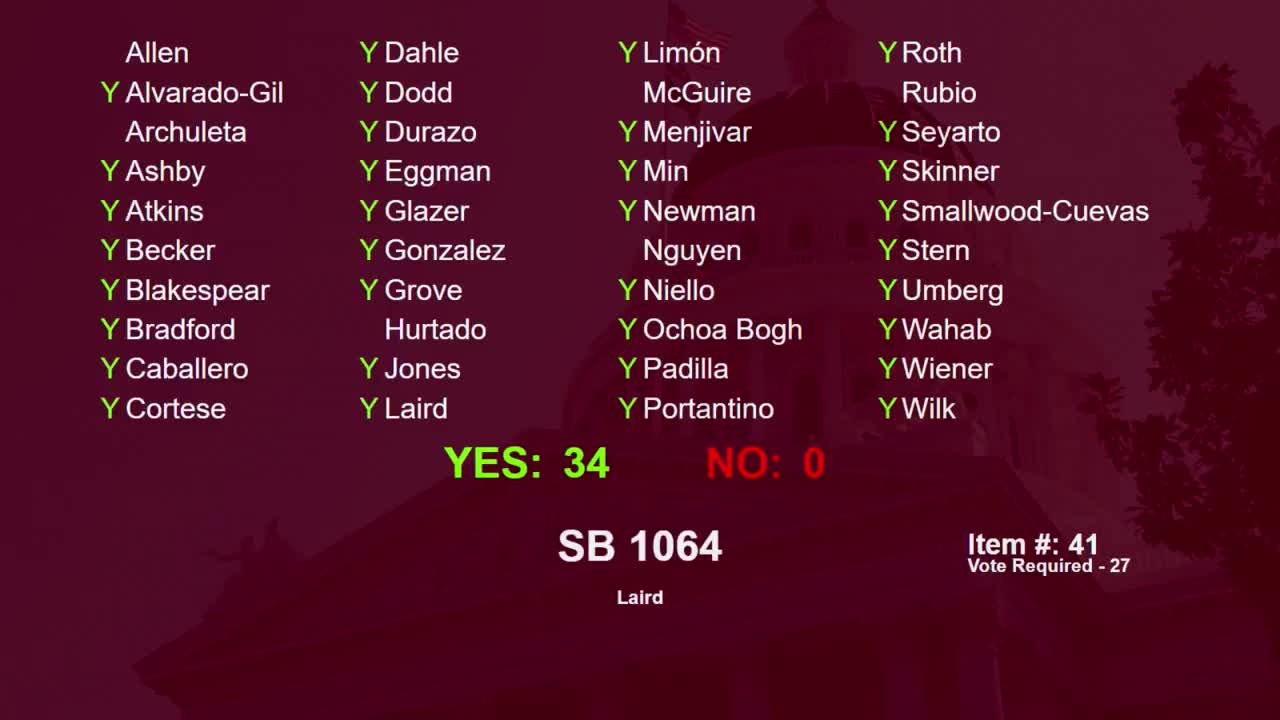 3MIN
Senate Floor
 7MIN
Senate Standing Committee on Energy, Utilities and Communications
 29SEC
Senate Standing Committee on Energy, Utilities and Communications
Bill Author

Bill Co-Author(s):