SB 307: Middle Class Scholarship Program: community colleges: current and former foster youth.
- Session Year: 2023-2024
- House: Senate
- Latest Version Date: 2023-06-01
Current Status:
Failed
(2023-06-01: Referred to Com. on HIGHER ED.)
Introduced
In Committee
First Chamber
In Committee
Second Chamber
Enacted
Existing law establishes the Middle Class Scholarship Program (MCSP) under the administration of the Student Aid Commission. Existing law makes an undergraduate student eligible for a scholarship award under the MCSP if the student is enrolled at the University of California or the California State University, or enrolled in upper division coursework in a community college baccalaureate program, and meets certain eligibility requirements.
This bill would extend awards under the MCSP to community college students who are current or former foster youth pursuing transfer to a 4-year postsecondary educational institution, an associate degree, an associate degree for transfer, or a community college career technical education certificate and meet other MCSP requirements, as provided. The bill would require the commission to summarize the provisions of the MCSP that apply to these current or former foster youth and title those provisions as The Fostering Futures Program on a page on its internet website.
(a)(1)Subject to an available and sufficient appropriation, an undergraduate student enrolled in the California State University or the University of California, a community college student enrolled in upper division coursework of a community college baccalaureate program, described in Article 3 (commencing with Section 78040) of Chapter 1 of Part 48 of Division 7, or a current or former foster youth, as defined in paragraph (2) of subdivision (e) of Section 69433.6, who is a community college student pursuing transfer to a four-year postsecondary educational institution, an associate degree, an associate degree for transfer, or a community college career technical education certificate, who meets the requirements of paragraph (3) is eligible for a scholarship award as described in paragraph (2).
(2)(A)For the 201314 to the 202122 academic year, inclusive, except as provided in paragraphs (4) and (5), an eligible student shall receive a scholarship award in an amount that, combined with other federal, state, or institutionally administered student grants or fee waivers received by an eligible student, is up to 40 percent of the amount charged to that student in that academic year for mandatory systemwide tuition and fees, or for an eligible community college student, up to 40 percent of the amount charged to that student in upper division fees for a community college baccalaureate degree program, if all of the requirements in paragraph (3) are met, to the satisfaction of the commission, each academic year.
(B)Commencing with the 202223 academic year, except as provided in paragraph (5), an eligible student, except for a current or former foster youth described in paragraph (1), shall receive a scholarship award in an amount that equals the difference between their cost of attendance as determined by the commission and the sum of the following amounts:
(i)Other federal, state, and institutionally administered student scholarships, grants, or fee waivers, and the amount of private scholarships awarded to the student in excess of the sum of the amounts in clauses (ii) and (iii).
(ii)Seven thousand eight hundred ninety-eight dollars ($7,898), reflecting an expected student contribution toward cost of attendance from work earnings or other resources. Commencing with the 202425 award year, the commission shall annually adjust this amount based on the percentage change in the minimum wage, pursuant to paragraph (1) of subdivision (c) of Section 1182.12 of the Labor Code.
(iii)Notwithstanding Section 69506, for dependent students with an annual household income exceeding one hundred thousand dollars ($100,000), 33 percent of the parents contribution from adjusted available income, as determined using the federal methodology established by Title IV of the federal Higher Education Act of 1965, as amended (20 U.S.C. Sec. 1087mm et seq.), and applicable rules and regulations adopted by the commission.
(C)Commencing with the 202425 academic year, a current or former foster youth described in paragraph (1) shall receive a scholarship award in an amount that equals the difference between their cost of attendance as determined by the commission and the sum of the amounts in clauses (i) and (iii) of subparagraph (B).
(3)(A)A student shall be eligible to receive an award if all of the following requirements are met, to the satisfaction of the commission, each academic year:
(B)(i)For each academic year from 201314 to 202122, inclusive, the students annual household income does not exceed one hundred fifty thousand dollars ($150,000). For awards distributed for the 201617 academic year and subsequent academic years, the commission shall annually adjust the maximum income level set under this clause in accordance with the percentage changes in the cost of living within the meaning of paragraph (1) of subdivision (e) of Section 8 of Article XIII B of the California Constitution. For purposes of this article, annual household income shall be calculated in a manner that is consistent with the requirements applicable to the Ortiz-Pacheco-Poochigian-Vasconcellos Cal Grant Program (Chapter 1.7 (commencing with Section 69430)) and Section 69506.
(ii)Commencing with the 202223 academic year, the students annual household income does not exceed the following amounts:
(I)Two hundred one thousand dollars ($201,000) if the student is a dependent student or an independent student with dependents other than a spouse.
(II)One hundred thirty-three thousand dollars ($133,000) if the student is a married independent student with no dependents other than a spouse.
(III)One hundred sixteen thousand dollars ($116,000) if the student is a single independent student with no dependents.
(iii)For awards distributed for the 202324 academic year and subsequent academic years, the commission shall annually adjust the maximum income levels set under clause (ii) in accordance with the percentage changes in the cost of living within the meaning of paragraph (1) of subdivision (e) of Section 8 of Article XIIIB of the California Constitution. For purposes of this article, annual household income shall be calculated in a manner that is consistent with the requirements applicable to the Ortiz-Pacheco-Poochigian-Vasconcellos Cal Grant Program (Chapter 1.7 (commencing with Section 69430)) and Section 69506.
(C)(i)For each academic year from 201516 to 202122, inclusive, the students household asset level shall not exceed one hundred fifty thousand dollars ($150,000). For awards distributed in the 201617 academic year and subsequent academic years, the commission shall annually adjust the maximum household asset level set under this clause in accordance with the percentage changes in the cost of living within the meaning of paragraph (1) of subdivision (e) of Section 8 of Article XIIIB of the California Constitution. For purposes of this article, students household asset level shall be calculated in a manner that is consistent with the requirements applicable to the Ortiz-Pacheco-Poochigian-Vasconcellos Cal Grant Program (Chapter 1.7 (commencing with Section 69430)) and Section 69506.
(ii)Commencing with the 202223 academic year, the students household asset level does not exceed the following amounts:
(I)Two hundred one thousand dollars ($201,000) if the student is a dependent student or an independent student with dependents other than a spouse.
(II)Ninety-six thousand dollars ($96,000) if the student is a single independent student with no dependents or a married independent student with no dependents other than a spouse.
(iii)For awards distributed in the 202324 academic year and subsequent academic years, the commission shall annually adjust the maximum household asset level set under clause (ii) in accordance with the percentage changes in the cost of living within the meaning of paragraph (1) of subdivision (e) of Section 8 of Article XIIIB of the California Constitution. For purposes of this article, a students household asset level shall be calculated in a manner that is consistent with the requirements applicable to the Ortiz-Pacheco-Poochigian-Vasconcellos Cal Grant Program (Chapter 1.7 (commencing with Section 69430)) and Section 69506.
(D)The student satisfies the eligibility requirements for a Cal Grant award pursuant to Section 69433.9, except that a student who is exempt from nonresident tuition under Section 68130.5 shall not be required to satisfy the requirements of subdivision (a) of Section 69433.9.
(E)The student is exempt from paying nonresident tuition.
(F)(i)The student completes and submits a Free Application for Federal Student Aid (FAFSA) or a California Dream Act application. The FAFSA or California Dream Act application must be submitted or postmarked by no later than March 2.
(ii)Notwithstanding clause (i), the FAFSA or California Dream Act application of a current or former foster youth described in paragraph (1) of subdivision (a) must be submitted or postmarked by no later than September 2.
(G)The student makes a timely application or applications for all other federal, state, or institutionally administered grants or fee waivers for which the student is eligible.
(H)(i)The student maintains satisfactory academic progress in a manner that is consistent with the requirements applicable to the Ortiz-Pacheco-Poochigian-Vasconcellos Cal Grant Program pursuant to subdivision (m) of Section 69432.7.
(ii)Notwithstanding clause (i), for a student who is a current or former foster youth described in paragraph (1) of subdivision (a) only, the student maintains satisfactory academic progress in a manner that is consistent with the requirements applicable to the Chafee Educational and Training Vouchers Program pursuant to subdivisions (h) and (i) of Section 69519.
(I)The student is pursuing the students first undergraduate baccalaureate degree or has completed a baccalaureate degree and has been admitted to, and is enrolled in, a program of professional teacher preparation at an institution approved by the Commission on Teacher Credentialing. This subparagraph shall not apply to a current or former foster youth described in paragraph (1) of subdivision (a).
(J)The student is enrolled at least part time.
(4)(A)For each academic year from 201314 to 202122, inclusive, the percentages specified in paragraph (2) shall be reduced by 0.6-percent increments per one thousand dollars ($1,000) of annual household income in excess of one hundred thousand dollars ($100,000), to a minimum 10 percent, provided that no scholarship award shall be provided to a student with an annual household income exceeding one hundred fifty thousand dollars ($150,000). Beginning with award calculations for the 201617 academic year, and for subsequent academic years, the commission shall annually adjust the income levels specified in this subparagraph by the percentage change in the cost of living within the meaning of paragraph (1) of subdivision (e) of Section 8 of Article XIII B of the California Constitution and shall adjust the incremental reduction accordingly to ensure that a minimum of 10 percent of mandatory systemwide tuition and fees for an academic year are awarded. This reduction shall be in addition to any reduction required by Section 70023.
(B)Notwithstanding subparagraph (A), for each academic year from 201314 to 202122, inclusive, for any student who qualifies for a scholarship award of at least one dollar ($1), the minimum annual scholarship amount for full-time enrollment is ninety dollars ($90).
(5)(A)For the 201415, 201516, and 201617 academic years, the maximum amount of a students scholarship award shall be 35 percent, 50 percent, and 75 percent, respectively, of the total scholarship award amount that the student would otherwise be eligible to receive.
(B)Commencing with the 202223 academic year, except as provided in subparagraph (D), the maximum amount of a students scholarship award shall be determined by the percentage determined pursuant to subparagraph (C) of the total scholarship award amount that the student would otherwise be eligible to receive.
(C)The commission shall annually determine the percentage required for purposes of subparagraph (B) by taking the amount appropriated for the purposes of this program for the applicable award year, less the amount necessary to fund subparagraph (D), and dividing that by the sum of the projected amount computed for all eligible students pursuant to subparagraph (B) of paragraph (2) for the applicable award year.
(D)Commencing with the 202425 academic year, a current or former foster youth described in paragraph (1) of subdivision (a) shall receive a scholarship award in the full amount determined in subparagraph (C) of paragraph (2), as adjusted, if applicable, in paragraph (2) of subdivision (d).
(b)In order for students enrolled in their respective segments to remain eligible to receive a scholarship award under this article, the University of California and the California State University shall not supplant their respective institutional need-based or merit-based grants with the funds provided for scholarships under this article. The University of California and the California State University shall ensure that the amount of institutional student aid provided in each academic year beginning with the 202223 academic year is adjusted annually to account for increases in systemwide undergraduate enrollment, as applicable, such that the proportion of institutional student aid relative to systemwide undergraduate enrollment is maintained at a level at least equivalent to the level maintained for undergraduate students during the 202122 academic year. The University of California and the California State University shall also ensure that at least 33 percent of the revenues of an increase to existing mandatory systemwide fees charged to undergraduate students is set aside by the regents or the trustees, as applicable, for institutional student aid to assist resident undergraduate students, including those undergraduate students exempt from nonresident tuition pursuant to Sections 68075.5 and 68130.5, and families in meeting the total cost of education.
(c)(1)The University of California and the California State University shall report on the implementation of this article as part of the report made pursuant to Section 66021.1. At a minimum, the report shall add the following information, by parental income level or expected family contribution deciles, for the prior academic year:
(A)The number and percentage of students receiving an award under this article and the average dollar amount of that award.
(B)The number and percentage of students receiving a student loan and the average amount borrowed.
(2)The report shall also include the following information by campus for the prior academic year:
(A)The cost of attendance for undergraduates in each living arrangement (on campus, off campus, or at home with parents).
(B)The number and percentage of undergraduates in each living arrangement (on campus, off campus, or at home with parents).
(d)(1)A Middle Class Scholarship Program award authorized pursuant to this article shall be defined as a full-time equivalent grant. An award to a part-time student shall be a fraction of a full-time grant. For each academic year from 201314 to 202122, inclusive, an award to a part-time student shall be determined by the proportionate amount charged for systemwide tuition and fees. A part-time student shall not be discriminated against in the selection of Middle Class Scholarship Program awards. For purposes of this section, full-time student and part-time student have the same meaning as specified in subdivision (f) of Section 69432.7.
(2)Commencing with the 202223 academic year, an award to a student enrolled in six to eight semester units, inclusive, or the equivalent shall be no more than one-half of the award the student would have received had the student enrolled full time. An award to a student enrolled in 9 to 11 semester units, inclusive, or the equivalent shall be no more than three-quarters of the award the student would have received had the student enrolled full time.
SEC. 2.Section 70022.5 of the Education Code is amended to read:70022.5.(a)A scholarship award under this article may be renewed for a total of the equivalent of four years of full-time attendance in an undergraduate program or, for a community college award recipient enrolled in upper division coursework of a community college baccalaureate program, described in Article 3 (commencing with Section 78040) of Chapter 1 of Part 48 of Division 7, the equivalent of two years of full-time upper division coursework attendance in the community college baccalaureate degree program. Commencing with the 201617 academic year, the total number of years of eligibility for grants pursuant to this article shall be based on the students educational level in the students course of study as designated by the institution of attendance when the recipient initially receives payment for a grant.
(b)For a student enrolled in an institutionally prescribed five-year undergraduate program, a scholarship award under this article may be renewed for a total of up to five academic years of attendance as long as the student meets the requirements of Section 70022.
(c)A recipient of a scholarship award under this article who has completed a baccalaureate degree, and who has been admitted to and is enrolled in a program of professional teacher preparation at an institution approved by the Commission on Teacher Credentialing, is eligible for, but not entitled to, renewal of the scholarship award for an additional academic year of full-time attendance as long as the student meets the requirements of Section 70022.
(d)A scholarship award under this article for a current or former foster youth may be renewed for a total of the equivalent of eight years of full-time attendance in an undergraduate program at the University of California, the California State University, or the California Community Colleges.
SEC. 3.Section 70023 of the Education Code is amended to read:70023.(a)For each academic year, the commission shall determine an amount sufficient, when combined with other federal, state, or institutionally administered student scholarships, grants, or fee waivers received by eligible students from other sources, to provide scholarships to eligible students in the amounts described in paragraphs (2), (4), and (5) of subdivision (a) of Section 70022. The University of California, the California State University, and the office of the Chancellor of the California Community Colleges shall provide the commission with any financial aid data that are necessary for the determination of these amounts.
(b)(1)The commission shall annually determine if the amounts appropriated under this section in each fiscal year are sufficient to cover the costs of the scholarships as projected to be awarded pursuant to the program. If those amounts are not sufficient for this purpose, the scholarships shall be reduced proportionately by an equal percentage for all recipients of scholarships under this article.
(2)Notwithstanding paragraph (1), commencing with the 202223 academic year, for any student who qualifies for a scholarship award under this article of at least one dollar ($1), the minimum annual scholarship amount for full-time enrollment shall be ninety dollars ($90).
(3)This paragraph subdivision shall not apply to a scholarship award under this article for current or former foster youth described in paragraph (1) of subdivision (a) of Section 70022.
(c)The commission may adopt regulations necessary to carry out the purposes of this article under subdivision (b) as emergency regulations in accordance with Chapter 3.5 (commencing with Section 11340) of Part 1 of Division 3 of Title 2 of the Government Code. For purposes of the Administrative Procedure Act, including Section 11349.6 of the Government Code, the adoption of those regulations shall be deemed to be an emergency and necessary for the immediate preservation of the public peace, health and safety, or general welfare, notwithstanding subdivision (e) of Section 11346.1 of the Government Code. Notwithstanding subdivision (e) of Section 11346.1 of the Government Code, any regulation adopted pursuant to this section shall not remain in effect more than 180 days unless the commission complies with all provisions of Chapter 3.5 (commencing with Section 11340) of Part 1 of Division 3 of Title 2 of the Government Code, as required by subdivision (e) of Section 11346.1 of the Government Code.
(d)The unencumbered balance, as of June 30 of each fiscal year, of the amount appropriated from the Middle Class Scholarship Fund pursuant to paragraph (1) of subdivision (e) shall revert to the General Fund.
(e)(1)Upon order of the Director of Finance, the following amounts shall be transferred from the General Fund to the Middle Class Scholarship Fund, and are hereby appropriated to the commission for allocation pursuant to this article:
(A)For the 201415 fiscal year, one hundred seven million dollars ($107,000,000).
(B)For the 201516 fiscal year, eighty-two million dollars ($82,000,000).
(C)For the 201617 fiscal year, seventy-one million two hundred forty-four thousand dollars ($71,244,000).
(D)For the 201718 fiscal year, ninety-nine million nine hundred thirty-eight thousand dollars ($99,938,000).
(E)For the 201819 fiscal year, one hundred four million three hundred forty-five thousand dollars ($104,345,000).
(F)For the 201920 fiscal year, one hundred sixteen million five hundred fifty-seven thousand dollars ($116,557,000).
(G)For the 202021 fiscal year, one hundred fourteen million one hundred seventy-one thousand dollars ($114,171,000).
(H)For the 202122 fiscal year, one hundred nine million nine hundred sixty-one thousand dollars ($109,961,000).
(2)An annual appropriation to the commission is hereby established in the amounts and for the fiscal years described in paragraph (1) to carry out the purposes of this section and Section 70022.
(3)Commencing with the 202223 fiscal year, the annual appropriation to the commission to carry out the purposes of this section and Section 70022 shall be determined in the annual Budget Act.
(4)It is the intent of the Legislature that any savings realized from changes made to the allocations under this subdivision by a bill providing for appropriations related to the Budget Bill for the 201516 fiscal year shall be used to support higher education.
(5)The funds transferred and appropriated pursuant to paragraph (1) shall only be available for encumbrance in the fiscal year in which they are transferred, and the General Fund shall have no liability or any obligation beyond the transfers explicitly authorized in paragraph (1) unless a subsequent transfer or allocation is required pursuant to statute.
(6)In any fiscal year, additional appropriations may be enacted pursuant to statute to carry out the purposes of this article.
(7)(A)Beginning with the Governors Budget proposal for the 201415 fiscal year, and in the Governors Budget for each fiscal year thereafter, the Department of Finance shall include a fund condition statement for the Middle Class Scholarship Fund for the fiscal year of the proposed budget and the two immediately preceding fiscal years prepared in accordance with existing law.
(B)Upon order of the Director of Finance and for the 201314 to 202122 fiscal years, inclusive, if the May Revision projects a budget deficit for the next fiscal year, the amount specified in paragraph (1) for the fiscal year for which the budget deficit is projected may be reduced by up to 33 percent.
(f)Subject to an appropriation in the annual Budget Act for its purposes, the commission may begin implementation of, and establish outreach services relating to, this article.
SEC. 4.Section 70023.5 is added to the Education Code, to read:70023.5.The commission shall maintain a page on its internet website that summarizes the provisions of the Middle Class Scholarship Program that apply to current and foster youth described in paragraph (1) of subdivision (a) of Section 70022 and title these provisions on the internet webpage as The Fostering Futures Program.
(a)(1)Subject to an available and sufficient appropriation, an undergraduate student enrolled in the California State University or the University of California, or a community college student enrolled in upper division coursework of a community college baccalaureate program, described in Article 3 (commencing with Section 78040) of Chapter 1 of Part 48 of Division 7, or a current or former foster youth, as defined in paragraph (2) of subdivision (e) of Section 69433.6, who is a community college student pursuing transfer to a four-year postsecondary educational institution, an associate degree, an associate degree for transfer, or a community college career technical education certificate, who meets the requirements of paragraph (3) is eligible for a scholarship award as described in paragraph (2).
(2)(A)For the 201314 to the 202122 academic year, inclusive, except as provided in paragraphs (4) and (5), an eligible student shall receive a scholarship award in an amount that, combined with other federal, state, or institutionally administered student grants or fee waivers received by an eligible student, is up to 40 percent of the amount charged to that student in that academic year for mandatory systemwide tuition and fees, or for an eligible community college student, up to 40 percent of the amount charged to that student in upper division fees for a community college baccalaureate degree program, if all of the requirements in paragraph (3) are met, to the satisfaction of the commission, each academic year.
(B)Commencing with the 202223 academic year, except as provided in paragraph (5), an eligible student student, except for a current or former foster youth described in paragraph (1), shall receive a scholarship award in an amount that equals the difference between their cost of attendance as determined by the commission and the sum of the following amounts:
(i)Other federal, state, and institutionally administered student scholarships, grants, or fee waivers, and the amount of private scholarships awarded to the student in excess of the sum of the amounts in clauses (ii) and (iii).
(ii)Seven thousand eight hundred ninety-eight dollars ($7,898), reflecting an expected student contribution toward cost of attendance from work earnings or other resources. Commencing with the 202425 award year, the commission shall annually adjust this amount based on the percentage change in the minimum wage, pursuant to paragraph (1) of subdivision (c) of Section 1182.12 of the Labor Code.
(iii)Notwithstanding Section 69506, for dependent students with an annual household income exceeding one hundred thousand dollars ($100,000), 33 percent of the parents contribution from adjusted available income, as determined using the federal methodology established by Title IV of the federal Higher Education Act of 1965, as amended (20 U.S.C. Sec. 1087mm et seq.), and applicable rules and regulations adopted by the commission.
(C)Commencing with the 202425 academic year, a current or former foster youth described in paragraph (1) shall receive a scholarship award in an amount that equals the difference between their cost of attendance as determined by the commission and the sum of the amounts in clauses (i) and (iii) of subparagraph (B).
(3)(A)A student shall be eligible to receive an award if all of the following requirements are met, to the satisfaction of the commission, each academic year:
(B)(i)For each academic year from 201314 to 202122, inclusive, the students annual household income does not exceed one hundred fifty thousand dollars ($150,000). For awards distributed for the 201617 academic year and subsequent academic years, the commission shall annually adjust the maximum income level set under this clause in accordance with the percentage changes in the cost of living within the meaning of paragraph (1) of subdivision (e) of Section 8 of Article XIII B of the California Constitution. For purposes of this article, annual household income shall be calculated in a manner that is consistent with the requirements applicable to the Ortiz-Pacheco-Poochigian-Vasconcellos Cal Grant Program (Chapter 1.7 (commencing with Section 69430)) and Section 69506.
(ii)Commencing with the 202223 academic year, the students annual household income does not exceed the following amounts:
(I)Two hundred one thousand dollars ($201,000) if the student is a dependent student or an independent student with dependents other than a spouse.
(II)One hundred thirty-three thousand dollars ($133,000) if the student is a married independent student with no dependents other than a spouse.
(III)One hundred sixteen thousand dollars ($116,000) if the student is a single independent student with no dependents.
(iii)For awards distributed for the 202324 academic year and subsequent academic years, the commission shall annually adjust the maximum income levels set under clause (ii) in accordance with the percentage changes in the cost of living within the meaning of paragraph (1) of subdivision (e) of Section 8 of Article XIIIB of the California Constitution. For purposes of this article, annual household income shall be calculated in a manner that is consistent with the requirements applicable to the Ortiz-Pacheco-Poochigian-Vasconcellos Cal Grant Program (Chapter 1.7 (commencing with Section 69430)) and Section 69506.
(C)(i)For each academic year from 201516 to 202122, inclusive, the students household asset level shall not exceed one hundred fifty thousand dollars ($150,000). For awards distributed in the 201617 academic year and subsequent academic years, the commission shall annually adjust the maximum household asset level set under this clause in accordance with the percentage changes in the cost of living within the meaning of paragraph (1) of subdivision (e) of Section 8 of Article XIIIB of the California Constitution. For purposes of this article, students household asset level shall be calculated in a manner that is consistent with the requirements applicable to the Ortiz-Pacheco-Poochigian-Vasconcellos Cal Grant Program (Chapter 1.7 (commencing with Section 69430)) and Section 69506.
(ii)Commencing with the 202223 academic year, the students household asset level does not exceed the following amounts:
(I)Two hundred one thousand dollars ($201,000) if the student is a dependent student or an independent student with dependents other than a spouse.
(II)Ninety-six thousand dollars ($96,000) if the student is a single independent student with no dependents or a married independent student with no dependents other than a spouse.
(iii)For awards distributed in the 202324 academic year and subsequent academic years, the commission shall annually adjust the maximum household asset level set under clause (ii) in accordance with the percentage changes in the cost of living within the meaning of paragraph (1) of subdivision (e) of Section 8 of Article XIIIB of the California Constitution. For purposes of this article, a students household asset level shall be calculated in a manner that is consistent with the requirements applicable to the Ortiz-Pacheco-Poochigian-Vasconcellos Cal Grant Program (Chapter 1.7 (commencing with Section 69430)) and Section 69506.
(D)The student satisfies the eligibility requirements for a Cal Grant award pursuant to Section 69433.9, except that a student who is exempt from nonresident tuition under Section 68130.5 shall not be required to satisfy the requirements of subdivision (a) of Section 69433.9.
(E)The student is exempt from paying nonresident tuition.
(F)(i)The student completes and submits a Free Application for Federal Student Aid (FAFSA) or a California Dream Act application. The FAFSA or California Dream Act application must be submitted or postmarked by no later than March 2.
(ii)Notwithstanding clause (i), the FAFSA or California Dream Act application of a current or former foster youth described in paragraph (1) of subdivision (a) must be submitted or postmarked by no later than September 2.
(G)The student makes a timely application or applications for all other federal, state, or institutionally administered grants or fee waivers for which the student is eligible.
(H)The (i)The student maintains satisfactory academic progress in a manner that is consistent with the requirements applicable to the Ortiz-Pacheco-Poochigian-Vasconcellos Cal Grant Program pursuant to subdivision (m) of Section 69432.7.
(ii)Notwithstanding clause (i), for a student who is a current or former foster youth described in paragraph (1) of subdivision (a) only, the student maintains satisfactory academic progress in a manner that is consistent with the requirements applicable to the Chafee Educational and Training Vouchers Program pursuant to subdivisions (h) and (i) of Section 69519.
(I)The student is pursuing the students first undergraduate baccalaureate degree or has completed a baccalaureate degree and has been admitted to, and is enrolled in, a program of professional teacher preparation at an institution approved by the Commission on Teacher Credentialing. This subparagraph shall not apply to a current or former foster youth described in paragraph (1) of subdivision (a).
(J)The student is enrolled at least part time.
(4)(A)For each academic year from 201314 to 202122, inclusive, the percentages specified in paragraph (2) shall be reduced by 0.6-percent increments per one thousand dollars ($1,000) of annual household income in excess of one hundred thousand dollars ($100,000), to a minimum 10 percent, provided that no scholarship award shall be provided to a student with an annual household income exceeding one hundred fifty thousand dollars ($150,000). Beginning with award calculations for the 201617 academic year, and for subsequent academic years, the commission shall annually adjust the income levels specified in this subparagraph by the percentage change in the cost of living within the meaning of paragraph (1) of subdivision (e) of Section 8 of Article XIII B of the California Constitution and shall adjust the incremental reduction accordingly to ensure that a minimum of 10 percent of mandatory systemwide tuition and fees for an academic year are awarded. This reduction shall be in addition to any reduction required by Section 70023.
(B)Notwithstanding subparagraph (A), for each academic year from 201314 to 202122, inclusive, for any student who qualifies for a scholarship award of at least one dollar ($1), the minimum annual scholarship amount for full-time enrollment is ninety dollars ($90).
(5)(A)For the 201415, 201516, and 201617 academic years, the maximum amount of a students scholarship award shall be 35 percent, 50 percent, and 75 percent, respectively, of the total scholarship award amount that the student would otherwise be eligible to receive.
(B)Commencing with the 202223 academic year, except as provided in subparagraph (D), the maximum amount of a students scholarship award shall be determined by the percentage determined pursuant to subparagraph (C) of the total scholarship award amount that the student would otherwise be eligible to receive.
(C)The commission shall annually determine the percentage required for purposes of subparagraph (B) by taking the amount appropriated for the purposes of this program for the applicable award year year, less the amount necessary to fund subparagraph (D), and dividing that by the sum of the projected amount computed for all eligible students pursuant to subparagraph (B) of paragraph (2) for the applicable award year.
(D)Commencing with the 202425 academic year, a current or former foster youth described in paragraph (1) of subdivision (a) shall receive a scholarship award in the full amount determined in subparagraph (C) of paragraph (2), as adjusted, if applicable, in paragraph (2) of subdivision (d).
(b)In order for students enrolled in their respective segments to remain eligible to receive a scholarship award under this article, the University of California and the California State University shall not supplant their respective institutional need-based or merit-based grants with the funds provided for scholarships under this article. The University of California and the California State University shall ensure that the amount of institutional student aid provided in each academic year beginning with the 202223 academic year is adjusted annually to account for increases in systemwide undergraduate enrollment, as applicable, such that the proportion of institutional student aid relative to systemwide undergraduate enrollment is maintained at a level at least equivalent to the level maintained for undergraduate students during the 202122 academic year. The University of California and the California State University shall also ensure that at least 33 percent of the revenues of an increase to existing mandatory systemwide fees charged to undergraduate students is set aside by the regents or the trustees, as applicable, for institutional student aid to assist resident undergraduate students, including those undergraduate students exempt from nonresident tuition pursuant to Sections 68075.5 and 68130.5, and families in meeting the total cost of education.
(c)(1)The University of California and the California State University shall report on the implementation of this article as part of the report made pursuant to Section 66021.1. At a minimum, the report shall add the following information, by parental income level or expected family contribution deciles, for the prior academic year:
(A)The number and percentage of students receiving an award under this article and the average dollar amount of that award.
(B)The number and percentage of students receiving a student loan and the average amount borrowed.
(2)The report shall also include the following information by campus for the prior academic year:
(A)The cost of attendance for undergraduates in each living arrangement (on campus, off campus, or at home with parents).
(B)The number and percentage of undergraduates in each living arrangement (on campus, off campus, or at home with parents).
(d)(1)A Middle Class Scholarship Program award authorized pursuant to this article shall be defined as a full-time equivalent grant. An award to a part-time student shall be a fraction of a full-time grant. For each academic year from 201314 to 202122, inclusive, an award to a part-time student shall be determined by the proportionate amount charged for systemwide tuition and fees. A part-time student shall not be discriminated against in the selection of Middle Class Scholarship Program awards. For purposes of this section, full-time student and part-time student have the same meaning as specified in subdivision (f) of Section 69432.7.
(2)Commencing with the 202223 academic year, an award to a student enrolled in six to eight semester units, inclusive, or the equivalent shall be no more than one-half of the award the student would have received had the student enrolled full time. An award to a student enrolled in 9 to 11 semester units, inclusive, or the equivalent shall be no more than three-quarters of the award the student would have received had the student enrolled full time.
SEC. 2.Section 70022.5 of the Education Code is amended to read:70022.5.(a)A scholarship award under this article may be renewed for a total of the equivalent of four years of full-time attendance in an undergraduate program or, for a community college award recipient, recipient enrolled in upper division coursework of a community college baccalaureate program, described in Article 3 (commencing with Section 78040) of Chapter 1 of Part 48 of Division 7, the equivalent of two years of full-time upper division coursework attendance in the community college baccalaureate degree program. Commencing with the 201617 academic year, the total number of years of eligibility for grants pursuant to this article shall be based on the students educational level in his or her the students course of study as designated by the institution of attendance when the recipient initially receives payment for a grant.
(b)For a student enrolled in an institutionally prescribed five-year undergraduate program, a scholarship award under this article may be renewed for a total of up to five academic years of attendance as long as the student meets the requirements of Section 70022.
(c)A recipient of a scholarship award under this article who has completed a baccalaureate degree, and who has been admitted to and is enrolled in a program of professional teacher preparation at an institution approved by the Commission on Teacher Credentialing, is eligible for, but not entitled to, renewal of the scholarship award for an additional academic year of full-time attendance as long as the student meets the requirements of Section 70022.
(d)A scholarship award under this article for a current or former foster youth may be renewed for a total of the equivalent of eight years of full-time attendance in an undergraduate program at the University of California, the California State University, or the California Community Colleges.
SEC. 3.Section 70023 of the Education Code is amended to read:70023.(a)For each academic year, the commission shall determine an amount sufficient, when combined with other federal, state, or institutionally administered student scholarships, grants, or fee waivers received by eligible students from other sources, to provide scholarships to eligible students in the amounts described in paragraphs (2), (4), and (5) of subdivision (a) of Section 70022. The University of California, the California State University, and the office of the Chancellor of the California Community Colleges shall provide the commission with any financial aid data that are necessary for the determination of these amounts.
(b)(1)The commission shall annually determine if the amounts appropriated under this section in each fiscal year are sufficient to cover the costs of the scholarships as projected to be awarded pursuant to the program. If those amounts are not sufficient for this purpose, the scholarships shall be reduced proportionately by an equal percentage for all recipients of scholarships under this article.
(2)Notwithstanding paragraph (1), commencing with the 202223 academic year, for any student who qualifies for a scholarship award under this article of at least one dollar ($1), the minimum annual scholarship amount for full-time enrollment shall be ninety dollars ($90).
(3)This paragraph shall not apply to a scholarship award under this article for current or former foster youth described in paragraph (1) of subdivision (a) of Section 70022.
(c)The commission may adopt regulations necessary to carry out the purposes of this article under subdivision (b) as emergency regulations in accordance with Chapter 3.5 (commencing with Section 11340) of Part 1 of Division 3 of Title 2 of the Government Code. For purposes of the Administrative Procedure Act, including Section 11349.6 of the Government Code, the adoption of those regulations shall be deemed to be an emergency and necessary for the immediate preservation of the public peace, health and safety, or general welfare, notwithstanding subdivision (e) of Section 11346.1 of the Government Code. Notwithstanding subdivision (e) of Section 11346.1 of the Government Code, any regulation adopted pursuant to this section shall not remain in effect more than 180 days unless the commission complies with all provisions of Chapter 3.5 (commencing with Section 11340) of Part 1 of Division 3 of Title 2 of the Government Code, as required by subdivision (e) of Section 11346.1 of the Government Code.
(d)The unencumbered balance, as of June 30 of each fiscal year, of the amount appropriated from the Middle Class Scholarship Fund pursuant to paragraph (1) of subdivision (e) shall revert to the General Fund.
(e)(1)Upon order of the Director of Finance, the following amounts shall be transferred from the General Fund to the Middle Class Scholarship Fund, and are hereby appropriated to the commission for allocation pursuant to this article:
(A)For the 201415 fiscal year, one hundred seven million dollars ($107,000,000).
(B)For the 201516 fiscal year, eighty-two million dollars ($82,000,000).
(C)For the 201617 fiscal year, seventy-one million two hundred forty-four thousand dollars ($71,244,000).
(D)For the 201718 fiscal year, ninety-nine million nine hundred thirty-eight thousand dollars ($99,938,000).
(E)For the 201819 fiscal year, one hundred four million three hundred forty-five thousand dollars ($104,345,000).
(F)For the 201920 fiscal year, one hundred sixteen million five hundred fifty-seven thousand dollars ($116,557,000).
(G)For the 202021 fiscal year, one hundred fourteen million one hundred seventy-one thousand dollars ($114,171,000).
(H)For the 202122 fiscal year, one hundred nine million nine hundred sixty-one thousand dollars ($109,961,000).
(2)An annual appropriation to the commission is hereby established in the amounts and for the fiscal years described in paragraph (1) to carry out the purposes of this section and Section 70022.
(3)Commencing with the 202223 fiscal year, the annual appropriation to the commission to carry out the purposes of this section and Section 70022 shall be determined in the annual Budget Act.
(4)It is the intent of the Legislature that any savings realized from changes made to the allocations under this subdivision by a bill providing for appropriations related to the Budget Bill for the 201516 fiscal year shall be used to support higher education.
(5)The funds transferred and appropriated pursuant to paragraph (1) shall only be available for encumbrance in the fiscal year in which they are transferred, and the General Fund shall have no liability or any obligation beyond the transfers explicitly authorized in paragraph (1) unless a subsequent transfer or allocation is required pursuant to statute.
(6)In any fiscal year, additional appropriations may be enacted pursuant to statute to carry out the purposes of this article.
(7)(A)Beginning with the Governors Budget proposal for the 201415 fiscal year, and in the Governors Budget for each fiscal year thereafter, the Department of Finance shall include a fund condition statement for the Middle Class Scholarship Fund for the fiscal year of the proposed budget and the two immediately preceding fiscal years prepared in accordance with existing law.
(B)Upon order of the Director of Finance and for the 201314 to 202122 fiscal years, inclusive, if the May Revision projects a budget deficit for the next fiscal year, the amount specified in paragraph (1) for the fiscal year for which the budget deficit is projected may be reduced by up to 33 percent.
(f)Subject to an appropriation in the annual Budget Act for its purposes, the commission may begin implementation of, and establish outreach services relating to, this article.
SEC. 4.Section 70023.5 is added to the Education Code, to read:70023.5.The commission shall maintain a page on its internet website that summarizes the provisions of the Middle Class Scholarship Program that apply to current and foster youth described in paragraph (1) of subdivision (a) of Section 70022 and title these provisions on the internet webpage as The Fostering Futures Program.
|
Date
|
Status
|
|---|---|
| Jun 1, 2023 | From committee with author's amendments. Read second time and amended. Re-referred to Com. on HIGHER ED. |
| Jun 1, 2023 | Referred to Com. on HIGHER ED. |
| May 23, 2023 | In Assembly. Read first time. Held at Desk. |
| May 22, 2023 | Read third time. Passed. (Ayes 39. Noes 1. Page 1217.) Ordered to the Assembly. |
| May 18, 2023 | From committee: Do pass. (Ayes 6. Noes 1. Page 1164.) (May 18). |
| May 18, 2023 | Read second time. Ordered to third reading. |
| May 12, 2023 | Set for hearing May 18. |
| May 8, 2023 | May 8 hearing: Placed on APPR suspense file. |
| May 1, 2023 | Set for hearing May 8. |
| Apr 25, 2023 | From committee: Do pass and re-refer to Com. on APPR. (Ayes 5. Noes 0. Page 876.) (April 24). Re-referred to Com. on APPR. |
| Apr 11, 2023 | Set for hearing April 24. |
| Mar 29, 2023 | From committee: Do pass and re-refer to Com. on HUMAN S. (Ayes 7. Noes 0. Page 569.) (March 29). Re-referred to Com. on HUMAN S. |
| Mar 8, 2023 | Set for hearing March 29. |
| Feb 15, 2023 | Referred to Coms. on ED. and HUMANS S. |
| Feb 3, 2023 | From printer. May be acted upon on or after March 5. |
| Feb 2, 2023 | Introduced. Read first time. To Com. on RLS. for assignment. To print. |
|
Date
|
Description
|
Location
|
Votes
|
|
|---|---|---|---|---|
| May 22, 2023 | Senate 3rd Reading SB307 Ashby et al. | Senate Floor |
Passed |
|
| May 18, 2023 | Do pass | Senate Standing Committee on Appropriations |
Passed |
|
| May 8, 2023 | Placed on suspense file | Senate Standing Committee on Appropriations |
Passed |
|
| Apr 24, 2023 | Do pass, but first be re-referred to the Committee on [Appropriations] | Senate Standing Committee on Human Services |
Passed |
|
| Mar 29, 2023 | Do pass, but first be re-referred to the Committee on [Human Services] | Senate Standing Committee on Education |
Passed |
This list shows positions taken on this bill by organizations on the date displayed, which is linked to the original source.
Positions by individuals are not included.
|
Organization
|
Position
|
Date
|
|---|---|---|
| 3rd Street Youth Center & Clinic | ** Support | |
| A Better Way, Inc. | ** Support | |
| Alameda County Office Of Education | ** Support | |
| Alameda County Office of Education, Foster Youth Services Coordinating | ** Support | |
| ASPIRANET | ** Support | |
| Associated Students of Pasadena City College | ** Support | |
| Barstow Community College | ** Support | |
| Berkeley Hope Scholars | ** Support | |
| Berkeley Hope Scholars | * Support | Mar 29, 2023 |
| Beyond Emancipation | ** Support | |
| Butte College Inspiring Scholars | ** Support | |
| California Alliance of Caregivers | ** Support | |
| California Alliance Of Child And Family Services | * Support | Mar 29, 2023 |
| California Chamber Of Commerce | ** Support | |
| California Charter Schools Association | ** Support | |
| California Court Appointed Special Advocate Association | ** Support | |
| California Professional Firefighters | ** Support | |
| California State University, Dominguez Hills - Toro Guardian Scholars Program | ** Support | |
| California Teachers Association | ** Support | |
| Casa Pacifica Centers for Children and Families | ** Support | |
| Center For Public Interest LawChildrenS Advocacy InstituteUniversity Of San Diego | ** Support | |
| Cerritos College | ** Support | |
| Chief Probation Officers Of California | ** Support | |
| Children Now | ** Support | |
| Children Youth & Family Collaborative | ** Support | |
| Children's Advocacy Institute | ** Support | |
| Children'S Law Center Of California | ** Support | |
| Children's Legal Services of San Diego | ** Support | |
| ChildrenS Institute | ** Support | |
| Citrus College | * Support | Mar 29, 2023 |
| City Of Sacramento | * Support | Mar 29, 2023 |
| City Year Inc. | ** Support | |
| College of the Desert | * Support | Mar 29, 2023 |
| College of The Desert - Foster Youth Services | ** Support | |
| Compton College | * Support | Mar 29, 2023 |
| County of Santa Clara | ** Support | |
| County Welfare Directors Association of California | ** Support | |
| Cuesta College | ** Support | |
| Doing Good Works | ** Support | |
| Ea Family Services | ** Support | |
| East Bay Leadership Council | ** Support | |
| Emmanuel Gomez, President, Associated Students of Pasadena City College | ** Support | |
| FASD Network of Northern California | ** Support | |
| FASD Network of Northern California | * Support | Mar 29, 2023 |
| FASD Now! a California Alliance | ** Support | |
| First Place for Youth | ** Support | |
| Foster Care Counts | ** Support | |
| Foster Youth Services At College of The Desert | ** Support | |
| GENup | ** Support | |
| Haven Of Hope | ** Support | |
| John Burton Advocates for Youth | ** Support | |
| Jovenes, Inc. | ** Support | |
| LA Pierce College | * Support | Mar 29, 2023 |
| League Of Women Voters Of California | ** Support | |
| Los Angeles County | ** Support | |
| Mary Graham Children's Foundation | ** Support | |
| Merced County - Children's Services Branch | ** Support | |
| Merced County Human Services Agency | * Support | Mar 29, 2023 |
| Merced County Independent Living Program | ** Support | |
| Monterey County Office of Education - Foster Youth Services | ** Support | |
| Mount San Antonio College | * Support | Mar 29, 2023 |
| Mt. San Antonio College | ** Support | |
| Mt. San Antonio College Reach | ** Support | |
| Mt. San Antonio College- Reach Guardian Scholars | ** Support | |
| National Association of Social Work | * Support | Mar 29, 2023 |
| National Association Of Social Workers, California Chapter | ** Support | |
| Natomas Unified School District | ** Support | |
| Norco College | ** Support | |
| Norco College - Special Funded Programs | ** Support | |
| Norco College Phoenix Scholars NextUP | * Support | Mar 29, 2023 |
| North Orange Community College District | ** Support | |
| Northern California College Promise Coalition | ** Support | |
| Nossaman LLP | * Support | Mar 29, 2023 |
| Oak Grove Sanctuary Palm Springs | ** Support | |
| On The Move/VOICES | ** Support | |
| Pivotal | ** Support | |
| Pivotal | * Support | Mar 29, 2023 |
| Pivotal | * Support | Apr 24, 2023 |
| Power To Soar | ** Support | |
| Power to Soar Foundation | ** Support | |
| Power to Soar Foundation | * Support | Mar 29, 2023 |
| Prevail | ** Support | |
| Pullias Center for Higher Education | * Support | Apr 24, 2023 |
| Rancho Santiago Community College District | ** Support | |
| Razing the Bar | ** Support | |
| Reedley College | ** Support | |
| Reedley College - EOPS | ** Support | |
| Rio Hondo College | ** Support | |
| Riverside City College | ** Support | |
| riverside city college, guardian scholar program | ** Support | |
| Sacramento State University | * Support | Mar 29, 2023 |
| San Benito County - Health & Human Services Agency - Child Welfare Division | ** Support | |
| San Diego City College | ** Support | |
| San Diego City College - Nextup Program | ** Support | |
| San Jose-Evergreen Community College District | ** Support | |
| Schoolhouse Connection | ** Support | |
| Shasta College - Inspiring & Fostering Independence | ** Support | |
| Smart Justice California | ** Support | |
| Sonoma County - Family Youth & Children's Services | ** Support | |
| Sonoma county families and Children's Services | * Support | Apr 24, 2023 |
| Sonoma County Family and Children Services | * Support | Mar 29, 2023 |
| Sonoma County Family and Children Services | * Support | Mar 29, 2023 |
| Students Rising Above | ** Support | |
| Sycamores | ** Support | |
| TLC Child & Family Services - Transition Age Youth Housing | ** Support | |
| Together We Rise Dba Foster Love | ** Support | |
| Transitional Age Youth | * Support | Mar 29, 2023 |
| Unite-LA | ** Support | |
| United Friends Of The Children | ** Support | |
| University of Southern California | * Support | Mar 29, 2023 |
| Usc Rosier Pullias Center For Higher Education | ** Support | |
| USC Rossier Pullias Center for Education | ** Support | |
| Voices - Solano | ** Support | |
| Voices Youth Center | * Support | Mar 29, 2023 |
| Waking the Village | ** Support | |
| Walden Family Services | ** Support | |
| Wind Youth Services | ** Support | |
| Woodland Community College Foster & Kinship Care Education | ** Support | |
| Woodland Community College's Independent Living Program | * Support | Mar 29, 2023 |
| Youth Law Center | ** Support | |
| Youth Leadership Institute | ** Support |
SENATE RULES COMMITTEE Office of Senate Floor Analyses (916) 651-1520 Fax: (916) 327-4478 | SB 307 |
THIRD READING
Bill No: SB 307
Author: Ashby (D) and McGuire (D), et al.
Introduced: 2/2/23
Vote: 21
SENATE EDUCATION COMMITTEE: 7-0, 3/29/23
AYES: Newman, Ochoa Bogh, Cortese, Glazer, McGuire, Smallwood-Cuevas, Wilk
SENATE HUMAN SERVICES COMMITTEE: 5-0, 4/24/23
AYES: Alvarado-Gil, Ochoa Bogh, Hurtado, Menjivar, Wahab
SENATE APPROPRIATIONS COMMITTEE: 6-1, 5/18/23
AYES: Portantino, Ashby, Bradford, Seyarto, Wahab, Wiener
NOES: Jones
SUBJECT: Middle Class Scholarship Program: community colleges: current and former foster youth
SOURCE: John Burton Advocates for Youth
DIGEST:
This bill expands eligibility for the Middle Class Scholarship (MCS) to community college students who are current or former foster youth pursuing transfer to a four-year postsecondary educational institution, an associate degree, an associate degree for transfer, or a certificate. This bill additional relaxes eligibility MCS requirements for this group of students.
ANALYSIS: Existing law establishes the MCS program under the administration of the California Student Aid Commission (Commission). Existing law makes an undergraduate student eligible for a scholarship award under the MCS if the student is enrolled at the University of California (UC) or the California State University (CSU), or enrolled in upper division coursework in a community college baccalaureate program, and meets certain eligibility requirements. (Education Code (EC) Sections 70020 – 70023)
This bill:
- Expands eligibility for the MCS program to community colleges students who are current or former foster youth pursuing transfer to a four-year postsecondary educational institution, an associate degree, an associate degree for transfer, or a certificate and who do not exceed the program’s current annual household income and asset thresholds.
- Relaxes the MCS eligibility requirements for community college students who are current and former foster youth as follows:
- Moves the deadline for submitting FAFSA or a CADA from March 2 to September 2.
- Uses the satisfactory academic progress standard established for Chafee program.
- Removes the requirement that students be pursuing their first undergraduate baccalaureate degree to be eligible.
- Excludes the student contribution requirement from consideration when determining a current or former foster youth’s remaining financial need to cover costs associated with college attendance and requires that the amount necessary to fund MSC awards for community college students who are current or former foster youth be set aside when determining the percentage of each student’s remaining cost covered by the award.
- Establishes the maximum MCS award amount for community college students who are current or former foster youth to be the full amount for which they are eligible to receive rather than a percentage of their eligible amount as prescribed for all other recipients and increases the number of years an MCS award can be renewed from 4 to 8 years of full-time attendance for a current or former foster youth enrolled at the UC, CSU or the CCCs.
- Exempts scholarship awards for current or former foster youth attending community college from being reduced in the manner prescribed by current law for all other MCS awards when sufficient funds are unavailable. (Due to a drafting error, the incorrect paragraph is cited in the bill but the intent of the author is described here.)
- Requires that the Commission maintain a page on its internet website that summarizes the provisions of the Middle Class Scholarship Program that apply to current and former foster youth and title it as “The Fostering Futures Program.”
Comments
- Need for this bill. According to the author, “California has been making strides to improve access to financial aid for foster youth, but more can be done. Currently, California offers the Chafee Education and Training Voucher, which provides up to $5,000 annually to eligible foster youth, as well as a $6,000 Cal Grant award for non-tuition costs. However, even with these investments, the state’s financial aid program has not kept pace with significant increases to the cost of living for students, and foster youth are among those hit hardest by this disparity.”
- New benefit for foster youth within MCS. This bill seeks to have 100 percent of each current or former foster youth’s remaining costs covered at community colleges. It accomplishes this by prohibiting award amounts from being reduced and sets aside the amount necessary to fund these awards when award amounts for other recipients are being determined. It also excludes the student contribution requirement (i.e. work requirement) when assessing the amount for which they are qualified, allowing for a larger award. These changes effectively establish a scholarship dedicated for a unique population within the MCS program’s appropriation and framework. The remainder of the MCS appropriation will be rationed among all other qualified students, which may affect their award amounts.
- Who is eligible? Under the bill’s provisions, eligibility is extended to current and former foster youth attending a CCC who have submitted the FAFSA or a CADA application by September 2. Community college students must be pursuing transfer, an associate degree, or a certificate, and their annual household income and assets must not exceed the threshold for the MCS program. A current or former foster youth is defined as current or former foster whose dependency was established or continued by the court after their 13th birthday.
- Foster youth. According to the letter of support submitted to the committee from John Burton Advocates for Youth, “Children and youth enter foster care due to serious abuse and neglect. This trauma is often compounded by the instability they experience while in foster care, through placement and school changes. Together, these lead to poor educational outcomes, most notably low rates of college completion: in California, just 10% of foster youth obtain a two-year or four-year degree by the age of 23 compared to 36% of their non-foster youth peers. However, a recent student found that foster youth who receive a Chafee Education and Training Voucher are twice as likely to graduate as those who did not.” This bill seeks to further support foster youth cover their remaining financial need associated with college attendance, including housing, transportation and materials.
- Award renewals. This bill, in addition to the benefits provided to community college students, increases the number of years an MCS award can be renewed for current or former foster youth at UC or CSU by four years. This is similar to the renewal limits established in state's Cal Grant program for foster youth. Unlike the Cal Grant, MCS is not an entitlement program and not all eligible students will get their full scholarship.
- Relaxes some eligibility requirements. This measure also relaxes some MCS eligibility rules specifically for current and former foster youth, including changes that could make the program available to students pursuing a second baccalaureate degree, extends the application deadline, and employs a less stringent process when failing to meet satisfactory academic progress standards. These changes do not apply to non-foster youth.
- MCS implementation concerns. Making changes to the MCS to better serve those with the greatest financial need such as current or former foster youth is a worthy goal, but doing so in the manner prescribed by the bill may present implementation challenges, given the difficulties mentioned in the Senate Education Committee analysis. Additionally, because the bill grows the program at the community colleges, it is unclear whether the community college financial aid offices are prepared or equipped to participate in this program, given that they do not currently administer MCS at the proposed level. To ensure that implementation is feasible so that newly eligible current or foster youth, as well as other students, receive awards in a timely manner and campuses and the Commission are equipped to administer the program the author may wish to consider extending the bill’s implementation date.
FISCAL EFFECT: Appropriation: No Fiscal Com.: Yes Local: No
According to the Senate Appropriations Committee:
- This bill provides that its provisions would be implemented within the existing MCS program budget, therefore any costs exceeding that amount would result in reductions to MCS awards. The Commission estimates that this bill’s impact on the existing MCS appropriation would range from $65.7 million to $288.9 million. On the low end, this estimate assumes there would be a minimum of 4,417 foster youth students attending community college part-time. On the high end, the estimate assumes there would be approximately 16,620 students attending community college full-time. A precise number would depend on a variety of factors, most notably student behavior and the number of students that transition from part-time or less to full-time due to the availability of the new community college MCS grant. The Commission indicates it assumed an average cost of attendance of $25,000 for community college students and then subtracted the estimated Pell, Cal and Chafee grant amounts.
- The Commission estimates one-time General Fund costs of $614,000 in the first year of implementation, and ongoing General Fund costs of $292,000 to administer the MCS program for foster youth. These resources would be needed to support program implementation and IT systems development since the Commission’s existing IT processes were not designed to communicate or interact with all of the 115 community college campuses and their different automated systems or manual processes. The Commission indicates that IT enhancements would also be necessary for the MCS programs at UC and CSU.
SUPPORT: (Verified 5/18/23)
John Burton Advocates for Youth (source)
3rd Street Youth Center & Clinic
A Better Way, Inc.
Alameda County Office of Education, Foster Youth Services Coordinating
Aspiranet
Associated Students of Pasadena City College
Barstow Community College
Berkeley Hope Scholars
Beyond Emancipation
Butte College Inspiring Scholars
California Alliance of Caregivers
California Chamber of Commerce
California Charter Schools Association
California Court Appointed Special Advocate Association
California Professional Firefighters
California State University, Dominguez Hills - Toro Guardian Scholars Program
California Teachers Association
Casa Pacifica Centers for Children and Families
Cerritos College
Chief Probation Officers' of California
Children Now
Children Youth & Family Collaborative
Children's Advocacy Institute
Children's Institute
Children's Law Center of California
Children's Legal Services of San Diego
City Year Inc.
County of Santa Clara
County Welfare Directors Association of California
Cuesta College
Doing Good Works
EA Family Services
East Bay Leadership Council
FASD Network of Northern California
FASDNow! a California Alliance
First Place for Youth
Foster Care Counts
Foster Youth Services at College of the Desert
GENup
Haven of Hope
Jovenes, Inc.
League of Women Voters of California
Los Angeles County
Mary Graham Children's Foundation
Merced County Independent Living Program
Monterey County Office of Education - Foster Youth Services
Mt. San Antonio College
Mt. San Antonio College- REACH Guardian Scholars
National Association of Social Workers, California Chapter
Natomas Unified School District
Norco College
North Orange Community College District
Northern California College Promise Coalition
Oak Grove Sanctuary Palm Springs
On The Move/VOICES
Pivotal
Power to Soar Foundation
Prevail
Rancho Santiago Community College District
Razing The Bar
Reedley College
Rio Hondo College
Riverside City College, Guardian Scholar Program
San Benito County - Health & Human Services Agency - Child Welfare Division
San Diego City College
San Jose-Evergreen Community College District
Schoolhouse Connection
Shasta College - Inspiring & Fostering Independence
Smart Justice California
Sonoma County - Family Youth & Children's Services
Students Rising Above
Sycamores
TLC Child & Family Services - Transition Age Youth Housing
Together We Rise Dba Foster Love
United Friends of the Children
Unite-LA
USC Rossier Pullias Center for Education
Waking the Village
Walden Family Services
Wind Youth Services
Woodland Community College Foster & Kinship Care Education
Youth Law Center
Youth Leadership Institute
OPPOSITION: (Verified 5/18/23)
Prepared by: Olgalilia Ramirez / ED. / (916) 651-4105
5/20/23 12:41:18
SENATE COMMITTEE ON
Senator Anthony Portantino, Chair
2023 - 2024 Regular Session
SB 307 (Ashby) - Middle Class Scholarship Program: community colleges: current and former foster youth
Version: | Policy Vote: |
Urgency: | Mandate: |
Hearing Date: | Consultant: |
Bill Summary:
This bill would expand eligibility for the Middle Class Scholarship (MCS) to community college students who are current or former foster youth pursuing transfer to a four-year postsecondary educational institution, an associate degree, an associate degree for transfer, or a certificate.
Fiscal Impact:
- This bill provides that its provisions would be implemented within the existing MCS program budget, therefore any costs exceeding that amount would result in reductions to MCS awards. The Commission estimates that the bill’s impact on the existing MCS appropriation would range from $65.7 million to $288.9 million. On the low end, this estimate assumes there would be a minimum of 4,417 foster youth students attending community college part-time. On the high end, the estimate assumes there would be approximately 16,620 students attending community college full-time. A precise number would depend on a variety of factors, most notably student behavior and the number of students that transition from part-time or less to full-time due to the availability of the new community college MCS grant. The Commission indicates it assumed an average cost of attendance of $25,000 for community college students and then subtracted the estimated Pell, Cal and Chafee grant amounts.
- The California Student Aid Commission estimates one-time General Fund costs of $614,000 in the first year of implementation, and ongoing General Fund costs of $292,000 to administer the MCS program for foster youth. These resources would be needed to support program implementation and IT systems development since the Commission’s existing IT processes were not designed to communicate or interact with all of the 115 community college campuses and their different automated systems or manual processes. The Commission indicates that IT enhancements would also be necessary for the MCS programs at UC and CSU.
Background:
Existing law establishes the MCS program under the administration of the Commission. Existing law makes an undergraduate student eligible for a scholarship award under the MCS if the student is enrolled at the University of California (UC) or the California State University (CSU), or enrolled in upper division coursework in a community college baccalaureate program, and meets certain eligibility requirements.
Existing law provides that a student is eligible to receive an MCS award if in addition to meeting the specified criteria, submits a complete financial aid application, submitted and postmarked no later than March 2. It also provides that a student is eligible to receive an MCS award if in addition to meeting the specified criteria, is pursuing the student’s first undergraduate baccalaureate degree or has completed a baccalaureate degree and has been admitted to, and is enrolled in, a program of professional teacher preparation at an institution approved by the Commission on Teacher Credentialing.
Existing law provides that a student is eligible to receive an MCS award if in addition to meeting the specified criteria, maintains satisfactory academic progress in a manner that is consistent with the requirements applicable to the Cal Grant program. It also prohibits an applicant from receiving a MCS program award in excess of the amount equivalent to the award level for a total of a 4-year period of full-time attendance in an undergraduate program at UC or CSU or two-year period of full-time upper division coursework attendance in the community college baccalaureate degree program.
Existing law requires that scholarships be reduced proportionately by an equal percentage for all recipients of scholarships if amounts appropriated for the MCS program are not sufficient. It also provides that the maximum amount of a student’s scholarship award be determined by taking the amount appropriated for the MCS program for the applicable award year, and dividing that by the sum of the projected amount computed for all eligible students, as described.
Proposed Law:
This bill expands eligibility for the MCS program to community colleges students who are current or former foster youth pursuing transfer to a four-year postsecondary educational institution, an associate degree, an associate degree for transfer, or a certificate and who do not exceed the program’s current annual household income and asset thresholds.
This bill relaxes the MCS eligibility requirements for community college students who are current and former foster youth as follows:
- Moves the deadline for submitting FAFSA or a CADA from March 2 to
September 2.
- Uses the satisfactory academic progress standard established for
Chafee program.
- Removes the requirement that students be pursuing their first
undergraduate baccalaureate degree to be eligible.
This bill excludes the student contribution requirement from consideration when determining a current or former foster youth’s remaining financial need to cover costs associated with college attendance, and requires that the amount necessary to fund MSC awards for community college students who are current or former foster youth be set aside when determining the percentage of each student’s remaining cost covered by the award.
This bill establishes the maximum MCS award amount for community college students who are current or former foster youth to be the full amount for which they are eligible to receive rather than a percentage of their eligible amount as prescribed for all other recipients. It also increases the number of years an MCS award can be renewed from 4 to 8 years of full-time attendance for a current or former foster youth enrolled at the UC, CSU or the CCCs.
This bill exempts scholarship awards for current or former foster youth attending community college from being reduced in the manner prescribed by current law for all other MCS awards when sufficient funds are unavailable. This bill also requires that the Commission maintain a page on its internet website that summarizes the provisions of the Middle Class Scholarship Program that apply to current and former foster youth and title it as “The Fostering Futures Program.”
Staff Comments:
The MCS provides undergraduate students with a scholarship, which accounts for the cost of attendance, to attend a UC, CSU or community college Bachelor’s degree program. Students with family income and assets up to $201,000 may be eligible. To determine each student’s award amount, the Commission will first determine each student’s remaining cost of attendance, after accounting for other available gift aid, a student contribution from part-time work earnings, and a parent contribution for dependent students with a household income of more than $100,000. Then the Commission determines what percentage of each student’s remaining costs to cover based on the annual appropriation for the program. In 2022-23, the program is estimated to cover 24 percent of each student’s remaining costs.
This bill seeks to have 100 percent of each current or former foster youth’s remaining costs covered at community colleges. It accomplishes this by prohibiting award amounts from being reduced and sets aside the amount necessary to fund these awards when award amounts for other recipients are being determined. The bill also excludes the student contribution requirement (i.e. work requirement) when assessing the amount for which they are qualified which would allow for a larger award. The remainder of the MCS appropriation will be rationed among all other qualified students, which may reduce their award amounts. For the 2022-23 academic year, the average MCS awards for UC and CSU students were $2,074 and $2,429, respectively.
-- END --
SENATE COMMITTEE ON HUMAN SERVICES
Senator Alvarado-Gil, Chair
2023 - 2024 Regular
Bill No: | SB 307 | ||
Author: | Ashby | ||
Version: | February 2, 2023 | Hearing Date: | April 24, 2023 |
Urgency: | No | Fiscal: | Yes |
Consultant: | Heather Hopkins | ||
Subject: Middle Class Scholarship Program: community colleges: current and former foster youth
SUMMARY
This bill expands eligibility for the Middle Class Scholarship Program (MCSP) to current or former foster youth who are attending community college and pursuing transfer to a four-year postsecondary educational institution, an associate degree, an associate degree for transfer, or a certificate.
ABSTRACT
Existing Law:
- Establishes a state and local system of child welfare services (CWS), including foster care, for children who have been adjudged by the court to be at risk of abuse and neglect or to have been abused or neglected, as specified. (WIC 202)
- Establishes a system of juvenile dependency for children for specified reasons, and designates that a child who meets certain criteria is within the jurisdiction of the juvenile court and may be adjudged as a dependent child of the court, as specified. (WIC 300 et seq.)
- Requires each campus of the CSU and CCC, and requests each campus of the UC, to grant priority enrollment to current and former foster youth and current and former homeless youth. (Education Code (EDC) 66025.9)
- Defines a current or former foster youth for the purposes of priority enrollment as a person in California whose dependency was established or continued by the court on or after the youth’s 13th birthday and who is no older than 25 years of age at the commencement of the academic year. (EDC 66025.9)
- Authorizes the CCC Chancellor’s Office to enter into agreements with up to 20 community college districts to provide additional funds for services in support of postsecondary education for foster youth, also known as the Cooperating Agencies Foster Youth Education Support Program (NextUp). Further provides that services are to include, when appropriate, outreach and recruitment; consultation and eligibility verification; consultation and referrals for students deemed ineligible; service coordination; counseling; book and supply grants; tutoring; independent living and financial literacy skills support; frequent in-person contact; career guidance; transfer counseling; childcare and transportation assistance; referrals to health services, mental health services, housing assistance; and other related services. (EDC 79220)
- 6) Requires a student participating in the foster youth education support program to meet both of the following requirements: a) Be a current or former California foster youth whose dependency was established or continued by the court on or after the youth’s 16th birthday; and b) Be no older than 25 years of age at the beginning of any academic year in which the student participates in the program. (EDC 79222)
- Establishes as eligibility criteria, among other things, that the student qualify to receive a fee waiver with a calculated Expected Family Contribution of $0. (California Code of Regulations, Title 5, Sec. 56403)
This Bill:
- Expands MCSP to community colleges students who are current or former foster youth pursuing transfer to a four-year postsecondary educational institution, an associate degree, an associate degree for transfer, or a certificate and who do not exceed the program’s current annual household income and asset thresholds.
- Relaxes the MCSP eligibility requirements for community college students who are current and former foster youth.
- Excludes the student contribution requirement from consideration when determining a current or former foster youth’s remaining financial need to cover costs associated with college attendance.
- Requires that the amount necessary to fund MSC awards for community college students who are current or former foster youth be set aside when determining the percentage of each student’s remaining cost covered by the award.
- Establishes the maximum MCS award amount for community college students who are current or former foster youth to be the full amount for which they are eligible to receive rather than a percentage of their eligible amount as prescribed for all other recipients.
- Increases the number of years an MCS award can be renewed from 4 to 8 years of full-time attendance for a current or former foster youth enrolled at the UC, CSU or the CCCs.
- Exempts scholarship awards for current or former foster youth attending community college from being reduced in the manner prescribed by current law for all other MCS awards when sufficient funds are unavailable. (Due to a drafting error, the incorrect paragraph is cited in the bill but the intent of the author is described here.)
- Requires that the Commission maintain a page on its internet website that summarizes the provisions of the Middle Class Scholarship Program that apply to current and former foster youth and title it as “The Fostering Futures Program.”
FISCAL IMPACT
This bill has not yet been analyzed by a fiscal committee.
BACKGROUND AND DISCUSSION
Purpose of the Bill: According to the authors, “California has been making strides to improve access to financial aid for foster youth, but more can be done. Currently, California offers the Chafee Education and Training Voucher, which provides up to $5,000 annually to eligible foster youth, as well as a $6,000 Cal Grant award for non-tuition costs. However, even with these investments, the state’s financial aid program has not kept pace with significant increases to the cost of living for students, and foster youth are among those hit hardest by this disparity.”
The authors go on to say, “Every foster youth deserves the opportunity to achieve their college dream, but in too many cases, that dream is out of reach due to financial barriers and extreme challenges that come about in the foster system. This is simply unacceptable. SB 307 will change countless lives by guaranteeing California’s foster youth the financial resources to go to and through college.”
Child Welfare Services (CWS)
The CWS system is an essential component of the state’s safety net. Social workers in each county who receive reports of abuse or neglect, investigate and resolve those reports. When a case is substantiated, a family is either provided with services to ensure a child’s well-being and avoid court involvement, or a child is removed and placed into foster care. In 2022, the state’s child welfare agencies received 440,212 reports of abuse or neglect. Of these, 51,806 reports contained allegations that were substantiated and 19,953 children were removed from their homes and placed into foster care via the CWS system.
Abused and neglected children who have been removed from their homes fall under the jurisdiction of the county’s juvenile dependency court. The dependency court holds legal jurisdiction over the child, while the child is served by a CWS system social worker. This system seeks to ensure the safety and protection of these children, and where possible, preserve and strengthen families through visitation and family reunification. It is the state’s goal to reunify a foster child or youth with their biological family whenever possible. Reunification is accomplished through the child’s biological parents completing all reunifications requirements ordered by a dependency court judge, which typically involves the provision of services, such as drug counseling or parenting classes, to that parent. In instances where reunification is not possible, due to the parent being unable or unwilling to meet the court’s requirements, it is the state’s goal to provide a permanent placement alternative, such as adoption or guardianship, with priority placed on uniting children with other relatives or nonrelative extended family members.
Foster Youth and Higher Education
Children and youth typically enter the CWS system because of abuse and/or serious neglect. This trauma is then further compounded by the instability they experience while in foster care, through placement and school changes. The result is well-documented disparities in education outcomes between foster youth and their non-foster peers, with the CalYouth Study reporting that in California just 11 percent of foster youth obtain a degree by age 23 as compared to 36 percent of the same-age non-foster youth population.[1]
This bill deals with a current or former foster youth’s eligibility for the MCS and relaxes some eligibility requirements to make such financial aid easier to obtain. Foster youth obtain degrees at a rate much lower than non-foster youth. Financial burdens are often a huge barrier to receiving a degree. This bill makes it easier for current or former foster youth to avail themselves of the MCS and in doing so, increases their chances to achieve their educational goals.
Expanding MCS Benefits for Foster Youth
California provides two years of free community college tuition. However, that assistance is limited to tuition and does not include expenses such as books or housing. MSC helps to fill that gap by providing money for unmet needs of students.
MCS provides undergraduate students with a scholarship, and was recently revamped to account for cost of attendance, to attend a UC, CSU or community college Bachelor’s degree program. Currently, a community college student pursing an associate degree or certificate is not eligible for MCS. Students with family income and assets up to $201,000 may be eligible. To determine each student’s award amount, the Commission will first determine each student’s remaining cost of attendance, after accounting for other available gift aid, a student contribution from part-time work earnings, and a parent contribution for dependent students with a household income of more than $100,000. Then, the Commission will determine what percentage of each student’s remaining costs to cover based on the annual appropriation for the program. In 2022-23, the program is estimated to cover 24 percent of each student’s remaining costs. This bill seeks to have 100 percent of each current or former foster youth’s remaining costs covered at community colleges.
Related/Prior Legislation:
SB 228 (Leyva) This bill would have expanded eligibility for priority enrollment for current and former foster youth at the University of California, California State University, and California
Community Colleges (CCCs). This bill also would have expanded eligibility for a student support program for current and former foster youth at the CCCs by lowering the age in care requirement from 16 to 13, thus increasing the number of eligible youth. This bill was held on the Senate floor, but the provisions described above were amended into SB 512 (Min, Chapter 574, Statutes of 2021), which was signed into law.
COMMENTS
As noted in the Senate Education Committee analysis, due to a drafting error, the incorrect paragraph is cited in Education Code Section 70023 (b)(3) of the bill. Should the bill move forward, the author may wish to correct the error by referencing the appropriate subdivision.
PRIOR VOTES
Senate Education Committee: | 7-0 |
Assembly Floor: |
|
Assembly Appropriations Committee: |
|
Assembly Committee: |
|
POSITIONS
Support:
John Burton Advocates for Youth (Sponsor)
3rd Street Youth Center & Clinic
A Better Way, INC.
Alameda County Office of Education
Aspiranet
Associated Students of Pasadena City College
Barstow Community College
Berkeley Hope Scholars
Beyond Emancipation
Butte College Inspiring Scholars
California Alliance of Caregivers
California Chamber of Commerce
California Charter Schools Association (CCSA)
California Court Appointed Special Advocate Association
California Professional Firefighters
California State University, Dominguez Hills - Toro Guardian Scholars Program
California Teachers Association
Casa Pacifica Centers for Children and Families
Cerritos College
Children Now - Child Welfare
Children Youth & Family Collaborative
Children's Advocacy Institute
Children's Institute
Children's Legal Services of San Diego
Cuesta College - Financial Aid
Doing Good Works
Ea Family Services
East Bay Leadership Council
Fasd Network of Northern California
Fasd Now! a California Alliance
First Place for Youth
Foster Care Counts
Foster Youth Services At College of The Desert
Haven of Hope
Jovenes, INC.
Mary Graham Children's Foundation
Merced County Independent Living Program
Monterey County Office of Education - Foster Youth Services
Mt. San Antonio College
Mt. San Antonio College- Reach Guardian Scholars
National Association of Social Workers, California Chapter
Natomas Unified School District
Norco College
North Orange Community College District
Northern California College Promise Coalition
Oak Grove Sanctuary Palm Springs
Pivotal
Power to Soar Foundation
Prevail
Razing the Bar
Reedley College
Rio Hondo College
Riverside City College, Guardian Scholar Program
San Benito County - Health & Human Services
San Diego City College - Nextup Program
San Jose-evergreen Community College District
Schoolhouse Connection
Shasta College - Inspiring & Fostering Independence (SCI*FI)
Smart Justice California
Sonoma County - Family Youth & Children's Services
Students Rising Above
Sycamores
Tlc Child & Family Services - Transition Age Youth Housing
Together We Rise Dba Foster Love
Unite-la
United Friends of The Children
Usc Rossier Pullias Center for Higher Education
Voices - Solano
Waking the Village
Walden Family Services
Wind Youth Services
Woodland Community College Foster & Kinship Care Education
Youth Law Center
Youth Leadership Institute
Oppose:
None received
-- END --
https://www.chapinhall.org/wp-content/uploads/CY_YT_RE1020.pdf ↑
SENATE COMMITTEE ON EDUCATION
Senator Josh Newman, Chair
2023 - 2024 Regular
Bill No: SB 307 Hearing Date: March 29, 2023
Author: | |||
Version: | February 2, 2023 | ||
Urgency: | No | Fiscal: | Yes |
Consultant: | Olgalilia Ramirez | ||
Subject: Middle Class Scholarship Program: community colleges: current and former foster youth.
NOTE: This bill has been referred to the Committees on Education and Human Services. A “do pass” motion should include referral to the Committee on Human Services.
SUMMARY
This bill: 1) expands eligibility for the Middle Class Scholarship (MCS) to community college students who are current or former foster youth pursuing transfer to a four-year postsecondary educational institution, an associate degree, an associate degree for transfer, or a certificate; 2) relaxes some MCS eligibility requirements; 3) excludes the student contribution requirement from consideration when determining a student’s remaining financial need; and 4) requires that the California Student Aid Commission (Commission) set aside funds from the MCS program’s total appropriation for current or former foster youth when determining the percentage of each student’s remaining cost covered by the award.
BACKGROUND
Existing law:
- Establishes the MCS program under the administration of the Commission. Existing law makes an undergraduate student eligible for a scholarship award under the MCS if the student is enrolled at the University of California (UC) or the California State University (CSU), or enrolled in upper division coursework in a community college baccalaureate program, and meets certain eligibility requirements. (Education Code (EC) Sections 70020 – 70023)
- Provides that a student is eligible to receive an MCS award if in addition to meeting the specified criteria, submits a complete financial aid application, submitted and postmarked no later than March 2. (EC Section 70020 (a)(3)(F))
- Provides that a student is eligible to receive an MCS award if in addition to meeting the specified criteria, is pursuing the student’s first undergraduate baccalaureate degree or has completed a baccalaureate degree and has been admitted to, and is enrolled in, a program of professional teacher preparation at an institution approved by the Commission on Teacher Credentialing. (EC Section 70020 (a)(3)(I))
- Provides that a student is eligible to receive an MCS award if in addition to meeting the specified criteria, maintains satisfactory academic progress in a manner that is consistent with the requirements applicable to the Cal Grant program. (EC Section 70020 (a)(3)(H))
- Prohibits an applicant from receiving a MCS program award in excess of the amount equivalent to the award level for a total of a 4-year period of full-time attendance in an undergraduate program at UC or CSU or two-year period of full-time upper division coursework attendance in the community college baccalaureate degree program. (EC Section 70022.5 (a))
- Requires that scholarships be reduced proportionately by an equal percentage for all recipients of scholarships if amounts appropriated for the MCS program are not sufficient. (EC Section 70023 (b)(3))
- Provides that the maximum amount of a student’s scholarship award be determined by taking the amount appropriated for the MCS program for the applicable award year, and dividing that by the sum of the projected amount computed for all eligible students, as described. (EC Section 70020 (B) and (C))
- Existing federal law establishes the federal John H. Chafee Foster Care Independence Program to provide, among other benefits, education and training vouchers to qualifying current and former foster youth. (United States Code, Title 42, § 677)
- Requires the Commission, through an interagency agreement with the Department of Social Services, to operate a federally-funded scholarship program that provides grant aid to California’s current and former foster youth. Existing law requires funds to be used to assist students who are current and former foster youth, for career and technical training or traditional college courses. (EC Section 69519)
- Prohibits Chafee funds from being released to Chaffee awardees who have failed satisfactory academic progress for two consecutive semesters, three consecutive quarters, or an equivalent enrollment period, unless the student has worked with a qualified college staff member, as specified, to develop and submit an academic progress improvement plan to the Office of Financial Aid. A student who fails to update their plan, or who fails to meet satisfactory academic progress for a fourth consecutive semester, a fifth consecutive quarter, or an equivalent enrollment period, shall lose Chafee eligibility.(EC Section 69519 (h))
- Requires that a student who loses Chafee eligibility due to failing satisfactory academic progress standards and subsequently un-enrolls for at least one semester, quarter, or other applicable period, is to regain Chafee eligibility upon re-enrollment at a qualifying postsecondary institution. (EC Section 69519 (i))
- Defines for purposes of the Cal Grant program, “current or former foster youth” to mean a person whose dependency was established or continued by the court on or after the date on which the person reached 13 years of age.
ANALYSIS
This bill:
- Expands eligibility for the MCS program to community colleges students who are current or former foster youth pursuing transfer to a four-year postsecondary educational institution, an associate degree, an associate degree for transfer, or a certificate and who do not exceed the program’s current annual household income and asset thresholds.
- Relaxes the MCS eligibility requirements for community college students who are current and former foster youth as follows:
- Moves the deadline for submitting FAFSA or a CADA from March 2 to
September 2.
- Uses the satisfactory academic progress standard established for
Chafee program.
- Removes the requirement that students be pursuing their first
undergraduate baccalaureate degree to be eligible.
- Excludes the student contribution requirement from consideration when determining a current or former foster youth’s remaining financial need to cover costs associated with college attendance.
- Requires that the amount necessary to fund MSC awards for community college students who are current or former foster youth be set aside when determining the percentage of each student’s remaining cost covered by the award.
- Establishes the maximum MCS award amount for community college students who are current or former foster youth to be the full amount for which they are eligible to receive rather than a percentage of their eligible amount as prescribed for all other recipients.
- Increases the number of years an MCS award can be renewed from 4 to 8 years of full-time attendance for a current or former foster youth enrolled at the UC, CSU or the CCCs.
- Exempts scholarship awards for current or former foster youth attending community college from being reduced in the manner prescribed by current law for all other MCS awards when sufficient funds are unavailable. (Due to a drafting error, the incorrect paragraph is cited in the bill but the intent of the author is described here.)
- Requires that the Commission maintain a page on its internet website that summarizes the provisions of the Middle Class Scholarship Program that apply to current and former foster youth and title it as “The Fostering Futures Program.”
STAFF COMMENTS
- Need for this bill. According to the author, “California has been making strides to improve access to financial aid for foster youth, but more can be done. Currently, California offers the Chafee Education and Training Voucher, which provides up to $5,000 annually to eligible foster youth, as well as a $6,000 Cal Grant award for non-tuition costs. However, even with these investments, the state’s financial aid program has not kept pace with significant increases to the cost of living for students, and foster youth are among those hit hardest by this disparity.”
The author further asserts, “Every foster youth deserves the opportunity to achieve their college dream, but in too many cases, that dream is out of reach due to financial barriers and extreme challenges that come about in the foster system. This is simply unacceptable. SB 307 will change countless lives by guaranteeing California’s foster youth the financial resources to go to and through college.”
- New benefit for foster youth within MCS. MCS provides undergraduate students, including students pursuing a teaching credential, with a scholarship, and was recently revamped to account for cost of attendance, to attend a UC, CSU or community college Bachelor’s degree program. Currently, a community college student pursing an associate degree or certificate is not eligible for MCS. Students with family income and assets up to $201,000 may be eligible. To determine each student’s award amount, the Commission will first determine each student’s remaining cost of attendance, after accounting for other available gift aid, a student contribution from part-time work earnings, and a parent contribution for dependent students with a household income of more than $100,000. Then, the Commission will determine what percentage of each student’s remaining costs to cover based on the annual appropriation for the program. In 2022-23, the program is estimated to cover 24 percent of each student’s remaining costs.
This bill seeks to have 100 percent of each current or former foster youth’s remaining costs covered at community colleges. It accomplishes this by prohibiting award amounts from being reduced and sets aside the amount necessary to fund these awards when award amounts for other recipients are being determined. It also excludes the student contribution requirement (i.e. work requirement) when assessing the amount for which they are qualified, allowing for a larger award. These changes effectively establish a scholarship dedicated for a unique population within the MCS program’s appropriation and framework. The remainder of the MCS appropriation will be rationed among all other qualified students, which may affect their award amounts.
- Who is eligible? Under the bill’s provisions, eligibility is extended to current and former foster youth attending a CCC who have submitted the FAFSA or a CADA application by September 2. Community college students must be pursuing transfer, an associate degree, or a certificate, and their annual household income and assets must not exceed the threshold for the MCS program. A current or former foster youth is defined as current or former foster whose dependency was established or continued by the court after their 13th birthday.
- Foster youth. According to information provided by the author’s office, foster youth experience extremely high rates of housing insecurity, which can lead to instability that permeates to other areas of adulthood. A 2019 analysis by the Commission found that 56% of community college students in California lived with their parents. Families play an important role in the housing stability of their adult children, in particular those attending college. Foster youth, by definition, have been removed from their parents and therefore are less likely to have a parental home to fall back on. This is further borne out by research on homelessness among college students that has shown that the rate of homelessness among former foster youth (43%) is more than double that of other students (19%).
According to the letter of support submitted to the committee from John Burton Advocates for Youth, “Children and youth enter foster care due to serious abuse and neglect. This trauma is often compounded by the instability they experience while in foster care, through placement and school changes. Together, these lead to poor educational outcomes, most notably low rates of college completion: in California, just 10% of foster youth obtain a two-year or four year degree by the age of 23 compared to 36% of their non-foster youth peers. However, a recent student found that foster youth who receive a Chafee Education and Training Voucher are twice as likely to graduate as those who did not.” This bill seeks to further support foster youth cover their remaining financial need associated with college attendance, including housing, transportation and materials.
- Award renewals. This bill, in addition to the benefits provided to community college students, increases the number of years an MCS award can be renewed for current or former foster youth at UC or CSU by four years. This is similar to the renewal limits established in state's Cal Grant program for foster youth. Unlike the Cal Grant, MCS is not an entitlement program and not all eligible students will get their full scholarship. The Commission estimates there to be 200 foster youth at UC, 800 at CSU and 3,000 at community colleges. It is unclear to staff whether extending the eligibility period in this manner would have a significant impact on MCS.
- Relaxes some eligibility requirements. This measure also relaxes some MCS eligibility rules specifically for current and former foster youth, including changes that could make the program available to students pursuing a second baccalaureate degree, extends the application deadline, and employs a less stringent process when failing to meet satisfactory academic progress standards. These changes do not apply to non-foster youth.
- MCS implementation concerns. The 2021 Budget Act significantly changed the MCS program. The Legislative Analyst’s Office (LAO) assessment of the MCS noted various challenges as the Commission and campus financial aid offices implemented the redesigned MCS program for the first time this year. In Spring 2022, when students considered admissions offers, the Commission had no data to anticipate MCS award levels under the new approach. Students and families were not informed of their award amounts in time to affect college enrollment or financial planning. According to the LAO Assessment, some of the MCS implementation issues that the Commission and campus financial aid offices faced in 2022-23 are expected to be resolved over time. The Commission and the segments, however, indicate that other challenges may persist under the current program structure. MCS award amounts change often. These modifications may occur to reflect new student gift aid (such as merit scholarships or emergency grants), to comply with federal financial aid packaging rules, or to maintain MCS expenditure within the annual appropriation. These changes increase the workload on the Commission and campus financial aid offices. Furthermore, they cause student frustration and potential hardship, especially when award amounts are reduced mid-year.
Making changes to the MCS to better serve those with the greatest financial need such as current or former foster youth is a worthy goal, but doing so in the manner prescribed by the bill may present implementation challenges, given the difficulties mentioned in the above paragraph. Additionally, because the bill grows the program at the community colleges, it is unclear whether the community college financial aid offices are prepared or equipped to participate in this program, given that they do not currently administer MCS at the proposed level. Should the bill move forward the author may wish to consider working with the Commission to ensure that implementation is feasible so that newly eligible current or foster youth, as well as other students, receive awards in a timely manner and campuses and the Commission are equipped to administer the program. As such, the author may wish to consider extending the bill’s implementation date.
- Drafting error. Due to a drafting error, the incorrect paragraph is cited in Education Code Section 70023 (b)(3) of the bill. Should the bill move forward, the author may wish to correct the error by referencing the appropriate subdivision.
SUPPORT
John Burton Advocates for Youth (Sponsor)
3rd Street Youth Center & Clinic
A Better Way, INC. - Permanency Program
Alameda County Office of Education
Barstow Community College
Berkeley Hope Scholars
Beyond Emancipation
Butte College Inspiring Scholars
California Alliance of Caregivers
California Chamber of Commerce
California State University, Dominguez Hills - Toro Guardian Scholars Program
Casa Pacifica Centers for Children and Families
Center for Public Interest Law/children's Advocacy Institute/university of San Diego
Cerritos College
Children Now - Child Welfare
Children Youth & Family Collaborative
Children's Institute
Children's Legal Services of San Diego
College of The Desert - Foster Youth Services
Cuesta College - Financial Aid
Doing Good Works
EA Family Services
Emmanuel Gomez, President, Associated Students of Pasadena City College
FASD Network of Northern California
FASD Now! a California Alliance
Foster Care Counts
Haven of Hope
Jovenes, INC.
Mary Graham Children's Foundation
Merced County - Children's Services Branch
Monterey County Office of Education - Foster Youth Services
Mt. San Antonio College
Mt. San Antonio College Reach
National Association of Social Workers, California Chapter
Norco College - Special Funded Programs
North Orange Community College District
Northern California College Promise Coalition
Oak Grove Sanctuary Palm Springs
Pivotal
Power to Soar
Razing the Bar
Reedley College - EOPS
Rio Hondo College
Riverside City College
San Benito County - Health & Human Services
San Diego City College - Nextup Program
Shasta College - Inspiring & Fostering Independence (SCI*FI)
Smart Justice California
Sonoma County - Family Youth & Children's Services
Students Rising Above
TLC Child & Family Services - Transition Age Youth Housing
Together We Rise Dba Foster Love
Unite-la, INC.
United Friends of The Children
USC Rossier Pullias Center for Higher Education
Voices - Solano
Waking the Village
Walden Family Services
Wind Youth Services
Woodland Community College Foster & Kinship Care Education
Youth Law Center
Youth Leadership Institute
OPPOSITION
None received
-- END --
Discussed in Hearing
 3MIN
Senate Floor
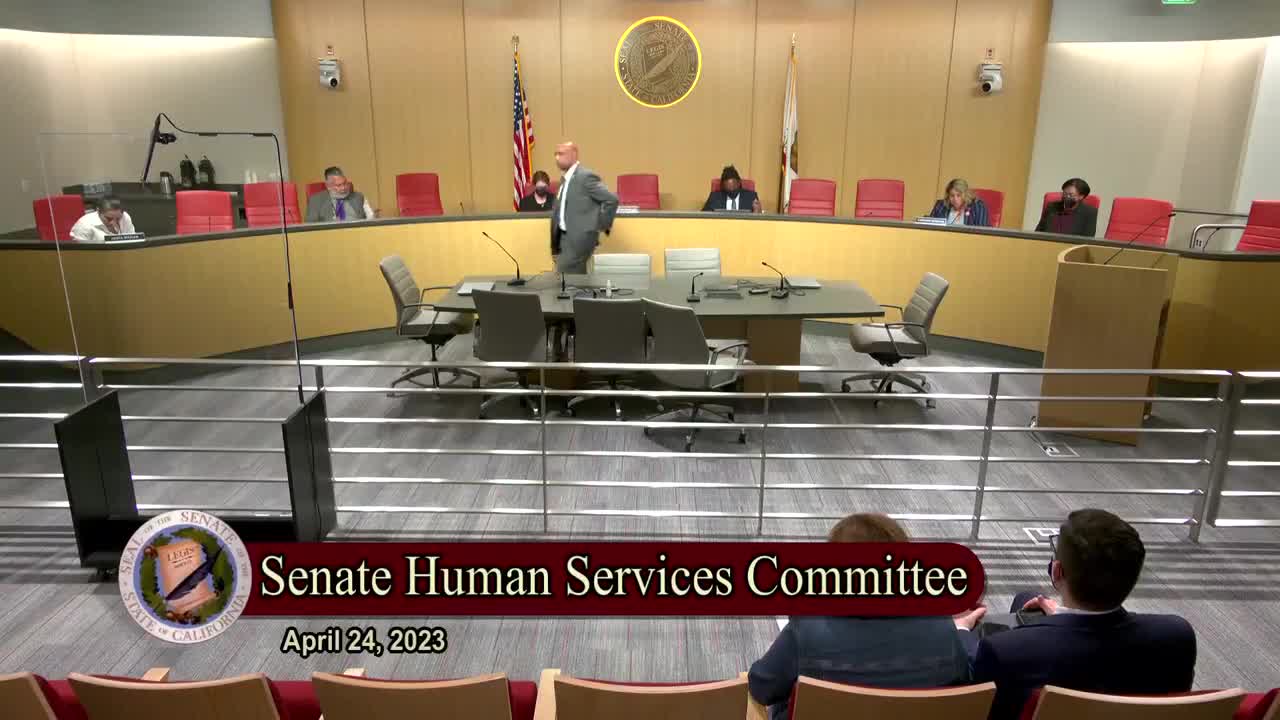 19MIN
Senate Standing Committee on Human Services
 25MIN
Senate Standing Committee on Education


Bill Co-Author(s):