SB 322: Zero-Emission Vehicle Battery Manufacturing Block Grants Program.
- Session Year: 2023-2024
- House: Senate
- Latest Version Date: 2023-06-13
Current Status:
Failed
(2023-09-01: September 1 hearing postponed by committee.)
Introduced
In Committee
First Chamber
In Committee
Second Chamber
Enacted
What does this bill do?
This bill creates a state Zero‑Emission Vehicle Battery Manufacturing Block Grants Program, run by the California Energy Commission, to fund in‑state battery production and requires rules for companies that seek those grants. To be eligible, applicants must submit environmental safety and workforce plans, pay a living wage (at least 167% of the minimum wage), commit to hire 30% people with employment barriers, and state whether they have or will enter labor peace or collective bargaining arrangements. Applications are scored on pay, training, safety, legal compliance, and worker voice (20 points each; 80 needed), and awardees must report annually or face repayment or fines for violations.
The summary is provided by generative AI which can make mistakes. For original language, please view the details in the table below.
Existing law creates the Clean Transportation Program, administered by the State Energy Resources Conservation and Development Commission, to provide, among other things, competitive grants and revolving loans to specified entities for those entities to develop and deploy innovative technologies that transform Californias fuel and vehicle types to help attain the states climate change policies. Under existing law, a project, as defined, that develops in-state production of raw materials and the manufacturing supply chain for zero-emission vehicle components is eligible to receive funding under that program. As part of that program, the commission has awarded grant moneys through a zero-emission vehicle battery manufacturing block grant to promote in-state battery manufacturing for zero-emission vehicles and related infrastructure.
This bill would require the commission, or an entity it contracts with, to administer its Zero-Emission Vehicle Battery Manufacturing Block Grant Program, and would impose eligibility, application scoring, workforce, and reporting requirements on the program. The bill would authorize the commission, or an entity it contracts with, to adopt procedures and criteria to supplement these requirements.
Existing law, the Buy Clean California Act, requires the Department of General Services to establish and publish a maximum acceptable global warming potential for each category of eligible materials, as defined, in accordance with specified requirements. Existing law requires awarding authorities to require the successful bidder for certain types of contracts to submit information relating to each eligible material proposed to be used, as specified. Existing law requires an awarding authority, in carrying out its duties pursuant to the act, to strive to achieve a continuous reduction of emissions over time. Existing law defines various terms for purposes of the act.This bill would make nonsubstantive changes to the provision that defines terms.Existing law, the Buy Clean California Act, requires the Department of General Services to establish and publish a maximum acceptable global warming potential for each category of eligible materials, as defined, in accordance with specified requirements. Existing law requires awarding authorities to require the successful bidder for certain types of contracts to submit information relating to each eligible material proposed to be used, as specified. Existing law requires an awarding authority, in carrying out its duties pursuant to the act, to strive to achieve a continuous reduction of emissions over time. Existing law defines various terms for purposes of the act.
This bill would make nonsubstantive changes to the provision that defines terms.
(a)The Legislature finds and declares all of the following:
(1)The state faces grave environmental, economic, and social challenges due to climate change and its effects. The transportation sector plays an outsized role in achieving a decarbonized economy as it annually generates approximately 50 percent of the states emissions of greenhouse gases, when accounting for fuel production emissions, and 80 percent of air pollutants in California.
(2)California has taken the initiative in addressing these problems by, among other things, creating the Advanced Clean Cars Program, a program adopted by the State Air Resources Board in 2012 to support Californias statutory requirement to develop and implement programs to reduce the emissions of greenhouse gases to 1990 levels by 2020, to reduce the emissions of greenhouse gases an additional 40 percent below 1990 levels by 2030, and to achieve carbon neutrality by 2045 or sooner. A key component of this plan is to end sales of new internal combustion engine passenger vehicles by 2035.
(3)Replacing internal combustion engine passenger vehicles will require the development of battery production capacity sufficient to provide safe, efficient, and affordable electric batteries to meet the demands of consumers. As the largest market for such vehicles and the national leader in calling for the replacement of internal combustion vehicles, California has an interest in supporting the development of that battery production capacity in the state and in ensuring the domestic battery manufacturing industry, which has imposed environmental, economic, and social harms on surrounding communities, particularly economically depressed communities and communities of color, in the past, operates responsibly and provides meaningful economic cobenefits to the state and people of California.
(4)California has budgeted substantial funding, including $25,000,000 in grants related to zero-emission vehicle battery manufacturing. The state has the responsibility to ensure such financial support offered to businesses to produce batteries domestically provides for the creation of durable, quality jobs that do not require workers to surrender their statutory rights to fair pay and fair treatment at work.
(5)Recognizing the extreme financial threat climate change poses to the economy of California, the state has a financial interest in rolling out zero-emission transit vehicles as quickly and expeditiously as possible.
(6)It is in the public interest to do all of the following:
(A)Promote sustainable and renewable energy sources, implement measures that increase efficient energy use, advance transportation technologies that reduce the degradation of the environment, lessen the states dependence on fossil fuels, and protect the health, welfare, and safety of the people of the state.
(B)Promote the development of domestic battery production to support these larger environmental, economic, and social goals, while minimizing the harms associated with battery production.
(C)Spend resources to avoid recreating historical patterns of injustice by allocating resources in a manner that will create an economy founded on climate, racial, and economic justice, that puts an end to extreme inequality and systemic racial injustice, and ensures all Californians have a clean and safe environment in which to live, work, and play.
(D)Allocate state funds to programs, businesses, organizations, agencies, and institutions that provide the greatest opportunities for high road jobs, strong labor provisions, and climate-based solutions in a manner that is consistent with the urgency of the climate crisis, statewide greenhouse gas emission reduction targets, recommendations of the Intergovernmental Panel on Climate Change, and achieving the greatest economic benefit to the state as a participant in the zero-emissions vehicle and battery manufacturing market.
(E)Ensure funds provided for the development of battery production capacity pursuant to the Zero-Emission Vehicle Battery Manufacturing Block Grants Program prioritize high road employers to enhance labor standards, workers rights, career pathways, and community benefits, including by requiring applicants for subsidies to submit a workforce plan and attestation regarding any labor peace agreement they have entered into with a union.
(b)It is therefore the intent of the Legislature to support the creation of equitable high-quality battery manufacturing jobs in California through the enactment and implementation of this act.
SEC. 2.Chapter 6.7 (commencing with Section 25570) is added to Division 15 of the Public Resources Code, to read:6.7.Zero-Emission Vehicle Battery Manufacturing Block Grants Program25570.This chapter shall be known, and may be cited, as the Zero-Emission Vehicle Battery Manufacturing Block Grants Program.
25570.1.For purposes of this chapter, the following definitions apply:
(a)Applicant means a private entity that applies, bids, or seeks qualification for a covered financial subsidy pursuant to the program. Applicant may include more than a single entity.
(b)Awardee means a private entity that has been awarded a covered financial subsidy pursuant to the program.
(c)Covered financial subsidy means a grant awarded by the relevant public agency for the development of battery production capacity, improvement of battery production methods, or remediation of environmental effects of battery production pursuant to the program.
(d)Individual with employment barriers means an individual with any characteristic that substantially limits the individuals ability to obtain employment, including, but not limited to, indicators of poor work history, lack of work experience, employment in nontraditional occupations, long-term unemployment, lack of educational or occupational skills attainment, dislocation from high-wage and high-benefit employment, including those displaced or dislocated from jobs in the fossil fuel economy, low levels of literacy or English proficiency, disability status, or welfare dependency.
(e)Labor peace agreement means an agreement between an applicant and any union that, at minimum, includes all of the following:
(1)A prohibition on the union and its members from engaging in picketing, work stoppages, boycotts, and any other economic interference with the applicants business.
(2)A prohibition on the applicant from engaging in a lockout of its employees.
(3)An agreement by the applicant not to disrupt efforts by the union to communicate with, and attempt to organize and represent, the applicants employees.
(4)Union access at reasonable times to areas in which the applicants employees work for the purpose of meeting with employees to discuss their rights to representation, employment rights under state law, and terms and conditions of employment.
(5)A methodology for determining whether the union has been chosen as the representative of particular job classifications of the applicant.
(f)Living wage means at least 167 percent of the minimum wage set by state statute or local ordinance, if higher.
(g)Program means the Zero-Emission Vehicle Battery Manufacturing Block Grants Program administered by the relevant public agency.
(h)Relevant public agency means the commission and any entities with which it may contract to award or administer covered financial subsidies, evaluate applicants, or monitor compliance with conditions of covered financial subsidies pursuant to the program.
(i)Subcontractor means a private entity performing a portion of the work of the awardee through a subcontract or subgrant.
(j)Union means a bona fide labor organization that is the recognized or certified exclusive bargaining representative of the employees of an employer. A labor organization is bona fide if all the following requirements are satisfied:
(1)The labor organization represents employees in California as to wages, hours, and working conditions.
(2)The labor organizations officers have been elected by secret ballot or otherwise in a manner consistent with federal law.
(3)The labor organization is free of domination or interference by any employer or association of employers and has not received improper assistance or support from an employer or association of employers.
25570.2.The commission, or an otherwise relevant public agency, shall administer its Zero-Emission Vehicle Battery Manufacturing Block Grant Program consistent with this chapter.
25570.4.In order to be eligible to receive a covered financial subsidy, an applicant shall do all of the following:
(a)Include in its application an environmental safety plan that includes, at minimum, all of the following:
(1)Procedures for the safe handling and storage of all materials used in the process of battery production, storage, and distribution.
(2)Procedures for the regular testing of all employees engaged in the process of battery production, storage, and distribution for workplace chemical exposure.
(3)Procedures for the regular testing of the air, water, and soil of the facility and the immediately surrounding area.
(b)Include in its application a workforce plan that includes, at minimum, all of the following:
(1)A commitment that 30 percent of its employees will be individuals with employment barriers, which may be satisfied by the employer showing that it has either hired, or made a good faith effort to hire, individuals with employment barriers.
(2)A commitment to offer employment to those engaged in apprenticeships through programs approved by the Division of Apprenticeship Standards or contractually mandated training, or to offer compensation for continuing education in a relevant field.
(3)Payment of a living wage to its employees.
(c)(1)Attest whether the applicant has entered into a labor peace agreement covering a classification of its employees, and, if it has, the applicant shall provide attestation for each labor peace agreement, verified by the union that is a signatory to the labor peace agreement, to the relevant public agency. For applicants that have not entered into a labor peace agreement, the applicant shall indicate whether it will enter into and abide by a labor peace agreement with any union that communicates its interest in representing any classification of the applicants employees.
(2)This subdivision shall only apply to an applicant with five or more employees.
(d)Include in its application any current collective bargaining agreement that the applicant has with a labor organization that represents employees engaged in the production of batteries in the United States, if applicable.
25570.6.(a)Upon the relevant public agency receiving a complete application from an eligible applicant, the application shall be scored, out of 100 points, based on the following:
(1)The application shall receive 20 points if the applicant will pay its employees at or above a living wage and at or above local or regional prevailing wage standards, where those standards exist for the applicable occupations.
(2)The application shall receive 20 points if it includes a targeted plan for investments in employee training, growth, and development, including the hiring of employees displaced or dislocated from jobs in the fossil fuel economy.
(3)The application shall receive 20 points if the applicants workplace provides safe and healthy working conditions, based on the incidence of serious workplace injuries or illnesses reported to the Division of Occupational Safety and Health during the two years preceding the applications filing date, and the applicant has adopted an injury and illness prevention program consistent with Section 3203 of Title 8 of the California Code of Regulations.
(4)The application shall receive 20 points if the applicant has demonstrated consistent compliance with workplace laws and regulations, including proactive efforts to remedy past problems, as measured by proof of internal procedures for investigating and responding to complaints of inappropriate workplace conditions and a narrative description of any charges or lawsuits filed by employees against the applicant during the two years preceding the applications filing date.
(5)The application shall receive 20 points if the applicant has adopted mechanisms, such as labor peace agreements or collective bargaining agreements, to include worker voice and agency in the workplace.
(b)An application that receives a score of at least 80 points is eligible to receive a covered financial subsidy pursuant to the program. Receiving a score of at least 80 points does not entitle the application to a covered financial subsidy of any amount, and the relevant public agency may use metrics other than score to determine which eligible applications are awarded covered financial subsidies.
25570.8.In order to maximize economic cobenefits, an awardee, and its subcontractors, as specified below, shall do all of the following:
(a)The awardee shall meet high road job standards designed to achieve all of the following goals:
(1)Support the creation and retention of quality, permanent, and full-time jobs that provide high wages, including benefits and access to training.
(2)Support the hiring of individuals with employment barriers.
(3)Protect public health by supporting the adoption of specific protections for worker health and safety and community public health and safety.
(b)The awardee shall establish and maintain an employer-employee relationship with individuals performing production, operations, maintenance, research, design, and supporting administrative work in connection with a project for which it has received a covered financial subsidy. If the awardee subcontracts any of those functions to another entity, that subcontractor shall establish and maintain an employer-employee relationship with individuals performing production, operations, maintenance, research, design, and supporting administrative work in connection with its work on the project. The requirements of this subdivision do not apply to the performance of building and construction work in connection with the program.
(c)An applicant that the commission has determined to have violated any applicable federal, state, or local laws pertaining to leave, both paid and unpaid, including any antiretaliation laws, public health and safety, or employee protections, including pursuant to Sections 6310 and 6311 of the Labor Code, Title VII (commencing with Section 701) of the Civil Rights Act of 1964 (Public Law 88-352), the federal Age Discrimination in Employment Act of 1967 (29 U.S.C. Sec. 621 et seq.), the Americans with Disabilities Act of 1990 (Public Law 101-336), the Americans with Disabilities Act Amendments Act of 2008 (Public Law 110-325), or the California Fair Employment and Housing Act (Part 2.8 (commencing with Section 12900) of Division 3 of Title 2 of the Government Code), and all related regulations, shall not be eligible for a covered financial subsidy pursuant to the program.
25571.(a)Within 12 months of receiving a covered financial subsidy, and annually thereafter until the final report is submitted pursuant to subdivision (b), an awardee shall submit to the relevant public agency information that is necessary to demonstrate its compliance with the requirements of this chapter.
(b)Before receiving the final payment of a covered financial subsidy, the awardee shall submit to the relevant public agency a final report that demonstrates its compliance with the requirements of this chapter for the entire time during which it received the covered financial subsidy.
(c)(1)If an awardee fails to comply with a reporting requirement specified in subdivision (a) or (b), the relevant public agency shall recover the full amount of the covered financial subsidy from the awardee until the awardee addresses that noncompliance pursuant to subdivision (d).
(2)If the relevant public agency does not recover a covered financial subsidy pursuant to paragraph (1), an individual who paid personal income taxes to the state in the calendar year before the year in dispute, or any organization representing such a taxpayer, may bring a civil action in state court to compel recovery under this subdivision. The court shall award reasonable attorneys fees and costs to such a prevailing taxpayer or organization.
(d)(1)An awardee that fails to comply with a reporting requirement specified in subdivision (a) or (b), after receiving notice from the relevant public agency that it failed to comply with the requirement, may address that noncompliance by submitting a revised or new report by the deadline established pursuant to paragraph (2).
(2)The relevant public agency shall establish a deadline for an awardee to submit a revised or new report within at least 15 calendar days, but not more than 30 calendar days, from the date the awardee received notice pursuant to paragraph (1).
(3)If an awardee fails to address its noncompliance with a reporting requirement by the deadline established pursuant to paragraph (2), the relevant public agency shall permanently deduct ten thousand dollars ($10,000) from the awardees covered financial subsidy, or the full covered financial subsidy if its amount is less than ten thousand dollars ($10,000), for each noncompliant report.
(e)This section does not limit the availability of standard breach of contract remedies if an awardee fails to comply with the requirements of this chapter.
25571.2.The relevant public agency may adopt procedures and criteria to supplement the requirements of this chapter.
25572.The provisions of this chapter are severable. If any provision of this chapter or its application is held invalid, that invalidity shall not affect other provisions or applications that can be given effect without the invalid provision or application.
(a)The Legislature finds and declares all of the following:
(1)The state faces grave environmental, economic, and social challenges due to climate change and its effects. The transportation sector plays an outsized role in achieving a decarbonized economy as it annually generates approximately 50 percent of the states emissions of greenhouse gases, when accounting for fuel production emissions, and 80 percent of air pollutants in California.
(2)California has taken the initiative in addressing these problems by, among other things, creating the Advanced Clean Cars Program, a program adopted by the State Air Resources Board in 2012 to support Californias statutory requirement to develop and implement programs to reduce the emissions of greenhouse gases to 1990 levels by 2020, to reduce the emissions of greenhouse gases an additional 40 percent below 1990 levels by 2030, and to achieve carbon neutrality by 2045 or sooner. A key component of this plan is to end sales of new internal combustion engine passenger vehicles by 2035.
(3)Replacing internal combustion engine passenger vehicles will require the development of battery production capacity sufficient to provide safe, efficient, and affordable electric batteries to meet the demands of consumers. As the largest market for such vehicles and the national leader in calling for the replacement of internal combustion vehicles, California has an interest in supporting the development of that battery production capacity in the state and in ensuring the domestic battery manufacturing industry, which has imposed environmental, economic, and social harms on surrounding communities, particularly economically depressed communities and communities of color, in the past, operates responsibly and provides meaningful economic cobenefits to the state and people of California.
(4)California has budgeted substantial funding, including $25,000,000 in grants related to zero-emission vehicle battery manufacturing. The state has the responsibility to ensure such financial support offered to businesses to produce batteries domestically provides for the creation of durable, quality jobs that do not require workers to surrender their statutory rights to fair pay and fair treatment at work.
(5)Recognizing the extreme financial threat climate change poses to the economy of California, the state has a financial interest in rolling out zero-emission transit vehicles as quickly and expeditiously as possible.
(6)It is in the public interest to do all of the following:
(A)Promote sustainable and renewable energy sources, implement measures that increase efficient energy use, advance transportation technologies that reduce the degradation of the environment, lessen the states dependence on fossil fuels, and protect the health, welfare, and safety of the people of the state.
(B)Promote the development of domestic battery production to support these larger environmental, economic, and social goals, while minimizing the harms associated with battery production.
(C)Spend resources to avoid recreating historical patterns of injustice by allocating resources in a manner that will create an economy founded on climate, racial, and economic justice, that puts an end to extreme inequality and systemic racial injustice, and ensures all Californians have a clean and safe environment in which to live, work, and play.
(D)Allocate state funds to programs, businesses, organizations, agencies, and institutions that provide the greatest opportunities for high road jobs, strong labor provisions, and climate-based solutions in a manner that is consistent with the urgency of the climate crisis, statewide greenhouse gas emission reduction targets, recommendations of the Intergovernmental Panel on Climate Change, and achieving the greatest economic benefit to the state as a participant in the zero-emissions vehicle and battery manufacturing market.
(E)Ensure funds provided for the development of battery production capacity pursuant to the Zero-Emission Vehicle Battery Manufacturing Block Grants Program prioritize high road employers to enhance labor standards, workers rights, career pathways, and community benefits, including by requiring applicants for subsidies to submit a workforce plan and attestation regarding any labor peace agreement they have entered into with a union.
(b)It is therefore the intent of the Legislature to support the creation of equitable high-quality battery manufacturing jobs in California through the enactment and implementation of this act.
SEC. 2.Chapter 6.7 (commencing with Section 25570) is added to Division 15 of the Public Resources Code, to read:6.7.Zero-Emission Vehicle Battery Manufacturing Block Grants Program25570.This chapter shall be known, and may be cited, as the Zero-Emission Vehicle Battery Manufacturing Block Grants Program.
25570.1.For purposes of this chapter, the following definitions apply:
(a)Applicant means a private entity that applies, bids, or seeks qualification for a covered financial subsidy pursuant to the program. Applicant may include more than a single entity.
(b)Awardee means a private entity that has been awarded a covered financial subsidy pursuant to the program.
(c)Covered financial subsidy mean means a grant awarded by the relevant public agency for the development of battery production capacity, improvement of battery production methods, or remediation of environmental effects of battery production pursuant to the program.
(d)Individual with employment barriers means an individual with any characteristic that substantially limits the individuals ability to obtain employment, including including, but not limited to, indicators of poor work history, lack of work experience, employment in nontraditional occupations, long-term unemployment, lack of educational or occupational skills attainment, dislocation from high-wage and high-benefit employment, including those displaced or dislocated from jobs in the fossil fuel economy, low levels of literacy or English proficiency, disability status, or welfare dependency. Individual with employment barriers includes, but is not limited to, members of all of the following groups:
(1)Displaced homemakers.(2)Low-income individuals.(3)Indians, Alaska Natives, and Native Hawaiians, as those terms are defined in Section 3221 of Title 29 of the United States Code.(4)Individuals with disabilities, including youths with disabilities.(5)Older individuals.(6)Ex-offenders.(7)Homeless individuals, as defined in Section 12473 of Title 34 of the United States Code, or homeless children and youths, as defined in Section 11434a of Title 42 of the United States Code.(8)Youths who are in, or have aged out of, the foster care system.(9)Individuals who are English language learners, individuals who have low levels of literacy, and individuals facing substantial cultural barriers.(10)Eligible migrant and seasonal farmworkers, as defined in Section 3322 of Title 29 of the United States Code.(11)Individuals within two years of exhausting lifetime eligibility under Part A (commencing with Section 601) of Subchapter IV of the Social Security Act (42 U.S.C. Sec. 601 et seq.).(12)Single parents, including single pregnant women.(13)Long-term unemployed individuals.(14)Transgender and gender nonconforming individuals.(15)Workers who have been displaced, on and after January 1, 2020, from the fossil fuel industry for nondisciplinary reasons after more than six months of service.(16)Any other groups that the Governor determines to have barriers to employment.(e)Labor peace agreement means an agreement between an applicant and any union that, at minimum, includes all of the following:
(1)A prohibition on the union and its members from engaging in picketing, work stoppages, boycotts, and any other economic interference with the applicants business.
(2)A prohibition on the applicant from engaging in a lockout of its employees.
(3)An agreement by the applicant not to disrupt efforts by the union to communicate with, and attempt to organize and represent, the applicants employees.
(4)Union access at reasonable times to areas in which the applicants employees work for the purpose of meeting with employees to discuss their rights to representation, employment rights under state law, and terms and conditions of employment.
(5)A methodology for determining whether the union has been chosen as the representative of particular job classifications of the applicant.
(f)Living wage means at least 167 percent of the minimum wage set by state statute or local ordinance, if higher.
(g)Program means the Zero-Emission Vehicle Battery Manufacturing Block Grants Program administered by the relevant public agency.
(h)Relevant public agency means the commission and any entities with which it may contract to award or administer covered financial subsidies, evaluate applicants, or monitor compliance with conditions of covered financial subsidies pursuant to the program.
(i)Subcontractor means a private entity performing a portion of the work of the awardee through a subcontract or subgrant.
(j)Union means a bona fide labor organization that is the recognized or certified exclusive bargaining representative of the employees of an employer. A labor organization is bona fide if all the following requirements are satisfied:
(1)The labor organization represents employees in California as to wages, hours, and working conditions.
(2)The labor organizations officers have been elected by secret ballot or otherwise in a manner consistent with federal law.
(3)The labor organization is free of domination or interference by any employer or association of employers and has not received improper assistance or support from an employer or association of employers.
25770.2.25570.2.The commission, or an otherwise relevant public agency, shall administer its Zero-Emission Vehicle Battery Manufacturing Block Grant Program consistent with this chapter.
25770.4.25570.4.In order to be eligible to receive a covered financial subsidy, an applicant shall do all of the following:
(a)Include in its application an environmental safety plan that includes, at minimum, all of the following:
(1)Procedures for the safe handling and storage of all materials used in the process of battery production, storage, and distribution.
(2)Procedures for the regular testing of all employees engaged in the process of battery production, storage, and distribution for workplace chemical exposure.
(3)Procedures for the regular testing of the air, water, and soil of the facility and the immediately surrounding area.
(b)Include in its application a workforce plan that includes, at minimum, all of the following:
(1)A commitment that 30 percent of its employees will be individuals with employment barriers, which may be satisfied by the employer showing that it has either hired, or made a good faith effort to hire, individuals with employment barriers.
(2)A commitment to offer employment to those engaged in apprenticeships through programs approved by the Division of Apprenticeship Standards or contractually mandated training, or to offer compensation for continuing education in a relevant field.
(3)Payment of a living wage to its employees.
(c)(1)Attest whether the applicant has entered into a labor peace agreement covering a classification of its employees, and, if it has, the applicant shall provide attestation for each labor peace agreement, verified by the union that is a signatory to the labor peace agreement, to the relevant public agency. For applicants that have not entered into a labor peace agreement, the applicant shall indicate whether it will enter into and abide by a labor peace agreement with any union that communicates its interest in representing any classification of the applicants employees.
(2)This subdivision shall only apply to an applicant with five or more employees.
(d)Include in its application any current collective bargaining agreement that the applicant has with a labor organization that represents employees engaged in the production of batteries in the United States, if applicable.
25770.6.25570.6.(a)Upon the relevant public agency receiving a complete application from an eligible applicant, the application shall be scored, out of 100 points, based on the following:
(1)The application shall receive 20 points if the applicant will pay its employees at or above a living wage and at or above local or regional prevailing wage standards, where those standards exist for the applicable occupations.
(2)The application shall receive 20 points if it includes a targeted plan for investments in employee training, growth, and development, including the hiring of employees displaced or dislocated from jobs in the fossil fuel economy.
(3)The application shall receive 20 points if the applicants workplace provides safe and healthy working conditions, based on the incidence of serious workplace injuries or illnesses reported to the Division of Occupational Safety and Health during the two years preceding the applications filing date, and the applicant has adopted an injury and illness prevention program consistent with Section 3203 of Title 8 of the California Code of Regulations.
(4)The application shall receive 20 points if the applicant has demonstrated consistent compliance with workplace laws and regulations, including proactive efforts to remedy past problems, as measured by proof of internal procedures for investigating and responding to complaints of inappropriate workplace conditions and a narrative description of any charges or lawsuits filed by employees against the applicant during the two years preceding the applications filing date.
(5)The application shall receive 20 points if the applicant has adopted mechanisms, such as labor peace agreements or collective bargaining agreements, to include worker voice and agency in the workplace.
(b)An application that receives a score of at least 80 points is eligible to receive a covered financial subsidy pursuant to the program. Receiving a score of at least 80 points does not entitle the application to a covered financial subsidy of any amount, and the relevant public agency may use metrics other than score to determine which eligible applications are awarded covered financial subsidies.
25770.8.25570.8.In order to maximize economic cobenefits, an awardee, and its subcontractors, as specified below, shall do all of the following:
(a)The awardee shall meet high road job standards designed to achieve all of the following goals:
(1)Support the creation and retention of quality, permanent, and full-time jobs that provide high wages, including benefits and access to training.
(2)Support the hiring of individuals with employment barriers.
(3)Protect public health by supporting the adoption of specific protections for worker health and safety and community public health and safety.
(b)The awardee shall establish and maintain an employer-employee relationship with individuals performing production, operations, maintenance, research, design, and supporting administrative work in connection with a project for which it has received a covered financial subsidy. If the awardee subcontracts any of those functions to another entity, that subcontractor shall establish and maintain an employer-employee relationship with individuals performing production, operations, maintenance, research, design, and supporting administrative work in connection with its work on the project. The requirements of this subdivision do not apply to the performance of building and construction work in connection with the program.
(c)An applicant that the commission has determined to have violated any applicable federal, state, or local laws pertaining to leave, both paid and unpaid, including any antiretaliation laws, public health and safety, or employee protections, including pursuant to Sections 6310 and 6311 of the Labor Code, Title VII (commencing with Section 701) of the Civil Rights Act of 1964 (Public Law 88-352), the federal Age Discrimination in Employment Act of 1967 (29 U.S.C. Secs. Sec. 621 et seq.), the Americans with Disabilities Act of 1990 (Public Law 101-336), the Americans with Disabilities Act Amendments Act of 2008 (Public Law 110-325), or the California Fair Employment and Housing Act (Part 2.8 (commencing with Section 12900) of Division 3 of Title 2 of the Government Code), and all related regulations, shall not be eligible for a covered financial subsidy pursuant to the program.
25771.25571.(a)Within 12 months of receiving a covered financial subsidy, and annually thereafter until the final report is submitted pursuant to subdivision (b), an awardee shall submit to the relevant public agency information that is necessary to demonstrate its compliance with the requirements of this chapter.
(b)Before receiving the final payment of a covered financial subsidy, the awardee shall submit to the relevant public agency a final report that demonstrates its compliance with the requirements of this chapter for the entire time during which it received the covered financial subsidy.
(c)(1)If an awardee fails to comply with a reporting requirement specified in subdivision (a) or (b), the relevant public agency shall recover the full amount of the covered financial subsidy from the awardee until the awardee addresses that noncompliance pursuant to subdivision (d).
(2)If the relevant public agency does not recover a covered financial subsidy pursuant to paragraph (1), an individual who paid personal income taxes to the state in the calendar year before the year in dispute, or any organization representing such a taxpayer, may bring a civil action in state court to compel recovery under this subdivision. The court shall award reasonable attorneys fees and costs to such a prevailing taxpayer or organization.
(d)(1)An awardee that fails to comply with a reporting requirement specified in subdivision (a) or (b), after receiving notice from the relevant public agency that it failed to comply with the requirement, may address that noncompliance by submitting a revised or new report by the deadline established pursuant to paragraph (2).
(2)The relevant public agency shall establish a deadline for an awardee to submit a revised or new report within at least 15 calendar days, but not more than 30 calendar days, from the date the awardee received notice pursuant to paragraph (1).
(3)If an awardee fails to address its noncompliance with a reporting requirement by the deadline established pursuant to paragraph (2), the relevant public agency shall permanently deduct ten thousand dollars ($10,000) from the awardees covered financial subsidy, or the full covered financial subsidy if its amount is less than ten thousand dollars ($10,000), for each noncompliant report.
(e)This section does not limit the availability of standard breach of contract remedies if an awardee fails to comply with the requirements of this chapter.
25771.2.25571.2.The relevant public agency may adopt procedures and criteria to supplement the requirements of this chapter.
(a)The Legislature finds and declares all of the following:
(1)The state faces grave environmental, economic, and social challenges due to climate change and its effects. The transportation sector plays an outsized role in achieving a decarbonized economy as it annually generates approximately 50 percent of the states emissions of greenhouse gases, when accounting for fuel production emissions, and 80 percent of air pollutants in California.
(2)California has taken the initiative in addressing these problems by, among other things, creating the Advanced Clean Cars Program, a program adopted by the State Air Resources Board in 2012 to support Californias statutory requirement to develop and implement programs to reduce the emissions of greenhouse gases to 1990 levels by 2020, to reduce the emissions of greenhouse gases an additional 40 percent below 1990 levels by 2030, and to achieve carbon neutrality by 2045 or sooner. A key component of this plan is to end sales of new internal combustion engine passenger vehicles by 2035.
(3)Replacing internal combustion engine passenger vehicles will require the development of battery production capacity sufficient to provide safe, efficient, and affordable electric batteries to meet the demands of consumers. As the largest market for such vehicles and the national leader in calling for the replacement of internal combustion vehicles, California has an interest in supporting the development of that battery production capacity in the state and in ensuring the domestic battery manufacturing industry, which has imposed environmental, economic, and social harms on surrounding communities, particularly economically depressed communities and communities of color, in the past, operates responsibly and provides meaningful economic cobenefits to the state and people of California.
(4)California has budgeted substantial funding, including $25,000,000 in grants related to zero-emission vehicle battery manufacturing. The state has the responsibility to ensure such financial support offered to businesses to produce batteries domestically provides for the creation of durable, quality jobs that do not require workers to surrender their statutory rights to fair pay and fair treatment at work.
(5)Recognizing the extreme financial threat climate change poses to the economy of California, the state has a financial interest in rolling out zero-emission transit vehicles as quickly and expeditiously as possible.
(6)It is in the public interest to do all of the following:
(A)Promote sustainable and renewable energy sources, implement measures that increase efficient energy use, advance transportation technologies that reduce the degradation of the environment, lessen the states dependence on fossil fuels, and protect the health, welfare, and safety of the people of the state.
(B)Promote the development of domestic battery production to support these larger environmental, economic, and social goals, while minimizing the harms associated with battery production.
(C)Spend resources to avoid recreating historical patterns of injustice by allocating resources in a manner that will create an economy founded on climate, racial, and economic justice, that puts an end to extreme inequality and systemic racial injustice, and ensures all Californians have a clean and safe environment in which to live, work, and play.
(D)Allocate state funds to programs, businesses, organizations, agencies, and institutions that provide the greatest opportunities for high road jobs, strong labor provisions, and climate-based solutions in a manner that is consistent with the urgency of the climate crisis, statewide greenhouse gas emission reduction targets, recommendations of the Intergovernmental Panel on Climate Change, and achieving the greatest economic benefit to the state as a participant in the zero-emissions vehicle and battery manufacturing market.
(E)Ensure funds provided for the development of battery production capacity pursuant to the Zero-Emission Vehicle Battery Manufacturing Block Grants Program prioritize high road employers to enhance labor standards, workers rights, career pathways, and community benefits, including by requiring applicants for subsidies to submit a workforce plan and attestation regarding any labor peace agreement they have entered into with a union.
(b)It is therefore the intent of the Legislature to support the creation of equitable high-quality battery manufacturing jobs in California through the enactment and implementation of this act.
SEC. 2.Chapter 6.7 (commencing with Section 25570) is added to Division 15 of the Public Resources Code, to read:6.7.Zero-Emission Vehicle Battery Manufacturing Block Grants Program25570.This chapter shall be known, and may be cited, as the Zero-Emission Vehicle Battery Manufacturing Block Grants Program.
25570.1.For purposes of this chapter, the following definitions apply:
(a)Applicant means a private entity that applies, bids, or seeks qualification for a covered financial subsidy pursuant to the program. Applicant may include more than a single entity.
(b)Awardee means a private entity that has been awarded a covered financial subsidy pursuant to the program.
(c)Covered financial subsidy mean a grant awarded by the relevant public agency for the development of battery production capacity, improvement of battery production methods, or remediation of environmental effects of battery production pursuant to the program.
(d)Individual with employment barriers means an individual with any characteristic that substantially limits the individuals ability to obtain employment, including indicators of poor work history, lack of work experience, employment in nontraditional occupations, long-term unemployment, lack of educational or occupational skills attainment, dislocation from high-wage and high-benefit employment, including those displaced or dislocated from jobs in the fossil fuel economy, low levels of literacy or English proficiency, disability status, or welfare dependency. Individual with employment barriers includes, but is not limited to, members of all of the following groups:
(1)Displaced homemakers.
(2)Low-income individuals.
(3)Indians, Alaska Natives, and Native Hawaiians, as those terms are defined in Section 3221 of Title 29 of the United States Code.
(4)Individuals with disabilities, including youths with disabilities.
(5)Older individuals.
(6)Ex-offenders.
(7)Homeless individuals, as defined in Section 12473 of Title 34 of the United States Code, or homeless children and youths, as defined in Section 11434a of Title 42 of the United States Code.
(8)Youths who are in, or have aged out of, the foster care system.
(9)Individuals who are English language learners, individuals who have low levels of literacy, and individuals facing substantial cultural barriers.
(10)Eligible migrant and seasonal farmworkers, as defined in Section 3322 of Title 29 of the United States Code.
(11)Individuals within two years of exhausting lifetime eligibility under Part A (commencing with Section 601) of Subchapter IV of the Social Security Act (42 U.S.C. Sec. 601 et seq.).
(12)Single parents, including single pregnant women.
(13)Long-term unemployed individuals.
(14)Transgender and gender nonconforming individuals.
(15)Workers who have been displaced, on and after January 1, 2020, from the fossil fuel industry for nondisciplinary reasons after more than six months of service.
(16)Any other groups that the Governor determines to have barriers to employment.
(e)Labor peace agreement means an agreement between an applicant and any union that, at minimum, includes all of the following:
(1)A prohibition on the union and its members from engaging in picketing, work stoppages, boycotts, and any other economic interference with the applicants business.
(2)A prohibition on the applicant from engaging in a lockout of its employees.
(3)An agreement by the applicant not to disrupt efforts by the union to communicate with, and attempt to organize and represent, the applicants employees.
(4)Union access at reasonable times to areas in which the applicants employees work for the purpose of meeting with employees to discuss their rights to representation, employment rights under state law, and terms and conditions of employment.
(5)A methodology for determining whether the union has been chosen as the representative of particular job classifications of the applicant.
(f)Living wage means at least 167 percent of the minimum wage set by state statute or local ordinance, if higher.
(g)Program means the Zero-Emission Vehicle Battery Manufacturing Block Grants Program administered by the relevant public agency.
(h)Relevant public agency means the commission and any entities with which it may contract to award or administer covered financial subsidies, evaluate applicants, or monitor compliance with conditions of covered financial subsidies pursuant to the program.
(i)Subcontractor means a private entity performing a portion of the work of the awardee through a subcontract or subgrant.
(j)Union means a bona fide labor organization that is the recognized or certified exclusive bargaining representative of the employees of an employer. A labor organization is bona fide if all the following requirements are satisfied:
(1)The labor organization represents employees in California as to wages, hours, and working conditions.
(2)The labor organizations officers have been elected by secret ballot or otherwise in a manner consistent with federal law.
(3)The labor organization is free of domination or interference by any employer or association of employers and has not received improper assistance or support from an employer or association of employers.
25770.2.The commission, or an otherwise relevant public agency, shall administer its Zero-Emission Vehicle Battery Manufacturing Block Grant Program consistent with this chapter.
25770.4.In order to be eligible to receive a covered financial subsidy, an applicant shall do all of the following:
(a)Include in its application an environmental safety plan that includes, at minimum, all of the following:
(1)Procedures for the safe handling and storage of all materials used in the process of battery production, storage, and distribution.
(2)Procedures for the regular testing of all employees engaged in the process of battery production, storage, and distribution for workplace chemical exposure.
(3)Procedures for the regular testing of the air, water, and soil of the facility and the immediately surrounding area.
(b)Include in its application a workforce plan that includes, at minimum, all of the following:
(1)A commitment that 30 percent of its employees will be individuals with employment barriers, which may be satisfied by the employer showing that it has either hired, or made a good faith effort to hire, individuals with employment barriers.
(2)A commitment to offer employment to those engaged in apprenticeships through programs approved by the Division of Apprenticeship Standards or contractually mandated training, or to offer compensation for continuing education in a relevant field.
(3)Payment of a living wage to its employees.
(c)(1)Attest whether the applicant has entered into a labor peace agreement covering a classification of its employees, and, if it has, the applicant shall provide attestation for each labor peace agreement, verified by the union that is a signatory to the labor peace agreement, to the relevant public agency. For applicants that have not entered into a labor peace agreement, the applicant shall indicate whether it will enter into and abide by a labor peace agreement with any union that communicates its interest in representing any classification of the applicants employees.
(2)This subdivision shall only apply to an applicant with five or more employees.
(d)Include in its application any current collective bargaining agreement that the applicant has with a labor organization that represents employees engaged in the production of batteries in the United States, if applicable.
25770.6.(a)Upon the relevant public agency receiving a complete application from an eligible applicant, the application shall be scored, out of 100 points, based on the following:
(1)The application shall receive 20 points if the applicant will pay its employees at or above a living wage and at or above local or regional prevailing wage standards, where those standards exist for the applicable occupations.
(2)The application shall receive 20 points if it includes a targeted plan for investments in employee training, growth, and development, including the hiring of employees displaced or dislocated from jobs in the fossil fuel economy.
(3)The application shall receive 20 points if the applicants workplace provides safe and healthy working conditions, based on the incidence of serious workplace injuries or illnesses reported to the Division of Occupational Safety and Health during the two years preceding the applications filing date, and the applicant has adopted an injury and illness prevention program consistent with Section 3203 of Title 8 of the California Code of Regulations.
(4)The application shall receive 20 points if the applicant has demonstrated consistent compliance with workplace laws and regulations, including proactive efforts to remedy past problems, as measured by proof of internal procedures for investigating and responding to complaints of inappropriate workplace conditions and a narrative description of any charges or lawsuits filed by employees against the applicant during the two years preceding the applications filing date.
(5)The application shall receive 20 points if the applicant has adopted mechanisms, such as labor peace agreements or collective bargaining agreements, to include worker voice and agency in the workplace.
(b)An application that receives a score of at least 80 points is eligible to receive a covered financial subsidy pursuant to the program. Receiving a score of at least 80 points does not entitle the application to a covered financial subsidy of any amount, and the relevant public agency may use metrics other than score to determine which eligible applications are awarded covered financial subsidies.
25770.8.In order to maximize economic cobenefits, an awardee, and its subcontractors, as specified below, shall do all of the following:
(a)The awardee shall meet high road job standards designed to achieve all of the following goals:
(1)Support the creation and retention of quality, permanent, and full-time jobs that provide high wages, including benefits and access to training.
(2)Support the hiring of individuals with employment barriers.
(3)Protect public health by supporting the adoption of specific protections for worker health and safety and community public health and safety.
(b)The awardee shall establish and maintain an employer-employee relationship with individuals performing production, operations, maintenance, research, design, and supporting administrative work in connection with a project for which it has received a covered financial subsidy. If the awardee subcontracts any of those functions to another entity, that subcontractor shall establish and maintain an employer-employee relationship with individuals performing production, operations, maintenance, research, design, and supporting administrative work in connection with its work on the project. The requirements of this subdivision do not apply to the performance of building and construction work in connection with the program.
(c)An applicant that the commission has determined to have violated any applicable federal, state, local laws pertaining to leave, both paid and unpaid, including any antiretaliation laws, public health and safety, or employee protections, including pursuant to Sections 6310 and 6311 of the Labor Code, Title VII (commencing with Section 701) of the Civil Rights Act of 1964 (Public Law 88-352), the federal Age Discrimination in Employment Act of 1967 (29 U.S.C. Secs. 621 et seq.), the Americans with Disabilities Act of 1990 (Public Law 101-336), the Americans with Disabilities Act Amendments Act of 2008 (Public Law 110-325), or the California Fair Employment and Housing Act (Part 2.8 (commencing with Section 12900) of Division 3 of Title 2 of the Government Code), and all related regulations, shall not be eligible for a covered financial subsidy pursuant to the program.
25771.(a)Within 12 months of receiving a covered financial subsidy, and annually thereafter until the final report is submitted pursuant to subdivision (b), an awardee shall submit to the relevant public agency information that is necessary to demonstrate its compliance with the requirements of this chapter.
(b)Before receiving the final payment of a covered financial subsidy, the awardee shall submit to the relevant public agency a final report that demonstrates its compliance with the requirements of this chapter for the entire time during which it received the covered financial subsidy.
(c)(1)If an awardee fails to comply with a reporting requirement specified in subdivision (a) or (b), the relevant public agency shall recover the full amount of the covered financial subsidy from the awardee until the awardee addresses that noncompliance pursuant to subdivision (d).
(2)If the relevant public agency does not recover a covered financial subsidy pursuant to paragraph (1), an individual who paid personal income taxes to the state in the calendar year before the year in dispute, or any organization representing such a taxpayer, may bring a civil action in state court to compel recovery under this subdivision. The court shall award reasonable attorneys fees and costs to such a prevailing taxpayer or organization.
(d)(1)An awardee that fails to comply with a reporting requirement specified in subdivision (a) or (b), after receiving notice from the relevant public agency that it failed to comply with the requirement, may address that noncompliance by submitting a revised or new report by the deadline established pursuant to paragraph (2).
(2)The relevant public agency shall establish a deadline for an awardee to submit a revised or new report within at least 15 calendar days, but not more than 30 calendar days, from the date the awardee received notice pursuant to paragraph (1).
(3)If an awardee fails to address its noncompliance with a reporting requirement by the deadline established pursuant to paragraph (2), the relevant public agency shall permanently deduct ten thousand dollars ($10,000) from the awardees covered financial subsidy, or the full covered financial subsidy if its amount is less than ten thousand dollars ($10,000), for each noncompliant report.
(e)This section does not limit the availability of standard breach of contract remedies if an awardee fails to comply with the requirements of this chapter.
25771.2.The relevant public agency may adopt procedures and criteria to supplement the requirements of this chapter.
SECTION 1.Section 3501 of the Public Contract Code is amended to read:3501.For purposes of this article, the following definitions apply:(a)Awarding authority means any of the following:(1)A state agency for a contract for a public works project that is subject to the State Contract Act (Chapter 1 (commencing with Section 10100) of Part 2).(2)The Regents of the University of California for a contract for a public works project that is subject to Chapter 2.1 (commencing with Section 10500) of Part 2.(3)The Trustees of the California State University for a contract for a public works project that is subject to the California State University Contract Law (Chapter 2.5 (commencing with Section 10700) of Part 2).(b)Department means the Department of General Services.(c)Eligible materials means any of the following:(1)Carbon steel rebar.(2)Flat glass.(3)Mineral wool board insulation.(4)Structural steel.(d)Eligible project means a project that the awarding authority determines will require eligible materials.(e)Greenhouse gas emissions has the same meaning as defined in subdivision (g) of Section 38505 of the Health and Safety Code.For purposes of this section: article, the following definitions apply:
(a)Awarding authority means any of the following:
(1)A state agency for a contract for a public works project that is subject to the State Contract Act (Chapter 1 (commencing with Section 10100) of Part 2).
(2)The Regents of the University of California for a contract for a public works project that is subject to Chapter 2.1 (commencing with Section 10500) of Part 2.
(3)The Trustees of the California State University for a contract for a public works project that is subject to the California State University Contract Law (Chapter 2.5 (commencing with Section 10700) of Part 2).
(b)Department means the Department of General Services.
(c)Eligible materials means any of the following:
(1)Carbon steel rebar.
(2)Flat glass.
(3)Mineral wool board insulation.
(4)Structural steel.
(d)Eligible project means a project that the awarding authority determines will require eligible materials.
(e)Greenhouse gas emissions has the same meaning as defined in subdivision (g) of Section 38505 of the Health and Safety Code.
|
Date
|
Status
|
|---|---|
| Sep 1, 2023 | September 1 hearing postponed by committee. |
| Aug 23, 2023 | August 23 set for first hearing. Placed on suspense file. |
| Jun 27, 2023 | From committee: Do pass and re-refer to Com. on APPR. (Ayes 12. Noes 3.) (June 26). Re-referred to Com. on APPR. |
| Jun 13, 2023 | From committee with author's amendments. Read second time and amended. Re-referred to Com. on TRANS. |
| Jun 1, 2023 | Referred to Com. on TRANS. |
| May 25, 2023 | In Assembly. Read first time. Held at Desk. |
| May 24, 2023 | Read third time. Passed. (Ayes 32. Noes 7. Page 1275.) Ordered to the Assembly. |
| May 18, 2023 | Read second time. Ordered to third reading. |
| May 18, 2023 | From committee: Do pass. (Ayes 5. Noes 2. Page 1165.) (May 18). |
| May 12, 2023 | Set for hearing May 18. |
| May 8, 2023 | May 8 hearing: Placed on APPR suspense file. |
| May 1, 2023 | Set for hearing May 8. |
| Apr 26, 2023 | From committee: Do pass and re-refer to Com. on APPR. (Ayes 4. Noes 1. Page 897.) (April 26). Re-referred to Com. on APPR. |
| Apr 21, 2023 | Set for hearing April 26. |
| Apr 18, 2023 | Read second time and amended. Re-referred to Com. on L., P.E. & R. |
| Apr 17, 2023 | From committee: Do pass as amended and re-refer to Com. on L., P.E. & R. (Ayes 11. Noes 3. Page 637.) (April 10). |
| Apr 3, 2023 | Set for hearing April 10. |
| Mar 29, 2023 | Re-referred to Coms. on E., U. & C. and L., P.E. & R. |
| Mar 22, 2023 | From committee with author's amendments. Read second time and amended. Re-referred to Com. on RLS. |
| Feb 15, 2023 | Referred to Com. on RLS. |
| Feb 7, 2023 | From printer. May be acted upon on or after March 9. |
| Feb 6, 2023 | Introduced. Read first time. To Com. on RLS. for assignment. To print. |
|
Date
|
Description
|
Location
|
Votes
|
|
|---|---|---|---|---|
| Jun 26, 2023 | Do pass and be re-referred to the Committee on [Appropriations] | Assembly Standing Committee on Transportation |
Passed |
|
| May 24, 2023 | Senate 3rd Reading SB322 Becker | Senate Floor |
Passed |
|
| May 18, 2023 | Do pass | Senate Standing Committee on Appropriations |
Passed |
|
| May 8, 2023 | Placed on suspense file | Senate Standing Committee on Appropriations |
Passed |
|
| Apr 26, 2023 | Do pass, but first be re-referred to the Committee on [Appropriations] | Senate Standing Committee on Labor, Public Employment and Retirement |
Passed |
|
| Apr 10, 2023 | Do pass as amended, but first amend, and re-refer to the Committee on [Labor, Public Employment and Retirement ] | Senate Standing Committee on Energy, Utilities and Communications |
Passed |
This list shows positions taken on this bill by organizations on the date displayed, which is linked to the original source.
Positions by individuals are not included.
|
Organization
|
Position
|
Date
|
|---|---|---|
| BlueGreen Alliance | * Support | Jun 26, 2023 |
| Broad and Gusman | * Support | Jun 26, 2023 |
| California Environmental Donors | * Support | Apr 10, 2023 |
| California Environmental Voters | ** Support | |
| California Labor Federation | * Support | Jun 26, 2023 |
| California State Association Of Electrical Workers | * Support | Apr 26, 2023 |
| California Teamsters Public Affairs Council | ** Support | |
| Climate Action California | * Support | Apr 10, 2023 |
| jobs to move america | ** Support | |
| Local 230 | * Support | Apr 10, 2023 |
| Natural Resources Defense Council | ** Support | |
| Natural Resources Defense Council (NRDC) | * Support | Apr 10, 2023 |
| Sierra Club | ** Support | |
| Sparkz | ** Support | |
| United Auto Workers Region 6 | * Support | Jun 26, 2023 |
Date of Hearing: August 23, 2023
ASSEMBLY COMMITTEE ON APPROPRIATIONS
Chris Holden, Chair
SBPCA Bill Id:SB 322
Author:(Becker) – As Amended Ver:June 13, 2023
Policy Committee: | Transportation | Vote: | 12 - 3 |
|
| ||
|
|
Urgency: No State Mandated Local Program: No Reimbursable: No
SUMMARY:
This bill prescribes administration of the existing Zero-emission Vehicle (ZEV) Battery Manufacturing Block Grant Program (ZEV battery grant program) and obligations of grant recipients with the goal of ensuring state funds allocated to the program support “high-road employers” that pay employees higher wages; invest in workforce training and development; hire workers displaced from the fossil-fuel industry; maintain safe and healthy workplaces; and accommodate and promote worker advocacy and representation.
Specifically, this bill, among other things, limits grant eligibility to only those applicants that receive at least 80 points on a 100-point scale, with the program administrator to award points, as follows:
- 20 points if the applicant will pay its employees at or above a living wage and at or above local or regional prevailing wage standards, if applicable.
- 20 points if the application includes a plan for investments in employee training, growth and development, including the hiring of employees displaced or dislocated from jobs in the fossil fuel economy.
- 20 points if the applicant’s workplace provides safe and healthy working conditions and the applicant has adopted an injury and illness prevention program.
- 20 points if the applicant has demonstrated consistent compliance with workplace laws and regulations.
- 20 points if the applicant has adopted mechanisms to include worker voice and agency in the workplace.
The bill also prescribes threshold requirements an applicant with five or more employees must meet to be eligible to receive a grant. Those requirements include, among other things, (a) having an environmental safety plan, (b) having entered into certain labor agreements with employees and (c) committing to hiring employees with specified employment barriers and paying them a living wage.
The bill makes reporting requirements of grant recipients and directs the “relevant public agency”—the California Energy Commission (CEC) and its program contractors—to recover the full grant amount from an awardee that fails to meet the reporting requirements and to withhold the funds until the awardee comes in to compliance. The bill empowers an individual who paid personal income taxes to the state in the calendar year before the year in dispute, or any organization representing such a taxpayer, to bring a civil action in state court to compel recovery if the relevant public agency fails to do so.
The bill requires the relevant public agency, for each noncompliant report, to deduct $10,000 from an award to a grant recipient that fails to comply with the reporting requirements within deadlines established by the relevant public agency.
Finally, the bill provides the relevant public agency may adopt procedures and criteria to supplement the requirements of this bill.
FISCAL EFFECT:
It is likely the bill will increase CALSTART’s administrative costs and CALSTART, as a result, will likely seek to renegotiate its existing contract with the California Energy Commission (CEC) for administration of the battery block grant program. (For a description of the existing battery block grant program administered by CALSTRT, see below). CEC staff time to renegotiate the agreement will likely be minor and absorbable within existing resources. The more significant fiscal effect will be to reduce the amount of funds available for block grants as CALSTART diverts money from the block grant program to program administration. It is not known how much money will be diverted, but the amount is potentially significant and likely more than $150,000.
COMMENTS:
- Purpose. The author intends this bill to support development of the ZEV battery industry in California while ensuring that industry provides good jobs, in safe working environments, to members of communities who most need them. According to the author, as expressed in the bill’s findings and declarations:
California has budgeted substantial funding, including $25,000,000 in grants related to zero-emission vehicle battery manufacturing. The state has the responsibility to ensure such financial support offered to businesses to produce batteries domestically provides for the creation of durable, quality jobs that do not require workers to surrender their statutory rights to fair pay and fair treatment at work.
- Background.
California Provides Funds to Foster In-state ZEV Battery Manufacturing. As California, and other jurisdictions, transition to a vehicle fleet that is predominantly powered by electricity, there is potential for development of a robust domestic battery manufacturing industry. The budget acts of 2021 and 2022 provided CEC with $100 million to administer a block grant program to incentivize in-state manufacturing of batteries for zero-emission vehicles. In December 2022, CEC awarded the administration of the $25 million block grant to CALSTART, which will award grants under its PowerForward – Battery Manufacturing Grant Program. CALSTART is developing program details through, among other activities, public workshops to identify grant funding opportunities that will facilitate ZEV battery manufacturing provide feedback on the design of the solicitation and subsequent sub-grants, solicitation process, application process and sub-grant implementation process.
This Bill Places PowerForward on the High Road. This bill prescribes numerous requirements applicable to the ZEV battery grant program, its administrator and eligible recipients and their subcontractors. Very generally, and as described in the summary of the bill, above, these requirements address wages, employment opportunities for those facing employment barriers, public health and worker safety, and employee relations. These requirements seem generally consistent what are oftentimes called “high road jobs.” For example, recently enacted legislation (SB 674 (Durazo), Chapter 875, Statutes of 2022) characterized the high roads job standard as one that, at a minimum:
- Supports the creation and retention of quality, nontemporary and full-time jobs that provide high wages, including benefits and access to training.
- Supports the hiring of displaced workers and individuals facing barriers to employment.
- Encourages the development of the state’s long-term, climate-sustainable transportation and related infrastructure and manufacturing sectors.
- Protects public health by supporting the adoption of specific protections for worker health and safety.
Writing in support of the bill, the California Labor Federation contends:
All public subsidies should be conditioned on labor standards as the state too often must pick up the tab for employer wage theft, misclassification, and contracting out. By attaching high road standards to public subsidies and creating a competitive process that prioritizes job quality, California can reduce income and racial inequality while also reducing emissions.
CEC concerns. Incorporating these requirements into the state’s ZEV battery grant program may place any resulting jobs on the high road. But CEC has practical concerns, nonetheless. Consistent with fiscal effect described above, CEC predicts the bill will cause CEC to revise its agreement with ZEV battery grant program administrator, CALSTART, to accommodate what likely will be additional administrative duties, as well as a correspondingly higher administrative fee, which will reduce monies available for grants.
CEC is generally critical of the bill’s scoring criteria, describing it as the “strictest scoring criteria used within the Clean Transportation Program’s grants and subgrants.” CEC asserts the scoring criteria “omits the scoring and selection of applications based on other equally or more critical scoring criteria” such as market competitiveness, technological innovation and local environmental impacts, for example. CEC warns, “Weighting the scoring criteria in a sub-optimal manner can cause good projects to fail and bad projects to proceed.”
In addition, CEC expresses strong concerns with the bill’s empowerment of individuals and organizations to bring civil action to compel recovery of grant awards, fearing CEC entanglement in costly, time-consuming litigation.
Analysis Prepared by: Jay Dickenson / APPR. / (916) 319-2081
Date of Hearing: June 26, 2023
ASSEMBLY COMMITTEE ON TRANSPORTATION
Laura Friedman, Chair
SBPCA Bill Id:SB 322
Author:(Becker) – As Amended Ver:June 13, 2023
SENATE VOTE: 32-7
SUBJECT: Zero-Emission Vehicle Battery Manufacturing Block Grants Program
SUMMARY: Requires the Energy Resources Conservation and Development Commission (CEC) to administer the Zero-Emission Vehicle (ZEV) Battery Manufacturing Block Grant Program and imposes eligibility, scoring, labor, and reporting requirements on the program. Specifically, this bill:
- Requires minimum labor and safety requirements for grant applicant eligibility.
- Requires CEC, and the grant administrator, to score applications out of 100 points, and sets minimum application eligibility at 80 points, with 20 points awarded for each of the following criteria:
- Payment of a living wage;
- Investments in employee training;
- Safe and healthy working conditions;
- Demonstrated workplace law compliance; and,
- Labor peace agreements.
- Authorizes CEC, and the grant administrator, to use metrics other than score to determine which eligible applications are awarded funding.
- Requires awardees to meet high road job standards, as specified.
- Prohibits applicants who have violated any applicable federal, state, or local laws pertaining to leave, public health and safety, or employee protections from being eligible for grant funding.
- Requires awardees to demonstrate compliance within 12 months of receiving a grant and annually after.
- Contains a severability clause, so that if any provisions are held invalid, other provisions are not affected.
- Makes Legislative findings and declarations and states Legislative intent to support the creation of equitable high-quality battery manufacturing jobs in California through the enactment and implementation of this bill.
EXISTING LAW:
- Requires the California Air Resources Board (CARB), pursuant to the California Global Warming Solutions Act of 2006 (AB 32 (Núñez), Chapter 488, Statutes of 2006), to adopt a statewide greenhouse gas (GHG) emissions limit equivalent to 1990 levels by 2020 and to develop a scoping plan for achieving the maximum technologically feasible and cost effective reductions in GHGs. (Health and Safety Code (HSC) 38500)
- Requires, pursuant to SB 32 (Pavley), Chapter 249, Statutes of 2016 that CARB ensure that statewide GHG emissions are reduced to at least 40% below 1990 levels by 2030. (HSC 38566)
- Provides, pursuant to the California Climate Crisis Act (AB 1279 (Muratsuchi), Chapter 337, Statutes of 2022) that it is the policy of the state to do both of the following:
- Achieve net zero GHG emissions as soon as possible but no later than 2045; and,
- Ensure that by 2045, GHG emissions are reduced to at least 85% below 1990 levels.
- Defines “high road” as a set of economic and workforce development strategies to achieve economic growth, economic equity, shared prosperity and a clean environment. The strategies include, but are not limited to, interventions that improve job quality and job access, including for women and people from underserved and underrepresented populations; meet the skill and profitability needs of employers, and; meet the economic, social, and environmental needs of the community. (Unemployment Insurance Code 14005(r))
FISCAL EFFECT: According to the Senate Appropriations Committee:
- To the extent that this bill would require the CEC to amend or revise its existing contract with its third-party administrator CALSTART to set and enforce the bill’s labor requirements, it could result in unknown but potentially significant costs (Alternative and Renewable Fuel and Vehicle Technology [ARFVT] fund).
- Unknown but likely minor and absorbable costs (ARFVT fund) for the CEC to perform new actions required by this bill with regard to implementing the block grant agreement.
COMMENTS:
California’s climate goals require incremental GHG emissions reductions, and carbon neutrality by no later than 2045. Transportation is the single largest source of GHG emissions, and strategies for reducing emissions from the transportation sector include transitioning internal combustion engine vehicles to ZEVs, reducing the carbon intensity of fuels, and reducing vehicle miles traveled.
ZEV adoption is increasing in California. Financial incentives and manufacturer regulations have contributed to consumers purchasing a greater number of ZEVs. The state has awarded over $1 billion in consumer rebates through the Clean Vehicle Rebate Project (CVRP), resulting in the purchase of more than 500,000 ZEVs. The Advanced Clean Cars 2 regulation requires 100% of passenger vehicle sales to be zero-emission by 2035. California reached 1.5 million cumulative ZEV sales in April 2023. In the first quarter of 2023, over 21% of new car sales were ZEVs.
EV battery manufacturing in the United States and California is increasing. Consistent with the growth in EV sales, the U.S. Department of Energy projects that the EV battery manufacturing capacity in North America in 2030 will be nearly 20 times greater than in 2021. The Bipartisan Infrastructure Law, also known as the Infrastructure Investment and Jobs Act, passed in 2021, included $2.8 billion to build and expand commercial-scale facilities in 12 states to extract and process battery materials, manufacture components, and demonstrate new approaches, including manufacturing components from recycled materials. None of the funded projects are located in California.
SB 129 (Budget Act), Chapter 69, Statutes of 2021 appropriated $125 million to CEC to support manufacturing grants to increase California manufacturing of ZEVs, ZEV components, and ZEV charging or refueling equipment. At the end of 2022, CEC designated CALSTART, a nonprofit technology industry member organization, as the administrator of an initial $25 million block grant for ZEV battery manufacturing.
High road jobs. AB 398 (E. Garcia), Chapter 135, Statutes of 2017 requires that the California Workforce Development Board (CWDB) present a report to the Legislature on strategies “to help industry, workers, and communities transition to economic and labor-market changes related to statewide GHG emissions reduction goals.” The report, delivered to the Legislature in the fall of 2020, addresses workforce interventions to ensure that the transition to a carbon-neutral economy creates high-quality jobs; prepares workers with the skills needed to adapt to and master new, zero- and low-emission technologies; broadens career opportunities for workers from disadvantaged communities; and supports workers whose jobs may be at risk. Ultimately, a “high road” approach to economic development means optimizing climate policy outcomes while supporting the creation of, and access to, family-supporting jobs. This bill applies a “high road” framework to the ZEV manufacturing block grant program.
Under existing law, the CTP includes prioritization criteria for scoring applications and workforce consideration. CEC has indicated that it would not need to revise its contract with CALSTART as a result of this bill. CALSTART is currently in the program design process, and could relatively easily incorporate the requirements of this bill, albeit with a potential delay. However, a delay during the design phase would be less disruptive than if CALSTART were in the process of soliciting proposals for funding.
As a result of this bill, each project the block grant program funds could have additional costs associated with meeting new labor requirements which would result in less funding being available for ZEV battery manufacturing. For example, the cost of establishing workforce plans or creating an employee growth plan could reduce the amount of funding available to manufacture batteries.
Staff comments: This bill could potentially delay program implementation and reduce the amount of funding available for battery manufacturing as a result of ensuring that money awarded through the ZEV Battery Manufacturing Block Grant Program goes to high road jobs. The Legislature has signaled support of applying high road job standards to the green transportation sector by passing similar legislation related to vehicle incentive programs and state acquisition of zero-emission transit vehicles or EV supply equipment.
In addition, this bill has not been double referred to the labor committee and this analysis does not assess the merits of the labor standards added by this bill. This bill also prohibits applicants from being eligible for funding if the CEC has determined them to be in violation of specified labor laws. It is unclear if this is an activity that is suitable or feasible for the CEC to determine, or if a labor agency should be more directly involved.
According to the author, “On both the federal and state level, there have been significant investments in providing quality jobs while establishing the battery manufacturing industry and transitioning to a clean energy future. To meet the state’s clean energy goals, California will need to manufacture large amounts of lithium batteries.”
In support the California Labor Federation writes, “The transition to ZEVs will displace some existing auto manufacturing jobs, so it is even more important that we ensure job quality standards in sectors receiving significant subsidies. [This bill] will link climate goals with high road job creation by conditioning eligibility for grant funding on complying with labor, workplace safety, and anti-discrimination and leave laws, and proper classification of workers. [This bill] also requires applicants to commit to hiring workers with employment barriers and evaluate applicants based on their payment of living wages, investments in training programs, compliance with health and safety and labor laws, and adoption of labor peace agreements. As California increases its use and manufacturing of ZEVs, it is imperative that state incentives supporting this industry also support high quality, equitable jobs; especially for historically marginalized communities and workers in the manufacturing industry who have been heavily impacted by the transition.”
Related and previous legislation: AB 241 (Reyes) and SB 84 (Gonzalez) of this Session extend and revise the CTP to prioritize projects that meet certain air quality improvement goals and provide equity-based investments in disadvantaged communities. The bills specify that at least 50% of CTP monies must be allocated for certain types of projects, including programs that promote ZEV car-sharing in low-income and disadvantaged communities. AB 241 is on the Assembly floor and SB 84 is on the Senate inactive file.
SB 674 (Durazo), Chapter 875, Statutes of 2022 requires the Department of General Services and the Department of Transportation and their contractors to enter into a Labor Peace Agreement and adhere to High Road Jobs Standards, as defined, for contracts for the acquisition of zero-emission transit vehicles or EV supply equipment valued at $10,000,000 or more.
AB 794 (W.Carillo), Chapter 748, Statutes of 2021 attaches labor standards to eligibility for various clean vehicle incentive programs administered by CARB for fleet purchasers of new drayage or short-haul trucks.
AB 398 (E. Garcia), Chapter 135, Statutes of 2017 directs CWDB to assess the need for increased education, job training, and workforce development resources to help workers and communities transition to a low carbon economy.
REGISTERED SUPPORT / OPPOSITION:
Support
California Environmental Voters
California Labor Federation, AFL-CIO
California Teamsters Public Affairs Council
Jobs to Move America
Natural Resources Defense Council
Sierra Club
Sparkz
UAW Region 6
Opposition
None on file
Analysis Prepared by: Christine Casey / TRANS. / (916) 319-2093
SENATE RULES COMMITTEE Office of Senate Floor Analyses (916) 651-1520 Fax: (916) 327-4478 | SB 322 |
THIRD READING
Bill No: SB 322
Author: Becker (D)
Amended: 4/18/23
Vote: 21
SENATE ENERGY, U. & C. COMMITTEE: 11-3, 4/10/23
AYES: Bradford, Ashby, Becker, Dodd, Durazo, Gonzalez, McGuire, Min, Newman, Rubio, Skinner
NOES: Dahle, Seyarto, Wilk
NO VOTE RECORDED: Caballero, Eggman, Grove, Stern
SENATE LABOR, PUB. EMP. & RET. COMMITTEE: 4-1, 4/26/23
AYES: Cortese, Durazo, Laird, Smallwood-Cuevas
NOES: Wilk
SENATE APPROPRIATIONS COMMITTEE: 5-2, 5/18/23
AYES: Portantino, Ashby, Bradford, Wahab, Wiener
NOES: Jones, Seyarto
SUBJECT: Zero-Emission Vehicle Battery Manufacturing Block Grants Program
SOURCE: United Auto Workers
DIGEST:
This bill establishes labor preferences that the California Energy Commission (CEC) and any third-party administrator must use when awarding funds for the Zero-Emission Vehicle (ZEV) Battery Manufacturing Block Grants Program.
ANALYSIS:
Existing law:
- Establishes the Clean Transportation Program (CTP) at the CEC to provide grants, loans, and other funding opportunities to develop and deploy innovative fuel and vehicle technologies to support California’s climate change policies. (Health and Safety Code §44272(a))
- Establishes CTP grant prioritization criteria. These criteria include, but are not limited to, a project’s ability to reduce certain air pollutants, provide in-state economic benefits, attract non-state matching funds, and deploy projects in non-attainment areas pursuant to the federal Clean Air Act. The CEC must rank projects based on each project’s ability to meet the prioritization criteria. (Health and Safety Code §44272(c-d))
- Specifies the types of projects eligible for funding from the CTP, including, but not limited to projects that develop and deploy alternative and renewable fuels, ZEV infrastructure and technologies, programs that help commercialize ZEV and alternative fuel vehicles, and workforce development projects that transition workers from fossil fuel industries to clean transportation jobs. (Health and Safety Code §44272 (e))
- Allocates a portion of smog abatement fees to fund the CTP and sunsets the fee on January 1, 2024. (Health and Safety Code §44060.5)
This bill:
- Establishes various definitions for the purposes of administering the ZEV Battery Manufacturing Block Grants Program, including but not limited to, the following definitions:
- “Labor peace agreement” means an agreement between an applicant and any union that includes at least the following:
- A prohibition on the union and its members from engaging in picketing, work stoppages, boycotts, and any other economic interference with the applicant’s business.
- A prohibition on the applicant from engaging in a lockout of its employees.
- An agreement by the applicant not to disrupt efforts by the union to communicate with, and attempt to organize and represent, the applicant’s employees.
- Union access at reasonable times to areas in which the applicant’s employees work for the purpose of meeting with employees to discuss their rights to representation, employment rights under state law, and terms and conditions of employment.
- A methodology for determining whether the union has been chosen as the representative of particular job classifications of the applicant.
- “Living wage” means at least 167 percent of the minimum wage set by state statute or local ordinance, if higher.
- “Relevant public agency” means the commission and any entities with which it may contract to award or administer covered financial subsidies, evaluate applicants, or monitor compliance with conditions of covered financial subsidies pursuant to the program.
- “Subcontractor” means a private entity performing a portion of the work of the awardee through a subcontract or subgrant.
- “Labor peace agreement” means an agreement between an applicant and any union that includes at least the following:
- Defines an “Individual with employment barriers” a person with any characteristic that substantially limits that individual’s ability to obtain employment. These characteristics may include, but are not limited to, indicators of poor work history, lack of work experience, employment in nontraditional occupations, long-term unemployment, lack of educational or occupational skills attainment, dislocation from high-wage and high-benefit employment, including those displaced or dislocated from jobs in the fossil fuel economy, low levels of literacy or English proficiency, disability status, or welfare dependency.
- Requires block grant applicants to do all of the following in order to obtain a subsidy from the ZEV Battery Manufacturing Block Grants Program:
- Include a specified environmental safety plan in the block grant application that identifies procedures for safe handling of materials, employee testing for chemical exposure, and environmental testing.
- Include a workforce plan that requires specified commitments from the employer, including commitments to pay a living wage, hire individuals with employment barriers for at least 30 percent of its workforce, and offer employment to individuals in approved apprenticeships or offer specified training or compensated education. Applicants may satisfy the commitment to hire individuals with employment barriers by showing that the employer has made a good faith effort to hire those individuals.
- Attest that the applicant has entered into a labor peace agreement covering its employees. Applicants that have not entered into a labor peace agreement must indicate whether they will enter into and abide by a labor peace agreement with any union that communicates its interest in representing any classification of the applicants’ employees.
- Include in the application any current collective bargaining agreement between the applicant and a labor organization representing the project’s employees.
- Requires the CEC and any third-party administrator to adopt a specified scoring process for evaluating applicants. This bill requires this scoring process to include five specified labor components, each worth 20 points. Applicants may receive a maximum score of 20 points, and no applicant that receives less than 80 points may receive an award from the block grant program.
- Establishes certain workforce goals for recipients of block grant awards and prohibits any awardee that violates specified existing labor, employment, and antidiscrimination laws from obtaining a subsidy through the program.
- Requires the CEC and any third-party administrator to adopt an annual reporting schedule for block grant awardees to submit documentation demonstrating their compliance with this bill. This bill specifies penalties for non-compliant awardees, including awardees who fail to report compliance documentation.
- Authorizes the CEC and any third-party administrator to adopt procedures and criteria to supplement the bill’s requirements.
Background
CEC’s ZEV Battery Manufacturing Block Grant. The Budget Acts of 2021 and 2022 provided the CEC with funding to administer a block grant program to fund in-state manufacturing of ZEV battery electric vehicle (EV) components. While the CEC received funding to administer up to $100 million for the block grant, the CEC issued a funding opportunity for a third-party administrator to oversee an initial $25 million block grant program. In December 2022, the CEC awarded the administration of the $25 million block grant to CALSTART for the PowerForward program.
Bill would establish labor requirements for the ZEV Battery Manufacturing Block Grant Program. This bill establishes a number of workforce and labor requirements for applicants seeking subsidies from the ZEV Battery Manufacturing Block Grant Program. These requirements, include establishing workforce plans to create high-road employment opportunities and provide employment options for workers who have been economically displaced or face certain employment barriers. This bill also includes requirements for awardees to have plans to ensure that battery manufacturing projects funded by the block grant do not create hazardous working environments for employees.
The establishment of labor and occupational health and safety requirements are consistent with efforts to ensure that in-state battery manufacturing does not create exploitative conditions occurring in other parts of the world where battery components are mined and processed. Cobalt is a major component of many rechargeable batteries, and more than half of the world’s known supply of cobalt is located in mines in the Democratic Republic of Congo. These mines have been the site of substantial human rights abuses, including slavery. As California seeks to maximize its domestic battery manufacturing and lithium extraction in the Salton Sea, stakeholders are seeking mechanisms to ensure that domestic mineral extraction and battery supply chains do not replicate exploitative labor and environmental conditions. The federal government is also seeking to align tax incentives for EV batteries to domestic mineral extraction and processing. The Inflation Reduction Act of 2022 (IRA) aims to provide tax credits for EV manufacturing using minerals sourced within the United States. Under the IRA, an EV would need to have a battery in which at least 80 percent of the market value of its minerals are sourced domestically to qualify for the tax credit.
How will the CEC incorporate these labor requirements into the existing ZEV Battery Manufacturing Block Grant? The CEC established a third-party administrator for the ZEV Battery Manufacturing Block Grant program by issuing a funding opportunity under the CEC’s existing CTP authority. Under existing law, the CTP already includes a list of prioritization criteria for scoring applications and workforce considerations. While this block grant was issued under the CEC’s CTP authority, it is not clear whether the existing CTP program guidelines would apply to the block grant program. In the absence of program rules that could be amended to incorporate this bill’s labor requirements, this bill may require the CEC to amend or revise its existing contract with CALSTART to set and enforce the bill’s labor requirements.
Related/Prior Legislation
SCR 24 (Bradford, 2023) recognizes the human rights abuses, including child slave labor, occurring in cobalt mines in Africa and resolves that California should take steps to bring a greater proportion of mineral extraction for batteries in-state to reduce the state’s reliance on foreign sources of these minerals. This resolution is currently pending in the Assembly
SB 84 (Gonzalez, 2023) and AB 241 (Reyes, 2023) each extends and revises the CTP to prioritize projects that meet certain air quality improvement goals and provide equity-based investments in disadvantaged communities. The bills have specified that at least 50 percent of CTP monies must be allocated for certain types of projects, including programs that promote ZEV car-sharing in low-income and disadvantaged communities. SB 84 is pending in the Senate Transportation Committee, and AB 241 is pending in the Assembly Transportation Committee.
SB 589 (Hueso, Chapter 732, Statutes of 2021) expanded the types of projects eligible for funding from the CTP to include projects that develop in-state supply chains and the workforce for raw materials and components needed for ZEV manufacturing. The bill also expanded the groups the CEC must consult as part of CTP workforce development efforts.
AB 1657 (E. Garcia, Chapter 271, Statutes of 2020) authorized the CEC to convene a blue ribbon commission on lithium extraction in California and submit a report to the Legislature by October 1, 2022, which must include findings and recommendations from the blue ribbon commission regarding actions to develop lithium extraction from geothermal brines.
AB 2127 (Ting, Chapter 365, Statutes of 2017) required the CEC to conduct a statewide assessment of the EV charging infrastructure needed to support the levels of EV adoption required for the state to meet its goals of putting at least five million ZEV on California roads by 2030 and of reducing emissions of GHG to 40 percent below 1990 levels by 2030.
AB 1697 (Bonilla, Chapter 446, Statutes of 2016) added prioritization criteria for the CTP to prioritize projects that transition workers to the alternative and renewable fuel and vehicle technology sector. The bill also added criteria for workforce development programs eligible for CTP funding.
FISCAL EFFECT: Appropriation: No Fiscal Com.: Yes Local: No
According to the Senate Appropriations Committee:
- To the extent that this bill would require the CEC to amend or revise its existing contract with its third-party administrator CALSTART to set and enforce the bill’s labor requirements, it could result in unknown but potentially significant costs (Alternative and Renewable Fuel and Vehicle Technology [ARFVT] fund).
- Unknown but likely minor and absorbable costs (ARFVT fund) for the CEC to perform new actions required by this bill with regard to implementing the block grant agreement.
SUPPORT: (Verified 5/18/23)
United Auto Workers (source)
California Environmental Voters
California Labor Federation
California Teamsters Public Affairs Council
Jobs to Move America
Natural Resources Defense Council
Sierra Club California
Sparkz, Inc.
United Auto Workers-Region 6
OPPOSITION: (Verified 5/18/23)
None received
ARGUMENTS IN SUPPORT: According to the author:
On both the federal and state level, there have been significant investments in providing quality, good paying jobs while establishing the battery manufacturing industry and transitioning to a clean energy future. To meet the clean energy goals outlined in SB 100 (de Leon, 2018), SB 1020 (Laird, 2022), and the EV adoption targets in the California Air Resources Board’s Scoping Plan, California will need to manufacture and purchase large amounts of lithium batteries. As California increases its use and manufacturing of zero-emission vehicles, it is imperative that state incentives supporting this industry also support high quality, equitable jobs.
Historically marginalized communities and workers in the manufacturing industry are most impacted by the transition toward a non-fossil fuel future and would most benefit from additional high road job transition support.
SB 322 will establish a ranking system to prioritize businesses who establish a workforce plan to employ individuals with employment barriers when applying for the Zero-Emission Vehicle Battery Manufacturing Grant. By doing so, this bill will simultaneously support business development and workers in underserved communities with high paying, stable jobs as California leads the transition to a green economy.
Prepared by: Sarah Smith / E., U. & C. / (916) 651-4107
5/20/23 12:44:28
**** END ****
SENATE COMMITTEE ON
Senator Anthony Portantino, Chair
2023 - 2024 Regular Session
SB 322 (Becker) - Zero-Emission Vehicle Battery Manufacturing Block Grants Program
Version: | Policy Vote: |
Urgency: | Mandate: |
Hearing Date: | Consultant: |
Bill Summary:
This bill would establish labor preferences that the California Energy Commission (CEC) and any third-party administrator must use when awarding funds for the Zero-Emission Vehicle (ZEV) Battery Manufacturing Block Grants Program.
Fiscal Impact:
- To the extent that this bill would require the CEC to amend or revise its existing contract with its third-party administrator CALSTART to set and enforce the bill’s labor requirements, it could result in unknown but potentially significant costs (Alternative and Renewable Fuel and Vehicle Technology [ARFVT] fund).
- Unknown but likely minor and absorbable costs (ARFVT fund) for the CEC to perform new actions required by this bill with regard to implementing the block grant agreement.
Background:
CEC’s ZEV Battery Manufacturing Block Grant. The Budget Acts of 2021 and 2022 provided the CEC with funding to administer a block grant program to fund in-state manufacturing of ZEV battery electric vehicle (EV) components. While the CEC received funding to administer up to $100 million for the block grant, the CEC issued a funding opportunity for a third-party administrator to oversee an initial $25 million block grant program. In December 2022, the CEC awarded the administration of the $25 million block grant to CALSTART for the PowerForward program.
Proposed Law:
This bill would establish labor preferences that the CEC and any third-party administrator must use when awarding funds for the ZEV Battery Manufacturing Block Grants Program. Specifically, this bill would:
- Establish a workforce plan that the CEC and any third-party administrator must use when awarding funds for the ZEV Battery Manufacturing Block Grants Program.
- Require block grant applicants to do all of the following in order to obtain a subsidy from the ZEV Battery Manufacturing Block Grants Program:
- Include a specified environmental safety plan in the block grant application that identifies procedures for safe handling of materials, employee testing for chemical exposure, and environmental testing.
- Include a workforce plan that requires specified commitments from the employer, including commitments to pay a living wage, hire individuals with employment barriers for at least 30 percent of its workforce, and offer employment to individuals in approved apprenticeships or offer specified training or compensated education. Applicants may satisfy the commitment to hire individuals with employment barriers by showing that the employer has made a good faith effort to hire those individuals.
- For applicants with more than five employees, attest that the applicant has entered into a labor peace agreement covering its employees. Applicants that have not entered into a labor peace agreement must indicate whether they will enter into and abide by a labor peace agreement with any union that communicates its interest in representing any classification of the applicants’ employees.
- Include in the application any current collective bargaining agreement between the applicant and a labor organization representing the project’s employees.
- Include a specified environmental safety plan in the block grant application that identifies procedures for safe handling of materials, employee testing for chemical exposure, and environmental testing.
- Require that each grant application be scored out of 100 points for grantees who pledge to do the following. An applicant that scores 80 point would be eligible for a grant.
- Pay a living wage (20 points)
- Create an employee growth plan (20 points).
- Create and report on safe and healthy working conditions (20 points).
- Consistently comply with workplace laws and regulations (20 points).
- Agree to labor peace agreements or collective bargaining opportunities for workers (20 points).
- Establish high road standards for block grant recipients and prohibits any awardee that violates specified existing labor, employment, and antidiscrimination laws from obtaining a subsidy through the program.
- Require the CEC and any third-party administrator to adopt an annual reporting schedule for block grant awardees to submit documentation demonstrating their compliance with this bill. and specifies penalties for non-compliant awardees, including awardees who fail to report compliance documentation.
- Authorize the CEC and any third-party administrator to adopt procedures and criteria to supplement the bill’s requirements.
- Define certain terms for the purposes of the bill.
- Make Legislative findings and declarations and state Legislative intent to support the creation of equitable high-quality battery manufacturing jobs in California through the enactment and implementation of this bill.
This bill would establish labor requirements for the ZEV Battery Manufacturing Block Grant Program. This bill would establish a number of workforce and labor requirements for applicants seeking subsidies from the ZEV Battery Manufacturing Block Grant Program. The establishment of labor and occupational health and safety requirements are consistent with efforts to ensure that in-state battery manufacturing does not create exploitative conditions occurring in other parts of the world where battery components are mined and processed. Cobalt is a major component of many rechargeable batteries, and more than half of the world’s known supply of cobalt is located in mines in the Democratic Republic of Congo. These mines have been the site of substantial human rights abuses, including slavery. As California seeks to maximize its domestic battery manufacturing and lithium extraction in the Salton Sea, stakeholders are seeking mechanisms to ensure that domestic mineral extraction and battery supply chains do not replicate exploitative labor and environmental conditions. The federal government is also seeking to align tax incentives for EV batteries to domestic mineral extraction and processing. The Inflation Reduction Act of 2022 (IRA) aims to provide tax credits for EV manufacturing using minerals sourced within the United States. Under the IRA, an EV would need to have a battery in which at least 80 percent of the market value of its minerals are sourced domestically to qualify for the tax credit.
How will the CEC incorporate these labor requirements into the existing ZEV Battery Manufacturing Block Grant? The CEC established a third-party administrator for the ZEV Battery Manufacturing Block Grant program by issuing a funding opportunity under the CEC’s existing CTP authority. Under existing law, the CTP already includes a list of prioritization criteria for scoring applications and workforce considerations. While this block grant was issued under the CEC’s CTP authority, it is not clear whether the existing CTP program guidelines would apply to the block grant program. In the absence of program rules that could be amended to incorporate this bill’s labor requirements, this bill may require the CEC to amend or revise its existing contract with CALSTART to set and enforce the bill’s labor requirements.
Related Legislation:
SCR 24 (Bradford, 2023) recognizes the human rights abuses, including child slave labor, occurring in cobalt mines in Africa and resolves that California should take steps to bring a greater proportion of mineral extraction for batteries in-state to reduce the state’s reliance on foreign sources of these minerals.
SB 84 (Gonzalez, 2023) and AB 241 (Reyes, 2023) would each extend and revise the CTP to prioritize projects that meet certain air quality improvement goals and provide equity-based investments in disadvantaged communities. The bill would have specified that at least 50 percent of CTP monies must be allocated for certain types of projects, including programs that promote ZEV car-sharing in low-income and disadvantaged communities.
SB 589 (Hueso, Chapter 732, Statutes of 2021) expanded the types of projects eligible for funding from the CTP to include projects that develop in-state supply chains and the workforce for raw materials and components needed for ZEV manufacturing. The bill also expanded the groups the CEC must consult as part of CTP workforce development efforts.
AB 1657 (E. Garcia, Chapter 271, Statutes of 2020) authorized the CEC to convene a blue ribbon commission on lithium extraction in California and submit a report to the Legislature by October 1, 2022, which must include findings and recommendations from the blue ribbon commission regarding actions to develop lithium extraction from geothermal brines.
AB 2127 (Ting, Chapter 365, Statutes of 2017) required the CEC to conduct a statewide assessment of the EV charging infrastructure needed to support the levels of EV adoption required for the state to meet its goals of putting at least five million ZEV on California roads by 2030 and of reducing emissions of GHG to 40 percent below 1990 levels by 2030.
AB 1697 (Bonilla, Chapter 446, Statutes of 2016) added prioritization criteria for the CTP to prioritize projects that transition workers to the alternative and renewable fuel and vehicle technology sector. The bill also added criteria for workforce development programs eligible for CTP funding.
Staff Comments:
Since a portion of each project that is funded through the ZEV Battery Manufacturing Grant Program could have some additional costs associated with meeting new labor requirements as a result of this bill, the practical impact of this change may be that there is an incremental decrease in ZEV battery manufacturing. For example, if a portion of a project award for ZEV battery manufacturing is dedicated to establishing workforce plans or creating an employee growth plan, fewer batteries may be manufactured.
-- END --
SENATE COMMITTEE ON LABOR, PUBLIC EMPLOYMENT AND RETIREMENT
Senator Dave Cortese, Chair
2023 - 2024 Regular
Bill No: SB 322 Hearing Date: April 26, 2023
Author: | Becker | ||
Version: | April 18, 2023 | ||
Urgency: | No | Fiscal: | Yes |
Consultant: | Dawn Clover | ||
SUBJECT: Zero-Emission Vehicle Battery Manufacturing Block Grants Program
KEY ISSUE
Should the Legislature establish labor preferences that the California Energy Commission (CEC) and a third-party administrator must use when awarding funds for the Zero-Emission Vehicle (ZEV) Battery Manufacturing Block Grants Program?
ANALYSIS
Existing law:
- Establishes the Clean Transportation Program (CTP) at the CEC to provide grants, loans, and other funding opportunities to develop and deploy innovative fuel and vehicle technologies to support California’s climate change policies.
- Establishes CTP grant prioritization criteria to include, but not be limited to, a project’s ability to reduce certain air pollutants, provide in-state economic benefits, attract non-state matching funds, and deploy projects in nonattainment areas pursuant to the federal Clean Air Act.
- Specifies the types of projects eligible for funding from the CTP, including, but not limited to projects that develop and deploy alternative and renewable fuels, ZEV infrastructure and technologies, programs that help commercialize ZEV and alternative fuel vehicles, and workforce development projects that transition workers from fossil fuel industries to clean transportation jobs. (Health and Safety Code §44272)
- Establishes CTP grant prioritization criteria to include, but not be limited to, a project’s ability to reduce certain air pollutants, provide in-state economic benefits, attract non-state matching funds, and deploy projects in nonattainment areas pursuant to the federal Clean Air Act.
- Allocates a portion of smog abatement fees to fund the CTP and sunsets the fee on January 1, 2024. (Health and Safety Code §44060.5)
- Defines “high road” as a set of economic and workforce development strategies to achieve economic growth, economic equity, shared prosperity and a clean environment. The strategies include, but are not limited to, interventions that improve job quality and job access, including for women and people from underserved and underrepresented populations; meet the skill and profitability needs of employers, and; meet the economic, social, and environmental needs of the community. (Unemployment Insurance Code §14005(r))
- Allows a Public Entity to enter into or require contractors to enter into a project labor agreement if it includes the following provisions:
- The agreement prohibits discrimination based on race, national origin, religion, sex, sexual orientation, political affiliation, or membership in a labor organization in hiring and dispatching workers for the project.
- The agreement permits all qualified contractors and subcontractors to bid for and be awarded work on the project without regard to whether they are otherwise parties to collective bargaining agreements.
- The agreement contains an agreed-upon protocol concerning drug testing for workers who will be employed on the project.
- The agreement contains guarantees against work stoppages, strikes, lockouts, and similar disruptions of the project.
- The agreement provides that disputes arising from the agreement shall be resolved by a neutral arbitrator. (PCC §2500)
- The agreement prohibits discrimination based on race, national origin, religion, sex, sexual orientation, political affiliation, or membership in a labor organization in hiring and dispatching workers for the project.
- Defines “Labor peace agreement” to mean an agreement between an employer and any bona fide labor organization that, at a minimum, protects the state’s proprietary interests by prohibiting labor organizations and members from engaging in picketing, work stoppages, boycotts, and any other economic interference with the applicant’s business. In exchange, the employer has agreed not to disrupt efforts by the bona fide labor organization to communicate with, and attempt to organize and represent, the employer’s employees. (BPC §26001)
- Defines “skilled and trained workforce” to include, among other criteria, skilled journeypersons who are paid at least a rate equivalent to the applicable prevailing hourly wage rate. (HSC § 25536.7)
This bill:
- Establishes a workforce plan that the CEC and any third-party administrator must use when awarding funds for the ZEV Battery Manufacturing Block Grants Program.
- Requires block grant applicants to do all of the following in order to obtain a subsidy from the ZEV Battery Manufacturing Block Grants Program:
- Include a specified environmental safety plan in the block grant application that identifies procedures for safe handling of materials, employee testing for chemical exposure, and environmental testing.
- Include a workforce plan that requires specified commitments from the employer, including commitments to pay a living wage, hire individuals with employment barriers for at least 30 percent of its workforce, and offer employment to individuals in approved apprenticeships or offer specified training or compensated education. Applicants may satisfy the commitment to hire individuals with employment barriers by showing that the employer has made a good faith effort to hire those individuals.
- For applicants with more than five employees, attest that the applicant has entered into a labor peace agreement covering its employees. Applicants that have not entered into a labor peace agreement must indicate whether they will enter into and abide by a labor peace agreement with any union that communicates its interest in representing any classification of the applicants’ employees.
- Include in the application any current collective bargaining agreement between the applicant and a labor organization representing the project’s employees.
- Include a specified environmental safety plan in the block grant application that identifies procedures for safe handling of materials, employee testing for chemical exposure, and environmental testing.
- Requires that each grant application be scored out of 100 points for grantees who pledge to do the following. An applicant that scores 80 point would be eligible for a grant.
- Pay a living wage (20 points).
- Create an employee growth plan (20 points).
- Create and report on safe and healthy working conditions (20 points).
- Consistently comply with workplace laws and regulations (20 points).
- Agree to labor peace agreements or collective bargaining opportunities for workers (20 points).
- Pay a living wage (20 points).
- Establishes high road standards for block grant recipients and prohibits any awardee that violates specified existing labor, employment, and antidiscrimination laws from obtaining a subsidy through the program.
- Requires the CEC and any third-party administrator to adopt an annual reporting schedule for block grant awardees to submit documentation demonstrating their compliance with this bill. and specifies penalties for non-compliant awardees, including awardees who fail to report compliance documentation.
- Authorizes the CEC and any third-party administrator to adopt procedures and criteria to supplement the bill’s requirements.
- Defines, for the purpose of this bill:
- “Applicant” as a private entity or entities that apply, bid, or seek qualification for a covered financial subsidy pursuant to the program.
- “Awardee” as a private entity that has been awarded a covered financial subsidy pursuant to the program.
- “Covered financial subsidy” as a grant awarded by the relevant public agency for the development of battery production capacity, improvement of battery production methods, or remediation of environmental effects of battery production.
- “Individual with employment barriers” as an individual with any characteristic that substantially limits the individual’s ability to obtain employment, including, but not limited to, indicators of poor work history, lack of work experience, employment in nontraditional occupations, long-term unemployment, lack of educational or occupational skills attainment, dislocation from high-wage and high-benefit employment, including those displaced or dislocated from jobs in the fossil fuel economy, low levels of literacy or English proficiency, disability status, or welfare dependency.
- “Labor peace agreement” as an agreement between an applicant and any union that, at minimum, includes all of the following:
- A prohibition on the union and its members from engaging in picketing, work stoppages, boycotts, and any other economic interference with the applicant’s business.
- A prohibition on the applicant from engaging in a lockout of its employees.
- An agreement by the applicant not to disrupt efforts by the union to communicate with, and attempt to organize and represent, the applicant’s employees.
- Union access at reasonable times to areas in which the applicant’s employees work for the purpose of meeting with employees to discuss their rights to representation, employment rights under state law, and terms and conditions of employment.
- A methodology for determining whether the union has been chosen as the representative of particular job classifications of the applicant.
- “Living wage” as at least 167 percent of the state minimum wage set by state statute or local ordinance, if higher. For the state minimum wage, it would currently be $25 per hour.
- “Program” as the ZEV Battery Manufacturing Block Grants Program administered by the relevant public agency.
- “Relevant public agency” as the CEC and any entities with which it may contract to award or administer covered financial subsidies, evaluate applicants, or monitor compliance with conditions of covered financial subsidies pursuant to the program.
- “Subcontractor” as a private entity performing a portion of the work of the awardee through a subcontract or subgrant.
- “Union” as a bona fide labor organization that is the recognized or certified exclusive bargaining representative of the employees of an employer. A labor organization is bona fide if:
- The labor organization represents employees in California as to wages, hours, and working conditions;
- The labor organization’s officers have been elected by secret ballot or otherwise in a manner consistent with federal law, and;
- The labor organization is free of domination or interference by any employer or association of employers and has not received improper assistance or support from an employer or association of employers.
- “Applicant” as a private entity or entities that apply, bid, or seek qualification for a covered financial subsidy pursuant to the program.
- Makes Legislative findings and declarations and states Legislative intent to support the creation of equitable high-quality battery manufacturing jobs in California through the enactment and implementation of this bill.
COMMENTS
1. Background
Federal Inflation Reduction Act
The Inflation Reduction Act of 2022 (IRA) provides tax credits for electric vehicle (EV) manufacturing using minerals sourced within North America. Under the IRA, an EV will need to have a battery in which at least 80 percent of the market value of its minerals are sourced in North America to qualify for the tax credit. Beginning in 2025, EVs cannot have any battery components or critical minerals sourced from a foreign entity of concern in order to qualify for the maximum available tax credit for the purchase of an EV.
High Road Standards
Last year, the Legislature passed and the Governor signed SB 674 (Durazo, Chapter 875, Statutes of 2022), which established the High Road Jobs in Transportation-Related Public Contracts and Grants Pilot Program to support the creation of equitable high quality transportation and related manufacturing and infrastructure jobs. The bill required the Department of General Services and the Department of Transportation, and their contractors, to adhere to High Road Jobs Standards on covered contracts worth $10 million or more.
CEC ZEV Battery Manufacturing Block Grant Program
The Budget provided the CEC with funding to administer a block grant program to fund in-state manufacturing of EV components. While the CEC received funding to administer up to $100 million for the block grant, the CEC issued a funding opportunity for a third-party nonprofit administrator to oversee an initial $25 million block grant program (GFO-21-606). In December 2022, the CEC awarded the administration of the $25 million block grant to CALSTART for the PowerForward project, which will design and implement the block grant to promote in-state battery manufacturing for ZEVs and related infrastructure. CALSTART is a national nonprofit that was founded in 1992.
Defining Labor Peace Agreement
The definition of “Labor Peace Agreement” in this bill was modelled after the definition in SB 674 (Durazo - Chapter 875, Statutes of 2022) with a few of distinctions. The rationale is to protect the state’s proprietary and economic interests in performing the work without interruption due to the economic effects of a labor dispute. First, the author and sponsor chose to clarify the union shall have reasonable access to employees at reasonable times in order to communicate with and organize employees. Second, the prohibition on the applicant from engaging in a lockout of its employees was specified. Finally, the bill specifies that a labor peace agreement shall include a methodology for determining whether the union has been chosen as the representative of particular job classifications of the applicant. According to the sponsor, the latter provision is in response to recent lack of clarity in another sector of industry in California.
Status of the Industry in California
Since the passage of AB 794 (Carillo - Chapter 748, Statutes of 2021), which attached labor standards to eligibility for various clean vehicle incentive programs administered by the California Air Resources Board for fleet purchasers of new drayage or short-haul trucks, dozens of battery manufacturers have opened with more coming on line every day. The CEC estimates California is currently home to 55 ZEV and ZEV related manufacturers.
According to recommendations from the July 2021 Bluegreen Alliance report Advancing High Road Standards in Zero-Emission Transportation “to achieve the state’s economic, climate, and equity goals at the least social and economic cost, high road standards elevating job quality are necessary. With regard to hiring and wages, the report recommends offering industry-specific or economy-wide wage and benefit standards that significantly exceed the California minimum wage to meet industry prevailing wages.
2. Need for this bill?
According to the author, “To meet the clean energy goals outlined in SB 100 (De Leon, 2018) and SB 1020 (Laird, 2022) and the Electric Vehicle adoption targets in the California Air Resources Board’s Scoping Plan, California will need to manufacture and purchase large amounts of lithium batteries.
Historically marginalized communities and workers in the manufacturing industry are most impacted by the transition toward non-fossil fuel industries and would most benefit from additional high road job transition support. This is exemplified in the Imperial Valley, near the Salton Sea, where there is a surplus of lithium and communities in need of economic opportunities. As California increases its use and manufacturing of zero-emission vehicles, it is imperative that the incentives we create to support this industry also support high quality, equitable jobs.
The current Zero Emission Vehicle Battery Manufacturing Block Grants Program, for example, lacks guidance on how the program will support goals to provide underrepresented communities with high quality jobs.
SB 322 will establish a ranking system to prioritize businesses who establish a workforce plan to employ individuals with employment barriers when applying for the Zero-Emission Vehicle Battery Manufacturing Grant.”
3. Proponent Arguments:
The sponsor, United Auto Workers Region 6 states “The auto industry is a cornerstone of manufacturing jobs in the United States, employing nearly 20,000 people in California and hundreds of thousands of people nationally. But job quality in the auto industry has been compromised by offshoring, reliance on temporary workers, attacks on workers’ freedom of association and weakened health and safety enforcement.
UAW members are fighting for a just transition to ensure that changes in the U.S. automotive industry result in quality jobs that benefit workers and their communities. California’s investments in EV and battery manufacturing offer a critical opportunity to revitalize U.S. industry and transition workers who build ICE vehicles or whose jobs are in the ICE supply chain to quality jobs in the EV supply chain that promote economic and racial justice.
California has budgeted substantial funding, including $25,000,000 in grants related to zero-emission vehicle battery manufacturing. The state has the responsibility to ensure such financial support offered to businesses to produce batteries domestically provides for the creation of durable, high quality jobs, labor standards, workers’ rights, career pathways, and community benefits.
UAW members know that the transition to zero emission vehicles presents an opportunity to preserve and grow high quality jobs in the EV supply chain, including in battery manufacturing. SB 322 (Becker) capitalizes on this opportunity by ensuring that battery manufacturers receiving public funds follow our laws, protect the safety of workers, and provide family-sustaining jobs for workers that serve as engines of economic development for their communities. These policies will encourage high road employment practices in highly strategic sectors of California’s economy.
SB 322 will link climate goals with high road job creation by conditioning eligibility for grant funding on complying with labor, workplace safety, and anti-discrimination and leave laws, and proper classification of workers. To ensure that the development of the battery industry also protects the air, soil, and water that our communities rely on, the bill also requires applicants to submit an environmental safety plan.
SB 322 amplifies the impact of public funds used to meet its climate goals by conditioning that support on also meeting employment objectives like providing quality jobs and promoting racial justice by ensuring opportunities in communities of working people of color. It does this by requiring applicants to commit to hiring workers with employment barriers and to complete a workforce application. This competitive scoring system evaluates applicants based on their payment of living wages, investments in training programs, compliance with health and safety and labor laws, and adoption of labor peace agreements. By attaching high road standards to public subsidies and creating a competitive process that prioritizes job quality, California can reduce income and racial inequality while also reducing emissions.”
4. Opponent Arguments:
None Received
5. Double Referral
This bill was first referred to the Senate Committee on Environmental Quality, where it passed 11-3.
6. Prior Legislation
SB 84 (Gonzalez, 2023) and AB 241 (Reyes, 2023) would each extend and revise the CTP to prioritize projects that meet certain air quality improvement goals and provide equity-based investments in disadvantaged communities. The bill would have specified that at least 50 percent of CTP monies must be allocated for certain types of projects, including programs that promote ZEV car-sharing in low-income and disadvantaged communities. As of April 21, 2023, SB 84 is pending in the Senate Committee on Environmental Quality and AB 241 is pending in the Assembly Committee on Natural Resources.
SB 740 (Cortese, 2023) would extend labor requirements to contracts awarded, extended, or renewed on or after January 1, 2024, by an owner or operator of a stationary source that is engaged in manufacturing hydrogen, biofuels, lithium batteries, or certain specified chemicals, in mining or beneficiating lithium, or in capturing, sequestering, or using carbon dioxide in specified conditions.
SB 822 (Durazo, 2023) would establish an Interagency High Road Team (Team) and charge the Team with creating high road evaluation metrics, including but not limited to, a set of principles, procedures, scoring rubrics, and contract application metrics pertaining to contractor applicant employment practices, including but not limited to, practices related to a contractor’s employee wages, benefits, and working conditions, and the contractor’s record of compliance with labor laws.
SCR 24 (Bradford, 2023) recognizes the human rights abuses, including child slave labor, occurring in cobalt mines in Africa and resolves that California should take steps to bring a greater proportion of mineral extraction for batteries in-state to reduce the state’s reliance on foreign sources of these minerals. This resolution is currently pending in the Assembly.
SB 674 (Durazo - Chapter 875, Statutes of 2022) established the High Road Jobs in Transportation-Related Public Contracts and Grants Pilot Program to support the creation of equitable high-quality transportation and related manufacturing and infrastructure jobs. SB 674 required a covered public contract for the acquisition of zero-emission transit vehicles or electric vehicle supply equipment valued at $10 million or more, to incorporate high road job standards.
AB 680 (Burke - Chapter 746, Statutes of 2021) required increased workforce standards on projects which utilize Greenhouse Gas Reduction Fund grants, including the payment of prevailing wage for construction projects.
SB 589 (Hueso - Chapter 732, Statutes of 2021) expanded the types of projects eligible for funding from the CTP to include projects that develop in-state supply chains and the workforce for raw materials and components needed for ZEV manufacturing. The bill also expanded the groups the CEC must consult as part of CTP workforce development efforts.
AB 794 (Carillo - Chapter 748, Statutes of 2021) attached labor standards to eligibility for various clean vehicle incentive programs administered by the California Air Resources Board for fleet purchasers of new drayage or short-haul trucks.
AB 1657 (E. Garcia - Chapter 271, Statutes of 2020) authorized the CEC to convene a blue ribbon commission on lithium extraction in California and submit a report to the Legislature by October 1, 2022, which must include findings and recommendations from the blue ribbon commission regarding actions to develop lithium extraction from geothermal brines.
AB 2127 (Ting - Chapter 365, Statutes of 2017) required the CEC to conduct a statewide assessment of the EV charging infrastructure needed to support the levels of EV adoption required for the state to meet its goals of putting at least five million ZEV on California roads by 2030 and of reducing emissions of GHG to 40 percent below 1990 levels by 2030.
AB 1697 (Bonilla - Chapter 446, Statutes of 2016) added prioritization criteria for the CTP to prioritize projects that transition workers to the alternative and renewable fuel and vehicle technology sector. The bill also added criteria for workforce development programs eligible for CTP funding.
SUPPORT
United Auto Workers Region 6 (Sponsor)
California Environmental Voters
California Labor Federation, AFL-CIO
California Teamsters Public Affairs Council
Jobs to Move America
Natural Resources Defense Council
Sierra Club
Sparkz, INC.
OPPOSITION
None received
-- END --
SENATE COMMITTEE ON ENERGY, UTILITIES AND COMMUNICATIONS
Senator Steven Bradford, Chair
2023 - 2024 Regular
Bill No: Hearing Date: 4/10/2023
Author: | |||
Version: | Amended | ||
Urgency: | Fiscal: | ||
Consultant: | |||
SUBJECT:
DIGEST: This bill establishes labor preferences that the California Energy Commission (CEC) and any third-party administrator must use when awarding funds for the Zero-Emission Vehicle (ZEV) Battery Manufacturing Block Grants Program.
ANALYSIS:
Existing law:
- Establishes the Clean Transportation Program (CTP) at the CEC to provide grants, loans, and other funding opportunities to develop and deploy innovative fuel and vehicle technologies to support California’s climate change policies. (Health and Safety Code §44272(a))
- Establishes CTP grant prioritization criteria. These criteria include, but are not limited to, a project’s ability to reduce certain air pollutants, provide in-state economic benefits, attract non-state matching funds, and deploy projects in non-attainment areas pursuant to the federal Clean Air Act. The CEC must rank projects based on each project’s ability to meet the prioritization criteria. (Health and Safety Code §44272(c-d))
- Specifies the types of projects eligible for funding from the CTP, including, but not limited to projects that develop and deploy alternative and renewable fuels, ZEV infrastructure and technologies, programs that help commercialize ZEV and alternative fuel vehicles, and workforce development projects that transition workers from fossil fuel industries to clean transportation jobs. (Health and Safety Code §44272 (e))
- Allocates a portion of smog abatement fees to fund the CTP and sunsets the fee on January 1, 2024. (Health and Safety Code §44060.5)
This bill:
- Establishes various definitions for the purposes of administering the ZEV Battery Manufacturing Block Grants Program, including but not limited to, the following definitions:
- “Labor peace agreement” means an agreement between an applicant and any union that includes at least the following:
- A prohibition on the union and its members from engaging in picketing, work stoppages, boycotts, and any other economic interference with the applicant’s business.
- A prohibition on the applicant from engaging in a lockout of its employees.
- An agreement by the applicant not to disrupt efforts by the union to communicate with, and attempt to organize and represent, the applicant’s employees.
- Union access at reasonable times to areas in which the applicant’s employees work for the purpose of meeting with employees to discuss their rights to representation, employment rights under state law, and terms and conditions of employment.
- A methodology for determining whether the union has been chosen as the representative of particular job classifications of the applicant.
- “Living wage” means at least 167 percent of the minimum wage set by state statute or local ordinance, if higher.
- “Relevant public agency” means the commission and any entities with which it may contract to award or administer covered financial subsidies, evaluate applicants, or monitor compliance with conditions of covered financial subsidies pursuant to the program.
- “Subcontractor” means a private entity performing a portion of the work of the awardee through a subcontract or subgrant.
- “Labor peace agreement” means an agreement between an applicant and any union that includes at least the following:
- Defines “Individual with employment barriers” as an individual with any characteristic that limits the individual’s ability to obtain employment, including indicators of poor work history, lack of work experience, employment in nontraditional occupations, long-term unemployment, lack of educational or occupational skills attainment, dislocation from high-wage and high-benefit employment, including those displaced or dislocated from jobs in the fossil fuel economy, low levels of literacy or English proficiency, disability status, or welfare dependency. This bill specifies a number of individuals and groups included in the definition of “Individual with employment barriers.”
- Requires block grant applicants to do all of the following in order to obtain a subsidy from the ZEV Battery Manufacturing Block Grants Program:
- Include a specified environmental safety plan in the block grant application that identifies procedures for safe handling of materials, employee testing for chemical exposure, and environmental testing.
- Include a workforce plan that requires specified commitments from the employer, including commitments to pay a living wage, hire individuals with employment barriers for at least 30 percent of its workforce, and offer employment to individuals in approved apprenticeships or offer specified training or compensated education. Applicants may satisfy the commitment to hire individuals with employment barriers by showing that the employer has made a good faith effort to hire those individuals.
- Attest that the applicant has entered into a labor peace agreement covering its employees. Applicants that have not entered into a labor peace agreement must indicate whether they will enter into and abide by a labor peace agreement with any union that communicates its interest in representing any classification of the applicants’ employees.
- Include in the application any current collective bargaining agreement between the applicant and a labor organization representing the project’s employees.
- Requires the CEC and any third-party administrator to adopt a specified scoring process for evaluating applicants. This bill requires this scoring process to include five specified labor components, each worth 20 points. Applicants may receive a maximum score of 20 points, and no applicant that receives less than 80 points may receive an award from the block grant program.
- Establishes certain workforce goals for recipients of block grant awards and prohibits any awardee that violates specified existing labor, employment, and antidiscrimination laws from obtaining a subsidy through the program.
- Requires the CEC and any third-party administrator to adopt an annual reporting schedule for block grant awardees to submit documentation demonstrating their compliance with this bill. This bill specifies penalties for non-compliant awardees, including awardees who fail to report compliance documentation.
- Authorizes the CEC and any third-party administrator to adopt procedures and criteria to supplement the bill’s requirements.
Background
CEC’s ZEV Battery Manufacturing Block Grant. The Budget Acts of 2021 and 2022 provided the CEC with funding to administer a block grant program to fund in-state manufacturing of ZEV battery electric vehicle (EV) components. While the CEC received funding to administer up to $100 million for the block grant, the CEC issued a funding opportunity for a third-party administrator to oversee an initial $25 million block grant program. In December 2022, the CEC awarded the administration of the $25 million block grant to CALSTART for the PowerForward program.
Bill would establish labor requirements for the ZEV Battery Manufacturing Block Grant Program. This bill establishes a number of workforce and labor requirements for applicants seeking subsidies from the ZEV Battery Manufacturing Block Grant Program. These requirements, include establishing workforce plans to create high-road employment opportunities and provide employment options for workers who have been economically displaced or face certain employment barriers. This bill also includes requirements for awardees to have plans to ensure that battery manufacturing projects funded by the block grant do not create hazardous working environments for employees.
The establishment of labor and occupational health and safety requirements are consistent with efforts to ensure that in-state battery manufacturing does not create exploitative conditions occurring in other parts of the world where battery components are mined and processed. Cobalt is a major component of many rechargeable batteries, and more than half of the world’s known supply of cobalt is located in mines in the Democratic Republic of Congo. These mines have been the site of substantial human rights abuses, including slavery. As California seeks to maximize its domestic battery manufacturing and lithium extraction in the Salton Sea, stakeholders are seeking mechanisms to ensure that domestic mineral extraction and battery supply chains do not replicate exploitative labor and environmental conditions. The federal government is also seeking to align tax incentives for EV batteries to domestic mineral extraction and processing. The Inflation Reduction Act of 2022 (IRA) aims to provide tax credits for EV manufacturing using minerals sourced within the United States. Under the IRA, an EV would need to have a battery in which at least 80 percent of the market value of its minerals are sourced domestically to qualify for the tax credit.
How will the CEC incorporate these labor requirements into the existing ZEV Battery Manufacturing Block Grant? The CEC established a third-party administrator for the ZEV Battery Manufacturing Block Grant program by issuing a funding opportunity under the CEC’s existing CTP authority. Under existing law, the CTP already includes a list of prioritization criteria for scoring applications and workforce considerations. While this block grant was issued under the CEC’s CTP authority, it is not clear whether the existing CTP program guidelines would apply to the block grant program. In the absence of program rules that could be amended to incorporate this bill’s labor requirements, this bill may require the CEC to amend or revise its existing contract with CALSTART to set and enforce the bill’s labor requirements.
Need for amendments. As currently drafted, this bill defines an “individual with employment barriers,” and provides non-exclusive list of groups and individuals who meet this definition. Since the bill’s definition of “individual with employment barriers” is not exclusive and broadly encompasses individuals with workforce challenges, it is not clear that the subsequent enumeration of certain groups and individuals is necessary. As a result, the author and committee may wish to strike the enumerated list and retain the broad definition of “individual with employment barriers.”
Double Referral. This bill is also referred to the Senate Committee on Labor, Public Employment and Retirement.
Prior/Related Legislation
SCR 24 (Bradford, 2023) recognizes the human rights abuses, including child slave labor, occurring in cobalt mines in Africa and resolves that California should take steps to bring a greater proportion of mineral extraction for batteries in-state to reduce the state’s reliance on foreign sources of these minerals. This resolution is currently pending in the Assembly
SB 84 (Gonzalez, 2023) and AB 241 (Reyes, 2023) would each extend and revise the CTP to prioritize projects that meet certain air quality improvement goals and provide equity-based investments in disadvantaged communities. The bill would have specified that at least 50 percent of CTP monies must be allocated for certain types of projects, including programs that promote ZEV car-sharing in low-income and disadvantaged communities. SB 84 is pending in the Senate Transportation Committee, and AB 241 is pending in the Assembly Transportation Committee.
SB 589 (Hueso, Chapter 732, Statutes of 2021) expanded the types of projects eligible for funding from the CTP to include projects that develop in-state supply chains and the workforce for raw materials and components needed for ZEV manufacturing. The bill also expanded the groups the CEC must consult as part of CTP workforce development efforts.
AB 1657 (E. Garcia, Chapter 271, Statutes of 2020) authorized the CEC to convene a blue ribbon commission on lithium extraction in California and submit a report to the Legislature by October 1, 2022, which must include findings and recommendations from the blue ribbon commission regarding actions to develop lithium extraction from geothermal brines.
AB 2127 (Ting, Chapter 365, Statutes of 2017) required the CEC to conduct a statewide assessment of the EV charging infrastructure needed to support the levels of EV adoption required for the state to meet its goals of putting at least five million ZEV on California roads by 2030 and of reducing emissions of GHG to 40 percent below 1990 levels by 2030.
AB 1697 (Bonilla, Chapter 446, Statutes of 2016) added prioritization criteria for the CTP to prioritize projects that transition workers to the alternative and renewable fuel and vehicle technology sector. The bill also added criteria for workforce development programs eligible for CTP funding.
FISCAL EFFECT: Appropriation: Fiscal Com.: Local:
SUPPORT:
United Auto Workers-Region 6, Sponsor
California Labor Federation
California Teamsters Public Affairs Council
Jobs to Move America
Natural Resources Defense Council
Sierra Club
OPPOSITION:
None received
ARGUMENTS IN SUPPORT: According to the author:
On both the federal and state level, there have been significant investments in providing quality, good paying jobs while establishing the battery manufacturing industry and transitioning to a clean energy future. To meet the clean energy goals outlined in SB 100 (de Leon, 2018), SB 1020 (Laird, 2022), and the EV adoption targets in the California Air Resources Board’s Scoping Plan, California will need to manufacture and purchase large amounts of lithium batteries. As California increases its use and manufacturing of zero-emission vehicles, it is imperative that state incentives supporting this industry also support high quality, equitable jobs.
Historically marginalized communities and workers in the manufacturing industry are most impacted by the transition toward a non-fossil fuel future and would most benefit from additional high road job transition support.
SB 322 will establish a ranking system to prioritize businesses who establish a workforce plan to employ individuals with employment barriers when applying for the Zero-Emission Vehicle Battery Manufacturing Grant. By doing so, this bill will simultaneously support business development and workers in underserved communities with high paying, stable jobs as California leads the transition to a green economy.
-- END --
Discussed in Hearing
 8MIN
Assembly Standing Committee on Transportation
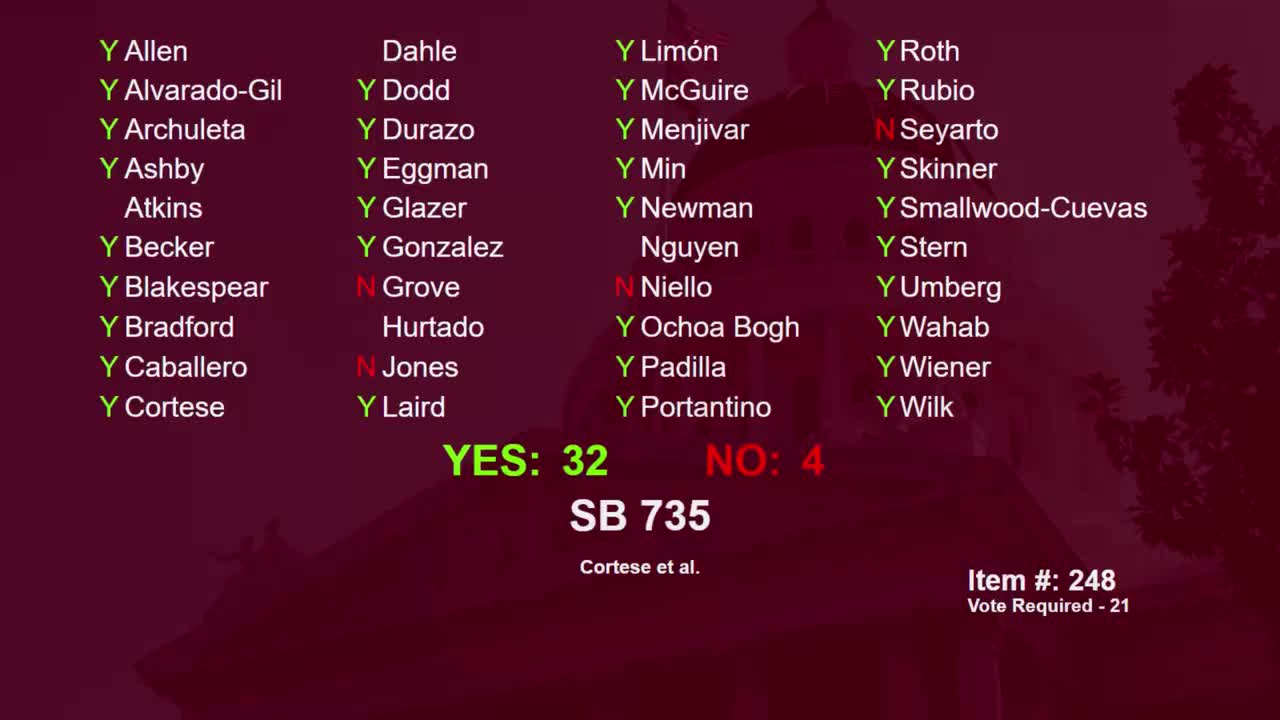 2MIN
Senate Floor
 15MIN
Senate Standing Committee on Labor, Public Employment and Retirement
 10MIN
Senate Standing Committee on Energy, Utilities and Communications
Bill Author

Bill Co-Author(s):