SB 369: Pupil instruction: model curricula: Vietnamese American refugee experience: Cambodian American history and heritage.
- Session Year: 2023-2024
- House: Senate
- Latest Version Date: 2023-10-10
Current Status:
Passed
(2023-10-10: Chaptered by Secretary of State. Chapter 711, Statutes of 2023.)
Introduced
In Committee
First Chamber
In Committee
Second Chamber
Enacted
(1)Existing law requires the State Department of Education to use specified appropriated funds to, in collaboration with, and subject to the approval of, the executive director of the State Board of Education, enter into a contract with a county office of education or a consortium of county offices of education by March 1, 2022, for the purpose of developing model curriculum related to the Vietnamese American refugee experience, as provided, by September 1, 2024. Existing law defines model curriculum for these purposes as various teaching tools to assist teachers in teaching about, among other things, the Fall of Saigon in 1975 and the conditions that led to the resettlement of Vietnamese people in the United States, as provided.
This bill would specify that the model curriculum is meant to cover the period from the Vietnam War and the Fall of Saigon in 1975 to the year 2000, as provided. To the extent these provisions impose additional duties on the contracted county office of education or consortium of county offices of education, the bill would impose a state-mandated local program.
(2)Existing law requires the department to use specified appropriated funds to, in collaboration with, and subject to the approval of, the executive director of the state board, enter into a contract with a county office of education or a consortium of county offices of education by April 1, 2022, for the purpose of developing model curriculum related to the Cambodian genocide, as provided, by September 1, 2024.
This bill would revise and recast these provisions, by, among other things, requiring the model curriculum developed under these provisions to instead be related to Cambodian American history and heritage. To the extent these provisions impose additional duties on the contracted county office of education or consortium of county offices of education, the bill would impose a state-mandated local program.
(3)The California Constitution requires the state to reimburse local agencies and school districts for certain costs mandated by the state. Statutory provisions establish procedures for making that reimbursement.
This bill would provide that, if the Commission on State Mandates determines that the bill contains costs mandated by the state, reimbursement for those costs shall be made pursuant to the statutory provisions noted above.
(1)Existing law requires the State Department of Education to use specified appropriated funds to, in collaboration with, and subject to the approval of, the executive director of the State Board of Education, enter into a contract with a county office of education or a consortium of county offices of education by March 1, 2022, for the purpose of developing model curriculum related to the Vietnamese American refugee experience, as provided, by September 1, 2024. Existing law defines model curriculum for these purposes as various teaching tools to assist teachers in teaching about, among other things, the Fall of Saigon in 1975 and the conditions that led to the resettlement of Vietnamese people in the United States, as provided.
This bill would specify that the model curriculum is meant to cover the period from the Vietnam War and the Fall of Saigon in 1975 to the year 2000, as provided. To the extent these provisions impose additional duties on the contracted county office of education or consortium of county offices of education, the bill would impose a state-mandated local program.
(2)Existing law requires the department to use specified appropriated funds to, in collaboration with, and subject to the approval of, the executive director of the state board, enter into a contract with a county office of education or a consortium of county offices of education by April 1, 2022, for the purpose of developing model curriculum related to the Cambodian genocide, as provided, by September 1, 2024.
This bill would revise and recast these provisions, by, among other things, requiring the model curriculum developed under these provisions to instead be related to Cambodian culture, history, heritage, and the Cambodian American refugee experience. American history and heritage. To the extent these provisions impose additional duties on the contracted county office of education or consortium of county offices of education, the bill would impose a state-mandated local program.
(3)The California Constitution requires the state to reimburse local agencies and school districts for certain costs mandated by the state. Statutory provisions establish procedures for making that reimbursement.
This bill would provide that, if the Commission on State Mandates determines that the bill contains costs mandated by the state, reimbursement for those costs shall be made pursuant to the statutory provisions noted above.
(1)Existing law requires the State Department of Education to use specified appropriated funds to, in collaboration with, and subject to the approval of, the executive director of the State Board of Education, enter into a contract with a county office of education or a consortium of county offices of education by March 1, 2022, for the purpose of developing model curriculum related to the Vietnamese American refugee experience, as provided, by September 1, 2024. Existing law defines model curriculum for these purposes as various teaching tools to assist teachers in teaching about, among other things, the Fall of Saigon in 1975 and the conditions that led to the resettlement of Vietnamese people in the United States, as provided.
This bill would specify that the model curriculum is meant to cover the period from the Vietnam War and the Fall of Saigon in 1975 to the year 2000, as provided. To the extent these provisions impose additional duties on the contracted county office of education or consortium of county offices of education, the bill would impose a state-mandated local program.
(2)Existing law requires the department to use specified appropriated funds to, in collaboration with, and subject to the approval of, the executive director of the state board, enter into a contract with a county office of education or a consortium of county offices of education by April 1, 2022, for the purpose of developing model curriculum related to the Cambodian genocide, as provided, by September 1, 2024.
This bill would revise and recast these provisions, by, among other things, requiring the model curriculum developed under these provisions to instead be related to Cambodian culture, history, heritage, and the Cambodian American refugee experience. To the extent these provisions impose additional duties on the contracted county office of education or consortium of county offices of education, the bill would impose a state-mandated local program.
(3)The California Constitution requires the state to reimburse local agencies and school districts for certain costs mandated by the state. Statutory provisions establish procedures for making that reimbursement.
This bill would provide that, if the Commission on State Mandates determines that the bill contains costs mandated by the state, reimbursement for those costs shall be made pursuant to the statutory provisions noted above.
Existing law requires the adopted course of study for grades 1 to 12, inclusive, to include instruction in various areas of study, including, but not limited to, English, mathematics, and social sciences.This bill would declare the Legislatures intent to enact subsequent legislation relating to pupil instruction.Existing law requires the adopted course of study for grades 1 to 12, inclusive, to include instruction in various areas of study, including, but not limited to, English, mathematics, and social sciences.
This bill would declare the Legislatures intent to enact subsequent legislation relating to pupil instruction.
(a)The department shall, no later than March 1, 2022, in collaboration with, and subject to the approval of, the executive director of the state board, use the funding appropriated pursuant to Section 156 of Chapter 44 of the Statutes of 2021 to enter into a contract with a county office of education or a consortium of county offices of education for the purposes of developing a model curriculum related to the Vietnamese American refugee experience by September 1, 2024. The model curriculum shall be housed on the platform developed and maintained by the California History-Social Science Project. The designated county office of education or consortium of county offices of education shall work with the California History-Social Science Project and Teaching California to ensure that the curriculum is accessible and compatible with the platform.
(b)The county office of education or consortium of county offices of education shall ensure the inclusion of authentic voices and perspectives in the development of the model curriculum and shall provide multiple opportunities for authentic stakeholder engagement across the state, which shall include, but not be limited to, town halls or other input sessions and surveys. The county office of education or consortium of county offices of education shall consult with, but is not limited to consulting with, Vietnamese American cultural centers and community groups located in California, survivors, rescuers, and liberators of the Vietnam War, Vietnamese American refugees, representatives of local educational agencies, members of the commission, and teachers, including teachers who have relevant experience or educational backgrounds in the study and teaching of Vietnamese American history.
(c)(1)The model curriculum shall include the incorporation of writings and other media that represent all perspectives of the Vietnamese refugee experience, including oral testimony by survivors, rescuers, and liberators of the Vietnam War, including Vietnamese American refugees, Vietnamese boat people, and members of the Republic of Vietnam Armed Forces, to ensure quality standards and materials for this area of study.
(2)For purposes of this subdivision, oral testimony means the firsthand accounts of significant historical events presented in a format that includes, but is not limited to, in-person testimony, video, or a multimedia option, such as a DVD or an online video.
(d)The model curriculum shall be open source and accessible to educators across the state and shall include curriculum and online instructional modules appropriate for use with pupils in kindergarten and any of grades 1 to 12, inclusive.
(e)The model curriculum shall be written as a guide to allow school districts, charter schools, and county offices of education to adapt their related courses to best meet the educational needs of their communities. The model curriculum developed for use in high schools shall include examples of courses offered by local educational agencies that have been approved as meeting the AG admissions requirements of the University of California and the California State University, including, to the extent possible, course outlines for those courses.
(f)The county office of education or consortium of county offices of education may subcontract with a nonprofit organization or institution of higher education in the development of the model curriculum pursuant to this section.
(g)The county office of education or consortium of county offices of education shall submit a report annually, until the completion of the model curriculum, on its progress in the development of the model curriculum, to the appropriate fiscal and policy committees of the Legislature and to the state board.
(h)Beginning in the school year following the completion of the model curriculum pursuant to subdivision (a), each school district, charter school, or county office of education maintaining kindergarten or any of grades 1 to 12, inclusive, that does not otherwise offer standards-based curriculum relative to the Vietnamese American refugee experience, Vietnamese boat people, and the Republic of Vietnam Armed Forces, is encouraged to offer to pupils a course of study relative to the Vietnamese American refugee experience. A school district, charter school, or county office of education that serves pupils in any of grades 7 to 12, inclusive, that elects to offer a course of study in the Vietnamese American refugee experience pursuant to this subdivision, shall offer the course as an elective in the social sciences or world history and shall make the course available in at least one year during a pupils enrollment in grades 7 to 12, inclusive.
(i)It is the intent of the Legislature that local educational agencies that maintain high schools submit course outlines for studies relative to the Vietnamese American refugee experience for approval as AG courses.
(j)For purposes of this section, model curriculum means lesson plans, primary source documents, planning resources, teaching strategies, and professional development activities to assist teachers in teaching about the Vietnamese American refugee experience, the Fall of Saigon in 1975, discussion of the Vietnamese boat people and members of the Republic of Vietnam Armed Forces, the reasons behind the exodus, the hardships faced by the Vietnamese people attempting to flee who were apprehended by the communist government, and the conditions that led to the resettlement of Vietnamese people in the United States and covers the period from the Vietnam War and the Fall of Saigon in 1975 to the year 2000, which captures the experience of postwar Vietnamese immigrants in the United States.
SEC. 2.Section 33540.4 of the Education Code is amended to read:33540.4.(a)The department shall, no later than April 1, 2022, in collaboration with, and subject to the approval of, the executive director of the state board, use the funding appropriated pursuant to Section 156 of Chapter 44 of the Statutes of 2021 to enter into a contract with a county office of education or a consortium of county offices of education for the purposes of developing a model curriculum related to Cambodian American history and heritage by September 1, 2024. The model curriculum shall be housed on the platform developed and maintained by the California History-Social Science Project. The designated county office of education or consortium of county offices of education shall work with the California History-Social Science Project and Teaching California to ensure that the curriculum is accessible and compatible with the platform.
(b)The county office of education or consortium of county offices of education shall ensure the inclusion of a myriad of voices and perspectives in the development of the model curriculum and shall provide opportunities for stakeholders active engagement and participation across the state, which shall include, but not be limited to, town halls, community forums, and other forms of input. The county office of education or consortium of county offices of education shall consult with, but is not limited to consulting with, Cambodian Americans that span generations and have diverse social backgrounds, including educators, scholars, students, and artistic, creative, cultural, and religious groups.
(c)The model curriculum shall include the incorporation of tangible and intangible expressions, including, but not limited to, writings, media, other artistic, cultural, and historical artifacts, multigenerational storytelling, and oral history that represent Cambodian American history and heritage to ensure quality standards and materials for this area of study.
(d)The model curriculum shall be open source and accessible to educators across the state and shall include curriculum and online instructional modules appropriate for use with pupils in kindergarten and any of grades 1 to 12, inclusive.
(e)The model curriculum shall be written as a guide to allow school districts, charter schools, and county offices of education to adapt their related courses to accommodate the educational needs of their communities. The model curriculum developed for use in high schools shall include examples of courses offered by local educational agencies that have been approved as meeting the AG admissions requirements of the University of California and the California State University, including, to the extent possible, course outlines for those courses.
(f)The county office of education or consortium of county offices of education may subcontract with nonprofit organizations or institutions of higher education in the development of the model curriculum pursuant to this section.
(g)The county office of education or consortium of county offices of education shall submit a report annually, until the completion of the model curriculum, on its progress in the development of the model curriculum, to the appropriate fiscal and policy committees of the Legislature and to the state board.
(h)Beginning in the school year following the completion of the model curriculum pursuant to subdivision (a), each school district, charter school, or county office of education maintaining kindergarten or any of grades 1 to 12, inclusive, that does not otherwise offer standards-based curriculum relative to Cambodian American history and heritage is encouraged to offer to pupils a course of study relative to Cambodian American history and heritage based on the model curriculum. A school district, charter school, or county office of education that serves pupils in any of grades 7 to 12, inclusive, that elects to offer a course of study in Cambodian American history and heritage pursuant to this subdivision, shall offer the course as an elective in the social sciences or world history and shall make the course available in at least one year during a pupils enrollment in grades 7 to 12, inclusive.
(i)It is the intent of the Legislature that local educational agencies that maintain high schools submit course outlines for studies relative to Cambodian American history and heritage for approval as AG courses.
(j)For purposes of this section, model curriculum means lesson plans, primary source documents, planning resources, teaching strategies, and professional development activities to assist teachers in teaching about Cambodian American history and heritage.
SEC. 3.If the Commission on State Mandates determines that this act contains costs mandated by the state, reimbursement to local agencies and school districts for those costs shall be made pursuant to Part 7 (commencing with Section 17500) of Division 4 of Title 2 of the Government Code.
(a)The department shall, no later than March 1, 2022, in collaboration with, and subject to the approval of, the executive director of the state board, use the funding appropriated pursuant to Section 156 of Chapter 44 of the Statutes of 2021 to enter into a contract with a county office of education or a consortium of county offices of education for the purposes of developing a model curriculum related to the Vietnamese American refugee experience by September 1, 2024. The model curriculum shall be housed on the platform developed and maintained by the California History-Social Science Project. The designated county office of education or consortium of county offices of education shall work with the California History-Social Science Project and Teaching California to ensure that the curriculum is accessible and compatible with the platform.
(b)The county office of education or consortium of county offices of education shall ensure the inclusion of authentic voices and perspectives in the development of the model curriculum and shall provide multiple opportunities for authentic stakeholder engagement across the state, which shall include, but not be limited to, town halls or other input sessions and surveys. The county office of education or consortium of county offices of education shall consult with, but is not limited to consulting with, Vietnamese American cultural centers and community groups located in California, survivors, rescuers, and liberators of the Vietnam War, Vietnamese American refugees, representatives of local educational agencies, members of the commission, and teachers, including teachers who have relevant experience or educational backgrounds in the study and teaching of Vietnamese American history.
(c)(1)The model curriculum shall include the incorporation of writings and other media that represent all perspectives of the Vietnamese refugee experience, including oral testimony by survivors, rescuers, and liberators of the Vietnam War, including Vietnamese American refugees, Vietnamese boat people, and members of the Republic of Vietnam Armed Forces, to ensure quality standards and materials for this area of study.
(2)For purposes of this subdivision, oral testimony means the firsthand accounts of significant historical events presented in a format that includes, but is not limited to, in-person testimony, video, or a multimedia option, such as a DVD or an online video.
(d)The model curriculum shall be open source and accessible to educators across the state and shall include curriculum and online instructional modules appropriate for use with pupils in kindergarten and any of grades 1 to 12, inclusive.
(e)The model curriculum shall be written as a guide to allow school districts, charter schools, and county offices of education to adapt their related courses to best meet the educational needs of their communities. The model curriculum developed for use in high schools shall include examples of courses offered by local educational agencies that have been approved as meeting the AG admissions requirements of the University of California and the California State University, including, to the extent possible, course outlines for those courses.
(f)The county office of education or consortium of county offices of education may subcontract with a nonprofit organization or institution of higher education in the development of the model curriculum pursuant to this section.
(g)The county office of consortium or education or consortium of county offices of education shall submit a report annually, until the completion of the model curriculum, on its progress in the development of the model curriculum, to the appropriate fiscal and policy committees of the Legislature and to the state board.
(h)Beginning in the school year following the completion of the model curriculum pursuant to subdivision (a), each school district, charter school, or county office of education maintaining kindergarten or any of grades 1 to 12, inclusive, that does not otherwise offer standards-based curriculum relative to the Vietnamese American refugee experience, Vietnamese boat people, and the Republic of Vietnam Armed Forces, is encouraged to offer to pupils a course of study relative to the Vietnamese American refugee experience. A school district, charter school, or county office of education that serves pupils in any of grades 7 to 12, inclusive, that elects to offer a course of study in the Vietnamese American refugee experience pursuant to this subdivision, shall offer the course as an elective in the social sciences or world history and shall make the course available in at least one year during a pupils enrollment in grades 7 to 12, inclusive.
(i)It is the intent of the Legislature that local educational agencies that maintain high schools submit course outlines for studies relative to the Vietnamese American refugee experience for approval as AG courses.
(j)For purposes of this section, model curriculum means lesson plans, primary source documents, planning resources, teaching strategies, and professional development activities to assist teachers in teaching about the Vietnamese American refugee experience, the Fall of Saigon in 1975, discussion of the Vietnamese boat people and members of the Republic of Vietnam Armed Forces, the reasons behind the exodus, the hardships faced by the Vietnamese people attempting to flee who were apprehended by the communist government, and the conditions that led to the resettlement of Vietnamese people in the United States and covers the period from the Vietnam War and the Fall of Saigon in 1975 to the year 2000, which captures the experience of postwar Vietnamese immigrants in the United States.
SEC. 2.Section 33540.4 of the Education Code is amended to read:33540.4.(a)The department shall, no later than April 1, 2022, in collaboration with, and subject to the approval of, the executive director of the state board, use the funding appropriated pursuant to Section 156 of Chapter 44 of the Statutes of 2021 to enter into a contract with a county office of education or a consortium of county offices of education for the purposes of developing a model curriculum related to Cambodian culture, history, heritage, and the Cambodian American refugee experience American history and heritage by September 1, 2024. The model curriculum shall be housed on the platform developed and maintained by the California History-Social Science Project. The designated county office of education or consortium of county offices of education shall work with the California History-Social Science Project and Teaching California to ensure that the curriculum is accessible and compatible with the platform.
(b)The county office of education or consortium of county offices of education shall ensure the inclusion of a myriad of voices and perspectives in the development of the model curriculum and shall provide opportunities for stakeholders active engagement and participation across the state, which shall include, but not be limited to, town halls, community forums, and other forms of input. The county office of education or consortium of county offices of education shall consult with, but is not limited to consulting with, Cambodian Americans that span generations and have diverse social backgrounds, including educators, scholars, students, and artistic, creative, cultural, and religious groups.
(c)The model curriculum shall include the incorporation of tangible and intangible expressions, including, but not limited to, writings, media, other artistic, cultural, and historical artifacts, multigenerational storytelling, and oral history that represent Cambodian culture, history, heritage, and the Cambodian American refugee experience American history and heritage to ensure quality standards and materials for this area of study.
(d)The model curriculum shall be open source and accessible to educators across the state and shall include curriculum and online instructional modules appropriate for use with pupils in kindergarten and any of grades 1 to 12, inclusive.
(e)The model curriculum shall be written as a guide to allow school districts, charter schools, and county offices of education to adapt their related courses to accommodate the educational needs of their communities. The model curriculum developed for use in high schools shall include examples of courses offered by local educational agencies that have been approved as meeting the AG admissions requirements of the University of California and the California State University, including, to the extent possible, course outlines for those courses.
(f)The county office of education or consortium of county offices of education may subcontract with nonprofit organizations or institutions of higher education in the development of the model curriculum pursuant to this section.
(g)The county office of education or consortium of county offices of education shall submit a report annually, until the completion of the model curriculum, on its progress in the development of the model curriculum, to the appropriate fiscal and policy committees of the Legislature and to the state board.
(h)Beginning in the school year following the completion of the model curriculum pursuant to subdivision (a), each school district, charter school, or county office of education maintaining kindergarten or any of grades 1 to 12, inclusive, that does not otherwise offer standards-based curriculum relative to Cambodian culture, history, heritage, and the Cambodian American refugee experience American history and heritage is encouraged to offer to pupils a course of study relative to Cambodian culture, history, heritage, and the Cambodian American refugee experience American history and heritage based on the model curriculum. A school district, charter school, or county office of education that serves pupils in any of grades 7 to 12, inclusive, that elects to offer a course of study in Cambodian culture, history, heritage, and the Cambodian American refugee experience American history and heritage pursuant to this subdivision, shall offer the course as an elective in the social sciences or world history and shall make the course available in at least one year during a pupils enrollment in grades 7 to 12, inclusive.
(i)It is the intent of the Legislature that local educational agencies that maintain high schools submit course outlines for studies relative to Cambodian culture, history, heritage, and the Cambodian American refugee experience American history and heritage for approval as AG courses.
(j)For purposes of this section, model curriculum means lesson plans, primary source documents, planning resources, teaching strategies, and professional development activities to assist teachers in teaching about Cambodian culture, history, heritage, and the Cambodian American refugee experience. American history and heritage.
SEC. 3.If the Commission on State Mandates determines that this act contains costs mandated by the state, reimbursement to local agencies and school districts for those costs shall be made pursuant to Part 7 (commencing with Section 17500) of Division 4 of Title 2 of the Government Code.
(a)The department shall, no later than March 1, 2022, in collaboration with, and subject to the approval of, the executive director of the state board, use the funding appropriated pursuant to Section 156 of Chapter 44 of the Statutes of 2021 to enter into a contract with a county office of education or a consortium of county offices of education for the purposes of developing a model curriculum related to the Vietnamese American refugee experience by September 1, 2024. The model curriculum shall be housed on the platform developed and maintained by the California History-Social Science Project. The designated county office of education or consortium of county offices of education shall work with the California History-Social Science Project and Teaching California to ensure that the curriculum is accessible and compatible with the platform.
(b)The county office of education or consortium of county offices of education shall ensure the inclusion of authentic voices and perspectives in the development of the model curriculum and shall provide multiple opportunities for authentic stakeholder engagement across the state, which shall include, but not be limited to, town halls or other input sessions and surveys. The county office of education or consortium of county offices of education shall consult with, but is not limited to consulting with, Vietnamese American cultural centers and community groups located in California, survivors, rescuers, and liberators of the Vietnam War, Vietnamese American refugees, representatives of local educational agencies, members of the commission, and teachers, including teachers who have relevant experience or educational backgrounds in the study and teaching of Vietnamese American history.
(c)(1)The model curriculum shall include the incorporation of writings and other media that represent all perspectives of the Vietnamese refugee experience, including oral testimony by survivors, rescuers, and liberators of the Vietnam War, including Vietnamese American refugees, Vietnamese boat people, and members of the Republic of Vietnam Armed Forces, to ensure quality standards and materials for this area of study.
(2)For purposes of this subdivision, oral testimony means the firsthand accounts of significant historical events presented in a format that includes, but is not limited to, in-person testimony, video, or a multimedia option, such as a DVD or an online video.
(d)The model curriculum shall be open source and accessible to educators across the state and shall include curriculum and online instructional modules appropriate for use in elementary schools, middle schools, and high schools. with pupils in kindergarten and any of grades 1 to 12, inclusive.
(e)The model curriculum shall be written as a guide to allow school districts, charter schools, and county offices of education to adapt their related courses to best meet the educational needs of their communities. The model curriculum developed for use in high schools shall include examples of courses offered by local educational agencies that have been approved as meeting the AG admissions requirements of the University of California and the California State University, including, to the extent possible, course outlines for those courses.
(f)The county office of education or consortium of county offices of education may subcontract with a nonprofit organization or institution of higher education in the development of the model curriculum pursuant to this section.
(g)The county office of consortium or county offices of education shall submit a report annually, until the completion of the model curriculum, on its progress in the development of the model curriculum, to the appropriate fiscal and policy committees of the Legislature and to the state board.
(h)Beginning in the school year following the completion of the model curriculum pursuant to subdivision (a), each school district, charter school, or county office of education maintaining kindergarten or any of grades 1 to 12, inclusive, that does not otherwise offer standards-based curriculum relative to the Vietnamese American refugee experience, Vietnamese boat people, and the Republic of Vietnam Armed Forces, is encouraged to offer to pupils a course of study relative to the Vietnamese American refugee experience. A school district, charter school, or county office of education that serves pupils in any of grades 7 to 12, inclusive, that elects to offer a course of study in the Vietnamese American refugee experience pursuant to this subdivision, shall offer the course as an elective in the social sciences or world history and shall make the course available in at least one year during a pupils enrollment in grades 7 to 12, inclusive.
(i)It is the intent of the Legislature that local educational agencies that maintain high schools submit course outlines for studies relative to the Vietnamese American refugee experience for approval as AG courses.
(j)For purposes of this section, model curriculum means lesson plans, primary source documents, planning resources, teaching strategies, and professional development activities to assist teachers in teaching about the Vietnamese American refugee experience, the fall Fall of Saigon in 1975, discussion of the Vietnamese boat people and members of the Republic of Vietnam Armed Forces, the reasons behind the exodus, the hardships faced by the Vietnamese people attempting to flee who were apprehended by the communist government, and the conditions that led to the resettlement of Vietnamese people in the United States. States and covers the period from the Vietnam War and the Fall of Saigon in 1975 to the year 2000, which captures the experience of postwar Vietnamese immigrants in the United States.
SEC. 2.Section 33540.4 of the Education Code is amended to read:33540.4.(a)The department shall, no later than April 1, 2022, in collaboration with, and subject to the approval of, the executive director of the state board, use the funding appropriated pursuant to Section 156 of Chapter 44 of the Statutes of 2021 to enter into a contract with a county office of education or a consortium of county offices of education for the purposes of developing a model curriculum related to the Cambodian Genocide culture, history, heritage, and the Cambodian American refugee experience by September 1, 2024. The model curriculum shall be housed on the platform developed and maintained by the California History-Social Science Project. The designated county office of education or consortium of county offices of education shall work with the California History-Social Science Project and Teaching California to ensure that the curriculum is accessible and compatible with the platform.
(b)The county office of education or consortium of county offices of education shall ensure the inclusion of authentic a myriad of voices and perspectives in the development of the model curriculum and shall provide multiple opportunities for authentic stakeholder stakeholders active engagement and participation across the state, which shall include, but not be limited to, town halls or other input sessions and surveys. halls, community forums, and other forms of input. The county office of education or consortium of county offices of education shall consult with, but is not limited to consulting with, survivors of the Cambodian genocide, representatives of local educational agencies, members of the commission, and teachers, including teachers who have relevant experience or educational backgrounds in the study and teaching of the Cambodian genocide. Cambodian Americans that span generations and have diverse social backgrounds, including educators, scholars, students, and artistic, creative, cultural, and religious groups.
(c)(1)The model curriculum shall include the incorporation of writings or other media that represent all perspectives of the Cambodian genocide, including oral testimony by survivors, tangible and intangible expressions, including, but not limited to, writings, media, other artistic, cultural, and historical artifacts, multigenerational storytelling, and oral history that represent Cambodian culture, history, heritage, and the Cambodian American refugee experience to ensure quality standards and materials for this area of study.
(2)For purposes of this subdivision, oral testimony means the firsthand accounts of significant historical events presented in a format that includes, but is not limited to, in-person testimony, video, or a multimedia option, such as a DVD or an online video.(d)The model curriculum shall be open source and accessible to educators across the state and shall include curriculum and online instructional modules appropriate for use in elementary schools, middle schools, and high schools. with pupils in kindergarten and any of grades 1 to 12, inclusive.
(e)The model curriculum shall be written as a guide to allow school districts, charter schools, and county offices of education to adapt their related courses to best meet accommodate the educational needs of their communities. The model curriculum developed for use in high schools shall include examples of courses offered by local educational agencies that have been approved as meeting the AG admissions requirements of the University of California and the California State University, including, to the extent possible, course outlines for those courses.
(f)The county office of education or consortium of county offices of education may subcontract with a nonprofit organization organizations or institution institutions of higher education in the development of the model curriculum pursuant to this section.
(g)The county office of education or consortium or of county offices of education shall submit a report annually, until the completion of the model curriculum, on its progress in the development of the model curriculum, to the appropriate fiscal and policy committees of the Legislature and to the state board.
(h)Beginning in the school year following the completion of the model curriculum pursuant to subdivision (a), each school district, charter school, or county office of education maintaining kindergarten or any of grades 1 to 12, inclusive, that does not otherwise offer standards-based curriculum relative to the Cambodian genocide, culture, history, heritage, and the Cambodian American refugee experience is encouraged to offer to pupils a course of study relative to the Cambodian genocide culture, history, heritage, and the Cambodian American refugee experience based on the model curriculum. A school district, charter school, or county office of education that serves pupils in any of grades 7 to 12, inclusive, that elects to offer a course of study in the Cambodian genocide culture, history, heritage, and the Cambodian American refugee experience pursuant to this subdivision, shall offer the course as an elective in the social sciences or world history and shall make the course available in at least one year during a pupils enrollment in grades 7 to 12, inclusive.
(i)It is the intent of the Legislature that local educational agencies that maintain high schools submit course outlines for studies relative to the Cambodian genocide culture, history, heritage, and the Cambodian American refugee experience for approval as AG courses.
(j)For purposes of this section, model curriculum means lesson plans, primary source documents, planning resources, teaching strategies, and professional development activities to assist teachers in teaching about the Cambodian Genocide. culture, history, heritage, and the Cambodian American refugee experience.
SEC. 3.If the Commission on State Mandates determines that this act contains costs mandated by the state, reimbursement to local agencies and school districts for those costs shall be made pursuant to Part 7 (commencing with Section 17500) of Division 4 of Title 2 of the Government Code.
SECTION 1.It is the intent of the Legislature to enact subsequent legislation relating to pupil instruction.It is the intent of the Legislature to enact subsequent legislation relating to pupil instruction.
|
Date
|
Status
|
|---|---|
| Oct 10, 2023 | Chaptered by Secretary of State. Chapter 711, Statutes of 2023. |
| Oct 10, 2023 | Approved by the Governor. |
| Sep 21, 2023 | Enrolled and presented to the Governor at 4 p.m. |
| Sep 14, 2023 | Assembly amendments concurred in. (Ayes 40. Noes 0. Page 2841.) Ordered to engrossing and enrolling. |
| Sep 13, 2023 | In Senate. Concurrence in Assembly amendments pending. |
| Sep 13, 2023 | Read third time. Passed. (Ayes 80. Noes 0. Page 3426.) Ordered to the Senate. |
| Sep 5, 2023 | Read second time. Ordered to third reading. |
| Sep 1, 2023 | Read second time and amended. Ordered to second reading. |
| Sep 1, 2023 | From committee: Do pass as amended. (Ayes 15. Noes 0.) (September 1). |
| Aug 16, 2023 | August 16 set for first hearing. Placed on suspense file. |
| Jun 29, 2023 | From committee: Do pass and re-refer to Com. on APPR. with recommendation: To consent calendar. (Ayes 7. Noes 0.) (June 28). Re-referred to Com. on APPR. |
| Jun 8, 2023 | Referred to Com. on ED. |
| May 25, 2023 | In Assembly. Read first time. Held at Desk. |
| May 25, 2023 | Read third time. Passed. (Ayes 40. Noes 0. Page 1299.) Ordered to the Assembly. |
| May 23, 2023 | Ordered to special consent calendar. |
| May 18, 2023 | Read second time. Ordered to third reading. |
| May 18, 2023 | From committee: Do pass. (Ayes 7. Noes 0. Page 1168.) (May 18). |
| May 12, 2023 | Set for hearing May 18. |
| Apr 24, 2023 | April 24 hearing: Placed on APPR suspense file. |
| Apr 14, 2023 | Set for hearing April 24. |
| Apr 12, 2023 | From committee: Do pass and re-refer to Com. on APPR with recommendation: To consent calendar. (Ayes 7. Noes 0. Page 682.) (April 12). Re-referred to Com. on APPR. |
| Apr 3, 2023 | Set for hearing April 12. |
| Mar 29, 2023 | Re-referred to Com. on ED. |
| Mar 21, 2023 | From committee with author's amendments. Read second time and amended. Re-referred to Com. on RLS. |
| Feb 22, 2023 | Referred to Com. on RLS. |
| Feb 10, 2023 | From printer. May be acted upon on or after March 12. |
| Feb 9, 2023 | Introduced. Read first time. To Com. on RLS. for assignment. To print. |
|
Date
|
Description
|
Location
|
Votes
|
|
|---|---|---|---|---|
| Sep 14, 2023 | Unfinished Business SB369 Nguyen et al. Concurrence | Senate Floor |
Passed |
|
| Sep 13, 2023 | SB 369 Nguyen Senate Third Reading By Lowenthal | Assembly Floor |
Passed |
|
| Sep 1, 2023 | Do pass as amended. | Assembly Standing Committee on Appropriations |
Passed |
|
| Jun 28, 2023 | Do pass and be re-referred to the Committee on [Appropriations] with recommendation: To Consent Calendar | Assembly Standing Committee on Education |
Passed |
|
| May 25, 2023 | Special Consent SB369 Nguyen et al. | Senate Floor |
Passed |
|
| May 18, 2023 | Do pass | Senate Standing Committee on Appropriations |
Passed |
|
| Apr 24, 2023 | Placed on suspense file | Senate Standing Committee on Appropriations |
Passed |
|
| Apr 12, 2023 | Do pass, but first be re-referred to the Committee on [Appropriations] with the recommendation: To Consent Calendar | Senate Standing Committee on Education |
Passed |
This list shows positions taken on this bill by organizations on the date displayed, which is linked to the original source.
Positions by individuals are not included.
|
Organization
|
Position
|
Date
|
|---|---|---|
| Santa Clara County Office Of Education | ** Support |
SENATE RULES COMMITTEE Office of Senate Floor Analyses (916) 651-1520 Fax: (916) 327-4478 | SB 369 |
UNFINISHED BUSINESS
Bill No: SB 369
Author: Nguyen (R) and Gonzalez (D)
Amended: 9/1/23
Vote: 21
SENATE EDUCATION COMMITTEE: 7-0, 4/12/23
AYES: Newman, Ochoa Bogh, Cortese, Glazer, McGuire, Smallwood-Cuevas, Wilk
SENATE APPROPRIATIONS COMMITTEE: 7-0, 5/18/23
AYES: Portantino, Jones, Ashby, Bradford, Seyarto, Wahab, Wiener
SENATE FLOOR: 40-0, 5/25/23
AYES: Allen, Alvarado-Gil, Archuleta, Ashby, Atkins, Becker, Blakespear, Bradford, Caballero, Cortese, Dahle, Dodd, Durazo, Eggman, Glazer, Gonzalez, Grove, Hurtado, Jones, Laird, Limón, McGuire, Menjivar, Min, Newman, Nguyen, Niello, Ochoa Bogh, Padilla, Portantino, Roth, Rubio, Seyarto, Skinner, Smallwood-Cuevas, Stern, Umberg, Wahab, Wiener, Wilk
ASSEMBLY FLOOR: 80-0, 9/13/23 - See last page for vote
SUBJECT: Pupil instruction: model curricula: Vietnamese American refugee experience: Cambodia and the Cambodian American refugee experience
SOURCE: Author
DIGEST:
This bill requires that the model curriculum related to the Vietnamese American refugee experience include the period from the Vietnam War and the Fall of Saigon in 1975 to the year 2000, and modifies the model curriculum on the Cambodian Genocide to instead focus on Cambodian American history and heritage.
Assembly Amendments
clarify that the model curriculum focus on Cambodian American history and heritage rather than culture, history, heritage.
ANALYSIS:
Existing law:
- Requires the CDE no later than March 1, 2022, in collaboration with, and subject to the approval of the executive director of the State Board of Education (SBE), to enter into a contract with a COE or a consortium of COEs for the purposes of developing a model curriculum related to the Vietnamese American refugee experience by September 1, 2024. (Education Code (EC) § 33540.2 (a))
- Requires the CDE no later than March 1, 2022, in collaboration with, and subject to the approval of, the executive director of the SBE, to enter into a contract with a COE or a consortium of COEs for the purposes of developing a model curriculum related to the Cambodian Genocide by September 1, 2024. (EC § 33540.4 (a))
- Requires the COE or consortium of COEs shall consult with, but is not limited to consulting with, survivors of the Cambodian Genocide, representatives of LEAs, members of the commission, and teachers, including teachers who have relevant experience or educational backgrounds in the study and teaching of the Cambodian genocide. (EC § 33540.4 (b))
- Specifies the model curriculum related to the Cambodian Genocide must include the incorporation of writings or other media that represent all perspectives of the Cambodian genocide, including oral testimony by survivors, to ensure quality standards and materials for this area of study, as specified. (EC § 33540.4 (c))
- Encourages, beginning in the school year following the completion of the model curriculum, each LEA, charter school, or COE maintaining kindergarten or any of grades 1 to 12, inclusive to offer to pupils a course of study relative to the Cambodian Genocide. (EC § 33540.4 (h))
- Specifies that if a LEA, COE, charter school that elects to offer a course of study in the Cambodian Genocide, then they must offer that course as an elective in the social sciences or world history and make that course available in at least one year during a pupil’s enrollment in grades 7 to 12. (EC § 33540.4 (h))
This bill:
- Requires that the model curriculum related to the Vietnamese American refugee experience include the period from the Vietnam War and the Fall of Saigon in 1975 to the year 2000.
- Recasts the model curriculum on the Cambodian Genocide as the model curriculum on Cambodian American history and heritage.
- Makes changes to the process required to develop the model curriculum on Cambodian American history and heritage, including by requiring that:
- The County Office of Education (COE) or consortium of COEs producing the model curriculum ensure the inclusion of a myriad of voices and perspectives in the development of the model curriculum and provide stakeholders' active engagement and participation across the state, including through town halls, community forums, and other forms of input;
- The COE or consortium of COEs consult with Cambodian Americans that span generations and have diverse social backgrounds, including educators, scholars, students, and artistic, creative, cultural, and religious groups, rather than survivors of the Cambodian genocide, representatives of local educational agencies (LEAs), members of the Instructional Quality Commission (IQC), and teachers, including teachers who have relevant experience or educational backgrounds; and
- The model curriculum include the incorporation of tangible and intangible expressions, including, but not limited to, writings, media, other artistic, cultural, and historical artifacts, multigenerational storytelling, and oral history that represent Cambodian American history and heritage, rather than the incorporation of writings or other media that represent all perspectives of the Cambodian Genocide, including oral testimony by survivors as specified, to ensure quality standards and materials for this area of study.
Comments
- Need for the bill. According to the author, “SB 369 will offer the Cambodian and Cambodian-American community within California an opportunity to share their history and experiences through an accurate lens and provide students and educators with more historical and social context. The history of Cambodia and its people is a rich and diverse one that involves social and religious points of interest such as Angkor Wat but also includes an unfortunate struggle under European colonialism, a transition from a monarchy to a despotic communist regime before finally achieving democracy and holding accountable the many figures and leaders who committed atrocities against the Cambodian people.”
- Model Curricula Projects. AB 167 (Committee on Budget, Chapter 252, Statutes of 2021) required the CDE in collaboration with, and subject to the approval of, the executive director of the SBE, enter into contracts with COE or a or consortium of COEs to develop model curriculum related to following:
- Vietnamese American Refugee Experience Model Curriculum;
- Cambodian Genocide Model Curriculum;
- Hmong History and Cultural Studies Model Curriculum; and
- Native American Studies Model Curriculum.
Work on these projects began in 2022 and will conclude September 2025. The model curriculum related to the Vietnamese American Refugee experience, Cambodian Genocide, and Hmong History and Cultural Studies, according to the provision of AB 167, are to be completed by September 1, 2024 and September 1, 2025 for the model curriculum related to Native American studies.
The CDE has entered into contract with a consortium of COEs to fulfill its statutory obligation. The Orange County Department of Education (OCDOE) has been tasked with developing model curriculum related to the Vietnamese American Refugee Experience Model Curriculum, Cambodian Genocide Model Curriculum, and Hmong History and Cultural Studies Model Curriculum. The Humboldt COE, San Diego COE have been tasked to jointly develop the model curriculum related to Native American Studies Model Curriculum.
Related to the scope of the bill, the OCDOE has been holding meetings for the Cambodian Genocide Model Curriculum since October 7, 2022 and October 11, 2022 for the Vietnamese American Refugee Experience Model Curriculum. The remaining meetings in which the public can participate in regarding the CGMC are below. The last meeting for the Vietnamese American Refugee Experience Model Curriculum took place March 22, 2023. OCDOE encourages persons interested in participating in the writing of the curriculum
- How Curriculum, Standards, Frameworks, and Model Curricula Are Created and Adopted. The Legislature has vested the IQC and SBE with the authority to develop and adopt state curriculum and instructional materials. The IQC develops curriculum frameworks in each subject by convening expert panels, developing drafts, and holding public hearings to solicit input. Changes are frequently made in response to public comment. The frameworks are then adopted by the SBE in a public meeting. The SBE also adopts, in a public process, instructional materials aligned to those frameworks for grades K-8. School district governing boards and charter schools then adopt instructional materials aligned to these standards and frameworks. This process occurs on a regular schedule which gives schools a predictable timetable to plan and budget for changes to the curriculum. Local adoption of new curricula involves significant local cost and investment of resources professional development.
These existing processes involve practitioners and experts who have in-depth understanding of curriculum and instruction, including the full scope and sequence of the curriculum in each subject and at each grade level, constraints on instructional time and resources, and the relationship of curriculum to state assessments and other measures of student progress.
Model curricula were first developed in the 1990’s in order to provide educators the means to teach about a topic in an in depth manner, on a voluntary basis. At that time, there were few resources available for this purpose on the Internet. Until 2016, only two model curricula were required to be developed.
Recent legislation has required the development of numerous model curricula. In 2021, through the budget, the state changed the process for the development of model curricula. COEs are now responsible for developing model curricula, in the form of open source, accessible resources available to California schools. The IQC and SBE no longer develops or approves model curricula.
FISCAL EFFECT: Appropriation: No Fiscal Com.: Yes Local: Yes
According to the Assembly Appropriations Committee, “One-time General Fund costs in the tens of thousands of dollars to low hundreds of thousands of dollars to modify the scope of the Cambodian Genocide model curriculum. According to the California Department of Education (CDE), by recasting the scope of the Cambodian Genocide model curriculum that is already in development, it is likely that the entity contracted to develop the model curriculum (the Orange County Department of Education) would not be able to absorb the expansion within its existing contract with CDE. It is unclear how the Orange County Department of Education would accommodate increased costs imposed by this bill. Minor and absorbable General Fund costs to make relatively minor changes to the Vietnamese American Refugee Experience model curriculum. To the extent these provisions impose additional duties on the contracted county office of education, the bill would impose a state-mandated local program.
SUPPORT: (Verified 9/13/23)
Santa Clara County Office of Education
OPPOSITION: (Verified 9/13/23)
None received
ARGUMENTS IN SUPPORT: According to the Santa Clara County Office of Education, “In 2021, the education budget trailer bill (AB 167) included language requiring the California Department of Education (CDE) to contract with a consortium of county offices of education (COEs) to develop model curriculum on the "Cambodian genocide" and the "Vietnamese refugee" experience. As currently written, the statute narrowly focuses on brief periods in Vietnam and Cambodia's histories which were marked by war, famine, fascism, and emigration. As part of the COE consortium drafting the model curriculum, the SCCOE shares stakeholder concerns that the current legislative directive fails to reflect the dynamic and rich history of the Cambodian and Vietnamese people and is working to ensure that the model curriculum covers a broader time period and historical perspective. We are therefore supportive of the proposed amendments in SB 369 which would update legislative language to align with the model curriculum currently being developed and includes a broader historical and cultural perspective."
ASSEMBLY FLOOR: 80-0, 9/13/23
AYES: Addis, Aguiar-Curry, Alanis, Alvarez, Arambula, Bains, Bauer-Kahan, Bennett, Berman, Boerner, Bonta, Bryan, Calderon, Juan Carrillo, Wendy Carrillo, Cervantes, Chen, Connolly, Megan Dahle, Davies, Dixon, Essayli, Flora, Mike Fong, Vince Fong, Friedman, Gabriel, Gallagher, Garcia, Gipson, Grayson, Haney, Hart, Holden, Hoover, Irwin, Jackson, Jones-Sawyer, Kalra, Lackey, Lee, Low, Lowenthal, Maienschein, Mathis, McCarty, McKinnor, Muratsuchi, Stephanie Nguyen, Ortega, Pacheco, Papan, Jim Patterson, Joe Patterson, Pellerin, Petrie-Norris, Quirk-Silva, Ramos, Rendon, Reyes, Luz Rivas, Rodriguez, Blanca Rubio, Sanchez, Santiago, Schiavo, Soria, Ta, Ting,
Valencia, Villapudua, Waldron, Wallis, Ward, Weber, Wicks, Wilson, Wood, Zbur, Robert Rivas
Prepared by: Kordell Hampton / ED. / (916) 651-4105
9/14/23 10:00:53
**** END ****
SENATE THIRD READING
STR Bill Id:SB 369
Author:(Nguyen and Gonzalez)
As Amended Ver:September 1, 2023
Majority vote
SUMMARY
Requires that the model curriculum related to the Vietnamese American refugee experience include the period from the Vietnam War and the Fall of Saigon in 1975 to the year 2000, and modifies the model curriculum on the Cambodian Genocide to instead focus on Cambodian American history and heritage.
Major Provisions
- Requires that the model curriculum related to the Vietnamese American refugee experience include the period from the Vietnam War and the Fall of Saigon in 1975 to the year 2000.
- Recasts the model curriculum on the Cambodian Genocide as the model curriculum on Cambodian American history and heritage.
- Makes changes to the process required to develop the model curriculum on Cambodian American history and heritage, including by requiring that:
- The County Office of Education (COE) or consortium of COEs producing the model curriculum ensure the inclusion of a myriad of voices and perspectives in the development of the model curriculum and provide stakeholders' active engagement and participation across the state, including through town halls, community forums, and other forms of input;
- The COE or consortium of COEs consult with Cambodian Americans that span generations and have diverse social backgrounds, including educators, scholars, students, and artistic, creative, cultural, and religious groups, rather than survivors of the Cambodian genocide, representatives of local educational agencies (LEAs), members of the Instructional Quality Commission (IQC), and teachers, including teachers who have relevant experience or educational backgrounds; and
- The model curriculum include the incorporation of tangible and intangible expressions, including, but not limited to, writings, media, other artistic, cultural, and historical artifacts, multigenerational storytelling, and oral history that represent Cambodian American history and heritage, rather than the incorporation of writings or other media that represent all perspectives of the Cambodian Genocide, including oral testimony by survivors as specified, to ensure quality standards and materials for this area of study.
COMMENTS
Curriculum, Standards, Frameworks, and Model Curricula. California's public school curriculum is based on content standards in various subjects, including English language arts (ELA), mathematics, science, history-social science, physical education, English language development, career technical education, health education, world languages, and visual and performing arts. These standards are developed by the IQC through a public process, and are adopted by the SBE.
These content standards form the basis of California's curriculum frameworks. The frameworks, which are developed by the IQC and adopted by the SBE, guide the implementation of these standards, and are used to establish criteria for the evaluation of instructional materials for state adoption for grades kindergarten through grade eight. They also guide school district selection of instructional materials for grades nine through 12. The state has, on a few occasions, required the development of model curricula on specific topics, such as human rights and genocide, the life of Cesar Chavez, and ethnic studies.
Status of model curriculum projects. AB 167 (Budget Committee) Chapter 252, Statutes of 2021 required the CDE in collaboration with, and subject to the approval of, the executive director of the SBE, enter into contracts with a COE or a consortium of COEs to develop the following model curricula:
- Vietnamese American Refugee Experience Model Curriculum;
- Cambodian Genocide Model Curriculum;
- Hmong History and Cultural Studies Model Curriculum; and
- Native American Studies Model Curriculum.
AB 167 also recast the model curricula from state-adopted written products and instead defined model curricula to mean lesson plans, primary source documents, planning resources, teaching strategies, and professional development activities to assist teachers in teaching the specified content.
Work on these projects began in 2022 and will conclude in September 2025. The model curriculum related to the Vietnamese American Refugee experience, Cambodian Genocide, and Hmong History and Cultural Studies, according to the provision of AB 167, are due to be completed by September 1, 2024. The Native American Studies Model Curriculum is due to be completed by September 1, 2025.
The CDE selected the Orange County Department of Education (OCDOE) to develop the model curriculum related to the Vietnamese American Refugee Experience and the Cambodian Genocide Model Curriculum, and Hmong History and Cultural Studies Model Curriculum. The Humboldt COE and the San Diego COE were selected to jointly develop the Native American Studies Model Curriculum.
The OCDOE has been holding meetings for the Cambodian Genocide Model Curriculum since October 7, 2022 and October 11, 2022 for the Vietnamese American Refugee Experience Model Curriculum.
According to the Author
"SB 369 will offer the Cambodian and Cambodian-American community within California an opportunity to share their history and experiences through an accurate lens and provide students and educators with more historical and social context. The history of Cambodia and its people is a rich and diverse one that involves social and religious points of interest such as Angkor Wat but also includes an unfortunate struggle under European colonialism, a transition from a monarchy to a despotic communist regime before finally achieving democracy and holding accountable the many figures and leaders who committed atrocities against the Cambodian people."
Arguments in Support
The Santa Clara County Office of Education writes, "In 2021, the education budget trailer bill (AB 167) included language requiring the California Department of Education (CDE) to contract with a consortium of county offices of education (COEs) to develop model curriculum on the "Cambodian genocide" and the "Vietnamese refugee" experience. As currently written, the statute narrowly focuses on brief periods in Vietnam and Cambodia's histories which were marked by war, famine, fascism, and emigration.
As part of the COE consortium drafting the model curriculum, the SCCOE shares stakeholder concerns that the current legislative directive fails to reflect the dynamic and rich history of the Cambodian and Vietnamese people and is working to ensure that the model curriculum covers a broader time period and historical perspective. We are therefore supportive of the proposed amendments in SB 369 which would update legislative language to align with the model curriculum currently being developed and includes a broader historical and cultural perspective."
Arguments in Opposition
None on file
FISCAL COMMENTS
According to the Assembly Appropriations Committee:
- One-time General Fund costs in the tens of thousands of dollars to low hundreds of thousands of dollars to modify the scope of the Cambodian Genocide model curriculum.
According to the California Department of Education (CDE), by recasting the scope of the Cambodian Genocide model curriculum that is already in development, it is likely that the entity contracted to develop the model curriculum (the Orange County Department of Education) would not be able to absorb the expansion within its existing contract with CDE. It is unclear how the Orange County Department of Education would accommodate increased costs imposed by this bill.
- Minor and absorbable General Fund costs to make relatively minor changes to the Vietnamese American Refugee Experience model curriculum.
To the extent these provisions impose additional duties on the contracted county office of education, the bill would impose a state-mandated local program.
VOTES
SENATE FLOOR: 40-0-0
YES: Allen, Alvarado-Gil, Archuleta, Ashby, Atkins, Becker, Blakespear, Bradford, Caballero, Cortese, Dahle, Dodd, Durazo, Eggman, Glazer, Gonzalez, Grove, Hurtado, Jones, Laird, Limón, McGuire, Menjivar, Min, Newman, Nguyen, Niello, Ochoa Bogh, Padilla, Portantino, Roth, Rubio, Seyarto, Skinner, Smallwood-Cuevas, Stern, Umberg, Wahab, Wiener, Wilk
ASM EDUCATION: 7-0-0
YES: Muratsuchi, Megan Dahle, Juan Carrillo, Hoover, Lee, McCarty, Quirk-Silva
ASM APPROPRIATIONS: 15-0-1
YES: Holden, Megan Dahle, Bryan, Calderon, Wendy Carrillo, Dixon, Mike Fong, Hart, Lowenthal, Mathis, Papan, Pellerin, Sanchez, Weber, Wilson
ABS, ABST OR NV: Soria
UPDATED
VERSION: September 1, 2023
CONSULTANT: Tanya Lieberman / ED. / (916) 319-2087 FN: 0001523
Date of Hearing: August 16, 2023
ASSEMBLY COMMITTEE ON APPROPRIATIONS
Chris Holden, Chair
SBPCA Bill Id:SB 369
Author:(Nguyen) – As Amended Ver:March 21, 2023
Policy Committee: | Education | Vote: | 7 - 0 |
|
| ||
|
|
Urgency: No State Mandated Local Program: Yes Reimbursable: Yes
SUMMARY:
This bill makes changes to the scope of material to be covered by model curricula related to (a) the Cambodian Genocide and (b) the Vietnamese American refugee experience.
Specifically, this bill modifies and expands the scope of the model curriculum related to the Cambodian Genocide to relate instead to Cambodian culture, history, heritage, and the Cambodian American refugee experience. In addition, this bill specifies the model curriculum related to the Vietnamese American Refugee Experience is to cover the period from the Vietnam War and the fall of Saigon in 1975 to the year 2000.
FISCAL EFFECT:
- One-time General Fund costs in the tens of thousands of dollars to low hundreds of thousands of dollars to modify the scope of the Cambodian Genocide model curriculum.
According to the California Department of Education (CDE), by recasting the scope of the Cambodian Genocide model curriculum that is already in development, it is likely that the entity contracted to develop the model curriculum (the Orange County Department of Education) would not be able to absorb the expansion within its existing contract with CDE. It is unclear how the Orange County Department of Education would accommodate increased costs imposed by this bill.
- Minor and absorbable General Fund costs to make relatively minor changes to the Vietnamese American Refugee Experience model curriculum.
To the extent these provisions impose additional duties on the contracted county office of education (COE), the bill would impose a state-mandated local program.
COMMENTS:
- Purpose. According to the author, “SB 369 will offer the Cambodian and Cambodian-American community within California an opportunity to share their history and experiences through an accurate lens and provide students and educators with more historical and social context.”
- Background. Model curricula are lesson plans, primary source documents, planning resources, teaching strategies, and professional development activities to assist teachers in teaching specified content. Teachers are not required to use the curricula, but the curricula is to serve as a free and high quality tool for teachers who wish to use it.
AB 167 (Committee on Budget) Chapter 252, Statutes of 2021 required the CDE in collaboration with, and subject to the approval of, the executive director of the State Board of Education, to enter into contracts with a COE or a consortium of COEs to develop model curricula related to (a) the Vietnamese American Refugee Experience, (b) the Cambodian Genocide, (c) Hmong History and Cultural Studies, and (d) Native American Studies. AB 130 (Committee on Budget), Chapter 44, Statutes of 2021, appropriated $1.2 million General Fund to CDE for these contracts.
CDE selected the Orange County Department of Education to develop model curricula related to the Vietnamese American Refugee Experience, the Cambodian Genocide, and Hmong History and Cultural Studies. The Orange County Department of Education has been holding meetings related to the Cambodian Genocide Model Curriculum and the Vietnamese American Refugee Experience Model Curriculum since October 2022. Statute requires these three curricula to be completed by September 1, 2024.
This bill makes significant changes to the scope of the Cambodian Genocide model curriculum and makes relatively minor specifications to the scope of the Vietnamese American Refugee Experience model curriculum.
Analysis Prepared by: Natasha Collins / APPR. / (916) 319-2081
Date of Hearing: June 28, 2023
ASSEMBLY COMMITTEE ON EDUCATION
Al Muratsuchi, Chair
SBPCA Bill Id:SB 369
Author:(Nguyen) – As Amended Ver:March 21, 2023
SENATE VOTE: 40-0
SUBJECT: Pupil instruction: model curricula: Vietnamese American refugee experience: Cambodia and the Cambodian American refugee experience
SUMMARY: Requires that the model curriculum related to the Vietnamese American refugee experience include the period from the Vietnam War and the Fall of Saigon in 1975 to the year 2000, and modifies the model curriculum on the Cambodian Genocide to instead focus on Cambodian culture, history, heritage, and the Cambodian American refugee experience. Specifically, this bill:
- Requires that the model curriculum related to the Vietnamese American refugee experience include the period from the Vietnam War and the Fall of Saigon in 1975 to the year 2000.
- Requires that the model curriculum on the Cambodian Genocide focus on Cambodian culture, history, heritage, and the Cambodian American refugee experience.
- Makes changes to the process required to develop the model curriculum on the Cambodian Genocide, including by requiring that:
- The County Office of Education (COE) or consortium of COEs producing the model curriculum ensure the inclusion of a myriad of voices and perspectives in the development of the model curriculum and provide stakeholders’ active engagement and participation across the state, including through town halls, community forums, and other forms of input;
- The COE or consortium of COEs consult with Cambodian Americans that span generations and have diverse social backgrounds, including educators, scholars, students, and artistic, creative, cultural, and religious groups, rather than survivors of the Cambodian genocide, representatives of local educational agencies (LEAs), members of the Instructional Quality Commission (IQC), and teachers, including teachers who have relevant experience or educational backgrounds in the study and teaching of the Cambodian Genocide; and
- The model curriculum include the incorporation of tangible and intangible expressions, including, but not limited to, writings, media, other artistic, cultural, and historical artifacts, multigenerational storytelling, and oral history that represent Cambodian culture, history, heritage, and the Cambodian American refugee experience, rather than the incorporation of writings or other media that represent all perspectives of the Cambodian Genocide, including oral testimony by survivors as specified, to ensure quality standards and materials for this area of study.
EXISTING LAW:
- Requires the California Department of Education (CDE), no later than March 1, 2022, in collaboration with, and subject to the approval of the executive director of the State Board of Education (SBE), to enter into a contract with a COE or a consortium of COEs for the purposes of developing a model curriculum related to the Vietnamese American refugee experience by September 1, 2024. (Education Code (EC) 33540.2 (a))
- Requires the CDE, no later than March 1, 2022, in collaboration with, and subject to the approval of, the executive director of the SBE, to enter into a contract with a COE or a consortium of COEs for the purposes of developing a model curriculum related to the Cambodian Genocide by September 1, 2024. (EC 33540.4 (a))
- Requires the COE or consortium of COEs to consult with survivors of the Cambodian Genocide, representatives of LEAs, members of the IQC, and teachers, including teachers who have relevant experience or educational backgrounds in the study and teaching of the Cambodian genocide. (EC 33540.4 (b))
- Requires that the model curriculum related to the Cambodian Genocide include the incorporation of writings or other media that represent all perspectives of the Cambodian genocide, including oral testimony by survivors, to ensure quality standards and materials for this area of study, as specified. (EC 33540.4(c))
- Encourages, beginning in the school year following the completion of the model curriculum, each LEA, charter school, or COE maintaining kindergarten or any of grades 1 to 12, inclusive to offer to pupils a course of study relative to the Cambodian Genocide. (EC 33540.4 (h))
- Requires that if an LEA, COE, or charter school elects to offer a course of study in the Cambodian Genocide, then they must offer that course as an elective in the social sciences or world history and make that course available in at least one year during a pupil’s enrollment in grades 7 to 12. (EC 33540.4(h))
FISCAL EFFECT: According to the Senate Appropriations Committee:
- By recasting the scope of the Cambodian Genocide model curriculum that is already in the process of being developed, it is likely that the Orange County Department of Education (who was contracted to perform the work) would not be able to absorb the expansion within its existing contract.
- Based on the amount of funding that was provided by the 2021 Budget package for model curriculum development related to the Vietnamese American Refugee Experience Model, the Cambodian Genocide, Hmong history and cultural studies, and Native American studies, this bill could lead to one-time General Fund cost pressure in the tens of thousands to low hundreds of thousands of dollars.
COMMENTS:
Need for the bill. According to the author, “SB 369 will offer the Cambodian and Cambodian-American community within California an opportunity to share their history and experiences through an accurate lens and provide students and educators with more historical and social context. The history of Cambodia and its people is a rich and diverse one that involves social and religious points of interest such as Angkor Wat but also includes an unfortunate struggle under European colonialism, a transition from a monarchy to a despotic communist regime before finally achieving democracy and holding accountable the many figures and leaders who committed atrocities against the Cambodian people.”
Curriculum, Standards, Frameworks, and Model Curricula. California’s public school curriculum is based on content standards in various subjects, including English language arts (ELA), mathematics, science, history-social science, physical education, English language development, career technical education, health education, world languages, and visual and performing arts. These standards are developed by the IQC through a public process, and are adopted by the SBE.
These content standards form the basis of California’s curriculum frameworks. The frameworks, which are developed by the IQC and adopted by the SBE, guide the implementation of these standards, and are used to establish criteria for the evaluation of instructional materials for state adoption for grades kindergarten through grade 8. They also guide school district selection of instructional materials for grades 9 through 12. The state has, on a few occasions, required the development of model curricula on specific topics, such as human rights and genocide, the life of Cesar Chavez, and ethnic studies.
Status of model curriculum projects. AB 167 (Committee on Budget) Chapter 252, Statutes of 2021 required the CDE in collaboration with, and subject to the approval of, the executive director of the SBE, enter into contracts with a COE or a consortium of COEs to develop the following model curricula:
- Vietnamese American Refugee Experience Model Curriculum;
- Cambodian Genocide Model Curriculum;
- Hmong History and Cultural Studies Model Curriculum; and
- Native American Studies Model Curriculum.
AB 167 also recast the model curricula from state-adopted written products and instead defined model curricula to mean lesson plans, primary source documents, planning resources, teaching strategies, and professional development activities to assist teachers in teaching the specified content.
Work on these projects began in 2022 and will conclude in September 2025. The model curriculum related to the Vietnamese American Refugee experience, Cambodian Genocide, and Hmong History and Cultural Studies, according to the provision of AB 167, are due to be completed by September 1, 2024. The Native American Studies Model Curriculum is due to be completed by September 1, 2025.
The CDE selected the Orange County Department of Education (OCDOE) to develop the model curriculum related to the Vietnamese American Refugee Experience and the Cambodian Genocide Model Curriculum, and Hmong History and Cultural Studies Model Curriculum. The Humboldt COE and the San Diego COE were selected to jointly develop the Native American Studies Model Curriculum.
The OCDOE has been holding meetings for the Cambodian Genocide Model Curriculum since October 7, 2022 and October 11, 2022 for the Vietnamese American Refugee Experience Model Curriculum.
Arguments in support. The Santa Clara County Office of Education writes, “In 2021, the education budget trailer bill (AB 167) included language requiring the California Department of Education (CDE) to contract with a consortium of county offices of education (COEs) to develop model curriculum on the “Cambodian genocide” and the “Vietnamese refugee” experience. As currently written, the statute narrowly focuses on brief periods in Vietnam and Cambodia’s histories which were marked by war, famine, fascism, and emigration.
As part of the COE consortium drafting the model curriculum, the SCCOE shares stakeholder concerns that the current legislative directive fails to reflect the dynamic and rich history of the Cambodian and Vietnamese people and is working to ensure that the model curriculum covers a broader time period and historical perspective. We are therefore supportive of the proposed amendments in SB 369 which would update legislative language to align with the model curriculum currently being developed and includes a broader historical and cultural perspective.”
Related Legislation. AB 1039 (Nguyen and Kalra) of the 2021-22 Session would have extended the deadlines for the IQC to develop and submit, and for the SBE to adopt, modify, or revise, three model curricula relative to the Vietnamese American refugee experience, the Cambodian genocide, and Hmong history and culture. This bill was held in Senate Appropriations Committee.
AB 167 (Committee on Budget), Chapter 252, Statutes of 2021, among other things, required that the CDE enter into contracts with a COE or a consortium of COE for the development of Vietnamese American refugees, Cambodian Genocide, Hmong history and cultural studies by September 1, 2024; and Native American studies by September 1, 2025.
AB 1393 (Weber) of the 2019-20 Session would have added Laotian history and cultural studies to the model curriculum in Hmong history and cultural studies that the IQC is required to develop and submit to the SBE by December 31, 2022, and that the SBE is required to adopt, modify, or reject by March 31, 2023. This bill was vetoed by Governor Newsom, who stated:
While I appreciate the interest in addressing a gap in prior legislation, I remain concerned that the current process is piecemeal and fragmented, as the adoption of the ethnic studies model has displayed. Before we move forward with additional model curricula, I believe a review of the existing process is necessary to support reforms needed so that our schools can provide instruction in a manner that reflects and honors the experiences of all Californians.
SB 895 (Nguyen), Chapter 686 Statutes of 2018, requires the IQC to develop and submit to the SBE by December 31, 2022, and requires the SBE to adopt, modify, or revise, by March 31, 2023, model curricula on the Vietnamese American refugee experience that includes the fall of Saigon in 1975; the Cambodian genocide; and Hmong history and cultural studies.
AB 738 (Limon), Chapter 614, Statutes of 2017, requires the development of a model curriculum in Native American studies, and requires school districts which elect to offer one course in Native American studies to make the course available in at least one year during a student’s enrollment in grades 9-12.
AB 2016 (Alejo) Chapter 327, Statutes of 2016, requires the development of a model curriculum in ethnic studies, and requires school districts which elect to offer one course in ethnic studies to make the course available in at least one year during a student’s enrollment in grades 9-12.
AB 101 (Alejo) of the 2015-16 Session would have required the SPI to oversee the development of a model curriculum in ethnic studies, and would have established an advisory committee on ethnic studies to make recommendations on the development of the curriculum. AB 101 was vetoed by the Governor with the following message:
This bill creates what is essentially a redundant process. The Instructional Quality Commission is in the midst of revising the History-Social Science Framework, which includes guidance on ethnic studies courses. Creating yet another advisory body specific to ethnic studies would be duplicative and undermine our current curriculum process.
AB 1750 (Alejo) of the 2013-14 Session would have required the IQC to identify a model curriculum on ethnic studies at the high school level. That bill was held in the Senate Appropriations Committee.
AB 78 (Reyes), Chapter 44, Statutes of 2003, encourages instruction in the area of social sciences, as required pursuant to subdivision (b) of Section 51220, which may include instruction on the Vietnam war including the “Secret War” in Laos and the role of Southeast Asians in that war.
AB 2001 (Diaz) of the 2001-02 Session would have required the Curriculum Development and Supplemental Materials Commission (now the IQC) to identify model programs, standards, and curricula for ethnic studies at the high school level. This bill was vetoed by the Governor, who stated that existing law, teacher training, and curriculum already addressed this topic.
AB 2064 (Arambula) of the 2007-08 Session would have required the SBE and the Curriculum Development and Supplemental Materials Commission to ensure that the history-social science framework adopted in the course of the next submission cycle after January 1, 2009, includes the Vietnam War, including the “Secret War” in Laos, the role of Southeast Asians in that war, and the refugee/immigrant/new American experiences. This bill was vetoed by the Governor, who stated:
While I respect the author's intent to recognize the role that Southeast Asians played in the Vietnam War, I have consistently vetoed legislation that has attempted to mandate specific details or events into areas of instruction. The State Board of Education adopted content standards are developed by a diverse group of experts and are intentionally broad in order to allow coverage of various events, developments, and issues. I continue to believe that the State should establish rigorous academic standards and frameworks, but refrain from being overly prescriptive in specific school curriculum.
REGISTERED SUPPORT / OPPOSITION:
Support
Santa Clara County Office of Education
Opposition
None on file
Analysis Prepared by: Tanya Lieberman / ED. / (916) 319-2087
SENATE RULES COMMITTEE Office of Senate Floor Analyses (916) 651-1520 Fax: (916) 327-4478 | SB 369 |
THIRD READING
Bill No: SB 369
Author: Nguyen (R) and Gonzalez (D)
Amended: 3/21/23
Vote: 21
SENATE EDUCATION COMMITTEE: 7-0, 4/12/23
AYES: Newman, Ochoa Bogh, Cortese, Glazer, McGuire, Smallwood-Cuevas, Wilk
SENATE APPROPRIATIONS COMMITTEE: 7-0, 5/18/23
AYES: Portantino, Jones, Ashby, Bradford, Seyarto, Wahab, Wiener
SUBJECT: Pupil instruction: model curricula: Vietnamese American refugee experience: Cambodia and the Cambodian American refugee experience
SOURCE: Author
DIGEST:
This bill specifies that the model curriculum related to the Vietnamese American refugee experience include the period from the Vietnam War and the Fall of Saigon in 1975 to the year 2000 and modifies the model curriculum on the Cambodian Genocide to instead focus on Cambodian culture, history, heritage, and the Cambodian American refugee experience by September 1, 2024.
ANALYSIS:
Existing law:
- Requires the CDE no later than March 1, 2022, in collaboration with, and subject to the approval of the executive director of the State Board of Education (SBE), to enter into a contract with a COE or a consortium of COEs for the purposes of developing a model curriculum related to the Vietnamese American refugee experience by September 1, 2024. (Education Code (EC) § 33540.2 (a))
- Requires the CDE no later than March 1, 2022, in collaboration with, and subject to the approval of, the executive director of the SBE, to enter into a contract with a COE or a consortium of COEs for the purposes of developing a model curriculum related to the Cambodian Genocide by September 1, 2024. (EC § 33540.4 (a))
- Requires the COE or consortium of COEs shall consult with, but is not limited to consulting with, survivors of the Cambodian Genocide, representatives of LEAs, members of the commission, and teachers, including teachers who have relevant experience or educational backgrounds in the study and teaching of the Cambodian genocide. (EC § 33540.4 (b))
- Specifies the model curriculum related to the Cambodian Genocide must include the incorporation of writings or other media that represent all perspectives of the Cambodian genocide, including oral testimony by survivors, to ensure quality standards and materials for this area of study, as specified. (EC § 33540.4 (c))
- Encourages, beginning in the school year following the completion of the model curriculum, each LEA, charter school, or COE maintaining kindergarten or any of grades 1 to 12, inclusive to offer to pupils a course of study relative to the Cambodian Genocide. (EC § 33540.4 (h))
- Specifies that if a LEA, COE, charter school that elects to offer a course of study in the Cambodian Genocide, then they must offer that course as an elective in the social sciences or world history and make that course available in at least one year during a pupil’s enrollment in grades 7 to 12. (EC § 33540.4 (h))
This bill:
- Specifies that the model curriculum related to the Vietnamese American refugee experience include the period from the Vietnam War and the Fall of Saigon in 1975 to the year 2000.
- Modifies the model curriculum on the Cambodian Genocide to focus instead on Cambodian culture, history, heritage, and the Cambodian American refugee experience by September 1, 2024.
- Requires, the COE or consortium of COEs must ensure the inclusion of a myriad of voices and perspectives in the development of the model curriculum and shall provide stakeholders’ active engagement and participation across the state, in, but is not limited to, town halls, community forums, and other forms of input.
- Requires the COE or consortium of COEs to consult with, but is not limited to Cambodian Americans that span generations and have diverse social backgrounds, including educators, scholars, students, and artistic, creative, cultural, and religious groups, rather than survivors of the Cambodian genocide, representatives of local educational agencies, members of the commission, and teachers, including teachers who have relevant experience or educational backgrounds in the study and teaching of the Cambodian Genocide.
- Specifies the model curriculum must include the incorporation of tangible and intangible expressions, including, but not limited to, writings, media, other artistic, cultural, and historical artifacts, multigenerational storytelling, and oral history that represent Cambodian culture, history, heritage, and the Cambodian American refugee experience, rather than the incorporation of writings or other media that represent all perspectives of the Cambodian Genocide, including oral testimony by survivors as specified, to ensure quality standards and materials for this area of study.
- Specifies the model curriculum shall be open source and accessible to educators across the state and shall include curriculum and online instructional modules appropriate for use with pupils in kindergarten and any of grades 1 to 12, inclusive.
- Makes conforming changes.
Comments
- Need for the bill. According to the author, “SB 369 will offer the Cambodian and Cambodian-American community within California an opportunity to share their history and experiences through an accurate lens and provide students and educators with more historical and social context. The history of Cambodia and its people is a rich and diverse one that involves social and religious points of interest such as Angkor Wat but also includes an unfortunate struggle under European colonialism, a transition from a monarchy to a despotic communist regime before finally achieving democracy and holding accountable the many figures and leaders who committed atrocities against the Cambodian people.”
- How Curriculum, Standards, Frameworks, and Model Curricula Are Created and Adopted. The Legislature has vested the Instructional Quality Commission (IQC) and SBE with the authority to develop and adopt state curriculum and instructional materials. The IQC develops curriculum frameworks in each subject by convening expert panels, developing drafts, and holding public hearings to solicit input. Changes are frequently made in response to public comment. The frameworks are then adopted by the SBE in a public meeting. The SBE also adopts, in a public process, instructional materials aligned to those frameworks for grades K-8. School district governing boards and charter schools then adopt instructional materials aligned to these standards and frameworks. This process occurs on a regular schedule which gives schools a predictable timetable to plan and budget for changes to the curriculum. Local adoption of new curricula involves significant local cost and investment of resources professional development.
These existing processes involve practitioners and experts who have in-depth understanding of curriculum and instruction, including the full scope and sequence of the curriculum in each subject and at each grade level, constraints on instructional time and resources, and the relationship of curriculum to state assessments and other measures of student progress.
Model curricula were first developed in the 1990’s in order to provide educators the means to teach about a topic in an in depth manner, on a voluntary basis. At that time, there were few resources available for this purpose on the Internet. Until 2016, only two model curricula were required to be developed.
Recent legislation has required the development of numerous model curricula. In 2021, through the budget, the state changed the process for the development of model curricula. COEs are now responsible for developing model curricula, in the form of open source, accessible resources available to California schools. The IQC and SBE no longer develops or approves model curricula.
- Model Curricula Projects. AB 167 (Committee on Budget, Chapter 252, Statutes of 2021) required the CDE in collaboration with, and subject to the approval of, the executive director of the SBE, enter into contracts with COE or a or consortium of COEs to develop model curriculum related to following:
- Vietnamese American Refugee Experience Model Curriculum;
- Cambodian Genocide Model Curriculum;
- Hmong History and Cultural Studies Model Curriculum; and
- Native American Studies Model Curriculum.
Work on these projects began in 2022 and will conclude September 2025. The model curriculum related to the Vietnamese American Refugee experience, Cambodian Genocide, and Hmong History and Cultural Studies, according to the provision of AB 167, are to be completed by September 1, 2024, and September 1, 2025, for the model curriculum related to Native American studies.
The CDE has entered into contract with a consortium of COEs to fulfill its statutory obligation. The Orange County Department of Education (OCDOE) has been tasked with developing model curriculum related to the Vietnamese American Refugee Experience Model Curriculum, Cambodian Genocide Model Curriculum, and Hmong History and Cultural Studies Model Curriculum. The Humboldt COE, San Diego COE have been tasked to jointly develop the model curriculum related to Native American Studies Model Curriculum.
Related to this bill’s scope, the OCDOE has been holding meetings for the Cambodian Genocide Model Curriculum since October 7, 2022, and October 11, 2022, for the Vietnamese American Refugee Experience Model Curriculum. The remaining meetings in which the public can participate in regarding the CGMC are below. The last meeting for the Vietnamese American Refugee Experience Model Curriculum took place March 22, 2023. OCDOE encourages persons interested in participating in the writing of the curriculum to join in regard to the Cambodian Genocide Model Curriculum.
Related/Prior Legislation
AB 1039 (Nguyen and Kalra, 2021) would have extended the deadlines for the Instructional Quality Commission (IQC) to develop and submit, and for the SBE to adopt, modify, or revise, three model curricula relative to: (1) the Vietnamese American refugee experience, (2) the Cambodian genocide, and (3) Hmong history and cultural. The bill was held in Senate Appropriations Committee.
AB 167 (Committee on Budget, Chapter 252, Statues of 2021), among other things, required that the CDE enter into contracts with COE or a consortium of COE for the development of Vietnamese American refugees, Cambodian Genocide, Hmong history and cultural studies by September 1, 2024; and Native American studies by September 1, 2025.
AB 1393 (Weber, 2019) would have added Laotian history and cultural studies to the forthcoming model curriculum in Hmong history and cultural studies. AB 1393 was vetoed by Governor Newsom, who stated:
While I appreciate the interest in addressing a gap in prior legislation, I remain concerned that the current process is piecemeal and fragmented, as the adoption of the ethnic studies model has displayed. Before we move forward with additional model curricula, I believe a review of the existing process is necessary to support reforms needed so that our schools can provide instruction in a manner that reflects and honors the experiences of all Californians.
SB 895 (Nguyen, Chapter 686, Statutes of 2018) required the IQC to develop and submit to the SBE, and requires the SBE to adopt, modify, or revise, the following model curricula: (1) relative to the Vietnamese American refugee experience that includes, but is not limited to, curriculum on the fall of Saigon in 1975, (2) relative to the Cambodian genocide, and (3) in Hmong history and cultural studies.
AB 2016 (Alejo, Chapter 327, Statutes 2016) required the IQC to develop, and the SBE to adopt, a model curriculum in ethnic studies, as specified. The bill also encouraged school districts and charter schools to offer an ethnic studies course based on the model curriculum for students in grades 9-12.
FISCAL EFFECT: Appropriation: No Fiscal Com.: Yes Local: Yes
According to the Senate Appropriations Committee, by recasting the scope of the Cambodian Genocide model curriculum that is already in the process of being developed, it is likely that the Orange County Department of Education (who was contracted to perform the work) would not be able to absorb the expansion within its existing contract. Based on the amount of funding that was provided by the 2021 Budget package for model curriculum development related to the Vietnamese American Refugee Experience Model, the Cambodian Genocide, Hmong history and cultural studies, and Native American studies, this bill could lead to one-time General Fund cost pressure in the tens of thousands to low hundreds of thousands of dollars.
SUPPORT: (Verified 5/19/23)
Santa Clara County Office of Education
OPPOSITION: (Verified 5/19/23)
None received
ARGUMENTS IN SUPPORT: According to the Santa Clara County Office of Education, “In 2021, the education budget trailer bill (AB 167) included language requiring the California Department of Education (CDE) to contract with a consortium of county offices of education (COEs) to develop model curriculum on the “Cambodian genocide” and the “Vietnamese refugee” experience. As currently written, the statute narrowly focuses on brief periods in Vietnam and Cambodia’s histories which were marked by war, famine, fascism, and emigration. As part of the COE consortium drafting the model curriculum, the SCCOE shares stakeholder concerns that the current legislative directive fails to reflect the dynamic and rich history of the Cambodian and Vietnamese people and is working to ensure that the model curriculum covers a broader time period and historical perspective. We are therefore supportive of the proposed amendments in SB 369, which would update legislative language to align with the model curriculum currently being developed and includes a broader historical and cultural perspective. For these reasons, I am pleased to support SB 369.”
Prepared by: Kordell Hampton / ED. / (916) 651-4105
5/20/23 12:44:41
**** END ****
SENATE COMMITTEE ON APPROPRIATIONS
Senator Anthony Portantino, Chair
2023 - 2024 Regular Session
SB 369 (Nguyen) - Pupil instruction: model curricula: Vietnamese American refugee experience: Cambodia and the Cambodian American refugee experience
Version: March 21, 2023 | Policy Vote: ED. 7 - 0 |
Urgency: No | Mandate: Yes |
Hearing Date: April 24, 2023 | Consultant: Lenin Del Castillo |
Bill Summary:
This bill modifies the scope of the model curriculum related to the Cambodian Genocide that is currently being developed to focus instead on the Cambodian culture, history, heritage, and the Cambodian American refugee experience. This bill also specifies that the model curriculum related to the Vietnamese American refugee experience shall include the period from the Vietnam War and the Fall of Saigon in 1975 to the year 2000.
Fiscal Impact:
By recasting the scope of the Cambodian Genocide model curriculum that is already in the process of being developed, it is likely that the Orange County Department of Education (who was contracted to perform the work) would not be able to absorb the expansion within its existing contract. Based on the amount of funding that was provided by the 2021 Budget package for model curriculum development related to the Vietnamese American Refugee Experience Model, the Cambodian Genocide, Hmong history and cultural studies, and Native American studies, this bill could lead to one-time General Fund cost pressure in the tens of thousands to low hundreds of thousands of dollars.
Background:
Existing law requires the California Department of Education (CDE) no later than March 1, 2022, in collaboration with, and subject to the approval of the executive director of the State Board of Education (SBE), to enter into a contract with a county office of education (COE) or a consortium of COEs for the purposes of developing model curricula related to the Vietnamese American refugee experience and the Cambodian Genocide by September 1, 2024
Existing law requires the COE or consortium of COEs shall consult with, but is not limited to consulting with, survivors of the Cambodian Genocide, representatives of LEAs, members of the commission, and teachers, including teachers who have relevant experience or educational backgrounds in the study and teaching of the Cambodian genocide. Existing law specifies the model curriculum related to the Cambodian Genocide must include the incorporation of writings or other media that represent all perspectives of the Cambodian genocide, including oral testimony by survivors, to ensure quality standards and materials for this area of study, as specified.
Existing law encourages, beginning in the school year following the completion of the model curriculum, each LEA, charter school, or COE maintaining kindergarten or any of grades 1 to 12, inclusive to offer to pupils a course of study relative to the Cambodian Genocide. It also specifies that if a LEA, COE, charter school that elects to offer a course of study in the Cambodian Genocide, then they must offer that course as an elective in the social sciences or world history and make that course available in at least one year during a pupil’s enrollment in grades 7 to 12.
Proposed Law:
This bill specifies that the model curriculum related to the Vietnamese American refugee experience include the period from the Vietnam War and the Fall of Saigon in 1975 to the year 2000.
This bill also modifies the model curriculum on the Cambodian Genocide to instead focus on Cambodian culture, history, heritage, and the Cambodian American refugee experience. It requires, the COE or consortium of COEs to ensure the inclusion of a myriad of voices and perspectives in the development of the model curriculum and shall provide stakeholders’ active engagement and participation across the state, in, but is not limited to, town halls, community forums, and other forms of input.
This bill requires the COE or consortium of COEs to consult with, but is not limited to Cambodian Americans that span generations and have diverse social backgrounds, including educators, scholars, students, and artistic, creative, cultural, and religious groups, rather than survivors of the Cambodian genocide, representatives of local educational agencies, members of the commission, and teachers, including teachers who have relevant experience or educational backgrounds in the study and teaching of the Cambodian Genocide. This bill also specifies that the model curriculum must include the incorporation of tangible and intangible expressions, including, but not limited to, writings, media, other artistic, cultural, and historical artifacts, multigenerational storytelling, and oral history that represent Cambodian culture, history, heritage, and the Cambodian American refugee experience, rather than the incorporation of writings or other media that represent all perspectives of the Cambodian Genocide, including oral testimony by survivors as specified, to ensure quality standards and materials for this area of study.
This bill provides that the model curriculum shall be open source and accessible to educators across the state and shall include curriculum and online instructional modules appropriate for use with pupils in kindergarten and any of grades 1 to 12, inclusive.
Related Legislation: AB 167 (Committee on Budget, Chapter 252, Statues of 2021), among other things, required CDE to enter into contracts with a COE or a consortium of COE for the development of Vietnamese American refugee experience, Cambodian Genocide, Hmong history and cultural studies by September 1, 2024; and Native American studies by September 1, 2025.
SB 895 (Nguyen, Chapter 686, Statutes of 2018) requires the IQC to develop and submit to the SBE, and requires the SBE to adopt, modify, or revise, the following model curricula: the Vietnamese American refugee experience; the Cambodian genocide; and Hmong history and cultural studies.
Staff Comments:
AB 130 (Committee on Budget, Chapter 44, Statutes of 2021) appropriated $1.2 million from the General Fund to the Superintendent of Public Instruction to support the development of model curricula for Native American studies, the Vietnamese American refugee experience, the Cambodian Genocide, and Hmong history and cultural studies. The CDE has already entered into contract with a consortium of COEs for the development of these curricula. The Orange County Department of Education has been contracted to develop the model curriculum related to the Vietnamese American Refugee Experience Model, the Cambodian Genocide, and Hmong history and cultural studies. The Orange County Department of Education has been holding meetings for the Cambodian Genocide model curriculum since October 7, 2022 and October 11, 2022 for the Vietnamese American refugee experience. The Humboldt and San Diego COEs have been contracted to jointly develop the model curriculum related to Native American studies.
-- END --
SENATE COMMITTEE ON EDUCATION
Senator Josh Newman, Chair
2023 - 2024 Regular
Bill No: Hearing Date: April 12, 2023
Author: | Nguyen | ||
Version: |
| ||
Urgency: | Fiscal: | ||
Consultant: | |||
Subject: .
SUMMARY
This bill specifies that the model curriculum related to the Vietnamese American refugee experience include the period from the Vietnam War and the Fall of Saigon in 1975 to the year 2000 and modifies the model curriculum on the Cambodian Genocide to instead focus on Cambodian culture, history, heritage, and the Cambodian American refugee experience by September 1, 2024.
BACKGROUND
Existing Law
Education Code (EDC)
- Requires the CDE no later than March 1, 2022, in collaboration with, and subject to the approval of the executive director of the State Board of Education (SBE), to enter into a contract with a COE or a consortium of COEs for the purposes of developing a model curriculum related to the Vietnamese American refugee experience by September 1, 2024. (EDC § 33540.2 (a))
- Requires the CDE no later than March 1, 2022, in collaboration with, and subject to the approval of, the executive director of the SBE, to enter into a contract with a COE or a consortium of COEs for the purposes of developing a model curriculum related to the Cambodian Genocide by September 1, 2024. (EDC § 33540.4 (a))
- Requires the COE or consortium of COEs shall consult with, but is not limited to consulting with, survivors of the Cambodian Genocide, representatives of LEAs, members of the commission, and teachers, including teachers who have relevant experience or educational backgrounds in the study and teaching of the Cambodian genocide. (EDC § 33540.4 (b))
- Specifies the model curriculum related to the Cambodian Genocide must include the incorporation of writings or other media that represent all perspectives of the Cambodian genocide, including oral testimony by survivors, to ensure quality standards and materials for this area of study, as specified. (EDC § 33540.4 (c))
- Encourages, beginning in the school year following the completion of the model curriculum, each LEA, charter school, or COE maintaining kindergarten or any of grades 1 to 12, inclusive to offer to pupils a course of study relative to the Cambodian Genocide. (EDC § 33540.4 (h))
- Specifies that if a LEA, COE, charter school that elects to offer a course of study in the Cambodian Genocide, then they must offer that course as an elective in the social sciences or world history and make that course available in at least one year during a pupil’s enrollment in grades 7 to 12. (EDC § 33540.4 (h))
ANALYSIS
This bill specifies that the model curriculum related to the Vietnamese American refugee experience include the period from the Vietnam War and the Fall of Saigon in 1975 to the year 2000 and modifies the model curriculum on the Cambodian Genocide to instead focus on Cambodian culture, history, heritage, and the Cambodian American refugee experience by September 1, 2024. Specifically, this bill:
Vietnamese American Refugee Experience Model Curriculum
- Specifies that the model curriculum related to the Vietnamese American refugee experience include the period from the Vietnam War and the Fall of Saigon in 1975 to the year 2000.
Cambodian Culture, History, Heritage and the Cambodian American Refugee Experience Model Curriculum rather than Cambodian Genocide Model Curriculum.
- Modifies the model curriculum on the Cambodian Genocide to instead focus on Cambodian culture, history, heritage, and the Cambodian American refugee experience by September 1, 2024.
- Requires, the COE or consortium of COEs must ensure the inclusion of a myriad of voices and perspectives in the development of the model curriculum and shall provide stakeholders’ active engagement and participation across the state, in, but is not limited to, town halls, community forums, and other forms of input.
- Requires the COE or consortium of COEs to consult with, but is not limited to Cambodian Americans that span generations and have diverse social backgrounds, including educators, scholars, students, and artistic, creative, cultural, and religious groups, rather than survivors of the Cambodian genocide, representatives of local educational agencies, members of the commission, and teachers, including teachers who have relevant experience or educational backgrounds in the study and teaching of the Cambodian Genocide.
- Specifies the model curriculum must include the incorporation of tangible and intangible expressions, including, but not limited to, writings, media, other artistic, cultural, and historical artifacts, multigenerational storytelling, and oral history that represent Cambodian culture, history, heritage, and the Cambodian American refugee experience, rather than the incorporation of writings or other media that represent all perspectives of the Cambodian Genocide, including oral testimony by survivors as specified, to ensure quality standards and materials for this area of study.
- Specifies the model curriculum shall be open source and accessible to educators across the state and shall include curriculum and online instructional modules appropriate for use with pupils in kindergarten and any of grades 1 to 12, inclusive.
- Makes conforming changes.
STAFF COMMENTS
- Need for the bill. According to the author, “SB 369 will offer the Cambodian and Cambodian-American community within California an opportunity to share their history and experiences through an accurate lens and provide students and educators with more historical and social context. The history of Cambodia and its people is a rich and diverse one that involves social and religious points of interest such as Angkor Wat but also includes an unfortunate struggle under European colonialism, a transition from a monarchy to a despotic communist regime before finally achieving democracy and holding accountable the many figures and leaders who committed atrocities against the Cambodian people.
- How Curriculum, Standards, Frameworks, and Model Curricula Are Created and Adopted. The Legislature has vested the Instructional Quality Commission (IQC) and SBE with the authority to develop and adopt state curriculum and instructional materials. The IQC develops curriculum frameworks in each subject by convening expert panels, developing drafts, and holding public hearings to solicit input. Changes are frequently made in response to public comment. The frameworks are then adopted by the SBE in a public meeting. The SBE also adopts, in a public process, instructional materials aligned to those frameworks for grades K-8. School district governing boards and charter schools then adopt instructional materials aligned to these standards and frameworks. This process occurs on a regular schedule which gives schools a predictable timetable to plan and budget for changes to the curriculum. Local adoption of new curricula involves significant local cost and investment of resources professional development.
These existing processes involve practitioners and experts who have in-depth understanding of curriculum and instruction, including the full scope and sequence of the curriculum in each subject and at each grade level, constraints on instructional time and resources, and the relationship of curriculum to state assessments and other measures of student progress.
Model curricula were first developed in the 1990’s in order to provide educators the means to teach about a topic in an in depth manner, on a voluntary basis. At that time, there were few resources available for this purpose on the Internet. Until 2016, only two model curricula were required to be developed.
Recent legislation has required the development of numerous model curricula. In 2021, through the budget, the state changed the process for the development of model curricula. COEs are now responsible for developing model curricula, in the form of open source, accessible resources available to California schools. The IQC and SBE no longer develops or approves model curricula.
- Model Curricula Projects. AB 167 (Committee on Budget) Chapter 252, Statutes of 2021 required the CDE in collaboration with, and subject to the approval of, the executive director of the SBE, enter into contracts with COE or a or consortium of COEs to develop model curriculum related to following:
- Vietnamese American Refugee Experience Model Curriculum;
- Cambodian Genocide Model Curriculum;
- Hmong History and Cultural Studies Model Curriculum; and
- Native American Studies Model Curriculum.
Work on these projects began in 2022 and will conclude September 2025. The model curriculum related to the Vietnamese American Refugee experience, Cambodian Genocide, and Hmong History and Cultural Studies, according to the provision of AB 167, are to be completed by September 1, 2024 and September 1, 2025 for the model curriculum related to Native American studies.
The CDE has entered into contract with a consortium of COEs to fulfill its statutory obligation. The Orange County Department of Education (OCDOE) has been tasked with developing model curriculum related to the Vietnamese American Refugee Experience Model Curriculum, Cambodian Genocide Model Curriculum, and Hmong History and Cultural Studies Model Curriculum. The Humboldt COE, San Diego COE have been tasked to jointly develop the model curriculum related to Native American Studies Model Curriculum.
Related to the scope of the bill, the OCDOE has been holding meetings for the Cambodian Genocide Model Curriculum since October 7, 2022 and October 11, 2022 for the Vietnamese American Refugee Experience Model Curriculum. The remaining meetings in which the public can participate in regarding the CGMC are below. The last meeting for the Vietnamese American Refugee Experience Model Curriculum took place March 22, 2023. OCDOE encourages persons interested in participating in the writing of the curriculum to join in regard to the Cambodian Genocide Model Curriculum.
Cambodian Genocide Model Curriculum | ||||
Organization | Information Session Date and Time | Listening Session Date and Time | Focus Group Date and Time | Flyer and Registration Link |
Southeast Asia Resource Action Center | April 18, 2023 4:30 PM | April 18, 2023 | April 20, 2023 | |
This bill would require the OCDOE to specify within the Vietnamese American Refugee Experience Model Curriculum, the period from the Vietnam War and the Fall of Saigon in 1975 to the year 2000, which captures the experience of postwar Vietnamese immigrants in the United States. The OCDOE is currency in the process of developing the Vietnamese American Refugee Experience Model Curriculum. This specification would have minimal impact on OCDOE considering that the OCDOE must cover the Vietnamese American refugee experience, the Fall of Saigon in 1975, discussion of the Vietnamese boat people and members of the Republic of Vietnam Armed Forces, the reasons behind the exodus, the hardships faced by the Vietnamese people attempting to flee who were apprehended by the communist government, and the conditions that led to the resettlement of Vietnamese people.
This bill would also revise and recast the provisions regarding the Cambodian Genocide Model Curriculum, and instead focus this model curriculum on the Cambodian culture, history, heritage, and the Cambodian American refugee experience. As mentioned above, the OCDOE is currency in the process of developing the Cambodian Genocide Model Curriculum. By expanding the scope of the model curriculum to include the culture, history, heritage, and the Cambodian American refugee experience it may be difficult for the OCODE to meet the deadline of September 1, 2024 and create additional cost. When AB 167 (Committee on Budget) Chapter 252, Statutes of 2021 was chaptered into law, the Vietnamese American Refugee Experience Model Curriculum, Hmong History and Cultural Studies Model Curriculum, and the Native American Studies Model Curriculum focused on the refugee experience to history and cultural studies. Comparatively, the Cambodian Genocide Model Curriculum was limited to only the Cambodian Genocide.
The committee on March 15, 2023, adopted the joint Assembly and Senate curriculum policy of 2023-24 that discourages the introduction of policy bills that propose to require, or require consideration of, modifications to state curriculum frameworks, to require that specified content be taught, or to require the development of new model curricula. This bill does not violate the joint curriculum policy as it modifies model curricula and not a state framework.
The committee may wish to consider that, to the extent that this bill may require additional time and resources for OCDOE to develop model curriculum related to the Cambodian culture, history, heritage, and the Cambodian American refugee experience as proposed by this bill, the need to ensure that an ethnic community is accurately captured a model curriculum.
The author may wish to consider extending the deadline to provide OCDOE additional time to develop model curriculum related to the Cambodian culture, history, heritage, and the Cambodian American refugee experience.
- Related Legislation.
AB 1039 (Nguyen and Kalra, 2021) would have extended the deadlines for the Instructional Quality Commission (IQC) to develop and submit, and for the SBE to adopt, modify, or revise, three model curricula relative to: (1) the Vietnamese American refugee experience, (2) the Cambodian genocide, and (3) Hmong history and cultural. This bill was held in Senate Appropriations Committee.
AB 167 (Committee on Budget) Chapter 252, Statues of 2021, among other things, required that the CDE enter into contracts with COE or a consortium of COE for the development of Vietnamese American refugees, Cambodian Genocide, Hmong history and cultural studies by September 1, 2024; and Native American studies by September 1, 2025.
AB 1393 (Weber, 2019) would have added Laotian history and cultural studies to the forthcoming model curriculum in Hmong history and cultural studies. AB 1393 was vetoed by Governor Newsom, who stated:
While I appreciate the interest in addressing a gap in prior legislation, I remain concerned that the current process is piecemeal and fragmented, as the adoption of the ethnic studies model has displayed. Before we move forward with additional model curricula, I believe a review of the existing process is necessary to support reforms needed so that our schools can provide instruction in a manner that reflects and honors the experiences of all Californians.
SB 895 (Nguyen) Chapter 686, Statutes of 2018 requires the IQC to develop and submit to the SBE, and requires the SBE to adopt, modify, or revise, the following model curricula: (1) relative to the Vietnamese American refugee experience that includes, but is not limited to, curriculum on the fall of Saigon in 1975, (2) relative to the Cambodian genocide, and (3) in Hmong history and cultural studies.
AB 2016 (Alejo) Chapter 327, Statutes 2016, requires the IQC to develop, and the SBE to adopt, a model curriculum in ethnic studies, as specified. The bill also encourages school districts and charter schools to offer an ethnic studies course based on the model curriculum for students in grades 9-12.
SUPPORT
None received
OPPOSITION
None received
-- END --
Discussed in Hearing
View Older Hearings
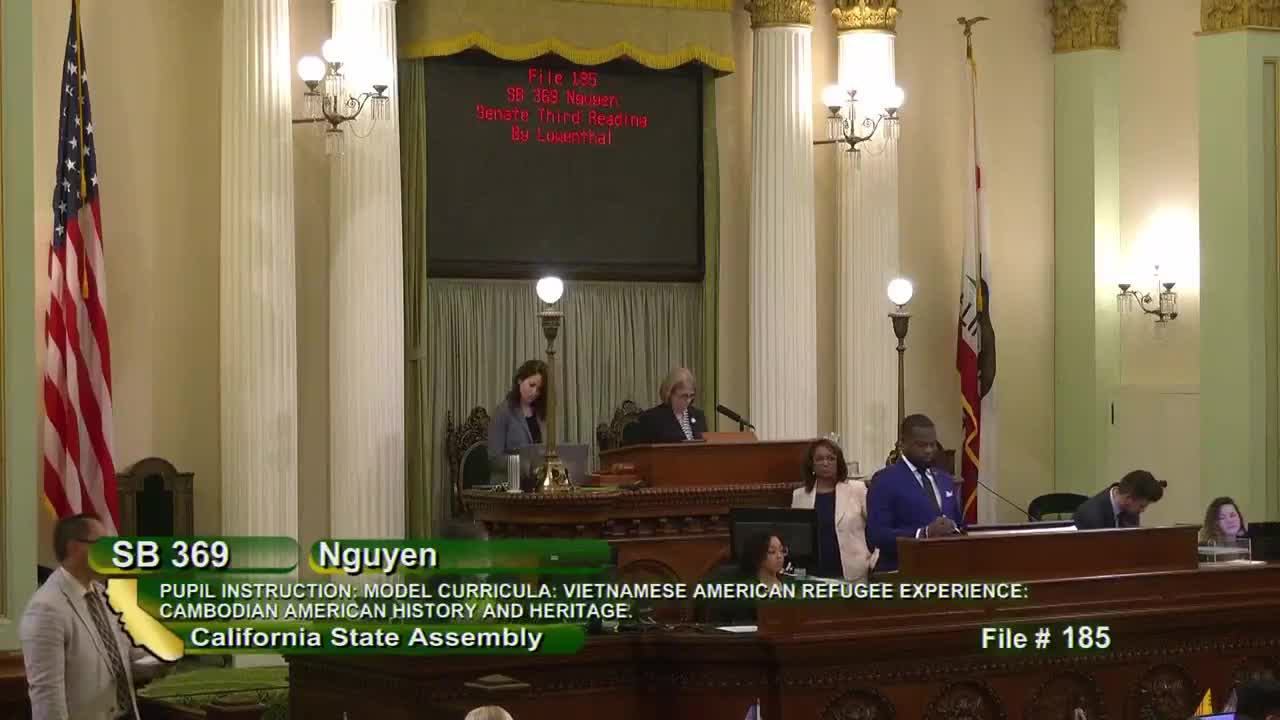


Bill Co-Author(s):