SB 414: Climate change: applications using hydrogen: assessment.
- Session Year: 2023-2024
- House: Senate
- Latest Version Date: 2023-05-18
Current Status:
Failed
(2023-09-01: September 1 hearing: Held in committee and under submission.)
Introduced
In Committee
First Chamber
In Committee
Second Chamber
Enacted
What does this bill do?
The bill requires the State Air Resources Board, with the Energy Commission and Public Utilities Commission, to assess statewide uses of zero‑carbon hydrogen (made without fossil fuel feedstocks) for transportation, shipping, aviation, appliances, industry, agriculture, and electricity. The assessment must compare hydrogen to other low‑carbon options on greenhouse‑gas reductions, costs (2024 and projected to 2045), and energy efficiency, analyze health, safety and environmental risks for production, transport, storage and use, and produce a ranked list to guide state agencies' planning and rules.
The summary is provided by generative AI which can make mistakes. For original language, please view the details in the table below.
Existing law establishes as a policy of the state to achieve net zero greenhouse gas emissions as soon as possible, but no later than 2045, and to achieve and maintain net negative greenhouse gas emissions thereafter and to ensure that, by 2045, statewide anthropogenic greenhouse gas emissions are reduced at least 85% below the statewide greenhouse gas emissions levels in 1990. Existing law requires the State Air Resources Board, by June 1, 2024, to prepare and post an evaluation on its internet website related to the use of hydrogen in the state.
This bill would, on or before December 31, 2025, require the State Air Resources Board, in consultation with the State Energy Resources Conservation and Development Commission (Energy Commission) and the Public Utilities Commission (PUC), upon appropriation by the Legislature, to complete an assessment of the use of hydrogen in certain applications, as specified. The bill would require the assessment to incorporate the findings of, and not duplicate, the above-described evaluation. The bill would require the state board, the Energy Commission, and the PUC to consider the findings in the assessment in their plans, rulemakings, reports, or other process related to the planning, implementation, or regulation of hydrogen production, distribution, storage, or usage in the state.
Existing law establishes as a policy of the state to achieve net zero greenhouse gas emissions as soon as possible, but no later than 2045, and to achieve and maintain net negative greenhouse gas emissions thereafter and to ensure that, by 2045, statewide anthropogenic greenhouse gas emissions are reduced at least 85% below the statewide greenhouse gas emissions levels in 1990.
This bill would, on or before December 31, 2025, require the State Air Resources Board, in consultation with the State Energy Resources Conservation and Development Commission (Energy Commission) and the Public Utilities Commission (PUC), upon appropriation by the Legislature, to complete an assessment of the use of hydrogen in certain applications, as specified. The bill would require the state board, the Energy Commission, and the PUC to consider the findings in the assessment in their plans, rulemakings, reports, or other process related to the planning, implementation, or regulation of hydrogen production, distribution, storage, or usage in the state.
Existing law prohibits a city, including a charter city, county, and city and county, from enacting or enforcing any ordinance or regulation that prohibits the installation of drought-tolerant landscaping, synthetic grass, or artificial turf on residential property, as specified. Existing law, the Personal Income Tax Law and the Corporation Tax Law, in conformity with federal income tax law, generally defines gross income as income from whatever source derived, except as specifically excluded. Existing law provides, among other exclusions, an exclusion from gross income for any amount received as a rebate, voucher, or other financial incentive issued by a public water system, as defined, local government, or state agency for participation in a turf replacement water conservation program.This bill would prohibit a city, including a charter city, county, city and county, or special district, from issuing a rebate, voucher, or other financial incentive for the use of synthetic grass or artificial turf that contains contaminants, including zinc, plastic, or perfluoroalkyl and polyfluoroalkyl substances (PFAS), except as specified. By establishing new requirements for local agencies, this bill would impose a state-mandated program. The bill would include findings that changes proposed by this bill address a matter of statewide concern rather than a municipal affair and, therefore, apply to all cities, including charter cities.The California Constitution requires the state to reimburse local agencies and school districts for certain costs mandated by the state. Statutory provisions establish procedures for making that reimbursement.This bill would provide that, if the Commission on State Mandates determines that the bill contains costs mandated by the state, reimbursement for those costs shall be made pursuant to the statutory provisions noted above.Existing law prohibits a city, including a charter city, county, and city and county, from enacting or enforcing any ordinance or regulation that prohibits the installation of drought-tolerant landscaping, synthetic grass, or artificial turf on residential property, as specified. Existing law, the Personal Income Tax Law and the Corporation Tax Law, in conformity with federal income tax law, generally defines gross income as income from whatever source derived, except as specifically excluded. Existing law provides, among other exclusions, an exclusion from gross income for any amount received as a rebate, voucher, or other financial incentive issued by a public water system, as defined, local government, or state agency for participation in a turf replacement water conservation program.
This bill would prohibit a city, including a charter city, county, city and county, or special district, from issuing a rebate, voucher, or other financial incentive for the use of synthetic grass or artificial turf that contains contaminants, including zinc, plastic, or perfluoroalkyl and polyfluoroalkyl substances (PFAS). (PFAS), except as specified. By establishing new requirements for local agencies, this bill would impose a state-mandated program.
The bill would include findings that changes proposed by this bill address a matter of statewide concern rather than a municipal affair and, therefore, apply to all cities, including charter cities.
The California Constitution requires the state to reimburse local agencies and school districts for certain costs mandated by the state. Statutory provisions establish procedures for making that reimbursement.
This bill would provide that, if the Commission on State Mandates determines that the bill contains costs mandated by the state, reimbursement for those costs shall be made pursuant to the statutory provisions noted above.
Existing law prohibits a city, including a charter city, county, and city and county, from enacting or enforcing any ordinance or regulation that prohibits the installation of drought-tolerant landscaping, synthetic grass, or artificial turf on residential property, as specified. Existing law, the Personal Income Tax Law and the Corporation Tax Law, in conformity with federal income tax law, generally defines gross income as income from whatever source derived, except as specifically excluded. Existing law provides, among other exclusions, an exclusion from gross income for any amount received as a rebate, voucher, or other financial incentive issued by a public water system, as defined, local government, or state agency for participation in a turf replacement water conservation program.
This bill would prohibit a city, including a charter city, county, city and county, or special district, from issuing a rebate, voucher, or other financial incentive for the use of synthetic grass or artificial turf that contains contaminants, including zinc, plastic, or perfluoroalkyl and polyfluoroalkyl substances (PFAS). By establishing new requirements for local agencies, this bill would impose a state-mandated program.
The bill would include findings that changes proposed by this bill address a matter of statewide concern rather than a municipal affair and, therefore, apply to all cities, including charter cities.
The California Constitution requires the state to reimburse local agencies and school districts for certain costs mandated by the state. Statutory provisions establish procedures for making that reimbursement.
This bill would provide that, if the Commission on State Mandates determines that the bill contains costs mandated by the state, reimbursement for those costs shall be made pursuant to the statutory provisions noted above.
(a)For purposes of this section, decarbonization means a process to reduce or eliminate associated emissions of greenhouse gases.
(b)(1)On or before December 31, 2025, to advance efforts to achieve the states goal for carbon neutrality by 2045, and upon appropriation by the Legislature for those purposes, the state board, in consultation with the State Energy Resources Conservation and Development Commission and the Public Utilities Commission, shall complete an assessment of the use of hydrogen in all of the following applications within the state:
(A)Light-, medium-, and heavy-duty vehicles, including long-distance trucks.
(B)Long-distance trains.
(C)Off-road equipment.
(D)Household and commercial appliances.
(E)Maritime shipping.
(F)Aviation.
(G)Industrial and agricultural processes, including chemical feedstocks.
(H)Electricity generation.
(2)The state board may include additional applications it determines to be relevant in the assessment.
(c)The assessment shall evaluate for each application specified in subdivision (b) as follows:
(1)The potential for other zero-carbon alternatives that are not hydrogen for the application including, but not limited to, electrification.(2)(1)The potential for reductions in emissions of greenhouse gases using hydrogen for the application. The assessment shall also evaluate the potential for reductions in emissions of greenhouse gases by using alternative decarbonization options for the application, including electrification or combinations of decarbonization methods, if applicable.
(3)An approximation of the amount of hydrogen that would be needed to replace fossil fuels in the application to realistically decarbonize the application in the state.(4)(2)A range of cost of the hydrogen needed to replace fossil fuels for the application in the state based on the cost as of January 1, 2024, and projected estimated cost by 2045. The assessment shall also evaluate the cost, as of January 1, 2024, using alternative decarbonization options for the application, including electrification or combinations of decarbonization methods, if applicable, for this application and the projected cost by 2045.
(5)(3)The energy efficiency of using hydrogen for the application. The assessment shall also evaluate the energy efficiency of using alternative decarbonization options for the application, including electrification or combinations of decarbonization methods, if applicable, for the application.
(6)(4)Health and safety, environmental, and climate risk associated with transportation and storage of hydrogen for the application, including, but not limited to, the risk of hydrogen leakage.
(7)(5)Health and safety, environmental, and climate risk associated with the use of hydrogen for the application, including, but not limited to, the emission of air and water pollutants.
(d)For applications for which hydrogen is being used or is projected to be used to partially replace fossil fuels, such as blending hydrogen with natural gas, or to be used alongside another zero-carbon alternative, such as electrification, the assessment is to additionally address all criteria in subdivision (c) for a realistic partial-hydrogen-use scenario.
(e)For the purposes of the assessment, the state board shall assume zero-carbon hydrogen production. hydrogen produced without fossil fuel feedstocks.
(f)The assessment shall incorporate the findings of, and shall not duplicate, the evaluation completed pursuant to Section 38561.8.
(g)The assessment shall establish a preferential ordering of the applications specified in subdivision (b) by considering the criteria in subdivision (c) for each application, any findings in the evaluation prepared pursuant to Section 38561.8, the available supply of hydrogen in the state, the existing use, as of January 1, 2024, of hydrogen produced using fossil fuel, the infrastructure required to store and transport hydrogen, the availability of materials and designs that minimize leakage risk and of technology to detect leaks, and any other criteria the state board, the State Energy Resources Conservation and Development Commission, or the Public Utilities Commission consider necessary, that takes the form of a ranked list prioritizing applications for a finite supply of zero-carbon hydrogen in the state in pursuit of the states carbon neutrality and zero-carbon electricity goals.
(h)The state board may contract with an educational institution, research laboratory, or related organization to conduct this assessment.
(i)In preparing the assessment, the state board may review and incorporate information required for the assessment from other studies.
(i)(j)Upon completion of the assessment, the state board shall post the assessment on its internet website.
(j)(k)The state board, the State Energy Resources Conservation and Development Commission, and the Public Utilities Commission shall consider the findings of the assessment in their plans, rulemakings, reports, or other processes related to the planning, implementation, or regulation of hydrogen production, distribution, storage, or usage in the state.
(a)For purposes of this section, decarbonization means a process to reduce or eliminate associated emissions of greenhouse gases.
(b)(1)On or before December 31, 2025, to advance efforts to achieve the states goal for carbon neutrality by 2045, and upon appropriation by the Legislature for those purposes, the state board, in consultation with the State Energy Resources Conservation and Development Commission and the Public Utilities Commission, shall complete an assessment of the use of hydrogen in all of the following applications within the state:
(A)Light-, medium-, and heavy-duty vehicles, including long-distance trucks.
(B)Long-distance trains.
(C)Off-road equipment.
(C)(D)Household and commercial appliances.
(D)(E)Maritime shipping.
(E)Aviation.(F)Aviation.
(F)(G)Industrial manufacturing. and agricultural processes, including chemical feedstocks.
(G)(H)Electricity generation.
(2)The state board may include additional applications it determines to be relevant in the assessment.
(b)(c)The assessment shall evaluate for each application specified in subdivision (a) (b) as follows:
(1)The potential for other zero-carbon alternatives that are not hydrogen for the application including, but not limited to, electrification.
(2)The potential for reductions in emissions of greenhouse gases using hydrogen for the application. The assessment shall also evaluate the potential for reductions in emissions of greenhouse gases by electrifying the application, if applicable. using alternative decarbonization options for the application, including electrification or combinations of decarbonization methods, if applicable.
(3)An approximation of the amount of hydrogen that would be needed to replace fossil fuels in the application to realistically decarbonize the application in the state.
(4)A range of cost of the hydrogen needed to replace fossil fuels for the application in the state based on the cost as of January 1, 2024, and projected estimated cost by 2045. The assessment shall also evaluate the cost, as of January 1, 2024, to electrify using alternative decarbonization options for the application, including electrification or combinations of decarbonization methods, if applicable, for this application and the projected cost by 2045, if applicable. 2045.
(5)The energy efficiency of using hydrogen for the application. The assessment shall also evaluate the energy efficiency of electrifying the application, if applicable. using alternative decarbonization options for the application, including electrification or combinations of decarbonization methods, if applicable, for the application.
(6)Infrastructure needed for hydrogen transportation and storage necessary to replace fossil fuels for the application, including cost, availability of materials and designs that minimize leakage risk, availability of leak detection technology, and expected timeline of construction.(7)(6)Health and safety, environmental, and climate risk associated with transportation and storage of hydrogen for the application, including, but not limited to, the risk of hydrogen leakage.
(8)(7)Health and safety, environmental, and climate risk associated with the use of hydrogen for the application, including, but not limited to, the emission of air and water pollutants.
(c)(d)For applications for which hydrogen is being used or is projected to be used to partially replace fossil fuels, such as blending hydrogen with natural gas, or to be used alongside another zero-carbon alternative, such as electrification, the assessment is to additionally address all criteria in subdivision (b) (c) for a realistic partial-hydrogen-use scenario.
(d)(e)For the purposes of the assessment, the state board shall assume zero-carbon hydrogen production.
(f)The assessment shall incorporate the findings of, and shall not duplicate, the evaluation completed pursuant to Section 38561.8.
(e)(g)The assessment shall establish a preferential ordering of the applications specified in subdivision (a) (b) by considering the criteria in subdivision (b) (c) for each application, any findings in the evaluation prepared pursuant to Section 38561.8, the available supply of hydrogen in the state, the existing use, as of January 1, 2024, of hydrogen produced using fossil fuel, the infrastructure required to store and transport hydrogen, the availability of materials and designs that minimize leakage risk and of technology to detect leaks, and any other criteria the state board, the State Energy Resources Conservation and Development Commission, or the Public Utilities Commission consider necessary, that takes the form of a ranked list prioritizing applications for a finite supply of zero-carbon hydrogen in the state in pursuit of the states carbon neutrality and zero-carbon electricity goals.
(f)(h)The state board may contract with an educational institution, research laboratory, or related organization to conduct this assessment.
(g)(i)Upon completion of the assessment, the state board shall post the assessment on its internet website.
(h)(j)The state board, the State Energy Resources Conservation and Development Commission, and the Public Utilities Commission shall consider the findings of the assessment in their plans, rulemakings, reports, or other processes related to the planning, implementation, or regulation of hydrogen production, distribution, storage, or usage in the state.
(a)(1)On or before December 31, 2025, to advance efforts to achieve the states goal for carbon neutrality by 2045, and upon appropriation by the Legislature for those purposes, the state board, in consultation with the State Energy Resources Conservation and Development Commission and the Public Utilities Commission, shall complete an assessment of the use of hydrogen in all of the following applications within the state:
(A)Light-, medium-, and heavy-duty vehicles, including long-distance trucks.
(B)Long-distance trains.
(C)Household and commercial appliances.
(D)Maritime shipping.
(E)Aviation.
(F)Industrial manufacturing.
(G)Electricity generation.
(2)The state board may include additional applications it determines to be relevant in the assessment.
(b)The assessment shall evaluate for each application specified in subdivision (a) as follows:
(1)The potential for other zero-carbon alternatives that are not hydrogen for the application including, but not limited to, electrification.
(2)The potential for reductions in emissions of greenhouse gases using hydrogen for the application. The assessment shall also evaluate the potential for reductions in emissions of greenhouse gases by electrifying the application, if applicable.
(3)An approximation of the amount of hydrogen that would be needed to replace fossil fuels in the application to realistically decarbonize the application in the state.
(4)A range of cost of the hydrogen needed to replace fossil fuels for the application in the state based on the cost as of January 1, 2024, and projected estimated cost by 2045. The assessment shall also evaluate the cost, as of January 1, 2024, to electrify this application and the projected cost by 2045, if applicable.
(5)The energy efficiency of using hydrogen for the application. The assessment shall also evaluate the energy efficiency of electrifying the application, if applicable.
(6)Infrastructure needed for hydrogen transportation and storage necessary to replace fossil fuels for the application, including cost, availability of materials and designs that minimize leakage risk, availability of leak detection technology, and expected timeline of construction.
(7)Health and safety, environmental, and climate risk associated with transportation and storage of hydrogen for the application, including, but not limited to, the risk of hydrogen leakage.
(8)Health and safety, environmental, and climate risk associated with the use of hydrogen for the application, including, but not limited to, the emission of air and water pollutants.
(c)For applications for which hydrogen is being used or is projected to be used to partially replace fossil fuels, such as blending hydrogen with natural gas, or to be used alongside another zero-carbon alternative, such as electrification, the assessment is to additionally address all criteria in subdivision (b) for a realistic partial-hydrogen-use scenario.
(d)For the purposes of the assessment, the state board shall assume zero-carbon hydrogen production.
(e)The assessment shall establish a preferential ordering of the applications specified in subdivision (a) by considering the criteria in subdivision (b) for each application, the available supply of hydrogen in the state, and any other criteria the state board, the State Energy Resources Conservation and Development Commission, or the Public Utilities Commission consider necessary, that takes the form of a ranked list prioritizing applications for a finite supply of zero-carbon hydrogen in the state in pursuit of the states carbon neutrality and zero-carbon electricity goals.
(f)The state board may contract with an educational institution, research laboratory, or related organization to conduct this assessment.
(g)Upon completion of the assessment, the state board shall post the assessment on its internet website.
(h)The state board, the State Energy Resources Conservation and Development Commission, and the Public Utilities Commission shall consider the findings of the assessment in their plans, rulemakings, reports, or other processes related to the planning, implementation, or regulation of hydrogen production, distribution, storage, or usage in the state.
SECTION 1.Section 53087.7 of the Government Code is amended to read:53087.7.(a)A city, including a charter city, county, or city and county, shall not enact any ordinance or regulation, or enforce any existing ordinance or regulation, that prohibits the installation of drought-tolerant landscaping, synthetic grass, or artificial turf on residential property.(b)A city, including a charter city, county, or city and county, may impose reasonable restrictions on the type of drought-tolerant landscaping, synthetic grass, or artificial turf that may be installed on residential property provided that those restrictions do not do any of the following:(1)Substantially increase the cost of installing drought-tolerant landscaping, synthetic grass, or artificial turf.(2)Effectively prohibit the installation of drought-tolerant landscaping, synthetic grass, or artificial turf.(3)Significantly impede the installation of drought-tolerant landscaping, including, but not limited to, a requirement that a residential yard must be completely covered with living plant material.(c)A city, including a charter city, county, or city and county, may impose reasonable restrictions on the installation or design of synthetic grass or artificial turf within the dripline of a tree protected by local ordinance.(d)(1)Notwithstanding any other law, a city, including a charter city, county, city and county, or special district, shall not issue a rebate, voucher, or other financial incentive for the use of synthetic grass or artificial turf that contains contaminants, including zinc, plastic, or perfluoroalkyl and polyfluoroalkyl substances (PFAS).(2)This subdivision shall not apply to a rebate, voucher, or other financial incentive paid entirely with or by charter city, county, or city and county, or special district, funds.SEC. 2.The Legislature finds and declares that maintenance of a quality environment for the people of this state now and in the future is a matter of statewide concern. The Legislature further finds and declares that certain synthetic grass and artificial turf contain components harmful to the environment. Therefore, incentivizing property owners in this state to install synthetic grass or artificial turf with these specified components on their residential properties is a matter of statewide concern and is not a municipal affair as that term is used in Section 5 of Article XI of the California Constitution. Therefore, Section 1 of this act amending Section 53087.7 of the Government Code applies to all cities, including charter cities.SEC. 3.If the Commission on State Mandates determines that this act contains costs mandated by the state, reimbursement to local agencies and school districts for those costs shall be made pursuant to Part 7 (commencing with Section 17500) of Division 4 of Title 2 of the Government Code.(a)A city, including a charter city, county, or city and county, shall not enact any ordinance or regulation, or enforce any existing ordinance or regulation, that prohibits the installation of drought-tolerant landscaping, synthetic grass, or artificial turf on residential property.
(b)A city, including a charter city, county, or city and county, may impose reasonable restrictions on the type of drought-tolerant landscaping, synthetic grass, or artificial turf that may be installed on residential property provided that those restrictions do not do any of the following:
(1)Substantially increase the cost of installing drought-tolerant landscaping, synthetic grass, or artificial turf.
(2)Effectively prohibit the installation of drought-tolerant landscaping, synthetic grass, or artificial turf.
(3)Significantly impede the installation of drought-tolerant landscaping, including, but not limited to, a requirement that a residential yard must be completely covered with living plant material.
(c)A city, including a charter city, county, or city and county, may impose reasonable restrictions on the installation or design of synthetic grass or artificial turf within the dripline of a tree protected by local ordinance.
(d)(1)Notwithstanding any other law, a city, including a charter city, county, city and county, or special district, shall not issue a rebate, voucher, or other financial incentive for the use of synthetic grass or artificial turf that contains contaminants, including zinc, plastic, or perfluoroalkyl and polyfluoroalkyl substances (PFAS).
(2)This subdivision shall not apply to a rebate, voucher, or other financial incentive paid entirely with or by charter city, county, or city and county, or special district, funds.
SEC. 2.The Legislature finds and declares that maintenance of a quality environment for the people of this state now and in the future is a matter of statewide concern. The Legislature further finds and declares that certain synthetic grass and artificial turf contain components harmful to the environment. Therefore, incentivizing property owners in this state to install synthetic grass or artificial turf with these specified components on their residential properties is a matter of statewide concern and is not a municipal affair as that term is used in Section 5 of Article XI of the California Constitution. Therefore, Section 1 of this act amending Section 53087.7 of the Government Code applies to all cities, including charter cities.
SEC. 3.If the Commission on State Mandates determines that this act contains costs mandated by the state, reimbursement to local agencies and school districts for those costs shall be made pursuant to Part 7 (commencing with Section 17500) of Division 4 of Title 2 of the Government Code.
(a)A city, including a charter city, county, or city and county, shall not enact any ordinance or regulation, or enforce any existing ordinance or regulation, that prohibits the installation of drought tolerant drought-tolerant landscaping, synthetic grass, or artificial turf on residential property.
(b)A city, including a charter city, county, or city and county, may impose reasonable restrictions on the type of drought tolerant drought-tolerant landscaping, synthetic grass, or artificial turf that may be installed on residential property provided that those restrictions do not do any of the following:
(1)Substantially increase the cost of installing drought tolerant drought-tolerant landscaping, synthetic grass, or artificial turf.
(2)Effectively prohibit the installation of drought tolerant drought-tolerant landscaping, synthetic grass, or artificial turf.
(3)Significantly impede the installation of drought tolerant drought-tolerant landscaping, including, but not limited to, a requirement that a residential yard must be completely covered with living plant material.
(c)A city, including a charter city, county, or city and county, may impose reasonable restrictions on the installation or design of synthetic grass or artificial turf within the dripline of a tree protected by local ordinance.
(d)Notwithstanding any other law, a city, including a charter city, county, city and county, or special district, shall not issue a rebate, voucher, or other financial incentive for the use of synthetic grass or artificial turf that contains contaminants, including zinc, plastic, or perfluoroalkyl and polyfluoroalkyl substances (PFAS).
SEC. 2.The Legislature finds and declares that maintenance of a quality environment for the people of this state now and in the future is a matter of statewide concern. The Legislature further finds and declares that certain synthetic grass and artificial turf contain components harmful to the environment. Therefore, incentivizing property owners in this state to install synthetic grass or artificial turf with these specified components on their residential properties is a matter of statewide concern and is not a municipal affair as that term is used in Section 5 of Article XI of the California Constitution. Therefore, Section 1 of this act amending Section 53087.7 of the Government Code applies to all cities, including charter cities.
SEC. 3.If the Commission on State Mandates determines that this act contains costs mandated by the state, reimbursement to local agencies and school districts for those costs shall be made pursuant to Part 7 (commencing with Section 17500) of Division 4 of Title 2 of the Government Code.
|
Date
|
Status
|
|---|---|
| Sep 1, 2023 | September 1 hearing: Held in committee and under submission. |
| Aug 16, 2023 | August 16 set for first hearing. Placed on suspense file. |
| Jun 20, 2023 | From committee: Do pass and re-refer to Com. on APPR. (Ayes 11. Noes 0.) (June 19). Re-referred to Com. on APPR. |
| Jun 1, 2023 | Referred to Com. on NAT. RES. |
| May 25, 2023 | In Assembly. Read first time. Held at Desk. |
| May 24, 2023 | Read third time. Passed. (Ayes 40. Noes 0. Page 1266.) Ordered to the Assembly. |
| May 22, 2023 | Read second time. Ordered to third reading. |
| May 18, 2023 | Read second time and amended. Ordered to second reading. |
| May 18, 2023 | From committee: Do pass as amended. (Ayes 7. Noes 0. Page 1169.) (May 18). |
| May 16, 2023 | Set for hearing May 18. |
| May 15, 2023 | May 15 hearing: Placed on APPR suspense file. |
| May 5, 2023 | Set for hearing May 15. |
| Apr 27, 2023 | Read second time and amended. Re-referred to Com. on APPR. |
| Apr 26, 2023 | From committee: Do pass as amended and re-refer to Com. on APPR. (Ayes 6. Noes 0. Page 936.) (April 26). |
| Apr 14, 2023 | Set for hearing April 26. |
| Apr 12, 2023 | From committee with author's amendments. Read second time and amended. Re-referred to Com. on E.Q. |
| Mar 30, 2023 | Read second time and amended. Re-referred to Com. on E.Q. |
| Mar 29, 2023 | From committee: Do pass as amended and re-refer to Com. on E.Q. (Ayes 7. Noes 0. Page 573.) (March 29). |
| Mar 14, 2023 | Set for hearing March 29. |
| Feb 22, 2023 | Referred to Coms. on GOV. & F. and E.Q. |
| Feb 10, 2023 | From printer. May be acted upon on or after March 12. |
| Feb 9, 2023 | Introduced. Read first time. To Com. on RLS. for assignment. To print. |
|
Date
|
Description
|
Location
|
Votes
|
|
|---|---|---|---|---|
| Jun 19, 2023 | Do pass and be re-referred to the Committee on [Appropriations] | Assembly Standing Committee on Natural Resources |
Passed |
|
| May 24, 2023 | Senate 3rd Reading SB414 Allen | Senate Floor |
Passed |
|
| May 18, 2023 | Do pass as amended | Senate Standing Committee on Appropriations |
Passed |
|
| May 15, 2023 | Placed on suspense file | Senate Standing Committee on Appropriations |
Passed |
|
| Apr 26, 2023 | Do pass as amended, but first amend, and re-refer to the Committee on [Appropriations] | Senate Standing Committee on Environmental Quality |
Passed |
|
| Mar 29, 2023 | Do pass as amended, but first amend, and re-refer to the Committee on [Environmental Quality] | Senate Standing Committee on Governance and Finance |
Passed |
This list shows positions taken on this bill by organizations on the date displayed, which is linked to the original source.
Positions by individuals are not included.
|
Organization
|
Position
|
Date
|
|---|---|---|
| 350 Bay Area Action | ** Support | |
| Angelenos for Green Schools | ** Support | |
| Association Of California Water Agencies | * Support | Mar 29, 2023 |
| Ban SUP | ** Support | |
| Bay Area Youth Lobbying Initiative | ** Support | |
| California Hydrogen Business Council | * For If Amend | Apr 26, 2023 |
| California Hydrogen Coalition | * For If Amend | Apr 26, 2023 |
| California Municipal Utilities Association | * Support | Mar 29, 2023 |
| City Of Millbrae | * Support | Apr 26, 2023 |
| Clean Healthy Air, Clean Healthy Altadena | ** Support | |
| Climate Action California | * Support | Jun 19, 2023 |
| Coalition For Renewable Natural Gas | ** Against | |
| Community 2.0 | ** Support | |
| Green Hydrogen Coalition | * For If Amend | Apr 26, 2023 |
| Indivisible Alta Pasadena | ** Support | |
| Indivisible California Green Team | ** Support | |
| Natural Gas Coalition | * For If Amend | Apr 26, 2023 |
| Nielsen Merksamer | * Support | Apr 26, 2023 |
| Sierra Club California | ** Support | |
| Stop Waste | * Support | Mar 29, 2023 |
| Sustainable Rossmoor | ** Support | |
| Upper San Gabriel Valley Municipal Water District | ** Support | |
| Urban Ecology Project | ** Support |
Date of Hearing: August 16, 2023
ASSEMBLY COMMITTEE ON APPROPRIATIONS
Chris Holden, Chair
SBPCA Bill Id:SB 414
Author:(Allen) – As Amended Ver:May 18, 2023
Policy Committee: | Natural Resources | Vote: | 11 - 0 |
|
| ||
|
|
Urgency: No State Mandated Local Program: No Reimbursable: No
SUMMARY:
This bill requires the Air Resources Board (ARB), upon appropriation, to complete an assessment of the use of hydrogen in specified applications.
Specifically, this bill, among other things:
- Requires ARB, on or before December 31, 2025, upon appropriation by the Legislature, in consultation with the California Energy Commission (CEC) and the California Public Utilities Commission (CPUC), to complete and post on its website an assessment of the use of hydrogen in certain applications within the state. Requires ARB, for purposes of the assessment, to assume hydrogen produced without fossil fuel feedstocks.
- Requires the assessment, for applications for which hydrogen is being used or is projected to be used to partially replace fossil fuels, to additionally address all specified criteria for a realistic partial-hydrogen-use scenario.
- Requires the assessment to incorporate the findings of, and not duplicate, a hydrogen assessment required by SB 1075 (Skinner), Chapter 363, Statutes of 2022.
- Requires the assessment to establish a ranked list prioritizing applications for a finite supply of zero-carbon hydrogen.
- Authorizes ARB to contract with an educational institution, research laboratory, or related organization to conduct the assessment.
- Requires ARB, CEC and CPUC to consider the findings of the assessment in their plans, rulemakings, reports, or other processes related to the planning, implementation, or regulation of hydrogen production, distribution, storage, or usage in the state.
FISCAL EFFECT:
1) ARB estimates ongoing annual costs of approximately $1.9 million for four positions and contract funds (Cost of Implementation Account) to complete the required assessment. See the staff comments below.
2) CEC estimates one-time costs of approximately $500,000 for staff work and to hire a technical support contractor with expertise in hydrogen to coordinate with ARB and assist with analysis and reporting (Energy Resources Programs Account (ERPA)).
3) Minor and absorbable costs to CPUC.
As part of the fiscal year 2023-24 budget, ARB requested and received $3.1 million and four permanent positions, including $2.3 million in one-time contract funds, to develop the evaluation and provide policy recommendations on the use of hydrogen, as required by SB 1075. Given that there is almost certainly significant overlap between the SB 1075 evaluation, the Scoping Plan, and the assessment required by this bill (see comments below), and in light of recently approved ongoing funding, this committee questions ARB’s cost estimate for this bill.
On the other hand, CEC did not request or receive any additional resources for its role in implementing SB 1075; its estimate of the one-time resources necessary to consult with ARB on the assessment required by this bill appears reasonable.
COMMENTS:
1) Purpose. According to the author:
Hydrogen is one tool we can use to decarbonize our economy. In order to effectively choose the right tool for the right job, the state needs easily accessible data that can inform that decision, including the potential for reducing emissions, the cost, and the energy efficiency. SB 414 aims to make such information readily available for hydrogen and enable comparison to alternative zero-carbon options such as electrification. We also need a robust assessment of health and safety, environmental, and climate risks associated with hydrogen as we anticipate scaling up its use. SB 414 aims to complement other assessments requested by the Legislature to answer some of these questions and develop a prioritization of where hydrogen implementation can be most effective for the state to meet its carbon neutrality and zero-carbon energy goals.
2) Background.
Hydrogen. The environmental impacts of hydrogen, including effects on climate and air quality, can range from very favorable to very unfavorable, depending on production, delivery, end use, and the fuel the hydrogen is replacing. For example, hydrogen produced with fossil fuels and used in a combustion application that replaces a renewable energy source is not a good environmental solution. However, hydrogen produced with zero-carbon energy and used in a zero-emission application that replaces diesel combustion has clear climate and air quality benefits.
The source of the hydrogen and the source of the energy used to split hydrogen plays a significant role in determining the lifecycle emissions associated with hydrogen use. Today, there are several means of hydrogen production and it is likely these will evolve as technology advances. No matter how “green” it is, where hydrogen is used matters. There have been recent evaluations seeking to identify the “least-regrets” end-uses of hydrogen, especially given the costliness of initial hydrogen production and the varied emissions benefits of hydrogen usage in different sectors. For a more detailed discussion of the different types of hydrogen, please see the Assembly Natural Resources Committee analysis of this bill.
Parallel Assessment. Following the passage of SB 1075, ARB, CPUC, and CEC are evaluating the possible deployment, development, and uses of hydrogen in the state. The agencies must publicly post the evaluation by June 1, 2024. SB 1075 also requires CEC to study and model potential growth for hydrogen and its role in decarbonizing the electrical and transportation sectors of the economy as part of the 2023 and 2025 editions of its Integrated Energy Policy Report. ARB’s recently completed 2022 Scoping Plan similarly includes a fairly robust discussion of hydrogen.
ERPA. CEC’s main funding source, the ERPA, is in a structural deficit and has overspent revenues by more than $17.4 million since 2014-15. The ERPA was established to provide funds for ongoing energy programs and projects, including the operations of the CEC, and is supported by a statutory surcharge on electricity consumption. The CEC increased the surcharge to its statutory maximum – from $0.00029 to $0.0003 per kilowatt-hour – effective January 1, 2019. The surcharge generated approximately $67.5 million in 2017-18 and costs the average household roughly $2.01 annually. According to CEC, the structural deficit results from the commission’s growing role in implementing aggressive climate policies that reduce electricity consumption, thereby reducing ERPA revenues. The CEC notes that even as revenues drop, ERPA is repeatedly tapped to support new programs and must cover increases in employee compensation and benefit contributions. Given the ongoing structural deficit in the account, CEC notes the ERPA may not be an appropriate fund source to support implementation of this bill.
Analysis Prepared by: Nikita Koraddi / APPR. / (916) 319-2081
Date of Hearing: June 19, 2023
ASSEMBLY COMMITTEE ON NATURAL RESOURCES
Luz Rivas, Chair
SBPCA Bill Id:SB 414
Author:(Allen) – As Amended Ver:May 18, 2023
SENATE VOTE: 40-0
SUBJECT: Climate change: applications using hydrogen: assessment
SUMMARY: Requires the Air Resources Board (ARB), upon appropriation, to complete an assessment of the use of hydrogen in specified applications.
EXISTING LAW:
- Requires ARB to ensure that statewide greenhouse gas (GHG) emissions are reduced to at least 40% below the 1990 level by 2030. (Health and Safety Code (HSC) 38500 et seq.)
- Declares the policy of the state to achieve net zero GHG emissions as soon as possible, but no later than 2045, and to achieve and maintain net negative GHG emissions thereafter. (HSC 38562.2)
- Requires ARB, by June 1, 2024, to prepare a hydrogen evaluation, including:
- Policy recommendations to accelerate production and use of hydrogen, and specifically green hydrogen, to help achieve climate, clean energy, and clean air objectives;
- Strategies supporting hydrogen infrastructure and end uses in difficult to decarbonize sectors;
- Potential for other forms of hydrogen, outside of green hydrogen, to achieve emissions reductions;
- An analysis of how curtailed electrical generation could be used to meet climate goals, including for the production of green hydrogen; and,
- An estimate of emissions reductions the state could achieve through deployment of green hydrogen.
(HSC 38561.8)
THIS BILL:
- Requires ARB, on or before December 31, 2025, to advance efforts to achieve the state’s goal for carbon neutrality by 2045, and upon appropriation by the Legislature, in consultation with the California Energy Commission (CEC) and the Public Utilities Commission (PUC), to complete an assessment of the use of hydrogen in all of the following applications within the state:
- Light-, medium-, and heavy-duty vehicles, including long-distance trucks;
- Long-distance trains;
- Off-road equipment;
- Household and commercial appliances;
- Maritime shipping;
- Aviation;
- Industrial and agricultural processes, including chemical feedstocks;
- Electricity generation; and,
- Any additional applications ARB determines to be relevant in the assessment.
- Requires the assessment to evaluate, for each specified application, the following:
- The potential for reductions in GHG emissions using hydrogen for the application, as well as alternative decarbonization options for the application, including electrification or combinations of decarbonization methods, if applicable;
- A range of cost of the hydrogen needed to replace fossil fuels for the application in the state based on the cost as of January 1, 2024, and projected estimated cost by 2045;
- The energy efficiency of using hydrogen for the application. The assessment shall also evaluate the energy efficiency of using alternative decarbonization options for the application, including electrification or combinations of decarbonization methods, if applicable, for the application;
- Health and safety, environmental, and climate risk associated with transportation and storage of hydrogen for the application, including, but not limited to, the risk of hydrogen leakage; and
- Health and safety, environmental, and climate risk associated with the use of hydrogen for the application, including, but not limited to, the emission of air and water pollutants.
- Requires ARB, for purposes of the assessment, to assume hydrogen produced without fossil fuel feedstocks.
- Requires the assessment to establish a ranked list prioritizing applications for a finite supply of zero-carbon hydrogen.
- Authorizes ARB to contract with an educational institution, research laboratory, or related organization to conduct the assessment.
- Requires the ARB, CEC and PUC to consider the findings of the assessment in their plans, rulemakings, reports, or other processes related to the planning, implementation, or regulation of hydrogen production, distribution, storage, or usage in the state.
FISCAL EFFECT: According to the Senate Appropriations Committee:
- Unknown ongoing costs, likely in the millions of dollars annually (Cost of Implementation Account [COIA]), for ARB to coordinate internally, with other entities, and with stakeholders; conduct evaluations, produce a report, and continue to ensure the findings in the assessment are considered in any plans, rulemakings, reports, or other processes related to the planning, implementation, or regulation of hydrogen production, distribution, storage, or usage in the state, among other things.
- The PUC and CEC anticipate that any costs would be minor and absorbable.
COMMENTS:
- Background. The environmental impacts of hydrogen, including effects on climate and air quality, can range from very favorable to very unfavorable, depending on production, delivery, end use, and the fuel the hydrogen is replacing. For example, hydrogen produced with fossil fuels and used in a combustion application that replaces a renewable energy source is not a good environmental solution. However, hydrogen produced with zero-carbon energy and used in a zero-emission application that replaces diesel combustion has clear climate and air quality benefits.
The source of the hydrogen and the source of the energy used to split hydrogen plays a significant role in determining the lifecycle emissions associated with hydrogen use. Today, there are several means of hydrogen production and it is likely that these will evolve as technology advances.
Green hydrogen can result in almost no GHG emissions. Produced by electrolyzing water, green hydrogen is made using 100% renewable electricity to split hydrogen from water molecules. Less than 0.1% of hydrogen production globally comes from water electrolysis.
Ninety six percent of the hydrogen today is considered to be gray hydrogen. Gray hydrogen is produced by heating natural gas, or methane, with steam to form syngas (a mixture of hydrogen and carbon monoxide and carbon dioxide). The syngas is separated to produce hydrogen. This process results in a relatively high release of GHGs.
Blue hydrogen attempts to mitigate some of the GHG emission release during the production of gray hydrogen by pairing production with carbon capture and storage. However, not all carbon dioxide emissions can be captured, and some carbon dioxide is emitted during the production of blue hydrogen. Carbon capture increases the cost and inefficiency of the production of blue hydrogen.
Currently hydrogen branded “renewable” is produced mainly by steam methane reformation of biomethane from North American landfills. SB 1505 (Lowenthal), Chapter 877, Statutes of 2006, requires 33% of the hydrogen produced for fueling stations that receive state funds be made from eligible renewable energy resources, including biomass, digester gas, landfill gas, solar, and wind. However, compliance is achieved largely on paper, through the use of credits from out of state renewable energy sources, rather than direct production and use of renewable hydrogen in California.
No matter how green it is, where hydrogen is used matters. There have been recent evaluations seeking to identify the “least-regrets” end-uses of hydrogen, especially given the costliness of initial hydrogen production and the varied emissions benefits of hydrogen usage in different sectors. For instance, Earthjustice, an environmental law organization, released a report in 2021 identifying promising applications for green hydrogen and ranking hydrogen use by least-regrets uses, sectors to explore with caution, and sectors where hydrogen is not a solution. The report categorizes the least-regrets use for hydrogen as displacing fossil hydrogen in current industrial feedstocks. The usage of hydrogen in maritime shipping, aviation, and long-haul trucks and trains were categorized as “sectors to explore with caution.” While Earthjustice categorized hydrogen usage in combustion in fossil gas power plants, gas-burning appliances in homes and commercial buildings, and cars, buses, and regional trucks as sectors where hydrogen is not a solution.
Following the passage of SB 1075 (Skinner), Chapter 363, Statutes of 2022, ARB, the PUC, and the CEC are evaluating the possible deployment, development, and uses of hydrogen in the state. The evaluation is mandated to be publicly posted by June 1, 2024. SB 1075 also requires the CEC to study and model potential growth for hydrogen and its role in decarbonizing the electrical and transportation sectors of the economy as part of the 2023 and 2025 editions of its Integrated Energy Policy Report. Ideally this joint agency work will aide understanding of the appropriate end-uses of hydrogen within the state.
- Author’s statement:
Cutting the state’s GHG emissions at the pace scientists have determined to be necessary requires all hands on deck and a rapid shift to a decarbonized economy. While we work hard to dramatically expand our clean energy infrastructure, the state should strategically evaluate and implement the strategies available to achieve our climate goals as rapidly as possible. Hydrogen is one tool we can use to decarbonize our economy. In order to effectively choose the right tool for the right job, the state needs easily accessible data that can inform that decision, including the potential for reducing emissions, the cost, and the energy efficiency. SB 414 aims to make such information readily available for hydrogen and enable comparison to alternative zero-carbon options such as electrification. We also need a robust assessment of health and safety, environmental, and climate risks associated with hydrogen as we anticipate scaling up its use. SB 414 aims to complement other assessments requested by the Legislature to answer some of these questions and develop a prioritization of where hydrogen implementation can be most effective for the state to meet its carbon neutrality and zero-carbon energy goals.
REGISTERED SUPPORT / OPPOSITION:
Support
Sustainable Rossmoor
Opposition
None on file
Analysis Prepared by: Lawrence Lingbloom / NAT. RES. /
SENATE RULES COMMITTEE Office of Senate Floor Analyses (916) 651-1520 Fax: (916) 327-4478 | SB 414 |
THIRD READING
Bill No: SB 414
Author: Allen (D)
Amended: 5/18/23
Vote: 21
SENATE GOVERNANCE & FIN. COMMITTEE: 7-0, 3/29/23
AYES: Caballero, Blakespear, Dahle, Durazo, Glazer, Skinner, Wiener
NO VOTE RECORDED: Seyarto
SENATE ENVIRONMENTAL QUALITY COMMITTEE: 6-0, 4/26/23
AYES: Allen, Dahle, Gonzalez, Hurtado, Menjivar, Skinner
NO VOTE RECORDED: Jones
SENATE APPROPRIATIONS COMMITTEE: 7-0, 5/18/23
AYES: Portantino, Jones, Ashby, Bradford, Seyarto, Wahab, Wiener
SUBJECT: Climate change: applications using hydrogen: assessment
SOURCE: Author
DIGEST:
This bill requires the California Air Resources Board (CARB), in consultation with the California Energy Commission (CEC) and California Public Utilities Commission (CPUC), to develop an assessment of specified hydrogen applications evaluating specified criteria. It directs the assessment to include a ranked prioritization of hydrogen applications.
ANALYSIS:
Existing law:
Under the Global Warming Solutions Act of 2006 and updates thereof (Health and Safety Code (HSC) § 38500 et seq.)
- Requires CARB to ensure that statewide greenhouse gas (GHG) emissions are reduced to at least 40% below the 1990 level by 2030.
- States, under the California Climate Crisis Act, it is the policy of the state to achieve net zero GHG emissions no later than 2045, and to ensure that by 2045 statewide anthropogenic GHG emissions are reduced to at least 85% below the 1990 level. (HSC § 38562.2)
This bill:
- Directs CARB, in consultation with the CEC and CPUC, to complete an assessment by December 31, 2025 to:
- Consider specific hydrogen applications in the transportation, appliances, and electricity generation sectors.
- Evaluate for each of the above applications the following criteria:
- Potential for GHG emission reduction using hydrogen
- Cost of using hydrogen
- Energy efficiency of using hydrogen
- Health and safety, environmental, and climate risks of using hydrogen
- Compare hydrogen use for the application to using alternatives, including electrification and combinations of alternatives, if applicable, for criteria (i), (ii), and (iii).
- Establish a preferential ordering of the hydrogen applications based on the specified criteria.
- Directs CARB, CEC, and CPUC to consider these findings in their plans, rulemakings, reports, or other processes related to the planning, implementation, or regulation of hydrogen production, distribution, storage, and/or usage in the state.
Background
- The many (potential) uses of hydrogen. Hydrogen has many potential applications including oil refining; industrial and chemical processes, including fertilizer and steel production; electricity generation; fuel for on-road, off-road, rail, aviation, and maritime transportation; and household and commercial applications such as heating. In practice today, almost all of the hydrogen produced in the United States is used for industrial purposes such as refining petroleum, treating metals, and producing fertilizer. Using hydrogen instead of fossil fuels has the potential to decarbonize these sectors, assuming the lifetime hydrogen pathway through production, transportation, and end use does not emit GHGs.
- What is the right tool for the job? Different zero-carbon energy options may be more efficient for different applications, and prioritizing the right tool for the right job could help the state reach its decarbonization goals more quickly. Deciding which tool or combination of tools might be most appropriate would be best informed considering a variety of context-specific criteria, such as cost, efficiency, reliability, and risks.
Using electricity directly instead of hydrogen to power a process can be more energy efficient, especially if the hydrogen was produced using electricity in the first place. The more conversions an energy source goes through from its initial generation to its end application, the more energy is lost along the way. Electrons to move a hydrogen fuel cell vehicle have more steps on their journey from generation to end use, and therefore more of them are lost, than those electrons going from generation to moving a battery electric vehicle. As a result, recent analyses found a hydrogen fuel cell car requires on average 3-4 times and up to 9 times more energy than a battery electric car. While battery electric may be the more efficient option for the average light- or medium duty vehicle, there are significant challenges to recharging batteries for long-distance transportation by air, ocean, rail, or road. A liquid fuel will likely be the most feasible strategy in those sectors for the foreseeable future. Hydrogen could be a promising decarbonization strategy in those cases. Hydrogen may also play an important role in decarbonizing high-temperature industrial processes, such as steel production, where electrification may not be feasible due to the extreme high heat needed.
Hydrogen can be used to generate power, making it a plausible method of medium- to long-term energy storage. Power can be generated from fuel cells or burning hydrogen.
Some natural gas power plants have experimented with blending hydrogen into natural gas. Blending hydrogen into natural gas (which is mainly methane) can lower GHG emissions by a modest amount: a 20% blend of hydrogen will only reduce the emissions by 6 to 7%. Any blending still does not decarbonize energy generation if fossil fuel gas is used. There are no commercially available power plant turbines yet that can burn pure hydrogen and there are significant technical challenges to retrofitting gas plants to run on hydrogen.
- Hydrogen itself may pose climate risks. Hydrogen gas acts as an indirect GHG through its reactions with other gases in the atmosphere. Hydrogen causes methane, a GHG 28 times more planet-warming than carbon dioxide when considered over the timescale of a century, to persist in the atmosphere longer. Hydrogen also increases the concentration of ozone and of water vapor, both of which cause the atmosphere to trap more heat. As the state builds up its hydrogen infrastructure, it is important to minimize and monitor that infrastructure for leaks that could release hydrogen into the atmosphere, contributing to warming and wasting a valuable product.
Leaks are of particular concern from hydrogen storage facilities and transportation pipelines. A 2022 study from the University of California, Riverside, commissioned by the CPUC as part of its Renewable Gas Rulemaking, stressed that transporting hydrogen through existing natural gas pipelines risks leakage. Hydrogen is the world’s smallest molecule and does not act like the gases such pipelines were designed to carry, so it can leak out and degrade pipelines. While hydrogen is not explicitly barred from using existing pipelines, the CPUC’s Standard Renewable Gas Interconnection Tariff currently limits the amount of pure hydrogen gas concentration injected into the intrastate pipeline to 0.1%.
- Hydrogen has potential health and safety risks. Some hydrogen applications involve combustion, notably in power plants and home heating and cooking. Burning hydrogen creates health-harming pollution, most notably oxides of nitrogen (NOx). NOx can damage heart and respiratory function and impair lung growth in children. Burning hydrogen emits fewer GHGs than burning methane (the main component of natural gas), but one group of researchers predicted that burning pure hydrogen may emit more than six times as much NOx as burning methane. Burning hydrogen for power generation, therefore, while arguably preferable to burning natural gas for the climate, could still burden neighboring communities, failing to end the legacy of public health harm from fossil fuel industries. Burning hydrogen to heat homes and cook would also pose an indoor health hazard. Further, hydrogen’s high flammability makes it potentially dangerous to store and transport: it is susceptible to combust even in small concentrations.
- Infrastructure need. Hydrogen production, transportation, and storage to meet the projected need requires infrastructure that does not yet exist. A significant amount of hydrogen will likely be made using electrolysis. Electrolysis is very energy intensive, so creating substantial volumes of hydrogen using this production method for any major economic sector would require enormous amounts of renewable electricity and all the land and materials to support it. Using hydrogen for applications that could instead use electricity directly would make scaling up California’s renewable electricity infrastructure harder. Once hydrogen is produced, it needs to be moved to where it will be used. The most cost-effective means of transporting hydrogen is by pipeline (other options include by truck, ship, or rail). Currently, the amount of hydrogen allowed in Californian pipelines is 0.1%. For the reasons discussed above regarding hydrogen leakage, the existing pipeline infrastructure is not suited to transporting hydrogen, so either appropriate retrofitting will need to occur or new pipelines will need to be built. Building a hydrogen pipeline can cost up to 68% more per mile than a conventional fossil gas pipeline. Developing all of this infrastructure will take money and time, which are important considerations in evaluating hydrogen’s viability as a decarbonization strategy for different applications.
Comments
- Purpose of bill. According to the author, “Cutting the state’s greenhouse gas emissions at the pace scientists have determined to be necessary requires all hands on deck and a rapid shift to a decarbonized economy. While we work hard to dramatically expand our clean energy infrastructure, the state should strategically evaluate and implement the strategies available to achieve our climate goals as rapidly as possible. Hydrogen is one tool we can use to decarbonize our economy. In order to effectively choose the right tool for the right job, the state needs easily accessible data that can inform that decision, including the potential for reducing emissions, the cost, and the energy efficiency. SB 414 aims to make such information readily available for hydrogen and enable comparison to alternative zero-carbon options such as electrification. We also need a robust assessment of health and safety, environmental, and climate risks associated with hydrogen as we anticipate scaling up its use. SB 414 aims to complement other assessments requested by the Legislature to answer some of these questions and develop a prioritization of where hydrogen implementation can be most effective for the state to meet its carbon neutrality and zero-carbon energy goals.”
- Is this already being done? Current law does not direct a comprehensive assessment encompassing the criteria outlined in this bill or a direct comparison of these criteria between hydrogen and alternative decarbonization strategies such as electrification on an application-by-application basis. However, a number of previous bills have directed some kind of hydrogen assessment, including SB 1075 (Skinner, Chapter 363, Statutes of 2022). To avoid duplicating existing efforts, SB 414 directs the assessment to incorporate relevant findings from other studies and assessments.
SB 414 differs from existing law by providing more clear direction on which applications should be evaluated, how they should be evaluated, and specifically requiring CARB to compare hydrogen to electrification. An assessment providing data comparing hydrogen to alternative decarbonization options that concludes with a ranked list prioritizing hydrogen applications that synthesizes the assessment’s findings could be valuable as the state evaluates its strategies to decarbonize and achieve net-zero by 2045.
- This is not another hydrogen definition bill. Producing hydrogen without emitting GHGs is a critical first step in the hydrogen lifecycle to ensure hydrogen helps us meet our climate goals. Today, most hydrogen in the United States is produced using a process called natural gas reforming, which uses a non-renewable fossil fuel. Electrolysis, which splits water into hydrogen and oxygen, powered with renewable energy is a potential zero-carbon hydrogen production method favored by a number of environmental groups and specifically focused on in previous legislation (e.g. SB 1369, Skinner, Chapter 567, Statutes of 2018). There is potential for other hydrogen production methods to be carbon neutral, such as those using renewable feedstocks. This bill does not take a position on the relative merits of various hydrogen production pathways. Best practices for decarbonized hydrogen production have been discussed in the Legislature for the past several years and these discussions are continuing this year. Production, however, is just the beginning of hydrogen’s lifecycle. This bill considers hydrogen’s journey after production: transportation, storage, and end use, which have not received as much attention.
- Who’s in charge? The bill currently directs CARB to complete this assessment in consultation with the CEC and CPUC. However, the CEC may be better equipped to assess some of the criteria in this bill, especially as they relate to the state’s energy portfolio. As example, the CEC is responsible for the Hydrogen Program established in last year’s budget (AB 209, Committee on Budget, 2022) and completes the biannual Integrated Energy Policy Report (IEPR).
Related/Prior Legislation
SB 493 (Min) requires the CEC, in consultation with CARB and CPUC, to conduct an assessment of the electric and hydrogen infrastructure needed to meet the Executive Order N-79-20 to transition medium- and heavy-duty vehicles to zero-emission vehicles by December 31, 2024. It would then require CARB to develop a strategic plan by December 31, 2025. This bill is now on the Senate Floor.
SCR 21 (Archuleta, 2023) recognizes the importance of hydrogen as part of the clean energy transition, recognizes the Alliance for Renewable Clean Hydrogen Energy Systems (ARCHES) and its application for IIJA funding as a regional hydrogen hub, and urges ARCHES to prioritize renewable, clean hydrogen and ensure leakage risk is minimized. It states that the state will need best practices regarding hydrogen production, distribution, storage, and use. This resolution is currently in the Assembly Transportation Committee.
SB 1075 (Skinner, Chapter 363, Statutes of 2022) directed CARB, in consultation with the CPUC and CEC, to develop an evaluation by June 1, 2024 which includes, among other topics, policy recommendations regarding the use of green hydrogen in the state, an estimate of reduced GHG emissions achievable through the use of green hydrogen, the cost of green hydrogen, the potential use for other forms of hydrogen (not green hydrogen), health and environmental impacts of various forms of hydrogen, and strategies to support hydrogen infrastructure.
AB 209 (Committee on Budget, Chapter 251, Statutes of 2022) among other things, directed the CEC to establish a Hydrogen Program to provide financial incentives to in-state hydrogen projects for the demonstration or scale-up of the production, processing, delivery, storage, or end use of hydrogen.
SB 643 (Archuleta, Chapter 646, Statutes of 2021) required the CEC, in consultation with CARB and the PUC, to prepare a statewide assessment of the fuel cell electric vehicle (FCEV) fueling infrastructure and fuel production needed to support the zero-emission trucks, buses, and off-road vehicles to meet the goals of EO N-79-20. The first assessment is to be completed by December 31, 2023 and is to be updated at least once every three years.
SB 1369 (Skinner, Chapter 567, Statutes of 2018) required the CPUC, CARB, and CEC to consider green electrolytic hydrogen an eligible form of energy storage, and to consider other potential uses of green electrolytic hydrogen. It defines “green electrolytic hydrogen” as hydrogen gas produced for electrolysis, excluding hydrogen gas manufactured using steam reforming or any other technology using a fossil fuel feedstock.
AB 8 (Perea, Chapter 401, Statutes of 2013) required the CEC and CARB to jointly review and report annually on progress toward establishing a hydrogen fueling network that provides the coverage and capacity to fuel hydrogen fuel vehicles that are being placed in to operation in the state.
FISCAL EFFECT: Appropriation: No Fiscal Com.: Yes Local: No
According to the Senate Appropriations Committee:
- Unknown ongoing costs, likely in the millions of dollars annually (Cost of Implementation Account [COIA]), for ARB to coordinate internally, with other entities, and with stakeholders; conduct evaluations, produce a report, and continue to ensure the findings in the assessment are considered in any plans, rulemakings, reports, or other processes related to the planning, implementation, or regulation of hydrogen production, distribution, storage, or usage in the state, among other things.
- The CPUC and CEC anticipate that any costs would be minor and absorbable.
SUPPORT: (Verified 5/18/23)
Climate Action California
OPPOSITION: (Verified 5/18/23)
Coalition for Renewable Natural Gas
ARGUMENTS IN SUPPORT: According to Climate Action California, “Passage of SB 414 will ensure that hydrogen is developed and used only where it is the most cost-effective energy source, thus protecting the public’s investments and ensuring that decarbonization across the economy proceeds efficiently.”
ARGUMENTS IN OPPOSITION: According to the Coalition for Renewable Natural Gas, “The Coalition for Renewable Natural Gas (RNG Coalition) opposes SB 414 because it lacks clarity on key terms, does not rely on lifecycle greenhouse gas (GHG) performance as the primary environmental performance metric, may unnecessarily increase conflict between electrification and renewable gas proponents, and is duplicative of other existing state assessments.”Click here to enter text.
Prepared by: Theresa Keates / E.Q. / (916) 651-4108
5/23/23 13:10:14
**** END ****
SENATE COMMITTEE ON
Senator Anthony Portantino, Chair
2023 - 2024 Regular Session
SB 414 (Allen) - Climate change: applications using hydrogen: assessment
Version: | Policy Vote: |
Urgency: | Mandate: |
Hearing Date: | Consultant: |
Bill Summary:
This bill would require the California Air Resources Board (ARB), in consultation with the California Energy Commission (CEC) and the California Public Utilities Commission (CPUC), to develop an assessment and rank prioritization of specified hydrogen applications.
*********** ANALYSIS ADDENDUM – SUSPENSE FILE ***********
The following information is revised to reflect amendments
adopted by the committee on May 18, 2023
Fiscal Impact:
- Unknown ongoing costs, likely in the millions of dollars annually (Cost of Implementation Account [COIA]), for ARB to coordinate internally, with other entities, and with stakeholders; conduct evaluations, produce a report, and continue to ensure the findings in the assessment are considered in any plans, rulemakings, reports, or other processes related to the planning, implementation, or regulation of hydrogen production, distribution, storage, or usage in the state, among other things.
- The CPUC and CEC anticipate that any costs would be minor and absorbable.
Author Amendments:
These amendments would narrow the assessment and add clarifying language.
-- END --
SENATE COMMITTEE ON
Senator Anthony Portantino, Chair
2023 - 2024 Regular Session
SB 414 (Allen) - Climate change: applications using hydrogen: assessment
Version: | Policy Vote: |
Urgency: | Mandate: |
Hearing Date: | Consultant: |
Bill Summary:
This bill would require the California Air Resources Board (ARB), in consultation with the California Energy Commission (CEC) and the California Public Utilities Commission (CPUC), to develop an assessment and rank prioritization of specified hydrogen applications.
Fiscal Impact:
- ARB estimates ongoing costs of about $1.9 million annually (Cost of Implementation Account [COIA]) to coordinate internally, with other entities, and with stakeholders; conduct evaluations, produce a report, and continue to ensure the findings in the assessment are considered in any plans, rulemakings, reports, or other processes related to the planning, implementation, or regulation of hydrogen production, distribution, storage, or usage in the state, among other things.
- The CPUC and CEC anticipate that any costs would be minor and absorbable.
Background:
Hydrogen has many potential applications including oil refining; industrial and chemical processes, including fertilizer and steel production; electricity generation; fuel for on-road, off-road, rail, aviation, and maritime transportation; and household and commercial applications such as heating. In practice today, almost all of the hydrogen produced in the United States is used for industrial purposes such as refining petroleum, treating metals, and producing fertilizer. Using hydrogen instead of fossil fuels has the potential to decarbonize these sectors, assuming the lifetime hydrogen pathway through production, transportation, and end use does not emit GHGs.
Different zero-carbon energy options may be more efficient for different applications, and prioritizing the right tool for the right job could help the state reach its decarbonization goals more quickly. Deciding which tool or combination of tools might be most appropriate would be best informed considering a variety of context-specific criteria, such as cost, efficiency, reliability, and risks.
Hydrogen considerations. Hydrogen itself may pose climate risks. It acts as an indirect GHG through its reactions with other gases in the atmosphere. Hydrogen causes methane, a GHG 28 times more planet-warming than carbon dioxide when considered over the timescale of a century, to persist in the atmosphere longer. Hydrogen also increases the concentration of ozone and of water vapor, both of which cause the atmosphere to trap more heat. As the state builds up its hydrogen infrastructure, it is important to minimize and monitor that infrastructure for leaks that could release hydrogen into the atmosphere, contributing to warming and wasting a valuable product. Leaks are of particular concern from hydrogen storage facilities and transportation pipelines.
Hydrogen has potential health and safety risks. Some hydrogen applications involve combustion, notably in power plants and home heating and cooking. Burning hydrogen creates health-harming pollution, most notably oxides of nitrogen (NOx). NOx can damage heart and respiratory function and impair lung growth in children. Burning hydrogen emits fewer GHGs than burning methane (the main component of natural gas), but one group of researchers predicted that burning pure hydrogen may emit more than six times as much NOx as burning methane. Burning hydrogen for power generation, therefore, while arguably preferable to burning natural gas for the climate, could still burden neighboring communities, failing to end the legacy of public health harm from fossil fuel industries. Burning hydrogen to heat homes and cook would also pose an indoor health hazard.
Hydrogen planning in California. ARB’s 2022 Scoping Plan projects the state must increase its hydrogen supply about 1,700 times to meet its climate goals. Alongside individual hydrogen projects, funding from the federal Infrastructure Investment and Jobs Act (IIJA) may support the development of a regional hydrogen hub in California. Under the IIJA hydrogen hubs program, hubs should create a network of hydrogen producers and infrastructure to deliver clean hydrogen at a specified cost to consumers.
Infrastructure need. Hydrogen production, transportation, and storage to meet the projected need requires infrastructure that does not yet exist. A significant amount of hydrogen will likely be made using electrolysis. Electrolysis is very energy intensive, so creating substantial volumes of hydrogen using this production method for any major economic sector would require enormous amounts of renewable electricity and all the land and materials to support it. Using hydrogen for applications that could instead use electricity directly would make scaling up California’s renewable electricity infrastructure harder. Once hydrogen is produced, it needs to be moved to where it will be used. The most cost-effective means of transporting hydrogen is by pipeline (other options include by truck, ship, or rail). Currently, the amount of hydrogen allowed in Californian pipelines is 0.1%. For the reasons discussed above regarding hydrogen leakage, the existing pipeline infrastructure is not suited to transporting hydrogen, so either appropriate retrofitting will need to occur or new pipelines will need to be built. Building a hydrogen pipeline can cost up to 68% more per mile than a conventional fossil gas pipeline. Developing all of this infrastructure will take money and time, which are important considerations in evaluating hydrogen’s viability as a decarbonization strategy for different applications.
Proposed Law:
This bill would require ARB, in consultation with the CEC and CPUC, to develop an assessment and rank prioritization of specified hydrogen applications. Specifically, this bill would:
- Direct ARB, in consultation with the CEC and CPUC, to complete an assessment by December 31, 2025 to:
- Consider specific hydrogen applications in the transportation, appliances, and electricity generation sectors.
- Evaluate specified criteria.
- Compare hydrogen use to electrifying the application for criteria (ii), (iv), and (v).
- Establish a preferential ordering of the hydrogen applications based on the specified criteria
- Require that the assessment incorporate the findings of, and shall not duplicate, the evaluation completed pursuant to Section 38561.8.
- Direct ARB, CEC, and CPUC to consider these findings in their plans, rulemakings, reports, or other processes related to the planning, implementation, or regulation of hydrogen production, distribution, storage, and/or usage in the state.
Related Legislation:
SB 663 (Archuleta, 2023) would include electrical generation facilities using renewable hydrogen in the state’s Renewables Portfolio Standard (RPS) Program.
SB 493 (Min) would require the CEC, in consultation with ARB and CPUC, to conduct an assessment of the electric and hydrogen infrastructure needed to meet the Executive Order N-79-20 to transition medium- and heavy-duty vehicles to zero-emission vehicles by December 31, 2024. It would then require ARB to develop a strategic plan by December 31, 2025.
SB 501 (Newman, 2023) would require the CEC to develop a plan to improve reliability, service quality, and operational uptime of retail hydrogen fueling stations in the state.
SCR 21 (Archuleta, 2023) would recognize the importance of hydrogen as part of the clean energy transition, recognize the Alliance for Renewable Clean Hydrogen Energy Systems (ARCHES) and its application for IIJA funding as a regional hydrogen hub, and urge ARCHES to prioritize renewable, clean hydrogen and ensure leakage risk is minimized. It would state that the state will need best practices regarding hydrogen production, distribution, storage, and use.
SB 1347 (Hueso, 2022) would have required ARB to complete an assessment of renewable hydrogen production, distribution, transmission, and application within the state. The assessment would have included, among other things, the life-cycle GHG emissions from various forms of renewable hydrogen production and an analysis of air pollution and other environmental impacts from renewable hydrogen distribution and end uses. This bill died in the Assembly Appropriations Committee.
SB 1075 (Skinner, Chapter 363, Statutes of 2022) directs ARB, in consultation with the CPUC and CEC, to develop an evaluation by June 1, 2024 which includes, among other topics, policy recommendations regarding the use of green hydrogen in the state, an estimate of reduced GHG emissions achievable through the use of green hydrogen, the cost of green hydrogen, the potential use for other forms of hydrogen (not green hydrogen), health and environmental impacts of various forms of hydrogen, and strategies to support hydrogen infrastructure.
AB 209 (Committee on Budget, Chapter 251, Statues of 2022) among other things, directs the CEC to establish a Hydrogen Program to provide financial incentives to in-state hydrogen projects for the demonstration or scale-up of the production, processing, delivery, storage, or end use of hydrogen.
SB 643 (Archuleta, Chapter 646, Statutes of 2021) requires the CEC, in consultation with ARB and the PUC, to prepare a statewide assessment of the fuel cell electric vehicle (FCEV) fueling infrastructure and fuel production needed to support the zero-emission trucks, buses, and off-road vehicles to meet the goals of EO N-79-20. The first assessment is to be completed by December 31, 2023 and is to be updated at least once every three years.
AB 8 (Perea, Chapter 401, Statutes of 2013) requires the CEC and ARB to jointly review and report annually on progress toward establishing a hydrogen fueling network that provides the coverage and capacity to fuel hydrogen fuel vehicles that are being placed in to operation in the state.
-- END --
SENATE COMMITTEE ON ENVIRONMENTAL QUALITY
Senator Allen, Chair
2023 - 2024 Regular
Bill No: SB 414
Author: | Allen | ||
Version: | April 12, 2023 | Hearing Date: | 4/26/2023 |
Urgency: | No | Fiscal: | Yes |
Consultant: | Theresa Keates | ||
SUBJECT: Climate change: Applications using hydrogen: assessment
DIGEST: This bill requires the California Air Resources Board (CARB), in consultation with the California Energy Commission (CEC) and California Public Utilities Commission (CPUC), to develop an assessment of specified hydrogen applications evaluating specified criteria. It directs the assessment to include a ranked prioritization of hydrogen applications.
ANALYSIS:
Existing law:
Under the Global Warming Solutions Act of 2006 and updates thereof (Health and Safety Code (HSC) § 38500 et seq.):
- Requires CARB to ensure that statewide greenhouse gas (GHG) emissions are reduced to at least 40% below the 1990 level by 2030 (SB 32, Pavley, Chapter 249, Statutes of 2016).
- Requires CARB to prepare and approve a scoping plan for achieving the maximum technologically feasible and cost-effective reductions in GHG emissions and to update the scoping plan at least once every 5 years.
- Requires CARB when adopting regulations, to the extent feasible and in furtherance of achieving the statewide GHG emissions goal, to:
- Ensure activities undertaken to comply with the regulations do not disproportionately impact low-income communities.
- Ensure activities pursuant to the regulations do not interfere with efforts to achieve and maintain federal and state ambient air quality standards and reduce toxic air contaminant emissions.
- Consider overall societal benefits, including reductions in other air pollutants, diversification of energy sources, and other benefits to the economy, environment, and public health.
- Under the California Climate Crisis Act (AB 1279, Muratsuchi, Chapter 337, Statutes of 2022), states it is the policy of the state to achieve net zero GHG emissions no later than 2045, and to ensure that by 2045 statewide anthropogenic GHG emissions are reduced to at least 85% below the 1990 level. (HSC § 38562.2)
This bill:
- Directs CARB, in consultation with the CEC and CPUC, to complete an assessment by December 31, 2025 to:
- Consider specific hydrogen applications in the transportation, appliances, and electricity generation sectors.
- Evaluate for each of the above applications the following criteria:
- Potential for using other non-hydrogen decarbonization methods
- Potential for GHG emission reduction using hydrogen
- Amount of hydrogen needed
- Cost of using hydrogen
- Energy efficiency of using hydrogen
- Infrastructure need of using hydrogen
- Health and safety, environmental, and climate risks of using hydrogen
- Compare hydrogen use to electrifying the application for criteria (ii), (iv), and (v).
- Establish a preferential ordering of the hydrogen applications based on the specified criteria
- Directs CARB, CEC, and CPUC to consider these findings in their plans, rulemakings, reports, or other processes related to the planning, implementation, or regulation of hydrogen production, distribution, storage, and/or usage in the state.
Background
- The many (potential) uses of hydrogen. Hydrogen has many potential applications including oil refining; industrial and chemical processes, including fertilizer and steel production; electricity generation; fuel for on-road, off-road, rail, aviation, and maritime transportation; and household and commercial applications such as heating. In practice today, almost all of the hydrogen produced in the United States is used for industrial purposes such as refining petroleum, treating metals, and producing fertilizer. Using hydrogen instead of fossil fuels has the potential to decarbonize these sectors, assuming the lifetime hydrogen pathway through production, transportation, and end use does not emit GHGs.
- What is the right tool for the job? Different zero-carbon energy options may be more efficient for different applications, and prioritizing the right tool for the right job could help the state reach its decarbonization goals more quickly. Deciding which tool or combination of tools might be most appropriate would be best informed considering a variety of context-specific criteria, such as cost, efficiency, reliability, and risks.
Using electricity directly instead of hydrogen to power a process can be more energy efficient, especially if the hydrogen was produced using electricity in the first place. The more conversions an energy source goes through from its initial generation to its end application, the more energy is lost along the way. Electrons to move a hydrogen fuel cell vehicle have more steps on their journey from generation to end use, and therefore more of them are lost, than those electrons going from generation to moving a battery electric vehicle. As a result, recent analyses found a hydrogen fuel cell car requires on average 3-4 times and up to 9 times more energy than a battery electric car. While battery electric may be the more efficient option for the average light- or medium duty vehicle, there are significant challenges to recharging batteries for long-distance transportation by air, ocean, rail, or road. A liquid fuel will likely be the most feasible strategy in those sectors for the foreseeable future. Hydrogen could be a promising decarbonization strategy in those cases. Hydrogen may also play an important role in decarbonizing high-temperature industrial processes, such as steel production, where electrification may not be feasible due to the extreme high heat needed.
Hydrogen can be used to generate power, making it a plausible method of medium- to long-term energy storage. Power can be generated from fuel cells or burning hydrogen.
Some natural gas power plants have experimented with blending hydrogen into natural gas. Blending hydrogen into natural gas (which is mainly methane) can lower GHG emissions by a modest amount: a 20% blend of hydrogen will only reduce the emissions by 6 to 7%. Any blending still does not decarbonize energy generation if fossil fuel gas is used. There are no commercially available power plant turbines yet that can burn pure hydrogen and there are significant technical challenges to retrofitting gas plants to run on hydrogen.
- Hydrogen itself may pose climate risks. Hydrogen gas acts as an indirect GHG through its reactions with other gases in the atmosphere. Hydrogen causes methane, a GHG 28 times more planet-warming than carbon dioxide when considered over the timescale of a century, to persist in the atmosphere longer. Hydrogen also increases the concentration of ozone and of water vapor, both of which cause the atmosphere to trap more heat. As the state builds up its hydrogen infrastructure, it is important to minimize and monitor that infrastructure for leaks that could release hydrogen into the atmosphere, contributing to warming and wasting a valuable product.
Leaks are of particular concern from hydrogen storage facilities and transportation pipelines. A 2022 study from the University of California, Riverside, commissioned by the CPUC as part of its Renewable Gas Rulemaking, stressed that pumping hydrogen through existing natural gas pipelines risks leakage. Hydrogen is the world’s smallest molecule and does not act like the gases such pipelines were designed to carry, so it can leak out and degrade pipelines. While hydrogen is not explicitly barred from using existing pipelines, the CPUC’s Standard Renewable Gas Interconnection Tariff currently limits the amount of pure hydrogen gas concentration injected into the intrastate pipeline to 0.1%.
- Hydrogen has potential health and safety risks. Some hydrogen applications involve combustion, notably in power plants and home heating and cooking. Burning hydrogen creates health-harming pollution, most notably oxides of nitrogen (NOx). NOx can damage heart and respiratory function and impair lung growth in children. Burning hydrogen emits fewer GHGs than burning methane (the main component of natural gas), but one group of researchers predicted that burning pure hydrogen may emit more than six times as much NOx as burning methane. Burning hydrogen for power generation, therefore, while arguably preferable to burning natural gas for the climate, could still burden neighboring communities, failing to end the legacy of public health harm from fossil fuel industries. Burning hydrogen to heat homes and cook would also pose an indoor health hazard.
Further, hydrogen’s high flammability makes it potentially dangerous to store and transport: it is susceptible to combust even in small concentrations.
- Hydrogen planning in California. CARB’s 2022 Scoping Plan projects the state must increase its hydrogen supply about 1,700 times to meet its climate goals. Alongside individual hydrogen projects, funding from the federal Infrastructure Investment and Jobs Act (IIJA) may support the development of a regional hydrogen hub in California. Under the IIJA hydrogen hubs program, hubs should create a network of hydrogen producers and infrastructure to deliver clean hydrogen at a specified cost to consumers.
- Infrastructure need. Hydrogen production, transportation, and storage to meet the projected need requires infrastructure that does not yet exist. A significant amount of hydrogen will likely be made using electrolysis. Electrolysis is very energy intensive, so creating substantial volumes of hydrogen using this production method for any major economic sector would require enormous amounts of renewable electricity and all the land and materials to support it. Using hydrogen for applications that could instead use electricity directly would make scaling up California’s renewable electricity infrastructure harder. Once hydrogen is produced, it needs to be moved to where it will be used. The most cost-effective means of transporting hydrogen is by pipeline (other options include by truck, ship, or rail). Currently, the amount of hydrogen allowed in Californian pipelines is 0.1%. For the reasons discussed above regarding hydrogen leakage, the existing pipeline infrastructure is not suited to transporting hydrogen, so either appropriate retrofitting will need to occur or new pipelines will need to be built. Building a hydrogen pipeline can cost up to 68% more per mile than a conventional fossil gas pipeline. Developing all of this infrastructure will take money and time, which are important considerations in evaluating hydrogen’s viability as a decarbonization strategy for different applications.
Comments
- Purpose of Bill. According to the author, “Cutting the state’s greenhouse gas emissions at the pace scientists have determined to be necessary requires all hands on deck and a rapid shift to a decarbonized economy. While we work hard to dramatically expand our clean energy infrastructure, the state should strategically evaluate and implement the strategies available to achieve our climate goals as rapidly as possible. Hydrogen is one tool we can use to decarbonize our economy. In order to effectively choose the right tool for the right job, the state needs easily accessible data that can inform that decision, including the potential for reducing emissions, the cost, and the energy efficiency. SB 414 aims to make such information readily available for hydrogen and enable comparison to alternative zero-carbon options such as electrification. We also need a robust assessment of health and safety, environmental, and climate risks associated with hydrogen as we anticipate scaling up its use. SB 414 aims to complement other assessments requested by the Legislature to answer some of these questions and develop a prioritization of where hydrogen implementation can be most effective for the state to meet its carbon neutrality and zero-carbon energy goals.”
- Is this already being done? Current law does not direct a comprehensive assessment encompassing the criteria outlined in this bill or a direct comparison of these criteria between hydrogen and alternative decarbonization strategies such as electrification on an application-by-application basis. However, a number of previous bills have directed some kind of hydrogen assessment and it could be beneficial to ensure existing efforts are not duplicated.
Several previous and current bills consider hydrogen infrastructure. AB 8 (Perea, Chapter 401, Statues of 2013), SB 643 (Archuleta, Chapter 646, Statutes of 2021), SB 493 (Min, 2023), and SB 501 (Newman, 2023) already ask for various kinds of infrastructure assessments and/or strategic plans for hydrogen fuel cells. SB 1075 (Skinner, Chapter 363, Statutes of 2022) also directs an assessment describing strategies supporting hydrogen infrastructure, including production, processing, delivery, and storage.
SB 1075 also includes many other criteria in its assessment direction. Among other things, it directs an evaluation of GHG emission reduction potential and air quality benefits associated with using green hydrogen through a variety of unspecified scenarios and the cost of using green hydrogen. Note that “green hydrogen” is not currently defined in statute. SB 1075 also requires the health and environmental impacts of various forms of hydrogen to be evaluated and compared to unspecified alternatives, as well as an analysis of air pollution and other environmental impacts from hydrogen distribution and end uses. There is potential for overlap here with this bill.
SB 414 differs from existing law by providing more clear direction on which applications should be evaluated, how they should be evaluated, and specifically requiring CARB to compare hydrogen to electrification. An assessment providing data comparing hydrogen to alternative decarbonization options that concludes with a ranked list prioritizing hydrogen applications that synthesizes the assessment’s findings could be valuable as the state evaluates its strategies to decarbonize and achieve net-zero by 2045. However, the committee may wish to amend the bill to avoid duplicating existing legislation, stating the intention to be complementary, not duplicative, of existing assessments, and directing the assessment in this bill to incorporate relevant findings from previous related assessments.
- Further hydrogen applications. There are a number of additional hydrogen applications not currently covered by the bill, including off-road equipment, such as forklifts, tractors, and top loaders, and manufacturing of agricultural products such as ammonia. While the bill does allow CARB to add further applications to the assessment, the committee may wish to add agricultural processes and off-road equipment to the list of hydrogen applications to include in the assessment.
- Is electrification always the other option? The bill as currently written directs comparisons to be made between hydrogen and electrification. Electrification may, in many of these applications, be the most likely decarbonization alternative to hydrogen, but in order to avoid making this assumption and precluding other alternatives, the committee may wish to amend the bill to require comparisons be made to feasible alternative decarbonization options, including but not limited to electrification.
- This is not another hydrogen definition bill. Producing hydrogen without emitting GHGs is a critical first step in the hydrogen lifecycle to ensure hydrogen helps us meet our climate goals. Today, most hydrogen in the United States is produced using a process called natural gas reforming, which uses a non-renewable fossil fuel. Hydrogen also can be produced through thermochemical processes, electrolytic processes, biological processes, or direct solar water splitting processes. Electrolysis, which splits water into hydrogen and oxygen, powered with renewable energy is a potential zero-carbon hydrogen production method favored by a number of environmental groups and specifically focused on in previous legislation (e.g. SB 1369, Skinner, Chapter 567, Statutes of 2018). There is potential for other hydrogen production methods to be carbon neutral, such as those using renewable feedstocks. This bill does not take a position on the relative merits of various hydrogen production pathways. Best practices for decarbonized hydrogen production have been discussed in the Legislature for the past several years and these discussions are continuing this year, including in SB 663 (Archuleta) and AB 324 (Pacheco). Production, however, is just the beginning of hydrogen’s lifecycle. This bill considers hydrogen’s journey after production: transportation, storage, and end use, which have not received as much attention.
- Who’s in charge? The bill currently directs CARB to complete this assessment in consultation with the CEC and CPUC. However, the CEC may be better equipped to assess some of the criteria in this bill, especially as they relate to the state’s energy portfolio. As example, the CEC is responsible for the Hydrogen Program established in last year’s budget (AB 209, Committee on Budget, 2022) and completes the biannual Integrated Energy Policy Report (IEPR). Moving forward, the author may wish to consider directing this assessment to be completed by the CEC instead.
- Committee amendments. Staff recommends the committee adopt the bolded amendments contained in Comments 2, 3, and 4 above.
Related/Prior Legislation
SB 663 (Archuleta, 2023) would include electrical generation facilities using renewable hydrogen in the state’s Renewables Portfolio Standard (RPS) Program. This bill passed through the Senate Energy, Utilities, and Communications Committee and is being heard in the Senate Environmental Quality Committee during the same hearing as this bill.
SB 493 (Min) would require the CEC, in consultation with CARB and CPUC, to conduct an assessment of the electric and hydrogen infrastructure needed to meet the Executive Order N-79-20 to transition medium- and heavy-duty vehicles to zero-emission vehicles by December 31, 2024. It would then require CARB to develop a strategic plan by December 31, 2025. This bill was passed by the Senate Energy, Utilities, and Communications Committee and the Senate Environmental Quality.
SB 501 (Newman, 2023) would require the CEC to develop a plan to improve reliability, service quality, and operational uptime of retail hydrogen fueling stations in the state. This bill was passed by the Senate Energy, Utilities and Communications Committee and is now in the Senate Environmental Quality Committee.
SCR 21 (Archuleta, 2023) recognizes the importance of hydrogen as part of the clean energy transition, recognizes the Alliance for Renewable Clean Hydrogen Energy Systems (ARCHES) and its application for IIJA funding as a regional hydrogen hub, and urges ARCHES to prioritize renewable, clean hydrogen and ensure leakage risk is minimized. It states that the state will need best practices regarding hydrogen production, distribution, storage, and use. This resolution is currently eligible for a Senate Floor vote.
SB 1347 (Hueso, 2022) would have required CARB to complete an assessment of renewable hydrogen production, distribution, transmission, and application within the state. The assessment would have included, among other things, the life-cycle GHG emissions from various forms of renewable hydrogen production and an analysis of air pollution and other environmental impacts from renewable hydrogen distribution and end uses. This bill died in the Assembly Appropriations Committee.
SB 1075 (Skinner, Chapter 363, Statutes of 2022) directs CARB, in consultation with the CPUC and CEC, to develop an evaluation by June 1, 2024 which includes, among other topics, policy recommendations regarding the use of green hydrogen in the state, an estimate of reduced GHG emissions achievable through the use of green hydrogen, the cost of green hydrogen, the potential use for other forms of hydrogen (not green hydrogen), health and environmental impacts of various forms of hydrogen, and strategies to support hydrogen infrastructure.
AB 209 (Committee on Budget, Chapter 251, Statues of 2022) among other things, directs the CEC to establish a Hydrogen Program to provide financial incentives to in-state hydrogen projects for the demonstration or scale-up of the production, processing, delivery, storage, or end use of hydrogen.
SB 643 (Archuleta, Chapter 646, Statutes of 2021) requires the CEC, in consultation with CARB and the PUC, to prepare a statewide assessment of the fuel cell electric vehicle (FCEV) fueling infrastructure and fuel production needed to support the zero-emission trucks, buses, and off-road vehicles to meet the goals of EO N-79-20. The first assessment is to be completed by December 31, 2023 and is to be updated at least once every three years.
AB 8 (Perea, Chapter 401, Statutes of 2013) requires the CEC and CARB to jointly review and report annually on progress toward establishing a hydrogen fueling network that provides the coverage and capacity to fuel hydrogen fuel vehicles that are being placed in to operation in the state.
SOURCE:
Author.
SUPPORT:
None received
OPPOSITION:
None received
ARGUMENTS IN SUPPORT:
ARGUMENTS IN OPPOSITION:
-- END --
SENATE COMMITTEE ON GOVERNANCE AND FINANCE
Senator Anna M. Caballero, Chair
2023 - 2024 Regular
Bill No: | SB 414 | Hearing Date: | 3/29/23 |
Author: | Allen | Tax Levy: | No |
Version: | 2/9/23 | Fiscal: | Yes |
Consultant: | Royce, Favorini-Csorba | ||
Drought-tolerant landscaping: local incentive programs: synthetic grass: artificial turf
Prohibits local agencies from issuing rebates, vouchers, or other financial incentives for drought-tolerant landscaping that uses synthetic grass or artificial turf containing certain contaminants.
Background
California’s drought. In October 2021, Governor Newsom issued a proclamation extending the statewide drought emergency and urging Californians to increase their water conservation efforts. In recent years, a number of local governments and agencies have established rebate and other incentive programs to encourage residents to curb water use. For instance, the Municipal Water District of Orange County offers a turf removal program that replaces water-intensive grass with climate-appropriate landscapes, thus reducing customers’ water use by up to 70 percent. Likewise, the Sacramento County Water Agency’s “cash for grass” program provides a voluntary rebate of up to $2,000 to residential customers for converting grass and sprinkler irrigation to drip irrigation systems.
Local artificial turf regulations. State law prohibits local governments from adopting ordinances or regulations that ban the installation of drought-tolerant landscaping, synthetic grass, or artificial turf on residential property (AB 1164, Gatto, 2015). However, local agencies can restrict the type of drought-tolerant landscaping, synthetic grass or artificial turf that residents can install on their properties, provided such restrictions are reasonable and do not do any of the following:
- Substantially increase the cost of installation;
- Effectively prohibit the installation; or,
- Significantly impede the installation, including, but not limited to, requiring a residential yard to be completely covered with living plant materials.
In response to this restriction authority, some local jurisdictions, such as the City of Glendale, have excluded the installation of artificial or synthetic turf from their turf replacement rebate program because it does not meet specified sustainability goals. Others, such as the City of Millbrae, have enacted a temporary moratorium on the use of artificial turf and synthetic grass to allow time for City staff to develop and prepare a permanent ordinance prescribing landscape standards, specifications and a process for regulating installation methods.
The use of artificial turf has come under scrutiny in recent years due to health concerns that have been raised about its chemical components, including the presence of PFAS. According to the State Water Resources Control Board, PFAS are a large group of human-made substances that do not occur naturally in the environment and are resistant to heat, water, and oil. PFAS have been widely used as surface coatings and protectants in consumer goods such as carpet and home textiles; clothing; food packaging; and non-stick cookware. Exposure can occur through food, food packaging, consumer products, house dust, and drinking water.
Seeking to discourage the use of artificial or synthetic turf in water-conscious landscaping, the author wants to prohibit local agencies from providing rebates or other financial incentives for the replacement of water-intensive lawns with synthetic grass or artificial turf that contains specified contaminants, including PFAS.
Proposed Law
Senate Bill 414 bans a charter city, county, city and county, or special district from issuing a rebate, voucher, or other financial incentive for drought-tolerant landscaping that uses synthetic grass or artificial turf that contains contaminants, including zinc, plastic, or perfluoroalkyl and polyfluoroalkyl substances (PFAS).
The bill also includes necessary legislative findings and declarations to apply its provisions to charter cities.
State Revenue Impact
No estimate.
Comments
1. Purpose of the bill. According to the author, SB 414 is intended to prevent local governments from incentivizing installation of toxic artificial turf through drought-tolerant landscaping rebates and other financial incentive programs. In describing the need for the bill, the author cites environmental health studies from the U.S. Environmental Protection Agency and the California Office of Environmental Health Hazard Assessment focusing on potential health impacts associated with synthetic turf fields and playground mats made with material from recycled waste tires and notes that the chemicals from such material can pose significant environmental harm through pollution, chemical run-off, and lack of recyclability. The author states that the prohibition in SB 414 builds on California’s commitment to protect the environment.
2. State versus local. The police power is the inherent authority of sovereign governments to regulate private behavior, consistent with constitutional rights and procedures. Under the California Constitution, the police power is delegated to cities and counties to "make and enforce within [their] limits all local, police, sanitary, and other ordinances and regulations not in conflict with general laws" (Article XI, Section 7). Courts have interpreted the police power as including the power to regulate the physical appearance of the environment within a community, including ordinances that enforce aesthetic standards. In this regard, existing law already allows a local government to establish reasonable design and quality restrictions related to the type of artificial turf a resident can use, including, for example, color and replacement requirements, as long as those restrictions do not effectively make it impossible for residents to install the artificial turf. This bill substitutes the state’s policy priorities for those of local agencies when issuing rebates and other incentives for a particular type of drought-tolerant landscaping.
Additionally, it is unclear whether the ban in this bill applies to drought-tolerant landscaping incentives paid with local funds, state funds or both. The Committee may wish to consider amending the bill to specify that the bill’s prohibition applies only when local agencies issue rebates, vouchers, or other financial incentives paid from state funds, but not to those paid entirely from local funds.
3. Charter cities. The California Constitution allows cities that adopt charters to control their own “municipal affairs.” In all other matters, charter cities must follow the general, statewide laws. However, the Constitution does not define “municipal affairs,” leaving it to the courts to determine whether a topic is a municipal affair or an issue of statewide concern. SB 414 specifies that it applies to all cities, including charter cities. To support this assertion, the bill includes a legislative finding that offering incentives for residential property owners to install synthetic grass or artificial turf that contains certain components harmful to the environment is a matter of statewide concern.
4. Mandate. The California Constitution requires the state to reimburse local governments for the costs of new or expanded state-mandated local programs. SB 414 provides that if the Commission on State Mandates determines that the bill imposes a reimbursable mandate, reimbursement must be made pursuant to existing statutory procedures.
5. Double-referral. The Senate Rules Committee has ordered a double-referral of SB 414; first to this Committee, which has jurisdiction over bills relating to local governments’ police powers, and second to the Senate Environmental Quality Committee, which has jurisdiction over bills relating to environmental contaminants.
Support and Opposition
(3/24/23)
Support:
350 Bay Area Action
Angelenos for Green Schools
Association of California Water Agencies (ACWA)
Ban SUP (Single Use Plastic)
Bay Area Youth Lobbying Initiative
California Municipal Utilities Association
Clean Healthy Air, Clean Healthy Altadena
Climate Action California
Community 2.0
Indivisible Alta Pasadena
Indivisible California Green Team
Sierra Club California
Sustainable Rossmoor
Upper San Gabriel Valley Municipal Water District
Urban Ecology Project
Couple Individuals
Opposition: None submitted.
-- END --
Discussed in Hearing
 1MIN
Assembly Standing Committee on Natural Resources
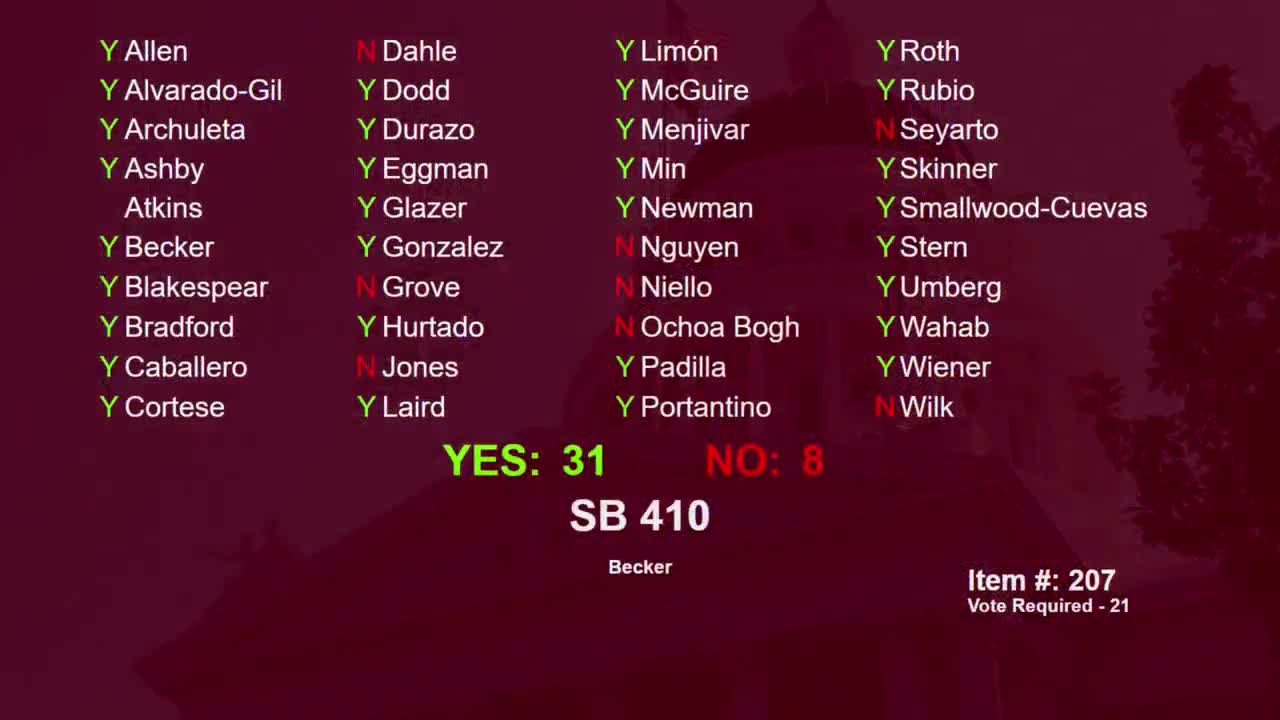 59SEC
Senate Floor
 10MIN
Senate Standing Committee on Environmental Quality
 14MIN
Senate Standing Committee on Governance and Finance
Bill Author

Bill Co-Author(s):