SB 439: Special motions to strike: priority housing development projects.
- Session Year: 2023-2024
- House: Senate
- Latest Version Date: 2023-10-11
Current Status:
Passed
(2023-10-11: Chaptered by Secretary of State. Chapter 779, Statutes of 2023.)
Introduced
In Committee
First Chamber
In Committee
Second Chamber
Enacted
What does this bill do?
The bill lets defendants in lawsuits that challenge approval or permitting of a “priority housing development” — a project where 100% of units are reserved for lower‑income households for at least 55 years — file a special motion to strike (an early motion to dismiss) to remove all or part of the complaint. The court must deny that motion only if the plaintiff shows a probability of winning, and a defendant who prevails can recover attorneys’ fees and costs, except for enforcement actions brought by public prosecutors.
The summary is provided by generative AI which can make mistakes. For original language, please view the details in the table below.
Existing law permits any party to file a notice of motion and motion to strike the whole or any part of a pleading. Under existing law, a party may file with the trial court a special motion to strike a cause of action against a person arising from any act of that person in furtherance of the persons right of petition or free speech under the United States Constitution or the California Constitution in connection with a public issue.
This bill would permit a party to file with the trial court a special motion to strike the whole or any part of a pleading in all civil actions brought by any plaintiff to challenge the approval or permitting of a priority housing development project, as defined. The bill would require the trial court to deny the motion to strike if it determines that the plaintiff has established that there is a probability that the plaintiff will prevail on the claim. The bill would entitle a prevailing defendant on a special motion to strike to recover their attorneys fees and costs, except as specified. Except as specified, the bill would require the filing of a special motion to strike within 60 days of the service of the complaint, or in the courts discretion, at any later time the court deems proper. The bill would provide that if the court determines the administrative record is required for its decision, the moving party may, notwithstanding the filing deadlines above, file the special motion to strike within 60 days of the service of the administrative record or, in the courts discretion, at any later time the court deems proper. The bill would require the court to make its determination on the special motion to strike on the pleadings, supporting and opposing affidavits stating the facts upon which the liability or defense is based, and if applicable, the administrative record. The bill would provide that an order granting or denying this special motion to strike is appealable, as specified.
Existing law permits any party to file a notice of motion and motion to strike the whole or any part of a pleading. Under existing law, a party may file with the trial court a special motion to strike a cause of action against a person arising from any act of that person in furtherance of the persons right of petition or free speech under the United States Constitution or the California Constitution in connection with a public issue.
This bill would permit a party to file with the trial court a special motion to strike the whole or any part of a pleading in all civil actions brought by any plaintiff to challenge the approval or permitting of a priority housing development project, as defined. The bill would require the trial court to deny the motion to strike if it determines that the plaintiff has established that there is a probability that the plaintiff will prevail on the claim. The bill would entitle a prevailing defendant on a special motion to strike to recover their attorneys fees and costs, except as specified. The Except as specified, the bill would require the filing of a special motion to strike within 60 days of the service of the complaint, or in the courts discretion, at any later time the court deems proper. The bill would provide that if the court determines the administrative record is required for its decision, the moving party may, notwithstanding the filing deadlines above, file the special motion to strike within 60 days of the service of the administrative record or, in the courts discretion, at any later time the court deems proper. The bill would require the court to make its determination on the special motion to strike on the pleadings, supporting and opposing affidavits stating the facts upon which the liability or defense is based, and if applicable, the administrative record. The bill would provide that an order granting or denying this special motion to strike is appealable, as specified.
Existing law permits any party to file a notice of motion and motion to strike the whole or any part of a pleading. Under existing law, a party may file with the trial court a special motion to strike a cause of action against a person arising from any act of that person in furtherance of the persons right of petition or free speech under the United States Constitution or the California Constitution in connection with a public issue.
This bill would permit a party to file with the trial court a special motion to strike the whole or any part of a pleading in all civil actions brought by any plaintiff to challenge the approval or permitting of a priority housing development project, as defined. The bill would require the trial court to deny the motion to strike if it determines that the plaintiff has established that there is a probability that the plaintiff will prevail on the claim. The bill would entitle a prevailing defendant on a special motion to strike to recover their attorneys fees and costs, except as specified. The bill would require the filing of a special motion to strike within 60 days of the service of the complaint, or in the courts discretion, at any later time the court deems proper. The bill would provide that an order granting or denying this special motion to strike is appealable, as specified.
Existing law, the San Francisco Bay Area Regional Housing Finance Act, establishes the Bay Area Housing Finance Authority to raise, administer, and allocate funding for affordable housing in the San Francisco Bay area, as defined.This bill would make nonsubstantive changes to the provision establishing the title of the act.Existing law, the San Francisco Bay Area Regional Housing Finance Act, establishes the Bay Area Housing Finance Authority to raise, administer, and allocate funding for affordable housing in the San Francisco Bay area, as defined.
This bill would make nonsubstantive changes to the provision establishing the title of the act.
(a)The Legislature finds and declares all of the following:
(1)The lack of affordable housing is a critical problem that threatens the economic, environmental, and social quality of life in California.
(2)It is in the public interest to encourage priority housing development projects in which 100 percent of the units, exclusive of any managers unit or units, are reserved for lower income households, as defined in Section 50079.5 of the Health and Safety Code, and ensure such developments are not unnecessarily delayed or caused to fail through abuse of the judicial process. To this end, this section shall be construed broadly.
(b)(1)(A)In all civil actions brought by any plaintiff to challenge the approval or permitting of a priority housing development project, including, but not limited to, actions brought pursuant to Section 21167 of the Public Resources Code, a defendant may bring a special motion to strike the whole or any part of a pleading. The court shall deny the motion to strike if it determines that the plaintiff has established that there is a probability that the plaintiff will prevail on the claim.
(B)The court shall make its determination on the special motion to strike based on the pleadings, and supporting and opposing affidavits stating the facts upon which the liability or defense is based. Affidavits submitted with the pleadings may include a request for judicial notice of facts and documents relevant to the courts determination.
(C)(i)If the court is unable to determine whether the plaintiff has established a probability that the plaintiff will prevail on the claim without reviewing the administrative record in an action where the administrative record is required, the court shall make its determination on the special motion to strike based on the documents specified in subparagraph (B) and the administrative record, once prepared.
(ii)If the court determines that an administrative record is required for its decision, the moving party may, notwithstanding the 60-day filing requirement pursuant to paragraph (4) and without appealing an order denying a special motion to strike pursuant to paragraph (7), file the special motion to strike within 60 days of the service of the administrative record or, in the courts discretion, at any later time it deems proper.
(D)If the court determines that the plaintiff has established a probability that the plaintiff will prevail on the claim, neither that determination nor the fact of that determination shall be admissible in evidence at any later stage of the case, or in any subsequent action, and no burden of proof or degree of proof otherwise applicable shall be affected by that determination in any later stage of the case or in any subsequent proceeding.
(2)In any action subject to paragraph (1), a prevailing defendant on a special motion to strike shall be entitled to recover that defendants attorneys fees and costs. If the court finds that a special motion to strike is frivolous or is solely intended to cause unnecessary delay, the court shall award costs and reasonable attorneys fees to a plaintiff prevailing on the motion, pursuant to Section 128.5.
(3)This subdivision does not apply to any enforcement action brought in the name of the people of the State of California by the Attorney General, district attorney, or city attorney, acting as a public prosecutor.
(4)The special motion may be filed within 60 days of the service of the complaint or, in the courts discretion, at any later time upon terms it deems proper. The motion shall be scheduled by the clerk of the court for a hearing not more than 30 days after the service of the motion unless the docket conditions of the court require a later hearing.
(5)All discovery proceedings in the action shall be stayed upon the filing of a notice of motion made pursuant to this section. The stay of discovery shall remain in effect until notice of entry of the order ruling on the motion. The court, on noticed motion and for good cause shown, may order that specified discovery be conducted notwithstanding this subdivision.
(6)For purposes of this section, complaint includes cross-complaint and petition, plaintiff includes cross-complainant and petitioner, and defendant includes cross-defendant and respondent.
(7)An order granting or denying a special motion to strike is appealable under Section 904.1.
(c)Priority housing development means a development in which 100 percent of the units, exclusive of any managers unit or units, will be reserved for lower income households, as defined in Section 50079.5 of the Health and Safety Code, for at least 55 years.
SEC. 2.Section 904.1 of the Code of Civil Procedure is amended to read:904.1.(a)An appeal, other than in a limited civil case, is to the court of appeal. An appeal, other than in a limited civil case, may be taken from any of the following:
(1)From a judgment, except an interlocutory judgment, other than as provided in paragraphs (8), (9), and (11), or a judgment of contempt that is made final and conclusive by Section 1222.
(2)From an order made after a judgment made appealable by paragraph (1).
(3)From an order granting a motion to quash service of summons or granting a motion to stay the action on the ground of inconvenient forum, or from a written order of dismissal under Section 581d following an order granting a motion to dismiss the action on the ground of inconvenient forum.
(4)From an order granting a new trial or denying a motion for judgment notwithstanding the verdict.
(5)From an order discharging or refusing to discharge an attachment or granting a right to attach order.
(6)From an order granting or dissolving an injunction, or refusing to grant or dissolve an injunction.
(7)From an order appointing a receiver.
(8)From an interlocutory judgment, order, or decree, made or entered in an action to redeem real or personal property from a mortgage thereof, or a lien thereon, determining the right to redeem and directing an accounting.
(9)From an interlocutory judgment in an action for partition determining the rights and interests of the respective parties and directing partition to be made.
(10)From an order made appealable by the Probate Code or the Family Code.
(11)From an interlocutory judgment directing payment of monetary sanctions by a party or an attorney for a party if the amount exceeds five thousand dollars ($5,000).
(12)From an order directing payment of monetary sanctions by a party or an attorney for a party if the amount exceeds five thousand dollars ($5,000).
(13)From an order granting or denying a special motion to strike under Sections 425.16 and 425.19.
(14)From a final order or judgment in a bifurcated proceeding regarding child custody or visitation rights.
(b)Sanction orders or judgments of five thousand dollars ($5,000) or less against a party or an attorney for a party may be reviewed on an appeal by that party after entry of final judgment in the main action, or, at the discretion of the court of appeal, may be reviewed upon petition for an extraordinary writ.
(a)The Legislature finds and declares all of the following:
(1)The lack of affordable housing is a critical problem that threatens the economic, environmental, and social quality of life in California.
(2)It is in the public interest to encourage affordable priority housing development projects in which 100 percent of the units, exclusive of any managers unit or units, are reserved for lower income households, as defined in Section 50079.5 of the Health and Safety Code, and ensure such developments are not unnecessarily delayed or caused to fail through abuse of the judicial process. To this end, this section shall be construed broadly.
(b)(1)(A)In all civil actions, including, but not limited to, actions brought pursuant to Section 21167 of the Public Resources Code, actions brought by any plaintiff to challenge the approval or permitting of a priority housing development project, including, but not limited to, actions brought pursuant to Section 21167 of the Public Resources Code, a defendant may bring a special motion to strike the whole or any part of a pleading. The court shall deny the motion to strike if it determines that the plaintiff has established that there is a probability that the plaintiff will prevail on the claim.
(B)In making its determination, the The court shall consider make its determination on the special motion to strike based on the pleadings, and supporting and opposing affidavits stating the facts upon which the liability or defense is based. Affidavits submitted with the pleadings may include a request for judicial notice of facts and documents relevant to the courts determination.
(C)(i)If the court is unable to determine whether the plaintiff has established a probability that the plaintiff will prevail on the claim without reviewing the administrative record in an action where the administrative record is required, the court shall make its determination on the special motion to strike based on the documents specified in subparagraph (B) and the administrative record, once prepared.
(ii)If the court determines that an administrative record is required for its decision, the moving party may, notwithstanding the 60-day filing requirement pursuant to paragraph (4) and without appealing an order denying a special motion to strike pursuant to paragraph (7), file the special motion to strike within 60 days of the service of the administrative record or, in the courts discretion, at any later time it deems proper.
(C)(D)If the court determines that the plaintiff has established a probability that the plaintiff will prevail on the claim, neither that determination nor the fact of that determination shall be admissible in evidence at any later stage of the case, or in any subsequent action, and no burden of proof or degree of proof otherwise applicable shall be affected by that determination in any later stage of the case or in any subsequent proceeding.
(2)In any action subject to paragraph (1), a prevailing defendant on a special motion to strike shall be entitled to recover that defendants attorneys fees and costs. If the court finds that a special motion to strike is frivolous or is solely intended to cause unnecessary delay, the court shall award costs and reasonable attorneys fees to a plaintiff prevailing on the motion, pursuant to Section 128.5.
(3)This subdivision does not apply to any enforcement action brought in the name of the people of the State of California by the Attorney General, district attorney, or city attorney, acting as a public prosecutor.
(4)The special motion may be filed within 60 days of the service of the complaint or, in the courts discretion, at any later time upon terms it deems proper. The motion shall be scheduled by the clerk of the court for a hearing not more than 30 days after the service of the motion unless the docket conditions of the court require a later hearing.
(5)All discovery proceedings in the action shall be stayed upon the filing of a notice of motion made pursuant to this section. The stay of discovery shall remain in effect until notice of entry of the order ruling on the motion. The court, on noticed motion and for good cause shown, may order that specified discovery be conducted notwithstanding this subdivision.
(6)For purposes of this section, complaint includes cross-complaint and petition, plaintiff includes cross-complainant and petitioner, and defendant includes cross-defendant and respondent.
(7)An order granting or denying a special motion to strike is appealable under Section 904.1.
(c)Priority housing development means a development in which 100 percent of the units, exclusive of any managers unit or units, will be reserved for lower income households, as defined in Section 50079.5 of the Health and Safety Code. Code, for at least 55 years.
SEC. 2.Section 904.1 of the Code of Civil Procedure is amended to read:904.1.(a)An appeal, other than in a limited civil case, is to the court of appeal. An appeal, other than in a limited civil case, may be taken from any of the following:
(1)From a judgment, except an interlocutory judgment, other than as provided in paragraphs (8), (9), and (11), or a judgment of contempt that is made final and conclusive by Section 1222.
(2)From an order made after a judgment made appealable by paragraph (1).
(3)From an order granting a motion to quash service of summons or granting a motion to stay the action on the ground of inconvenient forum, or from a written order of dismissal under Section 581d following an order granting a motion to dismiss the action on the ground of inconvenient forum.
(4)From an order granting a new trial or denying a motion for judgment notwithstanding the verdict.
(5)From an order discharging or refusing to discharge an attachment or granting a right to attach order.
(6)From an order granting or dissolving an injunction, or refusing to grant or dissolve an injunction.
(7)From an order appointing a receiver.
(8)From an interlocutory judgment, order, or decree, made or entered in an action to redeem real or personal property from a mortgage thereof, or a lien thereon, determining the right to redeem and directing an accounting.
(9)From an interlocutory judgment in an action for partition determining the rights and interests of the respective parties and directing partition to be made.
(10)From an order made appealable by the Probate Code or the Family Code.
(11)From an interlocutory judgment directing payment of monetary sanctions by a party or an attorney for a party if the amount exceeds five thousand dollars ($5,000).
(12)From an order directing payment of monetary sanctions by a party or an attorney for a party if the amount exceeds five thousand dollars ($5,000).
(13)From an order granting or denying a special motion to strike under Sections 425.16 and 425.19.
(14)From a final order or judgment in a bifurcated proceeding regarding child custody or visitation rights.
(b)Sanction orders or judgments of five thousand dollars ($5,000) or less against a party or an attorney for a party may be reviewed on an appeal by that party after entry of final judgment in the main action, or, at the discretion of the court of appeal, may be reviewed upon petition for an extraordinary writ.
(a)The Legislature finds and declares all of the following:
(1)The lack of affordable housing is a critical problem that threatens the economic, environmental, and social quality of life in California.
(2)It is in the public interest to encourage affordable housing development and ensure such developments are not delayed or caused to fail through abuse of the judicial process. To this end, this section shall be construed broadly.
(b)(1)(A)In all civil actions, including, but not limited to, actions brought pursuant to Section 21167 of the Public Resources Code, brought by any plaintiff to challenge the approval or permitting of a priority housing development project, a defendant may bring a special motion to strike the whole or any part of a pleading. The court shall deny the motion to strike if it determines that the plaintiff has established that there is a probability that the plaintiff will prevail on the claim.
(B)In making its determination, the court shall consider the pleadings, and supporting and opposing affidavits stating the facts upon which the liability or defense is based.
(C)If the court determines that the plaintiff has established a probability that the plaintiff will prevail on the claim, neither that determination nor the fact of that determination shall be admissible in evidence at any later stage of the case, or in any subsequent action, and no burden of proof or degree of proof otherwise applicable shall be affected by that determination in any later stage of the case or in any subsequent proceeding.
(2)In any action subject to paragraph (1), a prevailing defendant on a special motion to strike shall be entitled to recover that defendants attorneys fees and costs. If the court finds that a special motion to strike is frivolous or is solely intended to cause unnecessary delay, the court shall award costs and reasonable attorneys fees to a plaintiff prevailing on the motion, pursuant to Section 128.5.
(3)This subdivision does not apply to any enforcement action brought in the name of the people of the State of California by the Attorney General, district attorney, or city attorney, acting as a public prosecutor.
(4)The special motion may be filed within 60 days of the service of the complaint or, in the courts discretion, at any later time upon terms it deems proper. The motion shall be scheduled by the clerk of the court for a hearing not more than 30 days after the service of the motion unless the docket conditions of the court require a later hearing.
(5)All discovery proceedings in the action shall be stayed upon the filing of a notice of motion made pursuant to this section. The stay of discovery shall remain in effect until notice of entry of the order ruling on the motion. The court, on noticed motion and for good cause shown, may order that specified discovery be conducted notwithstanding this subdivision.
(6)For purposes of this section, complaint includes cross-complaint and petition, plaintiff includes cross-complainant and petitioner, and defendant includes cross-defendant and respondent.
(7)An order granting or denying a special motion to strike is appealable under Section 904.1.
(c)Priority housing development means a development in which 100 percent of the units, exclusive of any managers unit or units, will be reserved for lower income lower income households, as defined in Section 50079.5 of the Health and Safety Code.
SEC. 2.Section 904.1 of the Code of Civil Procedure is amended to read:904.1.(a)An appeal, other than in a limited civil case, is to the court of appeal. An appeal, other than in a limited civil case, may be taken from any of the following:
(1)From a judgment, except an interlocutory judgment, other than as provided in paragraphs (8), (9), and (11), or a judgment of contempt that is made final and conclusive by Section 1222.
(2)From an order made after a judgment made appealable by paragraph (1).
(3)From an order granting a motion to quash service of summons or granting a motion to stay the action on the ground of inconvenient forum, or from a written order of dismissal under Section 581d following an order granting a motion to dismiss the action on the ground of inconvenient forum.
(4)From an order granting a new trial or denying a motion for judgment notwithstanding the verdict.
(5)From an order discharging or refusing to discharge an attachment or granting a right to attach order.
(6)From an order granting or dissolving an injunction, or refusing to grant or dissolve an injunction.
(7)From an order appointing a receiver.
(8)From an interlocutory judgment, order, or decree, made or entered in an action to redeem real or personal property from a mortgage thereof, or a lien thereon, determining the right to redeem and directing an accounting.
(9)From an interlocutory judgment in an action for partition determining the rights and interests of the respective parties and directing partition to be made.
(10)From an order made appealable by the Probate Code or the Family Code.
(11)From an interlocutory judgment directing payment of monetary sanctions by a party or an attorney for a party if the amount exceeds five thousand dollars ($5,000).
(12)From an order directing payment of monetary sanctions by a party or an attorney for a party if the amount exceeds five thousand dollars ($5,000).
(13)From an order granting or denying a special motion to strike under Section 425.16. Sections 425.16 and 425.19.
(14)From a final order or judgment in a bifurcated proceeding regarding child custody or visitation rights.
(b)Sanction orders or judgments of five thousand dollars ($5,000) or less against a party or an attorney for a party may be reviewed on an appeal by that party after entry of final judgment in the main action, or, at the discretion of the court of appeal, may be reviewed upon petition for an extraordinary writ.
SECTION 1.Section 64500 of the Government Code is amended to read:64500.This title shall be known and may be cited as the San Francisco Bay Area Regional Housing Finance Act.This title shall be known, known and may be cited, cited as the San Francisco Bay Area Regional Housing Finance Act.
|
Date
|
Status
|
|---|---|
| Oct 11, 2023 | Chaptered by Secretary of State. Chapter 779, Statutes of 2023. |
| Oct 11, 2023 | Approved by the Governor. |
| Sep 15, 2023 | Enrolled and presented to the Governor at 3 p.m. |
| Sep 11, 2023 | Assembly amendments concurred in. (Ayes 39. Noes 0. Page 2599.) Ordered to engrossing and enrolling. |
| Sep 7, 2023 | In Senate. Concurrence in Assembly amendments pending. |
| Sep 7, 2023 | Read third time. Passed. (Ayes 78. Noes 0. Page 2987.) Ordered to the Senate. |
| Sep 1, 2023 | Read third time and amended. |
| Sep 1, 2023 | Ordered to third reading. |
| Jun 12, 2023 | Ordered to third reading. |
| Jun 12, 2023 | From consent calendar on motion of Assembly Member Reyes. |
| Jun 7, 2023 | Read second time. Ordered to consent calendar. |
| Jun 6, 2023 | From committee: Do pass. Ordered to consent calendar. (Ayes 11. Noes 0.) (June 6). |
| May 26, 2023 | From committee with author's amendments. Read second time and amended. Re-referred to Com. on JUD. |
| May 18, 2023 | Referred to Com. on JUD. |
| May 11, 2023 | In Assembly. Read first time. Held at Desk. |
| May 11, 2023 | Read third time. Passed. (Ayes 39. Noes 0. Page 1053.) Ordered to the Assembly. |
| May 4, 2023 | Read second time. Ordered to consent calendar. |
| May 3, 2023 | From committee: Do pass. Ordered to consent calendar. (Ayes 10. Noes 0. Page 1011.) (May 2). |
| Apr 18, 2023 | Set for hearing May 2. |
| Mar 29, 2023 | Re-referred to Com. on JUD. |
| Mar 22, 2023 | From committee with author's amendments. Read second time and amended. Re-referred to Com. on RLS. |
| Feb 22, 2023 | Referred to Com. on RLS. |
| Feb 14, 2023 | From printer. May be acted upon on or after March 16. |
| Feb 13, 2023 | Introduced. Read first time. To Com. on RLS. for assignment. To print. |
|
Date
|
Description
|
Location
|
Votes
|
|
|---|---|---|---|---|
| Sep 11, 2023 | Unfinished Business SB439 Skinner Concurrence | Senate Floor |
Passed |
|
| Sep 7, 2023 | SB 439 Skinner Senate Third Reading By Grayson | Assembly Floor |
Passed |
|
| Jun 6, 2023 | Do pass. To Consent Calendar. | Assembly Standing Committee on Judiciary |
Passed |
|
| May 11, 2023 | Consent Calendar SB439 Skinner | Senate Floor |
Passed |
|
| May 2, 2023 | Do pass and be ordered to the Consent Calendar | Senate Standing Committee on Judiciary |
Passed |
This list shows positions taken on this bill by organizations on the date displayed, which is linked to the original source.
Positions by individuals are not included.
|
Organization
|
Position
|
Date
|
|---|---|---|
| Affirmed Housing | ** Support | |
| AMCAL | ** Support | |
| AMCAL Multi-Housing, Inc. | ** Support | |
| AMG & Associates LLC | ** Support | |
| California Apartment Association | ** Support | |
| California Housing Consortium | ** Support | |
| California Housing Partnership | ** Support | |
| City Of Beverly Hills | ** Against | |
| City of San Jose | ** Support | |
| CRP Affordable Housing and Community Development | ** Support | |
| East Bay YIMBY | ** Support | |
| Eden Housing | ** Support | |
| Grow the Richmond | ** Support | |
| How to ADU | ** Support | |
| John Burton Advocates for Youth | ** Support | |
| LINC Housing | ** Support | |
| Merritt Community Capital Corporation | ** Support | |
| MidPen Housing Corporation | ** Support | |
| Mountain View YIMBY | ** Support | |
| Napa-Solano for Everyone | ** Support | |
| Northern Neighbors | ** Support | |
| Peninsula for Everyone | ** Support | |
| People For Housing Orange County | ** Support | |
| Progress Noe Valley | ** Support | |
| Public Interest Law Project | ** Support | |
| Resources for Community Development | ** Support | |
| San Francisco Bay Area Planning and Urban Research Association | ** Support | |
| San Francisco Yimby | ** Support | |
| San Luis Obispo Yimby | ** Support | |
| Santa Cruz Yimby | ** Support | |
| Santa Rosa Yimby | ** Support | |
| Satellite Affordable Housing Associates | ** Support | |
| South Bay Yimby | ** Support | |
| Southside Forward | ** Support | |
| The John Stewart Company | ** Support | |
| The Pacific Companies | ** Support | |
| Urban Environmentalists | ** Support | |
| Ventura County YIMBY | ** Support | |
| Yimby Action | ** Support | |
| YIMBY Law | ** Support |
SENATE RULES COMMITTEE Office of Senate Floor Analyses (916) 651-1520 Fax: (916) 327-4478 | SB 439 |
UNFINISHED BUSINESS
Bill No: SB 439
Author: Skinner (D)
Amended: 9/1/23
Vote: 21
SENATE JUDICIARY COMMITTEE: 10-0, 5/2/23
AYES: Umberg, Wilk, Allen, Ashby, Caballero, Durazo, Laird, Min, Niello, Wiener
NO VOTE RECORDED: Stern
SENATE FLOOR: 39-0, 5/11/23 (Consent)
AYES: Allen, Alvarado-Gil, Archuleta, Ashby, Atkins, Becker, Blakespear, Bradford, Caballero, Cortese, Dahle, Dodd, Durazo, Eggman, Glazer, Gonzalez, Hurtado, Jones, Laird, Limón, McGuire, Menjivar, Min, Newman, Nguyen, Niello, Ochoa Bogh, Padilla, Portantino, Roth, Rubio, Seyarto, Skinner, Smallwood-Cuevas, Stern, Umberg, Wahab, Wiener, Wilk
NO VOTE RECORDED: Grove
ASSEMBLY FLOOR: 78-0, 9/7/23 - See last page for vote
SUBJECT: Special motions to strike: priority housing development projects
SOURCE: California Housing Consortium
Public Interest Law Project
DIGEST:
This bill creates a special motion to strike a challenge to the approval or permitting of an affordable housing project modeled after California’s anti-Strategic Lawsuit against Public Participation (SLAAP) statute.
Assembly Amendments
narrow the scope of applicable housing projects and provide direction on the judicial determination of the motion.
ANALYSIS:
Existing law:
- Establishes anti-SLAPP procedures. Provides that a cause of action against a person arising from any act of that person in furtherance of the person’s right of petition or free speech under the United States or California Constitution, as defined, in connection with a public issue is subject to a special motion to strike, unless the court determines, based on the pleadings, and supporting and opposing affidavits stating the facts upon which the liability or defense is based, that the plaintiff has established that there is a probability that the plaintiff will prevail on the claim. (Code Civ. Proc. § 425.16(b).)
- Entitles a prevailing defendant, with certain exceptions, to attorney’s fees and costs; likewise for a prevailing plaintiff, provided the court finds the motion was frivolous or solely intended to cause unnecessary delay pursuant to Section 128.5 of the Code of Civil Procedure. (Code Civ. Proc. § 425.16(c).) Stays discovery proceedings upon filing of notice of a SLAPP motion. (Code Civ. Proc. § 425.16 (g).)
- Exempts, generally, certain actions from the anti-SLAPP statute:
- Actions brought solely in the public interest or on behalf of the general public, provided that (i) the plaintiff does not seek any relief greater than or different from the relief sought for the class; (ii) the action enforces an important right affecting the public, and confers a significant benefit on the public or a large class of persons; and (iii) private enforcement is necessary and places a disproportionate financial burden on the plaintiff in relation to their stake in the matter. (Code Civ. Proc. § 425.17(b).)
- Actions against a person for statements or conduct, provided the person is primarily engaged in the business of selling or leasing goods or services, the statement or conduct consists of representations of fact related to the business, and the intended audience is a potential buyer or customer, as specified. (Id. at (c).)
- Requires lead agencies with the principal responsibility for carrying out or approving a proposed discretionary project to prepare a negative declaration, mitigated declaration, or environmental impact report (EIR) for this action, unless the project is exempt from California Environmental Quality Act (CEQA). Includes, pursuant CEQA, various statutory exemptions, as well as categorical exemptions in the CEQA Guidelines). (Pub. Res. Code § 21100 et seq.)
- Sets requirements relating to the preparation, review, comment, approval and certification of environmental documents, as well as procedures relating to an action or proceeding to attack, review, set aside, void, or annul various actions of a public agency on the grounds of noncompliance with CEQA. (Pub. Res. Code § 21165 et seq.)
- Authorizes judicial review of CEQA actions taken by public agencies, following the agency’s decision to carry out or approve the project, and specifies certain time periods in which an action must be instituted depending on the type of claim alleged. (Pub. Res. Code § 21167.)
- Provides that upon motion, a court may award attorney fees to a successful party against one or more opposing parties in any action which has resulted in the enforcement of an important right affecting the public interest, as specified. (Code Civ. Proc. Sec. 1021.5.)
This bill:
- Provides that in all civil actions, including actions brought by any plaintiff to challenge the approval or permitting of a “priority housing development” project, including actions brought pursuant to Section 21167 of the Public Resources Code, a defendant may bring a special motion to strike the whole or any part of a pleading.
- Requires the court to deny the motion to strike if it determines that the plaintiff has established that there is a probability that the plaintiff will prevail on the claim. Provides that the court to makes its determination based on the pleadings, and supporting and opposing affidavits stating the facts upon which the liability or defense is based. Affidavits submitted with the pleadings may include a request for judicial notice of facts and documents relevant to the court’s determination.
- Provides that if the court is unable to determine whether the plaintiff has established a probability that the plaintiff will prevail on the claim without reviewing the administrative record in an action where the administrative record is required, the court shall make its determination based on the documents specified above and the administrative record, once prepared. Provides that, if the court determines that an administrative record is required, the moving party may, notwithstanding the 60-day filing requirement and without appealing an order denying a special motion to strike, file the special motion to strike within 60 days of the service of the administrative record or, in the court’s discretion, at any later time it deems proper.
- Provides that if the court determines that the plaintiff has established a probability the plaintiff will prevail on the claim, neither that determination nor the fact of that determination shall be admissible in evidence at any later stage of the case, or in any subsequent action, and no burden of proof or degree of proof otherwise applicable shall be affected by that determination in any later stage of the case or in any subsequent proceeding.
- Provides that in such actions, a prevailing defendant is entitled to recover attorney’s fees and costs. Provides that if the court finds that a special motion to strike is frivolous or is solely intended to cause unnecessary delay, the court shall award costs and reasonable attorney’s fees to a plaintiff prevailing on the motion, pursuant to Section 128.5 of the Code of Civil Procedure.
- Exempts enforcement actions brought by the Attorney General, district attorney, or city attorney, acting as a public prosecutor.
- Requires the special motion to be filed within 60 days of the service of the complaint or, in the court’s discretion, at any later time upon terms it deems proper. Require the motion to be scheduled by the clerk of the court for a hearing not more than 30 days after the service of the motion unless the docket conditions of the court require a later hearing.
- Stays all discovery proceedings in the action upon the filing of a notice of this motion. The stay remains in effect until notice of entry of the order ruling on the motion. The court, on noticed motion and for good cause shown, may order that specified discovery be conducted notwithstanding this provision.
- Provides for interlocutory appeal of an order granting or denying this special motion to strike.
- Defines “priority housing development” as a development in which 100 percent of the units, exclusive of any manager’s unit or units, will be reserved for lower income households, as defined, for at least 55 years.
Background
A typical SLAPP is a meritless civil lawsuit filed to chill the defendant’s exercise of their political rights and deplete their resources. The anti-SLAPP statute enables such defendants to expeditiously unmask SLAPP suits with a special motion to strike that stays discovery proceedings and may result in an award of attorney’s fees and costs if the plaintiff is unable to show a probability of prevailing on the claim. Although commonly associated with the protection of constitutional rights, the anti-SLAPP statute applies to a broad range of contexts.
This bill creates a nearly identical motion to strike in another context. CEQA challenges to the approval or permitting of “priority housing developments” will be subject to these motions. The developments included are those in which 100 percent of the units will be reserved for lower income households for at least 55 years, as provided. Just as with the anti-SLAPP motions, the court is required to deny the motions if the plaintiff is able establish that there is a probability that the plaintiff will prevail on their claim.
This bill is co-sponsored by the California Housing Consortium and the Public Interest Law Project. There is a wide coalition of groups in support, including a YIMBY coalition and various community development groups. The City of Beverly Hills opposes this bill.
Comments
California’s anti-SLAPP statute provides that a cause of action against a person arising from any act of that person in furtherance of the person’s right of petition or free speech under the United States Constitution or the California Constitution in connection with a public issue shall be subject to a special motion to strike. (Civ. Proc. Code § 425.16.) The Legislature asserted that the law was justified because “it is in the public interest to encourage continued participation in matters of public significance, and that this participation should not be chilled through abuse of the judicial process.”
The seminal article entitled Strategic Lawsuits Against Public Participation defined SLAPP suits as “civil lawsuits … that are aimed at preventing citizens from exercising their political rights or punishing those who have done so.”[1] While SLAPP suits “masquerade as ordinary lawsuits” such as defamation and interference with a prospective economic advantage, they are generally meritless suits brought primarily to chill the exercise of free speech or petition rights by the threat of severe economic consequences for the defendant, and not to vindicate a legally cognizable right.[2]
In 1992, Code of Civil Procedure Section 425.16 was added by SB 1264 (Lockyer, Chapter 726, Statutes of 1992) to provide a “special motion to strike” for use by defendants in SLAPP suits to obtain an early judicial ruling and termination of a meritless claim arising from a person’s exercise of their constitutional rights of petition and free speech in connection with a public issue. In passing the anti-SLAPP law, the Legislature found “that there has been a disturbing increase in lawsuits brought primarily to chill the valid exercise of the constitutional rights of freedom of speech and petition for the redress of grievances.” (Code Civ. Proc. § 425.16(a).)
The special motion to strike must be brought within 60 days of service of complaint; it can result in an award of attorney’s fees and costs, stays discovery proceedings, and must be heard within 30 days if the court’s docket permits. (Code Civ. Proc. § 425.16(c), (f), (g).) The motion involves two steps. First, the moving party must show that the claim at issue arises from a protected activity, which includes any “statement or writing made in connection with an issue under consideration or review by a … judicial body.” (Id. at (e).) If so, under the second step the burden shifts to the opposing party to demonstrate a reasonable probability of prevailing on the merits. (See id. at (b).) If the opposing party meets this burden, the special motion to strike is denied.
Anti-SLAPP in the CEQA context
This bill creates a special motion to strike that is nearly identical to the anti-SLAPP statute with regard to challenges to certain housing developments. According to the author:
The California Environmental Quality Act (CEQA) is intended to ensure that environmental impacts are considered and mitigated before local decision makers approve a proposed construction project. Sadly, opponents of affordable housing development have misused CEQA to stop projects they don’t like even when the requirements of CEQA have been met, filing lawsuits that can almost indefinitely slow or stop the approved development. Such illegitimate lawsuits against affordable housing projects that have been approved and have undergone the full CEQA required review can result in the developer losing the financing needed to complete the affordable housing project.
Our state is in an increasingly severe housing crisis. Misusing the system to obstruct affordable housing projects that have already fulfilled the requirements of CEQA and received approval from their respective local government only exacerbates our housing crisis. SB 439 will empower courts to intervene in nuisance lawsuits by allowing judges to throw out a CEQA lawsuit filed against an affordable housing project when that lawsuit lacks merit and does not have a chance of success in court. If a court does throw out an illegitimate case, SB 439 allows the affordable housing developer to recover costs and attorney’s fees. This will ensure that affordable housing dollars are going towards new homes not fighting spurious lawsuits.
This bill allows for this motion to strike to be filed in a case that challenges the approval or permitting of a “priority housing development” project, explicitly including actions brought pursuant to CEQA. The procedures and guidelines mirror those in Section 425.16. As such, the court is required to deny the motion if it determines that the plaintiff has established that there is a probability that the plaintiff will prevail on the claim.
This bill applies only to developments in which 100 percent of the units, excluding manager’s units, are reserved for lower income households for at least 55 years. “Lower income households” means persons and families whose income does not exceed the qualifying limits for lower income families as established and amended from time to time pursuant to Section 8 of the United States Housing Act of 1937. This includes very low income households and extremely low income households. (Health & Saf. Code § 50079.5.)
FISCAL EFFECT: Appropriation: No Fiscal Com.: No Local: No
SUPPORT: (Verified 9/7/23)
California Housing Consortium (co-source)
Public Interest Law Project (co-source)
Affirmed Housing
AMCAL
AMG & Associates, LLC
California Housing Partnership
CRP Affordable Housing and Community Development
East Bay YIMBY
Eden Housing
Grow the Richmond
How to ADU
John Burton Advocates for Youth
LINC Housing
Merritt Community Capital Corporation
MidPen Housing Corporation
Mountain View YIMBY
Napa-Solano for Everyone
Northern Neighbors
Peninsula for Everyone
People for Housing Orange County
Progress Noe Valley
Resources for Community Development
San Francisco Bay Area Planning and Urban Research Association
San Francisco YIMBY
San Luis Obispo YIMBY
Santa Cruz YIMBY
Santa Rosa YIMBY
Satellite Affordable Housing Associates
South Bay YIMBY
Southside Forward
The John Stewart Company
The Pacific Companies
Urban Environmentalists
Ventura County YIMBY
YIMBY Action
YIMBY Law
OPPOSITION: (Verified 9/7/23)
City of Beverly Hills
ARGUMENTS IN SUPPORT: The California Housing Consortium and the Public Interest Law Project, co-sponsors of this bill, write:
Despite the many tools policymakers have provided to ensure affordable and supportive housing projects can move forward, too often developers continue to face non-meritorious litigation attacking their projects even after securing local approval. This type of litigation is pursued by NIMBYs who, having tried unsuccessfully to stop the development during the approval process, turn to the courts, knowing that the prospect of ongoing litigation may deter funding for the project and cause untenable delays and expenses. . . .
SB 439 would establish a special motion to strike, similar to the motion that is permitted under state Anti-SLAPP law, to quickly end litigation filed against approved affordable housing projects that has no likelihood of success on the merits.
ARGUMENTS IN OPPOSITION: The City of Beverly Hills writes:
Affordable housing is vital for the social and economic well-being of our city, but it should not come at the cost of environmental sustainability or public participation. Instead of rushing the approval process, we advocate for a more thoughtful approach that respects and values all stakeholders.
ASSEMBLY FLOOR VOTE 78-0, 9/7/23
AYES: Addis, Aguiar-Curry, Alanis, Alvarez, Arambula, Bauer-Kahan, Bennett, Berman, Boerner, Bonta, Bryan, Calderon, Juan Carrillo, Wendy Carrillo, Cervantes, Chen, Connolly, Megan Dahle, Davies, Dixon, Flora, Mike Fong, Vince Fong, Friedman, Gabriel, Gallagher, Garcia, Gipson, Grayson, Haney, Hart, Holden, Hoover, Irwin, Jackson, Jones-Sawyer, Kalra, Lackey, Lee, Low, Lowenthal, Maienschein, Mathis, McCarty, McKinnor, Muratsuchi, Stephanie Nguyen, Ortega, Pacheco, Papan, Jim Patterson, Joe Patterson, Pellerin, Petrie-Norris, Quirk-Silva, Ramos, Rendon, Reyes, Luz Rivas, Rodriguez, Blanca Rubio, Sanchez, Santiago, Schiavo, Soria, Ta, Ting, Valencia, Villapudua, Waldron, Wallis, Ward, Weber, Wicks, Wilson, Wood, Zbur, Robert Rivas
NO VOTE RECORDED: Bains, Essayli
Prepared by: Christian Kurpiewski / JUD. / (916) 651-4113
9/8/23 14:17:47
**** END ****
SENATE THIRD READING
STR Bill Id:SB 439
Author:(Skinner)
As Amended Ver:September 1, 2023
Majority vote
SUMMARY
Adopts the established anti-SLAPP (Strategic Lawsuit Against Public Participation) special motion to strike mechanism to dismiss frivolous lawsuits seeking to halt affordable housing developments.
Major Provisions
- Finds and declares that:
- The lack of affordable housing is a critical problem that threatens the economic, environmental, and social quality of life in California.
- There is a public interest in encouraging priority housing projects in which 100 percent of the units, exclusive of any manager's unit or units, are reserved for lower income households, as defined in Section 50079.5 of Health and Safety Code, and ensuring that such developments are not unnecessarily delayed or caused to fail through an abuse of the judicial process.
- Provides that in all civil actions brought by any plaintiff to challenge the approval or permitting of a "priority housing development" project, including actions brought pursuant to Public Resources Code Section 21167, a defendant may bring a special motion to strike the whole or any part of a pleading.
- Defines "priority housing development" as a development in which 100 percent of the units, exclusive of any manager's unit or units, will be reserved for lower income households, as defined in Section 50079.5 of the Health and Safety Code, for at least 55 years.
- Requires a court to deny the motion to strike if it determines that the plaintiff has established that there is a probability that the plaintiff will prevail on the claim. Requires the court to make its determination on the special motion to strike based on the pleadings, and supporting and opposing affidavits stating the facts upon which the liability or defense is based.
- Establishes that affidavits submitted with the pleadings may include a request for judicial notice of facts and documents relevant to the court's determination.
- Establishes that if the court is unable to determine whether the plaintiff has established a probability that the plaintiff will prevail on the claim without reviewing the administrative record in an action where the administrative record is required, the court shall make its determination on the special motion to strike based on the documents specified in 4) and 5), above, and the administrative record, once prepared.
- Establishes that if the court determines that an administrative record is required for its decision, the moving party may, notwithstanding the 60-day filing requirement in 11), and without appealing an order denying a special motion to strike, file the special motion to strike within 60 days of the service of the administrative record or, in the court's discretion, at any later time it deems proper.
- Provides that in the event a court determines that a plaintiff has a probability of success, that determination shall not be admissible at any later stage of the case or in any subsequent action.
- Provides that in such actions for a special motion to strike as described in 1), above, a prevailing defendant is entitled to recover attorney's fees and costs. If the court finds that a special motion to strike is frivolous or is solely intended to cause unnecessary delay, the court shall award costs and reasonable attorney's fees to a plaintiff prevailing on the motion, pursuant to Code of Civil Procedure Section 128.5.
- Exempts enforcement actions brought by the Attorney General, district attorney, or city attorney, acting as a public prosecutor.
- Requires the special motion to be filed within 60 days of the service of the complaint or, in the court's discretion, at any later time upon terms it deems proper.
- Requires the special motion to be heard no more than 30 days after the service of the motion, unless the docket conditions of the court require a later hearing.
- Establishes that the filing of a special motion stays all discovery proceedings in the underlying action, which stays in effect pending resolution of the special motion.
- Provides for interlocutory appeal of an order granting or denying this special motion to strike.
COMMENTS
The housing crisis in California is dire, and is particularly acute when it comes to low-income housing. According to the National Low Income Housing Coalition, for every 100 lower-income families that rent housing in California, there are about 60 units of affordable housing available. (https://nlihc.org/housing-needs-by-state/california.) The perceived threat of litigation, often under the auspices of California's Environmental Quality Act (CEQA), can delay and derail needed, lawful affordable housing development. This bill seeks to combat abusive litigation practices by repurposing an established legal mechanism – the anti-SLAPP special motion to strike – to halt meritless litigation challenging the approval or permitting of "priority housing developments" at the onset of a case. The bill also mirrors the anti-SLAPP mechanism by imposing fees and costs on those who abuse environmental statutes, including CEQA, in bringing such frivolous suits. It is supported by a wide range of affordable housing advocates as well as the California Apartment Association and has no known opposition.
The problem the author is attempting to remedy is not with the CEQA mandate itself, but rather with the perceived ease with which a litigious NIMBYs (Not-in-My-Back-Yard-ers) can use a CEQA suit to derail much-needed development. CEQA is enforced by aggrieved parties requesting that a court mandate either a full environmental review – in cases where none was initially deemed necessary – or heavy revisions to an existing EIR. This bill would provide project proponents and lead agencies a tool to combat truly illegitimate CEQA litigation.
Recognizing the potential for misuse, and the dire need for housing development in the state, the Legislature has adopted numerous mechanisms to facilitate the construction of housing. CEQA includes various statutory exemptions, as well as categorical exemptions in the CEQA Guidelines, for housing projects. In 2002, SB 1925 (Sher), Chapter 1039, Statutes of 2002, established CEQA exemptions for certain residential projects providing affordable urban or agricultural housing, or located on an infill site within an urbanized area, and meeting specified unit and acreage criteria. Since SB 1925 was enacted, additional legislation has provided CEQA exemptions and streamlining for residential (including, but not limited to, affordable housing) and certain other projects in infill areas. Nevertheless, the real (and perceived) risk that CEQA lawsuits pose to housing development remains pervasive.
This bill permits the filing of a motion to strike in a case that challenges the approval or permitting of a "priority housing development" project, which includes actions brought under CEQA. The procedures and guidelines are identical to those in Code of Civil Procedure Section 425.16, and require a court to deny the motion to strike if it determines that the plaintiff has shown a likelihood of success on the claim. Its scope is narrowly targeted: the bill applies only to developments in which all units, excluding manager's units, are reserved for lower income households, defined at those whose income does not exceed the qualifying limits for lower income families under Section 8 of the United State Housing Act of 1937, for at least 55 years. This includes very low-income households and extremely low-income households. (Health and Safety Code Section 50079.5.)
By mirroring the existing anti-SLAPP statute, this bill relies on an established mechanism, which has been repeatedly amended, and about which there is extensive case law. This bill ingeniously borrows what works (anti-SLAPP mechanism) to fix something that does not (speedy development of low-income housing).
According to the Author
The California Environmental Quality Act (CEQA) is intended to ensure that environmental impacts are considered and mitigated before local decision makers approve a proposed construction project. Sadly, opponents of affordable housing development have misused CEQA to stop projects they don't like even when the requirements of CEQA have been met, filing lawsuits that can almost indefinitely slow or stop the approved development. Such illegitimate lawsuits against affordable housing projects that have been approved and have undergone the full CEQA required review can result in the developer losing the financing needed to complete the affordable housing project.
Our state is in an increasingly severe housing crisis. Misusing the system to obstruct affordable housing projects that have already fulfilled the requirements of CEQA and received approval from their respective local government only exacerbates our housing crisis. SB 439 will empower courts to intervene in nuisance lawsuits by allowing judges to throw out a CEQA lawsuit filed against an affordable housing project when that lawsuit lacks merit and does not have a chance of success in court. If a court does throw out an illegitimate case, SB 439 allows the affordable housing developer to recover costs and attorney's fees. This will ensure that affordable housing dollars are going towards new homes not fighting spurious lawsuits."
Arguments in Support
The California Housing Consortium and the Public Interest Law Project, co-sponsors of this bill, write:
Despite the many tools policymakers have provided to ensure affordable and supportive housing projects can move forward, too often developers continue to face non-meritorious litigation attacking their projects even after securing local approval. This type of litigation is pursued by NIMBYs who, having tried unsuccessfully to stop the development during the approval process, turn to the courts, knowing that the prospect of ongoing litigation may deter funding for the project and cause untenable delays and expenses.
… SB 439 would establish a special motion to strike, similar to the motion that is permitted under state Anti-SLAPP law, to quickly end litigation filed against approved affordable housing projects that has no likelihood of success on the merits.
This bill is supported by the California Apartment Association, which notes that it will successfully address California's housing shortage:
Housing opponents are notorious for weaponizing CEQA to indefinitely delay legally approved housing projects. This frustrating tactic makes housing more expensive for every Californian as our state struggles to address the housing crisis. SB 439 would make frivolous CEQA challenges easier to dispose of and allow defendants to receive attorney's fees and costs for frivolous CEQA lawsuits. This solution would be a strong step to addressing California's housing shortage.
Arguments in Opposition
This bill is opposed by the City of Beverly Hills:
Since the bill would require the trial court to deny the motion to strike based on whether a probability exists the plaintiff will win on the claim, this would have the potential to deny a significant amount of very real claims, as the "probability of success" is not only arbitrary, but also would be determined by the court itself. This could subsequently lead to consequential impacts on the infrastructure of countless communities across the state, including the City of Beverly Hills.
FISCAL COMMENTS
None
VOTES
SENATE FLOOR: 39-0-1
YES: Allen, Alvarado-Gil, Archuleta, Ashby, Atkins, Becker, Blakespear, Bradford, Caballero, Cortese, Dahle, Dodd, Durazo, Eggman, Glazer, Gonzalez, Hurtado, Jones, Laird, Limón, McGuire, Menjivar, Min, Newman, Nguyen, Niello, Ochoa Bogh, Padilla, Portantino, Roth, Rubio, Seyarto, Skinner, Smallwood-Cuevas, Stern, Umberg, Wahab, Wiener, Wilk
ABS, ABST OR NV: Grove
ASM JUDICIARY: 11-0-0
YES: Maienschein, Essayli, Connolly, Dixon, Haney, Kalra, Pacheco, Papan, Reyes, Robert Rivas, Sanchez
UPDATED
VERSION: September 1, 2023
CONSULTANT: Shiran Zohar / JUD. / (916) 319-2334 FN: 0001437
SENATE THIRD READING
STR Bill Id:SB 439
Author:(Skinner)
As Amended Ver:May 26, 2023
Majority vote
SUMMARY
Adopts the established anti-SLAPP (Strategic Lawsuit Against Public Participation) special motion to strike mechanism to dismiss frivolous lawsuits seeking to halt affordable housing developments.
Major Provisions
- Finds and declares that:
- The lack of affordable housing is a critical problem that threatens the economic, environmental, and social quality of life in California.
- There is a public interest in encouraging affordable housing and ensuring that such developments are not delayed or caused to fail through an abuse of the judicial process.
- Provides that in all civil actions, including actions brought pursuant to Public Resources Code Section 21167, brought by any plaintiff to challenge the approval or permitting of a "priority housing development" project, a defendant may bring a special motion to strike the whole or any part of a pleading.
- Defines "priority housing development" as a development in which 100% of the units, exclusive of any manager's unit or units, will be reserved for lower income households, as defined.
- Requires a court to deny the motion to strike if it determines that the plaintiff has established that there is a probability that the plaintiff will prevail on the claim. In making this determination, the court shall consider the pleadings, and supporting and opposing affidavits stating the facts upon which the liability or defense is based.
- Provides that in the event a court determines that a plaintiff has a probability of success, that determination shall not be admissible at any later stage of the case or in any subsequent action.
- Provides that in such actions, a prevailing defendant is entitled to recover attorney's fees and costs. If the court finds that a special motion to strike is frivolous or is solely intended to cause unnecessary delay, the court shall award costs and reasonable attorney's fees to a plaintiff prevailing on the motion, pursuant to Code of Civil Procedure Section 128.5.
- Exempts enforcement actions brought by the Attorney General, district attorney, or city attorney, acting as a public prosecutor.
- Requires the special motion to be filed within 60 days of the service of the complaint or, in the court's discretion, at any later time upon terms it deems proper.
- Requires the special motion to be heard no more than 30 days after the service of the motion, unless the docket conditions of the court require a later hearing.
- Establishes that the filing of a special motion stays all discovery proceedings in the underlying action, which stays in effect pending resolution of the special motion.
- Provides for interlocutory appeal of an order granting or denying this special motion to strike.
COMMENTS
The housing crisis in California is dire, and is particularly acute when it comes to low-income housing. According to the National Low Income Housing Coalition, for every 100 lower-income families that rent housing in California, there are about 60 units of affordable housing available. (https://nlihc.org/housing-needs-by-state/california.) The perceived threat of litigation, often under the auspices of California's Environmental Quality Act (CEQA), can delay and derail needed, lawful affordable housing development. This bill seeks to combat abusive litigation practices by repurposing an established legal mechanism – the anti-SLAPP special motion to strike – to halt meritless litigation challenging the approval or permitting of "priority housing developments" at the onset of a case. The bill also mirrors the anti-SLAPP mechanism by imposing fees and costs on those who abuse environmental statutes, including CEQA, in bringing such frivolous suits. It is supported by a wide range of affordable housing advocates as well as the California Apartment Association and has no known opposition.
The problem the author is attempting to remedy is not with the CEQA mandate itself, but rather with the perceived ease with which a litigious NIMBYs (Not-in-My-Back-Yard-ers) can use a CEQA suit to derail much-needed development. CEQA is enforced by aggrieved parties requesting that a court mandate either a full environmental review – in cases where none was initially deemed necessary – or heavy revisions to an existing EIR. This bill would provide project proponents and lead agencies a tool to combat truly illegitimate CEQA litigation.
Recognizing the potential for misuse, and the dire need for housing development in the state, the Legislature has adopted numerous mechanisms to facilitate the construction of housing. CEQA includes various statutory exemptions, as well as categorical exemptions in the CEQA Guidelines, for housing projects. In 2002, SB 1925 (Sher) Chapter 1039, Statutes of 2002, established CEQA exemptions for certain residential projects providing affordable urban or agricultural housing, or located on an infill site within an urbanized area, and meeting specified unit and acreage criteria. Since SB 1925 was enacted, additional legislation has provided CEQA exemptions and streamlining for residential (including, but not limited to, affordable housing) and certain other projects in infill areas. Nevertheless, the real (and perceived) risk that CEQA lawsuits pose to housing development remains pervasive.
This bill permits the filing of a motion to strike in a case that challenges the approval or permitting of a "priority housing development" project, which includes actions brought under CEQA. The procedures and guidelines are identical to those in Code of Civil Procedure Section 425.16, and require a court to deny the motion to strike if it determines that the plaintiff has shown a likelihood of success on the claim. Its scope is narrowly targeted: the bill applies only to developments in which all units, excluding manager's units, are reserved for lower income households, defined at those whose income does not exceed the qualifying limits for lower income families under Section 8 of the United State Housing Act of 1937. This includes very low-income households and extremely low-income households. (Health and Safety Code Section 50079.5.)
By mirroring the existing anti-SLAPP statute, this bill relies on an established mechanism, which has been repeatedly amended, and about which there is extensive case law. This bill ingeniously borrows what works (anti-SLAPP mechanism) to fix something that does not (speedy development of low-income housing).
According to the Author
The California Environmental Quality Act (CEQA) is intended to ensure that environmental impacts are considered and mitigated before local decision makers approve a proposed construction project. Sadly, opponents of affordable housing development have misused CEQA to stop projects they don't like even when the requirements of CEQA have been met, filing lawsuits that can almost indefinitely slow or stop the approved development. Such illegitimate lawsuits against affordable housing projects that have been approved and have undergone the full CEQA required review can result in the developer losing the financing needed to complete the affordable housing project.
Our state is in an increasingly severe housing crisis. Misusing the system to obstruct affordable housing projects that have already fulfilled the requirements of CEQA and received approval from their respective local government only exacerbates our housing crisis. SB 439 will empower courts to intervene in nuisance lawsuits by allowing judges to throw out a CEQA lawsuit filed against an affordable housing project when that lawsuit lacks merit and does not have a chance of success in court. If a court does throw out an illegitimate case, SB 439 allows the affordable housing developer to recover costs and attorney's fees. This will ensure that affordable housing dollars are going towards new homes not fighting spurious lawsuits."
Arguments in Support
The California Housing Consortium and the Public Interest Law Project, co-sponsors of the bill, write:
Despite the many tools policymakers have provided to ensure affordable and supportive housing projects can move forward, too often developers continue to face non-meritorious litigation attacking their projects even after securing local approval. This type of litigation is pursued by NIMBYs who, having tried unsuccessfully to stop the development during the approval process, turn to the courts, knowing that the prospect of ongoing litigation may deter funding for the project and cause untenable delays and expenses.
… SB 439 would establish a special motion to strike, similar to the motion that is permitted under state Anti-SLAPP law, to quickly end litigation filed against approved affordable housing projects that has no likelihood of success on the merits.
This bill is supported by the California Apartment Association, which notes that it will successfully address California's housing shortage:
Housing opponents are notorious for weaponizing CEQA to indefinitely delay legally approved housing projects. This frustrating tactic makes housing more expensive for every Californian as our state struggles to address the housing crisis. SB 439 would make frivolous CEQA challenges easier to dispose of and allow defendants to receive attorney's fees and costs for frivolous CEQA lawsuits. This solution would be a strong step to addressing California's housing shortage.
Arguments in Opposition
No opposition on file.
FISCAL COMMENTS
None
VOTES
SENATE FLOOR: 39-0-1
YES: Allen, Alvarado-Gil, Archuleta, Ashby, Atkins, Becker, Blakespear, Bradford, Caballero, Cortese, Dahle, Dodd, Durazo, Eggman, Glazer, Gonzalez, Hurtado, Jones, Laird, Limón, McGuire, Menjivar, Min, Newman, Nguyen, Niello, Ochoa Bogh, Padilla, Portantino, Roth, Rubio, Seyarto, Skinner, Smallwood-Cuevas, Stern, Umberg, Wahab, Wiener, Wilk
ABS, ABST OR NV: Grove
ASM JUDICIARY: 11-0-0
YES: Maienschein, Essayli, Connolly, Dixon, Haney, Kalra, Pacheco, Papan, Reyes, Robert Rivas, Sanchez
UPDATED
VERSION: May 26, 2023
CONSULTANT: Shiran Zohar / JUD. / (916) 319-2334 FN: 0001069
Date of Hearing: June 6, 2023
ASSEMBLY COMMITTEE ON JUDICIARY
Brian Maienschein, Chair
SBPCA Bill Id:SB 439
Author:(Skinner) – As Amended Ver:May 26, 2023
PROPOSED CONSENT
SENATE VOTE: 39-0
SUBJECT: Special motions to strike: priority housing development projects
KEY ISSUE: SHOULD THE LEGISLATURE ADOPT A SPECIAL MOTION TO STRIKE MECHANISM FOR DEFENDANTS TO OBTAIN EARLY DISMISSAL OF FRIVOLOUS LAWSUITS filed FOR the purpose of delaying or preventing affordable housing developments?
SYNOPSIS
The housing crisis in California is dire, and it is particularly acute when it comes to low-income housing. According to the National Low Income Housing Coalition, for every 100 lower-income families that rent housing in California, there are about 60 units of affordable housing available. The threat of litigation, often under the auspices of California’s Environmental Quality Act (CEQA), can delay and derail needed, lawful affordable housing development. This bill seeks to combat abusive litigation practices by repurposing an established legal mechanism—the anti-SLAPP special motion to strike— to halt meritless litigation challenging the approval or permitting of “priority housing developments” at the onset of a case challenging such a development. The bill also mirrors the anti-SLAPP mechanism by imposing fees and costs on those who abuse environmental statutes, including CEQA, in bringing such frivolous suits.
The bill is supported by a wide range of affordable housing advocates, including the California Housing Consortium and numerous YIMBY (Yes In My Backyard) organizations, as well as the California Apartment Association, who argue that this bill would be a strong step to addressing California’s housing shortage. The bill has no known opposition.
SUMMARY: Adopts an established special motion to strike mechanism to dismiss frivolous lawsuits seeking to halt affordable housing developments. Specifically, this bill:
- Finds and declares that:
- The lack of affordable housing is a critical problem that threatens the economic, environmental, and social quality of life in California.
- There is a public interest in encouraging affordable housing and ensuring that such developments are not delayed or caused to fail through an abuse of the judicial process.
- Provides that in all civil actions, including actions brought pursuant to Section 21167 of the Public Resources Code, brought by any plaintiff to challenge the approval or permitting of a “priority housing development” project, a defendant may bring a special motion to strike the whole or any part of a pleading.
- Defines “priority housing development” as a development in which 100 percent of the units, exclusive of any manager’s unit or units, will be reserved for lower income households, as defined.
- Requires a court to deny the motion to strike if it determines that the plaintiff has established that there is a probability that the plaintiff will prevail on the claim. In making this determination, the court shall consider the pleadings, and supporting and opposing affidavits stating the facts upon which the liability or defense is based.
- Provides that in the event a court determines that a plaintiff has a probability of success, that determination shall not be admissible at any later stage of the case or in any subsequent action.
- Provides that in such actions, a prevailing defendant is entitled to recover attorney’s fees and costs. If the court finds that a special motion to strike is frivolous or is solely intended to cause unnecessary delay, the court shall award costs and reasonable attorney’s fees to a plaintiff prevailing on the motion, pursuant to Code of Civil Procedure Section 128.5.
- Exempts enforcement actions brought by the Attorney General, district attorney, or city attorney, acting as a public prosecutor.
- Requires the special motion to be filed within 60 days of the service of the complaint or, in the court’s discretion, at any later time upon terms it deems proper.
- Requires the special motion to be heard no more than 30 days after the service of the motion, unless the docket conditions of the court require a later hearing.
- Establishes that the filing of a special motion stays all discovery proceedings in the underlying action, which stays in effect pending resolution of the special motion.
- Provides for interlocutory appeal of an order granting or denying this special motion to strike.
EXISTING LAW:
- Provides that a cause of action against a defendant arising from any act of that defendant “in furtherance of the person’s right of petition or free speech under the United States or California Constitution in connection with a public issue” is subject to a special motion to strike (known as an anti-SLAPP motion). (Code of Civil Procedure Section 425.16 (b). Unless otherwise noted, all further references are to the Code of Civil Procedure.)
- Provides that a court may grant an anti-SLAPP motion unless the court determines, based on the pleadings, and supporting and opposing affidavits that the plaintiff has established that there is a probability that they will prevail on the claim. (Section 425.16 (b).)
- Entitles a defendant who successfully brings an anti-SLAPP motion to recover their attorney’s fees and costs. (Section 425.16 (c).)
- Provides that in the event a court determines that the anti-SLAPP motion was frivolous or brought solely for the purpose of causing unnecessary delay, the prevailing plaintiff defending against such meritless anti-SLAPP motion is entitled to recover attorney’s fees and costs. (Section 425.16 (c).)
- Defines an “act in furtherance of the person’s right of petition or free speech under the United States or California Constitution in connection with a public issue” to include:
- Any written or oral statement or writing made before a legislative, executive, or judicial proceeding, or any other official proceeding authorized by law;
- Any written or oral statement or writing made in connection with an issue under consideration or review by a legislative, executive, or judicial body, or any other official proceeding authorized by law;
- Any written or oral statement or writing made in a place open to the public or a public forum in connection with an issue of public interest; or
- Any other conduct in furtherance of the exercise of the constitutional right of petition or the constitutional right of free speech in connection with a public issue or an issue of public interest. (Section 425.16 (e).)
- Stays discovery proceedings upon filing of notice of an anti- SLAPP motion. (Section 425.16 (g).)
- Generally exempts certain actions from the anti-SLAPP statute:
- Actions brought solely in the public interest or on behalf of the general public, provided that:
- The plaintiff does not seek any relief greater than or different from the relief sought for the class;
- The action enforces an important right affecting the public, and confers a significant benefit on the public or a large class of persons; and
- Private enforcement is necessary and places a disproportionate financial burden on the plaintiff in relation to their stake in the matter. (Section 425.16 (b).)
- Actions against a person for statements or conduct, provided the person is primarily engaged in the business of selling or leasing goods or services, the statement or conduct consists of representations of fact related to the business, and the intended audience is a potential buyer or customer, as specified. (Section 425.16 (c).)
- Actions brought solely in the public interest or on behalf of the general public, provided that:
- Establishes the California Environmental Quality Act (CEQA) that, generally, requires a public agency to prepare, or cause to be prepared, and to certify the completion of, an environmental impact report on a project that it proposes to carry out or approve that may have a significant effect on the environment or to adopt a negative declaration if it finds that the project will not have significant effects. (Public Resources Code Section 21100 et seq.)
- Defines a “project” for the purpose of CEQA as “an activity that may cause either a direct physical change in the environment, or a reasonably foreseeable indirect physical change in the environment,” and includes any of the following:
- An activity directly undertaken by any public agency;
- An activity undertaken by a person which is supported, in whole or in part, through contracts, grants, subsidies, loans, or other forms of assistance from one or more public agencies; or
- An activity that involves the issuance to a person of a lease, permit, license, certificate, or other entitlement for use by one or more public agencies. (Public Resources Code Section 21065.)
- Provides that an action or proceeding to attack, review, set aside, void, or annul the acts or decisions of a public agency on the grounds of noncompliance with CEQA may be commenced when it is alleged that:
- A public agency is carrying out or has approved a project that may have a significant effect on the environment without having determined whether the project may have a significant effect on the environment;
- A public agency has improperly determined whether a project may have a significant effect on the environment;
- An environmental impact report prepared by, or caused to be prepared by, a public agency does not comply with CEQA;
- A public agency has improperly determined that a project is not subject to CEQA; or
- Any other act or omission of a public agency does not comply with CEQA. (Public Resources Code Section 21167.)
- Allows a defendant in a proceeding for an injunction to low-incoming housing development project to seek a bond of up to $500,000 if the action has the effect of preventing or delaying the project from being carried out. (Section 529.2.)
- Provides that a plaintiff seeking a security in accordance with 11) must make a motion for that security on the grounds that:
- The action was brought in bad faith, vexatiously, for the purpose of delay, or to thwart the low- or moderate-income nature of the housing development project, and
- The plaintiff will not suffer undue economic hardship by filing the undertaking. (Ibid.)
FISCAL EFFECT: As currently in print this bill is keyed non-fiscal.
COMMENTS: The housing crisis in California is dire, and is particularly acute when it comes to low-income housing. According to the National Low Income Housing Coalition, for every 100 lower-income families that rent housing in California, there are about 60 units of affordable housing available. (https://nlihc.org/housing-needs-by-state/california.) The perceived threat of litigation, often under the auspices of California’s Environmental Quality Act (CEQA), can delay and derail needed, lawful affordable housing development. This bill seeks to combat abusive litigation practices by repurposing an established legal mechanism—the anti-SLAPP special motion to strike— to halt meritless litigation challenging the approval or permitting of “priority housing developments” at the onset of a case. The bill also mirrors the anti-SLAPP mechanism by imposing fees and costs on those who abuse environmental statutes, including CEQA, in bringing such frivolous suits. It is supported by a wide range of affordable housing advocates as well as the California Apartment Association and has no known opposition. According to the author:
The California Environmental Quality Act (CEQA) is intended to ensure that environmental impacts are considered and mitigated before local decision makers approve a proposed construction project. Sadly, opponents of affordable housing development have misused CEQA to stop projects they don’t like even when the requirements of CEQA have been met, filing lawsuits that can almost indefinitely slow or stop the approved development. Such illegitimate lawsuits against affordable housing projects that have been approved and have undergone the full CEQA required review can result in the developer losing the financing needed to complete the affordable housing project.
Our state is in an increasingly severe housing crisis. Misusing the system to obstruct affordable housing projects that have already fulfilled the requirements of CEQA and received approval from their respective local government only exacerbates our housing crisis. SB 439 will empower courts to intervene in nuisance lawsuits by allowing judges to throw out a CEQA lawsuit filed against an affordable housing project when that lawsuit lacks merit and does not have a chance of success in court. If a court does throw out an illegitimate case, SB 439 allows the affordable housing developer to recover costs and attorney’s fees. This will ensure that affordable housing dollars are going towards new homes not fighting spurious lawsuits.”
Process for bringing anti-SLAPP lawsuits. In 1992, the California Legislature enacted what is now Code of Civil Procedure Section 425.16 in response to a “disturbing increase in lawsuits brought primarily to chill the valid exercise of the constitutional rights of freedom of speech and petition.” (Section 425.16 (a).) The section, which applies to “strategic lawsuits against public participation,” is commonly referred to as the anti-SLAPP law. An anti-SLAPP motion is a special motion to strike to expedite the early dismissal of unmeritorious causes of action that are aimed at preventing citizens from exercising their constitutional rights of petition or free speech in connection with a public issue. (Simpson Strong-Tie Co., Inc. v. Gore, 49 Cal. 4th 12, 21 (2010); Code of Civil Procedure Section 425.16 (b)(1).)
The motion involves a two-step process. In step one, the moving defendant has the burden of making a prima facie showing that the plaintiff’s cause of action arises from an act “in furtherance of the [defendant’s] right of petition or free speech . . .in connection with a public issue.” (Section 425.16 (b)(1).) If the defendant satisfies step one, the court proceeds to step two to decide if the plaintiff can meet its burden of establishing “a probability that [the] plaintiff will prevail on the claim.” If the defendant fails to meet its threshold burden under step one, the inquiry ends. (Gallimore v. State Farm Fire & Cas. Ins. Co. (2002) 102 Cal. App. 4th 1388, 1396.) A defendant who meets the burden in step one must establish that the statement or conduct on which the cause of action is based falls within one of the four categories delineated in Section 425.16 (e). (Robles v. Chalilpoyil (2010) 181 Cal. App. 4th 566, 574.)
With limited exceptions, the filing of an anti-SLAPP motion stays all discovery proceedings in the action (Section 425.16 (g)) and, if the motion is successful, an award of attorney’s fees to the moving defendant is mandatory. (Section 425.16 (c)(1).) The downside to the moving defendant is that if the court denies the motion and determines that the motion was “frivolous or...solely intended to cause unnecessary delay,” the court may award discretionary attorney’s fees to the plaintiff pursuant to Code of Civil Procedure Section 128.5. (Ibid.) An order granting or denying an anti-SLAPP motion is automatically appealable under Code of Civil Procedure Section 904.1. (Section 425.16 (i).)
Benefits of anti-SLAPP motions. An anti-SLAPP motion presents extraordinary advantages for the defendant. It, in effect, provides an immediate motion for summary judgment or adjudication without a 60-day waiting time, 75-day notice period or the filing of separate statements of undisputed facts. To the extent the lack of a prima facie case for the plaintiff is a legal defect then it provides the equivalent of a demurrer without any required meet and confer session, and cutting off any “right” to file an amended pleading to evade the defect. Moreover, because discovery is stayed while the motion (and any appeal) is pending, the defendant can save significant expense. To conduct discovery, the plaintiff must bring a motion and demonstrate to the court “good cause.” (Section 425.16 (g).) In addition, if the defendant prevails on the anti-SLAPP motion, they are entitled to attorney’s fees and costs as a matter of right. (Id. at (c)(1).) A prevailing plaintiff may only collect attorney’s fees and costs if the special motion to strike was “frivolous or solely intended to cause unnecessary delay.” (Ibid.) Thus, an anti-SLAPP motion is a powerful tool available in limited instances.
The CEQA process and potential court challenges. At its core, CEQA seeks to ensure that public agencies do not approve projects without considering the negative impacts a project may inflict on the environment. Although CEQA is too often, and incorrectly, viewed as a tool to skew outcomes in a manner that favors environmentalists and deters development, in reality, “CEQA operates, not by dictating pro-environmental outcomes, but rather by mandating that ‘decision makers and the public’ study the likely environmental effects of contemplated government actions and thus make fully informed decisions regarding those actions.” (Citizens Coalition Los Angeles v. City of Los Angeles (2018) 26 Cal.App.5th 561, 577.) Thus, the primary objective of the environmental review required by CEQA is to steer agency decision makers into approving projects in a manner that utilizes feasible alternatives and mitigation measures to lessen the project’s impact on the environment. The consideration of the impacts of a project is to be analyzed in the agency’s environmental impact report. The failure to properly consider a project’s impacts is what typically results in litigation.
The process of finalizing an environmental impact report requires several steps. First the local lead agency must determine if a project qualifies for one of the many exemptions to CEQA provided in statute and the Office of Planning and Research’s regulations, more commonly known as the CEQA Guidelines. If no exemption exists, the lead agency must then begin to initially study the project in order to determine the scope of the project and associated environmental review. At this point if the agency believes no environmental impacts exist they may opt to file a negative declaration stating as much and proceed to approve the project. Once the scope of the project and review is properly determined, the environmental review is conducted and a draft environmental impact report is submitted for public comment. A lead agency must respond to all written comments on the environmental impact report received during the public comment period, and revise the environmental impact report as necessary. The responses to comments should explain why the comments are rejected or if the comment resulted in the adoption of a mitigation measure. Once the public review is completed the agency can certify the final environmental impact report.
Once a final environmental impact report is certified, and a project is subsequently approved, any litigation over the environmental review of the project can begin. Courts require an environmental impact report to make a good faith effort at fully disclosing the impacts of the project, provide a detailed set of information about project impacts and serve as the foundation for agency review. The court must review the environmental impact report in two ways. First a court must determine if the environmental impact report was prepared in a procedurally sufficient manner, as described above, and contains the proper content as required by law. Secondly, the court must determine the substantive aspect of its review and determine whether the conclusions and decisions made by the lead agency are based on substantial evidence in the record. (Vineyard Area Citizens v. City of Rancho Cordova (2007) 40 Cal.4th 412.)
The problem the author is attempting to remedy is not with this mandate itself, but rather with the perceived ease with which a litigious NIMBYs (Not-in-My-Back-Yard-ers) can use a CEQA suit to derail much-needed development. CEQA is enforced by aggrieved parties requesting that a court mandate either a full environmental review—in cases where none was initially deemed necessary—or heavy revisions to an existing EIR. This bill would provide project proponents and lead agencies a tool to combat truly illegitimate CEQA litigation.
Existing laws seeks to encourage affordable housing development. Recognizing the potential for misuse, and the dire need for housing development in the state, the Legislature has adopted numerous mechanisms to facilitate the construction of housing. CEQA includes various statutory exemptions, as well as categorical exemptions in the CEQA Guidelines, for housing projects. In 2002, SB 1925 (Sher, Polanco) Chap. 1039, Stats. 2002, established CEQA exemptions for certain residential projects providing affordable urban or agricultural housing, or located on an infill site within an urbanized area, and meeting specified unit and acreage criteria. Since SB 1925 was enacted, additional legislation has provided CEQA exemptions and streamlining for residential (including, but not limited to, affordable housing) and certain other projects in infill areas.
In 2017, the Legislature passed three bills to streamline the CEQA process for affordable housing projects. SB 35 (Wiener) Chap. 366, Stats. 2017 establishes a ministerial approval process (i.e., not subject to CEQA) for certain multifamily affordable housing projects that are proposed in local jurisdictions that have not met regional housing needs. SB 540 (Roth) Chap. 369, Stats. 2017 authorizes a city or county to establish a Workforce Housing Opportunity Zone (WHOZ) by preparing an EIR and by adopting a specific plan. Once a WHOZ is established, and for five years thereafter, eligible housing developments within a WHOZ must be approved within 60 days without requiring the preparation of an EIR or negative declaration under CEQA. AB 73 (Chiu) Chap. 371, Stats. 2017 authorizes a city or county to create a Housing Sustainability District (HSD) to complete upfront zoning and environmental review in order to receive incentive payments for residential and mixed-use development projects with an affordable housing component. Once the city or county has prepared an EIR for the HSD, then housing projects within, and consistent with, a designated HSD are exempt from CEQA.
In 2018, AB 1804 (Berman) Chap. 670, Stats. 2018 codified an existing categorical exemption for infill projects, expanding the exemption to apply to multi-family residential and mixed-use housing projects on infill sites in unincorporated urbanized areas or urban clusters. Also, in 2018, AB 2162 (Chiu, Daly) Chap. 753, Stats. 2018 provided for non-discretionary “by right” approval of supportive housing projects.
This trend towards streamlining and CEQA exemptions has only gained steam within the last several years. SB 450 (Umberg) Chap. 344, Stats. 2019 exempts projects converting motels to transitional housing from CEQA review through 2025 and another bill pending in the Assembly, SB 91 (Umberg), seeks to exempt such programs indefinitely.
In addition to these categorical exemptions and Legislature-approved streamlined projects, there are other tools within existing law to combat impediments to needed affordable housing developments. The Code of Civil Procedure Section 529.2 permits a judge to impose a security requirement on a plaintiff at the request of a defendant, if the defendant can show that an action was brought in bad faith, vexatiously, for the purpose of delay, or to thwart a low- or moderate-income housing development project. The existing law also prohibits the imposition of a financial security if doing so would be financial harmful to the plaintiff. By limiting the existing law to low- and moderate-income projects, the existing law also targets those projects most desperately in need of construction, and most likely to be attacked by affluent neighbors.
Nevertheless, the real (and perceived) risk that CEQA lawsuits pose to housing development remains pervasive. The author’s office points to numerous examples in which affordable housing was stifled by meritless lawsuits, in spite of the protections discussed above. It points to the Eden Housing project in Livermore, approved by that city’s planning commission in 2021 to provide 130 affordable housing units and a public park in downtown Livermore, and was then tied up for years with litigation. The project overcame community opposition during the local approval process and won unanimous support from the city council. Then, a group calling itself Save Livermore Downtown (SLD) filed a suit claiming the city’s approval violated CEQA and the state’s Planning and Zoning Law. Eden asked the court to impose a $500,000 bond pursuant to Section 529.2, which was granted by the court. Over the next 18 months, the court consistently rejected SLD’s claims, with the First District Court of Appeal asserting that the claims are “almost utterly without merit” and that the court’s decision to reject them was “not a close call.” The California Supreme Court recently declined to review the Eden Housing case, culminating protracted and contentious litigation. The author’s office, supported by a broad coalition of housing advocates, use this example to demonstrate the need for this bill.
This bill adopts the anti-SLAPP mechanism in the context of low-income housing. This bill adopts the special motion to strike mechanism created by the Legislature more than 30 years ago with the adoption of SB 1264 (Lockyer). Anti-SLAPP motions were crafted in reaction to the “disturbing increase in lawsuits brought primarily to chill the valid exercise of the constitutional rights of freedom of speech and petition for the redress of grievances.” (Section 425.16.) This bill adopts that special motion to strike mechanism to curtail efforts by NIMBYers to obstruct lawful affordable housing projects with frivolous litigation.
Specifically, this bill permits the filing of a motion to strike in a case that challenges the approval or permitting of a “priority housing development” project, which includes actions brought under CEQA. The procedures and guidelines are identical to those in Section 425.16, and require a court to deny the motion to strike if it determines that the plaintiff has shown a likelihood of success on the claim. Its scope is narrowly targeted: the bill applies only to developments in which all units, excluding manager’s units, are reserved for lower income households, defined at those whose income does not exceed the qualifying limits for lower income families under Section 8 of the United State Housing Act of 1937. This includes very low-income households and extremely low-income households. (Health & Safety Code Section 50079.5.)
By mirroring the existing anti-SLAPP statute, this bill relies on an established mechanism, which has been repeatedly amended, and about which there is extensive case law. This bill ingeniously borrows what works (anti-SLAPP mechanism) to fix something that does not (speedy development of low-income housing).
ARGUMENTS IN SUPPORT: The California Housing Consortium and the Public Interest Law Project, co-sponsors of the bill, write:
Despite the many tools policymakers have provided to ensure affordable and supportive housing projects can move forward, too often developers continue to face non-meritorious litigation attacking their projects even after securing local approval. This type of litigation is pursued by NIMBYs who, having tried unsuccessfully to stop the development during the approval process, turn to the courts, knowing that the prospect of ongoing litigation may deter funding for the project and cause untenable delays and expenses.
…
SB 439 would establish a special motion to strike, similar to the motion that is permitted under state Anti-SLAPP law, to quickly end litigation filed against approved affordable housing projects that has no likelihood of success on the merits.
This bill is supported by the California Apartment Association, which notes that it will successfully address California’s housing shortage:
Housing opponents are notorious for weaponizing CEQA to indefinitely delay legally approved housing projects. This frustrating tactic makes housing more expensive for every Californian as our state struggles to address the housing crisis. SB 439 would make frivolous CEQA challenges easier to dispose of and allow defendants to receive attorney’s fees and costs for frivolous CEQA lawsuits. This solution would be a strong step to addressing California’s housing shortage.
REGISTERED SUPPORT / OPPOSITION:
Support
Affirmed Housing
AMCAL Multi-Housing, Inc.
AMG & Associates, LLC
California Apartment Association
California Housing Consortium
California Housing Partnership Corporation
City of San Jose
CRP Affordable Housing and Community Development
East Bay Yimby
Eden Housing
Grow the Richmond
How to ADU
John Burton Advocates for Youth
Linc Housing
Merritt Community Capital Corporation
Midpen Housing Corporation
Mountain View Yimby
Napa-Solano for Everyone
Northern Neighbors
Peninsula for Everyone
People for Housing Orange County
Progress Noe Valley
Public Interest Law Project
Resources for Community Development
San Francisco Bay Area Planning and Urban Research Association (SPUR)
San Francisco Yimby
San Luis Obispo Yimby
Santa Cruz Yimby
Santa Rosa Yimby
Satellite Affordable Housing Associates
South Bay Yimby
Southside Forward
The John Stewart Company
The Pacific Companies
Urban Environmentalists
Ventura County Yimby
Yimby Action
Yimby Law
Opposition
None on file
Analysis Prepared by: Shiran Zohar / JUD. / (916) 319-2334
SENATE RULES COMMITTEE Office of Senate Floor Analyses (916) 651-1520 Fax: (916) 327-4478 | SB 439 |
CONSENT
Bill No: SB 439
Author: Skinner (D)
Amended: 3/22/23
Vote: 21
SENATE JUDICIARY COMMITTEE: 10-0, 5/2/23
AYES: Umberg, Wilk, Allen, Ashby, Caballero, Durazo, Laird, Min, Niello, Wiener
NO VOTE RECORDED: Stern
SUBJECT: Special motions to strike: priority housing development projects
SOURCE: California Housing Consortium
Public Interest Law Project
DIGEST:
This bill creates a special motion to strike a challenge to the approval or permitting of an affordable housing project modeled after California’s anti-SLAPP statute.
ANALYSIS:
Existing law:
- Establishes anti-SLAPP procedures. Provides that a cause of action against a person arising from any act of that person in furtherance of the person’s right of petition or free speech under the United States or California Constitution, as defined, in connection with a public issue is subject to a special motion to strike, unless the court determines, based on the pleadings, and supporting and opposing affidavits stating the facts upon which the liability or defense is based, that the plaintiff has established that there is a probability that the plaintiff will prevail on the claim. (Code Civ. Proc. § 425.16(b).)
- Entitles a prevailing defendant, with certain exceptions, to attorney’s fees and costs; likewise for a prevailing plaintiff, provided the court finds the motion was frivolous or solely intended to cause unnecessary delay pursuant to Section 128.5 of the Code of Civil Procedure. (Code Civ. Proc. § 425.16(c).) Stays discovery proceedings upon filing of notice of a SLAPP motion. (Code Civ. Proc. § 425.16 (g).)
- Exempts, generally, certain actions from the anti-SLAPP statute:
- Actions brought solely in the public interest or on behalf of the general public, provided that (i) the plaintiff does not seek any relief greater than or different from the relief sought for the class; (ii) the action enforces an important right affecting the public, and confers a significant benefit on the public or a large class of persons; and (iii) private enforcement is necessary and places a disproportionate financial burden on the plaintiff in relation to their stake in the matter. (Code Civ. Proc. § 425.17(b).)
- Actions against a person for statements or conduct, provided the person is primarily engaged in the business of selling or leasing goods or services, the statement or conduct consists of representations of fact related to the business, and the intended audience is a potential buyer or customer, as specified. (Id. at (c).)
- Requires lead agencies with the principal responsibility for carrying out or approving a proposed discretionary project to prepare a negative declaration, mitigated declaration, or environmental impact report (EIR) for this action, unless the project is exempt from CEQA (CEQA includes various statutory exemptions, as well as categorical exemptions in the CEQA Guidelines). (Pub. Res. Code § 21100 et seq.)
- Sets requirements relating to the preparation, review, comment, approval and certification of environmental documents, as well as procedures relating to an action or proceeding to attack, review, set aside, void, or annul various actions of a public agency on the grounds of noncompliance with CEQA. (Pub. Res. Code § 21165 et seq.)
- Authorizes judicial review of CEQA actions taken by public agencies, following the agency’s decision to carry out or approve the project, and specifies certain time periods in which an action must be instituted depending on the type of claim alleged. (Pub. Res. Code § 21167.)
- Provides that upon motion, a court may award attorney fees to a successful party against one or more opposing parties in any action which has resulted in the enforcement of an important right affecting the public interest, as specified. (Code Civ. Proc. Sec. 1021.5.)
This bill:
- Provides that in all civil actions, including actions brought pursuant to Section 21167 of the Public Resources Code, brought by any plaintiff to challenge the approval or permitting of a “priority housing development” project, a defendant may bring a special motion to strike the whole or any part of a pleading.
- Requires the court to deny the motion to strike if it determines that the plaintiff has established that there is a probability that the plaintiff will prevail on the claim. In making this determination, the court shall consider the pleadings, and supporting and opposing affidavits stating the facts upon which the liability or defense is based.
- Provides that if the court determines that the plaintiff has established a probability the plaintiff will prevail on the claim, neither that determination nor the fact of that determination shall be admissible in evidence at any later stage of the case, or in any subsequent action, and no burden of proof or degree of proof otherwise applicable shall be affected by that determination in any later stage of the case or in any subsequent proceeding.
- Provides that in such actions, a prevailing defendant is entitled to recover attorney’s fees and costs. If the court finds that a special motion to strike is frivolous or is solely intended to cause unnecessary delay, the court shall award costs and reasonable attorney’s fees to a plaintiff prevailing on the motion, pursuant to Section 128.5.
- Exempts enforcement actions brought by the Attorney General, district attorney, or city attorney, acting as a public prosecutor.
- Requires the special motion to be filed within 60 days of the service of the complaint or, in the court’s discretion, at any later time upon terms it deems proper. The motion shall be scheduled by the clerk of the court for a hearing not more than 30 days after the service of the motion unless the docket conditions of the court require a later hearing.
- Stays all discovery proceedings in the action upon the filing of a notice of this motion. The stay remains in effect until notice of entry of the order ruling on the motion. The court, on noticed motion and for good cause shown, may order that specified discovery be conducted notwithstanding this provision.
- Provides for interlocutory appeal of an order granting or denying this special motion to strike.
- Defines “priority housing development” as a development in which 100 percent of the units, exclusive of any manager’s unit or units, will be reserved for lower income households, as defined.
Background
A typical “strategic lawsuit against public participation” (SLAPP) is a meritless civil lawsuit filed to chill the defendant’s exercise of their political rights and deplete their resources. The anti-SLAPP statute enables such defendants to expeditiously unmask SLAPP suits with a special motion to strike that stays discovery proceedings and may result in an award of attorney’s fees and costs if the plaintiff is unable to show a probability of prevailing on the claim. Although commonly associated with the protection of constitutional rights, the anti-SLAPP statute applies to a broad range of contexts.
This bill creates a nearly identical motion to strike in another context. California Environmental Quality Act (CEQA) challenges to the approval or permitting of “priority housing developments” will be subject to these motions. The developments included are those in which 100 percent of the units will be reserved for lower income households, as provided. Just as with the anti-SLAPP motions, the court is required to deny the motions if the plaintiff is able establish that there is a probability that the plaintiff will prevail on their claim.
This bill is co-sponsored by the California Housing Consortium and the Public Interest Law Project. There is a wide coalition of groups in support, including a YIMBY coalition and various community development groups. There is no known opposition.
Comments
California’s anti-SLAPP statute provides that a cause of action against a person arising from any act of that person in furtherance of the person’s right of petition or free speech under the United States Constitution or the California Constitution in connection with a public issue shall be subject to a special motion to strike. (Civ. Proc. Code § 425.16.) The Legislature asserted that the law was justified because “it is in the public interest to encourage continued participation in matters of public significance, and that this participation should not be chilled through abuse of the judicial process.”
The seminal article entitled Strategic Lawsuits Against Public Participation defined SLAPP suits as “civil lawsuits … that are aimed at preventing citizens from exercising their political rights or punishing those who have done so.”[1] While SLAPP suits “masquerade as ordinary lawsuits” such as defamation and interference with a prospective economic advantage, they are generally meritless suits brought primarily to chill the exercise of free speech or petition rights by the threat of severe economic consequences for the defendant, and not to vindicate a legally cognizable right.[2]
In 1992, Code of Civil Procedure Section 425.16 was added by SB 1264 (Lockyer, Chapter 726, Statutes of 1992) to provide a “special motion to strike” for use by defendants in SLAPP suits to obtain an early judicial ruling and termination of a meritless claim arising from a person’s exercise of their constitutional rights of petition and free speech in connection with a public issue. In passing the anti-SLAPP law, the Legislature found “that there has been a disturbing increase in lawsuits brought primarily to chill the valid exercise of the constitutional rights of freedom of speech and petition for the redress of grievances.” (Code Civ. Proc. § 425.16(a).)
The special motion to strike must be brought within 60 days of service of complaint; it can result in an award of attorney’s fees and costs, stays discovery proceedings, and must be heard within 30 days if the court’s docket permits. (Code Civ. Proc. § 425.16(c), (f), (g).) The motion involves two steps. First, the moving party must show that the claim at issue arises from a protected activity, which includes any “statement or writing made in connection with an issue under consideration or review by a … judicial body.” (Id. at (e).) If so, under the second step the burden shifts to the opposing party to demonstrate a reasonable probability of prevailing on the merits. (See id. at (b).) If the opposing party meets this burden, the special motion to strike is denied.
Anti-SLAPP in the CEQA context
This bill creates a special motion to strike that is nearly identical to the anti-SLAPP statute with regard to challenges to certain housing developments. According to the author:
The California Environmental Quality Act (CEQA) is intended to ensure that environmental impacts are considered and mitigated before local decision makers approve a proposed construction project. Sadly, opponents of affordable housing development have misused CEQA to stop projects they don’t like even when the requirements of CEQA have been met, filing lawsuits that can almost indefinitely slow or stop the approved development. Such illegitimate lawsuits against affordable housing projects that have been approved and have undergone the full CEQA required review can result in the developer losing the financing needed to complete the affordable housing project.
Our state is in an increasingly severe housing crisis. Misusing the system to obstruct affordable housing projects that have already fulfilled the requirements of CEQA and received approval from their respective local government only exacerbates our housing crisis. SB 439 will empower courts to intervene in nuisance lawsuits by allowing judges to throw out a CEQA lawsuit filed against an affordable housing project when that lawsuit lacks merit and does not have a chance of success in court. If a court does throw out an illegitimate case, SB 439 allows the affordable housing developer to recover costs and attorney’s fees. This will ensure that affordable housing dollars are going towards new homes not fighting spurious lawsuits.
This bill allows for this motion to strike to be filed in a case that challenges the approval or permitting of a “priority housing development” project, explicitly including actions brought pursuant to CEQA. The procedures and guidelines mirror those in Section 425.16. As such, the court is required to deny the motion if it determines that the plaintiff has established that there is a probability that the plaintiff will prevail on the claim.
This bill only applies to developments in which 100 percent of the units, excluding manager’s units, are reserved for lower income households. “Lower income households” means persons and families whose income does not exceed the qualifying limits for lower income families as established and amended from time to time pursuant to Section 8 of the United States Housing Act of 1937. This includes very low income households and extremely low income households. (Health & Saf. Code § 50079.5.) Despite this limitation, the success of such a motion in this context would likely spur expansion into other projects.
FISCAL EFFECT: Appropriation: No Fiscal Com.: No Local: No
SUPPORT: (Verified 5/3/23)
California Housing Consortium (co-source)
Public Interest Law Project (co-source)
Affirmed Housing
AMCAL
AMG & Associates, LLC
California Housing Partnership
CRP Affordable Housing and Community Development
East Bay YIMBY
Eden Housing
Grow the Richmond
How to ADU
John Burton Advocates for Youth
LINC Housing
Merritt Community Capital Corporation
MidPen Housing Corporation
Mountain View YIMBY
Napa-Solano for Everyone
Northern Neighbors
Peninsula for Everyone
People for Housing Orange County
Progress Noe Valley
Resources for Community Development
San Francisco Bay Area Planning and Urban Research Association
San Francisco YIMBY
San Luis Obispo YIMBY
Santa Cruz YIMBY
Santa Rosa YIMBY
Satellite Affordable Housing Associates
South Bay YIMBY
Southside Forward
The John Stewart Company
The Pacific Companies
Urban Environmentalists
Ventura County YIMBY
YIMBY Action
YIMBY Law
OPPOSITION: (Verified 5/3/23)
None received
ARGUMENTS IN SUPPORT: The California Housing Consortium and the Public Interest Law Project, co-sponsors of this bill, write:
Despite the many tools policymakers have provided to ensure affordable and supportive housing projects can move forward, too often developers continue to face non-meritorious litigation attacking their projects even after securing local approval. This type of litigation is pursued by NIMBYs who, having tried unsuccessfully to stop the development during the approval process, turn to the courts, knowing that the prospect of ongoing litigation may deter funding for the project and cause untenable delays and expenses. . . .
SB 439 would establish a special motion to strike, similar to the motion that is permitted under state Anti-SLAPP law, to quickly end litigation filed against approved affordable housing projects that has no likelihood of success on the merits.
Prepared by: Christian Kurpiewski / JUD. / (916) 651-4113
5/5/23 13:17:53
**** END ****
Senator Thomas Umberg, Chair
2023-2024 Regular Session
Bill No: SB 439 (Author:Skinner)
Version: March 22, 2023
Hearing Date: May 2, 2023
Fiscal: No
Urgency: No
Consultant: CK
SUBJECT
Special motions to strike: priority housing development projects
DIGEST
This bill creates a special motion to strike a challenge to the approval or permitting of an affordable housing project modeled after California’s anti-SLAPP statute.
EXECUTIVE SUMMARY
A typical “strategic lawsuit against public participation” (SLAPP) is a meritless civil lawsuit filed to chill the defendant’s exercise of their political rights and deplete their resources. The anti-SLAPP statute enables such defendants to expeditiously unmask SLAPP suits with a special motion to strike that stays discovery proceedings and may result in an award of attorney’s fees and costs if the plaintiff is unable to show a probability of prevailing on the claim. Although commonly associated with the protection of constitutional rights, the anti-SLAPP statute applies to a broad range of contexts.
This bill creates a nearly identical motion to strike in another context. California Environmental Quality Act (CEQA) challenges to the approval or permitting of “priority housing developments” will be subject to these motions. The developments included are those in which 100 percent of the units will be reserved for lower income households, as provided. Just as with the anti-SLAPP motions, the court is required to deny the motions if the plaintiff is able establish that there is a probability that the plaintiff will prevail on their claim.
This bill is co-sponsored by the California Housing Consortium and the Public Interest Law Project. There is a wide coalition of groups in support, including a YIMBY coalition and various community development groups. There is no known opposition.
PROPOSED CHANGES TO THE LAW
Existing law:
- Establishes anti-SLAPP procedures. Provides that a cause of action against a person arising from any act of that person “in furtherance of the person’s right of petition or free speech under the United States or California Constitution in connection with a public issue” is subject to a special motion to strike, unless the court determines, based on the pleadings, and supporting and opposing affidavits stating the facts upon which the liability or defense is based, that the plaintiff has established that there is a probability that the plaintiff will prevail on the claim. (Code Civ. Proc. § 425.16(b).)
- Defines an “act in furtherance of the person’s right of petition or free speech under the United States or California Constitution in connection with a public issue” to include:
- any written or oral statement or writing made before a legislative, executive, or judicial proceeding, or any other official proceeding authorized by law;
- any written or oral statement or writing made in connection with an issue under consideration or review by a legislative, executive, or judicial body, or any other official proceeding authorized by law;
- any written or oral statement or writing made in a place open to the public or a public forum in connection with an issue of public interest; or
- any other conduct in furtherance of the exercise of the constitutional right of petition or the constitutional right of free speech in connection with a public issue or an issue of public interest. (Code Civ. Proc. § 425.16(e).)
- Entitles a prevailing defendant, with certain exceptions, to attorney’s fees and costs; likewise for a prevailing plaintiff, provided the court finds the motion was frivolous or solely intended to cause unnecessary delay pursuant to Section 128.5 of the Code of Civil Procedure. (Code Civ. Proc. § 425.16(c).)
- Stays discovery proceedings upon filing of notice of a SLAPP motion. (Code Civ. Proc. § 425.16 (g).)
- Generally exempts certain actions from the anti-SLAPP statute:
- Actions brought solely in the public interest or on behalf of the general public, provided that (1) the plaintiff does not seek any relief greater than or different from the relief sought for the class; (2) the action enforces an important right affecting the public, and confers a significant benefit on the public or a large class of persons; and (3) private enforcement is necessary and places a disproportionate financial burden on the plaintiff in relation to their stake in the matter. (Code Civ. Proc. § 425.17(b).)
- Actions against a person for statements or conduct, provided the person is primarily engaged in the business of selling or leasing goods or services, the statement or conduct consists of representations of fact related to the business, and the intended audience is a potential buyer or customer, as specified. (Id. at (c).)
- Requires lead agencies with the principal responsibility for carrying out or approving a proposed discretionary project to prepare a negative declaration, mitigated declaration, or environmental impact report (EIR) for this action, unless the project is exempt from CEQA (CEQA includes various statutory exemptions, as well as categorical exemptions in the CEQA Guidelines). (Pub. Res. Code § 21100 et seq.)
- Sets requirements relating to the preparation, review, comment, approval and certification of environmental documents, as well as procedures relating to an action or proceeding to attack, review, set aside, void, or annul various actions of a public agency on the grounds of noncompliance with CEQA. (Pub. Res. Code § 21165 et seq.)
- Authorizes judicial review of CEQA actions taken by public agencies, following the agency’s decision to carry out or approve the project, and specifies certain time periods in which an action must be instituted depending on the type of claim alleged. (Pub. Res. Code § 21167.)
- Provides that upon motion, a court may award attorney fees to a successful party against one or more opposing parties in any action which has resulted in the enforcement of an important right affecting the public interest if:
- a significant benefit, whether pecuniary or nonpecuniary, has been conferred on the general public or a large class of persons;
- the necessity and financial burden of private enforcement, or of enforcement by one public entity against another public entity, are such as to make the award appropriate; and
- such fees should not, in the interest of justice, be paid out of the recovery, if any. (Code Civ. Proc. Sec. 1021.5.)
This bill:
- Provides that in all civil actions, including actions brought pursuant to Section 21167 of the Public Resources Code, brought by any plaintiff to challenge the approval or permitting of a “priority housing development” project, a defendant may bring a special motion to strike the whole or any part of a pleading.
- Requires the court to deny the motion to strike if it determines that the plaintiff has established that there is a probability that the plaintiff will prevail on the claim. In making this determination, the court shall consider the pleadings, and supporting and opposing affidavits stating the facts upon which the liability or defense is based.
- Provides that if the court determines that the plaintiff has established a probability the plaintiff will prevail on the claim, neither that determination nor the fact of that determination shall be admissible in evidence at any later stage of the case, or in any subsequent action, and no burden of proof or degree of proof otherwise applicable shall be affected by that determination in any later stage of the case or in any subsequent proceeding.
- Provides that in such actions, a prevailing defendant is entitled to recover attorney’s fees and costs. If the court finds that a special motion to strike is frivolous or is solely intended to cause unnecessary delay, the court shall award costs and reasonable attorney’s fees to a plaintiff prevailing on the motion, pursuant to Section 128.5.
- Exempts enforcement actions brought by the Attorney General, district attorney, or city attorney, acting as a public prosecutor.
- Requires the special motion to be filed within 60 days of the service of the complaint or, in the court’s discretion, at any later time upon terms it deems proper. The motion shall be scheduled by the clerk of the court for a hearing not more than 30 days after the service of the motion unless the docket conditions of the court require a later hearing.
- Stays all discovery proceedings in the action upon the filing of a notice of this motion. The stay remains in effect until notice of entry of the order ruling on the motion. The court, on noticed motion and for good cause shown, may order that specified discovery be conducted notwithstanding this provision.
- Provides for interlocutory appeal of an order granting or denying this special motion to strike.
- Defines “priority housing development” as a development in which 100 percent of the units, exclusive of any manager’s unit or units, will be reserved for lower income households, as defined.
COMMENTS
- CEQA generally
Enacted in 1970, CEQA requires state and local agencies to follow a set protocol to disclose and evaluate the significant environmental impacts of proposed projects and to adopt feasible measures to mitigate those impacts. CEQA itself applies to projects undertaken or requiring approval by public agencies, and, if more than one agency is involved, CEQA requires one of the agencies to be designated as the “lead agency.” The environmental review process required by CEQA consists of: (1) determining if the activity is a project; (2) determining if the project is exempt from CEQA; and (3) performing an initial study to identify the environmental impacts and, depending on the findings, prepare either a Negative Declaration (for projects with no significant impacts), a Mitigated Negative Declaration (for projects with significant impacts but that are revised in some form to avoid or mitigate those impacts), or an EIR (for projects with significant impacts).
An EIR must accurately describe the proposed project, identify and analyze each significant environmental impact expected to result from the proposed project, identify mitigation measures to reduce those impacts to the extent feasible, and evaluate a range of reasonable alternatives to the proposed project. Before approving any project that has received environmental review, an agency must make certain findings pertaining to the project’s environmental impact and any associated mitigation measures. If mitigation measures are required or incorporated into a project, the public agency must adopt a reporting or monitoring program to ensure compliance with those measures. To enforce the requirements of CEQA, a civil action may be brought under several code sections to attack, review, set aside, void, or annul the acts or decisions of a public agency for noncompliance with the act.
Unlike other environmental laws specific to air resources, water resources, or the control of toxic substances, there is no statewide bureaucracy charged with enforcement of CEQA. Rather, it is enforced through citizen participation and litigation if necessary. Arguably, this makes the implementation of CEQA more efficient and expeditious than if a state agency were created to administer the law. Thus, CEQA litigation could more appropriately be characterized as mere enforcement.
“CEQA operates, not by dictating proenvironmental outcomes, but rather by mandating that ‘decision makers and the public’ study the likely environmental effects of contemplated government actions and thus make fully informed decisions regarding those actions. … In other words, CEQA does not care what decision is made as long as it is an informed one.” (Citizens Coalition Los Angeles v. City of Los Angeles (2018) 26 Cal. App. 5th 561, 577.)
- Anti-SLAPP motions
California’s anti-SLAPP statute provides that a cause of action against a person arising from any act of that person in furtherance of the person’s right of petition or free speech under the United States Constitution or the California Constitution in connection with a public issue shall be subject to a special motion to strike. (Civ. Proc. Code § 425.16.) The Legislature asserted that the law was justified because “it is in the public interest to encourage continued participation in matters of public significance, and that this participation should not be chilled through abuse of the judicial process.”
The seminal article entitled Strategic Lawsuits Against Public Participation defined SLAPP suits as “civil lawsuits … that are aimed at preventing citizens from exercising their political rights or punishing those who have done so.”[1] While SLAPP suits “masquerade as ordinary lawsuits” such as defamation and interference with a prospective economic advantage, they are generally meritless suits brought primarily to chill the exercise of free speech or petition rights by the threat of severe economic consequences for the defendant, and not to vindicate a legally cognizable right.[2]
In 1992, Code of Civil Procedure section 425.16 was added by SB 1264 (Lockyer, Ch. 726, Stats. 1992) to provide a “special motion to strike” for use by defendants in SLAPP suits to obtain an early judicial ruling and termination of a meritless claim arising from a person’s exercise of their constitutional rights of petition and free speech in connection with a public issue. In passing the anti-SLAPP law, the Legislature found “that there has been a disturbing increase in lawsuits brought primarily to chill the valid exercise of the constitutional rights of freedom of speech and petition for the redress of grievances.” (Code Civ. Proc. § 425.16(a).)
The special motion to strike must be brought within 60 days of service of complaint; it can result in an award of attorney’s fees and costs, stays discovery proceedings, and must be heard within 30 days if the court’s docket permits. (Code Civ. Proc. § 425.16(c), (f), (g).) The motion involves two steps. First, the moving party must show that the claim at issue arises from a protected activity, which includes any “statement or writing made in connection with an issue under consideration or review by a … judicial body.” (Id. at (e).) If so, under the second step the burden shifts to the opposing party to demonstrate a reasonable probability of prevailing on the merits. (See id. at (b).) If the opposing party meets this burden, the special motion to strike is denied.
- Anti-SLAPP in the CEQA context
This bill creates a special motion to strike that is nearly identical to the anti-SLAPP statute with regard to challenges to certain housing developments. According to the author:
The California Environmental Quality Act (CEQA) is intended to ensure that environmental impacts are considered and mitigated before local decision makers approve a proposed construction project. Sadly, opponents of affordable housing development have misused CEQA to stop projects they don’t like even when the requirements of CEQA have been met, filing lawsuits that can almost indefinitely slow or stop the approved development. Such illegitimate lawsuits against affordable housing projects that have been approved and have undergone the full CEQA required review can result in the developer losing the financing needed to complete the affordable housing project.
Our state is in an increasingly severe housing crisis. Misusing the system to obstruct affordable housing projects that have already fulfilled the requirements of CEQA and received approval from their respective local government only exacerbates our housing crisis. SB 439 will empower courts to intervene in nuisance lawsuits by allowing judges to throw out a CEQA lawsuit filed against an affordable housing project when that lawsuit lacks merit and does not have a chance of success in court. If a court does throw out an illegitimate case, SB 439 allows the affordable housing developer to recover costs and attorney’s fees. This will ensure that affordable housing dollars are going towards new homes not fighting spurious lawsuits.
This bill allows for this motion to strike to be filed in a case that challenges the approval or permitting of a “priority housing development” project, explicitly including actions brought pursuant to CEQA. The procedures and guidelines mirror those in Section 425.16. As such, the court is required to deny the motion if it determines that the plaintiff has established that there is a probability that the plaintiff will prevail on the claim.
The bill only applies to developments in which 100 percent of the units, excluding manager’s units, are reserved for lower income households. “Lower income households” means persons and families whose income does not exceed the qualifying limits for lower income families as established and amended from time to time pursuant to Section 8 of the United States Housing Act of 1937. This includes very low income households and extremely low income households. (Health & Saf. Code § 50079.5.) Despite this limitation, the success of such a motion in this context would likely spur expansion into other projects.
The California Housing Consortium and the Public Interest Law Project, co-sponsors of the bill, write:
Despite the many tools policymakers have provided to ensure affordable and supportive housing projects can move forward, too often developers continue to face non-meritorious litigation attacking their projects even after securing local approval. This type of litigation is pursued by NIMBYs who, having tried unsuccessfully to stop the development during the approval process, turn to the courts, knowing that the prospect of ongoing litigation may deter funding for the project and cause untenable delays and expenses.
One example involves a project Eden Housing proposed in downtown Livermore, which would provide 130 units affordable to households earning 20% to 60% of Alameda County’s area median income. The project overcame community opposition during the local approval process and won unanimous support from the city council, but Save Livermore Downtown (SLD) then filed a suit claiming the city’s approval violated CEQA and the state’s Planning and Zoning Law. Over the next 18 months, the court consistently rejected SLD’s claims, asserting that the claims are “almost utterly without merit” and that the court’s decision to reject them was “not a close call.” The project would already be complete today but for the litigation. Instead, Eden has yet to break ground and is waiting to see if SLD is going to file an appeal and further delay the project.
The challenge to the Livermore project is hardly unique and represents an increasingly common NIMBY tactic. For example, a similar saga ensued when a local merchant challenged a 49-unit supportive housing project in the Boyle Heights neighborhood of Los Angeles. There, the developer endured a five-year local approval process only to then be forced to defend its project against a meritless suit brought by a neighboring merchant. The Lorena Plaza project finally broke ground in 2022 after years of delay and at greatly increased cost.
SB 439 would establish a special motion to strike, similar to the motion that is permitted under state Anti-SLAPP law, to quickly end litigation filed against approved affordable housing projects that has no likelihood of success on the merits.
SUPPORT
California Housing Consortium (co-sponsor)
Public Interest Law Project (co-sponsor)
Affirmed Housing
AMCAL
AMG & Associates, LLC
California Housing Partnership
CRP Affordable Housing and Community Development
East Bay YIMBY
Eden Housing
Grow the Richmond
How to ADU
John Burton Advocates for Youth
LINC Housing
Merritt Community Capital Corporation
Midpen Housing Corporation
Mountain View YIMBY
Napa-Solano for Everyone
Northern Neighbors
Peninsula for Everyone
People for Housing Orange County
Progress Noe Valley
Resources for Community Development
San Francisco Bay Area Planning and Urban Research Association
San Francisco YIMBY
San Luis Obispo YIMBY
Santa Cruz YIMBY
Santa Rosa YIMBY
Satellite Affordable Housing Associates
South Bay YIMBY
Southside Forward
The John Stewart Company
The Pacific Companies
Urban Environmentalists
Ventura County YIMBY
YIMBY Action
YIMBY Law
OPPOSITION
None known
RELATED LEGISLATION
Pending Legislation:
SB 393 (Glazer, 2023) requires a plaintiff or petitioner in an action brought pursuant to CEQA relating to a housing development project, as defined, to disclose the identity of a person or entity that contributes in excess of $5,000 toward to cost of the action, as provided. The bill would provide that a failure to comply with these requirements may be grounds for dismissal of the action by the court. The bill also prohibits an action or proceeding from being brought in the court to attack, review, set aside, void, or annul an act of a public agency for housing projects, included in a master environmental impact report or other plan or project already approved following the completion of an environmental review, on grounds of noncompliance with CEQA, as specified, and that further environmental reviews are not subject to this provision. SB 393 is set to be heard by this Committee on the same day as this bill.
SB 794 (Niello, 2023) requires anyone challenging a project under CEQA to file an affidavit with the court identifying anyone who has contributed $100 or more – in financial or in-kind support – to support the effort. The bill also requires CEQA challenges to certain commercial, housing, or public works projects where a minimum of $25 million has been invested to be resolved by the court in 365 days or fewer. SB 794 failed passage in the Senate Environmental Quality Committee, but was granted reconsideration.
Prior Legislation: SB 1264 (Lockyer, Ch. 726, Stats. 1992) See Comment 2.
**************
Discussed in Hearing
View Older Hearings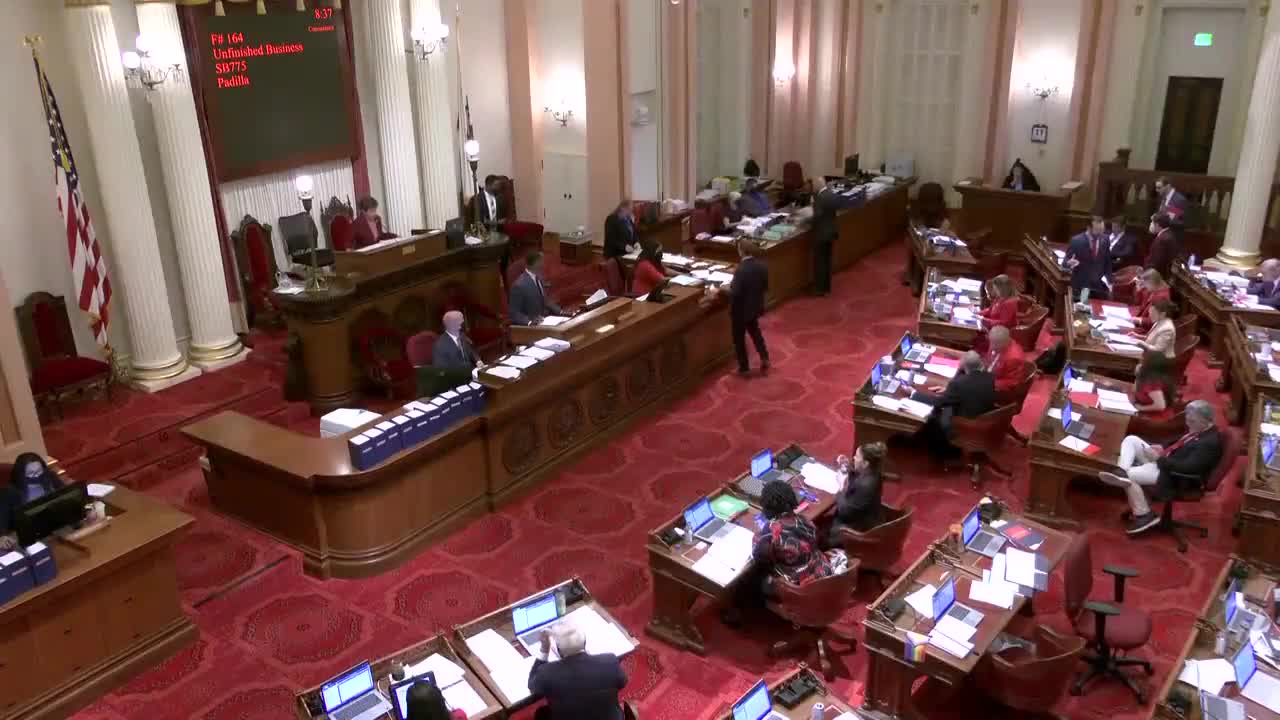

Bill Author

Bill Co-Author(s):