SB 485: Elections: election worker protections.
- Session Year: 2023-2024
- House: Senate
- Latest Version Date: 2023-10-08
Current Status:
Passed
(2023-10-08: Chaptered by Secretary of State. Chapter 611, Statutes of 2023.)
Introduced
In Committee
First Chamber
In Committee
Second Chamber
Enacted
Existing law makes interfering in any manner with the officers holding an election or conducting a canvass or with a voter lawfully exercising their right of voting at an election, in order to prevent the election or canvass from being fairly held and lawfully conducted, a crime punishable by imprisonment for 16 months or 2 or 3 years.
This bill would specify that for purposes of this crime, officers holding an election or conducting a canvass include, but are not limited to, the Secretary of State and their staff, in their performance of any of their duties related to administering the provisions of the Elections Code, an elections official and their staff, including temporary workers and poll workers, or a member of a precinct board, in their performance of any duty related to holding an election or conducting a canvass in order to prevent the election or canvass from being fairly held and lawfully conducted. The bill would clarify that holding an election or conducting a canvass for purposes of this crime includes the election observation process.
By expanding the scope of an existing crime, this bill would impose a state-mandated local program.
The California Constitution requires the state to reimburse local agencies and school districts for certain costs mandated by the state. Statutory provisions establish procedures for making that reimbursement.
This bill would provide that no reimbursement is required by this act for a specified reason.
Existing law makes interfering in any manner with the officers holding an election or conducting a canvass or with a voter lawfully exercising their right of voting at an election, in order to prevent the election or canvass from being fairly held and lawfully conducted, a crime punishable by imprisonment for 16 months or 2 or 3 years.
This bill would specify that for purposes of this crime, officers holding an election or conducting a canvass include, but are not limited to, the Secretary of State and their staff, in their performance of any of their duties related to administering the provisions of the Elections Code, an elections official or and their staff, including temporary workers, workers and poll workers, or a member of a precinct board, in their performance of any duty related to conducting holding an election or conducting a canvass in order to prevent the election or canvass from being fairly held and lawfully conducted. The bill would clarify that conducting holding an election or conducting a canvass for purposes of this crime includes the election observation process.
By expanding the scope of an existing crime, this bill would impose a state-mandated local program.
The California Constitution requires the state to reimburse local agencies and school districts for certain costs mandated by the state. Statutory provisions establish procedures for making that reimbursement.
This bill would provide that no reimbursement is required by this act for a specified reason.
Existing law makes interfering in any manner with the officers holding an election or conducting a canvass or with a voter lawfully exercising their right of voting at an election, in order to prevent the election or canvass from being fairly held and lawfully conducted, a crime punishable by imprisonment for 16 months or 2 or 3 years.
This bill would expand this crime to include interference with specify that for purposes of this crime, officers holding an election or conducting a canvass include, but are not limited to, the Secretary of State and their staff, in their performance of any of their duties related to administering the provisions of the Elections Code, an elections official or their staff, including temporary workers and volunteers, workers, or a member of a precinct board, in their performance of any duty related to conducting an election or canvass in order to prevent the election or canvass from being fairly held and lawfully conducted. The bill would clarify that conducting an election or canvass for purposes of this crime includes the election observation process.
By expanding the scope of an existing crime, this bill would impose a state-mandated local program.
The California Constitution requires the state to reimburse local agencies and school districts for certain costs mandated by the state. Statutory provisions establish procedures for making that reimbursement.
This bill would provide that no reimbursement is required by this act for a specified reason.
Existing law makes interfering in any manner with the officers holding an election or conducting a canvass or with a voter lawfully exercising their right of voting at an election, in order to prevent the election or canvass from being fairly held and lawfully conducted, a crime punishable by imprisonment for 16 months or 2 or 3 years.
This bill would expand that this crime to include interference with an elections official or their staff, including temporary workers and volunteers, or a member of a precinct board, in their performance of any duty related to conducting an election or canvass in order to prevent the election or canvass from being fairly held and lawfully conducted. The bill would clarify that conducting an election or canvass for purposes of this crime includes the election observation process.
The bill would also make it a crime punishable by imprisonment for 16 months or 2 or 3 years to use or threaten to use force, violence, or coercion or intimidation, or to hire or arrange for any other person to do so, to prevent or attempt to prevent an elections official, their staff, or a member of a precinct board from performing any duty related to conducting an election or canvass, or to prevent or attempt to prevent the Secretary of State or their staff from performing any of their election-related duties.The bill would clarify that these and related penal provisions in the Elections Code apply to the election observation process.By creating a new crime and expanding the scope of an existing crime, this bill would impose a state-mandated local program.
The California Constitution requires the state to reimburse local agencies and school districts for certain costs mandated by the state. Statutory provisions establish procedures for making that reimbursement.
This bill would provide that no reimbursement is required by this act for a specified reason.
Existing law makes interfering in any manner with the officers holding an election or conducting a canvass or with a voter lawfully exercising their right of voting at an election, in order to prevent the election or canvass from being fairly held and lawfully conducted, a crime punishable by imprisonment for 16 months or 2 or 3 years.
This bill would expand that crime to include interference with an elections official or their staff, including temporary workers and volunteers, or a member of a precinct board, in their performance of any duty related to conducting an election or canvass in order to prevent the election or canvass from being fairly held and lawfully conducted.
The bill would also make it a crime punishable by imprisonment for 16 months or 2 or 3 years to use or threaten to use force, violence, or coercion or intimidation, or to hire or arrange for any other person to do so, to prevent or attempt to prevent an elections official, their staff, or a member of a precinct board from performing any duty related to conducting an election or canvass, or to prevent or attempt to prevent the Secretary of State or their staff from performing any of their election-related duties.
The bill would clarify that these and related penal provisions in the Elections Code apply to the election observation process.
By creating a new crime and expanding the scope of an existing crime, this bill would impose a state-mandated local program.
The California Constitution requires the state to reimburse local agencies and school districts for certain costs mandated by the state. Statutory provisions establish procedures for making that reimbursement.
This bill would provide that no reimbursement is required by this act for a specified reason.
Existing law requires the State Air Resources Board to approve and begin implementing a comprehensive short-lived climate pollutant strategy, as specified, to achieve a reduction in the statewide emissions of methane by 40%, hydrofluorocarbon gases by 40%, and anthropogenic black carbon by 50% below 2013 levels by 2030. Existing law requires the state board, in consultation with the Department of Food and Agriculture, to adopt regulations to reduce methane emissions from livestock manure management operations and dairy manure management operations, consistent with the strategy, by up to 40% below the dairy sectors and livestock sectors 2013 levels by 2030.This bill would require, on or before August 1, 2026, the state board, in consultation with the Department of Food and Agriculture, to create a feed additive program to reduce emissions from dairy cattle, to be achieved through the use of voluntary incentives, if and when effective feed additives are demonstrated to be scientifically proven, cost effective, and safe. The bill would require the state board, in order to achieve that goal, to convene a workgroup to complete a comprehensive assessment of the potential impacts of feed additives on dairy cattle and to implement a voluntary incentives program consistent with the findings of the workgroup as set forth in the assessment.Existing law requires the State Air Resources Board to approve and begin implementing a comprehensive short-lived climate pollutant strategy, as specified, to achieve a reduction in the statewide emissions of methane by 40%, hydrofluorocarbon gases by 40%, and anthropogenic black carbon by 50% below 2013 levels by 2030. Existing law requires the state board, in consultation with the Department of Food and Agriculture, to adopt regulations to reduce methane emissions from livestock manure management operations and dairy manure management operations, consistent with the strategy, by up to 40% below the dairy sectors and livestock sectors 2013 levels by 2030.
This bill would require, on or before August 1, 2026, the state board, in consultation with the Department of Food and Agriculture, to create a feed additive program to reduce emissions, as specified. The bill would also require the state board, in consultation with the department, to provide the Legislature with a report, 2 years after a safe and effective feed additive is commercially available, as determined by the state board, about further funding and scientific research that is necessary to improve the incentive program, and to convene specified workgroups for related purposes, including a workgroup to provide a comprehensive assessment to the Legislature of the potential impacts of feed additives, as described, on or before August 1, 2026, among other duties. The bill would require the department to report to the Legislature on an outreach plan for potential applicants for voluntary incentive programs, as provided, and to provide technical assistance, upon request, to any organic or pasture-based dairies or small farm, as described, for any enteric fermentation program created, among other duties. The bill would allocate, upon appropriation by the Legislature in the annual Budget Act for these purposes, as specified, the sum of $10,000,000 to the state board for early research, development, and demonstration projects of enteric fermentation, after completion of the report to the Legislature regarding improving the incentive program. emissions from dairy cattle, to be achieved through the use of voluntary incentives, if and when effective feed additives are demonstrated to be scientifically proven, cost effective, and safe. The bill would require the state board, in order to achieve that goal, to convene a workgroup to complete a comprehensive assessment of the potential impacts of feed additives on dairy cattle and to implement a voluntary incentives program consistent with the findings of the workgroup as set forth in the assessment.
Existing law, the Cannella Environmental Farming Act of 1995, requires the Department of Food and Agriculture to establish and oversee an environmental farming program to provide incentives to farmers whose practices promote the well-being of ecosystems, air quality, and wildlife and their habitat. The act requires the Secretary of Food and Agriculture to convene a 9-member Scientific Advisory Panel on Environmental Farming for specified purposes, including to review data on the impact that agriculture has on the environment and recommend to the secretary and appropriate state agencies the best available science on environmental impacts of agriculture. Existing law specifies the qualifications of members of the panel and requires the Secretary for Environmental Protection to appoint 2 members of the panel.
This bill would expand the membership of the board to 10 members, including a 3rd member appointed by the Secretary for Environmental Protection member who would be required to have scientific research expertise in livestock emissions. The bill would also expand the scope of the duties of the panel by requiring the panel to oversee enteric fermentation emission reduction programs and to provide suggestions on which mitigation strategies for the enteric fermentation emissions reduction programs need to apply as new research is made available and approved, as specified. provide input to the department regarding specified programs and any new programs established by the department for enteric fermentation emission reduction.
Existing law requires the State Air Resources Board to approve and begin implementing a comprehensive short-lived climate pollutant strategy, as specified, to achieve a reduction in the statewide emissions of methane by 40%, hydrofluorocarbon gases by 40%, and anthropogenic black carbon by 50% below 2013 levels by 2030. Existing law requires the state board, in consultation with the Department of Food and Agriculture, to adopt regulations to reduce methane emissions from livestock manure management operations and dairy manure management operations, consistent with the strategy, by up to 40% below the dairy sectors and livestock sectors 2013 levels by 2030.
This bill would require, on or before June 1, 2025, August 1, 2026, the state board, in cooperation consultation with the Department of Food and Agriculture, to begin developing offset or inset compliance protocols to incentivize the use of livestock feed additives that reduce enteric fermentation. The bill would require the state board and the department to perform various duties relating to encouraging the use of feed additives that reduce enteric fermentation, as described. The bill would require the state board, in partnership with the department, to set an adoption target of feed additives through the year 2040. create a feed additive program to reduce emissions, as specified. The bill would also require the state board board, in consultation with the department, to provide the Legislature with a report, 2 years after an a safe and effective feed additive is commercially available, as determined by the state board, about further funding and scientific research that is necessary to improve compliance and accuracy of the offset the incentive program, and to convene a workgroup, as specified, specified workgroups for related purposes, including a workgroup to provide a comprehensive assessment to the Legislature of the potential impacts of feed additives, as described, on or before August 1, 2025, 2026, among other duties. The bill would require the department to report to the Legislature on an outreach plan for potential applicants for voluntary incentive programs, as provided, and to provide technical support to any small farms, as defined, that request technical support assistance, upon request, to any organic or pasture-based dairies or small farm, as described, for any enteric fermentation program created, among other duties. The bill would allocate, upon appropriation by the Legislature in the annual Budget Act for these purposes, as specified, the sum of $10,000,000 to the state board for early research, development, and demonstration projects of enteric fermentation. fermentation, after completion of the report to the Legislature regarding improving the incentive program.
Existing law, the Cannella Environmental Farming Act of 1995, requires the Department of Food and Agriculture to establish and oversee an environmental farming program to provide incentives to farmers whose practices promote the well-being of ecosystems, air quality, and wildlife and their habitat. The act requires the Secretary of Food and Agriculture to convene a 9-member Scientific Advisory Panel on Environmental Farming for specified purposes, including to review data on the impact that agriculture has on the environment and recommend to the secretary and appropriate state agencies the best available science on environmental impacts of agriculture. Existing law specifies the qualifications of members of the panel and requires the Secretary for Environmental Protection to appoint 2 members of the panel.
This bill would expand the membership of the board to 10 members, including a 3rd member appointed by the Secretary for Environmental Protection who would be required to have scientific research expertise in livestock emissions. The bill would also expand the scope of the duties of the panel by requiring the panel to oversee enteric fermentation emission reduction programs and to provide suggestions on which mitigation strategies for the enteric fermentation emissions reduction program programs need to apply as new research is made available and approved, as specified.
Existing law requires the State Air Resources Board to approve and begin implementing a comprehensive short-lived climate pollutant strategy, as specified, to achieve a reduction in the statewide emissions of methane by 40%, hydrofluorocarbon gases by 40%, and anthropogenic black carbon by 50% below 2013 levels by 2030. Existing law requires the state board, in consultation with the Department of Food and Agriculture Agriculture, to adopt regulations to reduce methane emissions from livestock manure management operations and dairy manure management operations, consistent with the strategy, by up to 40% below the dairy sectors and livestock sectors 2013 levels by 2030.
This bill would require, on or before June 1, 2025, the state board, in cooperation with the Department of Food and Agriculture, to develop and implement begin developing offset or inset compliance protocols to incentivize the use of livestock feed additives that reduce enteric fermentation. The bill would require the state board and the department to perform various duties relating to encouraging the use of feed additives that reduce enteric fermentation, as described. The bill would require the state board, in partnership with the department, to set an adoption target of feed additives through the year 2040. The bill would also require the state board to provide the Legislature with a report, 2 years after an effective feed additive is commercially available, as determined by the state board, about further funding and scientific research that is necessary to improve compliance and accuracy of the offset program, and to convene a workgroup, as specified, for related purposes, on or before August 1, 2025, among other duties. The bill would require the department to report to the Legislature on an outreach plan for potential applicants for voluntary incentive programs, as provided, and to provide technical assistance support to any small farms, as defined, that request technical support for any enteric fermentation program created, among other duties. The bill would allocate, upon appropriation by the Legislature in the annual Budget Act for these purposes, as specified, the sum of $10,000,000 to the state board for early research, development, and demonstration projects of enteric fermentation.
Existing law, the Cannella Environmental Farming Act of 1995, requires the Department of Food and Agriculture to establish and oversee an environmental farming program to provide incentives to farmers whose practices promote the well-being of ecosystems, air quality, and wildlife and their habitat. The act requires the Secretary of Food and Agriculture to convene a 9-member Scientific Advisory Panel on Environmental Farming for specified purposes, including to review data on the impact that agriculture has on the environment and recommend to the secretary and appropriate state agencies the best available science on environmental impacts of agriculture. Existing law specifies the qualifications of members of the panel and requires the Secretary for Environmental Protection to appoint 2 members of the panel.
This bill would expand the membership of the board to 10 members, including a 3rd member appointed by the Secretary for Environmental Protection who would be required to have scientific research expertise in livestock emissions. The bill would also expand the scope of the duties of the panel by requiring the panel to oversee enteric fermentation emission reduction programs and to provide suggestions on which mitigation strategies for the enteric fermentation emissions reduction program need to apply as new research is made available and approved, as specified.
Existing law requires the State Air Resources Board to approve and begin implementing a comprehensive short-lived climate pollutant strategy, as specified, to achieve a reduction in the statewide emissions of methane by 40%, hydrofluorocarbon gases by 40%, and anthropogenic black carbon by 50% below 2013 levels by 2030. Existing law requires the state board, in consultation with the Department of Food and Agriculture to adopt regulations to reduce methane emissions from livestock manure management operations and dairy manure management operations, consistent with the strategy, by up to 40% below the dairy sectors and livestock sectors 2013 levels by 2030.
This bill would require, on or before June 1, 2025, the state board, in cooperation with the Department of Food and Agriculture, to develop and implement offset or inset compliance protocols to incentivize the use of livestock feed additives that reduce enteric fermentation. The bill would require the state board and the department to perform various duties relating to encouraging the use of feed additives that reduce enteric fermentation, as described. The bill would require the state board, in partnership with the department, to set an adoption target of feed additives through the year 2040. The bill would also require the state board to provide the Legislature with a report, 2 years after an effective feed additive is commercially available, as determined by the state board, about further funding and scientific research that is necessary to improve compliance and accuracy of the offset program, and to convene a workgroup, as specified, for related purposes, on or before August 1, 2025, among other duties. The bill would require the department to report to the Legislature on an outreach plan for potential applicants for voluntary incentive programs, as provided, and to provide technical assistance to any small farms, as defined, for any enteric fermentation program created, among other duties. The bill would allocate, upon appropriation by the Legislature in the annual Budget Act for these purposes, as specified, the sum of $10,000,000 to the state board for early research, development, and demonstration projects of enteric fermentation.
Existing law requires the State Air Resources Board to approve and begin implementing a comprehensive short-lived climate pollutant strategy, as specified, to achieve a reduction in the statewide emissions of methane by 40%, hydrofluorocarbon gases by 40%, and anthropogenic black carbon by 50% below 2013 levels by 2030. Existing law requires the state board, in consultation with the Department of Food and Agriculture to adopt regulations to reduce methane emissions from livestock manure management operations and dairy manure management operations, consistent with the strategy, by up to 40% below the dairy sectors and livestock sectors 2013 levels by 2030.
This bill would require, on or before June 1, 2025, the state board, in cooperation with the Department of Food and Agriculture, to develop and implement offset or inset compliance protocols to incentivize the use of livestock feed additives that reduce enteric fermentation.
(a)Any person who in any manner interferes with the officers holding an election or conducting a canvass, as to prevent the election or canvass from being fairly held and lawfully conducted, or with the voters lawfully exercising their rights of voting at an election, is punishable by imprisonment pursuant to subdivision (h) of Section 1170 of the Penal Code for 16 months or two or three years.
(b)For purposes of this section, officers holding an election or conducting a canvass include, but are not limited to, the Secretary of State as the chief elections officer, and their staff, as it relates to performance of any of their duties related to administering the provisions of the Elections Code, and elections officials and their staff, including temporary workers and poll workers, and members of a precinct board, in their performance of any duty related to assisting with holding an election or conducting a canvass.
(c)For purposes of this section, holding an election or conducting a canvass includes, but is not limited to, the election observation process governed by the Elections Code and applicable regulations adopted by the Secretary of State.
(d)For purposes of this section, voting at an election includes, but is not limited to, voting in person at a polling place or at the office of the elections official, including satellite locations pursuant to Section 3018, and voting by mail and returning a voted ballot pursuant to subdivision (a) of Section 3017.
SEC. 2.Section 18540 of the Elections Code is amended to read:18540.(a)Every person who makes use of or threatens to make use of any force, violence, or tactic of coercion or intimidation, to induce or compel any other person to vote or refrain from voting at any election or to vote or refrain from voting for any particular person or measure at any election, or because any person voted or refrained from voting at any election or voted or refrained from voting for any particular person or measure at any election is guilty of a felony punishable by imprisonment pursuant to subdivision (h) of Section 1170 of the Penal Code for 16 months or two or three years.
(b)Every person who hires or arranges for any other person to make use of or threaten to make use of any force, violence, or tactic of coercion or intimidation, to induce or compel any other person to vote or refrain from voting at any election or to vote or refrain from voting for any particular person or measure at any election, or because any person voted or refrained from voting at any election or voted or refrained from voting for any particular person or measure at any election is guilty of a felony punishable by imprisonment pursuant to subdivision (h) of Section 1170 of the Penal Code for 16 months or two or three years.
(c)For purposes of this section, voting at any election includes, but is not limited to, voting in person at a polling place or at the office of the elections official, including satellite locations pursuant to Section 3018, and voting by mail and returning a voted ballot pursuant to subdivision (a) of Section 3017.
SEC. 3.No reimbursement is required by this act pursuant to Section 6 of Article XIIIB of the California Constitution because the only costs that may be incurred by a local agency or school district will be incurred because this act creates a new crime or infraction, eliminates a crime or infraction, or changes the penalty for a crime or infraction, within the meaning of Section 17556 of the Government Code, or changes the definition of a crime within the meaning of Section 6 of Article XIIIB of the California Constitution.
(a)Any person who in any manner interferes with the officers holding an election or conducting a canvass, or with the voters lawfully exercising their rights of voting at an election, as to prevent the election or canvass from being fairly held and lawfully conducted, or with the voters lawfully exercising their rights of voting at an election, is punishable by imprisonment pursuant to subdivision (h) of Section 1170 of the Penal Code for 16 months or two or three years.
(b)For purposes of this section, officers holding an election or conducting a canvass include, but are not limited to, the Secretary of State as the chief elections officer, and their staff, as it relates to performance of any of their duties related to administering the provisions of the Elections Code, and elections officials or and their staff, including temporary workers and volunteers, poll workers, and members of a precinct board, in their performance of any duty related to assisting with holding an election or conducting an election or a canvass.
(c)For purposes of this section, conducting holding an election or conducting a canvass includes, but is not limited to, the election observation process governed by this code the Elections Code and applicable regulations adopted by the Secretary of State.
(d)For purposes of this section, voting at an election includes, but is not limited to, voting in person at a polling place or at the office of the elections official, including satellite locations pursuant to Section 3018, and voting by mail and returning a voted ballot pursuant to subdivision (a) of Section 3017.
SEC. 2.Section 18540 of the Elections Code is amended to read:18540.(a)Every person who makes use of or threatens to make use of any force, violence, or tactic of coercion or intimidation, to induce or compel any other person to vote or refrain from voting at any election or to vote or refrain from voting for any particular person or measure at any election, or because any person voted or refrained from voting at any election or voted or refrained from voting for any particular person or measure at any election is guilty of a felony punishable by imprisonment pursuant to subdivision (h) of Section 1170 of the Penal Code for 16 months or two or three years.
(b)Every person who hires or arranges for any other person to make use of or threaten to make use of any force, violence, or tactic of coercion or intimidation, to induce or compel any other person to vote or refrain from voting at any election or to vote or refrain from voting for any particular person or measure at any election, or because any person voted or refrained from voting at any election or voted or refrained from voting for any particular person or measure at any election is guilty of a felony punishable by imprisonment pursuant to subdivision (h) of Section 1170 of the Penal Code for 16 months or two or three years.
(c)For purposes of this section, voting at any election includes, but is not limited to, voting in person at a polling place or at the office of the elections official, including satellite locations pursuant to Section 3018, and voting by mail and returning a voted ballot pursuant to subdivision (a) of Section 3017.
SEC. 3.No reimbursement is required by this act pursuant to Section 6 of Article XIIIB of the California Constitution because the only costs that may be incurred by a local agency or school district will be incurred because this act creates a new crime or infraction, eliminates a crime or infraction, or changes the penalty for a crime or infraction, within the meaning of Section 17556 of the Government Code, or changes the definition of a crime within the meaning of Section 6 of Article XIIIB of the California Constitution.
(a)Any person who in any manner interferes with any of the following the officers holding an election or conducting a canvass, or with the voters lawfully exercising their rights of voting at an election, as to prevent the election or canvass from being fairly held and lawfully conducted, is punishable by imprisonment pursuant to subdivision (h) of Section 1170 of the Penal Code for 16 months or two or three years: years.
(1)An elections official or their staff, including temporary workers and volunteers, in their performance of any duty related to conducting an election or canvass.(2)A member of a precinct board, in their performance of any duty related to assisting with conducting an election or canvass.(3)A voter lawfully exercising their rights of voting at an election.(b)For purposes of this section, officers holding an election or conducting a canvass include, but are not limited to, the Secretary of State as the chief elections officer, and their staff, as it relates to performance of any of their duties related to administering the provisions of the Elections Code, and elections officials or their staff, including temporary workers and volunteers, and members of a precinct board, in their performance of any duty related to assisting with conducting an election or canvass.
(b)(c)For purposes of this section, conducting an election or canvass includes includes, but is not limited to, the election observation process governed by this code and applicable regulations adopted by the Secretary of State.
(c)
(d)For purposes of this section, voting at an election includes includes, but is not limited to, voting in person at a polling place or at the office of the elections official, including satellite locations pursuant to Section 3018, and voting by mail and returning a voted ballot pursuant to subdivision (a) of Section 3017.
SEC. 2.Section 18540 of the Elections Code is amended to read:18540.(a)Every person who makes use of or threatens to make use of any force, violence, or tactic of coercion or intimidation, to induce or compel any other person to vote or refrain from voting at any election or to vote or refrain from voting for any particular person or measure at any election, or because any person voted or refrained from voting at any election or voted or refrained from voting for any particular person or measure at any election is guilty of a felony punishable by imprisonment pursuant to subdivision (h) of Section 1170 of the Penal Code for 16 months or two or three years.
(b)Every person who hires or arranges for any other person to make use of or threaten to make use of any force, violence, or tactic of coercion or intimidation, to induce or compel any other person to vote or refrain from voting at any election or to vote or refrain from voting for any particular person or measure at any election, or because any person voted or refrained from voting at any election or voted or refrained from voting for any particular person or measure at any election is guilty of a felony punishable by imprisonment pursuant to subdivision (h) of Section 1170 of the Penal Code for 16 months or two or three years.
(c)For purposes of this section, voting at any election includes includes, but is not limited to, voting in person at a polling place or at the office of the elections official, including satellite locations pursuant to Section 3018, and voting by mail and returning a voted ballot pursuant to subdivision (a) of Section 3017.
SEC. 3.No reimbursement is required by this act pursuant to Section 6 of Article XIIIB of the California Constitution because the only costs that may be incurred by a local agency or school district will be incurred because this act creates a new crime or infraction, eliminates a crime or infraction, or changes the penalty for a crime or infraction, within the meaning of Section 17556 of the Government Code, or changes the definition of a crime within the meaning of Section 6 of Article XIIIB of the California Constitution.
(a)Any person who in any manner interferes with any of the following as to prevent the election or canvass from being fairly held and lawfully conducted, is punishable by imprisonment pursuant to subdivision (h) of Section 1170 of the Penal Code for 16 months or two or three years:
(1)An elections official or their staff, including temporary workers and volunteers, in their performance of any duty related to conducting an election or canvass.
(2)A member of a precinct board, in their performance of any duty related to assisting with conducting an election or canvass.
(3)A voter lawfully exercising their rights of voting at an election.
(b)For purposes of this section, conducting an election or canvass includes the election observation process governed by this code and applicable regulations adopted by the Secretary of State.
(c)For purposes of this section, voting at an election includes voting in person at a polling place or at the office of the elections official, including satellite locations pursuant to Section 3018, and voting by mail and returning a voted ballot pursuant to subdivision (a) of Section 3017.
SEC. 2.Section 18502.5 is added to the Elections Code, to read:18502.5.(a)Every person who makes or hires or arranges for any other person to make use of or threatens to make use of any force, violence, or tactic of coercion or intimidation to prevent or attempt to prevent any of the following is guilty of a felony punishable by imprisonment pursuant to subdivision (h) of Section 1170 of the Penal Code for 16 months or two or three years:(1)An elections official or their staff, including temporary workers and volunteers, from performing any duty related to conducting an election or canvass.(2)A member of the precinct board from performing any duty related to assisting with conducting an election or canvass.(3)The Secretary of State as the chief elections officer, or their staff, from performing any duties related to administering the provisions of this code.(b)For purposes of this section, conducting an election or canvass includes the election observation process governed by this code and applicable regulations adopted by the Secretary of State.SEC. 3.SEC. 2.Section 18540 of the Elections Code is amended to read:18540.(a)Every person who makes use of or threatens to make use of any force, violence, or tactic of coercion or intimidation, to induce or compel any other person to vote or refrain from voting at any election or to vote or refrain from voting for any particular person or measure at any election, or because any person voted or refrained from voting at any election or voted or refrained from voting for any particular person or measure at any election is guilty of a felony punishable by imprisonment pursuant to subdivision (h) of Section 1170 of the Penal Code for 16 months or two or three years.
(b)Every person who hires or arranges for any other person to make use of or threaten to make use of any force, violence, or tactic of coercion or intimidation, to induce or compel any other person to vote or refrain from voting at any election or to vote or refrain from voting for any particular person or measure at any election, or because any person voted or refrained from voting at any election or voted or refrained from voting for any particular person or measure at any election is guilty of a felony punishable by imprisonment pursuant to subdivision (h) of Section 1170 of the Penal Code for 16 months or two or three years.
(c)For purposes of this section, voting at any election includes voting in person at a polling place or at the office of the elections official, including satellite locations pursuant to Section 3018, and voting by mail and returning a voted ballot pursuant to subdivision (a) of Section 3017.
SEC. 4.SEC. 3.No reimbursement is required by this act pursuant to Section 6 of Article XIIIB of the California Constitution because the only costs that may be incurred by a local agency or school district will be incurred because this act creates a new crime or infraction, eliminates a crime or infraction, or changes the penalty for a crime or infraction, within the meaning of Section 17556 of the Government Code, or changes the definition of a crime within the meaning of Section 6 of Article XIIIB of the California Constitution.
(a)Any person who in any manner interferes with the officers holding an election or conducting a canvass, or with the voters lawfully exercising their rights of voting at an election, any of the following as to prevent the election or canvass from being fairly held and lawfully conducted, is punishable by imprisonment pursuant to subdivision (h) of Section 1170 of the Penal Code for 16 months or two or three years. years:
(1)An elections official or their staff, including temporary workers and volunteers, in their performance of any duty related to conducting an election or canvass.
(2)A member of a precinct board, in their performance of any duty related to assisting with conducting an election or canvass.
(3)A voter lawfully exercising their rights of voting at an election.
(b)For purposes of this section, conducting an election or canvass includes the election observation process governed by this code and applicable regulations adopted by the Secretary of State.
(c)For purposes of this section, voting at an election includes voting in person at a polling place or at the office of the elections official, including satellite locations pursuant to Section 3018, and voting by mail and returning a voted ballot pursuant to subdivision (a) of Section 3017.
SEC. 2.Section 18502.5 is added to the Elections Code, to read:18502.5.(a)Every person who makes or hires or arranges for any other person to make use of or threatens to make use of any force, violence, or tactic of coercion or intimidation to prevent or attempt to prevent any of the following is guilty of a felony punishable by imprisonment pursuant to subdivision (h) of Section 1170 of the Penal Code for 16 months or two or three years:
(1)An elections official or their staff, including temporary workers and volunteers, from performing any duty related to conducting an election or canvass.
(2)A member of the precinct board from performing any duty related to assisting with conducting an election or canvass.
(3)The Secretary of State as the chief elections officer, or their staff, from performing any duties related to administering the provisions of this code.
(b)For purposes of this section, conducting an election or canvass includes the election observation process governed by this code and applicable regulations adopted by the Secretary of State.
SEC. 3.Section 18540 of the Elections Code is amended to read:18540.(a)Every person who makes use of or threatens to make use of any force, violence, or tactic of coercion or intimidation, to induce or compel any other person to vote or refrain from voting at any election or to vote or refrain from voting for any particular person or measure at any election, or because any person voted or refrained from voting at any election or voted or refrained from voting for any particular person or measure at any election is guilty of a felony punishable by imprisonment pursuant to subdivision (h) of Section 1170 of the Penal Code for 16 months or two or three years.
(b)Every person who hires or arranges for any other person to make use of or threaten to make use of any force, violence, or tactic of coercion or intimidation, to induce or compel any other person to vote or refrain from voting at any election or to vote or refrain from voting for any particular person or measure at any election, or because any person voted or refrained from voting at any election or voted or refrained from voting for any particular person or measure at any election is guilty of a felony punishable by imprisonment pursuant to subdivision (h) of Section 1170 of the Penal Code for 16 months or two or three years.
(c)For purposes of this section, voting at any election includes voting in person at a polling place or at the office of the elections official, including satellite locations pursuant to Section 3018, and voting by mail and returning a voted ballot pursuant to subdivision (a) of Section 3017.
SEC. 4.No reimbursement is required by this act pursuant to Section 6 of Article XIIIB of the California Constitution because the only costs that may be incurred by a local agency or school district will be incurred because this act creates a new crime or infraction, eliminates a crime or infraction, or changes the penalty for a crime or infraction, within the meaning of Section 17556 of the Government Code, or changes the definition of a crime within the meaning of Section 6 of Article XIIIB of the California Constitution.
SECTION 1.It is the intent of the Legislature to do all of the following:(a)Provide incentives for scientifically effective, safe, and economic feed additives that reduce methane emissions from enteric fermentation in dairy cattle.(b)Signal to investors and manufacturers Californias interest and support for scientifically sound feed additives that can reduce methane in dairy cattle.(c)Recognize the need for more accurate and available research on enteric fermentation solutions for the timely approval of dairy cattle feed additives that require safety approval from federal and state agencies.(d)Recognize the Department of Food and Agricultures and the United States Food and Drug Administrations existing efforts to support expedited approval methods for dairy cattle feed additives, and encourage further partnership that also ensures no harm to public health, animal health, and environmental health.SEC. 2.Section 39730.7.5 is added to the Health and Safety Code, to read:39730.7.5.(a)On or before August 1, 2026, the state board shall, in consultation with the Department of Food and Agriculture, create a feed additive program to reduce emissions from dairy cattle, which shall be achieved through the use of voluntary incentives, if and when effective feed additives are demonstrated to be scientifically proven, cost effective, and safe.(b)In order to achieve the goal described in subdivision (a), the state board shall do both of the following:(1)Convene a workgroup to complete a comprehensive assessment of the potential impacts of feed additives on dairy cattle.(2)Implement a voluntary incentives program consistent with the findings of the workgroup as set forth in the assessment described in paragraph (1).(c)This section does not limit the provisions of Section 39730.7.It is the intent of the Legislature to do all of the following:
(a)Provide incentives for scientifically effective, safe, and economic feed additives that reduce methane emissions from enteric fermentation in dairy cattle.
(b)Signal to investors and manufacturers Californias interest and support for scientifically sound feed additives that can reduce methane in dairy cattle.
(c)Recognize the need for more accurate and available research on enteric fermentation solutions for the timely approval of dairy cattle feed additives that require safety approval from federal and state agencies.
(d)Recognize the Department of Food and Agricultures and the United States Food and Drug Administrations existing efforts to support expedited approval methods for dairy cattle feed additives, and encourage further partnership that also ensures no harm to public health, animal health, and environmental health.
SEC. 2.Section 39730.7.5 is added to the Health and Safety Code, to read:39730.7.5.(a)On or before August 1, 2026, the state board shall, in consultation with the Department of Food and Agriculture, create a feed additive program to reduce emissions from dairy cattle, which shall be achieved through the use of voluntary incentives, if and when effective feed additives are demonstrated to be scientifically proven, cost effective, and safe.
(b)In order to achieve the goal described in subdivision (a), the state board shall do both of the following:
(1)Convene a workgroup to complete a comprehensive assessment of the potential impacts of feed additives on dairy cattle.
(2)Implement a voluntary incentives program consistent with the findings of the workgroup as set forth in the assessment described in paragraph (1).
(c)This section does not limit the provisions of Section 39730.7.
All matter omitted in this version of the bill appears in the bill as amended in the Senate, April 19, 2023. (JR11)It is the intent of the Legislature to do all of the following:
(a)Provide incentives for scientifically effective, safe, and economic feed additives that reduce methane emissions from enteric fermentation in livestock.
(b)Signal to investors and manufacturers Californias interest and support for scientifically sound feed additives that can reduce methane in livestock.
(c)Recognize the need for more accurate and available research on enteric fermentation solutions for the quicker timely approval of livestock feed additives that require safety approval from federal and state agencies.
(d)Recognize the Department of Food and Agricultures and the U.S. United States Food and Drug Administrations existing efforts to support expedited approval methods for dairy feed additives, and encourage further partnership that also ensures no harm to the public or the environment. public health, animal health, and environmental health.
(e)Recognize that the State Air Resources Boards March 2022 Analysis of Progress toward Achieving the 2030 Dairy and Livestock Sector Methane Emissions Target finds viable enteric fermentation feed additives to be a viable supportive solution to meeting the targets of Section 39730.5 of the Health and Safety Code, and all of the following:(1)To fully achieve the 2030 target, California must maintain an annual appropriation of seventy-five million dollars ($75,000,000) toward manure management and mitigation projects through 2028, and must maintain the same level of natural gas pipeline build-out.(2)Dairy and livestock sectors may fall short of the 2030 target without an enteric strategy and sufficient public funding.(3)A feed strategy is likely to be available in the next three to five years, inclusive, which can help achieve the 2030 target.SEC. 2.Section 568 of the Food and Agricultural Code is amended to read:568.(a)The secretary shall convene a 10-member Scientific Advisory Panel on Environmental Farming to advise the secretary on the implementation of the Healthy Soils Program established pursuant to Section 569, and the State Water Efficiency and Enhancement Program established by the department from moneys made available pursuant to Chapter 2 of the Statutes of 2014, and to assist federal, state, and local government agencies, as appropriate or necessary, on issues relating to the impact of agricultural practices on air, water, and wildlife habitat to do the following:
(1)Review data on the impact that agriculture has on the environment and recommend to the secretary and appropriate state agencies the best available science on environmental impacts of agriculture, as well as practices and policies based on that information to advance the goals of this article, including Section 569.
(2)Compile the net environmental impacts that agriculture creates for the environment, identified pursuant to paragraph (1).
(3)Research, review, and comment on data upon which proposed environmental policies and regulatory programs are based to ensure that the environmental impacts of agricultural activities are accurately portrayed and to identify incentives that may be provided to encourage agricultural practices with environmental benefits.
(4)Assist government agencies to incorporate policies and practices identified pursuant to paragraph (1) into environmental regulatory programs.
(5)Oversee the departments Provide input to the department regarding the Alternative Manure Management Program and the Dairy Digester Research and Development Program, and any new programs established by the department for enteric fermentation emission reduction.
(6)Provide suggestions on which mitigation strategies for the enteric fermentation emissions reduction programs need to apply as new research is made available and approved by the U.S. Food and Drug Administration.(b)(1) Members of the panel shall be highly qualified and professionally active or engaged in the conduct of scientific research. Of the members first appointed to the panel, two shall serve for a term of two years and three shall serve for a term of three years, as determined by lot. Thereafter, members shall be appointed for a term of three years. The members shall be appointed as follows:
(A)Five Six members shall be appointed by the secretary as follows:
(i)At least two members shall have a minimum of five years of training and experience in the field of agriculture and shall represent production agriculture.
(ii)At least one member shall have training and field experience in on-farm management practices that reduce greenhouse gas emissions, sequester carbon, or both.
(iii)At least one member shall be certified as a producer pursuant to federal Organic Foods Production Act of 1990 (7 U.S.C. Sec. 6501 et seq.).
(iv)At least one member shall have technical expertise in agricultural conservation planning and management.
(v)At least one member with scientific research expertise in livestock emissions.
(B)Three Two members shall be appointed by the Secretary for Environmental Protection. One shall have a minimum of five years of training and experience in the field of human health or environmental science, science and one shall have expertise in greenhouse gas emissions reductions practices related to agriculture, and one shall have scientific research expertise in livestock emissions. agriculture.
(C)Two members who have a minimum of five years of training and experience in the field of resource management shall be appointed by the Secretary of the Natural Resources Agency. One member shall additionally have expertise in climate change adaptation and climate change impacts in the agricultural sector.
(2)The secretary may also appoint, in consultation with the panel, ex officio nonvoting members to the panel.
(c)The panel may establish ad hoc committees, which may include professionals, scientists, or representatives of nongovernmental entities, to assist it in performing its functions.
(d)The panel shall be created and maintained with funds made available from existing resources within the department to the extent they are available.
(e)The State Air Resources Board shall consult with the secretary and the panel, as appropriate, in developing the quantification methods described in subdivision (b) of Section 16428.9 of the Government Code as it relates to the demonstration and quantification of on-farm greenhouse gas emissions reductions.
SEC. 3.Section 39730.7.5 is added to the Health and Safety Code, to read:39730.7.5.(a)On or before June 1, 2025, the state board, in cooperation August 1, 2026, the state board shall, in consultation with the Department of Food and Agriculture, shall begin developing offset or inset compliance protocols to incentivize the use of livestock feed additives that reduce enteric fermentation. create a feed additive program to reduce emissions, which shall be achieved through the use of voluntary incentives, if and when effective feed additives are demonstrated to be scientifically proven, cost effective, and safe.
(b)(1)The state board shall, in partnership with the Department of Food and Agriculture, set an adoption target of feed additives through the year 2040, which may be achieved through the use of voluntary incentives, if and when effective feed additives are demonstrated to be scientifically proven, cost effective, and safe.(2)(b)In order to achieve the goal described in paragraph (1), subdivision (a), the state board shall do all of the following:
(A)Determine a baseline enteric fermentation rate for livestock based on age, lactation state, cattle type, and feed type to be used in determining the enteric emission rate for individual dairy operations.(1)Annually review new methods, technologies, and processes that are proven to reduce enteric methane from livestock and, once demonstrated to be scientifically proven, cost effective, and safe, incentivize those new processes under this program.
(B)(2)Provide the Legislature with a report, two years after an a safe and effective feed additive is commercially available, as determined by the state board, board in consultation with the Department of Food and Agriculture, about further funding and scientific research that is necessary to improve compliance and accuracy of the offset the incentive program, as well as alternative long-term solutions to scaling adoption among livestock farmers. The report shall be submitted in compliance with Section 9795 of the Government Code.
(C)(3)Convene a workgroup on repurposing existing data from other government agencies and entities that are helpful to improve emissions data assumptions regarding enteric fermentation on or before August 1, 2025. 2026.
(i)(A)The workgroup shall include a representative of the Central Valley Regional Water Quality Control Board, the United States Department of Agriculture, if available, the San Joaquin Valley Air Pollution Control District, the State Water Resources Control Board, and any other relevant agencies.
(B)The state board shall invite representatives of large farms, small farms, organic farms, and pasture-based farmers to participate in the workgroup.
(4)Convene a workgroup to provide a comprehensive assessment to the Legislature, in accordance with Section 9795 of the Government Code, of the potential impacts of feed additives on the long-term health of dairy cattle and other livestock, dairy and other livestock products, consumer acceptance, dairy and other livestock economics, microbial activities in manure, condition of manure applied to croplands, and plant growth and health on or before August 1, 2026. The workgroup shall include a broad range of stakeholders involved in the development of dairy and other livestock enteric reductions strategies, including, but not limited to, project developers, dairy and livestock industry representatives, organic and pasture-based dairy and livestock producers, environmental and conservation stakeholders, state and local permitting agencies, large animal clinics, dairy and livestock practices veterinary practitioners, public health experts, and others with demonstrated expertise relevant to the success of diary and other livestock methane emissions reduction efforts.
(ii)The state board shall make(5)Make publicly available on the state boards internet website or through other means information about further data that is needed to improve the quality of emissions data.
(D)Develop a needs assessment for long-term enteric fermentation reduction planning.(3)(c)In order to achieve the goal described in paragraph (1), subdivision (a), the Department of Food and Agriculture shall do all both of the following:
(A)(1)Report to the Legislature on an outreach plan for potential applicants for voluntary incentive programs and include an estimate of funding necessary for third-party or department outreach efforts. The report shall be submitted in compliance with Section 9795 of the Government Code.
(B)When low-emission dairy products using enteric fermentation feed additives become commercially available, establish a public awareness campaign to encourage early adoption and purchasing of those products.(C)Develop a needs assessment for long-term enteric fermentation reduction planning.(D)(2)Provide technical support to any small farms that request it assistance, upon request, to any organic or pasture-based dairies or small farm for any enteric fermentation program created. For purposes of this subparagraph, paragraph, a small farm is a farm with 1,500 milking cows or fewer livestock.
(c)(d)Upon appropriation by the Legislature in the annual Budget Act or another statute for the purposes described in paragraph (2) of subdivision (b), the sum of ten million dollars ($10,000,000) is hereby allocated to the state board for early research, development, and demonstration projects of enteric fermentation. fermentation, after the completion of the report described in paragraph (2) of subdivision (b).
It is the intent of the Legislature to do all of the following:
(a)Provide incentives for scientifically effective, safe, and economic feed additives that reduce methane emissions from enteric fermentation in livestock.
(b)Signal to investors and manufacturers Californias interest and support for scientifically sound feed additives that can reduce methane in livestock.
(c)Recognize the need for more accurate and available research on enteric fermentation solutions for the quicker approval of livestock feed additives that require safety approval from federal and state agencies.
(d)Recognize the Department of Food and Agricultures and the U.S. Food and Drug Administrations existing efforts to support expedited approval methods for dairy feed additives, and encourage further partnership that also ensures no harm to the public or environmental harm. the environment.
(e)Recognize that the State Air Resources Boards March 2022 Analysis of Progress toward Achieving the 2030 Dairy and Livestock Sector Methane Emissions Target finds viable enteric fermentation feed additives to be a viable supportive solution to meeting the targets of Section 39730.5 of the Health and Safety Code, and all of the following:
(1)To fully achieve the 2030 target, California must maintain an annual appropriation of seventy-five million dollars ($75,000,000) toward manure management and mitigation projects through 2028, and must maintain the same level of natural gas pipeline build-out.
(2)Dairy and livestock sectors may fall short of the 2030 target without an enteric strategy and sufficient public funding.
(3)A feed strategy is likely to be available in the next three to five years, inclusive, which can help achieve the 2030 target.
SEC. 2.Section 568 of the Food and Agricultural Code is amended to read:568.(a)The secretary shall convene a 10-member Scientific Advisory Panel on Environmental Farming to advise the secretary on the implementation of the Healthy Soils Program established pursuant to Section 569, and the State Water Efficiency and Enhancement Program established by the department from moneys made available pursuant to Chapter 2 of the Statutes of 2014, and to assist federal, state, and local government agencies, as appropriate or necessary, on issues relating to the impact of agricultural practices on air, water, and wildlife habitat to do the following:
(1)Review data on the impact that agriculture has on the environment and recommend to the secretary and appropriate state agencies the best available science on environmental impacts of agriculture, as well as practices and policies based on that information to advance the goals of this article, including Section 569.
(2)Compile the net environmental impacts that agriculture creates for the environment, identified pursuant to paragraph (1).
(3)Research, review, and comment on data upon which proposed environmental policies and regulatory programs are based to ensure that the environmental impacts of agricultural activities are accurately portrayed and to identify incentives that may be provided to encourage agricultural practices with environmental benefits.
(4)Assist government agencies to incorporate policies and practices identified pursuant to paragraph (1) into environmental regulatory programs.
(5)Oversee the departments Alternative Manure Management Program and Dairy Digester Research and Development Program, and any new programs established by the department for enteric fermentation emission reduction.
(6)Provide suggestions on which mitigation strategies for the enteric fermentation emissions reduction program programs need to apply as new research is made available and approved by the U.S. Food and Drug Administration.
(b)(1) Members of the panel shall be highly qualified and professionally active or engaged in the conduct of scientific research. Of the members first appointed to the panel, two shall serve for a term of two years and three shall serve for a term of three years, as determined by lot. Thereafter, members shall be appointed for a term of three years. The members shall be appointed as follows:
(A)Five members shall be appointed by the secretary as follows:
(i)At least two members shall have a minimum of five years of training and experience in the field of agriculture and shall represent production agriculture.
(ii)At least one member shall have training and field experience in on-farm management practices that reduce greenhouse gas emissions, sequester carbon, or both.
(iii)At least one member shall be certified as a producer pursuant to federal Organic Foods Production Act of 1990 (7 U.S.C. Sec. 6501 et seq.).
(iv)At least one member shall have technical expertise in agricultural conservation planning and management.
(B)Three members shall be appointed by the Secretary for Environmental Protection. One shall have a minimum of five years of training and experience in the field of human health or environmental science, one shall have expertise in greenhouse gas emissions reductions practices related to agriculture, and one shall have scientific research expertise in livestock emissions.
(C)Two members who have a minimum of five years of training and experience in the field of resource management shall be appointed by the Secretary of the Natural Resources Agency. One member shall additionally have expertise in climate change adaptation and climate change impacts in the agricultural sector.
(2)The secretary may also appoint, in consultation with the panel, ex officio nonvoting members to the panel.
(c)The panel may establish ad hoc committees, which may include professionals, scientists, or representatives of nongovernmental entities, to assist it in performing its functions.
(d)The panel shall be created and maintained with funds made available from existing resources within the department to the extent they are available.
(e)The State Air Resources Board shall consult with the secretary and the panel, as appropriate, in developing the quantification methods described in subdivision (b) of Section 16428.9 of the Government Code as it relates to the demonstration and quantification of on-farm greenhouse gas emissions reductions.
SEC. 3.Section 39730.7.5 is added to the Health and Safety Code, to read:39730.7.5.(a)On or before June 1, 2025, the state board, in cooperation with the Department of Food and Agriculture, shall develop and implement begin developing offset or inset compliance protocols to incentivize the use of livestock feed additives that reduce enteric fermentation.
(b)(1)The state board shall, in partnership with the Department of Food and Agriculture, set an adoption target of feed additives through the year 2040, which may be achieved through the use of voluntary incentives, if and when effective feed additives are demonstrated to be scientifically proven, cost effective, and safe.
(2)In order to achieve the goal described in paragraph (1), the state board shall do all of the following:
(A)Begin examining an offset compliance protocol to cover the cost difference for feed additives that reduce enteric fermentation when the state board determines that those feed additives are commercially available.(B)(A)Determine a baseline enteric fermentation rate for livestock based on age, lactation state, cattle type, and feed type to be used in determining the enteric emission rate for individual dairy operations.
(C)(B)Provide the Legislature with a report, two years after an effective feed additive is commercially available, as determined by the state board, about further funding and scientific research that is necessary to improve compliance and accuracy of the offset program, as well as alternative long-term solutions to scaling adoption among livestock farmers. The report shall be submitted in compliance with Section 9795 of the Government Code.
(D)(C)Convene a workgroup on repurposing existing data from other government agencies and entities that are helpful to improve emissions data assumptions regarding enteric fermentation on or before August 1, 2025.
(i)The workgroup shall include a representative of the Central Valley Regional Water Quality Control Board, the United States Department of Agriculture, if available, the San Joaquin Valley Air Pollution Control District, the State Water Resources Control Board, and any other relevant agencies.
(ii)The state board shall make publicly available on the state boards internet website or through other means information about further data that is needed to improve the quality of emissions data.
(E)(D)Develop a needs assessment for long-term enteric fermentation reduction planning.
(3)In order to achieve the goal described in paragraph (1), the Department of Food and Agriculture shall do all of the following:
(A)Report to the Legislature on an outreach plan for potential applicants for voluntary incentive programs and include an estimate of funding necessary for third-party or department outreach efforts. The report shall be submitted in compliance with Section 9795 of the Government Code.
(B)When low-emission dairy products using enteric fermentation feed additives become commercially available, establish a public awareness campaign to encourage early adoption and purchasing of those products.
(C)Develop a needs assessment for long-term enteric fermentation reduction planning.
(D)Provide technical assistance support to any small farms that request it for any enteric fermentation program created. For purposes of this clause, subparagraph, a small farm is a farm with 1,500 or fewer livestock.
(c)Upon appropriation by the Legislature in the annual Budget Act or another statute for the purposes described in paragraph (2) of subdivision (b), the sum of ten million dollars ($10,000,000) is hereby allocated to the state board for early research, development, and demonstration projects of enteric fermentation.
It is the intent of the Legislature to do all of the following:
(a)Provide incentives for scientifically effective, safe, and economic feed additives that reduce methane emissions from enteric fermentation in livestock.
(b)Signal to investors and manufacturers Californias interest and support for scientifically sound feed additives that can reduce methane in livestock.
(c)Recognize the need for more accurate and available research on enteric fermentation solutions for the quicker approval of livestock feed additives that require safety approval from federal and state agencies.
(d)Recognize Department of Food and Agricultures and the U.S. Food and Drug Administrations existing efforts to support expedited approval methods for dairy feed additives, and encourage further partnership that also ensures no harm to public or environmental harm.
(e)Recognize that the State Air Resources Boards March 2022 Analysis of Progress toward Achieving the 2030 Dairy and Livestock Sector Methane Emissions Target finds viable enteric fermentation feed additives to be a viable supportive solution to meeting the targets of Section 39730.5 of the Health and Safety Code, and all of the following:
(1)To fully achieve the 2030 target, California must maintain an annual appropriation of seventy-five million dollars ($75,000,000) toward manure management and mitigation projects through 2028, and must maintain the same level of natural gas pipeline build-out.
(2)Dairy and livestock sectors may fall short of the 2030 target without an enteric strategy and sufficient public funding.
(3)A feed strategy is likely to be available in the next three to five years, inclusive, which can help achieve the 2030 target.
SEC. 2.Section 568 of the Food and Agricultural Code is amended to read:568.(a)The secretary shall convene a nine-member 10-member Scientific Advisory Panel on Environmental Farming to advise the secretary on the implementation of the Healthy Soils Program established pursuant to Section 569, and the State Water Efficiency and Enhancement Program established by the department from moneys made available pursuant to Chapter 2 of the Statutes of 2014, and to assist federal, state, and local government agencies, as appropriate or necessary, on issues relating to the impact of agricultural practices on air, water, and wildlife habitat to do the following:
(1)Review data on the impact that agriculture has on the environment and recommend to the secretary and appropriate state agencies the best available science on environmental impacts of agriculture, as well as practices and policies based on that information to advance the goals of this article, including Section 569.
(2)Compile the net environmental impacts that agriculture creates for the environment, identified pursuant to paragraph (1).
(3)Research, review, and comment on data upon which proposed environmental policies and regulatory programs are based to ensure that the environmental impacts of agricultural activities are accurately portrayed and to identify incentives that may be provided to encourage agricultural practices with environmental benefits.
(4)Assist government agencies to incorporate policies and practices identified pursuant to paragraph (1) into environmental regulatory programs.
(5)Oversee the departments Alternative Manure Management Program and Dairy Digester Research and Development Program, and any new programs established by the department for enteric fermentation emission reduction.
(6)Provide suggestions on which mitigation strategies for the enteric fermentation emissions reduction program need to apply as new research is made available and approved by the U.S. Food and Drug Administration.
(b)(1) Members of the panel shall be highly qualified and professionally active or engaged in the conduct of scientific research. Of the members first appointed to the panel, two shall serve for a term of two years and three shall serve for a term of three years, as determined by lot. Thereafter, members shall be appointed for a term of three years. The members shall be appointed as follows:
(A)Five members shall be appointed by the secretary as follows:
(i)At least two members shall have a minimum of five years of training and experience in the field of agriculture and shall represent production agriculture.
(ii)At least one member shall have training and field experience in on-farm management practices that reduce greenhouse gas emissions, sequester carbon, or both.
(iii)At least one member shall be certified as a producer pursuant to federal Organic Foods Production Act of 1990 (7 U.S.C. Sec. 6501 et seq.).
(iv)At least one member shall have technical expertise in agricultural conservation planning and management.
(B)Two Three members shall be appointed by the Secretary for Environmental Protection. One shall have a minimum of five years of training and experience in the field of human health or environmental science, and one shall have expertise in greenhouse gas emissions reductions practices related to agriculture. agriculture, and one shall have scientific research expertise in livestock emissions.
(C)Two members who have a minimum of five years of training and experience in the field of resource management shall be appointed by the Secretary of the Natural Resources Agency. One member shall additionally have expertise in climate change adaptation and climate change impacts in the agricultural sector.
(2)The secretary may also appoint, in consultation with the panel, ex officio nonvoting members to the panel.
(c)The panel may establish ad hoc committees, which may include professionals, scientists, or representatives of nongovernmental entities, to assist it in performing its functions.
(d)The panel shall be created and maintained with funds made available from existing resources within the department to the extent they are available.
(e)The State Air Resources Board shall consult with the secretary and the panel, as appropriate, in developing the quantification methods described in subdivision (b) of Section 16428.9 of the Government Code as it relates to the demonstration and quantification of on-farm greenhouse gas emissions reductions.
SECTION 1.SEC. 3.Section 39730.7.5 is added to the Health and Safety Code, to read:39730.7.5.(a)On or before June 1, 2025, the state board, in cooperation with the Department of Food and Agriculture, shall develop and implement offset or inset compliance protocols to incentivize the use of livestock feed additives that reduce enteric fermentation.
(b)(1)The state board shall, in partnership with the Department of Food and Agriculture, set an adoption target of feed additives through the year 2040, which may be achieved through the use of voluntary incentives, if and when effective feed additives are demonstrated to be scientifically proven, cost effective, and safe.
(2)In order to achieve the goal described in paragraph (1), the state board shall do all of the following:
(A)Begin examining an offset compliance protocol to cover the cost difference for feed additives that reduce enteric fermentation when the state board determines that those feed additives are commercially available.
(B)Determine a baseline enteric fermentation rate for livestock based on age, lactation state, cattle type, and feed type to be used in determining enteric emission rate for individual dairy operations.
(C)Provide the Legislature with a report, two years after an effective feed additive is commercially available, as determined by the state board, about further funding and scientific research that is necessary to improve compliance and accuracy of the offset program, as well as alternative long-term solutions to scaling adoption among livestock farmers. The report shall be submitted in compliance with Section 9795 of the Government Code.
(D)Convene a workgroup on repurposing existing data from other government agencies and entities that are helpful to improve emissions data assumptions regarding enteric fermentation on or before August 1, 2025.
(i)The workgroup shall include a representative of the Central Valley Regional Water Quality Control Board, the United States Department of Agriculture, if available, the San Joaquin Valley Air Pollution Control District, the State Water Resources Control Board, and any other relevant agencies.
(ii)The state board shall make publicly available on the state boards internet website or through other means information about further data that is needed to improve the quality of emissions data.
(E)Develop a needs assessment for long-term enteric fermentation reduction planning.
(3)In order to achieve the goal described in paragraph (1), the Department of Food and Agriculture shall do all of the following:
(A)Report to the Legislature on an outreach plan for potential applicants for voluntary incentive programs and include an estimate of funding necessary for third-party or department outreach efforts. The report shall be submitted in compliance with Section 9795 of the Government Code.
(B)When low-emission dairy products using enteric fermentation feed additives become commercially available, establish a public awareness campaign to encourage early adoption and purchasing of those products.
(C)Develop a needs assessment for long-term enteric fermentation reduction planning.
(D)Provide technical assistance to any small farms for any enteric fermentation program created. For purposes of this clause, a small farm is a farm with 1,500 or fewer livestock.
(c)Upon appropriation by the Legislature in the annual Budget Act or another statute for the purposes described in paragraph (2) of subdivision (b), the sum of ten million dollars ($10,000,000) is hereby allocated to the state board for early research, development, and demonstration projects of enteric fermentation.
On or before June 1, 2025, the state board, in cooperation with the Department of Food and Agriculture, shall develop and implement offset or inset compliance protocols to incentivize the use of livestock feed additives that reduce enteric fermentation.
|
Date
|
Status
|
|---|---|
| Oct 8, 2023 | Chaptered by Secretary of State. Chapter 611, Statutes of 2023. |
| Oct 8, 2023 | Approved by the Governor. |
| Sep 21, 2023 | Enrolled and presented to the Governor at 4 p.m. |
| Sep 14, 2023 | Assembly amendments concurred in. (Ayes 33. Noes 7. Page 2838.) Ordered to engrossing and enrolling. |
| Sep 13, 2023 | From committee: That the Assembly amendments be concurred in. (Ayes 5. Noes 1. Page 2770.) |
| Sep 12, 2023 | From committee: Be re-referred to Com. on E. & C.A. pursuant to Senate Rule 29.10(d). (Ayes 4. Noes 0. Page 2683.) Re-referred to Com. on E. & C.A. |
| Sep 12, 2023 | Re-referred to Com. on RLS pursuant to Senate Rule 29.10(d). |
| Sep 12, 2023 | In Senate. Concurrence in Assembly amendments pending. |
| Sep 12, 2023 | Read third time. Passed. (Ayes 63. Noes 10. Page 3289.) Ordered to the Senate. |
| Sep 5, 2023 | Read second time. Ordered to third reading. |
| Sep 1, 2023 | Read second time and amended. Ordered to second reading. |
| Sep 1, 2023 | From committee: Do pass as amended. (Ayes 11. Noes 3.) (September 1). |
| Aug 23, 2023 | August 23 set for first hearing. Placed on suspense file. |
| Aug 14, 2023 | Read second time and amended. Re-referred to Com. on APPR. |
| Jul 13, 2023 | From committee: Do pass as amended and re-refer to Com. on APPR. (Ayes 6. Noes 1.) (July 11). |
| Jul 6, 2023 | From committee with author's amendments. Read second time and amended. Re-referred to Com. on PUB. S. |
| Jul 6, 2023 | From committee: Do pass and re-refer to Com. on PUB. S. (Ayes 6. Noes 0.) (July 5). Re-referred to Com. on PUB. S. |
| Jun 22, 2023 | From committee with author's amendments. Read second time and amended. Re-referred to Com. on ELECTIONS. |
| Jun 22, 2023 | Referred to Coms. on ELECTIONS and PUB. S. |
| May 31, 2023 | In Assembly. Read first time. Held at Desk. |
| May 30, 2023 | Read third time. Passed. (Ayes 38. Noes 0. Page 1346.) Ordered to the Assembly. |
| May 18, 2023 | Read second time. Ordered to third reading. |
| May 18, 2023 | From committee: Do pass. (Ayes 6. Noes 0. Page 1172.) (May 18). |
| May 16, 2023 | Set for hearing May 18. |
| May 15, 2023 | May 15 hearing: Placed on APPR suspense file. |
| May 5, 2023 | Set for hearing May 15. |
| May 1, 2023 | Read second time and amended. Re-referred to Com. on APPR. |
| Apr 27, 2023 | From committee: Do pass as amended and re-refer to Com. on APPR. (Ayes 4. Noes 0. Page 853.) (April 24). |
| Apr 19, 2023 | From committee with author's amendments. Read second time and amended. Re-referred to Com. on AGRI. |
| Apr 14, 2023 | Set for hearing April 24. |
| Apr 12, 2023 | Re-referred to Com. on AGRI. |
| Mar 30, 2023 | Read second time and amended. Re-referred to Com. on RLS. |
| Mar 29, 2023 | From committee: Do pass as amended and re-refer to Com. on RLS. (Ayes 5. Noes 0. Page 571.) (March 29). |
| Mar 20, 2023 | From committee with author's amendments. Read second time and amended. Re-referred to Com. on E.Q. |
| Mar 7, 2023 | Set for hearing March 29. |
| Feb 22, 2023 | Referred to Com. on E.Q. |
| Feb 15, 2023 | From printer. May be acted upon on or after March 17. |
| Feb 14, 2023 | Introduced. Read first time. To Com. on RLS. for assignment. To print. |
|
Date
|
Description
|
Location
|
Votes
|
|
|---|---|---|---|---|
| Sep 14, 2023 | Unfinished Business SB485 Becker Concurrence | Senate Floor |
Passed |
|
| Sep 13, 2023 | That the Assembly amendments be concurred in | Senate Standing Committee on Elections and Constitutional Amendments |
Passed |
|
| Sep 12, 2023 | SB 485 Becker Senate Third Reading By Pellerin | Assembly Floor |
Passed |
|
| Sep 1, 2023 | Do pass as amended. | Assembly Standing Committee on Appropriations |
Passed |
|
| Jul 11, 2023 | Do pass as amended and be re-referred to the Committee on [Appropriations] | Assembly Standing Committee on Public Safety |
Passed |
|
| Jul 5, 2023 | Do pass and be re-referred to the Committee on [Public Safety] | Assembly Standing Committee on Elections |
Passed |
|
| May 30, 2023 | Senate 3rd Reading SB485 Becker | Senate Floor |
Passed |
|
| May 18, 2023 | Do pass | Senate Standing Committee on Appropriations |
Passed |
|
| May 15, 2023 | Placed on suspense file | Senate Standing Committee on Appropriations |
Passed |
|
| Apr 24, 2023 | Do pass as amended, but first amend, and re-refer to the Committee on [Appropriations] | Senate Standing Committee on Agriculture |
Passed |
|
| Mar 29, 2023 | Do pass as amended, but first amend, and re-refer to the Committee on [Rules] | Senate Standing Committee on Environmental Quality |
Passed |
This list shows positions taken on this bill by organizations on the date displayed, which is linked to the original source.
Positions by individuals are not included.
|
Organization
|
Position
|
Date
|
|---|---|---|
| 350 Humboldt | ** Support | |
| Breakthrough Institute | * Support | Apr 24, 2023 |
| California Association of Clerks and Election Officials | ** Support | |
| California Cattleman's Association | * Neutral | Apr 24, 2023 |
| California Dairies Incorporated | * Support | Apr 24, 2023 |
| California Farm Bureau | * Neutral | Apr 24, 2023 |
| California State Association Of Counties | ** Support | |
| California Young Democrats | ** Support | |
| California's Secretary of State | * Support | Sep 13, 2023 |
| City Clerks Association of California | * Support | Sep 13, 2023 |
| City Clerks Association of California | ** Support | |
| Climate Action California | ** Support | |
| Elders Climate Action, Norcal and Socal Chapters | ** Support | |
| Secretary of State Shirley N. Weber, Ph.D. | ** Support | |
| The Climate Center | ** Support | |
| Western United Dairies | * Neutral | Apr 24, 2023 |
| Western United Diaries | ** Against |
SENATE COMMITTEE ON
ELECTIONS AND CONSTITUTIONAL AMENDMENTS
Senator Steven Glazer, Chair
2023 - 2024 Regular
Bill No: SB Hearing Date: 9/13/23
Author: | |||
Version: | 9/1/23 | ||
Urgency: | No | Fiscal: | Yes |
Consultant: | Scott Matsumoto | ||
Subject: Elections: election worker protections.
DIGEST
This bill provides additional specificity for penal provisions within the Elections Code as it pertains to a person who interferes with the officers holding an election, officers conducting a canvass, or with voters lawfully exercising their rights of voting at an election.
ANALYSIS
Existing law:
- Provides that the Secretary of State (SOS) is the chief elections officer of the state and shall administer the provisions of the Elections Code. Requires the SOS to see that elections are efficiently conducted and that state election laws are enforced.
- Makes it a felony for a person to interfere with the officers holding an election or conducting a canvass, or with the voters lawfully exercising their rights of voting at an election, as to prevent the election or canvass from being fairly held and lawfully conducted.
- Makes it a felony for a person to make use of or threaten to make use of any force, violence, or tactic of coercion or intimidation, or to hire or arrange for another person to do so, to induce or compel any other person to vote or refrain from voting at any election or to vote or refrain from voting for any particular person or measure at any election, or because any person voted or refrained from voting at any election or voted or refrained from voting for any particular person or measure at any election.
- Makes it a crime punishable by imprisonment in county jail or in state prison for a person to knowingly challenge a person’s right to vote without probable cause or on fraudulent or spurious grounds; to engage in mass, indiscriminate, and groundless challenging of voters solely for the purpose of preventing voters from voting or to delay the process of voting; or to fraudulently advise any person that the person is not eligible or registered to vote when in fact that person is eligible or is registered, or who violates a provision of existing law relating to challenges of voters at a polling place. Makes it a felony to conspire to violate these provisions.
- Makes it a crime punishable by a fine, imprisonment in county jail or in state prison, or by both a fine and imprisonment, for a person in possession of a firearm or any uniformed peace officer, private guard, or security personnel or any person who is wearing a uniform of a peace officer, guard, or security personnel to be stationed in the immediate vicinity of, or posted at, a polling place, or to hire or arrange for another such person do so without written authorization of the appropriate city or county elections official.
- Makes it a misdemeanor for a member of the public to willfully engage in any attempt to ascertain the identity and ballot choices of a voter while observing the processing of vote by mail ballots, the semifinal official canvass, the official canvass, or a recount, as specified.
- Requires the SOS to promulgate regulations establishing guidelines for county elections officials relating to the processing of vote by mail ballots and elections observers, as specified.
- Defines the term “elections official” to mean any of the following: (a) A clerk or any person who is charged with the duty of conducting an election; or (b) A county clerk, city clerk, registrar of voters, or elections supervisor having jurisdiction over elections within any county, city, or district within the state. Defines the term “elections official,” for the purposes of provisions of law related to intimidation of voters, to mean the county elections official, registrar of voters, or city clerk.
- Defines the term “precinct board” to mean the board appointed by the elections official to serve at a single precinct or a consolidated precinct, or vote center; when used in relation to proceedings taking place after the polls have closed to include any substitutive canvassing and counting board that may have been appointed to take the place of the board theretofore serving; or as a member of the precinct board and includes an election officer.
This bill:
- Provides that “officers holding an election or conducting a canvass,” for the purposes of the existing statute prohibiting election interference, includes, but are not limited to, the following:
- The SOS as the chief elections officer, and their staff, as it relates to performance of any of their duties related to administering the provisions of the Elections Code.
- Elections officials and their staff, including temporary workers, poll workers, and members of a precinct board in their performance of any duty related to assisting with holding an election or conducting a canvass.
- Provides that “holding an election or conducting a canvass,” for the purposes of the existing statute prohibiting election interference, includes, but is not limited to, the election observation process governed by the Elections Code and applicable regulations adopted by the SOS.
- Provides that “voting at an election,” for the purposes of the existing statute prohibiting election interference, includes, but is not limited to, voting in person at a polling place or at the office of the elections official, including satellite locations and voting by mail.
- Provides that “voting at any election,” for the purposes of the existing statute prohibiting threats to induce or compel a person to vote or refrain from voting at any election includes, but is not limited to, voting in person at a polling place or at the office of the elections official, including satellite locations and voting by mail.
BACKGROUND
Current Protections in California. Many provisions of existing law seek to protect election workers and voters from bad actors. For example, current law makes it a felony for a person to interfere with the officers holding an election or conducting a canvass, or with the voters lawfully exercising their rights of voting at an election, as to prevent the election or canvass from being fairly held and lawfully conducted. However, according to the author and sponsor, the applicability of the term “officers holding an election” is unclear and this bill seeks to clarify who encompasses an “officer” by clearly stating the elections official and their permanent staff, temporary workers, and volunteers who conduct certain tasks during the election and canvass. Additionally, the author and sponsor state that the applicability of the phrase “holding an election or conducting a canvass” is also unclear. Thus, this bill defines what it means to “conduct an election or canvass” and what the phrase “voting in an election” includes.
Recent Surveys. In 2022, the Democracy Fund/Elections & Voting Information Center at Reed College conducted a national survey of local election officials. The goal of the survey was to lift up local election officials’ voices in national, regional, and state conversations about election administration, integrity, and conduct. According to the survey, local election officials showed that nearly a quarter of them experienced threats of violence, harassment, or other instances of abuse as the result of their work.
Additionally, a 2023 survey conducted by the Brennan Center for Justice reached out to local election officials and reported that nearly one in three election officials have been harassed, abused, or threatened because of their job, and more than one in five are concerned about being physically assaulted on the job in future elections. Additionally, more than half of survey respondents expressed concern the attacks will make it more difficult to retain or recruit election workers in future elections.
Federal Level Response. In July 2021, the United States Department of Justice established the Election Threats Task Force in partnership with United States attorneys’ offices and the Federal Bureau of Investigation to provide a federal resource for reporting, evaluating, and investigating threats against election workers. In August 2022, the task force announced that of the more than 1,000 cases it had reviewed, a handful of federal cases had been charged, but only one sentence had been handed down. Additionally, 58% of all potentially criminal threats reviewed were found to be in states where election results were challenged following the 2020 election—including Arizona, Colorado, Georgia, Michigan, Nevada, Pennsylvania, and Wisconsin.
Additionally, funding has been provided at the federal level for improved security. Last year, the United States Election Assistance Commission (EAC) voted unanimously to allow states to use federal Help America Vote Act funds to improve personal security of election officials and provide physical security services and social media threat monitoring to state or local election officials. Earlier this year, the Department of Homeland Security announced a change in its Homeland Security Grant Program. Specifically, in fiscal year 2023, states must dedicate at least three percent of the money they receive to election security needs.
There is also federal legislation pending in Congress that could help support and protect election workers. Specifically, the Election Worker Protection Act (S.1318) provides grants for state and local governments to help recruit and retain poll workers and protect election workers’ personal information. The bill also expands federal penalties for threatening, intimidating, or doxxing (online harassment that involves sharing a person’s private information) election workers. The Support Our Elections Workers Act (S. 1609) directs the EAC to establish a program to make grants to states to provide increased pay for election workers, and for other purposes as specified.
State Level Responses. According to the National Conference of State Legislatures (NCSL), after the 2020 United States presidential election, election officials faced an unprecedented level of threats to their safety and security. Since 2020, state policymakers from both parties have confronted the harassment of election workers, including threats of violence, from a variety of angles, including by revising existing statutes and passing stand-alone protections. For example, last year two states (California and Oregon), expanded their address confidentiality programs to include election workers.
According to NCSL, states are also revising their statutes to criminalize threats against election workers. For example, in 2021, Arizona and Kansas made it illegal to impersonate an election official, and Washington enhanced criminal penalties for harassment of election workers, placing them in the same protected category as judicial workers. Additionally, last year Vermont expanded its definition of “criminal threatening” to include offenses in polling locations and against election officials, making election-related harassment crimes easier to prosecute. This year, New Mexico and Oklahoma criminalized intimidation of state and municipal election workers. Additionally, in Colorado, doxxing protections were extended to include immediate family members of election officials. In Maine, legislation required de-escalation training for election officials and annual reporting of election threats to the Legislature.
Elections Observers. Elections observers are groups and individuals that observe the conduct of various aspects of California elections. Existing law requires the SOS to promulgate regulations establishing guidelines for county elections officials relating to the processing of vote by mail ballots and elections observers, as specified. The SOS is currently developing regulations to clearly set forth the rights and responsibilities of the election observers and the county elections officials and to provide uniform guidance to election observers and county elections officials for the observation process. It is anticipated that having clear guidance with respect to the observation process – in the form of these regulations – will aid elections officials in addressing tense situations with election observers that have appeared more frequently in the past few elections.
The proposed regulations were submitted to the Office of Administrative Law and the proposed text of the regulations has been updated twice based upon public comments received during earlier public comment periods.
COMMENTS
- According to the author: Recent surges in election misinformation created unprecedented attention on elections and election officials. This attention has led to negative outcomes for poll workers across the country, including here in California. Increased use of social media has facilitated the rapid dissemination of unverified information, fostering a surge in dangerous election misinformation. Consequently, this has fueled democratic division and skepticism towards electoral processes, prompting a wave of uncertainty and mistrust among the public.
Among those burdened by this surge in distrust have been election workers and other parties that conduct elections. Unproven claims of fraud, tampering, or election interference have created undue barriers for election workers including threats to their personal safety and mental health.
The escalating hostility and acrimonious discourse surrounding elections have taken a toll on elections officials and their staff. This strain on the election’s workforce impedes their ability to effectively serve Californians and their communities. Concerns for personal safety and the well-being of their families prompt some individuals to leave the election profession altogether.
This bill clarifies the parties involved in an election and expansive voting definitions as it relates to contact free voting like mail in voting or ballot drop boxes. Election workers play an integral role in our democracy and we must ensure their safety and wellbeing is protected from election interference and misinformation.
- Is Current Law Insufficient? The author and sponsor believe this bill is necessary to ensure existing protections provide safety for election officials and other key election workers. The author and sponsor provided the following examples to demonstrate how the provisions of this bill will address certain instances that have occurred during California elections:
- A rally by a political party circled a polling place and prevented voters from accessing the location. Additionally, voters in at least one county reported organized groups setting up surveillance cameras at drop box locations. According to the author and sponsor, this bill addresses this behavior by expanding what it means to interfere with a voter who is “voting at an election” to specifically include dropping a ballot off at a dropoff location.
- A warning that individuals were posting on social media disruptive actions to prevent election workers from collecting ballots from drop boxes, such as placing live poisonous snakes, reactive chemicals, or other substances into drop boxes. This bill addresses this behavior by expanding current law to include interference with elections officials and their staff, including temporary workers and volunteers while performing their election related duties.
- During the pandemic there were situations where people refused to wear a mask and became irate at poll workers for enforcing mask mandates. Additionally, there were reports of misinformation that stated sharpies caused ballots to be unread by tabulators, and reports of observers taking sharpies from the hands of voters. This bill addresses this behavior by expanding existing law to include interfering with a poll worker while assisting with the conduct of an election or a canvass.
According to the author and sponsor, this bill provides more specificity to allow law enforcement to engage and address menacing, threatening, and obstructive behavior of individuals towards elections officials and their job duties. However, it is unclear whether current law fails to provide sufficient protections for all of those who are involved in administering an election. At least some of the conduct described above appears to be illegal under existing law. It is unclear whether the lack of a law enforcement response to those situations was due to an insufficient level of specificity in the law, in light of the fact that existing law is fairly broad and thus could be interpreted to protect all election workers from interference with bad actors.
On the other hand, it could be argued that the provisions of this bill may be helpful in light of recent election reforms and changes in way voters are choosing to return their ballots.
- Argument in Support. In a letter sponsoring SB 485, Secretary of State Shirley N. Weber, Ph.D., stated, in part, the following:
This measure is necessary to provide for the safety of election officials and other key election workers by expanding the definition of an “election officer” to all individuals involved in election proceedings.
Widespread misinformation and attempts to interfere with the democratic process have fueled alarming instances of threatening and violent behavior toward election workers. Intimidation towards workers and voters include physicals assaults, blocking drop boxes, verbal and online threats, and planned disruptive actions via social media, which have been partially coordinated through online forums.
Frequent violence and threats have resulted in nationwide shortages of election workers as they fear for their safety. Many locations have been forced to invest unanticipated expenditures to implement secondary safety measures such as reinforced doors and panic buttons. The current landscape calls for measures to ensure the safety and well-being of California elections workers and voters. It is crucial to address the challenges posed by misinformation, electoral manipulation, and threats to the integrity of elections.
RELATED/PRIOR LEGISLATION
SB 1131 (Newman), Chapter 554, Statutes of 2022, allowed individuals who face threats or acts of violence or harassment because of their work for public entities (including election workers) to participate in an existing address confidentiality program for reproductive health care service providers, employees, volunteers, and patients. SB 1131 also allowed employees and contractors of state or local election officials who face life-threatening circumstances to have their voter registration information made confidential.
PRIOR ACTION
Assembly Floor: | 63 - 10 |
Assembly Appropriations Committee: | |
Assembly Elections Committee: |
POSITIONS
Sponsor: Secretary of State Shirley N. Weber, Ph.D.
Support: California Association of Clerks and Election Officials
California State Association of Counties
California Young Democrats
City Clerks Association of California
Oppose: None received
-- END --
SENATE RULES COMMITTEE Office of Senate Floor Analyses (916) 651-1520 Fax: (916) 327-4478 | SB 485 |
UNFINISHED BUSINESS
Bill No: SB 485
Author: Becker (D)
Amended: 9/1/23
Vote: 21
PRIOR SENATE VOTES NOT RELEVANT
SENATE ELECTIONS & C.A. COMMITTEE: 5-1, 9/13/23 (Pursuant to Senate Rule 29.10)
AYES: Glazer, Allen, Menjivar, Newman, Umberg
NOES: Nguyen
NO VOTE RECORDED: McGuire
ASSEMBLY FLOOR: 63-10, 9/12/23 - See last page for vote
SUBJECT: Elections: election worker protections
SOURCE: Secretary of State Shirley N. Weber, Ph.D.
DIGEST:
This bill provides additional specificity for penal provisions within the Elections Code as it pertains to a person who interferes with the officers holding an election, officers conducting a canvass, or with voters lawfully exercising their rights of voting at an election.
Assembly Amendments
change the contents of the bill to provide for various provisions relating to election interference and voter intimidation.
ANALYSIS:
Existing law:
- Provides that the Secretary of State (SOS) is the chief elections officer of the state and shall administer the provisions of the Elections Code. Requires the SOS to see that elections are efficiently conducted and that state election laws are enforced.
- Makes it a felony for a person to interfere with the officers holding an election or conducting a canvass, or with the voters lawfully exercising their rights of voting at an election, as to prevent the election or canvass from being fairly held and lawfully conducted.
- Makes it a felony for a person to make use of or threaten to make use of any force, violence, or tactic of coercion or intimidation, or to hire or arrange for another person to do so, to induce or compel any other person to vote or refrain from voting at any election or to vote or refrain from voting for any particular person or measure at any election, or because any person voted or refrained from voting at any election or voted or refrained from voting for any particular person or measure at any election.
- Makes it a crime punishable by imprisonment in county jail or in state prison for a person to knowingly challenge a person’s right to vote without probable cause or on fraudulent or spurious grounds; to engage in mass, indiscriminate, and groundless challenging of voters solely for the purpose of preventing voters from voting or to delay the process of voting; or to fraudulently advise any person that the person is not eligible or registered to vote when in fact that person is eligible or is registered, or who violates a provision of existing law relating to challenges of voters at a polling place. Makes it a felony to conspire to violate these provisions.
- Makes it a crime punishable by a fine, imprisonment in county jail or in state prison, or by both a fine and imprisonment, for a person in possession of a firearm or any uniformed peace officer, private guard, or security personnel or any person who is wearing a uniform of a peace officer, guard, or security personnel to be stationed in the immediate vicinity of, or posted at, a polling place, or to hire or arrange for another such person do so without written authorization of the appropriate city or county elections official.
- Makes it a misdemeanor for a member of the public to willfully engage in any attempt to ascertain the identity and ballot choices of a voter while observing the processing of vote by mail ballots, the semifinal official canvass, the official canvass, or a recount, as specified.
- Requires the SOS to promulgate regulations establishing guidelines for county elections officials relating to the processing of vote by mail ballots and elections observers, as specified.
- Defines the term “elections official” to mean any of the following: (a) a clerk or any person who is charged with the duty of conducting an election; or (b) a county clerk, city clerk, registrar of voters, or elections supervisor having jurisdiction over elections within any county, city, or district within the state. Defines the term “elections official,” for the purposes of provisions of law related to intimidation of voters, to mean the county elections official, registrar of voters, or city clerk.
- Defines the term “precinct board” to mean the board appointed by the elections official to serve at a single precinct or a consolidated precinct, or vote center; when used in relation to proceedings taking place after the polls have closed to include any substitutive canvassing and counting board that may have been appointed to take the place of the board theretofore serving; or as a member of the precinct board and includes an election officer.
This bill:
- Provides that “officers holding an election or conducting a canvass,” for the purposes of the existing statute prohibiting election interference, includes, but are not limited to, the following:
- The SOS as the chief elections officer, and their staff, as it relates to performance of any of their duties related to administering the provisions of the Elections Code.
- Elections officials and their staff, including temporary workers, poll workers, and members of a precinct board in their performance of any duty related to assisting with holding an election or conducting a canvass.
- Provides that “holding an election or conducting a canvass,” for the purposes of the existing statute prohibiting election interference, includes, but is not limited to, the election observation process governed by the Elections Code and applicable regulations adopted by the SOS.
- Provides that “voting at an election,” for the purposes of the existing statute prohibiting election interference, includes, but is not limited to, voting in person at a polling place or at the office of the elections official, including satellite locations and voting by mail.
- Provides that “voting at any election,” for the purposes of the existing statute prohibiting threats to induce or compel a person to vote or refrain from voting at any election includes, but is not limited to, voting in person at a polling place or at the office of the elections official, including satellite locations and voting by mail.
Background
Current Protections in California. Many provisions of existing law seek to protect election workers and voters from bad actors. For example, current law makes it a felony for a person to interfere with the officers holding an election or conducting a canvass, or with the voters lawfully exercising their rights of voting at an election, as to prevent the election or canvass from being fairly held and lawfully conducted. However, according to the author and sponsor, the applicability of the term “officers holding an election” is unclear and this bill seeks to clarify who encompasses an “officer” by clearly stating the elections official and their permanent staff, temporary workers, and volunteers who conduct certain tasks during the election and canvass. Additionally, the author and sponsor state that the applicability of the phrase “holding an election or conducting a canvass” is also unclear. Thus, this bill defines what it means to “conduct an election or canvass” and what the phrase “voting in an election” includes.
Recent Surveys. In 2022, the Democracy Fund/Elections & Voting Information Center at Reed College conducted a national survey of local election officials. The goal of the survey was to lift up local election officials’ voices in national, regional, and state conversations about election administration, integrity, and conduct. According to the survey, local election officials showed that nearly a quarter of them experienced threats of violence, harassment, or other instances of abuse as the result of their work.
Additionally, a 2023 survey conducted by the Brennan Center for Justice reached out to local election officials and reported that nearly one in three election officials have been harassed, abused, or threatened because of their job, and more than one in five are concerned about being physically assaulted on the job in future elections. Additionally, more than half of survey respondents expressed concern the attacks will make it more difficult to retain or recruit election workers in future elections.
Elections Observers. Elections observers are groups and individuals that observe the conduct of various aspects of California elections. Existing law requires the SOS to promulgate regulations establishing guidelines for county elections officials relating to the processing of vote by mail ballots and elections observers, as specified. The SOS is currently developing regulations to clearly set forth the rights and responsibilities of the election observers and the county elections officials and to provide uniform guidance to election observers and county elections officials for the observation process. It is anticipated that having clear guidance with respect to the observation process – in the form of these regulations – will aid elections officials in addressing tense situations with election observers that have appeared more frequently in the past few elections.
The proposed regulations were submitted to the Office of Administrative Law and the proposed text of the regulations has been updated twice based upon public comments received during earlier public comment periods.
Comments
- Author’s statement. According to the author, recent surges in election misinformation created unprecedented attention on elections and election officials. This attention has led to negative outcomes for poll workers across the country, including here in California. Increased use of social media has facilitated the rapid dissemination of unverified information, fostering a surge in dangerous election misinformation. Consequently, this has fueled democratic division and skepticism towards electoral processes, prompting a wave of uncertainty and mistrust among the public.
Among those burdened by this surge in distrust have been election workers and other parties that conduct elections. Unproven claims of fraud, tampering, or election interference have created undue barriers for election workers including threats to their personal safety and mental health.
The escalating hostility and acrimonious discourse surrounding elections have taken a toll on elections officials and their staff. This strain on the election’s workforce impedes their ability to effectively serve Californians and their communities. Concerns for personal safety and the well-being of their families prompt some individuals to leave the election profession altogether.
This bill clarifies the parties involved in an election and expansive voting definitions as it relates to contact free voting like mail in voting or ballot drop boxes. Election workers play an integral role in our democracy and we must ensure their safety and wellbeing is protected from election interference and misinformation.
- Is Current Law Insufficient? The author and sponsor believe this bill is necessary to ensure existing protections provide safety for election officials and other key election workers. The author and sponsor provided the following examples to demonstrate how the provisions of this bill will address certain instances that have occurred during California elections:
- A rally by a political party circled a polling place and prevented voters from accessing the location. Additionally, voters in at least one county reported organized groups setting up surveillance cameras at drop box locations. According to the author and sponsor, this bill addresses this behavior by expanding what it means to interfere with a voter who is “voting at an election” to specifically include dropping a ballot off at a dropoff location.
- A warning that individuals were posting on social media disruptive actions to prevent election workers from collecting ballots from drop boxes, such as placing live poisonous snakes, reactive chemicals, or other substances into drop boxes. This bill addresses this behavior by expanding current law to include interference with elections officials and their staff, including temporary workers and volunteers while performing their election related duties.
- During the pandemic there were situations where people refused to wear a mask and became irate at poll workers for enforcing mask mandates. Additionally, there were reports of misinformation that stated sharpies caused ballots to be unread by tabulators, and reports of observers taking sharpies from the hands of voters. This bill addresses this behavior by expanding existing law to include interfering with a poll worker while assisting with the conduct of an election or a canvass.
According to the author and sponsor, this bill provides more specificity to allow law enforcement to engage and address menacing, threatening, and obstructive behavior of individuals towards elections officials and their job duties. However, it is unclear whether current law fails to provide sufficient protections for all of those who are involved in administering an election. At least some of the conduct described above appears to be illegal under existing law. It is unclear whether the lack of a law enforcement response to those situations was due to an insufficient level of specificity in the law, in light of the fact that existing law is fairly broad and thus could be interpreted to protect all election workers from interference with bad actors.
On the other hand, it could be argued that the provisions of this bill may be helpful in light of recent election reforms and changes in way voters are choosing to return their ballots.
Related/Prior Legislation
SB 1131 (Newman, Chapter 554, Statutes of 2022) allowed individuals who face threats or acts of violence or harassment because of their work for public entities (including election workers) to participate in an existing address confidentiality program for reproductive health care service providers, employees, volunteers, and patients. SB 1131 also allowed employees and contractors of state or local election officials who face life-threatening circumstances to have their voter registration information made confidential.
FISCAL EFFECT: Appropriation: No Fiscal Com.: Yes Local: Yes
According to the Assembly Appropriations Committee, by expanding the scope of an existing felony, this bill may result in additional individuals tried and convicted for the specified felony, resulting in potential cost pressures (General Fund (GF) or Trial Court Trust Fund) to the trial courts in increased workload, as a defendant is entitled to no-cost legal representation and a jury trial, and potential non-reimbursable incarceration costs if the defendant is convicted, which also cause GF cost pressure because the state has historically granted new funding to counties to offset overcrowding after the 2011 Realignment Act. Although the magnitude of these cost pressures ultimately depends on the number of defendants, the estimated workload cost of one hour of court time is $1,000 and the average annual cost to incarcerate a defendant in county jail is approximately $29,000.
SUPPORT: (Verified 9/13/23)
Secretary of State Shirley N. Weber, Ph.D. (source)
California Association of Clerks and Election Officials
California State Association of Counties
California Young Democrats
City Clerks Association of California
OPPOSITION: (Verified 9/13/23)
None received
ASSEMBLY FLOOR: 63-10, 9/12/23
AYES: Addis, Aguiar-Curry, Alvarez, Arambula, Bains, Bauer-Kahan, Bennett, Berman, Boerner, Bonta, Bryan, Calderon, Juan Carrillo, Wendy Carrillo, Cervantes, Connolly, Mike Fong, Friedman, Gabriel, Garcia, Gipson, Grayson, Haney, Hart, Holden, Irwin, Jackson, Jones-Sawyer, Kalra, Lee, Low, Lowenthal, Maienschein, McCarty, McKinnor, Muratsuchi, Stephanie Nguyen, Ortega, Pacheco, Papan, Pellerin, Petrie-Norris, Quirk-Silva, Ramos, Rendon, Reyes, Luz Rivas, Rodriguez, Blanca Rubio, Santiago, Schiavo, Soria, Ting, Valencia, Villapudua, Wallis, Ward, Weber, Wicks, Wilson, Wood, Zbur, Robert Rivas
NOES: Alanis, Chen, Megan Dahle, Essayli, Flora, Vince Fong, Gallagher, Mathis, Sanchez, Waldron
NO VOTE RECORDED: Davies, Dixon, Hoover, Lackey, Jim Patterson, Joe Patterson, Ta
Prepared by: Scott Matsumoto / E. & C.A. / (916) 651-4106
9/13/23 18:30:10
**** END ****
SENATE THIRD READING
STR Bill Id:SB 485
Author:(Becker)
As Amended Ver:September 1, 2023
Majority vote
SUMMARY
Expands an existing crime that makes it a felony to interfere with the officers holding an election or conducting a canvass, or a voter exercising their right to vote.
Major Provisions
- Provides that "officers holding an election or conducting a canvass," for the purposes of the existing statute prohibiting election interference, include, but are not limited to, the following:
- The Secretary of State (SOS) as the chief elections officer, and their staff, as it relates to performance of any of their duties related to administering the provisions of the Elections Code; and,
- Elections officials and their staff, including temporary workers, poll workers, and members of a precinct board, in their performance of any duty related to assisting with holding an election or conducting a canvass.
- Provides that "holding an election or conducting a canvass," for the purposes of the existing statute prohibiting election interference, includes, but is not limited to, the election observation process governed by the Elections Code and applicable regulations adopted by the SOS.
- Provides that "voting at an election," for the purposes of the existing statute prohibiting election interference, includes, but is not limited to, voting in person at a polling place or at the office of the elections official, including satellite locations and voting by mail.
- Provides that "voting at any election," for the purposes of the existing statute prohibiting threats to induce or compel a person to vote or refrain from voting at any election includes, but is not limited to, voting in person at a polling place or at the office of the elections official, including satellite locations and voting by mail.
COMMENTS
Many provisions of existing law seek to protect election workers and voters from bad actors. For instance, current law makes it a felony for a person to interfere with the officers holding an election or conducting a canvass, or with the voters lawfully exercising their rights of voting at an election, as to prevent the election or canvass from being fairly held and lawfully conducted. However, according to the author and sponsor, the applicability of the term "officers holding an election" is unclear and this bill seeks to clarify who encompasses an "officer" by clearly stating the elections official and their permanent staff, temporary workers and volunteers who conduct certain tasks during the election and canvass. Additionally, the author and sponsor state that the applicability of the phrase "holding an election or conducting a canvass" is also unclear. Thus this bill defines what it means to "hold an election or conduct a canvass" and what the phrase "voting in an election" includes.
According to the author and sponsor, this bill provides more specificity to allow law enforcement to engage and address menacing, threatening, and obstructive behavior of individuals towards elections officials and their job duties. However, it is unclear whether current law fails to provide sufficient protections for all of those who are involved in administering an election. On the other hand, it could be argued that the provisions of this bill may be helpful in light of recent election reforms and changes in way voters are choosing to return their ballots.
Please policy committee analysis for a full discussion of this bill.
According to the Author
"Recent surges in election misinformation created unprecedented attention on elections and election officials…Among those burdened by this surge in distrust have been election workers and other parties that conduct elections including volunteers. Unproven claims of fraud, tampering, or election interference have created undue barriers for election workers including threats to their personal safety and mental health…This bill clarifies the parties involved in an election and expansive voting definitions as it relates to contact free voting like mail in voting or ballot drop boxes. Election workers play an integral role in our democracy and we must ensure their safety and wellbeing is protected from election interference and misinformation."
Arguments in Support
In support of a prior version of this bill, the sponsor of this bill, Secretary of State Shirley N. Weber, Ph.D., wrote, "This measure is necessary to provide for the safety of election officials and other key election workers by expanding the definition of an 'election officer' to all individuals involved in election proceedings. Widespread misinformation and attempts to interfere with the democratic process have fueled alarming instances of threatening and violent behavior toward election workers. Intimidation towards workers and voters include physical[] assaults, blocking drop boxes, verbal and online threats, and planned disruptive actions via social media, which have been partially coordinated through online forums…The current landscape calls for measures to ensure the safety and well-being of California elections workers and voters."
Arguments in Opposition
None received.
FISCAL COMMENTS
According to the Assembly Appropriations Committee, by expanding the scope of an existing felony, this bill may result in additional individuals tried and convicted for the specified felony, resulting in potential cost pressures (General Fund (GF) or Trial Court Trust Fund) to the trial courts in increased workload, as a defendant is entitled to no-cost legal representation and a jury trial, and potential non-reimbursable incarceration costs if the defendant is convicted, which also cause GF cost pressure because the state has historically granted new funding to counties to offset overcrowding after the 2011 Realignment Act. Although the magnitude of these cost pressures ultimately depends on the number of defendants, the estimated workload cost of one hour of court time is $1,000 and the average annual cost to incarcerate a defendant in county jail is approximately $29,000.
VOTES
SENATE FLOOR: Vote Not Relevant
YES:
ABS, ABST OR NV:
ASM ELECTIONS: 6-0-2
YES: Pellerin, Bennett, Lee, Low, Blanca Rubio, Bryan
ABS, ABST OR NV: Lackey, Essayli
ASM PUBLIC SAFETY: 6-1-1
YES: Jones-Sawyer, Bonta, Bryan, Ortega, Santiago, Zbur
NO: Alanis
ABS, ABST OR NV: Lackey
ASM APPROPRIATIONS: 11-3-2
YES: Holden, Bryan, Calderon, Wendy Carrillo, Mike Fong, Hart, Lowenthal, Papan, Pellerin, Weber, Wilson
NO: Megan Dahle, Dixon, Sanchez
ABS, ABST OR NV: Mathis, Soria
UPDATED
VERSION: September 1, 2023
CONSULTANT: Nichole Becker / ELECTIONS / (916) 319-2094 FN: 0001532
Date of Hearing: August 23, 2023
ASSEMBLY COMMITTEE ON APPROPRIATIONS
Chris Holden, Chair
SBPCA Bill Id:SB 485
Author:(Becker) – As Amended Ver:August 14, 2023
Policy Committee: | Elections | Vote: | 6 - 0 |
Public Safety | 6 - 1 | ||
|
|
Urgency: No State Mandated Local Program: Yes Reimbursable: No
SUMMARY:
This bill expands, by defining specified terms, the existing felony offense of interfering in any manner with (1) the officers holding an election or conducting a canvass or (2) a voter lawfully exercising their rights of voting at an election.
Specifically, this bill:
- Defines “officers holding an election or conducting a canvass” to include the Secretary of State (SOS) or SOS staff, local elections officials or their staff, including temporary workers and volunteers, and members of a precinct board, in any of these persons’ performance of any duty related to assisting with conducting an election or canvass.
- Defines “conducting an election or canvass” to include the election observation process governed by the Elections Code and applicable SOS regulations.
- Defines “voting at an election” to include voting in-person at a polling place or at the office of the elections official, including satellite locations, as well as voting by mail and returning a voted ballot.
FISCAL EFFECT:
By expanding the scope of an existing felony, this bill may result in additional individuals tried and convicted for the specified felony, resulting in potential cost pressures (General Fund (GF) or Trial Court Trust Fund) to the trial courts in increased workload, as a defendant is entitled to no-cost legal representation and a jury trial, and potential non-reimbursable incarceration costs if the defendant is convicted, which also cause GF cost pressure because the state has historically granted new funding to counties to offset overcrowding after the 2011 Realignment Act. Although the magnitude of these cost pressures ultimately depends on the number of defendants, the estimated workload cost of one hour of court time is $1,000 and the average annual cost to incarcerate a defendant in county jail is approximately $29,000.
COMMENTS:
- Purpose. According to the author:
The escalating hostility and acrimonious discourse surrounding elections have taken a toll on elections officials and their staff. This strain on the election’s workforce impedes their ability to effectively serve Californians and their communities. Concerns for personal safety and the well-being of their families prompt some individuals to leave the election profession altogether.
This bill clarifies the parties involved in an election and expansive voting definitions as it relates to contact free voting like mail in voting or ballot drop boxes.
This bill is sponsored by SOS Shirley N. Weber and supported by the California Association of Clerks and Election Officials and California State Association of Counties.
- Protections for Elections Officials. A 2023 national survey of local elections officials conducted by the Brennan Center for Justice reported that nearly one in three elections officials has been harassed, abused, or threatened because of their job. Existing state law contains many provisions to specifically protect election workers and voters from harm, such as making it a felony to interfere with officers holding an election or conducting a canvass, or with voters lawfully exercising their right to vote. However, the author and sponsor of this bill argue such terminology in existing law is not clear about who and what activities are protected. This bill further defines such terms to specify the protections extend to elections officials’ staff, temporary workers, and volunteers, as well as the vote-by-mail process. As noted in the Assembly Elections Committee analysis of this bill, some of the behavior this bill seeks to penalize already appears to be illegal under existing law. However, even if explicit changes are not necessary to prohibit such behavior, updating existing law to reflect recent election reforms and additional options voters have to return their ballots may make it easier to try and convict an individual for the specified felony.
- Related Legislation. AB 1539 (Berman) makes it a misdemeanor for a person to vote or attempt to vote in both an election held in this state and an election held in another state on the same day. AB 1539 is pending on the Senate Appropriations Committee’s suspense file.
AB 1559 (Jackson) revises election record procedures regarding electronic voting data, including clarifying that it is a felony to knowingly provide unauthorized access to, or break the chain of custody to, certified voting technology and finished or unfinished ballot cards. AB 1559 is pending on the Senate Appropriations Committee’s suspense file.
- Prior Legislation. SB 1311 (Newman), Chapter 554, Statutes of 2022, allowed individuals, including election workers, who face threats or acts of violence or harassment because of their work for public entities, to participate in an existing address confidentiality program.
Analysis Prepared by: Irene Ho / APPR. / (916) 319-2081
Date of Hearing: July 11, 2023
Counsel: Liah Burnley
ASSEMBLY COMMITTEE ON PUBLIC SAFETY
Reginald Byron Jones-Sawyer, Sr., Chair
SBPCA Bill Id:SB 485
Author:(Becker) – As Amended Ver:July 6, 2023
As Proposed to be Amended in Committee
SUMMARY: Expands an existing felony of interfering with officers holding an election or conducting a canvass, or with the voters lawfully exercising their rights of voting at an election, as specified. Specifically, this bill:
- Provides that “officers holding an election or conducting a canvass,” for the purposes of the existing statute prohibiting election interference, include, but are not limited to, the following:
- The Secretary of State as the chief elections officer, and their staff, as it relates to performance of any of their duties related to administering the provisions of the Elections Code; and
- Elections officials or their staff, including temporary workers and members of a precinct board, in their performance of any duty related to assisting with conducting an election or canvass.
- The Secretary of State as the chief elections officer, and their staff, as it relates to performance of any of their duties related to administering the provisions of the Elections Code; and
- Provides that “conducting an election or canvass”, for the purposes of the existing statute prohibiting election interference, includes, but is not limited to, the election observation process governed by the Elections Code and applicable regulations adopted by the Secretary of State.
- Provides that “voting at an election”, for the purposes of the existing statute prohibiting election interference, includes, but is not limited to, voting in person at a polling place or at the office of the elections official, including satellite locations and voting by mail.
- Provides that “voting at any election” for the purposes of the existing statute prohibiting threats to induce or compel a person to vote or refrain from voting at any election includes, but is not limited to, voting in person at a polling place or at the office of the elections official, including satellite locations and voting by mail.
EXISTING LAW:
- Provides that any person who in any manner interferes with the officers holding an election or conducting a canvass, or with the voters lawfully exercising their rights of voting at an election, as to prevent the election or canvass from being fairly held and lawfully conducted, is guilty of a felony, punishable by imprisonment in a county jail for 16 months or two or three years. (Elec. Code, § 18502.)
- Provides that any person who makes use of, or threatens to make use of, any force, violence, or tactic of coercion or intimidation, to induce or compel any other person to vote or refrain from voting at any election or to vote or refrain from voting for any particular person or measure at any election, or because any person voted or refrained from voting at any election or voted or refrained from voting for any particular person or measure at any election is guilty of a felony, punishable by imprisonment in a county jail for 16 months or two or three years. (Elec. Code, § 18540, subd. (a).)
- Provides that any person who hires or arranges for any other person to make use of, or threaten to make use of, any force, violence, or tactic of coercion or intimidation, to induce or compel any other person to vote or refrain from voting at any election or to vote or refrain from voting for any particular person or measure at any election, or because any person voted or refrained from voting at any election or voted or refrained from voting for any particular person or measure at any election is guilty of a felony, punishable by imprisonment in a county jail for 16 months or two or three years. (Elec. Code, § 18540, subd. (b).)
- Makes it a crime punishable by imprisonment in county jail or in state prison for a person to knowingly challenge a person’s right to vote without probable cause or on fraudulent or spurious grounds; to engage in mass, indiscriminate, and groundless challenging of voters solely for the purpose of preventing voters from voting or to delay the process of voting; or to fraudulently advise any person that the person is not eligible or registered to vote when in fact that person is eligible or is registered, or who violates a provision of existing law relating to challenges of voters at a polling place. Makes it a felony to conspire to violate these provisions. (Elec. Code, § 18543.)
- Makes it a crime punishable by a fine, by imprisonment in county jail or in state prison, or by both a fine and imprisonment, for a person in possession of a firearm or any uniformed peace officer, private guard, or security personnel or any person who is wearing a uniform of a peace officer, guard, or security personnel, to be stationed in the immediate vicinity of, or posted at, a polling place, or to hire or arrange for another such person do so, without written authorization of the appropriate city or county elections official. (Elec. Code, §§18544, 18545.)
- Makes it a misdemeanor for a member of the public to willfully engage in any attempt to ascertain the identity and ballot choices of a voter while observing the processing of vote by mail ballots, the semifinal official canvass, the official canvass, or a recount, as specified. (Elec. Code, § 18562.5.)
- Provides that the Secretary of State is the chief elections officer of the state, and shall administer the provisions of the Elections Code. (Gov. Code, § 12172.5, subd. (a).)
- Requires the Secretary of State to see that elections are efficiently conducted and that state election laws are enforced. (Gov. Code, § 12172.5, subd. (a).)
- Requires the Secretary of State to promulgate regulations establishing guidelines for county elections officials relating to the processing of vote by mail ballots and elections observers, as specified. (Elec. Code § 3026.)
- Defines “elections official” as any of the following:
- A clerk or any person who is charged with the duty of conducting an election; or,
- A county clerk, city clerk, registrar of voters, or elections supervisor having jurisdiction over elections within any county, city, or district within the state. (Elec. Code, § 320.)
- A clerk or any person who is charged with the duty of conducting an election; or,
- Defines “elections official,” for the purposes of provisions of law related to intimidation of voters, as the county elections official, registrar of voters, or city clerk. (Elec. Code, § 18546.)
- Defines the term “precinct board” to mean the board appointed by the elections official to serve at a single precinct or a consolidated precinct, or vote center; when used in relation to proceedings taking place after the polls have closed to include any substitutive canvassing and counting board that may have been appointed to take the place of the board theretofore serving; or, as a member of the precinct board and includes an election officer. (Elec. Code, § 339.)
- Provides that it is an alternative felony-misdemeanor, punishable by imprisonment in the county jail not to exceed one year, or by imprisonment in the state prison, to willfully threaten to commit a crime, which will result in the death or great bodily injury of another person. (Pen. Code, § 422.)
- Provides that every person who attempts, by means of any threat or violence, to deter or prevent an executive officer from performing any duty imposed upon the officer by law, or who knowingly resists, by the use of force or violence, the officer, in the performance of his or her duty, is punishable by a fine not exceeding $10,000, or by imprisonment in a county jail not exceeding one year, or by both. (Pen. Code, § 69.)
FISCAL EFFECT:
COMMENTS:
- Author's Statement: According to the author, “Recent surges in election misinformation created unprecedented attention on elections and election officials. This attention has led to negative outcomes for poll workers across the country, including here in California. Increased use of social media has facilitated the rapid dissemination of unverified information, fostering a surge in dangerous election misinformation. Consequently, this has fueled democratic division and skepticism towards electoral processes, prompting a wave of uncertainty and mistrust among the public.
“Among those burdened by this surge in distrust have been election workers and other parties that conduct elections including volunteers. Unproven claims of fraud, tampering, or election interference have created undue barriers for election workers including threats to their personal safety and mental health.
“The escalating hostility and acrimonious discourse surrounding elections have taken a toll on elections officials and their staff. This strain on the election’s workforce impedes their ability to effectively serve Californians and their communities. Concerns for personal safety and the well-being of their families prompt some individuals to leave the election profession altogether.
“This bill clarifies the parties involved in an election and expansive voting definitions as it relates to contact free voting like mail in voting or ballot drop boxes. Election workers play an integral role in our democracy and we must ensure their safety and wellbeing is protected from election interference and misinformation.”
- Need for this Bill: Several provisions of existing law seek to protect election workers and voters from bad actors. For instance, Elections Code section 18502 makes it a felony for a person to interfere with the “officers holding an election or conducting a canvass, or with the voters lawfully exercising their rights of voting at an election, as to prevent the election or canvass from being fairly held and lawfully conducted.” (Elec. Code, § 18502.) This offense is a felony, punishable by imprisonment in a county jail for 16 months or two or three years. (Ibid.)
However, according to the author and sponsor, the applicability of the term “officers holding an election” in Section 18502 is unclear. Accordingly, this bill seeks to define who encompasses an “officer” by providing that an officer holding an election includes the Secretary of State as the chief elections officer, and their staff, as it relates to performance of any of their duties related to administering the provisions of the Elections Code and elections officials or their staff, including temporary workers and members of a precinct board, in their performance of any duty related to assisting with conducting an election or canvass. It should be noted however, that both Elections Code sections 320 and 18546 define “elections official.” This bill would significantly expand this term for purposes of interfering with an election to include temporary workers.
Additionally, the author and sponsor state that the applicability of the phrases “holding an election or conducting a canvass” and “voting in an election” in Elections Code section 18502 is unclear. Thus, this bill clarifies what it means to “conduct an election or canvass” and what the phrase “voting in an election” includes. Specifically, this bill would provide that “conducting an election or canvass” includes the election observation process governed by the Elections Code and applicable regulations adopted by the Secretary of State. “Voting at an election”, includes, but is not limited to, voting in person at a polling place or at the office of the elections official, including satellite locations and voting by mail.
Under current law, Elections Code section 18540 makes it a felony to threaten to use any force, violence, or tactic of coercion or intimidation, to induce or compel any other person to vote or refrain from voting at any election. This offense is punishable by imprisonment in a county jail for 16 months or two or three years. (Elec. Code, § 18540.) This bill amends Section 18540 and provides, for the purposes of this statute, that “voting at an election”, includes, but is not limited to, voting in person at a polling place or at the office of the elections official, including satellite locations and voting by mail.
- Argument in Support: According to the California Secretary of State, “This measure is necessary to provide for the safety of election officials and other key election workers by expanding the definition of an ‘election officer’ to all individuals involved in election proceedings.
“Widespread misinformation and attempts to interfere with the democratic process have fueled alarming instances of threatening and violent behavior toward election workers. Intimidation towards workers and voters include physicals assaults, blocking drop boxes, verbal and online threats, and planned disruptive actions via social media, which have been partially coordinated through online forums.
“Frequent violence and threats have resulted in nationwide shortages of election workers as they fear for their safety. Many locations have been forced to invest unanticipated expenditures to implement secondary safety measures such as reinforced doors and panic buttons. The current landscape calls for measures to ensure the safety and well-being of California elections workers and voters. It is crucial to address the challenges posed by misinformation, electoral manipulation, and threats to the integrity of elections.” - Related Legislation:
- AB 1559 (Jackson), would clarify that it is a criminal offense to interfere with voting by knowingly providing unauthorized access to certified voting technology. AB 1559 is pending in the Senate Public Safety Committee.
- AB 1539 (Berman), would make it a misdemeanor for any person to vote or to attempt to vote both in an election held in this state and in an election held in another state on the same date. AB 1539 is pending in the Senate Public Safety Committee.
- AB 1559 (Jackson), would clarify that it is a criminal offense to interfere with voting by knowingly providing unauthorized access to certified voting technology. AB 1559 is pending in the Senate Public Safety Committee.
- Prior Legislation:
- SB 1131 (Newman), Chapter 554, Statutes of 2022, allows individuals who face threats or acts of violence or harassment because of their work for public entities, including election workers, to participate in an address confidentiality program and to have their voter registration information made confidential.
- SB 35 (Umberg), Chapter 13, Statutes of 2021, added several new crimes to the Elections Code including specifically prohibiting the obstruction of a vote by mail ballot drop box, and prohibiting blocking parking and the ingress and egress to a vote site.
- AB 777 (Harper), of the 2017-2018 Legislative Session, would have increased the maximum fine amount from $1,000 to $10,000 for fraudulently signing a ballot. AB 777 failed passage in the Assembly Elections Committee.
- SB 1376 (Perata), Chapter 813, Statutes of 2004, authorized the Secretary of State, and in some cases the Attorney General and county elections officials, to take legal actions regarding the security of voting systems and the conduct of elections.
- SB 1131 (Newman), Chapter 554, Statutes of 2022, allows individuals who face threats or acts of violence or harassment because of their work for public entities, including election workers, to participate in an address confidentiality program and to have their voter registration information made confidential.
REGISTERED SUPPORT / OPPOSITION:
Support
California Secretary of State (Sponsor)
Opposition
None submitted.
Analysis Prepared by: Liah Burnley / PUB. S. / (916) 319-3744
Date of Hearing: July 5, 2023
ASSEMBLY COMMITTEE ON ELECTIONS
Gail Pellerin, Chair
SBPCA Bill Id:SB 485
Author:(Becker) – As Amended Ver:June 22, 2023
AS PROPOSED TO BE AMENDED
SENATE VOTE: (vote not relevant)
SUBJECT: Elections: election worker protections.
SUMMARY: Expands an existing crime that makes it a felony to interfere with the officers conducting an election or canvass, or a voter exercising their right to vote. Specifically, this bill:
- Expands an existing crime that makes it a felony to interfere in any manner with the officers holding an election or conducting a canvass, or with the voters lawfully exercising their right of voting at an election, in order to prevent the election or canvass from being fairly held and lawfully conducted, to specifically include interfering with any of the following:
- An elections official or their staff, including temporary workers and volunteers, in their performance of any duty related to conducting an election or canvass.
- A member of a precinct board, in their performance of any duty related to assisting with conducting an election or canvass.
- A voter lawfully exercising their rights of voting at an election.
- An elections official or their staff, including temporary workers and volunteers, in their performance of any duty related to conducting an election or canvass.
- Provides that for purposes of these provisions, the term “conducting an election or canvass” includes the election observation process governed by the Elections Code and applicable regulations adopted by the Secretary of State (SOS), and the term “voting at an election” includes voting in person at a polling place or at the office of the elections official, including satellite locations, and voting by mail and returning a voted ballot pursuant to existing law.
- Provides that for the purposes of a law that makes it a felony to threaten or use violence, or to arrange for someone else to do so, to influence a person who is voting at any election, as specified, that the term “voting at any election” includes voting in person at a polling place or at the office of the elections official, including satellite locations, and voting by mail and returning a voted ballot pursuant to existing law.
- Makes conforming changes.
EXISTING LAW:
- Provides that the SOS is the chief elections officer of the state, and shall administer the provisions of the Elections Code. Requires the SOS to see that elections are efficiently conducted and that state election laws are enforced. (Government Code §12172.5(a))
- Makes it a felony for a person to interfere with the officers holding an election or conducting a canvass, or with the voters lawfully exercising their rights of voting at an election, as to prevent the election or canvass from being fairly held and lawfully conducted. (Elections Code §18502)
- Makes it a felony for a person to make use of or threaten to make use of any force, violence, or tactic of coercion or intimidation, or to hire or arrange for another person to do so, to induce or compel any other person to vote or refrain from voting at any election or to vote or refrain from voting for any particular person or measure at any election, or because any person voted or refrained from voting at any election or voted or refrained from voting for any particular person or measure at any election. (Elections Code §18540)
- Makes it a crime punishable by imprisonment in county jail or in state prison for a person to knowingly challenge a person’s right to vote without probable cause or on fraudulent or spurious grounds; to engage in mass, indiscriminate, and groundless challenging of voters solely for the purpose of preventing voters from voting or to delay the process of voting; or to fraudulently advise any person that the person is not eligible or registered to vote when in fact that person is eligible or is registered, or who violates a provision of existing law relating to challenges of voters at a polling place. Makes it a felony to conspire to violate these provisions. (Elections Code §18543)
- Makes it a crime punishable by a fine, by imprisonment in county jail or in state prison, or by both a fine and imprisonment, for a person in possession of a firearm or any uniformed peace officer, private guard, or security personnel or any person who is wearing a uniform of a peace officer, guard, or security personnel, to be stationed in the immediate vicinity of, or posted at, a polling place, or to hire or arrange for another such person do so, without written authorization of the appropriate city or county elections official. (Elections Code §§18544, 18545)
- Makes it a misdemeanor for a member of the public to willfully engage in any attempt to ascertain the identity and ballot choices of a voter while observing the processing of vote by mail ballots, the semifinal official canvass, the official canvass, or a recount, as specified. (Elections Code §18562.5)
- Requires the SOS to promulgate regulations establishing guidelines for county elections officials relating to the processing of vote by mail ballots and elections observers, as specified. (Elections Code §3026)
- Defines the term “elections official” to mean any of the following: (a) A clerk or any person who is charged with the duty of conducting an election; or, (b) A county clerk, city clerk, registrar of voters, or elections supervisor having jurisdiction over elections within any county, city, or district within the state. (Elections Code §320) Defines the term “elections official,” for the purposes of provisions of law related to intimidation of voters, to mean the county elections official, registrar of voters, or city clerk. (Elections Code §18546)
- Defines the term “precinct board” to mean the board appointed by the elections official to serve at a single precinct or a consolidated precinct, or vote center; when used in relation to proceedings taking place after the polls have closed to include any substitutive canvassing and counting board that may have been appointed to take the place of the board theretofore serving; or, as a member of the precinct board and includes an election officer. (Elections Code §339)
FISCAL EFFECT: Unknown. State-mandated local program; contains a crimes and infractions disclaimer.
COMMENTS:
- New Bill: This bill recently was amended at the request of the author to delete its prior contents and add the current provisions. As a result, prior votes and analyses are not relevant. The current version of this bill proposes policy changes that have not been heard in an Assembly or Senate policy committee during this legislative session.
- Author’s Amendments: After the committee’s deadline for pre-committee author’s amendments, the author proposed an amendment to delete section 2 of this bill, which would make it a felony to use of or threaten to make use of any force, violence, or tactic of coercion or intimidation to prevent or attempt to prevent an elections official or their staff, a poll worker, or the SOS or their staff from performing any duty related to conducting an election or canvass, as specified. This analysis reflects those proposed amendments.
- Purpose of the Bill: According to the author:
Recent surges in election misinformation created unprecedented attention on elections and election officials. This attention has led to negative outcomes for poll workers across the country, including here in California. Increased use of social media has facilitated the rapid dissemination of unverified information, fostering a surge in dangerous election misinformation. Consequently, this has fueled democratic division and skepticism towards electoral processes, prompting a wave of uncertainty and mistrust among the public.
Among those burdened by this surge in distrust have been election workers and other parties that conduct elections including volunteers. Unproven claims of fraud, tampering, or election interference have created undue barriers for election workers including threats to their personal safety and mental health.
The escalating hostility and acrimonious discourse surrounding elections have taken a toll on elections officials and their staff. This strain on the election’s workforce impedes their ability to effectively serve Californians and their communities. Concerns for personal safety and the well-being of their families prompt some individuals to leave the election profession altogether.
This bill clarifies the parties involved in an election and expansive voting definitions as it relates to contact free voting like mail in voting or ballot drop boxes. Election workers play an integral role in our democracy and we must ensure their safety and wellbeing is protected from election interference and misinformation.
- Current Protections in California: As described above, many provisions of existing law seek to protect election workers and voters from bad actors. For instance, current law makes it a felony for a person to interfere with the officers holding an election or conducting a canvass, or with the voters lawfully exercising their rights of voting at an election, as to prevent the election or canvass from being fairly held and lawfully conducted. However, according to the author and sponsor, the applicability of the term “officers holding an election” is unclear and this bill seeks to clarify who encompasses an “officer” by clearly stating the elections official and their permanent staff, temporary workers and volunteers who conduct certain tasks during the election and canvass. Additionally, the author and sponsor state that the applicability of the phrase “holding an election or conducting a canvass” is also unclear. Thus this bill defines what it means to “conduct an election or canvass” and what the phrase “voting in an election” includes.
- Is Current Law Insufficient? The author and sponsor believe this bill is necessary to ensure existing protections provide safety for election officials and other key election workers. The author and sponsor provided the following examples to demonstrate how the provisions of this bill will address certain instances that have occurred during California elections:
- A rally by a political party circled a polling place and prevented voters from accessing the location. Additionally, voters in at least one county reported organized groups setting up surveillance cameras at drop box locations. According to the author and sponsor, this bill addresses this behavior by expanding what it means to interfere with a voter who is “voting at an election” to specifically include dropping a ballot off at a dropoff location.
- A warning that individuals were posting on social media disruptive actions to prevent election workers from collecting ballots from drop boxes, such as placing live poisonous snakes, reactive chemicals, or other substances into drop boxes. This bill addresses this behavior by expanding current law to include interference with elections officials and their staff, including temporary workers and volunteers while performing their election related duties.
- During the pandemic there were situations where people refused to wear a mask and became irate at poll workers for enforcing mask mandates. Additionally, there were reports of misinformation that stated sharpies caused ballots to be unread by tabulators, and reports of observers taking sharpies from the hands of voters. This bill addresses this behavior by expanding existing law to include interfering with a poll worker while assisting with the conduct of an election or a canvass.
According to the author and sponsor, this bill provides more specificity to allow law enforcement to engage and address menacing, threatening, and obstructive behavior of individuals towards elections officials and their job duties. However, it is unclear whether current law fails to provide sufficient protections for all of those who are involved in administering an election. At least some of the conduct described above appears to be illegal under existing law. It is unclear whether the lack of a law enforcement response to those situations was due to an insufficient level of specificity in the law, in light of the fact that existing law is fairly broad and thus could be interpreted to protect all election workers from interference with bad actors.
On the other hand, it could be argued that the provisions of this bill may be helpful in light of recent election reforms and changes in way voters are choosing to return their ballots.
- Recent Surveys: In 2022, the Democracy Fund/Elections & Voting Information Center at Reed College conducted a national survey of local election officials. The goal of the survey was to lift up local election officials’ voices in national, regional, and state conversations about election administration, integrity, and conduct. According to the survey, local election officials showed that nearly a quarter of them experienced threats of violence, harassment or other instances of abuse as the result of their work.
Additionally, a 2023 survey conducted by the Brennan Center for Justice reached out to local election officials and reported that nearly one in three election officials have been harassed, abused, or threatened because of their job, and more than one in five are concerned about being physically assaulted on the job in future elections. Additionally, more than half of survey respondents expressed concern the attacks will make it more difficult to retain or recruit election workers in future elections. - Federal Level Response: In July 2021, the US Department of Justice (DOJ) established the Election Threats Task Force in partnership with US attorneys’ offices and the Federal Bureau of Investigation (FBI) to provide a federal resource for reporting, evaluating, and investigating threats against election workers. In August 2022, the task force announced that of the more than 1,000 cases it had reviewed, a handful of federal cases had been charged, but only one sentence had been handed down. Moreover, 58% of all potentially criminal threats reviewed were found to be in states where election results were challenged following the 2020 election—including Arizona, Colorado, Georgia, Michigan, Nevada, Pennsylvania, and Wisconsin.
Additionally, funding has been provided at the federal level for improved security. Last year, the US Election Assistance Commission (EAC) voted unanimously to allow states to use federal Help America Vote Act funds to improve personal security of election officials and provide physical security services and social media threat monitoring to state or local election officials. Earlier this year, the Department of Homeland Security announced a change in its Homeland Security Grant Program. Specifically, in fiscal year 2023, states must dedicate at least three percent of the money they receive to election security needs.
Furthermore, there is federal legislation pending in Congress that could help support and protect election workers. Specifically, the Election Worker Protection Act (S.1318) provides grants for state and local governments to help recruit and retain poll workers and protect election workers’ personal information. The bill also expands federal penalties for threatening, intimidating, or doxxing (online harassment that involves sharing a person’s private information) election workers. The Support Our Elections Workers Act (S. 1609) directs the EAC to establish a program to make grants to states to provide increased pay for election workers, and for other purposes as specified. - State Level Responses: According to the National Conference of State Legislatures (NCSL), after the 2020 US presidential election, election officials faced an unprecedented level of threats to their safety and security. Since 2020, state policymakers from both parties have confronted the harassment of election workers, including threats of violence, from a variety of angles, including by revising existing statutes and passing stand-alone protections. For instance, last year two states (California and Oregon), expanded their address confidentiality programs to include election workers.
According to NCSL, states are also revising their statutes to criminalize threats against election workers. For instance, in 2021, Arizona and Kansas made it illegal to impersonate an election official, and Washington enhanced criminal penalties for harassment of election workers, placing them in the same protected category as judicial workers. Additionally, last year Vermont expanded its definition of “criminal threatening” to include offenses in polling locations and against election officials, making election-related harassment crimes easier to prosecute. This year, New Mexico and Oklahoma criminalized intimidation of state and municipal election workers. Moreover, in Colorado, doxxing protections were extended to include immediate family members of election officials. In Maine, legislation required de-escalation training for election officials and annual reporting of election threats to the Legislature. - Elections Observers: Elections observers are groups and individuals that observe the conduct of various aspects of California elections. Existing law requires the SOS to promulgate regulations establishing guidelines for county elections officials relating to the processing of vote by mail ballots and elections observers, as specified. The SOS is currently developing regulations to clearly set forth the rights and responsibilities of the election observers and the county elections officials and to provide uniform guidance to election observers and county elections officials for the observation process. It is anticipated that having clear guidance with respect to the observation process - in the form of these regulations - will aid elections officials in addressing tense situations with election observers that have appeared more frequently in the past few elections.
The proposed regulations were submitted to the Office of Administrative Law and the proposed text of the regulations has been updated twice based upon public comments received during earlier public comment periods. A new public comment period is underway, and will run through July 17, 2023. - Previous Legislation: SB 1131 (Newman), Chapter 554, Statutes of 2022, allows individuals who face threats or acts of violence or harassment because of their work for public entities (including election workers) to participate in an existing address confidentiality program for reproductive health care service providers, employees, volunteers, and patients. SB 1131 additionally allows employees and contractors of state or local election officials who face life-threatening circumstances to have their voter registration information made confidential. SB 1131 was approved by this committee on a 5-1 vote, and was approved on the Assembly Floor on a 62-0 vote.
- Arguments in Support: The sponsor of this bill, Secretary of State Shirley N. Weber, Ph.D., writes;
This measure is necessary to provide for the safety of election officials and other key election workers by expanding the definition of an "election officer" to all individuals involved in election proceedings.
Widespread misinformation and attempts to interfere with the democratic process have fueled alarming instances of threatening and violent behavior toward election workers. Intimidation towards workers and voters include physical[] assaults, blocking drop boxes, verbal and online threats, and planned disruptive actions via social media, which have been partially coordinated through online forums.
Frequent violence and threats have resulted in nationwide shortages of election workers as they fear for their safety. Many locations have been forced to invest unanticipated expenditures to implement secondary safety measures such as reinforced doors and panic buttons. The current landscape calls for measures to ensure the safety and well-being of California elections workers and voters. It is crucial to address the challenges posed by misinformation, electoral manipulation, and threats to the integrity of elections.
- Double Referral: This bill has been double-referred to the Assembly Committee on Public Safety.
REGISTERED SUPPORT / OPPOSITION:
Support
Secretary of State Shirley N. Weber, Ph.D. (Sponsor)
Opposition
None on file.
Analysis Prepared by: Nichole Becker / ELECTIONS / (916) 319-2094
SENATE RULES COMMITTEE Office of Senate Floor Analyses (916) 651-1520 Fax: (916) 327-4478 | SB 485 |
THIRD READING
Bill No: SB 485
Author: Becker (D)
Amended: 5/1/23
Vote: 21
SENATE ENVIRONMENTAL QUALITY COMMITTEE: 5-0, 3/29/23
AYES: Allen, Gonzalez, Hurtado, Menjivar, Skinner
NO VOTE RECORDED: Dahle, Nguyen
SENATE AGRICULTURE COMMITTEE: 4-0, 4/24/23
AYES: Hurtado, Grove, Alvarado-Gil, Padilla
SENATE APPROPRIATIONS COMMITTEE: 6-0, 5/18/23
AYES: Portantino, Jones, Ashby, Bradford, Wahab, Wiener
NO VOTE RECORDED: Seyarto
SUBJECT: Methane emissions: dairy cattle: feed additives
SOURCE: Author
DIGEST:
This bill requires the California Air Resources Board (CARB), in consultation with the California Department of Food and Agriculture (CDFA), to create a feed additive program to reduce emissions from dairy cattle using voluntary incentives.
ANALYSIS:
Existing law:
- Directs CARB to implement a comprehensive short-lived climate pollutant strategy to achieve, among other goals, a reduction in the statewide emissions of methane by 40% below 2013 levels by 2030 (SB 1383, Lara, 2019). (Health and Safety Code (HSC) § 39730.5)
- Requires CARB, in consultation with CDFA, to adopt regulations to reduce methane emissions from livestock and dairy operations by up to 40% below the dairy and livestock sectors’ 2013 levels by 2030. (HSC § 39730.7)
- Dictates that enteric methane emissions reductions be achieved only through incentive-based mechanisms until CARB, in consultation with CDFA, determines that a cost-effective and scientifically proven method of reducing enteric emissions is available and that adoption of the enteric emissions reduction method would not damage animal health, public health, or consumer acceptance. (HSC § 39730.7)
- Requires, through the Cannella Environmental Farming Act of 1995 (Act), CDFA to establish and oversee an environmental farming program to provide incentives to farmers whose practices promote the well-being of ecosystems, air quality, and wildlife and their habitat.
This Act directs the Secretary of Food and Agriculture to convene a 9-member Scientific Advisory Panel on Environmental Farming, which, among other things, reviews the best available science on agriculture’s impact on the environment. Two of the members are appointed by the Secretary for Environmental Protection. (Food and Agriculture Code (FAC) § 560 et seq.)
This bill:
- Requires, on or before August 1, 2026, CARB, in consultation with CDFA, to create a feed additive program to reduce emissions from dairy cattle, to be achieved through the use of voluntary incentives, if and when effective feed additives are demonstrated to be scientifically proven, cost effective, and safe.
- Requires CARB, in order to achieve that goal, to convene a workgroup to complete a comprehensive assessment of the potential impacts of feed additives on dairy cattle and to implement a voluntary incentives program consistent with the findings of the workgroup as set forth in the assessment.
Background
- Methane is a significant contributor to climate change. The Intergovernmental Panel on Climate Change (IPCC) estimates that human sources of methane emissions are responsible for up to 25% of current warming. Methane is considered a short-lived climate pollutant because it does not stay in the atmosphere as long as carbon dioxide does (it lasts about a decade vs. centuries for carbon dioxide). However, its much higher warming potential (28 times that of carbon dioxide when considered over 100-year timescales, 84 times over 20-year timescales) and continuous replenishment in the atmosphere (60% of methane emissions are estimated to be due to human activity) make it an important element in climate change mitigation strategies. Methane also degrades local air quality and contributes to ozone formation.
The largest sources of methane in California are landfills, leakage from the oil and gas sectors, and the dairy and livestock industries. CARB estimates that the dairy and livestock sector accounts for about 55%. Enteric methane from dairy and livestock constitutes about 30% of the state’s methane emissions. Enteric methane is a by-product of the natural digestive process occurring in ruminant animals such as cattle. When microbes decompose and ferment food and fibers in the digestive tract of the animal, they release methane which is then released into the atmosphere.
- We are not on track to meet statutory goals. CARB’s 2022 “Analysis of Progress toward Achieving the 2030 Dairy and Livestock Sector Methane Emissions” found that based on current trends, the dairy and livestock sector is only projected to achieve just over half of the annual methane emissions reductions necessary to achieve the statutory 2030 target established by SB 1383 (Lara, 2016). The primary strategies being implemented currently are modifications to manure management systems (primarily using anaerobic digesters). Decreases in animal populations are also contributing to methane emission reductions. Enteric methane reduction strategies have been implemented far less. Although enteric methane-reducing feed additives may achieve considerable near-term emissions reductions, there has been limited progress in overcoming technical and market barriers to enteric reductions. The aforementioned CARB report determined that the dairy and livestock sector may fall short of the 2030 target without an enteric emissions reduction strategy and sufficient funding. CARB’s 2022 Scoping Plan, too, suggests financial incentives for enteric fermentation strategies that are cost-effective, scientifically proven, safe for animal and human health, and acceptable to consumers, and that do not impact animal productivity.
- How do we moo-ve forward? Enteric methane emissions can be reduced through genetic selection, diet modification, and feed additives. Of these, feed additives offer the greatest potential for sector-wide methane emissions reductions because they potentially deliver considerable methane emissions reductions shortly after adoption. In comparison, strategies like diet modifications, feed efficiency improvements, and selective breeding require a relatively long time to achieve significant emissions reductions. Unlike manure management strategies, these strategies can be implemented at existing operations with minimal need to modify facility design and without significant upfront capital requirements or changes to land use. This makes these strategies potentially attractive for dairy and livestock operations, especially rented or leased operations.
CARB calculates that methane emissions reductions from enteric fermentation present an opportunity to achieve significant methane emissions reductions, potentially at a cost of approximately $50 per metric ton on a carbon dioxide equivalent basis. This is far lower than most technological carbon dioxide removal methods, which typically range between $200 and $2,000 per ton of carbon dioxide (costs are expected to fall as the technology matures and the market scales).
Comments
- Purpose of Bill. According to the author, “Feed additives are an up-and-coming climate solution to reduce methane emissions from the digestive gas from livestock, which currently composes around 30% of methane emissions from agriculture. However, California doesn’t have a way to encourage early adoption of feed additives among eager farmers, and past bills require that any programs that target emissions from the digestive gas from livestock must be incentive-based.”
- Feed additives are being worked on. CARB anticipates that a scientifically proven, cost-effective, safe, and consumer-accepted enteric methane mitigation strategy may be commercially available by 2025-2027 to help achieve the 2030 methane reduction target. There are currently two commercially available products that were developed for enteric methane mitigation, with potential emissions reductions up to 10-20%: Agolin® Ruminant, an essential oil mix, and Mootrol® Ruminant, a pelleted product made from garlic and orange extract. Both are classified as “Generally Regarded As Safe” by the U.S. Food and Drug Administration (FDA). 3-Nitrooxypropanol (3-NOP under the commercial name of Bovaer®) has shown an emissions reduction potential between 20 and 40%, making it a promising product. The additive 3-NOP has undergone both laboratory and farm testing for effectiveness in reducing methane emissions safely and for potential impacts on animal health, reproduction, and productivity. It is currently undergoing FDA approval and may become available within the next few years. Some regions, including Brazil, Chile, and Europe, have already approved the use of 3-NOP.
- Getting a feed additive FDA approved and commercially available is not the end of the story. In order to be widely adopted, these feed additives need to be cost-effective and accepted by both farmers and consumers. CARB is only authorized to implement regulations to meet the 2030 methane reduction target after January 1, 2024, provided that CARB, in consultation with CDFA, determines the regulations are technologically and economically feasible, cost-effective, include provisions to minimize and mitigate potential leakage, and include an evaluation of the achievements made by incentive-based programs. In the meantime, only incentive-based programs are permissible. Further investment in feed additive research and outreach and establishing mechanisms to encourage use will be critical to promoting feed additives as an effective and accepted means of reducing methane emissions. This bill could help speed up adoption of these feed additives through the development of voluntary incentives and the convening of a workgroup to assess the potential impacts to dairy cattle.
- Debate around climate incentives. Different mechanisms are used to encourage or enforce businesses’ behavior changes to further climate goals, some of which have significant debate surrounding them. These include incentives, credits, and market-based compliance mechanisms. While stacking incentives can facilitate adoption of climate-friendly behaviors that would not otherwise make economic sense, double-counting of emissions reductions can lead to perverse incentives and overstatement of progress towards climate goals.
One example of such a debate is the production of fuel derived from dairy manure. Dairy digesters, which capture methane released from manure and produce a form of natural gas that can be used as fuel, have received some criticisms from environmental justice organizations and climate advocates. Dairy digester operators can receive state incentives while also receiving credits they can sell through the state’s Low Carbon Fuel Standard (LCFS) program. This makes a dairy digester part of two emission reduction programs simultaneously: one, contributing to state emissions reduction goals in the dairy and livestock sector, and two, by producing what the LCFS considers low-carbon fuel. This has raised questions about the emission reduction accounting in this scenario as reductions may be double-counted. These stacked incentives can be financially lucrative and have raised concerns that dairy and livestock operations will grow to the detriment of local communities. SB 709 (Allen, 2023) would make changes to how dairy manure-derived fuels are treated under the LCFS program in response to some of these concerns. Although specific to natural carbon sequestration and not applicable to dairy or livestock methane reductions, AB 1757 (C. Garcia, 2022) explicitly directed CARB to ensure that double counting of emissions reduction does not occur and prohibited emissions reduction projects that receive state funding from generating credits under market-based compliance mechanisms. As this bill seeks to develop a new incentive to reduce dairy methane, the dairy digester debate may serve as a cautionary tale of combining emission reduction tools (such as incentive programs and LCFS) that may overstate progress towards climate goals and could incentivize expansion of dairy operations while affecting the air and water quality of local communities.
Related/Prior Legislation
SB 709 (Allen, 2023) makes several changes to how Low Carbon Fuel Standard (LCFS)-eligible fuels derived from methane released by dairy manure are treated under the LCFS. The changes include capping credit generation at the volume at the time of pathway approval, striking a guarantee for 10 years of LCFS crediting for dairy biogas projects, substantial changes to the life cycle assessments of dairy biogas, and requiring all data supporting carbon intensity determinations to be made public. The bill is a two-year bill currently in the Senate Appropriations Committee.
AB 179 (Ting, Chapter 249, Statutes of 2022) appropriated $5 million for research grants to measure and verify emissions reductions associated with livestock methane reduction projects. Research shall include an assessment of the cost-effectiveness of various livestock methane reduction strategies on a per ton basis, including methane reduction strategies such as dietary modifications.
AB 1757 (C. Garcia, Chapter 341, Statutes of 2022) directed the Natural Resources Agency, in collaboration with CARB, the California Environmental Protection Agency, and CDFA, among others, to determine targets for natural carbon sequestration and for nature-based climate solutions on or before January 1, 2024. The bill directed CARB to ensure that all emissions reductions from projects and actions under this are accounted for in a manner that does not result in double counting of emissions reductions. The bill further stated that emissions reduction projects and actions that receive state funding are not eligible to generate credits under any market-based compliance mechanism.
SB 1383 (Lara, Chapter 395, Statutes of 2016) established short-lived climate pollutant reduction targets and required CARB to implement a Short-Lived Climate Pollutant Reduction Strategy to achieve these targets. The bill set a 2030 methane emissions reduction target for the dairy and livestock sector to reach 40% below its 2013 levels by 2030. The bill also required CARB, in consultation with the CDFA, to analyze the progress that the sector has made toward achieving the 2030 reduction target.
FISCAL EFFECT: Appropriation: No Fiscal Com.: Yes Local: No
According to the Senate Appropriations Committee:
- CDFA indicates that it would incur annual General Fund administrative costs in the mid-hundreds of thousands of dollars to implement its provisions of this bill
- CARB’s administrative costs would total about $425,000 annually (special fund).
SUPPORT: (Verified 5/19/23)
350 Humboldt
Climate Action California
Elders Climate Action, NorCal and SoCal Chapters
The Climate Center
OPPOSITION: (Verified 5/19/23)
None received
ARGUMENTS IN SUPPORT: According to 350 Humboldt and Climate Action California, “Dairies contribute the largest percentage of enteric methane emissions, and the Air Resources Board (CARB) is charged with annually reviewing methods for reducing enteric emissions (methane) that are cost effective and safe. SB 485 ensures that CARB and the Department of Food and Agriculture (CDFA) will consult and collaborate on addressing enteric methane going forward. [...] We support passage of SB 485 this year, as it is essential for California’s achievement of our greenhouse gas reduction goals that we take action to reduce enteric methane.”
Prepared by: Theresa Keates / E.Q. / (916) 651-4108
5/20/23 12:51:38
**** END ****
SENATE COMMITTEE ON APPROPRIATIONS
Senator Anthony Portantino, Chair
2023 - 2024 Regular Session
SB 485 (Becker) - Methane emissions: dairy cattle: feed additives
Version: May 1, 2023 | Policy Vote: E.Q. 5 - 0, AGRI. 4 - 0 |
Urgency: No | Mandate: No |
Hearing Date: May 15, 2023 | Consultant: Robert Ingenito |
Bill Summary:
SB 485 would require the California Air Resources Board (CARB), in consultation with the California Department of Food and Agriculture (CDFA), to create a feed additive program to reduce emissions from dairy cattle, as specified.
Fiscal Impact:
- CDFA indicates that it would incur annual General Fund administrative costs in the mid-hundreds of thousands of dollars to implement its provisions of the bill
- CARB’s administrative costs would total about $425,000 annually (special fund).
Background:
Current law requires CARB to approve and begin implementing a comprehensive short-lived climate pollutant strategy, as specified, to achieve a reduction in the statewide emissions of methane by 40 percent, hydrofluorocarbon gases by 40 percent, and anthropogenic black carbon by 50 percent below 2013 levels by 2030. Additionally, existing law requires CARB, in consultation with CDFA, to adopt regulations to reduce methane emissions from livestock manure management operations and dairy manure management operations, consistent with the strategy, by up to 40 percent below the dairy sector’s and livestock sector’s 2013 levels by 2030.
Proposed Law:
This bill would do the following:
- Require, on or before August 1, 2026, CARB, in consultation with CDFA, to create a feed additive program to reduce emissions from dairy cattle, to be achieved through the use of voluntary incentives, if and when effective feed additives are demonstrated to be scientifically proven, cost effective, and safe.
- Require CARB, in order to achieve that goal, to convene a workgroup to complete a comprehensive assessment of the potential impacts of feed additives on dairy cattle and to implement a voluntary incentives program consistent with the findings of the workgroup as set forth in the assessment.
Related Legislation:
- AB 32 (Nunez, Chapter 488, Statutes of 2006) enacted the Global Warming Act of 2006 which created a statewide greenhouse gas emission limit that would reduce emissions by 25 percent by 2020.
- SB 32 (Pavley, Chapter 249, Statutes of 2016) required CARB to ensure that statewide greenhouse gas emissions are reduced to at least 40 percent below the 1990 level by 2030.
Staff Comments:
As noted above, this bill would require CARB and CDFA to create a feed additive program to reduce emissions through voluntary incentives. CDFA assumes it will play a supporting role with respect to convening and participating in the workgroup required by the bill. CDFA anticipates that the bill would result in significant involvement from several of its programs, including its Commercial Feed Regulatory Program, and the Office of Environmental Farming and Innovation. Workload drivers would include workgroup development, and coordination on any early research and demonstration projects that address animal and food safety concerns. Total costs are estimated to be from $400,000 to $650,000 annually.
In addition to duties related to the required workgroup, CARB anticipates that the bill’s workload would include having to develop a quantification tool to estimate the contribution of enteric methane emissions reductions from the adoption of feed additives to the State’s greenhouse gas emissions reductions target. The empirical tool would need regular updating to reflect the introduction of new products in the marketplace. Overall, CARB would incur annual costs of about $425,000 to support two positions.
-- END --
SENATE COMMITTEE ON AGRICULTURE
Senator Melissa Hurtado, Chair
2023 - 2024 Regular
Bill No: SB 485 Hearing Date: 4/24/23
Author: | Becker | ||
Version: | 4/19/23 Amended | ||
Urgency: | No | Fiscal: | Yes |
Consultant: | Reichel Everhart | ||
Subject: Methane emissions: livestock: feed additives.
SUMMARY
:
This bill adds one member with expertise in scientific research in livestock emissions to the existing Scientific Advisory Panel in the Office of Environmental Farming within the California Department of Food and Agriculture (CDFA). Requires the California Air Resources Board (CARB), in consultation with CDFA, to create a feed additive program to reduce emissions; to provide a report to the Legislature two years after a safe and effective feed additive is commercially available that includes recommendations about further funding and scientific research needed to improve the incentive program; to convene specified workgroups, including a workgroup to provide a comprehensive assessment to the Legislature of the potential impacts of feed additives on or before August 1, 2026. Requires CDFA to report to the Legislature an outreach plan for potential applicants for the voluntary incentive programs and to provide technical assistance to any organic or pasture-based dairies or small farm for any enteric fermentation program created. Upon completion of the report on improving the incentive program to the Legislature, this bill would appropriate $10,000,000 to CARB for early research, development, and demonstration projects of enteric fermentation.
BACKGROUND AND EXISTING LAW
:
Existing state law:
- Cannella Environmental Farming Act of 1995 (Act). Among other things, the Act:
- Requires CDFA to establish and oversee an environmental farming program to provide incentives to farmers whose practices promote the well-being of ecosystems, air quality, and wildlife in their habitat (Food and Agricultural Code Section 566a).
- Requires CDFA to assist in the compilation of scientific evidence from public and private sources and serve as a depository of this information and to provide it to federal, state, and local governments, as needed (Food and Agricultural Code Section 566(b)).
- Establishes the 9-member Scientific Advisory Panel on Environmental Farming. The Panel has the ability to establish ad hoc committees, which can consist of professionals, scientists, or representatives of nongovernmental entities to assist in performing its functions. (Food and Agricultural Code, Section 568(c)).
- Requires CARB to consult with CDFA and the Scientific Advisory Panel on the quantification methods of on-farm greenhouse gas emissions reductions (Food and Agricultural Code Section 568(e)).
- CDFA Office of Environmental Farming and Innovation (OEFI): The mission of the OEFI is to serve California by supporting agricultural production and incentivizing practices that result in a net benefit for the environment through innovation, efficient management and science. Among other programs, the Dairy Digester Research and Development Program and the Alternative Manure Management Program were established to provide, among other things, scientific research and suggestions to the Secretary on digester and non-digester programs to reduce GHG emissions.
- Requires CARB to develop guidance on reporting and quantification methods for all state agencies that receive appropriations from the Greenhouse Gas Reduction Fund to ensure the requirements of this section are met. Chapter 3.5 (commencing with Section 11340) of Part 1 of Division 3 does not apply to the procedures developed pursuant to this subdivision. (Government Code 16428.9(b)).
PROPOSED LAW
:
This bill:
- Adds a member to the existing Scientific Advisory Panel on Environmental Farming (Panel) that has scientific expertise in livestock emissions.
- Requires the Panel to provide input to CDFA regarding the Alternative Manure Management Program and the Dairy Digester Research and Development Program, and any new programs established by the department for enteric fermentation emission reduction.
- Requires the California Air Resources Board (CARB), in consultation with the California Department of Food and Agriculture (CDFA) to create a feed additive program to reduce emissions, which may be achieved through voluntary incentives, if and when effective feed additives are demonstrated to be scientifically proven, cost-effective, and safe.
- Requires CARB to annually review new methods, technologies, and processes proven to reduce enteric methane from livestock and, once demonstrated to be scientifically proven, cost-effective, and safe, incentivize those new processes under this program.
- Requires CARB, in consultation with CDFA, to provide the legislature with a report about further funding and scientific research that is necessary to improve the incentive program and alternative long-term solutions to scaling adoption among livestock farmers.
- Requires CARB to convene a workgroup on repurposing existing data from other government agencies and entities that are helpful to improve emissions data assumptions regarding enteric fermentation on or before August 1, 2026.
- Requires CDFA to invite representatives of large farms, small farms, organic farmers, and pasture based farmers to participate in the working group.
- Requires CARB to make publicly available on the state board’s internet website, or through other means, information about further data needed to improve the quality of emissions data.
- Requires CARB to convene a working group to provide a comprehensive assessment to the Legislature of the potential impacts of feed additives on the long-term health of livestock, animal products, consumer acceptance, livestock economics, microbial activities in manure, condition of manure applied to croplands, and plant growth and health on or before August 1, 2026.
- Requires CDFA to report to the legislature on an outreach plan for potential applicants for voluntary incentive programs and to include an estimate of funding necessary for third-party or department outreach efforts.
- Requires CDFA to provide technical assistance, upon request, to any organic or pasture-based dairies, or small farms for any enteric fermentation program created.
- Defines “small farm” to mean a farm with 1,500 milking cows or fewer livestock.
ARGUMENTS IN SUPPORT:
According to the author:
“Methane emissions from enteric fermentation — emissions created in the stomachs of livestock which result from digestive gas — compose 30% of all methane emissions from the livestock industry in California. Existing law attempts to reduce methane from manure emissions. SB 1383 (Lara, 2016)1 requires CARB to reduce methane emissions from livestock manure by 40% below 2013 levels by 2030. This law allows CARB to regulate methane emissions from livestock manure, but not enteric fermentation, on or after 2024.
“The California Air Resources Board’s Analysis of Progress toward Achieving the 2030 Dairy and Livestock Sector Methane Emissions Target report found that, despite great progress, the livestock industry “may fall short of the 2030 target absent an enteric strategy and sufficient public funding,” unless the industry achieves “considerable emissions reductions from additional manure management projects, proven enteric mitigation strategies, or a combination of both over the next few years.” Similarly, CARB’s 2022 Scoping Plan suggests California should “implement enteric fermentation strategies that are cost-effective, scientifically proven, safe for animal and human health, and acceptable to consumers, and that do not impact animal productivity,” and “provide financial incentives for these strategies as needed.”
“However, unlike other methane sources from agriculture, SB 1383 prevents any direct regulation from CARB of enteric fermentation and limits programs to incentive-based policies.6 Currently, no federally approved available feed additives can provide high (50%) or medium (30%) levels of reductions in methane emissions. Multiple companies have submitted applications for approval to the Federal Food and Drug Administration which claim to be more effective in their reductions, and are estimated to be approved as soon as 2024. However, any newly approved feed additives are uncertain to be readily cost-competitive compared to existing cattle feed and still must have their manufacturing facilities constructed.”
ARGUMENTS IN OPPOSITION:
Oppose Unless Amended: The California Cattlemen’s Association (CCA) and CCA’s Feeder Council write:
“…we must oppose SB 485 (Becker) unless the bill is substantially narrowed to exclude beef production. To date, research and development of feed additives has been focused largely on dairy cattle. Beef producers are highly concerned with the implications of creating a feed additive program applicable to beef cattle before the requisite research has been conducted regarding the impact of feed additives on beef cattle health, beef quality, human health, consumer acceptance, etc. As written, SB 485 risks creating a one-size-fits all program for all livestock based on research primarily focused upon dairies, which could result in an ineffective or even counter-productive program as applied to other livestock. Additionally, the nature of dairy cattle production means that a feed additive program will be exponentially more effective at reducing enteric methane emissions if it is focused squarely upon the dairy sector rather than livestock more broadly. Incorporating other livestock animals at this time would simply divert State resources and add costs, stymying the State’s methane emissions reduction efforts.
“Should the State make significant strides in reducing dairy enteric methane emissions via an incentives-based feed additive program developed under SB 485 and should the state of research and development targeted at beef cattle and other livestock significantly improve, it may well be prudent at a later date to incorporate beef cattle into a feed additive program. Presently, however, inclusion of non-dairy livestock within SB 485 would be premature, and we must thus oppose SB 485 unless the bill is narrowed to exclude beef cattle.”
COMMENTS
:
In April 2021, President Biden announced a new target for the United States to achieve a 50-52% reduction in greenhouse gas emissions from 2005 levels by 2030. In November in the same year, the White House Office of Domestic Climate Policy released the report “U.S. Methane Emissions Reduction Action Plan” which discusses the three largest sources of emissions from agriculture include manure management, enteric fermentation from domestic livestock, and rice cultivation[1]. The report stresses increased investments in strategies such as feed additives are critical. Specifically, the report states:
“Within the measurement and verification program, the USDA will take the lead in addressing agricultural methane quantification and reporting at the farm, program, and national scales. In particular, USDA’s research agencies will conduct and sponsor research to assess the efficacy of methane reduction technologies, including feed additives and manure management systems. USDA also will improve and expand on conservation and farming practice surveys to better track changes in adoption rates over time. USDA will build and improve farm-scale decision support tools to help farmers quantify their greenhouse footprint and estimate the benefits of taking actions.”
Further studies such as The Breakthrough Institute’s “From Lab to Farm” showcases the importance of ticking up funding for research and development to help agriculture address greenhouse gas emissions[2]:
“Feed additives, vaccines, drugs, and genetics: A suite of agricultural innovations is emerging with the potential to reduce enteric methane emissions. For example, vaccines could be developed to target the microorganisms responsible for enteric fermentation, and cattle could be selectively bred to have lower emissions. Both of these innovations are in early stages and require substantial research to be developed, tested, and widely adopted. One of the more developed approaches consists of giving cattle feed additives that are shown to reduce methane emissions. Testing, regulatory approval, and adoption by all producers of the most widely researched additive, 3-nitrooxypropanol (3-NOP), could reduce enteric methane emissions from dairy and beef production by as much as 20% (34 MMT CO2e/year) below 2018 levels.[42] Further development and adoption of additives in earlier stages of research, such as red seaweed, could potentially reduce emissions even more—by as much as 57 MMT CO2e/year from beef production—if effective formulations were developed that could be administered to grazing cattle.[43] However, these additives require long-term feeding trials and safety assessments to meet U.S. Food and Drug Administration (FDA) requirements. Farm-based trials can cost over $1 million, depending on the number of animals needed for testing.[44] Research is also needed on how to produce additives, such as red seaweed, with minimal ecological and environmental impact. Further study is also essential to learn how to better deliver additives to cattle while they are grazing, which is when the majority of emissions are produced.”
Putting the cart before the cow? As of December 7, 2022, the FDA had not approved any additives to help reduce methane emissions in livestock. There are two procedures to regulate potential feed ingredients: the animal drug process and the food additives process. Though both processes must demonstrate product efficacy and safety in human and animal reviews, the food additive process can be completed in 2 to 3 years, whereas the animal drug process can be completed in 8 to 10 years. Since the FDA has not approved any additives to date, it is hard to determine when one will be made available for dairy or livestock farmers.
Is the approval process for feed additives too lengthy? In December, 2022, fifteen United States Senators, including Senator Dianne Feinstein and Senator Alex Padilla, wrote Robert M. Califf, MD, Commissioner of the Food and Drug Administration (FDA), about the processes additives must go through to be approved, stating that expediting the processes would be beneficial in aiding the nation’s dairy and cattle industries in achieving their commitment to reducing the climate impact of their farming operations over the next 20 – 30 years as part of their commitment to President Biden’s goal of halving economy-wide greenhouse gas emissions by 2030 in order to reach net zero by 2050[3].
The feed additive program will be voluntary. While CARB and CDFA are being tasked to set up a feed additive program in this bill, the participation in the program is not mandatory. A major component of any program is data. In order to get the data needed to show if additives will be beneficial to the reduction of methane emissions in agriculture, volunteers are needed. This bill attempts to help those who want to reduce their GHG emissions voluntarily.
Suggested amendments: The author’s office has stated they have been working with stakeholders who have concerns with the language currently in the bill.
As a result, the author has agreed to take amendments that will focus the feed additive program on dairy cattle only, and remove the language in the bill that requires the establishment of working groups and reporting requirements, allowing for discussions on these issues to continue. The suggested amendments are:
- Page 3, lines 5 and 8, Remove the word “livestock” and replace with “dairy cattle”
- Page 6, line 23, after “emissions” put “from dairy cattle
- Page 6, lines 33 through Page 8, line 32, strike in its entirety
- Page 9, after line 2 add, “Nothing in this section shall be construed as limiting the provisions of Section 39730.7
RELATED LEGISLATION
:
- AB 32 (Chapter 488, Statutes of 2006) – Enacted the Global Warming Act of 2006 which created a statewide greenhouse gas emission limit that would reduce emissions by 25% by 2020.
- SB 32 (Chapter 249, Statutes of 2016) – Required the Air Resources Board to ensure that statewide greenhouse gas emissions are reduced to at least 40% below the 1990 level by 2030.
- AB 1279 (Chapter 337, Statutes of 2022) – Established the California Climate Crisis Act to declare the policy of the state both to achieve net zero greenhouse gas emissions by 2045 and to ensure that by 2045, statewide anthropogenic greenhouse gases are reduced to at least 85% below 1990 levels.
- SB 709 Allen (In Senate Appropriations) - Makes several changes to how Low Carbon Fuel Standard (LCFS)-eligible fuels derived from methane released by dairy manure are treated under the LCFS. The changes include capping credit generation at the volume at the time of pathway approval, striking a guarantee for 10 years of LCFS crediting for dairy biogas projects, substantial changes to the life cycle assessments of dairy biogas, and requiring all data supporting carbon intensity determinations to be made public.
SUPPORT
: (As of 4/20/23)
Elders Climate Action, Norcal and Socal Chapters
The Climate Center
OPPOSITION
: (As of 4/20/23)
California Cattlemen's Association
Oppose Unless Amended
California Farm Bureau Federation
Western United Diaries
-- END --
SENATE COMMITTEE ON ENVIRONMENTAL QUALITY
Senator Allen, Chair
2023 - 2024 Regular
Bill No: SB 485
Author: | Becker | ||
Version: | 3/20/2023 | Hearing Date: | 3/29/2023 |
Urgency: | No | Fiscal: | Yes |
Consultant: | Theresa Keates | ||
SUBJECT: Methane emissions: livestock: feed additives
DIGEST: This bill requires the expansion of the Scientific Advisory Panel on Environmental Farming (Panel) to include a member with scientific research expertise in livestock emissions and expands the Panel’s responsibilities regarding livestock methane reduction strategies. The bill requires the California Air Resources Board (CARB) in cooperation with the California Department of Food and Agriculture (CDFA) to develop an offset compliance protocol to encourage the use of feed additives that reduce enteric methane emissions.
ANALYSIS:
Existing law:
- Directs CARB to implement a comprehensive short-lived climate pollutant strategy to achieve, among other goals, a reduction in the statewide emissions of methane by 40% below 2013 levels by 2030 (SB 1383, Lara, 2019). (Health and Safety Code (HSC) § 39730.5)
- Requires CARB, in consultation with CDFA, to adopt regulations to reduce methane emissions from livestock and dairy operations by up to 40% below the dairy and livestock sectors’ 2013 levels by 2030. (HSC § 39730.7)
- Dictates that enteric methane emissions reductions be achieved only through incentive-based mechanisms until CARB, in consultation with CDFA, determines that a cost-effective and scientifically proven method of reducing enteric emissions is available and that adoption of the enteric emissions reduction method would not damage animal health, public health, or consumer acceptance. (HSC § 39730.7)
- Through the Cannella Environmental Farming Act of 1995 (Act), requires CDFA to establish and oversee an environmental farming program to provide incentives to farmers whose practices promote the well-being of ecosystems, air quality, and wildlife and their habitat.
This Act directs the Secretary of Food and Agriculture to convene a 9-member Scientific Advisory Panel on Environmental Farming, which, among other things, reviews the best available science on agriculture’s impact on the environment. Two of the members are appointed by the Secretary for Environmental Protection. (Food and Agriculture Code (FAC) § 560 et seq.)
This bill:
- Modifies the Panel, convened by the Secretary of Food and Agriculture, by:
- Expanding the membership of the Panel from 9 to 10, with the additional member to have scientific research expertise in livestock emissions and to be appointed by the Secretary for Environmental Protection.
- Expanding the scope of the Panel to oversee CDFA’s Alternative Manure Management Program and Dairy Digester Research and Development Program as well as any new programs for enteric fermentation emission reductions.
- Expanding the scope of the Panel to provide suggestions on enteric fermentation emissions reduction strategies to apply as new research is available and approved by the U.S. Food and Drug Administration.
- Requires CARB, in cooperation with the CDFA, to:
- Develop and implement offset or inset compliance protocols to incentivize the use of livestock feed additives that reduce enteric emissions on or before June 1, 2025.
- Set an adoption target for feed additives through 2040.
- Directs CARB to:
- Begin examining an offset compliance protocol to cover the cost difference for feed additives that reduce enteric fermentation.
- Determine a baseline enteric fermentation rate for livestock.
- Two years after determining an effective feed additive to be commercially available, provide the Legislature with a report about funding and scientific research that is necessary to improve compliance and accuracy of the offset program and alternative long-term solutions to scaling adoption among livestock farmers.
- On or before August 1, 2025, convene a workgroup to gather data for emissions assumptions regarding enteric fermentation.
- Develop a needs assessment for long-term enteric fermentation reduction planning.
- Directs the CDFA to:
- Report to the Legislature on an outreach plan for potential participants in voluntary incentive programs.
- Establish a public awareness campaign to encourage the purchase of dairy products produced with the use of enteric fermentation feed additives.
- Develop a needs assessment for long-term enteric fermentation reduction planning.
- Provide technical assistance to small farms (<1,500 livestock) for enteric fermentation programs created.
- Allocates $10 million upon appropriation by the Legislature.
Background
- Methane is a significant contributor to climate change. The Intergovernmental Panel on Climate Change (IPCC) estimates that human sources of methane emissions are responsible for up to 25% of current warming. Methane is considered a short-lived climate pollutant because it does not stay in the atmosphere as long as carbon dioxide does (it lasts about a decade vs. centuries for carbon dioxide). However, its much higher warming potential (28 times that of carbon dioxide when considered over 100-year timescales, 84 times over 20-year timescales) and continuous replenishment in the atmosphere (60% of methane emissions are estimated to be due to human activity) make it an important element in climate change mitigation strategies. Methane also degrades local air quality and contributes to ozone formation.
The largest sources of methane in California are landfills, leakage from the oil and gas sectors, and the dairy and livestock industries. CARB estimates that the dairy and livestock sector accounts for about 55%. Enteric methane from dairy and livestock constitutes about 30% of the state’s methane emissions. Enteric methane is a by-product of the natural digestive process occurring in ruminant animals such as cattle. When microbes decompose and ferment food and fibers in the digestive tract of the animal, they release methane which is then released into the atmosphere.
- We are not on track to meet statutory goals. CARB’s 2022 “Analysis of Progress toward Achieving the 2030 Dairy and Livestock Sector Methane Emissions” found that based on current trends, the dairy and livestock sector is only projected to achieve just over half of the annual methane emissions reductions necessary to achieve the statutory 2030 target established by SB 1383 (Lara, 2016). The primary strategies being implemented currently are modifications to manure management systems (primarily using anaerobic digesters). Decreases in animal populations are also contributing to methane emission reductions. Enteric methane reduction strategies have been implemented far less. Although enteric methane-reducing feed additives may achieve considerable near-term emissions reductions, there has been limited progress in overcoming technical and market barriers to enteric reductions. The aforementioned CARB report determined that the dairy and livestock sector may fall short of the 2030 target without an enteric emissions reduction strategy and sufficient funding. CARB’s 2022 Scoping Plan, too, suggests financial incentives for enteric fermentation strategies that are cost-effective, scientifically proven, safe for animal and human health, and acceptable to consumers, and that do not impact animal productivity.
- How do we moo-ve forward? Enteric methane emissions can be reduced through genetic selection, diet modification, and feed additives. Of these, feed additives offer the greatest potential for sector-wide methane emissions reductions because they potentially deliver considerable methane emissions reductions shortly after adoption. In comparison, strategies like diet modifications, feed efficiency improvements, and selective breeding require a relatively long time to achieve significant emissions reductions. Unlike manure management strategies, these strategies can be implemented at existing operations with minimal need to modify facility design and without significant upfront capital requirements or changes to land use. This makes these strategies potentially attractive for dairy and livestock operations, especially rented or leased operations.
CARB calculates that methane emissions reductions from enteric fermentation present an opportunity to achieve significant methane emissions reductions, potentially at a cost of approximately $50 per metric ton on a carbon dioxide equivalent basis. This is far lower than most technological carbon dioxide removal methods, which typically range between $200 and $2,000 per ton of carbon dioxide (costs are expected to fall as the technology matures and the market scales).
- Feed additives are being worked on. CARB anticipates that a scientifically proven, cost-effective, safe, and consumer-accepted enteric methane mitigation strategy may be commercially available by 2025-2027 to help achieve the 2030 methane reduction target. There are currently two commercially available products that were developed for enteric methane mitigation, with potential emissions reductions up to 10-20%: Agolin® Ruminant, an essential oil mix, and Mootrol® Ruminant, a pelleted product made from garlic and orange extract. Both are classified as “Generally Regarded As Safe” by the U.S. Food and Drug Administration (FDA). 3-Nitrooxypropanol (3-NOP under the commercial name of Bovaer®) has shown an emissions reduction potential between 20 and 40%, making it a promising product. The additive 3-NOP has undergone both laboratory and farm testing for effectiveness in reducing methane emissions safely and for potential impacts on animal health, reproduction, and productivity. It is currently undergoing FDA approval and may become available within the next few years. Some regions, including Brazil, Chile, and Europe, have already approved the use of 3-NOP.
- Getting a feed additive FDA approved and commercially available is not the end of the story. In order to be widely adopted, these feed additives need to be cost-effective and accepted by both farmers and consumers. CARB is only authorized to implement regulations to meet the 2030 methane reduction target after January 1, 2024, provided that CARB, in consultation with CDFA, determines the regulations are technologically and economically feasible, cost-effective, include provisions to minimize and mitigate potential leakage, and include an evaluation of the achievements made by incentive-based programs. In the meantime, only incentive-based programs are permissible. Further investment in feed additive research and outreach and establishing mechanisms to encourage use will be critical to promoting feed additives as an effective and accepted means of reducing methane emissions.
Comments
- Purpose of Bill. According to the author, “Feed additives are an up-and-coming climate solution to reduce methane emissions from the digestive gas from livestock, which currently composes around 30% of methane emissions from agriculture. However, California doesn’t have a way to encourage early adoption of feed additives among eager farmers, and past bills require that any programs that target emissions from the digestive gas from livestock must be incentive-based.
“SB 485 requires CARB to create an emissions offset program that can be voluntarily opted-into by livestock farmers that will help reduce livestock emissions. The bill also requires CARB to set a target for the voluntary adoption of feed additives, once they are proven safe and scientifically effective, and places all the climate livestock programs under the jurisdiction of the Department of Food and Agriculture’s Scientific Advisory Committee. This will ensure that the program stays in line with new scientific findings on feed additives’ effectiveness and that animal and human safety is protected before widespread adoption. In turn, SB 485 will signal to investors California’s desire to be a pioneer in the nascent market of methane-reducing feed additives, encourage further research, development, and investment in the industry, and create an opportunity for farmers to be part of the climate solution.”
- Offsets may or may not cover the cost of feed additives. Through a voluntary offset or inset compliance protocol, as this bill directs CARB to implement, a livestock or dairy farmer would make money by selling credits generated through methane reductions achieved through feed additives under the state’s Cap-and-Trade program. (Note that CARB currently does not implement any inset compliance protocols.) The farmers themselves are not regulated entities under the Cap-and-Trade program; they instead can sell the offsets they generate to regulated entities. The amount of money a farmer can make from this sale depends on the carbon market. Therefore, there is no guarantee that the offset compliance protocol will allow farmers to recuperate the cost of the feed additives or be enough incentive for farmers to adopt the use of feed additives. The language in the bill suggests the offset compliance protocol provides an amount of money it may or may not deliver. The committee may wish to add a technical amendment to clarify this.
- Too fast? June 1, 2025, is likely too soon for CARB to reasonably develop and implement an offset or inset protocol. A deadline for the development and implementation of a protocol may be more appropriately tied to the timing of commercial availability of effective feed additives, as is used elsewhere in the bill. Further, the current direction to CARB to “begin examining an offset compliance protocol” is vague. Moving forward, the author may wish to consider a more appropriate timeline if they want to impose a deadline for CARB to develop and implement said protocol. The committee may wish to assign a medium-term deadline to the initiation of the offset compliance protocol development rather than its implementation.
- “Technical assistance.” Requiring CDFA to provide “technical assistance” to any small farms creating enteric fermentation programs may be appropriate for incentive programs, which come with verification requirements, but do not offset compliance protocols. The committee may wish to amend this requirement into an option upon request.
- Clarification of agency reports. This bill directs both CARB and CDFA to develop needs assessments for long-term enteric fermentation reduction planning. This direction could benefit from more specificity. Moving forward, the author may wish to consider clarifying what this needs assessment should include. In CARB’s case, it may especially be helpful to clarify what the needs assessment should include that is distinct from the content of the report that is being requested.
- Requiring a report to the Legislature may slow things down. Wording requiring CARB and CDFA to “provide the Legislature with a report” entails certain levels of review within the Administration. Requiring the agencies to instead post reports on their websites could be a faster way to disseminate information.
- Debate around offsets, incentives, credits, and more. Carbon offsets are widely used by individuals, corporations, and governments to mitigate their GHG emissions. Carbon offsets are a mechanism for these entities to balance out the carbon they are emitting by investing in projects that either remove carbon from the atmosphere or avoid emitting it in the first place. For the latter, the idea is that by paying for an offset, you are ensuring that GHG emissions are avoided elsewhere that otherwise would have been released into the atmosphere. The term “additionality” is used to describe this feature, as in, the offset led to an additional reduction. It can of course be challenging to prove what “would have happened.” Concerns have been raised frequently about the effectiveness of forest offsets, which make up a majority of California’s current offset supply. If the forest that is protected through the purchase of an offset wasn’t likely to be logged anyway or ends up burning down, what was gained? The stakes are high: if emitting one ton of GHGs is justified because of an offset, and that offset turns out to not be real, then emissions will rise. When establishing a new kind of offset based on enteric emission reductions, it will be important to ensure reductions in GHG emissions are happening and that they are truly additional.
The emission calculations regarding dairy digesters, which capture methane released from manure and produce a form of natural gas that can be used as fuel, have received some criticisms from environmental justice organizations and climate advocates. Dairy digester operators can receive state incentives while also receiving credits they can sell through the state’s Low Carbon Fuel Standard (LCFS) program. This makes a dairy digester part of two emission reduction programs simultaneously: one, contributing to state emissions reduction goals in the dairy and livestock sector, and two, by producing what the LCFS considers low-carbon fuel. This has raised questions about the emission reduction accounting in this scenario as reductions may be double counted; there is no additionality if the reduction has already been accounted for by another program. These stacked incentives can be financially lucrative and have raised concerns that dairy and livestock operations will grow to the detriment of local communities. Although specific to natural carbon sequestration and not applicable to dairy or livestock methane reductions, AB 1757 (C. Garcia, 2022) explicitly directed CARB to ensure that double counting of emissions reduction does not occur and prohibited emissions reduction projects that receive state funding from generating credits under market-based compliance mechanisms. The dairy digester debate may serve as a cautionary tale when combining emission reduction tools (such as incentive programs and offset reduction protocols) that may overstate progress towards climate goals and incentivize expansion while affecting the air and water quality of local communities.
- Committee amendments. Staff recommends the committee adopt the bolded amendments contained in comments 2, 3, and 4 above.
Related/Prior Legislation
AB 179 (Ting, Chapter 249, Statutes of 2022) appropriates $5 million for research grants to measure and verify emissions reductions associated with livestock methane reduction projects. Research shall include an assessment of the cost-effectiveness of various livestock methane reduction strategies on a per ton basis, including methane reduction strategies such as dietary modifications.
SB 1383 (Lara, Chapter 395, Statutes of 2016) establishes short-lived climate pollutant reduction targets and required CARB to implement a Short-Lived Climate Pollutant Reduction Strategy to achieve these targets. This bill sets a 2030 methane emissions reduction target for the dairy and livestock sector to reach 40% below its 2013 levels by 2030. This bill also requires CARB, in consultation with the CDFA, to analyze the progress that the sector has made toward achieving the 2030 reduction target.
AB 1757 (C. Garcia, Chapter 341, Statutes of 2022) directs the Natural Resources Agency, in collaboration with CARB, the California Environmental Protection Agency, and CDFA, among others, to determine targets for natural carbon sequestration and for nature-based climate solutions on or before January 1, 2024. This bill directs CARB to ensure that all emissions reductions from projects and actions under this are accounted for in a manner that does not result in double counting of emissions reductions. This bill further states that emissions reduction projects and actions that receive state funding are not eligible to generate credits under any market-based compliance mechanism.
SOURCE:
Author
SUPPORT:
Elders Climate Action, Norcal and Socal Chapters
The Climate Center
OPPOSITION:
None received
ARGUMENTS IN SUPPORT:
According to the Climate Center, “Creating this additional incentive program would help California more quickly achieve its methane emission reduction targets in the agricultural sector and encourage the creation and research in a nascent climate technology. […] SB 485 is needed to encourage an early market and signal to investors that California farmers are ready to participate in climate solutions and avoid long-term industry leakage.”
-- END --
Discussed in Hearing
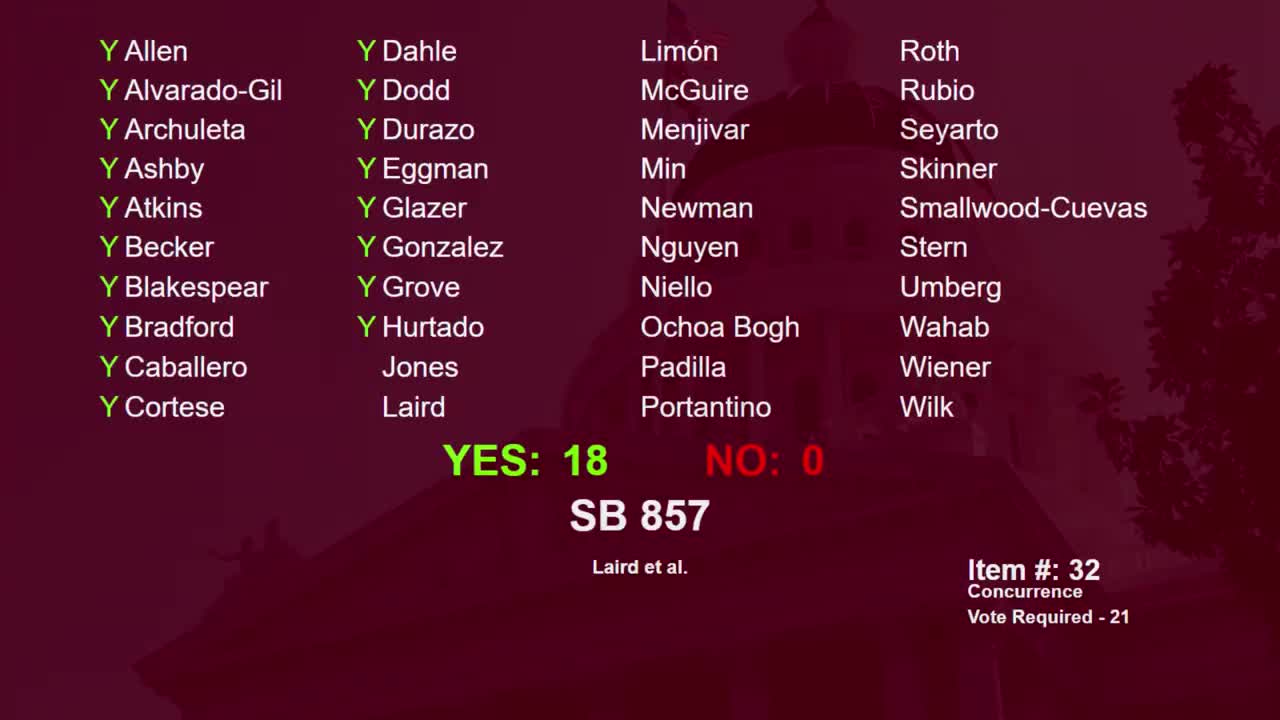 2MIN
Senate Floor
 8MIN
Senate Standing Committee on Elections and Constitutional Amendments
 1MIN
Assembly Floor
 4MIN
Assembly Standing Committee on Public Safety
 5MIN
Assembly Standing Committee on Elections
 4MIN
Senate Floor
 12MIN
Senate Standing Committee on Agriculture
 10MIN
Senate Standing Committee on Environmental Quality
Bill Author
Bill Co-Author(s):