SB 532: Parking payment zones.
- Session Year: 2023-2024
- House: Senate
- Latest Version Date: 2024-09-28
Current Status:
Passed
(2024-09-28: Chaptered by Secretary of State. Chapter 858, Statutes of 2024.)
Introduced
In Committee
First Chamber
In Committee
Second Chamber
Enacted
Existing law allows a local authority to establish parking meter zones and fix the rate of fees for those zones by ordinance. Existing law prohibits a local authority from requiring payment of parking meter fees by a mobile device, as specified.
This bill would instead authorize, until January 1, 2033, in the City and County of San Francisco, City of Long Beach, and City of Santa Monica, a local authority to require payment of parking fees by a mobile device, if it meets certain requirements, such as adopting an accessible and equitable parking cash payment plan that does not utilize parking meters or payment centers in parking payment zones to provide reasonably accessible alternative means for payment of parking fees using cash. The bill would also authorize the local authority in the City and County of San Francisco, City of Long Beach, and City of Santa Monica to operate the above-described parking zones for 5 years following the date of creation, in each of the respective entities, of the first mobile device parking payment zone, or until January 1, 2033, whichever is sooner. The bill would specify that a civil fine for parking in a zone that requires payment by mobile device and lacks a parking meter is 1/2 of the civil fine for failing to pay for metered parking. The bill would require a local authority to consult with specified stakeholders in the development of the plan and would require a local authority that adopts a plan and implements a mobile device parking payment zone to provide to its governing body and the Legislature a specified evaluation of the impact of all mobile device parking payment zones implemented by the local authority on equity, accessibility, and costs.
Existing law allows a local authority to establish parking meter zones and fix the rate of fees for those zones by ordinance. Existing law prohibits a local authority from requiring payment of parking meter fees by a mobile device, as specified.
This bill would instead authorize, until January 1, 2033, in the City and County of San Francisco, City of Long Beach, and City of Santa Monica, a local authority to require payment of parking fees by a mobile device, if it meets certain requirements, such as adopting an accessible and equitable parking cash payment plan that does not utilize parking meters or payment centers in parking payment zones to provide reasonably accessible alternative means for payment of parking fees using cash. The bill would also authorize the local authority in the City and County of San Francisco Francisco, City of Long Beach, and City of Santa Monica to operate the above-described parking zone, zones for 5 years following the creation date of creation, in each of the respective entities, of the first mobile device parking payment zone, or until January 1, 2033, whichever is sooner. The bill would specify that a civil fine for parking in a zone that requires payment by mobile device and lacks a parking meter is 1/2 of the civil fine for failing to pay for metered parking. The bill would require a local authority to consult with specified stakeholders in the development of the plan and would require a local authority that adopts a plan and implements a mobile device parking payment zone to provide to its governing body and the Legislature, as specified, an Legislature a specified evaluation of the plan to determine the plans impact impact of all mobile device parking payment zones implemented by the local authority on equity, accessibility, and costs.
Existing law allows a local authority to establish parking meter zones and fix the rate of fees for those zones by ordinance. Existing law prohibits a local authority from requiring payment of parking meter fees by a mobile device, as specified.
This bill would instead authorize, until January 1, 2035, in the City and County of San Francisco, a local authority to require payment of parking fees by a mobile device, if it meets certain requirements, such as adopting an accessible and equitable parking cash payment plan that does not utilize parking meters or payment centers in parking payment zones to provide reasonably accessible alternative means for payment of parking fees using cash. The bill would also authorize the local authority in the City and County of San Francisco to operate the above-described parking zone, for 5 years following the creation of the first zone, or until January 1, 2033, whichever is sooner. The bill would specify that a civil fine for parking in a zone that requires payment by mobile device and lacks a parking meter is 1/2 of the civil fine for failing to pay for metered parking. The bill would require a local authority to consult with specified stakeholders in the development of the plan and would require a local authority that adopts a plan to provide to its governing body and the Legislature, as specified, an evaluation of the plan to determine the plans impact on equity, accessibility, and costs.
Existing law allows a local authority to establish parking meter zones and fix the rate of fees for those zones by ordinance. Existing law prohibits a local authority from requiring payment of parking meter fees by a mobile device, as specified.
This bill would instead authorize authorize, until January 1, 2035, in the City and County of San Francisco, a local authority to require payment of parking fees by a mobile device, if it meets certain requirements, such as adopting an accessible and equitable parking cash payment plan that does not utilize parking meters or payment centers in parking payment zones to provide reasonably accessible alternative means for payment of parking fees using cash. The bill would require a local authority to consult with specified stakeholders in the development of the plan and would require a local authority that adopts a plan to provide to its governing body and the Legislature, as specified, an evaluation of the plan to determine the plans impact on equity, accessibility, and costs.
Existing law allows a local authority to establish parking meter zones and fix the rate of fees for those zones by ordinance. Existing law prohibits a local authority from requiring payment of parking meter fees by a mobile device, as specified.
This bill would instead authorize a local authority to require payment of parking fees by a mobile device, if it meets certain requirements, such as adopting an accessible and equitable parking cash payment plan that does not utilize parking meters or payment centers in parking payment zones to provide reasonably accessible alternative means for payment of parking fees using cash. The bill would require a local authority to consult with specified stakeholders in the development of the plan and would require a local authority that adopts a plan to provide to its governing body and the Legislature, as specified, an evaluation of the plan to determine the plans impact on equity, accessibility, and costs.
Existing law creates the Metropolitan Transportation Commission (MTC) as a regional agency in the 9-county San Francisco Bay area with comprehensive regional transportation planning and other related responsibilities. Existing law creates the Bay Area Toll Authority (BATA) as a separate entity governed by the same governing board as MTC and makes BATA responsible for the administration of toll revenues from the state-owned toll bridges in the San Francisco Bay area. Existing law requires the Department of Transportation to collect tolls on these state-owned toll bridges. Existing law requires those toll revenues to be deposited in the Bay Area Toll Account and requires BATA to control and maintain that account, as specified.This bill would, until December 31, 2028, require BATA to increase the toll rate for vehicles for crossing the state-owned toll bridges in the San Francisco Bay area by $1.50, as adjusted for inflation. The bill would require the revenues collected from this toll to be deposited in the Bay Area Toll Account, would continuously appropriate moneys from this toll increase and other specified tolls, and would require moneys from this toll to be transferred to MTC for allocation to transit operators that provide service within the San Francisco Bay area and that are experiencing a financial shortfall, as specified. The bill would direct MTC to require each transit operator eligible to receive an allocation from the account to, on an annual basis, submit a 5-year projection of its operating needs, as specified.To the extent this bill would mandate that MTC or a transit operator provide a new program or higher level of service, the bill would impose a state-mandated local program.Existing law, beginning July 1, 2024, prohibits a schedule of toll evasion penalties for a toll evasion violation on a toll bridge from exceeding $25 for the notice of toll evasion violation and $50 for the notice of delinquent toll evasion violation, as specified.This bill, beginning July 1, 2024, would decrease the maximum amount of penalties that can be included in a schedule of toll evasion penalties for a toll evasion violation on a San Francisco Bay area state-owned toll bridge to instead be $5 for the notice of toll evasion violation and $10 for the notice of delinquent toll evasion violation, as specified.The California Constitution requires the state to reimburse local agencies and school districts for certain costs mandated by the state. Statutory provisions establish procedures for making that reimbursement.This bill would provide that, if the Commission on State Mandates determines that the bill contains costs mandated by the state, reimbursement for those costs shall be made pursuant to the statutory provisions noted above.Existing law creates the Metropolitan Transportation Commission (MTC) as a regional agency in the 9-county San Francisco Bay area with comprehensive regional transportation planning and other related responsibilities. Existing law creates the Bay Area Toll Authority (BATA) as a separate entity governed by the same governing board as MTC and makes BATA responsible for the administration of toll revenues from the state-owned toll bridges in the San Francisco Bay area. Existing law requires the Department of Transportation to collect tolls on these state-owned toll bridges. Existing law requires those toll revenues to be deposited in the Bay Area Toll Account and requires BATA to control and maintain that account, as specified.
This bill would, until December 31, 2028, require BATA to increase the toll rate for vehicles for crossing the state-owned toll bridges in the San Francisco Bay area by $1.50, as adjusted for inflation. The bill would require the revenues collected from this toll to be deposited in the Bay Area Toll Account, would continuously appropriate moneys from this toll increase and other specified tolls, and would require moneys from this toll to be transferred to MTC for allocation to transit operators that provide service within the San Francisco Bay area and that are experiencing a financial shortfall, as specified. The bill would direct MTC to require each transit operator eligible to receive an allocation from the account to, on an annual basis, submit a 5-year projection of its operating needs, as specified.
To the extent this bill would mandate that MTC or a transit operator provide a new program or higher level of service, the bill would impose a state-mandated local program.
Existing law, beginning July 1, 2024, prohibits a schedule of toll evasion penalties for a toll evasion violation on a toll bridge from exceeding $25 for the notice of toll evasion violation and $50 for the notice of delinquent toll evasion violation, as specified.
This bill, beginning July 1, 2024, would decrease the maximum amount of penalties that can be included in a schedule of toll evasion penalties for a toll evasion violation on a San Francisco Bay area state-owned toll bridge to instead be $5 for the notice of toll evasion violation and $10 for the notice of delinquent toll evasion violation, as specified.
The California Constitution requires the state to reimburse local agencies and school districts for certain costs mandated by the state. Statutory provisions establish procedures for making that reimbursement.
This bill would provide that, if the Commission on State Mandates determines that the bill contains costs mandated by the state, reimbursement for those costs shall be made pursuant to the statutory provisions noted above.
Existing law creates the Metropolitan Transportation Commission (MTC) as a regional agency in the 9-county San Francisco Bay area with comprehensive regional transportation planning and other related responsibilities. Existing law creates the Bay Area Toll Authority (BATA) as a separate entity governed by the same governing board as MTC and makes BATA responsible for the administration of toll revenues from the state-owned toll bridges in the San Francisco Bay area. Existing law requires the Department of Transportation to collect tolls on these state-owned toll bridges. Existing law requires those toll revenues to be deposited in the Bay Area Toll Account and requires BATA to control and maintain that account, as specified.
This bill would, until December 31, 2028, require BATA to increase the toll rate for vehicles for crossing the state-owned toll bridges in the San Francisco Bay area by $1.50, as adjusted for inflation. The bill would require the revenues collected from this toll to be deposited in the Bay Area Toll Account, would continuously appropriate moneys from this toll increase and other specified tolls, and would require moneys from this toll to be transferred to MTC for allocation to transit operators that provide service within the San Francisco Bay area and that are experiencing a financial shortfall, as specified. The bill would direct MTC to require each transit operator eligible to receive an allocation from the account to, on an annual basis, submit a 5-year projection of its operating needs, as specified.
To the extent this bill would mandate that MTC or a transit operator provide a new program or higher level of service, the bill would impose a state-mandated local program.
The California Constitution requires the state to reimburse local agencies and school districts for certain costs mandated by the state. Statutory provisions establish procedures for making that reimbursement.
This bill would provide that, if the Commission on State Mandates determines that the bill contains costs mandated by the state, reimbursement for those costs shall be made pursuant to the statutory provisions noted above.
Existing law requires that the ballots used when voting upon a measure proposed by a local governing body or submitted to the voters as an initiative or referendum measure, including a measure authorizing the issuance of bonds or the incurrence of debt, have printed on them a true and impartial statement describing the purpose of the measure. If the proposed measure imposes a tax or raises the rate of a tax, existing law requires the ballot to include in the statement of the measure the amount of money to be raised annually and the rate and duration of the tax to be levied. Existing law requires the ballot label contain no more than 75 words.This bill would exempt from this requirement a measure that imposes or increases a tax with more than one rate or authorizes the issuance of bonds. If the proposed measure imposes or increases a tax with more than one rate, or authorizes the issuance of bonds, this bill would require that the ballot include in the statement of the measure to be voted on an estimate of the amount of money to be raised annually and the rate and the duration of the tax to be levied. This statement, which may contain bullet points, would not count toward any word limit that applies to the statement of the measure. If including the fiscal disclosure in the ballot would result in the total number of words on the ballot label to exceed the 75 word limit and would necessitate the printing of an extra ballot card compared to the ballot labels not exceeding the 75 word limit, the type size of the fiscal disclosure may be reduced by the minimal amount needed to stop from necessitating an extra ballot card, as long as the type size is no smaller than 8-point, and as long as the type size is reduced by the same amount for all ballot measures.By imposing new duties on local elections officials, the bill would create a state-mandated local program. The California Constitution requires the state to reimburse local agencies and school districts for certain costs mandated by the state. Statutory provisions establish procedures for making that reimbursement.This bill would provide that, if the Commission on State Mandates determines that the bill contains costs mandated by the state, reimbursement for those costs shall be made pursuant to the statutory provisions noted above.Existing law requires that the ballots used when voting upon a measure proposed by a local governing body or submitted to the voters as an initiative or referendum measure, including a measure authorizing the issuance of bonds or the incurrence of debt, have printed on them a true and impartial statement describing the purpose of the measure. If the proposed measure imposes a tax or raises the rate of a tax, existing law requires the ballot to include in the statement of the measure the amount of money to be raised annually and the rate and duration of the tax to be levied. Existing law requires the ballot label contain no more than 75 words.
This bill would exempt from this requirement a measure that imposes or increases a tax with more than one rate or authorizes the issuance of bonds. If the proposed measure imposes or increases a tax with more than one rate, or authorizes the issuance of bonds, this bill would require that the ballot include in the statement of the measure to be voted on an estimate of the amount of money to be raised annually and the rate and the duration of the tax to be levied. This statement, which may contain bullet points, would not count toward any word limit that applies to the statement of the measure. If including the fiscal disclosure in the ballot would result in the total number of words on the ballot label to exceed the 75 word limit and would necessitate the printing of an extra ballot card compared to the ballot labels not exceeding the 75 word limit, the type size of the fiscal disclosure may be reduced by the minimal amount needed to stop from necessitating an extra ballot card, as long as the type size is no smaller than 8-point, and as long as the type size is reduced by the same amount for all ballot measures.
By imposing new duties on local elections officials, the bill would create a state-mandated local program.
The California Constitution requires the state to reimburse local agencies and school districts for certain costs mandated by the state. Statutory provisions establish procedures for making that reimbursement.
This bill would provide that, if the Commission on State Mandates determines that the bill contains costs mandated by the state, reimbursement for those costs shall be made pursuant to the statutory provisions noted above.
Existing law requires that the ballots used when voting upon a measure proposed by a local governing body or submitted to the voters as an initiative or referendum measure, including a measure authorizing the issuance of bonds or the incurrence of debt, have printed on them a true and impartial statement describing the purpose of the measure. If the proposed measure imposes a tax or raises the rate of a tax, existing law requires the ballot to include in the statement of the measure the amount of money to be raised annually and the rate and duration of the tax to be levied.
This bill would exempt from this requirement a measure that imposes or increases a tax with more than one rate or authorizes the issuance of bonds. The bill would instead permit for these types of measures the statement of the measure to include the words See voter guide for measure information statement and an explanation of how this measure could impact local property taxes. The bill would exclude these words from any word count limit that applies to the statement of the measure. The bill would require an elections official to ensure that each polling place has voter information guides, as specified. If the proposed measure imposes or increases a tax with more than one rate, or authorizes the issuance of bonds, this bill would require that the ballot include in the statement of the measure to be voted on an estimate of the amount of money to be raised annually and the rate and the duration of the tax to be levied. This statement, which may contain bullet points, would not count toward any word limit that applies to the statement of the measure.
Existing law requires local governments, when submitting for voter approval a bond measure that will be secured by an ad valorem tax, to provide the voters with a statement that includes estimates of the tax rates required to fund the measure.This bill would additionally require for a measure that imposes or increases a tax with more than one rate or authorizes the issuance of bonds, that voters be provided with a statement that includes specified information relating to the tax that will be imposed or increased as a result of the measure.By imposing new duties on local elections officials, the bill would create a state-mandated local program.
The California Constitution requires the state to reimburse local agencies and school districts for certain costs mandated by the state. Statutory provisions establish procedures for making that reimbursement.
This bill would provide that, if the Commission on State Mandates determines that the bill contains costs mandated by the state, reimbursement for those costs shall be made pursuant to the statutory provisions noted above.
Existing law requires that the ballots used when voting upon a measure proposed by a local governing body or submitted to the voters as an initiative or referendum measure, including a measure authorizing the issuance of bonds or the incurrence of debt, have printed on them a true and impartial statement describing the purpose of the measure. If the proposed measure imposes a tax or raises the rate of a tax, existing law requires the ballot to include in the statement of the measure the amount of money to be raised annually and the rate and duration of the tax to be levied.
This bill would exempt from this requirement a measure that imposes or increases a tax with more than one rate or authorizes the issuance of bonds. The bill would instead permit for these types of measures the statement of the measure to include the words See voter guide for measure information statement. statement and an explanation of how this measure could impact local property taxes. The bill would exclude these words from any word count limit that applies to the statement of the measure. The bill would require an elections official to ensure that each polling place has voter information guides, as specified.
Existing law requires local governments, when submitting for voter approval a bond measure that will be secured by an ad valorem tax, to provide the voters with a statement that includes estimates of the tax rates required to fund the measure.
This bill would additionally require for a measure that imposes or increases a tax with more than one rate or authorizes the issuance of bonds, that voters be provided with a statement that includes specified information relating to the tax that will be imposed or increased as a result of the measure.
By imposing new duties on local elections officials, the bill would create a state-mandated local program.
The California Constitution requires the state to reimburse local agencies and school districts for certain costs mandated by the state. Statutory provisions establish procedures for making that reimbursement.
This bill would provide that, if the Commission on State Mandates determines that the bill contains costs mandated by the state, reimbursement for those costs shall be made pursuant to the statutory provisions noted above.
Existing law requires that the ballots used when voting upon a measure proposed by a local governing body or submitted to the voters as an initiative or referendum measure, including a measure authorizing the issuance of bonds or the incurrence of debt, have printed on them a true and impartial statement describing the purpose of the measure. If the proposed measure imposes a tax or raises the rate of a tax, existing law requires the ballot to include in the statement of the measure the amount of money to be raised annually and the rate and duration of the tax to be levied.
This bill would exempt from this requirement a measure that imposes or increases a tax with more than one rate or authorizes the issuance of bonds. The bill would instead permit for these types of measures the statement of the measure to include the words See voter guide for measure information statement.
Existing law requires local governments, when submitting for voter approval a bond measure that will be secured by an ad valorem tax, to provide the voters with a statement that includes estimates of the tax rates required to fund the measure.
This bill would additionally require for a measure that imposes or increases a tax with more than one rate or authorizes the issuance of bonds, that voters be provided with a statement that includes specified information relating to the tax that will be imposed or increased as a result of the measure.
By imposing new duties on local elections officials, the bill would create a state-mandated local program.
The California Constitution requires the state to reimburse local agencies and school districts for certain costs mandated by the state. Statutory provisions establish procedures for making that reimbursement.
This bill would provide that, if the Commission on State Mandates determines that the bill contains costs mandated by the state, reimbursement for those costs shall be made pursuant to the statutory provisions noted above.
(a)A local authority shall not establish parking payment zones or fix the rate of fees for those zones except by ordinance. The rate of fees may be variable, based upon criteria identified by the local authority in the ordinance. An ordinance establishing a parking payment zone shall describe the area that would be included within the zone.
(b)A local authority may, by ordinance, cause streets and highways to be marked with white lines designating parking spaces and require vehicles to park within the parking spaces.
(c)An ordinance adopted by a local authority pursuant to this section with respect to a state highway shall not become effective until the proposed ordinance has been submitted to and approved in writing by the Department of Transportation. The proposed ordinance shall be submitted to the department only by action of the local legislative body and the proposed ordinance shall be submitted in complete draft form.
(d)An ordinance adopted pursuant to this section establishing a parking payment zone or fixing rates of fees for that zone shall be subject to local referendum processes in the same manner as if the ordinance dealt with a matter of purely local concern.
(e)Except as described in Section 22508.2, a local authority may accept but shall not require payment of parking meter fees by a mobile device.
SEC. 2.Section 22508.2 is added to the Vehicle Code, to read:22508.2.(a)A local authority in the City and County of San Francisco, City of Long Beach, or City of Santa Monica may require payment by a mobile device in a parking payment zone only if it meets both of the following requirements:
(1)Installs signs no more than 100 feet from any space where payment is required that clearly states that payment is required and how payments may be made.
(2)Adopts by ordinance or resolution an accessible and equitable parking cash payment plan that does not utilize parking meters or payment centers in parking payment zones. The plan shall provide reasonably accessible alternative means for payment of parking fees using cash. The plan shall assess the feasibility of potential strategies, including, but not limited to, accepting cash payment for parking from a mailed invoice requested through the mobile payment system. The local authority shall consult and work collaboratively with relevant local stakeholder organizations that may include, but are not limited to, racial equity, privacy protection, and economic justice groups, in developing the accessible and equitable parking cash payment plan. The plan shall be approved by the local authority.
(b)A local authority in the City and County of San Francisco, City of Long Beach, or City of Santa Monica that adopts an accessible and equitable parking cash payment plan and implements at least one mobile device parking payment zone pursuant to this section shall, on or before January 1 of the fourth year in which the first mobile device parking payment zone has been implemented, submit to its governing body and the transportation committees of the Legislature, consistent with Section 9795 of the Government Code, an evaluation report of the impact of all mobile device parking payment zones implemented by the local authority on equity, accessibility, and costs. The report shall evaluate the effectiveness, impact on privacy, impact on equity, impact on traffic outcomes, cost to implement, change in citations issued, and generation of revenue.
(c)A civil fine for parking in a parking payment zone that requires payment by mobile device and lacks a parking meter shall be one-half of the civil fine for failing to pay for parking in a metered zone. This subdivision shall not apply to a person who paid for parking but stayed in the spot beyond the period for which the person paid.
(d)A local authority in the City and County of San Francisco, City of Long Beach, or City of Santa Monica may operate a mobile device parking payment zone authorized by this section for five years following the date of creation for each city and county, or city, of the first mobile device parking payment zone, or until January 1, 2033, whichever is sooner.
(e)This section shall remain in effect only until January 1, 2033, and as of that date is repealed.
(a)A local authority shall not establish parking payment zones or fix the rate of fees for those zones except by ordinance. The rate of fees may be variable, based upon criteria identified by the local authority in the ordinance. An ordinance establishing a parking payment zone shall describe the area that would be included within the zone.
(b)A local authority may, by ordinance, cause streets and highways to be marked with white lines designating parking spaces and require vehicles to park within the parking spaces.
(c)An ordinance adopted by a local authority pursuant to this section with respect to a state highway shall not become effective until the proposed ordinance has been submitted to and approved in writing by the Department of Transportation. The proposed ordinance shall be submitted to the department only by action of the local legislative body and the proposed ordinance shall be submitted in complete draft form.
(d)An ordinance adopted pursuant to this section establishing a parking payment zone or fixing rates of fees for that zone shall be subject to local referendum processes in the same manner as if the ordinance dealt with a matter of purely local concern.
(e)Except as described in Section 22508.2, a local authority may accept but shall not require payment of parking meter fees by a mobile device.
SEC. 2.Section 22508.2 is added to the Vehicle Code, to read:22508.2.(a)A local authority in the City and County of San Francisco Francisco, City of Long Beach, or City of Santa Monica may require payment by a mobile device in a parking payment zone only if it meets both of the following requirements:
(1)Installs signs no more than 100 feet from any space where payment is required that clearly states that payment is required and how payments may be made.
(2)Adopts by ordinance or resolution an accessible and equitable parking cash payment plan that does not utilize parking meters or payment centers in parking payment zones. The plan shall provide reasonably accessible alternative means for payment of parking fees using cash. The plan shall assess the feasibility of potential strategies, including, but not limited to, accepting cash payment for parking from a mailed invoice requested through the mobile payment system. The local authority shall consult and work collaboratively with relevant local stakeholder organizations that may include, but are not limited to, racial equity, privacy protection, and economic justice groups, in developing the accessible and equitable parking cash payment plan. The plan shall be approved by the local authority.
(b)A local authority in the City and County of San Francisco Francisco, City of Long Beach, or City of Santa Monica that adopts an accessible and equitable parking cash payment plan and implements at least one mobile device parking payment zone pursuant to this section shall, on or before January 1 of the fourth year in which the plan first mobile device parking payment zone has been implemented, submit to its governing body and the transportation committees of the Legislature, consistent with Section 9795 of the Government Code, an evaluation report of the plans impact impact of all mobile device parking payment zones implemented by the local authority on equity, accessibility, and costs. The report shall evaluate the effectiveness, impact on privacy, impact on equity, impact on traffic outcomes, cost to implement, change in citations issued, and generation of revenue.
(c)A civil fine for parking in a parking payment zone that requires payment by mobile device and lacks a parking meter shall be one-half of the civil fine for failing to pay for parking in a metered zone. This provision does subdivision shall not apply to a person who paid for parking but stayed in the spot beyond the period it was permitted. for which the person paid.
(d)A local authority in the City and County of San Francisco Francisco, City of Long Beach, or City of Santa Monica may operate a mobile device parking payment zone authorized by this section for five years following the creation date of creation for each city and county, or city, of the first mobile device parking payment zone, or until January 1, 2033, whichever is sooner.
(e)This section shall remain in effect only until January 1, 2033, and as of that date is repealed.
(a)A local authority shall not establish parking payment zones or fix the rate of fees for those zones except by ordinance. The rate of fees may be variable, based upon criteria identified by the local authority in the ordinance. An ordinance establishing a parking payment zone shall describe the area that would be included within the zone.
(b)A local authority may, by ordinance, cause streets and highways to be marked with white lines designating parking spaces and require vehicles to park within the parking spaces.
(c)An ordinance adopted by a local authority pursuant to this section with respect to a state highway shall not become effective until the proposed ordinance has been submitted to and approved in writing by the Department of Transportation. The proposed ordinance shall be submitted to the department only by action of the local legislative body and the proposed ordinance shall be submitted in complete draft form.
(d)An ordinance adopted pursuant to this section establishing a parking payment zone or fixing rates of fees for that zone shall be subject to local referendum processes in the same manner as if the ordinance dealt with a matter of purely local concern.
(e)Except as described in subdivision (f), Section 22508.2, a local authority may accept but shall not require payment of parking meter fees by a mobile device.
(f)Until January 1, 2035, a local authority in the City and County of San Francisco may require payment by a mobile device in a parking payment zone only if it meets both of the following requirements:(1)Installs signs no more than 100 feet from any space where payment is required that clearly states that payment is required and how payments may be made.(2)Adopts by ordinance or resolution an accessible and equitable parking cash payment plan that does not utilize parking meters or payment centers in parking payment zones. The plan shall provide reasonably accessible alternative means for payment of parking fees using cash. The plan shall assess the feasibility of potential strategies, including, but not limited to, accepting cash payment for parking from a mailed invoice requested through the mobile payment system. The local authority shall consult and work collaboratively with relevant local stakeholder organizations that may include, but are not limited to, racial equity, privacy protection, and economic justice groups, in developing the accessible and equitable parking cash payment plan. The plan shall be approved by the local authority.(g)A local authority that adopts an accessible and equitable parking cash payment plan pursuant to this section shall, on or before March 1 of every third year in which the plan has been implemented, submit to its governing body and the transportation committees of the Legislature, consistent with Section 9795 of the Government Code, an evaluation report of the plans impact on equity, accessibility, and costs. The report shall evaluate the effectiveness, impact on privacy, impact on equity, impact on traffic outcomes, cost to implement, change in citations issued, and generation of revenue.SEC. 2.Section 22508.2 is added to the Vehicle Code, to read:22508.2.(a)A local authority in the City and County of San Francisco may require payment by a mobile device in a parking payment zone only if it meets both of the following requirements:
(1)Installs signs no more than 100 feet from any space where payment is required that clearly states that payment is required and how payments may be made.
(2)Adopts by ordinance or resolution an accessible and equitable parking cash payment plan that does not utilize parking meters or payment centers in parking payment zones. The plan shall provide reasonably accessible alternative means for payment of parking fees using cash. The plan shall assess the feasibility of potential strategies, including, but not limited to, accepting cash payment for parking from a mailed invoice requested through the mobile payment system. The local authority shall consult and work collaboratively with relevant local stakeholder organizations that may include, but are not limited to, racial equity, privacy protection, and economic justice groups, in developing the accessible and equitable parking cash payment plan. The plan shall be approved by the local authority.
(b)A local authority in the City and County of San Francisco that adopts an accessible and equitable parking cash payment plan pursuant to this section shall, on or before January 1 of the fourth year in which the plan has been implemented, submit to its governing body and the transportation committees of the Legislature, consistent with Section 9795 of the Government Code, an evaluation report of the plans impact on equity, accessibility, and costs. The report shall evaluate the effectiveness, impact on privacy, impact on equity, impact on traffic outcomes, cost to implement, change in citations issued, and generation of revenue.
(c)A civil fine for parking in a parking payment zone that requires payment by mobile device and lacks a parking meter shall be one-half of the civil fine for failing to pay for parking in a metered zone. This provision does not apply to a person who paid for parking but stayed in the spot beyond the period it was permitted.
(d)A local authority in the City and County of San Francisco may operate a parking payment zone authorized by this section for five years following the creation of the first mobile device parking payment zone, or until January 1, 2033, whichever is sooner.
(e)This section shall remain in effect only until January 1, 2033, and as of that date is repealed.
(a)A local authority shall not establish parking payment zones or fix the rate of fees for those zones except by ordinance. The rate of fees may be variable, based upon criteria identified by the local authority in the ordinance. An ordinance establishing a parking payment zone shall describe the area that would be included within the zone.
(b)A local authority may, by ordinance, cause streets and highways to be marked with white lines designating parking spaces and require vehicles to park within the parking spaces.
(c)An ordinance adopted by a local authority pursuant to this section with respect to a state highway shall not become effective until the proposed ordinance has been submitted to and approved in writing by the Department of Transportation. The proposed ordinance shall be submitted to the department only by action of the local legislative body and the proposed ordinance shall be submitted in complete draft form.
(d)An ordinance adopted pursuant to this section establishing a parking payment zone or fixing rates of fees for that zone shall be subject to local referendum processes in the same manner as if the ordinance dealt with a matter of purely local concern.
(e)Except as described in subdivision (f), a local authority may accept but shall not require payment of parking meter fees by a mobile device.
(f)A Until January 1, 2035, a local authority in the City and County of San Francisco may require payment by a mobile device in a parking payment zone only if it meets both of the following requirements:
(1)Installs signs no more than 100 feet from any space where payment is required that clearly states that payment is required and how payments may be made.
(2)Adopts by ordinance or resolution an accessible and equitable parking cash payment plan that does not utilize parking meters or payment centers in parking payment zones. The plan shall provide reasonably accessible alternative means for payment of parking fees using cash. The plan shall assess the feasibility of potential strategies, including, but not limited to, accepting cash payment for parking from a mailed invoice requested through the mobile payment system. The local authority shall consult and work collaboratively with relevant local stakeholder organizations that may include, but are not limited to, racial equity, privacy protection, and economic justice groups, in developing the accessible and equitable parking cash payment plan. The plan shall be approved by the local authority.
(g)A local authority that adopts an accessible and equitable parking cash payment plan pursuant to this section shall, on or before March 1 of the fifth every third year in which the plan has been implemented, submit to its governing body and the transportation committees of the Legislature, consistent with Section 9795 of the Government Code, an evaluation report of the plans impact on equity, accessibility, and costs. The report shall evaluate the effectiveness, impact on privacy, impact on equity, impact on traffic outcomes, cost to implement, change in citations issued, and generation of revenue.
(a)A local authority shall not establish parking payment zones or fix the rate of fees for those zones except by ordinance. The rate of fees may be variable, based upon criteria identified by the local authority in the ordinance. An ordinance establishing a parking payment zone shall describe the area that would be included within the zone.
(b)A local authority may by ordinance may, by ordinance, cause streets and highways to be marked with white lines designating parking spaces and require vehicles to park within the parking spaces.
(c)An ordinance adopted by a local authority pursuant to this section with respect to a state highway shall not become effective until the proposed ordinance has been submitted to and approved in writing by the Department of Transportation. The proposed ordinance shall be submitted to the department only by action of the local legislative body and the proposed ordinance shall be submitted in complete draft form.
(d)An ordinance adopted pursuant to this section establishing a parking payment zone or fixing rates of fees for that zone shall be subject to local referendum processes in the same manner as if the ordinance dealt with a matter of purely local concern.
(e)Except as described in subdivision (f), a local authority may accept but shall not require payment of parking meter fees by a mobile device.
(f)A local authority may require payment by a mobile device in a parking payment zone only if it meets both of the following requirements:
(1)Installs signs no more than 100 feet from any space where payment is required that clearly states that payment is required and how payments may be made.
(2)Adopts by ordinance or resolution an accessible and equitable parking cash payment plan that does not utilize parking meters or payment centers in parking payment zones. The plan shall provide reasonably accessible alternative means for payment of parking fees using cash. The local authority shall consult and work collaboratively with relevant local stakeholder organizations that may include, but are not limited to, racial equity, privacy protection, and economic justice groups, in developing the accessible and equitable parking cash payment plan. The plan shall be approved by the local authority.
(g)A local authority that adopts an accessible and equitable parking cash payment plan pursuant to this section shall, on or before March 1 of the fifth year in which the plan has been implemented, submit to its governing body and the transportation committees of the Legislature, consistent with Section 9795 of the Government Code, an evaluation report of the plans impact on equity, accessibility, and costs. The report shall evaluate the effectiveness, impact on privacy, impact on equity, impact on traffic outcomes, cost to implement, change in citations issued, and generation of revenue.
(a)A local authority shall not establish parking meter payment zones or fix the rate of fees for those zones except by ordinance. The rate of fees may be variable, based upon criteria identified by the local authority in the ordinance. An ordinance establishing a parking meter payment zone shall describe the area that would be included within the zone.
(b)A local authority may by ordinance cause streets and highways to be marked with white lines designating parking spaces and require vehicles to park within the parking spaces.
(c)An ordinance adopted by a local authority pursuant to this section with respect to any a state highway shall not become effective until the proposed ordinance has been submitted to and approved in writing by the Department of Transportation. The proposed ordinance shall be submitted to the department only by action of the local legislative body and the proposed ordinance shall be submitted in complete draft form.
(d)An ordinance adopted pursuant to this section establishing a parking meter payment zone or fixing rates of fees for that zone shall be subject to local referendum processes in the same manner as if the ordinance dealt with a matter of purely local concern.
(e)A Except as described in subdivision (f), a local authority may accept but shall not require payment of parking meter fees by a mobile device.
(f)A local authority may require payment by a mobile device in a parking payment zone only if it meets both of the following requirements:
(1)Installs signs no more than 100 feet from any space where payment is required that clearly states that payment is required and how payments may be made.
(2)Adopts by ordinance or resolution an accessible and equitable parking cash payment plan that does not utilize parking meters or payment centers in parking payment zones. The plan shall provide reasonably accessible alternative means for payment of parking fees using cash. The local authority shall consult and work collaboratively with relevant local stakeholder organizations that may include, but are not limited to, racial equity, privacy protection, and economic justice groups, in developing the accessible and equitable parking cash payment plan. The plan shall be approved by the local authority.
(g)A local authority that adopts an accessible and equitable parking cash payment plan pursuant to this section shall, on or before March 1 of the fifth year in which the plan has been implemented, submit to its governing body and the transportation committees of the Legislature, consistent with Section 9795 of the Government Code, an evaluation report of the plans impact on equity, accessibility, and costs. The report shall evaluate the effectiveness, impact on privacy, impact on equity, impact on traffic outcomes, cost to implement, change in citations issued, and generation of revenue.
SECTION 1.This act shall be known, and may be cited, as the Safe, Clean, and Reliable Bay Area Public Transportation Emergency Act.SEC. 2.It is the intent of the Legislature to enact future legislation to require the Metropolitan Transportation Commission to study, design, and implement an equity-based program to mitigate the impacts of the $1.50 toll increase required by this act within two years of the effective date of this act. It is the intent of the Legislature that the commission would establish the equity-based program in a manner that is operationally feasible, financially practicable, and effective, and that the commission would consider including discounts, toll caps, and toll exemptions as part of the program.SEC. 3.Section 30911 of the Streets and Highways Code is amended to read:30911.(a)The authority shall control and maintain the Bay Area Toll Account and other subaccounts it deems necessary and appropriate to document toll revenue and operating expenditures in accordance with generally accepted accounting principles.(b)(1)After providing for expenditures pursuant to subdivision (a) of Section 30912 and for operating assistance pursuant to subdivision (d) of Section 30914 and subdivision (c) of Section 30914.7 and after the requirements of any bond resolution or indenture of the authority for any outstanding revenue bonds have been met, the authority shall transfer on a regularly scheduled basis as set forth in the authoritys annual budget resolution, the revenues defined in subdivision (b) of Section 30913 and Sections 30914, 30914.7, and 30914.8 to the commission. The funds transferred are continuously appropriated to the commission to expend for the purposes specified in subdivision (b) of Section 30913 and Sections 30914, 30914.7, and 30914.8. After the commission makes a determination that the projects and programs funded by the commission have been completed, the revenues transferred to the commission shall be expended by the commission for supplemental funding for the projects and programs identified in subdivision (a) of Section 30914.7 if the voters approve a toll increase authorized pursuant to Section 30923.(2)For purposes of paragraph (1), the revenues defined in subdivision (b) of Section 30913 and subdivision (a) of Section 30914 include all revenues accruing since January 1, 1989.SEC. 4.Section 30914.8 is added to the Streets and Highways Code, to read:30914.8.(a)The Metropolitan Transportation Commission shall, from proceeds of the toll imposed pursuant to subdivision (f) of Section 30916 and transferred pursuant to Section 30911, provide funding to transit operators that provide service within the commissions geographic jurisdiction and that are experiencing a financial shortfall. A transit operator shall only be eligible to receive an allocation pursuant to this section if it operates fixed-route public transit services, including by bus, rail, or ferry, within the commissions geographic jurisdiction and does not directly receive the majority of its revenues from the Golden Gate Bridge, Highway, and Transportation District.(b)The commission shall annually distribute at least 90 percent of the revenues described in subdivision (a) to eligible transit operators in order to avoid service cuts and maintain operations, including safety, security, reliability, or cleanliness services and improvements. The commission may only allocate funds pursuant to this subdivision to a transit operator after it makes a determination that the funds are necessary to avoid service cuts relative to service levels provided by that transit operator during 202223 fiscal year. In providing allocations pursuant to this subdivision, the commission shall prioritize averting service cuts for transit operators that serve the highest number of transit riders. The commission shall also take into consideration the extent of local funding to support transit service and may also consider operator fares and other sources of revenue.(c)The commission shall annually distribute no more than 10 percent of the revenues described in subdivision (a) to assist eligible transit operators with restoring or reconfiguring service above levels provided during the 202223 fiscal year or for the purpose of funding initiatives to transform transit service pursuant to the commissions adopted Transit Transformation Action Plan, or to make specific safety, security, reliability, or cleanliness improvements.(d)The commission shall require each transit operator eligible to receive an allocation pursuant to this section to, on an annual basis, submit a five-year projection of its operating needs. This projection of operating needs shall be based on standardized assumptions and guidance developed by the commission in collaboration with transit operators. The commission may reasonably audit, request revision to, or directly amend operating needs projections if appropriate or necessary to ensure consistency of assumptions and fairness across transit operators.SEC. 5.Section 30916 of the Streets and Highways Code is amended to read:30916.(a)The base toll rate for vehicles crossing the state-owned toll bridges within the geographic jurisdiction of the commission as of January 1, 2003, is as follows:Number of AxlesTollTwo axles$1.00Three axles3.00Four axles5.25Five axles8.25Six axles9.00Seven axles & more10.50(b)If the voters approve a toll increase, pursuant to Section 30921, commencing July 1, 2004, the base toll rate for vehicles crossing the bridges described in subdivision (a) is as follows:Number of axlesTollTwo axles$ 2.00Three axles4.00Four axles6.25Five axles9.25Six axles10.00Seven axles & more11.50(c)(1)If the voters approve a toll increase, pursuant to Section 30923, the authority shall increase the base toll rate for vehicles crossing the bridges described in subdivision (a) from the toll rates then in effect by the amount approved by the voters pursuant to Section 30923. The authority may, beginning six months after the election approving the toll increase, phase in the toll increase over a period of time and may adjust the toll increase for inflation based on the California Consumer Price Index after the toll increase has been phased in completely.(2)Revenue generated from the adjustment of the toll to account for inflation pursuant to paragraph (1) may be expended for the following purposes:(A)Bridge maintenance and rehabilitation necessary to preserve, protect, and replace the bridge structures consistent with subdivision (b) of Section 30950.3.(B)Supplemental funding for the projects and programs authorized pursuant to subdivision (a) of Section 30914.7.(d)The authority shall increase the amount of the toll only if required to meet its obligations on any bonds or to satisfy its covenants under any bond resolution or indenture. The authority shall hold a public hearing before adopting a toll schedule reflecting the increased toll charge.(e)Nothing in this section shall be construed to prohibit the adoption of either a discounted commute rate for two-axle vehicles or of special provisions for high-occupancy vehicles under terms and conditions prescribed by the authority in consultation with the department.(f)(1)Beginning January 1, 2024, and until December 31, 2028, the authority shall increase the base toll rate for vehicles crossing the bridges described in subdivision (a) from the toll rates then in effect by one dollar and fifty cents ($1.50).(2)The authority shall adjust the toll increase imposed pursuant to paragraph (1) on an annual basis for inflation based on the California Consumer Price Index.(3)Notwithstanding Section 30918, the toll increase imposed pursuant to paragraph (1) shall not be reduced without statutory authorization by the Legislature.(4)This subdivision shall become inoperative on January 1, 2029.SEC. 6.Section 30920 of the Streets and Highways Code is amended to read:30920.The authority may issue toll bridge revenue bonds to finance any or all of the projects and purposes, including those specified in Sections 30913, 30914, 30914.7, and 30914.8, if the issuance of the bonds does not adversely affect the minimum amount of toll revenue proceeds designated in Section 30913 and in paragraph (4) of subdivision (a) of, and subdivision (b) of, Section 30914 for rail extension and improvement projects and transit projects to reduce vehicular traffic. A determination of the authority that a specific project or projects or purposes shall have no adverse effect will be binding and conclusive in all respects.SEC. 7.Section 40258 of the Vehicle Code, as added by Section 13 of Chapter 969 of the Statutes of 2022, is amended to read:40258.(a)(1)The schedule of toll evasion penalties for a toll evasion violation on a toll bridge shall not exceed twenty-five dollars ($25) for the notice of toll evasion violation, and shall not exceed fifty dollars ($50) for the notice of delinquent toll evasion violation for a cumulative total of fifty dollars ($50) for each individual toll evasion violation.(2)Notwithstanding paragraph (1), the schedule of toll evasion penalties for a toll evasion violation on a San Francisco Bay area state-owned toll bridge shall not exceed five dollars ($5) for the notice of toll evasion violation, and shall not exceed ten dollars ($10) for the notice of delinquent toll evasion violation for a cumulative total of fifteen dollars ($15) for each individual toll evasion violation. For purposes of this paragraph, San Francisco Bay area state-owned toll bridge means any of the toll bridges described in Section 30910 of the Streets and Highways Code.(3)Notwithstanding paragraphs (1) and (2), the schedule of toll evasion penalties may include any administrative fee, fine, or assessment imposed by the state after enactment of this chapter in addition to the cumulative fifty-dollar ($50) limit per each individual toll evasion violation.(b)If the registered owner, by appearance or by mail, makes payment to the processing agency within 15 days of the mailing of the notice of toll evasion violation issued pursuant to subdivision (a) of Section 40254 for a bridge toll evasion, the amount owed shall consist of the amount of the toll without any additional penalties, administrative fees, or charges.(c)The maximum penalty for each toll evasion violation included in a notice of toll evasion for either a toll highway, toll road, or express lane shall be sixty dollars ($60). The maximum cumulative toll evasion penalty shall not exceed one hundred dollars ($100) for each individual toll evasion violation.(d)Toll evasion penalties under this article shall be collected as civil penalties.(e)The amounts specified in this section may be adjusted periodically by an issuing agency at a rate not to exceed any increase in the California Consumer Price Index as compiled and reported by the Department of Industrial Relations.(f)An issuing agency shall waive the toll evasion penalty for a first violation with the issuing agency if the person contacts, as applicable, the issuing or processing agency customer service center within 21 days from the mailing of the notice of toll evasion violation, and the person is not currently an accountholder with the issuing agency, signs up for an account, and pays the outstanding toll.(g)This section shall become operative on July 1, 2024.SEC. 8.If the Commission on State Mandates determines that this act contains costs mandated by the state, reimbursement to local agencies and school districts for those costs shall be made pursuant to Part 7 (commencing with Section 17500) of Division 4 of Title 2 of the Government Code.This act shall be known, and may be cited, as the Safe, Clean, and Reliable Bay Area Public Transportation Emergency Act.
SEC. 2.It is the intent of the Legislature to enact future legislation to require the Metropolitan Transportation Commission to study, design, and implement an equity-based program to mitigate the impacts of the $1.50 toll increase required by this act within two years of the effective date of this act. It is the intent of the Legislature that the commission would establish the equity-based program in a manner that is operationally feasible, financially practicable, and effective, and that the commission would consider including discounts, toll caps, and toll exemptions as part of the program.
SEC. 2.SEC. 3.Section 30911 of the Streets and Highways Code is amended to read:30911.(a)The authority shall control and maintain the Bay Area Toll Account and other subaccounts it deems necessary and appropriate to document toll revenue and operating expenditures in accordance with generally accepted accounting principles.
(b)(1)After providing for expenditures pursuant to subdivision (a) of Section 30912 and for operating assistance pursuant to subdivision (d) of Section 30914 and subdivision (c) of Section 30914.7 and after the requirements of any bond resolution or indenture of the authority for any outstanding revenue bonds have been met, the authority shall transfer on a regularly scheduled basis as set forth in the authoritys annual budget resolution, the revenues defined in subdivision (b) of Section 30913 and Sections 30914, 30914.7, and 30914.8 to the commission. The funds transferred are continuously appropriated to the commission to expend for the purposes specified in subdivision (b) of Section 30913 and Sections 30914, 30914.7, and 30914.8. After the commission makes a determination that the projects and programs funded by the commission have been completed, the revenues transferred to the commission shall be expended by the commission for supplemental funding for the projects and programs identified in subdivision (a) of Section 30914.7 if the voters approve a toll increase authorized pursuant to Section 30923.
(2)For purposes of paragraph (1), the revenues defined in subdivision (b) of Section 30913 and subdivision (a) of Section 30914 include all revenues accruing since January 1, 1989.
SEC. 3.SEC. 4.Section 30914.8 is added to the Streets and Highways Code, to read:30914.8.(a)The Metropolitan Transportation Commission shall, from proceeds of the toll imposed pursuant to subdivision (f) of Section 30916 and transferred pursuant to Section 30911, provide funding to transit operators that provide service within the commissions geographic jurisdiction and that are experiencing a financial shortfall. A transit operator shall only be eligible to receive an allocation pursuant to this section if it operates fixed-route public transit services services, including by bus, rail, or ferry, within the commissions geographic jurisdiction and does not directly receive the majority of its revenues from the Golden Gate Bridge, Highway, and Transportation District.
(b)The commission shall annually distribute at least 90 percent of the revenues described in subdivision (a) to eligible transit operators in order to avoid service cuts and maintain operations, including safety, security, reliability, or cleanliness services and improvements. The commission may only allocate funds pursuant to this subdivision to a transit operator after it makes a determination that the funds are necessary to avoid service cuts relative to service levels provided by that transit operator during 202223 fiscal year. In providing allocations pursuant to this subdivision, the commission shall prioritize averting service cuts for transit operators that serve the highest number of transit riders. The commission shall also take into consideration the extent of local funding to support transit service and may also consider operator fares and other sources of revenue.
(c)The commission shall annually distribute no more than 10 percent of the revenues described in subdivision (a) to assist eligible transit operators with restoring or reconfiguring service above levels provided during the 202223 fiscal year or for the purpose of funding initiatives to transform transit service pursuant to the commissions adopted Transit Transformation Action Plan, or to make specific safety, security, reliability, or cleanliness improvements.
(d)The commission shall require each transit operator eligible to receive an allocation pursuant to this section to, on an annual basis, submit a five-year projection of its operating needs. This projection of operating needs shall be based on standardized assumptions and guidance developed by the commission in collaboration with transit operators. The commission may reasonably audit, request revision to, or directly amend operating needs projections if appropriate or necessary to ensure consistency of assumptions and fairness across transit operators.
SEC. 4.SEC. 5.Section 30916 of the Streets and Highways Code is amended to read:30916.(a)The base toll rate for vehicles crossing the state-owned toll bridges within the geographic jurisdiction of the commission as of January 1, 2003, is as follows:
Number of Axles | Toll |
Two axles | $1.00 |
Three axles | 3.00 |
Four axles | 5.25 |
Five axles | 8.25 |
Six axles | 9.00 |
Seven axles & more | 10.50 |
(b)If the voters approve a toll increase, pursuant to Section 30921, commencing July 1, 2004, the base toll rate for vehicles crossing the bridges described in subdivision (a) is as follows:
Number of axles | Toll |
Two axles | $ 2.00 |
Three axles | 4.00 |
Four axles | 6.25 |
Five axles | 9.25 |
Six axles | 10.00 |
Seven axles & more | 11.50 |
(c)(1)If the voters approve a toll increase, pursuant to Section 30923, the authority shall increase the base toll rate for vehicles crossing the bridges described in subdivision (a) from the toll rates then in effect by the amount approved by the voters pursuant to Section 30923. The authority may, beginning six months after the election approving the toll increase, phase in the toll increase over a period of time and may adjust the toll increase for inflation based on the California Consumer Price Index after the toll increase has been phased in completely.
(2)Revenue generated from the adjustment of the toll to account for inflation pursuant to paragraph (1) may be expended for the following purposes:
(A)Bridge maintenance and rehabilitation necessary to preserve, protect, and replace the bridge structures consistent with subdivision (b) of Section 30950.3.
(B)Supplemental funding for the projects and programs authorized pursuant to subdivision (a) of Section 30914.7.
(d)The authority shall increase the amount of the toll only if required to meet its obligations on any bonds or to satisfy its covenants under any bond resolution or indenture. The authority shall hold a public hearing before adopting a toll schedule reflecting the increased toll charge.
(e)Nothing in this section shall be construed to prohibit the adoption of either a discounted commute rate for two-axle vehicles or of special provisions for high-occupancy vehicles under terms and conditions prescribed by the authority in consultation with the department.
(f)(1)Beginning January 1, 2024, and until December 31, 2028, the authority shall increase the base toll rate for vehicles crossing the bridges described in subdivision (a) from the toll rates then in effect by one dollar and fifty cents ($1.50).
(2)The authority shall adjust the toll increase imposed pursuant to paragraph (1) on an annual basis for inflation based on the California Consumer Price Index.
(3)Notwithstanding Section 30918, the toll increase imposed pursuant to paragraph (1) shall not be reduced without statutory authorization by the Legislature.
(4)This subdivision shall become inoperative on January 1, 2029.
SEC. 5.SEC. 6.Section 30920 of the Streets and Highways Code is amended to read:30920.The authority may issue toll bridge revenue bonds to finance any or all of the projects and purposes, including those specified in Sections 30913, 30914, 30914.7, and 30914.8, if the issuance of the bonds does not adversely affect the minimum amount of toll revenue proceeds designated in Section 30913 and in paragraph (4) of subdivision (a) of, and subdivision (b) of, Section 30914 for rail extension and improvement projects and transit projects to reduce vehicular traffic. A determination of the authority that a specific project or projects or purposes shall have no adverse effect will be binding and conclusive in all respects.
SEC. 7.Section 40258 of the Vehicle Code, as added by Section 13 of Chapter 969 of the Statutes of 2022, is amended to read:40258.(a)(1)The schedule of toll evasion penalties for a toll evasion violation on a toll bridge shall not exceed twenty-five dollars ($25) for the notice of toll evasion violation, and shall not exceed fifty dollars ($50) for the notice of delinquent toll evasion violation for a cumulative total of fifty dollars ($50) for each individual toll evasion violation.
(2)Notwithstanding paragraph (1), the schedule of toll evasion penalties for a toll evasion violation on a San Francisco Bay area state-owned toll bridge shall not exceed five dollars ($5) for the notice of toll evasion violation, and shall not exceed ten dollars ($10) for the notice of delinquent toll evasion violation for a cumulative total of fifteen dollars ($15) for each individual toll evasion violation. For purposes of this paragraph, San Francisco Bay area state-owned toll bridge means any of the toll bridges described in Section 30910 of the Streets and Highways Code.
(2)(3)Notwithstanding paragraph (1), paragraphs (1) and (2), the schedule of toll evasion penalties may include any administrative fee, fine, or assessment imposed by the state after enactment of this chapter in addition to the cumulative fifty-dollar ($50) limit per each individual toll evasion violation.
(b)If the registered owner, by appearance or by mail, makes payment to the processing agency within 15 days of the mailing of the notice of toll evasion violation issued pursuant to subdivision (a) of Section 40254 for a bridge toll evasion, the amount owed shall consist of the amount of the toll without any additional penalties, administrative fees, or charges.
(c)The maximum penalty for each toll evasion violation included in a notice of toll evasion for either a toll highway, toll road, or express lane shall be sixty dollars ($60). The maximum cumulative toll evasion penalty shall not exceed one hundred dollars ($100) for each individual toll evasion violation.
(d)Toll evasion penalties under this article shall be collected as civil penalties.
(e)The amounts specified in this section may be adjusted periodically by an issuing agency at a rate not to exceed any increase in the California Consumer Price Index as compiled and reported by the Department of Industrial Relations.
(f)An issuing agency shall waive the toll evasion penalty for a first violation with the issuing agency if the person contacts, as applicable, the issuing or processing agency customer service center within 21 days from the mailing of the notice of toll evasion violation, and the person is not currently an accountholder with the issuing agency, signs up for an account, and pays the outstanding toll.
(g)This section shall become operative on July 1, 2024.
SEC. 6.SEC. 8.If the Commission on State Mandates determines that this act contains costs mandated by the state, reimbursement to local agencies and school districts for those costs shall be made pursuant to Part 7 (commencing with Section 17500) of Division 4 of Title 2 of the Government Code.
This act shall be known, and may be cited, as the Safe, Clean, and Reliable Public Transportation Emergency Act.
SEC. 2.Section 30911 of the Streets and Highways Code is amended to read:30911.(a)The authority shall control and maintain the Bay Area Toll Account and other subaccounts it deems necessary and appropriate to document toll revenue and operating expenditures in accordance with generally accepted accounting principles.
(b)(1)After providing for expenditures pursuant to subdivision (a) of Section 30912 and for operating assistance pursuant to subdivision (d) of Section 30914 and subdivision (c) of Section 30914.7 and after the requirements of any bond resolution or indenture of the authority for any outstanding revenue bonds have been met, the authority shall transfer on a regularly scheduled basis as set forth in the authoritys annual budget resolution, the revenues defined in subdivision (b) of Section 30913 and Sections 30914 and 30914.7 30914, 30914.7, and 30914.8 to the commission. The funds transferred are continuously appropriated to the commission shall be expended to expend for the purposes specified in subdivision (b) of Section 30913 and Sections 30914 and 30914.7. 30914, 30914.7, and 30914.8. After the commission makes a determination that the projects and programs funded by the commission have been completed, the revenues transferred to the commission shall be expended by the commission for supplemental funding for the projects and programs identified in subdivision (a) of Section 30914.7 if the voters approve a toll increase authorized pursuant to Section 30923.
(2)For purposes of paragraph (1), the revenues defined in subdivision (b) of Section 30913 and subdivision (a) of Section 30914 include all revenues accruing since January 1, 1989.
SEC. 3.Section 30914.8 is added to the Streets and Highways Code, to read:30914.8.(a)The Metropolitan Transportation Commission shall, from proceeds of the toll imposed pursuant to subdivision (f) of Section 30916 and transferred pursuant to Section 30911, provide funding to transit operators that provide service within the commissions geographic jurisdiction and that are experiencing a financial shortfall. A transit operator shall only be eligible to receive an allocation pursuant to this section if it operates fixed-route public transit services within the commissions geographic jurisdiction and does not directly receive the majority of its revenues from the Golden Gate Bridge, Highway, and Transportation District.
(b)The commission shall annually distribute at least 90 percent of the revenues described in subdivision (a) to eligible transit operators in order to avoid service cuts and maintain operations, including safety, security, reliability, or cleanliness services and improvements. The commission may only allocate funds pursuant to this subdivision to a transit operator after it makes a determination that the funds are necessary to avoid service cuts relative to service levels provided by that transit operator during 202223 fiscal year. In providing allocations pursuant to this subdivision, the commission shall prioritize averting service cuts for transit operators that serve the highest number of transit riders. The commission shall also take into consideration the extent of local funding to support transit service and may also consider operator fares and other sources of revenue.
(c)The commission shall annually distribute no more than 10 percent of the revenues described in subdivision (a) to assist eligible transit operators with restoring or reconfiguring service above levels provided during the 202223 fiscal year or for the purpose of funding initiatives to transform transit service pursuant to the commissions adopted Transit Transformation Action Plan, or to make specific safety, security, reliability, or cleanliness improvements.
(d)The commission shall require each transit operator eligible to receive an allocation pursuant to this section to, on an annual basis, submit a five-year projection of its operating needs. This projection of operating needs shall be based on standardized assumptions and guidance developed by the commission in collaboration with transit operators. The commission may reasonably audit, request revision to, or directly amend operating needs projections if appropriate or necessary to ensure consistency of assumptions and fairness across transit operators.
SEC. 4.Section 30916 of the Streets and Highways Code is amended to read:30916.(a)The base toll rate for vehicles crossing the state-owned toll bridges within the geographic jurisdiction of the commission as of January 1, 2003, is as follows:
Number of Axles | Toll |
Two axles | $1.00 |
Three axles | 3.00 |
Four axles | 5.25 |
Five axles | 8.25 |
Six axles | 9.00 |
Seven axles & more | 10.50 |
(b)If the voters approve a toll increase, pursuant to Section 30921, commencing July 1, 2004, the base toll rate for vehicles crossing the bridges described in subdivision (a) is as follows:
Number of axles | Toll |
Two axles | $ 2.00 |
Three axles | 4.00 |
Four axles | 6.25 |
Five axles | 9.25 |
Six axles | 10.00 |
Seven axles & more | 11.50 |
(c)(1)If the voters approve a toll increase, pursuant to Section 30923, the authority shall increase the base toll rate for vehicles crossing the bridges described in subdivision (a) from the toll rates then in effect by the amount approved by the voters pursuant to Section 30923. The authority may, beginning six months after the election approving the toll increase, phase in the toll increase over a period of time and may adjust the toll increase for inflation based on the California Consumer Price Index after the toll increase has been phased in completely.
(2)Revenue generated from the adjustment of the toll to account for inflation pursuant to paragraph (1) may be expended for the following purposes:
(A)Bridge maintenance and rehabilitation necessary to preserve, protect, and replace the bridge structures consistent with subdivision (b) of Section 30950.3.
(B)Supplemental funding for the projects and programs authorized pursuant to subdivision (a) of Section 30914.7.
(d)The authority shall increase the amount of the toll only if required to meet its obligations on any bonds or to satisfy its covenants under any bond resolution or indenture. The authority shall hold a public hearing before adopting a toll schedule reflecting the increased toll charge.
(e)Nothing in this section shall be construed to prohibit the adoption of either a discounted commute rate for two-axle vehicles or of special provisions for high-occupancy vehicles under terms and conditions prescribed by the authority in consultation with the department.
(f)(1)Beginning January 1, 2024, and until December 31, 2028, the authority shall increase the base toll rate for vehicles crossing the bridges described in subdivision (a) from the toll rates then in effect by one dollar and fifty cents ($1.50).
(2)The authority shall adjust the toll increase imposed pursuant to paragraph (1) on an annual basis for inflation based on the California Consumer Price Index.
(3)Notwithstanding Section 30918, the toll increase imposed pursuant to paragraph (1) shall not be reduced without statutory authorization by the Legislature.
(4)This subdivision shall become inoperative on January 1, 2029.
SEC. 5.Section 30920 of the Streets and Highways Code is amended to read:30920.The authority may issue toll bridge revenue bonds to finance any or all of the projects, projects and purposes, including those specified in Sections 30913, 30914, and 30914.7, and 30914.8, if the issuance of the bonds does not adversely affect the minimum amount of toll revenue proceeds designated in Section 30913 and in paragraph (4) of subdivision (a) of, and subdivision (b) of, Section 30914 for rail extension and improvement projects and transit projects to reduce vehicular traffic. A determination of the authority that a specific project or projects or purposes shall have no adverse effect will be binding and conclusive in all respects.
SEC. 6.If the Commission on State Mandates determines that this act contains costs mandated by the state, reimbursement to local agencies and school districts for those costs shall be made pursuant to Part 7 (commencing with Section 17500) of Division 4 of Title 2 of the Government Code.
SECTION 1.Section 13119 of the Elections Code is amended to read:13119.(a)The ballots used when voting upon a measure proposed by a local governing body or submitted to the voters as an initiative or referendum measure pursuant to Division 9 (commencing with Section 9000) shall have printed on them the words Shall the measure (stating the nature thereof) be adopted? To the right or below the statement of the measure to be voted on, the words Yes and No shall be printed on separate lines, with voting targets. If a voter marks the voting target next to the printed word Yes, the voters vote shall be counted in favor of the adoption of the measure. If a voter marks the voting target next to the printed word No, the voters vote shall be counted against its adoption.(b)(1)Except for a measure described in paragraph (2), if the proposed measure imposes a tax or raises the rate of a tax, the ballot shall include in the statement of the measure to be voted on an estimate of the amount of money to be raised annually and the rate and duration of the tax to be levied.(2)If the proposed measure imposes or increases a tax with more than one rate, or authorizes the issuance of bonds, the ballot shall include in the statement of the measure to be voted on a fiscal disclosure that includes an estimate of the amount of money to be raised annually and the rate and duration of the tax to be levied.(3)This fiscal disclosure in paragraph (2), which may contain bullet points, does not count toward any word limit that applies to the statement of the measure.(4)If including the fiscal disclosure in the ballot as required by this section would cause the total number of words on the ballot label to exceed the applicable word limit for the ballot label and would necessitate the printing of an extra ballot card compared to the ballot labels not exceeding the applicable word limit, the type size of the fiscal disclosure may be reduced by the minimal amount needed to stop from necessitating an extra ballot card, as long as the type size is no smaller than 8-point, and as long as the type size is reduced by the same amount for all ballot measures.(c)The statement of the measure shall be a true and impartial synopsis of the purpose of the proposed measure, and shall be in language that is neither argumentative nor likely to create prejudice for or against the measure.(d)Any estimate or projection included in the statement of the measure pursuant to this section, or included in the statement required pursuant to Section 9401, shall not restrict or limit the tax imposed in accordance with the measure.(e)For purposes of this section, the following definitions apply:(1)Local governing body means the governing body of a city, county, city and county, including a charter city or charter county, or district, including a school district.(2)Target means an object designated as the aim for a voter to make a vote selection.SEC. 2.If the Commission on State Mandates determines that this act contains costs mandated by the state, reimbursement to local agencies and school districts for those costs shall be made pursuant to Part 7 (commencing with Section 17500) of Division 4 of Title 2 of the Government Code.SEC. 3.It is the intent of the Legislature that elections officials prepare ballot materials for the March 5, 2024, primary election in compliance with this act.(a)The ballots used when voting upon a measure proposed by a local governing body or submitted to the voters as an initiative or referendum measure pursuant to Division 9 (commencing with Section 9000) shall have printed on them the words Shall the measure (stating the nature thereof) be adopted? To the right or below the statement of the measure to be voted on, the words Yes and No shall be printed on separate lines, with voting targets. If a voter marks the voting target next to the printed word Yes, the voters vote shall be counted in favor of the adoption of the measure. If a voter marks the voting target next to the printed word No, the voters vote shall be counted against its adoption.
(b)(1)Except for a measure described in paragraph (2), if the proposed measure imposes a tax or raises the rate of a tax, the ballot shall include in the statement of the measure to be voted on an estimate of the amount of money to be raised annually and the rate and duration of the tax to be levied.
(2)If the proposed measure imposes or increases a tax with more than one rate, or authorizes the issuance of bonds, the ballot shall include in the statement of the measure to be voted on a fiscal disclosure that includes an estimate of the amount of money to be raised annually and the rate and duration of the tax to be levied.
(3)This fiscal disclosure in paragraph (2), which may contain bullet points, does not count toward any word limit that applies to the statement of the measure.
(4)If including the fiscal disclosure in the ballot as required by this section would cause the total number of words on the ballot label to exceed the applicable word limit for the ballot label and would necessitate the printing of an extra ballot card compared to the ballot labels not exceeding the applicable word limit, the type size of the fiscal disclosure may be reduced by the minimal amount needed to stop from necessitating an extra ballot card, as long as the type size is no smaller than 8-point, and as long as the type size is reduced by the same amount for all ballot measures.
(c)The statement of the measure shall be a true and impartial synopsis of the purpose of the proposed measure, and shall be in language that is neither argumentative nor likely to create prejudice for or against the measure.
(d)Any estimate or projection included in the statement of the measure pursuant to this section, or included in the statement required pursuant to Section 9401, shall not restrict or limit the tax imposed in accordance with the measure.
(e)For purposes of this section, the following definitions apply:
(1)Local governing body means the governing body of a city, county, city and county, including a charter city or charter county, or district, including a school district.
(2)Target means an object designated as the aim for a voter to make a vote selection.
SEC. 2.If the Commission on State Mandates determines that this act contains costs mandated by the state, reimbursement to local agencies and school districts for those costs shall be made pursuant to Part 7 (commencing with Section 17500) of Division 4 of Title 2 of the Government Code.
SEC. 3.It is the intent of the Legislature that elections officials prepare ballot materials for the March 5, 2024, primary election in compliance with this act.
(a)The ballots used when voting upon a measure proposed by a local governing body or submitted to the voters as an initiative or referendum measure pursuant to Division 9 (commencing with Section 9000) shall have printed on them the words Shall the measure (stating the nature thereof) be adopted? To the right or below the statement of the measure to be voted on, the words Yes and No shall be printed on separate lines, with voting targets. If a voter marks the voting target next to the printed word Yes, the voters vote shall be counted in favor of the adoption of the measure. If a voter marks the voting target next to the printed word No, the voters vote shall be counted against its adoption.
(b)(1)Except for a measure described in paragraph (2), if the proposed measure imposes a tax or raises the rate of a tax, the ballot shall include in the statement of the measure to be voted on an estimate of the amount of money to be raised annually and the rate and duration of the tax to be levied.
(2)If the proposed measure imposes or increases a tax with more than one rate, or authorizes the issuance of bonds, the ballot shall include in the statement of the measure to be voted on a fiscal disclosure that includes an estimate of the amount of money to be raised annually and the rate and duration of the tax to be levied.
(3)This fiscal disclosure in paragraph (2), which may contain bullet points, does not count toward any word limit that applies to the statement of the measure.
(2)If the proposed measure imposes or increases a tax with more than one rate, or authorizes the issuance of bonds, the jurisdiction submitting the measure to the voters, or, in the case of an initiative measure, the proponents, shall, not later than 88 days before the election, inform the elections official conducting the election which of the following shall be included in or immediately following, as applicable, the statement of the measure:(A)The estimate, rate, and duration information described in paragraph (1).(B)The phrase See voter guide for measure information statement and an explanation of how this measure could impact local property taxes.(3)If the statement of the measure is to include the phrase provided for in subparagraph (B) of paragraph (2), the specifications of the election order for the measure, or, in the case of an initiative measure, the full text of the measure itself, shall include a statement of the reasons for selecting the inclusion of the phrase provided for in subparagraph (B) of paragraph (2).(4)If the elections official is informed that the statement of the measure shall include the phrase contained in subparagraph (B) of paragraph (2), the requirements of Section 9400 apply to the measure, and the 19 words of the phrase shall not count toward any word limit that applies to the statement of the measure.(c)The statement of the measure shall be a true and impartial synopsis of the purpose of the proposed measure, and shall be in language that is neither argumentative nor likely to create prejudice for or against the measure.
(d)Any estimate or projection included in the statement of the measure pursuant to this section, or included in the statements statement required pursuant to Section 9400 or 9401, shall not restrict or limit the tax imposed in accordance with the measure.
(e)For purposes of this section, the following definitions apply:
(1)Local governing body means the governing body of a city, county, city and county, including a charter city or charter county, or district, including a school district.
(2)Target means an object designated as the aim for a voter to make a vote selection.
(f)The elections official shall ensure that each polling place has voter information guides as required by Section 19323.SEC. 9.SEC. 2.If the Commission on State Mandates determines that this act contains costs mandated by the state, reimbursement to local agencies and school districts for those costs shall be made pursuant to Part 7 (commencing with Section 17500) of Division 4 of Title 2 of the Government Code.
SEC. 10.SEC. 3.It is the intent of the Legislature that elections officials prepare ballot materials for the March 5, 2024, primary election in compliance with this act.
(a)For each tax measure specified in paragraph (3) of subdivision (b) of Section 13119, a measure information statement shall be mailed to the voters, or electronically submitted to the voters pursuant to Section 13300.7, with the sample ballot for the election to authorize the tax. The measure information statement required by this section shall be filed with the elections official conducting the election not later than the 88th day before the election, and it shall include all of the following:
(1)A concise description of the purpose of the tax proposed, including how the bond proceeds or tax revenue will be spent to benefit the community.
(2)If the measure imposes a tax expected to have more than one tax rate, a list of all the tax rates that are expected to apply and a description of how the tax will be imposed.
(3)A plain language description of any mechanism that would cause the tax rate or rates to vary over time.
(4)An explanation of the duration of the tax stating whether the tax expires on a specific date, expires upon final payment of indebtedness, does not expire until further action by the voters or the local governing body, or expires as the result of some other action or occurrence.
(5)Except if the information specified in paragraph (6) of this subdivision is included, the best estimate from official sources of the average annual dollar amount of taxes that would be collected during the ten-year period following the initial levy.
(6)If the tax measure would authorize the issuance of bonds, the security for which constitutes a lien on the property for ad valorem taxes within the jurisdiction, all the disclosures required by Section 9401.
(b)For purposes of an election to approve a tax under the Mello-Roos Community Facilities Act of 1982, Chapter 2.5 (commencing with Section 53311) of Part 1 of Division 2 of Title 5 of the Government Code, or a charter citys authority under Section 5 of Article XI of the California Constitution, the statement required by subdivision (a) may consist entirely of a complete copy of the report and resolution of formation described in Sections 53321.5 and 53325.1 of the Government Code, or, in the case of a charter city, the applicable charter or ordinance provision.
SEC. 4.Section 9401 of the Elections Code is amended to read:9401.(a)In connection with each bond issue proposed by a county, city and county, city, school district, community college district, or special district, or by any agency, department, or board thereof, the security for which constitutes a lien on the property for ad valorem taxes within the jurisdiction and the proposal for which is required to be submitted to the voters for approval, a measure information statement, which shall be combined with any measure information statement required by Section 9400, shall be mailed to the voters, or electronically transmitted to the voters pursuant to Section 13300.7, with the sample ballot for the bond election. The measure information statement required by this section shall be filed with the elections official conducting the election not later than the 88th day before the election, and shall include all of the following:
(1)The best estimate from official sources of the average annual tax rate that would be required to be levied to fund that bond issue over the entire duration of the bond debt service, based on assessed valuations available at the time of the election or a projection based on experience within the same jurisdiction or other demonstrable factors. The estimate shall also identify the final fiscal year in which the tax is anticipated to be collected.
(2)The best estimate from official sources of the highest tax rate that would be required to be levied to fund that bond issue, and an estimate of the year in which that rate will apply, based on assessed valuations available at the time of the election or a projection based on experience within the same jurisdiction or other demonstrable factors.
(3)The best estimate from official sources of the total debt service, including the principal and interest, that would be required to be repaid if all the bonds are issued and sold. The estimate may include information about the assumptions used to determine the estimate.
(b)In addition, the statement may contain a declaration of policy of the legislative or governing body of the applicable jurisdiction, proposing to use revenues other than ad valorem taxes to fund the bond issue, and the best estimate from official sources of these revenues and the reduction in the tax rate levied to fund the bond issue resulting from the substitution of revenue.
(c)The words tax rate as used in this chapter means tax rate per one hundred dollars ($100) of assessed valuation on all property to be taxed to fund a bond issue described in Section 9400.
SEC. 5.Section 9403 of the Elections Code is amended to read:9403.Failure to comply with this chapter does not affect the validity of either of the following:
(a)A bond issue following the sale and delivery of the bonds.
(b)A tax following its initial imposition.
SEC. 6.Section 9405 of the Elections Code is amended to read:9405.(a)If the elections official is required to mail a measure information statement, as provided in Section 9400 or 9401, only one copy of the measure information statement shall be mailed to a postal address where two or more registered voters have the same surname and the same postal address, or the measure information statement may be transmitted electronically pursuant to Section 13300.7.
(b)This section only applies if the legislative body adopts this section and the election official conducting the election approves of the procedure.
SEC. 7.Section 9406 is added to the Elections Code, to read:9406.An estimate or projection made in the measure information statement required pursuant to Section 9400 or 9401 shall not restrict or limit the tax imposed in accordance with the measure.
SEC. 8.Section 13119 of the Elections Code is amended to read:13119.(a)The ballots used when voting upon a measure proposed by a local governing body or submitted to the voters as an initiative or referendum measure pursuant to Division 9 (commencing with Section 9000) shall have printed on them the words Shall the measure (stating the nature thereof) be adopted? To the right or below the statement of the measure to be voted on, the words Yes and No shall be printed on separate lines, with voting targets. If a voter marks the voting target next to the printed word Yes, the voters vote shall be counted in favor of the adoption of the measure. If a voter marks the voting target next to the printed word No, the voters vote shall be counted against its adoption.
(b)(1)Except for a measure described in paragraph (2), if the proposed measure imposes a tax or raises the rate of a tax, the ballot shall include in the statement of the measure to be voted on an estimate of the amount of money to be raised annually and the rate and duration of the tax to be levied.
(2)If the proposed measure imposes or increases a tax with more than one rate, or authorizes the issuance of bonds, the jurisdiction submitting the measure to the voters, or, in the case of an initiative measure, the proponents, shall, not later than 88 days before the election, inform the elections official conducting the election which of the following shall be included in or immediately following, as applicable, the statement of the measure:
(A)The estimate, rate, and duration information described in paragraph (1).
(B)The phrase See voter guide for measure information statement. statement and an explanation of how this measure could impact local property taxes.
(3)If the statement of the measure is to include the phrase provided for in subparagraph (B) of paragraph (2), the specifications of the election order for the measure, or, in the case of an initiative measure, the full text of the measure itself, shall include a statement of the reasons for selecting the inclusion of the phrase provided for in subparagraph (B) of paragraph (2).
(4)If the elections official is informed that the statement of the measure shall include the phrase contained in subparagraph (B) of paragraph (2), the requirements of Section 9400 apply to the measure, and the seven 19 words of the phrase shall not count toward any word limit that applies to the statement of the measure.
(c)The statement of the measure shall be a true and impartial synopsis of the purpose of the proposed measure, and shall be in language that is neither argumentative nor likely to create prejudice for or against the measure.
(d)Any estimate or projection included in the statement of the measure pursuant to this section, or included in the statements required pursuant to Section 9400 or 9401, shall not restrict or limit the tax imposed in accordance with the measure.
(e)For purposes of this section, the following definitions apply:
(1)Local governing body means the governing body of a city, county, city and county, including a charter city or charter county, or district, including a school district.
(2)Target means an object designated as the aim for a voter to make a vote selection.
(f)The elections official shall ensure that each polling place has voter information guides as required by Section 19323.
SEC. 9.If the Commission on State Mandates determines that this act contains costs mandated by the state, reimbursement to local agencies and school districts for those costs shall be made pursuant to Part 7 (commencing with Section 17500) of Division 4 of Title 2 of the Government Code.
SEC. 10.It is the intent of the Legislature that elections officials prepare ballot materials for the March 5, 2024, primary election in compliance with this act.
(a)For each tax measure specified in paragraph (2) (3) of subdivision (b) of Section 13119, a measure information statement shall be mailed to the voters, or electronically submitted to the voters pursuant to Section 13300.7, with the sample ballot for the election to authorize the tax. The measure information statement required by this section shall be filed with the elections official conducting the election not later than the 88th day before the election, and it shall include all of the following:
(1)A concise description of the purpose of the tax proposed, including how the bond proceeds or tax revenue will be spent to benefit the community.
(2)If the measure imposes a tax expected to have more than one tax rate, a list of all the tax rates that are expected to apply and a description of how the tax will be imposed.
(3)A plain language description of any mechanism that would cause the tax rate or rates to vary over time.
(4)An explanation of the duration of the tax stating whether the tax expires on a specific date, expires upon final payment of indebtedness, does not expire until further action by the voters or the local governing body, or expires as the result of some other action or occurrence.
(5)Except if the information specified in paragraph (6) of this subdivision is included, the best estimate from official sources of the average annual dollar amount of taxes that would be collected during the ten-year period following the initial levy.
(6)If the tax measure would authorize the issuance of bonds, the security for which constitutes a lien on the property for ad valorem taxes within the jurisdiction, all the disclosures required by Section 9401.
(b)For purposes of an election to approve a tax under the Mello-Roos Community Facilities Act of 1982, Chapter 2.5 (commencing with Section 53311) of Part 1 of Division 2 of Title 5 of the Government Code, or a charter citys authority under Section 5 of Article XI of the California Constitution, the statement required by subdivision (a) may consist entirely of a complete copy of the report and resolution of formation described in Sections 53321.5 and 53325.1 of the Government Code, or, in the case of a charter city, the applicable charter or ordinance provision.
SEC. 4.Section 9401 of the Elections Code is amended to read:9401.(a)In connection with each bond issue proposed by a county, city and county, city, school district, community college district, or special district, or by any agency, department, or board thereof, the security for which constitutes a lien on the property for ad valorem taxes within the jurisdiction and the proposal for which is required to be submitted to the voters for approval, a measure information statement, which shall be combined with any measure information statement required by Section 9400, shall be mailed to the voters, or electronically transmitted to the voters pursuant to Section 13300.7, with the sample ballot for the bond election. The measure information statement required by this section shall be filed with the elections official conducting the election not later than the 88th day before the election, and shall include all of the following:
(1)The best estimate from official sources of the average annual tax rate that would be required to be levied to fund that bond issue over the entire duration of the bond debt service, based on assessed valuations available at the time of the election or a projection based on experience within the same jurisdiction or other demonstrable factors. The estimate shall also identify the final fiscal year in which the tax is anticipated to be collected.
(2)The best estimate from official sources of the highest tax rate that would be required to be levied to fund that bond issue, and an estimate of the year in which that rate will apply, based on assessed valuations available at the time of the election or a projection based on experience within the same jurisdiction or other demonstrable factors.
(3)The best estimate from official sources of the total debt service, including the principal and interest, that would be required to be repaid if all the bonds are issued and sold. The estimate may include information about the assumptions used to determine the estimate.
(b)In addition, the statement may contain a declaration of policy of the legislative or governing body of the applicable jurisdiction, proposing to use revenues other than ad valorem taxes to fund the bond issue, and the best estimate from official sources of these revenues and the reduction in the tax rate levied to fund the bond issue resulting from the substitution of revenue.
(c)The words tax rate as used in this chapter means tax rate per one hundred dollars ($100) of assessed valuation on all property to be taxed to fund a bond issue described in Section 9400.
SEC. 5.Section 9403 of the Elections Code is amended to read:9403.Failure to comply with this chapter does not affect the validity of either of the following:
(a)A bond issue following the sale and delivery of the bonds.
(b)A tax following its initial imposition.
SEC. 6.Section 9405 of the Elections Code is amended to read:9405.(a)If the elections official is required to mail a measure information statement, as provided in Section 9400 or 9401, only one copy of the measure information statement shall be mailed to a postal address where two or more registered voters have the same surname and the same postal address, or the measure information statement may be transmitted electronically pursuant to Section 13300.7.
(b) This section only applies if the legislative body adopts this section and the election official conducting the election approves of the procedure.
SEC. 7.Section 9406 is added to the Elections Code, to read:9406.An estimate or projection made in the measure information statement required pursuant to Section 9400 or 9401 shall not restrict or limit the tax imposed in accordance with the measure.
SEC. 8.Section 13119 of the Elections Code is amended to read:13119.(a)The ballots used when voting upon a measure proposed by a local governing body or submitted to the voters as an initiative or referendum measure pursuant to Division 9 (commencing with Section 9000) shall have printed on them the words Shall the measure (stating the nature thereof) be adopted? To the right or below the statement of the measure to be voted on, the words Yes and No shall be printed on separate lines, with voting targets. If a voter marks the voting target next to the printed word Yes, the voters vote shall be counted in favor of the adoption of the measure. If a voter marks the voting target next to the printed word No, the voters vote shall be counted against its adoption.
(b)(1)Except for a measure described in paragraph (2), if the proposed measure imposes a tax or raises the rate of a tax, the ballot shall include in the statement of the measure to be voted on an estimate of the amount of money to be raised annually and the rate and duration of the tax to be levied.
(2)If the proposed measure imposes or increases a tax with more than one rate, or authorizes the issuance of bonds, the jurisdiction submitting the measure to the voters, or, in the case of an initiative measure, the proponents, shall, not later than 88 days before the election, inform the elections official conducting the election which of the following shall be included in or immediately following, as applicable, the statement of the measure:
(A)The estimate, rate, and duration information described in paragraph (1).
(B)The phrase See voter guide for measure information statement.
(C)(3)If the statement of the measure is to include the phrase provided for in subparagraph (B) of paragraph (2), the specifications of the election order for the measure, or, in the case of an initiative measure, the full text of the measure itself, shall include a statement of the reasons for selecting the inclusion of the phrase provided for in subparagraph (B) of paragraph (2).
(3)(4)If the elections official is informed that the statement of the measure shall include the phrase contained in subparagraph (B) of paragraph (2), the requirements of Section 9400 apply to the measure, and the seven words of the phrase shall count toward any word limit that applies to the statement of the measure.
(c)The statement of the measure shall be a true and impartial synopsis of the purpose of the proposed measure, and shall be in language that is neither argumentative nor likely to create prejudice for or against the measure.
(d)Any estimate or projection included in the statement of the measure pursuant to this section, or included in the statements required pursuant to Section 9400 or 9401, shall not restrict or limit the tax imposed in accordance with the measure.
(e)For purposes of this section, the following definitions apply:
(1)Local governing body means the governing body of a city, county, city and county, including a charter city or charter county, or district, including a school district.
(2)Target means an object designated as the aim for a voter to make a vote selection.
SEC. 9.If the Commission on State Mandates determines that this act contains costs mandated by the state, reimbursement to local agencies and school districts for those costs shall be made pursuant to Part 7 (commencing with Section 17500) of Division 4 of Title 2 of the Government Code.
SEC. 10.It is the intent of the Legislature that elections officials prepare ballot materials for the March 5, 2024, primary election in compliance with this act.
(a)For each tax measure specified in paragraph (2) of subdivision (b) of Section 13119, a measure information statement shall be mailed to the voters, or electronically submitted to the voters pursuant to Section 13300.7, with the sample ballot for the election to authorize the tax. The measure information statement required by this section shall be filed with the elections official conducting the election not later than the 88th day before the election, and it shall include all of the following:
(1)A concise description of the purpose of the tax proposed, including how the bond proceeds or tax revenue will be spent to benefit the community.
(2)If the measure imposes a tax expected to have more than one tax rate, a list of all the tax rates that are expected to apply and a description of how the tax will be imposed.
(3)A plain language description of any mechanism that would cause the tax rate or rates to vary over time.
(4)An explanation of the duration of the tax stating whether the tax expires on a specific date, expires upon final payment of indebtedness, does not expire until further action by the voters or the local governing body, or expires as the result of some other action or occurrence.
(5)Except if the information specified in paragraph (6) of this subdivision is included, the best estimate from official sources of the average annual dollar amount of taxes that would be collected during the ten-year period following the initial levy.
(6)If the tax measure would authorize the issuance of bonds, the security for which constitutes a lien on the property for ad valorem taxes within the jurisdiction, all the disclosures required by Section 9401.
(b)For purposes of an election to approve a tax under the Mello-Roos Community Facilities Act of 1982, Chapter 2.5 (commencing with Section 53311) of Part 1 of Division 2 of Title 5 of the Government Code, or a charter citys authority under Section 5 of Article XI of the California Constitution, the statement required by subdivision (a) may consist entirely of a complete copy of the report and resolution of formation described in Sections 53321.5 and 53325.1 of the Government Code, or, in the case of a charter city, the applicable charter or ordinance provision.
SEC. 4.Section 9401 of the Elections Code is amended to read:9401.(a)In connection with each bond issue specified in Section 9400, a statement proposed by a county, city and county, city, school district, community college district, or special district, or by any agency, department, or board thereof, the security for which constitutes a lien on the property for ad valorem taxes within the jurisdiction and the proposal for which is required to be submitted to the voters for approval, a measure information statement, which shall be combined with any measure information statement required by Section 9400, shall be mailed to the voters, or electronically transmitted to the voters pursuant to Section 13300.7, with the sample ballot for the bond election. The measure information statement required by this section shall be filed with the elections official conducting the election not later than the 88th day before the election, and shall include all of the following:
(1)The best estimate from official sources of the average annual tax rate that would be required to be levied to fund that bond issue over the entire duration of the bond debt service, based on assessed valuations available at the time of the election or a projection based on experience within the same jurisdiction or other demonstrable factors. The estimate shall also identify the final fiscal year in which the tax is anticipated to be collected.
(2)The best estimate from official sources of the highest tax rate that would be required to be levied to fund that bond issue, and an estimate of the year in which that rate will apply, based on assessed valuations available at the time of the election or a projection based on experience within the same jurisdiction or other demonstrable factors.
(3)The best estimate from official sources of the total debt service, including the principal and interest, that would be required to be repaid if all the bonds are issued and sold. The estimate may include information about the assumptions used to determine the estimate.
(b)In addition, the statement may contain a declaration of policy of the legislative or governing body of the applicable jurisdiction, proposing to use revenues other than ad valorem taxes to fund the bond issue, and the best estimate from official sources of these revenues and the reduction in the tax rate levied to fund the bond issue resulting from the substitution of revenue.
(c)The words tax rate as used in this chapter means tax rate per one hundred dollars ($100) of assessed valuation on all property to be taxed to fund a bond issue described in Section 9400.
SEC. 5.Section 9403 of the Elections Code is amended to read:9403.Failure to comply with this chapter shall does not affect the validity of any bond issue following the sale and delivery of the bonds. either of the following:
(a)A bond issue following the sale and delivery of the bonds.
(b)A tax following its initial imposition.
SEC. 6.Section 9405 of the Elections Code is amended to read:9405.Whenever (a)If the elections official is required to mail a measure information statement, as provided in Section 9400 or 9401, only one copy of the measure information statement shall be mailed to a postal address where two or more registered voters have the same surname and the same postal address. address, or the measure information statement may be transmitted electronically pursuant to Section 13300.7.
(b) This section shall only apply applies if the legislative body adopts this section and the election official conducting the election approves of the procedure.
SEC. 7.Section 9406 is added to the Elections Code, to read:9406.An estimate or projection made in the measure information statement required pursuant to Section 9400 or 9401 shall not restrict or limit the tax imposed in accordance with the measure.
SEC. 8.Section 13119 of the Elections Code is amended to read:13119.(a)The ballots used when voting upon a measure proposed by a local governing body or submitted to the voters as an initiative or referendum measure pursuant to Division 9 (commencing with Section 9000), including a measure authorizing the issuance of bonds or the incurrence of debt, 9000) shall have printed on them the words Shall the measure (stating the nature thereof) be adopted? To the right or below the statement of the measure to be voted on, the words Yes and No shall be printed on separate lines, with voting targets. If a voter marks the voting target next to the printed word Yes, the voters vote shall be counted in favor of the adoption of the measure. If the a voter marks the voting target next to the printed word No, the voters vote shall be counted against its adoption.
(b) If (1)Except for a measure described in paragraph (2), if the proposed measure imposes a tax or raises the rate of a tax, the ballot shall include in the statement of the measure to be voted on an estimate of the amount of money to be raised annually and the rate and duration of the tax to be levied.
(2)If the proposed measure imposes or increases a tax with more than one rate, or authorizes the issuance of bonds, the jurisdiction submitting the measure to the voters, or, in the case of an initiative measure, the proponents, shall, not later than 88 days before the election, inform the elections official conducting the election which of the following shall be included in or immediately following, as applicable, the statement of the measure:
(A)The estimate, rate, and duration information described in paragraph (1).
(B)The phrase See voter guide for measure information statement.
(C)If the statement of the measure is to include the phrase provided for in subparagraph (B), the specifications of the election order for the measure, or, in the case of an initiative measure, the full text of the measure itself, shall include a statement of the reasons for selecting the inclusion of the phrase provided for in subparagraph (B).
(3)If the elections official is informed that the statement of the measure shall include the phrase contained in subparagraph (B) of paragraph (2), the requirements of Section 9400 apply to the measure, and the seven words of the phrase shall count toward any word limit that applies to the statement of the measure.
(c)The statement of the measure shall be a true and impartial synopsis of the purpose of the proposed measure, and shall be in language that is neither argumentative nor likely to create prejudice for or against the measure.
(d)Any estimate or projection included in the statement of the measure pursuant to this section, or included in the statements required pursuant to Section 9400 or 9401, shall not restrict or limit the tax imposed in accordance with the measure.
(d)(e)For purposes of this section, the following terms have the following meanings: definitions apply:
(1)Local governing body means the governing body of a city, county, city and county, including a charter city or charter county, or district, including a school district.
(2)Target means an object designated as the aim for a voter to make a vote selection.
SEC. 9.If the Commission on State Mandates determines that this act contains costs mandated by the state, reimbursement to local agencies and school districts for those costs shall be made pursuant to Part 7 (commencing with Section 17500) of Division 4 of Title 2 of the Government Code.
SEC. 10.It is the intent of the Legislature that elections officials prepare ballot materials for the March 5, 2024, primary election in compliance with this act.
|
Date
|
Status
|
|---|---|
| Sep 28, 2024 | Chaptered by Secretary of State. Chapter 858, Statutes of 2024. |
| Sep 28, 2024 | Approved by the Governor. |
| Sep 9, 2024 | Enrolled and presented to the Governor at 3 p.m. |
| Aug 29, 2024 | Assembly amendments concurred in. (Ayes 34. Noes 5. Page 5631.) Ordered to engrossing and enrolling. |
| Aug 28, 2024 | From committee: That the Assembly amendments be concurred in. (Ayes 11. Noes 0. Page 5622.) |
| Aug 28, 2024 | Set for hearing August 28. |
| Aug 26, 2024 | Re-referred to Com. on RLS pursuant to Senate Rule 29.10(d). |
| Aug 26, 2024 | In Senate. Concurrence in Assembly amendments pending. |
| Aug 26, 2024 | From committee: Be re-referred to Com. on TRANS. pursuant to Senate Rule 29.10(d). (Ayes 5. Noes 0. Page 5416.) Re-referred to Com. on TRANS. |
| Aug 26, 2024 | Read third time. Passed. (Ayes 65. Noes 6. Page 6506.) Ordered to the Senate. |
| Aug 15, 2024 | Read third time and amended. |
| Aug 15, 2024 | Ordered to third reading. |
| Aug 6, 2024 | Read second time. Ordered to third reading. |
| Aug 5, 2024 | Read second time and amended. Ordered to second reading. |
| Jul 3, 2024 | From committee: Do pass as amended. (Ayes 11. Noes 0.) (July 2). |
| Jul 2, 2024 | From committee: Do pass and re-refer to Com. on P. & C.P. (Ayes 12. Noes 3.) (July 1). Re-referred to Com. on P. & C.P. |
| Jun 25, 2024 | From committee with author's amendments. Read second time and amended. Re-referred to Com. on TRANS. |
| Jun 17, 2024 | From committee with author's amendments. Read second time and amended. Re-referred to Com. on TRANS. |
| Jun 17, 2024 | Assembly Rule 56 suspended. |
| Jun 13, 2024 | Re-referred to Coms. on TRANS. and P. & C.P. pursuant to Assembly Rule 96. |
| Jun 10, 2024 | From committee with author's amendments. Read second time and amended. Re-referred to Com. on APPR. |
| Aug 23, 2023 | August 23 set for first hearing canceled at the request of author. |
| Jul 6, 2023 | From committee: Do pass and re-refer to Com. on APPR. (Ayes 10. Noes 4.) (July 5). Re-referred to Com. on APPR. |
| Jun 29, 2023 | From committee with author's amendments. Read second time and amended. Re-referred to Com. on TRANS. |
| Jun 22, 2023 | Referred to Com. on TRANS. |
| Jun 22, 2023 | From committee with author's amendments. Read second time and amended. Re-referred to Com. on TRANS. |
| Jun 1, 2023 | In Assembly. Read first time. Held at Desk. |
| May 31, 2023 | Read third time. Passed. (Ayes 34. Noes 3. Page 1393.) Ordered to the Assembly. |
| May 22, 2023 | Read second time. Ordered to third reading. |
| May 18, 2023 | Read second time and amended. Ordered to second reading. |
| May 18, 2023 | From committee: Do pass as amended. (Ayes 5. Noes 2. Page 1174.) (May 18). |
| May 12, 2023 | Set for hearing May 18. |
| May 8, 2023 | May 8 hearing: Placed on APPR suspense file. |
| May 1, 2023 | Set for hearing May 8. |
| Apr 25, 2023 | Read second time and amended. Re-referred to Com. on APPR. |
| Apr 24, 2023 | From committee: Do pass as amended and re-refer to Com. on APPR. (Ayes 6. Noes 1. Page 792.) (April 18). |
| Apr 13, 2023 | Read second time and amended. Re-referred to Com. on E. & C.A. |
| Apr 12, 2023 | Set for hearing April 18. |
| Apr 12, 2023 | From committee: Do pass as amended and re-refer to Com. on E. & C.A. (Ayes 5. Noes 1. Page 683.) (April 12). |
| Mar 30, 2023 | From committee with author's amendments. Read second time and amended. Re-referred to Com. on GOV. & F. |
| Mar 23, 2023 | Set for hearing April 12. |
| Mar 21, 2023 | March 29 set for first hearing canceled at the request of author. |
| Mar 14, 2023 | Set for hearing March 29. |
| Feb 22, 2023 | Referred to Coms. on GOV. & F. and E. & C.A. |
| Feb 15, 2023 | From printer. May be acted upon on or after March 17. |
| Feb 14, 2023 | Introduced. Read first time. To Com. on RLS. for assignment. To print. |
|
Date
|
Description
|
Location
|
Votes
|
|
|---|---|---|---|---|
| Aug 29, 2024 | Unfinished Business SB532 Wiener Concurrence | Senate Floor |
Passed |
|
| Aug 28, 2024 | That the Assembly amendments be concurred in | Senate Standing Committee on Transportation |
Passed |
|
| Aug 26, 2024 | SB 532 Wiener Senate Third Reading By Ting | Assembly Floor |
Passed |
|
| Jul 2, 2024 | Do pass as amended. | Assembly Standing Committee on Privacy and Consumer Protection |
Passed |
|
| Jul 1, 2024 | Do pass and be re-referred to the Committee on [Privacy and Consumer Protection] | Assembly Standing Committee on Transportation |
Passed |
|
| Jul 5, 2023 | Do pass and be re-referred to the Committee on [Appropriations] | Assembly Standing Committee on Transportation |
Passed |
|
| May 31, 2023 | Senate 3rd Reading SB532 Wiener et al. | Senate Floor |
Passed |
|
| May 18, 2023 | Do pass as amended | Senate Standing Committee on Appropriations |
Passed |
|
| May 8, 2023 | Placed on suspense file | Senate Standing Committee on Appropriations |
Passed |
|
| Apr 18, 2023 | Do pass as amended, but first amend, and re-refer to the Committee on [Appropriations] | Senate Standing Committee on Elections and Constitutional Amendments |
Passed |
|
| Apr 12, 2023 | Do pass as amended, but first amend, and re-refer to the Committee on [Elections and Constitutional Amendments] | Senate Standing Committee on Governance and Finance |
Passed |
This list shows positions taken on this bill by organizations on the date displayed, which is linked to the original source.
Positions by individuals are not included.
|
Organization
|
Position
|
Date
|
|---|---|---|
| Alameda Contra Costa Transit District | * Support | Jul 5, 2023 |
| Alameda County Transportation Commission | ** Support | |
| American Federation Of State, County, And Municipal Employees, Afl-Cio | ** Support | |
| Association Of Bay Area Governments | ** Support | |
| Association Of California Community College Administrators | * Support | Apr 18, 2023 |
| Association Of California Construction Managers | ** Support | |
| Association of California Healthcare Districts | ** Support | |
| Association Of California School Administrators | ** Support | |
| Bay Area Council | ** Against | |
| Bay Area Housing Finance Authority | * Support | Apr 18, 2023 |
| California Association Of Realtors | ** Against | |
| California Association Of School Business Officials | ** Support | |
| California City Transportation Initiative | ** Support | |
| California Federation Of Teachers | ** Support | |
| California Housing Partnership | ** Support | |
| California Mobility and Parking Association | ** Support | |
| California Special Districts Association | ** Support | |
| California State Association Of Counties | ** Support | |
| California Taxpayer Association | * Against | Apr 18, 2023 |
| California Taxpayers Association | * Against | Apr 18, 2023 |
| California YIMBY | * Support | Jul 5, 2023 |
| CIO | ** Support | |
| City and County of San Francisco | ** Support | |
| City of Berkeley | ** Support | |
| City of Long Beach | ** Support | |
| City Of Oakland | * Support | Jul 5, 2023 |
| City of Oakland Mayor Sheng Thao | ** Support | |
| City of San Francisco, Mayor London Breed | * Support | Jul 2, 2024 |
| City of San Jose | ** Support | |
| City of Santa Monica | ** Support | |
| Clovis Unified School District | ** Support | |
| Coalition For Adequate School Housing | ** Support | |
| Columbus Unified District | * Support | Apr 18, 2023 |
| Common Ground California | ** Support | |
| Community College Facility Coalition | ** Support | |
| Corona Norco Unified School District | ** Support | |
| Grow the Richmond | ** Support | |
| Housing Action Coalition | ** Support | |
| How to ADU | ** Support | |
| Howard Jarvis Taxpayers Association | ** Against | |
| Livable California | ** Against | |
| Mayor Matt Mahan, Mayor of San José | ** Support | |
| Mayor Sheng Thao, City of Oakland | ** Support | |
| Mayor Todd Gloria, City of San Diego | ** Support | |
| Metropolitan Transportation Commission | ** Support | |
| Mission Street Neighbors | ** Against | |
| Napa-Solano for Everyone | ** Support | |
| Natural Resources Defense Council | ** Support | |
| Non-Profit Housing Association Northern California | * Support | Apr 12, 2023 |
| Nonprofit Housing Association of Northern California | ** Support | |
| Northern Neighbors | ** Support | |
| NRDC | * Support | Jul 5, 2023 |
| Oakland Mayor Office | * Support | Apr 18, 2023 |
| Office of the Riverside County Superintendent of Schools | ** Support | |
| Open Mobility Foundation | ** Support | |
| orange county realtors | ** Against | |
| Parking Reform Network | ** Support | |
| Peninsula for Everyone | ** Support | |
| Progress Noe Valley | ** Support | |
| Riverside Community College District | ** Support | |
| San Diego Housing Federation | ** Support | |
| San Diego Unified School District | ** Support | |
| San Francisco Bay Area Rapid Transit | * Support | Jul 5, 2023 |
| San Francisco Bay Area Rapid Transit District | ** Support | |
| San Francisco Mayor's Office | * Support | Jul 5, 2023 |
| San Francisco Municipal Transportation Agency | ** Support | |
| Santa Clara Valley Water District | ** Support | |
| School Energy Coalition | ** Support | |
| Seamless Bay Area | ** Support | |
| SEIU California | * Support | Jul 5, 2023 |
| Sfmta | * Support | Jul 2, 2024 |
| Small School Districts Association | ** Support | |
| Sonoma County Climate Activist Network | ** Support | |
| SPUR | ** Support | |
| Streets for All | * Support | Jul 2, 2024 |
| Streets for People Bay Area | ** Support | |
| Sustainable Silicon Valley | * Support | Jul 5, 2023 |
| SvHome Action Fund | ** Support | |
| Transform | * Support | Jul 5, 2023 |
| Urban Counties of California | ** Support | |
| Urban Environmentalists | ** Support |
SENATE RULES COMMITTEE Office of Senate Floor Analyses (916) 651-1520 Fax: (916) 327-4478 | SB 532 |
UNFINISHED BUSINESS
Bill No: SB 532
Author: Wiener (D)
Amended: 8/15/24
Vote: 21
PRIOR SENATE VOTES NOT RELEVANT
SENATE TRANSPORTATION COMMITTEE: 11-0, 8/28/24
AYES: Cortese, Niello, Archuleta, Blakespear, Dahle, Dodd, Limón, Newman, Portantino, Seyarto, Umberg
NO VOTE RECORDED: Allen, Becker, Gonzalez, Nguyen
ASSEMBLY FLOOR: 65-6, 8/26/24 - See last page for vote
SUBJECT: Parking payment zones
SOURCE: California Mobility and Parking Association
DIGEST:
This bill authorizes local authorities in the City and County of San Francisco, the City of Long Beach, or the City of Santa Monica to require payment of parking fees with a mobile device under specified conditions for five years or until January 1, 2033, whichever is sooner.
Assembly Amendments
remove the original contents of the bill and replaced it with the current content.
ANALYSIS: Existing law authorizes a local authority to accept payment of parking meter fees by a mobile device but prohibits requiring payment by mobile device. (Vehicle Code 22508)
This bill:
- Authorizes a local authority in the City and County of San Francisco, the City of Long Beach, or the City of Santa Monica to require payment by a mobile device in a parking payment zone if the authority:
- Installs signs no more than 100 feet away from the parking zone clearly stating that payment is required and how payments may be made;
- Adopts by ordinance or resolution an accessible and equitable parking cash payment plan that provides a reasonably accessible alternative means for paying parking fees using cash. The plan must assess the feasibility of potential strategies and shall be developed in consultation with relevant local stakeholder organizations;
- Submits to its governing body and the transportation committees of the Legislature, by January 1 of the fourth year in which the first mobile device parking payment zone has been implemented, an evaluation report of the zones’ impact on equity, accessibility, privacy, and costs.
- Requires the civil fine for parking in a payment zone that requires payment by mobile device and that lacks a parking meter to be one-half of the civil fine of failing to pay for parking in a metered zone, unless the fine was for parking beyond the period of time for which they paid.
- Limits the operation of a mobile device parking payment zone authorized by this bill to five years following the creation of the first such zone, or until January 1, 2033 whichever is sooner.
Comments
- Purpose of bill. According to the author, “SB 532 authorizes - but does not require - local agencies to implement meterless parking payment zones while requiring cities that choose to do so to expand equitable cash payment options. Current law effectively requires cities to spend precious resources purchasing, installing, and maintaining outdated and expensive parking meter equipment for paid parking zones. In some cities, parking meters use up tens of millions of dollars that could otherwise be used to fund essential services like roadway maintenance and transit service. On top of this, meters are often vandalized and block precious sidewalk space. It is past time to allow cities to implement other, more effective ways to collect parking payment while helping them continue maintaining essential services.”
- Paying for parking. In dense, urban environments space is one of the most valuable resources. In order to support a transportation system largely designed for cars, cities have traditionally tried to devote a significant portion of space to parking. Given the high value of this space, cities need mechanisms to make sure those spaces are being used effectively. Cities will often meter valuable spaces in order to incentivize shorter trips and discourage congestion. Illegal on-street parking can increase travel time and congestion. Cities use parking tickets today to reduce congestion in downtown areas, ensure local residents have a place to park, enable people to park near retail stores for a limited period of time, prevent individuals from parking in spaces for emergency vehicles, keep open spots for people with disabilities, and ensure that non electric vehicles are not parking in spots meant for electric vehicles to charge.
- Parking revenues. Revenues from parking oversight and enforcement are substantial for many jurisdictions and are used to subsidize important city functions. According to the website for the San Francisco Municipal Transportation Agency (SFMTA), oversight of the processing, payment, review and customer service associated with the approximately 1.5 million parking and transit citations issued annually and generating approximately $90 million in revenue. The total amount parking revenue reported per fiscal year from 2018-2023 in a SFMTA Board of Directors Workshop range between $136 million and $78 million, with a large dip caused by the pandemic and a partial recovery. This report breaks revenue sources into four categories: parking permits, parking meters, parking garages, and parking fees and fines. While the breakdown between these sources fluctuates a bit year-to-year, the percent of city parking revenue generated by fees and fines consistently sits around 44%. It is perhaps a bit concerning that such a large proportion of this important city revenue is reliant upon people not complying with existing rules. Efforts to properly manage parking, if successful, could potentially reduce city revenues. It’s also worth noting that flat fees and fines, like those associated with parking, tend to be inequitable, though cities implement various payment and forgiveness plans for low-income individuals to help address this concern.
- Parking meters are expensive. According to SFMTA, in 2023-2024, parking meter revenue was $47.3 million, the cost of meter installation and maintenance has reached $20 million a year ($7 million of which is operations and maintenance costs). Collecting cash payments has also been expensive for the city. From 2019 to 2023, the city collected $28.5 million in cash payments, while spending $17 million to collect the cash payments over the same time period. Over time, the disparity between cash collected and the costs of collecting cash has worsened. In 2023, the city collected nearly $4.4 million in cash payments for meters, while spending $3.45 million to collect that cash. This bill seeks to ease those costs, increasing net parking revenues that will be used to fund other elements of SFMTA operation.
- Mobile-only parking zones. As smartphones and other mobile devices have become ubiquitous cities have explored their use as a way to pay for parking. From a user perspective, mobile payment options can improve convenience as there is no need to search for a parking kiosk, not all users regularly carry cash, and mobile payment allows for remote extension of paid parking times to avoid returning to the car to extend the time. For a parking authority mobile-only payments are useful because it removes the need to install and maintain parking meters, which are expensive and can suffer from damage and vandalism. In California local authorities are authorized to use mobile payment systems, but have been prohibited from requiring payment via mobile device. Other cities have experimented with mobile-only payment including areas and lots in Miami, Seattle, and New York.
Currently SFMTA has a contract for mobile payment with PayByPhone but this will be expiring soon, so it is unclear what company will be implementing the pilot authorized by this bill and what their cost will be. However, current mobile payments cost SFMTA on the order of a few cents per transaction, while meters, when accounting for installation and maintenance cost, cost much more. Replacing parking meters with mobile-only zones could save cities millions of dollars each year.
- Mobile device access and equity. According to "The Cost of Financial Exclusion: Understanding the Impact of the Unbanked in California," 7% of Californians (2.9 million people) are unbanked, lacking access to traditional banking services. Disparities are pronounced among people of color, with 20% of Black and 15% of Latino Californians categorized as unbanked.
Smartphone access has grown over the years but is not universal. According to a Pew Research Center survey, 97% of Americans own a cell phone, with nine in ten owning a smartphone. Older Americans are far less likely to own a smartphone, with only 76% of those over 65 owning one.
As of July 1, 2024 a parking ticket in San Francisco for failure to pay at a meter is $99 outside of the downtown core and $108 within the downtown core. Late fees can add an addition $132 to the ticket. Without an easy to use cash payment system in place, drivers who are unbanked, lack a cell phone, or who simply miss the sign 100 feet away requiring mobile parking may end up with costly parking tickets or be prevented from accessing places in the city. Additionally technology is not perfect, networks can fail, apps can crash, and mobile devices can be damaged. This bill attempts to address those edge cases by requiring local authorities to offer a cash payment plan in order to implement mobile-only zones. However the bill lacks specificity in how this system would be implemented, instead giving local authorities flexibility to work with vendors and local stakeholders to develop their plan. One option, for example, could be to collaborate with local vendors to collect the cash payments for nearby spaces, as is done in Galveston, Texas.
Because of this lack of specificity, this authority is only granted as part of a limited-term pilot and requires a report back to the Legislature on the equity impacts of any such plan.
FISCAL EFFECT: Appropriation: No Fiscal Com.: No Local: No
SUPPORT: (Verified 8/28/24)
California Mobility and Parking Association (source)
California City Transportation Initiative (CACTI)
City and County of San Francisco
City of Long Beach
City of San Jose
City of Santa Monica
Open Mobility Foundation
Parking Reform Network
San Francisco Municipal Transportation Agency
SPUR
OPPOSITION: (Verified 8/28/24)
None received
ASSEMBLY FLOOR: 65-6, 8/26/24
AYES: Addis, Aguiar-Curry, Alanis, Alvarez, Arambula, Bains, Bauer-Kahan, Bennett, Berman, Boerner, Bonta, Bryan, Calderon, Juan Carrillo, Wendy Carrillo, Connolly, Dixon, Mike Fong, Friedman, Gabriel, Garcia, Gipson, Grayson, Haney, Hart, Holden, Hoover, Irwin, Jackson, Jones-Sawyer, Kalra, Lee, Low, Lowenthal, Maienschein, McCarty, McKinnor, Muratsuchi, Stephanie Nguyen, Pacheco, Papan, Jim Patterson, Joe Patterson, Pellerin, Petrie-Norris, Quirk-Silva, Ramos, Rendon, Reyes, Luz Rivas, Rodriguez, Blanca Rubio, Santiago, Schiavo, Soria, Ting, Valencia, Villapudua, Ward, Weber, Wicks, Wilson, Wood, Zbur, Robert Rivas
NOES: Megan Dahle, Davies, Mathis, Sanchez, Waldron, Wallis
NO VOTE RECORDED: Cervantes, Chen, Essayli, Flora, Gallagher, Lackey, Ortega, Ta
Prepared by: Jacob O'Connor / TRANS. / (916) 651-4121
8/28/24 19:55:05
**** END ****
SENATE COMMITTEE ON TRANSPORTATION
Senator Dave Cortese, Chair
2023 - 2024 Regular
Bill No: SB 532 Hearing Date: 8/28/2024
Author: | Wiener | ||
Version: | 8/15/2024 Amended | ||
Urgency: | No | Fiscal: | No |
Consultant: | Jacob O'Connor | ||
SUBJECT: Parking payment zones
DIGEST: This bill authorizes local authorities in the City and County of San Francisco, the City of Long Beach, or the City of Santa Monica to require payment of parking fees with a mobile device under specified conditions for five years or until January 1, 2033, whichever is sooner.
ANALYSIS:
Existing law:
- Authorizes a local authority to accept payment of parking meter fees by a mobile device but prohibits requiring payment by mobile device. (VEH 22508)
This bill:
- Authorizes a local authority in the City and County of San Francisco, the City of Long Beach, or the City of Santa Monica to require payment by a mobile device in a parking payment zone if the authority:
- Installs signs no more than 100 feet away from the parking zone clearly stating that payment is required and how payments may be made;
- Adopts by ordinance or resolution an accessible and equitable parking cash payment plan that provides a reasonably accessible alternative means for paying parking fees using cash. The plan must assess the feasibility of potential strategies and shall be developed in consultation with relevant local stakeholder organizations;
- Submits to its governing body and the transportation committees of the Legislature, by January 1 of the fourth year in which the first mobile device parking payment zone has been implemented, an evaluation report of the zones’ impact on equity, accessibility, privacy, and costs.
- Requires the civil fine for parking in a payment zone that requires payment by mobile device and that lacks a parking meter to be one-half of the civil fine of failing to pay for parking in a metered zone, unless the fine was for parking beyond the period of time for which they paid.
- Limits the operation of a mobile device parking payment zone authorized by this bill to five years following the creation of the first such zone, or until January 1, 2033 whichever is sooner.
COMMENTS:
- Purpose of bill. According to the author “SB 532 authorizes - but does not require - local agencies to implement meterless parking payment zones while requiring cities that choose to do so to expand equitable cash payment options. Current law effectively requires cities to spend precious resources purchasing, installing, and maintaining outdated and expensive parking meter equipment for paid parking zones. In some cities, parking meters use up tens of millions of dollars that could otherwise be used to fund essential services like roadway maintenance and transit service. On top of this, meters are often vandalized and block precious sidewalk space. It is past time to allow cities to implement other, more effective ways to collect parking payment while helping them continue maintaining essential services.”
- Paying for parking. In dense, urban environments space is one of the most valuable resources. In order to support a transportation system largely designed for cars, cities have traditionally tried to devote a significant portion of space to parking. Given the high value of this space, cities need mechanisms to make sure those spaces are being used effectively. Cities will often meter valuable spaces in order to incentivize shorter trips and discourage congestion. Illegal on-street parking can increase travel time and congestion. Cities use parking tickets today to reduce congestion in downtown areas, ensure local residents have a place to park, enable people to park near retail stores for a limited period of time, prevent individuals from parking in spaces for emergency vehicles, keep open spots for people with disabilities, and ensure that non electric vehicles are not parking in spots meant for electric vehicles to charge.
- Parking revenues. Revenues from parking oversight and enforcement are substantial for many jurisdictions and are used to subsidize important city functions. According to the website for the San Francisco Municipal Transportation Agency (SFMTA), oversight of the processing, payment, review and customer service associated with the approximately 1.5 million parking and transit citations issued annually and generating approximately $90 million in revenue. The total amount parking revenue reported per fiscal year from 2018-2023 in a SFMTA Board of Directors Workshop range between $136 million and $78 million, with a large dip caused by the pandemic and a partial recovery. This report breaks revenue sources into four categories: parking permits, parking meters, parking garages, and parking fees and fines. While the breakdown between these sources fluctuates a bit year-to-year, the percent of city parking revenue generated by fees and fines consistently sits around 44%. It is perhaps a bit concerning that such a large proportion of this important city revenue is reliant upon people not complying with existing rules. Efforts to properly manage parking, if successful, could potentially reduce city revenues. It’s also worth noting that flat fees and fines, like those associated with parking, tend to be inequitable, though cities implement various payment and forgiveness plans for low-income individuals to help address this concern.
- Parking meters are expensive. According to SFMTA, in 2023-2024, parking meter revenue was $47.3 million, the cost of meter installation and maintenance has reached $20 million a year ($7 million of which is operations and maintenance costs). Collecting cash payments has also been expensive for the city. From 2019 to 2023, the city collected $28.5 million in cash payments, while spending $17 million to collect the cash payments over the same time period. Over time, the disparity between cash collected and the costs of collecting cash has worsened. In 2023, the city collected nearly $4.4 million in cash payments for meters, while spending $3.45 million to collect that cash. This bill seeks to ease those costs, increasing net parking revenues that will be used to fund other elements of SFMTA operation.
- Mobile-only parking zones. As smartphones and other mobile devices have become ubiquitous cities have explored their use as a way to pay for parking. From a user perspective, mobile payment options can improve convenience as there is no need to search for a parking kiosk, not all users regularly carry cash, and mobile payment allows for remote extension of paid parking times to avoid returning to the car to extend the time. For a parking authority mobile-only payments are useful because it removes the need to install and maintain parking meters, which are expensive and can suffer from damage and vandalism. In California local authorities are authorized to use mobile payment systems, but have been prohibited from requiring payment via mobile device. Other cities have experimented with mobile-only payment including areas and lots in Miami, Seattle, and New York.
Currently SFMTA has a contract for mobile payment with PayByPhone but this will be expiring soon, so it is unclear what company will be implementing the pilot authorized by this bill and what their cost will be. However, current mobile payments cost SFMTA on the order of a few cents per transaction, while meters, when accounting for installation and maintenance cost, cost much more. Replacing parking meters with mobile-only zones could save cities millions of dollars each year.
- Mobile device access and equity. According to "The Cost of Financial Exclusion: Understanding the Impact of the Unbanked in California," 7% of Californians (2.9 million people) are unbanked, lacking access to traditional banking services. Disparities are pronounced among people of color, with 20% of Black and 15% of Latino Californians categorized as unbanked.
Smartphone access has grown over the years but is not universal. According to a Pew Research Center survey, 97% of Americans own a cell phone, with nine in ten owning a smartphone. Older Americans are far less likely to own a smartphone, with only 76% of those over 65 owning one.
As of July 1, 2024 a parking ticket in San Francisco for failure to pay at a meter is $99 outside of the downtown core and $108 within the downtown core. Late fees can add an addition $132 to the ticket. Without an easy to use cash payment system in place, drivers who are unbanked, lack a cell phone, or who simply miss the sign 100 feet away requiring mobile parking may end up with costly parking tickets or be prevented from accessing places in the city. Additionally technology is not perfect, networks can fail, apps can crash, and mobile devices can be damaged. This bill attempts to address those edge cases by requiring local authorities to offer a cash payment plan in order to implement mobile-only zones. However the bill lacks specificity in how this system would be implemented, instead giving local authorities flexibility to work with vendors and local stakeholders to develop their plan. One option, for example, could be to collaborate with local vendors to collect the cash payments for nearby spaces, as is done in Galveston, Texas.
Because of this lack of specificity, this authority is only granted as part of a limited-term pilot and requires a report back to the Legislature on the equity impacts of any such plan.
Related Legislation:
SB 1487 (Glazer) would have extend the time period it takes before late penalties can be applied to unpaid parking tickets and cap the late penalties at 30% of the original penalty. The bill was held on suspense in the Assembly Appropriations Committee.
FISCAL EFFECT: Appropriation: Fiscal Com.: Local:
POSITIONS: (Communicated to the committee before noon on Tuesday,
August 27, 2024.)
SUPPORT:
California City Transportation Initiative (CACTI)
California Mobility and Parking Association (sponsor)
City and County of San Francisco
City of Long Beach
City of San Jose
City of Santa Monica
Open Mobility Foundation
Parking Reform Network
San Francisco Municipal Transportation Agency (SFMTA)
SPUR
OPPOSITION:
None received
-- END --
SENATE THIRD READING
STR Bill Id:SB 532
Author:(Wiener)
As Amended Ver:August 15, 2024
Majority vote
SUMMARY
Authorizes the City and County of San Francisco, and the cities of Santa Monica and Long Beach, to require payment of parking fees with a mobile device under specified conditions for five years or until January 1, 2033, whichever is sooner.
Major Provisions
- Allows a local authority in the City and County of San Francisco to require payment of a parking meter fee by a mobile device only if:
- Signs are installed no more than 100 feet from any space where payment is required that clearly state that payment is required and how payments may be made; and,
- An accessible and equitable parking cash payment plan that does not utilize parking meters or payment centers in parking payment zones is adopted:
- Requires the plan to provide reasonably accessible alternative means for payment of parking fees using cash.
- Requires the cash payment plan to assess the feasibility of potential strategies, including, but not limited to, accepting cash payment for parking from a mailed invoice requested through the mobile payment system.
- Requires San Francisco to consult and work collaboratively with relevant local stakeholder organizations that may include, but are not limited to, racial equity, privacy protection, and economic justice groups, in developing the accessible and equitable parking cash payment plan.
- Requires San Francisco to submit an evaluation report of the plan's impact on equity, accessibility, and costs. The report is required to evaluate its effectiveness, impact on privacy, impact on equity, impact on traffic outcomes, cost to implement, change in citations issued, and generation of revenue.
- Requires the city to reduce the civil fine to half of the existing fine for failing to pay for a metered spot unless the person paid for parking but stayed in the spot beyond the period it was permitted.
COMMENTS
In 2012, the Legislature passed SB 1388 (Desaulnier), Chapter 70, which authorized local authorities to use, but not require, mobile payments for parking.
Parking meters are expensive. According to the San Francisco Municipal Transportation Agency (SFMTA), the cost of meter installation and maintenance has reached $26 million a year. Collecting cash payments has also been expensive for the city. From 2019 to 2023, the city collected $28.5 million in cash payments, while spending $17 million to collect the cash payments over the same time period. Over time, the disparity between cash collected and the costs of collecting cash has worsened. In 2023, the city collected nearly $4.4 million in cash payments for meters, while spending $3.45 million to collect that cash.
The high cost of free parking. Most parking in the United States is free. In order to accommodate car use, cities have dedicated exorbitant amounts of land to cars. The County of Los Angeles has dedicated around 200 square miles to parking, which is equivalent to the land mass of Brooklyn, Manhattan, San Francisco, and the Bronx combined (home to 6.5 million people).
University of California Los Angeles urban planner Donald Shoup, in his book The High Cost of Free Parking, describes parking as "desirable in most locations, but you can have too much of a good thing. The principle that 'the dose makes the poison' applies perfectly to parking. By prescribing massive overdoses of parking spaces, planners are poisoning the city. Planning for parking has caused severe adverse reactions, and if a policy is judged by its consequences, off-street parking requirements are a catastrophe. The many significant costs related to current parking policies (e.g., increased housing prices, unjust subsidies for cars, distorted transportation choices, sprawl, social inequity, and economic and environmental degradation) are not a consideration."
Shoup proposes "market-priced curb parking [to] save time, reduce congestion, conserve energy, improve air quality, and produce public revenue [and] returning all meter revenue to the neighborhoods that generate it."
Equity concerns. According to "The Cost of Financial Exclusion: Understanding the Impact of the Unbanked in California," 7% of Californians (2.9 million people) are unbanked, lacking access to traditional banking services. Disparities are pronounced among people of color, with 20% of Black and 15% of Latino Californians categorized as unbanked. Cash payments for parking in San Francisco account for 9% of their total parking revenue.
Smartphone access has grown over the years but is not universal. According to a Pew Research Center survey, 97% of Americans own a cell phone, with nine in ten owning a smartphone. Older Americans are far less likely to own a smartphone, with only 76% of those over 65 owning one.
As of July 1, 2024 a parking ticket in San Francisco for failure to pay at a meter is $99 outside of the downtown core and $108 within the downtown core. Late fees can add an addition $132 to the ticket. In Santa Monica, the ticket for failure to park at a meter is $50.50 while in Long Beach the ticket is $69. Without an easy to use cash payment system in place, drivers who are unbanked, lack a cell phone, or simply miss the sign 100 feet away requiring mobile parking may end up with costly parking tickets.
According to the Author
"SB 532 authorizes—but does not require—local agencies to implement meterless parking payment zones while requiring cities that choose to do so to expand equitable cash payment options. Current law effectively requires cities to spend precious resources purchasing, installing, and maintaining outdated and expensive parking meter equipment for paid parking zones. In some cities, parking meters use up tens of millions of dollars that could otherwise be used to fund essential services like roadway maintenance and transit service. On top of this, meters are often vandalized and block precious sidewalk space. It is past time to allow cities to implement other, more effective ways to collect parking payments while helping them continue maintaining essential services."
Arguments in Support
According to SFMTA, "Current law allows local authorities to permit mobile-only parking payment, but still effectively requires local authorities to include expensive physical parking meters. For example, last year the SFMTA spent $26 million purchasing, installing, maintaining, and managing parking meters. This cost is over half of the $48 million the SFMTA collected in parking revenue that year. This high cost recovery ratio gives local authorities no choice but to use vital funds on parking meters when they could be better used to provide other essential services such as street safety projects or improved transit service. Further, parking meters are often vandalized and consume valuable real estate on our streets that can be utilized in other ways by the community, such as for outdoor dining parklets, vendors, or bicycle parking, or more practically used by pedestrians, especially for people with disabilities who may need more space to get around.
Arguments in Opposition
None on file.
FISCAL COMMENTS
This bill is keyed non-fiscal by Legislative Counsel.
VOTES
SENATE FLOOR: 34-3-3
YES: Allen, Alvarado-Gil, Archuleta, Ashby, Atkins, Becker, Blakespear, Bradford, Caballero, Cortese, Dodd, Durazo, Eggman, Glazer, Gonzalez, Laird, Limón, McGuire, Menjivar, Min, Newman, Niello, Ochoa Bogh, Padilla, Portantino, Roth, Rubio, Skinner, Smallwood-Cuevas, Stern, Umberg, Wahab, Wiener, Wilk
NO: Jones, Nguyen, Seyarto
ABS, ABST OR NV: Dahle, Grove, Hurtado
ASM TRANSPORTATION: 12-3-0
YES: Wilson, Aguiar-Curry, Berman, Juan Carrillo, Hart, Hoover, Jackson, Lowenthal, Papan, Ting, Ward, Wicks
NO: Davies, Sanchez, Wallis
ASM PRIVACY AND CONSUMER PROTECTION: 11-0-0
YES: Bauer-Kahan, Joe Patterson, Bryan, Dixon, Hoover, Irwin, Lowenthal, Ortega, Ward, Wicks, Wilson
ASM TRANSPORTATION: 10-4-1
YES: Friedman, Alvarez, Juan Carrillo, Gipson, Hart, Jackson, Kalra, Stephanie Nguyen, Ward, Wicks
NO: Vince Fong, Davies, Sanchez, Wallis
ABS, ABST OR NV: Berman
UPDATED
VERSION: August 15, 2024
CONSULTANT: David Sforza / TRANS. / (916) 319-2093 FN: 0003818
SENATE THIRD READING
STR Bill Id:SB 532
Author:(Wiener)
As Amended Ver:June 25, 2024
Majority vote
SUMMARY
Authorizes the City and County of San Francisco to require payment of parking fees with a mobile device under specified conditions for five years or until January 1, 2033, whichever is sooner.
Major Provisions
- Allows a local authority in the City and County of San Francisco to require payment of a parking meter fee by a mobile device only if:
- Signs are installed no more than 100 feet from any space where payment is required that clearly state that payment is required and how payments may be made; and,
- An accessible and equitable parking cash payment plan that does not utilize parking meters or payment centers in parking payment zones is adopted:
- Requires the plan to provide reasonably accessible alternative means for payment of parking fees using cash.
- Requires the cash payment plan to assess the feasibility of potential strategies, including, but not limited to, accepting cash payment for parking from a mailed invoice requested through the mobile payment system.
- Requires San Francisco to consult and work collaborative with relevant local stakeholder organizations that may include, but are not limited to, racial equity, privacy protection, and economic justice groups, in developing the accessible and equitable parking cash payment plan.
- Requires San Francisco to submit an evaluation report of the plan's impact on equity, accessibility, and costs. The report is required to evaluate its effectiveness, impact on privacy, impact on equity, impact on traffic outcomes, cost to implement, change in citations issued, and generation of revenue.
- Requires the city to reduce the civil fine to half of the existing fine for failing to pay for a metered spot unless the person paid for parking but stayed in the spot beyond the period it was permitted.
COMMENTS
In 2012, the Legislature passed SB 1388 (Desaulnier), Chapter 70, which authorized local authorities to use, but not require, mobile payments for parking.
Parking meters are expensive. According to the San Francisco Municipal Transportation Agency (SFMTA), the cost of meter installation and maintenance has reached $26 million a year. Collecting cash payments has also been expensive for the city. From 2019 to 2023, the city collected $28.5 million in cash payments, while spending $17 million to collect the cash payments over the same time period. Over time, the disparity between cash collected and the costs of collecting cash has worsened. In 2023, the city collected nearly $4.4 million in cash payments for meters, while spending $3.45 million to collect that cash.
The high cost of free parking. Most parking in the United States is free. In order to accommodate car use, cities have dedicated exorbitant amounts of land to cars. The County of Los Angeles has dedicated around 200 square miles to parking, which is equivalent to the land mass of Brooklyn, Manhattan, San Francisco, and the Bronx combined (home to 6.5 million people).
University of California Los Angeles urban planner Donald Shoup, in his book The High Cost of Free Parking, describes parking as "desirable in most locations, but you can have too much of a good thing. The principle that 'the dose makes the poison' applies perfectly to parking. By prescribing massive overdoses of parking spaces, planners are poisoning the city. Planning for parking has caused severe adverse reactions, and if a policy is judged by its consequences, off-street parking requirements are a catastrophe.... The many significant costs related to current parking policies (e.g., increased housing prices, unjust subsidies for cars, distorted transportation choices, sprawl, social inequity, and economic and environmental degradation) are not a consideration."
Shoup proposes "market-priced curb parking [to] save time, reduce congestion, conserve energy, improve air quality, and produce public revenue [and] returning all meter revenue to the neighborhoods that generate it."
Equity concerns. According to "The Cost of Financial Exclusion: Understanding the Impact of the Unbanked in California," 7% of Californians (2.9 million people) are unbanked, lacking access to traditional banking services. Disparities are pronounced among people of color, with 20% of Black and 15% of Latino Californians categorized as unbanked. Cash payments for parking in San Francisco account for 9% of their total parking revenue.
Smartphone access has grown over the years but is not universal. According to a Pew Research Center survey, 97% of Americans own a cell phone, with nine in ten owning a smartphone. Older Americans are far less likely to own a smartphone, with only 76% of those over 65 owning one.
As of July 1, 2024 a parking ticket in San Francisco for failure to pay at a meter is $99 outside of the downtown core and $108 within the downtown core. Late fees can add an addition $132 to the ticket. Without an easy to use cash payment system in place, drivers who are unbanked, lack a cell phone, or simply miss the sign 100 feet away requiring mobile parking may end up with costly parking tickets.
According to the Author
According to the author, "SB 532 authorizes—but does not require—local agencies to implement meterless parking payment zones while requiring cities that choose to do so to expand equitable cash payment options. Current law effectively requires cities to spend precious resources purchasing, installing, and maintaining outdated and expensive parking meter equipment for paid parking zones. In some cities, parking meters use up tens of millions of dollars that could otherwise be used to fund essential services like roadway maintenance and transit service. On top of this, meters are often vandalized and block precious sidewalk space. It is past time to allow cities to implement other, more effective ways to collect parking payments while helping them continue maintaining essential services."
Arguments in Support
Current law allows local authorities to permit mobile-only parking payment, but still effectively requires local authorities to include expensive physical parking meters. For example, last year the SFMTA spent $26 million purchasing, installing, maintaining, and managing parking meters. This cost is over half of the $48 million the SFMTA collected in parking revenue that year. This high cost recovery ratio gives local authorities no choice but to use vital funds on parking meters when they could be better used to provide other essential services such as street safety projects or improved transit service. Further, parking meters are often vandalized and consume valuable real estate on our streets that can be utilized in other ways by the community, such as for outdoor dining parklets, vendors, or bicycle parking, or more practically used by pedestrians, especially for people with disabilities who may need more space to get around.
Arguments in Opposition
None on file.
FISCAL COMMENTS
This bill is keyed non-fiscal by Legislative Counsel.
VOTES
SENATE FLOOR: 34-3-3
YES: Allen, Alvarado-Gil, Archuleta, Ashby, Atkins, Becker, Blakespear, Bradford, Caballero, Cortese, Dodd, Durazo, Eggman, Glazer, Gonzalez, Laird, Limón, McGuire, Menjivar, Min, Newman, Niello, Ochoa Bogh, Padilla, Portantino, Roth, Rubio, Skinner, Smallwood-Cuevas, Stern, Umberg, Wahab, Wiener, Wilk
NO: Jones, Nguyen, Seyarto
ABS, ABST OR NV: Dahle, Grove, Hurtado
ASM TRANSPORTATION: 12-3-0
YES: Wilson, Aguiar-Curry, Berman, Juan Carrillo, Hart, Hoover, Jackson, Lowenthal, Papan, Ting, Ward, Wicks
NO: Davies, Sanchez, Wallis
ASM PRIVACY AND CONSUMER PROTECTION: 11-0-0
YES: Bauer-Kahan, Joe Patterson, Bryan, Dixon, Hoover, Irwin, Lowenthal, Ortega, Ward, Wicks, Wilson
ASM TRANSPORTATION: 10-4-1
YES: Friedman, Alvarez, Juan Carrillo, Gipson, Hart, Jackson, Kalra, Stephanie Nguyen, Ward, Wicks
NO: Vince Fong, Davies, Sanchez, Wallis
ABS, ABST OR NV: Berman
UPDATED
VERSION: June 25, 2024
CONSULTANT: David Sforza / TRANS. / (916) 319-2093 FN: 0003720
Date of Hearing: July 2, 2024
ASSEMBLY COMMITTEE ON PRIVACY AND CONSUMER PROTECTION
Rebecca Bauer-Kahan, Chair
SBPCA Bill Id:SB 532
Author:(Wiener) – As Amended Ver:June 25, 2024
SENATE VOTE: Not relevant
SUBJECT: Parking payment zones
SYNOPSIS
According to the San Francisco Municipal Transportation Agency (SFMTA), last year San Francisco spent $26 million purchasing, installing, maintaining, and managing parking meters, which constituted over half of the parking revenue collected during the year.
The purpose of this bill is to provide San Francisco with the opportunity to pilot paid parking zones throughout the city that do not have meters or nearby payment kiosks, thus requiring mobile payments and an alternative method of cash payment. The bill also requires an assessment of the impact on equity, privacy, revenue and costs, and citations issued.
This bill authorizes, but does not require, the City and County of San Francisco to implement a meterless parking payment zone pilot project, provided that the local parking authority also meets the following requirements:
- Installs signs that clearly state that payment is required and how payments may be made within 100 feet of any space that is part of the meterless parking zone.
- Adopts an accessible and equitable parking cash payment plan for the meterless zones that provides a reasonably accessible alternative means for the cash payment of parking fees.
- Consults and collaborates with local stakeholder groups, including racial equity, privacy protection, and economic justice groups, to develop the cash payment plan.
The bill also requires the local parking authority to regularly evaluate the impact of the pilot project and sunsets the pilot as of January 1, 2035.
The Transportation Committee is scheduled to hear this bill one day before this Committee. Should that bill pass with a commitment to take Transportation Committee amendments, due to timing, the amendments will be taken by this Committee. The bill is sponsored by California Mobility and Parking Association and supported by SFMTA, among others. There is no registered opposition.
SUMMARY: Authorizes a local authority in the City and County of San Francisco to require the payment of parking fees by a mobile device until January 1, 2035. Specifically, this bill:
- Allows a local authority in the City and County of San Francisco to require parking fee payments through a mobile device if it meets the following requirements:
- Install signs no more than 100 feet from any parking space where payment is required that clearly states the requirement and how payment may be made.
- Adopts by ordinance or resolution a cash payment plan that does not use parking meters or payment centers in parking zones.
- The local authority works with relevant stakeholder organizations, including racial equity, privacy protection, and economic justice groups, to develop the cash payment plan.
- The plan must assess the feasibility of potential strategies, including, but not limited to, accepting cash payment for parking from a mailed invoice requested through the mobile payment system.
- Requires the local authority, on or before March 1 of every third year after the plan has been implemented, to submit to its governing body and the transportation committees of the Legislature an evaluation report of the plan’s impact on equity, accessibility, and costs.
- Requires the evaluation to include the effectiveness, impact on privacy, impact on equity, impact on traffic outcomes, cost to implement, change in citations issued, and generation of revenue.
- Sunsets January 1, 2035.
EXISTING LAW:
- Authorizes local authorities to restrict parking or standing of vehicles on designated streets or highways within their jurisdiction. (Veh. Code §§ 22500 – 22526.)
- Restricts a local authority from establishing parking meter zones or fixing the rate of fees for those zones except by ordinance. (Veh. Code § 22508(a).)
- Allows that a local authority may accept but shall not require payment of parking meter fees by a mobile device. (Veh. Code § 22508(e).)
- Allows a driver to park a vehicle up to the posted time limit in any parking space that is regulated by an inoperable parking meter or an inoperable parking payment center.
- Allows a driver to park a vehicle without time limit in any parking space that does not have a posted time limit and that is regulated by an inoperable parking meter or inoperable parking payment center.
- Allows a local authority to limit parking to four hours for a parking space that does not have a posted time limit and that is regulated by an inoperable parking meter or an inoperable parking payment center, if the local authority posts signs clearly providing notice of the time limitation applicable when that parking meter or parking payment center is inoperable.
- Prohibits a local authority from issuing a citation for nonpayment of parking fees if a parking space is regulated by a parking meter or parking payment center that cannot physically accept payment, notwithstanding the fact that the parking meter or parking payment center may accept payment by other nonphysical means.
- Defines an “inoperable parking meter” to mean a meter located next to and designated for an individual parking space that has become inoperable and cannot accept payment in any form or cannot register that a payment in any form has been made.
- Defines an “inoperable parking payment center” to mean an electronic parking meter or pay station serving one or more parking spaces that is closest to the space where a person has parked and that cannot accept payment in any form, cannot register that a payment in any form has been made, or cannot issue a receipt that is required to be displayed in a conspicuous location on or in the vehicle. (Veh. Code § 22508.5.)
FISCAL EFFECT: As currently in print, this bill is keyed fiscal.
COMMENTS:
1) Purpose of this legislation. According to the San Francisco Municipal Transportation Agency (SFMTA), last year San Francisco spent $26 million purchasing, installing, maintaining, and managing parking meters, which constituted over half of the parking revenue collected during the year. The agency argues in its letter to this Committee:
This high cost recovery ratio gives local authorities no choice but to use vital funds on parking meters when they could be better used to provide other essential services such as street safety projects or improved transit service. Further, parking meters are often vandalized and consume valuable real estate on our streets that can be utilized in other ways by the community, such as for outdoor dining parklets, vendors, or bicycle parking, or more practically used by pedestrians, especially for people with disabilities who may need more space to get around.
The purpose of this bill is to provide San Francisco with the opportunity to establish a pilot project that allows paid parking zones throughout the city that do not have meters or nearby payment kiosks, thus requiring mobile payments and an alternative method of cash payment. SFMTA will be required to assess the impact on equity, privacy, revenue and costs, and citations issued.
2) Author’s statement. According to the author:
SB 532 authorizes - but does not require - local agencies to implement meterless parking payment zones while requiring cities that choose to do so to expand equitable cash payment options. Current law effectively requires cities to spend precious resources purchasing, installing, and maintaining outdated and expensive parking meter equipment for paid parking zones. In some cities, parking meters use up tens of millions of dollars that could otherwise be used to fund essential services like roadway maintenance and transit service. On top of this, meters are often vandalized and block precious sidewalk space. It is past time to allow cities to implement other, more effective ways to collect parking payment while helping them continue maintaining essential services.
3) What this bill does. This bill authorizes, but does not require, the City and County of San Francisco to implement a meterless parking payment zone pilot project, provided that the local parking authority also meets the following requirements:
- Installs signs that clearly state that payment is required and how payments may be made within 100 feet of any space that is part of such the meterless parking zone.
- Adopts an accessible and equitable parking cash payment plan for the meterless zones that provides a reasonably accessible alternative means for the cash payment of parking fees.
- Consults and collaborates with local stakeholder groups, including racial equity, privacy protection, and economic justice groups, to develop the cash payment plan.
The bill also requires the local parking authority to regularly evaluate the impact of the pilot project and sunsets the pilot as of January 1, 2035.
4) Question before this Committee. The primary consideration for this Committee is whether or not authorizing meterless parking payment zones that require mobile payments poses any additional or unnecessary risk to the driver who will be supplying personal information related to the vehicle they are driving and their credit card or bank account to the SFMTA. Allowing people to pay for parking through the use of credit cards either at meters, kiosks, or through mobile smartphone apps is not new. Therefore, eliminating two types of parking payment options would not result in the agency needing to collect additional personal information, nor would it necessarily result in an increase in the amount of personal information that SFMTA is required to collect to facilitate online and credit card payments. As a result, there do not appear to be any privacy concerns related with authorizing this pilot project.
5) Transportation Committee amendments. The Transportation Committee is scheduled to hear this bill one day before this Committee. Should the bill pass with a commitment to take the following Transportation Committee amendments, due to timing, the amendments will be taken by this Committee:
22508.2
(b) A local authority that adopts an accessible and equitable parking cash payment plan pursuant to this section shall, on or before March 1 of every third January 1 of the fourth year in which the plan has been implemented, submit to its governing body and the transportation committees of the Legislature, consistent with Section 9795 of the Government Code, an evaluation report of the plan’s impact on equity, accessibility, and costs. The report shall evaluate the effectiveness, impact on privacy, impact on equity, impact on traffic outcomes, cost to implement, change in citations issued, and generation of revenue.
(c) A civil violation for parking in a parking payment zone that requires payment by mobile device and lacks a parking meter shall be half of the civil violation for failing to pay for parking in a metered zone. This provision shall not apply to a person who paid for parking but stayed in the spot beyond the period it was permitted.
- The City and County of San Francisco may operate a parking payment zone authorized by this section five years upon the creation of the first mobile device parking payment zone or until January 1, 2033, whichever is sooner.
(j) This section shall remain in effect Until January 1, 2033 and as of that date is repealed.
ARGUMENTS IN SUPPORT: The sponsors of the bill, the California Mobility & Parking Association, argues in support of this bill:
Current law allows local authorities to permit meterless parking payment, but still effectively requires local authorities to include expensive physical parking meters. Cities thus spend precious resources purchasing, installing, and maintaining outdated and expensive meter equipment if they price parking to manage demand or advance other goals such as mode shift. Further, parking meters are often vandalized and take up valuable sidewalk space.
SB 532 modernizes the way cities may require parking payments and reduces costs for cities as they face rising expenses that put pressure on delivering essential services. SB 532 authorizes – but does not require – local authorities to implement meterless parking payment zones provided that the authority meets various signage and equitable cash payment plan requirements. SB 532 helps local agencies reduce fee collection costs while improving parking payment processes.
The measure has been narrowed to a pilot program and we have taken significant amendments to ensure that residents and tourists in these proposed zones are aware of the process and options available to them for compliance.
REGISTERED SUPPORT / OPPOSITION:
Support
California Mobility and Parking Association (sponsor)
City of San Jose
Open Mobility Foundation
San Francisco Municipal Transportation Agency (SFMTA)
Spur
Opposition
None on file.
Analysis Prepared by: Julie Salley / P. & C.P. / (916) 319-2200
Date of Hearing: July 1, 2024
ASSEMBLY COMMITTEE ON TRANSPORTATION
Lori D. Wilson, Chair
SBPCA Bill Id:SB 532
Author:(Wiener) – As Amended Ver:June 25, 2024
SENATE VOTE: Not relevant
SUBJECT: Parking payment zones
SUMMARY: Authorizes the City and County of San Francisco to require payment of parking fees with a mobile device under specified conditions until January 1, 2035. Specifically, this bill:
- Until January 1, 2035, allows a local authority in the City and County of San Francisco to require payment of a parking meter fee by a mobile device only if both:
- Signs are installed no more than 100 feet from any space where payment is required that clearly state that payment is required and how payments may be made; and,
- An accessible and equitable parking cash payment plan that does not utilize parking meters or payment centers in parking payment zones is adopted:
- Requires the plan to provide reasonably accessible alternative means for payment of parking fees using cash.
- Requires the cash payment plan to assess the feasibility of potential strategies, including, but not limited to, accepting cash payment for parking from a mailed invoice requested through the mobile payment system.
- Requires San Francisco to consult and work collaborative with relevant local stakeholder organizations that may include, but are not limited to, racial equity, privacy protection, and economic justice groups, in developing the accessible and equitable parking cash payment plan.
- Requires San Francisco to submit an evaluation report of the plan’s impact on equity, accessibility, and costs. The report is required to evaluate its effectiveness, impact on privacy, impact on equity, impact on traffic outcomes, cost to implement, change in citations issued, and generation of revenue.
EXISTING LAW:
- Authorizes a local authority to establish parking payment zones or fix the rate of parking fees by ordinance. (Vehicle Code (VEH) 22508)
- Authorizes a local authority to accept, but not require, payment of parking meeter fees by a mobile device. (VEH 22508)
- Provides that an ordinance establishing a parking meeter zone is subject to a local referendum process. (VEH 22508).
FISCAL EFFECT: Unknown
COMMENTS: In 2012, the Legislature passed SB 1388 (Desaulnier), Chapter 70, which authorized local authorities to use, but not require, mobile payments for parking.
According to the author, "SB 532 authorizes—but does not require—local agencies to implement meterless parking payment zones while requiring cities that choose to do so to expand equitable cash payment options. Current law effectively requires cities to spend precious resources purchasing, installing, and maintaining outdated and expensive parking meter equipment for paid parking zones. In some cities, parking meters use up tens of millions of dollars that could otherwise be used to fund essential services like roadway maintenance and transit service. On top of this, meters are often vandalized and block precious sidewalk space. It is past time to allow cities to implement other, more effective ways to collect parking payments while helping them continue maintaining essential services."
Parking meters are expensive. According to the San Francisco Municipal Transportation Agency (SFMTA), the cost of meter installation and maintenance has reached $20 million a year ($7 million of which is operations and maintenance costs). Collecting cash payments has also been expensive for the city. From 2019 to 2023, the city collected $28.5 million in cash payments, while spending $17 million to collect the cash payments over the same time period. Over time, the disparity between cash collected and the costs of collecting cash has worsened. In 2023, the city collected nearly $4.4 million in cash payments for meters, while spending $3.45 million to collect that cash.
The high cost of free parking. Most parking in the United States is free. In order to accommodate car use, cities have dedicated exorbitant amounts of land to cars. The County of Los Angeles has dedicated around 200 square miles to parking, which is equivalent to the land mass of Brooklyn, Manhattan, San Francisco, and the Bronx combined (home to 6.5 million people).
University of California Los Angeles urban planner Donald Shoup, in his book The High Cost of Free Parking, describes parking as "desirable in most locations, but you can have too much of a good thing. The principle that 'the dose makes the poison' applies perfectly to parking. By prescribing massive overdoses of parking spaces, planners are poisoning the city. Planning for parking has caused severe adverse reactions, and if a policy is judged by its consequences, off-street parking requirements are a catastrophe.... The many significant costs related to current parking policies (e.g., increased housing prices, unjust subsidies for cars, distorted transportation choices, sprawl, social inequity, and economic and environmental degradation) are not a consideration."
Shoup proposes "market-priced curb parking [to] save time, reduce congestion, conserve energy, improve air quality, and produce public revenue [and] returning all meter revenue to the neighborhoods that generate it."
Equity concerns. According to "The Cost of Financial Exclusion: Understanding the Impact of the Unbanked in California," 7% of Californians (2.9 million people) are unbanked, lacking access to traditional banking services. Disparities are pronounced among people of color, with 20% of Black and 15% of Latino Californians categorized as unbanked. Cash payments for parking in San Francisco account for 9% of their total parking revenue.
Smartphone access has grown over the years but is not universal. According to a Pew Research Center survey, 97% of Americans own a cell phone, with nine in ten owning a smartphone. Older Americans are far less likely to own a smartphone, with only 76% of those over 65 owning one.
As of July 1, 2024 a parking ticket in San Francisco for failure to pay at a meter is $99 outside of the downtown core and $108 within the downtown core. Late fees can add an addition $132 to the ticket. Without an easy to use cash payment system in place, drivers who are unbanked, lack a cell phone, or simply miss the sign 100 feet away requiring mobile parking may end up with costly parking tickets.
Committee Concerns: A 10 year pilot is too long. Most pilot programs are five years (See AB 1778 (Connolly) of 2024, AB 2234 (Boerner) of 2024, AB 361 (Ward, Chapter 432, Statutes of 2023), AB 645 (Friedman) Chapter 808, Statutes of 2023).
Therefore, the committee recommends shortening the length of the pilot to five years and requiring a report back to the Legislature on year four of the pilot so the Legislature can properly evaluate extending, modifying or expanding the pilot.
The high costs of San Francisco parking tickets, coupled with the lack of a clear path forward for cash payments for parking and the novelty of mobile payment only also warrant a reduction in the potential financial harms that may come with a parking ticket during the pilot period. Therefore, the Committee suggests amending this bill to cap parking tickets for meter-less parking zones to be half the cost of a parking ticket for areas with meters. Even with a 50% reduction in tickets, parking tickets in San Francisco would still be more than a parking ticket in the City of Sacramento.
This bill is double referred to Assembly Privacy and Consumer Protection Committee and will be heard the next day Because of the double referral, amendments would have to be taken in the next committee.
Related legislation: SB 1487 (Glazer) of 2024 prohibits a late payment penalty for a parking violation from exceeding 30% of the original penalty and would extend the time to pay a parking violation before additional penalties accrue.
SB 1388 (Desaulnier) Chapter 70, Statutes of 2012 authorized local authorities to use, but not require, mobile payments for parking.
REGISTERED SUPPORT / OPPOSITION:
Support
California Mobility and Parking Association
City of San Jose
Open Mobility Foundation
San Francisco Municipal Transportation Agency (SFMTA)
Spur
Opposition
None on file
Analysis Prepared by: David Sforza / TRANS. / (916) 319-2093
Date of Hearing: July 5, 2023
ASSEMBLY COMMITTEE ON TRANSPORTATION
Laura Friedman, Chair
SBPCA Bill Id:SB 532
Author:(Wiener) – As Amended Ver:June 22, 2023
SENATE VOTE: Not applicable
SUBJECT: San Francisco Bay area toll bridges: tolls: transit operating expenses
SUMMARY: Requires the Bay Area Toll Authority (BATA) to increase by $1.50 the toll for each of the seven state-owned toll bridges in the San Francisco Bay Area and continuously appropriates toll revenues to the Metropolitan Transportation Commission (MTC), including revenues from the toll increase for allocation to transit operators in the region that are experiencing a financial shortfall. Specifically, this bill:
- Beginning January 1, 2024, and until December 31, 2028 requires MTC to increase the base toll rate by $1.50 for the seven state-owned toll bridges within its jurisdiction and requires the toll to be adjusted annually based on the California Consumer Price Index.
- Continuously appropriates moneys from the toll increase and other specified tolls to MTC to expend for specified purposes.
- Requires MTC to provide revenues from the toll increase to toll operators within MTC’s jurisdiction that are experiencing a financial shortfall and operate fixed-route public transit services, including bus, rail, or ferry and do not directly receive most of their revenues from the Golden Gate Bridge, Highway, and Transportation District.
- Requires MTC to annually distribute at least 90% of the revenues from the toll increase to these operators in order to avoid service cuts and maintain operations, including safety, security, reliability, or cleanliness services and improvements.
- Provides that MTC may only allocate these funds to a transit operator after it determines that the funds are necessary to avoid service cuts relative to service levels provided by that transit operator during the 2022-23 fiscal year.
- Requires MTC to prioritize averting service cuts for transit operators that serve the highest number of transit riders.
- Requires MTC to annually distribute no more than 10% of the revenues from the toll increase to assist eligible transit riders with restoring or reconfiguring service above levels provided during the 2022-23 fiscal year, or for the purpose of funding initiatives to transform transit service pursuant to the MTC’s adopted Transit Transformation Action Plan, or to make specific safety, reliability, or cleanliness improvements.
- Requires each transit operator eligible to receive an allocation to annually submit a five-year projection of its operating needs based on standardized assumptions and guidance developed by MTC.
- Allows MTC to audit, request revision, or directly amend operating needs projections if necessary to ensure consistency and fairness across transit operators.
- Prohibits the $1.50 toll increase from being reduced without statutory authorization by the Legislature.
- Authorizes BATA to issue revenue bonds to finance transit operations and capital funded by the $1.50 toll increase.
- Decreases the maximum amount of penalties that can be included in a schedule of toll evasion penalties for a toll evasion violation on a San Francisco Bay area state-owned toll bridge to instead be $5 for the notice of toll evasion violation and $10 for the notice of delinquent toll evasion violation beginning July 1, 2024.
- States legislative intent to enact future legislation to require MTC to study, design, and implement an equity-based program to mitigate the impacts of the $1.50 toll increase within two years of the effective date of this act.
- Creates a state-local mandate and requires a 2/3 vote.
EXISTING LAW:
- Creates the MTC as the transportation planning, coordinating, and financing agency for the nine-county San Francisco Bay Area. (Government Code section 66500)
- Identifies the following state-owned toll bridges within MTC's jurisdiction:
- Antioch Bridge;
- Benicia-Martinez Bridge;
- Carquinez Bridges;
- Richmond-San Rafael Bridge;
- Dumbarton Bridge;
- San Mateo-Hayward Bridge; and,
- San Francisco-Oakland Bay Bridge. (Streets and Highways Code section (SHC) 30910)
- Creates BATA to administer the base $1 auto toll for the San Francisco Bay Area’s seven state-owned toll bridges. BATA operates under the same board that governs MTC; however, they are separate entities. In 2005, BATA’s responsibilities were expanded to include administration of all toll revenues and joint oversight of the toll bridge construction program along with the California Department of Transportation (Caltrans) and the California Transportation Commission. Vests with the BATA the responsibility to administer all toll revenues from state-owned toll bridges within the geographic jurisdiction of the MTC. (SHC 30800)
- Authorized a special election in the 9-county Bay Area region to increase bridge tolls by up to $3, increasing tolls from $5 to $8 (SHC 30923).
- Gives BATA the authority to control and maintain the Bay Area Toll Account and other subaccounts it deems necessary and appropriate to document toll revenue and operating expenditures in accordance with generally accepted accounting principles and to transfer revenues to MTC after providing for operating assistance and paying for outstanding revenue bonds, as specified in statute. (SHC 30911)
- Allows revenue derived from tolls on all bridges to be expended, subject to the adopted annual budget of the authority, for Safety and operational costs, including toll collection and maintenance costs, and costs of bridge construction and improvement projects. (SHC 30912)
- Prohibits a schedule of toll evasion penalties for a toll evasion violation on a toll bridge from exceeding $25 for the notice of toll evasion violation and $50 for the notice of delinquent toll evasion violation (Vehicle Code 40258)
FISCAL EFFECT: The fiscal effect provided by the Senate Appropriations Committee is not relevant because this bill has been amended significantly since its analysis.
COMMENTS: Over 200 transit operators in California, including cities, counties, independent special districts, transportation planning agencies, private nonprofit organizations, universities, and tribes provide a wide variety of transit services. Prior to COVID-19, nationwide, based on data from the American Public Transit Association (APTA), transit ridership for both light rail and buses had declined to levels seen in 2012 for light rail, and ridership for buses had dropped to the levels of the early 1990s. California (except for the Bay Area which had flat ridership levels) experienced similar declines.
Transit ridership and revenues plunged during COVID. With the onset of the COVID-19 pandemic, during the first half of 2020, transit ridership plunged from 50% to as much as 94%. In efforts to stave off financial losses from declining transit ridership, the federal government provided relief for transit operators across the country. In March of 2020, Congress passed and the President signed the Coronavirus Aid, Relief and Economic Security (CARES) Act, which provided $25 billion in relief to transit agencies. The Coronavirus Response and Relief Supplemental Appropriations Act of 2021 added an additional $14 billion in transit relief. The American Rescue Plan in March of 2021 provided an additional $30.5 billion.
Transit ridership has improved since 2020, but is still far below January 2020 levels. In January of 2021, transit ridership nationally was at 48% of what it was prior to the pandemic. By the start of 2023, national ridership has returned to 73% of where it was pre-pandemic. The Pacific region of the United States has seen a smaller return to transit ridership than national trends, with ridership hovering at 67% of where it was pre-pandemic.
Ridership recovery in California has been mixed. Transit ridership has recovered unevenly across the state due to a variety of factors. Bay Area Rapid Transit (BART) has been hit particularly hard by the shift to remote work, and ridership these days is only about 35% of what it was before the pandemic, according to APTA. Similarly, Caltrain, has only 25% of its former ridership, according APTA. In contrast, Los Angeles’s buses and trains, and the AC Transit bus service based in Oakland have been doing much better in 2023, carrying closer to 75% of their pre-pandemic ridership.
The variance in recovery and operating funding shortfalls among transit systems is based on a variety of factors that include what types of riders the system primarily served prior to COVID. Recovery, in part, depends on if most of the transit system’s riders were “choice riders” who choose to ride transit but have other options, such as commuters, or if they were dependent on transit for mobility because they lack a car. In addition, systems that rely heavily on passenger fares for revenue are struggling more financially than those that rely on local sales tax measures or other funding sources for operations funding. This is further complicated by some systems, such as fixed-rail, having little flexibility to change their operating routes to address changing travel patterns. Systems like fixed-rail have large fixed costs that are difficult to reduce the costs of compared to being able to reduce the cost of operating a bus-dependent system by eliminating or consolidating less-utilized bus routes.
Bay Area transit agencies facing operating shortfalls. MTC was created by the California Legislature in 1970 to help integrate bus and rail systems with the new BART system. MTC has grown significantly since then and directly distributes more than $700 million a year to local public transit agencies and other recipients, and prioritizes requests from local agencies for millions more in state and federal funds. Acting as the Bay Area Toll Authority (BATA), MTC collects in excess of $600 million a year in bridge tolls, and allocates these funds for the operation and upkeep of the region's seven state-owned toll bridges.
There are 27 transit agencies in the Bay Area, according to one source, but the landscape of operators in the area is more complex. The agencies range from large agencies such as BART and Caltrain which serve tens to millions of riders annually to much smaller ones such as Petaluma Transit and the Rio Vista Delta Breeze.
Fare dependent systems like BART and Caltrain have seen the slowest transit ridership returns and face the largest financial problems as a result. Prior to COVID-19, farebox revenues made up 70% of BARTs operating budget, accounting for nearly $600 million of their operating budget. For the 2023-24 fiscal year, BART anticipates the collection of $255.2 million in operating revenue, down from $578.8 million in 2019. BART anticipates that federal relief money will run out by fiscal year 2026-27, with projected annual deficits of $140 million. Caltrain is likely to see its federal relief dollars run out in in fiscal year 2024-25, facing a projected $25 million budget deficit in 2024 and a $49 million budget deficit in 2025.
Recently passed 2023-24 Budget Act provides financial support for transit agencies. The legislature as part of the 2023-24 Budget Act recently passed a funding package that provides $5.1 billion for transit across 2023-24, 2024-25, 2025-26 and 2026-27 fiscal years to help ensure that transit operators do not have to cut their service levels. The funding is 100% flexible for transit agencies to use for capital and operations expenses and is contingent on meeting specified accountability provisions.
Local revenues are an option to increase funding. The short term funding the state will provide is unlikely to cover the operating shortfalls of all transit operators based on budget forecasts provided by some of the larger operators in the state. As a result, transit agencies facing a shortfall not covered by the state relief will need to consider other ways to cover their shortfall. According to the author’s office, the toll increase proposed in this bill is expected to yield roughly $180 million annually over the 5-year period.
According to the author “Bay Area public transportation systems face ongoing risks from budget shortfalls resulting from pandemic ridership reductions, inflation, and the exhaustion of pandemic emergency federal relief funds. While temporary state relief to address the nearest-term funding shortfalls from these financial pressures is incredibly important, it does not come close to addressing the full regional shortfall. Agencies will exhaust current funding before the region can identify and enact long-term funding solutions. The resulting shortfalls will force drastic service cuts that will irreparably damage the Bay Area’s transit network, deeply harming low-income transit riders and undermining California’s ability to meet its climate goals. SB 532 is critical to ensure Bay Area public transportation systems avert these service cuts and improve cleanliness, reliability, and safety by investing in reforms.”
Writing in support, seven members of BART’s board of directors state “we greatly appreciate the funding that the Legislature has included in the Fiscal Year 2023-24 State Budget. However, BART, alone, faces a deficit of almost $1.1 billion through Fiscal Year 2027-28, and additional funding will be necessary to avoid drastic service cuts, station closures, and layoffs. SB 532 offers Bay Area transit agencies experiencing the worst shortfalls a lifeline until a Bay Area regional transportation funding measure can be placed on the ballot in 2026 or 2028. With increased toll revenues planned through Fiscal Year 2028-29, regional stakeholders are afforded time to assemble a funding measure that will help operators achieve financial sustainability long-term and transform the regional transit network.”
Writing in opposition, the Bay Area Council writes “Bay Area residents’ ability to pay for improvements is not limitless, and they deserve a more cost-effective, efficient, seamless, and in some cases safer transit system. You have called for that, the Governor has called for that, the Budget Chairs have called for that, the Bay Area Caucus has called for that, and the Bay Area Council has pushed hard for that. We appreciate that some accountability measures were included in the budget deal.
Before we can support new taxes, tolls or fees to support transit, we need to see the agencies do the hard work to make their systems safer, most cost effective and more seamless. This is work that needs to be done now, at a very fast pace. While we acknowledge this work by the agencies will be painful and complex, we have been exceptionally frustrated with the stubbornness to change and adapt.”
Bridge Tolls in the Bay Area: In 2017 the Legislature passed SB 595 (Beall) Chapter 650, which authorized MTC to go to the voters to approve a toll increase from $5 to $8 for a measure referred to as Regional Measure 3 (RM3). RM3 was expected to raise $4.5 billion for transportation projects across the region. MTC has only recently been given authority to spend RM3 as the funds were held in escrow pending a lawsuit questioning whether RM3 required a 2/3 vote of the Legislature. The California Supreme Court rejected the challenge in January of 2023, freeing up $545 million that had been held in escrow.
RM3 passed with 54% of the vote in June of 2018. On January 1, 2019, tolls were increased by $1 to $6. Tolls were increased again to $7 in January of 2022, and are set to increase again to $8 in January of 2025. Should SB 532 pass, tolls in the Bay Area will increase to $8.50 in 2024, and in combination with the expected $1 increase due to RM3 in 2025 will be greater than $9.50. While SB 595 only required a majority vote because MTC was required to receive voter approval before increasing tolls, this bill requires a two-thirds vote because it makes a continuous appropriation of toll revenues to MTC.
Increased transit use is necessary to meet the state’s climate goals. Declining public transit use is problematic if the State is going to meet its climate change goals. In California, the transportation sector is the largest contributor of greenhouse gas (GHG) emissions and is responsible for about 40% of the state’s emissions with light duty passenger vehicles being the single largest contributor. The Legislature has set a number of goals to reduce greenhouse (GHG) emissions and address climate change. Providing alternative modes of transportation such as buses and light rail could significantly reduce the number of vehicle miles traveled (VMT) in California and associated GHG emissions. California has targeted a 15% reduction in VMT by 2050 as part of its larger strategy to reduce GHG emissions 80% from 1990 levels by 2050.
Staff comments:
This bill was very recently amended from being an elections bill to a transportation bill that is intended to address operating funding shortfalls that some transit operators in the Bay Area anticipate they will face even after the state budget provides near-term fiscal relief of $5.1 billion statewide. According to the author’s office, this bill is a work in progress and amendments are anticipated related to accountability and distribution of funds.
Unlike RM3, which had a detailed expenditure plan approved by the Legislature, this bill provides little direction to MTC about how to allocate the revenues provided by the $1.50 toll increase aside from prioritizing “averting service cuts for transit operators that serve the highest number of transit riders.” The author’s office may wish to give MTC less discretion about how to allocate funding to eligible transit operators and may wish to prioritize allocating funding in a way that is consistent with recent state actions in SB 125, the transportation trailer bill that accompanied the transit relief provided in the budget act. Specifically, SB 125 seeks to hold transit agencies accountability for using the additional revenues to maintain and increase existing service levels and states the intent to provide funding (1) to transit operators to address operational costs until long-term transit sustainability solutions are identified; (2) assist transit operators in preventing service cuts and increasing ridership; (3) prioritize the availability of transit for riders who are transit dependent; and (4) prioritize transit agencies representing a significant percentage of the region’s ridership.
The author’s office also could establish in the bill outcomes that it would like to see achieved with the additional funds, such as requiring transit agencies that receive the funds to develop ridership improvement strategies that focus on riders, such as coordinating schedules and ease of payment, and improving cleanliness and safety, to improve the ridership experience.
In addition, under current law, BATA is authorized to issue revenue bonds backed by all sources of toll revenue deposited in the Bay Area Toll Account. This bill adds the $1.50 toll increase to the code section that specifies all the sources of revenue that constitute collateral for bonds issued by the authority. While the intent of the bill is for the revenue from the $1.50 toll increase to fund transit operations, as drafted, the increased revenue from the toll increase would be pledged to back future revenue bonds issued pursuant to this section in accordance with the existing structure for all of the authority’s bond issuances. The author may want to consider amendments that offer an assurance of legislative intent that the revenue from the $1.50 increase is intended to be fully dedicated to operations costs.
Prior legislation:
SB 595 (Beall), Chapter 650, Statutes of 2017 required BATA to place a toll increase measure, known as Regional Measure 3, on the 2018 ballot in the 9-county Bay Area region, that allowed BATA to increase base toll rates, directing the revenues to MTC for allocation to a variety of transportation capital projects, including public transit capital projects.
SB 916 (Perata), Chapter 715, Statutes of 2003 defined BATA as a separate entity from MTC but with the same governing board, and made BATA responsible for the programming, administration, and allocation of toll revenues from the state-owned toll bridges in the San Francisco Bay Area, including toll revenues raised by state action.
REGISTERED SUPPORT / OPPOSITION:
Support
Alameda County Transportation Commission
Alameda-Contra Costa Transit District
California State Council of Service Employees International Union (SEIU California)
California YIMBY
City of Berkeley
City of Oakland
City of Oakland Mayor Sheng Thao
Common Ground California
East Bay YIMBY
Grow the Richmond
Housing Action Coalition
How to ADU
Mountain View YIMBY
Napa-Solano for Everyone
Natural Resources Defense Council (NRDC)
Northern Neighbors
Peninsula for Everyone
Progress Noe Valley
San Francisco Bay Area Rapid Transit District (BART)
San Francisco YIMBY
Santa Cruz YIMBY
Santa Rosa YIMBY
Seamless Bay Area
Sonoma County Climate Activist Network
Spur
Streets for People Bay Area
SV@Home Action Fund
Transform
Urban Environmentalists
YIMBY Action
Opposition
Bay Area Council
Analysis Prepared by: Farra Bracht / TRANS. / (916) 319-2093
SENATE RULES COMMITTEE Office of Senate Floor Analyses (916) 651-1520 Fax: (916) 327-4478 | SB 532 |
THIRD READING
Bill No: SB 532
Author: Wiener (D), et al.
Amended: 5/18/23
Vote: 21
SENATE GOVERNANCE & FIN. COMMITTEE: 5-1, 4/12/23
AYES: Caballero, Blakespear, Durazo, Skinner, Wiener
NOES: Seyarto
NO VOTE RECORDED: Dahle, Glazer
SENATE ELECTIONS & C.A. COMMITTEE: 6-1, 4/18/23
AYES: Glazer, Allen, McGuire, Menjivar, Newman, Umberg
NOES: Nguyen
SENATE APPROPRIATIONS COMMITTEE: 5-2, 5/18/23
AYES: Portantino, Ashby, Bradford, Wahab, Wiener
NOES: Jones, Seyarto
SUBJECT: Ballot measures: local taxes
SOURCE: Coalition for Adequate School Housing
Nonprofit Housing Association of Northern California
DIGEST:
This bill exempts fiscal disclosure requirements for local tiered-tax and bond measures from the 75-word cap on local ballot labels.
ANALYSIS:
Existing law:
- Defines a ballot label to mean the portion of the ballot containing the names of the candidates or a statement of a measure. Requires the statement of all measures submitted to the voters to be abbreviated on the ballot in a ballot label. Prohibits the ballot label from containing more than 75 words and requires it to be the condensed version of the ballot title and summary including the financial impact summary prepared pursuant to existing law.
- Requires that a ballot for a measure proposed by a local governing body or submitted to the voters, as specified, include the words “Shall the measure (stating the nature thereof) be adopted?” Requires that the statement of the measure printed on the ballot be a true and impartial synopsis of the purpose of the proposed measure and be in language that is neither argumentative nor likely to create prejudice for or against the measure.
- Provides similar procedures and requirements to state law for submitting arguments for or against county, city, and school district ballot measures for inclusion in the local voter information guide, as specified.
- Requires the ballot label for a statewide ballot measure, and permits the ballot label for a local ballot measure, to include the names of specified supporters and opponents of the measure, as specified.
- Requires a local agency, when submitting local tax measures to include in the statement of the measure:
- The amount of money the tax will raise annually;
- The duration of the tax; and
- The tax rate.
- Requires a local agency, when submitting bond measures secured by ad valorem taxes for voter approval, to mail a statement to voters with the sample ballot for the bond election.
- Requires the statement to be filed with the elections official conducting the election no later than the 88th day before the election, and to include all of the following:
- The best estimate from official sources of the average annual tax rate that would be required to be levied to fund that bond issue over the entire duration of the bond debt service as specified.
- The best estimate from official sources of the highest tax rate that would be required to be levied to fund that bond issue, and an estimate of the year in which that rate will apply as specified.
- The best estimate from official sources of the total debt service, including principal and interest, required to be repaid if all the bonds are issued and sold as specified.
- Defines the term “tax rate” to mean tax rate per $100 of assessed valuation on all property to be taxed to fund a bond.
This bill:
- Provides that if the proposed measure imposes or increases a tax with more than one rate, or authorizes the issuance of bonds, the ballot must include a fiscal disclosure in the statement of the measure that includes an estimate of money to be raised annually and the rate and duration of the tax.
- Provides that the fiscal disclosure, which may contain bullet points, does not count toward any word limit that applies to the statement of the measure.
- Provides that, if including the fiscal disclosure in the ballot would cause the total number of words on the ballot label to exceed the applicable word limit and necessitate the printing of an extra ballot card, the type size of the fiscal disclosure can be reduced by the minimal amount needed to stop from necessitating an extra ballot card, as long as the type size is no smaller than 8-point, and the type size is reduced by the same amount for all ballot measures.
- Allows, for taxes not subject to 1), to also include an estimate of the amount of money to be raised annually, and the rate and duration of the tax.
- Provides that an estimate or projection included in the statement of the measure, or the statement submitted for bond measures, cannot restrict or limit the tax imposed in accordance with this bill.
- Expresses the Legislature’s intent that elections officials prepare ballot materials for the March 5, 2024, primary election in compliance with this bill.
Background
Prior to 1978, local agencies could enact taxes by ordinance. Proposition 13 (1978) amended the Constitution to require a 2/3 vote of the electorate to enact a local special tax. Proposition 62 (1986) prohibited local agencies from imposing general taxes without majority approval of local voters, and clarified the 2/3 vote necessary to impose special taxes. Proposition 218 (1996) extended those vote thresholds to charter cities and required local agencies’ to obtain voter approval to levy new assessments, fees, and taxes, which was subsequently limited by Proposition 26 (2010).
Proposition 13 also added Article XIII of the California Constitution, which provides that all property is taxable at the same percentage of fair market value unless explicitly exempted by the Constitution or federal law. The Constitution limits the maximum amount of any ad valorem tax on real property at 1% of full cash value, and directs assessors to only reappraise property when newly constructed, or ownership changes. Proposition 13 additionally limited any inflationary growth of the full cash value base to 2% per year.
Local agencies can place bonds measures on the ballot secured by increased property taxes, which can be in excess of the Proposition 13 limitations. When public agencies issue bonds, they essentially borrow money from investors, who provide cash in exchange for the agencies’ commitment to repay the principal amount of the bond plus interest in the future. Article XIIIA, Section 1 of the California Constitution requires counties, cities, and school districts to get voter approval for long-term debt. Counties, cities, school districts, community college districts, and some special districts can issue general obligation (GO) bonds, secured by ad valorem, or according to value, property tax revenues with 2/3-voter approval (Proposition 46, 1986). Proposition 39 (2000) allows school districts and school facility improvement districts to issue GO bonds to build, rehabilitate, or replace schools with 55% voter approval subject to certain conditions, including tax limits.
Current law (Elections Code Section 13119) was amended by AB 809 (Obernolte, Chapter 337, Statutes of 2015) and AB 195 (Obernolte, Chapter 105, Statutes of 2017) to modify the local ballot label requirements for measures that impose a tax or raise the rate of a tax. Each ballot label that voters see has a 75-word limit. The Elections Code now requires local tax and bond measures to provide a fiscal disclosure with the following information on the ballot label: (1) the amount of money to be raised annually, (2) the rate of the tax to be levied, and (3) the duration of the tax to be levied. These disclosures consume a portion of the available 75 words, leaving local jurisdictions fewer words to explain what projects and benefits would result from proposed measures.
Comments
Purpose of the bill. According to the author, “SB 532 expands transparency for local tax measures by providing the option to include key financial measures in the voter information guide, while amending ballot label requirements that have proven problematic or even impossible for tiered tax rates and bond issuances. The improved financial disclosures created by SB 532 will help voters better understand the potential financial impacts of a proposed bond or tiered tax measure.
“Past changes to the Elections Code 13119 by AB 809 (Obernolte) and AB 195 (Obernolte) have required bond measures and measures that impose or increase a tax to include the tax rate, duration of the measure, and amount of money to be raised annually in the 75-word ballot label. These requirements reduce — sometimes in the extreme — the amount of space on the ballot label available to describe what the revenues raised by the measure would be used for.
“Further, these ballot label requirements are confusing and misleading to voters. The tax rate for bonds issued in multiple series under one voter approval may fluctuate significantly over time. Attempting to comply with the law, local agencies are forced to insert rates into their ballot label language that are averages, projections, or statutory maximums that may not be charged in any given year. The ballot label requirements also run the risk of forcing regressive, flat taxation by making it impossible to include multiple rate categories in the ballot label. These requirements have led to lower passage rates and jurisdictions deciding not to go to the ballot at all.
“SB 532 addresses a serious problem in current law that inhibits local tax mechanisms that cannot be accurately explained in the 75-word ballot label. SB 532 is smart, good government policy that enhances transparency while ensuring local jurisdictions can continue to work in partnership with their local communities in support of vital infrastructure.”
Related/Prior Legislation
SB 798 (Glazer, 2023) requires the tax rate statement included in the ballot materials for local bond measures to express the tax rate per $100,000 instead of per $100 of assessed value. The bill is awaiting referral in the Assembly.
SB 268 (Wiener, 2019) would have permitted the proponents of a local initiative measure, or a local jurisdiction submitting a local ballot measure, that imposes or increases a tax with more than one rate, or authorizes the issuance of bonds, to choose how specific information will appear on the ballot label, as specified.
Governor Newsom vetoed SB 268 who stated, in part, “I am concerned that this bill as crafted will reduce transparency for local tax and bond measures.” Unlike SB 268, which allowed for proponents to choose how information appears on the ballot label, SB 532 requires them to include fiscal information current law requires, but exempts these fiscal disclosure requirements for local tiered-tax and bond measures from the 75-word cap on local ballot labels words to explain what projects and benefits would result from proposed measures.
FISCAL EFFECT: Appropriation: No Fiscal Com.: Yes Local: Yes
According to the Senate Appropriations Committee:
- The Secretary of State indicates that it would incur first-year costs of $133,000, and $128,000 annually thereafter, to review and recertify ballot-on-demand systems and inspect/recertify ballot printing facilities. (General Fund).
- By imposing additional requirements on local elections officials, this bill creates a state-mandated local program. To the extent the Commission on State Mandates determines that the provisions of this bill create a new program or impose a higher level of service on local agencies, local agencies could claim reimbursement of those costs. The magnitude is unknown, but potentially in excess of $50,000 in a given year (General Fund).
SUPPORT: (Verified 5/18/23)
Coalition for Adequate School Housing (co-source)
Nonprofit Housing Association of Northern California (co-source)
American Federation of State, County, and Municipal Employees, AFL-CIO
Association of Bay Area Governments
Association of California Construction Managers
Association of California Healthcare Districts
Association of California School Administrators
California Association of School Business Officials
California Federation of Teachers
California Housing Partnership
California Special Districts Association
California State Association of Counties
Clovis Unified School District
Community College Facility Coalition
Corona Norco Unified School District
Mayor London Breed, City and County of San Francisco
Mayor Matt Mahan, City of San José
Mayor Sheng Thao, City of Oakland
Mayor Todd Gloria, City of San Diego
Metropolitan Transportation Commission
Office of the Riverside County Superintendent of Schools
Riverside Community College District
San Diego Housing Federation
San Diego Unified School District
Santa Clara Valley Water District
School Energy Coalition
Small School Districts’ Association
SV@Home Action Fund
Urban Counties of California
OPPOSITION: (Verified 5/25/23)
Howard Jarvis Taxpayers Association
Livable California
Mission Street Neighbors
Orange County Realtors
Prepared by: Jonathan Peterson / GOV. & F. / (916) 651-4119
5/25/23 16:09:04
**** END ****
SENATE COMMITTEE ON APPROPRIATIONS
Senator Anthony Portantino, Chair
2023 - 2024 Regular Session
SB 532 (Wiener) - Ballot measures: local taxes
Version: April 25, 2023 | Policy Vote: GOV. & F. 5 - 1, E. & C.A. 6 - 1 |
Urgency: No | Mandate: Yes |
Hearing Date: May 18, 2023 | Consultant: Robert Ingenito |
Bill Summary:
SB 532 would exempt fiscal disclosure requirements for local tiered-tax and bond measures from the 75-word cap on local ballot labels.
*********** ANALYSIS ADDENDUM – SUSPENSE FILE ***********
The following information is revised to reflect amendments
adopted by the committee on May 18, 2023
Fiscal Impact:
- The Secretary of State (SOS) indicates that it would incur first-year costs of $133,000, and $128,000 annually thereafter, to review and recertify ballot-on-demand systems and inspect/recertify ballot printing facilities. (General Fund).
- By imposing additional requirements on local elections officials, this bill creates a state-mandated local program. To the extent the Commission on State Mandates determines that the provisions of this bill create a new program or impose a higher level of service on local agencies, local agencies could claim reimbursement of those costs. The magnitude is unknown, but potentially in excess of $50,000 in a given year (General Fund).
Author Amendments:
Specify that, if the 75-word cap is exceeded, the type size of the fiscal disclosure may be reduced by the minimal amount needed to prevent necessitating and extra ballot card, as long as the type size is (1) no smaller than 8-point, and (2) reduced by the same amount for all ballot measures.
-- END --
SENATE COMMITTEE ON
Senator Anthony Portantino, Chair
2023 - 2024 Regular Session
SB 532 (Wiener) - Ballot measures: local taxes
Version: | Policy Vote: |
Urgency: | Mandate: |
Hearing Date: | Consultant: |
Bill Summary:
SB 532 would exempt fiscal disclosure requirements for local tiered-tax and bond measures from the 75-word cap on local ballot labels.
Fiscal Impact:
- The Secretary of State (SOS) indicates that it would incur first-year costs of $133,000, and $128,000 annually thereafter, to review and recertify ballot-on-demand systems and inspect/recertify ballot printing facilities. (General Fund).
- By imposing additional requirements on local elections officials, this bill creates a state-mandated local program. To the extent the Commission on State Mandates determines that the provisions of this bill create a new program or impose a higher level of service on local agencies, local agencies could claim reimbursement of those costs. The magnitude is unknown, but potentially in excess of $50,000 in a given year (General Fund, see Staff Comments).
Background:
Local agencies can place bond measures on the ballot secured by increased property taxes. When public agencies issue bonds, they borrow money from investors who provide cash in exchange for the agencies’ commitment to repay the principal amount of the bond plus interest in the future. Under the California Constitution, counties, cities, and school districts are required to get voter approval for long-term debt. Counties, cities, school districts, community college districts, and some special districts can issue general obligation (GO) bonds, secured by ad valorem, or according to value, property tax revenues with 2/3-voter approval. Proposition 39 (2000) allows school districts and school facility improvement districts to issue GO bonds to build, rehabilitate, or replace schools with 55 percent voter approval subject to certain conditions, including tax limits.
Current law (Elections Code Section 13119) was amended by AB 809 (Obernolte, 2015) and AB 195 (Obernolte, 2017) to modify the local ballot label requirements for measures that impose a tax or raise the rate of a tax. Each ballot label that voters see has a 75-word limit. The Elections Code now requires local tax and bond measures to provide a fiscal disclosure with the following information on the ballot label: (1) the amount of money to be raised annually, (2) the rate of the tax to be levied, and (3) the duration of the tax to be levied. These disclosures consume a portion of the available 75 words, leaving local jurisdictions fewer words to explain what projects and benefits would result from proposed measures.
Proposed Law:
This bill, among other things, would exempt the fiscal disclosure requirements in Elections Code 13119 for local tiered-tax and bond measures from the 75-word cap on local ballot labels.
Related Legislation:
- SB 798 (Glazer) of 2023 would require the tax rate statement included in the ballot materials for local bond measures to express the tax rate per $100,000 instead of per $100 of assessed value. The bill is currently pending on the Senate Floor.
- AB 1416 (Santiago, Chapter 751, Statutes of 2022) requires the ballot label for a statewide ballot measure, and permits the ballot label for a local ballot measure, to include the names of specified supporters and opponents of the measure, as specified.
- SB 268 (Wiener, 2019), similar to SB 532, would have permitted the proponents of a local initiative measure, or a local jurisdiction submitting a local ballot measure, that imposes or increases a tax with more than one rate, or authorizes the issuance of bonds, to choose how specific information will appear on the ballot label, as specified. The bill was vetoed by the Governor.
- AB 195 (Obernolte, Chapter 105, Statutes of 2017) required the ballot statement for all local ballot measures that impose a tax or raise the rate of a tax to include specified information about the tax, instead of making such a requirement applicable only to local initiative measures.
- AB 809 (Obernolte, Chapter 337, Statutes of 2015) required the ballot, if a proposed local initiative imposed a tax or raised the rate of a tax, to include in the statement of the ordinance the amount of money to be raised annually and the rate and duration of the tax to be levied.
Staff Comments:
This bill would result in additional text on the ballot. This, in turn, may cause an increase in the number of ballot cards used, resulting in an unknown cost to county elections officials for printing, mailing, and counting of ballots.
-- END --
SENATE COMMITTEE ON
ELECTIONS AND CONSTITUTIONAL AMENDMENTS
Senator Steven Glazer, Chair
2023 - 2024 Regular
Bill No: SB Hearing Date: 4/18/23
Author: | |||
Version: | 4/13/23 | ||
Urgency: | No | Fiscal: | Yes |
Consultant: | Scott Matsumoto | ||
Subject: Ballot measures: local taxes
DIGEST
This bill permits the proponents of a local initiative measure, or a local jurisdiction submitting a local ballot measure, that imposes or increases a tax with more than one rate, or authorizes the issuance of bonds, to choose how specific information will appear on the ballot label.
ANALYSIS
Existing law:
- Defines a ballot label to mean the portion of the ballot containing the names of the candidates or a statement of a measure. Requires the statement of all measures submitted to the voters to be abbreviated on the ballot in a ballot label. Prohibits the ballot label from containing more than 75 words and requires it to be the condensed version of the ballot title and summary including the financial impact summary prepared pursuant to existing law.
- Requires that a ballot for a measure proposed by a local governing body or submitted to the voters, as specified, include the words “Shall the measure (stating the nature thereof) be adopted?” Requires that the statement of the measure printed on the ballot be a true and impartial synopsis of the purpose of the proposed measure and be in language that is neither argumentative nor likely to create prejudice for or against the measure.
- Provides similar procedures and requirements to state law for submitting arguments for or against county, city, and school district ballot measures for inclusion in the local voter information guide, as specified.
- Requires the ballot label for a statewide ballot measure, and permits the ballot label for a local ballot measure, to include the names of specified supporters and opponents of the measure, as specified.
- Requires a local government agency, when submitting bond measures that will be secured by an ad valorem tax for voter approval, to mail a statement to voters with the sample ballot for the bond election. Requires the statement to be filed with the elections official conducting the election no later than the 88th day before the election, and to include all of the following:
- The best estimate from official sources of the average annual tax rate that would be required to be levied to fund that bond issue over the entire duration of the bond debt service based on assessed valuations available at the time of the election or a projection based on experience within the same jurisdiction or other demonstrable factors. Requires the estimate to also identify the final fiscal year in which the tax is anticipated to be collected.
- The best estimate from official sources of the highest tax rate that would be required to be levied to fund that bond issue, and an estimate of the year in which that rate will apply based on assessed valuations available at the time of the election or a projection based on experience within the same jurisdiction or other demonstrable factors.
- The best estimate from official sources of the total debt service, including the principal and interest, that would be required to be repaid if all the bonds are issued and sold. Permits the estimate to include information about the assumptions used to determine the estimate.
- Allows the statement to contain a declaration of policy of the legislative or governing body of the applicable jurisdiction, proposing to use revenues other than ad valorem taxes to fund the bond issue, and the best estimate from official sources of these revenues and the reduction in the tax rate levied to fund the bond issue resulting from the substitution of revenue.
- Defines the term “tax rate” to mean tax rate per $100 of assessed valuation on all property to be taxed to fund a bond.
This bill:
- Provides that if the proposed measure imposes or increases a tax with more than one rate, or authorizes the issuance of bonds, the jurisdiction submitting the measure to the voters, or in the case of an initiative measure, the proponents, shall, not later than 88 days before the election, inform the elections official conducting the election which of the following shall be included in or immediately following, as applicable, the statement of the measure:
- A statement of the measure to be voted on, an estimate of the amount of money to be raised annually, and the rate and duration of the tax to be levied.
- The words “See voter guide for measure information statement and an explanation of how this measure could impact local property taxes.” Provides that the nineteen words included above do not count against any ballot label word limits.
- Requires for a measure that imposes or increases a tax with more than one rate or authorizes the issuance of bonds, that voters be provided with a statement that includes specified information relating to the tax that will be imposed or increased as a result of the measure.
- Reiterates the requirement that elections officials ensure that each polling place has voter information guides as specified by existing law.
- Declares its intent that elections officials prepare ballot materials for the March 5, 2024, primary election in compliance with bill’s provisions.
- Makes minor and technical changes.
BACKGROUND
Historical Context. Prior to 1978, local agencies could enact taxes by ordinance. Proposition 13 (1978) amended the Constitution to require a 2/3 vote of the electorate to enact a local special tax. Proposition 62 (1986) prohibited local agencies from imposing general taxes without majority approval of local voters, and clarified the 2/3 vote necessary to impose special taxes. Proposition 218 (1996) extended those vote thresholds to charter cities and required local agencies’ to obtain voter approval to levy new assessments, fees, and taxes, which was subsequently limited by Proposition 26 (2010).
Proposition 13 also added Article XIII of the California Constitution, which provides that all property is taxable at the same percentage of fair market value unless explicitly exempted by the Constitution or federal law. The Constitution limits the maximum amount of any ad valorem tax on real property at 1% of full cash value, and directs assessors to only reappraise property when newly constructed, or ownership changes. Proposition 13 additionally limited any inflationary growth of the full cash value base to 2% per year.
Local Ballot Requirements. Existing law requires certain information to be included for local measures. Each measure submitted to voters must include a statement for the ballot label that includes no more than more than 75 words and requires it to be the condensed version of the ballot title and summary including the financial impact summary prepared pursuant to existing law. The ballot statement must be a true and impartial synopsis of the purpose of the proposed measure, and presented in language that is neither argumentative nor likely to create prejudice for or against the measure.
In 2022, the Legislature passed and Governor Newsom signed AB 1416 (Santiago), Chapter 751, Statutes of 2022. AB 1416 requires the ballot label for a statewide ballot measure, and permits the ballot label for a local ballot measure, to include the names of specified supporters and opponents of the measure. As it relates to local measures, AB 1416 permitted the ballot label or similar description of a county, city, district, or school measure on a county ballot to include a listing of the names of the signers of the ballot arguments printed in the voter information guide in support of and in opposition to the measure. AB 1416 also permitted a county board of supervisors, at least 30 days before the deadline for submitting arguments for or against county measures, to elect not to list supporters and opponents for county, city, district, and school measures on the county ballot and future county ballots.
Local Bond Measures. Local agencies can place bond measures on the ballot secured by increased property taxes which can be in excess of the Proposition 13 limitations. When public agencies issue bonds they essentially borrow money from investors who provide cash in exchange for the agencies’ commitment to repay the principal amount of the bond plus interest in the future. Article XIIIA, Section 1 of the California Constitution requires counties, cities, and school districts to get voter approval for long-term debt. Counties, cities, school districts, community college districts, and some special districts can issue general obligation (GO) bonds, secured by ad valorem, or according to value, property tax revenues with 2/3-voter approval. Proposition 39 (2000) allows school districts and school facility improvement districts to issue GO bonds to build, rehabilitate, or replace schools with 55% voter approval subject to certain conditions, including tax limits.
When a local agency qualifies a bond measure for the ballot, it has to mail a statement to voters with the sample ballot no later than the 88th day before the election. This statement must include the best available estimates of the:
- Average annual tax rate to be levied to fund that bond issue over the entire duration of the bond debt service, based on assessed property values within the jurisdiction.
- Highest tax rate to be levied to fund that bond issue, and an estimate of when that rate would apply.
- Total debt service, including principal and interest, required to be repaid if all the bonds are issued and sold.
The local agency submitting the measure to voters can also declare its intent to use revenues other than ad valorem property taxes to fund the bond issue and include its best estimate of this replacement revenue and the reduction in the tax rate resulting from the substitution of revenues.
Current law defines the term “tax rate” to mean the tax rate per $100 of assessed property value. When local agencies prepare official election materials in addition to the sample ballot, including voter information guides, state law requires them to express the tax rate in this specific way. The local agency must include this tax rate information on all official materials directed at or including a bond issue proposal.
Since local bond measures impose a tax or raise the rate of a tax, the ballot must also include:
- The amount of money the tax will raise annually;
- The duration of the tax; and
- The tax rate.
The ballot statement must be a true and impartial synopsis of the purpose of the proposed measure, and presented in language that is neither argumentative nor likely to create prejudice for or against the measure.
Local Ballot Measure Ballot Statements and Previous Legislation. In 2015, the Legislature passed and the Governor signed AB 809 (Obernolte), Chapter 337, Statutes of 2015, which required the ballot, if a proposed local initiative imposed a tax or raised the rate of a tax, to include in the statement of the ordinance the amount of money to be raised annually and the rate and duration of the tax to be levied. AB 809 took effect in January 2016.
A 2017 Los Angeles County Superior Court ruling regarding the ballot label for a local tax measure placed on the ballot by a government agency subsequently prompted the introduction of AB 195 (Obernolte), Chapter 105, Statutes of 2017. According to previous analyses, the superior court ruled that Elections Code Section 13119 (b) applied only to initiative measures that qualify for the ballot through a petition signed by voters of the local jurisdiction and did not apply to a ballot measure placed on the ballot by a local government agency. Moreover, the intent of AB 195 was to clarify current law to better reflect the intent of AB 809 and to ensure the ballot label for all local tax measures placed on the ballot, not only initiative tax measures, are required to include the rate of the proposed tax increase, its duration, and an estimate of the amount of revenue to be raised. AB 195 was signed into law by Governor Brown.
COMMENTS
- According to the author: SB 532 expands transparency for local tax measures by providing the option to include key financial measures in the voter information guide, while amending ballot label requirements that have proven problematic or even impossible for tiered tax rates and bond issuances. The improved financial disclosures created by SB 532 will help voters better understand the potential financial impacts of a proposed bond or tiered tax measure.
Past changes to the Elections Code 13119 by AB 809 (Obernolte) and AB 195 (Obernolte) have required bond measures and measures that impose or increase a tax to include the tax rate, duration of the measure, and amount of money to be raised annually in the 75-word ballot label. These requirements reduce — sometimes in the extreme — the amount of space on the ballot label available to describe what the revenues raised by the measure would be used for.
Further, these ballot label requirements are confusing and misleading to voters. The tax rate for bonds issued in multiple series under one voter approval may fluctuate significantly over time. Attempting to comply with the law, local agencies are forced to insert rates into their ballot label language that are averages, projections, or statutory maximums that may not be charged in any given year. The ballot label requirements also run the risk of forcing regressive, flat taxation by making it impossible to include multiple rate categories in the ballot label. These requirements have led to lower passage rates and jurisdictions deciding not to go to the ballot at all.
SB 532 addresses a serious problem in current law that inhibits local tax mechanisms that cannot be accurately explained in the 75-word ballot label. SB 532 is smart, good government policy that enhances transparency while ensuring local jurisdictions can continue to work in partnership with their local communities in support of vital infrastructure.
- Do Voters Read the Guide? Space on a ballot is a valuable tool used to relay information about a candidate or a ballot measure. The ballot is typically the final time a voter sees and consumes information before voting. The committee should consider whether moving important language from the ballot to the voter information guide would cause voters to skip the question, guess, or actually go to their guide to find a relevant information concerning the measure.
- Bonds. SB 532 permits the proponents of a local initiative measure, or a local jurisdiction submitting a local ballot measure, that imposes or increases a tax with more than one rate, or authorizes the issuance of bonds, to choose how specific information will appear on the ballot label. While there is an emphasis on measures relating to tiered tax rates, this bill also affects all local bond measures.
- Parcel Taxes. A parcel tax is a tax on parcels of real property collected as part of a property tax bill. According to the Public Policy Institute of California, unlike the property tax, the parcel tax cannot be based on property value; it is a tax that does not vary with the size or characteristics of a parcel. To impose a parcel tax, governments must win support from two-thirds of voters. From 2002 to 2012, California cities, school districts, and special districts placed almost 700 parcel tax proposals on the ballot, of which more than half passed. If a parcel tax imposes a more than one rate, then it would be subject to the requirements of this bill.
- Argument in Support. In a letter supporting SB 532, the California Housing Partnership stated, in part, the following:
The statements required by current law for tiered tax rate measures, bond measures, or measures combining a tax and bonds consume most of the 75 words of the ballot label language, leaving few, if any, words to describe how taxes or bond proceeds will be spent in the community to support critical infrastructure projects. Moreover, the tax rate for bonds issued in multiple series under one ballot measure may fluctuate significantly over time. Attempting to comply with the law, local agencies for both bonds and tiered tax rates are forced to insert rates into their ballot label language that are averages, projections, or statutory maximums that may not be charged in any given year. These over-simplified statements do not make sense and ultimately mislead and confuse voters, which unfairly affects voter choice.
- Argument in Opposition. In a letter opposing SB 532, the California Taxpayers Association (CalTax) stated, in part, the following:
In the November 2022 election, 206 of the 297 local tax and bond measures placed on the ballot were approved by voters while complying with current rate disclosure information – a 69 percent passage rate. Passage rates for local tax and bond measures have consistently remained high, including when taxpayers are provided detailed, accurate tax rate statements at the ballot box.
SB 532 would reduce voter transparency when making critical decisions on local funding. For the foregoing reasons, CalTax must oppose SB 532.
- Double Referral. Before being considered by this committee, SB 532 was passed by the Senate Committee on Governance and Finance by a vote of 5-1.
RELATED/PRIOR LEGISLATION
SB 798 (Glazer) of 2023 would require the tax rate statement included in the ballot materials for local bond measures to express the tax rate per $100,000 instead of per $100 of assessed value. SB 798 is pending before this committee and is set to heard on the same date as SB 532.
AB 1416 (Santiago), Chapter 751, Statutes of 2022, requires the ballot label for a statewide ballot measure, and permits the ballot label for a local ballot measure, to include the names of specified supporters and opponents of the measure, as specified.
SB 268 (Wiener) 2019, similar to SB 532, would have permitted the proponents of a local initiative measure, or a local jurisdiction submitting a local ballot measure, that imposes or increases a tax with more than one rate, or authorizes the issuance of bonds, to choose how specific information will appear on the ballot label, as specified.
SB 268 was vetoed by Governor Newsom who stated, in part, “I am concerned that this bill as crafted will reduce transparency for local tax and bond measures.”
AB 195 (Obernolte), Chapter 105, Statutes of 2017, required the ballot statement for all local ballot measures that impose a tax or raise the rate of a tax to include specified information about the tax, instead of making such a requirement applicable only to local initiative measures.
AB 809 (Obernolte), Chapter 337, Statutes of 2015, required the ballot, if a proposed local initiative imposed a tax or raised the rate of a tax, to include in the statement of the ordinance the amount of money to be raised annually and the rate and duration of the tax to be levied.
POSITIONS
Sponsor: Coalition for Adequate School Housing
Nonprofit Housing Association of Northern California
Support: Mayor London Breed, City and County of San Francisco
Mayor Todd Gloria, City of San Diego
Mayor Matt Mahan, Mayor of San José
Mayor Sheng Thao, City of Oakland
American Federation of State, County, and Municipal Employees, AFL-
CIO
Association of California Construction Managers
Association of California Healthcare Districts
Association of California School Administrators
California Association of School Business Officials
California Federation of Teachers
California Housing Partnership
California Special Districts Association
California State Association of Counties
Clovis Unified School District
Corona Norco Unified School District
Office of the Riverside County Superintendent of Schools
Riverside Community College District
San Diego Housing Federation
San Diego Unified School District
Santa Clara Valley Water District
School Energy Coalition
Small School Districts’ Association
SV@Home Action Fund
Urban Counties of California
Oppose: California Association of Realtors
California Taxpayers Association
Howard Jarvis Taxpayers Association
Livable California
Mission Street Neighbors
Orange County Realtors
-- END --
SENATE COMMITTEE ON GOVERNANCE AND FINANCE
Senator Anna M. Caballero, Chair
2023 - 2024 Regular
Bill No: | SB 532 | Hearing Date: | 4/12/23 |
Author: | Wiener | Tax Levy: | No |
Version: | 3/30/23 | Fiscal: | Yes |
Consultant: | Peterson | ||
Ballot measures: local taxes
Permits the proponents of a local initiative measure, or a local jurisdiction submitting a local ballot measure, that imposes or increases a tax with more than one rate, or authorizes the issuance of bonds, to choose how specific information will appear on the ballot label.
Background
Prior to 1978, local agencies could enact taxes by ordinance. Proposition 13 (1978) amended the Constitution to require a 2/3 vote of the electorate to enact a local special tax. Proposition 62 (1986) prohibited local agencies from imposing general taxes without majority approval of local voters, and clarified the 2/3 vote necessary to impose special taxes. Proposition 218 (1996) extended those vote thresholds to charter cities and required local agencies’ to obtain voter approval to levy new assessments, fees, and taxes, which was subsequently limited by Proposition 26 (2010).
Proposition 13 also added Article XIII of the California Constitution, which provides that all property is taxable at the same percentage of fair market value unless explicitly exempted by the Constitution or federal law. The Constitution limits the maximum amount of any ad valorem tax on real property at 1% of full cash value, and directs assessors to only reappraise property when newly constructed, or ownership changes. Proposition 13 additionally limited any inflationary growth of the full cash value base to 2% per year.
Local agencies can place bonds measures on the ballot secured by increased property taxes, which can be in excess of the Proposition 13 limitations. When public agencies issue bonds, they essentially borrow money from investors, who provide cash in exchange for the agencies’ commitment to repay the principal amount of the bond plus interest in the future. Article XIIIA, Section 1 of the California Constitution requires counties, cities, and school districts to get voter approval for long-term debt. Counties, cities, school districts, community college districts, and some special districts can issue general obligation (GO) bonds, secured by ad valorem, or according to value, property tax revenues with 2/3-voter approval (Proposition 46, 1986). Proposition 39 (2000) allows school districts and school facility improvement districts to issue GO bonds to build, rehabilitate, or replace schools with 55% voter approval subject to certain conditions, including tax limits.
Local ballot requirements. State law requires certain information to be included for local measures. Each measure submitted to voters must include a statement for the ballot label that includes no more than more than 75 words and requires it to be the condensed version of the ballot title and summary including the financial impact summary prepared pursuant to existing law. The ballot statement must be a true and impartial synopsis of the purpose of the proposed measure, and presented in language that is neither argumentative nor likely to create prejudice for or against the measure.
Local tax measures. AB 809 (Obernolte, 2015) added additional ballot requirements for local initiatives that imposed or raised a tax. For these measures, the bill required the ballot to include in the statement of the measure:
- The amount of money the tax will raise annually;
- The duration of the tax; and
- The tax rate.
A 2017 Los Angeles County Superior Court ruling regarding the ballot label for a local tax measure placed on the ballot by a local agency found that AB 809 only applied to voter initiatives, not measures local agencies introduce. AB 195 (Obernolte, 2017) extended AB 809’s requirements to tax measures local agencies submit to the electorate.
Local bond measures. When a local agency qualifies a bond measure for the ballot, it has to mail a statement to voters with the sample ballot no later than the 88th day before the election. This statement must include the best available estimates of the:
- Average annual tax rate to be levied to fund that bond issue over the entire duration of the bond debt service, based on assessed property values within the jurisdiction;
- Highest tax rate to be levied to fund that bond issue, and an estimate of when that rate would apply; and
- Total debt service, including principal and interest, required to be repaid if all the bonds are issued and sold.
The local agency submitting the measure to voters can also declare its intent to use revenues other than ad valorem property taxes to fund the bond issue, and include its best estimate of this replacement revenue and the reduction in the tax rate resulting from the substitution of revenues.
Current law defines the term “tax rate” to mean the tax rate per $100 of assessed property value. When local agencies prepare official election materials in addition to the sample ballot, including voter information guides, state law requires them to express the tax rate in this specific way. The local agency must include this tax rate information on all official materials directed at or including a bond issue proposal.
Since local bond measures impose a tax or raise the rate of a tax, the ballot must also include:
- The amount of money the tax will raise annually;
- The duration of the tax; and
- The tax rate.
Concerned that the information AB 809 and AB 195 requires may confuse voters and lead them to vote against tax and bond measures, supporters including the Coalition of Adequate School Housing and the Non-Profit Housing Association of Northern California want to move certain tax information to the voter information guide.
Proposed Law
Senate Bill 532 alters the information voters see on the ballot for local measures that increase taxes, and changes the information included in measure information statements, among other changes.
Ballot information changes. If the proposed measure imposes or increases a tax with more than one rate, or authorizes the issuance of bonds, the jurisdiction submitting the measure, or the proponents in the case of a voter-submitted initiative, must inform the elections official which of the following must be included in, or immediately following, the statement of the measure:
- The estimate, rate, and duration of the tax;
- The phrase “See voter guide for measure information statement.”
If the local agency or proponents elect to tell voters to see the voter guide, the specifications of the election order for the measure, or the full text of the measure in the case of a voter-submitted initiative, must include a statement of the reasons for selecting the inclusion of the phrase. SB 532 provides that the seven-word phrase counts toward the word limit that applies to the statement of the measure, and that measures must comply with SB 532’s requirements to prepare measure information statements.
Instead of including the amount of money that a tax will raise annually, SB 532 requires an estimate of that amount. It also provides that any estimate or projection included in the ballot statement or measure information statements does not restrict or limit the tax the measure imposes.
Measure information statements. The measure makes various changes to the information that local agencies must include in the measure information statement that comes with the sample ballot for the election to authorize the tax and/or bonds.
For all local tax measures, SB 532 requires the local agency that submitted the measure to submit a measure information statement that includes:
- A concise description of the tax’s purpose, including how the agency imposing the tax will spend bond proceeds or tax revenue to benefit the community;
- If the measure imposes a tax expected to have more than one tax rate, a list of all the tax rates expected to apply, including a description of how the tax will be imposed;
- A plain language description of any mechanism that would cause the tax rate to vary over time;
- An explanation of the duration of the tax, including whether the tax expires on a specific date upon final payment of indebtedness, does not expire until further action by voters or the local governing body, or expires as a result of some other action or occurrence;
- If the tax measure authorizes the issuance of bonds, the security for which constitutes a lien on the property for ad valorem taxes in the jurisdiction, and the currently required information for local bond measures; and
- Unless the information is included in the bond information described above, the best estimate from official sources of the average amount of taxes that would be collected during the ten-year period following the initial levy.
For elections to approve a tax under the Mello-Roos Community Facilities Act of 1982, or a charter city’s authority under Section 5 of Article XI of the California Constitution, the measure information statement may consist entirely of a complete copy of the report and resolution of a Community Facilities District’s formation, or in the case of a charter city, the applicable charter or ordinance provision.
For local bond measures, SB 532 clarifies that its requirement to prepare a measure impact statement applies to local agency bond measures that:
- A county, city and county, city, school district, community college district, or special district, or by any agency, department, or board thereof proposes;
- Constitute a lien on the property for ad valorem taxes within the jurisdiction and the proposal; and
- Require voter approval.
SB 532 also requires local agencies to submit the currently required information for local bond measures along with the measure information statement the measure adds for all local tax measures.
Other changes. SB 532 also makes various changes to conform the requirements for local tax and bond measures, including providing:
- The ability for the local agency to submit the measure impact statement to voters electronically, if the voter requests it; and
- That failure to comply with the requirements for local tax and bond measures does not invalidate the local tax or bond measure.
SB 532 declares its intent that elections officials prepare ballot materials for the March 5, 2024, primary election in compliance with its provisions.
The measure also makes various technical changes.
State Revenue Impact
No estimate.
Comments
1. Purpose of the bill. According to the author, “SB 532 expands transparency for local tax measures by providing the option to include key financial measures in the voter information guide, while amending ballot label requirements that have proven problematic or even impossible for tiered tax rates and bond issuances. The improved financial disclosures created by SB 532 will help voters better understand the potential financial impacts of a proposed bond or tiered tax measure.
Specifically, this bill allows a jurisdiction placing a bond or tax measure on the ballot to direct voters to the voter information guide for financial information related to the measure and a description of how those financial measures can change over time depending on the revenue structure. SB 532 requires a local jurisdiction selecting this option to specify the reasons for doing so in the resolution calling the election.
Past changes to the Elections Code 13119 by AB 809 (Obernolte, 2015) and AB 195 (Obernolte, 2017) have required bond measures and measures that impose or increase a tax to include the tax rate, duration of the measure, and amount of money to be raised annually in the 75-word ballot label. These requirements reduce — sometimes in the extreme — the amount of space on the ballot label available to describe what the revenues raised by the measure would be used for.
Further, these ballot label requirements are confusing and misleading to voters. The tax rate for bonds issued in multiple series under one voter approval may fluctuate significantly over time. Attempting to comply with the law, local agencies are forced to insert rates into their ballot label language that are averages, projections, or statutory maximums that may not be charged in any given year. The ballot label requirements also run the risk of forcing regressive, flat taxation by making it impossible to include multiple rate categories in the ballot label. These requirements have led to lower passage rates and jurisdictions deciding not to go to the ballot at all.
SB 532 addresses a serious problem in current law that inhibits local tax mechanisms that cannot be accurately explained in the 75-word ballot label. SB 532 is smart, good government policy that enhances transparency while ensuring local jurisdictions can continue to work in partnership with their local communities in support of vital infrastructure.”
2. Confusion or transparency? While supporters of SB 532 claim that its provisions help address voter confusion, opponents claim it reduces transparency. Supporters, including many local agencies, schools, and housing groups, point to the fact that 75 words on the ballot does not provide sufficient space to explain how the tax rate may vary depending on various factors, including when the local agency sells the bonds, or if the measure includes different tiers. They also point to polling that shows measures lose 5%-15% support when they include information that complies with existing law, making the difference in whether the voters approve the measure or it is even placed on the ballot. Supporters add that providing a more thorough explanation in the voter guide would help local agencies explain these issues to voters, and make these measures more likely to pass, providing crucial revenue for local agencies to provide needed services to their residents.
On the other hand, opponents, like the Howard Jarvis Taxpayers’ Association, raise concerns that moving tax information to the voter guide instead of the ballot reduces transparency, and point to Governor Newsom’s veto message of SB 268 (Wiener, 2019), which included many similar provisions to SB 532:
I am returning Senate Bill 268 without my signature. This bill makes modifications to ballot label requirements and notification requirements to voters for a local measure that imposes or increases a tax with more than one rate or authorizes the issuance of bonds. I am concerned that this bill as crafted will reduce transparency for local tax and bond measures.
Unlike SB 268, SB 532 requires local agencies that elect to put information in the voter guide, instead of on the ballot, to specify the reasons for doing so in the resolution calling the election. Jurisdictions using this option would be required to include information that is difficult to display concisely on the ballot label in the measure information statement. Do these changes adequately address transparency concerns? To help mitigate concerns over transparency, the Committee may wish to amend the bill to:
- Change the statement included on the ballot to read: “See voter guide for measure information statement and an explanation of how this measure could impact local property taxes.”
- Provide that the nineteen words included above do not count against any ballot label word limits.
- Require that elections officials ensure that each polling place has voter information guides as specified by existing law.
3. Related legislation. SB 798 (Glazer, 2023), which the Committee approved at its March 29th hearing on a vote of 8-0, requires the tax rate statement included in the ballot materials for local bond measures to express the tax rate per $100,000 instead of per $100 of assessed value.
4. Coming and going. The Senate Rules Committee ordered a double referral of SB 532: first, to the Governance and Finance Committee to consider its local government implications, and second to the Elections and Constitutional Amendments Committee.
5. Mandate. The California Constitution requires the state to reimburse local governments for the costs of new or expanded state mandated local programs. Because SB 532 adds to the duties of local officials, Legislative Counsel says that the bill imposes a new state mandate. The measure states that if the Commission on State Mandates determines that the bill imposes a reimbursable mandate, then reimbursement must be made pursuant to existing statutory provisions.
Support and Opposition
(4/7/23)
Support:
Mayor London Breed - City & County of San Francisco
Mayor Matt Mahan - City of San José
Mayor Sheng Thao - City of Oakland
Mayor Todd Gloria - City of San Diego
Afscme CA
Association of California Construction Managers
Association of California Healthcare Districts (ACHD)
Association of California School Administrators
California Housing Partnership
California Housing Partnership Corporation
California Special Districts Association
California State Association of Counties (CSAC)
Coalition for Adequate School Housing (CASH)
Community College Facility Coalition
Corona Norco Unified School District
Non-profit Housing Association of Northern California (NPH)
Riverside Community College District
San Diego Housing Federation
San Diego Unified School District
Santa Clara Valley Water District
School Energy Coalition
Small School Districts' Association
Sv@home
Urban Counties of California (UCC)
Opposition:
California Association of Realtors
California Taxpayers Association
Howard Jarvis Taxpayers Association (HJTA)
Mission Street Neighbors
New Livable California Dba Livable California
Orange County Realtors
-- END --
Discussed in Hearing
 3MIN
Senate Floor
 13MIN
Senate Standing Committee on Transportation
 57SEC
Assembly Floor
 51SEC
Assembly Floor
 10MIN
Assembly Standing Committee on Privacy and Consumer Protection
 10MIN
Assembly Standing Committee on Transportation
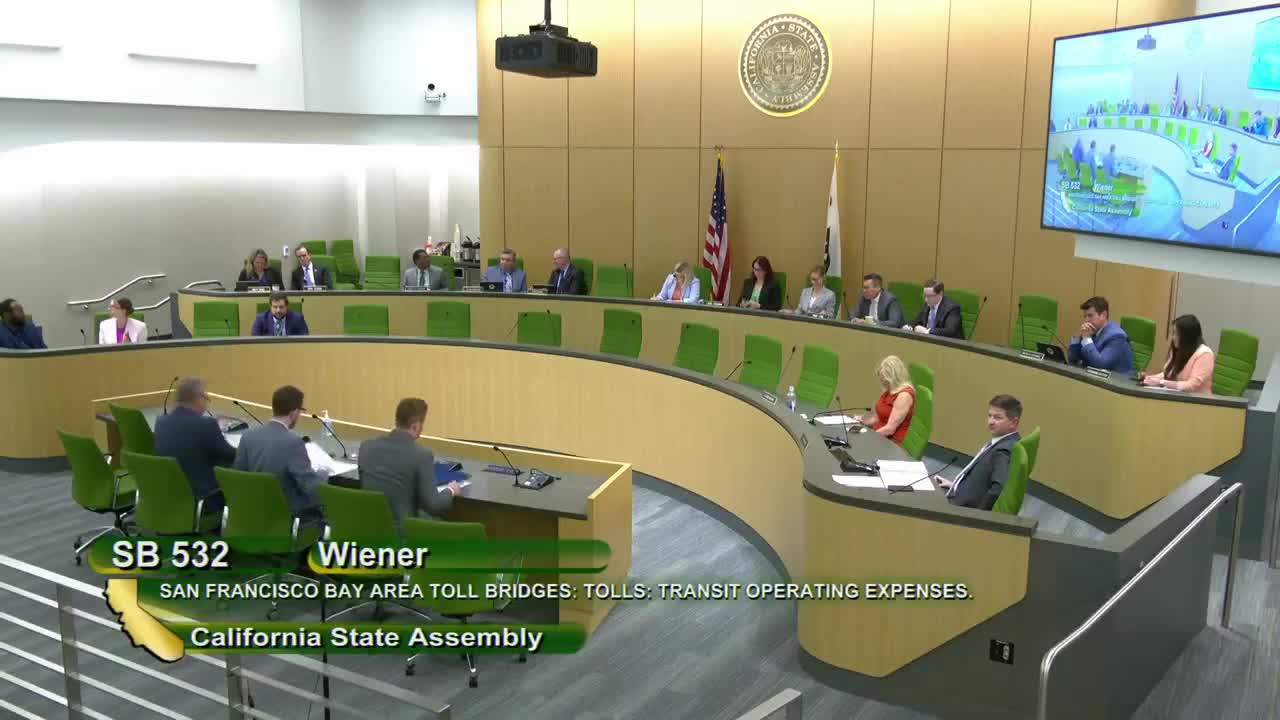 29MIN
Assembly Standing Committee on Transportation
 3MIN
Senate Floor
Bill Author