SB 661: Student Athlete Bill of Rights.
- Session Year: 2023-2024
- House: Senate
- Latest Version Date: 2023-10-08
Current Status:
Passed
(2023-10-08: Chaptered by Secretary of State. Chapter 625, Statutes of 2023.)
Introduced
In Committee
First Chamber
In Committee
Second Chamber
Enacted
Existing law establishes a system of postsecondary education in this state, including the University of California, the California State University, private postsecondary educational institutions, and independent institutions of higher education, as 4 segments of that system. Existing law, known as the Student Athlete Bill of Rights, provides for certain benefits for student athletes, including the protection of athletic scholarships, and exempts an institution that maintains an intercollegiate athletic program and receives, as an average, less than $10,000,000 in annual income derived from media rights for intercollegiate athletics from being subject to these requirements. Existing law requires an institution that is required to grant these benefits to student athletes to rely exclusively on revenue derived from media rights for intercollegiate athletics to defray any costs accrued from granting these benefits to student athletes.
This bill would also grant these benefits to student athletes who attend institutions that receive, as an average, less than $10,000,000 in annual income derived from media rights for intercollegiate athletics and participate in intercollegiate athletic programs whose teams do not compete in Division III of the National Collegiate Athletic Association. The bill would remove the requirement on institutions to rely exclusively on revenue derived from media rights for intercollegiate athletics to defray any costs accrued from affording these benefits to student athletes.
Existing law establishes a system of postsecondary education in this state, including the University of California, the California State University, private postsecondary educational institutions, and independent institutions of higher education, as 4 segments of that system. Existing law, known as the Student Athlete Bill of Rights, provides for certain benefits for student athletes, including the protection of athletic scholarships, and exempts an institution that maintains an intercollegiate athletic program and receives, as an average, less than $10,000,000 in annual income derived from media rights for intercollegiate athletics from being subject to these requirements. Existing law requires an institution that is required to grant these benefits to student athletes to rely exclusively on revenue derived from media rights for intercollegiate athletics to defray any costs accrued from granting these benefits to student athletes.
This bill would remove the exemption for institutions that receive, as an average, less than $10,000,000 in annual income derived from media rights for intercollegiate athletics, thereby requiring these institutions to grant these benefits to student athletes. also grant these benefits to student athletes who attend institutions that receive, as an average, less than $10,000,000 in annual income derived from media rights for intercollegiate athletics and participate in intercollegiate athletic programs whose teams do not compete in Division III of the National Collegiate Athletic Association. The bill would remove the requirement on institutions to rely exclusively on revenue derived from media rights for intercollegiate athletics to defray any costs accrued from affording these benefits to student athletes.
Existing law establishes a system of postsecondary education in this state, including the University of California, the California State University, private postsecondary educational institutions, and independent institutions of higher education, as 4 segments of that system. Existing law, known as the Student Athlete Bill of Rights, provides for certain benefits for student athletes, including the protection of athletic scholarships, and exempts an institution that maintains an intercollegiate athletic program and receives, as an average, less than $10,000,000 in annual income derived from media rights for intercollegiate athletics from being subject to these requirements. Existing law requires an institution that is required to grant these benefits to student athletes to rely exclusively on revenue derived from media rights for intercollegiate athletics to defray any costs accrued from granting these benefits to student athletes.
This bill would remove the exemption for institutions that receive, as an average, less than $10,000,000 in annual income derived from media rights for intercollegiate athletics, thereby requiring these institutions to grant these benefits to student athletes. The bill would remove the requirement on institutions to rely exclusively on revenue derived from media rights for intercollegiate athletics to defray any costs accrued from affording these benefits to student athletes.
(a)Commencing with the 201314 academic year, an athletic program shall comply with all of the following:
(1)(A)If an athletic program does not renew an athletic scholarship of a student athlete who suffers an incapacitating injury or illness resulting from the student athletes participation in the athletic program, and the institution of higher educations medical staff determines that the student is medically ineligible to participate in intercollegiate athletics, the institution of higher education shall provide an equivalent scholarship that, combined with the total duration of any previous athletic scholarship or scholarships received by the student athlete, will be provided for a total of up to five academic years or until the student athlete completes their undergraduate degree, whichever period is shorter. Additional years may be provided at the discretion of the institution of higher education, and additional years may be required pursuant to state law.
(B)If a student athlete takes a temporary leave of absence from an institution of higher education, the duration of that leave of absence shall not count against the five-year limit on eligibility for an equivalent scholarship imposed by subparagraph (A).
(C)An athletic program shall provide an equivalent scholarship to a student athlete who was on an athletic scholarship and is in good standing, but has exhausted their athletic eligibility, for up to one year or until the student athlete completes their primary undergraduate degree, whichever is shorter, except that an athletic program with a graduation success rate that is above 60 percent, disaggregated by team, shall not be subject to the requirements of this subparagraph. Additional years may be provided at the discretion of the institution of higher education, and additional years may be required pursuant to state law.
(D)A student athlete whose athletic scholarship is not renewed for cause by an athletic program shall receive no benefits under this part, but may appeal this decision within the institution of higher education attended by the student or within the athletic conference or association of which that institution of higher education is a member, as appropriate.
(2)Each athletic program shall conduct a financial and life skills workshop for all of its first-year and third-year student athletes at the beginning of the academic year. This workshop shall include, but not be limited to, information concerning financial aid, debt management, and a recommended budget for full-scholarship and partial-scholarship student athletes living on or off campus during the academic year and the summer term based on the current academic years cost of attendance. The workshop shall also include information on time management skills necessary for success as a student athlete, and academic resources available on campus.
(3)An institution of higher education shall grant a student athlete the same rights as other students with regard to any and all matters related to possible adverse or disciplinary actions, including, but not necessarily limited to, actions involving athletically related financial aid.
(4)An athletic program shall respond within seven business days with an answer to a student athletes written request to transfer to another institution of higher education.
(b)This section shall not apply to an athletic program whose teams compete in Division III of the National Collegiate Athletic Association.
(a)Commencing with the 201314 academic year, an athletic program shall comply with all of the following:
(a)(1) If(1)(A)If an athletic program does not renew an athletic scholarship of a student athlete who suffers an incapacitating injury or illness resulting from the student athletes participation in the athletic program, and the institution of higher educations medical staff determines that the student is medically ineligible to participate in intercollegiate athletics, the institution of higher education shall provide an equivalent scholarship that, combined with the total duration of any previous athletic scholarship or scholarships received by the student athlete, will be provided for a total of up to five academic years or until the student athlete completes their undergraduate degree, whichever period is shorter. Additional years may be provided at the discretion of the institution of higher education. education, and additional years may be required pursuant to state law.
(2)(B)If a student athlete takes a temporary leave of absence from an institution of higher education, the duration of that leave of absence shall not count against the five-year limit on eligibility for an equivalent scholarship imposed by paragraph (1). subparagraph (A).
(3)(C)An athletic program shall provide an equivalent scholarship to a student athlete who was on an athletic scholarship and is in good standing, but has exhausted their athletic eligibility, for up to one year or until the student athlete completes their primary undergraduate degree, whichever is shorter, except that an athletic program with a graduation success rate that is above 60 percent, disaggregated by team, shall not be subject to the requirements of this paragraph. subparagraph. Additional years may be provided at the discretion of the institution of higher education, and additional years may be required pursuant to state law.
(4)(D)A student athlete whose athletic scholarship is not renewed for cause by an athletic program shall receive no benefits under this part, but may appeal this decision within the institution of higher education attended by the student or within the athletic conference or association of which that institution of higher education is a member, as appropriate.
(b)(2)Each athletic program shall conduct a financial and life skills workshop for all of its first-year and third-year student athletes at the beginning of the academic year. This workshop shall include, but not be limited to, information concerning financial aid, debt management, and a recommended budget for full-scholarship and partial-scholarship student athletes living on or off campus during the academic year and the summer term based on the current academic years cost of attendance. The workshop shall also include information on time management skills necessary for success as a student athlete, and academic resources available on campus.
(c)(3)An institution of higher education shall grant a student athlete the same rights as other students with regard to any and all matters related to possible adverse or disciplinary actions, including, but not necessarily limited to, actions involving athletically related financial aid.
(d)(4)An athletic program shall respond within seven business days with an answer to a student athletes written request to transfer to another institution of higher education.
(b)This section shall not apply to an athletic program whose teams compete in Division III of the National Collegiate Athletic Association.
Commencing with the 201314 academic year, an athletic program shall comply with all of the following:
(a)(1)If an athletic program does not renew an athletic scholarship of a student athlete who suffers an incapacitating injury or illness resulting from the student athletes participation in the athletic program, and the institution of higher educations medical staff determines that the student is medically ineligible to participate in intercollegiate athletics, the institution of higher education shall provide an equivalent scholarship that, combined with the total duration of any previous athletic scholarship or scholarships received by the student athlete, will be provided for a total of up to five academic years or until the student athlete completes their undergraduate degree, whichever period is shorter. Additional years may be provided at the discretion of the institution. institution of higher education.
(2)If a student athlete takes a temporary leave of absence from an institution of higher education, the duration of that leave of absence shall not count against the five-year limit on eligibility for an equivalent scholarship imposed by paragraph (1).
(3)An athletic program shall provide an equivalent scholarship to a student athlete who was on an athletic scholarship and is in good standing, but has exhausted their athletic eligibility, for up to one year or until the student athlete completes their primary undergraduate degree, whichever is shorter, except that an athletic program with a graduation success rate that is above 60 percent, disaggregated by team, shall not be subject to the requirements of this paragraph.
(4)A student athlete whose athletic scholarship is not renewed for cause by an athletic program shall receive no benefits under this part, but may appeal this decision within the institution of higher education attended by the student or within the athletic conference or association of which that institution of higher education is a member, as appropriate.
(b)Each athletic program shall conduct a financial and life skills workshop for all of its first-year and third-year student athletes at the beginning of the academic year. This workshop shall include, but not be limited to, information concerning financial aid, debt management, and a recommended budget for full-scholarship and partial-scholarship student athletes living on or off campus during the academic year and the summer term based on the current academic years cost of attendance. The workshop shall also include information on time management skills necessary for success as a student athlete, and academic resources available on campus.
(c)An institution of higher education shall grant a student athlete the same rights as other students with regard to any and all matters related to possible adverse or disciplinary actions, including, but not necessarily limited to, actions involving athletically related financial aid.
(d)An athletic program shall respond within seven business days with an answer to a student athletes written request to transfer to another institution of higher education.
Commencing with the 201314 academic year, an athletic program shall comply with all of the following:
(a)(1)If an athletic program does not renew an athletic scholarship of a student athlete who suffers an incapacitating injury or illness resulting from his or her the student athletes participation in the athletic program, and the institution of higher educations medical staff determines that he or she the student is medically ineligible to participate in intercollegiate athletics, the institution of higher education shall provide an equivalent scholarship that, combined with the total duration of any previous athletic scholarship or scholarships received by the student athlete, will be provided for a total of up to five academic years or until the student athlete completes his or her their undergraduate degree, whichever period is shorter. Additional years may be provided at the discretion of the institution of higher education. institution.
(2)If a student athlete takes a temporary leave of absence from an institution of higher education, the duration of that leave of absence shall not count against the five-year limit on eligibility for an equivalent scholarship imposed by paragraph (1).
(3)An athletic program shall provide an equivalent scholarship to a student athlete who was on an athletic scholarship and is in good standing, but has exhausted his or her their athletic eligibility, for up to one year or until the student athlete completes his or her their primary undergraduate degree, whichever is shorter, except that an athletic program with a graduation success rate that is above 60 percent, disaggregated by team, shall not be subject to the requirements of this paragraph.
(4)A student athlete whose athletic scholarship is not renewed for cause by an athletic program shall receive no benefits under this part, but may appeal this decision within the institution of higher education attended by the student or within the athletic conference or association of which that institution of higher education is a member, as appropriate.
(b)Each athletic program shall conduct a financial and life skills workshop for all of its first-year and third-year student athletes at the beginning of the academic year. This workshop shall include, but not be limited to, information concerning financial aid, debt management, and a recommended budget for full- full-scholarship and partial-scholarship student athletes living on or off campus during the academic year and the summer term based on the current academic years cost of attendance. The workshop shall also include information on time management skills necessary for success as a student athlete, and academic resources available on campus.
(c)An institution of higher education shall grant a student athlete the same rights as other students with regard to any and all matters related to possible adverse or disciplinary actions, including, but not necessarily limited to, actions involving athletically related financial aid.
(d)An athletic program shall respond within seven business days with an answer to a student athletes written request to transfer to another institution of higher education.
(e)An institution of higher education that receives, as an average, less than ten million dollars ($10,000,000) in annual income derived from media rights for intercollegiate athletics shall not be subject to the requirements of this section.(f)An institution of higher education to which this section applies shall rely exclusively on revenue derived from media rights for intercollegiate athletics to defray any costs accrued under this section.|
Date
|
Status
|
|---|---|
| Oct 8, 2023 | Chaptered by Secretary of State. Chapter 625, Statutes of 2023. |
| Oct 8, 2023 | Approved by the Governor. |
| Sep 21, 2023 | Enrolled and presented to the Governor at 4 p.m. |
| Sep 14, 2023 | Assembly amendments concurred in. (Ayes 40. Noes 0. Page 2814.) Ordered to engrossing and enrolling. |
| Sep 13, 2023 | In Senate. Concurrence in Assembly amendments pending. |
| Sep 13, 2023 | Read third time. Passed. (Ayes 77. Noes 0. Page 3462.) Ordered to the Senate. |
| Sep 5, 2023 | Read second time. Ordered to third reading. |
| Sep 1, 2023 | Read second time and amended. Ordered to second reading. |
| Sep 1, 2023 | From committee: Do pass as amended. (Ayes 11. Noes 0.) (September 1). |
| Jun 28, 2023 | June 28 set for first hearing. Placed on suspense file. |
| Jun 14, 2023 | From committee: Do pass and re-refer to Com. on APPR. (Ayes 11. Noes 0.) (June 13). Re-referred to Com. on APPR. |
| Jun 1, 2023 | Referred to Com. on HIGHER ED. |
| May 25, 2023 | In Assembly. Read first time. Held at Desk. |
| May 24, 2023 | Read third time. Passed. (Ayes 39. Noes 0. Page 1259.) Ordered to the Assembly. |
| May 18, 2023 | Read second time. Ordered to third reading. |
| May 18, 2023 | From committee: Do pass. (Ayes 7. Noes 0. Page 1179.) (May 18). |
| May 12, 2023 | Set for hearing May 18. |
| May 1, 2023 | May 1 hearing: Placed on APPR suspense file. |
| Apr 25, 2023 | Set for hearing May 1. |
| Apr 20, 2023 | Read second time and amended. Re-referred to Com. on APPR. |
| Apr 19, 2023 | From committee: Do pass as amended and re-refer to Com. on APPR. (Ayes 7. Noes 0. Page 790.) (April 19). |
| Apr 11, 2023 | Set for hearing April 19. |
| Mar 1, 2023 | Referred to Com. on ED. |
| Feb 17, 2023 | From printer. May be acted upon on or after March 19. |
| Feb 16, 2023 | Introduced. Read first time. To Com. on RLS. for assignment. To print. |
|
Date
|
Description
|
Location
|
Votes
|
|
|---|---|---|---|---|
| Sep 14, 2023 | Unfinished Business SB661 Bradford Concurrence | Senate Floor |
Passed |
|
| Sep 13, 2023 | SB 661 Bradford Senate Third Reading By Valencia | Assembly Floor |
Passed |
|
| Sep 1, 2023 | Do pass as amended. | Assembly Standing Committee on Appropriations |
Passed |
|
| Jun 13, 2023 | Do pass and be re-referred to the Committee on [Appropriations] | Assembly Standing Committee on Higher Education |
Passed |
|
| May 24, 2023 | Senate 3rd Reading SB661 Bradford | Senate Floor |
Passed |
|
| May 18, 2023 | Do pass | Senate Standing Committee on Appropriations |
Passed |
|
| May 1, 2023 | Placed on suspense file | Senate Standing Committee on Appropriations |
Passed |
|
| Apr 19, 2023 | Do pass as amended, but first amend, and re-refer to the Committee on [Appropriations] | Senate Standing Committee on Education |
Passed |
This list shows positions taken on this bill by organizations on the date displayed, which is linked to the original source.
Positions by individuals are not included.
|
Organization
|
Position
|
Date
|
|---|---|---|
| California Faculty Association | ** Support | |
| California Teachers Association | ** Support |
SENATE RULES COMMITTEE Office of Senate Floor Analyses (916) 651-1520 Fax: (916) 327-4478 | SB 661 |
UNFINISHED BUSINESS
Bill No: SB 661
Author: Bradford (D)
Amended: 9/1/23
Vote: 21
SENATE EDUCATION COMMITTEE: 7-0, 4/19/23
AYES: Newman, Ochoa Bogh, Cortese, Glazer, McGuire, Smallwood-Cuevas, Wilk
SENATE APPROPRIATIONS COMMITTEE: 7-0, 5/18/23
AYES: Portantino, Jones, Ashby, Bradford, Seyarto, Wahab, Wiener
SENATE FLOOR: 39-0, 5/24/23
AYES: Allen, Alvarado-Gil, Archuleta, Ashby, Atkins, Becker, Blakespear, Bradford, Caballero, Cortese, Dahle, Dodd, Durazo, Eggman, Glazer, Gonzalez, Grove, Hurtado, Jones, Laird, McGuire, Menjivar, Min, Newman, Nguyen, Niello, Ochoa Bogh, Padilla, Portantino, Roth, Rubio, Seyarto, Skinner, Smallwood-Cuevas, Stern, Umberg, Wahab, Wiener, Wilk
NO VOTE RECORDED: Limón
ASSEMBLY FLOOR: 77-0, 9/13/23 - See last page for vote
SUBJECT: Student Athlete Bill of Rights
SOURCE: Author
DIGEST:
Expands the rights that student athletes who attend an institution of higher education (IHE), as defined, and removes the requirement on IHE, to rely exclusively on revenue derived from media to defray any costs accrued from affording these benefits to student athletes.
Assembly Amendments
exempt an athletic program whose teams compete in Division III of the National Collegiate Athletic Association (NCAA).
ANALYSIS:
Existing law:
- Requires an athletic program that does not renew an athletic scholarship of a student athlete who suffers an incapacitating injury or illness resulting from his or her participation in the athletic program, and the IHE’s medical staff determines that he or she is medically ineligible to participate in intercollegiate athletics, to provide an equivalent scholarship that, combined with the total duration of any previous athletic scholarship or scholarships received by the student athlete, will be provided for a total of up to five academic years or until the student athlete completes his or her undergraduate degree, whichever period is shorter.
- Clarifies that if a student athlete takes a temporary leave of absence from an IHE, the duration of that leave of absence shall not count against the five-year limit on eligibility for an equivalent scholarship.
- Requires an athletic program to provide an equivalent scholarship to a student athlete who was on an athletic scholarship and is in good standing, but has exhausted his or her athletic eligibility, for up to one year or until the student athlete completes his or her primary undergraduate degree, whichever is shorter, except that an athletic program with a graduation success rate that is above 60 percent, disaggregated by team, shall not be subject to the requirements of this paragraph.
- States a student athlete whose athletic scholarship is not renewed for cause by an athletic program shall receive no benefits under this part, but may appeal this decision within the IHE attended by the student or within the athletic conference or association of which that institution of higher education is a member, as appropriate. (Education Code (EC) § 67452 (a))
- Requires each athletic program to conduct a financial and life skills workshop for all of its first-year and third-year student athletes at the beginning of the academic year. (EC § 67452 (b))
- Requires an IHE to grant a student athlete the same rights as other students with regard to any and all matters related to possible adverse or disciplinary actions, including, but not necessarily limited to, actions involving athletically related financial aid. (EC § 67452 (c))
- Requires an athletic program to respond within seven business days with an answer to a student athlete’s written request to transfer to another IHE. (EC § 67452 (d))
- Specifies that an IHE that receives less than ten million dollars, on average, in media rights are exempt in providing benefits to their student athletes as specified in #1-4. (EC § 67452 (e))
- Requires an IHE that receives more than ten million dollars, on average, from intercollegiate media rights to exclusively use that revenue to provide benefits to their student athletes. (EC 67452 (f))
This bill:
- Strikes an exemption in current law for IHEs that make less than $10 million, on average, in annual income derived from media right for intercollegiate athletics, to provide specified benefits to their student athletes, thereby require those IHEs to provide benefits to their student athletes.
- Removes the requirement that IHEs that make more than $10 million, on average, in annual income derived from media right for intercollegiate athletics, to use that revenue to defray any cost in providing specified benefits to their student athletes, thereby expanding the source of funds used by an IHE to defray the cost of these benefits.
- Exempts an athletic program whose teams compete in Division III of the NCAA.
- Clarifies future laws related to college athletes benefits, as specified, will take precedent.
- Makes various technical changes.
Comments
- Need for the bill. According to the author, “SB 661 will remove the existing exemption for universities who receive on average less than $10,000,000 in annual income derived from media rights, ensuring that all universities provide scholarship protections and finance/life skills workshops to their student athletes. After SB 206 was enacted into law authorizing name, image, and likeness promotion opportunities, many athletes across all sports have utilized this change in law to partner with companies on social media, provide coaching lessons and camps, and pursue other business endeavors. Given the massive increase in students utilizing these new opportunities, there is an increased need for student athletes to have financial literacy education, but existing law only imposes this requirement to a few universities. Additionally, no student athlete, regardless of which university they attend or sport they play should fear losing their scholarship as a result of an injury. It is crucial that all student athletes in California have these basic protections.”
- Name, Image, and Likeliness (NIL). In Alston v. National Collegiate Athletic Association (NCAA), the athletes challenged the NCAA compensation limits as reducing competition among colleges and universities as to what those schools would otherwise provide the athletes. Given this restriction on competition, the NCAA relied on its longstanding position that the uniqueness of its product – the status of student athletes as amateurs – required antitrust deference and pointed for support to the 1984 decision in NCAA v. Board of Regents. Specifically, the NCAA’s procompetitive justification for the status quo (whereby the NCAA limits athlete compensation tied to academics and athletics and mostly prohibits athlete monetization of NIL rights) was that the survival of the product of college athletics depends on such restrictions by the NCAA. It reasoned that intercollegiate athletics differentiates itself from professional sports chiefly through the amateur status of its athletes, therefore diminishing the purity of amateurism through unrestrained athlete payment—even for academic expenses—would render intercollegiate athletics obsolete.
The Alston decision rejected this argument, holding that the Board of Regents decision was inapplicable to questions of athlete compensation and that the decision’s oft-cited commentary that the NCAA enjoys “ample latitude” under federal antitrust law was mere dicta that could not insulate the NCAA from antitrust scrutiny. Specifically, the Court found the NCAA had failed to show any economic analysis as to how or why the consumer market for college sports might be irrevocably destroyed by teenage athletes receiving unrestrained educational benefits. The Court noted, in contrast, that the Alston plaintiffs were able to show the very opposite—namely that the popularity of college sports had increased in the years following increased allowances in educational benefits allocation.
Justice Gorsuch found that by limiting education-related compensation that college athletes are permitted to receive from their schools, the NCAA is acting in violation of Section 1 of the Sherman Act, which prohibits any “contract, combination, or conspiracy in restraint of trade or commerce.” The Court reached this conclusion by affirming the lower court’s application of the “rule of reason” – a judicial doctrine of antitrust law.
- Current Benefits Awarded to Students. As specified in current statute, intercollegiate student athletes who attend IHE who receive more than ten million dollars, on average, in media rights must provide the following to its students athletes:
- An equivalent scholarship that totals to five academic years or until the student athlete completes their undergraduate degree, whichever is shorter, if an athletic program does not renew a student athletes scholarship due to an incapacitating injury or illness, and the IHE’s medical staff determines that the medical injury or illness sustained by the student athlete is medically ineligible to participate in intercollegiate athletics, resulting from the student athlete’s participation in the athletic program;
- Financial and life skills workshop for all of its first-year and third-year student athletes at the beginning of the academic year;
- Parity among student athletes to any and all matters related to possible adverse or disciplinary actions, including, but not necessarily limited to, actions involving athletically related financial aid; and
- Timely response (within 7 business days) from an athletic program to a student athlete’s written request to transfer to another IHE.
This bill would ensure that all student athletes at an IHE would receive these benefits (described above), regardless of how much income an IHE makes from media rights for intercollegiate athletics and expands an IHEs ability to pay for these benefits beyond revenue made solely from media rights for intercollegiate athletics. While some IHE already afford these benefits to their student athletes, providing a financial and life skills workshop, parity in student athlete discipline, and a timely response should not pose significant challenges to IHEs that would fall under this bill.
FISCAL EFFECT: Appropriation: No Fiscal Com.: Yes Local: No
According to the Assembly Appropriations Committee, “Ongoing, unknown costs, General Fund or special fund, to CSU to provide college athletes with certain benefits, including extended scholarships. The precise amount would depend upon several variables, including how many CSU campuses already provide these benefits to college athletes and the particulars of how a campus would offer financial and life skills workshops, for example. Ongoing, unknown, but likely minor costs, General Fund or special fund, to UC to provide additional college athletes with certain benefits, including extended scholarships. According to UC, it already provides some of the benefits this bill requires to its college athletes. The largest cost, according to UC, would be to offer financial and life skills workshops, which could vary by campus.”
SUPPORT: (Verified 9/13/23)
California Teachers Association
OPPOSITION: (Verified 9/13/23)
None received
ARGUMENTS IN SUPPORT: According to the California Teachers Association, “The California Faculty Association wrote that "existing legislation, while a significant step forward, contains an unfortunate exemption for institutions that receive less than $10,000,000 in annual income from media rights for intercollegiate athletics. This exemption inadvertently creates a two-tier system for student athletes, where the rights and protections provided under the Bill of Rights are only accessible to those attending institutions with substantial media revenues. SB 661 rectifies this inequity, ensuring that all student athletes, regardless of the size or wealth of their institutions, receive the rights and protections they deserve. The provision to remove the requirement on institutions to rely exclusively on revenue derived from media rights to cover the costs of these benefits is also welcome. This will allow for more financial flexibility, enabling institutions to fully implement the Student Athlete Bill of Rights. Student athletes contribute significantly to their schools and communities, yet they often face unique academic and personal challenges due to the demands of their athletic commitments. These challenges necessitate comprehensive institutional support for these students. By extending the full benefits of the Student Athlete Bill of Rights to all student
athletes, SB 661 will enhance their academic success, personal wellbeing, and overall college experience."
ASSEMBLY FLOOR: 77-0, 9/13/23
AYES: Addis, Aguiar-Curry, Alanis, Alvarez, Arambula, Bains, Bennett, Berman, Boerner, Bonta, Bryan, Calderon, Juan Carrillo, Wendy Carrillo, Cervantes, Connolly, Megan Dahle, Davies, Dixon, Essayli, Flora, Mike Fong, Vince Fong, Friedman, Gabriel, Gallagher, Garcia, Gipson, Grayson, Haney, Hart, Holden, Hoover, Irwin, Jackson, Jones-Sawyer, Kalra, Lackey, Lee, Low, Lowenthal, Maienschein, Mathis, McCarty, McKinnor, Muratsuchi, Stephanie Nguyen, Ortega, Pacheco, Papan, Jim Patterson, Joe Patterson, Pellerin, Petrie-Norris, Quirk-Silva, Ramos, Rendon, Reyes, Rodriguez, Blanca Rubio, Sanchez, Santiago, Schiavo, Soria, Ta, Ting, Valencia, Villapudua, Waldron, Wallis, Ward, Weber, Wicks, Wilson, Wood, Zbur, Robert Rivas
NO VOTE RECORDED: Bauer-Kahan, Chen, Luz Rivas
Prepared by: Kordell Hampton / ED. / (916) 651-4105
9/14/23 10:02:41
**** END ****
SENATE THIRD READING
STR Bill Id:SB 661
Author:(Bradford)
As Amended Ver:September 1, 2023
Majority vote
SUMMARY
Expands the rights that student athletes who attend an institution of higher education (IHE), as defined, and removes the requirement on IHE, to rely exclusively on revenue derived from media to defray any costs accrued from affording these benefits to student athletes.
Major Provisions
- Strikes an exemption in current law for IHEs that make less than $10 million, on average, in annual income derived from media right for intercollegiate athletics, to provide specified benefits to their student athletes, thereby require those IHEs to provide benefits to their student athletes.
- Removes the requirement that IHEs that make more than $10 million, on average, in annual income derived from media right for intercollegiate athletics, to use that revenue to defray any cost in providing specified benefits to their student athletes, thereby expanding the source of funds used by an IHE to defray the cost of these benefits.
- Exempts an athletic program whose teams compete in Division III of the National Collegiate Athletic Association (NCAA).
- Clarifies future laws related to college athletes benefits, as specified, will take precedent.
- Makes various technical changes.
COMMENTS
Name, Image, Likeness (NIL): On June 30, 2021, the NCAA Division 1 Board of Directors approved an interim NIL policy. This new policy allows all NCAA Division I, II, and III student-athletes to be compensated for their NIL as of July 1, 2021, regardless of whether their state has a NIL law in place or not. California was one of the first states to establish an NIL policy, as passed by SB 206 (Skinner), Chapter 383, Statutes of 2019, and strongly influenced the implementation of NCAA's policy.
The NCAA NIL rules do not override state, college/university or conference specific NIL rules. This means student-athletes need to review the NIL rules in the state where their school is located and check with their athletic department for any school and conference-specific rules to understand what limitations they will have on their NIL.
The author contends that extending the financial literacy provisions currently included in the Student Athlete's Bill of Rights (SABR) to all students would allow them to better navigate the post-NIL collegiate athletics landscape.
SABR. SB 1525 (Padilla), Chapter 625, Statutes of 2012, established the SABR. Several of the protections provided for California student athletes contained in the SABR (specifically EDC Sections 67452 and 67453) are limited to universities that receive, on average, at least $10 million in annual income from media rights for intercollegiate athletics. This number is a minority of California colleges and universities, and has traditionally only included UC Berkeley, Stanford, the University of Southern California (USC), and UC Los Angeles. The rapid increase in athletics media rights deals – and the lack of inflation growth built into current law – means that other universities with robust athletics programs might also soon fall under these specific provisions of SABR.
Specifically, these SABR provisions requires an intercollegiate athletic program at any campus of the UC, CSU, or private four-year university in California to provide to students whose athletic scholarship is not renewed due to an incapacitating injury or illness resulting from his or her participation in the athletic program, an equivalent scholarship (when combined with the total duration of any previous athletic or other scholarship received by the student) for a total of at least five years or until the student completes his or her undergraduate degree, whichever period is shorter.
The law also requires athletic programs to promptly approve a qualifying student athlete's written request to transfer to another institution without actively or passively imposing any restrictions or condition. Implementation must include granting other institutions permission to contact the student athlete and waiving residency requirements, as permitted by athletic association rules.
Colleges must also grant a student athlete the same rights as other students with regard to any and all matters related to possible adverse or disciplinary actions, including actions involving his or her participation in the athletic program.
SB 661 would remove the $10 million media rights cap, thereby requiring all CSU, UC, and independent private institutions in the specific provisions of the SABR detailed in "Existing Law".
Current policies. According to information provided to the Senate Committee on Appropriations, the CSU does not currently have a policy to provide student athletes with an extension of their scholarship following a determination that they are medically ineligible to play. However, it has been CSU's general practice to do so contingent upon the student athlete maintaining satisfactory progress toward degree and in some instances, a requirement that the student athlete work in the department in which they have an interest.
UC indicates that is it bound by Regents Policy 3105 which states that, "for those campuses that provide athletic scholarships if a student sustains an incapacitating injury while participating in intercollegiate athletic activities and is medically unable to continue his/her athletic commitments, the campus shall not revoke financial aid or scholarships, and shall provide the student-athlete with an equivalent grant or scholarship to finish his/her degree."
Committee Staff understands that policies vary throughout independent colleges, and thus complying with the provisions of SB 661 (Bradford) would constitute an expansion.
According to the Author
According to the author, "SB 661 will remove the existing exemption for universities who receive on average less than $10 million in annual income derived from media rights, ensuring that all universities provide scholarship protections and finance/life skills workshops to their student athletes. After SB 206 was enacted into law authorizing name, image, and likeness promotion opportunities, many athletes across all sports have utilized this change in law to partner with companies on social media, provide coaching lessons and camps, and pursue other business endeavors. Given the massive increase in students utilizing these new opportunities, there is an increased need for student athletes to have financial literacy education, but existing law only imposes this requirement to a few universities. Additionally, no student athlete, regardless of which university they attend or sport they play should fear losing their scholarship as a result of an injury. It is crucial that all student athletes in California have these basic protections."
Arguments in Support
The California Faculty Association wrote that "existing legislation, while a significant step forward, contains an unfortunate exemption for institutions that receive less than $10,000,000 in annual income from media rights for intercollegiate athletics. This exemption inadvertently creates a two-tier system for student athletes, where the rights and protections provided under the Bill of Rights are only accessible to those attending institutions with substantial media revenues. SB 661 rectifies this inequity, ensuring that all student athletes, regardless of the size or wealth of their institutions, receive the rights and protections they deserve. The provision to remove the requirement on institutions to rely exclusively on revenue derived from media rights to cover the costs of these benefits is also welcome. This will allow for more financial flexibility, enabling institutions to fully implement the Student Athlete Bill of Rights."
"Student athletes contribute significantly to their schools and communities, yet they often face unique academic and personal challenges due to the demands of their athletic commitments. These challenges necessitate comprehensive institutional support for these students. By extending the full benefits of the Student Athlete Bill of Rights to all student athletes, SB 661 will enhance their academic success, personal wellbeing, and overall college experience."
Arguments in Opposition
None on file.
FISCAL COMMENTS
According to the Assembly Appropriations Committee:
- Ongoing, unknown costs, General Fund or special fund, to CSU to provide college athletes with certain benefits, including extended scholarships. The precise amount would depend upon several variables, including how many CSU campuses already provide these benefits to college athletes and the particulars of how a campus would offer financial and life skills workshops, for example.
- Ongoing, unknown, but likely minor costs, General Fund or special fund, to UC to provide additional college athletes with certain benefits, including extended scholarships. According to UC, it already provides some of the benefits this bill requires to its college athletes. The largest cost, according to UC, would be to offer financial and life skills workshops, which could vary by campus.
VOTES
SENATE FLOOR: 39-0-1
YES: Allen, Alvarado-Gil, Archuleta, Ashby, Atkins, Becker, Blakespear, Bradford, Caballero, Cortese, Dahle, Dodd, Durazo, Eggman, Glazer, Gonzalez, Grove, Hurtado, Jones, Laird, McGuire, Menjivar, Min, Newman, Nguyen, Niello, Ochoa Bogh, Padilla, Portantino, Roth, Rubio, Seyarto, Skinner, Smallwood-Cuevas, Stern, Umberg, Wahab, Wiener, Wilk
ABS, ABST OR NV: Limón
ASM HIGHER EDUCATION: 11-0-1
YES: Mike Fong, Ta, Arambula, Gabriel, Irwin, Low, Ortega, Sanchez, Santiago, Wallis, Weber
ABS, ABST OR NV: Addis
ASM APPROPRIATIONS: 11-0-5
YES: Holden, Bryan, Calderon, Wendy Carrillo, Mike Fong, Hart, Lowenthal, Papan, Pellerin, Weber, Wilson
ABS, ABST OR NV: Megan Dahle, Dixon, Mathis, Sanchez, Soria
UPDATED
VERSION: September 1, 2023
CONSULTANT: Kevin J. Powers / HIGHER ED. / (916) 319-3960 FN: 0001602
Date of Hearing: June 28, 2023
ASSEMBLY COMMITTEE ON APPROPRIATIONS
Chris Holden, Chair
SBPCA Bill Id:SB 661
Author:(Bradford) – As Amended Ver:April 20, 2023
Policy Committee: | Higher Education | Vote: | 11 - 0 |
|
| ||
|
|
Urgency: No State Mandated Local Program: No Reimbursable: No
SUMMARY:
This bill requires additional institutions of higher education to provide certain benefits to college athletes as required by the Student Athlete Bill of Rights.
Specifically, this bill strikes the exemption for public and private institutions of higher education that make less than $10 million, on average, in annual income derived from media rights for intercollegiate athletics to provide certain benefits to their college athletes. The bill also removes the requirement that institutions may use media rights revenue only to defray costs to provide the benefits.
FISCAL EFFECT:
- Ongoing, unknown costs, General Fund or special fund, to CSU to provide college athletes with certain benefits, including extended scholarships. The precise amount would depend upon several variables, including how many CSU campuses already provide these benefits to college athletes and the particulars of how a campus would offer financial and life skills workshops, for example.
- Ongoing, unknown, but likely minor costs, General Fund or special fund, to UC to provide additional college athletes with certain benefits, including extended scholarships. According to UC, it already provides some of the benefits this bill requires to its college athletes. The largest cost, according to UC, would be to offer financial and life skills workshops, which could vary by campus.
COMMENTS:
- Purpose. According to the author:
SB 661 will remove the existing exemption for universities who receive on average less than $10,000,000 in annual income derived from media rights, ensuring that all universities provide scholarship protections and finance/life skills workshops to their student athletes. After SB 206 was enacted into law authorizing name, image, and likeness promotion opportunities, many athletes across all sports have utilized this change in law to partner with companies on social media, provide coaching lessons and camps, and pursue other business endeavors. Given the massive increase in students utilizing these new opportunities, there is an increased need for student athletes to have financial literacy education, but existing law only imposes this requirement to a few universities. Additionally, no student athlete, regardless of which university they attend or sport they play should fear losing their scholarship as a result of an injury. It is crucial that all student athletes in California have these basic protections.
- Background. Institutions receive “media rights” revenue from contracts with broadcasting organizations. These contracts provide exclusive rights to the organization to broadcast the institution’s sports on media outlets, including television and radio.
SB 1525 (Padilla), Chapter 625, Statutes of 2012, requires institutions of higher education with college athletic programs that receive more $10 million, on average, in media rights revenue to provide certain benefits to college athletes under the Student Athlete Bill of Rights. Specifically, the Student Athlete Bill of Rights requires an eligible intuition to provide (a) an equivalent scholarship that totals up to five academic years or until the college athlete completes their undergraduate degree if an athletic program does not renew the scholarship due to an incapacitating injury or illness; (b) financial and life skills workshop for all of its first-year and third-year college athletes at the beginning of the academic year; (c) parity among college athletes to all matters related to possible adverse or disciplinary actions, including actions involving athletics-related financial aid; and (d) timely response (within seven business days) from an athletic program to a college athlete’s written request to transfer to another institution. Traditionally, only UC Berkeley, Stanford, the University of Southern California, and UC Los Angeles have been subject to these requirements.
This bill requires all CSUs, UCs, and private institutions to provide these benefits to college athletes, regardless of media rights revenue.
- Related Legislation. AB 252 (Holden) would provide various rights, benefits, and protections to college athletes. The bill is pending in the Senate Education Committee.
Analysis Prepared by: Natasha Collins / APPR. / (916) 319-2081
Date of Hearing: June 13, 2023
ASSEMBLY COMMITTEE ON HIGHER EDUCATION
Mike Fong, Chair
SBPCA Bill Id:SB 661
Author:(Bradford) – As Amended Ver:April 20, 2023
SENATE VOTE: 39-0
SUBJECT: Student Athlete Bill of Rights
SUMMARY: Expands the rights that student athletes who attend an institution of higher education (IHE), as defined, and removes the requirement on IHE, to rely exclusively on revenue derived from media to defray any costs accrued from affording these benefits to student athletes. Specifically, this bill:
- Strikes an exemption in current law for IHEs that make less than $10 million, on average, in annual income derived from media right for intercollegiate athletics, to provide specified benefits to their student athletes (described in detail in Existing Law 1-4 below), thereby require those IHEs to provide benefits to their student athletes.
- Removes the requirement that IHEs that make more than 10 million, on average, in annual income derived from media right for intercollegiate athletics, to use that revenue to defray any cost in providing specified benefits to their student athletes, thereby expanding the source of funds used by an IHE to defray the cost of these benefits.
- Makes various technical changes.
EXISTING LAW:
- Requires an athletic program that does not renew an athletic scholarship of a student athlete who suffers an incapacitating injury or illness resulting from his or her participation in the athletic program, and the IHE’s medical staff determines that he or she is medically ineligible to participate in intercollegiate athletics, to provide an equivalent scholarship that, combined with the total duration of any previous athletic scholarship or scholarships received by the student athlete, will be provided for a total of up to five academic years or until the student athlete completes his or her undergraduate degree, whichever period is shorter.
- Clarifies that if a student athlete takes a temporary leave of absence from an IHE, the duration of that leave of absence shall not count against the five-year limit on eligibility for an equivalent scholarship;
- Requires an athletic program to provide an equivalent scholarship to a student athlete who was on an athletic scholarship and is in good standing, but has exhausted his or her athletic eligibility, for up to one year or until the student athlete completes his or her primary undergraduate degree, whichever is shorter, except that an athletic program with a graduation success rate that is above 60 percent, disaggregated by team, shall not be subject to the requirements of this paragraph; and,
- States a student athlete whose athletic scholarship is not renewed for cause by an athletic program shall receive no benefits under this part, but may appeal this decision within the IHE attended by the student or within the athletic conference or association of which that institution of higher education is a member, as appropriate. (Education Code (EDC) Section 67452 (a))
- Requires each athletic program to conduct a financial and life skills workshop for all of its first-year and third-year student athletes at the beginning of the academic year. (EDC Section 67452 (b))
- Requires an IHE to grant a student athlete the same rights as other students with regard to any and all matters related to possible adverse or disciplinary actions, including, but not necessarily limited to, actions involving athletically related financial aid. (EDC Section 67452 (c))
- Requires an athletic program to respond within seven business days with an answer to a student athlete’s written request to transfer to another IHE. (EDC Section 67452 (d))
- Specifies that an IHE that receives less than ten million dollars, on average, in media rights are exempt in providing benefits to their student athletes as specified in #1-4. (EDC § 67452 (e))
- Requires an IHE that receives more than ten million dollars, on average, from intercollegiate media rights to exclusively use that revenue to provide benefits to their student athletes described in #1-4. (EDC 67452 (f))
- Defines IHE to any campus of the University of California (UC) or the California State University (CSU), or any four-year private university located in California, that maintains an intercollegiate athletic program. (EDC Section 67451 (d))
FISCAL EFFECT: According to the Senate Committee on Appropriations, “the bill’s requirement for institutions to provide replacement scholarships for student athletes that suffer an incapacitating injury or illness could result in additional, unknown institutional costs and cost pressures to the CSU. A precise amount would depend on the number of students that would be impacted and the level of their scholarship support.” To the extent there are CSU campuses that do not employ the practice of providing replacement scholarships or there are student athletes that become injured and do not maintain satisfactory progress, there could be additional cost pressures on those campuses. The CSU indicates that the costs associated with financial literacy workshops would be relatively minor and absorbable, but could vary by campus depending on the size of their athletic programs.”
“The UC indicates there would be no costs because campuses already comply with scholarship replacement provisions. The UC estimates that any costs to provide financial literacy and life skills workshops would be minor.”
“This bill would apply to the private, independent colleges and universities that offer athletic scholarships in the state. While some already provide replacement scholarships, there are colleges that do not and therefore, would incur additional costs to comply. The amount per scholarship can range from $15,000 to nearly $80,000, with the total cost per college dependent on the number of replacement scholarships provided. The private, independent colleges may also experience additional, unknown costs to provide financial literacy training for student athletes.”
COMMENTS: Purpose. According to the author, “SB 661 will remove the existing exemption for universities who receive on average less than $10,000,000 in annual income derived from media rights, ensuring that all universities provide scholarship protections and finance/life skills workshops to their student athletes. After SB 206 was enacted into law authorizing name, image, and likeness promotion opportunities, many athletes across all sports have utilized this change in law to partner with companies on social media, provide coaching lessons and camps, and pursue other business endeavors. Given the massive increase in students utilizing these new opportunities, there is an increased need for student athletes to have financial literacy education, but existing law only imposes this requirement to a few universities. Additionally, no student athlete, regardless of which university they attend or sport they play should fear losing their scholarship as a result of an injury. It is crucial that all student athletes in California have these basic protections.”
Name, Image, Likeness (NIL): On June 30, 2021, the NCAA Division 1 Board of Directors approved an interim NIL policy. This new policy allows all NCAA Division I, II, and III student-athletes to be compensated for their NIL as of July 1, 2021, regardless of whether their state has a NIL law in place or not. California was one of the first states to establish an NIL policy, as passed by SB 206 (Skinner), Chapter 383, Statutes of 2019, and strongly influenced the implementation of NCAA’s policy.
The NCAA NIL rules do not override state, college/university or conference specific NIL rules. This means student-athletes need to review the NIL rules in the state where their school is located and check with their athletic department for any school and conference-specific rules to understand what limitations they will have on their NIL.
The author contends that extending the financial literacy provisions currently included in the Student Athlete’s Bill of Rights (SABR) to all students would allow them to better navigate the post-NIL collegiate athletics landscape.
SABR. SB 1525 (Padilla) Chapter 625, Statutes of 2012, established the SABR. Several of the protections provided for California student athletes contained in the SABR (specifically EDC Sections 67452 and 67453) are limited to universities that receive, on average, at least $10 million in annual income from media rights for intercollegiate athletics. This number is a minority of California colleges and universities, and has traditionally only included UC Berkeley, Stanford, the University of Southern California (USC), and UC Los Angeles. The rapid increase in athletics media rights deals – and the lack of inflation growth built into current law – means that other universities with robust athletics programs might also soon fall under these specific provisions of SABR.
Specifically, these SABR provisions requires an intercollegiate athletic program at any campus of the UC, CSU, or private four-year university in California to provide to students whose athletic scholarship is not renewed due to an incapacitating injury or illness resulting from his or her participation in the athletic program, an equivalent scholarship (when combined with the total duration of any previous athletic or other scholarship received by the student) for a total of at least five years or until the student completes his or her undergraduate degree, whichever period is shorter.
The law also requires athletic programs to promptly approve a qualifying student athlete's written request to transfer to another institution without actively or passively imposing any restrictions or condition. Implementation must include granting other institutions permission to contact the student athlete and waiving residency requirements, as permitted by athletic association rules.
Colleges must also grant a student athlete the same rights as other students with regard to any and all matters related to possible adverse or disciplinary actions, including actions involving his or her participation in the athletic program.
SB 661 would remove the $10 million media rights cap, thereby requiring all CSU, UC, and independent private institutions in the specific provisions of the SABR detailed in “Existing Law”.
Current policies. According to information provided to the Senate Committee on Appropriations, the CSU does not currently have a policy to provide student athletes with an extension of their scholarship following a determination that they are medically ineligible to play. However, it has been CSU’s general practice to do so contingent upon the student athlete maintaining satisfactory progress toward degree and in some instances, a requirement that the student athlete work in the department in which they have an interest.
UC indicates that is it bound by Regents Policy 3105 which states that, “for those campuses that provide athletic scholarships if a student sustains an incapacitating injury while participating in intercollegiate athletic activities and is medically unable to continue his/her athletic commitments, the campus shall not revoke financial aid or scholarships, and shall provide the student-athlete with an equivalent grant or scholarship to finish his/her degree.”
Committee Staff understands that policies vary throughout independent colleges, and thus complying with the provisions of SB 661 (Bradford) would constitute an expansion. Committee Staff also notes that numerous institutions participate in NCAA Division III, and generally do not offer scholarships for athletes.
Arguments in support. The California Faculty Association wrote that “existing legislation, while a significant step forward, contains an unfortunate exemption for institutions that receive less than $10,000,000 in annual income from media rights for intercollegiate athletics. This exemption inadvertently creates a two-tier system for student athletes, where the rights and protections provided under the Bill of Rights are only accessible to those attending institutions with substantial media revenues. SB 661 rectifies this inequity, ensuring that all student athletes, regardless of the size or wealth of their institutions, receive the rights and protections they deserve. The provision to remove the requirement on institutions to rely exclusively on revenue derived from media rights to cover the costs of these benefits is also welcome. This will allow for more financial flexibility, enabling institutions to fully implement the Student Athlete Bill of Rights.”
“Student athletes contribute significantly to their schools and communities, yet they often face unique academic and personal challenges due to the demands of their athletic commitments. These challenges necessitate comprehensive institutional support for these students. By extending the full benefits of the Student Athlete Bill of Rights to all student athletes, SB 661 will enhance their academic success, personal wellbeing, and overall college experience.”
Similar and prior legislation. AB 252 (Holden, 2023) would establish the College Athlete Protection Act for purposes of providing various rights, benefits, and protections to college athletes. This bill is currently pending referral in the Senate.
SB 1401 (Bradford, 2022) would have required postsecondary institutions to establish degree completion funds for their student athletes that take into account the revenues generated by the sport in question and the amount of athletic scholarship aid provided to athletes participating in that sport. This bill was held on the Suspense File in the Assembly Committee on Appropriations.
SB 26 (Skinner) Chapter 159, Statutes of 2021, expands the existing authority for a collegiate student athlete to receive compensation to also include compensation earned from the use of the student’s athletic reputation, and moves up the implementation date of existing statutes relative to compensation earned from the use of a student athlete’s NIL.
AB 609 (Kamlager, 2021) would have required institutions of higher learning to (1) pay their athletes in sports generating high revenue in comparison to the amount of scholarships awarded; (2) comply with federal law requiring equal opportunity to participate in college athletics, regardless of gender and to suspend an athletic director from intercollegiate athletics responsibilities in the state for three years if such compliance is not achieved; and (3) limit compensation for athletics administrative personnel. AB 609 died in the Assembly Committee on Arts, Entertainment, Sports, Tourism, and Internet Media.
SB 206 (Skinner), Chapter 383, Statutes of 2019, allows, commencing on January 1, 2023, college student athletes to earn compensation for the use of their own name, image, or likeness (athletic endorsements). This bill allows student athletes to obtain professional legal representation, such as that provided by a sports agent, in relation to their college athletics. This bill provides protections for student athletes that elect to engage in the compensation and representation activities described therein.
SB 1525 (Padilla) Chapter 625, Statutes of 2012, enacted a SABR and places specified requirements on collegiate athletic programs commencing with the 2013-14 academic year and ending January 1, 2021.
REGISTERED SUPPORT / OPPOSITION:
Support
California Faculty Association
California Teachers Association
Opposition
None on file.
Analysis Prepared by: Kevin J. Powers / HIGHER ED. / (916) 319-3960
SENATE RULES COMMITTEE Office of Senate Floor Analyses (916) 651-1520 Fax: (916) 327-4478 | SB 661 |
THIRD READING
Bill No: SB 661
Author: Bradford (D)
Amended: 4/20/23
Vote: 21
SENATE EDUCATION COMMITTEE: 7-0, 4/19/23
AYES: Newman, Ochoa Bogh, Cortese, Glazer, McGuire, Smallwood-Cuevas, Wilk
SENATE APPROPRIATIONS COMMITTEE: 7-0, 5/18/23
AYES: Portantino, Jones, Ashby, Bradford, Seyarto, Wahab, Wiener
SUBJECT: Student Athlete Bill of Rights
SOURCE: Author
DIGEST:
This bill expands the rights that student athletes who attend an institution of higher education (IHE), that generates more than ten million dollars, on average, in annual income derived from media rights for intercollegiate athletics, to student athletes at all IHEs and removes the requirement on IHE to rely exclusively on revenue derived from media to defray any costs accrued from affording these benefits to student athletes.
ANALYSIS:
Existing law:
- Requires an athletic program that does not renew an athletic scholarship of a student athlete who suffers an incapacitating injury or illness resulting from his or her participation in the athletic program, and the IHE’s medical staff determines that he or she is medically ineligible to participate in intercollegiate athletics, to provide an equivalent scholarship that, combined with the total duration of any previous athletic scholarship or scholarships received by the student athlete, will be provided for a total of up to five academic years or until the student athlete completes his or her undergraduate degree, whichever period is shorter.
- Clarifies that if a student athlete takes a temporary leave of absence from an IHE, the duration of that leave of absence shall not count against the five-year limit on eligibility for an equivalent scholarship.
- Requires an athletic program to provide an equivalent scholarship to a student athlete who was on an athletic scholarship and is in good standing, but has exhausted his or her athletic eligibility, for up to one year or until the student athlete completes his or her primary undergraduate degree, whichever is shorter, except that an athletic program with a graduation success rate that is above 60 percent, disaggregated by team, shall not be subject to the requirements of this paragraph.
- States a student athlete whose athletic scholarship is not renewed for cause by an athletic program shall receive no benefits under this part, but may appeal this decision within the IHE attended by the student or within the athletic conference or association of which that institution of higher education is a member, as appropriate. (EC § 67452 (a))
- Requires each athletic program to conduct a financial and life skills workshop for all of its first-year and third-year student athletes at the beginning of the academic year. (EC § 67452 (b))
- Requires an IHE to grant a student athlete the same rights as other students with regard to any and all matters related to possible adverse or disciplinary actions, including, but not necessarily limited to, actions involving athletically related financial aid. (EC § 67452 (c))
- Requires an athletic program to respond within seven business days with an answer to a student athlete’s written request to transfer to another IHE. (EC § 67452 (d))
- Specifies that an IHE that receives less than ten million dollars, on average, in media rights are exempt in providing benefits to their student athletes as specified in #1-4. (EC § 67452 (e))
- Requires an IHE that receives more than ten million dollars, on average, from intercollegiate media rights to exclusively use that revenue to provide benefits to their student athletes described in #1-4. (EC 67452 (f))
This bill:
- Strikes the exemption for IHEs that make less than ten million dollars, on average, in annual income derived from media right for intercollegiate athletics, to provide benefits to their student athletes, thereby require those IHEs to provide benefits to their student athletes.
- Removes the requirement that IHEs that make more than ten million dollars, on average, in annual income derived from media right for intercollegiate athletics, to use that revenue to defray any cost in providing benefits to their student athletes, thereby expanding the source of funds used by an IHE to defray the cost of these benefits.
- Makes technical changes.
Comments
- Need for the bill. According to the author, “SB 661 will remove the existing exemption for universities who receive on average less than $10,000,000 in annual income derived from media rights, ensuring that all universities provide scholarship protections and finance/life skills workshops to their student athletes. After SB 206 was enacted into law authorizing name, image, and likeness promotion opportunities, many athletes across all sports have utilized this change in law to partner with companies on social media, provide coaching lessons and camps, and pursue other business endeavors. Given the massive increase in students utilizing these new opportunities, there is an increased need for student athletes to have financial literacy education, but existing law only imposes this requirement to a few universities. Additionally, no student athlete, regardless of which university they attend or sport they play should fear losing their scholarship as a result of an injury. It is crucial that all student athletes in California have these basic protections.”
- Name, Image, and Likeliness (NIL). In Alston v. National Collegiate Athletic Association (NCAA), the athletes challenged the NCAA compensation limits as reducing competition among colleges and universities as to what those schools would otherwise provide the athletes. Given this restriction on competition, the NCAA relied on its longstanding position that the uniqueness of its product – the status of student athletes as amateurs – required antitrust deference and pointed for support to the 1984 decision in NCAA v. Board of Regents. Specifically, the NCAA’s procompetitive justification for the status quo (whereby the NCAA limits athlete compensation tied to academics and athletics and mostly prohibits athlete monetization of NIL rights) was that the survival of the product of college athletics depends on such restrictions by the NCAA. It reasoned that intercollegiate athletics differentiates itself from professional sports chiefly through the amateur status of its athletes, therefore diminishing the purity of amateurism through unrestrained athlete payment—even for academic expenses—would render intercollegiate athletics obsolete.
The Alston decision rejected this argument, holding that the Board of Regents decision was inapplicable to questions of athlete compensation and that the decision’s oft-cited commentary that the NCAA enjoys “ample latitude” under federal antitrust law was mere dicta that could not insulate the NCAA from antitrust scrutiny. Specifically, the Court found the NCAA had failed to show any economic analysis as to how or why the consumer market for college sports might be irrevocably destroyed by teenage athletes receiving unrestrained educational benefits. The Court noted, in contrast, that the Alston plaintiffs were able to show the very opposite—namely that the popularity of college sports had increased in the years following increased allowances in educational benefits allocation.
Justice Gorsuch found that by limiting education-related compensation that college athletes are permitted to receive from their schools, the NCAA is acting in violation of Section 1 of the Sherman Act, which prohibits any “contract, combination, or conspiracy in restraint of trade or commerce.” The Court reached this conclusion by affirming the lower court’s application of the “rule of reason” – a judicial doctrine of antitrust law.
- The Equity In Athletics Disclosure Act. The EADA was designed to make prospective students and prospective student-athletes aware of an IHE’s commitment to providing equitable athletic opportunities for its men and women students. The EADA requires the disclosure of information about varsity teams and the financial resources and personnel that the school dedicates to those teams. The EADA Report must be published by October 15 each year and must be made available upon request to students, prospective students, and the public. The EADA Report includes:
Participation counts: The October 15th report requires the number of student athletes who participated on more than 1 varsity team, and the number of varsity teams each student athlete participated on, which are not collected in the web-based data collection. This is in addition to the total number of participants as of the day of the first scheduled contest for each team, and an unduplicated count of participants which are reported in the web-based data collection.
Expenses: The October 15th report requires separate expenses for Football, Men’s Basketball, Women’s Basketball, All Men’s teams except Football and Basketball, All Women’s teams except Basketball, and all sports combined. Expenses for All Men’s teams except Football and Basketball and All Women’s teams except Basketball are not collected in the web-based data collection.
Expenses are expenses attributable to intercollegiate athletic activities. This includes appearance guarantees and options, athletically related student aid, contract services, equipment, fundraising activities, operating expenses, promotional activities, recruiting expenses, salaries and benefits, supplies, travel, and any other expenses attributable to intercollegiate athletic activities.
Revenues: The October 15th report requires separate revenues for Football, Men’s Basketball, Women’s Basketball, All Men’s teams except Football and Basketball, All Women’s teams except Basketball, and all sports combined. Revenues for All Men’s teams except Football and Basketball and All Women’s teams except Basketball are not collected web-based data collection.
Revenues are revenues attributable to intercollegiate athletic activities. This includes revenues from appearance guarantees and options, an athletic conference, tournament or bowl games, concessions, contributions from alumni and others, institutional support, program advertising and sales, radio and television, royalties, signage and other sponsorships, sports camps, state or other government support, student activity fees, ticket and luxury box sales, and any other revenues attributable to intercollegiate athletic activities.
- Current Benefits Awarded to Students. As specified in current statute, intercollegiate student athletes who attend IHE who receive more than ten million dollars, on average, in media rights must provide the following to its students athletes:
- An equivalent scholarship that totals to five academic years or until the student athlete completes their undergraduate degree, whichever is shorter, if an athletic program does not renew a student athletes scholarship due to an incapacitating injury or illness, and the IHE’s medical staff determines that the medical injury or illness sustained by the student athlete is medically ineligible to participate in intercollegiate athletics, resulting from the student athlete’s participation in the athletic program;
- Financial and life skills workshop for all of its first-year and third-year student athletes at the beginning of the academic year;
- Parity among student athletes to any and all matters related to possible adverse or disciplinary actions, including, but not necessarily limited to, actions involving athletically related financial aid; and
- Timely response (within 7 business days) from an athletic program to a student athlete’s written request to transfer to another IHE.
FISCAL EFFECT: Appropriation: No Fiscal Com.: Yes Local: No
According to the Senate Appropriations Committee, “The bill’s requirement for institutions to provide replacement scholarships for student athletes that suffer an incapacitating injury or illness could result in additional, unknown institutional costs and cost pressures to the California State University (CSU). A precise amount would depend on the number of students that would be impacted and the level of their scholarship support. The CSU does not currently have a policy to provide student athletes with an extension of their scholarship following a determination that they are medically ineligible to play. However, it has been CSU’s general practice to do so contingent upon the student athlete maintaining satisfactory progress toward degree and in some instances, a requirement that the student athlete work in the department in which they have an interest. To the extent there are CSU campuses that do not employ the practice of providing replacement scholarships or there are student athletes that become injured and do not maintain satisfactory progress, there could be additional cost pressures on those campuses. The CSU indicates that the costs associated with financial literacy workshops would be relatively minor and absorbable, but could vary by campus depending on the size of their athletic programs.
“The University of California (UC) indicates that is it bound by Regents Policy 3105 which states that “For those campuses that provide athletic scholarships if a student sustains an incapacitating injury while participating in intercollegiate athletic activities and is medically unable to continue his/her athletic commitments, the campus shall not revoke financial aid or scholarships, and shall provide the student-athlete with an equivalent grant or scholarship to finish his/her degree.” Therefore, the UC indicates there would be no costs because campuses already comply with scholarship replacement provisions. The UC estimates that any costs to provide financial literacy and life skills workshops would be minor.
“This bill would apply to the private, independent colleges and universities that offer athletic scholarships in the state. While some already provide replacement scholarships, there are colleges that do not and therefore, would incur additional costs to comply. The amount per scholarship can range from $15,000 to nearly $80,000, with the total cost per college dependent on the number of replacement scholarships provided. The private, independent colleges may also experience additional, unknown costs to provide financial literacy training for student athletes.”
SUPPORT: (Verified 5/19/23)
California Teachers Association
OPPOSITION: (Verified 5/19/23)
None received
ARGUMENTS IN SUPPORT: According to the California Teachers Association “CTA believes there should be adequate funding for student financial aid at the state and federal levels. No qualified student should be denied access to higher education programs for lack of funding. This bill would protect student athletes from discrimination and arbitrary rules at their individual campuses. SB 661 (Bradford) also assures students whether they get an academic scholarship or an athletic scholarship from being treated differently.”
Prepared by: Kordell Hampton / ED. / (916) 651-4105
5/20/23 13:05:21
**** END ****
SENATE COMMITTEE ON APPROPRIATIONS
Senator Anthony Portantino, Chair
2023 - 2024 Regular Session
SB 661 (Bradford) - Student Athlete Bill of Rights
Version: April 20, 2023 | Policy Vote: ED. 7 - 0 |
Urgency: No | Mandate: No |
Hearing Date: May 1, 2023 | Consultant: Lenin Del Castillo |
Bill Summary:
This bill extends the rights currently provided to student athletes attending an institution of higher education (IHE) that generates more than ten million dollars in annual income derived from media rights for intercollegiate athletics to student athletes at all institutions of higher education. This bill also removes the requirement for an IHE to rely exclusively on revenue derived from media to defray any costs accrued from affording these benefits to student athletes.
Fiscal Impact:
- The bill’s requirement for institutions to provide replacement scholarships for student athletes that suffer an incapacitating injury or illness could result in additional, unknown institutional costs and cost pressures to the California State University (CSU). A precise amount would depend on the number of students that would be impacted and the level of their scholarship support. The CSU does not currently have a policy to provide student athletes with an extension of their scholarship following a determination that they are medically ineligible to play. However, it has been CSU’s general practice to do so contingent upon the student athlete maintaining satisfactory progress toward degree and in some instances, a requirement that the student athlete work in the department in which they have an interest. To the extent there are CSU campuses that do not employ the practice of providing replacement scholarships or there are student athletes that become injured and do not maintain satisfactory progress, there could be additional cost pressures on those campuses. The CSU indicates that the costs associated with financial literacy workshops would be relatively minor and absorbable, but could vary by campus depending on the size of their athletic programs.
- The University of California (UC) indicates that is it bound by Regents Policy 3105 which states that “For those campuses that provide athletic scholarships if a student sustains an incapacitating injury while participating in intercollegiate athletic activities and is medically unable to continue his/her athletic commitments, the campus shall not revoke financial aid or scholarships, and shall provide the student-athlete with an equivalent grant or scholarship to finish his/her degree.” Therefore, the UC indicates there would be no costs because campuses already comply with scholarship replacement provisions. The UC estimates that any costs to provide financial literacy and life skills workshops would be minor.
- This bill would apply to the private, independent colleges and universities that offer athletic scholarships in the state. While some already provide replacement scholarships, there are colleges that do not and therefore, would incur additional costs to comply. The amount per scholarship can range from $15,000 to nearly $80,000, with the total cost per college dependent on the number of replacement scholarships provided. The private, independent colleges may also experience additional, unknown costs to provide financial literacy training for student athletes.
Background:
Federal law provides that any coeducational IHE that participates in Title IV, the federal student aid program, and has an intercollegiate athletics program, must comply with the Equity In Athletics Disclosure Act (EADA) by preparing an annual report, officially called The Report on Athletic Program Participation Rates and Financial Support Data.
Existing law requires an athletic program that does not renew an athletic scholarship of a student athlete who suffers an incapacitating injury or illness resulting from his or her participation in the athletic program, and the IHE’s medical staff determines that he or she is medically ineligible to participate in intercollegiate athletics, to provide an equivalent scholarship that, combined with the total duration of any previous athletic scholarship or scholarships received by the student athlete, will be provided for a total of up to five academic years or until the student athlete completes his or her undergraduate degree, whichever period is shorter.
Existing law provides that if a student athlete takes a temporary leave of absence from an IHE, the duration of that leave of absence shall not count against the five-year limit on eligibility for an equivalent scholarship. It also requires an athletic program to provide an equivalent scholarship to a student athlete who was on an athletic scholarship and is in good standing, but has exhausted his or her athletic eligibility, for up to one year or until the student athlete completes his or her primary undergraduate degree, whichever is shorter, except that an athletic program with a graduation success rate that is above 60 percent, disaggregated by team, shall not be subject to the requirements of this paragraph. Further, existing law states a student athlete whose athletic scholarship is not renewed for cause by an athletic program shall receive no benefits under this part, but may appeal this decision within the IHE attended by the student or within the athletic conference or association of which that institution of higher education is a member, as appropriate.
Existing law requires each athletic program to conduct a financial and life skills workshop for all of its first-year and third-year student athletes at the beginning of the academic year.
Existing law requires an IHE to grant a student athlete the same rights as other students with regard to any and all matters related to possible adverse or disciplinary actions, including, but not necessarily limited to, actions involving athletically related financial aid. It also requires an athletic program to respond within seven business days with an answer to a student athlete’s written request to transfer to another IHE.
Existing law provides that an IHE that receives less than ten million dollars, on average, in media rights are exempt in providing the aforementioned benefits to their student athletes, as specified.
Proposed Law:
This bill strikes the exemption for IHEs that make less than ten million dollars, on average, in annual income derived from media right for intercollegiate athletics, to provide benefits to their student athletes, thereby requiring all IHEs (regardless of annual income) to provide benefits to their student athletes.
This bill also removes the requirement that IHEs that make more than ten million dollars, on average, in annual income derived from media rights for intercollegiate athletics, to use that revenue to defray any cost in providing benefits to their student athletes. This would expand the source of funds used by an IHE to defray the cost of these benefits.
Related Legislation:
AB 252 (Holden, 2023) would establish the College Athlete Protection Act for purposes of providing various rights, benefits, and protections to college athletes. This bill is currently in the Assembly Higher Education Committee.
SB 1401 (Bradford, 2022) would have required postsecondary institutions to establish degree completion funds for their student athletes that take into account the revenues generated by the sport in question and the amount of athletic scholarship aid provided to athletes participating in that sport. This bill was held on the Suspense File in this Committee.
SB 26 (Skinner, Chapter 159, Statutes of 2021) expands the existing authority for a collegiate student athlete to receive compensation to also include compensation earned from the use of the student’s athletic reputation, and moves up the implementation date of existing statutes relative to compensation earned from the use of a student athlete’s NIL.
Staff Comments:
Institutions of higher education that receive more than ten million dollars, on average, in media rights must provide the following benefits to their student athletes:
- An equivalent scholarship that totals to five academic years or until the student athlete completes their undergraduate degree if an athletic program does not renew the scholarship due to an incapacitating injury or illness;
- Financial and life skills workshop for all of its first-year and third-year student athletes at the beginning of the academic year;
- Parity among student athletes to any and all matters related to possible adverse or disciplinary actions, including, but not necessarily limited to, actions involving athletically related financial aid; and
- Timely response (within 7 business days) from an athletic program to a student athlete’s written request to transfer to another IHE.
This bill would extend these benefits to student athletes attending any IHE, regardless of how much income the institution makes from media rights for intercollegiate athletics.
-- END --
SENATE COMMITTEE ON EDUCATION
Senator Josh Newman, Chair
2023 - 2024 Regular
Bill No: Hearing Date: April 19, 2023
Author: | Bradford | ||
Version: |
| ||
Urgency: | Fiscal: | ||
Consultant: | |||
Subject: .
SUMMARY
This bill expands the rights that student athletes who attend an institution of higher education (IHE), that generates more than ten million dollars, on average, in annual income derived from media rights for intercollegiate athletics, to student athletes at all IHEs and removes the requirement on IHE to rely exclusively on revenue derived from media to defray any costs accrued from affording these benefits to student athletes.
BACKGROUND
Federal law
Code of Federal Regulation (CFR)
- Any coeducational IHE that participates in Title IV, the federal student aid program, and has an intercollegiate athletics program, must comply with the Equity In Athletics Disclosure Act (EADA) by preparing an annual report, officially called The Report on Athletic Program Participation Rates and Financial Support Data. (34 CFR § 668.47)
State law
Education Code (EDC)
- Requires an athletic program that does not renew an athletic scholarship of a student athlete who suffers an incapacitating injury or illness resulting from his or her participation in the athletic program, and the IHE’s medical staff determines that he or she is medically ineligible to participate in intercollegiate athletics, to provide an equivalent scholarship that, combined with the total duration of any previous athletic scholarship or scholarships received by the student athlete, will be provided for a total of up to five academic years or until the student athlete completes his or her undergraduate degree, whichever period is shorter.
- Clarifies that if a student athlete takes a temporary leave of absence from an IHE, the duration of that leave of absence shall not count against the five-year limit on eligibility for an equivalent scholarship.
- Requires an athletic program to provide an equivalent scholarship to a student athlete who was on an athletic scholarship and is in good standing, but has exhausted his or her athletic eligibility, for up to one year or until the student athlete completes his or her primary undergraduate degree, whichever is shorter, except that an athletic program with a graduation success rate that is above 60 percent, disaggregated by team, shall not be subject to the requirements of this paragraph.
- States a student athlete whose athletic scholarship is not renewed for cause by an athletic program shall receive no benefits under this part, but may appeal this decision within the IHE attended by the student or within the athletic conference or association of which that institution of higher education is a member, as appropriate. (EDC § 67452 (a))
- Requires each athletic program to conduct a financial and life skills workshop for all of its first-year and third-year student athletes at the beginning of the academic year. (EDC § 67452 (b))
- Requires an IHE to grant a student athlete the same rights as other students with regard to any and all matters related to possible adverse or disciplinary actions, including, but not necessarily limited to, actions involving athletically related financial aid. (EDC § 67452 (c))
- Requires an athletic program to respond within seven business days with an answer to a student athlete’s written request to transfer to another IHE. (EDC § 67452 (d))
- Specifies that an IHE that receives less than ten million dollars, on average, in media rights are exempt in providing benefits to their student athletes as specified in #1-4. (EDC § 67452 (e))
- Requires an IHE that receives more than ten million dollars, on average, from intercollegiate media rights to exclusively use that revenue to provide benefits to their student athletes described in #1-4. (EDC 67452 (f))
ANALYSIS
This bill expands the rights that student athletes who attend an IHE, that generates more than ten million dollars, on average, in annual income derived from media right for intercollegiate athletics, to student athletes at all IHEs and removes the requirement on IHEs to rely exclusively on revenue derived from media to defray any costs accrued from affording these benefits to student athletes. Specifically, this bill:
- Strikes the exemption for IHEs that make less than ten million dollars, on average, in annual income derived from media right for intercollegiate athletics, to provide benefits to their student athletes, thereby require those IHEs to provide benefits to their student athletes.
- Removes the requirement that IHEs that make more than ten million dollars, on average, in annual income derived from media right for intercollegiate athletics, to use that revenue to defray any cost in providing benefits to their student athletes, thereby expanding the source of funds used by an IHE to defray the cost of these benefits.
- Makes technical changes.
STAFF COMMENTS
- Need for the bill. According to the author, “SB 661 will remove the existing exemption for universities who receive on average less than $10,000,000 in annual income derived from media rights, ensuring that all universities provide scholarship protections and finance/life skills workshops to their student athletes. After SB 206 was enacted into law authorizing name, image, and likeness promotion opportunities, many athletes across all sports have utilized this change in law to partner with companies on social media, provide coaching lessons and camps, and pursue other business endeavors. Given the massive increase in students utilizing these new opportunities, there is an increased need for student athletes to have financial literacy education, but existing law only imposes this requirement to a few universities. Additionally, no student athlete, regardless of which university they attend or sport they play should fear losing their scholarship as a result of an injury. It is crucial that all student athletes in California have these basic protections.”
- Name, Image, and Likeliness (NIL). In Alston v. National Collegiate Athletic Association (NCAA), the athletes challenged the NCAA compensation limits as reducing competition among colleges and universities as to what those schools would otherwise provide the athletes. Given this restriction on competition, the NCAA relied on its longstanding position that the uniqueness of its product – the status of student athletes as amateurs – required antitrust deference and pointed for support to the 1984 decision in NCAA v. Board of Regents. Specifically, the NCAA’s procompetitive justification for the status quo (whereby the NCAA limits athlete compensation tied to academics and athletics and mostly prohibits athlete monetization of NIL rights) was that the survival of the product of college athletics depends on such restrictions by the NCAA. It reasoned that intercollegiate athletics differentiates itself from professional sports chiefly through the amateur status of its athletes, therefore diminishing the purity of amateurism through unrestrained athlete payment—even for academic expenses—would render intercollegiate athletics obsolete.
The Alston decision rejected this argument, holding that the Board of Regents decision was inapplicable to questions of athlete compensation and that the decision’s oft-cited commentary that the NCAA enjoys “ample latitude” under federal antitrust law was mere dicta that could not insulate the NCAA from antitrust scrutiny. Specifically, the Court found the NCAA had failed to show any economic analysis as to how or why the consumer market for college sports might be irrevocably destroyed by teenage athletes receiving unrestrained educational benefits. The Court noted, in contrast, that the Alston plaintiffs were able to show the very opposite—namely that the popularity of college sports had increased in the years following increased allowances in educational benefits allocation.
Justice Gorsuch found that by limiting education-related compensation that college athletes are permitted to receive from their schools, the NCAA is acting in violation of Section 1 of the Sherman Act, which prohibits any “contract, combination, or conspiracy in restraint of trade or commerce.” The Court reached this conclusion by affirming the lower court’s application of the “rule of reason” – a judicial doctrine of antitrust law.
- The Equity In Athletics Disclosure Act. The EADA was designed to make prospective students and prospective student-athletes aware of an IHE’s commitment to providing equitable athletic opportunities for its men and women students. The EADA requires the disclosure of information about varsity teams and the financial resources and personnel that the school dedicates to those teams. The EADA Report must be published by October 15 each year and must be made available upon request to students, prospective students, and the public. The EADA Report includes:
Participation counts: The October 15th report requires the number of student athletes who participated on more than 1 varsity team, and the number of varsity teams each student athlete participated on, which are not collected in the web-based data collection. This is in addition to the total number of participants as of the day of the first scheduled contest for each team, and an unduplicated count of participants which are reported in the web-based data collection.
Expenses: The October 15th report requires separate expenses for Football, Men’s Basketball, Women’s Basketball, All Men’s teams except Football and Basketball, All Women’s teams except Basketball, and all sports combined. Expenses for All Men’s teams except Football and Basketball and All Women’s teams except Basketball are not collected in the web-based data collection.
Expenses are expenses attributable to intercollegiate athletic activities. This includes appearance guarantees and options, athletically related student aid, contract services, equipment, fundraising activities, operating expenses, promotional activities, recruiting expenses, salaries and benefits, supplies, travel, and any other expenses attributable to intercollegiate athletic activities.
Revenues: The October 15th report requires separate revenues for Football, Men’s Basketball, Women’s Basketball, All Men’s teams except Football and Basketball, All Women’s teams except Basketball, and all sports combined. Revenues for All Men’s teams except Football and Basketball and All Women’s teams except Basketball are not collected web-based data collection
Revenues are revenues attributable to intercollegiate athletic activities. This includes revenues from appearance guarantees and options, an athletic conference, tournament or bowl games, concessions, contributions from alumni and others, institutional support, program advertising and sales, radio and television, royalties, signage and other sponsorships, sports camps, state or other government support, student activity fees, ticket and luxury box sales, and any other revenues attributable to intercollegiate athletic activities.
While the EADA provides a snapshot of an IHE’s expenses, revenue, and participant count in college athletic sports, this information is not disaggregated into individual line items. From this data, it is unclear if media rights are captured in the EADA report.
- Current Benefits Awarded to Students. As specified in current statute, intercollegiate student athletes who attend IHE who receive more than ten million dollars, on average, in media rights must provide the following to its students athletes:
- An equivalent scholarship that totals to five academic years or until the student athlete completes their undergraduate degree, whichever is shorter, if an athletic program does not renew a student athletes scholarship due to an incapacitating injury or illness, and the IHE’s medical staff determines that the medical injury or illness sustained by the student athlete is medically ineligible to participate in intercollegiate athletics, resulting from the student athlete’s participation in the athletic program;
- Financial and life skills workshop for all of its first-year and third-year student athletes at the beginning of the academic year;
- Parity among student athletes to any and all matters related to possible adverse or disciplinary actions, including, but not necessarily limited to, actions involving athletically related financial aid; and
- Timely response (within 7 business days) from an athletic program to a student athlete’s written request to transfer to another IHE.
This bill would ensure that all student athletes at an IHE would receive these benefits (described above), regardless of how much income an IHE makes from media rights for intercollegiate athletics and expands an IHEs ability to pay for these benefits beyond revenue made solely from media rights for intercollegiate athletics. While some IHE already afford these benefits to their student athletes, providing a financial and life skills workshop, parity in student athlete discipline, and a timely response should not pose significant challenges to IHEs that would fall under this bill.
While this bill removes the specification that an IHE that makes more than ten million dollars, on average, in annual income derived from media right, for intercollegiate athletics must use that revenue to defray cost in providing these benefits to student athletes, expanding an IHE ability to pay for these cost through any fund or revenue source, providing a equivalent scholarship that totals to five academic years or until the student athlete completes their undergraduate degree may impose costs depending on the amount of a student athlete’s scholarship or time to complete their undergraduate degree, whichever period is shorter.
- Committee Amendment. Committee staff recommends, and the author has agreed to accept, the following amendment:
- Restores the phrase “Institution of Higher Education” to be consistent with existing statue.
- Related Legislation.
SB 1525 (Padilla) Chapter 625, Statutes of 2012, enacts the Student Athlete Bill of Rights that requires intercollegiate athletic programs at universities, as defined, to provide scholarships to injured student athletes, continue to pay specified medical expenses for a student athlete who was injured, and conduct financial and life skills workshops for student athletes, and clarifies the process for student athletes seeking a transfer.
AB 252 (Holden, 2023) would establish the College Athlete Protection Act for purposes of providing various rights, benefits, and protections to college athletes. This bill is currently in Assembly Higher Education.
SB 1401 (Bradford, 2022) would have required postsecondary institutions to establish degree completion funds for their student athletes that take into account the revenues generated by the sport in question and the amount of athletic scholarship aid provided to athletes participating in that sport. This bill was held in Senate Appropriations.
SB 206 (Skinner and Bradford) Chapter 383, Statutes of 2019, allows, commencing on January 1, 2023, college student athletes to earn compensation for the use of their own NIL (athletic endorsements). This bill allows student athletes to obtain professional legal representation, such as that provided by a sports agent, in relation to their college athletics. This bill provides protections for student athletes that elect to engage in the compensation and representation activities described therein.
SB 26 (Skinner) Chapter 159, Statutes of 2021, expands the existing authority for a collegiate student athlete to receive compensation to also include compensation earned from the use of the student’s athletic reputation, and moves up the implementation date of existing statutes relative to compensation earned from the use of a student athlete’s NIL.
SUPPORT
California Teachers Association
OPPOSITION
None received
-- END --
Discussed in Hearing
 2MIN
Senate Floor
 1MIN
Assembly Floor
 15MIN
Assembly Standing Committee on Higher Education
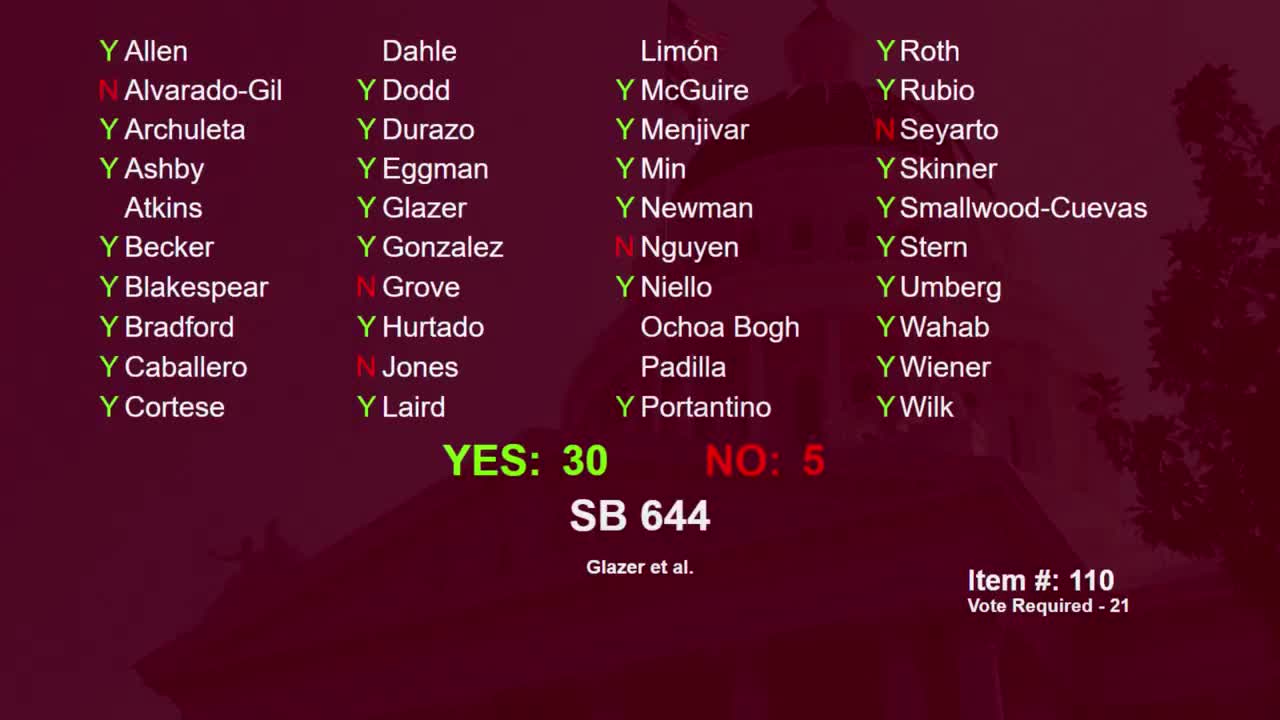 2MIN
Senate Floor
Bill Author

Bill Co-Author(s):