SB 689: Local coastal program: bicycle lane: amendment.
- Session Year: 2023-2024
- House: Senate
- Latest Version Date: 2024-09-22
Current Status:
Passed
(2024-09-22: Chaptered by Secretary of State. Chapter 445, Statutes of 2024.)
Introduced
In Committee
First Chamber
In Committee
Second Chamber
Enacted
What does this bill do?
The bill lets local governments in the coastal zone convert an existing motor vehicle travel lane into a dedicated bicycle lane, dedicated transit lane, or a pedestrian walkway. Such permit requests or changes to a community’s local coastal plan would not need a traffic study, and if a plan change is required it can be handled under a faster “de minimis” (minor amendment) process if the Coastal Commission’s executive director finds the project adds public access without significantly reducing existing access.
The summary is provided by generative AI which can make mistakes. For original language, please view the details in the table below.
The California Coastal Act of 1976 requires any person wishing to perform or undertake any development in the coastal zone, as defined, in addition to obtaining any other permit required by law from any local government or from any state, regional, or local agency, to obtain a coastal development permit, as provided. The act requires the issuance of a coastal development permit if the proposed development is in conformity with the certified local coastal program. The act provides for the certification of local coastal programs by the California Coastal Commission.
This bill would provide that an application by a local government to convert an existing motorized vehicle travel lane into a dedicated bicycle lane, dedicated transit lane, or a pedestrian walkway shall not require a traffic study for the processing of either a coastal development permit or an amendment to a local coastal program. The bill would require, if a proposal to convert an existing motorized vehicle travel lane into a dedicated bicycle lane, dedicated transit lane, or a pedestrian walkway within the developed portion of an existing road right-of-way requires an amendment to a local coastal program, that the amendment be processed in accordance with the procedures applicable to de minimus local coastal program amendments if the executive director of the commission makes specified determinations.
The California Coastal Act of 1976 requires any person wishing to perform or undertake any development in the coastal zone, as defined, in addition to obtaining any other permit required by law from any local government or from any state, regional, or local agency, to obtain a coastal development permit, as provided. The act requires the issuance of a coastal development permit if the proposed development is in conformity with the certified local coastal program. The act provides for the certification of local coastal programs by the California Coastal Commission.
This bill would provide that an application by a local government to convert an existing motorized vehicle travel lane into a dedicated bicycle lane lane, dedicated transit lane, or a pedestrian walkway shall not require a traffic study for the processing of either a coastal development permit or an amendment to a local coastal program. The bill would require, if a proposal to create convert an existing motorized vehicle travel lane into a dedicated bicycle lane lane, dedicated transit lane, or a pedestrian walkway within the developed portion of an existing road right-of-way requires an amendment to a local coastal program, that the amendment be processed according to specified law, in accordance with the procedures applicable to de minimus local coastal program amendments if the executive director of the commission makes specified determinations.
The California Coastal Act of 1976 requires any person wishing to perform or undertake any development in the coastal zone, as defined, in addition to obtaining any other permit required by law from any local government or from any state, regional, or local agency, to obtain a coastal development permit, as provided. The act requires the issuance of a coastal development permit if the proposed development is in conformity with the certified local coastal program. The act provides for the certification of local coastal programs by the California Coastal Commission Commission.
This bill would provide that an application by a local government to convert an existing motorized vehicle travel lane into a dedicated bicycle lane shall not require a traffic study for the processing of either a coastal development permit or an amendment to a local coastal program. The bill would require, if a proposal to create a dedicated bicycle lane within the developed portion of an existing right-of-way requires an amendment to a local coastal program, the amendment be processed according to specified law, if the executive director of the commission makes specified determinations.
Existing law requires the Department of Transportation, in cooperation with county and city governments, to establish minimum safety design criteria for the planning and construction of bikeways. Existing law requires all city, county, regional, and other local agencies responsible for the development or operation of bikeways or roadways where bicycle travel is permitted to utilize the minimum safety design criteria established by the department or alternative criteria that meet specified requirements. Existing law authorizes a city or county to prepare a bicycle transportation plan with specified required elements for these purposes and, subject to approval of the county transportation commission or transportation planning agency, authorizes the city or county to submit the plan to the department with an application for funds for bikeways and related facilities that will implement the plan.This bill would require any project that is contained within, or consistent with, a bicycle transportation plan to be deemed consistent, and in conformity, with any applicable certified local coastal program.(2)Existing law provides generally for the regulation of construction and maintenance of city streets.This bill would require any project that is solely intended to restripe a street or highway for the purpose of relieving traffic congestion to be deemed consistent, and in conformity, with any applicable certified local coastal program.(1)The California Coastal Act of 1976 requires any person wishing to perform or undertake any development in the coastal zone, as defined, in addition to obtaining any other permit required by law from any local government or from any state, regional, or local agency, to obtain a coastal development permit, as provided. The act requires the issuance of a coastal development permit if the proposed development is in conformity with the certified local coastal program. The act provides for the certification of local coastal programs by the California Coastal Commission
Existing law requires the Department of Transportation, in cooperation with county and city governments, to establish minimum safety design criteria for the planning and construction of bikeways. Existing law requires all city, county, regional, and other local agencies responsible for the development or operation of bikeways or roadways where bicycle travel is permitted to utilize the minimum safety design criteria established by the department or alternative criteria that meet specified requirements. Existing law authorizes a city or county to prepare a bicycle transportation plan with specified required elements for these purposes and, subject to approval of the county transportation commission or transportation planning agency, authorizes the city or county to submit the plan to the department with an application for funds for bikeways and related facilities that will implement the plan.
This bill would require any project that is contained within, or consistent with, a bicycle transportation plan to be deemed consistent, and in conformity, with any applicable certified local coastal program.
(2)Existing law provides generally for the regulation of construction and maintenance of city streets.
This bill would require any project that is solely intended to restripe a street or highway for the purpose of relieving traffic congestion to be deemed consistent, and in conformity, with any applicable certified local coastal program.
Existing law prescribes the powers and duties that are common to cities and counties, including the powers and duties of legislative bodies. Under existing law, if a statute requires a local agency to take legislative action by resolution, and the local agencys charter requires it to take legislative action by ordinance, action by ordinance is compliance with the statute for all purposes.This bill would make a nonsubstantive change to that provision.Existing law prescribes the powers and duties that are common to cities and counties, including the powers and duties of legislative bodies. Under existing law, if a statute requires a local agency to take legislative action by resolution, and the local agencys charter requires it to take legislative action by ordinance, action by ordinance is compliance with the statute for all purposes.
This bill would make a nonsubstantive change to that provision.
(a)The Legislature finds and declares that designing and building complete streets that safely accommodate the needs of nonmotorized vehicles, pedestrians, and motorized vehicles in the coastal zone is preferred and encouraged.
(b)In order to expedite the provision of safe, nonvehicular travel within urbanized areas for the purpose of increasing recreational public access to the coast, limiting vehicle miles traveled, and reducing greenhouse gas emissions, an application by a local government to convert an existing motorized vehicle travel lane into a dedicated bicycle lane, dedicated transit lane, or a pedestrian walkway, shall not require a traffic study for the processing of either a coastal development permit or an amendment to a local coastal program.
(c)If a proposal to convert an existing motorized vehicle travel lane into a dedicated bicycle lane, dedicated transit lane, or a pedestrian walkway within the developed portion of an existing road right-of-way requires an amendment to a local coastal program, the amendment shall be processed pursuant to subdivision (d) of Section 30514, if the executive director determines that, on balance, the project will provide additional public access benefits without significantly reducing existing public access opportunities.
(a)The Legislature finds and declares that designing and building complete streets that safely accommodate the needs of nonmotorized vehicles, pedestrians, and motorized vehicles in the coastal zone is preferred and encouraged.
(b)In order to expedite the provision of safe, nonvehicular travel within urbanized areas for the purpose of increasing recreational public access to the coast, limiting vehicle miles traveled, and reducing greenhouse gas emissions, an application by a local government to convert an existing motorized vehicle travel lane into a dedicated bicycle lane lane, dedicated transit lane, or a pedestrian walkway, shall not require a traffic study for the processing of either a coastal development permit or an amendment to a local coastal program.
(c)If a proposal to create convert an existing motorized vehicle travel lane into a dedicated bicycle lane lane, dedicated transit lane, or a pedestrian walkway within the developed portion of an existing road right-of-way requires an amendment to a local coastal program, the amendment shall be processed pursuant to subdivision (d) of Section 30514, if the executive director determines that, on balance, the project will provide additional public access benefits without significantly reducing existing public access opportunities.
(a)The Legislature finds and declares that designing and building complete streets that safely accommodate the needs of nonmotorized vehicles, pedestrians, and motorized vehicles in the coastal zone is preferred and encouraged.
(b)In order to expedite the provision of safe, nonvehicular travel within urbanized areas for the purpose of increasing recreational public access to the coast, limiting vehicle miles traveled, and reducing greenhouse gas emissions, an application by a local government to convert an existing motorized vehicle travel lane into a dedicated bicycle lane shall not require a traffic study for the processing of either a coastal development permit or an amendment to a local coastal program.
(c)If a proposal to create a dedicated bicycle lane within the developed portion of an existing right-of-way requires an amendment to a local coastal program, the amendment shall be processed pursuant to subdivision (d) of Section 30514, if the executive director determines that, on balance, the project will provide additional public access benefits without significantly reducing existing public access opportunities.
SECTION 1.Section 891.3 is added to the Streets and Highways Code, to read:891.3.Any project that is contained within, or consistent with, a bicycle transportation plan shall be deemed consistent, and in conformity, with any applicable certified local coastal program.SEC. 2.Section 1814 is added to the Streets and Highways Code, immediately following Section 1813, to read:1814.Any project that is solely intended to restripe a street or highway for the purpose of relieving traffic congestion shall be deemed consistent, and in conformity, with any applicable certified local coastal program.Any project that is contained within, or consistent with, a bicycle transportation plan shall be deemed consistent, and in conformity, with any applicable certified local coastal program.
SEC. 2.Section 1814 is added to the Streets and Highways Code, immediately following Section 1813, to read:1814.Any project that is solely intended to restripe a street or highway for the purpose of relieving traffic congestion shall be deemed consistent, and in conformity, with any applicable certified local coastal program.
SECTION 1.Section 50020 of the Government Code is amended to read:50020.If a statute requires a local agency to take legislative action by resolution and the local agency is required by its charter to take legislative action by ordinance, action by ordinance is compliance with the statute for all purposes.When If a statute requires a local agency to take legislative action by resolution and the local agency is required by its charter to take legislative action by ordinance, action by ordinance is compliance with the statute for all purposes.
|
Date
|
Status
|
|---|---|
| Sep 22, 2024 | Chaptered by Secretary of State. Chapter 445, Statutes of 2024. |
| Sep 22, 2024 | Approved by the Governor. |
| Aug 27, 2024 | Enrolled and presented to the Governor at 2 p.m. |
| Aug 22, 2024 | Assembly amendments concurred in. (Ayes 25. Noes 7. Page 5291.) Ordered to engrossing and enrolling. |
| Aug 20, 2024 | In Senate. Concurrence in Assembly amendments pending. |
| Aug 19, 2024 | Read third time. Passed. (Ayes 63. Noes 8. Page 6379.) Ordered to the Senate. |
| Aug 8, 2024 | Read second time. Ordered to third reading. |
| Aug 7, 2024 | From committee: Do pass. (Ayes 11. Noes 3.) (August 7). |
| Jul 2, 2024 | From committee: Do pass and re-refer to Com. on APPR. (Ayes 15. Noes 0.) (July 1). Re-referred to Com. on APPR. |
| Jun 11, 2024 | From committee: Do pass and re-refer to Com. on TRANS. (Ayes 10. Noes 0.) (June 10). Re-referred to Com. on TRANS. |
| Jun 3, 2024 | From committee with author's amendments. Read second time and amended. Re-referred to Com. on NAT. RES. |
| May 13, 2024 | Referred to Coms. on NAT. RES. and TRANS. |
| Jan 29, 2024 | In Assembly. Read first time. Held at Desk. |
| Jan 29, 2024 | Read third time. Passed. (Ayes 31. Noes 8. Page 3048.) Ordered to the Assembly. |
| Jan 17, 2024 | Read second time. Ordered to third reading. |
| Jan 16, 2024 | From committee: Be ordered to second reading pursuant to Senate Rule 28.8. |
| Jan 12, 2024 | Set for hearing January 16. |
| Jan 11, 2024 | Read second time. Ordered to third reading. |
| Jan 11, 2024 | Re-referred to Com. on APPR. pursuant to Joint Rule 10.5. |
| Jan 10, 2024 | From committee: Do pass. (Ayes 11. Noes 3. Page 2971.) (January 9). |
| Jan 9, 2024 | From committee: Do pass and re-refer to Com. on TRANS. (Ayes 8. Noes 3. Page 2958.) (January 9). Re-referred to Com. on TRANS. |
| Jan 5, 2024 | Set for hearing January 9 in TRANS. pending receipt. |
| Jan 4, 2024 | Set for hearing January 9. |
| Jan 3, 2024 | Re-referred to Coms. on N.R. & W. and TRANS. |
| Jan 3, 2024 | From committee with author's amendments. Read second time and amended. Re-referred to Com. on TRANS. |
| Jan 3, 2024 | January 9 hearing postponed by committee. |
| Jan 3, 2024 | Set for hearing January 9. |
| Jan 3, 2024 | Withdrawn from committee. |
| Apr 11, 2023 | April 11 set for first hearing canceled at the request of author. |
| Mar 30, 2023 | Set for hearing April 11. |
| Mar 29, 2023 | Re-referred to Coms. on TRANS. and N.R. & W. |
| Mar 20, 2023 | From committee with author's amendments. Read second time and amended. Re-referred to Com. on RLS. |
| Mar 1, 2023 | Referred to Com. on RLS. |
| Feb 17, 2023 | From printer. May be acted upon on or after March 19. |
| Feb 16, 2023 | Introduced. Read first time. To Com. on RLS. for assignment. To print. |
|
Date
|
Description
|
Location
|
Votes
|
|
|---|---|---|---|---|
| Aug 22, 2024 | Unfinished Business SB689 Blakespear Concurrence | Senate Floor |
Passed |
|
| Aug 19, 2024 | SB 689 Blakespear Senate Third Reading By Alvarez | Assembly Floor |
Passed |
|
| Aug 7, 2024 | Do pass. | Assembly Standing Committee on Appropriations |
Passed |
|
| Jul 1, 2024 | Do pass and be re-referred to the Committee on [Appropriations] | Assembly Standing Committee on Transportation |
Passed |
|
| Jun 10, 2024 | Do pass and be re-referred to the Committee on [Transportation] | Assembly Standing Committee on Natural Resources |
Passed |
|
| Jan 29, 2024 | Senate 3rd Reading SB689 Blakespear | Senate Floor |
Passed |
|
| Jan 9, 2024 | Do pass, but first be re-referred to the Committee on [Transportation] | Senate Standing Committee on Natural Resources and Water |
Passed |
|
| Jan 9, 2024 | Do pass | Senate Standing Committee on Transportation |
Passed |
This list shows positions taken on this bill by organizations on the date displayed, which is linked to the original source.
Positions by individuals are not included.
|
Organization
|
Position
|
Date
|
|---|---|---|
| Bike San Diego | ** Support | |
| California Bicycle Coalition | ** Support | |
| California City Transportation Initiative | * Support | Jul 1, 2024 |
| California Coastal Commission | ** Support | |
| Circulate San Diego | ** Support | |
| City and County of San Francisco | ** Support | |
| city of carlsbad | ** Support | |
| City of Encinitas | ** Support | |
| City of Long Beach | ** Support | |
| City of Oceanside | ** Support | |
| City Of San Diego | ** Support | |
| City of Santa Monica | ** Support | |
| City of Solana Beach | ** Support | |
| County of Santa Barbara | ** Support | |
| League Of California Cities | ** Support | |
| New Livable California Dba Livable California | ** Against | |
| Ride SD | ** Support | |
| San Diego Regional Chamber Of Commerce | ** Support | |
| San Francisco Bay Area Planning and Urban Research Association | ** Support | |
| San Francisco Municipal Transportation Agency | * Support | Jul 1, 2024 |
| Streets for All | ** Support | |
| Topp Strategies LLC | * Support | Jan 9, 2024 |
SENATE RULES COMMITTEE Office of Senate Floor Analyses (916) 651-1520 Fax: (916) 327-4478 | SB 689 |
UNFINISHED BUSINESS
Bill No: SB 689
Author: Blakespear (D)
Amended: 6/3/24
Vote: 21
SENATE TRANSPORTATION COMMITTEE: 11-3, 1/9/24
AYES: Gonzalez, Allen, Archuleta, Becker, Blakespear, Cortese, Dodd, Limón, Newman, Umberg, Wahab
NOES: Niello, Nguyen, Seyarto
NO VOTE RECORDED: Dahle
SENATE NATURAL RES. & WATER COMMITTEE: 8-3, 1/9/24
AYES: Min, Allen, Becker, Hurtado, Laird, Limón, Padilla, Stern
NOES: Seyarto, Dahle, Grove
SENATE APPROPRIATIONS COMMITTEE: Senate Rule 28.8
SENATE FLOOR: 31-8, 1/29/24
AYES: Allen, Alvarado-Gil, Archuleta, Ashby, Atkins, Becker, Blakespear, Bradford, Caballero, Cortese, Dodd, Durazo, Eggman, Glazer, Hurtado, Laird, Limón, McGuire, Menjivar, Min, Newman, Padilla, Portantino, Roth, Rubio, Skinner, Smallwood-Cuevas, Stern, Umberg, Wahab, Wiener
NOES: Dahle, Grove, Jones, Nguyen, Niello, Ochoa Bogh, Seyarto, Wilk
NO VOTE RECORDED: Gonzalez
ASSEMBLY FLOOR: 63-8, 8/19/24 - See last page for vote
SUBJECT: Local coastal program: bicycle lane: amendment
SOURCE: City of San Diego
DIGEST:
This bill provides that an application by a local government to convert an existing motorized vehicle travel lane into a dedicated bicycle lane, dedicated transit lane, or a pedestrian walkway shall not require a traffic study for a coastal development permit or an amendment to a local coastal program. This bill also requires that any amendment to a local coastal program to develop such a lane from an existing motorized vehicle travel lane will be processed with minimal review, as provided.
Assembly Amendments
add the conversion of an existing motorized vehicle travel lane to a dedicated transit lane or a pedestrian walkway to the bill’s provisions, and clarified that conversion of an existing motorized vehicle travel lane qualified for minimal review, as provided.
ANALYSIS:
Existing law:
- Establishes, pursuant to the California Coastal Act of 1976, (Coastal Act) (Public Resources Code (PRC) §§30000 et seq.), the California Coastal Commission (Coastal Commission) in the California Natural Resources Agency.
- Includes legislative findings and declarations that the goals of the state for the coastal zone are to:
- Protect, maintain, enhance, and restore the overall quality of the coastal zone environment and its natural and artificial resources;
- Ensure orderly, balanced utilization and conservation of coastal zone resources;
- Maximize public access to and public recreational opportunities in the coastal zone consistent with resources conservation principles and rights of private property owners;
- Ensure priority for coastal-dependent and coastal-related development over other development on the coast;
- Encouraging state and local initiatives and cooperation to implement coordinated planning and development for mutually beneficial uses; and
- Anticipate, assess, plan for, and minimize or mitigate adverse environmental and economic effects of sea level rise. (PRC §30001.5)
- Requires each local government in the coastal zone to prepare a local coastal program (LCP) for that portion of the coastal zone within its jurisdiction, as provided. Requires the precise content of each LCP to be determined by the local government in full consultation with the Coastal Commission and full public participation. (PRC §30500)
- Establishes a process through which a LCP may be amended by a local government including mechanisms by which amendments may be determined as minor or requiring rapid action and thereby not subject to normal review. (PRC §30501, 30514)
- Authorizes the executive director of the Coastal Commission to determine that an LCP amendment is de minimis if the director determines the amendment:
- Would have no impact on coastal resources;
- Is consistent with the Coastal Act’s resources planning and management policies;
- Does not propose any change in land use, water use, or the allowable use of property; and
- The local government has provided public notice at least 21 days prior to submission of the amendment to accept public comments on the proposed amendments.
- Requires that de minimis amendments must be noticed in the agenda of the next regularly scheduled meeting of the Coastal Commission, and, if three or more members of the Coastal Commission do not object to the determination, the amendment shall become part of the LCP ten days after the meeting. (PRC §30514)
- Requires a person planning to perform or undertake any development in the coastal zone to obtain a coastal development permit (CDP) from the Coastal Commission or local government enforcing a certified LCP. (PRC §30600)
- Prohibits the Coastal Commission from exercising its review authority over any new development within the area to which the certified LCP, or any portion thereof, applies. (PRC §30519)
- Authorizes a city or county to prepare a bicycle transportation plan which shall at least include:
- The estimated number of existing bicycle commuters in the plan area and the estimated increase in the number of commuters;
- A map and description of existing and proposed land use, bikeways, bicycle parking facilities, and facilities for changing and storing clothes and equipment;
- A description of bicycle safety and education programs, efforts by law enforcement to enforce bicycle operation rules, and the resulting effect on accidents involving bicyclists;
- A description of the extent of citizen and community involvement in the development of the plan; and
- A description of how the plan has been coordinated and is consistent with other transportation, air quality, or energy conservation plans.
- Exempts from the California Environmental Quality Act projects in an active transportation plan, a pedestrian plan, or a bicycle transportation plan for the restriping of streets and highways, bicycle parking and storage, signal timing to improve street and highway intersection operations, and the related signage for bicycles, pedestrians, and vehicles. (PRC §21080.20)
This bill provides that an application by a local government to convert an existing motorized vehicle travel lane into a dedicated bicycle lane, dedicated transit lane, or a pedestrian walkway shall not require a traffic study for a CDP or an amendment to a LCP. This bill also requires that any amendment to a LCP to develop such a lane from an existing motorized vehicle travel lane will be processed with minimal review, as provided.
Specifically, this bill:
- Provides that an application by a local government to convert an existing motorized vehicle traffic lane into a dedicated bicycle lane, dedicated transit land, or a pedestrian walkway shall not require a traffic study for the processing of either a CDP or an amendment to a LCP, as provided.
- Provides that an amendment to a LCP to authorize the conversion of an existing motorized vehicle travel lane into a dedicated bicycle lane, dedicated transit lane, or a pedestrian walkway within the developed portion of an existing road right-of-way shall be processed through a de minimis review if the Coastal Commission’s executive director determines that the project will provide additional public access benefits, as provided.
- Makes legislative findings and declarations that designing and building complete streets that safely accommodate nonmotorized vehicles, pedestrians, and motorized vehicles in the coastal zone is preferred and encouraged.
Background
The Coastal Commission was established by voter initiative in 1972. The Legislature later made the commission permanent through the adoption of the Coastal Act. The Coastal Commission plans for and regulates the use of land and water in the coastal zone (which excludes the San Francisco Bay).
Increasing the use of bicycling, walking, and other modes of transportation is an essential part of California’s path to meeting its goals for greenhouse gas emissions and vehicle miles traveled reductions. California has taken several steps in order to encourage the development of active transportation infrastructure as part of maintaining and improving the highway system. In 2017, California Department of Transportation (Caltrans) published the first-ever statewide plan for active modes of transportation, the Toward an Active California - State Bicycle and Pedestrian Plan, with the following vision statement, “By 2040, people in California of all ages, abilities, and incomes can safely, conveniently, and comfortably walk and bicycle for their transportation needs.” Each Caltrans District is in the process of completing a districtwide bicycle and pedestrian plan, in order to address active transportation needs along and across California.
Comments
Traffic studies are not always required in the coastal zone. The Coastal Act does not specifically require a traffic study to be conducted, though the Coastal Commission has asked for traffic studies from time to time depending on the nature of the project. Traditionally, the role of traffic studies has been to evaluate the potential impacts of a proposed development on public access to the coast.
Outdated LCPs may delay active transportation projects. While not all bicycle lane projects in the coastal zone currently require a CDP or an LCP amendment, some local governments have faced delays in building active transportation infrastructure in areas covered by LCPs. For example, as reported by KPBS, on West Point Loma Boulevard in San Diego, there is a stretch of road where cyclists must currently share a lane with vehicles. San Diego developed plans to redesign the road that would have reduced the number of lanes and used the new space to establish a separated bike lane with street parking acting as a barrier to protect cyclists from traffic. However, the local LCP designates West Point Loma Boulevard as a four-lane road, so implementing the design would have required amending the LCP, which would have delayed and increased costs of the redesign.
FISCAL EFFECT: Appropriation: No Fiscal Com.: Yes Local: No
According to the Assembly Appropriations Committee, the Commission reports minor and absorbable costs, stating that increasing the Commission's flexibility to approve minor, transportation-related LCP amendments via the streamlined de minimis approval process could result in a modest cost savings, which would be counterbalanced by increased Commission staff time necessary to coordinate with local government staff on the front end to develop LCP amendments that meet the standard established by this
SUPPORT: (Verified 8/19/24)
City of San Diego (source)
Bike San Diego
California Bicycle Coalition
California Coastal Commission
Circulate San Diego
City and County of San Francisco
City of Carlsbad
City of Encinitas
City of Long Beach
City of Oceanside
City of Santa Monica
City of Solana Beach
County of Santa Barbara
League of California Cities
Ride SD
San Diego Regional Chamber of Commerce
San Francisco Bay Area Planning and Urban Research Association
Streets for All
OPPOSITION: (Verified 8/19/24)
New Livable California dba Livable California
ARGUMENTS IN SUPPORT: According to the author, “SB 689 will help ensure that sustainable transportation projects are not unnecessarily delayed. The climate crisis we find ourselves in demands a comprehensive approach that eliminates bureaucratic hurdles and facilitates transportation projects to meet the State’s climate goals.”
The City of San Diego, writing in support, adds that SB 689 “will improve traffic safety for all modes” of transportation and notes that “In recent years, the Legislature has acknowledged the importance of swift attention to sustainable transportation projects through the passage of legislation which exempts many types of sustainable projects, including those identified in SB 689, from the California Environmental Quality Act.”
ARGUMENTS IN OPPOSITION: According to Livable California, “Traffic studies are often required for local jurisdictions and the coastal commission to make informed decisions. Local jurisdictions and the commission are best positioned to determine if a traffic study is necessary. The state should not take away this flexibility or this tool for proper decision making. SB 689 takes this tool away and should be rejected.”
ASSEMBLY FLOOR: 63-8, 8/19/24
AYES: Addis, Aguiar-Curry, Alanis, Alvarez, Arambula, Bauer-Kahan, Bennett, Berman, Boerner, Bonta, Bryan, Calderon, Juan Carrillo, Cervantes, Connolly, Davies, Mike Fong, Friedman, Gabriel, Garcia, Gipson, Grayson, Haney, Hart, Holden, Hoover, Irwin, Jackson, Jones-Sawyer, Kalra, Lackey, Lee, Low, Lowenthal, Maienschein, McCarty, Muratsuchi, Stephanie Nguyen, Pacheco, Papan, Joe Patterson, Pellerin, Petrie-Norris, Quirk-Silva, Ramos, Rendon, Luz Rivas, Rodriguez, Blanca Rubio, Sanchez, Santiago, Schiavo, Soria, Ting, Valencia, Villapudua, Ward, Weber, Wicks, Wilson, Wood, Zbur, Robert Rivas
NOES: Megan Dahle, Dixon, Essayli, Gallagher, Mathis, Jim Patterson, Waldron, Wallis
NO VOTE RECORDED: Bains, Wendy Carrillo, Chen, Flora, McKinnor, Ortega, Reyes, Ta
Prepared by: Katharine Moore / N.R. & W. / (916) 651-4116
8/20/24 16:11:17
**** END ****
SENATE THIRD READING
STR Bill Id:SB 689
Author:(Blakespear)
As Amended Ver:June 3, 2024
Majority vote
SUMMARY
Provides that an application by a local government to convert an existing motorized vehicle travel lane into a dedicated bicycle lane, dedicated transit lane, or a pedestrian walkway shall not require a traffic study for the processing of either a coastal development permit (CDP) or an amendment to a local coastal plan (LCP).
Major Provisions
- Provides that, in order to expedite the provision of safe, nonvehicular travel within urbanized areas for the purpose of increasing recreational public access to the coast, limiting vehicle miles travelled, and reducing greenhouse gas emissions, an application by a local government to convert an existing motorized vehicle travel lane into a dedicated bicycle lane, a dedicated transit lane, or a pedestrian walkway shall not require a traffic study for the processing of either a CDP or an amendment to a LCP.
- Requires, if a proposal to convert an existing motorized vehicle travel lane into a dedicated bicycle lane, dedicated transit lane, or a pedestrian walkway within the developed portion of an existing road right-of-way requires an amendment to a LCP, the amendment to be processed pursuant to the requirements of the Coastal Act, if the executive director determines that, on balance, the project will provide additional public access benefits without significantly reducing existing public access opportunities.
COMMENTS
This bill provides that when a local government applies to the Commission for a CDP or an LCP amendment to convert a vehicle travel lane into a bicycle lane, a dedicated transit lane, or a pedestrian walkway, the local government is not required to provide a traffic study as part of its application submittal to the Commission.
The Coastal Act does not specifically require a traffic study to be conducted, though the Commission has asked for traffic studies from time to time depending on the nature of the project. Traditionally, the role of traffic studies has been to evaluate the potential impacts of a proposed development on public access to the coast.
While not all bicycle lane projects in the Coastal Zone currently require a CDP or an LCP amendment, some local governments have faced delays in building active transportation infrastructure in areas covered by LCPs. For example, as reported by KPBS, on West Point Loma Boulevard in San Diego, there is a stretch of road where cyclists must currently share a lane with vehicles. San Diego developed plans to redesign the road that would have reduced the number of lanes and used the new space to establish a separated bike lane with street parking acting as a barrier to protect cyclists from traffic. However, the local LCP designates the Boulevard as a four-lane road, so implementing the design would have required amending the LCP, which would have delayed and increased costs of the redesign.
Relieving local governments from having to prepare a traffic study for bicycle lane projects encourages local governments to consider public access to the coast and in do so in partnership with the Commission when designing such projects.
This bill explicitly provides that an application by a local government to convert an existing motorized vehicle travel lane into a dedicated bicycle lane does not require a traffic study for the processing of either a CDP or an amendment to a LCP. The bill also requires, if a proposal to create a dedicated bicycle lane within the developed portion of an existing right-of-way requires an amendment to a LCP, the amendment to be processed pursuant to current law if the executive director determines that, on balance, the project will provide additional public access benefits without significantly reducing existing public access opportunities.
According to the Author
SB 689 will help ensure that bike lane projects are not unnecessarily delayed. The climate crisis we find ourselves in demands a comprehensive approach that eliminates bureaucratic hurdles and facilitates transportation projects to meet the State's climate goals.
Arguments in Support
The California Bicycle Coalition writes that the standard LCP amendment process can be time consuming and cost money, as thorough studies may be required for the amendment or public testimony at a hearing is mandatory. This typically dissuades local governments from updating their LCP. Therefore, it is critical to allow for a de minimis LCP amendment process for less strenuous amendments.
Arguments in Opposition
Livable California writes that traffic studies are often required for local jurisdictions and the Commission to make informed decisions. Local jurisdictions and the Commission are best positioned to determine if a traffic study is necessary. The state should not take away this flexibility or this tool for proper decision making. SB 689 takes this tool away and should be rejected.
FISCAL COMMENTS
According to the Assembly Appropriations Committee, the Commission reports minor and absorbable costs, stating that increasing the Commission's flexibility to approve minor, transportation-related LCP amendments via the streamlined de minimis approval process could result in a modest cost savings, which would be counterbalanced by increased Commission staff time necessary to coordinate with local government staff on the front end to develop LCP amendments that meet the standard established by this bill.
VOTES
SENATE FLOOR: 31-8-1
YES: Allen, Alvarado-Gil, Archuleta, Ashby, Atkins, Becker, Blakespear, Bradford, Caballero, Cortese, Dodd, Durazo, Eggman, Glazer, Hurtado, Laird, Limón, McGuire, Menjivar, Min, Newman, Padilla, Portantino, Roth, Rubio, Skinner, Smallwood-Cuevas, Stern, Umberg, Wahab, Wiener
NO: Dahle, Grove, Jones, Nguyen, Niello, Ochoa Bogh, Seyarto, Wilk
ABS, ABST OR NV: Gonzalez
ASM NATURAL RESOURCES: 10-0-1
YES: Bryan, Flora, Bauer-Kahan, Friedman, Hoover, Kalra, Muratsuchi, Pellerin, Wicks, Wood
ABS, ABST OR NV: Mathis
ASM TRANSPORTATION: 15-0-0
YES: Wilson, Davies, Aguiar-Curry, Berman, Juan Carrillo, Hart, Hoover, Jackson, Lowenthal, Papan, Sanchez, Ting, Wallis, Ward, Wicks
ASM APPROPRIATIONS: 11-3-1
YES: Wicks, Sanchez, Arambula, Bryan, Calderon, Wendy Carrillo, Mike Fong, Grayson, Haney, Hart, Pellerin
NO: Dixon, Jim Patterson, Ta
ABS, ABST OR NV: Villapudua
UPDATED
VERSION: June 3, 2024
CONSULTANT: Paige Brokaw / NAT. RES. / (916) 319-2092 FN: 0003773
Date of Hearing: August 7, 2024
ASSEMBLY COMMITTEE ON APPROPRIATIONS
Buffy Wicks, Chair
SBPCA Bill Id:SB 689
Author:(Blakespear) – As Amended Ver:June 3, 2024
Policy Committee: | Natural Resources | Vote: | 10 - 0 |
Transportation | 15 - 0 | ||
|
|
Urgency: No State Mandated Local Program: No Reimbursable: No
SUMMARY:
This bill provides that an application by a local government to convert an existing motorized vehicle travel lane into a dedicated bicycle lane, dedicated transit lane, or a pedestrian walkway shall not require a traffic study for the processing of either a coastal development permit (CDP) or an amendment to a local coastal plan (LCP) and shall get expedited review by the California Coastal Commission (Commission).
Specifically, this bill:
- Provides that, in order to expedite provision of safe, nonvehicular travel within urbanized areas to increase recreational public access to the coast, limit vehicle miles traveled, and reduce greenhouse gas emissions, an application by a local government to convert an existing motorized vehicle travel lane into a dedicated bicycle lane, dedicated transit lane, or a pedestrian walkway shall not require a traffic study for the processing of either a CDP or amendment to an LCP.
- Provides that, if a proposal to convert an existing motorized vehicle travel lane into a dedicated bicycle lane, dedicated transit lane, or a pedestrian walkway within the developed portion of an existing road right-of-way requires an amendment to an LCP, the Commission shall give expedited de minimis review if the executive director determines that, on balance, the project will provide additional public access benefits without significantly reducing existing public access opportunities.
FISCAL EFFECT:
The Commission reports minor and absorbable costs, stating that increasing the Commission’s flexibility to approve minor, transportation-related LCP amendments via the streamlined de minimis approval process could result in a modest cost savings, which would be counterbalanced by increased Commission staff time necessary to coordinate with local government staff on the front end to develop LCP amendments that meet the standard established by this bill.
COMMENTS:
- Purpose. According to the author:
SB 689 will help ensure that bike lane projects are not unnecessarily delayed. The climate crisis we find ourselves in demands a comprehensive approach that eliminates bureaucratic hurdles and facilitates transportation projects to meet the State’s climate goals.
- Background. The California Coastal Act of 1976 (Act) requires a person proposing any development in the coastal zone to obtain a CDP in addition to other required permits. The Act requires the Commission to issue a CDP if the proposed development is in conformity with the certified LCP. A local government must submit proposed amendments to its LCP for Commission approval. The Commission has 90 working days to certify or refuse the proposed amendments. The Commission may determine a proposed LCP amendment as de minimis if it has no impact, either individually or cumulatively, on coastal resources and meets specified criteria. In that case, the 90-day process does not apply, expedited review is required, and the amendments take effect on the 10th day after Commission designation.
The Coastal Act does not specifically require a traffic study, but the Commission sometimes requests them depending on the nature of the project. A traffic study typically evaluates the potential impacts of a proposed development on public access to the coast, traffic patterns, potential congestion, and pedestrian impacts. The cost of a traffic study can be $3,500 per intersection, paid for by a developer or local government.
California has encouraged development of active transportation infrastructure such as bicycling and walking as part of maintaining and improving the highway system and to meet climate goals. Greater access to safe modes of active transit improves local air quality, promotes physical activity, enhances public health benefits, and provides greater transit options. While not all bicycle lane projects in the coastal zone currently require a CDP or an LCP amendment, some local governments have faced delays in building active transportation infrastructure in areas covered by LCPs.
This bill seeks to reduce barriers to building active transportation infrastructure in a coastal zone by eliminating the requirement for a traffic study in a CDP or LCP. On the other hand, prohibiting a traffic study reduces flexibility to require one for proposed projects on a case-by-case basis.
Analysis Prepared by: Jacqueline Kinney / APPR. / (916) 319-2081
Date of Hearing: July 1, 2024
ASSEMBLY COMMITTEE ON TRANSPORTATION
Lori D. Wilson, Chair
SBPCA Bill Id:SB 689
Author:(Blakespear) – As Amended Ver:June 3, 2024
SENATE VOTE: 31-8
SUBJECT: Local coastal program: bicycle lane: amendment
SUMMARY: Provides that an application by a local government to convert an existing motorized vehicle travel lane into a dedicated bicycle lane, dedicated transit lane, or a pedestrian walkway shall not require a traffic study for the processing of either a coastal development permit (CDP) or an amendment to a local coastal plan (LCP). Specifically, this bill:
- Provides that, an application by a local government to convert an existing motorized vehicle travel lane into a dedicated bicycle lane, a dedicated transit lane, or a pedestrian walkway shall not require a traffic study for the processing of either a CDP or an amendment to a LCP.
- Requires, if a proposal to convert an existing motorized vehicle travel lane into a dedicated bicycle lane, dedicated transit lane, or a pedestrian walkway within the developed portion of an existing road right-of-way requires an amendment to a LCP, the amendment to be processed pursuant to the requirements of the Coastal Act, if the executive director determines that, on balance, the project will provide additional public access benefits without significantly reducing existing public access opportunities.
EXISTING LAW:
- Declares that it is a basic goal of the state to maximize public access to and along the coast and to maximize public recreational opportunities in the coastal zone consistent with sound resource conservation principles and constitutionally protected rights of private property owners. (Public Resources Code (PRC) PRC 30001.5)
- Requires any person wishing to perform or undertake any development in the coastal zone, in addition to obtaining any other permit required by law from any local government or from any state, regional, or local agency, to obtain a CDP. (PRC 30600)
- Requires each local government lying, in whole or in part, within the coastal zone to prepare a LCP for that portion of the coastal zone within its jurisdiction. (PRC 30500)
- Defines “development” to mean, among other things, the placement or erection of any solid material or structure on land or in water. “Structure” includes, but is not limited to, any building, road, pipe, flume, conduit, siphon, aqueduct, telephone line, and electrical power transmission and distribution line. (PRC 30106)
- Requires all new development to, among other things, minimize energy consumption and vehicle miles traveled (VMT). (PRC 30253)
- Provides for LCPs to be amended by the local government and that the amendment does not take effect until certified by the Coastal Commission (Commission). Authorizes the executive director of the Commission to determine that a proposed LCP amendment is de minimis if the executive director determines that a proposed amendment would have no impact, either individually or cumulatively, on coastal resources, is consistent with specified policies of the Coastal Act, and meets the specified criteria. (PRC 30514)
FISCAL EFFECT: According to the Senate Appropriations Committee, this bill will have negligible state costs pursuant to Senate Rule 28.8.
COMMENTS: The Coastal Act requires new development in the Coastal Zone to minimize energy consumption and vehicle miles traveled (VMT) and provides that the location and amount of new development should maintain and enhance public access to the coast by facilitating the provision or extension of transit service; providing non-automobile circulation within the development; and, assuring that the recreational needs of new residents be balanced with the provision of onsite recreational facilities to serve the new development, among other things.
To manage development in the Coastal Zone, coastal local governments are required to develop LCPs that can carry out policies of the Coastal Act at the local level. LCPs are land use planning documents that lay out a framework for development and coastal resource protection within a city or county’s Coastal Zone area. Local jurisdictions submit LCPs to the Commission for certification. About 73% of local jurisdictions in the coastal zone have approved LCPs. In the remaining jurisdictions that do not have an approved LCP, CDPs are issued by the Commission directly.
Streamlined review. When a local government proposes amendments to its LCP, it must submit the amendments to the Commission to approve. Current law provides the Commission 90 working days to certify or refuse the proposed amendments. The Commission’s regulations establish procedures for reviewing and designating proposed amendments to an LCP as being minor in nature or as requiring rapid and expeditious action. Proposed amendments that are designated as being minor in nature or as requiring rapid and expeditious action are exempt from the statutory 90-day timeframe and take effect on the 10th working day after the Commission’s designation.
Further, the executive director of the Commission may determine that a proposed LCP amendment is de minimis if the executive director determines that a proposed amendment would have no impact, either individually or cumulatively, on coastal resources and meets specified criteria.
Traffic studies. A traffic study is carried out by a traffic engineer that collects and analyzes data regarding traffic patterns. The traffic engineer will create a report with the study’s findings, which entities such as the government, developers, and communities use to better understand foot and vehicle traffic. One purpose of traffic studies is to figure out the possible impacts of a development or other changes to the area on local traffic. The traffic engineer will study local traffic patterns and make educated predictions on how these patterns will be affected by whatever changes are being proposed. Another purpose of traffic studies is to study an area that has major traffic issues to gain a better understanding of the root of the problem, then propose solutions that will help alleviate the burden on the area’s traffic. Factors that influence a traffic study can include intersections, time of year, and access to various forms of transportation.
The cost of a traffic study can be $3,500 per intersection, paid for by a developer or local government.
Biking, walking, and transit. Active transportation is the use of non-vehicular modes of transportation, such as bicycling and walking. Providing greater access to safe modes of active transit improves local air quality, gives greater opportunities for physical activity, enhance public health benefits, and provides a broad spectrum of opportunities for greater transit options.
California has taken steps to encourage the development of active transportation infrastructure as part of maintaining and improving the highway system. All California cities and counties are required to include complete streets policies as part of any substantial revision to the circulation element of their general plans; the complete streets policy requires that roadways are planned, designed, and operated for the safety of all people, including people biking and walking. Each Caltrans District is in the process of completing a districtwide bicycle and pedestrian plan in order to address active transportation needs throughout the state.
This bill seeks to eliminate barriers to building active transportation infrastructure in a coastal zone by eliminating the requirement for a traffic study in a CDP or LCP.
Valuing active transportation on the coast. The Coastal Act does not specifically require a traffic study to be conducted, though the Commission has asked for traffic studies from time to time depending on the nature of the project. Traditionally, the role of traffic studies has been to evaluate the potential impacts of a proposed development on public access to the coast.
While not all bicycle lane projects in the coastal zone currently require a CDP or an LCP amendment, some local governments have faced delays in building active transportation infrastructure in areas covered by LCPs. For example, as reported by KPBS, on West Point Loma Boulevard in San Diego, there is a stretch of road where cyclists must share a lane with vehicles. San Diego developed plans to redesign the road that would have reduced the number of lanes and used the new space to establish a separated bike lane with street parking acting as a barrier to protect cyclists from traffic. However, the local LCP designates the Boulevard as a four-lane road, so implementing the design would have required amending the LCP, which would have delayed and increased costs of the redesign.
Relieving local governments from having to prepare a traffic study for bicycle lane projects encourages local governments to consider public access to the coast and do so in partnership with the Commission when designing such projects.
According to the author, “SB 689 will help ensure that bike lane projects are not unnecessarily delayed. The climate crisis we find ourselves in demands a comprehensive approach that eliminates bureaucratic hurdles and facilitates transportation projects to meet the State’s climate goals.”
In support, the California Coastal Commission writes, “Projects that make communities more sustainable are a key strategy for mitigating the impacts of climate change on California’s coast. This strategy is strongly aligned with the policies of the Coastal Act and with the Coastal Commission’s vision for the coastal zone. SB 689 would leverage this alignment by using the Coastal Act to affirmatively promote bicycle lanes, transit lanes, and pedestrian walkways; and in doing so, would provide a blueprint for how other forms of sustainable development could similarly be promoted through the Coastal Act.”
In opposition, Livable California writes, “Traffic studies are often required for local jurisdictions and the coastal commission to make informed decisions. Local jurisdictions and the commission are best positioned to determine if a traffic study is necessary. The state should not take away this flexibility or this tool for proper decision making. SB 689 takes this tool away and should be rejected.”
Previous legislation. SB 922 (Wiener), Chapter 987, Statutes of 2022 expands California Environmental Quality Act (CEQA) exemptions for specified transit, bicycle, and pedestrian projects, and extends these exemptions from 2023 to 2030.
SB 932 (Portantino), Chapter 710, Statutes of 2022 requires the circulation element of a general plan to include specified contents related to bicycle plans, pedestrian plans, and traffic calming plan, and to implement those plans.
Double referral. This bill passed out of the Assembly Natural Resources Committee 10-0.
REGISTERED SUPPORT / OPPOSITION:
Support
California Coastal Commission
City and County of San Francisco
City of Carlsbad
City of Encinitas
City of Long Beach
City of Oceanside
City of San Diego
San Francisco Municipal Transportation Agency
Streets for All
Opposition
Livable California
Analysis Prepared by: Julia Kingsley / TRANS. / (916) 319-2093
Date of Hearing: June 10, 2024
ASSEMBLY COMMITTEE ON NATURAL RESOURCES
Isaac G. Bryan, Chair
SBPCA Bill Id:SB 689
Author:(Blakespear) – As Amended Ver:June 3, 2024
SENATE VOTE: 31-8
SUBJECT: Local coastal program: bicycle lane: amendment
SUMMARY: Provides that an application by a local government to convert an existing motorized vehicle travel lane into a dedicated bicycle lane, dedicated transit lane, or a pedestrian walkway shall not require a traffic study for the processing of either a coastal development permit (CDP) or an amendment to a local coastal plan (LCP).
EXISTING LAW, Pursuant to the California Coastal Act (Coastal Act) (Public Resources Code (PRC) 30000 et seq.):
- Declares that it is a basic goal of the state to maximize public access to and along the coast and to maximize public recreational opportunities in the coastal zone consistent with sound resource conservation principles and constitutionally protected rights of private property owners. (PRC 30001.5 (c))
- Requires any person wishing to perform or undertake any development in the coastal zone, in addition to obtaining any other permit required by law from any local government or from any state, regional, or local agency, to obtain a CDP. (PRC 30600)
- Requires each local government lying, in whole or in part, within the coastal zone to prepare a LCP for that portion of the coastal zone within its jurisdiction. (PRC 30500)
- Defines “development” to mean, among other things, the placement or erection of any solid material or structure on land or in water. “Structure” includes, but is not limited to, any building, road, pipe, flume, conduit, siphon, aqueduct, telephone line, and electrical power transmission and distribution line. (PRC 30106)
- Requires all new development to, among other things, minimize energy consumption and vehicle miles traveled (VMT). (PRC 30253 (f))
- Provides for LCPs to be amended by the local government and that the amendment does not take effect until certified by the Coastal Commission (Commission). Authorizes the executive director of the Commission to determine that a proposed LCP amendment is de minimis if the executive director determines that a proposed amendment would have no impact, either individually or cumulatively, on coastal resources, is consistent with specified policies of the Coastal Act, and meets the specified criteria. (PRC 30514)
THIS BILL:
- Finds and declares that designing and building complete streets that safely accommodate the needs of nonmotorized vehicles, pedestrians, and motorized vehicles in the coastal zone is preferred and encouraged.
- Provides that, in order to expedite the provision of safe, nonvehicular travel within urbanized areas for the purpose of increasing recreational public access to the coast, limiting VMT, and reducing greenhouse gas emissions, an application by a local government to convert an existing motorized vehicle travel lane into a dedicated bicycle lane, a dedicated transit lane, or a pedestrian walkway shall not require a traffic study for the processing of either a CDP or an amendment to a LCP.
- Requires, if a proposal to convert an existing motorized vehicle travel lane into a dedicated bicycle lane, dedicated transit lane, or a pedestrian walkway within the developed portion of an existing road right-of-way requires an amendment to a LCP, the amendment to be processed pursuant to the requirements of the Coastal Act, if the executive director determines that, on balance, the project will provide additional public access benefits without significantly reducing existing public access opportunities.
FISCAL EFFECT: According to the Senate Appropriations Committee, this bill will have negligible state costs.
COMMENTS:
- Author’s statement:
SB 689 will help ensure that bike lane projects are not unnecessarily delayed. The climate crisis we find ourselves in demands a comprehensive approach that eliminates bureaucratic hurdles and facilitates transportation projects to meet the State’s climate goals.
- Active transportation. Active transportation is the use of non-vehicular modes of transportation, including bicycling, walking, skateboarding, etc. Providing greater access to safe modes of active transit improve local air quality through reduced VMT, give greater opportunities for physical activity, enhance public health benefits, and provide a broad spectrum opportunities for greater transit options.
California has taken steps to encourage the development of active transportation infrastructure as part of maintaining and improving the highway system. In 2017, the Department of Transportation (Caltrans) published the first-ever statewide plan for active modes of transportation, Toward an Active California - State Bicycle and Pedestrian Plan, with the following vision statement, “By 2040, people in California of all ages, abilities, and incomes can safely, conveniently, and comfortably walk and bicycle for their transportation needs.” All California cities and counties are required to include complete streets policies as part of any substantial revision to the circulation element of their general plans; the complete streets policy requires that roadways are planned, designed, and operated for the safety of all people, including people biking and walking. Each Caltrans District is in the process of completing a districtwide bicycle and pedestrian plan in order to address active transportation needs throughout the state.
Californians love to bike. The League of American Bicyclists reports that 0.74% of Californians bike to work. No government body in California regularly keeps track of the number of miles of bikeways in a uniform manner, but the U.S. Department of Transportation estimates that California has 396,540 miles of road, nearly 250,000 of which are in urban areas. More than 45% of motor vehicle trips are 3 miles or less, and the average bicycle trip distance is 2.4 miles, according to the 2017 National Household Travel Survey. More bike lanes can lead to greater biking and reduced VMT.
- Local Coastal Plans. The Coastal Act declares that it is a basic goal of the state to maximize public access to and along the coast and to maximize public recreational opportunities in the coastal zone consistent with sound resource conservation principles and constitutionally protected rights of private property owners. Further, the Coastal Act requires new development in the Coastal Zone to minimize energy consumption and VMT and provides that the location and amount of new development should maintain and enhance public access to the coast by facilitating the provision or extension of transit service; providing nonautomobile circulation within the development; and, assuring that the recreational needs of new residents be balanced with the provision of onsite recreational facilities to serve the new development, among other things.
To manage development in the Coastal Zone, coastal local governments are required to develop LCPs that can carry out policies of the Coastal Act at the local level. LCPs are land use planning documents that lay out a framework for development and coastal resource protection within a city or county’s Coastal Zone area. They are prepared by the local jurisdiction and submitted to the Commission for certification. About 73% of local jurisdictions in the coastal zone have approved LCPs. In the remaining jurisdictions that do not have an approved LCP, CDPs are issued by the Commission directly.
When a local government proposes amendments to its LCP, it must submit the amendments to the Commission to approve. Current law provides the Commission 90 working days to certify or refuse the proposed amendments.
The Commission’s regulations establish procedures for reviewing and designating proposed amendments to an LCP as being minor in nature or as requiring rapid and expeditious action. Proposed amendments that are designated as being minor in nature or as requiring rapid and expeditious action are exempt from the statutory 90-day timeframe and take effect on the 10th working day after the Commission’s designation. (Title 14, California Code of Regulations 13554 et seq.)
Further, the executive director of the Commission may determine that a proposed LCP amendment is de minimis if the executive director determines that a proposed amendment would have no impact, either individually or cumulatively, on coastal resources and meets specified criteria.
- Traffic lane studies. This bill provides that when a local government applies to the Commission for a CDP or an LCP amendment to convert a vehicle travel lane into a bicycle lane, a dedicated transit lane, or a pedestrian walkway, the local government is not required to provide a traffic study as part of its application submittal to the Commission.
The Coastal Act does not specifically require a traffic study to be conducted, though the Commission has asked for traffic studies from time to time depending on the nature of the project. Traditionally, the role of traffic studies has been to evaluate the potential impacts of a proposed development on public access to the coast.
While not all bicycle lane projects in the coastal zone currently require a CDP or an LCP amendment, some local governments have faced delays in building active transportation infrastructure in areas covered by LCPs. For example, as reported by KPBS, on West Point Loma Boulevard in San Diego, there is a stretch of road where cyclists must currently share a lane with vehicles. San Diego developed plans to redesign the road that would have reduced the number of lanes and used the new space to establish a separated bike lane with street parking acting as a barrier to protect cyclists from traffic. However, the local LCP designates the Boulevard as a 4-lane road, so implementing the design would have required amending the LCP, which would have delayed and increased costs of the redesign.
Relieving local governments from having to prepare a traffic study for bicycle lane projects encourages local governments to consider public access to the coast and in do so in partnership with the Commission when designing such projects.
- This bill. SB 689 explicitly provides that an application by a local government to convert an existing motorized vehicle travel lane into a dedicated bicycle lane does not require a traffic study for the processing of either a CDP or an amendment to a LCP. The bill also requires, if a proposal to create a dedicated bicycle lane within the developed portion of an existing right-of-way requires an amendment to a LCP, the amendment to be processed pursuant to current law if the executive director determines that, on balance, the project will provide additional public access benefits without significantly reducing existing public access opportunities.
- Double referral. This bill has been double-referred to the Assembly Transportation Committee.
REGISTERED SUPPORT / OPPOSITION:
Support
California Bicycle Coalition
Circulate San Diego
City of Carlsbad
City of Encinitas
City of Long Beach
City of Oceanside
City of San Diego
City of Santa Monica
Ride SD
San Diego Regional Chamber of Commerce
San Francisco Bay Area Planning and Urban Research Association
Streets for All
Opposition
Livable California
Analysis Prepared by: Paige Brokaw / NAT. RES. /
SENATE RULES COMMITTEE Office of Senate Floor Analyses (916) 651-1520 Fax: (916) 327-4478 | SB 689 |
THIRD READING
Bill No: SB 689
Author: Blakespear (D)
Amended: 1/3/24
Vote: 21
SENATE TRANSPORTATION COMMITTEE: 11-3, 1/9/24
AYES: Gonzalez, Allen, Archuleta, Becker, Blakespear, Cortese, Dodd, Limón, Newman, Umberg, Wahab
NOES: Niello, Nguyen, Seyarto
NO VOTE RECORDED: Dahle
SENATE NATURAL RES. & WATER COMMITTEE: 8-3, 1/9/24
AYES: Min, Allen, Becker, Hurtado, Laird, Limón, Padilla, Stern
NOES: Seyarto, Dahle, Grove
SENATE APPROPRIATIONS COMMITTEE: Senate Rule 28.8
SUBJECT: Local coastal program: bicycle lane: amendment
SOURCE: City of San Diego
DIGEST:
This bill provides that an application by a local government to convert an existing motorized vehicle travel lane into a dedicated bicycle lane shall not require a traffic study for a coastal development permit or an update to a local coastal program. This bill also requires that any amendment to a local coastal program to develop such a lane will be processed with a minimal review.
ANALYSIS:
Existing law:
- Establishes, pursuant to the California Coastal Act of 1976, (Coastal Act) (Public Resources Code (PRC) §§30000 et seq.), the California Coastal Commission (Coastal Commission) in the California Natural Resources Agency.
- Includes legislative findings and declarations that the goals of the state for the coastal zone are to:
- Protect, maintain, enhance, and restore the overall quality of the coastal zone environment and its natural and artificial resources;
- Ensure orderly, balanced utilization and conservation of coastal zone resources;
- Maximize public access to and public recreational opportunities in the coastal zone consistent with resources conservation principles and rights of private property owners;
- Ensure priority for coastal-dependent and coastal-related development over other development on the coast;
- Encouraging state and local initiatives and cooperation to implement coordinated planning and development for mutually beneficial uses; and
- Anticipate, assess, plan for, and minimize or mitigate adverse environmental and economic effects of sea level rise. (PRC §30001.5)
- Requires each local government in the coastal zone to prepare a local coastal program (LCP) for that portion of the coastal zone within its jurisdiction, as provided. Requires the precise content of each LCP to be determined by the local government in full consultation with the Coastal Commission and full public participation. (PRC §30500)
- Establishes a process through which a LCP may be amended by a local government including mechanisms by which amendments may be determined as minor or requiring rapid action and thereby not subject to normal review. (PRC §30501, 30514)
- Authorizes the executive director of the Coastal Commission to determine that an LCP amendment is de minimis if the director determines the amendment:
- Would have no impact on coastal resources;
- Is consistent with the Coastal Act’s resources planning and management policies;
- Does not propose any change in land use, water use, or the allowable use of property; and
- The local government has provided public notice at least 21 days prior to submission of the amendment to accept public comments on the proposed amendments.
- Requires that de minimis amendments must be noticed in the agenda of the next regularly scheduled meeting of the Coastal Commission and if three or more members of the Coastal Commission do not object to the determination the amendment shall become part of the LCP ten days after the meeting. (PRC §30514)
- Requires a person planning to perform or undertake any development in the coastal zone to obtain a coastal development permit (CDP) from the Coastal Commission or local government enforcing a certified LCP. (PRC §30600)
- Prohibits the Coastal Commission from exercising its review authority over any new development within the area to which the certified LCP, or any portion thereof, applies. (PRC §30519)
- Exempts from the California Environmental Quality Act projects in an active transportation plan, a pedestrian plan, or a bicycle transportation plan for the restriping of streets and highways, bicycle parking and storage, signal timing to improve street and highway intersection operations, and the related signage for bicycles, pedestrians, and vehicles. (PRC §2108.20)
This bill:
- Makes legislative findings and declarations that designing and building complete streets that safely accommodate nonmotorized vehicles, pedestrians, and motorized vehicles in the coastal zone is preferred and encouraged.
- Provides that an application by a local government to convert an existing motorized vehicle travel lane into a dedicated bicycle lane shall not require a traffic study for processing either a CDP or an amendment to a LCP.
- Provides that an amendment to a LCP to create a dedicated bicycle lane within the developed portion of an existing right-of-way shall be processed through a de minmus review if the executive director of the Coastal Commission determines that the project will provide additional public access benefits without significantly reducing existing public access opportunities.
Comments
- Purpose of this bill. According to the author, “SB 689 will help ensure that bike lane projects are not unnecessarily delayed. The climate crisis we find ourselves in demands a comprehensive approach that eliminates bureaucratic hurdles and facilitates transportation projects to meet the State’s climate goals.”
- Protecting the unique environment of California’s coast. The Coastal Commission was established by Proposition 20 passed by the voters in 1972. The Legislature later made the Coastal Commission permanent through the adoption of the California Coastal Act of 1976. The Coastal Commission plans for and regulates the use of land and water in the coastal zone (which excludes the San Francisco Bay). The Coastal Commission’s mission statement states that it “is committed to protecting and enhancing California’s coast and ocean for present and future generations.” The Coastal Commission does so “through careful planning and regulation of environmentally sustainable development, rigorous use of science, strong public participation, education, and effective intergovernmental coordination.”
Development activities in the coastal zone generally require a CDP from the Coastal Commission. Alternatively, a local government may develop a LCP. Once the LCP is certified by the Coastal Commission, the local government becomes the permitting body for developments within the area of the LCP. Development is broadly defined to include construction of buildings, divisions of land, and activities that change the intensity of use of land or public access to coastal waters. When reviewing or approving a CDP or LCP, the Coastal Commission considers factors such as protecting the natural resources of the coast, maximizing public access to the coast, prioritizing coastal-related development along the coast over other projects, and mitigating the effects of sea-level rise. Applications for a CDP can cost thousands of dollars, depending on the type of development being undertaken. As part of approving a CDP or LCP the Coastal Commission may require mitigation activities.
- Promoting active transportation. Increasing the use of bicycling, walking, and other modes of transportation is an essential part of California’s path to meeting its goals for greenhouse gas emissions and vehicle miles traveled reductions. California has taken several steps in order to encourage the development of active transportation infrastructure as part of maintaining and improving the highway system. In 2017, California Department of Transportation (Caltrans) published the first-ever statewide plan for active modes of transportation, the Toward an Active California - State Bicycle and Pedestrian Plan, with the following vision statement, “By 2040, people in California of all ages, abilities, and incomes can safely, conveniently, and comfortably walk and bicycle for their transportation needs.” Each Caltrans District is in the process of completing a districtwide bicycle and pedestrian plan, in order to address active transportation needs along and across California.
On December 7th, 2021 then Director of Caltrans, Toks Omishakin, issued a Director's Policy for Complete Streets (DP-37). This policy states that “all transportation projects funded or overseen by Caltrans will provide comfortable, convenient, and connected complete streets facilities for people walking, biking, and taking transit or passenger rail unless an exception is documented and approved.”
- Pedaling through red tape. Local governments have followed the state’s lead in adopting policies to promote the building of bikeways and other active transportation infrastructure. Unfortunately, some local governments have faced delays in building active transportation infrastructure in areas covered by LCPs. For example, as reported by KPBS, on West Point Loma Boulevard in San Diego there is a stretch of road where bikers must currently share a lane with drivers. San Diego developed plans to redesign the road that would have reduced the number of lanes and used the new space to establish a separated bike lane with street parking acting as a barrier to protect cyclists from traffic. However, the local LCP designates the Boulevard as a 4-lane road and so implementing the design would have required amending the LCP, which would have delayed and increased costs of the redesign. This bill seeks to address this issue by allowing conversion of an existing motorized vehicle travel lane into a dedicated bicycle lane to not require a traffic study in order to receive their CDP and for any associated LCP amendments to be eligible for an expedited de minimus review. The Legislature has taken similar action in the past when it passed SB 922 (Wiener, Chapter 987, Statutes of 2022) which exempted various transit-related projects such as pedestrian and bicycle facilities projects from the California Environmental Quality Act until 2030.
Removing the requirement for a traffic study for a CDP will reduce time and costs for cities to obtain a permit for these types of projects. Projects will still be subject to all the other rules for permit approval designed to ensure compliance with the policies of the Coastal Act, including considerations of coastal access and public engagement. Without a traffic study the decisions involved with issuing a permit will be less informed. The Coastal Commission will not have a firm estimate on how a lane removal will precisely impact vehicular access, but they will still require applicants to submit information such as expected impact on parking and public access. Similarly, the de minimus review for LCP amendments will speed implementation of these projects but still maintain staff and directorial oversight of compliance with the policies of the Coastal Act.
- Going on a diet. The types of projects covered by this bill are a subtype of project generally referred to as road diets. Road diets involve the removal of vehicle lanes along a highway, often replacing them with parking, traffic calming devices, turn lanes, bikeways, transit lanes, or other needed roadway infrastructure. Road diets are attractive projects because they offer many benefits while being relatively inexpensive- usually only requiring restriping of existing roadways. They also are likely to have a small impact on the coastal environment as they do not require the creation of new roadway.
Research has shown that road diets improve safety by calming traffic and creating buffers between drivers and pedestrians and cyclists. Road diets have been shown to increase efficiency along highways by creating more consistent traffic flows and reducing the number of lanes turning vehicles need to cross. A road diet can transform a street that was formerly difficult for a bicyclist or pedestrian to travel along to a comfortable route that attracts many more users. Road diets can also reduce vehicle usage without significantly increasing congestion as drivers usually shift to other roads or modes of travel. However, overall motor vehicle capacity of the road does diminish, which helps with the state’s vehicle- mile traveled (VMT) reduction goals but may have other drawbacks.
- Access for who? By passing Proposition 20, the voters of California identified public access to the coastal zone as an important function of the state. This bill will help aid access along the coastal zone for users of active transportation at the cost of some vehicular access. This creates a tension between the state’s equity goals, access goals, and VMT reduction goals. Owning a vehicle is expensive and low-income households use cycling and walking at higher rates to alleviate or avoid the cost of owning and using a car. Aiding the construction of bike infrastructure in these areas will help connect low-income individuals in nearby areas to the coastal zone, as well as help connect nearby communities. However, the cost of living and property are often quite high in many coastal areas. Many low-income and disadvantaged communities are located well outside of biking, or even transit, distance of the coastal zone. Personal vehicles remain the only way for many of these communities to access the unique benefits and environment of the coast. A balance between the two types of access must be maintained. This bill leaves that judgement in the jurisdiction of the Coastal Commission, who could chose to reject a CDP or LCP amendment if the projects proposed for expedited review would significantly reduce existing public access opportunities.
FISCAL EFFECT: Appropriation: No Fiscal Com.: Yes Local: No
SUPPORT: (Verified 1/29/24)
City of San Diego (source)
California Bicycle Coalition
Circulate San Diego
City of Santa Monica
San Francisco Bay Area Planning and Urban Research Association
Streets for All
OPPOSITION: (Verified 1/29/24)
New Livable California dba Livable California
Prepared by: Jacob O’Connor / TRANS. / (916) 651-4121
1/29/24 11:47:51
**** END ****
SENATE COMMITTEE ON TRANSPORTATION
Senator Lena Gonzalez, Chair
2023 - 2024 Regular
Bill No: Hearing Date: 1/9/2024
Author: | Blakespear | ||
Version: | 1/3/2024 Amended | ||
Urgency: | No | Fiscal: | Yes |
Consultant: | Jacob O'Connor | ||
SUBJECT:
DIGEST: This bill would provide that an application by a local government to convert an existing motorized vehicle travel lane into a dedicated bicycle lane shall not require a traffic study for a coastal development permit or an update to a local coastal program. It would also require that any amendment to a local coastal program to develop such a lane will be processed with a minimal review.
ANALYSIS:
Existing law:
- Pursuant to the California Coastal Act of 1976, (Coastal Act) (Public Resources Code (PRC) §§30000 et seq.) establishes the California Coastal Commission (Coastal Commission) in the California Natural Resources Agency.
- Includes legislative findings and declarations that the goals of the state for the coastal zone are to: (PRC §30001.5)
- Protect, maintain, enhance, and restore the overall quality of the coastal zone environment and its natural and artificial resources;
- Ensure orderly, balanced utilization and conservation of coastal zone resources;
- Maximize public access to and public recreational opportunities in the coastal zone consistent with resources conservation principles and rights of private property owners;
- Ensure priority for coastal-dependent and coastal-related development over other development on the coast;
- Encouraging state and local initiatives and cooperation to implement coordinated planning and development for mutually beneficial uses; and
- Anticipate, assess, plan for, and minimize or mitigate adverse environmental and economic effects of sea level rise.
- Requires each local government in the coastal zone to prepare a local coastal program (LCP) for that portion of the coastal zone within its jurisdiction, as provided. Requires the precise content of each LCP to be determined by the local government in full consultation with the Coastal Commission and full public participation. (PRC §30500)
- Establishes a process through which a LCP may be amended by a local government including mechanisms by which amendments may be determined as minor or requiring rapid action and thereby not subject to normal review. (PRC §30501, 30514)
- Authorizes the executive director of the Commission to determine that an LCP amendment is de minimis if the director determines the amendment:
- Would have no impact on coastal resources;
- Is consistent with the Coastal Act’s resources planning and management policies;
- Does not propose any change in land use, water use, or the allowable use of property; and
- The local government has provided public notice at least 21 days prior to submission of the amendment to accept public comments on the proposed amendments;
De minimis amendments must be noticed in the agenda of the next regularly scheduled meeting of the Coastal Commission and if three or more members of the Coastal Commission do not object to the determination the amendment shall become part of the LCP ten days after the meeting. (PRC §30514)
- Requires a person planning to perform or undertake any development in the coastal zone to obtain a coastal development permit (CDP) from the commission or local government enforcing a certified LCP. (PRC §30600)
- Prohibits the commission from exercising its review authority over any new development within the area to which the certified LCP, or any portion thereof, applies. (PRC §30519)
- Authorizes a city or county to prepare a bicycle transportation plan which shall at least include:
- The estimated number of existing bicycle commuters in the plan area and the estimated increase in the number of commuters;
- A map and description of existing and proposed land use, bikeways, bicycle parking facilities, and facilities for changing and storing clothes and equipment;
- A description of bicycle safety and education programs, efforts by law enforcement to enforce bicycle operation rules, and the resulting effect on accidents involving bicyclists;
- A description of the extent of citizen and community involvement in the development of the plan; and
- A description of how the plan has been coordinated and is consistent with other transportation, air quality, or energy conservation plans.
- Exempts from the California Environmental Quality Act projects in an active transportation plan, a pedestrian plan, or a bicycle transportation plan for the restriping of streets and highways, bicycle parking and storage, signal timing to improve street and highway intersection operations, and the related signage for bicycles, pedestrians, and vehicles. (PRC §2108.20)
This bill:
- Makes legislative findings and declarations that designing and building complete streets that safely accommodate nonmotorized vehicles, pedestrians, and motorized vehicles in the coastal zone is preferred and encouraged.
- Provides that an application by a local government to convert an existing motorized vehicle travel lane into a dedicated bicycle lane shall not require a traffic study for processing either a CDP or an amendment to a LCP.
- Provides that an amendment to a LCP to create a dedicated bicycle lane within the developed portion of an existing right-of-way shall be processed through a de minmus review if the executive director of the Commission determines that the project will provide additional public access benefits without significantly reducing existing public access opportunities.
COMMENTS:
- Purpose of bill. According to the author, “SB 689 will help ensure that bike lane projects are not unnecessarily delayed. The climate crisis we find ourselves in demands a comprehensive approach that eliminates bureaucratic hurdles and facilitates transportation projects to meet the State’s climate goals.”
- Protecting the unique environment of California’s coast. The Coastal Commission was established by Proposition 20 passed by the voters in 1972. The Legislature later made the Coastal Commission permanent through the adoption of the California Coastal Act of 1976. The Commission plans for and regulates the use of land and water in the coastal zone (which excludes the San Francisco Bay). The Coastal Commission’s mission statement states that it “is committed to protecting and enhancing California’s coast and ocean for present and future generations.” The Coastal Commission does so “through careful planning and regulation of environmentally sustainable development, rigorous use of science, strong public participation, education, and effective intergovernmental coordination.”
Development activities in the coastal zone generally require a coastal development permit (CDP) from the Coastal Commission. Alternatively, a local government may develop a local coastal program (LCP). Once the LCP is certified by the Coastal Commission, the local government becomes the permitting body for developments within the area of the LCP. Development is broadly defined to include construction of buildings, divisions of land, and activities that change the intensity of use of land or public access to coastal waters. When reviewing or approving a CDP or LCP, the Coastal Commission considers factors such as protecting the natural resources of the coast, maximizing public access to the coast, prioritizing coastal-related development along the coast over other projects, and mitigating the effects of sea-level rise. Applications for a CDP can cost thousands of dollars, depending on the type of development being undertaken. As part of approving a CDP or LCP the Coastal Commission may require mitigation activities.
- Promoting active transportation. Increasing the use of bicycling, walking, and other modes of transportation is an essential part of California’s path to meeting its goals for greenhouse gas emissions and vehicle miles traveled reductions. California has taken several steps in order to encourage the development of active transportation infrastructure as part of maintaining and improving the highway system. In 2017, Caltrans published the first-ever statewide plan for active modes of transportation, the Toward an Active California - State Bicycle and Pedestrian Plan, with the following vision statement, “By 2040, people in California of all ages, abilities, and incomes can safely, conveniently, and comfortably walk and bicycle for their transportation needs.” Each Caltrans District is in the process of completing a districtwide bicycle and pedestrian plan, in order to address active transportation needs along and across the State.
On December 7th, 2021 then Director of Caltrans, Toks Omishakin, issued a Director's Policy for Complete Streets (DP-37). This policy states that “all transportation projects funded or overseen by Caltrans will provide comfortable, convenient, and connected complete streets facilities for people walking, biking, and taking transit or passenger rail unless an exception is documented and approved.”
- Pedaling through red tape. Local governments have followed the state’s lead in adopting policies to promote the building of bikeways and other active transportation infrastructure. Unfortunately, some local governments have faced delays in building active transportation infrastructure in areas covered by LCPs. For example, as reported by KPBS, on West Point Loma Boulevard in San Diego there is a stretch of road where bikers must currently share a lane with drivers. San Diego developed plans to redesign the road that would have reduced the number of lanes and used the new space to establish a separated bike lane with street parking acting as a barrier to protect cyclists from traffic. However, the local LCP designates the Boulevard as a 4-lane road and so implementing the design would have required amending the LCP, which would have delayed and increased costs of the redesign. This bill seeks to address this issue by allowing conversion of an existing motorized vehicle travel lane into a dedicated bicycle lane to not require a traffic study in order to receive their CDP and for any associated LCP amendments to be eligible for an expedited de minimus review. The Legislature has taken similar action in the past when it passed SB 922 (Wiener, Chapter 987, Statutes of 2022) which exempted various transit-related projects such as pedestrian and bicycle facilities projects from the California Environmental Quality Act until 2030.
Removing the requirement for a traffic study for a CDP will reduce time and costs for cities to obtain a permit for these types of projects. Projects will still be subject to all the other rules for permit approval designed to ensure compliance with the policies of the Coastal Act, including considerations of coastal access and public engagement. Without a traffic study the decisions involved with issuing a permit will be less informed. The Commission will not have a firm estimate on how a lane removal will precisely impact vehicular access, but they will still require applicants to submit information such as expected impact on parking and public access. Similarly, the de minimus review for LCP amendments will speed implementation of these projects but still maintain staff and directorial oversight of compliance with the policies of the Coastal Act.
- Going on a diet. The types of projects covered by this bill are a subtype of project generally referred to as road diets. Road diets involve the removal of vehicle lanes along a highway, often replacing them with parking, traffic calming devices, turn lanes, bikeways, transit lanes, or other needed roadway infrastructure. Road diets are attractive projects because they offer many benefits while being relatively inexpensive- usually only requiring restriping of existing roadways. They also are likely to have a small impact on the coastal environment as they do not require the creation of new roadway.
Research has shown that road diets improve safety by calming traffic and creating buffers between drivers and pedestrians and cyclists. Road diets have been shown to increase efficiency along highways by creating more consistent traffic flows and reducing the number of lanes turning vehicles need to cross. A road diet can transform a street that was formerly difficult for a bicyclist or pedestrian to travel along to a comfortable route that attracts many more users. Road diets can also reduce vehicle usage without significantly increasing congestion as drivers usually shift to other roads or modes of travel. However, overall motor vehicle capacity of the road does diminish, which helps with the state’s VMT reduction goals but may have other drawbacks.
Before and after example of a Road Diet. Source: FHWA
- Access for who? By passing Proposition 20, the voters of California identified public access to the coastal zone as an important function of the state. This bill will help aid access along the coastal zone for users of active transportation at the cost of some vehicular access. This creates a tension between the state’s equity goals, access goals, and VMT reduction goals. Owning a vehicle is expensive and low-income households use cycling and walking at higher rates to alleviate or avoid the cost of owning and using a car. Aiding the construction of bike infrastructure in these areas will help connect low-income individuals in nearby areas to the coastal zone, as well as help connect nearby communities. However, the cost of living and property are often quite high in many coastal areas. Many low-income and disadvantaged communities are located well outside of biking, or even transit, distance of the coastal zone. Personal vehicles remain the only way for many of these communities to access the unique benefits and environment of the coast. A balance between the two types of access must be maintained. This bill leaves that judgement in the jurisdiction of the Coastal Commission, who could chose to reject a CDP or LCP amendment if the projects proposed for expedited review would significantly reduce existing public access opportunities.
- Double referral. This bill was previously heard by the Senate Committee on Natural Resources and Water on January 9, 2024.
Related Legislation:
SB 197 (Committee on Budget and Fiscal Review, Chapter 70, Statutes of 2022) – Among other provisions, specified projects receiving funds to provide housing for the homeless shall be deemed consistent and in conformity with any applicable coastal plan.
SB 288 (Wiener, Chapter 200, Statutes of 2020) – Exempted, various transit-related projects such as pedestrian and bicycle facilities projects from CEQA until 2023.
SB 922 (Wiener, Chapter 987, Statutes of 2022) – Expanded the authority of SB 288 and extended the sunset until 2030.
FISCAL EFFECT: Appropriation: No Fiscal Com.: Yes Local: No
POSITIONS: (Communicated to the committee before noon on Monday, January 8, 2024.)
SUPPORT:
Circulate San Diego
City of San Diego (sponsor)
San Francisco Bay Area Planning and Urban Research Association (SPUR)
Streets for All
OPPOSITION:
New Livable California dba Livable California
-- END --
SENATE COMMITTEE ON NATURAL RESOURCES AND WATER
Senator Dave Min, Chair
2023 - 2024 Regular
Bill No: SB Hearing Date: January 9, 2024
Author: | Blakespear | ||
Version: | January 3, 2024 Amended | ||
Urgency: | No | Fiscal: | Yes |
Consultant: | Katharine Moore | ||
Subject: Local coastal program: conformity determination
SUMMARY
This bill would expedite the processing of an amendment to a certified local coastal program for the creation of a dedicated bicycle lane within the developed portion of an existing right-of-way, and waive the traffic study requirement for the conversion of an existing motorized vehicle travel lane into a dedicated bicycle lane in the coastal zone, as provided.
BACKGROUND AND EXISTING LAW
The California Coastal Commission (commission) was established by voter initiative in 1972. The Legislature later made the commission permanent through the adoption of the California Coastal Act of 1976 (Coastal Act) (Public Resources Code (PRC) §§30000 et seq.). The commission plans for and regulates the use of land and water in the coastal zone (which excludes the San Francisco Bay).
The commission is an independent, quasi-judicial state agency, and its mission statement provides that it “is committed to protecting and enhancing California’s coast and ocean for present and future generations.” The commission does so “through careful planning and regulation of environmentally sustainable development, rigorous use of science, strong public participation, education, and effective intergovernmental coordination.”
Coastal Act policies are the standards the commission uses to determine the permissibility of proposed developments subject to its jurisdiction.
Existing law, pursuant to the Coastal Act:
- Establishes the commission in the California Natural Resources Agency.
- Includes legislative findings and declarations that the basic goals of the state for the coastal zone include to protect, maintain, and, where feasible, enhance and restore the overall quality of the coastal zone environment and its natural and artificial resources, among other goals. These include to maximize public access to and along the coast and maximize public recreational opportunities in the coastal zone consistent with sound resources conservation principles (PRC §30001.5).
- Provides for the planning and regulation of development within the coastal zone, as defined.
- A person planning to perform or undertake any development in the coastal zone is required to obtain a coastal development permit (CDP) from the commission or local government enforcing a certified local coastal program (LCP) approved by the commission, as provided (PRC §30600).
- Development means, among other things, the placement or erection of any solid material or structure on land or in water. Structure means building, road, pipe, flume, conduit, and electrical power transmission and distribution lines, among other things (PRC §30106).
- The coastal zone means the coastal land and waters of California, and includes the lands that extend inland generally 1,000 yards from the mean high tide line, as specified, with various exceptions including the San Francisco Bay (PRC §30103).
- Among other requirements, new development is required to minimize energy consumption and vehicle miles traveled (PRC §30253).
- A person planning to perform or undertake any development in the coastal zone is required to obtain a coastal development permit (CDP) from the commission or local government enforcing a certified local coastal program (LCP) approved by the commission, as provided (PRC §30600).
- Authorizes a local government to amend a certified LCP, local implementing ordinances, regulations, and other actions, and requires certification of the amendment by the commission for it to take effect.
- Any proposed amendments to a certified LCP must be submitted to and processed by the commission according to applicable requirements, as provided.
- The commission is required to establish a process where proposed amendments to a certified LCP may be reviewed and designated by the commission’s executive director as minor in nature or as requiring rapid and expeditious action. Amendments so designated become effective 10 days after designation. Changes in uses are not eligible for this designation.
- The commission’s executive director is authorized to determine that a proposed LCP amendment is de minimis if the executive director determines that the proposed amendment would have no impact on coastal resources, as provided, and certain criteria are met. These criteria include, for example, public notice requirements, and that the amendment does not include a change in land use, among others.
- The executive director is required to make the de minimis determination within 10 working days of the submittal of the proposed amendment. Proposed amendments determined to be de minimis are required to be noticed in the next commission meeting’s agenda, as provided.
- If three or more commission members do not object to the de minimis determination, the proposed amendment becomes part of the certified LCP 10 days after the date of the commission’s meeting (PRC §30514).
Existing law further:
- Promotes the use of bicycles and other nonmotorized methods for transportation to reduce traffic congestion, and improve air quality, among other reasons (see, for example, Streets and Highways Code (SHC) §§885 et seq.).
- Requires the state Department of Transportation, in cooperation with county and city governments, to establish minimum safety design criteria for the planning and construction of bikeways, as provided (SHC §890.6).
According to materials provided by the author, the City of San Diego is prioritizing infrastructure projects that support sustainable transportation mode choices such as walking, bicycling, and transit use to meet its climate goals. The City’s Bicycle Master Plan envisions a comprehensive bikeway network that locally and regionally ensures bicycling is a safe and viable travel choice, particularly for trips shorter than five miles. Efforts are underway to design and install approximately nine miles of new or upgraded bicycle facilities throughout the City of San Diego annually. Apparently, the work to ensure safe and accessible bike lanes often requires the simple restriping of existing roadway rights of way. This restriping helps to protect bikers from the flow of motor vehicular traffic, and encourages more to shift their mode of transportation to bicycle use.
In the coastal zone, however, an amendment to a certified LCP may be required for the conversion or addition of bicycle lanes and related facilities depending upon the content of the existing LCP and the scope of the proposed development. Additional documentation or studies considering the impacts of the proposed amendment may also be required.
PROPOSED LAW
This bill would expedite the processing of an amendment to a certified LCP for the creation of a dedicated bicycle lane within the developed portion of an existing right-of-way, and waive the traffic study requirement for the conversion of an existing motorized vehicle travel lane into a dedicated bicycle lane in the coastal zone, as provided.
Specifically, this bill would:
- Require the commission’s executive director to process an amendment to a LCP needed for the creation of a dedicated bicycle lane within the developed portion of an existing right-of-way as a de minimis amendment if the executive director determines that the project will provide additional public access benefits, as provided.
- For certain purposes, waive the requirement that an application to the commission by a local government include a traffic study if the application is:
- To convert an existing motorized vehicle travel land into a dedicated bicycle lane, and
- For either a CDP or an amendment to a LCP.
- Make related legislative findings and declarations.
ARGUMENTS IN SUPPORT
According to the author, “SB 689 will help ensure that sustainable transportation projects are not unnecessarily delayed. The climate crisis we find ourselves in demands a comprehensive approach that eliminates bureaucratic hurdles and facilitates transportation projects to meet the State’s climate goals.”
The City of San Diego, writing in support, adds that SB 689 “will improve traffic safety for all modes” of transportation and notes that “In recent years, the Legislature has acknowledged the importance of swift attention to sustainable transportation projects through the passage of legislation which exempts many types of sustainable projects, including those identified in SB 689, from the California Environmental Quality Act.”
ARGUMENTS IN OPPOSITION
Livable California opposed an earlier version of this bill, and recent amendments may have addressed their concerns related to undermining the Commission’s authority in the coastal zone.
COMMENTS
This bill is double-referred. This bill is referred to both this Committee and the Senate Transportation Committee. Elements of this bill under the jurisdiction of the Senate Transportation Committee will be discussed before that Committee and are included here for completeness and context.
This bill provides for expedited approval of converting an existing motor vehicle lanes into a bicycle lane in certain circumstances using existing commission processes. Of the methods provided in statute to expedite the approval of new development in the coastal zone, the de minimis determination is the more appropriate one in this instance. There is merit in using an existing commission process as this should facilitate implementation. The circumstances where this bill applies are narrow, and the commission retains its discretion to interpret the Coastal Act.
Submitted letters. This bill analysis includes position letters submitted through the portal to this Committee’s attention that met the Committee’s deadlines. In addition, position letters submitted through the portal to other Committees or to earlier bill versions may be included if determined to be relevant.
Recent related legislation
SB 922 (Wiener, Chapter 987, Statutes of 2022) expands California Environmental Quality Act exemptions for specified transit, bicycle, and pedestrian projects, and extends these exemptions from 2023 to 2030.
SUGGESTED AMENDMENTS: none
SUPPORT
City of San Diego (sponsor)
Circulate San Diego
OPPOSITION
Livable California
-- END --
SENATE COMMITTEE ON TRANSPORTATION
Senator Lena Gonzalez, Chair
2023 - 2024 Regular
Bill No: SB 689 Hearing Date: 1/9/2024
Author: | Blakespear | ||
Version: | 1/3/2024 Amended | ||
Urgency: | No | Fiscal: | Yes |
Consultant: | Jacob O'Connor | ||
SUBJECT: Local coastal program: conformity determination
DIGEST: This bill would provide that an application by a local government to convert an existing motorized vehicle travel lane into a dedicated bicycle lane shall not require a traffic study for a coastal development permit or an update to a local coastal program. It would also require that any amendment to a local coastal program to develop such a lane will be processed with a minimal review.
ANALYSIS:
Existing law:
- Pursuant to the California Coastal Act of 1976, (Coastal Act) (Public Resources Code (PRC) §§30000 et seq.) establishes the California Coastal Commission (Coastal Commission) in the California Natural Resources Agency.
- Includes legislative findings and declarations that the goals of the state for the coastal zone are to: (PRC §30001.5)
- Protect, maintain, enhance, and restore the overall quality of the coastal zone environment and its natural and artificial resources;
- Ensure orderly, balanced utilization and conservation of coastal zone resources;
- Maximize public access to and public recreational opportunities in the coastal zone consistent with resources conservation principles and rights of private property owners;
- Ensure priority for coastal-dependent and coastal-related development over other development on the coast;
- Encouraging state and local initiatives and cooperation to implement coordinated planning and development for mutually beneficial uses; and
- Anticipate, assess, plan for, and minimize or mitigate adverse environmental and economic effects of sea level rise.
- Requires each local government in the coastal zone to prepare a local coastal program (LCP) for that portion of the coastal zone within its jurisdiction, as provided. Requires the precise content of each LCP to be determined by the local government in full consultation with the Coastal Commission and full public participation. (PRC §30500)
- Establishes a process through which a LCP may be amended by a local government including mechanisms by which amendments may be determined as minor or requiring rapid action and thereby not subject to normal review. (PRC §30501, 30514)
- Authorizes the executive director of the Commission to determine that an LCP amendment is de minimis if the director determines the amendment:
- Would have no impact on coastal resources;
- Is consistent with the Coastal Act’s resources planning and management policies;
- Does not propose any change in land use, water use, or the allowable use of property; and
- The local government has provided public notice at least 21 days prior to submission of the amendment to accept public comments on the proposed amendments;
De minimis amendments must be noticed in the agenda of the next regularly scheduled meeting of the Coastal Commission and if three or more members of the Coastal Commission do not object to the determination the amendment shall become part of the LCP ten days after the meeting. (PRC §30514)
- Requires a person planning to perform or undertake any development in the coastal zone to obtain a coastal development permit (CDP) from the commission or local government enforcing a certified LCP. (PRC §30600)
- Prohibits the commission from exercising its review authority over any new development within the area to which the certified LCP, or any portion thereof, applies. (PRC §30519)
- Authorizes a city or county to prepare a bicycle transportation plan which shall at least include:
- The estimated number of existing bicycle commuters in the plan area and the estimated increase in the number of commuters;
- A map and description of existing and proposed land use, bikeways, bicycle parking facilities, and facilities for changing and storing clothes and equipment;
- A description of bicycle safety and education programs, efforts by law enforcement to enforce bicycle operation rules, and the resulting effect on accidents involving bicyclists;
- A description of the extent of citizen and community involvement in the development of the plan; and
- A description of how the plan has been coordinated and is consistent with other transportation, air quality, or energy conservation plans.
- Exempts from the California Environmental Quality Act projects in an active transportation plan, a pedestrian plan, or a bicycle transportation plan for the restriping of streets and highways, bicycle parking and storage, signal timing to improve street and highway intersection operations, and the related signage for bicycles, pedestrians, and vehicles. (PRC §2108.20)
This bill:
- Makes legislative findings and declarations that designing and building complete streets that safely accommodate nonmotorized vehicles, pedestrians, and motorized vehicles in the coastal zone is preferred and encouraged.
- Provides that an application by a local government to convert an existing motorized vehicle travel lane into a dedicated bicycle lane shall not require a traffic study for processing either a CDP or an amendment to a LCP.
- Provides that an amendment to a LCP to create a dedicated bicycle lane within the developed portion of an existing right-of-way shall be processed through a de minmus review if the executive director of the Commission determines that the project will provide additional public access benefits without significantly reducing existing public access opportunities.
COMMENTS:
- Purpose of bill. According to the author, “SB 689 will help ensure that bike lane projects are not unnecessarily delayed. The climate crisis we find ourselves in demands a comprehensive approach that eliminates bureaucratic hurdles and facilitates transportation projects to meet the State’s climate goals.”
- Protecting the unique environment of California’s coast. The Coastal Commission was established by Proposition 20 passed by the voters in 1972. The Legislature later made the Coastal Commission permanent through the adoption of the California Coastal Act of 1976. The Commission plans for and regulates the use of land and water in the coastal zone (which excludes the San Francisco Bay). The Coastal Commission’s mission statement states that it “is committed to protecting and enhancing California’s coast and ocean for present and future generations.” The Coastal Commission does so “through careful planning and regulation of environmentally sustainable development, rigorous use of science, strong public participation, education, and effective intergovernmental coordination.”
Development activities in the coastal zone generally require a coastal development permit (CDP) from the Coastal Commission. Alternatively, a local government may develop a local coastal program (LCP). Once the LCP is certified by the Coastal Commission, the local government becomes the permitting body for developments within the area of the LCP. Development is broadly defined to include construction of buildings, divisions of land, and activities that change the intensity of use of land or public access to coastal waters. When reviewing or approving a CDP or LCP, the Coastal Commission considers factors such as protecting the natural resources of the coast, maximizing public access to the coast, prioritizing coastal-related development along the coast over other projects, and mitigating the effects of sea-level rise. Applications for a CDP can cost thousands of dollars, depending on the type of development being undertaken. As part of approving a CDP or LCP the Coastal Commission may require mitigation activities.
- Promoting active transportation. Increasing the use of bicycling, walking, and other modes of transportation is an essential part of California’s path to meeting its goals for greenhouse gas emissions and vehicle miles traveled reductions. California has taken several steps in order to encourage the development of active transportation infrastructure as part of maintaining and improving the highway system. In 2017, Caltrans published the first-ever statewide plan for active modes of transportation, the Toward an Active California - State Bicycle and Pedestrian Plan, with the following vision statement, “By 2040, people in California of all ages, abilities, and incomes can safely, conveniently, and comfortably walk and bicycle for their transportation needs.” Each Caltrans District is in the process of completing a districtwide bicycle and pedestrian plan, in order to address active transportation needs along and across the State.
On December 7th, 2021 then Director of Caltrans, Toks Omishakin, issued a Director's Policy for Complete Streets (DP-37). This policy states that “all transportation projects funded or overseen by Caltrans will provide comfortable, convenient, and connected complete streets facilities for people walking, biking, and taking transit or passenger rail unless an exception is documented and approved.”
- Pedaling through red tape. Local governments have followed the state’s lead in adopting policies to promote the building of bikeways and other active transportation infrastructure. Unfortunately, some local governments have faced delays in building active transportation infrastructure in areas covered by LCPs. For example, as reported by KPBS, on West Point Loma Boulevard in San Diego there is a stretch of road where bikers must currently share a lane with drivers. San Diego developed plans to redesign the road that would have reduced the number of lanes and used the new space to establish a separated bike lane with street parking acting as a barrier to protect cyclists from traffic. However, the local LCP designates the Boulevard as a 4-lane road and so implementing the design would have required amending the LCP, which would have delayed and increased costs of the redesign. This bill seeks to address this issue by allowing conversion of an existing motorized vehicle travel lane into a dedicated bicycle lane to not require a traffic study in order to receive their CDP and for any associated LCP amendments to be eligible for an expedited de minimus review. The Legislature has taken similar action in the past when it passed SB 922 (Wiener, Chapter 987, Statutes of 2022) which exempted various transit-related projects such as pedestrian and bicycle facilities projects from the California Environmental Quality Act until 2030.
Removing the requirement for a traffic study for a CDP will reduce time and costs for cities to obtain a permit for these types of projects. Projects will still be subject to all the other rules for permit approval designed to ensure compliance with the policies of the Coastal Act, including considerations of coastal access and public engagement. Without a traffic study the decisions involved with issuing a permit will be less informed. The Commission will not have a firm estimate on how a lane removal will precisely impact vehicular access, but they will still require applicants to submit information such as expected impact on parking and public access. Similarly, the de minimus review for LCP amendments will speed implementation of these projects but still maintain staff and directorial oversight of compliance with the policies of the Coastal Act.
- Going on a diet. The types of projects covered by this bill are a subtype of project generally referred to as road diets. Road diets involve the removal of vehicle lanes along a highway, often replacing them with parking, traffic calming devices, turn lanes, bikeways, transit lanes, or other needed roadway infrastructure. Road diets are attractive projects because they offer many benefits while being relatively inexpensive- usually only requiring restriping of existing roadways. They also are likely to have a small impact on the coastal environment as they do not require the creation of new roadway.
Research has shown that road diets improve safety by calming traffic and creating buffers between drivers and pedestrians and cyclists. Road diets have been shown to increase efficiency along highways by creating more consistent traffic flows and reducing the number of lanes turning vehicles need to cross. A road diet can transform a street that was formerly difficult for a bicyclist or pedestrian to travel along to a comfortable route that attracts many more users. Road diets can also reduce vehicle usage without significantly increasing congestion as drivers usually shift to other roads or modes of travel. However, overall motor vehicle capacity of the road does diminish, which helps with the state’s VMT reduction goals but may have other drawbacks.
Before and after example of a Road Diet. Source: FHWA
- Access for who? By passing Proposition 20, the voters of California identified public access to the coastal zone as an important function of the state. This bill will help aid access along the coastal zone for users of active transportation at the cost of some vehicular access. This creates a tension between the state’s equity goals, access goals, and VMT reduction goals. Owning a vehicle is expensive and low-income households use cycling and walking at higher rates to alleviate or avoid the cost of owning and using a car. Aiding the construction of bike infrastructure in these areas will help connect low-income individuals in nearby areas to the coastal zone, as well as help connect nearby communities. However, the cost of living and property are often quite high in many coastal areas. Many low-income and disadvantaged communities are located well outside of biking, or even transit, distance of the coastal zone. Personal vehicles remain the only way for many of these communities to access the unique benefits and environment of the coast. A balance between the two types of access must be maintained. This bill leaves that judgement in the jurisdiction of the Coastal Commission, who could chose to reject a CDP or LCP amendment if the projects proposed for expedited review would significantly reduce existing public access opportunities.
- Double referral. This bill was previously heard by the Senate Committee on Natural Resources and Water on January 9, 2024.
Related Legislation:
SB 197 (Committee on Budget and Fiscal Review, Chapter 70, Statutes of 2022) – Among other provisions, specified projects receiving funds to provide housing for the homeless shall be deemed consistent and in conformity with any applicable coastal plan.
SB 288 (Wiener, Chapter 200, Statutes of 2020) – Exempted, various transit-related projects such as pedestrian and bicycle facilities projects from CEQA until 2023.
SB 922 (Wiener, Chapter 987, Statutes of 2022) – Expanded the authority of SB 288 and extended the sunset until 2030.
FISCAL EFFECT: Appropriation: Fiscal Com.: Local:
POSITIONS: (Communicated to the committee before noon on Wednesday, January 3, 2024.)
SUPPORT:
Circulate San Diego
City of San Diego
OPPOSITION:
New Livable California dba Livable California
-- END --
SENATE COMMITTEE ON TRANSPORTATION
Senator Lena Gonzalez, Chair
2023 - 2024 Regular
Bill No: SB 689 Hearing Date: 4/11/2023
Author: | Blakespear | ||
Version: | 3/20/2023 | ||
Urgency: | No | Fiscal: | Yes |
Consultant: | Jacob O'Connor | ||
SUBJECT: Local coastal program: conformity determination
DIGEST: This bill would require that any project within or consistent with a bicycle transportation plan or that is solely intended to restripe a street or highway for the purpose of relieving traffic congestion shall be deemed consistent and in conformity with any applicable certified local coastal program.
ANALYSIS:
Existing law:
- Pursuant to the California Coastal Act of 1976, (Coastal Act) (Public Resources Code (PRC) §§30000 et seq.) establishes the California Coastal Commission (Coastal Commission) in the California Natural Resources Agency.
- Includes legislative findings and declarations that the goals of the state for the coastal zone are to: (PRC §30001.5)
- Protect, maintain, enhance, and restore the overall quality of the coastal zone environment and its natural and artificial resources;
- Ensure orderly, balanced utilization and conservation of coastal zone resources;
- Maximize public access to and public recreational opportunities in the coastal zone consistent with resources conservation principles and rights of private property owners;
- Ensure priority for coastal-dependent and coastal-related development over other development on the coast;
- Encouraging state and local initiatives and cooperation in to implement coordinated planning and development for mutually beneficial uses; and
- Anticipate, assess, plan for, and minimize or mitigate adverse environmental and economic effects of sea level rise.
- Requires each local government in the coastal zone to prepare a local coastal program (LCP) for that portion of the coastal zone within its jurisdiction, as provided. Requires the precise content of each LCP to be determined by the local government in full consultation with the Coastal Commission and full public participation. (PRC §30500)
- Requires a person planning to perform or undertake any development in the coastal zone to obtain a coastal development permit (CDP) from the commission or local government enforcing a certified LCP. (PRC §30600)
- Prohibits the commission from exercising its review authority over any new development within the area to which the certified LCP, or any portion thereof, applies. (PRC §30519)
- Pursuant to the California Bicycle Transportation Act of 1993 (Vehicle Code §890-892) requires the California Department of Transportation (Caltrans) to establish minimum safety design criteria for the planning and construction of bikeways and roadways where bicycle travel is permitted.
- Authorizes a city or county to prepare a bicycle transportation plan which shall at least include:
- The estimated number of existing bicycle commuters in the plan area and the estimated increase in the number of commuters;
- A map and description of existing and proposed land use, bikeways, bicycle parking facilities, and facilities for changing and storing clothes and equipment;
- A description of bicycle safety and education programs, efforts by law enforcement to enforce bicycle operation rules, and the resulting effect on accidents involving bicyclists;
- A description of the extent of citizen and community involvement in the development of the plan; and
- A description of how the plan has been coordinated and is consistent with other transportation, air quality, or energy conservation plans.
- Exempts from the California Environmental Quality Act projects in an active transportation plan, a pedestrian plan, or a bicycle transportation plan for the restriping of streets and highways, bicycle parking and storage, signal timing to improve street and highway intersection operations, and the related signage for bicycles, pedestrians, and vehicles. (PRC §2108.20)
- Requires the legislative body of a city or county to adopt a comprehensive general plan that includes various elements, including a circulation element. (Government Code (GOV) §§65100 et seq.)
- Requires a local legislative body, upon any substantive revision of the circulation element, to modify it to plan for a balanced, multimodal transportation network. (GOV §65302)
This bill:
- Declares that any project contained within, or consistent with, a bicycle transportation plan shall be deemed consistent, and in conformity, with any applicable certified local coastal program.
- Declares that any project that is solely intended to restripe a street or highway for the purpose of relieving traffic congestion shall be deemed consistent, and in conformity, with any applicable certified local coastal program.
COMMENTS:
- Purpose of bill. According to the author “SB 689 will help ensure that sustainable transportation projects are not unnecessarily delayed. The climate crisis we find ourselves in demands a comprehensive approach that eliminates bureaucratic hurdles and facilitates transportation projects to meet the State’s climate goals. SB 689 builds on prior legislation by recognizing the inherent environmental benefits of bicycle and restriping projects and declares those projects consistent with local coastal plans.”
- Protecting the unique environment of California’s coast. The Coastal Commission was established by Proposition 20 passed by the voters in 1972. The Legislature later made the Coastal Commission permanent through the adoption of the California Coastal Act of 1976. The Commission plans for and regulates the use of land and water in the coastal zone (which excludes the San Francisco Bay). The Coastal Commission’s mission statement states that it “is committed to protecting and enhancing California’s coast and ocean for present and future generations.” The Coastal Commission does so “through careful planning and regulation of environmentally sustainable development, rigorous use of science, strong public participation, education, and effective intergovernmental coordination.”
Development activities in the coastal zone generally require a coastal development permit (CDP) from the Coastal Commission. Alternatively, a local government may develop a local coastal program (LCP). Once the LCP is certified by the Coastal Commission, the local government becomes the permitting body for developments within the area of the LCP. Development is broadly defined to include construction of buildings, divisions of land, and activities that change the intensity of use of land or public access to coastal waters. When reviewing or approving a CDP or LCP, the Coastal Commission considers factors such as protecting the natural resources of the coast, maximizing public access to the coast, prioritizing coastal-related development along the coast over other projects, and mitigating the effects of sea-level rise. Applications for a CDP can cost thousands of dollars, depending on the type of development being undertaken. As part of approving a CDP or LCP the Coastal Commission may require mitigation activities.
- Planning for bicycle usage. In 1971 the Legislature passed the Transportation Development Act which used state sales tax to provide funding for improving public transportation services and encouraging regional transportation coordination. This Act made new funds available to counties and cities for capital improvements for bicycles and pedestrians. These funds caused cities and counties to build bikeways at a new pace. Unfortunately, many of these early bikeways were ill-conceived, being too narrow or poorly placed. Lessons from these implementation missteps led to the development of Caltrans’ Bikeway and Planning Design Criteria Manual and an appreciation of the importance of integrating bicycle projects into larger local development plans.
Today, there are many state and federal programs focused on the development of bicycling and other forms of active transportation. These programs commonly require projects to be included in a bicycle plan to be eligible for funding. The California Bicycle Transportation Act (1994) requires all cities and counties to have an adopted bicycle plan in order to qualify to apply for the Bicycle Transportation Account funding source. Caltrans plays an oversight and review role for the Transportation Equity Act for the 21st Century (TEA-21), which created funding programs for bicycle projects that are approved by a bicycle plan. The Complete Streets Act of 2008, required that all major revisions to a city or county’s Circulation Element of their general plan include provisions for the accommodation of all roadway users, including bicyclists and pedestrians.
These bicycle plans serve as policy documents to guide the development and maintenance of the local government’s bicycle network. This includes factors like which roadways bicycles have the right to use, what support facilities exist, and what non-infrastructure programs exist to support safe bicycle use. In addition to these narrow, bicycle-specific elements, a bicycle plan must also include a description of how the plan has been coordinated and is consistent with other transportation, air quality, or energy conservation plans.
- Riding roughshod over the coast. Bicycle plans are not evaluated and designed with the same set of criteria and environmental focus as LCPs. Critically, a bicycle plan requires no specific environmental impact assessment for included projects. By requiring that any project in a bicycle plan is deemed consistent with a LCP this bill would effectively remove the oversight and review of the Coastal Commission from any bike-related project being built in their jurisdiction.
A similar exemption to the Coastal Act has been made recently, as part of SB 197 (Committee on Budget and Fiscal Review, Chapter 70, Statutes of 2022) which took several actions to implement housing related provisions of the Budget Act of 2022. This included specifying that projects receiving funds to provide housing for individuals experiencing or at risk of homelessness shall be deemed consistent and in conformity with any applicable local plan and any applicable coastal plan. Though, the stakes between finishing housing for the homeless and an element of a bicycle plan are not quite the same. Specific elements of bicycle plans, including restriping, bicycle parking and storage, signal timing, and signage, have also been exempted from review under the California Environmental Quality Act (CEQA). However a CEQA analysis does not include the same considerations required under the Coastal Act. It’s important to note that by passing Proposition 20, the voters of California identified the coastal zone of being deserving of special attention and care.
Exempting bicycle transportation plans from the Coastal Act will doubtlessly save on costs and time for bicycle-related projects, but also may result in the approval of projects that have negative impacts on the coast. For example, installing a new bike path necessarily requires disruption of nearby flora and fauna. While the increase in bicycle use may improve overall air quality, if there is a corresponding decrease in vehicle use, the increased bicycle traffic may disrupt an ecosystem unique to a particular region. The Coastal Commission has the expertise and mandate to recognize and evaluate such a risk, while a bicycle plan and a local agency would not. Even in cases where environmental benefits seem clear and coastal disruption may seem minimal the Coastal Commission’s oversight may provide useful information. For example, if restriping a highway to add a bike path, it seems likely that there would be air quality and traffic benefits with no cost. However, installing a bike line would take time and disrupt traffic along that stretch of road. If the Coastal Commission has approved development nearby because the bicycle plan was implemented without their knowledge, the two projects could conflict, causing delays and increasing costs. Additionally, the elimination of parking along a road by the restriping of that road could limit access to the coast, which is a priority of the Coastal Act.
- Working in tandem. There is no reason that a bicycle plan and a LCP need to conflict with each other. They both have the overall goal of allowing agencies to align their long-term planning with environmental and other priorities. If a bicycle plan aligns with a LCP then it could be included in the LCP, which would make all components of it consistent with the Coastal Act and make permitting of those projects swifter. Furthermore, integrating a bicycle plan into the LCP will make it easier for the Commission or local governments to direct mitigation measures relating to coastal development to elements of the bicycle plan. The committee and author may wish to consider amending the bill to instead facilitate the inclusion of bicycle plans in the LCP while directing the coastal commission to additionally prioritize bicycle, pedestrian, and transit access when considering approving submitted bicycle plans. Due to time constraints, these amendments will be taken in the Senate Committee on Natural Resources and Water.
- Double referral. This bill has been double referred to the Senate Committee on Natural Resources and Water.
Related Legislation:
SB 197 (Committee on Budget and Fiscal Review, Chapter 70, Statutes of 2022) – Among other provisions, specified projects receiving funds to provide housing for the homeless shall be deemed consistent and in conformity with any applicable coastal plan.
SB 288 (Wiener, Chapter 200, Statutes of 2020) – Exempted, various transit-related projects such as pedestrian and bicycle facilities projects from CEQA until 2023.
SB 922 (Wiener, Chapter 987, Statutes of 2022) – Expanded the authority of SB 288 and extended the sunset until 2030.
FISCAL EFFECT: Appropriation: Fiscal Com.: Local:
Unknown
POSITIONS: (Communicated to the committee before noon on Wednesday, April 5, 2023.)
SUPPORT:
None received
OPPOSITION:
New Livable California dba Livable California
-- END --
Discussed in Hearing
 2MIN
Senate Floor
 1MIN
Assembly Floor
 1MIN
Assembly Standing Committee on Appropriations
 8MIN
Assembly Standing Committee on Transportation
 7MIN
Assembly Standing Committee on Natural Resources
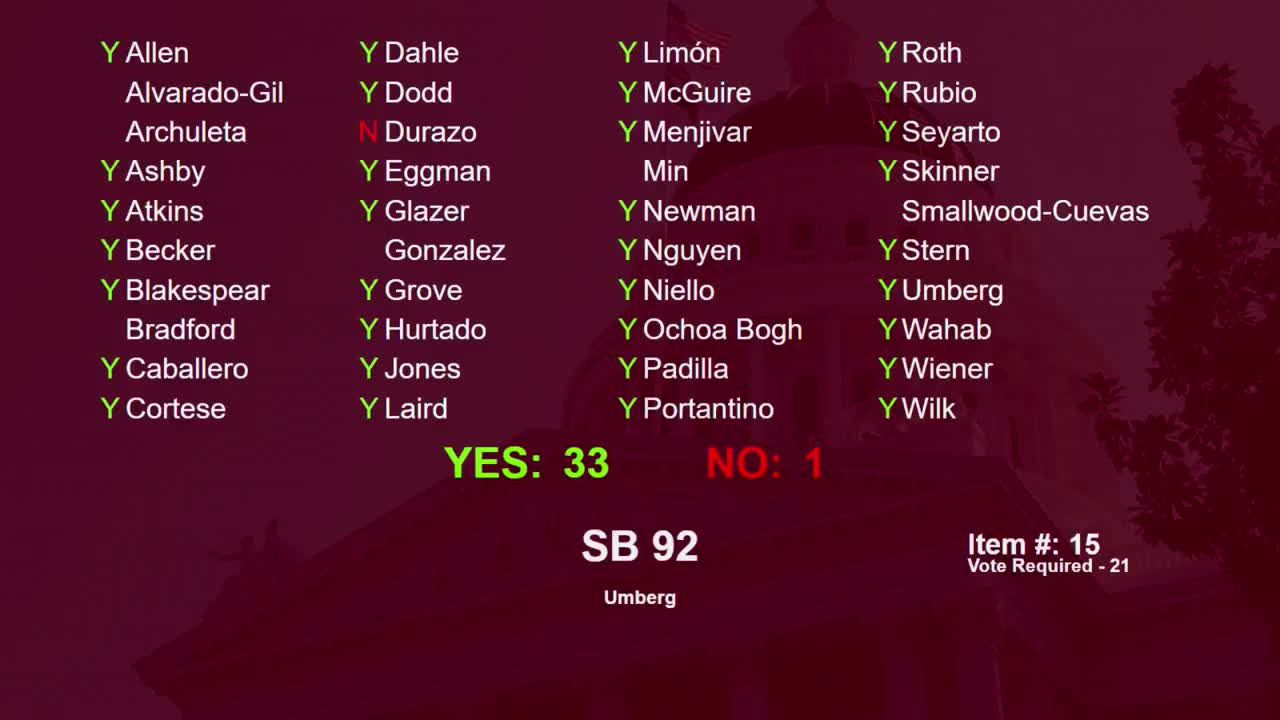 5MIN
Senate Floor
 17MIN
Senate Standing Committee on Transportation
 6MIN
Senate Standing Committee on Natural Resources and Water
Bill Author

Bill Co-Author(s):