SB 722: Daycare facilities: incidental medical services plans.
- Session Year: 2023-2024
- House: Senate
- Latest Version Date: 2023-10-08
Current Status:
Passed
(2023-10-08: Chaptered by Secretary of State. Chapter 631, Statutes of 2023.)
Introduced
In Committee
First Chamber
In Committee
Second Chamber
Enacted
What does this bill do?
The bill lets licensed child daycare facilities enroll a child with exceptional needs (as defined in the Education Code) before the state approves the facility’s incidental medical services plan, if the facility submits a completed plan using a department-created template. It also requires the licensing department to produce template forms for plans of operation and incidental medical services and to remove any rule that currently requires plan approval before such a child may attend.
The summary is provided by generative AI which can make mistakes. For original language, please view the details in the table below.
Existing law, the California Child Day Care Facilities Act, administered by the State Department of Social Services, provides for the licensure and regulation of child daycare facilities, as defined. Existing regulations impose various requirements on child daycare facilities, including, among others, the administration of medication to children. A willful or repeated violation of these provisions is a misdemeanor.
This bill would require the department, on or before January 1, 2025, to create a template form for plans of operations and incidental medical services plans. The bill would also require the department, upon completion of these template forms, to revise its regulations, notices, practices, and bulletins to eliminate any requirement that an incidental medical services plan or amended plan of operation be approved before a child with exceptional needs, as defined, is allowed to attend a child daycare or child development program. The bill would authorize a licensed child daycare facility that submits to the department a completed incidental medical services plan using the template form described above to enroll a child prior to departmental approval of the plan.
Existing law, the California Child Day Care Facilities Act, administered by the State Department of Social Services, provides for the licensure and regulation of child daycare facilities, as defined. Existing regulations impose various requirements on child daycare facilities, including, among others, the administration of medication to children. A willful or repeated violation of these provisions is a misdemeanor.
This bill would require the department, on or before January 1, 2025, to create a template form for plans of operations and incidental medical services plans. The bill would also require the department, upon completion of the templates described above, these template forms, to revise its regulations, notices, practices, and bulletins to eliminate any requirement that an incidental medical services plan or amended plan of operation be approved before a child with exceptional needs, as defined, is allowed to attend a child daycare or child development program. The bill would authorize a licensed child daycare facility that submits to the department a completed incidental medical services plan using the template form described above to enroll a child prior to departmental approval of the plan.
Existing law, the California Child Day Care Facilities Act, administered by the State Department of Social Services, provides for the licensure and regulation of child daycare facilities, as defined. Existing regulations impose various requirements on child daycare facilities, including, among others, the administration of medication to children. A willful or repeated violation of these provisions is a misdemeanor.
This bill would require the department, on or before January 1, 2025, to create a template form for plans of operations and incidental medical services plans. The bill would also require the department, upon completion of the templates described above, to revise its regulations, notices, practices, and bulletins to eliminate any requirement that an incidental medical services plan or amended plan of operation be approved before a child with exceptional needs, as defined, is allowed to attend a child daycare or child development program. The bill would prohibit a child care provider who completes and submits all sections of the incidental medical services plan template described above from being subject to professional review, liable in civil action, or subject to criminal prosecution for the administration of medication, unless that administration constitutes gross negligence or willful or malicious conduct.
Notwithstanding any other law, on or before January 1, 2025, the department shall do all of the following:
(a)Create a template form for plans of operations.
(b)Create a template form for incidental medical services plans.
(c)Upon completion of the templates described in subdivisions (a) and (b), revise its regulations, notices, practices, and bulletins to eliminate any requirement that an incidental medical services plan or amended plan of operation be approved before a child with exceptional needs as defined in Section 8205 of the Education Code is allowed to attend a child daycare or child development program.
(d)A licensed child daycare facility that submits to the department a completed incidental medical services plan using the form created pursuant to subdivision (b) may enroll a child prior to departmental approval of the plan.
(a)Notwithstanding any other law, on or before January 1, 2025, the department shall do all of the following:
(1)(a)Create a template form for plans of operations.
(2)(b)Create a template form for incidental medical services plans.
(3)(c)Upon completion of the templates described in paragraphs (1) and (2), subdivisions (a) and (b), revise its regulations, notices, practices, and bulletins to eliminate any requirement that an incidental medical services plan or amended plan of operation be approved before a child with exceptional needs as defined in Section 8205 of the Education Code is allowed to attend a child daycare or child development program.
(b)Notwithstanding any other law, a provider who completes and submits all sections of an incidental medical services plan template created by the department pursuant to subdivision (a) shall not be subject to professional review, liable in a civil action, or subject to criminal prosecution for the administration of a medication, unless administration of the medication constitutes gross negligence or willful or malicious conduct.(a)Notwithstanding any other law, on or before January 1, 2025, the department shall do all of the following:
(1)Create a template form for plans of operations.
(2)Create a template form for incidental medical services plans.
(3)Upon completion of the templates described in paragraphs (1) and (2), revise its regulations, notices, practices, and bulletins to eliminate any requirement that an incidental medical services plan or amended plan of operation be approved before a child with exceptional needs as defined in Section 8205 of the Education Code is allowed to attend a child daycare or child development program.
(b)Notwithstanding any other law, a provider who completes and submits all sections of an incidental medical services plan template created by the department pursuant to subdivision (a) shall not be subject to professional review, liable in a civil action, or subject to criminal prosecution for the administration of a medication, unless administration of the medication constitutes gross negligence or willful or malicious conduct.
|
Date
|
Status
|
|---|---|
| Oct 8, 2023 | Chaptered by Secretary of State. Chapter 631, Statutes of 2023. |
| Oct 8, 2023 | Approved by the Governor. |
| Sep 21, 2023 | Enrolled and presented to the Governor at 4 p.m. |
| Sep 14, 2023 | Assembly amendments concurred in. (Ayes 38. Noes 0. Page 2834.) Ordered to engrossing and enrolling. |
| Sep 7, 2023 | In Senate. Concurrence in Assembly amendments pending. |
| Sep 7, 2023 | Read third time. Passed. (Ayes 77. Noes 0. Page 3066.) Ordered to the Senate. |
| Sep 5, 2023 | Read second time. Ordered to third reading. |
| Sep 1, 2023 | Read second time and amended. Ordered to second reading. |
| Sep 1, 2023 | From committee: Do pass as amended. (Ayes 11. Noes 0.) (September 1). |
| Jul 12, 2023 | July 12 set for first hearing. Placed on APPR. suspense file. |
| Jun 27, 2023 | Re-referred to Com. on APPR. pursuant to Assembly Rule 96. |
| Jun 22, 2023 | Read second time and amended. Re-referred to Com. on JUD. |
| Jun 21, 2023 | From committee: Do pass as amended and re-refer to Com. on JUD. (Ayes 8. Noes 0.) (June 20). |
| Jun 8, 2023 | Referred to Coms. on HUM. S. and JUD. |
| May 25, 2023 | In Assembly. Read first time. Held at Desk. |
| May 25, 2023 | Read third time. Passed. (Ayes 40. Noes 0. Page 1304.) Ordered to the Assembly. |
| May 23, 2023 | Ordered to special consent calendar. |
| May 18, 2023 | Read second time. Ordered to third reading. |
| May 18, 2023 | From committee: Do pass. (Ayes 7. Noes 0. Page 1181.) (May 18). |
| May 12, 2023 | Set for hearing May 18. |
| May 8, 2023 | May 8 hearing: Placed on APPR suspense file. |
| May 1, 2023 | Set for hearing May 8. |
| Apr 26, 2023 | From committee: Do pass and re-refer to Com. on APPR with recommendation: To consent calendar. (Ayes 11. Noes 0. Page 895.) (April 25). Re-referred to Com. on APPR. |
| Apr 18, 2023 | From committee: Do pass and re-refer to Com. on JUD. with recommendation: To consent calendar. (Ayes 4. Noes 0. Page 748.) (April 17). Re-referred to Com. on JUD. |
| Apr 14, 2023 | Set for hearing April 25 in JUD. pending receipt. |
| Mar 13, 2023 | Set for hearing April 17. |
| Mar 1, 2023 | Referred to Coms. on HUMAN S. and JUD. |
| Feb 17, 2023 | From printer. May be acted upon on or after March 19. |
| Feb 16, 2023 | Introduced. Read first time. To Com. on RLS. for assignment. To print. |
|
Date
|
Description
|
Location
|
Votes
|
|
|---|---|---|---|---|
| Sep 14, 2023 | Unfinished Business SB722 Ochoa Bogh Concurrence | Senate Floor |
Passed |
|
| Sep 7, 2023 | SB 722 Ochoa Bogh Senate Third Reading | Assembly Floor |
Passed |
|
| Sep 1, 2023 | Do pass as amended. | Assembly Standing Committee on Appropriations |
Passed |
|
| Jun 20, 2023 | Do pass as amended and be re-referred to the Committee on [Judiciary] | Assembly Standing Committee on Human Services |
Passed |
|
| May 25, 2023 | Special Consent SB722 Ochoa Bogh | Senate Floor |
Passed |
|
| May 18, 2023 | Do pass | Senate Standing Committee on Appropriations |
Passed |
|
| May 8, 2023 | Placed on suspense file | Senate Standing Committee on Appropriations |
Passed |
|
| Apr 25, 2023 | Do pass, but first be re-referred to the Committee on [Appropriations] with the recommendation: To Consent Calendar | Senate Standing Committee on Judiciary |
Passed |
|
| Apr 17, 2023 | Do pass, but first be re-referred to the Committee on [Judiciary] with the recommendation: To Consent Calendar | Senate Standing Committee on Human Services |
Passed |
This list shows positions taken on this bill by organizations on the date displayed, which is linked to the original source.
Positions by individuals are not included.
|
Organization
|
Position
|
Date
|
|---|---|---|
| California County Superintendents | ** Support | |
| Office of the Riverside County Superintendent of Schools | ** Support | |
| Santa Clara County | * Support | Jun 20, 2023 |
| Santa Clara County Office Of Education | ** Support | |
| Santa Clara County School Boards Association | ** Support |
SENATE RULES COMMITTEE Office of Senate Floor Analyses (916) 651-1520 Fax: (916) 327-4478 | SB 722 |
UNFINISHED BUSINESS
Bill No: SB 722
Author: Ochoa Bogh (R)
Amended: 9/1/23
Vote: 21
SENATE HUMAN SERVICES COMMITTEE: 4-0, 4/17/23
AYES: Alvarado-Gil, Ochoa Bogh, Menjivar, Wahab
NO VOTE RECORDED: Hurtado
SENATE JUDICIARY COMMITTEE: 11-0, 4/25/23
AYES: Umberg, Wilk, Allen, Ashby, Caballero, Durazo, Laird, Min, Niello, Stern, Wiener
SENATE APPROPRIATIONS COMMITTEE: 7-0, 5/18/23
AYES: Portantino, Jones, Ashby, Bradford, Seyarto, Wahab, Wiener
SENATE FLOOR: 40-0, 5/25/23
AYES: Allen, Alvarado-Gil, Archuleta, Ashby, Atkins, Becker, Blakespear, Bradford, Caballero, Cortese, Dahle, Dodd, Durazo, Eggman, Glazer, Gonzalez, Grove, Hurtado, Jones, Laird, Limón, McGuire, Menjivar, Min, Newman, Nguyen, Niello, Ochoa Bogh, Padilla, Portantino, Roth, Rubio, Seyarto, Skinner, Smallwood-Cuevas, Stern, Umberg, Wahab, Wiener, Wilk
ASSEMBLY FLOOR: 77-0, 9/7/23 - See last page for vote
SUBJECT: Daycare facilities: incidental medical services plans
SOURCE: Office of the Riverside County Superintendent of Schools
Santa Clara County Office of Education
DIGEST:
This bill requires the California Department of Social Services (CDSS) to develop, by January 1, 2025, template forms for plans of operation and incidental medical services plans in daycare facilities. This bill allows licensed daycare facilities that submit an incidental medical services plan using the template form, to enroll a child prior to departmental approval.
Assembly Amendments
delete provisions regarding limiting professional review, civil liability or criminal prosecution for the administration of medicine without gross negligence or willful or malicious misconduct, and add language allowing a licensed childcare facility that submits a completed incidental medical services plan, using the department created form, to enroll a child prior to departmental approval of the plan.
ANALYSIS:
Existing law:
- Establishes the California Child Daycare Facilities Act, which creates a separate licensing category for child daycare centers and family daycare homes within DSS’s existing licensing structure. (Health and Safety Code (HSC) 1596.70 et seq.)
- Defines “child daycare facility” to mean a facility that provides nonmedical care to children under 18 years of age, as specified, including daycare centers, employer sponsored childcare centers, and family daycare homes. (HSC 1596.750)
- Requires that any person, firm, partnership, association, or corporation operating a child day care facility in California shall have a valid license. (HSC 1596.80)
- Requires DSS to develop guidelines and procedures to permit licensed child day care centers serving preschool-age children and licensed child day care centers serving infants to create a special toddler program component for children between the ages of 18 months and three years and requires this optional toddler program to meet certain requirements, as specified. Further requires the toddler program to be considered an extension of the infant center or preschool license. (HSC 1596.955, 1596.956)
- Expresses the intent of the Legislature to create a child care license that has individual program components that serve infant, toddler, preschool, and school-age children, and that CDSS consider flexibility for child care providers, maximizing administrative efficiency, while supporting a continuum of services in a manner consistent with all respective health and safety requirements. (HSC 1596.951(a))
- Defines a “day care center” to include any child day care facility other than a family day care home, including infant centers, preschools, extended day care facilities, school-age child care centers, and child care centers licensed to serve infant, toddler, preschool, and school-age children. (HSC 1596.76)
- Defines “school-age child care center” to mean a day care center or part of a day care center that provides nonmedical care and supervision, personal services, or assistance essential for sustaining the activities of daily living or for the protection of school-age children or nonminor students, or both, in a group setting for less than 24 hours per day. (HSC 1596.7915)
- Defines “children with exceptional needs” to mean either of the following:
- Infants and toddlers, under three years of age, who have been determined to be eligible for early intervention services pursuant to the California Early Intervention Services Act, including an infant or toddler with a developmental delay, or an established risk condition, or who is at high risk of having a substantial developmental disability; and,
- Children, three to 21 years of age, who have been determined to be eligible for special education and related services by an individualized education program team, including children with intellectual disabilities, autism, hearing and other impairments as specified, who need special education and related services. (WIC 10213.5(l))
- Requires DSS to set criteria for, and permits the department to grant specific waivers of, the prioritization categories for agencies that wish to serve specific populations, including children with exceptional needs, as specified. (WIC 10271(b)(3))
This bill:
- Requires CDSS, by January 1, 2025, to do the following:
- Create a template form for plans of operations.
- Create a template form for incidental medical services plans.
- Upon completion of the above templates, revise its regulations, notices, practices, and bulletins to eliminate any requirement that an incidental medical services plan or amended plan of operation be approved before a child with exceptional needs, as defined, is allowed to attend a child daycare or child development program.
- Provides that a licensed child daycare facility that submits to the department a completed incidental medical services plan using the form created pursuant to the above referenced template may enroll a child prior to departmental approval of the plan.
Comments
- Author’s statement. According to the author, “Disproportionate access to early learning and childcare (ELC) programs limits social and emotional growth opportunities for children with disabilities and contributes to the K-12 academic achievement gap between students with and without disabilities. The latest student assessment from the California Department of Education (CDE) revealed students with disabilities performed 97.3 and 130.8 points below the state standard in English language arts and math, respectively. SB 722 will eliminate state-imposed barriers to childcare for children with disabilities by requiring the CDSS to create templates for the documents required of ELC providers and allow children with disabilities to attend ELC programs while [CDSS] reviews such documents.”
- Individuals with Education Disabilities Act (IDEA). In January 2017, the U.S. Education Department (ED) and the U.S. Department of Health and Human Services (HHS) issued an updated “Dear Colleague” letter promoting inclusion in early childhood programs. This updated letter outlined the ED and HHS’s vision on such inclusion, as well as recommendations to states, local educational agencies (LEAs), schools, and public and private early childhood programs. According to the letter, HHS and ED did this because despite the expansion of early childhood programs, there was not a proportionate expansion of inclusive early learning opportunities for young children with disabilities so that they are able to participate in the least restrictive environment (LRE) possible. Existing federal law states that “to the maximum extent possible, children with disabilities, including children in public or private institutions or other care facilities, must be educated with children who are not disabled. Further, special classes, separate schooling, or other removal of children with disabilities from the regular educational environment occurs only when the nature or severity of the disability of a child is such that education in regular classes with the use of supplementary aids and services cannot be achieved satisfactorily.”
The LRE requirements under the IDEA apply to all children with disabilities who are served under Part B of the IDEA, including preschool children with disabilities aged three through five. Additionally, states may serve, at their discretion, to two-year-old children who will turn three during the school year. All states must make a “free appropriate public education” available to all children with disabilities available beginning on a child’s third birthday.
- Community Care Licensing Division (CCLD). Within CDSS is CCLD, which is responsible for licensing and investigating complaints against facilities that fall within its jurisdiction, such as residential care facilities for the elderly, child care facilities, and placements for foster youth, among others. Typically, these facilities provide non-medical care and supervision for adults, children and youth by providing adult care services, early childhood education (child care), foster care and shelter services for youth, and residential care for seniors or individuals with developmental disabilities.
CCLD is also responsible for ensuring these facilities comply with all applicable laws and regulations, including criminal background checks, as well as overseeing any necessary corrective actions in the event of noncompliance. CCLD is responsible for inspecting and licensing California’s child care facilities CCLD is required to conduct unannounced site visits of all licensed child daycare facilities and homes. Additionally, 30 percent of their annual inspections are conducted randomly. Each facility licensed by CCLD must be visited at least once every three years, although exceptions exist that may warrant more frequent inspections.
The two main sources of authority for CCLD activities are the California Health and Safety Code and the CCR, Title 22. CCLD must follow CCR Title 22, Division 12 when licensing and inspecting child care and school-age daycare facilities in the state. Under CCR, if a child care facility wishes to implement changes to their program, such as provide new or alternate program concepts, or make changes to the services, procedures, techniques, equipment, space, personnel qualifications or staffing ratios, or the conduct of experimental or demonstration projects, the facility would need to first request a waiver or an exception from CDSS and be approved before any changes can occur.
The licensure, maintenance, and operation of child day care centers and family day care homes in the state are governed by the California Child Day Care Facilities Act. This law and the corresponding regulations establish, among other things, general health and safety requirements, staff-to-child ratios, and provider training requirements for licensed child care. CDSS’s Child Care Licensing Program, within the CCLD is charged with ensuring licensed child care facilities meet health and safety standards through monitoring facilities, providing technical assistance, and establishing partnerships with providers, parents, and the child care community.
- Plans of Operation and Incidental Medical Services Plans (IMSP). Title 22 regulations cover child care facilities, operations and staffing. Under these regulations all ELC providers must have a Plan of Operation that is approved by CCLD. This Plan of Operation includes information about administration and staffing, admissions and rate setting policies, schedules, menus, floorplans and transportation.
If a child with a disability requires medication or adaptive medical equipment, an ELC provider must also have an IMSP approved by the CCLD. IMSP are needed for even minor medical needs such as asthma or allergies. According to the sponsors, because there is currently no template for such plans, there is often much back and forth between providers and CDSS to get plans approved, resulting in delays in children with disabilities having access to child care slots.
- Improving Outcomes for Children with Disabilities. Parents of children with disabilities experience more difficulty finding child care for their children than do parents of nondisabled children. This becomes especially concerning when coupled with studies that show early learning opportunities reduce the prevalence and severity of disabilities and increase the chance that a child with disabilities will graduate with their peers.
Research has shown that very young children who attend high-quality care and education programs realize important gains in language and in social-emotional and cognitive development. Children who experience these programs are also more likely to graduate from high school, attend college, and be employed as adults. Early care and education is particularly important for children with disabilities. When developmental delays are recognized and addressed at the youngest possible age, many delays can be significantly ameliorated. Queens College economist Clive R. Belfeld estimates that children who receive high-quality care and education before kindergarten are 40 percent to 60 percent less likely to need special education interventions when they reach school age.
As with older children, most 3- to 5-year-olds with disabilities learn best when they attend preschools alongside their age-mates without disabilities to the greatest extent possible. These settings provide both language and behavioral models that assist in children’s development and help all children learn to be productively engaged with diverse peers. However, relatively few children are able to attend preschool in such integrated settings. Currently, only one in five preschool-aged children with identified disabilities is enrolled in such settings.
Related/Prior Legislation
AB 2042 (Villapudua, 2022) would have required CDSS to establish an anaphylactic policy that sets guidelines and procedures to be followed by child daycare personnel to prevent a child from suffering from anaphylaxis and to be used during a medical emergency by July 1, 2024. This bill was vetoed by the Governor.
SB 217 (Portantino, 2019) would have, as introduced, created the Early Intervention Grant Program to increase inclusive access to early education programs for children with exceptional needs and expand eligibility for transitional kindergarten to include children with exceptional needs turning five-years-old at any time during the school year. SB 217 was amended to include content unrelated to early education, then died in Assembly Health Committee.
AB 1754 (McCarty, 2018) would have required the state to provide all eligible low-income four-year-old children with access to early care and education programs. AB 1754 was held in the Senate Appropriations Committee.
FISCAL EFFECT: Appropriation: No Fiscal Com.: Yes Local: No
According to the Assembly Appropriations Committee on July 12, 2023, CDSS estimates General Fund costs of $173,000 in the first year and $169,000 in years two and three, for one limited-term staff to create the templates and revise related regulations, notices, practices and bulletins.
SUPPORT: (Verified 9/8/23)
Office of the Riverside County Superintendent of Schools (co-source)
Santa Clara County Office of Education (co-source)
California County Superintendents
Santa Clara County School Boards Association
OPPOSITION: (Verified 9/8/23)
None received
ASSEMBLY FLOOR: 77-0, 9/7/23
AYES: Addis, Aguiar-Curry, Alanis, Alvarez, Arambula, Bains, Bauer-Kahan, Bennett, Berman, Boerner, Bonta, Bryan, Calderon, Juan Carrillo, Wendy Carrillo, Cervantes, Chen, Connolly, Megan Dahle, Davies, Dixon, Mike Fong, Vince Fong, Friedman, Gabriel, Gallagher, Garcia, Gipson, Haney, Hart, Holden, Hoover, Irwin, Jackson, Jones-Sawyer, Kalra, Lackey, Lee, Low, Lowenthal, Maienschein, Mathis, McCarty, McKinnor, Muratsuchi, Stephanie Nguyen, Ortega, Pacheco, Papan, Jim Patterson, Joe Patterson, Pellerin, Petrie-Norris, Quirk-Silva, Ramos, Rendon, Reyes, Luz Rivas, Rodriguez, Blanca Rubio, Sanchez, Santiago, Schiavo, Soria, Ta, Ting, Valencia, Villapudua, Waldron, Wallis, Ward, Weber, Wicks, Wilson, Wood, Zbur, Robert Rivas
NO VOTE RECORDED: Essayli, Flora, Grayson
Prepared by: Heather Hopkins / HUMAN S. / (916) 651-1524
9/8/23 14:10:51
**** END ****
SENATE THIRD READING
STR Bill Id:SB 722
Author:(Ochoa Bogh)
As Amended Ver:September 1, 2023
Majority vote
SUMMARY
Requires the California Department of Social Services (CDSS), by January 1, 2025, to create a template for plans of operations, and for incidental medical services plans (ICMP); requires CDSS to remove any requirements in regulations, notices, or practices for ICMPs or plans of operation to be approved before a child with exceptional needs may attend a child daycare or child development program; and authorizes a child daycare facility that submits an ICMP using the template to enroll the child prior to the departmental approval of the ICMP.
Major Provisions
COMMENTS
Background: CDSS and Childcare Licensing. The California Child Day Care Facilities Act and the attendant regulations found in Title 22 of the California Code of Regulations establish, among other things, general health and safety requirements, staff-to-child ratios, and provider training requirements.
CDSS is responsible for licensing and regulatory oversight of childcare providers to ensure facilities are upholding all applicable health and safety standards. To fulfill CDSS' responsibilities, the department conducts in-person and online orientations, pre-licensing inspections, unannounced facility inspections, complaint investigations, consultations, education and technical support, and follow-up inspections.
State law and regulations dictate that infant care centers serve children under two years old, preschool child care centers serve children between the ages of two years old and when they start school, and school-age child care centers serve children who have entered the first grade or are in a child care program exclusively for children in kindergarten and above. A "combination center" is any combination of an infant center, preschool child care center, school-age child care center and child care center for mildly ill children that is owned and operated by one licensee at a common address. In California, separate licenses are required for serving infant, preschool, and school age children. Thus, owner/operators of combination centers serving more than one population must get multiple licenses and undergo separate inspection and compliance processes for each license.
Children with Exceptional Needs. Early intervention for children with exceptional needs are particularly important because research shows that when developmental delays are recognized and addressed at the youngest age possible, then delays can be ameliorated. Federal law established the "Individuals with Disabilities Education Act" (IDEA), which ensures that children with disabilities and the families of such children have access to a free appropriate public education and to improve educational results for children with disabilities. IDEA also requires that children are able to learn amongst peers without early interventions. Integrated settings allow for language and behavior models, which benefit development.
California State Preschool Program contractors are required to set aside enrollment priority for these children. However, similar to the experiences across the board in childcare, there is a lack of availability, which make accessing these services difficult and further delays interventions.
Plans of Operation and Incidental Medical Services Plans (IMSP). As a part of licensing requirements, childcare providers must submit a plan of operations to CDSS for approval. The plan of operations includes staffing, admissions, rates, schedules, food menus, and use of space. Furthermore, if a childcare provider is enrolling a child with exceptional needs that require medications or equipment, the plan must also include an IMSP. Because children are continuously enrolling, this requires childcare providers to revise its IMSP when a new child that needs medication is admitted. There is currently not a template for providers to follow; however, CDSS published a Provider Information Notice in February 2022 intended to provide information and best practices for administering IMSP in childcare facilities, which could guide a facility through making an IMSP.
Equity Implications. A report published by the Children's Equity project in November 2020 noted that there are significant access disparities between children with disabilities and children without. The report states, "Nationally, fewer than half of preschoolers with disabilities receive their services in regular early childhood programs…. Barriers to inclusion that have been cited in research include the ableist attitudes and beliefs; inadequate workforce preparation, development, and support; the intersection between race, disability categories, and placement decisions; a lack of will to change the status quo and policy misperceptions on the parts of administrators and systems leaders; and a lack of coordination between early childhood and IDEA systems."
Lack of access further impacts the ability for parents to work, and more specifically women more often take on that role, when sufficient childcare is unavailable. 2016–18 National Survey of Children's Health data show that parents with children with disabilities are three times more likely to have "job disruptions because of problems with child care."
As mentioned in the author's statement, a recent CDE assessment revealed students with disabilities performed 97.3 and 130.8 points below the state standard in English language arts and math, respectively.
According to the Author
"Disproportionate access to early learning and childcare (ELC) programs limits social and emotional growth opportunities for children with disabilities and contributes to the K-12 academic achievement gap between students with and without disabilities. The latest student assessment from the California Department of Education (CDE) revealed students with disabilities performed 97.3 and 130.8 points below the state standard in English language arts and math, respectively. [This bill] will eliminate state-imposed barriers to childcare for children with disabilities by requiring the Department of Social Services (DSS) to create templates for the documents required of ELC providers and allow children with disabilities to attend ELC programs while the Department reviews such documents."
Arguments in Support
The Riverside County Office of Education writes, "Unfortunately, the current process often results in a child having to wait to access care while DSS approves the IMSP. In many cases, the wait can take as long as several months. SB 722 would help remedy this barrier by ensuring that DSS creates a template a provider can submit to streamline enrollment and would allow the provider to begin serving the child immediately."
According to the Santa Clara County Office of Education and the California County Superintendents, "SB 722 would remove barriers for children with disabilities by ensuring that children who require an Incidental Medical Services Plan (IMSP) can attend childcare as soon as their provider completes an IMSP. This change would alter the current practice in which families wait months for approval before a child can access care. The bill would also require the Department to create IMSP and Plan of Operation templates, thereby easing the uncertainty and administrative burden for childcare providers who serve children with disabilities."
According to the Santa Clara County School Board Association, "Children with disabilities should not wait; today it generally takes months of back- and-forth conversations between an ELC provider and the CCLD to obtain approval of an IMSP. This costly delay disproportionately affects children with disabilities, including low income families with disabled children now losing Covid economic support. More equitable access is immediately required for children and families to thrive."
Arguments in Opposition
No opposition on file
FISCAL COMMENTS
According to the Assembly Appropriations Committee on July 12, 2023, CDSS estimates General Fund costs of $173,000 in the first year and $169,000 in years two and three, for one limited-term staff to create the templates and revise related regulations, notices, practices and bulletins.
VOTES
SENATE FLOOR: 40-0-0
YES: Allen, Alvarado-Gil, Archuleta, Ashby, Atkins, Becker, Blakespear, Bradford, Caballero, Cortese, Dahle, Dodd, Durazo, Eggman, Glazer, Gonzalez, Grove, Hurtado, Jones, Laird, Limón, McGuire, Menjivar, Min, Newman, Nguyen, Niello, Ochoa Bogh, Padilla, Portantino, Roth, Rubio, Seyarto, Skinner, Smallwood-Cuevas, Stern, Umberg, Wahab, Wiener, Wilk
ASM HUMAN SERVICES: 8-0-0
YES: Jackson, Alanis, Arambula, Bonta, Juan Carrillo, Calderon, Garcia, Lackey
ASM APPROPRIATIONS: 11-0-5
YES: Holden, Bryan, Calderon, Wendy Carrillo, Mike Fong, Hart, Lowenthal, Papan, Pellerin, Weber, Wilson
ABS, ABST OR NV: Megan Dahle, Dixon, Mathis, Sanchez, Soria
UPDATED
VERSION: September 1, 2023
CONSULTANT: Alexandria Smith / HUM. S. / (916) 319-2089 FN: 0001590
Date of Hearing: July 12, 2023
ASSEMBLY COMMITTEE ON APPROPRIATIONS
Chris Holden, Chair
SBPCA Bill Id:SB 722
Author:(Ochoa Bogh) – As Amended Ver:June 22, 2023
Policy Committee: | Human Services | Vote: | 8 - 0 |
|
| ||
|
|
Urgency: No State Mandated Local Program: No Reimbursable: No
SUMMARY:
This bill requires the California Department of Social Services (CDSS), by January 1, 2025, to create a template for plans of operation and for incidental medical services plans (IMSPs) for childcare providers. The bill further requires CDSS, upon completion of the templates, to remove any requirement in regulations, notices, practices, and bulletins that an IMSP or plan of operation must be approved before a child with exceptional needs may attend a child daycare or child development program.
FISCAL EFFECT:
CDSS estimates General Fund costs of $173,000 in the first year and $169,000 in years two and three, for one limited-term staff to create the templates and revise related regulations, notices, practices and bulletins.
COMMENTS:
- Purpose. The author seeks to reduce barriers to childcare for children with exceptional needs. According to the author:
Disproportionate access to early learning and childcare (ELC) programs limits social and emotional growth opportunities for children with disabilities and contributes to the K-12 academic achievement gap between students with and without disabilities. [This bill] will eliminate state-imposed barriers to childcare for children with disabilities by requiring the [CDSS] to create templates for the documents required of ELC providers and allow children with disabilities to attend ELC programs while the Department reviews such documents.
- Background. CDSS is responsible for the licensure of child day care facilities. CDSS establishes and enforces general health and safety requirements, staff-to-child ratios, and provider training requirements for licensed child care. CDSS regulations require that providers must have a plan of operation that is approved by CDSS. This plan of operation includes information about administration and staffing, admissions and rate setting policies, schedules, menus, floorplans and transportation.
Before admitting a child with a disability who requires medication administration or adaptive equipment, including for asthma or allergies, a provider must amend their plan of operation to add an IMSP approved by CDSS.
There is no template for plans of operation or IMSPs, nor is there state guidance or regulation outlining what information must be included in an IMSP. The author and advocates contend this contributes to a prolonged approval process and delays in children with disabilities obtaining access to child care slots. This bill requires CDSS to create standardized templates for plans of operation and IMSPs and removes requirements that CDSS must approve these documents prior to a child with exceptional needs attending a child daycare or child development program.
Analysis Prepared by: Jennifer Swenson / APPR. / (916) 319-2081
Date of Hearing: June 20, 2023
ASSEMBLY COMMITTEE ON HUMAN SERVICES
Corey A. Jackson, Chair
SBPCA Bill Id:SB 722
Author:(Ochoa Bogh) – As Introduced Ver:February 16, 2023
SENATE VOTE: 40-0
SUBJECT: Daycare facilities: incidental medical services plans
SUMMARY: Requires the California Department of Social Services (CDSS), by January 1, 2025, to create a template for plans of operations, and for incidental medical services plans (ICMP); requires CDSS to remove any requirements in regulations, notices, or practices for ICMPs or plans of operation to be approved before a child with exceptional needs may attend a child daycare or child development program; and, provides immunity to childcare providers in connection with administering medication.
EXISTING LAW:
- Establishes the “California Child Day Care Facilities Act” with the purpose to streamline the administration of childcare licensing and thereby increase the efficiency and effectiveness of this system. (Health and Safety Code Section [HSC] 1596.70 et seq.)
- Defines “child day care facility” as a facility that provides nonmedical care to children under 18 years of age in need of personal services, supervision, or assistance essential for sustaining the activities of daily living or for the protection of the individual on less than a 24-hour basis. Child day care facility includes day care centers, employer-sponsored child care centers, and family day care homes. (HSC 1596.750)
- Requires CDSS to develop guidelines and procedures to permit licensed child day care centers serving preschool-age children and licensed child day care centers serving infants to create a special toddler program component for children between the ages of 18 months and three years and requires this optional toddler program to meet certain requirements, as specified. Further requires the toddler program to be considered an extension of the infant center or preschool license. (HSC 1596.955, 1596.956)
- Defines “children with exceptional needs” as either of the following:
- Children under three years of age who have been determined to be eligible for early intervention services, as provided. These children include an infant or toddler with a developmental delay or established risk condition, or who is at high risk of having a substantial developmental disability, as defined. These children shall have active individualized family service plans and shall be receiving early intervention services; or,
- Children 3 to 21 years of age, inclusive, who have been determined to be eligible for special education and related services by an individualized education program team according to the special education requirements, as specified, and who meet certain eligibility criteria. These children shall have an active individualized education program and shall be receiving early intervention services or appropriate special education. (Education Code Section [EDC] 8205(h))
- Requires a percentage of part-time and full-day California State Preschool Program (CSPP) contractor’s funded enrollment be set aside specifically to allow children with exceptional needs, including children with severe disabilities, to be enrolled in income order, but without regard to enrollment priorities, until the set aside is filled. (EDC 8208(c)(1) & (d)(2)(A))
- Requires children with exceptional needs must be educated in the least restrictive environment. (EDC 8208(c)(3) & 20 United States Code Section [U.S.C.] 1412(a)(5)(A))
- Requires each child care center licensee to have and keep on file a current written, definitive plan of operation. A copy of the plan shall be submitted to CDSS with the license application. The plan and related materials shall contain specified elements, including program methods and goals; administrative organization; staffing plan, qualifications, and duties; sample menus; and a rate-setting policy. Any proposed changes in the plan of operation that affect services to children shall be subject to CDSS approval prior to implementation and shall be reported, as specified. The child care center shall operate in accordance with the terms specified in the plan of operation. (22 California Code of Regulations [CCR] 101173)
- Authorizes CDSS to approve the use of alternate concepts, programs, services, procedures, techniques, equipment, space, personnel qualifications or staffing ratios, or the conduct of experimental or demonstration projects, as specified. Further, requires the applicant or licensee to submit a written request for a waiver or an exception and substantiating evidence supporting the request to CDSS, as provided. (22 CCR 101175)
- Requires CDSS to set criteria for, and permits the department to grant specific waivers of, the prioritization categories for agencies that wish to serve specific populations, including children with exceptional needs, as specified. (Welfare and Institutions Code Section 10271(b)(3))
- Establishes the federal “Individuals with Disabilities Education Act” (IDEA), which ensures that children with disabilities and the families of such children have access to a free appropriate public education and to improve educational results for children with disabilities. (20 U.S.C 1400, et seq.)
FISCAL EFFECT: According to the Senate Appropriations Committee on May 8, 2023, “unknown, one-time General Fund costs, likely hundreds of thousands, for CDSS to develop the template forms and revise its regulations.”
COMMENTS:
Background: CDSS and Childcare Licensing. The California Child Day Care Facilities Act and the attendant regulations found in Title 22 of the CCR establish, among other things, general health and safety requirements, staff-to-child ratios, and provider training requirements.
CDSS is responsible for licensing and regulatory oversight of childcare providers to ensure facilities are upholding all applicable health and safety standards. To fulfill CDSS’ responsibilities, the department conducts in-person and online orientations, pre-licensing inspections, unannounced facility inspections, complaint investigations, consultations, education and technical support, and follow-up inspections.
State law and regulations dictate that infant care centers serve children under two years old, preschool child care centers serve children between the ages of two years old and when they start school, and school-age child care centers serve children who have entered the first grade or are in a child care program exclusively for children in kindergarten and above. A “combination center” is any combination of an infant center, preschool child care center, school-age child care center and child care center for mildly ill children that is owned and operated by one licensee at a common address. In California, separate licenses are required for serving infant, preschool, and school age children. Thus, owner/operators of combination centers serving more than one population must get multiple licenses and undergo separate inspection and compliance processes for each license.
Children with Exceptional Needs. Early intervention for children with exceptional needs are particularly important because research shows that when developmental delays are recognized and addressed at the youngest age possible, then delays can be ameliorated. The IDEA guarantees early intervention services for infants and toddlers in a preschool setting. IDEA also requires that children are able to learn amongst peers without early interventions. Integrated settings allow for language and behavior models, which benefit development. CSPP contractors are required to set aside enrollment priority for these children. However, similar to the experiences across the board in childcare, there is a lack of availability, which make accessing these services difficult and further delays interventions.
Plans of Operation and Incidental Medical Services Plans (IMSP). As a part of licensing requirements, childcare providers must submit a plan of operations to CDSS for approval. The plan of operations includes staffing, admissions, rates, schedules, food menus, and use of space. Furthermore, if a childcare provider is enrolling a child with exceptional needs that require medications or equipment, the plan must also include an IMSP. Because children are continuously enrolling, this requires childcare providers to revise its IMSP when a new child that needs medication is admitted. There is currently not a template for providers to follow. CDSS published a Provider Information Notice in February 2022 intended to provide information and best practices for administering IMSP in childcare facilities, which could guide a facility through making an IMSP.
Author’s Statement: According to the Author, “Disproportionate access to early learning and childcare (ELC) programs limits social and emotional growth opportunities for children with disabilities and contributes to the K-12 academic achievement gap between students with and without disabilities. The latest student assessment from the California Department of Education (CDE) revealed students with disabilities performed 97.3 and 130.8 points below the state standard in English language arts and math, respectively. [This bill] will eliminate state-imposed barriers to childcare for children with disabilities by requiring the Department of Social Services (DSS) to create templates for the documents required of ELC providers and allow children with disabilities to attend ELC programs while the Department reviews such documents.”
Need for this bill: Currently, childcare providers are reporting difficulty in submitting plans to CDSS and it taking months of back and forth before it is approved. The delay in approval plans is reportedly causing a delay in enrollment for a child with exceptional needs. Due to the lack of conformity in the IMSP, childcare providers struggle to submit an appropriate plan, creating an extended period of time working with CDSS to find an appropriate plan or solution. This bill seeks to rectify that issue by standardizing a template.
Equity Implications: A report published by the Children’s Equity project in November 2020 noted that there are significant access disparities between children with disabilities and children without. The report states, “Nationally, fewer than half of preschoolers with disabilities receive their services in regular early childhood programs…. Barriers to inclusion that have been cited in research include the ableist attitudes and beliefs; inadequate workforce preparation, development, and support; the intersection between race, disability categories, and placement decisions; a lack of will to change the status quo and policy misperceptions on the parts of administrators and systems leaders; and a lack of coordination between early childhood and IDEA systems.”
Lack of access further impacts the ability for parents to work, and more specifically women more often take on that role, when sufficient childcare is unavailable. 2016–18 National Survey of Children’s Health data show that parents with children with disabilities are three times more likely to have “job disruptions because of problems with child care.”
As mentioned in the author’s statement, a recent CDE assessment revealed students with disabilities performed 97.3 and 130.8 points below the state standard in English language arts and math, respectively.
Policy Considerations: This bill provides immunity to a childcare provider who completes and submits all sections of an IMSP template from professional review or criminal and civil liability for the administration of a medication, unless administration of the medication constitutes gross negligence or willful or malicious conduct. California law provides immunity in some cases in emergency cases. This bill goes beyond emergencies and provides liability protections in routine daily tasks before an IMSP is even approved by CDSS. As noted in the Senate Judiciary Committee analysis:
“…immunity from liability disincentivizes careful planning and acting on the part of individuals and entities. When one enjoys immunity from civil liability, it is relieved of the responsibility to act with due regard and an appropriate level of care in the conduct of its activities. Immunity provisions are also disfavored because they, by their nature, preclude parties from recovering when they are injured, and force injured parties to absorb losses for which they are not responsible. Liability acts not only to allow a victim to be made whole, but to encourage appropriate compliance with legal requirements.”
Proposed Committee Amendments:
To address the policy concerns about immunity raised above, the Committee proposes the following amendments:
On page 2, strike out lines 14 to 20, inclusive
Double referral: This bill will be referred to the Assembly Judiciary Committee, should it pass out of this Committee.
RELATED AND PRIOR LEGISLATION:
AB 2042 (Villapudua) of 2022, would have required CDSS to establish an anaphylactic policy that sets guidelines and procedures to be followed by child daycare personnel to prevent a child from suffering from anaphylaxis and to be used during a medical emergency by July 1, 2024.
AB 2042 was vetoed by Governor Newsom.
SB 217 (Portantino) of 2019, as introduced, would have created the “Early Intervention Grant Program” to increase inclusive access to early education programs for children with exceptional needs and expand eligibility for transitional kindergarten to include children with exceptional needs turning five-years-old at any time during the school year. SB 217 was substantially amended to include language unrelated to early education.
REGISTERED SUPPORT / OPPOSITION:
Support
Office of the Riverside County Superintendent of Schools (Co-Sponsor)
Santa Clara County Office of Education (Co-Sponsor)
California County Superintendents
Santa Clara County School Boards Association
Opposition
None on file
Analysis Prepared by: Alexandria Smith / HUM. S. / (916) 319-2089
SENATE RULES COMMITTEE Office of Senate Floor Analyses (916) 651-1520 Fax: (916) 327-4478 | SB 722 |
THIRD READING
Bill No: SB 722
Author: Ochoa Bogh (R)
Introduced: 2/16/23
Vote: 21
SENATE HUMAN SERVICES COMMITTEE: 4-0, 4/17/23
AYES: Alvarado-Gil, Ochoa Bogh, Menjivar, Wahab
NO VOTE RECORDED: Hurtado
SENATE JUDICIARY COMMITTEE: 11-0, 4/25/23
AYES: Umberg, Wilk, Allen, Ashby, Caballero, Durazo, Laird, Min, Niello, Stern, Wiener
SENATE APPROPRIATIONS COMMITTEE: 7-0, 5/18/23
AYES: Portantino, Jones, Ashby, Bradford, Seyarto, Wahab, Wiener
SUBJECT: Daycare facilities: incidental medical services plans
SOURCE: Office of the Riverside County of Superintendent of Schools
Santa Clara County Office of Education
DIGEST:
This bill requires the California Department of Social Services (CDSS) to develop, by January 1, 2025, template forms for plans of operation and incidental medical services plans in daycare facilities.
ANALYSIS:
Existing law:
- Establishes the federal Individuals with Disabilities Education Act (IDEA), which ensures that children with disabilities and the families of such children have access to a free appropriate public education and to improve educational results for children with disabilities. (20 United States Code 1400, et seq.)
- Defines “combination center” to mean any combination of a child care center, infant care center, school-age child care center, and child care center for mildly ill children that is owned and operated by one licensee at a common address. (22 California Code of Regulations (CCR) 101152 (c)(10))
- Defines “infant” to mean a child under two years of age and defines “infant care center” to mean any child care center, or part thereof, where less than 24-hour per day nonmedical care and supervision are provided to infants in a group setting. (22 CCR 101152 (i)(1-2))
- Defines “school-age child” to mean any child who has either entered the first grade or higher or who is in a child care program that provides care and supervision exclusively to children enrolled in kindergarten and above. (22 CCR 101152 (s)(1))
- Authorizes CDSS to approve the use of alternate concepts, programs, services, procedures, techniques, equipment, space, personnel qualifications or staffing ratios, or the conduct of experimental or demonstration projects, as specified. Further, requires the applicant or licensee to submit a written request for a waiver or an exception and substantiating evidence supporting the request to DSS, as provided. (22 CCR 101175)
- Establishes regulations for licensed child care centers. (22 CCR 101238 et seq.)
- Permits a child whose developmental needs require continuation in an infant care center to remain in an infant care center up to a maximum age of three years. (22 CCR 101361)
- Establishes the California Child Daycare Facilities Act, which creates a separate licensing category for child daycare centers and family daycare homes within DSS’s existing licensing structure. (HSC 1596.70 et seq.)
- Defines “child daycare facility” to mean a facility that provides nonmedical care to children under 18 years of age, as specified, including daycare centers, employer sponsored childcare centers, and family daycare homes. (HSC 1596.750)
- Requires that any person, firm, partnership, association, or corporation operating a child day care facility in California shall have a valid license. (HSC 1596.80)
- Requires DSS to charge an original application fee for the issuance of a license to operate a child day care facility and, thereafter, an annual fee, based on facility type and capacity. (HSC 1596.803)
- Requires DSS to develop guidelines and procedures to permit licensed child day care centers serving preschool-age children and licensed child day care centers serving infants to create a special toddler program component for children between the ages of 18 months and three years and requires this optional toddler program to meet certain requirements, as specified. Further requires the toddler program to be considered an extension of the infant center or preschool license. (HSC 1596.955, 1596.956)
- Expresses the intent of the Legislature to create a child care license that has individual program components that serve infant, toddler, preschool, and school-age children, and that CDSS consider flexibility for child care providers, maximizing administrative efficiency, while supporting a continuum of services in a manner consistent with all respective health and safety requirements. (HSC 1596.951(a))
- Requires CDSS, in consultation with stakeholders, to adopt regulations on or before January 1, 2021, to create a child care center license to serve infant, toddler, preschool, and school-age children with all respective health and safety requirements. Requires all day care centers to be licensed accordingly by January 1, 2024. (HSC 1596.951(b))
- Allows CDSS to adopt emergency regulations in order to implement the single child care center license serving infants, toddlers, preschool, and school-age children. (HSC 1596.951)
- Requires DSS to set criteria for, and permits the department to grant specific waivers of, the prioritization categories for agencies that wish to serve specific populations, including children with exceptional needs, as specified. (WIC 10271(b)(3))
This bill:
- Requires CDSS, by January 1, 2025 to develop template forms for plans of operation and incidental medical services plans.
- Requires, upon completion of these templates, CDSS to revise its regulations, notices, practices, and bulletins to eliminate any requirement than an incidental medical services plan or amended plan of operation be approved before a child with exceptional needs is allowed to attend a child daycare or child development program.
- Provides that a provider who completes and submits all sections of an incidental medical services plan template is not subject to professional review, liability in a civil action or criminal prosecution for the administration of a medication unless done so with gross negligence or willful or malicious conduct.
Comments
According to the author, “Disproportionate access to early learning and childcare (ELC) programs limits social and emotional growth opportunities for children with disabilities and contributes to the K-12 academic achievement gap between students with and without disabilities. The latest student assessment from the California Department of Education (CDE) revealed students with disabilities performed 97.3 and 130.8 points below the state standard in English language arts and math, respectively. SB 722 will eliminate state-imposed barriers to childcare for children with disabilities by requiring the CDSS to create templates for the documents required of ELC providers and allow children with disabilities to attend ELC programs while [CDSS] reviews such documents.”
Community Care Licensing Division (CCLD) Within CDSS is CCLD, which is responsible for licensing and investigating complaints against facilities that fall within its jurisdiction, such as residential care facilities for the elderly, child care facilities, and placements for foster youth, among others. Typically, these facilities provide non-medical care and supervision for adults, children and youth by providing adult care services, early childhood education (child care), foster care and shelter services for youth, and residential care for seniors or individuals with developmental disabilities.
CCLD is also responsible for ensuring these facilities comply with all applicable laws and regulations, including criminal background checks, as well as overseeing any necessary corrective actions in the event of noncompliance. CCLD is responsible for inspecting and licensing California’s child care facilities CCLD is required to conduct unannounced site visits of all licensed child daycare facilities and homes. Additionally, 30 percent of their annual inspections are conducted randomly. Each facility licensed by CCLD must be visited at least once every three years, although exceptions exist that may warrant more frequent inspections.
The two main sources of authority for CCLD activities are the California Health and Safety Code (HSC) and the CCR, Title 22. CCLD must follow CCR Title 22, Division 12 when licensing and inspecting child care and school-age daycare facilities in the state. Under CCR, if a child care facility wishes to implement changes to their program, such as provide new or alternate program concepts, or make changes to the services, procedures, techniques, equipment, space, personnel qualifications or staffing ratios, or the conduct of experimental or demonstration projects, the facility would need to first request a waiver or an exception from CDSS and be approved before any changes can occur.
The licensure, maintenance, and operation of child day care centers and family day care homes in the state are governed by the California Child Day Care Facilities Act. This law and the corresponding regulations establish, among other things, general health and safety requirements, staff-to-child ratios, and provider training requirements for licensed child care. CDSS’s Child Care Licensing Program, within the CCLD is charged with ensuring licensed child care facilities meet health and safety standards through monitoring facilities, providing technical assistance, and establishing partnerships with providers, parents, and the child care community.
Plans of Operation and Incidental Medical Services Plans (IMSP) Title 22 regulations cover child care facilities, operations and staffing. Under these regulations all ELC providers must have a Plan of Operation that is approved by CCLD. This Plan of Operation includes information about administration and staffing, admissions and rate setting policies, schedules, menus, floorplans and transportation.
If a child with a disability requires medication or adaptive medical equipment, an ELC provider must also have an IMSP approved by the CCLD. IMSP are needed for even minor medical needs such as asthma or allergies. According to the sponsors, because there is currently no template for such plans, there is often much back and forth between providers and CDSS to get plans approved, resulting in delays in children with disabilities having access to child care slots.
This bill would require CDSS to create template forms for plans of operation and incidental medical services plans. The author notes that currently there is often a lag time in approval of such requests as CDSS reviews the requests and asks for supplemental information. The hope of the author with this bill is that creation of templates will assist in providing all the relevant information in the initial paperwork to streamline the process.
Improving Outcomes for Children with Disabilities Parents of children with disabilities experience more difficulty finding child care for their children than do parents of nondisabled children. This becomes especially concerning when coupled with studies that show early learning opportunities reduce the prevalence and severity of disabilities and increase the chance that a child with disabilities will graduate with their peers.
Research has shown that very young children who attend high-quality care and education programs realize important gains in language and in social-emotional and cognitive development. Children who experience these programs are also more likely to graduate from high school, attend college, and be employed as adults. Early care and education is particularly important for children with disabilities. When developmental delays are recognized and addressed at the youngest possible age, many delays can be significantly ameliorated. Queens College economist Clive R. Belfeld estimates that children who receive high-quality care and education before kindergarten are 40 percent to 60 percent less likely to need special education interventions when they reach school age.
As with older children, most 3- to 5-year-olds with disabilities learn best when they attend preschools alongside their age-mates without disabilities to the greatest extent possible. These settings provide both language and behavioral models that assist in children’s development and help all children learn to be productively engaged with diverse peers. However, relatively few children are able to attend preschool in such integrated settings. Currently, only one in five preschool-aged children with identified disabilities is enrolled in such settings.
According to the letter of support submitted to the committee from one of the bill’s sponsors, Riverside County Office of Education, “Like many districts throughout California, school districts in Riverside County are committed to ensuring students with disabilities are placed in inclusive classrooms from their earliest years. As research has shown, all students benefit both academically and socially from learning in inclusive educational settings. The Early Education Services Division within the Riverside County Office of Education continues to grow every month in student enrollment and currently serves over 17,000 of our youngest learners. Our providers work diligently to provide families with disabled children access to early educational programs, and to submit the required IMSP to specify how they will meet a child’s disability (whether medical or non-medical). Once the CDSS approves the plan, the child is able to access the program. Unfortunately, the current process often results in a child having to wait to access care while CDSS approves the IMSP. In many cases, the wait can take as long as several months.
This bill helps remedy this barrier by ensuring that CDSS creates a template a provider can submit to streamline enrollment and would allow the provider to begin serving the child immediately.”
This bill would require DSS to create template forms to help streamline the process of disabled children accessing childcare.
Related/Prior Legislation
AB 2042 (Villapudua, 2022) would have required CDSS to establish an anaphylactic policy that sets guidelines and procedures to be followed by child daycare personnel to prevent a child from suffering from anaphylaxis and to be used during a medical emergency by July 1, 2024. This bill was vetoed by the Governor.
SB 217 (Portantino, 2019), as introduced, would have created the Early Intervention Grant Program to increase inclusive access to early education programs for children with exceptional needs and expand eligibility for transitional kindergarten to include children with exceptional needs turning five-years-old at any time during the school year. SB 217 was amended to include content unrelated to early education.
AB 1754 (McCarty, 2018) would have required the state to provide all eligible low-income four-year-old children with access to early care and education programs. AB 1754 was held in the Senate Appropriations Committee.
FISCAL EFFECT: Appropriation: No Fiscal Com.: Yes Local: No
According to the Senate Appropriations Committee, unknown, one-time General Fund costs, likely hundreds of thousands, for CDSS to develop the template forms and revise its regulations.
SUPPORT: (Verified 5/19/23)
Office of the Riverside County Superintendent of Schools (co-source)
Santa Clara County Office of Education (co-source)
California County Superintendents
Santa Clara County School Boards Association
OPPOSITION: (Verified 5/19/23)
None received
Prepared by: Heather Hopkins / HUMAN S. / (916) 651-1524
5/20/23 13:05:37
SENATE COMMITTEE ON
Senator Anthony Portantino, Chair
2023 - 2024 Regular Session
SB 722 (Ochoa Bogh) - Daycare facilities: incidental medical services plans
Version: | Policy Vote: |
Urgency: | Mandate: |
Hearing Date: | Consultant: |
Bill Summary:
SB 722 would require the California Department of Social Services (CDSS) to develop, by January 1, 2025, template forms for plans of operation and incidental medical services plans in child day care facilities.
Fiscal Impact:
- Unknown, one-time General Fund costs, likely hundreds of thousands, for CDSS to develop the template forms and revise its regulations.
Background:
CDSS is responsible for the licensure of child day care facilities. CDSS establishes and enforces general health and safety requirements, staff-to-child ratios, and provider training requirements for licensed child care. CDSS regulations require that providers must have a plan of operation that is approved by the department. This plan of operation includes information about administration and staffing, admissions and rate setting policies, schedules, menus, floorplans and transportation.
If a child with a disability requires medication or adaptive medical equipment, including for asthma or allergies, a provider must also have an incidental medical services plan approved by the department. There is currently no template for plans of operation and incidental medical services plans, which can contribute to a prolonged approval process and thus delays in children with disabilities having access to child care slots.
Proposed Law:
Specific provisions of the bill would:
- Require CDSS, by January 1, 2025 to develop template forms for child day care facilities for plans of operation and for incidental medical services plans.
- Require, upon completion of these templates, CDSS to revise its regulations, notices, practices, and bulletins to eliminate any requirement than an incidental medical services plan or amended plan of operation be approved before a child with exceptional needs is allowed to attend a child daycare or child development program.
- Provide that a provider who completes and submits all sections of an incidental medical services plan template is not subject to professional review, liability in a civil action or criminal prosecution for the administration of a medication unless done so with gross negligence or willful or malicious conduct.
-- END --
Senator Thomas Umberg, Chair
2023-2024 Regular Session
Bill No: SB 722 (Author:Ochoa Bogh)
Version: February 16, 2023
Hearing Date: April 25, 2023
Fiscal: Yes
Urgency: No
Consultant: CK
SUBJECT
Daycare facilities: incidental medical services plans
DIGEST
This bill requires the California Department of Social Services (DSS) to create templates for certain plans required of childcare providers and allows for children with exceptional needs, as defined, to attend a child daycare or development program once a template incidental medical services plan is completed. The bill provides immunity to childcare providers in connection with administering medication, as specified.
EXECUTIVE SUMMARY
In order to provide childcare in this state, providers must comply with a host of laws and regulations and directives issued by DSS. Among these requirements are an obligation to create a plan of operation, laying out the details of the program and, where applicable, an incidental medical services plan, laying out the procedures for providing certain medical services, including administering medication to children.
Given the immense barriers faced by children with disabilities seeking quality childcare, this bill seeks to streamline certain licensing requirements by requiring DSS to create templates for plans of operation and incidental medical services plans, and to allow children with exceptional needs to begin attending childcare after submission of these templates but before approval by DSS. The bill also provides qualified immunity to providers in connection with the administration of medication to children pursuant to incidental medical services plans, except where such administration amounts to gross negligence or willful and malicious conduct.
This bill is co-sponsored by the Santa Clara County Office of Education and the Office of the Riverside County Superintendent of Schools. It is supported by the Santa Clara County School Boards Association. There is no known opposition. The bill passed out of the Senate Human Services Committee on a 4 to 0 vote.
PROPOSED CHANGES TO THE LAW
Existing law:
- Establishes the California Child Day Care Facilities Act with the purpose to streamline the administration of childcare licensing and thereby increase the efficiency and effectiveness of this system. (Health & Saf. Code § 1596.70 et seq.)
- Defines “child day care facility” as a facility that provides nonmedical care to children under 18 years of age in need of personal services, supervision, or assistance essential for sustaining the activities of daily living or for the protection of the individual on less than a 24-hour basis. Child day care facility includes day care centers, employer-sponsored child care centers, and family day care homes. (Health & Saf. Code § 1596.750.)
- Requires each child care center licensee to have and keep on file a current written, definitive plan of operation. A copy of the plan shall be submitted to DSS with the license application. The plan and related materials shall contain specified elements, including program methods and goals; administrative organization; staffing plan, qualifications, and duties; sample menus; and a rate-setting policy. Any proposed changes in the plan of operation that affect services to children shall be subject to DSS approval prior to implementation and shall be reported as specified. The child care center shall operate in accordance with the terms specified in the plan of operation. (22 C.C.R. § 101173.)
- Defines “children with exceptional needs” as either of the following:
- children under three years of age who have been determined to be eligible for early intervention services, as provided. These children include an infant or toddler with a developmental delay or established risk condition, or who is at high risk of having a substantial developmental disability, as defined. These children shall have active individualized family service plans and shall be receiving early intervention services; or
- children 3 to 21 years of age, inclusive, who have been determined to be eligible for special education and related services by an individualized education program team according to the special education requirements, as specified, and who meet certain eligibility criteria. These children shall have an active individualized education program and shall be receiving early intervention services or appropriate special education. (Educ. Code § 8205(h).)
- Provides that every person is responsible, not only for the result of their willful acts, but also for an injury occasioned to another by the person’s want of ordinary care or skill in the management of their property or person, except so far as the latter has, willfully or by want of ordinary care, brought the injury upon themselves. (Civ. Code § 1714(a).)
- Provides that no person who, in good faith, and not for compensation, renders emergency medical or nonmedical care at the scene of an emergency shall be liable for any civil damages resulting from any act or omission. The scene of an emergency shall not include emergency departments and other places where medical care is usually offered. This applies only to medical, law enforcement, and emergency personnel, as specified. (Health & Saf. Code § 1799.102(a).)
- Extends to all other persons not covered by the above who are rendering medical or nonmedical care or other assistance in such situations immunity from civil damages resulting from any act or omission other than acts or omissions constituting gross negligence or willful or wanton misconduct. (Health & Saf. Code § 1799.102(b).)
This bill:
- Requires the State Department of Social Services (DSS), notwithstanding any other law, on or before January 1, 2025, to create template forms for plans of operations and incidental medical services plans.
- Requires DSS, upon completion of the templates, to revise its regulations, notices, practices, and bulletins to eliminate any requirement that an incidental medical services plan or amended plan of operation be approved before a child with exceptional needs as defined is allowed to attend a child daycare or child development program.
- Immunizes, notwithstanding any other law, a provider who completes and submits all sections of an incidental medical services plan template from being subject to professional review, liable in a civil action, or subject to criminal prosecution for the administration of a medication, unless administration of the medication constitutes gross negligence or willful or malicious conduct.
COMMENTS
- Childcare licensing
Providers of child care must be licensed through DSS in order to lawfully operate in California. DSS has established thorough licensing requirements in Title 22 of the California Code of Regulations that govern everything from facilities to operations to staffing. Among these regulations is the requirement that providers have a Plan of Operation approved by the DSS Community Care Licensing Division (CCLD), which includes information about staffing and administration, admissions and rate setting policies, building floorplans, schedules, menus, and transportation.
CCLD has issued guidance on the regulations and best practices for providing incidental medical services in child care centers and family child care homes:
As places of public accommodation, licensed child care facilities are subject to federal and state disability laws, including Title III of the Americans with Disabilities Act (ADA) of 1990 (42 U.S.C. 12181 et seq), the California Unruh Civil Rights Act (Civil Code Sections 51 et seq.), and the California Disabled Persons Act (Civil Code Sections 54 et seq.). Child care facilities may be required to undertake an individualized assessment if the facility receives a request to provide Incidental Medical Services (IMS), the provision of necessary medication while a child is in care, as an accommodation to a child with a disability. Each child care licensee is responsible for determining their legal obligations under the ADA and California disability laws.
Child Care Center (CCC) and Family Child Care Home (FCCH) licensees are responsible for ensuring that each child’s needs can be met at the time of admission and throughout a child’s attendance at the facility. Children with disabilities or special health care needs may require medications while in care. Child care staff can learn to safely give medications to children, and these services are known as IMS. The provision of IMS helps to ensure that licensed child care settings provide an inclusive environment and appropriate services for all children.
Among the best practices laid out therein, CCLD encourages facilities to document to DSS that the facility is providing IMS through an IMS plan, and for certain facilities, to include such an IMS plan in the facility’s plan of operation.
CCLD provides that facilities should get written authorization for administering IMS and a copy of the medical orders written by the child’s doctor. CCLD indicates that each designated licensee and staff person must be trained in the manner identified by the child’s physician, and at least one trained person must be present at all times. Facilities are also encouraged to adhere to standard precautions when administering IMS.
- Reducing barriers for children with disabilities
According to the author:
Disproportionate access to early learning and childcare (ELC) programs limits social and emotional growth opportunities for children with disabilities and contributes to the K-12 academic achievement gap between students with and without disabilities. The latest student assessment from the California Department of Education (CDE) revealed students with disabilities performed 97.3 and 130.8 points below the state standard in English language arts and math, respectively. SB 722 will eliminate state-imposed barriers to childcare for children with disabilities by requiring the Department of Social Services (DSS) to create templates for the documents required of ELC providers and allow children with disabilities to attend ELC programs while the Department reviews such documents.
Research shows that the United States has failed to adequately invest in child care, leading to a dearth of affordable, high quality childcare options. These issues are exacerbated for children with disabilities and medical needs.[1]
This bill seeks to streamline licensing requirements by requiring DSS to create templates for plans of operation and incidental medical services plans. Upon completion of these templates, DSS is required to revise their regulations and practices to eliminate any requirement that an IMS plan or amended plan of operation be approved before a child with exceptional needs is allowed to attend a child daycare or development program.
This ensures that a child is not left without childcare while such plans are being reviewed by DSS as a matter of course. The Santa Clara County Office of Education, the sponsor of the bill, elaborates:
When families are able to secure ELC for a child with a disability, they must often resort to segregated providers that serve children with disabilities separate from children without disabilities. Although access to any early learning may be better than none, significant research demonstrates that inclusive early learning programs reduce the prevalence and severity of disabilities and increase the likelihood that a child with a disability will graduate with their peers. At just 37%, California’s preschool inclusion rate is one of the lowest in the nation.
SB 722 would remove barriers for children with disabilities by ensuring that children who require an Incidental Medical Services Plan (IMSP) can attend childcare as soon as their provider completes an IMSP. This change would alter the current practice in which families wait months for approval before a child can access care. The bill would also require the Department to create IMSP and Plan of Operation templates, thereby easing the [uncertainty] and administrative burden for childcare providers who serve children with disabilities.
- Immunity
Directly relevant to this Committee’s jurisdiction, the bill immunizes a provider who completes and submits all sections of an IMS plan template from professional review or criminal and civil liability for the administration of a medication, unless administration of the medication constitutes gross negligence or willful or malicious conduct.
As a general rule, California law provides that persons are responsible, not only for the result of their willful acts, but also for an injury occasioned to another by their want of ordinary care or skill in the management of their property or person, except so far as the latter has, willfully or by want of ordinary care, brought the injury upon themselves. (Civ. Code § 1714(a).) Liability has the primary effect of ensuring that some measure of recourse exists for those persons injured by the negligent or willful acts of others; the risk of that liability has the primary effect of ensuring parties act reasonably to avoid harm to those to whom they owe a duty.
Conversely, immunity from liability disincentivizes careful planning and acting on the part of individuals and entities. When one enjoys immunity from civil liability, it is relieved of the responsibility to act with due regard and an appropriate level of care in the conduct of its activities. Immunity provisions are also disfavored because they, by their nature, preclude parties from recovering when they are injured, and force injured parties to absorb losses for which they are not responsible. Liability acts not only to allow a victim to be made whole, but to encourage appropriate compliance with legal requirements.
Although immunity provisions are rarely preferable, the Legislature has in limited scenarios approved measured immunity from liability (as opposed to blanket immunities) to promote other policy goals that could benefit the public. Immunities are generally afforded when needed to ensure the willingness of individuals to continue taking on certain roles that may involve some risk and to incentivize certain conduct, such as the provision of life-saving or other critical services. Examples include protections for use of CPR (Civ. Code § 1714.2); use of an automated external defibrillator (Civ. Code § 1714.21); use of opiate overdose treatment (Civ. Code § 1714.22); providing emergency care at the scene of an emergency (Health & Saf. Code §§ 1799.102, 1799.106); and performing emergency rescue services (Health & Saf. Code § 1799.107). However, as indicated above, rarely is immunity absolute, and these immunities generally do not cover grossly negligent conduct or intentional misconduct.
Unlike other conduct that is immunized under California law, this bill provides immunity for the provision of medical care even where there is not an emergency. While the bill does limit the immunity to protect only simple negligence, the potential for serious health consequences were medication is negligently administered is clear. This concern is heightened where providers can begin to provide care for, and administer medication to, a child without the IMS plan being approved by DSS. The ultimate question is whether the policy goals served by encouraging more child care providers to administer medication without fear of liability justifies removing this source of liability and the incentives for careful conduct that come with it.
SUPPORT
Santa Clara County Office of Education (co-sponsor)
Office of The Riverside County Superintendent of Schools (co-sponsor)
California County Superintendents
Santa Clara County School Boards Association
OPPOSITION
None known
RELATED LEGISLATION
Pending Legislation:
AB 71 (Rodriguez, 2023) provides, in relevant part, that a local agency, entity of state or local government, or other public or private organization that sponsors, authorizes, supports, finances, or supervises the instruction of pupils in bleeding control shall not be liable for any civil damages alleged to result from the acts or omissions of an individual who received such instruction. In addition, a public employee who provides or facilitates the instruction of pupils in bleeding control pursuant to this section shall not be liable for any civil damages alleged to result from the acts or omissions of an individual who received such instruction. AB 71 is currently on the Assembly floor.
SB 868 (Wilk, 2023) requires local educational agencies to equip each classroom with a trauma kit and to offer training to employees on the use of such kits. Employees who render emergency care with such kits are granted qualified immunity from civil damages, as provided. SB 868 is currently in the Senate Appropriations Committee.
Prior Legislation:
AB 2042 (Villapudua, 2022) would have required CDSS to establish an anaphylactic policy that sets guidelines and procedures to be followed by child daycare personnel to prevent a child from suffering from anaphylaxis and to be used during a medical emergency by July 1, 2024. This bill was vetoed by the Governor Newsom, who stated in his veto message: “It is important for all children in a child care setting to be cared for by staff who are trained to assist with their unique needs, including being able to recognize and respond to symptoms of anaphylaxis. While I appreciate the author's attention to this important matter, the bill before me creates a number of implementation concerns, including establishing multiple processes and expanding the memorandum of understanding (MOU) between the State and the [Child Care Providers United – California].”
PRIOR VOTES:
Senate Human Services Committee (Ayes 4, Noes 0)
**************
Cristina Novoa, The Child Care Crisis Disproportionately Affects Children With Disabilities (Jan. 2020) Center for American Progress, https://www.americanprogress.org/wp-content/uploads/sites/2/2020/08/Child-Care-for-Children-with-Disabilites2.pdf. ↑
SENATE COMMITTEE ON HUMAN SERVICES
Senator Alvarado-Gil, Chair
2023 - 2024 Regular
Bill No: | SB 722 | ||
Author: | Ochoa Bogh | ||
Version: | February 16, 2023 | Hearing Date: | April 17, 2023 |
Urgency: | No | Fiscal: | Yes |
Consultant: | Heather Hopkins | ||
Subject: Daycare facilities: incidental medical services plans
SUMMARY
This bill requires the California Department of Social Services (CDSS) to develop, by January 1, 2025, template forms for plans of operation and incidental medical services plans in daycare facilities.
ABSTRACT
Existing Law:
- Establishes the federal Individuals with Disabilities Education Act (IDEA), which ensures that children with disabilities and the families of such children have access to a free appropriate public education and to improve educational results for children with disabilities. (20 United States Code 1400, et seq.)
- Defines “combination center” to mean any combination of a child care center, infant care center, school-age child care center, and child care center for mildly ill children that is owned and operated by one licensee at a common address. (22 California Code of Regulations (CCR) 101152 (c)(10))
- Defines “infant” to mean a child under two years of age and defines “infant care center” to mean any child care center, or part thereof, where less than 24-hour per day nonmedical care and supervision are provided to infants in a group setting. (22 CCR 101152 (i)(1-2))
- Defines “school-age child” to mean any child who has either entered the first grade or higher or who is in a child care program that provides care and supervision exclusively to children enrolled in kindergarten and above. (22 CCR 101152 (s)(1))
- Authorizes CDSS to approve the use of alternate concepts, programs, services, procedures, techniques, equipment, space, personnel qualifications or staffing ratios, or the conduct of experimental or demonstration projects, as specified. Further, requires the applicant or licensee to submit a written request for a waiver or an exception and substantiating evidence supporting the request to DSS, as provided. (22 CCR 101175)
- Establishes regulations for licensed child care centers. (22 CCR 101238 et seq.)
- Permits a child whose developmental needs require continuation in an infant care center to remain in an infant care center up to a maximum age of three years. (22 CCR 101361)
- Establishes the California Child Daycare Facilities Act, which creates a separate licensing category for child daycare centers and family daycare homes within DSS’s existing licensing structure. (HSC 1596.70 et seq.)
- Defines “child daycare facility” to mean a facility that provides nonmedical care to children under 18 years of age, as specified, including daycare centers, employer-sponsored childcare centers, and family daycare homes. (HSC 1596.750)
- Requires that any person, firm, partnership, association, or corporation operating a child day care facility in California shall have a valid license. (HSC 1596.80)
- Requires DSS to charge an original application fee for the issuance of a license to operate a child day care facility and, thereafter, an annual fee, based on facility type and capacity. (HSC 1596.803)
- Requires DSS to develop guidelines and procedures to permit licensed child day care centers serving preschool-age children and licensed child day care centers serving infants to create a special toddler program component for children between the ages of 18 months and three years and requires this optional toddler program to meet certain requirements, as specified. Further requires the toddler program to be considered an extension of the infant center or preschool license. (HSC 1596.955, 1596.956)
- Defines “preschool age children” to mean children who are enrolled in a licensed child day care center and who are not enrolled in either an infant care center or school-age child day care center. (HSC 1597.059)
- Expresses the intent of the Legislature to create a child care license that has individual program components that serve infant, toddler, preschool, and school-age children, and that CDSS consider flexibility for child care providers, maximizing administrative efficiency, while supporting a continuum of services in a manner consistent with all respective health and safety requirements. (HSC 1596.951(a))
- Requires CDSS, in consultation with stakeholders, to adopt regulations on or before January 1, 2021, to create a child care center license to serve infant, toddler, preschool, and school-age children with all respective health and safety requirements. Requires all day care centers to be licensed accordingly by January 1, 2024. (HSC 1596.951(b))
- Allows CDSS to adopt emergency regulations in order to implement the single child care center license serving infants, toddlers, preschool, and school-age children. (HSC 1596.951)
- Defines a “day care center” to include any child day care facility other than a family day care home, including infant centers, preschools, extended day care facilities, school-age child care centers, and child care centers licensed to serve infant, toddler, preschool, and school-age children. (HSC 1596.76)
- Defines “school-age child care center” to mean a day care center or part of a day care center that provides nonmedical care and supervision, personal services, or assistance essential for sustaining the activities of daily living or for the protection of school-age children or nonminor students, or both, in a group setting for less than 24 hours per day. (HSC 1596.7915)
- Defines “children with exceptional needs” to mean either of the following:
- Infants and toddlers, under three years of age, who have been determined to be eligible for early intervention services pursuant to the California Early Intervention Services Act, including an infant or toddler with a developmental delay, or an established risk condition, or who is at high risk of having a substantial developmental disability; and,
- Children, three to 21 years of age, who have been determined to be eligible for special education and related services by an individualized education program team, including children with intellectual disabilities, autism, hearing and other impairments as specified, who need special education and related services. (WIC 10213.5(l))
- Requires DSS to set criteria for, and permits the department to grant specific waivers of, the prioritization categories for agencies that wish to serve specific populations, including children with exceptional needs, as specified. (WIC 10271(b)(3))
This Bill:
- Requires CDSS, by January 1, 2025 to develop template forms for:
- Plans of operation
- Incidental medical services plans.
- Plans of operation
- Requires, upon completion of these templates, CDSS to revise its regulations, notices, practices, and bulletins to eliminate any requirement than an incidental medical services plan or amended plan of operation be approved before a child with exceptional needs is allowed to attend a child daycare or child development program.
- Provides that a provider who completes and submits all sections of an incidental medical services plan template is not subject to professional review, liability in a civil action or criminal prosecution for the administration of a medication unless done so with gross negligence or willful or malicious conduct.
FISCAL IMPACT
This bill has not yet been analyzed by a fiscal committee.
BACKGROUND AND DISCUSSION
Purpose of the Bill:
According to the author, “Disproportionate access to early learning and childcare (ELC) programs limits social and emotional growth opportunities for children with disabilities and contributes to the K-12 academic achievement gap between students with and without disabilities. The latest student assessment from the California Department of Education (CDE) revealed students with disabilities performed 97.3 and 130.8 points below the state standard in English language arts and math, respectively. SB 722 will eliminate state-imposed barriers to childcare for children with disabilities by requiring the CDSS to create templates for the documents required of ELC providers and allow children with disabilities to attend ELC programs while [CDSS] reviews such documents.”
Individuals with Education Disabilities Act (IDEA)
In January 2017, the U.S. Education Department (ED) and the U.S. Department of Health and Human Services (HHS) issued an updated “Dear Colleague” letter promoting inclusion in early childhood programs. This updated letter outlined the ED and HHS’s vision on such inclusion, as well as recommendations to states, local educational agencies (LEAs), schools, and public and private early childhood programs. According to the letter, HHS and ED did this because despite the expansion of early childhood programs, there was not a proportionate expansion of inclusive early learning opportunities for young children with disabilities so that they are able to participate in the least restrictive environment (LRE) possible. Existing federal law states that “to the maximum extent possible, children with disabilities, including children in public or private institutions or other care facilities, must be educated with children who are not disabled. Further, special classes, separate schooling, or other removal of children with disabilities from the regular educational environment occurs only when the nature or severity of the disability of a child is such that education in regular classes with the use of supplementary aids and services cannot be achieved satisfactorily.”[1]
The LRE requirements under the IDEA apply to all children with disabilities who are served under Part B of the IDEA, including preschool children with disabilities aged three through five. Additionally, states may serve, at their discretion, to two-year-old children who will turn three during the school year. All states must make a “free appropriate public education” available to all children with disabilities available beginning on a child’s third birthday.[2]
Community Care Licensing Division (CCLD)
Within CDSS is CCLD, which is responsible for licensing and investigating complaints against facilities that fall within its jurisdiction, such as residential care facilities for the elderly, child care facilities, and placements for foster youth, among others. Typically, these facilities provide non-medical care and supervision for adults, children and youth by providing adult care services, early childhood education (child care), foster care and shelter services for youth, and residential care for seniors or individuals with developmental disabilities. CCLD is also responsible for ensuring these facilities comply with all applicable laws and regulations, including criminal background checks, as well as overseeing any necessary corrective actions in the event of noncompliance.
CCLD is responsible for inspecting and licensing California’s child care facilities CCLD is required to conduct unannounced site visits of all licensed child daycare facilities and homes. Additionally, 30 percent of their annual inspections are conducted randomly. Each facility licensed by CCLD must be visited at least once every three years, although exceptions exist that may warrant more frequent inspections.
The two main sources of authority for CCLD activities are the California Health and Safety Code (HSC) and the CCR, Title 22. CCLD must follow CCR Title 22, Division 12 when licensing and inspecting child care and school-age daycare facilities in the state. Under CCR, if a child care facility wishes to implement changes to their program, such as provide new or alternate program concepts, or make changes to the services, procedures, techniques, equipment, space, personnel qualifications or staffing ratios, or the conduct of experimental or demonstration projects, the facility would need to first request a waiver or an exception from CDSS and be approved before any changes can occur.
The licensure, maintenance, and operation of child day care centers and family day care homes in the state are governed by the California Child Day Care Facilities Act. This law and the corresponding regulations establish, among other things, general health and safety requirements, staff-to-child ratios, and provider training requirements for licensed child care. CDSS’s Child Care Licensing Program, within the CCLD is charged with ensuring licensed child care facilities meet health and safety standards through monitoring facilities, providing technical assistance, and establishing partnerships with providers, parents, and the child care community.
Plans of Operation and Incidental Medical Services Plans (IMSP)
Title 22 regulations cover child care facilities, operations and staffing. Under these regulations all ELC providers must have a Plan of Operation that is approved by CCLD. This Plan of Operation includes information about administration and staffing, admissions and rate setting policies, schedules, menus, floorplans and transportation.
If a child with a disability requires medication or adaptive medical equipment, an ELC provider must also have an IMSP approved by the CCLD. IMSP are needed for even minor medical needs such as asthma or allergies. According to the sponsors, because there is currently no template for such plans, there is often much back and forth between providers and CDSS to get plans approved, resulting in delays in children with disabilities having access to child care slots.
This bill would require CDSS to create template forms for plans of operation and incidental medical services plans. The author notes that currently there is often a lag time in approval of such requests as CDSS reviews the requests and asks for supplemental information. The hope of the author with this bill is that creation of templates will assist in providing all the relevant information in the initial paperwork to streamline the process.
Improving Outcomes for Children with Disabilities
Parents of children with disabilities experience more difficulty finding child care for their children than do parents of nondisabled children. This becomes especially concerning when coupled with studies that show early learning opportunities reduce the prevalence and severity of disabilities and increase the chance that a child with disabilities will graduate with their peers.
Research has shown that very young children who attend high-quality care and education programs realize important gains in language and in social-emotional and cognitive development. Children who experience these programs are also more likely to graduate from high school, attend college, and be employed as adults. Early care and education is particularly important for children with disabilities. When developmental delays are recognized and addressed at the youngest possible age, many delays can be significantly ameliorated. Queens College economist Clive R. Belfeld estimates that children who receive high-quality care and education before kindergarten are 40 percent to 60 percent less likely to need special education interventions when they reach school age.
As with older children, most 3- to 5-year-olds with disabilities learn best when they attend preschools alongside their age-mates without disabilities to the greatest extent possible. These settings provide both language and behavioral models that assist in children’s development and help all children learn to be productively engaged with diverse peers. However, relatively few children are able to attend preschool in such integrated settings. Currently, only one in five preschool-aged children with identified disabilities is enrolled in such settings.
According to the letter of support submitted to the committee from one of the bill’s sponsors, Riverside County Office of Education, “Like many districts throughout California, school districts in Riverside County are committed to ensuring students with disabilities are placed in inclusive classrooms from their earliest years. As research has shown, all students benefit both academically and socially from learning in inclusive educational settings. The Early Education Services Division within the Riverside County Office of Education continues to grow every month in student enrollment and currently serves over 17,000 of our youngest learners. Our providers work diligently to provide families with disabled children access to early educational programs, and to submit the required IMSP to specify how they will meet a child’s disability (whether medical or non-medical). Once the CDSS approves the plan, the child is able to access the program. Unfortunately, the current process often results in a child having to wait to access care while CDSS approves the IMSP. In many cases, the wait can take as long as several months. This bill would help remedy this barrier by ensuring that CDSS creates a template a provider can submit to streamline enrollment and would allow the provider to begin serving the child immediately.”
This bill would require DSS to create template forms to help streamline the process of disabled children accessing childcare.
Related/Prior Legislation:
AB 2042 (Villapudua, 2022) would have required CDSS to establish an anaphylactic policy that sets guidelines and procedures to be followed by child daycare personnel to prevent a child from suffering from anaphylaxis and to be used during a medical emergency by July 1, 2024. This bill was vetoed by the Governor.
SB 217 (Portantino, 2019), as introduced, would have created the Early Intervention Grant Program to increase inclusive access to early education programs for children with exceptional needs and expand eligibility for transitional kindergarten to include children with exceptional needs turning five-years-old at any time during the school year. SB 217 was amended to include content unrelated to early education.
AB 1754 (McCarty, 2018) would have required the state to provide all eligible low-income four-year-old children with access to early care and education programs. AB 1754 was held in the Senate Appropriations Committee.
COMMENTS
Finding child care can be difficult for all families, but those difficulties are often multiplied for families of children with disabilities. Having template forms for plans of operation and incidental medical services plans should help streamline the process allowing children with disabilities to enroll in childcare sooner. This is especially important given the better outcomes disabled children have from being enrolled in programs with children without disabilities.
POSITIONS
Support:
Office of the Riverside County Superintendent of Schools (Co-sponsor)
Santa Clara County Office of Education (Co-sponsor)
Santa Clara County School Boards Association
Oppose:
None received
-- END --
Discussed in Hearing
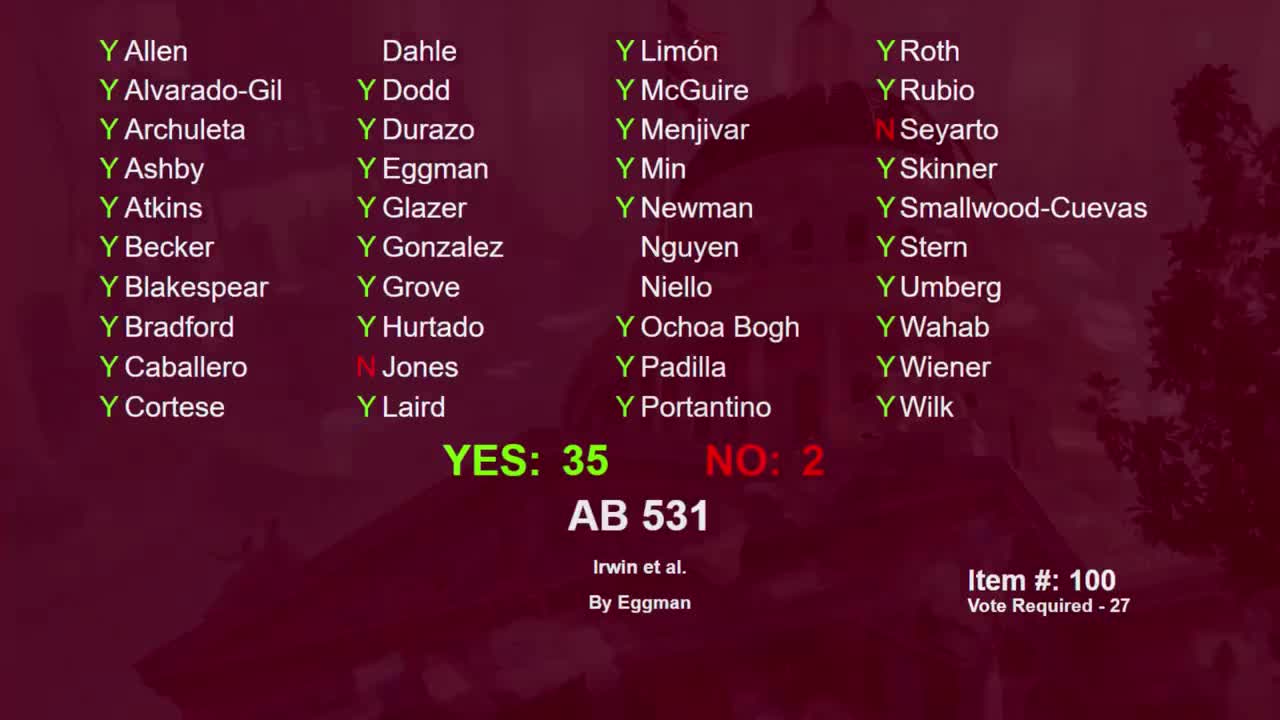 2MIN
Senate Floor
 1MIN
Assembly Floor
 9MIN
Assembly Standing Committee on Human Services
Bill Author
Bill Co-Author(s):