SB 833: Cannabis licensing: cultivation licenses: changing license type: inactive status.
- Session Year: 2023-2024
- House: Senate
- Latest Version Date: 2023-10-13
Current Status:
Passed
(2023-10-13: Chaptered by Secretary of State. Chapter 886, Statutes of 2023.)
Introduced
In Committee
First Chamber
In Committee
Second Chamber
Enacted
(1)Existing law, the Control, Regulate and Tax Adult Use of Marijuana Act (AUMA), approved by the voters at the November 8, 2016, statewide general election, regulates the cultivation, distribution, transport, storage, manufacturing, testing, processing, sale, and use of marijuana for nonmedical purposes by people 21 years of age and older. The Medicinal and Adult-Use Cannabis Regulation and Safety Act (MAUCRSA), among other things, consolidates the licensure and regulation of commercial medicinal and adult-use cannabis activities.
Under existing law, the Department of Cannabis Control may issue cannabis cultivation licenses to commercial cannabis businesses that differ depending on the size of the cultivation site and whether the site is indoor, outdoor, or mixed-light. Existing law requires the department to charge each licensee a licensure and renewal fee, as applicable.
This bill would require the department, beginning no later than March 1, 2024, to allow a cultivation licensee to change the type of size of a cultivation license or to place a cultivation license in inactive status. The bill would authorize a licensee, at the license renewal, to change an existing cultivation license to a type with a smaller maximum canopy size, and at each subsequent license renewal, to restore the original type, maintain the type that the license was changed to at the license renewal, or change to a different type with a maximum canopy size smaller than the original type. The bill would prohibit a licensee who holds a license in inactive status from engaging in the cultivation of cannabis, except as specified, would require a license in inactive status to remain in inactive status until the license is next renewed, and would require a licensee who holds a license in inactive status to pay a reduced license fee. The bill would require the department, in implementing these provisions, to allow each licensee a one-time opportunity to change the date of license renewal.
(2)AUMA authorizes the Legislature to amend its provisions by a 2/3 vote of each house if the amendment furthers its purposes and intent.
This bill would declare that its provisions further the purposes and intent of AUMA.
(1)Existing law, the Control, Regulate and Tax Adult Use of Marijuana Act (AUMA), approved by the voters at the November 8, 2016, statewide general election, regulates the cultivation, distribution, transport, storage, manufacturing, testing, processing, sale, and use of marijuana for nonmedical purposes by people 21 years of age and older. The Medicinal and Adult-Use Cannabis Regulation and Safety Act (MAUCRSA), among other things, consolidates the licensure and regulation of commercial medicinal and adult-use cannabis activities.
Under existing law, the Department of Cannabis Control may issue cannabis cultivation licenses to commercial cannabis businesses that differ depending on the size of the cultivation site and whether the site is indoor, outdoor, or mixed-light. Existing law requires the department to charge each licensee a licensure and renewal fee, as applicable.
This bill would require the department, beginning no later than March 1, 2024, to establish a cannabis licensing fallowing program for cannabis cultivators who choose to reduce or temporarily pause cultivating cannabis under their license. The bill would establish certain eligibility criteria to participate in the program, including specified limitations based on the size of the cultivation site and method of cultivation. The bill would require the program to authorize a licensee who participates in the program to, among other things, maintain their cultivation license and pay a reduced license fee in an amount determined by the department, as specified. allow a cultivation licensee to change the type of size of a cultivation license or to place a cultivation license in inactive status. The bill would authorize a licensee, at the license renewal, to change an existing cultivation license to a type with a smaller maximum canopy size, and at each subsequent license renewal, to restore the original type, maintain the type that the license was changed to at the license renewal, or change to a different type with a maximum canopy size smaller than the original type. The bill would prohibit a licensee who holds a license in inactive status from engaging in the cultivation of cannabis, except as specified, would require a license in inactive status to remain in inactive status until the license is next renewed, and would require a licensee who holds a license in inactive status to pay a reduced license fee. The bill would require the department, in implementing these provisions, to allow each licensee a one-time opportunity to change the date of license renewal.
(2)AUMA authorizes the Legislature to amend its provisions by a 2/3 vote of each house if the amendment furthers its purposes and intent.
This bill would declare that its provisions further the purposes and intent of AUMA.
(1)Existing law, the Control, Regulate and Tax Adult Use of Marijuana Act (AUMA), approved by the voters at the November 8, 2016, statewide general election, regulates the cultivation, distribution, transport, storage, manufacturing, testing, processing, sale, and use of marijuana for nonmedical purposes by people 21 years of age and older. The Medicinal and Adult-Use Cannabis Regulation and Safety Act (MAUCRSA), among other things, consolidates the licensure and regulation of commercial medicinal and adult-use cannabis activities.
Under existing law, the Department of Cannabis Control may issue cannabis cultivation licenses to commercial cannabis businesses that differ depending on the size of the cultivation site and whether the site is indoor, outdoor, or mixed-light. Existing law requires the department to charge each licensee a licensure and renewal fee, as applicable.
This bill would require the department, no later than March 1, 2024, to establish a cannabis licensing fallowing program for cannabis cultivators who choose to reduce or temporarily pause cultivating cannabis under their license. The bill would establish certain eligibility criteria to participate in the program, including specified limitations based on the size of the cultivation site and method of cultivation. The bill would require the program to authorize a licensee who participates in the program to, among other things, maintain their cultivation license and pay a reduced license fee in an amount determined by the department, as specified.
(2)AUMA authorizes the Legislature to amend its provisions by a 2/3 vote of each house if the amendment furthers its purposes and intent.
This bill would declare that its provisions further the purposes and intent of AUMA.
Existing law declares that resource conservation is of fundamental importance to the prosperity and welfare of the people of this state, and provides for the formation and powers of resource conservation districts.This bill would declare the intent of the Legislature to enact subsequent legislation relating to natural resources.Existing law declares that resource conservation is of fundamental importance to the prosperity and welfare of the people of this state, and provides for the formation and powers of resource conservation districts.
This bill would declare the intent of the Legislature to enact subsequent legislation relating to natural resources.
(a)Beginning no later than March 1, 2024, the department shall allow a cultivation licensee to do both of the following:
(1)Change the type of size of a cultivation license as set forth in subdivision (b).
(2)Place a cultivation license in inactive status as set forth in subdivision (c).
(b)The department shall allow a licensee to change the type of size of a cultivation license, as follows:
(1)At the time of license renewal, a licensee may change an existing cultivation license to a cultivation license type with a smaller maximum canopy size.
(2)At the time of each subsequent license renewal, a licensee may do any of the following:
(A)Restore the licensees original cultivation license type.
(B)Maintain the cultivation license type selected by the licensee pursuant to paragraph (1).
(C)Change to a different cultivation license type with a maximum canopy size smaller than the licensees original cultivation license type, which may be larger or smaller than the cultivation license type selected by the licensee pursuant to paragraph (1).
(3)If a licensee holds a provisional license, the licensee may do either of the following, at the election of the licensee:
(A)Continue to pursue the requirements for annual licensure in connection with the licensees original cultivation license type.
(B)Pursue the requirements for annual licensure in connection with a smaller cultivation license type selected pursuant to this subdivision.
(4)Nothing in this subdivision requires the department to allow changes to nursery licenses or to the classification of a cultivation license as indoor, outdoor, or mixed-light.
(c)The department shall allow a licensee to place a cultivation license in inactive status at the time of license renewal, as follows:
(1)A licensee who holds a license in inactive status shall not engage in the cultivation of cannabis, except that the department may allow a licensee with a license in inactive status to do both of the following:
(A)Engage in the drying, curing, grading, trimming, packaging, and sale of cannabis harvested before the date the license was placed in inactive status.
(B)Possess and maintain seeds and immature plants used solely for propagation to preserve the genetic lineage of the licensees cannabis plants.
(2)A license in inactive status shall remain in inactive status until the license is next renewed. At that next renewal, and at each renewal thereafter, the license may be placed in either active or inactive status, at the election of the licensee.
(3)A licensee who holds a license in inactive status shall pay a reduced license fee in an amount determined by the department in accordance with Section 26180.
(4)A license in inactive status shall remain a license issued pursuant to this division. All of the following apply to a licensee who holds a license in inactive status:
(A)The licensee shall continue to comply with all laws and regulations applicable to cultivation licensees.
(B)If the licensee holds a provisional license, the licensee shall continue to pursue requirements for annual licensure.
(C)The licensee shall be allowed to maintain eligibility for state programs available to cultivation licensees, including, but not limited to, grant programs.
(d)Notwithstanding subdivision (c) of Section 26050, the department shall allow each licensee a one-time opportunity to change the date of license renewal, in implementing subdivisions (b) and (c).
(e)Notwithstanding any other law, the department may adopt emergency regulations to implement this section. The provisions of Section 26013 shall be applicable to emergency regulations adopted or readopted pursuant to this section. The adoption of emergency regulations authorized by this section shall be deemed an emergency and necessary for the immediate preservation of the public peace, health, safety, or general welfare.
SEC. 2.The Legislature finds and declares that this act furthers the purposes and intent of the Control, Regulate and Tax Adult Use of Marijuana Act.
(a)No later than March 1, 2024, the department shall establish a cannabis licensing fallowing program for cannabis cultivators who choose to reduce or temporarily pause cultivating cannabis under their license.
(b)A licensee may apply to the department to participate in the cannabis licensing fallowing program established pursuant to subdivision (a) if the licensee meets all of the following requirements:
(1)The applicant holds a valid state cultivation license.
(2)The applicant holds any license, permit, or other authorization required by a local jurisdiction to engage in cannabis cultivation in that jurisdiction and that authorization is valid.
(3)The applicant satisfies all of the following:
(A)The applicant cultivates no more than one acre of cannabis under an outdoor cultivation license or licenses, inclusive of all licensed premises.
(B)The applicant cultivates no more than 22,000 square feet of cannabis under a Mixed-Light Tier 1 cultivation license or licenses, inclusive of all licensed premises.
(C)The applicant cultivates no more than 5,000 square feet of cannabis under a Mixed-Light Tier 2 and indoor cultivation license or licenses, inclusive of all licensed premises.
(c)The cannabis licensing fallowing program shall authorize a licensee who participates in the program to do all of the following:
(1)Maintain their cultivation license and pay a reduced license fee in an amount determined by the department in accordance with Section 26180.
(2)If the licensee holds a provisional license issued pursuant to Section 26050.2, continue to pursue requirements for annual licensure.
(3)Maintain eligibility for state programs for cultivation licensees, including, but not limited to, grant programs.
(4)Engage in the drying, curing, grading, trimming, packaging, and sale of cannabis, and possess and maintain immature cannabis plants and seeds.
(5)Receive a credit toward future licensing fees that corresponds to the time period when the cultivator did not cultivate mature cannabis plants if the licensee previously paid a license fee.
(6)Apply to begin cultivating cannabis, or to cultivate a larger area of cannabis, under their license in an area not to exceed the maximum amount allowed under the license at any time during the license year.
(d)For cultivation licenses that were not renewed between January 1, 2023, and the date that the department establishes the cannabis licensing fallowing program pursuant to this section, the department shall establish a process to authorize a person to reactivate a license if the person would have qualified to participate in the cannabis licensing fallowing program if the program existed at that time.
(e)(1)In adopting regulations pursuant to this section, the department shall comply with the rulemaking process in Chapter 3.5 (commencing with Section 11340) of Part 1 of Division 3 of Title 2 of the Government Code.
(2)Notwithstanding any other law, the department may issue emergency regulations in accordance with the process in Section 11346.1 of the Government Code if necessary to meet the deadlines in this section.
SEC. 2.The Legislature finds and declares that this act furthers the purposes and intent of the Control, Regulate and Tax Adult Use of Marijuana Act.
SECTION 1.It is the intent of the Legislature to enact subsequent legislation relating to natural resources.It is the intent of the Legislature to enact subsequent legislation relating to natural resources.
|
Date
|
Status
|
|---|---|
| Oct 13, 2023 | Chaptered by Secretary of State. Chapter 886, Statutes of 2023. |
| Oct 13, 2023 | Approved by the Governor. |
| Sep 20, 2023 | Enrolled and presented to the Governor at 4:30 p.m. |
| Sep 13, 2023 | Assembly amendments concurred in. (Ayes 38. Noes 0. Page 2748.) Ordered to engrossing and enrolling. |
| Aug 24, 2023 | In Senate. Concurrence in Assembly amendments pending. |
| Aug 24, 2023 | Read third time. Passed. (Ayes 73. Noes 0. Page 2803.) Ordered to the Senate. |
| Aug 17, 2023 | Read second time. Ordered to consent calendar. |
| Aug 16, 2023 | From committee: Do pass. Ordered to consent calendar. (Ayes 15. Noes 0.) (August 16). |
| Jun 27, 2023 | From committee: Do pass and re-refer to Com. on APPR. with recommendation: To consent calendar. (Ayes 18. Noes 0.) (June 27). Re-referred to Com. on APPR. |
| Jun 22, 2023 | From committee with author's amendments. Read second time and amended. Re-referred to Com. on B. & P. |
| Jun 8, 2023 | Referred to Com. on B. & P. |
| May 31, 2023 | In Assembly. Read first time. Held at Desk. |
| May 30, 2023 | Read third time. Passed. (Ayes 37. Noes 1. Page 1361.) Ordered to the Assembly. |
| May 18, 2023 | Read second time. Ordered to third reading. |
| May 18, 2023 | From committee: Do pass. (Ayes 6. Noes 0. Page 1185.) (May 18). |
| May 12, 2023 | Set for hearing May 18. |
| May 8, 2023 | May 8 hearing: Placed on APPR suspense file. |
| May 1, 2023 | Set for hearing May 8. |
| Apr 24, 2023 | From committee: Do pass and re-refer to Com. on APPR. (Ayes 12. Noes 0. Page 854.) (April 24). Re-referred to Com. on APPR. |
| Apr 3, 2023 | Set for hearing April 24. |
| Mar 29, 2023 | Re-referred to Com. on B., P. & E. D. |
| Mar 22, 2023 | From committee with author's amendments. Read second time and amended. Re-referred to Com. on RLS. |
| Mar 1, 2023 | Referred to Com. on RLS. |
| Feb 21, 2023 | From printer. May be acted upon on or after March 20. |
| Feb 17, 2023 | Introduced. Read first time. To Com. on RLS. for assignment. To print. |
|
Date
|
Description
|
Location
|
Votes
|
|
|---|---|---|---|---|
| Sep 13, 2023 | Unfinished Business SB833 McGuire Concurrence | Senate Floor |
Passed |
|
| Aug 24, 2023 | SB 833 McGuire Consent Calendar Second Day Regular Session | Assembly Floor |
Passed |
|
| Aug 16, 2023 | Do pass. To Consent Calendar. | Assembly Standing Committee on Appropriations |
Passed |
|
| Jun 27, 2023 | Do pass and be re-referred to the Committee on [Appropriations] with recommendation: To Consent Calendar | Assembly Standing Committee on Business and Professions |
Passed |
|
| May 30, 2023 | Senate 3rd Reading SB833 McGuire | Senate Floor |
Passed |
|
| May 18, 2023 | Do pass | Senate Standing Committee on Appropriations |
Passed |
|
| May 8, 2023 | Placed on suspense file | Senate Standing Committee on Appropriations |
Passed |
|
| Apr 24, 2023 | Do pass, but first be re-referred to the Committee on [Appropriations] | Senate Standing Committee on Business, Professions and Economic Development |
Passed |
This list shows positions taken on this bill by organizations on the date displayed, which is linked to the original source.
Positions by individuals are not included.
|
Organization
|
Position
|
Date
|
|---|---|---|
| Big Sur Farmers Association | ** Support | |
| County of Humboldt | ** Support | |
| CSU Long Beach | * Indeterminate | Apr 24, 2023 |
| Humboldt County Growers Alliance | ** Support | |
| Jeeter | ** Support | |
| Mendocino Cannabis Alliance | ** Support | |
| Nevada County Cannabis Alliance | ** Support | |
| Origins Council | ** Support | |
| Resources Legacy Fund | ** Support | |
| Trinity County Agriculture Alliance | ** Support | |
| Trout Unlimited | ** Support |
SENATE RULES COMMITTEE Office of Senate Floor Analyses (916) 651-1520 Fax: (916) 327-4478 | SB 833 |
UNFINISHED BUSINESS
Bill No: SB 833
Author: McGuire (D)
Amended: 6/22/23
Vote: 27
SENATE BUS., PROF. & ECON. DEV. COMMITTEE: 12-0, 4/24/23
AYES: Roth, Alvarado-Gil, Archuleta, Ashby, Becker, Dodd, Eggman, Glazer, Niello, Smallwood-Cuevas, Wahab, Wilk
NO VOTE RECORDED: Nguyen
SENATE APPROPRIATIONS COMMITTEE: 6-0, 5/18/23
AYES: Portantino, Jones, Ashby, Bradford, Wahab, Wiener
NO VOTE RECORDED: Seyarto
SENATE FLOOR: 37-1, 5/30/23
AYES: Allen, Alvarado-Gil, Archuleta, Ashby, Atkins, Becker, Blakespear, Bradford, Caballero, Cortese, Dahle, Dodd, Durazo, Eggman, Glazer, Gonzalez, Hurtado, Jones, Laird, Limón, McGuire, Menjivar, Min, Newman, Niello, Ochoa Bogh, Padilla, Portantino, Roth, Rubio, Skinner, Smallwood-Cuevas, Stern, Umberg, Wahab, Wiener, Wilk
NOES: Nguyen
NO VOTE RECORDED: Grove, Seyarto
ASSEMBLY FLOOR: 73-0, 8/24/23 (Consent) - See last page for vote
SUBJECT: Cannabis licensing: cultivation licenses: changing license type: inactive status
SOURCE: Author
DIGEST:
This bill requires the Department of Cannabis Control (DCC), no later than March 1, 2024, to begin allowing cultivators to select a smaller license type or place their license in inactive status, as specified.
Assembly Amendments
delete the provisions of this bill that would have required the DCC to establish a license fallow program for cultivators who met specified requirements, and instead require the DCC to allow cultivators to change their license type to a smaller license type or place their current license in an inactive status, as specified.
ANALYSIS:
Existing law:
- Establishes the Department of Cannabis Control (DCC) to regulate cannabis with the sole authority to create, issue, deny, renew, discipline, suspend, or revoke licenses for microbusinesses, transportation, storage unrelated to manufacturing activities, distribution, testing, and sale of cannabis and cannabis products within the state. Requires the DCC to administer the portions of the Medicinal and Adult Use Cannabis Regulation and Safety Act related to and associated with the cultivation of cannabis and with the manufacturing of cannabis products. (Business and Professions Code (BPC) § 26010)
- Provides for 20 total types of cannabis licenses including subtypes for cultivation, manufacturing, testing, retail, distribution, and microbusiness; requires each licensee except for testing laboratories to clearly designate whether their license is for adult-use or medicinal cannabis. (BPC § 26050)
- Defines “cultivation” to mean any activity involving the planting, growing, harvesting, drying, curing, grading, or trimming of cannabis. (BPC §26001(k))
- Defines “cultivation site” to mean a location where cannabis is planted, grown, harvested, dried, cured, graded, or trimmed, or a location where any combination of those activities occurs. (BPC 26001(l))
This bill:
- Requires the DCC to allow a cultivation licensee to do both of the following, no later than March 1, 2024:
- Change the type size of the a cultivation license, as specified; and,
- Place a cultivation license in inactive status as specified.
- Change the type size of the a cultivation license, as specified; and,
- Requires the DCC to allow a licensee to change the type of size of a cultivation license to a cultivation license type with a smaller maximum canopy size at the time of license renewal, and at each subsequent license renewal, a licensee may:
- Restore the licensee’s original cultivation license type;
- Maintain the smaller maximum canopy size license; or,
- Change to a different cultivation license type with a maximum canopy size smaller than the licensee’s original cultivation license type, which may be larger or smaller than the cultivation license type selected by the licensee in 1) above.
- Restore the licensee’s original cultivation license type;
- Specifies that if the licensee holds a provisional license, the licensee may do either of the following at the election of the licensee:
- Continue to pursue the requirements for annual licensure in connection with the licensee’s original cultivation license type; or,
- Pursue the requirements for annual licensure in connection with a smaller cultivation license type, as specified in this bill.
- Continue to pursue the requirements for annual licensure in connection with the licensee’s original cultivation license type; or,
- States that nothing in the above authority requires the DCC to allow changes to nursey licenses or to the classification of a cultivation license as indoor, outdoor, or mixed-light.
- Requires the DCC to allow a licensee to place a cultivation license in inactive status at the time of renewal, and prohibits the licensee from engaging in the cultivation of cannabis, except the DCC may allow a licensee with an inactive license to engage in the drying, curing, grading, trimming, packaging, and sale of cannabis harvested before the date the license was placed in inactive status and possess and maintain seeds and immature plants used solely for the propagation to preserve the genetic lineage of the licensee’s cannabis plants.
- Requires a license in inactive status to remain in inactive status until the next renewal cycle, as specified.
- Specifies that a license in inactive status is to pay a reduced fee, as determined by the DCC.
- Provides the requirements for a licensee in inactive status to follow.
- Requires the DCC to allow a licensee a one-time opportunity to change the date of their license renewal in order to allow a licensee to change the size of their cultivation license or place their license in inactive status, as specified.
- Authorizes the DCC to adopt emergency regulations to implement the license change.
Background
In 2021, DCC was formally established with both licensing, regulatory and enforcement authority. DCC was designed to centralize and align critical licensing, compliance and enforcement responsibilities to help build a sustainable and successful legal cannabis market by creating a single point of contact for cannabis applicant, licensees and local governments.
There are 14 different classifications for a cultivation license as follows:
- Type 1—Cultivation; Specialty outdoor; Small.
- Type 1A—Cultivation; Specialty indoor; Small.
- Type 1B—Cultivation; Specialty mixed-light; Small.
- Type 1C—Cultivation; Specialty cottage; Small.
- Type 2—Cultivation; Outdoor; Small.
- Type 2A—Cultivation; Indoor; Small.
- Type 2B—Cultivation; Mixed-light; Small.
- Type 3—Cultivation; Outdoor; Medium.
- Type 3A—Cultivation; Indoor; Medium.
- Type 3B—Cultivation; Mixed-light; Medium.
- Type 4—Cultivation; Nursery.
- Type 5—Cultivation; Outdoor; Large.
- Type 5A—Cultivation; Indoor; Large.
- Type 5B—Cultivation; Mixed-light; Large.
Cultivator licensees grow all of the cannabis plants that are harvested, sold as flower, and made into products. Cannabis is considered an agriculture product for purposes of cannabis regulation in California. In determining the issuance of a cultivation license, the DCC is required to consider a number of factors including, water use and environmental impacts and if it is determined that cannabis cultivation is having a negative environmental impact, the DCC is prohibited from issuing a license or increasing the number of plants within that current area.
The cultivation license needed depends on the type of product, the size of the area the cultivator intends to grow on, and under what lighting conditions. Further, depending on where the cultivator wants to grow the products (indoor, outdoor, or mixed use) will determine the cultivator license type to apply for. Outdoor licenses are for cultivators who grow cannabis outside without using any artificial lighting on mature plants. Indoor licenses are for cultivators who grow cannabis in a permanent structure using at least 25 watts of artificial light per square foot. Mixed-light licenses are for cultivators who grow cannabis in a greenhouse, hoop-house, glasshouse, conservatory, hothouse, or other similar structure. In addition, mixed-light licenses have two tiers based on the amount of artificial light used:
- Tier 1 – Up to 6 watts per square foot of artificial light
- Tier 2 – 6 to 25 watts per square foot of artificial light
Business and Professions Code Section 26066 requires that cultivation of cannabis, either indoor or outdoor, be conducted in accordance with state and local laws related to land conversion, current building and fire standards, grading, electricity usage, water usage and quality. There is no current pathway under existing law to allow a cultivator licensee to change their license type to a smaller license size without reapplying to the DCC, or to place their license in inactive status to address the current market volatility in cannabis cultivation. For cannabis cultivators, drought, oversupply, fees and taxes are all reasons that a cultivator may seek a reprieve through a smaller or inactive cultivation license. Changing the license type or moving to inactive status may also reduce costs for cultivation license holders.
Under the provisions of this bill, the DCC would be required to allow current cultivation licensees with an opportunity to change the size of their cultivation license or to allow their current cultivation license to become inactive. This bill requires the DCC to establish the licensure change program no later than March 1, 2024. Additionally, this bill would permit a cultivator license who has either reduced the license type or placed the license in inactive status to change their renewal date, one-time only, in order to accommodate the request to change license type sooner, as it can only occur at the time of a licensure renewal.
FISCAL EFFECT: Appropriation: No Fiscal Com.: Yes Local: No
According to the Assembly Appropriations Committee, “DCC estimates a cost of $60,000 to update its licensing system within an existing contract (Cannabis Control Fund).”
SUPPORT: (Verified 8/25/23)
Big Sur Farmers Association
County of Humboldt
Humboldt County Growers Alliance
Jeeter
Mendocino Cannabis Alliance
Nevada County Cannabis Alliance
Origins Council
Resources Legacy Fund
Trinity County Agriculture Alliance
Trout Unlimited
OPPOSITION: (Verified 8/25/23)
None received
ARGUMENTS IN SUPPORT: Supporters generally support allowing cultivators the flexibility to adjust their production.
ASSEMBLY FLOOR: 73-0, 8/24/23
AYES: Addis, Aguiar-Curry, Alanis, Alvarez, Arambula, Bains, Bauer-Kahan, Bennett, Berman, Boerner, Bryan, Calderon, Juan Carrillo, Wendy Carrillo, Cervantes, Chen, Connolly, Megan Dahle, Davies, Dixon, Essayli, Flora, Mike Fong, Vince Fong, Friedman, Gabriel, Gipson, Grayson, Haney, Hart, Holden, Hoover, Irwin, Jackson, Kalra, Lackey, Lee, Low, Lowenthal, Mathis, McCarty, Muratsuchi, Stephanie Nguyen, Ortega, Pacheco, Papan, Jim Patterson, Joe Patterson, Pellerin, Petrie-Norris, Quirk-Silva, Ramos, Rendon, Reyes, Luz Rivas, Rodriguez, Blanca Rubio, Sanchez, Santiago, Schiavo, Soria, Ta, Ting, Valencia, Villapudua, Waldron, Wallis, Weber, Wicks, Wilson, Wood, Zbur, Robert Rivas
NO VOTE RECORDED: Bonta, Gallagher, Garcia, Jones-Sawyer, Maienschein, McKinnor, Ward
Prepared by: Elissa Silva / B., P. & E.D. / 916-651-4104
8/25/23 13:41:53
**** END ****
Date of Hearing: August 16, 2023
ASSEMBLY COMMITTEE ON APPROPRIATIONS
Chris Holden, Chair
SBPCA Bill Id:SB 833
Author:(McGuire) – As Amended Ver:June 22, 2023
Policy Committee: | Business and Professions | Vote: | 18 - 0 |
|
| ||
|
|
Urgency: No State Mandated Local Program: No Reimbursable: No
SUMMARY:
This bill requires the Department of Cannabis Control (DCC) to allow a cultivator to select a cultivation license type with a smaller maximum canopy size or place their license in inactive status.
FISCAL EFFECT:
DCC estimates a cost of $60,000 to update its licensing system within an existing contract (Cannabis Control Fund).
COMMENTS:
- Purpose. According to the author:
Many cannabis cultivators have been heavily affected by market volatility, drought, and fire issues over the past several years. These small growers across the golden state have faced hard choices between either abandoning their state licenses, or paying a full state licensing fee for cultivation area not under production. Cannabis cultivators must either renew their state license each year, costing tens of thousands of dollars in fees, or they need to forfeit their license and reapply and start the arduous licensing process all over again. [This bill] would enable cultivators to voluntarily reduce or pause their cultivation while paying a reduced licensing fee that corresponds to their reduced cultivation area.
- Cannabis Cultivation Licenses. DCC issues many different types of cultivation licenses based on the size, setting, and lighting of the operation. Application fees for these licenses range from $135 to $8,655, and license fees range from $1,205 to $77,905, with additional fees per additional 2,000 square feet.
- Fallowing. Fallowing is when land is allowed to lie idle during growing season. There are a variety of reasons to fallow, such as rotating crops, improving soil health, or as a response to drought, wildfires, or market conditions. According to the author, fallowing is not practical for cannabis cultivators because there are only two options: (a) maintain their license and pay the full fee without growing new crops to sell or (b) allow their license to expire and undergo the full application process again. This bill would allow cultivators the option of reducing their license size or placing their license in inactive status, making it easier to fallow.
Analysis Prepared by: Allegra Kim / APPR. / (916) 319-2081
Date of Hearing: June 27, 2023
ASSEMBLY COMMITTEE ON BUSINESS AND PROFESSIONS
Marc Berman, Chair
SBPCA Bill Id:SB 833
Author:(McGuire) – As Amended Ver:June 22, 2023
SENATE VOTE: 37-1
SUBJECT: Cannabis licensing: cultivation licenses: changing license type: inactive status.
SUMMARY: Requires the Department of Cannabis Control (DCC), no later than March 1, 2024, to begin allowing cultivators to select a smaller license type or place their license in inactive status, as specified.
EXISTING LAW:
- Regulates the cultivation, distribution, transport, storage, manufacturing, processing, and sale of medicinal and adult-use cannabis under the Medicinal and Adult-Use Cannabis Regulation and Safety Act (MAUCRSA) and establishes the Department of Cannabis Control (DCC) to administer and enforce the act. (Business and Professions Code (BPC) §§ 26000-26260)
- Prohibits a person or entity from engaging in commercial cannabis activity without a state license issued by the DCC. (BPC § 26037.5)
- Declares that cannabis is an agricultural product, requires the DCC to consider issues including water use and environmental impacts when issuing cannabis cultivation licenses, and prohibits the DCC from issuing new licenses or increasing the total number of plant identifiers within a watershed or geographic area if the State Water Resources Control Board or the Department of Fish and Wildlife finds that cannabis cultivation is causing significant adverse impacts in that watershed or area. (BPC § 26060)
- Establishes 20 types of cannabis licenses, including subtypes, for cultivation, manufacturing, testing, retail, distribution, and microbusiness and requires each licensee except for testing laboratories to designate whether their license is for adult-use or medicinal cannabis. (BPC § 26050)
- Defines “cultivation” to mean any activity involving the planting, growing, harvesting, drying, curing, grading, or trimming of cannabis. (BPC §26001(m))
- Defines “cultivation site” to mean a location where cannabis is planted, grown, harvested, dried, cured, graded, or trimmed or a location where any combination of those activities occurs. (BPC § 26001(n))
- Designates 14 different cultivator license types depending on the size, setting, and lighting of the cultivation site. (BPC § 26061)
- Requires the DCC to establish a scale of application, licensing, and renewal fees, based upon the cost of administering and enforcing MAUCRSA. (BPC § 26180)
THIS BILL:
- Requires the DCC, no later than March 1, 2024, to begin allowing cultivation licensees to change the size of a cultivation license or to place a cultivation license in inactive status.
- Requires the DCC to allow a licensee to change the size of a cultivation license as follows:
- Allow a licensee, at the time of license renewal, to change an existing cultivation license to a cultivation license type with a smaller maximum canopy size.
- Allow a licensee, at the time of each subsequent license renewal, to do any of the following:
- Restore the licensee’s original cultivation license type.
- Maintain the smaller cultivation license type selected.
- Change to a different cultivation license type with a maximum canopy size smaller than the licensee’s original cultivation license type, which may be larger or smaller than the smaller cultivation license selected.
- Allow a provisional license holder to do either of the following:
- Continue to pursue the requirements for annual licensure in connection with the licensee’s original cultivation license type.
- Pursue the requirements for annual licensure in connection with a smaller cultivation license type selected.
- Clarifies that this bill does not require the DCC to allow changes to nursery licenses or the classification of a cultivation license as indoor, outdoor, or mixed-light.
- Requires the DCC to allow a licensee to place a cultivation license in inactive status at the time of license renewal as follows:
- Prohibit an inactive license holder from engaging in the cultivation of cannabis, except they may:
- Engage in the drying, curing, grading, trimming, packaging, and sale of cannabis harvested before the date the license was placed in inactive status.
- Possess and maintain seeds and immature plants used solely for propagation, to preserve the genetic lineage of the licensee’s cannabis plants.
- Specify that an inactive license is inactive until the license is next renewed. At that next renewal, and each renewal thereafter, the license may be placed in either active or inactive status, at the election of the licensee.
- Require a licensee who holds a license in inactive status to pay a reduced license fee, as determined by the DCC.
- Specify that a license in inactive status is still a license and specify that an inactive license holder:
- Must continue to comply with all laws and regulations applicable to cultivation licensees.
- Must, if the licensee holds a provisional license, continue to pursue requirements for annual licensure.
- Is allowed to maintain eligibility for state programs available to cultivation licensees, including, but not limited to, grant programs.
- Prohibit an inactive license holder from engaging in the cultivation of cannabis, except they may:
- Requires the DCC to allow licensees a one-time opportunity to change the date of license renewal.
- Authorizes the DCC to adopt emergency regulations to implement this bill, specifies that the DCC’s existing regulatory provisions apply to emergency regulations adopted or readopted under this bill, and deems the adoption of emergency regulations authorized by this bill an emergency and necessary for the immediate preservation of the public peace, health, safety, or general welfare.
- Specifies that the Legislature finds and declares that this bill furthers the purposes and intent of the Control, Regulate and Tax Adult Use of Marijuana Act.
FISCAL EFFECT: According to the Senate Appropriations Committee, the DCC estimates one-time costs of $200,000 to update IT systems to collect and process applications, reactive licenses, and apply credits for fallowing durations and fee reductions (Cannabis Control Fund).
COMMENTS:
Purpose. This bill is sponsored by the author. According to the author, “Many cannabis cultivators have been heavily affected by market volatility, drought, and fire issues over the past several years. These small growers across the golden state have faced hard choices between either abandoning their state licenses, or paying a full state licensing fee for cultivation area not under production. Cannabis cultivators must either renew their state license each year, costing tens of thousands of dollars in fees, or they need to forfeit their license and reapply and start the arduous licensing process all over again. [This bill] would enable cultivators to voluntarily reduce or pause their cultivation while paying a reduced licensing fee that corresponds to their reduced cultivation area.”
Background. The Medicinal and Adult Use Cannabis Regulation and Safety Act (MAUCRSA), which incorporates prior cannabis laws, authorizes a person who obtains a state license under MAUCRSA to engage in commercial adult-use cannabis activity under that license and applicable local laws.
The Department of Cannabis Control (DCC) is the state agency that licenses and regulates cannabis businesses. DCC regulates:
- Cultivation of cannabis plants.
- Transportation and tracking of cannabis.
- Manufacturing and labeling of cannabis.
- Testing of cannabis.
- Sale of cannabis.
- Holding events where cannabis is sold or used.
Cultivation. The growing of cannabis is known as cultivation and requires a cultivation license. DCC issues 14 different types of cultivation licenses based on the size, setting, and lighting:
License type | Application fee | License fee |
Specialty cottage outdoor | $135 | $1,205 |
Specialty cottage indoor | $205 | $1,830 |
Specialty cottage mixed-light tier 1 | $340 | $3,035 |
Specialty cottage mixed-light tier 2 | $580 | $5,200 |
Specialty outdoor | $270 | $2,410 |
Specialty indoor | $2,170 | $19,540 |
Specialty mixed-light tier 1 | $655 | $5,900 |
Specialty mixed-light tier 2 | $1,125 | $10,120 |
Small outdoor | $535 | $4,820 |
Small indoor | $3,935 | $35,410 |
Small mixed-light tier 1 | $1,310 | $11,800 |
Small mixed-light tier 2 | $2,250 | $20,235 |
Medium outdoor | $1,555 | $13,990 |
Medium indoor | $8,655 | $77,905 |
Medium mixed-light tier 1 | $2,885 | $25,970 |
Medium mixed-light tier 2 | $4,945 | $44,517 |
Nursery | $520 | $4,685 |
Processor | $1,040 | $9,370 |
Large cultivation type | Application fee | Base license fee | Fee per additional 2,000 Sq. Ft |
Large outdoor | $1,555 | $13,990 | $640 |
Large indoor | $8,655 | $77,905 | $7,080 |
Large mixed-light tier 1 | $2,885 | $25,970 | $2,360 |
Large mixed-light tier 2 | $4,945 | $44,517 | $4,040 |
Fallowing. Fallowing is when land is allowed to lie idle during growing season. There are a variety of reasons to fallow, such as rotating crops, improving soil health, or as a response to drought, wildfires, or market conditions. According to the author, fallowing is not practical for cannabis cultivators because there are only two options: (1) maintain their license and pay the full fee without growing new crops to sell or (2) allow their license to expire and undergo the full application process again. This bill would allow cultivators the option of reducing their license size or placing their license in inactive status, making it easier to fallow.
ARGUMENTS IN SUPPORT:
Origins Council writes in support of the March 22, 2023, version of this bill:
In other sectors of agriculture, farmers commonly adjust their production in response to market and environmental conditions, cutting back during periods of oversupply and expanding in periods of undersupply. Under current state regulatory procedures, however, fallowing is currently not practical for cannabis cultivators. Current state regulations require cannabis cultivators to either renew their state license each year and pay thousands of dollars in annual licensing fees, or to forfeit their license and reapply from square one at a future date.
The effect of the current regulatory structure is to effectively require farmers to grow their full square footage each year, or permanently forfeit their license – regardless of market or environmental conditions that would otherwise lead cultivators to cut back.
[This bill] would enable cultivators to voluntarily reduce or pause their cultivation while paying a reduced licensing fee that corresponds to their reduced cultivation area, thereby providing cannabis cultivators with the same opportunities available to all other agricultural producers.
ARGUMENTS IN OPPOSITION:
None on file
REGISTERED SUPPORT:
Big Sur Farmers Association
County of Humboldt
Humboldt County Growers Alliance
Mendocino Cannabis Alliance
Nevada County Cannabis Alliance
Origins Council
Resources Legacy Fund
Trinity County Agriculture Alliance
Trout Unlimited
REGISTERED OPPOSITION:
None on file
Analysis Prepared by: Vincent Chee / B. & P. / (916) 319-3301
SENATE RULES COMMITTEE Office of Senate Floor Analyses (916) 651-1520 Fax: (916) 327-4478 | SB 833 |
THIRD READING
Bill No: SB 833
Author: McGuire (D)
Amended: 3/22/23
Vote: 27
SENATE BUS., PROF. & ECON. DEV. COMMITTEE: 12-0, 4/24/23
AYES: Roth, Alvarado-Gil, Archuleta, Ashby, Becker, Dodd, Eggman, Glazer, Niello, Smallwood-Cuevas, Wahab, Wilk
NO VOTE RECORDED: Nguyen
SENATE APPROPRIATIONS COMMITTEE: 6-0, 5/18/23
AYES: Portantino, Jones, Ashby, Bradford, Wahab, Wiener
NO VOTE RECORDED: Seyarto
SUBJECT: Cannabis licensing fallowing program: cultivation licenses: reduced license fee
SOURCE: Author
DIGEST:
This bill requires the Department of Cannabis Control (DCC) to establish a cannabis licensing fallowing program no later than March 24, 2024.
ANALYSIS:
Existing law:
- Establishes the Department of Cannabis Control (DCC) to regulate cannabis with the sole authority to create, issue, deny, renew, discipline, suspend, or revoke licenses for microbusinesses, transportation, storage unrelated to manufacturing activities, distribution, testing, and sale of cannabis and cannabis products within the state. Requires the DCC to administer the portions of MAUCRSA related to and associated with the cultivation of cannabis and with the manufacturing of cannabis products. (BPC § 26010)
- Provides for twenty total types of cannabis licenses including subtypes for cultivation, manufacturing, testing, retail, distribution, and microbusiness; requires each licensee except for testing laboratories to clearly designate whether their license is for adult-use or medicinal cannabis. (BPC § 26050)
- Defines “cultivation” to mean any activity involving the planting, growing, harvesting, drying, curing, grading, or trimming of cannabis. (BPC §26001(k))
- Defines “cultivation site” to mean a location where cannabis is planted, grown, harvested, dried, cured, graded, or trimmed, or a location where any combination of those activities occurs. (BPC 26001(l))
This bill:
- Requires the DCC to establish a cannabis licensing fallowing program for cannabis cultivators who choose to reduce or temporarily pause cultivating cannabis under their license, by March 1, 2024.
- Permits a licensee to apply to the DCC to participate in the cannabis licensing fallowing program if the licensee meets all of the following requirements:
- The applicant holds a valid state cultivation license.
- The applicant holds any license, permit, or other authorization required by a local jurisdiction to engage in cannabis cultivation in that jurisdiction and that authorization is valid.
- The applicant satisfies all of the following:
- The applicant cultivates no more than one acre of cannabis under an outdoor cultivation license or licenses, inclusive of all licensed premises;
- The applicant cultivates no more than 22,000 square feet of cannabis under a mixed-light tier 1 cultivation license or licenses, inclusive of all licensed premises;
- The applicant cultivates more than 5,000 square feet of cannabis under a mixed light tier 2 and indoor cultivation license or licenses, inclusive of all licensed premises.
- States that the cannabis licensing fallowing program authorizes the licensee who participates in the program to do all of the following:
- Maintain their cultivation license and pay a reduced fee amount as determined by the DCC;
- If the licensee holds a provisional license, continue to pursue requirements for annual licensure;
- Maintain eligibility for state programs, as specified;
- Engage in the drying, curing, grading, trimming, packaging, and sale of cannabis, and possess and maintain immature cannabis plants and seeds;
- Receive a credit toward future licensing fees that corresponds to the time period when the cultivator did not cultivate mature cannabis plants if the licensee previously paid a license fee; and,
- Apply to begin cultivating cannabis, or to cultivate a larger area of cannabis, under their license in an area not to exceed the maximum amount allowed under the license at any time during the year.
- States that for cultivation licenses that were not renewed between January 1, 2023, and the date the department establishes the cannabis licensing fallowing program, as authorized by this bill, the DCC must establish a process to authorize a person to reactivate a license if the person would have qualified to participate in the cannabis licensing fallowing program if the program existed at that time.
- Provides the DCC with emergency regulatory authority, and requires that the DCC comply with the rulemaking process, as required.
Background
In 2021, DCC was formally established with both licensing, regulatory and enforcement authority. DCC was designed to centralize and align critical licensing, compliance and enforcement responsibilities to help build a sustainable and successful legal cannabis market by creating a single point of contact for cannabis applicant, licensees and local governments. The goal was to ultimately simplify and centralize state regulatory efforts; improve coordination, including enforcement; reduce barriers to participation in the legal market; and incentivize greater local participation.
There are 20 distinct license types for all aspects of the cannabis market, including 14 different classifications for a cultivation license as follows:
(1) Type 1—Cultivation; Specialty outdoor; Small.
(2) Type 1A—Cultivation; Specialty indoor; Small.
(3) Type 1B—Cultivation; Specialty mixed-light; Small.
(4) Type 1C—Cultivation; Specialty cottage; Small.
(5) Type 2—Cultivation; Outdoor; Small.
(6) Type 2A—Cultivation; Indoor; Small.
(7) Type 2B—Cultivation; Mixed-light; Small.
(8) Type 3—Cultivation; Outdoor; Medium.
(9) Type 3A—Cultivation; Indoor; Medium.
(10) Type 3B—Cultivation; Mixed-light; Medium.
(11) Type 4—Cultivation; Nursery.
(12) Type 5—Cultivation; Outdoor; Large.
(13) Type 5A—Cultivation; Indoor; Large.
(14) Type 5B—Cultivation; Mixed-light; Large.
(15) Type 6—Manufacturer 1.
(16) Type 7—Manufacturer 2.
(17) Type 8—Testing laboratory.
(18) Type 10—Retailer.
(19) Type 11—Distributor.
(20) Type 12—Microbusiness.
Cultivator licensees grow all of the cannabis plants that are harvested, sold as flower, and made into products. Cannabis is considered an agriculture product for purposes of cannabis regulation in California. In determining the issuance of a cultivation license, the DCC is required to consider a number of factors including, water use and environmental impacts and if it is determined that cannabis cultivation is having a negative environmental impact, the DCC is prohibited from issuing a license or increasing the number of plants within that current area. Cultivator licensees are required to abide by Department of Pesticide Regulation’s (DPR) regulations for cannabis products.
The cultivation license needed depends on the type of product, the size of the area the cultivator intends to grow on, and under what lighting conditions. Further, depending on where the cultivator wants to grow the products (indoor, outdoor, or mixed use) will determine the cultivator license type to apply for. Outdoor licenses are for cultivators who grow cannabis outside without using any artificial lighting on mature plants. Indoor licenses are for cultivators who grow cannabis in a permanent structure using at least 25 watts of artificial light per square foot. Mixed-light licenses are for cultivators who grow cannabis in a greenhouse, hoop-house, glasshouse, conservatory, hothouse, or other similar structure. In addition, mixed-light licenses have two tiers based on the amount of artificial light used:
- Tier 1 – Up to 6 watts per square foot of artificial light
- Tier 2 – 6 to 25 watts per square foot of artificial light
BPC § 26066 requires that cultivation of cannabis, either indoor or outdoor, be conducted in accordance with state and local laws related to land conversion, current building and fire standards, grading, electricity usage, water usage and quality.
This bill is applicable to cultivation license holders only, and is limited to those licensees who hold the following:
- An outdoor cultivation license, with no more than one acre of cannabis, inclusive of all premises;
- A mixed-light tier 1 cultivation license with no more than 22,000 square feet of cannabis, inclusive of all licensed premises; and
- A mixed-light tier 2 cultivation license with no more than 5,000 square feet of cannabis inclusive of all licensed premises.
Under the provisions of this bill, the DCC would be required to establish the parameters for how the fallowing licensure program would operate including, the fee associated with the fallowed license and any requirements to return the fallowed license back to its operational license capacity. This bill requires the DCC to establish the fallowing program no later than March 1, 2024.
Fallowing of land is a common practice in the agricultural industry and can be used for a variety of reasons. In traditional agriculture, it can be used as a method of crop rotation and for soil health. In recent years, in California, fallowing of agriculture land has been used as a strategy for drought mitigation in order to allow more water to flow through rivers and streams and improve certain habitats. Fallowing of agricultural land in California can be determined by the farmer as necessary for farming practices or can be incentivized through California based programs, such as those that provide grants to farmers to fallow land.
In the cannabis space, a cultivator could choose to fallow the land; however, because there is no pathway under the DCC for such action, cultivator license holders would still be required to abide by all current licensing and regulatory requirements for cultivator licenses, including paying the full fee amounts and any required taxes and fees. While some local jurisdictions may authorize cannabis fallowing, without a state regulatory process, fallowing may not be viable option.
For cannabis cultivators, drought, over supply, fees and taxes are all reasons that a cultivator may seek a reprieve through a cultivator fallow license.
FISCAL EFFECT: Appropriation: No Fiscal Com.: Yes Local: No
According to the Senate Appropriations Committee, DCC estimates one-time costs of $200,000 to update IT systems to collect and process applications, reactive licenses, and apply credits for fallowing durations and fee reductions.
SUPPORT: (Verified 5/19/23)
County of Humboldt
Origins Council
Resources Legacy Fund
Trout Unlimited
OPPOSITION: (Verified 5/19/23)
None received
ARGUMENTS IN SUPPORT: Supporters note that this bill would provide flexibility for cannabis cultivators to modify product growth depending on varying market conditions, while maintaining or pursuing the annual license.
Prepared by: Elissa Silva / B., P. & E.D. / 916-651-4104
5/20/23 13:09:47
**** END ****
SENATE COMMITTEE ON
Senator Anthony Portantino, Chair
2023 - 2024 Regular Session
SB 833 (McGuire) - Cannabis licensing fallowing program: cultivation licenses: reduced license fee
Version: | Policy Vote: |
Urgency: | Mandate: |
Hearing Date: | Consultant: |
Bill Summary:
SB 833 requires the Department of Cannabis Control (DCC) to establish a fallowing program for cannabis cultivator licensees by March 1, 2024, as specified.
Fiscal Impact:
The DCC estimates one-time costs of $200,000 to update IT systems to collect and process applications, reactive licenses, and apply credits for fallowing durations and fee reductions (Cannabis Control Fund).
Background:
There are 20 distinct license types for all aspects of the cannabis market, including 14 different classifications for a cultivation license as follows:
- Type 1—Cultivation; Specialty outdoor; Small.
- Type 1A—Cultivation; Specialty indoor; Small.
- Type 1B—Cultivation; Specialty mixed-light; Small.
- Type 1C—Cultivation; Specialty cottage; Small.
- Type 2—Cultivation; Outdoor; Small.
- Type 2A—Cultivation; Indoor; Small.
- Type 2B—Cultivation; Mixed-light; Small.
- Type 3—Cultivation; Outdoor; Medium.
- Type 3A—Cultivation; Indoor; Medium.
- Type 3B—Cultivation; Mixed-light; Medium.
- Type 4—Cultivation; Nursery.
- Type 5—Cultivation; Outdoor; Large.
- Type 5A—Cultivation; Indoor; Large.
- Type 5B—Cultivation; Mixed-light; Large.
Cultivator licensees grow all of the cannabis plants that are harvested, sold as flower, and made into products. Cannabis is considered an agriculture product for purposes of cannabis regulation in California. In determining the issuance of a cultivation license, the DCC is required to consider a number of factors including, water use and environmental impacts and if it is determined that cannabis cultivation is having a negative environmental impact, the DCC is prohibited from issuing a license or increasing the number of plants within that current area. Cultivator licensees are required to abide by Department of Pesticide Regulation’s (DPR) regulations for cannabis products.
The cultivation license needed depends on the type of product, the size of the area the cultivator intends to grow on, and under what lighting conditions. Further, depending on where the cultivator wants to grow the products (indoor, outdoor, or mixed use) will determine the cultivator license type to apply for. Outdoor licenses are for cultivators who grow cannabis outside without using any artificial lighting on mature plants. Indoor licenses are for cultivators who grow cannabis in a permanent structure using at least 25 watts of artificial light per square foot. Mixed-light licenses are for cultivators who grow cannabis in a greenhouse, hoop-house, glasshouse, conservatory, hothouse, or other similar structure. In addition, mixed-light licenses have two tiers based on the amount of artificial light used:
- Tier 1 – Up to 6 watts per square foot of artificial light
- Tier 2 – 6 to 25 watts per square foot of artificial light
The cultivation license types can be broken down as follows:
- Specialty cottage
- Specialty cottage outdoor – up to 25 mature plants or up to 2,500 square feet of canopy
- Specialty cottage indoor – up to 500 square feet of canopy
- Specialty cottage mixed-light tier 1 and 2 – up to 2,500 square feet of canopy
- Specialty
- Specialty outdoor – up to 50 mature plants or up to 5,000 square feet of canopy
- Specialty indoor – 501 to 5,000 square feet of canopy
- Specialty mixed-light tier 1 and 2 – 2,501 to 5,000 square feet of canopy
- Small
- Small outdoor – 5,001 to 10,000 square feet of canopy
- Small indoor – 5,001 to 10,000 square feet of canopy
- Small mixed-light tier 1 and 2 – 5,001 to 10,000 square feet of canopy
- Medium
- Medium outdoor – 10,001 square feet to 1 acre of canopy
- Medium indoor – 10,001 to 22,000 square feet of canopy
- Medium mixed-light tier 1 and 2 – 10,001 to 22,000 square feet of canopy
- Large
- Large outdoor – more than 1 acre of total canopy
- Large indoor – more than 22,000 square feet of total canopy
- Large mixed-light – mixed-light site with more than 22,000 square feet of total canopy
- Nursery – for cultivators that only grow clones, immature plants, seeds or other types of cannabis used for propagation
- Processor – for cultivators that only trim, sift, cure, dry, grade, package or label cannabis
Fallowing of land is a common practice in the agricultural industry and can be used for a variety of reasons. In traditional agriculture, it can be used as a method of crop rotation and for soil health. In recent years, in California, fallowing of agriculture land has been used as a strategy for drought mitigation in order to allow more water to flow through rivers and streams and improve certain habitats. Fallowing of agricultural land in California can be determined by the farmer as necessary for farming practices or can be incentivized through California based programs, such as those that provide grants to farmers to fallow land.
In the cannabis space, a cultivator could choose to fallow the land; however, because there is no pathway under the DCC for such action, cultivator license holders would still be required to abide by all current licensing and regulatory requirements for cultivator licenses, including paying the full fee amounts and any required taxes and fees. While some local jurisdictions may authorize cannabis fallowing, without a state regulatory process, fallowing may not be viable option.
Proposed Law:
- Requires, by March 1, 2024, the DCC to establish a licensing fallowing program for cannabis cultivators who choose to reduce or temporarily pause cultivating cannabis under their license.
- Authorizes a licensee to apply to DCC to participate in the fallowing program if the licensee satisfies all of the following:
- Holds a valid state cultivation license.
- Holds any license, permit, or other authorization required by a local jurisdiction to engage in cannabis cultivation in that jurisdiction and that authorization is valid.
- Cultivates no more than one acre of cannabis under an outdoor cultivation license or licenses, inclusive of all licensed premises.
- Cultivates no more than 22,000 square feet of cannabis under a Mixed-Light Tier 1 cultivation license or licenses, inclusive of all licensed premises.
- Cultivates no more than 5,000 square feet of cannabis under a Mixed-Light Tier 2 and indoor cultivation license or licenses, inclusive of all licensed premises.
- Authorizes a licensee who participates in the fallowing program to:
- Maintain their cultivation license and pay a reduced license fee in an amount determined by DCC.
- Continue to pursue requirements for annual licensure if the licensee holds a provisional license.
- Maintain eligibility for state programs for cultivation licensees.
- Engage in the drying, curing, grading, trimming, packaging, and sale of cannabis, and possess and maintain immature cannabis plants and seeds.
- Receive a credit toward future licensing fees that corresponds to the time period when the cultivator did not cultivate mature cannabis plants if the licensee previously paid a license fee.
- Apply to begin cultivating cannabis, or to cultivate a larger area of cannabis, under their license in an area not to exceed the maximum amount allowed under the license at any time during the license year.
- Requires DCC to establish a process to authorize a person to reactivate a license if the person would have qualified to participate in the fallowing program but did not renew a cultivation license between January 1, 2023 and the date DCC establishes the program.
-- END --
SENATE COMMITTEE ON
BUSINESS, PROFESSIONS AND ECONOMIC DEVELOPMENT
Senator Richard Roth, Chair
2023 - 2024 Regular
Bill No: SB 833 Hearing Date: April 24, 2023
Author: | McGuire | ||
Version: |
| ||
Urgency: | Fiscal: | ||
Consultant: | |||
Subject: Cannabis licensing fallowing program: cultivation licenses: reduced license fee
SUMMARY:
Requires the Department of Cannabis Control (DCC) to establish a cannabis licensing fallowing program no later than March 24, 2024.
Existing law:
- Enacts the Medicinal and Adult-Use Cannabis Regulation and Safety Act (MAUCRSA) to provide for a comprehensive regulatory framework for the cultivation, distribution, transport, storage, manufacturing, processing, and sale of medicinal and adult-use cannabis. (Business and Professions Code (BPC) §§ 26000 et seq.)
- Establishes the Department of Cannabis Control (DCC) to regulate cannabis with the sole authority to create, issue, deny, renew, discipline, suspend, or revoke licenses for microbusinesses, transportation, storage unrelated to manufacturing activities, distribution, testing, and sale of cannabis and cannabis products within the state. Requires the DCC to administer the portions of MAUCRSA related to and associated with the cultivation of cannabis and with the manufacturing of cannabis products. Delegates to the DCC authority to create, issue, deny, and suspend or revoke cultivation or manufacturing licenses for violations of MAUCRSA. (BPC §§ 26010, 26012)
- Provides for twenty total types of cannabis licenses including subtypes for cultivation, manufacturing, testing, retail, distribution, and microbusiness; requires each licensee except for testing laboratories to clearly designate whether their license is for adult-use or medicinal cannabis. (BPC § 26050)
- Defines “cultivation” to mean any activity involving the planting, growing, harvesting, drying, curing, grading, or trimming of cannabis. (BPC §26001(k))
- Defines “cultivation site” to mean a location where cannabis is planted, grown, harvested, dried, cured, graded, or trimmed, or a location where any combination of those activities occurs. (BPC 26001(l))
- Designates the following state cultivator license types:
- Type 1, or “specialty outdoor,” for outdoor cultivation using no artificial lighting of less than or equal to 5,000 square feet of total canopy size on one premises, or up to 50 mature plants on noncontiguous plots.
- Type 1A, or “specialty indoor,” for indoor cultivation using exclusively artificial lighting of between 501 and 5,000 square feet of total canopy size on one premises.
- Type 1B, or “specialty mixed-light,” for cultivation using a combination of natural and supplemental artificial lighting at a maximum threshold to be determined by the department of between 2,501 and 5,000 square feet of total canopy size on one premises.
- Type 1C, or “specialty cottage,” for cultivation using a combination of natural and supplemental artificial lighting at a maximum threshold to be determined by the department, of 2,500 square feet or less of total canopy size for mixed-light cultivation, 2,500 square feet or less of total canopy size for outdoor cultivation with the option to meet an alternative maximum threshold to be determined by the department of up to 25 mature plants for outdoor cultivation, or 500 square feet or less of total canopy size for indoor cultivation, on one premises.
- Type 2, or “small outdoor,” for outdoor cultivation using no artificial lighting between 5,001 and 10,000 square feet, inclusive, of total canopy size on one premises.
- Type 2A, or “small indoor,” for indoor cultivation using exclusively artificial lighting between 5,001 and 10,000 square feet, inclusive, of total canopy size on one premises.
- Type 2B, or “small mixed-light,” for cultivation using a combination of natural and supplemental artificial lighting at a maximum threshold to be determined by the department, between 5,001 and 10,000 square feet, inclusive, of total canopy size on one premises.
- Type 3, or “outdoor,” for outdoor cultivation using no artificial lighting from 10,001 square feet to one acre, inclusive, of total canopy size on one premises. The DCC shall limit the number of licenses allowed of this type.
- Type 3A, or “indoor,” for indoor cultivation using exclusively artificial lighting between 10,001 and 22,000 square feet, inclusive, of total canopy size on one premises. The department shall limit the number of licenses allowed of this type.
- Type 3B, or “mixed-light,” for cultivation using a combination of natural and supplemental artificial lighting at a maximum threshold to be determined by the department between 10,001 and 22,000 square feet, inclusive, of total canopy size on one premises. The DCC shall limit the number of licenses allowed of this type.
- Type 4, or “nursery,” for cultivation of cannabis solely as a nursery.
- Type 5, or “outdoor,” means for outdoor cultivation using no artificial lighting greater than one acre, inclusive, of total canopy size on one premises.
- Type 5A, or “indoor,” means for indoor cultivation using exclusively artificial lighting greater than 22,000 square feet, inclusive, of total canopy size on one premises.
- Type 5B, or “mixed-light,” means for cultivation using a combination of natural and supplemental artificial lighting at a maximum threshold to be determined by the department greater than 22,000 square feet, inclusive, of total canopy size on one premises. (BPC § 26061(a)(b))
- Type 1, or “specialty outdoor,” for outdoor cultivation using no artificial lighting of less than or equal to 5,000 square feet of total canopy size on one premises, or up to 50 mature plants on noncontiguous plots.
- Prohibits a Type 5, Type 5A, or Type 5B cultivation licenses from being issued before January 1, 2023. (BPC § 26061(c))
This bill:
- Requires the DCC to establish a cannabis licensing fallowing program for cannabis cultivators who choose to reduce or temporarily pause cultivating cannabis under their license, by March 1, 2024.
- Permits a licensee to apply to the DCC to participate in the cannabis licensing fallowing program if the licensee meets all of the following requirements:
- The applicant holds a valid state cultivation license.
- The applicant holds any license, permit, or other authorization required by a local jurisdiction to engage in cannabis cultivation in that jurisdiction and that authorization is valid.
- The applicant satisfies all of the following:
- The applicant cultivates no more than one acre of cannabis under an outdoor cultivation license or licenses, inclusive of all licensed premises;
- The applicant cultivates no more than 22,000 square feet of cannabis under a mixed-light tier 1 cultivation license or licenses, inclusive of all licensed premises;
- The applicant cultivates more than 5,000 square feet of cannabis under a mixed light tier 2 and indoor cultivation license or licenses, inclusive of all licensed premises.
- States that the cannabis licensing fallowing program authorizes the licensee who participates in the program to do all of the following:
- Maintain their cultivation license and pay a reduced fee amount as determined by the DCC;
- If the licensee holds a provisional license, continue to pursue requirements for annual licensure;
- Maintain eligibility for state programs, as specified;
- Engage in the drying, curing, grading, trimming, packaging, and sale of cannabis, and possess and maintain immature cannabis plants and seeds;
- Receive a credit toward future licensing fees that corresponds to the time period when the cultivator did not cultivate mature cannabis plants if the licensee previously paid a license fee; and,
- Apply to begin cultivating cannabis, or to cultivate a larger area of cannabis, under their license in an area not to exceed the maximum amount allowed under the license at any time during the year.
- Maintain their cultivation license and pay a reduced fee amount as determined by the DCC;
- States that for cultivation licenses that were not renewed between January 1, 2023, and the date the department establishes the cannabis licensing fallowing program, as authorized by this bill, the DCC must establish a process to authorize a person to reactivate a license if the person would have qualified to participate in the cannabis licensing fallowing program if the program existed at that time.
- Provides the DCC with emergency regulatory authority, and requires that the DCC comply with the rulemaking process, as required.
FISCAL EFFECT:
Unknown. This bill is keyed fiscal by Legislative Counsel.
COMMENTS:
- Purpose. This bill would require the DDC to establish a fallowing program for certain cultivator license holders who seek to reduce or temporarily suspend their cannabis cultivation activities. This bill is sponsored by the author. According to the author, “While there is a fee structure in existing law, DCC only had created a temporary drought relief framework for licensees. While the drought is beginning to end, cultivators continue to be impacted by natural and market disasters. Many cultivators have been heavily affected by market volatility, drought, and fire issues over the past several years, and have faced hard choices between abandoning their state licenses, or paying a full state-licensing fee for cultivation area not under production. In other sectors of agriculture, farmers commonly adjust their production in response to market and environmental conditions, cutting back during periods of oversupply and expanding in periods of undersupply. Under current state regulatory procedures, however, fallowing is currently not practical for cannabis cultivators. Current state regulations require cannabis cultivators to either renew their state license each year and pay thousands of dollars in annual licensing fees, or to forfeit their license and reapply from square one at a future date.
As cultivators face similar challenges in future years, SB 833 would facilitate a resilient and adaptive cannabis supply chain that can appropriately respond to market and environmental challenges.”
- Background.
Cannabis Regulatory Background. In 1996, California first legalized medicinal cannabis via Proposition 215, also known as the Compassionate Use Act. Proposition 215 protected qualified patients and primary caregivers from prosecution related to the possession and cultivation of cannabis for medicinal purposes. In 2003, the Legislature authorized the formation of medical marijuana cooperatives—nonprofit organizations that cultivate and distribute marijuana for medical uses to their members through dispensaries.
In 2015, Governor Brown signed three bills into law that created a comprehensive state licensing and regulatory framework governing the commercial cultivation, manufacture, retail sale, transport, distribution, delivery, and testing of medical cannabis in California. AB 243 (Wood, Chapter 688, Statutes of 2015), AB 266 (Bonta, Chapter 689, Statutes of 2015), and SB 643 (McGuire, Chapter 719, Statutes of 2015) collectively established the Medical Marijuana Regulation and Safety Act (later renamed to the Medical Cannabis Regulation and Safety Act (MCRSA)), to be administered by a number of state agencies: a Bureau of Cannabis Control within the Department of Consumer Affairs; the California Department of Public Health; and the California Department of Food and Agriculture (CDFA).
Shortly following the passage of MCRSA, in November 2016, California voters passed Proposition 64, the “Control, Regulate and Tax Adult Use of Marijuana Act” (Prop 64), which decriminalized and legalized adult-use cannabis. Less than a year later in June 2017, the California State Legislature passed a budget trailer bill, SB 94 (Committee on Budget and Fiscal Review, Chapter 27, Statutes of 2017), that integrated MCRSA with Prop 64 to create the Medical and Adult-Use Cannabis Regulation and Safety Act (MAUCRSA), the current regulatory structure for both medicinal and adult-use cannabis.
Beginning in 2018, Prop 64 permitted adults 21 years of age or older to legally grow, possess, and use cannabis for nonmedical purposes, with certain restrictions. Additionally, in 2018, because of Prop 64 and as codified in MAUCRSA, the state implemented a cannabis cultivation and excise tax, which imposes a weight-based tax on production of cannabis and a 15% tax on those who purchase cannabis or cannabis products that are sold in the state.
In 2021, DCC was formally established with both licensing, regulatory and enforcement authority. DCC was designed to centralize and align critical licensing, compliance and enforcement responsibilities to help build a sustainable and successful legal cannabis market by creating a single point of contact for cannabis applicant, licensees and local governments. The goal was to ultimately simplify and centralize state regulatory efforts; improve coordination, including enforcement; reduce barriers to participation in the legal market; and incentivize greater local participation.
Licensing and Cultivation Licenses. There are 20 distinct license types for all aspects of the cannabis market, including 14 different classifications for a cultivation license as follows:
(1) Type 1—Cultivation; Specialty outdoor; Small.
(2) Type 1A—Cultivation; Specialty indoor; Small.
(3) Type 1B—Cultivation; Specialty mixed-light; Small.
(4) Type 1C—Cultivation; Specialty cottage; Small.
(5) Type 2—Cultivation; Outdoor; Small.
(6) Type 2A—Cultivation; Indoor; Small.
(7) Type 2B—Cultivation; Mixed-light; Small.
(8) Type 3—Cultivation; Outdoor; Medium.
(9) Type 3A—Cultivation; Indoor; Medium.
(10) Type 3B—Cultivation; Mixed-light; Medium.
(11) Type 4—Cultivation; Nursery.
(12) Type 5—Cultivation; Outdoor; Large.
(13) Type 5A—Cultivation; Indoor; Large.
(14) Type 5B—Cultivation; Mixed-light; Large.
(15) Type 6—Manufacturer 1.
(16) Type 7—Manufacturer 2.
(17) Type 8—Testing laboratory.
(18) Type 10—Retailer.
(19) Type 11—Distributor.
(20) Type 12—Microbusiness.
Cultivator licensees grow all of the cannabis plants that are harvested, sold as flower, and made into products. Cannabis is considered an agriculture product for purposes of cannabis regulation in California. In determining the issuance of a cultivation license, the DCC is required to consider a number of factors including, water use and environmental impacts and if it is determined that cannabis cultivation is having a negative environmental impact, the DCC is prohibited from issuing a license or increasing the number of plants within that current area. Cultivator licensees are required to abide by Department of Pesticide Regulation’s (DPR) regulations for cannabis products.
The cultivation license needed depends on the type of product, the size of the area the cultivator intends to grow on, and under what lighting conditions. Further, depending on where the cultivator wants to grow the products (indoor, outdoor, or mixed use) will determine the cultivator license type to apply for. Outdoor licenses are for cultivators who grow cannabis outside without using any artificial lighting on mature plants. Indoor licenses are for cultivators who grow cannabis in a permanent structure using at least 25 watts of artificial light per square foot. Mixed-light licenses are for cultivators who grow cannabis in a greenhouse, hoop-house, glasshouse, conservatory, hothouse, or other similar structure. In addition, mixed-light licenses have two tiers based on the amount of artificial light used:
- Tier 1 – Up to 6 watts per square foot of artificial light
- Tier 2 – 6 to 25 watts per square foot of artificial light
The cultivation license types can be broken down as follows:
- Specialty cottage
- Specialty cottage outdoor – up to 25 mature plants or up to 2,500 square feet of canopy
- Specialty cottage indoor – up to 500 square feet of canopy
- Specialty cottage mixed-light tier 1 and 2 – up to 2,500 square feet of canopy
- Specialty
- Specialty outdoor – up to 50 mature plants or up to 5,000 square feet of canopy
- Specialty indoor – 501 to 5,000 square feet of canopy
- Specialty mixed-light tier 1 and 2 – 2,501 to 5,000 square feet of canopy
- Small
- Small outdoor – 5,001 to 10,000 square feet of canopy
- Small indoor – 5,001 to 10,000 square feet of canopy
- Small mixed-light tier 1 and 2 – 5,001 to 10,000 square feet of canopy
- Medium
- Medium outdoor – 10,001 square feet to 1 acre of canopy
- Medium indoor – 10,001 to 22,000 square feet of canopy
- Medium mixed-light tier 1 and 2 – 10,001 to 22,000 square feet of canopy
- Large
- Large outdoor – more than 1 acre of total canopy
- Large indoor – more than 22,000 square feet of total canopy
- Large mixed-light – mixed-light site with more than 22,000 square feet of total canopy
- Nursery – for cultivators that only grow clones, immature plants, seeds or other types of cannabis used for propagation
- Processor – for cultivators that only trim, sift, cure, dry, grade, package or label cannabis
BPC § 26066 requires that cultivation of cannabis, either indoor or outdoor, be conducted in accordance with state and local laws related to land conversion, current building and fire standards, grading, electricity usage, water usage and quality.
This bill is applicable to cultivation license holders only, and is limited to those licensees who hold the following:
- An outdoor cultivation license, with no more than one acre of cannabis, inclusive of all premises;
- A mixed-light tier 1 cultivation license with no more than 22,000 square feet of cannabis, inclusive of all licensed premises; and
- A mixed-light tier 2 cultivation license with no more than 5,000 square feet of cannabis inclusive of all licensed premises.
Under the provisions of this bill, the DCC would be required to establish the parameters for how the fallowing licensure program would operate including, the fee associated with the fallowed license and any requirements to return the fallowed license back to its operational license capacity. This bill requires the DCC to establish the fallowing program no later than March 1, 2024.
Agricultural Fallowing. Fallowing of land is a common practice in the agricultural industry and can be used for a variety of reasons. In traditional agriculture, it can be used as a method of crop rotation and for soil health. In recent years, in California, fallowing of agriculture land has been used as a strategy for drought mitigation in order to allow more water to flow through rivers and streams and improve certain habitats. Fallowing of agricultural land in California can be determined by the farmer as necessary for farming practices or can be incentivized through California based programs, such as those that provide grants to farmers to fallow land.
In the cannabis space, a cultivator could choose to fallow the land; however, because there is no pathway under the DCC for such action, cultivator license holders would still be required to abide by all current licensing and regulatory requirements for cultivator licenses, including paying the full fee amounts and any required taxes and fees. While some local jurisdictions may authorize cannabis fallowing, without a state regulatory process, fallowing may not be viable option.
For cannabis cultivators, drought, over supply, fees and taxes are all reasons that a cultivator may seek a reprieve through a cultivator fallow license.
- Arguments in Support. Humboldt County Board of Supervisors, write in support, “In Humboldt, for several years we have enacted a local program that allows individuals to reduce their cultivation area, resulting in lower local fees and taxes. This allows cultivators to make better decisions about how to position their product in the marketplace or in response to other factors (such as drought), rather than being incentivized to maximize cultivation area. A similar state-level program has been needed for many years, and should result with a meaningful reduction in costs, especially for rural and small farmers like those in Humboldt. California cultivators deserve to have flexibility in determining how much they will grow each year, and Humboldt County supports allowing inactivity, or fallowing of licenses, with a corresponding reduction in fees.”
Origins Council states that, “Many cultivators have been heavily affected by market volatility, drought, and fire issues over the past several years, and have faced hard choices between abandoning their state licenses, or paying a full state licensing fee for cultivation area not under production. As cultivators face similar challenges in future years, SB 833 would facilitate a resilient and adaptive cannabis supply chain that can appropriately respond to market and environmental challenges.”
According to Resources Legacy Fund, “Cannabis cultivation in California significantly exceeds the demand for cannabis and cannabis products in the legal market. The supply glut has resulted in significant decreases in the wholesale price of cannabis making it unprofitable for many small and medium sized cultivators to cover their costs and make a profit. Rather than dropping out of consideration for a state cannabis annual license, SB 833 also appropriately allows the cultivators to remain in line for state license consideration if they agree to fallow their fields. This allows cultivators that take advantage of this alternative to avoid the costs of growing cannabis when it is not financially viable and the need to re-apply for a state license if market conditions significantly improve in the future.”
Trout Unlimited writes in support, “SB 833 would allow cultivators to adjust their production in response to market and environmental conditions, cutting back during periods of oversupply and expanding in periods of undersupply. The effect of the current regulatory structure is to effectively require farmers to grow their full square footage each year, or permanently forfeit their license – regardless of market or environmental conditions. SB 833 would enable cultivators to voluntarily reduce or pause their cultivation while paying a reduced licensing fee that corresponds to their reduced cultivation area.”
- Policy Issues for Consideration.
Delayed Implementation. This bill requires the DCC to establish a completely new fallow license program by March 1, 2024-three months after the presumed implementation of this bill. This bill requires the DCC to establish regulations that outline any fees needed, and the requirements to return a license back to active status. The creation of such a program would likely take more than three months, even with the authorization of emergency regulations. In order to give the DCC the necessary time to establish a new program, the author may wish to consider extending the implementation date of this bill to ensure sufficient time to create the appropriate program.
SUPPORT AND OPPOSITION:
Support:
County of Humboldt
Origins Council
Resources Legacy Fund
Trout Unlimited
Opposition:
None received
-- END --
Discussed in Hearing
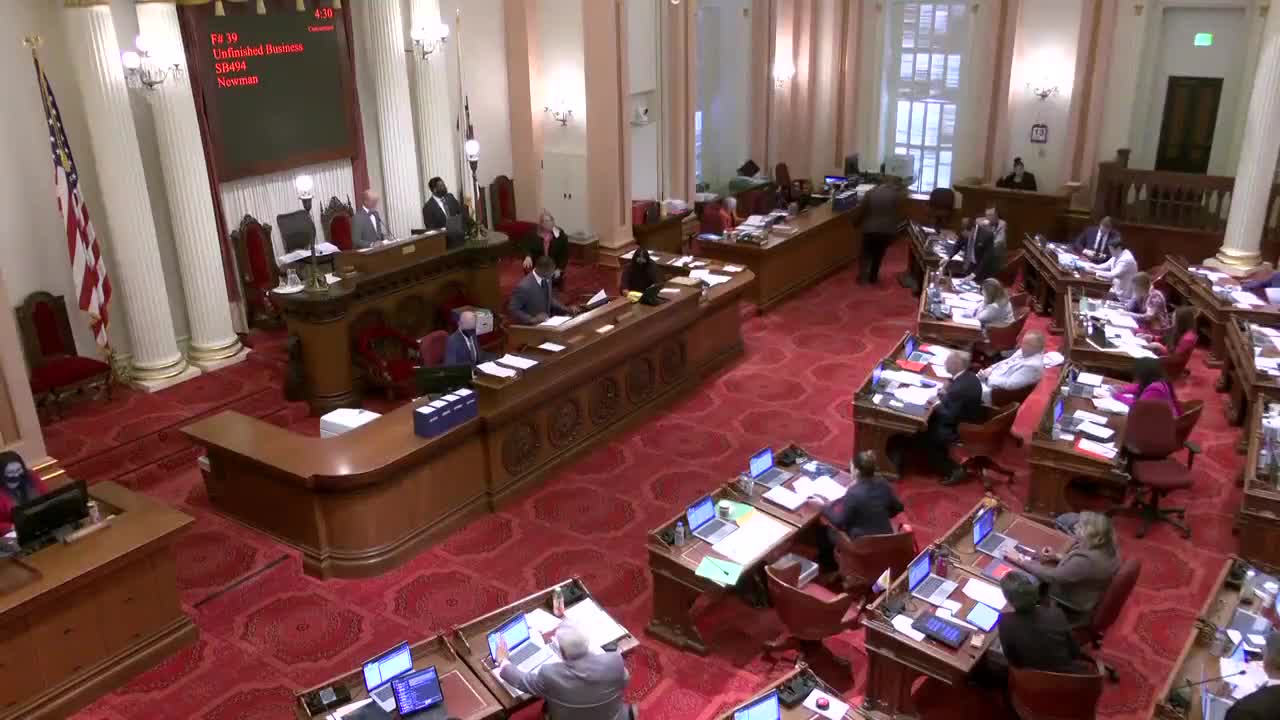 1MIN
Senate Floor
 5MIN
Senate Floor
 6MIN
Senate Standing Committee on Business, Professions and Economic Development
Bill Author

Bill Co-Author(s):