AB 1070: Residential developments: building standards: review.
- Session Year: 2025-2026
- House: Assembly
- Latest Version Date: 2026-06-11
Current Status:
In Progress
(2026-08-13: In committee: Held under submission.)
Introduced
In Committee
Awaiting First Chamber Vote
Passed First Chamber
In Committee
Awaiting Second Chamber Vote
Passed Second Chamber
Enacted
Existing law, the California Building Standards Law, establishes the California Building Standards Commission (commission) within the Department of General Services and sets forth its powers and duties, including approval and adoption of building standards and codification of those standards into the California Building Standards Code (code). Existing law requires the commission to publish, or cause to be published, editions of the code in its entirety once every 3 years.
Existing law requires the building standards and rules and regulations to impose substantially the same requirements as are contained in the most recent editions of specified international or uniform industry codes, including the International Residential Code of the International Code Council.
Existing law establishes the Department of Housing and Community Development (department) and requires the department to submit an annual report to the Governor and both houses of the Legislature on the operations and accomplishments during the previous fiscal year of the housing programs administered by the department.
This bill would require the department to convene a working group initiate a study no later than December January 31, 2027, to research and consider identifying and recommending amendments to state building standards allowing evaluating the conditions under which residential developments of between 3 and 10 units to be built may be designed and constructed under the requirements of the California Residential Code, as specified. The bill would require the department to contract with external experts or an independent third party for this purpose. The bill would require the department, no later than December 31, 2028, to provide a one-time report of its findings to the Legislature in the annual report described above. The bill, if the report identifies and recommends amendments to building standards, would require the department to research, develop, and consider proposing the standards for adoption by the commission, as specified. For the purposes of these provisions, the bill would authorize the department to exceed the scope and application of the International Residential Code to evaluate and propose amendments to allow residential developments of between 3 and 10 units to be designed and constructed under the requirements of the California Residential Code.
The bill would additionally require the department to perform a review of construction cost pressures for single-family and multifamily residential construction as a result of new or existing building standards and provide its findings to the Legislature in its above-described annual report on or before December 31, 2027. The bill would require the department to perform the same review every 3 years to revise or update standards, as specified.Existing law, the California Building Standards Law, establishes the California Building Standards Commission (commission) within the Department of General Services and sets forth its powers and duties, including approval and adoption of building standards and codification of those standards into the California Building Standards Code (code). Existing law requires the commission to publish, or cause to be published, editions of the code in its entirety once every 3 years.
Existing law requires the building standards and rules and regulations to impose substantially the same requirements as are contained in the most recent editions of specified international or uniform industry codes, including the International Residential Code of the International Code Council.
Existing law establishes the Department of Housing and Community Development (department) and requires the department to submit an annual report to the Governor and both houses of the Legislature on the operations and accomplishments during the previous fiscal year of the housing programs administered by the department.
This bill would require the department to convene a working group no later than December 31, 2027, to research and consider identifying and recommending amendments to state building standards allowing residential developments of between 3 and 10 units to be built under the requirements of the California Residential Code, as specified. The bill would require the department, no later than December 31, 2028, to provide a one-time report of its findings to the Legislature in the annual report described above. The bill, if the report identifies and recommends amendments to building standards, would require the department to research, develop, and consider proposing the standards for adoption by the commission, as specified. For the purposes of these provisions, the bill would authorize the department to exceed the scope and application of the International Residential Code to allow residential developments of between 3 and 10 units to be designed and constructed under the requirements of the California Residential Code.
The bill would additionally require the department to perform a review of construction cost pressures for single-family and multifamily residential construction as a result of new or existing building standards and provide its findings to the Legislature in its above-described annual report on or before December 31, 2027. The bill would require the department to perform the same review every 3 years to revise or update standards, as specified.
Existing law provides for the formation of various transit districts and specifies the duties and powers of their governing boards. Existing law authorizes a transit district to compensate a member of the governing board for attending a board meeting and for engaging in other district business, as provided.This bill would prohibit a transit district from compensating a member of the governing board unless the member demonstrates personal use of the transit system, as specified. The bill would require the governing board of a transit district to include 2 nonvoting members and 4 alternate nonvoting members, as specified. The bill would require nonvoting members and alternate nonvoting members to have certain rights and protections, including the right to attend and participate in all public meetings of the governing board, except as specified. The bill would require the chair of the governing board of a transit district to exclude these nonvoting members from meetings discussing, among other things, negotiations with labor organizations. By expanding the duties of transit districts, the bill would impose a state-mandated local program.The California Constitution requires the state to reimburse local agencies and school districts for certain costs mandated by the state. Statutory provisions establish procedures for making that reimbursement.This bill would provide that, if the Commission on State Mandates determines that the bill contains costs mandated by the state, reimbursement for those costs shall be made pursuant to the statutory provisions noted above.Existing law provides for the formation of various transit districts and specifies the duties and powers of their governing boards. Existing law authorizes a transit district to compensate a member of the governing board for attending a board meeting and for engaging in other district business, as provided.
This bill would prohibit a transit district from compensating a member of the governing board unless the member demonstrates personal use of the transit system, as specified. The bill would require the governing board of a transit district to include 2 nonvoting members and 4 alternate nonvoting members, as specified. The bill would require nonvoting members and alternate nonvoting members to have certain rights and protections, including the right to attend and participate in all public meetings of the governing board, except as specified. The bill would authorize require the chair of the governing board of a transit district to exclude these nonvoting members from meetings discussing discussing, among other things, negotiations with labor organizations. By expanding the duties of transit districts, the bill would impose a state-mandated local program.
The California Constitution requires the state to reimburse local agencies and school districts for certain costs mandated by the state. Statutory provisions establish procedures for making that reimbursement.
This bill would provide that, if the Commission on State Mandates determines that the bill contains costs mandated by the state, reimbursement for those costs shall be made pursuant to the statutory provisions noted above.
Existing law provides for the formation of various transit districts and specifies the duties and powers of their governing boards. Existing law authorizes a transit district to compensate a member of the governing board for attending a board meeting and for engaging in other district business, as provided.
This bill would prohibit a transit district from compensating a member of the governing board unless the member demonstrates personal use of the transit system, as specified. The bill would require the governing board of a transit district to include 2 nonvoting members and 4 alternate nonvoting members, as specified. The bill would authorize the chair of the governing board of a transit district to exclude these nonvoting members from meetings discussing negotiations with labor organizations. By expanding the duties of transit districts, the bill would impose a state-mandated local program.
The California Constitution requires the state to reimburse local agencies and school districts for certain costs mandated by the state. Statutory provisions establish procedures for making that reimbursement.
This bill would provide that, if the Commission on State Mandates determines that the bill contains costs mandated by the state, reimbursement for those costs shall be made pursuant to the statutory provisions noted above.
It is the intent of the Legislature to facilitate the safe and feasible use of the California Residential Code for residential developments of between 3 and 10 units by studying the conditions under which those developments may achieve life safety outcomes equal to or superior to otherwise applicable code pathways and by developing code-ready recommendations for future consideration by the California Building Standards Commission.
SECTION 1.SEC. 2.Section 17921.12 is added to the Health and Safety Code, to read:17921.12.(a)No later than December January 31, 2027, the Department of Housing and Community Development shall convene a working group, with membership including, initiate a study evaluating the conditions under which residential developments of between 3 and 10 units may be designed and constructed under the requirements of the California Residential Code (Part 2.5 of Title 24 of the California Code of Regulations). The department shall complete the study no later than June 30, 2028.
(b)The department shall contract with external experts or an independent third party to develop the study and perform other functions required of the department under this section.
(c)In conducting the study, the department and any external experts or independent third party retained pursuant to subdivision (b) may consult with relevant stakeholders, including, but not limited to, the California Building Standards Commission, State Fire Marshal, Division of the State Architect, Energy Commission, and other stakeholders, to research and consider identifying and recommending amendments to state building standards allowing residential developments of between 3 and 10 units to be built under the requirements of the California Residential Code (Part 2.5 of Title 24 of the California Code of Regulations), and any necessary modifications to maintain health and safety standards for the developments. Each entity shall provide input relative to its area of expertise and oversight. fire service representatives, fire prevention officials, local building officials, organizations representing licensed architects and licensed engineers, nonprofit or market-rate housing developers experienced in small-scale multifamily construction, housing advocacy organizations, third-party professional plan checkers and inspectors, and faculty with expertise in fire protection engineering, building science, or related disciplines.
(d)The study shall consist of a comprehensive analysis of the opportunities, constraints, technical considerations, and recommendations relevant to increasing the threshold under which residential developments of between 3 and 10 units may be designed and constructed under the California Residential Code (Part 2.5 of Title 24 of the California Code of Regulations) while maintaining health and safety and without materially reducing development feasibility. The study shall include both of the following:
(1)An analysis of all of the following:
(A)The conditions under which residential developments of between 3 and 10 units may be designed and constructed under the California Residential Code (Part 2.5 of Title 24 of the California Code of Regulations) while achieving life safety outcomes equal to or superior to otherwise applicable requirements of the California Building Standards Code (Title 24 of the California Code of Regulations) for residential developments of similar height, floor area, and occupancy classification. The study shall evaluate those life safety outcomes using probabilistic and comparative risk analysis.
(B)The building types, site conditions, construction types, height limits, floor area limits, unit count limits, egress conditions, fire and life safety systems, and other objective criteria under which residential developments of between 3 and 10 units may be designed and constructed under the California Residential Code (Part 2.5 of Title 24 of the California Code of Regulations).
(C)Analysis of fire loss history in jurisdictions that have adopted or studied similar provisions; review of available National Fire Protection Association fire loss and fire protection system performance data, together with other available system reliability data; and consultation with fire service personnel regarding fire suppression and rescue techniques in the residential developments evaluated pursuant to this section. The study shall use probabilistic and comparative risk analysis and shall not rely solely on worst-case-scenario assumptions. If existing data is insufficient, the study may also include smoke modeling, egress modeling, or other analyses necessary to evaluate life safety outcomes.
(D)The extent to which life safety outcomes from residential developments evaluated pursuant to this section compare both to smaller one-family and two-family dwellings and to larger multifamily residential buildings subject to otherwise applicable provisions of the California Building Standards Code (Title 24 of the California Code of Regulations).
(E)The feasibility implications of allowing residential developments of between 3 and 10 units to be designed and constructed under the California Residential Code (Part 2.5 of Title 24 of the California Code of Regulations), including effects on constructability, code compliance, permitting, inspection, project delivery, and the practical ability to build small-scale multifamily housing.
(F)Cost implications of allowing residential developments of between 3 and 10 units to be designed and constructed under the California Residential Code (Part 2.5 of Title 24 of the California Code of Regulations), including cost-saving opportunities, tradeoffs, alternative compliance approaches, and other means of reducing unnecessary construction costs while maintaining health and safety.
(G)The interaction of any proposed California Residential Code pathway with the California Electrical Code (Part 3 of Title 24 of the California Code of Regulations), the California Mechanical Code (Part 4 of Title 24 of the California Code of Regulations), the California Plumbing Code (Part 5 of Title 24 of the California Code of Regulations), the California Energy Code (Part 6 of Title 24 of the California Code of Regulations), and other applicable parts of the California Building Standards Code.
(H)A comparison of currently adopted California building standards with alternative code approaches used or studied in other jurisdictions, including other states, including, but not limited to, Alaska, Montana, and North Carolina, for small-scale multifamily buildings.
(I)Any code provisions, limitations, safeguards, mitigations, inspection or maintenance requirements, or alternative compliance measures that may be necessary to maintain health and safety while allowing residential developments of between 3 and 10 units to be designed and constructed under the California Residential Code (Part 2.5 of Title 24 of the California Code of Regulations).
(J)Any administrative, permitting, inspection, or enforcement considerations relevant to the safe and feasible implementation of a California Residential Code pathway for residential development of between 3 and 10 units.
(K)Any other subjects the department identifies through the course of preparing the study that would contribute to determining how residential developments of between 3 and 10 units may be safely and feasibly designed and constructed under the California Residential Code (Part 2.5 of Title 24 of the California Code of Regulations).
(2)Recommendations to the state based on the study for all of the following:
(A)Specific amendments to state building standards that would allow residential developments of between 3 and 10 units to be designed and constructed under the California Residential Code (Part 2.5 of Title 24 of the California Code of Regulations).
(B)Any objective limitations, safeguards, or alternative compliance measures necessary to maintain health and safety.
(C)Any code simplifications, cost-saving measures, or alternative compliance approaches that could improve the feasibility of small-scale multifamily housing without reducing health and safety.
(D)Any administrative, permitting, inspection, or enforcement changes that would facilitate safe implementation of the recommended standards.
(E)Recommendations regarding whether code updates are warranted and, if so, recommendations for code updates for the residential developments evaluated in this section, based on the probabilistic and comparative risk analysis required by paragraph (1).
(b)(e)No later than December 31, 2028, the department shall provide a one-time report of its findings to the Legislature include the completed study in the annual report required by Section 50408. 50408 and shall submit the completed study to the California Building Standards Commission for review.
(c)(1)(f)Notwithstanding any other law, if the working group study identifies and recommends amendments to building standards in the report described in subdivision (b), standards, the Department of Housing and Community Development and other state agencies within the working group with authority to propose adoption of building standards shall research, develop, and consider proposing for adoption by the California Building Standards Commission such standards for the next triennial update of the California Building Standards Code (Title 24 of the California Code of Regulations) that occurs on or after January 1, 2027. after completion of the study.
(2)(g)For the purposes of this subdivision, section, the Department of Housing and Community Development may exceed the scope and application of the International Residential Code as referenced in Section 17922 to evaluate whether to, and, if warranted, propose amendments to state building standards that would, allow residential developments of between 3 and 10 units to be designed and constructed under the requirements of the California Residential Code (Part 2.5 of Title 24 of the California Code of Regulations).
(d)(h)(1)This section does not limit the application of the California Electrical Code (Part 3 of Title 24 of the California Code of Regulations), the California Mechanical Code (Part 4 of Title 24 of the California Code of Regulations), the California Plumbing Code (Part 5 of Title 24 of the California Code of Regulations), and the California Energy Code (Part 6 of Title 24 of the California Code of Regulations) to residential occupancies of any size.
(2)This section does not authorize the working group to propose study to recommend the expansion of the California Residential Code to include chapters in the International Residential Code that were not adopted in the 2025 edition of the California Residential Code due to duplication with other parts of the California Building Standards Code.
SEC. 2.SEC. 3.Section 17921.13 is added to the Health and Safety Code, to read:17921.13.(a)No later than December 31, 2027, the Department of Housing and Community Development shall perform a review of construction cost pressures for single-family and multifamily residential construction as a result of new or existing building standards requirements in the California Buildings Standards Code and provide a one-time report of its findings to the Legislature in the annual report required by Section 50408.(b)Commencing with the next triennial update of the California Building Standards Code (Title 24 of the California Code of Regulations) that occurs on or after January 1, 2031, and every three years thereafter, the Department of Housing and Community Development shall perform a review as described in subdivision (a) to revise or update standards, as needed.(a)No later than December 31, 2027, the Department of Housing and Community Development shall convene a working group, with membership including, but not limited to, the California Building Standards Commission, State Fire Marshal, Division of the State Architect, Energy Commission, and other stakeholders, to research and consider identifying and recommending amendments to state building standards allowing residential developments of between 3 and 10 units to be built under the requirements of the California Residential Code (Part 2.5 of Title 24 of the California Code of Regulations), and any necessary modifications to maintain health and safety standards for the developments. Each entity shall provide input relative to its area of expertise and oversight.
(b)No later than December 31, 2028, the department shall provide a one-time report of its findings to the Legislature in the annual report required by Section 50408.
(c)(1)Notwithstanding any other law, if the working group identifies and recommends amendments to building standards in the report described in subdivision (b), the Department of Housing and Community Development and other state agencies within the working group with authority to propose adoption of building standards shall research, develop, and consider proposing for adoption by the California Building Standards Commission such standards for the next triennial update of the California Building Standards Code (Title 24 of the California Code of Regulations) that occurs on or after January 1, 2027.
(2)For the purposes of this subdivision, the Department of Housing and Community Development may exceed the scope and application of the International Residential Code as referenced in Section 17922 to allow residential developments of between 3 and 10 units to be designed and constructed under the requirements of the California Residential Code (Part 2.5 of Title 24 of the California Code of Regulations).
(d)(1)This section does not limit the application of the California Electrical Code (Part 3 of Title 24 of the California Code of Regulations), the California Mechanical Code (Part 4 of Title 24 of the California Code of Regulations), the California Plumbing Code (Part 5 of Title 24 of the California Code of Regulations), and the California Energy Code (Part 6 of Title 24 of the California Code of Regulations) to residential occupancies of any size.
(2)This section does not authorize the working group to propose the expansion of the California Residential Code to include chapters in the International Residential Code that were not adopted in the 2025 edition of the California Residential Code due to duplication with other parts of the California Building Standards Code.
SEC. 2.Section 17921.13 is added to the Health and Safety Code, to read:17921.13.(a)No later than December 31, 2027, the Department of Housing and Community Development shall perform a review of construction cost pressures for single-family and multifamily residential construction as a result of new or existing building standards requirements in the California Buildings Standards Code and provide a one-time report of its findings to the Legislature in the annual report required by Section 50408.
(b)Commencing with the next triennial update of the California Building Standards Code (Title 24 of the California Code of Regulations) that occurs on or after January 1, 2031, and every three years thereafter, the Department of Housing and Community Development shall perform a review as described in subdivision (a) to revise or update standards, as needed.
SECTION 1.Section 99156 of the Public Utilities Code is amended to read:99156.(a)Notwithstanding any other law, a transit district may provide compensation to a member of the governing board of the district only for attendance at a meeting of the board or for each day the member is engaged in other district business within or without the district. A member who engages in district business other than attendance at board meetings shall first obtain authorization of the board for reimbursement of travel expenses or other compensation before engaging in that business and shall submit a report thereof to the board for all expenditures.(b)A transit district shall not provide compensation to a member of the governing board of the district unless the member demonstrates, through evidence or attestation recorded by the clerk of the board, personal use of the transit system for at least one hour or for four trips during the month for which the member seeks compensation.SEC. 2.Section 99156.5 is added to the Public Utilities Code, to read:99156.5.(a)Notwithstanding any other law, the governing board of a transit district shall include two nonvoting members and four alternate nonvoting members, as follows:(1)The first nonvoting member shall be a user of mass transit services provided by the transit district and shall be recommended for appointment by a transit advisory council representing transit users. There shall be two nonvoting alternates to the first nonvoting member as follows:(A)The first nonvoting alternate to the nonvoting member described in paragraph (1) shall be a user of mass transit services provided by the transit district and shall be recommended for appointment by a commuter council associated with a major transit service in the state.(B)The second nonvoting alternate to the nonvoting member described in paragraph (1) shall be a user of mass transit services provided by the transit district and shall be recommended for appointment by a commuter council associated with a transit service, other than the transit service described in subparagraph (A), that is under the transit districts jurisdiction.(2)The second nonvoting member shall be recommended for appointment by the labor organization that represents a plurality of represented employees within the transit district. There shall be two nonvoting alternates to the second nonvoting member as follows:(A)The first nonvoting alternate to the nonvoting member described in paragraph (2) shall be recommended for appointment by the labor organization that represents a plurality of represented employees within the transit district.(B)The second nonvoting alternate to the nonvoting member described in paragraph (2) shall be recommended for appointment by the labor organization that represents a plurality of represented employees within the transit district.(b)Nonvoting members and alternate nonvoting members shall be appointed according to the following procedures:(1)The chair of the governing board shall appoint the nonvoting members and alternate nonvoting members from the recommendations provided by the respective organizations within 31 days of receiving the recommendations.(2)If the chair does not receive recommendations within 31 days of a request or vacancy, the governing board may appoint qualified individuals to these positions by majority vote.(3)If the chair determines that a recommended individual does not meet the qualifications specified in this section, the chair shall request a new recommendation from the respective organization.(4)Appointments shall be made at a regular meeting of the governing board and shall be recorded in the minutes of that meeting.(c)The nonvoting members and alternate nonvoting members shall have the following rights and protections:(1)The right to attend and participate in all public meetings of the governing board except as provided in subdivision (d).(2)The right to receive all meeting materials provided to voting members of the governing board.(3)The right to place items on the agenda related to transit service and labor matters, subject to the same procedures applicable to voting members.(4)Protection from retaliation for their participation and statements made during board meetings.(d)(1)The chair of the governing board of a transit district shall exclude a nonvoting member and any corresponding alternate nonvoting member from any portion of a meeting of the governing board or a committee if the portion of the meeting discusses any of the following:(A)Negotiations with labor organizations.(B)Personnel matters specifically related to individual employees.(C)Confidential legal matters where attorney-client privilege applies.(2)When a nonvoting member is excluded from a meeting pursuant to this subdivision, any corresponding alternate nonvoting member shall also be excluded.SEC. 3.If the Commission on State Mandates determines that this act contains costs mandated by the state, reimbursement to local agencies and school districts for those costs shall be made pursuant to Part 7 (commencing with Section 17500) of Division 4 of Title 2 of the Government Code.(a)Notwithstanding any other law, a transit district may provide compensation to a member of the governing board of the district only for attendance at a meeting of the board or for each day the member is engaged in other district business within or without the district. A member who engages in district business other than attendance at board meetings shall first obtain authorization of the board for reimbursement of travel expenses or other compensation before engaging in that business and shall submit a report thereof to the board for all expenditures.
(b)A transit district shall not provide compensation to a member of the governing board of the district unless the member demonstrates, through evidence or attestation recorded by the clerk of the board, personal use of the transit system for at least one hour or for four trips during the month for which the member seeks compensation.
SEC. 2.Section 99156.5 is added to the Public Utilities Code, to read:99156.5.(a)Notwithstanding any other law, the governing board of a transit district shall include two nonvoting members and four alternate nonvoting members, as follows:
(1)The first nonvoting member shall be a user of mass transit services provided by the transit district and shall be recommended for appointment by a transit advisory council representing transit users. There shall be two nonvoting alternates to the first nonvoting member as follows:
(A)The first nonvoting alternate to the nonvoting member described in paragraph (1) shall be a user of mass transit services provided by the transit district and shall be recommended for appointment by a commuter council associated with a major transit service in the state.
(B)The second nonvoting alternate to the nonvoting member described in paragraph (1) shall be a user of mass transit services provided by the transit district and shall be recommended for appointment by a commuter council associated with a transit service, other than the transit service described in subparagraph (A), that is under the transit districts jurisdiction.
(2)The second nonvoting member shall be recommended for appointment by the labor organization representing the majority of the employees of a major transit system in the state. that represents a plurality of represented employees within the transit district. There shall be two nonvoting alternates to the second nonvoting member as follows:
(A)The first nonvoting alternate to the nonvoting member described in paragraph (2) shall be recommended for appointment by the labor organization representing the majority of employees of a major transit system in the state. that represents a plurality of represented employees within the transit district.
(B)The second nonvoting alternate to the nonvoting member described in paragraph (2) shall be recommended for appointment by the labor organization representing the majority of employees of a major transit system in the state. that represents a plurality of represented employees within the transit district.
(C)The nonvoting members described in this paragraph shall be recommended for appointment by labor organizations representing employees of different transit systems.(b)Nonvoting members and alternate nonvoting members shall be appointed according to the following procedures:
(1)The chair of the governing board shall appoint the nonvoting members and alternate nonvoting members from the recommendations provided by the respective organizations within 31 days of receiving the recommendations.
(2)If the chair does not receive recommendations within 31 days of a request or vacancy, the governing board may appoint qualified individuals to these positions by majority vote.
(3)If the chair determines that a recommended individual does not meet the qualifications specified in this section, the chair shall request a new recommendation from the respective organization.
(4)Appointments shall be made at a regular meeting of the governing board and shall be recorded in the minutes of that meeting.
(c)The nonvoting members and alternate nonvoting members shall have the following rights and protections:
(1)The right to attend and participate in all public meetings of the governing board except as provided in subdivision (d).
(2)The right to receive all meeting materials provided to voting members of the governing board.
(3)The right to place items on the agenda related to transit service and labor matters, subject to the same procedures applicable to voting members.
(4)Protection from retaliation for their participation and statements made during board meetings.
(b)(d)(1)The chair of the governing board of a transit district may shall exclude the a nonvoting members member and any corresponding alternate nonvoting members member from any portion of a meeting of the governing board or a committee that discusses negotiations with labor organizations. if the portion of the meeting discusses any of the following:
(A)Negotiations with labor organizations.
(B)Personnel matters specifically related to individual employees.
(C)Confidential legal matters where attorney-client privilege applies.
(2)When a nonvoting member is excluded from a meeting pursuant to this subdivision, any corresponding alternate nonvoting member shall also be excluded.
SEC. 3.If the Commission on State Mandates determines that this act contains costs mandated by the state, reimbursement to local agencies and school districts for those costs shall be made pursuant to Part 7 (commencing with Section 17500) of Division 4 of Title 2 of the Government Code.
(a)Notwithstanding any other provision of law, a transit district may provide compensation to a member of the governing board of the district only for attendance at a meeting of the board or for each day the member is engaged in other district business within or without the district. A member who engages in district business other than attendance at board meetings shall first obtain authorization of the board for reimbursement of travel expenses or other compensation before engaging in that business and shall submit a report thereof to the board for all expenditures.
(b)A transit district shall not provide compensation to a member of the governing board of the district unless the member demonstrates, through evidence or attestation recorded by the clerk of the board, personal use of the transit system for at least one hour or for four trips during the month for which the member seeks compensation.
SEC. 2.Section 99156.5 is added to the Public Utilities Code, to read:99156.5.(a)Notwithstanding any other law, the governing board of a transit district shall include two nonvoting members and four alternate nonvoting members, as follows:
(1)The first nonvoting member shall be a user of mass transit services provided by the transit district and shall be recommended for appointment by a transit advisory council representing transit users. There shall be two nonvoting alternates to the first nonvoting member as follows:
(A)The first nonvoting alternate to the nonvoting member described in paragraph (1) shall be a user of mass transit services provided by the transit district and shall be recommended for appointment by a commuter council associated with a major transit service in the state.
(B)The second nonvoting alternate to the nonvoting member described in paragraph (1) shall be a user of mass transit services provided by the transit district and shall be recommended for appointment by a commuter council associated with a transit service, other than the transit service described in subparagraph (A), that is under the transit districts jurisdiction.
(2)The second nonvoting member shall be recommended for appointment by the labor organization representing the majority of the employees of a major transit system in the state. There shall be two nonvoting alternates to the second nonvoting member as follows:
(A)The first nonvoting alternate to the nonvoting member described in paragraph (2) shall be recommended for appointment by the labor organization representing the majority of employees of a major transit system in the state.
(B)The second nonvoting alternate to the nonvoting member described in paragraph (2) shall be recommended for appointment by the labor organization representing the majority of employees of a major transit system in the state.
(C)The nonvoting members described in this paragraph shall be recommended for appointment by labor organizations representing employees of different transit systems.
(b)The chair of the governing board of a transit district may exclude the nonvoting members and alternate nonvoting members from any portion of a meeting of the governing board or a committee that discusses negotiations with labor organizations.
SEC. 3.If the Commission on State Mandates determines that this act contains costs mandated by the state, reimbursement to local agencies and school districts for those costs shall be made pursuant to Part 7 (commencing with Section 17500) of Division 4 of Title 2 of the Government Code.
|
Date
|
Status
|
|---|---|
| Aug 13, 2026 | In committee: Held under submission. |
| Aug 3, 2026 | In committee: Referred to APPR. suspense file. |
| Jun 25, 2026 | From committee: Do pass and re-refer to Com. on APPR. (Ayes 10. Noes 0.) (June 24). Re-referred to Com. on APPR. |
| Jun 11, 2026 | From committee chair, with author's amendments: Amend, and re-refer to committee. Read second time, amended, and re-referred to Com. on HOUSING. |
| May 6, 2026 | Referred to Com. on HOUSING. |
| Jan 27, 2026 | In Senate. Read first time. To Com. on RLS. for assignment. |
| Jan 26, 2026 | Read third time. Passed. Ordered to the Senate. (Ayes 75. Noes 0. Page 3834.) |
| Jan 22, 2026 | Assembly Rule 63 suspended. (Page 3806.) |
| Jan 22, 2026 | Read second time. Ordered to third reading. |
| Jan 22, 2026 | In committee: Set, first hearing. Referred to suspense file. |
| Jan 22, 2026 | From committee: Do pass. (Ayes 15. Noes 0.) (January 22). |
| Jan 14, 2026 | From committee: Do pass and re-refer to Com. on APPR. (Ayes 11. Noes 0.) (January 14). Re-referred to Com. on APPR. |
| Jan 5, 2026 | Re-referred to Com. on L. GOV. |
| Jan 5, 2026 | Re-referred to Com. on H. & C.D. pursuant to Assembly Rule 96. |
| Jan 5, 2026 | From committee chair, with author's amendments: Amend, and re-refer to Com. on L. GOV. Read second time and amended. |
| Apr 23, 2025 | In committee: Set, first hearing. Hearing canceled at the request of author. |
| Apr 7, 2025 | Re-referred to Com. on L. GOV. |
| Apr 3, 2025 | From committee chair, with author's amendments: Amend, and re-refer to Com. on L. GOV. Read second time and amended. |
| Mar 17, 2025 | Referred to Coms. on L. GOV. and TRANS. |
| Feb 21, 2025 | From printer. May be heard in committee March 23. |
| Feb 20, 2025 | Read first time. To print. |
|
Date
|
Description
|
Location
|
Votes
|
|
|---|---|---|---|---|
| Aug 3, 2026 | Placed on suspense file | Senate Standing Committee on Appropriations |
Passed |
|
| Jun 24, 2026 | Do pass, but first be re-referred to the Committee on [Appropriations] | Senate Standing Committee on Housing |
Passed |
|
| Jan 26, 2026 | AB 1070 Ward Assembly Third Reading | Assembly Floor |
Passed |
|
| Jan 22, 2026 | Do pass. | Assembly Standing Committee on Appropriations |
Passed |
|
| Jan 14, 2026 | Do pass and be re-referred to the Committee on [Appropriations] | Assembly Standing Committee on Housing and Community Development |
Passed |
This list shows positions taken on this bill by organizations on the date displayed, which is linked to the original source.
Positions by individuals are not included.
|
Organization
|
Position
|
Date
|
|---|---|---|
| Abundant Housing Los Angeles | ** Support | |
| Active San Gabriel Valley | ** Support | |
| American Federation Of State, County And Municipal Employees, Afl-Cio | ** Against | |
| American Institute Of Architects California | ** Support | |
| Bike East Bay | ** Support | |
| Bike LA | ** Support | |
| California Association for Coordinated Transportation | ** Against | |
| California Conference of the Amalgamated Transit Union | ** Support | |
| California Council For Affordable Housing | ** Support | |
| California Housing Consortium | ** Support | |
| California Special Districts Association | ** Against | |
| California Teamsters Public Affairs Council | ** Support | |
| California Transit Association | ** Against | |
| California Walks | ** Support | |
| California YIMBY | ** Support | |
| City Of Los Angeles | ** Support | |
| City of Thousand Oaks | ** Against | |
| Climate Plan | ** Support | |
| Communities for a Better Environment | ** Support | |
| Community Coalition | ** Support | |
| Courage California | ** Support | |
| East Bay Transit Riders Union | ** Support | |
| Eastside Housing for All | ** Support | |
| Faith and Housing Coalition | ** Support | |
| Golden Gate Bridge, Highway & Transportation District | ** Against | |
| Greenbelt Alliance | ** Support | |
| Holos Communities | ** Support | |
| Inner City Law Center | ** Support | |
| la forward | ** Support | |
| Long Beach Transit | ** Against | |
| Los Angeles County Metropolitan Transportation Authority | ** Against | |
| Los Angeles Walks | ** Support | |
| Monterey-Salinas Transit District | ** Against | |
| Move LA | ** Support | |
| Move Santa Barbara County | ** Support | |
| Neighborhood Partnership Housing Services INC | ** Support | |
| Public Advocates | ** Support | |
| Sacramento Regional Transit District | ** Against | |
| Safe Routes Partnership | ** Support | |
| San Diego Housing Federation | ** Support | |
| San Francisco Bicycle Coalition | ** Support | |
| San Joaquin Regional Transit District | ** Against | |
| Santa Barbara Metropolitan Transit District | ** Against | |
| Santa Cruz Metropolitan Transit District | ** Against | |
| SPUR | ** Support | |
| Streets for All | ** Support | |
| Sustainable Claremont | ** Support | |
| The Two Hundred for Homeownership | ** Support | |
| Transbay Coalition | ** Support | |
| Transform | ** Support | |
| Victor Valley Transit Authority | ** Against | |
| Zillow Group | ** Support |
SENATE COMMITTEE ON
Senator Sabrina Cervantes, Chair
2025 - 2026 Regular Session
AB 1070 (Ward) - Residential developments: building standards: review
Version: | Policy Vote: |
Urgency: | Mandate: |
Hearing Date: | Consultant: |
Bill Summary:
AB 1070 would require the Department of Housing and Community Development (HCD) to initiate a study evaluating conditions under which residential developments of three to 10 units may be designed and built under the California Residential Code (CRC), and to provide a report of its findings to the Legislature by December 31, 2028, as specified. The bill would also require HCD to perform a review of residential construction cost pressures as a result of new or existing building standards requirements and report its findings in its annual report, as specified.
Fiscal Impact:
- HCD estimates General Fund costs of approximately $6.2 million in 2027-28 and $199,000 annually ongoing thereafter as follows:
- One-time contracting costs of approximately $6 million in 2027-28 for third-party expert consultation to conduct the study and comprehensive analysis to assess whether and under what conditions residential developments of 3-10 units may be designed and constructed under the CRC, perform the residential construction cost pressure analysis, and prepare the required reports. See Staff Comments.
- Ongoing costs of $199,000 for 1.0 PY of staff to conduct and manage the contracts for the study and cost pressure report, assess building standards impacting residential occupancies to identify overlap and conflict, and evaluate the study findings. To the extent the study and report recommend amendments to the building standards, HCD staff would research, develop, and propose revisions and clarifications to the Building Standards Code for adoption by the Building Standards Commission (CBSC).
- The Division of the State Architect estimates costs of approximately $265,000 annually for two years to participate in the study and make recommendations for specific to building standards under its jurisdiction. (Disability Access Fund and/or Public School Planning, Design, and Construction Review Revolving Fund)
- Minor and absorbable costs for the CBSC to participate in the study and to consider the proposed revisions to the Building Standards Code for adoption as part of next triennial update. (Building Standards Administration Revolving Fund)
Background:
Existing law, the California Building Standards Law, authorizes the CBSC to approve and adopt building standards through a triennial rulemaking process to revise and update the California Building Standards Code. There are approximately twenty state agencies that develop building standards for submittal to the CBSC for review, approval, and adoption. HCD is responsible for proposing building standards to the BSC for residential buildings including, hotels, motels, lodging houses, apartment houses, dwellings, buildings and structures. In the absence of a designated state agency, the CBSC is required to adopt specific building standards, as prescribed. Building standards take effect 180 days after they are published, unless a different date is specified. The most recent update to the California Building Standards Code, the 2025 Triennial Edition, is in effect from January 1, 2026 until December 31, 2028.
The California Building Standards Code includes various sections, including an Administrative Code, Residential Code, Building Code, Electrical Code, Mechanical Code, Plumbing Code, Energy Code, Fire Code, and Green Building Standards Code, among others. The California Residential Code governs construction of one- and two-family residential dwellings and townhouses of three stories or less, while the California Building Code establishes requirements for the general building design and construction requirements for all other buildings, including medium and high density housing.
New building standards being proposed by various code entities to the CBSC must be accompanied by an analysis that justifies approval based on specified criteria, including that the standard is not duplicative of other standards, is not unreasonable, arbitrary, unfair, or capricious, and the cost to the public is reasonable, based on overall benefits derived from the standard. While existing law requires the proposing entity to analyze the cost to the public of individual building code modifications, there are not current requirements for a review of the accumulation of those many changes at a holistic level to form a reasonable estimate of the cumulative cost impacts of adopting additional building standards.
Proposed Law:
AB 1070 would require HCD to contract with external experts or an independent third-party to conduct a study evaluating the conditions under which residential developments of 3-10 units may be designed and constructed under the requirements of the CRC. HCD and any external experts may consult with specified relevant stakeholders in conducting the study, and must complete the study by June 30, 2028, include the study in its annual report by December 31, 2028, and submit it to the CBSC for review. The bill would require the study to consist of a comprehensive analysis of the opportunities, constraints, technical considerations, and recommendations relevant to increasing the threshold under which residential developments of 3-10 units may be designed and constructed under the Residential Code while maintaining health and safety standards without materially reducing development feasibility.
The study must include an analysis of all of the following:
- The conditions under which residential developments of 3-10 units may be designed and constructed under the CRC while achieving life safety outcomes equal to or superior to otherwise applicable requirements of the Building Code for residential developments of similar characteristics, as specified.
- The building types, site conditions, construction types, height limits, floor area limits, unit count limits, egress conditions, fire and life safety systems, and other objective criteria under which residential developments of 3-10 units may be designed and constructed under the CRC.
- Analysis of fire loss history in jurisdictions that have adopted or studied similar provisions; review of available National Fire Protection Association fire loss and fire protection system performance data, together with other available system reliability data; and consultation with fire service personnel regarding fire suppression and rescue techniques in the evaluated residential developments, as specified.
- The extent to which life safety outcomes from residential developments evaluated pursuant to this section compare both to smaller one-family and two-family dwellings and to larger multifamily residential buildings subject to otherwise applicable provisions of the Building Code.
- The feasibility implications of allowing residential developments of 3-10 units to be designed and constructed under the CRC, including effects on constructability, code compliance, permitting, inspection, project delivery, and the practical ability to build small-scale multifamily housing.
- Cost implications of allowing residential developments of 3-10 units to be designed and constructed under the CRC, including cost-saving opportunities, tradeoffs, alternative compliance approaches, and other means of reducing unnecessary construction costs while maintaining health and safety.
- The interaction of any proposed CRC pathway with the California Electrical Code, the California Mechanical Code, the California Plumbing Code, the California Energy Code, and other applicable parts of the Building Code.
- A comparison of currently adopted California building standards with alternative code approaches used or studied in other jurisdictions, including other states, for small-scale multifamily buildings.
- Any code provisions, limitations, safeguards, mitigations, inspection or maintenance requirements, or alternative compliance measures that may be necessary to maintain health and safety while allowing residential developments of 3-10 units to be designed and constructed under the CRC.
- Any administrative, permitting, inspection, or enforcement considerations relevant to the safe and feasible implementation of a CRC pathway for residential development of 3-10 units.
- Any other subjects HCD identifies through the course of preparing the study that would contribute to determining how these residential developments may be safely and feasibly designed and constructed under the CRC.
The study must also include recommendations for all of the following:
- Specific amendments to state building standards that would allow residential developments of 3-10 units to be designed and constructed under the CRC.
- Any objective limitations, safeguards, or alternative compliance measures necessary to maintain health and safety.
- Any code simplifications, cost-saving measures, or alternative compliance approaches that could improve the feasibility of small-scale multifamily housing without reducing health and safety.
- Any administrative, permitting, inspection, or enforcement changes that would facilitate safe implementation of the recommended standards.
- Recommendations regarding whether code updates are warranted and, if so, recommendations for code updates for the residential developments evaluated in this section, based on the required probabilistic and comparative risk analysis.
AB 1070 would require HCD, if the study identifies and recommends amendments to building standards, to research, develop, and consider proposing those standards for adoption by the CBSC for the next triennial update of the Building Standards Code.
The bill would also require HCD to perform a review of construction cost pressures for single-family and multifamily residential construction as a result of new or existing building standards requirements, and provide a one-time report of its findings to the Legislature by December 31, 2027.
Related Legislation:
AB 6 (Ward), which was held on this Committee’s Suspense File last year, would have required HCD to convene a specified working group to research and consider recommending building standards to allow residential developments of 3-10 units to be built under the requirements of the CRC, as specified. The bill also required HCD to perform a review of residential construction cost pressures resulting from building standards requirements, and make recommendations for changes to building standards with the goal of reducing costs by 30%.
AB 2934 (Ward), which was held on this Committee’s Suspense File in 2024, was substantially similar to AB 6. However, provisions requiring HCD to perform a review of residential construction cost pressures were amended out of the bill in the Assembly.
AB 529 (Gabriel), Chap. 743/2023, required HCD to convene a specified working group regarding adaptive reuse residential projects, including identifying and recommending amendments to state building standards, and made other changes to state law related to adaptive reuse projects.
Staff Comments:
Affordable housing advocates assert certain reasonable requirements in the Building Code for larger buildings can make development of smaller building projects prohibitively complicated or financially infeasible. As a result, several jurisdictions across the United States have begun to allow smaller, “missing-middle housing types,” including triplexes and fourplexes, to be built under the requirements of their respective Residential Codes. This bill would require HCD to perform a study that consists of a comprehensive analysis of the opportunities, constraints, technical considerations, and recommendations, as specified, in order to increase the threshold under which residential developments of 3-10 units may be designed and constructed under the CRC, while maintaining health and safety without materially reducing development feasibility.
HCD indicates that it would incur one-time contracting costs of approximately $6 million in 2027-28, which includes costs of the specified study as well as costs to perform a review of construction cost pressures for residential construction resulting from new and existing building standards. Staff notes that HCD has previously estimated contract costs of approximately $1.5 million for the cost pressure review and report that was included in prior versions of bills on this topic, so one-time contracting costs for the comprehensive study and analysis work would likely be in the range of $4.5 million to hire multiple third-party experts with technical expertise. HCD also estimates the need for 1.0 PY of staff at an ongoing cost of $199,000 to participate in the work of the study, oversee contractors and the report, and evaluate findings. To the extent the working group recommends amendments to building standards, HCD would continue to incur costs for workload to research, develop, and consider proposing building standards for adoption by the CBSC for the next triennial update of the Building Standards Code.
-- END --
SENATE COMMITTEE ON HOUSING
Senator Jesse Arreguín, Chair
2025 - 2026 Regular
Bill No: AB 1070 Hearing Date: 6/24/2026
Author: | Ward | ||
Version: | 1/5/2026 Amended | ||
Urgency: | No | Fiscal: | Yes |
Consultant: | Ryan Hardmeyer | ||
SUBJECT: Residential developments: building standards: review
DIGEST: This bill: 1) requires the California Department of Housing and Community Development (HCD) to initiate a study and make findings and recommendations to the Legislature, including considering state building standards code changes, as specified, on shifting 3- to 10-unit residential developments from regulation under the California Building Standards Code (Building Code) to the California Residential Code (CRC) and, 2) requires HCD to perform a review of construction cost-pressures for single- and multi-family residential housing construction as a result of new or existing building standards.
ANALYSIS:
Existing law:
- Prohibits changes to building standards affecting residential units at the state and local level until 2031, with limited exceptions.
- Establishes the CBSC within the Department of General Services (DGS), and requires the CBSC to approve and adopt building standards and to codify those standards in the Building Code. Requires the CBSC to publish editions of the code in its entirety once every three years. In the intervening period, the CBSC must publish supplements as necessary.
- Requires the CBSC to receive proposed building standards from a state agency for consideration in an 18-month code adoption cycle. Requires CBSC to adopt regulations governing the procedures for the18-month code adoption cycle, which must include adequate provision of the following:
- Public participation in the development of standards;
- Notice in written form to the public of the compiled building standards with justifications;
- Technical review of the proposed building standards and accompanying justification by advisory boards appointed by the CBSC; and,
- Time for review of recommendations by the advisory boards prior to the CBSC taking action.
- Requires proposed building standards that are submitted to the CBSC for consideration to be accompanied by an analysis completed by the appropriate state agency that justifies approval based on the following criteria:
- The building standard does not conflict with, overlap, or duplicate other building standards;
- The proposed standard is within the parameters of the agency's jurisdiction;
- The public interest requires the adoption of the building standard;
- The standard is not unreasonable, arbitrary, unfair, or capricious;
- The cost to the public is reasonable, based on the overall benefit to be derived from the building standard;
- The standard is not unnecessarily ambiguous or vague; and,
- The applicable national specifications, published standards, and model codes have been appropriately incorporated into the standard.
- Requires HCD to propose the adoption, amendment, or repeal of residential building standards to the CBSC, including single-family and multifamily units, as well as hotels, motels, and dormitories.
- Requires the building standards adopted and submitted by HCD for approval to be adopted by reference, inclusive of any additions or deletions made by HCD, and requires the standards to impose substantially the same requirements as are contained in the most recent editions of the following international or uniform industry codes as adopted by the organizations specified:
- The Uniform Housing Code of the International Conference of Building Officials, except its definition of “substandard building;
- The International Building Code of the International Code Council (ICC);
- The International Residential Code of the ICC;
- The Uniform Plumbing Code of the International Association of Plumbing and Mechanical Officials;
- The Uniform Mechanical Code of the International Association of Plumbing and Mechanical Officials;
- The National Electric Code of the National Fire Protection Association;
- The International Existing Building Code of the ICC.
- Provides that only those building standards that are approved by the CBSC and are in effect at the local level at the time an application for a building permit is submitted shall apply to the plans and specifications for construction, with exceptions for permits for residential dwellings based on model home designs approved under specified standards.
This bill:
- Requires HCD, no later than January 31st, 2027, to initiate a study evaluating the conditions under which residential developments of between 3 and 10 units can be designed and constructed under the requirements of the California Residential Code (CRC). The study shall be completed by June 30th, 2028.
- Instructs HCD to contract with external experts or an independent third party to develop the study and perform other functions required of HCD.
- Provides that in conducting the study, HCD and any involved parties may consult with relevant stakeholders, including, but not limited to:
- CBSC;
- State Fire Marshal;
- Division of the State Architect;
- Energy Commission;
- Fire service representatives and prevention officials;
- Local building officials;
- Organizations representing licensed architects and engineers;
- Non-profit and market-rate housing developers experienced in small-scale multifamily construction;
- Housing advocacy organizations;
- Third-party professional plan-checkers and inspectors; and,
- Faculty with expertise in fire protection engineering, building science, or related disciplines.
- Requires the study to consist of a comprehensive analysis of the opportunities, constraints, technical considerations, and recommendations relevant to increasing the threshold under which residential developments of between 3 and 10 units may be designed and constructed under the CRC while maintaining health and safety and without materially reducing development feasibility. The study shall include both of the following:
- An analysis of all of the following:
- The conditions under which residential developments of between 3 and 10 units may be designed and constructed under the CRC while achieving life safety outcomes equal to or superior to otherwise applicable requirements of the Building Code for residential developments of similar height, floor area, and occupancy classification. The study shall evaluate those life safety outcomes using probabilistic and comparative risk analysis.
- The building types, site conditions, construction types, height limits, floor area limits, unit count limits, egress conditions, fire and life safety systems, and other objective criteria under which residential developments of between 3 and 10 units may be designed and constructed under the CRC.
- Analysis of fire loss history in jurisdictions that have adopted or studied similar provisions; review of available National Fire Protection Association fire loss and fire protection system performance data, together with other available system reliability data; and consultation with fire service personnel regarding fire suppression and rescue techniques in the residential developments evaluated pursuant to this section. The study shall use probabilistic and comparative risk analysis and shall not rely solely on worst-case-scenario assumptions. If existing data is insufficient, the study may also include smoke modeling, egress modeling, or other analyses necessary to evaluate life safety outcomes.
- The extent to which life safety outcomes from residential developments evaluated pursuant to this section compare both to smaller one-family and two-family dwellings and to larger multifamily residential buildings subject to otherwise applicable provisions of the Building Code.
- The feasibility implications of allowing residential developments of between 3 and 10 units to be designed and constructed under the CRC, including effects on constructability, code compliance, permitting, inspection, project delivery, and the practical ability to build small-scale multifamily housing.
- Cost implications of allowing residential developments of between 3 and 10 units to be designed and constructed under the CRC, including cost-saving opportunities, tradeoffs, alternative compliance approaches, and other means of reducing unnecessary construction costs while maintaining health and safety.
- The interaction of any proposed CRC pathway with the California Electrical Code, the California Mechanical Code, the California Plumbing Code, the California Energy Code, and other applicable parts of the Building Code.
- A comparison of currently adopted California building standards with alternative code approaches used or studied in other jurisdictions, including other states, including, but not limited to, Alaska, Montana, and North Carolina, for small-scale multifamily buildings.
- Any code provisions, limitations, safeguards, mitigations, inspection or maintenance requirements, or alternative compliance measures that may be necessary to maintain health and safety while allowing residential developments of between 3 and 10 units to be designed and constructed under the CRC.
- Any administrative, permitting, inspection, or enforcement considerations relevant to the safe and feasible implementation of a CRC pathway for residential development of between 3 and 10 units.
- Any other subjects HCD identifies through the course of preparing the study that would contribute to determining how residential developments of between 3 and 10 units may be safely and feasibly designed and constructed under the CRC.
- Recommendations to the state based on the study for all of the following:
- Specific amendments to state building standards that would allow residential developments of between 3 and 10 units to be designed and constructed under the CRC.
- Any objective limitations, safeguards, or alternative compliance measures necessary to maintain health and safety.
- Any code simplifications, cost-saving measures, or alternative compliance approaches that could improve the feasibility of small-scale multifamily housing without reducing health and safety.
- Any administrative, permitting, inspection, or enforcement changes that would facilitate safe implementation of the recommended standards.
- Recommendations regarding whether code updates are warranted and, if so, recommendations for code updates for the residential developments evaluated in this section, based on the probabilistic and comparative risk analysis required by this bill.
- An analysis of all of the following:
- Requires HCD include the completed study in its annual report to the Legislature, and submit the completed study to the CBSC for review.
- Provides that if the study identifies and recommends amendments to building standards, HCD shall research, develop, and consider proposing those standards to the CBSC for adoption in the next triennial update following the completion of the study.
- Allows HCD to exceed the scope and application of the International Residential Code, as specified, to evaluate whether to, and if warranted, propose amendments to state building standards that would allow for residential developments of between 3 and 10 units to be designed and constructed under the requirements of the CRC instead of the Building Code.
Background
The Building Standards Process. The California Building Standards Law establishes the process for adopting state building standards by the CBSC. Statewide building standards are intended to provide uniformity in building across the state. The CBSC’s duties include the following: receiving proposed building standards from state agencies for consideration in each triennial and intervening building code adoption cycle; reviewing and approving building standards submitted by state agencies; adopting building standards for state buildings where no other state agency is authorized by law; and publishing the approved building standards in the California Building Standards Code.
Most building standards currently in use in California are developed and vetted at the national level every three years by technical organizations, academics, and trade associations that develop consensus standards, which are then incorporated into the International Building Code (IBC), the national model code used by most U.S. jurisdictions. At the state level, agencies with jurisdictional authority then review the IBC and amend as necessary for California’s specific needs, e.g.,:
- Office of State Fire Marshall is responsible for the development of building standards that provide for fire and life safety within residential buildings, such as means of egress, fire alarm systems, and fire extinguishing systems.
- HCD is responsible for the development of residential building standards, such as those in single-family and multifamily dwellings, as well as dormitories, hotels, motels, and accessibility in privately funded multifamily dwellings.
- Division of the State Architect is responsible for the development of building standards to promote structural safety and accessibility in public schools, essential service buildings, commercial facilities, and public housing.
After the proposal of building standards by state agencies, the proposals undergo a public vetting process. A code advisory committee composed of experts in a particular scope of code reviews the proposed standards, followed by public review. The proposing agency considers feedback and may then amend the standards and re-submit them to the CBSC for consideration. CBSC reviews and adopts the standards and files them with the Secretary of State for codification and publishing, and there is an 180-day period during which local agencies file modifications and changes to the state codes. The new codes then take effect January 1 of the subsequent year following publication.
Updates and changes to building standards are adopted on two timelines: through the triennial code adoption cycle which occurs every three years, and through the intervening code adoption cycle which provides an update to codes 18 months after the publication of the triennial codes. Regulatory activities for each cycle begin over two years before the effective date of the codes.
As a matter of practice, the Legislature typically offers guidelines or directs agencies to consider certain standards, rather than requiring the adoption of specific standards, in order to provide flexibility and allow for subject matter experts to determine suitability and weigh the many considerations that must be evaluated when recommending new or modified building standards.
AB 130’s Building Standards Freeze. The Legislature and Governor have enacted multiple additional directives to research and propose new building standards in recent years, including for rainwater catchment, electric vehicle charging, water efficiency and reuse, adaptive reuse projects, “single stair” apartments exceeding three stories, and beyond. Some of the most impactful mandates in recent years have also come from outside stakeholders or the adopting agencies themselves (rather than the Legislature), like solar panel mandates and fire sprinkler requirements. There are several legitimate and important concerns that are addressed by these and many other elements of building standards for housing. However, the framework for proposing and adopting new standards leaves agencies in silos regarding the volume or costs of new proposals that counterpart agencies are also simultaneously developing. Cost analyses are performed on each individual modification or for each respective chapter, not on the accumulation of the entirety of changes in each intervening or triennial cycle across all agencies. Holistic review is therefore difficult and while individual standards may increase costs by what appears a reasonable amount, from a different lens, the cost of the totality of all cumulative changes may be less reasonable.
In response to concerns regarding the rapid pace of modifications to building standards, the deadly Los Angeles fires of January 2025, and a need to find methods to stem increases in housing construction costs, the Legislature and Governor enacted several significant changes to building standards in AB 130 (Committee on Budget, Chapter 22, Statutes of 2025). The most significant change is a freeze to any new building standards or changes to existing building standards affecting residential units at both the state and local level until 2031, with limited exceptions. The bill also curtailed the practice of incorporating significant new building standards into the codes via the intervening code cycle (instead, only technical or emergency changes may be made in this manner), and allowed phased residential developments utilizing model home designs to continue using approved building permits until those designs substantially change or for a period of 10 years, rather than at each new code cycle.
Comments
- Author’s Statement. “AB 1070 would direct HCD to create a working group to explore allowing ‘missing middle’ developments between three and 10 units to be built under the requirements of the California Residential Code, rather than the California Building Code. This change could unlock the production of triplexes and other smaller multi-family housing types by streamlining code requirements, while preserving health and safety and opening up a broader workforce to build these projects. Additionally, this bill would also require HCD to perform an analysis of cost pressures created by current building code requirements and to complete the same analysis in future building code cycles with a goal of maintaining or reducing the costs of construction for new housing.”
- Missing Middle Housing. It is well-documented that California’s housing market is the most expensive in the nation – and that the pace of cost increases in renting, buying, and developing outpace those across the country. Consequently, the cost of attaining housing (whether as a buyer or renter) has becoming increasingly difficult. While there are a multitude of factors that affect housing development, many experts point to high interest rates, rising costs of materials and labor, and complex building code requirements as primary drivers of housing unaffordability. In effect, this has meant that fewer than 1 in 4 Californians can afford the median-priced home ($843,390).[1]
In response, there is a growing chorus of calls for enhancing development of, and support for, what is known as “missing middle” housing. As defined by this bill, this housing type refers to developments of 3 to 10 units. It stands in contrast to the much more common forms of development in the state – single-family (1 unit) and multifamily (larger-scale, 11+ unit developments). Despite their prevalence, those housing types come with unique struggles. For instance, new single-family housing is often the far more expensive housing type to acquire and inefficiently uses land, worsening urban sprawl and related climate concerns. Conversely, large-scale multifamily development is often massively expensive on the frontend, which increases rents and listing prices. Missing middle housing seeks to bridge the gap between these housing types by utilizing “gentle density” to increase the efficiency of land use in a way that is less expensive to develop. This includes housing typologies such as accessory dwelling units, condos, duplexes, fourplexes, cottage courts, and the like. These units are more likely to be affordable to moderate-income households that cannot afford typical market-rate homes, but that earn too much to qualify for publicly-subsidized affordable multifamily housing.
So, if these units are so promising, why aren’t more being built? Under current law, one- and two-unit dwellings, as well as townhomes of three stories or less, are regulated by the CRC. Meanwhile, the Building Code regulates all other buildings, lumping missing middle housing in the same category as high-density housing complexes and large-scale commercial developments. In practice, this means developments that are often much more similar to those covered by the CRC are instead subject to higher building standards, which increase costs and timelines, and prevent access to more affordable financing (e.g., FHA-backed loans for 1-4 units). These requirements are often cost prohibitive for these developments, and can render a project economically infeasible from the jump. As a result, several jurisdictions across the U.S. have begun to allow missing middle housing types to be regulated by their respective Residential Code. For instance, Memphis, Tennessee, pioneered their own missing middle housing program, where non-profit and for-profit developers are permitted to construct and/or rehabilitate 2- to 10-unit housing developments under the Residential Code. The program requires units to be attainable for moderate-income households (those earning 80-120% AMI), either for sale or for rent.
While this bill would not contain the same affordability provisions of the program in Tennessee, it would similarly consider the feasibility and impacts of switching 3- to 10-unit residential developments from the Building Code to the CRC, in an attempt to create more housing to meet growing demand that is not met by publicly-subsidized low-income housing or expensive luxury housing. This could help improve housing attainment and security and prevent people from having to overcrowd, leave their community, or even leave the state entirely in an attempt to acquire the housing to meet their needs.
- Scope Creep of Building Requirements. Developments constructed under the Building Code are subject to greater requirements than those under the CRC.
Duplex Development Residential Code | Triplex Development Building Code | |
Fire Sprinklers | N/A | Required |
Commercial-grade Alarms | N/A | Required |
Fire-rated Wall Separation | N/A | Required |
Dual Exit Stairwells | N/A | Required |
Heightened Design Loads | N/A | Required |
The table above illustrates the difference in requirements for a development that differs by just 1 unit. While heightened health and safety standards may be warranted for larger-scale developments that house many more people, this bill would direct HCD and other relevant stakeholders to evaluate whether it makes sense to regulate a 3-unit triplex under the same regulations of a 40-unit building, rather than that of a duplex – which many planners assess as much more functionally similar.[2]
- Comprehensive Cost Study. While current law mandates that state agencies proposing building standards consider a multitude of factors, including costs, there is currently no requirement for any one state entity to calculate the cumulative costs of such proposals. As such, this bill would require HCD to begin performing a more holistic cost pressure analysis of proposed standards, to better identify the impacts and ensure the residential building standards process evaluates not just the granular cost of individual modifications, but the overall impact of the totality of standards.
- Safeguards for Health and Safety. This bill has a specific callout for ensuring health and safety considerations accompany any proposal seeking to shift coverage of 3- to 10-unit developments from the Building Code to the CRC. Because this shift would reduce and/or eliminate a suite of requirements for development and ongoing operation of these units, these safeguards could address concerns over whether there will be unintended consequences to Californians who reside in these buildings. Further, the bill’s instruction to include the State Fire Marshal, Division of the State Architect, Energy Commission, and other stakeholders as key advisors in the study process can ensure their respective areas of health and safety are covered and proposed changes to building standards are responsibly crafted.
Related/Prior Legislation
AB 6 (Ward, 2025) — requires HCD to convene a working group to research and consider recommending building standards to allow residential developments between 3 and 10 units to be built under the requirements of the California Residential Code. This bill was held on the Senate Appropriations Suspense File.
AB 2934 (Ward, 2024) — requires HCD to convene a working group to research and consider recommending building standards to allow residential developments between 3 and 10 units to be built under the requirements of the California Residential Code. This bill was held on the Senate Appropriations Suspense File.
FISCAL EFFECT: Appropriation: Fiscal Com.: Local:
POSITIONS: (Communicated to the committee before noon on Wednesday,
June 17th, 2026.)
SUPPORT:
Abundant Housing Los Angeles
American Institute of Architects California
California Council for Affordable Housing
California Housing Consortium
California Yimby
City of Los Angeles
Eastside Housing for All
Faith and Housing Coalition
Greenbelt Alliance
Holos Communities
Inner City Law Center
Neighborhood Partnership Housing Services INC
San Diego Housing Federation
Spur
The Two Hundred for Homeownership
Zillow Group
OPPOSITION:
None received.
-- END --
California Association of Realtors. 1st Quarter 2026 Housing Affordability. Accessible here: https://www.car.org/aboutus/mediacenter/newsreleases/2026releases/1qtr2026hai/. May 2026. ↑
Jon DePaolis - American Planning Association. Creating More Housing Doesn't End With Zoning Reform. Accessible here: https://www.planning.org/blog/9317388/new-white-paper-creating-more-housing-doesnt-end-with-zoning-reform/. September 2025. ↑
ASSEMBLY THIRD READING
ATR Bill Id:AB 1070
Author:(Ward)
As Amended Ver:January 5, 2026
Majority vote
SUMMARY
Requires the Department of Housing and Community Development (HCD) to convene a working group to research and consider recommending building standards to allow residential developments between three and ten units to be built under the requirements of the California Residential Code (CRC), and requires HCD to perform a review of residential construction cost pressures, as specified.
Major Provisions
- Requires HCD, no later than December 31, 2027, to convene a working group, with membership including but not limited to the California Building Standards Commission (CBSC), State Fire Marshal, Division of the State Architect, Energy Commission, and other stakeholders, to research and consider identifying and recommending amendments to state building standards allowing residential developments of between three to ten units to be built under the requirements of the CRC, and any necessary modifications to maintain health and safety standards for the developments.
- Requires each entity in the working group to provide input relative to its area of expertise and oversight.
- Requires HCD to provide a one-time report of its findings to the Legislature in the annual report, as specified, no later than December 31, 2028.
- If the working group identifies and recommends amendments to building standards in the report under 3) above, requires HCD and other state agencies within the working group with authority to propose adoption of building standards to research, develop, and consider proposing for adoption by CBSC such standards for the next triennial update of the California Building Standards Code that occurs on or after January 1, 2027, notwithstanding any other law.
- Allows HCD to exceed the scope and application of the International Residential Code, as specified, to allow residential developments of between three and ten units to be designed and constructed under the requirements of the CRC.
- Clarifies that this bill does not limit the application of the California Electrical Code, the California Mechanical Code, the California Plumbing Code, and the California Energy Code to residential occupancies of any size.
- Prohibits this bill from authorizing the working group to propose the expansion of the CRC to include chapters in the International Residential Code that were not adopted in the 2025 edition due to duplication with other parts of the California Building Standards Code.
- Requires HCD, by December 31, 2027, to perform a review of construction cost pressures for single-family and multifamily residential construction as a result of new or existing building standards requirements in the California Building Standards Code and provide a one-time report of its findings to the Legislature in the annual report, as specified.
- Requires HCD to perform the review under 8) above commencing with the next triennial update of the California Building Standards Code that occurs on or after January 1, 2031, and every three years thereafter, to revise or update standards, as needed.
COMMENTS
Building Standards: The California Building Standards Law establishes the process for adopting state building standards by the Commission. Statewide building standards are intended to provide uniformity in building across the state. The CBSC′s duties include the following: receiving proposed building standards from state agencies for consideration in each triennial and intervening building code adoption cycle; reviewing and approving building standards submitted by state agencies; adopting building standards for state buildings where no other state agency is authorized by law; and publishing the approved building standards in the California Building Standards Code (CCR, Title 24).
Most building standards currently in use in California are developed and vetted at the national level every three years by technical organizations, academics, and trade associations that develop consensus standards, which are then incorporated into the International Building Code (IBC), the national model code used by most US jurisdictions. At the state level, agencies with authority over specified occupancies then review the IBC and amend as necessary for California′s needs.
After the proposal of building standards by state agencies, the proposals undergo a public vetting process. A code advisory committee composed of experts in a particular scope of code reviews the proposed standards, followed by public review. The proposing agency considers feedback and may then amend the standards and re-submit them to the CBSC for consideration. CBSC reviews and adopts the standards and files them with the Secretary of State for codification and publishing, and there is a 180-day period during which local agencies file modifications and changes to the state codes (though they are not limited to this window). The new codes then take effect January 1 of the subsequent year following publication. Updates and changes to building standards are adopted on two timelines: through the triennial code adoption cycle which occurs every three years, and through the intervening code adoption cycle which provides an update to codes 18 months after the publication of the triennial codes. Regulatory activities for each cycle begin over two years before the effective date of the codes.
HCD is responsible for the standards for residential buildings, hotels, and motels. The California Building Code and CRC govern general standards for multifamily and single-family residential construction, while other codes similarly control other aspects of building. As a matter of practice, the Legislature typically offers guidelines or directs agencies to consider certain standards, rather than requires the adoption of specific standards, in order to provide flexibility and allow for subject matter experts to determine appropriateness and weigh the many considerations that must be evaluated when recommending new or modified building standards.
Numerous Directives and Mandates Leading to Standards Freeze: The Legislature and Governor have enacted multiple additional directives to research and propose new building standards in recent years, including for rainwater catchment, electric vehicle charging, water efficiency and reuse, adaptive reuse projects, ″″single stair″″ apartments exceeding three stories, and beyond. Some of the most impactful mandates in recent years have also come from outside stakeholders or the adopting agencies themselves (rather than the Legislature), like solar panel mandates and fire sprinkler requirements. There are several legitimate and important concerns that are addressed by these and many other elements of building standards for housing. However, the framework for proposing and adopting new standards leaves agencies in silos regarding the volume or costs of new proposals that counterpart agencies are also simultaneously developing. Cost analyses are performed on each individual modification or for each respective chapter, not on the accumulation of the entirety of changes in each intervening or triennial cycle across all agencies. Holistic review is therefore difficult and while individual standards may increase costs by what appears a reasonable amount, from a different lens, the cost of the totality of all cumulative changes may be less reasonable.
In response to concerns regarding the rapid pace of modifications to building standards, the deadly Los Angeles fires of January 2025, and a need to find methods to stem increases in housing construction costs, the Legislature and Governor enacted several significant changes to building standards in the 2025 housing budget trailer bill, AB 130 (Committee on Budget), Chapter 22. The most significant change is a freeze to any new building standards or changes to existing building standards affecting residential units at both the state and local level until 2031, with limited exceptions. AB 130 (Committee on Budget) also curtailed the practice of incorporating significant new building standards into the codes via the intervening code cycle (instead only technical or emergency changes may be made in this manner).
Housing Costs and Missing Middle Housing: The cost of housing in California is the highest of any state in the nation. Additionally, the pace of cost increase has far outstripped that in other parts of the county. One result of this is that homeownership has become much more difficult to attain, and the median priced home in California has continued to climb even during the high interest rate environment. Construction costs have also continued to increase, though there are many drivers of this, including the cost of materials, cost and availability of labor, complexity of building code requirements, availability of construction loan financing, and more. According to the California Association of Realtors′ Housing Affordability Index, only 17% of California households can afford to purchase the median priced home – compared to 36% for the country.
One of the many reasons that housing is too expensive is the type of housing that is being built. Much of the housing built in California is large single-family homes (which can be an inefficient use of land) and mid- and high-rise construction (which are expensive to build). A strategy to lower the cost of housing is to facilitate the construction of ″″missing-middle″″ housing types that accommodate more units per acre, but are not as inherently expensive to build. This includes medium-density typologies such as accessory dwelling units, condos, duplexes, fourplexes, and the like. These units are more likely to be affordable to moderate-income households that cannot afford typical market-rate homes, but that earn too much income to qualify for publicly-subsidized affordable housing.
The CRC governs construction of one- and two-family dwellings and townhouses of three stories or less. The California Building Code (CBC) establishes requirements for all other buildings, including medium and high-density housing. These are based on model international codes commonly used around the country. However, certain reasonable requirements in the CBC for larger buildings can make development prohibitively complicated or render the economics infeasible for smaller ones. As a result, several jurisdictions across the United States have begun to allow smaller, missing-middle housing types, including triplexes and fourplexes, to be built under the requirements of the Residential Code.
Additionally, the unit cutoffs in the CRC do not align with the current financing offerings for constructing one- to four-unit dwellings. FHA-backed mortgages allow recipients to take advantage of more affordable financing for construction up to a fourplex, but the rigidity of the CBC hinders this possibility. In addition, some jurisdictions have reported that the construction of new units that increase the unit count of a parcel from two to three (or more) are triggering the heightened requirements of the CBC, including instances of adding an ADU to properties with a duplex, or adding a second ADU to a lot with a single-family home and an existing ADU.
This bill would direct HCD to set up a working group, similar to the working group established in AB 529 (Gabriel), Chapter 743, Statutes of 2023, to examine the possibility of modifying the CBC/CRC here in California for smaller developments between three and 10 units in size, without creating negative impacts on health and safety.
The city of Memphis, which pioneered this new flexibility, identified several immediate benefits to the shift, including no longer requiring separate mechanical, engineering, and plumbing drawings to be submitted for project permitting; providing simpler egress requirements; and safely modifying seismic and fire protections. In addition, more small-scale residential contractors are now available to build these homes, as commercial contractors tend to work on larger projects like block-size apartment complexes and large commercial buildings.
Cost Study: New building standards being proposed by various code entities like HCD or the Division of the State Architect to CBSC must be accompanied by an analysis that justifies approval based on specific criteria. While the law currently requires the proposing entity to analyze the cost to the public of individual building code modifications, as discussed above, it is not apparent that any entity is reviewing the accumulation of those many changes at a holistic level to form a reasonable estimate of the cumulative cost impacts. These changes and any new or heightened requirements in the code have a direct impact on the cost of new housing in the state. This bill would require HCD to begin performing a more holistic cost pressure analysis of proposed standards, to better identify the impacts and ensure the residential building standards process evaluates not just the granular cost of individual modifications, but the overall impact of the totality of standards.
According to the Author
″″AB 1070 would direct HCD to create a working group to explore allowing ′missing middle′ developments between three and 10 units to be built under the requirements of the California Residential Code, rather than the California Building Code. This change could unlock the production of triplexes and other smaller multi-family housing types by streamlining code requirements, while preserving health and safety and opening up a broader workforce to build these projects. Additionally, this bill would also require HCD to perform an analysis of cost pressures created by current building code requirements and to complete the same analysis in future building code cycles with a goal of maintaining or reducing the costs of construction for new housing.″″
Arguments in Support
According to California YIMBY, ″″AB 1070 would direct the Department of Housing and Community Development to convene a working group to study and recommend pathways for allowing missing middle housing developments of three to 10 units to be constructed in the California Residential Code. This recognizes that modern fire safety technology and mitigation, including sprinklers, alarms, and fire-resistant assemblies, have raised the safety baseline in residential code buildings, making it reasonable to permit more units while still satisfying health and safety requirements. Other jurisdictions have demonstrated that allowing small multifamily projects to follow residential code standards can safely reduce complexity, eliminate duplicative engineering requirements, expand the pool of qualified builders, and lower overall project costs.″″
Arguments in Opposition
None on file.
FISCAL COMMENTS
According to the Assembly Appropriations Committee:
- HCD estimates General Fund (GF) costs of $1.69 million in fiscal year (FY) 2026-27, and $388,000 in FY 2027-28, and annually thereafter. These costs include ongoing funding for one staff position to support the new workload created by this bill, one-time contracting costs of $1.5 million in the first year to perform the review of residential construction cost pressures, and, for every triennial cycle thereafter, contracting costs of approximately $570,000 per cycle or $190,000 per year. HCD indicates the consultant work would be significant and require coordination and outside entity contribution.
- Based on last year′s nearly identical bill, estimated costs to the Division of the State Architect of approximately $256,000 annually for two years to participate in the working group and consider amendments to building standards under its jurisdiction (Disability Access Fund and Public School Planning, Design, and Construction Review Revolving Fund).
- Minor and absorbable costs (GF and special funds) for the Energy Commission and State Fire Marshal to participate in the working group and assist HCD in the investigation of possible building standards changes.
VOTES
ASM HOUSING AND COMMUNITY DEVELOPMENT: 11-0-1
YES: Haney, Patterson, Ávila Farías, Caloza, Garcia, Kalra, Lee, Quirk-Silva, Ta, Tangipa, Wicks
ABS, ABST OR NV: Wilson
ASM APPROPRIATIONS: 15-0-0
YES: Wicks, Hoover, Stefani, Calderon, Caloza, Dixon, Fong, Mark González, Krell, Bauer-Kahan, Pacheco, Pellerin, Solache, Ta, Tangipa
UPDATED
VERSION: January 5, 2026
CONSULTANT: Nicole Restmeyer / H. & C.D. / (916) 319-2085 FN: 0002239
Date of Hearing: January 22, 2026
ASSEMBLY COMMITTEE ON APPROPRIATIONS
Buffy Wicks, Chair
ABPCA Bill Id:AB 1070
Author:(Ward) – As Amended Ver:January 5, 2026
Policy Committee: | Housing and Community Development | Vote: | 11 - 0 |
|
| ||
|
|
Urgency: No State Mandated Local Program: No Reimbursable: No
SUMMARY:
This bill requires the Department of Housing and Community Development (HCD) to convene a working group to consider amendments to state building standards to allow residential developments between three and 10 units to be built under the California Residential Code (Residential Code). This bill also requires HCD to review residential construction cost pressures resulting from new or existing building standards requirements and to report its findings to the Legislature.
Among its provisions, this bill:
- Requires HCD, by December 31, 2027, to convene a working group to include the California Building Standards Commission (Commission), State Fire Marshal, State Architect, Energy Commission, and other stakeholders, to research and consider recommending amendments to state building standards allowing residential developments of between three and 10 units to be built under the requirements of the Residential Code, and any necessary modifications to maintain health and safety standards for the developments. HCD must report its findings to the Legislature by December 31, 2028, in its annual report.
- Requires HCD, if the working group recommends amendments to the building standards, to research and consider proposing standards for adoption by the Commission for the next triennial update of the California Building Standards Code that occurs on or after January 1, 2027.
- Requires HCD to conduct a review of construction cost pressures resulting from new or existing building standards requirements in the California Building Standards Code for single-family and multifamily residential construction and provide an initial report to the Legislature by December 31, 2027, in its annual report.
- Requires HCD, beginning with the next triennial edition of the California Building Standards Code that occurs on or after January 1, 2031, and every three years thereafter, to perform a review of construction cost pressures as described above to revise or update standards, as needed.
FISCAL EFFECT:
- HCD estimates General Fund (GF) costs of $1.69 million in fiscal year (FY) 2026-27, and $388,000 in FY 2027-28, and annually thereafter. These costs include ongoing funding for one staff position to support the new workload created by this bill, one-time contracting costs of $1.5 million in the first year to perform the review of residential construction cost pressures, and, for every triennial cycle thereafter, contracting costs of approximately $570,000 per cycle or $190,000 per year. HCD indicates the consultant work would be significant and require coordination and outside entity contribution.
- Based on last year’s nearly identical bill, estimated costs to the Division of the State Architect of approximately $256,000 annually for two years to participate in the working group and consider amendments to building standards under its jurisdiction (Disability Access Fund and Public School Planning, Design, and Construction Review Revolving Fund).
- Minor and absorbable costs (GF and special funds) for the Energy Commission and State Fire Marshal to participate in the working group and assist HCD in the investigation of possible building standards changes.
COMMENTS:
- Purpose. According to the author, this bill could “unlock the production of triplexes and other smaller multi-family housing types by streamlining code requirements, while preserving health and safety and opening up a broader workforce to build these projects.”
- Background. California Building Standards Code. Existing law authorizes the Commission, located within the Department of General Services, to approve and adopt building standards through a triennial rulemaking process to revise and update the California Building Standards Code. There are approximately twenty state agencies that develop building standards for submittal to the Commission for review, approval, and adoption. HCD is responsible for proposing building standards to the Commission for residential buildings including, hotels, motels, lodging houses, apartment houses, dwellings, buildings and structures. In the absence of a designated state agency, the Commission is required to adopt specific building standards, as prescribed. Building standards take effect 180 days after they are published, unless a different date is specified.
The California Building Standards Code includes various sections, including an Administrative Code, Residential Code, Building Code, Electrical Code, Plumbing Code, and Fire Code, among others. The Residential Code governs construction of one- and two-family residential dwellings and townhouses of three stories or less, while the Building Code establishes requirements for the general building design and construction requirements for all other buildings, including medium- and high-density housing.
Affordable housing advocates assert certain reasonable requirements in the Building Code for larger buildings can make development prohibitively complicated or render infeasible smaller building projects. As a result, several jurisdictions across the United States allow smaller, “missing-middle housing types,” including triplexes and fourplexes, to be built under the requirements of the Residential Code.
This bill directs HCD to convene a working group to examine modifying the Building Code and Residential Code for smaller developments between three and 10 units.
Cost Pressure Study. Existing law requires new building standards being proposed to the Commission to be accompanied by an analysis that justifies approval, based on specified criteria. Existing law requires the proposing entity to analyze the cost to the public of individual building code modifications but does not require that an entity review the cumulative cost impacts of the individual changes.
This bill requires HCD to perform a review of construction cost pressures resulting from proposed or existing building standards and to update or revise standards as needed.
- Related Legislation. This bill is a reintroduction of last year’s AB 6 (Ward), which was held on the Senate Appropriations Committee’s suspense file.
- Prior Legislation. AB 2934 (Ward) of the 2023-24 Legislative Session, was substantially similar to this bill. AB 2934 was held on the Senate Appropriations Committee’s suspense file.
Analysis Prepared by: Jennifer Swenson / APPR. / (916) 319-2081
Date of Hearing: January 14, 2026
ASSEMBLY COMMITTEE ON HOUSING AND COMMUNITY DEVELOPMENT
Matt Haney, Chair
ABPCA Bill Id:AB 1070 (
Author:Ward) – As Amended Ver:January 5, 2026
SUBJECT: Residential developments: building standards: review
SUMMARY: Requires the Department of Housing and Community Development (HCD) to convene a working group to research and consider recommending building standards to allow residential developments between three and ten units to be built under the requirements of the California Residential Code (CRC), and requires HCD to perform a review of residential construction cost pressures, as specified. Specifically, this bill:
- Requires HCD, no later than December 31, 2027, to convene a working group, with membership including but not limited to the California Building Standards Commission (CBSC), State Fire Marshal, Division of the State Architect, Energy Commission, and other stakeholders, to research and consider identifying and recommending amendments to state building standards allowing residential developments of between three to ten units to be built under the requirements of the CRC, and any necessary modifications to maintain health and safety standards for the developments.
- Requires each entity in the working group to provide input relative to its area of expertise and oversight.
- Requires HCD to provide a one-time report of its findings to the Legislature in the annual report, as specified, no later than December 31, 2028.
- If the working group identifies and recommends amendments to building standards in the report under 3) above, requires HCD and other state agencies within the working group with authority to propose adoption of building standards to research, develop, and consider proposing for adoption by CBSC such standards for the next triennial update of the California Building Standards Code that occurs on or after January 1, 2027, notwithstanding any other law.
- Allows HCD to exceed the scope and application of the International Residential Code, as specified, to allow residential developments of between three and ten units to be designed and constructed under the requirements of the CRC.
- Clarifies that this bill does not limit the application of the California Electrical Code, the California Mechanical Code, the California Plumbing Code, and the California Energy Code to residential occupancies of any size.
- Prohibits this bill from authorizing the working group to propose the expansion of the CRC to include chapters in the International Residential Code that were not adopted in the 2025 edition due to duplication with other parts of the California Building Standards Code.
- Requires HCD, by December 31, 2027, to perform a review of construction cost pressures for single-family and multifamily residential construction as a result of new or existing building standards requirements in the California Building Standards Code and provide a one-time report of its findings to the Legislature in the annual report, as specified.
- Requires HCD to perform the review under 8) above commencing with the next triennial update of the California Building Standards Code that occurs on or after January 1, 2031, and every three years thereafter, to revise or update standards, as needed.
EXISTING LAW:
- Pauses changes to building standards affecting residential units at the state and local level until 2031, with limited exceptions. (Health and Safety Code (HSC) Section 18921.1)
- Establishes the CBSC within the Department of General Services, and requires the commission to approve and adopt building standards and to codify those standards in the California Building Standards Code. Requires CBSC to publish editions of the code in its entirety once every three years. In the intervening period the commission must publish supplements as necessary. (HSC 18942 and 18930)
- Requires CBSC to receive proposed building standards from a state agency for consideration in an 18-month code adoption cycle. Requires CBSC to adopt regulations governing the procedures for 18-month code adoption cycle, which must include adequate provision of the following:
- Public participation in the development of standards;
- Notice in written form to the public of the compiled building standards with justifications;
- Technical review of the proposed building standards and accompanying justification by advisory boards appointed by CBSC; and
- Time for review of recommendations by the advisory boards prior to CBSC taking action. (HSC 18929.1)
- Requires proposed building standards that are submitted to CBSC for consideration to be accompanied by an analysis completed by the appropriate state agency that justifies approval based on the following criteria:
- The building standard does not conflict with, overlap, or duplicate other building standards;
- The proposed standard is within the parameters of the agency's jurisdiction;
- The public interest requires the adoption of the building standard;
- The standard is not unreasonable, arbitrary, unfair, or capricious;
- The cost to the public is reasonable, based on the overall benefit to be derived from the building standard;
- The standard is not unnecessarily ambiguous or vague; and
- The applicable national specifications, published standards, and model codes have been appropriately incorporated into the standard. (HSC 18930)
- Requires HCD to propose the adoption, amendment, or repeal of building standards to CBSC for residential buildings, including hotels, motels, lodging houses, apartment houses, dwellings, buildings, and structures. (HSC 17921)
- Requires the building standards adopted and submitted by HCD for approval to be adopted by reference, inclusive of any additions or deletions made by HCD, and requires the standards to impose substantially the same requirements as are contained in the most recent editions of the following international or uniform industry codes as adopted by the organizations specified:
- The Uniform Housing Code of the International Conference of Building Officials, except its definition of “substandard building;”
- The International Building Code of the International Code Council;
- The International Residential Code of the International Code Council;
- The Uniform Plumbing Code of the International Association of Plumbing and Mechanical Officials;
- The Uniform Mechanical Code of the International Association of Plumbing and Mechanical Officials;
- The National Electric Code of the National Fire Protection Association; and
- The International Existing Building Code of the International Code Council. (HSC 17922(a))
- Provides that only those building standards that are approved by the CBSC and are in effect at the local level at the time an application for a building permit is submitted shall apply to the plans and specifications for construction, with exceptions for permits for residential dwellings based on model home designs approved under specified standards. (HSC 18938.5)
FISCAL EFFECT: Unknown.
COMMENTS:
Author’s Statement: According to the author, “AB 1070 would direct HCD to create a working group to explore allowing ‘missing middle’ developments between three and 10 units to be built under the requirements of the California Residential Code, rather than the California Building Code. This change could unlock the production of triplexes and other smaller multi-family housing types by streamlining code requirements, while preserving health and safety and opening up a broader workforce to build these projects. Additionally, this bill would also require HCD to perform an analysis of cost pressures created by current building code requirements and to complete the same analysis in future building code cycles with a goal of maintaining or reducing the costs of construction for new housing.”
Building Standards: The California Building Standards Law establishes the process for adopting state building standards by the Commission. Statewide building standards are intended to provide uniformity in building across the state. The CBSC’s duties include the following: receiving proposed building standards from state agencies for consideration in each triennial and intervening building code adoption cycle; reviewing and approving building standards submitted by state agencies; adopting building standards for state buildings where no other state agency is authorized by law; and publishing the approved building standards in the California Building Standards Code (CCR, Title 24).
Most building standards currently in use in California are developed and vetted at the national level every three years by technical organizations, academics, and trade associations that develop consensus standards, which are then incorporated into the International Building Code (IBC), the national model code used by most US jurisdictions. At the state level, agencies with authority over specified occupancies then review the IBC and amend as necessary for California’s specific needs. There are approximately 20 state agencies that develop building standards and propose them for adoption to the CBSC.
After the proposal of building standards by state agencies, the proposals undergo a public vetting process. A code advisory committee composed of experts in a particular scope of code reviews the proposed standards, followed by public review. The proposing agency considers feedback and may then amend the standards and re-submit them to the CBSC for consideration. CBSC reviews and adopts the standards and files them with the Secretary of State for codification and publishing, and there is a 180-day period during which local agencies file modifications and changes to the state codes (though they are not limited to this window). The new codes then take effect January 1 of the subsequent year following publication.
Updates and changes to building standards are adopted on two timelines: through the triennial code adoption cycle which occurs every three years, and through the intervening code adoption cycle which provides an update to codes 18 months after the publication of the triennial codes. Regulatory activities for each cycle begin over two years before the effective date of the codes.
HCD is responsible for the standards for residential buildings, hotels and motels. The California Building Code and CRC govern general standards for multifamily and single-family residential construction, while the California Plumbing Code governs plumbing requirements for a variety of buildings and other codes similarly control other aspects of building. Within the codes, there are certain requirements that are mandatory for all newly constructed dwellings or buildings, and certain provisions that are optional or voluntary – meaning the requirements must be followed only if an entity chooses to construct certain items or systems.
As a matter of practice, the Legislature typically offers guidelines or directs agencies to consider certain standards, rather than requires the adoption of specific standards, in order to provide flexibility and allow for subject matter experts to determine appropriateness and weigh the many considerations that must be evaluated when recommending new or modified building standards.
Numerous Directives and Mandates Leading to Standards Freeze: The Legislature and Governor have enacted multiple additional directives to research and propose new building standards in recent years, including for rainwater catchment, electric vehicle charging, water efficiency and reuse, adaptive reuse projects, “single stair” apartments exceeding three stories, and beyond. Some of the most impactful mandates in recent years have also come from outside stakeholders or the adopting agencies themselves (rather than the Legislature), like solar panel mandates and fire sprinkler requirements. There are several legitimate and important concerns that are addressed by these and many other elements of building standards for housing. However, the framework for proposing and adopting new standards leaves agencies in silos regarding the volume or costs of new proposals that counterpart agencies are also simultaneously developing. Cost analyses are performed on each individual modification or for each respective chapter, not on the accumulation of the entirety of changes in each intervening or triennial cycle across all agencies. Holistic review is therefore difficult and while individual standards may increase costs by what appears a reasonable amount, from a different lens, the cost of the totality of all cumulative changes may be less reasonable.
In response to concerns regarding the rapid pace of modifications to building standards, the deadly Los Angeles fires of January 2025, and a need to find methods to stem increases in housing construction costs, the Legislature and Governor enacted several significant changes to building standards in the 2025 housing budget trailer bill, AB 130 (Committee on Budget), Chapter 22. The most significant change is a freeze to any new building standards or changes to existing building standards affecting residential units at both the state and local level until 2031, with limited exceptions. AB 130 (Committee on Budget) also curtailed the practice of incorporating significant new building standards into the codes via the intervening code cycle (instead only technical or emergency changes may be made in this manner), and allowed phased residential developments utilizing model home designs to continue using approved building permits until those designs substantially change or for a period of 10 years, rather than at each new code cycle.
Housing Costs and Missing Middle Housing: The cost of housing in California is the highest of any state in the nation. Additionally, the pace of cost increase has far outstripped that in other parts of the county. One result of this is that homeownership has become much more difficult to attain, and the median priced home in California has continued to climb even during the high interest rate environment. Construction costs have also continued to increase, though there are many drivers of this, including the cost of materials, cost and availability of labor, complexity of building code requirements, availability of construction loan financing, and more. According to the California Association of Realtors’ Housing Affordability Index, only 17% of California households can afford to purchase the median priced home – compared to 36% for the country.
One of the many reasons that housing is too expensive is the type of housing that is being built. Much of the housing built in California is large single-family homes (which can be an inefficient use of land) and mid- and high-rise construction (which are expensive to build). A strategy to lower the cost of housing is to facilitate the construction of “missing-middle” housing types that accommodate more units per acre, but are not as inherently expensive to build. This includes medium-density typologies such as accessory dwelling units, condos, duplexes, fourplexes, and the like. These units are more likely to be affordable to moderate-income households that cannot afford typical market-rate homes, but that earn too much income to qualify for publicly-subsidized affordable housing.
The CRC governs construction of one- and two-family dwellings and townhouses of three stories or less. The California Building Code (CBC) establishes requirements for all other buildings, including medium and high-density housing. These are based on model international codes commonly used around the country. However, certain reasonable requirements in the CBC for larger buildings can make development prohibitively complicated or render the economics infeasible for smaller ones. As a result, several jurisdictions across the United States have begun to allow smaller, missing-middle housing types, including triplexes and fourplexes, to be built under the requirements of the Residential Code.
Additionally, the unit cutoffs in the CRC do not align with the current financing offerings for constructing one- to four-unit dwellings. FHA-backed mortgages allow recipients to take advantage of more affordable financing for construction up to a fourplex, but the rigidity of the CBC hinders this possibility. In addition, some jurisdictions have reported that the construction of new units that increase the unit count of a parcel from two to three (or more) are triggering the heightened requirements of the CBC, including instances of adding an ADU to properties with a duplex, or adding a second ADU to a lot with a single-family home and an existing ADU.
This bill would direct HCD to set up a working group, similar to the working group established in AB 529 (Gabriel), Chapter 743, Statutes of 2023, to examine the possibility of modifying the CBC/CRC here in California for smaller developments between three and 10 units in size, without creating negative impacts on health and safety.
The city of Memphis, which pioneered this new flexibility, identified several immediate benefits to the shift, including no longer requiring separate mechanical, engineering, and plumbing drawings to be submitted for project permitting; providing simpler egress requirements; and safely modifying seismic and fire protections. In addition, more small-scale residential contractors are now available to build these homes, as commercial contractors tend to work on larger projects like block-size apartment complexes and large commercial buildings.
Cost Study: New building standards being proposed by various code entities like HCD or the Division of the State Architect to CBSC must be accompanied by an analysis that justifies approval based on the following criteria:
- The building standard does not conflict with, overlap, or duplicate other building standards;
- The proposed standard is within the parameters of the agency's jurisdiction;
- The public interest requires the adoption of the building standard;
- The standard is not unreasonable, arbitrary, unfair, or capricious;
- The cost to the public is reasonable, based on the overall benefit to be derived from the building standard;
- The standard is not unnecessarily ambiguous or vague; and
- The applicable national specifications, published standards, and model codes have been appropriately incorporated into the standard. (HSC 18930)
While the law currently requires the proposing entity to analyze the cost to the public of individual building code modifications, as discussed above, it is not apparent that any entity is reviewing the accumulation of those many changes at a holistic level to form a reasonable estimate of the cumulative cost impacts. These changes and any new or heightened requirements in the code have a direct impact on the cost of new housing in the state. This bill would require HCD to begin performing a more holistic cost pressure analysis of proposed standards, to better identify the impacts and ensure the residential building standards process evaluates not just the granular cost of individual modifications, but the overall impact of the totality of standards.
Arguments in Support: According to California YIMBY, “AB 1070 would direct the Department of Housing and Community Development to convene a working group to study and recommend pathways for allowing missing middle housing developments of three to 10 units to be constructed in the California Residential Code. This recognizes that modern fire safety technology and mitigation, including sprinklers, alarms, and fire-resistant assemblies, have raised the safety baseline in residential code buildings, making it reasonable to permit more units while still satisfying health and safety requirements. Other jurisdictions have demonstrated that allowing small multifamily projects to follow residential code standards can safely reduce complexity, eliminate duplicative engineering requirements, expand the pool of qualified builders, and lower overall project costs.”
Arguments in Opposition: None on file.
Related Legislation:
AB 6 (Ward) of 2025 was substantially similar to this bill. The bill was held in the Senate Appropriations Committee.
AB 130 (Committee on Budget), Chapter 22, Statutes of 2025: Paused further changes to building standards affecting residential units at the state and local level until 2031, with limited exceptions.
AB 2934 (Ward) of 2024 was substantially similar to this bill. The bill was held in the Senate Appropriations Committee.
AB 529 (Gabriel), Chapter 743, Statutes of 2023: Requires HCD to convene a working group regarding adaptive reuse residential projects, including identifying and recommending amendments to state building standards, and makes other changes to state law related to adaptive reuse projects.
AB 835 (Lee), Chapter 345, Statutes of 2023: Requires the California State Fire Marshal to research standards for single-exit, single stairway apartment houses, with more than two dwelling units, in buildings above three stories, as specified, and to provide a report to the relevant legislative committees by January 1, 2026, as specified.
REGISTERED SUPPORT / OPPOSITION:
Support
California YIMBY (Co-Sponsor)
Opposition
None on file.
Analysis Prepared by: Nicole Restmeyer / H. & C.D. / (916) 319-2085
Date of Hearing: April 23, 2025
ASSEMBLY COMMITTEE ON LOCAL GOVERNMENT
Juan Carrillo, Chair
ABPCA Bill Id:AB 1070 (
Author:Ward) – As Amended Ver:April 3, 2025
SUBJECT: Transit districts: governing boards: compensation: nonvoting members.
SUMMARY: Requires transit district board members to use the transit system in order to receive compensation, and adds two nonvoting members and four alternate nonvoting members to each transit district board. Specifically, this bill:
- Prohibits a transit district from providing compensation to a member of the governing board of the district unless the member demonstrates, through evidence or attestation recorded by the clerk of the board, personal use of the transit system for at least one hour or for four trips during the month for which the member seeks compensation.
- Provides that the governing board of a district shall include two nonvoting members and four alternate nonvoting members, as follows:
- The first nonvoting member shall be a user of mass transit services provided by the transit district and shall be recommended for appointment by a transit advisory council representing transit users. There shall be two nonvoting alternates to the first nonvoting member as follows:
- The first nonvoting alternate to the nonvoting member described in a), above, shall be a user of mass transit services provided by the transit district and shall be recommended for appointment by a commuter council associated with a major transit service in the state.
- The second nonvoting alternate to the nonvoting member described in a), above, shall be a user of mass transit services provided by the transit district and shall be recommended for appointment by a commuter council associated with a transit service, other than the transit service described in i), above, that is under the transit district’s jurisdiction.
- The second nonvoting member shall be recommended for appointment by the labor organization that represents a plurality of represented employees within the transit district. There shall be two nonvoting alternates to the second nonvoting member, both of which shall be recommended for appointment by the labor organization that represents a plurality of represented employees within the transit district.
- Nonvoting members and alternate nonvoting members shall be appointed according to the following procedures:
- The chair of the governing board shall appoint the nonvoting members and alternate nonvoting members from the recommendations provided by the respective organizations within 31 days of receiving the recommendations.
- If the chair does not receive recommendations within 31 days of a request or vacancy, the governing board may appoint qualified individuals to these positions by majority vote.
- If the chair determines that a recommended individual does not meet the qualifications specified in this bill, the chair shall request a new recommendation from the respective organization.
- The nonvoting members and alternate nonvoting members shall have the following rights and protections:
- The right to attend and participate in all public meetings of the governing board, except as provided in e), below.
- The right to receive all meeting materials provided to voting members of the governing board.
- The right to place items on the agenda related to transit service and labor matters, subject to the same procedures applicable to voting members.
- Protection from retaliation for their participation and statements made during board meetings.
- The chair of the governing board of a transit district shall exclude a nonvoting member and any corresponding alternate nonvoting member from any portion of a meeting of the governing board or a committee if the portion of the meeting discusses any of the following:
- Negotiations with labor organizations.
- Personnel matters specifically related to individual employees.
- Confidential legal matters where attorney-client privilege applies.
- When a nonvoting member is excluded from a meeting pursuant to e), above, any corresponding alternate nonvoting member shall also be excluded.
- The first nonvoting member shall be a user of mass transit services provided by the transit district and shall be recommended for appointment by a transit advisory council representing transit users. There shall be two nonvoting alternates to the first nonvoting member as follows:
- Specifies that if the Commission on State Mandates determines that this bill contains costs mandated by the state, reimbursement to local agencies and school districts for those costs shall be made.
EXISTING LAW:
- Creates specific transit districts and provides for their governance and powers [Public Utilities Code §§ (PUC) 24501-107025].
- Provides that a transit district may provide compensation to a member of the governing board of the district only for attendance at a meeting of the board or for each day the member is engaged in other district business within or without the district. A member who engages in district business other than attendance at board meetings shall first obtain authorization of the board for reimbursement of travel expenses or other compensation before engaging in that business and shall submit a report thereof to the board for all expenditures PUC § 99156.
FISCAL EFFECT: This bill is keyed fiscal and contains a state-mandated local program.
COMMENTS:
- Bill Summary. This bill prohibits a transit district board member from receiving compensation unless the member demonstrates personal use of the transit system for at least one hour or for four trips in a month. This bill would also require transit district governing boards to include two nonvoting members and four alternate nonvoting members. One of these nonvoting members, and the two related alternates, must be recommended for appointment by the labor organization that represents the most represented employees of the district. This bill enumerates the rights and protections of the nonvoting board members. It also specifies that nonvoting board members must be excluded from portions of a meeting for only these circumstances:
- Negotiations with labor organizations.
- Personnel matters specifically related to individual employees.
- Confidential legal matters where attorney-client privilege applies.
The California Conference of the Amalgamated Transit Union is the sponsor of this bill.
- Author’s Statement. According to the author, “AB 1070 strengthens local transit governance by ensuring meaningful labor and rider representation on transit boards. By creating a pathway for these critical voices to participate in board decision-making, the bill promotes more inclusive, transparent, and accountable transit policies. Workers and riders are on the front lines of our transit systems, and their input is essential to building responsive, equitable, and effective public transportation. AB 1070 helps ensure that those most impacted by transit decisions have a say in shaping them.”
- Transit Districts. Cities and counties provide transit services in a variety of ways, including as transit districts, as municipal operators, and as county transportation commissions. Current law specifically creates at least 18 distinct transit districts to provide transit within a prescribed area of a jurisdiction such as the Bay Area Regional Transit District (BART) and the Gold Coast Transit District, among others. Each of these 18 transit districts has a separate set of provisions that dictate who can serve on a governing board and the powers they have, including how a board member is compensated for serving on the board.
The governing boards of these transit districts vary significantly. BART and the Alameda Contra Costa Transit District (AC Transit) have independently elected board members that serve fixed terms. However, it is more common for these transit district boards to be made up primarily of city and county representatives who are appointed. For example, the Santa Cruz Metropolitan Transit District is governed by seven board members: one member appointed by Santa Cruz County and six appointed to represent the city councils within Santa Cruz County. Additionally, the Yolo County Transportation District’s board is required to include two nonvoting ex officio members appointed by the University of California at Davis and the Department of Transportation, respectively.
The compensation that these transit district board members receive for their service also varies among the different districts. For instance, AC Transit may compensate its board members with a set monthly stipend and the San Joaquin Regional Transit District may compensate its board members $100 per meeting, but the compensation may not exceed $500 in a calendar month. AB 1714 (Lockyer), Chapter 1160, Statutes of 1988, specified that a transit district may only provide compensation to a member of its board for attendance at a meeting or for each day the board member is engaged in other district business. Any board member that conducts district business other than attending a board meeting must first obtain approval of the board for reimbursement of travel expenses or other compensation before engaging in that business. The board member is also required to submit a report to the board of all expenditures.
- Policy Considerations. The Committee may wish to consider the following:
- Striking the Right Balance. The addition of nonvoting members to transportation agency boards is not entirely unique. As explained above, the Yolo County Transportation District has two nonvoting, ex officio board members. AB 2982 (Gloria), Chapter 222, Statutes of 2018, added a nonvoting board member from the City of San Diego to the North County Transit District Board. However, a number of transit districts have written in opposition to the inclusion of nonvoting members as this bill proposes.
Opponents argue that all transit district are unique and that all transit district boards were created with careful deliberation based upon local conditions. Additionally, a number of transit districts note that they are already required to engage with labor representatives for the purposes of collective bargaining and different community groups that represent riders. For example, the Sacramento Regional Transit District (SacRT) states that its Mobility Advisory Council meets monthly and provides SacRT with input from riders with disabilities. Transit districts are also required to comply with the Ralph M. Brown Act’s open meeting requirements that allow for the community to provide public comment.
- Striking the Right Balance. The addition of nonvoting members to transportation agency boards is not entirely unique. As explained above, the Yolo County Transportation District has two nonvoting, ex officio board members. AB 2982 (Gloria), Chapter 222, Statutes of 2018, added a nonvoting board member from the City of San Diego to the North County Transit District Board. However, a number of transit districts have written in opposition to the inclusion of nonvoting members as this bill proposes.
This bill proposes to add nonvoting members to transit district boards. While this bill may increase the opportunity for labor and transit rider representatives to participate in greater levels of discourse, the board members that are able to vote will ultimately make the decisions on the actions taken by the transit district. In light of the concerns raised by the transit districts, the Committee may wish to consider if existing opportunities for labor organizations and communities to provide input are sufficient, or if additional input is needed to improve transit ridership.
- Decision-Making. This bill would require a transit district board member to use the transit system they govern a minimum amount each month in order to receive compensation. However, local elected officials likely make frequent decisions on services they do not directly utilize. Additionally, the opposition argues that circumstance may not allow a board member to use public transit and that transit districts currently face challenges in retaining board members due to the time commitment associated with serving on a board. The Committee may wish to consider if the requirement to personally use transit services should be a prerequisite for receiving compensation.
- Fairness. This bill would allow a labor organization that represents a plurality of represented employees within the transit district to appoint one nonvoting board member and its alternates. According to the American Federation of State, County and Municipal Employees, “...while the amendments made on April 3, 2025, regarding nonvoting member procedures, rights, and limited exclusion from confidential discussions move AB 1070 in a positive direction, the bill's ‘plurality’ standard for representation remains deeply problematic. This standard would create a permanent monopoly on representation for the largest union, which would foster a divisive workplace hierarchy with detrimental consequences for the collaborative labor environment essential for effective transit systems.” The committee may wish to consider if the provisions in the bill allow for an equitable approach to the appointment process for the labor nonvoting seat.
- Is Additional Clarity Needed? The stated intent of this bill is to ensure meaningful labor and rider representation on transit boards. However, a number of provisions may need to be clarified in order to ensure this bill meets the author’s intent:
- This bill would allow for each nonvoting seat to have two alternates. However, it is not currently clear whether an alternate can participate in a meeting only in the absence of the primary nonvoting member and, in the case of the second nonvoting alternate, in absence of the first nonvoting alternate.
- The terms “transit advisory council” and “commuter council” are not defined. While it seems many of the transit districts in the state are associated with a community rider advisory group of some kind, it is not clear if this bill requires the transit district to create a council to appoint the nonvoting members or if existing councils will be given this authority.
- The first nonvoting alternate for the seat representing mass transit users must be recommended for appointment by a commuter council associated with a major transit service in the state. Should this authority instead be given to a council associated with the transit service to which they would be appointing a nonvoting alternate?
- As currently written, this bill may allow for both the nonvoting member representing labor organizations and the nonvoting member representing mass transit users to both be members of a labor organization. In order to ensure diverse voices on the board, should there be additional clarification that the mass transit nonvoting member must not be an employee of the transit district?
- This bill specifies that nonvoting members must be given “protection from retaliation for their participation and statements made during board meetings”. However, what this entails is not clear. If a nonvoting member, who is also an employee of the transit district, makes disparaging or threatening remarks during a meeting, would this provision protect the employee from potential discipline? If the intent is to protect the nonvoting members from retaliation of a different nature (the public, other board members, etc.), how would this be achieved? And who would be responsible for this protection?
- Committee Amendments. In order to respond to the policy consideration above, the Committee may wish to amend the bill as follows.
- Reduce the number of alternate nonvoting members from four to two.
- Specify that the nonvoting members and the corresponding alternates shall be recommended for appointment from a list of at least five individuals submitted by the labor organization or a transit advisory council, or another local organization representing transit users, of the transit district, respectively.
- Specify that nonvoting members and alternate nonvoting members shall not serve on the governing board for more than one year unless they are reappointed.
- Remove provision guaranteeing nonvoting and alternate nonvoting members the right to protection from retaliation for their participation and statements made during board meetings.
- Specify that nonvoting members and corresponding alternates shall comply with the Ralph M. Brown Act and California Public Records Act.
- Provide that an alternate nonvoting member may only participate in public meetings of the governing board as a member of the board if the nonvoting member will be absent from a meeting, and shall adhere to any requirements placed on a voting member, if any.
- Specify that the nonvoting member and corresponding alternate nonvoting member representing transit users shall not be an employee of the transit district.
- Arguments in Support. According to the sponsor of this bill, the California Conference of the Amalgamated Transit Union, “AB 1070 would add two nonvoting members to transit district governing boards, one from the union that represents a plurality of the workers at the district, and one identified as a user of mass transit in the district. The bill would additionally require district governing board members to demonstrate a minimal use of the transit system services.
“We believe the addition of worker and rider representative to the board will provide unique and important perspectives to board considerations. Representatives with daily experience with what’s happening on the ground in the transit system know firsthand what is and isn’t working. We believe this will result in better managed transit systems statewide.
“Lastly, requiring transit governing board members to use the transit system they manage once in a while will provide a better prospective and will surely result in better decision making.”
- Arguments in Opposition. According to the California Transit Association, “First, while our Association hopes that our transit district board members regularly use and experience the systems they govern, it is impractical to assume that all of them have convenient access to transit. Some may have personal or family circumstances that preclude them from taking transit or have any other number of reasons as to why utilizing transit is not practical for them. Our transit district board members serve vital roles, but transit districts already face challenges in retaining board members, due to the time commitment associated with board functions, including preparation for, and participation in, committee and board meetings. Adding additional requirements for board service, while also committing transit agencies to additional administrative work, poses significant concerns for our member agencies.
“In addition, AB 1070 seeks to impose a ‘one size fits all’ solution to transit districts which are in fact all generally unique. For instance, unlike city councils, of which the vast majority have an identical or near-identical composition, transit district boards are all created individually in statute in the Public Utilities Code. The composition of these governing boards was given careful consideration when the districts were established, based on a local process in collaboration with their elected state representatives. Many of these district boards oversee local sales tax measures approved by the voters and these voters understood the body that would be making the decisions governing the revenues.”
“...What’s more, this bill ignores that transit districts already routinely solicit input from their riders on agency priorities, capital budgets, and service elements through public outreach activities, advisory committees, and board public comment processes that comply with Brown Act requirements. Transit districts’ engagement with labor representatives is even more rigorous due to the breadth of topics that require management and labor to meet at the collective bargaining table and federal law that requires the parties to jointly development plans that address the critical topic of transit safety.”
- Double-Referral. This bill is double-referred to the Assembly Committee on Transportation.
REGISTERED SUPPORT / OPPOSITION:
Support
California Conference of the Amalgamated Transit Union [SPONSOR]
Active San Gabriel Valley
Bike East Bay
Bike LA
California Teamsters Public Affairs Council
California Walks
Climate Plan
Communities for a Better Environment
Community Coalition
Courage California
East Bay Transit Riders Union
LA Forward
Los Angeles Walks
Move LA
Move Santa Barbara County
Public Advocates
Safe Routes Partnership
San Francisco Bicycle Coalition
Streets for All
Sustainable Claremont
Transbay Coalition
Transform
Opposition
American Federation of State, County and Municipal Employees, AFL-CIO (unless amended)
California Association for Coordinated Transportation
California Special Districts Association
California Transit Association
City of Thousand Oaks
Golden Gate Bridge, Highway & Transportation District
Long Beach Transit
Los Angeles County Metropolitan Transportation Authority
Monterey-Salinas Transit District
Sacramento Regional Transit District
San Joaquin Regional Transit District
Santa Barbara Metropolitan Transit District
Santa Cruz Metropolitan Transit District
Victor Valley Transit Authority
Analysis Prepared by: Jimmy MacDonald / L. GOV. / (916) 319-3958
Discussed in Hearing
 7MIN
Senate Standing Committee on Housing
 1MIN
Assembly Floor
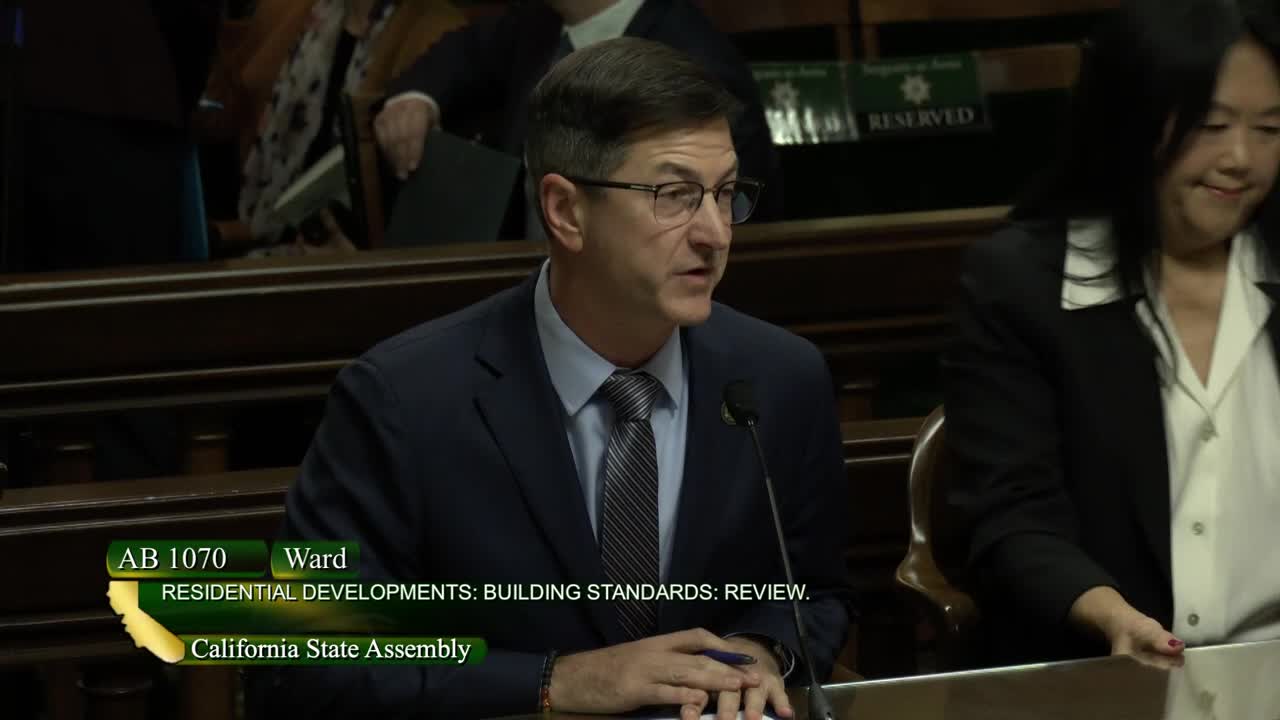 12MIN
Assembly Standing Committee on Housing and Community Development
Bill Author

Bill Co-Author(s):