AB 1106: State Air Resources Board: regional air quality incident response program.
- Session Year: 2025-2026
- House: Assembly
- Latest Version Date: 2025-03-24
Current Status:
Failed
(2026-02-02: From committee: Filed with the Chief Clerk pursuant to Joint Rule 56.)
Introduced
In Committee
Awaiting First Chamber Vote
Passed First Chamber
In Committee
Awaiting Second Chamber Vote
Passed Second Chamber
Enacted
Existing law generally designates the State Air Resources Board as the state agency with the primary responsibility for the control of vehicular air pollution, and air pollution control districts and air quality management districts with the primary responsibility for the control of air pollution from all sources other than vehicular sources. Existing law requires the state board to inventory sources of air pollution within the air basins of the state, determine the kinds and quantity of air pollutants, and monitor air pollutants in cooperation with districts and other agencies.
This bill would require the state board to expand its incident air monitoring program, subject to an appropriation by the Legislature for those purposes, to provide support for a regional network of air quality incident response centers operated by air districts, including at least one located in the South Coast Air Quality Management District, in order to facilitate emergency air monitoring response at the local and regional level. Prior to the state board establishing an air quality incident response center within an air district, the bill would require the state board to coordinate and develop operational plans for the air quality incident response centers with the relevant air districts. The bill would provide that funding made available to the state board for purposes of these provisions may be used for various purposes, including program funding to plan, create, equip, and maintain air quality incident response centers.
To the extent that the bill would expand the duties of an air district, the bill would impose a state-mandated local program.
The California Constitution requires the state to reimburse local agencies and school districts for certain costs mandated by the state. Statutory provisions establish procedures for making that reimbursement.
This bill would provide that, if the Commission on State Mandates determines that the bill contains costs mandated by the state, reimbursement for those costs shall be made pursuant to the statutory provisions noted above.
Existing law requires the State Air Resources Board to adopt rules and regulations relating to vehicular emissions standards, as specified, that will achieve the ambient air quality standards required by federal law in conjunction with other measures adopted by the state board, air pollution control and air quality management districts, and the United States Environmental Protection Agency. Existing law requires the state board to adopt and enforce rules and regulations that anticipate the development of new technologies or the improvement of existing technologies if necessary to carry out its duty.This bill would make a nonsubstantive change to this provision.Existing law requires the State Air Resources Board to adopt rules and regulations relating to vehicular emissions standards, as specified, that will achieve the ambient air quality standards required by federal law in conjunction with other measures adopted by the state board, air pollution control and air quality management districts, and the United States Environmental Protection Agency. Existing law requires the state board to adopt and enforce rules and regulations that anticipate the development of new technologies or the improvement of existing technologies if necessary to carry out its duty.
This bill would make a nonsubstantive change to this provision.
For purposes of this chapter, the following definitions apply:
(a)Air contaminant includes any toxic air contaminant designated or identified pursuant to Chapter 3.5 (commencing with Section 39650), and as defined in Section 39013, and any substance as listed in the Table of Standards pursuant to Section 70200 of Title 17 of the California Code of Regulations.
(b)Air quality incident response center means an air quality incident response center established pursuant to this chapter to facilitate emergency air monitoring.
39951.Subject to an appropriation by the Legislature for purposes of this chapter, the state board shall expand its incident air monitoring program to provide support in accordance with this chapter for a regional network of air quality incident response centers operated by districts in order to facilitate emergency air monitoring response at the local and regional level.
39952.(a)The state board shall, in coordination with districts, establish air quality incident response centers throughout the state, including at least one air quality incident response center located within the jurisdiction of the south coast district, all of which shall receive support pursuant to this chapter. Prior to the state board establishing an air quality incident response center within a district, the state board shall coordinate and develop operational plans for the air quality incident response centers with the relevant districts. The state board and each district shall only be responsible to operate an air quality incident response center and perform the other duties set forth in this chapter to the extent that the state board provides funding for those purposes.
(b)The state board and each district that operates an air quality incident response center shall coordinate to provide emergency air monitoring response for disasters or other crises impacting air quality and public health in the state, as determined by the state board and those districts.
39953.(a)Funding made available to the state board for purposes of this chapter may be used, but is not limited to being used, for any of the following purposes:
(1)Program funding to plan, create, equip, and maintain air quality incident response centers, including for the acquisition of monitoring equipment and systems, vehicles, and other necessary equipment, and facilities, needed to support air quality incident response centers, and to plan, develop, conduct training on, and implement incident response protocols.
(2)Air quality data collection, maintenance, analysis, presentation, dissemination, modeling, and publishing, and the integration of that data into a unified command or joint information center, and other related activities.
(3)The funding of staffing resources, including a State Air Quality Health Officer, and regional emergency response coordinators and technical staff at districts that operate air quality incident response centers, develop plans, prepare for, and respond during, incidents and as needed for investigation and recovery efforts.
(4)Training and preparedness exercises for state board staff and the staff of districts that operate air quality incident response centers to facilitate expeditious, efficient, and effective emergency air monitoring responses to provide air quality information to the public and protect public health.
(5)State board-supported research studies regarding any of the following:
(A)The health impacts of emissions from wildfires and other types of air quality incidents, in coordination with districts.
(B)Health risk communication research and emissions, including speciation.
(C)Updates to source profiles and emissions inventories.
(b)In undertaking their duties funded pursuant to subdivision (a), the State Air Quality Health Officer shall support local response by doing both of the following:
(1)Providing expertise to translate air monitoring data collection, analyses, and modeling results in terms of impacts on public health.
(2)Coordinating with relevant state and local agencies, local governments, and public health departments, including districts, to provide unified command and joint information centers, and with other organizations with air quality data and analysis to inform the public and local response and recovery efforts.
39954.As part of the operation of an air quality incident response center, air quality monitoring shall be conducted for targeted air contaminants of concern, as identified by the state board or the district operating that air quality incident response center, during disaster or emergency situations and during the recovery period from a disaster or emergency to aid impacted communities, and shall be conducted, as needed, in coordination with unified command centers, joint information centers, other state agencies, and other entities, as appropriate.
SEC. 2.If the Commission on State Mandates determines that this act contains costs mandated by the state, reimbursement to local agencies and school districts for those costs shall be made pursuant to Part 7 (commencing with Section 17500) of Division 4 of Title 2 of the Government Code.
SECTION 1.Section 39602.5 of the Health and Safety Code is amended to read:39602.5.(a)The state board shall adopt rules and regulations pursuant to Section 43013 that, in conjunction with other measures adopted by the state board, the districts, and the United States Environmental Protection Agency, will achieve the ambient air quality standards required by the federal Clean Air Act (42 U.S.C. Sec. 7401 et seq.) in all areas of the state by the applicable attainment date, and to maintain these standards thereafter. The state board shall adopt these measures if they are necessary, technologically feasible, and cost effective, consistent with Section 43013.(b)If necessary to carry out its duties under this section, the state board shall adopt and enforce rules and regulations that anticipate the development of new technologies or the improvement of existing technologies. The rules and regulations shall require standards that the state board finds and determines can likely be achieved by the compliance date set forth in the rule.(a)The state board shall adopt rules and regulations pursuant to Section 43013 that, in conjunction with other measures adopted by the state board, the districts, and the United States Environmental Protection Agency, will achieve the ambient air quality standards required by the federal Clean Air Act (42 U.S.C. Sec. 7401 et seq.) in all areas of the state by the applicable attainment date, and to maintain these standards thereafter. The state board shall adopt these measures if they are necessary, technologically feasible, and cost effective, consistent with Section 43013.
(b)If necessary to carry out its duties under this section, the state board shall adopt and enforce rules and regulations that anticipate the development of new technologies or the improvement of existing technologies. The rules and regulations shall require standards that the state board finds and determines can likely be achieved by the compliance date set forth in the rule.
|
Date
|
Status
|
|---|---|
| Feb 2, 2026 | From committee: Filed with the Chief Clerk pursuant to Joint Rule 56. |
| Jan 31, 2026 | Died pursuant to Art. IV, Sec. 10(c) of the Constitution. |
| May 23, 2025 | In committee: Held under submission. |
| May 7, 2025 | In committee: Set, first hearing. Referred to APPR. suspense file. |
| Apr 29, 2025 | From committee: Do pass and re-refer to Com. on APPR. (Ayes 14. Noes 0.) (April 28). Re-referred to Com. on APPR. |
| Mar 25, 2025 | Re-referred to Com. on NAT. RES. |
| Mar 24, 2025 | From committee chair, with author's amendments: Amend, and re-refer to Com. on NAT. RES. Read second time and amended. |
| Mar 24, 2025 | Referred to Com. on NAT. RES. |
| Feb 21, 2025 | From printer. May be heard in committee March 23. |
| Feb 20, 2025 | Read first time. To print. |
|
Date
|
Description
|
Location
|
Votes
|
|
|---|---|---|---|---|
| Apr 28, 2025 | Do pass and be re-referred to the Committee on [Appropriations] | Assembly Standing Committee on Natural Resources |
Passed |
This list shows positions taken on this bill by organizations on the date displayed, which is linked to the original source.
Positions by individuals are not included.
|
Organization
|
Position
|
Date
|
|---|---|---|
| California Air Pollution Control Officers Association | ** Support | |
| San Diego County Air Pollution Control District | ** Support | |
| South Coast Air Quality Management District | ** Support |
Date of Hearing: May 7, 2025
ASSEMBLY COMMITTEE ON APPROPRIATIONS
Buffy Wicks, Chair
ABPCA Bill Id:AB 1106
Author:(Michelle Rodriguez) – As Amended Ver:March 24, 2025
Policy Committee: | Natural Resources | Vote: | 14 - 0 |
|
| ||
|
|
Urgency: No State Mandated Local Program: Yes Reimbursable: Yes
SUMMARY:
This bill, subject to appropriation, requires the Air Resources Board (ARB) to expand its incident air monitoring program to provide support for a regional network of air quality incident response centers (AQIRCs) operated by local air districts to facilitate local and regional emergency air monitoring response.
Specifically, this bill, among other things:
- Requires ARB, in coordination with air districts, to establish AQIRCs throughout the state, including at least one within the jurisdiction of the south coast air district.
- Requires ARB and each air district that operates an AQIRC to coordinate to provide emergency air monitoring response for disasters or other crises impacting air quality and public health.
- Authorizes funding to ARB for numerous specified purposes, such as staffing resources, including a State Air Quality Health Officer (Officer). Requires the Officer to support local response, as specified.
- Requires, as part of the operation of an AQIRC, air quality monitoring be conducted for targeted air contaminants of concern, in coordination with unified command centers, joint information centers, other state agencies, and other entities, as appropriate.
FISCAL EFFECT:
1) ARB will incur significant ongoing costs to implement the requirements of this bill (Air Pollution Control Fund). ARB estimates costs of approximately $6.6 million in fiscal year (FY) 2025-26 and $5 million in FY 2026-27 and ongoing for 18 new positions and contract funds. Implementation costs include, among many other things, establishing, equipping, and maintaining AQIRCs with portable equipment, rapid response trailers, and contacts for laboratory analysis; creating advanced data collection, interpretation, and visualization platforms to strengthen centralized emergency response systems; purchasing and maintaining equipment; coordinating with state and local agencies to provide unified command; various enforcement-related tasks; rulemaking activities; community engagement; and other tasks.
2) By expanding the duties of an air district, this bill imposes a state-mandated local program. Costs incurred by an air district are potentially reimbursable by the state, subject to a determination by the Commission on State Mandates (General Fund). However, the bill specifies that ARB and each air district is responsible for operating an AQIRC and performing other duties set forth in this bill only to the extent ARB provides funding for those purposes.
COMMENTS:
1) Purpose. According to the author:
AB 1106 would strengthen California's existing air quality incident response program by establishing a modernized, well-equipped, and coordinated regional network of Air Quality Incident Response Centers, in collaboration with CARB and local air districts.
AB 1106 would provide timely information on existing levels of potentially dangerous air pollutants emitted as a result of wildfires and other disasters or emergencies, to increase public awareness and better inform health and emergency response agencies. This information will help improve emergency preparedness and response, protect public health, and strengthen statewide and local air quality management.
2) Background. Over the last several years, numerous catastrophic events affecting air quality and public safety have occurred throughout the state. In November 2023, a fire at a historic hangar at the former Tustin Air Base led to a public health emergency due to the presence of asbestos in debris and ash samples collected near the hangar. SCAQMD provided air monitoring data to the City of Tustin, which supported the declaration of a local and countywide state of emergency. In January 2025, a fire that erupted at the Moss Landing Power Plant led to evacuation orders for about 1,200 nearby residents. The South Coast Air Quality Management District (SCAQMD), the sponsor of this bill, notes that the recent unprecedented and devastating wildfires in Southern California have further demonstrated the critical need for increased resources to expand and modernize incident air monitoring emergency response.
The California Air Pollution Control Officers Association (CAPCOA) contends that the state’s current incident air monitoring program does not have the resources to quickly respond to emergencies, especially if multiple emergencies simultaneously occur in different regions of the state. CAPCOA argues this bill will provide timely information on levels of potentially dangerous air pollutants emitted as a result of wildfires and other disasters or emergencies to increase public awareness and inform health and emergency response agencies.
Analysis Prepared by: Nikita Koraddi / APPR. / (916) 319-2081
Date of Hearing: April 28, 2025
ASSEMBLY COMMITTEE ON NATURAL RESOURCES
Isaac G. Bryan, Chair
ABPCA Bill Id:AB 1106 (
Author:Michelle Rodriguez) – As Amended Ver:March 24, 2025
SUBJECT: State Air Resources Board: regional air quality incident response program
SUMMARY: Requires the Air Resources Board (ARB), subject to appropriation, to expand its incident air monitoring program to provide support for a regional network of air quality incident response centers (AQIRCs) operated by local air districts in order to facilitate emergency air monitoring response at the local and regional level.
EXISTING LAW:
- The federal Clean Air Act (CAA) and its implementing regulations set National Ambient Air Quality Standard (NAAQS) for six criteria pollutants, designate air basins that do not achieve NAAQS as nonattainment, and require states with nonattainment areas to submit a State Implementation Plan (SIP) detailing how they will achieve compliance with NAAQS. (42 U.S.C. 7401 et seq.)
- Establishes ARB as the air pollution control agency in California and requires the ARB, among other things, to control emissions from a wide array of mobile sources and coordinate with local air districts to control emissions from stationary sources in order to implement the CAA. (Health and Safety Code (HSC) 39000 et seq.)
- Requires ARB to (1) divide the state into air basins based upon similar meteorological and geographic conditions, and consideration for political boundary lines whenever practicable, and (2) adopt air quality standards for each air basin in consideration of the public health, safety, and welfare. (HSC 39606)
- Requires, subject to the powers and duties of the ARB, air districts to adopt and enforce rules and regulations to achieve and maintain the state and federal air quality standards in all areas affected by emission sources under their jurisdiction, and to enforce all applicable provisions of state and federal law. (HSC 40001)
- Requires air districts to develop attainment plans detailing how they will attain and maintain state air quality standards, and submit those plans to ARB. (HSC 40910 et seq.)
THIS BILL:
- Requires ARB, subject to appropriation, to expand its incident air monitoring program to provide support for a regional network of AQIRCs operated by districts in order to facilitate emergency air monitoring response at the local and regional level.
- Requires ARB to establish AQIRCs throughout the state, in coordination with districts and including at least one AQIRC in the south coast district. Requires ARB to coordinate with, and provide funding to, districts.
- Requires ARB and each district that operates an AQIRC to coordinate to provide emergency air monitoring response for disasters or other crises impacting air quality and public health.
- Authorizes funding for specified purposes.
- Requires the State Air Quality Health Officer to support local response by doing both of the following:
- Providing expertise to translate air monitoring data collection, analyses, and modeling results in terms of impacts on public health.
- Coordinating with relevant state and local agencies, local governments, and public health departments, including districts, to provide unified command and joint information centers, and with other organizations with air quality data and analysis to inform the public and local response and recovery efforts.
- Requires, as part of the operation of an AQIRC, air quality monitoring to be conducted for targeted air contaminants of concern, in coordination with unified command centers, joint information centers, other state agencies, and other entities, as appropriate.
FISCAL EFFECT: Unknown
COMMENTS:
- Background. The Palisades and Eaton Fires burned 23,700 and 14,000 acres, respectively. The University of California – Los Angeles’ Anderson School of Management estimates that the economic impacts of the wildfires could range between $76 billion and $131 billion, with insured losses estimated up to $45 billion. The impact on local businesses and employees in the affected areas is an estimated $297 million.
On top of the economic impacts, wildfires are devastating to public health. Wildfire smoke poses a significant public health threat, particularly due to fine particulate matter (PM2.5), which can cause respiratory and cardiovascular problems and exacerbate existing health conditions. It can travel deep into the lungs and may even enter the bloodstream. For urban wildfires, air toxics are a concern as smoke and ash from homes and businesses can contain asbestos, metals, and other pollutants of concern.
Wildfires are not the only health-impacting events requiring localized air monitoring. In November 2023, a fire at a historic hangar at the former Tustin Air Base led to a public health emergency due to the presence of asbestos in debris and ash samples collected near the hangar. The smoke and debris also tested positive for heavy metals, including lead, arsenic and nickel. The city of Tustin declared a local state of emergency, and the Orange County Board of Supervisors declared a county-wide state of emergency. The cleanup costs exceeded $54 million. A similar event also took place in January 2025, when a fire erupted at the Moss Landing Power Plant, a large battery storage facility, located south of San Francisco. The incident led to evacuation orders for about 1,200 nearby residents. About 80% of the structure and its batteries were destroyed in the fire. After burning through the night, emergency officials declared the fire a local emergency.
According to the author, these events highlight the critical need for enhanced localized air monitoring response to emergency events. Once funded, AB 1106 would provide timely information on existing levels of potentially dangerous air pollutants emitted as a result of wildfires and other disasters or emergencies to increase public awareness and inform health and emergency response agencies. This information will help improve emergency preparedness and response, protect public health, and strengthen statewide and local air quality management.
- Author’s statement:
Over the last several years numerous catastrophic events affecting air quality and public safety have occurred throughout the state. The recent unprecedented urban wildfires in Southern California have further demonstrated the critical need for increased resources to expand and enhance localized air monitoring response to emergency events.
AB 1106 would strengthen California's existing air quality incident response program by establishing a modernized, well-equipped, and coordinated regional network of Air Quality Incident Response Centers, in collaboration with CARB and local air districts.
AB 1106 would provide timely information on existing levels of potentially dangerous air pollutants emitted as a result of wildfires and other disasters or emergencies, to increase public awareness and better inform health and emergency response agencies. This information will help improve emergency preparedness and response, protect public health, and strengthen statewide and local air quality management.
REGISTERED SUPPORT / OPPOSITION:
Support
South Coast Air Quality Management District (sponsor)
California Air Pollution Control Officers Association
San Diego County Air Pollution Control District
Opposition
None on file
Analysis Prepared by: Lawrence Lingbloom / NAT. RES. /
Discussed in Hearing
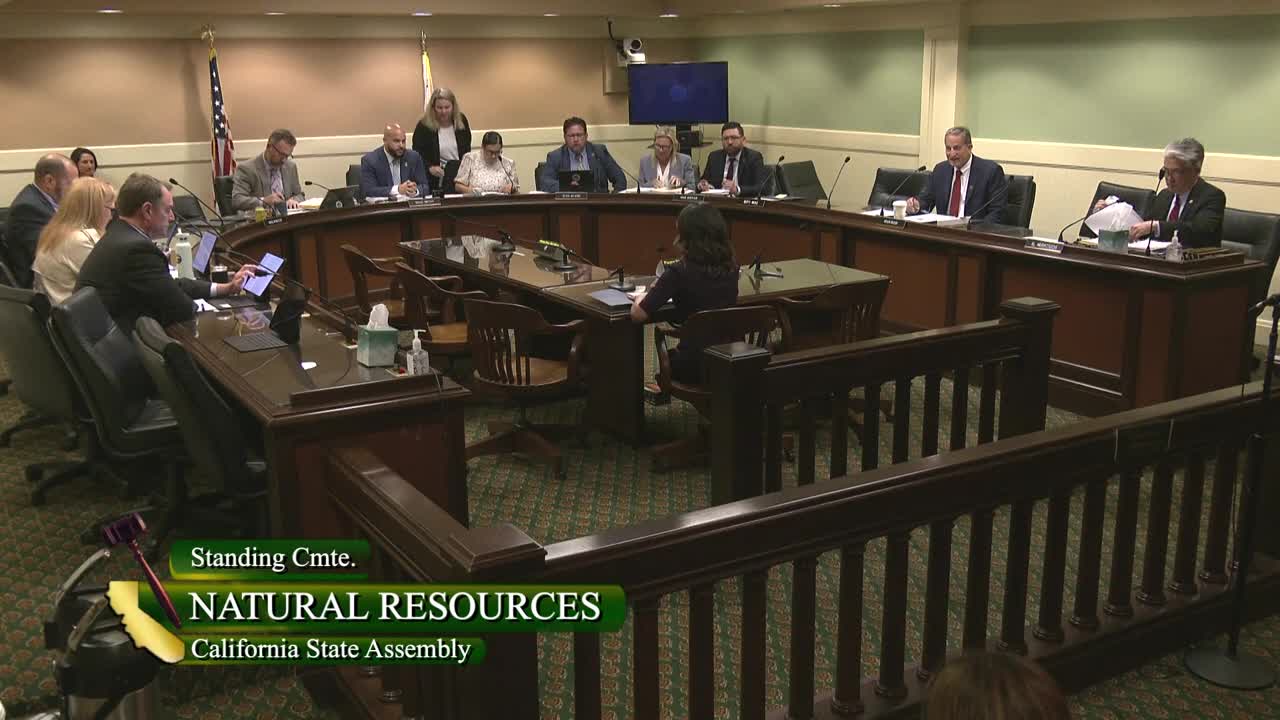 7MIN
Assembly Standing Committee on Natural Resources
Bill Author

Bill Co-Author(s):
