AB 1145: Vehicles: local regulation: Department of Transportation.
- Session Year: 2025-2026
- House: Assembly
- Latest Version Date: 2026-09-27
Current Status:
Passed
(2026-09-27: Chaptered by Secretary of State - Chapter 511, Statutes of 2026.)
Introduced
In Committee
Awaiting First Chamber Vote
Passed First Chamber
In Committee
Awaiting Second Chamber Vote
Passed Second Chamber
Enacted
Existing law authorizes local authorities, for those highways under their jurisdiction, to adopt rules and regulations by ordinance or resolution, on various matters, including regulating traffic by means of specified official traffic control devices and prohibiting the use of particular highways by certain vehicles. Existing law authorizes specified proposed ordinances or resolutions to be effective as to any state highway or part thereof if the proposed ordinance or resolution is submitted to the Department of Transportation for approval prior to the enactment, as specified.
This bill would require the Department of Transportation, when reviewing and approving or rejecting an ordinance or resolution that has been submitted to the department for approval by a local authority, to consider the costs of the proposed ordinance or resolution compared to any possible alternative solution to the issue that the proposed ordinance or resolution is addressing and to provide written reasons and justifications for a rejection.
Existing law authorizes local authorities, for those highways under their jurisdiction, to adopt rules and regulations by ordinance or resolution, on various matters, including regulating traffic by means of specified official traffic control devices and prohibiting the use of particular highways by certain vehicles. Existing law authorizes specified proposed ordinances or resolutions to be effective as to any state highway or part thereof if the proposed ordinance or resolution is submitted to the Department of Transportation approval prior to the enactment, as specified.
This bill would require the Department of Transportation, when reviewing and approving or rejecting an ordinance or resolution that has been submitted to the department for approval by a local authority, to consider the costs of the proposed ordinance or resolution compared to any possible alternative solution to the issue that the proposed ordinance or resolution is addressing and to provide written reasons and justifications for a rejection.
Existing law establishes the Department of Transportation and the California Transportation Commission and vests the department with full possession and control of all state highways and all property and rights in property acquired for state highway purposes. Existing law requires the department to improve and maintain state highways, including all traversable highways that have been adopted or designated as state highways by the commission.This bill would require the department, on or before December 31, 2027, to conduct a study on highway safety on State Highway Route 74. The bill would require the study to collect specified data over the preceding 10 years, as provided, and to develop recommendations to improve highway safety on State Highway Route 74, including recommendations on how to address enforcement facility bypassing on roadways other than State Highway Route 74, as specified. The bill would require the department to report its findings and recommendations to the Legislature on or before December 31, 2027. The bill would repeal these provisions as of January 1, 2029.Existing law establishes the Department of Transportation and the California Transportation Commission and vests the department with full possession and control of all state highways and all property and rights in property acquired for state highway purposes. Existing law requires the department to improve and maintain state highways, including all traversable highways that have been adopted or designated as state highways by the commission.
This bill would require the department, on or before December 31, 2027, to conduct a study on highway safety on the state highway system, including, but not limited to, State Highway Route 74. The bill would require the study to collect specified data, disaggregated by state highway, data over the preceding 10 years, as provided, and to develop recommendations to improve highway safety on the state highway system, State Highway Route 74, including recommendations on how to address enforcement facility bypassing, bypassing on roadways other than State Highway Route 74, as specified. The bill would require the department to report its findings and recommendations to the Legislature on or before December 31, 2027. The bill would repeal these provisions as of January 1, 2029.
Existing law establishes the Department of Transportation and the California Transportation Commission and vests the department with full possession and control of all state highways and all property and rights in property acquired for state highway purposes. Existing law requires the department to improve and maintain state highways, including all traversable highways that have been adopted or designated as state highways by the commission.
This bill would require the department, on or before December 31, 2027, to conduct a study on highway safety on the state highway system, including, but not limited to, State Highway Route 74. The bill would require the study to collect specified data, disaggregated by state highway, over the preceding 10 years, as provided, and to develop recommendations to improve highway safety on the state highway system, including recommendations on how to address enforcement facility bypassing, as specified. The bill would require the department to report its findings and recommendations to the Legislature on or before December 31, 2027. The bill would repeal these provisions as of January 1, 2029.
Existing law requires the Department of Transportation to designate a state highway segment as a Safety Enhancement-Double Fine Zone if specified conditions are met, including that the highway segment is eligible for designation pursuant to specified law. Existing law provides that a certain segment of State Highway Route 12 is eligible for designation as a Safety Enhancement-Double Fine Zone. Existing law requires the fine for certain violations of the Vehicle Code that are committed within a Safety Enhancement-Double Fine Zone to be doubled in a misdemeanor case and to be one category higher than the penalty otherwise prescribed by the uniform traffic penalty schedule in an infraction case. Existing law requires a commercial motor vehicle, singly or in combination, that operates with a declared gross or combined gross vehicle weight that exceeds 10,000 pounds to be registered, prohibits a person from operating a commercial motor vehicle, either singly or in combination, in excess of its registered declared gross or combined gross vehicle weight, and makes a violation of these provisions punishable as an infraction.This bill would make eligible for designation as a Safety Enhancement-Double Fine Zone State Highway Route 74 between the State Highway Route 111 junction in the City of Palm Desert and the State Highway Route 371 in Anza. The bill would also make a violation of the above-described rules relating to commercial motor vehicle weight limits within an area that has been designated as a Safety Enhancement-Double Fine Zone subject to the fine enhancement for an infraction case.Existing law requires the Department of Transportation to designate a state highway segment as a Safety Enhancement-Double Fine Zone if specified conditions are met, including that the highway segment is eligible for designation pursuant to specified law. Existing law provides that a certain segment of State Highway Route 12 is eligible for designation as a Safety Enhancement-Double Fine Zone. Existing law requires the fine for certain violations of the Vehicle Code that are committed within a Safety Enhancement-Double Fine Zone to be doubled in a misdemeanor case and to be one category higher than the penalty otherwise prescribed by the uniform traffic penalty schedule in an infraction case. Existing law requires a commercial motor vehicle, singly or in combination, that operates with a declared gross or combined gross vehicle weight that exceeds 10,000 pounds to be registered, prohibits a person from operating a commercial motor vehicle, either singly or in combination, in excess of its registered declared gross or combined gross vehicle weight, and makes a violation of these provisions punishable as an infraction.
This bill would make eligible for designation as a Safety Enhancement-Double Fine Zone State Highway Route 74 between the State Highway Route 111 junction in the City of Palm Desert and the State Highway Route 371 in Anza. The bill would also make a violation of the above-described rules relating to commercial motor vehicle weight limits within an area that has been designated as a Safety Enhancement-Double Fine Zone subject to the fine enhancement for an infraction case.
Existing law makes various provisions of the law relating to vehicles crimes, subject to various fines. Existing law makes driving a vehicle upon a highway at a speed greater than 100 miles per hour guilty of an infraction and subject to a $500 fine, as specified.This bill would state that it is the intent of the Legislature to enact legislation relating to penalties for certain traffic violations.Existing law makes various provisions of the law relating to vehicles crimes, subject to various fines. Existing law makes driving a vehicle upon a highway at a speed greater than 100 miles per hour guilty of an infraction and subject to a $500 fine, as specified.
This bill would state that it is the intent of the Legislature to enact legislation relating to penalties for certain traffic violations.
(a)An ordinance or resolution proposed to be enacted under Section 21101 or subdivision (d) of Section 21100 is not effective as to any highway not under the exclusive jurisdiction of the local authority enacting the same, except that an ordinance or resolution submitted to the Department of Transportation by a local authority for approval, in complete form and prior to the enactment of the ordinance or resolution, is effective as to any state highway or part thereof specified in the written approval of the department.
(b)The Department of Transportation shall do both of the following when reviewing, and approving or rejecting, a proposed ordinance or resolution that has been submitted to the department for approval by a local authority pursuant to subdivision (a):
(1)Consider the costs of the proposed ordinance or resolution compared to any possible alternative solution to the issue that the proposed ordinance or resolution is addressing.
(2)If the department rejects the proposed ordinance or resolution, provide written reasons and justifications for the rejection to the submitting local authority.
(c)This section does not preclude the application of an ordinance or resolution adopted under Section 21101 or subdivision (d) of Section 21100 to streets maintained by a community services district organized pursuant to Division 3 (commencing with Section 61000) of Title 6 of the Government Code. An ordinance or resolution enacted by a local authority pursuant to subdivision (c) of Section 21101 may impose a fine or penalty of up to one hundred dollars ($100) for a violation of this code.
No (a)An ordinance or resolution proposed to be enacted under Section 21101 or subdivision (d) of Section 21100 is not effective as to any highway not under the exclusive jurisdiction of the local authority enacting the same, except that an ordinance or resolution which is submitted to the Department of Transportation by a local legislative body in complete draft form for approval authority for approval, in complete form and prior to the enactment thereof of the ordinance or resolution, is effective as to any state highway or part thereof specified in the written approval of the department.
(b)The Department of Transportation shall do both of the following when reviewing, and approving or rejecting, a proposed ordinance or resolution that has been submitted to the department for approval by a local authority pursuant to subdivision (a):
(1)Consider the costs of the proposed ordinance or resolution compared to any possible alternative solution to the issue that the proposed ordinance or resolution is addressing.
(2)If the department rejects the proposed ordinance or resolution, provide written reasons and justifications for the rejection to the submitting local authority.
This(c)This section does not preclude the application of an ordinance or resolution adopted under Section 21101 or subdivision (d) of Section 21100 to streets maintained by a community services district organized pursuant to Division 3 (commencing with Section 61000) of Title 6 of the Government Code. An ordinance or resolution enacted by a local authority pursuant to subdivision (c) of Section 21101 may impose a fine or penalty of up to one hundred dollars ($100) for a violation of this code.
SECTION 1.Section 98 is added to the Streets and Highways Code, to read:98.(a)The department shall, on or before December 31, 2027, conduct a study on highway safety on State Highway Route 74. The study shall collect all available data over the preceding 10 years, including, but not limited to, all of the following data:(1)The number of accidents, including fatal and nonfatal accidents.(2)The number of 911 calls related to tire blowouts due to potholes or other poor road conditions.(3)The number of incidents involving truck tractors.(4)The number and types of citations issued for violations of the Vehicle Code, including, but not limited to, weight-limit violations.(5)The number of injuries and fatalities.(6)The number of instances in which an accident was caused by brake failure.(7)All of the following relating to enforcement facilities:(A)The identification of transportation corridors used to bypass enforcement facilities.(B)The resulting dangers, hazards, poor road conditions, and other consequences of the transportation corridors identified pursuant to subparagraph (A).(C)The identification of hot spots on the corridors identified pursuant to subparagraph (A) and the enforcement facilities being bypassed.(b)As part of the study required pursuant to subdivision (a), the department shall develop recommendations to improve highway safety on State Highway Route 74, including recommendations on how to address enforcement facility bypassing on roadways other than State Highway Route 74, which shall include, but is not limited to, recommendations relating to increased enforcement, road safety projects, and road maintenance projects.(c)The department shall report its findings and recommendations to the Legislature on or before December 31, 2027, consistent with the requirements of Section 9795 of the Government Code.(d)This section shall remain in effect only until January 1, 2029, and as of that date is repealed.(a)The department shall, on or before December 31, 2027, conduct a study on highway safety on the state highway system, including, but not limited to, State Highway Route 74. The study shall collect all available data, disaggregated by state highway, data over the preceding 10 years, including, but not limited to, all of the following data:
(1)The number of accidents, including fatal and nonfatal accidents.
(2)The number of 911 calls related to tire blowouts due to potholes and otherwise or other poor road conditions.
(3)The number of incidents involving truck tractors.
(4)The number and types of citations issued for violations of the Vehicle Code, including, but not limited to, weight-limit violations.
(5)The number of injuries and fatalities.
(6)The number of instances in which an accident was caused by brake failure.
(7)All of the following relating to enforcement facilities:
(A)The identification of transportation corridors used to bypass enforcement facilities.
(B)The resulting dangers, hazards, poor road conditions, and other consequences of the transportation corridors identified pursuant to subparagraph (A).
(C)The identification of hot spots on the corridors identified pursuant to subparagraph (A) and the enforcement facilities being bypassed.
(b)As part of the study required pursuant to subdivision (a), the department shall develop recommendations to improve highway safety on the state highway system, State Highway Route 74, including recommendations on how to address enforcement facility bypassing, bypassing on roadways other than State Highway Route 74, which shall include, but is not limited to, recommendations relating to increased enforcement, road safety projects, and road maintenance projects.
(c)The department shall report its findings and recommendations to the Legislature on or before December 31, 2027, consistent with the requirements of Section 9795 of the Government Code.
(d)This section shall remain in effect only until January 1, 2029, and as of that date is repealed.
(a)The department shall, on or before December 31, 2027, conduct a study on highway safety on the state highway system, including, but not limited to, State Highway Route 74. The study shall collect all available data, disaggregated by state highway, over the preceding 10 years, including, but not limited to, all of the following data:
(1)The number of accidents, including fatal and nonfatal accidents.
(2)The number of 911 calls related to tire blowouts due to potholes and otherwise poor road conditions.
(3)The number of incidents involving truck tractors.
(4)The number and types of citations issued for violations of the Vehicle Code, including, but not limited to, weight-limit violations.
(5)The number of injuries and fatalities.
(6)The number of instances in which an accident was caused by brake failure.
(7)All of the following relating to enforcement facilities:
(A)The identification of transportation corridors used to bypass enforcement facilities.
(B)The resulting dangers, hazards, poor conditions, and other consequences of the transportation corridors identified pursuant to subparagraph (A).
(C)The identification of hot spots on the corridors identified pursuant to subparagraph (A) and the enforcement facilities being bypassed.
(b)As part of the study required pursuant to subdivision (a), the department shall develop recommendations to improve highway safety on the state highway system, including recommendations on how to address enforcement facility bypassing, which shall include, but is not limited to, recommendations relating to increased enforcement, road safety projects, and road maintenance projects.
(c)The department shall report its findings and recommendations to the Legislature on or before December 31, 2027, consistent with the requirements of Section 9795 of the Government Code.
(d)This section shall remain in effect only until January 1, 2029, and as of that date is repealed.
SECTION 1.Section 97 of the Streets and Highways Code is amended to read:97.(a)A state highway segment shall be designated by the department as a Safety Enhancement-Double Fine Zone if all of the following conditions have been satisfied:(1) The highway segment is eligible for designation pursuant to subdivision (b).(2)The Director of Transportation, in consultation with the Commissioner of the California Highway Patrol, certifies that the segment identified in subdivision (b) meets all of the following criteria:(A)The highway segment is a conventional highway or expressway and is part of the state highway system.(B)The rate of total collisions per mile per year on the segment under consideration has been at least 1.5 times the statewide average for similar roadway types during the most recent three-year period for which data are available.(C)The rate of head-on collisions per mile per year on the segment under consideration has been at least 1.5 times the statewide average for similar roadway types during the most recent three-year period for which data are available.(3)The Department of the California Highway Patrol or local agency having traffic enforcement jurisdiction, as the case may be, has concurred with the designation.(4)The governing board of each city, or county with respect to an unincorporated area, in which the segment is located has by resolution indicated that it supports the designation.(5)An active public awareness effort to change driving behavior is ongoing either by the local agency with jurisdiction over the segment or by another state or local entity.(6)Other traffic safety enhancements, including, but not limited to, increased enforcement and other roadway safety measures, are in place or are being implemented concurrent with the designation of the Safety Enhancement-Double Fine Zone.(b)The following segments are eligible for designation as a Safety Enhancement-Double Fine Zone pursuant to subdivision (a):(1)State Highway Route 12 between the State Highway Route 80 junction in Solano County and the State Highway Route 5 junction in San Joaquin County.(2)State Highway Route 74 between the State Highway Route 111 junction in the City of Palm Desert and the State Highway Route 371 in Anza.(c)Designation of a segment as a Safety Enhancement-Double Fine Zone by the department pursuant to subdivision (a) shall be done in writing and a written notification shall be provided to the court with jurisdiction over the area in which the highway segment is located. The designation shall be valid for a minimum of two years from the date of submission to the court.(d)After the two-year period, and at least every two years thereafter, the department, in consultation with the Department of the California Highway Patrol, shall evaluate whether the highway segment continues to meet the conditions set forth in subdivision (a). If the segment meets those conditions, the department shall renew the designation in which case an updated notification shall be sent to the court. If the department, in consultation with the Department of the California Highway Patrol, determines that any of those conditions no longer apply to a segment designated as a Safety Enhancement-Double Fine Zone under this section, the department shall revoke the designation and the segment shall cease to be a Safety Enhancement-Double Fine Zone.(e)A Safety Enhancement-Double Fine Zone is subject to the rules and regulations adopted by the department prescribing uniform standards for warning signs to notify motorists that, pursuant to Section 42010 of the Vehicle Code, increased penalties apply for traffic violations that are committed within a Safety Enhancement-Double Fine Zone.(f)(1)The department or the local authority having jurisdiction over these highway and road segments shall place and maintain the warning signs identifying these segments by stating that a Special Safety Zone Region Begins Here and a Special Safety Zone Ends Here.(2)Increased penalties shall apply to violations under Section 42010 of the Vehicle Code only if appropriate signage is in place pursuant to this subdivision.(3)If designation as a Safety Enhancement-Double Fine Zone is revoked pursuant to subdivision (d), the department shall be responsible for removal of all signage placed pursuant to this subdivision.(g)Safety Enhancement-Double Fine Zones do not increase the civil liability of the state or local authority having jurisdiction over the highway segment under Division 3.6 (commencing with Section 810) of Title 1 of the Government Code or any other provision of law relating to civil liability.(1)Only the base fine shall be enhanced pursuant to this section.(2)Notwithstanding any other provision of law, any additional penalty, forfeiture, or assessment imposed by any other statute shall be based on the amount of the base fine before enhancement or doubling and shall not be based on the amount of the enhanced fine imposed pursuant to this section.(h)The projects specified as a Safety Enhancement-Double Fine Zone shall not be elevated in priority for state funding purposes.SEC. 2.Section 42010 of the Vehicle Code is amended to read:42010.(a)For an offense specified in subdivision (b) that is committed by the driver of a vehicle within an area that has been designated as a Safety Enhancement-Double Fine Zone pursuant to Section 97 and following of the Streets and Highways Code, the fine, in a misdemeanor case, shall be double the amount otherwise prescribed, and, in an infraction case, the fine shall be one category higher than the penalty otherwise prescribed by the uniform traffic penalty schedule established pursuant to Section 40310.(b)A violation of the following is an offense that is subject to subdivision (a):(1)Chapter 3 (commencing with Section 21650) of Division 11, relating to driving, overtaking, and passing.(2)Chapter 7 (commencing with Section 22348) of Division 11, relating to speed limits.(3)Section 23103, relating to reckless driving.(4)Section 23104 or 23105, relating to reckless driving that results in bodily injury to another.(5)Section 23109 or 23109.1, relating to speed contests.(6)Section 23152, relating to driving under the influence of alcohol or a controlled substance, or a violation of Section 23103, as specified in Section 23103.5, relating to alcohol-related reckless driving.(7)Section 23153, relating to driving under the influence of alcohol or a controlled substance, which results in bodily injury to another.(8)Section 23154, relating to convicted drunk drivers operating a motor vehicle with a blood-alcohol concentration of 0.01 percent or greater.(9)Section 23220, relating to drinking while driving.(10)Section 23221, relating to drinking in a motor vehicle while on the highway.(11)Section 23222, relating to driving while possessing an open alcoholic beverage container.(12)Section 23223, relating to being in a vehicle on the highway while possessing an open alcoholic beverage container.(13)Section 23224, relating to being a driver or passenger under 21 years of age possessing an open alcoholic beverage container.(14)Section 23225, relating to being the owner or driver of a vehicle in which there is an open alcoholic beverage container.(15)Section 23226, relating to being a passenger in a vehicle in which there is an open alcoholic beverage container.(16)Section 4000.6, relating to commercial motor vehicle weight limits.(c)This section applies only when traffic controls or warning signs have been placed pursuant to Section 97 or 97.1 of the Streets and Highways Code.(d)(1)Notwithstanding any other law, the enhanced fine imposed pursuant to this section shall be based only on the base fine imposed for the underlying offense and shall not include any other enhancements imposed pursuant to law.(2)Notwithstanding any other provision of law, any additional penalty, forfeiture, or assessment imposed by any other statute shall be based on the amount of the base fine before enhancement or doubling and shall not be based on the amount of the enhanced fine imposed pursuant to this section.(a)A state highway segment shall be designated by the department as a Safety Enhancement-Double Fine Zone if all of the following conditions have been satisfied:
(1) The highway segment is eligible for designation pursuant to subdivision (b).
(2)The Director of Transportation, in consultation with the Commissioner of the California Highway Patrol, certifies that the segment identified in subdivision (b) meets all of the following criteria:
(A)The highway segment is a conventional highway or expressway and is part of the state highway system.
(B)The rate of total collisions per mile per year on the segment under consideration has been at least 1.5 times the statewide average for similar roadway types during the most recent three-year period for which data are available.
(C)The rate of head-on collisions per mile per year on the segment under consideration has been at least 1.5 times the statewide average for similar roadway types during the most recent three-year period for which data are available.
(3)The Department of the California Highway Patrol or local agency having traffic enforcement jurisdiction, as the case may be, has concurred with the designation.
(4)The governing board of each city, or county with respect to an unincorporated area, in which the segment is located has by resolution indicated that it supports the designation.
(5)An active public awareness effort to change driving behavior is ongoing either by the local agency with jurisdiction over the segment or by another state or local entity.
(6)Other traffic safety enhancements, including, but not limited to, increased enforcement and other roadway safety measures, are in place or are being implemented concurrent with the designation of the Safety Enhancement-Double Fine Zone.
(b)The following segments are eligible for designation as a Safety Enhancement-Double Fine Zone pursuant to subdivision (a):
(1)State Highway Route 12 between the State Highway Route 80 junction in Solano County and the State Highway Route 5 junction in San Joaquin County.
(2)State Highway Route 74 between the State Highway Route 111 junction in the City of Palm Desert and the State Highway Route 371 in Anza.
(c)Designation of a segment as a Safety Enhancement-Double Fine Zone by the department pursuant to subdivision (a) shall be done in writing and a written notification shall be provided to the court with jurisdiction over the area in which the highway segment is located. The designation shall be valid for a minimum of two years from the date of submission to the court.
(d)After the two-year period, and at least every two years thereafter, the department, in consultation with the Department of the California Highway Patrol, shall evaluate whether the highway segment continues to meet the conditions set forth in subdivision (a). If the segment meets those conditions, the department shall renew the designation in which case an updated notification shall be sent to the court. If the department, in consultation with the Department of the California Highway Patrol, determines that any of those conditions no longer apply to a segment designated as a Safety Enhancement-Double Fine Zone under this section, the department shall revoke the designation and the segment shall cease to be a Safety Enhancement-Double Fine Zone.
(e)A Safety Enhancement-Double Fine Zone is subject to the rules and regulations adopted by the department prescribing uniform standards for warning signs to notify motorists that, pursuant to Section 42010 of the Vehicle Code, increased penalties apply for traffic violations that are committed within a Safety Enhancement-Double Fine Zone.
(f)(1)The department or the local authority having jurisdiction over these highway and road segments shall place and maintain the warning signs identifying these segments by stating that a Special Safety Zone Region Begins Here and a Special Safety Zone Ends Here.
(2)Increased penalties shall apply to violations under Section 42010 of the Vehicle Code only if appropriate signage is in place pursuant to this subdivision.
(3)If designation as a Safety Enhancement-Double Fine Zone is revoked pursuant to subdivision (d), the department shall be responsible for removal of all signage placed pursuant to this subdivision.
(g)Safety Enhancement-Double Fine Zones do not increase the civil liability of the state or local authority having jurisdiction over the highway segment under Division 3.6 (commencing with Section 810) of Title 1 of the Government Code or any other provision of law relating to civil liability.
(1)Only the base fine shall be enhanced pursuant to this section.
(2)Notwithstanding any other provision of law, any additional penalty, forfeiture, or assessment imposed by any other statute shall be based on the amount of the base fine before enhancement or doubling and shall not be based on the amount of the enhanced fine imposed pursuant to this section.
(h)The projects specified as a Safety Enhancement-Double Fine Zone shall not be elevated in priority for state funding purposes.
(i)The requirements of subdivision (a) shall not apply to the Safety Enhancement-Double Fine Zone established prior to the effective date of this subdivision pursuant to Section 97.4 or to the Safety Enhancement-Double Fine Zones established pursuant to Section 97.5.SEC. 2.Section 42010 of the Vehicle Code is amended to read:42010.(a)For an offense specified in subdivision (b) that is committed by the driver of a vehicle within an area that has been designated as a Safety Enhancement-Double Fine Zone pursuant to Section 97 and following of the Streets and Highways Code, the fine, in a misdemeanor case, shall be double the amount otherwise prescribed, and, in an infraction case, the fine shall be one category higher than the penalty otherwise prescribed by the uniform traffic penalty schedule established pursuant to Section 40310.
(b)A violation of the following is an offense that is subject to subdivision (a):
(1)Chapter 3 (commencing with Section 21650) of Division 11, relating to driving, overtaking, and passing.
(2)Chapter 7 (commencing with Section 22348) of Division 11, relating to speed limits.
(3)Section 23103, relating to reckless driving.
(4)Section 23104 or 23105, relating to reckless driving that results in bodily injury to another.
(5)Section 23109 or 23109.1, relating to speed contests.
(6)Section 23152, relating to driving under the influence of alcohol or a controlled substance, or a violation of Section 23103, as specified in Section 23103.5, relating to alcohol-related reckless driving.
(7)Section 23153, relating to driving under the influence of alcohol or a controlled substance, which results in bodily injury to another.
(8)Section 23154, relating to convicted drunk drivers operating a motor vehicle with a blood-alcohol concentration of 0.01 percent or greater.
(9)Section 23220, relating to drinking while driving.
(10)Section 23221, relating to drinking in a motor vehicle while on the highway.
(11)Section 23222, relating to driving while possessing an open alcoholic beverage container.
(12)Section 23223, relating to being in a vehicle on the highway while possessing an open alcoholic beverage container.
(13)Section 23224, relating to being a driver or passenger under 21 years of age possessing an open alcoholic beverage container.
(14)Section 23225, relating to being the owner or driver of a vehicle in which there is an open alcoholic beverage container.
(15)Section 23226, relating to being a passenger in a vehicle in which there is an open alcoholic beverage container.
(16)Section 4000.6, relating to commercial motor vehicle weight limits.
(c)This section applies only when traffic controls or warning signs have been placed pursuant to Section 97 or 97.1 of the Streets and Highways Code.
(d)(1)Notwithstanding any other provision of law, the enhanced fine imposed pursuant to this section shall be based only on the base fine imposed for the underlying offense and shall not include any other enhancements imposed pursuant to law.
(2)Notwithstanding any other provision of law, any additional penalty, forfeiture, or assessment imposed by any other statute shall be based on the amount of the base fine before enhancement or doubling and shall not be based on the amount of the enhanced fine imposed pursuant to this section.
SECTION 1.It is the intent of the Legislature to enact legislation relating to penalties for certain traffic violations.It is the intent of the Legislature to enact legislation relating to penalties for certain traffic violations.
|
Date
|
Status
|
|---|---|
| Sep 27, 2026 | Chaptered by Secretary of State - Chapter 511, Statutes of 2026. |
| Sep 27, 2026 | Approved by the Governor. |
| Aug 24, 2026 | Enrolled and presented to the Governor at 4:30 p.m. |
| Aug 17, 2026 | Senate amendments concurred in. To Engrossing and Enrolling. (Ayes 73. Noes 0. Page 6200.). |
| Aug 17, 2026 | Senate amendments concurred in. To Engrossing and Enrolling. |
| Aug 11, 2026 | In Assembly. Concurrence in Senate amendments pending. |
| Aug 10, 2026 | Read third time. Passed. Ordered to the Assembly. (Ayes 39. Noes 0.). |
| Aug 10, 2026 | Read third time. Passed. Ordered to the Assembly. (Ayes 39. Noes 0. Page 5321.). |
| Aug 4, 2026 | Read second time. Ordered to Consent Calendar. |
| Aug 3, 2026 | From committee: Be ordered to second reading file pursuant to Senate Rule 28.8 and ordered to Consent Calendar. |
| Jul 1, 2026 | From committee: Do pass and re-refer to Com. on APPR. with recommendation: To Consent Calendar. (Ayes 12. Noes 0.) (June 30). Re-referred to Com. on APPR. |
| Jun 17, 2026 | From committee chair, with author's amendments: Amend, and re-refer to committee. Read second time, amended, and re-referred to Com. on TRANS. |
| Jul 1, 2025 | In committee: Set, first hearing. Hearing canceled at the request of author. |
| Jun 18, 2025 | Referred to Com. on TRANS. |
| Jun 4, 2025 | In Senate. Read first time. To Com. on RLS. for assignment. |
| Jun 3, 2025 | Read third time. Passed. Ordered to the Senate. (Ayes 78. Noes 0. Page 2014.) |
| May 27, 2025 | Read second time. Ordered to third reading. |
| May 23, 2025 | Read second time and amended. Ordered returned to second reading. |
| May 23, 2025 | From committee: Amend, and do pass as amended. (Ayes 14. Noes 0.) (May 23). |
| May 23, 2025 | Assembly Rule 63 suspended. (Ayes 51. Noes 16. Page 1644.) |
| May 21, 2025 | Joint Rule 62(a), file notice suspended. (Page 1627.) |
| May 21, 2025 | In committee: Set, first hearing. Referred to APPR. suspense file. |
| May 14, 2025 | In committee: Hearing postponed by committee. |
| Apr 29, 2025 | From committee: Do pass and re-refer to Com. on APPR. with recommendation: To Consent Calendar. (Ayes 16. Noes 0.) (April 28). Re-referred to Com. on APPR. |
| Apr 22, 2025 | Re-referred to Com. on TRANS. |
| Apr 21, 2025 | From committee chair, with author's amendments: Amend, and re-refer to Com. on TRANS. Read second time and amended. |
| Apr 8, 2025 | In committee: Hearing postponed by committee. |
| Mar 25, 2025 | Re-referred to Com. on TRANS. |
| Mar 24, 2025 | Referred to Com. on TRANS. |
| Mar 24, 2025 | From committee chair, with author's amendments: Amend, and re-refer to Com. on TRANS. Read second time and amended. |
| Feb 21, 2025 | From printer. May be heard in committee March 23. |
| Feb 20, 2025 | Read first time. To print. |
|
Date
|
Description
|
Location
|
Votes
|
|
|---|---|---|---|---|
| Aug 17, 2026 | AB 1145 Jeff Gonzalez Concurrence in Senate Amendments | Assembly Floor |
Passed |
|
| Aug 10, 2026 | Consent Calendar 2nd AB1145 Jeff Gonzalez et al. | Senate Floor |
Passed |
|
| Jun 30, 2026 | Do pass, but first be re-referred to the Committee on [Appropriations] with the recommendation: To Consent Calendar | Senate Standing Committee on Transportation |
Passed |
|
| Jun 3, 2025 | AB 1145 Jeff Gonzalez Assembly Third Reading | Assembly Floor |
Passed |
|
| May 23, 2025 | Do pass as amended. | Assembly Standing Committee on Appropriations |
Passed |
|
| Apr 28, 2025 | Do pass and be re-referred to the Committee on [Appropriations] with recommendation: To Consent Calendar | Assembly Standing Committee on Transportation |
Passed |
This list shows positions taken on this bill by organizations on the date displayed, which is linked to the original source.
Positions by individuals are not included.
|
Organization
|
Position
|
Date
|
|---|---|---|
| Riverside County | ** Support | |
| Truck Safety Coalition | ** Support |
CONCURRENCE IN SENATE AMENDMENTS
CSA1 Bill Id:AB 1145
Author:(Jeff Gonzalez and Wallis)
As Amended Ver:June 17, 2026
Majority vote
SUMMARY
Requires the California Department of Transportation (Caltrans), in reviewing a proposed ordinance or resolution submitted by a local authority to regulate traffic on a state highway, to consider the cost compared to an alternative solution.
Senate Amendments
Delete the Assembly version of the bill and instead require the above.
COMMENTS
Background. According to The Office of Traffic Safety (OTS), California continues to experience a road safety crisis. Projections from the National Highway Traffic Safety Administration (NHSTA) estimate more than 4,400 people were killed in motor vehicle crashes throughout California in 2022, or about 12 people every day. Data from NHSTA for 2023 and 2024 estimates a year over year 5% increase in traffic fatalities. Across the state, traffic fatalities increased approximately 7.6% from 3,980 in 2020 to 4,285 in 2021. The increase of traffic fatalities in recent years led to the creation of the Vision Zero Network—a collaborative campaign with the goal of eliminating all traffic fatalities and severe injuries while increasing safe, healthy, and equitable mobility for all. Today, more than 40 communities (including at least 13 in California) across the country have joined the Vision Zero Network.
In 2022, Caltrans issued a Director's Policy on Road Safety (DP-36) which reaffirmed their vision of reaching zero fatalities and serious injuries on state highways by 2050. It also committed to a "Safe System" approach, which focuses on five elements: safe road users, safe roads, safe speeds, safe vehicles, and post-crash care. As part of DP-36, Caltrans committed to prioritizing safety in highway planning, operation, construction, and maintenance, to focus on eliminating the most serious crashes rather than all crashes and eliminating disparities in road safety outcomes. Caltrans is planning additional measures this year to further the Safe System approach.
Truck safety laws. The California Highway Patrol (CHP) enforces California's truck operating laws and regulations. CHP operates Commercial Vehicle Enforcement Facilities (CVEF) across the state to inspect the safety and weight of trucks and commercial vehicles. There are currently 54 CVEFs in the state plus 76 mini-sites.
Focus on State Route 74. State Route 74 (SR 74) is a 93-mile east–west highway extending from Interstate 5 in the City of San Juan Capistrano in Orange County to the southern city limits of Palm Desert in Riverside County. East of the City of Hemet, SR 74 transitions into an undivided two-lane highway passing through forested and winding terrains before reaching Palm Desert.
At least twelve hairpin curves exist between Hemet and Palm Desert. Despite posted signage and advisory speeds, several curves have been identified as posing operational and safety issues to large vehicles. Hairpin curve signage is used when the roadway changes direction by at least 135 degrees. SR 74 is restricted to California legal trucks no more than 65 feet in length with a posted kingpin-to-rear-axle (KPRA) advisory distance of 30 feet or less. This advisory warns commercial vehicle drivers that the route may not be well-suited for long wheelbases or trailer vehicles.
Residents of Riverside County have been concerned about the volume of trucks travelling along this route. As noted by the author below, tragically, in October 2024, Tristan Bourgeois was killed driving to work on SR 74. A large dump truck pulling a trailer, both full of sand, lost control coming down the switchbacks above Palm Springs, tipped over, and collided with his pickup truck.
In response, Tristan’s family advocated to make SR 74 safer, and the author introduced this bill last year requiring Caltrans to collect specified data from the past 10 years, including the number of fatal and nonfatal accidents, the number of incidents involving truck trailers, and the number and types of citations issued for certain violations. This bill also required Caltrans to develop recommendations to improve safety.
Local enforcement of truck safety. Existing law allows local agencies to propose truck restrictions on highways under their jurisdiction by ordinance or resolution. Those applicable to state highway must be submitted to Caltrans for approval. Caltrans' Truck Restriction Process requires local agencies to prepare an ordinance, initial study, and a report to Caltrans, all subject to public review and comment and ultimate approval by the Director of Caltrans.
Last summer, Riverside County prepared an initial study of possible truck restrictions on SR 74, including seven hairpin curves. The draft, completed in March 2026, is currently being reviewed by Caltrans and CHP. The study notes that many of the existing state route segments with specific restrictions, "were enacted due to recurring safety and operational issues on mountainous roads with steep grades or limited shoulder areas. The main concern is often off tracking even at low speeds, where long wheelbases and trailer combinations require trucks to encroach on the centerline or shoulders to complete tight turns." Specifically, the study included four recent examples of accidents or collisions since 2022 involving heavy vehicles and recommends the restriction of vehicles with more than three axles on a 21-mile segment, including a reduction of the allowable KPRA length to 38 feet.
This bill seeks to make Caltrans more deliberative and transparent. Since Riverside County moved forward with its initial study, the author recently amended AB 1145 to focus on a statewide approach that requires Caltrans to be more deliberative and transparent with these local agency requests.
Specifically, this bill requires Caltrans to consider the costs of the proposed ordinance or resolution compared to any possible alternative solution to the issue that the proposed ordinance or resolution is addressing. As noted by in the draft Riverside study, the alterative identified is widening the highway at certain points to accommodate the bigger trucks. The cost of widening a highway, especially with the conditions and terrain of SR 74's location, would be extremely difficult and costly. This bill requires Caltrans to weigh these factors in its decision making. If Caltrans rejects the proposed ordinance or resolution, it must provide written justification for the rejection to the submitting agency.
According to the Author
"Highway safety is critical to the wellbeing of communities throughout California. Highway 74 and many rural roads across the state serve as vital lifelines for residents traveling to work, school, medical appointments, and other essential destinations. Yet many of these routes continue to face serious safety challenges, including deteriorating road conditions, increasing traffic demands, and accidents involving overweight or improperly routed commercial trucks. The tragic loss of Anza resident Tristin Bourgeois on October 31, 2024, serves as a painful reminder of the consequences of these hazards. His death left behind a grieving family and community and underscores the urgent need for stronger enforcement, improved road maintenance, and greater accountability in transportation planning. AB 1145 would help address these concerns by increasing transparency, accountability, and public engagement in transportation decisions affecting rural and mountain communities throughout California. The bill would require CalTrans, in reviewing alternatives submitted by local agencies, to evaluate associated costs and provide written explanations when recommendations are rejected. While it does not dictate the outcome of any transportation study, AB 1145 ensures that local voices are heard and that communities receive meaningful responses regarding decisions that impact public safety. The loss of Tristin Bourgeois reminds us that transportation decisions have real human consequences. AB 1145 is an important step toward ensuring safer roads and a more transparent process for the communities that depend on them."
Arguments in Support
Riverside County states that "…AB 1145 would facilitate the establishment of resilient, ready, and connected communities. Our primary objective includes making Highway 74, a vital transportation corridor for businesses, commuters, and tourists, safer given that frequent accidents and hazardous road conditions have negatively impacted travel efficiency and economic activity in the region. AB 1145 is an important piece of legislation that will address road safety concerns that have plagued this region for years."
Arguments in Opposition
None on file.
FISCAL COMMENTS
According to the Senate Appropriations Committee, pursuant to Senate Rule 28.8, negligible state costs.
VOTES
ASM TRANSPORTATION: 16-0-0
YES: Wilson, Davies, Aguiar-Curry, Ahrens, Carrillo, Harabedian, Hart, Hoover, Jackson, Lackey, Lowenthal, Macedo, Papan, Ransom, Rogers, Ward
ASM APPROPRIATIONS: 14-0-1
YES: Wicks, Arambula, Calderon, Caloza, Dixon, Elhawary, Fong, Mark González, Hart, Pacheco, Pellerin, Solache, Ta, Tangipa
ABS, ABST OR NV: Sanchez
ASSEMBLY FLOOR: 78-0-1
YES: Addis, Aguiar-Curry, Ahrens, Alanis, Alvarez, Arambula, Ávila Farías, Bains, Bauer-Kahan, Bennett, Berman, Boerner, Bonta, Bryan, Calderon, Caloza, Carrillo, Castillo, Chen, Connolly, Davies, DeMaio, Dixon, Elhawary, Ellis, Flora, Fong, Gabriel, Gallagher, Garcia, Gipson, Jeff Gonzalez, Mark González, Hadwick, Haney, Harabedian, Hart, Hoover, Irwin, Jackson, Kalra, Krell, Lackey, Lowenthal, Macedo, McKinnor, Muratsuchi, Nguyen, Ortega, Pacheco, Papan, Patel, Patterson, Pellerin, Petrie-Norris, Quirk-Silva, Ramos, Ransom, Celeste Rodriguez, Michelle Rodriguez, Rogers, Blanca Rubio, Sanchez, Schiavo, Schultz, Sharp-Collins, Solache, Soria, Stefani, Ta, Tangipa, Valencia, Wallis, Ward, Wicks, Wilson, Zbur, Rivas
ABS, ABST OR NV: Lee
SENATE FLOOR: 39-0-1
YES: Allen, Archuleta, Arreguín, Ashby, Becker, Blakespear, Cabaldon, Caballero, Cervantes, Choi, Cortese, Dahle, Durazo, Gonzalez, Grayson, Grove, Hurtado, Jones, Laird, Limón, McGuire, McNerney, Menjivar, Niello, Ochoa Bogh, Padilla, Pérez, Reyes, Richardson, Rubio, Seyarto, Smallwood-Cuevas, Stern, Strickland, Umberg, Valladares, Wahab, Weber Pierson, Wiener
ABS, ABST OR NV: Alvarado-Gil
UPDATED
VERSION: June 17, 2026
CONSULTANT: Dan Chia / TRANS. / (916) 319-2093 FN: 0003444
SENATE RULES COMMITTEE Office of Senate Floor Analyses (916) 651-4171 | AB 1145 |
CONSENT
Bill No: AB 1145
Author: Jeff Gonzalez (R) and Wallis (R)
Amended: 6/17/26 in Senate
Vote: 21
SENATE TRANSPORTATION COMMITTEE: 12-0, 6/30/26
AYES: Cortese, Strickland, Archuleta, Arreguín, Blakespear, Dahle, Grayson, Menjivar, Richardson, Seyarto, Valladares, Wiener
NO VOTE RECORDED: Gonzalez
SENATE APPROPRIATIONS COMMITTEE: Senate Rule 28.8
ASSEMBLY FLOOR: 78-0, 6/3/25 - See last page for vote
SUBJECT: Vehicles: local regulation: Department of Transportation
DIGEST:
This bill 1) requires the California Department of Transportation (Caltrans), in reviewing a proposed ordinance or resolution submitted by a local authority to regulate traffic on a state highway, to consider the cost of the proposed ordnance or resolution compared to any possible alternative solution; and 2) requires Caltrans, if they reject the proposed ordinance or resolution, to provide written reasons and justifications for the rejection to the local authority.
ANALYSIS:
Existing law:
- Vests Caltrans with the responsibility of operating and maintaining state highways.
- Defines “commercial vehicle” to mean a motor vehicle of a type required to be registered, pursuant to current law, used or maintained for the transportation of persons for hire, compensation, or profit or designed, used, or maintained primarily for the transportation of property.
- Authorizes Caltrans to restrict the use of, or close, any state highway whenever they consider such closing or restriction of use necessary for the protection of the public; or for the protection of such highway from damage during storms or during construction, improvement or maintenance operations.
- Authorizes local authorities, for those highways under their jurisdiction, to adopt rules and regulations by ordinance or resolution, on various matters, including regulating traffic by means of specified official traffic control devices and prohibiting the use of particular highways by certain vehicles.
- Authorizes that a local authority that enacted an ordinance or resolution prohibiting the use of a particular highway by certain vehicles to impose a fine or a penalty of up to $100 for a violation.
- Authorizes specified proposed ordinances or resolutions to be effective as to any state highway, or part thereof, if the proposed ordinance or resolution is submitted to Caltrans approval prior to the enactment, as specified.
This bill:
- Requires Caltrans, in reviewing, and approving or rejecting, a proposed ordinance or resolution submitted by a local authority to regulate traffic on a state highway, as defined, to do both of the following:
- Consider the cost of the proposed ordinance or resolution compared to any possible alternative solution to the issue that the proposed ordinance or resolution is addressing; and,
- Requires Caltrans, if they reject the proposed ordinance or resolution, to provide written reasons and justifications for the rejection to the submitting local authority.
Comments
- Purpose of the bill. According to the author, “Highway safety is critical to the wellbeing of communities throughout California. Highway 74 and many rural roads across the state serve as vital lifelines for residents traveling to work, school, medical appointments, and other essential destinations. Yet many of these routes continue to face serious safety challenges, including deteriorating road conditions, increasing traffic demands, and accidents involving overweight or improperly routed commercial trucks. The tragic loss of Anza resident Tristin Bourgeois on October 31, 2024, serves as a painful reminder of the consequences of these hazards. His death left behind a grieving family and community and underscores the urgent need for stronger enforcement, improved road maintenance, and greater accountability in transportation planning. AB 1145 would help address these concerns by increasing transparency, accountability, and public engagement in transportation decisions affecting rural and mountain communities throughout California. The bill would require CalTrans, in reviewing alternatives submitted by local agencies, to evaluate associated costs and provide written explanations when recommendations are rejected. While it does not dictate the outcome of any transportation study, AB 1145 ensures that local voices are heard and that communities receive meaningful responses regarding decisions that impact public safety. The loss of Tristin Bourgeois reminds us that transportation decisions have real human consequences. AB 1145 is an important step toward ensuring safer roads and a more transparent process for the communities that depend on them.”
- California’s Highway System. California has a large network of highways and local streets and roads, consisting of almost 400,000 lane miles of pavement and over 25,000 bridges. The state highway system, owned and managed by Caltrans, is made up of roughly 51,000 lane miles and 13,000 bridges, including both federal and state highways. The state highway system provides mobility to millions of Californians, and serves as a major lifeline for goods movement, shepherding billions of dollars of products throughout the state every year.
- Which trucks can drive on which highways? There are two categories of truck tractor-semitrailers that are legal to operate on the roads in California. So-called Green trucks, also known as Surface Transportation Assistance Act (STAA) trucks, are a type of large commercial truck permitted under federal law to operate mostly on the Interstate Highway System and certain designated primary routes. The other type of trucks are so-called Black trucks, which are also called California legal trucks. Overall, Green STAA trucks are much longer than the standard Black trucks, which are limited to a maximum of 65 feet for overall length. Therefore, as mentioned, Green STAA trucks are much more restricted on what routes they can use in the state. Black trucks can operate widely throughout California on Interstates and have access to the entire state highway system except where specifically prohibited.
Trucks are also regulated by kingpin-to-rear-axle (KPRA), which measures how far the trailer’s rear axle group can be from the kingpin. KPRA controls off-tracking, or how far the trailer’s rear wheels cut inside the tractor’s turning path. A longer KPRA means more inward drift, which can cause the trailer to swing into curbs, medians, or adjacent lanes.
Caltrans maintains the California Truck Network Map for state highways as the official government source for truck route information. All the truck routes in California are color coded to represent which types of trucks are allowed to travel on which routes in the state. Additionally, there is specific signage for certain allowable uses and advisories, such as a terminal access route which allows Green STAA trucks to exit the interstate and travel onto certain state and local streets for first and last mile. Also, many routes are considered KPRA Advisory routes, with signage in bright yellow warning trucks above a specified KPRA to avoid the route for safety reasons.
- State Route 74 raises serious concerns. State Route 74 (SR 74) is a 93-mile east–west highway extending from Interstate 5 in the City of San Juan Capistrano in Orange County to the southern city limits of Palm Desert in Riverside County. East of the City of Hemet, SR 74 transitions into an undivided two-lane highway passing through forested and winding terrains before reaching Palm Desert. At least twelve hairpin curves exist between Hemet and Palm Desert, with posted signage and advisory speeds; however, many of the turns cannot be navigated safely by large vehicles. SR 74 is a 65-foot Black California legal truck route with a posted KPRA advisory distance of 30 feet or less. This advisory warns commercial vehicle drivers that the route may not be well-suited for long wheelbases or trailer vehicles.
Residents of Riverside County have been concerned about the amount of trucks travelling along this route. Also, several hairpin curves have been identified as an operational and safety concern for large vehicles. As noted by the author, tragically, in October 2024, Tristan Bourgeois was killed driving to work on SR 74. A large dump truck pulling a trailer, both full of sand, lost control coming down the switchbacks above Palm Springs, tipped over, and collided with his pickup truck. Mr. Bourgeois was 27 years old.
His family started a petition drive to make SR 74 safer by limiting the use of the highway by certain trucks. The petition called for several changes, including a portable California Highway Patrol (CHP) weigh station, better Caltrans enforcement of restrictions on truck length and weight, improved signage advising trucks to use pullouts, a GPS warning system advising trucks to avoid the highway altogether, and a Caltrans study on accidents along the highway.
To begin this work, the author introduced this bill last year. As passed by the Assembly, the bill called for Caltrans to conduct a study on SR 74 collecting specified data from the past 10 years, including the number fatal and nonfatal accidents, the number of incidents involving truck trailers, the number and types of citations issued for violations, including, weight-limit violations, and the number of instances in which an accident was caused by brake failure. Additionally, the bill required Caltrans to develop recommendations to improve safety.
- What can locals do about it? As this bill wound its way through the legislative process, Riverside County decided to move forward to make SR 74 safer. Current law allows local agencies to propose truck restrictions on highways under their jurisdiction by ordinance or resolution. For any restrictions that would apply to a state highway, the proposed ordinance or resolution must be submitted to Caltrans for approval.
Caltrans has established guidelines for this process. The Caltrans Truck Restriction Process identifies the steps to be taken by local agencies when proposing a truck restriction on a state highway. Specifically, the process requires a local agency to:
- Prepare a draft truck restriction ordinance or resolution. Requires the local agency to submit a draft ordinance or resolution detailing the justification for the truck restriction.
- Prepare an initial study. Requires the local agency to prepare a study which provides the information necessary to justify the restriction and indicates whether the proposed restriction is subject to the California Environmental Quality Act (CEQA). The study requires input from Caltrans, the local agency, and CHP, as well as comments from the trucking industry, affected industries, and citizen groups.
- Public review. Requires the local agency to give public notice of the proposed restriction, including conducting a public hearing.
- Receive comments and prepare a final truck restriction report. Requires that all public comments be considered and resolved. The local agency must then complete a final report, including the draft ordinance or resolution, and submit it to the Caltrans District Office whom then forwards it to Caltrans headquarters.
- Caltrans traffic operations submits recommendation to the Caltrans Director’s office. Caltrans Traffic Operations, in cooperation with the Legal and Environmental Division prepares a recommendation for the Caltrans Director.
- Caltrans Director issues a written approval. If approved by Caltrans, the Caltrans Director issues a written approval of the truck restriction and the draft ordinance or resolution.
- Pass final truck restriction ordinance or resolution. Requires the local agency to approve a final version of the ordinance or resolution.
- Erect restriction signs and enforce restriction. Requires Caltrans to erect needed signage at each end of the affected portion of the highway.
There are a number of examples of state route segments with specific truck restrictions based on factors such as the number of axles, gross weight, length, and cargo type. According to Caltrans, there are currently 25, some of which were put in place through the process described above and some were approved by the Legislature.
Last summer, Riverside County commissioned the required initial study for possible truck restrictions on a portion of SR 74, which include seven of the hairpin curves. The draft, which was finished in March 2026, is currently being reviewed by Caltrans and CHP. The county will then proceed to solicit public comment on the study. The County has determined that the proposed restrictions would not require a CEQA analysis.
The study notes that many of the existing state route segments with specific restrictions, “were enacted due to recurring safety and operational issues on mountainous roads with steep grades or limited shoulder areas. The main concern is often off tracking even at low speeds, where long wheelbases and trailer combinations require trucks to encroach on the centerline or shoulders to complete tight turns.”
The study includes recommended action, stating that “The analysis supports the finding that the constrained roadway on SR 74 justifies the restriction of vehicles with more than three axles on the 20.5-mile segment between the SR 371 Junction to the Palm Desert city limits in both travel directions, as vehicles of that axle configuration cannot consistently stay within the traveled way at this segment.”
Finally, the study analyzed possible alternatives to the truck restrictions, “An alternative to the restriction of vehicles with more than three axles would be to widen the roadway at all the hairpin locations, especially in the Carrizo Road to Palm Desert segment, by several feet to help accommodate the swept-path movements of large trucks. However, this alternative is considered largely infeasible due to the magnitude and scale of engineering design, construction costs, and environmental impacts.”
- AB 1145 seeks to make Caltrans more deliberative and transparent. Since Riverside County moved forward with the initial study to begin the truck restriction process with Caltrans, the author recently amended this bill to focus on a statewide approach requiring Caltrans to be more deliberative and transparent with these local agency requests.
Specifically, as part of Caltrans existing Caltrans Truck Restriction Process, the bill requires Caltrans to consider the costs of the proposed ordinance or resolution compared to any possible alternative solution to the issue that the proposed ordinance or resolution is addressing. As noted by in the draft Riverside study, the alterative identified is widening the highway at certain points to accommodate the bigger trucks. The cost of widening a highway, especially with the conditions and terrain of SR 74’s location, would be extremely difficult and at a huge cost. This bill would require Caltrans to have to fully examine and weigh these factors in their decision making.
Additionally, if Caltrans rejects the proposed ordinance or resolution, they must provide written reasons and justifications for the rejection to the submitting agency. The Legislature has previously signaled to Caltrans that more transparency in decision making about projects is warranted. Specifically, SB 960 (Wiener, Chapter 630, Statues of 2024), requires Caltrans to document and post to their website a justification if they do not include complete streets facilities on a project in a manner consistent with their guidance.
FISCAL EFFECT: Appropriation: No Fiscal Com.: Yes Local: No
SUPPORT: (Verified 8/3/26)
County of Riverside (source)
2 individuals
OPPOSITION: (Verified 8/3/26)
None received
ARGUMENTS IN SUPPORT: Writing as the sponsor of this bill, Riverside County states, “While the current version of this measure removes earlier State Route 74 specific safety study provisions, the County believes that AB 1145 would facilitate the establishment of resilient, ready, and connected communities. Our primary objective includes making Highway 74, a vital transportation corridor for businesses, commuters, and tourists, safer given that frequent accidents and hazardous road conditions have negatively impacted travel efficiency and economic activity in the region.
“AB 1145 is an important piece of legislation that will address road safety concerns that have plagued this region for years.”
ASSEMBLY FLOOR: 78-0, 6/3/25
AYES: Addis, Aguiar-Curry, Ahrens, Alanis, Alvarez, Arambula, Ávila Farías, Bains, Bauer-Kahan, Bennett, Berman, Boerner, Bonta, Bryan, Calderon, Caloza, Carrillo, Castillo, Chen, Connolly, Davies, DeMaio, Dixon, Elhawary, Ellis, Flora, Fong, Gabriel, Gallagher, Garcia, Gipson, Jeff Gonzalez, Mark González, Hadwick, Haney, Harabedian, Hart, Hoover, Irwin, Jackson, Kalra, Krell, Lackey, Lowenthal, Macedo, McKinnor, Muratsuchi, Nguyen, Ortega, Pacheco, Papan, Patel, Patterson, Pellerin, Petrie-Norris, Quirk-Silva, Ramos, Ransom, Celeste Rodriguez, Michelle Rodriguez, Rogers, Blanca Rubio, Sanchez, Schiavo, Schultz, Sharp-Collins, Solache, Soria, Stefani, Ta, Tangipa, Valencia, Wallis, Ward, Wicks, Wilson, Zbur, Rivas
NO VOTE RECORDED: Lee
Prepared by: Melissa White / TRANS. / (916) 651-4121
8/5/26 14:57:31
SENATE COMMITTEE ON TRANSPORTATION
Senator Dave Cortese, Chair
2025 - 2026 Regular
Bill No: Hearing Date: 6/30/2026
Author: | Jeff Gonzalez | ||
Version: | 6/17/2026 Amended | ||
Urgency: | No | Fiscal: | Yes |
Consultant: | Melissa White | ||
SUBJECT:
DIGEST: This bill requires the California Department of Transportation (Caltrans), in reviewing a proposed ordinance or resolution submitted by a local authority to regulate traffic on a state highway, to consider the cost of the proposed ordnance or resolution compared to any possible alternative solution. Requires Caltrans, if they reject the proposed ordinance or resolution, to provide written reasons and justifications for the rejection to the local authority.
ANALYSIS:
Existing law:
- Vests Caltrans with the responsibility of operating and maintaining state highways.
- Defines “commercial vehicle” to mean a motor vehicle of a type required to be registered, pursuant to current law, used or maintained for the transportation of persons for hire, compensation, or profit or designed, used, or maintained primarily for the transportation of property.
- Authorizes Caltrans to restrict the use of, or close, any state highway whenever they consider such closing or restriction of use necessary for the protection of the public; or for the protection of such highway from damage during storms or during construction, improvement or maintenance operations.
- Authorizes local authorities, for those highways under their jurisdiction, to adopt rules and regulations by ordinance or resolution, on various matters, including regulating traffic by means of specified official traffic control devices and prohibiting the use of particular highways by certain vehicles.
- Authorizes that a local authority that enacted an ordinance or resolution prohibiting the use of a particular highway by certain vehicles to impose a fine or a penalty of up to $100 for a violation.
- Authorizes specified proposed ordinances or resolutions to be effective as to any state highway, or part thereof, if the proposed ordinance or resolution is submitted to Caltrans approval prior to the enactment, as specified.
This bill:
- Requires Caltrans, in reviewing, and approving or rejecting, a proposed ordinance or resolution submitted by a local authority to regulate traffic on a state highway, as defined, to do both of the following:
- Consider the cost of the proposed ordinance or resolution compared to any possible alternative solution to the issue that the proposed ordinance or resolution is addressing; and,
- Requires Caltrans, if they reject the proposed ordinance or resolution, to provide written reasons and justifications for the rejection to the submitting local authority.
COMMENTS:
- Purpose of the bill. According to the author, “Highway safety is critical to the wellbeing of communities throughout California. Highway 74 and many rural roads across the state serve as vital lifelines for residents traveling to work, school, medical appointments, and other essential destinations. Yet many of these routes continue to face serious safety challenges, including deteriorating road conditions, increasing traffic demands, and accidents involving overweight or improperly routed commercial trucks. The tragic loss of Anza resident Tristin Bourgeois on October 31, 2024, serves as a painful reminder of the consequences of these hazards. His death left behind a grieving family and community and underscores the urgent need for stronger enforcement, improved road maintenance, and greater accountability in transportation planning. AB 1145 would help address these concerns by increasing transparency, accountability, and public engagement in transportation decisions affecting rural and mountain communities throughout California. The bill would require CalTrans, in reviewing alternatives submitted by local agencies, to evaluate associated costs and provide written explanations when recommendations are rejected. While it does not dictate the outcome of any transportation study, AB 1145 ensures that local voices are heard and that communities receive meaningful responses regarding decisions that impact public safety. The loss of Tristin Bourgeois reminds us that transportation decisions have real human consequences. AB 1145 is an important step toward ensuring safer roads and a more transparent process for the communities that depend on them.”
- California’s Highway System. California has a large network of highways and local streets and roads, consisting of almost 400,000 lane miles of pavement and over 25,000 bridges. The state highway system, owned and managed by Caltrans, is made up of roughly 51,000 lane miles and 13,000 bridges, including both federal and state highways. The state highway system provides mobility to millions of Californians, and serves as a major lifeline for goods movement, shepherding billions of dollars of products throughout the state every year. In fact, the movement of freight generates about one-third of California’s economy. State highways also support our state’s transit systems, provide biking and walking opportunities, and serve as a main thoroughfare in many areas, especially rural parts of the state.
According to The Office of Traffic Safety (OTS), California continues to experience a road safety crisis. Projections from the National Highway Traffic Safety Administration (NHSTA) estimate more than 4,400 people were killed in motor vehicle crashes throughout California in 2022, or about 12 people every day. Data from NHSTA for 2023 and 2024 estimates a year over year 5% increase in traffic fatalities. Across the state, traffic fatalities increased approximately 7.6% from 3,980 in 2020 to 4,285 in 2021. The increase of traffic fatalities in recent years led to the creation of the Vision Zero Network—a collaborative campaign with the goal of eliminating all traffic fatalities and severe injuries while increasing safe, healthy, and equitable mobility for all. Today, more than 40 communities (including at least 13 in California) across the country have joined the Vision Zero Network.
- What are we doing to make roads safer? In 2022, Caltrans issued a Director’s Policy on Road Safety (DP-36) that committed the department to a Safe System approach and reaffirmed the vision of reaching zero fatalities and serious injuries on state highways by 2050. Under the Safe System approach, Caltrans focuses on five elements: safe road users, safe roads, safe speeds, safe vehicles, and post-crash care. As part of the policy, Caltrans committed to prioritizing safety in highway planning, operation, construction, and maintenance, to focus on eliminating the most serious crashes rather than all crashes, and eliminating disparities in road safety outcomes.
Additionally, in 2023 Caltrans released their Road Safety Action Plan designed to review and track progress towards aligning Caltrans policies and practices with the Safe Systems approach. One step that was taken was to update the safety project prioritization methodology in the federally funded Highway Safety Improvement Program (HSIP) to better prioritize sites with the highest severity of collisions. Other goals planned to be completed by the end of this year include updating statewide planning guidelines to incorporate the Safe System Approach, developing a statewide decision-making framework for proactively identifying and prioritizing roadway safety investment, and developing trainings for project development teams on how to design safer roadways.
- Which trucks can drive on which highways? There are two categories of truck tractor-semitrailers that are legal to operate on the roads in California. So-called Green trucks, also known as Surface Transportation Assistance Act (STAA) trucks, are a type of large commercial truck permitted under federal law to operate mostly on the Interstate Highway System and certain designated primary routes.
The other type of trucks are so-called Black trucks, which are also called California legal trucks. Overall, Green STAA trucks are much longer than the standard Black trucks, which are limited to a maximum of 65 feet for overall length. Therefore, as mentioned, Green STAA trucks are much more restricted on what routes they can use in the state. Black trucks can operate widely throughout California on Interstates and have access to the entire state highway system except where specifically prohibited.
Trucks are also regulated by kingpin-to-rear-axle (KPRA), which measures how far the trailer’s rear axle group can be from the kingpin. KPRA controls off-tracking, or how far the trailer’s rear wheels cut inside the tractor’s turning path. A longer KPRA means more inward drift, which can cause the trailer to swing into curbs, medians, or adjacent lanes.
Caltrans maintains the California Truck Network Map for state highways as the official government source for truck route information. All the truck routes in California are color coded to represent which types of trucks are allowed to travel on which routes in the state. Additionally, there is specific signage for certain allowable uses and advisories, such as a terminal access route which allows Green STAA trucks to exit the interstate and travel onto certain state and local streets for first and last mile. Also, many routes are considered KPRA Advisory routes, with signage in bright yellow warning trucks above a specified KPRA to avoid the route for safety reasons.
- How do we enforce safety laws for trucks? The California Highway Patrol (CHP) are responsible for enforcement of California’s truck operating laws and regulations. CHP operates Commercial Vehicle Enforcement Facilities (CVEF) across the state to inspect the weight of trucks and commercial vehicles and provide safety inspections. There are currently 54 CVEFs in the state plus 76 mini-sites. According to Caltrans, there are three primary reasons for CVEFs: infrastructure preservation, truck operations, and highway safety. Highway pavement or structure life is affected by the weight and frequency of truck traffic. Heavy trucks cause far greater impact on pavement and bridges compared to passenger cars. A road test sponsored by the American Association of State Highway and Transportation Officials established that it takes the passage of approximately 9,600 cars to equal the pavement damage caused by one legal truck weighing 80,000 pounds. Studies on pavement damage indicate that a 10% overload increases the pavement damage by as much as 40%. It is imperative to monitor overweight truck traffic to preserve and extend pavement life.
Additionally, every four years Caltrans and CHP prepare an Inventor of Needs (ION) CVEF report. This report’s objective is to construct new CVEF on highways, conduct planning, engineering and traffic studies to determine the feasibility of construction/ upgrades, optimize safety, and establish virtual weigh stations.
- State Route 74 raises serious concerns. State Route 74 (SR 74) is a 93-mile east–west highway extending from Interstate 5 in the City of San Juan Capistrano in Orange County to the southern city limits of Palm Desert in Riverside County. East of the City of Hemet, SR 74 transitions into an undivided two-lane highway passing through forested and winding terrains before reaching Palm Desert.
The area along SR 74 serves a mix of land uses, including low-density rural residential and agricultural spaces near Hemet. Near Mountain Center and the State Route 243 (SR 243) Junction are recreational areas, campgrounds, and small shops. Continuing eastbound toward Palm Desert, there are small rural communities such as Pinyon Pines, Alpine Village, and Pinyon Crest, along with isolated residential properties. Further east is the Coachella Valley Vista Point, which marks the beginning of a series of seven posted hairpin curves entering Palm Desert.
At least twelve hairpin curves exist between Hemet and Palm Desert, with posted signage and advisory speeds; however, many of the turns cannot be navigated safely by large vehicles. Hairpin curve signage is used when the roadway changes direction by at least 135 degrees. SR 74 is a 65-foot Black California legal truck route with a posted KPRA advisory distance of 30 feet or less. This advisory warns commercial vehicle drivers that the route may not be well-suited for long wheelbases or trailer vehicles.
Residents of Riverside County have been concerned about the amount of trucks travelling along this route. Also, several hairpin curves have been identified as an operational and safety concern for large vehicles. As noted by the author, tragically, in October 2024, Tristan Bourgeois was killed driving to work on SR 74. A large dump truck pulling a trailer, both full of sand, lost control coming down the switchbacks above Palm Springs, tipped over, and collided with his pickup truck. Mr. Bourgeois was 27 years old.
His family started a petition drive to make SR 74 safer by limiting the use of the highway by certain trucks. The petition called for several changes, including a portable CHP weigh station, better Caltrans enforcement of restrictions on truck length and weight, improved signage advising trucks to use pullouts, a GPS warning system advising trucks to avoid the highway altogether, and a Caltrans study on accidents along the highway.
To begin this work, the author introduced AB 1145 last year. As passed by the Assembly, the bill called for Caltrans to conduct a study on SR 74 collecting specified data from the past 10 years, including the number fatal and nonfatal accidents, the number of incidents involving truck trailers, the number and types of citations issued for violations, including, weight-limit violations, and the number of instances in which an accident was caused by brake failure. Additionally, the bill required Caltrans to develop recommendations to improve safety.
- What can locals do about it? As AB 1145 wound its way through the legislative process, Riverside County decided to move forward to make SR 74 safer. Current law allows local agencies to propose truck restrictions on highways under their jurisdiction by ordinance or resolution. For any restrictions that would apply to a state highway, the proposed ordinance or resolution must be submitted to Caltrans for approval.
Caltrans has established guidelines for this process. The Caltrans Truck Restriction Process identifies the steps to be taken by local agencies when proposing a truck restriction on a state highway. Specifically, the process requires a local agency to:
- Prepare a draft truck restriction ordinance or resolution. Requires the local agency to submit a draft ordinance or resolution detailing the justification for the truck restriction.
- Prepare an initial study. Requires the local agency to prepare a study which provides the information necessary to justify the restriction and indicates whether the proposed restriction is subject to the California Environmental Quality Act (CEQA). The study requires input from Caltrans, the local agency, and CHP, as well as comments from the trucking industry, affected industries, and citizen groups.
- Public review. Requires the local agency to give public notice of the proposed restriction, including conducting a public hearing.
- Receive comments and prepare a final truck restriction report. Requires that all public comments be considered and resolved. The local agency must then complete a final report, including the draft ordinance or resolution, and submit it to the Caltrans District Office whom then forwards it to Caltrans headquarters.
- Caltrans traffic operations submits recommendation to the Caltrans Director’s office. Caltrans Traffic Operations, in cooperation with the Legal and Environmental Division prepares a recommendation for the Caltrans Director.
- Caltrans Director issues a written approval. If approved by Caltrans, the Caltrans Director issues a written approval of the truck restriction and the draft ordinance or resolution.
- Pass final truck restriction ordinance or resolution. Requires the local agency to approve a final version of the ordinance or resolution.
- Erect restriction signs and enforce restriction. Requires Caltrans to erect needed signage at each end of the affected portion of the highway.
There are a number of examples of state route segments with specific truck restrictions based on factors such as the number of axles, gross weight, length, and cargo type. According to Caltrans, there are currently 25, some of which were put in place through the process described above and some were approved by the Legislature.
Last summer, Riverside County commissioned the required initial study for possible truck restrictions on a portion of SR 74, which include seven of the hairpin curves. The draft, which was finished in March 2026, is currently being reviewed by Caltrans and CHP. The county will then proceed to solicit public comment on the study. The County has determined that the proposed restrictions would not require a CEQA analysis.
The study notes that many of the existing state route segments with specific restrictions, “were enacted due to recurring safety and operational issues on mountainous roads with steep grades or limited shoulder areas. The main concern is often off tracking even at low speeds, where long wheelbases and trailer combinations require trucks to encroach on the centerline or shoulders to complete tight turns.”
Further, “Near the Coachella Valley Vista Point, AutoTURN results indicate that the four-axle WB-40 design vehicle must encroach on the centerline or shoulder to navigate the hairpin curves.”
Specifically, the study included recent examples of incidents on SR 74 involving heavy vehicles, including:
- June 22, 2022 – A downhill truck traveled onto the opposite side of the road and collided head on with a pickup truck. The driver in the pickup truck sustained a severe injury.
- October 17, 2023 – A downhill truck was repeatedly crossing onto the opposite side of the road, with overheated brakes, eventually losing control. The truck struck the mountainside, driving over the edge of the roadway, and became fully engulfed in fire. Fire response and law enforcement fully closed the roadway for approximately 3 hours, with periodic closures the following day for clean-up and repair. There were no injuries to the driver.
- February 29, 2024 – A downhill passenger car sideswiped a moving truck. The collision was fatal for the passenger car driver.
- October 31, 2024 – A downhill truck traveled onto the opposite side of the road, overturned, and collided with a pickup truck. The collision was fatal for the pickup truck driver.
The study includes recommended action, stating that “The analysis supports the finding that the constrained roadway on SR 74 justifies the restriction of vehicles with more than three axles on the 20.5-mile segment between the SR 371 Junction to the Palm Desert city limits in both travel directions, as vehicles of that axle configuration cannot consistently stay within the traveled way at this segment.
“In addition, a reduction of the allowable KPRA length to 38 feet is also recommended to restrict any configurations exceeding this length. These vehicle characteristics are observable for vehicle operators and law enforcement, as compared to other forms of restriction.”
Further, in recognition of local considerations, the study details a few exceptions, including necessary local pickups or deliveries along the State Route, through required permits, and emergency and fire suppression vehicle driving in response to emergencies.
Finally, the study analyzed possible alternatives to the truck restrictions, “An alternative to the restriction of vehicles with more than three axles would be to widen the roadway at all the hairpin locations, especially in the Carrizo Road to Palm Desert segment, by several feet to help accommodate the swept-path movements of large trucks. However, this alternative is considered largely infeasible due to the magnitude and scale of engineering design, construction costs, and environmental impacts.”
- AB 1145 seeks to make Caltrans more deliberative and transparent. Since Riverside County moved forward with the initial study to begin the truck restriction process with Caltrans, the author recently amended AB 1145 to focus on a statewide approach requiring Caltrans to be more deliberative and transparent with these local agency requests.
Specifically, as part of Caltrans existing Caltrans Truck Restriction Process, the bill requires Caltrans to consider the costs of the proposed ordinance or resolution compared to any possible alternative solution to the issue that the proposed ordinance or resolution is addressing. As noted by in the draft Riverside study, the alterative identified is widening the highway at certain points to accommodate the bigger trucks. The cost of widening a highway, especially with the conditions and terrain of SR 74’s location, would be extremely difficult and at a huge cost. AB 1145 would require Caltrans to have to fully examine and weigh these factors in their decision making.
Additionally, if Caltrans rejects the proposed ordinance or resolution, they must provide written reasons and justifications for the rejection to the submitting agency. The Legislature has previously signaled to Caltrans that more transparency in decision making about projects is warranted. Specifically, SB 960 (Wiener, Chapter 630, Statues of 2024), requires Caltrans to document and post to their website a justification if they do not include complete streets facilities on a project in a manner consistent with their guidance.
Writing as the sponsor of the bill, Riverside County states, “While the current version of this measure removes earlier State Route 74 specific safety study provisions, the County believes that AB 1145 would facilitate the establishment of resilient, ready, and connected communities. Our primary objective includes making Highway 74, a vital transportation corridor for businesses, commuters, and tourists, safer given that frequent accidents and hazardous road conditions have negatively impacted travel efficiency and economic activity in the region.
“AB 1145 is an important piece of legislation that will address road safety concerns that have plagued this region for years.”
Related/PREVIOUS Legislation:
SB 78 (Seyarto, Chapter 743, Statutes of 2025) – Required Caltrans to prepare and submit a report to the Legislature by January 1, 2027, that evaluates current efforts and potential opportunities to streamline the processes and procedures for the delivery of safety enhancement projects on the state highway system.
SB 936 (Seyarto, 2024) – Would have required Caltrans to study and post it on its website by January 1, 2026, the 15 locations in the state highway system with the highest rate of vehicle collisions and to identify projects that could improve road safety at those locations. SB 936 was vetoed by Governor Newsom.
AB 1361 (Portantino, Chapter 147, Statutes of 2009) – Prohibited commercial vehicles with a gross vehicle weight exceeding 9,000 pounds from being operated on SR 2, between Interstate Route 210 in the City of La Canada Flintridge and County Route N4 (a.k.a. Big Pine Highway) in Los Angeles County, with exceptions.
SB 1729 (McPherson, Chapter 177, Statutes of 2002) – Provided that an ordinance or resolution enacted by a local authority prohibiting the use of a particular highway by certain vehicles may impose a fine or a penalty of up to $100 for a violation.
FISCAL EFFECT: Appropriation: Fiscal Com.: Local:
POSITIONS: (Communicated to the committee before noon on Wednesday,
July 2, 2025.)
SUPPORT:
County of Riverside (sponsor)
OPPOSITION:
None received
-- END --
ASSEMBLY THIRD READING
ATR Bill Id:AB 1145
Author:(Jeff Gonzalez and Wallis)
As Amended Ver:May 23, 2025
Majority vote
SUMMARY
Requires the Department of Transportation (Caltrans) to conduct a study on highway safety on State Highway Route 74 on or before December 31, 2027.
Major Provisions
- Requires the Caltrans study to collect all available data, over the preceding 10 years, including, but not limited to, all of the following data on State Highway Route 74:
- Number of accidents, including fatal and nonfatal accidents;
- Number of 911 calls related to tire blowouts due to potholes and otherwise poor road conditions;
- Number of incidents involving truck tractors;
- Number and types of citations issued for violations of the Vehicle Code, including, but not limited to, weight-limit violations;
- Number of injuries and fatalities;
- Number of instances in which an accident was caused by brake failure; and,
- All of the following relating to enforcement facilities:
- The identification of transportation corridors used to bypass enforcement facilities;
- The resulting dangers, hazards, poor conditions, and other consequences of the transportation corridors; and,
- The identification of hot spots on the corridors identified.
- Requires Caltrans to develop recommendations to improve highway safety on the state highway system, including recommendations on how to address enforcement facility bypassing, including but not limited to, recommendations related to increased enforcement, road safety projects, and road maintenance projects.
- Requires Caltrans to report back to the Legislature by December 31, 2027.
COMMENTS
State Route 74 (SR 74) is a state highway that runs from Interstate 5 in San Juan Capistrano in Orange County to the city limits of Palm Desert in Riverside County. The route stretches about 111 miles. In Riverside County, the route is also called Ortega Highway, and offers picturesque views of the Cleveland National Forest. The winding nature of the road features numerous blind curves surrounded by mountain walls and steep drop-offs. From 2011 through August of 2022, 214 people have died on the road, which is nearly the same as the death toll of the far more traveled Interstate 5 within Los Angeles County.
According to the Office of Traffic Study (OTS) California continues to experience a road safety crisis. Projections from the National Highway Traffic Safety Administration (NHSTA) estimate more than 4,400 people were killed in motor vehicle crashes throughout California in 2022, or about 12 people every day. Early data from NHSTA for 2023 and 2024 estimates a year over year 5% increase in traffic fatalities. Across the state, traffic fatalities increased approximately 7.6% from 3,980 in 2020 to 4,285 in 2021. The increase of traffic fatalities in recent years led to the creation of the Vision Zero Network—a collaborative campaign with the goal of eliminating all traffic fatalities and severe injuries while increasing safe, healthy, and equitable mobility for all. Today, more than 40 communities (including at least 13 in California) across the country have joined the Vision Zero Network.
In 2022, Caltrans issued a Director's Policy on Road Safety (DP-36) that committed the department to a Safe System approach and reaffirmed the vision of reaching zero fatalities and serious injuries on state highways by 2050. Under the Safe System approach, Caltrans focuses on five elements: safe road users, safe roads, safe speeds, safe vehicles, and post-crash care. As part of the policy, Caltrans committed to prioritizing safety in highway planning, operation, construction, and maintenance, to focus on eliminating the most serious crashes rather than all crashes, and eliminating disparities in road safety outcomes.
In 2023 Caltrans released their Road Safety Action Plan designed to review and track progress towards aligning Caltrans policies and practices with the Safe Systems approach. One step that was taken was to update the safety project prioritization methodology in the federally funded Highway Safety Improvement Program to better prioritize sites with the highest severity of collisions. Other goals planned to be completed by the end of this year include updating statewide planning guidelines to incorporate the Safe System Approach, developing a statewide decision-making framework for proactively identifying and prioritizing roadway safety investment, and developing trainings for project development teams on how to design safer roadways.
Every four years Caltrans and the California Highway Patrol (CHP) prepare an Inventor of Needs (ION) Commercial Vehicle Enforcement Facility (CVEF) report. This report’s objectives is to construct new CVEF on highways were now exists, conduct planning, engineering and traffic studies to determine the feasibility of construction/ upgrades, optimize safety, and establish virtual weigh stations.
According to the Author
Highway 74, a critical route connecting the palms to the pines, serves as a lifeline for countless individuals who rely on it to get to work, school, and other essential destinations each day. Unfortunately, this road has been plagued by a series of accidents, including those involving large semi-trucks that should not be on such narrow, winding stretches of highway. These oversized trucks not only cause dangerous road conditions, such as potholes, but also create an environment where the safety of all drivers is at risk.
We must take action to ensure that the safety of those who drive Highway 74 as well as all other State Highways is prioritized. It is crucial that laws and regulations are enforced, and that safety measures are put in place to prevent further accidents. This includes better road maintenance, particularly in areas that have been damaged by trucks, and stricter controls on truck weights to ensure no vehicle is driving on roads that cannot safely accommodate them.
Arguments in Support
According to the District Attorney of the County of Riverside, "The tragic loss of Tristin Bourgeois, a 27-year-old father, son, and husband, on this very highway is a powerful reminder of the human cost of inaction. Tristin's memory calls us to do better. By supporting AB 1145, we honor not only his legacy, but we also protect the thousands of Californians who travel Highway 74 and similar roads every day. AB 1145 takes the essential first step toward addressing these dangers by ordering a comprehensive CalTrans study to gather critical data such as accident history, traffic violations, mechanical failures, and enforcement gaps subject Highway 74. This information will provide lawmakers and safety agencies with the tools they need to implement real and lasting change. It is a proactive, data-driven approach to saving lives."
Arguments in Opposition
None on file.
FISCAL COMMENTS
According to Assembly Appropriations Committee, costs to Caltrans to study the safety of SR 74 of approximately $300,000 to $500,000, as well as additional, significant costs develop recommendations on how to address enforcement facility bypassing on roadways other than SR 74.
VOTES
ASM TRANSPORTATION: 16-0-0
YES: Wilson, Davies, Aguiar-Curry, Ahrens, Carrillo, Harabedian, Hart, Hoover, Jackson, Lackey, Lowenthal, Macedo, Papan, Ransom, Rogers, Ward
ASM APPROPRIATIONS: 14-0-1
YES: Wicks, Arambula, Calderon, Caloza, Dixon, Elhawary, Fong, Mark González, Hart, Pacheco, Pellerin, Solache, Ta, Tangipa
ABS, ABST OR NV: Sanchez
UPDATED
VERSION: May 23, 2025
CONSULTANT: David Sforza / TRANS. / (916) 319-2093 FN: 0000896
Date of Hearing: May 21, 2025
ASSEMBLY COMMITTEE ON APPROPRIATIONS
Buffy Wicks, Chair
ABPCA Bill Id:AB 1145
Author:(Jeff Gonzalez) – As Amended Ver:April 21, 2025
Policy Committee: | Transportation | Vote: | 16 - 0 |
|
| ||
|
|
Urgency: No State Mandated Local Program: No Reimbursable: No
SUMMARY:
This bill requires the Department of Transportation (Caltrans) to conduct a study on highway safety on the state highway system, including, but not limited to, State Highway Route (SR) 74, lists specific types of data the study is to collect, and specifies the study is to collect all available data, disaggregated by state highway, over the preceding 10 years.
The bill requires Caltrans, as part of the study, to develop recommendations to improve highway safety, including recommendations on how to address enforcement facility bypassing, which shall include, but is not limited to, recommendations relating to increased enforcement, road safety projects and road maintenance projects.
Caltrans is to report its findings and recommendations to the Legislature on or before December 31, 2027.
FISCAL EFFECT:
This bill would impost very significant costs (special fund) on Caltrans, as the bill directs Caltrans to conduct study of the safety of not just SR 74, but the entire state highway system. According to Caltrans, costs to study the safety of SRB 74, alone, would cost approximately $300,000 to $500,000. Caltrans describes the entire state highway system as having over 15,000 centerline miles and 50,000 lane miles. Conducting a safety study of it would likely cost tens of millions of dollars.
COMMENTS:
The author intends this bill to lead Caltrans to consider safety improvements to the state highway system overall, but especially to SR 74. Writing in support of an earlier version of this bill, the Truck Safety Coalition, relaying the death of Tristan Bourgeois, who was killed when a “big rig” overturned and crushed Mr. Bourgeois’ pick up, described SR 74 as follows:
California DOT’s State Route 74 Transportation Concept Report describes the roadway as “a winding narrow road having steep slopes and sheer drop-offs to the canyon floor.” The same report declares that Highway 74 was NEVER meant to be utilized by large trucks: “SR 74 is not on the National Freight Network, so it is not considered to be a major truck route.” Yet, State Route 74 presently is traversed by high numbers of commercial motor vehicles, posing a substantial risk to all its roadway users…Many speculate that carriers and truck drivers utilize this route to avoid upcoming inspectors and weigh scales further on I-10, creating incendiary conditions that drastically increase the likelihood of truck crashes. Overweight trucks can increase the likelihood of a crash by up to 400%. Carriers and truck drivers must be deterred from choosing bottom-line, short-term profit-based decisions that threaten public safety.
Analysis Prepared by: Jay Dickenson / APPR. / (916) 319-2081
Date of Hearing: April 28, 2025
ASSEMBLY COMMITTEE ON TRANSPORTATION
Lori D. Wilson, Chair
ABPCA Bill Id:AB 1145 (
Author:Jeff Gonzalez) – As Amended Ver:April 21, 2025
SUBJECT: State highways: safety: report
SUMMARY: Requires the Department of Transportation (Caltrans) to conduct a study on highway safety on the state highway system on or before December 31, 2027. Specifically, this bill:
- Requires the Caltrans study to collect all available data, disaggregated by state highway, over the preceding 10 years, including, but not limited to, all of the following data:
- The number of accidents, including fatal and nonfatal accidents;
- The number of 911 calls related to tire blowouts due to potholes and otherwise poor road conditions;
- The number of incidents involving truck tractors;
- The number and types of citations issued for violations of the Vehicle Code, including, but not limited to, weight-limit violations;
- The number of injuries and fatalities;
- The number of instances in which an accident was caused by brake failure; and,
- All of the following relating to enforcement facilities:
- The identification of transportation corridors used to bypass enforcement facilities;
- The resulting dangers, hazards, poor conditions, and other consequences of the transportation corridors; and,
- The identification of hot spots on the corridors identified.
- Requires Caltrans to develop recommendations to improve highway safety on the state highway system, including recommendations on how to address enforcement facility bypassing, including but not limited to, recommendations related to increased enforcement, road safety projects, and road maintenance projects.
- Requires Caltrans to report back to the Legislature by December 31, 2027.
EXISTING LAW:
- Assigns Caltrans the responsibility of operating and maintaining state highways. (Streets and Highway Code Section 91)
- Establishes the California Traffic Safety Program (OTS), which consists of a comprehensive plan in conformity with the laws of this state to reduce traffic accidents and deaths, injuries, and property damage resulting from accidents. (Vehicle Code (VEH) Section 2900)
- Requires OTS to provide a detailed presentation and a statement concerning the progress made in implementing the program and recommendations concerning possible legislative action deemed necessary or desirable to implement the program. (VEH 2905)
- Requires every driver of a commercial vehicle to stop and submit the vehicle to an inspection of the vehicle’s size, weight, equipment, loading, and smoke emissions, as well as the driver’s license, medical qualifications, and hours-of-service compliance of a driver of the vehicle at any location where members of the CHP are conducting inspections of commercial vehicles and when signs are displayed requiring the stop. (VEH 2813)
- Defines a “commercial vehicle” as a motor vehicle of a type required to be registered under this code used or maintained for the transportation of persons for hire, compensation, or profit or designed, used, or maintained primarily for the transportation of property, with certain exemptions. (VEH 260)
- Makes it a misdemeanor if a driver of a vehicle does not stop and submit the vehicle to an inspection when signs are displayed requiring that stop. (VEH 2813)
FISCAL EFFECT: Unknown
COMMENTS: According to OTS, California continues to experience a road safety crisis. Projections from the National Highway Traffic Safety Administration (NHSTA) estimate more than 4,400 people were killed in motor vehicle crashes throughout California in 2022, or about 12 people every day. Early data from NHSTA for 2023 and 2024 estimates a year over year 5% increase in traffic fatalities. Across the state, traffic fatalities increased approximately 7.6% from 3,980 in 2020 to 4,285 in 2021. The increase of traffic fatalities in recent years led to the creation of the Vision Zero Network—a collaborative campaign with the goal of eliminating all traffic fatalities and severe injuries while increasing safe, healthy, and equitable mobility for all. Today, more than 40 communities (including at least 13 in California) across the country have joined the Vision Zero Network.
In 2022, Caltrans issued a Director’s Policy on Road Safety (DP-36) that committed the department to a Safe System approach and reaffirmed the vision of reaching zero fatalities and serious injuries on state highways by 2050. Under the Safe System approach, Caltrans focuses on five elements: safe road users, safe roads, safe speeds, safe vehicles, and post-crash care. As part of the policy, Caltrans committed to prioritizing safety in highway planning, operation, construction, and maintenance, to focus on eliminating the most serious crashes rather than all crashes, and eliminating disparities in road safety outcomes.
In 2023 Caltrans released their Road Safety Action Plan designed to review and track progress towards aligning Caltrans policies and practices with the Safe Systems approach. One step that was taken was to update the safety project prioritization methodology in the federally funded Highway Safety Improvement Program to better prioritize sites with the highest severity of collisions. Other goals planned to be completed by the end of this year include updating statewide planning guidelines to incorporate the Safe System Approach, developing a statewide decision-making framework for proactively identifying and prioritizing roadway safety investment, and developing trainings for project development teams on how to design safer roadways.
According to the author, the CHP operates Commercial Vehicle Enforcement Facilities (CVEF) across the state to inspect the weight of trucks and commercial vehicles and provide safety inspections. There are currently 54 CVEFs in the state plus 76 mini-sites. According to Caltrans, there are three primary reasons for CVEFs: infrastructure preservation, truck operations, and highway safety. Highway pavement or structure life is affected by the weight and frequency of truck traffic. Heavy trucks cause far greater impact on pavement and bridges compared to passenger cars. A road test sponsored by the American Association of State Highway and Transportation Officials established that it takes the passage of approximately 9,600 cars to equal the pavement damage caused by one legal truck weighing 80,000 pounds. Studies on pavement damage indicate that a 10% overload increases the pavement damage by as much as 40%. It is imperative to monitor overweight truck traffic to preserve and extend pavement life.
Every four years Caltrans and the California Highway Patrol (CHP) prepare an Inventor of Needs (ION) CVEF report. This report’s objectives is to construct new CVEF on highways were now exists, conduct planning, engineering and traffic studies to determine the feasibility of construction/ upgrades, optimize safety, and establish virtual weigh stations.
Last year Governor Newsom vetoed SB 936 (Seyarto), which would have required Caltrans, to study and post it on its website by January 1, 2026, the 15 locations in the state highway system with the highest rate of vehicle collisions and to identify projects that could improve road safety at those locations. In his veto message, the Governor wrote:
“Caltrans is already implementing various initiatives to prioritize road safety improvements, including its Safe System Approach. This innovative approach aims to reduce fatal and serious injuries for all road users by taking a comprehensive view of safety, focusing on multiple layers of protection, from building safer roads to post-crash care. While I support efforts to expedite traffic safety enhancements, this bill conflicts with Caltrans' data-driven approach to identifying and developing a holistic traffic safety framework for its projects. Prioritizing locations based solely on overall collision rates, without considering crash severity and other associated collision factors, may fail to address the areas of greatest safety concern.
Existing safety planning efforts that proactively identify and implement safety projects, such as the California Strategic Highway Safety Plan, can already effectively achieve the goals that this bill seeks to accomplish. I encourage the Legislature to partner with Caltrans to advance the implementation of these efforts.”
Committee comments: Given the veto of SB 936, the author may want to pursue a more focused approach rather than the broad safety study in this bill. The author could consider directing Caltrans to include a section in the next edition of the ION that addresses corridors trucks may be using to bypass CVEF. This section could identify highways commonly used to bypass weigh stations, evaluate any associated safety risks, and explore strategies the state could implement to improve safety on those routes.
Previous legislation: AB 2363 (Friedman), Chapter 650, Statutes of 2018 requires the Secretary of Transportation to establish and convene the Zero Traffic Fatalities Task Force, on or before, July 1, 2019, and prepare and submit a report of findings based on the efforts of this task force by January 1, 2020.
SB 936 (Seyarto) of 2024 would have required the California Department of Transportation (Caltrans), to study and post it on its website by January 1, 2026, the 15 locations in the state highway system with the highest rate of vehicle collisions and to identify projects that could improve road safety at those locations. That bill was vetoed by Governor Newsom.
REGISTERED SUPPORT / OPPOSITION:
Support
Truck Safety Coalition
17 Individuals
Opposition
None on file
Analysis Prepared by: David Sforza / TRANS. / (916) 319-2093
Discussed in Hearing
View Older Hearings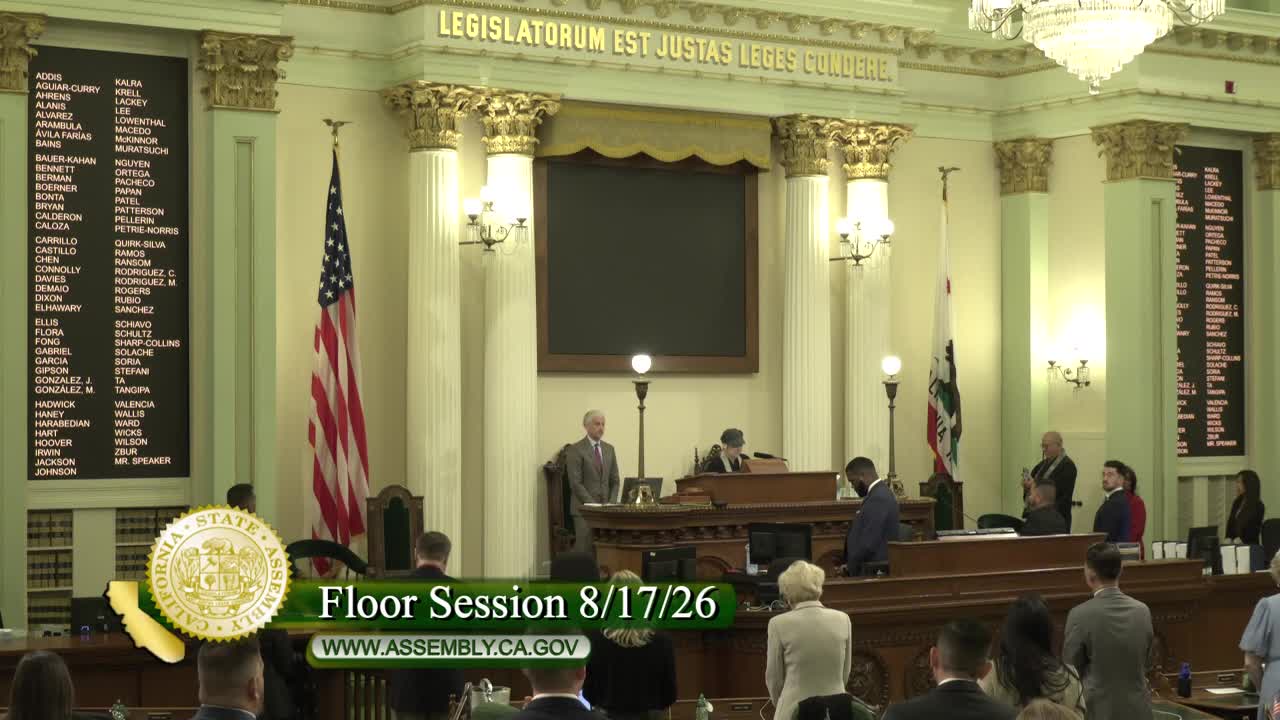


Bill Co-Author(s):