AB 1213: Restitution: priority.
- Session Year: 2025-2026
- House: Assembly
- Latest Version Date: 2025-10-01
Current Status:
Passed
(2025-10-01: Chaptered by Secretary of State - Chapter 184, Statutes of 2025.)
Introduced
In Committee
Awaiting First Chamber Vote
Passed First Chamber
In Committee
Awaiting Second Chamber Vote
Passed Second Chamber
Enacted
The California Constitution entitles the victim of a crime to restitution. Existing law requires the court in each criminal case to order a convicted defendant to pay full restitution to the victim and a separate restitution fine, as specified. Existing law makes a restitution order in a case in which a victim suffered economic loss as a result of the defendants conduct, as specified, enforceable as if it were a civil judgment.
This bill, the Restitution First Act, would also require that a restitution order be paid before all fines, restitution fines, penalty assessments, and other fees, as specified. The bill would also make nonsubstantive, conforming changes.
The California Constitution entitles the victim of a crime to restitution. Existing law requires the court in each criminal case to order a convicted defendant to pay full restitution to the victim and a separate restitution fine, as specified. Existing law makes a restitution order in a case in which a victim suffered economic loss as a result of the defendants conduct, as specified, enforceable as if it were a civil judgment.
This bill bill, the Restitution First Act, would also require that a restitution order be paid before all fines, restitution fines, penalty assessments, and other fees, as specified. The bill would also make nonsubstantive, conforming changes.
The California Constitution entitles the victim of a crime to restitution. Existing law requires the court in each criminal case to order a convicted defendant to pay full restitution to the victim and a separate restitution fine, as specified. Existing law makes a restitution order in a case in which a victim suffered economic loss as a result of the defendants conduct, as specified, enforceable as if it were a civil judgment.
This bill would make an order for restitution to have priority over any other debts, liens, or monetary judgments, and would, in cases where an individual has two or more orders for restitution, make the restitution order entered first have higher priority than additional restitution orders.This bill would also require that a restitution order be paid before all fines, restitution fines, penalty assessments, and other fees, as specified.
The California Constitution entitles the victim of a crime to restitution. Existing law requires the court in each criminal case to order a convicted defendant to pay full restitution to the victim and a separate restitution fine, as specified.
This bill would make an order for restitution to have priority over any other debts, liens, or monetary judgments, and would, in cases where an individual has two or more orders for restitution, make the restitution order entered first have higher priority than additional restitution orders.
The Legislature finds and declares both of the following:
(a)Victims of crimes have a constitutional right to restitution and that the restitution be paid by the offender.
(b)It is the intent of the Legislature that no other debt owed by a criminal defendant be satisfied before the restitution to the victim is satisfied first. Accordingly, the Legislature declares that an order for restitution shall have priority over all other fines and fees associated with a criminal conviction.
SEC. 2.This act shall be known, and may be cited, as the Restitution First Act.
SEC. 3.Section 1202.4 of the Penal Code is amended to read:1202.4.(a)(1)It is the intent of the Legislature that a victim of a crime who incurs an economic loss as a result of the commission of a crime shall receive restitution directly from a defendant convicted of that crime.
(2)Upon a person being convicted of a crime in the State of California, the court shall order the defendant to pay a fine in the form of a penalty assessment in accordance with Section 1464.
(3)The court, in addition to any other penalty provided or imposed under the law, shall order the defendant to pay both of the following:
(A)A restitution fine in accordance with subdivision (b).
(B)Restitution to the victim or victims, if any, in accordance with subdivision (f), which shall be enforceable as if the order were a civil judgment and shall be paid as specified in subdivision (i).
(b)In every case where a person is convicted of a crime, the court shall impose a separate and additional restitution fine, unless it finds compelling and extraordinary reasons for not doing so and states those reasons on the record.
(1)The restitution fine shall be set at the discretion of the court and commensurate with the seriousness of the offense. If the person is convicted of a felony, the fine shall not be less than three hundred dollars ($300) and not more than ten thousand dollars ($10,000). If the person is convicted of a misdemeanor, the fine shall not be less than one hundred fifty dollars ($150) and not more than one thousand dollars ($1,000).
(2)In setting a felony restitution fine, the court may determine the amount of the fine as the product of the minimum fine pursuant to paragraph (1) multiplied by the number of years of imprisonment the defendant is ordered to serve, multiplied by the number of felony counts of which the defendant is convicted.
(c)The court shall impose the restitution fine unless it finds compelling and extraordinary reasons for not doing so and states those reasons on the record. A defendants inability to pay shall not be considered a compelling and extraordinary reason not to impose a restitution fine. Inability to pay may be considered only in increasing the amount of the restitution fine in excess of the minimum fine pursuant to paragraph (1) of subdivision (b). The court may specify that funds confiscated at the time of the defendants arrest, except for funds confiscated pursuant to Chapter 8 (commencing with Section 11469) of Division 10 of the Health and Safety Code, be applied to the restitution fine if the funds are not exempt for spousal or child support or subject to any other legal exemption.
(d)In setting the amount of the fine pursuant to subdivision (b) in excess of the minimum fine pursuant to paragraph (1) of subdivision (b), the court shall consider any relevant factors, including, but not limited to, the defendants inability to pay, the seriousness and gravity of the offense and the circumstances of its commission, any economic gain derived by the defendant as a result of the crime, the extent to which any other person suffered losses as a result of the crime, and the number of victims involved in the crime. Those losses may include pecuniary losses to the victim or the victims dependents as well as intangible losses, such as psychological harm caused by the crime. Consideration of a defendants inability to pay may include the defendants future earning capacity. A defendant shall bear the burden of demonstrating the defendants inability to pay. Express findings by the court as to the factors bearing on the amount of the fine shall not be required. A separate hearing for the fine shall not be required.
(e)The restitution fine shall not be subject to penalty assessments authorized in Section 1464 or Chapter 12 (commencing with Section 76000) of Title 8 of the Government Code, or the state surcharge authorized in Section 1465.7, and shall be deposited in the Restitution Fund in the State Treasury.
(f)Except as provided in subdivisions (p) and (q), in every case in which a victim has suffered economic loss as a result of the defendants conduct, the court shall require that the defendant make restitution to the victim or victims in an amount established by court order, based on the amount of loss claimed by the victim or victims or any other showing to the court. If the amount of loss cannot be ascertained at the time of sentencing, the restitution order shall include a provision that the amount shall be determined at the direction of the court. The court shall order full restitution. The court may specify that funds confiscated at the time of the defendants arrest, except for funds confiscated pursuant to Chapter 8 (commencing with Section 11469) of Division 10 of the Health and Safety Code, be applied to the restitution order if the funds are not exempt for spousal or child support or subject to any other legal exemption.
(1)The defendant has the right to a hearing before a judge to dispute the determination of the amount of restitution. The court may modify the amount, on its own motion or on the motion of the district attorney, the victim or victims, or the defendant. If a motion is made for modification of a restitution order, the victim shall be notified of that motion at least 10 days prior to the proceeding held to decide the motion. A victim at a restitution hearing or modification hearing described in this paragraph may testify by live, two-way audio and video transmission, if testimony by live, two-way audio and video transmission is available at the court.
(2)Determination of the amount of restitution ordered pursuant to this subdivision shall not be affected by the indemnification or subrogation rights of a third party. Restitution ordered pursuant to this subdivision shall be ordered to be deposited in the Restitution Fund to the extent that the victim, as defined in subdivision (k), has received assistance from the California Victim Compensation Board pursuant to Chapter 5 (commencing with Section 13950) of Part 4 of Division 3 of Title 2 of the Government Code.
(3)To the extent possible, the restitution order shall be prepared by the sentencing court, shall identify each victim and each loss to which it pertains, and shall be of a dollar amount that is sufficient to fully reimburse the victim or victims for every determined economic loss incurred as the result of the defendants criminal conduct, including, but not limited to, all of the following:
(A)Full or partial payment for the value of stolen or damaged property. The value of stolen or damaged property shall be the replacement cost of like property, or the actual cost of repairing the property when repair is possible.
(B)Medical expenses.
(C)Mental health counseling expenses.
(D)Wages or profits lost due to injury incurred by the victim, and if the victim is a minor, wages or profits lost by the minors parent, parents, guardian, or guardians, while caring for the injured minor. Lost wages shall include commission income as well as base wages. Commission income shall be established by evidence of commission income during the 12-month period prior to the date of the crime for which restitution is being ordered, unless good cause for a shorter time period is shown.
(E)Wages or profits lost by the victim, and if the victim is a minor, wages or profits lost by the minors parent, parents, guardian, or guardians, due to time spent as a witness or in assisting the police or prosecution. Lost wages shall include commission income as well as base wages. Commission income shall be established by evidence of commission income during the 12-month period prior to the date of the crime for which restitution is being ordered, unless good cause for a shorter time period is shown.
(F)Noneconomic losses, including, but not limited to, psychological harm, for felony violations of Section 288, 288.5, or 288.7.
(G)Interest, at the rate of 10 percent per annum, that accrues as of the date of sentencing or loss, as determined by the court.
(H)Actual and reasonable attorneys fees and other costs of collection accrued by a private entity on behalf of the victim.
(I)Expenses incurred by an adult victim in relocating away from the defendant, including, but not limited to, deposits for utilities and telephone service, deposits for rental housing, temporary lodging and food expenses, clothing, and personal items. Expenses incurred pursuant to this section shall be verified by law enforcement to be necessary for the personal safety of the victim or by a mental health treatment provider to be necessary for the emotional well-being of the victim.
(J)Expenses to install or increase residential security incurred related to a violation of Section 273.5, or a violent felony as defined in subdivision (c) of Section 667.5, including, but not limited to, a home security device or system, or replacing or increasing the number of locks.
(K)Expenses to retrofit a residence or vehicle, or both, to make the residence accessible to or the vehicle operational by the victim, if the victim is permanently disabled, whether the disability is partial or total, as a direct result of the crime.
(L)Expenses for a period of time reasonably necessary to make the victim whole, for the costs to monitor the credit report of, and for the costs to repair the credit of, a victim of identity theft, as defined in Section 530.5.
(4)(A)If, as a result of the defendants conduct, the Restitution Fund has provided assistance to or on behalf of a victim or derivative victim pursuant to Chapter 5 (commencing with Section 13950) of Part 4 of Division 3 of Title 2 of the Government Code, the amount of assistance provided shall be presumed to be a direct result of the defendants criminal conduct and shall be included in the amount of the restitution ordered.
(B)The amount of assistance provided by the Restitution Fund shall be established by copies of bills submitted to the California Victim Compensation Board reflecting the amount paid by the board and whether the services for which payment was made were for medical or dental expenses, funeral or burial expenses, mental health counseling, wage or support losses, or rehabilitation. Certified copies of these bills provided by the board and redacted to protect the privacy and safety of the victim or any legal privilege, together with a statement made under penalty of perjury by the custodian of records that those bills were submitted to and were paid by the board, shall be sufficient to meet this requirement.
(C)If the defendant offers evidence to rebut the presumption established by this paragraph, the court may release additional information contained in the records of the board to the defendant only after reviewing that information in camera and finding that the information is necessary for the defendant to dispute the amount of the restitution order.
(5)Except as provided in paragraph (6), in any case in which an order may be entered pursuant to this subdivision, the defendant shall prepare and file a disclosure identifying all assets, income, and liabilities in which the defendant held or controlled a present or future interest as of the date of the defendants arrest for the crime for which restitution may be ordered. The financial disclosure statements shall be made available to the victim and the board pursuant to Section 1214. The disclosure shall be signed by the defendant upon a form approved or adopted by the Judicial Council for the purpose of facilitating the disclosure. A defendant who willfully states as true a material matter that the defendant knows to be false on the disclosure required by this subdivision is guilty of a misdemeanor, unless this conduct is punishable as perjury or another provision of law provides for a greater penalty.
(6)A defendant who fails to file the financial disclosure required in paragraph (5), but who has filed a financial affidavit or financial information pursuant to subdivision (c) of Section 987, shall be deemed to have waived the confidentiality of that affidavit or financial information as to a victim in whose favor the order of restitution is entered pursuant to subdivision (f). The affidavit or information shall serve in lieu of the financial disclosure required in paragraph (5), and paragraphs (7) to (10), inclusive, shall not apply.
(7)Except as provided in paragraph (6), the defendant shall file the disclosure with the clerk of the court no later than the date set for the defendants sentencing, unless otherwise directed by the court. The disclosure may be inspected or copied as provided by subdivision (b), (c), or (d) of Section 1203.05.
(8)In its discretion, the court may relieve the defendant of the duty under paragraph (7) of filing with the clerk by requiring that the defendants disclosure be submitted as an attachment to, and be available to, those authorized to receive the following:
(A)A report submitted pursuant to subparagraph (D) of paragraph (2) of subdivision (b) of Section 1203 or subdivision (g) of Section 1203.
(B)A stipulation submitted pursuant to paragraph (4) of subdivision (b) of Section 1203.
(C)A report by the probation officer, or information submitted by the defendant applying for a conditional sentence pursuant to subdivision (d) of Section 1203.
(9)The court may consider a defendants unreasonable failure to make a complete disclosure pursuant to paragraph (5) as any of the following:
(A)A circumstance in aggravation of the crime in imposing a term under subdivision (b) of Section 1170.
(B)A factor indicating that the interests of justice would not be served by admitting the defendant to probation under Section 1203.
(C)A factor indicating that the interests of justice would not be served by conditionally sentencing the defendant under Section 1203.
(D)A factor indicating that the interests of justice would not be served by imposing less than the maximum fine and sentence fixed by law for the case.
(10)A defendants failure or refusal to make the required disclosure pursuant to paragraph (5) shall not delay entry of an order of restitution or pronouncement of sentence. In appropriate cases, the court may do any of the following:
(A)Require the defendant to be examined by the district attorney pursuant to subdivision (h).
(B)If sentencing the defendant under Section 1170, provide that the victim shall receive a copy of the portion of the probation report filed pursuant to Section 1203.10 concerning the defendants employment, occupation, finances, and liabilities.
(C)If sentencing the defendant under Section 1203, set a date and place for submission of the disclosure required by paragraph (5) as a condition of probation or suspended sentence.
(11)If a defendant has any remaining unpaid balance on a restitution order or fine 120 days prior to the defendants scheduled release from probation or 120 days prior to the defendants completion of a conditional sentence, the defendant shall prepare and file a new and updated financial disclosure identifying all assets, income, and liabilities in which the defendant holds or controls or has held or controlled a present or future interest during the defendants period of probation or conditional sentence. The financial disclosure shall be made available to the victim and the board pursuant to Section 1214. The disclosure shall be signed and prepared by the defendant on the same form as described in paragraph (5). A defendant who willfully states as true a material matter that the defendant knows to be false on the disclosure required by this subdivision is guilty of a misdemeanor, unless this conduct is punishable as perjury or another provision of law provides for a greater penalty. The financial disclosure required by this paragraph shall be filed with the clerk of the court no later than 90 days prior to the defendants scheduled release from probation or completion of the defendants conditional sentence.
(12)In cases where an employer is convicted of a crime against an employee, a payment to the employee or the employees dependent that is made by the employers workers compensation insurance carrier shall not be used to offset the amount of the restitution order unless the court finds that the defendant substantially met the obligation to pay premiums for that insurance coverage.
(g)A defendants inability to pay shall not be a consideration in determining the amount of a restitution order.
(h)The district attorney may request an order of examination pursuant to the procedures specified in Article 2 (commencing with Section 708.110) of Chapter 6 of Division 2 of Title 9 of Part 2 of the Code of Civil Procedure, in order to determine the defendants financial assets for purposes of collecting on the restitution order.
(i)A restitution order imposed pursuant to subdivision (f) shall be enforceable as if the order were a civil judgment and shall be paid before all fines, restitution fines, penalty assessments, and other fees imposed on a criminal defendant, including, but not limited to, Sections 70372, 76000, 76000.5, 76104.6, and 76104.7 of the Government Code, and Sections 1464 and 1465.7 of this code.
(j)The making of a restitution order pursuant to subdivision (f) shall not affect the right of a victim to recovery from the Restitution Fund as otherwise provided by law, except to the extent that restitution is actually collected pursuant to the order. Restitution collected pursuant to this subdivision shall be credited to any other judgments for the same losses obtained against the defendant arising out of the crime for which the defendant was convicted.
(k)For purposes of this section, victim shall include all of the following:
(1)The immediate surviving family of the actual victim.
(2)A corporation, business trust, estate, trust, partnership, association, joint venture, government, governmental subdivision, agency, or instrumentality, or any other legal or commercial entity when that entity is a direct victim of a crime.
(3)A person who has sustained economic loss as the result of a crime and who satisfies any of the following conditions:
(A)At the time of the crime was the parent, grandparent, sibling, spouse, child, or grandchild of the victim.
(B)At the time of the crime was living in the household of the victim.
(C)At the time of the crime was a person who had previously lived in the household of the victim for a period of not less than two years in a relationship substantially similar to a relationship listed in subparagraph (A).
(D)Is another family member of the victim, including, but not limited to, the victims fiance, and who witnessed the crime.
(E)Is the primary caretaker of a minor victim.
(4)A person who is eligible to receive assistance from the Restitution Fund pursuant to Chapter 5 (commencing with Section 13950) of Part 4 of Division 3 of Title 2 of the Government Code.
(5)A governmental entity that is responsible for repairing, replacing, or restoring public or privately owned property that has been defaced with graffiti or other inscribed material, as defined in subdivision (e) of Section 594, and that has sustained an economic loss as the result of a violation of Section 594, 594.3, 594.4, 640.5, 640.6, or 640.7.
(l)In every case in which the defendant is granted probation, the court shall make the payment of restitution fines and orders imposed pursuant to this section a condition of probation. Any portion of a restitution order that remains unsatisfied after a defendant is no longer on probation shall continue to be enforceable by a victim pursuant to Section 1214 until the obligation is satisfied.
(m)If the court finds and states on the record compelling and extraordinary reasons why a restitution fine should not be required, the court shall order, as a condition of probation, that the defendant perform specified community service, unless it finds and states on the record compelling and extraordinary reasons not to require community service in addition to the finding that a restitution fine should not be required. Upon revocation of probation, the court shall impose the restitution fine pursuant to this section.
(n)The provisions of Section 13963 of the Government Code shall apply to restitution imposed pursuant to this section.
(o)The court clerk shall notify the California Victim Compensation and Government Claims Board within 90 days of an order of restitution being imposed if the defendant is ordered to pay restitution to the board due to the victim receiving compensation from the Restitution Fund. Notification shall be accomplished by mailing a copy of the court order to the board, which may be done periodically by bulk mail or email.
(p)Upon conviction for a violation of Section 236.1, the court shall, in addition to any other penalty or restitution, order the defendant to pay restitution to the victim in a case in which a victim has suffered economic loss as a result of the defendants conduct. The court shall require that the defendant make restitution to the victim or victims in an amount established by court order, based on the amount of loss claimed by the victim or victims or another showing to the court. In determining restitution pursuant to this section, the court shall base its order upon the greater of the following: the gross value of the victims labor or services based upon the comparable value of similar services in the labor market in which the offense occurred, or the value of the victims labor as guaranteed under California law, or the actual income derived by the defendant from the victims labor or services or any other appropriate means to provide reparations to the victim.
(q)(1)In addition to any other penalty or fine, the court shall order a person who has been convicted of a violation of Section 350, 653h, 653s, 653u, 653w, or 653aa that involves a recording or audiovisual work to make restitution to an owner or lawful producer, or trade association acting on behalf of the owner or lawful producer, of a phonograph record, disc, wire, tape, film, or other device or article from which sounds or visual images are derived that suffered economic loss resulting from the violation. The order of restitution shall be based on the aggregate wholesale value of lawfully manufactured and authorized devices or articles from which sounds or visual images are devised corresponding to the number of nonconforming devices or articles involved in the offense, unless a higher value can be proved in the case of (A) an unreleased audio work, or (B) an audiovisual work that, at the time of unauthorized distribution, has not been made available in copies for sale to the general public in the United States on a digital versatile disc. For purposes of this subdivision, possession of nonconforming devices or articles intended for sale constitutes actual economic loss to an owner or lawful producer in the form of displaced legitimate wholesale purchases. The order of restitution shall also include reasonable costs incurred as a result of an investigation of the violation undertaken by the owner, lawful producer, or trade association acting on behalf of the owner or lawful producer. Aggregate wholesale value means the average wholesale value of lawfully manufactured and authorized sound or audiovisual recordings. Proof of the specific wholesale value of each nonconforming device or article is not required.
(2)As used in this subdivision, audiovisual work and recording shall have the same meaning as in Section 653w.
(r)(1)If a corporation, as defined in Section 1398, is convicted of a misdemeanor or felony offense, the court shall impose a separate and additional restitution fine, unless it finds compelling and extraordinary reasons for not doing so and states those reasons on the record.
(2)The court may determine the amount of the restitution fine. The fine shall be commensurate with the seriousness of the offense. If the corporation is convicted of a felony, the fine shall not be more than one hundred thousand dollars ($100,000). If the corporation is convicted of a misdemeanor, the fine shall not be more than one thousand dollars ($1,000).
(3)Any moneys collected pursuant to this subdivision shall be distributed as follows:
(A)Seventy-five percent shall be deposited into the California Crime Victims Fund established under Section 13839.
(B)Twenty-five percent shall be distributed as follows:
(i)If the action was brought by the Department of Justice, the moneys shall be deposited in a special account in the General Fund, and, upon appropriation, may be expended by the Department of Justice to offset costs incurred for investigation and prosecution.
(ii)If the action was brought by a district attorney or county counsel, the moneys shall be paid to the treasurer of the county in which the judgment is entered.
(iii)If the action was brought by a city attorney or city prosecutor, one-half of the moneys shall be paid to the treasurer of the county in which the judgment was entered and one-half to the city, except that if the action was brought by a city attorney of a city and county the entire amount of the moneys shall be paid to the treasurer of the city and county in which the judgment is entered.
The Legislature finds and declares both of the following:
(a)Victims of crimes have a constitutional right to restitution and that the restitution be paid by the offender.
(b)It is the intent of the Legislature that no other debt owed by a criminal defendant be satisfied before the restitution to the victim is satisfied first. Accordingly, the Legislature declares that an order for restitution shall have priority over all other fines and fees associated with a criminal conviction.
SEC. 2.This act shall be known, and may be cited, as the Restitution First Act.
SEC. 3.Section 1202.4 of the Penal Code is amended to read:1202.4.(a)(1)It is the intent of the Legislature that a victim of a crime who incurs an economic loss as a result of the commission of a crime shall receive restitution directly from a defendant convicted of that crime.
(2)Upon a person being convicted of a crime in the State of California, the court shall order the defendant to pay a fine in the form of a penalty assessment in accordance with Section 1464.
(3)The court, in addition to any other penalty provided or imposed under the law, shall order the defendant to pay both of the following:
(A)A restitution fine in accordance with subdivision (b).
(B)Restitution to the victim or victims, if any, in accordance with subdivision (f), which shall be enforceable as if the order were a civil judgment and shall be paid as specified in subdivision (i).
(b)In every case where a person is convicted of a crime, the court shall impose a separate and additional restitution fine, unless it finds compelling and extraordinary reasons for not doing so and states those reasons on the record.
(1)The restitution fine shall be set at the discretion of the court and commensurate with the seriousness of the offense. If the person is convicted of a felony, the fine shall not be less than three hundred dollars ($300) and not more than ten thousand dollars ($10,000). If the person is convicted of a misdemeanor, the fine shall not be less than one hundred fifty dollars ($150) and not more than one thousand dollars ($1,000).
(2)In setting a felony restitution fine, the court may determine the amount of the fine as the product of the minimum fine pursuant to paragraph (1) multiplied by the number of years of imprisonment the defendant is ordered to serve, multiplied by the number of felony counts of which the defendant is convicted.
(c)The court shall impose the restitution fine unless it finds compelling and extraordinary reasons for not doing so and states those reasons on the record. A defendants inability to pay shall not be considered a compelling and extraordinary reason not to impose a restitution fine. Inability to pay may be considered only in increasing the amount of the restitution fine in excess of the minimum fine pursuant to paragraph (1) of subdivision (b). The court may specify that funds confiscated at the time of the defendants arrest, except for funds confiscated pursuant to Chapter 8 (commencing with Section 11469) of Division 10 of the Health and Safety Code, be applied to the restitution fine if the funds are not exempt for spousal or child support or subject to any other legal exemption.
(d)In setting the amount of the fine pursuant to subdivision (b) in excess of the minimum fine pursuant to paragraph (1) of subdivision (b), the court shall consider any relevant factors, including, but not limited to, the defendants inability to pay, the seriousness and gravity of the offense and the circumstances of its commission, any economic gain derived by the defendant as a result of the crime, the extent to which any other person suffered losses as a result of the crime, and the number of victims involved in the crime. Those losses may include pecuniary losses to the victim or the victims dependents as well as intangible losses, such as psychological harm caused by the crime. Consideration of a defendants inability to pay may include the defendants future earning capacity. A defendant shall bear the burden of demonstrating the defendants inability to pay. Express findings by the court as to the factors bearing on the amount of the fine shall not be required. A separate hearing for the fine shall not be required.
(e)The restitution fine shall not be subject to penalty assessments authorized in Section 1464 or Chapter 12 (commencing with Section 76000) of Title 8 of the Government Code, or the state surcharge authorized in Section 1465.7, and shall be deposited in the Restitution Fund in the State Treasury.
(f)Except as provided in subdivisions (p) and (q), in every case in which a victim has suffered economic loss as a result of the defendants conduct, the court shall require that the defendant make restitution to the victim or victims in an amount established by court order, based on the amount of loss claimed by the victim or victims or any other showing to the court. If the amount of loss cannot be ascertained at the time of sentencing, the restitution order shall include a provision that the amount shall be determined at the direction of the court. The court shall order full restitution. The court may specify that funds confiscated at the time of the defendants arrest, except for funds confiscated pursuant to Chapter 8 (commencing with Section 11469) of Division 10 of the Health and Safety Code, be applied to the restitution order if the funds are not exempt for spousal or child support or subject to any other legal exemption.
(1)The defendant has the right to a hearing before a judge to dispute the determination of the amount of restitution. The court may modify the amount, on its own motion or on the motion of the district attorney, the victim or victims, or the defendant. If a motion is made for modification of a restitution order, the victim shall be notified of that motion at least 10 days prior to the proceeding held to decide the motion. A victim at a restitution hearing or modification hearing described in this paragraph may testify by live, two-way audio and video transmission, if testimony by live, two-way audio and video transmission is available at the court.
(2)Determination of the amount of restitution ordered pursuant to this subdivision shall not be affected by the indemnification or subrogation rights of a third party. Restitution ordered pursuant to this subdivision shall be ordered to be deposited in the Restitution Fund to the extent that the victim, as defined in subdivision (k), has received assistance from the California Victim Compensation Board pursuant to Chapter 5 (commencing with Section 13950) of Part 4 of Division 3 of Title 2 of the Government Code.
(3)To the extent possible, the restitution order shall be prepared by the sentencing court, shall identify each victim and each loss to which it pertains, and shall be of a dollar amount that is sufficient to fully reimburse the victim or victims for every determined economic loss incurred as the result of the defendants criminal conduct, including, but not limited to, all of the following:
(A)Full or partial payment for the value of stolen or damaged property. The value of stolen or damaged property shall be the replacement cost of like property, or the actual cost of repairing the property when repair is possible.
(B)Medical expenses.
(C)Mental health counseling expenses.
(D)Wages or profits lost due to injury incurred by the victim, and if the victim is a minor, wages or profits lost by the minors parent, parents, guardian, or guardians, while caring for the injured minor. Lost wages shall include commission income as well as base wages. Commission income shall be established by evidence of commission income during the 12-month period prior to the date of the crime for which restitution is being ordered, unless good cause for a shorter time period is shown.
(E)Wages or profits lost by the victim, and if the victim is a minor, wages or profits lost by the minors parent, parents, guardian, or guardians, due to time spent as a witness or in assisting the police or prosecution. Lost wages shall include commission income as well as base wages. Commission income shall be established by evidence of commission income during the 12-month period prior to the date of the crime for which restitution is being ordered, unless good cause for a shorter time period is shown.
(F)Noneconomic losses, including, but not limited to, psychological harm, for felony violations of Section 288, 288.5, or 288.7.
(G)Interest, at the rate of 10 percent per annum, that accrues as of the date of sentencing or loss, as determined by the court.
(H)Actual and reasonable attorneys fees and other costs of collection accrued by a private entity on behalf of the victim.
(I)Expenses incurred by an adult victim in relocating away from the defendant, including, but not limited to, deposits for utilities and telephone service, deposits for rental housing, temporary lodging and food expenses, clothing, and personal items. Expenses incurred pursuant to this section shall be verified by law enforcement to be necessary for the personal safety of the victim or by a mental health treatment provider to be necessary for the emotional well-being of the victim.
(J)Expenses to install or increase residential security incurred related to a violation of Section 273.5, or a violent felony as defined in subdivision (c) of Section 667.5, including, but not limited to, a home security device or system, or replacing or increasing the number of locks.
(K)Expenses to retrofit a residence or vehicle, or both, to make the residence accessible to or the vehicle operational by the victim, if the victim is permanently disabled, whether the disability is partial or total, as a direct result of the crime.
(L)Expenses for a period of time reasonably necessary to make the victim whole, for the costs to monitor the credit report of, and for the costs to repair the credit of, a victim of identity theft, as defined in Section 530.5.
(4)(A)If, as a result of the defendants conduct, the Restitution Fund has provided assistance to or on behalf of a victim or derivative victim pursuant to Chapter 5 (commencing with Section 13950) of Part 4 of Division 3 of Title 2 of the Government Code, the amount of assistance provided shall be presumed to be a direct result of the defendants criminal conduct and shall be included in the amount of the restitution ordered.
(B)The amount of assistance provided by the Restitution Fund shall be established by copies of bills submitted to the California Victim Compensation Board reflecting the amount paid by the board and whether the services for which payment was made were for medical or dental expenses, funeral or burial expenses, mental health counseling, wage or support losses, or rehabilitation. Certified copies of these bills provided by the board and redacted to protect the privacy and safety of the victim or any legal privilege, together with a statement made under penalty of perjury by the custodian of records that those bills were submitted to and were paid by the board, shall be sufficient to meet this requirement.
(C)If the defendant offers evidence to rebut the presumption established by this paragraph, the court may release additional information contained in the records of the board to the defendant only after reviewing that information in camera and finding that the information is necessary for the defendant to dispute the amount of the restitution order.
(5)Except as provided in paragraph (6), in any case in which an order may be entered pursuant to this subdivision, the defendant shall prepare and file a disclosure identifying all assets, income, and liabilities in which the defendant held or controlled a present or future interest as of the date of the defendants arrest for the crime for which restitution may be ordered. The financial disclosure statements shall be made available to the victim and the board pursuant to Section 1214. The disclosure shall be signed by the defendant upon a form approved or adopted by the Judicial Council for the purpose of facilitating the disclosure. A defendant who willfully states as true a material matter that the defendant knows to be false on the disclosure required by this subdivision is guilty of a misdemeanor, unless this conduct is punishable as perjury or another provision of law provides for a greater penalty.
(6)A defendant who fails to file the financial disclosure required in paragraph (5), but who has filed a financial affidavit or financial information pursuant to subdivision (c) of Section 987, shall be deemed to have waived the confidentiality of that affidavit or financial information as to a victim in whose favor the order of restitution is entered pursuant to subdivision (f). The affidavit or information shall serve in lieu of the financial disclosure required in paragraph (5), and paragraphs (7) to (10), inclusive, shall not apply.
(7)Except as provided in paragraph (6), the defendant shall file the disclosure with the clerk of the court no later than the date set for the defendants sentencing, unless otherwise directed by the court. The disclosure may be inspected or copied as provided by subdivision (b), (c), or (d) of Section 1203.05.
(8)In its discretion, the court may relieve the defendant of the duty under paragraph (7) of filing with the clerk by requiring that the defendants disclosure be submitted as an attachment to, and be available to, those authorized to receive the following:
(A)A report submitted pursuant to subparagraph (D) of paragraph (2) of subdivision (b) of Section 1203 or subdivision (g) of Section 1203.
(B)A stipulation submitted pursuant to paragraph (4) of subdivision (b) of Section 1203.
(C)A report by the probation officer, or information submitted by the defendant applying for a conditional sentence pursuant to subdivision (d) of Section 1203.
(9)The court may consider a defendants unreasonable failure to make a complete disclosure pursuant to paragraph (5) as any of the following:
(A)A circumstance in aggravation of the crime in imposing a term under subdivision (b) of Section 1170.
(B)A factor indicating that the interests of justice would not be served by admitting the defendant to probation under Section 1203.
(C)A factor indicating that the interests of justice would not be served by conditionally sentencing the defendant under Section 1203.
(D)A factor indicating that the interests of justice would not be served by imposing less than the maximum fine and sentence fixed by law for the case.
(10)A defendants failure or refusal to make the required disclosure pursuant to paragraph (5) shall not delay entry of an order of restitution or pronouncement of sentence. In appropriate cases, the court may do any of the following:
(A)Require the defendant to be examined by the district attorney pursuant to subdivision (h).
(B)If sentencing the defendant under Section 1170, provide that the victim shall receive a copy of the portion of the probation report filed pursuant to Section 1203.10 concerning the defendants employment, occupation, finances, and liabilities.
(C)If sentencing the defendant under Section 1203, set a date and place for submission of the disclosure required by paragraph (5) as a condition of probation or suspended sentence.
(11)If a defendant has any remaining unpaid balance on a restitution order or fine 120 days prior to the defendants scheduled release from probation or 120 days prior to the defendants completion of a conditional sentence, the defendant shall prepare and file a new and updated financial disclosure identifying all assets, income, and liabilities in which the defendant holds or controls or has held or controlled a present or future interest during the defendants period of probation or conditional sentence. The financial disclosure shall be made available to the victim and the board pursuant to Section 1214. The disclosure shall be signed and prepared by the defendant on the same form as described in paragraph (5). A defendant who willfully states as true a material matter that the defendant knows to be false on the disclosure required by this subdivision is guilty of a misdemeanor, unless this conduct is punishable as perjury or another provision of law provides for a greater penalty. The financial disclosure required by this paragraph shall be filed with the clerk of the court no later than 90 days prior to the defendants scheduled release from probation or completion of the defendants conditional sentence.
(12)In cases where an employer is convicted of a crime against an employee, a payment to the employee or the employees dependent that is made by the employers workers compensation insurance carrier shall not be used to offset the amount of the restitution order unless the court finds that the defendant substantially met the obligation to pay premiums for that insurance coverage.
(g)A defendants inability to pay shall not be a consideration in determining the amount of a restitution order.
(h)The district attorney may request an order of examination pursuant to the procedures specified in Article 2 (commencing with Section 708.110) of Chapter 6 of Division 2 of Title 9 of Part 2 of the Code of Civil Procedure, in order to determine the defendants financial assets for purposes of collecting on the restitution order.
(i)A restitution order imposed pursuant to subdivision (f) shall be enforceable as if the order were a civil judgment and shall be paid before all fines, restitution fines, penalty assessments, and other fees imposed on a criminal defendant, including, but not limited to, Sections 70372, 76000, 76000.5, 76104.6, and 76104.7 of the Government Code, and Sections 1464 and 1465.7 of this code.
(j)The making of a restitution order pursuant to subdivision (f) shall not affect the right of a victim to recovery from the Restitution Fund as otherwise provided by law, except to the extent that restitution is actually collected pursuant to the order. Restitution collected pursuant to this subdivision shall be credited to any other judgments for the same losses obtained against the defendant arising out of the crime for which the defendant was convicted.
(k)For purposes of this section, victim shall include all of the following:
(1)The immediate surviving family of the actual victim.
(2)A corporation, business trust, estate, trust, partnership, association, joint venture, government, governmental subdivision, agency, or instrumentality, or any other legal or commercial entity when that entity is a direct victim of a crime.
(3)A person who has sustained economic loss as the result of a crime and who satisfies any of the following conditions:
(A)At the time of the crime was the parent, grandparent, sibling, spouse, child, or grandchild of the victim.
(B)At the time of the crime was living in the household of the victim.
(C)At the time of the crime was a person who had previously lived in the household of the victim for a period of not less than two years in a relationship substantially similar to a relationship listed in subparagraph (A).
(D)Is another family member of the victim, including, but not limited to, the victims fiance, and who witnessed the crime.
(E)Is the primary caretaker of a minor victim.
(4)A person who is eligible to receive assistance from the Restitution Fund pursuant to Chapter 5 (commencing with Section 13950) of Part 4 of Division 3 of Title 2 of the Government Code.
(5)A governmental entity that is responsible for repairing, replacing, or restoring public or privately owned property that has been defaced with graffiti or other inscribed material, as defined in subdivision (e) of Section 594, and that has sustained an economic loss as the result of a violation of Section 594, 594.3, 594.4, 640.5, 640.6, or 640.7.
(l)In every case in which the defendant is granted probation, the court shall make the payment of restitution fines and orders imposed pursuant to this section a condition of probation. Any portion of a restitution order that remains unsatisfied after a defendant is no longer on probation shall continue to be enforceable by a victim pursuant to Section 1214 until the obligation is satisfied.
(m)If the court finds and states on the record compelling and extraordinary reasons why a restitution fine should not be required, the court shall order, as a condition of probation, that the defendant perform specified community service, unless it finds and states on the record compelling and extraordinary reasons not to require community service in addition to the finding that a restitution fine should not be required. Upon revocation of probation, the court shall impose the restitution fine pursuant to this section.
(n)The provisions of Section 13963 of the Government Code shall apply to restitution imposed pursuant to this section.
(o)The court clerk shall notify the California Victim Compensation and Government Claims Board within 90 days of an order of restitution being imposed if the defendant is ordered to pay restitution to the board due to the victim receiving compensation from the Restitution Fund. Notification shall be accomplished by mailing a copy of the court order to the board, which may be done periodically by bulk mail or email.
(p)Upon conviction for a violation of Section 236.1, the court shall, in addition to any other penalty or restitution, order the defendant to pay restitution to the victim in a case in which a victim has suffered economic loss as a result of the defendants conduct. The court shall require that the defendant make restitution to the victim or victims in an amount established by court order, based on the amount of loss claimed by the victim or victims or another showing to the court. In determining restitution pursuant to this section, the court shall base its order upon the greater of the following: the gross value of the victims labor or services based upon the comparable value of similar services in the labor market in which the offense occurred, or the value of the victims labor as guaranteed under California law, or the actual income derived by the defendant from the victims labor or services or any other appropriate means to provide reparations to the victim.
(q)(1)In addition to any other penalty or fine, the court shall order a person who has been convicted of a violation of Section 350, 653h, 653s, 653u, 653w, or 653aa that involves a recording or audiovisual work to make restitution to an owner or lawful producer, or trade association acting on behalf of the owner or lawful producer, of a phonograph record, disc, wire, tape, film, or other device or article from which sounds or visual images are derived that suffered economic loss resulting from the violation. The order of restitution shall be based on the aggregate wholesale value of lawfully manufactured and authorized devices or articles from which sounds or visual images are devised corresponding to the number of nonconforming devices or articles involved in the offense, unless a higher value can be proved in the case of (A) an unreleased audio work, or (B) an audiovisual work that, at the time of unauthorized distribution, has not been made available in copies for sale to the general public in the United States on a digital versatile disc. For purposes of this subdivision, possession of nonconforming devices or articles intended for sale constitutes actual economic loss to an owner or lawful producer in the form of displaced legitimate wholesale purchases. The order of restitution shall also include reasonable costs incurred as a result of an investigation of the violation undertaken by the owner, lawful producer, or trade association acting on behalf of the owner or lawful producer. Aggregate wholesale value means the average wholesale value of lawfully manufactured and authorized sound or audiovisual recordings. Proof of the specific wholesale value of each nonconforming device or article is not required.
(2)As used in this subdivision, audiovisual work and recording shall have the same meaning as in Section 653w.
(r)(1)If a corporation, as defined in Section 1398, is convicted of a misdemeanor or felony offense, the court shall impose a separate and additional restitution fine, unless it finds a compelling and extraordinary reason reasons for not doing so and states those reasons on the record.
(2)The court may determine the amount of the restitution fine. The fine shall be commensurate with the seriousness of the offense. If the corporation is convicted of a felony, the fine shall not be more than one hundred thousand dollars ($100,000). If the corporation is convicted of a misdemeanor, the fine shall not be more than one thousand dollars ($1,000).
(3)Any moneys collected pursuant to this subdivision shall be distributed as follows:
(A)Seventy-five percent shall be deposited into the California Crime Victims Fund established under Section 13839.
(B)Twenty-five percent shall be distributed as follows:
(i)If the action was brought by the Department of Justice, the moneys shall be deposited in a special account in the General Fund, and, upon appropriation, may be expended by the Department of Justice to offset costs incurred for investigation and prosecution.
(ii)If the action was brought by a district attorney or county counsel, the moneys shall be paid to the treasurer of the county in which the judgment is entered.
(iii)If the action was brought by a city attorney or city prosecutor, one-half of the moneys shall be paid to the treasurer of the county in which the judgment was entered and one-half to the city, except that if the action was brought by a city attorney of a city and county the entire amount of the moneys shall be paid to the treasurer of the city and county in which the judgment is entered.
The Legislature finds and declares both of the following:
(a)Victims of crimes have a constitutional right to restitution and that the restitution be paid by the offender.
(b)It is the intent of the Legislature that no other order, civil judgment, lien, or other debt owed by a criminal defendant be satisfied before the restitution to the victim is satisfied first. Accordingly, the Legislature declares that an order for restitution shall have priority over all other orders, judgments, liens, or other debts. fines and fees associated with a criminal conviction.
SEC. 2.This act shall be known, and may be cited, as the Restitution First Act.
SEC. 3.Section 1202.42 of the Penal Code is amended to read:1202.42.Upon entry of a restitution order under subdivision (c) of Section 13967 of the Government Code, as operative on or before September 28, 1994, paragraph (3) of subdivision (a) of Section 1202.4 of this code, or Section 1203.04 as operative on or before August 2, 1995, the following shall apply:(a)The court shall enter a separate order for income deduction upon determination of the defendants ability to pay, regardless of the probation status, in accordance with Section 1203. Determination of a defendants ability to pay may include their future earning capacity. A defendant shall bear the burden of demonstrating lack of their ability to pay. Express findings by the court as to the factors bearing on the amount of the fine shall not be required.(b)(1)In any case in which the court enters a separate order for income deduction under this section, the order shall be stayed until the agency in the county responsible for collection of restitution determines that the defendant has failed to meet their obligation under the restitution order and the defendant has not provided the agency with good cause for the failure in accordance with paragraph (2).(2)If the agency responsible for collection of restitution receives information that the defendant has failed to meet their obligation under the restitution order, the agency shall request the defendant to provide evidence indicating that timely payments have been made or provide information establishing good cause for the failure. If the defendant fails to either provide the agency with the evidence or fails to establish good cause within five days of the request, the agency shall immediately inform the defendant of that fact, and shall inform the clerk of the court in order that an income deduction order will be served pursuant to subdivision (f) following a 15-day appeal period. The defendant may apply for a hearing to contest the lifting of the stay pursuant to subdivision (f).(c)The income deduction order shall direct a payer to deduct from all income due and payable to the defendant the amount required by the court to meet the defendants obligation.(d)The income deduction order shall be effective so long as the order for restitution upon which it is based is effective or until further order of the court.(e)When the court orders the income deduction, the court shall furnish to the defendant a statement of their rights, remedies, and duties in regard to the income deduction order. The statement shall state all of the following:(1)All fees or interest that will be imposed.(2)The total amount of income to be deducted for each pay period.(3)That the income deduction order applies to current and subsequent payers and periods of employment.(4)That a copy of the income deduction order will be served on the defendants payer or payers.(5)That enforcement of the income deduction order may only be contested on the ground of mistake of fact regarding the amount of restitution owed.(6)That the defendant is required to notify the clerk of the court within seven days after changes in the defendants address, payers, and the addresses of their payers.(7)That the court order will be stayed in accordance with subdivision (b) and that a hearing is available in accordance with subdivision (f).(f)(1)Upon receiving the notice described in paragraph (2) of subdivision (b), the clerk of the court or officer of the agency responsible for collection of restitution shall serve an income deduction order and the notice to payer on the defendants payer unless the defendant has applied for a hearing to contest the enforcement of the income deduction order.(2)(A)Service by or upon any person who is a party to a proceeding under this section shall be made in the manner prescribed for service upon parties in a civil action.(B)Service upon the defendants payer or successor payer under this section shall be made by prepaid certified mail, return receipt requested.(3)The defendant, within 15 days after being informed that the order staying the income deduction order will be lifted, may apply for a hearing to contest the enforcement of the income deduction order on the ground of mistake of fact regarding the amount of restitution owed or on the ground that the defendant has established good cause for the nonpayment. The timely request for a hearing shall stay the service of an income deduction order on all payers of the defendant until a hearing is held and a determination is made as to whether the enforcement of the income deduction order is proper.(4)The notice to any payer required by this subdivision shall contain only information necessary for the payer to comply with the income deduction order. The notice shall do all of the following:(A)Require the payer to deduct from the defendants income the amount specified in the income deduction order, and to pay that amount to the clerk of the court.(B)Instruct the payer to implement the income deduction order no later than the first payment date that occurs more than 14 days after the date the income deduction order was served on the payer.(C)Instruct the payer to forward, within two days after each payment date, to the clerk of the court the amount deducted from the defendants income and a statement as to whether the amount totally or partially satisfies the periodic amount specified in the income deduction order.(D)Specify that if a payer fails to deduct the proper amount from the defendants income, the payer is liable for the amount the payer should have deducted, plus costs, interest, and reasonable attorneys fees.(E)Provide that the payer may collect up to five dollars ($5) against the defendants income to reimburse the payer for administrative costs for the first income deduction and up to one dollar ($1) for each deduction thereafter.(F)State that the income deduction order and the notice to payer are binding on the payer until further notice by the court or until the payer no longer provides income to the defendant.(G)Instruct the payer that, when the payer no longer provides income to the defendant, they shall notify the clerk of the court and shall also provide the defendants last known address and the name and address of the defendants new payer, if known, and that, if the payer violates this provision, the payer is subject to a civil penalty not to exceed two hundred fifty dollars ($250) for the first violation or five hundred dollars ($500) for any subsequent violation.(H)State that the payer shall not discharge, refuse to employ, or take disciplinary action against the defendant because of an income deduction order and shall state that a violation of this provision subjects the payer to a civil penalty not to exceed two hundred fifty dollars ($250) for the first violation or five hundred dollars ($500) for any subsequent violation.(I)Inform the payer that when the payer receives income deduction orders requiring that the income of two or more defendants be deducted and sent to the same clerk of a court, they may combine the amounts that are to be paid to the depository in a single payment as long as the payer identifies that portion of the payment attributable to each defendant.(J)Inform the payer that if the payer receives more than one income deduction order against the same defendant, the payer shall contact the court for further instructions.(5)The clerk of the court shall enforce income deduction orders against the defendants successor payer who is located in this state in the same manner prescribed in this subdivision for the enforcement of an income deduction order against a payer.(6)A person may not discharge, refuse to employ, or take disciplinary action against an employee because of the enforcement of an income deduction order. An employer who violates this provision is subject to a civil penalty not to exceed two hundred fifty dollars ($250) for the first violation or five hundred dollars ($500) for any subsequent violation.(7)When a payer no longer provides income to a defendant, the payer shall notify the clerk of the court and shall provide the defendants last known address and the name and address of the defendants new payer, if known. A payer who violates this provision is subject to a civil penalty not to exceed two hundred fifty dollars ($250) for the first violation or five hundred dollars ($500) for a subsequent violation.(g)If the defendant has failed to meet their obligation under the restitution order and the defendant has not provided good cause for the failure in accordance with the process set forth in paragraph (2) of subdivision (b), the court may, upon the request of the prosecuting attorney, order that the prosecuting attorney be given authority to use lien procedures applicable to the defendant, including, but not limited to, a writ of attachment of property. This authority is in addition to any authority granted to the prosecuting attorney in subdivision (h).(1)If the court authorizes a lien or other similar encumbrance on real property pursuant to this subdivision, the court shall, within 15 days, furnish to the defendant a statement of their rights, remedies, and duties in regard to the order. The statement shall state all of the following:(A)That the lien is enforceable and collectible by execution issued by order of the court, except that a lien shall not be enforced by writ of execution on a defendants principal place of residence.(B)A legal description of the property to be encumbered.(C)The total amount of restitution still owed by the defendant.(D)That enforcement of the lien order may only be contested on the ground of mistake of fact regarding the amount of restitution owed or on the ground of mistake of fact regarding the defendants ownership interest of the property to be encumbered.(E)That a hearing is available in accordance with paragraph (2).(F)That, upon paying the restitution order in full, the defendant may petition the court for a full release of any related encumbrance in accordance with paragraph (3).(2)The defendant, within 15 days after being informed that a lien or other similar encumbrance on real property has been ordered, may apply for a hearing to contest the enforcement order on the ground of mistake of fact regarding the amount of restitution owed, on the ground of mistake of fact regarding the defendants ownership interest of the property to be encumbered, or on the ground that the defendant has established good cause for the nonpayment. The timely request for a hearing shall stay any execution on the lien until a hearing is held and a determination is made as to whether the enforcement order is proper.(3)Upon payment of the restitution order in full, the defendant may petition the court to issue an order directing the clerk of the court to execute a full reconveyance of title, a certificate of discharge, or a full release of any lien against real property created to secure performance of the restitution order.(4)Neither a prosecutorial agency nor a prosecuting attorney shall be liable for an injury caused by an act or omission in exercising the authority granted by this subdivision.(h)If there is no agency in the county responsible for the collection of restitution, the county probation office or the prosecuting attorney may carry out the functions and duties of such an agency as specified in subdivisions (b) and (f).(i)A prosecuting attorney shall not make any collection against, or take any percentage of, the defendants income or assets to reimburse the prosecuting attorney for administrative costs in carrying out any action authorized by this section.(j)As used in this section, good cause for failure to meet an obligation or good cause for nonpayment means, but shall not be limited to, any of the following:(1)That there has been a substantial change in the defendants economic circumstances, such as involuntary unemployment, involuntary cost-of-living increases, or costs incurred as the result of medical circumstances or a natural disaster.(2)That the defendant reasonably believes there has been an administrative error with regard to their obligation for payment.(3)Any other similar and justifiable reasons.(k)Notwithstanding any other law, an order for restitution shall have priority over any other debts, liens, or monetary judgments. In cases where an individual has two or more orders for restitution, the restitution order entered first shall have higher priority than additional restitution orders.SEC. 3.Section 1202.4 of the Penal Code is amended to read:1202.4.(a)(1)It is the intent of the Legislature that a victim of crime who incurs an economic loss as a result of the commission of a crime shall receive restitution directly from a defendant convicted of that crime.
(2)Upon a person being convicted of a crime in the State of California, the court shall order the defendant to pay a fine in the form of a penalty assessment in accordance with Section 1464.
(3)The court, in addition to any other penalty provided or imposed under the law, shall order the defendant to pay both of the following:
(A)A restitution fine in accordance with subdivision (b).
(B)Restitution to the victim or victims, if any, in accordance with subdivision (f), which shall be enforceable as if the order were a civil judgment. judgment and shall be paid as specified in subdivision (i).
(b)In every case where a person is convicted of a crime, the court shall impose a separate and additional restitution fine, unless it finds compelling and extraordinary reasons for not doing so and states those reasons on the record.
(1)The restitution fine shall be set at the discretion of the court and commensurate with the seriousness of the offense. If the person is convicted of a felony, the fine shall not be less than three hundred dollars ($300) and not more than ten thousand dollars ($10,000). If the person is convicted of a misdemeanor, the fine shall not be less than one hundred fifty dollars ($150) and not more than one thousand dollars ($1,000).
(2)In setting a felony restitution fine, the court may determine the amount of the fine as the product of the minimum fine pursuant to paragraph (1) multiplied by the number of years of imprisonment the defendant is ordered to serve, multiplied by the number of felony counts of which the defendant is convicted.
(c)The court shall impose the restitution fine unless it finds compelling and extraordinary reasons for not doing so and states those reasons on the record. A defendants inability to pay shall not be considered a compelling and extraordinary reason not to impose a restitution fine. Inability to pay may be considered only in increasing the amount of the restitution fine in excess of the minimum fine pursuant to paragraph (1) of subdivision (b). The court may specify that funds confiscated at the time of the defendants arrest, except for funds confiscated pursuant to Chapter 8 (commencing with Section 11469) of Division 10 of the Health and Safety Code, be applied to the restitution fine if the funds are not exempt for spousal or child support or subject to any other legal exemption.
(d)In setting the amount of the fine pursuant to subdivision (b) in excess of the minimum fine pursuant to paragraph (1) of subdivision (b), the court shall consider any relevant factors, including, but not limited to, the defendants inability to pay, the seriousness and gravity of the offense and the circumstances of its commission, any economic gain derived by the defendant as a result of the crime, the extent to which any other person suffered losses as a result of the crime, and the number of victims involved in the crime. Those losses may include pecuniary losses to the victim or the victims dependents as well as intangible losses, such as psychological harm caused by the crime. Consideration of a defendants inability to pay may include the defendants future earning capacity. A defendant shall bear the burden of demonstrating the defendants inability to pay. Express findings by the court as to the factors bearing on the amount of the fine shall not be required. A separate hearing for the fine shall not be required.
(e)The restitution fine shall not be subject to penalty assessments authorized in Section 1464 or Chapter 12 (commencing with Section 76000) of Title 8 of the Government Code, or the state surcharge authorized in Section 1465.7, and shall be deposited in the Restitution Fund in the State Treasury.
(f)Except as provided in subdivisions (p) and (q), in every case in which a victim has suffered economic loss as a result of the defendants conduct, the court shall require that the defendant make restitution to the victim or victims in an amount established by court order, based on the amount of loss claimed by the victim or victims or any other showing to the court. If the amount of loss cannot be ascertained at the time of sentencing, the restitution order shall include a provision that the amount shall be determined at the direction of the court. The court shall order full restitution. The court may specify that funds confiscated at the time of the defendants arrest, except for funds confiscated pursuant to Chapter 8 (commencing with Section 11469) of Division 10 of the Health and Safety Code, be applied to the restitution order if the funds are not exempt for spousal or child support or subject to any other legal exemption.
(1)The defendant has the right to a hearing before a judge to dispute the determination of the amount of restitution. The court may modify the amount, on its own motion or on the motion of the district attorney, the victim or victims, or the defendant. If a motion is made for modification of a restitution order, the victim shall be notified of that motion at least 10 days prior to the proceeding held to decide the motion. A victim at a restitution hearing or modification hearing described in this paragraph may testify by live, two-way audio and video transmission, if testimony by live, two-way audio and video transmission is available at the court.
(2)Determination of the amount of restitution ordered pursuant to this subdivision shall not be affected by the indemnification or subrogation rights of a third party. Restitution ordered pursuant to this subdivision shall be ordered to be deposited in the Restitution Fund to the extent that the victim, as defined in subdivision (k), has received assistance from the California Victim Compensation Board pursuant to Chapter 5 (commencing with Section 13950) of Part 4 of Division 3 of Title 2 of the Government Code.
(3)To the extent possible, the restitution order shall be prepared by the sentencing court, shall identify each victim and each loss to which it pertains, and shall be of a dollar amount that is sufficient to fully reimburse the victim or victims for every determined economic loss incurred as the result of the defendants criminal conduct, including, but not limited to, all of the following:
(A)Full or partial payment for the value of stolen or damaged property. The value of stolen or damaged property shall be the replacement cost of like property, or the actual cost of repairing the property when repair is possible.
(B)Medical expenses.
(C)Mental health counseling expenses.
(D)Wages or profits lost due to injury incurred by the victim, and if the victim is a minor, wages or profits lost by the minors parent, parents, guardian, or guardians, while caring for the injured minor. Lost wages shall include commission income as well as base wages. Commission income shall be established by evidence of commission income during the 12-month period prior to the date of the crime for which restitution is being ordered, unless good cause for a shorter time period is shown.
(E)Wages or profits lost by the victim, and if the victim is a minor, wages or profits lost by the minors parent, parents, guardian, or guardians, due to time spent as a witness or in assisting the police or prosecution. Lost wages shall include commission income as well as base wages. Commission income shall be established by evidence of commission income during the 12-month period prior to the date of the crime for which restitution is being ordered, unless good cause for a shorter time period is shown.
(F)Noneconomic losses, including, but not limited to, psychological harm, for felony violations of Section 288, 288.5, or 288.7.
(G)Interest, at the rate of 10 percent per annum, that accrues as of the date of sentencing or loss, as determined by the court.
(H)Actual and reasonable attorneys fees and other costs of collection accrued by a private entity on behalf of the victim.
(I)Expenses incurred by an adult victim in relocating away from the defendant, including, but not limited to, deposits for utilities and telephone service, deposits for rental housing, temporary lodging and food expenses, clothing, and personal items. Expenses incurred pursuant to this section shall be verified by law enforcement to be necessary for the personal safety of the victim or by a mental health treatment provider to be necessary for the emotional well-being of the victim.
(J)Expenses to install or increase residential security incurred related to a violation of Section 273.5, or a violent felony as defined in subdivision (c) of Section 667.5, including, but not limited to, a home security device or system, or replacing or increasing the number of locks.
(K)Expenses to retrofit a residence or vehicle, or both, to make the residence accessible to or the vehicle operational by the victim, if the victim is permanently disabled, whether the disability is partial or total, as a direct result of the crime.
(L)Expenses for a period of time reasonably necessary to make the victim whole, for the costs to monitor the credit report of, and for the costs to repair the credit of, a victim of identity theft, as defined in Section 530.5.
(4)(A)If, as a result of the defendants conduct, the Restitution Fund has provided assistance to or on behalf of a victim or derivative victim pursuant to Chapter 5 (commencing with Section 13950) of Part 4 of Division 3 of Title 2 of the Government Code, the amount of assistance provided shall be presumed to be a direct result of the defendants criminal conduct and shall be included in the amount of the restitution ordered.
(B)The amount of assistance provided by the Restitution Fund shall be established by copies of bills submitted to the California Victim Compensation Board reflecting the amount paid by the board and whether the services for which payment was made were for medical or dental expenses, funeral or burial expenses, mental health counseling, wage or support losses, or rehabilitation. Certified copies of these bills provided by the board and redacted to protect the privacy and safety of the victim or any legal privilege, together with a statement made under penalty of perjury by the custodian of records that those bills were submitted to and were paid by the board, shall be sufficient to meet this requirement.
(C)If the defendant offers evidence to rebut the presumption established by this paragraph, the court may release additional information contained in the records of the board to the defendant only after reviewing that information in camera and finding that the information is necessary for the defendant to dispute the amount of the restitution order.
(5)Except as provided in paragraph (6), in any case in which an order may be entered pursuant to this subdivision, the defendant shall prepare and file a disclosure identifying all assets, income, and liabilities in which the defendant held or controlled a present or future interest as of the date of the defendants arrest for the crime for which restitution may be ordered. The financial disclosure statements shall be made available to the victim and the board pursuant to Section 1214. The disclosure shall be signed by the defendant upon a form approved or adopted by the Judicial Council for the purpose of facilitating the disclosure. A defendant who willfully states as true a material matter that the defendant knows to be false on the disclosure required by this subdivision is guilty of a misdemeanor, unless this conduct is punishable as perjury or another provision of law provides for a greater penalty.
(6)A defendant who fails to file the financial disclosure required in paragraph (5), but who has filed a financial affidavit or financial information pursuant to subdivision (c) of Section 987, shall be deemed to have waived the confidentiality of that affidavit or financial information as to a victim in whose favor the order of restitution is entered pursuant to subdivision (f). The affidavit or information shall serve in lieu of the financial disclosure required in paragraph (5), and paragraphs (7) to (10), inclusive, shall not apply.
(7)Except as provided in paragraph (6), the defendant shall file the disclosure with the clerk of the court no later than the date set for the defendants sentencing, unless otherwise directed by the court. The disclosure may be inspected or copied as provided by subdivision (b), (c), or (d) of Section 1203.05.
(8)In its discretion, the court may relieve the defendant of the duty under paragraph (7) of filing with the clerk by requiring that the defendants disclosure be submitted as an attachment to, and be available to, those authorized to receive the following:
(A)A report submitted pursuant to subparagraph (D) of paragraph (2) of subdivision (b) of Section 1203 or subdivision (g) of Section 1203.
(B)A stipulation submitted pursuant to paragraph (4) of subdivision (b) of Section 1203.
(C)A report by the probation officer, or information submitted by the defendant applying for a conditional sentence pursuant to subdivision (d) of Section 1203.
(9)The court may consider a defendants unreasonable failure to make a complete disclosure pursuant to paragraph (5) as any of the following:
(A)A circumstance in aggravation of the crime in imposing a term under subdivision (b) of Section 1170.
(B)A factor indicating that the interests of justice would not be served by admitting the defendant to probation under Section 1203.
(C)A factor indicating that the interests of justice would not be served by conditionally sentencing the defendant under Section 1203.
(D)A factor indicating that the interests of justice would not be served by imposing less than the maximum fine and sentence fixed by law for the case.
(10)A defendants failure or refusal to make the required disclosure pursuant to paragraph (5) shall not delay entry of an order of restitution or pronouncement of sentence. In appropriate cases, the court may do any of the following:
(A)Require the defendant to be examined by the district attorney pursuant to subdivision (h).
(B)If sentencing the defendant under Section 1170, provide that the victim shall receive a copy of the portion of the probation report filed pursuant to Section 1203.10 concerning the defendants employment, occupation, finances, and liabilities.
(C)If sentencing the defendant under Section 1203, set a date and place for submission of the disclosure required by paragraph (5) as a condition of probation or suspended sentence.
(11)If a defendant has any remaining unpaid balance on a restitution order or fine 120 days prior to the defendants scheduled release from probation or 120 days prior to the defendants completion of a conditional sentence, the defendant shall prepare and file a new and updated financial disclosure identifying all assets, income, and liabilities in which the defendant holds or controls or has held or controlled a present or future interest during the defendants period of probation or conditional sentence. The financial disclosure shall be made available to the victim and the board pursuant to Section 1214. The disclosure shall be signed and prepared by the defendant on the same form as described in paragraph (5). A defendant who willfully states as true a material matter that the defendant knows to be false on the disclosure required by this subdivision is guilty of a misdemeanor, unless this conduct is punishable as perjury or another provision of law provides for a greater penalty. The financial disclosure required by this paragraph shall be filed with the clerk of the court no later than 90 days prior to the defendants scheduled release from probation or completion of the defendants conditional sentence.
(12)In cases where an employer is convicted of a crime against an employee, a payment to the employee or the employees dependent that is made by the employers workers compensation insurance carrier shall not be used to offset the amount of the restitution order unless the court finds that the defendant substantially met the obligation to pay premiums for that insurance coverage.
(g)A defendants inability to pay shall not be a consideration in determining the amount of a restitution order.
(h)The district attorney may request an order of examination pursuant to the procedures specified in Article 2 (commencing with Section 708.110) of Chapter 6 of Division 2 of Title 9 of Part 2 of the Code of Civil Procedure, in order to determine the defendants financial assets for purposes of collecting on the restitution order.
(i)A restitution order imposed pursuant to subdivision (f) shall be enforceable as if the order were a civil judgment. judgment and shall be paid before all fines, restitution fines, penalty assessments, and other fees imposed on a criminal defendant, including, but not limited to, Sections 70372, 76000, 76000.5, 76104.6, and 76104.7 of the Government Code, and Sections 1464 and 1465.7 of this code.
(j)The making of a restitution order pursuant to subdivision (f) shall not affect the right of a victim to recovery from the Restitution Fund as otherwise provided by law, except to the extent that restitution is actually collected pursuant to the order. Restitution collected pursuant to this subdivision shall be credited to any other judgments for the same losses obtained against the defendant arising out of the crime for which the defendant was convicted.
(k)For purposes of this section, victim shall include all of the following:
(1)The immediate surviving family of the actual victim.
(2)A corporation, business trust, estate, trust, partnership, association, joint venture, government, governmental subdivision, agency, or instrumentality, or any other legal or commercial entity when that entity is a direct victim of a crime.
(3)A person who has sustained economic loss as the result of a crime and who satisfies any of the following conditions:
(A)At the time of the crime was the parent, grandparent, sibling, spouse, child, or grandchild of the victim.
(B)At the time of the crime was living in the household of the victim.
(C)At the time of the crime was a person who had previously lived in the household of the victim for a period of not less than two years in a relationship substantially similar to a relationship listed in subparagraph (A).
(D)Is another family member of the victim, including, but not limited to, the victims fiance or fiancee, fiance, and who witnessed the crime.
(E)Is the primary caretaker of a minor victim.
(4)A person who is eligible to receive assistance from the Restitution Fund pursuant to Chapter 5 (commencing with Section 13950) of Part 4 of Division 3 of Title 2 of the Government Code.
(5)A governmental entity that is responsible for repairing, replacing, or restoring public or privately owned property that has been defaced with graffiti or other inscribed material, as defined in subdivision (e) of Section 594, and that has sustained an economic loss as the result of a violation of Section 594, 594.3, 594.4, 640.5, 640.6, or 640.7.
(l)In every case in which the defendant is granted probation, the court shall make the payment of restitution fines and orders imposed pursuant to this section a condition of probation. Any portion of a restitution order that remains unsatisfied after a defendant is no longer on probation shall continue to be enforceable by a victim pursuant to Section 1214 until the obligation is satisfied.
(m)If the court finds and states on the record compelling and extraordinary reasons why a restitution fine should not be required, the court shall order, as a condition of probation, that the defendant perform specified community service, unless it finds and states on the record compelling and extraordinary reasons not to require community service in addition to the finding that a restitution fine should not be required. Upon revocation of probation, the court shall impose the restitution fine pursuant to this section.
(n)The provisions of Section 13963 of the Government Code shall apply to restitution imposed pursuant to this section.
(o)The court clerk shall notify the California Victim Compensation and Government Claims Board within 90 days of an order of restitution being imposed if the defendant is ordered to pay restitution to the board due to the victim receiving compensation from the Restitution Fund. Notification shall be accomplished by mailing a copy of the court order to the board, which may be done periodically by bulk mail or email.
(p)Upon conviction for a violation of Section 236.1, the court shall, in addition to any other penalty or restitution, order the defendant to pay restitution to the victim in a case in which a victim has suffered economic loss as a result of the defendants conduct. The court shall require that the defendant make restitution to the victim or victims in an amount established by court order, based on the amount of loss claimed by the victim or victims or another showing to the court. In determining restitution pursuant to this section, the court shall base its order upon the greater of the following: the gross value of the victims labor or services based upon the comparable value of similar services in the labor market in which the offense occurred, or the value of the victims labor as guaranteed under California law, or the actual income derived by the defendant from the victims labor or services or any other appropriate means to provide reparations to the victim.
(q)(1)In addition to any other penalty or fine, the court shall order a person who has been convicted of a violation of Section 350, 653h, 653s, 653u, 653w, or 653aa that involves a recording or audiovisual work to make restitution to an owner or lawful producer, or trade association acting on behalf of the owner or lawful producer, of a phonograph record, disc, wire, tape, film, or other device or article from which sounds or visual images are derived that suffered economic loss resulting from the violation. The order of restitution shall be based on the aggregate wholesale value of lawfully manufactured and authorized devices or articles from which sounds or visual images are devised corresponding to the number of nonconforming devices or articles involved in the offense, unless a higher value can be proved in the case of (A) an unreleased audio work, or (B) an audiovisual work that, at the time of unauthorized distribution, has not been made available in copies for sale to the general public in the United States on a digital versatile disc. For purposes of this subdivision, possession of nonconforming devices or articles intended for sale constitutes actual economic loss to an owner or lawful producer in the form of displaced legitimate wholesale purchases. The order of restitution shall also include reasonable costs incurred as a result of an investigation of the violation undertaken by the owner, lawful producer, or trade association acting on behalf of the owner or lawful producer. Aggregate wholesale value means the average wholesale value of lawfully manufactured and authorized sound or audiovisual recordings. Proof of the specific wholesale value of each nonconforming device or article is not required.
(2)As used in this subdivision, audiovisual work and recording shall have the same meaning as in Section 653w.
(r)(1)If a corporation, as defined in Section 1398, is convicted of a misdemeanor or felony offense, the court shall impose a separate and additional restitution fine, unless it finds a compelling and extraordinary reason for not doing so and states those reasons on record.
(2)The court may determine the amount of the restitution fine. The fine shall be commensurate with the seriousness of the offense. If the corporation is convicted of a felony, the fine shall not be more than one hundred thousand dollars ($100,000). If the corporation is convicted of a misdemeanor, the fine shall not be more than one thousand dollars ($1,000).
(3)Any moneys collected pursuant to this subdivision shall be distributed as follows:
(A)Seventy-five percent shall be deposited into the California Crime Victims Fund established under Section 13839.
(B)Twenty-five percent shall be distributed as follows:
(i)If the action was brought by the Department of Justice, the moneys shall be deposited in a special account in the General Fund, and, upon appropriation, may be expended by the Department of Justice to offset costs incurred for investigation and prosecution.
(ii)If the action was brought by a district attorney or county counsel, the moneys shall be paid to the treasurer of the county in which the judgment is entered.
(iii)If the action was brought by a city attorney or city prosecutor, one-half of the moneys shall be paid to the treasurer of the county in which the judgment was entered and one-half to the city, except that if the action was brought by a city attorney of a city and county the entire amount of the moneys shall be paid to the treasurer of the city and county in which the judgment is entered.
The Legislature finds and declares both of the following:
(a)Victims of crimes have a constitutional right to restitution and that the restitution be paid by the offender.
(b)It is the intent of the Legislature that no other order, civil judgment, lien, or other debt owed by a criminal defendant be satisfied before the restitution is satisfied first. Accordingly, the Legislature declares that an order for restitution shall have priority over all other orders, judgments, liens, or other debts.
SEC. 2.This act shall be known, and may be cited, as the Restitution First Act.
SEC. 3.Section 1202.42 of the Penal Code is amended to read:1202.42.Upon entry of a restitution order under subdivision (c) of Section 13967 of the Government Code, as operative on or before September 28, 1994, paragraph (3) of subdivision (a) of Section 1202.4 of this code, or Section 1203.04 as operative on or before August 2, 1995, the following shall apply:
(a)The court shall enter a separate order for income deduction upon determination of the defendants ability to pay, regardless of the probation status, in accordance with Section 1203. Determination of a defendants ability to pay may include his or her their future earning capacity. A defendant shall bear the burden of demonstrating lack of his or her their ability to pay. Express findings by the court as to the factors bearing on the amount of the fine shall not be required.
(b)(1)In any case in which the court enters a separate order for income deduction under this section, the order shall be stayed until the agency in the county responsible for collection of restitution determines that the defendant has failed to meet his or her their obligation under the restitution order and the defendant has not provided the agency with good cause for the failure in accordance with paragraph (2).
(2)If the agency responsible for collection of restitution receives information that the defendant has failed to meet his or her their obligation under the restitution order, the agency shall request the defendant to provide evidence indicating that timely payments have been made or provide information establishing good cause for the failure. If the defendant fails to either provide the agency with the evidence or fails to establish good cause within five days of the request, the agency shall immediately inform the defendant of that fact, and shall inform the clerk of the court in order that an income deduction order will be served pursuant to subdivision (f) following a 15-day appeal period. The defendant may apply for a hearing to contest the lifting of the stay pursuant to subdivision (f).
(c)The income deduction order shall direct a payer to deduct from all income due and payable to the defendant the amount required by the court to meet the defendants obligation.
(d)The income deduction order shall be effective so long as the order for restitution upon which it is based is effective or until further order of the court.
(e)When the court orders the income deduction, the court shall furnish to the defendant a statement of his or her their rights, remedies, and duties in regard to the income deduction order. The statement shall state all of the following:
(1)All fees or interest that will be imposed.
(2)The total amount of income to be deducted for each pay period.
(3)That the income deduction order applies to current and subsequent payers and periods of employment.
(4)That a copy of the income deduction order will be served on the defendants payer or payers.
(5)That enforcement of the income deduction order may only be contested on the ground of mistake of fact regarding the amount of restitution owed.
(6)That the defendant is required to notify the clerk of the court within seven days after changes in the defendants address, payers, and the addresses of his or her their payers.
(7)That the court order will be stayed in accordance with subdivision (b) and that a hearing is available in accordance with subdivision (f).
(f)(1)Upon receiving the notice described in paragraph (2) of subdivision (b), the clerk of the court or officer of the agency responsible for collection of restitution shall serve an income deduction order and the notice to payer on the defendants payer unless the defendant has applied for a hearing to contest the enforcement of the income deduction order.
(2)(A)Service by or upon any person who is a party to a proceeding under this section shall be made in the manner prescribed for service upon parties in a civil action.
(B)Service upon the defendants payer or successor payer under this section shall be made by prepaid certified mail, return receipt requested.
(3)The defendant, within 15 days after being informed that the order staying the income deduction order will be lifted, may apply for a hearing to contest the enforcement of the income deduction order on the ground of mistake of fact regarding the amount of restitution owed or on the ground that the defendant has established good cause for the nonpayment. The timely request for a hearing shall stay the service of an income deduction order on all payers of the defendant until a hearing is held and a determination is made as to whether the enforcement of the income deduction order is proper.
(4)The notice to any payer required by this subdivision shall contain only information necessary for the payer to comply with the income deduction order. The notice shall do all of the following:
(A)Require the payer to deduct from the defendants income the amount specified in the income deduction order, and to pay that amount to the clerk of the court.
(B)Instruct the payer to implement the income deduction order no later than the first payment date that occurs more than 14 days after the date the income deduction order was served on the payer.
(C)Instruct the payer to forward, within two days after each payment date, to the clerk of the court the amount deducted from the defendants income and a statement as to whether the amount totally or partially satisfies the periodic amount specified in the income deduction order.
(D)Specify that if a payer fails to deduct the proper amount from the defendants income, the payer is liable for the amount the payer should have deducted, plus costs, interest, and reasonable attorneys fees.
(E)Provide that the payer may collect up to five dollars ($5) against the defendants income to reimburse the payer for administrative costs for the first income deduction and up to one dollar ($1) for each deduction thereafter.
(F)State that the income deduction order and the notice to payer are binding on the payer until further notice by the court or until the payer no longer provides income to the defendant.
(G)Instruct the payer that, when he or she the payer no longer provides income to the defendant, he or she they shall notify the clerk of the court and shall also provide the defendants last known address and the name and address of the defendants new payer, if known, and that, if the payer violates this provision, the payer is subject to a civil penalty not to exceed two hundred fifty dollars ($250) for the first violation or five hundred dollars ($500) for any subsequent violation.
(H)State that the payer shall not discharge, refuse to employ, or take disciplinary action against the defendant because of an income deduction order and shall state that a violation of this provision subjects the payer to a civil penalty not to exceed two hundred fifty dollars ($250) for the first violation or five hundred dollars ($500) for any subsequent violation.
(I)Inform the payer that when he or she the payer receives income deduction orders requiring that the income of two or more defendants be deducted and sent to the same clerk of a court, he or she they may combine the amounts that are to be paid to the depository in a single payment as long as he or she the payer identifies that portion of the payment attributable to each defendant.
(J)Inform the payer that if the payer receives more than one income deduction order against the same defendant, he or she the payer shall contact the court for further instructions.
(5)The clerk of the court shall enforce income deduction orders against the defendants successor payer who is located in this state in the same manner prescribed in this subdivision for the enforcement of an income deduction order against a payer.
(6)A person may not discharge, refuse to employ, or take disciplinary action against an employee because of the enforcement of an income deduction order. An employer who violates this provision is subject to a civil penalty not to exceed two hundred fifty dollars ($250) for the first violation or five hundred dollars ($500) for any subsequent violation.
(7)When a payer no longer provides income to a defendant, he or she the payer shall notify the clerk of the court and shall provide the defendants last known address and the name and address of the defendants new payer, if known. A payer who violates this provision is subject to a civil penalty not to exceed two hundred fifty dollars ($250) for the first violation or five hundred dollars ($500) for a subsequent violation.
(g)If the defendant has failed to meet his or her their obligation under the restitution order and the defendant has not provided good cause for the failure in accordance with the process set forth in paragraph (2) of subdivision (b), the court may, upon the request of the prosecuting attorney, order that the prosecuting attorney be given authority to use lien procedures applicable to the defendant, including, but not limited to, a writ of attachment of property. This authority is in addition to any authority granted to the prosecuting attorney in subdivision (h).
(1)If the court authorizes a lien or other similar encumbrance on real property pursuant to this subdivision, the court shall, within 15 days, furnish to the defendant a statement of his or her their rights, remedies, and duties in regard to the order. The statement shall state all of the following:
(A)That the lien is enforceable and collectible by execution issued by order of the court, except that a lien shall not be enforced by writ of execution on a defendants principal place of residence.
(B)A legal description of the property to be encumbered.
(C)The total amount of restitution still owed by the defendant.
(D)That enforcement of the lien order may only be contested on the ground of mistake of fact regarding the amount of restitution owed or on the ground of mistake of fact regarding the defendants ownership interest of the property to be encumbered.
(E)That a hearing is available in accordance with paragraph (2).
(F)That, upon paying the restitution order in full, the defendant may petition the court for a full release of any related encumbrance in accordance with paragraph (3).
(2)The defendant, within 15 days after being informed that a lien or other similar encumbrance on real property has been ordered, may apply for a hearing to contest the enforcement order on the ground of mistake of fact regarding the amount of restitution owed, on the ground of mistake of fact regarding the defendants ownership interest of the property to be encumbered, or on the ground that the defendant has established good cause for the nonpayment. The timely request for a hearing shall stay any execution on the lien until a hearing is held and a determination is made as to whether the enforcement order is proper.
(3)Upon payment of the restitution order in full, the defendant may petition the court to issue an order directing the clerk of the court to execute a full reconveyance of title, a certificate of discharge, or a full release of any lien against real property created to secure performance of the restitution order.
(4)Neither a prosecutorial agency nor a prosecuting attorney shall be liable for an injury caused by an act or omission in exercising the authority granted by this subdivision.
(h)If there is no agency in the county responsible for the collection of restitution, the county probation office or the prosecuting attorney may carry out the functions and duties of such an agency as specified in subdivisions (b) and (f).
(i)A prosecuting attorney shall not make any collection against, or take any percentage of, the defendants income or assets to reimburse the prosecuting attorney for administrative costs in carrying out any action authorized by this section.
(j)As used in this section, good cause for failure to meet an obligation or good cause for nonpayment means, but shall not be limited to, any of the following:
(1)That there has been a substantial change in the defendants economic circumstances, such as involuntary unemployment, involuntary cost-of-living increases, or costs incurred as the result of medical circumstances or a natural disaster.
(2)That the defendant reasonably believes there has been an administrative error with regard to his or her their obligation for payment.
(3)Any other similar and justifiable reasons.
(k)Notwithstanding any other law, an order for restitution shall have priority over any other debts, liens, or monetary judgments. In cases where an individual has two or more orders for restitution, the restitution order entered first shall have higher priority than additional restitution orders.
|
Date
|
Status
|
|---|---|
| Oct 1, 2025 | Chaptered by Secretary of State - Chapter 184, Statutes of 2025. |
| Oct 1, 2025 | Approved by the Governor. |
| Sep 15, 2025 | Enrolled and presented to the Governor at 4:30 p.m. |
| Sep 4, 2025 | Senate amendments concurred in. To Engrossing and Enrolling. (Ayes 78. Noes 0. Page 2911.). |
| Sep 2, 2025 | In Assembly. Concurrence in Senate amendments pending. |
| Sep 2, 2025 | Read third time. Passed. Ordered to the Assembly. (Ayes 40. Noes 0. Page 2389.). |
| Jul 7, 2025 | Read second time. Ordered to third reading. |
| Jul 3, 2025 | Read third time and amended. Ordered to second reading. |
| Jun 27, 2025 | Ordered to third reading. |
| Jun 27, 2025 | From Consent Calendar. |
| Jun 24, 2025 | Read second time. Ordered to Consent Calendar. |
| Jun 23, 2025 | From committee: Be ordered to second reading file pursuant to Senate Rule 28.8 and ordered to Consent Calendar. |
| Jun 10, 2025 | From committee: Do pass and re-refer to Com. on APPR. with recommendation: To Consent Calendar. (Ayes 6. Noes 0.) (June 10). Re-referred to Com. on APPR. |
| May 14, 2025 | Referred to Com. on PUB. S. |
| May 1, 2025 | In Senate. Read first time. To Com. on RLS. for assignment. |
| May 1, 2025 | Read third time. Passed. Ordered to the Senate. (Ayes 76. Noes 0. Page 1387.) |
| Apr 24, 2025 | Read second time. Ordered to Consent Calendar. |
| Apr 23, 2025 | From committee: Do pass. To Consent Calendar. (Ayes 15. Noes 0.) (April 23). |
| Apr 9, 2025 | From committee: Do pass and re-refer to Com. on APPR. with recommendation: To Consent Calendar. (Ayes 9. Noes 0.) (April 8). Re-referred to Com. on APPR. |
| Mar 20, 2025 | Re-referred to Com. on PUB. S. |
| Mar 19, 2025 | In committee: Set, first hearing. Hearing canceled at the request of author. |
| Mar 19, 2025 | From committee chair, with author's amendments: Amend, and re-refer to Com. on PUB. S. Read second time and amended. |
| Mar 10, 2025 | Referred to Com. on PUB. S. |
| Feb 24, 2025 | Read first time. |
| Feb 22, 2025 | From printer. May be heard in committee March 24. |
| Feb 21, 2025 | Introduced. To print. |
|
Date
|
Description
|
Location
|
Votes
|
|
|---|---|---|---|---|
| Sep 4, 2025 | AB 1213 Stefani Concurrence in Senate Amendments | Assembly Floor |
Passed |
|
| Sep 2, 2025 | The committee on AGR recommend that the measure be PASSED, UNAMENDED | Senate Floor |
Passed |
|
| Jun 10, 2025 | Do pass, but first be re-referred to the Committee on [Appropriations] with the recommendation: To Consent Calendar | Senate Standing Committee on Public Safety |
Passed |
|
| May 1, 2025 | AB 1213 Stefani Consent Calendar Second Day Regular Session | Assembly Floor |
Passed |
|
| Apr 23, 2025 | Do pass. To Consent Calendar. | Assembly Standing Committee on Appropriations |
Passed |
|
| Apr 8, 2025 | Do pass and be re-referred to the Committee on [Appropriations] with recommendation: To Consent Calendar | Assembly Standing Committee on Public Safety |
Passed |
This list shows positions taken on this bill by organizations on the date displayed, which is linked to the original source.
Positions by individuals are not included.
|
Organization
|
Position
|
Date
|
|---|---|---|
| California District Attorneys Association | ** Support | |
| California Police Chiefs Association | ** Support | |
| Chief Probation Officers Of California | ** Support | |
| Community Youth Center of San Francisco | ** Support | |
| Institute on Aging | ** Support | |
| Office of the San Francisco County District Attorney | ** Support | |
| San Francisco District Attorney Brooke Jenkins | ** Support | |
| San Francisco District Attorney's Office | ** Support |
CONCURRENCE IN SENATE AMENDMENTS
CSA1 Bill Id:AB 1213
Author:(Stefani)
As Amended Ver:July 3, 2025
Majority vote
SUMMARY
Clarifies a restitution order be paid before all fines, restitution fines, penalty assessments, and other fees on a criminal defendant, as specified.
Senate Amendments
Makes technical, non-substantive changes.
COMMENTS
As passed by the Assembly: This bill clarified a restitution order be paid before all fines, restitution fines, penalty assessments, and other fees on a criminal defendant, as specified.
According to the Author
"California's Constitution enshrines the rights of victims of crime in California. Among those is the right to receive restitution and that "all monetary payments, monies, and properties collected from any person who has been ordered to make restitution shall be first applied to pay the amounts ordered as restitution to the victim. However, our Penal Code has yet to carry that constitutional command into practice.
"AB 1213 will make clear that victims in California remain at the forefront of our consideration and will statutorily mandate that victim restitution orders have priority over any fines, fees, or penalty assessments imposed in conjunction with a criminal conviction. While restitution cannot undue the harm a victim has suffered, it is often the first step in a victim's healing journey. This bill will carry our Constitution's command into effect and places a victim's restitution order first in priority for satisfaction."
Arguments in Support
According to the Office of the San Francisco County District Attorney: "Our Constitution guarantees a victim of a crime the right to restitution. (Cal. Const., art. I, Section 28(b)(l3).) And the Constitution further provides that "All monetary payments, monies, and properties collected from any person who has been ordered to make restitution shall be first applied to pay the amounts ordered as restitution to the victim." (Cal. Const., Art. I, Section 28(b)(13)(C).) While in practice victim restitution has always had priority (see e.g., People v. Mozes (2011) 192 Cal.App.4th 1124), no statute carries that constitutional command into effect. AB 1213 does just that by amending Penal Code section 1202.4 to clarify that a victim restitution order has priority over all other fines, fees, and penalty assessments imposed as part of a criminal conviction.
"Receiving restitution is an essential component to victims of crime being made whole after a crime is committed. By ensuring that such orders are satisfied first, victims of crime will begin to heal from the trauma that a defendant inflicted upon them. And, conversely, an incarcerated defendant, who has paid off their restitution order will not be surprised upon their release to learn of an unpaid restitution order. Through work with incarcerated men at San Quentin Rehabilitation Center's Civic Engagement Group, this proposal was identified as a critical gap in services for victims of crime. While restitution cannot undo the harm a victim suffered, it is an important step in ensuring that the victim is made whole and their constitutional rights are honored. The incarcerated men identified this issue as a top legislative priority for them because of its direct impact on victims of crime and on their ability to successfully reenter the community. Ensuring timely restitution payments benefits victims of crime and is a smart, common-sense, prison reform that improves community re-entry opportunities for incarcerated people. Paying restitution is not optional; it is mandated and part of the court-imposed sentence people convicted of a crime must complete to successfully move past their crime and reenter the community."
Arguments in Opposition
None submitted.
FISCAL COMMENTS
According to the Assembly Appropriations Committee, "No significant state costs."
VOTES:
ASM PUBLIC SAFETY: 9-0-0
YES: Schultz, Alanis, Mark González, Haney, Harabedian, Lackey, Nguyen, Ramos, Sharp-Collins
ASM APPROPRIATIONS: 15-0-0
YES: Wicks, Sanchez, Arambula, Calderon, Caloza, Dixon, Elhawary, Fong, Mark González, Hart, Pacheco, Pellerin, Solache, Ta, Tangipa
ASSEMBLY FLOOR: 76-0-3
YES: Addis, Aguiar-Curry, Ahrens, Alanis, Alvarez, Arambula, Ávila Farías, Bains, Bauer-Kahan, Bennett, Berman, Boerner, Bonta, Bryan, Calderon, Caloza, Carrillo, Castillo, Connolly, Davies, DeMaio, Dixon, Elhawary, Ellis, Flora, Fong, Gabriel, Gallagher, Garcia, Gipson, Jeff Gonzalez, Mark González, Hadwick, Haney, Harabedian, Hart, Hoover, Irwin, Jackson, Kalra, Krell, Lackey, Lee, Lowenthal, Macedo, Muratsuchi, Nguyen, Ortega, Pacheco, Patel, Patterson, Pellerin, Petrie-Norris, Quirk-Silva, Ramos, Ransom, Celeste Rodriguez, Michelle Rodriguez, Rogers, Blanca Rubio, Sanchez, Schiavo, Schultz, Sharp-Collins, Solache, Soria, Stefani, Ta, Tangipa, Valencia, Wallis, Ward, Wicks, Wilson, Zbur, Rivas
ABS, ABST OR NV: Chen, McKinnor, Papan
SENATE FLOOR: 40-0-0
YES: Allen, Alvarado-Gil, Archuleta, Arreguín, Ashby, Becker, Blakespear, Cabaldon, Caballero, Cervantes, Choi, Cortese, Dahle, Durazo, Gonzalez, Grayson, Grove, Hurtado, Jones, Laird, Limón, McGuire, McNerney, Menjivar, Niello, Ochoa Bogh, Padilla, Pérez, Reyes, Richardson, Rubio, Seyarto, Smallwood-Cuevas, Stern, Strickland, Umberg, Valladares, Wahab, Weber Pierson, Wiener
UPDATED
VERSION: July 3, 2025
CONSULTANT: Kimberly Horiuchi / PUB. S. / (916) 319-3744 FN: 0001522
SENATE RULES COMMITTEE Office of Senate Floor Analyses (916) 651-1520 Fax: (916) 327-4478 | AB 1213 |
THIRD READING
Bill No: AB 1213
Author: Stefani (D)
Amended: 3/19/25 in Assembly
Vote: 21
SENATE PUBLIC SAFETY COMMITTEE: 6-0, 6/10/25
AYES: Arreguín, Seyarto, Caballero, Cortese, Pérez, Wiener
SENATE APPROPRIATIONS COMMITTEE: Senate Rule 28.8
ASSEMBLY FLOOR: 76-0, 5/1/25 (Consent) - See last page for vote
SUBJECT: Restitution: priority
SOURCE: San Francisco District Attorney
DIGEST:
This bill clarifies that an order for victim restitution has priority over all other fines and fees associated with a criminal conviction and shall be paid first.
ANALYSIS:
Existing law:
- States that it is the unequivocal intention of the People of the State of California that all persons who suffer losses as a result of criminal activity shall have the right to seek and secure restitution from the persons convicted of the crimes causing the losses they suffer. (California Constitution (Cal. Const.), art. I, § 28, subd. (b)(13)(A).)
- Provides that restitution shall be ordered from the convicted wrongdoer in every case, regardless of the sentence or disposition imposed, in which a crime victim suffers a loss. (Cal. Const., art. I, § 28, subd. (b)(13)(B).)
- Requires the court to order the defendant to pay victim restitution in every case in which a victim has suffered an economic loss as a result of the defendant's conduct. (Pen. Code, § 1202, subd. (f).)
- Prohibits consideration of a defendant's inability to pay in determining the amount of a restitution order. (Penal (Pen.) Code § 1202.4, subd. (g).)
- Authorizes the victim to enforce the restitution order as a civil judgment. (Pen. Code, § 1202.4, subd. (i).)
- Provides that in determining the amount and manner of disbursement under an order made pursuant to the Penal Code requiring a defendant to make reparation or restitution to a victim of a crime, to pay any cost of jail or other confinement, or to pay any other reimbursable costs, the court, after determining the amount of any fine and penalty assessments, and a county financial evaluation officer when making a financial evaluation, shall first determine the amount of restitution to be ordered paid to any victim, and shall determine the amount of the other reimbursable costs. (Pen. Code, § 1203.1d, subd. (a).)
- States that with respect to installment payments and amounts collected by the Franchise Tax Board the board of supervisors shall provide that disbursements be made in the following order of priority:
- Restitution ordered to, or on behalf of, the victim pursuant to subdivision (f) of Section 1202.4.
- The state surcharge ordered pursuant to Section 1465.7.
- Any fines, penalty assessments, and restitution fines ordered pursuant to subdivision (b) of Section 1202.4. Payment of each of these items shall be made on a proportional basis.
- Any other reimbursable costs.
- Requires the California Department of Corrections and Rehabilitation (CDCR) to deduct a percent of an incarcerated person’s wages and monies in their trust account if they owe a restitution fine or a restitution order, and requires the department to collect the restitution order first in the event the person owes both. (Pen. Code, § 2085.5, subds. (a), (c), & (g).)
- Authorizes, when a person is serving a sentence in the county jail, the agency designated by the board of supervisors to deduct from the incarcerated person’s wages and trust account if they owe a restitution fine or a restitution order, and requires the agency to collect the restitution order first in the event the person owes both. (Pen. Code, § 2085.5, subds. (b), (d), & (h).)
- Authorizes collection of victim restitution and the restitution fine from a parolee and provides that the restitution order may be collected first. (Pen. Code, § 2085.5, subds. (e), (f), & (i).)
- Authorizes the collection of victim restitution and the restitution fine from an individual on post-release community supervision, and provides that if the county elects to collect these, then the restitution order shall be collected before the restitution fine. (Pen. Code, § 2085.6, subds. (a), (b), & (d).)
This bill:
- Clarifies that a victim restitution order shall be paid before all fines, restitution fines, penalty assessments, and other fees imposed on a criminal defendant.
- States legislative intent that no other debt owed by a criminal defendant be satisfied before victim restitution is satisfied first.
- Names these provisions the Restitution First Act.
Comments
Prioritization of Court Ordered Debt. Several existing statutes prioritize the order in which delinquent court-ordered debt received is to be satisfied. For example, Penal Code section 1203.1d directs the Franchise Tax Board to disburse monies in the following order of priority: 1) victim restitution, 2) state surcharge, 3) restitution fines, penalty assessments, and other fines, with payments made on a proportional basis to the total amount levied for all of these items, and, 4) state/county/city reimbursements, and special revenue items. (See Pen. Code, § 1203.1d.) Similarly, Penal Code section 2085.5 directs CDCR to first collect victim restitution before collecting a restitution fine from an incarcerated person’s wages or trust account. The same is true for individuals serving a sentence in county jail pursuant to Criminal Justice Realignment. (Pen. Code, § 2085.5.)
Consistent with these existing mandates regarding the manner of disbursements, this bill specifies within the restitution statute itself that a victim restitution order shall be paid before all fines, restitution fines, penalty assessments, and other fees imposed on a criminal defendant.
FISCAL EFFECT: Appropriation: No Fiscal Com.: Yes Local: No
SUPPORT: (Verified 6/23/25)
San Francisco District Attorney Brooke Jenkins (source)
California District Attorneys Association
Chief Probation Officers' of California
OPPOSITION: (Verified 6/23/25)
None received
ARGUMENT IN SUPPORT:
According to the San Francisco District Attorney’s Office, the sponsor of this bill:
AB 1213 will carry our Constitution's command into effect and ensure that victim restitution orders will receive priority in payment from a convicted defendant.
Our Constitution guarantees a victim of a crime the right to restitution. (Cal. Const., art. I, § 28(b)(l3).) And the Constitution further provides that "All monetary payments, monies, and properties collected from any person who has been ordered to make restitution shall be first applied to pay the amounts ordered as restitution to the victim." (Cal. Const., Art. I, § 28(b)(13)(C).) While in practice victim restitution has always had priority (see e.g., People v. Mozes (2011) 192 Cal.App.4th 1124), no statute carries that constitutional command into effect. AB 1213 does just that by amending Penal Code section 1202.4 to clarify that a victim restitution order has priority over all other fines, fees, and penalty assessments imposed as part of a criminal conviction.
Receiving restitution is an essential component to victims of crime being made whole after a crime is committed. By ensuring that such orders are satisfied first, victims of crime will begin to heal from the trauma that a defendant inflicted upon them. And, conversely, an incarcerated defendant, who has paid off their restitution order will not be surprised upon their release to learn of an unpaid restitution order.
ASSEMBLY FLOOR: 76-0, 5/1/25
AYES: Addis, Aguiar-Curry, Ahrens, Alanis, Alvarez, Arambula, Ávila Farías, Bains, Bauer-Kahan, Bennett, Berman, Boerner, Bonta, Bryan, Calderon, Caloza, Carrillo, Castillo, Connolly, Davies, DeMaio, Dixon, Elhawary, Ellis, Flora, Fong, Gabriel, Gallagher, Garcia, Gipson, Jeff Gonzalez, Mark González, Hadwick, Haney, Harabedian, Hart, Hoover, Irwin, Jackson, Kalra, Krell, Lackey, Lee, Lowenthal, Macedo, Muratsuchi, Nguyen, Ortega, Pacheco, Patel, Patterson, Pellerin, Petrie-Norris, Quirk-Silva, Ramos, Ransom, Celeste Rodriguez, Michelle Rodriguez, Rogers, Blanca Rubio, Sanchez, Schiavo, Schultz, Sharp-Collins, Solache, Soria, Stefani, Ta, Tangipa, Valencia, Wallis, Ward, Wicks, Wilson, Zbur, Rivas
NO VOTE RECORDED: Chen, McKinnor, Papan
Prepared by: Sandy Uribe / PUB. S. /
6/27/25 11:08:07
**** END ****
SENATE RULES COMMITTEE Office of Senate Floor Analyses (916) 651-1520 Fax: (916) 327-4478 | AB 1213 |
CONSENT
Bill No: AB 1213
Author: Stefani (D)
Amended: 3/19/25 in Assembly
Vote: 21
SENATE PUBLIC SAFETY COMMITTEE: 6-0, 6/10/25
AYES: Arreguín, Seyarto, Caballero, Cortese, Pérez, Wiener
SENATE APPROPRIATIONS COMMITTEE: Senate Rule 28.8
ASSEMBLY FLOOR: 76-0, 5/1/25 (Consent) - See last page for vote
SUBJECT: Restitution: priority
SOURCE: San Francisco District Attorney
DIGEST:
This bill clarifies that an order for victim restitution has priority over all other fines and fees associated with a criminal conviction and shall be paid first.
ANALYSIS:
Existing law:
- States that it is the unequivocal intention of the People of the State of California that all persons who suffer losses as a result of criminal activity shall have the right to seek and secure restitution from the persons convicted of the crimes causing the losses they suffer. (California Constitution (Cal. Const.), art. I, § 28, subd. (b)(13)(A).)
- Provides that restitution shall be ordered from the convicted wrongdoer in every case, regardless of the sentence or disposition imposed, in which a crime victim suffers a loss. (Cal. Const., art. I, § 28, subd. (b)(13)(B).)
- Requires the court to order the defendant to pay victim restitution in every case in which a victim has suffered an economic loss as a result of the defendant's conduct. (Pen. Code, § 1202, subd. (f).)
- Prohibits consideration of a defendant's inability to pay in determining the amount of a restitution order. (Penal (Pen.) Code § 1202.4, subd. (g).)
- Authorizes the victim to enforce the restitution order as a civil judgment. (Pen. Code, § 1202.4, subd. (i).)
- Provides that in determining the amount and manner of disbursement under an order made pursuant to the Penal Code requiring a defendant to make reparation or restitution to a victim of a crime, to pay any cost of jail or other confinement, or to pay any other reimbursable costs, the court, after determining the amount of any fine and penalty assessments, and a county financial evaluation officer when making a financial evaluation, shall first determine the amount of restitution to be ordered paid to any victim, and shall determine the amount of the other reimbursable costs. (Pen. Code, § 1203.1d, subd. (a).)
- States that with respect to installment payments and amounts collected by the Franchise Tax Board the board of supervisors shall provide that disbursements be made in the following order of priority:
- Restitution ordered to, or on behalf of, the victim pursuant to subdivision (f) of Section 1202.4.
- The state surcharge ordered pursuant to Section 1465.7.
- Any fines, penalty assessments, and restitution fines ordered pursuant to subdivision (b) of Section 1202.4. Payment of each of these items shall be made on a proportional basis.
- Any other reimbursable costs.
- Requires the California Department of Corrections and Rehabilitation (CDCR) to deduct a percent of an incarcerated person’s wages and monies in their trust account if they owe a restitution fine or a restitution order, and requires the department to collect the restitution order first in the event the person owes both. (Pen. Code, § 2085.5, subds. (a), (c), & (g).)
- Authorizes, when a person is serving a sentence in the county jail, the agency designated by the board of supervisors to deduct from the incarcerated person’s wages and trust account if they owe a restitution fine or a restitution order, and requires the agency to collect the restitution order first in the event the person owes both. (Pen. Code, § 2085.5, subds. (b), (d), & (h).)
- Authorizes collection of victim restitution and the restitution fine from a parolee and provides that the restitution order may be collected first. (Pen. Code, § 2085.5, subds. (e), (f), & (i).)
- Authorizes the collection of victim restitution and the restitution fine from an individual on post-release community supervision, and provides that if the county elects to collect these, then the restitution order shall be collected before the restitution fine. (Pen. Code, § 2085.6, subds. (a), (b), & (d).)
This bill:
- Clarifies that a victim restitution order shall be paid before all fines, restitution fines, penalty assessments, and other fees imposed on a criminal defendant.
- States legislative intent that no other debt owed by a criminal defendant be satisfied before victim restitution is satisfied first.
- Names these provisions the Restitution First Act.
Comments
Prioritization of Court Ordered Debt. Several existing statutes prioritize the order in which delinquent court-ordered debt received is to be satisfied. For example, Penal Code section 1203.1d directs the Franchise Tax Board to disburse monies in the following order of priority: 1) victim restitution, 2) state surcharge, 3) restitution fines, penalty assessments, and other fines, with payments made on a proportional basis to the total amount levied for all of these items, and, 4) state/county/city reimbursements, and special revenue items. (See Pen. Code, § 1203.1d.) Similarly, Penal Code section 2085.5 directs CDCR to first collect victim restitution before collecting a restitution fine from an incarcerated person’s wages or trust account. The same is true for individuals serving a sentence in county jail pursuant to Criminal Justice Realignment. (Pen. Code, § 2085.5.)
Consistent with these existing mandates regarding the manner of disbursements, this bill specifies within the restitution statute itself that a victim restitution order shall be paid before all fines, restitution fines, penalty assessments, and other fees imposed on a criminal defendant.
FISCAL EFFECT: Appropriation: No Fiscal Com.: Yes Local: No
SUPPORT: (Verified 6/23/25)
San Francisco District Attorney Brooke Jenkins (source)
California District Attorneys Association
Chief Probation Officers' of California
OPPOSITION: (Verified 6/23/25)
None received
ARGUMENT IN SUPPORT:
According to the San Francisco District Attorney’s Office, the sponsor of this bill:
AB 1213 will carry our Constitution's command into effect and ensure that victim restitution orders will receive priority in payment from a convicted defendant.
Our Constitution guarantees a victim of a crime the right to restitution. (Cal. Const., art. I, § 28(b)(l3).) And the Constitution further provides that "All monetary payments, monies, and properties collected from any person who has been ordered to make restitution shall be first applied to pay the amounts ordered as restitution to the victim." (Cal. Const., Art. I, § 28(b)(13)(C).) While in practice victim restitution has always had priority (see e.g., People v. Mozes (2011) 192 Cal.App.4th 1124), no statute carries that constitutional command into effect. AB 1213 does just that by amending Penal Code section 1202.4 to clarify that a victim restitution order has priority over all other fines, fees, and penalty assessments imposed as part of a criminal conviction.
Receiving restitution is an essential component to victims of crime being made whole after a crime is committed. By ensuring that such orders are satisfied first, victims of crime will begin to heal from the trauma that a defendant inflicted upon them. And, conversely, an incarcerated defendant, who has paid off their restitution order will not be surprised upon their release to learn of an unpaid restitution order.
ASSEMBLY FLOOR: 76-0, 5/1/25
AYES: Addis, Aguiar-Curry, Ahrens, Alanis, Alvarez, Arambula, Ávila Farías, Bains, Bauer-Kahan, Bennett, Berman, Boerner, Bonta, Bryan, Calderon, Caloza, Carrillo, Castillo, Connolly, Davies, DeMaio, Dixon, Elhawary, Ellis, Flora, Fong, Gabriel, Gallagher, Garcia, Gipson, Jeff Gonzalez, Mark González, Hadwick, Haney, Harabedian, Hart, Hoover, Irwin, Jackson, Kalra, Krell, Lackey, Lee, Lowenthal, Macedo, Muratsuchi, Nguyen, Ortega, Pacheco, Patel, Patterson, Pellerin, Petrie-Norris, Quirk-Silva, Ramos, Ransom, Celeste Rodriguez, Michelle Rodriguez, Rogers, Blanca Rubio, Sanchez, Schiavo, Schultz, Sharp-Collins, Solache, Soria, Stefani, Ta, Tangipa, Valencia, Wallis, Ward, Wicks, Wilson, Zbur, Rivas
NO VOTE RECORDED: Chen, McKinnor, Papan
Prepared by: Sandy Uribe / PUB. S. /
6/26/25 9:03:05
**** END ****
SENATE COMMITTEE ON PUBLIC SAFETY
Senator Jesse Arreguín, Chair
2025 - 2026 Regular
Bill No: AB 1213 Hearing Date: June 10, 2025
Author: | Stefani | ||
Version: | March 19, 2025 | ||
Urgency: | No | Fiscal: | Yes |
Consultant: | SU | ||
Subject: Restitution: priority
HISTORY
Source: San Francisco District Attorney
Prior Legislation: AB 1186 (Bonta), Ch. 805, Stats. of 2024
AB 855 (Jackson), held in Assembly Rev. & Tax, 2024
AB 1257 (Baker), held in Assembly Appropriations, 2017
SB 1197 (Pavley), Ch. 517, Stats. of 2014
Support: California District Attorneys Association; Chief Probation Officers’ of California; San Francisco District Attorney’s Office
Opposition: None known
Assembly Floor Vote: 76 - 0
PURPOSE
The purpose of this bill is to clarify that an order for victim restitution has priority over all other fines and fees associated with a criminal conviction and shall be paid first.
Existing law states that it is the unequivocal intention of the People of the State of California that all persons who suffer losses as a result of criminal activity shall have the right to seek and secure restitution from the persons convicted of the crimes causing the losses they suffer. (Cal. Const., art. I, § 28, subd. (b)(13)(A).)
Existing law provides that restitution shall be ordered from the convicted wrongdoer in every case, regardless of the sentence or disposition imposed, in which a crime victim suffers a loss. (Cal. Const., art. I, § 28, subd. (b)(13)(B).)
Existing law requires the court to order the defendant to pay victim restitution in every case in which a victim has suffered an economic loss as a result of the defendant's conduct. (Pen. Code, § 1202, subd. (f).)
Existing law states that economic losses include, but are not limited to, the following: full or partial payment for the value of stolen or damaged property; medical expenses; mental health counseling expenses; wages or profits lost due to injury incurred by the victim, and if the victim is a minor, wages or profits lost by the minor's parent, parents, guardian, or guardians, while caring for the injured minor; wages or profits lost by the victim, due to time spent as a witness or in assisting the police or prosecution. (Pen. Code, § 1202.4, subd. (f)(3).)
Existing law prohibits consideration of a defendant's inability to pay in determining the amount of a restitution order. (Pen. Code § 1202.4, subd. (g).)
Existing law authorizes the victim to enforce the restitution order as a civil judgment. (Pen. Code, § 1202.4, subd. (i).)
Existing law provides that in determining the amount and manner of disbursement under an order made pursuant to the Penal Code requiring a defendant to make reparation or restitution to a victim of a crime, to pay any cost of jail or other confinement, or to pay any other reimbursable costs, the court, after determining the amount of any fine and penalty assessments, and a county financial evaluation officer when making a financial evaluation, shall first determine the amount of restitution to be ordered paid to any victim, and shall determine the amount of the other reimbursable costs. (Pen. Code, § 1203.1d, subd. (a).)
Existing law states that with respect to installment payments and amounts collected by the Franchise Tax Board the board of supervisors shall provide that disbursements be made in the following order of priority:
- Restitution ordered to, or on behalf of, the victim pursuant to subdivision (f) of Section 1202.4.
- The state surcharge ordered pursuant to Section 1465.7.
- Any fines, penalty assessments, and restitution fines ordered pursuant to subdivision (b) of Section 1202.4. Payment of each of these items shall be made on a proportional basis.
- Any other reimbursable costs.
Existing law requires the California Department of Corrections and Rehabilitation (CDCR) to deduct a percent of an incarcerated person’s wages and monies in their trust account if they owe a restitution fine or a restitution order, and requires the department to collect the restitution order first in the event the person owes both. (Pen. Code, § 2085.5, subds. (a), (c), & (g).)
Existing law authorizes, when a person is serving a sentence in the county jail, the agency designated by the board of supervisors to deduct from the incarcerated person’s wages and trust account if they owe a restitution fine or a restitution order, and requires the agency to collect the restitution order first in the event the person owes both. (Pen. Code, § 2085.5, subds. (b), (d), & (h).)
Existing law authorizes collection of victim restitution and the restitution fine from a parolee and provides that the restitution order may be collected first. (Pen. Code, § 2085.5, subds. (e), (f), & (i).)
Existing law authorizes the collection of victim restitution and the restitution fine from an individual on post-release community supervision, and provides that if the county elects to collect these, then the restitution order shall be collected before the restitution fine. (Pen. Code, § 2085.6, subds. (a), (b), & (d).)
This bill clarifies that a victim restitution order shall be paid before all fines, restitution fines, penalty assessments, and other fees imposed on a criminal defendant.
This bill states legislative intent that no other debt owed by a criminal defendant be satisfied before victim restitution is satisfied first.
This bill names these provisions the Restitution First Act.
COMMENTS
- Need for This Bill
According to the author:
California’s Constitution enshrines the rights of victims of crime in California. Among those is the right to receive restitution and that “all monetary payments, monies, and properties collected from any person who has been ordered to make restitution shall be first applied to pay the amounts ordered as restitution to the victim. However, our Penal Code has yet to carry that constitutional command into practice.
AB 1213 will make clear that victims in California remain at the forefront of our consideration and will statutorily mandate that victim restitution orders have priority over any fines, fees, or penalty assessments imposed in conjunction with a criminal conviction. While restitution cannot undue the harm a victim has suffered, it is often the first step in a victim’s healing journey. This bill will carry our Constitution’s command into effect and places a victim’s restitution order first in priority for satisfaction.
- Victim Restitution
The purpose of victim restitution is to reimburse the victim for economic loss caused by the crime. (People v. Giordano (2007) 42 Cal.4th 644, 652.) In 1982, California voters passed Proposition 8, the Victims’ Bill of Rights, which added article I, section 28, subdivision (b) to the California Constitution, which gives victims the right to seek and secure restitution from the persons convicted of the crimes causing the loss that the suffer. (People v. Gross (2015) 238 Cal.App.4th 1313, 1317-1318.) “A victim’s right to restitution is, therefore, a constitutional one; it cannot be bargained away or limited, nor can the prosecution waive the victim's right to receive restitution.” (Ibid.)
As directed by the voters, the Legislature enacted Penal Code section 1202.4 to implement the Victims’ Bill of Rights. (Gross, supra, 238 Cal.App.4th at p. 1318; People v. Seymour (2015) 239 Cal.App.4th 1418, 1435.) This statute provides that “in every case in which a victim has suffered economic loss as a result of the defendant’s conduct, the court shall require that the defendant make restitution to the victim or victims in an amount established by court order.” (Pen. Code, § 1202.4, subd. (f).) The statute further provides that a “defendant’s inability to pay shall not be a consideration in determining the amount of a restitution order.” (Pen. Code, §
1202.4, subd. (g).) Rather, victim restitution orders must be of a dollar amount that is sufficient
to fully reimburse the victim, which can include an assortment of expenses such as medical
expenses, mental health counseling expenses, wages or lost profits, noneconomic losses like psychological harm, actual and reasonable attorney’s fees, and relocation fees. The victim restitution order must also include interest at the rate of 10% per annum. (Pen. Code, § 1202.4, subd. (f)(3)(G).)
Payment of victim restitution goes directly to the victim and compensates them for economic losses they have suffered because of the defendant’s crime, i.e., to make the victim reasonably whole. (People v. Guillen (2013) 218 Cal.App.4th 975, 984.) A victim restitution order is an enforceable civil money judgment, and typical post-judgment enforcement tools are available to the victim. (Pen. Code, § 1202.4, subd. (i).) Victims have access to all available resources to enforce the order, including wage garnishment and lien procedures, even if the defendant is no longer in custody or on supervision. (Ibid.)
- Prioritization of Court Ordered Debt
Several existing statutes prioritize the order in which delinquent court-ordered debt received is to be satisfied. For example, Penal Code section 1203.1d directs the Franchise Tax Board to disburse monies in the following order of priority: 1) victim restitution, 2) state surcharge, 3) restitution fines, penalty assessments, and other fines, with payments made on a proportional basis to the total amount levied for all of these items, and, 4) state/county/city reimbursements, and special revenue items. (See Pen. Code, § 1203.1d.) Similarly, Penal Code section 2085.5 directs CDCR to first collect victim restitution before collecting a restitution fine from an incarcerated person’s wages or trust account. The same is true for individuals serving a sentence in county jail pursuant to Criminal Justice Realignment. (Pen. Code, § 2085.5.)
Consistent with these existing mandates regarding the manner of disbursements, this bill specifies within the restitution statute itself that a victim restitution order shall be paid before all fines, restitution fines, penalty assessments, and other fees imposed on a criminal defendant.
- Argument in Support
According to the San Francisco District Attorney’s Office, the sponsor of this bill:
AB 1213 will carry our Constitution's command into effect and ensure that victim restitution orders will receive priority in payment from a convicted defendant.
Our Constitution guarantees a victim of a crime the right to restitution. (Cal. Const., art. I, § 28(b)(l3).) And the Constitution further provides that "All monetary payments, monies, and properties collected from any person who has been ordered to make restitution shall be first applied to pay the amounts ordered as restitution to the victim." (Cal. Const., Art. I, § 28(b)(13)(C).) While in practice victim restitution has always had priority (see e.g., People v. Mozes (2011) 192 Cal.App.4th 1124), no statute carries that constitutional command into effect. AB 1213 does just that by amending Penal Code section 1202.4 to clarify that a victim restitution order has priority over all other fines, fees, and penalty assessments imposed as part of a criminal conviction.
Receiving restitution is an essential component to victims of crime being made whole after a crime is committed. By ensuring that such orders are satisfied first, victims of crime will begin to heal from the trauma that a defendant inflicted upon them. And, conversely, an incarcerated defendant, who has paid off their restitution order will not be surprised upon their release to learn of an unpaid restitution order.
– END –
Date of Hearing: April 23, 2025
ASSEMBLY COMMITTEE ON APPROPRIATIONS
Buffy Wicks, Chair
ABPCA Bill Id:AB 1213
Author:(Stefani) – As Amended Ver:March 19, 2025
Policy Committee: | Public Safety | Vote: | 9 - 0 |
|
| ||
|
|
Urgency: No State Mandated Local Program: No Reimbursable: No
SUMMARY:
This bill clarifies that a criminal defendant ordered to pay restitution must do so before paying any other fines, restitution fines, penalty assessments, and other fees owed by the defendant as a result of the conviction.
FISCAL EFFECT:
No significant state costs.
COMMENTS:
- Purpose. According to the author:
California’s Constitution enshrines the rights of victims of crime in California. Among those is the right to receive restitution and that “all monetary payments, monies, and properties collected from any person who has been ordered to make restitution shall be first applied to pay the amounts ordered as restitution to the victim. However, our Penal Code has yet to carry that constitutional command into practice. AB 1213 will make clear that victims in California remain at the forefront of our consideration and will statutorily mandate that victim restitution orders have priority over any fines, fees, or penalty assessments imposed in conjunction with a criminal conviction.
- Background. The California Constitution guarantees crime victims the right to restitution. Existing law requires a court to order a criminal defendant to pay restitution in any case in which a victim has suffered economic loss as a result of the defendant’s conduct. The purpose of restitution is to reimburse the victim for losses they suffered as a result of the crime committed against them. The court must set the amount of a restitution order based on the amount of the victim’s economic loss, without regard to the defendant’s ability to pay. A court’s restitution order is enforceable as a civil money judgment, so a victim may seek wage garnishment or a lien if the defendant fails to pay the order. If a defendant is incarcerated, the jail or prison will collect a percentage of any money the defendant earns and any money deposited into the defendant’s trust account to pay the defendant’s restitution order.
When a person is convicted of a crime and required to pay a criminal fine, the amount they actually owe is calculated by adding various fees and assessments to the base fine for their offense. Standard charges include a state penalty assessment, county penalty assessment, county construction penalty assessment, DNA Fund penalty assessment, and others. Together, these additional fees and assessments can more than triple the original base fine provided in statute, and are used to fund a number of state and county programs. Fine and fee revenue has declined since around 2010, and the state has provided additional General Fund money to various programs and special funds to help offset the decline.
This bill clarifies that regardless of the other fines and fees a defendant is ordered to pay as a result of their criminal conviction, the defendant must first pay a restitution order entered against them. Typically, a defendant will make a payment through the California Department of Corrections and Rehabilitation (CDCR), a superior court, or a county department, and the receiving entity will distribute the money to satisfy the defendant’s court-ordered financial obligations. Because a victim’s right to receive restitution is already guaranteed by the state Constitution, CDCR, the courts, and the county offices that distribute these payments already pay down restitution orders before paying any other fines and fees owed by the defendant, and are unlikely to experience any fiscal impacts from this bill.
Analysis Prepared by: Annika Carlson / APPR. / (916) 319-2081
Date of Hearing:
Counsel: Kimberly Horiuchi
ASSEMBLY COMMITTEE ON PUBLIC SAFETY
Nick Schultz, Chair
ABPCA Bill Id:AB 1213
Author:(Stefani) – As Amended Ver:March 19, 2025
SUMMARY:
Clarifies a restitution order be paid before all fines, restitution fines, penalty assessments, and other fees on a criminal defendant, as specified.
EXISTING LAW:
- Provides that, in order to preserve and protect a victim’s rights to justice and due process, a victim shall be entitled specified rights, including among others, restitution. (Cal. Const., art. I, § 28, subd. (b)(13).)
- States that it is the unequivocal intention of the People of the State of California that all persons who suffer losses as a result of criminal activity shall have the right to seek and secure restitution from the persons convicted of the crimes causing the losses they suffer. (Cal. Const., art. I, § 28, subd. (b)(13)(A).)
- Provides that restitution shall be ordered from the convicted wrongdoer in every case, regardless of the sentence or disposition imposed, in which a crime victim suffers a loss. (Cal. Const., art. I, § 28, subd. (b)(13)(B).)
- Mandates that in every case where a person is convicted of a crime, the court shall impose a separate and additional restitution fine, unless it finds compelling and extraordinary reasons for not doing so and states those reasons on the record. (Pen. Code, § 1202.4, subd. (b).)
- Requires a restitution fine be set at the discretion of the court and commensurate with the seriousness of the offense. If the person is convicted of a felony, the fine shall not be less than $300 and not more than $10,000. If the person is convicted of a misdemeanor, the fine shall not be less than $150 and not more than $1,000. (Pen. Code, § 1202.4, subd. (b)(1).)
- States that, in setting a felony restitution fine, the court may determine the amount of the fine as the product of the minimum fine, as specified above, multiplied by the number of years of imprisonment the defendant is ordered to serve, multiplied by the number of felony counts of which the defendant is convicted. (Pen. Code, § 1202.4, subd. (b)(2).)
- Provides that to the extent possible, the restitution order shall be prepared by the sentencing court, shall identify each victim and each loss to which it pertains, and shall be of a dollar amount that is sufficient to fully reimburse the victim or victims for every determined economic loss incurred as the result of the defendant’s criminal conduct, including, but not limited to, all of the following:
- Full or partial payment for the value of stolen or damaged property. The value of stolen or damaged property shall be the replacement cost of like property, or the actual cost of repairing the property when repair is possible.
- Medical expenses.
- Mental health counseling expenses.
- Wages or profits lost due to injury incurred by the victim, and if the victim is a minor, wages or profits lost by the minor’s parent, parents, guardian, or guardians, while caring for the injured minor. Lost wages shall include commission income as well as base wages. Commission income shall be established by evidence of commission income during the 12-month period prior to the date of the crime for which restitution is being ordered, unless good cause for a shorter time period is shown.
- Wages or profits lost by the victim, and if the victim is a minor, wages or profits lost by the minor’s parent, parents, guardian, or guardians, due to time spent as a witness or in assisting the police or prosecution. Lost wages shall include commission income as well as base wages. Commission income shall be established by evidence of commission income during the 12-month period prior to the date of the crime for which restitution is being ordered, unless good cause for a shorter time period is shown.
- Noneconomic losses, including, but not limited to, psychological harm, for felony violations of child sexual assault, as specified.
- Interest, at the rate of 10 percent per year that accrues as of the date of sentencing or loss, as determined by the court.
- Actual and reasonable attorney’s fees and other costs of collection accrued by a private entity on behalf of the victim.
- Expenses incurred by an adult victim in relocating away from the defendant, including, but not limited to, deposits for utilities and telephone service, deposits for rental housing, temporary lodging and food expenses, clothing, and personal items. Expenses incurred pursuant to this section shall be verified by law enforcement to be necessary for the personal safety of the victim or by a mental health treatment provider to be necessary for the emotional well-being of the victim.
- Expenses to install or increase residential security incurred related to domestic violence, as specified, or a violent felony, as specified, including, but not limited to, a home security device or system, or replacing or increasing the number of locks.
- Expenses to retrofit a residence or vehicle, or both, to make the residence accessible to or the vehicle operational by the victim, if the victim is permanently disabled, whether the disability is partial or total, as a direct result of the crime.
- Expenses for a period of time reasonably necessary to make the victim whole, for the costs to monitor the credit report of, and for the costs to repair the credit of, a victim of identity theft, as specified. (Pen. Code, § 1202.4, subd. (f)(3)(A-L).)
- Full or partial payment for the value of stolen or damaged property. The value of stolen or damaged property shall be the replacement cost of like property, or the actual cost of repairing the property when repair is possible.
- States if a defendant is currently incarcerated in a state prison with two-way audio-video communication capability, the Department of Corrections and Rehabilitation (CDCR), at the request of the California Victim Compensation Board (Cal VCB), may collaborate with a court in any county to arrange for a hearing to impose or amend a restitution order, if the victim has received victim compensation assistance, to be conducted by two-way electronic audio-video communication between the defendant and the courtroom in lieu of the defendant’s physical presence in the courtroom, provided the county has agreed to make the necessary equipment available. (Pen. Code, § 1202.41, subd. (a)(1).)
FISCAL EFFECT:
Unknown
COMMENTS:
- Author's Statement: According to the author, “California’s Constitution enshrines the rights of victims of crime in California. Among those is the right to receive restitution and that “all monetary payments, monies, and properties collected from any person who has been ordered to make restitution shall be first applied to pay the amounts ordered as restitution to the victim. However, our Penal Code has yet to carry that constitutional command into practice.
“AB 1213 will make clear that victims in California remain at the forefront of our consideration and will statutorily mandate that victim restitution orders have priority over any fines, fees, or penalty assessments imposed in conjunction with a criminal conviction. While restitution cannot undue the harm a victim has suffered, it is often the first step in a victim’s healing journey. This bill will carry our Constitution’s command into effect and places a victim’s restitution order first in priority for satisfaction.”
- Victims’ Right to Restitution: The California Constitution guarantees victims the right to restitution. Specifically, Article I, Section 28 of the California Constitution provides that, in order to preserve and protect a victim’s rights to justice and due process, a victim shall be entitled specified rights, including among others, restitution. (Cal. Const., art. I, § 28, subd. (b)(13).) It also states that it is the unequivocal intention of the People of the State of California that all persons who suffer losses as a result of criminal activity shall have the right to seek and secure restitution from the persons convicted of the crimes causing the losses they suffer. (Cal. Const., art. I, § 28, subd. (b)(13)(A) [emphasis added].) And, it provides that restitution shall be ordered from the convicted wrongdoer in every case, regardless of the sentence or disposition imposed, in which a crime victim suffers a loss. (Cal. Const., art. I, § 28, subd. (b)(13)(B) [Emphasis added].)
The purpose of victim restitution is to reimburse the victim for economic loss caused by the crime. (People v. Giordano (2007) 42 Cal.4th 644, 652.) In 1982, California voters passed Proposition 8, the Victims’ Bill of Rights, which added article I, section 28, subdivision (b) to the California Constitution, which gives victims the right to seek and secure restitution from the persons convicted of the crimes causing the loss that they suffer. (People v. Gross (2015) 238 Cal.App.4th 1313, 1317-1318.) “A victim’s right to restitution is, therefore, a constitutional one; it cannot be bargained away or limited, nor can the prosecution waive the victim's right to receive restitution.” (Ibid.)
As directed by the voters, the Legislature enacted Penal Code section 1202.4 to implement the Victims’ Bill of Rights. (Gross, supra, 238 Cal.App.4th at p. 1318; People v. Seymour (2015) 239 Cal.App.4th 1418, 1435.) This statute provides that “in every case in which a victim has suffered economic loss as a result of the defendant’s conduct, the court shall require that the defendant make restitution to the victim or victims in an amount established by court order.” (Pen. Code, § 1202.4, subd. (f).) The statute further provides that a “defendant’s inability to pay shall not be consideration in determining the amount of a restitution order.” (Pen. Code, § 1202.4, subd. (g).) Rather, victim restitution orders must be of a dollar amount that is sufficient to fully reimburse the victim, which can include an assortment of expenses such as medical expenses, mental health counseling expenses, wages or lost profits, noneconomic losses like psychological harm, actual and reasonable attorney’s fees, and relocation fees. The victim restitution order must also include interest at the rate of 10% per annum (Pen. Code, § 1204.5, subd. (f)(3).).
Payment of victim restitution goes directly to the victim and compensates them for economic losses they have suffered because of the defendant’s crime, i.e., to make the victim reasonably whole. (People v. Guillen (2013) 218 Cal.App.4th 975, 984.) A victim restitution order is an enforceable civil money judgment, and typical post-judgment enforcement tools are available to the victim. (Pen. Code, § 1202.4, subd. (i).) Victims have access to all available resources to enforce the order, including wage garnishment and lien procedures, even if the defendant is no longer in custody or on supervision. (Ibid.)
This bill seeks to clarify, in existing law, that restitution orders take priority over all other fines and fees that may be levied against a defendant based on their conviction. - People v. Dueñas: In People v. Duenas (2019) 30 Cal.App.5th 1157, the court held that imposing court fines and assessments on indigent defendants who lack the ability to pay violates the Due Process Clauses of both the United States and California Constitutions. (Id. at p. 1168.) In Duenas, the trial court imposed $220 in fines and fees when an indigent, homeless mother of three children pleaded no contest to driving a suspended license.[1] (People v. Duenas, supra, 30 Cal.App.5th at p. 1160.) The court ordered that any outstanding debt at the end of Ms. Duenas’s probation would go to collections without further court order. (Ibid.) Ms. Duenas argued on appeal that the failure to consider her ability to pay before imposition of these charges violates due process.[2] (Ibid.) Specifically, Duenas argued that laws imposing mandatory fines on people who are too poor to pay essentially punish these persons for their poverty. (Id. at p. 1164.)
The Court of Appeal agreed. The court noted that “’Raising money for government through law enforcement, whatever the source … can lay a debt trap for the poor. When a minor offense produces a debt, that debt, along with attendant court appearances, can lead to a loss of employment or shelter, compounding interest, yet more legal action, and an ever-expanding financial burden—a cycle as predictable and counterproductive as it is intractable.’” (People v. Duenas, supra, 30 Cal.App.5th at p. 1163.) The court relied on well-established case law holding that the State cannot inflict punishment on an indigent criminal defendant solely based on his or her poverty. (Id. at pp. 1166-1167, citing In re Antazo (1970) 3 Cal.3d 100; Bearden v. Georgia (1983) 461 U.S. 660 [103 S.Ct. 2064]; and Tate v. Short (1971) 401 U.S. 395 [91 S.Ct. 668].)
The court rejected the prosecution’s argument that imposition of fines on people who cannot pay them is not punishment because such people do not face imprisonment for failure to pay, noting that punishment is not restricted to incarceration. (People v. Duenas, supra, 30 Cal.App.5th at pp. 1167-1168.) The court reversed the fees for court facilities and court operations, and stayed the restitution fine. The court remanded the case with directions that the charges be stayed until and unless prosecution establishes the defendant has the ability to pay them. (Id. at pp. 1172-1173.) The Duenas opinion dealt with three discreet fines and assessments and did not pertain to a victim restitution order. Restitution orders are levied against defendants for the actual harm done – not fines and fees.
- Argument in Support: According to the Office of the San Francisco County District Attorney: “Our Constitution guarantees a victim of a crime the right to restitution. (Cal. Const., art. I, § 28(b)(l3).) And the Constitution further provides that "All monetary payments, monies, and properties collected from any person who has been ordered to make restitution shall be first applied to pay the amounts ordered as restitution to the victim." (Cal. Const., Art. I, § 28(b)(13)(C).) While in practice victim restitution has always had priority (see e.g., People v. Mozes (2011) 192 Cal.App.4th 1124), no statute carries that constitutional command into effect. AB 1213 does just that by amending Penal Code section 1202.4 to clarify that a victim restitution order has priority over all other fines, fees, and penalty assessments imposed as part of a criminal conviction.
“Receiving restitution is an essential component to victims of crime being made whole after a crime is committed. By ensuring that such orders are satisfied first, victims of crime will begin to heal from the trauma that a defendant inflicted upon them. And, conversely, an incarcerated defendant, who has paid off their restitution order will not be surprised upon their release to learn of an unpaid restitution order. Through work with incarcerated men at San Quentin Rehabilitation Center's Civic Engagement Group, this proposal was identified as a critical gap in services for victims of crime. While restitution cannot undo the harm a victim suffered, it is an important step in ensuring that the victim is made whole and their constitutional rights are honored. The incarcerated men identified this issue as a top legislative priority for them because of its direct impact on victims of crime and on their ability to successfully reenter the community. Ensuring timely restitution payments benefits victims of crime and is a smart, common-sense, prison reform that improves community re-entry opportunities for incarcerated people. Paying restitution is not optional; it is mandated and part of the court-imposed sentence people convicted of a crime must complete to successfully move past their crime and reenter the community.”
- Related Legislation: AB 1100 (Sharp-Collins) makes changes to the definition of “derivative victim” and “victim” and adds the phrase “victim of violent crime advocate” for purposes of the Victim’s Compensation program. AB 1100 is being heard in this committee today.
- Prior Legislation:
- AB 855 (Jackson), of the 2023-2024 Legislative Session, would have changed the annual interest rate on restitution orders and the annual interest rate charged by the Franchise Tax Board on certain delinquent payments, including fines, fees, and restitution, to no more than 1%. AB 855 was referred to, but never heard in the Assembly Committee on Revenue and Taxation.
- AB 1803 (Jones-Sawyer), Chapter 494, Statutes of 2022, prohibited a court from denying expungement relief to an otherwise qualified person, and who meets the criteria, as specified, for a waiver of court fees and costs, solely on the basis that the person has not yet satisfied their restitution obligations.
- SB 1106 (Wiener), Chapter 734, Statutes of 2022, prohibited the denial of a petition for expungement relief, the denial of release on parole to another state, and the denial of a petition for reduction of a conviction, solely on the basis that the person has not yet satisfied their restitution obligations.
- SB 651 (Leyva), Chapter 131, Statutes of 2015, expanded the definition of “victim” in juvenile proceedings to include a corporation, estate, or other legal or commercial entity when that entity is a direct victim of a crime and a person who has sustained economic loss because of a crime and who satisfies specified conditions.
- AB 576 (Torres), Chapter 454, Statutes of 2009, expanded the definition of a “victim” for the purposes of restitution to include any governmental entity responsible for repairing, replacing or restoring public and privately owned property defaced with graffiti or other inscribed material, as specified, and has sustained economic loss as a result.
- AB 855 (Jackson), of the 2023-2024 Legislative Session, would have changed the annual interest rate on restitution orders and the annual interest rate charged by the Franchise Tax Board on certain delinquent payments, including fines, fees, and restitution, to no more than 1%. AB 855 was referred to, but never heard in the Assembly Committee on Revenue and Taxation.
REGISTERED SUPPORT / OPPOSITION:
Support
California District Attorneys Association
California Police Chiefs Association
Chief Probation Officers' of California (CPOC)
Community Youth Center of San Francisco
Institute on Aging
San Francisco District Attorney Brooke Jenkins
Opposition
None submitted.
Analysis Prepared by:
Kimberly Horiuchi / PUB. S. / (916) 319-3744
The suspended license was the result of the inability to pay over $1000 arising from three juvenile citations. (People v. Duenas, supra, 30 Cal.App.5th at p. 1161.) ↑
Amicus Curiae Los Angeles County Public Defender also argued that imposing a restitution fine without considering ability to pay also violates the prohibition on excessive fines. The Court of Appeal did not specifically address this claim, noting that the due process and excessive fines analysis are sufficiently similar that they reach the same result. (People v. Duenas, supra, 30 Cal.App.5th at 1171, fn. 8.) ↑
Discussed in Hearing
View Older Hearings
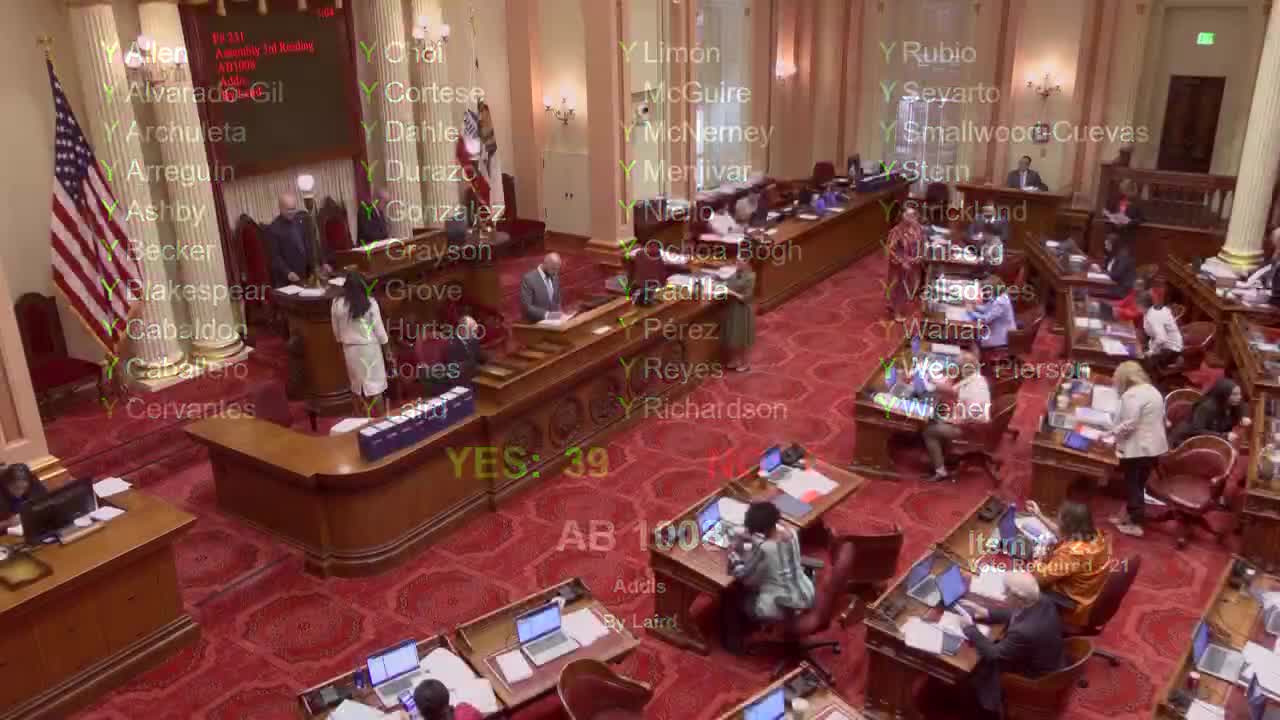
Bill Author

Bill Co-Author(s):