AB 1281: Vehicles: leaving the scene of an accident.
- Session Year: 2025-2026
- House: Assembly
- Latest Version Date: 2026-01-05
Current Status:
Failed
(2026-01-13: From committee: Without further action pursuant to Joint Rule 62(a).)
Introduced
In Committee
Awaiting First Chamber Vote
Passed First Chamber
In Committee
Awaiting Second Chamber Vote
Passed Second Chamber
Enacted
What does this bill do?
This bill shortens the state prison term for drivers who fail to stop after a crash that causes death or a permanent, serious injury from 15 years to seven, eight, or nine years. It applies when the crash results in death or a “permanent, serious injury,” defined as the loss or permanent impairment of a bodily member or organ.
The summary is provided by generative AI which can make mistakes. For original language, please view the details in the table below.
Existing law requires the driver of a vehicle involved in an accident resulting in injury to a person, other than that driver, or in the death of a person, to immediately stop the vehicle at the scene of the accident and provide specified personal information to the injured person or the occupants of the other vehicle and to any traffic or police officer at the scene of the accident. Under existing law, if a vehicle accident results in permanent, serious injury or death, a person who violates the requirement to stop is subject to punishment by imprisonment in the state prison for 2, 3, or 4 years, or in a county jail for not less than 90 days nor more than one year, or by a specified fine, or both the imprisonment and fine. Existing law requires a person who flees the scene of the crime after committing specified vehicle manslaughter while intoxicated or vehicle manslaughter to be punished for an additional term of imprisonment of 5 years in the state prison, upon conviction, and in addition and consecutive to the punishment prescribed.
This bill would instead require a person who violates the requirement to stop to be subject to punishment by imprisonment in the state prison for 15 7, 8, or 9 years if the vehicle accident results in permanent, serious injury or death.
Existing law requires the driver of a vehicle involved in an accident resulting in injury to a person, other than that driver, or in the death of a person, to immediately stop the vehicle at the scene of the accident and provide specified personal information to the injured person or the occupants of the other vehicle and to any traffic or police officer at the scene of the accident. Under existing law, if a vehicle accident results in permanent, serious injury or death, a person who violates the requirement to stop is subject to punishment by imprisonment in the state prison for 2, 3, or 4 years, or in a county jail for not less than 90 days nor more than one year, or by a specified fine, or both the imprisonment and fine. Existing law requires a person who flees the scene of the crime after committing specified vehicle manslaughter while intoxicated or vehicle manslaughter to be punished for an additional term of imprisonment of 5 years in the state prison, upon conviction, and in addition and consecutive to the punishment prescribed.
This bill would instead require a person who violates the requirement to stop to be subject to punishment by imprisonment in the state prison for 15 years if the vehicle accident results in permanent, serious injury or death.
(a)The driver of a vehicle involved in an accident resulting in injury to a person, other than that driver, or in the death of a person shall immediately stop the vehicle at the scene of the accident and shall fulfill the requirements of Sections 20003 and 20004.
(b)(1)Except as provided in paragraph (2), a person who violates subdivision (a) shall be punished by imprisonment in the state prison, or in a county jail for not more than one year, or by a fine of not less than one thousand dollars ($1,000) nor more than ten thousand dollars ($10,000), or by both that imprisonment and fine. In imposing the minimum fine required by this paragraph, the court shall take into consideration the defendants ability to pay the fine and, in the interests of justice and for reasons stated in the record, may reduce the amount of that minimum fine to less than the amount otherwise required by this paragraph.
(2)If the accident described in subdivision (a) results in death or permanent, serious injury, a person who violates subdivision (a) shall be punished by imprisonment in the state prison for 15 seven, eight, or nine years.
(c)A person who flees the scene of the crime after committing a violation of Section 191.5 of, or paragraph (1) of subdivision (c) of Section 192 of the Penal Code, upon conviction of any of those sections, in addition and consecutive to the punishment prescribed, shall be punished by an additional term of imprisonment of five years in the state prison. This additional term shall not be imposed unless the allegation is charged in the accusatory pleading and admitted by the defendant or found to be true by the trier of fact. The court shall not strike a finding that brings a person within the provisions of this subdivision or an allegation made pursuant to this subdivision.
(d)As used in this section, permanent, serious injury means the loss or permanent impairment of function of a bodily member or organ.
(a)The driver of a vehicle involved in an accident resulting in injury to a person, other than himself or herself, that driver, or in the death of a person shall immediately stop the vehicle at the scene of the accident and shall fulfill the requirements of Sections 20003 and 20004.
(b)(1)Except as provided in paragraph (2), a person who violates subdivision (a) shall be punished by imprisonment in the state prison, or in a county jail for not more than one year, or by a fine of not less than one thousand dollars ($1,000) nor more than ten thousand dollars ($10,000), or by both that imprisonment and fine. In imposing the minimum fine required by this paragraph, the court shall take into consideration the defendants ability to pay the fine and, in the interests of justice and for reasons stated in the record, may reduce the amount of that minimum fine to less than the amount otherwise required by this paragraph.
(2)If the accident described in subdivision (a) results in death or permanent, serious injury, a person who violates subdivision (a) shall be punished by imprisonment in the state prison for two, three, or four years, or in a county jail for not less than 90 days nor more than one year, or by a fine of not less than one thousand dollars ($1,000) nor more than ten thousand dollars ($10,000), or by both that imprisonment and fine. However, the court, in the interests of justice and for reasons stated in the record, may reduce or eliminate the minimum imprisonment required by this paragraph. 15 years.
(3)In imposing the minimum fine required by this subdivision, the court shall take into consideration the defendants ability to pay the fine and, in the interests of justice and for reasons stated in the record, may reduce the amount of that minimum fine to less than the amount otherwise required by this subdivision.(c)A person who flees the scene of the crime after committing a violation of Section 191.5 of, or paragraph (1) of subdivision (c) of Section 192 of the Penal Code, upon conviction of any of those sections, in addition and consecutive to the punishment prescribed, shall be punished by an additional term of imprisonment of five years in the state prison. This additional term shall not be imposed unless the allegation is charged in the accusatory pleading and admitted by the defendant or found to be true by the trier of fact. The court shall not strike a finding that brings a person within the provisions of this subdivision or an allegation made pursuant to this subdivision.
(d)As used in this section, permanent, serious injury means the loss or permanent impairment of function of a bodily member or organ.
|
Date
|
Status
|
|---|---|
| Jan 13, 2026 | From committee: Without further action pursuant to Joint Rule 62(a). |
| Jan 13, 2026 | In committee: Set, final hearing. Failed passage. |
| Jan 6, 2026 | Re-referred to Com. on PUB. S. |
| Jan 5, 2026 | From committee chair, with author's amendments: Amend, and re-refer to Com. on PUB. S. Read second time and amended. |
| Apr 10, 2025 | In committee: Set, second hearing. Hearing canceled at the request of author. |
| Apr 8, 2025 | In committee: Set, first hearing. Hearing canceled at the request of author. |
| Mar 13, 2025 | Referred to Com. on PUB. S. |
| Feb 24, 2025 | Read first time. |
| Feb 22, 2025 | From printer. May be heard in committee March 24. |
| Feb 21, 2025 | Introduced. To print. |
|
Date
|
Description
|
Location
|
Votes
|
|
|---|---|---|---|---|
| Jan 13, 2026 | Do pass and be re-referred to the Committee on [Appropriations] | Assembly Standing Committee on Public Safety |
Failed |
This list shows positions taken on this bill by organizations on the date displayed, which is linked to the original source.
Positions by individuals are not included.
|
Organization
|
Position
|
Date
|
|---|---|---|
| Aclu California Action | ** Against | |
| California Attorneys For Criminal Justice | ** Against | |
| California Police Chiefs Association | ** Support | |
| California Public Defenders Association | ** Against | |
| California State Sheriffs' Association | ** Support | |
| Californians United for a Responsible Budget | ** Against | |
| Ella Baker Center For Human Rights | ** Against | |
| Felony Murder Elimination Project | ** Against | |
| Initiate Justice | ** Against | |
| Initiate Justice Action | ** Against | |
| Justice2jobs Coalition | ** Against | |
| LA Defensa | ** Against | |
| San Francisco Public Defender | ** Against | |
| Sister Warriors Freedom Coalition | ** Against | |
| Smart Justice California, a project of Tides Advocacy | ** Against |
Date of Hearing: January 13, 2026
Counsel: Ilan Zur
ASSEMBLY COMMITTEE ON PUBLIC SAFETY
Nick Schultz, Chair
ABPCA Bill Id:AB 1281
Author:(DeMaio) – As Amended Ver:January 5, 2026
SUMMARY:
Increases the punishment for failing to stop and perform certain duties at the scene of an accident resulting in death or permanent, serious injury from an alternate felony-misdemeanor to a felony punishable by seven, eight, or nine years in state prison. Specifically, this bill:
- Increases the punishment for a driver involved in an accident resulting in death or permanent, serious injury to another person who fails to stop at the scene of the accident and perform certain duties from an alternative felony-misdemeanor, punishable by 90 days to one year in county jail or two, three, or four years in state prison, to a straight felony punishable by seven, eight, or nine years in state prison.
- Removes the court’s discretion for the above offense to, in the interests of justice and for reasons stated in the record, reduce or eliminate the minimum imprisonment required for this offense, and to reduce the minimum fine to less than the amount otherwise required for this offense.
EXISTING LAW:
- Requires the driver of a vehicle involved in an accident resulting in injury to another person to immediately stop the vehicle at the scene of the accident and to fulfill specified requirements, including providing identifying information and rendering reasonable assistance. (Veh. Code, §§ 20001, subd. (a); 20003.)
- Provides that, except as specified, fleeing the scene of an accident resulting in injury to another is punishable by 16 months, two, or three years in state prison, or by imprisonment in a county jail not to exceed one year, or by a fine of not less than $1,000 nor more than $10,000, or by both a fine and imprisonment. (Veh. Code, § 20001, subd. (b)(1).)
- Provides that fleeing the scene of an accident which results in permanent, serious injury or death to another, is punishable by imprisonment in state prison for two, three, or four years, or in county jail for not less than 90 days nor more than one year, or by a fine between $1,000 and $10,000, or by both a fine and imprisonment. (Veh. Code, § 20001, subd. (b)(2).)
- Allows the court, in the interests of justice, to reduce or eliminate the minimum term of imprisonment required for a conviction of fleeing the scene of an accident that causes death or permanent, serious injury. (Veh. Code, § 20001, subd. (b)(2).)
- Requires the court to take into consideration the defendant’s ability to pay in imposing the minimum fine required, and, in the interests of justice, the court may reduce the amount of the fine below the required minimum. (Veh. Code, § 20001, subd. (b)(3).)
- States that a person who flees the scene of an accident after committing gross vehicular manslaughter, gross vehicular manslaughter while intoxicated, or vehicular manslaughter while intoxicated, upon conviction for that offense, shall be punished by an additional term of five years in the state prison. This additional term runs in addition to and consecutive to the prescribed punishment. (Veh. Code, § 20001, subd. (c).)
- Defines “permanent, serious injury” as the loss or permanent impairment of the function of a bodily member or organ. (Veh. Code, § 20001, subd. (d).)
- Defines “gross vehicular manslaughter” as the unlawful killing of a human being, without malice aforethought, in driving a vehicle in the commission of an unlawful act, not amounting to a felony, and with gross negligence, or in driving a vehicle in the commission of a lawful act which might produce death, in an unlawful manner, and with gross negligence. This offense is punishable by imprisonment in a county jail for not more than one year, or in the state prison for two, four, or six years. (Pen. Code, §§ 192, subd. (c)(1); 193, subd. (c)(1).)
- Defines “gross vehicular manslaughter while intoxicated” as the unlawful killing of a human being, without malice aforethought, while driving a vehicle while intoxicated, and the killing was either a proximate result of an unlawful act, not amounting to a felony, and with gross negligence, or the proximate result of a lawful act that might produce death, in an unlawful manner, and with gross negligence. Gross vehicular manslaughter while intoxicated is punishable by four, six, or 10 years in state prison. (Pen. Code, § 191.5.)
- Provides for an additional punishment of three years when great bodily injury (GBI) is inflicted during the commission of a felony and where GBI is not an element of the offense, although this is inapplicable to murder or manslaughter. (Pen. Code, § 12022.7, subds. (a) & (g).)
- Provides that the additional punishment described above increases to five years if the victim becomes comatose due to brain injury or suffers permanent paralysis or if the victim is 70 years of age or older, and up to six years if the victim is a child under five years of age. (Pen. Code, § 12022.7, subds. (a)-(d).)
FISCAL EFFECT:
Unknown
COMMENTS:
- Author's Statement: According to the author, "Currently, there is not sufficient enough punishment for negligent drivers who have committed a hit and run that has resulted in the loss of life. The inadequate punishment results in victims families feeling as though the legal system does not properly value the life of their loved one, and losing faith in the legal system. AB 1281 would increase the minimum punishment for hit and runs resulting in death, and would make sure the punishment fits the crime.”
- Effect of this Bill: The offenses described in Vehicle Code section 20001 are commonly known as “hit and runs.” To prove a violation of a hit and run resulting in permanent, serious injury or death the prosecution must establish that: (1) the defendant was involved in a vehicle accident while driving; (2) the accident caused permanent, serious injury or death to another; (3) the defendant knew that they were involved in an accident that injured another person, or knew from the nature of the accident that it was probable that another person had been injured; and, (4) the defendant willfully failed to perform one or more duties, including immediately stopping at the scene, providing reasonable assistance to any injured person, providing specified identifying information, showing a driver’s license upon request, and notifying the applicable law enforcement entity. (2 CALCRIM 2140 (2025).)
The hit and run statute “merely addresses the duties of a driver, however otherwise innocent, once the accident and its attendant injuries have occurred.” (People v. Wood (2000) 83 Cal.App.4th 862, 866.) “The purpose of [the statute] is to prevent the driver of an automobile from leaving the scene of an accident in which he participates or is involved without proper identification and to compel necessary assistance to those who may be injured. The requirements of the statute are operative and binding on all drivers involved in an accident regardless of any question of their negligence respectively.” (People v. Scofield (1928) 203 Cal. 703, 708.) In other words, this offense does not require that a person drive impaired, recklessly, or negligently. A driver’s post-accident duties apply regardless of who was at fault for the accident. Accordingly, a hit-and-run may involve a driver who is involved in an accident in which they were not at fault but, for whatever reason, left the scene.
If the accident results in injury to another person, the offense is punishable by up to one year in county jail or 16 months, two, or three years in state prison. (Veh. Code, § 20001, subd. (b)(1).) However, if the accident results in death or permanent serious injury, it is punishable by 90 days to one year in county jail, or two, three, or four years in state prison. (Id. at § 20001, subd. (b)(2).) This bill would increase the punishment for failing to stop and perform certain duties following an accident resulting in death or permanent, serious injury to another person, from an alternative felony-misdemeanor to a straight felony punishable by seven, eight, or nine years in prison. It also removes the court’s discretion to, in the interests of justice and for reasons stated in the record, reduce or eliminate the minimum imprisonment for this offense, and to reduce the minimum fine required for this offense.
- Disproportionate Punishment for Vehicle-Related Crimes Causing Death: This bill contemplates a significant penalty increase, more than doubling the current maximum four-year prison term for this offense. This may create disproportionate and inconsistent criminal penalties by punishing a hit and run more harshly than other, arguably more serious, vehicle- related offenses that result in death. For example, gross vehicular manslaughter, an offense that requires greater harm (death) and culpability (gross negligence and unlawful behavior) than a hit and run, is punishable as a wobbler by up to one year in county jail or two, four, or six years in state prison. (Pen. Code, §§ 192, subd. (c)(1); 193, subd. (c)(1).) This bill would make the minimum prison term for a hit and run, irrespective of whether that person caused the accident, higher than the maximum prison term for a person who kills someone while driving unlawfully and with gross negligence.
Consider the crime of gross vehicular manslaughter while intoxicated: an offense that similarly requires greater harm (death) and culpability (gross negligence, intoxication, and unlawful behavior) than a hit and run, and which is punishable by four, six, or 10 years in state prison. (Pen. Code, § 191.5, subds. (a), (c).) This bill would make the low term (seven years) and middle term (eight years) for a hit and run higher than those for gross vehicular manslaughter while intoxicated (four years and six years, respectively). (Pen. Code, § 191.5, subd. (c)(1).) Given that courts may not order a sentence exceeding the middle term unless there are specified aggravating factors, under this bill, a person convicted of a hit and run involving permanent, serious injury or death would typically serve more time than a person convicted of gross vehicular manslaughter while intoxicated. (Pen. Code, § 1170, subd. (b)(2).) Should a person who gets into a car accident that was not their fault, that involves serious injury, but who panics and leaves the scene, receive a higher prison term than a person who kills someone while driving intoxicated, unlawfully, and with gross negligence?
It may be helpful to consider the prison terms for other serious crimes unrelated to driving. For example, this bill punishes an offense that can currently be prosecuted as a misdemeanor more severely than the crime of rape, one of society’s most heinous crimes, which is listed on the violent felonies list. (Pen. Code, § 667.5, subd. (a)(3).) The seven, eight, or nine-year sentence proposed by this bill is far greater than the three, six, or eight-year term associated with a rape conviction (Pen. Code, § 264, subd. (1).)
- Increased Penalties and Lack of Deterrent Effect: According to the National Institute of Justice (NIJ), “Laws and policies designed to deter crime by focusing mainly on increasing the severity of punishment are ineffective partly because criminals know little about the sanctions for specific crimes. “More severe punishments do not ‘chasten’ individuals convicted of crimes, and prisons may exacerbate recidivism.”[1] Rather than penalty increases, the NIJ emphasizes the need for policies that “increase[] the perception that criminals will be caught and punished” because “[t]he certainty of being caught is a vastly more powerful deterrent than the punishment.” [2]
In a 2014 report, the Little Hoover Commission similarly addressed the disconnect between science and sentencing – that is, “put[ting] away offenders for increasingly longer periods of time, with no evidence that lengthy incarceration, for many, brings any additional public safety benefit.”[3] Accordingly, while this bill guarantees greater punishment for hit-and-run drivers, it is unclear whether it will effectively prevent hit-and-run behavior. - Argument in Support: According to the California Police Chiefs Association, “Current law does not have sufficient punishment for drivers of vehicles who commit a hit and run that results in a permanent serious injury or death. The minimum punishment is no less than 90 days in county jail or no less than a $1,000 fine. The maximum punishment doesn’t add much to fit the crime, as it is either 4 years in prison, a $10,000 fine, or some combination of both. AB 1281 proposes harsher punishments, including longer prison sentences and higher fines. The bill aims to ensure greater accountability for individuals involved in accidents that result in permanent harm. The bill’s objective is to deter negligent and reckless behavior, ensuring that individuals who cause significant harm do not evade responsibility, ultimately promoting justice and protection for victims.
“As law enforcement professionals dedicated to ensuring justice and public safety, we believe that AB 1281 represents a crucial step in reaffirming California’s commitment to victim-centered justice.”
- Argument in Opposition: According to ACLU California Action, “AB 1281 [] would remove a court’s discretion when punishing a person who leaves the scene of an accident resulting in death or permanent, serious injury, instead requiring a blanket punishment of 7, 8, or 9 years in state prison – even if the driver is not at fault.
“Recognizing that the broad universe of culpability that may be involved in car accidents that result in serious injury or death, current law provides courts discretion in imposing a sentence. On one hand, there may be an at-fault driver who leaves the scene for fear of persecution. On the other hand, there may be a driver who is not at-fault, but who left the scene during their state of shock, without any knowledge of the condition of the at-fault driver. Because California’s prohibition on leaving the scene of an accident applies in both situations, current law allows courts to impose a sentence of up to 4 years, while also allowing a court to reduce or eliminate a sentence in the interests of justice. Instead of allowing courts to impose sentences as appropriate for different cases, AB 1281 requires courts to impose a 7-, 8-, or 9-year prison term in every situation.
“In situations involving a driver who was not at-fault for the accident and who has no knowledge of the condition of the at-fault driver, AB 1281’s mandatory sentencing is incredibly unjust. Yet, the bill removes the court’s authority to eliminate or reduce sentences in the interest of justice, thereby forcing a court to impose this unreasonable sentence on the individual. This scheme of imposing a 7-, 8-, or 9-year sentence on an individual with no criminal culpability runs afoul the Eight Amendment’s prohibition on cruel and unusual punishment.
“In situations involving a driver who is at-fault for the accident, AB 1281 remains problematic. It is important to note that the part of the Vehicle Code the bill would amend only punishes the act of driving away from the scene, the Penal Code applies to any underlying crime. For example, under the Penal Code, a person guilty of vehicular manslaughter may be sentenced up to 10 years in prison. The Vehicle Code’s current 4-year term for leaving the scene of the punishment would be in addition to this underlying 10-year term. AB 1281 turns this sentencing scheme on its head by requiring the punishment for leaving the scene of the crime be 7, 8, or 9 years of incarceration on its own, regardless of any underlying Penal Code violations. Again, because AB 1281 ties a court’s hands, this mandatory sentencing would apply in every situation where a person fled the scene of the accident, without any consideration whether the driver intended to cause an accident or if they had any knowledge that the accident resulted in serious injuries.
“Harsh sentencing schemes do not improve public safety, nor do they make victims whole. Extensive research has demonstrated, and the Federal Department of Justice has provided guidance, that increased penalties do not deter future crimes. Other studies confirm this by concluding the severity of punishment does not generally have an increased effect on deterrence. Rather, the conclusion is that certainty of punishment—that someone will be punished for a particular crime — has a greater deterrence effect than the severity of the punishment itself.
“With the state spending $133,110 per year to incarcerate one person, these increased penalties are unnecessary and will drain taxpayer dollars. If AB 1281 were to become law, each time a person is convicted of this mandatory sentencing scheme, it will cost taxpayers nearly $1.2 million for each conviction, without accounting for future inflation. We encourage lawmakers to instead invest in direct financial, emotional, and medical assistance to victims and their families so that they can fully heal from their trauma.”
- Related Legislation: AB 1193 (Gipson) removes the statute of limitations for a hit and run resulting in death or permanent serious injury. AB 1193 was never heard in this Committee.
- Prior Legislation:
- AB 1067 (Jim Patterson), of the 2023-2024 Legislative Session, would have increased the penalties for fleeing the scene of an accident resulting in the death of another person from an alternate felony-misdemeanor with a maximum punishment of four years in state prison, to an alternate felony-misdemeanor having a maximum punishment of six years in the state prison. AB 1067 was held in Assembly Appropriations Committee.
- AB 582 (Jim Patterson), of the 2021-2022 Legislative Session, was substantially similar to AB 1067, above. AB 582 was held in the Assembly Appropriations Committee.
- AB 195 (Jim Patterson), of the 2019-2020 Legislative Session, as amended in the Senate, was substantially similar to AB 1067, above. AB 195 failed passage in the Senate Public Safety Committee.
- AB 2014 (E. Garcia), of the 2017-2018 Legislative Session, would have increased the penalty for fleeing the scene of an accident resulting in death or serious bodily injury from two, three, or four years in state prison to two, four, or six years in state prison. The hearing in this committee on AB 2014 was canceled at the request of the author.
REGISTERED SUPPORT / OPPOSITION:
Support
California Police Chiefs Association
California State Sheriffs' Association
Opposition
ACLU California Action
California Attorneys for Criminal Justice
California Public Defenders Association
California Public Defenders Association (CPDA)
Californians United for a Responsible Budget
Ella Baker Center for Human Rights
Felony Murder Elimination Project
Initiate Justice
Initiate Justice Action
Justice2jobs Coalition
LA Defensa
San Francisco Public Defender
Sister Warriors Freedom Coalition
Smart Justice California, a Project of Tides Advocacy
Analysis Prepared by:
Ilan Zur / PUB. S. / (916) 319-3744
National Institute of Justice, U.S. Department of Justice, Five Things about Deterrence (June 5, 2016) https://nij.ojp.gov/topics/articles/five-things-about-deterrence. ↑
Ibid. ↑
Little Hoover Commission, Sensible Sentencing for a Safer California (Feb. 2014) at p. 4, https://lhc.ca.gov/wp-content/uploads/Reports/219/Report219.pdf ↑
Discussed in Hearing
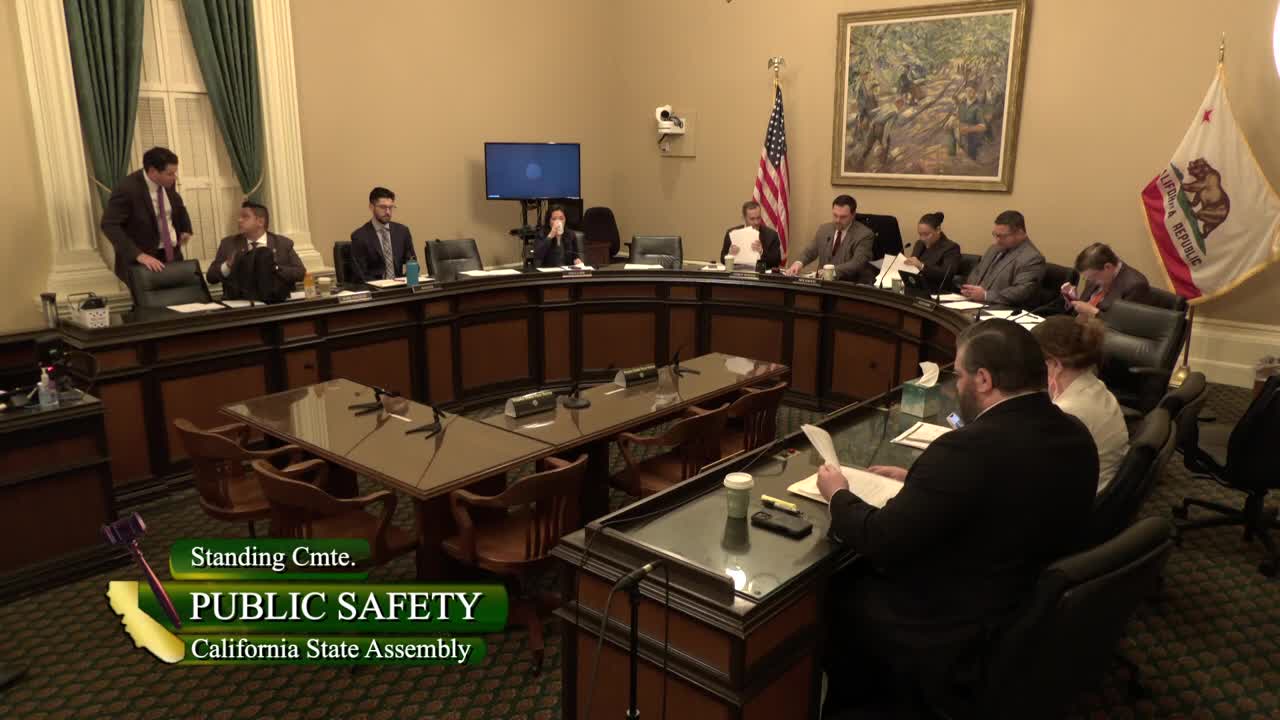 13MIN
Assembly Standing Committee on Public Safety
Bill Author

Bill Co-Author(s):