AB 1347: Electrical modernization zones.
- Session Year: 2025-2026
- House: Assembly
- Latest Version Date: 2025-03-28
Current Status:
Failed
(2026-02-02: From committee: Filed with the Chief Clerk pursuant to Joint Rule 56.)
Introduced
In Committee
Awaiting First Chamber Vote
Passed First Chamber
In Committee
Awaiting Second Chamber Vote
Passed Second Chamber
Enacted
What does this bill do?
The bill directs the Governor’s Office of Business and Economic Development, working with the Independent System Operator, to pick six electrical infrastructure modernization zones (including the high desert and unincorporated Altadena) and requires state energy agencies to treat those areas as priorities for expected electricity growth. Utilities serving customers in those zones may update load forecasts with local governments, recover upgrade costs faster, and — with local approval — operate microgrids (charging a fixed fee if a microgrid is not tied to the main grid); if a utility will not manage a microgrid, a customer may hire a microgrid provider for up to 10 years with one 10-year renewal.
The summary is provided by generative AI which can make mistakes. For original language, please view the details in the table below.
Existing law provides that it is the policy of the state that each electrical corporation upgrade the states electrical distribution systems as needed. Existing law requires the Public Utilities Commission (PUC), in consultation with the State Energy Resources Conservation and Development Commission (Energy Commission) and the Independent System Operator (ISO), to take specified actions to facilitate the commercialization of microgrids for distribution customers of large electrical corporations.
This bill would require the Governors Office of Business and Economic Development, in conjunction with the ISO, to identify six electrical infrastructure modernization zones, as provided. The bill would require the PUC and the Energy Commission to recognize these zones as load growth priority areas. The bill would authorize an electrical corporation that serves a customer within an electrical infrastructure modernization zone to work with the local jurisdiction to update its electrical load projections. The bill would require the PUC to authorize an electrical corporation that serves a customer within an electrical infrastructure modernization zone to expedite cost recovery and to manage microgrids, as specified.
Under existing law, a violation of the Public Utilities Act or any order, decision, rule, direction, demand, or requirement of the PUC is a crime.
Because the provisions of this bill would be a part of the act, and because a violation of a PUC action implementing its requirements would be a crime, the bill would impose a state-mandated local program.
The California Constitution requires the state to reimburse local agencies and school districts for certain costs mandated by the state. Statutory provisions establish procedures for making that reimbursement.
This bill would provide that no reimbursement is required by this act for a specified reason.
This bill would make legislative findings and declarations as to the necessity of a special statute for the unincorporated area known as Altadena in the County of Los Angeles.
Existing law requires the Public Utilities Commission, in consultation with the State Energy Resources Conservation and Development Commission and the Independent System Operator, to take specified actions to facilitate the commercialization of microgrids for distribution customers of large electrical corporations.This bill would state the intent of the Legislature to enact subsequent legislation that would create electric modernization zones in order to meet the needs of high-growth economic areas throughout the state, as specifiedExisting law requires the Public Utilities Commission, in consultation with the State Energy Resources Conservation and Development Commission and the Independent System Operator, to take specified actions to facilitate the commercialization of microgrids for distribution customers of large electrical corporations.
This bill would state the intent of the Legislature to enact subsequent legislation that would create electric modernization zones in order to meet the needs of high-growth economic areas throughout the state, as specified
The Legislature finds and declares all of the following:
(a)The state is facing unprecedented load growth coupled with increased pressures on affordability.
(b)Although the Legislature, in 2023, enacted the Powering Up Californians Act (Article 14.5 (commencing with Section 930) of Chapter 4 of Part 1 of Division 1 of the Public Utilities Code), many jurisdictions continue to face energy constraints.
(c)Delays in providing electricity, including service upgrades, are costly to local cities.
(d)Many local jurisdictions face millions of dollars of lost revenue because of potential delays.
(e)The state needs to look at alternative ways of providing safe and reliable electricity to hard-to-reach areas and customers.
SEC. 2.Section 933.1 is added to the Public Utilities Code, to read:933.1.(a)(1)The Governors Office of Business and Economic Development, in conjunction with the Independent System Operator, shall identify six electrical infrastructure modernization zones based on, at a minimum, all of the following indicators:
(A)Need for increased economic development within the local jurisdiction.
(B)Lack of electrical infrastructure and delays in providing timely electrification, or both.
(C)Projected load growth in the local jurisdiction.
(D)Need to build infrastructure with a minimum impact on ratepayers.
(2)The six electrical infrastructure modernization zones identified pursuant to paragraph (1) shall include both of the following zones:
(A)The high desert area, as defined by the Governors Office of Business and Economic Development in conjunction with the Independent System Operator.
(B)The unincorporated area known as Altadena in the County of Los Angeles.
(b)For electrical infrastructure modernization zones identified pursuant to subdivision (a), all of the following shall apply:
(1)The commission and the Energy Commission shall recognize the electrical infrastructure modernization zones as load growth priority areas.
(2)An electrical corporation that serves a customer within an electrical infrastructure modernization zone may work with the local jurisdiction to update its electrical load projections.
(3)The commission shall authorize an electrical corporation that serves a customer within an electrical infrastructure modernization zone to do both of the following:
(A)Expedite cost recovery pursuant to subdivision (a) of Section 937.
(B)Manage a microgrid, upon approval of the local jurisdiction. If the microgrid is not interconnected to the electrical grid, the electrical corporation may collect a fixed charge from a customer of the microgrid. If the electrical corporation is not able to manage the microgrid, a customer may contract with a microgrid provider for up to 10 years with a one-time 10-year renewal process.
SEC. 3.No reimbursement is required by this act pursuant to Section 6 of Article XIIIB of the California Constitution because the only costs that may be incurred by a local agency or school district will be incurred because this act creates a new crime or infraction, eliminates a crime or infraction, or changes the penalty for a crime or infraction, within the meaning of Section 17556 of the Government Code, or changes the definition of a crime within the meaning of Section 6 of Article XIIIB of the California Constitution.
SEC. 4.The Legislature finds and declares that a special statute is necessary and that a general statute cannot be made applicable within the meaning of Section 16 of Article IV of the California Constitution because of the unique demand for adequate operational electrical infrastructure in the unincorporated area known as Altadena in the County of Los Angeles.
SECTION 1.It is the intent of the Legislature to enact subsequent legislation that would create, in partnership with the Governors Office of Business and Economic Development and the Independent System Operator, electric modernization zones in order to meet the electricity needs of high-growth economic areas throughout California, including, but not limited to, the high desert. It is the intent of the Legislature that the Public Utilities Commission, the State Energy Resources Conservation and Development Commission, and the Department of Fish and Wildlife would work to implement that subsequent legislation.It is the intent of the Legislature to enact subsequent legislation that would create, in partnership with the Governors Office of Business and Economic Development and the Independent System Operator, electric modernization zones in order to meet the electricity needs of high-growth economic areas throughout California, including, but not limited to, the high desert. It is the intent of the Legislature that the Public Utilities Commission, the State Energy Resources Conservation and Development Commission, and the Department of Fish and Wildlife would work to implement that subsequent legislation.
|
Date
|
Status
|
|---|---|
| Feb 2, 2026 | From committee: Filed with the Chief Clerk pursuant to Joint Rule 56. |
| Jan 31, 2026 | Died pursuant to Art. IV, Sec. 10(c) of the Constitution. |
| Apr 30, 2025 | In committee: Set, first hearing. Hearing canceled at the request of author. |
| Apr 23, 2025 | In committee: Hearing postponed by committee. |
| Apr 22, 2025 | From committee: Do pass and re-refer to Com. on U. & E. (Ayes 7. Noes 0.) (April 22). Re-referred to Com. on U. & E. |
| Apr 7, 2025 | Re-referred to Coms. on E.D., G., & H.I. and U. & E. pursuant to Assembly Rule 96. |
| Apr 1, 2025 | Re-referred to Com. on U. & E. |
| Mar 28, 2025 | From committee chair, with author's amendments: Amend, and re-refer to Com. on U. & E. Read second time and amended. |
| Mar 28, 2025 | Referred to Coms. on U. & E. and E.D., G., & H.I. |
| Feb 24, 2025 | Read first time. |
| Feb 22, 2025 | From printer. May be heard in committee March 24. |
| Feb 21, 2025 | Introduced. To print. |
This list shows positions taken on this bill by organizations on the date displayed, which is linked to the original source.
Positions by individuals are not included.
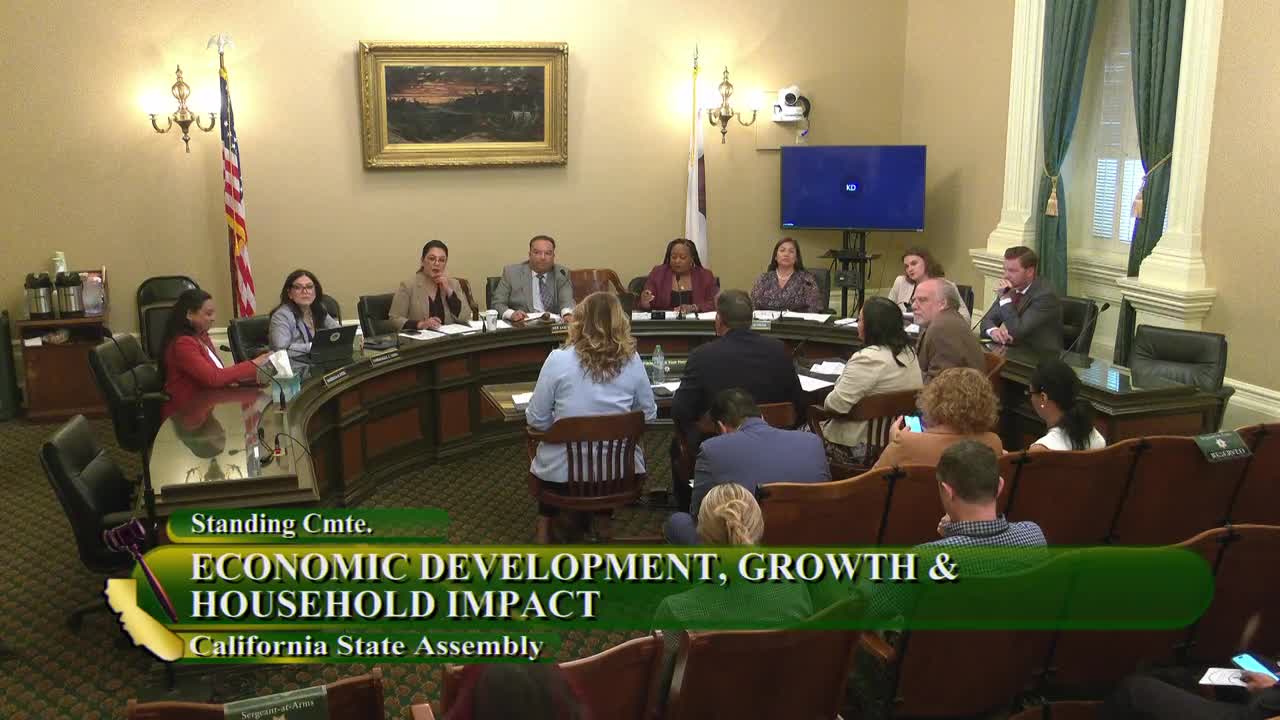
Date of Hearing: April 22, 2025
ASSEMBLY COMMITTEE ON ECONOMIC DEVELOPMENT, GROWTH, AND HOUSEHOLD IMPACT
José Solache, Chair
ABPCA Bill Id:AB 1347 (
Author:Carrillo) – As Amended Ver:March 28, 2025
SUBJECT: Electrical modernization zones
SUMMARY: AB 1347 would establish six electrical infrastructure modernization zones, recognized as priority areas for load growth by the Public Utilities Commission (PUC) and Energy Commission. It would allow electrical corporations to update load projections with local jurisdictions and expedite cost recovery and micro-grid management. The act creates a state-mandated local program with no reimbursement required and includes legislative findings for a special statute for Altadena in Los Angeles County.
Specifically, this bill:
- Requires the Governor’s Office of Business and Economic Development (GO-Biz), in conjunction with the California Independent System Operator (Cal ISO), to identify six electrical infrastructure modernization zones, as provided.
- Requires the PUC and the Energy Commission to recognize these zones as load growth priority areas.
- Authorizes an electrical corporation that serves a customer within an electrical infrastructure modernization zone to work with the local jurisdiction to update its electrical load projections.
- Requires the PUC to authorize an electrical corporation that serves a customer within an electrical infrastructure modernization zone to expedite cost recovery and to manage microgrids, as specified.
- Imposes a state-mandated local program.
- Provides that no reimbursement is required by this act for a specified reason.
- Makes legislative findings and declarations as to the necessity of a special statute for the unincorporated area known as Altadena in the County of Los Angeles.
EXISTING LAW:
- Existing law establishes the Governor’s Office of Business and Economic Development, known as “GO-Biz,” within the Governor’s office to serve the Governor as the lead entity for economic strategy and the marketing of California on issues relating to business development, private sector investment, and economic growth.
FISCAL EFFECT: According to the author, minor expenses to Go-Biz in order identify the priority zones and develop the pilot program.
COMMENTS: GO-Biz is focused on economic development, while CAISO oversees grid reliability and transmission planning. Modernization zones could align economic development with grid upgrades; ensuring businesses are located where the grid can support equitable growth, job creation and meet clean energy goals. Businesses need reliable, modern infrastructure. Cal ISO data can inform where capacity exists or where upgrades are planned, enabling GO-Biz to steer development toward feasible areas.
California has a long history of driving innovations for climate, climate energy and environmental sustainability. California set the nation’s first economy-wide greenhouse gas limit, the first climate emissions standards for cars, and is committed to 100% renewable energy by 2045.
- California today is home to many of the world’s largest investments in clean energy and sustainable transportation. Since 2014, there has been a total project investment in California of more than $9.3 billion.
- This commitment of private capital was matched in 2020 by more than $3 billion in public investment, supporting 51,000 projects delivering jobs and environmental benefits to California communities.
GO-Biz has been actively involved in initiatives aimed at enhancing the state's energy infrastructure. For instance, the office has participated in the ARCHES project, a public-private partnership focused on developing a clean hydrogen hub in California. This initiative aligns with the state's goal of achieving carbon neutrality by 2045 and underscores GO-Biz's commitment to fostering a sustainable energy ecosystem.
Additionally, GO-Biz has been involved in efforts to streamline the permitting process for zero-emission vehicle fueling stations, aiming to expand California's hydrogen and electric vehicle capacity. This initiative reflects the office's recognition of the importance of modernizing energy infrastructure to support equitable economic growth and environmental objectives.
As of the latest available Census data, California Assembly District 39, represented by Assemblymember Juan Carrillo, encompasses parts of Los Angeles County, including the cities of Palmdale and Adelanto. The district's population is approximately 476,039, with a median age of 31.7 years and a per capita income of $25,193. While both Palmdale and Adelanto face economic challenges, ongoing development efforts and strategic planning are paving the way for a more diversified and resilient economic future in the region.
Author’s Statement: “My district, and other growing regions of the State are being stifled by the often insurmountable challenge of expanding the grid to currently unserved areas. The high desert is poised to develop significant housing, commercial and industrial opportunities, but despite an abundance of solar and wind resources, the region continues to face energy constraints. Over the past several years the legislature has considered and approved a number of bills aimed at addressing the interconnection process and timelines that are hampering Californians across the state. AB 1347 takes a unique approach by allowing the Governor’s Office of Business and Economic Development to identify “electrical infrastructure modernization zones” in areas that are projected to grow quickly in the near future, and authorize the utilities that build new infrastructure to serve customers in these regions to expedite their cost recovery. This approach will both unlock the economic potential of these growing regions and protect existing ratepayers from the risk associated with building new grid infrastructure”.
REGISTERED SUPPORT / OPPOSITION:
Support
None on file.
Opposition
None on file.
Analysis Prepared by: Carla Castilla / E.D., G., & H.I. / (916) 319-2090
Discussed in Hearing
 56SEC
Senate Floor
 3MIN
Assembly Standing Committee on Economic Development, Growth, and Household Impact
Bill Author

Bill Co-Author(s):