AB 1354: Personal Income Tax Law: credits: insurance.
- Session Year: 2025-2026
- House: Assembly
- Latest Version Date: 2025-04-28
Current Status:
Failed
(2025-06-05: From committee: Without further action pursuant to Joint Rule 62(a).)
Introduced
In Committee
Awaiting First Chamber Vote
Passed First Chamber
In Committee
Awaiting Second Chamber Vote
Passed Second Chamber
Enacted
The Personal Income Tax Law allows various credits against the tax imposed by that law.
This bill would, for taxable years beginning on or after January 1, 2025, 2026, and before January 1, 2030, 2031, allow a credit against that tax to a qualified taxpayer taxpayer, as defined, equal to the amount paid during the taxable year for premium payments made by the taxpayer for a policy of residential property insurance, as defined, minus the base year premium, defined as the premium paid by the taxpayer for a fire insurance policy in the 2023 calendar year.
Existing law requires any bill authorizing a new tax expenditure to contain, among other things, specific goals, purposes, and objectives that the tax expenditure will achieve, detailed performance indicators, and data collection requirements.
This bill also would include additional information required for any bill authorizing a new tax expenditure.
This bill would take effect immediately as a tax levy.
The Personal Income Tax Law allows various credits against the tax imposed by that law.
This bill would, for taxable years beginning on or after January 1, 2025, and before January 1, 2030, allow a credit against that tax to a qualified taxpayer equal to the amount paid during the taxable year for premium payments made by the taxpayer for a policy of residential property insurance, as defined, minus the base year premium, defined as the premium paid by the taxpayer for a fire insurance policy in the 2023 calendar year.
Existing law requires any bill authorizing a new tax expenditure to contain, among other things, specific goals, purposes, and objectives that the tax expenditure will achieve, detailed performance indicators, and data collection requirements.
This bill also would include additional information required for any bill authorizing a new tax expenditure.
This bill would take effect immediately as a tax levy.
(a)(1)For each taxable year taxable years beginning on or after January 1, 2025, 2026, and before January 1, 2030, 2031, there shall be allowed a fire insurance credit against the net tax, as defined in Section 17039, to a qualified taxpayer, in an amount calculated pursuant to paragraph (2).
(2)The amount of the credit allowed by paragraph (1) shall be equal to the sum of the following:
(A)The amount of premium paid or incurred by a taxpayer for a policy of residential property insurance on a qualified residential property under Chapter 2 (commencing with Section 2030) of Part 1 of Division 2 of the Insurance Code in the taxable year minus the base year premium.
(B)Any assessment or surcharge paid or incurred by a taxpayer under Chapter 9 (commencing with Section 10090) of Part 1 of Division 2 of the Insurance Code.
(b)For purposes of this section, all of the following shall apply:
(1)Base year premium is the amount of premium paid or incurred by a taxpayer for a fire insurance policy under Chapter 2 (commencing with Section 2030) of Part 1 of Division 2 of the Insurance Code in the 2023 calendar year.
(2)(A)Policy of residential property insurance means a policy insuring individually owned residential structures of not more than four dwelling units, individually owned condominium units, or individually owned mobilehomes, and their contents, located in this state and used exclusively for residential purposes.
(B)Policy of residential property insurance shall not include insurance for real property, or the contents thereof, used for any commercial or industrial purpose.
(3)Premium paid paid or incurred shall not include interest charges or other fees paid or incurred through a premium finance plan or other plan for extension of credit.
(4)Qualified residential property means an individually owned residential structures of not more than four dwelling units, individually owned condominium units, or individually owned mobilehomes, and their contents, located in this state and used exclusively for residential purposes as the taxpayers primary residence that was purchased prior to December 31, 2023.
(5)(A)Qualified taxpayer means a taxpayer an individual that satisfies either of the following:
(i)(A)In the case of spouses filing a joint return, heads of household, or a surviving spouse, adjusted gross income does not exceed three hundred thousand dollars ($300,000).
(ii)(B)In the case of any other individual, a single individual or a spouse filing a separate return, adjusted gross income does not exceed one hundred fifty thousand dollars ($150,000).
(B)Qualified taxpayer shall not include an individual with insured residential real property with an aggregate value greater than three million three hundred thousand dollars ($3,300,000).(c)The credit allowed by this section shall be in lieu of any other credit or deduction that the qualified taxpayer may otherwise be allowed under this part with respect to amounts taken into account in calculating the credit allowed by this section.
(d)(1)The Franchise Tax Board may prescribe rules, guidelines, procedures, or other guidance to carry out the purposes of this section. Chapter 3.5 (commencing with Section 11340) of Part 1 of Division 3 of Title 2 of the Government Code shall not apply to any rule, guideline, or procedure prescribed by the Franchise Tax Board pursuant to this section.
(2)The Franchise Tax Board may prescribe any regulations necessary or appropriate to carry out the purposes of this section, including any regulations to prevent improper claims from being filed.(e)(1)For purposes of complying with Section 41, the Legislature finds and declares as follows:
(A)The specific goal of the credit allowed by this section is to assist California taxpayers in affording the massive price increases for the cost of residential property insurance.
(B)The performance indicators for the Legislature to use in determining whether the credit achieves the goal described in subparagraph (A) are the number of taxpayers claiming the credit and whether the average year-over-year increase on insurance premiums is in line with increases in the California Consumer Price Index.
(2)(A)No later than December 1, 2026, July 1, 2028, and annually thereafter, the Franchise Tax Board shall submit a report to the Legislature, in compliance with Section 9795 of the Government Code, detailing the number of taxpayers claiming the credit in the most recent taxable year, and the total dollar value of credits allowed.
(B)The disclosure requirements of this paragraph shall be treated as an exception to Section 19542.
(f)This section shall remain operative only until December 1, 2030, 2031, and as of that date is repealed.
SEC. 2.This act provides for a tax levy within the meaning of Article IV of the California Constitution and shall go into immediate effect.
(a)(1)For each taxable year beginning on or after January 1, 2025, and before January 1, 2030, there shall be allowed a fire insurance credit against the net tax, as defined in Section 17039, to a qualified taxpayer, in an amount calculated pursuant to paragraph (2).
(2)The amount of the credit allowed by paragraph (1) shall be equal to the sum of the following:
(A)The amount of premium paid by a taxpayer for a policy of residential property insurance on a qualified residential property under Chapter 2 (commencing with Section 2030) of Part 1 of Division 2 of the Insurance Code in the taxable year minus the base year premium.
(B)Any assessment or surcharge paid by a taxpayer under Chapter 9 (commencing with Section 10090) of Part 1 of Division 2 of the Insurance Code.
(b)For purposes of this section, all of the following shall apply:
(1)Base year premium is the amount of premium paid by a taxpayer for a fire insurance policy under Chapter 2 (commencing with Section 2030) of Part 1 of Division 2 of the Insurance Code in the 2023 calendar year.
(2)(A)Policy of residential property insurance means a policy insuring individually owned residential structures of not more than four dwelling units, individually owned condominium units, or individually owned mobilehomes, and their contents, located in this state and used exclusively for residential purposes.
(B)Policy of residential property insurance shall not include insurance for real property, or the contents thereof, used for any commercial or industrial purpose.
(3)Premium paid shall not include interest charges or other fees paid through a premium finance plan or other plan for extension of credit.
(4)Qualified residential property means an individually owned residential structures of not more than four dwelling units, individually owned condominium units, or individually owned mobilehomes, and their contents, located in this state and used exclusively for residential purposes that was purchased prior to December 31, 2023.
(5)(A)Qualified taxpayer means a taxpayer that satisfies either of the following:
(i)In the case of spouses filing a joint return, heads of household, or a surviving spouse, adjusted gross income does not exceed three hundred thousand dollars ($300,000).
(ii)In the case of any other individual, adjusted gross income does not exceed one hundred fifty thousand dollars ($150,000).
(B)Qualified taxpayer shall not include an individual with insured residential real property with an aggregate value greater than three million three hundred thousand dollars ($3,300,000).
(c)The credit allowed by this section shall be in lieu of any other credit or deduction that the qualified taxpayer may otherwise be allowed under this part with respect to amounts taken into account in calculating the credit allowed by this section.
(d)(1)The Franchise Tax Board may prescribe rules, guidelines, procedures, or other guidance to carry out the purposes of this section. Chapter 3.5 (commencing with Section 11340) of Part 1 of Division 3 of Title 2 of the Government Code shall not apply to any rule, guideline, or procedure prescribed by the Franchise Tax Board pursuant to this section.
(2)The Franchise Tax Board may prescribe any regulations necessary or appropriate to carry out the purposes of this section, including any regulations to prevent improper claims from being filed.
(e)(1)For purposes of complying with Section 41, the Legislature finds and declares as follows:
(A)The specific goal of the credit allowed by this section is to assist California taxpayers in affording the massive price increases for the cost of residential property insurance.
(B)The performance indicators for the Legislature to use in determining whether the credit achieves the goal described in subparagraph (A) are the number of taxpayers claiming the credit and whether the average year-over-year increase on insurance premiums is in line with increases in the California Consumer Price Index.
(2)(A)No later than December 1, 2026, and annually thereafter, the Franchise Tax Board shall submit a report to the Legislature, in compliance with Section 9795 of the Government Code, detailing the number of taxpayers claiming the credit in the most recent taxable year, and the total dollar value of credits allowed.
(B)The disclosure requirements of this paragraph shall be treated as an exception to Section 19542.
(f)This section shall remain operative only until December 1, 2030, and as of that date is repealed.
SEC. 2.This act provides for a tax levy within the meaning of Article IV of the California Constitution and shall go into immediate effect.
|
Date
|
Status
|
|---|---|
| Jun 5, 2025 | From committee: Without further action pursuant to Joint Rule 62(a). |
| May 5, 2025 | In committee: Set, final hearing. Held under submission. |
| Apr 29, 2025 | Re-referred to Com. on REV. & TAX. |
| Apr 28, 2025 | From committee chair, with author's amendments: Amend, and re-refer to Com. on REV. & TAX. Read second time and amended. |
| Apr 21, 2025 | In committee: Set, second hearing. Referred to suspense file. |
| Apr 7, 2025 | In committee: Set, first hearing. Hearing canceled at the request of author. |
| Mar 13, 2025 | Referred to Com. on REV. & TAX. |
| Feb 24, 2025 | Read first time. |
| Feb 22, 2025 | From printer. May be heard in committee March 24. |
| Feb 21, 2025 | Introduced. To print. |
This list shows positions taken on this bill by organizations on the date displayed, which is linked to the original source.
Positions by individuals are not included.
|
Organization
|
Position
|
Date
|
|---|---|---|
| California Apartment Association | ** Support | |
| California Association Of Realtors | ** Support | |
| California Teachers Association | ** Against |
Date of Hearing: May 5, 2025
ASSEMBLY COMMITTEE ON REVENUE AND TAXATION
Mike Gipson, Chair
ABPCA Bill Id:AB 1354 (
Author:Wallis) – As Amended Ver:April 28, 2025
SUSPENSE
Majority vote. Tax levy. Fiscal committee.
SUBJECT: Personal Income Tax Law: credits: insurance
SUMMARY: Allows, under the Personal Income Tax (PIT) Law, a credit for amounts paid or incurred in residential property insurance premiums, as specified. Specifically, this bill:
- Allows a credit for taxable years beginning on or after January 1, 2026, and before January 1, 2031, to a "qualified taxpayer" in an amount equal to the sum of the following:
- The amount of "premium paid or incurred" by a taxpayer for a "policy of residential property insurance" on a "qualified residential property", pursuant to Insurance Code Section 2030 et seq., in the taxable year minus the "base year premium"; and,
- Any assessment or surcharge paid or incurred by a taxpayer pursuant to Insurance Code Section 10090, relating to the California FAIR Plan Association.
- Defines all of the following terms:
- "Qualified taxpayer" is an individual who satisfies either of the following:
- In the case of spouses filing a joint return, heads of household, or a surviving spouse, adjusted gross income (AGI) does not exceed $300,000; or,
- In the case of a single individual or a spouse filing a separate return, AGI does not exceed $150,000.
- "Policy of residential property insurance" is a policy insuring individually owned residential structures of not more than four dwelling units, individually owned condominium units, or individually owned mobilehomes, and their contents, located in this state and used exclusively for residential purposes. "Policy of residential property insurance" does not include insurance for real property, or the contents thereof, used for any commercial or industrial purpose;
- "Qualified residential property" is an individually owned residential structure of not more than four dwelling units, individually owned condominium units, or individually owned mobilehomes, and their contents, located in this state and used exclusively as the taxpayer's primary residence that was purchased prior to December 31, 2023; and,
- "Base year premium" is the amount of premium paid by a taxpayer for a fire insurance policy in the 2023 calendar year.
- "Qualified taxpayer" is an individual who satisfies either of the following:
- Provides that "premium paid or incurred" does not include interest charges or other fees paid through a premium finance plan or other plan for extension of credit.
- Provides that any deduction otherwise allowed for amounts paid or incurred by the qualified taxpayer shall be reduced by the amount of the credit allowed.
- Finds and declares the following for the purposes of satisfying the requirements of Revenue and Taxation Code (R&TC) Section 41:
- The specific purpose of the credit is to assist California taxpayers in affording the massive price increases for the cost of residential property insurance;
- The performance indicators for the Legislature to use in determining whether the credit achieves its stated goal are the number of taxpayers allowed a credit and whether the average year-over-year increase on insurance premiums is in line with increases in the California Consumer Price Index; and,
- Requires the Franchise Tax Board, on or before July 1, 2028, and annually thereafter, to submit a report to the Legislature detailing the number of taxpayers allowed a credit and the total dollar value of credits allowed.
- Takes immediate effect as a tax levy.
- Sunsets the credit's statutory provisions on December 1, 2031.
EXISTING LAW:
- Allows various tax credits under the PIT Law. These credits are generally designed to encourage socially beneficial behavior or to provide relief to taxpayers who incur specified expenses.
- Requires any bill authorizing a new credit to contain all of the following:
- Specific goals, purposes, and objectives that the tax credit will achieve;
- Detailed performance indicators for the Legislature to use when measuring whether the tax credit meets the goals, purposes, and objectives stated in the bill; and,
- Data collection requirements to enable the Legislature to determine whether the tax credit is meeting, failing to meet, or exceeding those specific goals, purposes, and objectives. The requirements shall include the specific data and baseline measurements to be collected and remitted in each year the credit is in effect, for the Legislature to measure the change in performance indicators, and the specific taxpayers, state agencies, or other entities required to collect and remit data. (R&TC Section 41.)
- Establishes the California FAIR Plan Association (FAIR Plan), an insurer of last resort that provides basic property insurance to consumers when coverage in the voluntary market is unavailable. (Insurance Code Section 10090 et seq.)
- Authorizes the FAIR Plan, with the approval of the Insurance Commissioner, to impose an assessment on all members in amounts sufficient to operate the program. (Insurance Code Section 10094.)
FISCAL EFFECT: Regarding the prior version of the bill, the FTB estimates General Fund revenue losses of $900 million in fiscal year (FY) 2025-26, $550 million in FY 2026-27, and $500 million in FY 2027-28. An updated revenue estimate of the bill as recently amended is pending; however, the amendments likely result in slightly lower revenue losses than originally estimated.
COMMENTS:
- The author has provided the following statement in support of the bill:
California's homeowners' insurance market is in crisis. Due to the increased risk of wildfires and other natural disasters, insurance premiums have been rising. This makes it more difficult for homeowners to afford coverage, through no fault of their own. The State has failed to adequately address resilience, by continuing poor forest management practices, which has contributed to recent wildfires that are more severe and destructive than any recorded in California history. Insurers cancel existing policies, refuse to write new policies or leave the state altogether. California's regulatory environment, including Proposition 103, requires insurers to obtain approval for rate increases. While this aims to protect consumers, it can also limit insurers' ability to adjust rates in response to rising risks. These factors have led to a sharp increase in insurance premiums. Whether we like it or not, the way we will return to a stable insurance market is to allow premiums to rise in the short term, while continuing to improve the state's resilience to wildfires. By providing homeowners relief on their increased premium rates, the state can address the insurance crisis through a combination of building more resilience and allow the insurance market to correct and help families struggling to make ends meet.
- Writing in support of this bill, the California Association of Realtors notes, in part:
In the wake of recent wildfires, many California homeowners are shouldering the cost of rising insurance premiums, leading to reduction in homeownership affordability. AB 1354 would help mitigate that impact by offering eligible property owners a tax credit for the amount of their insurance premium, above their 2023 baseline premium.
- Writing in opposition to this bill, the California Teachers Association (CTA), notes, in part:
According to the Department of Finance, the state provided over $91.5 billion in General Fund tax expenditures in 2024-25 (including income, sales and use, corporate and other taxes). This number continues to grow each year. This revenue would have otherwise gone to the General Fund, of which, approximately 39 percent would have gone toward Proposition 98 for K-14 education. Due to existing tax expenditures, approximately $35 billion is redirected away from schools and community colleges each year. While we understand these bills are well intended, CTA does not support this approach, as it would reduce overall funding for education. CTA believes Proposition 98 should be protected from reductions through the creation of new or expanding existing tax expenditures or cuts to tax rates.
- Committee Staff Comments:
- What is a "tax expenditure"? Existing law provides various credits, deductions, exclusions, and exemptions for particular taxpayer groups. In the late 1960s, U.S. Treasury officials began arguing that these features of the tax law should be referred to as "expenditures" since they are generally enacted to accomplish some governmental purpose and there is a determinable cost associated with each (in the form of foregone revenues).
As the Department of Finance notes in its annual Tax Expenditure Report, there are several key differences between tax expenditures and direct expenditures. First, tax expenditures are typically reviewed less frequently than direct expenditures. Second, there is generally no control over the amount of revenue losses associated with any given tax expenditure. Finally, it should also be noted that, once enacted, it takes a two-thirds vote to rescind an existing tax expenditure absent a sunset date. This effectively results in a "one-way ratchet" whereby tax expenditures can be conferred by majority vote, but cannot be rescinded, irrespective of their efficacy or cost, without a supermajority vote. - What does this bill do? This bill creates a new tax credit for residential property insurance premiums. The amount of the credit allowed to a qualified taxpayer is determined by subtracting the amounts paid in property insurance premiums in 2023 (called the "base year premium") from the amounts paid in property insurance premiums in the current taxable year, plus any amounts paid by a taxpayer in the taxable year as a result of an assessment under the California FAIR Plan. In other words, the credit amount would be limited by an amount equal to the increase in costs associated with residential property insurance since 2023.
- Who stands to benefit? To qualify for the credit created by this bill, a taxpayer's AGI cannot exceed $300,000 if filing a joint return ($150,000 if filing a single return). Additionally, a qualifying taxpayer must have purchased a qualified residential property prior to December 31, 2023 and that does not include real property used for any commercial or industrial purpose. Any individual who owns insured residential real property totaling $3,300,000 or more would not qualify for this credit.
- Homeowners insurance in California: Proposition 103, passed by California voters in November 1988, was intended to protect consumers from arbitrary insurance rates and practices; to encourage a competitive marketplace; and to ensure that insurance is fair, available and affordable for all Californians. Proposition 103 instituted a regulatory system where the Insurance Commissioner must approve a rate applied for by an insurer before its use, known as the "prior approval" system, before an insurer can implement property and casualty insurance rates.
In 2017 and 2018, California experienced two of the most destructive wildfire seasons in state history, which resulted in California insurers paying a record of $15.4 billion in losses in 2017 and $13.6 billion in 2018. After two straight years of insurers paying out $1.85 in losses for every $1 of premium earned, the California Department of Insurance approved 71 rate increase requests from 50 different companies in 2019. Damage resulting from winter storms in subsequent years has continued to strain the property insurance market, with several major insurers stopping issuance of new policies or exiting the state altogether.[1]
The 2025 fires in Los Angeles have further exacerbated the property insurance crisis in multiple ways. While damage totals are still being calculated, it is estimated the fires resulted in the destruction or damage of tens of billions of dollars in property. Claims for insured properties are still being filed and will likely also total in the tens of billions of dollars. Additionally, many properties that were damaged or destroyed were already insured by the California FAIR Plan, the state's insurer of last resort, potentially jeopardizing the Plan's future solvency. - California FAIR Plan: The FAIR Plan was established after the riots and brush fires of the 1960s and provides basic property insurance to consumers when coverage in the voluntary market is unavailable. Every property insurance company licensed in California becomes a FAIR Plan member as a condition of doing business in California. Roughly 44% of FAIR Plan policies cover properties in California's urban areas while the rest are in the wildland urban interface (WUI) and properties are eligible for coverage regardless of wildfire exposure. The FAIR Plan is not a state agency and not state or taxpayer funded; the FAIR Plan is funded primarily through the policies it sells to customers.[2]
- What is a "tax expenditure"? Existing law provides various credits, deductions, exclusions, and exemptions for particular taxpayer groups. In the late 1960s, U.S. Treasury officials began arguing that these features of the tax law should be referred to as "expenditures" since they are generally enacted to accomplish some governmental purpose and there is a determinable cost associated with each (in the form of foregone revenues).
As of February 11, 2025, the FAIR Plan reported that it had paid more than $914 million to policy holders, including advance payments, to cover claims related to the Palisades and Eaton fires. The massive destruction in Los Angeles prompted the FAIR Plan's Accounting and Governing subcommittees to each recommend an assessment of $1 billion – the first assessment on insurers in more than 30 years, according to Insurance Commissioner Ricardo Lara – to enable the FAIR Plan to access additional available layers of reinsurance and maintain operations.[3] Generally, assessments are based on an insurer's market share of dwelling and commercial policies from two years ago, which means that property insurance policyholders that are not customers of the FAIR Plan may see their insurance costs increase.
For more information about the impact of recent disasters on the residential property insurance market and the California FAIR Plan, please refer to the Assembly Committee on Insurance's recent Oversight Hearings.
- Committee's tax expenditure policy: Both R&TC Section 41 and Committee policy require any tax expenditure bill to outline specific goals, purposes, and objectives that the tax expenditure will achieve, along with detailed performance indicators for the Legislature to use when measuring whether the tax expenditure meets those stated goals, purposes, and objectives. A tax expenditure bill will not be eligible for a Committee vote unless it has complied with these requirements. In its current form, this bill does not specify the goal of the credit or any performance indicators to evaluate whether the credit is achieving that goal. The author should amend this bill to include these provisions to comply with R&TC Section 41.
In addition to the R&TC Section 41 requirements, this Committee's policy also requires that all tax expenditure proposals contain an appropriate sunset provision to be eligible for a vote. According to this policy, an "appropriate sunset provision" means five years, except in the case of a tax expenditure measure providing relief to California veterans, in which case "appropriate sunset provision" means ten years. This bill, as currently drafted, complies with the Committee's policy on sunset dates. - Policy considerations:
- Which property? As currently drafted, there is no requirement that the qualified residential property is the taxpayer's primary residence. Additionally, there is no requirement that the insured property used to calculate the "base year premium" in 2023 is the same property that qualifies for the credit in future taxable years. For example, a taxpayer that has owned their primary residence and a vacation home in a high-risk area since 2022 could theoretically use the amounts paid in insurance premiums on their primary residence to establish the "base year premium", but then claim a credit for the increased costs of insurance on their vacation home. The author may wish to clarify the intent by further defining these key terms.
- Self-reported information: There are a number of data points included in this bill where the FTB would not have any information other than what is reported by the taxpayer, such as the amounts paid in insurance premiums, how much of it is attributable to a FAIR Plan assessment, and whether a taxpayer owns insured residential property totaling $3.3 million or greater. Any deficiencies or inaccuracies reported by taxpayers would likely only be discovered upon an audit.
- Implementation considerations:
- FAIR Plan assessments: In addition to the increased costs of insurance premiums, the credit allowed by this bill also seeks to include increased costs resulting from assessments on private insurers under the California FAIR Plan. It is unclear, however, if the increased costs of insurance resulting from assessments imposed by the California FAIR Plan will be separately reported and accounted for on a property insurance holder's bill. Without this information, it may be difficult for a taxpayer to understand the amount of credit that they would properly be allowed.
- Report timing: This bill would require the FTB to provide a report to the Legislature detailing the number of taxpayers claiming the credit and whether the average year-over-year increase on insurance premiums is in line with increases in the California Consumer Price Index by December 1, 2026. If the author's intent is to review a report that contains complete information for the 2025 taxable year, the FTB recommends that the reporting due date be extended to July 1, 2027. The FTB needs at least six to eight months to complete return processing and to compile the needed data to prepare a report.
- Related legislation: AB 232 (Calderon) creates tax-advantaged catastrophe savings accounts for residential property owners and allows a deduction under the PIT Law for contributions to catastrophe savings accounts, as specified. AB 232 is currently pending on this Committee's Suspense File.
- Prior legislation: AB 1867 (Sanchez), of the 2023-24 Legislative Session, would have allowed a miscellaneous itemized deduction equal to the costs paid or incurred by a taxpayer for a homeowners' insurance policy, as specified. AB 1867 was held on this Committee's Suspense File.
- Committee's tax expenditure policy: Both R&TC Section 41 and Committee policy require any tax expenditure bill to outline specific goals, purposes, and objectives that the tax expenditure will achieve, along with detailed performance indicators for the Legislature to use when measuring whether the tax expenditure meets those stated goals, purposes, and objectives. A tax expenditure bill will not be eligible for a Committee vote unless it has complied with these requirements. In its current form, this bill does not specify the goal of the credit or any performance indicators to evaluate whether the credit is achieving that goal. The author should amend this bill to include these provisions to comply with R&TC Section 41.
REGISTERED SUPPORT / OPPOSITION:
Support
California Apartment Association
California Association of Realtors
Opposition
California Teachers Association
Analysis Prepared by: Wesley Whitaker / REV. & TAX. / (916) 319-2098
Joint Informational Hearing: Wildfire Insurance: Risk, Resiliency & Recovery, Assembly Committee on Insurance and Select Committee on Wildfire Prevention (October 9, 2023). https://ains.assembly.ca.gov/sites/ains.assembly.ca.gov/files/10.9.23%20Final%20Committee%20background.pdf. ↑
Oversight Hearing: The California FAIR Plan, Assembly Committee on Insurance (March 13, 2024). https://ains.assembly.ca.gov/system/files/2024-03/asm-ins-fair-plan-background-final_0.pdf. ↑
Jergler, California Approves FAIR Plan Request to Assess Insurers $1B for Wildfire Claims, Insurance Journal (February 11, 2025). https://www.insurancejournal.com/news/west/
2025/02/11/811676.htm. ↑
Date of Hearing: April 21, 2025
ASSEMBLY COMMITTEE ON REVENUE AND TAXATION
Mike Gipson, Chair
ABPCA Bill Id:AB 1354 (
Author:Wallis) – As Introduced Ver:February 21, 2025
Majority vote. Tax levy. Fiscal committee.
SUBJECT: Personal Income Tax Law: credits: insurance
SUMMARY: Allows, under the Personal Income Tax (PIT) Law, a credit for amounts paid in residential property insurance premiums, as specified. Specifically, this bill:
- Allows a credit for taxable years beginning on or after January 1, 2025, and before January 1, 2030, to a "qualified taxpayer" in an amount equal to the sum of the following:
- The amount of "premium paid" by a taxpayer for a "policy of residential property insurance" on a "qualified residential property", pursuant to Insurance Code Section 2030 et seq., in the taxable year minus the "base year premium"; and,
- Any assessment or surcharge paid by a taxpayer pursuant to Insurance Code Section 10090, relating to the California FAIR Plan Association.
- Defines all of the following terms:
- "Qualified taxpayer" is a taxpayer who satisfies either of the following:
- For joint filers, adjusted gross income (AGI) does not exceed $300,000; or,
- For single filers, AGI does not exceed $150,000.
- "Policy of residential property insurance" is a policy insuring individually owned residential structures of not more than four dwelling units, individually owned condominium units, or individually owned mobilehomes, and their contents, located in this state and used exclusively for residential purposes. "Policy of residential property insurance" does not include insurance for real property, or the contents thereof, used for any commercial or industrial purpose;
- "Qualified residential property" is an individually owned residential structure of not more than four dwelling units, individually owned condominium units, or individually owned mobilehomes, and their contents, located in this state and used exclusively for residential purposes that was purchased prior to December 31, 2023; and,
- "Base year premium" is the amount of premium paid by a taxpayer for a fire insurance policy in the 2023 calendar year.
- "Qualified taxpayer" is a taxpayer who satisfies either of the following:
- Provides both of the following limitations for purposes of the credit:
- "Qualified taxpayer" does not include an individual with insured residential real property with an aggregate value of more than $3,300,000; and,
- "Premium paid" does not include interest charges or other fees paid through a premium finance plan or other plan for extension of credit.
- Provides that any deduction otherwise allowed for amounts paid or incurred by the qualified taxpayer shall be reduced by the amount of the credit allowed.
- Authorizes the Franchise Tax Board (FTB) to prescribe rules, guidelines, procedures, or other guidance to carry out the purposes of this bill. The Administrative Procedure Act shall not apply to any rule, guideline, or procedure prescribed by the FTB pursuant to this bill.
- Finds and declares the following for the purposes of satisfying the requirements of Revenue and Taxation Code (R&TC) Section 41:
- The specific purpose of the credit is to assist California taxpayers in affording the massive price increases for the cost of residential property insurance;
- The performance indicators for the Legislature to use in determining whether the credit achieves its stated goal are the number of taxpayers allowed a credit and whether the average year-over-year increase on insurance premiums is in line with increases in the California Consumer Price Index; and,
- Requires the FTB, on or before December 1, 2026, and annually thereafter, to submit a report to the Legislature detailing the number of taxpayers allowed a credit and the total dollar value of credits allowed.
- Takes immediate effect as a tax levy.
- Sunsets the credit's statutory provisions on December 1, 2030.
EXISTING LAW:
- Allows various tax credits under the PIT Law. These credits are generally designed to encourage socially beneficial behavior or to provide relief to taxpayers who incur specified expenses.
- Requires any bill authorizing a new credit to contain all of the following:
- Specific goals, purposes, and objectives that the tax credit will achieve;
- Detailed performance indicators for the Legislature to use when measuring whether the tax credit meets the goals, purposes, and objectives stated in the bill; and,
- Data collection requirements to enable the Legislature to determine whether the tax credit is meeting, failing to meet, or exceeding those specific goals, purposes, and objectives. The requirements shall include the specific data and baseline measurements to be collected and remitted in each year the credit is in effect, for the Legislature to measure the change in performance indicators, and the specific taxpayers, state agencies, or other entities required to collect and remit data. (R&TC Section 41.)
- Establishes the California FAIR Plan Association (FAIR Plan), an insurer of last resort that provides basic property insurance to consumers when coverage in the voluntary market is unavailable. (Insurance Code Section 10090 et seq).
- Authorizes the FAIR Plan, with the approval of the Insurance Commissioner, to impose an assessment on all members in amounts sufficient to operate the program. (Insurance Code Section 10094.)
FISCAL EFFECT: The FTB estimates General Fund revenue losses of $900 million in fiscal year (FY) 2025-26, $550 million in FY 2026-27, and $500 million in FY 2027-28.
COMMENTS:
- The author has provided the following statement in support of the bill:
California's homeowners' insurance market is in crisis. Due to the increased risk of wildfires and other natural disasters, insurance premiums have been rising. This makes it more difficult for homeowners to afford coverage, through no fault of their own. The State has failed to adequately address resilience, by continuing poor forest management practices, which has contributed to recent wildfires that are more severe and destructive than any recorded in California history. Insurers cancel existing policies, refuse to write new policies or leave the state altogether. California's regulatory environment, including Proposition 103, requires insurers to obtain approval for rate increases. While this aims to protect consumers, it can also limit insurers' ability to adjust rates in response to rising risks. These factors have led to a sharp increase in insurance premiums. Whether we like it or not, the way we will return to a stable insurance market is to allow premiums to rise in the short term, while continuing to improve the state's resilience to wildfires. By providing homeowners relief on their increased premium rates, the state can address the insurance crisis through a combination of building more resilience and allow the insurance market to correct and help families struggling to make ends meet.
- Writing in support of this bill, the California Association of Realtors notes, in part:
In the wake of recent wildfires, many California homeowners are shouldering the cost of rising insurance premiums, leading to reduction in homeownership affordability. AB 1354 would help mitigate that impact by offering eligible property owners a tax credit for the amount of their insurance premium, above their 2023 baseline premium.
- Writing in opposition to this bill, the California Teachers Association (CTA), notes, in part:
According to the Department of Finance, the state provided over $91.5 billion in General Fund tax expenditures in 2024-25 (including income, sales and use, corporate and other taxes). This number continues to grow each year. This revenue would have otherwise gone to the General Fund, of which, approximately 39 percent would have gone toward Proposition 98 for K-14 education. Due to existing tax expenditures, approximately $35 billion is redirected away from schools and community colleges each year. While we understand these bills are well intended, CTA does not support this approach, as it would reduce overall funding for education. CTA believes Proposition 98 should be protected from reductions through the creation of new or expanding existing tax expenditures or cuts to tax rates.
- Committee Staff Comments:
- What is a "tax expenditure"? Existing law provides various credits, deductions, exclusions, and exemptions for particular taxpayer groups. In the late 1960s, U.S. Treasury officials began arguing that these features of the tax law should be referred to as "expenditures" since they are generally enacted to accomplish some governmental purpose and there is a determinable cost associated with each (in the form of foregone revenues).
As the Department of Finance notes in its annual Tax Expenditure Report, there are several key differences between tax expenditures and direct expenditures. First, tax expenditures are typically reviewed less frequently than direct expenditures. Second, there is generally no control over the amount of revenue losses associated with any given tax expenditure. Finally, it should also be noted that, once enacted, it takes a two-thirds vote to rescind an existing tax expenditure absent a sunset date. This effectively results in a "one-way ratchet" whereby tax expenditures can be conferred by majority vote, but cannot be rescinded, irrespective of their efficacy or cost, without a supermajority vote. - What does this bill do? This bill creates a new tax credit for residential property insurance premiums. The amount of the credit allowed to a qualified taxpayer is determined by subtracting the amounts paid in property insurance premiums in 2023 (called the "base year premium") from the amounts paid in property insurance premiums in the current taxable year, plus any amounts paid by a taxpayer in the taxable year as a result of an assessment under the California FAIR Plan. In other words, the credit amount would be limited by an amount equal to the increase in costs associated with residential property insurance since 2023.
- Who stands to benefit? To qualify for the credit created by this bill, a taxpayer's AGI cannot exceed $300,000 if filing a joint return ($150,000 if filing a single return). Additionally, a qualifying taxpayer must have purchased a qualified residential property prior to December 31, 2023 and that does not include real property used for any commercial or industrial purpose. Any individual who owns insured residential real property totaling $3,300,000 or more would not qualify for this credit.
- Homeowners insurance in California: Proposition 103, passed by California voters in November 1988, was intended to protect consumers from arbitrary insurance rates and practices; to encourage a competitive marketplace; and to ensure that insurance is fair, available and affordable for all Californians. Proposition 103 instituted a regulatory system where the Insurance Commissioner must approve a rate applied for by an insurer before its use, known as the "prior approval" system, before an insurer can implement property and casualty insurance rates.
In 2017 and 2018, California experienced two of the most destructive wildfire seasons in state history, which resulted in California insurers paying a record of $15.4 billion in losses in 2017 and $13.6 billion in 2018. After two straight years of insurers paying out $1.85 in losses for every $1 of premium earned, the California Department of Insurance approved 71 rate increase requests from 50 different companies in 2019. Damage resulting from winter storms in subsequent years has continued to strain the property insurance market, with several major insurers stopping issuance of new policies or exiting the state altogether.[1]
The 2025 fires in Los Angeles have further exacerbated the property insurance crisis in multiple ways. While damage totals are still being calculated, it is estimated the fires resulted in the destruction or damage of tens of billions of dollars in property. Claims for insured properties are still being filed and will likely also total in the tens of billions of dollars. Additionally, many properties that were damaged or destroyed were already insured by the California FAIR Plan, the state's insurer of last resort, potentially jeopardizing the Plan's future solvency. - California FAIR Plan: The FAIR Plan was established after the riots and brush fires of the 1960s and provides basic property insurance to consumers when coverage in the voluntary market is unavailable. Every property insurance company licensed in California becomes a FAIR Plan member as a condition of doing business in California. Roughly 44% of FAIR Plan policies cover properties in California's urban areas while the rest are in the wildland urban interface (WUI) and properties are eligible for coverage regardless of wildfire exposure. The FAIR Plan is not a state agency and not state or taxpayer funded; the FAIR Plan is funded primarily through the policies it sells to customers.[2]
- What is a "tax expenditure"? Existing law provides various credits, deductions, exclusions, and exemptions for particular taxpayer groups. In the late 1960s, U.S. Treasury officials began arguing that these features of the tax law should be referred to as "expenditures" since they are generally enacted to accomplish some governmental purpose and there is a determinable cost associated with each (in the form of foregone revenues).
As of February 11, 2025, the FAIR Plan reported that it had paid more than $914 million to policy holders, including advance payments, to cover claims related to the Palisades and Eaton fires. The massive destruction in Los Angeles prompted the FAIR Plan's Accounting and Governing subcommittees to each recommend an assessment of $1 billion – the first assessment on insurers in more than 30 years, according to Insurance Commissioner Ricardo Lara – to enable the FAIR Plan to access additional available layers of reinsurance and maintain operations.[3] Generally, assessments are based on an insurer's market share of dwelling and commercial policies from two years ago, which means that property insurance policyholders that are not customers of the FAIR Plan may see their insurance costs increase.
For more information about the impact of recent disasters on the residential property insurance market and the California FAIR Plan, please refer to the Assembly Committee on Insurance's recent Oversight Hearings.
- Committee's tax expenditure policy: Both R&TC Section 41 and Committee policy require any tax expenditure bill to outline specific goals, purposes, and objectives that the tax expenditure will achieve, along with detailed performance indicators for the Legislature to use when measuring whether the tax expenditure meets those stated goals, purposes, and objectives. A tax expenditure bill will not be eligible for a Committee vote unless it has complied with these requirements. In its current form, this bill does not specify the goal of the credit or any performance indicators to evaluate whether the credit is achieving that goal. The author should amend this bill to include these provisions to comply with R&TC Section 41.
In addition to the R&TC Section 41 requirements, this Committee's policy also requires that all tax expenditure proposals contain an appropriate sunset provision to be eligible for a vote. According to this policy, an "appropriate sunset provision" means five years, except in the case of a tax expenditure measure providing relief to California veterans, in which case "appropriate sunset provision" means ten years. This bill, as currently drafted, complies with the Committee's policy on sunset dates. - Policy considerations:
- Which property? As currently drafted, there is no requirement that the qualified residential property is the taxpayer's primary residence. Additionally, there is no requirement that the insured property used to calculate the "base year premium" in 2023 is the same property that qualifies for the credit in future taxable years. For example, a taxpayer that has owned their primary residence and a vacation home in a high-risk area since 2022 could theoretically use the amounts paid in insurance premiums on their primary residence to establish the "base year premium", but then claim a credit for the increased costs of insurance on their vacation home. The author may wish to clarify the intent by further defining these key terms.
- Self-reported information: There are a number of data points included in this bill where the FTB would not have any information other than what is reported by the taxpayer, such as the amounts paid in insurance premiums, how much of it is attributable to a FAIR Plan assessment, and whether a taxpayer owns insured residential property totaling $3.3 million or greater. Any deficiencies or inaccuracies reported by taxpayers would likely only be discovered upon an audit.
- Implementation considerations:
- FAIR Plan assessments: In addition to the increased costs of insurance premiums, the credit allowed by this bill also seeks to include increased costs resulting from assessments on private insurers under the California FAIR Plan. It is unclear, however, if the increased costs of insurance resulting from assessments imposed by the California FAIR Plan will be separately reported and accounted for on a property insurance holder's bill. Without this information, it may be difficult for a taxpayer to understand the amount of credit that they would properly be allowed.
- Report timing: This bill would require the FTB to provide a report to the Legislature detailing the number of taxpayers claiming the credit and whether the average year-over-year increase on insurance premiums is in line with increases in the California Consumer Price Index by December 1, 2026. If the author's intent is to review a report that contains complete information for the 2025 taxable year, the FTB recommends that the reporting due date be extended to July 1, 2027. The FTB needs at least six to eight months to complete return processing and to compile the needed data to prepare a report.
- Related legislation: AB 232 (Calderon) creates tax-advantaged catastrophe savings accounts for residential property owners and allows a deduction under the PIT Law for contributions to catastrophe savings accounts, as specified. AB 232 will be heard by this Committee today.
- Prior legislation: AB 1867 (Sanchez), of the 2023-24 Legislative Session, would have allowed a miscellaneous itemized deduction equal to the costs paid or incurred by a taxpayer for a homeowners' insurance policy, as specified. AB 1867 was held on this Committee's Suspense File.
- Committee's tax expenditure policy: Both R&TC Section 41 and Committee policy require any tax expenditure bill to outline specific goals, purposes, and objectives that the tax expenditure will achieve, along with detailed performance indicators for the Legislature to use when measuring whether the tax expenditure meets those stated goals, purposes, and objectives. A tax expenditure bill will not be eligible for a Committee vote unless it has complied with these requirements. In its current form, this bill does not specify the goal of the credit or any performance indicators to evaluate whether the credit is achieving that goal. The author should amend this bill to include these provisions to comply with R&TC Section 41.
REGISTERED SUPPORT / OPPOSITION:
Support
California Apartment Association
California Association of Realtors
Opposition
California Teachers Association
Analysis Prepared by: Wesley Whitaker / REV. & TAX. / (916) 319-2098
Joint Informational Hearing: Wildfire Insurance: Risk, Resiliency & Recovery, Assembly Committee on Insurance and Select Committee on Wildfire Prevention (October 9, 2023). https://ains.assembly.ca.gov/sites/ains.assembly.ca.gov/files/10.9.23%20Final%20Committee%20background.pdf. ↑
Oversight Hearing: The California FAIR Plan, Assembly Committee on Insurance (March 13, 2024). https://ains.assembly.ca.gov/system/files/2024-03/asm-ins-fair-plan-background-final_0.pdf. ↑
Jergler, California Approves FAIR Plan Request to Assess Insurers $1B for Wildfire Claims, Insurance Journal (February 11, 2025). https://www.insurancejournal.com/news/west/
2025/02/11/811676.htm. ↑
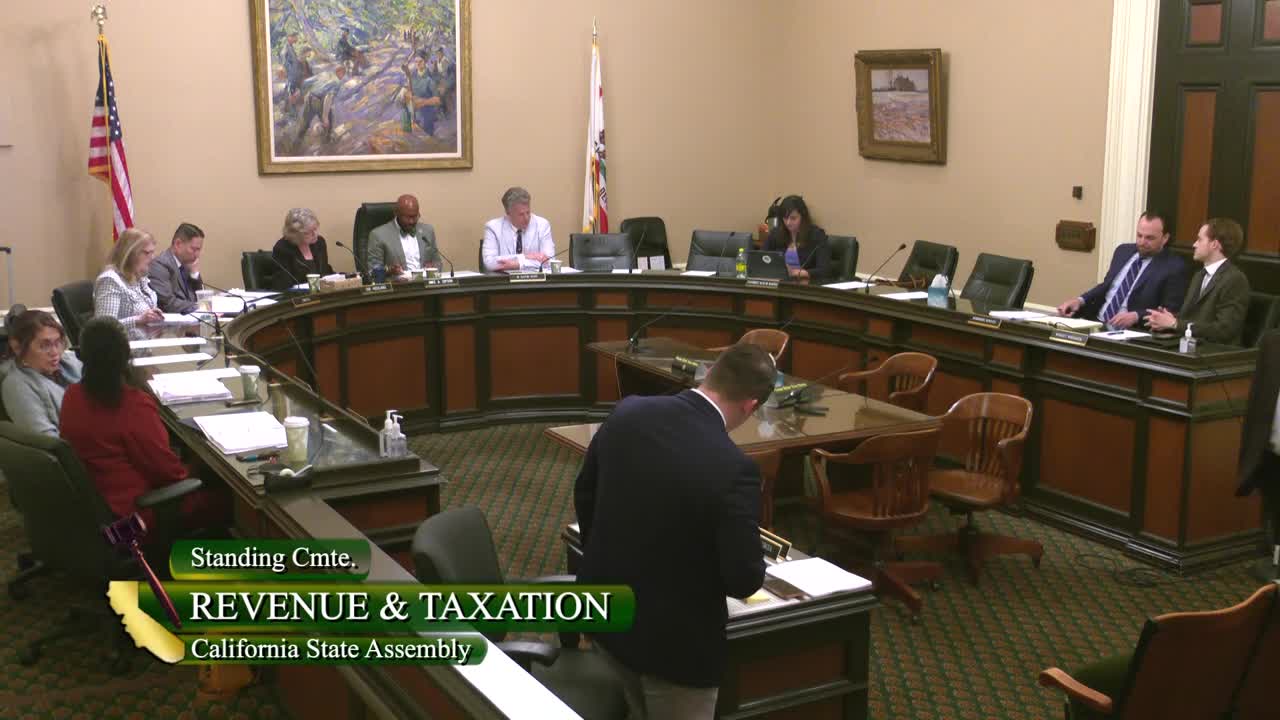
Discussed in Hearing
 5MIN
Assembly Standing Committee on Revenue and Taxation

Bill Co-Author(s):