AB 1410: Utilities: service outages and updates: alerts.
- Session Year: 2025-2026
- House: Assembly
- Latest Version Date: 2025-10-06
Current Status:
Passed
(2025-10-06: Chaptered by Secretary of State - Chapter 396, Statutes of 2025.)
Introduced
In Committee
Awaiting First Chamber Vote
Passed First Chamber
In Committee
Awaiting Second Chamber Vote
Passed Second Chamber
Enacted
What does this bill do?
The bill would require electric, gas, and water companies and local public power utilities to automatically enroll their customers in alerts about service outages and updates. Customers must be allowed to opt out of alerts they don’t want (except required or essential notices), and utilities must annually tell customers how to update their preferred contact method and let them change contact information online or, if possible, by phone.
The summary is provided by generative AI which can make mistakes. For original language, please view the details in the table below.
Existing law vests the Public Utilities Commission with regulatory authority over public utilities, including electrical corporations, gas corporations, and water corporations, while local publicly owned electric utilities are under the direction of their governing boards. If the commission finds after a hearing that the rules, practices, equipment, appliances, facilities, or service of any public utility, or the methods of manufacture, distribution, transmission, storage, or supply employed by the public utility, are unjust, unreasonable, unsafe, improper, inadequate, or insufficient, the Public Utilities Act requires the commission to determine and, by order or rule, fix the rules, practices, equipment, appliances, facilities, service, or methods to be observed, furnished, constructed, enforced, or employed.
This bill would require, except as provided, each electrical corporation, gas corporation, water corporation, or local publicly owned electric utility, on or before March 1, 2026, to automatically enroll its customers in alerts for service outages and updates. The bill would require customers to be provided with the opportunity to opt-out of any alerts they do not wish to receive, except as provided. The bill would require each of those utilities to annually provide information on customers bills on how to update their preferred contact methods and to allow customers to update their contact information on the utilitys internet website or, if feasible, by telephone.
Under existing law, a violation of any order, decision, rule, direction, demand, or requirement of the commission is a crime.
Because a violation of a commission action implementing this bills requirements would be a crime, the bill would impose a state-mandated local program. Additionally, by imposing new duties on local publicly owned electric utilities, the bill would impose a state-mandated local program.
The California Constitution requires the state to reimburse local agencies and school districts for certain costs mandated by the state. Statutory provisions establish procedures for making that reimbursement.
This bill would provide that no reimbursement is required by this act for specified reasons.
Existing law vests the Public Utilities Commission with regulatory authority over public utilities, including electrical corporations, gas corporations, and water corporations, while local publicly owned electric utilities are under the direction of their governing boards. If the commission finds after a hearing that the rules, practices, equipment, appliances, facilities, or service of any public utility, or the methods of manufacture, distribution, transmission, storage, or supply employed by the public utility, are unjust, unreasonable, unsafe, improper, inadequate, or insufficient, the Public Utilities Act requires the commission to determine and, by order or rule, fix the rules, practices, equipment, appliances, facilities, service, or methods to be observed, furnished, constructed, enforced, or employed.
This bill would require require, except as provided, each electrical corporation, gas corporation, water corporation, or local publicly owned electric utility, on or before March 1, 2026, to automatically enroll its customers in alerts for service outages and updates. The bill would require customers to be provided with the opportunity to opt-out of any alerts they do not wish to receive, except as provided. The bill would require each of those utilities to annually provide information on customers bills on how to update their preferred contact methods and to allow customers to update their contact information on the utilitys internet website or or, if feasible, by telephone.
Under existing law, a violation of any order, decision, rule, direction, demand, or requirement of the commission is a crime.
Because a violation of a commission action implementing this bills requirements would be a crime, the bill would impose a state-mandated local program. Additionally, by imposing new duties on local publicly owned electric utilities, the bill would impose a state-mandated local program.
The California Constitution requires the state to reimburse local agencies and school districts for certain costs mandated by the state. Statutory provisions establish procedures for making that reimbursement.
This bill would provide that no reimbursement is required by this act for specified reasons.
Existing law vests the Public Utilities Commission with regulatory authority over public utilities, including electrical corporations, gas corporations, and water corporations, while local publicly owned electric utilities are under the direction of their governing boards. If the commission finds after a hearing that the rules, practices, equipment, appliances, facilities, or service of any public utility, or the methods of manufacture, distribution, transmission, storage, or supply employed by the public utility, are unjust, unreasonable, unsafe, improper, inadequate, or insufficient, the Public Utilities Act requires the commission to determine and, by order or rule, fix the rules, practices, equipment, appliances, facilities, service, or methods to be observed, furnished, constructed, enforced, or employed.
This bill would require each electrical corporation, gas corporation, water corporations, corporation, or local publicly owned electric utility utility, on or before March 1, 2026, to automatically enroll its customers in alerts for service outages and updates. The bill would require customers to be provided with the opportunity to opt-out of any alerts they do not wish to receive, except as provided. The bill would require each of those utilities to annually provide information on customers bills on how to update their preferred contact methods and to allow customers to update their contact information on each the utilitys internet website or by telephone.
Under existing law, a violation of any order, decision, rule, direction, demand, or requirement of the commission is a crime.
Because a violation of a commission action implementing this bills requirements would be a crime, the bill would impose a state-mandated local program. Additionally, by imposing new duties on local publicly owned electric utilities, the bill would impose a state-mandated local program.
The California Constitution requires the state to reimburse local agencies and school districts for certain costs mandated by the state. Statutory provisions establish procedures for making that reimbursement.
This bill would provide that no reimbursement is required by this act for specified reasons.
Existing law vests the Public Utilities Commission with regulatory authority over public utilities. utilities, including electrical corporations, gas corporations, and water corporations, while local publicly owned electric utilities are under the direction of their governing boards. If the commission finds after a hearing that the rules, practices, equipment, appliances, facilities, or service of any public utility, or the methods of manufacture, distribution, transmission, storage, or supply employed by the public utility, are unjust, unreasonable, unsafe, improper, inadequate, or insufficient, the Public Utilities Act requires the commission to determine and, by order or rule, fix the rules, practices, equipment, appliances, facilities, service, or methods to be observed, furnished, constructed, enforced, or employed.
This bill would require each public utility electrical corporation, gas corporation, water corporations, or local publicly owned electric utility to automatically enroll its customers in alerts for service outages and updates. The bill would require customers to be provided with the opportunity to opt-out of any alerts they do not wish to receive, except as provided. The bill would require each public utility of those utilities to annually provide information on customers bills on how to update their preferred contact methods and to allow customers to update their contact information by email on each utilitys internet website or by telephone.
Under existing law, a violation of the Public Utilities Act or any order, decision, rule, direction, demand, or requirement of the commission is a crime.
Because the provisions of this bill would be a part of the act and because a violation of a commission action implementing the this bills requirements would be a crime, the bill would impose a state-mandated local program. Additionally, by imposing new duties on local publicly owned electric utilities, the bill would impose a state-mandated local program.
The California Constitution requires the state to reimburse local agencies and school districts for certain costs mandated by the state. Statutory provisions establish procedures for making that reimbursement.This bill would provide that no reimbursement is required by this act for a specified reason.The California Constitution requires the state to reimburse local agencies and school districts for certain costs mandated by the state. Statutory provisions establish procedures for making that reimbursement.
This bill would provide that no reimbursement is required by this act for specified reasons.
Existing law vests the Public Utilities Commission with regulatory authority over public utilities. If the commission finds after a hearing that the rules, practices, equipment, appliances, facilities, or service of any public utility, or the methods of manufacture, distribution, transmission, storage, or supply employed by the public utility, are unjust, unreasonable, unsafe, improper, inadequate, or insufficient, the Public Utilities Act requires the commission to determine and, by order or rule, fix the rules, practices, equipment, appliances, facilities, service, or methods to be observed, furnished, constructed, enforced, or employed.
This bill would require each public utility to automatically enroll customers in alerts for service outages and updates. The bill would require customers to be provided with the opportunity to opt-out of any alerts the customer does they do not wish to receive, except as provided. The bill would require each public utility to annually verify a customers provide information on customers bills on how to update their preferred contact method. methods and to allow customers to update their contact information by email or telephone.
Under existing law, a violation of the Public Utilities Act or any order, decision, rule, direction, demand, or requirement of the commission is a crime.
Because the provisions of this bill would be a part of the act and because a violation of a commission action implementing the bills requirements would be a crime, the bill would impose a state-mandated local program.
The California Constitution requires the state to reimburse local agencies and school districts for certain costs mandated by the state. Statutory provisions establish procedures for making that reimbursement.
This bill would provide that no reimbursement is required by this act for a specified reason.
Existing law vests the Public Utilities Commission with regulatory authority over public utilities. If the commission finds after a hearing that the rules, practices, equipment, appliances, facilities, or service of any public utility, or the methods of manufacture, distribution, transmission, storage, or supply employed by the public utility, are unjust, unreasonable, unsafe, improper, inadequate, or insufficient, the Public Utilities Act requires the commission to determine and, by order or rule, fix the rules, practices, equipment, appliances, facilities, service, or methods to be observed, furnished, constructed, enforced, or employed.
This bill would require each public utility to automatically enroll customers in alerts for service outages and updates. The bill would require customers to be provided with the opportunity to opt-out of any alerts the customer does not wish to receive, except as provided. The bill would require each public utility to annually verify a customers preferred contact method.
Under existing law, a violation of the Public Utilities Act or any order, decision, rule, direction, demand, or requirement of the commission is a crime.
Because the provisions of this bill would be a part of the act and because a violation of a commission action implementing the bills requirements would be a crime, the bill would impose a state-mandated local program.
The California Constitution requires the state to reimburse local agencies and school districts for certain costs mandated by the state. Statutory provisions establish procedures for making that reimbursement.
This bill would provide that no reimbursement is required by this act for a specified reason.
(a)Except as provided in subdivision (b), each utility shall, on or before March 1, 2026, automatically enroll its customers in alerts for service outages and updates.
(b)(1)A local publicly owned electric utility that does not have the necessary system to implement the requirements of subdivision (a) shall, on or before March 1, 2026, develop appropriate and feasible procedures to maximize the automatic enrollment of its customers in alerts for electrical service outages and updates.
(2)(A)A local publicly owned electric utility that does not have the necessary system to implement the requirements of subdivision (a) shall, on or before March 1, 2028, develop a plan to update its system to automatically enroll its customers in alerts for electrical service outages and updates.
(B)If the governing board of the local publicly owned electric utility determines the plan developed pursuant to subparagraph (A) is cost effective, the local publicly owned electric utility shall implement the plan during the next significant, planned upgrade of its system or by March 1, 2030, whichever is sooner.
(c)Customers shall be provided with the opportunity to opt-out of alerts for service outages and updates that the customer does not wish to receive, except for required or essential notifications.
(d)Each utility shall annually provide information on a customers bill on how to update the customers preferred contact method and shall allow a customer to update the customers contact information on the utilitys internet website or, if feasible, by telephone.
(e)For purposes of this section, utility means an electrical corporation, as defined in Section 218, a local publicly owned electric utility, as defined in Section 224.3, a gas corporation, as defined in Section 222, or a water corporation, as defined in Section 241.
SEC. 2.No reimbursement is required by this act pursuant to Section 6 of Article XIIIB of the California Constitution because a local agency or school district has the authority to levy service charges, fees, or assessments sufficient to pay for the program or level of service mandated by this act or because costs that may be incurred by a local agency or school district will be incurred because this act creates a new crime or infraction, eliminates a crime or infraction, or changes the penalty for a crime or infraction, within the meaning of Section 17556 of the Government Code, or changes the definition of a crime within the meaning of Section 6 of Article XIIIB of the California Constitution.
(a)Each Except as provided in subdivision (b), each utility shall, on or before March 1, 2026, automatically enroll its customers in alerts for service outages and updates.
(b)(1)A local publicly owned electric utility that does not have the necessary system to implement the requirements of subdivision (a) shall, on or before March 1, 2026, develop appropriate and feasible procedures to maximize the automatic enrollment of its customers in alerts for electrical service outages and updates.
(2)(A)A local publicly owned electric utility that does not have the necessary system to implement the requirements of subdivision (a) shall, on or before March 1, 2028, develop a plan to update its system to automatically enroll its customers in alerts for electrical service outages and updates.
(B)If the governing board of the local publicly owned electric utility determines the plan developed pursuant to subparagraph (A) is cost effective, the local publicly owned electric utility shall implement the plan during the next significant, planned upgrade of its system or by March 1, 2030, whichever is sooner.
(b)(c)Customers shall be provided with the opportunity to opt-out of alerts for service outages and updates that the customer does not wish to receive, except for required emergency and safety or essential notifications.
(c)(d)Each utility shall annually provide information on a customers bill on how to update the customers preferred contact method and shall allow a customer to update the customers contact information on the utilitys internet website or or, if feasible, by telephone.
(d)(e)For purposes of this section, utility means an electrical corporation, as defined in Section 218, a local publicly owned electric utility, as defined in Section 224.3, a gas corporation, as defined in Section 222, or a water corporation, as defined in Section 241.
SEC. 2.No reimbursement is required by this act pursuant to Section 6 of Article XIIIB of the California Constitution because a local agency or school district has the authority to levy service charges, fees, or assessments sufficient to pay for the program or level of service mandated by this act or because costs that may be incurred by a local agency or school district will be incurred because this act creates a new crime or infraction, eliminates a crime or infraction, or changes the penalty for a crime or infraction, within the meaning of Section 17556 of the Government Code, or changes the definition of a crime within the meaning of Section 6 of Article XIIIB of the California Constitution.
(a)Each utility shall shall, on or before March 1, 2026, automatically enroll its customers in alerts for service outages and updates.
(b)Customers shall be provided with the opportunity to opt-out of alerts for service outages and updates that the customer does not wish to receive, except for required emergency and safety notifications.
(c)Each utility shall annually provide information on a customers bill on how to update the customers preferred contact method and shall allow a customer to update the customers contact information on the utilitys internet website or by telephone.
(d)For purposes of this section, utility means an electrical corporation, as defined in Section 218, a local publicly owned electrical corporation, electric utility, as defined in Section 224.3, a gas corporation, as defined in Section 222, or a water corporation, as defined in Section 241.
SEC. 2.No reimbursement is required by this act pursuant to Section 6 of Article XIIIB of the California Constitution because a local agency or school district has the authority to levy service charges, fees, or assessments sufficient to pay for the program or level of service mandated by this act or because costs that may be incurred by a local agency or school district will be incurred because this act creates a new crime or infraction, eliminates a crime or infraction, or changes the penalty for a crime or infraction, within the meaning of Section 17556 of the Government Code, or changes the definition of a crime within the meaning of Section 6 of Article XIIIB of the California Constitution.
(a)Each public utility shall automatically enroll its customers in alerts for service outages and updates.
(b)Customers shall be provided with the opportunity to opt-out of alerts for service outage alerts outages and updates that the customer does not wish to receive, except for required emergency and safety notifications.
(c)Each public utility shall annually provide information on a customers bill on how to update the customers preferred contact method and shall allow a customer to update the customers contact information by email on the utilitys internet website or by telephone.
(d)For purposes of this section, utility means an electrical corporation, as defined in Section 218, a local publicly owned electrical corporation, as defined in Section 224.3, a gas corporation, as defined in Section 222, or a water corporation, as defined in Section 241.
SEC. 2.No reimbursement is required by this act pursuant to Section 6 of Article XIIIB of the California Constitution because the only costs that may be incurred by a local agency or school district will be incurred because this act creates a new crime or infraction, eliminates a crime or infraction, or changes the penalty for a crime or infraction, within the meaning of Section 17556 of the Government Code, or changes the definition of a crime within the meaning of Section 6 of Article XIIIB of the California Constitution.SEC. 2.No reimbursement is required by this act pursuant to Section 6 of Article XIIIB of the California Constitution because a local agency or school district has the authority to levy service charges, fees, or assessments sufficient to pay for the program or level of service mandated by this act or because costs that may be incurred by a local agency or school district will be incurred because this act creates a new crime or infraction, eliminates a crime or infraction, or changes the penalty for a crime or infraction, within the meaning of Section 17556 of the Government Code, or changes the definition of a crime within the meaning of Section 6 of Article XIIIB of the California Constitution.
(a)Each public utility shall automatically enroll its customers in alerts for service outages and updates.
(b)Customers shall be provided with the opportunity to opt-out of alerts for service outage alerts and updates that the customer does not wish to receive, except for required emergency and safety notifications.
(c)Each public utility shall annually verify a provide information on a customers bill on how to update the customers preferred contact method and shall allow a customer to update the customers contact information by email or by phone. telephone.
SEC. 2.No reimbursement is required by this act pursuant to Section 6 of Article XIIIB of the California Constitution because the only costs that may be incurred by a local agency or school district will be incurred because this act creates a new crime or infraction, eliminates a crime or infraction, or changes the penalty for a crime or infraction, within the meaning of Section 17556 of the Government Code, or changes the definition of a crime within the meaning of Section 6 of Article XIIIB of the California Constitution.
(a)Each public utility shall automatically enroll its customers in alerts for service outages and updates.
(b)Customers shall be provided with the opportunity to opt-out of alerts for service outage alerts and updates that the customer does not wish to receive, except for required emergency and safety notifications.
(c)Each public utility shall annually verify a customers preferred contact method and allow a customer to update the customers contact information by email or by phone.
SEC. 2.No reimbursement is required by this act pursuant to Section 6 of Article XIIIB of the California Constitution because the only costs that may be incurred by a local agency or school district will be incurred because this act creates a new crime or infraction, eliminates a crime or infraction, or changes the penalty for a crime or infraction, within the meaning of Section 17556 of the Government Code, or changes the definition of a crime within the meaning of Section 6 of Article XIIIB of the California Constitution.
|
Date
|
Status
|
|---|---|
| Oct 6, 2025 | Chaptered by Secretary of State - Chapter 396, Statutes of 2025. |
| Oct 6, 2025 | Approved by the Governor. |
| Sep 22, 2025 | Enrolled and presented to the Governor at 3 p.m. |
| Sep 10, 2025 | Senate amendments concurred in. To Engrossing and Enrolling. (Ayes 79. Noes 0. Page 3204.). |
| Sep 9, 2025 | In Assembly. Concurrence in Senate amendments pending. |
| Sep 9, 2025 | Read third time. Passed. Ordered to the Assembly. (Ayes 40. Noes 0. Page 2737.). |
| Sep 8, 2025 | Read second time. Ordered to third reading. |
| Sep 5, 2025 | Read third time and amended. Ordered to second reading. |
| Aug 26, 2025 | Read second time. Ordered to third reading. |
| Aug 25, 2025 | From committee: Be ordered to second reading pursuant to Senate Rule 28.8. |
| Aug 13, 2025 | In committee: Hearing postponed by committee. |
| Jul 3, 2025 | Read second time and amended. Re-referred to Com. on APPR. |
| Jul 2, 2025 | From committee: Amend, and do pass as amended and re-refer to Com. on APPR. (Ayes 17. Noes 0.) (July 1). |
| Jun 17, 2025 | From committee chair, with author's amendments: Amend, and re-refer to committee. Read second time, amended, and re-referred to Com. on E., U & C. |
| Jun 4, 2025 | Referred to Com. on E., U & C. |
| May 28, 2025 | In Senate. Read first time. To Com. on RLS. for assignment. |
| May 27, 2025 | Read third time. Passed. Ordered to the Senate. (Ayes 76. Noes 0. Page 1738.) |
| May 22, 2025 | Read second time. Ordered to third reading. |
| May 21, 2025 | From committee: Do pass. (Ayes 15. Noes 0.) (May 21). |
| May 14, 2025 | In committee: Set, first hearing. Referred to APPR. suspense file. |
| Apr 24, 2025 | From committee: Do pass and re-refer to Com. on APPR. (Ayes 18. Noes 0.) (April 23). Re-referred to Com. on APPR. |
| Apr 8, 2025 | Re-referred to Com. on U. & E. |
| Apr 7, 2025 | From committee chair, with author's amendments: Amend, and re-refer to Com. on U. & E. Read second time and amended. |
| Mar 13, 2025 | Referred to Com. on U. & E. |
| Feb 24, 2025 | Read first time. |
| Feb 22, 2025 | From printer. May be heard in committee March 24. |
| Feb 21, 2025 | Introduced. To print. |
|
Date
|
Description
|
Location
|
Votes
|
|
|---|---|---|---|---|
| Sep 10, 2025 | AB 1410 Garcia Concurrence in Senate Amendments | Assembly Floor |
Passed |
|
| Sep 9, 2025 | Assembly 3rd Reading AB1410 Garcia By Rubio | Senate Floor |
Passed |
|
| Jul 1, 2025 | Do pass as amended, but first amend, and re-refer to the Committee on [Appropriations] | Senate Standing Committee on Energy, Utilities and Communications |
Passed |
|
| May 27, 2025 | AB 1410 Garcia Assembly Third Reading | Assembly Floor |
Passed |
|
| May 21, 2025 | Do pass. | Assembly Standing Committee on Appropriations |
Passed |
|
| Apr 23, 2025 | Do pass and be re-referred to the Committee on [Appropriations] | Assembly Standing Committee on Utilities and Energy |
Passed |
This list shows positions taken on this bill by organizations on the date displayed, which is linked to the original source.
Positions by individuals are not included.
|
Organization
|
Position
|
Date
|
|---|---|---|
| San Diego Gas and Electric Company | ** Against |
CONCURRENCE IN SENATE AMENDMENTS
CSA1 Bill Id:AB 1410
Author:(Garcia)
As Amended Ver:September 5, 2025
Majority vote
SUMMARY
Requires utilities, with specific exceptions made for publically owned electric utilities, to automatically enroll their customers in alerts related to service outages and related updates by March 1, 2026.
Senate Amendments
- Sets a deadline of March 1, 2026 for electric utilities to implement the automatic enrollment in utility alert systems.
- Creates exceptions for publicly owned electric utilities (POUs) that don′t have the necessary system to implement auto-enrollment. These exceptions allow these POUs to (1) maximize automatic enrollment, (2) generate a plan to enroll customers in service alerts and (3), if deemed cost effective, implement the plan at the next significant system upgrade.
- Lowers the requirement for mechanisms to update customer contact information from ″the utility′s internet website or by telephone″ to ″the utility′s internet website or, if feasible, by telephone″
- Defines qualifying utilities to include electrical corporations, locally publicly owned electric utilities, gas corporations and water corporations, as previously defined in code.
COMMENTS
Investor owned utilities (IOUs) are required to send notifications to customers on a specified schedule prior to expected de-energization, or Public Safety Power Shutoffs (PSPS), and until re-energization. These notifications are intended to give customers adequate warning to prepare in advance for a proactive de-energization, which the IOUs perform as a last resort when weather conditions could result in a devastating wildfire. Timely notification allow customers to prepare for potential outages and make necessary arrangements based on the information provided.
January 2, 2025, Southern California Edison (SCE) initiated a PSPS event and de-energized 363,196 customer accounts. These accounts include 11,740 Medical Baseline customer accounts, 90,632 Access and Functional Needs customer accounts, and 6,800 critical facilities accounts. Fifteen days later, in the afternoon of January 17, 2025, SCE restored power to all customers. According to the Public Advocates Office, during the southern California fires in 2025, SCE failed to send 307,211 required notifications to Public Safety Partners, Critical Facilities and Infrastructure, and customers. Cal Advocates found the events in 2025 continued a pattern of failure of SCE to provide its customers with advance notification prior to de-energization.
Starting in 2012, the CPUC has released protocols for utilities to follow during de-energization events. The first PSPS guidance released by the CPUC was specifically for SDG&E and required notification of customers. In 2018, the CPUC adopted Resolution ESRB-8, which extended the requirements of the 2012 guidance for SDG&E to all electric investor owned utilities. Among other provisions, the resolution required customer notifications prior to a de-energization event, and required notification to the Safety and Enforcement Division once the de-energization decision is made, and within 30 minutes after the last service is restored.
In 2019, the CPUC implemented Phase 1 PSPS notification guidelines. The Commission stated that electric IOUs should, whenever possible, adhere to the following minimum notification timeline:
- 48-72 hours in advance of anticipated de-energization: notification of public safety partners priority notification entities
- 24-48 hours in advance of anticipated de-energization: notification of all other affected customers
- 1-4 hours in advance of anticipated de-energization, if possible: notification of all affected customers
- When de-energization is initiated: notification of all affected customers.
- Immediately before re-energization begins: notification of all affected customers.
- re-energization is complete: notification of all affected customers.
In 2020, Phase 2 guidelines directed electric IOUs to provide enhanced customer-friendly communication during all phases of a PSPS event, minimize the impact on customers, and increase accountability with regional working groups and in reports. In 2021, Phase 3 guidelines were implemented and are ongoing. They require IUOs to take a results-based approach to improve notification and mitigate the impacts of PSPS events.
There has been a history of problems with PSPS notification systems across the IOUs since the initiation of these protocols. In 2021, the CPUC fined Pacific Gas & Electric (PG&E) $106 million for violating guidelines during PSPS events in the fall of 2019. These violations included failures notifying many customers and public safety partners. In 2023, PG&E was fined $8 million as a result of failing to notify any of its impacted customers during its 2020 PSPS events. These failures are not limited to PG&E. In 2020, Southern California Edison (SCE) initiated sixteen PSPS events and failed to notify 25,573 customers, resulting in a $7 million fine. This was followed by twelve PSPS events initiated by SCE in 2021, during which SCE failed to send 232,719 notifications. SCE has had more severe notification failures – where high percentages of impacted customers never received a notice – than the other utilities.
According to the Public Advocates Office, in the 2023-2024 season, starting in October, SCE failed to meet customer notification requirements for as much as 79% of customers. In addition to the many fines implemented, many corrective actions have been required by all IOUs as a result of failed PSPS guideline compliance. The Center for Accessible Technology has suggested that few corrective actions have been effective at improving issues with SCE′s notification systems.
All the large IOUs in the state of California have a notification system to contact account holders in the case of de-energization as outlined by the CPUC guidelines. As of April 12, 2025, PG&E automatically alerts its customers about outages that impact service and requires customers to opt-out of notifications. PG&E reports that its primary communications are regarding potential outages, active outages and when power is restored. Both SCE and SDG&E have opt-in notification programs. This bill would mandate that all IOUs and other utilities maintain an opt-out notification system.
According to the Author
″My office received hundreds of complaints from constituents, who had their power shutoff during the January wildfires, without receiving any notice. They were left without power and without any idea of how long the shutoff may last. Customers being automatically opted-in to receiving updates from their utility companies, is a common sense practice and should be the standard. Unfortunately, too many utilities are operating from a reverse approach, where customers have the responsibility to opt themselves in to receive updates. AB 1410 ensures that everyone is able to prepare for future shutoffs by automatically opting customers in and regularly updating their preferred contact method.″
Arguments in Support
None on file.
Arguments in Opposition
None on file.
FISCAL COMMENTS
According to the Assembly Committee on Appropriations, the bill will lead to negligible costs to the California Public Utilities Commission (CPUC).
VOTES:
ASM UTILITIES AND ENERGY: 18-0-0
YES: Petrie-Norris, Patterson, Boerner, Calderon, Chen, Davies, Mark González, Harabedian, Hart, Irwin, Kalra, Papan, Rogers, Schiavo, Schultz, Ta, Wallis, Zbur
ASM APPROPRIATIONS: 15-0-0
YES: Wicks, Sanchez, Arambula, Calderon, Caloza, Dixon, Elhawary, Fong, Mark González, Hart, Pacheco, Pellerin, Solache, Ta, Tangipa
ASSEMBLY FLOOR: 76-0-3
YES: Addis, Aguiar-Curry, Ahrens, Alanis, Alvarez, Arambula, Ávila Farías, Bains, Bauer‑Kahan, Berman, Boerner, Bonta, Bryan, Calderon, Caloza, Carrillo, Castillo, Chen, Connolly, Davies, DeMaio, Dixon, Elhawary, Ellis, Flora, Fong, Gabriel, Gallagher, Garcia, Gipson, Mark González, Hadwick, Haney, Harabedian, Hart, Hoover, Irwin, Jackson, Kalra, Krell, Lackey, Lee, Lowenthal, Macedo, McKinnor, Muratsuchi, Ortega, Pacheco, Papan, Patel, Patterson, Pellerin, Petrie-Norris, Quirk-Silva, Ramos, Ransom, Celeste Rodriguez, Michelle Rodriguez, Rogers, Blanca Rubio, Sanchez, Schiavo, Schultz, Sharp-Collins, Solache, Soria, Stefani, Ta, Tangipa, Valencia, Wallis, Ward, Wicks, Wilson, Zbur, Rivas
ABS, ABST OR NV: Bennett, Jeff Gonzalez, Nguyen
UPDATED
VERSION: September 5, 2025
CONSULTANT: Kristen Koenig / U. & E. / (916) 319-2083 FN: 0001961
SENATE RULES COMMITTEE Office of Senate Floor Analyses (916) 651-1520 Fax: (916) 327-4478 | AB 1410 |
THIRD READING
Bill No: AB 1410
Author: Garcia (D)
Amended: 9/5/25 in Senate
Vote: 21
SENATE ENERGY, U. & C. COMMITTEE: 17-0, 7/1/25
AYES: Becker, Ochoa Bogh, Allen, Archuleta, Arreguín, Ashby, Caballero, Dahle, Gonzalez, Grove, Hurtado, Limón, McNerney, Rubio, Stern, Strickland, Wahab
SENATE APPROPRIATIONS COMMITTEE: Senate Rule 28.8
ASSEMBLY FLOOR: 76-0, 5/27/25 - See last page for vote
SUBJECT: Utilities: service outages and updates: alerts
SOURCE: Author
DIGEST:
This bill requires most electric and gas utilities, and some water utilities to automatically enroll their customers in alerts related to service outages.
Senate Floor Amendments of 9/5/25 afford electric publicly owned utilities (POUs), who lack the necessary system to automatically enroll customers, additional time to comply with the requirements of this bill and an off-ramp that exempts electric POUs should compliance not be cost-effective.
ANALYSIS:
Existing law:
- Establishes and vests the California Public Utilities Commission (CPUC) with regulatory authority over public utilities, including electrical corporations, gas corporations, and water corporations. (Article XII of the California Constitution)
- Requires the CPUC to determine and, by order or rule, fix the rules, practices, equipment, appliances, facilities, service, or methods to be observed, furnished, constructed, enforced, or employed, if the CPUC finds after a hearing that the rules, practices, equipment, appliances, facilities, or service of any public utility, or the methods of manufacture, distribution, transmission, storage, or supply employed by the public utility, are unjust, unreasonable, unsafe, improper, inadequate, or insufficient, the Public Utilities Act. (Public Utilities Code §451)
- Requires every public utility to furnish and maintain adequate, efficient, just, and reasonable service, instrumentalities, equipment, and facilities, as are necessary to promote the safety, health, comfort, and convenience of its patrons, employees, and the public. (Public Utilities Code §451)
- Establishes the policy of the state that each electrical corporation is required to continue to operate its electric distribution grid in its service territory and to do so in a safe, reliable, efficient, and cost-effective manner. (Public Utilities Code §399.2(a))
- Authorizes the CPUC to supervise and regulate every public utility in the state and to do all things necessary and convenient in the exercise of such power and jurisdiction. (Public Utilities Code §701)
- Requires a wildfire mitigation plan (WMP) of an electrical corporation to also include appropriate and feasible procedures for notifying a customer who may be impacted by the de-energizing of electrical lines and requires these procedures to consider the need to notify, as a priority, critical first responders, health care facilities, and operators of telecommunications infrastructure with premises within the footprint of a potential de-energization event. (Public Utilities Code §8386 (c)(7))
This bill:
- Requires, on or before March 1, 2026, each electrical corporation, gas corporation, water corporation, or local electric POUs to automatically enroll its customers in alerts for service outages and updates.
- Provides electric POUs additional time to comply with the alert requirements if the utility does not have the necessary system to meet the March 1, 2026 deadline. Specifically, this bill authorizes electric POUs to have an alternative option to develop appropriate procedures by March 1, 2026, develop a plan by March 1, 2028, and if the plan is cost-effective, implement the plan by March 1, 2030.
- Requires the customers to be provided with the opportunity to opt-out of any alerts they do not wish to receive, except for required safety and emergency alerts.
- Requires each of those utilities to annually provide information on customers’ bills on how to update their preferred contact methods and to allow customers to update their contact information on each utility’s internet website or by telephone, if feasible.
- Imposes a state-mandated local program by imposing new duties on local electric POUs.
Background
January 2025 Santa Ana wind events. This past January, with expected severe Santa Ana winds, low-humidity, high vegetation growth from previous wet winters, and dry conditions due to delayed precipitation, Southern California was at high risk for wildfires. Additionally, aerial fire suppression was limited by the extreme winds, which included gusts approaching 100 mph in some areas. Both Southern California Edison (SCE) and San Diego Gas & Electric (SDG&E) executed proactive power shutoffs in their service territory as a public safety measure. Other utilities, including Los Angeles Department of Water and Power, Pasadena Water and Power had to shutoff electric and water service in some parts of their service territories due to damage and safety concerns related to fires. In the case of SCE, the proactive power shutoffs resulted in extended outages throughout their service territory impacting upwards of 500,000 plus customer accounts (affecting many times more individuals) between January 2 through January 27, including two separate (and, in some cases overlapping) events. These de-energization events coincided with several wildfires in the area, including two large catastrophic fires, the Palisades Fire and the Eaton Fire (fire investigations as to the cause of these fires are still in process, ignition cause has not been determined).
SCE customers left in the dark. Based on SCE’s post-event reports, the proactive power shutoffs were the largest number of affected customers since the tool had been deployed and likely the largest in duration. These events resulted in many frustrations for customers and local governments as the utility’s execution of the proactive power shutoffs seems to have been greatly challenged by the scale and duration of the events with reports that their website crashed, inadequate notifications to customers, inability of some local governments to reach a utility point person, and inaccurate maps displayed at times on their websites. SCE also adjusted their operational thresholds in the midst of the events due to the evolving conditions which resulted in thousands of customers unexpectedly experiencing electricity outages without any advance notification. SCE’s post-event reports also indicated nearly 100 incidents of damage on de-energized facilities that, if they had been energized, could have been a significant risk to igniting wildfires.
Proactive power shutoff protocols. The CPUC and Legislature have exercised continued oversight of the utilities’ practices of proactive power shutoffs with the goal of minimizing the use of power shutoffs and accelerating wildfire mitigation to reduce risks of the electrical infrastructure igniting fires. However, proactive power shutoffs continue to be a tool in the electric utility’s toolbox to mitigate wildfire ignition risks. Currently, CPUC notifications require specified timing of notifications to customers and an extended (and continually evolving) list of public safety partners and critical facilities, including emergency services, government facilities, medical facilities, energy facilities, drinking water and wastewater treatment facilities, communications facilities, and others. The protocols require electric IOUs to, whenever possible, adhere to the following minimum notification timeline:
- 48-72 hours in advance of anticipated de-energization: notification of public safety partners/priority notification entities.
- 24-48 hours in advance of anticipated de-energization: notification of all other affected customers/populations.
- 1-4 hours in advance of anticipated de-energization, if possible: notification of all affected customers/populations.
- When de-energization is initiated: notification of all affected customers/populations.
- Immediately before re-energization begins: notification of all affected customers/populations.
- When re-energization is complete: notification of all affected customers/populations.
- When a Public Safety Power Shutoff (PSPS) [de-energization event] event is cancelled: Each electric investor-owned utility (IOU) must make every attempt to provide notification of the cancellation of a PSPS event, or removal from scope, by notifying all affected entities, including public safety partners, within two hours of the decision to cancel.
Comments
Need for this bill. The author’s office shared that their district was not directly affected by the wildfires, but their constituents were heavily impacted by the high winds and power shutoffs. They relay that they received countless complaints about the shutoffs, with many residents reporting they did not receive any direct update prior to losing power or any information about how long they would be impacted. In learning more about SCE’s shutoff notice process they learned that customers are often opted out from typical updates due to a number of complaints regarding receiving too many general updates. Instead, customers must opt-in to receive updates. The author believes public utilities should be operating from an approach where customers are automatically receiving alerts regarding service outages, unless the customer opts out.
Requiring utilities to send customers alerts concerning service outages, unless the customer opts out. The large electric corporations have a notification system to contact the customer of record in the case of de-energization as outlined by the CPUC protocols for de-energization. Pacific Gas & Electric (PG&E) automatically alerts its customers about outages that impact service and requires customers to opt-out of notifications. Both SCE and SDG&E have opt-in notification programs. This bill would mandate that all electric, gas, and water corporations and electric local public utilities provide an opt-out customer notification system concerning service outages.
Potential challenges. The loss of essential service, particularly for an extended outage, can be frustrating for customers. This can be compounded when information about the status of the outage is not available. During the January 2025 extended high wind events and prolonged power shutoffs, SCE lowered their threshold for de-energizing their electric lines in the midst of the fire and wind events. As a result, many customers experienced outages with no advanced notification. Additionally, SCE’s website was at times reporting inaccurate and not up-to-date information regarding the outages.
Automatic notifications, option to opt-out. This bill aims to help address these issues by requiring all customers are automatically enrolled in outage alerts. Utilities may not be able to provide these alerts if customers’ contact information is not current or provided by the customer. Additionally, as the use of wireless emergency alerts has gained growing use for many public safety messages (such as earthquakes, fires, Amber Alerts, etc.), and residents receive a growing number of alerts from both solicited and unsolicited entities, it’s possible customers may have a strong reaction to receiving alerts from utilities (or may consider them spam). This bill requires the utilities to provide customers the opportunity to opt-out and to ensure customers have the opportunity to update their preferred mode of communication (annually, if necessary). Additionally, it’s important to note that this bill only applies to most electric utilities, the majority of gas utilities, and only a small fraction of water utilities in the state, as water corporations serve about 15% of the state’s residents with the majority served by thousands of other water providers.
Concerns from electric POUs about the March 1, 2026 compliance date and costs to implement this bill. Southern California Public Power Association (SCPPA), which represents several electric POUs in Southern California, have shared that their members’ ability to send customer alerts is limited to varying degrees. However, they do not have a current list accounting for the status of each of their POUs capacity to send customer alerts, but they believe only a few utilities would be able to comply with the March 1, 2026 deadline in this bill. SCPPA also shares that a utility’s system capability is not reflected by the size of the utility, as it varies randomly among the electric POUs. They contend that many of their members, and likely POUs in other parts of the state, would need more time to update their systems to automatically enroll customers in alerts. They share that in general they provide customers with outage information via the respective utility’s website. They also state that in some cases it may not be cost-effective for an electric POU to upgrade their systems in order to provide customer service-related alerts as required by this bill.
Recent amendments intended to respond to electric POUs’ timing and affordability concerns. The recent amendments would afford electric POUs additional time, potentially up to four years, to comply with the requirements of this bill and an off-ramp that would allow electric POUs to be exempted should compliance not be cost-effective. Specifically, this bill authorizes electric POUs who are unable to comply with the March 1, 2026 deadline to automatically enroll its customers in alerts for service outages and updates, to instead have an alternative option to develop appropriate procedures by March 1, 2026, develop a plan by March 1, 2028, and if the plan is cost-effective, implement the plan by March 1, 2030. As a result, electric POUs who do not currently have the necessary system capability to automatically enroll customers and send outage-related alerts would have until March 1, 2030 to comply with this bill and could be exempted if the electric POU determines it is not cost-effective to comply. The author’s office understand this gives electric POUs much more flexibility to comply with this bill’s requirements, but given the varied system capabilities among electric POUs, they are willing to provide these utilities a more flexible option (including if it results in some utilities being exempted from this bill’s requirements).
Related/Prior Legislation
SB 256 (Perez) of 2025, includes related provisions requiring electrical corporations to allow customers who are not the customer of record to subscribe to receive notifications concerning service outages. The bill was held in the Assembly Appropriations Committee.
SB 292 (Cervantes) of 2025, includes specified reporting by electric utilities of de-energization events and annual reliability reports. The bill is pending before the full Assembly.
SB 559 (Stern) of 2025, would have required electrical corporations to provide specified notifications of de-energization events related to mitigating wildfire ignition risks, and requires specified reporting to, and oversight by, the CPUC. The bill was held the Senate Appropriations Committee.
SB 167 (Dodd, Chapter 403, Statutes of 2019) required electrical corporations to include impacts on customers enrolled in specified programs as part of the protocols for de-energizing portions of their distribution system within their WMP.
FISCAL EFFECT: Appropriation: No Fiscal Com.: Yes Local: Yes
SUPPORT: (Verified 9/5/25)
None received
OPPOSITION: (Verified 9/5/25)
None received
ARGUMENTS IN SUPPORT: According to the author:
My office received hundreds of complaints from constituents, who had their power shutoff during the January wildfires, without receiving any notice. They were left without power and without any idea of how long the shutoff may last. Customers being automatically opted-in to receiving updates from their utility companies, is a common sense practice and should be the standard. Unfortunately, too many utilities are operating from a reverse approach, where customers have the responsibility to opt themselves in to receive updates. AB 1410 ensures that everyone is able to prepare for future shutoffs by automatically opting customers in and regularly updating their preferred contact method.
ASSEMBLY FLOOR: 76-0, 5/27/25
AYES: Addis, Aguiar-Curry, Ahrens, Alanis, Alvarez, Arambula, Ávila Farías, Bains, Bauer-Kahan, Berman, Boerner, Bonta, Bryan, Calderon, Caloza, Carrillo, Castillo, Chen, Connolly, Davies, DeMaio, Dixon, Elhawary, Ellis, Flora, Fong, Gabriel, Gallagher, Garcia, Gipson, Mark González, Hadwick, Haney, Harabedian, Hart, Hoover, Irwin, Jackson, Kalra, Krell, Lackey, Lee, Lowenthal, Macedo, McKinnor, Muratsuchi, Ortega, Pacheco, Papan, Patel, Patterson, Pellerin, Petrie-Norris, Quirk-Silva, Ramos, Ransom, Celeste Rodriguez, Michelle Rodriguez, Rogers, Blanca Rubio, Sanchez, Schiavo, Schultz, Sharp-Collins, Solache, Soria, Stefani, Ta, Tangipa, Valencia, Wallis, Ward, Wicks, Wilson, Zbur, Rivas
NO VOTE RECORDED: Bennett, Jeff Gonzalez, Nguyen
Prepared by: Nidia Bautista / E., U. & C. / (916) 651-4107
9/8/25 21:44:02
**** END ****
SENATE RULES COMMITTEE Office of Senate Floor Analyses (916) 651-1520 Fax: (916) 327-4478 | AB 1410 |
THIRD READING
Bill No: AB 1410
Author: Garcia (D)
Amended: 7/3/25 in Senate
Vote: 21
SENATE ENERGY, U. & C. COMMITTEE: 17-0, 7/1/25
AYES: Becker, Ochoa Bogh, Allen, Archuleta, Arreguín, Ashby, Caballero, Dahle, Gonzalez, Grove, Hurtado, Limón, McNerney, Rubio, Stern, Strickland, Wahab
SENATE APPROPRIATIONS COMMITTEE: Senate Rule 28.8
ASSEMBLY FLOOR: 76-0, 5/27/25 - See last page for vote
SUBJECT: Utilities: service outages and updates: alerts
SOURCE: Author
DIGEST:
This bill requires most electric and gas utilities, and some water utilities to automatically enroll their customers in alerts related to service outages and related updates by March 1, 2026.
ANALYSIS:
Existing law:
- Establishes and vests the California Public Utilities Commission (CPUC) with regulatory authority over public utilities, including electrical corporations, gas corporations, and water corporations. (Article XII of the California Constitution)
- Requires the CPUC to determine and, by order or rule, fix the rules, practices, equipment, appliances, facilities, service, or methods to be observed, furnished, constructed, enforced, or employed, if the CPUC finds after a hearing that the rules, practices, equipment, appliances, facilities, or service of any public utility, or the methods of manufacture, distribution, transmission, storage, or supply employed by the public utility, are unjust, unreasonable, unsafe, improper, inadequate, or insufficient, the Public Utilities Act. (Public Utilities Code §451)
- Requires every public utility to furnish and maintain adequate, efficient, just, and reasonable service, instrumentalities, equipment, and facilities, as are necessary to promote the safety, health, comfort, and convenience of its patrons, employees, and the public. (Public Utilities Code §451)
- Establishes the policy of the state that each electrical corporation is required to continue operate its electric distribution grid in its service territory and to do so in a safe, reliable, efficient, and cost-effective manner. (Public Utilities Code §399.2(a))
- Authorizes the CPUC to supervise and regulate every public utility in the state and to do all things necessary and convenient in the exercise of such power and jurisdiction. (Public Utilities Code §701)
- Requires a wildfire mitigation plan (WMP) of an electrical corporation to also include appropriate and feasible procedures for notifying a customer who may be impacted by the de-energizing of electrical lines and requires these procedures to consider the need to notify, as a priority, critical first responders, health care facilities, and operators of telecommunications infrastructure with premises within the footprint of a potential de-energization event. (Public Utilities Code §8386 (c)(7))
This bill:
- Requires, on or before March 1, 2026, each electrical corporation, gas corporation, water corporation, or local electric publicly owned utility (POU) to automatically enroll its customers in alerts for service outages and updates.
- Requires the customers to be provided with the opportunity to opt-out of any alerts they do not wish to receive, except for required safety and emergency alerts.
- Requires each of those utilities to annually provide information on customers’ bills on how to update their preferred contact methods and to allow customers to update their contact information on each utility’s internet website or by telephone.
- Imposes a state-mandated local program by imposing new duties on local electric POUs.
Background
January 2025 Santa Ana wind events. This past January, with expected severe Santa Ana winds, low-humidity, high vegetation growth from previous wet winters, and dry conditions due to delayed precipitation, Southern California was at high risk for wildfires. Additionally, aerial fire suppression was limited by the extreme winds, which included gusts approaching 100 mph in some areas. Both Southern California Edison (SCE) and San Diego Gas & Electric (SDG&E) executed proactive power shutoffs in their service territory as a public safety measure. Other utilities, including Los Angeles Department of Water and Power, Pasadena Water and Power had to shutoff electric and water service in some parts of their service territories due to damage and safety concerns related to fires. In the case of SCE, the proactive power shutoffs resulted in extended outages throughout their service territory impacting upwards of 500,000 plus customer accounts (affecting many times more individuals) between January 2 through January 27, including two separate (and, in some cases overlapping) events. These de-energization events coincided with several wildfires in the area, including two large catastrophic fires, the Palisades Fire and the Eaton Fire (fire investigations as to the cause of these fires are still in process, ignition cause has not been determined).
SCE customers left in the dark. Based on SCE’s post-event reports, the proactive power shutoffs were the largest number of affected customers since the tool had been deployed and likely the largest in duration. These events resulted in many frustrations for customers and local governments as the utility’s execution of the proactive power shutoffs seems to have been greatly challenged by the scale and duration of the events with reports that their website crashed, inadequate notifications to customers, inability of some local governments to reach a utility point person, and inaccurate maps displayed at times on their websites. SCE also adjusted their operational thresholds in the midst of the events due to the evolving conditions which resulted in thousands of customers unexpectedly experiencing electricity outages without any advance notification. SCE’s post-event reports also indicated nearly 100 incidents of damage on de-energized facilities that, if they had been energized, could have been a significant risk to igniting wildfires.
Proactive power shutoff protocols. The CPUC and Legislature have exercised continued oversight of the utilities’ practices of proactive power shutoffs with the goal of minimizing the use of power shutoffs and accelerating wildfire mitigation to reduce risks of the electrical infrastructure igniting fires. However, proactive power shutoffs continue to be a tool in the electric utility’s toolbox to mitigate wildfire ignition risks. Currently, CPUC notifications require specified timing of notifications to customers and an extended (and continually evolving) list of public safety partners and critical facilities, including emergency services, government facilities, medical facilities, energy facilities, drinking water and wastewater treatment facilities, communications facilities, and others. The protocols require electric IOUs to, whenever possible, adhere to the following minimum notification timeline:
- 48-72 hours in advance of anticipated de-energization: notification of public safety partners/priority notification entities.
- 24-48 hours in advance of anticipated de-energization: notification of all other affected customers/populations.
- 1-4 hours in advance of anticipated de-energization, if possible: notification of all affected customers/populations.
- When de-energization is initiated: notification of all affected customers/populations.
- Immediately before re-energization begins: notification of all affected customers/populations.
- When re-energization is complete: notification of all affected customers/populations.
- When a Public Safety Power Shutoff (PSPS) [de-energization event] event is cancelled: Each electric investor-owned utility (IOU) must make every attempt to provide notification of the cancellation of a PSPS event, or removal from scope, by notifying all affected entities, including public safety partners, within two hours of the decision to cancel.
Comments
Need for this bill. The author’s office shared that their district was not directly affected by the wildfires, but their constituents were heavily impacted by the high winds and power shutoffs. They relay that they received countless complaints about the shutoffs, with many residents reporting they did not receive any direct update prior to losing power or any information about how long they would be impacted. In learning more about SCE’s shutoff notice process they learned that customers are often opted out from typical updates due to a number of complaints regarding receiving too many general updates. Instead, customers must opt-in to receive updates. The author believes public utilities should be operating from an approach where customers are automatically receiving alerts regarding service outages, unless the customer opts out.
Requiring utilities to send customers alerts concerning service outages, unless the customer opts out. The large electric corporations have a notification system to contact the customer of record in the case of de-energization as outlined by the CPUC protocols for de-energization. Pacific Gas & Electric (PG&E) automatically alerts its customers about outages that impact service and requires customers to opt-out of notifications. Both SCE and SDG&E have opt-in notification programs. This bill would mandate that all electric, gas, and water corporations and electric local public utilities provide an opt-out customer notification system concerning service outages.
Potential challenges. The loss of essential service, particularly for an extended outage, can be frustrating for customers. This can be compounded when information about the status of the outage is not available. During the January 2025 extended high wind events and prolonged power shutoffs, SCE lowered their threshold for de-energizing their electric lines in the midst of the fire and wind events. As a result, many customers experienced outages with no advanced notification. Additionally, SCE’s website was at times reporting inaccurate and not up-to-date information regarding the outages.
Automatic notifications, option to opt-out. This bill aims to help address these issues by requiring all customers are automatically enrolled in outage alerts. Utilities may not be able to provide these alerts if customers’ contact information is not current or provided by the customer. Additionally, as the use of wireless emergency alerts has gained growing use for many public safety messages (such as earthquakes, fires, Amber Alerts, etc.), and residents receive a growing number of alerts from both solicited and unsolicited entities, it’s possible customers may have a strong reaction to receiving alerts from utilities (or may consider them spam). This bill requires the utilities to provide customers the opportunity to opt-out and to ensure customers have the opportunity to update their preferred mode of communication (annually, if necessary). Additionally, it’s important to note that this bill only applies to most electric utilities, the majority of gas utilities, and only a small fraction of water utilities in the state, as water corporations serve about 15% of the state’s residents with the majority served by thousands of other water providers.
Related/Prior Legislation
SB 256 (Perez) of 2025, includes related provisions requiring electrical corporations to allow customers who are not the customer of record to subscribe to receive notifications concerning service outages. The bill is pending in the Assembly Appropriations Committee.
SB 292 (Cervantes) of 2025, includes specified reporting by electric utilities of de-energization events and annual reliability reports. The bill is pending in the Assembly Appropriations Committee.
SB 559 (Stern) of 2025, would have required electrical corporations to provide specified notifications of de-energization events related to mitigating wildfire ignition risks, and requires specified reporting to, and oversight by, the CPUC. The bill was held the Senate Appropriations Committee.
SB 167 (Dodd, Chapter 403, Statutes of 2019) required electrical corporations to include impacts on customers enrolled in specified programs as part of the protocols for de-energizing portions of their distribution system within their WMP.
FISCAL EFFECT: Appropriation: No Fiscal Com.: Yes Local: Yes
SUPPORT: (Verified 8/25/25)
None received
OPPOSITION: (Verified 8/25/25)
None received
ARGUMENTS IN SUPPORT: According to the author:
My office received hundreds of complaints from constituents, who had their power shutoff during the January wildfires, without receiving any notice. They were left without power and without any idea of how long the shutoff may last. Customers being automatically opted-in to receiving updates from their utility companies, is a common sense practice and should be the standard. Unfortunately, too many utilities are operating from a reverse approach, where customers have the responsibility to opt themselves in to receive updates. AB 1410 ensures that everyone is able to prepare for future shutoffs by automatically opting customers in and regularly updating their preferred contact method.
ASSEMBLY FLOOR: 76-0, 5/27/25
AYES: Addis, Aguiar-Curry, Ahrens, Alanis, Alvarez, Arambula, Ávila Farías, Bains, Bauer-Kahan, Berman, Boerner, Bonta, Bryan, Calderon, Caloza, Carrillo, Castillo, Chen, Connolly, Davies, DeMaio, Dixon, Elhawary, Ellis, Flora, Fong, Gabriel, Gallagher, Garcia, Gipson, Mark González, Hadwick, Haney, Harabedian, Hart, Hoover, Irwin, Jackson, Kalra, Krell, Lackey, Lee, Lowenthal, Macedo, McKinnor, Muratsuchi, Ortega, Pacheco, Papan, Patel, Patterson, Pellerin, Petrie-Norris, Quirk-Silva, Ramos, Ransom, Celeste Rodriguez, Michelle Rodriguez, Rogers, Blanca Rubio, Sanchez, Schiavo, Schultz, Sharp-Collins, Solache, Soria, Stefani, Ta, Tangipa, Valencia, Wallis, Ward, Wicks, Wilson, Zbur, Rivas
NO VOTE RECORDED: Bennett, Jeff Gonzalez, Nguyen
Prepared by: Nidia Bautista / E., U. & C. / (916) 651-4107
8/26/25 16:22:47
**** END ****
SENATE COMMITTEE ON ENERGY, UTILITIES AND COMMUNICATIONS
Senator Josh Becker, Chair
2025 - 2026 Regular
Bill No: AB 1410 Hearing Date: 7/1/2025
Author: | Garcia | ||
Version: | 6/17/2025 Amended | ||
Urgency: | No | Fiscal: | Yes |
Consultant: | Nidia Bautista | ||
SUBJECT: Utilities: service outages and updates: alerts
DIGEST: This bill requires most electric and gas utilities, and some water utilities to automatically enroll their customers in alerts related to service outages and related updates.
ANALYSIS:
Existing law:
- Establishes and vests the California Public Utilities Commission (CPUC) with regulatory authority over public utilities, including electrical corporations, gas corporations, and water corporations. (Article XII of the California Constitution)
- Requires the CPUC to determine and, by order or rule, fix the rules, practices, equipment, appliances, facilities, service, or methods to be observed, furnished, constructed, enforced, or employed, if the CPUC finds after a hearing that the rules, practices, equipment, appliances, facilities, or service of any public utility, or the methods of manufacture, distribution, transmission, storage, or supply employed by the public utility, are unjust, unreasonable, unsafe, improper, inadequate, or insufficient, the Public Utilities Act. (Public Utilities Code §451)
- Requires every public utility to furnish and maintain adequate, efficient, just, and reasonable service, instrumentalities, equipment, and facilities, as are necessary to promote the safety, health, comfort, and convenience of its patrons, employees, and the public. (Public Utilities Code §451)
- Establishes the policy of the state that each electrical corporation is required to continue operate its electric distribution grid in its service territory and to do so in a safe, reliable, efficient, and cost-effective manner. (Public Utilities Code §399.2(a))
- Authorizes the CPUC to supervise and regulate every public utility in the state and to do all things necessary and convenient in the exercise of such power and jurisdiction. (Public Utilities Code §701)
- Requires a wildfire mitigation plan (WMP) of an electrical corporation to also include appropriate and feasible procedures for notifying a customer who may be impacted by the deenergizing of electrical lines and requires these procedures to consider the need to notify, as a priority, critical first responders, health care facilities, and operators of telecommunications infrastructure with premises within the footprint of a potential deenergization event. (Public Utilities Code §8386 (c)(7))
This bill:
- Requires each electrical corporation, gas corporation, water corporation, or local electric publicly owned utility (POU) to automatically enroll its customers in alerts for service outages and updates.
- Requires the customers to be provided with the opportunity to opt-out of any alerts they do not wish to receive, except for required safety and emergency alerts.
- Requires each of those utilities to annually provide information on customers’ bills on how to update their preferred contact methods and to allow customers to update their contact information on each utility’s internet website or by telephone.
- Imposes a state-mandated local program by imposing new duties on local electric POUs.
Background
January 2025 Santa Ana wind events. This past January, with expected severe Santa Ana winds, low-humidity, high vegetation growth from previous wet winters, and dry conditions due to delayed precipitation, Southern California was at high risk for wildfires. Additionally, aerial fire suppression was limited by the extreme winds, which included gusts approaching 100 mph in some areas. Both Southern California Edison (SCE) and San Diego Gas & Electric (SDG&E) executed proactive power shutoffs in their service territory as a public safety measure. Other utilities, including Los Angeles Department of Water and Power, Pasadena Water and Power had to shutoff electric and water service in some parts of their service territories due to damage and safety concerns related to the fires. In the case of SCE, the proactive power shutoffs resulted in extended outages throughout their service territory impacting upwards of 500,000 plus customer accounts (affecting many times more individuals) between January 2 through January 27, including two separate (and, in some cases overlapping) events. These deenergization events coincided with several wildfires in the area, including two large catastrophic fires, the Palisades Fire and the Eaton Fire (fire investigations as to the cause of these fires are still in process, ignition cause has not been determined).
Based on SCE’s post-event reports, the proactive power shutoffs were the largest number of affected customers since the tool had been deployed and likely the largest in duration. These events resulted in many frustrations for customers and local governments as the utility’s execution of the proactive power shutoffs seems to have been greatly challenged by the scale and duration of the events (official CPUC oversight and review of these events is process) with reports that their website crashed, inadequate notifications to customers, inability of some local governments to reach a utility point person, and inaccurate maps displayed at times on their websites. SCE also adjusted their operational thresholds in the midst of the events due to the evolving conditions which resulted in many customers unexpectedly experiencing proactive power shutoff without any advance notification. SCE’s post-event reports also indicated nearly 100 incidents of damage on de-energized facilities that, if they had been energized, could have been a significant risk to igniting wildfires.
Oversight of proactive power shutoffs. The CPUC adopted protocols for de-energizing electric lines with a focus on who should receive notice and when; who should be responsible for notification; how different customer groups should be identified; the information that should be included in notifications in advance of and directly preceding a de-energizing event; the methods of communication; and how the IOUs should communicate and coordinate with public safety partners before, during, and after an event. The CPUC is working with the Office of Emergency Services, CalFire, and first-responders to address potential impacts of utility de-energization practices on emergency response activities, including evacuations. The CPUC is also monitoring the development and continuously assessing implementation of de-energization programs by utilities, including performing a review of de-energization events. In adopting the initial protocols, the CPUC commissioners expressed a desire that the power shutoffs would only be used as a “last resort” by the utilities. However, the use of proactive power shutoffs by electric utilities became widespread and increased concerns that the practice is relied upon more frequently than a last resort. In some instances, de-energization events overlap and result in customers experiencing extended days with loss of power.
Proactive power shutoff protocols. Over several years, the proactive power shutoff protocols have evolved via CPUC oversight and various CPUC decisions. The protocols include specified requirements related to advance planning with public safety partners and local governments, as well as, specified notifications to customers prior to, during, and after de-energization events. The protocols also require specified actions to address the public safety impacts for critical facilities and access and functional needs populations, among others. The CPUC and Legislature have exercised continued oversight of the utilities’ practices with the goal of minimizing the use of power shutoffs and accelerating wildfire mitigation to reduce risks of the electrical infrastructure igniting fires. However, proactive power shutoffs continue to be a tool in the electric utility’s toolbox to mitigate wildfire ignition risks. Currently, CPUC notifications require specified timing of notifications to customers and an extended (and continually evolving) list of public safety partners and critical facilities, including emergency services, government facilities, medical facilities, energy facilities, drinking water and wastewater treatment facilities, communications facilities, and others. The protocols require electric IOUs to, whenever possible, adhere to the following minimum notification timeline:
- 48-72 hours in advance of anticipated de-energization: notification of public safety partners/priority notification entities.
- 24-48 hours in advance of anticipated de-energization: notification of all other affected customers/populations.
- 1-4 hours in advance of anticipated de-energization, if possible: notification of all affected customers/populations.
- When de-energization is initiated: notification of all affected customers/populations.
- Immediately before re-energization begins: notification of all affected customers/populations.
- When re-energization is complete: notification of all affected customers/populations.
- When a Public Safety Power Shutoff (PSPS) [de-energization event] event is cancelled: Each electric IOU must make every attempt to provide notification of the cancellation of a PSPS event, or removal from scope, by notifying all affected entities, including public safety partners, within two hours of the decision to cancel.
Comments
Need for this bill. The author’s office shared that their district was not directly affected by the wildfires, but their constituents were heavily impacted by the high winds and power shutoffs. They relay that they received countless complaints about the shutoffs, with many reporting they did not receive any direct update prior to losing power or any information about how long they would be impacted. In learning more about SCE’s shutoff notice process they learned that customers are often opted out from typical updates due to a number of complaints regarding receiving too many general updates. Instead, customers must opt-in to receive updates. The author believes public utilities should be operating from an approach where customers are automatically receiving alerts regarding service outages, unless the customer opts out.
Requiring utilities to send customers alerts concerning service outages, unless the customer opts out. The large electric corporations have a notification system to contact the customer of record in the case of de-energization as outlined by the CPUC protocols for de-energization. Pacific Gas & Electric (PG&E) automatically alerts its customers about outages that impact service and requires customers to opt-out of notifications. Both SCE and SDG&E have opt-in notification programs. This bill would mandate that all electric, gas, and water corporations and electric local public utilities provide an opt-out customer notification system concerning service outages.
Potential challenges. The loss of essential service, particularly for an extended outage, can be frustrating for customers. This can be compounded when information about the status of the outage is not available. As noted above, SCE lowered their threshold for de-energizing their lines during the fire and wind events in January. As a result, many customers experienced outages with no advanced notification. Additionally, SCE’s website experienced some challenges concerning accurate and up-to-date information regarding the outages. This bill aims to help address these issues by requiring all customers are automatically enrolled in outage alerts. Utilities may not be able to provide these alerts if customer’s contact information is not current or provided by the customer. Additionally, as the use of wireless emergency alerts has gained growing use for many public safety messages (such as earthquakes, fires, etc.), and residents receive a growing number of alerts from both solicited and unsolicited entities, it’s possible customers may have a strong reaction to receiving alerts from utilities (or may consider them spam). This bill requires the utilities to provide customers the opportunity to opt-out and to ensure customers have the opportunity to update their preferred mode of communication (annually, if necessary). Additionally, it’s important to note that this bill only applies to most electric utilities, the majority of gas utilities, and only a small fraction of water utilities in the state.
Amendments needed. The affected utilities may need additional time to prepare their systems to begin automatically enrolling customers in alerts, the author and committee may wish to require these alerts beginning March 1, 2026 so as to ensure utilities have sufficient time to prepare their systems. An amendment is needed to clarify that local electric POUs are not corporations. The author and committee may wish to amend the reference to local electric POUs and delete the reference to “corporation” in reference to them.
Prior/Related Legislation
SB 256 (Perez) of 2025, includes related provisions requiring electrical corporations to allow customers who are not the customer of record to subscribe to receive notifications concerning service outages. The bill is pending in the Assembly Committee on Utilities and Energy.
SB 292 (Cervantes) of 2025, includes specified reporting by electric utilities of de-energization events and annual reliability reports. The bill is pending in the Assembly Utilities and Energy Committee.
SB 559 (Stern) of 2025, requires electrical corporations to provide specified notifications of de-energization events related to mitigating wildfire ignition risks, and requires specified reporting to, and oversight by, the CPUC. The bill is pending in the Assembly Utilities and Energy Committee.
SB 167 (Dodd, Chapter 403, Statutes of 2019) required electrical corporations to include impacts on customers enrolled in specified programs as part of the protocols for de-energizing portions of their distribution system within their WMP.
FISCAL EFFECT: Appropriation: No Fiscal Com.: Yes Local: Yes
SUPPORT:
None received
OPPOSITION:
None received
ARGUMENTS IN SUPPORT: According to the author:
My office received hundreds of complaints from constituents, who had their power shutoff during the January wildfires, without receiving any notice. They were left without power and without any idea of how long the shutoff may last. Customers being automatically opted-in to receiving updates from their utility companies, is a common sense practice and should be the standard. Unfortunately, too many utilities are operating from a reverse approach, where customers have the responsibility to opt themselves in to receive updates. AB 1410 ensures that everyone is able to prepare for future shutoffs by automatically opting customers in and regularly updating their preferred contact method.
-- END --
ASSEMBLY THIRD READING
ATR Bill Id:AB 1410
Author:(Garcia)
As Amended Ver:April 7, 2025
Majority vote
SUMMARY
Requires that all public utilities automatically enroll their customers in alerts for service outages and updates. Additionally requires public utilities to provide both an opt-out provision to decline alerts, with exceptions, and the ability for customers to update contact information through email and telephone.
Major Provisions
COMMENTS
Starting in 2012, the California Public Utilities Commission has implemented notification protocols for utilities to follow during de-energization events or Public Safety Power Shutoffs (PSPS). January 2, 2025, Southern California Electric (SCE) initiated a PSPS event and de-energized 363,196 customer accounts. Fifteen days later, in the afternoon of January 17, 2025, SCE restored power to all customers. According to the Public Advocates Office, during the southern California fires in 2025, SCE failed to send 307,211 required notifications to Public Safety Partners, Critical Facilities and Infrastructure, and customers. Cal Advocates found the events in 2025 continued a pattern of failure of SCE to provide its customers with advance notification prior to de-energization.
All the large investor owned utilities (IOUs) in the state of California have a notification system to contact account holders in the case of de-energization as outlined by the CPUC guidelines. As of April 12, 2025, PG&E automatically alerts its customers about outages that impact service and requires customers to opt-out of notifications. Both SCE and San Diego Gas and Electric (SDG&E) have opt-in notification programs. This bill would mandate that all IOUs and other utilities maintain an opt-out notification system.
Having accurate contact information for customers is essential to an effective notification system. Problems with customer contact information has been cited as a cause of failure to execute notifications for outages by all IOUs in their Public Safety Power Shutoff Post-Event Reports in the last year. This bill mandates the IOUs implement mechanisms to allow customers to readily update their contact information by phone or email.
According to the Author
"My office received hundreds of complaints from constituents, who had their power shutoff during the January wildfires, without receiving any notice. They were left without power and without any idea of how long the shutoff may last. Customers being automatically opted-in to receiving updates from their utility companies, is a common sense practice and should be the standard. Unfortunately, too many utilities are operating from a reverse approach, where customers have the responsibility to opt themselves in to receive updates. AB 1410 ensures that everyone is able to prepare for future shutoffs by automatically opting customers in and regularly updating their preferred contact method."
Arguments in Support
None on file
Arguments in Opposition
No registered opposition to the bill is on file. However, San Diego Gas and Electric (SDG&E) holds an Oppose Unless Amended position. SDG&E argues that the bill would require a costly bill redesign and prevent the use of more cost effective digital communication options that currently exist.
FISCAL COMMENTS
According the Assembly Committee on Appropriations, the cost of this bill would be negligible to the California Public Utilities Commission (CPUC).
VOTES
ASM UTILITIES AND ENERGY: 18-0-0
YES: Petrie-Norris, Patterson, Boerner, Calderon, Chen, Davies, Mark González, Harabedian, Hart, Irwin, Kalra, Papan, Rogers, Schiavo, Schultz, Ta, Wallis, Zbur
ASM APPROPRIATIONS: 15-0-0
YES: Wicks, Sanchez, Arambula, Calderon, Caloza, Dixon, Elhawary, Fong, Mark González, Hart, Pacheco, Pellerin, Solache, Ta, Tangipa
UPDATED
VERSION: April 7, 2025
CONSULTANT: Kristen Koenig / U. & E. / (916) 319-2083 FN: 0000474
Date of Hearing: May 21, 2025
ASSEMBLY COMMITTEE ON APPROPRIATIONS
Buffy Wicks, Chair
ABPCA Bill Id:AB 1410
Author:(Garcia) – As Amended Ver:April 7, 2025
Policy Committee: | Utilities and Energy | Vote: | 18 - 0 |
|
| ||
|
|
Urgency: No State Mandated Local Program: Yes Reimbursable: No
SUMMARY:
This bill requires each public utility (also known as an investor-owned utility, or IOU) to automatically enroll its customers in alerts for service outages and updates and provide them with the opportunity to opt-out of service outage alerts and updates, except for required emergency and safety notifications.
FISCAL EFFECT:
Negligible costs to the California Public Utilities Commission (CPUC).
COMMENTS:
The CPUC allows electric IOUs to temporarily disconnect service to customers in order to protect public safety. For example, a utility may disconnect electrical service during a high wind event when the threat of wildfire is especially great. Such service disconnections are known as public safety power shutoffs (PSPSs) and are subject to extensive CPUC rules governing use, communication and restoration.
In January of this year, severe wind storms struck the Los Angeles region. Southern California Edison undertook PSPSs to reduce fire risk. Thousands of customers were without power for extended periods, even as wildfire spread across the region. According to the author:
My office received hundreds of complaints from constituents, who had their power shutoff during the January wildfires, without receiving any notice. They were left without power and without any idea of how long the shutoff may last. Customers being automatically opted-in to receiving updates from their utility companies, is a common sense practice and should be the standard. Unfortunately, too many utilities are operating from a reverse approach, where customers have the responsibility to opt themselves in to receive updates. AB 1410 ensures that everyone is able to prepare for future shutoffs by automatically opting customers in and regularly updating their preferred contact method.
According to the analysis of this bill by the Assembly Utilities and Energy Committee, of the state’s three largest electric IOUs, one uses an opt-out system to notify customers of PSPS events, while the other two use opt-in systems. This bill would require every electrical IOU to use an opt-out notification system.
Analysis Prepared by: Jay Dickenson / APPR. / (916) 319-2081
Date of Hearing: May 14, 2025
ASSEMBLY COMMITTEE ON APPROPRIATIONS
Buffy Wicks, Chair
ABPCA Bill Id:AB 1410
Author:(Garcia) – As Amended Ver:April 7, 2025
Policy Committee: | Utilities and Energy | Vote: | 18 - 0 |
|
| ||
|
|
Urgency: No State Mandated Local Program: Yes Reimbursable: No
SUMMARY:
This bill requires each public utility (also known as an investor-owned utility, or IOU) to automatically enroll its customers in alerts for service outages and updates and provide them with the opportunity to opt-out of service outage alerts and updates, except for required emergency and safety notifications.
FISCAL EFFECT:
Negligible costs to the California Public Utilities Commission (CPUC).
COMMENTS:
The CPUC allows electric IOUs to temporarily disconnect service to customers in order to protect public safety. For example, a utility may disconnect electrical service during a high wind event when the threat of wildfire is especially great. Such service disconnections are known as public safety power shutoffs (PSPSs) and are subject to extensive CPUC rules governing use, communication and restoration.
In January of this year, severe wind storms struck the Los Angeles region. Southern California Edison undertook PSPSs to reduce fire risk. Thousands of customers were without power for extended periods, even as wildfire spread across the region. According to the author:
My office received hundreds of complaints from constituents, who had their power shutoff during the January wildfires, without receiving any notice. They were left without power and without any idea of how long the shutoff may last. Customers being automatically opted-in to receiving updates from their utility companies, is a common sense practice and should be the standard. Unfortunately, too many utilities are operating from a reverse approach, where customers have the responsibility to opt themselves in to receive updates. AB 1410 ensures that everyone is able to prepare for future shutoffs by automatically opting customers in and regularly updating their preferred contact method.
According to the analysis of this bill by the Assembly Utilities and Energy Committee, of the state’s three largest electric IOUs, one uses an opt-out system to notify customers of PSPS events, while the other two use opt-in systems. This bill would require every electrical IOU to use an opt-out notification system.
Analysis Prepared by: Jay Dickenson / APPR. / (916) 319-2081
Date of Hearing: April 23, 2025
ASSEMBLY COMMITTEE ON UTILITIES AND ENERGY
Cottie Petrie-Norris, Chair
ABPCA Bill Id:AB 1410 (
Author:Garcia) – As Amended Ver:April 7, 2025
SUBJECT: Public utilities: service outages and updates: alerts
SUMMARY: Requires that all public utilities automatically enroll their customers in alerts for service outages and updates. Additionally requires public utilities to provide both an opt-out provision to decline alerts, with exceptions, and the ability for customers to update contact information.
EXISTING LAW:
- Establishes the Wildfire Safety Division (WSD) within the CPUC and transfers, by July 1, 2021, all functions of the WSD to the Office of Energy Infrastructure Safety (OEIS) within the Natural Resources Agency. (Public Utilities Code § 326 and Government Code § 15470-15476)
- Outlines how utilities should mitigate wildfires. This includes the formation of Wildfire Mitigation Plans that include appropriate and feasible procedures for notifying a customer who may be impacted by the de-energizing of electrical lines. (Public Utilities Code § 8386)
- Requires an IOU to operate its electric distribution grid in its service territory and do so in a safe, reliable, efficient, and cost-effective manner. (Public Utilities Code § 399.2)
- Requires the CPUC to develop formal procedures to incorporate safety in a rate case application by electrical or gas IOUs. (Public Utilities Code § 750)
- Gives the electric IOUs authority to shut off the electric power to protect public safety. (Public Utilities Code §§ 451 and 399.2(a))
FISCAL EFFECT: Unknown. This bill is keyed fiscal and will be referred to the Assembly Committee on Appropriations for its review.
CONSUMER COST IMPACTS: Unknown. Impacts are likely minimal.
BACKGROUND:
De-energization Notification Protocols Implemented by the CPUC – Starting in 2012, the CPUC has released protocols for utilities to follow during de-energization events. The first Public Safety Power Shutoff (PSPS) guidance released by the CPUC was specifically for SDG&E and required notification of customers.[1] In 2018, the CPUC adopted Resolution ESRB-8, which extended the requirements of the 2012 guidance for SDG&E to all electric investor owned utilities (IOUs).[2] Among other provisions, the resolution required customer notifications prior to a de-energization event, and required notification to the Safety and Enforcement Division once the de-energization decision is made, and within 30 minutes after the last service is restored.
In 2019, the CPUC implemented Phase 1 PSPS notification guidelines.[3] The Commission stated that electric IOUs should, whenever possible, adhere to the following minimum notification timeline:
- 48-72 hours in advance of anticipated de-energization: notification of public safety partners priority notification entities
- 24-48 hours in advance of anticipated de-energization: notification of all other affected customers
- 1-4 hours in advance of anticipated de-energization, if possible: notification of all affected customers
- When de-energization is initiated: notification of all affected customers.
- Immediately before re-energization begins: notification of all affected customers.
- When re-energization is complete: notification of all affected customers.
In 2020, Phase 2 guidelines directed electric IOUs to provide enhanced customer-friendly communication during all phases of a PSPS event, minimize the impact on customers, and increase accountability with regional Working Groups and in reports. In 2021, Phase 3 guidelines were implemented and are ongoing. They require IUOs to take a results-based approach to improve notification and mitigate the impacts of PSPS events.
Year | PG&E | SCE | SDG&E |
2022 | 4,198 | 34,171 | 0 |
2023 | 4,738 | 82,212 | 0 |
2024 | 11,685 | 76,767 | 6,330 |
2025 | 657 | 385,588 | 12,266 |
History of IOU Emergency De-energization Notification Problems –
Table 1 shows the total notification failures accumulated by PG&E, SCE, and SDG&E from 2022 to 2025 during PSPS events.[4] |
As outlined in the protocols above, IOUs are required to send notifications to customers on a specified schedule prior to the expected de-energization and until re-energization. These notifications are intended to give customers adequate warning to prepare in advance for a proactive de-energization, which the IOUs perform as a last resort when weather conditions could result in a devastating wildfire. Timely notification allow customers to prepare for potential outages and make necessary arrangements based on the information provided.
There has been a history of problems with PSPS notification systems across the IOUs since the initiation of these protocols. In 2021, the CPUC fined Pacific Gas & Electric (PG&E) $106 million for violating guidelines during PSPS events in the Fall of 2019. These violations included failures notifying many customers and public safety partners. In 2023, PG&E was fined $8 million as a result of failing to notify any of its impacted customers during its 2020 PSPS events.[5] These failures are not limited to PG&E. In 2020, Southern California Edison (SCE) initiated sixteen PSPS events and failed to notify 25,573 customers, resulting in a $7 million fine.[6] This was followed by twelve PSPS events initiated by SCE in 2021, during which SCE failed to send 232,719 notifications.[7] Table 1 shows the recent notification failures accumulated by PG&E, SCE, and San Diego Gas & Electric (SDG&E) during PSPS events. Table 1 shows SCE has consistently had an increasing number of notification failures over the years, compared to PG&E and SDG&E. These trends are made more clear in Figure 1 below, which shows the percentage of customers that PG&E, SCE, and SDG&E de-energized without 24-48 hour advance notifications, for each event since 2022. As shown in Figure 1, SCE has had more severe notification failures – where high percentages of impacted customers never received a notice – than the other utilities.
Figure 1: Percentage of de-energized customers who did not receive 24-48 hour advance notification for each IOU, for each PSPS event, from 2022 through January 2025[8] |
According to the Public Advocates Office, in the 2023-2024 season, starting in October, SCE failed to meet customer notification requirements for as much as 79% of customers.[9] In addition to the many fines implemented, many corrective actions have been required by all IOUs as a result of failed PSPS guideline compliance. The Center for Accessible Technology has suggested that few corrective actions have been effective at improving issues with SCE’s notification systems.[10]
Southern California Fires of 2025 – January 2, 2025, SCE initiated a PSPS event and de-energized 363,196 customer accounts.[11] These accounts include 11,740 Medical Baseline customer accounts, 90,632 Access and Functional Needs customer accounts, and 6,800 critical facilities accounts.[12] Fifteen days later, in the afternoon of January 17, 2025, SCE restored power to all customers.[13] According to the Public Advocates Office, during the southern California fires in 2025, SCE failed to send 307,211 required notifications to Public Safety Partners, Critical Facilities and Infrastructure, and customers.[14] Cal Advocates found the events in 2025 continued a pattern of failure of SCE to provide its customers with advance notification prior to de-energization.
COMMENTS:
- Author’s Statement. According to the author: “My office received hundreds of complaints from constituents, who had their power shutoff during the January wildfires, without receiving any notice. They were left without power and without any idea of how long the shutoff may last. Customers being automatically opted-in to receiving updates from their utility companies, is a common sense practice and should be the standard. Unfortunately, too many utilities are operating from a reverse approach, where customers have the responsibility to opt themselves in to receive updates. AB 1410 ensures that everyone is able to prepare for future shutoffs by automatically opting customers in and regularly updating their preferred contact method.”
- Changing notification guidelines from opt-in to opt-out. All the large IOUs in the state of California have a notification system to contact account holders in the case of de-energization as outlined by the CPUC guidelines. As of April 12, 2025, PG&E automatically alerts its customers about outages that impact service and requires customers to opt-out of notifications.[15] PG&E reports that its primary communications are regarding potential outages, active outages and when power is restored. Both SCE and SDG&E have opt-in notification programs. [16],[17] This bill would mandate that all IOUs and other utilities maintain an opt-out notification system.
- The problem maintaining accurate customer contact information. One of the difficulties in establishing an effective notification system is having accurate contact information for customers. Problems with customer contact information, either inaccuracies or a lack of contact information, has been cited as a cause of failure to execute notifications for outages by all IOUs in their Public Safety Power Shutoff Post-Event Reports in the last year.[18],[19],[20] This bill mandates the IOUs implement mechanisms to allow customers to readily update their contact information by phone or email. SDG&E, writing in opposition to this bill, suggests that this mandate would result in additional cost because more cost effective digital options currently exist and would limit these options. The bill does not explicitly limit these digital avenues, it only mandates that the IOUs also provide opportunity to update contact information by email or by telephone. Many customers need an alternative to digital option due to technological limitations. This bill ensures those Californians retain the ability to adjust their preferences with their utility. The author may consider clarifying this language.
- Clarity on the definition of “public utility.” AB 1410 identifies “Each public utility…” as the responsible party within this legislation. However, the designation of “public utility” is very broad in statute, and not specific to electric utilities. In Public Utilities Code § 216,
“Public utility” includes every common carrier, toll bridge corporation, pipeline corporation, gas corporation, electrical corporation, telephone corporation, telegraph corporation, water corporation, sewer system corporation, and heat corporation, where the service is performed for, or the commodity is delivered to, the public or any portion thereof.
As noted by the author, the goal of this measure is to improve communication of electrical utilities during power outages. The author may consider narrowing this legislation to electrical utilities.
- Related Legislation.
AB 990 (Hadwick) authorizes and encourages a public water system, when updating an emergency notification plan, to provide notification to water users in their preferred language, if resources are available. Status: On the Assembly Floor Consent Calendar, after passage on April 8, 2025, in the Assembly Environmental Safety and Toxic Materials Committee on a 7-0-0 vote.
SB 593 (Hurtado) requires utilities, among many provisions, to notify ratepayers of power surges. Status: In the Senate Committee on Judiciary, following passage in the Senate Committee on Energy, Utilities and Communications on a 13-3-0 vote.
SB 559 (Stern) requires electrical corporations to provide specified real-time and other time interval notifications of deenergization events related to mitigating wildfire ignition risks, and requires specified reporting to, and oversight by CPUC. Status: In the Senate Committee on Appropriations, following passage in the Senate Committee on Energy, Utilities and Communications on a 13-3-0 vote.
SB 332 (Wahab) of the current legislative session requires various actions and assessments regarding electric utility operations, including related to the use of deenergization events. Status: Pending hearing in the Senate Committee on Energy, Utilities and Communication on April 21, 2025.
- Prior Legislation.
AB 3090 (Maienschein) authorizes and encourages a public water system, when updating its emergency notification plan, to provide notification to water users by means of various technology. Status: Chapter 68, Statutes of 2024.
SB 533 (Stern) required electrical corporations to identify circuits that have frequently been deenergized to mitigate the risk of wildfire and the measures taken to reduce the need for future deenergization of those circuits, as specified. Status: Chapter 244, Statutes of 2021
SB 167 (Dodd) required electrical corporations to include impacts on customers enrolled in specified programs as part of the protocols for deenergizing portions of their distribution system within their wildfire mitigation plans. Status: Chapter 403, Statutes of 2019
SB 821 (Jackson) among many provisions, authorized each county to access contact information of residents through the records of a public utility for a county-operated public emergency warning system. It specifies residents must be able to opt-out of the emergency warning system, and requires counties to have a process to terminate the receiving agency’s access to residents’ contact information. Status: Chapter 615, Statutes of 2018
SB 901 (Dodd) addressed numerous issues concerning wildfire prevention, response and recovery, including funding for mutual aid, fuel reduction and forestry policies, wildfire mitigation plans by electric utilities, and cost recovery by electric corporations of wildfire-related damages. Status: Chapter 626, Statutes of 2018
SB 1028 (Hill) requires electric utilities to file annual wildfire mitigation plans and requires the CPUC to review and comment on those plans. Status: Chapter 598, Statutes of 2016
REGISTERED SUPPORT / OPPOSITION:
Support
None on file.
Opposition
None on file.
Oppose Unless Amended
San Diego Gas and Electric Company
Analysis Prepared by: Kristen Koenig / U. & E. / (916) 319-2083
CPUC, Decision 12-04-024 April 19, 2012 ↑
CPUC, Resolution ESRB-8, Electric Safety and Reliability Branch July 12, 2018 ↑
CPUC, Decision 19-05-042, May 30, 2019 ↑
Comments of the Public Advocates Office on Southern California Edison Company’s Public Safety Power Shutoff Post-Event Report - January 2 TO 17, 2025, Rulemaking 18-12-005, March 18, 2025 ↑
CPUC, Resolution ALJ-445, October 16, 2023 ↑
CPUC, Resolution ALJ-440, June 8, 2023 ↑
CPUC, Resolution SED-12, November 7, 2024 ↑
Comments of the Public Advocates Office on Southern California Edison Company’s Public Safety Power Shutoff Post-Event Report - January 2 TO 17, 2025, Rulemaking 18-12-005, March 18, 2025 ↑
CPUC, Decision.19-05-042, May 30, 2019 ↑
Motion of Center for Accessible Technology for order to show cause against Southern California Edison for severe notification failures during the 2023 wildfire season. Rulemaking 18-12-005, August 6, 2024 ↑
Southern California Edison, January 2, 2025 to January 17, 2025, March 3, 2025 (SCE 25-1 Post-Event Data Workbook), Table 5. ↑
CPUC, Decision 19-05-042, May 30, 2019 ↑
SCE 25-1 Post-Event Data Workbook, Table 5. ↑
Comments of the Public Advocates Office on Southern California Edison Company’s Public Safety Power Shutoff Post-Event Report - January 2 TO 17, 2025, Rulemaking 18-12-005, March 18, 2025 ↑
https://www.pge.com/en/account/manage-my-account/online-account-preferences/outage-alerts.html, Accessed April 12, 2025 ↑
https://www.sce.com/outage-center/outage-alerts, Accessed April 12, 2025 ↑
https://www.sdge.com/notifications, Accessed April 12, 2025 ↑
R.18-12-005, San Diego Gas & Electric Company (U 902-E) Public Safety Power Shutoff Post-Event Group Report for January 20 – January 24, 2025, ↑
Southern California Edison, SCE PSPS Post Event Report – January 17, 2025 to January 27, 2025, March 10, 2025 ↑
Pacific Gas and Electric Company Public Safety Power Shutoff (PSPS) Report to the CPUC October 17 – 20, 2024 De-energization ↑
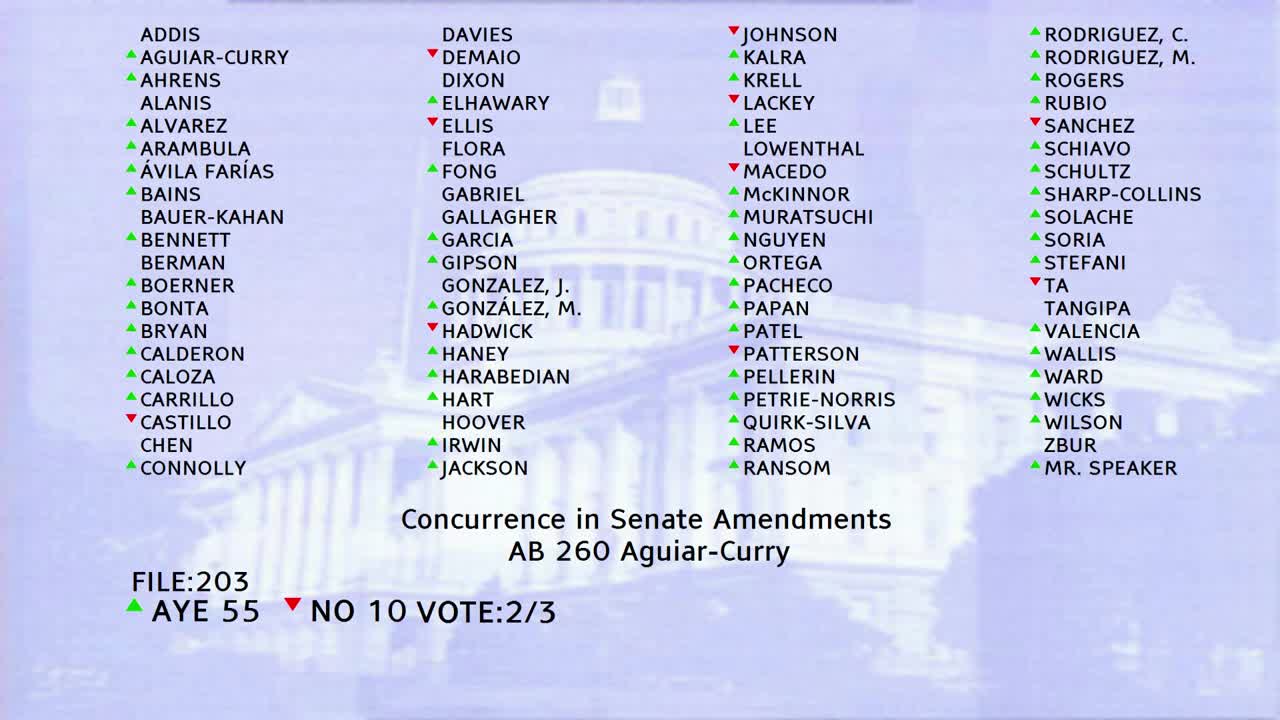

Bill Author

Bill Co-Author(s):