AB 1420: Surplus land.
- Session Year: 2025-2026
- House: Assembly
- Latest Version Date: 2025-02-21
Current Status:
Failed
(2026-02-02: From committee: Filed with the Chief Clerk pursuant to Joint Rule 56.)
Introduced
In Committee
Awaiting First Chamber Vote
Passed First Chamber
In Committee
Awaiting Second Chamber Vote
Passed Second Chamber
Enacted
Existing law requires each state agency, each year, to make a review of all proprietary state lands over which it has jurisdiction to determine what land is in excess of its foreseeable needs and report thereon to the Department of General Services, including, among other things, land that is not currently being utilized, or is currently being underutilized by the state agency for any ongoing state program.
This bill would require the report described above to include land that is not currently being utilized, or is currently being underutilized by the state agency for any ongoing state program regardless of whether the agency is currently prepared to dispose of the land by sale or otherwise. The bill would require the department to submit a report to the Legislature containing information regarding the land reported to it by a state agency as described in these provisions, on or before January 1, 2030.
(a)On or before December 31 of each year, each state agency shall make a review of all proprietary state lands, other than tax-deeded land, land held for highway purposes, lands under the jurisdiction of the State Lands Commission, land that has escheated to the state or that has been distributed to the state by court decree in estates of deceased persons, and lands under the jurisdiction of the State Coastal Conservancy, over which it has jurisdiction to determine what, if any, land is in excess of its foreseeable needs and report thereon in writing to the Department of General Services. These lands shall include, but not be limited to, the following:
(1)Land not currently being utilized, or currently being underutilized, by the state agency for any existing or ongoing state program. program regardless of whether the agency is currently prepared to dispose of the land by sale or otherwise. If the agency is not currently prepared to dispose of the land, subdivisions (b), (c), and (e) shall not apply.
(2)Land for which the state agency has not identified any specific utilization relative to future programmatic needs.
(3)Land not identified by the state agency within its master plans for facility development.
(b)Jurisdiction of all land reported as excess shall be transferred to the Department of General Services, when requested by the director of that department, for sale or disposition under this section or as may be otherwise authorized by law.
(c)The Department of General Services shall report to the Legislature annually, the land declared excess and request authorization to dispose of the land by sale or otherwise.
(d)The Department of General Services shall review and consider reports submitted to the Director of General Services pursuant to Section 66907.12 of this code and Section 31104.3 of the Public Resources Code before recommending or taking any action on surplus land, and shall also circulate the reports to all state agencies that are required to report excess land pursuant to this section. In recommending or determining the disposition of surplus lands, the Director of General Services may give priority to proposals by the state that involve the exchange of surplus lands for lands listed in those reports.
(e)Except as otherwise provided by any other law, whenever any land is reported as excess pursuant to this section, the Department of General Services shall determine whether or not the use of the land is needed by any other state agency. If the Department of General Services determines that any land is needed by any other state agency it may transfer the jurisdiction of this land to the other state agency upon the terms and conditions as it may deem to be for the best interests of the state.
(f)When authority is granted for the sale or other disposition of lands declared excess, and the Department of General Services has determined that the use of the land is not needed by any other state agency, the Department of General Services shall sell the land or otherwise dispose of the same pursuant to the authorization, upon any terms and conditions and subject to any reservations and exceptions as the Department of General Services may deem to be for the best interests of the state. The Department of General Services shall report to the Legislature annually, with respect to each parcel of land authorized to be sold under this section, giving the following information:
(1)A description or other identification of the property.
(2)The date of authorization.
(3)With regard to each parcel sold after the next preceding report, the date of sale and price received, or the value of the land received in exchange.
(4)The present status of the property, if not sold or otherwise disposed of at the time of the report.
(g)(1)(A)Except as otherwise specified by law, the net proceeds received from any real property disposition, including the sale, lease, exchange, or other means, that is received pursuant to this section shall be paid into the Deficit Recovery Bond Retirement Sinking Fund Subaccount, established pursuant to subdivision (f) of Section 20 of Article XVI of the California Constitution, as approved by the voters at the March 2, 2004, statewide primary election, until the time that the bonds issued pursuant to the Economic Recovery Bond Act (Title 18 (commencing with Section 99050)), approved by the voters at the March 2, 2004, statewide primary election, are retired. Thereafter, the net proceeds received pursuant to this section shall be deposited in the Special Fund for Economic Uncertainties.
(B)Notwithstanding subparagraph (A), the department may deposit some or all of the net proceeds into the Property Acquisition Law Money Account for the purposes of maintaining an operating reserve sufficient to continue redeveloping excess state properties as affordable housing.
(2)For purposes of this section, net proceeds shall be defined as proceeds less any outstanding loans from the General Fund, or outstanding reimbursements due to the Property Acquisition Law Money Account for costs incurred before June 30, 2005, related to the management of the states real property assets, including, but not limited to, surplus property identification, legal research, feasibility statistics, activities associated with land use, and due diligence.
(3)For the purposes of this section, an operating reserve sufficient to continue redeveloping excess state properties as affordable housing means an amount not to exceed three years of operating costs to redevelop excess state properties as affordable housing.
(h)The Director of Finance may approve loans from the General Fund to the Property Acquisition Law Money Account, which is hereby created in the State Treasury, for the purposes of supporting the management of the states real property assets.
(i)Any rentals or other revenues received by the department from real properties, the jurisdiction of which has been transferred to the Department of General Services under this section, shall be deposited in the Property Acquisition Law Money Account and shall be available for expenditure by the Department of General Services upon appropriation by the Legislature.
(j)Nothing contained in this section shall be construed to prohibit the sale, letting, or other disposition of any state lands pursuant to any law now or hereafter enacted authorizing the sale, letting, or disposition.
(k)(1)The disposition of a parcel of surplus state real property, pursuant to Section 11011.1, made on an as is basis shall be exempt from Division 13 (commencing with Section 21000) of the Public Resources Code. Upon title to the parcel vesting in the purchaser or transferee of the property, the purchaser or transferee shall be subject to any local governmental land use entitlement approval requirements and to Division 13 (commencing with Section 21000) of the Public Resources Code.
(2)If the disposition of a parcel of surplus state real property, pursuant to Section 11011.1, is not made on an as is basis and close of escrow is contingent on the satisfaction of a local governmental land use entitlement approval requirement or compliance by the local government with Division 13 (commencing with Section 21000) of the Public Resources Code, the execution of the purchase and sale agreement or of the exchange agreement by all parties to the agreement shall be exempt from Division 13 (commencing with Section 21000) of the Public Resources Code.
(3)For purposes of this subdivision, disposition means the sale, exchange, sale combined with an exchange, or transfer of a parcel of surplus state property.
(l)(1)On or before January 1, 2030, the department shall submit a report to the Legislature containing information regarding land reported to it by state agencies pursuant to paragraph (1) of subdivision (a).
(2)The requirement for submitting a report imposed under paragraph (1) is inoperative on January 1, 2034, pursuant to Section 10231.5 of the Government Code.
(3)A report to be submitted pursuant to paragraph (1) shall be submitted in compliance with Section 9795 of the Government Code.
|
Date
|
Status
|
|---|---|
| Feb 2, 2026 | From committee: Filed with the Chief Clerk pursuant to Joint Rule 56. |
| Jan 31, 2026 | Died pursuant to Art. IV, Sec. 10(c) of the Constitution. |
| May 23, 2025 | In committee: Held under submission. |
| May 14, 2025 | In committee: Set, first hearing. Referred to APPR. suspense file. |
| Apr 24, 2025 | From committee: Do pass and re-refer to Com. on APPR. (Ayes 21. Noes 0.) (April 23). Re-referred to Com. on APPR. |
| Mar 17, 2025 | Referred to Com. on G.O. |
| Feb 24, 2025 | Read first time. |
| Feb 22, 2025 | From printer. May be heard in committee March 24. |
| Feb 21, 2025 | Introduced. To print. |
|
Date
|
Description
|
Location
|
Votes
|
|
|---|---|---|---|---|
| Apr 23, 2025 | Do pass and be re-referred to the Committee on [Appropriations] | Assembly Standing Committee on Governmental Organization |
Passed |
This list shows positions taken on this bill by organizations on the date displayed, which is linked to the original source.
Positions by individuals are not included.
Date of Hearing: May 14, 2025
ASSEMBLY COMMITTEE ON APPROPRIATIONS
Buffy Wicks, Chair
ABPCA Bill Id:AB 1420
Author:(Ta) – As Introduced Ver:February 21, 2025
Policy Committee: | Governmental Organization | Vote: | 21 - 0 |
|
| ||
|
|
Urgency: No State Mandated Local Program: No Reimbursable: No
SUMMARY:
This bill requires a state agency to identify unutilized or underutilized land the state agency is not currently prepared to dispose as part of an existing annual surplus land report the state agency must make to the Department of General Services (DGS).
DGS must submit a report to the Legislature regarding all unutilized or underutilized land reported by a state agency by January 1, 2030.
FISCAL EFFECT:
- Ongoing costs of an unknown, but potentially absorbable, amount across all state agencies to annually identify unutilized or underutilized land the state agency is not currently prepared to dispose and report such land to DGS. However, since the primary purpose of this bill is to create a report, this bill qualifies for this committee’s suspense file consistent with committee rules.
- One-time costs of an unknown, but potentially absorbable, amount to DGS to prepare an additional report regarding unutilized or underutilized land for the Legislature.
COMMENTS:
- Purpose. According to the author:
AB 1420 will help legislators fulfill their fiduciary responsibility to California citizens by correctly identifying state-owned properties that are underutilized. By having a list of unused government property, California will unlock additional opportunities for accessing much-needed revenues through potential property sales and cost savings. Freeing up property will also help the state reach its goals in creating affordable housing development.
This bill is supported by California Civil Liberties Advocacy.
- State Surplus Land. Existing law governs the disposition of surplus state-owned real property and requires each state agency to annually review all proprietary lands under its jurisdiction to identify and report to DGS land that is excess to the agency’s foreseeable needs. Once a property has been identified as excess by the state agency, DGS must determine if there is another state use for the property. If another state agency has interest in using the property, DGS assists the interested agency with preparing transfer of jurisdiction documents to complete a change of control. If there is no other state use, DGS must report land declared excess to the Legislature and request authorization to dispose of the property. This bill requires a state agency, as part of its annual review of propriety lands, to additionally identify and report to DGS land that is unutilized or underutilized by the agency, but not considered excess. DGS must then submit a report to the Legislature by January 1, 2030, regarding excess and non-excess lands identified by state agencies.
Analysis Prepared by: Irene Ho / APPR. / (916) 319-2081
Date of Hearing: April 23, 2025
ASSEMBLY COMMITTEE ON GOVERNMENTAL ORGANIZATION
Blanca Rubio, Chair
ABPCA Bill Id:AB 1420 (
Author:Ta) – As Introduced Ver:February 21, 2025
SUBJECT: Surplus land
SUMMARY: The bill would require the Department of General Services (DGS) to submit a report to the Legislature by January 1, 2030, detailing land reported by state agencies under specified provisions. The report must include land that is not currently being utilized, or is currently being underutilized by the state agency for any ongoing state program irrespective of the agency's readiness to dispose of the land by sale or otherwise. Specifically, this bill:
1) Expands the requirement for state agencies to report land that is in excess of its foreseeable needs to the DGS, which includes land that is not being utilized or is underutilized, regardless of whether the agency is currently prepared to dispose of the land by sale or otherwise.
2) Requires DGS to submit a report to the Legislature with the information regarding land reported by state agencies under this measure, by January 1, 2030.
3) Sunsets the requirements for DGS to submit a report on January 1, 2034.
EXISTING LAW:
1) Establishes DGS, which is under the control of the Director of DGS, within the Government Operations Agency, and requires the director to perform various functions and duties with respect to property within the state, including entering into lease agreements.
2) Authorizes DGS, subject to legislative approval, to sell, lease, exchange, or transfer various specified properties for current market value, or upon such terms and conditions that DGS determines are in the best interest of the state.
3) Establishes criteria for state agencies to use in determining and reporting excess lands. A state agency must report land as surplus that is:
- Not currently utilized, or is underutilized, for any existing or ongoing programs;
- Land for which the agency cannot identify a specific utilization relative to future needs; and,
- Land not identified by the state agency within its master plan for facility development.
4) Prescribes a process for the disposition of surplus state property, which includes a requirement for DGS to determine whether or not the use of the land is needed by any other state agency prior to any sale or disposition of that land.
5) Requires DGS to create a digitized inventory of all excess state land, create screening tools for prioritizing affordable housing development on excess state land, and issue requests for proposals and select affordable housing developments on excess state land, as described.
6) Authorizes the Director of DGS, with the consent of the state agency concerned, to, among other things, let for a period not to exceed 5 years, any real or personal property that belongs to the state, the letting of which is not expressly prohibited by law, as specified.
7) States any report required or requested by law, or identified in the Legislative Analyst’s Supplemental Report of the Budget Act, to be submitted by a state or local agency to a committee of the Legislature or the Members of either house of the Legislature generally, shall instead be submitted as a printed copy to the Secretary of the Senate, as an electronic copy to the Chief Clerk of the Assembly, and as an electronic or printed copy to the Legislative Counsel. (CA Government Code § 9795)
FISCAL EFFECT: This bill is keyed fiscal by Legislative Counsel.
COMMENTS:
Purpose of the bill. According to the author’s office, “AB 1420 will help legislators fulfill their fiduciary responsibility to California citizens by correctly identifying state-owned properties that are underutilized. By having a list of unused government property, California will unlock additional opportunities for accessing much-needed revenues through potential property sales and cost savings. Freeing up property will also help the state reach its goals in creating affordable housing development.”
What problem does this bill solve? The author’s office states, “California faces significant budget deficits, and unused state land presents a potential revenue source for closing budget shortfalls. As the keepers of the public trust, it is critical that the Legislature have a complete list of state assets. AB 1420 would require the DGS to include land that is not currently being used by any state agency for any ongoing state programs regardless of if the state is planning on selling or disposing of the land.”
Background.
The DGS acts as the business manager for the state of California. DGS helps state government better serve the public by providing services to state agencies, including procurement and acquisition solutions, real estate management, leasing and design services, environmentally friendly transportation, and architectural oversight and funding for the construction of safe schools.
California Government Code § 11011 governs the disposition of surplus state-owned real property. Each state agency is required to annually review all proprietary lands under its jurisdiction to identify and report to DGS any land that is excess to the agency’s foreseeable needs. Once a property has been identified as excess by the state agency, DGS is required to determine if there is another state use for the property. If there is other state agency interest in the property, DGS assists the interested agency with preparing the transfer of jurisdiction documents to complete the change of control. If there is no state use, the property may include in the omnibus surplus property bill sponsored by DGS to seek legislative authorization for DGS to dispose of it.
State Property. The State owns over 3,100 properties, encompassing more than 44,000 parcels of land. Altogether, these holdings span approximately 2.9 million acres—an area comparable in size to Los Angeles County. State agencies possess this land and use it for a variety of purposes, including maintaining office space for state operations, providing parks to the public, and furnishing campuses for higher education. The agencies that possess the largest percentage of the State's acreage are the Department of Parks and Recreation, the California Department of Fish and Wildlife, and the California State Lands Commission. In addition, the California Department of Transportation (Caltrans) maintains numerous land holdings that serve as components of the State's transportation system.
The Legislature empowers the DGS with overseeing the administration of certain centralized services for state agencies, including the leasing and purchasing of real property. Acting as the State's property manager, DGS acquires and disposes of property for the State after legislative approval or approves property leases as necessary for state agencies to conduct their business. DGS also provides planning, construction management, and other services to state agencies to support the use of the properties those agencies possess.
Excess and Surplus Property. To improve the State's management of its real property holdings, state law requires all state agencies, with certain limited exceptions, to report annually to DGS on the land they possess. DGS relies on these self-reported data to populate the State Property Inventory (SPI), a database that catalogs much of the State's real property. When reporting to the SPI, state agencies must provide information on topics that include the size of the property, its location, and any major structures located on it.
As part of their duties related to the SPI, state agencies must also report, with certain limited exceptions, the extent to which they are or anticipate using the property they possess. Existing law requires state agencies to identify for DGS any property they possess that is not in use, and it defines such property as excess property. Once an agency reports excess property, DGS determines whether another state agency may be able to make use of it. If DGS identifies such an agency, it may transfer possession of the property to that agency. When DGS is not able to identify an alternate use for the property, it includes the property in an annual report it issues to the Legislature, which may declare the land surplus property. DGS may then sell or lease the property. Since 2009, state law has set a preference for DGS to sell or lease surplus property in a manner that supports affordable housing development, when possible. Between 2010 and 2020, DGS sold, leased, or transferred 64 surplus properties, and seven of these properties ultimately went on to support affordable housing, providing more than 500 units of affordable housing.
It should be noted that not all state-owned property is suitable for development. For example, the SPI indicates that the California State Lands Commission possesses about 460,000 acres of state property, but the commission's mission is to protect and enhance those lands as well as the public's access to them.
The State's Process for Disposing of Surplus Property. Agencies submit annual reports to DGS by December 31each year detailing the properties they control and identifying any that are unused or underused (excess properties). Upon receipt of agencies’ reports, DGS evaluates whether any other state agencies can use properties identified as excess. DGS annually reports to the Legislature on excess properties that cannot be put to another beneficial use and requests authority to sell or lease those properties as surplus property. Upon legislative approval, DGS sells or leases the surplus property, prioritizing affordable housing uses when feasible.
In 2019, Governor Newsom, issued Executive Order N-06-19 (EO) which reoriented DGS’s priorities to focus on facilitating conversion of excess property to affordable housing. The contents of the EO were later codified by SB 561 (Dodd, Chapter 446, Statutes of 2022) and AB 2233 (Quirk-Silva, Chapter 438, Statutes of 2022). Since the EO, HCD and DGS have assembled a statewide pipeline of nearly 4,300 housing units across 32 projects in various phases of development. The state estimates that the new sites being released have the capacity for at least 2,000 homes to be added as the sites are developed.
Additionally, current law, under Government Code § 14671.2, authorizes DGS, with the consent of the state agency concerned, to let for any period of time any real property or interest in real property that belongs to the state, when DGS deems the letting serves a beneficial public purpose limited to the development of housing, including permanent supportive or traditional housing and emergency shelters or park and recreation facilities.
Related legislation. AB 98 (Jackson) of 2025. This bill would require the DGS to quitclaim to the City of Moreno Valley, at no cost to the city, all interests of the state in 11 parcels of land located within the Lake Perris Fairgrounds that consist mainly of undeveloped open-space land. The bill would require the City of Moreno Valley to use the land to conduct wildfire mitigation to ensure fire protection for residents and businesses, to increase open-space opportunities, and any other similar use the City of Moreno Valley deems necessary. (Assembly Committee on Governmental Organization)
AB 971 (Alvarez) of 2025. This bill would require the DGS to quitclaim to the San Pasqual Band of Mission Indians, at no cost to the tribe, all interests of the state in the land that it owns within the San Pasqual Battlefield State Park, consisting of 3 parcels of land totaling approximately 3.68 acres. This bill would encourage the City of San Diego to transfer to the San Pasqual Band of Mission Indians all of the city’s interests in the land the city owns within the San Pasqual Battlefield State Park, as specified. (Assembly Committee on Governmental Organization)
SB 46 (Padilla) of 2025. This bill would require the DGS to quitclaim to the City of Imperial, at no cost to the city, all interests of the state in the excess state property known as the California Highway Patrol El Centro Area office located at 2331 U.S. Highway 86, Imperial, in the County of Imperial. The bill would require the city to use the property as a police station for the Imperial Police Department. (Senate Committee on Governmental Organization)
Prior legislation. SB 572 (Smallwood-Cuevas), Chapter 770, Statutes of 2024. Authorized the Director of the DGS to sell, upon those terms and conditions the director determines are in the best interest of the state, all or any part of approximately 59,200 square feet of property, located at 5401 Crenshaw Boulevard, Los Angeles for purposes of redeveloping the property as an affordable housing or mixed-used housing project.
SB 792 (Smallwood-Cuevas) of 2023. This bill would have required the DGS to update, by January 1, of each year, a complete and accurate inventory of all real property held by the state. (Gut and amended in the Assembly)
SB 803 (Becker) of 2023. This bill would have required the DGS to annually verify a sample of the digitized inventory to ensure that digitized inventory is accurate. Current law requires DGS to conduct a comprehensive survey of all state-owned parcels every four years and to keep a digitized inventory of state-owned parcels that are suitable for affordable housing. (Gut and amended in the Assembly)
AB 2233 (Quirk-Silva), Chapter 438, Statutes of 2022. Required the DGS to develop a plan to facilitate development of affordable housing on state-owned excess land, as specified.
AB 869 (Cunningham) of 2019. Would have required the DGS to notify other state agencies of an excess property and take action on a transfer of jurisdiction request for the property within 150 days. (Vetoed by Governor)
AB 1255 (Robert Rivas), Chapter 661, Statutes of 2019. Required local governments to include an inventory of surplus sites that are infill, “high-density” sites in their housing elements and requires DGS to create a searchable database of surplus sites.
SB 6 (Beall), Chapter 667, Statutes of 2019. Required the Department of Housing and Community Development to provide DGS with an annual list of vacant sites that are suitable and available for residential development, as identified by local governments, and requires DGS to develop a searchable database of those sites and state surplus sites.
REGISTERED SUPPORT / OPPOSITION:
Support
None on file
Opposition
None on file
Analysis Prepared by: Eric Johnson / G.O. / (916) 319-2531
Discussed in Hearing
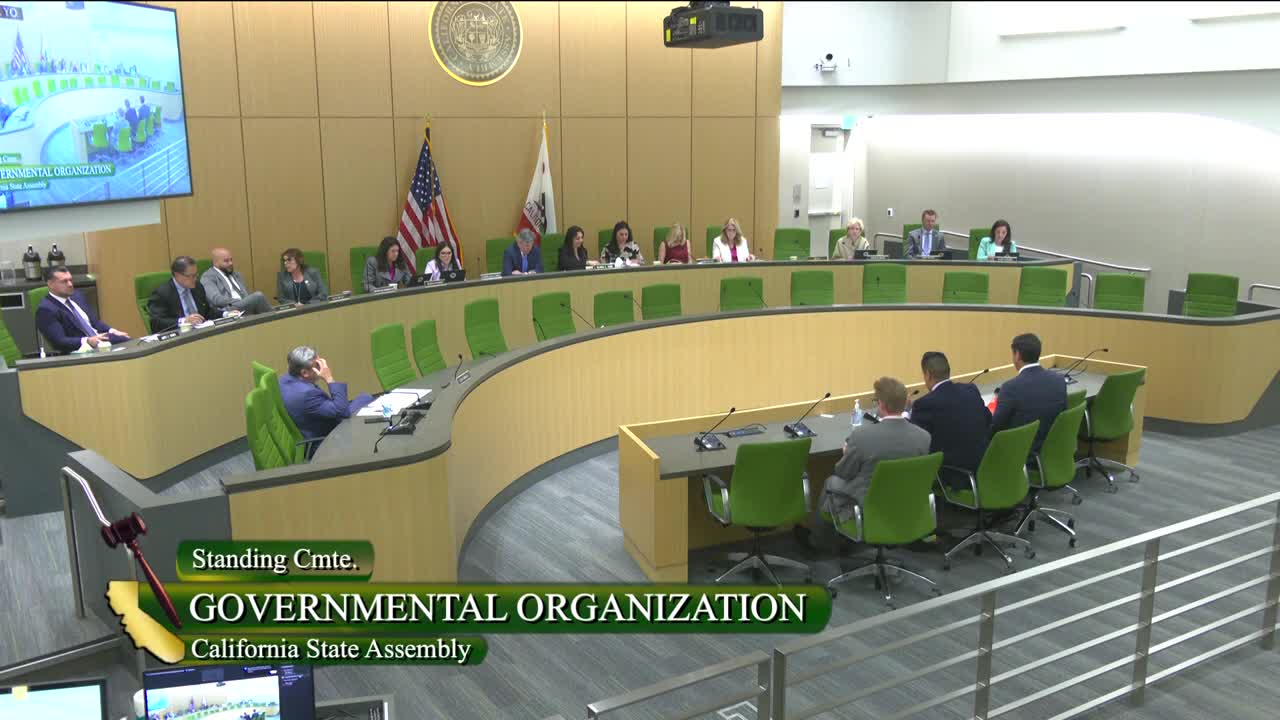 5MIN
Assembly Standing Committee on Governmental Organization
Bill Author

Bill Co-Author(s):