AB 1486: Climate resiliency: research farms: grant program.
- Session Year: 2025-2026
- House: Assembly
- Latest Version Date: 2026-09-30
Current Status:
Passed
(2026-09-30: Chaptered by Secretary of State - Chapter 879, Statutes of 2026.)
Introduced
In Committee
Awaiting First Chamber Vote
Passed First Chamber
In Committee
Awaiting Second Chamber Vote
Passed Second Chamber
Enacted
What does this bill do?
The bill directs $15 million from a state climate resilience bond to grants for public colleges and universities’ Agricultural Experiment Stations and Agricultural Research Institutes to build or improve research farms for climate resiliency, up to $1 million per institution and requiring environmentally sustainable infrastructure. It also lets the State Department of Education advance payments to the Department of Food and Agriculture for these projects in 2026–27 and 2027–28, exempts those contracts from approval by the Director of General Services, and clarifies that developing a research farm includes building new farms and improving existing ones.
The summary is provided by generative AI which can make mistakes. For original language, please view the details in the table below.
The Safe Drinking Water, Wildfire Prevention, Drought Preparedness, and Clean Air Bond Act of 2024, approved by the voters as Proposition 4 at the November 5, 2024, statewide general election, authorized the issuance of bonds in the amount of $10,000,000,000 pursuant to the State General Obligation Bond Law to finance projects for safe drinking water, drought, flood, and water resilience, wildfire and forest resilience, coastal resilience, extreme heat mitigation, biodiversity protection and nature-based climate solutions, climate-smart, sustainable, and resilient farms, ranches, and working lands, park creation and outdoor access, and clean air programs. Of these funds, the act makes $300,000,000 available, upon appropriation by the Legislature, for improving climate resilience and sustainability of agricultural lands, including, among other things, by making $15,000,000 available, upon appropriation by the Legislature, to the State Department of Education, in consultation with the Department of Food and Agriculture, for purposes of providing grants to public postsecondary educational institutions that are designated as Agricultural Experiment Stations or Agricultural Research Institutes, to develop research farms to improve climate resiliency, as specified.
Existing law authorizes a state agency to furnish services, materials, or equipment to, or perform work for, any other state agency upon terms and conditions and for the consideration as they may determine, and to enter into agreements for that purpose, subject to approval of the Director of General Services. Existing law requires a state agency that furnishes the services, materials, or equipment to, or performs the work for, the other state agency to compute charges in a manner approved by the Director of Finance. Existing law authorizes a state agency to provide for the advancing of funds, as provided, to defray those charges.
This bill would authorize the State Department of Education to advance a payment for a contract or agreement made with the Department of Food and Agriculture pursuant to the research farm provisions of Proposition 4, described above, in the 202627 and 202728 fiscal years. The bill would exempt those contracts and agreements from the above-described requirement of approval by the Director of General Services. The bill would provide, for purposes of those contracts and agreements, that developing a research farm pursuant to the research farm provisions of Proposition 4 includes constructing a new research farm and maintaining, altering, or improving an existing research farm previously constructed by the Agricultural Experiment Station or the Agricultural Research Institute.
This bill would provide, for purposes of the research farm grants, that Agricultural Experiment Stations and Agricultural Research Institutes are designated by the University of California and the California State University.
The Safe Drinking Water, Wildfire Prevention, Drought Preparedness, and Clean Air Bond Act of 2024, approved by the voters as Proposition 4 at the November 5, 2024, statewide general election, authorized the issuance of bonds in the amount of $10,000,000,000 pursuant to the State General Obligation Bond Law to finance projects for safe drinking water, drought, flood, and water resilience, wildfire and forest resilience, coastal resilience, extreme heat mitigation, biodiversity protection and nature-based climate solutions, climate-smart, sustainable, and resilient farms, ranches, and working lands, park creation and outdoor access, and clean air programs. Of these funds, the act makes $300,000,000 available, upon appropriation by the Legislature, for improving climate resilience and sustainability of agricultural lands, including, among other things, by making $15,000,000 available, upon appropriation by the Legislature, to the State Department of Education, in consultation with the Department of Food and Agriculture, for purposes of providing grants to public postsecondary educational institutions that are designated as Agricultural Experiment Stations or Agricultural Research Institutes, to develop research farms to improve climate resiliency, as specified.
This bill would, upon an appropriation by the Legislature for this purpose, require the State Department of Education, in consultation with the Department of Food and Agriculture, on or before July 1, 2026, to establish a grant program to provide grants to public postsecondary educational institutions that are designated as Agricultural Experiment Stations or Agricultural Research Institutes to develop or expand research farms to improve climate resiliency, in accordance with the above-described provisions.This bill would provide, for purposes of the grants, that Agricultural Experiment Stations and Agricultural Research Institutes are designated by the University of California and the California State University.
The Safe Drinking Water, Wildfire Prevention, Drought Preparedness, and Clean Air Bond Act of 2024, approved by the voters as Proposition 4 at the November 5, 2024, statewide general election, authorized the issuance of bonds in the amount of $10,000,000,000 pursuant to the State General Obligation Bond Law to finance projects for safe drinking water, drought, flood, and water resilience, wildfire and forest resilience, coastal resilience, extreme heat mitigation, biodiversity and nature-based climate solutions, climate-smart, sustainable, and resilient farms, ranches, and working lands, park creation and outdoor access, and clean air programs. Of these funds, the act makes $300,000,000 available, upon appropriation by the Legislature, for improving climate resilience and sustainability of agricultural lands, including, among other things, by making $15,000,000 available, upon appropriation by the Legislature, to the State Department of Education, in consultation with the Department of Food and Agriculture, for purposes of providing grants to public postsecondary educational institutions that are designated as Agricultural Experiment Stations or Agricultural Research Institutes, to develop research farms to improve climate resiliency, as specified.
This bill would, upon an appropriation by the Legislature for this purpose, require the State Department of Education, in consultation with the Department of Food and Agriculture, on or before January July 1, 2026, to establish a grant program to provide grants to public postsecondary educational institutions that are designated as Agricultural Experiment Stations or Agricultural Research Institutes to develop or expand research farms to improve climate resiliency, in accordance with the above-described provisions.
The Safe Drinking Water, Wildfire Prevention, Drought Preparedness, and Clean Air Bond Act of 2024, approved by the voters as Proposition 4 at the November 5, 2024, statewide general election, authorized the issuance of bonds in the amount of $10,000,000,000 pursuant to the State General Obligation Bond Law to finance projects for safe drinking water, drought, flood, and water resilience, wildfire and forest resilience, coastal resilience, extreme heat mitigation, biodiversity and nature-based climate solutions, climate-smart, sustainable, and resilient farms, ranches, and working lands, park creation and outdoor access, and clean air programs. Of these funds, the act makes $300,000,000 available, upon appropriation by the Legislature, for improving climate resilience and sustainability of agricultural lands, including, among other things, by making $15,000,000 available, upon appropriation by the Legislature, to the State Department of Education, in consultation with the Department of Food and Agriculture, for purposes of providing grants to public postsecondary educational institutions that are designated as Agricultural Experiment Stations or Agricultural Research Institutes, to develop research farms to improve climate resiliency, as specified.
This bill would, upon an appropriation by the Legislature for this purpose, require the State Department of Education, in consultation with the Department of Food and Agriculture, on or before January 1, 2026, to establish a grant program to provide grants to public postsecondary educational institutions that are designated as Agricultural Experiment Stations or Agricultural Research Institutes to develop or expand research farms to improve climate resiliency, in accordance with the above-described provisions.
(a)Notwithstanding any other law, the department may advance a payment for a contract or agreement made with the Department of Food and Agriculture pursuant to Section 93570 of the Public Resources Code in the 202627 and 202728 fiscal years. A contract or agreement made by the department with the Department of Food and Agriculture pursuant to Section 93570 of the Public Resources Code in those fiscal years shall be exempt from the requirement of approval by the Director of General Services pursuant to Section 11256 of the Government Code.
(b)For purposes of a contract or agreement specified in subdivision (a), developing a research farm pursuant to Section 93570 of the Public Resources Code includes both of the following:
(1)Constructing a new research farm.
(2)Maintaining, altering, or improving an existing research farm previously constructed by the Agricultural Experiment Station or the Agricultural Research Institute.
SEC. 2.Section 93570 of the Public Resources Code is amended to read:93570.Of the funds made available by Section 93500, fifteen million dollars ($15,000,000) shall be available, upon appropriation by the Legislature, to the State Department of Education, in consultation with the Department of Food and Agriculture, for purposes of providing grants to public postsecondary educational institutions that are designated by the University of California and the California State University as Agricultural Experiment Stations or Agricultural Research Institutes, to develop research farms to improve climate resiliency. Funding provided pursuant to this section shall not exceed one million dollars ($1,000,000) per institution and shall be constructed and maintained with environmentally sustainable infrastructure practices.
(a)Notwithstanding any other law, the department may advance a payment for a contract or agreement made with the Department of Food and Agriculture pursuant to Section 93570 of the Public Resources Code in the 202627 and 202728 fiscal years. A contract or agreement made by the department with the Department of Food and Agriculture pursuant to Section 93570 of the Public Resources Code in those fiscal years shall be exempt from the requirement of approval by the Director of General Services pursuant to Section 11256 of the Government Code.
(b)For purposes of a contract or agreement specified in subdivision (a), developing a research farm pursuant to Section 93570 of the Public Resources Code includes both of the following:
(1)Constructing a new research farm.
(2)Maintaining, altering, or improving an existing research farm previously constructed by the Agricultural Experiment Station or the Agricultural Research Institute.
SECTION 1.SEC. 2.Section 93570 of the Public Resources Code is amended to read:93570.Of the funds made available by Section 93500, fifteen million dollars ($15,000,000) shall be available, upon appropriation by the Legislature, to the State Department of Education, in consultation with the Department of Food and Agriculture, for purposes of providing grants to public postsecondary educational institutions that are designated by the University of California and the California State University as Agricultural Experiment Stations or Agricultural Research Institutes, to develop research farms to improve climate resiliency. Funding provided pursuant to this section shall not exceed one million dollars ($1,000,000) per institution and shall be constructed and maintained with environmentally sustainable infrastructure practices.
Of the funds made available by Section 93500, fifteen million dollars ($15,000,000) shall be available, upon appropriation by the Legislature, to the State Department of Education, in consultation with the Department of Food and Agriculture, for purposes of providing grants to public postsecondary educational institutions that are designated by the University of California and the California State University as Agricultural Experiment Stations or Agricultural Research Institutes, to develop research farms to improve climate resiliency. Funding provided pursuant to this section shall not exceed one million dollars ($1,000,000) per institution and shall be constructed and maintained with environmentally sustainable infrastructure practices.
(a)It is the intent of the Legislature to ensure that funds made available pursuant to Section 93570 of the Public Resources Code, as added by the Safe Drinking Water, Wildfire Prevention, Drought Preparedness, and Clean Air Bond Act of 2024, are granted to public postsecondary educational institutions that are designated as Agricultural Experiment Stations or Agricultural Research Institutes to develop research farms to improve climate resiliency.
(b)On or before January July 1, 2026, upon an appropriation by the Legislature for this purpose, the State Department of Education, in consultation with the Department of Food and Agriculture, shall establish a grant program to provide grants to public postsecondary educational institutions that are designated as Agricultural Experiment Stations or Agricultural Research Institutes to develop or expand research farms to improve climate resiliency, in accordance with Section 93570 of the Public Resources Code.
(a)It is the intent of the Legislature to ensure that funds made available pursuant to Section 93570 of the Public Resources Code, as added by the Safe Drinking Water, Wildfire Prevention, Drought Preparedness, and Clean Air Bond Act of 2024, are granted to public postsecondary educational institutions that are designated as Agricultural Experiment Stations or Agricultural Research Institutes to develop research farms to improve climate resiliency.
(b)On or before January 1, 2026, upon an appropriation by the Legislature for this purpose, the State Department of Education, in consultation with the Department of Food and Agriculture, shall establish a grant program to provide grants to public postsecondary educational institutions that are designated as Agricultural Experiment Stations or Agricultural Research Institutes to develop or expand research farms to improve climate resiliency, in accordance with Section 93570 of the Public Resources Code.
|
Date
|
Status
|
|---|---|
| Sep 30, 2026 | Chaptered by Secretary of State - Chapter 879, Statutes of 2026. |
| Sep 30, 2026 | Approved by the Governor. |
| Aug 28, 2026 | Enrolled and presented to the Governor at 3:30 p.m. |
| Aug 24, 2026 | Senate amendments concurred in. To Engrossing and Enrolling. (Ayes 78. Noes 0.). |
| Aug 24, 2026 | Senate amendments concurred in. To Engrossing and Enrolling. (Ayes 78. Noes 0. Page 6400.). |
| Aug 24, 2026 | Senate amendments concurred in. To Engrossing and Enrolling. |
| Aug 20, 2026 | In Assembly. Concurrence in Senate amendments pending. |
| Aug 20, 2026 | Read third time. Passed. Ordered to the Assembly. (Ayes 39. Noes 0. Page 5588.). |
| Aug 20, 2026 | Read third time. Passed. Ordered to the Assembly. (Ayes 39. Noes 0.). |
| Aug 18, 2026 | Ordered to special consent calendar. |
| Aug 13, 2026 | Read second time. Ordered to third reading. |
| Aug 13, 2026 | From committee: Do pass. (Ayes 7. Noes 0.) (August 13). |
| Aug 3, 2026 | In committee: Referred to APPR. suspense file. |
| Jul 2, 2026 | From committee: Do pass and re-refer to Com. on APPR. with recommendation: To Consent Calendar. (Ayes 7. Noes 0.) (July 1). Re-referred to Com. on APPR. |
| Jun 10, 2026 | From committee chair, with author's amendments: Amend, and re-refer to committee. Read second time, amended, and re-referred to Com. on E.Q. |
| Jun 4, 2026 | From committee: Do pass and re-refer to Com. on E.Q. with recommendation: To Consent Calendar. (Ayes 7. Noes 0.) (June 3). Re-referred to Com. on E.Q. |
| May 6, 2026 | Referred to Coms. on ED. and E.Q. |
| Jan 29, 2026 | In Senate. Read first time. To Com. on RLS. for assignment. |
| Jan 29, 2026 | Read third time. Passed. Ordered to the Senate. (Ayes 75. Noes 0. Page 3879.) |
| Jan 26, 2026 | Read second time. Ordered to third reading. |
| Jan 22, 2026 | Read second time and amended. Ordered returned to second reading. |
| Jan 22, 2026 | From committee: Amend, and do pass as amended. (Ayes 11. Noes 0.) (January 22). |
| Jan 22, 2026 | Assembly Rule 63 suspended. (Page 3806.) |
| May 23, 2025 | In committee: Hearing postponed by committee. |
| May 7, 2025 | In committee: Set, first hearing. Referred to APPR. suspense file. |
| Apr 22, 2025 | From committee: Do pass and re-refer to Com. on APPR. with recommendation: To Consent Calendar. (Ayes 14. Noes 0.) (April 21). Re-referred to Com. on APPR. |
| Apr 7, 2025 | Re-referred to Com. on NAT. RES. |
| Apr 3, 2025 | Read second time and amended. |
| Apr 2, 2025 | From committee: Amend, and do pass as amended and re-refer to Com. on NAT. RES. (Ayes 8. Noes 0.) (March 26). |
| Mar 17, 2025 | Referred to Coms. on AGRI. and NAT. RES. |
| Feb 24, 2025 | Read first time. |
| Feb 22, 2025 | From printer. May be heard in committee March 24. |
| Feb 21, 2025 | Introduced. To print. |
|
Date
|
Description
|
Location
|
Votes
|
|
|---|---|---|---|---|
| Aug 24, 2026 | AB 1486 Soria Concurrence in Senate Amendments | Assembly Floor |
Passed |
|
| Aug 20, 2026 | Special Consent AB1486 Soria et al. | Senate Floor |
Passed |
|
| Aug 13, 2026 | Do pass | Senate Standing Committee on Appropriations |
Passed |
|
| Aug 3, 2026 | Placed on suspense file | Senate Standing Committee on Appropriations |
Passed |
|
| Jul 1, 2026 | Do pass, but first be re-referred to the Committee on [Appropriations] with the recommendation: To Consent Calendar | Senate Standing Committee on Environmental Quality |
Passed |
|
| Jun 3, 2026 | Do pass, but first be re-referred to the Committee on [Environmental Quality] with the recommendation: To Consent Calendar | Senate Standing Committee on Education |
Passed |
|
| Jan 29, 2026 | AB 1486 Soria Assembly Third Reading | Assembly Floor |
Passed |
|
| Jan 22, 2026 | Do pass as amended. | Assembly Standing Committee on Appropriations |
Passed |
|
| Apr 21, 2025 | Do pass and be re-referred to the Committee on [Appropriations] with recommendation: To Consent Calendar | Assembly Standing Committee on Natural Resources |
Passed |
|
| Mar 26, 2025 | Do pass as amended and be re-referred to the Committee on [Natural Resources] | Assembly Standing Committee on Agriculture |
Passed |
This list shows positions taken on this bill by organizations on the date displayed, which is linked to the original source.
Positions by individuals are not included.
|
Organization
|
Position
|
Date
|
|---|---|---|
| California State University | ** Support | |
| California State University, Office Of The Chancellor | ** Support | |
| Sustainable Conservation | ** Support | |
| University of California | ** Support |
CONCURRENCE IN SENATE AMENDMENTS
CSA1 Bill Id:AB 1486
Author:(Soria)
As Amended Ver:June 10, 2026
Majority vote
SUMMARY
This bill requires the California Department of Education (CDE), in consultation with the California Department of Food and Agriculture (CDFA), to provide grants to public postsecondary educational institutions that are designated as Agricultural Experiment Stations or Agriculture Research Institutes by the University of California (UC) and the California State University (CSU) to develop or expand research farms to improve climate resiliency.
Senate Amendments
Specify that if CDE enters into a contract or agreement with CDFA, pursuant to this bill, that it may advance payments without needing Department of General Services (DGS) approval and that funds may be used for both construction of new farms and maintaining, altering or improving existing farms.
COMMENTS
While the program requires CDE consultation with CDFA on the provision of these grants, there may be a scenario in which CDE needs to send money to CDFA and the Senate amendments ensure that these contracts or agreements are not subject to DGS approval, thus making it consistent with most interagency agreements. Moreover, it would be unwieldy and inefficient to have CDFA seek reimbursement from CDE, so this allows CDE to advance the payments.
According to the Author
″Proposition 4′s research farm grants will help California′s public colleges improve existing, or help start up, research farms with a focus on improving climate resiliency.″
Arguments in Support
The University of California wrote in support that, ″The UC looks forward to applying for Proposition 4 funding to improve climate resiliency. AB 1486 sets up a timeframe for the establishment of this grant funding. For these reasons, UC supports AB 1486.″
Additionally, Sustainable Conservation opined that, ″[B]y expanding the network of research farms to continue this kind of groundbreaking work, will provide additional investment in the kind of innovation that is needed to respond to the ongoing climate crisis. The practices developed by these kinds of networks will be crucial to enabling California′s agricultural sector to meet sustainability challenges and continue thriving into the future.″
Arguments in Opposition
None of file.
FISCAL COMMENTS
This bill would authorize CDE to provide grants to public postsecondary educational institutions to develop or expand research farms. The Clean Air Bond Act of 2024, approved by voters as Proposition 4, provides $15 million for this purpose. Additionally, Proposition 4 provides that 7 percent of the funds allocated for a grant program may be used to pay for the administrative costs of that program.
The CDE estimates administrative costs of $428,000 each year and 1.0 position to provide the grants. To the extent that the set-aside from Proposition 4 is insufficient to cover these costs for the duration of the program, CDE may require future General Fund costs in the low hundreds of thousands of dollars.
Any costs to the CDFA are expected to be minor and absorbable costs.
VOTES:
ASM AGRICULTURE: 8-0-0
YES: Soria, Alanis, Aguiar-Curry, Connolly, Jeff Gonzalez, Hadwick, Irwin, Ransom
ASM NATURAL RESOURCES: 14-0-0
YES: Bryan, Alanis, Connolly, Ellis, Flora, Garcia, Haney, Hoover, Kalra, Muratsuchi, Pellerin, Schultz, Wicks, Zbur
ASM APPROPRIATIONS: 11-0-4
YES: Wicks, Stefani, Calderon, Caloza, Fong, Mark González, Krell, Bauer-Kahan, Pacheco, Pellerin, Solache
ABS, ABST OR NV: Hoover, Dixon, Ta, Tangipa
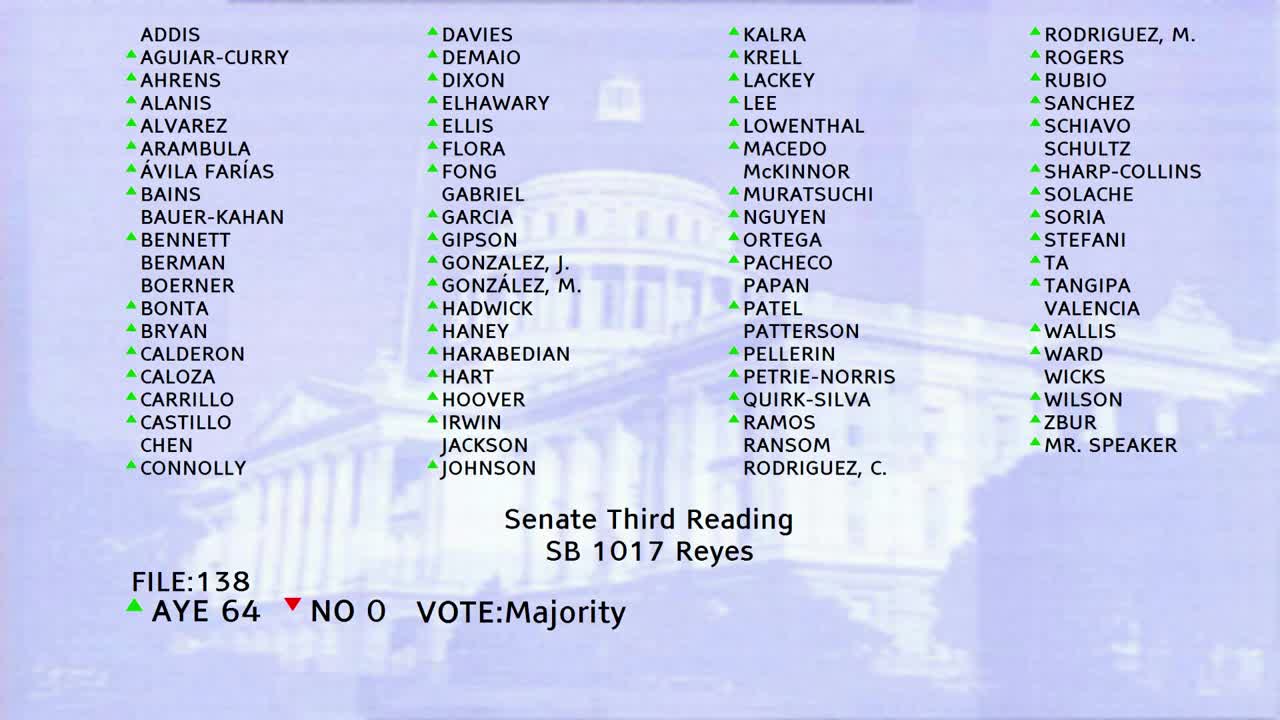
ASSEMBLY FLOOR: 75-0-5
YES: Addis, Aguiar-Curry, Ahrens, Alanis, Alvarez, Ávila Farías, Bains, Bauer-Kahan, Bennett, Berman, Boerner, Bonta, Bryan, Calderon, Caloza, Carrillo, Castillo, Chen, Connolly, Davies, DeMaio, Dixon, Elhawary, Ellis, Flora, Fong, Gabriel, Gallagher, Garcia, Jeff Gonzalez, Mark González, Hadwick, Haney, Harabedian, Hart, Hoover, Irwin, Jackson, Johnson, Kalra, Krell, Lackey, Lee, Lowenthal, Macedo, McKinnor, Muratsuchi, Nguyen, Ortega, Pacheco, Papan, Patel, Patterson, Pellerin, Petrie-Norris, Quirk-Silva, Ramos, Michelle Rodriguez, Rogers, Blanca Rubio, Sanchez, Schiavo, Schultz, Sharp-Collins, Solache, Soria, Stefani, Ta, Tangipa, Wallis, Ward, Wicks, Wilson, Zbur, Rivas
ABS, ABST OR NV: Arambula, Gipson, Ransom, Celeste Rodriguez, Valencia
UPDATED
VERSION: June 10, 2026
CONSULTANT: Jim Houston / AGRI. / (916) 319-2084 FN: 0003818
SENATE RULES COMMITTEE Office of Senate Floor Analyses (916) 651-4171 | AB 1486 |
THIRD READING
Bill No: AB 1486
Author: Soria (D), et al.
Amended: 6/10/26 in Senate
Vote: 21
SENATE EDUCATION COMMITTEE: 7-0, 6/3/26
AYES: Pérez, Ochoa Bogh, Cabaldon, Choi, Cortese, Gonzalez, Reyes
SENATE ENVIRONMENTAL QUALITY COMMITTEE: 7-0, 7/1/26
AYES: Blakespear, Valladares, Allen, Dahle, Gonzalez, Hurtado, Menjivar
SENATE APPROPRIATIONS COMMITTEE: 7-0, 8/13/26
AYES: Cervantes, Seyarto, Cabaldon, Dahle, Grayson, Richardson, Wahab
ASSEMBLY FLOOR: 75-0, 1/29/26 - See last page for vote
SUBJECT: Climate resiliency: research farms: grant program
SOURCE: Author
DIGEST:
This bill requires the California Department of Education (CDE), in consultation with the California Department of Food and Agriculture (CDFA), to establish a grant program to provide grants to public postsecondary educational institutions that are designated as Agricultural Experiment Stations or Agriculture Research Institutes by the University of California (UC) and the California State University (CSU) to develop or expand research farms to improve climate resiliency.
ANALYSIS:
Existing law:
- Establishes, under the California Constitution, the UC as a public trust to be administered by the Regents of the UC with full powers of organization and government, subject only to such legislative control as may be necessary to insure the security of its funds and compliance with the terms of the endowments of the university, and such competitive bidding procedures as may be made applicable to the university for construction contracts, selling real property, and purchasing materials, goods and services. (Constitution of California, Article IX, Section 9)
- Declares the UC as the primary state-supported academic agency for research. (Education Code (EC) § 66010.4 (c))
- Establishes the CSU, under the administration of the Trustees of the CSU, as one of the segments of public postsecondary education in the state. (EC § 66600)
- Makes $15,000,000 available, upon appropriation by the Legislature, to the State Department of Education, in consultation with CDFA, for purposes of providing grants to public postsecondary educational institutions that are designated as Agricultural Experiment Stations or Agricultural Research Institutes, to develop research farms to improve climate resiliency, as specified. (Public Resource Code § 93570)
This bill requires CDE, in consultation with the CDFA, to establish a grant program to provide grants to public postsecondary educational institutions that are designated as Agricultural Experiment Stations or Agricultural Research Institutes by UC and the CSU to develop or expand research farms to improve climate resiliency.
Comments
Need for the bill. As noted in the Assembly Appropriations analysis, “The $10 billion Safe Drinking Water, Wildfire Prevention, Drought Preparedness, and Clean Air Bond Act of 2024, approved by voters in 2024 as Proposition 4, allocated $300 million to fund improvements in climate resilience and sustainability of agricultural lands. As part of this allocation, the bond makes $15 million available, upon appropriation, to CDE, in consultation with CDFA, to provide grants to public postsecondary educational institutions designated as agricultural experiment stations or agricultural research institutes to develop or expand research farms to improve climate resiliency. The bond language provides that this funding shall not exceed $1 million per institution and “shall be constructed and maintained with environmentally sustainable infrastructure practices.”
“The Governor’s Proposition 4 expenditure plan, proposed as part of the administration’s January budget for the 2025-26 fiscal year, places this $15 million in a “pending allocation” category. The Legislative Analyst’s Office noted in a February report that the administration is requesting that the Legislature provide more guidance around its intentions for three bond activities – including the $15 million for research farms at postsecondary education institutions – for which the Governor’s expenditure plan does not yet include an appropriation timeline.”
The Budget Act of 2025 made the appropriation contingent upon the enactment of this bill. According to the author, “Proposition 4’s research farm grants will help California’s public colleges improve existing, or help start up, research farms with a focus on improving climate resiliency.”
Agricultural Research Institutes and experiment stations. The CSU Agricultural Research Institute consists of four member campuses: Fresno, San Luis Obispo, Pomona, and Chico, along with two associate member campuses, Humboldt and Monterey Bay. This multi-campus program focuses on conducting applied agricultural and environmental research. Project categories primarily focus on agricultural business, natural resources, biodiversity, food science, and more. Within the UC system, Agricultural Experiment Stations are housed at UC Berkeley, Davis, Merced, Riverside, and Santa Cruz campuses. These stations engage in land-grant mission research, host outreach and demonstration programs, and collaborate with farmers, suppliers, and other stakeholders in the agricultural industry, which aim to address issues related to agricultural natural resources and health.
This bill establishes a grant program for the purpose of providing state funding to CSU and UC Agricultural Research Institutes and Agricultural Experiment Stations with the goal of expanding research farms. The adopted bond measure and this bill assign the administration of the grant with CDE, even though the program is directed at CSU and UC, which function independently of CDE’s jurisdiction. CDE is required to consult with CDFA in establishing the grant program.
FISCAL EFFECT: Appropriation: No Fiscal Com.: Yes Local: No
According to the Senate Appropriations analysis, this bill would have the following fiscal impact:
- This bill would authorize CDE to provide grants to public postsecondary educational institutions to develop or expand research farms. The Clean Air Bond Act of 2024, approved by voters as Proposition 4, provides $15 million for this purpose. Additionally, Proposition 4 provides that 7 percent of the funds allocated for a grant program may be used to pay for the administrative costs of that program.
- The CDE estimates administrative costs of $428,000 each year and 1.0 position to provide the grants. To the extent that the set-aside from Proposition 4 is insufficient to cover these costs for the duration of the program, CDE may require future General Fund costs in the low hundreds of thousands of dollars.
- Any costs to the CDFA are expected to be minor and absorbable costs.
SUPPORT: (Verified 8/14/26)
California State University, Office of the Chancellor
OPPOSITION: (Verified 8/14/26)
None received
ASSEMBLY FLOOR: 75-0, 1/29/26
AYES: Addis, Aguiar-Curry, Ahrens, Alanis, Alvarez, Ávila Farías, Bains, Bauer-Kahan, Bennett, Berman, Boerner, Bonta, Bryan, Calderon, Caloza, Carrillo, Castillo, Chen, Connolly, Davies, DeMaio, Dixon, Elhawary, Ellis, Flora, Fong, Gabriel, Gallagher, Garcia, Jeff Gonzalez, Mark González, Hadwick, Haney, Harabedian, Hart, Hoover, Irwin, Jackson, Johnson, Kalra, Krell, Lackey, Lee, Lowenthal, Macedo, McKinnor, Muratsuchi, Nguyen, Ortega, Pacheco, Papan, Patel, Patterson, Pellerin, Petrie-Norris, Quirk-Silva, Ramos, Michelle Rodriguez, Rogers, Blanca Rubio, Sanchez, Schiavo, Schultz, Sharp-Collins, Solache, Soria, Stefani, Ta, Tangipa, Wallis, Ward, Wicks, Wilson, Zbur, Rivas
NO VOTE RECORDED: Arambula, Gipson, Ransom, Celeste Rodriguez, Valencia
Prepared by: Olgalilia Ramirez / ED. / (916) 651-4105
8/15/26 12:45:38
**** END ****
SENATE COMMITTEE ON
Senator Sabrina Cervantes, Chair
2025 - 2026 Regular Session
AB 1486 (Soria) - Climate resiliency: research farms: grant program
Version: | Policy Vote: |
Urgency: | Mandate: |
Hearing Date: | Consultant: |
Bill Summary:
This bill requires the California Department of Education (CDE), in consultation with the California Department of Food and Agriculture (CDFA), to provide grants to public postsecondary educational institutions that are designated as Agricultural Experiment Stations or Agriculture Research Institutes by the University of California (UC) and the California State University (CSU) to develop or expand research farms to improve climate resiliency.
Fiscal Impact:
This bill would authorize CDE to provide grants to public postsecondary educational institutions to develop or expand research farms. The Clean Air Bond Act of 2024, approved by voters as Proposition 4, provides $15 million for this purpose. Additionally, Proposition 4 provides that 7 percent of the funds allocated for a grant program may be used to pay for the administrative costs of that program.
The CDE estimates administrative costs of $428,000 each year and 1.0 position to provide the grants. To the extent that the set-aside from Proposition 4 is insufficient to cover these costs for the duration of the program, CDE may require future General Fund costs in the low hundreds of thousands of dollars.
Any costs to the CDFA are expected to be minor and absorbable costs.
Background:
Existing law provides $15,000,000, upon appropriation by the Legislature, to the State Department of Education, in consultation with CDFA, for purposes of providing grants to public postsecondary educational institutions that are designated as Agricultural Experiment Stations or Agricultural Research Institutes, to develop research farms to improve climate resiliency, as specified.
Proposed Law:
This bill requires CDE, in consultation with the CDFA, to establish a grant program to provide grants to public postsecondary educational institutions that are designated as Agricultural Experiment Stations or Agricultural Research Institutes by UC and the CSU to develop or expand research farms to improve climate resiliency.
Staff Comments:
The $10 billion Safe Drinking Water, Wildfire Prevention, Drought Preparedness, and Clean Air Bond Act of 2024, approved by voters in 2024 as Proposition 4, allocated $300 million to fund improvements in climate resilience and sustainability of agricultural lands. As part of this allocation, the bond makes $15 million available, upon appropriation, to CDE, in consultation with CDFA, to provide grants to public postsecondary educational institutions designated as agricultural experiment stations or agricultural research institutes to develop or expand research farms to improve climate resiliency. The language provides that this funding shall not exceed $1 million per institution and “shall be constructed and maintained with environmentally sustainable infrastructure practices.”
This bill establishes a grant program for the purpose of providing state funding to CSU and UC Agricultural Research Institutes and Agricultural Experiment Stations with the goal of expanding research farms. This bill assigns the administration of the grant with CDE, which would be required to consult with CDFA in establishing the grant program.
-- END --
SENATE COMMITTEE ON ENVIRONMENTAL QUALITY
Senator Blakespear, Chair
2025 - 2026 Regular
Bill No: AB 1486
Author: | Soria | ||
Version: | 1/22/2026 | Hearing Date: | 7/1/2026 |
Urgency: | No | Fiscal: | Yes |
Consultant: | Alyssa Poletti | ||
SUBJECT: Climate resiliency: research farms: grant program
DIGEST: This bill requires the California Department of Education (DOE), in consultation with the California Department of Food and Agriculture (CDFA), to establish a grant program to provide grants to public postsecondary educational institutions that are designated as Agricultural Experiment Stations or Agriculture Research Institutes by the University of California (UC) and the California State University (CSU) to develop or expand research farms to improve climate resiliency.
ANALYSIS:
Existing law:
- The Safe Drinking Water, Wildfire Prevention, Drought Preparedness, and Clean Air Bond Act of 2024 (SB 867, Allen, Chapter 83, Statutes of 2024), approved by the voters as Proposition 4 at the November 5, 2024, statewide general election, authorizes $10 billion in general obligation bonds to finance projects for safe drinking water, drought, flood, and water resilience, wildfire and forest resilience, coastal resilience, extreme heat mitigation, biodiversity and nature-based climate solutions, climate-smart, sustainable, and resilient farms, ranches, and working lands, park creation and outdoor access, and clean air programs. (Public Resources Code (PRC) § 90000 et seq.)
- Proposition 4 includes $300 million for improving climate resilience and sustainability of agricultural lands, of which $15 million is available, upon appropriation, for DOE, in consultation with CDFA, to provide grants to public post-secondary educational institutions that are designated as Agricultural Experiment Stations or Agricultural Research Institutes, to develop research farms to improve climate resiliency. Specifies that funding for each institution is limited to no more than $1 million. (PRC § 93570)
- Allows state agencies to provide materials or services for other state agencies subject to approval by the Direct of General Services (Government Code (GOV) § 11256)
This bill:
- Allows the State Department of Education (DOE) to advance payments for any contracts or agreements with the California Department of Food and Agriculture (CDFA) for fiscal years 2026-27 and 2027-28 without approval from the Director of General Services to:
- Construct a new research farm; or
- Maintain, alter, or improve an existing research farm.
- Specifies that the agricultural experiment stations or agricultural research institutes (e.g. research farms) eligible for the $15 million of Proposition 4 funding for climate resilience, upon appropriation by the Legislature, must be designated by the University of California and the California State University.
Background
- Proposition 4. Proposition 4 authorized the issuance of bonds in the amount of $10 billion to fund projects for safe drinking water, drought, flood, and water resilience, wildfire and forest resilience, coastal resilience, extreme heat mitigation, biodiversity and nature-based climate solutions, climate-smart, sustainable, and resilient farms, ranches, and working lands, park creation and outdoor access, and clean air programs.
Of these funds, Proposition 4 allocated $300 million to fund improvements in climate resilience and sustainability of agricultural lands. As part of this allocation, $15 million was made available, upon appropriation by the Legislature, to DOE, in consultation with CDFA, to provide grants to public postsecondary educational institutions that are designated as Agricultural Experiment Stations or Agricultural Research Institutes, to develop research farms to improve climate resiliency, as specified. The proposed 2025-26 State budget does not appropriate these funds for research farm grants.
The Assembly Appropriations Committee analysis states that “The Governor’s Proposition 4 expenditure plan, proposed as part of the administration’s January budget for the 2025-26 fiscal year, places this $15 million in a “pending allocation” category. The Legislative Analyst’s Office noted in a February report that the administration is requesting that the Legislature provide more guidance around its intentions for three bond activities – including the $15 million for research farms at postsecondary education institutions – for which the Governor’s expenditure plan does not yet include an appropriation timeline.”
The Budget Act of 2025 (SB 105 Wiener, Chapter 104, Statutes of 2025) made the appropriation contingent upon the enactment of this bill.
- Climate impacts on agriculture. California’s agricultural operations generated nearly $60 billion in 2024; its top exports included almonds, dairy and dairy products, pistachios, wine, and walnuts.[1] Climate change poses direct threats to California’s agricultural productivity, the livelihoods of farmers and ranchers, and food security.[2] As the climate continues to warm, experts predict that some areas of the state will no longer be able to support the production of certain crops, including wine grapes, walnuts, and some stone fruits.[3] Increasing droughts, unpredictable precipitation, extreme heat, diseases and pests, and wildfires have the potential to significantly impact the state’s critical agricultural productivity.[4]
- University research farms. California has numerous research farms and programs at The California State University (CSU) system and the University of California (UC) system.
- CSU has ten campus centers and institutes (CCIs) that are devoted to agricultural research.[5] These research organizations are affiliated with CSU campuses but also offer noncredit instruction, information, or other services to groups beyond the campus community. They are designed to serve public organizations and agencies, private companies, and individuals throughout California. The CCIs include the Agribusiness Institute at Chico State University, which offers general agricultural business expertise, and the Irrigation Training and Resource Center at California Polytechnic State University, San Luis Obispo, which provides training and technical assistance for industry members, farmers, and state and local government agencies. The four CSU campuses with colleges of agriculture (CSU Chico, Fresno State, Cal Poly Pomona, and Cal Poly San Luis Obispo) operate working farms and ranches to support education and research in agriculture.[6]
- UC Davis plays a key role through the UC Agriculture and Natural Resources (ANR) and the College of Agricultural and Environmental Sciences. The UC ANR operates 10 research and extension centers (REC) with 13,000 acres to study diverse climates, ecosystems, and crops.[7]
Comments
- Purpose of Bill. According to the author, “Proposition 4’s research farm grants will help California’s public colleges improve existing, or help start up, research farms with a focus on improving climate resiliency.”
- Circumventing funding delays. Despite the successful passage of Prop 4, the $15 million earmarked for research farms at postsecondary education institutions has not been allocated to any Agricultural Experiment Stations or Agricultural Research Institutes. AB 35 (Alvarez) aims to speed up delays in Prop 4 spending by allowing for emergency regulations. AB 1486 has similar aims: to speed up Prop 4 spending by authorizing $15 million to research farms through the DOE and CDFA without approval from the Director of General Services. AB 1486 could release already-promised funding to vital climate resiliency research. This research is needed sooner rather than later as the climate crisis poses an immediate threat to California’s agricultural industry.
DOUBLE REFERRAL:
This measure was heard in Senate Education Committee on June 4, 2026, and passed out of committee with a vote of 7-0.
Related/Prior Legislation
AB 35 (Alvarez) allows agencies to adopt emergency regulations for programs needed to implement The Safe Drinking Water, Wildfire Prevention, Drought Preparedness, and Clean Air Bond Act of 2024. This bill has been referred to the Senate Committee on Natural Resources and Water.
SB 105 (Wiener, Chapter 104, Statutes of 2025) appropriates funding for grants to public postsecondary educational institutions that are designated as Agricultural Experiment Stations or Agricultural Research Institutes, to develop research farms to improve climate resiliency contingent on the enactment of AB 1486 (Soria).
SOURCE:
Author
SUPPORT:
California State University, Office of the Chancellor
OPPOSITION:
None received
-- END --
CDFA, California Agricultural Production Statistics. https://www.cdfa.ca.gov/Statistics/ ↑
California Climate and Agriculture Network, Climate Threats to Agriculture. https://calclimateag.org/climatethreatstoag/ ↑
USDA Climate Hubs, California Crops Under Climate Change. https://www.climatehubs.usda.gov/hubs/california/california-crops-under-climate-change ↑
Medellin-Azuara, J., et al. (2024) Cultivating climate resilience in California agriculture: Adaptations to an increasingly volatile water future, Sustainability Science. https://www.pnas.org/doi/10.1073/pnas.2310079121 ↑
CSU, Agriculture. https://www.calstate.edu/impact/Pages/research/agriculture.aspx ↑
Beall, A. (2025) CSU Research Cultivates Sustainable Future for Agriculture, CSU.
https://www.calstate.edu/csu-system/news/Pages/CSU-Research-Cultivates-Sustainable-Future-for-Agriculture.aspx ↑
UC Agriculture and Natural Resources, UC ANR Research and Extension Centers: About Us https://ucanr.edu/program/anr-research-and-extension-centers/about-us ↑
SENATE COMMITTEE ON EDUCATION
Senator Sasha Renée Pérez, Chair
2025 - 2026 Regular
Bill No: Hearing Date: June 3, 2026
Author: | |||
Version: |
| ||
Urgency: | Fiscal: | ||
Consultant: | |||
Subject: .
Note: This bill has been referred to the Committees on Education and Environmental Quality. A “do pass” motion should include referral to the Committee on Environmental Quality.
SUMMARY
This bill requires the California Department of Education (CDE), in consultation with the California Department of Food and Agriculture (CDFA), to establish a grant program to provide grants to public postsecondary educational institutions that are designated as Agricultural Experiment Stations or Agriculture Research Institutes by the University of California (UC) and the California State University (CSU) to develop or expand research farms to improve climate resiliency.
BACKGROUND
Existing law:
- Establishes, under the California Constitution, the UC as a public trust to be administered by the Regents of the UC with full powers of organization and government, subject only to such legislative control as may be necessary to insure the security of its funds and compliance with the terms of the endowments of the university, and such competitive bidding procedures as may be made applicable to the university for construction contracts, selling real property, and purchasing materials, goods and services. (Constitution of California, Article IX, Section 9)
- Declares the UC as the primary state-supported academic agency for research. (Education Code (EC) § 66010.4 (c))
- Establishes the CSU, under the administration of the Trustees of the CSU, as one of the segments of public postsecondary education in the state. (EC § 66600)
- Makes $15,000,000 available, upon appropriation by the Legislature, to the State Department of Education, in consultation with CDFA, for purposes of providing grants to public postsecondary educational institutions that are designated as Agricultural Experiment Stations or Agricultural Research Institutes, to develop research farms to improve climate resiliency, as specified. (Public Resource Code § 93570)
ANALYSIS
This bill requires CDE, in consultation with the CDFA, to establish a grant program to provide grants to public postsecondary educational institutions that are designated as Agricultural Experiment Stations or Agricultural Research Institutes by UC and the CSU to develop or expand research farms to improve climate resiliency.
STAFF COMMENTS
- Need for the bill. As noted in the Assembly Appropriations analysis, “The $10 billion Safe Drinking Water, Wildfire Prevention, Drought Preparedness, and Clean Air Bond Act of 2024, approved by voters in 2024 as Proposition 4, allocated $300 million to fund improvements in climate resilience and sustainability of agricultural lands. As part of this allocation, the bond makes $15 million available, upon appropriation, to CDE, in consultation with CDFA, to provide grants to public postsecondary educational institutions designated as agricultural experiment stations or agricultural research institutes to develop or expand research farms to improve climate resiliency. The bond language provides that this funding shall not exceed $1 million per institution and “shall be constructed and maintained with environmentally sustainable infrastructure practices.”
“The Governor’s Proposition 4 expenditure plan, proposed as part of the administration’s January budget for the 2025-26 fiscal year, places this $15 million in a “pending allocation” category. The Legislative Analyst’s Office noted in a February report that the administration is requesting that the Legislature provide more guidance around its intentions for three bond activities – including the $15 million for research farms at postsecondary education institutions – for which the Governor’s expenditure plan does not yet include an appropriation timeline.”
The Budget Act of 2025 made the appropriation contingent upon the enactment of this bill. According to the author, “Proposition 4’s research farm grants will help California’s public colleges improve existing, or help start up, research farms with a focus on improving climate resiliency.”
- Agricultural Research Institutes and experiment stations. The CSU Agricultural Research Institute consists of four member campuses: Fresno, San Luis Obispo, Pomona, and Chico, along with two associate member campuses, Humboldt and Monterey Bay. This multi-campus program focuses on conducting applied agricultural and environmental research. Project categories primarily focus on agricultural business, natural resources, biodiversity, food science and more. Within the UC system, Agricultural Experiment Stations are housed at UC Berkeley, Davis, Merced, Riverside, and Santa Cruz campuses. These stations engage in land-grant mission research, host outreach and demonstration programs, and collaborate with farmers, suppliers, and other stakeholders in the agricultural industry, which aim to address issues related to agricultural natural resources and health.
This bill establishes a grant program for the purpose of providing state funding to CSU and UC Agricultural Research Institutes and Agricultural Experiment Stations with the goal of expanding research farms. The adopted bond measure and this bill assign the administration of the grant with CDE, even though the program is directed at CSU and UC, which function independently of CDE’s jurisdiction. CDE is required to consult with CDFA in establishing the grant program.
SUPPORT
California State University
OPPOSITION
None received
-- END --
ASSEMBLY THIRD READING
ATR Bill Id:AB 1486
Author:(Soria)
As Amended Ver:January 22, 2026
Majority vote
SUMMARY
Requires the State Department of Education (DOE), in consultation with the Department of Food and Agriculture (CDFA), to establish a grant program to provide grants to public postsecondary educational institutions that are designated as Agricultural Experiment Stations or Agricultural Research Institutes by the University of California and the California State University to develop or expand research farms to improve climate resiliency, as specified.
Major Provisions
- States the intent of the Legislature to ensure that the $15 million made available for grants to educational institutions for research farms is used for this purpose.
- Requires the DOE, in consultation with CDFA, to establish a grant program to provide grants to public postsecondary educational institutions that are designated as Agricultural Experiment Stations or Agricultural Research Institutes to develop or expand research farms to improve climate resiliency, in accordance with The Safe Drinking Water, Wildfire Prevention, Drought Preparedness, and Clean Air Bond Act of 2024 (Proposition 4).
COMMENTS
Proposition 4 authorized the issuance of bonds in the amount of $10 billion to fund projects for safe drinking water, drought, flood, and water resilience, wildfire and forest resilience, coastal resilience, extreme heat mitigation, biodiversity and nature-based climate solutions, climate-smart, sustainable, and resilient farms, ranches, and working lands, park creation and outdoor access, and clean air programs.
Of these funds, Proposition 4 allocated $300 million to fund improvements in climate resilience and sustainability of agricultural lands. As part of this allocation, $15 million was made available, upon appropriation by the Legislature, to DOE, in consultation with CDFA, to provide grants to public postsecondary educational institutions that are designated as Agricultural Experiment Stations or Agricultural Research Institutes, to develop research farms to improve climate resiliency, as specified.
SB 105 (Wiener) Chapter 104, Statutes of 2025 appropriated Prop 4 Research Farms funds to be available for encumbrance or expenditure until June 30, 2028, and liquidation until June 30, 2031, and are available contingent upon the enactment of Assembly Bill 1486 of the 2025–26 Regular Session.
According to the Author
Proposition 4's research farm grants will help California's public colleges improve existing, or help start up, research farms with a focus on improving climate resiliency.
Arguments in Support
This bill, by expanding the network of research farms to continue this kind of groundbreaking work, will provide additional investment in the kind of innovation that is needed to respond to the ongoing climate crisis. The practices developed by these kinds of networks will be crucial to enabling California's agricultural sector to meet sustainability challenges and continue thriving into the future. Investments in our climate change infrastructure, such as this bill, are more important than ever in our current climate of unpredictable and changing fiscal and regulatory environments. We applaud you for supporting this vitally important work.
Arguments in Opposition
None on file
FISCAL COMMENTS
- CDE will incur ongoing costs of an unknown amount, likely in the hundreds of thousands to low millions of dollars, to establish and administer the required grant program. CDE estimates ongoing costs of approximately $1.1 million for 5.5 new staff as well as IT, contracting, and travel costs (bond funds, possibly General Fund).
- Cost pressure of an unknown but significant amount, likely in the millions of dollars, to provide grants to specified public postsecondary educational institutions to develop or expand research farms (bond funds).
As noted below, the Proposition 4 climate bond provides $15 million for this purpose. The bond provides that 7% of the funds allocated for a grant program may be used to pay for the administrative costs of that program. If this 7% set-aside is a one-time allowance, bond funds may cover CDE's administrative costs for approximately one year. The department may need to seek funding from a different fund source (like the General Fund) to cover its administrative costs in subsequent years.
- CDFA reports minor and absorbable costs for its consultative role.
VOTES
ASM AGRICULTURE: 8-0-0
YES: Soria, Alanis, Aguiar-Curry, Connolly, Jeff Gonzalez, Hadwick, Irwin, Ransom
ASM NATURAL RESOURCES: 14-0-0
YES: Bryan, Alanis, Connolly, Ellis, Flora, Garcia, Haney, Hoover, Kalra, Muratsuchi, Pellerin, Schultz, Wicks, Zbur
ASM APPROPRIATIONS: 11-0-4
YES: Wicks, Stefani, Calderon, Caloza, Fong, Mark González, Krell, Bauer-Kahan, Pacheco, Pellerin, Solache
ABS, ABST OR NV: Hoover, Dixon, Ta, Tangipa
UPDATED
VERSION: January 22, 2026
CONSULTANT: Victor Francovich / AGRI. / (916) 319-2084 FN: 0002263
Date of Hearing: May 7, 2025
ASSEMBLY COMMITTEE ON APPROPRIATIONS
Buffy Wicks, Chair
ABPCA Bill Id:AB 1486
Author:(Soria) – As Amended Ver:April 3, 2025
Policy Committee: | Agriculture | Vote: | 8 - 0 |
Natural Resources | 14 - 0 | ||
|
|
Urgency: No State Mandated Local Program: No Reimbursable: No
SUMMARY:
This bill (1) requires the California Department of Education (CDE), in consultation with the California Department of Food and Agriculture (CDFA), on or before January 1, 2026, and upon appropriation, to establish a grant program to provide grants to specified public postsecondary educational institutions to develop or expand research farms to improve climate resiliency, and (2) states it is the intent of the Legislature to ensure that the $15 million made available in the Proposition 4 climate bond for grants to educational institutions for research farms is used for this purpose.
FISCAL EFFECT:
1) CDE will incur ongoing costs of an unknown amount, likely in the hundreds of thousands to low millions of dollars, to establish and administer the required grant program. CDE estimates ongoing costs of approximately $1.1 million for 5.5 new staff as well as IT, contracting, and travel costs (bond funds, possibly General Fund).
2) Cost pressure of an unknown but significant amount, likely in the millions of dollars, to provide grants to specified public postsecondary educational institutions to develop or expand research farms (bond funds).
As noted below, the Proposition 4 climate bond provides $15 million for this purpose. The bond provides that 7% of the funds allocated for a grant program may be used to pay for the administrative costs of that program. If this 7% set-aside is a one-time allowance, bond funds may cover CDE’s administrative costs for approximately one year. The department may need to seek funding from a different fund source (like the General Fund) to cover its administrative costs in subsequent years.
3) CDFA reports minor and absorbable costs for its consultative role.
COMMENTS:
1) Purpose. According to the author, “Proposition 4’s research farm grants will help California’s public colleges improve existing, or help start up, research farms with a focus on improving climate resiliency.”
2) Background.
Proposition 4. The $10 billion Safe Drinking Water, Wildfire Prevention, Drought Preparedness, and Clean Air Bond Act of 2024, approved by voters in 2024 as Proposition 4, allocated $300 million to fund improvements in climate resilience and sustainability of agricultural lands. As part of this allocation, the bond makes $15 million available, upon appropriation, to CDE, in consultation with CDFA, to provide grants to public postsecondary educational institutions designated as agricultural experiment stations or agricultural research institutes to develop or expand research farms to improve climate resiliency. The bond language provides that this funding shall not exceed $1 million per institution and “shall be constructed and maintained with environmentally sustainable infrastructure practices.”
The Governor’s Proposition 4 expenditure plan, proposed as part of the administration’s January budget for the 2025-26 fiscal year, places this $15 million in a “pending allocation” category. The Legislative Analyst’s Office noted in a February report that the administration is requesting that the Legislature provide more guidance around its intensions for three bond activities – including the $15 million for research farms at postsecondary education institutions – for which the Governor’s expenditure plan does not yet include an appropriation timeline.
Research Farms. The California State University (CSU) system has ten campus centers and institutes (CCIs) devoted to agricultural research. These research organizations are affiliated with CSU campuses but also offer noncredit instruction, information, or other services to groups beyond the campus community. The CCIs include the Agribusiness Institute at Chico State University, which offers general agricultural business expertise, and the Irrigation Training and Resource Center at California Polytechnic State University, San Luis Obispo, which provides training and technical assistance for industry members, farmers, and state and local government agencies. The four CSU campuses with colleges of agriculture (CSU Chico, Fresno State, Cal Poly Pomona, and Cal Poly San Luis Obispo) operate working farms and ranches to support education and research in agriculture.
In addition to those operated by the CSU system, the state has numerous research farms and programs. University of California (UC) Davis plays a key role through the UC Agriculture and Natural Resources (ANR) and the College of Agricultural and Environmental Sciences.
3) Support. Writing in support of the bill, Sustainable Conservation notes its organization partners with researchers across the state, including UC ANR and its associated cooperative extensions, as well as growers and other stakeholders, to develop “new and sustainable practices to help meet the state’s climate resilience and water conservation goals.” These practices that are aimed at managing the impact of greenhouse gases from dairy manure management include reducing nitrate loading through subsurface drip irrigation technology, cover cropping for both soil health and water supply benefits, and other innovations. Sustainable Conservation contends this bill, by expanding the network of research farms to continue this kind of groundbreaking work, will provide additional investment in the kind of innovation that is needed to respond to the ongoing climate crisis.
Analysis Prepared by: Nikita Koraddi / APPR. / (916) 319-2081
Date of Hearing: April 21, 2025
ASSEMBLY COMMITTEE ON NATURAL RESOURCES
Isaac G. Bryan, Chair
ABPCA Bill Id:AB 1486 (
Author:Soria) – As Amended Ver:April 3, 2025
SUBJECT: Climate resiliency: research farms: grant program
SUMMARY: Requires the State Department of Education (DOE), in consultation with the Department of Food and Agriculture (CDFA), on or before January 1, 2026, to establish a grant program to provide grants to public postsecondary educational institutions that are designated as Agricultural Experiment Stations or Agricultural Research Institutes to develop or expand research farms to improve climate resiliency, as specified.
EXISTING LAW:
- The Safe Drinking Water, Wildfire Prevention, Drought Preparedness, and Clean Air Bond Act of 2024, approved by the voters as Proposition 4 at the November 5, 2024, statewide general election, authorizes $10 billion in general obligation bonds to finance projects for safe drinking water, drought, flood, and water resilience, wildfire and forest resilience, coastal resilience, extreme heat mitigation, biodiversity and nature-based climate solutions, climate-smart, sustainable, and resilient farms, ranches, and working lands, park creation and outdoor access, and clean air programs: (Public Resources Code (PRC) 90000 – 95015)
- Proposition 4 includes $300 million for improving climate resilience and sustainability of agricultural lands, of which $15 million is available, upon appropriation, for DOE, in consultation with CDFA, to provide grants to public postsecondary educational institutions that are designated as Agricultural Experiment Stations or Agricultural Research Institutes, to develop research farms to improve climate resiliency. Specifies that funding for each institution is limited to no more than $1 million. (PRC 93570)
THIS BILL:
- States the intent of the Legislature to ensure that the $15 million made available for grants to educational institutions for research farms is used for this purpose.
- Requires, on or before July 1, 2026, the DOE, in consultation with CDFA, to establish a grant program to provide grants to public postsecondary educational institutions that are designated as Agricultural Experiment Stations or Agricultural Research Institutes to develop or expand research farms to improve climate resiliency, in accordance with PRC 93570.
FISCAL EFFECT: Unknown
COMMENTS:
- Proposition 4. Proposition 4 authorized the issuance of bonds in the amount of $10 billion to fund projects for safe drinking water, drought, flood, and water resilience, wildfire and forest resilience, coastal resilience, extreme heat mitigation, biodiversity and nature-based climate solutions, climate-smart, sustainable, and resilient farms, ranches, and working lands, park creation and outdoor access, and clean air programs.
Of these funds, Proposition 4 allocated $300 million to fund improvements in climate resilience and sustainability of agricultural lands. As part of this allocation, $15 million was made available, upon appropriation by the Legislature, to DOE, in consultation with CDFA, to provide grants to public postsecondary educational institutions that are designated as Agricultural Experiment Stations or Agricultural Research Institutes, to develop research farms to improve climate resiliency, as specified. The proposed 2025-26 State budget does not appropriate these funds for research farm grants.
- Climate resilience. California’s agricultural operations generated nearly $60 billion in 2023; its top exports included almonds, dairy and dairy products, pistachios, wine, and walnuts. Climate change poses direct threats to California’s agricultural productivity, the livelihoods of farmers and ranchers, and food security. As the climate continues to warm, experts predict that some areas of the state will no longer be able to support the production of certain crops, including wine grapes, walnuts, and some stone fruits. Increasing droughts, unpredictable precipitation, extreme heat, diseases and pests, and wildfires have the potential to significantly impact the state’s critical agricultural productivity.
- Research farms. The California State University (CSU) system has ten campus centers and institutes (CCIs) that are devoted to agricultural research. These research organizations are affiliated with CSU campuses but also offer noncredit instruction, information, or other services to groups beyond the campus community. They are designed to serve public organizations and agencies, private companies, and individuals throughout California. The CCIs include the Agribusiness Institute at Chico State University, which offers general agricultural business expertise, and the Irrigation Training and Resource Center at California Polytechnic State University, San Luis Obispo, which provides training and technical assistance for industry members, farmers, and state and local government agencies. The four CSU campuses with colleges of agriculture (CSU Chico, Fresno State, Cal Poly Pomona, and Cal Poly San Luis Obispo) operate working farms and ranches to support education and research in agriculture.
In addition to those operated by the CSU system, California has numerous research farms and programs. The University of California (UC) Davis plays a key role through the UC Agriculture and Natural Resources (ANR) and the College of Agricultural and Environmental Sciences.
- This bill. The funding in Proposition 4 to support research farm grants is intended to improve agricultural resilience to the challenges posed by climate change. However, funding for this purpose has not been appropriated by the Legislature. This bill is intended to ensure the appropriation of those funds by establishing a clear timeline for DOE to implement the grant program.
- Author’s statement:
Proposition 4’s research farm grants will help California’s public colleges improve existing, or help start up, research farms with a focus on improving climate resiliency.
- Double referral. This bill was passed by the Assembly Agriculture Committee on March 26th with a vote of 8-0.
REGISTERED SUPPORT / OPPOSITION:
Support
Sustainable Conservation
Opposition
None on file
Analysis Prepared by: Elizabeth MacMillan / NAT. RES. /
Date of Hearing: March 26, 2025
ASSEMBLY COMMITTEE ON AGRICULTURE
Esmeralda Soria, Chair
ABPCA Bill Id:AB 1486
Author:(Soria) – As Introduced Ver:February 21, 2025
SUBJECT: Climate resiliency: research farms: grant program
SUMMARY: This bill would, upon an appropriation by the Legislature for this purpose, require the State Department of Education (DOE), in consultation with the Department of Food and Agriculture (CDFA), on or before January 1, 2026, to establish a grant program to provide grants to public postsecondary educational institutions that are designated as Agricultural Experiment Stations or Agricultural Research Institutes to develop or expand research farms to improve climate resiliency, as specified.
EXISTING LAW:
- Makes $15,000,000 available, upon appropriation by the Legislature, to the DOE, in consultation with the CDFA, for purposes of providing grants to public postsecondary educational institutions that are designated as Agricultural Experiment Stations or Agricultural Research Institutes, to develop research farms to improve climate resiliency, as specified. (Public Resource Code 93570)
FISCAL EFFECT: Unknown
COMMENTS: Proposition 4 (Prop 4), The Safe Drinking Water, Wildfire Prevention, Drought Preparedness, and Clean Air Bond Act of 2024, authorized the issuance of bonds in the amount of $10,000,000,000 to finance projects for safe drinking water, drought, flood, and water resilience, wildfire and forest resilience, coastal resilience, extreme heat mitigation, biodiversity and nature-based climate solutions, climate-smart, sustainable, and resilient farms, ranches, and working lands, park creation and outdoor access, and clean air programs.
Of these funds, Prop 4 made $15,000,000 available, upon appropriation by the Legislature, to the DOE, in consultation with the CDFA, to provide grants to public postsecondary educational institutions that are designated as Agricultural Experiment Stations or Agricultural Research Institutes, to develop research farms to improve climate resiliency, as specified. The proposed State budget for 2025-26 does not allocated the Prop 4 funds for the research farm grants. This bill will start the grant making process sooner.
In the California State College (CSU) system, there are ten existing campus centers and institutes (CCIs) that are devoted to agricultural research at the CSU. These research organizations are affiliated with CSU campuses but also offer noncredit instruction, information or other services to groups beyond the campus community. They are designed to serve public organizations or agencies, private companies and even individuals throughout California. The CCIs range from the Agribusiness Institute at Chico State University offering general agricultural business expertise, to the Irrigation Training and Resource Center at California Polytechnic State University, San Luis Obispo, which provides training and technical assistance for industry members, farmers and state and local government agencies. The four CSU campuses with colleges of agriculture operate working farms and ranches to support classes and research in agriculture.
California has numerous research farms and programs, with the University of California (UC) playing a key role through its UC Agriculture and Natural Resources (ANR) and the UC Davis College of Agricultural and Environmental Sciences (CA&ES), focusing on improving food systems and addressing agricultural challenges.
Prop 4’s Research Farm Grants will help California’s Public Collages improve existing or help start up research farms with a focus on improving climate resiliency.
Proposed Amendment: change the start of the grant program from January 1, 2026 to July 1, 2026, to ensure that the DOE and CDFA have appropriate time to develop the Research Farm grant program.
REGISTERED SUPPORT / OPPOSITION:
Support
Sustainable Conservation
Opposition
None on file.
Analysis Prepared by: Victor Francovich / AGRI. / (916) 319-2084
Discussed in Hearing
 53SEC
Assembly Floor
 1MIN
Assembly Floor
 5MIN
Assembly Standing Committee on Agriculture
Bill Author