AB 1545: Sexually violent predators.
- Session Year: 2025-2026
- House: Assembly
- Latest Version Date: 2026-03-09
Current Status:
In Progress
(2026-05-14: In committee: Held under submission.)
Introduced
In Committee
Awaiting First Chamber Vote
Passed First Chamber
In Committee
Awaiting Second Chamber Vote
Passed Second Chamber
Enacted
Existing law defines a sexually violent predator to mean a person who has been convicted of a sexually violent offense against one or more victims and who has a diagnosed mental disorder that makes the person a danger to the health and safety of others in that it is likely that the person will engage in sexually violent criminal behavior. For purposes of this definition, a conviction for a sexually violent offense includes convictions that resulted in either a determinate or an indeterminate prison sentence, as specified. Existing law requires the Secretary of the Department of Corrections and Rehabilitation to refer a person who is in custody under that departments jurisdiction, and who is serving a determinate sentence or whose parole has been revoked, for evaluation by the State Department of State Hospitals at least 6 months prior to that individuals scheduled date for release from prison if the secretary determines that the person may be a sexually violent predator. Existing law requires a petition for commitment as a sexually violent predator to be filed in the county in which the person was convicted of the sexual offense for which the person was committed to the jurisdiction of the Department of Corrections and Rehabilitation.
This bill would also require the Executive Officer of the Board of Parole Hearings to make that referral and revise the criteria for referral to additionally apply to a person who is serving an indeterminate prison sentence. The bill would also authorize the secretary, or the Executive Officer of the Board of Parole Hearings, to refer the person for evaluation if the person will be scheduled for a parole hearing within the next 6 months. By imposing additional duties on counties regarding commitment of persons as sexually violent predators, this bill would impose a state-mandated local program.
The bill would also make conforming changes.
The California Constitution requires the state to reimburse local agencies and school districts for certain costs mandated by the state. Statutory provisions establish procedures for making that reimbursement.
This bill would provide that, if the Commission on State Mandates determines that the bill contains costs mandated by the state, reimbursement for those costs shall be made pursuant to the statutory provisions noted above.
Existing laws provide for increased punishments for certain crimes committed, in whole or in part, because of one or more specified actual or perceived characteristics of the victim, including, but not limited to, race, gender, or sexual orientation.This bill would provide enhanced penalties for the commission of an offense that is a targeted attack on a person who is reasonably identifiable as a journalist, as defined, or on property reasonably identifiable as belonging to a journalist or the entity that journalist represents. The bill would define targeted attack as a criminal offense that is motivated by the victims status as a journalist or intended to interfere with a journalist in the performance of their work as a journalist. If the underlying offense is a felony, the bill would create an enhancement punishable by an additional term of one, two, or three years imprisonment, as provided. The bill would authorize a court to strike any additional term imposed by this section if the court determines that there are mitigating circumstances and states on the record the reasons for striking the additional punishment.By creating a new sentencing enhancement, the bill would impose a state-mandated local program.The California Constitution requires the state to reimburse local agencies and school districts for certain costs mandated by the state. Statutory provisions establish procedures for making that reimbursement.This bill would provide that no reimbursement is required by this act for a specified reason.Existing laws provide for increased punishments for certain crimes committed, in whole or in part, because of one or more specified actual or perceived characteristics of the victim, including, but not limited to, race, gender, or sexual orientation.
This bill would provide enhanced penalties for the commission of an offense that is a targeted attack on a person who is reasonably identifiable as a journalist, as defined, or on property reasonably identifiable as belonging to a journalist or the entity that journalist represents. The bill would define targeted attack as a criminal offense that is motivated by the victims status as a journalist or intended to interfere with a journalist in the performance of their work as a journalist. If the underlying offense is a felony, the bill would create an enhancement punishable by an additional term of one, two, or three years imprisonment, as provided. The bill would authorize a court to strike any additional term imposed by this section if the court determines that there are mitigating circumstances and states on the record the reasons for striking the additional punishment.
By creating a new sentencing enhancement, the bill would impose a state-mandated local program.
The California Constitution requires the state to reimburse local agencies and school districts for certain costs mandated by the state. Statutory provisions establish procedures for making that reimbursement.
This bill would provide that no reimbursement is required by this act for a specified reason.
As used in this article, the following terms have the following meanings:
(a)(1)Sexually violent predator means a person who has been convicted of a sexually violent offense against one or more victims and who has a diagnosed mental disorder that makes the person a danger to the health and safety of others in that it is likely that he or she they will engage in sexually violent criminal behavior.
(2)For purposes of this subdivision any of the following shall be considered a conviction for a sexually violent offense:
(A)A prior or current conviction that resulted in a determinate prison sentence for an offense described in subdivision (b).
(B)A conviction for an offense described in subdivision (b) that was committed prior to July 1, 1977, and that resulted in an indeterminate prison sentence.(C)(B)A prior conviction in another jurisdiction for an offense that includes all of the elements of an offense described in subdivision (b).
(D)(C)A conviction for an offense under a predecessor statute that includes all of the elements of an offense described in subdivision (b).
(E)(D)A prior conviction for which the inmate incarcerated person received a grant of probation for an offense described in subdivision (b).
(F)(E)A prior finding of not guilty by reason of insanity for an offense described in subdivision (b).
(G)(F)A conviction resulting in a finding that the person was a mentally disordered sex offender.
(H)(G)A prior conviction for an offense described in subdivision (b) for which the person was committed to the Division of Juvenile Facilities, Department of Corrections and Rehabilitation pursuant to Section 1731.5.
(I)(H)A prior conviction for an offense described in subdivision (b) that resulted in an indeterminate prison sentence.
(3)Conviction of one or more of the crimes enumerated in this section shall constitute evidence that may support a court or jury determination that a person is a sexually violent predator, but shall not be the sole basis for the determination. The existence of any prior convictions may be shown with documentary evidence. The details underlying the commission of an offense that led to a prior conviction, including a predatory relationship with the victim, may be shown by documentary evidence, including, but not limited to, preliminary hearing transcripts, trial transcripts, probation and sentencing reports, and evaluations by the State Department of State Hospitals. Jurors shall be admonished that they may not find a person a sexually violent predator based on prior offenses absent relevant evidence of a currently diagnosed mental disorder that makes the person a danger to the health and safety of others in that it is likely that he or she they will engage in sexually violent criminal behavior.
(4)The provisions of this section shall apply to any person against whom proceedings were initiated for commitment as a sexually violent predator on or after January 1, 1996.
(b)Sexually violent offense means the following acts when committed by force, violence, duress, menace, fear of immediate and unlawful bodily injury on the victim or another person, or threatening to retaliate in the future against the victim or any other person, and that are committed on, before, or after the effective date of this article and result in a conviction or a finding of not guilty by reason of insanity, as defined in subdivision (a): a felony violation of Section 261, 262, 264.1, 269, 286, 287, 288, 288.5, or 289 of, or former Section 288a of, the Penal Code, or any felony violation of Section 207, 209, or 220 of the Penal Code, committed with the intent to commit a violation of Section 261, 262, 264.1, 286, 287, 288, or 289 of, or former Section 288a of, the Penal Code.
(c)Diagnosed mental disorder includes a congenital or acquired condition affecting the emotional or volitional capacity that predisposes the person to the commission of criminal sexual acts in a degree constituting the person a menace to the health and safety of others.
(d)Danger to the health and safety of others does not require proof of a recent overt act while the offender is in custody.
(e)Predatory means an act is directed toward a stranger, a person of casual acquaintance with whom no substantial relationship exists, or an individual with whom a relationship has been established or promoted for the primary purpose of victimization.
(f)Recent overt act means any criminal act that manifests a likelihood that the actor may engage in sexually violent predatory criminal behavior.
(g)Notwithstanding any other provision of law and for purposes of this section, a prior juvenile adjudication of a sexually violent offense may constitute a prior conviction for which the person received a determinate term if all of the following apply:
(1)The juvenile was 16 years of age or older at the time he or she they committed the prior offense.
(2)The prior offense is a sexually violent offense as specified in subdivision (b).
(3)The juvenile was adjudged a ward of the juvenile court within the meaning of Section 602 because of the persons commission of the offense giving rise to the juvenile court adjudication.
(4)The juvenile was committed to the Division of Juvenile Facilities, Department of Corrections and Rehabilitation for the sexually violent offense.
(h)A minor adjudged a ward of the court for commission of an offense that is defined as a sexually violent offense shall be entitled to specific treatment as a sexual offender. The failure of a minor to receive that treatment shall not constitute a defense or bar to a determination that any person is a sexually violent predator within the meaning of this article.
SEC. 2.Section 6601 of the Welfare and Institutions Code is amended to read:6601.(a)(1)When the Secretary of the Department of Corrections and Rehabilitation or the Executive Officer of the Board of Parole Hearings determines that an individual who is in custody under the jurisdiction of the Department of Corrections and Rehabilitation, who is either serving a determinate prison sentence or whose parole has been revoked, and who is not in custody for the commission of a new offense committed while the individual was serving an indeterminate term in a state hospital as a sexually violent predator, may be a sexually violent predator, the secretary or the Executive Officer of the Board of Parole Hearings shall, at least six months prior to that individuals scheduled date for release from prison, refer the person for evaluation in accordance with this section. However, if the inmate incarcerated person was received by the department with less than nine months of their sentence to serve, or if the inmates incarcerated persons release date is modified by judicial or administrative action, or if the incarcerated person will be scheduled for a parole hearing in the next six months, the secretary or the Executive Officer of the Board of Parole Hearings may refer the person for evaluation in accordance with this section at a date that is less than six months prior to the inmates incarcerated persons scheduled release date.
(2)When an individual is in custody under the jurisdiction of the Department of Corrections and Rehabilitation for the commission of a new offense committed while the individual was serving an indeterminate term in a state hospital as a sexually violent predator, the Secretary of the Department of Corrections and Rehabilitation shall, at least six months prior to the individuals scheduled date for release from prison, refer the person directly to the State Department of State Hospitals for a full evaluation of whether the person still meets the criteria in Section 6600. However, if the inmate incarcerated person was received by the department with less than nine months of their sentence to serve, or if the inmates incarcerated persons release date is modified by judicial or administrative action, the secretary may refer the person for evaluation in accordance with this section at a date that is less than six months prior to the inmates incarcerated persons scheduled release date. The evaluation shall be conducted in accordance with subdivisions (c) to (g), inclusive. If both evaluators concur that the person has a diagnosed mental disorder so that the person is likely to engage in acts of sexual violence without appropriate treatment and custody, the Director of State Hospitals shall forward a request for a court order no less than 20 calendar days prior to the scheduled release date of the person to the county designated in subdivision (i) authorizing a transfer of the individual from the Department of Corrections and Rehabilitation to the State Department of State Hospitals to continue serving the remainder of the individuals original indeterminate commitment as a sexually violent predator if the original petition has not been dismissed. If the petition has previously been dismissed, the Director of State Hospitals shall forward a request for a new petition to be filed for commitment to the county designated in subdivision (i) no less than 20 calendar days prior to the scheduled release date of the person consistent with subdivision (d).
(3)A petition may be filed under this section if the individual was in custody pursuant to a determinate prison term, parole revocation term, or a hold placed pursuant to Section 6601.3, at the time the petition is filed. A petition shall not be dismissed on the basis of a later judicial or administrative determination that the individuals custody was unlawful, if the unlawful custody was the result of a good faith mistake of fact or law. This paragraph applies to any petition filed on or after January 1, 1996.
(b)The person shall be screened by the Department of Corrections and Rehabilitation and the Board of Parole Hearings based on whether the person has committed a sexually violent predatory offense and on a review of the persons social, criminal, and institutional history. This screening shall be conducted in accordance with a structured screening instrument developed and updated by the State Department of State Hospitals in consultation with the Department of Corrections and Rehabilitation. If as a result of this screening it is determined that the person is likely to be a sexually violent predator, the Department of Corrections and Rehabilitation shall refer the person to the State Department of State Hospitals for a full evaluation of whether the person meets the criteria in Section 6600.
(c)The State Department of State Hospitals shall evaluate the person in accordance with a standardized assessment protocol, developed and updated by the State Department of State Hospitals, to determine whether the person is a sexually violent predator as defined in this article. The standardized assessment protocol shall require assessment of diagnosable mental disorders, as well as various factors known to be associated with the risk of reoffense among sex offenders. Risk factors to be considered shall include criminal and psychosexual history, type, degree, and duration of sexual deviance, and severity of mental disorder.
(d)Pursuant to subdivision (c), the person shall be evaluated by two practicing psychiatrists or psychologists, or one practicing psychiatrist and one practicing psychologist, designated by the Director of State Hospitals. If both evaluators concur that the person has a diagnosed mental disorder so that the person is likely to engage in acts of sexual violence without appropriate treatment and custody, the Director of State Hospitals shall forward a request for a petition for commitment under Section 6602 to the county designated in subdivision (i). Copies of the evaluation reports and any other supporting documents shall be made available to the attorney designated by the county pursuant to subdivision (i) who may file a petition for commitment.
(e)If one of the professionals performing the evaluation pursuant to subdivision (d) does not concur that the person meets the criteria specified in subdivision (d), but the other professional concludes that the person meets those criteria, the Director of State Hospitals shall arrange for further examination of the person by two independent professionals selected in accordance with subdivision (g).
(f)If an examination by independent professionals pursuant to subdivision (e) is conducted, a petition to request commitment under this article shall only be filed if both independent professionals who evaluate the person pursuant to subdivision (e) concur that the person meets the criteria for commitment specified in subdivision (d). The professionals selected to evaluate the person pursuant to subdivision (g) shall inform the person that the purpose of their examination is not treatment but to determine if the person meets certain criteria to be involuntarily committed pursuant to this article. It is not required that the person appreciate or understand that information.
(g)An independent professional who is designated by the Secretary of the Department of Corrections and Rehabilitation or the Director of State Hospitals for purposes of this section shall not be a state government employee, shall have at least five years of experience in the diagnosis and treatment of mental disorders, and shall include psychiatrists and licensed psychologists who have a doctoral degree in psychology. The requirements set forth in this section also shall apply to professionals appointed by the court to evaluate the person for purposes of any other proceedings under this article.
(h)(1)If the State Department of State Hospitals determines that the person is a sexually violent predator as defined in this article, the Director of State Hospitals shall forward a request for a petition to be filed for commitment under this article to the county designated in subdivision (i) no less than 20 calendar days prior to the scheduled release date release of the person. Copies of the evaluation reports and any other supporting documents shall be made available to the attorney designated by the county pursuant to subdivision (i) who may file a petition for commitment in the superior court.
(2)If a hold is placed pursuant to Section 6601.3 and the State Department of State Hospitals determines that the person is a sexually violent predator as defined in this article, the Director of State Hospitals shall forward a request for a petition to be filed for commitment under this article to the county designated in subdivision (i) no less than 20 calendar days prior to the end of the hold.
(3)The person shall have no right to enforce the time limit set forth in this subdivision and shall have no remedy for its violation.
(i)If the countys designated counsel concurs with the recommendation, a petition for commitment shall be filed in the superior court of the county in which the person was convicted of the offense for which the person was committed to the jurisdiction of the Department of Corrections and Rehabilitation. The petition shall be filed, and the proceedings shall be handled, by either the district attorney or the county counsel of that county. A persons subsequent conviction for an offense that is not a sexually violent offense committed while in the custody of the Department of Corrections and Rehabilitation or the State Department of State Hospitals that occurs prior to the resolution of a petition filed pursuant to this section shall not change jurisdiction for the petition from the county in which the person was convicted of the offense for which the person was committed to the jurisdiction of the Department of Corrections and Rehabilitation. If a person is convicted of a subsequent sexually violent offense committed while in the custody of the Department of Corrections and Rehabilitation or the State Department of State Hospitals that occurs prior to the resolution of a petition filed pursuant to this section a subsequent petition for commitment as a sexually violent predator pursuant to this section shall be filed in the superior court of the county in which the person was convicted of the subsequent sexually violent offense. The county board of supervisors shall designate either the district attorney or the county counsel to assume responsibility for proceedings under this article.
(j)An order issued by a judge pursuant to Section 6601.5, finding that the petition, on its face, supports a finding of probable cause to believe that the individual named in the petition is likely to engage in sexually violent predatory criminal behavior upon release, shall toll that persons parole pursuant to paragraph (4) of subdivision (a) of Section 3000 of the Penal Code, if that individual is determined to be a sexually violent predator.
(k)The attorney designated by the county pursuant to subdivision (i) shall notify the State Department of State Hospitals of its decision regarding the filing of a petition for commitment pursuant to subdivision (d) within 15 days of making that decision.
SEC. 3.If the Commission on State Mandates determines that this act contains costs mandated by the state, reimbursement to local agencies and school districts for those costs shall be made pursuant to Part 7 (commencing with Section 17500) of Division 4 of Title 2 of the Government Code.
SECTION 1.Section 411 is added to the Penal Code, to read:411.(a)If a person commits an offense that is a targeted attack on a person reasonably identifiable as a journalist or property reasonably identifiable as belonging to a journalist or the entity they represent, or attempts to commit an offense that is a targeted attack on a person reasonably identifiable as a journalist or property reasonably identifiable as belonging to a journalist or the entity that they represent, the underlying offense shall be punished as follows:(1)If the underlying offense is a misdemeanor, upon conviction, it shall be punishable by imprisonment in a county jail not exceeding one year, or by an additional fine not exceeding two thousand dollars ($2,000), or by both that fine and imprisonment.(2)If the underlying offense is a felony, upon conviction, it shall be punishable by an additional term of one, two, or three years in the state prison, if the underlying felony is punishable by imprisonment in the state prison, or if the offense is punishable pursuant to subdivision (h) of Section 1170, by an additional term of one, two, or three years.(3)Except in the case of a person punished under paragraph (2) of subdivision (b) of this section, a person who commits a felony that is described in this subdivision, and who voluntarily acts in concert with another person, either personally or by aiding and abetting another person, shall receive an additional two, three, or four years at the courts discretion.(4)For the purpose of imposing an additional term under paragraph (2) or (3) of subdivision (b), it shall be a factor in aggravation that the defendant personally used a firearm in the commission of the offense. Nothing in this subdivision shall preclude a court from also imposing a sentence enhancement pursuant to Section 12022.5, 12022.53, or 12022.55, or any other law.(5)A person who is punished pursuant to this section for a felony offense also shall receive an additional term of one year for each prior felony conviction on charges brought and tried separately in which it was found by the trier of fact or admitted by the defendant that the crime was a targeted attack on a person reasonably identifiable as a journalist, or property reasonably identifiable as belonging to a journalist. This additional term shall only apply where a sentence enhancement is not imposed pursuant to Section 667 or 667.5.(b)For the purposes of this section, the following definitions shall apply:(1)A journalist means a representative of any news service, online news service, newspaper, or radio or television station or network.(2)A targeted attack means any criminal offense that is motivated by the victims status as a journalist or intended to interfere with a journalist in the performance of their work as a journalist.(c)Any additional term authorized by this section shall not be imposed unless the allegation is charged in the accusatory pleading and admitted by the defendant or found to be true by the trier of fact.(d)Nothing in this section shall preclude or prohibit prosecution under any other provision of law. A term imposed pursuant to this section shall be, in addition to any other punishment provided by law, subject to the limitations described in Section 18.5.(e)Notwithstanding any other provision of law, the court may strike any additional term imposed by this section if the court determines that there are mitigating circumstances and states on the record the reasons for striking the additional punishment.SEC. 2.No reimbursement is required by this act pursuant to Section 6 of Article XIIIB of the California Constitution because the only costs that may be incurred by a local agency or school district will be incurred because this act creates a new crime or infraction, eliminates a crime or infraction, or changes the penalty for a crime or infraction, within the meaning of Section 17556 of the Government Code, or changes the definition of a crime within the meaning of Section 6 of Article XIIIB of the California Constitution. REVISIONS: HeadingLine 2.(a)If a person commits an offense that is a targeted attack on a person reasonably identifiable as a journalist or property reasonably identifiable as belonging to a journalist or the entity they represent, or attempts to commit an offense that is a targeted attack on a person reasonably identifiable as a journalist or property reasonably identifiable as belonging to a journalist or the entity that they represent, the underlying offense shall be punished as follows:
(1)If the underlying offense is a misdemeanor, upon conviction, it shall be punishable by imprisonment in a county jail not exceeding one year, or by an additional fine not exceeding two thousand dollars ($2,000), or by both that fine and imprisonment.
(2)If the underlying offense is a felony, upon conviction, it shall be punishable by an additional term of one, two, or three years in the state prison, if the underlying felony is punishable by imprisonment in the state prison, or if the offense is punishable pursuant to subdivision (h) of Section 1170, by an additional term of one, two, or three years.
(3)Except in the case of a person punished under paragraph (2) of subdivision (b) of this section, a person who commits a felony that is described in this subdivision, and who voluntarily acts in concert with another person, either personally or by aiding and abetting another person, shall receive an additional two, three, or four years at the courts discretion.
(4)For the purpose of imposing an additional term under paragraph (2) or (3) of subdivision (b), it shall be a factor in aggravation that the defendant personally used a firearm in the commission of the offense. Nothing in this subdivision shall preclude a court from also imposing a sentence enhancement pursuant to Section 12022.5, 12022.53, or 12022.55, or any other law.
(5)A person who is punished pursuant to this section for a felony offense also shall receive an additional term of one year for each prior felony conviction on charges brought and tried separately in which it was found by the trier of fact or admitted by the defendant that the crime was a targeted attack on a person reasonably identifiable as a journalist, or property reasonably identifiable as belonging to a journalist. This additional term shall only apply where a sentence enhancement is not imposed pursuant to Section 667 or 667.5.
(b)For the purposes of this section, the following definitions shall apply:
(1)A journalist means a representative of any news service, online news service, newspaper, or radio or television station or network.
(2)A targeted attack means any criminal offense that is motivated by the victims status as a journalist or intended to interfere with a journalist in the performance of their work as a journalist.
(c)Any additional term authorized by this section shall not be imposed unless the allegation is charged in the accusatory pleading and admitted by the defendant or found to be true by the trier of fact.
(d)Nothing in this section shall preclude or prohibit prosecution under any other provision of law. A term imposed pursuant to this section shall be, in addition to any other punishment provided by law, subject to the limitations described in Section 18.5.
(e)Notwithstanding any other provision of law, the court may strike any additional term imposed by this section if the court determines that there are mitigating circumstances and states on the record the reasons for striking the additional punishment.
SEC. 2.No reimbursement is required by this act pursuant to Section 6 of Article XIIIB of the California Constitution because the only costs that may be incurred by a local agency or school district will be incurred because this act creates a new crime or infraction, eliminates a crime or infraction, or changes the penalty for a crime or infraction, within the meaning of Section 17556 of the Government Code, or changes the definition of a crime within the meaning of Section 6 of Article XIIIB of the California Constitution.
|
Date
|
Status
|
|---|---|
| May 14, 2026 | In committee: Held under submission. |
| May 6, 2026 | In committee: Set, first hearing. Referred to APPR. suspense file. |
| Apr 22, 2026 | Coauthors revised. |
| Apr 22, 2026 | From committee: Do pass and re-refer to Com. on APPR. (Ayes 9. Noes 0.) (April 21). Re-referred to Com. on APPR. |
| Mar 10, 2026 | Re-referred to Com. on PUB. S. |
| Mar 9, 2026 | From committee chair, with author's amendments: Amend, and re-refer to Com. on PUB. S. Read second time and amended. |
| Feb 2, 2026 | Referred to Com. on PUB. S. |
| Jan 6, 2026 | From printer. May be heard in committee February 5. |
| Jan 5, 2026 | Read first time. To print. |
|
Date
|
Description
|
Location
|
Votes
|
|
|---|---|---|---|---|
| Apr 21, 2026 | Do pass and be re-referred to the Committee on [Appropriations] | Assembly Standing Committee on Public Safety |
Passed |
This list shows positions taken on this bill by organizations on the date displayed, which is linked to the original source.
Positions by individuals are not included.
|
Organization
|
Position
|
Date
|
|---|---|---|
| A New PATH | ** Against | |
| Aclu California Action | ** Against | |
| Arcadia Police Officers' Association | ** Support | |
| Bend the Arc: Jewish Action, California | ** Against | |
| Brea Police Association | ** Support | |
| Burbank Police Officers' Association | ** Support | |
| California Association of School Police Chiefs | ** Support | |
| California Coalition for Women's Prisoners | ** Against | |
| California Coalition of School Safety Professionals | ** Support | |
| California District Attorneys Association | ** Support | |
| California Narcotic Officers' Association | ** Support | |
| California Police Chiefs Association | ** Support | |
| California Public Defenders Association | ** Against | |
| California Reserve Peace Officers Association | ** Support | |
| CALIFORNIA STATE ASSOCIATION OF PSYCHIATRISTS (CSAP) | ** Support | |
| Californians United for a Responsible Budget | ** Against | |
| CLAREMONT POLICE OFFICERS ASSOCIATION | ** Support | |
| Corona Police Officers Association | ** Support | |
| Culver City Police Officers' Association | ** Support | |
| Dignity and Power Now | ** Against | |
| Ella Baker Center For Human Rights | ** Against | |
| Felony Murder Elimination Project | ** Against | |
| Fullerton Police Officers' Association | ** Support | |
| Initiate Justice | ** Against | |
| Justice2jobs Coalition | ** Against | |
| LA Defensa | ** Against | |
| Los Angeles School Police Management Association | ** Support | |
| los angeles school police officers association | ** Support | |
| Murrieta Police Officers' Association | ** Support | |
| Newport Beach Police Association | ** Support | |
| Palos Verdes Police Officers Association | ** Support | |
| Peace Officers Research Association of California (PORAC) | ** Support | |
| Placer County Deputy Sheriffs' Association | ** Support | |
| Pomona Police Officers' Association | ** Support | |
| Prison Policy Initiative | ** Against | |
| RIVERSIDE POLICE OFFICERS ASSOCIATION | ** Support | |
| Riverside Sheriffs' Association | ** Support | |
| Rubicon Programs | ** Against | |
| San Diego County District Attorney's Office (Co-Sponsor) | ** Support | |
| The W. Haywood Burns Institute | ** Against | |
| transitions clinic network | ** Against | |
| Uncommon Law | ** Against | |
| Universidad Popular | ** Against | |
| Ventura County District Attorney's Office | ** Support |
Date of Hearing: May 6, 2026
ASSEMBLY COMMITTEE ON APPROPRIATIONS
Buffy Wicks, Chair
ABPCA Bill Id:AB 1545
Author:(Krell) – As Amended Ver:March 9, 2026
Policy Committee: | Public Safety | Vote: | 9 - 0 |
|
| ||
|
|
Urgency: No State Mandated Local Program: Yes Reimbursable: Yes
SUMMARY:
This bill mandates the Executive Officer of the Board of Parole Hearings (BPH) refer an eligible inmate for an evaluation as a sexually violent predator (SVP), as specified, at least six months prior to the person’s release from prison or scheduled parole hearing.
Specifically, this bill:
- Authorizes a petition for commitment to be filed regardless of whether the person is in custody on either a determinate or indeterminate term.
- Eliminates offenses committed prior to 1977 and for an indeterminate prison term from the stated definition of a sexually violent offense.
FISCAL EFFECT:
- Ongoing CDCR costs of low millions of dollars annually for expanded SVP screening and referral workload (General Fund). The bill’s elimination of the determinate-term limitation on SVP referrals would require CDCR to conduct SVP screenings and referrals for indeterminately sentenced persons with qualifying offenses in advance of parole hearings. CDCR anticipates this represents a significant increase in ongoing screening workload.
- The Department of State Hospitals (DSH) estimates $4.13 million ongoing costs (General Fund) for expanded SVP evaluations. Eliminating the determinate-term limitation on SVP referrals expands the universe of inmates potentially subject to evaluation to include indeterminate-term inmates up for parole, and the new referral authority in BPH adds an additional referral pathway. Assuming BPH will refer these incarcerated persons to DSH for SVP evaluation before granting parole at the same rate they do for incarcerated persons who have already been granted parole, DSH estimates it would need to evaluate approximately 250 additional individuals referred each year. To do so, DSH would require ten SVP evaluators, one senior psychologist supervisor, and two analyst positions. Further, if the two initial evaluators disagree on whether the individual meets SVP criteria, two independent evaluators must complete another evaluation. Based on the current 10 % rate of difference of opinions, DSH would need to fund 50 additional independent evaluations (25 cases of differing opinion, requiring two additional evaluators per case).
- DSH estimates $10.23 million to $20.46 million ongoing costs (General Fund) to treat additional SVP patients. If DSH assumes 10% to 20% of the anticipated 250 additional SVP evaluations result in positive SVP determinations, DSH SVP commitments would increase by 25 to 50 patients annually. Since SVP patients’ length of stay is about 12 years, this would significantly impact DSH bed space. As of March 2026, DSH had a total population of 954 SVP patients. Based on FY 2024-25 expenditures, the average cost of inpatient treatment per day at DSH is $1,121. All available units at DSH-Coalinga are activated and serving SVP patients, incarcerated persons from CDCR, and Offender with Mental Health Disorder (OMD) patients. Depending upon the actual number of SVP patients referred to DSH as a result of this bill, DSH may need to relocate OMD patients to other DSH facilities, which may impact overall bed availability in the DSH system for other patient types. To the extent DSH will need to contract for additional bed capacity to meet these needs, there are additional unknown costs.
- Unknown costs to trial courts (Trial Court Trust Fund), county district attorneys, and county public defenders for SVP commitment proceedings generated by the expanded referral population. SVP proceedings are resource-intensive, often involving years of litigation, multiple expert evaluations, and probable cause hearings. These county costs are potentially reimbursable by the state, subject to a determination by the Commission on State Mandates. Although courts are not funded on the basis of workload, increased pressure on the Trial Court Trust Fund may create a demand for increased funding for courts from the General Fund. The state budget provides annual General Fund backfills to the Trial Court Trust Fund to offset revenue reductions, totaling approximately $117.3 million in 2025-26.
The Legislative Analyst’s Office recently warned of General Fund structural deficits of around $35 billion per year beginning in the 2027-28 fiscal year.
COMMENTS:
- Purpose. According to the author:
AB 1545 closes a loophole under existing law that can result in people who have been convicted of sexually violent offenses being released on parole without first having an assessment for potential commitment as a sexually violent predator. Simply because they are serving an indeterminate sentence. Public safety requires us to fix this loophole.
- Background. Under the Sexually Violent Predator Act (Welfare and Institutions Code section 6600 et seq.), CDCR may refer an individual for evaluation by the Department of State Hospitals (DSH) if CDCR determines the person may be an SVP. An SVP is defined as a person convicted of a sexually violent offense who has a diagnosed mental disorder that makes the person likely to engage in sexually violent criminal behavior. Evaluation is conducted by two designated psychiatrists or psychologists; if both concur, the Director of DSH may request a petition for commitment in the county of last conviction. If found to be an SVP, the person is committed to DSH for an indeterminate term. This bill expands the SVP referral framework in three ways. First, it adds the Executive Officer of BPH as a referring authority alongside the Secretary of CDCR. Second, it eliminates the existing limitation that SVP referrals concern only individuals serving determinate terms, allowing referrals for indeterminate-term inmates (for example, lifers up for parole). Third, it adds new timing triggers that allow referrals if the incarcerated person will be scheduled for a parole hearing in the next six months.
- Related Legislation. AB 2727 (Nguyen) is identical as this bill as it pertains to the changes to the SVPA. However, AB 2727 also states that a person sentenced for a one-strike sex offense, as a habitual sex offender, for aggravated sexual assault of a child, or for specified sex acts on a child 10 years of age or younger, is ineligible for elderly parole until the person is 65 years old or older and has served a minimum of 25 years of continuous incarceration on their current sentence. AB 2727 is pending hearing in this committee.
Analysis Prepared by: Shiran Zohar / APPR. / (916) 319-2081
Date of Hearing:
Counsel: Kimberly Horiuchi
ASSEMBLY COMMITTEE ON
Nick Schultz, Chair
ABPCA Bill Id:
Author:() – As Ver:
SUMMARY:
Mandates the Executive Officer of the Board of Parole Hearings (BPH), refer an eligible inmate for an evaluation as a sexually violent predator (SVP), as specified, at least six months prior to the person’s release from prison or scheduled parole hearing, as specified. Specifically, this bill:
- Authorizes a petition for commitment to be filed regardless of whether the person is in custody on either a determinate or indeterminate term.
- Eliminates offenses committed prior to 1977 and for an indeterminate prison term from the stated definition of a sexually violent offense.
EXISTING LAW:
- Provides for the civil commitment for psychiatric and psychological treatment of a prison inmate found to be an SVP after the person has served their prison commitment. This is known as the Sexually Violent Predator Act (“SVPA”). (Welf. & Inst. Code, § 6600, et seq.)
- Defines a “sexually violent predator” as “a person who has been convicted of a sexually violent offense against at least one victim, and who has a diagnosed mental disorder that makes the person a danger to the health and safety of others in that it is likely that he or she will engage in sexually violent criminal behavior.” (Welf. & Inst. Code, § 6600, subd. (a)(1).)
- Mandates that any of the following be considered a conviction for a sexually violent offense:
- A prior or current conviction that resulted in a determinate prison sentence for an offense, as specified.
- A conviction for a sexually violent offense that was committed prior to July 1, 1977, and that resulted in an indeterminate prison sentence.
- A prior conviction in another jurisdiction for an offense that includes all of the elements of a sexually violent offense, as specified.
- A conviction for an offense under a predecessor statute that includes all of the elements of a sexually violent offense, as specified.
- A prior conviction for which the inmate received a grant of probation for a sexually violent offense, as specified.
- A prior finding of not guilty by reason of insanity for a sexually violent offense, as specified.
- A conviction resulting in a finding that the person was a mentally disordered sex offender.
- A prior conviction for a sexually violent offense, as specified, which the person was committed to the former Division of Juvenile Facilities, Department of Corrections and Rehabilitation (CDCR).
- A prior conviction for a sexually violent offense, as specified, that resulted in an indeterminate prison sentence. (Welf. & Inst. Code, § 6600, subd. (a)(2)(A)-(I).)
- Defines “sexually violent offense” as the following acts when committed by force, violence, duress, menace, fear of immediate and unlawful bodily injury on the victim or another person, or threatening to retaliate in the future against the victim or any other person, and that are committed on, before, or after the effective date of this article and result in a conviction or a finding of not guilty by reason of insanity, as defined in subdivision (a): a felony rape, former spousal rape, rape with a foreign object, aggravated sexual assault of a child, sodomy, forcible oral copulation, child molestation, continuous sexual abuse of a child, or sexual penetration, or former provision on child molest, or any felony violation of kidnapping, kidnapping for ransom, or assault with intent to committed rape, former spousal rape, rape with a foreign object, sodomy, forcible oral copulation, child molestation, or sexual penetration, or former child molest. (Welf. & Inst. Code, § 6600, subd. (b).)
- Permits a person committed as an SVP to be held for an indeterminate term upon commitment. (Welf. & Inst. Code, §§ 6604 & 6604.1.)
- Establishes a process whereby a person committed as an SVP can petition for conditional release or an unconditional discharge any time after one year of commitment, notwithstanding the lack of recommendation or concurrence by the Director of the Department of State Hospitals (DSH). (Welf. & Inst. Code, § 6608, subds. (a), (f) & (m).)
- Provides that if the petition is made without the consent of the director of the treatment facility, no action may be taken on the petition without first obtaining the written recommendation of the director of the treatment facility. (Welf. & Inst. Code, § 6608, subd. (e).)
- Provides that before actually placing a person on conditional release, the community program director designated by the DSH must recommend the program most appropriate for supervising and treating the person. (Welf. & Inst. Code, § 6608, subd. (h).)
- Provides that a person who is conditionally released shall be placed in the county of domicile of the person prior to the person’s incarceration, unless both of the following conditions are satisfied:
- The court finds that extraordinary circumstances require placement outside the county of domicile; and,
- The designated county of placement was given prior notice and an opportunity to comment on the proposed placement of the committed person in the county. (Welf. & Inst. Code, 6608.5, subd. (a).)
- The court finds that extraordinary circumstances require placement outside the county of domicile; and,
- States that the county of domicile shall designate a county agency or program that will provide assistance and consultation in the process of locating and securing housing within the county for persons committed as SVPs who are about to be conditionally released. (Welf. & Inst. Code, § 6608.5, subd. (d).)
- Specifies that in recommending a specific placement for community outpatient treatment, the DSH or its designee shall consider all of the following:
- The concerns and proximity of the victim or the victim’s next of kin; and,
- The age and profile of the victim or victims in the sexually violent offenses committed by the person subject to placement. The “profile” of a victim includes, but is not limited to, gender, physical appearance, economic background, profession, and other social or personal characteristics. (Welf. & Inst. Code, § 6608.5, subd. (e)(1)-(2).)
- The concerns and proximity of the victim or the victim’s next of kin; and,
- States that if the court determines that placement of a person in the county of their domicile is not appropriate, the court shall consider the following circumstances in designating his or her placement in a county for conditional release:
- If and how long the person has previously resided or been employed in the county; and,
- If the person has next of kin in the county. (Welf. & Inst. Code, § 6608.5, subd. (g)(1)- (2).)
- If and how long the person has previously resided or been employed in the county; and,
FISCAL EFFECT:
Unknown
COMMENTS:
- Author's Statement: According to the author, "AB 1545 closes a loophole under existing law that can result in people who have been convicted of sexually violent offenses being released on parole without first having an assessment for potential commitment as a sexually violent predator. Simply because they are serving an indeterminate sentence. Public safety requires us to fix this loophole.”
- Sexually Violent Predator Act (SVPA): Enacted in 1996, the SVPA authorizes an involuntary civil commitment of any person “who has been convicted of a sexually violent offense … and who has a diagnosed mental disorder that makes the person a danger to the health and safety of others in that it is likely that he or she will engage in sexually violent criminal behavior.” (Emphasis added.) (Welf. & Inst. Code, § 6601, subd. (a).) The SVPA was designed to accomplish the dual goals of protecting the public, by confining violent sexual predators likely to reoffend, and providing treatment to those offenders. “Those committed pursuant to the SVPA are to be treated not as criminals, but as sick persons. They are to receive treatment for their disorders and must be released when they no longer constitute a threat to society.” (Emphasis added.) (People v. Superior Court (Karsai) (2013) 213 Cal.App.4th 774, 783, citing Welf. & Inst. Code, § 6250.)
Civil commitment is not a prison sentence. Once a person has been deemed no longer a threat to public safety, they must, as a matter of law, be released from custody. Involuntary commitment under the SVPA only begins after a person has completed their prison sentence. Originally, the SVP laws provided for an initial commitment of two years and then a review every two years thereafter. However, effective September 20, 2006, the law now provides for indeterminate commitments for persons found to be SVPs. (Welf. & Inst. Code § 6604.) A SVP is a person convicted of specified sex offenses against at least one person and who has a diagnosed mental disorder that makes the person a danger to the health and safety of others in that it is likely that he or she will engage in sexually violent criminal behavior. (Welf. & Inst. Code, § 6600, subd. (a)(1).)
Offenders that may be designated SVP:
A sexually violent predator is defined in Welfare & Institutions Code section 6600 as “a person who has been convicted of a sexually violent offense against one or more victims and who has a diagnosed mental disorder that makes the person a danger to the health and safety of others in that it is likely that he or she will engage in sexually violent criminal behavior.” (Welf. & Inst. Code, § 6600, subd. (a).) (Emphasis added.) Welfare and Institutions Code, section 6600 further defines a sexually violent predator as someone who suffered the following:
- A prior or current conviction that resulted in a determinate prison sentence for a sexually violent offense.
- A conviction for a sexually violent offense that was committed prior to July 1, 1977, and that resulted in an indeterminate prison sentence.
- A prior conviction in another jurisdiction for an offense that includes all of the elements of a sexually violent offense.
- A conviction for an offense under a predecessor statute that includes all of the elements of a sexually violent offense.
- A prior conviction for which the inmate received a grant of probation for a sexually violent offense.
- A prior finding of not guilty by reason of insanity for a sexually violent offense.
- A conviction resulting in a finding that the person was a mentally disordered sex offender.
- A prior conviction for a sexually violent offense for which the person was committed to the Division of Juvenile Facilities, CDCR, as specified.
- A prior conviction for a sexually violent offense that resulted in an indeterminate prison sentence. (Welf. & Inst. Code, § 6600, subd. (a)(1)(A-I).)
A sexually violent offense means any of the following crimes when committed by force, violence, duress, menace, fear of immediate and unlawful bodily injury on the victim or another person, or threatening to retaliate in the future against the victim or any other person, and that are committed on, before, or after the effective date of the SVPA and resulted in a conviction or a finding of not guilty by reason of insanity: (i) a felony violation of rape, (ii) former provision of spousal rape, (iii) aiding abetting rape or sexual penetration, (iv) aggravated sexual assault of a child, (v) sodomy, (vi) forcible oral copulation, (vii) child molestation, (viii) continuous sexual abuse of a child, or (ix) sexual penetration, or (x) former provision on child molest, or any felony violation of (xi) kidnapping, (xii) kidnapping with intent to commit robbery or rape, or (xiii) assault with intent to commit rape, (xiv) former provision of spousal rape, (xv) aiding and abetting rape, (xvi) sodomy, (xvii) forcible oral copulation, (xviii) child molest, or (xix) sexual penetration. (Welf. & Inst. Code, § 6600, subd. (b).)
The SVPA was formally enacted in its current form after the U.S. Supreme Court approved SVP designations in Kansas v. Hendricks (1997) 521 U.S. 346. The SVPA was somewhat controversial at the time because offenders had already served their prison sentence and were being re-incarcerated in a mental health facility for the same crimes. As a general matter, that is, on its face, an unconstitutional violation of the Ex Post Facto clause, the double jeopardy clause, and the due process clause of the 5th Amendment. (Kansas v. Hendricks, 521 U.S. at 371.) However, in validating the involuntary commitment of sexually violent offenders who are compelled to commit sex offenses due to a “mental illness,” the court explained that due process demands the individual have a mental illness and be provided a meaningful opportunity to be released when the mental illness is controlled. (Ibid., 521 U.S. at 377, conc. Kennedy.)
In 1997, the SVPA required that an offender be committed for two or more sexually violent offenses that received a determinate sentence.[1] However, Proposition 83 and its mostly duplicative legislative companion, SB 1128 (Alquist), Chapter 337, Statutes of 2006 broadened the definition of an SVP and restricted the subsequent civil proceedings necessary to ensure the offender still constitutes a danger to society.
Process of SVP designation:
When CDCR- determines that an inmate “may be a sexually violent predator,” the CDCR Secretary refers the inmate to the DSH for a thorough evaluation. (Hubbart v. Superior Court (1999) 19 Cal.4th 1138, 1145; Welf. & Inst., § 6601, subd. (b).) A “diagnosed mental disorder” for purposes of determining whether someone is a SVP means a “congenital or acquired condition affecting the emotional or volitional capacity that predisposes the person to the commission of criminal sexual acts in a degree constituting the person a menace to the health and safety of others.” (Welf. & Inst. Code, § 6600, subd. (c).)
An evaluation “must be conducted by at least two practicing psychiatrists or psychologists in accordance with a standardized assessment protocol[.]” (Welf. & Inst. Code, § 6601, subd. (c)-(d).) If the two evaluators agree the inmate is likely to reoffend without treatment or custody due to their mental disorder, the Director of DSH must request a petition for commitment pursuant to the Welfare and Institutions Code section 6602 to the county in which the inmate was last convicted. (Welf. & Inst. Code, § 6601, subd. (d).) Thereafter, the county district attorney will file a petition for civil commitment. Due process requires any deprivation of liberty by the state requires notice and a meaningful opportunity to be heard.
Accordingly, a court then reviews the petition and determines whether there is probable cause to believe the inmate “is likely to engage in sexually violent predatory criminal behavior upon their release. If the court or jury determines that the person is a sexually violent predator, the person [is] committed for an indeterminate term” to a state mental hospital “for appropriate treatment and confinement.” (Welf. & Inst. Code, § 6604.)
The burden then shifts to the “offender seeking his or her release from an SVPA commitment” to prove he or she is no longer a significant risk to society. (Ashley Felando (2012) California’s Sexually Violent Predator Act and the Dangerous Patient Exception, 40 W. St. U. L.Rev. 73, 76; Note (2014) Examining the Conditions of Confinement for Civil Detainees under California's Sexually Violent Predators Act, 68 Hastings L.J. 1441, 1444-1446.)
If the Director of DSH determines that the inmate’s diagnosed mental disorder has so changed that the inmate is not likely to commit acts of predatory sexual violence while under supervision and treatment in the community, the Director will forward a report and recommendation for conditional release. If the court at the hearing determines that the SVP would not be a danger to others due to his or her diagnosed mental disorder while under supervision and treatment in the community, the court will order the person placed with an appropriate forensic conditional release program operated by the state for one year, a substantial portion of which is required to include outpatient supervision and treatment. (Welf. & Inst. Code, § 6608, subd. (f).)
After a judicial determination that a person would not be a danger to the health and safety of others (i.e., in that it is not likely that the person will engage in sexually violent criminal behavior due to the person’s diagnosed mental disorder while under supervision and treatment in the community), they will be placed in their pre-incarceration county of domicile, unless the court finds that extraordinary circumstances require placement outside the county domicile. (Welf. & Inst. Code, § 6608.5, subd. (a); see Welf. & Inst. Code, § 6608.5, subd. (b).)
This bill clarifies that if an offender, who is currently serving or who has previously served a prison term for a sexually violent offense, and eligible for parole within the next six months, the BPH must refer that inmate for an evaluation for involuntary commitment as an SVP. It also clarifies that an offender may be referred for an SVP evaluation so long as they are either currently serving a prison sentence or previously served a prison sentence for a sexually violent offense. Both of these technical amendments were inspired by a recent parolee that was sentenced to multiple terms of 25-life for kidnapping, binding, and sexually assaulting children, mostly under the age of 10, in 1999. He was only technically available for parole at the age of 64 because of court-imposed elderly parole requirements due to significant overcrowding and universal denial of parole in the early 2000s.[2] Funston was sentenced pursuant to California’s one-strike sex statute (Pen. Code, § 667.61) which was contemplated at the time the SVPA was enacted. Therefore, these clarifications are within the original intent of the SVPA. It is unclear that Funston was not eligible for referral as a SVP notwithstanding his current indeterminate prison term based on his prior record. Nevertheless, since it was contemplated at the time the SVPA was initially enacted, it probably should have been included at its inception.
- Argument in Support: According to the San Diego District Attorney’s Office, a co-sponsor, “Under current law, SVPs are defined as individuals convicted of sexually violent offenses who have a diagnosed mental disorder that makes them a danger to others and are likely to reoffend. As our understanding of recidivism and risk management evolves, it is essential for the law to adapt accordingly to keep our communities safe and to effectively manage these high-risk individuals.
“Recent events have underscored the urgency of this issue. California made headlines with the release of Gregory Vogelsang, a 57-year-old sex offender convicted of 30 counts of kidnapping and sex crimes against multiple children between the ages of 5 and 11 in the 1990s. Vogelsang was released after serving only 27 years of his 355 year-to-life sentences. His release followed the decision to release David Funston, who served only 20 years of a 75- year-to-life sentence for 16 counts of kidnapping and child molestation. Both individuals were sentenced to indeterminate terms but were not evaluated for possible commitment to the state hospital as SVPs because their lengthy indeterminate terms did not qualify for SVP evaluation under current law.
“California’s SVP program currently only permits evaluation of sex offenders serving determinate prison terms. Paradoxically, individuals who commit the most egregious sexually violent offenses – those serving indeterminate terms under the One Strike Law or the Habitual Sexual Offender sentencing scheme – often escape evaluation. The rationale for not evaluating these “lifers” is the belief that parole-granted inmates serving indeterminate terms do not pose an unreasonable risk to society. Parole suitability focuses on whether an inmate currently poses an unreasonable risk of danger to society if released. However, SVP commitment uses a different standard: whether the individual has a diagnosed mental disorder that makes them likely to engage in sexually violent, predatory behavior.
“Defendants sentenced under the One Strike law are among the most violent sex offenders, yet this category may be released from prison without SVP screening because they are serving indeterminate terms. The One Strike Law mandates 25 years to life for the most severe sexual assaults, including those involving torture, mayhem, kidnapping, or burglary with intent to commit rape. Offenders convicted of rape with Great Bodily Injury or continuous sexual abuse of a child receive indeterminate terms and are not screened for SVP upon release. AB 1545 will ensure these violent sex offenders are properly screened for possible SVP commitment, with appropriate legal safeguards in place.
“AB 1545 addresses key gaps in the SVP referral and evaluation process. By authorizing both the Secretary of the Department of Corrections and Rehabilitation and the Executive Officer of the Board of Parole Hearings to refer individuals for evaluation, including those serving indeterminate sentences and those with parole hearings within six months, the bill ensures that no potentially dangerous individual avoids review due to procedural limitations. This measure is necessary to close loopholes that could allow high-risk individuals to be released without proper assessment.
“Additionally, the bill’s provisions support victim protection, community safety, and responsible criminal justice administration. While we recognize there may be impacts on local programs, these changes are essential to improve the SVP commitment process and to better protect our communities from preventable harm.”
- Argument in Opposition: According to Prison Policy Initiative, “This expansion is duplicative of the existing parole suitability system, will not improve public safety, and significantly increases costs within an already overburdened system. Our Principles for Parole Reform, created in partnership with the MacArthur Justice Center’s National Parole Transformation Project, serve as a touchstone for those looking to improve parole systems across the country. Our work has shown that elderly parole is a vital mechanism of release for people in prisons that poses minimal risk to public safety and should not be bound by offense restrictions. This is particularly true as research has shown time and time again that people with sexually-based convictions have among the lowest risk of re-offense of anyone released from prison, as do those who are released from prison after the age of 55.
“The parole suitability process already performs the same function as SVP proceedings: thoroughly assessing whether individuals with sexual convictions pose a current public safety risk. The Board of Parole Hearings conducts comprehensive, individualized evaluations, including psychological assessments, extensive review of institutional records, victim input procedures, and rigorous in-person hearings focused on assessing rehabilitation and risk. Applying the SVP process to people serving indeterminate sentences who have already undergone parole consideration is therefore redundant.
“For people with sexual convictions, both the parole suitability and parole supervision processes additionally require the administration of research-validated, actuarial risk instruments specifically for assessing sexual re-offense risk, including the Static-99R and the STABLE 2007. In other words, the parole release process already thoroughly screens for sexual re-offense risk. As a result, parole is granted very rarely for this group, with approval rates as low as 5% in certain years, compared to 10 to 16% annual parole suitability grant rates for the overall population.
“When those few individuals are granted parole, they remain safe in the community. In fact, there has never been a documented case of someone released through the Elderly Parole program sexually recidivating. For all forms of recidivism, rates are very low, as the parole suitability process is highly effective at preventing all categories of recidivism amongst the population AB 1545 targets. People released through California’s parole hearing process after serving indeterminate sentences consistently have among the lowest recidivism rates not only in our state prison system, but in the nation –– approximately 3% overall including misdemeanor recidivism and just 0.7% for felony crimes against another person. This is remarkably low in comparison to the general CDCR recidivism rate of 39% for the overall prison population and 7% recidivism for felony crimes against a person. Requiring an additional SVP evaluation is therefore redundant and unnecessary to protect public safety.
“Moreover, introducing SVP referrals to a markedly low-risk population after they have already been found suitable for parole risks leveraging the SVP system as a back-end civil tool for undermining parole grants, particularly in high-profile or politically sensitive cases. Given the significant political pressure that surrounds parole grants involving sexual offenses, expanding SVP referrals to people with indeterminate sentences invites the exertion of political pressure to influence both SVP and parole proceeding outcomes. This dynamic threatens the integrity and independence of both systems, making them vulnerable to politicized pressures rather than evidence-based standards.
“AB 1545 unjustifiably expands one of the most inefficient and costly public safety systems in the state, as SVP proceedings are notoriously resource-intensive, often involving years of litigation, multiple expert evaluations, and extended detention, placing substantial strain on courts, prosecutors, public defenders, and the Department of State Hospitals. Once committed, individuals may remain in costly inpatient treatment for years, followed by a conditional release process plagued by unlawful delays and housing shortages. A 2024 state audit of the program found that the cost of SVP conditional release alone –– not accounting for the cost of SVP referrals and proceedings –– is approximately $495,000 per person annually. Expanding this system to individuals already deemed safe for release by the parole board — and already subject to intensive, sex offense-specific supervision — lacks any evidence-based justification and diverts millions in limited resources from more effective public safety strategies.
“Finally, AB 1545 undermines rehabilitation for people with sexual offenses by creating a conflict in the parole process. Parole candidates are expected to demonstrate insight in hearings by openly discussing their recent sexual urges, triggers, and relapse prevention strategies. However, these same disclosures can later be used against them in SVP proceedings to support a mental illness diagnosis or other SVP criteria. This discourages honesty and participation in sex offense treatment, undermining the rehabilitative goals of the parole system.”
- Related Legislation:
- AB 22 (DeMaio) requires, among other things, DSH to approve a potential placement before a department employee or vendor proposes a potential placement to a court, including signing a lease or rental agreement regarding the placement of a SVP who is scheduled to be conditionally released into the community. AB 22 was referred to, but never heard in, this committee.
- SB 379 (Jones) states that the DSH is responsible for ensuring that department vendors consider public safety in the placement of a conditionally released SVPs. SB 379 was held on the Assembly Appropriations Committee suspense file.
- AB 2727 (Nguyen) is identical as this bill as it pertains to the changes to the SVPA. However, AB 2727 also states that a person sentenced for a one-strike sex offense, as a habitual sex offender, for aggravated sexual assault of a child, or for specified sex acts on a child 10 years of age or younger, is ineligible for elderly parole until the person is 65 years old or older and has served a minimum of 25 years of continuous incarceration on their current sentence. AB 2727 is pending hearing in the Assembly Appropriations Committee.
- AB 22 (DeMaio) requires, among other things, DSH to approve a potential placement before a department employee or vendor proposes a potential placement to a court, including signing a lease or rental agreement regarding the placement of a SVP who is scheduled to be conditionally released into the community. AB 22 was referred to, but never heard in, this committee.
- Prior Legislation:
- SB 380 (Jones), Chapter 581, Statutes of 2025 requires the DSH to conduct an analysis of the benefits and feasibility of establishing transitional housing facilities for the CONREP for SVPs.
- AB 763 (Davies) of the 2023-24 Legislative Session, would have prohibited placing an SCP released on conditional release within 1/4 mile of a home school. AB 763 was referred to this committee but never heard.
- AB 2035 (Patterson), of the 2023-24 Legislative Session, would have prohibited the DSH from placing a conditionally released SVP into the community if the person does not have housing in a qualified dwelling, which is defined as a structure intended for human habitation by one person or a single family and that is not within 10 feet of another dwelling. AB 2035 failed passage in this committee.
- SB 841 (Jones), of the 2021-22 Legislative Session, would have enacted the Sexually Violent Predator Accountability, Fairness, and Enforcement Act, would have required the DSH to take specified actions regarding the placement of SVPs in communities, including notifying the county’s executive officer of the placement location, as specified. SB 841 failed passage in the Senate Public Safety Committee.
- SB 380 (Jones), Chapter 581, Statutes of 2025 requires the DSH to conduct an analysis of the benefits and feasibility of establishing transitional housing facilities for the CONREP for SVPs.
REGISTERED SUPPORT / OPPOSITION:
Support
San Diego County District Attorney's Office (Co-Sponsor)
Arcadia Police Officers' Association
Brea Police Association
Burbank Police Officers' Association
California Association of School Police Chiefs
California Coalition of School Safety Professionals
California District Attorneys Association
California Narcotic Officers' Association
California Police Chiefs Association
California Reserve Peace Officers Association
California State Association of Psychiatrists (CSAP)
Claremont Police Officers Association
Corona Police Officers Association
Culver City Police Officers' Association
Fullerton Police Officers' Association
Los Angeles School Police Management Association
Los Angeles School Police Officers Association
Murrieta Police Officers' Association
Newport Beach Police Association
Palos Verdes Police Officers Association
Peace Officers Research Association of California (PORAC)
Placer County Deputy Sheriffs' Association
Pomona Police Officers' Association
Riverside Police Officers Association
Riverside Sheriffs' Association
Ventura County District Attorney's Office
Opposition
A New Path
ACLU California Action
Bend the Arc: Jewish Action, California
California Coalition for Women's Prisoners
California Public Defenders Association
Californians United for a Responsible Budget
Dignity and Power Now
Ella Baker Center for Human Rights
Felony Murder Elimination Project
Initiate Justice
Justice2jobs Coalition
LA Defensa
Prison Policy Initiative
Rubicon Programs
The W. Haywood Burns Institute
Transitions Clinic Network
Uncommon Law
Universidad Popular
3 Private Individuals
Analysis Prepared by:
1995 Cal ALS 763 | 1995 Cal AB 888 | 1995 Cal Stats. ch. 763. ↑
https://www.latimes.com/california/story/2026-02-26/serial-child-molester-rearrested-day-hes-set-to-be-freed [“In 1999, he was convicted of 16 counts of kidnapping and child molestation and had been serving three consecutive sentences of 25 years to life and one sentence of 20 years and eight months at the California Institution for Men in Chino. The sentences followed a string of cases out of Sacramento County in which prosecutors said Funston lured children under the age of 7 with candy and, in at least one case, a Barbie doll to kidnap and sexually assault them, often under the threat of violence.”] [last visited April 15, 2026]. ↑
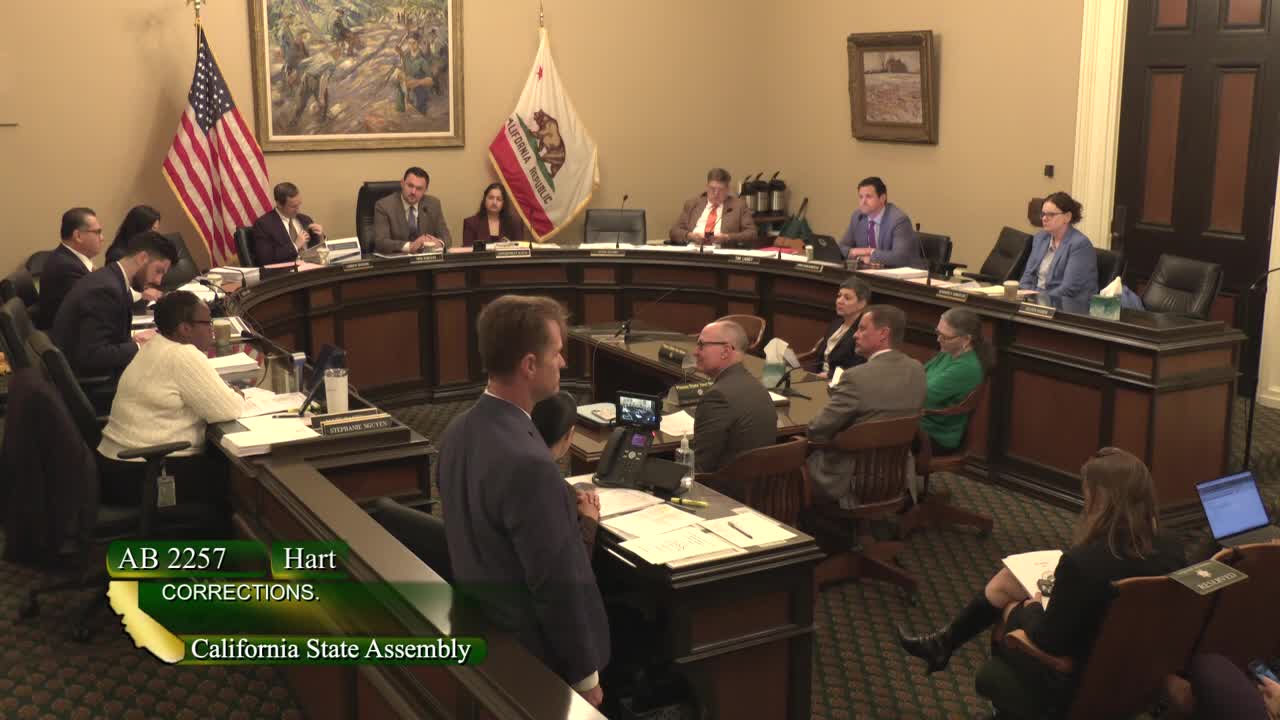
Discussed in Hearing
 12MIN