AB 1554: Disasters: data.
- Session Year: 2025-2026
- House: Assembly
- Latest Version Date: 2026-04-30
Current Status:
In Progress
(2026-08-12: In committee: Hearing postponed by committee.)
Introduced
In Committee
Awaiting First Chamber Vote
Passed First Chamber
In Committee
Awaiting Second Chamber Vote
Passed Second Chamber
Enacted
Existing law establishes the California Earthquake Authority (CEA), administered under the authority of the Insurance Commissioner, to transact insurance in this state as necessary to sell policies of basic residential earthquake insurance. Existing law requires the CEA to annually report to the Legislature and the commissioner on the CEAs program operations, including the financial condition of the authority, and to post the report on the CEAs internet website. Existing law requires copies of a certified report examining the CEAs financial and program operations and verifying the annual report to be made public.
This bill would additionally require the CEA to provide the annual report to the Senate Committee on Insurance and the Assembly Committee on Insurance. The bill would specify that the certified examination and verification report be posted on the CEAs internet website.
Existing law requires the commissioner to convene a working group to, among other things, identify, assess, and recommend risk transfer market mechanisms that promote investment and create incentives for investment in natural infrastructure to reduce risks of climate change, as specified.
This bill would require the working group to, no later than January 1, 2028, incorporate hazard mitigation projects into the above-described recommendations.
Existing law establishes the California Earthquake Authority (CEA), administered under the authority of the Insurance Commissioner, to transact insurance in this state as necessary to sell policies of basic residential earthquake insurance. Existing law requires the CEA to annually report to the Legislature and the commissioner on the CEAs program operations, including the financial condition of the authority, and to post the report on the CEAs internet website. Existing law requires copies of a certified report examining the CEAs financial and program operations and verifying the annual report to be made public.
This bill would additionally require the CEA to provide the annual report to the Senate Committee on Insurance and the Assembly Committee on Insurance. The bill would specify that the certified examination and verification report be posted on the CEAs internet website.
Existing law establishes the Wildfire Fund, administered by the Wildfire Fund Administrator, and continuously appropriates moneys in the fund to pay eligible claims, as defined, against participating electrical corporations arising from wildfires ignited on or after July 12, 2019. Existing law requires the administrator, in consultation with the Public Utilities Commission, the Office of Energy Infrastructure Safety, the Department of Insurance, the Office of Emergency Services, and the Department of Forestry and Fire Protection, and with feedback solicited from stakeholders, to prepare and submit a report that evaluates and sets forth recommendations on new models or approaches that mitigate damage, accelerate recovery, and responsibly and equitably allocate the burdens from natural catastrophes, including catastrophic wildfires, earthquakes, and other natural disasters, across stakeholders, to complement or replace the fund.This bill would state the intent of the Legislature to enact subsequent legislation to implement the recommendations set forth in the report.Existing law establishes the Wildfire Fund, administered by the Wildfire Fund Administrator, and continuously appropriates moneys in the fund to pay eligible claims, as defined, against participating electrical corporations arising from wildfires ignited on or after July 12, 2019. Existing law requires the administrator, in consultation with the Public Utilities Commission, the Office of Energy Infrastructure Safety, the Department of Insurance, the Office of Emergency Services, and the Department of Forestry and Fire Protection, and with feedback solicited from stakeholders, to prepare and submit a report that evaluates and sets forth recommendations on new models or approaches that mitigate damage, accelerate recovery, and responsibly and equitably allocate the burdens from natural catastrophes, including catastrophic wildfires, earthquakes, and other natural disasters, across stakeholders, to complement or replace the fund.
This bill would state the intent of the Legislature to enact subsequent legislation to implement the recommendations set forth in the report.
(a)One year following its commencement of operations, and annually thereafter by each August 1, the authority shall report to the Legislature and the commissioner on program operations in a format prescribed by the commissioner. The report shall include, but shall not be limited to, the financial condition of the authority, a description of all rates and rating plans approved for use in the authority, an evaluation of the functioning of the authority in light of its stated purpose of making residential property insurance and residential earthquake insurance more available. The report shall also include an analysis of the growth by market share of residential property insurance of participating insurers compared to nonparticipating insurers, any adverse consequences on the various insurance distribution systems resulting from the operation of the authority or alterations in the growth of the residential property insurance market share between participating insurers and nonparticipating insurers, any adverse consequences of the various insurance distribution systems resulting from the operation of the authority or alterations in the growth of homeowners insurance market share between participating insurers and nonparticipating insurers, and an analysis of any recommended program changes to permit the authority to better fulfill its stated purpose. In making this determination the board shall be mindful of the competitive nature of the market and how any decision can negatively impact insurers who are currently competing in the marketplace. The report shall be provided to the Senate Committee on Insurance and the Assembly Committee on Insurance in compliance with Section 9795 of the Government Code and posted on the authoritys official internet website.
(b)The annual report shall include full information describing the following matters relating to the authoritys condition and affairs:
(1)The property or assets held by the authority, including the amount of cash on hand and deposited in banks to its credit, the amount of cash in the hands of servicing insurance companies, the amount of any stocks or bonds owned by the authority, specifying the amount, number of shares, and the par and market value of each kind of stock or bond, and all other assets, specifying each.
(2)The liabilities of the authority, including the amount of losses due and unpaid, the amount of claims for losses resisted by the authority and the amount of losses in the process of adjustment or in suspense, including all reported and supposed losses, the amount of revenue bonds or other debt financing issues under Section 10089.29 or Section 10089.50, and all other liabilities.
(3)Income of the authority during the preceding year, specifying premiums received, interest money received, and income from all other sources, specifying the source.
(4)Expenditures of the authority during the preceding year, specifying the amount of losses paid, the amount of expenses paid by category, and the amount of all other payments and expenditures.
(5)The costs and scope of all reinsurance and capital market contracts entered into by the authority under Section 10089.10.
(c)As part of the annual report, the authority shall make a separate, summary report on the financial capacity of the authority to pay claims made against the authority. Copies of this report shall also be made available to the public. The report shall include, but shall not be limited to, the following information, valued as of 30 days prior to the date of the report:
(1)The available capital of the authority.
(2)The liabilities of the authority.
(3)The amount of all assessments previously made and the amount of assessments that may be made in the future under Section 10089.23.
(4)The amount of the reinsurance under contract and actually available to the authority.
(5)The amount of all revenue bonds or other debt financing previously issued or contracted for and the amount of all revenue bonds or other debt financing that may be issued or contracted for in the future under Section 10089.29.
(6)The amount of surcharges previously assessed against policyholders and the amount of surcharges that are currently outstanding against policyholders under Section 10089.29.
(7)The amount of capital committed and actually available by contract from private capital markets that is available to pay claims against the authority.
(8)The amount of all assessments previously made and the amount of all assessments that may be made in the future under Section 10089.30.
(9)The amount of all assessments previously made and the amount of all assessments that may be made in the future under Section 10089.31.
(d)In verification of the matters set forth in the annual report provided for in subdivision (a), the Department of Finance shall approve independent qualified auditors selected by the commissioner to examine the books and accounts relating to all matters concerning the financial and program operations of the authority. The commissioner shall file a certified report of the examination with the President pro Tempore of the Senate, the Speaker of the Assembly, the Chairpersons of the Senate and Assembly Insurance Committees, and the Chairperson of the Senate Committee on Judiciary within 10 days of its receipt. Copies of this report shall also be posted on the authoritys internet website. The expense of examining the books and accounts of the authority shall be paid out of the operating funds of the authority.
(e)The authority shall, within 120 days following a seismic event that results in the payment of claims by the authority, and within one year of a major seismic event that results in the payment of claims by the authority, submit to the President pro Tempore of the Senate, the Speaker of the Assembly, the Chairpersons of the Senate and Assembly Insurance Committees, the Chairperson of the Senate Committee on Judiciary, and the commissioner a concise written report of program operations related to that seismic event. The reports shall include, but not be limited to, progress on payment of claims, claims payments made and anticipated, and the functioning of the authority in response to the seismic event. Copies of this report shall also be made available to the public.
SEC. 2.Section 12922.5 of the Insurance Code is amended to read:12922.5.(a)The commissioner shall convene a working group to identify, assess, and recommend risk transfer market mechanisms that:
(1)Promote investment in natural infrastructure to reduce the risks of climate change related to catastrophic events.
(2)Create incentives for investment in natural infrastructure to reduce risks to communities.
(3)Provide mitigation incentives for private investment in natural lands to lessen exposure and reduce climate risks to public safety, property, utilities, and infrastructure.
(b)To the extent that the working group recommends risk transfer market mechanisms that would be provided by insurance and reinsurance companies, the working group shall recommend mechanisms that:
(1)Are profitable to insurance and reinsurance companies.
(2)If appropriate, apply to communities or regions, rather than individual land parcels.
(c)The policies recommended pursuant to subdivisions (a) and (b) shall include all of the following questions:
(1)What are the California analogies to examples in other countries for creating incentives for investment in natural infrastructure as part of insurance policies that mitigate elemental risks?
(2)Can we use insurance to create incentives for wetland restoration to help defend the coast against storm surge?
(3)Can we create incentives for forests to be managed to reduce the risk of major fires?
(4)Can we reduce the exposure of insurance companies to climate change-related losses through innovative state policies or insurance pricing mechanisms that reward good behavior and charge premiums for actions that increase public safety risks or losses of property or environmental attributes?
(5)Can we develop rating systems based on community risk factors to climate events, and use insurance incentives to make a community more resilient?
(d)No later than January 1, 2028, the working group shall incorporate hazard mitigation projects into the recommendations required by this section.
(a)One year following its commencement of operations, and annually thereafter by each August 1, the authority shall report to the Legislature and the commissioner on program operations in a format prescribed by the commissioner. The report shall include, but shall not be limited to, the financial condition of the authority, a description of all rates and rating plans approved for use in the authority, an evaluation of the functioning of the authority in light of its stated purpose of making residential property insurance and residential earthquake insurance more available. The report shall also include an analysis of the growth by market share of residential property insurance of participating insurers compared to nonparticipating insurers, any adverse consequences on the various insurance distribution systems resulting from the operation of the authority or alterations in the growth of the residential property insurance market share between participating insurers and nonparticipating insurers, any adverse consequences of the various insurance distribution systems resulting from the operation of the authority or alterations in the growth of homeowners insurance market share between participating insurers and nonparticipating insurers, and an analysis of any recommended program changes to permit the authority to better fulfill its stated purpose. In making this determination the board shall be mindful of the competitive nature of the market and how any decision can negatively impact insurers who are currently competing in the marketplace. The report shall be provided to the Senate Committee on Insurance and the Assembly Committee on Insurance in compliance with Section 9795 of the Government Code and posted on the authoritys official Internet Web site. internet website.
(b)The annual report shall include full information describing the following matters relating to the authoritys condition and affairs:
(1)The property or assets held by the authority, including the amount of cash on hand and deposited in banks to its credit, the amount of cash in the hands of servicing insurance companies, the amount of any stocks or bonds owned by the authority, specifying the amount, number of shares, and the par and market value of each kind of stock or bond, and all other assets, specifying each.
(2)The liabilities of the authority, including the amount of losses due and unpaid, the amount of claims for losses resisted by the authority and the amount of losses in the process of adjustment or in suspense, including all reported and supposed losses, the amount of revenue bonds or other debt financing issues under Section 10089.29 or Section 10089.50, and all other liabilities.
(3)Income of the authority during the preceding year, specifying premiums received, interest money received, and income from all other sources, specifying the source.
(4)Expenditures of the authority during the preceding year, specifying the amount of losses paid, the amount of expenses paid by category, and the amount of all other payments and expenditures.
(5)The costs and scope of all reinsurance and capital market contracts entered into by the authority under Section 10089.10.
(c)As part of the annual report, the authority shall make a separate, summary report on the financial capacity of the authority to pay claims made against the authority. Copies of this report shall also be made available to the public. The report shall include, but shall not be limited to, the following information, valued as of 30 days prior to the date of the report:
(1)The available capital of the authority.
(2)The liabilities of the authority.
(3)The amount of all assessments previously made and the amount of assessments that may be made in the future under Section 10089.23.
(4)The amount of the reinsurance under contract and actually available to the authority.
(5)The amount of all revenue bonds or other debt financing previously issued or contracted for and the amount of all revenue bonds or other debt financing that may be issued or contracted for in the future under Section 10089.29.
(6)The amount of surcharges previously assessed against policyholders and the amount of surcharges that are currently outstanding against policyholders under Section 10089.29.
(7)The amount of capital committed and actually available by contract from private capital markets that is available to pay claims against the authority.
(8)The amount of all assessments previously made and the amount of all assessments that may be made in the future under Section 10089.30.
(9)The amount of all assessments previously made and the amount of all assessments that may be made in the future under Section 10089.31.
(d)In verification of the matters set forth in the annual report provided for in subdivision (a), the Department of Finance shall approve independent qualified auditors selected by the commissioner to examine the books and accounts relating to all matters concerning the financial and program operations of the authority. The commissioner shall file a certified report of the examination with the President pro Tempore of the Senate, the Speaker of the Assembly, the Chairpersons of the Senate and Assembly Insurance Committees, and the Chairperson of the Senate Committee on Judiciary within 10 days of its receipt. Copies of this report shall also be made available to the public. posted on the authoritys internet website. The expense of examining the books and accounts of the authority shall be paid out of the operating funds of the authority.
(e)The authority shall, within 120 days following a seismic event that results in the payment of claims by the authority, and within one year of a major seismic event that results in the payment of claims by the authority, submit to the President pro Tempore of the Senate, the Speaker of the Assembly, the Chairpersons of the Senate and Assembly Insurance Committees, the Chairperson of the Senate Committee on Judiciary, and the commissioner a concise written report of program operations related to that seismic event. The reports shall include, but not be limited to, progress on payment of claims, claims payments made and anticipated, and the functioning of the authority in response to the seismic event. Copies of this report shall also be made available to the public.
SECTION 1.It is the intent of the Legislature to enact subsequent legislation to implement the recommendations set forth in the report required by Section 719 of the Public Utilities Code relating to new models or approaches that mitigate damage, accelerate recovery, and responsibly and equitably allocate the burdens from natural catastrophes, including catastrophic wildfires, earthquakes, and other natural disasters, to complement or replace the Wildfire Fund created pursuant to Section 3284 of the Public Utilities Code.It is the intent of the Legislature to enact subsequent legislation to implement the recommendations set forth in the report required by Section 719 of the Public Utilities Code relating to new models or approaches that mitigate damage, accelerate recovery, and responsibly and equitably allocate the burdens from natural catastrophes, including catastrophic wildfires, earthquakes, and other natural disasters, to complement or replace the Wildfire Fund created pursuant to Section 3284 of the Public Utilities Code.
|
Date
|
Status
|
|---|---|
| Aug 12, 2026 | In committee: Hearing postponed by committee. |
| Aug 10, 2026 | In committee: Hearing postponed by committee. |
| Jul 29, 2026 | In committee: Hearing postponed by committee. |
| Jun 25, 2026 | From committee: Do pass and re-refer to Com. on APPR. (Ayes 6. Noes 0.) (June 24). Re-referred to Com. on APPR. |
| Jun 3, 2026 | Referred to Com. on INS. |
| May 22, 2026 | In Senate. Read first time. To Com. on RLS. for assignment. |
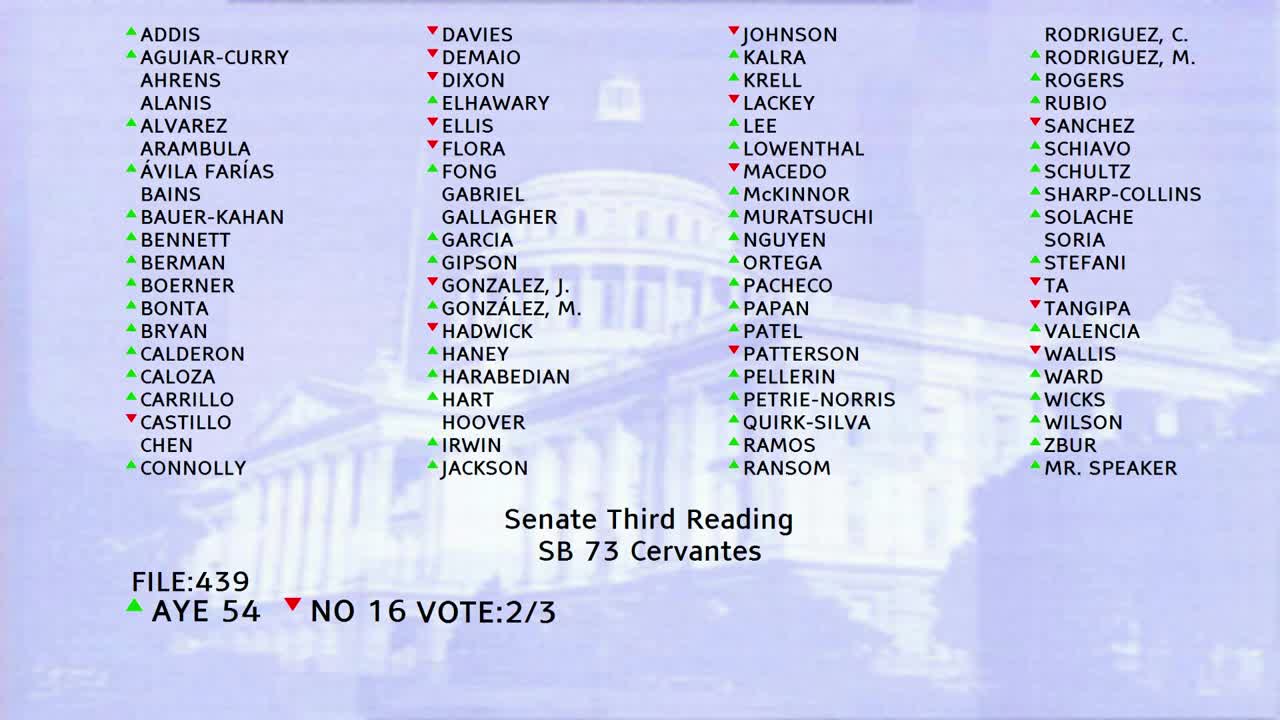
| May 22, 2026 | Read third time. Passed. Ordered to the Senate. (Ayes 73. Noes 1.) |
| May 22, 2026 | Read third time. Passed. Ordered to the Senate. (Ayes 73. Noes 1. Page 5253.) |
| May 18, 2026 | Read second time. Ordered to third reading. |
| May 14, 2026 | Joint Rule 62(a), file notice suspended. |
| May 14, 2026 | Joint Rule 62(a), file notice suspended. (Page 5030.) |
| May 14, 2026 | From committee: Do pass. (Ayes 15. Noes 0.) (May 14). |
| May 13, 2026 | In committee: Set, first hearing. Referred to APPR. suspense file. |
| May 4, 2026 | Re-referred to Com. on APPR. |
| Apr 30, 2026 | From committee chair, with author's amendments: Amend, and re-refer to Com. on APPR. Read second time and amended. |
| Apr 15, 2026 | From committee: Do pass and re-refer to Com. on APPR. with recommendation: To Consent Calendar. (Ayes 17. Noes 0.) (April 15). Re-referred to Com. on APPR. |
| Mar 3, 2026 | Re-referred to Com. on INS. |
| Mar 2, 2026 | Referred to Com. on INS. |
| Mar 2, 2026 | From committee chair, with author's amendments: Amend, and re-refer to Com. on INS. Read second time and amended. |
| Jan 9, 2026 | From printer. May be heard in committee February 8. |
| Jan 8, 2026 | Read first time. To print. |
|
Date
|
Description
|
Location
|
Votes
|
|
|---|---|---|---|---|
| Jun 24, 2026 | Do pass, but first be re-referred to the Committee on [Appropriations] | Senate Standing Committee on Insurance |
Passed |
|
| May 22, 2026 | AB 1554 Calderon Assembly Third Reading | Assembly Floor |
Passed |
|
| May 14, 2026 | Do pass. | Assembly Standing Committee on Appropriations |
Passed |
|
| Apr 15, 2026 | Do pass and be re-referred to the Committee on [Appropriations] with recommendation: To Consent Calendar | Assembly Standing Committee on Insurance |
Passed |
This list shows positions taken on this bill by organizations on the date displayed, which is linked to the original source.
Positions by individuals are not included.
SENATE COMMITTEE ON INSURANCE
Senator Stephen Padilla, Chair
2025 - 2026 Regular
Bill No: AB 1554 Hearing Date:
Author: | Calderon | ||
Version: | April 30, 2026 Amended | ||
Urgency: | No | Fiscal: | Yes |
Consultant: | Brandon Seto | ||
SUBJECT: Disasters: data
DIGEST:
Requires the California Earthquake Authority (CEA), in submitting its annual report on its operations to the Legislature, to provide the report to both houses’ insurance committees, and to post the report on the CEA′s website. Also requires the risk transfer market mechanisms working group that existing law directs the Insurance Commissioner (Commissioner) to convene, to incorporate hazard mitigation projects into its recommendations by January 1, 2028.
ANALYSIS:
Existing law:
- Establishes the CEA as a quasi-public insurance company that provides earthquake insurance to policyholders of "participating insurers."
- Requires the CEA to annually report to the Legislature and the Commissioner on the CEA program operations, including the financial condition of the CEA, a description of rates and rating plans approved, an evaluation of CEA efforts toward making residential property insurance and residential earthquake insurance more available, and other specified requirements. This report is due by August 1 of each year.
- Specifies that in verifying the matters contained in the annual report, the Department of Finance shall approve independent qualified auditors selected by the Commissioner to examine the books and accounts regarding all matters of the financial and program operations of the CEA.
- Provides that the CEA is governed by a Board comprised of the Governor, the Commissioner, and the State Treasurer as voting members, with a Senate and an Assembly appointee as non-voting members.
This bill:
- Requires the CEA, in submitting its annual report on its operations to the Legislature, to provide the report to both of the Legislature’s insurance committees, and to post the report on the CEA’s website.
- Requires the working group regarding risk transfer market mechanisms that existing law directs the Commissioner to convene to, by January 1, 2028, incorporate hazard mitigation projects into its recommendations.
Background
According to the author:
“This measure provides greater transparency to the Legislature and the public by clarifying that the annual report must be submitted to the relevant policy committees, and additional information posted to the CEA internet website. This greater transparency will cut costs and time associated with responding to public inquiries and providing copies to the public upon request.”
Related/Prior Legislation
SB 30 (Lara, Chapter 614, Statutes of 2018). Requires the IC to convene a working group to identify, assess and recommend risk transfer market mechanisms that promote investment in natural infrastructure to reduce the risks of climate change, including mitigation incentives for private investment to lessen exposure and reduce climate risks to public safety, property, utilities and infrastructure.
ARGUMENTS IN SUPPORT:
None received.
ARGUMENTS IN OPPOSITION:
None received.
SUPPORT:
None.
OPPOSITION:
None.
-- END --
ASSEMBLY THIRD READING
ATR Bill Id:AB 1554
Author:(Calderon)
As Amended Ver:April 30, 2026
Majority vote
SUMMARY
Requires the California Earthquake Authority (CEA), in submitting its annual report on the operations of the CEA to the Legislature, to provide the report to both of the Legislature′s insurance committees, and to post the report on the CEA′s website.
Major Provisions
Requires the Insurance Commissioner to convene a working group regarding risk transfer market mechanisms, by January 1, 2028, to incorporate hazard mitigation projects into its recommendations.
COMMENTS
Background: As a publicly managed entity organized to provide earthquake insurance to Californians, the operations of the CEA are important to its customers and potential customers. The CEA is the largest provider of residential earthquake insurance in the United States. At present, although California public policy strongly favors the public to consider purchases of earthquake insurance, and a mandatory offer of earthquake insurance is required by law when a person purchases a homeowner′s policy and every two years thereafter, nonetheless, only about 12% of California homeowners buy earthquake insurance. CEA ended 2024 with 1,000,249 policies in force.
Providing for broader dissemination of the CEA Annual Report may tend to support greater visibility of the availability in California of earthquake insurance and is consistent with transparency in government.
CEA: CEA was formed through legislation in 1995 and 1996 to primarily address a homeowners-insurance availability crisis that followed the 1994 Northridge earthquake. After that earthquake, many homeowners found it difficult, and in some cases impossible, to find basic homeowners′ insurance. Many others were faced with the prospect of having their homeowners insurance non-renewed as insurance companies tried to shed their exposure to earthquake risk. Because state law required insurers to offer earthquake insurance biennially to both residential policy applicants and current residential policyholders, the insurers′ retreat from the California market resulted in an availability crisis for homeowner′s earthquake insurance. The California Department of Insurance (CDI) reported in summer 1996, at the height of the crisis, that 95 percent of the homeowners-insurance market had either stopped or severely restricted sales of new homeowners′ policies. Today, CEA continues in its role as the largest residential earthquake insurer in California with slightly over 62% of the residential earthquake insurance market. CEA participating insurers are responsible for 70% of California′s residential property insurance
CEA operates as essentially a ″take-all-comers″ insurer for personal residential earthquake insurance coverage. Any consumer that has a personal residential property insurance policy with a CEA participating insurer is eligible to buy a CEA policy provided there is no unrepaired structural earthquake damage at the insured location.
According to the Author
This measure provides greater transparency to the Legislature and the public by clarifying that the annual report must be submitted to the relevant policy committees, and additional information posted to the CEA internet website.
Arguments in Support
None on file.
Arguments in Opposition
None on file.
FISCAL COMMENTS
According to Assembly Appropriations Committee, costs to the CEA should be minor and absorbable.
VOTES
ASM INSURANCE: 17-0-0
YES: Calderon, Wallis, Addis, Alvarez, Ávila Farías, Berman, Chen, Ellis, Gipson, Hadwick, Harabedian, Krell, Nguyen, Ortega, Petrie-Norris, Michelle Rodriguez, Valencia
ASM APPROPRIATIONS: 15-0-0
YES: Wicks, Hoover, Aguiar-Curry, Calderon, Caloza, Dixon, Fong, Mark González, Krell, Pacheco, Pellerin, Sharp-Collins, Solache, Ta, Tangipa
UPDATED
VERSION: April 30, 2026
CONSULTANT: Kathleen O′Malley / INS. / (916) 319-2086 FN: 0002602
Date of Hearing: May 13, 2026
ASSEMBLY COMMITTEE ON APPROPRIATIONS
Buffy Wicks, Chair
ABPCA Bill Id:AB 1554
Author:(Calderon) – As Amended Ver:April 30, 2026
Policy Committee: | Insurance | Vote: | 17 - 0 |
|
| ||
|
|
Urgency: No State Mandated Local Program: No Reimbursable: No
SUMMARY:
This bill requires the California Earthquake Authority (CEA), in submitting its annual report on the operations of the CEA to the Legislature, to provide the report to both of the Legislature’s insurance committees, and to post the report on the CEA’s website. The bill also requires the working group regarding risk transfer market mechanisms that existing law directs the Insurance Commissioner (IC) to convene to, by January 1, 2028, to incorporate hazard mitigation projects into its recommendations.
FISCAL EFFECT:
Costs to the CEA should be minor and absorbable. However, because the bill creates a report to the Legislature, it is a candidate for the suspense file, consistent with the committee’s rules, custom and practice.
COMMENTS:
The CEA was formed through legislation in 1995 and 1996 to primarily address a homeowners-insurance availability crisis that followed the 1994 Northridge earthquake. After that earthquake, many homeowners found it difficult, and in some cases impossible, to find basic homeowners’ insurance. Many others were faced with the prospect of having their homeowners’ insurance non-renewed as insurance companies tried to shed their exposure to earthquake risk. Because state law required insurers to offer earthquake insurance biennially to both residential policy applicants and current residential policyholders, the insurers’ retreat from the California market resulted in an availability crisis for homeowners’ earthquake insurance. The California Department of Insurance (CDI) reported in summer 1996, at the height of the crisis, that 95% of the homeowners’ insurance market had either stopped or severely restricted sales of new homeowners’ policies. Today, CEA continues in its role as the largest residential earthquake insurer in California with slightly over 62% of the residential earthquake insurance market. CEA- participating insurers are responsible for 70% of California’s residential property insurance.
Existing law requires the CEA to annually report to the Legislature and the IC on the CEA program operations, including the financial condition of the CEA, a description of rates and rating plans approved, an evaluation of CEA efforts toward making residential property insurance and residential earthquake insurance more available, and other specified requirements.
In addition, existing law requires the IC to convene a working group to identify, assess, and recommend risk transfer market mechanisms that: (1) promote investment in natural infrastructure to reduce the risks of climate change related to catastrophic events and (2) create incentives for investment in natural infrastructure to reduce risks to communities.
Analysis Prepared by: Jay Dickenson / APPR. / (916) 319-2081
Date of Hearing: April 15, 2026
ASSEMBLY COMMITTEE ON INSURANCE
Lisa Calderon, Chair
ABPCA Bill Id:AB 1554 (
Author:Calderon) – As Amended Ver:March 2, 2026
SUBJECT: California Earthquake Authority
SUMMARY: Requires the California Earthquake Authority (CEA) to provide the annual report to the Senate Committee on Insurance and the Assembly Committee on Insurance. Specifically, this bill:
- Requires CEA to post on the CEA’s website the certified examination and verification report.
EXISTING LAW:
- Establishes the CEA as a quasi-public insurance company that provides earthquake insurance to policyholders of "participating insurers." (Insurance (Ins.) Code, Section 10089.6)
- Requires the CEA to annually report to the Legislature and the Insurance Commissioner (IC) on the CEA program operations, including the financial condition of the CEA, a description of rates and rating plans approved, an evaluation of CEA efforts toward making residential property insurance and residential earthquake insurance more available, and other specified requirements. This report is due by August 1 of each year. (Ins. Code, Section 10089.13)
- Specifies that in verifying the matters contained in the annual report, the Department of Finance shall approve independent qualified auditors selected by the IC to examine the books and accounts regarding all matters of the financial and program operations of the CEA. (Ins. Code, Section 10089.13)
- Provides that the CEA is governed by a Board comprised of the Governor, the IC, and the State Treasurer as voting members, with a Senate and an Assembly appointee as non-voting members. (Ins. Code, Section 10089.7)
FISCAL EFFECT: Unknown
COMMENTS:
- Purpose of the bill: This measure provides greater transparency to the Legislature and the public by clarifying that the annual report must be submitted to the relevant policy committees, and additional information posted to the CEA internet website.
- Background: As a publicly managed entity organized to provide earthquake insurance to Californians, the operations of the CEA are important to its customers and potential customers. The CEA is the largest provider of residential earthquake insurance in the United States. At present, although California public policy strongly favors the public to consider purchases of earthquake insurance, and a mandatory offer of earthquake insurance is required by law when a person purchases a homeowner’s policy and every two years thereafter, nonetheless, only about 12% of California homeowners buy earthquake insurance. CEA ended 2024 with 1,000,249 policies in force.
Providing for broader dissemination of the CEA Annual Report may tend to support greater visibility of the availability in California of earthquake insurance and is consistent with transparency in government.
- CEA: CEA was formed through legislation in 1995 and 1996 to primarily address a homeowners-insurance availability crisis that followed the 1994 Northridge earthquake. After that earthquake, many homeowners found it difficult, and in some cases impossible, to find basic homeowners’ insurance. Many others were faced with the prospect of having their homeowners insurance non-renewed as insurance companies tried to shed their exposure to earthquake risk. Because state law required insurers to offer earthquake insurance biennially to both residential policy applicants and current residential policyholders, the insurers’ retreat from the California market resulted in an availability crisis for homeowner’s earthquake insurance. The California Department of Insurance (CDI) reported in summer 1996, at the height of the crisis, that 95 percent of the homeowners-insurance market had either stopped or severely restricted sales of new homeowners’ policies. Today, CEA continues in its role as the largest residential earthquake insurer in California with slightly over 62% of the residential earthquake insurance market. CEA participating insurers are responsible for 70% of California’s residential property insurance
CEA operates as essentially a “take-all-comers” insurer for personal residential earthquake insurance coverage. Any consumer that has a personal residential property insurance policy with a CEA participating insurer is eligible to buy a CEA policy provided there is no unrepaired structural earthquake damage at the insured location.
REGISTERED SUPPORT / OPPOSITION:
Support
None on file.
Opposition
None on file.
Analysis Prepared by: Kathleen O'Malley / INS. / (916) 319-2086
Discussed in Hearing
View Older Hearings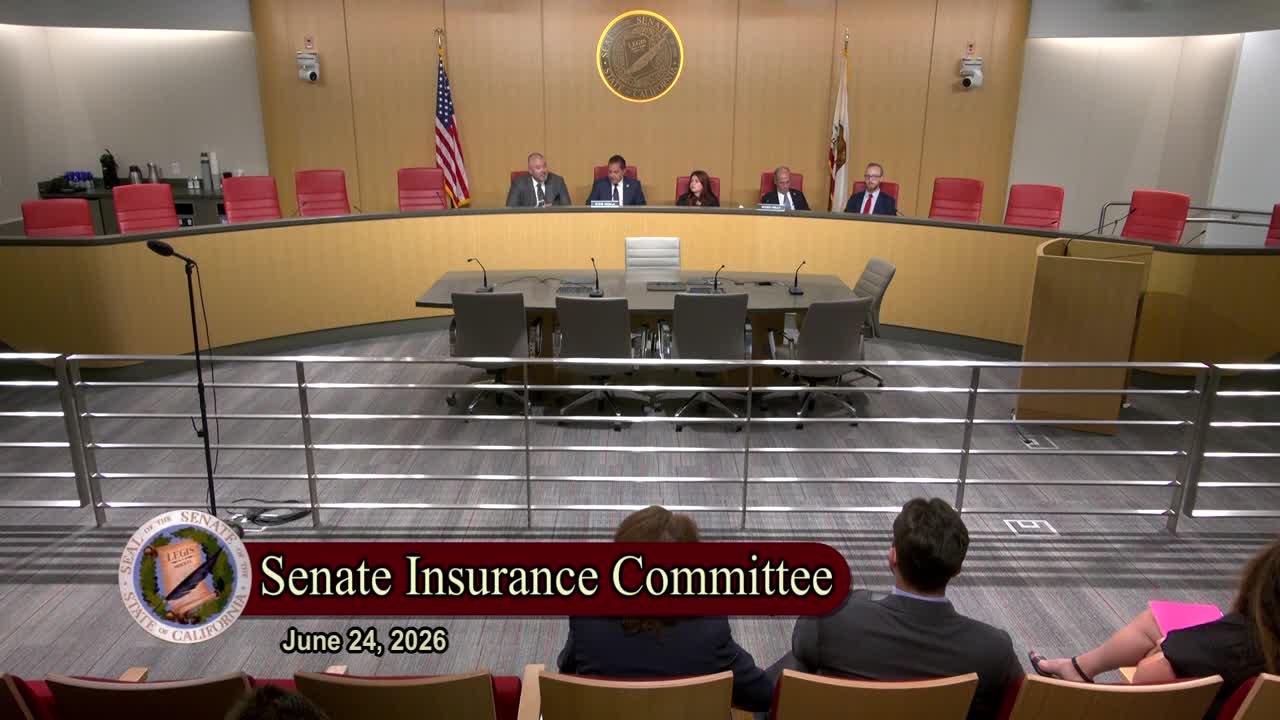
Bill Author

Bill Co-Author(s):