AB 1556: Recovery housing: funding.
- Session Year: 2025-2026
- House: Assembly
- Latest Version Date: 2026-09-29
Current Status:
Passed
(2026-09-29: Chaptered by Secretary of State - Chapter 779, Statutes of 2026.)
Introduced
In Committee
Awaiting First Chamber Vote
Passed First Chamber
In Committee
Awaiting Second Chamber Vote
Passed Second Chamber
Enacted
Existing law establishes the California Interagency Council on Homelessness to oversee the implementation of Housing First guidelines and regulations, and, among other things, identify resources, benefits, and services that can be accessed to prevent and end homelessness in California. Existing law requires a state agency or department that funds, implements, or administers a state program that provides housing or housing-related services to people experiencing homelessness or who are at risk of homelessness to revise or adopt guidelines and regulations to include enumerated Housing First policies. Existing law specifies the core components of Housing First, including services that are informed by a harm-reduction philosophy that recognizes drug and alcohol use and addiction as a part of tenants lives and where tenants are engaged in nonjudgmental communication regarding drug and alcohol use.
This bill would require applicants for state homelessness funding for recovery housing, as defined, to demonstrate the availability of a range of interventions, as specified. The bill would require a program that provides recovery housing to meet specified requirements in order to be eligible for state funding, including that the program satisfies the core components of Housing First, relapse is not, unless there is another lease violation, grounds for eviction and residents receive relapse support, the program provides emergency preparedness and overdose prevention and response training to staff and residents and makes overdose reversal medication available and readily accessible to staff and residents onsite, and the program adopts and maintains a written return-to-use policy, as specified. The bill would make related findings and declarations.
Existing law establishes the California Interagency Council on Homelessness to oversee the implementation of Housing First guidelines and regulations, and, among other things, identify resources, benefits, and services that can be accessed to prevent and end homelessness in California. Existing law requires a state agency or department that funds, implements, or administers a state program that provides housing or housing-related services to people experiencing homelessness or who are at risk of homelessness to revise or adopt guidelines and regulations to include enumerated Housing First policies. Existing law specifies the core components of Housing First, including services that are informed by a harm-reduction philosophy that recognizes drug and alcohol use and addiction as a part of tenants lives and where tenants are engaged in nonjudgmental communication regarding drug and alcohol use.
This bill would require applicants for state homelessness funding for recovery housing, as defined, to demonstrate the availability of a range of interventions, as specified. The bill would require a program that provides recovery housing, as defined, housing to meet specified requirements in order to be eligible for state funding, including that the program satisfies the core components of Housing First, relapse is not, unless there is another lease violation, grounds for eviction and residents receive relapse support, the program provides emergency preparedness and overdose prevention and response training to staff and residents and makes overdose reversal medication available and readily accessible to staff and residents onsite, and the program adopts and maintains a written return-to-use policy, as specified. The bill would make related findings and declarations.
Existing law establishes the California Interagency Council on Homelessness to oversee the implementation of Housing First guidelines and regulations, and, among other things, identify resources, benefits, and services that can be accessed to prevent and end homelessness in California. Existing law requires a state agency or department that funds, implements, or administers a state program that provides housing or housing-related services to people experiencing homelessness or who are at risk of homelessness to revise or adopt guidelines and regulations to include enumerated Housing First policies. Existing law specifies the core components of Housing First, including services that are informed by a harm-reduction philosophy that recognizes drug and alcohol use and addiction as a part of tenants lives and where tenants are engaged in nonjudgmental communication regarding drug and alcohol use.
This bill would require a program that provides recovery housing, defined as housing in a residence that serves individuals who seek a cooperative living arrangement that supports personal recovery from a substance use disorder and that does not require licensure or does not provide licensable services, as defined, to meet specified requirements in order to be eligible for state funding, including that the program satisfies the core components of Housing First, relapse is not, unless there is another lease violation, grounds for eviction and residents receive relapse support, the program provides emergency preparedness and overdose prevention and response training to staff and residents and makes overdose reversal medication available and readily accessible to staff and residents onsite, the program has consent and confidentiality protections for its residents consistent with state and federal law, and the program adopts and maintains a written return-to-use policy, as specified. The bill would make related findings and declarations.
Existing law establishes the California Interagency Council on Homelessness to oversee the implementation of Housing First guidelines and regulations, and, among other things, identify resources, benefits, and services that can be accessed to prevent and end homelessness in California. Existing law requires a state agency or department that funds, implements, or administers a state program that provides housing or housing-related services to people experiencing homelessness or who are at risk of homelessness to revise or adopt guidelines and regulations to include enumerated Housing First policies. Existing law specifies the core components of Housing First, including services that are informed by a harm-reduction philosophy that recognizes drug and alcohol use and addiction as a part of tenants lives and where tenants are engaged in nonjudgmental communication regarding drug and alcohol use.
This bill would require a recovery residence, program that provides recovery housing, defined as housing in a residence that serves individuals who seek a cooperative living arrangement that supports personal recovery from a substance use disorder and that does not require licensure or does not provide licensable services, to meet specified requirements in order to be eligible for state funding, including that the residence program satisfies the core components of Housing First, relapse is not, unless there is another lease violation, grounds for eviction and residents receive relapse support, the residence program provides emergency preparedness and overdose prevention and response training to staff and residents and makes overdose reversal medication available and readily accessible to staff and residents onsite, the residence program has consent and confidentiality protections for its residents consistent with state and federal law, and the residence program adopts and maintains a written return-to-use policy, as specified. The bill would make related findings and declarations.
Existing law establishes the California Interagency Council on Homelessness to oversee the implementation of Housing First guidelines and regulations, and, among other things, identify resources, benefits, and services that can be accessed to prevent and end homelessness in California. Existing law requires a state agency or department that funds, implements, or administers a state program that provides housing or housing-related services to people experiencing homelessness or who are at risk of homelessness to revise or adopt guidelines and regulations to include enumerated Housing First policies. Existing law specifies the core components of Housing First, including services that are informed by a harm-reduction philosophy that recognizes drug and alcohol use and addiction as a part of tenants lives and where tenants are engaged in nonjudgmental communication regarding drug and alcohol use.
This bill would require a recovery residence, defined as a residence that, among other things, satisfies the core components of Housing First as described above, to meet specified requirements in order to be eligible for state funding, including that residency is initiated by the resident and the resident is additionally offered at least one harm-reduction housing placement option, relapse is not cause housing in a residence that serves individuals who seek a cooperative living arrangement that supports personal recovery from a substance use disorder and that does not require licensure or does not provide licensable services, to meet specified requirements in order to be eligible for state funding, including that the residence satisfies the core components of Housing First, relapse is not, unless there is another lease violation, grounds for eviction and residents receive relapse support, the residence provides emergency preparedness and overdose prevention and response training to staff and residents and makes overdose reversal medication available and readily accessible to staff and residents onsite, the residence has consent and confidentiality protections for its residents consistent with state and federal law, and the residence adopts and maintains a written return to use return-to-use policy, as specified. The bill would make related findings and declarations.
Existing law establishes the California Interagency Council on Homelessness to oversee the implementation of Housing First guidelines and regulations, and, among other things, identify resources, benefits, and services that can be accessed to prevent and end homelessness in California. Existing law requires a state agency or department that funds, implements, or administers a state program that provides housing or housing-related services to people experiencing homelessness or who are at risk of homelessness to revise or adopt guidelines and regulations to include enumerated Housing First policies. Existing law specifies the core components of Housing First, including services that are informed by a harm-reduction philosophy that recognizes drug and alcohol use and addiction as a part of tenants lives and where tenants are engaged in nonjudgmental communication regarding drug and alcohol use.
This bill would require a recovery residence, defined as a residence that, among other things, satisfies the core components of Housing First as described above, to meet specified requirements in order to be eligible for state funding, including that residency is initiated by the resident and the resident is additionally offered at least one harm-reduction housing placement option, relapse is not cause for eviction and residents receive relapse support, the residence provides emergency preparedness and overdose prevention and response training to staff and residents and makes overdose reversal medication available and readily accessible to staff and residents onsite, the residence has consent and confidentiality protections for its residents consistent with state and federal law, and the residence adopts and maintains a written return to use policy, as specified. The bill would make related findings and declarations.
Existing law establishes the California Interagency Council on Homelessness to oversee the implementation of Housing First guidelines and regulations, and, among other things, identify resources, benefits, and services that can be accessed to prevent and end homelessness in California. Existing law requires a state agency or department that funds, implements, or administers a state program that provides housing or housing-related services to people experiencing homelessness or who are at risk of homelessness to revise or adopt guidelines and regulations to include enumerated Housing First policies. Existing law specifies the core components of Housing First, including services that are informed by a harm-reduction philosophy that recognizes drug and alcohol use and addiction as a part of tenants lives and where tenants are engaged in nonjudgmental communication regarding drug and alcohol use.
This bill would state the intent of the Legislature to enact legislation relating to the Supportive-Recovery Residence Program.This bill would require a recovery residence, defined as a residence that, among other things, satisfies the core components of Housing First as described above, to meet specified requirements in order to be eligible for state funding, including that residency is initiated by the resident and the resident is additionally offered at least one harm-reduction housing placement option, relapse is not cause for eviction and residents receive relapse support, the residence provides emergency preparedness and overdose prevention and response training to staff and residents and makes overdose reversal medication available and readily accessible to staff and residents onsite, the residence has consent and confidentiality protections for its residents consistent with state and federal law, and the residence adopts and maintains a written return to use policy, as specified. The bill would make related findings and declarations.
Existing law establishes the California Interagency Council on Homelessness to oversee the implementation of Housing First guidelines and regulations, and, among other things, identify resources, benefits, and services that can be accessed to prevent and end homelessness in California. Existing law requires a state agency or department that funds, implements, or administers a state program that provides housing or housing-related services to people experiencing homelessness or who are at risk of homelessness to revise or adopt guidelines and regulations to include enumerated Housing First policies. Existing law specifies the core components of Housing First, including services that are informed by a harm-reduction philosophy that recognizes drug and alcohol use and addiction as a part of tenants lives and where tenants are engaged in nonjudgmental communication regarding drug and alcohol use.
This bill would state the intent of the Legislature to enact legislation relating to the Supportive-Recovery Residence Program.
The Legislature finds and declares all of the following:
(a)Substance use can precipitate homelessness and homelessness worsens substance use.
(b)California has the largest homeless population in the United States at 187,084 individuals as of 2024.
(c)Overdose deaths among homeless Americans from drugs and alcohol surged 488 percent between 2010 and 2020.
(d)Recovery housing programs that operate in a manner consistent with the Interagency Council on Homelessness guidance document Implementing Recovery Housing in Alignment with California Housing First Requirements published in July 2025 can provide a high degree of quality and positive outcomes for program participants, fulfill a unique and specific role within a communitys homelessness services and behavioral health care systems, help provide meaningful choice in housing settings for people with substance use disorders, and should be a component of any continuum of care that needs this type of resource to prevent and end homelessness in its community.
(e)According to guidance in October 2025 from the California Interagency Council on Homelessness, the homelessness response system must be equipped to support people in their recovery journey.
(f)Recovery housing programs have a responsibility to protect and maintain the drug-free environments that are sought and expected by residents and their families.
SEC. 2.Division 10.95 (commencing with Section 11999.45) is added to the Health and Safety Code, to read:10.95.Recovery Housing11999.45.(a)For the purposes of this division, recovery housing has the same meaning as in paragraph (3) of subdivision (c) of Section 8256 of the Welfare and Institutions Code, but is limited to housing provided through state programs as defined in subdivision (e) of Section 8255 of the Welfare and Institutions Code.
(b)Applicants for state homelessness funding for recovery housing shall demonstrate the availability of a range of interventions within the jurisdiction, including harm-reduction-focused permanent housing.
11999.50.(a)To be eligible for state funding, a recovery housing program shall meet all of the following requirements:
(1)Satisfy the core components of Housing First pursuant to Section 8255 of the Welfare and Institutions Code.
(2)Use substance use-specific, peer support, and physical design features that support individuals and families on a path to recovery from substance use disorders.
(3)Emphasize abstinence.
(4)Offer tenants permanent housing or program participants interim housing.
(5)Provide nonclinical services that are participant driven and tailored to participant needs and facilitates voluntary access and linkages to licensed treatment providers and services. This paragraph does not authorize a recovery housing program to provide clinical treatment services.
(6)Unless participation in recovery housing is court ordered, residency is initiated by the tenant or program participant and the tenant or the program participant is offered at least one harm-reduction housing placement option and the resident chooses a recovery housing program instead of housing offering a harm-reduction approach. The harm-reduction housing placement option and the recovery housing program do not have to be available for move in at the same time.
(7)Relapse is not, unless there is another lease violation, grounds for eviction from recovery housing and residents receive relapse support, consistent with the return-to-use policy described in paragraph (11).
(8)Support, and does not prevent or restrict, a residents access to, or use of, medications prescribed for behavioral or physical health conditions, including, but not limited to, medications prescribed for the treatment of mental health conditions and substance use disorders, including, but not limited to, alcohol use disorder and opioid use disorder. Medications may include, but are not limited to, buprenorphine, methadone, and naltrexone. The residence does not directly provide or prescribe medications for the treatment of mental health conditions or substance use disorders.
(9)Provide emergency preparedness and overdose prevention and response training to staff and residents and make overdose reversal medication available and readily accessible to staff and residents onsite.
(10)Adopt and maintain a written return-to-use policy that is approved by an organization currently recognized as an affiliate of the National Alliance for Recovery Residences (NARR) for consistency with NARR best practices, or a similar entity. The return-to-use policy shall include all of the following:
(A)A clear articulation of the recovery housings policy on the possession and use of alcohol, cannabis, and other controlled substances.
(B)Contact information for treatment providers, mutual aid supports, and recovery coaches that can be contacted for additional support.
(C)An explanation that the housing programs standard response to a residents return to substance use will not be punitive in nature.
(D)An explanation of the steps the housing program will take to address a residents return to use.
(E)An explanation of actions by the resident that may result in eviction or discharge, including, but not limited to, repeated program violations.
(F)(i)An explanation that if a tenant of permanent recovery housing or permanent supportive housing is no longer interested in living in the housing, or is at risk of eviction for violating the lease, the housing program shall allow the resident to reside in the housing until the operator secures the tenant another permanent housing placement option operated with harm-reduction principles that is also permanent housing and provides a comparable level of supportive services.
(ii)If the tenant rejects the offer of a housing placement option described in clause (i), the operator may evict the tenant.
(iii)(I)If an unlawful detainer proceeding is initiated for an alleged violation of a lease provision agreement or program requirement, the housing program operator shall submit documentation of the alleged lease violation to the local grantor of state funds.
(II)The local grantor shall submit a copy of the documentation and a summary of all alleged violations reported pursuant to this clause to the appropriate state agency that administers the housing funds.
(III)The local grantor shall include the information described in subclause (II) in its annual reporting as required by existing program requirements.
(G)(i)An explanation that if a program participant in an interim recovery housing program is no longer interested in living in the housing, or is at risk of discharge for violating the return-to-use policy, the housing program shall allow the program participant to remain in the housing until the operator secures the program participant placement in interim housing operated with harm-reduction principles that is also interim housing and provides a comparable level of supportive services.
(ii)If the resident rejects the offer of another housing placement option described in clause (i), the operator may discharge the program participant.
(iii)(I)If a program participant is discharged for an alleged violation of any program requirement, the housing program operator shall submit documentation of the alleged violation to the local grantor of state funds.
(II)The local grantor shall submit a copy of the documentation and a summary of all alleged violations reported pursuant to this clause to the appropriate state agency that administers the housing funds.
(III)The local grantor shall include the information described in subclause (II) in its annual reporting as required by existing program requirements.
(11)Disclose applicable rules, behavioral expectations, participation requirements, and program policies to prospective residents or participants through lease agreements, intake materials, resident handbooks, program agreements, or other program documentation, as appropriate.
(12)The residence meets the requirements for recovery housing programs listed in subparagraph (C) of paragraph (1) of subdivision (c) of Section 8256 of the Welfare and Institutions Code.
(b)For purposes of state and federal housing law, including, but not limited to, the federal Fair Housing Act (42 U.S.C. Sec. 3601 et seq.) and the federal Americans with Disabilities Act of 1990 (42 U.S.C. Sec. 12101 et seq.), a recovery housing program is a housing provider and not a treatment facility solely on the basis of providing nonclinical services.
(c)Participation in recovery housing programs and eligibility for state or local funding shall not be conditioned on requiring the recovery housing to provide clinical treatment services.
The Legislature finds and declares all of the following:
(a)Substance use can precipitate homelessness and homelessness worsens substance use.
(b)California has the largest homeless population in the United States at 187,084 individuals as of 2024.
(c)Overdose deaths among homeless Americans from drugs and alcohol surged 488 percent between 2010 and 2020.
(d)Recovery housing programs that operate in a manner consistent with the Interagency Council on Homelessness guidance document Implementing Recovery Housing in Alignment with California Housing First Requirements published in July 2025 can provide a high degree of quality and positive outcomes for program participants, fulfill a unique and specific role within a communitys homelessness services and behavioral health care systems, help provide meaningful choice in housing settings for people with substance use disorders, and should be a component of any continuum of care that needs this type of resource to prevent and end homelessness in its community.
(e)According to guidance in October 2025 from the California Interagency Council on Homelessness, the homelessness response system must be equipped to support people in their recovery journey.
(f)Recovery housing programs have a responsibility to protect and maintain the drug-free environments that are sought and expected by residents and their families.
SEC. 2.Division 10.95 (commencing with Section 11999.45) is added to the Health and Safety Code, to read:10.95.Recovery Housing11999.45.(a)For the purposes of this division, recovery housing has the same meaning as in paragraph (3) of subdivision (c) of Section 8256 of the Welfare and Institutions Code, but is limited to housing provided through state programs as defined in subdivision (e) of Section 8255 of the Welfare and Institutions Code.
(b)Applicants for state homelessness funding for recovery housing shall demonstrate the availability of a range of interventions within the jurisdiction, including harm-reduction-focused permanent housing.
11999.50.(a)To be eligible for state funding, a recovery housing program shall meet all of the following requirements:
(1)Satisfy the core components of Housing First pursuant to Section 8255 of the Welfare and Institutions Code.
(2)Use substance use-specific, peer support, and physical design features that support individuals and families on a path to recovery from substance use disorders.
(3)Emphasize abstinence.
(4)Offer tenants permanent housing or program participants interim housing.
(5)Provide nonclinical services that are participant driven and tailored to participant needs and facilitates voluntary access and linkages to licensed treatment providers and services. This paragraph does not authorize a recovery housing program to provide clinical treatment services.
(6)Unless participation in recovery housing is court ordered, residency is initiated by the tenant or program participant and the tenant, the program participant, or their family tenant or the program participant is offered at least one harm-reduction housing placement option and the resident or family chooses a recovery housing program instead of housing offering a harm-reduction approach. The harm-reduction housing placement option and the recovery housing program do not have to be available for move in at the same time.
(7)Relapse is not, unless there is another lease violation, grounds for eviction from recovery housing and residents receive relapse support, consistent with the return-to-use policy described in paragraph (11).
(8)Support, and does not prevent or restrict, a residents access to, or use of, medications prescribed for behavioral or physical health conditions, including, but not limited to, medications prescribed for the treatment of mental health conditions and substance use disorders, including, but not limited to, alcohol use disorder and opioid use disorder. Medications may include, but are not limited to, buprenorphine, methadone, and naltrexone. The residence does not directly provide or prescribe medications for the treatment of mental health conditions or substance use disorders.
(9)Provide emergency preparedness and overdose prevention and response training to staff and residents and make overdose reversal medication available and readily accessible to staff and residents onsite.
(10)Adopt and maintain a written return-to-use policy that is approved by an organization currently recognized as an affiliate of the National Alliance for Recovery Residences (NARR) for consistency with NARR best practices, or a similar entity. The return-to-use policy shall include all of the following:
(A)A clear articulation of the recovery housings policy on the possession and use of alcohol, cannabis, and other controlled substances.
(B)Contact information for treatment providers, mutual aid supports, and recovery coaches that can be contacted for additional support.
(C)An explanation that the housing programs standard response to a residents return to substance use will not be punitive in nature.
(D)An explanation of the steps the housing program will take to address a residents return to use.
(E)An explanation of actions by the resident that may result in eviction or discharge, including, but not limited to, repeated program violations.
(F)(i)An explanation that if a tenant of permanent recovery housing or permanent supportive housing is no longer interested in living in the housing, or is at risk of eviction for violating the return-to-use policy, lease, the housing program shall allow the resident to reside in the housing until the operator secures the tenant another permanent housing placement option operated with harm-reduction principles that is also permanent housing and provides a comparable level of supportive services.
(ii)If the tenant rejects the offer of a housing placement option described in clause (i), the operator may evict the tenant.
(iii)(I)If an unlawful detainer proceeding is initiated for an alleged violation of a lease provision agreement or program requirement, the housing program operator shall submit documentation of the alleged lease violation to the local grantor of state funds.
(II)The local grantor shall submit a copy of the documentation and a summary of all alleged violations reported pursuant to this clause to the appropriate state agency that administers the housing funds.
(III)The local grantor shall include the information described in subclause (II) in its annual reporting as required by existing program requirements.
(G)(i)An explanation that if a program participant in an interim recovery housing program is no longer interested in living in the housing, or is at risk of discharge for violating the return-to-use policy, the housing program shall allow the program participant to remain in the housing until the operator secures the program participant placement in interim housing operated with harm-reduction principles that is also interim housing and provides a comparable level of supportive services.
(ii)If the resident rejects the offer of another housing placement option described in clause (i), the operator may discharge the program participant.
(iii)(I)If a program participant is discharged for an alleged violation of any program requirement, the housing program operator shall submit documentation of the alleged violation to the local grantor of state funds.
(II)The local grantor shall submit a copy of the documentation and a summary of all alleged violations reported pursuant to this clause to the appropriate state agency that administers the housing funds.
(III)The local grantor shall include the information described in subclause (II) in its annual reporting as required by existing program requirements.
(11)Disclose applicable rules, behavioral expectations, participation requirements, and program policies to prospective residents or participants through lease agreements, intake materials, resident handbooks, program agreements, or other program documentation, as appropriate.
(12)The residence meets the requirements for recovery housing programs listed in subparagraph (C) of paragraph (1) of subdivision (c) of Section 8256 of the Welfare and Institutions Code.
(b)For purposes of state and federal housing law, including, but not limited to, the federal Fair Housing Act (42 U.S.C. Sec. 3601 et seq.) and the federal Americans with Disabilities Act of 1990 (42 U.S.C. Sec. 12101 et seq.), a recovery housing program is a housing provider and not a treatment facility solely on the basis of providing nonclinical services.
(c)Participation in recovery housing programs and eligibility for state or local funding shall not be conditioned on requiring the recovery housing to provide clinical treatment services.
The Legislature finds and declares all of the following:
(a)Substance use can precipitate homelessness and homelessness worsens substance use.
(b)California has the largest homeless population in the United States at 187,084 individuals as of 2024.
(c)Overdose deaths among homeless Americans from drugs and alcohol surged 488 percent between 2010 and 2020.
(d)Recovery housing programs that operate in a manner consistent with the Interagency Council on Homelessness guidance document Implementing Recovery Housing in Alignment with California Housing First Requirements published in July 2025 can provide a high degree of quality and positive outcomes for program participants, fulfill a unique and specific role within a communitys homelessness services and behavioral health care systems, help provide meaningful choice in housing settings for people with substance use disorders, and should be a component of any continuum of care that needs this type of resource to prevent and end homelessness in its community.
(e)According to guidance in October 2025 from the California Interagency Council on Homelessness, the homelessness response system must be equipped to support people in their recovery journey.
(f)Recovery housing programs have a responsibility to protect and maintain the drug-free environments that are sought and expected by residents and their families.
SEC. 2.Division 10.95 (commencing with Section 11999.45) is added to the Health and Safety Code, to read:10.95.Recovery Housing11999.45.For the purposes of this division, recovery housing means housing in a residence that serves individuals who seek a cooperative living arrangement that supports personal recovery from a substance use disorder and that does not require licensure or does not provide licensable services, pursuant to Chapter 7.5 (commencing with Section 11834.01) of Part 2 of Division 10.5, who are experiencing, or who are at risk of experiencing, homelessness and who opt into a drug-free environment. Recovery housing may include, but is not limited to, residential dwellings commonly referred to as sober living homes, sober living environments, or unlicensed alcohol- and drug-free residences.11999.45.For the purposes of this division, recovery housing has the same meaning as in paragraph (3) of subdivision (c) of Section 8256 of the Welfare and Institutions Code, but is limited to housing provided through state programs as defined in subdivision (e) of Section 8255 of the Welfare and Institutions Code.
11999.50.(a)To be eligible for state funding, a recovery housing program shall meet all of the following requirements:
(1)Satisfy the core components of Housing First pursuant to Section 8255 of the Welfare and Institutions Code.
(2)Use substance use-specific, peer support, and physical design features that support individuals and families on a path to recovery from substance use disorders.
(3)Emphasize abstinence.
(4)Offer tenants permanent housing or program participants interim housing.
(5)Provide nonclinical services that are participant driven and tailored to participant needs and facilitates voluntary access and linkages to licensed treatment providers and services. This paragraph does not authorize a recovery housing program to provide clinical treatment services unless it is separately licensed or certified pursuant to applicable state law. services.
(6)Unless participation in recovery housing is court ordered, residency is initiated by the tenant or program participant and the tenant, the program participant, or their family is offered at least one harm-reduction housing placement option and the resident or family chooses a recovery housing program instead of housing offering a harm-reduction approach. The harm-reduction housing placement option and the recovery housing program do not have to be available for move in at the same time.
(7)Relapse is not, unless there is another lease violation, grounds for eviction from recovery housing and residents receive relapse support, consistent with the return-to-use policy described in paragraph (11).
(8)Support, and does not prevent or restrict, a residents access to, or use of, medications prescribed for behavioral or physical health conditions, including, but not limited to, medications prescribed for the treatment of mental health conditions and substance use disorders, including, but not limited to, alcohol use disorder and opioid use disorder. Medications may include, but are not limited to, buprenorphine, methadone, and naltrexone. The residence does not directly provide or prescribe medications for the treatment of mental health conditions or substance use disorders unless the entity operating the residence is separately licensed or certified by the State Department of Health Care Services or another applicable licensing authority. disorders.
(9)Provide emergency preparedness and overdose prevention and response training to staff and residents and make overdose reversal medication available and readily accessible to staff and residents onsite.
(10)Have consent and confidentiality protections for its residents consistent with applicable state and federal law, including, but not limited to, the Health Insurance Portability and Accountability Act (HIPAA) and (commencing with Section 2.1) Part 2 of Title 42 of the Code of Federal Regulations. (11)(10)Adopt and maintain a written return-to-use policy that is approved by an organization currently recognized as an affiliate of the National Alliance for Recovery Residences (NARR) for consistency with NARR best practices. practices, or a similar entity. The return-to-use policy shall include all of the following:
(A)A clear articulation of the recovery housings policy on the possession and use of alcohol, cannabis, and other controlled substances.
(B)Contact information for treatment providers, mutual aid supports, and recovery coaches that can be contacted for additional support.
(C)An explanation that the housing programs standard response to a residents return to substance use will not be punitive in nature.
(D)An explanation of the steps the housing program will take to address a residents return to use.
(E)An explanation of actions by the resident that may result in eviction or discharge, including, but not limited to, repeated program violations.
(F)(i)An explanation that if a tenant of permanent recovery housing or permanent supportive housing is no longer interested in living in the housing, or is at risk of eviction for violating the return-to-use policy, the housing program shall allow the resident to reside in the housing until the operator secures the tenant another permanent housing placement option operated with harm-reduction principles that is also permanent housing and provides a comparable level of supportive services.
(ii)If the tenant rejects the offer of a housing placement option described in clause (i), the operator may evict the tenant.
(iii)(I)If an unlawful detainer proceeding is initiated for an alleged violation of a lease provision agreement or program requirement, the housing program operator shall submit documentation of the alleged lease violation to the local grantor of state funds.
(II)The local grantor shall submit a copy of the documentation and a summary of all alleged violations reported pursuant to this clause to the appropriate state agency that administers the housing funds.
(III)The local grantor shall include the information described in subclause (II) in its annual reporting as required by existing program requirements.
(G)(i)An explanation that if a program participant in an interim recovery housing program is no longer interested in living in the housing, or is at risk of discharge for violating the return-to-use policy, the housing program shall allow the program participant to remain in the housing until the operator secures the program participant placement in interim housing operated with harm-reduction principles that is also interim housing and provides a comparable level of supportive services.
(ii)If the resident rejects the offer of another housing placement option described in clause (i), the operator may discharge the program participant.
(iii)(I)If a program participant is discharged for an alleged violation of any program requirement, the housing program operator shall submit documentation of the alleged violation to the local grantor of state funds.
(II)The local grantor shall submit a copy of the documentation and a summary of all alleged violations reported pursuant to this clause to the appropriate state agency that administers the housing funds.
(III)The local grantor shall include the information described in subclause (II) in its annual reporting as required by existing program requirements.
(12)(11)Disclose applicable rules, behavioral expectations, participation requirements, and program policies to prospective residents or participants through lease agreements, intake materials, resident handbooks, program agreements, or other program documentation, as appropriate.
(12)The residence meets the requirements for recovery housing programs listed in subparagraph (C) of paragraph (1) of subdivision (c) of Section 8256 of the Welfare and Institutions Code.
(b)For purposes of state and federal housing law, including, but not limited to, the federal Fair Housing Act (42 U.S.C. Sec. 3601 et seq.) and the federal Americans with Disabilities Act of 1990 (42 U.S.C. Sec. 12101 et seq.), a recovery housing program is a housing provider and not a treatment facility solely on the basis of providing nonclinical services.
(c)Participation in recovery housing programs and eligibility for state or local funding shall not be conditioned on the provision of clinical treatment services by the residence. requiring the recovery housing to provide clinical treatment services.
The Legislature finds and declares all of the following:
(a)Substance use can precipitate homelessness and homelessness worsens substance use.
(b)California has the largest homeless population in the United States at 187,084 individuals as of 2024.
(c)Overdose deaths among homeless Americans from drugs and alcohol surged 488 percent between 2010 and 2020.
(d)Recovery housing programs that operate in a manner consistent with the Interagency Council on Homelessness guidance document Implementing Recovery Housing in Alignment with California Housing First Requirements published in July 2025 can provide a high degree of quality and positive outcomes for program participants, fulfill a unique and specific role within a communitys homelessness services and behavioral health care systems, help provide meaningful choice in housing settings for people with substance use disorders, and should be a component of any continuum of care that needs this type of resource to prevent and end homelessness in its community.
(e)According to guidance in October 2025 from the California Interagency Council on Homelessness, the homelessness response system must be equipped to support people in their recovery journey.
(f)Recovery residences housing programs have a responsibility to protect and maintain the drug-free environments that are sought and expected by residents and their families.
SEC. 2.Division 10.95 (commencing with Section 11999.45) is added to the Health and Safety Code, to read:10.95.Recovery Residences Housing11999.45.For the purposes of this division, recovery residence housing means housing in a residence that serves individuals who seek a cooperative living arrangement that supports personal recovery from a substance use disorder and that does not require licensure or does not provide licensable services, pursuant to Chapter 7.5 (commencing with Section 11834.01) of Part 2 of Division 10.5, who are experiencing, or who are at risk of experiencing, homelessness and who opt into a drug-free environment. A recovery residence Recovery housing may include, but is not limited to, residential dwellings commonly referred to as sober living homes, sober living environments, or unlicensed alcohol- and drug-free residences.
11999.50.(a)To be eligible for state funding, a recovery residence housing program shall meet all of the following requirements:
(1)The residence satisfies Satisfy the core components of Housing First pursuant to Section 8255 of the Welfare and Institutions Code.
(2)The residence uses Use substance use-specific, peer support, and physical design features that support individuals and families on a path to recovery from substance use disorders.
(3)The residence emphasizes Emphasize abstinence.
(4)The residence offers Offer tenants permanent housing or program participants interim housing.
(5)The residence provides Provide nonclinical services that are participant driven and tailored to participant needs and facilitates voluntary access and linkages to licensed treatment providers and services. This paragraph does not authorize a recovery residence housing program to provide clinical treatment services unless it is separately licensed or certified pursuant to applicable state law.
(6)Unless participation in recovery housing is court ordered, residency is initiated by the tenant or program participant and the tenant, the program participant, or their family is offered at least one harm-reduction housing placement option and the resident or family chooses a recovery residence housing program instead of housing offering a harm-reduction approach. The harm-reduction housing placement option and the recovery residence housing program do not have to be available for move in at the same time.
(7)Relapse is not, unless there is another lease violation, grounds for eviction from recovery housing and residents receive relapse support, consistent with the return-to-use policy described in paragraph (11).
(8)The residence supports, Support, and does not prevent or restrict, a residents access to, or use of, medications prescribed for behavioral or physical health conditions, including, but not limited to, medications prescribed for the treatment of mental health conditions and substance use disorders, including, but not limited to, alcohol use disorder and opioid use disorder. Medications may include, but are not limited to, buprenorphine, methadone, and naltrexone. The residence does not directly provide or prescribe medications for the treatment of mental health conditions or substance use disorders unless the entity operating the residence is separately licensed or certified by the State Department of Health Care Services or another applicable licensing authority.
(9)The residence provides Provide emergency preparedness and overdose prevention and response training to staff and residents and makes make overdose reversal medication available and readily accessible to staff and residents onsite.
(10)The residence has Have consent and confidentiality protections for its residents consistent with applicable state and federal law, including, but not limited to, the Health Insurance Portability and Accountability Act (HIPAA) and (commencing with Section 2.1) Part 2 of Title 42 of the Code of Federal Regulations.
(11)The residence adopts and maintains Adopt and maintain a written return-to-use policy that is approved by an organization currently recognized as an affiliate of the National Alliance for Recovery Residences (NARR) for consistency with NARR best practices. The return-to-use policy shall include all of the following:
(A)A clear articulation of the recovery housings policy on the possession and use of alcohol, cannabis, and other controlled substances.
(B)Contact information for treatment providers, mutual aid supports, and recovery coaches that can be contacted for additional support.
(C)An explanation that the residences housing programs standard response to a residents return to substance use will not be punitive in nature.
(D)An explanation of the steps the residence housing program will take to address a residents return to use.
(E)An explanation of actions by the resident that may result in eviction or discharge, including, but not limited to, the possession or use of alcohol, cannabis, or any other controlled substance or repeated program violations.
(F)(i)An explanation that if a tenant of a permanent recovery residence permanent recovery housing or permanent supportive housing is no longer interested in living in the residence or housing, or is at risk of eviction for violating the return-to-use policy, the residence housing program shall allow the resident to reside in the residence housing until the operator secures the tenant another permanent housing placement option operated with harm-reduction principles that is also permanent housing and provides a comparable level of supportive services.
(ii)If the tenant rejects the offer of a housing placement option described in clause (i), the operator may evict the tenant.
(iii)(I)If an unlawful detainer proceeding is initiated for an alleged violation of a lease provision agreement or program requirement, the facility housing program operator shall submit documentation of the alleged lease violation to the local grantor of state funds.
(II)The local grantor shall submit a copy of the documentation and a summary of all alleged violations reported pursuant to this clause to the appropriate state agency that administers the housing funds.
(III)The local grantor shall include the information described in subclause (II) in its annual reporting as required by existing program requirements.
(G)(i)An explanation that if a program participant in an interim recovery residence housing program is no longer interested in living in the residence, housing, or is at risk of discharge for violating the return-to-use policy, the residence housing program shall allow the program participant to remain in the residence housing until the operator secures the program participant placement in interim housing operated with harm-reduction principles that is also interim housing and provides a comparable level of supportive services.
(ii)If the resident rejects the offer of another housing placement option described in clause (i), the operator may discharge the program participant.
(iii)(I)If a program participant is discharged for an alleged violation of any program requirement, the facility housing program operator shall submit documentation of the alleged violation to the local grantor of state funds.
(II)The local grantor shall submit a copy of the documentation and a summary of all alleged violations reported pursuant to this clause to the appropriate state agency that administers the housing funds.
(III)The local grantor shall include the information described in subclause (II) in its annual reporting as required by existing program requirements.
(12)The residence discloses Disclose applicable rules, behavioral expectations, participation requirements, and program policies to prospective residents or participants through lease agreements, intake materials, resident handbooks, program agreements, or other program documentation, as appropriate.
(b)For purposes of state and federal housing law, including, but not limited to, the federal Fair Housing Act (42 U.S.C. Sec. 3601 et seq.) and the federal Americans with Disabilities Act of 1990 (42 U.S.C. Sec. 12101 et seq.), a recovery residence recovery housing program is a housing provider and not a treatment facility solely on the basis of providing nonclinical services.
(c)Participation in recovery residence housing programs and eligibility for state or local funding shall not be conditioned on the provision of clinical treatment services by the residence.
The Legislature finds and declares all of the following:
(a)Substance use can precipitate homelessness and homelessness worsens substance use.
(b)California has the largest homeless population in the United States at 187,084 individuals as of 2024.
(c)Overdose deaths among homeless Americans from drugs and alcohol surged 488 percent between 2010 and 2020.
(d)Recovery housing programs that operate in a manner consistent with the Interagency Council on Homelessness guidance document Implementing Recovery Housing in Alignment with California Housing First Requirements published in July 2025 can provide a high degree of quality and positive outcomes for program participants, fulfill a unique and specific role within a communitys homelessness services and behavioral health care systems, help provide meaningful choice in housing settings for people with substance use disorders, and should be a component of any continuum of care that needs this type of resource to prevent and end homelessness in its community.
(e)According to guidance in October 2025 from the California Interagency Council on Homelessness, the homelessness response system must be equipped to support people in their recovery journey.
(f)Recovery residences have a responsibility to protect and maintain the drug-free environments that are sought and expected by residents and their families.
SEC. 2.Division 10.95 (commencing with Section 11999.45) is added to the Health and Safety Code, to read:10.95.Recovery Residences11999.45.For the purposes of this division, recovery residence means housing in a residence that serves individuals who seek a cooperative living arrangement that supports personal recovery from a substance use disorder and that does not require licensure or does not provide licensable services, pursuant to Chapter 7.5 (commencing with Section 11834.01) of Part 2 of Division 10.5, who are experiencing, or who are at risk of experiencing, homelessness and who opt into a drug-free environment that does all of the following: environment. A recovery residence may include, but is not limited to, residential dwellings commonly referred to as sober living homes, sober living environments, or unlicensed alcohol- and drug-free residences.
(a)Satisfies the core components of Housing First pursuant to Section 8255 of the Welfare and Institutions Code.(b)Uses substance use-specific, peer support, and physical design features that support individuals and families on a path to recovery from substance use disorders.(c)Emphasizes abstinence.(d)Offers tenants permanent or temporary housing.11999.50.(a)To be eligible for state funding, a recovery residence shall meet all of the following requirements:
(1)The residence satisfies the core components of Housing First pursuant to Section 8255 of the Welfare and Institutions Code.
(2)The residence uses substance use-specific, peer support, and physical design features that support individuals and families on a path to recovery from substance use disorders.
(3)The residence emphasizes abstinence.
(4)The residence offers tenants permanent housing or program participants interim housing.
(a)(5)The residence provides treatment and nonclinical services that are participant driven and tailored to participant needs. needs and facilitates voluntary access and linkages to licensed treatment providers and services. This paragraph does not authorize a recovery residence to provide clinical treatment services unless it is separately licensed or certified pursuant to applicable state law.
(b)(6)Unless participation in recovery housing is court ordered, residency is initiated by the resident and the resident tenant or program participant and the tenant, the program participant, or their family is offered at least one harm-reduction housing placement option and the resident or family chooses a recovery residence instead of housing offering a harm-reduction approach. The harm-reduction housing placement option and the recovery residence do not have to be available for move in at the same time.
(c)(7)Relapse is not cause for eviction from housing and residents receive relapse support. not, unless there is another lease violation, grounds for eviction from recovery housing and residents receive relapse support, consistent with the return-to-use policy described in paragraph (11).
(d)(8)The residence supports, and does not prevent or restrict, a residents access to, or use of, medications prescribed for behavioral or physical health conditions, including, but not limited to, medications prescribed for the treatment of mental health conditions and substance use disorders, including, but not limited to, alcohol use disorder and opioid use disorder. Medications may include, but are not limited to, buprenorphine, methadone, and naltrexone. The residence does not directly provide or prescribe medications for the treatment of mental health conditions or substance use disorders unless the entity operating the residence is separately licensed or certified by the State Department of Health Care Services or another applicable licensing authority.
(e)(9)The residence provides emergency preparedness and overdose prevention and response training to staff and residents and makes overdose reversal medication available and readily accessible to staff and residents onsite.
(f)(10)The residence has consent and confidentiality protections for its residents consistent with applicable state and federal law, including, but not limited to, the Health Insurance Portability and Accountability Act (HIPAA) and (commencing with Section 2.1) Part 2 of Title 42 of the Code of Federal Regulations.
(g)(11)The residence adopts and maintains a written return to use return-to-use policy that is approved by an organization currently recognized as an affiliate of the National Alliance for Recovery Residences (NARR) for consistency with NARR best practices. The return to use return-to-use policy shall include all of the following:
(1)(A)A clear articulation of the recovery housings policy on the possession and use of alcohol, cannabis, and other controlled substances.
(2)(B)Contact information for treatment providers, mutual aid supports, and recovery coaches that can be contacted for additional support.
(3)(C)An explanation that the residences standard response to a residents return to substance use will not be punitive in nature.
(4)(D)An explanation of the steps the residence will take to address a residents return to use.
(5)(E)An explanation of actions by the resident that may result in eviction or discharge, including, but not limited to, the possession or use of alcohol, cannabis, or any other controlled substance or repeated program violations.
(6)(A)A prohibition on the eviction or discharge of a resident for a return to use related program violation unless both of the following conditions are met:(i)The resident rejects a warm handoff to permanent housing.(ii)If the resident rejects the warm handoff described in clause (i), the residence offers at least one warm handoff to interim housing, or an appropriate level of care consistent with the American Society of Addiction Medicine criteria, and the resident rejects all offers.(B)If the resident rejects the warm handoff offers described in subparagraph (A), the residence may proceed with an eviction or discharge of the resident.(7)A requirement that all prospective residents agree to the residences return to use policy as a condition of residency.(F)(i)An explanation that if a tenant of a permanent recovery residence or permanent supportive housing is no longer interested in living in the residence or housing, or is at risk of eviction for violating the return-to-use policy, the residence shall allow the resident to reside in the residence until the operator secures the tenant another permanent housing placement option operated with harm-reduction principles that is also permanent housing and provides a comparable level of supportive services.
(ii)If the tenant rejects the offer of a housing placement option described in clause (i), the operator may evict the tenant.
(iii)If an unlawful detainer proceeding is initiated for an alleged violation of a lease provision agreement or program requirement, the facility operator shall submit documentation of the alleged lease violation to the local grantor of state funds.
(G)(i)An explanation that if a program participant in an interim recovery residence is no longer interested in living in the residence, or is at risk of discharge for violating the return-to-use policy, the residence shall allow the program participant to remain in the residence until the operator secures the program participant placement in interim housing operated with harm-reduction principles that is also interim housing and provides a comparable level of supportive services.
(ii)If the resident rejects the offer of another housing placement option described in clause (i), the operator may discharge the program participant.
(iii)If a program participant is discharged for an alleged violation of any program requirement, the facility operator shall submit documentation of the alleged violation to the local grantor of state funds.
(12)The residence discloses applicable rules, behavioral expectations, participation requirements, and program policies to prospective residents or participants through lease agreements, intake materials, resident handbooks, program agreements, or other program documentation, as appropriate.
(b)For purposes of state and federal housing law, including, but not limited to, the federal Fair Housing Act (42 U.S.C. Sec. 3601 et seq.) and the federal Americans with Disabilities Act of 1990 (42 U.S.C. Sec. 12101 et seq.), a recovery residence is a housing provider and not a treatment facility solely on the basis of providing nonclinical services.
(c)Participation in recovery residence programs and eligibility for state or local funding shall not be conditioned on the provision of clinical treatment services by the residence.
The Legislature finds and declares all of the following:
(a)Substance use can precipitate homelessness and homelessness worsens substance use.
(b)California has the largest homeless population in the United States at 187,084 individuals as of 2024.
(c)Overdose deaths among homeless Americans from drugs and alcohol surged 488 percent between 2010 and 2020.
(d)Recovery housing programs that operated in a manner consistent with the United States Department of Housing and Urban Developments Recovery Housing Policy Brief operate in a manner consistent with the Interagency Council on Homelessness guidance document Implementing Recovery Housing in Alignment with California Housing First Requirements published in July 2025 can provide a high degree of quality and positive outcomes for program participants, fulfill a unique and specific role within a communitys homelessness services and behavioral health care systems, help provide meaningful choice in housing settings for people with substance use disorders, and should be a component of any continuum of care that needs this type of resource to prevent and end homelessness in its community.
(e)According to guidance in October 2025 from the California Interagency Council on Homelessness, the homelessness response system must be equipped to support people in their recovery journey.
(f)Recovery residences have a responsibility to protect and maintain the drug-free environments that are sought and expected by residents and their families.
SEC. 2.Division 10.95 (commencing with Section 11999.45) is added to the Health and Safety Code, to read:10.95.Recovery Residences11999.45.For the purposes of this division, recovery residence means housing in a residence that serves individuals experiencing, or who are at risk of experiencing, homelessness and who opt into a drug-free environment that does all of the following:
(a)Satisfies the core components of Housing First pursuant to Section 8255 of the Welfare and Institutions Code.
(b)Uses substance use-specific, peer support, and physical design features that support individuals and families on a path to recovery from substance use disorders.
(c)Emphasizes abstinence.
(d)Offers tenants permanent or temporary housing.
11999.50.To be eligible for state funding, a recovery residence shall meet all of the following requirements:
(a)The residence provides treatment and services that are participant driven and tailored to participant needs.
(b)Unless participation in recovery housing is court ordered, residency is initiated by the resident and the resident or their family is offered at least one harm-reduction housing placement option and the resident or family chooses a recovery residence instead of housing offering a harm-reduction approach. The harm-reduction housing placement option and the recovery residence do not have to be available for move in at the same time.
(c)Relapse is not cause for eviction from housing and residents receive relapse support.
(d)The residence supports, and does not prevent or restrict, a residents access to, or use of, medications prescribed for behavioral or physical health conditions, including, but not limited to, medications prescribed for the treatment of mental health conditions and substance use disorders, including, but not limited to, alcohol use disorder and opioid use disorder. Medications may include, but are not limited to, buprenorphine, methadone, and naltrexone.
(e)The residence provides emergency preparedness and overdose prevention and response training to staff and residents and makes overdose reversal medication available and readily accessible to staff and residents onsite.
(f)The residence has consent and confidentiality protections for its residents consistent with applicable state and federal law, including, but not limited to, the Health Insurance Portability and Accountability Act (HIPAA) and (commencing with Section 2.1) Part 2 of Title 42 of the Code of Federal Regulations.
(g)The residence adopts and maintains a written return to use policy that is approved by an organization currently recognized as an affiliate of the National Alliance for Recovery Residences (NARR) for consistency with NARR best practices. The return to use policy shall include all of the following:
(1)A clear articulation of the recovery housings policy on the possession and use of alcohol, cannabis, and other controlled substances.
(2)Contact information for treatment providers, mutual aid supports, and recovery coaches that can be contacted for additional support.
(3)An explanation that the residences standard response to a residents return to substance use will not be punitive in nature.
(4)An explanation of the steps the residence will take to address a residents return to use.
(5)An explanation of actions by the resident that may result in eviction or discharge, including, but not limited to, the possession or use of alcohol, cannabis, or any other controlled substance or repeated program violations.
(6)(A)A prohibition on the eviction or discharge of a resident for a return to use related program violation unless both of the following conditions are met:
(i)The resident rejects a warm handoff to long-term supportive permanent housing.
(ii)If the resident rejects the warm handoff described in clause (i), the residence offers at least one warm handoff to an emergency shelter, interim supportive housing, or an appropriate level of care consistent with the American Society of Addiction Medicine criteria, and the resident rejects all offers.
(B)If the resident rejects the warm handoff offers described in subparagraph (A), the residence may proceed with an eviction or discharge of the resident.
(7)A requirement that all prospective residents agree to the residences return to use policy as a condition of residency.
The Legislature finds and declares all of the following:
(a)Substance use can precipitate homelessness and homelessness worsens substance use.
(b)California has the largest homeless population in the United States at 187,084 individuals as of 2024.
(c)Overdose deaths among homeless Americans from drugs and alcohol surged 488 percent between 2010 and 2020.
(d)Recovery housing programs that operated in a manner consistent with the United States Department of Housing and Urban Developments Recovery Housing Policy Brief can provide a high degree of quality and positive outcomes for program participants, fulfill a unique and specific role within a communitys homelessness services and behavioral health care systems, help provide meaningful choice in housing settings for people with substance use disorders, and should be a component of any continuum of care that needs this type of resource to prevent and end homelessness in its community.
(e)According to guidance in October 2025 from the California Interagency Council on Homelessness, the homelessness response system must be equipped to support people in their recovery journey.
(f)Recovery residences have a responsibility to protect and maintain the drug-free environments that are sought and expected by residents and their families.
SEC. 2.Division 10.95 (commencing with Section 11999.45) is added to the Health and Safety Code, to read:10.95.Recovery Residences11999.45.For the purposes of this division, recovery residence means housing in a residence that serves individuals experiencing, or who are at risk of experiencing, homelessness and who opt into a drug-free environment that does all of the following:
(a)Satisfies the core components of Housing First pursuant to Section 8255 of the Welfare and Institutions Code.
(b)Uses substance use-specific, peer support, and physical design features that support individuals and families on a path to recovery from substance use disorders.
(c)Emphasizes abstinence.
(d)Offers tenants permanent or temporary housing.
11999.50.To be eligible for state funding, a recovery residence shall meet all of the following requirements:
(a)The residence provides treatment and services that are participant driven and tailored to participant needs.
(b)Unless participation in recovery housing is court ordered, residency is initiated by the resident and the resident or their family is offered at least one harm-reduction housing placement option and the resident or family chooses a recovery residence instead of housing offering a harm-reduction approach. The harm-reduction housing placement option and the recovery residence do not have to be available for move in at the same time.
(c)Relapse is not cause for eviction from housing and residents receive relapse support.
(d)The residence supports, and does not prevent or restrict, a residents access to, or use of, medications prescribed for behavioral or physical health conditions, including, but not limited to, medications prescribed for the treatment of mental health conditions and substance use disorders, including, but not limited to, alcohol use disorder and opioid use disorder. Medications may include, but are not limited to, buprenorphine, methadone, and naltrexone.
(e)The residence provides emergency preparedness and overdose prevention and response training to staff and residents and makes overdose reversal medication available and readily accessible to staff and residents onsite.
(f)The residence has consent and confidentiality protections for its residents consistent with applicable state and federal law, including, but not limited to, the Health Insurance Portability and Accountability Act (HIPAA) and (commencing with Section 2.1) Part 2 of Title 42 of the Code of Federal Regulations.
(g)The residence adopts and maintains a written return to use policy that is approved by an organization currently recognized as an affiliate of the National Alliance for Recovery Residences (NARR) for consistency with NARR best practices. The return to use policy shall include all of the following:
(1)A clear articulation of the recovery housings policy on the possession and use of alcohol, cannabis, and other controlled substances.
(2)Contact information for treatment providers, mutual aid supports, and recovery coaches that can be contacted for additional support.
(3)An explanation that the residences standard response to a residents return to substance use will not be punitive in nature.
(4)An explanation of the steps the residence will take to address a residents return to use.
(5)An explanation of actions by the resident that may result in eviction or discharge, including, but not limited to, the possession or use of alcohol, cannabis, or any other controlled substance or repeated program violations.
(6)(A)A prohibition on the eviction or discharge of a resident for a return to use related program violation unless both of the following conditions are met:
(i)The resident rejects a warm handoff to long-term supportive housing.
(ii)If the resident rejects the warm handoff described in clause (i), the residence offers at least one warm handoff to an emergency shelter, interim supportive housing, or an appropriate level of care consistent with the American Society of Addiction Medicine criteria, and the resident rejects all offers.
(B)If the resident rejects the warm handoff offers described in subparagraph (A), the residence may proceed with an eviction or discharge of the resident.
(7)A requirement that all prospective residents agree to the residences return to use policy as a condition of residency.
SECTION 1.It is the intent of the Legislature to enact legislation relating to the Supportive-Recovery Residence Program.It is the intent of the Legislature to enact legislation relating to the Supportive-Recovery Residence Program.
|
Date
|
Status
|
|---|---|
| Sep 29, 2026 | Chaptered by Secretary of State - Chapter 779, Statutes of 2026. |
| Sep 29, 2026 | Approved by the Governor. |
| Sep 8, 2026 | Enrolled and presented to the Governor at 3:30 p.m. |
| Aug 28, 2026 | Senate amendments concurred in. To Engrossing and Enrolling. (Ayes 78. Noes 0.). |
| Aug 28, 2026 | Senate amendments concurred in. To Engrossing and Enrolling. (Ayes 78. Noes 0. Page 6788.). |
| Aug 27, 2026 | In Assembly. Concurrence in Senate amendments pending. |
| Aug 27, 2026 | Read third time. Passed. Ordered to the Assembly. (Ayes 39. Noes 0.). |
| Aug 11, 2026 | Read second time. Ordered to third reading. |
| Aug 10, 2026 | From committee: Be ordered to second reading pursuant to Senate Rule 28.8. |
| Aug 3, 2026 | From committee chair, with author's amendments: Amend, and re-refer to committee. Read second time, amended, and re-referred to Com. on APPR. |
| Jul 29, 2026 | In committee: Hearing postponed by committee. |
| Jul 8, 2026 | Read second time and amended. Re-referred to Com. on APPR. |
| Jul 8, 2026 | From committee: Amend, and do pass as amended and re-refer to Com. on APPR. (Ayes 10. Noes 0.) (July 1). |
| Jun 25, 2026 | From committee chair, with author's amendments: Amend, and re-refer to committee. Read second time, amended, and re-referred to Com. on HEALTH. |
| Jun 25, 2026 | From committee: Do pass and re-refer to Com. on HEALTH. (Ayes 10. Noes 0.) (June 24). Re-referred to Com. on HEALTH. |
| Jun 10, 2026 | Referred to Coms. on HOUSING and HEALTH. |
| May 28, 2026 | In Senate. Read first time. To Com. on RLS. for assignment. |
| May 27, 2026 | Read third time. Passed. Ordered to the Senate. (Ayes 78. Noes 0.) |
| May 27, 2026 | Read third time. Passed. Ordered to the Senate. (Ayes 78. Noes 0. Page 5444.) |
| May 27, 2026 | Read third time. Passed. Ordered to the Senate. |
| May 22, 2026 | Read third time and amended. Ordered to third reading. (Page 5270.) |
| May 22, 2026 | Read third time and amended. Ordered to third reading. |
| May 18, 2026 | Read second time. Ordered to third reading. |
| May 14, 2026 | From committee: Do pass. (Ayes 15. Noes 0.) (May 14). |
| May 6, 2026 | In committee: Set, first hearing. Referred to APPR. suspense file. |
| Apr 27, 2026 | Re-referred to Com. on APPR. |
| Apr 23, 2026 | Read second time and amended. |
| Apr 22, 2026 | From committee: Amend, and do pass as amended and re-refer to Com. on APPR. (Ayes 16. Noes 0.) (April 21). |
| Apr 15, 2026 | From committee: Do pass and re-refer to Com. on HEALTH. (Ayes 12. Noes 0.) (April 15). Re-referred to Com. on HEALTH. |
| Mar 23, 2026 | Re-referred to Com. on H. & C.D. |
| Mar 19, 2026 | Referred to Coms. on H. & C.D. and HEALTH. |
| Mar 19, 2026 | From committee chair, with author's amendments: Amend, and re-refer to Com. on H. & C.D. Read second time and amended. |
| Jan 9, 2026 | From printer. May be heard in committee February 8. |
| Jan 8, 2026 | Read first time. To print. |
|
Date
|
Description
|
Location
|
Votes
|
|
|---|---|---|---|---|
| Aug 28, 2026 | AB 1556 Haney Concurrence in Senate Amendments | Assembly Floor |
Passed |
|
| Aug 27, 2026 | Assembly 3rd Reading AB1556 Haney By Allen | Senate Floor |
Passed |
|
| Jul 1, 2026 | Do pass as amended, but first amend, and re-refer to the Committee on [Appropriations] | Senate Standing Committee on Health |
Passed |
|
| Jun 24, 2026 | Do pass, but first be re-referred to the Committee on [Health] | Senate Standing Committee on Housing |
Passed |
|
| May 27, 2026 | AB 1556 Haney Assembly Third Reading | Assembly Floor |
Passed |
|
| May 14, 2026 | Do pass. | Assembly Standing Committee on Appropriations |
Passed |
|
| Apr 21, 2026 | Do pass as amended and be re-referred to the Committee on [Appropriations] | Assembly Standing Committee on Health |
Passed |
|
| Apr 15, 2026 | Do pass and be re-referred to the Committee on [Health] | Assembly Standing Committee on Housing and Community Development |
Passed |
This list shows positions taken on this bill by organizations on the date displayed, which is linked to the original source.
Positions by individuals are not included.
|
Organization
|
Position
|
Date
|
|---|---|---|
| A New PATH | ** Support | |
| A New Path (Parents for Addiction Treatment & Healing) | ** Support | |
| Bay Area Council | ** Support | |
| Buccola Family Homeless Advocacy Clinic | ** Against | |
| Buccola Family Homeless Advocacy Clinic (unless amended) | ** Against | |
| California Coalition of Addiction Recovery Advocates | ** Support | |
| California Consortium of Addiction Programs and Professionals | ** Support | |
| CD11 Coalition for Human Rights | ** Against | |
| CD11 Coalition for Human Rights (unless amended) | ** Against | |
| Circa Behavioral Healthcare Solutions | ** Support | |
| City and County of San Francisco | ** Support | |
| CLARE|Matrix | ** Support | |
| Coalition of Advocates for Better Addiction Treatment | ** Support | |
| Community Social Model Advocates, Inc. | ** Support | |
| Corporation For Supportive Housing | ** Against | |
| Corporation for Supportive Housing (unless amended) | ** Against | |
| County Behavioral Health Directors Association | ** Support | |
| County Behavioral Health Directors Association, (CBHDA) | ** Support | |
| Dignitymoves | ** Support | |
| Drug Policy Alliance | ** Against | |
| East Bay Leadership Council | ** Support | |
| Eden Housing | ** Support | |
| First Responder Wellness | ** Support | |
| Housing California | ** Against | |
| Housing California (unless amended) | ** Against | |
| Housing Is a Human Right - Orange County | ** Against | |
| Housing is a Human Right – Orange County | ** Against | |
| J. Cole Recovery Homes INC. | ** Support | |
| J. Cole Recovery Homes, Inc. | ** Support | |
| Mayor Daniel Lurie, City and County of San Francisco | ** Support | |
| National Alliance for Recovery Residences (NARR) | ** Support | |
| National Alliance to End Homelessness | ** Against | |
| National Association of Minority Contractors Northern California | ** Support | |
| National Homelessness Law Center | ** Against | |
| National Homelessness Law Center (unless amended) | ** Against | |
| North Bay Leadership Council | ** Support | |
| Public Advocates | ** Against | |
| Recovery in Action | ** Support | |
| san francisco marin medical society | ** Support | |
| Santa Rosa Yimby | ** Support | |
| Social Science Services, Inc. | ** Support | |
| Social Science Services, Inc., Dba Cedar House Life Change Center | ** Support | |
| western center on law & poverty | ** Against | |
| Western Regional Advocacy (unless amended) | ** Against | |
| Western Regional Advocacy Project | ** Against | |
| Young People In Recovery | ** Support |
CONCURRENCE IN SENATE AMENDMENTS
CSA1 Bill Id:AB 1556
Author:(Haney)
As Amended Ver:August 3, 2026
Majority vote
SUMMARY
Codifies recovery housing eligibility for state homelessness funds provided the program complies with, among other specifications, the core components of Housing First.
Senate Amendments
- Replaces "recovery residence" with "recovery housing."
- Changes the definition of recovery housing to the definition in existing law.
- Requires a local grantor to report any alleged lease violations, and times when an unlawful detainer proceeding is initiated, and when a program participant is discharged for an alleged violation, to the state agency that administers the housing funds.
- Requires applicants for homelessness funding for recovery housing to demonstrate the availability of a range of interventions within the jurisdiction including harm=reduction focused permanent housing.
COMMENTS
Housing First: Housing First is an evidence-based model that uses housing as a tool, rather than a reward, for recovery and that centers on connecting people experiencing homelessness to permanent housing as quickly as possible. Housing First is not housing only – people are offered services including mental health support, job training, and substance use treatment that are essential for maintaining long-term stability and preventing returns to homelessness. These supportive services are offered to support people with housing stability and individual well-being, but participation is not required, as services have been found to be more effective when a person chooses to engage. Housing First is a bipartisan, evidence-based approach that was first adopted as federal policy during the George W. Bush Administration. Various studies support the efficacy of Housing First as a policy that ends homelessness. Evidence from a systematic review of 26 studies indicates that Housing First programs decreased homelessness by 88% and improved housing stability by 41%, compared to programs that require treatment first as a condition of housing. Clients in stable housing experienced a better quality of life and showed reduced hospitalization and emergency department use. Three major studies of the Pathways to Housing program – one of the first Housing First programs in the U.S. – found that Housing First programs were more successful in reducing homelessness than abstinence-based programs. 79% of participants remained stably housed at the end of six months in Housing First programs, compared to 27% in the control group. After two years, Housing First participants spent almost no time experiencing homelessness, while participants in the city's residential treatment program spent on average 25% of their time experiencing homelessness. Participants in the Housing First model obtained housing earlier, remained stably housed after 24 months, and reported higher perceived choice than participants in abstinence-based programs. After five years, 88% of Pathways to Housing participants remained housed, compared to only 47% of the residents in the control group. In 2016, the Denver Supportive Housing Social Impact Bond Initiative (Denver SIB), found that people who had experienced long-term homelessness, who struggled with mental health and substance use and who received supportive housing coupled with Housing First over treatment first spent significantly more time in housing. Most participants stayed housed over the long term, with 86% remaining housed for over one year, 81% for two years, and 77% for three years. Denver SIB also demonstrated that stable, supportive housing can decrease police interactions and arrests and disrupt the homelessness-jail cycle. Denver SIB participants experienced a 34% reduction in police contacts, 40% reduction in arrests, 30% reduction in unique jail stays, and a 27% reduction in total jail days.
Recovery Housing: Under existing law, "recovery housing" or "sober living homes" are residential dwellings that provide cooperative living in a residential dwelling that support an individual's personal recovery from a substance use disorder. These homes are not licensed by DHCS or any other state or local government. Recovery housing, as currently defined under existing law, is not required to comply with Housing First requirements, although some elect to do so. This bill would define recovery residence as a residence that serves individuals experiencing, or who are at risk of experiencing, homelessness and who opt into a drug-free environment. The residence must satisfy the core components of Housing First; use substance use-specific, peer support, and physical design features that support individuals and families on a path to recovery from substance use disorders; emphasize abstinence; and offer tenants permanent or temporary housing. Recovery residences must have a written policy on what actions are taken if a residence returns to substance use. If relapse occurs, residents must be offered the option to move to a harm-reduction modelled housing. If the resident chooses not to move into harm-reduction housing, then the housing operator may move forward with an eviction.
Federal Department of Housing and Urban Development (HUD) Guidance: In 2015 HUD provided guidance to CoCs regarding the expected and effective operation of the subset of HUD-funded recovery housing programs to strengthen performance and improve the achievement of outcomes by these programs. HUD stated its intent was not to require CoCs to fund recovery housing but rather, in deciding whether to fund recovery housing, to consider the local conditions, including the existing housing inventory, the need, and the preferences of people being served. HUD's guidance emphasized the need to provide people the option to choose either recovery housing or a harm-reduction model.
Housing First requires that housing providers follow landlord-tenant laws and that participants have a lease. HUD's guidance for recovery housing maintains this requirement and states that relapse should not be a reason for eviction, and if people are evicted for "behavior that substantially disrupts or impacts the welfare of the recovery community," individuals must be offered a harm-reduction option for housing. This is key to ensuring that people do not fall back into homelessness and waste valuable state and local resources.
California Interagency Council on Homelessness (Cal-ICH) Guidance: Cal-ICH, the state's lead entity for coordinating state efforts to prevent and end homelessness, has provided guidance on how recovery housing can comply with Housing First core principles.[1] The guidance, "Implementing Recovery Housing in Alignment with California Housing First Requirements" published in January 2025, outlines four key principles that offer a roadmap for Recovery Housing Programs (RHP) serving people experiencing homelessness as they navigate the path to recovery and stable housing:
- Alignment with Housing First: RHPs must meet the 11 core components of Housing First, including low-barrier access, voluntary services, tenant rights, and equitable screening and referral policies.
- Person-Centered Care & Harm Reduction: RHPs ensure participants are at the center of their service plans and are referred to the housing and services options that meet their needs. RHPs must accommodate the use of medication-assisted treatment (MAT) and incorporate evidence-based practices such as motivational interviewing and trauma-informed care.
- Participant Choice: Entry into RHPs must be voluntary (unless court-ordered). Programs must offer alternative housing options for individuals who decline or exit recovery housing.
- Eviction for Relapse: Programs cannot remove participants solely for substance use. Instead, relapse support should be offered and transitions to other appropriate housing facilitated when necessary.
According to the Author
According to the author, "Although housing that does not require sobriety works for thousands of people who aren't yet ready to enter drug free housing, it doesn't work for everyone. There are thousands of people who want, and need, to live in a strictly sober living arrangement, but they can't access it because this type of housing is limited and hard to find. This causes people to live in housing that is not best suited for their sobriety journey and puts them at a higher risk of falling back into homelessness. AB 1556 aligns California policy with federal policy briefs by recognizing that drug free housing is a component of the housing first model and should get some statewide funding."
Arguments in Support
The Bay Area Council writes in support, "AB 1556 codifies key elements of the ICH guidance and establishes a clear framework for recovery housing providers to maintain drug-free environments while ensuring residents who return to use remain connected to housing. The bill requires recovery residences to develop a written Return to Use Policy, approved by the National Alliance for Recovery Residences (NARR), and agreed to by prospective residents, which would ensure all residents understand a recovery housing project's drug and alcohol policy, and steps the residence will take to address a return to use."
Arguments in Opposition
According to a coalition of organizations, "Diverting scarce Housing First dollars to models that do not adhere to Housing First principles — especially while CoC funds are under threat — is a disservice to the people we serve and undermines California's capacity to end houselessness in the most effective and cost-effective way. We would not fund a K–12 reading curriculum that empirical evidence shows fails to teach children to read; nor should we fund housing models that lack evidence of producing housing stability using Housing First dollars. Our state must spend every dollar of precious Housing First resources on programs proven to provide unhoused Californians with pathways to stable, affordable, permanent, and dignified homes."
FISCAL COMMENTS
According to the Assembly Committee on Appropriations:
Estimated ongoing General Fund costs to the California Department of Social Services (CDSS) of approximately $200,000 annually for one staff position to establish new mechanisms to track utilization of CDSS funding on recovery residence programs, provide formal guidance and technical assistance to grantees, and monitor compliance and data collection to track implementation and outcomes.
The Legislative Analyst's Office recently warned of General Fund structural deficits of around $35 billion per year in the 2027-28 fiscal year and ongoing.
VOTES:
ASM HOUSING AND COMMUNITY DEVELOPMENT: 12-0-0
YES: Haney, Patterson, Ávila Farías, Caloza, Garcia, Kalra, Lee, Quirk-Silva, Ta, Tangipa, Wicks, Wilson
ASM HEALTH: 16-0-0
YES: Bonta, Chen, Addis, Aguiar-Curry, Ahrens, Caloza, Carrillo, Mark González, Johnson, Patel, Patterson, Rogers, Sanchez, Schiavo, Sharp-Collins, Stefani
ASM APPROPRIATIONS: 15-0-0
YES: Wicks, Hoover, Aguiar-Curry, Calderon, Caloza, Dixon, Fong, Mark González, Krell, Pacheco, Pellerin, Sharp-Collins, Solache, Ta, Tangipa
ASSEMBLY FLOOR: 78-0-2
YES: Addis, Aguiar-Curry, Ahrens, Alanis, Alvarez, Arambula, Ávila Farías, Bains, Bauer-Kahan, Bennett, Berman, Boerner, Bonta, Bryan, Calderon, Caloza, Carrillo, Castillo, Chen, Connolly, Davies, Dixon, Elhawary, Ellis, Flora, Fong, Gabriel, Gallagher, Garcia, Gipson, Jeff Gonzalez, Mark González, Hadwick, Haney, Harabedian, Hart, Hoover, Irwin, Jackson, Johnson, Kalra, Krell, Lackey, Lee, Lowenthal, Macedo, McKinnor, Muratsuchi, Nguyen, Ortega, Pacheco, Papan, Patel, Patterson, Pellerin, Petrie-Norris, Quirk-Silva, Ramos, Ransom, Michelle Rodriguez, Rogers, Blanca Rubio, Sanchez, Schiavo, Schultz, Sharp-Collins, Solache, Soria, Stefani, Ta, Tangipa, Valencia, Wallis, Ward, Wicks, Wilson, Zbur, Rivas
ABS, ABST OR NV: DeMaio, Celeste Rodriguez
UPDATED
VERSION: August 3, 2026
CONSULTANT: Lisa Engel / H. & C.D. / (916) 319-2085 FN: 0003929
SENATE RULES COMMITTEE Office of Senate Floor Analyses (916) 651-4171 | AB 1556 |
THIRD READING
Bill No: AB 1556
Author: Haney (D)
Amended: 8/3/26 in Senate
Vote: 21
SENATE HOUSING COMMITTEE: 10-0, 6/24/26
AYES: Arreguín, Seyarto, Cabaldon, Caballero, Cortese, Durazo, Gonzalez, Grayson, Ochoa Bogh, Padilla
SENATE HEALTH COMMITTEE: 10-0, 7/1/26
AYES: Weber Pierson, Valladares, Caballero, Durazo, Gonzalez, Grove, Menjivar, Padilla, Pérez, Smallwood-Cuevas
NO VOTE RECORDED: Rubio
SENATE APPROPRIATIONS COMMITTEE: Senate Rule 28.8
ASSEMBLY FLOOR: 78-0, 5/27/26 - See last page for vote
SUBJECT: Recovery housing: funding
SOURCE: Bay Area Council
Mayor Daniel Lurie, City and County of San Francisco
DIGEST:
This bill codifies recovery housing eligibility for state homelessness funds provided the program complies with, among other specifications, the core components of Housing First.
ANALYSIS:
Existing law:
1) Defines “recovery housing”, for purposes of specified funding programs administered by the Department of Corrections and Rehabilitation, as meeting the following requirements:
- A recovery housing program participant shall sign an agreement upon entry that outlines the roles and responsibilities of both the participant and the program administrator to ensure individuals are aware of actions that could result in removal from the recovery housing program. Violations of the agreement shall not automatically result in discharge from the recovery housing program.
b) Efforts to link program participants to alternative housing options, including interim sheltering, permanent housing, or transitional housing, shall be documented. If a recovery housing program participant chooses to stop living in a housing setting with a recovery focus, is discharged from the program, or is removed from housing, the program administrator shall offer assistance accessing other housing and services options, including options operated with harm-reduction principles, and identifying an alternative housing placement.
c) The program administrator shall offer program participants who inform the program administrator that they are leaving the program one or more housing ore service options, as specified.
d) Specified annual reporting to track use of funding, including individuals service, demographics, and outcome data.
- Establishes the California Interagency Council on Homelessness (Cal-ICH) with the purpose of coordinating the state’s response to homelessness by utilizing Housing First practices. Requires agencies and departments administering state programs created on or after July 1, 2017, to incorporate the core components of Housing First. Defines “Housing First” to mean the evidence-based model that uses housing as a tool, rather than a reward, for recovery and that centers on providing or connecting homeless people to permanent housing as quickly as possible.
- Defines, among other things, the “core components of Housing First” to mean:
- Acceptance of referrals directly from shelters, street outreach, drop-in centers, and other parts of crisis response systems frequented by vulnerable people experiencing homelessness.
- Supportive services that emphasize engagement and problem-solving over therapeutic goals and service plans that are highly tenant-driven without predetermined goals.
- Participation in services or program compliance is not a condition of permanent housing tenancy.
- Tenants have a lease and all the rights and responsibilities of tenancy, as specified.
- The use of alcohol or drugs in and of itself, without other lease violations, is not a reason for eviction.
- Establishes the Homeless Housing Assistance and Prevention Program (HHAPP) to provide funds to help local jurisdictions combat homelessness.
This bill:
- Defines “recovery housing” as the same definition in (1) of the existing law section above, except that recovery housing shall extend to all state agency or housing funds for purposes of providing emergency shelter, interim housing, permanent housing, or housing-based services to people experiencing homelessness or at risk of homelessness, as specified. Applicants for state homelessness funding for recovery housing shall demonstrate the availability of a range of interventions within the jurisdiction, including harm-reduction-focused permanent housing.
- Provides that a recovery housing program may be eligible for state funding if it meets all of the following requirements:
- Satisfy the core components of Housing First.
- Use substance use-specific, peer support, and physical design features that support individuals and families on a path to recovery from substance use disorders.
- Emphasize abstinence.
- Offer tenants permanent housing or program participants interim housing.
- Provide nonclinical services that are participant driven and tailored to participant needs and facilitates voluntary access and linkages to licensed treatment providers and services.
- Unless participation in recovery housing is court ordered, residency is initiated by the tenant or program participant the program participant is offered at least one harm-reduction housing placement option and the resident chooses a recovery housing program instead of housing offering a harm-reduction approach.
- Relapse is not, unless there is another lease violation, grounds for eviction from recovery housing and residents receive relapse support.
- Support, and does not prevent or restrict, a resident’s access to, or use of, medications prescribed for behavioral or physical health conditions, as specified.
- Provide emergency preparedness and overdose prevention and response training to staff and residents and make overdose reversal medication available and readily accessible to staff and residents onsite.
- Adopt and maintain a written return-to-use policy that is approved by an organization currently recognized as an affiliate of the National Alliance for Recovery Residences (NARR) for consistency with NARR best practices, or other similar entity. The return-to-use policy shall include all of the following:
- A clear articulation of the recovery housing’s policy on the possession and use of alcohol, cannabis, and other controlled substances.
- Contact information for treatment providers, mutual aid supports, and recovery coaches that can be contacted for additional support.
- An explanation that the housing program’s standard response to a resident’s return to substance use will not be punitive in nature.
- An explanation of the steps the housing program will take to address a resident’s return to use.
- An explanation of actions by the resident that may result in eviction or discharge, including, but not limited to, repeated program violations.
- An explanation that if a tenant of permanent housing or permanent supportive housing is no longer interested in living in the housing, or is at risk of eviction for violating the lease, the housing program shall allow the resident to reside in the housing until the operator secures the tenant another permanent housing placement option operated with harm-reduction principles that is also permanent housing and provides a comparable level of supportive services. If the tenant rejects the offer of a housing placement option, the operator may evict the tenant.
- An explanation that if a program participant in an interim recovery housing program is no longer interested in living in the housing, or is at risk of discharge for violating the return-to-use policy, the housing program shall allow the program participant to remain in the residence until the operator secures the program participant placement in interim housing operated with harm-reduction principles that is also interim housing and provides a comparable level of supportive services. If the resident rejects the offer of another housing placement option, the operator may discharge the program participant.
- Disclose applicable rules, behavioral expectations, participation requirements, and program policies to prospective residents or participants through lease agreements, intake materials, resident handbooks, program agreements, or other program documentation, as appropriate.
- Requires the housing program to meet the requirements for a recovery housing program as defined in existing law.
- Requires, if an unlawful detainer proceeding is initiated for an alleged violation of a lease provision agreement or program requirement, the housing program operator to submit documentation of the alleged lease violation to the local grantor of state funds. The local grantor shall submit a copy of the documentation and a summary of all alleged violations reported pursuant to this provision to the appropriate state agency that administers the housing funds, as specified.
- Requires, if a program participant is discharged for an alleged violation of any program requirement, the facility operator to submit documentation of the alleged violation to the local grantor of state funds. The local grantor shall submit a copy of the documentation and a summary of all alleged violations reported pursuant to this provision to the appropriate state agency that administers the housing funds, as specified.
5) Provides that, for purposes of state and federal housing law, including, but not limited to, the federal Fair Housing Act and the federal Americans with Disabilities Act of 1990, a recovery housing program is a housing provider and not a treatment facility solely on the basis of providing nonclinical services.
6) Provides that participation in recovery housing programs and eligibility for state or local funding shall not be conditioned on requiring the recovery housing to provide clinical treatment services.
Background
Homelessness: stats and causes. According to the most recent point in time (PIT) count, 187,084 people were experiencing homelessness in California—representing 24% of the nation’s homeless population. Two-thirds of the homeless population in California is unsheltered. Over half (51%) of all unsheltered people in the United States were in California. A lack of affordable housing is the biggest contributor to homelessness. As housing costs continue to rise, rent becomes less affordable for lower-income households, who are forced to live beyond their means (paying more than 30% of income on housing costs) or are pushed out of their homes, leading to rapid increases in homelessness. The need for, and costs of, housing have consistently outpaced the development of affordable housing for over 30 years.
Seeing results. Despite the sobering data, California’s state investments and policy decisions are working. From 2023-2024, the nation as a whole experienced an increase in homelessness eight times larger than the increase in California. During the same period, California had the largest reduction in the number of veterans experiencing homelessness in the nation, with 1,279 fewer veterans experiencing homelessness on a single night in January in 2024 than in 2023 (8% reduction year over year). Furthermore, California had the largest reduction in the number of unaccompanied youths experiencing homelessness in the nation, with 1,121 fewer unaccompanied youth experiencing homelessness on a single night in January 2024 than in January 2023. Additionally, individual jurisdictions reported decrease in homelessness.
According to the UCSF Benioff Homelessness and Housing Initiative (UCSF Benioff), the reason for the reduction in veteran (and likely youth given set-asides for this population in specific programs) homelessness in California is because California has adequately scaled the evidence-based responses which include Housing First, and housing subsidies paired with appropriate services. State funds have also allowed California’s homeless response providers to serve more people than ever before; for example, in 2024, providers served 356,660 Californians, over 20,000 more Californians than in 2023, and in the first half of 2025, providers served 265,716 Californians, including: 176,101 individuals and 88,373 people in families with children, of which 38,496 were unaccompanied youth.
Comments
- Federal and state guidance regarding recovery housing. Recovery housing is a model that is abstinence-focused and offers peer supports for people recovering from substance abuse issues. These homes are not licensed or regulated by DHCS or any other state or local government. After treatment for substance abuse, whether by prison, hospital-based treatment programs, or therapeutic communities, many patients return to former high-risk environments or stressful family situations. Returning to these settings without a network of people to support abstinence increases chances of relapse. As a consequence, alcohol and substance use recidivism following treatment is high for both men and women. Recovery housing offers participants an option to live with other abstinence-focused residents while being offered supports through the recovery process.
The U.S. Department of Housing and Urban Development (HUD) guidance for recovery housing or “sober living environment” (e.g., the recovery housing programs contemplated in this bill) emphasizes the Housing First approach, but also recognizes the importance of providing “individual choice to support various paths towards recovery.” Some people pursuing recovery from addiction express a preference for an abstinence-focused residential or housing program where they can live among and be supported by a community of peers who are also focused on pursuing recovery from addiction – environments that are provided by recovery housing programs. However, the HUD guidance states that supporting individual choice must also mean that a community is ensuring that housing options are available for people at all stages of recovery, including people who continue to use drugs or alcohol.[1] In other words, if a person chooses an abstinence-focused/sober living program and relapses, in order to comply with Housing First principles, the relapse alone should not be treated as an automatic cause for eviction or termination. Cal-ICH, the state’s lead entity for coordinating state efforts to prevent and end homelessness, has provided similar guidance on how recovery housing can comply with Housing First core principles.[2]
- If at first you don’t succeed… Despite clear federal and state guidance, the sponsors are seeking statutory changes to allow for recovery housing. The two prior attempts to do this were AB 2893 (Ward, 2024) and AB 255 (Haney, 2025), though only AB 255 reached the Governor’s desk. AB 255 was vetoed by the Governor; the veto message noted that recovery housing is already permitted under current law and encouraged the stakeholders to work with his administration moving forward.
This bill attempts to codify the Cal-ICH Recovery Housing guidance by incorporating the 4 key components identified in that guidance (e.g., alignment with housing first principles, person-centered care and harm reduction, participant choice, and eviction protections). It also incorporates critical, evidence-based guardrails designed to keep people stably housed while on the path to recovery; namely, program participants must choose recovery housing, relapse without other lease violations shall not be grounds for eviction, and residents must receive relapse support. Should a resident choose to leave the program or is at risk of eviction, the resident shall reside at the program until another housing placement is secured by the operator. Any eviction proceedings shall be reported to the grantor of the state funds, along with documentation for the alleged violation.
FISCAL EFFECT: Appropriation: No Fiscal Com.: Yes Local: No
SUPPORT: (Verified 8/10/26)
Bay Area Council (co-source)
Mayor Daniel Lurie, City and County of San Francisco (co-source)
A New Path (parents for Addiction Treatment & Healing)
California Coalition of Addiction Recovery Advocates
California Consortium of Addiction Programs and Professionals
Circa Behavioral Healthcare Solutions
City and County of San Francisco
Clare|matrix
Community Social Model Advocates, INC.
County Behavioral Health Directors Association, (CBHDA)
Eden Housing
First Responder Wellness
J. Cole Recovery Homes INC.
Recovery in Action
San Francisco Marin Medical Society
Social Science Services, Inc., Dba Cedar House Life Change Center
Young People in Recovery
OPPOSITION: (Verified 8/10/26)
Buccola Family Homeless Advocacy Clinic
Cd11 Coalition for Human Rights
Corporation for Supportive Housing
Drug Policy Alliance
Housing California
Housing Is a Human Right - Orange County
National Alliance to End Homelessness
National Homelessness Law Center
Public Advocates
Western Center on Law & Poverty
Western Regional Advocacy Project
ARGUMENTS IN SUPPORT: According to the author, “[a]lthough housing that does not require sobriety works for thousands of people who are not yet ready to enter recovery housing, it does not work for everyone. There are thousands of people who want, and need, to live in a drug-free recovery environment, but access to this type of housing remains limited. As a result, many people are forced to live in housing that is not best suited to their recovery journey, increasing the risk of relapsing, overdose, and homelessness. AB 1556 recognizes that drug-free recovery housing is a critical component of the Housing First model and ensures these programs can access state funding while maintaining the recovery environments residents and families depend on.”
ARGUMENTS IN OPPOSITION: A coalition of homelessness organizations are opposed unless amended to this bill. They note that recent Cal-ICH guidance already allows the state to fund recovery housing that is consistent with existing California law, making this bill unnecessary. They are also seeking amendments to either codify the guidance directly, or modify the language with specific provisions to ensure consistency with existing Housing First laws.
ASSEMBLY FLOOR: 78-0, 5/27/26
AYES: Addis, Aguiar-Curry, Ahrens, Alanis, Alvarez, Arambula, Ávila Farías, Bains, Bauer-Kahan, Bennett, Berman, Boerner, Bonta, Bryan, Calderon, Caloza, Carrillo, Castillo, Chen, Connolly, Davies, Dixon, Elhawary, Ellis, Flora, Fong, Gabriel, Gallagher, Garcia, Gipson, Jeff Gonzalez, Mark González, Hadwick, Haney, Harabedian, Hart, Hoover, Irwin, Jackson, Johnson, Kalra, Krell, Lackey, Lee, Lowenthal, Macedo, McKinnor, Muratsuchi, Nguyen, Ortega, Pacheco, Papan, Patel, Patterson, Pellerin, Petrie-Norris, Quirk-Silva, Ramos, Ransom, Michelle Rodriguez, Rogers, Blanca Rubio, Sanchez, Schiavo, Schultz, Sharp-Collins, Solache, Soria, Stefani, Ta, Tangipa, Valencia, Wallis, Ward, Wicks, Wilson, Zbur, Rivas
NO VOTE RECORDED: DeMaio, Celeste Rodriguez
Prepared by: Alison Hughes / HOUSING / (916) 651-4124
8/12/26 16:18:48
**** END ****
“Recovery Housing Policy Brief”. (United States Department of Housing and Urban Development, December 2015). https://files.hudexchange.info/resources/documents/Recovery-Housing-Policy-Brief.pdf ↑
SENATE COMMITTEE ON HEALTH
Senator Akilah Weber Pierson, Chair
BILL NO: AB 1556
AUTHOR: | Haney | ||
VERSION: | June 25, 2026 | ||
HEARING DATE: | July 1, 2026 | ||
CONSULTANT: | Reyes Diaz | ||
SUBJECT: Recovery housing: funding
SUMMARY:
Requires “recovery housing” programs to meet a number of requirements in order to be eligible for state funding, including satisfying core components of Housing First, emphasizing abstinence, using features that support a path of recovery, providing nonclinical services, prohibiting relapse from resulting in eviction, supporting access and use of medications prescribed for behavioral health conditions, and adopting and maintaining a return-to-use policy.
Existing law:
- Grants sole authority in the state to the Department of Health Care Services (DHCS) to license adult residential alcohol and other drug recovery or treatment facilities (RTFs). [HSC §11834.01]
- Enumerates requirements for an RTF, such as the types of nonmedical services each is authorized to provide; prohibitions on reasons for denying an individual admission to the RTF; a plan for when an RTF resident relapses; and, maintaining unexpired doses of naloxone hydrochloride, or any other opioid antagonist that is approved by the U.S. Food and Drug Administration for treatment of an opioid overdose. [HSC §11834.26]
- Defines “recovery residences” (RRs) as a residential dwelling that provides primary housing for individuals who seek a cooperative living arrangement that supports personal recovery from a substance use disorder (SUD) and that does not require licensure by DHCS or does not provide licensable services, as specified, including, but not limited to, residential dwellings commonly referred to as “sober living homes” (SLHs), “sober living environments,” or “unlicensed alcohol and drug free residences.” The term “recovery housing” as used in this bill is also interchangeable with RR but is the term used in Housing First (HF) law. [HSC §11833.05]
- Requires agencies and departments administering “state programs” created after July 1, 2017, to collaborate with the California Interagency Council on Homelessness (Cal-ICH) to adopt guidelines and regulations to incorporate core components of HF. Defines “state programs” as any programs a California state agency or department funds, implements, or administers for the purpose of providing emergency shelter, interim housing, housing, or housing-based services to people experiencing homelessness or at risk of homelessness, with the exception of federally funded programs with requirements inconsistent with HF. [WIC §8255(e) and 8256(a)]
- Requires the California Department of Corrections and Rehabilitation (CDCR), for programs CDCR administers that fund “recovery housing” for specified parolees, among other things, to perform various tasks, including to ensure “recovery housing” meets specified requirements. Defines “recovery housing” as an SLH and programs that provide housing in a recovery-focused and peer-supported community for people recovering from substance use issues. Participation is voluntary, unless that participation is pursuant to a court order or is a condition of release for individuals under the jurisdiction of a county probation department or CDCR. [WIC §8256(c)(1), §8256(c)(1)(C), and §8256(c)(3)]
This bill:
- Requires a “recovery housing” program, in order to be eligible for state funding, to meet all of the following requirements:
- Satisfy the core components of HF;
- Use substance use-specific, peer support, and physical design features that support individuals and families on a path to recovery from SUDs;
- Emphasize abstinence;
- Offer tenants permanent housing or program participants interim housing;
- Provide nonclinical services that are participant driven and tailored to participant needs and facilitates voluntary access and linkages to licensed treatment providers and services. This paragraph does not authorize a recovery housing program to provide clinical treatment services unless it is separately licensed or certified pursuant to applicable state law;
- Unless participation in recovery housing is court ordered, residency is initiated by the tenant or program participant and the tenant, the program participant, or their family is offered at least one harm-reduction housing placement option and the resident or family chooses a recovery housing program instead of housing offering a harm-reduction approach. The harm-reduction housing placement option and the recovery housing program do not have to be available for move in at the same time;
- Relapse is not, unless there is another lease violation, grounds for eviction from recovery housing and residents receive relapse support, consistent with the specified return-to-use policy;
- Support, and does not prevent or restrict, a resident’s access to, or use of, medications prescribed for behavioral or physical health conditions, including, but not limited to, medications prescribed for the treatment of mental health conditions and SUDs, including, but not limited to, alcohol use disorder and opioid use disorder. Medications may include, but are not limited to, buprenorphine, methadone, and naltrexone. The residence does not directly provide or prescribe medications for the treatment of mental health conditions or SUDs unless the entity operating the residence is separately licensed or certified by DHCS or another applicable licensing authority;
- Provide emergency preparedness and overdose prevention and response training to staff and residents and makes make overdose reversal medication available and readily accessible to staff and residents onsite;
- Have consent and confidentiality protections for its residents consistent with applicable state and federal law, including, but not limited to, the Health Insurance Portability and Accountability Act and federal regulations related to the confidentiality of SUD patient records;
- Adopt and maintain a written return-to-use policy that is approved by an organization currently recognized as an affiliate of the National Alliance for Recovery Residences (NARR) for consistency with NARR best practices. The return-to-use policy shall include such things as clear articulation of the recovery housing’s policy on the possession and use of alcohol, cannabis, and other controlled substances; contact information for treatment providers, mutual aid supports, and recovery coaches that can be contacted for additional support; an explanation of the steps the housing program will take to address a resident’s return to use; and,
- Disclose applicable rules, behavioral expectations, participation requirements, and program policies to prospective residents or participants through lease agreements, intake materials, resident handbooks, program agreements, or other program documentation, as appropriate.
- Deems that, for purposes of state and federal housing law (including, but not limited to, the Fair Housing Act and the Americans with Disabilities Act), a recovery housing program is a housing provider and not a treatment facility solely on the basis of providing nonclinical services.
- Requires, if an unlawful detainer proceeding is initiated for an alleged violation of a lease provision agreement or program requirement, the facility operator to submit documentation of the alleged lease violation to the local grantor of state funds. Requires the local grantor to submit a copy of the documentation and a summary of all alleged violations reported to the appropriate state agency that administers the housing funds, and to include the information in its annual reporting as required by existing program requirements.
- Requires, if a program participant is discharged for an alleged violation of any program requirement, the facility operator to submit documentation of the alleged violation to the local grantor of state funds. Requires the local grantor to submit a copy of the documentation and a summary of all alleged violations reported to the appropriate state agency that administers the housing funds, and to include the information in its annual reporting as required by existing program requirements.
- Prohibits participation in recovery housing programs and eligibility for state or local funding from being conditioned on the provision of clinical treatment services by the residence.
- Defines “recovery housing” as housing in a residence that serves individuals who seek a cooperative living arrangement that supports personal recovery from a SUD and that does not require licensure or does not provide licensable services, pursuant to DHCS’s RTF licensing law, who are experiencing, or who are at risk of experiencing, homelessness and who opt into a drug-free environment. Permits “recovery housing” to include, but not be limited to, residential dwellings commonly referred to as “sober living homes,” “sober living environments,” or “unlicensed alcohol- and drug-free residences.”
FISCAL EFFECT:
According to the Assembly Appropriations Committee, this bill results in estimated ongoing General Fund costs to the California Department of Social Services (CDSS) of approximately $200,000 annually for one staff position to establish new mechanisms to track utilization of CDSS funding on RR programs, provide formal guidance and technical assistance to grantees, and monitor compliance and data collection to track implementation and outcomes. The Legislative Analyst's Office recently warned of General Fund structural deficits of around $35 billion per year in the 2027-28 fiscal year and ongoing.
PRIOR VOTES:
Senate Housing Committee: | 10 - 0 |
Assembly Floor: | 78 - 0 |
Assembly Appropriations Committee: Assembly Health Committee: | 15 - 0 16 - 0 |
Assembly Housing and Community Development Committee: | 12 - 0 |
COMMENTS:
- Author’s statement. According to the author, although housing that does not require sobriety works for thousands of people who are not yet ready to enter recovery housing, it does not work for everyone. There are thousands of people who want, and need, to live in a drug-free recovery environment, but access to this type of housing remains limited. As a result, many people are forced to live in housing that is not best suited to their recovery journey, increasing the risk of relapsing, overdose, and homelessness. This bill recognizes that drug-free recovery housing is a critical component of the HF model and ensures these programs can access state funding while maintaining the recovery environments residents and families depend on.
- RRs/SLHs. A 2010 report on the National Institutes of Health (NIH) website, “Sober Living Houses for Alcohol and Drug Dependence: 18-month Outcomes,” states that SLHs are not formal treatment programs and are not obligated to comply with state or local regulations applicable to treatment. However, NIH does not provide a formal definition of an SLH. The report also mentions that it is difficult to determine how many SLHs there are in California because they are outside of the purview of state licensing authorities. The NIH report cites the protection that the federal FHA affords SLHs to be located in residentially zoned areas, personal privacy under the Fourth Amendment, and the right of people with disabilities to live together for a shared purpose, such as mutually assisted recovery and maintenance of an abstinent lifestyle.
According to DHCS’s website, some types of residences do not provide alcohol and other drug services and therefore do not require licensure by DHCS, including cooperative living arrangements with a commitment or requirement to be free from alcohol and other drugs, sometimes referred to as RRs, SLHs, transitional housing, or alcohol- and drug-free housing. DHCS states that while SLHs are not required to be licensed by DHCS, they may be subject to other types of permits, clearances, business taxes, or local fees, which may be required by the cities or counties in which they are located. If an SLH is providing licensable services to adults, then it must obtain a valid RTF license. Licensable services can include, but are not limited to, detoxification services, group sessions, individual sessions, one-on-one counseling, educational sessions, or recovery, treatment, or discharge planning. If an SLH is providing just one of the mentioned services, then it should be classified as an RTF and must obtain a license from DHCS.
DHCS’s Drug Medi-Cal Organized Delivery System waiver allows counties to use RRs in their continuum of services if they adhere to the following guidelines: do not provide SUD services that would require licensure by DHCS; all residents of an RR are actively engaged in medically necessary recovery support services to be provided off-site; and, each county develops guidelines for contracted RR providers and provide monitoring and oversight.
- HF. According to Cal-ICH, HF approaches homelessness by providing permanent, affordable housing for families and individuals as quickly as possible, then providing supportive services to prevent their return to homelessness. This strategy is the evidence-based model that focuses on the idea that homeless individuals should be provided shelter and stability before underlying issues can be successfully addressed. Under the HF approach, anyone experiencing homelessness should be connected to a permanent home as quickly as possible, and programs should remove barriers to accessing the housing, like requirements for sobriety or absence of criminal history. It is based on the “hierarchy of need”: people must access basic necessities—like a safe place to live and food to eat—before being able to achieve quality of life or pursue personal goals. HF values choice in not only where to live, but whether to participate in services. This approach contrasts to the “housing readiness” model, which requires people to address predetermined goals before obtaining housing. In other words, housing readiness means housing is earned and can also be taken away, which results in homelessness.
- Double referral. This bill was heard in the Senate Housing Committee on June 24, 2026, and passed with a 10-0 vote.
- Prior legislation. AB 255 (Haney of 2025) would have created a process for abstinence-based housing for people experiencing homelessness to comply with the Core Components of HF and receive up to 10% of state homelessness funding. AB 255 was vetoed by Governor Newsom who stated in part: “this bill would create a new category of ‘supportive recovery residences,’ allow up to 10% of state homelessness funds to support them, and set up a new certification and oversight system. Current law already permits local jurisdictions to receive funding within the HF framework, and recent guidance allows support for recovery housing without creating a duplicative and costly new statutory category. Establishing a separate certification and oversight process wrongly suggests incompatibility with HF, while imposing fees that would not cover implementation costs. I encourage the author and stakeholders to continue working with my Administration to strengthen these options in ways that complement, rather than complicate, the state's approach.
AB 2893 (Ward, Haney of 2024) would have established a certification process for supportive community residences, and would have added a standard for supportive community residences that met the state's HF requirements. AB 2893 was held on the Senate Appropriations Committee suspense file.
- Support. The Bay Area Council, as a co-sponsor, states recovery housing is an evidence-based intervention for homeless individuals who seek sober environments to support their recovery from addiction. According to Cal-ICH Guidance, existing state law allows for state homeless programs to fund drug-free temporary and permanent housing, known as recovery housing or recovery residences, for people experiencing homelessness or at risk of becoming homeless and who seek drug-free environments. However, neither state law nor the ICH Guidance clearly addresses how providers should respond when a resident of a recovery residence returns to use. This lack of clarity undermines the ability of operators to protect and maintain the sober environments needed and expected by residents and their families. This bill would protect the sober integrity of recovery housing while minimizing returns to homelessness among residents who return to use. This bill will save lives, save money, and save families. San Francisco Mayor Daniel Lurie, also as co-sponsor, states that San Francisco currently has more than 3,600 shelter beds and crisis intervention units, as well as nearly 15,000 units of permanent housing. These exist alongside outreach and prevention initiatives, relocation assistance, emergency housing vouchers, subsidies, and a robust coordinated entry system. Every night, the City puts a roof over the head of approximately 20,000 people, who would otherwise be living on the streets. Mayor Lurie argues that despite the extensive system, it is not enough. Putting an end to homelessness is going to take a multi-faceted approach, so that we can provide every individual with the treatment and housing that they need to recover. Mayor Lurie states that one of his top priorities is to drastically expand the number of shelter beds and crisis interventions in the City so that everyone can get off of the street and into housing. A key piece of this system is abstinence-based housing for those who are in the midst of their recovery journey. We must expand funding availability for abstinence-based options; we never want someone to worry about jeopardizing their recovery in exchange for a roof over their head.
- Opposition. The Drug Policy Alliance (DPA) appreciates the intent to expand access to abstinence-based recovery housing for individuals who choose that pathway but states that this bill is unnecessary to achieve that goal. Recent guidance from ICH already clarifies that state homelessness funds may be used to support recovery housing that complies with existing California law. As a result, this bill does not create new opportunities for recovery housing that are not already available under current policy. DPA further states this bill risks undermining the evidence-based approaches that have proven most effective at ending homelessness and supporting long-term recovery. Decades of research demonstrate that housing stability is a foundational prerequisite for improved health, behavioral health recovery, and economic self-sufficiency. Housing models that do not condition tenancy on treatment participation or abstinence, coupled with voluntary, person-centered, evidence-based services, consistently produce better outcomes than approaches that make housing contingent on compliance with program requirements. SUDs are chronic health conditions in which return-to-use is often part of the recovery process. DPA further argues policies that make housing contingent on abstinence can result in individuals being discharged or evicted precisely when they are most in need of stability and support. Returning people to homelessness because they experience a symptom of their health condition is ineffective homelessness policy and ineffective drug policy. While recovery housing should remain available for individuals who seek it, state homelessness resources should not be redirected away from approaches with the strongest evidence base for ending homelessness.
- Oppose unless amended. A coalition of housing and homeless advocates state that they appreciate the bill’s goal of offering people with SUDs with a choice of abstinence-based recovery housing. However, recent Cal-ICH guidance already allows the state to fund recovery housing that is consistent with existing California law, making this bill unnecessary in achieving this goal. The coalition further argues points made by DPA, the group opposing this bill, stating that this bill is inconsistent with HF and that there are evidence-based models that should be funded over abstinence model. The coalition would like to see the following amendments (Need to check with Housing if their amendments included any of these):
- Codify Cal-ICH Guidance;
- Remove all provisions that conflict with HF;
- Require a substantial majority of funds to go to evidence-based models;
- Clarify consistently that, while tenants can be evicted for behaviors that violate a lease, including other tenants’ peaceful enjoyment of the property or disruption to the recovery home, tenants cannot be evicted for relapse;
- Remove provisions that allow family members to place a tenant in recovery housing, even if against the will of the individual; and,
- Clarify all provisions of the return to use policy to ensure tenants cannot be evicted for violations of the policy.
- Some remaining confusion. While this bill was amended after the Senate Housing Committee hearing to use the term “recovery housing” for consistency with Cal-ICH guidance and HF law, the definition for the term duplicates the RR definition in DHCS licensing law. However, there is an existing definition for recovery housing in HF law that more aligns with housing programs in this bill. Further, there are provisions in the bill that confuse DHCS’s authority for its RTFs and certified programs, and that require the residence to ensure patient confidentiality even though the tenant will not be receiving treatment or medical services from the residence.
- Amendments. In order to clarify that recovery housing is just housing and not a provider of SUD or other clinical services, the author may wish to amend this bill to:
- Strike the definition of “recovery housing” and instead refer to the definition in HF law;
- Strike language permitting recovery housing to provide clinical treatment services if it is separately licensed or certified in accordance with applicable state law, as such a provision would then deem the recovery housing not recovery housing (which by definition does not provide clinical treatment services);
- Strike language permitting residences to provide or directly prescribe medications if the entity operating the residence is separately licensed or certified by DHCS or another applicable licensing authority, as a DHCS license or certification does not authorize the provision or prescribing of medications;
- Strike the provision requiring the residence to have consent and confidentiality protections for its residents consistent with applicable state and federal law, including, but not limited to, the Health Insurance Portability and Accountability Act and regulations pertaining to the confidentiality of SUD patient records, as these protections are typically required in settings that provide clinical or treatment services; and,
- Allow for a return-to-use policy that is approved by any other similar entity as the one named to allow for if the one named ever ceases to exist.
SUPPORT AND OPPOSITION:
Support: Bay Area Council (co-sponsor)
San Francisco Mayor Daniel Lurie (co-sponsor)
A New PATH
California Coalition of Addiction Recovery Advocates
California Consortium of Addiction Programs and Professionals
Circa Behavioral Healthcare Solutions
City and County of San Francisco
Clare|Matrix
Coalition of Advocates for Better Addiction Treatment
Community Social Model Advocates, Inc.
County Behavioral Health Directors Association
DignityMoves
East Bay Leadership Council
Eden Housing
First Responder Wellness
J. Cole Recovery Homes, Inc.
North Bay Leadership Council
Recovery in Action
San Francisco Marin Medical Society
Santa Rosa YIMBY
Social Science Services, Inc.
Oppose: Drug Policy Alliance
Buccola Family Homeless Advocacy Clinic (unless amended)
CD11 Coalition for Human Rights (unless amended)
Corporation for Supportive Housing (unless amended)
Housing California (unless amended)
Public Advocates (unless amended)
National Alliance to end Homelessness (unless amended)
National Homelessness Law Center (unless amended)
Western Center on Law and Poverty (unless amended)
Western Regional Advocacy (unless amended)
-- END --
SENATE COMMITTEE ON HOUSING
Senator Jesse Arreguín, Chair
2025 - 2026 Regular
Bill No: AB 1556 Hearing Date: 6/24/2026
Author: | Haney | ||
Version: | 5/22/2026 Amended | ||
Urgency: | No | Fiscal: | Yes |
Consultant: | Alison Hughes | ||
SUBJECT: Recovery residences: funding
DIGEST: This bill codifies recovery residence eligibility for state homelessness funds provided the program complies with, among other specifications, the core components of Housing First.
ANALYSIS:
Existing law:
- Defines a “recovery residence” as a residential dwelling that provides primary housing for individuals who seek a cooperative living arrangement that supports personal recovery from a substance use disorder and that does not require licensure by the Department of Health Care Services (DHCS) or does not provide licensable services, as specified, including residential dwellings commonly referred to as “sober living homes,” “sober living environments,” or “unlicensed alcohol and drug free residences.”
- Prohibits any person, firm, partnership, association, corporation, or local governmental entity from operating, establishing, managing, conducting, or maintaining an alcoholism or drug abuse residential treatment facility to provide recovery, treatment, or detoxification services without first obtaining a current valid license from DHCS.
- Establishes the California Interagency Council on Homelessness (Cal-ICH) with the purpose of coordinating the state’s response to homelessness by utilizing Housing First practices. Requires agencies and departments administering state programs created on or after July 1, 2017, to incorporate the core components of Housing First. Defines “Housing First” to mean the evidence-based model that uses housing as a tool, rather than a reward, for recovery and that centers on providing or connecting homeless people to permanent housing as quickly as possible.
- Defines, among other things, the “core components of Housing First” to mean:
- Acceptance of referrals directly from shelters, street outreach, drop-in centers, and other parts of crisis response systems frequented by vulnerable people experiencing homelessness.
- Supportive services that emphasize engagement and problem-solving over therapeutic goals and service plans that are highly tenant-driven without predetermined goals.
- Participation in services or program compliance is not a condition of permanent housing tenancy.
- Tenants have a lease and all the rights and responsibilities of tenancy, as specified.
- The use of alcohol or drugs in and of itself, without other lease violations, is not a reason for eviction.
- Establishes the Homeless Housing Assistance and Prevention Program (HHAPP) to provide funds to help local jurisdictions combat homelessness.
This bill:
- Defines “recovery housing” as housing in a residence that serves individuals who seek a cooperative living arrangement that supports personal recovery from a substance use disorder and that does not require licensure or does not provide licensable services who are experiencing, or who are at risk of experiencing, homelessness and who opt into a drug-free environment. A recovery residence may include, but is not limited to, residential dwellings commonly referred to as “sober living homes,” “sober living environments,” or “unlicensed alcohol- and drug-free residences.”
- Provides that a recovery residence may be eligible for state funding if it meets all of the following requirements:
- The residence satisfies the core components of Housing First.
- The residence uses substance use-specific, peer support, and physical design features that support individuals and families on a path to recovery from substance use disorders.
- The residence emphasizes abstinence.
- The residence offers tenants permanent housing or program participants interim housing.
- The residence provides nonclinical services that are participant driven and tailored to participant needs and facilitates voluntary access and linkages to licensed treatment providers and services.
- Unless participation in recovery housing is court ordered, residency is initiated by the tenant or program participant and the tenant, the program participant, or their family is offered at least one harm-reduction housing placement option and the resident or family chooses a recovery residence instead of housing offering a harm-reduction approach.
- Relapse is not, unless there is another lease violation, grounds for eviction from recovery housing and residents receive relapse support.
- The residence supports, and does not prevent or restrict, a resident’s access to, or use of, medications prescribed for behavioral or physical health conditions, as specified.
- The residence provides emergency preparedness and overdose prevention and response training to staff and residents and makes overdose reversal medication available and readily accessible to staff and residents onsite.
- The residence has consent and confidentiality protections for its residents consistent with applicable state and federal law, as specified.
- The residence adopts and maintains a written return-to-use policy that is approved by an organization currently recognized as an affiliate of the National Alliance for Recovery Residences (NARR) for consistency with NARR best practices. The return-to-use policy shall include all of the following:
- A clear articulation of the recovery housing’s policy on the possession and use of alcohol, cannabis, and other controlled substances.
- Contact information for treatment providers, mutual aid supports, and recovery coaches that can be contacted for additional support.
- An explanation that the residence’s standard response to a resident’s return to substance use will not be punitive in nature.
- An explanation of the steps the residence will take to address a resident’s return to use.
- An explanation of actions by the resident that may result in eviction or discharge, including, but not limited to, the possession or use of alcohol, cannabis, or any other controlled substance or repeated program violations.
- An explanation that if a tenant of a permanent recovery residence or permanent supportive housing is no longer interested in living in the residence or housing, or is at risk of eviction for violating the return-to-use policy, the residence shall allow the resident to reside in the residence until the operator secures the tenant another permanent housing placement option operated with harm-reduction principles that is also permanent housing and provides a comparable level of supportive services. If the tenant rejects the offer of a housing placement option, the operator may evict the tenant.
- An explanation that if a program participant in an interim recovery residence is no longer interested in living in the residence, or is at risk of discharge for violating the return-to-use policy, the residence shall allow the program participant to remain in the residence until the operator secures the program participant placement in interim housing operated with harm-reduction principles that is also interim housing and provides a comparable level of supportive services. If the resident rejects the offer of another housing placement option, the operator may discharge the program participant.
- The residence discloses applicable rules, behavioral expectations, participation requirements, and program policies to prospective residents or participants through lease agreements, intake materials, resident handbooks, program agreements, or other program documentation, as appropriate.
- Requires, if an unlawful detainer proceeding is initiated for an alleged violation of a lease provision agreement or program requirement, the facility operator to submit documentation of the alleged lease violation to the local grantor of state funds.
- Requires, if a program participant is discharged for an alleged violation of any program requirement, the facility operator to submit documentation of the alleged violation to the local grantor of state funds.
5) Provides that, for purposes of state and federal housing law, including, but not limited to, the federal Fair Housing Act and the federal Americans with Disabilities Act of 1990, a recovery residence is a housing provider and not a treatment facility solely on the basis of providing nonclinical services.
6) Provides that participation in recovery residence programs and eligibility for state or local funding shall not be conditioned on the provision of clinical treatment services by the residence.
Background
Homelessness: stats and causes. According to the most recent point in time (PIT) count, 187,084 people were experiencing homelessness in California—representing 24% of the nation’s homeless population. Two-thirds of the homeless population in California is unsheltered. Over half (51%) of all unsheltered people in the United States were in California. A lack of affordable housing is the biggest contributor to homelessness. As housing costs continue to rise, rent becomes less affordable for lower-income households, who are forced to live beyond their means (paying more than 30% of income on housing costs) or are pushed out of their homes, leading to rapid increases in homelessness. Variation in rates of homelessness cannot be explained by variation in rates of individual factors such as poverty or mental illness; conversely, cities with higher rents and lower rental vacancy rates (i.e., tighter housing markets) are directly linked to higher per capita rates of homelessness.
The lack of affordable housing plays a significant role in causing individuals to become homeless and creates obstacles for individuals experiencing homeless to transition into stable housing. The need for, and costs of, housing have consistently outpaced the development of affordable housing for over 30 years. As of 2022, working at the minimum wage of $15/hour, a renter has to work 83 hours each week to afford a modest one-bedroom rental home at Fair Market Rent in California. The lack of supply is the primary factor underlying California’s housing crunch. To keep up with demand, HCD estimates that California must plan for the development of more than 2.5 million homes over the next eight years, and no less than one million of those homes must meet the needs of lower-income households (more than 640,000 very low-income and 385,000 low-income units are needed). For decades, not enough housing was constructed to meet need, resulting in a severe undersupply of housing. New construction of housing, both single family homes and apartments, continues to lag behind historical averages, and lags further behind the number of new units needed to meet housing demand.
Comments
- Author’s statement. “Although housing that does not require sobriety works for thousands of people who are not yet ready to enter recovery housing, it does not work for everyone. There are thousands of people who want, and need, to live in a drug-free recovery environment, but access to this type of housing remains limited. As a result, many people are forced to live in housing that is not best suited to their recovery journey, increasing the risk of relapsing, overdose, and homelessness. AB 1556 recognizes that drug-free recovery housing is a critical component of the Housing First model and ensures these programs can access state funding while maintaining the recovery environments residents and families depend on.”
- What are the primary solutions to ending and preventing homelessness? Simply put, we need more housing; more housing at all income levels, and in particular, more housing affordable to the lowest income earners. According to the United States Interagency Council on Homelessness, in a May 2019 report, “when housing costs are more affordable and housing opportunities are more readily available, there is a lower likelihood of households becoming homeless, and households who do become homeless can exit homelessness more quickly and with greater likelihood of sustaining that housing long-term. To reduce the negative impacts of housing instability, and to end homelessness as quickly and efficiently as possible, communities are increasingly focused on expanding the supply of housing that is affordable to renter households at lower income levels, as well as ensuring that people experiencing and exiting homelessness have access to such housing.”[1]
- What is the state doing to end and prevent homelessness? Traditionally, homelessness responses in California were considered the responsibility of the federal and local governments (cities, counties, and CoCs). This included financing, land use policies, tenant protections, physical and behavioral health services, social services, and more. Within the past decade, the State began playing a more active role in the homelessness response system by investing more heavily in prevention and response programs, streamlining the production of affordable housing, and facilitating greater coordination across state and local/regional sectors. California operates several programs that provide loans, grants, and tax credits to developers and local governments for the creation, rehabilitation, and preservation of affordable housing. The State also has several homeless assistance programs that have been updated, expanded, and streamlined over the past decade or longer—many of which receive funds or supplement funds from the federal government.
Beginning largely in 2017, the State of California and the voters have taken significant steps to invest billions of dollars for affordable housing construction, homeownership opportunities, and flexible homelessness solutions, as well as investments in infrastructure necessary to support these projects. The Legislature has also created streamlined development approval processes and reduced opportunities for local governments to disapprove quality permanent housing projects and homeless shelters, which has sped-up the approval of these processes, and reduced costs associated with unreasonable project delays. Further, the state has increased planning requirements to ensure that local governments create an environment to facilitate the creation of housing, and in particular, affordable housing, and has provided grants directly to local governments for these purposes.
According to Cal-ICH, between 2017 and 2020, CoCs across California have increased efforts to address the homelessness crisis by serving 40% more people experiencing homelessness (176,412 in 2017 compared to 246,142 in 2020)[2]. In many areas of the state, despite these efforts, for every person housed, another two fall into homelessness. There is no denying more can and should be done; however, with limited resources and looming budgetary challenges, the state should focus limited investments on evidence-based programs that ensure housing stability.
- Seeing results. Despite the sobering data, California’s state investments and policy decisions are working. From 2023-2024, the nation as a whole experienced an increase in homelessness eight times larger than the increase in California. During the same period, California had the largest reduction in the number of veterans experiencing homelessness in the nation, with 1,279 fewer veterans experiencing homelessness on a single night in January in 2024 than in 2023 (8% reduction year over year). Furthermore, California had the largest reduction in the number of unaccompanied youths experiencing homelessness in the nation, with 1,121 fewer unaccompanied youth experiencing homelessness on a single night in January 2024 than in January 2023. Individual jurisdictions also reported decreases in homelessness numbers:
- Riverside County: 19% decrease in unsheltered homelessness
- Los Angeles County: 9.5% decrease in unsheltered homelessness, 4% decrease total
- San Bernadino County: 10.2% decrease in total homelessness
- San Diego County: 7% decrease in total homelessness
- City of Los Angeles: 7.9% decrease in unsheltered homelessness, 3.4% decrease total
- Bakersfield’s Continuum of Care: 2.3% decrease in total homelessness
According to the UCSF Benioff Homelessness and Housing Initiative (UCSF Benioff), the reason for the reduction in veteran homelessness in California is because California has adequately scaled the evidence-based responses which include Housing First, and housing subsidies paired with appropriate services. The same conclusion can be reached for the reduction in homeless youth numbers, given consistent youth set asides in key programs (HHAPP and Homekey) for this population. UCSF Benioff notes that while the overall increase in homelessness numbers is lower than the national trend, the enormous number of people experiencing homelessness in California reflects the ongoing crisis caused by the lack of affordable housing in California.
That said, state funds have allowed California’s homeless response providers to serve more people than ever before:
- In 2024, providers served 356,660 Californians, over 20,000 more Californians than in 2023.
- In the first half of 2025, providers served 265,716 Californians, including: 176,101 individuals and 88,373 people in families with children, of which 38,496 were unaccompanied youth.
- What is Housing First? Housing First approaches homelessness by providing permanent, affordable housing for families and individuals as quickly as possible, then providing supportive services to prevent their return to homelessness. This strategy is the evidence-based model that focuses on the idea that homeless individuals should be provided shelter and stability before underlying issues can be successfully addressed. Under the Housing First approach, anyone experiencing homelessness should be connected to a permanent home as quickly as possible, and programs should remove barriers to accessing the housing, like requirements for sobriety or absence of criminal history. It is based on the “hierarchy of need;” people must access basic necessities—like a safe place to live and food to eat—before being able to achieve quality of life or pursue personal goals. Housing First values choice in not only where to live, but whether to participate in services. This approach contrasts to the “housing readiness” model, which requires people to address predetermined goals before obtaining housing. In other words, housing readiness means housing is “earned” and can also be taken away, thus returning to homelessness.
- Housing First efficacy. Housing First is a bipartisan, evidence-based approach that was first adopted as federal policy during the George W. Bush Administration. Various studies support the efficacy of Housing First as a policy that ends homelessness. Evidence from a systematic review of 26 studies indicates that Housing First programs decreased homelessness by 88% and improved housing stability by 41%, compared to programs that require treatment first as a condition of housing. Clients in stable housing experienced a better quality of life and showed reduced hospitalization and emergency department use.[3]
Three major studies of the Pathways to Housing program – one of the first Housing First programs in the U.S. – found that Housing First programs were more successful in reducing homelessness than abstinence-based programs. Seventy-nine percent of participants remained stably housed at the end of six months in Housing First programs, compared to 27% in the control group. After two years, Housing First participants spent almost no time experiencing homelessness, while participants in the city’s residential treatment program spent on average 25% of their time experiencing homelessness. Participants in the Housing First model obtained housing earlier, remained stably housed after 24 months, and reported higher perceived choice than participants in abstinence-based programs. After five years, 88% of Pathways to Housing participants remained housed, compared to only 47% of the residents in the control group.[4]
In 2016, the Denver Supportive Housing Social Impact Bond Initiative (Denver SIB), found that people who had experienced long-term homelessness, who struggled with mental health and substance use and who received supportive housing coupled with Housing First over treatment first spent significantly more time in housing. Most participants stayed housed over the long term, with 86% remaining housed for over one year, 81% for two years, and 77% for three years. Denver SIB also demonstrated that stable, supportive housing can decrease police interactions and arrests and disrupt the homelessness-jail cycle. Denver SIB participants experienced a 34% reduction in police contacts, 40% reduction in arrests, 30% reduction in unique jail stays, and a 27% reduction in total jail days.[5]
Housing First was embraced by California in 2015 through SB 1380 (Mitchell, Chapter 847, Statues of 2016), which requires all housing programs in the state to adopt this model.
- What type of housing is considered Housing First? Programs using Housing First generally fall into two categories:
- Supportive housing, which is a home that is made affordable through long-term rental assistance, paired with intensive services promoting housing stability.
- Rapid re-housing, which connects a family or individual to a home affordable through short-to medium-term rental assistance, along with moderate services designed to allow that household to increase their income sufficiently to be able to afford the apartment over the long-term.
- What is the recovery housing model? Recovery housing is a model that is abstinence-focused and offers peer supports for people recovering from substance abuse issues. These homes are not licensed or regulated by DHCS or any other state or local government. After treatment for substance abuse, whether by prison, hospital-based treatment programs, or therapeutic communities, many patients return to former high-risk environments or stressful family situations. Returning to these settings without a network of people to support abstinence increases chances of relapse. As a consequence, alcohol and substance use recidivism following treatment is high for both men and women. Recovery housing offers participants an option to live with other abstinence-focused residents while being offered supports through the recovery process.
- Federal guidance regarding recovery housing. The U.S. Department of Housing and Urban Development (HUD) guidance for recovery housing or “sober living environment” (e.g., the supportive community residences contemplated in this bill) emphasizes the Housing First approach, but also recognizes the importance of providing “individual choice to support various paths towards recovery.” Some people pursuing recovery from addiction express a preference for an abstinence-focused residential or housing program where they can live among and be supported by a community of peers who are also focused on pursuing recovery from addiction – environments that are provided by recovery housing programs. However, the HUD guidance states that supporting individual choice must also mean that a community is ensuring that housing options are available for people at all stages of recovery, including people who continue to use drugs or alcohol.[6] In other words, if a person chooses an abstinence-focused/sober living program and relapses, in order to comply with Housing First principles, the relapse alone should not be treated as an automatic cause for eviction or termination.
- Cal-ICH Guidance. Cal-ICH, the state’s lead entity for coordinating state efforts to prevent and end homelessness, has provided guidance on how recovery housing can comply with Housing First core principles.[7] The guidance, “Implementing Recovery Housing in Alignment with California Housing First Requirements” published in January 2025, outlines four key principles that offer a roadmap for Recovery Housing Programs (RHPs) serving people experiencing homelessness as they navigate the path to recovery and stable housing:
- Alignment with Housing First. RHPs must meet the 11 core components of Housing First, including low-barrier access, voluntary services, tenant rights, and equitable screening and referral policies.
- Person-Centered Care & Harm Reduction. RHPs ensure participants are at the center of their service plans and are referred to the housing options and services that meet their needs. RHPs must accommodate the use of medication-assisted treatment and incorporate evidence-based practices such as motivational interviewing and trauma-informed care.
- Participant Choice. Entry into RHPs must be voluntary (unless court-ordered). Programs must offer alternative housing options for individuals who decline or exit recovery housing.
- Eviction for Relapse. RHPs cannot remove participants solely for substance use. Instead, relapse support should be offered and transitions to other appropriate housing facilitated when necessary.
- If at first you don’t succeed… Despite clear federal guidance and state guidance issued by Cal-ICH, the sponsors are seeking statutory changes to allow for recovery housing. The two prior attempts to do this were AB 2893 (Ward, 2024) and AB 255 (Haney, 2025). Those bills would have allowed up to 10% of state homelessness funds to be used for recovery housing programs, provided these programs met requirements aligned with the major components of HUD’s guidance. Those bills, following the inclusion of amendments taken by the Senate Housing Committee, also provided layers of protection to provide tenants with choice, while also providing flexibility for a tenant to relapse without losing their housing and returning to the streets. Specifically, both bills required tenants to have a lease and comply with landlord-tenant law, consistent with permanent supportive housing units. At the time of entering housing, people experiencing homelessness would have to be offered a choice between recovery housing – which emphasizes sobriety – and harm-reduction housing (e.g., permanent supportive housing). Additionally, eviction from a recovery housing program could only occur when a tenant’s behavior substantially disrupts or impacts the welfare of the RHP in which the tenant resides, and that eviction could not occur solely on the basis of relapse. This is because relapse is a common experience for people recovering from substance abuse. If an eviction is initiated, the operator must submit documentation to the local CoC or other grantee. Lastly, both bills required periodic state monitoring and that grantees confirm that they are meeting successful outcomes in promoting housing retention rates analogous with housing first models.
AB 2893 was held in Senate Appropriations and AB 255 was vetoed by the Governor. The veto message noted that recovery housing is already permitted under current law and encouraged the stakeholders to work with his administration moving forward.
This bill attempts to codify the Cal-ICH Recovery Housing guidance by incorporating the 4 key components (e.g., alignment with housing first principles, person-centered care and harm reduction, participant choice, and eviction protections). It also incorporates critical, evidence-based guardrails designed to keep people stably housed while on the path to recovery; namely, program participants must choose recovery housing, relapse without other lease violations shall not be grounds for eviction, and residents must receive relapse support. Should a resident choose to leave the program or is at risk of eviction, the resident shall reside at the program until another housing placement is secured by the operator. Any eviction proceedings shall be reported to the grantor of the state funds, along with documentation for the alleged violation.
Unlike the two prior bills, this bill does not cap state funds from serving recovery housing, nor is there is a recovery housing certification process.
- Let’s be clear. In order to promote clarity and consistency with prior agreements with this Committee, the author has agreed to the following amendments:
- Remove a reference to eviction solely on the basis of possession of drugs or alcohol. The rest of the bill states otherwise, and this adds confusion around resident protections.
- If a local grantor receives documentation of any alleged recovery housing program violations and notices of any eviction proceedings for a resident, as required in the current version of the bill, the local grantor shall remit that information to the appropriate state funding agency. State homelessness programs require locals that receive funds to submit annual reports as a condition of funding. Both prior versions of this bill included a state oversight component. This amendment will ensure that information related to evictions will be received by the state, but not change or add any additional requirements on local recipients of state funds. The intent is for local grantors to merely copy what they receive from recovery housing programs and send to the state with their existing funding reports.
- Replace references to “recovery residence” with “recovery housing” to ensure consistency with the state Cal-ICH guidance.
- Opposition. A coalition of homelessness organizations are opposed unless amended to this bill. They note that recent Cal-ICH guidance already allows the state to fund recovery housing that is consistent with existing California law, making this bill unnecessary. They are also seeking amendments to either codify the guidance directly, or modify the language with specific provisions to ensure consistency with existing Housing First laws.
14) Double Referral. This bill was also referred to the Senate Health Committee.
Related/Prior Legislation
AB 255 (Haney, 2025) — would have created a process for abstinence-based housing for people experiencing homelessness to comply with the Core Components of Housing First and receive up to 10% of state homelessness funding. AB 255 was vetoed by the Governor. Below is the veto message:
I am returning Assembly Bill 255 without my signature.
This bill would create a new category of "supportive recovery residences," allow up to 10 percent of state homelessness funds to support them, and set up a new certification and oversight system.
Recovery-focused housing is an essential part of a comprehensive homelessness response, and California recognizes the value these programs provide individuals seeking support and stability. Current law already permits local jurisdictions to receive funding within the Housing First framework, and recent guidance allows support for recovery housing without creating a duplicative and costly new statutory category. Establishing a separate certification and oversight process wrongly suggests incompatibility with Housing First, while imposing fees that would not cover implementation costs.
California remains committed to advancing recovery housing within Housing First. I encourage the author and stakeholders to continue working with my Administration to strengthen these options in ways that complement, rather than complicate, the state's approach. Any broader programmatic changes, if warranted, should be considered holistically through the annual budget process.
For these reasons, I cannot sign this bill.
AB 2893 (Ward, 2024) — would have established a certification process for supportive community residences and adds a standard for supportive community residences that meets the state's Housing First requirements. This bill was held in the Senate Appropriations Committee.
SB 1380 (Mitchell, Chapter 847, Statutes of 2016) — required the state to adopt a Housing First approach and required all state-funded programs to comply with Housing First.
FISCAL EFFECT: Appropriation: Fiscal Com.: Local:
POSITIONS: (Communicated to the committee before noon on Wednesday,
June 17th, 2026.)
SUPPORT:
Bay Area Council (Sponsor)
Mayor Daniel Lurie, City and County of San Francisco (Sponsor)
San Francisco Marin Medical Society
OPPOSITION:
Buccola Family Homeless Advocacy Clinic
Cd11 Coalition for Human Rights
Corporation for Supportive Housing
Housing California
Housing Is a Human Right - Orange County
National Alliance to End Homelessness
Public Advocates
Western Center on Law & Poverty
Western Regional Advocacy Project
-- END --
The Importance of Housing Affordability and Stability for Preventing and Ending Homelessness. (US Interagency Council on Homelessness, May 2019). https://www.usich.gov/resources/uploads/asset_library/Housing-Affordability-and-Stablility-Brief.pdf ↑
California Interagency Council on Homelessness. “Homeless Data Integration System”. (2021) https://bcsh.ca.gov/calich/hdis.html ↑
https://pmc.ncbi.nlm.nih.gov/articles/PMC8513528/ ↑
https://nlihc.org/sites/default/files/Housing-First-Evidence.pdf#:~:text=%E2%80%93%20Evidence%20from%20a%20systematic%20review%20of,showed%20reduced%20hospitalization%20and%20emergency%20department%20use. ↑
https://www.urban.org/research/publication/breaking-homelessness-jail-cycle-housing-first-results-denver-supportive-housing-social-impact-bond-initiative ↑
“Recovery Housing Policy Brief”. (United States Department of Housing and Urban Development, December 2015). https://files.hudexchange.info/resources/documents/Recovery-Housing-Policy-Brief.pdf ↑
ASSEMBLY THIRD READING
ATR Bill Id:AB 1556
Author:(Haney)
As Amended Ver:May 22, 2026
Majority vote
SUMMARY
Creates a definition of "recovery residence" and establishes requirements for recovery residences to receive state funding.
Major Provisions
- Defines "recovery residence" to mean housing in a residence that serves individuals who seek a cooperative living arrangement that supports personal recovery from a substance use disorder and that does not require licensure or does not provide licensable services, for individuals who are experiencing, or who are at risk of experiencing, homelessness and who opt into a drug-free environment. Provides that a recovery residence may include, but is not limited to, residential dwellings commonly referred to as "sober living homes," "sober living environments," or "unlicensed alcohol- and drug-free residences.
- Requires a recovery residence to satisfy the following requirements to qualify for state funding:
- Satisfies the core components of Housing First;
- Uses substance use-specific, peer support, and physical design features that support individuals and families on a path to recovery from substance use disorders;
- Emphasizes abstinence;
- Offers tenants permanent or interim housing.
- Provide treatment and nonclinical services that are participant driven and tailored to participant needs and facilitates voluntary access and linkages to licensed treatment providers and services. Provides that recovery residences are not authorized to provide clinical treatment services unless it is separately licensed or certified pursuant to applicable state law;
- Requires residency to be initiated by the tenant/program participant and their family and the resident/program participant or their family to be offered at least one harm-reduction housing placement option, unless participation in recovery housing is court ordered;
- Does not require the harm-reduction housing placement option and the recovery residence to be available for move in at the same time;
- Provides that relapse, unless there is another lease violation, is not grounds for eviction from recovery housing and requires residents receive relapse support, consistent with the return-to-use policy;
- Require that the residence supports, and not prevent or restrict, a resident's access to, or use of, medications prescribed for behavioral or physical health conditions, including, but not limited to, medications prescribed for the treatment of mental health conditions and substance use disorders, including, but not limited to, alcohol use disorder and opioid use disorder;
- Provides that a residence shall not directly provide or prescribe medications for the treatment of mental health conditions or substance use disorders unless the entity operating the residence is separately licensed or certified by the State Department of Health Care Services or another applicable licensing authority;
- Requires the residence to provide emergency preparedness and overdose prevention and response training to staff and residents and makes overdose reversal medication available and readily accessible to staff and residents onsite; and
- Requires the residence to have consent and confidentiality protections for its residents consistent with applicable state and federal law.
- The residence to adopt and maintain a written return to use policy that is approved by an organization currently recognized as an affiliate of the National Alliance for Recovery Residences (NARR) for consistency with NARR best practices. Requires the return to use policy to include the following:
- A clear articulation of the recovery housing's policy on the possession and use of alcohol, cannabis, and other controlled substances;
- Contact information for treatment providers, mutual aid supports, and recovery coaches that can be contacted for additional support;
- An explanation that the residence's standard response to a resident's return to substance use will not be punitive in nature;
- An explanation of the steps the residence will take to address a resident's return to use; and
- An explanation of actions by the resident that may result in eviction or discharge, including, but not limited to, the possession or use of alcohol, cannabis, or any other controlled substance or repeated program violations.
- Provides an explanation of the following to a tenant:
- If a tenant of a permanent recovery residence or permanent supportive housing is no longer interested in living in the residence or housing, or is at risk of eviction for violating the return-to-use policy, the residence shall allow the resident to reside in the residence until the operator secures the tenant another permanent housing placement option operated with harm-reduction principles that is also permanent housing and provides a comparable level of supportive services;
- If the tenant rejects the offer of a housing placement option the operator may evict the tenant; and
- If an unlawful detainer proceeding is initiated for an alleged violation of a lease provision agreement or program requirement, the facility operator shall submit documentation of the alleged lease violation to the local grantor of state funds.
- Provides an explanation of the following to a tenant:
- If a tenant of interim housing is no longer interested in living in the residence or housing, or is at risk of eviction for violating the return-to-use policy, the residence shall allow the resident to reside in the residence until the operator secures the tenant another interim housing operated with harm-reduction principles that is also interim housing and provides a comparable level of supportive services;
- If the tenant rejects the offer of a housing placement option the operator may evict the tenant; and
- If an unlawful detainer proceeding is initiated for an alleged violation of a lease provision agreement or program requirement, the facility operator shall submit documentation of the alleged lease violation to the local grantor of state funds.
- Provides that for purposes of state and federal housing law, including, but not limited to, the federal Fair Housing Act and the federal Americans with Disabilities Act, a recovery residence is a housing provider and not a treatment facility solely on the basis of providing nonclinical services.
COMMENTS
Housing First: Housing First is an evidence-based model that uses housing as a tool, rather than a reward, for recovery and that centers on connecting people experiencing homelessness to permanent housing as quickly as possible. Housing First is not housing only – people are offered services including mental health support, job training, and substance use treatment that are essential for maintaining long-term stability and preventing returns to homelessness. These supportive services are offered to support people with housing stability and individual well-being, but participation is not required, as services have been found to be more effective when a person chooses to engage. Housing First is a bipartisan, evidence-based approach that was first adopted as federal policy during the George W. Bush Administration. Various studies support the efficacy of Housing First as a policy that ends homelessness. Evidence from a systematic review of 26 studies indicates that Housing First programs decreased homelessness by 88% and improved housing stability by 41%, compared to programs that require treatment first as a condition of housing. Clients in stable housing experienced a better quality of life and showed reduced hospitalization and emergency department use. Three major studies of the Pathways to Housing program – one of the first Housing First programs in the U.S. – found that Housing First programs were more successful in reducing homelessness than abstinence-based programs. Seventy-nine percent of participants remained stably housed at the end of six months in Housing First programs, compared to 27% in the control group. After two years, Housing First participants spent almost no time experiencing homelessness, while participants in the city's residential treatment program spent on average 25% of their time experiencing homelessness. Participants in the Housing First model obtained housing earlier, remained stably housed after 24 months, and reported higher perceived choice than participants in abstinence-based programs. After five years, 88% of Pathways to Housing participants remained housed, compared to only 47% of the residents in the control group. In 2016, the Denver Supportive Housing Social Impact Bond Initiative (Denver SIB), found that people who had experienced long-term homelessness, who struggled with mental health and substance use and who received supportive housing coupled with Housing First over treatment first spent significantly more time in housing. Most participants stayed housed over the long term, with 86% remaining housed for over one year, 81% for two years, and 77% for three years. Denver SIB also demonstrated that stable, supportive housing can decrease police interactions and arrests and disrupt the homelessness-jail cycle. Denver SIB participants experienced a 34% reduction in police contacts, 40% reduction in arrests, 30% reduction in unique jail stays, and a 27% reduction in total jail days.
Recovery Housing: Under existing law, "recovery housing" or "sober living homes" are residential dwellings that provide cooperative living in a residential dwelling that support an individual's personal recovery from a substance use disorder. These homes are not licensed by DHCS or any other state or local government. Recovery housing, as currently defined under existing law, is not required to comply with Housing First requirements, although some elect to do so. This bill would define recovery residence as a residence that serves individuals experiencing, or who are at risk of experiencing, homelessness and who opt into a drug-free environment. The residence must satisfy the core components of Housing First; use substance use-specific, peer support, and physical design features that support individuals and families on a path to recovery from substance use disorders; emphasize abstinence; and offer tenants permanent or temporary housing. Recovery residences must have a written policy on what actions are taken if a residence returns to substance use. If relapse occurs, residents must be offered the option to move to a harm-reduction modelled housing. If the resident chooses not to move into harm-reduction housing, then the housing operator may move forward with an eviction.
Federal Department of Housing and Urban Development (HUD) Guidance: In 2015 HUD provided guidance to CoCs regarding the expected and effective operation of the subset of HUD-funded recovery housing programs to strengthen performance and improve the achievement of outcomes by these programs. HUD stated its intent was not to require CoCs to fund recovery housing but rather, in deciding whether to fund recovery housing, to consider the local conditions, including the existing housing inventory, the need, and the preferences of people being served. HUD's guidance emphasized the need to provide people the option to choose either recovery housing or a harm-reduction model.
Housing First requires that housing providers follow landlord-tenant laws and that participants have a lease. HUD's guidance for recovery housing maintains this requirement and states that relapse should not be a reason for eviction, and if people are evicted for "behavior that substantially disrupts or impacts the welfare of the recovery community," individuals must be offered a harm-reduction option for housing. This is key to ensuring that people do not fall back into homelessness and waste valuable state and local resources.
California Interagency Council on Homelessness (Cal-ICH) Guidance: Cal-ICH, the state's lead entity for coordinating state efforts to prevent and end homelessness, has provided guidance on how recovery housing can comply with Housing First core principles.[1] The guidance, "Implementing Recovery Housing in Alignment with California Housing First Requirements" published in January 2025, outlines four key principles that offer a roadmap for Recovery Housing Programs (RHP) serving people experiencing homelessness as they navigate the path to recovery and stable housing:
- Alignment with Housing First: RHPs must meet the 11 core components of Housing First, including low-barrier access, voluntary services, tenant rights, and equitable screening and referral policies.
- Person-Centered Care & Harm Reduction: RHPs ensure participants are at the center of their service plans and are referred to the housing and services options that meet their needs. RHPs must accommodate the use of medication-assisted treatment (MAT) and incorporate evidence-based practices such as motivational interviewing and trauma-informed care.
- Participant Choice: Entry into RHPs must be voluntary (unless court-ordered). Programs must offer alternative housing options for individuals who decline or exit recovery housing.
- Eviction for Relapse: Programs cannot remove participants solely for substance use. Instead, relapse support should be offered and transitions to other appropriate housing facilitated when necessary.
According to the Author
According to the author, "Although housing that does not require sobriety works for thousands of people who aren't yet ready to enter drug free housing, it doesn't work for everyone. There are thousands of people who want, and need, to live in a strictly sober living arrangement, but they can't access it because this type of housing is limited and hard to find. This causes people to live in housing that is not best suited for their sobriety journey and puts them at a higher risk of falling back into homelessness. AB 1556 aligns California policy with federal policy briefs by recognizing that drug free housing is a component of the housing first model and should get some statewide funding."
Arguments in Support
The Bay Area Council writes in support, "AB 1556 codifies key elements of the ICH guidance and establishes a clear framework for recovery housing providers to maintain drug-free environments while ensuring residents who return to use remain connected to housing. The bill requires recovery residences to develop a written Return to Use Policy, approved by the National Alliance for Recovery Residences (NARR), and agreed to by prospective residents, which would ensure all residents understand a recovery housing project's drug and alcohol policy, and steps the residence will take to address a return to use."
Arguments in Opposition
A coalition including the Corporation for Supportive Housing, Housing California, Housing is a Human Right – Orange County, the National Alliance to End Homelessness, Public Advocates, the Western Center on Law and Poverty, and Western Regional Advocacy Project opposes this bill unless amended stating that it is unnecessary to achieving the goal of offering people with substance abuse disorders with a choice of abstinence-based housing in their recovery. The coalition argues, this bill would undermine the state's Housing First laws and Cal-ICH guidance, while also allowing state homelessness funding to pay for practices proven to yield poor outcomes. The coalition argues that Housing First is the only evidence-based solution to homelessness. Study after study shows subsidized permanent housing, not preconditioned on participation in services or a program, along with person-centered, evidence-based intensive services, works to help people exit homelessness for good. The coalition is requesting amendments to (1) include a cap on how much money awarded to each jurisdiction could be used for recovery housing programs of 10% of any state housing or homelessness program and compare costs and outcomes of this model to models following evidence-based harm reduction principles, (2) remove the "return to use" provisions, (3) to remove the ability of the state to fund transitional housing, and (4) include additional provisions to regarding tenant-landlord protections.
FISCAL COMMENTS
According to the Assembly Committee on Appropriations:
Estimated ongoing General Fund costs to the California Department of Social Services (CDSS) of approximately $200,000 annually for one staff position to establish new mechanisms to track utilization of CDSS funding on recovery residence programs, provide formal guidance and technical assistance to grantees, and monitor compliance and data collection to track implementation and outcomes.
The Legislative Analyst's Office recently warned of General Fund structural deficits of around $35 billion per year in the 2027-28 fiscal year and ongoing.
VOTES
ASM HOUSING AND COMMUNITY DEVELOPMENT: 12-0-0
YES: Haney, Patterson, Ávila Farías, Caloza, Garcia, Kalra, Lee, Quirk-Silva, Ta, Tangipa, Wicks, Wilson
ASM HEALTH: 16-0-0
YES: Bonta, Chen, Addis, Aguiar-Curry, Ahrens, Caloza, Carrillo, Mark González, Johnson, Patel, Patterson, Rogers, Sanchez, Schiavo, Sharp-Collins, Stefani
ASM APPROPRIATIONS: 15-0-0
YES: Wicks, Hoover, Aguiar-Curry, Calderon, Caloza, Dixon, Fong, Mark González, Krell, Pacheco, Pellerin, Sharp-Collins, Solache, Ta, Tangipa
UPDATED
VERSION: May 22, 2026
CONSULTANT: Lisa Engel / H. & C.D. / (916) 319-2085 FN: 0003138
ASSEMBLY THIRD READING
ATR Bill Id:AB 1556
Author:(Haney)
As Amended Ver:April 23, 2026
Majority vote
SUMMARY
Creates a definition of "recovery residence" and establishes requirements for recovery residences to receive state funding.
Major Provisions
- Defines "recovery residence" to mean housing in a residence that serves individuals experiencing, or who are at risk of experiencing, homelessness and who opt into a drug-free environment that does all of the following:
- Satisfies the core components of Housing First;
- Uses substance use-specific, peer support, and physical design features that support individuals and families on a path to recovery from substance use disorders;
- Emphasizes abstinence; and
- Offers tenants permanent or temporary housing.
- Requires a recovery residence to meet all of the following requirements:
- Provide treatment and services that are participant driven and tailored to participant needs;
- Requires residency to be initiated by the resident or their family and the resident or their family to be offered at least one harm-reduction housing placement option, unless participation in recovery housing is court ordered;
- Does not require the harm-reduction housing placement option and the recovery residence to be available for move in at the same time;
- Provides that relapse is not a cause for eviction from housing and requires residents to receive relapse support;
- Require that the residence supports, and not prevent or restrict, a resident's access to, or use of, medications prescribed for behavioral or physical health conditions, including, but not limited to, medications prescribed for the treatment of mental health conditions and substance use disorders, including, but not limited to, alcohol use disorder and opioid use disorder;
- Requires the residence to provide emergency preparedness and overdose prevention and response training to staff and residents and makes overdose reversal medication available and readily accessible to staff and residents onsite; and
- Requires the residence to have consent and confidentiality protections for its residents consistent with applicable state and federal law.
- Requires the residence to adopt and maintain a written return to use policy that is approved by an organization currently recognized as an affiliate of the National Alliance for Recovery Residences (NARR) for consistency with NARR best practices.
- Prohibits eviction or discharge of a resident for a return to use related program violation unless the following conditions are met:
- The resident rejects a warm handoff to long-term supportive housing;
- If the resident rejects the warm handoff the residence offers at least one warm handoff to an emergency shelter, interim supportive housing, or an appropriate level of care consistent with the American Society of Addiction Medicine criteria, and the resident rejects all offer; and
- If the resident rejects the warm handoff offers the residence may proceed with an eviction or discharge of the resident.
COMMENTS
Housing First: Housing First is an evidence-based model that uses housing as a tool, rather than a reward, for recovery and that centers on connecting people experiencing homelessness to permanent housing as quickly as possible. Housing First is not housing only – people are offered services including mental health support, job training, and substance use treatment that are essential for maintaining long-term stability and preventing returns to homelessness. These supportive services are offered to support people with housing stability and individual well-being, but participation is not required, as services have been found to be more effective when a person chooses to engage. Housing First is a bipartisan, evidence-based approach that was first adopted as federal policy during the George W. Bush Administration. Various studies support the efficacy of Housing First as a policy that ends homelessness. Evidence from a systematic review of 26 studies indicates that Housing First programs decreased homelessness by 88% and improved housing stability by 41%, compared to programs that require treatment first as a condition of housing. Clients in stable housing experienced a better quality of life and showed reduced hospitalization and emergency department use. Three major studies of the Pathways to Housing program – one of the first Housing First programs in the U.S. – found that Housing First programs were more successful in reducing homelessness than abstinence-based programs. 79% of participants remained stably housed at the end of six months in Housing First programs, compared to 27% in the control group. After two years, Housing First participants spent almost no time experiencing homelessness, while participants in the city's residential treatment program spent on average 25% of their time experiencing homelessness. Participants in the Housing First model obtained housing earlier, remained stably housed after 24 months, and reported higher perceived choice than participants in abstinence-based programs. After five years, 88% of Pathways to Housing participants remained housed, compared to only 47% of the residents in the control group. In 2016, the Denver Supportive Housing Social Impact Bond Initiative (Denver SIB), found that people who had experienced long-term homelessness, who struggled with mental health and substance use and who received supportive housing coupled with Housing First over treatment first spent significantly more time in housing. Most participants stayed housed over the long term, with 86% remaining housed for over one year, 81% for two years, and 77% for three years. Denver SIB also demonstrated that stable, supportive housing can decrease police interactions and arrests and disrupt the homelessness-jail cycle. Denver SIB participants experienced a 34% reduction in police contacts, 40% reduction in arrests, 30% reduction in unique jail stays, and a 27% reduction in total jail days.
Recovery Housing: Under existing law, "recovery housing" or "sober living homes" are residential dwellings that provide cooperative living in a residential dwelling that support an individual's personal recovery from a substance use disorder. These homes are not licensed by DHCS or any other state or local government. Recovery housing, as currently defined under existing law, is not required to comply with Housing First requirements, although some elect to do so. This bill would define recovery residence as a residence that serves individuals experiencing, or who are at risk of experiencing, homelessness and who opt into a drug-free environment. The residence must satisfy the core components of Housing First; use substance use-specific, peer support, and physical design features that support individuals and families on a path to recovery from substance use disorders; emphasize abstinence; and offer tenants permanent or temporary housing. Recovery residences must have a written policy on what actions are taken if a residence returns to substance use. If relapse occurs, residents must be offered the option to move to a harm-reduction modelled housing. If the resident chooses not to move into harm-reduction housing, then the housing operator may move forward with an eviction.
Federal Department of Housing and Urban Development (HUD) Guidance: In 2015 HUD provided guidance to CoCs regarding the expected and effective operation of the subset of HUD-funded recovery housing programs to strengthen performance and improve the achievement of outcomes by these programs. HUD stated its intent was not to require CoCs to fund recovery housing but rather, in deciding whether to fund recovery housing, to consider the local conditions, including the existing housing inventory, the need, and the preferences of people being served. HUD's guidance emphasized the need to provide people the option to choose either recovery housing or a harm-reduction model.
Housing First requires that housing providers follow landlord-tenant laws and that participants have a lease. HUD's guidance for recovery housing maintains this requirement and states that relapse should not be a reason for eviction, and if people are evicted for "behavior that substantially disrupts or impacts the welfare of the recovery community," individuals must be offered a harm-reduction option for housing. This is key to ensuring that people do not fall back into homelessness and waste valuable state and local resources.
California Interagency Council on Homelessness (Cal-ICH) Guidance: Cal-ICH, the state's lead entity for coordinating state efforts to prevent and end homelessness, has provided guidance on how recovery housing can comply with Housing First core principles.[1] The guidance, "Implementing Recovery Housing in Alignment with California Housing First Requirements" published in January 2025, outlines four key principles that offer a roadmap for Recovery Housing Programs (RHP) serving people experiencing homelessness as they navigate the path to recovery and stable housing:
- Alignment with Housing First: RHPs must meet the 11 core components of Housing First, including low-barrier access, voluntary services, tenant rights, and equitable screening and referral policies.
- Person-Centered Care & Harm Reduction: RHPs ensure participants are at the center of their service plans and are referred to the housing and services options that meet their needs. RHPs must accommodate the use of medication-assisted treatment (MAT) and incorporate evidence-based practices such as motivational interviewing and trauma-informed care.
- Participant Choice: Entry into RHPs must be voluntary (unless court-ordered). Programs must offer alternative housing options for individuals who decline or exit recovery housing.
- Eviction for Relapse: Programs cannot remove participants solely for substance use. Instead, relapse support should be offered and transitions to other appropriate housing facilitated when necessary.
According to the Author
According to the author, "Although housing that does not require sobriety works for thousands of people who aren't yet ready to enter drug free housing, it doesn't work for everyone. There are thousands of people who want, and need, to live in a strictly sober living arrangement, but they can't access it because this type of housing is limited and hard to find. This causes people to live in housing that is not best suited for their sobriety journey and puts them at a higher risk of falling back into homelessness. AB 1556 aligns California policy with federal policy briefs by recognizing that drug free housing is a component of the housing first model and should get some statewide funding."
Arguments in Support
The Bay Area Council writes in support, "AB 1556 codifies key elements of the ICH guidance and establishes a clear framework for recovery housing providers to maintain drug-free environments while ensuring residents who return to use remain connected to housing. The bill requires recovery residences to develop a written Return to Use Policy, approved by the National Alliance for Recovery Residences (NARR), and agreed to by prospective residents, which would ensure all residents understand a recovery housing project's drug and alcohol policy, and steps the residence will take to address a return to use."
Arguments in Opposition
A coalition including the Corporation for Supportive Housing, Housing California, Housing is a Human Right – Orange County, the National Alliance to End Homelessness, Public Advocates, the Western Center on Law and Poverty, and Western Regional Advocacy Project opposes this bill unless amended stating that it is unnecessary to achieving the goal of offering people with substance abuse disorders with a choice of abstinence-based housing in their recovery. The coalition argues, this bill would undermine the state's Housing First laws and Cal-ICH guidance, while also allowing state homelessness funding to pay for practices proven to yield poor outcomes. The coalition argues that Housing First is the only evidence-based solution to homelessness. Study after study shows subsidized permanent housing, not preconditioned on participation in services or a program, along with person-centered, evidence-based intensive services, works to help people exit homelessness for good. The coalition is requesting amendments to (1) include a cap on how much money awarded to each jurisdiction could be used for recovery housing programs of 10% of any state housing or homelessness program and compare costs and outcomes of this model to models following evidence-based harm reduction principles, (2) remove the "return to use" provisions, (3) to remove the ability of the state to fund transitional housing, and (4) include additional provisions to regarding tenant-landlord protections.
FISCAL COMMENTS
According to the Assembly Committee on Appropriations:
Estimated ongoing General Fund costs to the California Department of Social Services (CDSS) of approximately $200,000 annually for one staff position to establish new mechanisms to track utilization of CDSS funding on recovery residence programs, provide formal guidance and technical assistance to grantees, and monitor compliance and data collection to track implementation and outcomes.
The Legislative Analyst's Office recently warned of General Fund structural deficits of around $35 billion per year in the 2027-28 fiscal year and ongoing.
VOTES
ASM HOUSING AND COMMUNITY DEVELOPMENT: 12-0-0
YES: Haney, Patterson, Ávila Farías, Caloza, Garcia, Kalra, Lee, Quirk-Silva, Ta, Tangipa, Wicks, Wilson
ASM HEALTH: 16-0-0
YES: Bonta, Chen, Addis, Aguiar-Curry, Ahrens, Caloza, Carrillo, Mark González, Johnson, Patel, Patterson, Rogers, Sanchez, Schiavo, Sharp-Collins, Stefani
ASM APPROPRIATIONS: 15-0-0
YES: Wicks, Hoover, Aguiar-Curry, Calderon, Caloza, Dixon, Fong, Mark González, Krell, Pacheco, Pellerin, Sharp-Collins, Solache, Ta, Tangipa
UPDATED
VERSION: April 23, 2026
CONSULTANT: Lisa Engel / H. & C.D. / (916) 319-2085 FN: 0002566
Date of Hearing: May 6, 2026
ASSEMBLY COMMITTEE ON APPROPRIATIONS
Buffy Wicks, Chair
ABPCA Bill Id:AB 1556
Author:(Haney) – As Amended Ver:April 23, 2026
Policy Committee: | Housing and Community Development | Vote: | 12 - 0 |
Health | 16 - 0 | ||
|
|
Urgency: No State Mandated Local Program: No Reimbursable: No
SUMMARY:
This bill creates a definition of “recovery residence” and establishes requirements for a recovery residence to receive state funding.
Specifically, this bill:
- Defines “recovery residence” as housing in a residence that serves individuals experiencing, or who are at risk of experiencing, homelessness and who opt into a drug-free environment that (a) satisfies the core components of Housing First, (b) uses substance use-specific, peer support, and physical design features that support individuals and families on a path to recovery from substance use disorders, (c) emphasizes abstinence, and (d) offers tenants permanent or temporary housing.
- To be eligible for state funding, requires, among other requirements, the following:
- The residence provides treatment and services that are participant driven and tailored to participant needs.
- Unless participation in recovery housing is court ordered, residency is initiated by the resident and the resident, or their family, is offered at least one harm-reduction housing placement option.
- Relapse is not a cause for eviction from housing and residents receive relapse support.
- The residence supports, and does not prevent or restrict, a resident’s access to, or use of, medications prescribed for behavioral or physical health conditions, as specified.
- The residence provides emergency preparedness and overdose prevention and response training to staff and residents and makes overdose reversal medication available onsite.
- The residence has consent and confidentiality protections for residents consistent with applicable state and federal law.
- The residence adopts and maintains a written “return to use” policy approved by an organization recognized as an affiliate of the National Alliance for Recovery Residences (NARR) for consistency with NARR best practices that includes specified information, including all prospective residents agree to the policy as a condition of residency.
FISCAL EFFECT:
Estimated ongoing General Fund costs to the California Department of Social Services (CDSS) of approximately $200,000 annually for one staff position to establish new mechanisms to track utilization of CDSS funding on recovery residence programs, provide formal guidance and technical assistance to grantees, and monitor compliance and data collection to track implementation and outcomes.
The Legislative Analyst’s Office recently warned of General Fund structural deficits of around $35 billion per year in the 2027-28 fiscal year and ongoing.
COMMENTS:
- Purpose. According to the author:
Although housing that does not require sobriety works for thousands of people who aren’t yet ready to enter drug free housing, it doesn’t work for everyone. There are thousands of people who want, and need, to live in a strictly sober living arrangement, but they can’t access it because this type of housing is limited and hard to find. This causes people to live in housing that is not best suited for their sobriety journey and puts them at a higher risk of falling back into homelessness. [This bill] aligns California policy with federal policy briefs by recognizing drug free housing is a component of the housing first model and should get some statewide funding.
- Background. Housing First. Housing First is an evidence-based model that uses housing as a tool, rather than a reward, for recovery and that centers on connecting people experiencing homelessness to permanent housing as quickly as possible. Under Housing First, people are offered services including mental health support, job training, and substance use treatment, but are not required to participate in these services because evidence suggests these services are more effective when a person volunteers to participate. SB 1380 (Mitchell), Chapter 847, Statutes of 2016, required the state to adopt a Housing First approach. State agencies and departments administering state programs created on or after July 1, 2017, must incorporate the core components of Housing First.
Recovery Housing. Under existing law, “recovery housing” or “sober living homes” are residential dwellings that provide cooperative living and support for people in recovery from a substance use disorder. These homes are not licensed by the Department of Health Care Services (DHCS) or any other state or local government, and thus may not provide treatment or care, whether medical or nonmedical. The tenants of a recovery house pay rent and abide by house rules, including maintaining sobriety and participating in a self-help program. If a recovery home provides any licensable services, then it must obtain a valid residential treatment facility license from DHCS.
A recovery home, as defined under existing law, is not required to comply with Housing First, and, thus, does not qualify for state funding under state homelessness programs.
This bill defines a “recovery residence” for people who are experiencing homelessness and have substance abuse issues. The bill requires a recovery residence to comply with Housing First, which means maintenance of sobriety is not a requirement to reside at the residence. While a provider of recovery residence may emphasize abstinence, relapse is not an automatic cause for eviction, as under existing law. Instead, tenants may receive relapse support and uninterrupted access to housing.
Further, by requiring a recovery residence to comply with Housing First, this bill allows state programs to use a portion of available homelessness funding for recovery residences, provided, among other conditions, the recovery residence has in place the bill’s policies to conform to Housing First.
- Related Legislation. AB 255 (Haney), of this legislative session, would have created a new category of "supportive recovery residences," and allowed up to 10% of state homelessness funds to support them, and set up a new certification and oversight system. AB 255 was vetoed by the Governor who cited concerns over creating a duplicative and costly new statutory category. The Governor’s veto message stated, in part:
Current law already permits local jurisdictions to receive funding within the Housing First framework, and recent guidance allows support for recovery housing without creating a duplicative and costly new statutory category. Establishing a separate certification and oversight process wrongly suggests incompatibility with Housing First, while imposing fees that would not cover implementation costs.
The Governor encouraged the author to work on an approach that would complement, rather than complicate the state’s approach. This bill responds to the Governor’s message.
Analysis Prepared by: Jennifer Swenson / APPR. / (916) 319-2081
Date of Hearing: April 21, 2026
ASSEMBLY COMMITTEE ON HEALTH
Mia Bonta, Chair
ABPCA Bill Id:AB 1556
Author:(Haney) – As Amended Ver:March 19, 2026
SUBJECT: Recovery residences: funding.
SUMMARY: Requires a recovery residence (RR) to meet specified requirements in order to be eligible for state funding including that residency is initiated by the resident and the resident is additionally offered at least one harm-reduction housing placement option, relapse is not cause for eviction and residents receive relapse support, and more. Defines the term RR for the purposes of this bill. Specifically, this bill:
- Defines RR to mean, for the purposes of this bill, housing in a residence that serves individuals experiencing, or who are at risk of experiencing, homelessness and who opt into a drug-free environment that does all of the following:
- Satisfies the core components of Housing First (HF) pursuant to 4) of Existing Law below;
- Uses substance use-specific, peer support, and physical design features that support individuals and families on a path to recovery from substance use disorders;
- Emphasizes abstinence; and,
- Offers tenants permanent or temporary housing.
- Requires an RR to meet all of the following in order to be eligible for state funding:
- The residence provides treatment and services that are participant driven and tailored to participant needs;
- Unless participation in recovery housing is court ordered, residency is initiated by the resident and the resident or their family is offered at least one harm-reduction housing placement option and the resident or family chooses an RR instead of housing offering a harm-reduction approach, which do not have to be available for move in at the same time;
- Relapse is not cause for eviction from housing and residents receive relapse support;
- The residence supports, and does not prevent or restrict, a resident’s access to, or use of, medications prescribed for behavioral or physical health conditions, including, but not limited to, medications prescribed for the treatment of mental health conditions and substance use disorders, including, but are not limited to, buprenorphine, methadone, and naltrexone;
- The residence provides emergency preparedness and overdose prevention and response training to staff and residents and makes overdose reversal medication available and readily accessible to staff and residents onsite;
- The residence has consent and confidentiality protections for its residents consistent with applicable state and federal law, including, but not limited to 7) of Existing Law below; and,
- The residence adopts and maintains a written return to use policy that is approved by an organization currently recognized as an affiliate of the National Alliance for Recovery Residences (NARR) for consistency with NARR best practices. Requires the return to use policy to include all of the following:
- A clear articulation of the recovery housing’s policy on the possession and use of alcohol, cannabis, and other controlled substances;
- Contact information for treatment providers, mutual aid supports, and recovery coaches that can be contacted for additional support;
- An explanation that the residence’s standard response to a resident’s return to substance use will not be punitive in nature;
- An explanation of the steps the residence will take to address a resident’s return to use;
- An explanation of actions by the resident that may result in eviction or discharge, including, but not limited to, the possession or use of alcohol, cannabis, or any other controlled substance or repeated program violations;
- A prohibition on the eviction or discharge of a resident for a return to use related program violation unless both of the following conditions are met:
- The resident rejects a warm handoff to long-term supportive housing and the RR offers at least one additional warm handoff to an emergency shelter, interim supportive housing, or an appropriate level of care consistent with the American Society of Addiction Medicine (ASAM) criteria, and the resident rejects all offers; and,
- If the resident rejects the warm handoff offers described in (1), the residence may proceed with an eviction or discharge of the resident.
- A requirement that all prospective residents agree to the residence’s return to use policy as a condition of residency.
- Makes findings and declarations regarding homelessness and substance use in California.
EXISTING LAW:
- Establishes the Department of Health Care Services (DHCS) as the sole licensing authority for alcohol or other drug recovery or treatment facility (RTFs). Permits new licenses to be issued for a period of two years and requires DHCS to conduct onsite program visits for compliance at least once during the two-year licensing period. [Health and Safety Code (HSC) § 11834.01]
- Defines RTF to mean a premises, place, or building that provides residential nonmedical services to adults who are recovering from problems related to alcohol, drug, or alcohol and drug misuse or addiction, and who need alcohol, drug, or alcohol and drug recovery, treatment, or detoxification services. [HSC § 11834.02]
- Defines RR as a residential dwelling that provides primary housing for individuals who seek a cooperative living arrangement that supports personal recovery from a substance use disorder (SUD) and does not require DHCS licensure or does not provide RTF licensable services. Requires any certified program or licensed RTF to disclose to DHCS if any of its agents, partners, directors, officers, or owners, including a sole proprietor and member, has ownership or control of, or financial interest in, an RR. Permits an RR to include, but not be limited to, residential dwellings commonly referred to as “sober living homes (SLHs),” “sober living environments,” or “unlicensed alcohol and drug free residences.” [HSC § 11833.05(f)]
- Requires California agencies and departments administering state programs created on or after July 1, 2017, to collaborate with the California Interagency Council on Homelessness (Cal ICH) to adopt or revise guidelines and regulations to incorporate HF core components, except for the Returning Home Well Program, Specialized Treatment for Optimized Programming Program, and Long-Term Offender Reentry Recovery Program, all of which are administered by the California Department of Corrections and Rehabilitation (CDCR) and fund “recovery housing.” Defines “state programs” as those that a state entity funds, implements, or administers to provide housing or housing-based services to people experiencing or are at risk of homelessness. [Welfare and Institutions Code (WIC) § 8255 and § 8256]
- Defines HF to mean the evidence-based model that uses housing as a tool, rather than a reward, for an individual’s recovery, and that centers on providing or connecting homeless people to permanent housing as quickly as possible. Specifies that HF employs various core components that include such things as engaging tenants in services informed by a harm-reduction philosophy and recognize drug and alcohol use and addiction as a part of tenants’ lives; engage tenants in nonjudgmental communication about drug and alcohol use; and offer education to avoid risky behaviors and engage tenants in safer practices with connection to evidence-based treatment, if tenants so choose. [WIC § 8255(b and d)]
- Defines “recovery housing” to mean sober living facilities and programs that provide housing in a recovery-focused and peer-supported community for people recovering from SUD issues. Makes participation for tenants voluntary, unless it is ordered by a court or is a condition of release for individuals under the jurisdiction of a county probation department or the CDCR. [WIC § 8256(c)(3)]
- Establishes federal standards protecting sensitive health information from disclosure without patient's consent under the Health Insurance Portability and Accountability Act (HIPAA). [Public Law 104-191 and Part 2 of Title 42 of the Code of Federal Regulations]
FISCAL EFFECT: Unknown. This bill has not been analyzed by a fiscal committee.
COMMENTS:
- PURPOSE OF THIS BILL. According to the author, although housing that does not require sobriety works for thousands of people who aren’t yet ready to enter drug free housing, it doesn’t work for everyone. There are thousands of people who want, and need, to live in a strictly sober living arrangement, but they can’t access it because this type of housing is limited and hard to find. The author contends this causes people to live in housing that is not best suited for their sobriety journey and puts them at a higher risk of falling back into homelessness. The author argues this bill aligns California policy with federal policy briefs by recognizing that drug free housing is a component of the HF model and should get some statewide funding.
- BACKGROUND.
- Prevalence of SUD in California. A 2024 publication from Health Management Associates and the California Health Care Foundation titled, “Substance Use Disorder in California — a Focused Landscape Analysis” reported that approximately 9% of Californians ages 12 years and older met the criteria for SUD in 2022. According to the report, the prevalence of SUD among individuals 12 years of age and older increased to 8.8% in 2022 from 8.1% in 2015. While the health care system is moving toward acknowledging SUD as a chronic illness, only 6% of Americans and 10% of Californians ages 12 and older with an SUD received treatment for their condition in 2021. More than 19,335 Californians ages 12 years and older died from the effects of alcohol from 2020 to 2021, and the total annual number of alcohol-related deaths increased by approximately 18% in the state from 2020 to 2021. Overdose deaths from both opioids and psychostimulants (such as amphetamines), are soaring. This issue, compounded by the increased availability of fentanyl, has resulted in a 10-fold increase in fentanyl related deaths between 2015 and 2019. According to the Overdose Prevention Initiative, 7,847 opioid-related overdose deaths occurred in California in 2023, and preliminary data shows 5,030 opioid-related overdose deaths in 2025.
- RRs. An RR is a residence for people in recovery from SUDs. It may serve as support for individuals undergoing treatment but it does not provide treatment or care, whether medical or non-medical. The state laws and licensing requirements that govern treatment and care facilities do not currently include RRs. Therefore, the state does not keep any list of registered RRs, conduct inspections of RRs, or perform any of the other activities associated with licensing facilities. According to NARR, its standard defines the spectrum of recovery-oriented housing and services and distinguishes four residence types referred to as “levels” or “levels of support.” The standard was developed with input from major regional and national recovery housing organizations, recovery residence providers from across the nation representing all four levels of support, and nationally recognized recovery support stakeholders. The NARR Standard provides guidance for certifying effective RRs and incorporates the collaborative values of acute care and social models of recovery. The standard is built on the lived experience of operators and residents, not the decisions of an external accreditation body. Resident wellness and opportunities to enhance recovery are at the forefront of the Standard.
An RR may be completely self-governed or have formal on-site management, but in the latter case, the managers’ duties relate to the administration of the house rather than the tenants or their recovery. The tenants of an RR pay rent and abide by house rules, which include maintenance of sobriety and participation in a self-help program. In 2016 the California Research Bureau estimated that there were at least 12,000 sober living beds, like those offered in RRs, in the state to serve an eligible population of between 25,000 and 35,000 individuals. A 2021 article “Estimating the Number of Substance Use Disorder Recovery Homes in the United States” estimates 2,432 recovery homes in California. If an RR is providing any licensable services then it must obtain a valid RTF license from DHCS.
Recovery housing, as currently defined under existing law, is not required to comply with HF requirements, although some may do so. This bill would require an RR to comply with HF, which means that although the provider of the housing could emphasize abstinence, an individual would be offered options and would choose recovery housing over a harm-reduction approach; participation would be self-initiated; relapse is not cause for eviction from housing and tenants receive relapse support; and the residence has a clear return to use policy.
- HF. Research indicates that evidence-based approaches like supportive housing – affordable housing coupled with wrap-around services – resolves homelessness for many individuals. In addition, the state has a policy of HF, which is an approach that prioritizes providing permanent housing to people experiencing homelessness, thus ending their homelessness and serving as a platform from which they can pursue personal goals and improve their quality of life. Many state and local programs utilize these evidence-based approaches to address homelessness; however, the number of people falling into homelessness continues to overwhelm the response system and surpasses the affordable housing stock in many communities. These factors lead to persistently high rates of homelessness despite recent state and local investments. Other strategies, such as rental assistance and help with identifying and securing housing (housing navigation) can also help with those individuals who need prevention tools to avoid homelessness.
- Harm Reduction. According to the National Institutes of Health (NIH) website, harm reduction is a strategy that aims to reduce the harms associated with certain behaviors. The National Institute on Drug Abuse (NIDA) reports that decades of research have shown that some harm reduction strategies provide significant individual and public health benefits, including preventing deaths from overdoses and preventing transmission of infectious diseases among people who use drugs and the larger community. Others reduce emergency department visits and costly healthcare services, while in some cases offering people who use drugs opportunities to connect to substance use treatment and other health care services in settings relatively free of stigma. NIDA says that, as a model of substance use care distinct from treatment or recovery support, harm reduction was created by and for people who use drugs to improve health and wellbeing, including during active drug use.
- Cal ICH guidance. As the state’s lead entity on homelessness policy, Cal ICH is responsible for working with state departments, agencies, and partners to ensure effective implementation and compliance with California’s HF law. This includes providing technical assistance, policy guidance, and oversight to promote alignment across programs that receive state homelessness funding, including recovery housing. All programs with the purpose of providing housing and housing-based services to people experiencing or at risk of homelessness that are funded, implemented, or administered by the state are required to adopt the HF requirements, including state-funded recovery housing. In July 2025, Cal ICH released guidance for implementing recovery housing in alignment with California’s HF requirements. The guidance contains, in part, the following:
- Alignment with HF: recovery housing must meet the 11 core components of HF, including low-barrier access, voluntary services, tenant rights, and equitable screening and referral policies;
- Person-Centered Care & Harm Reduction: recovery housing ensures participants are at the center of their service plans and are referred to the housing and services options that meet their needs. Recovery housing must accommodate the use of medication-assisted treatment (MAT) and incorporate evidence-based practices such as motivational interviewing and trauma-informed care;
- Participant Choice: Entry into recovery housing must be voluntary (unless court-ordered). Programs must offer alternative housing options for individuals who decline or exit recovery housing; and,
- Eviction for Relapse: Programs cannot remove participants solely for substance use. Instead, relapse support should be offered and transitions to other appropriate housing facilitated when necessary.
- SUPPORT. San Francisco Mayor Daniel Lurie is the sponsor of this bill and states in support that the city currently has more than 3,600 shelter beds and crisis intervention units, as well as nearly 15,000 units of permanent housing. Despite this system, the Mayor argues that it is not enough. Putting an end to homelessness is going to take a multi-faceted approach, and a key piece of the system is abstinence-based housing for those in the midst of their recovery journey. The mayor concludes that we must expand funding availability for abstinence-based options.
The Bay Area Council also supports this bill stating that RRs are an evidence-based intervention for homeless individuals who seek sober environments to support their recovery from addiction. According to the 2025 ICH Guidance, existing state law allows for state homeless programs to fund drug-free temporary and permanent housing, known as recovery housing or RRs, for people experiencing homelessness or at risk of becoming homeless and who seek drug-free environments. To maintain and protect drug-free environments, recovery residences may be required to occasionally transfer residents who return to substance use to alternative housing. The Bay Area Council argues that current law provides no mechanism for RRs to execute these transfers. Without the ability to transfer residents who return to use, RRs are unable to guarantee the drug-free environments sought after and expected by residents and their families. The Bay Area Council concludes this bill codifies key elements of the ICH guidance and establishes a clear framework for recovery housing providers to maintain drug-free environments while ensuring residents who return to use remain connected to housing.
- OPPOSE UNLESS AMENDED. A coalition including the Corporation for Supportive Housing, Housing California, Housing is a Human Right – Orange County, the National Alliance to End Homelessness, Public Advocates, the Western Center on Law and Poverty, and Western Regional Advocacy Project opposes this bill unless amended stating that it is unnecessary to achieving the goal of offering people with SUDs with a choice of abstinence-based housing in their recovery. This bill would undermine the state’s HF laws and Cal ICH guidance, while also allowing state homelessness funding to pay for practices proven to yield poor outcomes. The coalition argues that HF is the only evidence-based solution to homelessness. Study after study shows subsidized permanent housing, not preconditioned on participation in services or a program, along with person-centered, evidence-based intensive services, works to help people exit homelessness for good. The coalition is requesting amendments to (1) include a cap on how much money awarded to each jurisdiction could be used for recovery housing programs of 10% of any state housing or homelessness program and compare costs and outcomes of this model to models following evidence-based harm reduction principles, (2) remove the “return to use” provisions, (3) to remove the ability of the state to fund transitional housing, and (4) include additional provisions to regarding tenant-landlord protections.
- DOUBLE REFERRAL. This bill is double referred; it was heard in the Assembly Housing and Community Development Committee on April 15, 2026 and passed by a vote of 12-0.
- PREVIOUS LEGISLATION.
- AB 255 (Haney) of 2025 would have created process for abstinence-based housing for people experiencing homelessness to comply with the Core Components of HF and receive up to 10% state funding to local jurisdictions for homelessness. AB 255 was vetoed by the Governor, with a message stating:
“Recovery-focused housing is an essential part of a comprehensive homelessness response, and California recognizes the value these programs provide individuals seeking support and stability. Current law already permits local jurisdictions to receive funding within the HF framework, and recent guidance allows support for recovery housing without creating a duplicative and costly new statutory category. Establishing a separate certification and oversight process wrongly suggests incompatibility with HF, while imposing fees that would not cover implementation costs. California remains committed to advancing recovery housing within HF. I encourage the author and stakeholders to continue working with my Administration to strengthen these options in ways that complement, rather than complicate, the state's approach. Any broader programmatic changes, if warranted, should be considered holistically through the annual budget process.”
- SB 1339 (Allen) of 2024 would have required DHCS, by January 1, 2027, to establish a voluntary certification program for “supportive community residences” (SCRs) using HF core components. SB 1339 was not heard in the Assembly Health Committee.
- AB 2479 (Haney) of 2024 was substantially similar to this bill in its HF provisions, but did not include the provision requiring DHCS to certify SCRs. AB 2479 was not heard in the Senate Housing Committee.
- AB 1098 (Daly) of 2021 would have required the Secretary of California Health and Human Services to develop and publish on DHCS’s website consensus-based guidelines and nationally recognized standards for counties to use to promote the availability of high-quality RRs. AB 1098 was held on the Assembly Appropriations Committee suspense file.
- AB 1220 (Luz Rivas) Chapter 398, Statutes of 2021 restructures the Homeless Coordinating and Financing Council (HCFC), such as renaming it Cal ICH; removing all required members that are not department or agency heads and placing them on an advisory board that includes Legislative appointees and a person who has experienced homelessness; and, requiring it to meet regularly with the advisory board and seek its counsel.
- SB 992 (Hernández) Chapter 784, Statutes of 2018 requires programs licensed or certified by DHCS to disclose business relationships with RRs. SB 992 also made changes and improvements in DHCS’s licensing requirements for RTFs.
- SB 1380 (Mitchell), Chapter 847, Statutes of 2016 established HF in this state and created the HCFC.
- SB 1283 (Bates) of 2016 would have permitted a city, county, or city and county to adopt by ordinance a registration process, health and safety standards, enforcement mechanisms for structured SLHs. SB 1283 was not heard in the Senate Health Committee.
- POLICY COMMENT. This bill, as proposed to be amended below, prohibits eviction or discharge for a violation of the “return to use” program unless the resident rejects an offer of a warm hand off to permanent housing, and a subsequent offer for a warm hand off to interim housing or an appropriate level of care consistent with the ASAM criteria. The author’s office is said to be working with the Administration following the veto of AB 255 (Haney) of 2025, though it’s not clear whether the offer of a “warm handoff” meets the criteria for “transition to other appropriate housing, and facilitating when necessary,” as provided in the guidance. Should this bill move forward, the author may wish to explore with the administration whether the facilitation of appropriate housing is clearly contained in this bill. Additionally, both the guidance and this bill make reference to RRs providing “services.” Should this bill move forward, the author may wish to consider collaboration with the administration to ensure there is not room for RRs to provide any treatment or recovery services that would be subject to licensure by DHCS.
- AMENDMENTS. In order to meet legislative deadlines, the previous committee shared the following amendments, which will be adopted:
- Update the findings and declarations to reference Cal ICH guidance rather than a federal policy brief;
- Require the warm handoff offer prior to eviction or discharge to be to permanent housing rather than long-term supportive housing; and,
- Require the second offer of a warm handoff, after a rejection of the first, to be to interim housing or an appropriate level of care, pursuant to ASAM, rather than to an emergency shelter, interim supportive housing, or an appropriate level of care, pursuant to ASAM.
REGISTERED SUPPORT / OPPOSITION:
Support
Mayor Daniel Lurie, City and County of San Francisco (sponsor)
Bay Area Council
California Consortium of Addiction Programs and Professionals
DignityMoves
National Association of Minority Contractors Northern California
Santa Rosa YIMBY
Opposition
None on file
Analysis Prepared by: Logan Hess / HEALTH / (916) 319-2097
Date of Hearing: April 15, 2026
ASSEMBLY COMMITTEE ON HOUSING AND COMMUNITY DEVELOPMENT
Matt Haney, Chair
ABPCA Bill Id:AB 1556 (
Author:Haney) – As Amended Ver:March 19, 2026
SUBJECT: Recovery residences: funding
SUMMARY: Creates a definition of “recovery residence” and establishes requirements for recovery residences to receive state funding. Specifically, this bill:
- Defines “recovery residence” to mean housing in a residence that serves individuals experiencing, or who are at risk of experiencing, homelessness and who opt into a drug-free environment that does all of the following:
- Satisfies the core components of Housing First;
- Uses substance use-specific, peer support, and physical design features that support individuals and families on a path to recovery from substance use disorders;
- Emphasizes abstinence; and
- Offers tenants permanent or temporary housing.
- Provides that to be eligible for state funding, a recovery residence shall meet all of the following requirements:
- Provide treatment and services that are participant driven and tailored to participant needs;
- Requires residency to be initiated by the resident or their family and the resident or their family is offered at least one harm-reduction housing placement option, unless participation in recovery housing is court ordered, residency is initiated by the resident;
- Requires the resident or family to choose a recovery residence instead of housing offering a harm-reduction approach;
- Does not require the harm-reduction housing placement option and the recovery residence to be available for move in at the same time;
- Provides that relapse is not a cause for eviction from housing and requires residents to receive relapse support;
- Require that the residence supports, and not prevent or restrict, a resident’s access to, or use of, medications prescribed for behavioral or physical health conditions, including, but not limited to, medications prescribed for the treatment of mental health conditions and substance use disorders, including, but not limited to, alcohol use disorder and opioid use disorder;
- Requires the residence to provide emergency preparedness and overdose prevention and response training to staff and residents and makes overdose reversal medication available and readily accessible to staff and residents onsite;
- Requires the residence to have consent and confidentiality protections for its residents consistent with applicable state and federal law;
- Requires the residence to adopt and maintains a written return to use policy that is approved by an organization currently recognized as an affiliate of the National Alliance for Recovery Residences (NARR) for consistency with NARR best practices. Requires the return to use policy to include all of the following:
- A clear articulation of the recovery housing’s policy on the possession and use of alcohol, cannabis, and other controlled substances;
- Contact information for treatment providers, mutual aid supports, and recovery coaches that can be contacted for additional support;
- An explanation that the residence’s standard response to a resident’s return to substance use will not be punitive in nature;
- An explanation of the steps the residence will take to address a resident’s return to use;
- An explanation of actions by the resident that may result in eviction or discharge, including, but not limited to, the possession or use of alcohol, cannabis, or any other controlled substance or repeated program violations;
- A prohibition on the eviction or discharge of a resident for a return to use related program violation unless the following conditions are met:
- The resident rejects a warm handoff to long-term supportive housing;
- If the resident rejects the warm handoff described in clause (i), the residence offers at least one warm handoff to an emergency shelter, interim supportive housing, or an appropriate level of care consistent with the American Society of Addiction Medicine criteria, and the resident rejects all offers;
- If the resident rejects the warm handoff offers described in subparagraph (A), the residence may proceed with an eviction or discharge of the resident; and
- The resident rejects a warm handoff to long-term supportive housing;
- Requires that all prospective residents agree to the residence’s return to use policy as a condition of residency.
EXISTING LAW:
- Establishes the California Interagency Council on Homelessness (Cal-ICH) with the purpose of coordinating the state’s response to homelessness by utilizing Housing First practices. (Welfare and Institutions Code (WIC) Section 8255)
- Requires agencies and departments administering state programs created on or after July 1, 2017 to incorporate the core components of Housing First. (WIC 8255)
- Defines “Housing First” to mean the evidence-based model that uses housing as a tool, rather than a reward, for recovery and that centers on providing or connecting homeless people to permanent housing as quickly as possible. Housing First providers offer services as needed and requested on a voluntary basis and that do not make housing contingent on participation in services. (WIC 8255)
- Defines, among other things, the “core components of Housing First” to mean:
- Acceptance of referrals directly from shelters, street outreach, drop-in centers, and other parts of crisis response systems frequented by vulnerable people experiencing homelessness;
- Supportive services that emphasize engagement and problem-solving over therapeutic goals and service plans that are highly tenant-driven without predetermined goals;
- Participation in services or program compliance is not a condition of permanent housing tenancy;
- Tenants have a lease and all the rights and responsibilities of tenancy, as outlined in California’s Civil, Health and Safety, and Government codes; and
- The use of alcohol or drugs in and of itself, without other lease violations, is not a reason for eviction. (WIC 8255)
- Defines “recovery residence” to mean a residential dwelling that provides primary housing for individuals who seek a cooperative living arrangement that supports personal recovery from a substance use disorder and that does not require licensure by the department or does not provide licensable services. Provides that a recovery residence may include, but is not limited to, residential dwellings commonly referred to as “sober living homes,” “sober living environments,” or “unlicensed alcohol and drug free residences.” (HSC 11833.05)
FISCAL EFFECT: Unknown.
COMMENTS:
Author’s statement: According to the author, “Although housing that does not require sobriety works for thousands of people who aren’t yet ready to enter drug free housing, it doesn’t work for everyone. There are thousands of people who want, and need, to live in a strictly sober living arrangement, but they can’t access it because this type of housing is limited and hard to find. This causes people to live in housing that is not best suited for their sobriety journey and puts them at a higher risk of falling back into homelessness. AB 1556 aligns California policy with federal policy briefs by recognizing that drug free housing is a component of the housing first model and should get some statewide funding.”
Homelessness in California: Based on the 2024 Point-in-Time count, 187,000 people experience homelessness on any given night California. Many of those people, 78%, or 143,900, are unsheltered, meaning they are living outdoors and not in temporary shelters. Nearly half of all unsheltered people in the country were in California during the 2024 PIT count. Homelessness grew at a higher rate in the nation (18%) than in California (3%) from 2023 to 2024, driven by a 25% jump in sheltered homeless in the US compared to 9% in California. The homelessness crisis is driven by the lack of affordable rental housing for lower income people. In the current market, 2.2 million extremely low-income and very low-income renter households are competing for 664,000 affordable rental units. Of the six million renter households in the state, 1.7 million are paying more than 50% of their income toward rent. The National Low Income Housing Coalition estimates that the state needs an additional 1.5 million housing units affordable to very-low income Californians.
Housing First: Housing First is an evidence-based model that uses housing as a tool, rather than a reward, for recovery and that centers on connecting people experiencing homelessness to permanent housing as quickly as possible. Housing First is not housing only – people are offered services including mental health support, job training, and substance use treatment that are essential for maintaining long-term stability and preventing returns to homelessness. These supportive services are offered to support people with housing stability and individual well-being, but participation is not required, as services have been found to be more effective when a person chooses to engage.
Housing First is a bipartisan, evidence-based approach that was first adopted as federal policy during the George W. Bush Administration. Various studies support the efficacy of Housing First as a policy that ends homelessness. Evidence from a systematic review of 26 studies indicates that Housing First programs decreased homelessness by 88% and improved housing stability by 41%, compared to programs that require treatment first as a condition of housing. Clients in stable housing experienced a better quality of life and showed reduced hospitalization and emergency department use.[1]
Three major studies of the Pathways to Housing program – one of the first Housing First programs in the U.S. – found that Housing First programs were more successful in reducing homelessness than abstinence-based programs. Seventy-nine percent of participants remained stably housed at the end of six months in Housing First programs, compared to 27% in the control group. After two years, Housing First participants spent almost no time experiencing homelessness, while participants in the city’s residential treatment program spent on average 25% of their time experiencing homelessness. Participants in the Housing First model obtained housing earlier, remained stably housed after 24 months, and reported higher perceived choice than participants in abstinence-based programs. After five years, 88% of Pathways to Housing participants remained housed, compared to only 47% of the residents in the control group.[2]
In 2016, the Denver Supportive Housing Social Impact Bond Initiative (Denver SIB), found that people who had experienced long-term homelessness, who struggled with mental health and substance use and who received supportive housing coupled with Housing First over treatment first spent significantly more time in housing. Most participants stayed housed over the long term, with 86% remaining housed for over one year, 81% for two years, and 77% for three years. Denver SIB also demonstrated that stable, supportive housing can decrease police interactions and arrests and disrupt the homelessness-jail cycle. Denver SIB participants experienced a 34% reduction in police contacts, 40% reduction in arrests, 30% reduction in unique jail stays, and a 27% reduction in total jail days. [3]
The High Cost of Housing: The high cost of housing is the cause of homelessness in California. Other states with higher rates of overdose but lower costs of housing report much lower rates of homelessness. West Virginia leads overdose deaths per capita, but has one of the lowest homelessness rates in the country. A study by the National Low Income Housing Coalition found that West Virginia has 50 affordable and available rental homes for every 100 extremely-low-income households, more than double the number that California has. A family in West Virginia can afford a two-bedroom rental on less than $17 an hour – the second-lowest figure in the nation. In California a family would need more than $40 per hour to be able to afford an average two-bedroom rental.
California needs an additional 2.5 million units of housing to meet the state’s need, including 643,352 for very low-income households and 394,910 for lower income households. Since 2018, California has permitted 890,000 units of new housing, with 126,000 of those being low- and very low-income units. The Legislature has passed major legislation in recent years to allow affordable housing to be built on almost any site in the state. However, the lack of housing overall and, in particular, the continued lack of sufficient affordable housing is a problem that is decades in the making.
Millions of Californians, who are disproportionately lower income and people of color, must make hard decisions about paying for housing at the expense of food, health care, child care, and transportation—one in three households in the state doesn't earn enough money to meet their basic needs. Currently, according to HDIS data, for every five individuals who access homelessness services in California, only one is housed each year, leaving four unhoused.
California Statewide Study of People Experiencing Homelessness (CASPEH): The University of California, San Francisco Benioff Housing and Homelessness Institute conducted the CAPSEH, the largest representative study of homelessness since the mid-1990s and the first large-scale representative study to use mixed methods (surveys and in-depth interviews). They administered questionnaires to nearly 3,200 participants and conducted in-depth interviews with 365 participants. Their report provides evidence to help shape the state’s policy response to homelessness. The median age of participants was 47 (range 18-89). Participants who report a Black (26%) or Native American or Indigenous identity (12%) were overrepresented compared to the overall California population. Thirty-five percent of participants identified as Latino/x.
The report found that people experiencing homelessness in California are Californians. Nine out of ten participants lost their last housing in California; 75% of participants lived in the same county as their last housing.
The median monthly household income in the six months prior to homelessness across all CASPEH participants was $960. Almost all participants met criteria to be considered “extremely low-income” or making less than 30% of the Area Median Income. Participants’ inability to afford housing was both the underlying cause of homelessness and the primary barrier to their returning to housing. Evidence and interviews with people who are experiencing homelessness show that a small amount of shallow subsidy could keep people from falling into homelessness. This finding was true throughout California, not only in the high-cost coastal regions.
Twenty percent of participants who reported current regular substance use indicated that they wanted treatment, but were unable to receive it. Evidence shows that substance use treatment is most effective among those who choose to engage with it. A higher proportion of individuals who used substances regularly live in unsheltered environments. There is a need for increased access for those who want it, particularly those in unsheltered settings. Promising models for low-barrier, outreach-focused services (including medication treatment) should be expanded.
Statue Funding to Address Substance Use: In March of 2024, the voters approved Proposition 1 to provide additional resources to treat people with behavioral health challenges and substance use disorders. The bond authorized $6.4 billion in bonds to finance behavioral health treatment beds, supportive housing, community sites, and funding for housing veterans with behavioral health needs. The Department of Health Care Services (DHCS) will administer $4.4 billion of these funds for grants to public and private entities for behavioral health treatment and residential settings. $1.5 billion of the $4.4 billion will be awarded only to counties, cities, and tribal entities, with $30 million set aside for tribes.
Recovery Housing: Under existing law, “recovery housing” or “sober living homes” are residential dwellings that provide cooperative living in a residential dwelling that support an individual’s personal recovery from a substance use disorder. These homes are not licensed by DHCS or any other state or local government. Recovery housing, as currently defined under existing law, is not required to comply with Housing First requirements, although some elect to do so. This bill would define recovery residence as a residence that serves individuals experiencing, or who are at risk of experiencing, homelessness and who opt into a drug-free environment. The residence must satisfy the core components of Housing First; use substance use-specific, peer support, and physical design features that support individuals and families on a path to recovery from substance use disorders; emphasize abstinence; and offer tenants permanent or temporary housing. Recovery residences must have a written policy on what actions are taken if a residence returns to substance use. If relapse occurs, residents must be offered the option to move to a harm-reduction modelled housing. If the resident chooses not to move into harm-reduction housing, then the housing operator may move forward with an eviction.
Federal Department of Housing and Urban Development (HUD) Guidance: In 2015 HUD provided guidance to CoCs regarding the expected and effective operation of the subset of HUD-funded recovery housing programs to strengthen performance and improve the achievement of outcomes by these programs. HUD stated its intent was not to require CoCs to fund recovery housing but rather, in deciding whether to fund recovery housing, to consider the local conditions, including the existing housing inventory, the need, and the preferences of people being served. HUD’s guidance emphasized the need to provide people the option to choose either recovery housing or a harm-reduction model.
Housing First requires that housing providers follow landlord-tenant laws and that participants have a lease. HUD’s guidance for recovery housing maintains this requirement and states that relapse should not be a reason for eviction, and if people are evicted for “behavior that substantially disrupts or impacts the welfare of the recovery community,” individuals must be offered a harm-reduction option for housing. This is key to ensuring that people do not fall back into homelessness and waste valuable state and local resources.
Cal-ICH Guidance: Cal-ICH, the state’s lead entity for coordinating state efforts to prevent and end homelessness, has provided guidance on how recovery housing can comply with Housing First core principles.[4] The guidance, “Implementing Recovery Housing in Alignment with California Housing First Requirements” published in January 2025, outlines four key principles that offer a roadmap for Recovery Housing Programs serving people experiencing homelessness as they navigate the path to recovery and stable housing:
- Alignment with Housing First: RHPs must meet the 11 core components of Housing First, including low-barrier access, voluntary services, tenant rights, and equitable screening and referral policies.
- Person-Centered Care & Harm Reduction: RHPs ensure participants are at the center of their service plans and are referred to the housing and services options that meet their needs. RHPs must accommodate the use of medication-assisted treatment (MAT) and incorporate evidence-based practices such as motivational interviewing and trauma-informed care.
- Participant Choice: Entry into RHPs must be voluntary (unless court-ordered). Programs must offer alternative housing options for individuals who decline or exit recovery housing.
- Eviction for Relapse: Programs cannot remove participants solely for substance use. Instead, relapse support should be offered and transitions to other appropriate housing facilitated when necessary.
Arguments in Support: The Bay Area Council writes in support, “AB 1556 codifies key elements of the ICH guidance and establishes a clear framework for recovery housing providers to maintain drug-free environments while ensuring residents who return to use remain connected to housing. The bill requires recovery residences to develop a written Return to Use Policy, approved by the National Alliance for Recovery Residences (NARR), and agreed to by prospective residents, which would ensure all residents understand a recovery housing project’s drug and alcohol policy, and steps the residence will take to address a return to use.”
Arguments in Opposition: None on file.
Related Legislation:
AB 255 (Haney) (2025) would have created a process for abstinence-based housing for people experiencing homelessness to comply with the Core Components of Housing First and receive up to 10% state funding to local jurisdictions for homelessness. AB 255 was vetoed by the Governor. Below is the veto message:
I am returning Assembly Bill 255 without my signature.
This bill would create a new category of "supportive recovery residences," allow up to 10 percent of state homelessness funds to support them, and set up a new certification and oversight system.
Recovery-focused housing is an essential part of a comprehensive homelessness response, and California recognizes the value these programs provide individuals seeking support and stability. Current law already permits local jurisdictions to receive funding within the Housing First framework, and recent guidance allows support for recovery housing without creating a duplicative and costly new statutory category. Establishing a separate certification and oversight process wrongly suggests incompatibility with Housing First, while imposing fees that would not cover implementation costs.
California remains committed to advancing recovery housing within Housing First. I encourage the author and stakeholders to continue working with my Administration to strengthen these options in ways that complement, rather than complicate, the state's approach. Any broader programmatic changes, if warranted, should be considered holistically through the annual budget process.
For these reasons, I cannot sign this bill.
AB 2479 (Haney) (2024) allows state departments and agencies to allow programs to fund recovery housing if the state program uses at least 75% percent of funds for housing or housing-based services using a harm-reduction model, and the recovery housing. AB 2479 was held in the Senate Housing Committee.
AB 2893 (Ward) (2024) establishes a certification process for recovery homes and adds a standard for recovery homes that meets the state’s Housing First requirements. AB 2893 was held in the Senate Appropriations Committee.
Double-Referred: This bill was also referred to the Assembly Committee on Health where it will be heard should it pass out of this committee.
REGISTERED SUPPORT / OPPOSITION:
Support
Mayor Daniel Lurie, City and County of San Francisco (Sponsor)
Bay Area Council (Co-Sponsor)
Opposition
None on file
Analysis Prepared by: Lisa Engel / H. & C.D. / (916) 319-2085
https://pmc.ncbi.nlm.nih.gov/articles/PMC8513528/ ↑
https://nlihc.org/sites/default/files/Housing-First-Evidence.pdf#:~:text=%E2%80%93%20Evidence%20from%20a%20systematic%20review%20of,showed%20reduced%20hospitalization%20and%20emergency%20department%20use. ↑
https://www.urban.org/research/publication/breaking-homelessness-jail-cycle-housing-first-results-denver-supportive-housing-social-impact-bond-initiative ↑
Discussed in Hearing
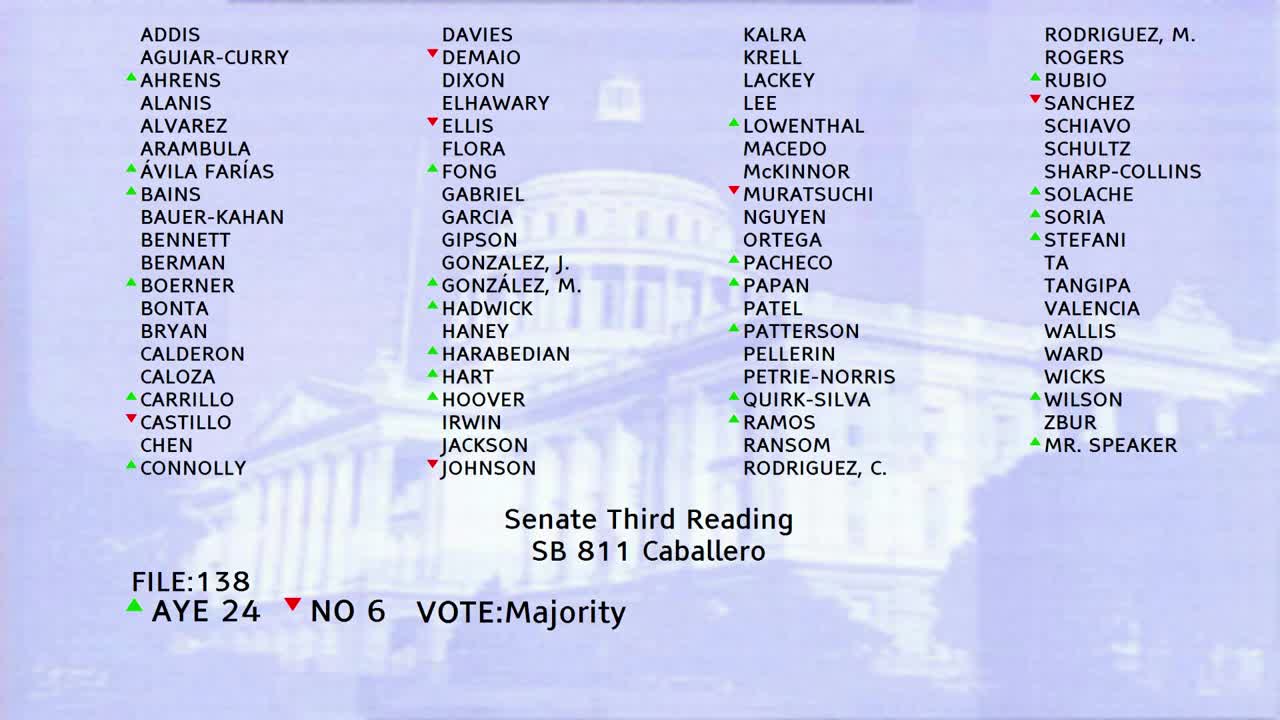 49SEC
Assembly Floor
 2MIN
Senate Floor
 9MIN
Senate Standing Committee on Health
 20MIN
Senate Standing Committee on Housing
 1MIN
Assembly Floor
 19MIN
Assembly Standing Committee on Health
 11MIN
Assembly Standing Committee on Housing and Community Development
Bill Author

Bill Co-Author(s):